Article

High-Spatiotemporal-Resolution GPP Mapping via a Fusion–VPM Framework: Quantifying Trends and Drivers in the Yellow River Delta from 2000 to 2021

1
School of Resources and Environmental Engineering, Ludong University, Yantai 264025, China
2
Institute of Grassland Research, Chinese Academy of Agricultural Sciences, Hohhot 010010, China
3
Institute of Surface-Earth System Science, School of Earth System Science, Tianjin University, Tianjin 300072, China
4
Beijing Institute of Space Mechanics & Electricity, Beijing 100094, China
5
The Institute for Advanced Study of Coastal Ecology, Ludong University, Yantai 264025, China
6
Institute of Coastal Research, College of Hydraulic and Civil Engineering, Ludong University, Yantai 264025, China
*
Author to whom correspondence should be addressed.
Land 2026, 15(1), 184; https://doi.org/10.3390/land15010184
Submission received: 7 December 2025 / Revised: 13 January 2026 / Accepted: 15 January 2026 / Published: 20 January 2026

Abstract

Tracking ecosystem productivity in fast-evolving estuarine wetlands is often constrained by the trade-off between spatial detail and temporal continuity in satellite observations. To address this, we developed a reproducible fusion–VPM framework that integrates multi-sensor data to map Gross Primary Production (GPP) at a high spatiotemporal resolution. By combining the Flexible Spatiotemporal Data Fusion (FSDAF) method with a Time-Series Linear Fitting Model (TSLFM), we constructed a continuous 30 m, 8-day vegetation index record for China’s Yellow River Delta (YRD) from 2000 to 2021. This record was propagated through the Vegetation Photosynthesis Model (VPM) to simulate GPP and quantify the relative contributions of land-use/land-cover change (LUCC) versus environmental factors. The results show a marginally significant increase in total GPP (9.74 Gg C a−1, p = 0.074) over the last two decades. Deconvolution of driving factors reveals that 87.45% of the GPP increase occurred in stable land-cover areas, where the Enhanced Vegetation Index (EVI) was the dominant driver (explaining 79.97% of the variability). In areas undergoing LUCC, the net effect on GPP primarily reflected the combined influences of artificial saline–alkali wetland expansion and cropland expansion: water-to-vegetation conversions enhanced GPP, whereas vegetation-to-water conversions fully offset these gains. This study demonstrates the efficacy of spatiotemporal data fusion in overcoming observational gaps and provides a transferable analytical framework for diagnosing carbon dynamics in complex, dynamic deltaic ecosystems. This study not only provides a critical, high-resolution assessment of carbon dynamics for the YRD but also delivers a generalizable analytical framework for mapping and attributing GPP trends in complex deltaic ecosystems worldwide.

1. Introduction

Wetlands are vital components of the Earth system and underpin regional ecological security and global environmental balance [1]. Among them, estuarine wetlands—formed at the land–sea interface—deliver multiple ecosystem services, including shoreline protection, carbon sequestration, climate regulation, biodiversity habitats, and cultural benefits [2,3]. As a fundamental indicator of wetland functionality, Gross Primary Production (GPP) represents the total carbon fixed by vegetation and serves as a cornerstone for modeling regional carbon cycles and assessing ecosystem sustainability [4,5,6]. However, accurately mapping GPP in dynamic estuarine environments, such as China’s Yellow River Delta (YRD), remains a significant challenge due to the high spatial heterogeneity and rapid temporal variability characteristic of these ecosystems.
Currently, GPP estimation primarily relies on eddy-covariance (EC) observations or remote sensing models. While EC towers provide process-based, high-frequency flux data, their sparse spatial coverage limits regional extrapolation [7]. Conversely, satellite-based Light Use Efficiency (LUE) models offer continuous spatial coverage but are constrained by a persistent trade-off between spatial and temporal resolution [5,8,9]. Coarse-resolution sensors (e.g., MODIS) capture temporal dynamics well but fail to resolve fine-scale landscape fragmentation in heterogeneous wetlands. High-resolution sensors (e.g., Landsat) capture spatial details but suffer from long revisit cycles and frequent cloud contamination, leading to data discontinuities [10]. Consequently, many studies rely on limited, bi-temporal scenes or coarse-resolution imagery to infer productivity change [11,12,13], which are insufficient for disentangling the complex interactions between climatic variability and intense land-use/land-cover change (LUCC) in fast-evolving deltas.
To bridge this gap, spatiotemporal data fusion (STDF) algorithms have emerged as a powerful solution to generate image series with both high spatial and high temporal resolution [10,14]. By fusing Landsat and MODIS data, it is possible to reconstruct continuous surface dynamics that preserve the spatial structure of fine-resolution sensors and the temporal fidelity of coarse-resolution sensors. Integrating such fused high-spatiotemporal-resolution vegetation indices into process-based models, such as the Vegetation Photosynthesis Model (VPM), offers a promising pathway to accurately quantify long-term GPP trends and attribute their drivers at the pixel scale [14,15].
The Yellow River Delta (YRD), recognized as China’s youngest and most representative temperate estuarine wetland, serves as an ideal testbed for investigating complex ecosystem dynamics [16]. Characterized by fragile interactions among river discharge, sediment deposition, and coastal processes, the region has undergone rapid environmental transformation and heightened ecological instability in recent decades due to these natural fluctuations combined with intensive human activities [17,18]. While the accretion of newly formed wetlands can facilitate progressive vegetation succession and enhance ecosystem functioning, strong anthropogenic disturbances and extreme events frequently trigger retrogressive succession, leading to functional degradation [19,20,21]. Although China’s recent Outline of the Plan for Ecological Protection and High-Quality Development of the Yellow River Basin (October 2021) explicitly calls for strengthened protection and restoration of these estuarine habitats, the relative contributions of natural environmental factors (e.g., climate) versus anthropogenic LUCC to GPP variability remain poorly quantified within this highly dynamic landscape.
In this study, we developed a reproducible ecological-informatics framework that couples the Flexible Spatiotemporal Data Fusion (FSDAF) method with a Time-Series Linear Fitting Model (TSLFM) to construct a 30 m, 8-day vegetation index record from 2000 to 2021. This record drives the VPM to map GPP dynamics across the YRD. Specifically, our objectives are to (1) characterize the high-spatiotemporal-resolution evolution of GPP and its inland-to-coast gradients, (2) partition the landscape to quantify the distinct impacts of LUCC and environmental factors on interannual GPP variability, and (3) identify dominant drivers of productivity changes at the pixel scale. This study not only provides a robust dataset for regional carbon management but also demonstrates a generalizable workflow for monitoring complex ecosystem dynamics in data-sparse regions.

2. Materials and Methods

2.1. Study Area

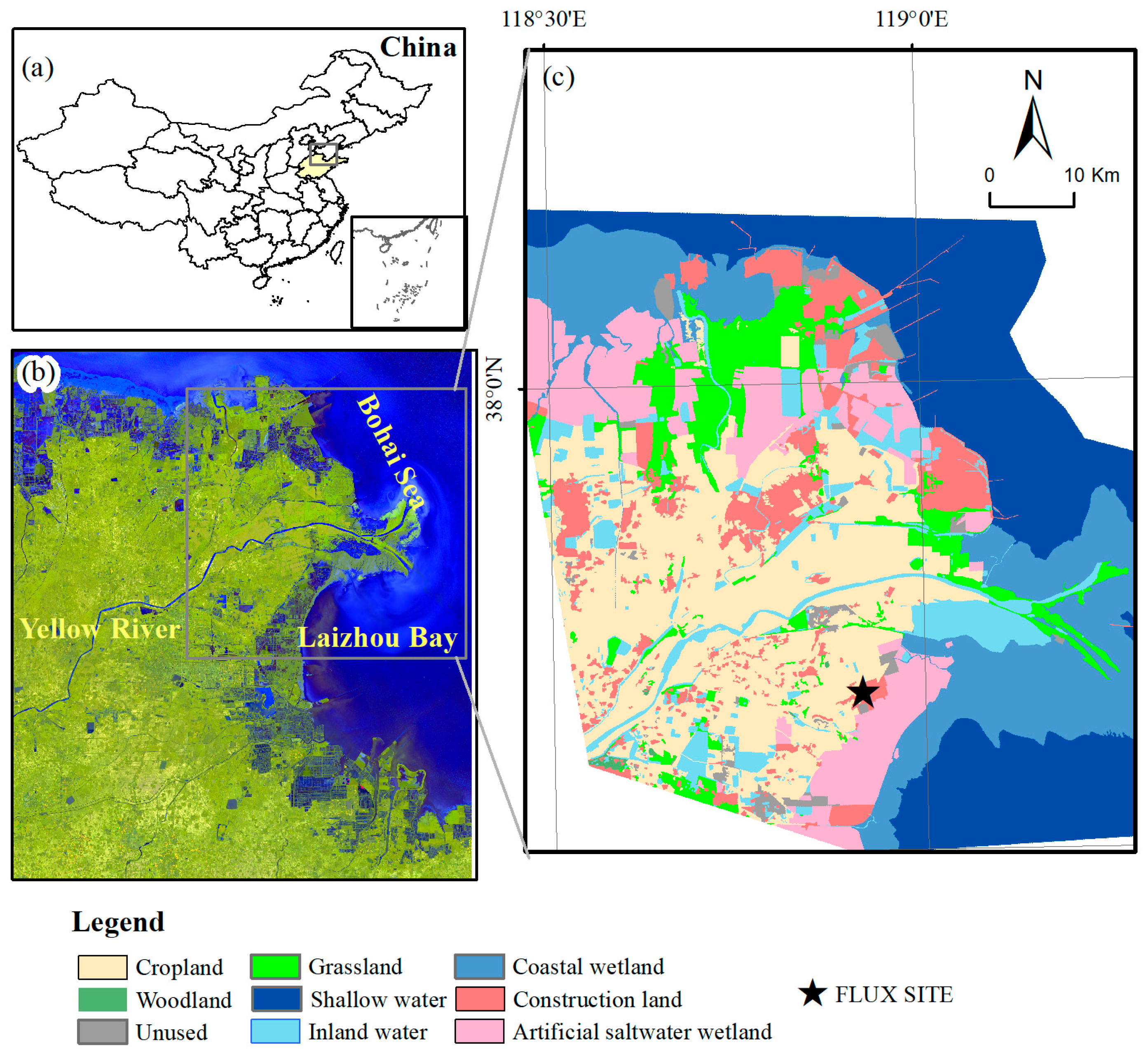
The Yellow River Delta in northern China, (YRD; 118°30′ E–119°30′ E, 37°30′ N–38°10′ N; Figure 1) is an alluvial plain formed by long-term sediment deposition from the Yellow River and exhibits an overall triangular planform. Situated at the confluence of the Bohai Sea and Laizhou Bay, it represents the terminal reach where the Yellow River enters the sea and a typical land–river–ocean interaction zone. The region has a warm-temperate monsoonal continental climate with four distinct seasons, a mean annual temperature of 11–12 °C, and a mean annual precipitation of ~552 mm [22]. The area is characterized by a dense drainage network, multiple water sources, and typical estuarine–coastal wetland functions coupled with hydrological–sedimentary landforms. Owing to historical channel avulsions of the Yellow River, the YRD exhibits geomorphic fragility and instability. Regional relief is low (elevation ~1–2 m), with diverse micro-landforms that include low ridges, gentle slopes, depressions, and natural levees. Elevated soil salinity leads to widespread salinization in parts of the YRD, constraining vegetation growth and resulting in relatively simple floristic composition [23].
Intensive human activities have driven pronounced LUCC, especially conversions between vegetated land and water, reinforcing ecosystem instability. The study area spans the coastal wetland–inland transition and comprises wetlands, croplands, urban/constructed land, and open water (Figure 1 and Figure S1). Considering the interacting influences of rivers, the ocean, and land, we delineated three zones: (i) ConVeg (no vegetation conversion): areas continuously classified as croplands, forests, or grasslands from 2000 to 2020 (1832.72 km2; 49.50%), (ii) Veg_Water (vegetation to water): areas converted from vegetated land to water bodies (440.79 km2; 11.91%), and (iii) Water_Veg (water to vegetation): areas converted from water bodies to vegetated land (163.07 km2; 4.40%).

2.2. Datasets

2.2.1. Remote Sensing Data

We used MODIS surface reflectance (MOD09A1, https://ladsweb.modaps.eosdis.nasa.gov/search/, accessed on 22 May 2025) from NASA LAADS DAAC and Landsat imagery (Landsat-5 TM and Landsat-8 OLI) from the USGS EarthExplorer portal ( https://earthexplorer.usgs.gov/, accessed on 22 May 2025) (Table 1) Landsat scenes provide a 30 m spatial resolution with a nominal 16-day revisit period; their availability is limited by cloud/aerosol contamination. MODIS provides temporally dense coverage to complement Landsat’s spatial detail. All images were co-registered to a common 30 m grid over the YRD. Quality assurance (QA) masks supplied with each product were used to exclude clouds, cloud shadows, and snow/ice prior to index calculation. The Enhanced Vegetation Index (EVI) was derived from atmospherically corrected red and near-infrared reflectance and subsequently used in the fusion and GPP estimation workflow described below.

2.2.2. Meteorological Data

Meteorological variables were obtained from the reanalysis of ERA5 (ECMWF, https://cds.climate.copernicus.eu/datasets, accessed on 22 May 2025), including air temperature, precipitation, relative humidity, and net radiation, at an original spatial resolution of 0.05°. These data were processed at an 8-day temporal scale to match the observation cycle of the fused products.
To match the 30 m spatial grid required for the VPM simulations, the meteorological fields were spatially resampled using bilinear interpolation. While physical downscaling is often necessary in complex terrains, the Yellow River Delta is characterized by a vast, flat alluvial plain with minimal elevational gradients, resulting in relatively smooth spatial variations in temperature and radiation. Therefore, bilinear interpolation was deemed sufficient to capture the regional climatic background, while the high-spatial-resolution heterogeneity of GPP is primarily resolved by the 30 m Landsat-based vegetation indices (EVI and LSWI).

2.2.3. Observation Data

Eddy-covariance (EC) observations were acquired from the Dongying field station (Chinese Academy of Sciences; 118.917° E, 37.669° N) using a closed-path EC system over May 2021–December 2021. Half-hourly fluxes were quality-controlled and aggregated to month values to align with the satellite-driven estimates for evaluation. The tower footprint lies within homogeneous land cover representative of the surrounding pixels used for comparison.

2.2.4. Land-Use/Land-Cover Data

The land-use/land-cover change data utilized in the YRD were derived from China’s coastal zone land-use and land-cover data [24]. This dataset was developed through visual interpretation of high-resolution Google Earth imagery (https://data.casearth.cn/sdo/detail/6253cddc819aec49731a4b9a, accessed on 22 May 2025), ensuring high classification accuracy and spatial consistency, and is widely employed in regional-scale land-use change analyses.
In our simulations, LUCC data for 2000, 2010, and 2020 were used to represent land-cover conditions. To align with the objectives of this research, the original data were reclassified into eight categories: croplands, woodlands, grasslands, construction land, inland water, coastal wetlands, artificial saltwater wetlands, and unused land. This classification system retains the detailed characteristics of the original dataset while highlighting the distribution of wetland resources in coastal zones. It facilitates a systematic analysis of the evolution processes and driving mechanisms behind land-use structure in the YRD region over the past two decades.

2.3. Methods

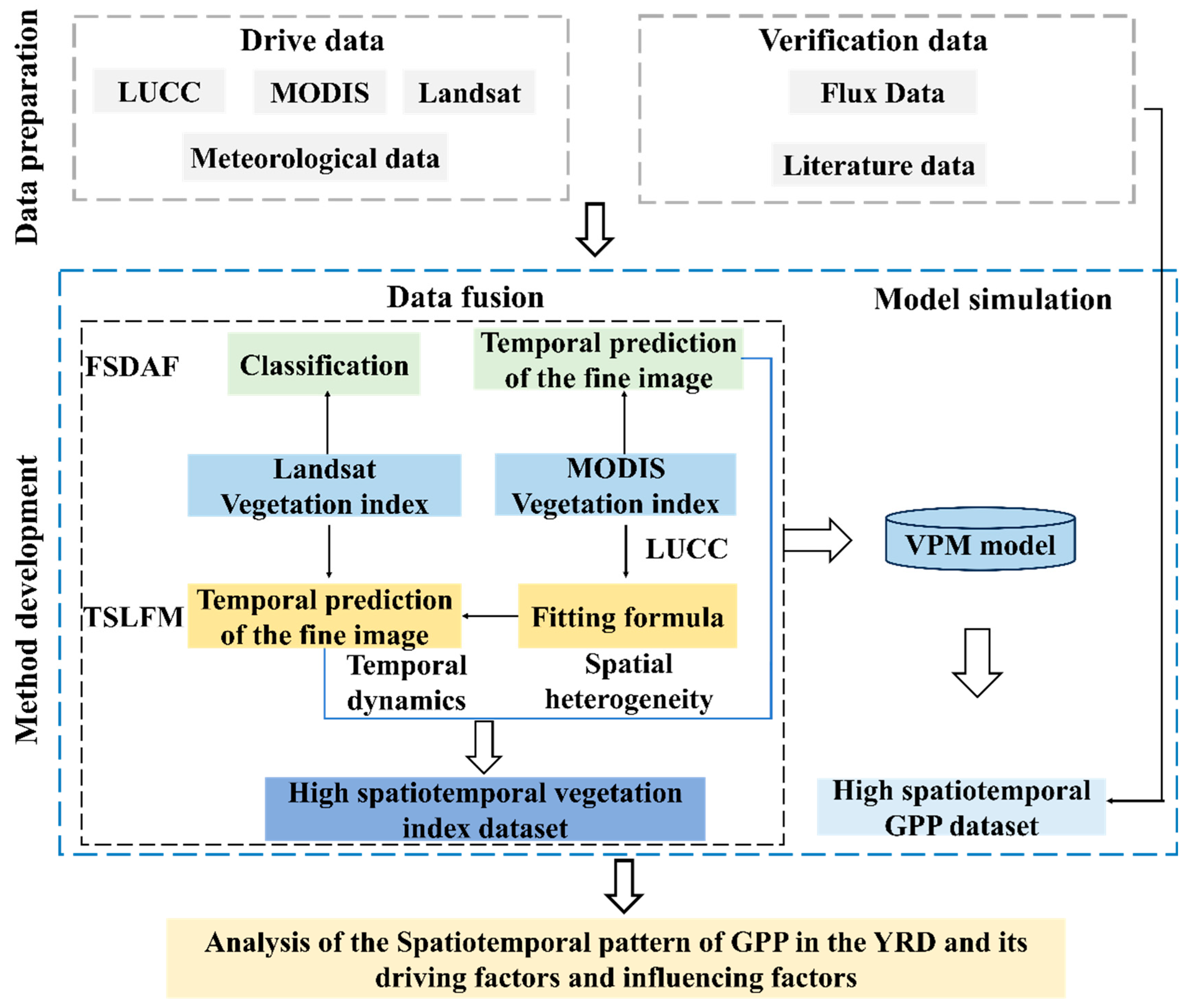
We first integrated multi-source datasets (MODIS, Landsat, LUCC, and meteorological drivers) and performed preprocessing, including projection harmonization, quality control, and masking. Next, we produced a high-spatiotemporal-resolution Enhanced Vegetation Index (EVI) dataset by combining two complementary fusion strategies: the Flexible Spatiotemporal Data Fusion (FSDAF) approach to inject spatial detail from Landsat into the temporal trajectory of MODIS and a Time-Series Linear Fitting Model (TSLFM) to locally extrapolate/interpolate fine-scale time series and enhance temporal continuity. The fused EVI preserves Landsat spatial texture while retaining MODIS phenological dynamics. We then used the fused EVI as a vegetation-state constraint, together with meteorological drivers, to run the Vegetation Photosynthesis Model (VPM) and retrieve a high-spatiotemporal-resolution GPP dataset. Finally, we evaluated the simulations with flux-tower observations and literature benchmarks and assessed model robustness using error statistics and uncertainty analyses (Figure 2).

2.3.1. Construction of the High-Spatiotemporal-Resolution EVI Dataset

We generated an EVI time series for 2000–2021 over the YRD by integrating Landsat and MOD09A1 using FSDAF [14,15].
(1) FSDAF
FSDAF yields accurate fused imagery while retaining spatial details and capturing reflectance changes caused by LUCC. The core relations are
C x i , y i , b = c = 1 l f c x i , y i × F c , b ,
F 2 T P x i j , y i j , b = F 1 x i j , y i j , b + F c , b ,
R x i , y i , b = C x i , y i , b 1 m j = 1 m F 2 T P x i j , y i j , b j = 1 m F 1 x i j , y i j , b ,
F 2 T P x i j , y i j , b = f T P S b x i j , y i j ,
F x i j , y i j , b = m × R x i , y i , b × W x i , y i , b + F c , b ,
F 2 , F S D A F x i j , y i j , b = F 1 x i j , y i j , b + k 1 n w k × F x k , y k , b ,
where ( x i , y i ) indexes the i-th coarse pixel, C ( x i , y i , b ) is the coarse-pixel band-b change between t1 and t2, F ( c , b ) is the fine-resolution band-b change for class c between t1 and t2, and f c ( x i , y i ) is the areal proportion of class c within the coarse pixel. F 2 T P x i j , y i j , b is the time prediction t2 for fine pixels j within the coarse pixel i; R is the within-pixel residual; W is a weight; Dk denotes a relative distance (−1 to 1); and w reflects neighborhood size/weights.
(2) TSLFM
TSLFM estimates the temporal evolution of pure pixels by fitting class-specific relations between times t1 and t2:
C 2 ¯ l , b = m × C 1 ¯ l , b + n ,
F 2 , T S L F M l , b = m × F 1 l , b + n ,
where m and n are fit parameters; l indexes vegetation classes; C 1 ¯ and C 2 ¯ are class-mean fine-resolution indices at t1 and t2, respectively; and F1 and F2 are fine-resolution band-b values at t1 and t2.
(3) FSDAF–TSLFM integration
We combine TSLFM’s temporal trend with FSDAF’s spatial heterogeneity [25]:
F 2 , F u s e d l , b = F 2 , T S L F M l , b ¯ + F 2 , F S D A F l , b ,
F 2 , F S D A F l , b = F 2 , F S D A F l , b F 2 , F S D A F l , b ¯ ,
where F 2 , F u s e d ( l , b ) denotes the final fused fine-resolution image (band b) at time t2; F 2 , T S L F M l , b ¯ is the class-mean value of band b at t2 predicted by TSLFM; and F 2 , F S D A F l , b ¯ is the corresponding class-mean value predicted by FSDAF. The overbar indicates a class mean (spatial average) within class l.

2.3.2. VPM-Based GPP Simulation

We simulated GPP using the VPM, in which the canopy is partitioned into chlorophyll-containing and non-photosynthetic components [26,27]. The core equations are
G P P = ε g × F P A R c h l × P A R ,
ε g = ε 0 × T s c a l a r × W s c a l a r × P s c a l a r ,
where εg is the realized light-use efficiency (LUE); FPARchl is the fraction of PAR absorbed by the chlorophyll pool; PAR is photosynthetically active radiation; ε0 is the maximum LUE; and the three scalars downregulate ε0 for temperature, water, and phenology effects, respectively.
We approximate FPARchl as a linear function of EVI, where
F P A R c h l = a × E V I   ( w i t h   a = 1 ) ,
The temperature scalar (Tscalar) is
T s c a l a r = T T m i n × T T m a x T   T m i n × T   T m a x T   T o p t 2 ,
where Tmin, Tmax, and Topt are the minimum, maximum, and optimal temperatures for photosynthesis. Tscalar = 0 when the air temperature is below Tmin.
The water scalar (Wscalar) uses the Land-Surface Water Index (LSWI):
W s c a l a r =   1   +   L S W I 1   +   L S W I m a x ,
where LSWImax is the maximum LSWI during the growing season.
The phenology scalar (Pscalar) accounts for leaf age, where
P s c a l a r = 1 + L S W I 2 ,
During fully expanded canopy conditions, Pscalar = 1.0. For canopies with multiple leaf-age cohorts or continuous leaf emergence within the season, Pscalar is likewise set to 1.0.

2.3.3. Spatial Fidelity Evaluation Scheme

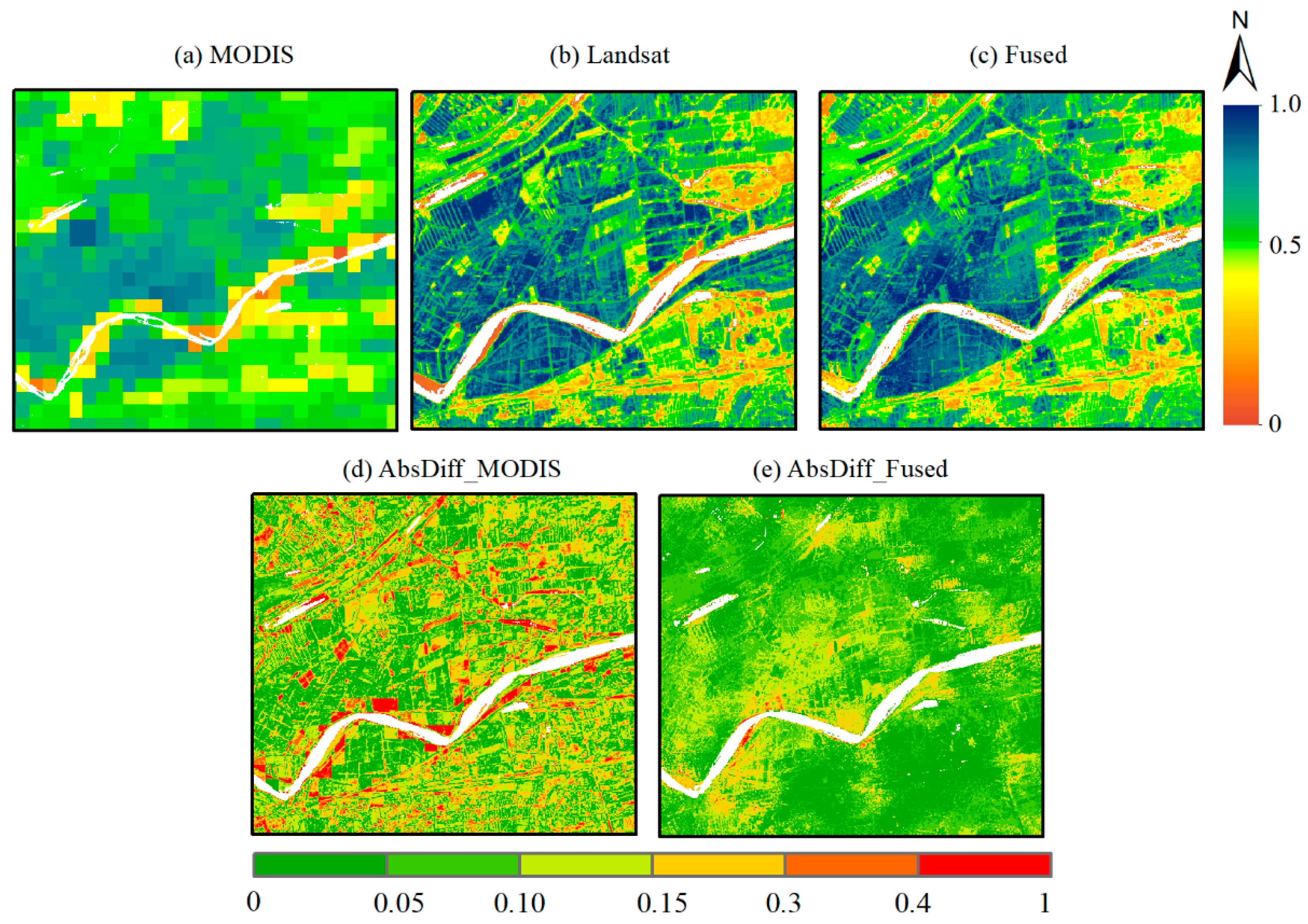
To evaluate the spatial performance of the fusion algorithm in heterogeneous landscapes, we selected a representative case from 20 August 2008. This scene was chosen because it captures the peak growing season with sharp morphological boundaries along riverbanks and channel margins, providing a rigorous test for the model’s ability to recover Landsat-level detail from MODIS observations.

2.4. Statistical Analyses

We assessed temporal trends (2000–2021) using linear regression and, where applicable, a piecewise formulation to explore potential change points:
y = β 0 + β 1 t + ε t t q ,
where t is the year, q denotes a potential breakpoint, β0 and β1 are regression coefficients, and ε is the residual.
We also computed Theil–Sen slopes [28,29] that robustly estimate pixel-wise and regional trends:
β = M E A N X j     X i j i , 2000 i < j 2021 ,
where β is the slope, while Xj and Xi are observations at times i and j. Model fit was summarized using the coefficient of determination (R2). To address the issue of multiple testing inherent in pixel-wise analysis, which can lead to an inflation of Type I errors, we applied the False Discovery Rate (FDR) control procedure to adjust the significance levels of the trend and correlation tests [30]. As emphasized in recent studies on spatiotemporal trend testing [31], robust error control is essential for validating spatial patterns in raster-based ecological datasets. In this study, an FDR threshold of q = 0.05 was used to determine the significance of the interannual GPP trends.

2.5. Contribution Analysis

To quantify how different subregions drive the basin-wide GPP trend, we applied a structural equation model (SEM) using the lavaan package in R (version 4.3.3). All path coefficients are standardized estimates (variables centered and scaled prior to analysis), ensuring comparability across paths. We computed signed contributions by combining standardized path coefficients with each subregion’s GPP trend (slope):
C i = β i · k i j 1 n β i · k i × 100 % ,
where β i is the standardized SEM path coefficient for subregion i, ki is its linear GPP trend (slope), and C i is the relative contribution to the regional GPP trend (%). Positive values denote promotion, while negative values denote inhibition.
Prior to assessing the relative influence of environmental predictors on GPP, we standardized variables (min–max scaling) to remove unit effects:
X i = x i     X m i n X m a x     x m i n ,
where Xi is the standardized value for year i, xi is the original value, and xmax and xmin are the series extrema.
We then fitted multiple linear regression (MLR) using
Y = b 0 + b 1 X 1 + b 2 X 2 + + b i X i + ε ,
f i = d b i X i / d t ,
where bi represents standardized regression coefficients, Xi represent normalized predictors (environmental factors), ε is the residual, Y is the dependent variable (GPP), and fi denotes the contribution of factor i to the GPP trend.

2.6. Pixel-Level Dominance Analysis

To evaluate the relative importance of different drivers, a dominant factor analysis was performed. For each pixel i, we identified the dominant factor Di by comparing the absolute correlation coefficients (|R|) between GPP and n environmental factors:
D i = a r g m a x ( | R i , 1 | ,   | R i , 2 | ,   | R i , n | ) ,
where Ri,n represents the Pearson correlation coefficient for the n-th factor. This pixel-level competition approach highlights the most influential driver of GPP interannual variability across the YRD.

3. Results

3.1. Accuracy Assessment of GPP

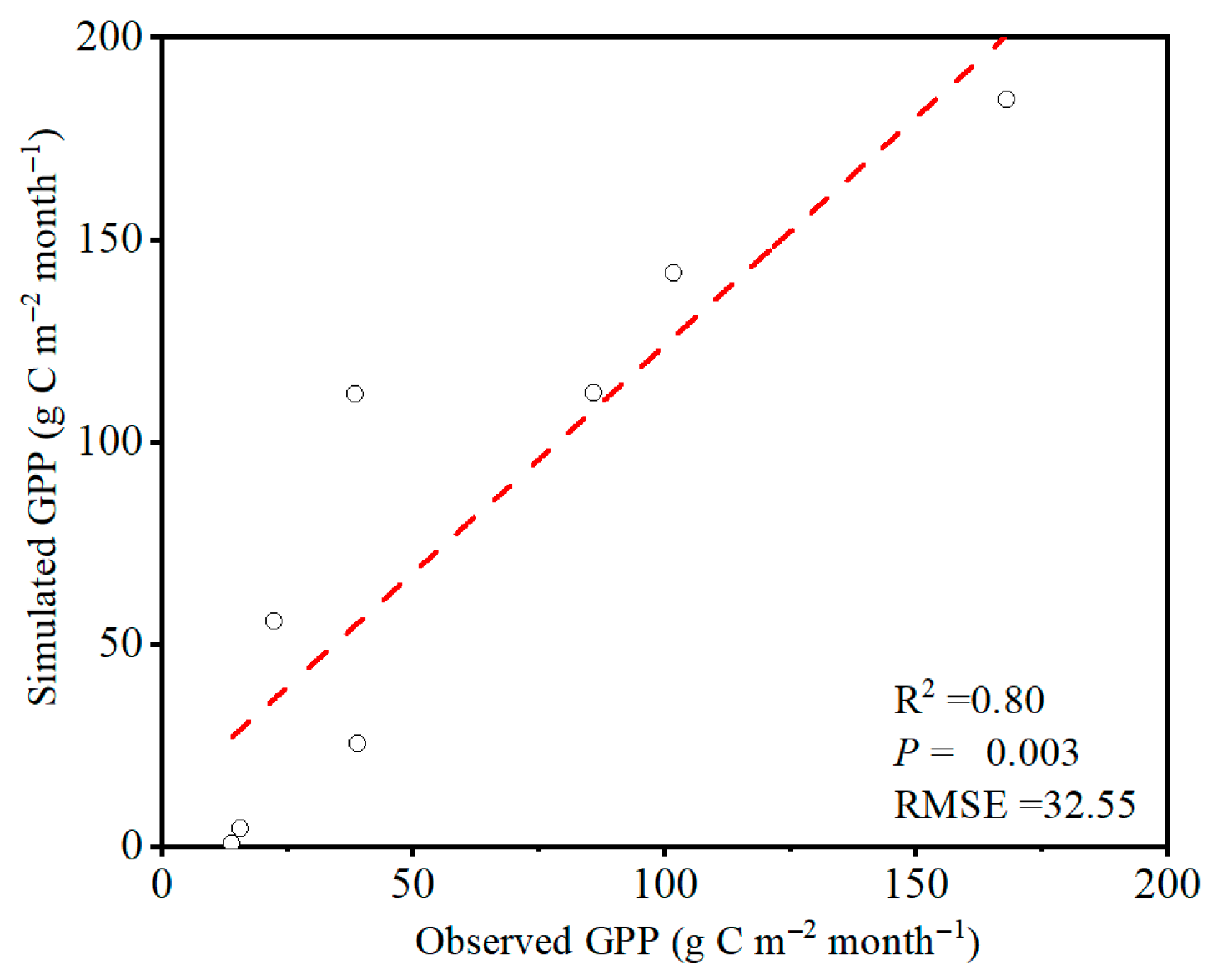
Accurately reproducing the GPP is fundamental for analyzing spatiotemporal dynamics and their drivers in the YRD. We evaluated the VPM-based estimates against month eddy-covariance observations at the Dongying site from May 2021 to December 2021 (Figure 3). Simulated and observed GPP showed strong agreement (R2 = 0.80; p = 0.003), indicating that our GPP retrievals are reliable and that the VPM performs well for GPP estimation in the YRD.

3.2. Spatial Distribution of GPP

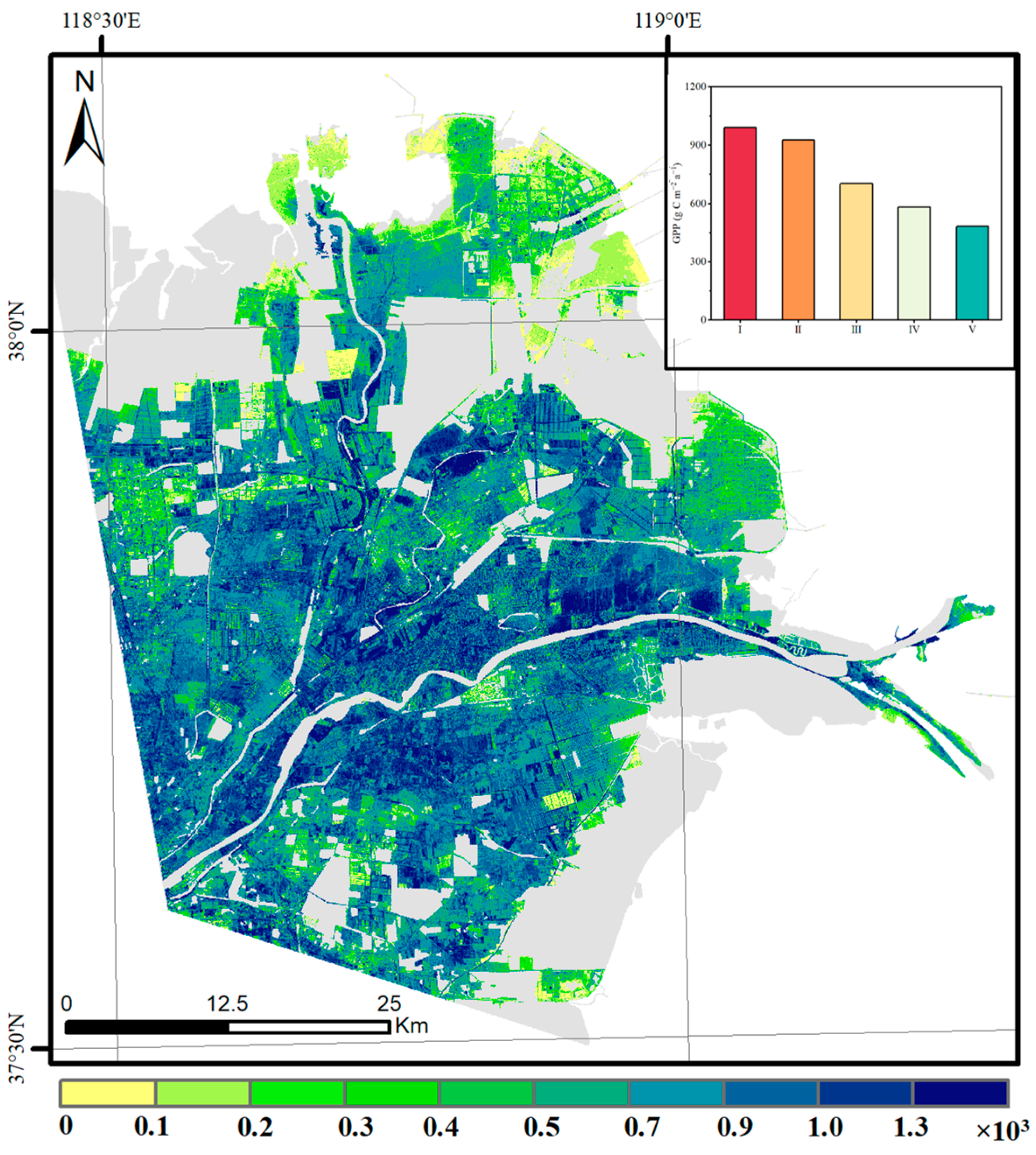
In 2021, the mean annual GPP across the YRD was 536.68 g C m−2 a−1, and total GPP reached 1574.48 Gg C a−1. Marked differences were evident among land-use/land-cover classes (Figure 4): Forests exhibited the highest GPP (989.93 g C m−2 a−1), significantly exceeding other vegetation types. Croplands and grasslands averaged 925.52 and 702.22 g C m−2 a−1, respectively. Built-up land and unused land were lower, at 582.89 and 481.77 g C m−2 a−1. Spatially, GPP displayed pronounced heterogeneity with a general inland-to-coast decreasing gradient (Figure 4). High-value areas (>1300 g C m−2 a−1) were concentrated in the central, eastern, and southwestern sectors and around the estuary, whereas low-value areas (<300 g C m−2 a−1) occurred mainly along the northern and southeastern coasts and in scattered inland patches.

3.3. Temporal Trends in GPP

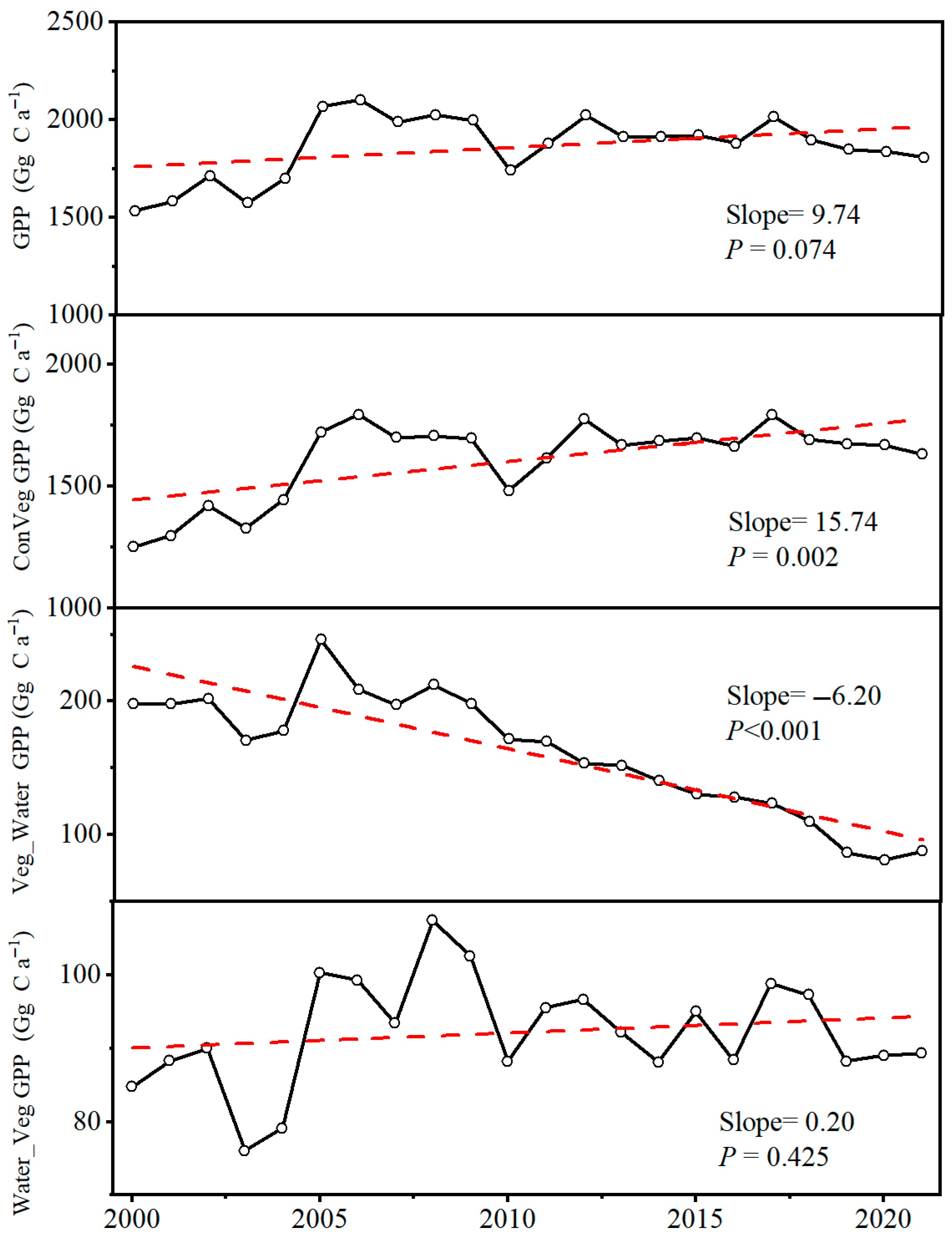
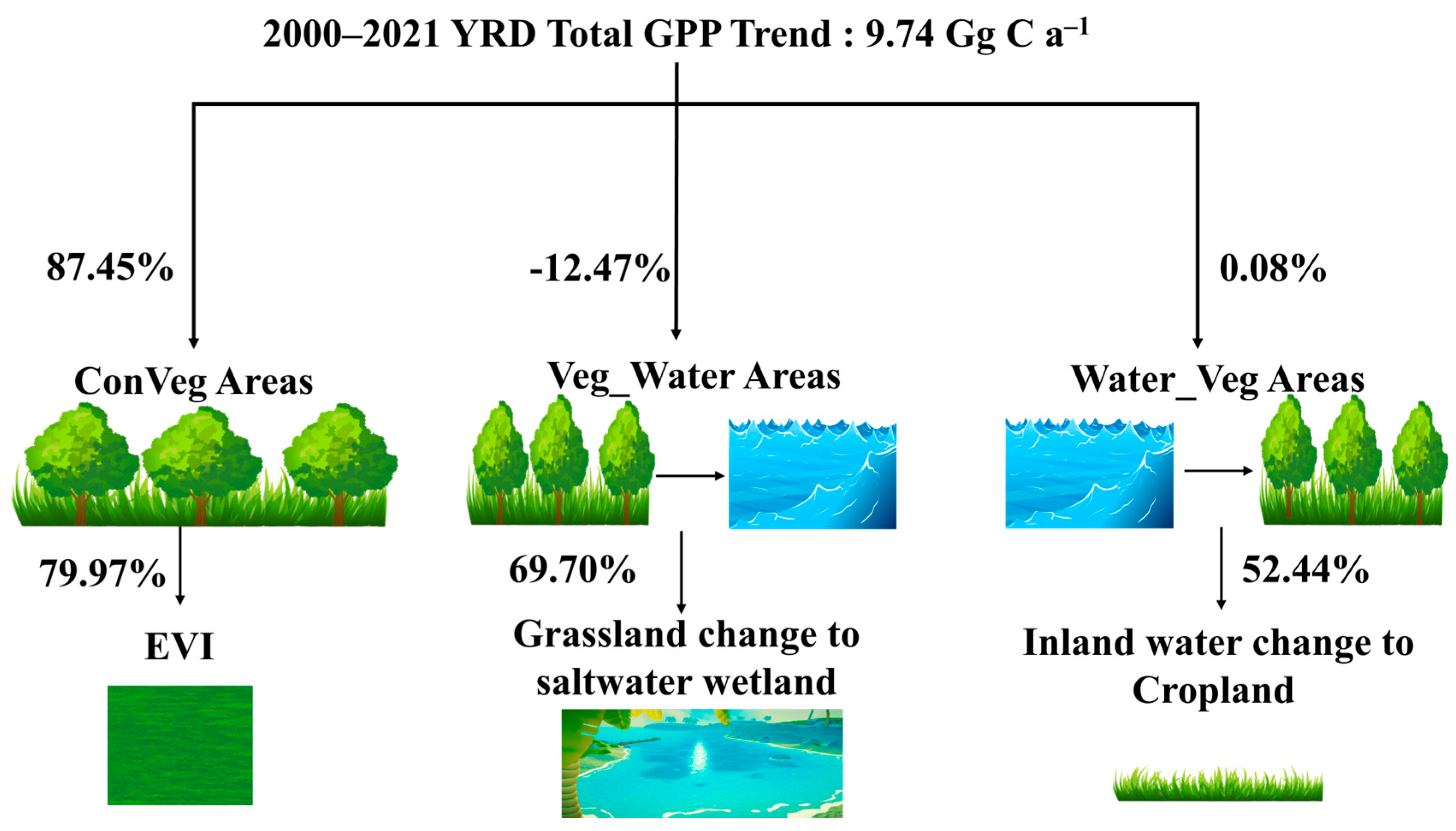
From 2000 to 2021, the increase in regional GPP was marginally significant (p = 0.074), with total GPP rising at an average rate of 9.74 Gg C a−1 (Figure 5) and the area-averaged GPP increasing by 3.32 g C m−2 a−1 (p = 0.027) (Figure S2). Partitioning by LUCC status shows that ConVeg (no vegetation conversion) dominated the upward trend, contributing 87.45% of the increase. In ConVeg, total GPP rose by 15.74 Gg C a−1 (p = 0.002), and mean GPP increased to 8.69 g C m−2 a−1 (p < 0.001), identifying this zone as the principal driver of carbon-sink enhancement. Among conversion zones, Water_Veg exhibited an increase in total GPP of 0.20 Gg C a−1 (p = 0.425), accounting for +0.08% of the regional increase; its mean GPP also rose by 5.12 g C m−2 a−1 (p = 0.001). By contrast, Veg_Water showed a significant decline in total GPP of 6.20 Gg C a−1 (p < 0.001), contributing −12.47% (i.e., offsetting part of the regional gain).
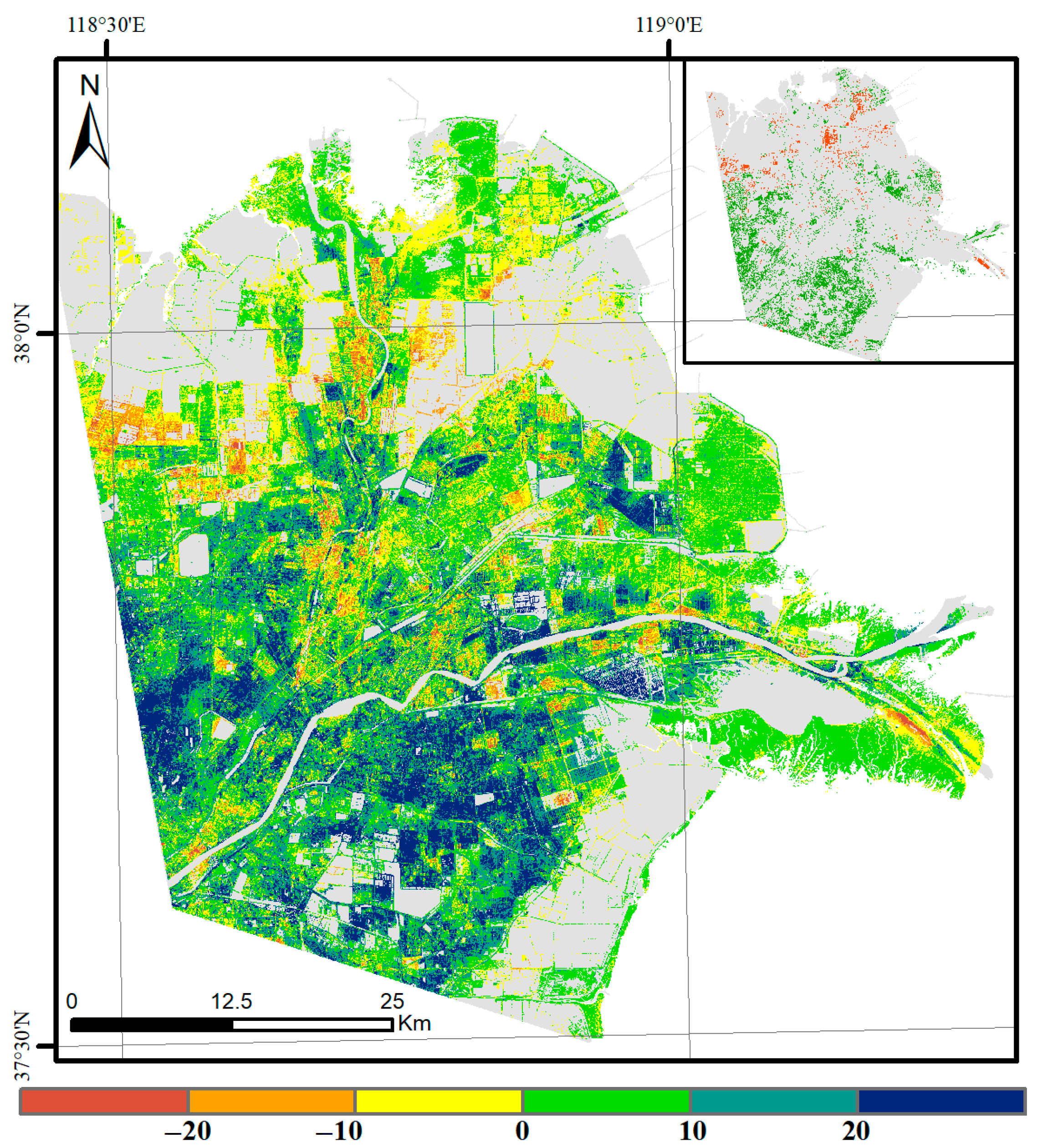
We further mapped the interannual trend at the pixel scale (Figure 6). To ensure the statistical robustness of the inferred spatial patterns, we explicitly quantified the impact of False Discovery Rate (FDR) correction. Out of a total of 2,266,389 valid pixels tested, 24.49% were initially identified as significant at the nominal level (p = 0.05). Spatial trend analysis, adjusted for multiple testing using FDR control (q < 0.011), revealed that 22.34% of the study area exhibited significant interannual changes in GPP (Figure 6). The comparison reveals that while the correction removed approximately 2.15% of pixels (likely false positives constrained to transition zones), the vast majority of the detected trends were preserved, confirming the reliability of the reported greening and browning patterns (Table S3).
Specifically, 18.90% of the region exhibited significant greening that was primarily concentrated in the northern, eastern, and northeastern YRD and in inland areas. Conversely, 3.44% of pixels showed significant decreases that were mainly distributed along the northern YRD coastline, the southern coast near the river mouth, and scattered inland locations.

3.4. Effects of Land-Use/Land-Cover Change on GPP

The YRD experienced substantial LUCC, notably reciprocal conversions between vegetated land and water (Figure S2; Table S1). Specifically, Veg_Water expanded by 440.79 km2 (18.09%), including 247.64 km2 of artificial saline–alkali wetland expansion. Water_Veg expanded by 163.07 km2 (6.69%), driven chiefly by increases in croplands (58.75 km2), with smaller gains in forests (8.1 × 10⁻³ km2) and grasslands (38.66 km2) (specific in Figure S3).
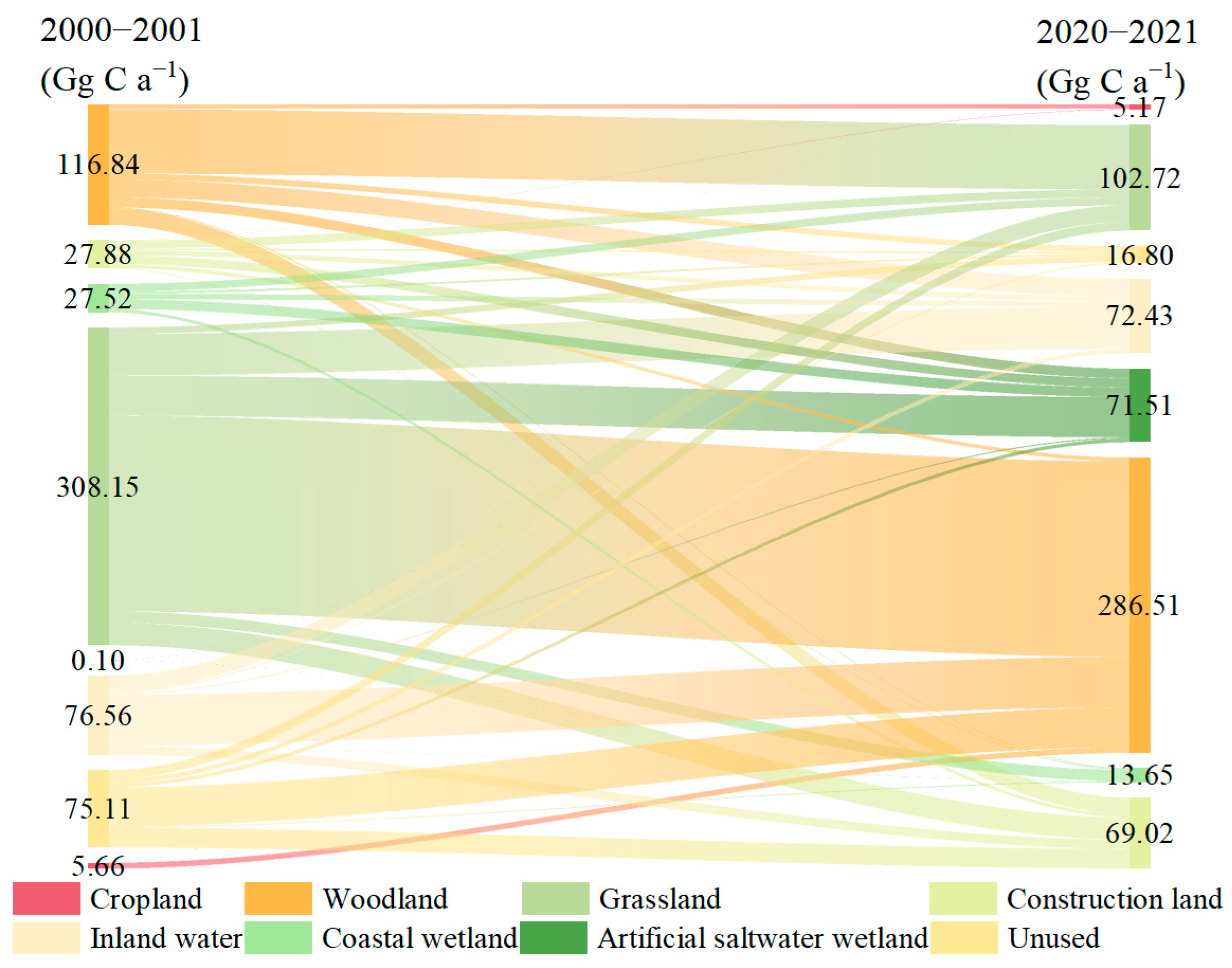
A GPP transfer matrix among LUCC types (Figure 7) further clarifies impacts on carbon fluxes. Grasslands exhibited the largest GPP outflow (308.15 Gg C a−1), whereas artificial saline–alkali wetlands had the smallest outflow (0.10 Gg C a−1). Conversions from grasslands to artificial saline–alkali wetlands accounted for 69.70% of the Veg_Water GPP change, while inland water-to-cropland conversions explained 52.44% of the Water_Veg GPP increase. Overall, LUCC effects on GPP reflect the combined influence of artificial saline–alkali wetland expansion and cropland expansion.

3.5. Drivers of GPP in ConVeg Areas

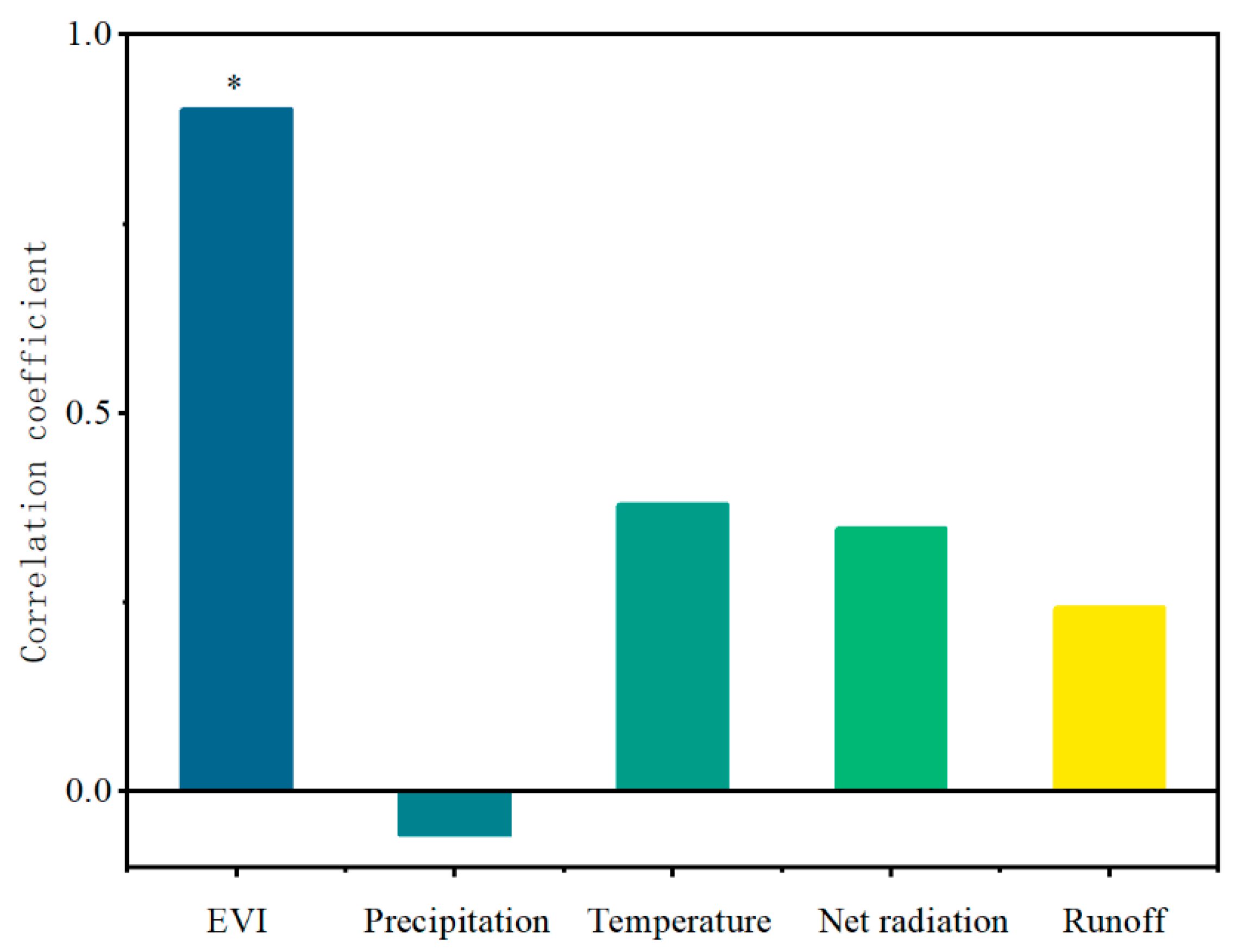
Interannual variability of GPP in ConVeg is dominated by the vegetation condition (EVI), with a correlation coefficient of 0.90 (Figure 8). In comparison, precipitation, temperature, net radiation, and runoff exert weaker overall influences. Contribution analysis indicates that the EVI explains 79.97% of the interannual GPP variability, substantially exceeding other environmental factors (Table 2).
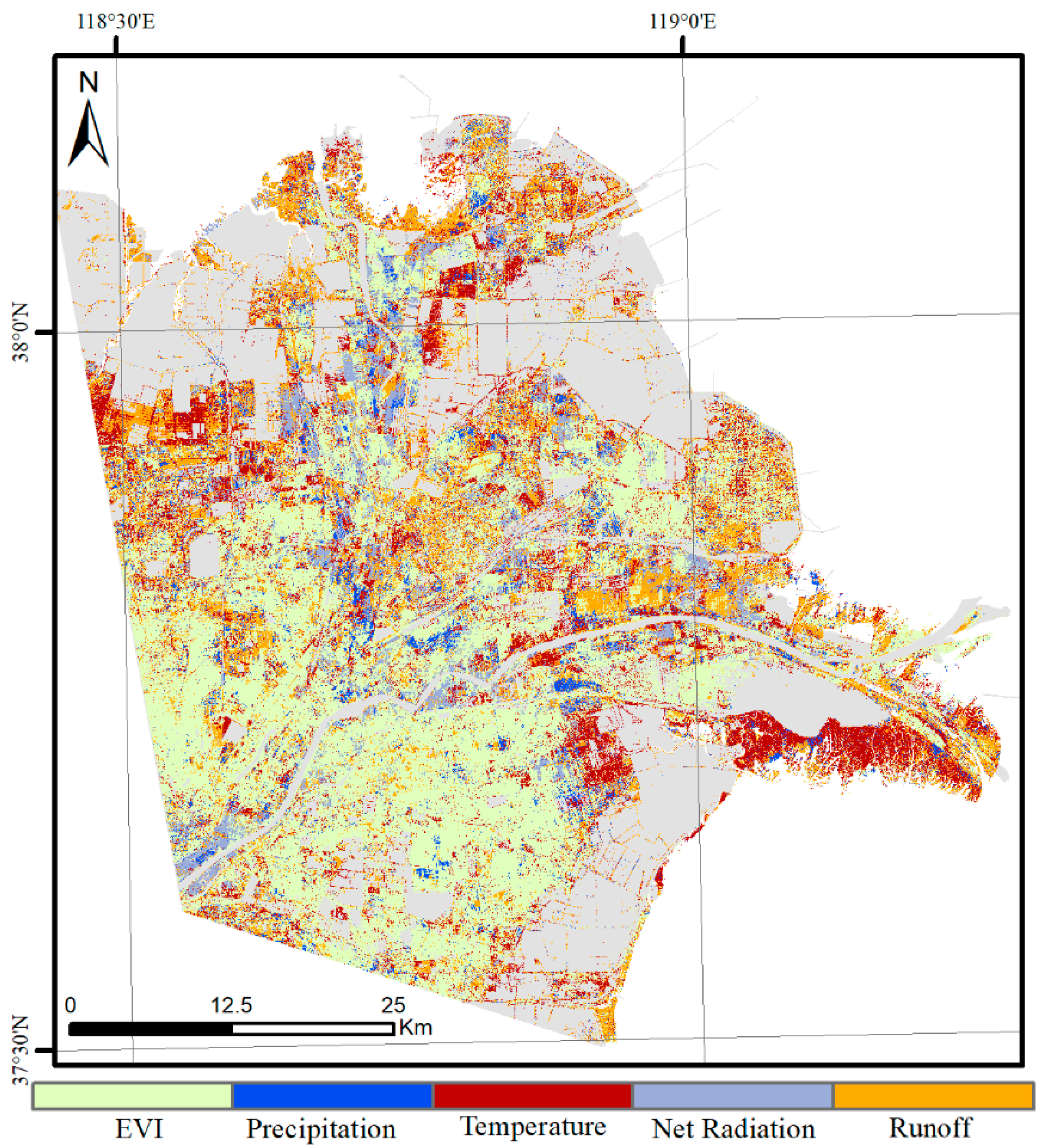
To examine spatial heterogeneity in controls, we mapped the factor with the highest local correlation with GPP (Figure 9). The EVI leads over ~50.94% of the area, followed by runoff (17.84%), temperature (15.90%), net radiation (9.84%), and precipitation (5.46%). Taken together, the EVI is the primary driver of interannual GPP variability in ConVeg.
At the regional scale, GPP trends reflect the joint influence of environmental factors and LUCC (Figure 10). ConVeg acts as the major positive driver (+87.45%) and is dominated by EVI-linked changes. Veg_Water exerts a strong negative effect (−12.47%), largely due to extensive grassland-to-artificial saline–alkali wetland conversions that reduce GPP. Water_Veg provides a weaker but positive contribution (+0.08%), mainly via inland water-to-cropland transitions.

4. Discussion

4.1. Validation of the High-Spatiotemporal-Resolution Fused Dataset

Because MODIS offers dense temporal sampling at a coarse resolution whereas Landsat resolves fine surface heterogeneity with sparse temporal coverage, it is essential to verify that the fused product inherits the strengths of both sensors. Spatial validation using the illustrative case (as described in Section 2.3.2) shows that the fused product recovers Landsat-level detail along riverbanks and channel margins where morphological boundaries are sharp and elevated EVI values (>0.5) are common (Figure 11a–c). Absolute-error maps relative to Landsat reveal blocky high-error patches for MODIS around rivers and field edges (Figure 11d), whereas these errors are markedly reduced for the fused product (Figure 11e). The capability of such fusion frameworks to resolve complex morphological boundaries and mitigate the ‘mixed pixel’ effect in fragmented landscapes has been extensively documented [14,32]. In boundary-rich pixels—where morphological complexity is highest—the fused EVI achieved a 54.87% reduction in Mean Absolute Error (MAE) compared to the original MODIS data (MAE decreased from 117.51 to 53.03). This substantial decrease in error indicates that coarse-resolution assessments inherently ‘blur’ carbon-intensive features along riverbanks and channel margins. Therefore, our high-resolution approach is not merely a spatial enhancement strategy but a necessary correction for accurately diagnosing carbon dynamics in the fragmented deltaic mosaic of the YRD.
The objective necessity of the 30 m resolution is further justified by the error characteristics of the model’s vegetation driver. The 54.87% reduction in EVI MAE achieved by our fusion approach (Figure 11) is particularly critical for the YRD’s fragmented landscape. At a 500 m resolution, the EVI signals of narrow ecological corridors are blended with surrounding background soil, a phenomenon known as the ‘mixed pixel effect’. By resolving these sub-pixel drivers, our framework ensures that the calculated GPP trends are not artifacts of spatial averaging but reflect the true biological response to land-use changes such as artificial wetland expansion.
Furthermore, it is noteworthy that the integration of multi-sensor data requires careful consideration of radiometric and spectral inconsistencies arising from differing spectral response functions [14]. In this study, these challenges were addressed by leveraging the inherent error-correction mechanisms of the FSDAF and TSLFM frameworks. Specifically, residual-based allocation in FSDAF compensates for localized radiometric differences between Landsat and MODIS, ensuring that the fused outputs maintain high spectral fidelity [14]. Moreover, the use of atmospherically corrected surface reflectance products provided a consistent physical baseline, which has been proven effective in reducing inter-sensor bias in heterogeneous coastal ecosystems [33]. Our spatial validation results (Figure 11) confirm that these spectral discrepancies did not introduce significant artifacts, allowing for a seamless reconstruction of a 22-year GPP time series.
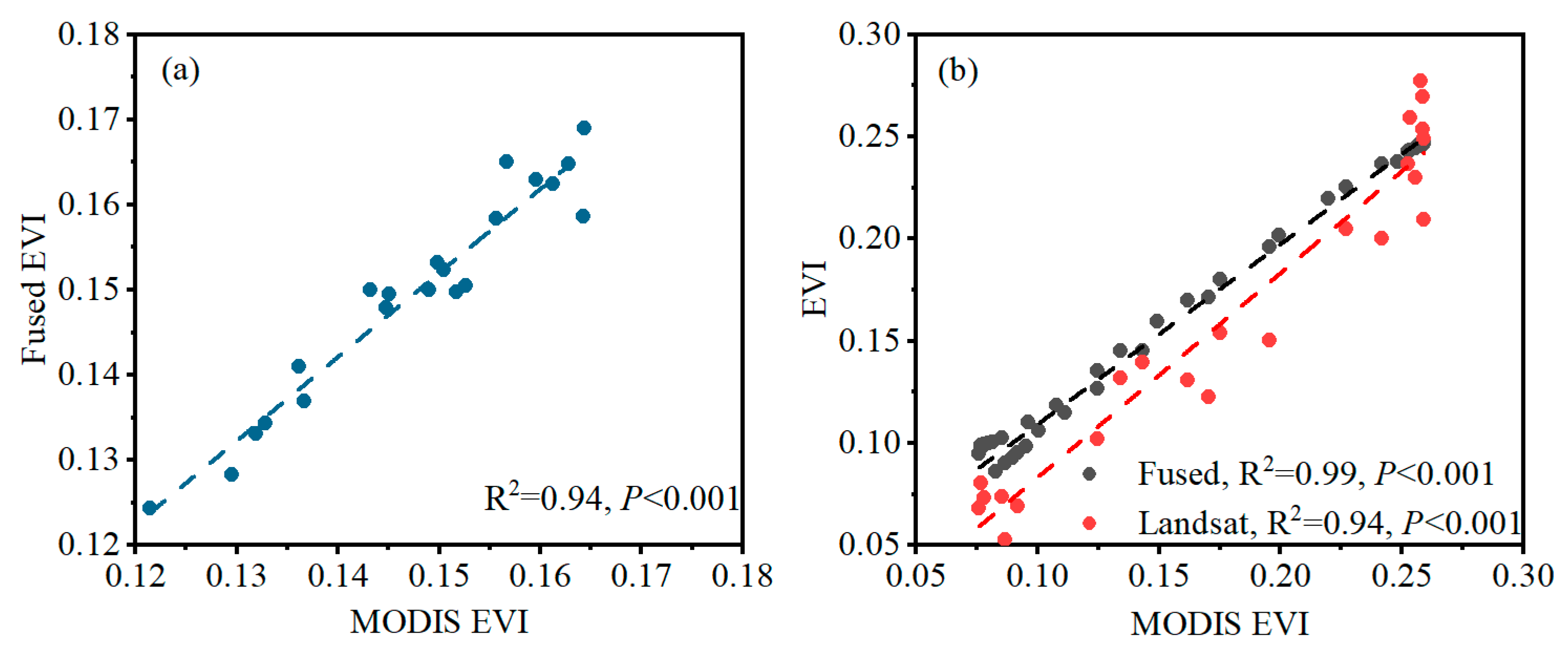
At broader temporal scales, the fused EVI retains MODIS-like phenological continuity. Over 2000–2021, fused and MODIS EVIs are strongly correlated at the interannual scale (R2 = 0.94; p < 0.001; Figure 12a), with an even tighter relationship at the seasonal scale (R2 = 0.99; p < 0.001; Figure 12b). Taken together, these checks demonstrate that the fusion approach restores spatial fidelity at 30 m while preserving long-term temporal coherence with MODIS, thereby achieving both temporal completeness and spatial detail critical for interannual analyses in rapidly evolving estuaries. Previous studies have confirmed that this synergistic use of multi-source data provides the necessary radiometric stability and temporal frequency for robust long-term ecological trend assessments [33].

4.2. Comparison with Related Studies

At the site scale, daily GPP simulated by the VPM agrees well with eddy-covariance (EC) observations (Figure 3), reproducing observed daily amplitudes and intra-annual variability. From 17 May to 30 December 2021, observed GPP averaged 114.51 ± 2.59 g C·m−2·d−1, while simulated GPP averaged 120.75 ± 3.24 g C·m−2·d−1—comparable magnitudes that support model credibility given flux-footprint versus pixel-grid representativeness differences.
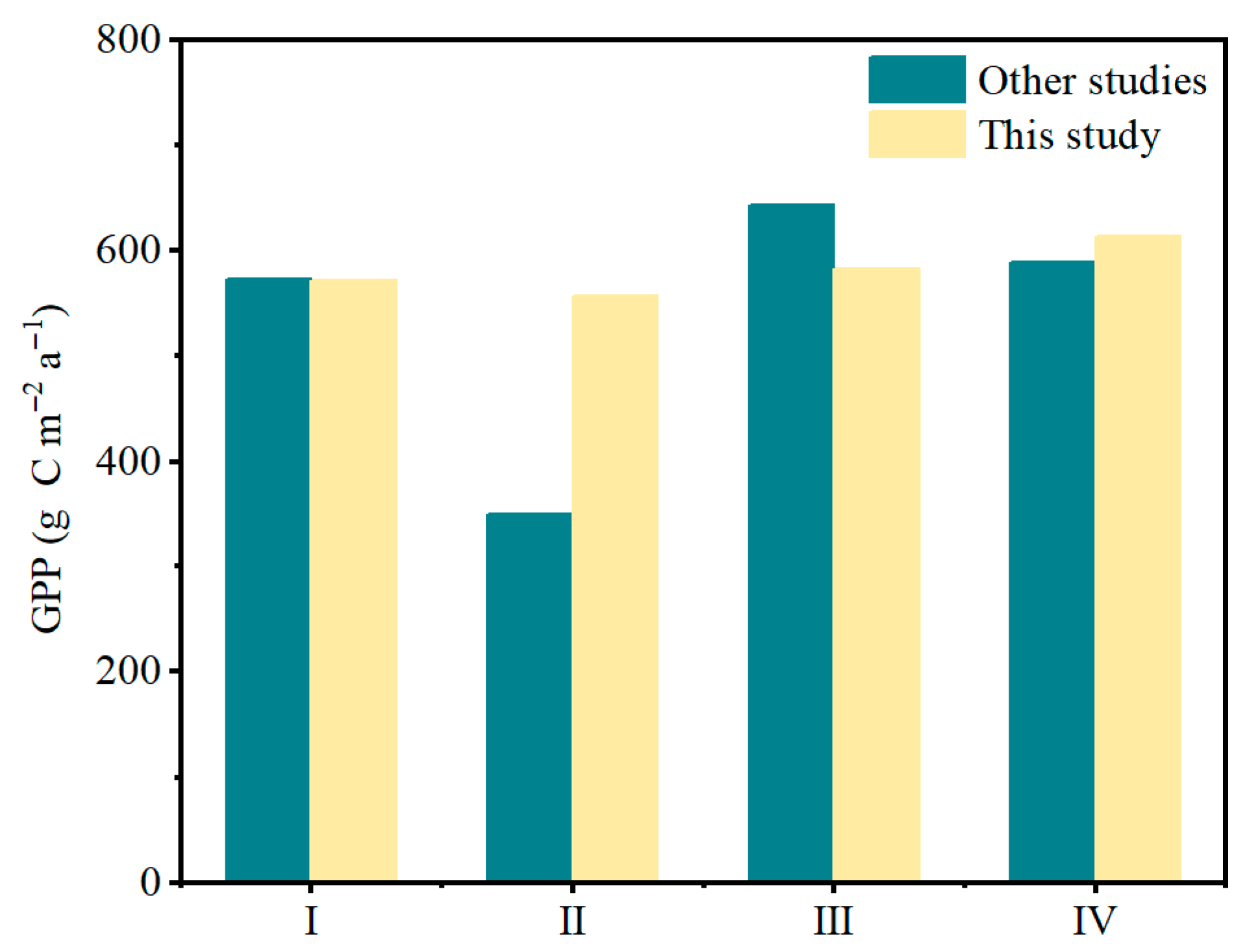
At the annual landscape scale, our YRD GPP estimates align with published magnitudes and trends [11,34,35,36]. The magnitudes are consistent with literature values (Figure 13; Table S2). This numerical convergence across different study periods suggests a stable regional ecological baseline defined by the delta’s climatic and biological limits. Most prior work relies on MODIS (e.g., MOD13Q1), often using limited seasonal windows (e.g., June–August of selected years) [34]. While such approaches capture broad variability, a coarse spatial resolution hampers representation of within-season dynamics and fine-scale land–water mosaics and limits construction of long, high-spatiotemporal-resolution GPP series—thereby increasing uncertainty in interannual assessments. Furthermore, while regional means appear similar, the drivers of these values differ across resolutions. In coarse-scale studies, localized GPP gains from artificial wetland expansion are often numerically offset by losses in fragmented, degraded patches within the same large pixel. In contrast, our workflow derives GPP from a fused, high-resolution VI time series, reconciling temporal continuity with spatial detail: it preserves MODIS-consistent seasonal/interannual fluctuations while recovering Landsat-scale heterogeneity. Considering both means and slopes, the fusion–VPM dataset offers a more complete depiction of the YRD’s interannual GPP increase, providing a robust basis for trend attribution.

4.3. Mechanisms and Management Implications

Since the late 1990s, a suite of conservation and restoration programs—such as “returning farmland to wetlands” and hydrological reconnection—has improved the ecosystem structure and function of YRD wetlands, increasing vegetation cover and stability [37,38,39]. Under widespread soil salinity, advances in restoration practices have helped control salinization and enabled saline–alkali agriculture, creating more favorable soil–water conditions for plant growth [40].
Regional water resources reflect both interannual climate variability and human regulation. Water–sediment regulation operations on the Yellow River and ecological water-replenishment projects in the YRD have substantially enhanced regional water supply. The former maintain downstream water balance and improve aquatic conditions by adjusting the water–sediment relationship, thereby alleviating, to some extent, soil salinization and land degradation. The latter secure sustainable water use through managed diversions and optimized allocation, promoting wetland recovery, vegetation growth, biodiversity, and ecosystem services.
Since 2000, the YRD has advanced an eco-circular economy with an increasingly diversified industry [41]; irrigation practices have been optimized alongside cropland expansion, underpinning sustained increases in growing-season vegetation indices [42]. These integrated measures provide synergies across agricultural irrigation, conservation, and water-quality improvements [43,44]. Under adequate water supply, riparian croplands benefit from lateral infiltration, which leaches salts, suppresses surface salt accumulation, and reduces soil and groundwater salinity [45]. Improved irrigation conditions further support land reclamation and agricultural intensification; together with optimized land management and ecological restoration, these changes strengthen the regional carbon sink.
GPP dynamics in the YRD are jointly driven by environmental factors and LUCC. The ConVeg zone is the principal positive driver of the regional trend, with GPP variability dominated by the EVI. Although the EVI is an input variable in the VPM, our attribution analysis indicates that climatic factors contributed minimally to the long-term GPP trend (Figure 10). This implies that the dominant role of the EVI primarily reflects substantial changes in biotic structure—such as land-cover conversions and enhanced canopy density—rather than being driven by meteorological variability. Because the EVI is closely linked to chlorophyll content—central to light absorption and conversion—its increase reflects enhanced canopy photosynthetic capacity [46]. Yet additional processes, notably atmospheric CO2 rise, also play important roles [47,48]. Increasing CO2 levels have been a key driver of global greening in recent decades [49,50,51], elevating canopy photosynthesis via enhanced carboxylation [52,53], promoting biomass accumulation and cover expansion [54], and increasing light-use efficiency [55]. Elevated CO2 levels typically reduce stomatal conductance [56,57], improving carbon assimilation efficiency per unit PAR. The EVI is further shaped by canopy structure, which often improves with higher chlorophyll content; when rising CO2 triggers stomatal regulation, increases in chlorophyll content, and canopy structural recovery, the EVI tends to rise accordingly [58], indicating improved vegetation conditions and stronger carbon uptake.
LUCC is another major determinant of GPP dynamics. Since the initiation of water–sediment regulation in 2008, sediment accretion in the estuary has provided the material basis for wetland expansion. Estuarine wetlands—highly sensitive to environmental changes—exhibit complex responses to increased runoff and sediment inputs [59]. On the one hand, cropland expansion increases vegetation cover and photosynthetic potential, especially where the baseline cover was low, thereby strengthening the regional carbon sink [60]. On the other hand, expanding cropland raises irrigation demand. In this context, water–sediment regulation and ecological replenishment projects not only facilitate wetland recovery but also secure irrigation water and deliver multiple benefits for conservation and water quality [43,44]. With sufficient water, lateral infiltration to riparian fields leaches salts, lowers soil and groundwater salinity, mitigates salinization, and enhances soil water-holding capacity and nutrient availability—improving soil quality and agricultural productivity potential [45]. Better water conditions optimize irrigation, increase arability, and further enhance crop photosynthesis and GPP [61], supporting sustainable agricultural development.

4.4. Uncertainty Analysis

Despite the strong performance of the VPM-based GPP retrievals, several uncertainties remain.
First, regarding model inputs and parameterization, the accuracy of GPP modeling is sensitive to the quality of meteorological drivers. Utilizing reanalysis datasets like ERA5 can introduce systematic errors due to their coarse spatial resolution, potentially failing to capture microclimatic variations in coastal ecotones [62,63]. Additionally, the parameterization of the maximum LUE (ε0) remains a major source of uncertainty [64,65]. Using biome-specific ε0 values may not fully account for the physiological stress adaptations of saline–alkali vegetation. Lastly, although our fusion approach (FSDAF + TSLFM) reduces spatial errors, radiometric inconsistencies between Landsat and MODIS sensors can still introduce minor temporal artifacts [66,67,68]. Systematic quantification of uncertainty propagation along this data fusion-to-modeling chain was not explicitly conducted in this study, representing a direction for future optimization.
Second, uncertainties associated with land-use/land-cover change (LUCC) may influence the robustness of our LUCC-attributed GPP patterns. First, because LUCC is a key explanatory factor in our framework, any thematic misclassification in LUCC maps can propagate into both the baseline land-cover composition and the inferred LUCC effects on GPP. Although the overall classification accuracy of the LUCC product is relatively high (93.98–95.15%) [24], certain classes like artificial saline wetlands exhibit lower accuracy, which may propagate into the inferred LUCC effects. Moreover, our simulations rely on LUCC snapshots from 2000, 2010, and 2020 to represent land-cover conditions for the corresponding periods; this discrete representation may not fully capture within-period land transitions or short-term disturbances, thereby adding uncertainty to the temporal attribution of LUCC impacts. While LUCC provides an effective empirical descriptor of landscape change, we did not explicitly quantify the direct effects of human interventions (e.g., policy implementation, agricultural management intensity, and urban expansion) on vegetation productivity. This limitation may lead to residual confounding in separating anthropogenic and natural controls on GPP. Future work should reduce LUCC-related uncertainty by incorporating higher-resolution and more frequently updated LUCC products, applying advanced classification and change-detection approaches, and integrating management- and policy-relevant indicators to enable a more mechanistic attribution of GPP responses.
Third, regarding validation and statistical inference, our assessment relied on a single eddy-covariance tower with a relatively short observation period compared to the full 2000–2021 timespan. However, validation at the Dongying site yielded promising results (R2 = 0.80), and previous studies have confirmed the VPM’s robustness across diverse biomes [69]. Similarly, the VPM maintains superior performance compared to other light-use efficiency models across diverse global ecosystems [70]. Additionally, spatial and temporal autocorrelations were not explicitly modeled in our trend analyses, which is a common challenge in regional remote sensing that future studies should address using advanced probabilistic frameworks. To further refine regional carbon assessments, future monitoring efforts should prioritize the installation of flux towers in ecotonal transition zones to calibrate the model’s response to salt stress.
Overall, our results provide preliminary evidence for the promoting effects of natural factors and LUCC on GPP and can inform ecosystem management and land-use planning in the region. But future research should integrate multi-source validation data to further constrain these uncertainties.

5. Conclusions

By leveraging a high-spatiotemporal-resolution vegetation index record and a reproducible fusion–VPM workflow, we quantified how environmental forcing and LUCC jointly shaped interannual GPP dynamics in the Yellow River Delta (YRD) from 2000 to 2021. Over this period, the increase in GPP was marginally significant, with area-averaged GPP rising by 3.32 g C m−2 a−1 (p = 0.027) and total GPP by 9.74 Gg C a−1 (p = 0.074), and exhibited pronounced spatial heterogeneity: approximately 22.34% increased significantly, especially near the estuary and in parts of the interior. Attribution by LUCC status indicates that areas without vegetation conversion (ConVeg) dominated the upward trend, contributing 87.45%, with the vegetation condition (EVI) explaining 79.97% of the interannual variability. In conversion zones, water-to-vegetation transitions made a modest positive contribution (+0.08%) and were mainly driven by inland water-to-cropland conversions (52.44%), whereas vegetation-to-water transitions offset the regional increase (−12.47%), largely via grassland-to-artificial saline–alkali wetland conversions (69.70%). Collectively, these findings underscore the coupled roles of LUCC and environmental forcing in regulating regional carbon cycling and the YRD’s carbon uptake capacity, providing quantitative evidence to guide wetland conservation and restoration and a transferable reference for large river-delta ecosystems globally.

Supplementary Materials

The following supporting information can be downloaded at: https://www.mdpi.com/article/10.3390/land15010184/s1, Figure S1. Spatial delineation of the three functional zones in the Yellow River Delta; Figure S2. Interannual variation trend of GPP in different regions of the Yellow River Delta from 2000 to 2021; Figure S3 Matrix of the change of land use types in the YRD Land surface during the period from 2000 to 2020; Table S1 Matrix of the change of land use types in the YRD Land surface during the period from 2000 to 2020; Table S2 Related studies of GPP on an annual scale in YRD wetland ecosystem; Table S3. Impact of FDR correction on pixel-wise trend detection.

Author Contributions

Conceptualization, Z.M., B.W. and Z.N.; methodology and software, Z.M., P.L. and Y.W.; writing—original draft preparation, Z.M. and B.W.; writing—review and editing, Z.N., X.S., Q.C. and C.X.; investigation and data curation B.C. and B.W.; funding acquisition, Z.N. All authors have read and agreed to the published version of the manuscript.

Funding

This research was funded by the National Natural Science Foundation of China (42477241, 42201312); the Tianjin Municipal Natural Science Foundation (24JCZDJC01120); the Beijing Engineering Research Center of Aerial Intelligent Remote Sensing Equipment Fund (AIRSE202408); the Natural Science Foundation of Shandong Province (ZR2022QD118); and the Taishan Scholars Project Foundation (tsqn202211185).

Data Availability Statement

The high-spatiotemporal-resolution EVI fusion dataset on the Yellow River Delta from 2000 to 2020 is publicly available from the National Cryosphere Desert Data Center at https://www.ncdc.ac.cn/portal/metadata/86c996f5-cb54-47c7-99b1-1818dae9dead, accessed on 22 May 2025. The GPP data presented in this study are available upon request from the corresponding author due to institutional data-sharing agreements.

Conflicts of Interest

The authors declare no conflicts of interest.

References

  1. Mitsch, W.J.; Bernal, B.; Hernandez, M.E. Ecosystem services of wetlands. Int. J. Biodivers. Sci. Ecosyst. Serv. Manag. 2015, 11, 1–4. [Google Scholar] [CrossRef]
  2. Wang, X.; Xiao, X.; Xu, X.; Zou, Z.; Chen, B.; Qin, Y.; Zhang, X.; Dong, J.; Liu, D.; Pan, L. Rebound in China’s coastal wetlands following conservation and restoration. Nat. Sustain. 2021, 4, 1076–1083. [Google Scholar] [CrossRef]
  3. Quevedo, J.M.D.; Kohsaka, R. A systematic review of cultural ecosystem services of blue carbon ecosystems: Trends, gaps, and challenges in Asia and beyond. Mar. Policy 2024, 159, 105898. [Google Scholar] [CrossRef]
  4. Zhu, W.; Xie, Z.; Zhao, C.; Zheng, Z.; Qiao, K.; Peng, D.; Fu, Y.H. Remote sensing of terrestrial gross primary productivity: A review of advances in theoretical foundation, key parameters and methods. GISci. Remote Sens. 2024, 61, 2318846. [Google Scholar] [CrossRef]
  5. Gong, E.; Zhang, J.; Wang, Z.; Wang, J. Estimating the dynamics and driving factors of gross primary productivity over the Chinese Loess Plateau by the modified vegetation photosynthesis model. Ecol. Inform. 2024, 83, 102838. [Google Scholar] [CrossRef]
  6. Zhu, W.; Zhao, C.; Xie, Z. An end-to-end satellite-based GPP estimation model devoid of meteorological and land cover data. Agric. For. Meteorol. 2023, 331, 109337. [Google Scholar] [CrossRef]
  7. Wang, Y.; Liu, S. Dynamic Characteristics and Influencing Factors of Carbon and Water Flux in Reed Wetland Ecosystem in the Yellow River Delta. Ecol. Environ. Manag. 2021, 30, 949. [Google Scholar] [CrossRef]
  8. Li, H.; He, Y.; Zhang, L.; Cao, S.; Sun, Q. Spatiotemporal changes of Gross Primary Production in the Yellow River Basin of China under the influence of climate-driven and human-activity. Glob. Ecol. Conserv. 2023, 46, e02550. [Google Scholar] [CrossRef]
  9. Jia, L.; Zhang, B. Simulating the Vegetation Gross Primary Productivity by the Biome-BGC Model in the Yellow River Basin of China. Water 2024, 16, 3468. [Google Scholar] [CrossRef]
  10. Tian, J.; Zhu, X.; Shen, M.; Chen, J.; Cao, R.; Qiu, Y.; Xu, Y.N. Effectiveness of spatiotemporal data fusion in fine-scale land surface phenology monitoring: A simulation study. J. Remote Sens. 2024, 4, 0118. [Google Scholar] [CrossRef]
  11. Chi, Y.; Shi, H.; Sun, J.; Li, J.; Yang, F.; Fu, Z. Spatio-temporal characteristics and main influencing factors of vegetationnet primary productivity in the Yellow River Delta in recent 30 years. Acta Ecol. Sin. 2018, 38, 2685–2697. (In Chinese) [Google Scholar] [CrossRef]
  12. Niu, B.; Zhang, Z.; Yu, X.; Li, X.; Wang, Z.; Loáiciga, H.A.; Peng, S. Regime shift of the hydroclimate–vegetation system in the Yellow River Delta of China from 1982 through 2015. Environ. Res. Lett. 2020, 15, 024017. [Google Scholar] [CrossRef]
  13. Xu, Y.; Qin, Y.; Li, B.; Li, J. Estimating vegetation aboveground biomass in Yellow River Delta coastal wetlands using Sentinel-1, Sentinel-2 and Landsat-8 imagery. Ecol. Inform. 2025, 87, 103096. [Google Scholar] [CrossRef]
  14. Zhu, X.; Helmer, E.H.; Gao, F.; Liu, D.; Chen, J.; Lefsky, M.A. A flexible spatiotemporal method for fusing satellite images with different resolutions. Remote Sens. Environ. 2016, 172, 165–177. [Google Scholar] [CrossRef]
  15. Yan, H.; Du, W.; Zhou, Y.; Luo, L.; Niu, Z. Satellite-based evidences to improve cropland productivity on the high-standard farmland project regions in Henan Province, China. Remote Sens. 2022, 14, 1724. [Google Scholar] [CrossRef]
  16. Cui, L.; Li, G.; Zhao, M.; Xu, X. Natural and anthropogenic contributions to the landscape evolution in the Yellow River Delta wetland, China. Glob. Ecol. Conserv. 2024, 56, e03347. [Google Scholar] [CrossRef]
  17. Zhang, X.; Wang, G.; Xue, B.; Zhang, M.; Tan, Z. Dynamic landscapes and the driving forces in the Yellow River Delta wetland region in the past four decades. Sci. Total Environ. 2021, 787, 147644. [Google Scholar] [CrossRef]
  18. Zhan, C.; Wang, Q.; Cheng, S.; Zeng, L.; Yu, J.; Dong, C.; Yu, X. Investigating the evolution of landscape patterns in historical subdeltas and coastal wetlands in the Yellow River Delta over the last 30 years: A geo-informatics approach. Front. Mar. Sci. 2023, 10, 1115720. [Google Scholar] [CrossRef]
  19. Cong, P.; Chen, K.; Qu, L.; Han, J. Dynamic Changes in the Wetland Landscape Pattern of the Yellow River Delta from 1976 to 2016 Based on Satellite Data. Chin. Geogr. Sci. 2019, 29, 372–381. [Google Scholar] [CrossRef]
  20. Shi, L.; Liu, Q.; Huang, C.; Gao, X.; Li, H.; Liu, G. Mapping quasi-circular vegetation patch dynamics in the Yellow River Delta, China, between 1994 and 2016. Ecol. Indic. 2021, 126, 107656. [Google Scholar] [CrossRef]
  21. Wang, H.; Zhou, Y.; Wu, J.; Wang, C.; Zhang, R.; Xiong, X.; Xu, C. Human activities dominate a staged degradation pattern of coastal tidal wetlands in Jiangsu province, China. Ecol. Indic. 2023, 154, 110579. [Google Scholar] [CrossRef]
  22. Liu, J.; Engel, B.A.; Zhang, G.; Wang, Y.; Wu, Y.; Zhang, M.; Zhang, Z. Hydrological connectivity: One of the driving factors of plant communities in the Yellow River Delta. Ecol. Indic. 2020, 112, 106150. [Google Scholar] [CrossRef]
  23. Yanbo, Q.; Shilei, W.; Yaya, T.; Guanghui, J.; Tao, Z.; Liang, M. Territorial spatial planning for regional high-quality development—An analytical framework for the identification, mediation and transmission of potential land utilization conflicts in the Yellow River Delta. Land Use Policy 2023, 125, 106462. [Google Scholar] [CrossRef]
  24. Hou, X.; Di, X.; Hou, W.; Wu, L.; Liu, J.; Wang, J.; Su, H.; Lu, X.; Ying, L.; Yu, X. Accuracy evaluation of land use mapping using remote sensing techniques in coastal zone of China. J. Geo-Inf. Sci. 2018, 20, 1478–1488. [Google Scholar] [CrossRef]
  25. Niu, Z.; Si, B.; Li, D.; Zhao, Y.; Hou, X.; Li, L.; Wang, B.; Song, B.; Zhang, M.; Li, X.; et al. Spatiotemporal Variation in Driving Factors of Vegetation Dynamics in the Yellow River Delta Estuarine Wetlands from 2000 to 2020. Remote Sens. 2023, 15, 4332. [Google Scholar] [CrossRef]
  26. Xiao, X.; Hollinger, D.; Aber, J.; Goltz, M.; Davidson, E.A.; Zhang, Q.; Moore, B., III. Satellite-based modeling of gross primary production in an evergreen needleleaf forest. Remote Sens. Environ. 2004, 89, 519–534. [Google Scholar] [CrossRef]
  27. Xiao, X.; Zhang, Q.; Saleska, S.; Hutyra, L.; De Camargo, P.; Wofsy, S.; Frolking, S.; Boles, S.; Keller, M.; Moore, B., III. Satellite-based modeling of gross primary production in a seasonally moist tropical evergreen forest. Remote Sens. Environ. 2005, 94, 105–122. [Google Scholar] [CrossRef]
  28. Forkel, M.; Carvalhais, N.; Verbesselt, J.; Mahecha, M.D.; Neigh, C.S.; Reichstein, M. Trend change detection in NDVI time series: Effects of inter-annual variability and methodology. Remote Sens. 2013, 5, 2113–2144. [Google Scholar] [CrossRef]
  29. Yeh, C.-F.; Wang, J.; Yeh, H.-F.; Lee, C.-H. Spatial and temporal streamflow trends in northern Taiwan. Water 2015, 7, 634–651. [Google Scholar] [CrossRef]
  30. Benjamini, Y.; Hochberg, Y. Controlling the False Discovery Rate: A Practical and Powerful Approach to Multiple Testing. J. R. Stat. Soc. Ser. B Methodol. 1995, 57, 289–300. [Google Scholar] [CrossRef]
  31. Gutiérrez-Hernández, O.; García, L.V. Implementing the Linear Adaptive False Discovery Rate Procedure for Spatiotemporal Trend Testing. Mathematics 2025, 13, 3630. [Google Scholar] [CrossRef]
  32. Emelyanova, I.V.; McVicar, T.R.; Van Niel, T.G.; Li, L.T.; Van Dijk, A.I. Assessing the accuracy of blending Landsat–MODIS surface reflectances in two landscapes with contrasting spatial and temporal dynamics: A framework for algorithm selection. Remote Sens. Environ. 2013, 133, 193–209. [Google Scholar] [CrossRef]
  33. Feng, G.; Masek, J.; Schwaller, M.; Hall, F. On the blending of the Landsat and MODIS surface reflectance: Predicting daily Landsat surface reflectance. IEEE Trans. Geosci. Remote Sens. 2006, 44, 2207–2218. [Google Scholar] [CrossRef]
  34. Ma, D.; Huang, Q.; Liu, B.; Zhang, Q. Analysis and Dynamic Evaluation of Eco-Environmental Quality in the Yellow River Delta from 2000 to 2020. Sustainability 2023, 15, 7835. [Google Scholar] [CrossRef]
  35. Zhang, H.; Tang, G.; Cui, L.; Wang, F.; Zhao, H. Evolution of NPP and Carbon Sequestration and Oxygen Release in the Yellow River Delta Wetland and Analysis of Its Driving Factors. China Rural Water Hydropower 2025, 3, 1–7+13. (In Chinese) [Google Scholar] [CrossRef]
  36. Zhang, X.; Cao, Q.; Ji, S.; Chen, H.; Zhang, T.; Liu, J. Quantifying the contributions of climate change and human activities to vegetation dynamic changes in the Yellow River Delta. Acta Sci. Circumst. 2022, 42, 56–69. (In Chinese) [Google Scholar] [CrossRef]
  37. Tang, Z.; Wang, D.; Tian, X.; Bi, X.; Zhou, Z.; Luo, F.; Ning, R.; Li, J. Exploring the factors influencing the carbon sink function of coastal wetlands in the Yellow River Delta. Sci. Rep. 2024, 14, 28938. [Google Scholar] [CrossRef]
  38. Wang, Z.; Liu, X.; Zhang, S.; Meng, X.; Zhang, H.; Guo, X. Multi-Scenario Land Use and Carbon Storage Assessment in the Yellow River Delta Under Climate Change and Resource Development. Remote Sens. 2025, 17, 1603. [Google Scholar] [CrossRef]
  39. Li, D.; Ning, Z.; Chen, G.; Li, Y.N.; Cui, B.; Wang, Q.; Xie, T. The effect of land use and land cover on soil carbon storage in the Yellow River Delta, China: Implications for wetland restoration and adaptive management. J. Environ. Manag. 2024, 367, 122097. [Google Scholar] [CrossRef]
  40. Cai, X.; Wang, Y.; Chen, Y. Progress of applied research on the ecological degradation and restoration of wetlands in the Yellow River Delta: A review. Shandong Sci. 2023, 36, 112–120. (In Chinese) [Google Scholar] [CrossRef]
  41. Wang, J.; Wu, J. Analysis of the dynamic coupling processes and trend of regional eco-economic system development in the Yellow River Delta. Acta Ecol. Sin. 2012, 32, 4861–4868. [Google Scholar] [CrossRef][Green Version]
  42. Ren, L.; Li, Y.; Yu, M.; Yang, J.; Zhan, C.; Zhou, D. Evolution of artificial wetlands in the Yellow River Delta and related driving factors during 1984–2015. J. Agric. Resour. Environ. 2020, 37, 493–502. [Google Scholar] [CrossRef]
  43. Arthington, A.H.; Bunn, S.E.; Poff, N.L.; Naiman, R.J. The challenge of providing environmental flow rules to sustain river ecosystems. Ecol. Appl. 2006, 16, 1311–1318. [Google Scholar] [CrossRef] [PubMed]
  44. Liu, J.; Mei, Z.; Gai, H.; Zhang, Y.; Mei, R. Ecological water replenishment calculation and water replenishment scheme analysis in Yellow River Delta. Water Resour. Hydropower Eng. 2024, 55, 222–227. (In Chinese) [Google Scholar] [CrossRef]
  45. Kong, X.; Li, Y.; Han, M.; Tian, L.; Niu, X.; Zhu, J.; Wang, M.; Huang, S. Distribution of Natural Wetlands in the Yellow River Delta for Three Periods since 1990 and Driving Factors of Their Changes. Wetl. Sci. 2020, 18, 603–612. (In Chinese) [Google Scholar] [CrossRef]
  46. Zhang, J.; Xiao, J.; Tong, X.; Zhang, J.; Meng, P.; Li, J.; Liu, P.; Yu, P. NIRv and SIF better estimate phenology than NDVI and EVI: Effects of spring and autumn phenology on ecosystem production of planted forests. Agric. For. Meteorol. 2022, 315, 108819. [Google Scholar] [CrossRef]
  47. Gao, S.; Yan, K.; Liu, J.; Pu, J.; Zou, D.; Qi, J.; Mu, X.; Yan, G. Assessment of remote-sensed vegetation indices for estimating forest chlorophyll concentration. Ecol. Indic. 2024, 162, 112001. [Google Scholar] [CrossRef]
  48. Zhang, P.; Liu, H.; Li, H.; Yao, J.; Chen, X.; Feng, J. Using enhanced vegetation index and land surface temperature to reconstruct the solar-induced chlorophyll fluorescence of forests and grasslands across latitude and phenology. Front. For. Glob. Change Biol. 2023, 6, 1257287. [Google Scholar] [CrossRef]
  49. Cui, N.; Zheng, S.; Jiang, S.; Wang, M.; Zhao, L.; He, Z.; Feng, Y.; Wang, Y.; Gong, D.; Liu, C. Evapotranspiration partitioning based on underlying conductance in a complex tree-grass orchard ecosystem in the humid area of southern China. Agric. For. Meteorol. 2024, 344, 109796. [Google Scholar] [CrossRef]
  50. Huang, M.; Piao, S.; Sun, Y.; Ciais, P.; Cheng, L.; Mao, J.; Poulter, B.; Shi, X.; Zeng, Z.; Wang, Y. Change in terrestrial ecosystem water-use efficiency over the last three decades. Glob. Change Biol. 2015, 21, 2366–2378. [Google Scholar] [CrossRef]
  51. Muñoz, E.; Chanca, I.; Sierra, C.A. Increased atmospheric CO2 and the transit time of carbon in terrestrial ecosystems. Glob. Change Biol. 2023, 29, 6441–6452. [Google Scholar] [CrossRef]
  52. Farquhar, G.D.; Sharkey, T.D. Stomatal conductance and photosynthesis. Annu. Rev. Plant Physiol. 1982, 33, 317–345. [Google Scholar] [CrossRef]
  53. Piao, S.; Wang, X.; Park, T.; Chen, C.; Lian, X.; He, Y.; Bjerke, J.W.; Chen, A.; Ciais, P.; Tømmervik, H. Characteristics, drivers and feedbacks of global greening. Nat. Rev. Earth Environ. Manag. 2020, 1, 14–27. [Google Scholar] [CrossRef]
  54. Ainsworth, E.A.; Long, S.P. What have we learned from 15 years of free-air CO2 enrichment (FACE)? A meta-analytic review of the responses of photosynthesis, canopy properties and plant production to rising CO2. New Phytol. 2005, 165, 351–372. [Google Scholar] [CrossRef] [PubMed]
  55. Keenan, T.F.; Luo, X.; Stocker, B.D.; De Kauwe, M.G.; Medlyn, B.E.; Prentice, I.C.; Smith, N.G.; Terrer, C.; Wang, H.; Zhang, Y.; et al. A constraint on historic growth in global photosynthesis due to rising CO2. Nat. Clim. Change 2023, 13, 1376–1381. [Google Scholar] [CrossRef]
  56. Gedney, N.; Cox, P.M.; Betts, R.A.; Boucher, O.; Huntingford, C.; Stott, P. Detection of a direct carbon dioxide effect in continental river runoff records. Nature 2006, 439, 835–838. [Google Scholar] [CrossRef] [PubMed]
  57. Lammertsma, E.I.; Boer, H.J.d.; Dekker, S.C.; Dilcher, D.L.; Lotter, A.F.; Wagner-Cremer, F. Global CO2 rise leads to reduced maximum stomatal conductance in Florida vegetation. Proc. Natl. Acad. Sci. USA 2011, 108, 4035–4040. [Google Scholar] [CrossRef] [PubMed]
  58. Cui, J.; Yang, H.; Huntingford, C.; Kooperman, G.J.; Lian, X.; He, M.; Piao, S. Vegetation Response to Rising CO2 Amplifies Contrasts in Water Resources Between Global Wet and Dry Land Areas. Geophys. Res. Lett. 2021, 48, e2021GL094293. [Google Scholar] [CrossRef]
  59. Ji, H.; Chen, S.; Pan, S.; Xu, C.; Tian, Y.; Li, P.; Liu, Q.; Chen, L. Fluvial sediment source to sink transfer at the Yellow River Delta: Quantifications, causes, and environmental impacts. J. Hydrol. 2022, 608, 127622. [Google Scholar] [CrossRef]
  60. Wang, C.; Yu, Z.; Liu, D.; Yang, C. Impact of Vegetation Change at Yellow River Basin on Local Water-carbon Interaction. Water Resour. Power 2022, 40, 150–154. (In Chinese) [Google Scholar]
  61. Qiu, H.; Yang, S.; Wang, G.; Liu, X.; Zhang, J.; Xu, Y.; Dong, S.; Liu, H.; Jiang, Z. Analysis of Carbon Flux Characteristics in Saline–Alkali Soil Under Global Warming. J. Agron. Crop Sci. 2024, 210, e12720. [Google Scholar] [CrossRef]
  62. Liu, T.; Zhu, X.; Guo, R.; Xu, K.; Zhang, S. Applicability of ERA5 reanalysis of precipitation data in China. Arid Land Geogr. 2022, 45, 66–79. [Google Scholar] [CrossRef]
  63. Turner, D.P.; Ritts, W.D.; Cohen, W.B.; Gower, S.T.; Running, S.W.; Zhao, M.; Costa, M.H.; Kirschbaum, A.A.; Ham, J.M.; Saleska, S.R.; et al. Evaluation of MODIS NPP and GPP products across multiple biomes. Remote Sens. Environ. 2006, 102, 282–292. [Google Scholar] [CrossRef]
  64. Yuan, W.; Liu, D.; Dong, W.; Liu, S.; Zhou, G.; Yu, G.; Zhao, T.; Feng, J.; Ma, Z.; Chen, J.; et al. Multiyear precipitation reduction strongly decreases carbon uptake over northern China. J. Geophys. Res. Biogeosci. 2014, 119, 881–896. [Google Scholar] [CrossRef]
  65. Yang, D.; Xu, X.; Xiao, F.; Xu, C.; Luo, W.; Tao, L. Improving modeling of ecosystem gross primary productivity through re-optimizing temperature restrictions on photosynthesis. Sci. Total Environ. 2021, 788, 147805. [Google Scholar] [CrossRef]
  66. Li, J.; Li, Y.; He, L.; Chen, J.; Plaza, A. Spatio-temporal fusion for remote sensing data: An overview and new benchmark. Sci. China Inf. Sci. 2020, 63, 140301. [Google Scholar] [CrossRef]
  67. Xiao, J.; Aggarwal, A.K.; Duc, N.H.; Arya, A.; Rage, U.K.; Avtar, R. A review of remote sensing image spatiotemporal fusion: Challenges, applications and recent trends. Remote Sens. Appl. Soc. Environ. 2023, 32, 101005. [Google Scholar] [CrossRef]
  68. You, M.; Meng, X.; Liu, Q.; Shao, F.; Fu, R. CIG-STF: Change Information Guided Spatiotemporal Fusion for Remote Sensing Images. IEEE Trans. Geosci. Remote Sens. 2024, 62, 5405815. [Google Scholar] [CrossRef]
  69. Zhang, Y.; Xiao, X.; Wu, X.; Zhou, S.; Zhang, G.; Qin, Y.; Dong, J. A global moderate resolution dataset of gross primary production of vegetation for 2000–2016. Sci. Data 2017, 4, 170165. [Google Scholar] [CrossRef]
  70. Yuan, W.; Cai, W.; Xia, J.; Chen, J.; Liu, S.; Dong, W.; Merbold, L.; Law, B.; Arain, A.; Beringer, J.; et al. Global comparison of light use efficiency models for simulating terrestrial vegetation gross primary production based on the LaThuile database. Agric. For. Meteorol. 2014, 192–193, 108–120. [Google Scholar] [CrossRef]
Figure 1. Location and land cover of the study area: (a) location of the YRD within Shandong Province, China; (b) regional setting at the confluence of the Bohai Sea and Laizhou Bay (image source: [Landsat_FLAASH_LC812103420210128]); and (c) land-cover/vegetation distribution map of the YRD.
Land 15 00184 g001
Figure 2. Workflow of the study.
Land 15 00184 g002
Figure 3. Consistency between field-observed GPP and VPM-simulated GPP in the YRD.
Land 15 00184 g003
Figure 4. Spatial distribution map of the annual mean GPP of the YRD in 2021. The top-right-hand corner shows the average GPP of different LUCC types: I: woodland, II: cropland, III: grassland, IV: construction land, and V: unused.
Land 15 00184 g004
Figure 5. Interannual trend of total GPP in the YRD and its subregions, 2000–2021.
Land 15 00184 g005
Figure 6. Spatial distribution of the interannual GPP trends at the pixel scale from 2000 to 2021. Stippling indicates areas with statistically significant trends (FDR-adjusted q < 0.011). Red indicates a significant decreasing trend, and green indicates a significant increasing trend.
Land 15 00184 g006
Figure 7. Total GPP transfer among LUCC classes in the YRD.
Land 15 00184 g007
Figure 8. Correlations between GPP and environmental factors in ConVeg areas of the YRD (*: p < 0.001).
Land 15 00184 g008
Figure 9. Spatial distribution of the dominant correlation between GPP and individual environmental factors.
Land 15 00184 g009
Figure 10. Contributions to the YRD GPP trend (2000–2021) from ConVeg, Veg_Water, and Water_Veg.
Land 15 00184 g010
Figure 11. Spatial patterns of the EVI in the YRD around 20 August 2008: (a) MODIS, (b) Landsat, (c) fused, (d) absolute difference (MODIS–Landsat), and (e) absolute difference (fused–Landsat).
Land 15 00184 g011
Figure 12. Correlations of the EVI in the YRD: (a) interannual scale, fused EVI versus MODIS EVI; (b) seasonal scale, MODIS EVI versus fused and Landsat EVIs.
Land 15 00184 g012
Figure 13. Comparison of annual GPP of different models: I: 2000–2017 [36], II: 2000–2020 [34], III: 2005–2020 [35], and IV: 2016–2017 [11].
Land 15 00184 g013
Table 1. Summary of remote sensing datasets used for spatiotemporal fusion.
SensorProductNo. of ImageResolution (Spat./Temp.)PeriodSource
MODISMOD09A11012500 m/8 days2000–2021NASA LAADS DAAC
Landsat-5TM (L2)3030 m/16 days2000–2011USGS EarthExplorer
Landsat-8OLI (L2)1630 m/16 days2013–2021USGS EarthExplorer
Table 2. Relative contributions of environmental factors to interannual GPP variability in ConVeg.
RegionEVIPrecipitationTemperatureNet RadiationRunoff
ConVeg79.97%1.03%6.96%7.08%4.96%
Disclaimer/Publisher’s Note: The statements, opinions and data contained in all publications are solely those of the individual author(s) and contributor(s) and not of MDPI and/or the editor(s). MDPI and/or the editor(s) disclaim responsibility for any injury to people or property resulting from any ideas, methods, instructions or products referred to in the content.