Historical Trajectories of the Evolved Cropland Features and Their Reshaped Influences on Agricultural Landscapes and Ecosystem Services in China’s Sanjiang Commodity Grain Base


Abstract
1. Introduction
2. Materials and Methods
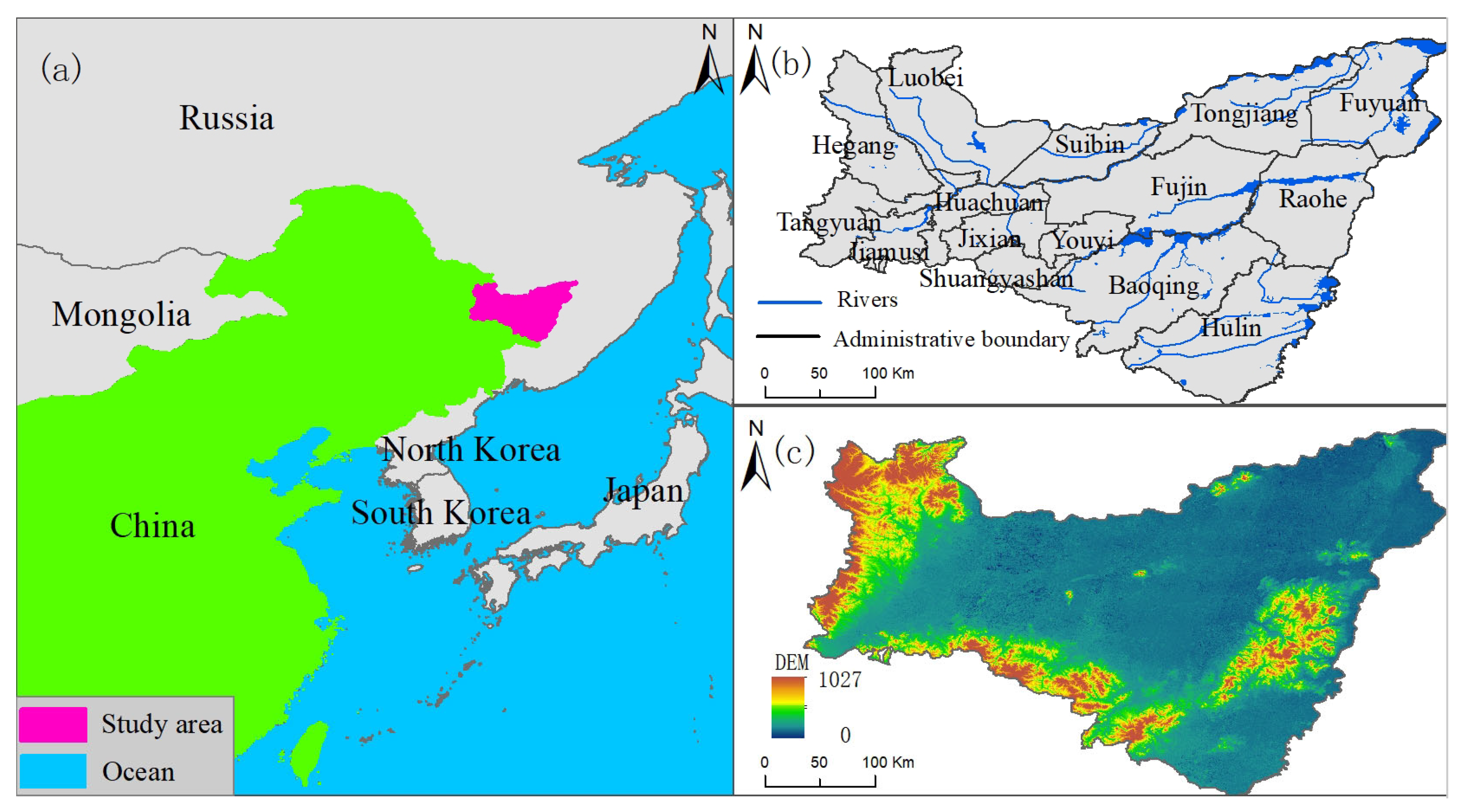
2.1. Study Area
2.2. Research Data and Methods
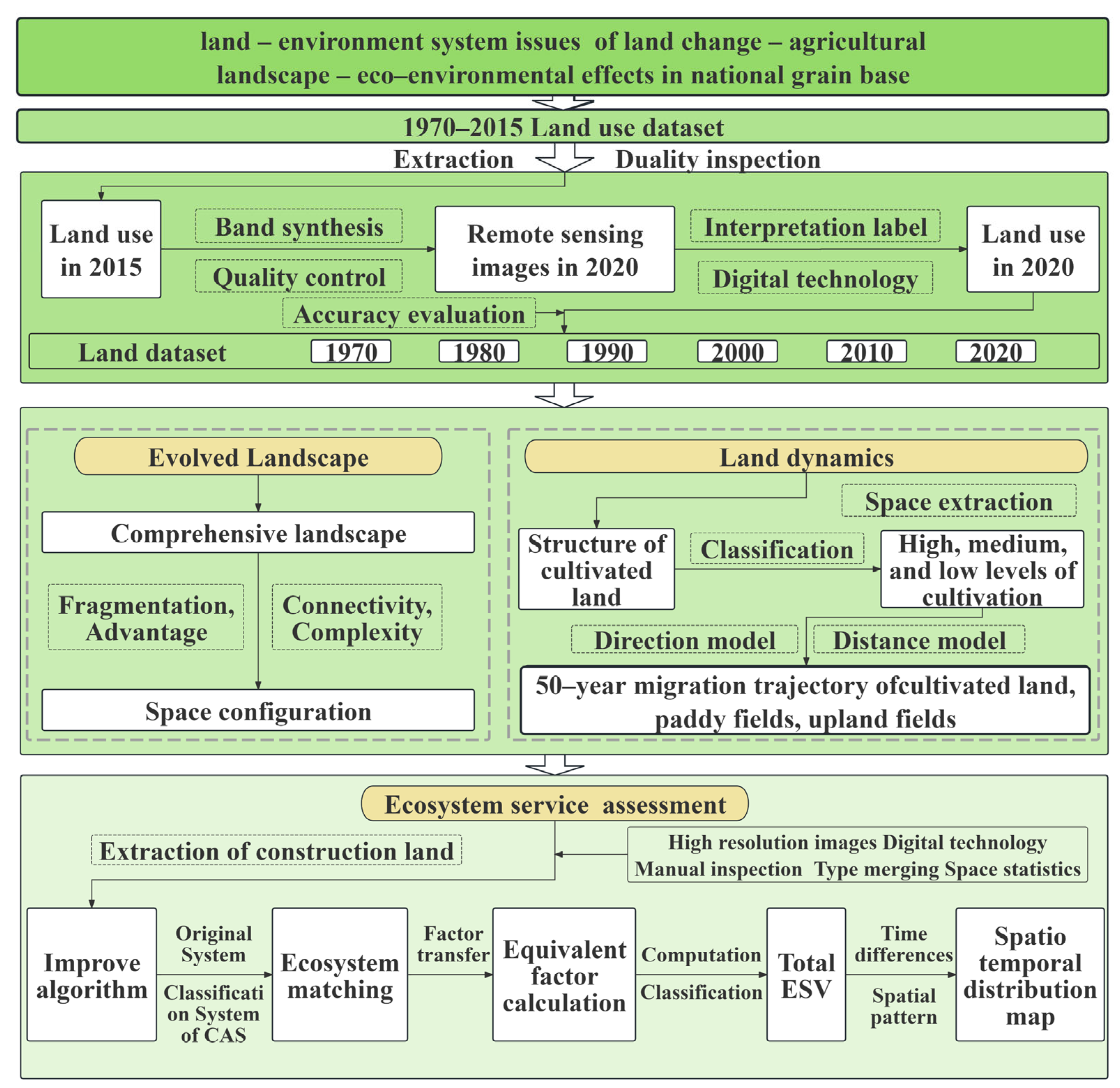
2.2.1. Technical Flowchart of This Study
2.2.2. Data Source and Preprocessing
2.2.3. Classification of Reclamation Rate Levels
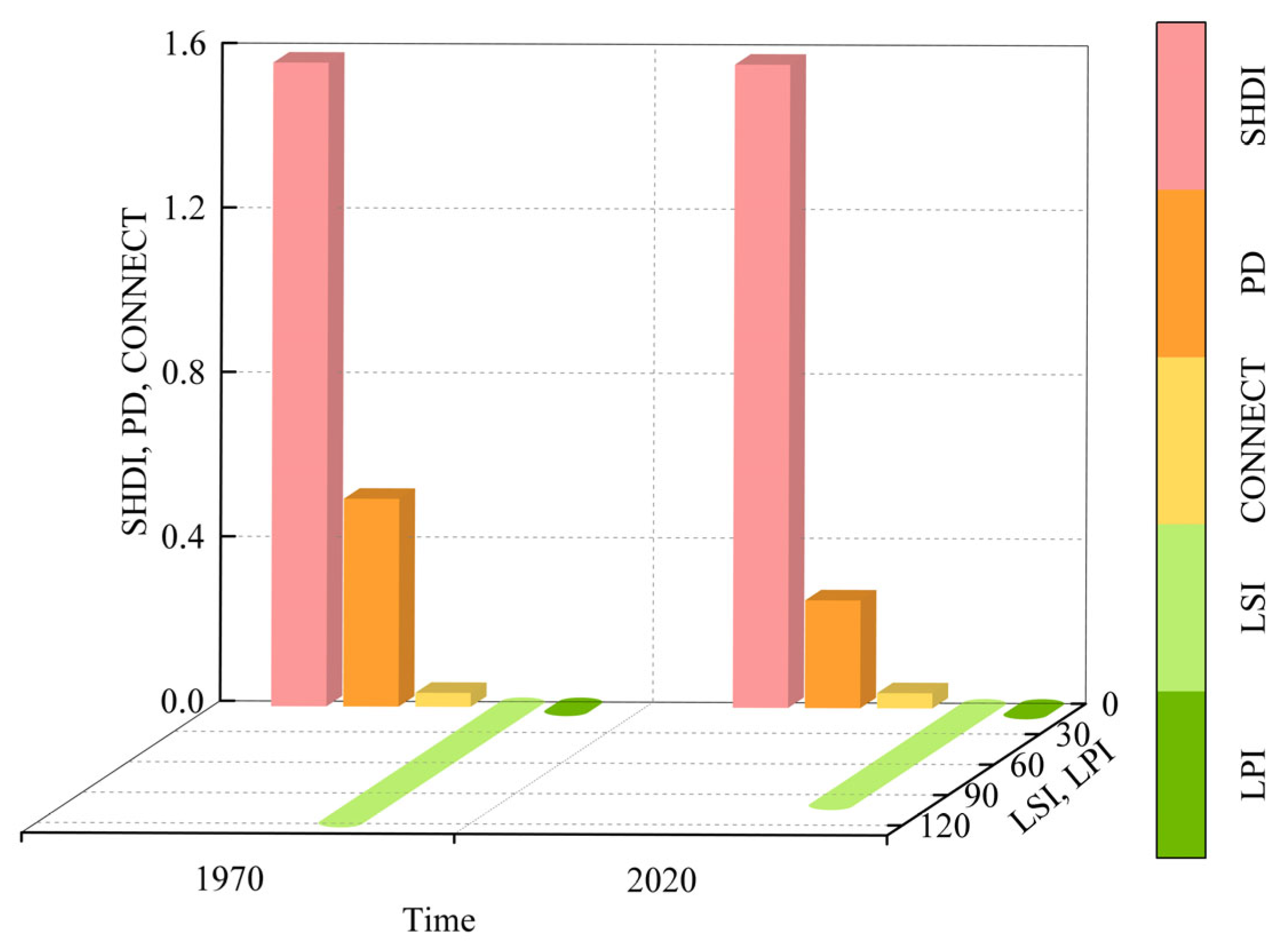
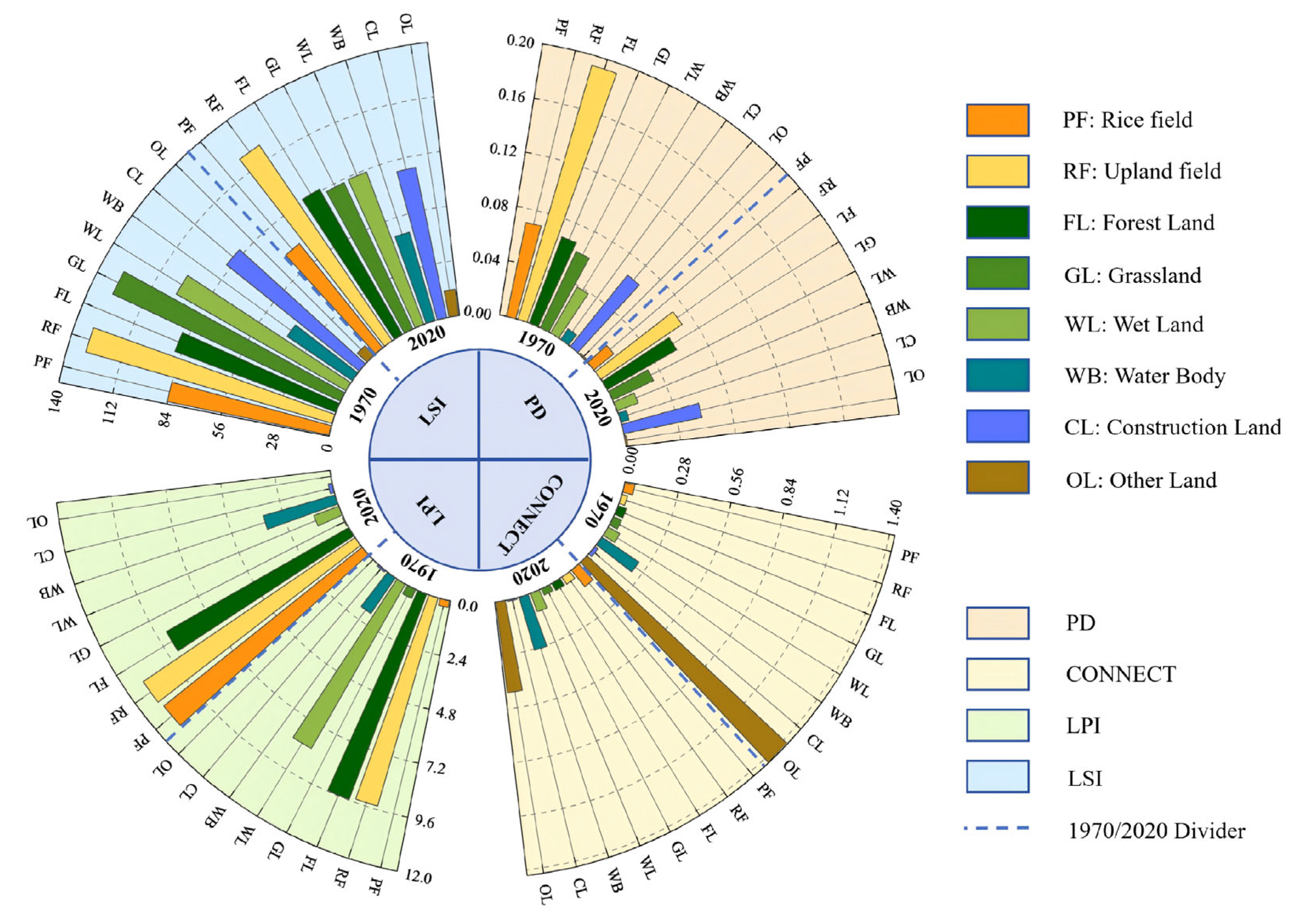
2.2.4. The Selection of Landscape Indices and Their Ecological Significance
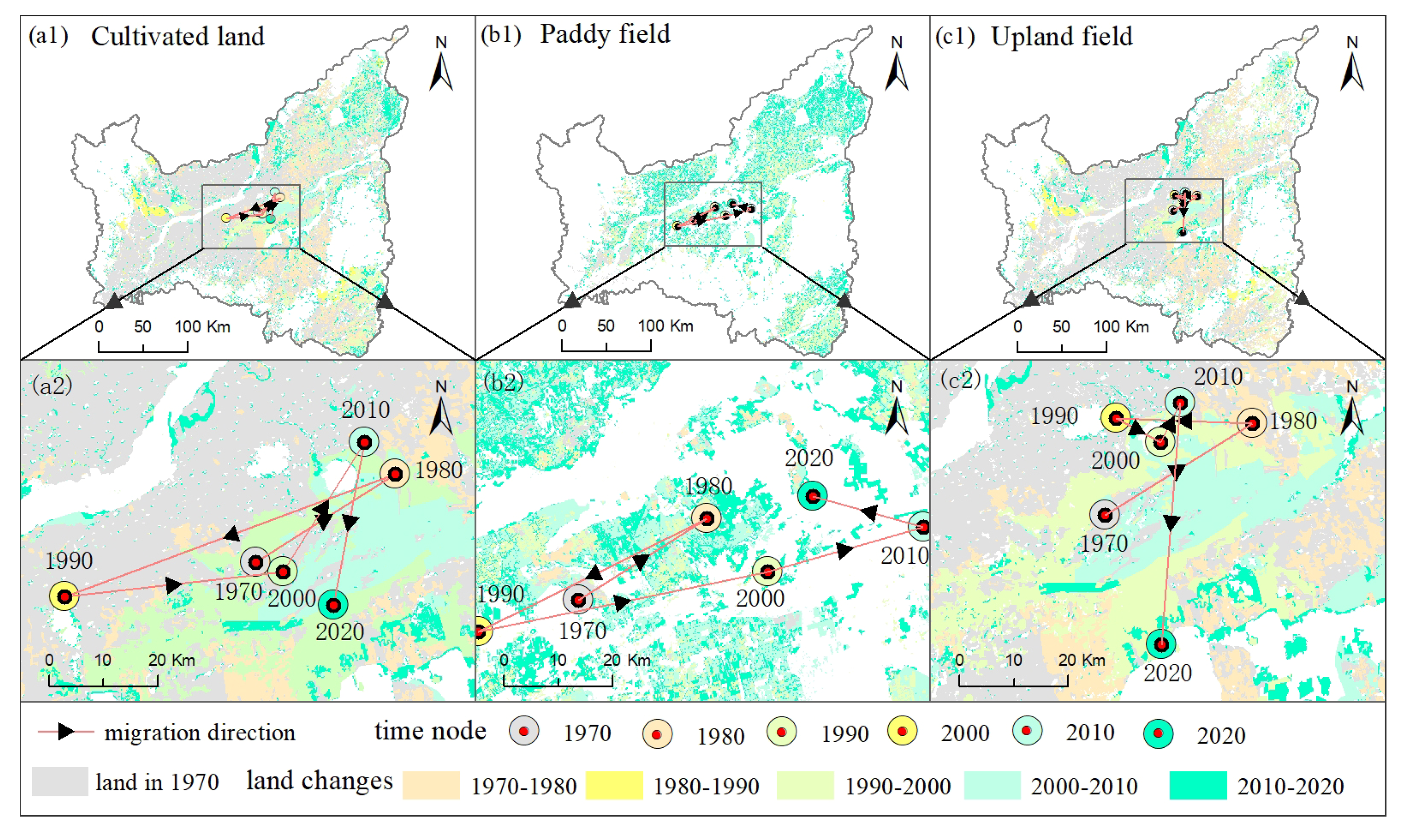
2.2.5. Migration Center and Direction Model
2.2.6. Improvement of Ecosystem Service Algorithm
3. Results
3.1. Analysis of the Evolutionary Cropland Structure Features from 1970 to 2020
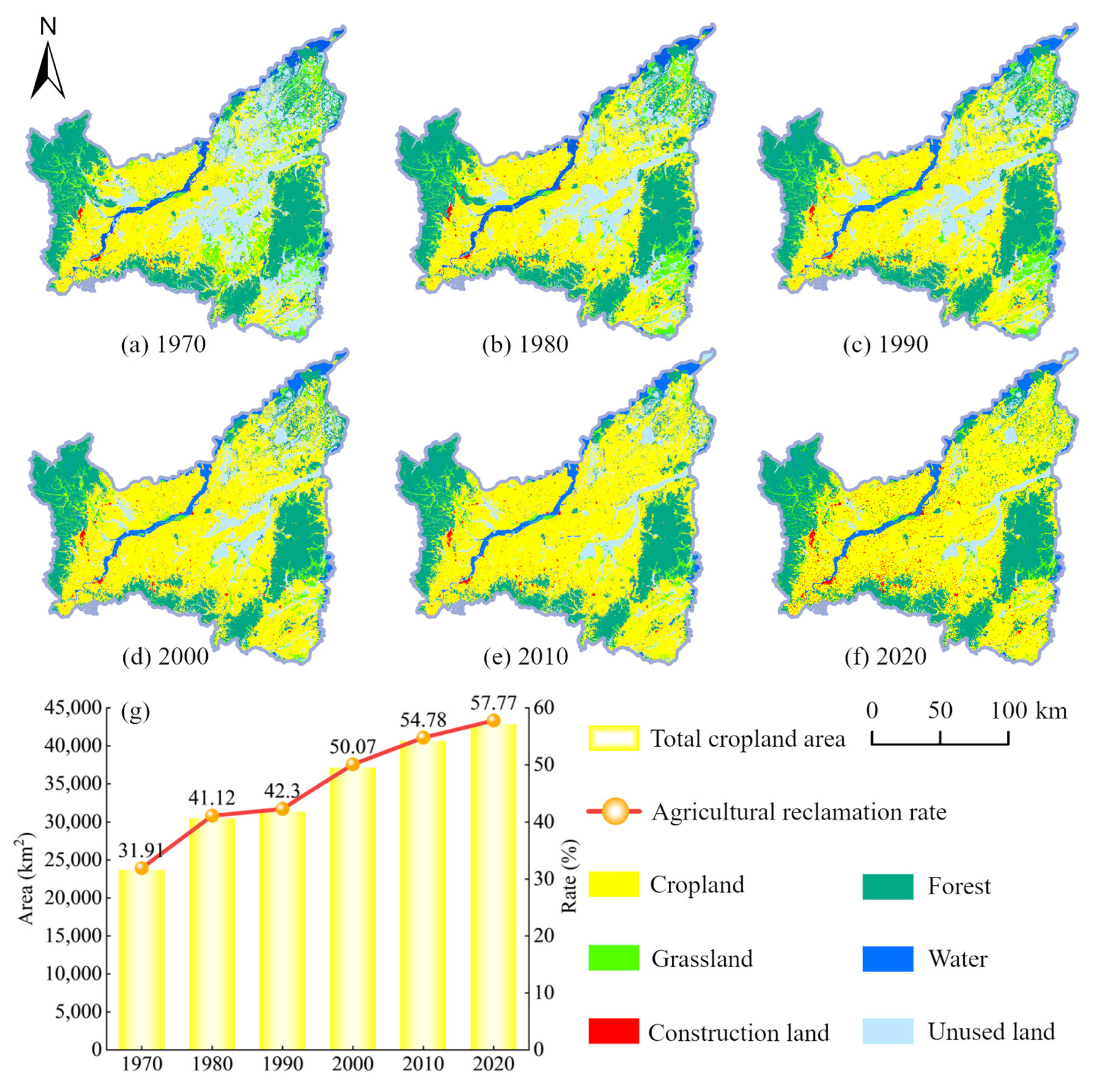
3.1.1. Overall Characteristics of the Succession Law of Cropland
3.1.2. Differences in the Reclamation Level with 10-Year Intervals in Different Administrative Regions from 1970 to 2020
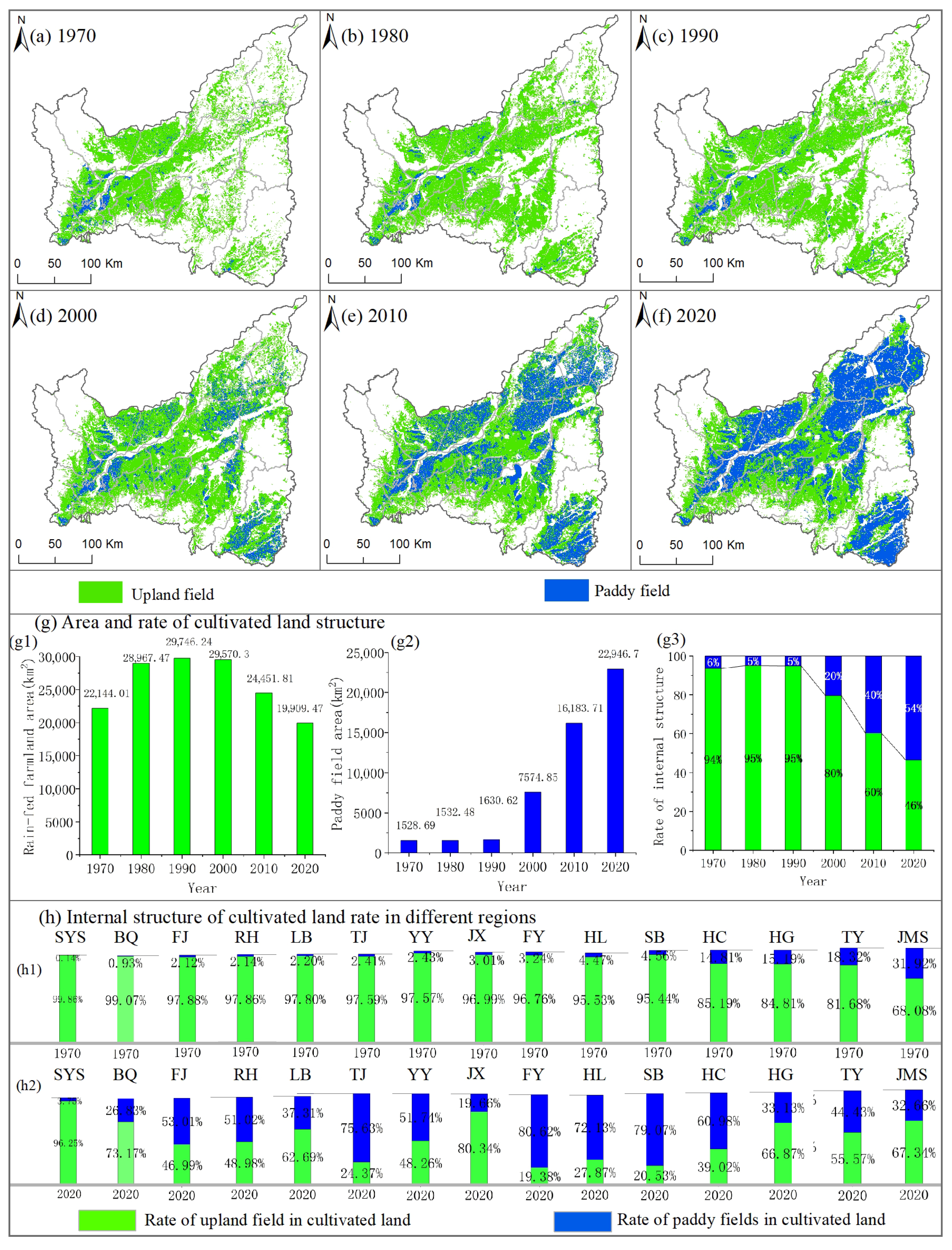
3.1.3. Different Cropland Structure Evolution Processes from 1970 to 2020
3.2. Cropland Structure Migration Process with 10-Year Intervals in the Study Area from 1970 to 2020
3.3. Analysis of Spatial Landscape Characteristics During Cropland Structure Changes
3.4. Analysis of Spatiotemporal Features in Ecosystem Services in the Whole Region During 1970–2020
3.4.1. Assessment of the Quantity and Evolutionary Law of Ecosystem Services and Their Different Subfunctions
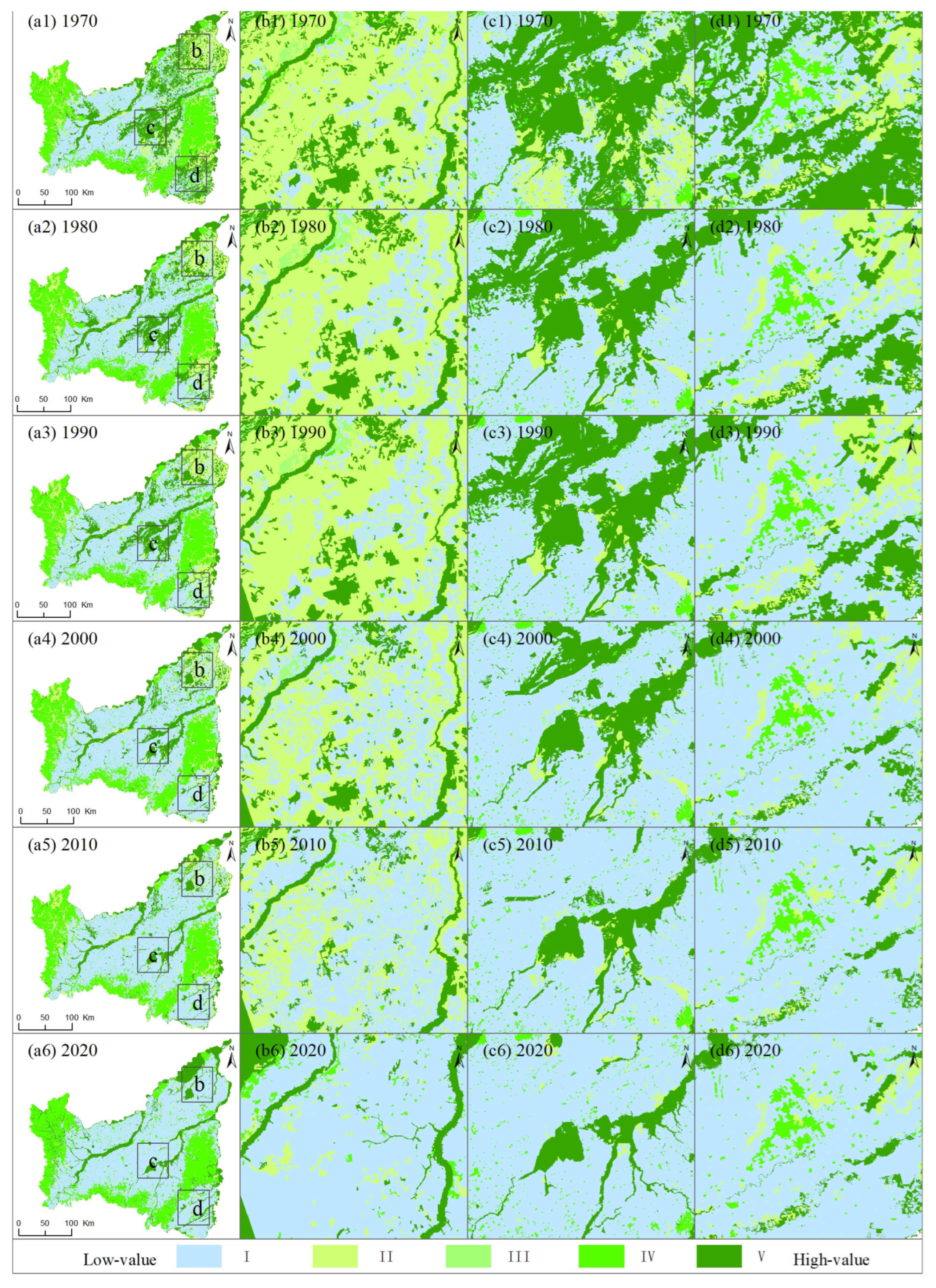
3.4.2. Spatial Variation Characteristics of the Different Ecosystem Service Gradings
4. Discussion
4.1. Sanjiang Plain Was a Special Commodity Grain Base Where Cropland Continuously Increased over the Past 50 Years in China
4.2. Human Activities Promote Agricultural Land Integrity in the Evolving Process of Natural to Artificial Landscapes
4.3. One-Third of the Original Ecosystem Services Have Been Lost in Sanjiang Plain in the Last Fifty Years
4.4. Limitations of This Study and Directions for Future Research
5. Conclusions
Author Contributions
Funding
Data Availability Statement
Conflicts of Interest
References
- Deng, J.S.; Wang, K.; Hong, Y.; Qi, J.G. Spatio-temporal dynamics and evolution of land use change and landscape pattern in response to rapid urbanization. Landsc. Urban Plan. 2009, 92, 187–198. [Google Scholar] [CrossRef] [Scilit]
- Mersha, E.; Degefa, S.; Argaw, M.; Mengist, W. Impact of land use land cover changes on ecosystem service values: Implication for landscape management. J. Landsc. Ecol. 2025, 18, 61–85. [Google Scholar] [CrossRef] [Scilit]
- Jin, J.; Yin, S.; Yin, H.; Bai, X. Eco–environmental effects of “production–living–ecological” space land use changes and recommendations for ecological restoration: A case study of the Weibei dryland in Shaanxi Province. Land 2023, 12, 1060. [Google Scholar] [CrossRef] [Scilit]
- Hatan, S.; Fleischer, A.; Tchetchik, A. Economic valuation of cultural ecosystem services: The case of landscape aesthetics in the agritourism market. Ecol. Econ. 2021, 184, 107005. [Google Scholar] [CrossRef] [Scilit]
- Sun, J.; Luo, L.; Li, L.; Fan, J.; Yang, J.; Tu, R.; Han, Z.; Zhu, X.; He, L.; Shao, J. Monitoring and analysis of land cover changes in Yala National Park, Sri Lanka using Landsat time series (2000~2022). Int. J. Digit. Earth 2025, 18, 2498602. [Google Scholar] [CrossRef] [Scilit]
- Whitehead, H.; Shin, M. Current global population size, post-whaling trend and historical trajectory of sperm whales. Sci. Rep. 2022, 12, 19468. [Google Scholar] [CrossRef] [Scilit]
- Hao, S.; Wang, G.; Yang, Y.; Zhao, S.; Huang, S.; Liu, L.; Zhang, H. Promoting grain production through high-standard farmland construction: Evidence in China. J. Integr. Agric. 2024, 23, 324–335. [Google Scholar] [CrossRef] [Scilit]
- Wang, X. Changes in cultivated land loss and landscape fragmentation in China from 2000 to 2020. Land 2022, 11, 684. [Google Scholar] [CrossRef] [Scilit]
- Belete, F.; Maryo, M.; Teka, A. Land use/land cover dynamics and perception of the local communities in Bita district, south western Ethiopia. Int. J. River Basin Manag. 2023, 21, 211–222. [Google Scholar] [CrossRef] [Scilit]
- Wang, H.; Liu, X.; Zhao, C.; Chang, Y.; Liu, Y.; Zang, F. Spatial-temporal pattern analysis of landscape ecological risk assessment based on land use/land cover change in Baishuijiang National nature reserve in Gansu Province, China. Ecol. Indic. 2021, 124, 107454. [Google Scholar] [CrossRef] [Scilit]
- Dai, K.; Shen, S.; Cheng, C. Evaluation and analysis of the projected population of China. Sci. Rep. 2022, 12, 3644. [Google Scholar] [CrossRef] [Scilit] [PubMed]
- He, G.; Zhao, Y.; Wang, L.; Jiang, S.; Zhu, Y. China’s food security challenge: Effects of food habit changes on requirements for arable land and water. J. Clean. Prod. 2019, 229, 739–750. [Google Scholar] [CrossRef] [Scilit]
- Zhu, Y.; Wang, Z.; Zhu, X. New reflections on food security and land use strategies based on the evolution of Chinese dietary patterns. Land Use Policy 2023, 126, 106520. [Google Scholar] [CrossRef] [Scilit]
- Liu, F.; Zhang, Z.; Zhao, X.; Wang, X.; Zuo, L.; Wen, Q.; Yi, L.; Xu, J.; Hu, S.; Liu, B. Chinese cropland losses due to urban expansion in the past four decades. Sci. Total Environ. 2019, 650, 847–857. [Google Scholar] [CrossRef] [Scilit]
- Zhou, Y.; Li, X.; Liu, Y. Cultivated land protection and rational use in China. Land Use Policy 2021, 106, 105454. [Google Scholar] [CrossRef] [Scilit]
- Chi, Y.; Zhang, Z.; Gao, J.; Xie, Z.; Zhao, M.; Wang, E. Evaluating landscape ecological sensitivity of an estuarine island based on landscape pattern across temporal and spatial scales. Ecol. Indic. 2019, 101, 221–237. [Google Scholar] [CrossRef] [Scilit]
- Medeiros, A.; Fernandes, C.; Gonçalves, J.F.; Farinha-Marques, P. Research trends on integrative landscape assessment using indicators–A systematic review. Ecol. Indic. 2021, 129, 107815. [Google Scholar] [CrossRef] [Scilit]
- Maurer, C.; Sutter, L.; Martínez-Núñez, C.; Pellissier, L.; Albrecht, M. Different types of semi-natural habitat are required to sustain diverse wild bee communities across agricultural landscapes. J. Appl. Ecol. 2022, 59, 2604–2615. [Google Scholar] [CrossRef] [Scilit]
- Pukowiec-Kurda, K. The urban ecosystem services index as a new indicator for sustainable urban planning and human well-being in cities. Ecol. Indic. 2022, 144, 109532. [Google Scholar] [CrossRef] [Scilit]
- Yan, Z.; Guo, Y.; Sun, B.; Gao, Z.; Qin, P.; Li, Y.; Yue, W.; Cui, H. Combating land degradation through human efforts: Ongoing challenges for sustainable development of global drylands. J. Environ. Manag. 2024, 354, 120254. [Google Scholar] [CrossRef] [Scilit]
- Costanza, R.; d’Arge, R.; De Groot, R.; Farber, S.; Grasso, M.; Hannon, B.; Limburg, K.; Naeem, S.; O’neill, R.V.; Paruelo, J.; et al. The value of the world’s ecosystem services and natural capital. Ecol. Econ. 1997, 387, 253–260. [Google Scholar] [CrossRef] [Scilit]
- Fu, B.; Li, S.; Yu, X.; Yang, P.; Yu, G.; Feng, R.; Zhuang, X. Chinese ecosystem research network: Progress and perspectives. Ecol. Complex. 2010, 7, 225–233. [Google Scholar] [CrossRef] [Scilit]
- Xie, G.; Zhang, C.; Zhen, L.; Zhang, L. Dynamic changes in the value of China’s ecosystem services. Ecosyst. Serv. 2017, 26, 146–154. [Google Scholar] [CrossRef] [Scilit]
- Xie, G.D.; Zhang, C.X.; Zhang, L.M.; Chen, W.H.; Li, S.M. Improvement of the evaluation method for ecosystem service value based on per unit area. J. Nat. Resour. 2015, 30, 1243–1254. [Google Scholar]
- Zeng, X.; Zhang, H.; Zhou, B.; Liang, X.; Cui, L.; Li, H.; Qu, Y.; Luo, C. Hydrological dynamics and its impact on wetland ecological functions in the Sanjiang Plain, China. Ecol. Indic. 2024, 169, 112878. [Google Scholar] [CrossRef] [Scilit]
- Dong, G.; Bai, J.; Yang, S.; Wu, L.; Cai, M.; Zhang, Y.; Luo, Y.; Wang, Z. The impact of land use and land cover change on net primary productivity on China’s Sanjiang Plain. Environ. Earth Sci. 2015, 74, 2907–2917. [Google Scholar] [CrossRef] [Scilit]
- Li, X.; Zhang, H.; Qu, Y. Land surface albedo variations in Sanjiang plain from 1982 to 2015: Assessing with glass data. Chin. Geogr. Sci. 2020, 30, 876–888. [Google Scholar] [CrossRef] [Scilit]
- Li, H.; Qu, Y.; Zeng, X.; Zhang, H.; Cui, L.; Luo, C. Dynamic response of the vegetation carbon storage in the sanjiang plain to changes in land use/cover and climate. Herit. Sci. 2021, 9, 134. [Google Scholar] [CrossRef] [Scilit]
- Jin, S.; Liu, X.; Yang, J.; Lv, J.; Gu, Y.; Yan, J.; Yuan, R.; Shi, Y. Spatial-temporal changes of land use/cover change and habitat quality in Sanjiang plain from 1985 to 2017. Front. Environ. Sci. 2022, 10, 1032584. [Google Scholar] [CrossRef] [Scilit]
- Ling, Z.; Shu, L.; Wang, D.; Lu, C.; Liu, B. Assessment and projection of the groundwater drought vulnerability under different climate scenarios and land use changes in the Sanjiang Plain, China. J. Hydrol. Reg. Stud. 2023, 49, 101498. [Google Scholar] [CrossRef] [Scilit]
- Zhang, L.; Wang, Z.; E, S.; Du, G.; Chen, Z. Analysis of climatic basis for the change of cultivated land area in Sanjiang Plain of China. Front. Earth Sci. 2022, 10, 862141. [Google Scholar] [CrossRef] [Scilit]
- Liu, X.; An, Y.; Dong, G.; Jiang, M. Land use and landscape pattern changes in the Sanjiang Plain, Northeast China. Forests 2018, 9, 637. [Google Scholar] [CrossRef] [Scilit]
- Gao, X.; Tao, Z.; Dai, J. Effects of extreme climatic events on the autumn phenology in northern China are related to vegetation types and background climates. Remote Sens. 2024, 16, 3724. [Google Scholar] [CrossRef] [Scilit]
- Šímová, P.; Gdulová, K. Landscape indices behavior: A review of scale effects. Appl. Geogr. 2012, 34, 385–394. [Google Scholar] [CrossRef] [Scilit]
- Wang, Q.; Zhang, P.; Chang, Y.; Li, G.; Chen, Z.; Zhang, X.; Xing, G.; Lu, R.; Li, M.; Zhou, Z. Landscape pattern evolution and ecological risk assessment of the Yellow River Basin based on optimal scale. Ecol. Indic. 2024, 158, 111381. [Google Scholar] [CrossRef] [Scilit]
- Wu, Z.; Wang, Y.; Ren, Y. Optimizing green space-building landscape characteristics of key urban functional zones for comprehensive thermal environment mitigation. Landsc. Urban Plan. 2025, 257, 105314. [Google Scholar] [CrossRef] [Scilit]
- Brockerhoff, E.G.; Barbaro, L.; Castagneyrol, B.; Forrester, D.I.; Gardiner, B.; González-Olabarria, J.R.; Lyver, P.O.B.; Meurisse, N.; Oxbrough, A.; Taki, H.J.B.; et al. Forest biodiversity, ecosystem functioning and the provision of ecosystem services. Biodivers. Conserv. 2017, 26, 3005–3035. [Google Scholar] [CrossRef] [Scilit]
- Gaodi, X.; Lin, Z.; Chunxia, L.; Yu, X.; Wenhua, L. Applying value transfer method for eco-service valuation in China. J. Resour. Ecol. 2010, 1, 51–59. [Google Scholar]
- Ning, J.; Liu, J.; Kuang, W.; Xu, X.; Zhang, S.; Yan, C.; Li, R.; Wu, S.; Hu, Y.; Du, G.; et al. Spatiotemporal patterns and characteristics of land-use change in China during 2010–2015. J. Geogr. Sci. 2018, 28, 547–562. [Google Scholar] [CrossRef] [Scilit]
- Liu, Y.; Duan, M.; Yu, Z. Agricultural landscapes and biodiversity in China. Agric. Ecosyst. Environ. 2013, 166, 46–54. [Google Scholar] [CrossRef] [Scilit]
- Pan, T.; Zhang, R. Spatiotemporal Heterogeneity Monitoring of Cropland Evolution and Its Impact on Grain Production Changes in the Southern Sanjiang Plain of Northeast China. Land 2022, 11, 1159. [Google Scholar] [CrossRef] [Scilit]
- Gao, X.; Cheng, W.; Wang, N.; Liu, Q.; Ma, T.; Chen, Y.; Zhou, C. Spatio-temporal distribution and transformation of cropland in geomorphologic regions of China during 1990–2015. J. Geogr. Sci. 2019, 29, 180–196. [Google Scholar] [CrossRef] [Scilit]
- Yang, F.; Dong, G.; Wu, P.; He, F. Stylized facts of past 1000-year of China’s cropland changes. Land Use Policy 2024, 144, 107258. [Google Scholar] [CrossRef] [Scilit]
- Qian, F.; Chi, Y.; Lal, R. Spatiotemporal characteristics analysis of multifunctional cultivated land: A case-study in Shenyang, Northeast China. Land Degrad. Dev. 2020, 31, 1812–1822. [Google Scholar] [CrossRef] [Scilit]
- Llausàs, A.; Nogué, J. Indicators of landscape fragmentation: The case for combining ecological indices and the perceptive approach. Ecol. Indic. 2012, 15, 85–91. [Google Scholar] [CrossRef] [Scilit]
- Wei, P.; Ye, H.; Nie, C.; Qin, M.; Zhang, Y.; Wang, H.; Huang, S.; Liu, R. Evaluating the impact of crop waterlogging and flood disasters using multi-source data: A case study of the Sanjiang Plain. Clim. Serv. 2025, 39, 100596. [Google Scholar] [CrossRef] [Scilit]
- Yan, F.; Zhang, S. Ecosystem service decline in response to wetland loss in the Sanjiang Plain, Northeast China. Ecol. Eng. 2019, 130, 117–121. [Google Scholar] [CrossRef] [Scilit]
- Pan, T.; Zhang, C.; Kuang, W.; Luo, G.; Du, G.; DeMaeyer, P.; Yin, Z. A large-scale shift of cropland structure profoundly affects grain production in the cold region of China. J. Clean. Prod. 2021, 307, 127300. [Google Scholar] [CrossRef] [Scilit]
- Huang, Q.; Guo, W.; Wang, Y. A study of the impact of new quality productive forces on agricultural modernization: Empirical evidence from China. Agriculture 2024, 14, 1935. [Google Scholar] [CrossRef] [Scilit]
- He, Y.; Wen, C.; Fang, X.; Sun, X. Impacts of urban-rural integration on landscape patterns and their implications for landscape sustainability: The case of Changsha, China. Landsc. Ecol. 2024, 39, 129. [Google Scholar] [CrossRef] [Scilit]
- Yu, Q.; Dai, Y.; Wei, J.; Wang, J.; Liao, B.; Cui, Y. Rice yield and water productivity in response to water-saving irrigation practices in China: A meta-analysis. Agric. Water Manag. 2024, 302, 109006. [Google Scholar] [CrossRef] [Scilit]
- Hao, W.; Hu, X.; Wang, J.; Zhang, Z.; Shi, Z.; Zhou, H. The impact of farmland fragmentation in China on agricultural productivity. J. Clean. Prod. 2023, 425, 138962. [Google Scholar] [CrossRef] [Scilit]
- Kang, L.; Yang, X.; Gao, X.; Zhang, J.; Zhou, J.; Hu, Y.; Chi, H. Landscape ecological risk evaluation and prediction under a wetland conservation scenario in the Sanjiang Plain based on land use/cover change. Ecol. Indic. 2024, 162, 112053. [Google Scholar] [CrossRef] [Scilit]
- Zhao, K.Y.; Luo, Y.J.; Hu, J.M.; Zhou, D.M.; Zhou, X.L. A study of current status and conservation of threatened wetland ecological environment in Sanjiang Plain. J. Nat. Resour. 2008, 23, 790–796. [Google Scholar]
- Ye, X.; Zhou, Y.; Lu, Y.; Du, X. Hydrochemical evolution and quality assessment of groundwater in the Sanjiang Plain, China. Water 2022, 14, 1265. [Google Scholar] [CrossRef] [Scilit]
- Molotoks, A.; Smith, P.; Dawson, T.P. Impacts of land use, population, and climate change on global food security. Food Energy Secur. 2021, 10, e261. [Google Scholar] [CrossRef] [Scilit]
- Liu, Y.; Liu, X.; Liu, Z. Effects of climate change on paddy expansion and potential adaption strategies for sustainable agriculture development across Northeast China. Appl. Geogr. 2022, 141, 102667. [Google Scholar] [CrossRef] [Scilit]
- Li, W.; Hu, B.; Yan, Z.; Liu, S.; Shi, P.; Zhu, Y.; Li, H. The socio-ecological implications of shifting patterns of cropland use in northeast China. J. Clean. Prod. 2024, 443, 141050. [Google Scholar] [CrossRef] [Scilit]
- Wang, H.; Zhang, C.; Yao, X.; Yun, W.; Ma, J.; Gao, L.; Li, P. Scenario simulation of the tradeoff between ecological land and farmland in black soil region of Northeast China. Land Use Policy 2022, 114, 105991. [Google Scholar] [CrossRef] [Scilit]



| Reclamation Rate of Cropland | Classification of Levels |
|---|---|
| (0–33.33%] | Low reclamation level |
| [33.33–66.66) | Medium reclamation level |
| [66.66–100] | High reclamation level |
| Names | Abbreviations | Formulas | Range of Value | Explanations |
|---|---|---|---|---|
| Shannon’s Diversity Index | SHDI | SHDI ≥ 0 | This serves as an indicator for assessing species diversity within ecosystems | |
| Patch Density | PD | 0 < PD ≤ 1 | Expresses the number of patches per unit area and facilitates comparisons among landscapes of various sizes | |
| Connectivity Index | CON | CON ≥ 0 | Connectivity is reported as a percentage of the maximum possible connectivity, given the number of patches | |
| Largest Patch Index | LPI | 0 < LPI ≤ 100 | Quantifies the percentage of the total landscape area represented by the largest patch: a simple measure of dominance | |
| Landscape Shape Index | LSI | LSI ≥ 1 | Serves as a quantitative measure for assessing the complexity of landscape forms, where higher values correspond to greater shape irregularity |
| Ecosystem Types in the Equivalent Factor Evaluation Model | First Level Type of Ecosystem | Ecosystem Types of Chinese Academy of Sciences |
|---|---|---|
| Rice field | Cropland | Rice field |
| Upland field | Upland field | |
| Average value of coniferous forest, mixed coniferous, and broad-leaved forest | Forestland | Woodland |
| Shrub wood | Shrub wood | |
| Average value of forest and bare land | Sparse woods | |
| The average value of forest | Other forestland | |
| Average value of grassland | Grassland | High- and medium-coverage grassland |
| Average value of grassland and bare land | Low-coverage grassland | |
| River system | Water bodies | Reservoirs, ponds, tidal flats, beaches, rivers, and lakes |
| Glacier and snow | Permanent glacier and snow | |
| Wetland | Wetland | Wetland |
| Desert | Construction land | Impermeable surface area (62.84%), forestlands (16.93%), grasslands (16.92%), and bare soils (3.31%) |
| Other lands | Bare land, alkali land, sandy land, gobi, and saline bare rock |
| Land Types | Paddy Fields | Rain-Fed Farmland | Wood Land | Shrub Wood | Sparse Woods | Other Forest Land | High–Medium-Density Grassland | Low-Density Grassland | Rivers, Lakes, Reservoirs, Ponds, Tidal Flats, and Beaches | Permanent Glacier and Snow | Wet Land | Urban Land, Rural Land, Industrial, and Mining Land | Bare Rock land Sandy Land, Bare Land, Gobi, Saline Alkali Land, and Others | |
|---|---|---|---|---|---|---|---|---|---|---|---|---|---|---|
| Supply | FP | 1.36 | 0.85 | 0.27 | 0.19 | 0.25 | 0.25 | 0.23 | 0.18 | 0.80 | 0.00 | 0.51 | 0.29 | 0.01 |
| MP | 0.09 | 0.40 | 0.63 | 0.43 | 0.58 | 0.58 | 0.34 | 0.26 | 0.23 | 0.00 | 0.50 | 0.58 | 0.03 | |
| WRS | −2.63 | 0.02 | 0.33 | 0.22 | 0.30 | 0.30 | 0.19 | 0.14 | 8.29 | 2.16 | 2.59 | 0.31 | 0.02 | |
| Regulation | GR | 1.11 | 0.67 | 2.07 | 1.41 | 1.91 | 1.91 | 1.21 | 0.91 | 0.77 | 0.18 | 1.90 | 1.95 | 0.13 |
| CR | 0.57 | 0.36 | 6.20 | 4.23 | 5.71 | 5.71 | 3.19 | 2.39 | 2.29 | 0.54 | 3.60 | 5.47 | 0.10 | |
| PE | 0.17 | 0.10 | 1.80 | 1.28 | 1.70 | 1.67 | 1.05 | 0.82 | 5.55 | 0.16 | 3.60 | 1.85 | 0.41 | |
| HR | 2.72 | 0.27 | 3.86 | 3.35 | 3.74 | 3.74 | 2.34 | 1.76 | 102.24 | 7.13 | 24.23 | 3.80 | 0.24 | |
| Support | SC | 0.01 | 1.03 | 2.52 | 1.72 | 2.33 | 2.32 | 1.47 | 1.11 | 0.93 | 0.00 | 2.31 | 2.37 | 0.15 |
| MNC | 0.19 | 0.12 | 0.19 | 0.13 | 0.18 | 0.18 | 0.11 | 0.09 | 0.07 | 0.00 | 0.18 | 0.18 | 0.01 | |
| BD | 0.21 | 0.13 | 2.30 | 1.57 | 2.12 | 2.12 | 1.34 | 1.01 | 2.55 | 0.01 | 7.87 | 2.16 | 0.14 | |
| Culture | AL | 0.09 | 0.06 | 1.01 | 0.69 | 0.93 | 0.93 | 0.59 | 0.45 | 1.89 | 0.09 | 4.73 | 0.95 | 0.06 |
| City Names | Year 1970 | Year 1980 | Year 1990 | Year 2000 | Year 2010 | Year 2020 | 1970–2020 Changes | Administrative Area |
|---|---|---|---|---|---|---|---|---|
| FuCNY | 9.85 | 15.60 | 16.42 | 28.78 | 47.07 | 62.32 | +52.47 | 623,274.04 |
| Hegang | 17.47 | 18.51 | 20.27 | 21.38 | 21.72 | 20.25 | +2.78 | 456,635.43 |
| Hulin | 17.97 | 29.65 | 32.24 | 47.93 | 51.07 | 53.06 | +35.09 | 930,830.67 |
| Raohe | 20.76 | 28.18 | 28.26 | 36.02 | 39.36 | 42.17 | +21.41 | 657,963.40 |
| Baoqing | 23.74 | 44.91 | 45.02 | 49.77 | 52.17 | 54.27 | +30.53 | 999,345.51 |
| Tongjiang | 24.68 | 42.40 | 42.42 | 49.44 | 58.21 | 60.66 | +35.97 | 616,047.83 |
| Luobei | 28.76 | 31.44 | 37.71 | 42.89 | 43.74 | 46.42 | +17.66 | 675,222.35 |
| Shuangyashan | 32.00 | 32.96 | 32.97 | 38.66 | 37.72 | 35.36 | +3.36 | 152,802.80 |
| Fujin | 41.81 | 56.17 | 56.20 | 69.13 | 79.77 | 82.90 | +41.10 | 822,803.50 |
| TangCNY | 47.35 | 47.47 | 48.29 | 50.59 | 51.67 | 52.33 | +4.98 | 343,773.62 |
| Youyi | 62.34 | 74.96 | 75.04 | 87.17 | 88.27 | 89.76 | +27.43 | 168,318.29 |
| Jiamusi | 64.05 | 63.35 | 64.09 | 66.21 | 66.57 | 66.69 | +2.64 | 190,454.37 |
| Suibin | 68.07 | 69.71 | 70.06 | 72.51 | 73.06 | 76.27 | +8.20 | 333,301.69 |
| Jixian | 73.56 | 74.32 | 74.37 | 77.13 | 77.07 | 78.81 | +5.25 | 224,756.17 |
| Huachuan | 73.58 | 73.11 | 73.19 | 77.84 | 79.78 | 80.10 | +6.53 | 222,373.82 |
| Service Types | Subfunctions | 1970 | 1980 | 1990 | 2000 | 2010 | 2020 | Changes in 1970–2020 | Change Rate |
|---|---|---|---|---|---|---|---|---|---|
| Supply | FP | 482,502.07 | 518,839.89 | 524,953.18 | 595,213.41 | 668,635.37 | 731,257.49 | 248,755.42 | 51.56% |
| MP | 419,441.49 | 413,869.33 | 411,907.99 | 386,076.87 | 350,765.52 | 331,301.74 | −88,139.75 | −21.01% | |
| WR | 910,543.21 | 775,133.42 | 760,460.90 | 460,282.16 | 108,969.96 | −117,133.89 | −1,027,677.10 | −112.86% | |
| Regulate | GR | 1,275,793.26 | 1,185,311.91 | 1,172,866.33 | 1,137,628.25 | 1,141,324.54 | 1,183,022.52 | −92,770.75 | −7.27% |
| CR | 2,894,952.01 | 2,628,966.54 | 2,579,242.41 | 2,357,453.36 | 2,231,209.93 | 2,192,539.33 | −702,412.68 | −24.26% | |
| PE | 1,542,989.17 | 1,319,542.48 | 1,296,300.59 | 1,135,486.89 | 1,034,637.73 | 1,036,959.58 | −506,029.60 | −32.80% | |
| HR | 10,463,426.63 | 9,290,465.98 | 9,175,418.36 | 8,285,631.24 | 7,821,957.01 | 7,787,183.44 | −2,676,243.20 | −25.58% | |
| Support | SC | 1,585,106.47 | 1,493,009.14 | 1,478,296.22 | 1,337,596.96 | 1,187,470.20 | 1,115,266.02 | −469,840.45 | −29.64% |
| MC | 135,572.40 | 131,829.31 | 131,330.00 | 134,223.34 | 140,036.66 | 147,980.78 | 12,408.38 | 9.15% | |
| BD | 2,362,137.81 | 1,848,628.24 | 1,810,310.66 | 1,504,586.73 | 1,307,503.36 | 1,391,197.66 | −970,940.15 | −41.10% | |
| Culture | AL | 1,305,981.64 | 1,002,252.75 | 981,515.21 | 803,494.08 | 686,844.59 | 740,520.27 | −565,461.36 | −43.30% |
Disclaimer/Publisher’s Note: The statements, opinions and data contained in all publications are solely those of the individual author(s) and contributor(s) and not of MDPI and/or the editor(s). MDPI and/or the editor(s) disclaim responsibility for any injury to people or property resulting from any ideas, methods, instructions or products referred to in the content. |
© 2026 by the authors. Licensee MDPI, Basel, Switzerland. This article is an open access article distributed under the terms and conditions of the Creative Commons Attribution (CC BY) license.
Share and Cite
Pan, T.; Liu, K.; Yin, Z.; Li, Z.; Shi, L. Historical Trajectories of the Evolved Cropland Features and Their Reshaped Influences on Agricultural Landscapes and Ecosystem Services in China’s Sanjiang Commodity Grain Base. Land 2026, 15, 175. https://doi.org/10.3390/land15010175
Pan T, Liu K, Yin Z, Li Z, Shi L. Historical Trajectories of the Evolved Cropland Features and Their Reshaped Influences on Agricultural Landscapes and Ecosystem Services in China’s Sanjiang Commodity Grain Base. Land. 2026; 15(1):175. https://doi.org/10.3390/land15010175
Chicago/Turabian StylePan, Tao, Kun Liu, Zherui Yin, Zexian Li, and Lin Shi. 2026. "Historical Trajectories of the Evolved Cropland Features and Their Reshaped Influences on Agricultural Landscapes and Ecosystem Services in China’s Sanjiang Commodity Grain Base" Land 15, no. 1: 175. https://doi.org/10.3390/land15010175
APA StylePan, T., Liu, K., Yin, Z., Li, Z., & Shi, L. (2026). Historical Trajectories of the Evolved Cropland Features and Their Reshaped Influences on Agricultural Landscapes and Ecosystem Services in China’s Sanjiang Commodity Grain Base. Land, 15(1), 175. https://doi.org/10.3390/land15010175