


Abstract
The Indigenous community of San Antonio Cacalotepec, located in the region of Cholula in central Mexico, has been an active witness to territorial dispossession at the hands of powerful real estate capital. This small territory—where clean water once flowed, milpas and nopales were cultivated, and Nahuatl was the everyday language—has now become the epicenter of predatory capitalism, manifested in gated communities, commercial zones, and exclusive residential developments. As a result, the original settlement and its small landholders have been segregated and excluded from the promises of modernity and progress. Nevertheless, in this last enclave, where traces of Nahuatl can still be heard, an Indigenous awareness has emerged, reclaiming identity and the right to continue naming the territory that has been lost as their own. Within this context, fieldwork carried out by the co-research group Colectiva Hilando Territorios has led to a series of community workshops with women from San Antonio Cacalotepec, together with architecture and anthropology students from Universidad de las Américas Puebla. These workshops mapped how Cacalotepec looked before massive urbanization and documented the toponyms in the Nahuatl language. The aim has been to make visible the memory of a living territory that persists, and that, despite the sale of exclusive, car-oriented commercial and residential spaces, is continually re-signified by the community as part of its identity and collective belonging in the face of dispossession.
1. Introduction
Language, territory, and ways of life have been deeply intertwined in Mexico through long histories of colonization, nation-building, and modernization. Although Spanish has become the dominant language, Mexico remains linguistically diverse, and Nahuatl has historically been among the most widely spoken Indigenous languages in central Mexico. Over the last two centuries, however, Indigenous-language use has declined sharply, shaped by assimilationist education policies, structural discrimination, and the marginalization of Indigenous knowledge within public institutions and professional training [1]. This linguistic erosion has not only affected everyday communication but has also undermined the transmission of place-based knowledge embedded in local toponymy—knowledge through which landscapes, water bodies, agricultural practices, paths, and sacred sites were historically named, remembered, and inhabited.
This article examines these processes through the case of San Antonio Cacalotepec, a historically Nahua community located in the municipality of San Andrés Cholula, Puebla. Over the past two decades, Cacalotepec has been increasingly encircled and transformed by accelerated urban expansion driven by highways, shopping centers, and gated residential developments, most notably the large-scale real estate project Lomas de Angelópolis. These processes have entailed not only material dispossession, but also symbolic reconfigurations of space, whereby land is fragmented, reclassified, and rebranded according to market logics that obscure prior histories, social relations, and collective meanings.
Rather than understanding these dynamics solely as conflicts over land use or planning regulations, this paper approaches them as struggles over ways of inhabiting and sustaining life. When territory is reduced to a commodity, the social, cultural, and ecological relationships that bind communities to land are rendered expendable. In this sense, the loss of Nahuatl toponymy is not merely a linguistic phenomenon, but part of a broader process through which everyday forms of memory, belonging, and territorial continuity are disrupted. Conversely, the recovery and circulation of Indigenous place names can operate as a form of resistance, reasserting territory as a living space and reinforcing claims to collective existence in the face of extractive urbanization.
Empirically, this article builds on participatory research conducted during 2023–2025 with members of Cholultecas Unidos en Resistencia (CHUR) and residents of Cacalotepec through the co-research group Colectiva Hilando Territorios, in collaboration with anthropology and architecture colleagues and students from Universidad de las Américas Puebla (UDLAP). The project developed a series of participatory maps that reconstruct past and present territorial configurations and document Nahuatl toponymy as remembered by community members. A central contribution of this work lies in the use of intuitive embroidery-based mapping as a methodological device. Far from functioning as a mere illustrative technique, embroidery enabled a slow, collective cartographic process through which memories, boundaries, losses, and disagreements could be shared, negotiated, and materialized, and later translated into GIS formats to engage institutional planning frameworks without displacing community knowledge.
Guided by this approach, the paper addresses three research questions:
- (1)
- What contributions can participatory mapping make to more socially grounded and coherent urban planning in rapidly transforming territories?
- (2)
- What challenges does San Antonio Cacalotepec face in sustaining territorial integrity and collective ways of life under real estate–driven urbanization, and how have residents responded?
- (3)
- How does the recovery of Nahuatl toponymy, through embroidery-based mapping, activate collective memory and open possibilities for imagining alternative futures?
The remainder of the paper is organized as follows. Section 2 reviews participatory cartographies and Indigenous recognition in relation to urban planning, with particular attention to non-digital and textile-based cartographic practices. Section 3 contextualizes the territorial disputes affecting Cacalotepec within the broader urbanization of the Cholula region. Section 4 details the research design and methods. Section 5 presents the results, focusing on participatory mapping as a tool for territorial understanding, collective response to dispossession, and toponymy as a form of resistance. Section 6 concludes by reflecting on the implications of these practices for rethinking territory not as a resource to be exploited, but as a living condition for imagining more just and sustainable futures in the context of contemporary socio-environmental crisis.
This paper contributes to urban and territorial studies in two ways: first, by proposing embroidery-based participatory mapping as a methodological tool for territorial co-research; and second, by analyzing Nahuatl toponymy as a form of resistance against real estate-driven urbanization.
2. Theoretical Review
2.1. Participatory Cartographies in Living Territories
According to the United Nations Framework Convention on Climate Change (UNFCCC), participatory mapping is “the most widespread participatory method developed since the 1980s to support and promote a more active role of communities in rural development projects” [2]. This approach has been widely used globally, particularly in rural, peri-urban, and urban contexts where social participation is key to understanding processes of territorial transformation.
This type of visual methodology allows professionals and technical experts to adopt a social perspective on territory and to maintain a dynamic view of ongoing spatial changes. This is especially relevant when planning relies exclusively on official cartography or geospatial data produced at fixed scales, which often become outdated amid rapid urbanization. In such cases, working at a human and local scale enables the creation of more intuitive maps that incorporate information relevant to decision-making.
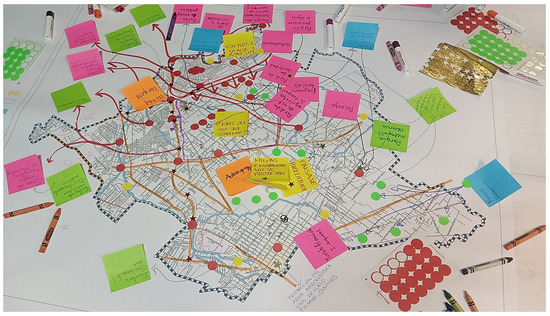
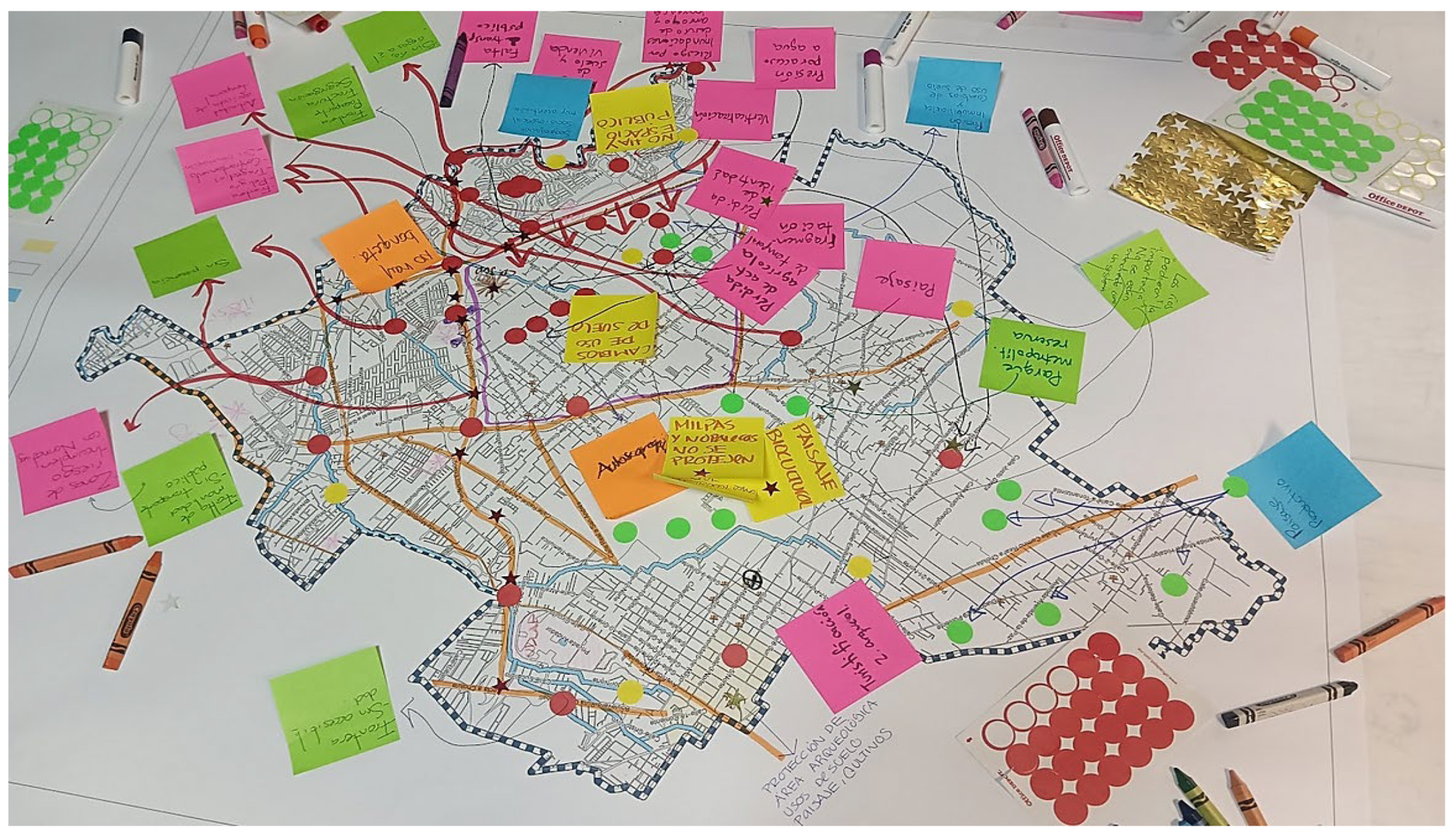
Maps narrated by the people who inhabit a territory constitute a valuable source of knowledge [3], as they provide access to dimensions of everyday life that GIS systems often struggle to capture. The inclusion of geospatial tools in participatory processes has been widely documented for its potential to engage citizens in public processes that directly affect their lives, such as data collection, mapping, spatial analysis, and decision-making [4]. From this perspective, participatory cartography is fundamental to producing maps based on the experiences, needs, and memories of communities, thereby contributing to the development of critical approaches within geography, as it is represented in Figure 1.
Figure 1.
Process of the map making of San Andrés Cholula used in a 2022 participatory workshop with academics and local authorities for the consultation of the new urban development plan.
Annette M. Kim [5], for example, distinguishes between testimonial maps—those that challenge the status quo by making visible injustices or overlooked phenomena—and visionary maps, which propose alternative scenarios to dominant institutional models. In this vein, participatory methods in cartography generate qualitative data that can later be processed for spatial analysis, ranging from community workshops to the production of digital maps. For Taylor et al. [6], the combination of participatory methodologies with geospatial tools enables the visualization of contextual information related to social and territorial resilience, thereby rendering GIS a more inclusive policy tool. These authors emphasize the importance of designing workshop dynamics that facilitate equitable participation, such as territorial walks, storytelling, material metaphors, social networks, and collective map-making.
Taken together, these approaches aim not only to produce cartography “from below,” but also to democratize spatial representations and make visible social, symbolic, and affective dimensions that are often excluded from institutional cartographic systems.
While most participatory cartography literature focuses on GIS-based or digital mapping, this research draws on textile and embroidery-based mapping as a situated, embodied, and collective practice. Although rarely systematized in urban studies, similar material-based methodologies have been explored in feminist and decolonial participatory processes.
Beyond GIS: Non-Digital Participatory Cartographies and Textile Practices
While a significant portion of the literature on participatory cartography has developed in close connection with GIS technologies, these approaches do not exhaust the field. In contexts shaped by territorial dispossession, accelerated urban reconfiguration, and disputes over the right to name and inhabit space, non-digital cartographic practices have emerged that operate through different materialities, temporalities, and modes of knowledge production.
Various studies in Latin America have documented the use of collective textile practices—such as arpilleras, community embroidery, and textile ethnographies—as methodological and political devices for producing situated knowledge, activating territorial memories, and narrating processes of loss, resistance, and spatial reconfiguration. These non-digital cartographies do not seek metric precision or technical standardization, but rather the material inscription of local knowledge that is often excluded from official archives and from the technical languages of urban planning.
From this perspective, collective embroidery can be understood as a form of situated cartography that displaces the centrality of the map as an objective representation of space and instead conceives it as a relational and collective process. The act of embroidering introduces a slow temporality that fosters conversation, negotiation, and the emergence of fragmented memories, enabling the reconstruction of territory through everyday routes, local place names, affects, and conflicts. In this sense, embroidery does not function as a mere illustration of territory, but as a mediating device that co-produces cartographic knowledge together with those who inhabit and remember the space.
Moreover, these textile cartographies possess a strong political-territorial potential. By reinscribing toponymies, trajectories, and boundaries that have been erased or redefined by the State and by real estate markets, embroidered maps challenge cartographic authority and reaffirm the collective right to name territory. In this way, cartography ceases to be an exclusively technical tool and becomes a field of symbolic and political dispute, closely linked to struggles for recognition, consultation, and territorial autonomy.
Finally, these practices expand the horizons of urban planning by incorporating forms of knowledge that not only document territory but also help sustain its social, cultural, and political continuity in the face of extractive urbanization processes. From this standpoint, non-digital participatory cartography does not oppose GIS tools; rather, it complements and decenters them by placing lived experience and territorial memory at the starting point of the cartographic process.
2.2. Recognition of Indigenous Peoples in Urban Planning in Mexico
Historically, Indigenous peoples in Mexico faced territorial conflicts due to mining concessions, extractive industries, land dispossession, expropriation, epistemic violence, and population displacement caused by narcotrafficking, among other struggles. However, since the rise of the Ejército Zapatista de Liberación Nacional (EZLN) in 1994, it has become increasingly evident that these struggles are gaining recognition at national and international levels. This is reflected in the Mexican Constitution [7], where Indigenous rights and self-determination are granted in Article 2, which focuses on the following aspects: (I) self-organization and decision-making on cultural, social, and political matters; (II) decision on their own regulatory systems for the regulation and resolution of internal conflicts; (III) land tenure rights; (IV) native language preservation; (V) environmental conservation; (VI) natural resources management; (VII) political participation at the municipal level; and (VIII) the right to full access to the jurisdiction of the State, to be respected in their culture and traditions, and to have an advocate and interpreter familiar with their culture and language.
Scholarly consensus suggests that recognizing these rights, along with other international conventions, is essential to incorporating Indigenous worldviews and perspectives into public policies and everyday life, moving beyond paternalistic approaches.
Although some changes have occurred since 1994, environmental conflict remains a priority for Indigenous communities and activists due to discoveries related to rare lands and natural resource extraction across Mexican territory. The perceived “enemy” appears to be both national and international corporations and governments; however, there is one adversary that takes many forms among stakeholders: urban development and developers.
Indigenous territorial defense against urbanization is a recent, visible, and newly studied phenomenon, unlike Indigenous resistance in communal land and conservation territories, which has a decades-long documented history.
To mark a specific year, we can argue that 1992 marked the beginning of the end of the agrarian and land-reform model that had governed communal land in Mexico. During this reform, ejido and communal lands were liberalized to align with the neoliberal policies of that time, which were linked to the NAFTA treaty between Canada, the United States, and Mexico. This shift meant that thousands of communal lands could become private, helping to provide tenure security for campesinos, ejidatarios, Indigenous peoples, and farmers who only had “the right” to use the land but not the right to sell it.
Therefore, thousands of rural areas, primarily those on the outskirts of cities, were appealing to the free market because they were inexpensive for private developers to convert into large social housing projects, industrial facilities, and commercial complexes.
The authors of this research have observed this phenomenon in the Cholula region across various publications [2,8,9,10,11,12,13]. Where the impact of neoliberal urban development is evident: on the one hand, neoliberal land-use policy aims to secure tenure and the Mexican aspiration of property ownership and personal freedom to use it as desired. However, studies reveal that land use policies and urban planning driven by real estate market forces and speculators are exploiting “available land for housing, commercial, and services uses” to pressure and displace Indigenous people and forcing them away from their ancestral lands. All of this is justified as “progress and development” because, casually, many of these territories embody the modern face of globalization and urbanization, but also the visible mask of systemic racism and dispossession [14].
However, what is recent is the increased visibility of struggles faced by pueblos originarios not only in the Cholula Region as part of the Metropolitan Area of the City of Puebla, but also in Mexico City, where other Indigenous communities embedded in urban areas are being harmed by gentrification, tourism-driven development, and large-scale commercial expansion.
2.3. Pueblos Originarios and Indigenous Peoples in Relation to Land Use Planning
Two recent cases help contextualize the territorial conflicts faced by pueblos originarios and Indigenous communities in urbanized regions of Mexico: the opposition of the pueblos originarios of Xochimilco and Milpa Alta to Mexico City’s land-use planning instruments, and the resistance of the pueblo of Xoco to the Mitikah real estate megaproject. Although these contexts differ, both illustrate how urban planning frameworks can become mechanisms of dispossession when Indigenous communities are treated as obstacles to development rather than as collective territorial authorities.
In the case of Mexico City, the draft General Land-Use Program (Programa General de Ordenamiento Territorial, PGOT) [15] proposed measures that, at least formally, appear desirable for any planning exercise—such as the recognition of Indigenous communities’ right to consultation and the reorganization of land uses, zoning, urban densification, infrastructure, and future growth toward 2035.
Conversely, territorial activists, community organizations, and journalists identified a series of structural problems related to this type of planning framework, including the land use recategorization that transforms conservation areas into rural or developable land, creating legal loopholes that threaten forests, aquifer recharge zones, protected natural areas, and agroforestry. These changes facilitate real estate speculation on collectively held lands with high biocultural value. Gentrification and touristification driven by real estate pressures—such as converting territorial reserves into urban areas, increasing land values, and promoting emerging tourist destinations—commodify traditional lifestyles.
Weak Indigenous consultation processes, marked by limited participation, insufficient information, and the absence of mechanisms for free, prior, and informed consultation, generate mistrust and lead participants to perceive these exercises as symbolic. The prioritization of the real estate market over territorial and biocultural rights, driven by a neoliberal view of land as a commodity, conflicts with Indigenous notions of territory as a collective, cultural, and spiritual space of memory and community.
Environmental and water risks—including deforestation, aquifer depletion, soil degradation, biodiversity decline, and landscape fragmentation—worsen water insecurity and affect Indigenous peoples. Within this framework, communities such as Xoco have denounced that large-scale redevelopment processes have entailed the privatization of everyday spaces, water stress, the destruction of urban green areas, and displacement pressures, as well as violations of fundamental rights, including access to water, information, culture, and Indigenous consultation. Similarly, in Xochimilco and Milpa Alta, community organizations have expressed concern over the potential loss of recognition as pueblos originarios and, consequently, of their capacity for self-determination and territorial governance.
These cases are not isolated; instead, they reveal broader patterns in which urban planning, when subordinated to real estate interests, reproduces contemporary forms of territorial control and dispossession. This framework is essential for understanding the processes currently unfolding in the Cholula region, and in the community of San Antonio Cacalotepec, where similar dynamics are being reconfigured and applied amid urban expansion and real estate capital.
3. Contextualization of San Antonio Cacalotepec’s Territorial Disputes
The Dispute Against Private Urban Planning
The municipality of San Andrés Cholula stands out not only for being part of the historical region of Cholula, home to one of the continent’s ancient living human settlements with more than 3000 years of continuous occupation, but also for the migration of different ethnic groups, such as the Nahuas. The municipality is also the mirror of modernity and globalization, with an intent to emulate industrial car-driven cities.
Within the current landscape of municipalities in Cholula, we can identify an urban development project, Lomas de Angelópolis, that, despite being relatively new, dates to the early 2000s. However, it is important to mention that the urbanization of this region dates to the 1990s when a big urban development plan for the extension of the City of Puebla was implemented through land expropriation from the State Government of Puebla [11,16].
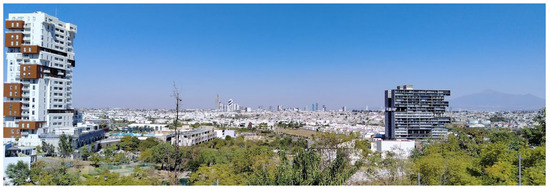
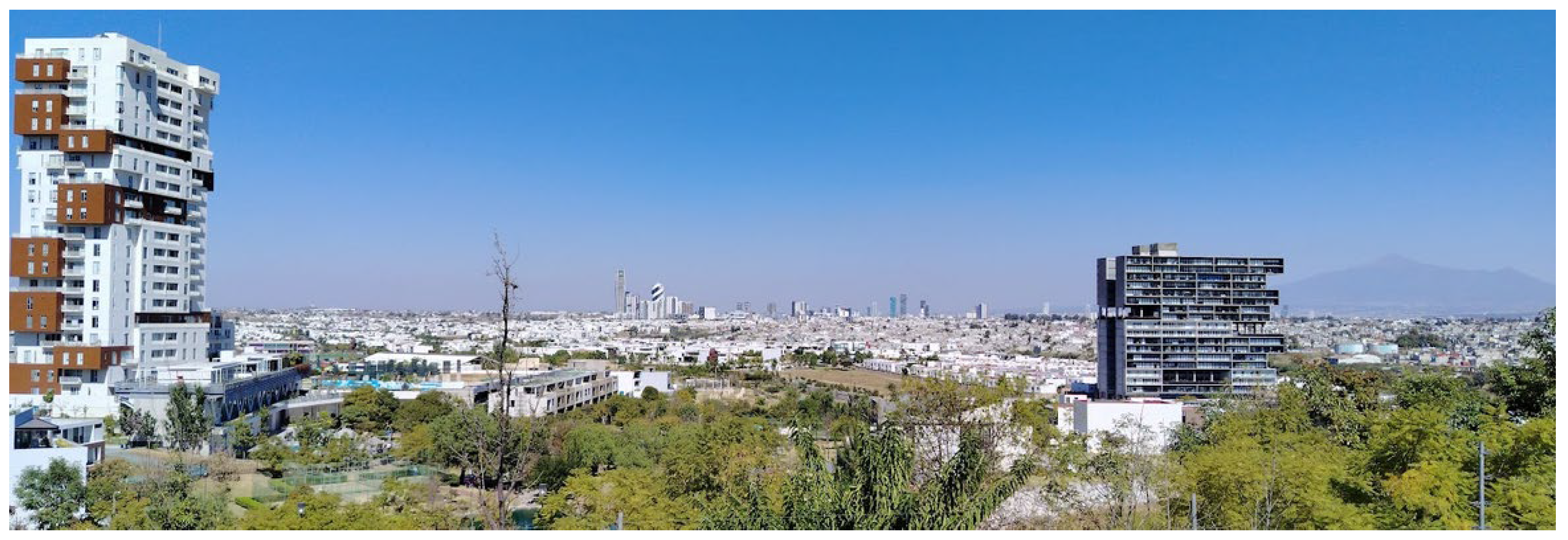
The gated city Lomas de Angelópolis (Figure 2) has grown into a residential and commercial area, becoming one of the most important real estate development projects in the Metropolitan Area. The appeal of Lomas, as this neighborhood is called, lies in the idea of living in a small city within the larger city of Puebla, where residents do not need to travel far to meet their basic needs or enjoy entertainment, thanks to the availability of security, amenities, and “lifestyle” [17]. Since construction began in 2003 on this gated community, it has developed over more than 900 hectares, and it is expected to have more than 21,000 housing units [18]. Till 2025, the gated city has a wall-perimeter of 25 km2. As Morales shows [18], many other gated communities in Cholula and Puebla have been developed since 1980. However, this gated community is quite particular because it is an “extreme case of gatedness, and because of its large scale and complex organizations, it is an example of what a gated city could be” (page 139). Based on Google Earth Data, by 2025 the gated city will cover more than 22.5 km2, which includes the territory of two municipalities: San Andrés Cholula and Ocoyucan. It is important to note that the current development has more than 1149 hectares developed, while the real estate company has another land bank of 200 hectares awaiting a new urban development [19].
Figure 2.
Urban landscape of Lomas de Angelópolis’s gated communities, former territory of San Antonio Cacalotepec and Ocoyucan. Image: Melissa Schumacher (2025).
This urban project offers a dream for its residents: its high-rise buildings, green spaces, private clusters, and business facilities provide a “high” quality of life for those who can afford the high prices needed to live there. However, on the outskirts of Lomas, a different reality exists. Land dispossession, urban extractivism, theft of natural resources, violence against communities, and the repression of their voices are almost daily issues faced by neighboring residents. Among them are the residents of the San Antonio Cacalotepec. In words of Sonia H.A.: “Calalotepec es un pueblo de constumbres, las cosas han cambiado… cuando yo estaba creciendo en pueblo era comunidad, comunidad implica que todos se conocen, todos somos de cierto modo cercanos, nos conocemos, nos llevamos, nos cuidamos” [20]. She describes her community as a place of costumes, where things are changing because it used to be a place where everyone knew each other and took care of each other [20]. Nevertheless, since 2018, through the collective of the seven Nahua communities of San Andrés Cholula, Cholultecas Unidos en Resistencia, or CHUR for short, the Cacalotepec community has participated in social movements in response to the Municipal Urban Development Program.
CHUR is a group formed by men and women from the seven Indigenous communities living in the municipality of San Andrés Cholula in Puebla: San Bernardino Tlaxcalancingo, San Andrés Cholula, San Francisco Acatepec, San Rafael Comac, Santa María Tonantzintla, San Luis Tehuiloyocan, and San Antonio Cacalotepec. This group emerged in response to the 2018 approval of the San Andrés Cholula Municipal Urban Development Program by the then. This program prioritizes the interests of real estate developers, promoting the construction of plazas, shopping centers, gated communities, skyscrapers, and, most problematically, boulevards with 40-m-wide roads cutting through the town centers. These projects could negatively affect residents’ quality of life and safety, including children who play in the streets. These people rely on bicycles for transportation, housewives walking to buy groceries, and the social life of Cacalotepec.
No doubt, an Indigenous awareness rose in San Andrés Cholula, mainly thanks to the resilience of Cholulteca women. In this matter, “community-based governance has played a pivotal role in maintaining territorial resilience.” [21] and, as a result, local committees and organizations like the CHUR have been created.
Finally, at the end of 2019, the Indigenous consultation protocol was signed, and members of CHUR began developing their own Urban Development Plan proposals [22]. The mayor (2021–2024) rejected these proposals as “viable or legal,” despite CHUR members not developing the project alone. They consulted urban planners and anthropologists to avoid mistakes and ensure legal compliance.
Each community has fought its own battles against the municipality for many years. For example, residents of Cacalotepec have protested at the San Andrés Cholula town hall, opposing plans to build roads that divide and destroy their land [23]. They have also demonstrated by opening the Atlixcáyotl toll highway [24] and peacefully blocking the federal highway [25].
However, efforts to defend their territory in Cacalotepec have been hampered not only by external forces but also by conflicting interests among residents. While some viewed the project’s progress as potentially harmful or irregular, others saw its suspension as a rejection of the community’s development and well-being. The clashes between those wanting to protect the territory and those seeking integration into the urban model create tension among residents, leading to discrimination and stigma against Indigenous groups.
4. Materials and Methods
The research employs participatory action research and a decolonial approach, emphasizing informed consent, collective knowledge creation, and community control over data and representations. The fieldwork is built on a participatory, community-centered methodology developed between 2024 and 2025 in San Antonio Cacalotepec. A total of 8 participatory workshops were held, each involving about five community members and approximately 5–6 undergraduate students from UDLAP. The workshops combined collective mapping, oral history, and territorial narrative reconstruction, focusing on Nahuatl toponymy, land-use changes, and community memory, as detailed in Table 1, with roles and activities assigned to participants and facilitators.
Table 1.
Workshop activities and roles between Colectiva Hilando Territorios and Cacalotepec community. Source: authors.
Community members actively led the identification, interpretation, and spatial localization of historical place names, while students supported cartographic systematization and documentation under the guidance of the research team. Instead of viewing maps as neutral images, the process framed cartography as a political and educational tool, allowing participants to visualize patterns of dispossession, symbolic erasure, and rebranding of land. The maps were collectively validated during follow-up sessions and are now used by the community as educational and territorial defense tools.
These activities started in November 2023. Fieldwork was on hold for about three months and then resumed in February 2024, thanks to Sonia H.A. and Facundo C.F., activists and members of the Pueblo Originario of Cacalotepec. Although this article covers a specific research period, collaborative efforts with the community continue beyond the publication of this manuscript.
Architecture and anthropology students were vital to ethnographic research, mapping, and the integration of disciplines crucial to urban development. They challenged exclusion, ‘othering,’ and the lack of Indigenous women’s voices in Mexican architectural education (p. 3, [26]).
One of the outcomes of the meetings was the creation of Colectiva Hilando el Territorio, a decolonial, co-research-based collective composed of women from San Antonio Cacalotepec, university researchers, and students from UDLAP. The collective organized the workshops, facilitated dialogue, and ensured that decisions about data use and representation remained in the community’s control. CHUR’s walks, interviews, and debates came before and shaped the workshops, serving as parallel and complementary processes. The goal of the Colectiva is to co-develop projects and participatory activities in biodiverse areas, encouraging dialogue, reflection, and highlighting landscapes from multiple community and Indigenous viewpoints [27].
Through the Colectiva, a total of 8 participatory workshops were held, mainly with women, students, and older community members. The workshops centered on a shared guiding question: how did people over 70 remember the territory before large-scale urbanization? These participants played a key role in the research process, as they directly experienced and witnessed the earliest stages of dispossession that later led to the region’s current phase of aggressive, speculative urbanization.
Anthropologists and architects involved in the project served as facilitators and methodological guides; however, the content, spatial references, narratives, and meanings depicted in the maps originated from the participants themselves, rather than being imposed by external academic frameworks. Finally, it is essential to note that for each organized workshop, participants were transparently informed about the nature of the work and that the results of the maps and the information generated are shared back with the community, as it makes no sense to keep them stored away in a drawer within the university.
4.1. Map Making (QGIS) as a Qualitative Research Method
The methodology used to create the maps presented in this study was grounded in understanding the multiple territorial transformations that San Antonio Cacalotepec has undergone over the past twenty years. This approach combined participatory workshops, qualitative data production, and the recovery of original Nahuatl place names associated with areas formerly occupied, cultivated, or inhabited by the community.
The primary objective of the maps was to geographically contextualize both Mexico and the state of Puebla within broader processes of urban expansion, while simultaneously foregrounding local territorial knowledge. In Figure 3, digitized information produced by community members and later processed in QGIS is presented, offering a detailed visualization of community boundaries and the extension of former agricultural lands using Nahuatl toponymy. The satellite image clearly shows the portion of the territory currently occupied by the gated urban development known as Lomas de Angelópolis.
Figure 3.
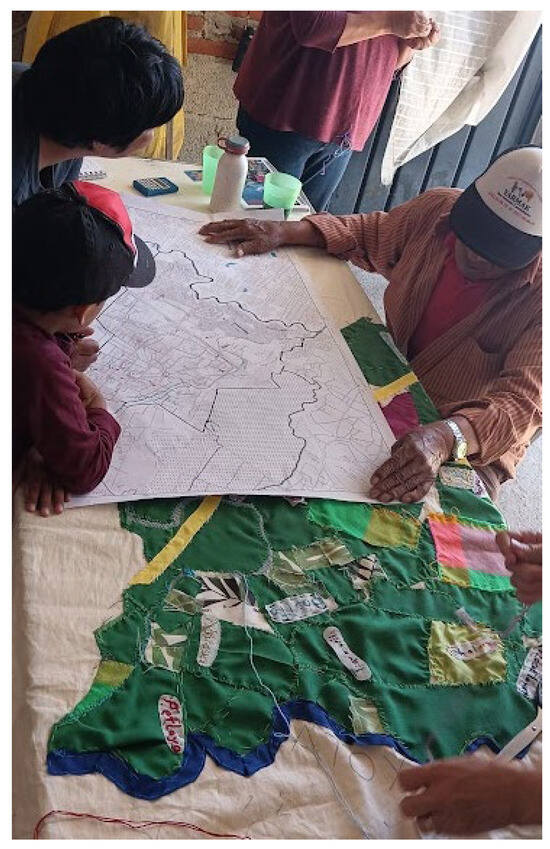
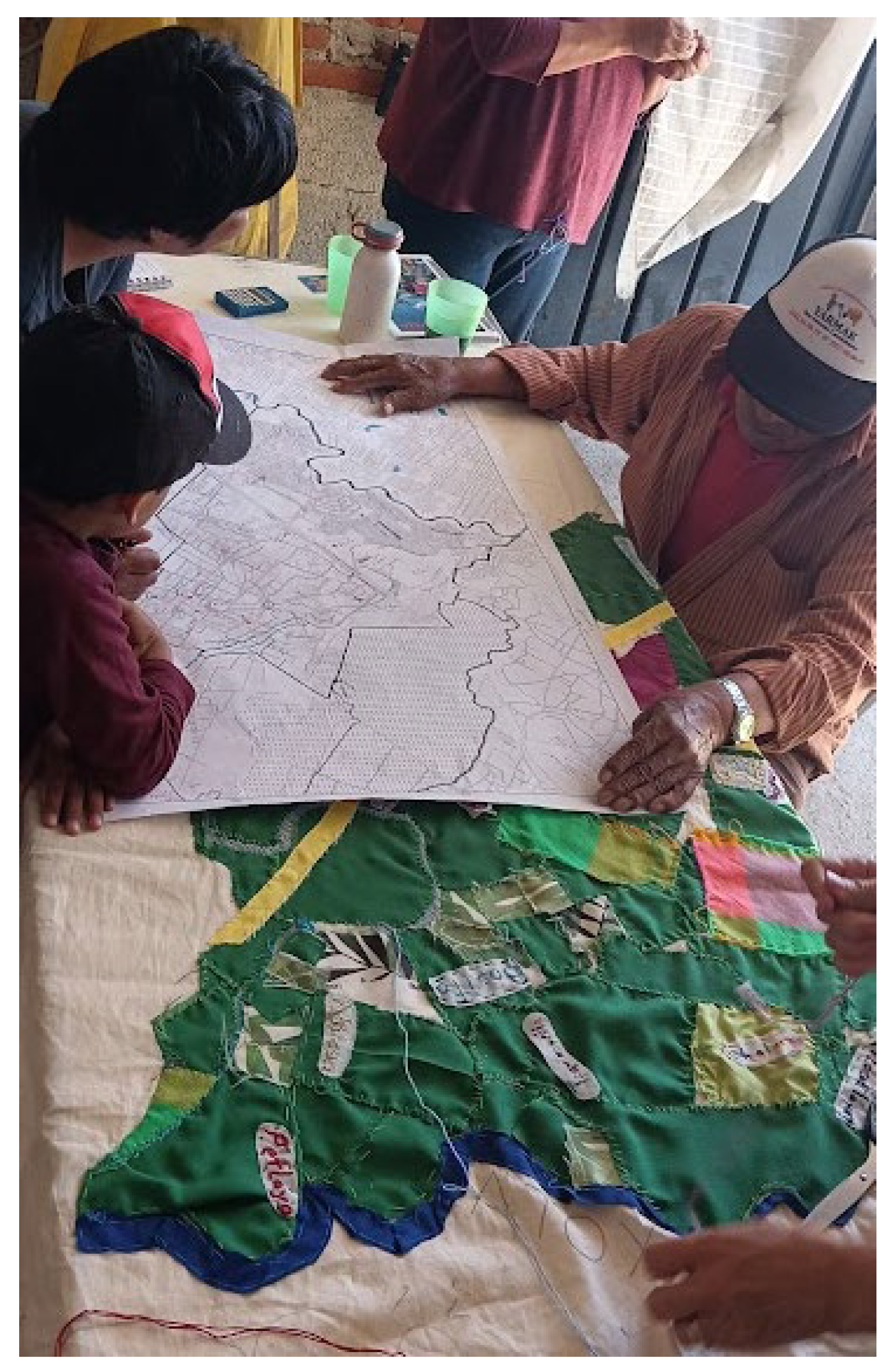
Comparison between the Cacalotepec map made on paper and the one embroidered in one of the workshops held on 24 March 2024. Source: Melissa Schumacher.
Before digitization, workshop participants were invited to collectively reconstruct what Cacalotepec looked like before extensive urbanization, thereby activating processes of collective memory. This exercise encouraged creative thinking, with a strong emphasis on the territory’s spatial, relational, and affective dimensions. The resulting maps functioned as tools for dialogue and reflection, and several original place names—such as Colostipac and Chalma—were recovered through these discussions.
The participatory mapping sessions were held in different locations within Cacalotepec. A key methodological decision was to use intuitive embroidery to embed collective memory into maps made from fabrics, threads, and colors. We observed that plastic maps or large-scale vinyl prints commonly used in community assemblies, are often difficult to transport and store. In contrast, fabric maps are easier to fold, carry, wash, and modify over time. This material flexibility allows the maps to remain active objects that can be transformed during assemblies as new information is added.
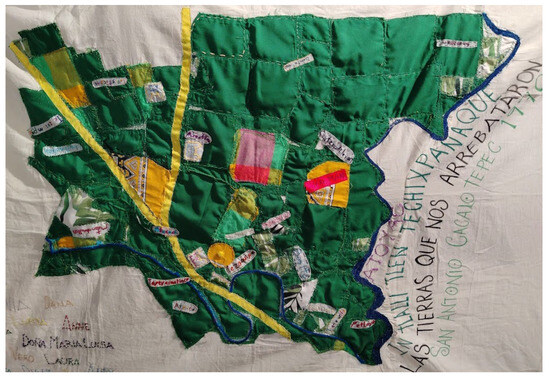
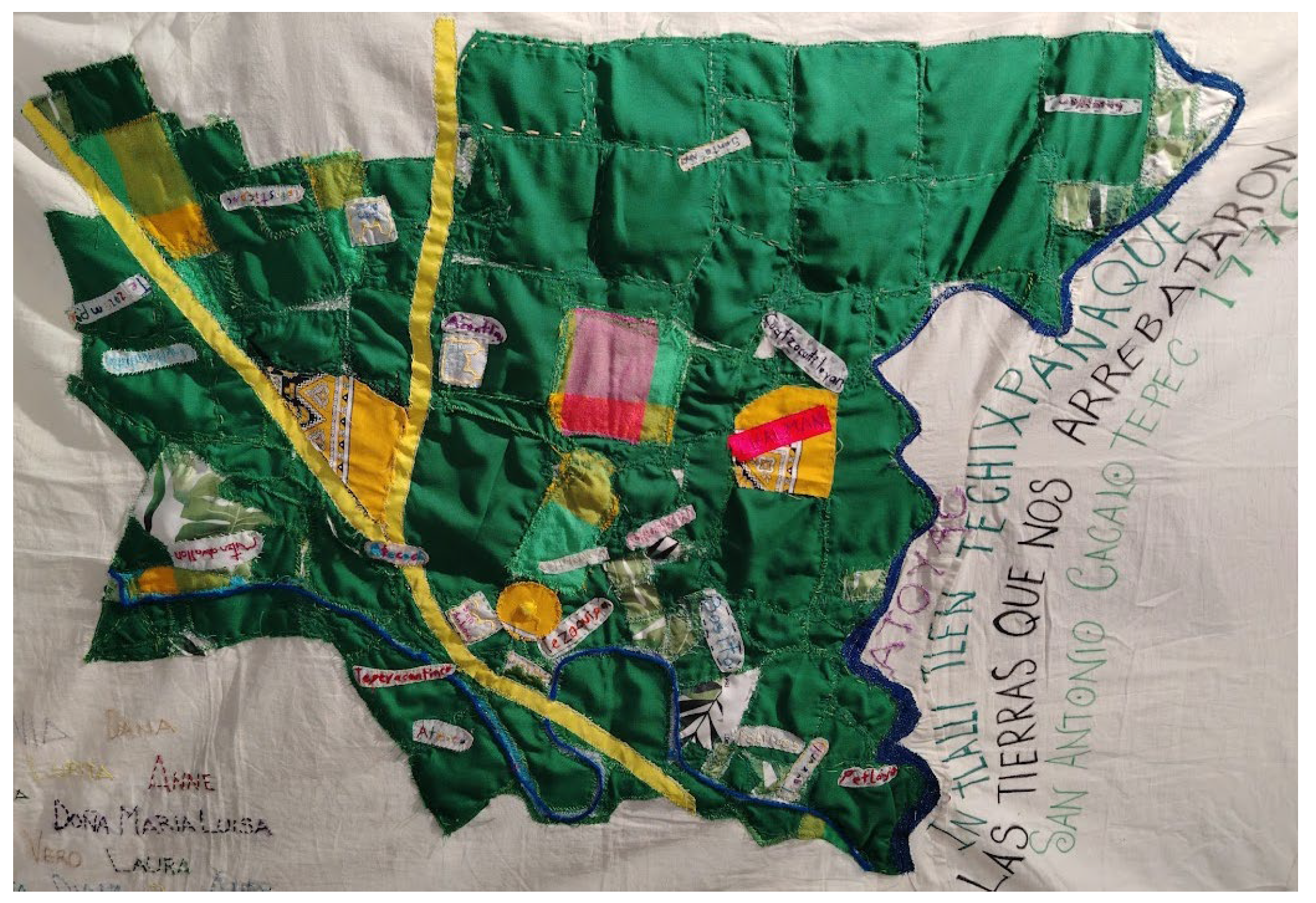
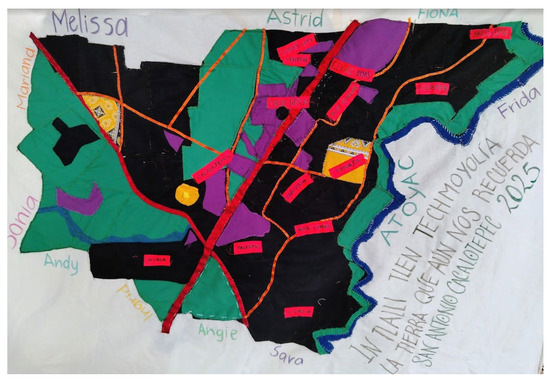
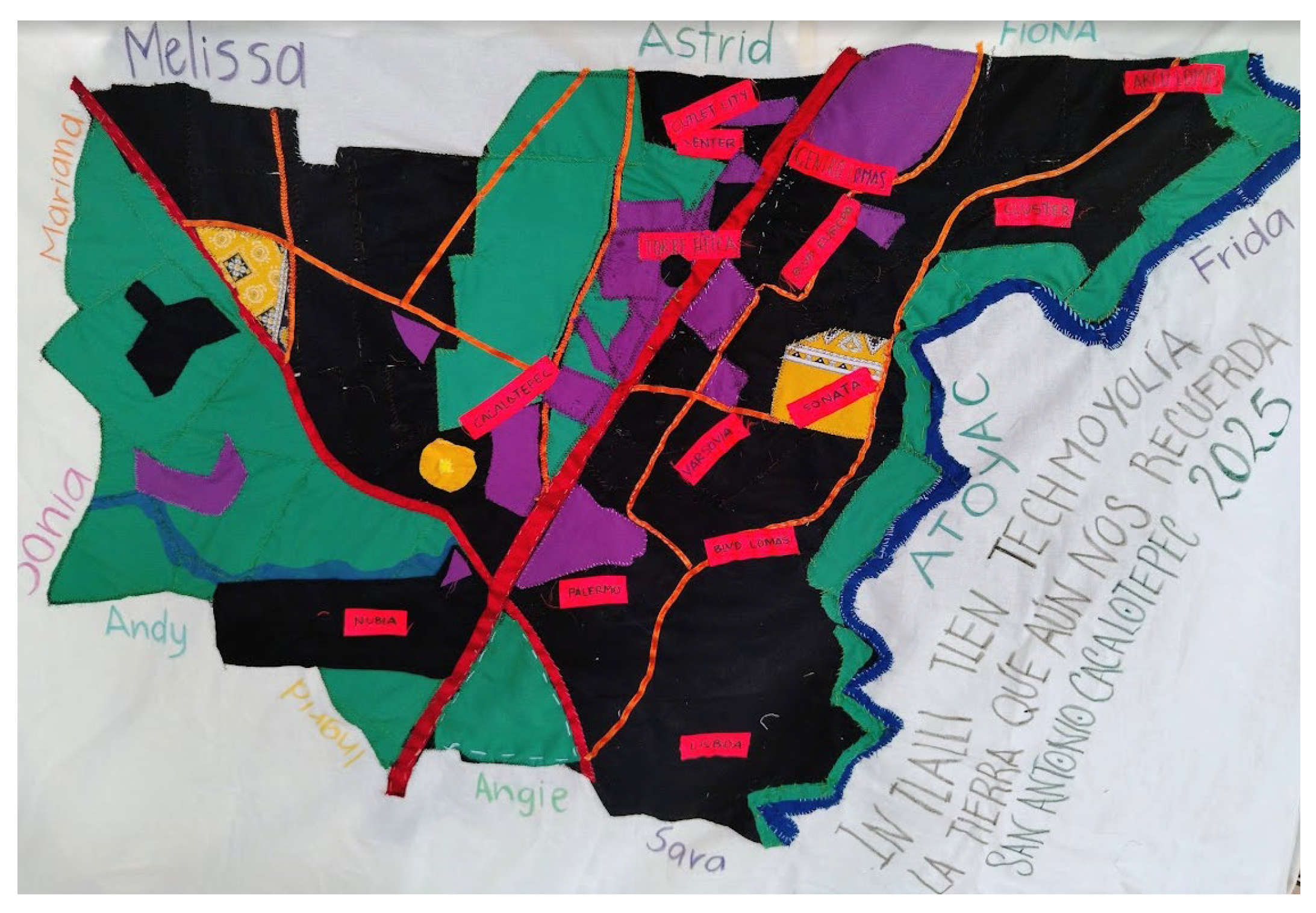
Based on this process, three maps were proposed: the first, dated to 1970, represents Cacalotepec as an entirely rural territory using original Nahuatl toponymy; the second, dated to 2025, depicts the expansion of Lomas de Angelópolis and the intensity of urban encroachment; and the third, projected into the future, is envisioned as a map created with children, reflecting their perspectives and imaginaries of possible futures.
4.2. Intuitive Embroidery as a Methodological Device
As has been widely documented, GIS-based cartography often struggles to capture lived experience, affective relationships, and the symbolic dimensions of territory. For this reason, the research incorporated intuitive embroidery as a methodological device [28], rather than as a decorative or illustrative technique.
Intuitive embroidery was used as a slow, tactile, and collective method that enabled participants to reflect, negotiate, and reach consensus regarding territorial boundaries, place names, memories, and losses. Working with fabric and thread allowed the mapping process to unfold at a human pace, facilitating intergenerational dialogue and creating space for storytelling, silence, disagreement, and shared recollection.
In this context, embroidery functioned as a situated methodological tool [29] that materialized memory and territorial knowledge through textures, colors, and gestures [3]. This approach aligns with previous experiences in Latin America, where textile practices—such as Chilean arpilleras or collective embroidery processes in Brazil [30]—have been documented as powerful devices for producing feminist, political, and ethnographic knowledge, particularly in contexts of violence, dispossession, and resistance.
The use of intuitive embroidery enabled participants to externalize memories that are often difficult to verbalize, especially those related to land loss, displacement, and the erosion of everyday practices tied to the territory. For example, the memories of Sonia H.A. “El vínculo con la tierra, con el agua, con los animales, lo perdimos en generación porque nos enseñaron que para progresar hay que estudiar…” she relates that her community lost the bond with the land, with the water, with the animals in one generation because they told her that to progress, you have to study [18].
Through stitching, participants traced rivers that no longer exist, paths erased by highways, and agricultural areas replaced by gated developments. In this sense, embroidery became a medium through which the past could be activated as a resource for imagining alternative futures.
The third map, still in progress, is planned as a workshop with children from Cacalotepec. This workshop draws inspiration from Ailton Krenak’s reflections on the need to develop mechanisms to postpone the end of the world by designing possible futures and understanding the past as a mechanism for imagining what lies ahead [31]. Through embroidery, children will be invited to envision how they would like their territory to exist in the future, what they wish to protect, and what they fear losing. This future-oriented exercise treats memory not as nostalgia, but as a political and methodological resource for territorial continuity.
It is important to note that the advantage of using these collective methods is that, when there is any discrepancy, you can return to the original plan created in QGIS and directly add details or clarify locations, as shown in Figure 3.
By combining intuitive embroidery with participatory cartography and GIS translation, the methodology bridges community-based knowledge production with tools commonly used in urban planning and territorial management. Working with people’s perceptions, memories, and embodied knowledge enables the development of alternative strategies for territorial governance and conservation, weaving together theoretical reflection and practical application in ways that challenge extractive and technocratic planning models [26].
5. Results & Discussion
While the previous section presented materials and methods derived from participatory mapping and collective memory, this section interprets these results through the lenses of territorial dispossession, urban extractivism, and symbolic erasure.
5.1. Contributions of Participatory Mapping to Territorial Understanding
The participatory cartography process developed in San Antonio Cacalotepec enabled the identification of territorial dimensions absent from official urban planning instruments. Based on the materials produced during workshops, embroidery sessions, and collective discussions, participants represented the territory not as an abstract administrative unit but as a lived space, closely linked to everyday practices, intergenerational memories, and social relationships.
The act of mapping is not simply recording facts as a collection of events; it is engaging with the field itself as an event [32]. The maps produced show, as an empirical finding, that territorial problems are not formulated solely through external technical diagnoses, but rather emerge from the direct experience of those who inhabit the territory. Participants repeatedly emphasized that places identified as “vacant” or “available” in planning documents correspond to spaces of everyday use, memory, and subsistence. In this sense, participatory mapping functioned as a device that rendered visible needs, impacts, and losses that are rarely considered in urban planning processes carried out exclusively from governmental offices or technical consultancies.
Furthermore, the process documented how local knowledge articulates the social, symbolic, and material dimensions of territory, offering a complex reading that complements—and, in some cases, challenges—institutional cartographic representations. These findings highlight the limits of technocratic planning tools when detached from lived territorial experience. For example, in official mapping it is not represented the flora and fauna loses, in this matter Facundo C.F. says that many things are lost like corn and vean cultivation, plow the land…a good diet with insects, mushrooms, axolots, frogs “cómo costumbres la enseñanza del cultivo del maíz, del frijol, de ha ido perdiendo y la agente ha dejado de trabajar el campo… otra cuestión es la alimentación, la alimentación sana, en esas zonas juntábamos chapulines, hongos, ajolotes, ranas… eso era alimento y se ha perdido, se ha perdido mucha flora y fauna” [20].
Mapmaking can serve as a form of resilience against cases of real estate development on indigenous land, a phenomenon not unique to Puebla; it has occurred throughout Mexico, often under the banner of the “right to the city.” [33,34]. This right refers to the entitlement of all residents to occupy, use, and develop cities to create a common good and ensure a good quality of life. It advocates freedom from discrimination, inclusive citizenship, increased political participation, fulfillment of social functions, gender equality, cultural diversity, an inclusive economy, and respect for connections between rural and urban areas [34].
Despite the encouraging rhetoric, the right to the city becomes a contradiction. When the city flourishes and benefits from the resources invested in it, undeveloped areas undergo a transformation that eliminates key aspects of urban life, such as sociocultural diversity, an inclusive economy, gender equality, and freedom from discrimination, among other points. A good quality of life becomes accessible only to those who can afford it. If we visualize the problems of Cacalotepec, where their people cannot afford an “urban quality of life”. It seems that the evolutionary paradigm, superseded by many academics by the end of the 19th century, remains present in the collective imagination of people today, as it has not truly been superseded [35].
Spatial Contrasts Between Community-Recognized Territory and Administrative Boundaries (GIS-Based Analysis)
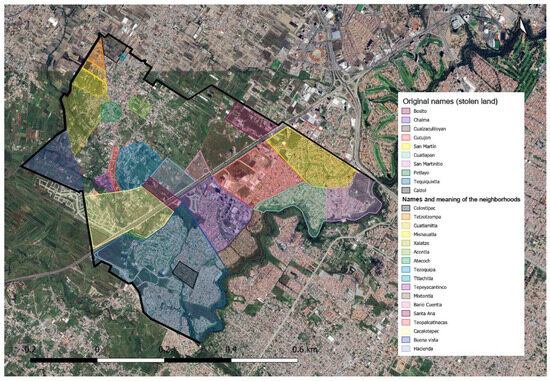
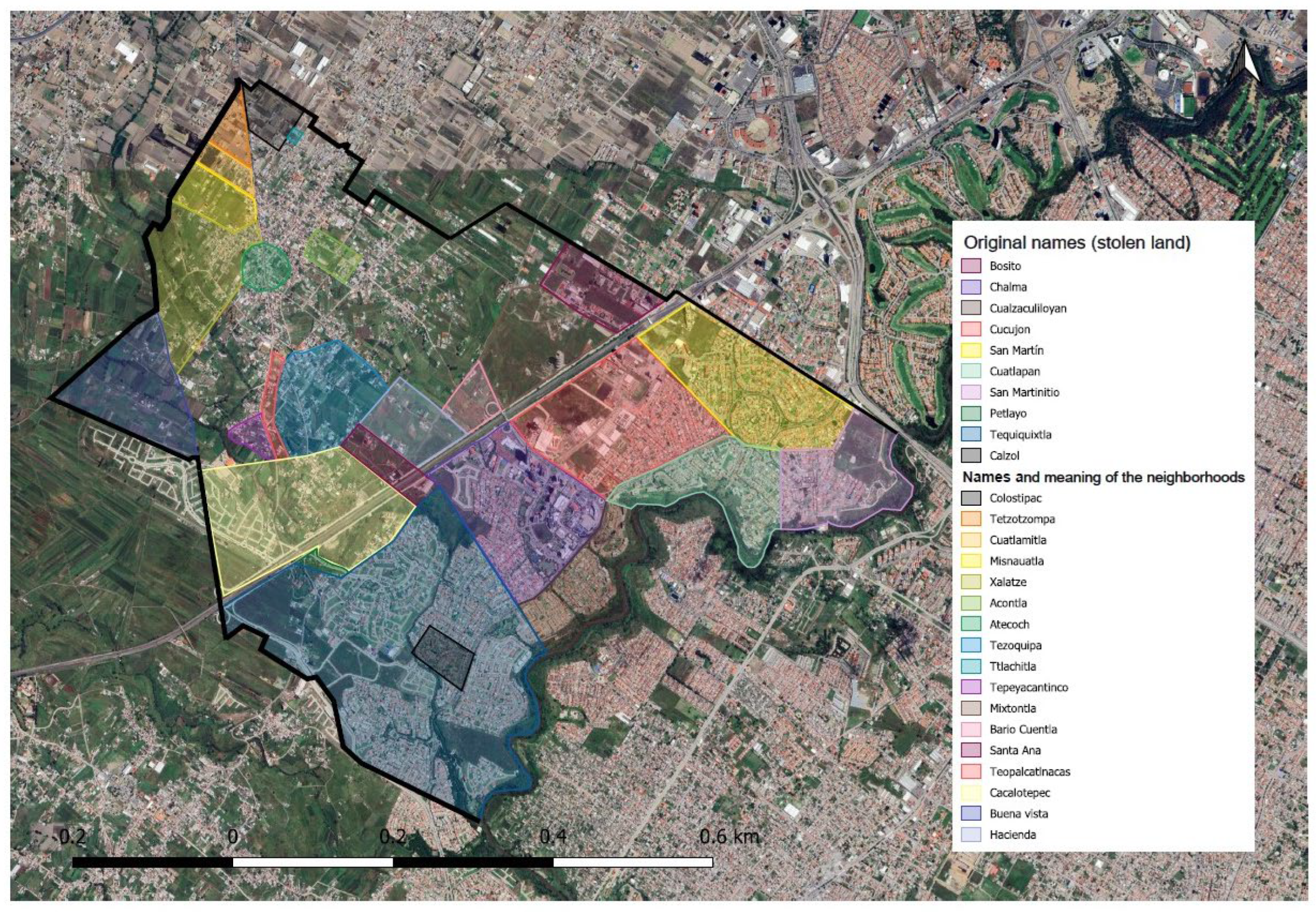
To complement the participatory and embroidered maps produced during the community workshops, a fundamental GIS-based spatial analysis was conducted. This exercise was not intended to replace the territorial knowledge generated by the community, but rather to visualize and contrast the differences between the territorial boundaries recognized by the inhabitants of San Antonio Cacalotepec and the official administrative delimitations used in urban planning instruments, as demonstrated in Figure 4.
Figure 4.
Map of San Antonio Cacalotepec based on limits established by CHUR Collective and GIS mapping of Nahuatl toponymy based on community workshops, elaborated by authors.
In this digitalized map of Cacalotepec, the overlay of these spatial layers reveals a clear empirical contrast. While official planning documents present large areas as available, vacant, or suitable for urban development, community-based mapping identifies these same spaces as former agricultural lands, water-recharge zones, historical paths, and areas of symbolic and productive value. This spatial mismatch constitutes one of the central results of the analysis.
The GIS analysis also reveals a partial overlap between contemporary real estate developments—such as Lomas de Angelópolis—and areas that the community recognizes as part of its original territory. This overlap corroborates narratives of dispossession and territorial fragmentation that emerged consistently during interviews and territorial walks.
Rather than contradicting the intuitive embroidery process, the GIS analysis visually confirms what community knowledge had already articulated: that what appears as “empty” or “available” land in official maps corresponds to territories densely inscribed with memory, use, and collective meaning. From an interpretive perspective, this finding underscores the role of GIS as an auxiliary, translational tool rather than an authoritative source of territorial truth.
5.2. Collective Responses: Collaborative Mapping
In response to accelerated urbanization processes and the advance of real estate projects, residents of Cacalotepec, organized through the CHUR collective, promoted the creation of collaborative maps using intuitive embroidery techniques. The emergence of these mapping practices constitutes a documented collective response, rather than an externally imposed research activity, to territorial loss, historical erasure, and the community’s exclusion from formal urban planning processes.
One of the most evident findings is the discrepancy between the territorial boundaries recognized by the community and those registered on official platforms such as Google Maps or in municipal planning documents. This discrepancy was identified repeatedly across workshops and confirmed through on-site verification. Community-recognized boundaries, reconstructed through interviews, walks, and collective work, include agricultural areas, paths, and every day-use space that administrative cartography does not acknowledge, despite their continued use by the population. This was represented in the Map of 1970 and the Map of 2025 described in Figure 5 and Figure 6.
Figure 5.
First living map based on intuitive embroidery, showing Cacalotepec in 1970. During this period, there were almost no agricultural uses, no motorways, nor urbanization. Elaborated by Colectiva Hilando Territorios and women of Cacalotepec 2024–2025. In green: Cacalotepec´s territory. In yellow (lines): the two main roads. In yellow (squares): an important meeting point for the people. In yellow (circle): Cacalotepec´s hill, a representative cultural symbol. In blue (lines): Atenco (left) and Atoyac (right) river.
Figure 6.
Map of Cacalotepec dated 2025, showing agricultural land uses transformed into urban, mainly residential and commercial (black), with new roads and motorways, and names changed to modern, European ones. Elaborated by Colectiva Hilando Territorios and woman of Cacalotepec. In purple: vacant land. In green: green zones. In orange: main boulevards. In red: road that divides Cacalotepec from Angelopolis, the lost territory. In yellow (circle): Cacalotepec´s hill, a representative cultural symbol. In yellow (squares): Sonata, now an urban area. In blue: Atenco (left) and Atoyac (right) river.
The comparison between the two representations reveals a significant reduction in the territory officially recognized and the omission of areas that remain fundamental to community life. Participants frequently described these omissions as sources of vulnerability and uncertainty regarding future dispossession. This discrepancy was confirmed through on-site walks, which verified the existence and current use of areas rendered invisible by bureaucratic representations of space.
5.3. Nahuatl Toponymy and Embroidery as a Form of Resistance
“Antes mi abuela hablaba mexicanos, él hablaba bien…mi mama y mis tíos lo entienden, pero no lo hablan” [20]. This was one of the phrases elaborated by Sonia H.A. when she explains when the Nahuatl was lost from her grandmother and her mother’s generation. The recovery of Nahuatl-language toponymy constitutes one of the central results of the mapping process. Through collective recall and discussion, the names of landscapes, paths, agricultural zones, and former settlements were identified that persist in the memories of older community members but have been displaced by names imposed by the State or real estate developers.
The embroidered maps reveal generational tensions surrounding the naming of territory: while older residents retain Nahuatl references, younger generations tend to know places only by official or commercial names. This generational divergence emerged as a recurring theme during workshops. This finding highlighted the need to develop strategies to document and preserve the oral tradition associated with the territory.
The first map, Cacalotepec 1970 (Figure 5), depicts the territory before intensive urbanization, emphasizing Nahuatl toponymy and land uses linked to agriculture, water, and communal life. The second map, Cacalotepec 2025 (Figure 6), illustrates territorial reduction and the superimposition of urban development, in which Spanish-language names systematically replace original denominations. These two maps constitute a comparative empirical corpus for analyzing processes of symbolic and material dispossession. The third map, still in progress, projects the territory into the future through the participation of children from the community.
The two embroidered maps currently on display are in the temporary exhibition “Views from within: Inhabiting the landscape” at the UDLAP Art Chapel since 27 November 2025. The display of the maps in this location serves as a strategy for disseminating and raising awareness of the territorial problems that develop around the university, making visible the everyday conflicts that can be overlooked within the academic environment.
The display of maps as a dissemination strategy highlights the importance of knowing the problems that exist in the territory we inhabit. Although they may not affect us directly, it is through the knowledge of these realities that we can build possible free futures, or at least futures with fewer problems of social inequality, territorial dispossession, and the transformation aimed at imposed urbanization where it is not necessary or beneficial for the locals who inhabit the territory.
The construction of the Toponymy presented in Table 2 allowed for the systematization of this knowledge, while also revealing significant limitations: the progressive loss of Nahuatl, the absence of written records, and the difficulties involved in translating terms rooted in oral tradition. Nevertheless, the process enabled the community to reach shared agreements and to reactivate debates about the meaning of territory, reaffirming naming as a form of resistance in the face of dispossession. These results demonstrate that toponymy operates not only as linguistic heritage but as an active political resource within contemporary territorial struggles.
Table 2.
Areas of the territory belonging to San Antonio Cacalotepec, with original Nahuatl toponymy that remains in the collective memory of its inhabitants. Elaborated by the authors.
Table 2 and Figure 5 and Figure 6 should be read together. While the table synthesizes Nahuatl toponymy, collective meanings, and real estate rebranding, the conceptual map illustrates spatial patterns of symbolic displacement and territorial transformation. This combined reading allows the identification of zones where toponymy persists without urban transformation and areas where it has been actively replaced by real estate branding.
We cannot know what we cannot name, which is why it is so essential to preserve these names in Nahuatl and participants emphasized that place names are not only references but ways of remembering who we are and where we come from. Recovering the names is keeping the memory alive; it is reclaiming what the Mexican State has taken from Indigenous peoples under the guise of progress and the myth of mestizaje. The Nahua toponymy recovered by the inhabitants of Cacalotepec demonstrates how the territory is named and experienced from the community perspective, alluding to aspects such as lineage, the natural qualities of the landscape, knowledge, and use of the territory in agricultural activities.
Then it comes to powerful words like Sonia H.A. [20] Who states, “La tierra no tiene precio; eso es lo que no entendemos…el valor de la tierra no está en el dinero, el valor de la tierra es lo que puedes tener de ella”? The land has no price; that is what we do not understand…the value of the land is what you can obtain from it.
In this case, urbanization processes, along with changes in the naming of the territory, not only lead to territorial dispossession but also to symbolic dispossession. The renaming of areas within Cacalotepec erases history and reinforces the imposition and hegemony of Spanish. This is not a neutral act, but rather a replica of the linguistic hierarchy inherited from Eurocentric colonialism, which has persisted to this day. The dominant language positions itself as the norm that dictates and erases the history of indigenous peoples.
These living territories are far more than mere spaces of habitation; they are vital repositories of spiritual, cultural, and ecological life, fundamentally connected to the communities that nurture them. Indigenous worldviews across Abya Yala see land not just as a passive resource, but as a living, sacred being with which humans have reciprocal relationships. These territories hold ancestral knowledge, collective memories, and sustainable practices that are essential for genuine harmony with nature—values we cannot afford to ignore if we genuinely aspire to achieve just and sustainable development.
Naming the territory in the Mexican language acknowledges the territory’s and the community’s history and recognizes the injustices they have suffered and continue to suffer. With this exercise, we realize that history did not begin with the arrival of urbanization and the alteration of the landscape to impose its highways, high-rise buildings, shopping malls, housing developments, and parking lots. The history of Cacalotepec has not ended, and its voices will continue to be heard, whether they like it or not.
6. Conclusions
Ailton Krenak [36] argues that the separation between humans and nature has produced a profound disconnection from life itself. In his words, we are falling into an abyss, the result of a division between what is considered “civilized” and what is labeled “savage”—a distinction that has historically legitimized the exploitation and annihilation of certain peoples and territories in the name of economic accumulation. In this context, the technological revolution at the beginning of the twenty-first century has imposed a new pace and intensity on processes of accumulation by dispossession, deepening pre-existing socio-environmental inequalities [37].
From this perspective, the case of San Antonio Cacalotepec cannot be reduced to the defense of territory against specific urban projects; instead, it foregrounds the defense of ways of life that are historically and materially tied to the land itself. The social, communal, and symbolic life of Cacalotepec is deeply intertwined with the physical space its people inhabit. Collective memory is inscribed in the territory through roads, hills, fields, water bodies, and ritual space, sustaining not only the material reproduction of the community but also its social and cultural bonds. This relationship, which dates to pre-Hispanic times, is currently threatened by neoliberal development projects that conceive territory as a commodity rather than as a space of life. Denying this relationship amounts to denying the community’s right to exist as an Indigenous people.
The creation of participatory maps, together with demonstrations and collective actions carried out in defense of the territory, constitutes both a political and methodological act that challenges the myth of urban modernity as the sole horizon of progress. These practices do not merely document dispossession; rather, they reconfigure territory as a space of memory, contestation, and future projection. The case of Cacalotepec, like that of other Indigenous peoples in Mexico and across the world, demonstrates that there is no single legitimate way to inhabit space or organize social life.
Despite the multiple pressures they face, Indigenous peoples show that it is both possible and necessary to resist imposed urban models and to open spaces for alternative forms of territorial planning, grounded in environmental care, collective life, and the recognition of local knowledge. From this perspective, territory ceases to be a resource to be exploited. It is reaffirmed as a living entity, whose defense is not only a matter of identity or culture, but a fundamental condition for imagining more just and sustainable futures in the face of the contemporary socio-environmental crisis.
In conclusion, collective mapping serves as a vital tool for the Cacalotepec community to safeguard its land, strengthen its local identity, and revive indigenous place names that preserve the Nahuatl heritage of lost territories within collective memory. This approach is crucial for promoting coherent territorial development at the grassroots level, guiding informed decision-making, and illustrating the community’s struggles alongside the socio-environmental impacts of neoliberal urbanization.
Author Contributions
Conceptualization, L.R., M.S. and A.G.-T.; methodology, M.S., L.R., A.G.-T. and S.H.-M.; software, S.H.-M.; investigation, M.S. and A.G.-T.; writing—original draft preparation, M.S. and A.G.-T.; writing—review and editing, M.S., A.G.-T. and L.R.; funding acquisition, M.S. All authors have read and agreed to the published version of the manuscript.
Funding
This research was funded by the Vicerrectoría de Investigación, Posgrado y Extensión of Universidad de las Américas Puebla.
Data Availability Statement
Update on research and data results can be consulted in Spanish in www.hilandoelterritorio.com.
Acknowledgments
During the preparation of this manuscript, the authors wish to express their gratitude to Sonia Aco, a member of the Indigenous Committee of San Antonio Cacalotepec, for her assistance in the development and organization of embroidery workshops. Additionally, we, the authors, extend our thanks to the women in her family and to her neighbors for their support. In this process, it was vital to have the help of the following Architecture students: Mariana Ramírez Flores, Ingrid Mandujano Aguilar, Angélica Díaz Campos, Astrid Balam Cortés, and Fiona Margalli Pintle, who were doing their community service at Colectiva Hilando Territorios. We also want to thank Verónica and Gilda González Kladiano, volunteers and residents in Cholula, who help with stitches on both maps. The authors also wish to acknowledge Patrick Johansson for his assistance in reviewing the Nahuatl toponymy used in the maps. The authors have thoroughly reviewed and edited the manuscript and are solely responsible for its content.
Conflicts of Interest
The authors declare no conflicts of interest.
Correction Statement
This article has been republished with a minor correction to an author's ORCID. This change does not affect the scientific content of the article.
Abbreviations
The following abbreviations are used in this manuscript:
| UDLAP | Universidad de las Américas Puebla |
| BUAP | Benemérita Universidad Autónoma de Puebla |
| CHUR | Cholultecas Unidos en Resistencia |
| IBERO | Universidad Iberoamericana Puebla |
| NAFTA | North America Free Trade Agreement |
| PGOT | Proyecto del Programa General de Ordenamiento Territorial de la Ciudad de México |
References
- INEGI, Hablantes de Lengua Indígena. Available online: https://cuentame.inegi.org.mx/descubre/poblacion/hablantes_de_lengua_indigena/ (accessed on 24 November 2025).
- UNFCCC. Participatory Mapping. Available online: https://www4.unfccc.int/SITES/NWPSTAGING/PAGES/item.aspx?ListItemId=23242&ListUrl=/sites/NWPStaging/Lists/MainDB&SearchId=982a1557-64be-f535-662e-fe7f86a214dc (accessed on 24 November 2025).
- Peña Azcona, I.; Trevilla Espinal, D.L. Arte agroecológica: Surcando entre hilos y cosechando experiencias de bordado. LEISA Rev. Agroecol. 2024, 38, 11. [Google Scholar]
- Schumacher, M. Peri-Urban Development in Cholula, Mexico: Towards a Socio-Spatial Management Model. Doctoral Dissertation, Technische Universität München, München, Germany, 2016. [Google Scholar]
- Kim, A.M. Critical cartography 2.0: From ‘participatory mapping’ to authored visualizations of power and people. Landsc. Urban Plan. 2015, 142, 215–225. [Google Scholar] [CrossRef] [Scilit]
- Taylor, F.E.; Millington, J.D.A.; Jacob, E.; Malamud, B.D.; Pelling, M. Messy maps: Qualitative GIS representations of resilience. Landsc. Urban Plan. 2020, 198, 103771. [Google Scholar] [CrossRef] [Scilit]
- Congreso de la Unión, H. Constitución Política de los Estados Unidos Mexicanos; Instituto Nacional de Desarrollo Social (INDESOL): Ciudad de México, México. Available online: https://www.gob.mx/indesol/documentos/constitucion-politica-de-los-estados-unidos-mexicanos-97187?utm_source=chatgpt.com (accessed on 27 November 2025).
- Schumacher, M. Modelos de Desarrollo Socio-Territorial: Caso de Estudio: Cholula, México. A: Seminario Internacional de Investigación en Urbanismo. 2015. Available online: https://hdl.handle.net/2117/78158 (accessed on 24 November 2025).
- Schumacher, M. Gated Communities in Puebla, Mexiko–So Wohnt Man als Deutscher Eingesperrt in Einer Ummauerten Stadt. Standpunkte. Online-Magazin des Münchner Forum e.V. 2016. Available online: https://muenchner-forum.de/veroeffentlichungen/#magazin (accessed on 27 November 2025).
- Schumacher, M.; Villalvazo, M.G.; Kurjenoja, A.K.; Durán-Díaz, P. The Writ of Amparo and Indigenous Consultation as Instruments to Enforce Inclusive Land Management in San Andrés Cholula, Mexico. Land 2022, 12, 9. [Google Scholar] [CrossRef] [Scilit]
- Schumacher, M.; Durán-Díaz, P.; Kurjenoja, A.K.; Gutiérrez-Juárez, E.; González-Rivas, D.A. Evolution and collapse of ejidos in Mexico-To what extent is communal land used for urban development? Land 2019, 8, 146. [Google Scholar] [CrossRef] [Scilit]
- Gutiérrez Juárez, E.; Kurjenoja, A.K.; Schumacher, M.; Guizar Villalvazo, M.; Gonzalez Meza, E.; Durán-Díaz, P. Neoliberal Urban Development vs. Rural Communities: Land Management Challenges in San Andrés Cholula, Mexico. Land 2022, 11, 1058. [Google Scholar] [CrossRef] [Scilit]
- Durán-Díaz, P.; Morales, E.R.; Schumacher, M. Using urban literacy to strengthen land governance and women’s empowerment in peri-urban communities of San Andrés Cholula, Mexico. In Land Governance and Gender: The Tenure-Gender Nexus in Land Management and Land Policy; Chigbu, U.E., Ed.; CABI: Wallingford, UK, 2021; Chapter 18; pp. 222–233. [Google Scholar] [CrossRef] [Scilit]
- Romero López, L.E.M.G.G.; González González, M.; Romero López, L.E.; González González, M. ‘Subdivisions are not progress...’. Real estate violence and racism in San Andrés Cholula, Puebla. Argumentos. Estud. Crít. Soc. 2025, 37, 71–92. [Google Scholar] [CrossRef] [Scilit]
- Gobierno de la Ciudad de México. Proyecto del Programa General de Ordenamiento Territorial de la Ciudad de México; Gobierno de la Ciudad de México: Ciudad de México, México, 2023. Available online: https://www.tjacdmx.gob.mx/images/convocatoria-indigena-2022/7.%20Proyecto%20Programa%20General%20d… (accessed on 27 November 2025).
- Gobierno del Estado de Puebla. Programa de Desarrollo Regional Angelópolis; Gobierno del Estado de Puebla: Puebla, Mexico, 1994.
- Bretón, Á. Lomas de Angelópolis ya es una Ciudad. El Sol de Puebla. 22 October 2022. Available online: https://www.eluniversalpuebla.com.mx/estado/lomas-de-angelopolis-ya-es-una-ciudad/ (accessed on 27 November 2025).
- Morales, E.R. The Gated City; Bristol University Press: Bristol, UK, 2025. [Google Scholar] [CrossRef] [Scilit]
- Ramos, J. City Lomas: Con 732 mdp, construirán nuevo Lomas de Angelópolis en Puebla. E-Consulta, 15 February 2023.
- Herrera, D. Mexico. Cacalotepec. 19 December 2024. Available online: https://www.youtube.com/watch?v=y696yef8uHk (accessed on 4 January 2026).
- Lugo-Espinosa, G.; Acevedo-Ortiz, M.A.; Ortiz-Hernández, Y.D.; Ortiz-Hernández, F.E.; Tavera-Cortés, M.E. Land Use Change and Biocultural Heritage in Valle Nacional, Oaxaca: Women’s Contributions and Community Resilience. Land 2025, 14, 1735. [Google Scholar] [CrossRef] [Scilit]
- Pueblos Originarios de San Andrés Cholula, Estrategias de Planeación Territorial, Protección y Conservación de los Pueblos Originarios Para ser Incluidas en el PMDU de San Andrés Cholula, San Andrés Cholula. 2022. Available online: https://drive.google.com/file/d/1NGU62OAGg4SHBv-I8oRnMyzK7hDXmuMj/edit (accessed on 30 November 2025).
- Marcial, N. Manifestantes de Cacalotepec rechazan Plan de Desarrollo. El Sol de Puebla. 19 May 2019. Available online: https://oem.com.mx/elsoldepuebla/local/manifestantes-de-cacalotepec-rechazan-plan-de-desarrollo-puebla-cholula-san-andres-cholula-13529446 (accessed on 27 November 2025).
- Gálvez, G. Vecinos de Cacalotepec Protestan Liberando Cobro en Autopista Atlixcáyotl. Urbano Puebla. 11 October 2018. Available online: https://www.urbanopuebla.com.mx/sociedad/vecinos-de-cacalotepec-protestan-liberando-cobro-en-autopista-atlixcayotl/ (accessed on 27 November 2025).
- Villegas, A. Bloquean Carretera Federal a Atlixco en Protesta por Expropiaciones en Cacalotepec. El Sol de Puebla. 18 September 2023. Available online: https://www.eluniversalpuebla.com.mx/estado/bloquean-carretera-federal-a-atlixco-en-protesta-por-expropiaciones-en-cacalotepec/ (accessed on 27 November 2025).
- Mahali, A.; Tate, S.A. Introduction: Racialized Gender Dialogues in/on Decolonizing the University. In Dialogues on Decolonizing the University. Mapping Global Racisms; Mahali, A.T.S.A., Ed.; Palgrave Macmillan: London, UK, 2025; Chapter Introduction; pp. 1–18. [Google Scholar] [CrossRef] [Scilit]
- Colectiva Hilando Territorios, Nosotrxs. Available online: https://www.hilandoelterritorio.com/ (accessed on 4 January 2026).
- Shercliff, E.; Holroyd, A.T. Stitching Together: Participatory textile making as an emerging methodological approach to research. J. Arts Communities 2020, 10, 5–18. [Google Scholar] [CrossRef] [Scilit]
- Pérez Bustos, T. Cómo Bordar una Etnografía: Prácticas Textiles Como Dispositivos de Conocimiento Situado. XCOL. 19 December 2023. Available online: https://xcol.org/wp-content/uploads/2023/12/WEB-Perez-Bustos-Como-bordar-una-etnografia.pdf (accessed on 4 January 2026).
- Zimmer da Paz Pereira, A.A. Arpilleras Chilenas e Brasileiras: Práticas Poéticas, Práticas de Luta. Master Thesis, Universidade Federal do rio Grande do sul, Porto Alegre, Brazil, 2023. Available online: https://lume.ufrgs.br/bitstream/handle/10183/268155/001189294-02.pdf?sequence=2&isAllowed=y (accessed on 4 January 2026).
- Krenak, A. Ideas para Postergar el fin del Mundo: Pueblos Indígenas y Medioambiente; Prometeo Libros: San Juan, Puerto Rico, 2021. [Google Scholar]
- Rey, J.; Granese, A. La cartografía como método de investigación en psicología. Psicol. Conoc. Soc. 2019, 9, 221–245. [Google Scholar] [CrossRef] [Scilit]
- Lefebvre, H. The production of Space (1991). In The People, Place, and Space Reader, 1st ed.; Gieseking, J.J., Mangold, W., Katz, C., Low, S., Saegert, S., Eds.; Routledge: London, UK, 2014; Chapter 47. [Google Scholar] [CrossRef] [Scilit]
- ONU-Habitat, Componentes del Derecho a la Ciudad, Nueva Agenda URbana. Available online: https://onu-habitat.org/index.php/componentes-del-derecho-a-la-ciudad (accessed on 27 November 2025).
- Graeber, D.; Wengrow, D. The Dawn of Everything: A New History of Humanity; Penguin: London, UK, 2021. [Google Scholar]
- Krenak, A. Futuro Ancestral; Companhia das Letras: São Paulo, Brazil, 2022. [Google Scholar]
- Barbosa, L.P.; Nóbrega, L.N. From the Agrarian Question to the Territorial Question: Green Grabbing and the Corridors of Extractivist Dispossession in Latin America. Land 2025, 14, 1104. [Google Scholar] [CrossRef] [Scilit]

Disclaimer/Publisher’s Note: The statements, opinions and data contained in all publications are solely those of the individual author(s) and contributor(s) and not of MDPI and/or the editor(s). MDPI and/or the editor(s) disclaim responsibility for any injury to people or property resulting from any ideas, methods, instructions or products referred to in the content. |
© 2026 by the authors. Licensee MDPI, Basel, Switzerland. This article is an open access article distributed under the terms and conditions of the Creative Commons Attribution (CC BY) license.