Article

Innovative Spatial Equity Assessment in Healthcare Services: Integrating Travel Behaviors with Supply–Demand Coupling


1
College of Urban and Environmental Sciences, Northwest University, Xi’an 710127, China
2
Carbon Neutrality College (Yulin), Northwest University, Yulin 719000, China
3
Xi’an Xida Urban-Rural Planning and Environmental Engineering Research Institute Co., Ltd., Xi’an 710069, China
4
Planning Research Center of Xiongan New Area, Xiongan 071700, China
5
Library, Northwest University, Xi’an 710127, China
*
Author to whom correspondence should be addressed.
Land 2026, 15(1), 163; https://doi.org/10.3390/land15010163
Submission received: 5 December 2025 / Revised: 7 January 2026 / Accepted: 10 January 2026 / Published: 14 January 2026

Abstract

Spatial equity of healthcare services is a critical concern in social equity and spatial justice research. Despite the availability of various methods to measure this equity, few studies have integrated the supply–demand coupling perspective with the analysis of impacts of residents’ travel behaviors’ on equity. This study develops and applies a Travel Behavior-based Coupling Coordination Degree (TB-CCD) method to assess the spatial equity of healthcare services in the Xi’an region. The results show the following: (1) Traditional single-mode models may fail to accurately assess this equity, whereas the TB-CCD model provides a more realistic evaluation. (2) Public transportation and driving provide a more equitable distribution of healthcare services compared to walking and cycling modes. The spatial equity of healthcare services exhibits a distinct core–periphery pattern, where accessibility and equity levels are significantly higher in city centers than in suburban areas. (3) The distribution of inequity ‘deserts’ and ‘oases’ in healthcare services is found to be travel-mode dependent, with the walking and public transportation modes exhibiting the highest incidence of these classifications. These findings provide valuable insights for urban planners and policymakers to formulate strategies and spatial plans aimed at enhancing equity in healthcare services.

1. Introduction

The spatial equity of healthcare services represents a crucial manifestation of social equity and serves as a core issue in the fields of urban–rural planning and public policy [1,2]. In the context of globalization and rapid urbanization, the spatial allocation of medical resources is not only constrained by the distribution on the supply side but is also profoundly influenced by residents’ travel behaviors and transportation modes [3,4,5]. However, existing studies predominantly focus on the static distribution of medical facilities or accessibility analyses under single transportation modes, failing to systematically integrate the variability in travel behaviors and the supply–demand coupling relationship [6,7]. Consequently, these approaches often fall short of accurately reflecting residents’ actual equitable experiences in the process of seeking healthcare services. Therefore, constructing a spatial equity assessment framework that incorporates both multimodal travel behaviors and the perspective of supply–demand coupling holds significant theoretical and practical importance.
Spatial equity is widely acknowledged to be an important policy objective in the healthcare field, and its achievement relies on advanced assessment tools to guide urban planning and ensure equitable resource distribution [8]. The “equity” focuses on the just arrangement of resources, providing fair distribution of resources and benefits among social groups and focusing on vulnerable groups [9,10]. Spatial equity assessment is an important tool for urban planners and policymakers, as it is crucial for identifying healthcare provision gaps and evaluating the impact of urban service policies. It provides actionable insights for the strategic allocation of healthcare facilities, ensuring a more equitable distribution of resources and services [11]. An earlier work by Marsh et al. (1994) [12] on the measurement of facility service equity has been widely adopted by the academic community. However, constrained by the computational capabilities of the time, this method primarily considered the impact of spatial distance of facilities on equity. With the advancement of geographic information technology, more complex calculations involving travel behavior and transportation accessibility have become feasible. Existing research has demonstrated the critical significance of spatial accessibility studies in facilitating the strategic optimization of the distribution of public service facilities and the achievement of equitable service delivery, taking the quantification of spatial accessibility as the foundational metric for evaluating the spatial equity within healthcare services [13,14]. Despite efforts to assess healthcare equity from perspectives such as accessibility, three major limitations persist in the existing literature: First, most studies rely on a single travel mode (e.g., walking or driving), failing to capture equity variations across multiple modes [5,15,16]. Second, few studies dynamically evaluate supply and demand within a unified coupling framework, often overlooking their spatial and behavioral interactions. Third, there is limited research that grounds its analysis in residents’ healthcare-seeking behavioral logic, distinguishing travel choices and their equity implications based on varying health needs. These limitations create a disconnect between assessment outcomes and real-world healthcare experiences, hindering the development of fine-grained, behavior-informed planning interventions.
Therefore, this study aims to construct a spatial equity assessment framework that integrates multi-modal travel behaviors with the coupling coordination degree between supply and demand (TB-CCD), in order to more accurately reveal the equity of healthcare resource distribution under different transportation modes. Using Xi’an, a typical high-density city in China, as a case study, this research seeks to address the following core questions: (1) How do multi-modal travel behaviors influence the assessment results of spatial equity in healthcare services? (2) How can “inequity deserts” and “inequity oases” under different travel modes be identified, thereby providing a basis for targeted planning interventions? The innovation of this study lies in integrating behavioral geography with spatial equity theory, thereby promoting a paradigm shift in assessment from “static resource distribution” to “dynamic behavior–resource matching.” This provides a scientific underpinning for urban healthcare facility planning and transportation policy formulation.

2. Literature Review

2.1. Definition of Spatial Equity

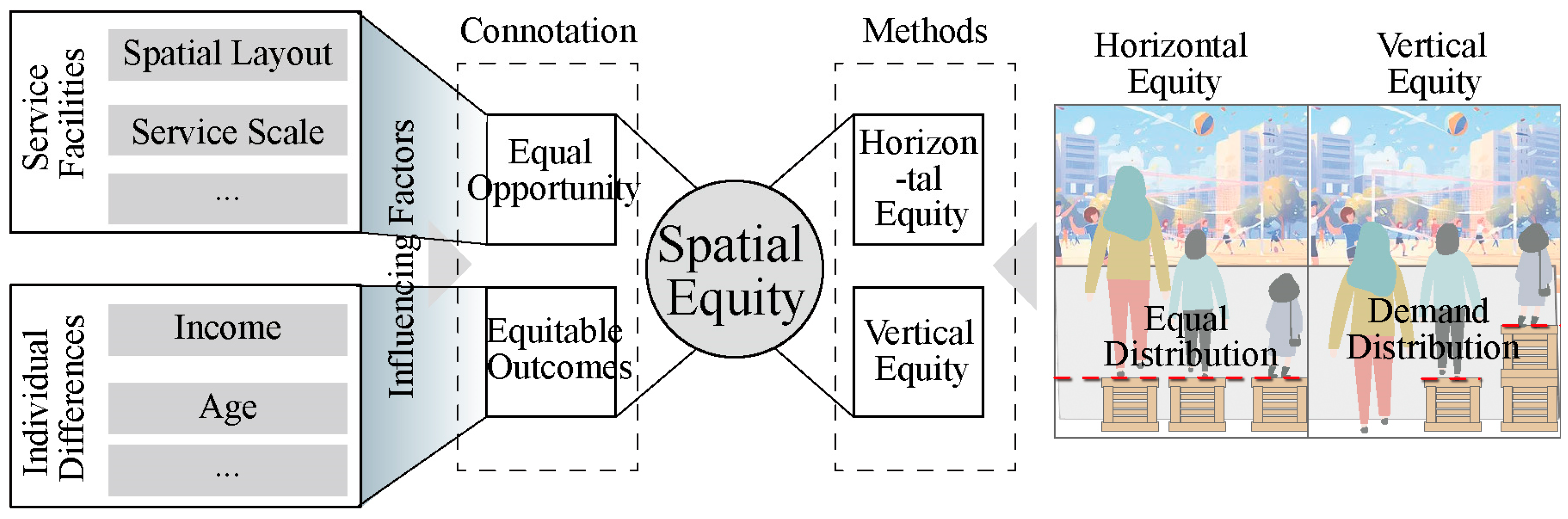
An important issue in seeking to understand whether different health systems promote equity lies in clearly defining what equity means [10]. Despite the relatively high priority given to equity by policymakers and the relatively large academic literature on equity in healthcare, there appears to be considerable confusion over what is meant by equity in this context [17]. This paper dissects the concept of healthcare service spatial equity along two dimensions—connotation and supply methods—to elucidate its multifaceted nature (Figure 1).
Spatial equity constitutes a central tenet in discussions on healthcare service fairness, encompassing two primary sub-dimensions: equity of opportunity and equity of outcome. Equity of opportunity denotes equal potential for all individuals to access healthcare services, regardless of their geographic location or socioeconomic status. It emphasizes that the availability of healthcare resources should not be constrained by factors such as residential location or economic conditions [18]. In contrast, equity of outcome focuses on the fairness of the actual healthcare results obtained by individuals. It aims to ensure that the quality of healthcare services is equitable across diverse populations, irrespective of individual attributes including income, age, and educational background [19]. Achieving equity of outcome is inherently complex, as individual disparities (e.g., in income, age, and education) can influence healthcare quality even in regions with comparable healthcare facilities.
Horizontal and vertical equity, as two fundamental principles for resource allocation in healthcare provision, play a pivotal role in addressing disparities in access to and outcomes of healthcare services [20]. The principle of horizontal equity posits that healthcare services should be equitably allocated among individuals with similar healthcare needs, regardless of their geographic location or demographic characteristics [21]. This framework emphasizes the necessity of standardized healthcare resource distribution, grounded in the egalitarian principle that similar needs warrant equivalent levels of service provision. Its core objective is to eliminate disparities stemming from diverse geographic and demographic attributes, thereby ensuring a consistent baseline of healthcare access across different populations. Conversely, the principle of vertical equity recognizes the heterogeneity of healthcare needs and the inherent disadvantages faced by specific population groups [22]. This principle advocates for a stratified healthcare provision model, wherein individuals with more pressing healthcare needs or confronting greater socioeconomic challenges are allocated proportionally enhanced levels of service. Vertical equity takes into account a range of factors that may affect the intensity of healthcare requirements, such as chronological age, morbidity status, and socioeconomic position. It proposes a compensatory allocation of healthcare resources aimed at mitigating these inherent inequalities, with the ultimate goal of constructing a more equitable and impartial healthcare system.
The principle of spatial equity in healthcare facility configuration is fundamentally concerned with the strategic placement of resources and the equitable distribution of healthcare benefits across different social groups. Its primary objective is to reduce spatial disparities in healthcare services—typically measured by accessibility—and to assess the spatial performance of healthcare resources (i.e., their effectiveness and distributional rationality) [21,23]. On this basis, the connotation of healthcare service spatial equity is defined as equity of opportunity: this is because equity of opportunity can be directly intervened through the spatial allocation of medical resources. Meanwhile, the supply mode corresponding to healthcare service spatial equity is vertical equity: this is attributable to the fact that vertical equity incorporates considerations of disparities in healthcare demand across different groups and regions, as well as the spatial performance of healthcare services—both of which are critical for evaluating the rationality of medical resource spatial allocation.
Synthesizing the above analysis, healthcare spatial equity is defined as follows: a state of healthcare resource allocation that takes equity of opportunity as its core connotation and vertical equity as its supply mode, aiming to reduce spatial disparities in healthcare accessibility through strategic spatial allocation of medical resources, while incorporating the evaluation of healthcare resource spatial performance to accommodate diverse healthcare demands across different regions and populations, thereby realizing the equitable distribution of healthcare benefits.

2.2. Measure of Spatial Equity

Given the critical role that enhanced facility accessibility plays in mitigating spatial inequities, accessibility analysis has been widely used to evaluate the fairness of healthcare service distribution, culminating in the formulation of strategic recommendations for optimization [24]. For instance, some studies directly equate healthcare service accessibility with its spatial equity [25]; others employ Local Moran’s I models to calculate the spatial differentiation of healthcare accessibility as a representation of spatial equity [26]; and there are those that use the Gini coefficient [27], Lorenz curves [28], and variance [29] to analyze disparities in healthcare accessibility within the study area as an indicator of spatial equity. Additionally, research has selected multiple indicators such as the number of medical institutions, beds, and healthcare professionals to construct a comprehensive evaluation system for healthcare service spatial equity [30].
Recent studies have increasingly integrated diverse transportation modes into the analysis of healthcare service spatial equity [5,31,32]. For example, Langford et al. (2016) [32] employed a multi-mode 2SFCA model that included public and private vehicles to assess the accessibility of primary healthcare. Li et al. (2021) [33] explored equity in park accessibility in Nanjing, examining walking, cycling, public transit, and driving to reveal spatial equity across various travel modes. These studies have enhanced spatial equity measurement models, demonstrating their value in evaluating the spatial equity of public facilities. The results show that patients consider several factors, such as the mode of transportation, service quality, distance, and cost, when selecting healthcare facilities based on the urgency and severity of their condition [34]. Patients with more severe conditions may choose faster transportation options to reach city-level healthcare facilities promptly, while those with less severe conditions might opt for walking or cycling to the local community healthcare facilities. So patient behavior in seeking medical care is a critical element that should be considered in the measurement of healthcare service spatial equity, as it significantly influences the fairness of these services.
Overall, despite the variety of methods available for assessing spatial equity in healthcare services, several key shortcomings have been identified in their practical application. Firstly, while existing methods effectively measure the overall equity of facility distribution, they often fail to capture the nuanced spatial equity at the individual unit level, such as residential areas. Models such as the Gini coefficient, Lorenz curves, and variance reflect overall equity but do not provide insights at the unit level. Secondly, the indicator system measurement method, while capable of reflecting unit scale, is computationally intensive and typically confined to fixed geographical or administrative boundaries, which may not accurately represent the fluid nature of healthcare access. This is because various statistical data are organized according to administrative boundaries. Such methods assume that healthcare services within a geographical unit (e.g., a county) are fully accessible to all residents of that unit and that patients will not seek treatment outside of it [35]. However, units demarcated by administrative boundaries are often too large, such as at the county or town level, failing to capture the internal disparities in healthcare services. Thirdly, current methods often emphasize horizontal equity, potentially neglecting the performance and efficiency of healthcare services. In the practical allocation of medical resources, an excessive pursuit of horizontal equity may lead to inefficient utilization of resources. For example, to ensure that residents in remote areas have access to medical services, facilities might be constructed in areas with low population density, which could result in underutilization and a waste of resources. Therefore, it is essential to pay attention to the spatial performance (i.e., effectiveness) of healthcare services and to find the optimal balance between spatial equity and service efficiency [36]. Lastly, up to now, no studies have differentiated the disparities in equity brought about by patients adopting different modes of travel based on their medical conditions and the levels of healthcare facilities they seek. Hence, there is an urgent need to explore a more refined methodology for assessing spatial equity in healthcare services.

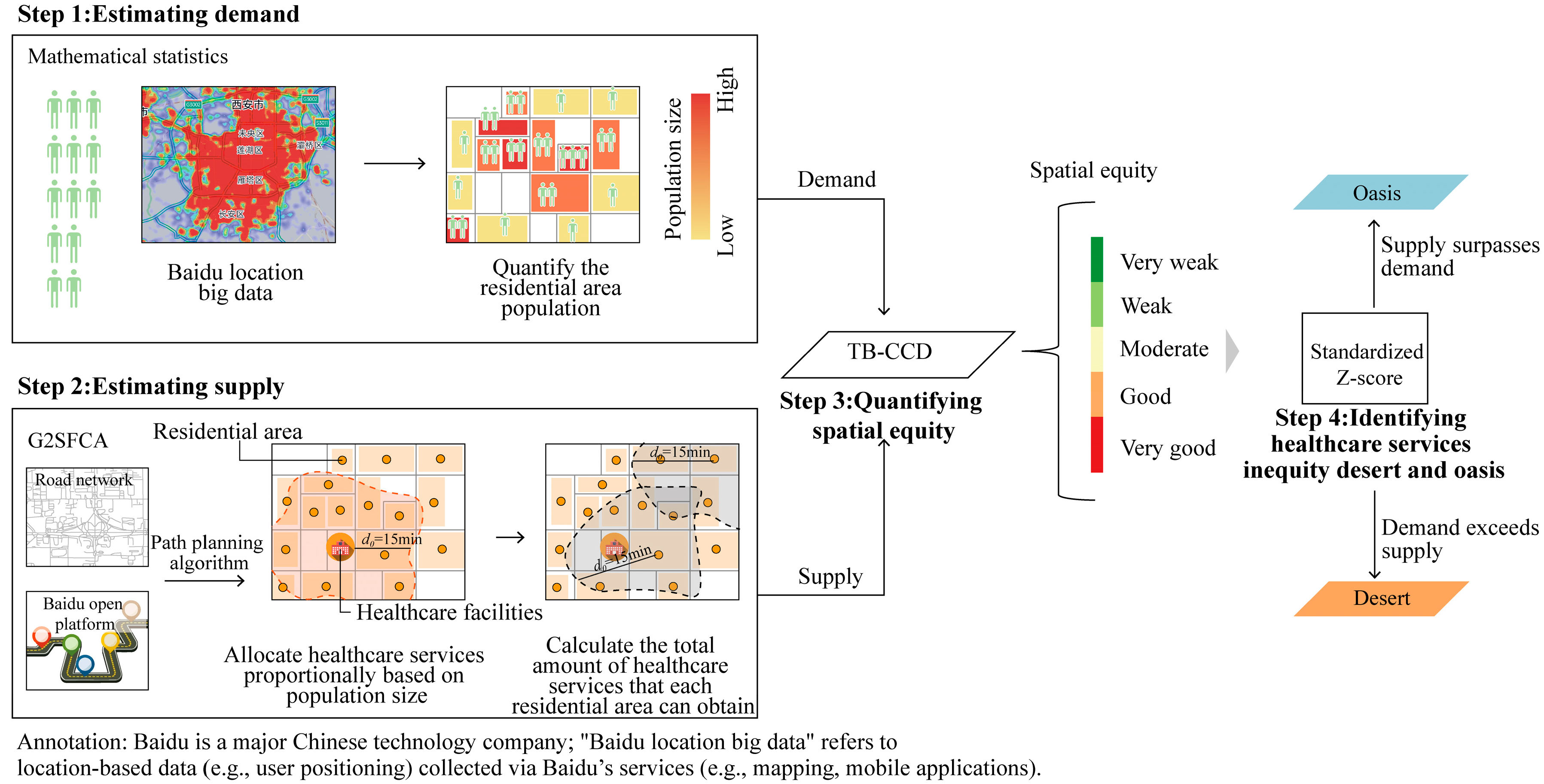
2.3. Research Framework

To address these issues, first, the level of healthcare service demand was evaluated. Mathematical statistics methods were employed to disaggregate the population data from Baidu Heat Maps to individual residential neighborhoods, thereby deriving the population size of each neighborhood and further characterizing the demand for healthcare services.
Second, the level of healthcare service supply was assessed. The Gaussian Two-Step Floating Catchment Area (G2SFCA) model—a cutting-edge and widely applied accessibility measurement tool—was utilized to extend the analysis to the scale of individual residential areas. By evaluating healthcare accessibility within residential neighborhoods while accounting for residents’ travel behaviors, this study aimed to accurately reflect the supply level of healthcare services. This approach enabled a more granular analysis that captures the subtle heterogeneities in healthcare accessibility at a fine scale, overcoming the limitations of prior models that failed to reflect equity at the neighborhood level.
Third, the spatial equity of healthcare services was quantified, based on the principles of vertical equity and opportunity equity. These principles postulate that “areas with higher healthcare needs should be allocated more healthcare services than those with lower needs, so as to ensure equitable opportunities for residents to access healthcare”. Conceptualizing healthcare service supply and demand as two distinct subsystems, spatial equity in healthcare can only be achieved when these two subsystems are mutually adaptive and reach a state of coordinated development. Given that healthcare service spatial accessibility can indirectly reflect the characteristics of healthcare supply, and population size can directly represent the latent demand for healthcare services [37], this study drew on the physics-derived concept of coupling and introduced the coupling coordination degree (CCD) between healthcare supply and demand as a core metric to characterize healthcare spatial equity. In physics, coupling refers to the phenomenon in which two or more subsystems interact with and influence one another, ultimately integrating into a unified and synergistic whole [38,39]. By adopting a travel behavior-based Coupling Coordination Degree (TB-CCD) model, this study directly evaluated the alignment between healthcare accessibility and healthcare service demand, thus effectively characterizing the spatial equity of healthcare services.
Fourth, the types of healthcare supply–demand imbalances were identified. The method of calculating the difference in standardized Z-score values was adopted to identify “deserts” (regions of severe supply shortage) and “oases” (regions of excessive supply) of healthcare services, thereby delineating the heterogeneous patterns of healthcare supply–demand mismatches.
The research framework is illustrated in Figure 2.

3. Data and Methods

3.1. Study Area and Data Collection

3.1.1. Study Area

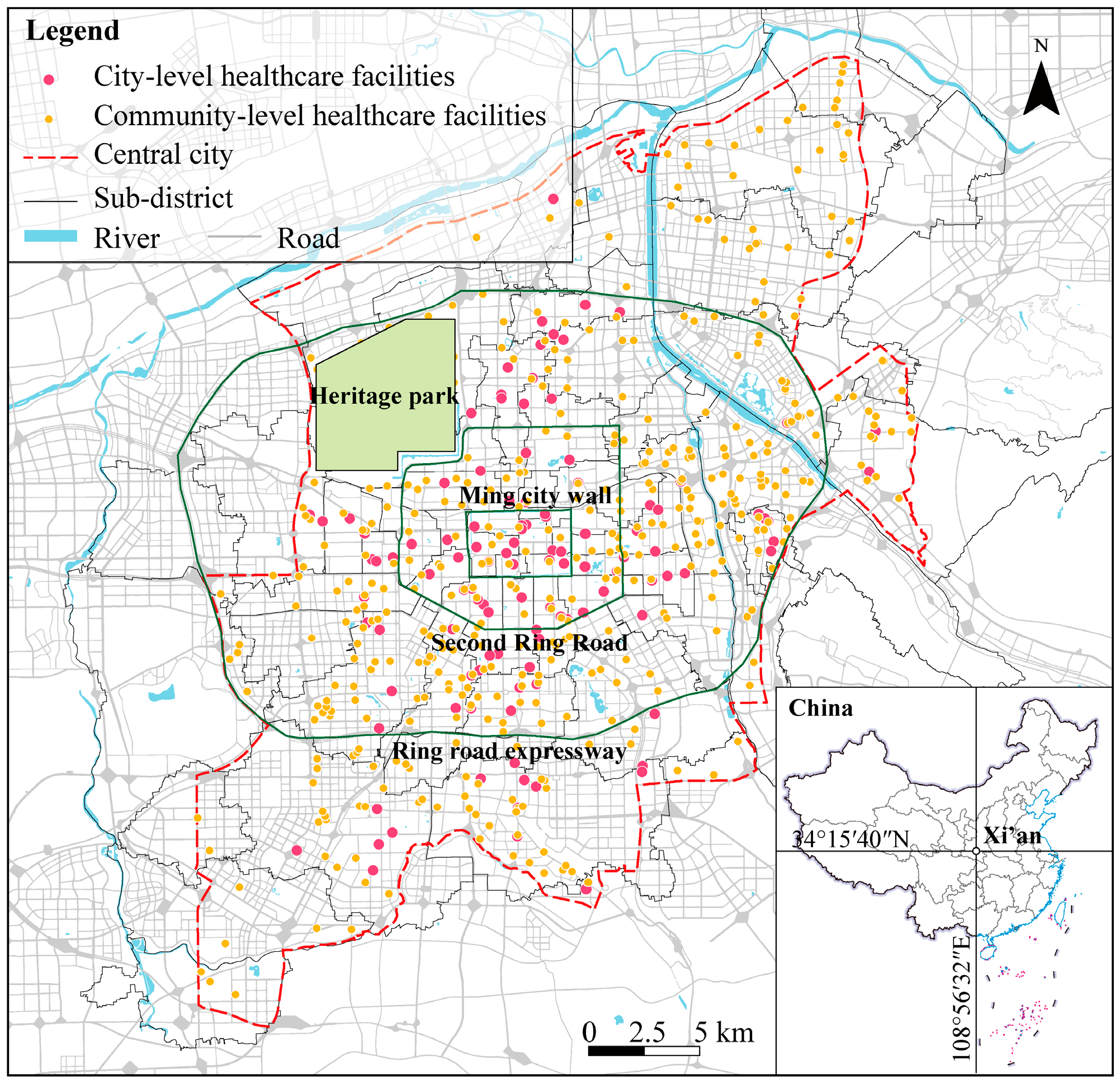
Xi’an, an ancient capital city with a rich historical heritage, is located in the northwest region of China and serves as the political, economic, and cultural hub of Shaanxi province. As a key central city and economic growth pole in the northwest region, it serves as a pioneering demonstration area for high-quality development in the western region and even nationwide, exerting a positive exemplary and leading role. As outlined in the Xi’an Master Plan (2020−2035), the city comprises 13 administrative districts, spanning a total area of approximately 10,752 km2 with a permanent population of nearly 12.9 million inhabitants. This study concentrates on the Central Districts of Xi’an, which are characterized by high population density. The area under consideration covers approximately 768 km2, with a population density of 13,020 persons per km2, as depicted in Figure 3.
Over the past decade, in order to meet the growing diverse demands for healthcare resources and to mitigate the impact of an aging population on the healthcare system, Xi’an has carried out multiple rounds of reforms in its healthcare field, achieving phased results. The quality of healthcare services has steadily improved, and the health level of residents has been further enhanced. However, challenges such as prominent supply–demand contradictions and unbalanced regional distribution of healthcare resources still exist, which constrain the overall development level of healthcare services in Xi’an. Therefore, selecting Xi’an as a case study for exploring the spatial equity of healthcare services has a certain typicality and representativeness.

3.1.2. Data and Pre-Processing

This study amassed comprehensive data encompassing healthcare facility attributes, demographic profiles, road network infrastructure, and public transport systems. Statistical data for healthcare facilities were sourced from the Xi’an Municipal Health Committee’s official website, reflecting the status as of the end of 2023 (http://xawjw.xa.gov.cn/, accessed on 4 December 2025). The dataset comprises details including healthcare facility names, addresses, the count of practicing physicians, facility construction areas, and the volume of diagnostic and treatment visits recorded in 2023. The Central Districts of Xi’an house a total of 586 healthcare facilities, categorized into 115 City-level facilities (public hospitals) and 471 Community-level facilities (community health service centers and stations). The geographic coordinates of the collected healthcare facilities were extracted using the Baidu Maps coordinate-picking tool. Obtain the population distribution data of the central urban area of Xi’an from Baidu Location Big Data (https://huiyan.baidu.com/, accessed on 4 December 2025), count the population of each residential area [40]. The areas of different coloured heat zones were individually extracted through vectorisation, and the magnitude of population activity was then compared on the basis of the areas of these heat zones. Residential area boundaries and road network data were derived from Baidu Map’s Area of Interest (AOI) dataset and road network dataset (https://map.baidu.com/, accessed on 4 December 2025). Walking, cycling, driving, and public-transport travel times from each healthcare facility to its associated residential areas were generated via the DirectionLite API of the Baidu Open Platform (https://lbsyun.baidu.com/, accessed on 4 December 2025).

3.2. Methods

3.2.1. Estimating Healthcare Service Demand

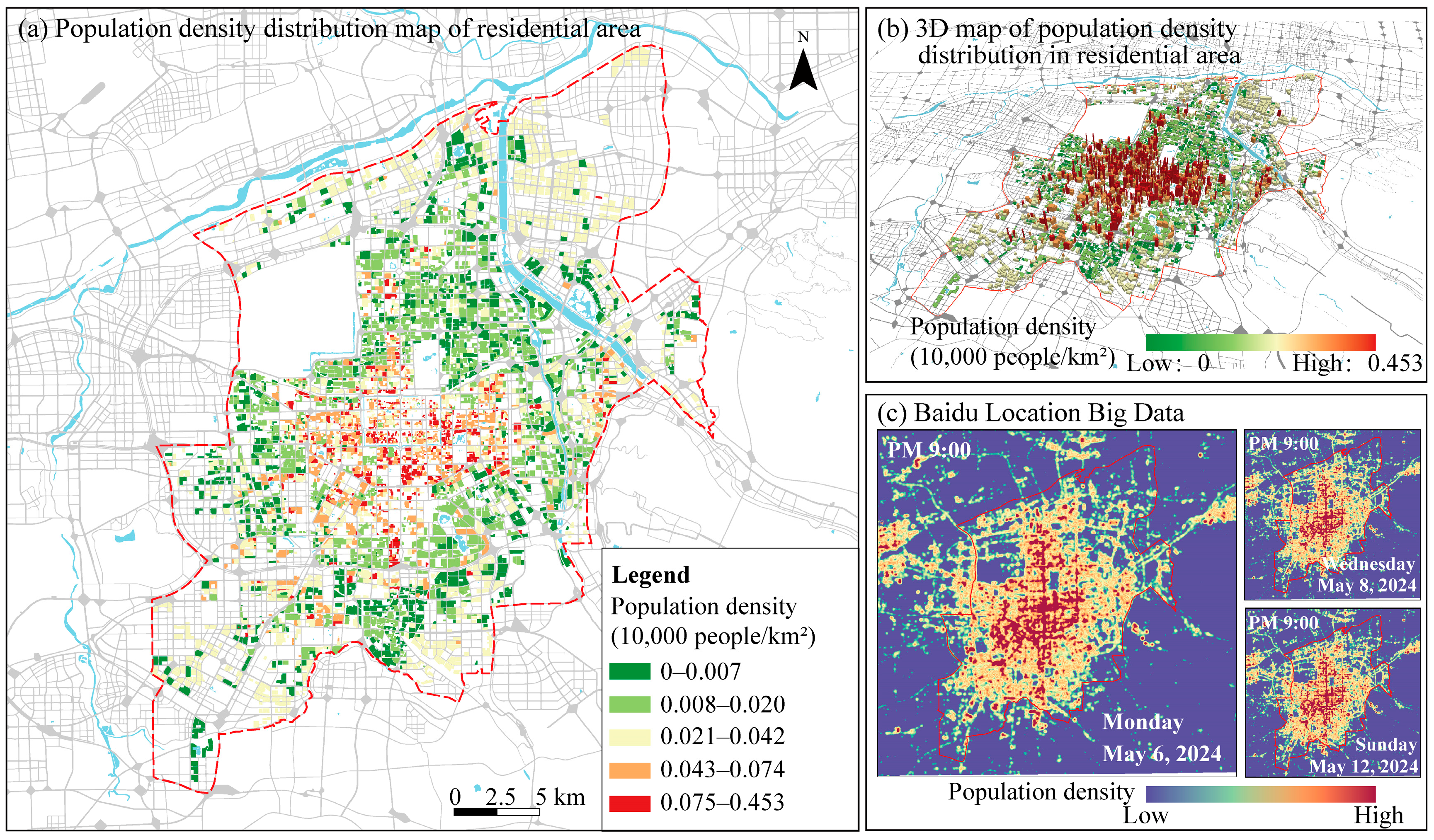
To accurately characterize fine-scale population distribution as a proxy for healthcare service demand, this study utilizes Baidu Location Big Data for population estimation [41]. To mitigate the confounding effects of transient population movements, we collected population heatmap data for Xi’an at 21:00 on 6 May, 8 May, and 12 May 2024, and used their average as a stable residential population size (see Appendix A.1 for details). The resulting population count Ph for each residential neighborhood serves as the core indicator of healthcare service demand in that area.

3.2.2. Estimating Healthcare Service Supply

The level of healthcare service supply is characterized by spatial accessibility. This study employs the Gaussian Two-Step Floating Catchment Area (G2SFCA) method for measurement, a cutting-edge tool for assessing facility accessibility.
First, the supply-to-demand ratio Rj for each healthcare facility location j is calculated as follows:
R j = Z j h ( d h j d 0 ) G d h j , d 0 P h
where Zj is the comprehensive service capacity of facility j (calculation process detailed in Appendix A.2), Ph is the population at demand location h, dhj is the travel time between them, d0 is the time threshold, and G(dhj, d0) is the Gaussian distance decay function. The travel time dhj between the demand and supply locations is determined using the Baidu Open Platform (https://lbsyun.baidu.com/, accessed on 4 December 2025).
Subsequently, the healthcare accessibility Ah for each residential neighborhood h is calculated as the weighted sum of all accessible facility supplies:
A h = i ( d h j d 0 ) G d h j , d 0 R j
A higher value of Ah indicates a greater level of healthcare service supply accessible to residents in that area. Formula (2) and detailed calculation steps are provided in Appendix A.3.

3.2.3. Quantifying Spatial Equity: The TB-CCD Model

The core of this study is to construct a Travel Behavior-based Coupling Coordination Degree (TB-CCD) model to quantify the spatial equity of healthcare services. This model treats supply (accessibility Ah) and demand (population Ph) as two interacting subsystems, with their degree of coordination representing the level of equity.
The coupling coordination degree Dh is calculated using the following formulas:
D h = A h × P h ( A h + P h ) 2 1 / 2 × T h
T h = ( α A h + β P h )
where Dh is the spatial equity of healthcare services of residential area h, Ah is the supply index of healthcare services, Ph is the demand index. The weights α and β represent the relative importance of supply and demand. Considering that demand for health care services is more important than supply [42], as: α = 0.4, β = 0.6. The spatial equity score Dh is classified into five categories based on the criteria established by Shi et al. (2020) [39], as illustrated in Table 1.
This study underscores the significance of residents’ travel behavior in assessing spatial equity in healthcare services, as highlighted by Zhang et al. (2019) [43]. By leveraging official survey data from the Xi’an Transport Annual Report (2022), we apply the Gaussian Two-Step Floating Catchment Area (G2SFCA) and Coupling Coordination Degree (CCD) methodologies to establish a robust analytical framework. Building upon these, we have further incorporated the Travel Behavior-based Coupling Coordination Degree (TB-CCD) method to analyze and integrate the spatial equity of healthcare services across four distinct travel modes. To incorporate travel behavior, this study sets differentiated travel speeds vn and time thresholds d0 (Mn) for four travel modes (walking, cycling, public transportation, driving) (parameter justification in Appendix A.4), and calculates the respective coupling coordination degree Dh, Mn for each mode (formula derivation in Appendix A.5). This study assumes that residents choose different tiers of facilities and travel modes based on illness severity [13,44] (behavioral assumptions detailed in Appendix A.6), enabling the TB-CCD model to more realistically reflect equity under different scenarios.

3.2.4. Identifying Healthcare Services Inequity Desert and Oasis

Inequity in healthcare services arises in scenarios characterized by a mismatch between supply and demand, specifically where there is either insufficient supply to meet high demand or an excess of supply with limited demand. This study designates these conditions as inequity deserts and oases, respectively, to delineate disparities within the inequity of healthcare services. A healthcare service inequity ‘desert’ signifies an area deficient in adequate healthcare facilities accessible within a specified travel time threshold by a particular mode of transportation. Conversely, a healthcare service inequity ‘oasis’ is characterized by an excess of healthcare facilities within the reachable distance for that mode. Consequently, areas identified as either ‘deserts’ or ‘oases’ are considered to have an abnormal distribution of healthcare service equity. To further analyze the impact of healthcare service supply and demand on inequity and to propose targeted optimization strategies, this study employs the methodologies of Gan et al. (2024) [45] and Lee et al. (2021) [46]. Specifically, the healthcare services gap for each area is calculated by subtracting the standardized Z-score of healthcare services demand from that of supply. A negative healthcare services gap value signifies that demand exceeds supply, whereas a positive value indicates that supply surpasses demand. An area is deemed an inequity desert if healthcare services gap is less than −1, indicating insufficient supply relative to demand. If the gap exceeds 1, the area is considered a inequity oasis, suggesting an oversupply. The healthcare services gap within each administrative boundary is determined using the following equation:
Healthcare services Gap = Supply (Z-score) − Demand (Z-score)

4. Results

4.1. Analysis of Healthcare Service Supply and Demand

4.1.1. Analysis of Healthcare Service Demand

Using the natural breaks method, we categorized the population density of residential areas into five distinct quintiles, as illustrated in Figure 4. Green indicates low-density areas, while red indicates high-density zones. This spatial pattern correlates with the varying demands for healthcare services. Xi’an’s population distribution exemplifies a core–periphery structure, featuring higher density in the central areas and lower density at the periphery. Notably, the old district within Xi’an’s second ring road shows a high population density (430 per/km2), indicative of early development, which corresponds to a higher demand for healthcare services. In contrast, suburban areas beyond the city’s outskirts, generally exhibiting a population density below 200 per/km2, display a lower demand for healthcare services. Furthermore, the high-density areas are strategically aligned in a ‘cross’ formation due to urban planning initiatives. This demand pattern underscores the necessity of incorporating spatial heterogeneity into equity assessments. Traditional macro-level evaluations often smooth over such intra-urban demand gradients, potentially masking significant local mismatches. By disaggregating demand to the residential area level, our TB-CCD framework captures these fine-scale variations, establishing a critical foundation for assessing whether supply aligns with the actual geographic distribution of need, which is a core tenet of vertical equity.

4.1.2. Analysis of Healthcare Service Supply

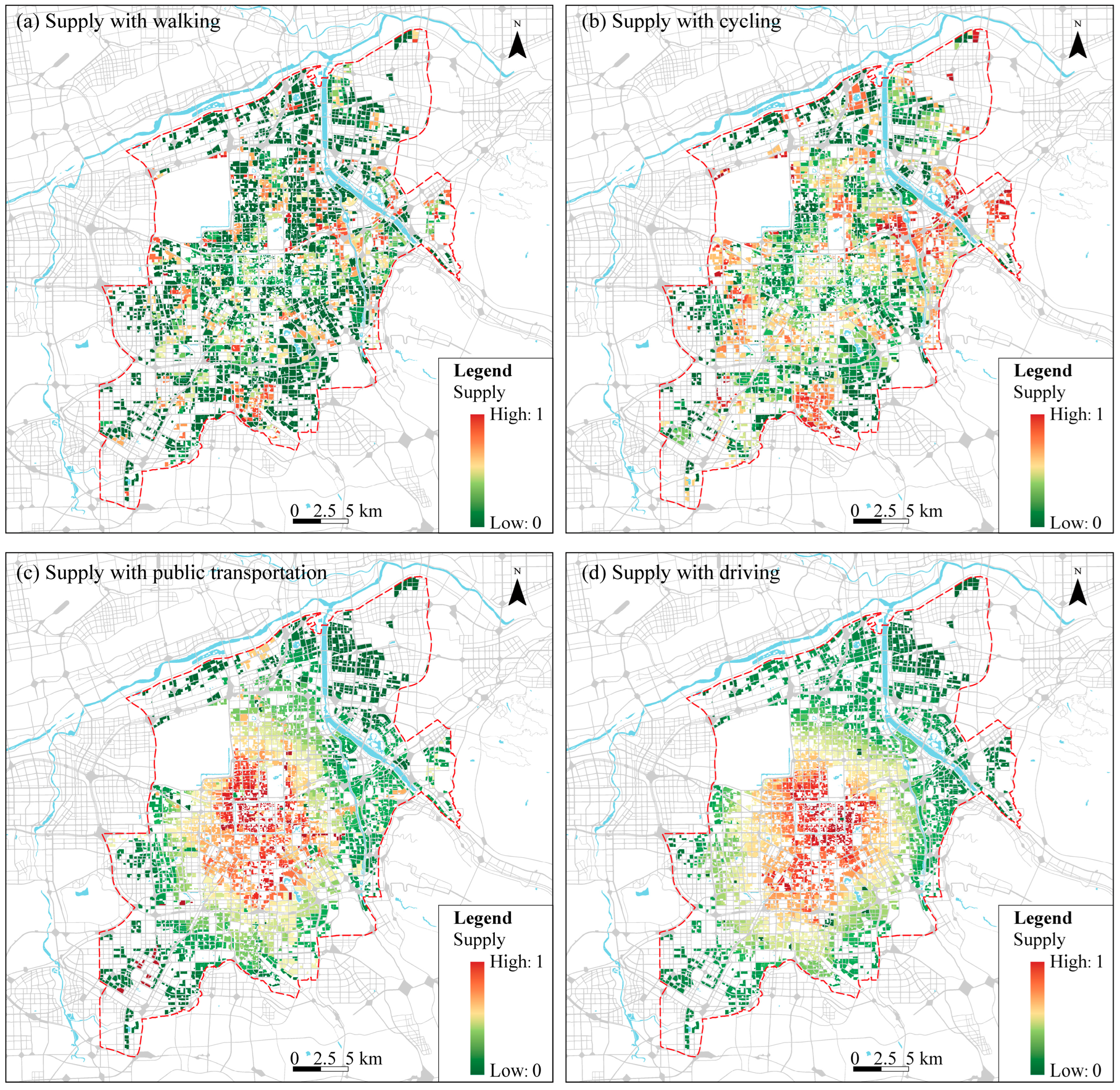
Employing the Gaussian Two-Step Floating Catchment Area (G2SFCA) model, this study assesses the supply level of healthcare services. Figure 5 illustrates the supply level with green indicating lower and red indicating higher healthcare service availability. In Xi’an, healthcare services are unevenly distributed, with a higher concentration in the city center compared to the suburban areas. For pedestrians and cyclists, facilities are concentrated within the typical 15 min travel radius, reflecting most residents’ daily activity ranges. However, for those utilizing public transportation or private vehicles, a contrasting distribution is observed that the city center has a higher concentration of services, while the outskirts have fewer services. It highlights the importance of location and access to transportation in determining the level of healthcare service supply. It can be attributed to the uneven distribution of healthcare facilities in Xi’an, as shown in Figure 3. Community-level healthcare facilities are primarily situated in proximity to residential areas, which results in a clustered supply of healthcare services within the 15 min travel range for those walking or cycling. In contrast, city-level healthcare facilities are concentrated in the downtown area, offering better service availability in the city center compared to the surrounding areas for those traveling by public transportation or drive. Additionally, within the area enclosed by the second ring road, service availability is notably lower for walking and cycling compared to motorized modes. Comparing across modes, the areas of low supply are most extensive for walking (Figure 5a), suggesting significant access constraints for pedestrians.
These multi-modal supply patterns directly demonstrate the added value of the TB-CCD approach. A single-mode analysis (e.g., driving only) would present an overly optimistic picture of city-wide supply, failing to reveal the severe accessibility deficits faced by non-motorized residents. Conversely, relying solely on walking mode would overlook the expanded catchment enabled by faster modes. By simultaneously modeling supply across four behaviorally relevant travel modes, the TB-CCD framework reveals that the level and spatial pattern of “available supply” is fundamentally contingent on the mobility options of the population. This challenges the assumption of a universal supply landscape and aligns the assessment with the reality of differential mobility, a key advancement over traditional static models.

4.2. Analysis for Spatial Equity in Healthcare Services

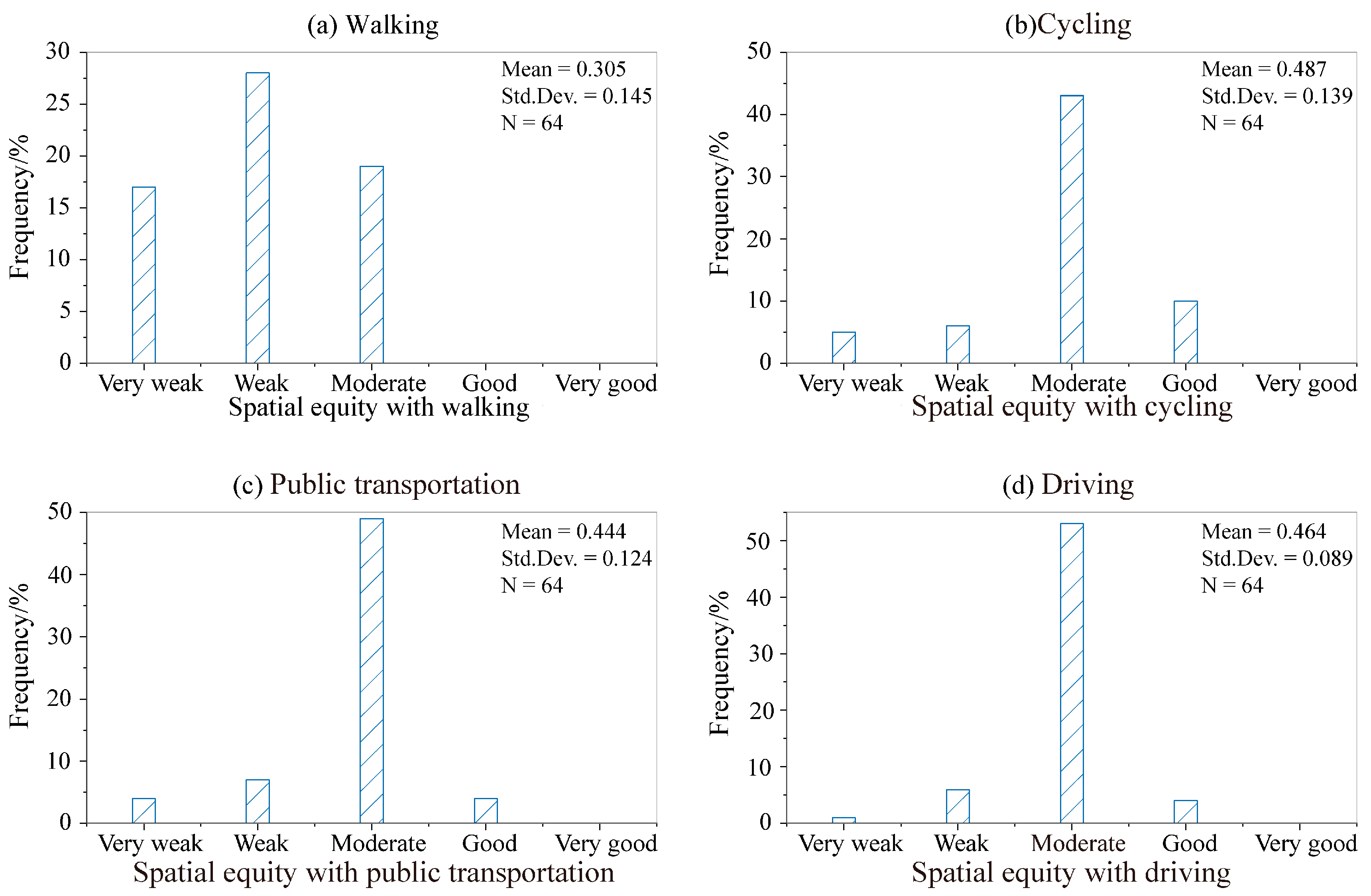
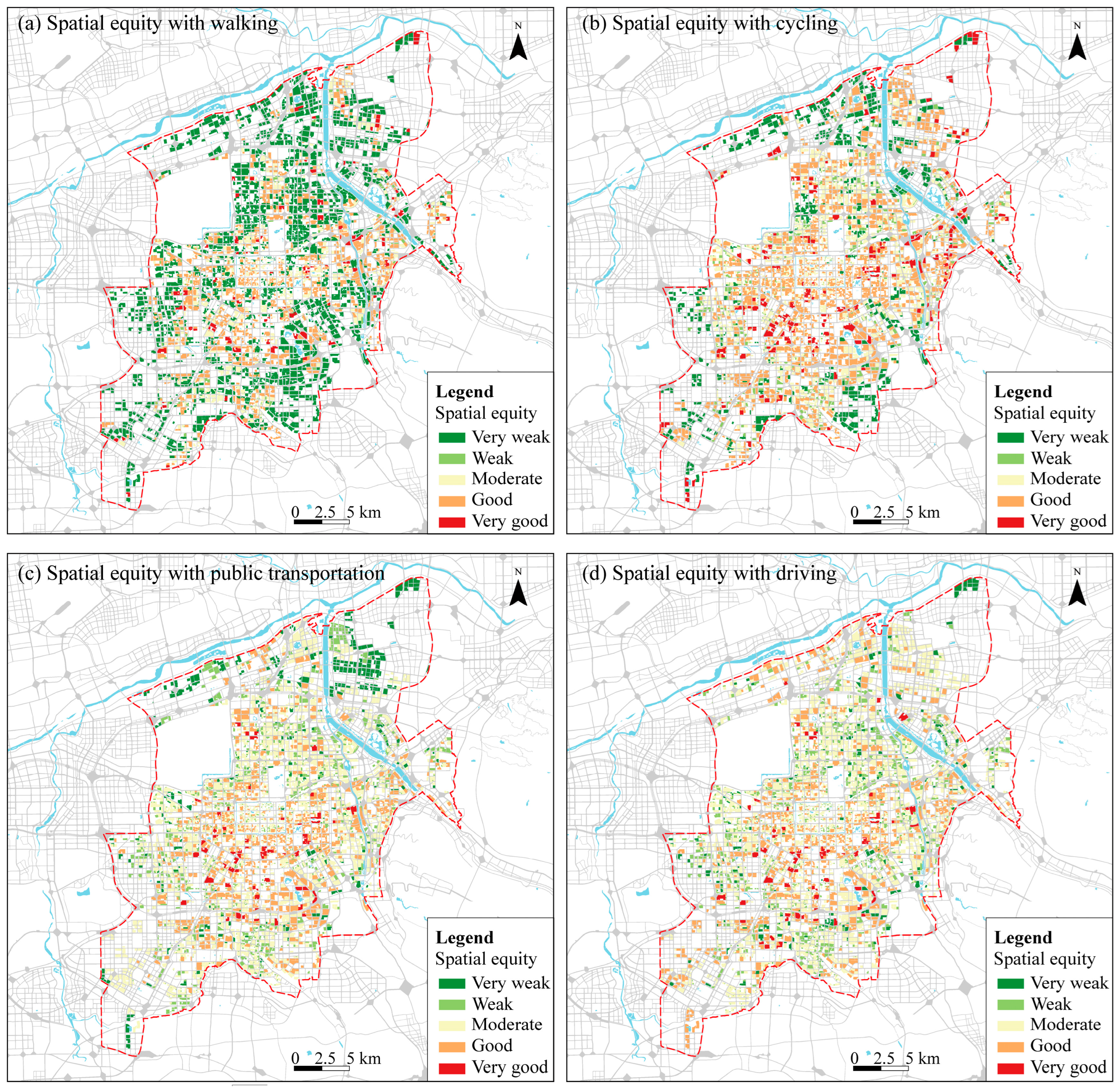
Figure 6 and Figure 7 illustrate the frequency and spatial distribution of spatial equity scores across residential areas under four different travel modes: walking, cycling, public transportation, and driving. The spatial equity scores are categorized into five levels, each represented by a distinct color. In Figure 7, red signifies areas where the alignment between healthcare service supply and demand is relatively favorable, whereas blue denotes areas where the match is less optimal.
Figure 6 demonstrates significant variation in healthcare service spatial equity depending on the travel mode used by individuals. Public transportation and driving offer a more equitable distribution of healthcare services compared to walking and cycling modes. Specifically, for the walking mode, Figure 6 shows that 50.78% of residential areas are classified as Very Weak, with an additional 21.01% in the Moderate category, highlighting a significant disparity in equitable healthcare access for pedestrians. For the cycling mode, conditions are somewhat improved, with 33.57% of areas rated Moderate and 33.28% Good. However, a significant portion, 15.75% and 13.34%, respectively, are still deemed Very Weak and Weak, indicating that cyclists face considerable challenges in accessing healthcare services. Conversely, public transportation and driving modes present a more equitable distribution of healthcare services, with the Moderate category predominating at 45.40% and 47.79%, respectively. The Very Weak category is the least prevalent for these modes, suggesting enhanced spatial equity in healthcare access for users of public transit and driving modes. This hierarchy of equity scores is a central finding that validates the TB-CCD framework’s core logic. It quantitatively confirms that spatial equity is not an intrinsic property of the facility distribution alone but is co-determined by residents’ travel capabilities.
Figure 7 reveals the spatial pattern of these equity scores, displaying a clear core–periphery gradient where inner-city areas generally outperform suburbs. However, a critical nuance emerges: the historical core within the Ming City Wall exhibits moderate equity scores that are unexpectedly lower than those in the surrounding inner-city neighborhoods (e.g., between the Ming Wall and the second ring road).
This “depressed core” phenomenon is a nuanced insight uniquely highlighted by the TB-CCD model’s integration of supply–demand coupling. While this area benefits from high supply accessibility (Figure 5), its exceptionally high population density (Figure 4) creates an intense local demand that even the proximate supply cannot fully satisfy, leading to a sub-optimal coupling coordination degree (Dh). This finding moves beyond simple accessibility mapping. It demonstrates that high physical access does not automatically translate to high spatial equity if demand is disproportionately concentrated. The TB-CCD model, by evaluating the balance (coupling) between supply and demand, successfully identifies these areas of “accessible but overwhelmed” services, which would be misclassified as well-served in a pure accessibility analysis. This directly addresses the limitation of studies that equate accessibility with equity.
For suburbs, the equity deficit is most acute under non-motorized modes (Figure 7a,b), where low scores are tightly clustered around areas with few facilities. Under motorized modes (Figure 7c,d), equity improves significantly, though a scattered mosaic of weak spots remains, often in remote suburban pockets.

4.3. Analysis for Healthcare Services Inequity Desert and Oases

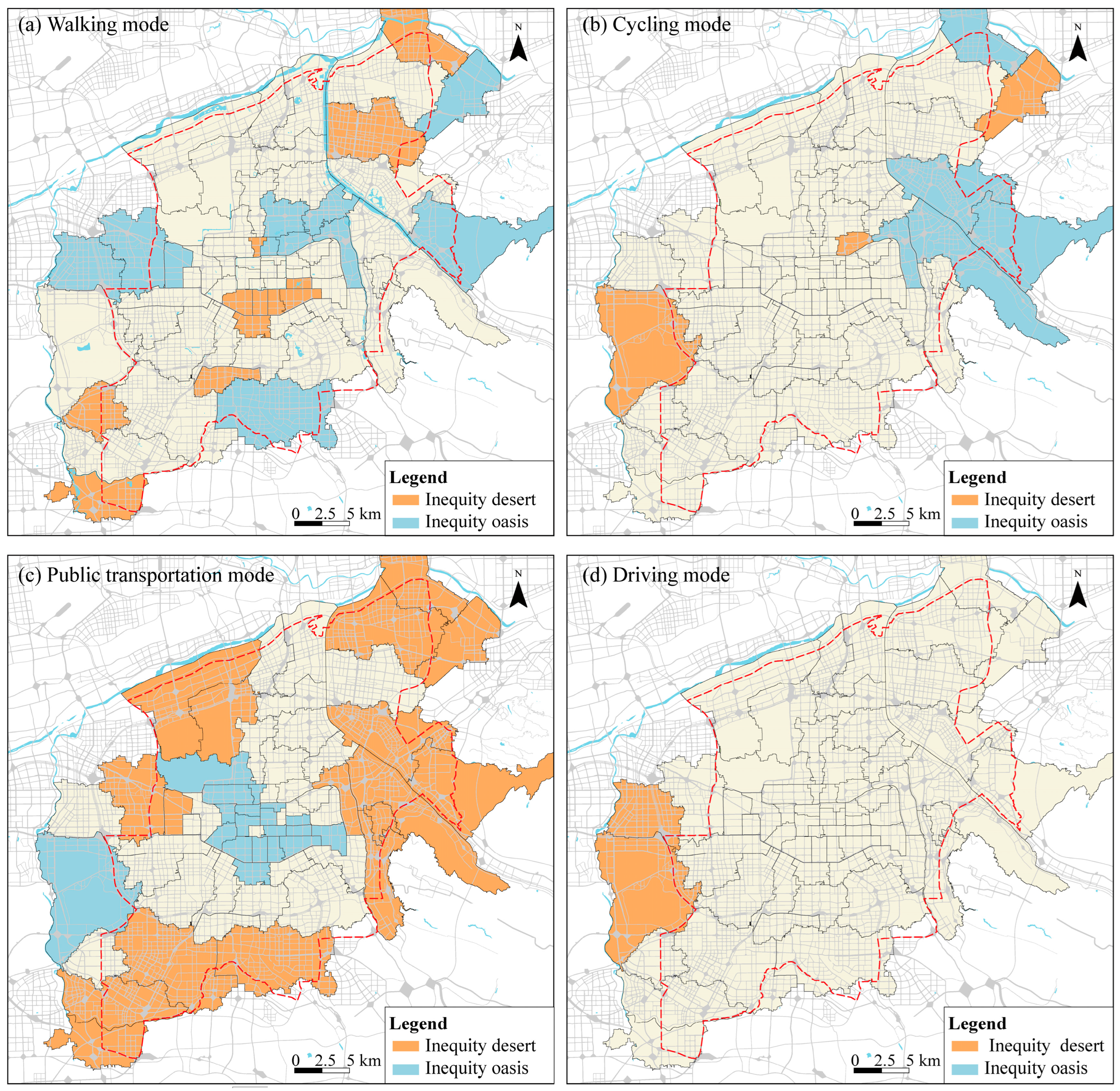
Figure 8 maps the “deserts” (supply << demand) and “oases” (supply >> demand) for each travel mode. The distribution is highly mode-dependent. Walking mode exhibits the most numerous and spatially dispersed deserts (12 sub-districts) and oases (11), showing a mosaic pattern across both central and suburban areas. Public transportation mode shows the starkest spatial polarization: 17 deserts are concentrated in the suburbs, while 19 oases are packed within the second ring road. Cycling shows fewer imbalances (3 deserts, 5 oases) and driving shows the least (only 2 deserts).
The identification of mode-specific deserts and oases is a direct application and key strength of the TB-CCD framework. It operationalizes the concept of “vertical equity” by pinpointing where and for whom the imbalance is most severe. For instance, the public transport result reveals a systemic inequity: suburban residents reliant on buses face a supply desert, while inner-city residents experience an oversupply oasis. This cannot be derived from an aggregate or single-mode analysis. The walking deserts in the high-density central south (e.g., Xiaozhai) further illustrate a mismatch within the local environment. By generating separate imbalance maps for each mode, the TB-CCD framework provides a targeted diagnostic tool for planners. It answers not just “is there inequity?” but “inequity for which user group, and in which locations?” This enables the formulation of differentiated policies (as later discussed in Section 5.2) that are precisely tailored to the mobility constraints and supply–demand gaps of specific populations, moving beyond one-size-fits-all planning recommendations.

5. Discussions

5.1. Methodological Contributions

The mounting evidence supporting a positive correlation between access to healthcare services and individual health outcomes underscores the need for an enhanced understanding of spatial equity within healthcare provision [4,47]. This research integrates spatial equity concepts inspired by coupling models in physics to construct an evaluation framework that assesses healthcare service spatial equity by examining the interaction between service supply and demand. Unlike previous studies that often relied on single-mode measurement [48] and assumed uniform travel methods for all residents seeking healthcare, this study recognizes the diversity of travel modes individuals may choose based on the severity and urgency of their health conditions. By incorporating travel behavior into the evaluation, we aim to provide a more nuanced and realistic assessment of healthcare service spatial equity.
A comparative analysis of healthcare service spatial equity across four travel modes (walking, cycling, public transportation, and driving) reveals significant differences in equity scores. Specifically, the mean spatial equity score for walking is 0.305, while that for driving reaches 0.464, with a difference of 0.159 (Figure 6). This finding confirms that single-mode models may not reliably evaluate healthcare service spatial equity—relying solely on walking mode would overestimate healthcare inequity in Xi’an’s central urban areas, while using only driving mode would underestimate accessibility deficits in suburban regions. Consistent with existing studies [43], this research highlights the importance of adopting a multi-mode spatial equity model for accurate assessment.
Notably, the TB-CCD model developed in this study addresses key pain points in urban–rural planning evaluations. Unlike traditional macro-evaluation methods such as the Gini coefficient and Moran’s I, this study uses the G2SFCA model to downscale the evaluation unit to the residential area level and quantifies the “supply–demand coupling coordination degree” through the TB-CCD model. Results show that 37% of residential areas within Xi’an’s Ming City Wall have a coupling coordination degree ≤ 0.4, falling into the “slightly uncoordinated” category. This fine-grained assessment directly meets the demand for “plot-level facility optimization” in urban–rural planning, providing operable technical support for “one policy per location” in healthcare resource allocation and filling the gap of existing methods that “emphasize macro analysis while neglecting micro details.”

5.2. Implications for Healthcare Facilities Planning

To address healthcare service inequities, targeted strategic policies and healthcare facility planning are essential. Based on the study’s quantitative results—including differences in spatial equity across travel modes, the core–periphery distribution pattern of “deserts” and “oases”—this section proposes differentiated planning strategies following the logic of “travel mode—spatial type” optimization measure.

5.2.1. Differentiated Optimization by Travel Mode

Walking mode: Results indicate that walking “deserts” are concentrated in the central area south of Xi’an’s Ming City Wall (e.g., around Xiaozhai and Dayan Pagoda) and the northwest/southeast suburbs (e.g., Ducheng and Xinzhuang), where most residential areas have a high population density exceeding 430 persons/km2 (Figure 4). For the central area, the key challenge is “excessive demand but insufficient community-level supply.” We recommend utilizing existing space (e.g., supporting facilities in old residential areas, idle public buildings) to densify community-level healthcare facilities, ensuring 15 min walking accessibility. For suburban areas, the focus should be on improving the connection between pedestrian road networks and community health service stations to fill gaps in the “15 min walking circle” rather than blindly adding city-level facilities. For walking “oases” (e.g., Xiquan and Shilipu), surplus community-level healthcare resources should be redirected to high-demand sub-districts to avoid waste.
Public transportation mode: Public transportation “deserts” are mainly distributed in suburban areas beyond the Third Ring Road (e.g., Xinglong and Guodu), while “oases” are concentrated within the Second Ring Road (Figure 8c). With an average bus speed of only 22 km/h in suburban areas (Table A1), accessibility is severely limited. We propose two key measures: first, add 1–2 city-level healthcare facilities in suburban areas and increase the frequency of bus routes connecting suburbs to the central city to within 5 min; second, optimize the functions of healthcare facilities in “oasis” areas within the Second Ring Road (e.g., Xiguan and Jiefangmen) by relocating some surplus specialized outpatient services from city-level facilities to suburbs, achieving “quality improvement in the core and quantity supplement in the periphery.”
Cycling mode: Cycling “deserts” are concentrated in the eastern suburbs (e.g., Xiquan and Doumen) (Figure 8b). Given that cycling serves as an important supplementary travel mode for mild illness treatment, we recommend constructing dedicated bicycle lanes connecting residential areas to healthcare facilities, forming a “community-level facility—city-level facility” cycling network to enhance the accessibility of healthcare services. For cycling “oases” (e.g., Gengzhen and Baqiao), moderately decentralize densely distributed community-level healthcare facilities to optimize resource allocation.
Driving mode: Only 2 suburban sub-districts (Doumen and Wangshi) are identified as driving “deserts” (Figure 8d), indicating relatively good accessibility for self-driving residents. The primary optimization direction is to improve the connection between suburban road networks and city-level healthcare facilities, ensuring smooth access to high-level medical resources for residents with severe illnesses.

5.2.2. Spatial Structure Optimization

The study reveals a special phenomenon: the spatial equity of the central area within Xi’an’s Ming City Wall is lower than that of surrounding neighborhoods (Figure 7). With a population density of 430 persons/km2 (Figure 4), the central area has concentrated city-level healthcare facilities forming “oases,” but the uneven distribution of community-level facilities fails to meet the daily medical needs of the dense population. As a result, 37% of residential areas have a coupling coordination degree ≤ 0.4, belonging to “slightly uncoordinated” (Figure 6a). For the central area, planning should avoid adding new city-level facilities and instead focus on “micro-renewal” of existing space (e.g., old factories and idle shops) to densify community health service stations, improving the coverage of “15 min walking medical care.” For the outer suburbs, it is necessary to “address shortcomings” by synchronously planning city-level healthcare facilities and public transportation hubs during new urban area development, forming a spatial structure of “strong communities in the core and strong hubs in the periphery.” This structure not only balances supply and demand in different regions but also aligns with the hierarchical healthcare system construction requirements.
Specific optimization strategies for each sub-district identified as an inequity desert or oasis are detailed in Table 2.

5.3. Limitations and Future Research

This study, while offering valuable insights, is not without its limitations. Firstly, this research makes the assumption of an even population distribution within communities, which may not accurately reflect the true demographic landscape. To address this, the studies could incorporate more detailed population data in the future, such as the mobile signaling data utilized by Xiao et al. (2019) [48] or the building data referenced by Song et al. (2024) [49]. Secondly, the current evaluation of healthcare service spatial equity does not account for the diverse needs of different demographic groups, including their medical history, age, gender, and disability status. For instance, individuals with specific health conditions might prefer specialized healthcare facilities, while the older adults may opt for larger, comprehensive facilities, and middle-aged individuals might be more inclined towards community-level healthcare due to their generally better health [50]. The research could extend our TB-CCD approach by integrating these critical demographic factors in the future, thus delving deeper into the spatial equity of healthcare services and providing a more nuanced understanding of the distribution of healthcare resources. Thirdly, the study sets a unified 15 min travel threshold for all travel modes but does not consider differences in acceptable travel time for different medical needs (e.g., longer acceptable time for non-urgent medical visits and shorter for emergency care). This may affect the accuracy of accessibility evaluation and further impact the rationality of planning suggestions. In future research, the introduction of time-series data—such as peak/off-peak travel speeds and seasonal fluctuations in medical demand—could support the construction of a dynamic TB-CCD evaluation model. Such a model would better capture the spatio-temporal evolution of healthcare service spatial equity, thereby enhancing the framework’s adaptability to dynamic planning adjustments.

6. Conclusions

This study aimed to address limitations of existing healthcare spatial equity assessments—overreliance on single travel modes, disconnected supply–demand evaluation, and neglect of travel behavior heterogeneity—by developing a Travel Behavior-based Coupling Coordination Degree (TB-CCD) framework. Taking Xi’an’s central urban area as a case, we integrated multi-modal travel behaviors (walking, cycling, public transport, driving) and the physics-derived coupling concept to evaluate equity at the residential scale.
Key findings synthesized: First, the TB-CCD framework outperforms single-mode models, capturing significant equity disparities across travel modes (driving > public transport > cycling > walking). Second, spatial equity exhibits a core–periphery pattern, with counterintuitive lower equity in Xi’an’s Ming City Wall core (supply–demand mismatch) and suburban accessibility deficits in non-motorized modes. Third, “inequity deserts/oases” are travel-mode dependent, concentrated in walking/public transport, with deserts in suburbs/southern central districts and oases in northern central districts/transport hubs. These validate that equity cannot be fully understood without integrating travel behavior and supply–demand coupling.
The TB-CCD framework’s conceptual contributions are threefold: (1) It bridges behavioral geography and spatial equity theory, shifting assessment from “static resource distribution” to “dynamic behavior-resource matching”. (2) It applies “coupling” to quantify supply–demand interdependence, redefining equity as “coordinated subsystem development” and enriching its theoretical connotation. (3) It downscales evaluation to residential areas, bridging macro assessments and fine-grained planning. In conclusion, the TB-CCD framework advances theoretical understanding of spatial equity and provides actionable insights for healthcare facility optimization. Refining and expanding this framework will enhance the scientificity of healthcare planning, contributing to equitable, people-centered urban development.

Author Contributions

Conceptualization, J.H. and W.X.; methodology, J.H., W.X. and Y.R.; software, J.H., W.X. and Y.Y.; validation, W.X. and Y.Y.; data curation, Y.Y. and W.G.; writing—original draft preparation, J.H., W.X. and Y.Y.; writing—review and editing, J.H., Y.R., W.X., Y.Y., W.G. and J.X.; visualization, J.H., W.X. and Y.Y.; funding acquisition, J.H. All authors have read and agreed to the published version of the manuscript.

Funding

The research was supported by the first batch of “Yulin Science and Technology Light” talent projects in Yulin City (No. 2023-KJZG-ZQNLJ-007).

Data Availability Statement

The data is contained within the article.

Conflicts of Interest

Author Jianxiong He is employed by Xi’an Xida Urban-Rural Planning and Environmental Engineering Research Institute Co., Ltd. The remaining authors declare that the research was conducted in the absence of any commercial or financial relationships that could be construed as a potential conflict of interest.

Appendix A

Appendix A.1. Detailed Steps for Population Estimation Based on Baidu Heatmaps

This study obtained population heatmaps for Xi’an from the Baidu Huiyan platform. The processing workflow included: (1) georeferencing and vectorizing the heatmap images to extract polygons of different color intensity zones; (2) assigning corresponding population activity intensity weights to each heat zone based on the publicly available relationship between Baidu’s data density levels and area; (3) overlaying residential neighborhood (AOI) boundaries with the heat zones and allocating the population weight proportionally by area to derive the relative population count Ph for each neighborhood. This method effectively overcomes the coarse scale of traditional census data, achieving population estimation at the residential neighborhood level.

Appendix A.2. Calculation of Comprehensive Capacity (Zj) for Healthcare Facilities: Entropy Weight Method

To comprehensively evaluate facility service capacity, we selected five indicators: number of practicing physicians, nurses, beds, annual patient visits, and construction area. The selection of a weighting method is crucial for constructing a composite index. Common strategies include equal weighting, Analytic Hierarchy Process (AHP), Principal Component Analysis (PCA), and the Entropy Weight Method [51]. Equal weighting assumes all indicators are equally important, which is often an oversimplification for complex systems like healthcare capacity. AHP relies on expert subjective judgment, which, while valuable for incorporating domain knowledge, can introduce bias and reduce reproducibility [52]. PCA determines weights based on the variance explained by components, effectively reducing dimensionality but sometimes at the cost of the interpretability of individual original indicators [53].
In contrast, the Entropy Weight Method was adopted for this study. It is an objective weighting technique that determines weights based on the degree of variation (information entropy) inherent in each indicator across the dataset. A smaller entropy value for an indicator signifies greater variability among facilities and thus provides more discriminatory information; consequently, it is assigned a higher weight. This data-driven approach minimizes subjective bias and is particularly suitable for our context, where the goal is to impartially quantify the relative contribution of different capacity metrics (e.g., personnel, physical resources, service volume) based solely on their observed distribution across the 586 facilities in Xi’an. It aligns with our aim to derive a transparent and reproducible composite measure of supply (Zj) for subsequent equity modeling.
The entropy weight method was applied following these steps:
Firstly, in accordance with the aforementioned methodology, the collected data were standardized using specific formulas to normalize the metrics across both positive and negative dimensions.
X i j = x i j m i n   ( x 1 j , , x n j ) m a x   ( x 1 j , , x n j ) m i n   ( x 1 j , , x n j )
where i denote their capacity indicators such as number of doctors, nurses, and beds, j denote the individual healthcare services, xij represents the value of the indicator, with min (x1j, …, xnj) and max (x1j, …, xnj) denoting the minimum and maximum values of indicator xi, Xij is the resulting normalized value. Subsequently, the sample index weight pij is calculated as pij = xij/ i = 1 n x i j , and in order to avoid the case of ln ( p i j ) = 0, which would be undefined, both the numerator and the denominator of pij are adjusted by adding 1, as shown in Equation (A2):
p i j = ( 1 + x i j ) / i = 1 n ( 1 + x i j )
Secondly, the entropy ej of indicator j is calculated using the following Formula (A3):
e j = k i = 1 n p i j ln ( p i j )
The constant variable k is determined based on the sample size n, calculated as k = 1 / ln ( n ) , This ensures that the entropy value ej falls within the range of 0 to 1, i.e., 0 e j 1 . Subsequently, the utility value d j for each index is derived using the formula d j = 1 e j , and the informational weight entropy w j is then calculated by the formula w j = d j / j = 1 m d j . where m represents the total number of indicators.
Thirdly, the comprehensive index Zj is calculated using the following Formula (A4):
Z j = i = 1 , j = 1 n , m X i j w i j

Appendix A.3. Gaussian Distance Decay Function in the G2SFCA Model

The term G(dhj, d0) in Formulas (1) and (2) is the Gaussian-type distance decay function, used to simulate the decay of travel probability with increasing distance. Its complete definition is as follows:
G d h j , d 0 = e ( 1 2 )   ×   ( d h j d 0 ) 2 e ( 1 2 ) 1 e ( 1 2 ) ,     i f         d h j   d 0 0 ,     i f         d h j   >   d 0
The function reaches its maximum value of 1 when dhj = 0 and decays to 0 when dhj = d0. This continuous function better reflects actual travel behavior compared to a binary threshold.

Appendix A.4. Setting of Speed and Time Thresholds for Different Travel Modes

This study references field survey data from the Xi’an Transport Annual Report (2022) to set differentiated average travel speeds for different regions and travel modes (see Table A1). A uniform acceptable time threshold of 15 min is adopted. The spatial search threshold for each mode is then calculated using the formula d0(Mn) = tn × vn.
Table A1. Travel behavior data of residents in Xi’an.
RegionWalkingCyclingDrivingPublic Transportation
Travel speed (km/h)Inside the Ming city wall51023.22Bus: 22
Subway: 60
Ming city wall to the second ring road25.45
Second ring road to ring road expressway27.45
Inside the central city, outside the expressway32.60
Travel time (min) 15 min

Appendix A.5. Integrated Formulas for the TB-CCD Model

Incorporating the travel mode Mn and its corresponding threshold d0(Mn) into the G2SFCA and CCD models yields the equity calculation formula for a specific travel mode:
A h , M n = h ( d h j d 0 M n ) G d h j , d 0 R j M n
D h , M n = A h , M n × P h ( A h , M n + P h ) 2 1 / 2 × T h , M n
T h , M n = 0.4 A h , M n + 0.6 P h

Appendix A.6. Detailed Explanation of Assumptions Regarding Residents’ Healthcare Travel Behavior

The behavioral assumptions in this study are based on surveys of healthcare-seeking characteristics among urban residents in China [13,44]:
Assumption A1 (Minor/Routine Care).
When residents are in stable health or have minor illnesses, they tend to visit nearby community-level healthcare facilities. For such trips, walking and cycling are the primary modes, with convenience and low cost being the main considerations, corresponding to shorter time thresholds.
Assumption A2 (Major/Specialist Care).
When residents suffer from more severe or complex conditions, they tend to seek care at more distant but better-resourced city-level hospitals. For such trips, public transportation or driving are the primary modes, with speed and accessibility being the main considerations, corresponding to longer time thresholds and higher speeds.
These assumptions enable the TB-CCD model to differentiate the equity patterns arising from varied healthcare needs.

References

  1. Barbieri, G.A.; Benassi, F.; Mantuano, M.; Prisco, M.R. In search of spatial justice. Towards a conceptual and operative framework for the analysis of inter- and intra-urban inequalities using a geo-demographic approach. The case of Italy. Reg. Sci. Policy Pract. 2019, 11, 109–122. [Google Scholar] [CrossRef]
  2. Sun, C.; Cheng, J.; Lin, A.; Peng, M. Gated university campus and its implications for socio-spatial inequality: Evidence from students’ accessibility to local public transport. Habitat Int. 2018, 80, 11–27. [Google Scholar] [CrossRef]
  3. Marmot, M. Social determinants of health inequalities. Lancet 2005, 365, 1099–1104. [Google Scholar] [CrossRef]
  4. Mulyanto, J.; Kunst, A.E.; Kringos, D.S. Geographical inequalities in healthcare utilisation and the contribution of compositional factors: A multilevel analysis of 497 districts in Indonesia. Health Place 2019, 60, 102236. [Google Scholar] [CrossRef]
  5. Hu, S.; Song, W.; Li, C.; Lu, J. A multi-mode Gaussian-based two-step floating catchment area method for measuring accessibility of urban parks. Cities 2020, 105, 102815. [Google Scholar] [CrossRef]
  6. Su, R.; Huang, X.; Chen, R.; Guo, X. Spatial and social inequality of hierarchical healthcare accessibility in urban system: A case study in Shanghai, China. Sustain. Cities Soc. 2024, 109, 105540. [Google Scholar] [CrossRef]
  7. Zhang, X. Evaluating spatial allocation of resilient medical facilities in megacities: A case study of Shanghai, China. Systems 2025, 13, 132. [Google Scholar] [CrossRef]
  8. Culyer, A.J.; Wagstaff, A. Equity and equality in health and health care. J. Health Econ. 1993, 12, 431–457. [Google Scholar] [CrossRef] [PubMed]
  9. Azmoodeh, M.; Haghighi, F.; Motieyan, H. Proposing an integrated accessibility-based measure to evaluate spatial equity among different social classes. Environ. Plan. B Urban Anal. City Sci. 2021, 48, 2790–2807. [Google Scholar] [CrossRef]
  10. Lane, H.; Sarkies, M.; Martin, J.; Haines, T. Equity in healthcare resource allocation decision making: A systematic review. Soc. Sci. Med. 2017, 175, 11–27. [Google Scholar] [CrossRef]
  11. Tao, Z.; Wang, Q.; Han, W. Towards Health Equality: Optimizing Hierarchical Healthcare Facilities towards Maximal Accessibility Equality in Shenzhen, China. Appl. Sci. 2021, 11, 10282. [Google Scholar] [CrossRef]
  12. Marsh, M.T.; Schilling, D.A. Equity measurement in facility location analysis: A review and framework. Eur. J. Oper. Res. 1994, 74, 1–17. [Google Scholar] [CrossRef]
  13. Tao, Z.; Han, W. Assessing the impacts of hierarchical healthcare system on the accessibility and spatial equality of healthcare services in Shenzhen, China. ISPRS Int. J. Geo-Inf. 2021, 10, 615. [Google Scholar] [CrossRef]
  14. Liu, L.; Zhao, Y.; Lyu, H.; Chen, S.; Tu, Y.; Huang, S. Spatial accessibility and equity evaluation of medical facilities based on improved 2SFCA: A case study in Xi’an, China. Int. J. Environ. Res. Public Health 2023, 20, 2076. [Google Scholar] [CrossRef]
  15. Du, F.; Liu, Y.; Wang, J.; Mao, L. Spatial equity in healthcare access: An opportunity-utilization perspective. Cities 2024, 154, 105424. [Google Scholar] [CrossRef]
  16. Chen, K.; Zhao, P.; Qin, K.; Kwan, M.-P.; Wang, N. Towards healthcare access equality: Understanding spatial accessibility to healthcare services for wheelchair users. Comput. Environ. Urban Syst. 2024, 108, 102069. [Google Scholar] [CrossRef]
  17. Plamondon, K.M.; Shahram, S.Z. Defining equity, its determinants, and the foundations of equity science. Soc. Sci. Med. 2024, 351, 116940. [Google Scholar] [CrossRef] [PubMed]
  18. Zeng, Y.; Zuo, J.; Li, C.; Luo, J. Assessing the spatial equity of multi-type health service facilities: An improved method integrating scale accessibility and type diversity. Land 2024, 13, 795. [Google Scholar] [CrossRef]
  19. Birzhandi, P.; Cho, Y.S. Application of fairness to healthcare, organizational justice, and finance: A survey. Expert Syst. Appl. 2023, 216, 119465. [Google Scholar] [CrossRef]
  20. Yu, P.; Jian, I.Y.; Yung, E.H.K.; Chan, E.H.W.; Wong, M.S.; Chen, Y. Spatial vertical equity in public general hospitals: Towards a sustainable healthcare system. Land 2023, 12, 1498. [Google Scholar] [CrossRef]
  21. Abatemarco, A.; Beraldo, S.; Stroffolini, F. Equality of opportunity in health care: Access and equal access revisited. Int. Rev. Econ. 2020, 67, 403–422. [Google Scholar] [CrossRef]
  22. Arnault, L.; Jusot, F.; Renaud, T. Did the COVID-19 pandemic reshape equity in healthcare use in Europe? Soc. Sci. Med. 2024, 358, 117194. [Google Scholar] [CrossRef] [PubMed]
  23. Ni, J.; Wang, Z.; Li, H.; Chen, J.; Long, Q. Spatial accessibility and equity of community healthcare: Unraveling the impact of varying time and transport mode. Front. Public Health 2024, 12, 1380884. [Google Scholar] [CrossRef]
  24. Lara-Hernandez, J.A.; Melis, A. Understanding the temporary appropriation in relationship to social sustainability. Sustain. Cities Soc. 2018, 39, 366–374. [Google Scholar] [CrossRef]
  25. Chen, C.; Zhao, Y.; Wu, Y.; Zhong, P.; Su, B.; Zheng, X. Socioeconomic, Health services, and Multimorbidity disparities in Chinese older adults. Am. J. Prev. Med. 2024, 66, 735–743. [Google Scholar] [CrossRef]
  26. Wang, Y.; Lv, W.; Wang, M.; Chen, X.; Li, Y. Application of improved Moran’s I in the evaluation of urban spatial development. Spat. Stat. 2023, 54, 100736. [Google Scholar] [CrossRef]
  27. Drezner, T.; Drezner, Z.; Guyse, J. Equitable service by a facility: Minimizing the Gini coefficient. Comput. Oper. Res. 2009, 36, 3240–3246. [Google Scholar] [CrossRef]
  28. Wang, F. Inverted two-step floating catchment area method for measuring facility crowdedness. Prof. Geogr. 2018, 70, 251–260. [Google Scholar] [CrossRef]
  29. Lara-Valencia, F.; García-Pérez, H. Space for equity: Socioeconomic variations in the provision of public parks in Hermosillo, Mexico. Local Environ. 2015, 20, 350–368. [Google Scholar] [CrossRef]
  30. Feng, Q.Q.; Ao, Y.B.; Chen, S.Z.; Martek, I. Evaluation of the allocation efficiency of medical and health resources in China’s rural three-tier healthcare system. Public Health 2023, 218, 39–44. [Google Scholar] [CrossRef]
  31. Boisjoly, G.; Deboosere, R.; Wasfi, R.; Orpana, H.; Manaugh, K.; Buliung, R.; El-Geneidy, A. Measuring accessibility to hospitals by public transport: An assessment of eight Canadian metropolitan regions. J. Transp. Health 2020, 18, 100916. [Google Scholar] [CrossRef]
  32. Langford, M.; Higgs, G.; Fry, R. Multi-modal two-step floating catchment area analysis of primary health care accessibility. Health Place 2016, 38, 70–81. [Google Scholar] [CrossRef] [PubMed]
  33. Li, Z.; Fan, Z.; Song, Y.; Chai, Y. Assessing equity in park accessibility using a travel behavior-based G2SFCA method in Nanjing, China. J. Transp. Geogr. 2021, 96, 103179. [Google Scholar] [CrossRef]
  34. Tao, Z.; Zhao, M. Planning for equal transit-based accessibility of healthcare facilities: A case study of Shenzhen, China. Socioecon. Plann. Sci. 2023, 88, 101666. [Google Scholar] [CrossRef]
  35. Dony, C.C.; Delmelle, E.M.; Delmelle, E.C. Re-conceptualizing accessibility to parks in multi-modal cities: A Variable-width Floating Catchment Area (VFCA) method. Landsc. Urban Plan. 2015, 143, 90–99. [Google Scholar] [CrossRef]
  36. Zhao, D.; Shao, L.; Li, J.; Shen, L. Spatial-performance evaluation of primary health care facilities: Evidence from Xi’an, China. Sustainability 2024, 16, 2838. [Google Scholar] [CrossRef]
  37. Zhang, C.; Yan, Y.; Zhu, X.; Li, L.; Li, Y.; Wang, G.; Zhang, N. Evaluating the spatial accessibility and spatial layout optimization of HIV/AIDS healthcare services in Shandong Province, China. Sci. Rep. 2024, 14, 11258. [Google Scholar] [CrossRef] [PubMed]
  38. Guan, S.; Zhang, Q. Coupling coordination degree measurement and forecast of poverty alleviation, energy conservation, and ecological protection: Evidence from 30 provinces and cities in China. Discret. Dyn. Nat. Soc. 2022, 1, 4047288. [Google Scholar] [CrossRef]
  39. Shi, T.; Yang, S.; Zhang, W.; Zhou, Q. Coupling coordination degree measurement and spatiotemporal heterogeneity between economic development and ecological environment—Empirical evidence from tropical and subtropical regions of China. J. Clean. Prod. 2020, 244, 118739. [Google Scholar] [CrossRef]
  40. Lin, A.; Wu, H.; Liang, G.; Cardenas-Tristan, A.; Wu, X.; Zhao, C.; Li, D. A big data-driven dynamic estimation model of relief supplies demand in urban flood disaster. Int. J. Disaster Risk Reduct. 2020, 49, 101682. [Google Scholar] [CrossRef]
  41. Yangtianzheng, Z.; Ying, G. Spatial patterns and trends of inter-city population mobility in China—Based on Baidu migration big data. Cities 2024, 151, 105124. [Google Scholar] [CrossRef]
  42. Leach, M.J.; Walsh, S.; Muyambi, K.; Gillam, M.; Jones, M. Expressed demand for health care services in regional South Australia: A cross-sectional study. J. Rural Health 2020, 36, 577–586. [Google Scholar] [CrossRef] [PubMed]
  43. Zhang, F.; Li, D.; Ahrentzen, S.; Zhang, J. Assessing spatial disparities of accessibility to community-based service resources for Chinese older adults based on travel behavior: A city-wide study of Nanjing, China. Habitat Int. 2019, 88, 101984. [Google Scholar] [CrossRef]
  44. Cheng, L.; Yang, M.; De Vos, J.; Witlox, F. Examining geographical accessibility to multi-tier hospital care services for the elderly: A focus on spatial equity. J. Transp. Health 2020, 19, 100926. [Google Scholar] [CrossRef]
  45. Gan, Z.; Liang, T.; Yang, R. Identifying temporal variations in accessibility inequity to healthcare services across different travel strategies. J. Transp. Health 2024, 38, 101965. [Google Scholar] [CrossRef]
  46. Lee, H.K.; Jiao, J.; Choi, S.J. Identifying spatiotemporal transit deserts in Seoul, South Korea. J. Transp. Geogr. 2021, 95, 103145. [Google Scholar] [CrossRef]
  47. Kline, N.S.; Webb, N.J.; Johnson, K.C.; Yording, H.D.; Griner, S.B.; Brunell, D.J. Mapping transgender policies in the US 2017–2021: The role of geography and implications for health equity. Health Place 2023, 80, 102985. [Google Scholar] [CrossRef]
  48. Xiao, Y.; Wang, D.; Fang, J. Exploring the disparities in park access through mobile phone data: Evidence from Shanghai, China. Landsc. Urban Plan. 2019, 181, 80–91. [Google Scholar] [CrossRef]
  49. Song, L.; Kong, X.; Cheng, P. Supply-demand matching assessment of the public service facilities in 15-minute community life circle based on residents’ behaviors. Cities 2024, 144, 104637. [Google Scholar] [CrossRef]
  50. Zhu, Y.; Jin, H.; Yu, D. Choosing health facilities and impact factors of the choice in context of tiered medical system: A questionnaire survey of opinions of patients with multi-morbidity. Chin. Gen. Pract. 2024, 1, 62–68. [Google Scholar] [CrossRef]
  51. Gan, X.; Fernandez, I.C.; Guo, J.; Wilson, M.; Zhao, Y.; Zhou, B.; Wu, J. When to use what: Methods for weighting and aggregating sustainability indicators. Ecol. Indic. 2017, 81, 491–502. [Google Scholar] [CrossRef]
  52. Liu, Y.; Eckert, C.M.; Earl, C. A review of fuzzy AHP methods for decision-making with subjective judgements. Expert Syst. Appl. 2020, 161, 113738. [Google Scholar] [CrossRef]
  53. Lever, J.; Krzywinski, M.; Altman, N. Principal component analysis. Nat. Methods 2017, 14, 641–642. [Google Scholar] [CrossRef]
Figure 1. Conceptual interpretation of spatial equity.
Land 15 00163 g001
Figure 2. Research framework of this study.
Land 15 00163 g002
Figure 3. The study area: Xi’an Central Districts.
Land 15 00163 g003
Figure 4. Spatial characteristics of population density in Xi’an.
Land 15 00163 g004
Figure 5. Spatial characteristics of healthcare service supply in Xi’an.
Land 15 00163 g005
Figure 6. Frequency distribution of spatial equity scores.
Land 15 00163 g006
Figure 7. The maps of spatial equity in healthcare service.
Land 15 00163 g007
Figure 8. The maps of spatial equity desert and oases.
Land 15 00163 g008
Table 1. Classification criteria for spatial equity in healthcare services.
Spatial Equity Score (Dh)Thematic ClassDegree
Dh > 0.8Superior coordination Very good
0.6 < Dh ≤ 0.8Moderate coordination Good
0.4 < Dh ≤ 0.6Slight coordinationModerate
0.2 < Dh ≤ 0.4Slightly incoordination Weak
Dh ≤ 0.2Extremely incoordination Very Weak
Table 2. Optimization strategies for each sub-district identified as an inequity desert or oasis.
Travel ModeType of InequitySub-DistrictOptimizing Strategy
WalkingDesert Gengzhen; Wuxing; Changanlu; Taiyilu; Xiliu; Zhangjiacun; Wenyilu; Dongguannan; Beiguan; Xiaozhai; Xinzhu; DuchengIncreasing the allocation of community-level healthcare facilities and improving the pedestrian transportation network.
OasisXiquan; Shilipu; Taiialu; Wangshi; Sanqiao; Zaoyuan; Daminggong; Weiqu; Ziqianglu; Hongqing; XinjiamiaoRedirect the surplus of community-level healthcare facilities to sub-districts with higher healthcare service demands.
CyclingDesert Xiquan; Doumen; TaiialuDevelop a cycling transportation network to enhance the accessibility of healthcare services.
OasisGengzhen; Baqiao; Shilipu; Hongqing; XiwangModerately decongest the densely distributed community-level healthcare facilities to optimize resource allocation.
Public transportationDesert Xiquan; Gengzhen; Shilipu; Baqiao; Hongqing; Xiwang; Xinhe; Hongqi; Fangzhicheng; Sanqiao; Hancheng; Weiqu; Xinglong; Wuxing; Guodu; Liucunbu; ZaoyuanInvesting in additional city-level healthcare facilities and increasing the frequency and coverage of bus routes.
OasisXiguan; Doumen; Huanchengxilu; Dongguannan; Wenyilu; Weiyanggong; Taiyilu; Baishulin; Changanlu; Xiyilu; Hansen; Beiyuanmen; Qinnianlu; Changlefang; Hongmiaopo; Beiguan; Jiefangmen; Xiaozhai; ZhangjiacunUrban planning should relocate city-level healthcare facilities to peripheral areas.
DrivingDesert Doumen; WangshiEnhance the allocation of city-level healthcare facilities and improve the accessibility of the road network.
Disclaimer/Publisher’s Note: The statements, opinions and data contained in all publications are solely those of the individual author(s) and contributor(s) and not of MDPI and/or the editor(s). MDPI and/or the editor(s) disclaim responsibility for any injury to people or property resulting from any ideas, methods, instructions or products referred to in the content.