Article

Accounting for the Environmental Costs of Nature-Based Solutions Through Indirect Monetization of Ecosystem Services: Evidence from European Practices and Implementations


by
Francesco Sica
1,*,
Maria Rosaria Guarini
1,
Pierluigi Morano
2 and
Francesco Tajani
1
1
Department of Architecture and Design, Sapienza University of Rome, Via Flaminia 359, 00196 Rome, Italy
2
Department of Civil, Environmental, Land, Building Engineering and Chemistry (DICATECh), Polytechnic University of Bari, 70126 Bari, Italy
*
Author to whom correspondence should be addressed.
Land 2026, 15(1), 151; https://doi.org/10.3390/land15010151
Submission received: 5 December 2025 / Revised: 7 January 2026 / Accepted: 9 January 2026 / Published: 11 January 2026
(This article belongs to the Special Issue Urban Resilience and Heritage Management (Second Edition))

Abstract

In response to recent policies on sustainable finance, nature restoration, soil protection, and biodiversity conservation, it is increasingly important for projects to assess their impacts on natural capital to safeguard Ecosystem Services (ES). Nature-Based Solutions (NBSs) are recognized as strategic tools for fostering cost-effective, nature- and people-centered development. Yet, standard economic and financial assessment methods often fall short, as many ES lack market prices. Indirect, ecosystem-based approaches—such as ES monetization and environmental cost accounting—are therefore critical. This study evaluates the feasibility of investing in NBSs by estimating their economic and financial value through indirect ES valuation. An empirical methodology is applied to quantify environmental costs relative to ES delivery, using Willingness to Pay (WTP) as a proxy for the economic relevance of NBSs. The proposed ES-Cost Accounting (ES-CA) framework was implemented across major NBS categories in Europe. Results reveal that the scale of NBS implementation significantly influences both unit environmental costs and ES provision: larger interventions tend to be more cost-efficient and generate broader benefits, whereas smaller solutions are more expensive per unit but provide more localized or specialized services. The findings offer practical guidance for robust cost–benefit analyses and support investment planning in sustainable climate adaptation and mitigation from an ES perspective.

1. Introduction

Nature-Based Solutions (NBSs) are increasingly recognized as effective approaches for addressing climate, hydrological, and biodiversity-related challenges by leveraging natural processes. The recent European roadmap on NBSs provides a strategic framework to strengthen the contribution of ecosystems to societal goals, including climate mitigation and adaptation, biodiversity conservation, and urban resilience [1].
The roadmap sets out clear priorities to advance research, enhance knowledge exchange, and scale up implementation across the European Union. It underscores the importance of cross-sector collaboration among researchers, policymakers, practitioners, and civil society, as well as the systematic integration of ecosystem-based approaches into existing policy frameworks. By identifying gaps and providing targeted guidance, it seeks to accelerate the uptake of sustainable, nature-centered solutions.
A core contribution of the roadmap is the structured synthesis of nature-positive practices, organized according to the Ecosystem Services (ES) they deliver. It defines four key action areas: improving knowledge and data availability; bridging the gap between research and practice; mainstreaming ecosystem-based approaches in policy; and strengthening capacity-building and multi-stakeholder engagement. Through the systematic mapping of 471 initiatives, representing over EUR 2 billion in investment, the roadmap aims to maximize co-benefits for biodiversity, climate action, ecosystem restoration, and human well-being across urban, coastal, and agricultural contexts. It promotes pilot projects in which targeted ecosystem services act as levers for Europe’s green transition and the development of nature-positive economic models [1].
Despite the growing recognition of Nature-Based Solutions, a major challenge remains their effective integration into decision-making processes. This limitation largely stems from difficulties in translating the multiple benefits of ecosystem-based approaches into economic terms that are compatible with conventional planning and investment tools. As a result, the value of ecosystem services is often underestimated or overlooked in policy and development choices [2].
Addressing this challenge requires the adoption of integrated and multi-dimensional valuation frameworks capable of capturing the full range of environmental, social, and economic benefits generated by NBSs. Such frameworks should combine robust, evidence-based assessments of ecosystem service provision with transparent monetization methods, complemented by market-derived cost information. Strengthening the economic visibility of NBSs is essential to support their systematic inclusion in cost–benefit analyses, life-cycle assessments, and other financial instruments that guide green development and investment decisions [3,4,5].

Background

The systematic economic assessment of Nature-Based Solutions (NBSs) remains challenging, largely due to the difficulty of capturing their multiple, layered benefits, many of which are not reflected in conventional markets. Recognizing this complexity, international frameworks have promoted increasingly comprehensive evaluation approaches. The IUCN Global Standard for Nature-Based Solutions, for example, calls for robust, science-based indicators to assess ecological integrity, biodiversity gains, and climate mitigation and adaptation outcomes, emphasizing the use of quantitative biophysical metrics supported by monitoring systems. Similarly, approaches aligned with the Intergovernmental Science-Policy Platform on Biodiversity and Ecosystem Services (IPBES) adopt an ecosystem services perspective that integrates ecological modeling with socio-economic valuation, thereby capturing both tangible and intangible benefits [6].
These efforts are complemented by methodologies from institutions such as the World Bank and the OECD (Organization for Economic Co-operation and Development), which advocate for cost–benefit analysis and natural capital accounting as tools to compare NBSs with conventional gray infrastructure [7]. At the policy level, global agendas—including the UNFCCC (United Nations Framework Convention on Climate Change) adaptation framework and the UN Sustainable Development Goals (SDGs)—highlight the importance of social inclusion, equity, and governance. This focus has encouraged participatory and qualitative approaches that integrate local knowledge and stakeholder engagement into NBS evaluation. More recently, the European Commission has promoted integrated, multi-criteria assessment frameworks capable of addressing trade-offs, uncertainty, and long-term performance under different climate and socio-economic scenarios. Collectively, these initiatives demonstrate that assessing NBS effectiveness requires a pluralistic approach, combining standardized indicators with context-sensitive analyses to ensure credibility, comparability, and policy relevance [8].
From a financial and economic perspective, the Taskforce on Nature-related Financial Disclosures (TNFD) offers a global framework to integrate nature-related risks and opportunities into corporate and investment decision-making [9]. Its four-stage LEAP process (Locate, Evaluate, Assess, Prepare) supports the systematic identification and evaluation of dependencies and impacts on natural capital, including those arising from NBSs. Applying TNFD guidance allows the quantification and disclosure of ecological, social, and economic benefits generated by interventions such as ecosystem restoration, sustainable land management, and climate adaptation measures. This enhances comparability with conventional infrastructure investments and facilitates the mobilization of capital toward projects delivering measurable biodiversity, climate, and socio-ecological co-benefits, thereby strengthening the evidence base for investment in nature-positive solutions [9].
A persistent challenge in NBS evaluation is that, unlike gray infrastructure—which is typically assessed using conventional financial metrics—ecosystem services rarely have observable market prices, requiring indirect valuation techniques to avoid underestimating their contribution to social welfare [5]. To address this imbalance, environmental economics increasingly incorporates indirect valuation methods within natural capital assessment frameworks. These include benefit transfer, hedonic pricing, production function approaches, replacement and restoration cost estimation, and avoided damage cost analysis [2]. Indirect assessments of NBS feasibility rely on valuation exercises grounded in cost-accounting and value-capture methods informed by ecosystem service measurements. Some tools operate within existing market mechanisms, while others are integrated into broader solution frameworks that guide NBS valuation [2,3,4]. These approaches are complementary and can function synergistically within integrated evaluation systems. Empirical data from implemented NBSs—including detailed cost structures and direct revenue streams—further enhance ecosystem service accounting and monetization, supporting evidence-based decision-making and long-term investment in sustainable, nature-positive solutions [5].
The environmental cost-accounting tools—including extended life-cycle costing, environmental liability accounting, and full-cost accounting—enable the internalization of externalities associated with land degradation, carbon emissions, hydrological alteration, and biodiversity loss [3]. These approaches not only facilitate the monetization of non-market ecosystem services but also improve comparability between NBSs and gray infrastructure by highlighting long-term avoided costs and socio-ecological co-benefits often excluded from conventional appraisal [5]. Embedding indirect valuation within established ecosystem accounting practices thus allows researchers and decision-makers to construct comprehensive evidence bases that reflect the economic, environmental, and social returns on NBS investments [1,2,3,4,5].
The present study addresses the economic valuation of NBSs by explicitly linking ecosystem service monetization with indirect, cost-accounting-based methodologies. Drawing on key European NBS case studies from the recent roadmap that have undergone comprehensive cost accounting, the analysis contributes to covering the valuation gap associated with an exclusive reliance on direct, price-based measures.
The paper is organized as follows: Section 2 reviews the literature on ecosystem service monetization and NBS cost-accounting approaches, which provide the foundation for the proposed environmental cost-accounting framework. Section 3 presents the application of this framework to the main NBS categories in Europe, following the recent Roadmap on Urban European NBSs. Section 4 discusses the results, and Section 5 concludes the study, highlighting directions for future research.

2. Materials and Methods

To provide the theoretical foundation for the proposed environmental cost-accounting procedure for NBSs (Section 2.2), a sector-specific literature review (Section 2.1) was conducted on ecosystem service monetization (Section 2.1.1) and NBS cost-accounting approaches (Section 2.1.2).

2.1. Literature Review

A scientific literature review was carried out using the SCOPUS database (https://www.scopus.com/home.uri?zone=header&origin=sbrowse (accessed on 4 January 2026), with a focus on ecosystem services monetization and nature-based solutions cost accounting. The search strings employed are reported in Table 1. The final datasets comprised 33 and 21 articles, respectively. The articles were analyzed in terms of their content, and the key findings are discussed in Section 2.1.1 and Section 2.1.2.

2.1.1. Ecosystem Services Monetization

The monetization of ecosystem services (ES) encompasses a comprehensive set of analytical valuation methods and policy instruments aimed at expressing the benefits humans derive from ecosystems in economic terms, thereby facilitating the integration of ecological values into environmental governance, policy appraisal, corporate accounting, and sustainability-oriented decision-making. This approach is grounded in the recognition that essential ecosystem functions—such as carbon sequestration, nutrient cycling, water purification, flood regulation, pollination, and cultural or recreational services—are systematically undervalued in conventional markets due to their public-good characteristics, resulting in persistent environmental externalities and distorted economic signals.
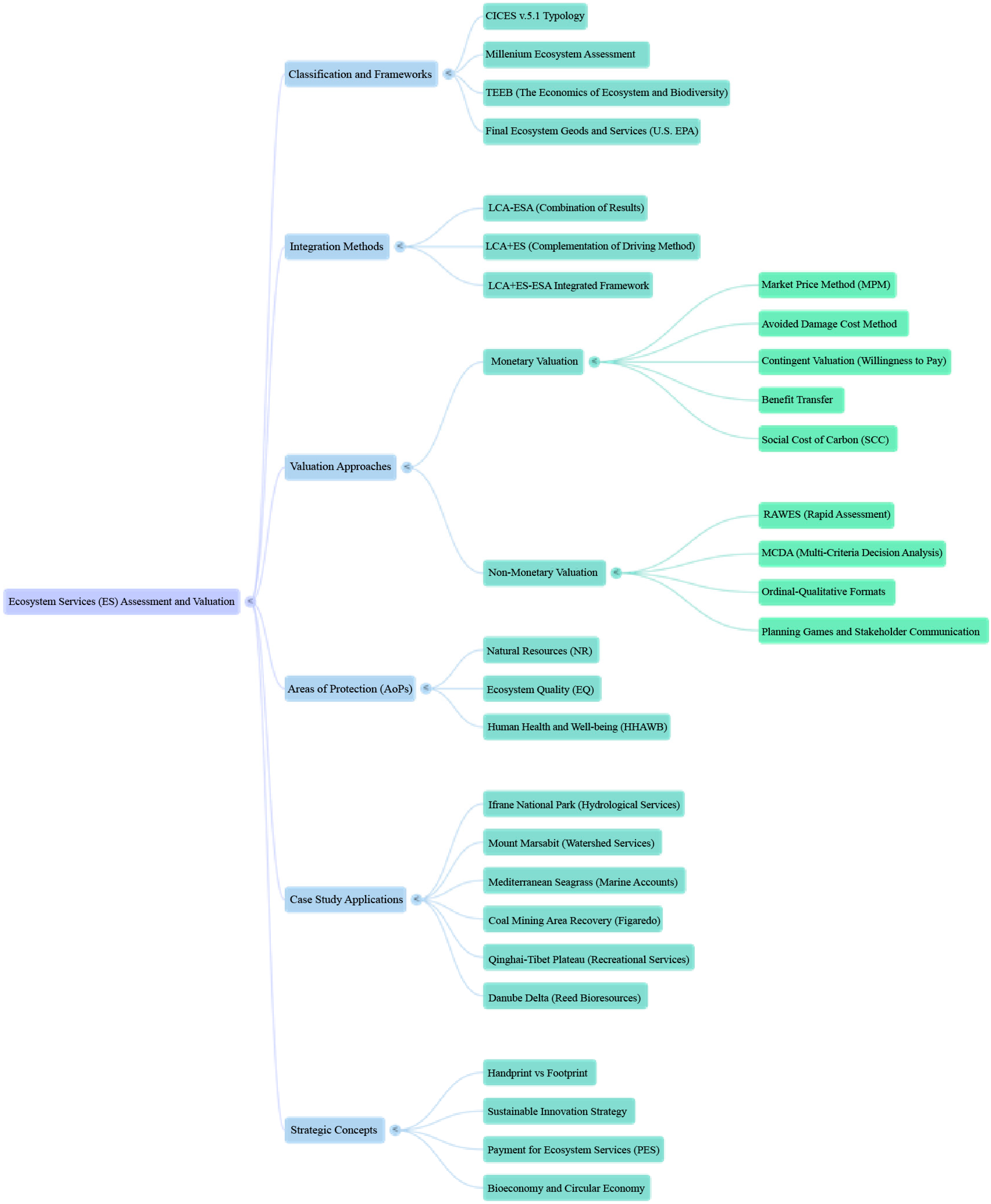
To operationalize ES valuation, a wide array of methodologies has been developed, including revealed-preference approaches (e.g., hedonic pricing and travel-cost methods), stated-preference techniques (e.g., contingent valuation and choice experiments), production function and cost-based methods, and benefit-transfer procedures, often framed within the Total Economic Value paradigm and increasingly embedded in natural capital accounting frameworks consistent with systems such as the Millennium Ecosystem Assessment and CICES. Within stated-preference techniques, the concept of Willingness To Pay (WTP) plays a central role, representing the maximum amount individuals are prepared to pay to secure the provision of an ecosystem service or to avoid its degradation. WTP is typically elicited through hypothetical market scenarios and carefully designed survey instruments, allowing for the estimation of both use and non-use values, including existence and bequest values that cannot be captured through revealed-preference methods. However, WTP estimates are sensitive to survey design, information provision, payment vehicles, and potential cognitive and strategic biases, such as hypothetical bias or embedding effects. As a result, robust econometric modeling, validity tests, and consistency checks are essential to ensure reliable welfare estimates. Despite these limitations, WTP-based measures remain a cornerstone of policy-oriented ES valuation, particularly for cost–benefit analyses and decision-making processes where monetary metrics are required. Figure 1 shows the mind map summarizing the literature review on ES monetization [10,11,12,13,14,15,16,17,18,19,20,21,22,23,24,25,26,27,28,29,30,31,32,33,34,35,36,37,38,39,40,41,42].
These valuation outputs underpin the design of policy instruments such as Payments for Ecosystem Services (PES), carbon and biodiversity markets, compensation schemes, environmental fiscal reforms, and certification mechanisms, which seek to internalize ecological costs, incentivize conservation and restoration, and support investments in Nature-Based Solutions (NBSs). At the same time, an extensive body of research and applied case studies across urban, conservation, industrial, and restoration contexts highlights persistent theoretical, ethical, and methodological challenges, including valuation uncertainty, non-linear ecological dynamics, scale and context dependency, distributional inequities, and the risk of privileging easily monetized services at the expense of cultural, relational, and intrinsic values. In response, recent advances increasingly emphasize integrated and pluralistic assessment frameworks—most notably the coupling of ecosystem service assessment with life cycle assessment, multi-criteria analysis, and spatially explicit modeling tools—that embed monetization within deliberative, participatory, and context-sensitive governance processes, thereby enhancing the robustness, legitimacy, and policy relevance of ecosystem service assessments while aligning environmental policy, economic planning, and conservation finance with long-term sustainability objectives [24,25,26].

2.1.2. Cost Accounting for Nature-Based Solutions

Nature-Based Solutions (NBSs) and Natural Infrastructure (NI) are increasingly implemented to address water security, flood risk management, and climate change adaptation; however, their rigorous evaluation requires advanced analytical frameworks capable of capturing their distinctive life-cycle cost structures and multi-dimensional benefits. Empirical evidence from 18 municipal-scale watershed investment programs shows that total annual expenditures range from approximately USD 0.25 to 3.02 million (median USD 0.75 million, PPP-adjusted), with administrative and transaction costs accounting on average for 46% of cumulative expenditures during the first decade and stabilizing at around 40% in mature programs—values comparable to those observed in agri-environmental schemes administered by the US Natural Resources Conservation Service (≈38%). These highlight the inadequacy of conventional cost accounting approaches focused solely on capital (CapEx) and operational expenditures (OpEx), and motivate the adoption of life-cycle cost analysis (LCCA) integrated with Environmental Cost Accounting (ECA). Such integrated frameworks allow the explicit quantification of environment-related costs (e.g., monitoring, habitat restoration) and environment-induced costs (e.g., risk, liabilities, and degradation damages), while internalizing avoided costs that frequently represent a substantial share of NBS value. For example, econometric analysis in Ontario, Canada, identified a statistically significant negative correlation between forest cover and drinking water rates, indicating that increased watershed forestation can measurably reduce engineered treatment costs. Similarly, floodplain restoration projects have been associated with property value increases of approximately 10% within 0.75 miles of restored river corridors, while renewable-energy and ecosystem-based interventions have demonstrated emission reductions exceeding 90% compared to baseline scenarios.
Decision-support tools such as Cost–Benefit Analysis, Cost-Effectiveness Analysis, natural capital accounting, and Multi-Criteria Decision Analysis (MCDA) enable the comparison of NBSs and gray infrastructure by incorporating co-benefits, non-market ecosystem services, and distributional effects, while Global Sensitivity Analysis (e.g., Sobol indices) is increasingly used to identify dominant uncertainties across life-cycle inventories and impact pathways. Furthermore, socio-hydrological and governance-oriented frameworks highlight that the effectiveness and cost-efficiency of NBSs are strongly influenced by behavioral responses, institutional capacity, and stakeholder coordination, which can generate feedback and path dependencies that materially affect long-term system performance. Recent applications integrating remote sensing, digital Monitoring, Reporting, and Verification (MRV), and optimization algorithms have shown potential to reduce monitoring costs, improve additionality assessment, and enhance the robustness of benefit estimates, particularly for forest and blue carbon systems. Collectively, these quantitative, life-cycle-oriented approaches provide a more transparent and evidence-based basis for evaluating NBS performance, supporting investment decisions that balance financial efficiency, environmental integrity, and long-term socio-ecological resilience [43,44,45,46,47,48,49,50,51,52,53,54,55,56,57,58,59,60,61,62,63].

2.2. Environmental Cost Accounting of Nature-Based Solutions Through the ES Monetization

The environmental cost accounting of Nature-Based Solutions (NBSs) provides a framework to translate ecological performance into economic value and to inform policy instruments for sustainable urban and environmental planning. It quantifies avoided environmental costs, reduced externalities, and deferred gray-infrastructure expenditures, enabling Ecosystem Service (ES) benefits to be incorporated into cost–benefit analyses, multi-criteria assessments, and public investment appraisals. Rather than valuing ecosystem services directly, this approach focuses on changes in environmental liabilities—such as avoided flood damage, reduced water treatment needs, lower carbon emissions, and decreased heat-stress mortality—expressing NBS benefits as monetary savings from mitigating anthropogenic pressures.
Integrating life-cycle impacts, opportunity costs, environmental externalities, and ecological dynamics allows for environmental cost accounting to capture both the biophysical effectiveness of NBSs and the avoided degradation pathways of conventional infrastructure. Within this framework, incorporating stakeholders’ Willingness to Pay (WTP) extends the assessment by reflecting the social and perceived value of NBSs, including use and non-use values such as recreation, biodiversity, social equity, and heritage. Combined with avoided-cost calculations, WTP complements traditional economic value, aligns assessments with public preferences, and enhances stakeholder legitimacy.
Furthermore, integrating monitoring systems with technology for assessment ensures that environmental and social outcomes are tracked over time, providing feedback for adaptive management and the design of effective legal frameworks. WTP can also guide funding strategies, prioritize NBS interventions, and reveal co-benefits that may remain invisible in infrastructure-focused accounting. Overall, this integrated approach creates a comprehensive framework that accounts for both ecological effectiveness and societal value, supporting robust, evidence-based investment decisions in climate adaptation, urban sustainability, and nature-based policy initiatives.
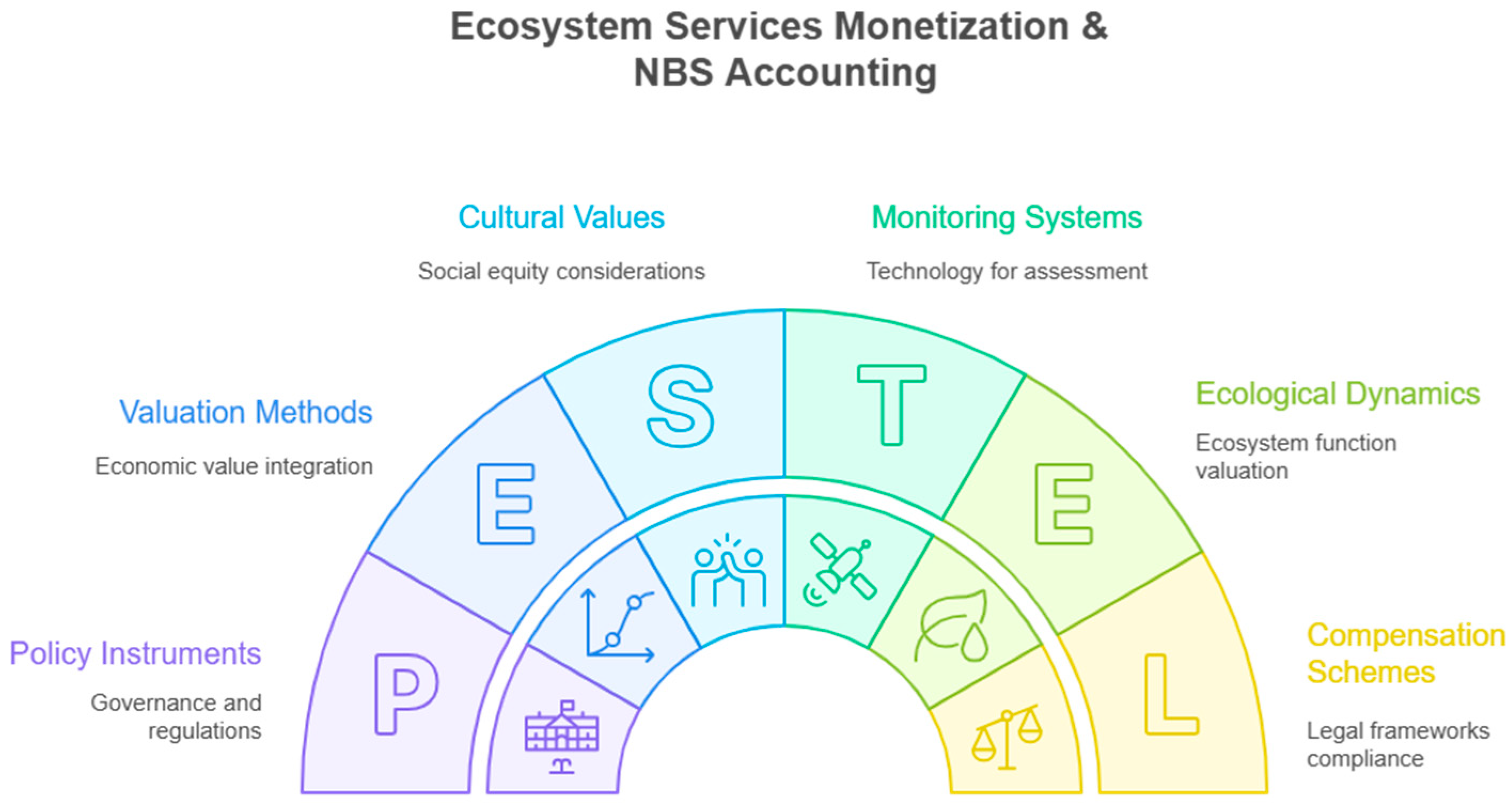
Figure 2 presents a conceptual framework (PESTEL: Policy, Economic, Social, Technology, Ecological, Legal) for Ecosystem Services monetization and environmental cost accounting. The diagram illustrates how multiple dimensions—including policy instruments, valuation methods, stakeholder engagement, analytical tools, ecosystem stewardship, and governance frameworks—interact to support informed environmental decision-making. Its circular layout emphasizes integration and balance, highlighting that economic valuation of ecosystems is most effective when underpinned by social equity, technological innovation, ecological conservation, and robust regulatory structures.

Ecosystem Services Cost Accounting (ES-CA) Algorithm

To support NBS accounting through the integration of externalities, an Ecosystem Services Cost Accounting (ES-CA) tool has been proposed as an affordable and insightful instrument capable of providing policy-relevant guidance for development-oriented decision-making. A key prerequisite for this approach is the estimation of the monetary value of ecosystem services (ES), which forms the basis for integrating environmental and social externalities into economic assessments.
Estimating the trajectory of relative prices for ecosystem services requires two key elements: the elasticity of substitution between market and non-market goods, and their respective growth rates. From a policy perspective, overlooking the limited substitutability of ecosystem services leads to a substantial undervaluation of these services in public policy evaluations and natural capital assessments. This oversight typically stems from an implicit assumption that ecosystem services can be fully replaced by market goods. Our main objective is to improve the estimation of the limited substitutability of non-market ecosystem services relative to market goods.
The global environmental cost of NBSi (with i = 1, …, n) with respect to the j-th ecosystem service (j = 1, …, m) can be expressed by the following linear algebraic Formula (1):
C E , i N B S =   ( 1 + α i + β i + ε i ) Q i P   c u P + γ C I
where
  • C E , i N B S = total environmental cost of the i-th NBS;
  • Q i P = area of the intervention expressed as the square meters of surface being transformed via the project;
  • c u P = unit cost per unit of the project;
  • α i , β i , ε i = coefficients for indirect impacts or externalities, often monetized via Willingness To Pay (WTP);
  • C I = initial investment cost;
  • γ = share of the investment attributable to environmental objectives, i.e., the portion of costs directed toward nature-positive targets such as biodiversity conservation or air quality improvement. This depends on the NBS typology, as well as on the degree of integration between artificial and natural components within the intervention. When the project is entirely nature-based (e.g., a forestry investment), γ = 1 . Otherwise, it can assume values lower than one ( γ < 1 ), approaching zero in the case of gray projects.
In unitary terms, Equation (1) assumes the subsequent configuration:
c E , i N B S =   ( 1 + α i + β i + ε i ) c u P + γ C I Q i P  
Equation (1) can be reformulated by replacing the coefficients with new ones that reflect the monetary values of the ecosystem services, since each coefficient corresponds to a potential ecosystem service considered as a positive externality of the NBS. If the ES terms are introduced to support an assessment of the economic NBS feasibility, they should be added as an additional component, as shown in Equation (3). Conversely, if the aim is to express a value-related consideration focused on environmental NBS cost estimation, Equation (1) can be rewritten in the form of Equation (4).
C E , i N B S = Q i P   c u P + γ C I E S j
C E , i N B S = ρ   Q i P   c u P + γ C I
where the ρ represents the income elasticity of marginal WTP for ecosystem services [64]. The income elasticity of marginal Willingness To Pay (WTP) for ecosystem services is a key parameter for environmental policy design, as it indicates how the value individuals assign to incremental improvements in ecosystem services changes with income. When income elasticity is high, economic growth can substantially increase public support and benefits from conservation policies, whereas low elasticity suggests that gains in income may not translate into higher demand for environmental quality. This has important implications for cost–benefit analysis, benefit transfer across regions with different income levels, and the equity impacts of environmental policies. Policymakers can use information on the income elasticity of marginal WTP to better anticipate how environmental benefits are distributed across income groups and to design financing mechanisms that align conservation efforts with social welfare objectives. Based on 735 income–WTP pairs from 396 studies, Drupp et al. (2025) found an income elasticity of WTP of around 0.6 [64].
In line with Equation (4), Equation (2) transforms in the following way, as shown in Equation (5):
c E , i N B S =   ρ   c u P + γ C I Q i P  
Equation (4) allows for the calculation of the total environmental costs of NBSs by accounting for externalities in terms of ecosystem services flowing between anthropic and natural resources. In this framework, the exchange power between nature and people is assumed to be expressed through the Willingness To Pay (WTP) to ensure the provision of ecosystem services (ES). In particular, the coefficient ρ —which represents the marginal utility derived from the exchange of ES within a linear “input–output” system—is introduced as a factor applied to the component of Equation (4) related to NBS construction costs, in order to indicate the proportion of costs required for ES production. This latter component is then added to the initial investment cost.
This approach to accounting for the environmental costs of NBSs, through the indirect monetization of ecosystem services, enhances the effectiveness of public and private investment strategies for the green transition and strengthens the economic justification for nature-positive infrastructure. Furthermore, it provides a policy-relevant framework for integrating ecological processes into economic analysis, supporting more informed, transparent, and balanced decision-making in land-use and resource management by explicitly addressing environmental–economic trade-offs.
The proposed ES-CA tool is planned for implementation in relation to the Nature-Based Solutions (NBSs) promoted across Europe under the Roadmap for Urban NBSs initiative. Based on a consultation of the relevant documents, groups of NBSs were identified. This clustering aligns with the NBS practices that are geo-referenced in the Urban Atlas platform, allowing for the identification of their distribution across European countries. The proposed implementation aims to demonstrate the flexibility of the accounting tool in supporting policy-oriented objectives and facilitating decision-making processes at the political level, ultimately contributing to a positive greening transition at multiple scales.

3. ES-CA Tool Implementation Across European NBS Categories

To effectively capture the environmental cost contribution of NBS across Europe, Equation (5) is applied to the examples provided in the Roadmap of Urban Nature-Based Solutions, which delineates the principal transformative and nature-positive pathways supported by Nature-Based Solutions. A series of theoretical and practical assumptions were made, as outlined below:
  • Equation (5) is linear in its algebraic structure, and alternative configurations were not tested.
  • The ρ coefficient is assumed to be equal to the value observed by Drupp et al. (2025), namely 0.6 [64]. No distinction is made across different ecosystem service (ES) categories.
  • The γ coefficient is assumed to be 1, implying that the investment cost is considered to be entirely directed toward achieving environmental and nature-positive objectives, such as adaptation and mitigation of climate change through greening actions via NBSs.
  • The analysis is performed using the NBS category as the unit of assessment, rather than concentrating on specific typologies or their spatial distribution across European countries. This approach adopts a pan-European perspective, considering the NBSs in a general context.
The Urban Nature Atlas database was also examined, from which the dataset shown in Table 2 was extracted. This enables the classification of NBSs according to the environmental targets set by the Sustainable Development Goals (SDGs). In the present simulation, SDG 13 (Climate Action)—with a focus on adaptation, resilience, and mitigation—was selected, specifically within the thematic domain of regeneration, land-use planning, and urban development. Within this domain, the corresponding number and typologies of NBSs implemented across Europe are identified. Table 2 categorizes the main NBS types by (a) budget range (CI) for implementation, expressed as minimum and maximum investment costs; (b) maximum and minimum surface areas per category; and (c) unit implementation costs. Items (a) and (b) were derived from the Urban Nature Atlas consultation, while item (c) was established based on comprehensive market surveys, reflecting current market conditions and prevailing prices.
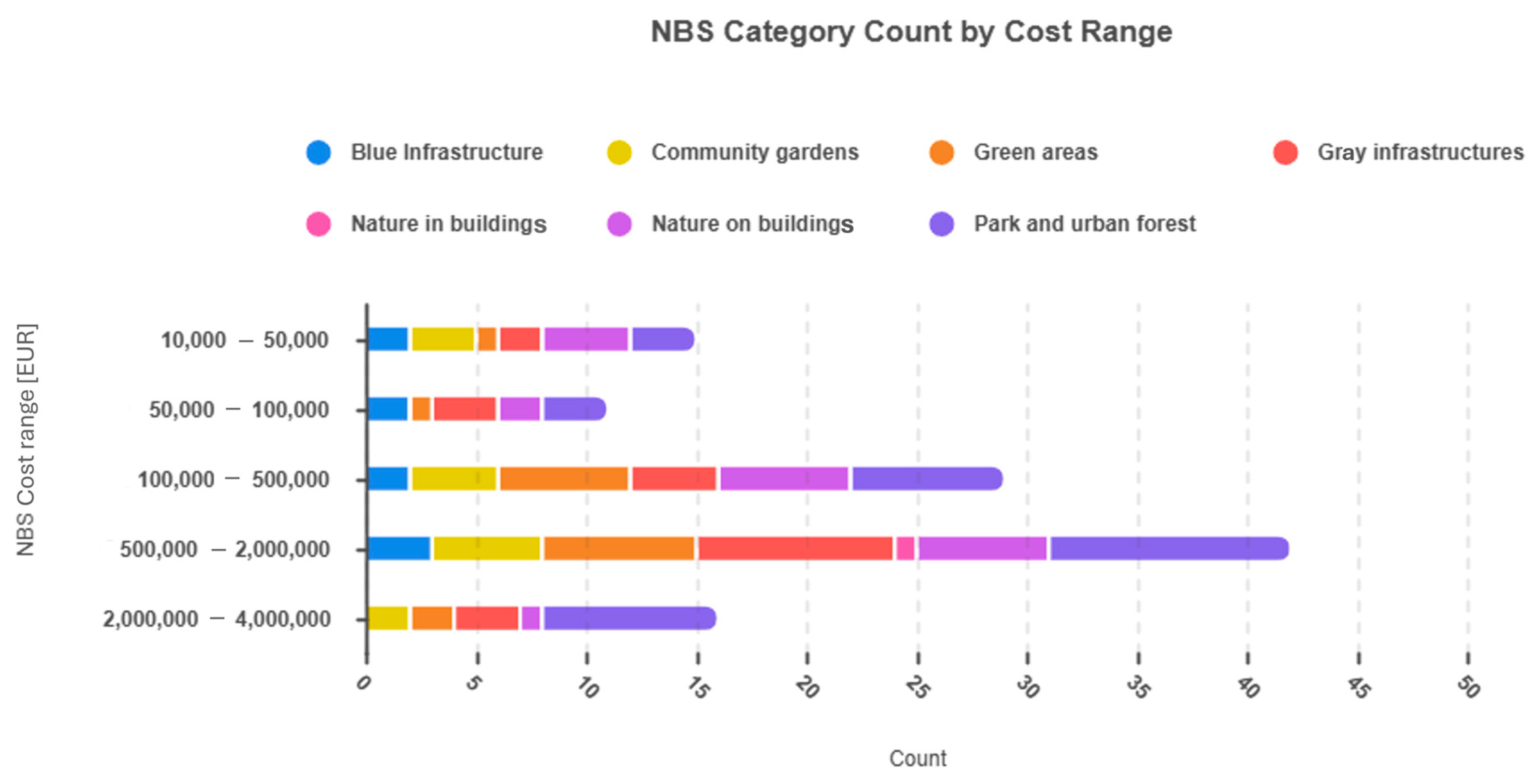
The table delineates the types of European Nature-Based Solutions (NBSs) and their contributions to climate action (SDG13), as well as the related financial costs. Parks and Urban Forests exhibit the largest project count (122), whilst Nature in Buildings (indoor) is the least represented, with only 3 projects. Investment expenditures exhibit considerable variability, ranging from minor interventions (EUR 10,000–50,000) to substantial projects (EUR 2–4 million), with specific categories, such as Parks/Urban Forests and Gray Infrastructure, more commonly associated with elevated costs. Project areas (b) vary from a few square meters (interior interventions) to several hundred thousand square meters (urban greening and Blue Infrastructure). Unit prices (c) range from EUR 55 to EUR 450 per sqm. Figure 3 below shows the distribution of cost amounts for NBSs.

Implementation Results

The environmental cost estimation per NBS category is reported in Table 3. The table presents the unit environmental cost (EUR/sqm) for the seven European NBS categories, grouped into four classes according to the Q ̿ i P size intervals (Low, Medium-low, Medium-high, and High). The chart delineates the variety of Nature-Based Solutions (NBSs) concerning scale, investment, and prospective environmental advantages, offering insights into cost-effectiveness and their role in urban climate adaptation and mitigation.
The table shows that unit environmental costs tend to decrease as Q ̿ i P increases, confirming the presence of economies of scale across all NBS categories. When interpreted together with the associated Ecosystem Services (ES), this trend suggests that larger NBS implementations not only reduce the environmental cost per square meter, but also enhance the overall ES delivery efficiency. Smaller-scale solutions (Low and Medium-low clusters) exhibit higher unit costs while typically providing more localized or specialized ES benefits. In contrast, Medium-high and High clusters, despite lower unit environmental costs, tend to generate broader and more cumulative ES—such as improved microclimate regulation, larger carbon sequestration potential, and enhanced stormwater management capacity. This combined behavior indicates that the trade-off between environmental cost and ES provision shifts favorably toward larger-scale applications, where the marginal cost per unit of ES supplied becomes substantially lower.
Differences across NBS categories remain evident, reflecting their distinct functional roles and ES profiles driven by the complexity of the intervention and the degree of standardization. Community gardens and green areas for water management tend to have the highest costs per square meter for small projects, reflecting their complexity and customization. In contrast, interventions in or on buildings generally have lower costs, especially for small surfaces, suggesting that these solutions are more modular and easier to implement. Large-scale projects, such as urban parks and forests, show lower and more consistent costs, indicating standardized approaches and efficiencies of scale.

4. Discussion

Building on the PESTEL-based conceptual framework for ecosystem services monetization and environmental cost accounting, the following thematic analytical dimensions are examined in greater depth, taking into account the empirical evidence emerging from the prior implementation.

4.1. Policy Instrument

Alignment with the EU Biodiversity Strategy and Climate Adaptation Strategy

Nature-Based Solutions (NBSs) are increasingly recognized as core implementation instruments of the EU Biodiversity Strategy for 2030 and the EU Climate Adaptation Strategy, which both promote the restoration, protection, and multifunctional use of ecosystems as cost-effective responses to biodiversity loss and climate risks. The analysis of environmental unit costs across European NBS categories provides quantitative evidence to support these policy objectives, enabling the translation of strategic goals into operational investment criteria [20,32,45].
Large-scale, land-based NBSs—such as parks, urban forests, blue infrastructure, and green areas for water management—exhibit declining environmental costs per square meter as project size increases, reaching values as low as 35–80 EUR/m2 for interventions above 225,000 m2. These results reinforce EU policy priorities that emphasize ecosystem restoration at scale, ecological connectivity, and nature-based climate resilience. Conversely, smaller-scale and building-integrated NBSs, while more expensive per unit area, play a complementary role in dense urban contexts, contributing to adaptation objectives where land availability is limited [55].
By providing comparable cost benchmarks across NBS typologies, this approach supports multi-level governance: municipalities can prioritize cost-effective interventions under budget constraints, while regional and national authorities can integrate NBSs into climate adaptation plans, biodiversity restoration programs, and green infrastructure networks consistent with EU strategic frameworks [44].

4.2. Economic Valuation

Novelty of Indirect Monetization of Ecosystem Services

A key methodological innovation of this analysis lies in the estimation of the environmental cost of NBSs through the indirect monetization of ecosystem services using the Willingness-To-Pay (WTP) approach. Unlike conventional assessment methods—typically focused on capital expenditures, operation and maintenance costs, or life-cycle financial accounting—this approach internalizes the value of ecosystem services generated by NBSs, such as climate regulation, flood mitigation, biodiversity support, and recreational benefits. By expressing environmental benefits in monetary terms and relating them to spatial units (EUR/m2), the method reframes “cost” as an environmental investment rather than a purely financial burden [2,39]. This represents a conceptual shift from traditional cost assessments, which often undervalue or exclude non-market ecological benefits, leading to systematic underinvestment in nature-based interventions. The WTP-based valuation thus offers a more comprehensive representation of NBS performance, consistent with the EU’s call for integrating natural capital and ecosystem services into economic decision-making [22].

4.3. Social Equity

Supporting Social and Biodiversity Objectives

Cultural ecosystem services constitute a central pillar of both the EU Biodiversity Strategy and climate adaptation policies, which emphasize human–nature relationships, equitable access to green spaces, and improved quality of life. Community gardens, allotments, and urban green spaces show moderate environmental unit costs while delivering high cultural and social value, including social cohesion, place attachment, and environmental awareness [58,60,61].
Building-integrated and indoor NBSs, although characterized by higher unit costs, contribute significantly to cultural value in compact urban environments. These interventions provide daily exposure to nature, support mental well-being, and enhance the perceived quality of the built environment. Importantly, WTP-based valuations implicitly capture these cultural dimensions, as public preferences reflect not only biophysical ecosystem services but also experiential and symbolic values aligned with EU policy goals on inclusive and livable cities [41].

4.4. Technology for Assessment

Evidence-Based Policy and Adaptive Governance

The substantial variability in environmental unit costs across NBS categories and scales highlights the need for robust monitoring systems, as advocated by both EU biodiversity and climate adaptation frameworks. Monitoring ecological performance, social outcomes, and economic efficiency over time is essential to validate WTP-based valuations and to ensure that projected ecosystem service benefits are realized [33].
Environmental unit cost indicators can be integrated into monitoring and reporting systems as performance benchmarks, enabling comparison across projects and regions. This supports adaptive governance by allowing policymakers to refine design standards, optimize maintenance regimes, and improve long-term effectiveness. Transparent monitoring also strengthens accountability and supports the scaling-up of successful NBSs in line with EU-wide targets for ecosystem restoration and climate resilience [28].

4.5. Ecological Dynamic

Long-Term Ecosystem Functioning and Climate Resilience

NBSs contribute to biodiversity conservation and climate adaptation through dynamic ecological processes that evolve over time. Large-scale green and blue infrastructures benefit from ecological maturation, including increased habitat complexity, improved connectivity, and enhanced ecosystem functioning. These dynamics are directly aligned with the EU Biodiversity Strategy’s emphasis on restoring self-sustaining ecosystems and with climate adaptation objectives focused on long-term resilience [50].
Smaller-scale and building-integrated NBSs tend to deliver more immediate but spatially limited benefits, with ecological performance closely tied to technical design and maintenance. Recognizing these differing ecological dynamics is critical for interpreting WTP-based environmental costs, as public valuations may reflect anticipated long-term benefits rather than short-term outcomes. This dynamic perspective strengthens the case for NBSs as strategic, long-term investments rather than short-lived infrastructure solutions [40,56].

4.6. Legal Frameworks and Compensation Schemes

Internalizing Environmental Value in Planning and Investment

The monetization of ecosystem services through WTP provides a robust basis for designing compensation and incentive schemes, consistent with EU principles of environmental liability, no-net-loss of biodiversity, and ecosystem restoration. By quantifying environmental benefits, this approach supports the development of compensation mechanisms, payments for ecosystem services, and targeted subsidies for NBS implementation.
High-cost, building-integrated NBSs may require financial incentives to overcome market barriers, particularly in private developments. In contrast, lower-cost, scalable interventions—such as community gardens or water-management green areas—are well suited to compensatory planning instruments, where incremental gains in ecosystem services can offset environmental impacts elsewhere [27]. Overall, WTP-based environmental cost assessments enable a more equitable and transparent allocation of resources, aligning private and public investments with EU biodiversity and climate adaptation objectives.

5. Conclusions

Environmental unit costs of Nature-Based Solutions (NBSs) vary considerably across European categories, reflecting differences in scale, design, and ecosystem service provision. High-cost interventions, such as external “Nature on Buildings” and urban parks/forests, offer substantial climate adaptation and mitigation benefits, while smaller-scale measures, like indoor greening or community gardens, provide lower per-unit benefits but greater scalability. This study contributes novel insights by applying cost accounting through the indirect monetization of ecosystem services using the Willingness-To-Pay (WTP) approach, linking ecological outcomes to economic valuation and enabling more precise, evidence-based decision-making. However, WTP-based estimates rely on respondents’ perceptions and memory, which may introduce biases and uncertainties that should be considered in policy applications. Integrating large-scale, high-impact NBSs with smaller, cost-effective solutions can enhance urban resilience and climate adaptation while optimizing resource allocation. Incorporating WTP-based environmental costs into urban planning frameworks promotes strategic NBS adoption and targeted investment in nature-based climate solutions.
Future research should focus on standardizing environmental cost assessments, addressing methodological limitations of WTP approaches, and quantifying long-term ecosystem service benefits across NBS categories, providing a stronger foundation for sustainable and resilient development.

Author Contributions

Conceptualization, F.S.; methodology, F.S.; software, F.S.; validation, F.S., M.R.G., F.T. and P.M.; formal analysis, F.S., M.R.G., F.T. and P.M.; investigation, F.S.; resources, F.S.; data curation, F.S.; writing—original draft preparation, F.S., M.R.G., F.T. and P.M.; writing—review and editing, F.S., M.R.G., F.T. and P.M.; visualization, F.S., M.R.G., F.T. and P.M.; supervision, M.R.G., F.T. and P.M.; project administration, F.S., M.R.G., F.T. and P.M.; funding acquisition, F.S., M.R.G., F.T. and P.M. All authors have read and agreed to the published version of the manuscript.

Funding

This research received no external funding.

Data Availability Statement

The raw data supporting the conclusions of this article will be made available by the authors on request.

Acknowledgments

This study was conducted as part of Sapienza University of Rome’s ongoing minor research project, “ECO-think: Integrating Ecosystem Services by Nature in the Urban Environment”.

Conflicts of Interest

The authors declare no conflicts of interest.

References

  1. Balzan, M.V. Assessing ecosystem services for evidence-based nature-based solutions. arXiv 2021, arXiv:2105.05672. [Google Scholar]
  2. Chelli, A.; Brander, L.; Geneletti, D. Cost–benefit analysis of urban nature-based solutions: A systematic review of approaches and scales with a focus on benefit valuation. Ecosyst. Serv. 2025, 71, 101684. [Google Scholar] [CrossRef]
  3. Almenar, J.B.; Elliot, T.; Rugani, B.; Philippe, B.; Gutierrez, T.N.; Sonnemann, G.; Geneletti, D. Nexus between nature-based solutions, ecosystem services and urban challenges. Land Use Policy 2021, 100, 104898. [Google Scholar] [CrossRef]
  4. Raymond, C.M.; Frantzeskaki, N.; Kabisch, N.; Berry, P.; Breil, M.; Nita, M.R.; Geneletti, D.; Calfapietra, C. A framework for assessing and implementing the co-benefits of nature-based solutions in urban areas. Environ. Sci. Policy 2017, 77, 15–24. [Google Scholar] [CrossRef]
  5. IUCN-2020-020; IUCN Global Standard for Nature-Based Solutions. International Union for Conservation of Nature (IUCN): Gland, Switzerland, 2020.
  6. OECD. Nature-Based Solutions for Adapting to Water-Related Climate Risks; OECD Environment Policy Papers, No. 21; OECD Publishing: Paris, France, 2020. [Google Scholar] [CrossRef]
  7. IPBES-IPCC Co-Sponsored Workshop Report on Biodiversity and Climate Change. 2021. Available online: https://www.ipbes.net/events/ipbes-ipcc-co-sponsored-workshop-biodiversity-and-climate-change (accessed on 4 January 2026).
  8. Donatti, C.I.; Martinez-Rodriguez, M.R.; Fedele, G.; Harvey, C.A.; Andrade, A.; Scorgie, S.; Rose, C. Guidlines for Designing, Implementing and Monitoring Nature-Based Solutions for Adaptation, 2nd ed.; Conservation Internationale: Arlington, VA, USA, 2021. [Google Scholar] [CrossRef]
  9. Nelson, F.; Combe, M. What are the task force on nature-related financial disclosures. Equity 2022, 36, 20–21. [Google Scholar]
  10. Certini, G.; Grilli, G.; Scalenghe, R. The monetization of soil: An emerging imperative? Land Use Policy 2025, 158, 107750. [Google Scholar] [CrossRef]
  11. Kogler, M.; Scharf, B.; Göschl, C.; Jech, M.; Pitha, U.; Stangl, R. Evaluation and monetisation of ecosystem services with real-time weather data and machine learning. Urban For. Urban Green. 2025, 111, 128860. [Google Scholar] [CrossRef]
  12. Ayuso, S.; Hereu, A.; Ventalló, E. Societal Impact of the Catalan Cork Industry: Measuring Its Socioeconomic and Environmental Value. Sustainability 2025, 17, 5899. [Google Scholar] [CrossRef]
  13. Wang, J.; Fu, M.; Han, X.; Wu, Y.; Wen, H. Research on Human Needs and the Valorization of Supply–Need Relationships in Ecosystem Services—A Case Study of the Southwest Karst Region. Land 2025, 14, 588. [Google Scholar] [CrossRef]
  14. Addamo, A.M.; La Notte, A.; Ferrini, S.; Grilli, G. Marine ecosystem services of seagrass in physical and monetary terms: The Mediterranean Sea case study. Ecol. Econ. 2025, 227, 108420. [Google Scholar] [CrossRef]
  15. Sadgui, O.; Khattabi, A. Economic Assessment of Hydrologic Ecosystem Services in Morocco’s Protected Areas: A Case Study of Ifrane National Park. Sustainability 2024, 16, 8800. [Google Scholar] [CrossRef]
  16. Ljubojević, M.; Buča, B.; Šarac, V.; Narandžić, T.; Panagopoulos, T. Assessment of Supercell Storm-Induced Uprooting of Amenity Trees—Monetization of Environmental and Socio-Economic Losses. Land 2024, 13, 1540. [Google Scholar] [CrossRef]
  17. Yuan, M.; Han, F.; Ma, X.; Wang, T.; Liang, Q. Recreational Ecosystem Services in the Qinghai–Tibet Plateau National Park Group: Mapping, Monetization, and Evaluation. Land 2024, 13, 682. [Google Scholar] [CrossRef]
  18. Zanini, S.F.; de Carli, A.; Rizzo, A.; Conte, G.; Masi, F. Monetization of Ecosystem Services from Nature-Based Solutions for Agricultural Diffuse Pollution Control: Simplified Value Transfer Method at European Scale. Water 2024, 16, 898. [Google Scholar] [CrossRef]
  19. Taelman, S.E.; De Luca Peña, L.V.; Préat, N.; Bachmann, T.M.; Van der Biest, K.; Maes, J.; Dewulf, J. Integrating ecosystem services and life cycle assessment: A framework accounting for local and global (socio-) environmental impacts. Int. J. Life Cycle Assess. 2024, 29, 99–115. [Google Scholar] [CrossRef]
  20. Drenning, P.; Volchko, Y.; Ahrens, L.; Rosén, L.; Söderqvist, T.; Norrman, J. Comparison of PFAS soil remediation alternatives at a civilian airport using cost-benefit analysis. Sci. Total Environ. 2023, 882, 163664. [Google Scholar] [CrossRef] [PubMed]
  21. Zhang, S.; Cheng, Z.; Liang, W.; Ding, L. For the Better Protection of Wetland Resources: Net Value of Ecosystem Services after Protective Development of Xixi Wetland in Hangzhou, China. Sustainability 2023, 15, 5913. [Google Scholar] [CrossRef]
  22. Bidolakh, D. Assessment of ecosystem functions of green spaces as an important component of their inventory in the context of sustainable development of urban landscapes. Ukr. J. For. Wood Sci. 2023, 14, 8–26. [Google Scholar] [CrossRef]
  23. Krzemień, A.; Álvarez Fernández, J.J.; Riesgo Fernández, P.; Fidalgo Valverde, G.; Garcia-Cortes, S. Valuation of Ecosystem Services Based on EU Carbon Allowances—Optimal Recovery for a Coal Mining Area. Int. J. Environ. Res. Public Health 2023, 20, 381. [Google Scholar] [CrossRef]
  24. Bidolakh, D.; Kolesnichenko, O. Assessment of ecosystem functions of public green spaces in the city of Berezhany, Ternopil region. Sci. Horiz. 2023, 26, 96–108. [Google Scholar] [CrossRef]
  25. Katz, O. The ecosystem services framework in archaeology (and vice versa). People Nat. 2022, 4, 1450–1460. [Google Scholar] [CrossRef]
  26. Wagner, M.; Winkler, B.; Lask, J.; Weik, J.; Kiesel, A.; Koch, M.; Clifton-Brown, J.; von Cossel, M. The True Costs and Benefits of Miscanthus Cultivation. Agronomy 2022, 12, 3071. [Google Scholar] [CrossRef]
  27. Krzemień, A.; Álvarez Fernández, J.J.; Riesgo Fernández, P.; Fidalgo Valverde, G.; Garcia-Cortes, S. Restoring Coal Mining-Affected Areas: The Missing Ecosystem Services. Int. J. Environ. Res. Public Health 2022, 19, 14200. [Google Scholar] [CrossRef]
  28. Everard, M.; Bradley, P.; Ogden, W.; Piscopiello, E.; Salter, L.; Herbert, S.; McInnes, R. Reassessing the multiple values of lowland British floodplains. Sci. Total Environ. 2022, 823, 153637. [Google Scholar] [CrossRef]
  29. Gapinski, C.M.; Vollheyde, A.-L.; von Haaren, C. Application of the ecosystem services concept in stakeholder communication—Results of a workshop including a planning game at the Lower Mulde River (Dessau-Roßlau, Germany). Int. Rev. Hydrobiol. 2022, 107, 128–139. [Google Scholar] [CrossRef]
  30. Takahashi, T.; Tsuge, T.; Shibata, S. Innovativeness of Japanese Forest Owners Regarding the Monetization of Forest Ecosystem Services. Sustainability 2022, 14, 2119. [Google Scholar] [CrossRef]
  31. Semenyuk, O.V.; Stoma, G.V.; Bodrova, K.S. Evaluation of the Cost of Ecosystem Services of Urban Landscapes (by the Example of Moscow). Eurasian Soil Sci. 2021, 54, 1975–1986. [Google Scholar] [CrossRef]
  32. Dobre, A.C.; Pascu, I.-S.; Leca, S.; Garcia-Duro, J.; Dobrota, C.-E.; Tudoran, G.M.; Badea, O. Applications of TLS and ALS in Evaluating Forest Ecosystem Services: A Southern Carpathians Case Study. Forests 2021, 12, 1269. [Google Scholar] [CrossRef]
  33. Bubicha, M.J.; Mwaura, F. Characterization and monetization of Mount Marsabit ecosystem watershed services, Marsabit County, Kenya. East Afr. J. Sci. Technol. Innov. 2021, 2, 20220092676. [Google Scholar] [CrossRef]
  34. Ullmann, J.; Grimm, D. Algae and their potential for a future bioeconomy, landless food production, and the socio-economic impact of an algae industry. Org. Agric. 2021, 11, 261–267. [Google Scholar] [CrossRef]
  35. Rizzo, A.; Conte, G.; Masi, F. Adjusted Unit Value Transfer as a Tool for Raising Awareness on Ecosystem Services Provided by Constructed Wetlands for Water Pollution Control: An Italian Case Study. Int. J. Environ. Res. Public Health 2021, 18, 1531. [Google Scholar] [CrossRef]
  36. Krozer, Y.; Coenen, F.; Hanganu, J.; Lordkipanidze, M.; Sbarcea, M. Towards Innovative Governance of Nature Areas. Sustainability 2020, 12, 10624. [Google Scholar] [CrossRef]
  37. Carrasco, A.R. Simple Assessment of Spatio-Temporal Evolution of Salt Marshes Ecological Services. Front. Ecol. Evol. 2019, 7, 77. [Google Scholar] [CrossRef]
  38. Temel, J.; Jones, A.; Jones, N.; Balint, L. Limits of monetization in protecting ecosystem services. Conserv. Biol. 2018, 32, 1048–1062. [Google Scholar] [CrossRef]
  39. Pechanec, V.; Machar, I.; Sterbova, L.; Prokopova, M.; Kilianova, H.; Chobot, K.; Cudlin, P. Monetary Valuation of Natural Forest Habitats in Protected Areas. Forests 2017, 8, 427. [Google Scholar] [CrossRef]
  40. Greenhalgh, S.; Samarasinghe, O.; Curran-Cournane, F.; Wright, W.; Brown, P. Using ecosystem services to underpin cost–benefit analysis: Is it a way to protect finite soil resources? Ecosyst. Serv. 2017, 27, 1–14. [Google Scholar] [CrossRef]
  41. Lupp, G.; Förster, B.; Kantelberg, V.; Markmann, T.; Naumann, J.; Honert, C.; Koch, M.; Pauleit, S. Assessing the Recreation Value of Urban Woodland Using the Ecosystem Service Approach in Two Forests in the Munich Metropolitan Region. Sustainability 2016, 8, 1156. [Google Scholar] [CrossRef]
  42. Cordier, M.; Pérez Agúndez, J.A.; Hecq, W.; Hamaide, B. A guiding framework for ecosystem services monetization in ecological–economic modeling. Ecosyst. Serv. 2014, 8, 86–96. [Google Scholar] [CrossRef]
  43. Faucher, M.; Grellier, S.; Chaudron, C.; Janeau, J.-L.; Rudi, G.; Vinatier, F. Secondary Seed Dispersal by Hydrochory During Surface Runoff Inside a Mediterranean Vineyard. Eur. J. Soil Sci. 2025, 76, e70257. [Google Scholar] [CrossRef]
  44. Ahmed, I.; Rehan, M.; Alqahtani, M.; Khalid, M. Microgrid modernisation using exponential decentralised consensus-based energy assessment by considering renewable generation uncertainties and operational price analysis. Results Eng. 2025, 27, 105731. [Google Scholar] [CrossRef]
  45. Nallainathan, S.; Arefi, A.; Lund, C.; Mehrizi-Sani, A. Allocation of Cost of Reliability to Various Customer Sectors in a Standalone Microgrid System. Energies 2025, 18, 3237. [Google Scholar] [CrossRef]
  46. Safavi, V.; Vaniar, A.M.; Bazmohammadi, N.; Vasquez, J.C.; Keysan, O.; Guerrero, J.M. A battery degradation-aware energy management system for agricultural microgrids. J. Energy Storage 2025, 108, 115059. [Google Scholar] [CrossRef]
  47. Houston, A.; Kennedy, H.; Austin, W.E.N. Additionality in Blue Carbon Ecosystems: Recommendations for a Universally Applicable Accounting Methodology. Glob. Change Biol. 2024, 30, e17559. [Google Scholar] [CrossRef]
  48. Abeywickrama, H.G.K.; Bajón-Fernández, Y.; Srinamasivayam, B.; Turner, D.; Rivas Casado, M. Monitoring CH4 Fluxes in Sewage Sludge Treatment Centres: Challenging Emission Underreporting. Remote Sens. 2024, 16, 2280. [Google Scholar] [CrossRef]
  49. Alshehri, K.; Chen, I.-C.; Rugani, B.; Sapsford, D.; Harbottle, M.; Cleall, P. A novel uncertainty assessment protocol for integrated ecosystem services-life cycle assessments: A comparative case of nature-based solutions. Sustain. Prod. Consum. 2024, 47, 499–515. [Google Scholar] [CrossRef]
  50. Kalaidjian, E.; Kurth, M.; Kucharski, J.; Galaitsi, S.; Yeates, E. Human well-being and natural infrastructure: Assessing opportunities for equitable project planning and implementation. Front. Ecol. Evol. 2024, 12, 1271182. [Google Scholar] [CrossRef]
  51. Pan, C.; Li, C.; An, A.; Deng, G.; Lin, J.K.; He, J.; Li, J.F.; Zhu, X.; Zhou, G.; Shrestha, A.K.; et al. Canada’s Green Gold: Unveiling Challenges, Opportunities, and Pathways for Sustainable Forestry Offsets. Forests 2023, 14, 2206. [Google Scholar] [CrossRef]
  52. Araya-Lopez, R.; Costa, M.D.P.; Wartman, M.; Macreadie, P.I. Trends in the application of remote sensing in blue carbon science. Ecol. Evol. 2023, 13, e10559. [Google Scholar] [CrossRef] [PubMed]
  53. Alshehri, K.; Harbottle, M.; Sapsford, D.; Beames, A.; Cleall, P. Integration of ecosystem services and life cycle assessment allows improved accounting of sustainability benefits of nature-based solutions for brownfield redevelopment. J. Clean. Prod. 2023, 413, 137352. [Google Scholar] [CrossRef]
  54. Kang, S.; Kroeger, T.; Shemie, D.; Echavarria, M.; Montalvo, T.; Bremer, L.L.; Bennett, G.; Barreto, S.R.; Bracale, H.; Calero, C.; et al. Investing in nature-based solutions: Cost profiles of collective-action watershed investment programs. Ecosyst. Serv. 2023, 59, 101507. [Google Scholar] [CrossRef]
  55. Zheng, H.; Guo, M.; Wang, Q.; Zhang, Q.; Akita, N. A Bibliometric Analysis of Current Knowledge Structure and Research Progress Related to Urban Community Garden Systems. Land 2023, 12, 143. [Google Scholar] [CrossRef]
  56. Kurth, M.H.; Piercy, C.D.; Jackson, C.R.; Lemasson, B.H.; Harris, B.D. Life cycle management of natural infrastructure: Assessment of state of practice and current tools. Front. Built Environ. 2024, 9, 1181835. [Google Scholar] [CrossRef]
  57. Basel, B.; Hoogesteger, J.; Hellegers, P. Promise and paradox: A critical sociohydrological perspective on small-scale managed aquifer recharge. Front. Water 2022, 4, 1002721. [Google Scholar] [CrossRef]
  58. Pan, Z.; Brouwer, R.; Emelko, M.B. Correlating forested green infrastructure to water rates and adverse water quality incidents: A spatial instrumental variable regression model. For. Policy Econ. 2022, 140, 102756. [Google Scholar] [CrossRef]
  59. Morán-Ordóñez, A.; Hermoso, V.; Martínez-Salinas, A. Multi-objective forest restoration planning in Costa Rica: Balancing landscape connectivity and ecosystem service provisioning with sustainable development. J. Environ. Manag. 2022, 310, 114717. [Google Scholar] [CrossRef]
  60. Tan, Z.D.; Carrasco, L.R.; Sutikno, S.; Taylor, D. Peatland restoration as an affordable nature-based climate solution with fire reduction and conservation co-benefits in Indonesia. Environ. Res. Lett. 2022, 17, 064028. [Google Scholar] [CrossRef]
  61. Siciliano, G.; Barontini, F.; Islam, D.M.Z.; Zunder, T.H.; Mahler, S.; Grossoni, I. Adapted cost-benefit analysis methodology for innovative railway services. Eur. Transp. Res. Rev. 2016, 8, 23. [Google Scholar] [CrossRef]
  62. Morte, R.; Pereira, T.; Fontes, D.B.M.M. MCDA applied to performance appraisal of short-haul truck drivers: A case study in a Portuguese trucking company. Int. J. Qual. Res. 2015, 9, 65–76. [Google Scholar]
  63. Challet, D. The demise of constant price impact functions and single-time step models of speculation. Phys. A Stat. Mech. Its Appl. 2006, 382, 29–35. [Google Scholar] [CrossRef]
  64. Drupp, M.A.; Turk, Z.M.; Groom, B.; Heckenhahn, J. Global evidence on the income elasticity of willingness to pay, relative price changes and public natural capital values. Environ. Resour. Econ. 2025, 88, 3765–3804. [Google Scholar] [CrossRef]
Figure 1. Mind map derived from the review of ES monetization scientific articles.
Land 15 00151 g001
Figure 2. PESTEL manometer for ES monetization and cost accounting.
Land 15 00151 g002
Figure 3. Count of Nature-Based Solution (NBS) categories by cost range.
Land 15 00151 g003
Table 1. Search strings per topics used in the SCOPUS database.
TopicSCOPUS Search String
ES monetization(TITLE-ABS-KEY (ecosystem services) AND TITLE-ABS-KEY (monetization)) AND (LIMIT-TO (OA, “all”)) AND (LIMIT-TO (PUBSTAGE, “final”)) AND (LIMIT-TO (EXACTKEYWORD, “Ecosystem Service”) OR LIMIT-TO (EXACTKEYWORD, “Ecosystem Services”) OR LIMIT-TO (EXACTKEYWORD, “Environmental Economics”) OR LIMIT-TO (EXACTKEYWORD, “Monetization”) OR LIMIT-TO (EXACTKEYWORD, “Monetary Valuation”)) AND (LIMIT-TO (DOCTYPE, “ar”)) AND (LIMIT-TO (LANGUAGE, “English”))
NBS costs accounting(TITLE-ABS-KEY (nature based solution) AND TITLE-ABS-KEY (cost) AND TITLE-ABS-KEY (accounting)) AND (LIMIT-TO (DOCTYPE, “ar”)) AND (LIMIT-TO (PUBSTAGE, “final”)) AND (LIMIT-TO (OA, “all”)) AND (LIMIT-TO (EXACTKEYWORD, “Nature-based Solutions”) OR LIMIT-TO (EXACTKEYWORD, “Nature-based Solution”) OR LIMIT-TO (EXACTKEYWORD, “Cost Accounting”) OR LIMIT-TO (EXACTKEYWORD, “Cost Effectiveness”) OR LIMIT-TO (EXACTKEYWORD, “Costs”) OR LIMIT-TO (EXACTKEYWORD, “Cost Estimating”))
Table 2. European Nature-Based Solutions for climate adaptation, resilience, and mitigation.
Challenge
Addressed
European NBS Categories
Blue
Infrastructure
Community Gardens and AllotmentsGreen Areas for Water ManagementGray Infrastructure Featuring GreensNature in Buildings
(Indoor)
Nature on Buildings
(External)
Parks and Urban Forests
NBS category count [n.]
SDG13—Climate action for adaptation, resilience, and mitigation57436097377122
Regeneration, land-use, and urban development
(a) CI (Total costs)NBS category count by CI range [n.]
EUR 10,000–50,0002312043
EUR 50,000–100,0002013023
EUR 100,000–500,0002464067
EUR 500,000–2,000,00035791611
EUR 2,000,000–4,000,0000223018
(b)  Q ̿ i P [sqm]12.00 ÷ 930,000.00412.00 ÷ 225,000.0062.30 ÷ 333,333.00500.00 ÷ 900,000.000.00 ÷ 566.0025.00 ÷ 333,333.0062.30 ÷ 930,000.00
( c )   c u P [€/sqm]55.0060.0065.00150.00300.00450.00130.00
Table 3. NBS unit environmental costs by size-based cluster.
European NBS Categories
Blue
Infrastructure
Community Gardens and AllotmentsGreen Areas for Water ManagementGray Infrastructure Featuring GreensNature in Buildings
(Indoor)
Nature on Buildings
(External)
Parks and Urban Forests
Q ̿ i P [sqm] c E N B S [EUR/sqm]
Low12.00 ÷ 200.0030,868.7232,874.0017,856.014,259.644,102.2611,376.104,534,.44
Medium-low201.00 ÷ 1000.003,181.003,184.003,235.002,310.003,012.743,223.001,785.00
Medium-High1001.00 ÷ 225,000.00389.0046.25395.0095.00536.00626.00434.00
High225,001.00 ÷ 900,000.0035.0038.0042.3391.78182.00272.0080.00
Disclaimer/Publisher’s Note: The statements, opinions and data contained in all publications are solely those of the individual author(s) and contributor(s) and not of MDPI and/or the editor(s). MDPI and/or the editor(s) disclaim responsibility for any injury to people or property resulting from any ideas, methods, instructions or products referred to in the content.