Ecological Functional Zoning and Conservation Strategies for Agricultural Heritage Sites Based on Ecosystem Service Bundles: A Case Study of the Mountain Spring Water Fish Farming System in Kaihua, Zhejiang, China

Abstract
1. Introduction
2. Study Area and Methods
2.1. Study Area
2.2. Data Source
2.3. Methods
2.3.1. Ecosystem Service Value Assessment Method
2.3.2. Analysis Method of Ecosystem Service Trade-Offs and Synergies
2.3.3. Ecological Function Zoning Method
3. Results
3.1. Spatiotemporal Variation in Ecosystem Service Values
3.1.1. Temporal Variation
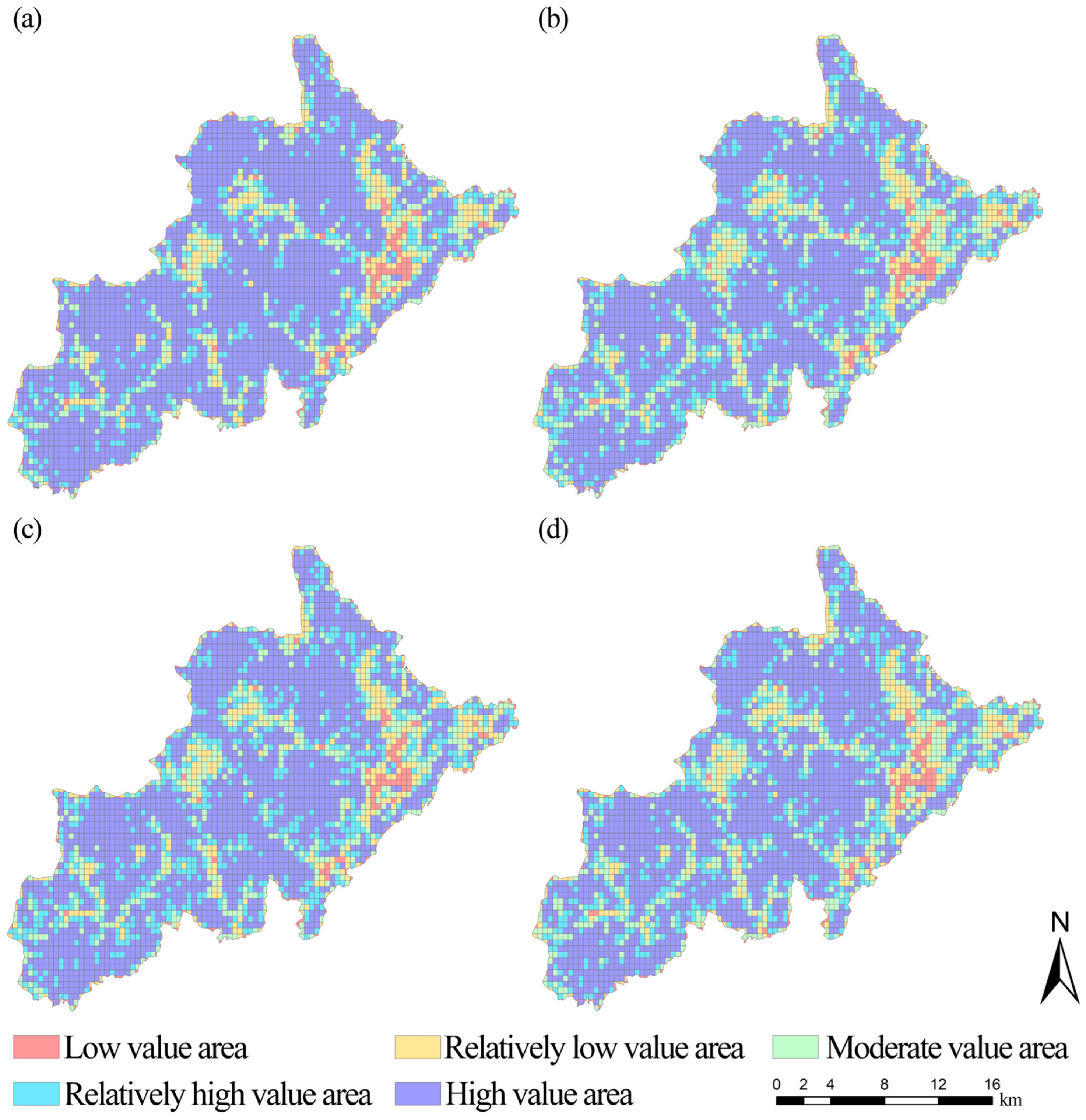
3.1.2. Spatial Variation
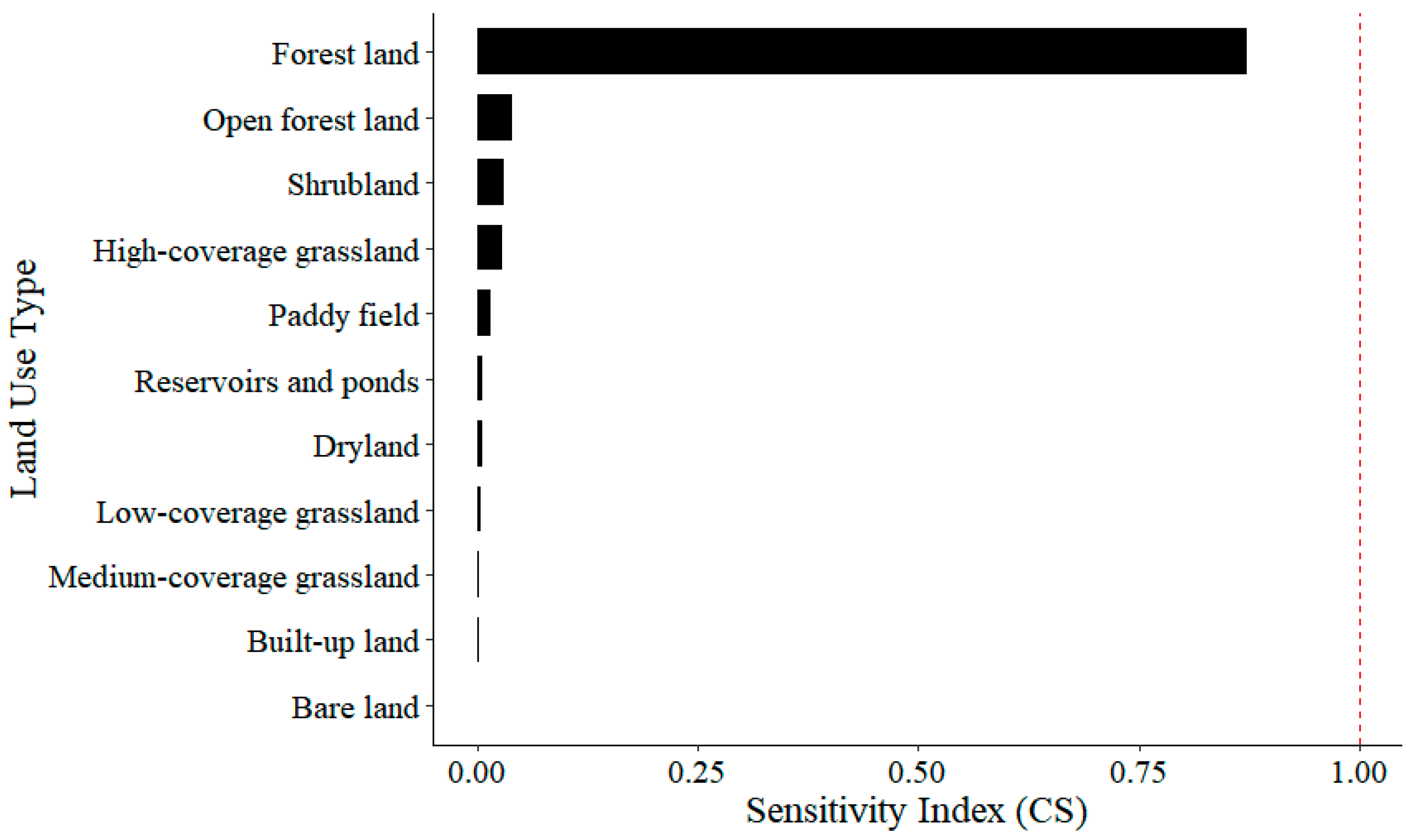
3.1.3. Sensitivity Analysis
3.2. Ecological Function Zoning Based on Ecosystem Service Clusters
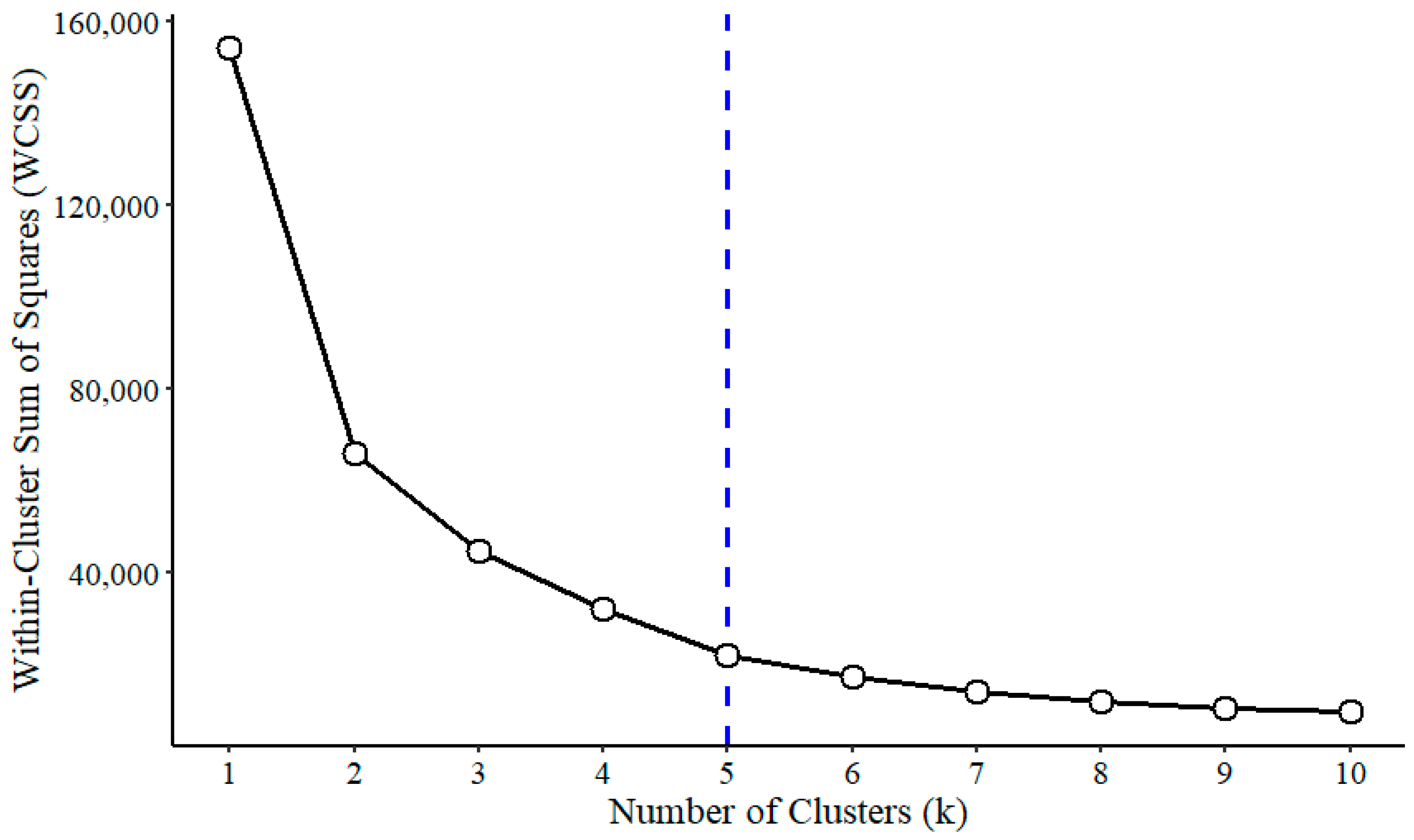
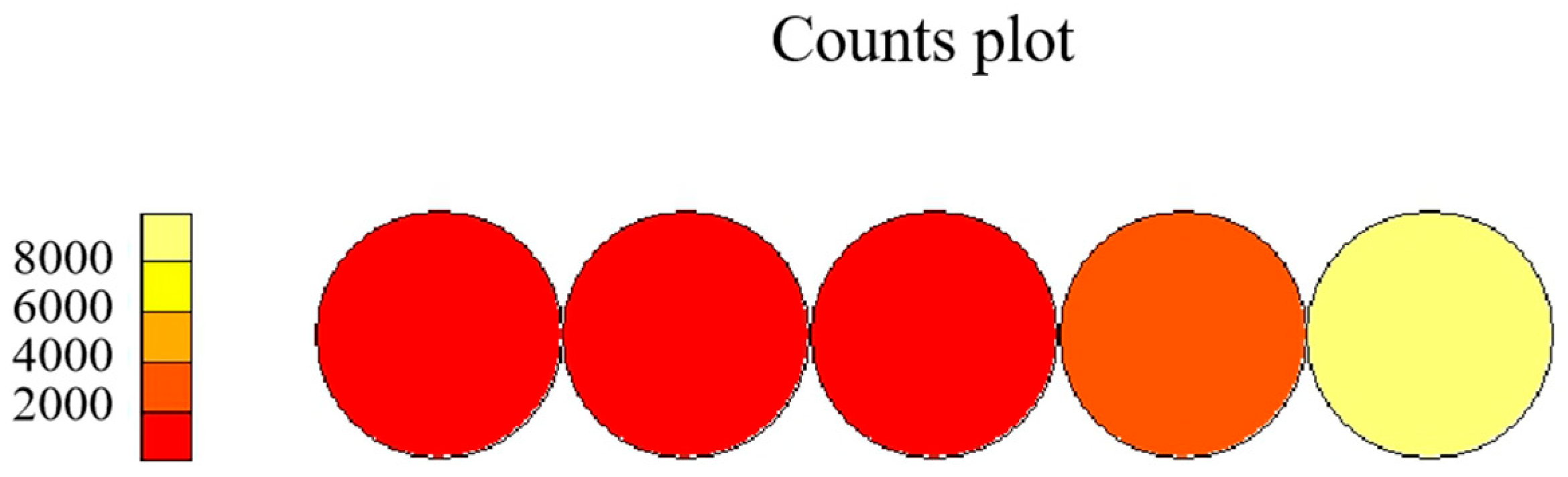
3.2.1. Identification Results of Ecosystem Service Clusters
3.2.2. Spatiotemporal Variation in Ecosystem Service Clusters
3.2.3. Trade-Offs and Synergies Among Ecosystem Service Clusters
3.2.4. Process and Results of Ecological Function Zoning
4. Discussion
4.1. Spatiotemporal Variations and Driving Factors of Ecosystem Service Value in the Zhejiang Kaihua Mountain Spring Water Fish Farming System
4.2. Protection and Utilization Strategies for the Zhejiang Kaihua Mountain Spring Water Fish Farming System Based on Ecological Functional Zoning
4.3. Dynamic Utilization and Integrated Industrial Development of the Zhejiang Kaihua Mountain Spring Water Fish Farming System
4.4. Limitations and Future Research
5. Conclusions
Supplementary Materials
Author Contributions
Funding
Data Availability Statement
Conflicts of Interest
References
- Min, Q.; Sun, Y. The concept, characteristics and conservation requirements of agro-cultural heritage. Resour. Sci. 2009, 31, 914–918. (In Chinese) [Google Scholar]
- Egoz, S. Israel’s citrus grove landscape—An opportunity to balance urbanization with cultural values. Landsc. Urban Plan. 1996, 36, 183–196. [Google Scholar] [CrossRef]
- Joshi, R.C.; Matchoc, O.R.O.; Bahatan, R.G.; Dela Pena, F.A. Farmers’ knowledge, attitudes and practices of rice crop and pest management at Ifugao Rice Terraces, Philippines. Int. J. Pest Manag. 2000, 46, 43–48. [Google Scholar] [CrossRef]
- Willson, M.F.; Morrison, J.L.; Sieving, K.E.; De Santo, T.L.; Santisteban, L.; Díaz, I. Patterns of predation risk and survival of bird nests in a Chilean agricultural landscape. Conserv. Biol. 2001, 15, 447–456. [Google Scholar] [CrossRef]
- Nugent, J.B. Yemeni agriculture: Historical overview, policy lessons and prospects. Res. Middle East Econ. 2003, 5, 257–288. [Google Scholar]
- Sun, Y.; Min, Q.; Cheng, S.; Wang, X. Relationship between tourism resources development and regional social and economic development in agricultural heritage site—Taking “traditional rice–fish agriculture” of Qingtian County as an example. Resour. Sci. 2006, 28, 138–144. (In Chinese) [Google Scholar]
- Sukhdev, P.; Wittmer, H.; Schröter-Schlaack, C.; Nesshöver, C.; Bishop, J.; ten Brink, P.; Gundimeda, H.; Kumar, P.; Simmons, B. The Economics of Ecosystems and Biodiversity: Mainstreaming the Economics of Nature; UNEP: Geneva, Switzerland, 2010. [Google Scholar]
- Zhang, Y.; Li, X. Protecting traditional agricultural landscapes by promoting industrial integration development: Practices from important agricultural heritage systems (IAHS) sites in China. Land 2022, 11, 1286. [Google Scholar] [CrossRef]
- Zhou, R.; Huang, L.; Wang, K.; Hu, W. From productive landscape to agritouristic landscape? The evidence of an agricultural heritage system—Zhejiang Huzhou Mulberry-Dyke and Fish-Pond System. Land 2023, 12, 1066. [Google Scholar] [CrossRef]
- Costanza, R.; d’Arge, R.; de Groot, R.; Farber, S.; Grasso, M.; Hannon, B.; Limburg, K.; Naeem, S.; O’Neill, R.V.; Paruelo, J.; et al. The value of the world’s ecosystem services and natural capital. Nature 1997, 387, 253–260. [Google Scholar] [CrossRef]
- Li, M.; Zhang, Y.; Miao, C.; He, L.; Chen, J. Centennial change and source–sink interaction process of traditional agricultural landscape: Case from Xin’an traditional cherry cultivation system (1920–2020). Land 2022, 11, 1863. [Google Scholar] [CrossRef]
- Landry, M.; Furrer, O. Well-being co-creation in service ecosystems: A systematic literature review. J. Serv. Mark. 2023, 37, 862–882. [Google Scholar] [CrossRef]
- Li, Y.; Liu, C.; Min, J.; Zhang, H.; Wang, Y. RS/GIS-based integrated evaluation of the ecosystem services of the Three Gorges Reservoir Area (Chongqing section). Acta Ecol. Sin. 2013, 33, 168–178. (In Chinese) [Google Scholar]
- Wang, Y.; Yu, H.; Lu, L. Spatio-temporal pattern and functional zoning of ecosystem services in the Yangtze River Delta region based on a spatially constrained K-means. Acta Ecol. Sin. 2024, 44, 7087–7104. (In Chinese) [Google Scholar]
- Liu, Y.; Bai, Y.; Li, W.; Chen, Q.; Du, X. Spatiotemporal distribution of cultural heritage in relation to population and agricultural productivity: Evidence from the Ming–Qing Yangtze River Basin. Land 2025, 14, 1416. [Google Scholar] [CrossRef]
- Gu, X.; Liu, L.; He, Z.; Lai, Q.; Wu, Y. Heritage characteristics and value analysis of the Kaihua mountain spring water fish farming system. J. Zhejiang Agric. Sci. 2019, 60, 2176–2180. (In Chinese) [Google Scholar]
- Dai, S. The value analysis and development suggestions of the mountain spring water fish farming system in Kaihua of Zhejiang. Anhui Agric. Sci. Bull. 2022, 28, 72–74. (In Chinese) [Google Scholar]
- Zhu, S.; Zhu, G. Cultural value and protection of mountain spring water fish farming system in Xiuning County. J. Ocean Univ. China (Soc. Sci. Ed.) 2016, 3, 72–77. (In Chinese) [Google Scholar]
- Gao, M.; Hu, Y.; Liu, X.; Liang, M. Revealing multi-scale characteristics of ecosystem service supply and demand imbalance to enhance refined ecosystem management in China. Ecol. Indic. 2025, 170, 112971. [Google Scholar] [CrossRef]
- Liu, J. Macro-Scale Survey and Dynamic Study of Natural Resources and Environment of China by Remote Sensing; China Science and Technology Press: Beijing, China, 1996. (In Chinese) [Google Scholar]
- Liu, J.; Ning, J.; Kuang, W.; Xu, X.; Zhang, S.; Yan, C.; Li, R.; Wu, S.; Hu, Y.; Du, G.; et al. Spatio-temporal patterns and characteristics of land-use change in China during 2010–2015. Acta Geogr. Sin. 2018, 73, 789–802. (In Chinese) [Google Scholar]
- Farber, S.C.; Costanza, R.; Wilson, M.A. Economic and ecological concepts for valuing ecosystem services. Ecol. Econ. 2002, 41, 375–392. [Google Scholar] [CrossRef]
- Mukherjee, N.; Sutherland, W.J.; Dicks, L.; Hugé, J.; Koedam, N.; Dahdouh-Guebas, F. Ecosystem service valuations of mangrove ecosystems to inform decision making and future valuation exercises. PLoS ONE 2014, 9, e107706. [Google Scholar] [CrossRef]
- Kreuter, U.P.; Harris, H.G.; Matlock, M.D.; Lacey, R.E. Change in ecosystem service values in the San Antonio area, Texas. Ecol. Econ. 2001, 39, 333–346. [Google Scholar] [CrossRef]
- Costanza, R.; de Groot, R.; Sutton, P.; van der Ploeg, S.; Anderson, S.J.; Kubiszewski, I.; Farber, S.; Turner, R.K. Changes in the global value of ecosystem services. Glob. Environ. Change 2014, 26, 152–158. [Google Scholar] [CrossRef]
- Aziz, T. Changes in land use and ecosystem services values in Pakistan, 1950–2050. Environ. Dev. 2021, 37, 100576. [Google Scholar] [CrossRef]
- Eregae, J.E.; Njogu, P.; Karanja, R.; Gichua, M. Economic valuation for cultural and passive ecosystem services using a stated preference (contingent valuation method (CVM)) case of the Elgeyo watershed ecosystem, Kenya. Int. J. For. Res. 2021, 2021, 5867745. [Google Scholar] [CrossRef]
- Wang, Z.; Wang, H.; Liu, Z.; Feng, R.; Pan, Y. Evolution of ecosystem service values and the response to landscape pattern change in the Huaihe River Eco-Economic Belt. Land 2023, 12, 1405. [Google Scholar] [CrossRef]
- Zou, Z.; Yuan, X.; Zhang, Z.; Li, X.; Zhou, C. Spatiotemporal evolution and influencing factors of coupling and coordination between ecosystem service value and economy in the Pearl River Delta urban agglomeration of China. Land 2024, 13, 1670. [Google Scholar] [CrossRef]
- Min, Q.; Zhang, B. Research progress in the conservation and development of China-Nationally Important Agricultural Heritage Systems (China-NIAHS). Sustainability 2020, 12, 126. [Google Scholar] [CrossRef]
- Xie, G.; Zhang, C.; Zhang, L.; Chen, W.; Li, S. Improvement of the evaluation method for ecosystem service value based on per unit area. J. Nat. Resour. 2015, 30, 1243–1254. (In Chinese) [Google Scholar]
- Chen, Y. Spatial and Temporal Evolution and Prediction of Landscape Patterns and Ecosystem Service Values in the Jiangsu Section of the Huaihe River. Master’s Thesis, Anhui Jianzhu University, Hefei, China, 2024. (In Chinese). [Google Scholar]
- Qu, Q.; Zhang, K.; Niu, J.; Xiao, C.; Sun, Y. Spatial–temporal differentiation of ecosystem service trade-offs and synergies in the Taihang Mountains, China. Land 2025, 14, 513. [Google Scholar] [CrossRef]
- Li, G.; Cai, J. Spatial and temporal differentiation of mountain ecosystem service trade-offs and synergies: A case study of Jieshi Mountain, China. Sustainability 2022, 14, 4652. [Google Scholar] [CrossRef]
- Wu, Y.; Liu, X.; Zhao, Q.; Liu, H.; Qu, F.; Zhang, M. Impact of land use/land cover change on ecosystem service trade-offs/synergies: A case study of Gangu County, China. Sustainability 2024, 16, 5929. [Google Scholar] [CrossRef]
- Li, H.; Xu, Q.; Qiu, H.; Du, J.; Xu, Z.; Liu, L.; Zhao, Z.; Zhu, Z.; He, Y. Study on ecosystem service trade-offs and synergies in the Guangdong–Hong Kong–Macao Greater Bay Area based on ecosystem service bundles. Land 2024, 13, 2086. [Google Scholar] [CrossRef]
- Jing, X.; He, Y.; Sun, Y.; Wang, M.; Wang, X. Spatial–temporal divergence and coupling analysis of land use change and ecosystem service value in the Yangtze River Delta urban agglomeration. Sustainability 2024, 16, 6624. [Google Scholar] [CrossRef]
- Zhang, Z.; Tong, Z.; Fan, F.; Liang, K. How to achieve integrated high supply and a balanced state of ecosystem service bundles: A case study of Fujian Province, China. Land 2025, 14, 2002. [Google Scholar] [CrossRef]
- Yang, X.; Cai, H.; Zhao, X.; Zhang, H. Revealing the ecological security pattern in China’s ecological civilization demonstration area. Land 2025, 14, 1560. [Google Scholar] [CrossRef]
- Liu, Y.; Li, T.; Zhao, W.; Wang, S.; Fu, B. Landscape functional zoning at a county level based on ecosystem services bundle: Methods comparison and management indication. J. Environ. Manag. 2019, 249, 109315. [Google Scholar] [CrossRef]
- Ren, C.; Zhou, X.; Wang, C.; Guo, Y.; Diao, Y.; Shen, S.; Reis, S.; Li, W.; Xu, J.; Gu, B. Ageing threatens sustainability of smallholder farming in China. Nature 2023, 616, 96–103. [Google Scholar] [CrossRef] [PubMed]
- Li, M.; Zhang, Y.; Xu, M.; He, L.; Liu, L.; Tang, Q. China eco-wisdom: A review of sustainability of agricultural heritage systems on aquatic–ecological conservation. Sustainability 2020, 12, 60. [Google Scholar] [CrossRef]
- Xiao, Y. Agricultural heritage conservation as a social intervention: The Zhejiang experience. J. China Agric. Univ. (Soc. Sci. Ed.) 2025, 42, 140–154. (In Chinese) [Google Scholar]
- Sözen, B.; Ecemiş Kılıç, S. Tourism-led rural gentrification in multi-conservation rural settlements: Yazıköy/Datça case. Sustainability 2025, 17, 8439. [Google Scholar] [CrossRef]
- Shen, J.; Huang, F.-T.; Chou, R.-J. Agricultural-heritage-oriented rural revitalization: Experiences from the ancient tea town of Xiping. Land 2021, 10, 927. [Google Scholar] [CrossRef]
- Deng, H.; Li, C.; Chen, T.; Song, Y.; Cao, J. Valuing the ecological products of wetlands and strategies for implementation: A case study of Weishui Wetland in Songzi City, Hubei Province. Pol. J. Environ. Stud. 2025, 34, 2627–2645. [Google Scholar] [CrossRef]
- Shen, J.; Chou, R.-J. Cultural landscape development integrated with rural revitalization: A case study of Songkou Ancient Town. Land 2021, 10, 406. [Google Scholar] [CrossRef]
- Corson, M.S.; Mondière, A.; Morel, L.; van der Werf, H.M.G. Beyond agroecology: Agricultural rewilding, a prospect for livestock systems. Agric. Syst. 2022, 199, 103410. [Google Scholar] [CrossRef]
- Tang, J.-W.; Chen, M.-L.; Chiu, T.-H. An exploratory study on local brand value development for outlying island agriculture: Local food system and actor–network theory perspectives. Sustainability 2018, 10, 4186. [Google Scholar] [CrossRef]
- Liang, J.; Zhang, S.; Lu, L. Research on the influence of cultural memory in agricultural heritage on brand loyalty. Sustainability 2024, 16, 4162. [Google Scholar] [CrossRef]
- Wayesa, G.; Kidane, M.; Tolessa, T.; Mammo, S. Impacts of land use/land cover dynamics on ecosystem services in Jimma Rare District, Western Ethiopia. Sustain. Environ. 2025, 11, 2436231. [Google Scholar] [CrossRef]



| Land Use Type | Provisioning Services | Regulating Services | Supporting Services | Cultural Services | |||||||
|---|---|---|---|---|---|---|---|---|---|---|---|
| Food Production | Raw Material Production | Water Supply | Gas Regulation | Climate Regulation | Environmental Purification | Hydrological Regulation | Soil Conservation | Nutrient Cycling | Biodiversity | Aesthetic Landscape | |
| Paddy field | 1.36 | 0.09 | −2.63 | 1.11 | 0.57 | 0.17 | 2.72 | 0.01 | 0.19 | 0.21 | 0.09 |
| Dryland | 0.85 | 0.4 | 0.02 | 0.67 | 0.36 | 0.1 | 0.27 | 1.03 | 0.12 | 0.13 | 0.06 |
| Forest land | 0.31 | 0.71 | 0.37 | 2.35 | 7.03 | 1.99 | 3.51 | 2.86 | 0.22 | 2.6 | 1.14 |
| Shrub-land | 0.19 | 0.43 | 0.22 | 1.41 | 4.23 | 1.28 | 3.35 | 1.72 | 0.13 | 1.57 | 0.69 |
| Open forest land | 0.248 | 0.568 | 0.296 | 1.88 | 5.624 | 1.592 | 2.808 | 2.288 | 0.176 | 2.08 | 0.912 |
| High-coverage grassland | 0.38 | 0.56 | 0.31 | 1.97 | 5.21 | 1.72 | 3.82 | 2.4 | 0.18 | 2.18 | 0.96 |
| Medium-coverage grassland | 0.304 | 0.448 | 0.248 | 1.576 | 4.168 | 1.376 | 3.056 | 1.92 | 0.144 | 1.744 | 0.768 |
| Low-coverage grassland | 0.228 | 0.336 | 0.186 | 1.182 | 3.126 | 1.032 | 2.292 | 1.44 | 0.108 | 1.308 | 0.576 |
| Reservoirs and ponds | 0.8 | 0.23 | 8.29 | 0.77 | 2.29 | 5.55 | 102.24 | 0.93 | 0.07 | 2.55 | 1.89 |
| Built-up land | 0 | 0 | 0 | 0 | −3.87 | −2.87 | −4.53 | 1.65 | 0 | 0 | 2.08 |
| Bare land | 0 | 0 | 0 | 0.02 | 0 | 0.1 | 0.03 | 0.02 | 0 | 0.02 | 0.01 |
| Land Use Type | 2005 | Variation | 2010 | Variation | 2015 | Variation | 2020 |
|---|---|---|---|---|---|---|---|
| Paddy field | 5389.67 | 13.71 | 5403.38 | −20.06 | 5383.32 | 22.30 | 5405.62 |
| Dryland | 1927.45 | 23.21 | 1950.66 | −15.92 | 1934.74 | 14.13 | 1948.87 |
| Forest land | 328,050.21 | −4025.13 | 324,025.08 | 337.93 | 324,363.00 | −330.65 | 324,032.36 |
| Shrubland | 11,178.31 | 85.54 | 11,263.85 | −23.15 | 11,240.70 | 18.35 | 11,259.05 |
| Open forest land | 12,049.54 | 2660.92 | 14,710.46 | −18.85 | 14,691.61 | 14.39 | 14,706.00 |
| High-coverage grassland | 9937.55 | 304.97 | 10,242.52 | −29.58 | 10,212.93 | 18.63 | 10,231.56 |
| Medium-coverage grassland | 773.12 | 32.14 | 805.26 | −5.26 | 800.00 | 3.80 | 803.80 |
| Low-coverage grassland | 1291.60 | −21.69 | 1269.91 | −11.83 | 1258.07 | 12.27 | 1270.34 |
| Reservoirs and ponds | 2066.66 | 0.00 | 2066.66 | 23.30 | 2089.96 | −30.29 | 2059.67 |
| Built-up land | −333.71 | 0.70 | −333.01 | 1.96 | −331.05 | 0.84 | −330.21 |
| Bare land | 0.37 | 0.00 | 0.37 | 0.00 | 0.37 | 0.00 | 0.37 |
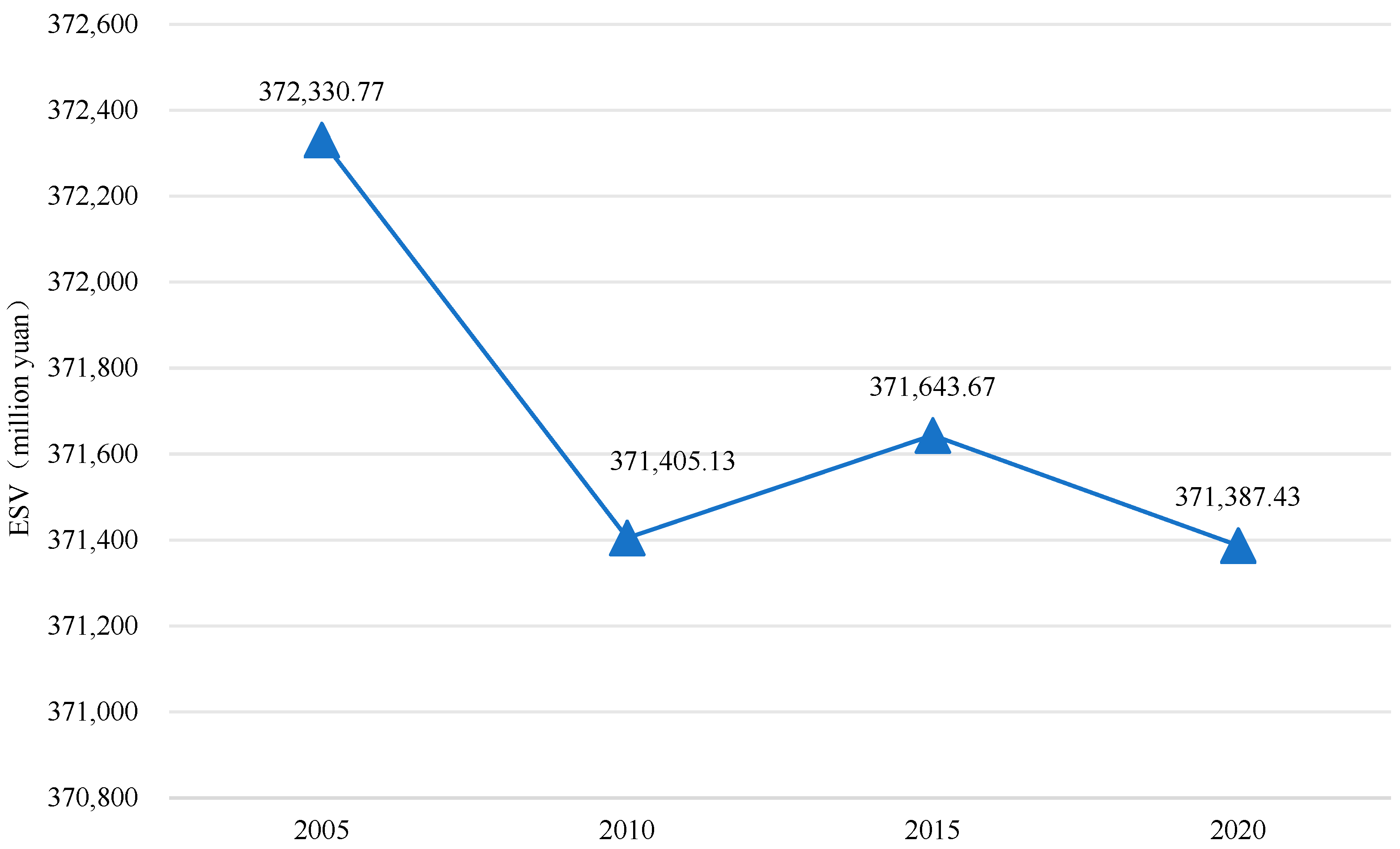
| Ecosystem Service Type | 2005 | Variation | 2010 | Variation | 2015 | Variation | 2020 | |
|---|---|---|---|---|---|---|---|---|
| Provisioning services | Food production | 7243.29 | −1.45 | 7241.85 | −7.14 | 7234.70 | 7.25 | 7241.95 |
| Raw material production | 11,435.72 | −27.93 | 11,407.79 | 5.82 | 11,413.61 | −6.35 | 11,407.26 | |
| Water supply | 2302.48 | −24.81 | 2277.67 | 19.06 | 2296.73 | −21.26 | 2275.47 | |
| Regulating services | Gas regulation | 38,722.96 | −91.57 | 38,631.39 | 17.42 | 38,648.81 | −18.48 | 38,630.33 |
| Climate regulation | 110,658.76 | −303.66 | 110,355.09 | 75.42 | 110,430.52 | −77.59 | 110,352.93 | |
| Environmental purification | 31,547.95 | −81.38 | 31,466.57 | 21.98 | 31,488.54 | −22.38 | 31,466.17 | |
| Hydrological regulation | 61,868.91 | −115.79 | 61,753.13 | 39.40 | 61,792.52 | −44.91 | 61,747.61 | |
| Supporting services | Soil conservation | 45,449.32 | −115.02 | 45,334.30 | 26.82 | 45,361.12 | −29.59 | 45,331.53 |
| Nutrient cycling | 3767.73 | −8.02 | 3759.71 | 0.97 | 3760.68 | −1.04 | 3759.64 | |
| Biodiversity | 41,173.57 | −108.38 | 41,065.19 | 27.25 | 41,092.44 | −28.83 | 41,063.61 | |
| Cultural services | Aesthetic landscape | 18,160.07 | −47.63 | 18,112.44 | 11.54 | 18,123.98 | −13.05 | 18,110.93 |
| Ecological Function Zoning | Ecosystem Service Clusters | Description |
|---|---|---|
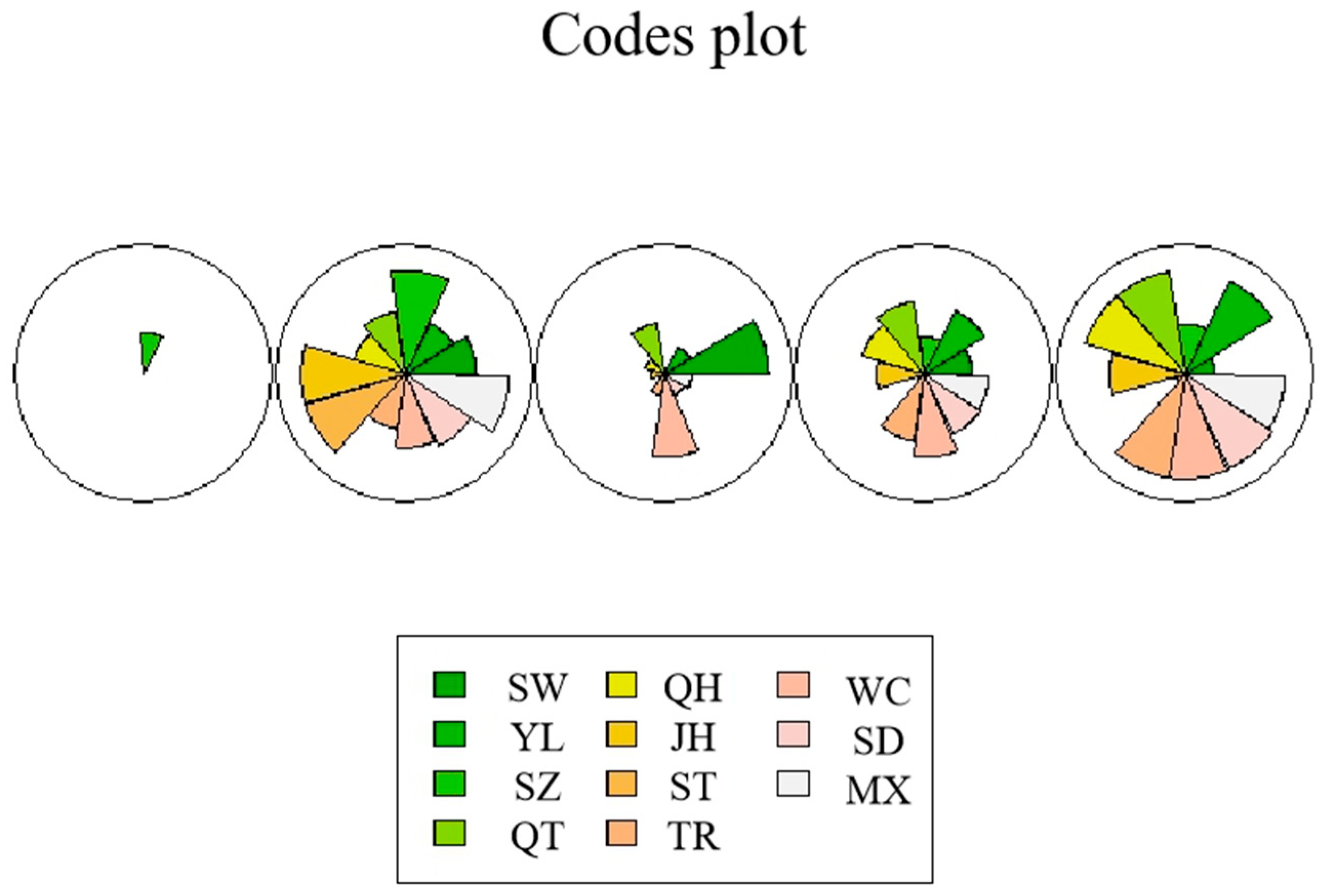
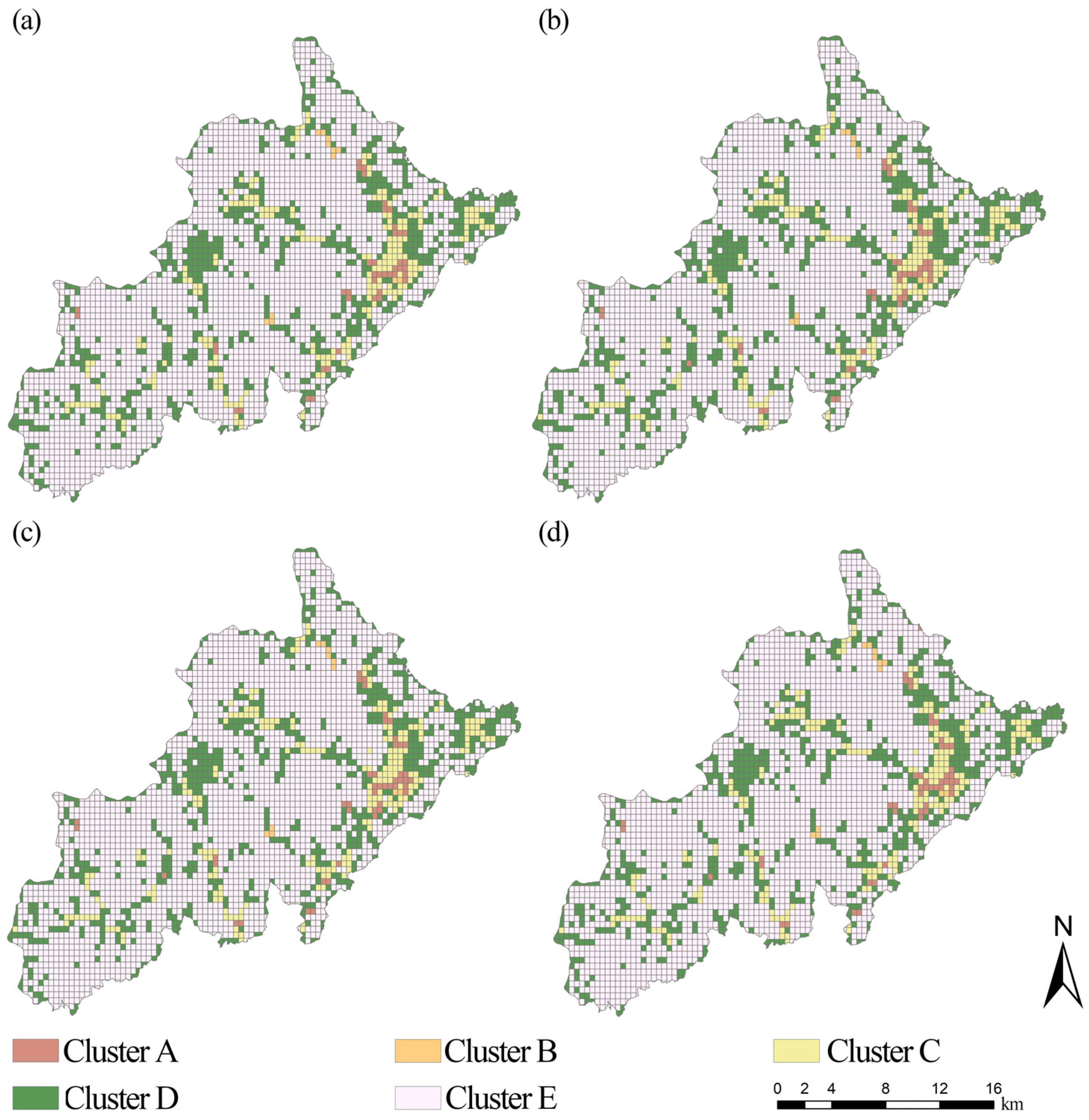
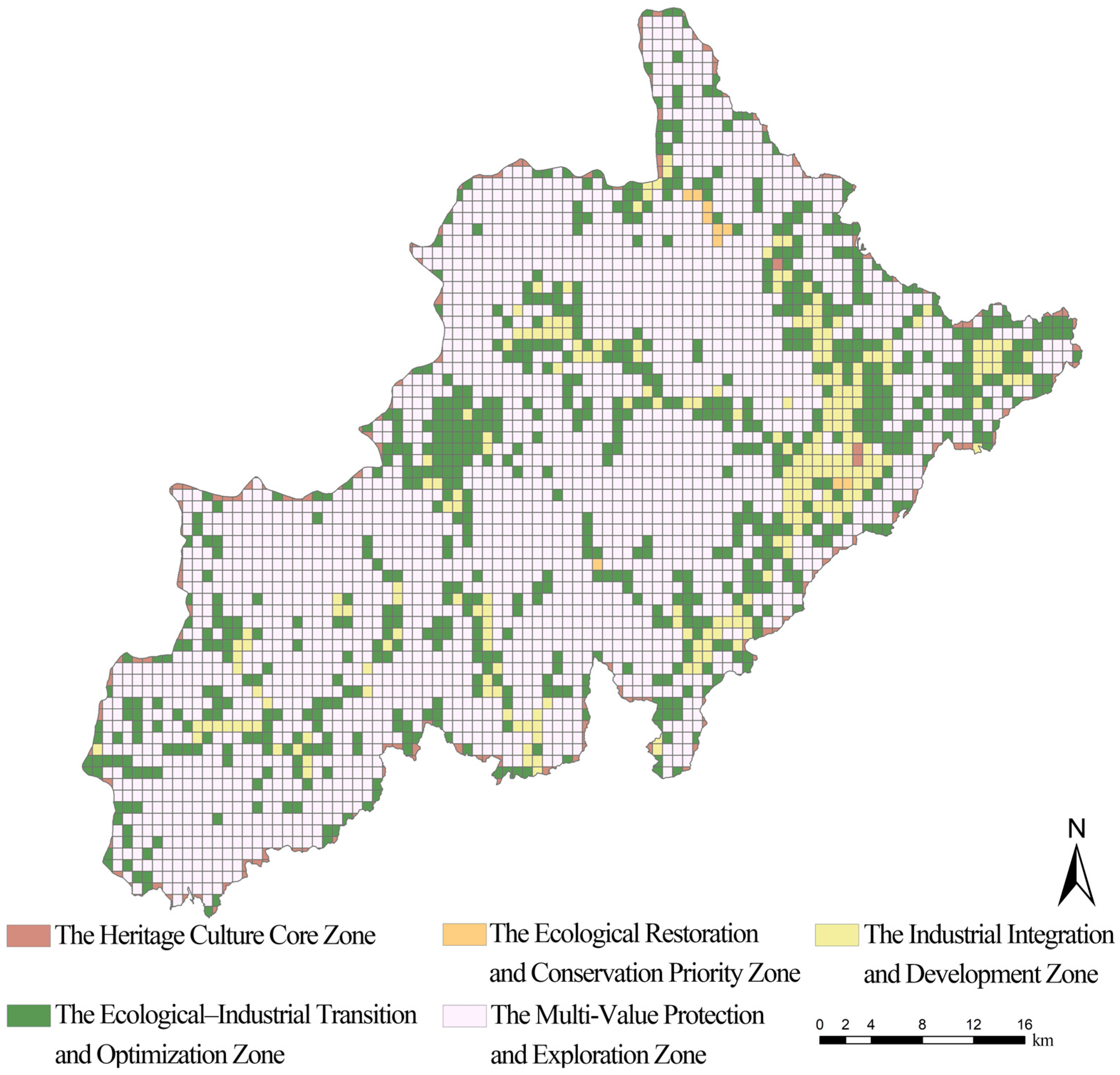
| The Heritage Culture Core Zone | Cluster A | The area is predominantly designated as built-up land, characterized primarily by village settlements. Serving as a core repository of the cultural heritage of the Mountain Spring Water Fish Farming System in Kaihua, Zhejiang, it preserves a rich array of traditional folk customs, historical relics, and heritage craft techniques. This area plays a pivotal role in sustaining and promoting the region’s distinctive agricultural culture and in maintaining the continuity of local farming traditions. |
| The Ecological Restoration and Conservation Priority Zone | Cluster B | The area is primarily characterized by reservoirs and ponds, which serve as distinctive and indispensable components of the Mountain Spring Water Fish Farming System in Kaihua, Zhejiang. Given their critical ecological roles, this area should be accorded priority protection to strengthen the ecological foundation that underpins the sustainable development of the entire system. |
| The Industrial Integration and Development Zone | Cluster C | The area comprises various land-use types, including paddy fields and dryland, which correspond to the terraced fields and tea plantations within the system. As the core zone for food production, it possesses distinct agricultural advantages that should be fully leveraged to promote the integrated development of agriculture and related industries. |
| The Ecological–Industrial Transition and Optimization Zone | Cluster D | The area comprises land-use types such as dryland and grassland and is located within the transitional zone between Cluster C and Cluster E. It faces dual demands for ecological conservation and industrial development. On the one hand, it is essential to strictly uphold the ecological red line, strengthen the protection of dryland and grassland ecosystems, and prevent ecological degradation resulting from overexploitation. On the other hand, the area’s ecological functions can be appropriately harnessed to regulate the local environment and support sustainable industrial development. |
| The Multi-Value Protection and Exploration Zone | Cluster E | The area consists primarily of forest land, which exhibits the highest ecosystem service value and covers the largest proportion of the Mountain Spring Water Fish Farming System in Kaihua, Zhejiang, thereby forming the ecological foundation of the entire system. Accordingly, the area’s diverse ecological, cultural, and economic values should be systematically identified and sustainably harnessed, under the strict prerequisite of safeguarding the natural ecosystem from any form of degradation. |
Disclaimer/Publisher’s Note: The statements, opinions and data contained in all publications are solely those of the individual author(s) and contributor(s) and not of MDPI and/or the editor(s). MDPI and/or the editor(s) disclaim responsibility for any injury to people or property resulting from any ideas, methods, instructions or products referred to in the content. |
© 2026 by the authors. Licensee MDPI, Basel, Switzerland. This article is an open access article distributed under the terms and conditions of the Creative Commons Attribution (CC BY) license.
Share and Cite
Cai, B.; Zhang, M.; Wang, Z.; Hu, W. Ecological Functional Zoning and Conservation Strategies for Agricultural Heritage Sites Based on Ecosystem Service Bundles: A Case Study of the Mountain Spring Water Fish Farming System in Kaihua, Zhejiang, China. Land 2026, 15, 102. https://doi.org/10.3390/land15010102
Cai B, Zhang M, Wang Z, Hu W. Ecological Functional Zoning and Conservation Strategies for Agricultural Heritage Sites Based on Ecosystem Service Bundles: A Case Study of the Mountain Spring Water Fish Farming System in Kaihua, Zhejiang, China. Land. 2026; 15(1):102. https://doi.org/10.3390/land15010102
Chicago/Turabian StyleCai, Bifan, Mingming Zhang, Zhiming Wang, and Wenhao Hu. 2026. "Ecological Functional Zoning and Conservation Strategies for Agricultural Heritage Sites Based on Ecosystem Service Bundles: A Case Study of the Mountain Spring Water Fish Farming System in Kaihua, Zhejiang, China" Land 15, no. 1: 102. https://doi.org/10.3390/land15010102
APA StyleCai, B., Zhang, M., Wang, Z., & Hu, W. (2026). Ecological Functional Zoning and Conservation Strategies for Agricultural Heritage Sites Based on Ecosystem Service Bundles: A Case Study of the Mountain Spring Water Fish Farming System in Kaihua, Zhejiang, China. Land, 15(1), 102. https://doi.org/10.3390/land15010102