Article

How Campus Landscapes Influence Mental Well-Being Through Place Attachment and Perceived Social Acceptance: Insights from SEM and Explainable Machine Learning

1
Department of Environmental Design, School of Architecture and Art, Central South University, Changsha 410083, China
2
Human Settlements Research Center, Central South University, Changsha 410083, China
3
Department of Environmental Design, School of Sch Art & Design, Hunan First Normal University, Changsha 410205, China
4
Key Laboratory for High-Density Habitat Ecology and Energy Conservation, Ministry of Education, Tongji University, Shanghai 200092, China
*
Author to whom correspondence should be addressed.
Land 2025, 14(9), 1712; https://doi.org/10.3390/land14091712
Submission received: 20 July 2025 / Revised: 21 August 2025 / Accepted: 22 August 2025 / Published: 24 August 2025

Abstract

Against the backdrop of growing concerns over university students’ mental health worldwide, campus environments play a crucial role not only in shaping spatial experiences but also in influencing psychological well-being. However, the psychosocial mechanisms through which campus landscapes affect well-being remain insufficiently theorized. Drawing on survey data from 500 students across two Chinese universities, this study employs structural equation modeling (SEM) and interpretable machine learning techniques (XGBoost-SHAP) to systematically examine the interrelations among landscape perception, place attachment, perceived social acceptance, school belonging, and psychological well-being. The results reveal the following: (1) campus landscapes serve as the primary catalyst for fostering emotional identification (place attachment) and social connectedness (perceived social acceptance and school belonging), thereby indirectly influencing psychological well-being through these psychosocial pathways; (2) landscape perception emerges as the strongest predictor of well-being, followed by school belonging. Although behavioral variables such as the green space maintenance quality, visit frequency, and duration of stay contribute consistently, their predictive power remains comparatively limited; (3) significant nonlinear associations are observed between core variables and well-being. While the positive effects of landscape perception, place attachment, and school belonging exhibit diminishing returns beyond certain thresholds, high levels of perceived social acceptance continue to generate sustained improvements in well-being. This study advances environmental psychology by highlighting the central role of campus landscapes in promoting mental health and provides actionable strategies for campus planning. It advocates for the design of balanced, diverse, and socially engaging landscape environments to maximize psychological benefits.

1. Introduction

In recent years, the issue of psychological well-being among university students has become increasingly severe worldwide, posing a significant challenge to youth health and the quality of higher education. According to the World Health Organization, approximately 35.3% of university students experience at least one mental disorder during their lifetime, with a 12-month prevalence rate reaching 31.4% [1]. In a study conducted in Belgium, nearly one-third of first-year university students reported mental health problems within the past 12 months [2]. In China, recent research among higher education institutions reveals that young adults aged 18 to 25—due to their transitional stage of physical and psychological development—are particularly vulnerable to mental health issues, especially under the compounded pressures of a competitive social environment. This vulnerability is particularly pronounced among university students, who face intersecting challenges such as academic overload, financial stress, and identity formation [3]. Epidemiological surveys report detection rates of 9.8% for depression, 15.5% for anxiety, and 6.5% for comorbid depression and anxiety within this population [4]. As university students navigate a critical transitional period in life, characterized by pressures related to academics, career prospects, and social relationships, there is an urgent need for effective intervention strategies to address the high prevalence of psychological distress.
Environmental psychology has long focused on the positive effects of natural environments on mental health [5]. Foundational theories, such as Attention Restoration Theory (ART) and Stress Recovery Theory (SRT), emphasize that natural landscapes facilitate cognitive restoration and emotional regulation [6,7,8]. In recent years, green spaces within university campuses—dense and high-pressure settings for learning and living—have emerged as the most frequently encountered form of nature for students, drawing increasing attention for their potential mental health benefits [9,10,11]. Empirical studies demonstrate that exposure to campus greenery significantly reduces stress [10], improves emotional states [12], and enhances subjective well-being [13]. These psychological benefits are often contingent upon a variety of spatial attributes, including high vegetation density [14], the presence of water features [14,15], sensory comfort (e.g., pleasant smells and natural sounds) [16,17], and perceptions of safety and privacy [17]. Furthermore, recent findings suggest that the restorative effects of green spaces are not solely determined by the landscape itself but are also moderated by spatial configuration and students’ daily behavioral pathways. This underscores the need to optimize “high-contact zones” in campus landscape design [13].
More importantly, natural environments influence psychological well-being not only through physiological or emotional pathways [10] but also via social mechanisms [18]. Among these, place attachment [19] and perceived social acceptance [20] are identified as key psychosocial variables that strengthen individuals’ sense of belonging, social connectedness, and identity, thereby amplifying the mental health benefits of natural settings. However, existing research has predominantly focused on the direct effects of natural environments, with limited empirical investigation into the compound pathways through which campus landscapes affect well-being via psychosocial mediators.
Despite offering valuable insights, current literature reveals two critical gaps in methodological approaches and theoretical development. First, most existing studies rely on conventional statistical methods such as linear regression, Pearson correlation analysis, or structural equation modeling (SEM) [12,14,17,18,21]. These approaches typically assume linear or monotonic relationships among variables, limiting their capacity to detect complex nonlinear structures, threshold effects, or interaction terms. As a result, phenomena such as the “diminishing returns” or even “reversals” of certain psychological variables often remain inadequately explained. Second, while recent research has incorporated machine learning models—such as random forests and neural networks—to uncover nonlinear patterns [22,23,24], these techniques, though powerful in prediction, suffer from limited interpretability due to their “black-box” nature. This has created a structural disconnect between predictive performance and theoretical explanation, impeding the advancement of mechanism-based inquiry in environmental psychology.
Therefore, this study employs a hybrid analytical approach that integrates structural equation modeling (SEM) with the XGBoost interpretation technique based on SHAP values, thereby leveraging their complementary strengths. Specifically, it aims to perform the following: (1) construct a theoretical framework that incorporates perceptual, emotional, and behavioral dimensions and explore how perceptions of campus green space influence students’ psychological well-being through the mediating roles of place attachment, social interaction, and school belonging; (2) identify the existence of threshold effects, diminishing marginal returns, and potential interaction effects within these relationships and clarify the roles that behavioral variables and subjective environmental evaluations play within the overall mechanism. This research expands the theoretical scope of environmental psychology by addressing the psychosocial mechanisms linking campus landscapes and well-being. Moreover, it provides a set of quantifiable, interpretable, and actionable strategies for optimizing campus landscapes, offering practical guidance for advancing the development of healthy university campuses worldwide.

2. Hypothetical Framework

2.1. Mechanisms by Which Landscape Perception Influences Place Attachment and Perceived Social Acceptance

Landscape perception refers to the process through which individuals receive environmental stimuli via sensory systems—such as vision and hearing—and subsequently generate emotional and psychological responses [25,26]. This process encompasses not only the reception of sensory inputs but also subjective evaluations of environmental aesthetics and the development of emotional connections to a place. Correspondingly, place attachment is commonly defined as the emotional bond between individuals and specific environments, involving the interplay of affective, cognitive, and behavioral dimensions [27]. The formation of place attachment is closely tied to the perceived restorative qualities of the environment and is shaped by individuals’ interpretations, memories, and associations related to landscape features [19]. Through repeated interaction with landscape elements, individuals tend to reinforce their sense of attachment, which in turn deepens their emotional connectedness [26,28]. Empirical studies provide further support for these associations. For example, Vanhöfen et al. demonstrate that visual satisfaction and auditory characteristics of the environment—such as pleasantness and eventfulness—moderate the relationship between landscape perception and place attachment [28]. Another study by Li et al. finds that landscape perception influences perceived restoration indirectly through place dependence and place identity, offering additional evidence for the mediating role of place attachment [26].
Perceived social acceptance refers to an individual’s subjective sense of being welcomed, recognized, and accepted by others in social interactions [29,30]. Among adolescents, higher levels of peer acceptance—such as being liked or selected as a preferred social partner—are closely associated with greater academic achievement and stronger social competence. In contrast, those with weaker social ties or experiences of rejection are more likely to face academic difficulties and social maladjustment. Beyond these effects, perceived social exclusion has also been linked to adverse health outcomes, including physical health problems, externalizing behaviors, and depressive symptoms [29,30]. Recent studies suggest that landscape perception may influence perceived social acceptance by shaping spatial design and user experience. For example, a virtual-reality-based experiment demonstrates that the rhythm of natural sounds significantly affects individuals’ willingness to engage socially. Specifically, faster-paced water sounds significantly enhance social interaction intentions among individuals with moderate to high social status [31]. Field research conducted in nine urban parks across Mexico further shows that physical attributes—such as distance, tree density, safety, cleanliness, and playground quality—significantly shape user activity patterns. Improvements in these features have been shown to increase the frequency of social interactions among park users [32]. Similarly, Veitch et al. identify tranquil and relaxing atmospheres, shaded greenery, and pedestrian paths designed for leisure as key elements that encourage park visitation and facilitate social engagement [33].
Therefore, the following hypotheses are proposed:
H1: 
Campus landscape perception positively influences place attachment.
H2: 
Campus landscape perception positively influences perceived social acceptance.

2.2. Place Attachment and Perceived Social Acceptance: Dual Dimensions of Emotional Belonging

Place attachment is defined as a stable psychological bond formed between individuals and their environment. It is commonly conceptualized as comprising two dimensions: affective identification, known as place identity, which reflects the incorporation of a place into one’s self-concept [34]; and functional dependence, or place dependence, which refers to the perceived capacity of a place to fulfill daily needs and emotional values [35]. Together, these mechanisms form the psychological foundation of place attachment and subtly shape individuals’ social behavioral tendencies [27]. Within university settings, campus landscapes provide vital spaces for social interaction. Everyday encounters—such as shared activities or spontaneous conversations—serve to strengthen students’ emotional bonds with their surroundings [12]. In turn, a higher level of place attachment often encourages more frequent participation in social activities, thereby enhancing individuals’ perceptions of social acceptance [36]. Evidence from urban and community studies supports this relationship. For example, Xu et al. find that emotional connections with parks fostered by place attachment promote social interactions not only among family and friends but also with strangers, thereby expanding users’ social networks [37]. Similarly, Li et al. and Yang et al. report that residents with stronger place attachment are more likely to engage in neighborhood communication and collective activities, which, in turn, enhance social relationships and community cohesion [38,39].
Therefore, the following hypothesis is proposed:
H3: 
Place attachment positively influences perceived social acceptance.

2.3. The Influence of Perceived Social Acceptance on School Belonging and Psychological Well-Being

School belonging is a multidimensional psychological construct that refers to the extent to which students feel accepted, respected, and included within the school environment [40,41]. A growing body of research has shown that perceived social acceptance significantly influences students’ sense of school belonging, particularly in the context of peer relationships, teacher support, and the overall school climate. Negative social experiences, such as bullying, often disrupt peer connections and reduce students’ feelings of belonging. Victims of school bullying tend to perceive the school environment as unsafe and unsupportive, which in turn undermines their sense of belonging [41]. Korpershoek et al. further demonstrate that peer and teacher support can enhance school belonging by strengthening students’ perceived social acceptance [42]. Similarly, a national report by the NCB emphasizes that positive peer relationships and extracurricular friendships help reduce bullying and promote a stronger sense of belonging [43].
Psychological well-being has long been recognized as a cornerstone of healthy and effective societies [44]. According to Diener, subjective well-being reflects individuals’ overall positive evaluations of their lives, regardless of external judgments [45]. Perceived social acceptance plays a crucial role in promoting psychological well-being, particularly in reducing anxiety and depression while fostering happiness and emotional resilience [46]. As a fundamental psychological need, social acceptance helps individuals avoid adverse emotional outcomes such as shame, jealousy, aggression, and withdrawal, all of which can severely undermine well-being [47]. Empirical evidence from Cobo-Rendón et al. supports this view, showing that perceived social support has a strong positive impact on the well-being of university students, especially in terms of stress management and adaptation to college life [48]. However, some studies caution that an excessive desire for social acceptance may lead to social anxiety and self-doubt, thereby negatively affecting well-being [49]. These findings suggest that the relationship between perceived social acceptance and psychological well-being may be more complex than previously assumed.
Therefore, the following hypotheses are proposed:
H4: 
Perceived social acceptance positively influences school belonging.
H5: 
Perceived social acceptance positively influences psychological well-being.

2.4. School Belonging and Psychological Well-Being

School belonging is recognized as a broad promotive factor for academic performance, psychological well-being, and mental health among young people [41]. A substantial body of empirical research highlights a strong association between school belonging and psychological well-being. Students with a higher sense of school belonging typically report greater levels of subjective well-being, stronger self-esteem, and lower risks of anxiety and depression [50]. This relationship is understood as the result of multiple interacting factors across different levels. Individual characteristics (e.g., self-esteem), microsystem factors (e.g., teacher–student relationships), and mesosystem conditions (e.g., classroom climate) all contribute to the development of school belonging, which in turn enhances well-being [50]. Moreover, school belonging plays an especially critical role for psychologically vulnerable or marginalized student populations. Research focusing on adolescents shows that a strong sense of school belonging significantly alleviates feelings of loneliness, anxiety, and depression, thereby improving overall psychological well-being [41].
Therefore, the following hypothesis is proposed:
H6: 
School belonging positively influences psychological well-being.

3. Materials and Methods

3.1. Research Framework

The research process comprises three main stages (Figure 1). First, data were collected from students at two universities in Changsha, Hunan Province, China, using a combination of convenience sampling and snowball sampling. After quality control and screening procedures, valid responses were retained and preprocessed for analysis. Second, a structural equation model (SEM) was developed as the core theoretical framework. This model aims to systematically examine and quantify the theoretical pathways linking landscape perception, psychosocial mechanisms, and psychological well-being. Third, interpretable machine learning techniques were introduced. Specifically, a gradient boosting decision tree model (XGBoost) was employed to predict psychological well-being. SHapley Additive exPlanations (SHAP) were then used to interpret the internal mechanics of the model, enabling the identification of critical threshold effects and interaction patterns.

3.2. Data Collection and Variable Construction

3.2.1. Site Selection

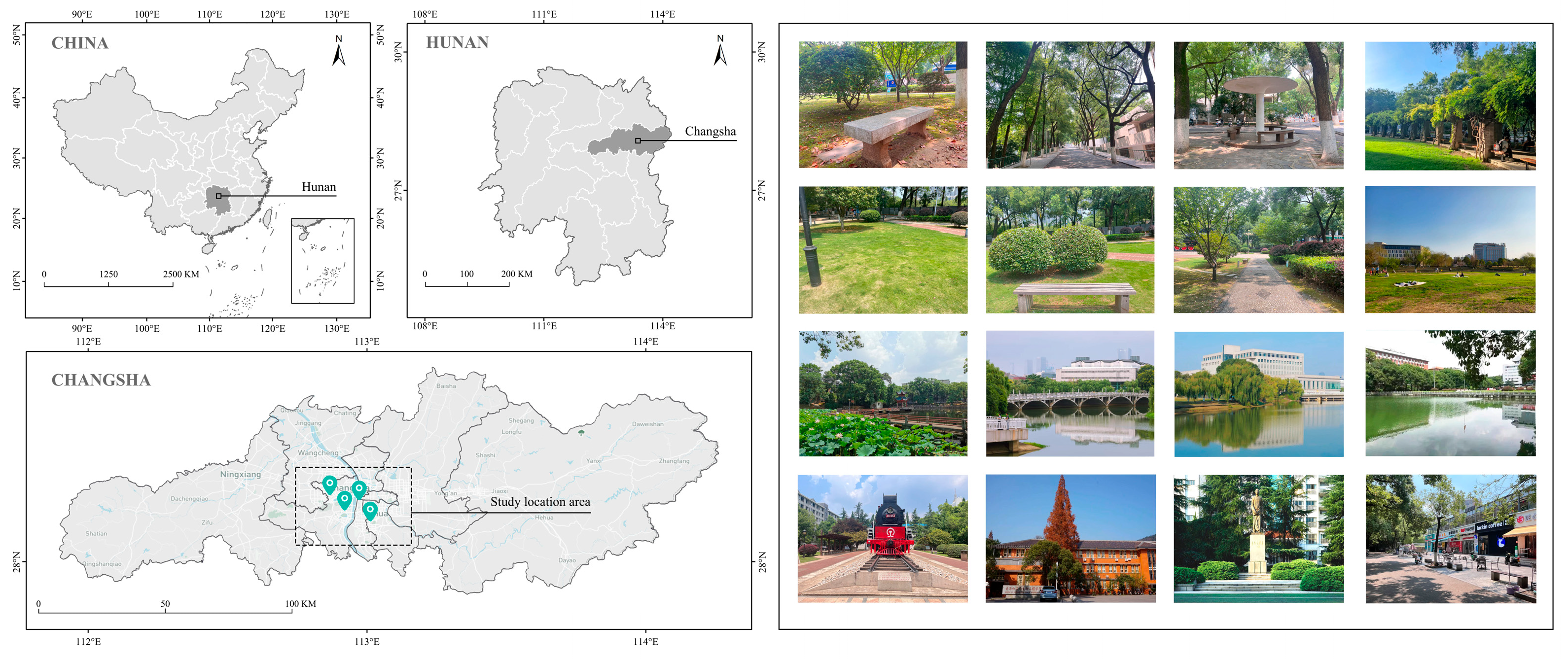
This study focuses on two universities in Changsha, Hunan Province, China—Central South University and Hunan First Normal University (Figure 2)—located between 112°53′ to 113°10′ E and 27°51′ to 28°41′ N. These campuses were selected due to their distinctive landscape characteristics, as well as their representativeness in terms of the green space layout, student usage patterns, and management structures. Central South University is situated at the intersection of mountain and river landscapes, with Yuelu Mountain to the west and the Xiang River to the east. The campus features a composite landscape system that integrates industrial heritage with modern functions through themed areas such as the “Metallurgy Garden,” “Railway Culture Park,” and “Xiangya Culture Park.” This configuration exemplifies a planning paradigm that merges technological and humanistic elements. Hunan First Normal University, known as a “millennium academy and century-old normal school,” emphasizes cultural continuity and spiritual identity in its landscape design. For example, the Dongfanghong Campus applies spatial narratives to convey campus values, creating a culturally rich and historically resonant environment. The study area is located in Changsha, which falls within the Cfa humid subtropical climate zone according to the Köppen classification. The region is characterized by four distinct seasons, moderate annual temperatures, and abundant precipitation—conditions favorable for green space development and year-round campus landscape utilization.

3.2.2. Questionnaire Design

A preliminary field investigation was conducted in August 2023, between 9:00 a.m. and 6:00 p.m., within green spaces on the campuses of the two selected universities. The target participants were actively engaged students using these green areas. Based on the findings of the pilot study, the questionnaire structure was optimized by eliminating redundant items and improving the theoretical alignment and measurability of the core variables.
The formal survey was administered via an online platform (Wenjuanxing) and broadly distributed to students at both institutions. To enhance contextual relevance and response validity, the questionnaire incorporated subjective prompts and real-scene visual stimuli, such as the following: “The image below shows a green space you frequently use on campus,” and “Which type of green space do you most prefer to stay in?” These design elements were intended to elicit experience-based responses. The use of an online survey was not a substitute for spatial empirical observation, but rather a strategic choice to improve sample diversity, distributional heterogeneity, and access to subjective experiential data. All respondents confirmed prior experience with campus green spaces. A total of 511 responses were collected, among which 500 were validated, yielding an effective response rate of 97.8%.
The questionnaire consisted of four sections:
(1)
Basic demographic information, including gender, age, educational level, field of study, monthly expenditure, and Body Mass Index (BMI);
(2)
Campus green space usage behavior, including the visit frequency, duration of stay, time of day, and usage patterns;
(3)
Evaluation of campus landscape spaces, including perceived adequacy of spatial design, comfort, safety, and overall satisfaction;
(4)
Standardized scales for core variables, adapted from validated instruments and modified to fit the current research context. All items were rated on a five-point Likert scale (1 = strongly disagree, 5 = strongly agree).
The Landscape Perception Scale measured students’ subjective perceptions of campus green environments, covering three dimensions: natural attributes (e.g., vegetation density, biodiversity), natural spaces (e.g., openness, accessibility), and natural forms (e.g., vegetation contours, structural layering) [51].
The Perceived Social Acceptance Scale assessed students’ subjective experiences of interpersonal attitudes, inclusivity, and interactional climate within the campus. It was adapted from neighborhood social interaction scales to better reflect the higher education setting [52,53].
The School Belonging Scale measured emotional connectedness to the school, with items such as “I can truly be myself at this school” and “I feel like I don’t belong here” (reverse coded), capturing students’ sense of identity and social embeddedness [54].
The Place Attachment Scale comprised two subdimensions: place dependence and place identity. These assessed students’ functional reliance on campus spaces and emotional identification with the campus as part of their self-concept [27].
The Psychological Well-being Scale evaluated subjective well-being, including emotional experience, life satisfaction, and positive psychological functioning [55].

3.3. Research Methodology

3.3.1. Structural Equation Modeling (SEM)

To comprehensively uncover the complex relationships among campus landscape perception, place attachment, social acceptance, sense of school belonging, and students’ psychological well-being, this study employed SEM for analysis. SEM is a multivariate statistical technique that integrates causal analysis with latent variable modeling. It is characterized by its theory-driven framework, allowing researchers to construct hypothesized variable pathways based on a priori assumptions and subsequently test them using observed data [56,57]. SEM not only identifies both direct and indirect relationships among multiple variables but also explicitly incorporates latent constructs and measurement errors into the modeling process. This enhances both the explanatory power and inferential validity of the model, effectively addressing the limitations of traditional path analysis and linear regression in handling multiple causal relationships and measurement inaccuracies [58].
The measurement model describes how observed variables reflect the latent constructs, and its general form is expressed by the following equation:
X = Λ x ξ + δ
Y = Λ y η + ε
In this context, X denotes the column vector composed of observed indicators for the i -th independent latent variable, serving as the measurement variables for the latent exogenous construct ξ . Similarly, Y represents the column vector of observed indicators corresponding to the latent endogenous variable η . The matrices Λ x and Λ y are the factor loading matrices, capturing the linear relationships between the observed variables and their respective latent constructs. δ and ε denote the measurement error terms, reflecting the portions of the observed variables that are not explained by the latent variables.
The structural model specifies the causal pathways among latent variables, and its mathematical representation is as follows:
η = B η + Γ ξ + ζ
Here, η denotes the column vector of latent endogenous variables, while ξ represents the column vector of latent exogenous variables. The matrix B contains the regression coefficients between the endogenous latent variables, capturing their direct linear interrelationships. Γ is the regression coefficient matrix associated with the exogenous latent variables, reflecting the causal effects and explanatory power of the exogenous constructs on the endogenous ones. ζ represents the structural error term, accounting for the unexplained variance in the endogenous variables that is not attributable to other latent constructs within the model.
Based on the assumption that the sample data follow a multivariate normal distribution, this study employed the Maximum Likelihood (ML) estimation method to simultaneously estimate all parameters within the SEM model. Specifically, ML aims to maximize the likelihood that the observed data would occur under the specified model structure, thereby enhancing the accuracy of parameter estimation and the overall model fit [59]. The ML estimation is mathematically expressed as follows:
F M L = log θ ^ + t r S 1 θ ^ log S p + q
In this equation, θ ^ represents the model-implied theoretical covariance matrix derived from the estimated parameter set θ ^ . This matrix is composed of several key components, including the factor loading matrix Λ x , Λ y from the measurement model, the measurement error covariance matrix Ω δ , Ω ε , the path coefficient matrix B , Γ from the structural model, and the latent variable covariance matrix Φ , Ψ . The function tr denotes the trace of a matrix, i.e., the sum of its diagonal elements. S is the observed covariance matrix calculated from the sample data. p and q represent the number of indicators associated with the latent exogenous and latent endogenous variables, respectively. The parameter estimation process involves identifying an optimal set of values that minimizes the discrepancy between the model-implied covariance matrix and the observed covariance matrix, thereby yielding the best-fitting path coefficients and factor loadings.

3.3.2. XGBoost-SHAP

To supplement the SEM analysis and further explore the complex and potentially nonlinear relationship between campus landscape perception and mental health, this study employed an interpretable machine learning approach using Extreme Gradient Boosting (XGBoost) in conjunction with SHapley Additive exPlanations (SHAP). As an efficient decision-tree algorithm based on the gradient boosting framework, XGBoost demonstrates strong performance in handling high-dimensional data and excels at capturing nonlinear relationships and intricate feature interactions, making it particularly advantageous in multivariate analysis [60,61].
First, latent variables were approximated by averaging the items within each theoretical construct. Specifically, the following latent variables were computed using average scores: landscape perception, place attachment, social acceptance, school belonging, and psychological well-being (as the target variable). Behavioral indicators and environmental satisfaction ratings were also used as predictors, including the frequency of green space use, duration of stay, time of activity, and access patterns; satisfaction with green space design, comfort, safety, and overall experience; and ratings of specific landscape features such as vegetation, terrain, water bodies, plant aesthetics, seating facilities, hygiene, transportation, lighting, accessibility, and maintenance. In addition, sociodemographic variables such as age, gender, BMI, education level, field of study, and monthly expenditure were included as control variables. All categorical variables were appropriately factorized, and missing data were handled using pairwise deletion during the latent variable computation. The XGBoost regression model was trained using five-fold cross-validation to optimize the number of boosting iterations. The model was configured with a squared error objective function, a maximum tree depth of 6, a learning rate (η) of 0.1, and a subsample rate of 80%.
Due to the black-box nature of ensemble learning models, it is often challenging to interpret the specific contribution of individual predictors to the model outcome. To enhance model interpretability, this study further incorporated the SHAP method, which is grounded in the Shapley value theory from cooperative game theory. SHAP assigns each feature a marginal contribution to the prediction, enabling us to evaluate both the global importance and local impact of individual predictors on psychological well-being [60].
The Shapley value for a given feature in the model can be computed using the following formula:
Φ i f , x = S M \ i S ! M S 1 ! M ! f S i f S
This formula represents the marginal contribution of a variable i to the predicted value of well-being f x for sample x . M denotes the set of all input variables, with S representing its subsets. S M \ i refers to all possible subsets of variables excluding the i -th variable, and f S i f S indicates the feature contribution of the i -th variable.

4. Results

4.1. Characteristics of the Sample Population

Table 1 presents the sociodemographic characteristics of the respondents. The sample is predominantly female (63.4%), with most participants aged between 19 and 22 years and primarily enrolled in undergraduate programs. Body Mass Index (BMI) was calculated based on self-reported height and weight data; 64.8% of the participants fall within the 18.5–23.9 range, which corresponds to the healthy weight category. In terms of academic disciplines, the most represented fields are the arts (29.2%), education (12.4%), and management (9.4%), indicating a tendency toward the humanities and social sciences. Monthly expenditure, reported in Chinese Yuan (CNY), shows that over half of the students spend between 1000 and 2000 CNY per month.
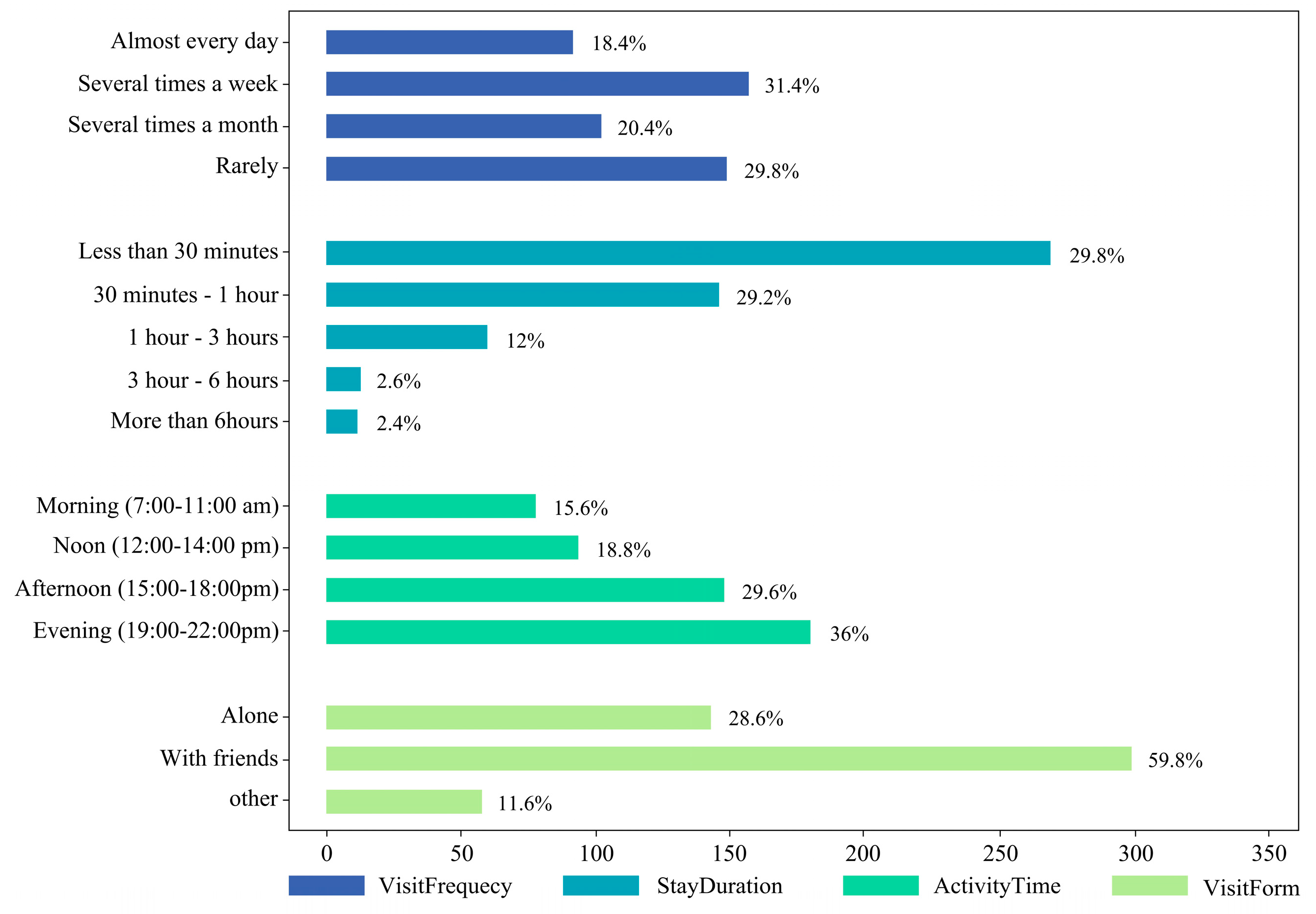
To further understand how campus landscapes influence students’ psychological well-being through behavioral pathways, green space usage behaviors were analyzed descriptively (Figure 3). Regarding usage frequency, 31.4% of students report visiting campus green spaces “several times a week,” while 29.8% indicate that they “rarely go.” In terms of duration, more than half of the respondents (53.8%) stay in green areas for “0–30 min,” and another 29.2% stay for “30 min to 1 h,” suggesting that most interactions with green spaces are brief. As for the time of use, green space activity is primarily concentrated in the afternoon (15:00–18:00; 29.6%) and evening (19:00–22:00; 36.0%). In terms of companionship, a majority of students (59.8%) prefer to visit green spaces “with friends,” while only 28.6% usually go “alone.”
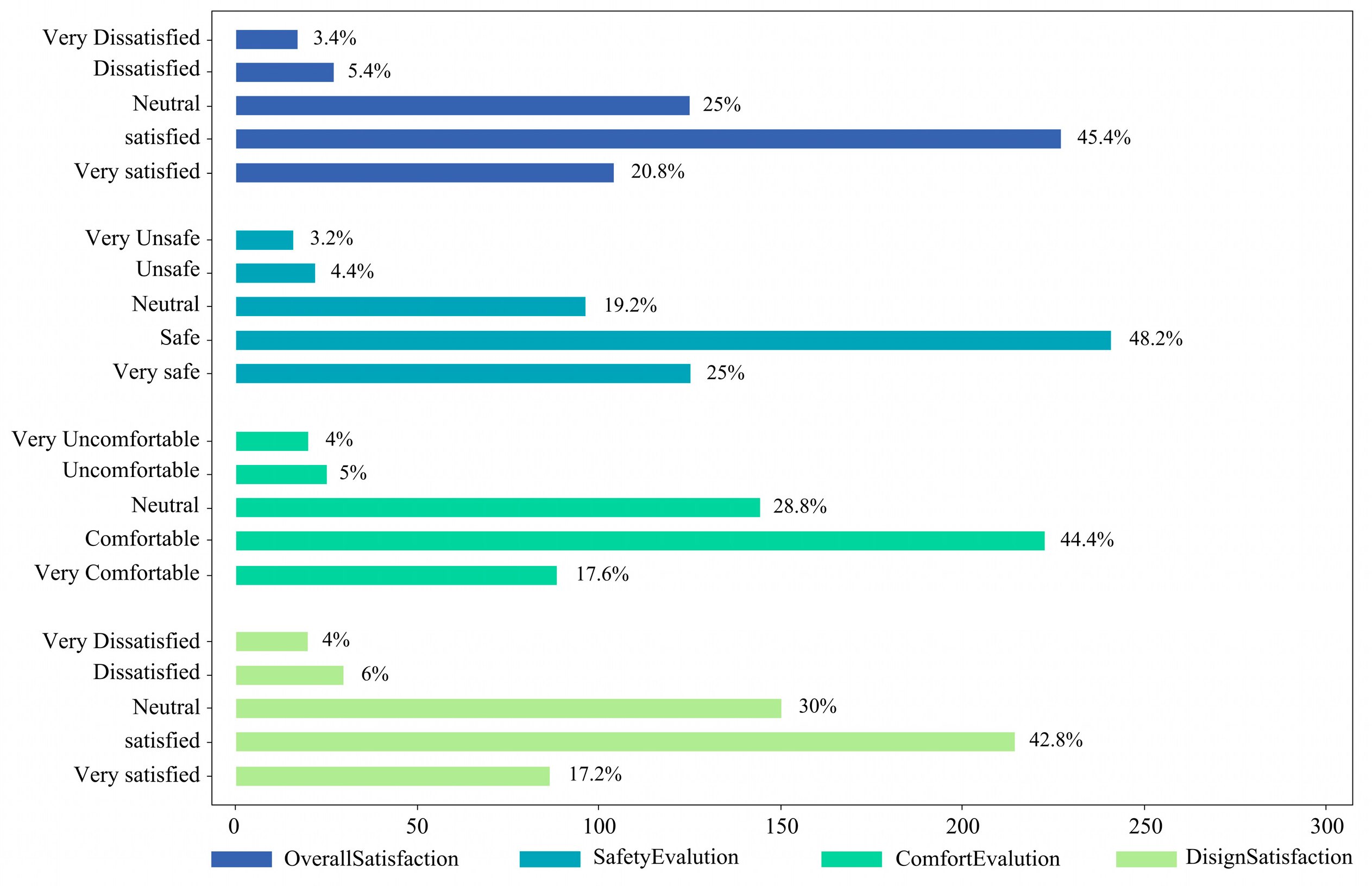
Students’ subjective evaluations of campus green spaces were also assessed across four dimensions: perceived functional adequacy, comfort, safety, and overall satisfaction (Figure 4). In terms of spatial needs, 42.8% of respondents report that their needs are “mostly met,” and 17.2% state they are “fully met.” With respect to comfort, nearly 62% describe the environment as “comfortable” (44.4%) or “very comfortable” (17.6%), while only 9% report feeling “uncomfortable” or “slightly uncomfortable.” Perceptions of safety are particularly positive, with 73.2% indicating that campus green spaces are either “very safe” or “fairly safe.” Regarding overall satisfaction, 45.4% express being “fairly satisfied,” and 20.8% report being “very satisfied,” whereas only 8.8% report dissatisfaction.

4.2. Results of the Structural Equation Model

4.2.1. Reliability and Validity Analysis

Table 2 presents the reliability and validity analysis results for the measurement scales, along with descriptive statistics for each item. The Cronbach’s α coefficients for all scales exceed 0.80, and the factor loadings of all items are above 0.70, indicating strong internal consistency and sound structural validity [62,63]. With regard to construct validity, all Average Variance Extracted (AVE) values are above 0.50, and all Composite Reliability (CR) values exceed 0.70. These results demonstrate good convergent validity, supporting the interpretability of each item within its respective construct [62,63]. Overall, the results confirm that the questionnaire measures are reliable and valid, and are therefore suitable for further analysis using SEM.
To examine the potential impact of common method variance (CMV) on the results, this study employed Harman’s single-factor test by conducting an unrotated exploratory factor analysis on all measurement items. The results indicated that five factors had eigenvalues greater than 1, accounting for a cumulative variance of 66.95%. The first factor explained 34.82% of the variance, which is below the commonly accepted threshold of 40%, suggesting that the risk of CMV is low and does not pose a significant threat to the validity of the findings.

4.2.2. Structural Equation Modeling Results

Table 3 presents the model fit indices for the SEM. The chi-square to degrees of freedom ratio (χ2/df) is used to assess the parsimony of model fit and the deviation between the observed and estimated covariance matrices. A value below 3 is generally considered acceptable. The Root Mean Square Error of Approximation (RMSEA) evaluates the approximation error of the model; RMSEA values below 0.05 indicate excellent fit, while values between 0.05 and 0.08 are deemed acceptable. The Comparative Fit Index (CFI) reflects the relative improvement of the proposed model over an independence model. A CFI ≥ 0.90 is typically interpreted as evidence of acceptable fit [62]. The Tucker–Lewis Index (TLI), which adjusts for model complexity, ranges from 0 to 1, with values ≥ 0.90 also indicating good model fit [64]. All indices meet or exceed recommended thresholds, suggesting a strong overall fit of the model.
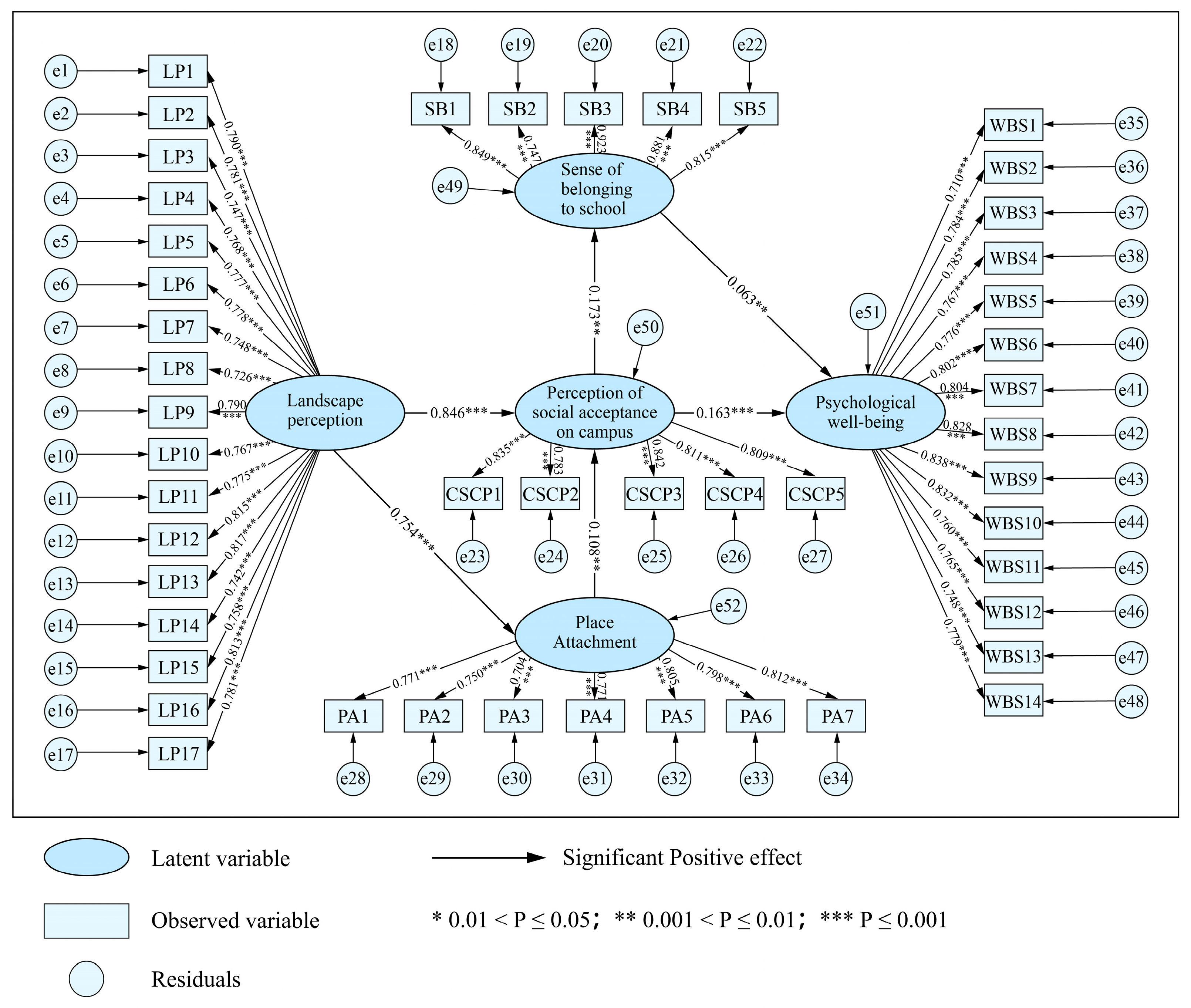
The standardized path coefficients and their significance levels derived from the SEM are shown in Figure 5, Table 4 and Table 5. Specifically, landscape perception has a significant positive effect on place attachment (β = 0.754, p ≤ 0.01) and perceived social acceptance (β = 0.846, p ≤ 0.01), place attachment significantly predicts perceived social acceptance (β = 0.108, p ≤ 0.05), perceived social acceptance has a significant positive impact on both school belonging (β = 0.173, p ≤ 0.05) and psychological well-being (β = 0.163, p ≤ 0.01), and school belonging also positively affects psychological well-being (β = 0.063, p ≤ 0.05). These results provide empirical support for the hypothesized relationships among the key variables.

4.3. Insights from Machine Learning on the Determinants of Psychological Well-Being

4.3.1. Feature Importance Analysis

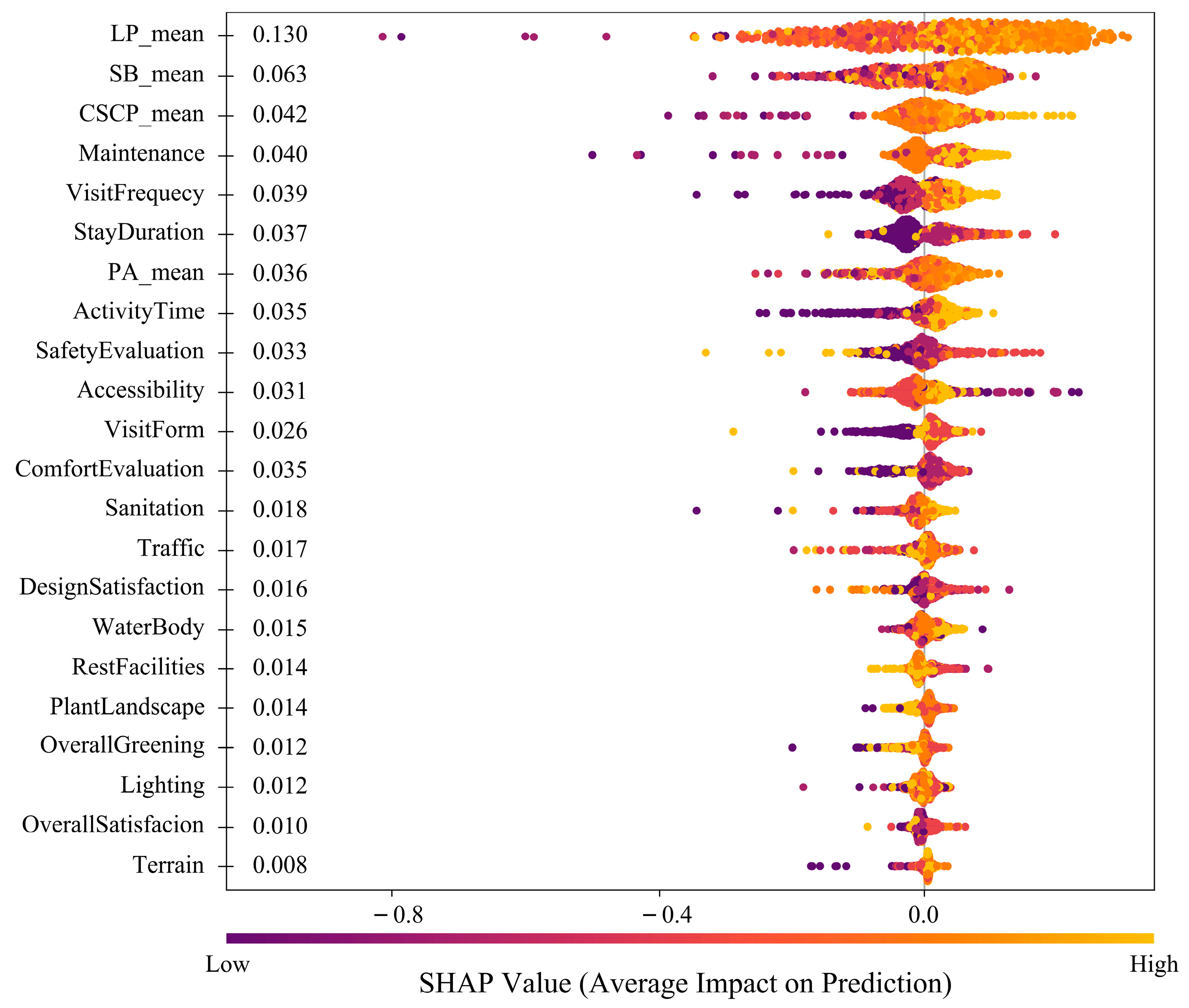
While SEM effectively verifies hypothesized causal pathways, it is inherently constrained by its reliance on pre-specified linear structures. To overcome this limitation and to explore potentially complex nonlinear effects among a broader set of predictors—including behavioral, perceptual, and demographic variables—an interpretable machine learning approach was adopted for feature importance analysis. Figure 6 presents a summary plot of SHAP values, illustrating the average marginal contribution and direction of influence of each feature on the prediction of psychological well-being. The results indicate that landscape perception is the most influential predictor. A high landscape perception score (indicated by the concentration of red/orange dots) is strongly associated with greater levels of psychological well-being. Following this, school belonging, perceived social acceptance, and place attachment also exhibit stable and positive contributions. Among behavioral and evaluative variables, green space maintenance quality, frequency of visits, and duration of stay are shown to have modest but meaningful impacts on psychological well-being.

4.3.2. Nonlinear Effects and Threshold Patterns

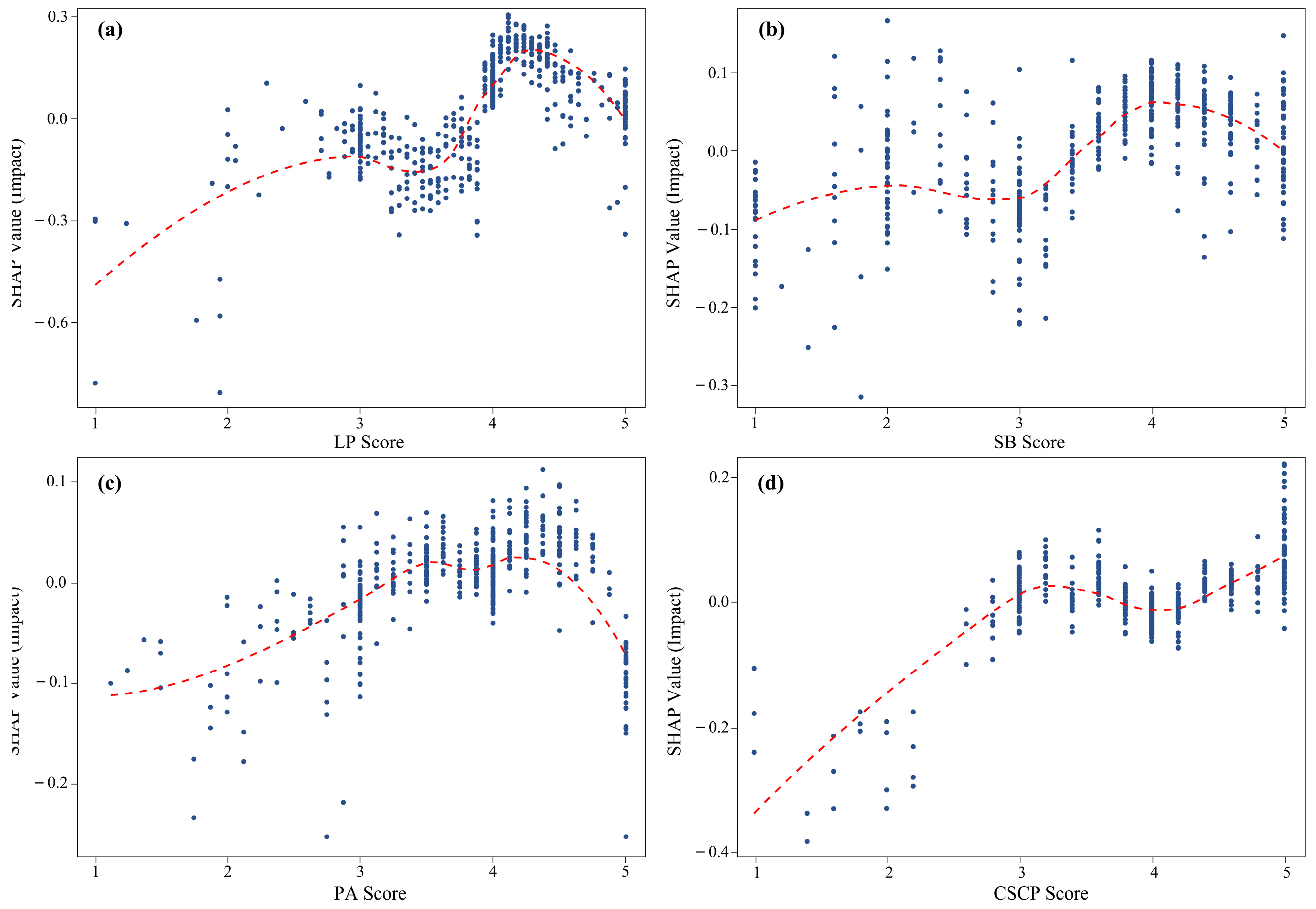
SHAP dependence plots were employed to visualize both the individual and interactive effects of key predictors on psychological well-being. These plots reveal pronounced nonlinear relationships between core latent variables and the outcome variable. Figure 7a shows that the effect of landscape perception on psychological well-being is not strictly linear. When the perception score increases from 1 to 4, the corresponding SHAP values rise steadily, indicating an increasing positive influence. However, beyond a score of 4, the SHAP values begin to decline slightly, suggesting diminishing marginal effects. Figure 7b illustrates a distinct phase-like pattern in the effect of school belonging. When the belonging score is below 2, the impact on psychological well-being is slightly negative. Between scores 2 and 3, the effect becomes neutral. As the score rises from 3 to 4, the positive impact increases significantly, but once it exceeds 4, the effect plateaus, showing slower marginal gains. Figure 7c shows that for perceived social acceptance, the SHAP values increase consistently between scores of 1 and 3, reflecting a steadily positive influence. Between 3 and 4, the relationship flattens slightly. Notably, when the score exceeds 4, the positive effect strengthens again, indicating a second-stage amplification. Figure 7d demonstrates that the effect of place attachment on psychological well-being increases continuously within the 1 to 4 score range. However, when scores exceed 4, SHAP values drop sharply, indicating a decline in contribution, possibly due to over-attachment or saturation effects.

4.3.3. Comparative Analysis of Feature Importance

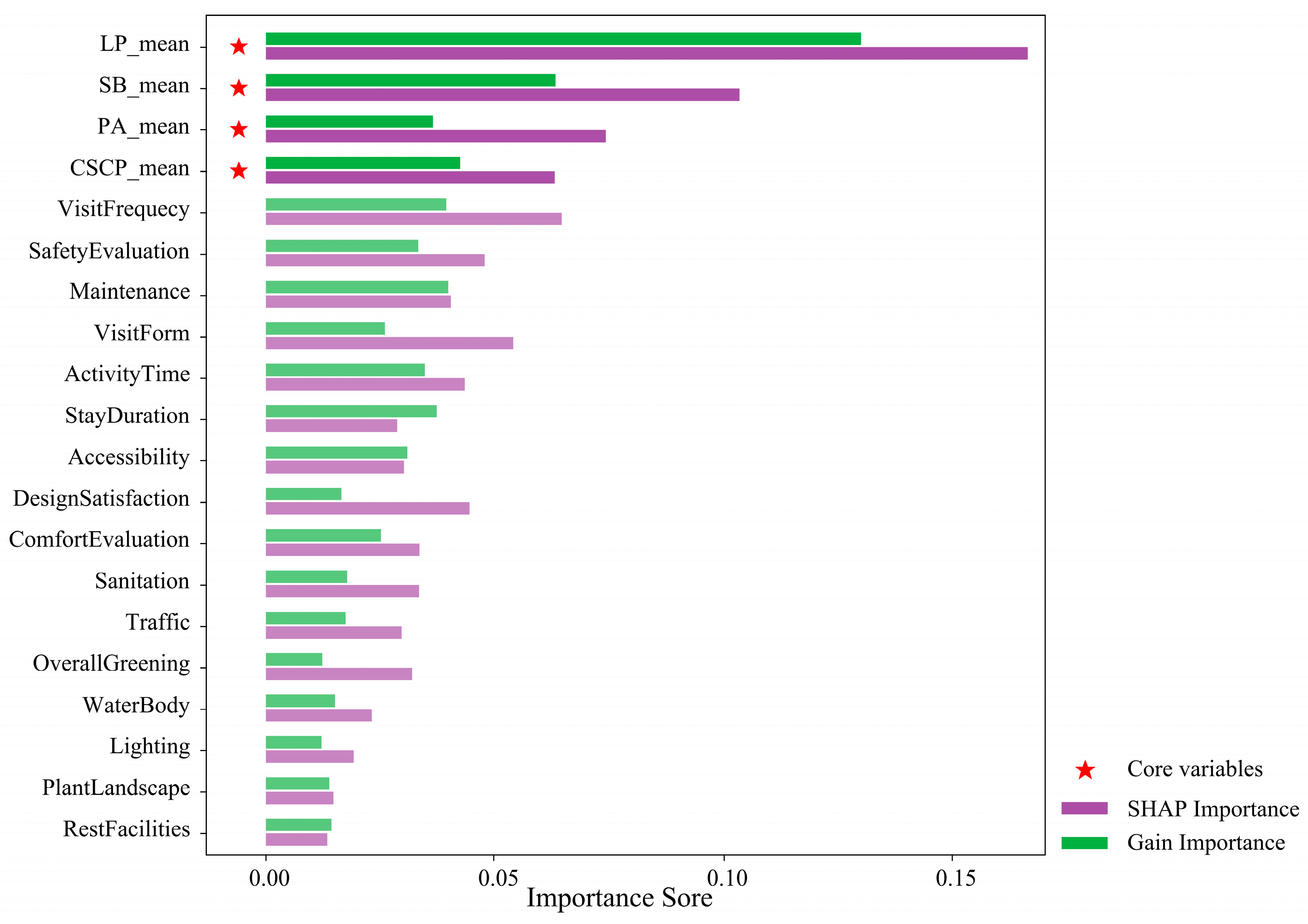
The integrated feature importance comparison (Figure 8) further confirms the robustness of the SHAP-based analysis. Compared to traditional gain-based importance measures derived from gradient boosting algorithms, the SHAP method produces a highly consistent feature ranking, while offering more granular and interpretable insights. Core latent variables—such as landscape perception, school belonging, and perceived social acceptance—remain top-ranked in both methods, reaffirming their pivotal roles in shaping psychological well-being. The consistency between SHAP and gain-based results enhances confidence in the findings and underscores the added explanatory value of SHAP in modeling complex behavioral phenomena.

5. Discussion

5.1. The Interplay Between Campus Landscapes and Social Interaction

The SEM results empirically validate the hypothesized mechanisms proposed in this study. Landscape perception is found to have a significant direct effect on both place attachment (β = 0.754) and perceived social acceptance (β = 0.846). Additionally, landscape perception indirectly enhances perceived social acceptance through the mediating effect of place attachment (β = 0.108). Perceived social acceptance, as a critical psychosocial variable, significantly predicts both school belonging (β = 0.173) and psychological well-being (β = 0.163). Furthermore, school belonging itself exerts a positive influence on psychological well-being (β = 0.063). Supplementary analyses further indicate that, after controlling for potential method bias and testing an alternative model, the main conclusions remain robust (see Appendix in Supplementary Materials). These findings resonate with established environmental psychology theories. Kaplan’s Attention Restoration Theory (ART) posits that natural environments restore cognitive resources by providing “soft fascination” and respite from everyday distractions [7]. This aligns closely with the observed strong effect of landscape perception on psychological well-being in our study. Similarly, Kuo (2015) highlights the long-term benefits of green space exposure for mental health, noting that nature promotes not only physical relaxation but also emotional improvement and social connectedness—consistent with our findings on the positive effects of behavioral factors such as green space visitation frequency and duration of stay [65].
More importantly, this study is among the first to systematically integrate four key psychosocial dimensions into a single pathway model: landscape perception, place attachment, perceived social acceptance, and school belonging. Results demonstrate that campus landscapes serve not only as the foundation of emotional identification but also as catalysts for social interaction and relational bonding. This insight expands the conventional focus of landscape research—beyond aesthetics or functional infrastructure—toward recognizing landscapes as social–psychological systems.
The XGBoost-SHAP machine learning analysis further reinforces these conclusions. Landscape perception emerges as the most influential predictor within the campus psychosocial framework. This suggests that landscape perception should not be treated as a mere background or secondary factor, but as a central driver in the psychological well-being mechanism. While prior studies have often underestimated the primacy of environmental features, our study provides quantitative evidence to highlight their central role. This finding echoes Gibson’s theory of affordances, which argues that environments are not passive backgrounds but active agents in shaping human behavior through their usability, operability, and behavioral cues [66,67,68]. In this context, campus green spaces function as behavioral settings—providing not only aesthetic pleasure but also activating social interaction and emotional connection, thereby indirectly enhancing students’ psychological well-being.

5.2. Diminishing Marginal Returns and Saturation Points in Psychological Well-Being

This study, through machine-learning-based interpretation, uncovers nonlinear threshold effects that traditional structural equation modeling (SEM) fails to detect—offering more nuanced insights into the mechanisms underlying psychological well-being. The effects of landscape perception, place attachment, and school belonging on psychological well-being are not linearly incremental. Instead, they exhibit patterns of diminishing marginal returns and even signs of psychological saturation. Specifically, when landscape perception scores exceed 4 (i.e., when respondents generally perceive campus landscapes as “good” or “very good”), the marginal benefit to psychological well-being begins to decline, suggesting a form of over-saturation. A similar stage-dependent pattern emerges in the role of school belonging: when transitioning from low to moderate levels of belonging, psychological well-being improves significantly—indicating that the establishment of belonging helps mitigate isolation and negative emotions. However, as belonging continues to intensify and enters a “high dependency” phase, its positive impact plateaus. In some cases, this heightened attachment may even increase emotional volatility or vulnerability due to anticipated environmental transitions (e.g., graduation, relocation). These findings suggest that excessive reinforcement of landscape experiences, place attachment, or school identity may trigger aesthetic fatigue or over-reliance risks. Such nonlinear effects align with the Optimal Stimulation Theory, which posits that individuals seek moderate and balanced levels of stimulation and that both under-stimulation and over-stimulation can undermine psychological benefit. Psychological functioning, therefore, often peaks within a “moderate stimulation zone” [69,70].
Prior research relying on SEM has often assumed linear associations, thereby overlooking such threshold effects. For example, Bertram and Rehdanz (2015) demonstrated a non-linear, inverted U-shaped association between urban green space and life satisfaction, where well-being benefits peaked at around 11% green coverage within a 1 km buffer [71]. Similar turning points have been observed in studies from China, where greenness showed positive health impacts up to a certain NDVI value but declined thereafter [72,73]. If analyzed through linear SEM, these nuanced saturation points would likely remain hidden.
In contrast, perceived social acceptance demonstrates a distinct activation threshold. Once acceptance scores exceed 4—indicating high levels of perceived inclusion—the positive impact on psychological well-being accelerates. This implies that high social acceptance not only sustains happiness but may also catalyze the generation of positive affect and accumulation of psychological resources. The effect suggests that the psychological gains from social connectedness are not uniform but instead amplify at higher levels of perceived acceptance. While recent machine learning studies (e.g., XGBoost and Random Forest) have also detected non-linear effects of environmental exposure on mental health [74], they often stop short of embedding these findings into a systematic theoretical framework. As highlighted by Amarasinghe (2023), current explainable AI approaches struggle to translate predictive curves into actionable mechanisms for policy [75]. In contrast, our SEM+SHAP integration not only detects these nonlinearities but also situates them within environmental psychology theory, thereby providing both predictive insight and mechanistic interpretation.

5.3. Integrated Strategies for Optimizing Campus Landscapes and Social Environments

From a practical perspective, this study offers actionable insights for campus landscape design. Landscapes should not be treated merely as static visual decor, but rather redefined as dynamic spatial platforms that promote social interaction, emotional connection, and psychological well-being. The findings reveal that appropriate control of the spatial scale and human-centered interactive design can effectively stimulate students’ sense of engagement and belonging, thereby significantly enhancing their well-being [76,77]. Specifically, campuses should be strategically zoned into functional subspaces—such as quiet rest areas, active recreation zones, and open social spaces—while modulating enclosure and scale to foster environments that are both comfortable and socially vibrant. In addition, the integration of natural elements and cultural symbols plays a critical role in enhancing students’ psychological perception. Incorporating culturally meaningful plant species, sculptures, or architectural motifs not only strengthens spatial recognition and emotional affiliation, but also promotes place identity and attachment. For example, embedding local cultural references into landscapes—such as native vegetation, traditional motifs in courtyards, or symbolic designs in seating areas—can aesthetically enrich the space while naturally attracting students to linger and interact, thereby enhancing perceived social acceptance and school belonging [78]. At the same time, landscape diversity and accessibility must not be overlooked. A wide variety of spatial types and landscape forms can better accommodate the heterogeneous preferences and functional needs of diverse student groups, thereby supporting mental health in a more inclusive manner. Underutilized or neglected “gray spaces” on campus can be regenerated into vibrant social nodes through infrastructure upgrades and functional redesign. Practical interventions—such as increasing seating diversity, improving spatial connectivity, and optimizing entrance and circulation design—can help bridge the gap between potential function and actual use, unlocking the social potential of these forgotten areas [17]. Importantly, the nonlinear effects identified in this study suggest that the optimal impact range for landscape-based well-being occurs at moderate to moderately high levels of perception. Overemphasis on excessively polished or idealized landscapes may lead to diminishing returns. Thus, planning strategies should prioritize moderation, diversity, and long-term sustainability, rather than pursuing aesthetic extremity. These findings provide empirical evidence for campus planners and designers, underscoring the importance of landscape design as a tool to support student well-being through socially and psychologically responsive environments.

5.4. Limitations and Future Research Directions

Although this study offers new theoretical insights and practical implications, several limitations must be acknowledged. First, the sample was drawn primarily from students at two universities in Hunan Province, China. While this provides valuable insights into the local higher-education context, the relatively homogeneous cultural and geographic background may constrain the external generalizability of the findings. Future research should deliberately broaden the sampling frame to include universities from different regions and countries, encompassing a wider variety of socioeconomic, cultural, and climatic contexts. Employing stratified or probability-based sampling methods would further help to reduce selection bias and strengthen the representativeness and transferability of the results. Second, this study mainly focused on students’ subjective perceptions of campus landscapes. Objective indicators such as the student population size, square meters of green space per student, and the spatial distribution and accessibility of green areas were not included. We acknowledge that these factors are crucial in shaping landscape use and may substantially affect well-being outcomes. Future studies should integrate GIS-based spatial data and campus planning information with perception surveys to provide a more comprehensive assessment. Third, cultural and contextual differences—including socioeconomic background, service availability on campus, extracurricular activities, and cross-cultural experiences of international students—may also shape how individuals perceive and value campus landscapes. These cultural influences may in turn alter the pathways linking environmental perceptions to psychological well-being. Therefore, cross-cultural comparative studies are essential for testing the robustness and universality of the proposed model and for identifying potential cultural nuances that could inform more context-sensitive campus design policies. Fourth, although machine learning methods demonstrate strong predictive performance, they are inherently limited in establishing causal relationships. Future research could combine this approach with causal inference frameworks—such as structural causal models, natural experiments, or counterfactual analysis—to provide stronger evidence for directional effects among variables. Finally, the study relies primarily on self-reported survey data, which may be subject to biases such as social desirability, recall error, and common method variance. Incorporating multi-source data could significantly enhance the robustness of findings. This might include physiological measures (e.g., heart rate variability, cortisol levels) to capture stress and relaxation responses, behavioral and spatial-tracking data (e.g., GPS logs, movement trajectories) to measure actual landscape use, and immersive virtual reality (VR)-based simulations to experimentally manipulate campus landscape features and observe real-time cognitive, emotional, and behavioral responses. Such triangulated data would offer a more holistic and objective understanding of the mechanisms through which campus landscapes influence student well-being.

6. Conclusions

This study addresses the core question of whether and how campus landscapes influence students’ psychological well-being. To this end, we proposed and empirically validated a novel “landscape–social–psychological” framework that not only integrates but also extends existing concepts by theorizing new sequential and mutually reinforcing pathways among environmental perception, socio-emotional processes, and mental health outcomes. To the best of our knowledge, few prior studies have jointly examined these five dimensions—landscape perception, place attachment, perceived social acceptance, school belonging, and psychological well-being—within a single coherent model. The model seeks to bridge disciplinary gaps by capturing the cross-level linkages among students’ subjective environmental perceptions, socio-emotional experiences, and psychological outcomes—responding to the limitations of prior research that treated these factors in isolation. The main findings are as follows:
(1)
The SEM results support the hypothesized pathways. Campus landscapes emerge as a starting point for fostering students’ emotional identification and social connection. Landscape perception is significantly associated with psychological well-being via the mediating roles of place attachment, perceived social acceptance, and school belonging.
(2)
The XGBoost and SHAP analyses further reveal that landscape perception contributes the most substantial predictive power among all variables, followed by school belonging and perceived social acceptance. These findings highlight the central role of environmental and social-identity factors in shaping psychological outcomes. Behavioral variables—such as green space maintenance quality, visitation frequency, and duration of stay—also show stable but relatively secondary effects.
(3)
Clear nonlinear relationships are observed between the core variables and psychological well-being. The positive effects of landscape perception, place attachment, and school belonging plateau at higher levels, indicating diminishing marginal returns. In contrast, perceived social acceptance displays an activation threshold effect, where high levels of social inclusion lead to additional well-being benefits.
Theoretically, this research contributes an original, cross-level conceptualization that advances environmental psychology by explicitly linking environmental, social, and psychological systems in a unified pathway model. Methodologically, it combines SEM and interpretable machine learning, offering a complementary approach for identifying variable importance and nonlinear dynamics. Practically, the findings provide evidence-based recommendations for optimizing campus green space design and management as a means to improve student well-being. However, given the cross-sectional nature of the study and its focus on a relatively localized sample, future research should incorporate longitudinal designs and broader contexts to further validate and extend these findings.

Supplementary Materials

The following supporting information can be downloaded at: https://www.mdpi.com/article/10.3390/land14091712/s1, Table S1: Model fit indices for the SEM.

Author Contributions

Conceptualization, Y.C.; methodology, Y.Y., Y.C., and L.Z.; software, S.L. and X.C.; validation, L J., Y.Y., and L.Z.; formal analysis, X.C.; investigation, Y.Y. and L.Z.; resources, S.L. and X.C.; data curation, Y.Y. and Y.C.; writing—original draft preparation, Y.C.; writing—review and editing, S.L. and J.L.; visualization, Y.Y. and Y.C.; supervision, S.L.; project administration, S.L. and J.L.; funding acquisition, S.L. and X.C. All authors have read and agreed to the published version of the manuscript.

Funding

This work was supported by Natural Science Foundation of Hunan Province, China (NO. 2025JJ20033 and NO. 2023JJ30182) and the National Natural Science Foundation of China (NO. 52108049).

Data Availability Statement

The original contributions presented in this study are included in the article/Supplementary Material. Further inquiries can be directed to the corresponding author(s).

Conflicts of Interest

The authors declare no conflicts of interest.

Abbreviations

The following abbreviations are used in this manuscript:
SEMStructural equation modeling
LPLandscape perception
SBSense of belonging to school
PAPlace attachment
WBSPsychological well-being
CSCPPerception of social acceptance on campus

References

  1. Auerbach, R.P.; Mortier, P.; Bruffaerts, R.; Alonso, J.; Benjet, C.; Cuijpers, P.; Demyttenaere, K.; Ebert, D.D.; Green, J.G.; Hasking, P.; et al. WHO World Mental Health Surveys International College Student Project: Prevalence and distribution of mental disorders. J. Abnorm. Psychol. 2018, 127, 623–638. [Google Scholar] [CrossRef]
  2. Bruffaerts, R.; Mortier, P.; Kiekens, G.; Auerbach, R.P.; Cuijpers, P.; Demyttenaere, K.; Green, J.G.; Nock, M.K.; Kessler, R.C. Mental health problems in college freshmen: Prevalence and academic functioning. J. Affect. Disord. 2018, 225, 97–103. [Google Scholar] [CrossRef]
  3. Lin, Z.; Cai, H.; Huang, Y.; Zhou, L.; Yuan, Z.; He, L.; Li, J. Prevalence of depression among university students in China: A systematic review and meta-analysis. BMC Psychol. 2025, 13, 373. [Google Scholar] [CrossRef]
  4. Han, S.-S.; Zhang, Y.-S.; Zhu, W.; Ye, Y.-P.; Li, Y.-X.; Meng, S.-Q.; Feng, S.; Li, H.; Cui, Z.-L.; Zhang, Y.; et al. Status and epidemiological characteristics of depression and anxiety among Chinese university students in 2023. BMC Public Health 2025, 25, 1189. [Google Scholar] [CrossRef] [PubMed]
  5. Li, J.; Chang, Y.; Cai, X.; Liu, S.; Peng, Y.; Feng, T.; Qi, J.; Ji, Y.; Xia, Y.; Lai, W. Health perception and restorative experience in the therapeutic landscape of urban wetland parks during the COVID-19 pandemic. Front. Public Health 2023, 11, 1272347. [Google Scholar] [CrossRef]
  6. Ulrich, R.S. Aesthetic and Affective Response to Natural Environment. In Behavior and the Natural Environment; Altman, I., Wohlwill, J.F., Eds.; Springer US: Boston, MA, USA, 1983; pp. 85–125. [Google Scholar]
  7. Kaplan, S. The restorative benefits of nature: Toward an integrative framework. J. Environ. Psychol. 1995, 15, 169–182. [Google Scholar] [CrossRef]
  8. Lee, K.E.; Williams, K.J.H.; Sargent, L.D.; Williams, N.S.G.; Johnson, K.A. 40-second green roof views sustain attention: The role of micro-breaks in attention restoration. J. Environ. Psychol. 2015, 42, 182–189. [Google Scholar] [CrossRef]
  9. Gong, C.; Yang, R.; Li, S. The role of urban green space in promoting health and well-being is related to nature connectedness and biodiversity: Evidence from a two-factor mixed-design experiment. Landsc. Urban Plan. 2024, 245, 105020. [Google Scholar] [CrossRef]
  10. Zhang, J.; Liu, S.; Liu, K.; Bian, F. How does campus-scape influence university students’ restorative experiences: Evidences from simultaneously collected physiological and psychological data. Urban For. Urban Green. 2025, 107, 128779. [Google Scholar] [CrossRef]
  11. Aerts, R.; Van Calster, H.; Ozen, M.; Benchrih, R.; Heyman, S.; Swerts, E.; Wuyts, A.; Lammens, L.; Lommelen, E.; Leone, M.; et al. Green space at school and attention in primary school children in Belgium: A stratified matched case-control study. Urban For. Urban Green. 2025, 105, 128680. [Google Scholar] [CrossRef]
  12. Liu, S.; Ji, Y.; Li, J.; Peng, Y.; Li, Z.; Lai, W.; Feng, T. Analysis of students’ positive emotions around the green space in the university campus during the COVID-19 pandemic in China. Front. Public Health 2022, 10, 888295. [Google Scholar] [CrossRef]
  13. Nie, X.; Wang, Y.; Zhang, C.; Zhao, Y.; Kirkwood, N. The varied restorative values of campus landscapes to students’ well-being: Evidence from a Chinese University. BMC Public Health 2024, 24, 487. [Google Scholar] [CrossRef]
  14. Wang, R.; Jiang, W.; Lu, T. Landscape characteristics of university campus in relation to aesthetic quality and recreational preference. Urban For. Urban Green. 2021, 66, 127389. [Google Scholar] [CrossRef]
  15. Wan, J.; Wu, H.; Collins, R.; Deng, K.; Zhu, W.; Xiao, H.; Tang, X.; Tian, C.; Zhang, C.; Zhang, L. Integrative analysis of health restoration in urban blue-green spaces: A multiscale approach to community park. J. Clean. Prod. 2024, 435, 140178. [Google Scholar] [CrossRef]
  16. Huang, H.; Zhang, B.; Cheng, J.; Sun, Y. Psychological and Visual Perception of Campus Lightscapes Based on Lightscape Walking Evaluation: A Case Study of Chongqing University in China. Buildings 2024, 14, 753. [Google Scholar] [CrossRef]
  17. Aghabozorgi, K.; van der Jagt, A.; Bell, S.; Smith, H. The role of university campus landscape characteristics in students’ mental health. Urban For. Urban Green. 2025, 111, 128863. [Google Scholar] [CrossRef]
  18. Foellmer, J.; Kistemann, T.; Anthonj, C. Academic Greenspace and Well-Being—Can Campus Landscape be Therapeutic? Evidence from a German University. Wellbeing Space Soc. 2021, 2, 100003. [Google Scholar] [CrossRef]
  19. Jayakody, D.Y.; Adams, V.M.; Pecl, G.; Lester, E. What makes a place special? Understanding drivers and the nature of place attachment. Appl. Geogr. 2024, 163, 103177. [Google Scholar] [CrossRef]
  20. Li, J.; Gao, J.; Zhang, Z.; Fu, J.; Shao, G.; Zhao, Z.; Yang, P. Insights into citizens’ experiences of cultural ecosystem services in urban green spaces based on social media analytics. Landsc. Urban Plan. 2024, 244, 104999. [Google Scholar] [CrossRef]
  21. Nguyen-Dinh, N.; Zhang, H. How Landscape Preferences and Emotions Shape Environmental Awareness: Perspectives from University Experiences. Sustainability 2025, 17, 3161. [Google Scholar] [CrossRef]
  22. Yang, L.; Yu, B.; Liang, Y.; Lu, Y.; Li, W. Time-varying and non-linear associations between metro ridership and the built environment. Tunn. Undergr. Space Technol. 2023, 132, 104931. [Google Scholar] [CrossRef]
  23. Li, S.; Fan, Z. Evaluation of urban green space landscape planning scheme based on PSO-BP neural network model. Alexandria Eng. J. 2022, 61, 7141–7153. [Google Scholar] [CrossRef]
  24. Liu, Y.; Fan, L.; Wang, L. Urban virtual environment landscape design and system based on PSO-BP neural network. Sci. Rep. 2024, 14, 13747. [Google Scholar] [CrossRef]
  25. Purcell, A. Landscape perception, preference, and schema discrepancy. Environ. Plan. B 1987, 14, 67–92. [Google Scholar] [CrossRef]
  26. Li, J.; Luo, J.; Deng, T.; Tian, J.; Wang, H. Exploring perceived restoration, landscape perception, and place attachment in historical districts: Insights from diverse visitors. Front. Psychol. 2023, 14, 1156207. [Google Scholar] [CrossRef]
  27. Williams, D.R.; Vaske, J.J. The measurement of place attachment: Validity and generalizability of a psychometric approach. For. Sci. 2003, 49, 830–840. [Google Scholar] [CrossRef]
  28. Vanhöfen, J.; Härtel, T.; Reichert, G.; Randler, C. The relationship between perception and landscape characteristics of recreational places with human mental well-being. Sci. Rep. 2025, 15, 4245. [Google Scholar] [CrossRef] [PubMed]
  29. Fallavollita, W.L.; Lyons, M.D. Social acceptance from peers and youth mentoring: Implications for addressing loneliness and social isolation. J. Community Psychol. 2023, 51, 2065–2082. [Google Scholar] [CrossRef]
  30. Wentzel, K.R.; Jablansky, S.; Scalise, N.R. Peer social acceptance and academic achievement: A meta-analytic study. J. Environ. Psychol. 2021, 113, 157. [Google Scholar] [CrossRef]
  31. Chen, X.; Kang, J. Effects of natural sound tempo and social conditions on social Interaction: An interactive virtual experiment. J. Environ. Psychol. 2025, 104, 102630. [Google Scholar] [CrossRef]
  32. Ayala-Azcárraga, C.; Diaz, D.; Zambrano, L. Characteristics of urban parks and their relation to user well-being. Landsc. Urban Plan. 2019, 189, 27–35. [Google Scholar] [CrossRef]
  33. Veitch, J.; Ball, K.; Rivera, E.; Loh, V.; Deforche, B.; Best, K.; Timperio, A. What entices older adults to parks? Identification of park features that encourage park visitation, physical activity, and social interaction. Landsc. Urban Plan. 2022, 217, 104254. [Google Scholar] [CrossRef]
  34. Wester-Herber, M. Underlying concerns in land-use conflicts—The role of place-identity in risk perception. Environ. Sci. Policy 2004, 7, 109–116. [Google Scholar] [CrossRef]
  35. Jorgensen, B.S.; Stedman, R.C. A comparative analysis of predictors of sense of place dimensions: Attachment to, dependence on, and identification with lakeshore properties. J. Environ. Manag. 2006, 79, 316–327. [Google Scholar] [CrossRef] [PubMed]
  36. Brown, G.; Reed, P.; Harris, C. Testing a place-based theory for environmental evaluation: An Alaska case study. Appl. Geogr. 2002, 22, 49–76. [Google Scholar] [CrossRef]
  37. Xu, Y.; Matarrita-Cascante, D.; Lee, J.H.; Luloff, A.E. Incorporating Physical Environment-Related Factors in an Assessment of Community Attachment: Understanding Urban Park Contributions. Sustainability 2019, 11, 5603. [Google Scholar] [CrossRef]
  38. Li, N.; Gu, D.; Li, Y.; Huang, X.; Chen, Q.; Li, X.; Lv, B. Exploring the Link Between Landscape Perception and Community Participation: Evidence from Gateway Communities in Giant Panda National Park, China. Land 2024, 13, 2216. [Google Scholar] [CrossRef]
  39. Yang, L.; Liu, J.; Albert, C.; Guo, X. Exploring the effects of soundscape perception on place attachment: A comparative study of residents and tourists. Appl. Acoust. 2024, 222, 110048. [Google Scholar] [CrossRef]
  40. Goodenow, C.; Grady, K.E. The relationship of school belonging and friends’ values to academic motivation among urban adolescent students. J. Exp. Educ. 1993, 62, 60–71. [Google Scholar] [CrossRef]
  41. Arslan, G. School Bullying and Youth Internalizing and Externalizing Behaviors: Do School Belonging and School Achievement Matter? Int. J. Ment. Health Addict. 2022, 20, 2460–2477. [Google Scholar] [CrossRef]
  42. Korpershoek, H.; Canrinus, E.T.; Fokkens-Bruinsma, M.; de Boer, H. The relationships between school belonging and students’ motivational, social-emotional, behavioural, and academic outcomes in secondary education: A meta-analytic review. Res. Pap. Educ. 2020, 35, 641–680. [Google Scholar] [CrossRef]
  43. Bureau, N.C.S. Nurturing a Sense of Belonging at School: What Helps Pupils Feel Connected? Available online: https://www.ncb.org.uk/about-us/media-centre/news-opinion/nurturing-sense-belonging-school-what-helps-pupils-feel (accessed on 14 July 2025).
  44. Das, K.V.; Jones-Harrell, C.; Fan, Y.; Ramaswami, A.; Orlove, B.; Botchwey, N. Understanding subjective well-being: Perspectives from psychology and public health. Public Health Rev. 2020, 41, 25. [Google Scholar] [CrossRef]
  45. Diener, E. The Science of Well-Being: The Collected Works of Ed Diener; Springer Science & Business Media: Berlin, Germany, 2009; Volume 37. [Google Scholar]
  46. Kutek, S.M.; Turnbull, D.; Fairweather-Schmidt, A.K. Rural men’s subjective well-being and the role of social support and sense of community: Evidence for the potential benefit of enhancing informal networks. Aust. J. Rural Health 2011, 19, 20–26. [Google Scholar] [CrossRef]
  47. Leary, M.R.; Gabriel, S. Chapter Five—The relentless pursuit of acceptance and belonging. In Advances in Motivation Science; Elliot, A.J., Ed.; Elsevier: Amsterdam, The Netherlands, 2022; Volume 9, pp. 135–178. [Google Scholar]
  48. Cobo-Rendón, R.; López-Angulo, Y.; Pérez-Villalobos, M.V.; Díaz-Mujica, A. Perceived Social Support and Its Effects on Changes in the Affective and Eudaimonic Well-Being of Chilean University Students. Front. Psychol. 2020, 11, 590513. [Google Scholar] [CrossRef]
  49. Martínez, R.; Senra, C.; Fernández-Rey, J.; Merino, H. Sociotropy, Autonomy and Emotional Symptoms in Patients with Major Depression or Generalized Anxiety: The Mediating Role of Rumination and Immature Defenses. Int. J. Environ. Res. Public Health 2020, 17, 5716. [Google Scholar] [CrossRef] [PubMed]
  50. Štremfel, U.; Šterman Ivančič, K.; Peras, I. Addressing the Sense of School Belonging Among All Students? A Systematic Literature Review. Eur. J. Investig. Health Psychol. Educ. 2024, 14, 2901–2917. [Google Scholar] [CrossRef]
  51. Chen, R.; Gao, Y.; Zhang, R.; Zhang, Z.; Zhang, W.; Meng, H.; Zhang, T. How Does the Experience of Forest Recreation Spaces in Different Seasons Affect the Physical and Mental Recovery of Users? Int. J. Environ. Res. Public Health 2023, 20, 2357. [Google Scholar] [CrossRef] [PubMed]
  52. Wang, Z.; Zhang, F.; Wu, F. Intergroup neighbouring in urban China: Implications for the social integration of migrants. Urban Stud. 2016, 53, 651–668. [Google Scholar] [CrossRef]
  53. Wang, X.; Liu, Z. Neighborhood environments and inclusive cities: An empirical study of local residents’ attitudes toward migrant social integration in Beijing, China. Landsc. Urban Plan. 2022, 226, 104495. [Google Scholar] [CrossRef]
  54. Arslan, G.; Duru, E. Initial Development and Validation of the School Belongingness Scale. Child Indic. Res. 2017, 10, 1043–1058. [Google Scholar] [CrossRef]
  55. Tennant, R.; Hiller, L.; Fishwick, R.; Platt, S.; Joseph, S.; Weich, S.; Parkinson, J.; Secker, J.; Stewart-Brown, S. The Warwick-Edinburgh Mental Well-being Scale (WEMWBS): Development and UK validation. Health Qual. Life Outcomes 2007, 5, 63. [Google Scholar] [CrossRef] [PubMed]
  56. Bentler, P.M. EQS Structural Equations Program Manual; Multivariate Software: Encino, CA, USA, 1995; Volume 6. [Google Scholar]
  57. Ali, M.H.; Hossain, S.B.; Mahmud, M.A.; Rahman, K.M.; Mridha, M.S.; Hassan, M.S.; Rahman, S.; Karim, M.R. Exploration of the factors associated with suicide ideation among students: A structural equation modeling (SEM) approach. J. Affect. Disord. Rep. 2025, 21, 100936. [Google Scholar] [CrossRef]
  58. Beran, T.N.; Violato, C. Structural equation modeling in medical research: A primer. BMC Res. Notes 2010, 3, 267. [Google Scholar] [CrossRef] [PubMed]
  59. Bollen, K.A. Structural Equations with Latent Variables; John Wiley & Sons: Hoboken, NJ, USA, 1989. [Google Scholar]
  60. He, J.; Shi, Y.; Xu, L.; Lu, Z.; Feng, M.; Tang, J.; Guo, X. Exploring the scale effect of urban thermal environment through XGBoost model. Sustain. Cities Soc. 2024, 114, 105763. [Google Scholar] [CrossRef]
  61. Yuan, Y.; Guo, W.; Tang, S.; Zhang, J. Effects of patterns of urban green-blue landscape on carbon sequestration using XGBoost-SHAP model. J. Clean. Prod. 2024, 476, 143640. [Google Scholar] [CrossRef]
  62. Hair, J.F. Multivariate Data Analysis: An Overview. In International Encyclopedia of Statistical Science; Lovric, M., Ed.; Springer: Berlin/Heidelberg, Germany, 2011; pp. 904–907. [Google Scholar]
  63. Li, J.; Zhang, C.; Cai, X.; Peng, Y.; Liu, S.; Lai, W.; Chang, Y.; Liu, Y.; Yu, L. The relation between barrier-free environment perception and campus commuting satisfaction. Front. Public Health 2023, 11, 1294360. [Google Scholar] [CrossRef]
  64. Henseler, J.; Ringle, C.M.; Sarstedt, M. A new criterion for assessing discriminant validity in variance-based structural equation modeling. J. Acad. Mark. Sci. 2015, 43, 115–135. [Google Scholar] [CrossRef]
  65. Kuo, M. How might contact with nature promote human health? Promising mechanisms and a possible central pathway. Front. Psychol. 2015, 6, 1093. [Google Scholar] [CrossRef]
  66. Menatti, L.; Casado da Rocha, A. Landscape and Health: Connecting Psychology, Aesthetics, and Philosophy through the Concept of Affordance. Front. Psychol. 2016, 7, 00571. [Google Scholar] [CrossRef]
  67. Heras-Escribano, M.; De Pinedo-García, M. Affordances and Landscapes: Overcoming the Nature–Culture Dichotomy through Niche Construction Theory. Front. Psychol. 2018, 8, 02294. [Google Scholar] [CrossRef]
  68. Gibson, J.J. The Ecological Approach to Visual Perception; Houghton Mifflin: Boston, MA, USA, 1979. [Google Scholar]
  69. Zentall, S. Optimal stimulation as theoretical basis of hyperactivity. Am. J. Orthopsychiatry 1975, 45, 549. [Google Scholar] [CrossRef]
  70. Ibáñez de Aldecoa, P.; Burdett, E.; Gustafsson, E. Riding the elephant in the room: Towards a revival of the optimal level of stimulation model. Dev. Rev. 2022, 66, 101051. [Google Scholar] [CrossRef]
  71. Bertram, C.; Rehdanz, K. The role of urban green space for human well-being. Ecol. Econ. 2015, 120, 139–152. [Google Scholar] [CrossRef]
  72. Peng, W.; Jiang, M.; Shi, H.; Li, X.; Liu, T.; Li, M.; Jia, X.; Wang, Y. Cross-sectional association of residential greenness exposure with activities of daily living disability among urban elderly in Shanghai. Int. J. Hyg. Environ. Health 2020, 230, 113620. [Google Scholar] [CrossRef]
  73. Nie, Z.; Yang, B.; Ou, Y.; Bloom, M.S.; Han, F.; Qu, Y.; Nasca, P.; Matale, R.; Mai, J.; Wu, Y. Maternal residential greenness and congenital heart defects in infants: A large case-control study in Southern China. Environ. Int. 2020, 142, 105859. [Google Scholar] [CrossRef] [PubMed]
  74. Zhang, T.; Wang, L.; Zhang, Y.; Hu, Y.; Zhang, W. Assessing the nonlinear impact of green space exposure on psychological stress perception using machine learning and street view images. Front. Public Health 2024, 12, 1402536. [Google Scholar] [CrossRef] [PubMed]
  75. Amarasinghe, K.; Rodolfa, K.T.; Lamba, H.; Ghani, R. Explainable machine learning for public policy: Use cases, gaps, and research directions. Data Policy 2023, 5, e5. [Google Scholar] [CrossRef]
  76. Shi, W.; Mahdzar, S.S.S.; Li, W. Park inclusive design index as a systematic evaluation framework to improve inclusive urban park uses: The case of Hangzhou urban parks. Appl. Sci. 2023, 13, 12954. [Google Scholar] [CrossRef]
  77. Cheng, Q. Research on improving urban park green space landscape quality based on public psychological perception: A comprehensive AHP-TOPSIS-POE evaluation of typical parks in Jinan City. Front. Psychol. 2025, 16, 1418477. [Google Scholar] [CrossRef]
  78. Pang, X.; Jia, M.; Zhang, Y. Campus landscape perception decoded by surveys combined with eye tracking: Visual and cultural perception for user well-being. Build. Environ. 2025, 283, 113341. [Google Scholar] [CrossRef]
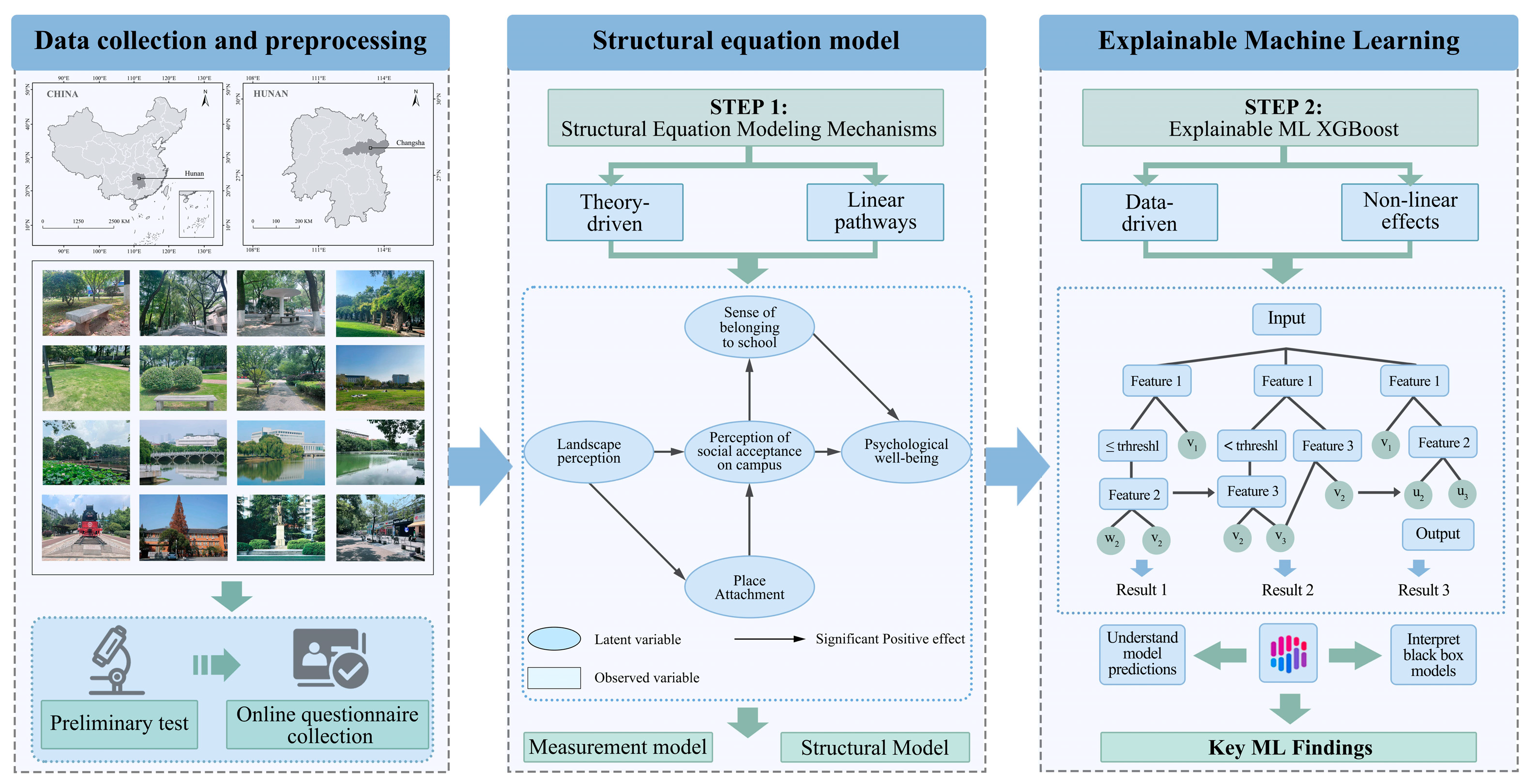
Figure 1. Research framework integrating SEM and interpretable machine learning.
Land 14 01712 g001
Figure 2. Study area and representative campus landscape settings in Changsha.
Land 14 01712 g002
Figure 3. Campus green space usage patterns among respondents.
Land 14 01712 g003
Figure 4. Students’ subjective evaluations of campus green spaces.
Land 14 01712 g004
Figure 5. Estimated path model from the SEM analysis.
Land 14 01712 g005
Figure 6. SHAP summary plot of feature importance for psychological well-being.
Land 14 01712 g006
Figure 7. SHAP dependence plots for key predictors of psychological well-being: (a) landscape perception; (b) school belonging; (c) perceived social acceptance; (d) place attachment.
Land 14 01712 g007
Figure 8. Comparison of feature importance rankings (SHAP vs. gain method).
Land 14 01712 g008
Table 1. Sociodemographic characteristics of respondents.
VariableCountPercentage
Gender
Male18336.6%
Female31763.4%
Age(years)
17–185410.8%
19–2020541.0%
21–2216432.8%
23–297715.4%
Education
Bachelor’s degree46793.4%
Master and above336.6%
Specialty
Philosophy173.4%
Economics306.0%
Law153.0%
Education6212.4%
Literature275.4%
History102.0%
Science326.4%
Engineering408.0%
Agronomy132.6%
Medicine295.8%
Business Administration479.4%
Arts14629.2%
Others326.4%
Monthly consumption
<1000 CNY438.6%
1000–2000 CNY28256.4%
2000–3000 CNY10821.6%
>3000 CNY6713.4%
BIM
<18.513326.6%
18.5–23.932464.8%
24.0–27.9346.8%
>28.091.8%
Table 2. Reliability and validity statistics of measurement scales.
Structure VariablesCodeSource of Observation IndicatorsStandardized Factors LoadingsCronbach’s Alpha ValueCRAVE
Landscape perceptionLP1The campus has a high vegetation coverage rate in green spaces.0.7900.9620.9980.624
LP2The campus green spaces are characterized by a rich botanical diversity.0.781
LP3A rich variety of natural sounds can be heard in the campus green spaces.0.747
LP4A rich variety of colors can be observed in the campus green spaces.0.768
LP5The campus green space design conveys a sense of friendliness, such as through the inclusion of accessible facilities.0.777
LP6Being in campus green spaces evokes a sense of inner peace.0.778
LP7There is sufficient space available for further development within the campus green areas.0.748
LP8Natural landscapes dominate over artificial ones in the campus green spaces.0.726
LP9The campus green spaces feature diverse vegetation profiles.0.790
LP10The terrain of the campus green spaces is undulating.0.767
LP11There is a clear vertical stratification of the landscape in the campus green spaces.0.775
LP12The landscape design of the campus green spaces is well-conceived.0.815
LP13The landscape of the campus green spaces is aesthetically pleasing.0.817
LP14The campus green landscape incorporates elements of the university’s historical and cultural identity.0.742
LP15The landscape design of the campus green spaces is highly distinctive.0.758
LP16Engaging in activities within campus green spaces evokes a sense of enjoyment.0.813
LP17Engaging in activities within campus green spaces is accompanied by a strong sense of safety.0.781
Sense of belonging to schoolSB1You feel like you do not belong to this school.0.8490.9250.9850.721
SB2You feel that you have not participated in most school activities.0.747
SB3You feel excluded at this school.0.923
SB4At this school, you feel that your friends and teachers usually ignore you.0.881
SB5At this school, you do not have anyone you feel closely (or genuinely) connected to.0.815
Place AttachmentPA1The campus green spaces are comfortable and allow me to do the things I want.0.7710.9120.9860.594
PA2I can get more satisfaction in the campus green spaces than in other places.0.750
PA3What I do on the campus green spaces than in other places.0.704
PA4The campus green allows me to see what I am interested in.0.771
PA5I feel that the campus green spaces are part of my life.0.805
PA6I have a strong identification with the campus green spaces. 0.798
PA7The campus green spaces are special, and I have a good feeling about them.0.812
Psychological well-beingWBS1I have been feeling optimistic about the future.0.7100.9570.9960.504
WBS2I have been feeling useful.0.784
WBS3I have been feeling relaxed.0.785
WBS4I have been feeling interested in other people.0.767
WBS5I have had energy to spare.0.776
WBS6I have been dealing with problems well.0.802
WBS7I have been thinking clearly.0.804
WBS8I have been feeling good about myself.0.828
WBS9I have been feeling close to other people.0.838
WBS10I have been feeling confident.0.832
WBS11I have been able to make up my own mind about things.0.760
WBS12I have been feeling loved.0.765
WBS13I have been interested in new things.0.748
WBS14I have been feeling cheerful.0.779
Perception of social acceptance on campusCSCP1In the past six months, the experience you had with your classmates was positive.0.8350.9080.9820.697
CSCP2In the past six months, your classmates have been friendly toward you.0.783
CSCP3In the past six months, your classmates have been polite to you.0.842
CSCP4In the past six months, your classmates have been welcoming toward you.0.811
CSCP5In the past six months, you felt your classmates respected you.0.809
Table 3. Model fit indices for the SEM.
Fit Indexχ2/dfRMSEACFITLI
Threshold2.0860.0470.9380.935
Value<3<0.08≥0.9≥0.9
Table 4. Measurement model results.
Latent VariableIndicatorEstimatep-Value
Landscape perceptionLP10.790***
LP20.781***
LP30.747***
LP40.768***
LP50.777***
LP60.778***
LP70.748***
LP80.726***
LP90.790***
LP100.767***
LP110.775***
LP120.815***
LP130.817***
LP140.742***
LP150.758***
LP160.813***
LP170.781***
Sense of belonging to schoolSB10.849***
SB20.747***
SB30.923***
SB40.881***
SB50.815***
Place attachmentPA10.771***
PA30.750***
PA40.704***
PA50.771***
PA60.805***
PA70.798***
PA80.812***
Psychological well-beingWBS10.710***
WBS20.784***
WBS30.785***
WBS40.767***
WBS50.776***
WBS60.802***
WBS70.804***
WBS80.828***
WBS90.838***
WBS100.832***
WBS110.760***
WBS120.765***
WBS130.748***
WBS140.779***
Perception of social acceptance on campusCSCP10.835***
CSCP20.783***
CSCP30.842***
CSCP40.811***
CSCP50.809***
Note: * 0.01 < p ≤ 0.05; ** 0.001 < p ≤ 0.01; *** p ≤ 0.001.
Table 5. Structural model fitting results.
PathEstimatep-ValueResults
Landscape perception → Place attachment0.754***Support
Landscape perception → Perception of social acceptance on campus0.846***Support
Place attachment → Perception of social acceptance on campus0.108**Support
Perception of social acceptance on campus → Sense of belonging to school0.173**Support
Perception of social acceptance on campus → Psychological well-being0.163***Support
Sense of belonging to school → Psychological well-being0.063**Support
Note: * 0.01 < p ≤ 0.05; ** 0.001 < p ≤ 0.01; *** p ≤ 0.001.
Disclaimer/Publisher’s Note: The statements, opinions and data contained in all publications are solely those of the individual author(s) and contributor(s) and not of MDPI and/or the editor(s). MDPI and/or the editor(s) disclaim responsibility for any injury to people or property resulting from any ideas, methods, instructions or products referred to in the content.