Article

Grassroots Organizational Capacity in Community Crisis Governance: A Case Study of Nanhai, China


1
School of Geography and Planning, Sun Yat-sen University, Guangzhou 510275, China
2
Guangdong Key Laboratory for Urbanization and Geo-Simulation, Sun Yat-sen University, Guangzhou 510275, China
*
Author to whom correspondence should be addressed.
Land 2025, 14(12), 2434; https://doi.org/10.3390/land14122434
Submission received: 26 October 2025 / Revised: 12 December 2025 / Accepted: 14 December 2025 / Published: 17 December 2025

Abstract

Public health emergencies (PHEs) test the crisis response capacity of grassroots organizations like China’s Residential Committees (RCs). While existing research attributes this capacity to factors like resource mobilization or state-society relations, its deeper structural foundations in land regimes and spatial configurations remain underexplored, particularly in Global South urbanization contexts. To fill this gap, this study develops a “Grassroots Organizational Capacity” (GOC) analytical framework, which disaggregates capacity into four dimensions: information, implementation, mobilization and cooperation, and coercion. We then employ this framework in a comparative case study of urban (Jiayi) and rural (Hedong) neighbourhoods in Nanhai, China, during the 2022 lockdown. Drawing on semi-structured interviews with ten key stakeholders in 2022, the findings reveal divergent types of governance. In the rural case, collective land ownership and open spaces foster an “Embedded Autonomy” type, enabling a proactive response through dense social networks. In the urban case, state land dependency and spatial fragmentation lead to a “Reactive Co-Governance” type, which relies on top-down state intervention. This study’s contribution is to provide a case-based illustration of how land and space structures are actively associated with grassroots crisis response effectiveness, rather than serving as passive backdrops.

1. Introduction

In the governance of crises worldwide, the success of national policies often hinges on their implementation at the grassroots level. However, how state capacity translates into effective governance within diverse community structures remains underexplored, particularly where a strong central state intersects with varied local societies. Public health emergencies (PHEs) particularly test the crisis response capacity of grassroots organizations. The Chinese case offers critical insights not merely as a specific national study, but as an archetype of the broader urbanization challenges in the Global South [1,2]. Like many developing nations grappling with the structural tension between formal planning and informal settlements (e.g., in India or Latin America), China’s distinct rural-urban land dichotomy creates fragmented governance landscapes. Unpacking how these land-based divisions shape crisis response provides comparative value for understanding governance resilience in other rapidly urbanizing contexts.
At the heart of China’s grassroots response are its Residential Committees (RCs). These quasi-governmental organizations embody a complex dual role as both extensions of state authority and autonomous neighbourhood managers [3,4]. Existing literature highlights their capacity to implement top-down policies [5,6], while also mobilizing bottom-up resources [7,8,9], creating a distinct governance tension. This challenge is not unique to China; across the Global South, grassroots organizations constantly navigate similar pressures. For instance, their autonomy is often constrained by established power structures, such as local institutions in Indonesia [10] or traditional authorities in Malawi [11].
Existing scholarship effectively documents governance tensions such as elite capture [12,13] and resource dependency [14]. Yet, these studies tend to view such dynamics primarily through a political or administrative lens. For instance, studies on state capacity often attribute success to mobilization mechanics [1] or collaborative leadership [8], while co-production literature emphasizes organizational synergy [7]. However, these analyses often treat the physical context merely as a passive backdrop for human interaction. This perspective obscures a critical conceptual gap: the foundational role of land regimes and spatial configurations in actively conditioning these capacities. We argue that without accounting for these material foundations, existing theories explain the symptoms of governance variance (e.g., resource shortages) but often overlook the structural conditions embedded in the built environment that enable or constrain such capacities. Specifically, issues like insecure land tenure [15,16,17,18] and fragmented spatial forms [19,20,21] are not merely contextual factors but are the material roots that condition whether a grassroots organization possesses the structural capital to exercise autonomy or is forced into reactivity.
Consequently, this study addresses the following core research question: How do divergent land regimes and spatial configurations structurally shape the capacity of RCs during PHEs? The objective of the research is to assess how the land regime and spatial configuration enable or limit local authorities in governing in crisis conditions. To answer this, we employ the ‘Grassroots Organizational Capacity’ (GOC) framework as a synthesis tool. Rather than proposing a new theory, this framework adapts state capacity theory and land governance literature to the specific context of crisis governance. The analytical contribution of this study, therefore, lies not in inventing new concepts, but in operationalizing these macro-level theories within the under-researched micro-level context of the Global South. It moves beyond general resource mobilization to examine how land and space specifically condition four key dimensions of capacity: information, implementation, mobilization, and coercion.
To apply this framework, this study employs a comparative case study of two neighbourhoods in Nanhai, a rapidly urbanizing district in Guangdong, during the stringent lockdown of 2022. The two cases, Hedong (rural) and Jiayi (urban), were selected as they represent China’s typical rural-urban contrasts in land ownership (collective vs. state) and spatial configurations (open villages vs. gated communities), making them well-suited for unpacking the mechanisms linking built environments to governance outcomes.
The paper is structured as follows: Section 2 outlines the research design, including the case selection, data collection, and analysis methods. Section 3 presents the empirical findings and discussion, culminating in two distinct types of governance. Section 4 concludes by discussing the study’s theoretical and practical implications.

2. Materials and Methods

2.1. Analytical Framework

To systematically analyze the capacities of grassroots organizations, a robust theoretical framework is required. As highlighted in the Introduction, current literature often overlooks how foundational land regimes and spatial configurations structurally shape governance outcomes. A powerful starting point is the State Capacity Theory, which provides a lens for understanding a government’s ability to manage crises by coordinating organizations, analyzing information, and delivering public services [22,23]. While traditionally applied at the macro-level, recent scholarship has extended it to incorporate the crucial role of state-society relations [24].
It is important to emphasize that in the governance of PHEs, state-led grassroots actors, represented by the RCs in China, are the dominant core force. Market actors (e.g., Property Management Companies (PMCs)) and social actors (e.g., Homeowner Associations (HOAs)) often need to align with state power to effectively advance governance work [5,7]. Therefore, this study’s GOC framework focuses on the RCs as extensions of state power and constructs its analytical dimensions around this core.
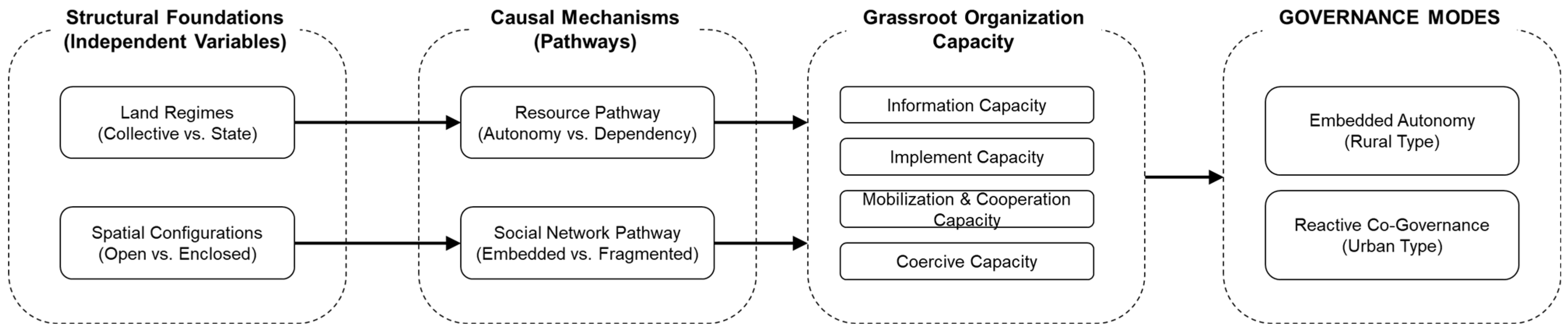
However, as our review of land governance literature suggests, at the grassroots level, this capacity is not abstract; it is profoundly associated with the foundational contexts of land and space [15,21]. To integrate these insights, this study synthesizes these concepts into a tailored analytical lens: the GOC framework (Figure 1). This framework is not intended as a standalone theoretical invention but as a mechanism to bridge macro-level land regimes with micro-level crisis response. This framework disaggregates the general notion of capacity into four specific, observable dimensions that are critical during PHEs: Information Capacity, Implementation Capacity, Mobilization and Cooperation Capacity, and Coercive Capacity. These dimensions are defined as follows:
Information Capacity: This refers to the ability of RCs to gather crucial crisis information from residents and disclose reliable information to them. Key information includes potential risks (e.g., exposure to COVID-19) and vulnerable populations (e.g., those with chronic illnesses).
Implementation Capacity: This measures the extent to which RCs can implement policies issued by superior governments during crises. The ability to execute government policies plays a crucial role in enhancing preparedness and improving institutional quality in crisis response [25]. As the grassroots level of urban governance, RCs have more limited power to formulate policies than to enforce orders from superior authorities.
Mobilization and Cooperation Capacity: This capacity reflects the comprehensive ability of RCs to mobilize various resources to meet challenges, with economic resources and human resources being the two major forms of resources at the grassroots level. Economic resource mobilization refers to the ability to acquire and allocate financial funds and material support. Human resource mobilization, in contrast, refers to the ability to engage residents in volunteer activities, cooperate with social organizations, and leverage social networks during crises. Effective resource mobilization and cooperation are essential for a successful crisis response [26].
Coercive Capacity: In crises, the coercive capacity of RCs is critical for enforcing anti-virus measures such as stay-at-home orders. Neighbourhoods must implement measures to ‘isolate the source of infection, cut off the transmission routes, and protect susceptible populations’ to reduce the spread of the PHEs. Strict adherence to these measures is necessary; non-compliance by some residents can lead to governance failure. Thus, coercive capacity is essential for ensuring effective enforcement of these measures. Based on the literature, our central hypothesis is that foundational land regimes and spatial configurations are associated with these four GOC dimensions through two exploratory pathways: a resource pathway and a social network pathway.
The resource pathway explores associations between community land ownership and grassroots governance. Drawing on studies that link property rights to governance outcomes, we hypothesize that a land tenure system allowing for collective ownership can generate autonomous financial resources, directly enhancing GOC. Research on China’s urbanizing villages, for instance, has shown that villagers’ collectively owned assets are an indispensable foundation for self-governance and reshaping the landscape of local governance [15,27]. This resource autonomy, in turn, can strengthen Implementation Capacity by allowing RCs to hire more staff and directly enhances the economic aspect of Mobilization and Cooperation Capacity, as it provides the necessary financial basis for incentivizing volunteers, hiring temporary staff, and purchasing supplies [28]. Conversely, a land regime that fosters financial dependency on the state is expected to constrain these capacities.
The social network pathway emphasizes spatial configurations of community and its influences on grassroots governance. Extant literature suggests that community physical environments shape social ties [19]. Conversely, fragmented community physical environments, such as the isolation of villagers’ relocated housing from commodity housing, can undermine social identity and the effectiveness of grassroots governance [29]. We therefore hypothesize that open, integrated spatial configurations of communities foster dense, close-knit local social networks, which become a crucial asset for governance. These dense networks, where they exist, can enhance Information Capacity through multi-directional communication and strengthen Coercive Capacity through social pressure and embedded relational control, as well as serve as the cornerstone for the human dimension of Mobilization and Cooperation Capacity, as deep social trust and close neighbourhood ties are prerequisites for recruiting and organizing volunteers. The effectiveness of this relational control is particularly evident in the governance of high-density informal settlements, where social ties and mutual supervision become key governance tools in the absence of formal planning [28,30].
This framework and these specific hypotheses lead to our central research questions: How are divergent land regimes and spatial configurations in China linked with the different portfolios of GOC in urban and rural RCs during PHEs? Through what specific mechanisms (e.g., resource autonomy, social networks) does this process occur? How do these resulting differences in GOC lead to different types of crisis governance at the neighbourhood level?
Based on the intersection of these dimensions and existing theories, we conceptualize two divergent governance typologies as theoretical lenses to guide our empirical enquiry, acknowledging their archetypal nature and potential for hybridity in practice:
Embedded Autonomy (Theoretical Rural Archetype): Drawing on Evans [31] and Tsai [32], we define this mode as a governance structure where the RC possesses dual capacities derived from local structures. Operationally, ‘Autonomy’ manifests primarily in Mobilization and Implementation Capacities, measured by the ability to self-fund and staff crisis responses through collective land dividends (Resource Pathway). Meanwhile, ‘Embeddedness’ significantly enhances Coercive and Information Capacities by leveraging indigenous social networks (e.g., landlord-tenant ties) to enforce compliance and verify data (Social Network Pathway).
Reactive Co-Governance (Theoretical Urban Archetype): Expanding on Ansell and Gash [33] and Liu et al. [7], we conceptualize a mode as a structure constrained by external dependency. Operationally, ‘Reactive’ is characterized by a constrained Implementation Capacity, referring to the inability to initiate action without top-down resource infusion due to the lack of independent assets (Resource Pathway). ‘Co-Governance’ here implies a mediated collaboration that weakens Information and Mobilization Capacities, where RCs must rely on third-party market actors (PMCs) to bridge fragmented social ties (Social Network Pathway), often resulting in delayed responsiveness.

2.2. Case Selection

Nanhai district in Foshan was selected as a case study because its rapid, uneven urbanization has created a landscape where distinct land regimes and spatial configurations coexist in close proximity, a dynamic well-documented in previous studies on its peri-urban village redevelopment [29]. As a former rural county now integrated into the Pearl River Delta metropolis, it starkly embodies the rural-urban dichotomy that lies at the heart of our analytical framework. This allows for a comparison between communities governed by collective land ownership and those under state land ownership, enabling a direct investigation of our central hypotheses.
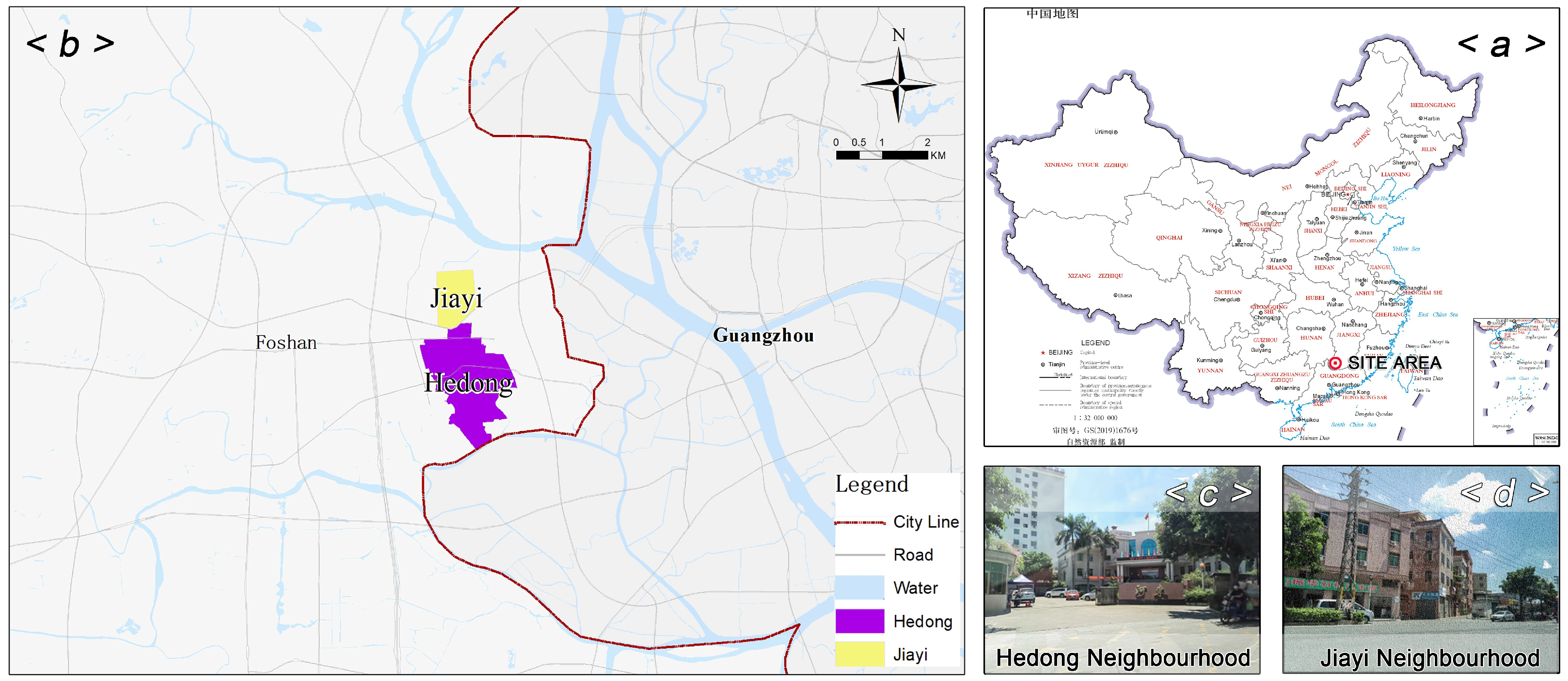
As shown in Figure 2, we selected two representative neighbourhoods: Hedong (H), a rural neighbourhood, and Jiayi (J), an urban neighbourhood. Their selection followed a ‘theoretical sampling’ strategy [34]. Rather than seeking statistical representativeness, we purposefully selected these two neighbourhoods as highly representative cases of divergent structural types to maximize the variance in the independent variables of interest. They serve as archetypal representations of the divergent institutional and spatial configurations inherent in China’s dual urban-rural structure: collective land with open spatial configurations versus state-owned land with gated enclosures. While they differ in demographics, this design aims to isolate how these underlying land-spatial configurations structurally condition governance capacities, treating socio-economic disparities as endogenous outcomes rather than confounding variables.
Hedong (H), a rural neighbourhood, exemplifies a type of governance rooted in a collective land regime. The land is collectively owned by villagers, which, as hypothesized in our framework, provides a strong foundation for a resource pathway based on financial autonomy. Its spatial configuration is characterized by open, low-rise, self-built housing clustered in five natural villages, fostering a dense, traditional social network pathway based on kinship and daily interaction.
Jiayi (J), a modern urban neighbourhood, represents a type of governance predicated on the state-owned land regime. This fosters a resource pathway marked by financial dependency on state allocations. Its spatial configuration consists of 19 high-rise, enclosed residential communities. This configuration shapes a more fragmented social network pathway, where social relations are often mediated by formal structures like PMCs and HOAs. In China’s urban contexts, PMCs are professional firms responsible for daily neighbourhood maintenance and services, while HOAs are resident-elected bodies that oversee PMC contracts and advocate for homeowner interests, often bridging state and neighbourhood governance.
The key differences between these two cases, which make them ideal for testing our framework, are summarized in Table 1.

2.3. Data Collection

To capture the dynamics of GOC during the 2022 lockdown, empirical data was collected by authors through virtual semi-structured interviews starting on 6 July 2022 (see Appendix A for the full interview outline). The interview protocol was explicitly designed to operationalize our analytical framework. Questions were structured to assess the four dimensions of GOC (the dependent variables) and to examine possible causal mechanisms. Given the sensitive nature of crisis governance, we adopted an ‘elite interviewing’ strategy. We targeted 10 key informants (Table 2) identified through purposive snowball sampling to ensure access to core decision-makers. While the sample size is small numerically, it holds high ‘information power’ regarding the specific mechanisms of mobilization and control [35]. Each interview lasted approximately 80 min and was recorded, transcribed, and anonymized for analysis. Prior to each interview, informed consent was obtained from all participants regarding the recording and use of data for research purposes, ensuring strict anonymity and confidentiality.

2.4. Data Analysis

The data analysis process followed an abductive inference logic, designed to rigorously test and refine the hypotheses derived from our GOC framework [36,37]. All interview transcripts were initially coded using NVivo 12 software.
First, we employed a deductive thematic analysis. An initial coding scheme was developed based on the four dimensions of the GOC framework (Information, Implementation, Mobilization, Coercive) and the theoretical archetypes conceptualized in Section 2.1 (Embedded Autonomy vs. Reactive Co-Governance). This step assessed the applicability of these pre-defined theoretical lenses to the empirical realities of rural and urban crisis response.
Second, we conducted an inductive analysis to identify emergent themes and nuances not fully encapsulated by the initial framework. This involved open coding to identify unexpected patterns, such as the specific “transactional” logic of urban volunteering or the informal coercive leverage within the landlord-tenant network. Substantively, this ‘transactional’ theme emerged iteratively: initial open codes like ‘points for school’ and ‘exchange for benefits’ were grouped and theoretically refined into the concept of ‘Reactive Co-Governance,’ distinct from the ‘identity-driven’ narratives found in the rural case. This inductive step helped mitigate confirmation bias by allowing data-driven themes to challenge or refine the deductive framework.
Crucially, the analysis involved a continuous dialogue between theory and data. We moved back and forth between the theoretical archetypes and the raw empirical data. This abductive process allowed us not only to verify the hypothesized capacities but also to uncover emergent mechanisms that refined our understanding of the governance typologies.
To ensure validity and mitigate the limitations of the small-N design, we performed methodological triangulation. The coded themes derived from interviews were cross-verified against documentary evidence—including over 20 official community notices, volunteer recruitment logs, and local policy documents collected during the 2022 lockdown—to confirm the consistency and accuracy of the respondents’ narratives. Inter-coder reliability was ensured by having two researchers independently double-code 20% of the transcripts, achieving a high degree of agreement. Table 3 illustrates this hybrid coding structure, presenting examples of both deductive themes (derived from the GOC framework) and inductive nuances (emergent from the data).

3. Results

3.1. The Resource Pathway: How Land Regimes Are Associated with Implementation and Mobilization and Cooperation Capacities

3.1.1. The Urban Case: State Land, Financial Dependency, and Reactive Capacities

In urban Jiayi (J), the state-owned land regime creates a resource pathway defined by high financial dependency. The RC operates as a classic extension of the state, relying on top-down financial allocations and personnel support. This dependency fundamentally weakens its inherent capacities in two distinct ways.
First, its Implementation Capacity was initially insufficient during the PHEs. With only 42 staff for 46,000 residents, the RC was overwhelmed in managing nucleic acid testing stations, leading to disorder until the superior government intervened by dispatching personnel. This reveals an Implementation Capacity that is not autonomous but reactive and contingent on external state support, stemming largely from its inability to generate its own resources from state-owned land. As the interviewed RC leaders commented, there were not enough staff to handle the work assigned by superiors during PHEs.
Second, and critically, this financial dependency crippled the RC’s Economic Mobilization and Cooperation Capacity, rendering it virtually non-existent. An RC officer commented:
“In the village, they [volunteers] still get a bit of a subsidy… sometimes 300 RMB a day for guarding an entrance… But for us [in the urban neighbourhood], it’s truly volunteer work. You get a box meal, and that’s it. Without the town government’s support, we wouldn’t have even been able to manage the testing sites. We have no money of our own.” (Interviewee-4)
Without independent revenue streams, it could not procure essential supplies or offer financial incentives to motivate volunteers, locking it into rigid, top-down solutions, confirming the theoretical expectation that fiscal dependency constrains adaptive capacity.

3.1.2. The Rural Case: Collective Land, Resource Autonomy, and Proactive Capacities

Conversely, in rural Hedong (H), the collective land regime fosters a resource pathway of high autonomy. By managing collective land and assets, the RC generates substantial independent revenue from land rent. This resource autonomy translates directly into robust and proactive capacities. As their RC leader argued:
“Our funds are basically self-raised. The village pays half, and the economic cooperatives below pay the other half, so we split the cost [for pandemic staff salaries].” (Interviewee-2).
Its Implementation Capacity was exceptionally strong during the PHEs. With over 100 staff members for 20,000 residents (a far more favourable staff-to-resident ratio), most of whom were locals familiar with the neighbourhood’s social networks, it could execute government mandates efficiently without significant external support.
Crucially, this autonomy also endowed the RC with a powerful Economic Mobilization and Cooperation Capacity. It could freely allocate funds for crisis needs, such as remunerating volunteers or hiring temporary staff. This financial flexibility enabled a proactive and adaptable crisis response, a stark contrast to the urban case’s rigidity and reliance on external aid, and this capability was rooted directly in its collective land ownership.

3.2. The Social Network Pathway: How Spatial Configurations Are Associated with Coercive, Mobilization and Cooperation, and Information Capacities

3.2.1. The Urban Case: Enclosed Spaces, Fragmented Networks, and Mediated Capacities

The enclosed spatial configuration of Jiayi (J), as composed of separate, high-rise gated communities, produces a fragmented social network pathway by minimizing casual encounters and promoting anonymity through physical barriers like walls and elevators, which undermine collective identity and relational trust. Resident-RC relationships are distant and often mediated by third parties like PMCs and HOAs, associated with weaker capacities.
The RC lacked direct leverage, resulting in limited Coercive Capacity for governing PHEs. Without embedded social pressure, enforcement relied on formal and door-to-door persuasion, as nominal institutions like HOAs and building supervisors provided no effective leverage—shaped by the spatial design that isolates residents, preventing the organic formation of authority nodes like rural landlords. As one RC Officer revealed:
“Regarding the HOA, in our neighbourhood… we barely have one, and it exists in name only. During the pandemic, I can say that the role they played was not significant, but they were the biggest complainers.” (Interviewee-4). This observation underscores the inefficacy of formal societal organizations in the urban context, where social fragmentation prevents them from acting as effective governance bridges.
The Mobilization and Cooperation Capacity of human resources was constrained. Mobilization depended on a formal, state-designed volunteer system linked to hukou (household registration) benefits, where points are awarded for activities, valuable for migrants accessing social welfare like public education for children. This reflects a transactional, rather than neighbourhood-based, logic. This was further constrained by a weak local party-member base (only 0.5% of residents, half over 60 with limited ability for high-workload tasks). However, this transactional approach, necessitated by spatially induced weak ties, risks exacerbating inequalities among migrants.
Information Capacity showed a heavy reliance on formal, top-down channels (e.g., PMCs notices, one-way WeChat groups), resulting in inefficient information flow, with delays in data collection, a direct outcome of the fragmented social networks within the enclosed spaces. The RC was heavily dependent on the PMC as an intermediary, as confirmed by an officer who admitted they had to rely on the property management for the most basic resident data:
“Sometimes we need them [the PMC] to provide information on how many people live in a building… their information in this regard is much more detailed than ours.” (Interviewee-4) Such reliance on PMCs for basic population data highlights the RC’s structural detachment from the residents, which is a key characteristic of the reactive governance, demonstrating how spatial fragmentation necessitates mediated rather than direct intervention.

3.2.2. The Rural Case: Open Spaces, Embedded Networks, and Direct Capacities

In stark contrast, the open spatial configuration of Hedong (H), as composed of interconnected natural villages, nurtures a dense, embedded social network pathway by enabling frequent, unplanned interactions in shared lanes and public areas, fostering kinship-based trust and relational control that urban enclosures suppress. This translates into robust, direct capacities.
The RC wielded powerful coercive leverage, showing a sign of strong Coercive Capacity. This was conveyed through an RC-landlord-tenant interest chain, compelling compliance through control over essential resources like rental permits within China’s informal rural rental market, where migrant tenants are precarious and susceptible to eviction threats. This chain’s potency derives from the spatial openness that integrates living and economic spaces, allowing landlords to emerge as natural intermediaries with leverage over tenants’ physical stability. As the leader of the sub-district government commented:
“[Landlords] have an annual review for their rental permits. If they have a problem with pandemic control, we might not pass them on the review. If they can’t pass the review, their tenants can’t get a residence permit, which is inconvenient for them, right?” (Interviewee-1).
This leverage effectively converted the landlords’ economic interests into a tool for the grassroots organization’s Coercive Capacity, demonstrating how embedded networks can function as powerful, albeit informal, compliance mechanisms.
Mobilization and Cooperation Capacity of human resources was clearly shown. The RC leveraged a strong, embedded base of local party members (approximately 1.5% of residents, 3/4 young, with organizational duty to respond to state calls as role types), creating a large, motivated, and disciplined crisis workforce. This powerful mobilization, however, was rooted not only in formal organization but also in a deep sense of collective identity, as expressed by a young volunteer:
“My father and mother are both Party members… my great-grandfather was in the Red Army, so I have a ‘red’ family background. They taught me, ‘If you don’t step up to do this kind of thing, who will?’… And I definitely have a sense of the collective; I want to make some contribution to my village.” (Interviewee-6).
This comment vividly illustrates the cultural dimension of the embedded social network. This reveals that the high mobilization capacity in the rural case is not only driven by transactional incentives. Instead, its roots are deeper, stemming from an intergenerational political socialization and a strong, place-based collective identity. These cultural factors are then amplified by the community’s open spatial configurations. This deeply rooted social logic stands in stark contrast to the hukou-based volunteerism in the urban case. While individual factors like leadership qualities undoubtedly contribute to governance effectiveness, this cultural embedding appeared to be linked to the collective land regime and appears to be a more foundational factor that mediates the influence of such variables.
The same landlord-tenant network functioned as a highly efficient, multi-directional information channel that consolidated Information Capacity. It allowed the RC to manage a large migrant population with remarkable precision, as evidenced by handling over 25,000 pieces of health data. The spatial integration of villages ensured this network’s efficiency, contrasting with urban fragmentation and allowing precise governance of migrants.
To visually synthesize the preceding findings, Table 4 provides a comparative summary of the GOC portfolios that illustrate two exploratory types of governance in the rural and urban cases.

4. Discussion

The findings of this study, rooted in a comparative analysis of two distinct neighbourhood types, offer a structurally grounded perspective on grassroots governance during crises. This section aims to synthesize these findings, position them within broader theoretical debates, and consider their implications. It unfolds in three parts: first, we synthesize and evaluate the two divergent governance logics that emerged from our cases. Second, we address plausible alternative explanations to defend the primacy of our structural argument. Finally, we articulate the study’s theoretical contributions by placing our findings in dialogue with existing literature.

4.1. Divergent Governance Logics: A Synthesis and Evaluation

Our empirical findings largely align with the theoretical archetypes conceptualized in Section 2.1, while also revealing nuanced deviations. Specifically, the rural Hedong case demonstrated robust capacities aligning with the “Embedded Autonomy” type; however, as theoretically predicted, the risk of elite capture was indeed observed in the coercive landlord-tenant dynamics. In contrast, the urban Jiayi case exhibited “Reactive Co-Governance”, where capacities were largely reactive and mediated, constrained by financial dependency and social fragmentation as anticipated by the “constructed order” logic. Synthesizing these findings, our analysis confirms the divergence of two operating logics for crisis governance at the grassroots level. Crucially, this divergence validates the insight that land regimes function as active determinants of ‘political subjectivity’ [38]). By defining the boundaries of legitimacy, the land regime structurally dictates whether a community exercises proactive autonomy or remains confined to reactive compliance.
The urban Jiayi case exemplifies a “Reactive Co-Governance” type, characterized by its financial dependency, fragmented social networks, and reliance on ineffective intermediaries. PMCs and HOAs proved to be ineffective for distinct reasons. The PMCs, driven by their commercial priorities, showed a lack of commitment to public responsibilities. The HOAs, meanwhile, failed to organize effectively due to a lack of sufficient interest-driven incentives.
The rural type of governance’s reliance on informal networks, while effective, also raises significant normative concerns, particularly regarding unaccountable coercion and the risks of elite capture [13,14]. This risk manifests on two levels. First, at the level of implementation, the exercise of power was characterized by a “selectivity” based on personal relationships (guanxi). As one volunteer described the situation at the village entrance during the PHE lockdown:
“You could only get out freely if you had ‘guanxi’ (connections)… For example, if you knew the person guarding the gate, he wouldn’t bother you. But for others, with whom he might not have a good relationship, he would be extremely strict.” (Interviewee-6)
Second, at a structural level, this informal power becomes institutionalized around landlords as “embedded elites.” They wield disciplinary power over the migrant population through their control of rental permits, highlighting the potential inequalities in rural governance.
Conversely, the urban type of governance, despite its inefficiencies, offers adaptive strengths such as formalized systems that promote equity. The hukou-linked volunteer points, while transactional, ensure broader participation among migrants, reducing elite dominance seen in rural cases.
This suggests that the path to enhancing grassroots capacity is not about choosing one type of governance over the other but about understanding and navigating the distinct set of strengths and vulnerabilities embedded in each structural arrangement.
Critically, coercive capacities in both types of governance need ethical scrutiny. In the rural case, landlord-tenant leverage is effective but risks normalizing power asymmetries, potentially leading to exploitation or rights violations [12,13]. This raises political concerns about accountability in informal systems. Policymakers must balance efficiency with ethical safeguards, such as independent oversight mechanisms.

4.2. The Primacy of Structural Factors: Addressing Alternative Explanations

One might argue that factors other than land and space, such as leadership quality or demographic differences, could better explain the observed outcomes [8]. The stark disparity in the staff-to-resident ratio, in particular, stands out as a powerful confounding variable [22]. However, our analysis suggests these factors are not independent, alternative explanations but are already embedded within the structural differences our framework identifies.
First, leadership is institutionalized in our analysis, as the GOC is embodied by both RCs. As our findings in Section 3.1 show, the stark difference in their capacities—one operating in a dependent type (understaffed and financially reliant), the other in an autonomous type (well-staffed and financially independent)—is a consequence of the resource pathway associated with the land regime.
Second, demographic factors are also already explained as integral components of the case studies. The staff-to-resident ratio, as argued above, is an outcome of the land regime’s influence on RCs finances. Furthermore, the different Party-member bases, which impacted mobilization efforts, are intrinsically linked to the social network pathway. This refutes the demographic argument, as Xu et al. [39] demonstrate, mobilization capacity relies not on the sheer number of residents, but on the ability of leadership to activate ‘group identification.’ Thus, demographics are not an external confounder but the raw material through which social network pathways operate.
In summary, factors like leadership and demographics are not confounding variables ignored by our framework. Instead, they are already integrated as core components of the mechanisms. We argue that the land and spatial configuration constitute a more foundational layer of explanation, setting the context that shapes the very form in which these leadership capacities and demographic dynamics operate.

4.3. Theoretical Contributions and Dialogue with Existing Literature

This study’s contribution is to offer a case-based illustration of a structurally grounded explanation for the varied effectiveness of grassroots governance, a topic of extensive debate, particularly in the Global South. While much of the literature attributes governance tensions to political or administrative factors [13,14], our findings point towards the potential foundational role of land and space. We suggest that many of these well-documented tensions are, at their root, mediated by these material and spatial contexts.
Our findings both resonate with and extend existing research. The risks of elite capture we observed in the rural case, for instance, align with broader studies on the topic. However, our study adds a crucial spatial dimension. We argue that the open, interconnected layout of traditional villages provides fertile ground for the informal power dynamics that enable such risks. Specifically, as shown in our results, this spatial openness empowers the landlord-tenant interest chain, which becomes a key mechanism of informal control and potential elite capture.
Furthermore, our urban case aligns with studies on collaborative governance in China, which find that even “third sector” actors like PMCs and HOAs are often constrained by the state, ultimately reinforcing its objectives [40,41]. Our findings vividly illustrate this mechanism. Faced with the failure of intermediaries like PMCs and HOAs, crisis response—particularly volunteer mobilization—relied on a formal, state-designed system tied to household registration benefits. This reveals how, in a context of state-dominated land regimes and fragmented social networks, even attempts at collaborative governance can be subsumed by, and ultimately reinforce, top-down state logic. This dependency exposes a critical ‘structural vulnerability’ that in fragmented urban spaces, the absence of endogenous social cohesion forces a reliance on rigid external systems, ultimately compromising the community’s inherent resilience to shocks [42].

5. Conclusions

This study has demonstrated how macro-level land regimes and their resulting spatial configurations are associated with the micro-level governance capacities of RCs during PHEs, as evidenced by the comparative analysis of Jiayi (urban neighbourhood) and Hedong (rural neighbourhood) in Nanhai. Through the GOC framework, the results reveal exploratory associations linked to two divergent types of crisis governance. In the urban type, financial dependency and spatial fragmentation lead to reactive capacities. In contrast, the rural type benefits from resource autonomy and embedded networks, enabling proactive governance. These findings underscore the interactive resource and social network pathways, where land and space appear to function as active factors influencing state-society relations. By defining the boundaries of local legitimacy, land regimes structurally condition ‘governance subjectivity’ [40]. Specifically, the rural case confirms that identity-driven mobilization remains a potent force for collective action [41], whereas the structural fragmentation in the urban case exposes the challenge of building inherent community resilience (Jin et al., 2026) [42].
Theoretically, our results bridge the fragmented literature on land regimes and crisis management, advancing the understanding of grassroots state capacity in two ways. Unlike previous studies that view resource mobilization as an administrative task, our findings suggest that foundational land institutions are active structural conditions of this capacity. First, we downscale the concept of state capacity to the local level. Second, we show how foundational structures constrain or enable crisis governance. Specifically, we focus on land and space, arguing that their influence goes beyond routine factors like resource mobilization. This provides a structurally grounded perspective on PHE governance. By linking governance capacity to land regimes, our framework offers comparative value for other Global South contexts (e.g., India, Brazil) where the structural tension between formal state planning and informal land tenure similarly conditions urban resilience [15].
Practically, the findings offer targeted implications for enhancing GOC within the existing institutional framework. First, addressing the deficit in the resource pathway for urban RCs is critical. The paralysis observed in Jiayi stems from the lack of immediate fiscal authority. Rather than radical property reform, we recommend establishing ‘Institutionalized Discretionary Funds’ (e.g., community resilience budgets). This mechanism would grant urban RCs the authority to allocate small-scale emergency resources without complex bureaucratic approval, mimicking the financial autonomy of rural villages within a compliant administrative structure [41].
Second, to repair the fragmented Social Network Pathway in urban areas, spatial planning should focus on ‘micro-regeneration’. Counteracting the “elevator isolation” identified in Section 3.2.1, large-scale restructuring is impractical. Instead, we advocate for retrofitting underutilized ‘grey spaces’ (such as pilotis or lobby corners) into shared social hubs. This ‘spatial acupuncture’ strategy can reconstruct the organic social ties necessary for information flow without requiring major capital construction.
Third, for rural areas, the priority is mitigating the normative risks within the Coercive Capacity. The efficient but unaccountable landlord-tenant network in Hedong suggests a need for regulation. Policies should aim to co-opt key landlords into the formal ‘Grid Management System’, converting their informal leverage into a standardized, accountable governance function (e.g., designated ‘grid assistants’). This approach retains the mobilization efficiency of the embedded network while subjecting it to administrative oversight to prevent elite capture [13].
This study has limitations, primarily regarding the sample size (N = 10). Data collection was conducted under the strict constraints of the 2022 lockdown, which limited broader access to a larger pool of participants. However, the study follows the principle of “Information Power” [35], where a highly specific sample of key experts provides sufficient depth for qualitative mechanism tracing. Consequently, our findings should be interpreted as “analytical generalizations”—proposing theoretical logics (e.g., the Embedded Autonomy mode) that can be tested in other contexts—rather than statistical inferences about population frequencies. Future research could expand to more cases in the Global South to further validate these mechanisms.

Author Contributions

J.T.: Investigation, Data Curation, Formal analysis, Writing—Original Draft; Y.Y.: Supervision, Funding acquisition, Methodology, Conceptualization. All authors have read and agreed to the published version of the manuscript.

Funding

This research was funded by the National Natural Science Foundation of China (Grant Nos. 52278085 and 41871161) and the Guangdong Basic and Applied Basic Research Foundation (Grant No. 2023A1515010704).

Data Availability Statement

The data presented in this study are available on request from the corresponding author. The data are not publicly available due to ethical and privacy restrictions, as they contain sensitive information that could compromise the anonymity of the research participants.

Conflicts of Interest

The authors declare no conflicts of interest. The funders had no role in the design of the study; in the collection, analyses, or interpretation of data; in the writing of the manuscript; or in the decision to publish the results.

Abbreviations

The following abbreviations are used in this manuscript:
PHEPublic Health Emergency
RCResidential Committee
GOCGrassroots Organization Capacity

Appendix A. Semi-Structured Interview Outline

Appendix A.1. Part 1: Basic Information

  • Could you briefly introduce the basic situation of your neighbourhood (e.g., population, socio-economic structure, key governance actors)?
  • Could you describe your role and main responsibilities, especially during the 2022 lockdown?

Appendix A.2. Part 2: Probing the Causal Pathways (Structural Factors)

  • 2.1 The Resource Pathway (State-RC Relationship and Land Regime):
    • What are the main sources of your RC’s budget and operational funds? How much financial autonomy do you have?
    • During the lockdown, how did you secure the financial and material resources needed for the response?
    • How would you describe your relationship with the superior (sub-district/town) government in terms of resource allocation and personnel support?
  • 2.2 The Social Network Pathway (Resident-RC Relationship and Spatial Configurations):
    • How does the physical layout of your community (e.g., open village vs. gated communities) affect how you communicate and interact with residents?
    • How well do neighbours know each other in this community? How would you describe the social atmosphere?
    • In the urban case, how was the cooperation with Property Management Companies (PMCs) and Homeowner Associations (HOAs) handled? In the rural case, what is the role of landlords?

Appendix A.3. Part 3: Assessing Grassroots Organizational Capacity (GOC) in Action

  • 3.1 Information Capacity:
    • How did you collect and disseminate critical information during the pandemic (e.g., tracking vulnerable populations, announcing testing schedules)?
    • What were the main challenges encountered in this process?
  • 3.2 Implementation Capacity:
    • What specific measures did you take in implementing the policies of the superior government (e.g., the stay-at-home order)?
    • Were there any adjustments needed during the implementation process to fit the local context?
  • 3.3 Mobilization and Cooperation Capacity:
    • How did you recruit, organize, and manage volunteers?
    • What motivated residents to participate (or not participate) in volunteer activities?
  • 3.4 Coercive Capacity:
    • What measures did you adopt to enforce epidemic prevention rules (e.g., testing mandates, quarantine)?
    • How did residents react to these measures, and how were instances of non-compliance addressed?

References

  1. He, A.J.; Shi, Y.; Liu, H. Crisis governance, Chinese style: Distinctive features of China’s response to the COVID-19 pandemic. Policy Des. Pract. 2020, 3, 242–258. [Google Scholar] [CrossRef]
  2. Wu, F. Scripting Indian and Chinese urban spatial transformation: Adding new narratives to gentrification and suburbanisation research. Environ. Plan. C Politics Space 2020, 38, 980–997. [Google Scholar] [CrossRef]
  3. Read, B. Roots of the State: Neighborhood Organization and Social Networks in Beijing and Taipei; Stanford University Press: Redwood City, CA, USA, 2012. [Google Scholar]
  4. Tomba, L. The government next door: Neighborhood politics in urban China. In The Government Next Door; Cornell University Press: New York, NY, USA, 2014. [Google Scholar]
  5. Nie, X.; Huang, Z.; Wu, L. Community governance during the Shanghai COVID-19 lockdown I: The roles and actions of residents’ committees. Urban Geogr. 2024, 45, 1640–1660. [Google Scholar] [CrossRef]
  6. Woodman, S. Local politics, local citizenship? Socialized governance in contemporary China. China Q. 2016, 226, 342–362. [Google Scholar] [CrossRef]
  7. Liu, Z.; Lin, S.; Lu, T.; Shen, Y.; Liang, S. Towards a constructed order of co-governance: Understanding the state–society dynamics of neighbourhood collaborative responses to COVID-19 in urban China. Urban Stud. 2023, 60, 1730–1749. [Google Scholar] [CrossRef]
  8. Shu, Q.; Wang, Y. Collaborative leadership, collective action, and community governance against public health crises under uncertainty: A case study of the Quanjingwan community in China. Int. J. Environ. Res. Public Health 2021, 18, 598. [Google Scholar] [CrossRef]
  9. Zhao, N.; Liu, Y.; Wang, J. “Co-production” as an alternative in post-political China? Conceptualizing the legitimate power over participation in neighborhood regeneration practices. Cities 2023, 141, 104462. [Google Scholar] [CrossRef]
  10. Das, A. Autonomous but constrained: CBOs and urban upgrading in Indonesia. Cities 2015, 48, 8–20. [Google Scholar] [CrossRef]
  11. Maiden, E.; Guzman, D.B.; Bleck, J. Who leads? Village development committees and local governance in Southern Malawi. Governance 2021, 34, 855–873. [Google Scholar] [CrossRef]
  12. Sexton, R. Unpacking the local resource curse: How externalities and governance shape social conflict. J. Confl. Resolut. 2020, 64, 640–673. [Google Scholar] [CrossRef]
  13. Waheduzzaman, W.; As-Saber, S.; Hamid, M.B. Elite capture of local participatory governance. Policy Politics 2018, 46, 645–662. [Google Scholar] [CrossRef]
  14. Suhardiman, D.; Kenney-Lazar, M.; Meinzen-Dick, R. The contested terrain of land governance reform in Myanmar. Crit. Asian Stud. 2019, 51, 368–385. [Google Scholar] [CrossRef]
  15. Shi, L.; Lamb, Z.; Qiu, X.C.; Cai, H.; Vale, L. Promises and perils of collective land tenure in promoting urban resilience: Learning from China’s urban villages. Habitat Int. 2018, 77, 1–11. [Google Scholar] [CrossRef]
  16. North, D.C. Institutions, Institutional Change and Economic Performance; Cambridge University Press: Cambridge, UK, 1990. [Google Scholar]
  17. Cai, M.; Sun, X. Institutional bindingness, power structure, and land expropriation in China. World Dev. 2018, 109, 172–186. [Google Scholar] [CrossRef]
  18. Li, S.; Vendryes, T. Real estate activity, democracy and land rights in rural China. China Econ. Rev. 2018, 52, 54–79. [Google Scholar] [CrossRef]
  19. Tong, D.; Wu, Y.; MacLachlan, I.; Zhu, J. The role of social capital in the collective-led development of urbanising villages in China: The case of Shenzhen. Urban Stud. 2021, 58, 3335–3353. [Google Scholar] [CrossRef]
  20. Kanai, J.M.; Schindler, S. Peri-urban promises of connectivity: Linking project-led polycentrism to the infrastructure scramble. Environ. Plan. A Econ. Space 2019, 51, 302–322. [Google Scholar] [CrossRef]
  21. Wang, C.; Xu, H.; Lin, A. Informal settlements in the context of COVID-19: Pandemic restrictions and the building of community resilience. Indoor Built Environ. 2023, 32, 1949–1957. [Google Scholar] [CrossRef]
  22. Hanson, J.K.; Sigman, R. Leviathan’s latent dimensions: Measuring state capacity for comparative political research. J. Politics 2021, 83, 1495–1510. [Google Scholar] [CrossRef]
  23. Mao, Y. Political institutions, state capacity, and crisis management: A comparison of China and South Korea. Int. Political Sci. Rev. 2021, 42, 316–332. [Google Scholar] [CrossRef]
  24. Persson, T.A.; Povitkina, M. “Gimme shelter”: The role of democracy and institutional quality in disaster preparedness. Political Res. Q. 2017, 70, 833–847. [Google Scholar] [CrossRef]
  25. Wong, S.W. Reconsolidation of state power into urbanising villages: Shareholding reforms as a strategy for governance in the Pearl River Delta region. Urban Stud. 2016, 53, 689–704. [Google Scholar] [CrossRef]
  26. Bynander, F.; Nohrstedt, D. (Eds.) Collaborative Crisis Management: Inter-Organizational Approaches to Extreme Events; Routledge: Oxford, UK, 2019. [Google Scholar]
  27. Yiwen, Z.; Kant, S.; Liu, J. Principal-agent relationships in rural governance and benefit sharing in community forestry: Evidence from a community forest enterprise in China. For. Policy Econ. 2019, 107, 101924. [Google Scholar] [CrossRef]
  28. Zhu, J.; He, B.J.; Tang, W. Community blemish or new dawn for the public realm? Governance challenges for self-claimed gardens in urban China. Cities 2020, 102, 102750. [Google Scholar] [CrossRef]
  29. Guo, Y.; Xiao, Y.; Yuan, Q. The redevelopment of peri-urban villages in the context of path-dependent land institution change and its impact on Chinese inclusive urbanization: The case of Nanhai, China. Cities 2017, 60, 466–475. [Google Scholar] [CrossRef]
  30. Yin, R.K. Case Study Research and Applications: Design and Methods, 6th ed.; SAGE Publications: Thousand Oaks, CA, USA, 2018. [Google Scholar]
  31. Evans, P.B. Embedded Autonomy: States and Industrial Transformation; Princeton University Press: Princeton, NJ, USA, 1995. [Google Scholar]
  32. Tsai, L.L. Accountability Without Democracy: Solidary Groups and Public Goods Provision in Rural China; Cambridge University Press: Cambridge, UK, 2007. [Google Scholar]
  33. Ansell, C.; Gash, A. Collaborative governance in theory and practice. J. Public Adm. Res. Theory 2008, 18, 543–571. [Google Scholar] [CrossRef]
  34. Eisenhardt, K.M. Building theories from case study research. Acad. Manag. Rev. 1989, 14, 532–550. [Google Scholar] [CrossRef]
  35. Malterud, K.; Siersma, V.D.; Guassora, A.D. Sample size in qualitative interview studies: Guided by information power. Qual. Health Res. 2016, 26, 1753–1760. [Google Scholar] [CrossRef]
  36. Braun, V.; Clarke, V. Using thematic analysis in psychology. Qual. Res. Psychol. 2006, 3, 77–101. [Google Scholar] [CrossRef]
  37. Fereday, J.; Muir-Cochrane, E. Demonstrating rigor using thematic analysis: A hybrid approach of inductive and deductive coding and theme development. Int. J. Qual. Methods 2006, 5, 80–92. [Google Scholar] [CrossRef]
  38. Kim, E.; Park, J. Property rights and redevelopment: Political subjectivity and the limits of the right to the city in Seoul, South Korea. Habitat Int. 2026, 167, 103651. [Google Scholar] [CrossRef]
  39. Xu, G.; Su, Y.; Zhu, Y. Group identification and political trust: A study on the influence and action mechanism of village leadership on farmers’ participation in public affairs. Habitat Int. 2026, 167, 103645. [Google Scholar] [CrossRef]
  40. Yuan, Y.; Chen, Y.; Cao, K. The third sector in collaborative planning: Case study of Tongdejie community in Guangzhou, China. Habitat Int. 2021, 109, 102327. [Google Scholar] [CrossRef]
  41. Cheng, Y.; Yu, J.; Shen, Y.; Huang, B. Coproducing responses to COVID-19 with community-based organizations: Lessons from Zhejiang Province, China. Public Adm. Rev. 2020, 80, 866–873. [Google Scholar] [CrossRef] [PubMed]
  42. Jin, Y.; Liu, Y.; Zhou, G.; Sun, H.; Wu, H. How does urban shrinkage influence urban resilience? Empirical evidence from Northeast China. Habitat Int. 2026, 167, 103646. [Google Scholar] [CrossRef]
Figure 1. The Analytical Framework of Grassroots Organizational Capacity (GOC). Note: The dotted frames represent the categorization of theoretical variables (Structural Foundations, Pathways, Capacities, and Modes), while the solid arrows indicate the logical progression and hypothesized associations linking land regimes to governance outcomes.
Land 14 02434 g001
Figure 2. The Geographical Position of the Study Area. (a) Location in China; (b) Location in Nanhai District; (c) Street view of Hedong; (d) Street view of Jiayi. Note: The non-English text in the map refers to the official Map Approval Number: GS(2019)1676.
Land 14 02434 g002
Table 1. Comparison of Case Study Sites Based on the Analytical Framework.
FeatureHedong (Rural Case)Jiayi (Urban Case)Theoretical Relevance
Land RegimeCollective Land OwnershipState-Owned LandIndependent Variable
Spatial configurationOpen, natural villages, low-riseEnclosed, gated communities, high-riseIndependent Variable
Dominant Resource PathwayAutonomous; funded by collective assetsDependent; funded by state allocationCausal Mechanism
Dominant Social Network PathwayDense, close-knit, informalFragmented, weaker ties, formalCausal Mechanism
Formal Staff (RC)Approx. 108Approx. 42Indicator of Resource Capacity
PopulationApprox. 20,000Approx. 46,000Contextual Factor
Note: RC = Residential Committee.
Table 2. Basic Status of Interviewees.
NumberSexRole in Grassroots Governance
1MaleLeader of Sub-district Government in Dali Town
2MaleLeader of RC in Hedong
3MaleLeader of RC in Hedong
4FemaleLeader of RC in Jiayi
5MaleLeader of RC in Jiayi
6MaleVolunteer in Hedong via PHEs
7MaleVolunteer in Hedong via PHEs
8FemaleVolunteer in Jiayi via PHEs
9MaleVolunteer in Jiayi via PHEs
10MalePMC Manager in Jiayi
Table 3. Coding Structure for Thematic Analysis.
Pathway (Broad Theme)Capacity (Core Theme)Theme OriginCaseSpecific Manifestation (Code) and Example Quote
1. Resource PathwayImplementation CapacityDeductiveUrbanDependent and Reactive: Lacks autonomous funding; reliant on state support. “Without the town government’s support, we wouldn’t have even been able to manage the testing sites.” (Interviewee-4)
RuralAutonomous and Proactive: Uses collective revenue to hire staff independently. “Our funds are basically self-raised… we split the cost [for pandemic staff salaries].” (Interviewee-2)
2. Social Network PathwayInformation CapacityDeductiveUrbanInefficient and Top-Down: Formal, one-way channels caused delays.
“The WeChat groups were for one-way notices; residents couldn’t report issues from it.” (Interviewee-1)
Rural Efficient and Multi-Directional: Precise information flow via landlord-tenant networks.
“Through the landlord network, we could verify the information of thousands of tenants in a single day.” (Interviewee-2)
Mobilization and Cooperation CapacityDeductive
and
Inductive
Urban Human—Transactional: Mobilization driven by formal hukou benefits.
“The points help with school access more or less……may be useful for [our] children.” (Interviewee-8)
RuralHuman—Identity-Driven: Rooted in collective identity and intergenerational duty.
“My father and mother are both Party members… my great-grandfather was in the Red Army… They taught me, ‘If you don’t step up… who will?’“ (Interviewee-6, Volunteer)
Coercive CapacityDeductive
and
Inductive
Urban Limited and Formal: Lacked informal leverage; relied on persuasion.
“Regarding the HOA… the role they played was not significant, but they were the biggest complainers.” (Interviewee-4)
Rural Effective and Informal: Leveraged rental permits for control.
“[Landlords] have an annual review for their rental permits. If they have a problem… we might not pass them.” (Interviewee-1)
SummaryEmergent ThemesInductiveBoth CasesDeepening Governance Logics: Inductive findings reveal distinct risks.
Urban: “Co-governance” is transactional, risking exclusion of migrants.
Rural: “Embedded autonomy” relies on ‘red’ identity but risks informal coercion
Table 4. GOC on PHEs for two neighbourhoods.
AspectUrban JiayiRural Hedong
Information CapacityLow: Relies on formal WeChat groups, delays commonHigh: Efficient via landlord-tenant networks
Implementation CapacityWeak: Dependent on external supportStrong: Autonomous staff hiring
Mobilization and Cooperation CapacityEconomic: Reactive: No independent revenue.
Human: Constrained: Transactional hukou-based system.
Economic: Proactive: Self-raised funds.
Human: Robust: Embedded party members and volunteers.
Coercive CapacityLimited: Formal persuasion only.Effective: Informal leverage via permits
Disclaimer/Publisher’s Note: The statements, opinions and data contained in all publications are solely those of the individual author(s) and contributor(s) and not of MDPI and/or the editor(s). MDPI and/or the editor(s) disclaim responsibility for any injury to people or property resulting from any ideas, methods, instructions or products referred to in the content.