1. Introduction
The global pursuit of the UN’s Sustainable Development Goals (SDGs) necessitates a profound transformation of rural areas, which can be understood as complex socio-economic systems [
1,
2,
3]. Within these systems, interactions between social structures (e.g., land tenure, livelihood capital), technical elements (e.g., farming practices), and the environment dictate the pathways to sustainability [
4,
5,
6,
7,
8,
9,
10,
11]. A central challenge in this transformation is managing the transition from traditional, smallholder agriculture to modern models.
Since the reform and opening up, China has witnessed rapid growth in its agricultural economy. According to data from the National Bureau of Statistics of China, the nation’s agricultural output value increased from 101.85 billion RMB in 1978 to 8975.52 billion RMB in 2023, representing an average annual growth rate of 4.4% at constant prices. At the same time, China’s ALP has also significantly improved, gaining international recognition [
12,
13]. However, it is noteworthy that the characteristics of “large country with small-scale farming” and the “marginalization of the agricultural sector” remain prominent, thereby contributing to a comparatively low overall level of ALP [
14,
15]. ALP, usually defined as the total agricultural output per unit of labor input, stands as one of the most important indicators for measuring economic development trends in rural areas, particularly the degree of agricultural modernization [
12]. Enhancing ALP is the key for low- and middle-income countries to increase farmers’ incomes, achieve agricultural modernization, and ensure sustainable agricultural development. This process is not merely a technical upgrade but a fundamental system reconfiguration, where policy interventions can trigger cascading effects and feedback loops with profound equity implications [
16,
17,
18].
As the world’s largest developing country, China provides a compelling case study for this systemic challenge. The Household Responsibility System (HRS), while historically successful in liberating productive forces, has also led to a land use pattern characterized by small-scale, fragmented, and scattered [
19,
20,
21]. This situation has led farmers to a dilemma of “involution”, which limits the improvement of ALP [
22]. Some rural regions have been actively seeking solutions to manage land fragmentation. By encouraging farmers to exchange and merge their land to achieve contiguous farming, they have achieved positive results [
23]. However, the problem of fragmented and scattered land is a systematic project. It not only requires changing the physical state of fragmented land, but also needs systematic policy measures to lay the foundation for large-scale, modern agricultural development [
24]. To solve this dilemma, the Chinese government, since 2008, has explored and implemented moderate-scale farming operations, vigorously promoting a market-driven reform centered on farmland transfer. This policy, an act of systems architecting, aims to reallocate land from farmers with lower productive efficiency to more specialized, scale-oriented producers, thereby unlocking gains in productivity and income [
25,
26,
27]. By the end of 2023, over one-third of China’s rural land had undergone such transfers [
25].
There is significant controversy in existing research regarding the relationship between farmland transfer and ALP [
28,
29]. Some scholars argue that farmland transfer has significantly improved ALP [
4,
18,
30,
31]. The main reasons for this were the redistribution of land to more efficient or technologically advanced farmers, the reduction of production costs, the improvement of economies of scale and technical efficiency, and the benefits of a refined division of labor and capital investment [
18,
31,
32]. Meanwhile, others claimed that excessive land transfers would disrupt optimal scale thresholds and lead to unbalanced factor allocation, extensive farming practices and a decline in technical efficiency and production performance [
32,
33,
34,
35]. In addition, the effect of land transfer-in and transfer-out on agricultural production efficiency is inconsistent. With the decline of operation scale, there would be double losses in technical efficiency and scale efficiency, while land transfer-out has no effect on ALP [
36].
The behavior of farmers within this system is not uniform. First, the research data is limited. The existing studies mostly refer to farmers in individual provinces or cities, so there is a lack of micro-level data at the national level. Second, while there are various methods for assessing impact, the issues of non-random participation and self-selection bias in farmers’ decisions to participate in the farmland transfer are often inadequately addressed. Thirdly, existing research mainly focuses on the external effects of farmland transfer policies, but pays insufficient attention to the constraints on the livelihood capital of farmers. In fact, livelihood capital is a key factor in the choice of farmers’ livelihood activities and determines the possible action strategies they may adopt in land utilization. The differences in farmers’ livelihood endowments are closely related to their behavior in farmland transfer and ALP [
37]. The differences in farmers’ livelihood capital affect both farmland transfer behavior and productivity outcomes [
37,
38]. In addition, rapid urbanization and labor mobility have further increased the heterogeneity of farmers’ livelihood capital, which may lead to significant differences in the ALP of farmland transfer among different types of farmers. Therefore, ignoring the heterogeneity of farmers may lead to biased model results.
In summary, existing literature mainly focuses on the impact of the external policy factor of farmland transfer on ALP, while largely overlooking the intrinsic constraints imposed by farmers’ livelihood capital. Moreover, there remains a divergence of perspectives regarding the impact of farmland transfer on ALP. Furthermore, although scholars have paid attention to the relationship among livelihood capital, farmland transfer, and farmers’ income [
38,
39]. Their research perspective has focused on analyzing the impact of different farmland transfer behaviors on farmers’ income, while neglecting farmers’ ALP, which is closely related to farmers’ income. At the same time, this paper also did not deeply investigate the mediating effect of farmland transfer between the two. In light of this, and with the aim of more accurately assessing these effects, this study seeks to supplement and extend the current research. By grounding our analysis in the Sustainable Livelihoods Framework, we integrate household livelihood capital, farmland transfer, and ALP into a unified analytical framework to systematically investigate the nexus among these three elements. Utilizing nationally representative survey data from the China Family Panel Studies (CFPS), we employ the entropy weight method to quantify household livelihood capital. An endogenous switching regression model (ESR) and a generalized structural equation model are then utilized to conduct an empirical analysis of the relationship between livelihood capital, farmland transfer, and ALP. Finally, based on the heterogeneity of household livelihood capital, we explore the variations in ALP resulting from farmland transfer across different household types. The primary contributions of this study are as follows:
First, this study analyzes the total effect of farmland transfer on ALP, as well as the differences in the impact of various transfer behaviors (transfer-in and transfer-out). Moreover, from the perspective of heterogeneity of livelihood capital, it examines the impact of farmland transfer on the ALP of different farmers. Second, methodologically, we use the nationally representative dataset and employ an ESR model to mitigate potential self-selection bias related to farmers’ farmland transfer and conduct robustness tests, enhancing the reliability of causal inference. Concurrently, a generalized structural equation model is applied to analyze the mediating effect of farmland transfer in the relationship between farmers’ livelihood capital and ALP. The findings of this study can provide precise policy implications for deepening China’s agricultural land reform and also offer new empirical evidence for understanding the resource allocation and changes in farmers’ livelihoods during periods of agricultural transformation in developing countries.
2. Theoretical Analysis
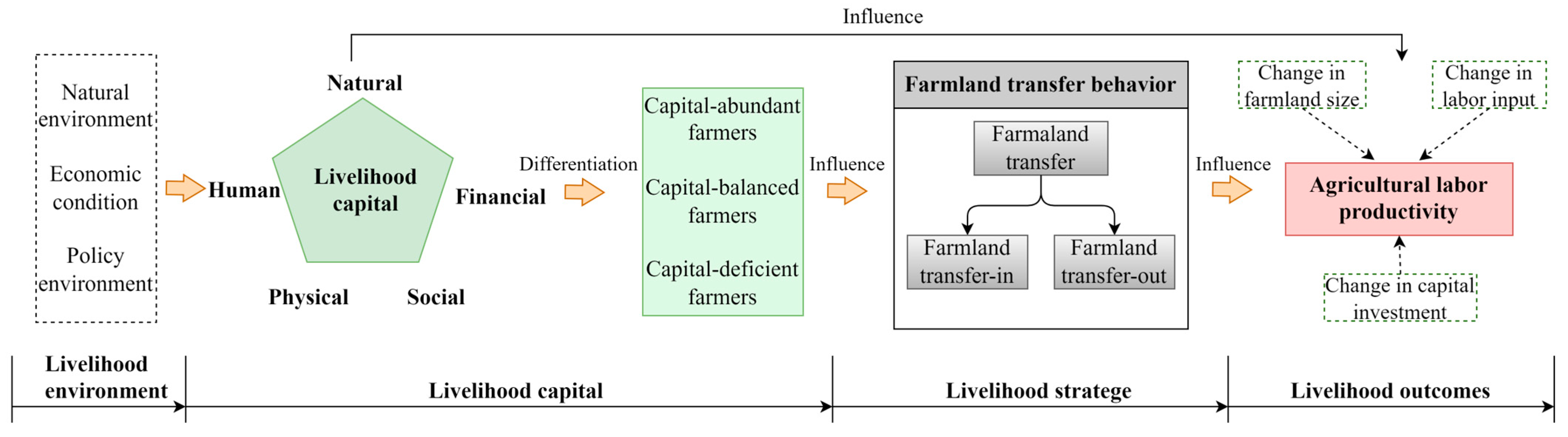
The theoretical framework of this study leverages the Sustainable Livelihoods Framework (SLF) as a systems-thinking tool for analyzing farmer-level dynamics within a complex environment (see
Figure 1) [
40]. The SLF outlines the process of how farmers in a vulnerable environment (the system environment) use their livelihood capital portfolio (system assets) to choose strategies aimed at achieving desired livelihood outcomes. Livelihood capital is central to this system model, as its composition fundamentally determines farmers’ strategic choices [
41]. Livelihood strategy refers to the process by which people improve their standard of living through the use or combination of different livelihood assets. It reflects how farmers utilize their capital, engage in livelihood activities, and diversify their livelihoods. The choice of strategy leads to corresponding livelihood outcomes, which in turn create a feedback loop that affects farmers’ future access to and accumulation of livelihood capital [
41].
Farmers survive in a risky environment that combines market, institutional policies and natural factors. Their livelihood activities are constrained by the external environment, policies and internal asset endowments [
6,
41]. In rural China, ongoing land reforms represent a critical policy intervention within the system’s environment, reshaping the context for farmers’ decision-making. A farmer’s decision to participate in the farmland transfer market—an important livelihood strategy—is determined by both this external policy environment and the farmer’s internal livelihood capital endowment [
17]. Rational farmers seek to maximize their returns by making the best use of their assets. However, given the heterogeneity of farmers’ livelihood capital, their capabilities (ability to act) and consequently their strategic decisions differ. This leads to different behaviors of farmers in the farmland transfer market, which in turn translates into different farmland transfer decisions. By entering the farmland transfer market, farmers change their factor allocation patterns, which leads to changes in the ALP. As these differentiated capabilities also extend to market transactions and production efficiency, farmers with different capital endowments are likely to realize different returns from the transfer of farmland [
31].
2.1. The Relationship Between Livelihood Capital and ALP
The endowment of livelihood capital determines farmers’ land use strategies, thereby influencing ALP [
38]. Among forms of natural capital, land stands as the principal tangible asset of rural households, and both its quantity and quality directly determine the upper limit of agricultural output. Farmers possessing large-scale, high-quality farmland can significantly enhance labor productivity through the advantages of scale [
42]. In contrast, fragmented and low-quality farmland will severely hinder the improvement of ALP [
43].
Human capital refers to the knowledge, skills, and labor capabilities possessed by farmers, which are important factors influencing the transformation of farmers’ livelihood strategies and the realization of their livelihood goals, and is directly related to ALP [
44]. Farmers with higher levels of education tend to exhibit a stronger aptitude for mastering new technologies, thus facilitating the adoption and effective utilization of agricultural innovations that can enhance ALP. The number of laborers within a household, as a component of human capital, significantly influences the allocation and efficiency of household labor. Families with abundant labor resources can diversify their livelihood strategies and enhance their economic benefits. However, when all household members engage in the same livelihood activity, excessive labor input may lead to diminishing returns in labor productivity.
Physical capital comprises the tools, equipment, and infrastructure necessary for farmers to sustain normal production and daily operations. Generally, abundant physical capital can apply advanced technologies to actual production, replace labor with machinery, thereby alleviating farmers’ labor constraints, and improve the efficiency of farmland use [
45]. Financial capital serves as a “catalyst” that activates other forms of capital and facilitates the upgrading of production technologies. With abundant financial resources, farmers can increase agricultural investment, improve production conditions, and thereby enhance ALP. Social capital plays an important role in many aspects such as information sharing and mutual benefit [
46]. It effectively improves production efficiency by expanding the collection of farmers’ resources through farmer networks.
They are mutually related and form a complex system that affects ALP. These distinct yet interrelated forms of capital form a complex, dynamic system that collectively influences productivity outcomes in agriculture. Therefore, the first hypothesis is put forward in this study:
Hypothesis 1. Household livelihood capital is a significant determinant of ALP; however, the direction and magnitude of the impact may vary across different dimensions of capital.
2.2. The Impact of Farmland Transfer on ALP
Theoretically, farmland transfer influences ALP through economies of scale, which can be both internal (e.g., expanded land area, optimized factor inputs) and external (e.g., improved access to markets for inputs, credit and services) [
47].
The farmland transfer-in directly addresses the constraints of small-scale, fragmented agriculture prevalent under China’s household responsibility system. First, Transferring-in farmland facilitates internal economies of scale by improving resource allocation efficiency [
48]. By expanding their operational scale, farmers can improve the land-to-labor ratio and reach the “scale threshold” required for modern inputs such as machinery and advanced technologies [
49,
50]. Second, the expansion of farmland scale can promote technological progress and expansion. By using external mechanized and socialized services, farmers can overcome their existing resource constraints, reduce labor input per unit area, and build a capital-intensive model in which “capital replaces labor” [
47]. Both ways directly improve labor productivity.
After farming households transfer out their land, the reallocation of family production factors indirectly affects ALP. On one hand, traditional family agricultural production has a large amount of surplus labor [
32], and family members receive low remuneration for farming on their small plots of land. Transferring out farmland provides farmers with a stable rental income, while young and middle-aged family laborers are freed from inefficient agricultural production to earn higher non-agricultural income [
51]. This increase in total family income breaks the capital constraints of smallholder farmers, and the additional funds can be used for agricultural production inputs, such as purchasing high-quality seeds and fertilizers. Therefore, the remaining agricultural laborers can leverage superior resources of production to improve ALP [
4]. On the other hand, by transferring out land, households avoid the losses in production efficiency associated with cultivating small, scattered plots, reduce the cultivation costs of marginal plots and improve the efficiency of land resource utilization [
48]. After the transferring out of land, farmers are more inclined to grow higher-value crops or specialized agriculture, increasing the returns to their remaining labor and land [
52]. Accordingly, this study proposes the following hypothesis:
Hypothesis 2. Farmland transfer can significantly enhance farmers’ ALP, with both the transfer-in and the transfer-out contributing positively to this effect.
2.3. The Mediating Role of Farmland Transfer
Based on the above analysis, livelihood capital serves as the internal driving force for farmers’ choice of livelihood strategies and the attainment of livelihood outcomes. Under the conditions of the farmland transfer market, farmers’ ability to utilize farmland is closely related to their initial endowment of livelihood capital. Land constitutes a fundamental factor of production for farmers, and the implementation of farmland policies will trigger farmers’ responses in terms of their livelihood strategies. Against a backdrop of increasingly widespread farmland transfers and a large amount of labor out-migration, farmers, acting as rational economic agents, strive to maximize their utility by reconfiguring their allocation of land resources.
For farmers with advantages in agricultural operation, such as families with relatively sufficient natural and physical capital and a low non-agricultural employment rate, they are more likely to transfer-in land, increase the scale of operation, and reduce production costs, thereby improving ALP. Conversely, farmers with a comparative advantage in non-agricultural sectors, such as families with scarce natural capital or inadequate labor and production facilities, are more inclined to transfer out land, thereby lowering the opportunity cost of farming and augmenting their income through non-agricultural employment [
46].
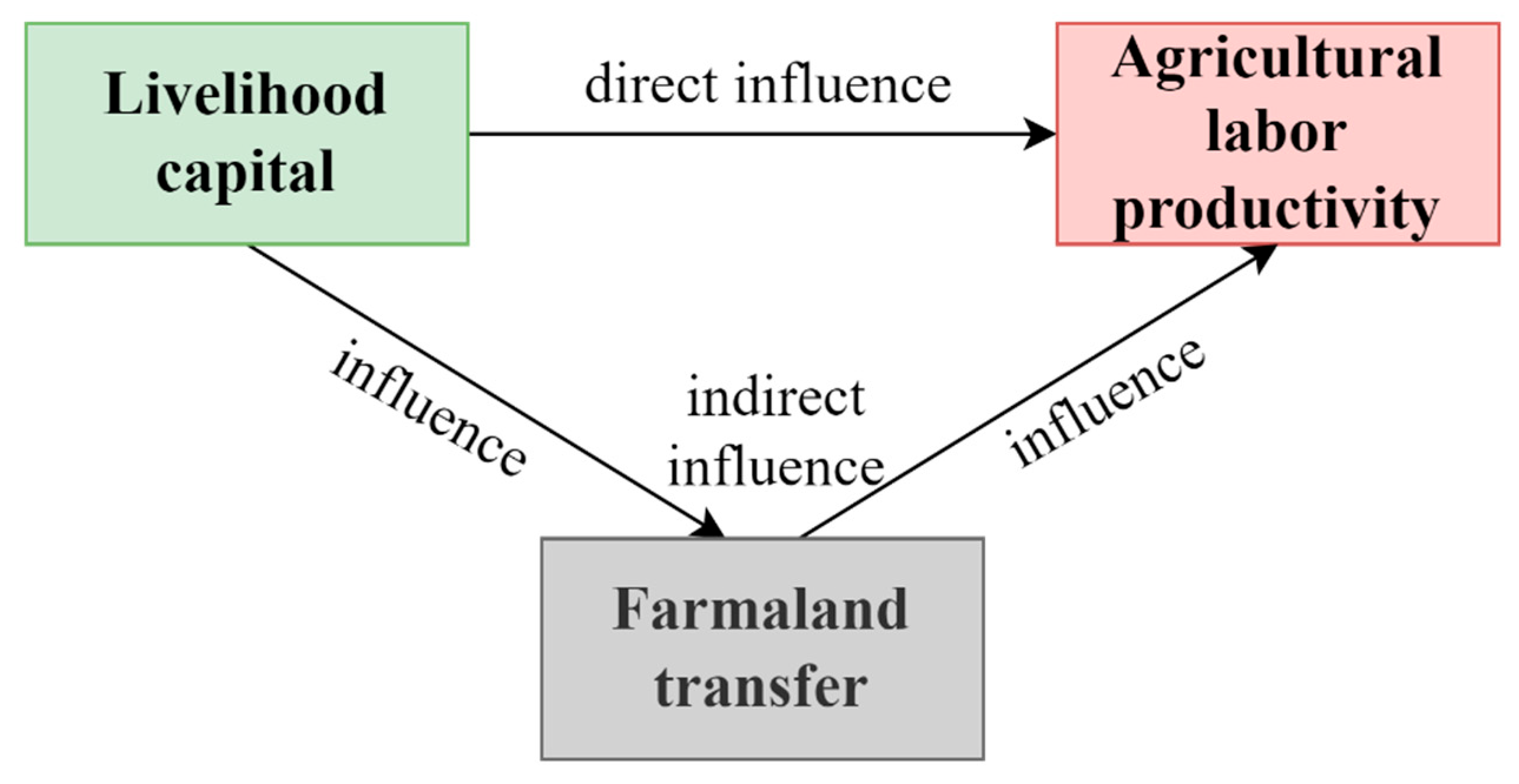
In summary, the livelihood capital influences farmers’ participation in farmland transfer, and the farmland transfer affects the ALP of farmers. The paths through which livelihood capital affects farmers’ ALP include the direct effects of various capitals, as well as the indirect effects of farmland transfer. These effects may exert either a positive or negative influence on farmers’ ALP; the actual effects need further empirical verification. The interaction pathways among these three elements are illustrated in
Figure 2. Based on the above analysis, this study proposes the following hypothesis:
Hypothesis 3. Livelihood capital may influence farmers’ ALP through the mediating effect of farmland transfer.
2.4. Farmland Transfer and ALP Among Farmers with Heterogeneous Livelihood Capital
Factor markets in developing countries are often imperfect, creating frictions within the system [
53]. Although the Chinese government has recently worked to improve the land transfer market, it is still characterized by high transaction costs and inadequate regulation [
54]. As a result, a farmer’s ability to engage in farmland transfer is limited by their initial livelihood capital endowment. At the same time, farmers with different types of livelihood capital have different capabilities, leading to differences in their efficiency in allocating the same factors. This leads to heterogeneous impacts of land transfer on ALP. In this paper, farmers are classified into three categories based on their level of livelihood capital: livelihood capital-abundant, livelihood capital-balanced and livelihood capital-deficient. Capital-abundant farmers are characterized by relatively superior levels across various forms of livelihood capital, with an aggregate capital value ranking in the upper echelon of the sample. Capital-balanced farmers are those whose various livelihood capitals are relatively balanced, without significant deficiencies in any one area, and whose composite scores fall in the middle range of the sample. Conversely, capital-deficient farmers are those defined by a relative scarcity of various livelihood capitals and a lower total capital value. This study analyzes the differential impact of farmland transfer on ALP among farmers with heterogeneous livelihood capital from three dimensions: farmland scale, technology adoption, and capital investment.
First, operational scale. The literature consistently finds a positive relationship between a farmer’s capital endowment and farm size [
18,
55]. Capital-abundant farmers have stronger financial resources and bargaining power to improve their disposal and income rights in the farmland market [
55]. They have access to effective information, save transaction costs and are able to pay higher rental prices, enabling them to produce on a large scale. Some advanced production technologies can only work effectively under certain scale conditions. Large-scale operations facilitate the adoption of new technologies and thus promote ALP. In contrast, capital-deficient farmers are limited by their own capital, making it difficult to cross the “scale threshold” to form moderately scaled operations [
56]. This increases difficulties in production management and machinery use, leading to differences in ALP from farmland transfer.
Second, technology adoption. The ability to adopt and use technology depends on livelihood capital. Farmers who have a lot of human and financial capital can quickly adapt their production strategies and adopt new technologies to respond to rising opportunity costs of agricultural labor and changes in operational scale. This ensures that their asset portfolio remains specialized in productive agriculture. Conversely, capital-deficient farmers are often path-dependent and stick to traditional methods due to financial, educational and managerial constraints [
57]. Their lower propensity to adopt new technologies leads to differences in ALP after farmland transfer.
Third, access to credit and capital investment. Access to external finance is crucial for achieving external economies of scale in agriculture. However, farmers are affected differently by credit rationing depending on their livelihood capital [
47]. Capital-abundant farmers have effective collateral and certain assets that can be easily verified by banks. This allows them to secure loans for important investments in quasi-public goods such as irrigation and local infrastructure and effectively internalize the externalities of these investments [
38,
58]. This ability to invest further widens the production gap between different types of farmers after a farmland transfer [
59]. Based on the above analysis, the study proposes the following hypothesis:
Hypothesis 4. The effect of farmland transfer on the ALP of farmers with differentiated livelihood capital is heterogeneous.
4. Results
In this study, an ESR model was used to estimate the effect of farmland transfer on ALP, accounting for selection bias. The results are shown in
Table 2. The LR test rejects the null hypothesis of independence between the selection and outcome equations (
p < 0.01), and the estimated cross-equation error correlations (ρ) are statistically significant. This indicates that there is a significant self-selection effect in farmers’ farmland transfer decisions, making the use of the ESR model both necessary and appropriate.
Table 3 shows the estimated effects of the different behaviors on the transfer of farmland. Models 4–6 show the results for the farmland transfer-in decision, while models 7–9 show the results for the farmland transfer-out decision. The LR test for the farmland transfer-out model also rejects the null hypothesis of independence. In addition, the correlation coefficient between the error terms of the farmland transfer-out selection equation and the outcome equation is significantly different from zero. Therefore, the use of the ESR model is essential to correct the problem of self-selection in the sample.
4.1. The Impact of Livelihood Capital on Farmers’ Farmland Transfer Behavior
The results of the selection equation for farmland transfer behavior (Model 1,
Table 2) indicate that physical capital and social capital have a positive and statistically significant effect on farmers’ decisions to transfer farmland at the 1% level. Financial capital also has a positive impact, which is significant at the 10% level. This indicates that physical, financial, and social capital can significantly increase the probability of farmers participating in farmland transfer [
67].
Farmers with abundant physical capital may choose to transfer in land to spread the cost of productive assets, thereby expanding their operational scale to realize economies of scale [
52,
69]. Similarly, farmers with high financial capital have a certain ability to pay rent and are more likely to transfer in land to obtain the benefits of large-scale land operation. Furthermore, rich social capital serves to lower the transaction costs inherent in the farmland transfer market, including the search for suitable transaction partners and the finalization of contracts [
70].
The instrumental variable of the village-level farmland transfer ratio has a significant positive impact on farmers’ farmland transfer decisions, indicating that farmers’ farmland transfer behavior is influenced by those around them and has a “peer effect” [
68].
The estimation results for the transfer-in and transfer-out selection equations are presented in
Table 3 as Model 4 and Model 7, respectively. The results show that natural capital has a negative effect on farmers’ decisions to transfer in land and a positive effect on their decisions to transfer out land; however, neither effect is statistically significant. Similarly, human capital exerts a positive influence on both transferring-in and transferring-out decisions, but these effects are also not significant.
Physical capital has a significant positive impact on farmers’ decisions to transfer in farmland, while it has a significant negative impact on their decisions to transfer out. This indicates that an increase in physical capital encourages farmers to acquire land and, at the same time, inhibits them from leasing out their land.
A plausible explanation is that productive assets, a key component of physical capital, can serve as a substitute for manual labor. This substitution alleviates household labor constraints, diminishes the labor input required per unit of land, streamlines production processes, and enhances ALP. Consequently, the household’s profitability is bolstered, thereby incentivizing the expansion of their operational scale through the transfer-in of farmland while inhibiting the transfer-out of their land [
71,
72].
Financial capital has a significant positive effect on farmers’ behavior of transferring in land. In contrast, its effect on their land transfer-out behavior is negative but not statistically significant. This implies that households with greater economic prosperity, possessing the requisite financial capacity for rental payments, are inclined to acquire more farmland to expand their scale of operations in pursuit of enhanced agricultural profits [
67].
Social capital has a positive impact on farmers’ decisions regarding both the transfer-in and transfer-out of their farmland. Moreover, it has a significant promoting effect on the transfer-in behavior. This indicates that farmers’ social networks can reduce transaction costs and facilitate the transfer of farmland [
70,
73].
Among the other control variables, the distance of the village to the county seat promotes transferring in farmland, while it inhibits transferring out. Proximity to urban centers, which reduces commuting costs for non-farm activities, allows farmers to pursue a double-cropping strategy. This makes them less likely to transfer out their farmland and possibly more likely to keep it in order to maintain a functioning farm [
72].
The economic condition of a village has a negative influence on farmland transfer-in behavior, but a positive influence on transfer-out behavior. This indicates that in areas with more favorable economic conditions, farmers tend to rely less on land for their livelihoods and are more inclined to pursue non-agricultural employment, thereby reducing the likelihood of transferring in land while increasing the probability of transferring it out.
4.2. The Impact of Livelihood Capital on ALP
Models 2–3 in
Table 2 show the differential impact of livelihood capital on the ALP of farmers who participated in farmland transfer versus those who did not.
Natural capital is positively correlated with the ALP of farmers participating in farmland transfer, but negatively correlated with the ALP of non-transfer farmers. Human capital shows a significant negative correlation with the ALP of non-transfer farmers, whereas its negative correlation with the ALP of transfer farmers is not significant. A possible explanation is that improvements in the quantity and quality of the labor force enable farmers to diversify their livelihood strategies. Given that family-contracted land plots in China are relatively small, excessive labor input can lead to a decline in production efficiency [
21].
Physical capital significantly enhances the ALP of both types of farmers. The main reason is that abundant physical capital allows for the application of advanced technologies in actual production, effectively substituting for manual labor and thereby improving ALP [
69].
Financial capital is positively correlated with the ALP of transfer farmers and negatively correlated with that of non-transfer farmers, though neither correlation is statistically significant. Agricultural production relies on capital investment. For farmers who actively participate in the market and seek to expand production, highly liquid financial capital is the key to breaking their investment constraints; increasing financial capital can enhance farmers’ productive investment and promote efficiency improvement. However, for non-transferring farmers, the land scale is relatively small. An increase in financial capital may prompt farmers to make non-productive investments, which crowd out investments in agricultural production, leading to a decline in the ALP of non-transferring farmers [
58,
74,
75].
Social capital contributes to the enhancement of ALP for both types of farming households, with its impact on non-transferring farmers passing the significance test. This confirms that social networks, through mechanisms such as information sharing, technological spillovers, and risk-sharing, can effectively improve the efficiency of agricultural production.
Models 5–6 in
Table 3 present the effects of livelihood capital on the ALP of transfer-in and non-transfer-in farmers, while Models 8–9 illustrate its impact on transfer-out and non-transfer-out farmers. Human capital has a significant negative correlation with the ALP of non-transfer-in farmers. For all four types of farmers, physical capital exerts a significant positive impact on ALP. Social capital shows a significant positive influence on the ALP of both non-transfer-in and non-transfer-out farmers.
4.3. The Average Treatment Effects of Farmland Transfer on ALP
Table 4 shows the estimated ATT of farmland transfer and different transfer decisions to the ALP. The results show that farmland transfer has an overall positive and significant impact. The ATT is 0.779 and is statistically significant at the 1% level.
Moreover, the results show a remarkable heterogeneity in the magnitude of the effects depending on the direction of the transfer. Although transferring in and transferring out farmland both significantly boost ALP, the effect of transferring in (ATT = 0.947) is substantially larger than that of transferring out (ATT = 0.510). This suggests that the reallocation of land improves ALP, and this improvement is more significant for farmers operating on a larger scale.
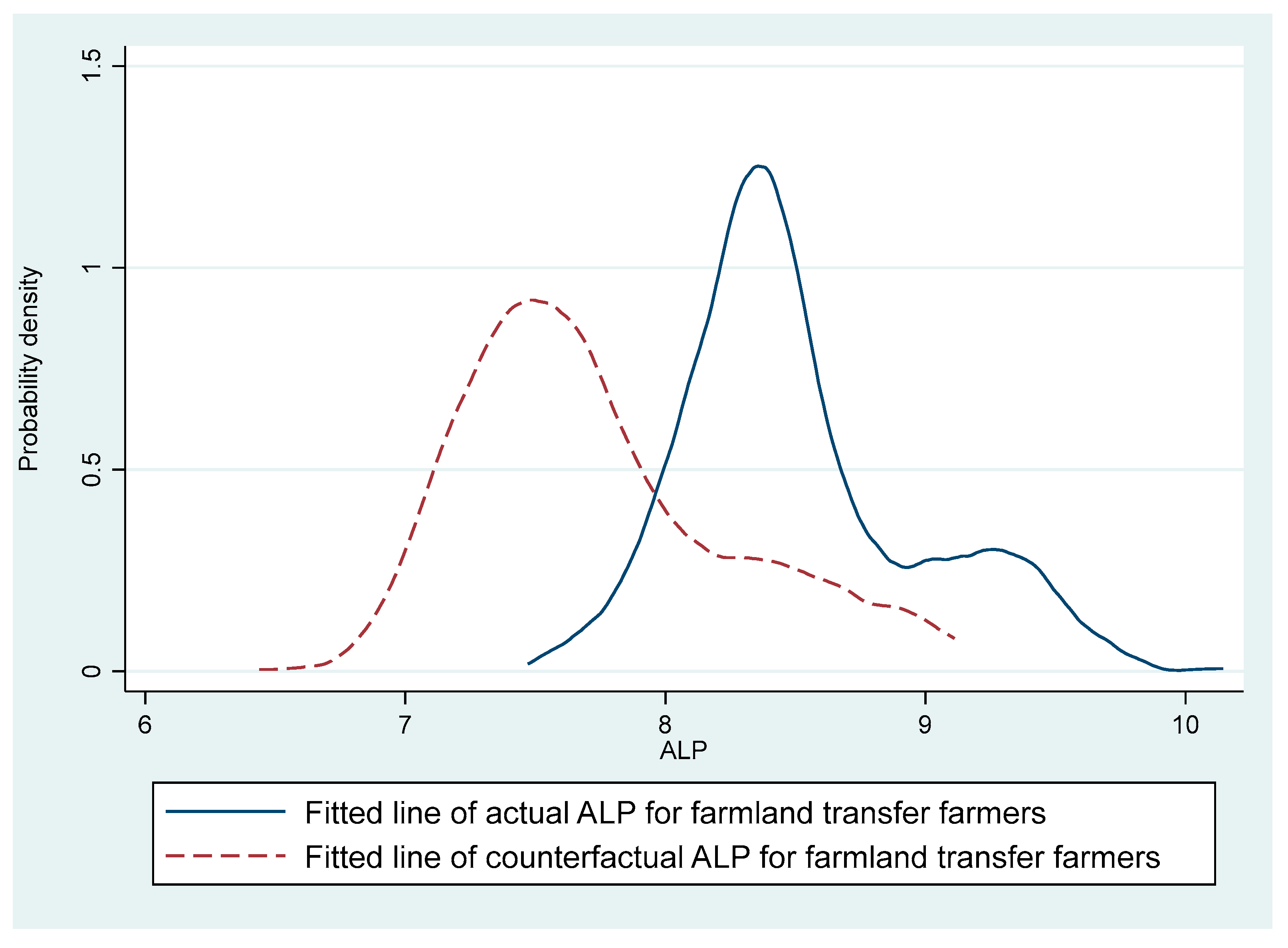
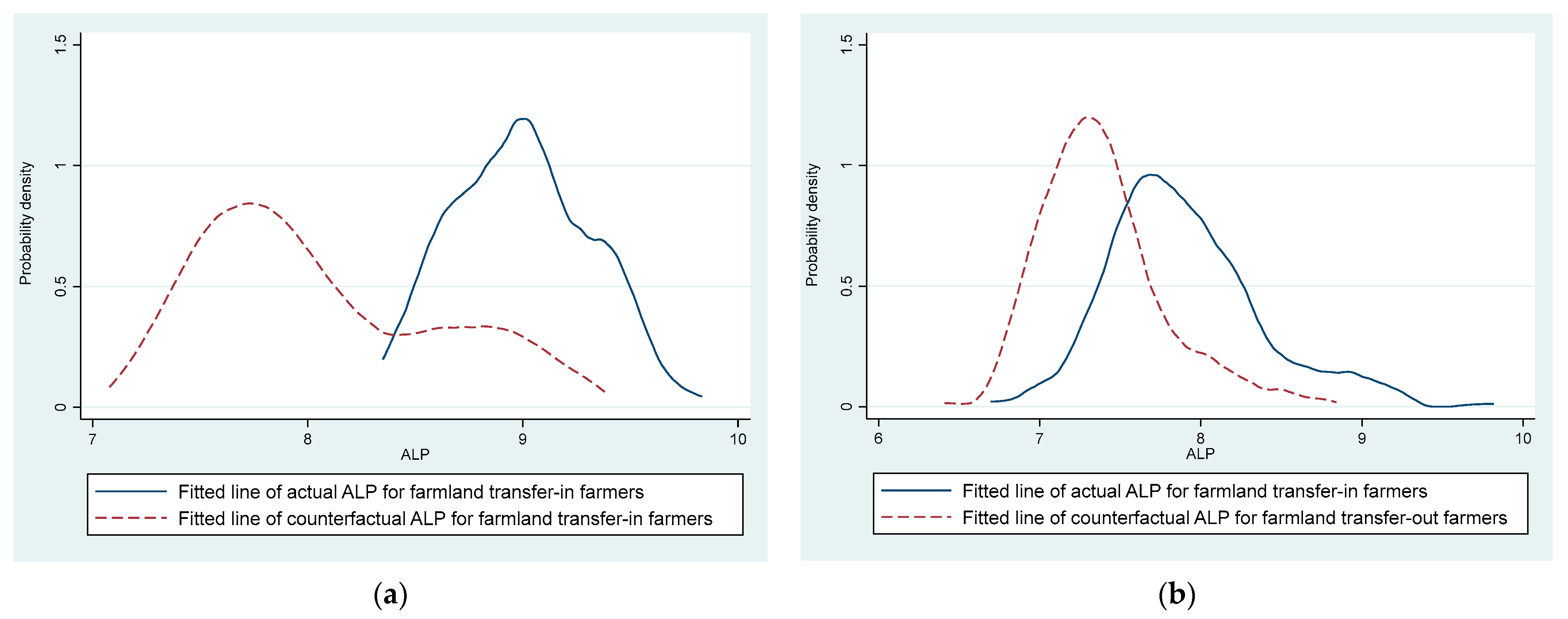
To further illustrate the distributional nature of the estimated treatment effects, we graphically compare the actual observed productivity distributions with their simulated counterfactual counterparts (
Figure 4 and
Figure 5).
Figure 4 illustrates the overall impact: the counterfactual ALP distribution for participating farmers shows a pronounced leftward shift compared to their actual distribution. This is compelling visual evidence that participation in the farmland transfer market prevents a significant decline in ALP.
This finding is robust when disaggregated by transfer direction. For farmers who transfer in farmland, the counterfactual distribution is clearly to the left of the actual distribution, confirming that ALP gains are real (
Figure 5a). Similarly, the analysis for farmers transferring out land shows that they would also have faced lower ALP in the counterfactual scenario without transfer (
Figure 5b).
4.4. Robustness Analysis with 2sls
To test the robustness of the model results, this section employs instrumental variables and conducts a two-stage least squares (2SLS) estimation. The village-level farmland transfer ratio is selected as the instrumental variable. As shown in
Table 5, columns (1), (3), and (5), the first-stage regression results reveal a significant positive correlation between the instrumental variable and the farmers’ farmland transfer behavior. In the weak instrument test, the computed Minimum Eigenvalue Statistic greatly exceeds Stock-Yogo’s critical value of 16.38 for a 10% maximal relative bias, thus ruling out the possibility of weak instruments. In the second-stage regression results, presented in columns (2), (4), and (6), the coefficients reflecting the impact of farmland transfer on ALP remain significantly positive after alleviating the endogeneity problem. This confirms the reliability and consistency of the original findings.
4.5. Mediation Effect Analysis
To explore the role of farmland transfer in the relationship between livelihood capital and ALP, this section employs a GSEM to test the mediating effect of farmland transfer (
Table 6), while the robustness of the mediation effect is further examined using the bootstrap sampling method (
Table 7). To address the potential endogeneity problem, this study employs the village-level farmland transfer ratio as an instrumental variable for farmland transfer.
According to the regression results in columns (1) and (2) of
Table 6, both farmers’ physical capital and social capital significantly increase the likelihood of farmland transfer.
Table 7 demonstrates that farmland transfer plays a statistically significant mediating role in the relationship between physical capital and ALP, as well as between social capital and ALP. The 95% confidence intervals derived from the bootstrap sampling method do not contain zero, indicating that both physical and social capital can enhance ALP through the channel of farmland transfer.
Further distinguishing between different types of farmland transfer behavior, the analysis reveals that physical, financial, and social capital enhance ALP through the channel of farmland transferring-in. Moreover, farmland transferring-in acts as a partial mediator in the relationship between physical capital and ALP, and similarly between social capital and ALP. It functions as a full mediator in the relationship between financial capital and ALP. In contrast, farmland transferring-out is found to only exhibit a partial mediating effect between physical capital and ALP.
4.6. The Heterogeneity Analysis
To analyze the heterogeneous effects of farmland transfer decisions on ALP, we first classify households according to their livelihood capital. Following the methods of Zhu et al. [
76], we use the entropy weight method to objectively assign weights to different livelihood capital indicators. Using the resulting composite scores, we then apply K-means clustering analysis to categorize the sampled households into three different categories: livelihood capital-abundant, livelihood capital-balanced and livelihood capital-deficient.
- (1)
Characteristic Analysis of Differentiated Livelihood Capital Farmers.
Table 8 details the livelihood capital characteristics for each farmer category. A general overview shows that livelihood capital-abundant farmers exhibit significantly higher levels of all types of capital compared to the other two groups. Conversely, the livelihood capital-deficient farmers have the lowest values for all types of capital.
In terms of the composition of capital, human capital is the most important asset in the livelihood portfolios of all farmer types. It is followed by social and financial capital. In contrast, natural and physical capital make up a comparatively smaller share of total livelihood capital for all categories of farmers.
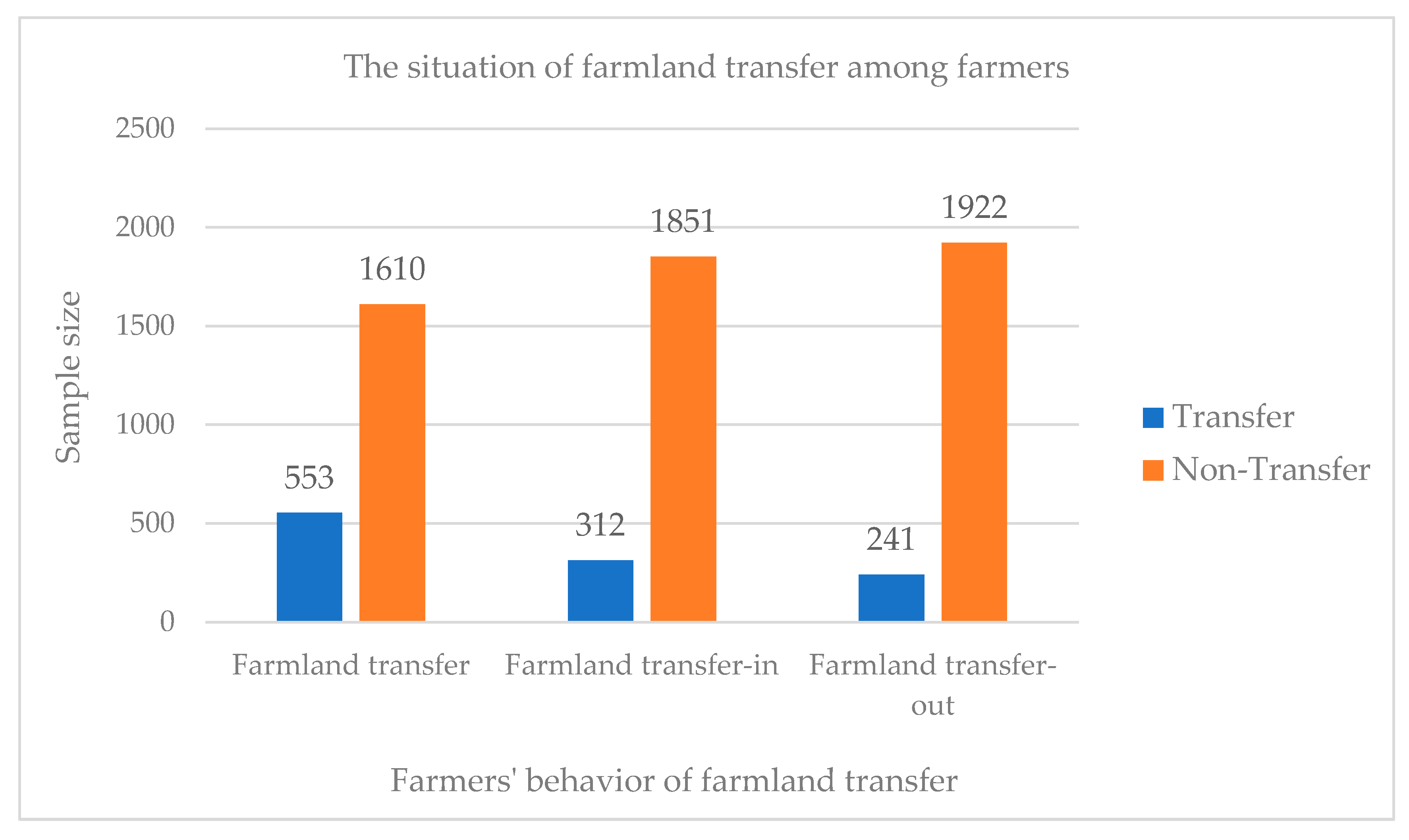
As indicated by the sample distribution in
Table 9, the livelihood capital-balanced farmers constitute the largest group, accounting for 44.38% of the total sample, whereas livelihood capital-deficient farmers are the least numerous.
As shown in
Table 9, the proportion of farmers engaged in farmland transfer is 30.87% among livelihood capital-abundant farmers, while this figure is 25.11% among livelihood capital-deficient farmers. Furthermore, for both capital-abundant and capital-balanced farmers, the percentage of those transferring-in land exceeds that of those transferring-out.
According to the data on farmland transfer behaviors by farmer type in
Table 10, livelihood capital-balanced farmers constitute the largest share in both the total land transfer sample and the farmland transferring-in sample, followed by capital-abundant farmers. In the total sample for farmland transferring-out, capital-balanced farmers again account for the highest proportion at 43.57%, followed by capital-deficient farmers at 29.87%.
- (2)
The ATT of Farmland Transfer on ALP for Differentiated Livelihood Capital Farmers
Table 11 reports the estimated effects of farmland transfer on ALP across farmers with varying livelihood capital. The results show a positive and statistically significant (
p < 0.01) impact of farmland transfer on ALP for all categories of farmers. However, the magnitude of this overall effect is not uniform. The largest productivity gains are observed for capital-abundant farmers, followed by capital-balanced farmers, while capital-deficient farmers benefit the least.
Analyzing the specific direction of the transfer, we find that the effect of transferring-in farmland on ALP shows significant differences between the different types of farmers. The results show that transferring-in farmland has the strongest productivity-enhancing effect for livelihood capital-deficient farmers (ATT = 1.024 ***), which is significantly higher than for livelihood capital-balanced farmers (ATT = 0.980 ***) and abundant farmers (ATT = 0.883 ***). Transferring-out farmland also has a significant positive impact on the ALP of all three groups, with the effect being greater for livelihood capital-balanced households than for the other two.
Crucially, even after controlling for farmer heterogeneity, there is a clear asymmetry between the two transfer modes. For a certain category of farmers, the productivity enhancement from transferring-in farmland significantly outweighs that from transferring-out.
5. Discussion
This study systematically reveals the complex interactions among household livelihood capital, farmland transfer decisions and ALP in the context of China’s agricultural modernization. Our findings not only confirm the comprehensive and structural positive effects of farmland transfer, but more importantly, provide suggestive evidence for understanding policy heterogeneity by introducing the perspective of livelihood capital differentiation.
First, this study identifies the key elements of livelihood capital that influence farmers’ participation in farmland transfer and their ALP. Livelihood capital reflects a household’s capacity for action and determines their livelihood capital strategies and livelihood outcomes. From the perspective of farmland transfer decisions, farmers with abundant physical, financial, and social capital are more likely to participate in the farmland transfer market, which is consistent with the views of other scholars [
71,
77]. One plausible explanation is that farmers with abundant physical capital may choose to transfer in land to dilute the cost of fixed assets, expand their scale of operation, and achieve economies of scale. Similarly, farmers with high financial capital possess a greater capacity to pay land rents, thus increasing the likelihood of transferring in land in pursuit of scale-based operational benefits. Furthermore, social capital can reduce transaction costs associated with farmland transfers, thereby facilitating greater participation in the farmland transfer market [
46].
At the same time, physical capital plays a significant role in enhancing ALP. Financial capital plays a positive role in enhancing the ALP of farmland transfer-in farmers. Social capital can also increase the ALP of non-transfer farmers and non-transfer-out farmers. This is in line with the research viewpoints of other scholars [
34,
78,
79]. Within the realm of physical capital, productive assets contribute to labor productivity by substituting manual labor and improving production conditions. Abundant financial capital and smooth access to credit enable farmers to purchase advanced agricultural machinery and high-quality production materials, accelerating the replacement of traditional production elements with modern ones and providing the financial foundation necessary for productivity gains. Social capital exerts its influence through both informal and formal networks. A rich endowment of social capital allows farmers to obtain market information, technical knowledge, and policy updates at a lower cost, thereby reducing the risks of misguided decisions caused by information asymmetry. This, in turn, minimizes production and transaction costs and indirectly enhances ALP.
Second, the results demonstrate asymmetric pathways and path dependency. The farmland transfer has a positive effect on farmers’ ALP, but this effect is structural and asymmetric. Overall, whether transferring-in or transferring-out land, farmers’ ALP improves, providing strong empirical support for China’s ongoing farmland transfer policy. However, the effects are asymmetric: the productivity-enhancing effect of farmland transferring-in is more pronounced than that of transferring-out. This divergence is not accidental, but reflects two fundamentally different paths of agricultural adaptation. Farmland transferring-in acts as a transformative catalyst: it allows farmers to reach the “scale threshold” and sets in motion a virtuous cycle of capital-labor substitution, improved technology adoption and better bargaining power in input markets [
80]. This is the path to modern, intensive agriculture. Conversely, after transferring-out land, farmers can engage in “intensive cultivation” on their remaining small plots, with a low productivity frontier. They remain shackled by “diseconomies of scale”, which disincentivize mechanization and technological upgrading, thereby widening the efficiency gap between the two types of transfer.
Third, this study further reveals that the positive effects of physical and social capital on ALP are, to a significant extent, realized through the intermediary pathway of farmland transfer. The positive impact of financial capital on ALP is entirely dependent on the intermediary pathway of farmland transfer-in. In order to dilute the depreciation cost of fixed assets, abundant physical capital serves as the primary driving force behind farmers’ motivation to expand their scale of operation by transferring in land. After the land is transferred-in, the larger operational area creates favorable conditions for the efficient use of agricultural machinery, enabling the substitution of labor with mechanized processes, and thereby enhancing ALP. Large-scale agricultural operations require substantial financial support, and robust financial capital provides farmers with the necessary conditions to transfer in farmland. After the land is concentrated, sustained capital investment ensures that operators can adopt efficient production technologies, and by optimizing the combination of production factors, ultimately enhance ALP [
81]. In rural societies where kinship and geographic ties form the social fabric, farmers endowed with abundant social capital can leverage their social influence to facilitate farmland transfer and achieve contiguous large-scale operations [
46]. This, in turn, lays the groundwork for mechanized agricultural production and drives improvements in overall production efficiency.
Fourth, our study reveals heterogeneous impacts of farmland transfer on the ALP of farmers with different livelihood capital endowments. Although farmland transfer generally has an enhancing effect on the ALP of all farmer types, the productivity-enhancing effect of farmland transfer is largest for livelihood capital-abundant farmers, while it is smallest for capital-deficient farmers. This divergence is due to complementary assets: capital-abundant farmers have complementary assets that are suitable for large farms, such as financial capital and human capital (technical and managerial skills) [
69]. After transferring farmland, they can form a positive feedback loop of “capital-technology-scale”. They use mechanization to reduce marginal costs and use social networks to access market information. In this way, they expand into the production and sale of high-value-added agricultural products and create a multiplier effect for productivity [
82]. For capital-deficient farmers, however, the acquisition of land alone is insufficient. Without the necessary complementary inputs, they are unable to translate land size into efficiency gains. Therefore, relying solely on farmland transfer may be insufficient to help the most vulnerable groups and even risks exacerbating income inequality in rural areas. For livelihood capital-deficient farmers, however, their constraints in natural and financial capital may prevent them from affording technological inputs. Their long-term reliance on traditional cultivation methods thus results in a limited improvement in ALP [
56].
Finally, analyzing by the direction of the transfer, farmland transfer-in has a more significant effect on improving the ALP of livelihood capital-deficient farmers, while its effect is limited for capital-abundant farmers. One possible reason is that capital-deficient farmers face multiple capital shortages, possess the least initial natural capital, and their families may suffer from an insufficient effective operational area and a significant labor surplus. By transferring in land, they can, on the one hand, fill the “minimum effective scale” gap in their family operations. The expanded land area allows them to deploy surplus household labor into agricultural production, thereby generating increasing returns to scale [
32]. On the other hand, these farmers initially have lower agricultural technological efficiency. Transferring in land grants them access to technical training and services from government agencies. Through the adoption of basic technologies, such as improved seeds and soil-testing-based formula fertilization, they can significantly boost their marginal output [
83]. In contrast, livelihood capital-abundant farmers, at their existing technological level, have already achieved scaled operations and may be approaching the production possibility frontier. For them, expanding land area leads to diminishing marginal returns. Furthermore, any efficiency gains from transferring in more land may be constrained by insufficient managerial capacity. If further technological upgrades require high-cost investments, the relatively low input-output ratio results in a smaller increase in labor productivity.
For the capital-balanced farmers, land transferring-out is a path of “strategic exit and specialization”. Their various livelihood capitals are relatively balanced and they have certain non-agricultural skills and employment opportunities [
65]. By transferring-out land, they reallocate their labor to more profitable non-farm sectors while collecting land rents, thereby maximizing total household income and resource allocation efficiency [
84]. Farmland transfer-out has a limited enhancing effect on the ALP of livelihood capital-abundant farmers. This may be because these farmers have diversified household income sources, with agricultural income accounting for a relatively small proportion. Therefore, transferring out a portion of their land has a relatively minor impact on their household’s labor allocation, resulting in a limited enhancing effect [
56].
Overall, this study transcends the question of whether farmland transfers work, instead providing a nuanced answer to the question of how, for whom, and through what mechanisms they increase productivity. Our findings carry critical policy implications, advocating for a shift from one-size-fits-all policies to targeted, endowment-aware interventions in China and offering a vital analytical framework for other developing countries grappling with the complex interplay between market reforms and livelihood diversity. While this study offers important insights, we acknowledge its limitations, which also chart the course for future inquiry. First, the lack of data on the area of transferred farmland prevents an examination of the impact of transfer scale on ALP. Second, the CFPS survey does not differentiate inputs and outputs for different crops, making it impossible for this study to distinguish between the ALP of grain crops and cash crops. Third, since the latest updated data from the CFPS do not include statistics on household contracted land area, this study uses data from 2012 for this variable. This may introduce potential measurement errors in the assessment of natural capital. Finally, due to the lack of data on farmers’ actual working hours, this study could only use the number of farm laborers to represent labor input, which may introduce some error in the results. In future research, we will try to improve the data to address the shortcomings of this study.
6. Conclusions and Policy Recommendations
This study has examined the intricate nexus of livelihood capital, the Chinese farmland transfer market and household productivity within a dynamic socio-economic system, providing a perspective that goes beyond aggregate effects to uncover heterogeneity. Our research led to the following conclusions: (1) Farmers endowed with abundant physical, financial, and social capital demonstrate a higher propensity to engage in farmland transfers; moreover, these capital assets are instrumental in elevating their ALP. (2) Farmland transfer can be a powerful engine for ALP growth, and this conclusion still holds after robustness tests. However, the gains are asymmetric. The productivity-enhancing effect of transferring-in land is more pronounced than that of transferring-out. (3) The results of the mediation analysis reveal that the positive effect of physical, financial, and social capital on ALP is largely mediated through the pathway of farmland transfer. (4) The impact of farmland transfer on the ALP of farmers with heterogeneous livelihood capital is differentiated. The effect is largest for capital-abundant farmers and smallest for capital-deficient farmers. The effects of transferring farmland are structural for farmers with differentiated capital. For livelihood capital-deficient farmers, transferring in farmland absorbs surplus labor, significantly enhancing their ALP. For the capital-balanced, transferring-out is a rational strategy to reallocate their labor to higher-return non-farm sectors. This reveals that the farmland transfer market, rather than being a simple tool, is a complex arena where households execute distinct livelihood strategies.
Based on these findings, we propose the following policy implications:
First, enhance the system’s core infrastructure: it is essential to enhance the institutional environment of the farmland transfer market. This includes the creation of transparent information platforms, support for village-level transfer cooperatives and the establishment of secure, digital registration systems. Such measures will reduce transaction costs and increase market liquidity, benefiting all participants.
Second, implement targeted policies and measures to safeguard and support farmland transfer based on the different livelihood capital types of farmers.
For capital-deficient farmers, policy should focus on “pooling” land with the appropriate resources. This means that access to credit should be coupled with special land transfer loans from rural financial institutions. Challenges such as mortgage credit assessment for farmers can be tackled by leveraging big data and digital technologies, as exemplified by Ant Group’s “310” model. This should be combined with government-led technical advisory and vocational training programs to improve agricultural production capacities.
For capital-balanced farmers, policy should support the development of robust agricultural socialized service markets. By facilitating partnerships with leading agribusinesses through “contract farming” models, these farmers can ensure that their land remains productive under professional management while they successfully transform their labor to optimize overall household welfare.
For capital-abundant farmers, the focus should be on leveraging their existing advantages. Policies should incentivize a shift from mere scale expansion to deepening intensification and increasing total factor productivity. Subsidies for digital and precision agriculture technologies should be disbursed through mechanisms like competitive bidding and performance-based allocation, steering these actors towards a more sustainable and efficient frontier.