


Abstract
Punta Carola beach, located on San Cristóbal Island in the Galápagos Archipelago, exemplifies how island environments of recent human settlement can rapidly acquire cultural significance. Drawing on a survey of 201 residents, this study examines perceptions of the ecosystem services provided by Punta Carola, their relationship to subjective wellbeing, and attitudes toward alternative tourism and governance strategies. The findings reveal that the inhabitants of San Cristóbal recognize a wide range of tangible and intangible benefits that the natural environment of Punta Carola contributes to their quality of life, sense of belonging, and cultural identity, as well as recreational and aesthetic values. Life satisfaction was positively associated with perceptions of nature’s contribution, the maintenance of local ecological knowledge, and household income, while formal education correlated negatively. Residents identified freshwater and artisanal fishing as the most critical ecosystem services, reflecting their centrality to local livelihoods and wellbeing. The results also underscore widespread criticism of large-scale tourism projects perceived as exclusionary or unsustainable and highlight the importance of participatory governance schemes that legitimize local values. Punta Carola thus emerges as a “cultural landscape of resistance”, where external pressures catalyze identity construction and territorial rootedness. This case contributes to academic debates on socio-ecological resilience in fragile island contexts and offers actionable insights for inclusive planning in the Galápagos.
1. Introduction
The accelerated transformations currently affecting ecosystems worldwide have redefined the relationship between human societies and nature, generating new territories of meaning where ecological, social, and cultural processes converge [1,2]. Contemporary social–ecological systems not only reflect this dynamic co-evolution but also reveal how local communities build deep identity bonds with natural spaces over relatively short periods of time [3,4,5]. These processes challenge traditional conceptions of cultural heritage that privilege antiquity over the richness and depth of cultural and emotional meanings associated with a territory [6,7].
This conceptual evolution is supported by contemporary theoretical frameworks that recognize the multidimensionality of cultural landscapes [8]. In this paper, the term “cultural landscape” is used in a broad socio-ecological sense, referring to an integrated system of natural and cultural elements shaped by human interactions, meanings, and practices. Far from being conceived merely as physical environments, cultural landscapes represent lived spaces where uses, memories, knowledge, and relationships intertwine to give meaning to the territory [9]. Thus, the landscape is no longer a visual backdrop but becomes an active stage for everyday experiences, spatial organization, and community ties [7]. These everyday landscapes constitute a legitimate form of cultural heritage, even when they lack millenary or monumental histories [9].
In coastal and island contexts such as the Galápagos, where permanent human colonization is relatively recent [5], these symbolic bonds emerge rapidly and with unique depth. Recent research in coastal ecosystems [10] has shown that specific characteristics of marine environments—such as species diversity, beach type, and landscape attractiveness—significantly influence recreational preferences, cultural use patterns, and the wellbeing of local communities. In these territories, human practices such as artisanal fishing, tourism, or emerging activities like surfing interact with unique ecosystems, generating multiple goods and services that sustain not only subsistence and wellbeing but also the identity and cultural construction of local communities [1,11].
The case of Punta Carola beach, located on San Cristóbal Island in the Galápagos archipelago, constitutes a paradigmatic example of an emerging cultural landscape: a natural space that has acquired a dense set of social, affective, and political meanings for the local community in a relatively short historical period. Locally known as “playa del amor” (the beach of love), Punta Carola has historically served as a space for affective, social, and family encounters where generations have built deep emotional and community bonds. These shared experiences—from family gatherings to the forging of intimate relationships—have shaped a strong sense of territorial belonging within the community. Today, many of those who grew up closely linked to this place are leading its defense against external threats increasingly affecting Galápagos landscapes. Such threats include, among others, the impacts of tourism growth [12], the effects of climate change on biodiversity [13], and marine plastic pollution [14]. This symbolic attachment is intertwined with remarkable ecological richness, as Punta Carola harbors numerous marine and terrestrial species endemic to the archipelago [15], reinforcing its value as an emerging cultural landscape and as a contested social–ecological system.
Many conservation strategies have failed by disconnecting local communities from the stewardship of their territories, imposing “top-down” models that disregard their perceptions, knowledge, and territorial values [1]. Community survey methodologies have proven effective in this regard as tools to capture the sociocultural perception of the different services that ecosystems provide to people. These approaches reveal perceptions and territory–identity bonds that other quantitative or spatial methods often fail to detect [16,17]. Identifying and understanding how different social actors perceive ecosystem services has been shown to be fundamental for informed decision-making [18], particularly in areas where nature conservation is threatened by expanding economic activities [19]. Moreover, these methods are especially valuable for exploring the multidimensional nature of human wellbeing in cultural landscapes, including symbolic, spiritual, and affective aspects that transcend conventional economic assessments [20]. For this reason, it is urgent to promote methodologies that incorporate sociocultural perceptions into ecosystem service assessments, recognizing not only economic but also symbolic, identity, and affective values that shape human wellbeing in territories [10,21,22]. Landscape perception, mediated by direct experiences and specific cultural practices, is key to motivating pro-environmental attitudes and fostering responsible territorial appropriation by local inhabitants [23,24].
The application of these cultural convergence frameworks is particularly urgent in territories such as Punta Carola, where the accelerated construction of community cultural meanings occurs simultaneously with growing external extractive pressures. Research on cultural landscapes suggests that when local communities perceive threats to highly valued symbolic spaces, processes of territorial appropriation intensify [25], generating what could be termed “cultural landscapes of resistance.” In such contexts, understanding community perceptions of ecosystem services is not merely an academic exercise but an essential political tool for legitimizing the territorial demands of local communities in the face of unsustainable development pressures.
In this study, we analyze the multidimensional role of Punta Carola as an emerging cultural landscape, drawing on the social perceptions of San Cristóbal’s inhabitants. Specifically, we explore how these perceptions relate to subjective wellbeing, identity construction, and community strategies for protecting territorial and cultural values. Our specific objectives are: (SO1) to identify the sociocultural and subjective factors that best predict people’s life satisfaction in the study area; (SO2) to assess how different sociodemographic and cultural variables influence residents’ perceptions of the importance of various ecosystem services associated with the studied cultural landscape; and (SO3) to discuss the potential role of three alternative management and conservation strategies for Punta Carola within a cultural landscapes framework.
2. Materials and Methods
2.1. Study Area
San Cristóbal is one of the fifteen main islands that make up the Galápagos Archipelago, located in the Pacific Ocean, 960 km off the continental coast of Ecuador. The biodiversity of these volcanic islands has been favored by the convergence of three major ocean currents: the Humboldt Current from the south, the eastward South Equatorial Surface Current, and the subsurface Cromwell Current [26]. Less than two kilometers north of Puerto Baquerizo Moreno (the provincial capital), Punta Carola beach extends for 300 m and represents a coastal ecosystem of high ecological value, crucial for the conservation of numerous endemic and endangered species. Among the most notable are the Galápagos sea lion (Zalophus wollebaeki) and the marine iguana (Amblyrhynchus cristatus), both of which use the beach for reproduction [27,28].
San Cristóbal is the second most populated island in the archipelago, with 8155 inhabitants distributed across 2699 households [29]. Most of the population is concentrated in Puerto Baquerizo Moreno (89.4%), while only 10.6% reside in rural areas. More than three-quarters of San Cristóbal’s residents are employed in the service sector, mainly through tourism. In contrast, the secondary sector (construction, manufacturing) accounts for around 8% of the population, while the primary sector (agriculture, livestock, fishing) comprises 6% [29]. According to data from the Galápagos National Park, the island received 78,406 tourists in 2024, more than half of whom visited Punta Carola. This represents a 147% increase compared to 2019, reflecting the structural transformation San Cristóbal has experienced in recent years, shifting from a traditional economy based on primary activities to a service-based model centered on tourism [30].
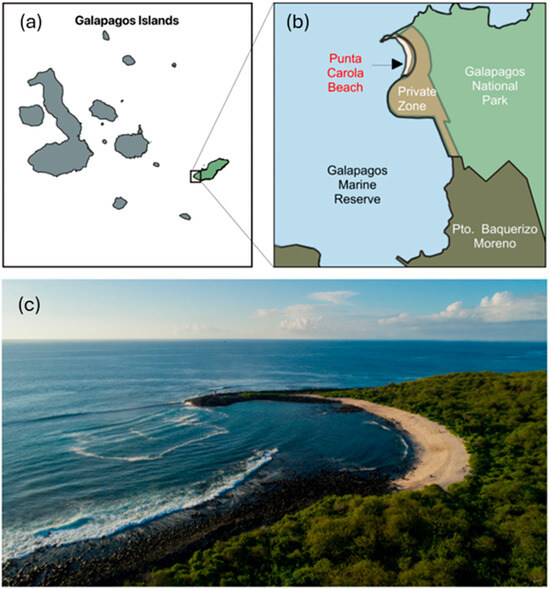
The continuous process of human colonization since 1866 has significantly altered the island’s native vegetation, particularly in the southwest—where Puerto Baquerizo Moreno is located—and in the highlands [31]. According to estimates by Rivas-Torres et al. [32], 0.3% of the island’s territory has already been converted to urban areas, mainly in the lowlands. For all these reasons, Punta Carola today constitutes not only a space of high biodiversity but also one of the most frequented sites on San Cristóbal, where tourist activities such as guided nature tours, surfing, photography, and snorkeling converge with the use and enjoyment of the space by the local community. This interaction, together with its proximity to the capital (just a ten min walk) and its location at the boundary between the Galápagos National Park (GNP) and various private areas (Figure 1), makes Punta Carola a key site for the sustainable management of the island. In recent years, these tensions have resulted in various social confrontations around the future of the site, where divergent perspectives on conservation, development, and community rights converge, highlighting the need to implement participatory governance approaches that integrate the ecological, cultural, and social dimensions of the territory.
Figure 1.
Study area: (a) the Galapagos Islands with San Cristóbal highlighted; (b) location of Punta Carola beach on the southwestern coast of the island; (c) photograph of Punta Carola beach.
2.2. Sampling Methods
We conducted a total of 201 surveys in two complementary phases: the first between 15 April and 15 May 2023, and the second between 28 June and 8 July 2024. The study population consisted of local inhabitants of San Cristóbal Island, with sampling restricted to individuals over 18 years old. Based on sociodemographic information for the island, we stratified the sampling by participants’ gender and age, as well as their profile and occupation (including fishers, farmers, livestock breeders, merchants, nature guides, and public and private sector workers).
The survey (Appendix A) included questions on socioeconomic and sociodemographic aspects (#1–10), as well as subjective perception questions regarding ecosystem services (#11–14) and human wellbeing, which was addressed through subjective life satisfaction (#15). At the end of the survey, participants were invited to choose one of three possible management strategies previously designed by the research team (#16): (a) participatory management, (b) strict conservation, and (c) economic development. For the assessment of ecosystem services, respondents were provided with a closed list of 12 ecosystem services: four provisioning, four regulating, and four cultural services. Furthermore, the interviewer presented three visual panels listing, describing, and illustrating examples of the 12 ecosystem services (Table S1, Supplementary Materials).
2.3. Data Analysis
To analyze the factors influencing subjective life satisfaction (SO1), we performed a stepwise multiple regression to identify the factors that best explained life satisfaction in the study area. Seven independent variables were used to build the models: gender, age, length of residence on the island, educational level, monthly income, perception of the maintenance of local ecological knowledge (LEK), and perception of the extent to which nature contributes to wellbeing. The Akaike Information Criterion (AIC) was used to select the most parsimonious model. Cronbach’s alpha was used to evaluate the internal consistency of the responses.
To analyze the effect of sociodemographic and cultural factors on the valuation of ecosystem services (SO2), we conducted a Redundancy Analysis (RDA), where perceptions of the importance of the 12 ecosystem services under study were used as dependent variables, and sociodemographic and cultural factors as explanatory variables. These explanatory factors included gender, age, length of residence on the island, educational level, perception of the maintenance of local ecological knowledge (LEK), monthly income, and whether respondents owned tourist accommodation facilities. Additionally, we evaluated the importance and vulnerability attributed to different ecosystem services by various actors using a scatter plot diagram, based on the frequency with which services were identified as important and vulnerable.
Finally, to explore the role of the three proposed management and conservation strategies in the study area (SO3), we conducted Kruskal–Wallis tests between the groups of participants who selected each of the strategies and both their valuations of ecosystem services and selected sociodemographic variables. All analyses were performed using XLSTAT 2014 software (Addinsoft, Paris, France).
3. Results
3.1. Factors Influencing Life Satisfaction
The multiple regression models showed that life satisfaction was explained by four key variables: (i) perception of nature’s contribution to wellbeing, (ii) perception of the maintenance of LEK, (iii) monthly income, and (iv) education level. Among these, only education level had a negative influence on life satisfaction, such that respondents with higher levels of formal education tended to report lower satisfaction with life (Table 1). Other predictors used in the analyses—such as gender, age, and length of residence on the island—did not appear in any of the models predicting life satisfaction in the study area.
Table 1.
Best multivariate regression model to estimate the effect of different factors on life satisfaction.
3.2. Perception of Ecosystem Services
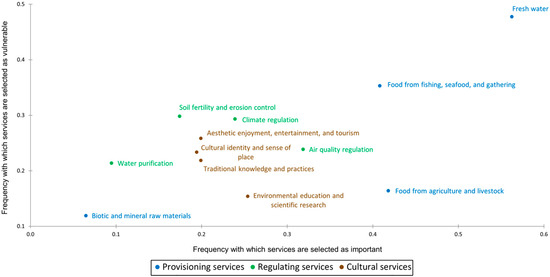
The ecosystem services perceived as most important (above-average values) were freshwater for consumption (selected by 56.2% of respondents), food from agriculture and livestock (41.8%), food from fishing, shellfish, and gathering (40.8%), and air purification (31.8%). In contrast, the services perceived as most vulnerable (above-average values) were freshwater for consumption (47.8%), food from fishing, shellfish, and gathering (35.3%), soil fertility and erosion control (29.9%), climate regulation (29.4%), and aesthetic enjoyment of landscapes, recreation, and tourism (25.9%) (Table S2, Supplementary Materials).
The analysis of social perceptions of ecosystem services in the study area also allowed us to identify those services recognized as critical by respondents, i.e., those simultaneously rated highly in terms of both their importance for wellbeing and their perceived vulnerability (understood as risk of degradation or loss). Two ecosystem services emerged as most critical: (i) freshwater for consumption and (ii) food from fishing, shellfish, and gathering (Figure 2).
Figure 2.
Scatter plot diagrams of the perceived importance and vulnerability of ecosystem services in the study area, both calculated as the frequency with which each service was selected as important/vulnerable by respondents.
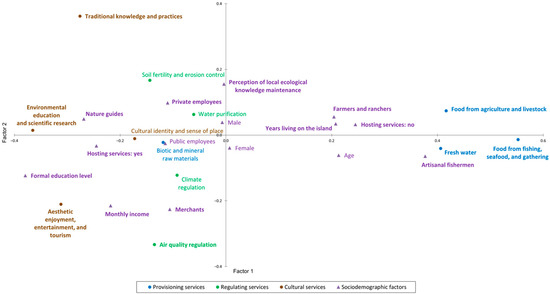
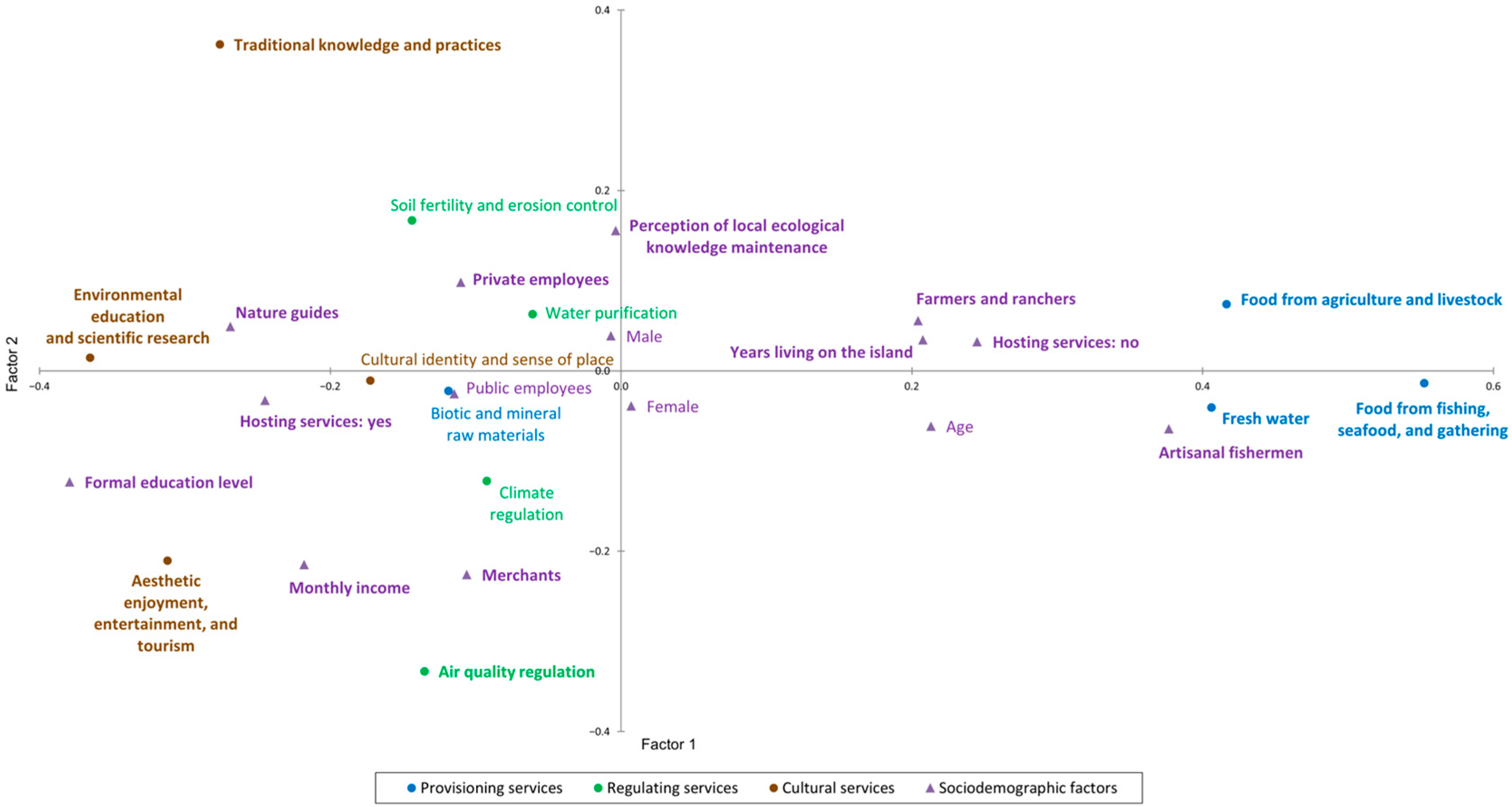
The RDA revealed a significant association between respondents’ sociodemographic characteristics and the relative importance they attributed to the studied ecosystem services (p < 0.001, 1000 permutations). The first three axes explained 76.5% of the total variance. Based on explained variance, total inertia, and eigenvalues, we focused on the first two axes as they captured the most relevant trends explaining differences in perceptions of ecosystem services (Figure 3).
Figure 3.
Biplot of the first two RDA axes, showing the relationships between perceived importance of ecosystem services (dependent variables) and sociodemographic variables (explanatory variables). Bold letters indicate variables with squared cosines higher than 0.40 and 0.10, respectively (Table S3, Supplementary Materials).
The first RDA axis (49.1% of total variance) revealed a contrast between three provisioning services (food from agriculture and livestock, food from fishing, shellfish, and gathering, and freshwater for human consumption) and two cultural services (environmental education and scientific research, and aesthetic enjoyment of landscapes, recreation, and tourism). We found that sociodemographic variables such as education level, ownership of accommodation services for tourists, length of residence on the island, and occupation influenced the importance respondents assigned to these services. Thus, individuals who had lived longer on the island, who did not own lodging services, and whose main occupation was in the primary sector (artisanal fishers, farmers, and livestock breeders) attributed higher importance to these provisioning services. In contrast, individuals with higher levels of formal education, who owned lodging services, and who worked as nature guides valued cultural services more.
The second RDA axis (16.0% of total variance) showed a contrast between the regulating service of air purification and the cultural service of traditional knowledge. Here, sociodemographic variables such as income, education level, occupation, and perception of LEK maintenance determined the importance attributed to these services.
3.3. Management and Conservation Strategies for Punta Carola
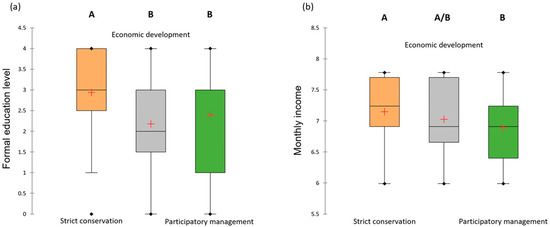
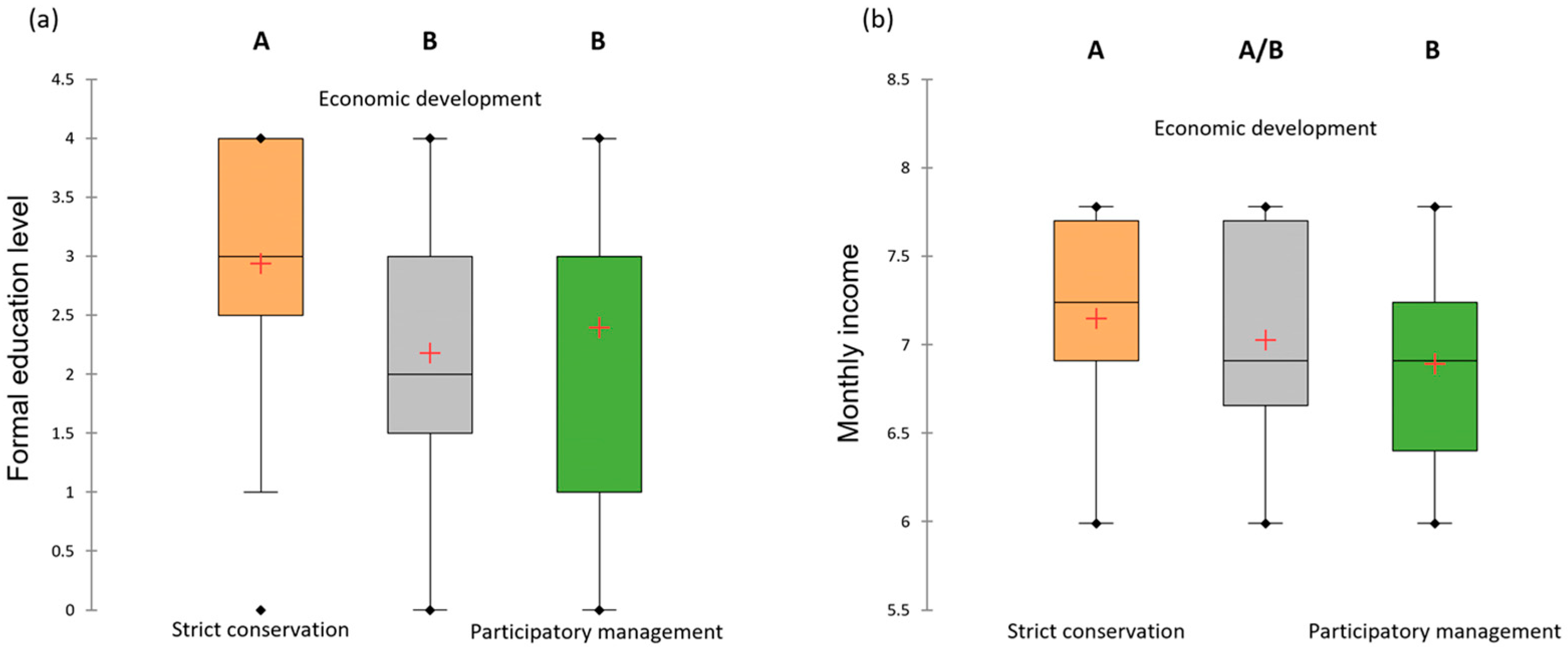
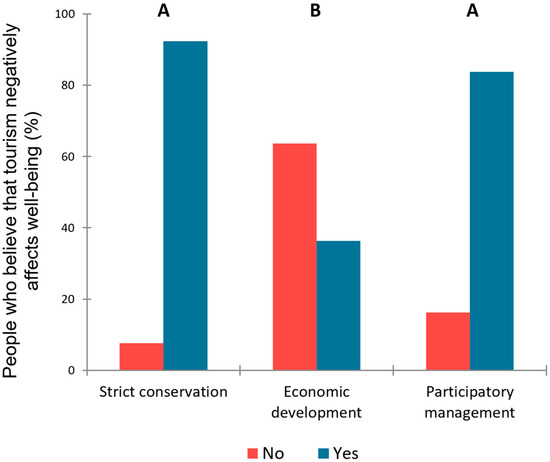
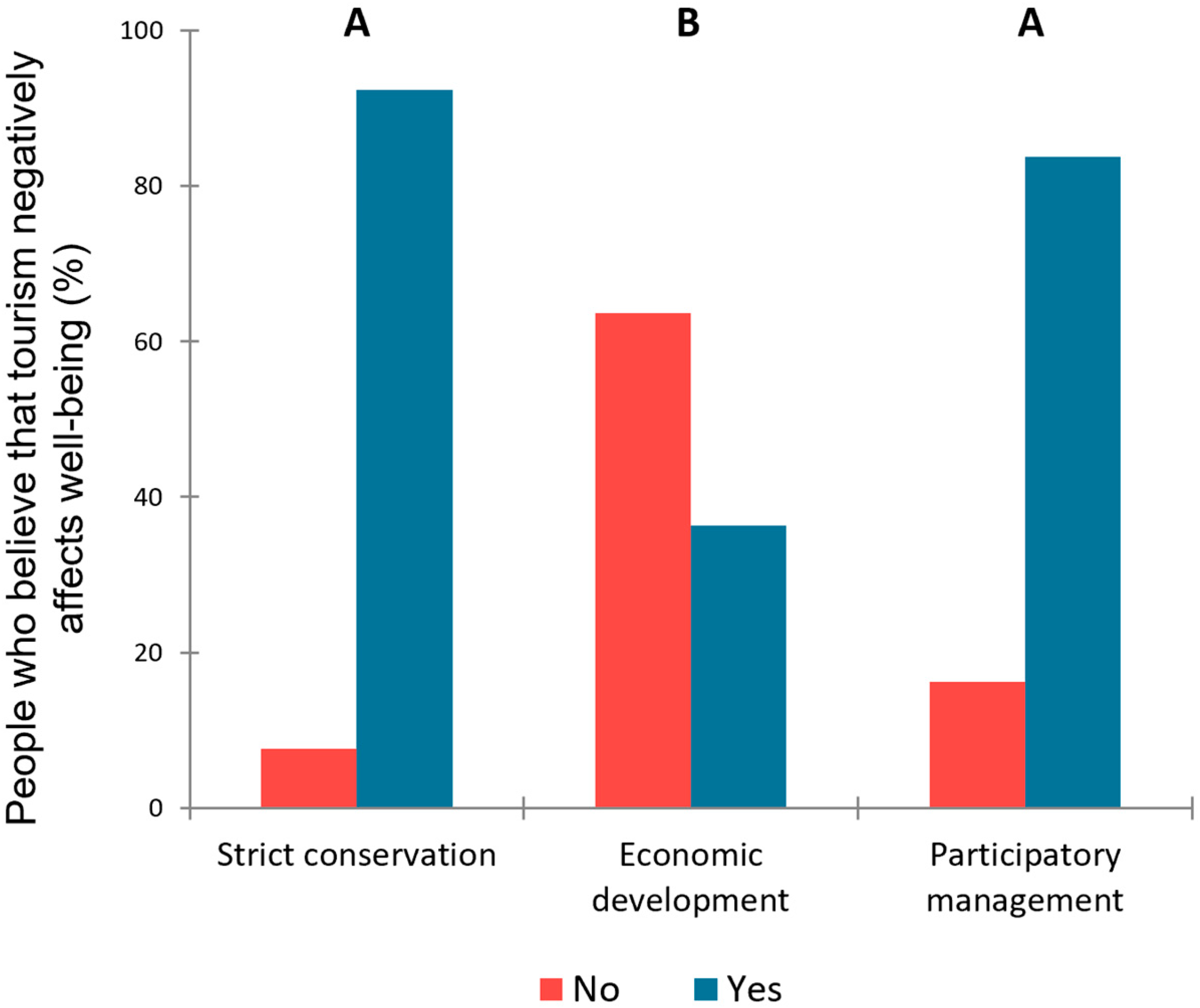
Among the three management strategies offered to participants in the survey, most opted for the participatory management model (55.2%), followed by strict conservation (39.3%) and economic development (5.5%). These groups differed significantly in some sociodemographic variables, such as education level (Kruskal–Wallis test, χ2 = 12.1, p < 0.01) and monthly income (Kruskal–Wallis test, χ2 = 9.9, p < 0.01) (Figure 4), as well as in their perception that the increase in tourism activities and hotel presence in Punta Carola could negatively affect human wellbeing (Kruskal–Wallis test, χ2 = 23.3, p < 0.001) (Figure 5).
Figure 4.
Differences across management strategies for respondents’ education level (a) and monthly income (b). Box plots show the mean (red crosses), median (central thick lines), 25% and 75% quartiles (box width), and upper and lower limits (T). Different letters indicate significant differences among strategies (post hoc Dunn’s tests, p < 0.001).
Figure 5.
Differences across management strategies in the perception that increasing tourism activities and hotel presence in Punta Carola negatively affects wellbeing. Different letters indicate significant differences among strategies (post hoc Dunn’s tests, p < 0.001).
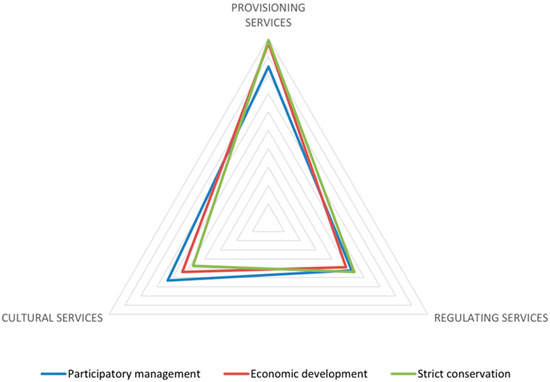
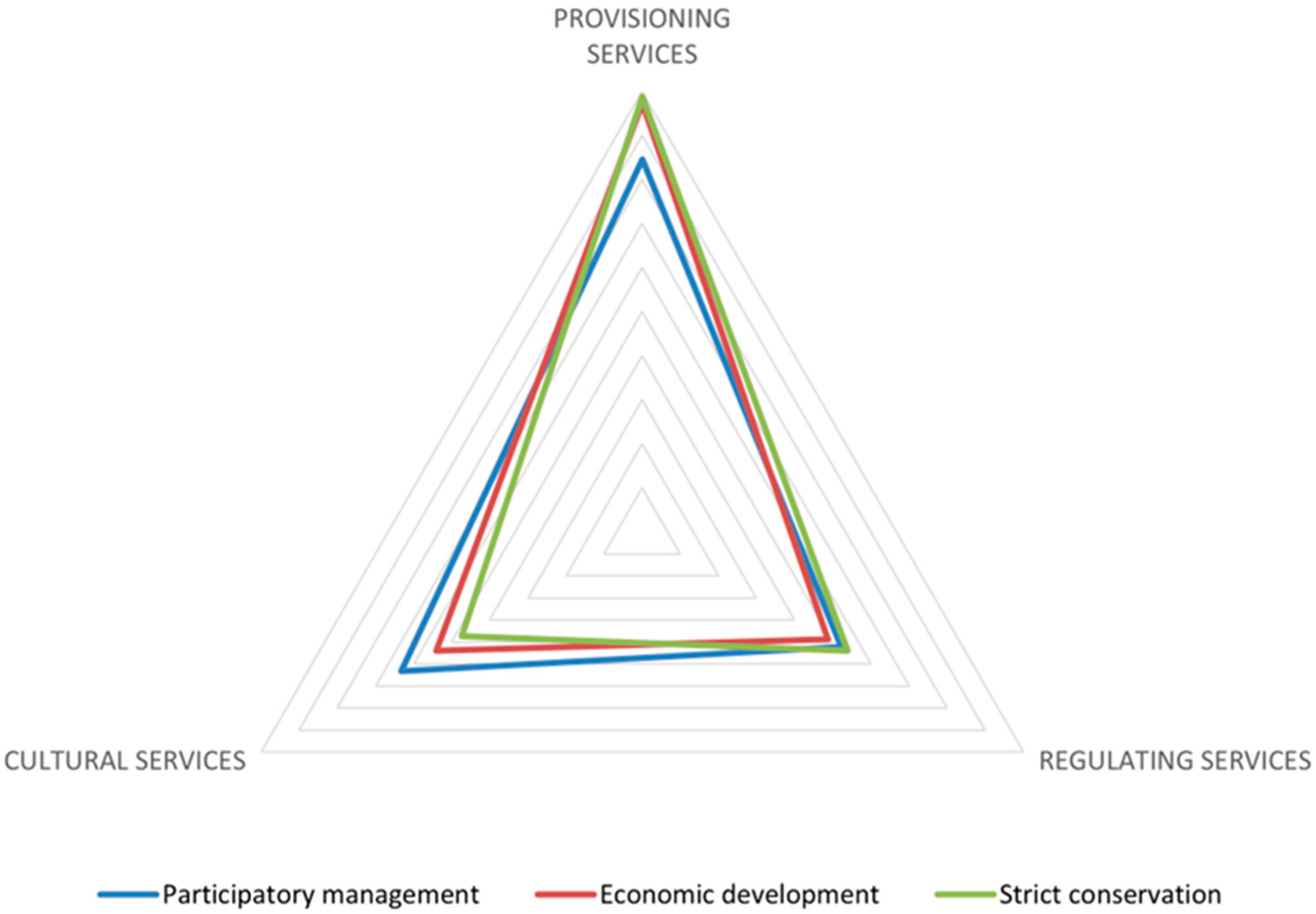
The valuations of the 12 ecosystem services varied considerably among respondents depending on the management strategy selected for Punta Carola (Figure S1, Supplementary Materials). Notably, significant differences were observed in the category of cultural services, whose valuation varied according to the selected management strategy (Kruskal–Wallis test, χ2 = 6.6, p < 0.05) (Figure 6).
Figure 6.
Radar diagram showing differences in the perception of provisioning, regulating and cultural services among the people selecting each management strategies.
4. Discussion
This study contributes to the academic debate on how cultural landscapes, even those with relatively recent human occupation, can acquire profound meanings over short periods of time [4,5]. Cases such as Punta Carola highlight that the cultural dimension of landscapes does not depend solely on the antiquity of settlement, but also on the intensity of shared experiences and the capacity of places to become references for identity, wellbeing, and community cohesion. In recent years, Punta Carola has been collectively appropriated as an intergenerational space for gathering, recreation, and environmental education, while simultaneously becoming a territory of resistance against threats derived from tourism and urbanization [12]. This dual process of accelerated identity construction coincides with what has been described in the literature on complex social–ecological landscapes, where external pressures intensify the symbolic appropriation of space [33]. In this context, the category of “cultural landscapes of resistance” acquires relevance, as it illustrates how external pressure can catalyze processes of territorial rootedness and defense that reinforce collective identity.
Regarding subjective wellbeing (SO1), our findings confirm the strong link between nature and life satisfaction [34,35,36]. The perception that nature contributes to wellbeing, along with the perception of maintaining LEK, were significant predictors of life satisfaction, in line with previous studies that emphasize the centrality of these connections in rural and traditional communities [21,37,38]. These results reinforce the idea that biodiversity conservation and the strengthening of local knowledge are essential not only for ecological sustainability but also for human wellbeing [39]. Moreover, our results suggest that educational and conservation policies could mutually benefit from incorporating LEK into curricula and recognizing its role in building collective wellbeing [40,41].
Another significant finding of this research was the negative association between formal education and subjective life satisfaction, indicating that respondents with higher levels of formal education tended to report lower personal life satisfaction than those with less education. This points to a possible “aspiration mismatch,” whereby increased but unmet professional expectations may generate frustration [42,43]. Conversely, Zorondo-Rodríguez et al. [44] found a positive relationship between the perception of maintaining LEK and subjective wellbeing, which suggests that formal schooling, when not integrating community values and local knowledge, can erode traditional knowledge systems [45]. Indeed, research has shown that the intergenerational loss of LEK, accelerated by modernization, globalization, and urbanization, reduces not only social–ecological resilience but also wellbeing and social cohesion [46,47]. These patterns highlight the importance of preserving biocultural refugia that maintain LEK as an essential component for both socio-ecological resilience and human wellbeing [46,48]. Furthermore, they invite reflection on the need to design more contextualized educational policies that integrate traditional knowledge in dialog with scientific knowledge, fostering intercultural education that enhances wellbeing.
Although more nuanced, respondents’ income showed a positive effect on life satisfaction. This result is consistent with previous studies in tribal, rural, and peasant communities in India [44], China [49,50], and Malaysia [51], which found a positive association between economic indicators such as income and subjective wellbeing [42]. However, other studies conducted in indigenous communities in Bolivia [52] and Ecuador [21] found that economic factors are not relevant in explaining subjective wellbeing. Faced with these disparities, some authors suggest that cultural contexts (such as the degree of integration into the market economy or the predominance of local versus foreign cultures) ultimately determine how people perceive the role of the economy in their wellbeing [21,49]. In the case of San Cristóbal Island, the positive income–wellbeing association may reflect the growing dependence of the local economy on tourism and services, which places monetary income in a more visible position within wellbeing perceptions.
Regarding ecosystem services (SO2), our results revealed that freshwater and artisanal fishing are perceived as the two most critical services [53,54], adding urgency to their management as they represent fundamental material pillars of community life on San Cristóbal Island. This finding underscores that conservation policies cannot be disconnected from the basic needs of the local population [55]. Integrating conservation strategies with the recognition of community rights and the guarantee of access to essential ecosystem services is indispensable for the sustainability of cultural landscapes [56].
In line with previous research, our results also showed that the sociocultural perception of ecosystem services varies significantly according to respondents’ sociodemographic characteristics [18,19,21]. We found that provisioning services critical for human subsistence in rural settings, such as food and water, were more highly valued by actors linked to the primary sector (farmers, ranchers, and fishers), who directly depend on them [57,58]. Conversely, and consistent with earlier studies, we found that cultural services traditionally associated with urban demand, such as environmental education, scientific research, aesthetic enjoyment of landscapes, recreation, and tourism [18], were more highly valued by actors working as nature guides, those linked to tourism, and respondents with higher levels of formal education [59,60].
This diversity of valuations coincides with previous findings showing that cultural services associated with scientific knowledge and education are mainly valued by researchers, managers, tourists, and urban residents, whereas basic provisioning services are predominantly valued by local fishers, farmers, and ranchers whose livelihoods depend on their management through traditional ecological knowledge [17,18,19]. If not adequately managed, these diverse perceptions may lead to tensions over land use, potentially jeopardizing local conservation goals [22] and resulting in policies that disproportionately affect specific stakeholder groups [61]. Incorporating analyses of the social dimension of ecosystem services into land management can promote a more equitable provision of nature’s contributions to people while reducing conflicts among stakeholders [62].
In terms of governance and management strategies (SO3), the majority preference for a participatory model in Punta Carola (55.2%) reflects a clear community orientation toward inclusive processes that articulate biodiversity, wellbeing, and cultural rights [63,64]. This finding aligns with Munévar-Quintero et al. [65], who stress that citizen participation is a fundamental right and an essential criterion for environmental governance, indispensable for legitimizing protected areas [66,67]. Along these lines, the Strategic Institutional Plan of the Galápagos National Park Directorate has for several years recognized the potential of environmental education and social participation as strategic pillars to achieve archipelago sustainability [68].
The differences observed regarding education, income, and tourism reinforce the idea that the perception and choice of territorial management strategies are strongly conditioned by social factors [69,70]. Likewise, our results revealed that the valuation of ecosystem services (mainly cultural) also changes depending on preferred management strategies. These findings are consistent with Schmidt et al. [16], who showed that sociocultural valuations of ecosystem services directly influence land use preferences and, consequently, the choice of territorial management models. Altogether, these results suggest that integrating the cultural and heritage values that structure local identity constitutes a key driver of nature conservation [71]. In Punta Carola, those who supported participatory management were also those who placed higher value on cultural ecosystem services, confirming the importance of collective memory and daily practices in ecosystem conservation and sustainability.
The finding that uncontrolled tourism negatively affects human wellbeing resonates with broader debates on the need to balance local niches of sustainable development with external pressures. This balance has been identified as essential to sustaining both biodiversity and local identities [72]. In this sense, López-Santiago et al. [1] criticize that traditional conservation policies have privileged biophysical control while marginalizing local perceptions, creating a disconnection between communities and ecosystem stewardship. Overcoming this deficit requires recognizing that cultural landscapes are living systems where biodiversity, wellbeing, and identity are interwoven. In Punta Carola, conflicts generated by uncontrolled tourism show that touristification can trivialize historical memory and deprive residents of their sense of belonging, as documented in other Latin American cultural landscapes [73].
Similarly, the sociodemographic differences observed among those who support strict conservation, those who prefer more developmental approaches, and those who advocate participatory management reveal that there is no single vision for the future of Punta Carola, but rather a field of tensions where different expectations and life trajectories converge. This finding coincides with recent proposals on cultural convergence frameworks in cultural landscape conservation, which emphasize the need to integrate spiritual, aesthetic, and community dimensions with technical expertise to avoid both the romanticization of nature and the commodification of territory [74].
The case of Punta Carola also illustrates a central aspect of the global debate: the tension between conservation and economic development in fragile territories. The growing pressure of unsustainable tourism, exemplified by projects such as the “Eco-Hotel San Cristóbal”, threatens both biodiversity and the cultural value of the site. This situation demonstrates that legal and planning frameworks are insufficient if not accompanied by effective mechanisms of citizen participation [75]. At the same time, it shows how external threats can reinforce community rootedness and foster processes of identity construction, turning cultural landscapes into arenas of territorial resistance.
5. Conclusions
Punta Carola beach illustrates how contemporary island landscapes can act as laboratories for understanding the co-evolution between nature and society. Its dual condition as a site of exceptional biodiversity and a place of deep symbolic rootedness positions Punta Carola as an emerging “cultural landscape of resistance”, where external pressures accelerate processes of identity construction and reinforce community cohesion. This case highlights the importance of recognizing that cultural landscapes are not static, but dynamic systems in which ecological, cultural, and social dimensions are intertwined. The effective conservation of such fragile and meaningful territories requires governance frameworks that move beyond traditional top–down approaches. Our results emphasize the need for participatory governance schemes that acknowledge and legitimize local perceptions and values, explicitly integrating the links between ecosystem services, subjective wellbeing, and cultural identity. While these findings provide a solid basis for inclusive planning, the dynamic nature of this landscape warrants a continuous research agenda: we suggest prioritizing long-term analyses of how perceptions evolve under changing tourism pressures, comparative studies with other island contexts, and, crucially, qualitative investigations into the design and implementation of effective participatory governance mechanisms. Only through such integrative and inclusive approaches will it be possible to harmonize biodiversity conservation with the quality of life of local communities and to secure a sustainable future for Punta Carola and other vulnerable island landscapes.
Supplementary Materials
The following supporting information can be downloaded at: https://www.mdpi.com/article/10.3390/land14112208/s1, Table S1: Panels used to describe and explain the ecosystem services; Table S2: Ecosystem services according to their frequency of importance and vulnerability; Table S3: Resulting Factor Scores from RDA; Figure S1: Radar chart for the 12 ecosystem services for the three management strategies studied.
Author Contributions
Conceptualization: M.A. and J.A.Q.; methodology: M.A. and J.A.Q.; formal analysis: M.A. and J.A.G.; investigation: M.A., J.A.Q. and J.A.G.; writing—original draft preparation: M.A. and J.A.Q.; writing—review and editing: M.A. and J.A.G.; supervision: J.A.G., J.A.Q. and M.A. contributed equally to this work. All authors have read and agreed to the published version of the manuscript.
Funding
This research received no external funding.
Data Availability Statement
The datasets generated during the current study are not publicly available due to confidentiality agreements with interviewees, but they are available from the corresponding author upon reasonable request.
Acknowledgments
We are deeply grateful to the Asamblea Comunitaria San Cristóbal, as well as to the fisher, farming, and merchant families, whose knowledge, experiences, and commitment have been essential for the development of this work. We also acknowledge the broader community of San Cristóbal, whose participation and voices continue to inspire processes of conservation and territorial defense. We gratefully acknowledge the National Institute of Statistics and Censuses (INEC) of Ecuador and the Ministry of Agriculture and Livestock—Galápagos District, for providing access to the databases that supported the analysis presented in this study. During the preparation of this manuscript, the authors used ChatGPT (OpenAI, GPT-5, San Francisco, CA, USA, 2025) for assistance with English language editing and style refinement. The authors have reviewed and edited all the content and take full responsibility for the final version of this publication.
Conflicts of Interest
The authors declare no conflicts of interest.
Appendix A
English summary of the questionnaire used in face-to-face surveys. The original questionnaire was administered in Spanish and included more questions. Only the questions pertinent to this research paper are presented here.
- Do you live in Galápagos? Yes/No
- How many years have you been living on the island?
- Where were you born?
- How old are you?
- What is your sex? Female/Male
- Which is the highest education level that you have reached
- ▪
- Illiterate
- ▪
- Basic studies/Primary studies
- ▪
- Secondary studies
- ▪
- Technologies/Undergraduate studies
- ▪
- Higher education
- Currently, what is your professional status or your main source of income?
- ▪
- Artisanal fishing
- ▪
- Agriculture/Livestock raising
- ▪
- Public employee
- ▪
- Private employee.
- ▪
- Business and market
- ▪
- Nature guide
- In which of these intervals does your monthly income fall?
- ▪
- Less than $400
- ▪
- Between $400–$800
- ▪
- Between $800–$1200
- ▪
- Between $1200–$1600
- ▪
- Between $2000–$2400
- ▪
- More than $2400
- Do you or your family provide any accommodation facilities (hotel, hostel, etc.) for tourists? Yes/No
- Do you believe that the increase in tourism activities and the presence of a hotel complex in the Punta Carola area could negatively affect your well-being and that of your family? Yes/No
- On a scale from 0 to 5, how much do you think nature contributes to your quality of life?
- Which of the following 12 benefits provided by nature would you say are the 3 most important for your well-being and quality of life?
- ▪
- Food from agriculture and livestock
- ▪
- Food from fishing, seafood, and gathering
- ▪
- Fresh water
- ▪
- Biotic and mineral raw materials
- ▪
- Climate regulation
- ▪
- Air quality regulation
- ▪
- Water purification
- ▪
- Soil fertility and erosion control
- ▪
- Environmental education and scientific research
- ▪
- Aesthetic enjoyment, recreation, and tourism
- ▪
- Traditional knowledge and practices
- ▪
- Cultural identity and sense of place
- And which of these would you say are the 3 that are in more danger of disappearing or degrading in the following years (the most vulnerable ones)?
- Do you think ancestral stories and knowledge about nature from your parents and grandparents are still present in your life?
- ▪
- Yes, completely
- ▪
- Yes, although some has been lost
- ▪
- Yes, although much has been lost
- ▪
- No
- On a scale from 0 to 5, how would you rate your satisfaction with your life?
- Which of the following management strategies would you prefer for Punta Carola?
- ▪
- The local community and institutions work together for the sustainability of Punta Carola. They develop a comprehensive participatory management plan for the area that respects the ecosystem’s dynamics and biodiversity. Sustainable local tourism is promoted, and the community is educated about the importance of conserving nature.
- ▪
- Urban development is allowed in Punta Carola. Economic gains from construction and tourism increase, but ecological degradation and damage to biodiversity also rise.
- ▪
- Punta Carola is declared part of the National System of Protected Areas of Ecuador. Construction is prohibited, access is limited, and tourism is controlled. Regulation by the State preserves biodiversity and the ecosystem’s ecological integrity.
References
- López-Santiago, C.A.; Aguado, M.; González Nóvoa, J.A.; Bidegain, I. Evaluación sociocultural del paisaje, una necesidad para la planificación y gestión sostenible de los sistemas socioecológicos. In Claves para la Gestión Humana de los Sistemas Naturales; Cerda, C.J., Palacios-Agundez, J.M., Eds.; Ocho Libros Editores: Santiago, Chile, 2019; pp. 105–137. Available online: https://repositorio.uam.es/handle/10486/720046 (accessed on 20 September 2025).
- Berkes, F.; Folke, C.; Colding, J. (Eds.) Linking Social and Ecological Systems: Management Practices and Social Mechanisms for Building Resilience; Cambridge University Press: Cambridge, UK, 2000. [Google Scholar]
- Brown, G.; Raymond, C. The relationship between place attachment and landscape values: Toward mapping place attachment. Appl. Geogr. 2007, 27, 89–111. [Google Scholar] [CrossRef] [Scilit]
- Bedoya, J.M.L. El Ecuador y los Paisajes Culturales en la Gestión del Territorio. Cad. Naui 2023, 12, 148–174. [Google Scholar]
- González, J.A.; Montes, C.; Rodríguez, J.; Tapia, W. Rethinking the Galapagos Islands as a complex social-ecological system: Implications for conservation and management. Ecol. Soc. 2008, 13, 1–26. [Google Scholar] [CrossRef] [Scilit]
- Taylor, K. Landscape and meaning: Context for a global discourse on cultural landscapes values. In Managing Cultural Landscapes; Routledge: Abingdon, UK, 2012; pp. 21–44. [Google Scholar]
- Mughal, M.A.Z. Landscape, space, and time: Navigating the cultural landscape through socio-spatial and socio-temporal organization in rural Pakistan. GeoJournal 2023, 88, 6175–6187. [Google Scholar] [CrossRef] [Scilit]
- Burlingame, K. Landscape geographies: Interdisciplinary landscape research and a new framework to apply landscape as method. Landsc. Res. 2025, 50, 754–765. [Google Scholar] [CrossRef] [Scilit]
- Melnick, R.Z. Protecting rural cultural landscapes: Finding value in the countryside. Landsc. J. 1983, 2, 85–96. [Google Scholar] [CrossRef] [Scilit]
- Reke, A.; Ruskule, A.; Lees, L.; Kotta, J.; Veidemane, K.; Kõivupuu, A.; Herkül, K.; Aps, R.; Jänes, H.; Barboza, F.R. Linking coastal cultural ecosystem services to human well-being and leisure preferences: Insights from the Baltic Sea region. Ecosyst. People 2025, 21, 2530103. [Google Scholar] [CrossRef] [Scilit]
- Díaz, S.; Fargione, J.; Chapin, F.S., III; Tilman, D. Biodiversity loss threatens human well-being. PLoS Biol. 2006, 4, e277. [Google Scholar] [CrossRef] [Scilit] [PubMed]
- Burbano, D.V.; Meredith, T.C. Effects of tourism growth in a UNESCO World Heritage Site: Resource-based livelihood diversification in the Galapagos Islands, Ecuador. J. Sustain. Tour. 2021, 29, 1270–1289. [Google Scholar] [CrossRef] [Scilit]
- Dueñas, A.; Jiménez-Uzcátegui, G.; Bosker, T. The effects of climate change on wildlife biodiversity of the Galapagos Islands. Clim. Change Ecol. 2021, 2, 100026. [Google Scholar] [CrossRef] [Scilit]
- Jones, J.S.; Porter, A.; Muñoz-Pérez, J.P.; Alarcón-Ruales, D.; Galloway, T.S.; Godley, B.J.; Santillo, D.; Vagg, J.; Lewis, C. Plastic contamination of a Galapagos Island (Ecuador) and the relative risks to native marine species. Sci. Total Environ. 2021, 789, 147704. [Google Scholar] [CrossRef] [Scilit] [PubMed]
- Bensted-Smith, R. (Ed.) A Biodiversity Vision for the Galapagos Islands; Charles Darwin Foundation and World Wildlife Fund: Puerto Ayora, Ecuador, 2002; Available online: https://www.researchgate.net/profile/Robert-Bensted-Smith/publication/358445842_A_biodiversity_vision_for_the_Galapagos_Islands_Charles_Darwin_Foundation_and_World_Wildlife_Fund_Ed_R_Bensted-Smith/links/6202eda0c2d279745e7629ec/A-biodiversity-vision-for-the-Galapagos-Islands-Charles-Darwin-Foundation-and-World-Wildlife-Fund-Ed-R-Bensted-Smith.pdf (accessed on 18 September 2025).
- Schmidt, K.; Walz, A.; Martín-López, B.; Sachse, L. Testing socio-cultural valuation methods of ecosystem services to explain land use preferences. Ecosyst. Serv. 2017, 26, 270–288. [Google Scholar] [CrossRef] [Scilit]
- López-Santiago, C.A.; Oteros-Rozas, E.; Martín-López, B.; Plieninger, T.; González Martín, E.; González, J.A. Using visual stimuli to explore the social perceptions of ecosystem services in cultural landscapes: The case of transhumance in Mediterranean Spain. Ecol. Soc. 2014, 19, 27. [Google Scholar] [CrossRef] [Scilit]
- Martín-López, B.; Iniesta-Arandia, I.; García-Llorente, M.; Palomo, I.; Casado-Arzuaga, I.; Amo, D.G.D.; Gómez-Baggethun, E.; Oteros-Rozas, E.; Palacios-Agundez, I.; Willaarts, B.; et al. Uncovering ecosystem service bundles through social preferences. PLoS ONE 2012, 7, e38970. [Google Scholar] [CrossRef] [Scilit]
- Bidegain, I.; Cerda, C.; Catalán, E.; Tironi, A.; López-Santiago, C. Social preferences for ecosystem services in a biodiversity hotspot in South America. PloS ONE 2019, 14, e0215715. [Google Scholar] [CrossRef] [Scilit]
- Kelemen, E.; García-Llorente, M.; Pataki, G.; Martín-López, B.; Gómez-Baggethun, E. Non-monetary techniques for the valuation of ecosystem services. In OpenNESS Ecosystem Services Reference Book; Potschin, M., Jax, K., Eds.; EC FP7 Grant Agreement no. 308428; 2016; pp. 1–5. Available online: https://connectingnature.oppla.eu/sites/default/files/uploads/sp-non-monetary-valuation.pdf (accessed on 18 September 2025).
- Aguado, M.; González, J.A.; Bellott, K.S.; López-Santiago, C.; Montes, C. Exploring subjective well-being and ecosystem services perception along a rural–urban gradient in the high Andes of Ecuador. Ecosyst. Serv. 2018, 34, 1–10. [Google Scholar] [CrossRef] [Scilit]
- Plieninger, T.; Dijks, S.; Oteros-Rozas, E.; Bieling, C. Assessing, mapping, and quantifying cultural ecosystem services at community level. Land Use Policy 2013, 33, 118–129. [Google Scholar] [CrossRef] [Scilit]
- Menatti, L.; Da Rocha, A.C. Landscape and health: Connecting psychology, aesthetics, and philosophy through the concept of affordance. Front. Psychol. 2016, 7, 571. [Google Scholar] [CrossRef] [Scilit] [PubMed]
- García-Llorente, M.; Martín-López, B.; Iniesta-Arandia, I.; López-Santiago, C.A.; Aguilera, P.A.; Montes, C. The role of multi-functionality in social preferences toward semi-arid rural landscapes: An ecosystem service approach. Environ. Sci. Policy 2012, 19–20, 136–146. [Google Scholar] [CrossRef] [Scilit]
- Hanaček, K.; Tran, D.; Landau, A.; Sanz, T.; Thiri, M.A.; Navas, G.; Del Bene, D.; Liu, J.; Walter, M.; Lopez, A.; et al. “We are protectors, not protestors”: Global impacts of extractivism on human–nature bonds. Sustain. Sci. 2024, 19, 1789–1808. [Google Scholar] [CrossRef] [Scilit]
- Palacios, D.M. Factors influencing the island-mass effect of the Galápagos Archipelago. Geophys. Res. Lett. 2002, 29, 2134. [Google Scholar] [CrossRef] [Scilit]
- Denkinger, J.; Gordillo, L.; Montero-Serra, I.; Murillo, J.C.; Guevara, N.; Hirschfeld, M.; Fietz, K.; Rubianes, F.; Dan, M. Urban life of Galapagos sea lions (Zalophus wollebaeki) on San Cristobal Island, Ecuador: Colony trends and threats. J. Sea Res. 2015, 105, 10–14. [Google Scholar] [CrossRef] [Scilit]
- Wikelski, M.; Nelson, K. Conservation of Galápagos marine iguanas (Amblyrhynchus cristatus). Iguana 2004, 11, 190–197. [Google Scholar]
- Instituto Nacional de Estadística y Censos (INEC). Perfil Territorial. Provincia Galápagos, Cantón San Cristóbal: Resultados del Censo de Población y Vivienda 2022 [Tablero Interactivo]; INEC: Quito, Ecuador, 2022; Available online: https://cubos.inec.gob.ec/AppCensoEcuador/ (accessed on 20 September 2025).
- Lucero, R.; Mera, M. Impacto del Turismo en el Desarrollo Económico Sostenible de la Isla San Cristóbal, Galápagos. Maest. Soc. 2024, 21, 2074–2084. [Google Scholar]
- Gordillo, J.G.; Kendrick, A.W. Isla San Cristóbal. Not. Galápagos 1989, 48, 40–48. [Google Scholar]
- Rivas-Torres, G.F.; Benítez, F.L.; Rueda, D.; Sevilla, C.; Mena, C.F. A methodology for mapping native and invasive vegetation coverage in archipelagos: An example from the Galápagos Islands. Prog. Phys. Geogr. 2018, 42, 83–111. [Google Scholar] [CrossRef] [Scilit]
- Mons, S.; Rodríguez, N.L. The complex socio-ecological landscape in Latin America: Transdisciplinary knowledge production to address diversity. Eur. Rev. Lat. Am. Caribb. Stud. 2023, 115, 1–23. [Google Scholar] [CrossRef] [Scilit]
- Nisbet, E.K.; Zelenski, J.M.; Murphy, S.A. Happiness is in our nature: Exploring nature relatedness as a contributor to subjective well-being. J. Happiness Stud. 2011, 12, 303–322. [Google Scholar] [CrossRef] [Scilit]
- Nisbet, E.K.; Zelenski, J.M. Nature relatedness and subjective well-being. In Encyclopedia of Quality of Life and Well-Being Research; Springer International Publishing: Cham, Switzerland, 2023; pp. 1–9. [Google Scholar]
- MacKerron, G.; Mourato, S. Happiness is greater in natural environments. Glob. Environ. Change 2013, 23, 992–1000. [Google Scholar] [CrossRef] [Scilit]
- Delgado, L.E.; Rojo Negrete, I.A.; Torres-Gómez, M.; Alfonso, A.; Zorondo-Rodríguez, F. Social-ecological Systems and Human Well-Being. In Social-ecological Systems of Latin America: Complexities and Challenges; Delgado, L., Marín, V., Eds.; Springer: Cham, Switzerland, 2019. [Google Scholar] [CrossRef] [Scilit]
- Das, M.; Das, A.; Seikh, S.; Pandey, R. Nexus between indigenous ecological knowledge and ecosystem services: A socio-ecological analysis for sustainable ecosystem management. Environ. Sci. Pollut. Res. 2022, 29, 61561–61578. [Google Scholar] [CrossRef] [Scilit] [PubMed]
- Majumdar, K.; Chaterjee, D. Perception of subjective well-being of the Lodha Tribe in West Bengal. Contemp. Voice Dalit 2025, 17, 227–241. [Google Scholar] [CrossRef] [Scilit]
- Ardoin, N.M.; Bowers, A.W.; Gaillard, E. Environmental education outcomes for conservation: A systematic review. Biol. Conserv. 2020, 241, 108224. [Google Scholar] [CrossRef] [Scilit]
- Kimmerer, R.W. Weaving traditional ecological knowledge into biological education: A call to action. BioScience 2002, 52, 432–438. [Google Scholar] [CrossRef] [Scilit]
- Reyes-García, V.; Babigumira, R.; Pyhälä, A.; Wunder, S.; Zorondo-Rodríguez, F.; Angelsen, A. Subjective wellbeing and income: Empirical patterns in the rural developing world. J. Happiness Stud. 2016, 17, 773–791. [Google Scholar] [CrossRef] [Scilit]
- Bednarik, Z. The Relationship Between Education and Happiness: Findings from the North Central and Northeast Regions; North Central Regional Center for Rural Development: West Lafayette, IN, USA, 2024. [Google Scholar] [CrossRef]
- Zorondo-Rodríguez, F.; Grau-Satorras, M.; Kalla, J.; Demps, K.; Gómez-Baggethun, E.; García, C.; Reyes-García, V. Contribution of natural and economic capital to subjective well-being: Empirical evidence from a small-scale society in Kodagu (Karnataka), India. Soc. Indic. Res. 2015, 127, 919–937. [Google Scholar] [CrossRef] [Scilit]
- McCarter, J.; Gavin, M.C. Perceptions of the value of traditional ecological knowledge to formal school curricula: Opportunities and challenges from Malekula Island, Vanuatu. J. Ethnobiol. Ethnomedicine 2011, 7, 38. [Google Scholar] [CrossRef] [Scilit]
- Gómez-Baggethun, E.; Mingorría, S.; Reyes-García, V.; Calvet, L.; Montes, C. Traditional ecological knowledge trends in the transition to a market economy: Empirical study in the Doñana natural areas. Conserv. Biol. 2010, 24, 721–729. [Google Scholar] [CrossRef] [Scilit]
- Gómez-Baggethun, E.; Corbera, E.; Reyes-García, V. Traditional ecological knowledge and global environmental change: Research findings and policy implications. Ecol. Soc. 2013, 18, 72. [Google Scholar] [CrossRef] [Scilit]
- Barthel, S.; Crumley, C.L.; Svedin, U. Biocultural refugia: Combating the erosion of diversity in landscapes of food production. Ecol. Soc. 2013, 18, 71. [Google Scholar] [CrossRef] [Scilit]
- Wu, R.; Tang, H.; Lu, Y. Exploring subjective well-being and ecosystem services perception in the agro-pastoral ecotone of northern China. J. Environ. Manag. 2022, 318, 115591. [Google Scholar] [CrossRef] [Scilit] [PubMed]
- Zhang, W. Social capital, income and subjective well-being: Evidence in rural China. Heliyon 2022, 8, e08705. [Google Scholar] [CrossRef] [Scilit] [PubMed]
- Howell, C.J.; Howell, R.T.; Schwabe, K.A. Does wealth enhance life satisfaction for people who are materially deprived? Exploring the association among the Orang Asli of Peninsular Malaysia. Soc. Indic. Res. 2006, 76, 499–524. [Google Scholar] [CrossRef] [Scilit]
- Masferrer-Dodas, E.; Rico-Garcia, L.; Huanca, T.; TAPS Bolivian Study Team; Reyes-García, V. Consumption of market goods and wellbeing in small-scale societies: An empirical test among the Tsimane’ in the Bolivian Amazon. Ecol. Econ. 2012, 84, 213–220. [Google Scholar] [CrossRef] [Scilit]
- Zhang, G.; Zhang, X.; Xie, L.; Zhang, Q.; Liu, D.; Wu, H.; Li, S. Perceived Importance and Bundles of Ecosystem Services in the Yangtze River Middle Reaches Megalopolis, China. Front. Environ. Sci. 2021, 9, 739876. [Google Scholar] [CrossRef] [Scilit]
- Pellowe, K.E.; Leslie, H.M. Ecosystem service lens reveals diverse community values of small-scale fisheries. Ambio 2021, 50, 586–600. [Google Scholar] [CrossRef] [Scilit]
- Chan, K.M.A.; Shaw, M.R.; Cameron, D.R.; Underwood, E.C.; Daily, G.C. Conservation planning for ecosystem services. PLoS Biol. 2006, 4, e379. [Google Scholar] [CrossRef] [Scilit]
- Hartel, T.; Fischer, J.; Câmpeanu, C.; Milcu, A.I.; Hanspach, J.; Fazey, I. The importance of ecosystem services for rural inhabitants in a changing cultural landscape in Romania. Ecol. Soc. 2014, 19, 42. [Google Scholar] [CrossRef] [Scilit]
- Temesgen, H.; Wu, W. Farmers’ value assessment of sociocultural and ecological ecosystem services in agricultural landscapes. Sustainability 2018, 10, 703. [Google Scholar] [CrossRef] [Scilit]
- Thiemann, M.; Riebl, R.; Haensel, M.; Schmitt, T.M.; Steinbauer, M.J.; Landwehr, T.; Fricke, U.; Redlich, S.; Koellner, T. Perceptions of ecosystem services: Comparing socio-cultural and environmental influences. PLoS ONE 2022, 17, e0276432. [Google Scholar] [CrossRef] [Scilit]
- Lima, F.P.; Bastos, R.P. Perceiving the invisible: Formal education affects the perception of ecosystem services provided by native areas. Ecosyst. Serv. 2019, 40, 101029. [Google Scholar] [CrossRef] [Scilit]
- Casado-Arzuaga, I.; Madariaga, I.; Onaindia, M. Perception, demand and user contribution to ecosystem services in the Bilbao Metropolitan Greenbelt. J. Environ. Manag. 2013, 129, 33–43. [Google Scholar] [CrossRef] [Scilit]
- Jorda-Capdevila, D.; Rodríguez-Labajos, B. An ecosystem service approach to understand conflicts on river flows: Local views on the Ter River (Catalonia). Sustain. Sci. 2015, 10, 463–477. [Google Scholar] [CrossRef] [Scilit]
- Castro, A.J.; Vaughn, C.C.; Julian, J.P.; García-Llorente, M. Social demand for ecosystem services and implications for watershed management. J. Am. Water Resour. Assoc. 2016, 52, 209–221. [Google Scholar] [CrossRef] [Scilit]
- Cruz, C.E.; Zizumbo, V.L.; Chaisatit, N. La gobernanza ambiental: El estudio del capital social en las Áreas Naturales Protegidas. Territorios 2019, 40, 29–51. [Google Scholar] [CrossRef] [Scilit]
- Martín, G. Ante las metas 2030 del convenio de biodiversidad. ¿Es la gobernanza de las áreas protegidas una alternativa a la gobernanza política tradicional? Rev. Univ. Geogr. 2021, 30, 111–144. [Google Scholar]
- Munévar-Quintero, C.; Valencia-Hernández, J.G.; Hernández-Gómez, N.; Aguirre-Fajardo, A.M.; Ramírez-Ríos, M. Gobernanza participativa en la conformación del Sistema Nacional de Áreas Protegidas de la ecorregión Eje Cafetero, Colombia. Jurídicas 2023, 20, 139–157. [Google Scholar] [CrossRef] [Scilit]
- Palomo, I.; Martín-López, B.; López-Santiago, C.; Montes, C. Participatory scenario planning for protected areas management under the ecosystem services framework: The Doñana social-ecological system in southwestern Spain. Ecol. Soc. 2011, 16, 23. [Google Scholar] [CrossRef] [Scilit]
- Palomo, I.; Montes, C.; Martin-Lopez, B.; González, J.A.; Garcia-Llorente, M.; Alcorlo, P.; Mora, M.R.G. Incorporating the social–ecological approach in protected areas in the Anthropocene. BioScience 2014, 64, 181–191. [Google Scholar] [CrossRef] [Scilit]
- Dirección del Parque Nacional Galápagos (DPNG). Plan Institucional DPNG 2021–2025; Dirección del Parque Nacional Galápagos: Puerto Ayora, Ecuador, 2021; Available online: https://www.galapagos.gob.ec/wp-content/uploads/2024/01/Plan_institucional_dpng_2021-2025-final.pdf (accessed on 18 September 2025).
- Cortés-Capano, G.; Hanley, N.; Sheremet, O.; Hausmann, A.; Toivonen, T.; Garibotto-Carton, G.; Soutullo, A.; Di Minin, E. Assessing landowners’ preferences to inform voluntary private land conservation: The role of non-monetary incentives. Land Use Policy 2021, 109, 105626. [Google Scholar] [CrossRef] [Scilit]
- Lee, C.L.; Wang, C.H.; Lee, C.H.; Sriarkarin, S. Evaluating the public’s preferences toward sustainable planning under climate and land use change in forest parks. Sustainability 2019, 11, 3149. [Google Scholar] [CrossRef] [Scilit]
- Walter, R.K.; Hamilton, R.J. A cultural landscape approach to community-based conservation in Solomon Islands. Ecol. Soc. 2014, 19, 41. [Google Scholar] [CrossRef] [Scilit]
- Plieninger, T.; van der Horst, D.; Schleyer, C.; Bieling, C. Sustaining ecosystem services in cultural landscapes. Ecol. Soc. 2014, 19, 59. [Google Scholar] [CrossRef] [Scilit]
- Ibarlucea, L. Patrimonio cultural y turismo en una ciudad patrimonio mundial: Encuentros (y desencuentros) en Colonia del Sacramento, Uruguay. In Gestión del Patrimonio: Paisajes Culturales y Participación Ciudadana; Galceran, C., Giordano, F., Eds.; Comisión del Patrimonio Cultural de la Nación, Intendencia de Río Negro, Universidad CLAEH: Montevideo, Uruguay, 2018; pp. 221–238. [Google Scholar]
- Djabarouti, J.; Ren, Y. Cultural convergence in heritage landscape conservation: A comparative study of Chinese and English traditions. Arts Commun. 2024, 2, 1923. [Google Scholar] [CrossRef] [Scilit]
- Riba-Hernández, L. Participación ciudadana para la conservación de los paisajes culturales de la UNESCO en América Latina: Crítica descolonial para el tránsito entre la teoría y la práctica. In Gestión del Patrimonio: Paisajes Culturales y Participación Ciudadana; Galceran, C., Giordano, F., Eds.; Comisión del Patrimonio Cultural de la Nación, Intendencia de Río Negro, Universidad CLAEH: Montevideo, Uruguay, 2018; pp. 97–114. [Google Scholar]

Disclaimer/Publisher’s Note: The statements, opinions and data contained in all publications are solely those of the individual author(s) and contributor(s) and not of MDPI and/or the editor(s). MDPI and/or the editor(s) disclaim responsibility for any injury to people or property resulting from any ideas, methods, instructions or products referred to in the content. |
© 2025 by the authors. Licensee MDPI, Basel, Switzerland. This article is an open access article distributed under the terms and conditions of the Creative Commons Attribution (CC BY) license (https://creativecommons.org/licenses/by/4.0/).