Review

A Review: Potential of Earth Observation (EO) for Mapping Small-Scale Agriculture and Cropping Systems in West Africa


1
German Remote Sensing Data Center, Earth Observation Center, EOC of the German Aerospace Center, DLR, 82234 Weßling, Germany
2
Institute for Geography and Geology, University of Wuerzburg, 97074 Wuerzburg, Germany
*
Author to whom correspondence should be addressed.
Land 2025, 14(1), 171; https://doi.org/10.3390/land14010171
Submission received: 7 November 2024 / Revised: 10 January 2025 / Accepted: 14 January 2025 / Published: 15 January 2025

Abstract

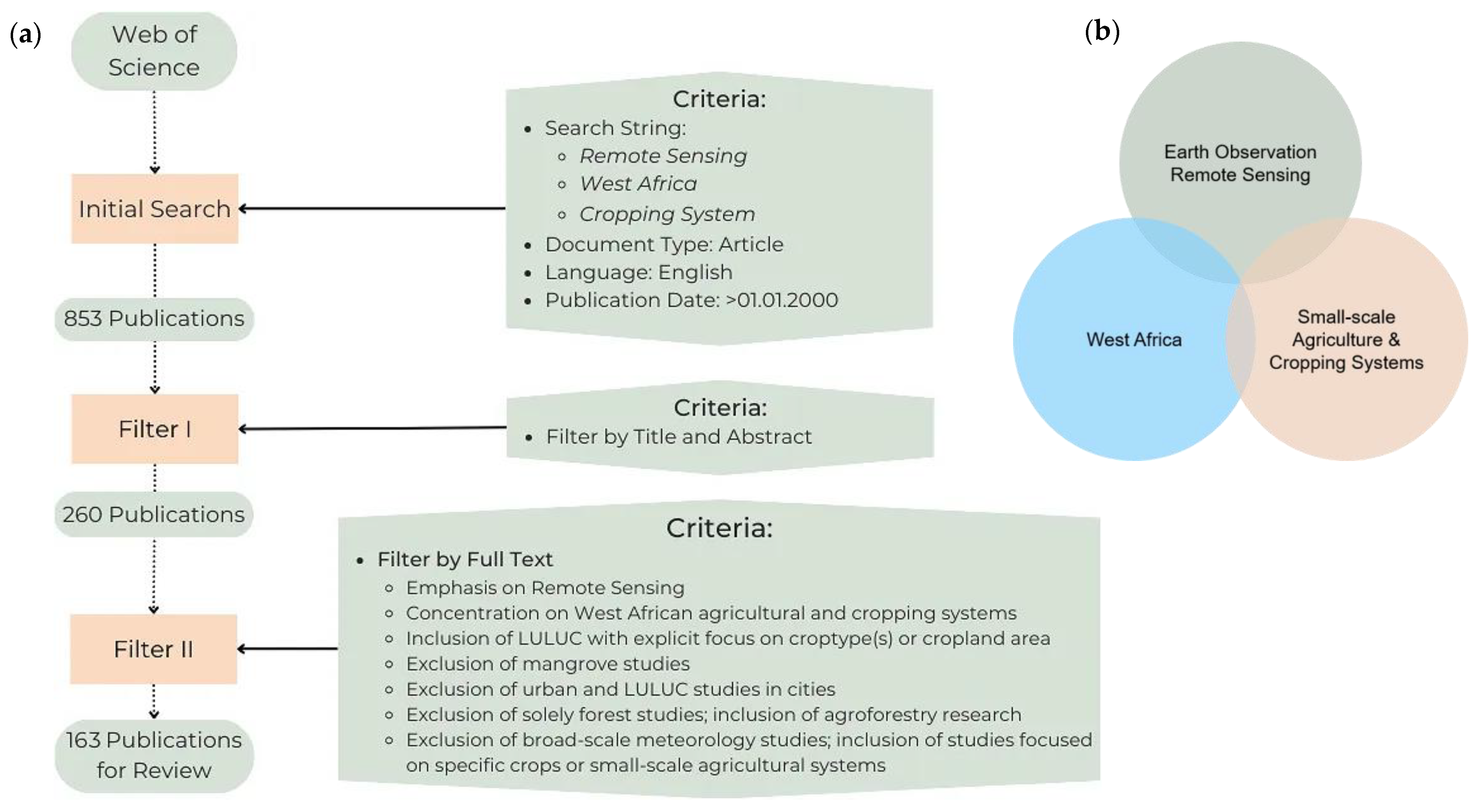
West Africa faces a complex range of challenges arising from climatic, social, economic, and ecological factors, which pose significant risks. The rapidly growing population, coupled with persistently low agricultural yield, further exacerbates these risks. A state-of-the-art monitoring and data derivation of agricultural systems are crucial for improving livelihoods and enhancing food security. Despite smallholder farming systems accounting for 80% of cultivated cropland area and providing about 42% of the total employment in West Africa, there exists a lack of a comprehensive overview of Remote Sensing (RS) products and studies specifically tailored to smallholder farming systems, which this review aims to address. Through a systematic literature review comprising 163 SCI papers sourced from the Web of Science database (Filter I), followed by a full-text review (Filter II), we analyze the RS sensors, spatiotemporal distribution, temporal scales, the crop types examined, and thematic foci employed in existing research. Our findings highlight the predominance of high to very high-resolution, multispectral sensors as the primary data source and we observe that a wide array of available sensors and datasets, along with increasing computing capacities, have shaped the field over the last years. By highlighting existing knowledge, this study identifies the potential of RS and pinpoints the key research gaps. This sets the stage for future investigations aimed at addressing critical challenges in West African smallholder agricultural systems.
Keywords: Africa; West Africa; review; remote sensing; earth observation; agriculture; farming; food security; monitoring; sustainable intensification Africa; West Africa; review; remote sensing; earth observation; agriculture; farming; food security; monitoring; sustainable intensification
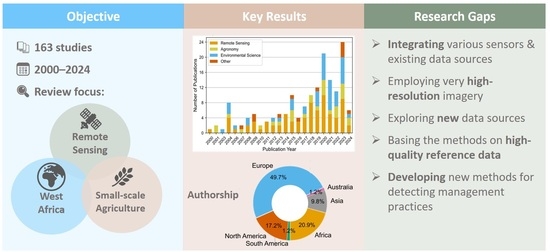
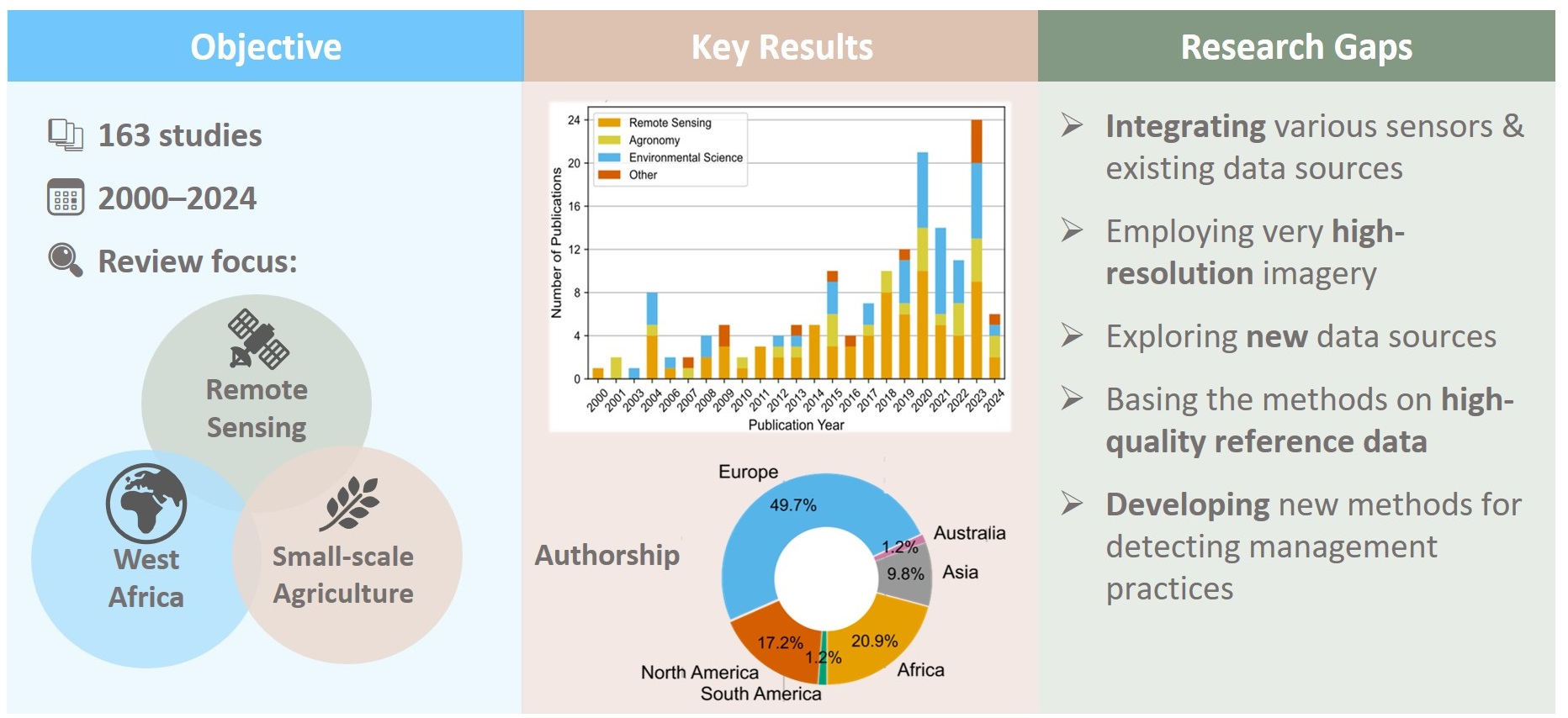
Graphical Abstract