Toward a Methodology of Spatial Neighborhood Evaluation to Uncover the “Invisible Spaces” in Neighborhoods Built Through State Initiatives Between 1945 and 1980


Abstract
1. Introduction—The Need to Develop a Methodology for Spatial Neighborhood Assessment
Evaluating the Quality of the Built Environment
2. Research Question and Methodology
- Prevalence Across Europe
- Rich Ideological Foundations
- Potential for Urban Renewal Related to Climate Change and Smart Cities Concepts.
- Unique Public Spaces and Veteran Communities
- Examining the planning characteristics as implemented by the planners while gaining an in-depth understanding of the planning intentions and the ideology underlying them;
- Examining the characteristics of intra-neighborhood spaces using selected evaluation tools for the built environment, such that the results of utilizing these tools will provide information regarding the potential emergence of the “invisible” beneficial spaces we are seeking.
3. Results—Method for Exposing the “Invisible Spaces”
3.1. First Spatial Analysis: From Ideology to Planning Features of the MHSINs at the Time of Planning
Changes in Themes Between the Construction Period and Present Days
3.2. Second Spatial Analysis: Spatial Characteristics That Currently Exist in MHSINs and How They Are Evaluated
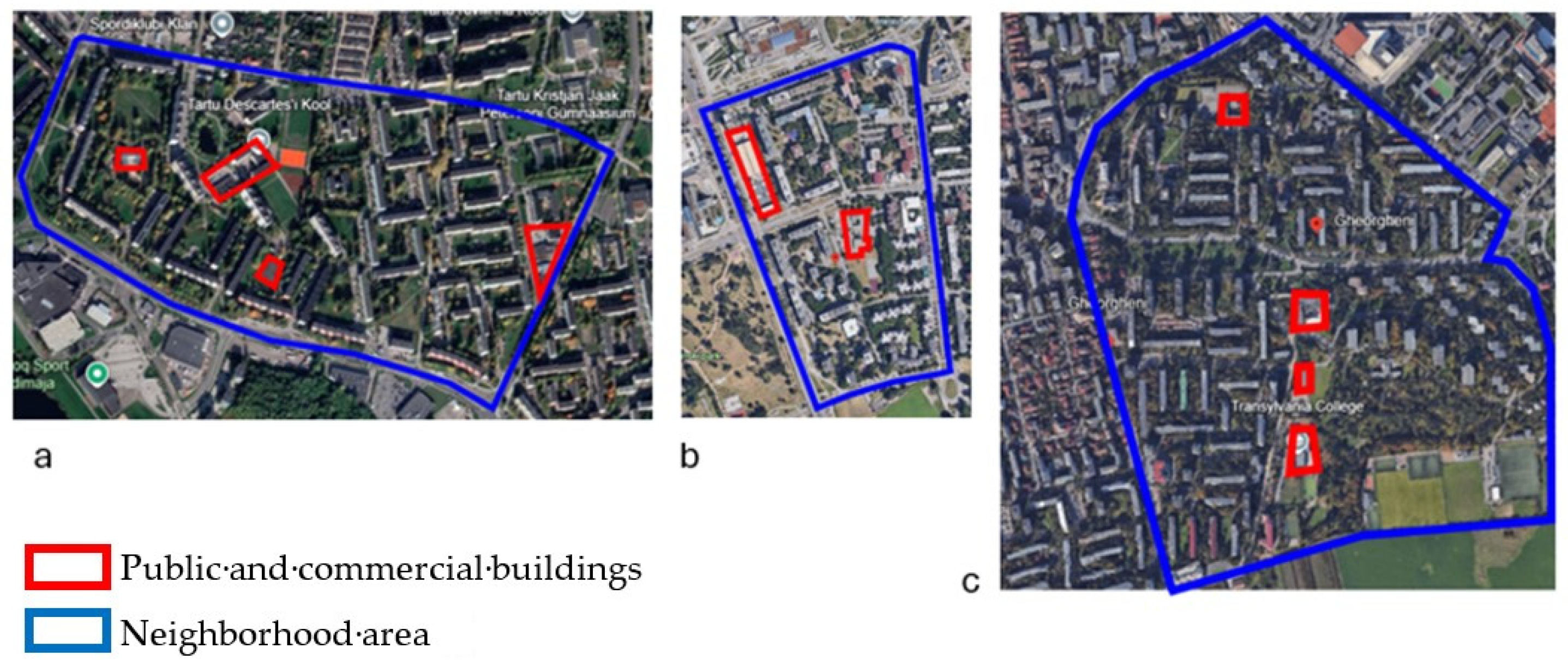
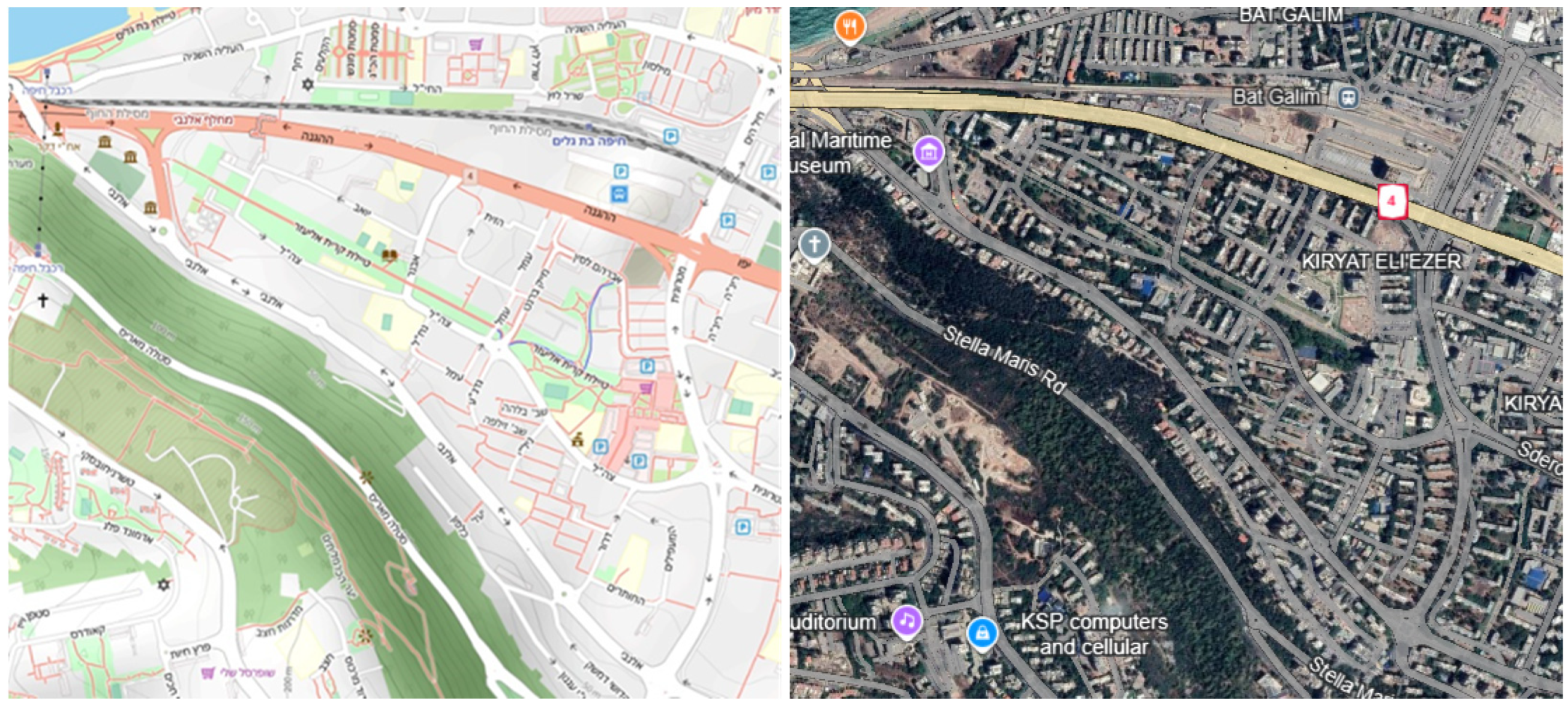
3.2.1. Urban Location in Proximity to Old Urban Centers
3.2.2. Spatial Human Diversity
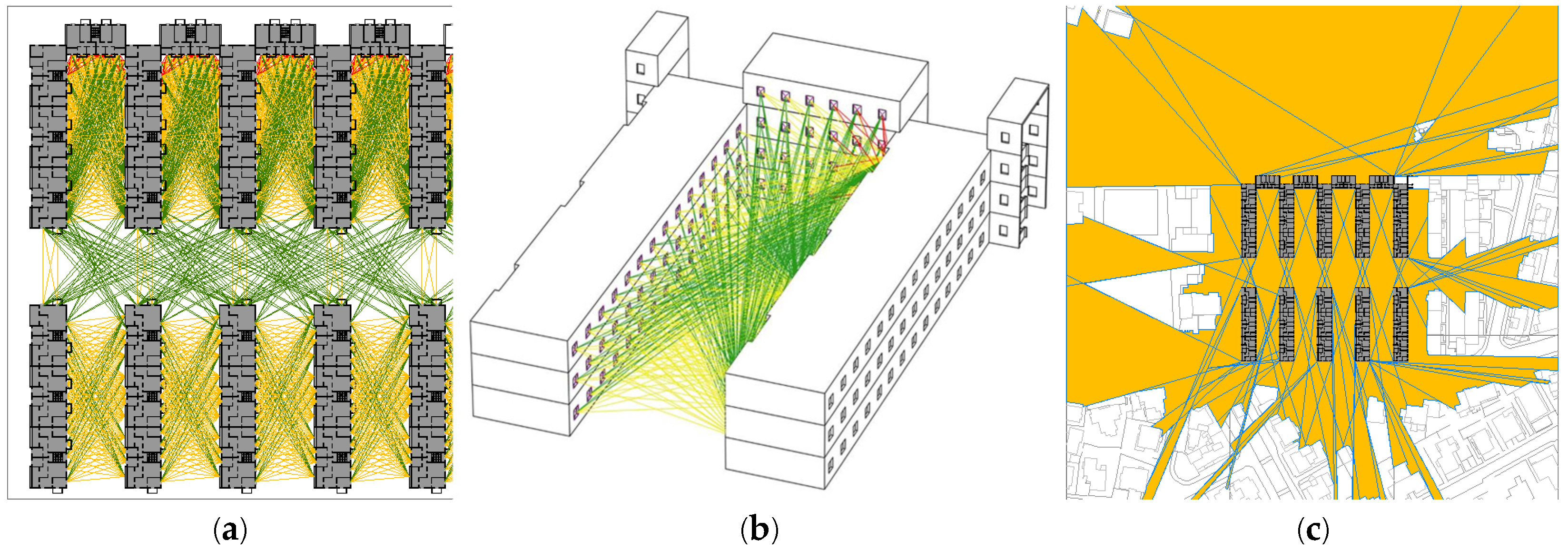
3.2.3. Neighborhood Visibility: Visual Openness to Views of Internal and External Landscapes as Well as Visual Privacy

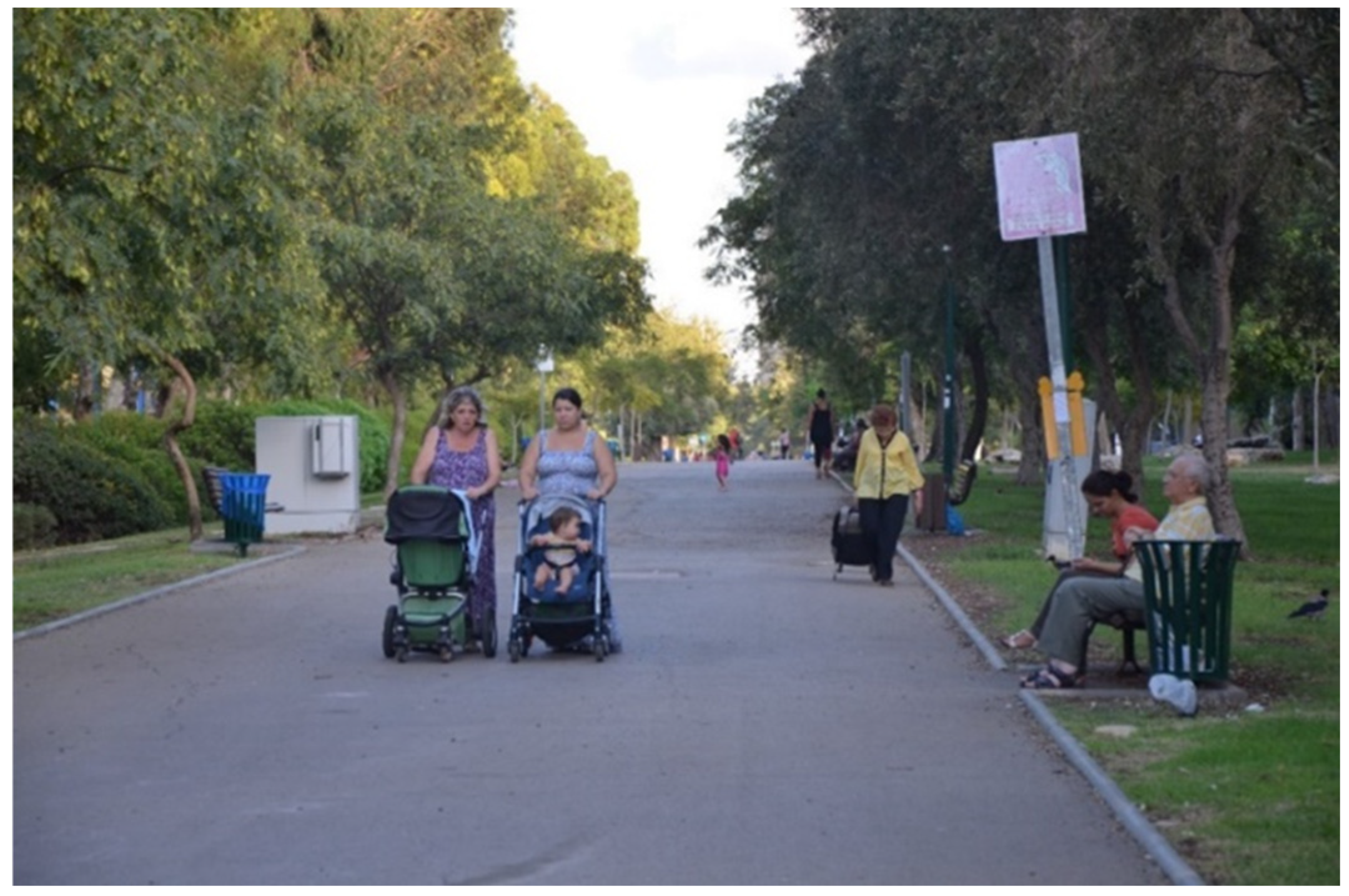
3.2.4. High Levels of Walkability, Hierarchical and Diverse
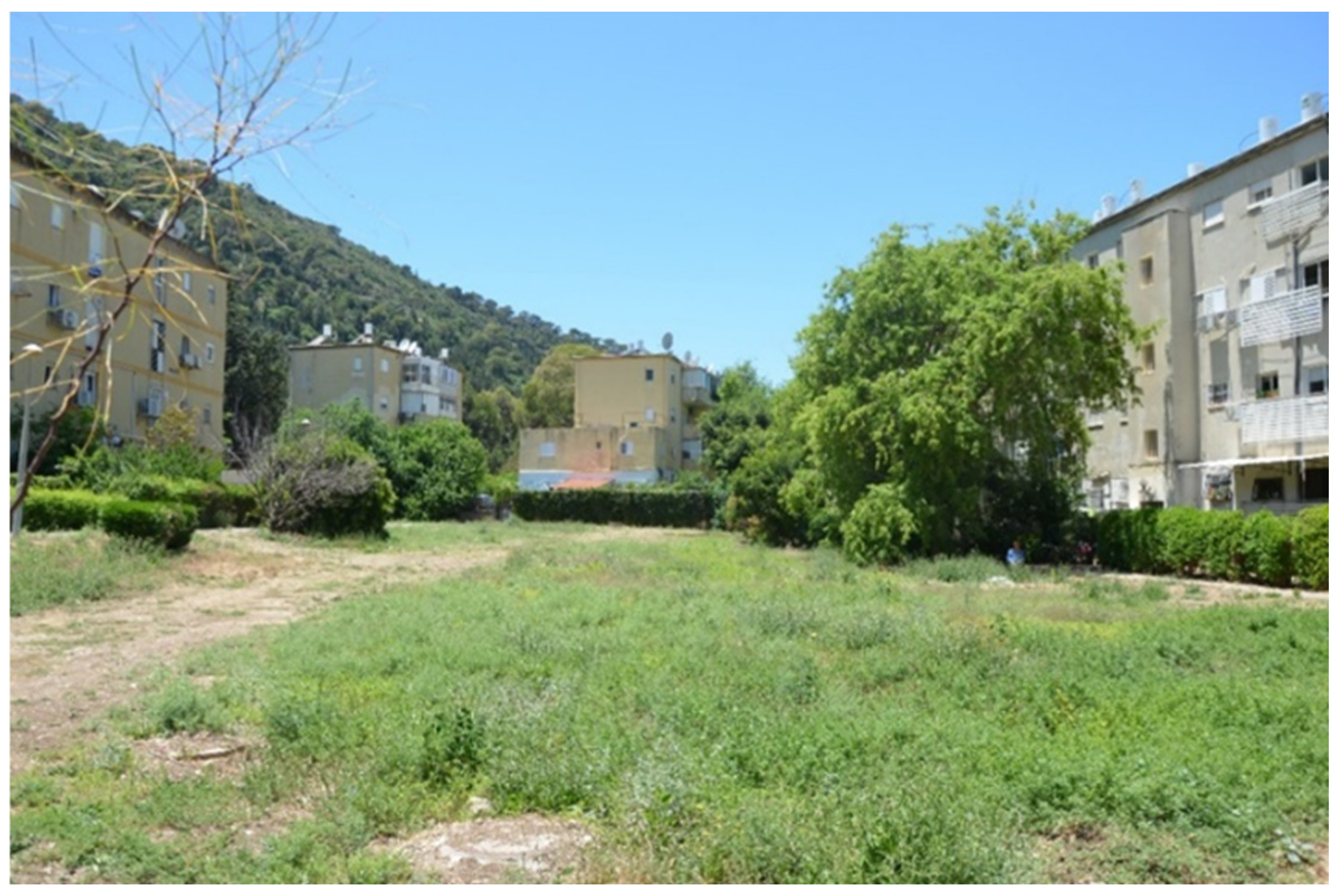
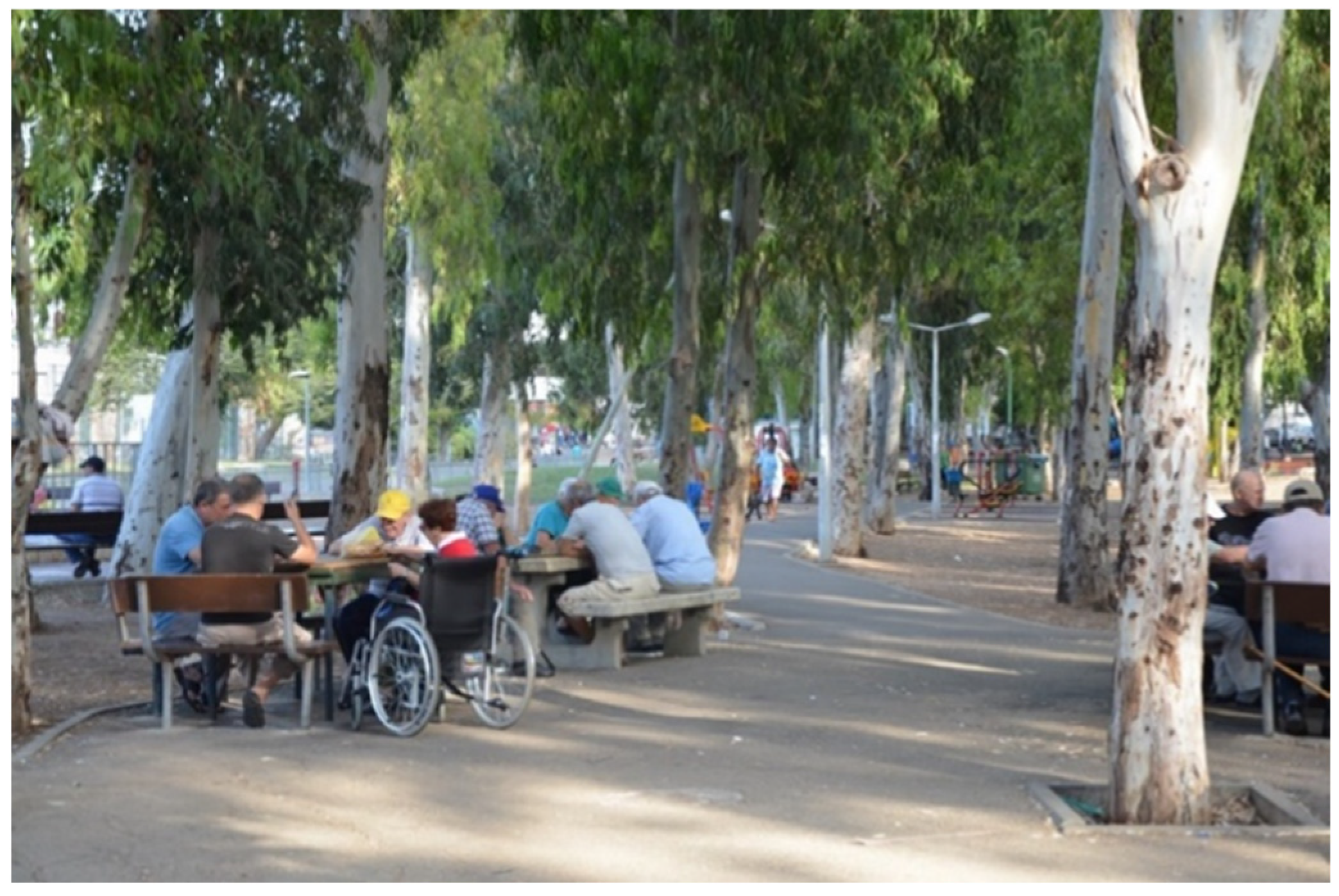
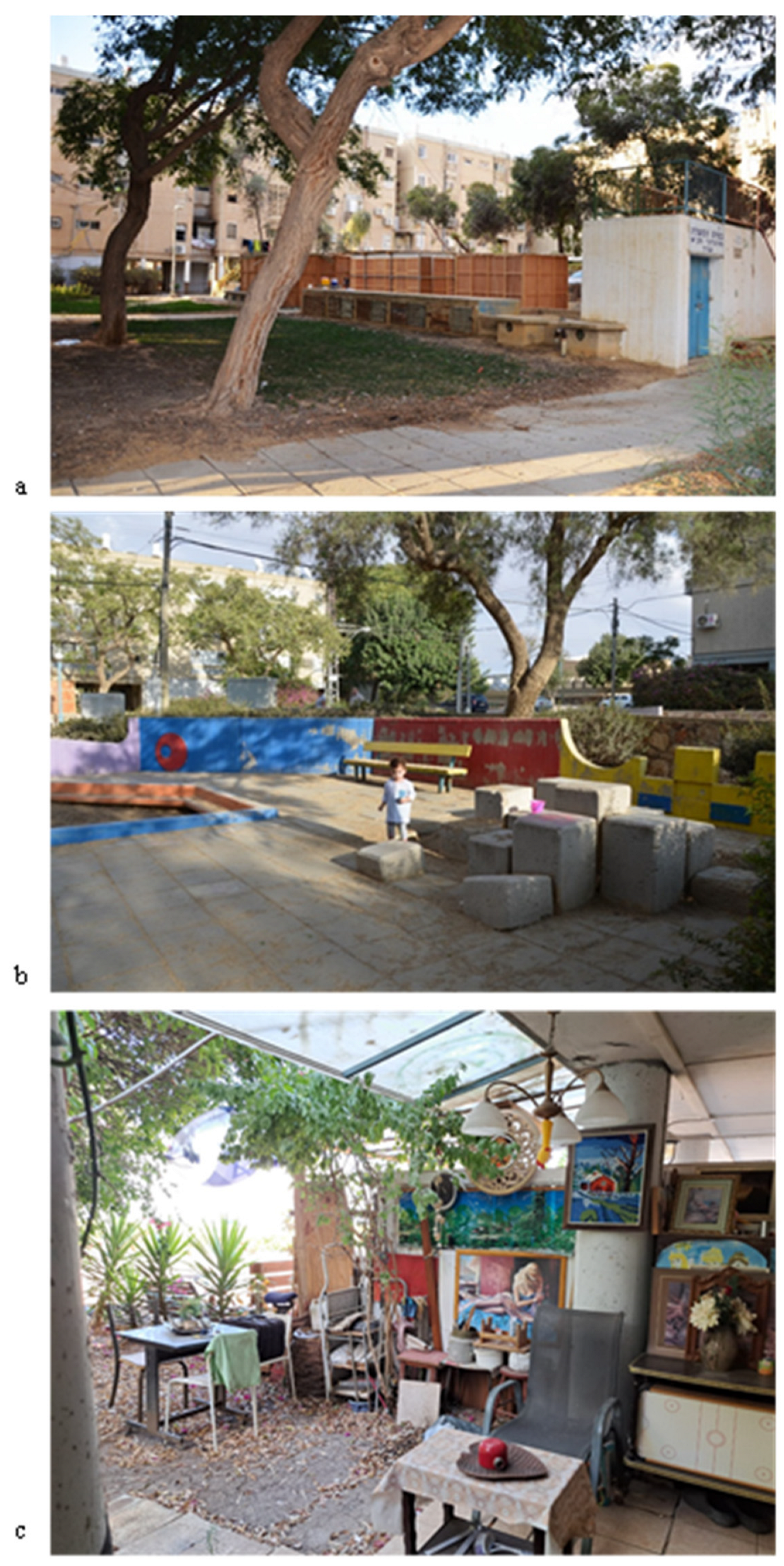
3.2.5. Intra-Neighborhood Spaces That Serve as Support System, or Discovering the Potential for the Creation of Beneficial “Invisible Spaces”
4. Discussion and Conclusions
Author Contributions
Funding
Data Availability Statement
Conflicts of Interest
References
- Perry, C. The neighborhood unit. In The City Reader; Original work published 1929; Routledge: London, UK, 2015; pp. 607–619. [Google Scholar]
- Park, Y.; Rogers, G.O. Neighborhood planning theory, guidelines, and research: Can area, population, and boundary guide conceptual framing? J. Plan. Lit. 2015, 30, 18–36. [Google Scholar] [CrossRef] [Scilit]
- Ewing, R.H.; Clemente, O.; Neckerman, K.M.; Purciel-Hill, M.; Quinn, J.W.; Rundle, A. Measuring Urban Design: Metrics for Livable Places; Island Press: Washington, DC, USA, 2013; Volume 200. [Google Scholar]
- Henry, D.; Gorman-Smith, D.; Schoeny, M.; Tolan, P. “Neighborhood matters”: Assessment of neighborhood social processes. Am. J. Community Psychol. 2014, 54, 187–204. [Google Scholar] [CrossRef] [Scilit]
- Lee, J.; Park, S. Exploring neighborhood unit’s planning elements and configuration methods in Seoul and Singapore from a walkability perspective. Sustainability 2018, 10, 988. [Google Scholar] [CrossRef] [Scilit]
- Kaur, H.; Garg, P. Urban sustainability assessment tools: A review. J. Clean. Prod. 2019, 210, 146–158. [Google Scholar] [CrossRef] [Scilit]
- Al Waer, H. Improving contemporary approaches to the master planning process. Proc. Inst. Civ. Eng. Urban Des. Plan. 2014, 167, 25–34. [Google Scholar] [CrossRef] [Scilit]
- Giddings, B.; Hopwood, B. From Evangelistic Bureaucrat to visionary developer: The changing character of the master plan in Britain. Plan. Pract. Res. 2006, 21, 337–348. [Google Scholar] [CrossRef] [Scilit]
- Shach-Pinsly, D.; Porat, I. Multi-identity planning process in a studio course: Integrative planning in multi-identity environments. Front. Archit. Res. 2016, 5, 279–289. [Google Scholar] [CrossRef] [Scilit]
- Shadar, H. Crisis, Urban Fabrics, and the Public Interest: The Israeli Experience. Urban Plan. 2021, 6, 139–149. [Google Scholar] [CrossRef] [Scilit]
- Bain, L.; Gray, B.; Rodgers, D. Living Streets: Strategies for Crafting Public Space; John Wiley & Sons: Hoboken, NJ, USA, 2012. [Google Scholar]
- Shach-Pinsly, D. Visual openness and visual exposure analysis models used as evaluation tools during the urban design development process. J. Urban. 2010, 3, 161–184. [Google Scholar] [CrossRef] [Scilit]
- Brownson, R.C.; Hoehner, C.M.; Day, K.; Forsyth, A.; Sallis, J.F. Measuring the built environment for physical activity: State of the science. Am. J. Prev. Med. 2009, 36, S99–S123. [Google Scholar] [CrossRef] [Scilit]
- Carmona, M.; Sieh, L. Measuring Quality in Planning: Managing the Performance Process; Routledge: London, UK, 2004. [Google Scholar]
- Cicerchia, A. Indicators for the measurement of the quality of urban life: What is the appropriate terriorial dimension? Soc. Indic. Res. 1996, 39, 321–358. [Google Scholar] [CrossRef] [Scilit]
- Shach-Pinsly, D. Measuring Security in the Built Environment: Evaluating Urban Vulnerability in a Human-Scale Urban Form. Landsc. Urban Plan. 2019, 191, 103412. [Google Scholar] [CrossRef] [Scilit]
- Yang, P.P.J.; Putra, S.Y.; Li, W. Viewsphere: A GIS-based 3D visibility analysis for urban design evaluation. Environ. Plan. B Plan. Des. 2007, 34, 971–992. [Google Scholar] [CrossRef] [Scilit]
- Ortner, T.; Sorger, J.; Steinlechner, H.; Hesina, G.; Piringer, H.; Gröller, E. Vis-a-ware: Integrating spatial and non-spatial visualization for visibility-aware urban planning. IEEE Trans. Vis. Comput. Graph. 2016, 23, 1139–1151. [Google Scholar] [CrossRef] [Scilit] [PubMed]
- Batty, M. A New Theory of Space Syntax; CASA Working Papers; Centre for Advanced Spatial Analysis (UCL): London, UK, 2004. [Google Scholar]
- Handled mation systems to objectively assess relevant environmental attributes. Health Place 2007, 13, 111–122. [CrossRef] [Scilit]
- Telega, A.; Telega, I.; Bieda, A. Measuring walkability with GIS—Methods overview and new approach proposal. Sustainability 2021, 13, 1883. [Google Scholar] [CrossRef] [Scilit]
- Carmona, M.; Magalhães, C.D. Local environmental quality: Establishing acceptable standards in England. Town Plan. Rev. 2009, 80, 517–548. [Google Scholar] [CrossRef] [Scilit]
- Carmona, M. Place value: Place quality and its impact on health, social, economic and environmental outcomes. J. Urban Des. 2019, 24, 1–48. [Google Scholar] [CrossRef] [Scilit]
- Ameen, R.F.M.; Mourshed, M.; Li, H. A critical review of environmental assessment tools for sustainable urban design. Environ. Impact Assess. Rev. 2015, 55, 110–125. [Google Scholar] [CrossRef] [Scilit]
- US Green Building Council. Leadership in Energy and Environmental Design (LEED). 2001. Available online: https://www.usgbc.org/leed (accessed on 29 March 2020).
- Lee, W.L.; Burnett, J. Benchmarking energy use assessment of HK-BEAM, BREEAM and LEED. Build. Environ. 2008, 43, 1882–1891. [Google Scholar] [CrossRef] [Scilit]
- Roderick, Y.; McEwan, D.; Wheatley, C.; Alonso, C. Comparison of energy performance assessment between LEED, BREEAM and Green Star. Build. Simul. 2009, 11, 1167–1176. [Google Scholar]
- Wheeler, S.M. Green Architecture and Building, Planning for Sustainability: Creating Livable, Equitable and Ecological Communities, 2nd ed.; Routledge: Abingdon, UK, 2013; pp. 194–196. [Google Scholar]
- Frank, L.D.; Sallis, J.F.; Saelens, B.E.; Leary, L.; Cain, K.; Conway, T.L.; Hess, P.M. The development of a walkability index: Application to the neighborhood quality of life study. Br. J. Sports Med. 2010, 44, 924–933. [Google Scholar] [CrossRef] [Scilit] [PubMed]
- Handy, S.L.; Boarnet, M.G.; Ewing, R.; Killingsworth, R.E. How the built environment affects physical activity: Views from urban planning. Am. J. Prev. Med. 2002, 23, 64–73. [Google Scholar] [CrossRef] [Scilit]
- Kindlmann, P.; Burel, F. Connectivity measures: A review. Landsc. Ecol. 2008, 23, 879–890. [Google Scholar] [CrossRef] [Scilit]
- Marcus, C.C.; Sarkissian, W. Housing as if People Mattered: Site Design Guidelines for the Planning of Medium-Density Family Housing; University of California Press: Berkeley, CA, USA, 1986; Volume 4. [Google Scholar]
- Benedikt, M.L. To take hold of space: Isovists and isovist fields. Environ. Plan. B Plan. Des. 1979, 6, 47–65. [Google Scholar] [CrossRef] [Scilit]
- Al-Kodmany, K. Residential visual privacy: Traditional and modern architecture and urban design. J. Urban Des. 1999, 4, 283–311. [Google Scholar] [CrossRef] [Scilit]
- Archea, J. The place of architectural factors in behavioral theories of privacy. J. Soc. Issues 1977, 33, 116–137. [Google Scholar] [CrossRef] [Scilit]
- Van Nes, A.; López, M.J. Micro scale spatial relationships in urban studies: The relationship between private and public space and its impact on street life. In Proceedings of the 6th Space Syntax Symposium (6SSS), Istanbul, Turkiye, 12–15 June 2007. [Google Scholar]
- Shu, C.F. Housing Layout and Crime Vulnerability; University of London, University College London: London, UK, 2000. [Google Scholar]
- Cozens, P.M.; Saville, G.; Hillier, D. Crime Prevention through Environmental Design (CPTED): A Review and Modern Bibliography. Prop. Manag. 2005, 23, 328–356. [Google Scholar] [CrossRef] [Scilit]
- Gehl, J. Cities for People; Island Press: Washington, DC, USA, 2013. [Google Scholar]
- Jacobs, J. The Death and Life of Great American Cities; Random House: New York, NY, USA, 1961. [Google Scholar]
- Little, R.G. Holistic Strategy for Urban Security. J. Infrastruct. Syst. 2004, 10, 52–59. [Google Scholar] [CrossRef] [Scilit]
- Cook, J.A.; Bose, M.; Marshall, W.E.; Main, D.S. How Does Design Quality Add to our Understanding of Walkable Communities? Landsc. J. 2013, 32, 151–162. [Google Scholar] [CrossRef] [Scilit]
- Shach-Pinsly, D.; Ganor, T. A New Approach for Assessing Secure and Vulnerable Areas in Central Urban Neighborhoods based on Social-Groups’ Analysis. Sustainability 2021, 13, 1174. [Google Scholar] [CrossRef] [Scilit]
- Gilchrist, A. The Well-Connected Community: A Networking Approach to Community Development, 3rd ed.; Bristol University Press: Bristol, UK, 2019. [Google Scholar]
- Ohmer, M.L.; Coulton, C.; Freedman, D.A.; Sobeck, J.L.; Booth, J. Measures for Community and Neighborhood Research; Sage: New York, NY, USA, 2019. [Google Scholar]
- De Meulenaere, J.; Baccarne, B.; Courtois, C.; Ponnet, K. Neighborhood hotspot and community awareness: The double role of social network sites in local communities. Communications 2021, 46, 492–515. [Google Scholar] [CrossRef] [Scilit]
- Architectural Forum—The Magazine of Building (Ed.) Berlin’s Interbau: Cheerful, Colorful and Chaotic; Architectural Forum: Boston, MA, USA, 1957; Volume 107, pp. 249–251. [Google Scholar]
- Bruckmann, H.; Lewis, D.L. New Housing in Great Britain; Universe Books: New York, NY, USA, 1960. [Google Scholar]
- Glikson, A. Urban design in new towns and neighborhoods. Landsc. Archit. 1962, 52, 169–172. [Google Scholar]
- Bateman, L.H. (Ed.) History of Harlow; Harlow Development Corporation: Harlow, UK, 1969; pp. 127–150. [Google Scholar]
- Von Hertzen, H.; Spreiregen, P.D. Building a New Town: Finland′s New Garden City, Tapiola; MIT Press: Cambridge, MA, USA, 1973; Volume 244, pp. 15–27. [Google Scholar]
- Candilis, G.; Josic, A.; Woods, S. Toulouse le Mirail: Birth of a New Town; Karl Kramer Vertag: Stuttgart, Germany, 1975. [Google Scholar]
- Hall, T.; Vidén, S. The Million Homes Programme: A review of the great Swedish planning project. Plan. Perspect. 2005, 20, 301–328. [Google Scholar] [CrossRef] [Scilit]
- Carnovale, N. The Development of Social Housing Projects in Post War Europe Trends and Innovations in Post War Planning of Public Housing: A Detailed Analysis and Comparison of Swedish New Empiricism, English New Towns, and Italian Neorealist Residential Districts; University of London, University College London: London, UK, 2008. [Google Scholar]
- Lahti, J. The Helsinki suburbs of Tapiola and Vantaanpuisto: Post-war planning by the architect Aarne Ervi. Plan. Perspect. 2008, 23, 147–169. [Google Scholar] [CrossRef] [Scilit]
- Cupers, K. The expertise of participation: Mass housing and urban planning in post-war France. Plan. Perspect. 2011, 26, 29–53. [Google Scholar] [CrossRef] [Scilit]
- Caramellino, G.; Renzoni, C. Negotiating the middle-class city. Housing and equipping post-war Turin, 1950–1980. Cidades. Comunidades E Territ. 2016, 33, 2182–3030. [Google Scholar] [CrossRef] [Scilit]
- Ward, B.; Pike, M.; Boyd, G. (Eds.) Irish Housing Design 1950–1980: Out of the Ordinary; Routledge: New York, NY, USA, 2019. [Google Scholar]
- Verlaan, T.; Couperus, S. From the ‘scientised’to the ‘sociocratic’city: The politics of knowledge and norm change in post-war urban planning in the Netherlands. In Politics of Urban Knowledge; Routledge: New York, NY, USA, 2023; pp. 81–107. [Google Scholar]
- Harnack, M.; Heger, N.; Brunner, M. (Eds.) Introduction. In Adaptive Re-Use: Strategies for Post-War Modernist Housing; De Gruyter: Berlin, Germany, 2021; pp. 7–15. [Google Scholar]
- Wassenberg, F. Conservation or Replacement of Large Housing Estates? In Adaptive Re-Use: Strategies for Post-War Modernist Housing; Harnack, M., Heger, N., Brunner, M., Eds.; De Gruyter: Berlin, Germany, 2021; pp. 95–103. [Google Scholar]
- Strzelecka, M.; Sorensen, J.; Wicks, B.E. The role of place attachment in revitalization of neighborhood parks in East St. Louis. Loisir Et Société/Soc. Leis. 2010, 33, 251–272. [Google Scholar] [CrossRef] [Scilit]
- Colacios, R.; Mendoza-Arroyo, C.; Anguelovski, I. Neighborhood reconstruction, community identity, and place attachment: Mixed experiences from the mass social housing complex of Sant Cosme, Barcelona. IJPP—Ital. J. Plan. Pract. 2020, X(1), 1–30. [Google Scholar]
- Porat, I.; Shach-Pinsly, D. Building morphometric analysis as a tool for urban renewal: Identifying post-Second World War mass public housing development potential. Environ. Plan. B Urban Anal. City Sci. 2021, 48, 248–264. [Google Scholar] [CrossRef] [Scilit]
- Howard, E. Garden Cities of To-Morrow; Original work published 1898; MIT Press: Cambridge, MA, USA, 1960. [Google Scholar]
- Corbusier, L. The Athens Charter; Eardley, A., Translator. Original Work Published 1933; Grossman: New York, NY, USA, 1973. [Google Scholar]
- Stein, C.S. Toward new towns for America: Radburn. Town Plan. Rev. 1949, 3, 219–251. [Google Scholar] [CrossRef] [Scilit]
- Corbusier, L. The City of To-Morrow and Its Planning; Etchells, F., Translator. Original work published 1929; The Architectural Press: London, UK, 1947. [Google Scholar]
- Corbusier, L. The Radiant City; Original work published 1933; The Orion Press: London, UK, 1967. [Google Scholar]
- Giedion, S. Walter Gropius: Work and Teamwork; Architectural Press Print: London, UK, 1954. [Google Scholar]
- Krier, L.; Economakis, R. Leon Krier: Architecture & Urban Design: 1967–1992; Academy Editions: London, UK, 1992. [Google Scholar]
- Shadar, H.; Orr, Z. Professions in Periods of Social Change: The Case of Architectural Discourse and Design. Int. Rev. Sociol. 2018, 28, 110–132. [Google Scholar] [CrossRef] [Scilit]
- Strauven, F. Aldo Van Eyck: The Shape of the Reality; Natura Press: Amsterdam, The Netherlands, 1998. [Google Scholar]
- Cupers, K. The Social Project: Housing Postwar France; University of Minnesota Press: Minneapolis, MN, USA, 2014. [Google Scholar]
- Havinga, L.; Colenbrander, B.; Schellen, H. Heritage attributes of post-war housing in Amsterdam. Front. Archit. Res. 2020, 9, 1–19. [Google Scholar] [CrossRef] [Scilit]
- Benkő, M. Budapest’s large prefab housing estates: Urban values of yesterday, today and tomorrow. Hung. Studies. A J. Int. Assoc. Hung. Stud. Balassi Inst. 2015, 29, 21–36. [Google Scholar] [CrossRef] [Scilit]
- Kurath, S.; Muhlebach, S. The Crux of Inward Development. In Adaptive Re-Use: Strategies for Post-War Modernist Housing; Harnack, M., Heger, N., Brunner, M., Eds.; De Gruyter: Berlin, Germany, 2021; pp. 56–66. [Google Scholar]
- Dragutinovic, A.; Pottgiesser, U.; De Vos, E.; Melenhorst, M. Modernism in belgrade: Classification of modernist housing buildings 1919–1980. IOP Conf. Ser. Mater. Sci. Eng. 2017, 245, 052075. [Google Scholar] [CrossRef] [Scilit]
- Shadar, H.; Oxman, R. Of village and city: Ideology in Israeli public planning. J. Urban Des. 2003, 8, 243–268. [Google Scholar] [CrossRef] [Scilit]
- Krier, R. Urban Space; Umbau-Verlag: London, UK, 1984. [Google Scholar]
- Ćorović, D.; Milinković, M.; Vasiljević, N.; Tilinger, D.; Mitrović, S.; Vuksanović-Macura, Z. Investigating Spatial Criteria for the Urban Landscape Assessment of Mass Housing Heritage: The Case of the Central Zone of New Belgrade. Land 2024, 13, 906. [Google Scholar] [CrossRef] [Scilit]
- Fredheim, L.H.; Khalaf, M. The significance of values: Heritage value typologies re-examined. Int. J. Herit. Stud. 2016, 22, 466–481. [Google Scholar] [CrossRef] [Scilit]
- Shadar, H.; Shach-Pinsly, D. Maintaining Community Resilience through Urban Renewal Processes Using Architectural and Planning Guidelines. Sustainability 2024, 16, 560. [Google Scholar] [CrossRef] [Scilit]
- Jackson, L.E. The relationship of urban design to human health and condition. Landsc. Urban Plan. 2003, 64, 191–200. [Google Scholar] [CrossRef] [Scilit]
- Koohsari, M.J.; Badland, H.; Giles-Corti, B. (Re) Designing the built environment to support physical activity: Bringing public health back into urban design and planning. Cities 2013, 35, 294–298. [Google Scholar] [CrossRef] [Scilit]
- Fathi, S.; Sajadzadeh, H.; Mohammadi Sheshkal, F.; Aram, F.; Pinter, G.; Felde, I.; Mosavi, A. The role of urban morphology design on enhancing physical activity and public health. Int. J. Environ. Res. Public Health 2020, 17, 2359. [Google Scholar] [CrossRef] [Scilit] [PubMed]
- Jones, P.R. The sociology of architecture and the politics of building: The discursive construction of Ground Zero. Sociology 2006, 40, 549–565. [Google Scholar] [CrossRef] [Scilit]
- Jones, P.R. The Sociology of Architecture: Constructing Identities; Liverpool University Press: Liverpool, UK, 2011. [Google Scholar]
- Sassen, S.; Sennett, R.; Clos, J.; Burdett, R. Quito Papers Presented During the Third UN Habitat Conference in Quito; UN: New York, NY, USA, 2016.

Disclaimer/Publisher’s Note: The statements, opinions and data contained in all publications are solely those of the individual author(s) and contributor(s) and not of MDPI and/or the editor(s). MDPI and/or the editor(s) disclaim responsibility for any injury to people or property resulting from any ideas, methods, instructions or products referred to in the content. |
© 2025 by the authors. Licensee MDPI, Basel, Switzerland. This article is an open access article distributed under the terms and conditions of the Creative Commons Attribution (CC BY) license (https://creativecommons.org/licenses/by/4.0/).
Share and Cite
Shadar, H.; Shach-Pinsly, D. Toward a Methodology of Spatial Neighborhood Evaluation to Uncover the “Invisible Spaces” in Neighborhoods Built Through State Initiatives Between 1945 and 1980. Land 2025, 14, 137. https://doi.org/10.3390/land14010137
Shadar H, Shach-Pinsly D. Toward a Methodology of Spatial Neighborhood Evaluation to Uncover the “Invisible Spaces” in Neighborhoods Built Through State Initiatives Between 1945 and 1980. Land. 2025; 14(1):137. https://doi.org/10.3390/land14010137
Chicago/Turabian StyleShadar, Hadas, and Dalit Shach-Pinsly. 2025. "Toward a Methodology of Spatial Neighborhood Evaluation to Uncover the “Invisible Spaces” in Neighborhoods Built Through State Initiatives Between 1945 and 1980" Land 14, no. 1: 137. https://doi.org/10.3390/land14010137
APA StyleShadar, H., & Shach-Pinsly, D. (2025). Toward a Methodology of Spatial Neighborhood Evaluation to Uncover the “Invisible Spaces” in Neighborhoods Built Through State Initiatives Between 1945 and 1980. Land, 14(1), 137. https://doi.org/10.3390/land14010137