


Analysis of the Changes and Causes of Runoff and Sediment Load in the Middle Reaches of the Yellow River from 1950 to 2022


Abstract
1. Introduction
2. Materials and Methods
2.1. Materials
2.1.1. Study Area
2.1.2. Data Source
2.2. Methods
2.2.1. Regarding Physical Quantities
- Runoff depth (mm)
- 2.
- Sediment transport modulus [t/(km2·a)]
2.2.2. Mann–Kendall Trend Test
2.2.3. Double Mass Curve Analysis
2.2.4. Trend Analysis Method
3. Results
3.1. Runoff and Sediment Load Variation
3.1.1. Runoff Variation
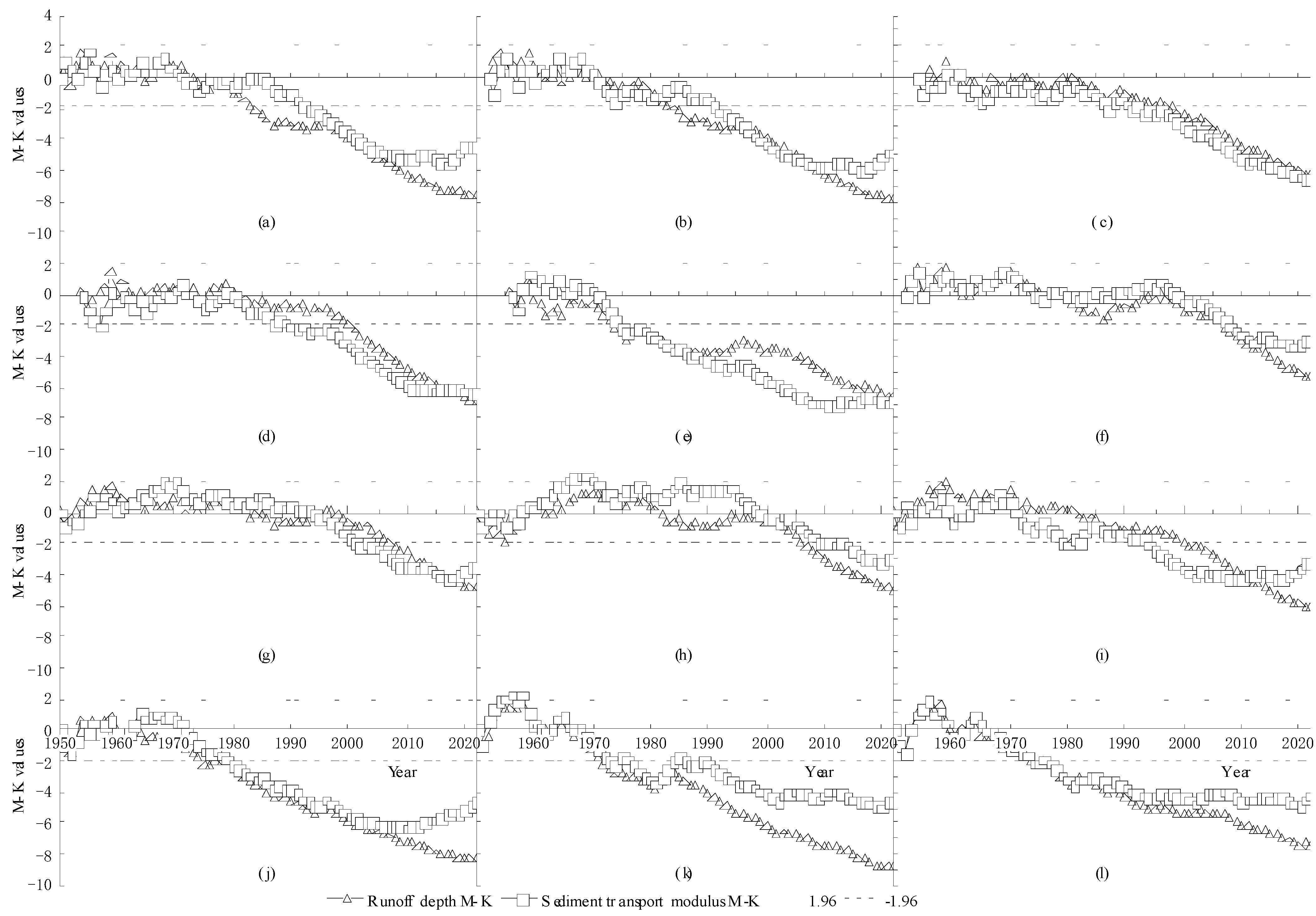
- The runoff depths at LM and TG were 51.75 mm and 48.97 mm, respectively, and their M–K test values were −4.486 and −4.840, respectively. These values continuously decreased from 1969 to 1997, with little change after 1997 and a slight upward trend after 2010, indicating that the runoff depths at these two hydrological stations significantly decreased.
- The runoff depth of the Yiluo River was greater, with an average value of 136.2 mm for many years, and the M–K test value was of −4.524, indicating that the runoff depths of this tributary exhibited a significant decreasing trend and that its flow production capacity was significantly weakened. The Yiluo River decreased significantly after 1965 and 1985, with mean values of 220.32 mm, 141.25 mm, and 97.01 mm, respectively, for the three periods.
- The runoff depths of the MRYR in the Kuye River, Wei River, and Qin River were small, with a variation interval of 55–65 mm, corresponding to a weakening of flow production capacity. The M–K test values were −6.371, −3.210, and −4.248, respectively, indicating that the runoff depths of the three tributaries significantly decreased from 95.23 mm, 80.31 mm, and 123.23 mm in the 1950s to 26.95 mm, 53.46 mm, and 45.79 mm in the 2000s, respectively.
- The runoff depths of the Huangfuchuan River, Wuding River, Yan River, Jing River, Beiluo River, and Fen River in the MRYR were very small, with multiyear averages ranging from 25 to 40 mm, indicating very weak flow-producing capacity. The values of their M–K statistics were −6.526, −6.878, −2.864, −3.438, −3.048, and −4.515, indicating that the runoff depths of the Yan River and Beiluo River tended to decrease, while those of the remaining four tributaries decreased significantly.
3.1.2. Sediment Load Variation
- The sediment transport modulus at LM and TG were 1243.31 t/(km2·a) and 1305.40 t/(km2·a), respectively, and their M–K test values were −7.753 and −7.927, respectively, which indicates that the sediment transport modulus at these two hydrological stations decreased significantly.
- The sediment transport modulus of the Fen River, Yiluo River, and Qin River was relatively small, with the average value over many years being less than 550 t/(km2·a). The watershed erosion was relatively low, and the M–K test value was between −8.934 and −7.486, which indicates that these tributaries reduced the sediment transport modulus and that watershed erosion weakened, though the erosion change processes varied. The sediment transport modulus of the Fen River clearly and continuously decreased from 1960 to 1980, while the sediment transport modulus of the Qin River and Yiluo River showed a continuous decreasing trend, from 1938 t/(km2·a) and 1032 t/(km2·a) in the 1950s to 32.81 t/(km2·a) and 26.94 t/(km2·a) after 2010, respectively.
- The sediment transport modulus of the Huangfuchuan River, Kuye River, and Yan River was very high, indicating severe erosion of the basin. The annual average values were as high as 10,950 t/(km2·a), 8007 t/(km2·a), and 5968 t/(km2·a), respectively, and their M–K test values were −6.412, −7.023, and −5.366, respectively. The corresponding accumulation process lines were convex, indicating that the sediment transport modulus of these three tributaries was significantly reduced. After 2010, the sediment transport modulus decreased from 24,394 t/(km2·a), 15,666 t/(km2·a), and 8888 t/(km2·a) in the 1950s to 952.22 t/(km2·a), 89.98 t/(km2·a), and 731.10 t/(km2·a), respectively. The erosion characteristics of the basins gradually changed from severe erosion to weak erosion.
- The sediment transport modulus of the Wuding River, Jing River, Beiluo River, and Wei River were between 2500 and 5000 t/(km2·a), with the M–K test values of −6.521, −4.991, −5.096, and −6.201, respectively, indicating that the sediment transport modulus of these four tributaries significantly decreased. The sediment transport modulus of the Jing River, Beiluo River, and Wei River decreased continuously from the 1980s, while the sediment transport modulus of the Wuding River decreased sharply from 10,021 t/(km2·a) in the 1950s to 3910 t/(km2·a) in the 1970s and then to 642.37 t/(km2·a) after 2010. The erosive characteristics of these tributaries gradually changed from more severe to less severe.
3.2. Proportion of Runoff and Sediment Load Reduction Attributed to Precipitation and Human Activities
3.2.1. Mainstream
3.2.2. Tributaries
4. Discussion
4.1. Changes in Influencing Factors
4.1.1. Precipitation
4.1.2. Soil and Water Conservation Measures
4.1.3. Reservoir Sediment Interception
4.1.4. Water Diversion and Sediment Load Diversion
4.2. Analysis of Runoff and Sediment Load Changes and Identification of Abrupt Change Points
4.2.1. Evaluation of the Trend and Identification of Abrupt Change Points in the Runoff and Sediment Load Changes
4.2.2. Differences in the Abrupt Change Points of Runoff and Sediment Load
4.2.3. Comparison of the Differences in the Assessment Results
5. Conclusions
- In the MRYR, the M–K test values for the LM and TG on the mainstream in the middle reaches were also less than −3.01, with both showing significant reductions in runoff depth. This suggests a gradual decline in the runoff generation capacity of the corresponding areas. Similarly, the M–K test value for the Yan River, a tributary, was −2.864, indicating a decreasing trend. The M–K test values for the other nine tributaries were all less than −3.01, showing significant decreasing trends. The sediment transport modulus for both the mainstream and tributary hydrological stations in the MRYR had M–K test values less than −3.01, indicating a significant decreasing trend.
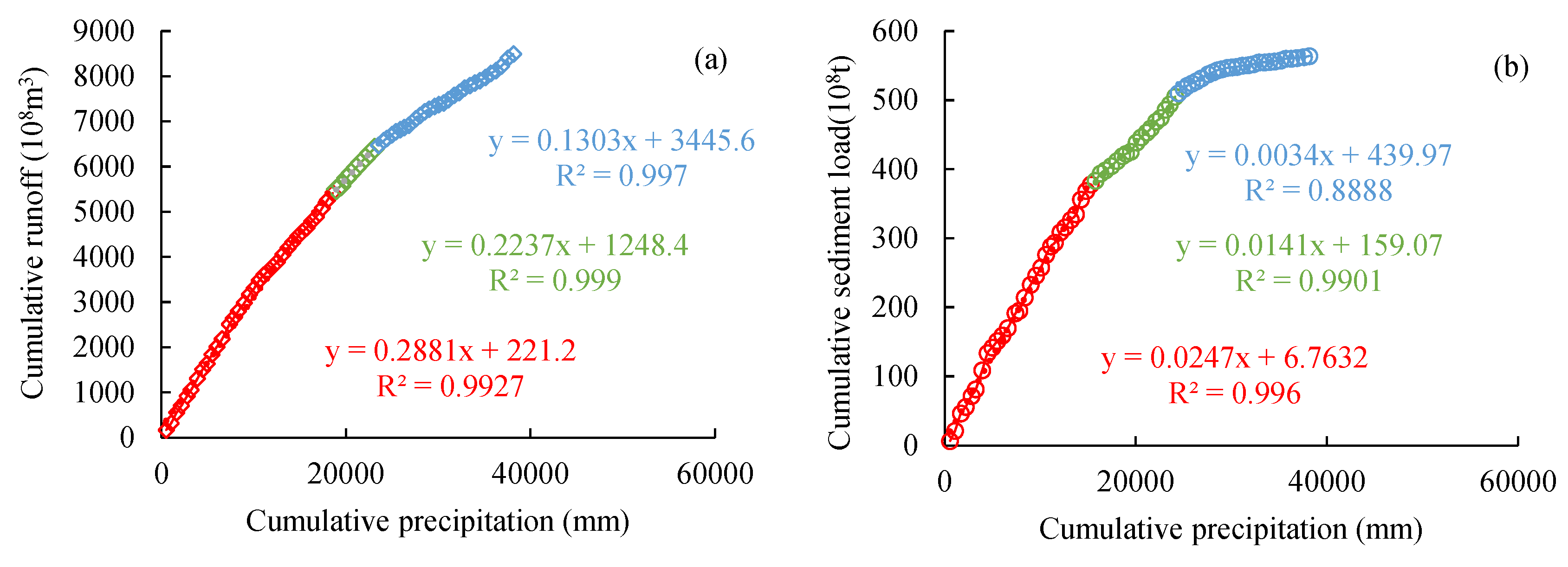
- In the mainstream of the MRYR, the years with abrupt changes in runoff volume were 1985 and 1994, while the years with abrupt changes in sediment load were 1979 and 1996. Compared with those during the baseline period, the contributions of human activities to runoff during period I and period II were 69.99% and 94.69%, respectively. Similarly, compared with those in the baseline period, the contributions of human activities to sediment load during period I and period II were 88.52% and 98.49%, respectively.
- In the MRYR tributaries, the contribution of human activities to the tributaries was significantly greater than that of precipitation. Compared to period I, the proportion of contributions from human activities increased significantly in period II, averaging 88.64%. The contribution of human activities to sediment load was high in both period I and period II. In period I, the average contribution was 82.54%, and in period II, it increased to an average of 98.66%.
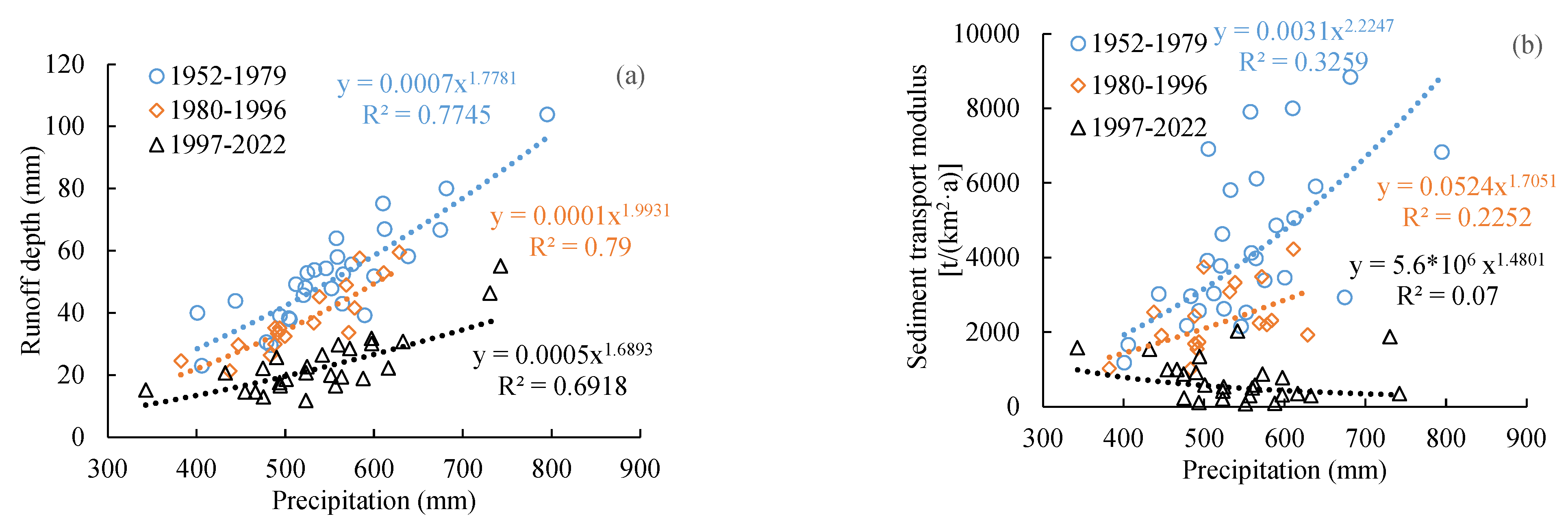
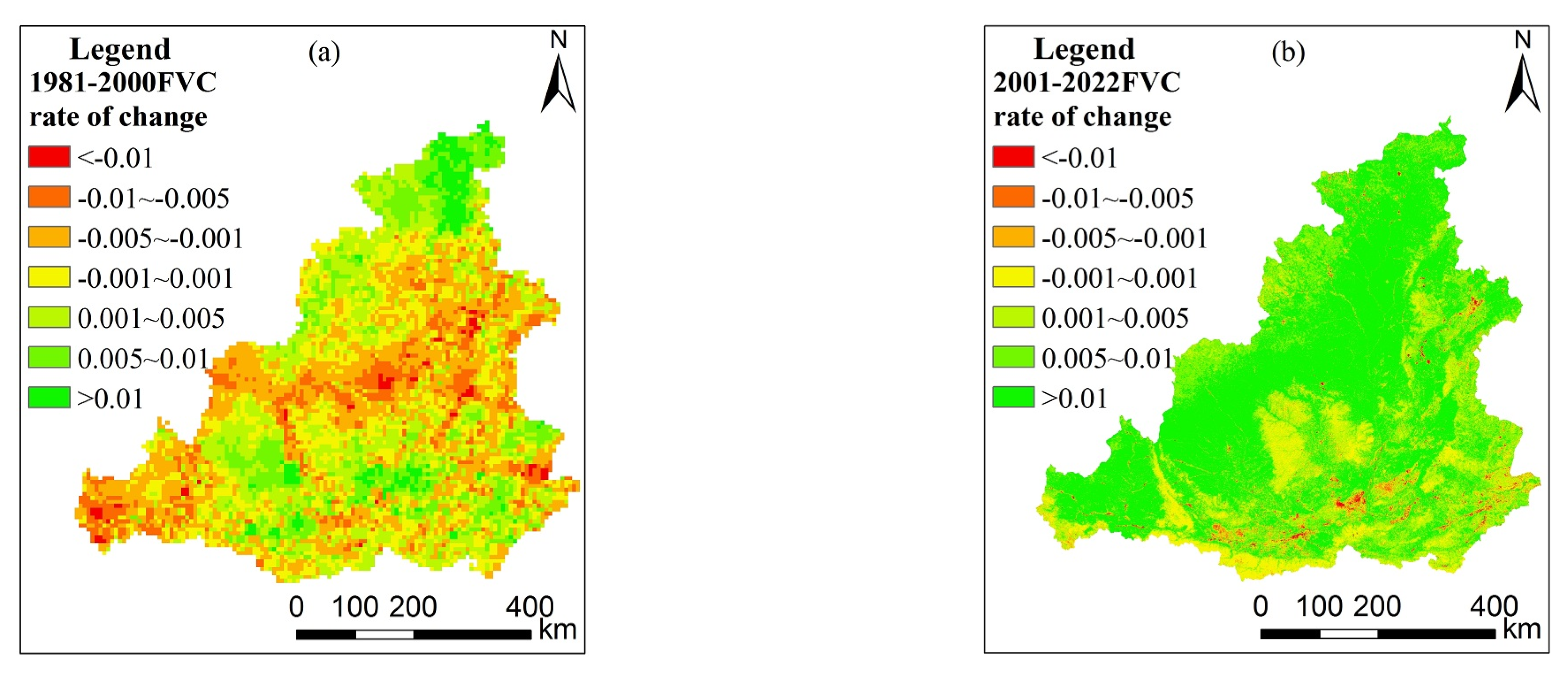
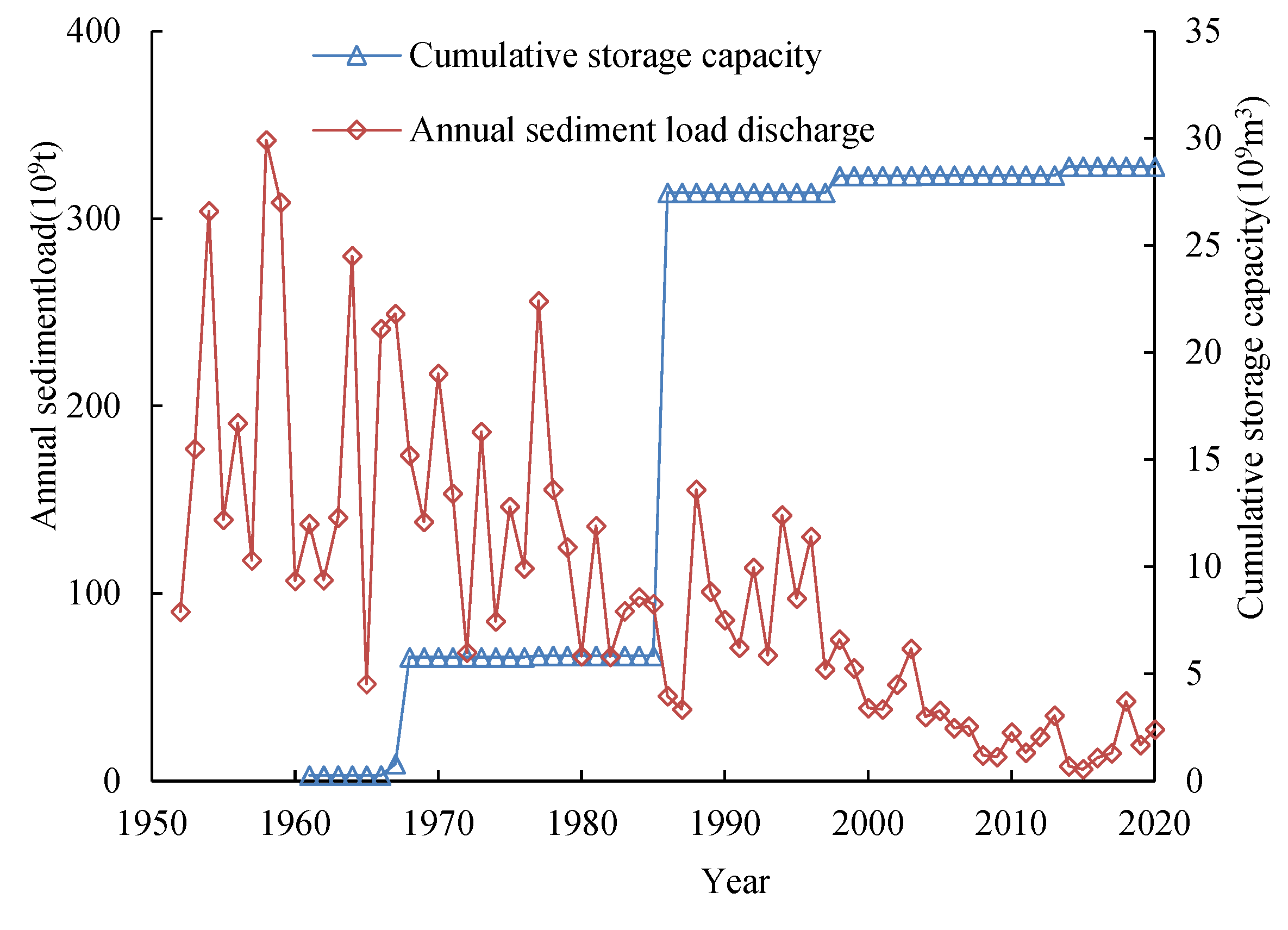
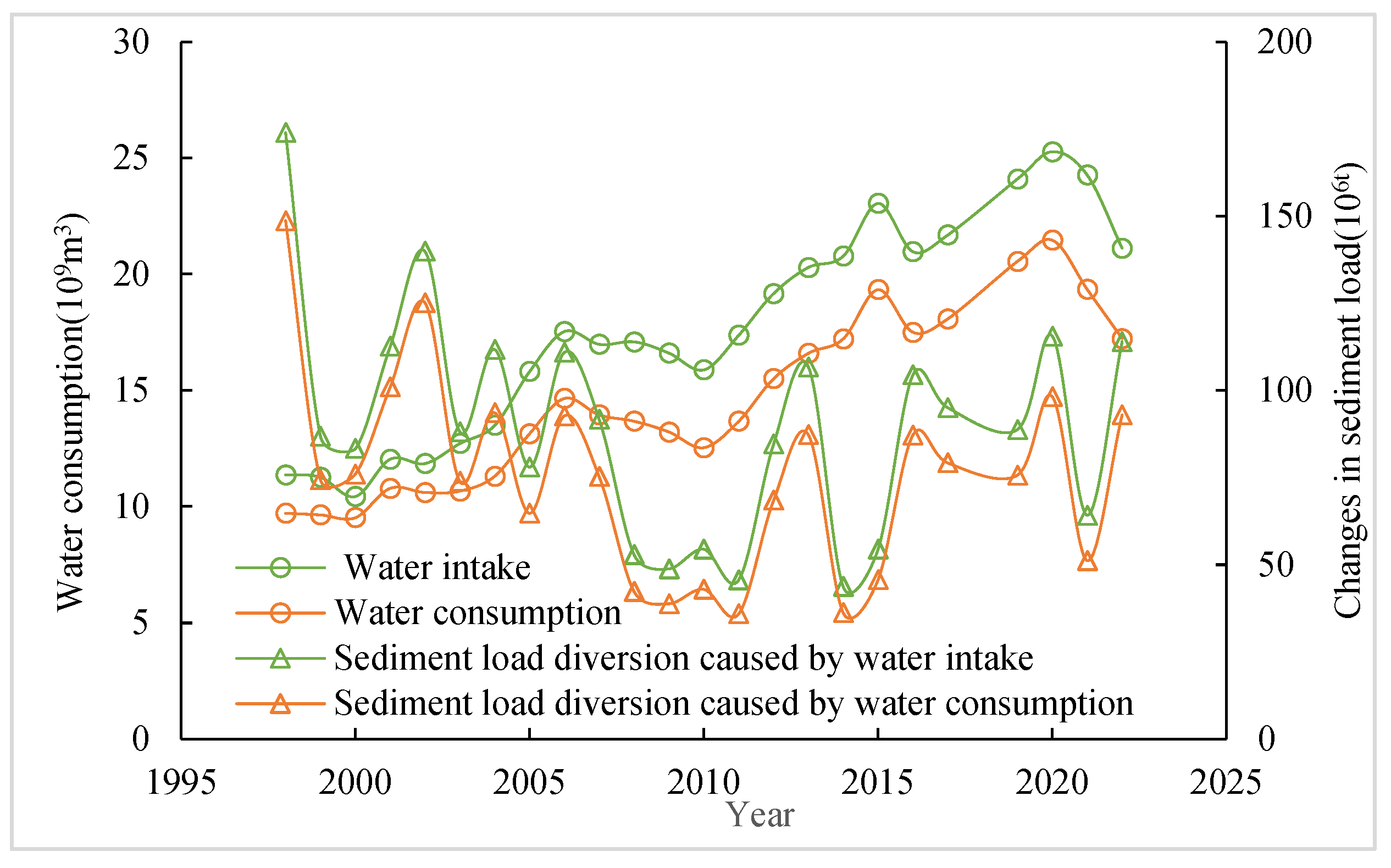
- In the MRYR, from the Toudaoguai to the TG hydrological stations, although there was a good positive correlation between runoff distribution and precipitation, the correlation between the sediment transport modulus and precipitation was not significant. From 1981 to 2022, the FVC generally showed an increasing trend. The peak periods for the construction of check dams were from 1970 to 1979 and from 2000 to 2009. The construction of reservoirs in the middle reaches began in 1956, with the most concentrated construction occurring from the 1970s to 1980s. The multiyear average water intake and consumption at the Toudaoguai-LM hydrological stations of the MRYR from 1998 to 2022 showed an upward trend, and there was an increasing trend in sediment transport in the last decade.
Author Contributions
Funding
Data Availability Statement
Acknowledgments
Conflicts of Interest
References
- Catt, J.A. The agricultural importance of loess. Earth-Sci. Rev. 2001, 54, 213–229. [Google Scholar] [CrossRef] [Scilit]
- Tian, S.; Li, Z.; Wang, Z.; Jiang, E.; Wang, W.; Sun, M. Mineral composition and particle size distribution of river sediment and loess in the middle and lower Yellow River. Int. J. Sediment Res. 2021, 36, 392–400. [Google Scholar] [CrossRef] [Scilit]
- Wang, J.; Shi, B.; Zhao, E.; Yuan, Q.; Chen, X. The long-term spatial and temporal variations of sediment loads and their causes of the Yellow River Basin. Catena 2022, 209, 105850. [Google Scholar] [CrossRef] [Scilit]
- Wang, H.; Yang, Z.; Saito, Y.; Liu, J.P.; Sun, X.; Wang, Y. Stepwise decreases of the Huanghe (Yellow River) sediment load (1950–2005): Impacts of climate change and human activities. Glob. Planet Change 2007, 57, 331–354. [Google Scholar] [CrossRef] [Scilit]
- Tian, S.; Xu, M.; Jiang, E.; Wang, G.; Hu, H.; Liu, X. Temporal variations of runoff and sediment load in the upper Yellow River, China. J. Hydrol. 2019, 568, 46–56. [Google Scholar] [CrossRef] [Scilit]
- Hamed, K.H. Exact distribution of the Mann–Kendall trend test statistic for persistent data. J. Hydrol. 2009, 365, 86–94. [Google Scholar] [CrossRef] [Scilit]
- Labat, D. Recent advances in wavelet analyses: Part 1. A review of concepts. J. Hydrol. 2005, 314, 275–288. [Google Scholar] [CrossRef] [Scilit]
- Bharat, S.; Mishra, V. Runoff sensitivity of Indian sub-continental river basins. Sci. Total. Environ. 2021, 766, 142642. [Google Scholar] [CrossRef] [Scilit]
- Flores, S.R.; Muñoz-Robles, C.; Ortíz-Rodríguez, A.J.; Tiznado, J.Q.; Julio-Miranda, P. Historical and projected changes in hydrological and sediment connectivity under climate change in a tropical catchment of Mexico. Sci. Total. Environ. 2022, 848, 157731. [Google Scholar] [CrossRef] [Scilit]
- Berihun, M.L.; Tsunekawa, A.; Haregeweyn, N.; Tsubo, M.; Fenta, A.A.; Ebabu, K.; Bayabil, H.K.; Dile, Y.T. Predicting runoff and sediment responses to climate-resilient land use and management scenarios. Environ. Sci. Pollut. R. 2023, 30, 72262–72283. [Google Scholar] [CrossRef] [Scilit]
- Hovenga, P.A.; Wang, D.; Medeiros, S.C.; Hagen, S.C.; Alizad, K. The response of runoff and sediment loading in the Apalachicola River, Florida to climate and land use land cover change. Earth’s Future 2016, 4, 124–142. [Google Scholar] [CrossRef] [Scilit]
- Das, S. Dynamics of streamflow and sediment load in Peninsular Indian rivers (1965–2015). Sci. Total. Environ. 2021, 799, 149372. [Google Scholar] [CrossRef] [Scilit] [PubMed]
- Khan, U.; Janjuhah, H.T.; Kontakiotis, G.; Rehman, A.; Zarkogiannis, S.D. Natural processes and anthropogenic activity in the Indus river sedimentary environment in Pakistan: A critical review. J. Mar. Sci. Eng. 2021, 9, 1109. [Google Scholar] [CrossRef] [Scilit]
- Van Binh, D.; Kantoush, S.; Sumi, T. Changes to long-term discharge and sediment loads in the Vietnamese Mekong Delta caused by upstream dams. Geomorphology 2020, 353, 107011. [Google Scholar] [CrossRef] [Scilit]
- Liquete, C.; Canals, M.; Ludwig, W.; Arnau, P. Sediment discharge of the rivers of Catalonia, NE Spain, and the influence of human impacts. J. Hydrol. 2009, 366, 76–88. [Google Scholar] [CrossRef] [Scilit]
- Ouyang, Y.; Leininger, T.D.; Moran, M. Impacts of reforestation upon sediment load and water outflow in the Lower Yazoo River Watershed, Mississippi. Ecol. Eng. 2013, 61, 394–406. [Google Scholar] [CrossRef] [Scilit]
- Charoenlerkthawin, W.; Namsai, M.; Bidorn, K.; Rukvichai, C.; Panneerselvam, B.; Bidorn, B. Effects of dam construction in the Wang River on sediment regimes in the Chao Phraya River basin. Water 2021, 13, 2146. [Google Scholar] [CrossRef] [Scilit]
- Béjar, M.; Vericat, D.; Batalla, R.J.; Gibbins, C.N. Variation in flow and suspended sediment transport in a montane river affected by hydropeaking and instream mining. Geomorphology 2018, 310, 69–83. [Google Scholar] [CrossRef] [Scilit]
- Zhang, X.; Wenhong, C.; Qingchao, G.; Sihong, W. Effects of landuse change on surface runoff and sediment yield at different watershed scales on the Loess Plateau. Int. J. Sediment Res. 2010, 25, 283–293. [Google Scholar] [CrossRef] [Scilit]
- Li, J.; Tan, S.; Chen, F.; Feng, P. Quantitatively analyze the impact of land use/land cover change on annual runoff decrease. Nat. Hazards 2014, 74, 1191–1207. [Google Scholar] [CrossRef] [Scilit]
- Wang, H.; Sun, F. Variability of annual sediment load and runoff in the Yellow River for the last 100 years (1919–2018). Sci. Total Environ. 2021, 758, 143715. [Google Scholar] [CrossRef] [Scilit] [PubMed]
- Miao, C.; Han, J.; Gou, J. A New Daily Gridded Precipitation Dataset for the Chinese Mainland Based on Gauge Observations; National Tibetan Plateau/Third Pole Environment Data Center: Beijing, China, 2023. [Google Scholar] [CrossRef]
- Peng, S. 1-km Monthly Precipitation Dataset for China (1901–2022); National Tibetan Plateau/Third Pole Environment Data Center: Beijing, China, 2020. [Google Scholar] [CrossRef]
- Tucker, C. Long-Term Serial GIMMS Vegetation Index Dataset in China (1981–2006); National Tibetan Plateau/Third Pole Environment Data Center: Beijing, China, 2013. [Google Scholar]
- Gao, J.; Shi, Y.; Zhang, H.; Chen, X.; Zhang, W.; Shen, W.; Zhang, Y. China Regional 250m Fractional Vegetation Cover Data Set (2000–2022); National Tibetan Plateau Data Center: Beijing, China, 2022. [Google Scholar] [CrossRef]
- Mann, H.B. Nonparametric test against trend. Econometrica 1945, 13, 245–259. [Google Scholar] [CrossRef] [Scilit]
- Kendall, M.G. Rank Correlation Measures; Chilie Griffin: London, UK, 1975. [Google Scholar]
- Chen, Y.; Zhang, P.; Zhao, Y.; Qu, L.; Du, P.; Wang, Y. Factors Affecting Runoff and Sediment Load Changes in the Wuding River Basin from 1960 to 2020. Hydrology 2022, 9, 198. [Google Scholar] [CrossRef] [Scilit]
- Zhao, Q.; Wang, L.; Liu, H.; Zhang, Q. Runoff and sediment variation and attribution over 60 years in typical Loess Plateau basins. J. Soil Sediment 2019, 19, 3631–3647. [Google Scholar] [CrossRef] [Scilit]
- Yang, Q.; Gao, H.; Han, Y.; Li, Z.; Lu, K. Coupling Changes in Runoff and Sediment and Their Relationships with Erosion Energy and Underlying Surface in the Wuding River Basin, China. Land 2024, 13, 496. [Google Scholar] [CrossRef] [Scilit]
- Jiang, L.; Liu, Y. Response of Runoff-Sediment System to Vegetation Variation in the Yellow River Basin in the Last 20 Years. Land 2023, 12, 428. [Google Scholar] [CrossRef] [Scilit]
- Guo, B.; Niu, Y.; Mantravadi, V.S.; Zhang, L.; Liu, G. The variation of rainfall runoff after vegetation restoration in upper reaches of the Yellow River by the remote sensing technology. Environ. Sci. Pollut. Res. 2021, 28, 50707–50717. [Google Scholar] [CrossRef] [Scilit]
- Miao, J.; Zhang, X.; Zhang, G.; Wei, T.; Zhao, Y.; Ma, W.; Chen, Y.; Li, Y.; Wang, Y. Applications and interpretations of different machine learning models in runoff and sediment discharge simulations. Catena 2024, 238, 107848. [Google Scholar] [CrossRef] [Scilit]
- Shi, H.; Hu, C.; Wang, Y.; Liu, C.; Li, H. Analyses of trends and causes for variations in runoff and sediment load of the Yellow River. Int. J. Sediment Res. 2017, 32, 171–179. [Google Scholar] [CrossRef] [Scilit]
- Gao, J.L.; Gao, Y.; Ma, H.B.; Dang, T.M. Study on characteristics of soil and water loss control in Loess Plateau in recent 70 Years. Yellow River 2019, 41, 65–69. (In Chinese) [Google Scholar]
- Peng, J.; Chen, S. The variation process of water and sediment and its effect on the Yellow River Delta over the six decades. Acta Geogr. Sin. 2009, 64, 1353–1362. (In Chinese) [Google Scholar] [CrossRef]
- Zhang, H.; Guo, J.; Li, X.; Liu, Y.; Wang, T. Spatiotemporal variation in and responses of the NDVI to climate in Western Ordos and Eastern Alxa. Sustainability 2023, 15, 4375. [Google Scholar] [CrossRef] [Scilit]
- Monitoring Center for Ecological Environment of Soil and Water Conservation in the Yellow River Basin. Data Set of Water Conservancy and Soil Conservation Projects in Key Tributaries of the Yellow River Basin in 1999. National Cryosphere Desert Data Center. 2018. Available online: https://cstr.cn/CSTR:11738.11.ncdc.HHSTBC.2020.123 (accessed on 20 July 2024).
- Monitoring Center for Ecological Environment of Soil and Water Conservation in the Yellow River Basin. Data Set of Water Conservancy and Soil Conservation Projects in Key Tributaries of the Yellow River Basin in 1999. National Cryosphere Desert Data Center. 2019. Available online: https://cstr.cn/CSTR:11738.11.ncdc.HHSTBC.2020.146 (accessed on 20 July 2024).
- Han, J.; Gao, J.; Luo, H. Changes and implications of the relationship between rainfall, runoff and sediment load in the Wuding River basin on the Chinese Loess Plateau. Catena 2019, 175, 228–235. [Google Scholar] [CrossRef] [Scilit]
- Ministry of Water Resources of the People’s Republic of China. China Water Statistical Yearbook 2020; China Water Power Press: Beijing, China, 2020. (In Chinese) [Google Scholar]
- Gao, P.; Mu, X.M.; Wang, F.; Li, R. Analysis of impact of human activities on stream flow and sediment discharge from Hekouzhen to Huayuankou in middle reaches of Yellow River. J. Sediment Res. 2013, 5, 75–80. (In Chinese) [Google Scholar] [CrossRef]
- Jia, Y.; Ding, X.; Wang, H.; Zhou, Z.; Qiu, Y.; Niu, C. Attribution of water resources evolution in the highly water-stressed Hai River Basin of China. Water Resour. Res. 2012, 48, w2513. [Google Scholar] [CrossRef] [Scilit]
- Gao, P.; Zhang, X.; Mu, X.; Wang, F.; Li, R.; Zhang, X. Trend and change-point analyses of streamflow and sediment discharge in the Yellow River during 1950–2005. Hydrol. Sci. J. 2010, 55, 275–285. [Google Scholar] [CrossRef] [Scilit]
- Zhou, Y.; Shi, C.; Du, J.; Fan, X. Characteristics and causes of changes in annual runoff of the Wuding River in 1956–2009. Environ. Earth Sci. 2013, 69, 225–234. [Google Scholar] [CrossRef] [Scilit]
- Hou, J.; Yan, D.; Qin, T.; Liu, S.; Lv, X.; Wang, J.; Yan, S.; Zhang, X.; Li, C.; Abebe, S.A.; et al. Attribution identification of natural runoff variation in the Yiluo River Basin. J. Hydrol.-Reg. Stud. 2023, 48, 101455. [Google Scholar] [CrossRef] [Scilit]
- Wang, C.; Mei, X.; Zhang, G.; Ren, Z.; Zhang, X.; Li, P.; Zhao, Y. Variation of water and sediment in the tributaries of Ningxia section of Yellow River, China from 1989 to 2019 and their driving factors. J. Earth Sci. Environ. 2023, 45, 844–856. (In Chinese) [Google Scholar] [CrossRef]
- Liu, Q.; Yu, F.; Chang, K.; Li, Y.; Liang, X.; Mu, X.; Du, M. Variation character of water and sediment and its response to rainfall and human activities in Longtong region of the middle Yellow River. J. Basic Sci. Eng. 2023, 31, 555–568. (In Chinese) [Google Scholar] [CrossRef]
- Zhao, Y.; Hu, C.; Zhang, X.; Wang, Y.; Cheng, C.; Yin, X.; Xie, M. Analysis on runoff and sediment regimes and its causes of the Yellow River in recent 70 years. Trans. CSAE 2018, 34, 112–119. (In Chinese) [Google Scholar] [CrossRef]
- Yao, W.; Ran, D.; Chen, J. Recent changes in runoff and sediment regimes and future projections in the Yellow River basin. Adv. Water Sci. 2013, 24, 607–616. (In Chinese) [Google Scholar] [CrossRef]
- Sun, Q.; Yu, K.; Li, Z.; Li, P.; Zhang, X.; Gong, J. The trends of streamflow and sediment and their driving factors in the middle reaches of the Yellow River. Acta Geogr. Sin. 2018, 73, 945–956. (In Chinese) [Google Scholar] [CrossRef]
- Xu, J. Trend of sediment yield in the coarser sediment producing area in the middle Yellow River Basin in the Period 1997–2007 and the formative cause. J. Soil Water Conserv. 2010, 24, 1–7. (In Chinese) [Google Scholar] [CrossRef]
- Yin, G. An analysis on the causes of variations of runoff and sediment yield in the sandy and coarse sediment region of the middle Yellow River. Acta Geogr. Sin. Chin. Ed. 1998, 53, 173–182. (In Chinese) [Google Scholar]
- Bao, W. Classified-quantitative analysis of changed runoff and sediment yields. Sci. Geogr. Sin. 1997, 17, 41–46. (In Chinese) [Google Scholar]
- Wang, Y. Characteristics of precipitation and flow/sediment implications in Hekou-Longmen section of the Yellow River in the 1980s. Yellow River 1994, 17, 5–9+59. (In Chinese) [Google Scholar]
- Mu, X.; Basang, C.; Zhang, L.; Gao, P.; Wang, F.; Zhang, X.P. Impact of soil conservation measures on runoff and sediment in Hekou-Longmen region of the Yellow River. J. Sediment Res. 2007, 2, 36–41. (In Chinese) [Google Scholar] [CrossRef]
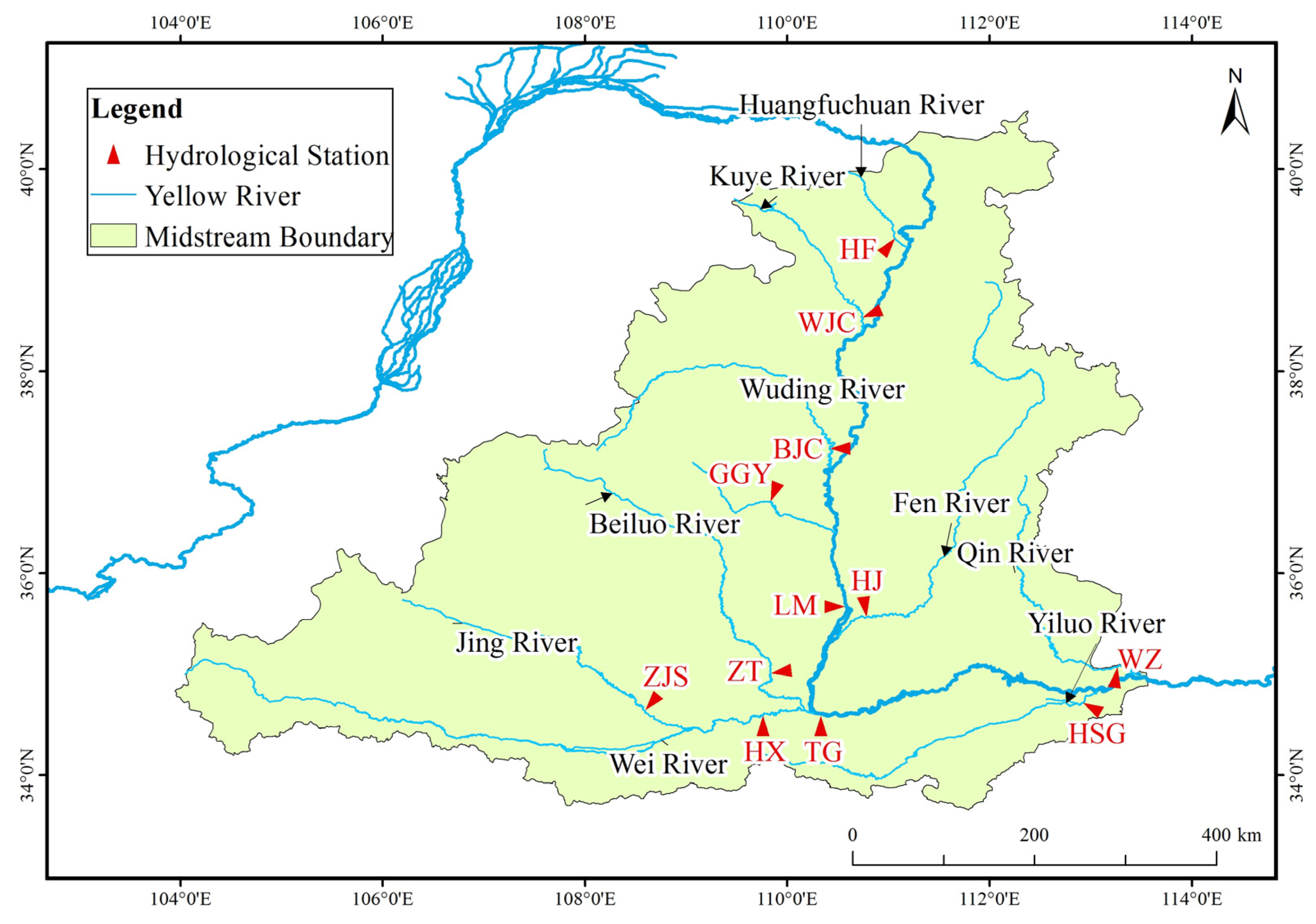

| Tributary Name | Hydrological Station | Data Series (Years) | Drainage Basin Area (km2) | Mainstream Length (km) |
|---|---|---|---|---|
| Huangfuchuan River | Huangfu | 1954–2022 | 3199 | 137 |
| Kuye River | Wenjiachuan | 1954–2022 | 8645 | 242 |
| Wuding River | Baijiachuan | 1956–2022 | 29,662 | 491 |
| Yan River | Ganguyi | 1952–2022 | 5891 | 287 |
| Jing River | Zhangjiashan | 1950–2022 | 43,216 | 455 |
| Beiluo River | Zhuangtou | 1950–2022 | 25,154 | 680 |
| Wei River | Huaxian | 1950–2022 | 106,498 | 818 |
| Fen River | Hejin | 1950–2022 | 38,728 | 716 |
| Yiluo River | Heishiguan | 1950–2022 | 18,563 | 447 |
| Qin River | Wuzhi | 1950–2022 | 12,894 | 485 |
| Descriptive Statistics | HF | WJC | BJC | GGY | ZJS | ZT | HX | HJ | HSG | WZ | LM | TG | |
|---|---|---|---|---|---|---|---|---|---|---|---|---|---|
| Runoff (108 m3) | mean | 1.2 | 5.0 | 10.8 | 2.0 | 15.6 | 7.7 | 67.5 | 9.9 | 25.3 | 8.0 | 257.5 | 334.1 |
| coefficient of variation (%) | 95.51 | 59.53 | 30.11 | 37.26 | 40.84 | 37.96 | 47.00 | 71.89 | 64.50 | 97.07 | 33.78 | 35.49 | |
| skewness | 1.68 | 1.01 | 0.96 | 1.40 | 1.24 | 1.36 | 1.02 | 1.30 | 1.81 | 1.72 | 0.77 | 0.71 | |
| kurtosis | 3.12 | 0.89 | 0.38 | 3.08 | 2.85 | 3.21 | 1.60 | 1.59 | 4.37 | 2.65 | 0.25 | 0.16 | |
| Sediment load (108 t) | mean | 0.35 | 0.69 | 0.92 | 0.35 | 1.95 | 0.63 | 2.78 | 0.18 | 0.10 | 0.04 | 6.19 | 8.90 |
| coefficient of variation (%) | 114.2 | 120.2 | 109.0 | 99.9 | 75.6 | 94.4 | 80.6 | 180.8 | 171.1 | 151.8 | 88.2 | 78.9 | |
| skewness | 1.57 | 1.38 | 1.69 | 1.74 | 1.43 | 1.29 | 1.45 | 2.81 | 3.31 | 2.33 | 1.43 | 1.12 | |
| kurtosis | 2.26 | 1.13 | 2.28 | 3.91 | 1.97 | 1.27 | 2.10 | 9.16 | 13.83 | 6.21 | 1.72 | 0.82 | |
| Year | Huangfuchuan River | Kuye River | Wuding River | Yan River | Jing River | Beiluo River | Wei River | Fen River | Yiluo River | Qin River | Mainstream | ||
|---|---|---|---|---|---|---|---|---|---|---|---|---|---|
| HF | WJC | BJC | GGY | ZJS | ZT | HX | HJ | HSG | WZ | LM | TG | ||
| Runoff depth (mm) | 1950–1959 | 82.95 | 95.23 | 53.34 | 36.29 | 37.58 | 28.87 | 80.31 | 45.36 | 217.39 | 123.23 | 61.48 | 62.69 |
| 1960–1969 | 53.86 | 85.09 | 51.29 | 42.08 | 50.15 | 40.22 | 90.31 | 46.13 | 191.11 | 108.84 | 67.65 | 66.11 | |
| 1970–1979 | 54.94 | 83.58 | 40.81 | 35.01 | 40.38 | 33.21 | 55.79 | 26.77 | 110.21 | 47.68 | 57.19 | 52.39 | |
| 1980–1989 | 39.74 | 60.20 | 34.93 | 35.33 | 39.62 | 36.63 | 74.30 | 17.17 | 162.46 | 42.39 | 55.51 | 54.10 | |
| 1990–1999 | 28.23 | 51.85 | 31.50 | 35.22 | 32.42 | 28.25 | 41.12 | 13.13 | 78.40 | 28.93 | 39.82 | 36.47 | |
| 2000–2009 | 11.27 | 19.54 | 25.43 | 24.91 | 23.07 | 24.72 | 42.29 | 9.02 | 93.46 | 41.26 | 34.26 | 30.85 | |
| 2010–2019 | 9.16 | 35.21 | 30.18 | 26.23 | 27.33 | 22.55 | 52.79 | 17.91 | 93.71 | 29.00 | 45.70 | 41.09 | |
| 2020–2022 | 7.52 | 24.15 | 27.95 | 34.74 | 41.64 | 30.95 | 86.23 | 33.99 | 158.45 | 112.03 | 53.78 | 55.15 | |
| Multiyear average | 36.12 | 57.95 | 36.40 | 33.55 | 36.03 | 30.65 | 63.39 | 25.44 | 136.20 | 62.32 | 51.75 | 48.97 | |
| M–K trend test (U) | −6.526 | −6.371 | −6.878 | −2.864 | −3.438 | −3.048 | −3.210 | −4.515 | −4.524 | −4.248 | −4.5 | −4.8 | |
| Abrupt change year | 1980 1996 | 1980 1996 | 1972 1996 | 1970 1996 | 1970 1996 | 1970 1994 | 1968 1993 | 1971 | 1965 1990 | 1964 1982 | - | - | |
| Sediment transport modulus [t/(km2·a)] | 1950–1959 | 24,394 | 15,666 | 10,021 | 8888 | 6273 | 4157 | 4027 | 1807 | 1938 | 1032 | 2390 | 2677 |
| 1960–1969 | 15,768 | 13,705 | 6293 | 10,791 | 6262 | 4076 | 4095 | 888 | 974 | 564 | 2274 | 2086 | |
| 1970–1979 | 19,547 | 16,178 | 3910 | 7948 | 6007 | 3531 | 3607 | 494 | 371 | 316 | 1745 | 1932 | |
| 1980–1989 | 13,386 | 7757 | 1777 | 5418 | 4313 | 1999 | 2590 | 116 | 477 | 194 | 945 | 1144 | |
| 1990–1999 | 7974 | 7490 | 2834 | 7275 | 5491 | 3534 | 2595 | 82 | 50 | 70 | 1023 | 1158 | |
| 2000–2009 | 3007 | 600 | 1219 | 2879 | 2588 | 883 | 1294 | 8 | 39 | 73 | 356 | 455 | |
| 2010–2019 | 1110 | 110 | 691 | 776 | 1455 | 363 | 620 | 6 | 16 | 10 | 253 | 260 | |
| 2020–2022 | 427 | 19 | 481 | 583 | 1733 | 374 | 695 | 10 | 65 | 109 | 300 | 300 | |
| Multiyear average | 10,950 | 8007 | 3116 | 5968 | 4508 | 2510 | 2608 | 466 | 532 | 314 | 1243 | 1305 | |
| M–K trend test (U) | −6.412 | −7.023 | −6.521 | −5.366 | −4.991 | −5.096 | −6.201 | −8.353 | −8.934 | −7.486 | −7.75 | −7.93 | |
| Abrupt change year | 1979 1996 | 1979 1996 | 1971 1996 | 1971 1996 | 1971 1997 | 1979 2002 | 1971 1996 | 1971 | 1964 1984 | 1964 1982 | - | - | |
| Time Period | Computed Values | Measured Values | Reduce the Total Values | Human Activities | Precipitation | |||
|---|---|---|---|---|---|---|---|---|
| Affected Values (108 m3) | Contribution (%) | Affected Values (108 t) | Contribution (%) | |||||
| Runoff | 1952–1985 | 157.53 | 159.37 | |||||
| 1986–1994 | 144.51 | 109.84 | 49.53 | 34.66 | 69.99 | 14.86 | 30.01 | |
| 1995–2022 | 154.87 | 74.58 | 84.80 | 80.29 | 94.69 | 4.50 | 5.31 | |
| Sediment Load | 1952–1979 | 13.49 | 13.51 | |||||
| 1980–1996 | 12.82 | 7.47 | 6.04 | 5.35 | 88.52 | 0.69 | 11.48 | |
| 1997–2022 | 13.34 | 2.27 | 11.25 | 11.08 | 98.49 | 0.17 | 1.51 | |
| River Basin Name | Time Period | Runoff | Sediment Load | ||||||
|---|---|---|---|---|---|---|---|---|---|
| Human Activity | Precipitation | Human Activity | Precipitation | ||||||
| Affected Values (108 m3) | Contribution (%) | Affected Values (108 m3) | Contribution (%) | Affected Values (108 t) | Contribution (%) | Affected Values (108 t) | Contribution (%) | ||
| Huangfuchuan River | Period I | 0.43 | 55.46 | 0.35 | 44.54 | 0.16 | 66.33 | 0.08 | 33.67 |
| Period II | 1.36 | 84.93 | 0.24 | 15.07 | 0.50 | 91.82 | 0.04 | 8.18 | |
| Kuye River | Period I | 1.52 | 65.13 | 0.81 | 34.87 | 0.46 | 80.06 | 0.11 | 19.94 |
| Period II | 4.8 | 94.07 | 0.3 | 5.93 | 1.24 | 98.22 | 0.02 | 1.78 | |
| Wuding River | Period I | 2.55 | 55.19 | 2.07 | 44.81 | 0.99 | 72.90 | 0.37 | 27.10 |
| Period II | 6.23 | 88.38 | 0.82 | 11.62 | 1.66 | 89.21 | 0.20 | 10.79 | |
| Yan River | Period I | −0.01 | −7.95 | 0.2 | 107.95 | 0.14 | 82.78 | 0.03 | 17.22 |
| Period II | 0.67 | 89.26 | 0.08 | 10.74 | 0.48 | 100.01 | 0 | −0.01 | |
| Jing River | Period I | 1.05 | 40.25 | 1.55 | 59.75 | 0.28 | 58.69 | 0.19 | 41.31 |
| Period II | 6.85 | 90.16 | 0.75 | 9.84 | 1.83 | 99.52 | 0.01 | 0.48 | |
| Beiluo River | Period I | −0.66 | 305.91 | 0.45 | −205.91 | 0.21 | 86.98 | 0.03 | 13.02 |
| Period II | 2.4 | 92.9 | 0.18 | 7.1 | 0.90 | 109.16 | −0.08 | −9.16 | |
| Wei River | Period I | 18.58 | 73.23 | 6.79 | 26.77 | 1.06 | 76.36 | 0.33 | 23.64 |
| Period II | 34.34 | 81.94 | 7.57 | 18.06 | 3.15 | 93.22 | 0.23 | 6.78 | |
| Fen River | Period I | 9.86 | 90.88 | 0.99 | 9.12 | 0.42 | 89.61 | 0.05 | 10.39 |
| Yiluo River | Period I | 14.27 | 91.17 | 1.38 | 8.83 | 0.26 | 113.21 | −0.03 | −13.21 |
| Period II | 21.39 | 91.41 | 2.01 | 8.59 | 0.33 | 106.82 | −0.02 | −6.82 | |
| Qin River | Period I | 8.16 | 80.8 | 1.94 | 19.2 | 0.08 | 98.48 | 0 | 1.52 |
| Period II | 9.93 | 84.7 | 1.79 | 15.3 | 0.11 | 100 | 0 | 0 | |
| Slope Value | The Extent of Change | Area Proportion (%) | |
|---|---|---|---|
| 1981–2000 | 2001–2022 | ||
| <−0.01 | Significant degradation | 1.02 | 0.28 |
| −0.01~−0.005 | Moderate degradation | 9.61 | 0.92 |
| −0.005~−0.001 | Mild degradation | 29.31 | 2.37 |
| −0.001~0.001 | Stable | 20.60 | 7.13 |
| 0.001~0.005 | Slight improvement | 23.15 | 15.23 |
| 0.005~0.01 | Moderate improvement | 12.39 | 21.69 |
| >0.01 | Significant improvement | 3.93 | 52.38 |
| References | Study Area | Data Range | Research Methods | Runoff Reduction Contribution Proportion (%) | Sediment Load Reduction Contribution Proportion (%) | ||
|---|---|---|---|---|---|---|---|
| Human Activities | Precipitation | Human Activities | Precipitation | ||||
| Liu et al. [48] | LM-TG Hydrological Stations | 1957~2019 | Double Cumulative Quantity Slope Change Rate Comparison Method | 73.79 | 26.20 | 77.2~88.27 | 11.73~22.8 |
| Zhao et al. [49] | Lanzhou-TG Hydrological Stations | 1950~2016 | Double Cumulative Curve Method | 88.90 | 11.10 | 91.82 | 8.18 |
| Yao et al. [50] | the MRYR | 1950~2006 | Hydrological Method and Soil and Water Conservation Method | 76.5~77.77 | 23.50 | 44.4~49.7 | 50.30 |
| Sun et al. [51] | the Coarse Sand Area in the MRYR | 1956~2010 | Double Cumulative Curve Method | 79.96 | 20.04 | 81.38 | 18.62 |
| Gao et al. [44] | the MRYR | 1975~2008 | Double Cumulative Curve Method | 70 | 30 | 80 | 20 |
| Xu [52] | the Coarse Sand Area in the MRYR | 1950~2007 | Double Cumulative Curve Method | 65 | 35 | ||
| Yin [53] | the Coarse Sand Area in the MRYR | the 1950s ~1989 | Precipitation, Runoff, and Sediment Load Statistical Models | 59.70 | 40.30 | 45.50 | 54.50 |
| Bao [54] | Hekou Town to LM Hydrological Station | 1963~1986 | Physical Model | 50 | 50 | 58.20 | 41.80 |
| Wang [55] | Hekou Town to LM Hydrological Station | 1955~1989 | Hydrological Method | 66.70 | 33.30 | 37 | 63 |
| Mu et al. [56] | Hekou Town to LM Hydrological Station | 1952~1996 | Hydrological Method and Soil and Water Conservation Method | 38.40~60.51 | 24~61.60 | 7.3~66.99 | 21.84~92.70 |
Disclaimer/Publisher’s Note: The statements, opinions and data contained in all publications are solely those of the individual author(s) and contributor(s) and not of MDPI and/or the editor(s). MDPI and/or the editor(s) disclaim responsibility for any injury to people or property resulting from any ideas, methods, instructions or products referred to in the content. |
© 2024 by the authors. Licensee MDPI, Basel, Switzerland. This article is an open access article distributed under the terms and conditions of the Creative Commons Attribution (CC BY) license (https://creativecommons.org/licenses/by/4.0/).
Share and Cite
Liu, H.; Chen, Y.; Du, P.; Wang, Y.; Zhao, Y.; Qu, L. Analysis of the Changes and Causes of Runoff and Sediment Load in the Middle Reaches of the Yellow River from 1950 to 2022. Land 2024, 13, 1482. https://doi.org/10.3390/land13091482
Liu H, Chen Y, Du P, Wang Y, Zhao Y, Qu L. Analysis of the Changes and Causes of Runoff and Sediment Load in the Middle Reaches of the Yellow River from 1950 to 2022. Land. 2024; 13(9):1482. https://doi.org/10.3390/land13091482
Chicago/Turabian StyleLiu, Huanyong, Yin Chen, Pengfei Du, Yangui Wang, Ying Zhao, and Liqin Qu. 2024. "Analysis of the Changes and Causes of Runoff and Sediment Load in the Middle Reaches of the Yellow River from 1950 to 2022" Land 13, no. 9: 1482. https://doi.org/10.3390/land13091482
APA StyleLiu, H., Chen, Y., Du, P., Wang, Y., Zhao, Y., & Qu, L. (2024). Analysis of the Changes and Causes of Runoff and Sediment Load in the Middle Reaches of the Yellow River from 1950 to 2022. Land, 13(9), 1482. https://doi.org/10.3390/land13091482

