


Using Public Participation Geographic Information System to Study Social Cohesion and Its Relationship with Activities and Specific Landscape Characteristics in Shanghai’s Modern Historic Parks


Abstract
1. Introduction
- (1)
- What are the features of activities and social cohesion of MHPs in Shanghai?
- (2)
- How are the landscape characteristics associated with the activities and social cohesion of MHPs in Shanghai?
2. Materials and Methods
2.1. Study Areas
2.2. Indicator Selection and Data Collection
2.2.1. Landscape Characteristic Indicators
2.2.2. Activity and Social Cohesion Indicators
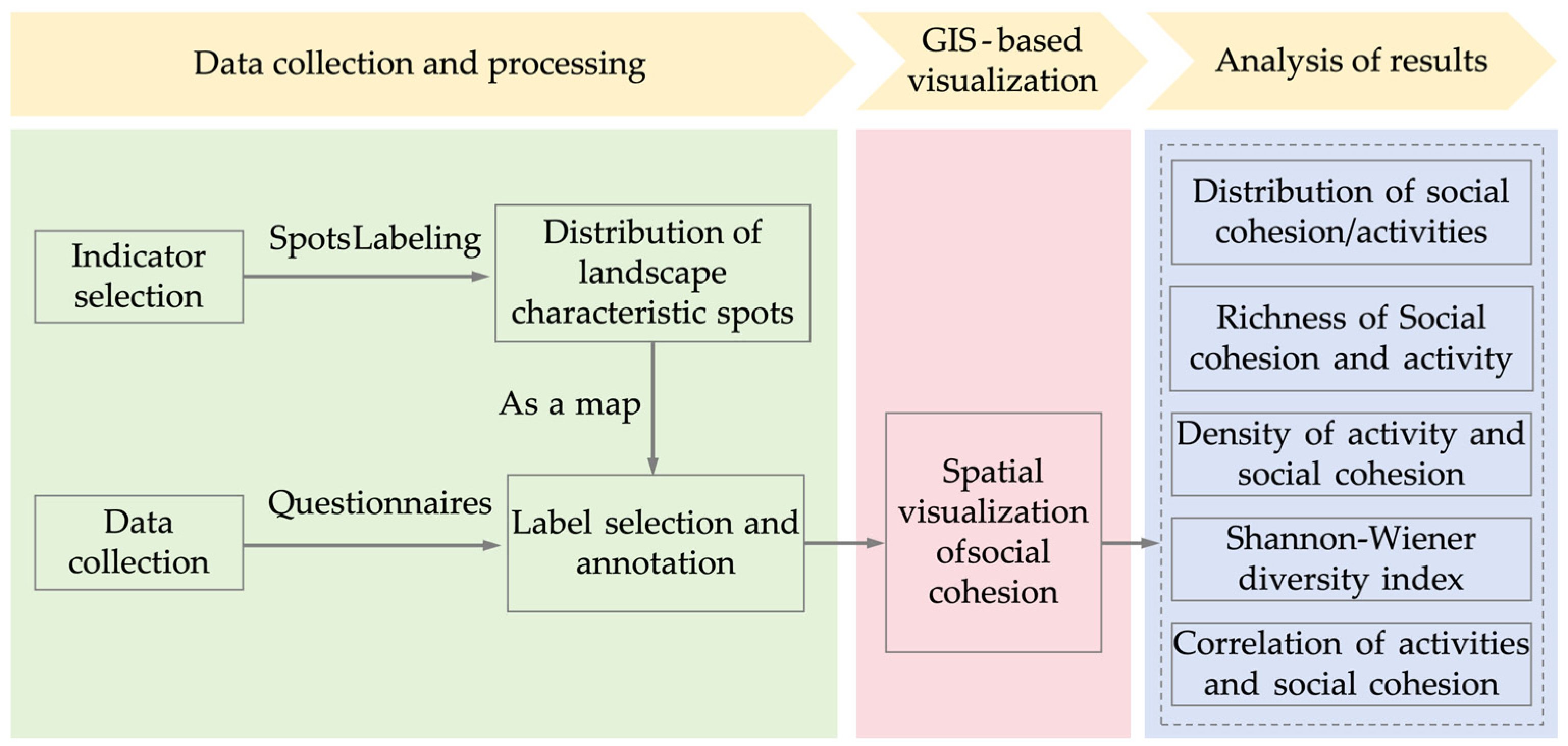
2.2.3. Data Analysis
3. Results
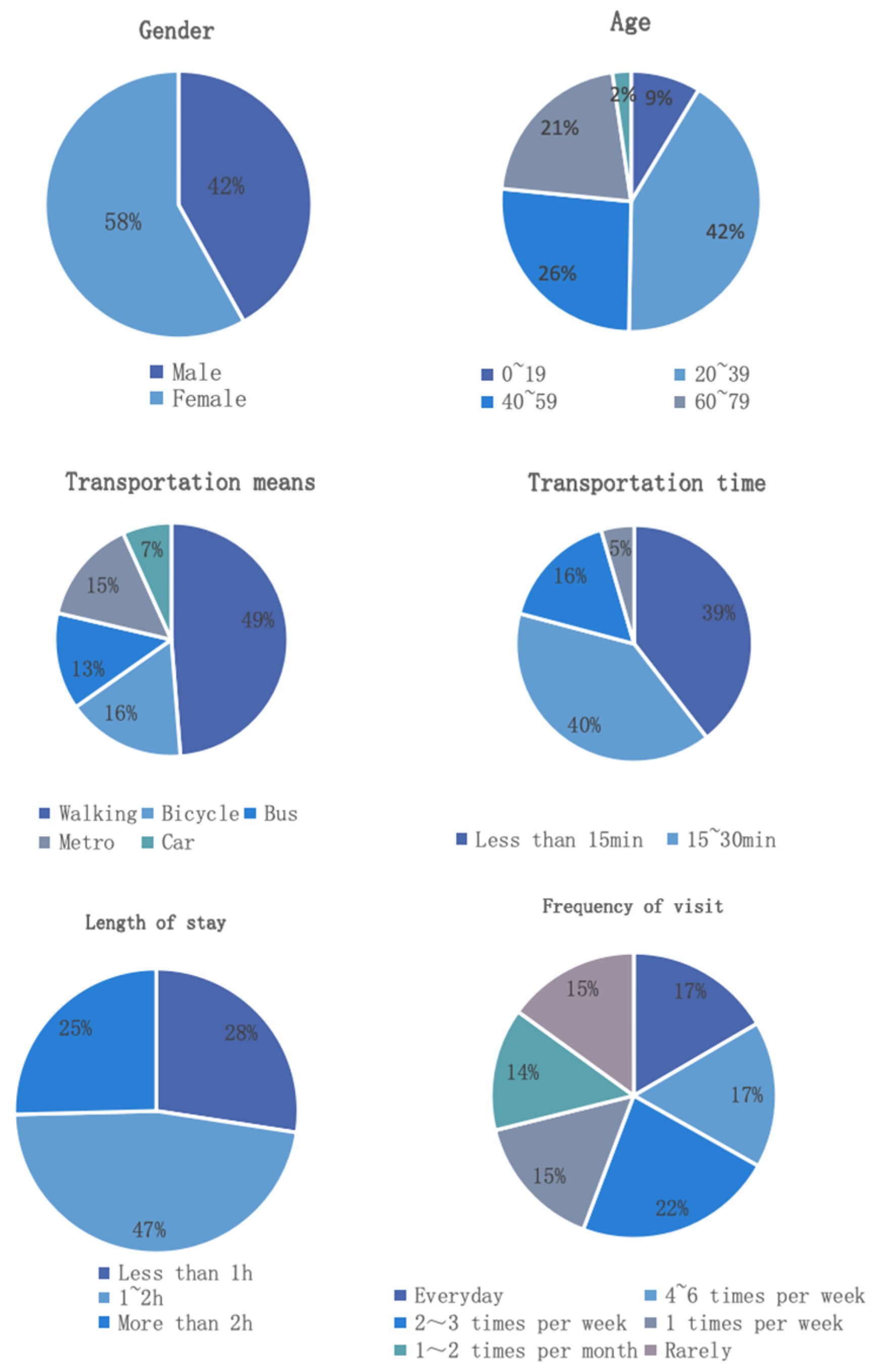
3.1. Descriptive Characteristics of Participants
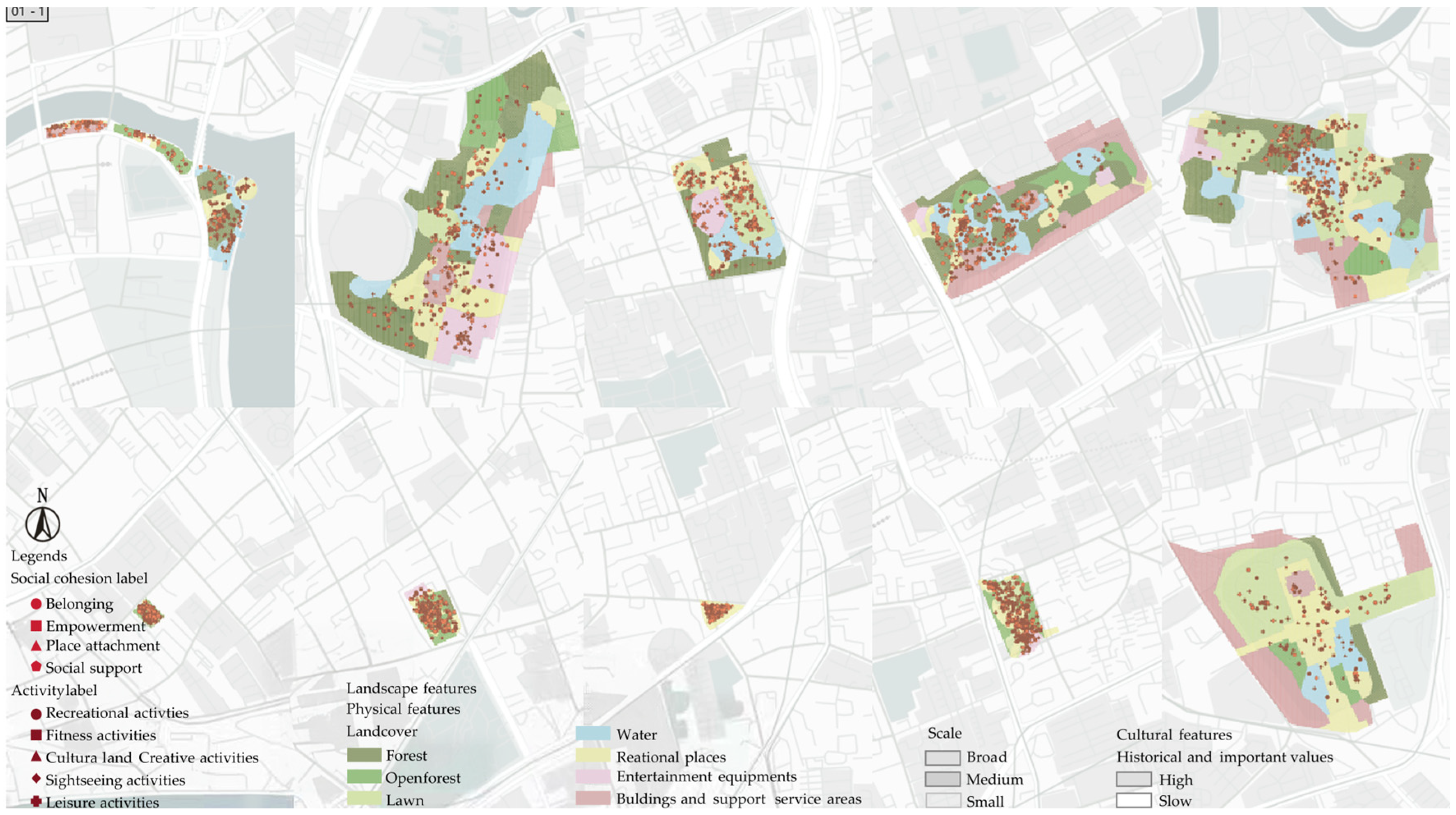
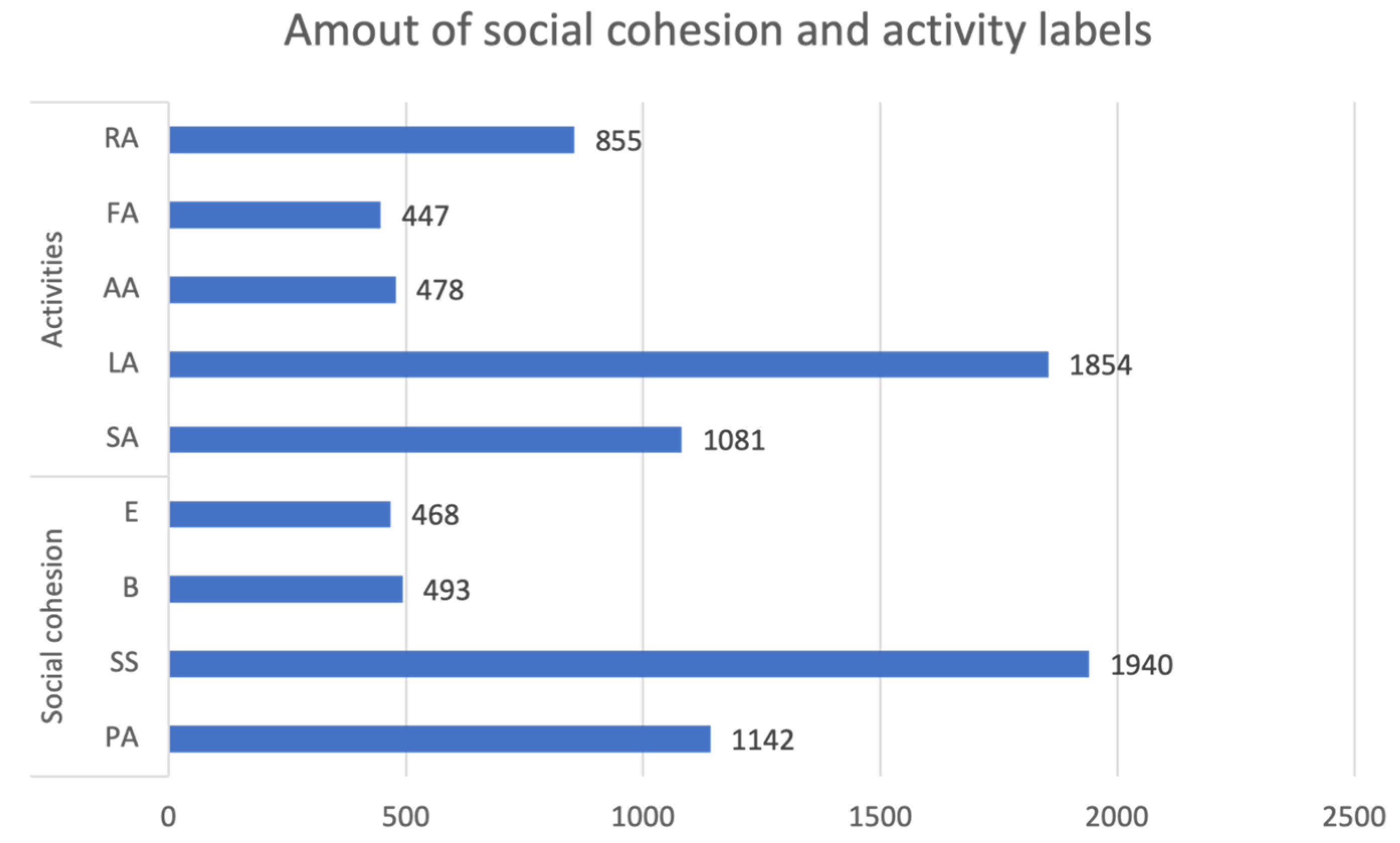
3.2. Spatial Distribution of Activities and Social Cohesion
3.3. Associations Between Landscape Characteristics and Social Cohesion
3.3.1. Land Cover Types and Social Cohesion
3.3.2. Space Scale and Social Cohesion
3.3.3. Historical Importance and Social Cohesion
3.4. Associations Between Activities and Social Cohesion
4. Conclusions and Discussion
4.1. Landscape Characteristics Are Closely Related to Social Cohesion and Activities
4.2. Social Cohesion Can Be Employed as a Potential Approach to Coordinate Historical Value Preservation and Recreational Demands Satisfaction in MHPs
- (1)
- As a type of urban green space, MHPs can provide recreational opportunities while facilitating meaningful, neighborly social interactions among local residents, which result in more emotional connections to other people and the site. Such connections can support and potentially influence the social fabric within the community and help foster social cohesion in a variety of ways. Meanwhile, the benefits of social cohesion, such as “social support”, and “belonging”, are crucial factors that attract residents to visit MHPs and conduct activities. Benefits such as “empowerment” also enhance health and well-being, alleviating feelings of social isolation. Such findings are consistent with Jennings’s (2019) theoretical hypothesis regarding the relationship between social cohesion and health and the well-being of urban green spaces [20].
- (2)
- In this paper, it is shown that the “existence” of the MHPs, the “presence” of the historical remains, the past fond memories, and the witness of the lives and transformations in them are part of the main reasons why local residents visit here and feel place attachment and a sense of belonging to MHPs. It can be inferred that the historical values of MHPs contribute to social cohesion by strengthening the place identity and forming collective memory. These benefits of social cohesion help residents to inherit the memories and historical values of MHPs across generations.
4.3. Limitations
Author Contributions
Funding
Data Availability Statement
Acknowledgments
Conflicts of Interest
References
- Chan, J.; To, H.-P.; Chan, E. Reconsidering Social Cohesion: Developing a Definition and Analytical Framework for Empirical Research. Soc. Indic. Res. 2006, 75, 273–302. [Google Scholar] [CrossRef] [Scilit]
- Schiefer, D.; van der Noll, J. The Essentials of Social Cohesion: A Literature Review. Soc. Indic. Res. 2017, 132, 579–603. [Google Scholar] [CrossRef] [Scilit]
- Sugiyama, T.; Leslie, E.; Giles-Corti, B.; Owen, N. Associations of Neighbourhood Greenness with Physical and Mental Health: Do Walking, Social Coherence and Local Social Interaction Explain the Relationships? J. Epidemiol. Community Health 2008, 62, e9. [Google Scholar] [CrossRef] [Scilit] [PubMed]
- Wang, P.; Han, L.; Hao, R.; Mei, R. Understanding the relationship between small urban parks and mental health: A case study in Shanghai, China. Urban For. Urban Green. 2022, 78, 127784. [Google Scholar] [CrossRef] [Scilit]
- Chen, S.; Sun, Y.; Seo, B.K. The Effects of Public Open Space on Older People’s Well-Being: From Neighborhood Social Cohesion to Place Dependence. Int. J. Environ. Res. Public Health 2022, 19, 16170. [Google Scholar] [CrossRef] [Scilit]
- Li, Q. A study on the properties of the public space with the orientation of social cohesion in residential area: Two cases of Chuangzhifang and Caoyangyicun in Shanghai. Urban Plan. Forum. 2014, 4, 88–97. [Google Scholar]
- Cook, I.R.; Swyngedouw, E. Cities, Social Cohesion and the Environment: Towards a Future Research Agenda. Urban Stud. 2012, 49, 1959–1979. [Google Scholar] [CrossRef] [Scilit]
- Clarke, M.; Cadaval, S.; Wallace, C.; Anderson, E.; Egerer, M.; Dinkins, L.; Platero, R. Factors that enhance or hinder social cohesion in urban greenspaces: A literature review. Urban For. Urban Green. 2023, 84, 127936. [Google Scholar] [CrossRef] [Scilit]
- Bottoni, G. A Multilevel Measurement Model of Social Cohesion. Soc. Indic. Res. 2018, 136, 835–857. [Google Scholar] [CrossRef] [Scilit]
- Xin, C.; Sylvie, V.D.; Luyuan, L.; Pieter, U. Taking “Social Relations” as a Cultural Ecosystem Service: A Triangulation Approach. Urban For. Urban Green. 2020, 55, 126790. [Google Scholar] [CrossRef] [Scilit]
- Jennings, V.; Rigolon, A.; Thompson, J.; Murray, A.; Henderson, A.; Gragg, R.S. The Dynamic Relationship between Social Cohesion and Urban Green Space in Diverse Communities: Opportunities and Challenges to Public Health. Int. J. Environ. Res. Public Health 2024, 21, 800. [Google Scholar] [CrossRef] [Scilit] [PubMed]
- de Vries, S.; van Dillen, S.M.E.; Groenewegen, P.P.; Spreeuwenberg, P. Streetscape greenery and health: Stress, social cohesion and physical activity as mediators. Soc. Sci. Med. 2013, 94, 26–33. [Google Scholar] [CrossRef] [Scilit] [PubMed]
- Peters, K.; Elands, B.; Buijs, A. Social Interactions in Urban Parks: Stimulating Social Cohesion? Urban For. Urban Green. 2010, 9, 93–100. [Google Scholar] [CrossRef] [Scilit]
- Lloyd, K.; Fullagar, S.; Reid, S. Where Is the ‘Social’ in Constructions of ‘Liveability’? Exploring Community, Social Interaction and Social Cohesion in Changing Urban Environments. Urban Policy Res. 2016, 34, 343–355. [Google Scholar] [CrossRef] [Scilit]
- Jennings, V.; Bamkole, O. The Relationship between Social Cohesion and Urban Green Space: An Avenue for Health Promotion. Int. J. Environ. Res. Public Health 2019, 16, 452. [Google Scholar] [CrossRef] [Scilit]
- Wan, C.; Shen, G.Q.; Choi, S. Underlying relationships between public urban green spaces and social cohesion: A systematic literature review. City Cult. Soc. 2021, 24, 100383. [Google Scholar] [CrossRef] [Scilit]
- Baran, P.K.; Smith, W.R.; Moore, R.C.; Floyd, M.F.; Bocarro, J.N.; Cosco, N.G.; Danninger, T.M. Park Use Among Youth and Adults. Environ. Behav. 2013, 46, 768–800. [Google Scholar] [CrossRef] [Scilit]
- Liu, Y.; Wang, R.; Lu, Y.; Li, Z.; Chen, H.; Cao, M.; Zhang, Y.; Song, Y. Natural Outdoor Environment, Neighbourhood Social Cohesion and Mental Health: Using Multilevel Structural Equation Modelling, Streetscape and Remote-Sensing Metrics. Urban For. Urban Green. 2020, 48, 126576. [Google Scholar] [CrossRef] [Scilit]
- Bergefurt, L.; Kemperman, A.; van den Berg, P.; Borgers, A.; van der Waerden, P.; Oosterhuis, G.; Hommel, M. Loneliness and Life Satisfaction Explained by Public-Space Use and Mobility Patterns. Int. J. Environ. Res. Public Health 2019, 16, 4282. [Google Scholar] [CrossRef] [Scilit]
- Opdam, P.; Verboom, J.; Pouwels, R. Landscape Cohesion: An Index for the Conservation Potential of Landscapes for Biodiversity. Landsc. Ecol. 2003, 18, 113–126. [Google Scholar] [CrossRef] [Scilit]
- Dupuis, M.; Baggio, S.; Gmel, G. Validation of a Brief Form of the Perceived Neighborhood Social Cohesion Questionnaire. J. Health Psychol. 2017, 22, 218–227. [Google Scholar] [CrossRef] [Scilit]
- Gehl, J. Life Between Buildings: Using Public Space, 6th ed.; Island Press: Washington, DC, USA, 2011; ISBN 978-1-59726-827-1. [Google Scholar]
- Fan, Y.; Das, K.V.; Chen, Q. Neighborhood Green, Social Support, Physical Activity, and Stress: Assessing the Cumulative Impact. Health Place 2011, 17, 1202–1211. [Google Scholar] [CrossRef] [Scilit] [PubMed]
- Mouratidis, K.; Poortinga, W. Built Environment, Urban Vitality and Social Cohesion: Do Vibrant Neighborhoods Foster Strong Communities? Landsc. Urban Plan. 2020, 204, 103951. [Google Scholar] [CrossRef] [Scilit]
- Talen, E. Sense of Community and Neighbourhood Form: An Assessment of the Social Doctrine of New Urbanism. Urban Stud. 1999, 36, 1361–1379. [Google Scholar] [CrossRef] [Scilit]
- Scannell, L.; Gifford, R. Defining Place Attachment: A Tripartite Organizing Framework. J. Environ. Psychol. 2010, 30, 1–10. [Google Scholar] [CrossRef] [Scilit]
- Hu, J.; Ying, J.; Zhang, Y.; Shen, Y.; Wu, X. From Landscapes to Bonds: Exploring the Influencing Mechanism of Community Parks on Social Integration. Sustainability 2023, 15, 8065. [Google Scholar] [CrossRef] [Scilit]
- Bazrafshan, M.; Spielhofer, R.; Wissen Hayek, U.; Kienast, F.; Grêt-Regamey, A. Greater Place Attachment to Urban Parks Enhances Relaxation: Examining Affective and Cognitive Responses of Locals and Bi-Cultural Migrants to Virtual Park Visits. Landsc. Urban Plan. 2023, 232, 104650. [Google Scholar] [CrossRef] [Scilit]
- Haggerty, L.J. Differential Social Contact in Urban Neighborhoods: Environmental vs. Sociodemographic Explanations. Sociol. Q. 1982, 23, 359–372. [Google Scholar] [CrossRef] [Scilit]
- ICOMOS. Document on Historic Urban Parks; ICOMOS: Delhi, India, 2017. [Google Scholar]
- Paraskevopoulou, A.; Klados, A.; Malesios, C. Historical Public Parks: Investigating Contemporary Visitor Needs. Sustainability 2020, 12, 9976. [Google Scholar] [CrossRef] [Scilit]
- Jiang, B.; Liu, Y. Historical and Cultural Values of the Modern Historic Parks in Tianjin—The British Concession. J. Asian Archit. Build. Eng. 2018, 17, 221–228. [Google Scholar] [CrossRef] [Scilit]
- Taplin, D.H.; Scheld, S.; Low, S.M. Rapid Ethnographic Assessment in Urban Parks: A Case Study of Independence National Historical Park. Hum. Organ. 2005, 61, 80–93. [Google Scholar] [CrossRef] [Scilit]
- Harding, S. Towards a Renaissance in Urban Parks. Cult. Trends 1999, 9, 1–20. [Google Scholar] [CrossRef] [Scilit]
- Bietti, L.M.; Tilston, O.; Bangerter, A. Storytelling as Adaptive Collective Sensemaking. Top. Cogn. Sci. 2019, 11, 710–732. [Google Scholar] [CrossRef] [Scilit] [PubMed]
- Gil, J.-H.; Park, H.-S. A Case Study on the Preservation Strategies of “Historic Urban Parks” in the UK, the USA, and Japan. J. Korean Inst. Landsc. Archit. 2020, 48, 20–33. [Google Scholar] [CrossRef] [Scilit]
- Petit-Boix, A.; Apul, D. From Cascade to Bottom-Up Ecosystem Services Model: How Does Social Cohesion Emerge from Urban Agriculture? Sustainability 2018, 10, 998. [Google Scholar] [CrossRef] [Scilit]
- Kosanic, A.; Petzold, J. A systematic review of cultural ecosystem services and human wellbeing. Ecosyst. Serv. 2020, 45, 101168. [Google Scholar] [CrossRef] [Scilit]
- van der Hoeven, A. Valuing Urban Heritage Through Participatory Heritage Websites: Citizen Perceptions of Historic Urban Landscapes. Space Cult. 2020, 23, 129–148. [Google Scholar] [CrossRef] [Scilit]
- Taylor, K. The Historic Urban Landscape Paradigm and Cities as Cultural Landscapes. Challenging Orthodoxy in Urban Conservation. Landsc. Res. 2016, 41, 471–480. [Google Scholar] [CrossRef] [Scilit]
- Ginzarly, M.; Houbart, C.; Teller, J. The Historic Urban Landscape Approach to Urban Management: A Systematic Review. Int. J. Herit. Stud. 2019, 25, 999–1019. [Google Scholar] [CrossRef] [Scilit]
- Potschin-Young, M.; Haines-Young, R.; Görg, C.; Heink, U.; Jax, K.; Schleyer, C. Understanding the Role of Conceptual Frameworks: Reading the Ecosystem Service Cascade. Ecosyst. Serv. 2018, 29, 428–440. [Google Scholar] [CrossRef] [Scilit]
- Fish, R.; Church, A.; Willis, C.; Winter, M.; Tratalos, J.A.; Haines-Young, R.; Potschin, M. Making Space for Cultural Ecosystem Services: Insights from a Study of the UK Nature Improvement Initiative. Ecosyst. Serv. 2016, 21, 329–343. [Google Scholar] [CrossRef] [Scilit]
- UNESCO World Heritage Centre. UNESCO World Heritage Centre—Document—Identification and Documentation of Modern Heritage. Available online: https://whc.unesco.org/en/documents/12/ (accessed on 31 August 2021).
- Mo, F.; Selman, P.; Woudstra, J. The Origins of the Modern Park System of the International Settlement in Shanghai (1899–1929). Landsc. Res. 2021, 46, 435–449. [Google Scholar] [CrossRef] [Scilit]
- Wu, Y.; Jin, Y.; Qian, C. Exploration on the regeneration of urban historical park under the background of organic regeneration: A case study of Shanghai Zuibaichi Park. In Annual Conference of CELA; Chinese Society of Landscape Architecture: Beijing, China, 2018; p. 7. Available online: https://kns.cnki.net/kcms2/article/abstract?v=QHiZY5KKB7ZyveH5vApja4KjiXCYy00dF5U6-M5_kNuzFTGpryfZd1HKdQqCwM2IEH3LfvIbuiiPSV4YHep312_e2YCPi1p6FajsMebgqN2e-rvw-8ngDuUUWUcql5QZkgZ0FtvGas-w4TKfvSn02axj5nOKfh1vnCF6TZhE83jKFd6K-a6b2SRnPYmYtzETnWOtT8Ym9Y0=&uniplatform=NZKPT&language=CHS (accessed on 15 August 2024).
- Dai, D.; Chen, Y.; Dai, K. Evaluating Cultural Ecosystem Services in China’s Modern Historic Parks: A Sentiment Computing Approach. Urban For. Urban Green. 2024, 95, 128314. [Google Scholar] [CrossRef] [Scilit]
- Dai, D.; Chen, Y.; Yuan, M. Cognitive map based quantitative method of spatial cognition in Shanghai’s urban historical parks: A case of Luxun Park. Urban Archit. 2019, 307, 7–13. [Google Scholar]
- Tveit, M.; Ode, Å.; Fry, G. Key Concepts in a Framework for Analysing Visual Landscape Character. Landsc. Res. 2006, 31, 229–255. [Google Scholar] [CrossRef] [Scilit]
- Osher, L.J.; Buol, S.W. Relationship of Soil Properties to Parent Material and Landscape Position in Eastern Madre de Dios, Peru. Geoderma 1998, 83, 143–166. [Google Scholar] [CrossRef] [Scilit]
- Li, S. Guidelines for urban design: Based on “public image”—A case study of the vicinity of Lu Xun Park in Shanghai. Harmonious Urban Planning. In Proceedings of the 2007 Annual Conference of Urban Planning in China, Harbin, China, 1–3 September 2007; p. 7. [Google Scholar]
- Swanwick, C.; Fairclough, G. Landscape Character: Experience from Britain. In Routledge Handbook of Landscape Character Assessment; Routledge: London, UK, 2018; ISBN 978-1-315-75342-3. [Google Scholar]
- Lin, Y. Comparative study on the assessment system of landscape characteristics in England and the assessment system of scenic and historic interest areas in China. Landsc. Archit. 2012, 1, 104–108. [Google Scholar] [CrossRef]
- Kümmerling, M.; Müller, N. The relationship between landscape design style and the conservation value of parks: A case study of a historical park in Weimar, Germany. Landsc. Urban Plan. 2012, 107, 111–117. [Google Scholar] [CrossRef] [Scilit]
- Loughran, K. Urban Parks and Urban Problems: An Historical Perspective on Green Space Development as a Cultural Fix. Urban Stud. 2020, 57, 2321–2338. [Google Scholar] [CrossRef] [Scilit]
- Zhan, Q.; Furuya, K.; Tang, X.; Li, Z. Policy Development in China’s Protected Scenic and Historic Areas. Land 2024, 13, 220. [Google Scholar] [CrossRef] [Scilit]
- Chen, H. Land Use Trade-Offs Associated with Protected Areas in China: Current State, Existing Evaluation Methods, and Future Application of Ecosystem Service Valuation. Sci. Total Environ. 2020, 711, 134688. [Google Scholar] [CrossRef] [Scilit] [PubMed]
- Church, A.; Fish, R.; Haines-Young, R. UK National Ecosystem Assessment Follow-On Work Package Report 5: Cultural Ecosystem Services and Indicators. Available online: http://uknea.unep-wcmc.org/Resources/tabid/82/Default.aspx (accessed on 31 August 2021).
- Yu, X.; Wang, F. Study on the spectrum of recreational activities in urban gardens: A case study of Wuxi. Chin. Gard. 2008, 4, 84–88. [Google Scholar]
- Human Geographies. Available online: https://www.humangeographies.org.ro/ (accessed on 5 November 2024).
- Comstock, N.; Dickinson, L.M.; Marshall, J.A.; Soobader, M.-J.; Turbin, M.S.; Buchenau, M.; Litt, J.S. Neighborhood attachment and its correlates: Exploring neighborhood conditions, collective efficacy, and gardening. J. Environ. Psychol. 2010, 30, 435–442. [Google Scholar] [CrossRef] [Scilit]
- Peng, W.T.; Liu, W.Q.; Cai, W.B.; Wang, X.; Huang, Z.; Wu, C.Z. Evaluation of ecosystem cultural services of urban protected areas based on public participation GIS (PPGIS): A case study of Gongqing Forest Park in Shanghai, China. Ying Yong Sheng Tai Xue Bao 2019, 30, 439–448. [Google Scholar] [CrossRef]
- Tenzer, M. Social Landscape Characterisation: A People-Centred, Place-Based Approach to Inclusive and Transparent Heritage and Landscape Management. Int. J. Herit. Stud. 2024, 30, 269–284. [Google Scholar] [CrossRef] [Scilit]
- Seaman, P.J.; Jones, R.; Ellaway, A. It’s Not Just about the Park, It’s about Integration Too: Why People Choose to Use or Not Use Urban Greenspaces. Int. J. Behav. Nutr. Phys. Act. 2010, 7, 78. [Google Scholar] [CrossRef] [Scilit]
- Gale, T. Harmony in Urban Growth: Combining Densification, Green Spaces, and Social Cohesion. Bachelor’s Thesis, University of Groningen, Groningen, The Netherlands, 2024. Available online: https://frw.studenttheses.ub.rug.nl/4637/ (accessed on 15 August 2024).
- Sonta, A.; Jiang, X. Rethinking walkability: Exploring the relationship between urban form and neighborhood social cohesion. Sustain. Cities Soc. 2023, 99, 104903. [Google Scholar] [CrossRef] [Scilit]
- Silva, T.M.; Silva, S.; Carvalho, A. Economic valuation of urban parks with historical importance: The case of Quinta do Castelo, Portugal. Land Use Policy 2022, 115, 106042. [Google Scholar] [CrossRef] [Scilit]
- Hosseini, F.; Sajadzadeh, H.; Aram, F.; Mosavi, A. The Impact of Local Green Spaces of Historically and Culturally Valuable Residential Areas on Place Attachment. Land 2021, 10, 351. [Google Scholar] [CrossRef] [Scilit]
- Hoteit, A. Role of the Landscape in the Preservation of Collective Memory and the Enhancement of National Belonging. Can. Soc. Sci. 2015, 11, 42–49. [Google Scholar] [CrossRef]
- Liu, Q.; Wu, Y.; Xiao, Y.; Fu, W.; Zhuo, Z.; van den Bosch, C.C.K.; Huang, Q.; Lan, S. More meaningful, more restorative? Linking local landscape characteristics and place attachment to restorative perceptions of urban park visitors. Landsc. Urban Plan. 2020, 197, 103763. [Google Scholar] [CrossRef] [Scilit]
- Goussous, J.S.; Al-Hammadi, N.A. Place attachment assessment of a heritage place: A case study of the roman amphitheater in downtown amman, jordan. Front. Archit. Res. 2018, 7, 1–10. [Google Scholar] [CrossRef] [Scilit]
- Biedenweg, K.; Williams, K.; Cerveny, L.; Styers, D. Is recreation a landscape value?: Exploring underlying values in landscape values mapping. Landsc. Urban Plan. 2019, 185, 24–27. [Google Scholar] [CrossRef] [Scilit]
- Bahriny, F.; Bell, S. Traditional versus Modern? Perceptions and Preferences of Urban Park Users in Iran. Sustainability 2021, 13, 2036. [Google Scholar] [CrossRef] [Scilit]
- Schöbel, S. Restructuring the Urban Landscape: A “Critical Reconstruction” of Permanent Structures in Historic Cultural and Urban Landscapes. In Urbanization and Locality: Strengthening Identity and Sustainability by Site-Specific Planning and Design; Wang, F., Prominski, M., Eds.; Springer: Berlin/Heidelberg, Germany, 2016; pp. 215–225. ISBN 978-3-662-48494-4. [Google Scholar]
- Yuan, L.; Marzuki, A. What Keeps Historical Theme Park Visitors Coming? Research Based on Expectation Confirmation Theory. Front. Psychol. 2024, 15, 1293638. [Google Scholar] [CrossRef] [Scilit]
- Cooper, N.; Brady, E.; Steen, H.; Bryce, R. Aesthetic and Spiritual Values of Ecosystems: Recognising the Ontological and Axiological Plurality of Cultural Ecosystem ‘Services’. Ecosyst. Serv. 2016, 21, 218–229. [Google Scholar] [CrossRef] [Scilit]
- Xu, Y.; Matarrita-Cascante, D.; Lee, J.H.; Luloff, A.E. Incorporating Physical Environment-Related Factors in an Assessment of Community Attachment: Understanding Urban Park Contributions. Sustainability 2019, 11, 5603. [Google Scholar] [CrossRef] [Scilit]
- Loughran, K. Imbricated Spaces: The High Line, Urban Parks, and the Cultural Meaning of City and Nature. Sociol. Theor. 2016, 34, 311–334. [Google Scholar] [CrossRef] [Scilit]
- Peters, K. Being Together in Urban Parks: Connecting Public Space, Leisure, and Diversity. Leis. Sci. 2010, 32, 418–433. [Google Scholar] [CrossRef] [Scilit]
- Putnam, R.D.; Leonardi, R.; Nonetti, R.Y. Making Democracy Work: Civic Traditions in Modern Italy; Princeton University Press: Princeton, NJ, USA, 1993; ISBN 978-0-691-03738-7. [Google Scholar]
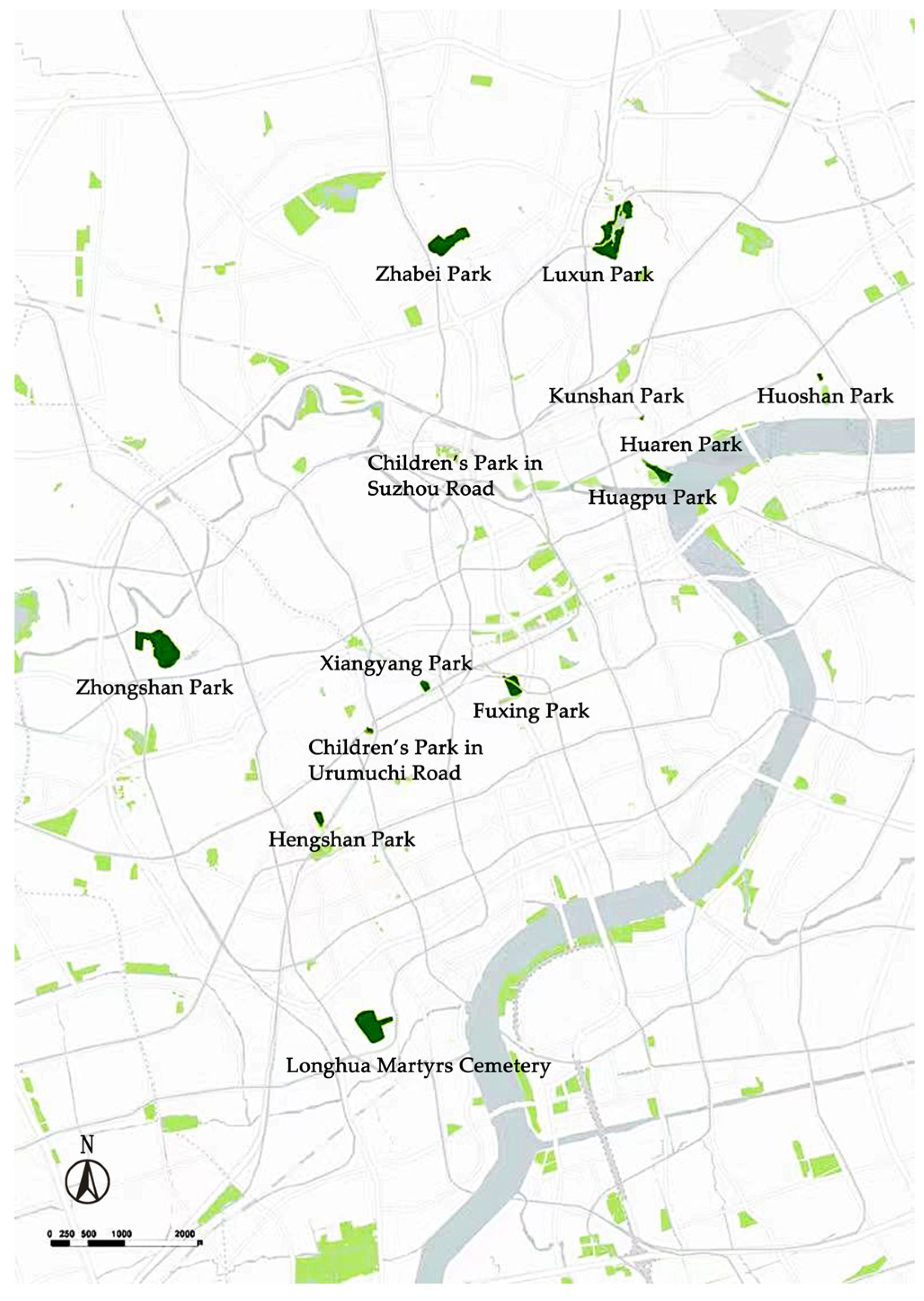

| Name of MHP | Completed Year | Surrounding Environment |
|---|---|---|
| Huangpu Park | 1868 | Several important historical and cultural landmarks, such as the Shanghai People’s Heroes Memorial Tower, etc. |
| Lu Xun Park | 1895 | Commercial facilities, Lu Xun’s former residence |
| Kunshan Park | 1898 | Residential, commercial spaces |
| Fuxing Park | 1908 | Public spaces, commercial spaces |
| Zhongshan Park | 1914 | Historical and cultural landmarks and commercial areas |
| Huoshan Park | 1917 | Residential areas, schools, commercial districts, etc. |
| Hengshan Park | 1925 | Xujiahui commercial district |
| Children’s Park in Suzhou Road | 1931 | Commercial areas, residential |
| Xiangyang Park | 1942 | Donghu Hotel, Russian Orthodox Church |
| Zhabei Park | 1946 | Hotels, accommodations, commercial facilities, educational institutions |
| Huaren Park | 1980 | Zhapu Road Bridge and Sichuan Road Bridge |
| Children’s Park in Urumuchi Road | 1981 | Educational facilities, residential |
| Longhua Martyrs’ Cemetery | 1995 | Red revolutionary memorial site |
| Landscape Characteristics | Definition | Indicator | Explanation | |
|---|---|---|---|---|
| Category | Subcategory | |||
| Physical characteristics | Land cover | The most dominant types of the spot’s land cover | Forest | Refers to areas where the canopy density is equal to or greater than 0.2 |
| Woodland | Refers to areas where the canopy density is smaller than 0.2 and equal to or greater than 0.1 | |||
| Grassland | Refers to areas where the canopy density is smaller than 0.1 and the land is covered by grass | |||
| Water area | Refers to areas that include rivers, lakes, ponds, or other kinds of waterscape, excluding dry fountains | |||
| Recreational area | Refers to areas that contain fitness equipment, small landscape structures, and some other unpowered amenities | |||
| Amusement area | Refers to areas that contain power amusement amenities | |||
| Buildings and office area | Refers to areas that contain buildings and their buffer zone | |||
| Scale | The scale of the spot size | Small | Refers to areas less than 500 m2 in size | |
| Medium | Refers to areas more than or equal to 500 m2 and less than 10,000 m2 in size | |||
| Wide | Refers to areas more than or equal to 10,000 m2 in size | |||
| Historical characteristics | Historical importance | High | Refers to areas that were built at least 30 years ago, or that present typical landscape features, or where there were certain historical stories or celebrity-related events | |
| Low | ||||
| Category | Subcategory | Indicator |
|---|---|---|
| Activities | Sightseeing activities | Enjoying the scenery |
| Taking photos | ||
| Participating in events | ||
| Leisure activities | Taking a stroll | |
| Sitting and resting | ||
| Artistic activities | Reading or painting | |
| Playing instruments or singing | ||
| Playing chess or cards | ||
| Fitness activities | Working out | |
| Doing extreme sports | ||
| Recreational activities | Parent–child activity | |
| Water entertainment | ||
| Amusement facilities | ||
| Picnic and camping | ||
| Games | ||
| Observation of nature | ||
| Social cohesion | Place attachment | Having fond memories (sense of place) |
| Feeling joy and happiness | ||
| Social support | Feeling safe. | |
| Having lots of friends (social belonging) | ||
| Belonging | Feeling at home (rooted identity, rootedness) | |
| Being used to coming here (space to belong) | ||
| Empowerment | Feeling sublimity (spirituality) | |
| Finding creative inspiration | ||
| Self-discovery (spiritual health) |
| Landscape Characteristics | Category | Social Cohesion | Activities | ||||||||||
|---|---|---|---|---|---|---|---|---|---|---|---|---|---|
| Category | Sub- Category | PA | SS | B | E | Total | SA | LA | AA | FA | RA | PA | |
| Physical characteristics | Land cover | Forest | 29.20% | 25.18% | 35.77% | 9.85% | 100.00% | 23.88% | 40.22% | 9.29% | 7.53% | 19.07% | 100.00% |
| Woodland | 28.16% | 23.67% | 39.59% | 8.57% | 100.00% | 17.44% | 43.36% | 11.13% | 12.96% | 15.12% | 100.00% | ||
| Grassland | 38.89% | 20.11% | 31.48% | 9.52% | 100.00% | 21.87% | 38.75% | 6.27% | 9.59% | 23.53% | 100.00% | ||
| Water area | 39.34% | 21.69% | 30.15% | 8.82% | 100.00% | 30.06% | 34.58% | 7.79% | 6.23% | 21.34% | 100.00% | ||
| Recreational area | 27.59% | 30.96% | 33.51% | 7.94% | 100.00% | 22.61% | 39.67% | 13.59% | 10.46% | 13.66% | 100.00% | ||
| Amusement area | 48.09% | 15.27% | 33.59% | 3.05% | 100.00% | 18.80% | 36.47% | 6.39% | 9.40% | 28.95% | 100.00% | ||
| Buildings and office area | 26.04% | 23.96% | 40.63% | 9.38% | 100.00% | 25.81% | 41.47% | 11.06% | 7.37% | 14.29% | 100.00% | ||
| Scale | Small | 25.00% | 43.33% | 28.33% | 3.33% | 100.00% | 16.54% | 48.12% | 10.53% | 15.79% | 9.02% | 100.00% | |
| Medium | 30.80% | 25.53% | 34.93% | 8.73% | 100.00% | 22.76% | 40.83% | 11.16% | 9.86% | 15.39% | 100.00% | ||
| Wide | 37.82% | 21.76% | 32.30% | 8.12% | 100.00% | 24.01% | 34.77% | 7.76% | 7.91% | 25.55% | 100.00% | ||
| Historical characteristics | Historical importance | High | 36.35% | 23.07% | 31.12% | 9.46% | 100.00% | 25.31% | 37.46% | 7.66% | 8.90% | 20.67% | 100.00% |
| Landscape Characteristics | Category | Social Cohesion | Activities | ||||||||
|---|---|---|---|---|---|---|---|---|---|---|---|
| Category | Subcategory | PA | SS | B | E | SA | LA | AA | FA | RA | |
| Physical characteristics | Land cover | Forest | 11.49% | 12.90% | 13.46% | 15.00% | 13.93% | 13.71% | 12.26% | 10.66% | 14.03% |
| Woodland | 9.91% | 10.84% | 13.32% | 11.67% | 9.81% | 14.25% | 14.16% | 17.69% | 10.73% | ||
| Grassland | 21.12% | 14.21% | 16.35% | 20.00% | 15.98% | 16.55% | 10.36% | 17.01% | 21.70% | ||
| Water area | 15.37% | 11.03% | 11.26% | 13.33% | 18.04% | 12.12% | 10.57% | 9.07% | 16.16% | ||
| Recreational area | 29.45% | 42.99% | 34.20% | 32.78% | 32.34% | 33.15% | 43.97% | 36.28% | 24.65% | ||
| Amusement area | 9.05% | 3.74% | 6.04% | 2.22% | 4.67% | 5.30% | 3.59% | 5.67% | 9.08% | ||
| Buildings and office area | 3.59% | 4.30% | 5.36% | 5.00% | 5.23% | 4.92% | 5.07% | 3.63% | 3.66% | ||
| Total | 100.00% | 100.00% | 100.00% | 100.00% | 100.00% | 100.00% | 100.00% | 100.00% | 100.00% | ||
| Scale | Small | 2.16% | 4.86% | 2.34% | 1.11% | 2.06% | 3.50% | 2.96% | 4.76% | 1.42% | |
| Medium | 66.38% | 71.59% | 71.98% | 72.78% | 67.29% | 70.56% | 74.63% | 70.75% | 57.43% | ||
| Wide | 31.47% | 23.55% | 25.69% | 26.11% | 30.65% | 25.94% | 22.41% | 24.49% | 41.16% | ||
| Total | 100.00% | 100.00% | 100.00% | 100.00% | 100.00% | 100.00% | 100.00% | 100.00% | 100.00% | ||
| Historical characteristics | Historical importance | High | 62.93% | 51.96% | 51.51% | 63.33% | 63.27% | 54.72% | 43.34% | 53.97% | 65.21% |
| Low | 37.07% | 48.04% | 48.49% | 36.67% | 36.73% | 45.28% | 56.66% | 46.03% | 34.79% | ||
| Total | 100.00% | 100.00% | 100.00% | 100.00% | 100.00% | 100.00% | 100.00% | 100.00% | 100.00% | ||
| Landscape Characteristics | Categories | Density of Social Cohesion Labels (pcs/km2) | Density of Activity Labels (pcs/km2) | |||||
|---|---|---|---|---|---|---|---|---|
| Category | Sub- Category | Max | Min | Mean | Max | Min | Mean | |
| Physical characteristics | Land cover | Forest | 0.00 | 50.20 | 9.85 | 0.00 | 116.25 | 22.42 |
| Woodland | 0.00 | 572.23 | 22.40 | 0.00 | 1512.32 | 55.04 | ||
| Grassland | 0.00 | 191.41 | 19.10 | 0.00 | 454.60 | 39.52 | ||
| Water area | 0.00 | 51.35 | 14.71 | 0.00 | 114.55 | 34.71 | ||
| Recreational area | 0.00 | 507.54 | 31.07 | 0.00 | 957.08 | 63.98 | ||
| Amusement area | 0.00 | 130.31 | 18.54 | 0.00 | 220.28 | 37.65 | ||
| Buildings and office area | 0.00 | 80.79 | 4.58 | 0.00 | 181.77 | 10.36 | ||
| Scale | Small | 0.00 | 572.23 | 185.84 | 0.00 | 1512.32 | 411.94 | |
| Medium | 0.00 | 507.54 | 23.51 | 0.00 | 957.08 | 49.59 | ||
| Wide | 0.00 | 55.21 | 8.93 | 0.00 | 90.07 | 21.06 | ||
| Historical characteristics | Historical importance | High | 0.00 | 262.78 | 16.07 | 0.00 | 394.17 | 35.68 |
| Low | 0.00 | 572.23 | 17.29 | 0.00 | 1512.32 | 36.81 | ||
| Landscape Characteristics | Categories | Diversity of Social Cohesion Labels | Diversity of Activity Labels | |||||
|---|---|---|---|---|---|---|---|---|
| Category | Subcategory | Max | Min | Mean | Max | Min | Mean | |
| Physical characteristics | Land cover | Forest | 0.00 | 1.36 | 1.30 | 0.00 | 1.50 | 1.44 |
| Woodland | 0.00 | 1.33 | 1.28 | 0.00 | 1.56 | 1.46 | ||
| Grassland | 0.00 | 1.32 | 1.28 | 0.00 | 1.46 | 1.44 | ||
| Water area | 0.00 | 1.39 | 1.27 | 0.00 | 1.53 | 1.43 | ||
| Recreational area | 0.00 | 1.39 | 1.29 | 0.00 | 0.00 | 1.48 | ||
| Amusement area | 0.00 | 1.39 | 1.11 | 0.00 | 1.57 | 1.44 | ||
| Buildings and office area | 0.00 | 1.29 | 1.28 | 0.00 | 1.56 | 1.43 | ||
| Scale | Small | 0.00 | 1.24 | 1.18 | 0.00 | 1.45 | 1.33 | |
| Medium | 0.00 | 1.39 | 1.29 | 0.00 | 1.57 | 1.51 | ||
| Wide | 0.00 | 1.35 | 1.27 | 0.00 | 1.56 | 1.41 | ||
| Historical characteristics | Historical importance | High | 0.00 | 1.24 | 1.18 | 0.00 | 1.45 | 1.33 |
| Low | 0.00 | 1.39 | 1.27 | 0.00 | 1.57 | |||
| Place attachment (PA) | Social support (SS) | Belonging (B) | Empowerment (E) | Sightseeing activities (SA) | Leisure activities (LA) | Artistic activities (AA) | Fitness activities (FA) | Recreational activities (RA) | |
|---|---|---|---|---|---|---|---|---|---|
| PA | 1 | ||||||||
| SS | 0.674 ** | 1 | |||||||
| B | 0.760 ** | 0.877 ** | 1 | ||||||
| E | 0.620 ** | 0.558 ** | 0.668 ** | 1 | |||||
| SA | 0.678 ** | 0.526 ** | 0.628 ** | 0.716 ** | 1 | ||||
| LA | 0.820 ** | 0.851 ** | 0.910 ** | 0.687 ** | 0.738 ** | 1 | |||
| AA | 0.560 ** | 0.909 ** | 0.838 ** | 0.543 ** | 0.452 ** | 0.773 ** | 1 | ||
| FA | 0.687 ** | 0.656 ** | 0.741 ** | 0.560 ** | 0.580 ** | 0.793 ** | 0.507 ** | 1 | |
| RA | 0.793 ** | 0.404 ** | 0.572 ** | 0.594 ** | 0.585 ** | 0.629 ** | 0.298 ** | 0.541 ** | 1 |
Disclaimer/Publisher’s Note: The statements, opinions and data contained in all publications are solely those of the individual author(s) and contributor(s) and not of MDPI and/or the editor(s). MDPI and/or the editor(s) disclaim responsibility for any injury to people or property resulting from any ideas, methods, instructions or products referred to in the content. |
© 2024 by the authors. Licensee MDPI, Basel, Switzerland. This article is an open access article distributed under the terms and conditions of the Creative Commons Attribution (CC BY) license (https://creativecommons.org/licenses/by/4.0/).
Share and Cite
Chen, Y.; Tang, J.; Dai, D. Using Public Participation Geographic Information System to Study Social Cohesion and Its Relationship with Activities and Specific Landscape Characteristics in Shanghai’s Modern Historic Parks. Land 2024, 13, 1996. https://doi.org/10.3390/land13121996
Chen Y, Tang J, Dai D. Using Public Participation Geographic Information System to Study Social Cohesion and Its Relationship with Activities and Specific Landscape Characteristics in Shanghai’s Modern Historic Parks. Land. 2024; 13(12):1996. https://doi.org/10.3390/land13121996
Chicago/Turabian StyleChen, Yuxian, Jiajia Tang, and Daixin Dai. 2024. "Using Public Participation Geographic Information System to Study Social Cohesion and Its Relationship with Activities and Specific Landscape Characteristics in Shanghai’s Modern Historic Parks" Land 13, no. 12: 1996. https://doi.org/10.3390/land13121996
APA StyleChen, Y., Tang, J., & Dai, D. (2024). Using Public Participation Geographic Information System to Study Social Cohesion and Its Relationship with Activities and Specific Landscape Characteristics in Shanghai’s Modern Historic Parks. Land, 13(12), 1996. https://doi.org/10.3390/land13121996

