


Vegetation Dynamics Studies Based on Ellenberg and Landolt Indicator Values: A Review


Abstract
1. Introduction
2. Materials and Methods
3. Results
3.1. Frequency of Studies by Country
3.2. Types of Plant Communities
3.3. Keyword Analysis and Research Topics
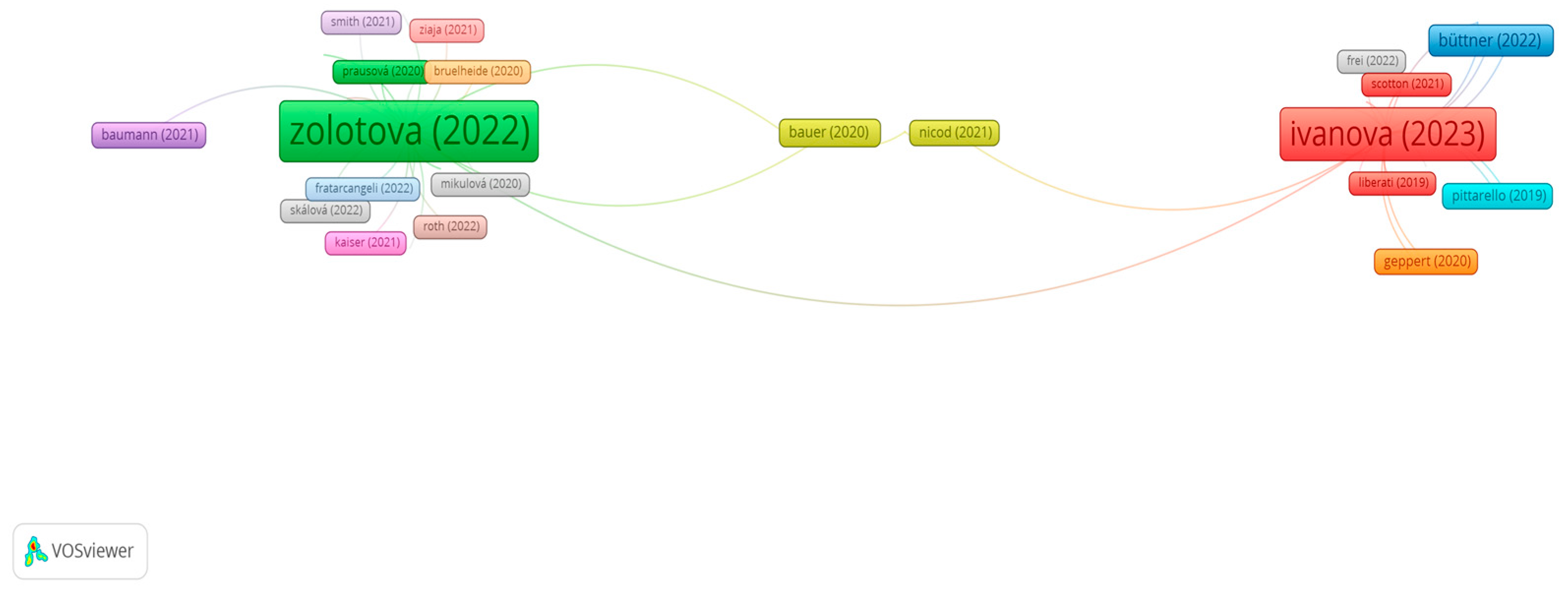
3.4. Citation Analysis
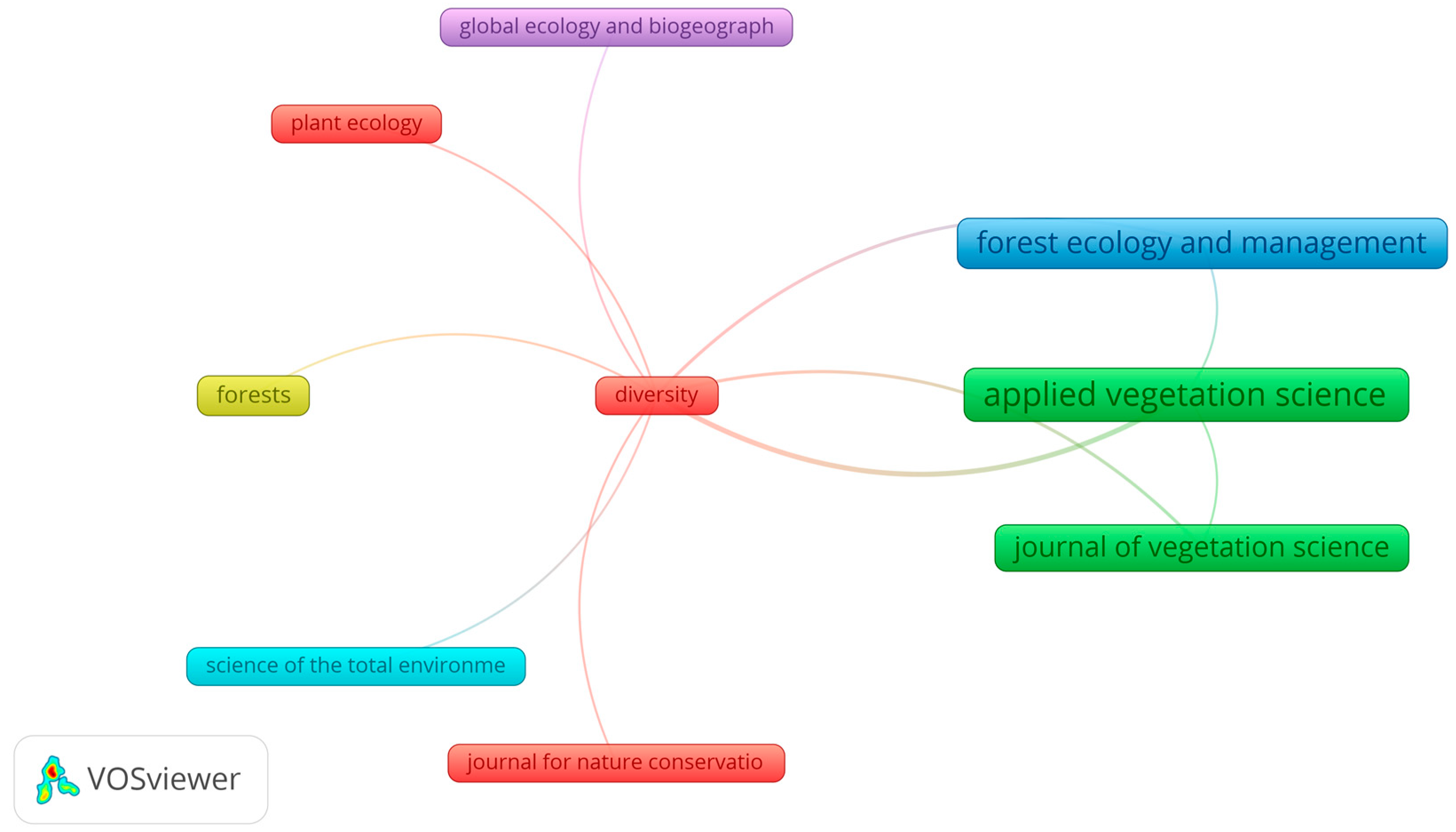
3.5. Analysis of the Journal Interconnection Network Based on Citations
4. Discussion
4.1. Problems of Studying Vegetation Dynamics Using Ecological Indicator Values
- Long-term research on the structure and dynamics of plant communities and the creation of various geobotanical databases has led the scientific community to the era of large ecological datasets. On the one hand, this makes it possible to obtain more accurate regional assessments and forecasts of plant community dynamics, increase the efficiency of nature management and conservation, and move to a new level of research: transcontinental and global [111]. On the other hand, there is an acute shortage of appropriate methods of analysis. The question remains of how widely ecological indicators can be used geographically. Modern research has shown that the geography of application of the Ellenberg and Landolt indicator values is expanding. Researchers are faced with the question of transformation of ecological niches in various bioclimatic zones. Nevertheless, the scale of transformation of ecological niches remains insufficiently studied, especially for man-made landscapes [112,113]. Understanding the transformation of ecological niches stimulates the adjustment of existing and the development of new regional ecological indicators with appropriate amendments. Moreover, the amendments may be relatively small if the countries are located close to the European countries for which the Ellenberg and Landolt indicator values were developed, in contrast to those that need to be made in more remote regions, including Russia. Thus, on the one hand, the development of regional ecological indicator values allows for a significant increase in their effectiveness within a particular region. On the other hand, it complicates the comparison of research results for different countries. In addition, the use of regional ecological indicators makes it difficult to move to the analysis of large territories, which requires the use of uniform ecological indicator values throughout the study area. There are currently no specific recommendations from the scientific community on how to adjust the estimates of indicators over large areas. Further specific studies are needed to reduce the risk of false results.
- Changes in species composition occur gradually and do not always clearly follow the transformation of the habitat. The lag effect is manifested both in the emergence of new species that are better adapted to changing conditions and in the extinction of species for which environmental conditions have become unsuitable [77]. However, there are no precise quantitative estimates characterizing the delay time. In addition, it can be assumed that this effect will depend on the bioclimatic zone, different types of impacts and many other factors. This problem is closely related to the rapidly gaining popularity of the scientific field on the study of plant adaptation [114,115] and plant communities [116,117].
- Climate change can lead to complex changes in the species composition, spatial structure, ecological processes and functional services of phytocenoses and distort the natural course of restorative and digressive successions. At the same time, the frequency and intensity of disturbances of terrestrial ecosystems that initiate restorative successions are increasing worldwide. Disturbances, their causes and their consequences are given close attention in modern science. However, there is still a lack of knowledge about restorative successions, despite their importance for sustainable nature management [118,119]. At the same time, despite the fact that synergistic effects from the imposition of different types of dynamics undoubtedly exist, this problem remains the least studied. Moreover, synergistic effects significantly complicate the study of both climate dynamics and restorative and digressive successions. This problem must be taken into account when using the ecological indicator values, as there is a possibility of obtaining false conclusions. However, modern research does not provide answers to these questions.
- The issue of convergence of plant communities was not addressed in the studies based on ecological indicators that we reviewed. In a review devoted to Russian forest typologies, it was emphasized that this phenomenon is very often manifested both in clearings and in primary and secondary forests [120]. It has been established that in clearings and burnt areas, this is due to the fact that the same type of external influences similarly transform the habitat and so physiognomically similar plant communities are formed in different forest growth conditions [121]. On the other hand, the influence of the edificator is clearly manifested in primary and secondary forests. It affects the species composition and structure of subordinate layers, and phytocenoses acquire physiognomic similarity in different habitats. Of course, the species composition of these plant communities is not identical, but to date, no quantitative assessment of the degree of variation in the convergence of plant communities has been carried out. We also did not find information on how much this phenomenon complicates the bioindication of the habitat based on ecological indicator values.
- The above problems lead to a difficulty of constructing effective models of vegetation dynamics. Predicting vegetation dynamics, for example, based on process models or machine learning, requires large amounts of accurate and representative data to train algorithms and verify parameters. Moreover, the data should be obtained using the same methods. Therefore, it is extremely important to expand plant-based bioindication systems to the Eurasian scale. Our conclusion is in good agreement with the opinions of other researchers [38]. The current shortage of high-quality monitoring datasets, lag effects, convergence of plant communities and synergistic effects reduce the accuracy of available models and, consequently, forecasts. This complicates the development of a system of sustainable environmental management and biodiversity conservation and also requires additional research.
4.2. Priority Directions for Further Research
- Fill existing gaps in the study of vegetation. As accurate quantitative data are the basis for ecological analysis, further large-scale, multi-year studies are needed to collect data on the vegetation structure and dynamics, as well as field measurements to study habitat factors. This will complement existing databases and initiate the creation of new databases. If such data for in-depth environmental analysis have already been collected for the EU countries, there are still many “empty zones” outside this area that have yet to be filled in. This applies, for example, to the vast Russian Federation and CIS territories. The identification of knowledge gaps will provide a basis for identifying priority and under-researched areas for future research. Data collection will require more effort. However, this phase is urgently needed to provide a reliable basis for further research.
- Verification of the effectiveness and development of a methodology for the correction of ecological indicator values for different bioclimatic zones and vegetation types. An example of this is a study by a large international team of authors on the development of the latest Ecological Indicator Values for Europe (EIVE) [21]. Here, they used 31 indicator value systems, including the Ellenberg, Landolt, Tsyganov, Ramensky and other indicator values. EIVE is by far the most comprehensive system of ecological indicator values for European vascular plants, containing data on 14,714 taxa for soil moisture (M), 13,748 taxa for nitrogen (N), 14,254 taxa for soil acidity (R), 14,054 taxa for light (L) and 14,496 taxa for temperature (T). However, there has been no evaluation of its effectiveness outside Europe, although such studies are highly relevant. For example, verifying the effectiveness of EIVE for the territories of the Russian Federation would significantly expand the boundaries of its application. Filling this gap is an urgent task. At the same time, the applicability, effectiveness and comparability of estimates for the ecological indicator values of Tsyganov, Ellenberg and Landolt have been verified for Russia [122]. The authors found that, despite the different ranges of scores for different indicator values, the normalized values of the corresponding indicators proved to be comparable and generally gave good results for studying successions in the complex pine (Pineta sylvestris composita (nemoro-boroherbosa)) subzones of coniferous–deciduous forests. Assessments of environmental factors based on all three systems of ecological indicators correlated during the successional process. The approval of the indicator values of Ramensky, Tsyganov and Landolt for the conditions of the Voronezh region in Russia was reached when using the example of the study of post-fire successions [123]. The authors obtained a positive result for all three systems of ecological indicator values tested. However, the researchers did not draw clear conclusions about the limits of applicability of these developments and the need to adjust indicator values. Therefore, despite the positive results of testing the Ellenberg, Landolt, Tsyganov and Ramensky indicator values on the territory of the Russian Federation, these problems require more thorough and large-scale studies for different bioclimatic zones and types of plant communities, especially in man-made landscapes and urbanized areas. At the same time, the Braun–Blanquet approach can be used to classify vegetation [124], which is widely used by researchers in Russia and abroad and provides a reliable basis for ecological analysis [125]. The choice of a classification system is particularly important, since the logical and correct systematization of the data obtained is extremely important for drawing correct conclusions. That is why we are addressing this issue here.
- To study the effects of a delay. For these purposes, specific studies are needed to obtain strictly quantitative data on the dynamics of both vegetation and habitat factors. The experience of an Austrian team of authors can be used to pursue this scientific direction [77].
- Development of predictive models of plant community dynamics. The importance of accurate predictions of plant community and habitat dynamics for the conservation and restoration of natural ecosystems and their functions is beyond doubt. On the one hand, it will provide a reliable basis for land use and conservation, and on the other, it will help to verify the quality and depth of our understanding of the mechanisms of climatic and anthropogenic vegetation change. It is important to understand the peculiarities of both the transformation of ecological niches and the effects of delayed changes in species composition during climatic shifts and successions. Identifying these features and developing robust, rigorous quantitative adjustments will be key to successfully predicting vegetation dynamics under different future climate change scenarios.
5. Conclusions
Author Contributions
Funding
Conflicts of Interest
References
- Gao, Y.; Skutsch, M.; Paneque-Gálvez, J.; Ghilardi, A. Remote sensing of forest degradation: A review. Environ. Res. Lett. 2020, 15, 103001. [Google Scholar] [CrossRef] [Scilit]
- Meng, N.; Wang, N.; Cheng, H.; Liu, X.; Niu, Z. Impacts of climate change and anthropogenic activities on the normalized difference vegetation index of desertified areas in northern China. J. Geogr. Sci. 2023, 33, 483–507. [Google Scholar] [CrossRef] [Scilit]
- Tariq, A.; Graciano, C.; Sardans, J.; Zeng, F.; Hughes, A.C.; Ahmed, Z.; Ullah, A.; Ali, S.; Gao, Y.; Peñuelas, J. Plant root mechanisms and their effects on carbon and nutrient accumulation in desert ecosystems under changes in land use and climate. New Phytol. 2024, 242, 916–934. [Google Scholar] [CrossRef] [Scilit]
- Santoro, A.; Piras, F.; Fiore, B.; Bazzurro, A.; Agnoletti, M. Forest-Cover Changes in European Natura 2000 Sites in the Period 2012–2018. Forests 2024, 15, 232. [Google Scholar] [CrossRef] [Scilit]
- Maiti, R.; Rodriguez, H.G.; Ivanova, N.S. Autoecology and Ecophysiology of Woody Shrubs and Trees: Concepts and Applications; John Wiley & Sons: Oxford, UK, 2016; 352p. [Google Scholar] [CrossRef] [Scilit]
- Sparey, M.; Williamson, M.S.; Cox, P.M. Machine Learning for Global Bioclimatic Classification: Enhancing Land Cover Prediction through Random Forests. Atmosphere 2024, 15, 700. [Google Scholar] [CrossRef] [Scilit]
- Zavyalov, K.; Ivanova, N.; Potapenko, A.; Ayan, S. Influence of soil fertility on the ability of Scots pine (Pinus sylvestris L.) to adapt to technogenic pollution. CERNE 2019, 25, 326–331. [Google Scholar] [CrossRef] [Scilit]
- Fomin, V.; Ivanova, N.; Mikhailovich, A.; Zolotova, E. Problem of climate-driven dynamics in the genetic forest typology. Modern synthetic methodologies for creating drugs and functional materials (mosm2020). AIP Conf. Proc. 2021, 2388, 030007. [Google Scholar] [CrossRef] [Scilit]
- Wang, Y.; Gu, X.; Yu, H. Spatiotemporal Variation in the Yangtze River Delta Urban Agglomeration from 1980 to 2020 and Future Trends in Ecosystem Services. Land 2023, 12, 929. [Google Scholar] [CrossRef] [Scilit]
- Bouchard, E.; Searle, E.B.; Drapeau, P.; Liang, J.; Gamarra, J.G.; Abegg, M.; Alberti, G.; Zambrano, A.A.; Alvarez-Davila, E.; Alves, L.F.; et al. Global patterns and environmental drivers of forest functional composition. Glob. Ecol. Biogeogr. 2024, 33, 303–324. [Google Scholar] [CrossRef] [Scilit]
- Midolo, G.; Herben, T.; Axmanová, I.; Marcenò, C.; Pätsch, R.; Bruelheide, H.; Karger, D.N.; Aćić, S.; Bergamini, A.; Bergmeier, E.; et al. Disturbance indicator values for European plants. Glob. Ecol. Biogeogr. 2023, 32, 24–34. [Google Scholar] [CrossRef] [Scilit]
- Liu, B.; Liao, C.; Chang, Y. Changing Dynamic of Tree Species Composition and Diversity: A Case Study of Secondary Forests in Northern China in Response to Climate Change. Forests 2024, 15, 322. [Google Scholar] [CrossRef] [Scilit]
- Ivanova, N.; Fomin, V.; Kusbach, A. Experience of Forest Ecological Classification in Assessment of Vegetation Dynamics. Sustainability 2022, 14, 3384. [Google Scholar] [CrossRef] [Scilit]
- Guo, K.; Wang, B.; Niu, X. A Review of Research on Forest Ecosystem Quality Assessment and Prediction Methods. Forests 2023, 14, 317. [Google Scholar] [CrossRef] [Scilit]
- Qi, Y.; Hu, Y. Spatiotemporal Variation and Driving Factors Analysis of Habitat Quality: A Case Study in Harbin, China. Land 2024, 13, 67. [Google Scholar] [CrossRef] [Scilit]
- Hussain, S.; Lu, L.; Mubeen, M.; Nasim, W.; Karuppannan, S.; Fahad, S.; Tariq, A.; Mousa, B.G.; Mumtaz, F.; Aslam, M. Spatiotemporal Variation in Land Use Land Cover in the Response to Local Climate Change Using Multispectral Remote Sensing Data. Land 2022, 11, 595. [Google Scholar] [CrossRef] [Scilit]
- Zevallos, J.; Lavado-Casimiro, W. Climate Change Impact on Peruvian Biomes. Forests 2022, 13, 238. [Google Scholar] [CrossRef] [Scilit]
- Ramos, M.B.; Maciel, M.G.R.; da Cunha, S.S.; de Souza, S.M.; Pedrosa, K.M.; de Souza, J.J.L.L.; González, E.J.; Meave, J.A.; de Faria Lopes, S. The role of chronic anthropogenic disturbances in plant community assembly along a water availability gradient in Brazil’s semiarid Caatinga region. For. Ecol. Manag. 2023, 538, 120980. [Google Scholar] [CrossRef] [Scilit]
- Zhivotovsky, L.A.; Osmanova, G.O. Phyto-Indicator of Variation in Environmental Conditions. Biol. Bull. Russ. Acad. Sci. 2021, 48, 207–213. [Google Scholar] [CrossRef] [Scilit]
- Rodríguez, J.P.; Sucre, B.; Mileham, K.; Sánchez-Mercado, A.; De Andrade, N.; Bezeng, S.B.; Croukamp, C.; Falcato, J.; García-Borboroglu, P.; González, S.; et al. Addressing the Biodiver-sity Paradox: Mismatch between the Co-Occurrence of Biological Diversity and the Human, Financial and Institutional Re-sources to Address Its Decline. Diversity 2022, 14, 708. [Google Scholar] [CrossRef] [Scilit]
- Dengler, J.; Jansen, F.; Chusova, O.; Hüllbusch, E.; Nobis, M.P.; Van Meerbeek, K.; Axmanová, I.; Bruun, H.H.; Chytrý, M.; Guarino, R.; et al. Ecological Indicator Values for Europe (EIVE) 1.0. Veg. Classif. Surv. 2023, 4, 7–29. [Google Scholar] [CrossRef] [Scilit]
- Cajander, A.K. The theory of forest types. Acta For. Fenn. 1926, 29, 1–108. [Google Scholar] [CrossRef] [Scilit]
- Iversen, J. Biologische Pflanzentypen als Hilfsmittel in der Vegetationsforschung—Ein Beitrag zur Ökologischen Charakterisierung und Anordnung der Pflanzengesellschaften; Levin & Munksgaard: Copenhagen, Denmark, 1936; pp. 1–224. [Google Scholar]
- Ellenberg, H. Landwirtschaftliche Pflanzensoziologie. II. Wiesen und Weiden und Ihre Standörtliche Bewertung; Verlag Eugen Ulmer: Stuttgart, Germany, 1952; pp. 1–143. [Google Scholar]
- Ramensky, L.G.; Tsatsenkin, I.A.; Chizhikov, O.N.; Antipin, N.A. Ecological Assessment of Fodder Lands by Vegetation Cover; Sel’khozhiz: Moscow, Russia, 1956; pp. 1–472. [Google Scholar]
- Ellenberg, H. Zeigerwerte der Gefässpflanzen Mitteleuropas. Scr. Geobot 1974, 9, 1–166. [Google Scholar]
- Landolt, E. Okologische Zeigerwerts zur Sweizer Flora. Veroff. Geobot. Inst. ETH. Zurich 1977, 64, 1–208. [Google Scholar]
- Landolt, E.; Bäumler, B.; Erhardt, A.; Hegg, O.; Klötzli, F.; Lämmler, W.; Wohlgemuth, T. Flora indicative. In Ecological Indicator Values and Biological Attributes of the Flora of Switzerland and the Alps; Haupt-Verlag: Bern, Switzerland, 2010; 376p. [Google Scholar]
- Ivanova, N.; Zolotova, E. Landolt Indicator Values in Modern Research: A Review. Sustainability 2023, 15, 9618. [Google Scholar] [CrossRef] [Scilit]
- Reutimann, P.; Billeter, R.; Dengler, J. Effects of grazing versus mowing on the vegetation of wet grasslands in the northern Pre-Alps, Switzerland. Appl. Veg. Sci. 2023, 26, e12706. [Google Scholar] [CrossRef] [Scilit]
- Diekmann, M. Species indicator values as an important tool in applied plant ecology–A review. Basic Appl. Ecol. 2003, 4, 493–506. [Google Scholar] [CrossRef] [Scilit]
- Zverev, A. Methodological Aspects of Using Indicator Values in Biodiversity Analysis. Contemp. Probl. Ecol. 2020, 13, 321–332. [Google Scholar] [CrossRef] [Scilit]
- Wasof, S.; Lenoir, J.; Gallet-Moron, E.; Jamoneau, A.; Brunet, J.; Cousins, S.A.; De Frenne, P.; Diekmann, M.; Hermy, M.; Kolb, A.; et al. Ecological niche shifts of understorey plants along a latitudinal gradient of temperate forests in north-western Europe. Glob. Ecol. Biogeogr. 2013, 22, 1130–1140. [Google Scholar] [CrossRef] [Scilit]
- Hellegers, M.; Ozinga, W.A.; Hinsberg, A.; van Huijbregts, M.A.J.; Hennekens, S.M.; Schaminée, J.H.J.; Dengler, J.; Schipper, A.M. Evaluating the ecological realism of plant species distribution models with ecological indicator values. Ecography 2020, 43, 161–170. [Google Scholar] [CrossRef] [Scilit]
- Marcenò, C.; Guarino, R. A test on Ellenberg indicator values in the Mediterranean evergreen woods (Quercetea ilicis). Rend. Lincei 2015, 26, 345–356. [Google Scholar] [CrossRef] [Scilit]
- Nakhutsrishvili, G.; Batsatsashvili, K.; Rudmann-Maurer, K.; Körner, C.; Spehn, E. New Indicator Values for Central Caucasus Flora. In Plant Diversity in the Central Great Caucasus: A Quantitative Assessment. Geobotany Studies; Nakhutsrishvili, G., Abdaladze, O., Batsatsashvili, K., Spehn, E., Körner, C., Eds.; Springer: Cham, Switzerland, 2017. [Google Scholar] [CrossRef] [Scilit]
- Tichý, L.; Axmanová, I.; Dengler, J.; Guarino, R.; Jansen, F.; Midolo, G.; Nobis, M.P.; Van Meerbeek, K.; Aćić, S.; Attorre, F.; et al. Ellenberg-type indicator values for European vascular plant species. J. Veg. Sci. 2023, 34, e13168. [Google Scholar] [CrossRef] [Scilit]
- Hájek, M.; Dítě, D.; Horsáková, V.; Mikulášková, E.; Peterka, T.; Navrátilová, J.; Jiménez-Alfaro, B.; Hájková, P.; Tichý, L.; Horsák, M. Towards the pan-European bioindication system: Assessing and testing updated hydrological indicator values for vascular plants and bryophytes in mires. Ecol. Indic. 2020, 116, 106527. [Google Scholar] [CrossRef] [Scilit]
- LaPaix, R.; Freedman, B.; Patriquin, D. Ground vegetation as an indicator of ecological integrity. Environ. Rev. 2009, 17, 249–265. [Google Scholar] [CrossRef] [Scilit]
- Bartelheimer, M.; Poschlod, P. Functional characterizations of Ellenberg indicator values–A review on ecophysiological determinants. Funct. Ecol. 2016, 30, 506–516. [Google Scholar] [CrossRef] [Scilit]
- Zolotova, E.; Ivanova, N.; Ivanova, S. Global Overview of Modern Research Based on Ellenberg Indicator Values. Diversity 2023, 15, 14. [Google Scholar] [CrossRef] [Scilit]
- Page, M.J.; Moher, D.; Bossuyt, P.M.; Boutron, I.; Hoffmann, T.C.; Mulrow, C.D.; Shamseer, L.; Tetzlaff, J.M.; Akl, E.A.; Brennan, S.E.; et al. PRISMA 2020 explanation and elaboration: Updated guidance and exemplars for reporting systematic reviews. BMJ 2021, 372, n160. [Google Scholar] [CrossRef]
- Mengist, W.; Soromessa, T.; Legese, G. Method for conducting systematic literature review and meta-analysis for environ-mental science research. MethodsX 2020, 7, 100777. [Google Scholar] [CrossRef] [Scilit]
- van Eck, N.J.; Waltman, L. Software survey: VOSviewer, a computer program for bibliometric mapping. Scientometrics 2010, 84, 523–538. [Google Scholar] [CrossRef] [Scilit]
- Nobanee, H.; Al Hamadi, F.Y.; Abdulaziz, F.A.; Abukarsh, L.S.; Alqahtani, A.F.; AlSubaey, S.K.; Alqahtani, S.M.; Almansoori, H.A. A Bibliometric Analysis of Sustainability and Risk Management. Sustainability 2021, 13, 3277. [Google Scholar] [CrossRef] [Scilit]
- Okolie, C.C.; Danso-Abbeam, G.; Groupson-Paul, O.; Ogundeji, A.A. Climate-Smart Agriculture Amidst Climate Change to Enhance Agricultural Production: A Bibliometric Analysis. Land 2023, 12, 50. [Google Scholar] [CrossRef] [Scilit]
- Ekeoma, E.C.; Sterling, M.; Metje, N.; Spink, J.; Farrelly, N.; Fenton, O. Unearthing Current Knowledge Gaps in Our Understanding of Tree Stability: Review and Bibliometric Analysis. Forests 2024, 15, 513. [Google Scholar] [CrossRef] [Scilit]
- Waltman, L.; Van Eck, N.J. A new methodology for constructing a publication-level classification system of science. J. Am. Soc. Inf. Sci. Technol. 2012, 63, 2378–2392. [Google Scholar] [CrossRef] [Scilit]
- Waltman, L.; Van Eck, N.J. A smart local moving algorithm for large-scale modularity-based community detection. Eur. Phys. J. B 2013, 86, 471. [Google Scholar] [CrossRef] [Scilit]
- Boyack, K.W.; Klavans, R. Including cited non-source items in a large-scale map of science: What difference does it make? J. Informetr. 2014, 8, 569–580. [Google Scholar] [CrossRef] [Scilit]
- Small, H.; Boyack, K.W.; Klavans, R. Identifying emerging topics in science and technology. Res. Policy 2014, 43, 1450–1467. [Google Scholar] [CrossRef] [Scilit]
- Rehell, S.; Laitinen, J.; Oksanen, J.; Siira, O.P. Mire margin to expanse gradient in part relates to nutrients gradient: Evidence from successional mire basins, north finland. Mires Peat 2019, 24, 1–12. [Google Scholar] [CrossRef] [Scilit]
- Löfgren, O.; Hall, K.; Schmid, B.C.; Prentice, H.C. Grasslands ancient and modern: Soil nutrients, habitat age and their relation to Ellenberg. N. J. Veg. Sci. 2020, 31, 367–379. [Google Scholar] [CrossRef] [Scilit]
- Bátori, Z.; Tölgyesi, C.; Li, G.; Erdős, L.; Gajdács, M.; Kelemen, A. Forest age and topographic position jointly shape the species richness and composition of vascular plants in karstic habitats. Ann. For. Sci. 2023, 80, 16. [Google Scholar] [CrossRef] [Scilit]
- Tavilla, G.; Lamoliere, A.; Gabarretta, J.; Attard, V.; Henwood, J.; Stevens, D.T.; del Galdo, G.G.; Minissale, P.; Ranno, V.; Adamo, M.; et al. Climate Change and Wetland Ecosystems: The Effects on Halophilous Vegetation Diversity in Il-Ballut ta’ Marsaxlokk Natura 2000 Site (Malta). Land 2023, 12, 1679. [Google Scholar] [CrossRef] [Scilit]
- Merle, H.; Garmendia, A.; Hernández, H.; Ferriol, M. Vegetation change over a period of 46 years in a Mediterranean mountain massif (Penyagolosa, Spain). Appl. Veg. Sci. 2020, 23, 495–507. [Google Scholar] [CrossRef] [Scilit]
- Uogintas, D.; Rašomavičius, V. Impact of Short-Term Abandonment on the Structure and Functions of Semi-Natural Dry Grasslands. Botanica 2020, 26, 40–48. [Google Scholar] [CrossRef] [Scilit]
- Van Den Berge, S.; Tessens, S.; Baeten, L.; Vanderschaeve, C.; Verheyen, K. Contrasting vegetation change (1974–2015) in hedgerows and forests in an intensively used agricultural landscape. Appl. Veg. Sci. 2019, 22, 269–281. [Google Scholar] [CrossRef] [Scilit]
- Dietz, L.; Collet, C.; Dupouey, J.L.; Lacombe, E.; Laurent, L.; Gégout, J.C. Windstorm-induced canopy openings accelerate temperate forest adaptation to global warming. Glob. Ecol. Biogeogr. 2020, 29, 2067–2077. [Google Scholar] [CrossRef] [Scilit]
- Prausová, R.; Doležal, J.; Rejmánek, M. Nine decades of major compositional changes in a Central European beech forest protected area. Plant Ecol. 2020, 221, 1005–1016. [Google Scholar] [CrossRef] [Scilit]
- Baumann, M.; Dittrich, S.; Körner, M.; von Oheimb, G. Temporal changes in the ground vegetation in spruce forests in the Erzgebirge (Ore Mountains)—Bryophytes are better indicators of the impact of liming and of sulphur and nitrogen deposition than the herb layer. Appl. Veg. Sci. 2021, 24. [Google Scholar] [CrossRef] [Scilit]
- Günther, K.; Schmidt, M.; Quitt, H.; Heinken, T. Vegetation change in the forests between the Elbe and Havel rivers (NE Germany) from 1960 to 2015. Tuexenia 2021, 41, 53–85. [Google Scholar] [CrossRef]
- Řepka, R.; Keclíková, J.; Šebesta, J. Comparison of Forest Species- Diversity and Composition Inside and Outside of the Holedná Game Reserve (The City of Brno, Czech Republic). J. Landsc. Ecol. 2021, 14, 1–18. [Google Scholar] [CrossRef] [Scilit]
- Kaiser, T.; Ahlborn, J. Long-term vegetation monitoring in the floodplain grasslands of the lower Havel Valley (northeastern Germany) and conclusions for sustainable management practices. J. Nat. Conserv. 2021, 63, 126053. [Google Scholar] [CrossRef] [Scilit]
- Nicod, C.; Gillet, F. Recent changes in mountain hay meadows of high conservation value in eastern France. Appl. Veg. Sci. 2021, 24, e12573. [Google Scholar] [CrossRef] [Scilit]
- Skálová, H.; Hadincová, V.; Krahulec, F.; Pecháčková, S.; Herben, T. Dynamics of a mountain grassland: Environment predicts long-term trends, while species’ traits predict short-term fluctuations. J. Veg. Sci. 2022, 33, e13138. [Google Scholar] [CrossRef] [Scilit]
- Varricchione, M.; Carranza, M.L.; Di Cecco, V.; Di Martino, L.; Stanisci, A. Warmer and Poorer: The Fate of Alpine Calcareous Grasslands in Central Apennines (Italy). Diversity 2022, 14, 695. [Google Scholar] [CrossRef] [Scilit]
- Fogliata, P.; Cislaghi, A.; Sala, P.; Giupponi, L. An ecological analysis of the riparian vegetation for improving the riverine ecosystem management: The case of Lombardy region (North Italy). Landsc. Ecol. Eng. 2021, 17, 375–386. [Google Scholar] [CrossRef] [Scilit]
- Smith, P.H.; Lockford, P. Fifteen years of habitat, floristic and vegetation change on a pioneer sand-dune and slack system at Ainsdale, north Merseyside, UK. Br. Ir. Bot. 2021, 3, 232–262. [Google Scholar] [CrossRef] [Scilit]
- Graf, U.H.; Bergamini, A.; Bedolla, A.; Boch, S.; Küchler, H.; Küchler, M.; Ecker, K. Regeneration potential of a degraded alpine mountain bog: Complex regeneration patterns after grazing cessation and partial rewetting. Mires Peat 2022, 28, 24. [Google Scholar] [CrossRef] [Scilit]
- Scotton, M.; Andreatta, D. Anti-erosion rehabilitation: Effects of revegetation method and site traits on introduced and native plant cover and richness. Sci. Total Environ. 2021, 776, 145915. [Google Scholar] [CrossRef] [Scilit]
- Geppert, C.; Perazza, G.; Wilson, R.J.; Bertolli, A.; Prosser, F.; Melchiori, G.; Marini, L. Consistent population declines but idiosyncratic range shifts in Alpine orchids under global change. Nat. Commun. 2020, 11, 5835. [Google Scholar] [CrossRef] [Scilit]
- Diaci, J.; Adamič, T.; Rozman, A.; Fidej, G.; Roženbergar, D. Conversion of Pinus nigra Plantations with Natural Regeneration in the Slovenian Karst: The Importance of Intermediate, Gradually Formed Canopy Gaps. Forests 2019, 10, 1136. [Google Scholar] [CrossRef] [Scilit]
- Fratarcangeli, C.; Giuliano Fanelli, G.; Testolin, R.; Buffi, F.; Travaglini, A. Floristic changes of vascular flora in the city of Rome through grid-cell census over 23 years. Urban Ecosyst. 2022, 25, 1851–1864. [Google Scholar] [CrossRef] [Scilit]
- Liberati, L.; Messerli, S.; Matteodo, M.; Vittoz, P. Contrasting impacts of climate change on the vegetation of windy ridges and snowbeds in the Swiss Alps. Alp. Bot. 2019, 129, 95–105. [Google Scholar] [CrossRef] [Scilit]
- Dalle Fratte, M.; Brusa, G.; Pierce, S.; Zanzottera, M.; Cerabolini, B.E.L. Plant trait variation along environmental indicators to infer global change impacts. Flora Morphol. Distrib. Funct. Ecol. Plants 2019, 254, 113–121. [Google Scholar] [CrossRef] [Scilit]
- Rumpf, S.B.; Hülber, K.; Wessely, J.; Willner, W.; Moser, D.; Gattringer, A.; Klonner, G.; Zimmermann, N.E.; Dullinger, S. Extinction debts and colonization credits of non-forest plants in the European Alps. Nat. Commun. 2019, 10, 4293. [Google Scholar] [CrossRef] [Scilit] [PubMed]
- Staubli, E.; Dengler, J.; Billeter, R.; Wohlgemuth, T. Changes in biodiversity and species composition of temperate beech forests in Switzerland over 26 years. Tuexenia 2021, 41, 87–108. [Google Scholar] [CrossRef]
- Kapfer, J.; Popova, K. Changes in subarctic vegetation after one century of land use and climate change. J. Veg. Sci. 2021, 32, e12854. [Google Scholar] [CrossRef] [Scilit]
- Tephnadze-Hoernchen, N.; Kikvidze, Z.; Nakhutsrishvili, G.; Abdaladze, O. Subalpine vegetation along the soil moisture gradient under the climate change conditions: Re-visitation approach (the Central Great Caucasus). Bocconea 2021, 29, 297–310. [Google Scholar] [CrossRef] [Scilit]
- Scherrer, D.; Bürgi, M.; Gessler, A.; Kessler, M.; Nobis, M.P.; Wohlgemuth, T. Abundance changes of neophytes and native species indicate a thermophilisation and eutrophisation of the Swiss flora during the 20th century. Ecol. Indic. 2022, 135, 108558. [Google Scholar] [CrossRef] [Scilit]
- Diaci, J.; Rozman, J.; Rozman, A. Regeneration gap and microsite niche partitioning in a high alpine forest: Are Norway spruce seedlings more drought-tolerant than beech seedlings? For. Ecol. Manag. 2020, 455, 117688. [Google Scholar] [CrossRef] [Scilit]
- Khanina, L.G.; Bobrovsky, M.V.; Zhmaylov, I.V. Vegetation diversity on the microsites caused by tree uprooting during a catastrophic windthrow in temperate broadleaved forests. Russ. J. Ecosyst. Ecol. 2019, 4, 1–17. [Google Scholar] [CrossRef] [Scilit]
- Frei, E.R.; Moser, B.; Wohlgemuth, T. Competitive ability of natural Douglas fir regeneration in central European close-to-nature forests. For. Ecol. Manag. 2022, 503, 119767. [Google Scholar] [CrossRef] [Scilit]
- Haselberger, S.; Ohler, L.-M.; Junker, R.R.; Otto, J.-C.; Glade, T.; Kraushaar, S. Quantification of biogeomorphic interactions between small-scale sediment transport and primary vegetation succession on proglacial slopes of the Gepatschferner, Austria. Earth Surf. Process. Landf. 2021, 46, 1941–1952. [Google Scholar] [CrossRef] [Scilit]
- Diekmann, M.; Andres, C.; Becker, T.; Bennie, J.; Blüml, V.; Bullock, J.M.; Culmsee, H.; Fanigliulo, M.; Hahn, A.; Heinken, T.; et al. Patterns of long-term vegetation change vary between different types of semi-natural grasslands in Western and Central Europe. J. Veg. Sci. 2019, 30, 187–202. [Google Scholar] [CrossRef] [Scilit]
- Busch, V.; Klaus, V.H.; Schäfer, D.; Prati, D.; Boch, S.; Müller, J.; Chisté, M.; Mody, K.; Blüthgen, N.; Fischer, M.; et al. Will I stay or will I go? Plant species-specific response and tolerance to high land-use intensity in temperate grassland ecosystems. J. Veg. Sci. 2019, 30, 674–686. [Google Scholar] [CrossRef] [Scilit]
- Mazalla, L.; Ludwig, G.; Peppler-Lisbach, C. Nardus grasslands and wet heaths are affected differently by reintroduction of management and pH recovery. Tuexenia 2021, 41, 227–252. [Google Scholar] [CrossRef]
- Pittarello, M.; Probo, M.; Perotti, E.; Lonati, M.; Lombardi, G.; Ravetto, E. Grazing Management Plans improve pasture selection by cattle and forage quality in sub-alpine and alpine grasslands. J. Mt. Sci. 2019, 16, 2126–2135. [Google Scholar] [CrossRef] [Scilit]
- Jamin, A.; Peintinger, M.; Gimmi, U.; Holderegger, R.; Bergamini, A. Evidence for a possible extinction debt in Swiss wetland specialist plants. Ecol. Evol. 2020, 10, 1264–1277. [Google Scholar] [CrossRef] [Scilit] [PubMed]
- Frantík, T.; Trylč, L. Recovery of grassland after clear-cutting of invasive Robinia pseudoacacia—Long-term study in Prague (Czech Republic). J. Nat. Conserv. 2023, 73, 126420. [Google Scholar] [CrossRef] [Scilit]
- Kaulfuß, F.; Rosbakh, S.; Reisch, C. Grassland restoration by local seed mixtures: New evidence from a practical 15-year res-toration study. Appl. Veg. Sci. 2022, 25, e12652. [Google Scholar] [CrossRef] [Scilit]
- Fanfarillo, E.; Kasperski, A.; Giuliani, A.; Abbate, G. Shifts of arable plant communities after agricultural intensification: A floristic and ecological diachronic analysis in maize fields of Latium (central Italy). Bot. Lett. 2019, 166, 356–365. [Google Scholar] [CrossRef] [Scilit]
- Habel, J.C.; Segerer, A.H.; Ulrich, W.; Schmitt, T. Succession matters: Community shifts in moths over three decades increases multifunctionality in intermediate successional stages. Sci. Rep. 2019, 9, 5586. [Google Scholar] [CrossRef] [Scilit]
- Mazalla, L.; Diekmann, M.; Duprè, C. Microclimate shapes vegetation response to drought in calcareous grasslands. Appl. Veg. Sci. 2022, 25, e12672. [Google Scholar] [CrossRef] [Scilit]
- Kermavnar, J.; Marinšek, A.; Eler, K.; Kutnar, L. Evaluating short-term impacts of forest management and microsite conditions on understory vegetation in temperate fir-beech forests: Floristic, ecological, and trait-based perspective. Forests 2019, 10, 909. [Google Scholar] [CrossRef] [Scilit]
- Tardella, F.M.; Postiglione, N.; Tavoloni, M.; Catorci, A. Changes in species and functional composition in the herb layer of sub-Mediterranean Ostrya carpinifolia abandoned coppices. Plant Ecol. 2019, 220, 1043–1055. [Google Scholar] [CrossRef] [Scilit]
- Roth, M.; Müller-Meißner, A.; Michiels, H.-G.; Hauck, M. Vegetation changes in the understory of nitrogen-sensitive temperate forests over the past 70 years. For. Ecol. Manag. 2022, 503, 119754. [Google Scholar] [CrossRef] [Scilit]
- Klynge, D.; Svenning, J.-C.; Skov, F. Floristic changes in the understory vegetation of a managed forest in Denmark over a period of 23 years–Possible drivers of change and implications for nature and biodiversity conservation. For. Ecol. Manag. 2020, 466, 118128. [Google Scholar] [CrossRef] [Scilit]
- Thomas, F.M.; Krug, K.; Zoldan, J.; Schröck, H.W. Long-term effects of liming on the species composition of the herb layer in temperate Central-European forests. For. Ecol. Manag. 2019, 437, 49–58. [Google Scholar] [CrossRef] [Scilit]
- Hájek, M.; Horsáková, V.; Hájková, P.; Coufal, R.; Dítě, D.; Němec, T.; Horsák, M. Habitat extremity and conservation management stabilise endangered calcareous fens in a changing world. Sci. Total Environ. 2020, 719, 134693. [Google Scholar] [CrossRef] [Scilit]
- Blaus, A.; Reitalu, T.; Poska, A.; Vassiljev, J.; Veski, S. Mire plant diversity change over the last 10,000 years: Importance of isostatic land uplift, climate and local conditions. J. Ecol. 2021, 109, 3634–3651. [Google Scholar] [CrossRef] [Scilit]
- Poska, A.; Väli, V.; Vassiljev, J.; Alliksaar, T.; Saarse, L. Timing and drivers of local to regional scale land-cover changes in the hemiboreal forest zone during the Holocene: A pollen-based study from South Estonia. Quat. Sci. Rev. 2022, 277, 107351. [Google Scholar] [CrossRef] [Scilit]
- Albrich, K.; Rammer, W.; Seidl, R. Climate change causes critical transitions and irreversible alterations of mountain forests. Glob. Change Biol. 2020, 26, 4013–4027. [Google Scholar] [CrossRef] [Scilit] [PubMed]
- Zhou, H.; Yang, X.; Zhou, C.; Shao, X.; Shi, Z.; Li, H.; Su, H.; Qin, R.; Chang, T.; Hu, X.; et al. Alpine Grassland Degradation and Its Restoration in the Qinghai–Tibet Plateau. Grasses 2023, 2, 31–46. [Google Scholar] [CrossRef] [Scilit]
- Zu, K.; Wang, Z.; Zhu, X.; Lenoir, J.; Shrestha, N.; Lyu, T.; Luo, A.; Li, Y.; Ji, C.; Peng, S.; et al. Upward shift and elevational range contractions of subtropical mountain plants in response to climate change. Sci. Total Environ. 2021, 783, 146896. [Google Scholar] [CrossRef] [Scilit]
- Dainese, M.; Crepaz, H.; Bottarin, R.; Fontana, V.; Guariento, E.; Hilpold, A.; Obojes, N.; Paniccia, C.; Scotti, A.; Seeber, J.; et al. Global change experiments in mountain ecosystems: A systematic review. Ecol. Monogr. 2024, e1632. [Google Scholar] [CrossRef] [Scilit]
- Ivanova, N.; Tantsyrev, N.; Li, G. Regeneration of Pinus sibirica Du Tour in the Mountain Tundra of the Northern Urals against the Background of Climate Warming. Atmosphere 2022, 13, 1196. [Google Scholar] [CrossRef] [Scilit]
- Mikhailovich, A.; Fomin, V. Quantitative Assessment of Forest–Tundra Patch Dynamics in Polar Urals Due to Modern Climate Change. Forests 2023, 14, 2340. [Google Scholar] [CrossRef] [Scilit]
- Kirdyanov, A.V.; Arzac, A.; Kirdyanova, A.A.; Arosio, T.; Ovchinnikov, D.V.; Ganyushkin, D.A.; Katjutin, P.N.; Myglan, V.S.; Nazarov, A.N.; Slyusarenko, I.Y.; et al. Tree-Ring Chronologies from the Upper Treeline in the Russian Altai Mountains Reveal Strong and Stable Summer Temperature Signals. Forests 2024, 15, 1402. [Google Scholar] [CrossRef] [Scilit]
- Chanachai, J.; Asamoah, E.F.; Maina, J.M.; Wilson, P.D.; Nipperess, D.A.; Esperon-Rodriguez, M.; Beaumont, L.J. What remains to be discovered: A global assessment of tree species inventory completeness. Divers. Distrib. 2024, 30, e13862. [Google Scholar] [CrossRef] [Scilit]
- Chang, C.R.; Chen, M.C.; Su, M.H. Natural versus human drivers of plant diversity in urban parks and the anthropogenic species-area hypotheses. Landsc. Urban Plan. 2021, 208, 104023. [Google Scholar] [CrossRef] [Scilit]
- Błońska, A.; Chmura, D.; Hutniczak, A.; Bakr, J.; Wilczek, Z.; Dyczko, A.; Plewa, F.; Sotek, Z.; Popczyk, M.; Woźniak, G. Wetland Vegetation of Novel Ecosystems as the Biodiversity Hotspots of the Urban-Industrial Landscape. J. Ecol. Eng. 2024, 25, 317–331. [Google Scholar] [CrossRef] [Scilit]
- Kougioumoutzis, K.; Tsakiri, M.; Kokkoris, I.P.; Trigas, P.; Iatrou, G.; Lamari, F.N.; Tzanoudakis, D.; Koumoutsou, E.; Dimopoulos, P.; Strid, A.; et al. Assessing the Vulnerability of Medicinal and Aromatic Plants to Climate and Land-Use Changes in a Mediterranean Biodiversity Hotspot. Land 2024, 13, 133. [Google Scholar] [CrossRef] [Scilit]
- Yang, X.-D.; Li, S.-Q.; Lv, G.-H.; Wu, N.-C.; Gong, X.-W. Plant Adaptation to Extreme Environments in Drylands—Series II: Studies from Northwest China. Forests 2024, 15, 733. [Google Scholar] [CrossRef] [Scilit]
- Ivanova, N.S.; Zolotova, E.S.; Li, G. Influence of soil moisture regime on the species diversity and biomass of the herb layer of pine forests in the Ural Mountains. Ecol. Quest. 2021, 32, 1–18. [Google Scholar] [CrossRef] [Scilit]
- Lu, J.; Yan, F. The Divergent Resistance and Resilience of Forest and Grassland Ecosystems to Extreme Summer Drought in Carbon Sequestration. Land 2023, 12, 1672. [Google Scholar] [CrossRef] [Scilit]
- Ivanova, N.; Petrova, I. Relationship between stand and regeneration of Picea obovata Ledeb. and Abies sibirica Ledeb. in the primary and secondary forests of the Southern Ural Mountains. BIO Web Conf. 2023, 67, 03012. [Google Scholar] [CrossRef] [Scilit]
- Mandl, L.; Viana-Soto, A.; Stritih, A.; Seidl, R.; Senf, C. Benchmarking remote sensing-based forest recovery indicators for predicting long-term recovery success. In Proceedings of the EGU General Assembly 2024, Vienna, Austria, 14–19 April 2024. EGU24-2456. [Google Scholar] [CrossRef] [Scilit]
- Fomin, V.; Ivanova, N.; Zalesov, S.; Popov, A.; Mikhailovich, A. Forest Typologies in the Russian Federation. Lesn. Zhurnal (For. J.) 2023, 6, 9–30. [Google Scholar] [CrossRef] [Scilit]
- Ivanova, N.; Zolotova, E. Influence of logging on plant species diversity in mountain forests of the Middle Urals. AIP Conf. Proc. 2021, 2388, 020007. [Google Scholar] [CrossRef] [Scilit]
- Zubkova, E.V.; Andreeva, M.V.; Priputina, I.V. Changes in species composition and ecological conditions in a complex pine forest of the coniferous-deciduous forests subzone under the nature reserve regimen. Biosphere 2020, 12, 214–222. [Google Scholar] [CrossRef] [Scilit]
- Starodubtseva, E.A.; Khanina, L.G. Post-fire succession in blueberry pine forests of the Voronezh Nature Reserve. Phytodiversity East. Eur. 2023, 17, 187–212. [Google Scholar] [CrossRef]
- Braun-Blanquet, J. Pflanzensoziologie. In Grundzüge der Vegetationskunde; Springer: Berlin/Heidelberg, Germany; Wien: New York, NY, USA, 1928; 330p. [Google Scholar]
- Ivanova, N. Global Overview of the Application of the Braun-Blanquet Approach in Research. Forests 2024, 15, 937. [Google Scholar] [CrossRef] [Scilit]

| Country | Ellenberg Indicator Values | Landolt Indicator Values | ||
|---|---|---|---|---|
| Number of Studies | % | Number of Studies | % | |
| Germany | 18 | 35 | 0 | 0 |
| Switzerland | 0 | 0 | 10 | 38 |
| Italy | 4 | 8 | 5 | 19 |
| Austria | 0 | 0 | 3 | 12 |
| Slovenia | 1 | 2 | 3 | 12 |
| Russia | 1 | 2 | 2 | 8 |
| Czech | 4 | 8 | 0 | 0 |
| England | 3 | 6 | 0 | 0 |
| Poland | 3 | 6 | 0 | 0 |
| France | 2 | 4 | 1 | 4 |
| Estonia | 2 | 4 | 0 | 0 |
| Slovakia | 2 | 4 | 0 | 0 |
| Denmark | 2 | 4 | 0 | 0 |
| Georgia | 0 | 0 | 1 | 4 |
| Plant Communities | Number of Studies, % of Total for Each Ecological Indicator | |
|---|---|---|
| Ellenberg | Landolt | |
| Forest | 39 | 15 |
| Meadows, grassland | 29 | 23 |
| Wetland, riparian vegetation | 14 | 12 |
| Plant communities of disturbed landscapes | 2 | 8 |
| Individual plant species | 0 | 8 |
| Authors | Indicator | Research Topic | Journal | Crossref Citations | References |
|---|---|---|---|---|---|
| 2019 | |||||
| Rumpf S.B., Hülber K., Wessely J., Willner W., Moser D., et al. | Landolt | Local habitat dynamics of non-forest plants in the European Alps related to climate change | Nature Communications | 63 | [77] |
| Diekmann M., Andres C., Becker T., Bennie J., Blüml V., et al. | Ellenberg | Modeling of long-term changes in the vegetation cover of different types of semi-natural grasslands in Western and Central Europe | Journal of Vegetation Science | 57 | [86] |
| Busch V., Klaus V.H., Schäfer D., Prati D., Boch S., et al. | Ellenberg | Studying the stability of temperate grasslands under a high land use intensity | Journal of Vegetation Science | 49 | [87] |
| 2020 | |||||
| Dietz L., Collet C., Dupouey J.L., Lacombe E., Laurent L., Gégout J.C. | Ellenberg | Influence of windstorms on the adaptation of temperate forests to global climate warming | Global Ecology and Biogeography | 28 | [59] |
| Geppert C., Perazza G., Wilson R.J., Bertolli A., Prosser F., et al. | Landolt | Range shifts of alpine orchids under global climate change in the European Alps | Nature Communications | 25 | [72] |
| Diaci J., Rozman J., Rozman A. | Landolt | Microsite niche partitioning in a high alpine forest | Forest Ecology and Management | 24 | [82] |
| 2021 | |||||
| Haselberger S., Ohler L-M., Junker R.R., Otto J-C., Glade T., Kraushaar S. | Landolt | Primary vegetation succession on proglacial slopes of the Gepatschferner | Earth Surface Processes and Landforms | 14 | [85] |
| Scotton M., Andreatta D. | Landolt | Anti-erosion rehabilitation | Science of The Total Environment | 12 | [71] |
| Kapfer J., Popova K. | Landolt | Changes in subarctic vegetation | Journal of Vegetation Science | 9 | [79] |
| 2022 | |||||
| Scherrer D., Bürgi M., Gessler A., Kessler M., Nobis M.P., et al. | Landolt | Climatic changes in the Swiss flora | Ecological Indicators | 11 | [81] |
| Roth M., Müller-Meißner A., Michiels H.G., Hauck M. | Ellenberg | Forest dynamics | Forest Ecology and Management | 10 | [98] |
| Kaulfuß F., Rosbakh S., Reisch S. | Ellenberg | Grassland restoration | Applied Vegetation Science | 9 | [92] |
| 2023 | |||||
| Midolo G., Herben T., Axmanová I., Marcenò C., Pätsch, R., et al. | Ellenberg, Landolt | Disturbance indicator values for European plants | Global Ecology and Biogeography | 17 | [11] |
| Zolotova E., Ivanova N., Ivanova S. | Ellenberg | Global overview of modern research based on Ellenberg indicator values | Diversity | 9 | [41] |
| Bátori Z., Tölgyesi C., Li G., Erdős L., Gajdács M., Kelemen A. | Ellenberg | Factors of forest dynamics in karst habitats | Annals of Forest Science | 3 | [54] |
| Journal | Cluster | Number of Relationships | Number of Articles | Number of Citations |
|---|---|---|---|---|
| Diversity | 1 | 8 | 2 | 14 |
| Journal for Nature Conservation | 1 | 1 | 2 | 4 |
| Plant Ecology | 1 | 1 | 2 | 6 |
| Applied Vegetation Science | 2 | 3 | 7 | 67 |
| Journal of Vegetation Science | 2 | 2 | 5 | 133 |
| Forest Ecology and Management | 3 | 2 | 6 | 66 |
| Forests | 4 | 1 | 3 | 35 |
| Global Ecology and Biogeography | 5 | 1 | 2 | 45 |
| Science of the Total Environment | 6 | 1 | 2 | 34 |
Disclaimer/Publisher’s Note: The statements, opinions and data contained in all publications are solely those of the individual author(s) and contributor(s) and not of MDPI and/or the editor(s). MDPI and/or the editor(s) disclaim responsibility for any injury to people or property resulting from any ideas, methods, instructions or products referred to in the content. |
© 2024 by the authors. Licensee MDPI, Basel, Switzerland. This article is an open access article distributed under the terms and conditions of the Creative Commons Attribution (CC BY) license (https://creativecommons.org/licenses/by/4.0/).
Share and Cite
Ivanova, N.; Zolotova, E. Vegetation Dynamics Studies Based on Ellenberg and Landolt Indicator Values: A Review. Land 2024, 13, 1643. https://doi.org/10.3390/land13101643
Ivanova N, Zolotova E. Vegetation Dynamics Studies Based on Ellenberg and Landolt Indicator Values: A Review. Land. 2024; 13(10):1643. https://doi.org/10.3390/land13101643
Chicago/Turabian StyleIvanova, Natalya, and Ekaterina Zolotova. 2024. "Vegetation Dynamics Studies Based on Ellenberg and Landolt Indicator Values: A Review" Land 13, no. 10: 1643. https://doi.org/10.3390/land13101643
APA StyleIvanova, N., & Zolotova, E. (2024). Vegetation Dynamics Studies Based on Ellenberg and Landolt Indicator Values: A Review. Land, 13(10), 1643. https://doi.org/10.3390/land13101643

