Article

Challenges and Solutions for Forest Biodiversity Conservation in Sweden: Assessment of Policy, Implementation Outputs, and Consequences

1
School for Forest Management, Faculty of Forest Sciences, Swedish University of Agricultural Sciences (SLU), SE-73921 Skinnskatteberg, Sweden
2
Faculty of Applied Ecology, Agricultural Sciences and Biotechnology, Inland Norway University of Applied Sciences, N-2480 Evenstad, Norway
3
Mapping Specialists, 3000 Cahill Main, Suite 202, Fitchburg, WI 53711, USA
4
Faculty of Forest Science and Ecology, Vytautas Magnus University, Studentu Street 13, LT-53362 Akademija, Lithuania
*
Author to whom correspondence should be addressed.
Formerly at Southern Swedish Forest Research Centre, Faculty of Forest Sciences, Swedish University of Agricultural Sciences (SLU), SE-230 53 Alnarp, Sweden.
Land 2023, 12(5), 1098; https://doi.org/10.3390/land12051098
Submission received: 3 April 2023 / Revised: 14 May 2023 / Accepted: 16 May 2023 / Published: 20 May 2023
(This article belongs to the Special Issue Diversifying Forest Landscape Management Approaches)

Abstract

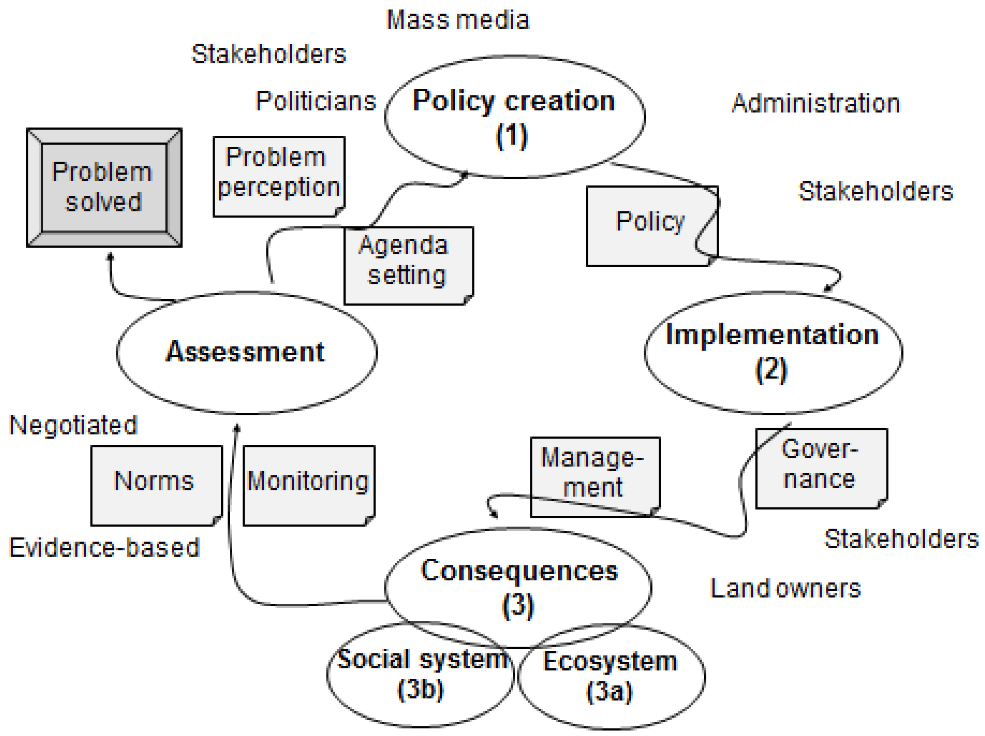
Swedish policies aim at conserving biological production, biodiversity, cultural heritage and recreational assets. This requires compositionally and structurally functional networks of representative habitats, the processes that maintain them, and resilient ecosystems. The term green infrastructure (GI) captures this. We review (1) policy concerning forest biodiversity conservation from the 1990s; (2) the implementation outputs, including the formulation of short-term and evidence-based long-term goals for protected areas, education, and the development of hierarchical spatial planning; (3) the consequences in terms of formally protected and voluntarily set-aside forest stands, as well as conservation management and habitat restoration. We assess the successes and failures regarding policy, outputs and consequences, discuss challenges to be addressed, and suggest solutions. Policies capture evidence-based knowledge about biodiversity, and evidence-based conservation planning as an output. However, the desired consequences are not met on the ground. Thus, the amount of formally protected and voluntary set-aside forests are presently too low, and have limited quality and poor functional connectivity. GI functionality is even declining because of forestry intensification, and insufficient conservation. Challenges include limited collaborative learning among forest and conservation planners, poor funding to conserve forest habitats with sufficient size, quality and connectivity, and national politics that ignores evidence-based knowledge. As solutions, we highlight the need for diversification of forest management systems with a landscape perspective that matches forest owner objectives and regional social-ecological contexts. This requires integrative approaches to knowledge production, learning and spatial planning.
Keywords: connectivity; disturbance regimes; forest policy; green infrastructure; habitat network; multi-functional landscape; nature restoration; protected areas; social system; spatial planning connectivity; disturbance regimes; forest policy; green infrastructure; habitat network; multi-functional landscape; nature restoration; protected areas; social system; spatial planning