Eco–Environmental Effects of “Production–Living–Ecological” Space Land Use Changes and Recommendations for Ecological Restoration: A Case Study of the Weibei Dryland in Shaanxi Province

Abstract
1. Introduction
2. Materials and Methods
2.1. Study Area
2.2. Data Preparation
2.3. Methodology
2.3.1. Eco–Environmental Quality Index (EQI)
2.3.2. Land Use Transfer Matrix Model
2.3.3. Ecological Contribution Rate of Land Use Transformation
3. Results
3.1. The Evolutionary Characteristics of PLES Land Use Functions
3.1.1. The Temporal and Spatial Variation in PLES Land Use
3.1.2. The Transformation Mode of PLES Land Use
3.2. The Ecological and Environmental Effects of PLES Land Use Transformation
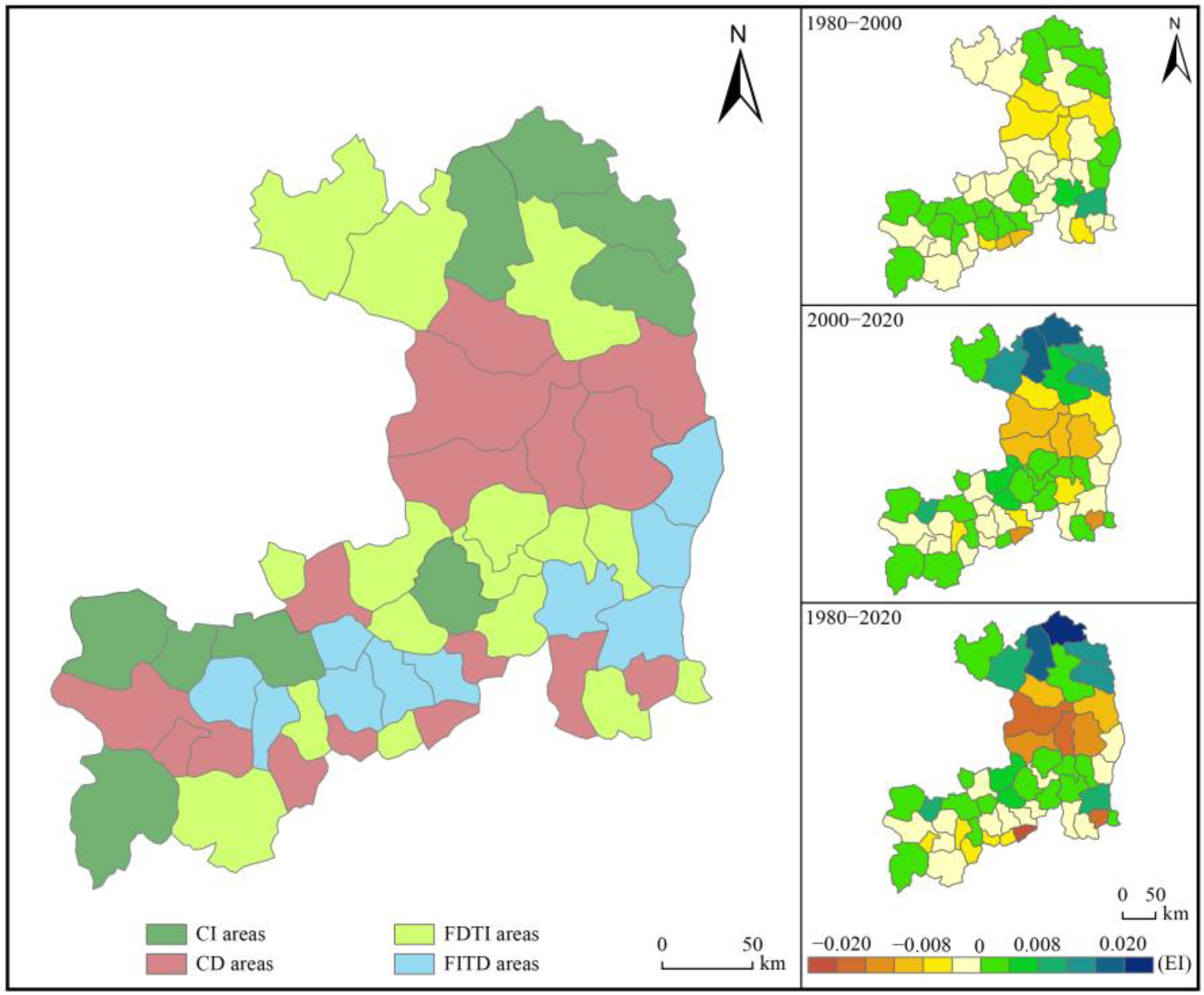
3.2.1. Spatiotemporal Evolution of the Ecological and Environmental Quality of PLES Land Use
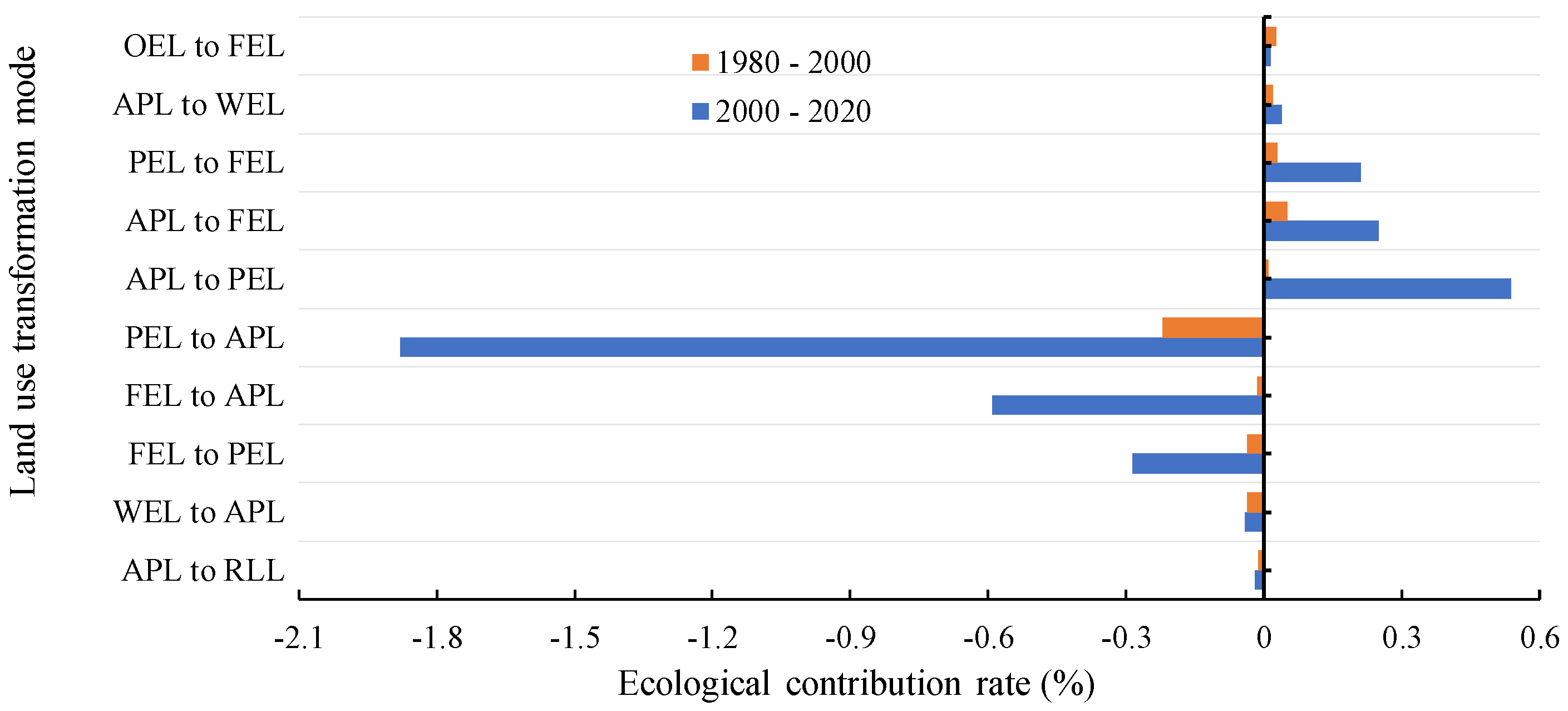
3.2.2. Differences in the Rate of PLES Land Use Transformation’s Ecological Contribution
4. Discussion
5. Conclusions
Author Contributions
Funding
Data Availability Statement
Conflicts of Interest
References
- Lambin, E.F.; Meyfroidt, P. Land use transitions: Socio–ecological feedback versus socio–economic change. Land Use Policy 2010, 27, 108–118. [Google Scholar] [CrossRef] [Scilit]
- Long, H.L. Land use transition and land management. Geogr. Res. 2015, 34, 1607–1618. [Google Scholar]
- Xu, D.X.; Wu, F.; He, L.H.; Liu, H.J.; Jiang, Y. Impact of land use change on ecosystem services: Case study of the Zhangjiakou–Chengde area. Acta Ecol. Sin. 2019, 39, 7493–7501. [Google Scholar]
- Dai, W.Y.; Jiang, F.Q.; Huang, W.L.; Liao, L.H.; Jiang, K. Study on transition of land use function and ecosystem service value based on the conception of production, living and ecological space: A case study of the Fuzhou New Area. J. Nat. Resour. 2018, 33, 2098–2109. [Google Scholar]
- Wang, K.; Yao, Y.F.; Bao, J.L. Dynamic change of ecological–living–industrial land and its spatial agglomeration at county–scale. Bull. Soil Water Conserv. 2018, 38, 306–312+329. [Google Scholar]
- Liu, Z.C. Three spaces and three lines delimitation in the context of new spatial plan system. Planners 2019, 35, 27–31. [Google Scholar]
- Sun, S.L.; Zhang, X.P. Analysis on the spatiotemporal evolution of land use transformation and its ecological environment effect in Shaanxi Province. Res. Soil Water Conserv. 2021, 28, 356–363+370. [Google Scholar]
- Tong, X.R.; Yang, Q.Y.; Bi, G.H. Spatio–temporal characteristics of land use changes in Chongqing during 2000–2015. Resour. Environ. Yangtze Basin 2018, 27, 2481–2495. [Google Scholar]
- Wang, X.F. Study on land use change characteristics in Henan Province based on ArcGIS software. Chin. J. Agric. Resour. Reg. Plan. 2018, 39, 92–98. [Google Scholar]
- Liu, J.Y.; Kuang, W.H.; Zhang, Z.X.; Xu, X.L.; Qin, Y.W.; Ning, J.; Zhou, W.C.; Zhang, S.W.; Li, R.D.; Yan, C.Z.; et al. Spatiotemporal characteristics, patterns and causes of land–use changes in China since the late 1980s. J. Geogr. Sci. 2014, 24, 195–210. [Google Scholar] [CrossRef] [Scilit]
- Lin, L.X.; You, T.G.; Liu, J.F.; Chen, Y.L.; Huang, J.H.; Kuang, K.J.; Lu, C.Y. Land use changes and driving forces in Xiamen City from 1985 to 2015. J. Fujian Agric. For. Univ. (Nat. Sci. Ed.) 2019, 48, 103–110. [Google Scholar]
- Herrick, J.E.; Urama, K.C.; Karl, J.W.; Boos, J.; Johnson, M.V.V.; Shepherd, K.D.; Hempel, J.; Bestelmeyer, B.T.; Davies, J.; Guerra, J.L.; et al. The global Land–Potential Knowledge System (LandPKS): Supporting evidence–based, site–specific land use and management through cloud computing, mobile applications, and crowdsourcing. J. Soil Water Conserv. 2013, 68, 5A–12A. [Google Scholar] [CrossRef] [Scilit]
- Fu, B.J.; Zhang, L.W. Land–use change and ecosystem services: Concepts, methods and progress. Prog. Geogr. 2014, 33, 441–446. [Google Scholar]
- He, Q.Z.; Xie, D.T.; Wang, S.; Yan, J.Z.; Chen, L. Land use transformation and its eco–environmental effects in Beibei District, Chongqing. Res. Soil Water Conserv. 2019, 26, 290–296. [Google Scholar]
- Powers, R.P.; Jetz, W. Global habitat loss and extinction risk of terrestrial vertebrates under future land–use–change scenarios. Nat. Clim. Chang. 2019, 9, 323–329. [Google Scholar] [CrossRef] [Scilit]
- Long, H.L.; Liu, Y.Q.; Hou, X.G.; Li, T.T.; Li, Y.R. Effects of land use transitions due to rapid urbanization on ecosystem services: Implications for urban planning in the new developing area of China. Habitat Int. 2014, 44, 536–544. [Google Scholar] [CrossRef] [Scilit]
- Huang, T.N.; Zhang, Y.L. Transformation of land use function and response of eco−environment based on “production–life–ecology space”: A case study of resource–rich area in western Guangxi. Acta Ecol. Sin. 2021, 41, 348–359. [Google Scholar]
- Lin, S.G.; Lu, R.C.; Liu, S.K.; Ye, Z.D.; Wei, Q.T.; Luo, J.L. Land use pattern and multifunctional evolution in the border areas in the Guangxi Zhuang Autonomous Region based on “production–living–ecosystem” space. Trans. Chin. Soc. Agric. Eng. 2021, 37, 265–274. [Google Scholar]
- Zhang, H.Q.; Xu, E.Q.; Zhu, H.Y. An ecological–living–industrial land classification system and its spatial distribution in China. Resour. Sci. 2015, 37, 1332–1338. [Google Scholar]
- Zhao, L.; Zhang, G.J.; Zhu, Y.M.; Zhang, P.T.; Xu, H. Land multi–functional transformation and characteristic analysis based on land use transition: A case study of Tang County, Hebei Province. China Land Sci. 2017, 31, 42–50+97. [Google Scholar]
- Cui, J.X.; Gu, J.; Sun, J.W.; Luo, J. The spatial pattern and evolution characteristics of the production, living and ecological space in Hubei Province. China Land Sci. 2018, 32, 67–73. [Google Scholar]
- Wang, C.; Tang, N. Spatio–temporal characteristics and evolution of rural production–living–ecological space function coupling coordination in Chongqing Municipality. Geogr. Res. 2018, 37, 1100–1114. [Google Scholar]
- Liu, J.Y.; Liu, M.L.; Zhuang, D.F.; Zhang, Z.X.; Deng, X.Z. Study on spatial pattern of land–use change in China during 1995–2000. Sci. China (Ser. D Earth Sci.) 2003, 46, 373–384+420–422. [Google Scholar]
- Liu, J.Y.; Zhang, Z.X.; Zhuang, D.F.; Wang, Y.M.; Zhou, W.S.; Zhang, S.W.; Li, R.D.; Jiang, N.; Wu, S.X. A study on the spatial–temporal dynamic changes of land–use and driving forces analyses of China in the 1990s. Geogr. Res. 2003, 1, 1–12. [Google Scholar]
- Liu, J.Y.; Zhang, Z.X.; Xu, X.L.; Kuang, W.H.; Zhou, W.S.; Zhang, S.W.; Li, R.D.; Yan, C.Z.; Yu, D.S.; Wu, S.N.; et al. Spatial patterns and driving forces of land use change in China in the early 21st Century. Acta Geogr. Sin. 2009, 64, 1411–1420. [Google Scholar] [CrossRef] [Scilit]
- Li, G.D.; Fang, C.L. Quantitative function identification and analysis of urban ecological–production–living spaces. Acta Geogr. Sin. 2016, 71, 49–65. [Google Scholar]
- Shuai, L.Y.; Ren, C.L.; Yan, W.B.; Song, Y.L.; Zeng, Z.G. Different elevational patterns of rodent species richness between the southern and northern slopes of a mountain. Sci. Rep. 2017, 7, 8743. [Google Scholar] [CrossRef] [Scilit]
- Yang, Q.K.; Duan, X.J.; Wang, L.; Jin, Z.F. Land use transformation based on ecological–production–living spaces and associated eco−environment effects: A case study in the Yangtze River delta. Sci. Geogr. Sin. 2018, 38, 97–106. [Google Scholar]
- Li, X.W.; Fang, C.L.; Huang, J.C.; Mao, H.Y. The urban land use transformations and associated effects on eco−environment in northwest China arid region: A case study in Hexi region, Gansu Province. Quat. Sci. 2003, 23, 280–290+348–349. [Google Scholar]
- Lei, J.C.; Wang, S.; Wang, J.M.; Wu, S.Q.; You, X.B.; Wu, J.; Cui, P.; Ding, H. Effects of land use change on ecosystem services value of Xunwu County. Acta Ecol. Sin. 2019, 39, 3089–3099. [Google Scholar]
- He, B.Y.; Gao, T. Study on land use changes and ecological effects in Yan’an City. Jiangsu Agric. Sci. 2020, 48, 286–292. [Google Scholar]
- Jackson, S.T.; Hobbs, R.J. Ecological restoration in the light of ecological history. Science 2009, 325, 567–569. [Google Scholar] [CrossRef] [Scilit] [PubMed]
- Martin, D.M. Ecological restoration should be redefined for the twenty–first century. Restor. Ecol. 2017, 25, 668–673. [Google Scholar] [CrossRef] [Scilit] [PubMed]
- Gann, G.D.; Mcdonald, T.; Walder, B.; Aronson, J.; Nelson, C.R.; Jonson, J.; Hallett, J.G.; Eisenberg, C.; Guariguata, M.R.; Liu, J.G.; et al. International principles and standards for the practice of ecological restoration. Restor. Ecol. 2019, 27, S1–S46. [Google Scholar] [CrossRef] [Scilit]
- Fu, B.J.; Tian, H.Q.; Tao, F.L.; Zhao, W.W.; Wang, S. The impact of global change on ecosystem services. China Basic Sci. 2017, 19, 14–18. [Google Scholar]
- Katharina, A.; Werner, R.; Dominik, T.; Rupert, S. Trade–offs between temporal stability and level of forest ecosystem services provisioning under climate change. Ecol. Appl. 2018, 28, 1884–1896. [Google Scholar]
- Jackson, L.L.; Lopoukhine, N.; Hillyard, D. Ecological restoration: A definition and comments. Restor. Ecol. 1995, 3, 71–75. [Google Scholar] [CrossRef] [Scilit]
- Suding, K.; Higgs, E.; Palmer, M.; Callicott, J.B.; Anderson, C.B.; Baker, M.; Gutrich, J.J.; Hondula, K.L.; LaFevor, M.C.; Larson, B.M.H.; et al. Committing to ecological restoration. Science 2015, 348, 638–640. [Google Scholar] [CrossRef] [Scilit]
- Diamond, J. Ecology: How and why eroded ecosystems should be restored. Nature 1985, 313, 629–630. [Google Scholar] [CrossRef] [Scilit]
- Romanelli, J.P.; Fujimoto, J.T.; Ferreira, M.D.; Milanez, D.H. Assessing ecological restoration as a research topic using bibliometric indicators. Ecol. Eng. 2018, 120, 311–320. [Google Scholar] [CrossRef] [Scilit]
- Cao, Y.; Wang, J.Y.; Li, G.Y. Ecological restoration for territorial space: Basic concepts and foundations. China Land Sci. 2019, 33, 1–10. [Google Scholar]
- Ouyang, Z.Y.; Zheng, H.; Xiao, Y.; Polasky, S.; Liu, J.G.; Xu, W.H.; Wang, Q.; Zhang, L.; Xiao, Y.; Rao, E.M.; et al. Improvements in ecosystem services from investments in natural capital. Science 2016, 352, 1455–1459. [Google Scholar] [CrossRef] [Scilit] [PubMed]
- Deng, Y.J.; Yao, S.B.; Hou, M.Y.; Zhang, T.Y.; Lu, Y.N.; Gong, Z.W.; Wang, Y.F. Assessing the effects of the green for grain program on ecosystem carbon storage service by linking the InVEST and FLUS models: A case study of Zichang county in hilly and gully region of Loess Plateau. J. Nat. Resour. 2020, 35, 826–844. [Google Scholar]



| Land Use Function Categorization | Subcategories of Original Land Use System | EQI | |
|---|---|---|---|
| Category | Subcategory | ||
| Productive land | APL | Paddy field, dry land | 0.261 |
| IML | Other construction land | 0.166 | |
| Living land | ULL | Urban land | 0.200 |
| RLL | Rural residential area | 0.200 | |
| Ecological land | FEL | Open woodland, woodland, shrubland, other woodland | 0.694 |
| PEL | High–, medium–, and low–coverage grassland | 0.458 | |
| WEL | Canal, lake, reservoir pond, permanent glacier snow, coast, shoaly land | 0.579 | |
| OEL | Sandy ground, Gobi, marsh land, saline land, bare land, gravelly land | 0.015 | |
| Category | Area/km2 | Subcategory | Area/km2 | ||||
|---|---|---|---|---|---|---|---|
| 1980 | 2000 | 2020 | 1980 | 2000 | 2020 | ||
| Productive land | 32,600.79 | 32,676.01 | 29,733.94 | APL | 32,557.31 | 32,616.63 | 29,389.70 |
| IML | 46.97 | 62.90 | 347.37 | ||||
| Living land | 1434.74 | 1712.44 | 2291.91 | ULL | 149.61 | 243.26 | 519.21 |
| RLL | 1258.27 | 1469.33 | 1772.88 | ||||
| Ecological land | 46,845.94 | 46,492.72 | 48,846.48 | FEL | 19,024.68 | 19,102.86 | 20,074.52 |
| PEL | 27,093.46 | 26,734.47 | 28,060.13 | ||||
| WEL | 585.88 | 551.22 | 562.67 | ||||
| OEL | 146.96 | 109.17 | 154.48 | ||||
| Category | Variation Area/km2 | Subcategories | Variation Area/km2 | ||||
| 1980–2000 | 2000–2020 | 1980–2020 | 1980–2000 | 2000–2020 | 1980–2020 | ||
| Productive land | 75.22 | −2942.07 | −2866.85 | APL | 59.33 | −3226.94 | −3167.61 |
| IML | 15.93 | 284.47 | 300.40 | ||||
| Living land | 277.70 | 579.47 | 857.17 | ULL | 93.65 | 275.94 | 369.60 |
| RLL | 184.06 | 303.55 | 487.61 | ||||
| Ecological land | −353.22 | 2353.76 | 2000.54 | FEL | 78.18 | 971.66 | 1049.84 |
| PEL | −358.99 | 1325.66 | 966.67 | ||||
| WEL | −34.67 | 11.45 | −23.22 | ||||
| OEL | −37.79 | 45.31 | 7.52 | ||||
| 1980 | 2000 | |||||||
|---|---|---|---|---|---|---|---|---|
| APL | IML | ULL | RLL | FEL | PEL | WEL | OEL | |
| APL | 32,026.62 | 8.88 | 55.07 | 160.27 | 97.03 | 40.64 | 50.62 | 2.15 |
| IML | 0.00 | 34.93 | 0.00 | 0.00 | 0.00 | 0.00 | 0.00 | 0.00 |
| ULL | 0.00 | 2.70 | 89.78 | 0.00 | 0.00 | 0.00 | 0.00 | 0.00 |
| RLL | 0.00 | 0.00 | 0.13 | 1121.91 | 0.00 | 2.71 | 0.00 | 0.00 |
| FEL | 26.05 | 0.42 | 1.93 | 0.90 | 18,792.58 | 124.63 | 1.82 | 0.50 |
| PEL | 410.22 | 0.05 | 2.59 | 1.29 | 97.03 | 26,898.39 | 39.14 | 1.56 |
| WEL | 91.16 | 0.00 | 0.12 | 0.64 | 5.71 | 27.09 | 487.69 | 0.48 |
| OEL | 3.26 | 0.00 | 0.00 | 0.13 | 32.34 | 0.00 | 6.68 | 142.29 |
| 2000 | 2020 | |||||||
|---|---|---|---|---|---|---|---|---|
| APL | IML | ULL | RLL | FEL | PEL | WEL | OEL | |
| APL | 29,576.76 | 43.17 | 106.94 | 440.65 | 1104.15 | 3510.24 | 102.64 | 11.90 |
| IML | 3.26 | 9.27 | 1.17 | 0.29 | 0.00 | 0.00 | 0.28 | 2.64 |
| ULL | 6.52 | 0.14 | 108.62 | 0.88 | 0.00 | 2.67 | 0.39 | 0.00 |
| RLL | 241.36 | 0.87 | 12.46 | 991.65 | 5.73 | 16.04 | 1.05 | 0.05 |
| FEL | 466.42 | 2.02 | 3.58 | 9.99 | 16,995.81 | 719.16 | 10.09 | 16.24 |
| PEL | 2211.41 | 7.14 | 9.58 | 22.48 | 981.89 | 22,440.92 | 41.62 | 17.12 |
| WEL | 97.85 | 0.27 | 0.90 | 3.09 | 7.64 | 34.75 | 393.68 | 4.63 |
| OEL | 9.78 | 0.03 | 0.00 | 0.00 | 5.73 | 10.69 | 1.49 | 56.58 |
Disclaimer/Publisher’s Note: The statements, opinions and data contained in all publications are solely those of the individual author(s) and contributor(s) and not of MDPI and/or the editor(s). MDPI and/or the editor(s) disclaim responsibility for any injury to people or property resulting from any ideas, methods, instructions or products referred to in the content. |
© 2023 by the authors. Licensee MDPI, Basel, Switzerland. This article is an open access article distributed under the terms and conditions of the Creative Commons Attribution (CC BY) license (https://creativecommons.org/licenses/by/4.0/).
Share and Cite
Jin, J.; Yin, S.; Yin, H.; Bai, X. Eco–Environmental Effects of “Production–Living–Ecological” Space Land Use Changes and Recommendations for Ecological Restoration: A Case Study of the Weibei Dryland in Shaanxi Province. Land 2023, 12, 1060. https://doi.org/10.3390/land12051060
Jin J, Yin S, Yin H, Bai X. Eco–Environmental Effects of “Production–Living–Ecological” Space Land Use Changes and Recommendations for Ecological Restoration: A Case Study of the Weibei Dryland in Shaanxi Province. Land. 2023; 12(5):1060. https://doi.org/10.3390/land12051060
Chicago/Turabian StyleJin, Junfang, Shuyan Yin, Hanmin Yin, and Xin Bai. 2023. "Eco–Environmental Effects of “Production–Living–Ecological” Space Land Use Changes and Recommendations for Ecological Restoration: A Case Study of the Weibei Dryland in Shaanxi Province" Land 12, no. 5: 1060. https://doi.org/10.3390/land12051060
APA StyleJin, J., Yin, S., Yin, H., & Bai, X. (2023). Eco–Environmental Effects of “Production–Living–Ecological” Space Land Use Changes and Recommendations for Ecological Restoration: A Case Study of the Weibei Dryland in Shaanxi Province. Land, 12(5), 1060. https://doi.org/10.3390/land12051060