1. Introduction
Cities are the hubs of countries and regions in response to global demands and challenges. Land use–human action nexuses are the material foundations for cities to operate such responses [
1]. Within fast-changing and highly uncertain urban development circumstances, urban regeneration involves the transformation of nexuses, such as urban adaptation in response to external changes. In Western cities, urban regeneration itself has experienced several rounds of amendments. Urban renewal, urban redevelopment, and urban regeneration are successive mainstream paradigms that lead to urban land changes in various periods [
2,
3]. In Chinese cities, urban regeneration also displays its diversity by using different approaches to mobilize political, economic, and social resources to overcome obstacles to alter outdated land uses.
A large number of studies have actively investigated this domain from distinct perspectives [
4,
5,
6,
7,
8,
9,
10,
11,
12,
13,
14,
15,
16,
17,
18,
19,
20,
21,
22,
23,
24,
25,
26,
27,
28,
29,
30,
31,
32,
33]. Research in both Western and Chinese cities has adequately investigated changes in the regeneration of various cities; however, determining how to change between different regeneration modes is still a domain that deserves further exploration. In response to this limitation, incorporating the concept of adaptive governance is meaningful. As a concept in social–ecological system (SES) studies, adaptive governance is employed to study governance systems that can manage complex systems facing highly uncertain external challenges. Adaptation is the key to responding to disturbances; adaptive governance is the social system used to produce and operate adaptation continuously [
34,
35].
This paper aims to investigate the adaptation of urban regeneration that has taken place in Guangzhou since 2009. This study contributes to the literature in two ways. First, it provides a dynamic and flexible picture of adaptive governance in changing modes of urban regeneration. It reveals the incentives, mechanisms, and outcomes of transforming governance processes in various phases under different challenges. Through analyzing disturbances, adaptation, and transformation, our paper aims to understand “how” changes happen between multiple phases and modes, whereas existing studies mainly focused on “what” has changed and “why” these changes have happened. Second, this research illustrates an adaptive system with a centralized power structure and exclusive policy decision making. Therefore, it offers a new lens of examination that differs from the conventional scopes of adaptive governance, which often preconditions a decentralized power structure and participative policymaking. The Guangzhou displays the specific “authoritarian” type of adaptive governance of urban regeneration, as opposed to the “democratic” type.
The remainder of the paper is structured as follows:
Section 2 provides a literature review detailing the key concepts;
Section 3 presents a framework of the research questions, studied areas, and methodology;
Section 4 provides a narrative of three phases of urban regeneration in Guangzhou;
Section 5 presents a segment focusing on the logics of adaptation between challenges and responses in these three phases,
Section 6 concludes with an analysis of social–political mechanisms as adaptive governance required to operate such adaptations.
2. Literature Review: Urban Regeneration and Adaptive Governance
2.1. Urban Regeneration
In response to various urban problems, urban regeneration, as a public policy-led activity, has undergone several distinct versions in Western countries regarding different targets, approaches, and outcomes. In the 1970s, activities to regenerate cities were mainly called urban renewal, which employed physical rebuilding, social replacement, and an economically public–private partnership with assistance from the central state to confront inner-city problems, such as poverty, unemployment, and crime [
2,
36]. However, the US urban renewal practices also included the large-scale building of infrastructure in declining inner-city areas and, as a consequence, the removal of former residents. As a result, adverse social and economic outcomes after renewal, particularly after city center replacements, have been questioned [
37].
In the 1980s, with the impacts of neoliberal ideology, economic growth was considered the cure for problematic areas; therefore, urban redevelopment became the mainstream paradigm which emphasized the role of private sectors and the goal of economic development [
38]. In this era, leverage was encouraged to input more capital into projects supported by the local state. State regulations, such as planning control, were released to benefit the private actors [
3,
36].
In the 1990s, urban regeneration became popular as critics accused existing redevelopment of ignoring social and environmental consequences [
3,
39]. Labeled as an inclusive approach to help achieve a more sustainable urban future, urban regeneration considered to meet the integrated economic, social, cultural and environmental targets. To realize such targets, policymakers tended to mobilize resources from the public sector jointly with private companies, voluntary organizations, and communities [
3,
36,
40]. As a result, urban regeneration has been the dominant method used to rebuild and improve problematic urban areas up until now.
Urban regeneration in China has been actively studied from different perspectives, such as capital accumulation [
41,
42,
43,
44,
45,
46], financialization [
47], migration [
4,
5,
6,
7,
8,
9,
10,
11,
12,
13,
14,
15], institutional change [
4,
5,
6,
7,
8,
9,
10,
11,
12,
13,
14,
15], urban governance [
16], and politics [
16,
17,
18,
19,
20,
21,
22,
23,
24,
25,
26,
27,
28,
29,
30,
31,
32,
33]. However, most research involved case studies within various contexts; only a few scholars investigated periodization between different phases. At the city level, the authors of [
48] considered two generations of gentrification in Guangzhou as a shift from activating declining urban space to improving urban competitiveness in regional competition. Pro-neoliberal political incentives were the driving force under such a shift. Lai [
15] divided urban redevelopment in Shenzhen into three periods, before 2004, 2004–2009, and after 2010, due to various levels of transaction cost. At the national level, Wu [
49] defined three versions of Chinese urban redevelopment: historical conditions; aims, approaches, and actors; products and impacts. Later, He [
50] summarized three waves of state-led gentrification in China: market experiments, neoliberal urban policy, and shantytown redevelopment. The purpose of gentrification and the state–market–society relationship have been interactively changed to match state targets since the 1990s.
The literature regarding the periodization of urban regeneration in both Western and Chinese cities has explored various generations with distinct aims, actors, resources, and actions determined by policies. These studies mainly focused on “what” and “why” these policies and practices have changed. However, outside of a couple of exceptions, such as Healey [
51], few studies have investigated “how” changes have occurred between various policy versions. To fill this gap, adaptive governance, which focuses on how a governed social–ecological system can respond to a highly dynamic and uncertain circumstance, might be helpful [
52].
2.2. Adaptive Governance
The idea of adaptive governance emerged as an outcome of the theoretical exploration of modes of managing complex, unexpected, and uncertain changes in social–ecological systems (SESs) [
34,
53]. More specifically, adaptive governance originated from studies conducted to resolve common-pool natural recourse problems through self-governance [
34]. This idea was developed to address sustainable issues to ensure resilience when structuring social learning under conditions of uncertainty with conflicts in decision making [
35]. Adaptive governance can oppose centralized scientific management, which aims to solve problems through engineering thoughts to maximize particular outcomes with the belief that human knowledge is completed to understand future challenges [
54,
55]. A helpful way to understand adaptive governance is to compare it to the concept of adaptation.
Adaptation describes the process of a system responding to unexpected external challenges with a high level of uncertainty in ecological crises [
56]. Adaptive governance is the social–political mechanism that is crucial to successfully producing adaptation in SESs [
57]. In other words, adaptation reveals what has changed and why such changes happened in policy after meeting external challenges [
58]. Adaptive governance investigates how a group of economic, social, and governance factors formulated adaptation [
54]. Adaptive governance involves complex social dimensions, including power-sharing and decision-making issues [
52].
In SESs, to respond to uncertainty, adaptive governance has two fundamental functions. On the one hand, it builds resilience to limit external impacts and maintains existing systems using social resources. On the other hand, adaptive governance can help develop and transfer to a new system that can better cope with further challenges [
34]. The first function is based on the ideas of engineering or ecological resilience focusing on maintaining existence of function [
59]; the second function of adaptive governance is related to the thought of evolutionary resilience which goes beyond the notion of a stable equilibrium to emphasize changes, in responses to external shocks [
60,
61]. Whether adaptive governance aims to maintain or alter a system depends on the system’s capacity to produce its most “desirable” outcomes [
58]. To facilitate these outcomes, feedback is a crucial mechanism. Adaptive governance is neither an incremental nor a linear changing process. Instead, it is unpredictable and uncertain; a small change may lead to rapid and dramatic occurrences. Feedback is the key to monitoring the changes. Any changes in feedback processes may bring about a fundamental reorganization of a system [
62,
63].
This “butterfly effect” of feedback can be explained by using the evolutionary governance theory (EGT), which reads governance as collectively binding decisions made by a community of governmental and other actors [
64]. In governance, a set of configurations (actors/institutions, formal/informal, and power/knowledge) co-evolves constantly in contingency, reflecting the limitations of elements in the governance entities and pathways [
65].
The entities and pathways used to express and respond to feedback relate to privileges in power relations [
35]. Feedback can also enhance social learning, realized through social interactions and experiments. Social learning can strengthen people’s abilities to discover and understand values, information, and knowledge, which can help to increase their adaptive capacities [
61]. A helpful environment can support feedback and social learning, resulting in a polycentric structured system with broad participation in decision making, flexible institutional arrangement, cross-scale interaction, a combination of top-down and bottom-up mobilization, and the application of local knowledge [
55,
66,
67]. In these sound systems, tradeoffs between different targets are crucial to obtain sustainability [
52]. These elements can benefit adaptive governance by increasing common interests and overcoming institutional barriers through feedback and social learning [
55].
2.3. Literature Gap, Research Questions, and Analytic Frame
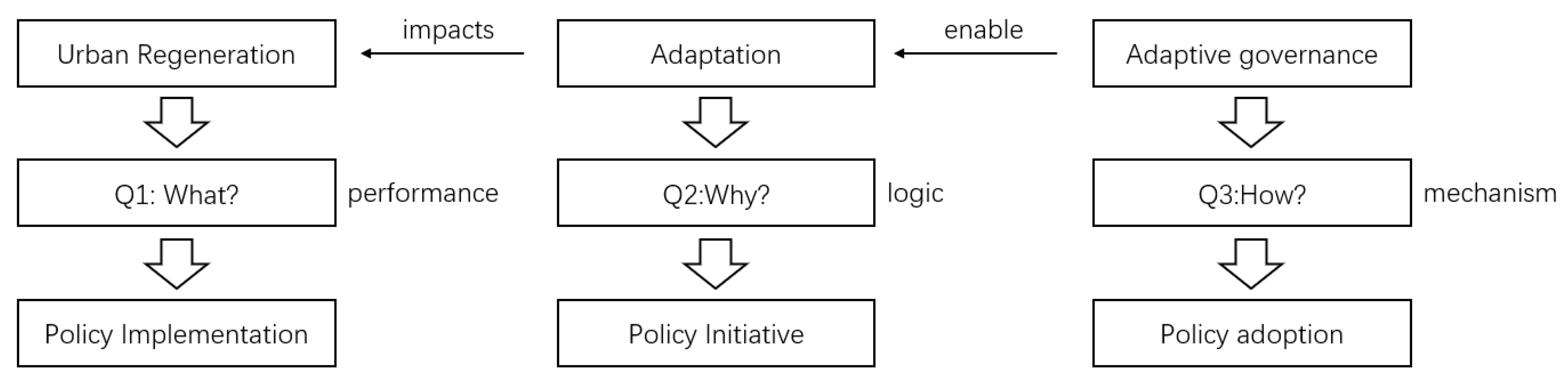
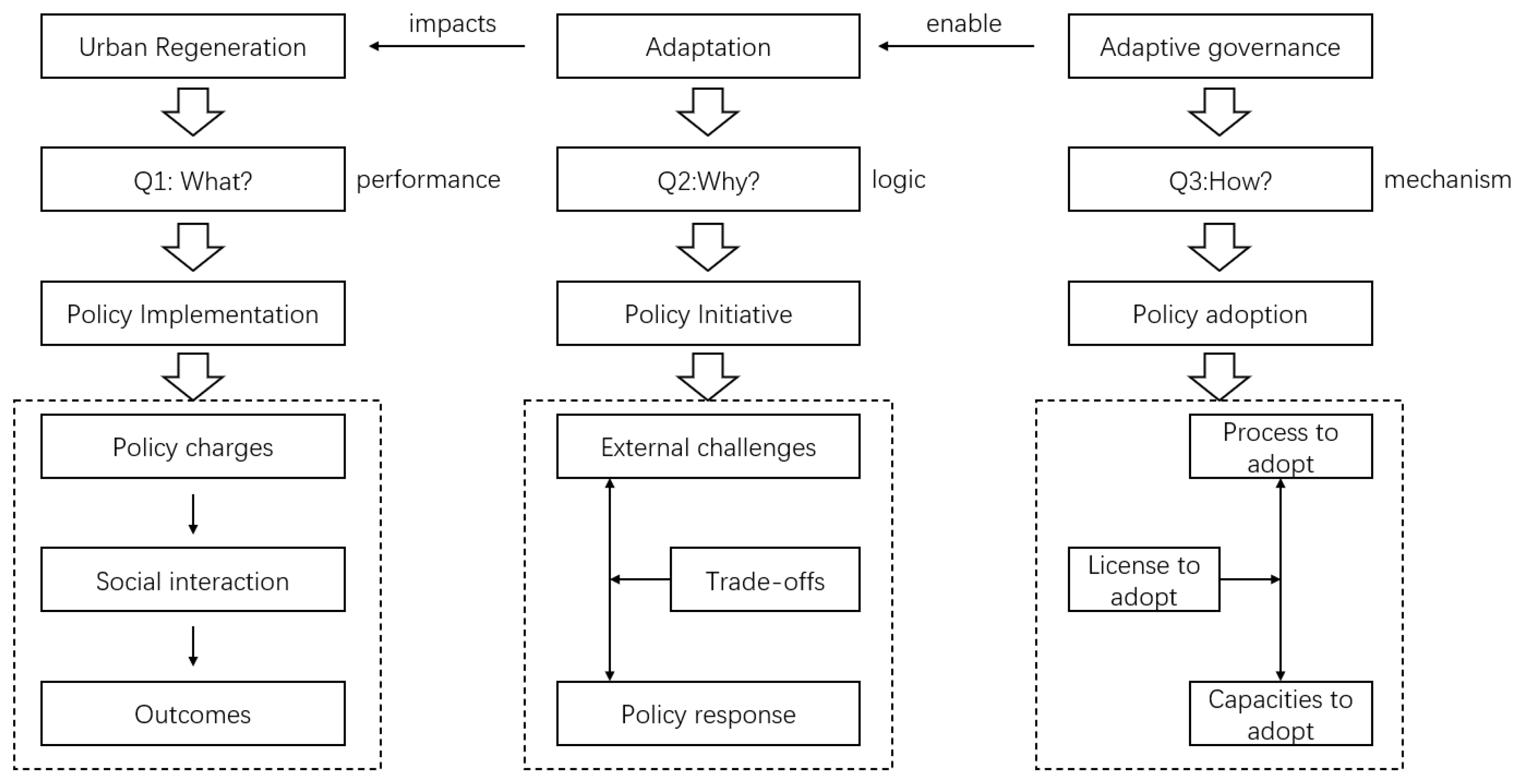
Studies in urban regeneration emphasize “what” has changed in different phases and “why” these changes have happened; research on “how” to change between these distinct phases is limited. Adaptive governance literature is introduced to bring “how” issues into “what” and “why” ones. To not only fill the gap but also extend existing thoughts into new ideas, our paper develops a three-level frame with three research questions: (1) What has changed in urban regeneration? (2) Why did these changes happen? (3) How did social–political mechanisms enable such changes?
Public policy has often been described as a cyclic issue, including its initiation, formulation, adoption, implementation, and evaluation [
68]. Urban regeneration, as a public policy-led activity, also follows such a cycle and offers potential answers to the “what” question. More specifically, comparisons between the implementations of urban regeneration policies at different periods give insights into the changes in between, while policy introduction changes, the patterns of policy-led social interaction between stakeholders, and policy outcomes (as direct results of social interaction) are three elements in the answers [
2,
3].
For the second question (“why”), external challenges to policymakers and responses from the local government leaders under competitive pressure are important reasons behind policy initiation and formulation. They display adaptation in policy issues [
69]. The third question (“how”) investigates policy adoption as adaptive governance. In particular, it concerns how political–social mechanisms such as feedback, social learning, and power relations enable adaptation [
54]. All three research questions, studied objects and policy elements have formulated the analytic frame in
Figure 1.
3. Studied Objects and Methodology
This paper focuses on urban regeneration in Guangzhou, the third largest city in China, between 2009 and 2019. The TOR (Three Old Redevelopment) policy was initiated in 2009. The TOR was the first systematic policy for urban regeneration at the municipality level in China. Although two other cities (Dongguan and Foshan) also experimented with this policy, Guangzhou was the best representative because of its economic and political significance as the capital city of Guangdong province. This research traced the development of urban regeneration policies from its birth to 2019 before the COVID-19 pandemic interrupted the world.
Guangzhou has a territory of 7434.4 km
2 and a population size of 14.9 million in 2018; its GDP reached 2286 billion CNY in 2018, doubling from a significant 1086 billion in 2010 [
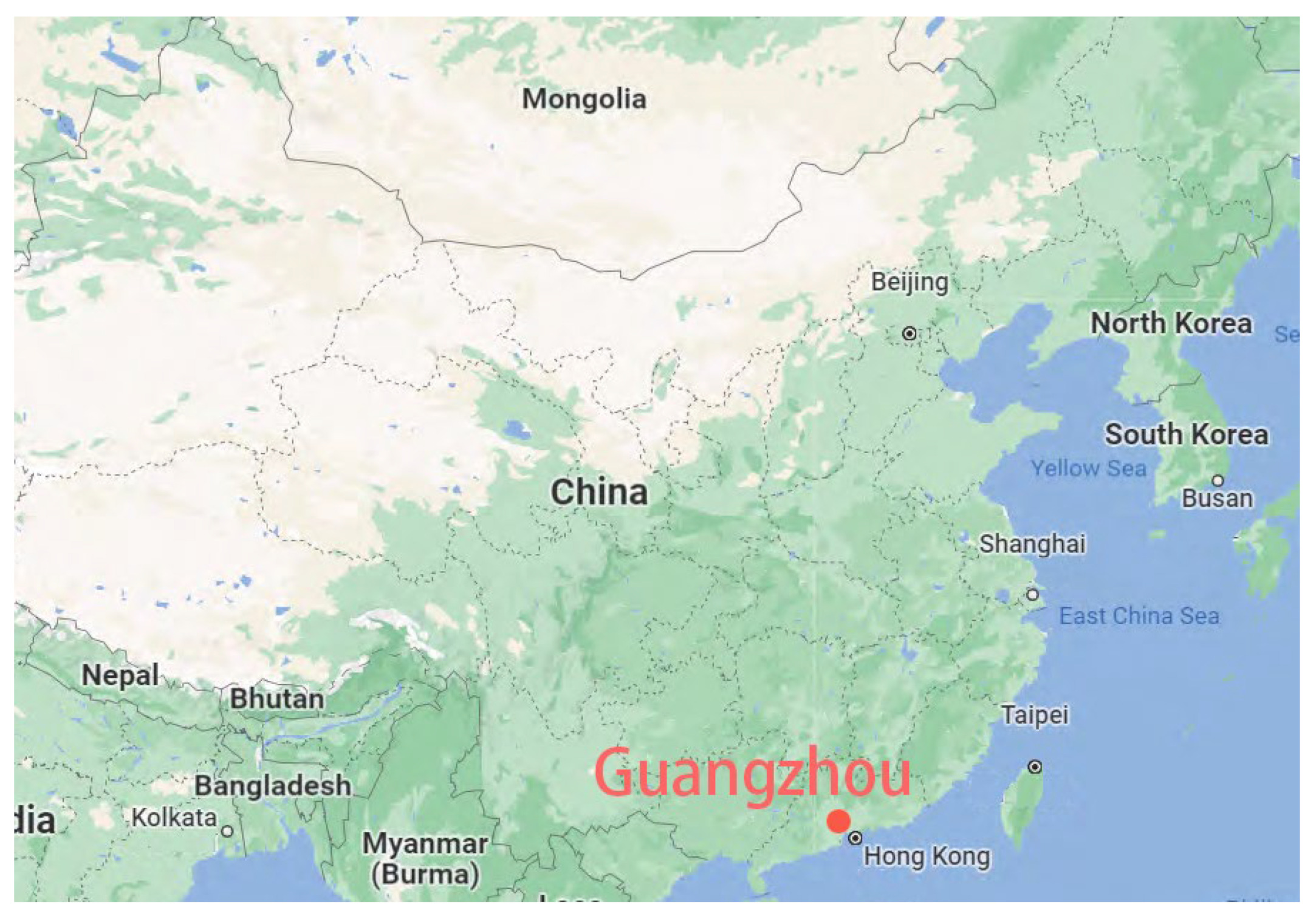
70]. Location of Guangzhou is displayed in
Figure 2.
Data regarding urban regeneration in Guangzhou came from three sources. The first was semi-structured interviews with 38 interviewees, including 12 urban planners (13 times), 9 governmental officers (11 times), 6 developers (7 times), 4 community members, 3 scholars, 2 NGO members (3 times), and 2 journalists (3 times). These interviews were conducted from 2013 to 2020 following a snowball sampling strategy. Each meeting lasted 30 min to 3 h; a majority of them were around 1 h. This research invited relevant actors from different positions to bring about the whole picture of urban regeneration from diverse perspectives. Planners, residents, and developers gave insights into individual projects in urban regeneration. At the same time, government officials and journalists mainly focused on the broader aspects of the policy, i.e., its initiation, adoption, and evaluation in specific periods. Information from interviews was mostly qualitative data to answer research questions.
The second source was secondary data from authorized databases, particularly annual official statistics from governmental websites. In addition, mass media, academic papers, and theses are also important for understanding cases. Secondary data include statistics about regeneration projects, land market, real estate market, fiscal income, and governmental debts; these data contribute to answering questions quantitatively. Furthermore, policy documents are also crucial to answer research questions about policy changes.
The third pathway used to access data was participant observation, conducted when one of the authors worked as a planner in Guangzhou and was involved in three TOR projects before 2012. However, direct personal experience is less critical but valuable in providing information about policy implementation in individual projects.
All data from three channels were coded and organized around three research questions and filled into subcategories within the “what”, “why”, and “how” questions. For the “what” question, policy changes were found in policy documents which were interpreted by planners and officials through interviews, as well as studied in academic papers and theses; social interactions were displayed in the participants’ observations, developers’ interviews, and scholars’ works; outcomes of urban regeneration were mainly analyzed on the basis of official statistics at both the Guangzhou level and the central government level, as well as papers from planners and scholars. For the “why” question, it was challenging to determine the core logic because it was too difficult to interview top leaders of Guangzhou and get true thoughts from them. Therefore, during interviews with officials and planners, their views about the political leaders of Guangzhou were quite helpful. After putting information from interviews together with policy changes and external challenges, a reasonable guess operated by the authors was necessary to find the reasons for policy initiation. For the “how” question, interviews with officials were useful to identify the processes of policy adoption. An analysis of the institutional context in Chinese urban politics could also contribute to the understanding of power relations in policy adoption. Moreover, data from the authors’ research about urban regeneration cases in Guangzhou were collected to research social learning capacities of the local government.
4. Three Phases of Urban Regeneration in Guangzhou
To explore the first research question (“What” has changed in urban regeneration in Guangzhou?), this paper treats urban regeneration in Guangzhou as a studied system, similar to an SES system in the literature. Between 2009 and 2019, such a researched system could be briefly divided into three phases, in terms of distinct policy changes, social interaction patterns, and outcomes of urban regeneration. Whilst the policy dramatically changed across these phases, its implementation also followed a policy shift to significantly alter the landscape of urban regeneration.
4.1. “TOR” Policy, Phase 1.0 (2009–2012)
4.1.1. Policy Changes
In 2009, the Three Old Redevelopment (TOR) policy was announced by the provincial government of Guangdong and the Ministry of Land and Resources in the Provincial Government Document No. 78. As one of the first three experimental cities to apply this new policy, Guangzhou published its No. 56 municipal government document to implement the No. 78 document in practice. The TOR policy in the No. 56 municipal document indicated the beginning of TOR in Guangzhou, introduced solid economic incentives to actors, decreased transaction costs, and decentralized decision-making structures (interview, officer 3, 2013). The core of the TOR policy is permission for closed-door negotiations, not just open auctions, as a channel for developers to obtain land for new constructions. This is because the price required to possess land is usually much cheaper when obtained by negotiating instead of competing in an open market. The only exemption is the attempts to turn old factories into commercial housing, where land cannot be transferred by negotiation [
71,
72].
The key to such policy changes is that the local state gives up a share of its income from land transactions to encourage private sectors and communities to establish new redevelopment projects. In addition, if redevelopment projects are operated through an open auction, not negotiation, in redeveloping old villages, 60% of governmental income from the land transaction is returned to redeveloped villages to support their collective capital organizations [
73]. When rebuilding old factories, except in the case of reconstructing new commercial housing, their free-distributed land requires land-leasing fees to be paid to the government at the benchmark land price, which is much lower than the market price. Moreover, communities are empowered by the TOR policy as the leading operator for TOR projects. For instance, in old towns, there is a two-round agreement mechanism for community members to prevent TOR projects from being undertaken in their territories. In old villages, a project’s initiation requires support from no less than 80% of the villagers.
Therefore, in this phase, the TOR policies reflect the local state’s active retreat from a monopolistic role in grasping financial gains from land transactions. Furthermore, implementing the policies in this era has led to the empowerment of nongovernmental actors. As such, various stakeholders under the TOR practiced urban redevelopment through a “shared interest mechanism”; in return, the local state, developers, and local communities found their respective interests and incentives to push forward the TOR projects [
29].
4.1.2. Social Interaction
The patterns of social interactions among local government, developers, and residents have become more decentralized because the municipal government, as the central player, has retreated to leave more space for the operation of actors from markets and communities. The redistribution of power and recourse occurred inside the local state between the municipal and subordinate district levels. Some relevant administrative permissions, such as planning control within zoning, the distribution of land leasing income, and decisions in governmental enforcement, were delivered into the hands of district governments from the municipal one [
72]. Such a redistribution benefited planning approval because district authorities were closer to project operators to make faster decisions. In terms of compensation to former owners, the distribution of income between stakeholders after redevelopment, and partially released planning control, detailed policies are highly flexible, allowing each project to adapt to its circumstances under this decentralized structure. This is called “one village, one policy” (yicunyice) and “one factory, one policy” (yichangyice).
4.1.3. Outcomes
As the results of the TOR policy, stimulated by potential economic returns, a flood of social investments into urban regeneration pushed landowners and developers to submit hundreds of project proposals to the planning authorities. The promised profits are attractive; therefore, some agencies can win millions of CNY from developers by just displaying possible income in the future and introducing these investors to the village leaders (interview, developer 4, 2014). Before the end of 2012, proposed TOR projects involved 172.57 km
2 of low-efficiency land, approximately 15% of the total land devoted to construction in Guangzhou [
73]. Among these submitted proposals, the urban planning system approved the redevelopment of 24 old villages and 144 old factories, involving 19.48 km
2 of land. This permitted redevelopment in urban villages surpassed the total number of similar approved projects before 2009 [
74]. Due to these redevelopment activities, a social investment of 250 billion CNY was injected into Guangzhou, representing 25% of the total investment in fixed assets in Guangzhou from 2009 to 2012. Because land transaction through negotiation is much cheaper for developers than through open auctions, in 2010 and 2011, the areas of land transaction for new commercial housing in TOR were 2.7 and 2.6 times the areas of land transaction through non-TOR channels, such as state-monopolized open auctions [
75]. This change led to a massive loss of billions of CNY for the local state as an opportunity cost to the possible revenue from the land leasing market.
4.2. “TOR” Policy, Phase 2.0 (2012–2015)
4.2.1. Policy Changes
The TOR policy changed in the No. 20 municipal government document, which was announced in June 2012. principally creating more institutional barriers against TOR than the No. 56 document did in 2009 (interview, officer 4, 2019). In terms of the state–society relationship, this new policy aimed to define TOR as government-led (zhengfuzhudao) rather than market-driven redevelopment [
73]. This state-led style can be displayed in five dimensions.
First, there is a municipal plan to control new projects, and only redevelopment included in such a plan can be permitted administratively, which was not required before 2012.
Second, land transactions through negotiation, not an open auction, in self-redevelopment (zizhugaizao) need special permission from the municipal government.
Third, to manage externality problems in TOR, such as too much commercial housing and too few social facilities after redevelopment, the local state has to make an overall plan to coordinate different projects within a TOR territory.
Fourth, old factories with previously free distributed land must pay land-leasing fees to the government at the market price.
Fifth, in strategic areas with municipal significance, such as city centers, riverside areas, ecological zones, and all residential land, all TOR land will be confiscated as a governmental store for future use (zhengfuchubeiyongdi). This principle is called “reserving all possible land whenever possible” (yingchujinchu). The aim is to have more government-controlled land that can be sold through open auctions. In addition, the agreement rate among villagers to permit redevelopment in old villages increased from 80% to 90% [
76].
4.2.2. Social Interaction
These policy changes led to two dimensions of shift: reduced incentives for participants and recentralized patterns of social interaction. Firstly, transaction costs and institutional barriers increased; therefore, the motivation to carry out regeneration projects declined. The first, second, and third dimensions described in the previous part added approval steps to former processes. The last point led to a rising agreement rate, causing increased difficulty for developers. Secondly, governments, especially municipal governments, grasped more power and recourse than in phase 1.0 of TOR. In the first, second, third, and fifth dimensions, the municipal level was given more approval power to control urban regeneration projects. This was a return to more centralized patterns of social interaction. Actors from the market and communities could feel more and stricter regulations from the state (interview, developer 4 and 6, 2013).
4.2.3. Outcomes
The effects of phase 2.0 of TOR were apparent. On the one hand, the number of established TOR projects significantly declined. For example, from 2009 to 2012, 27 old villages, 222 old factories, and one old town were approved at the municipal level as TOR projects; however, between 2012 and 2015, under TOR phase 2.0, no old villages or towns completed the administrative procedures required for construction, and the municipal government permitted only around 30 old factories to redevelop [
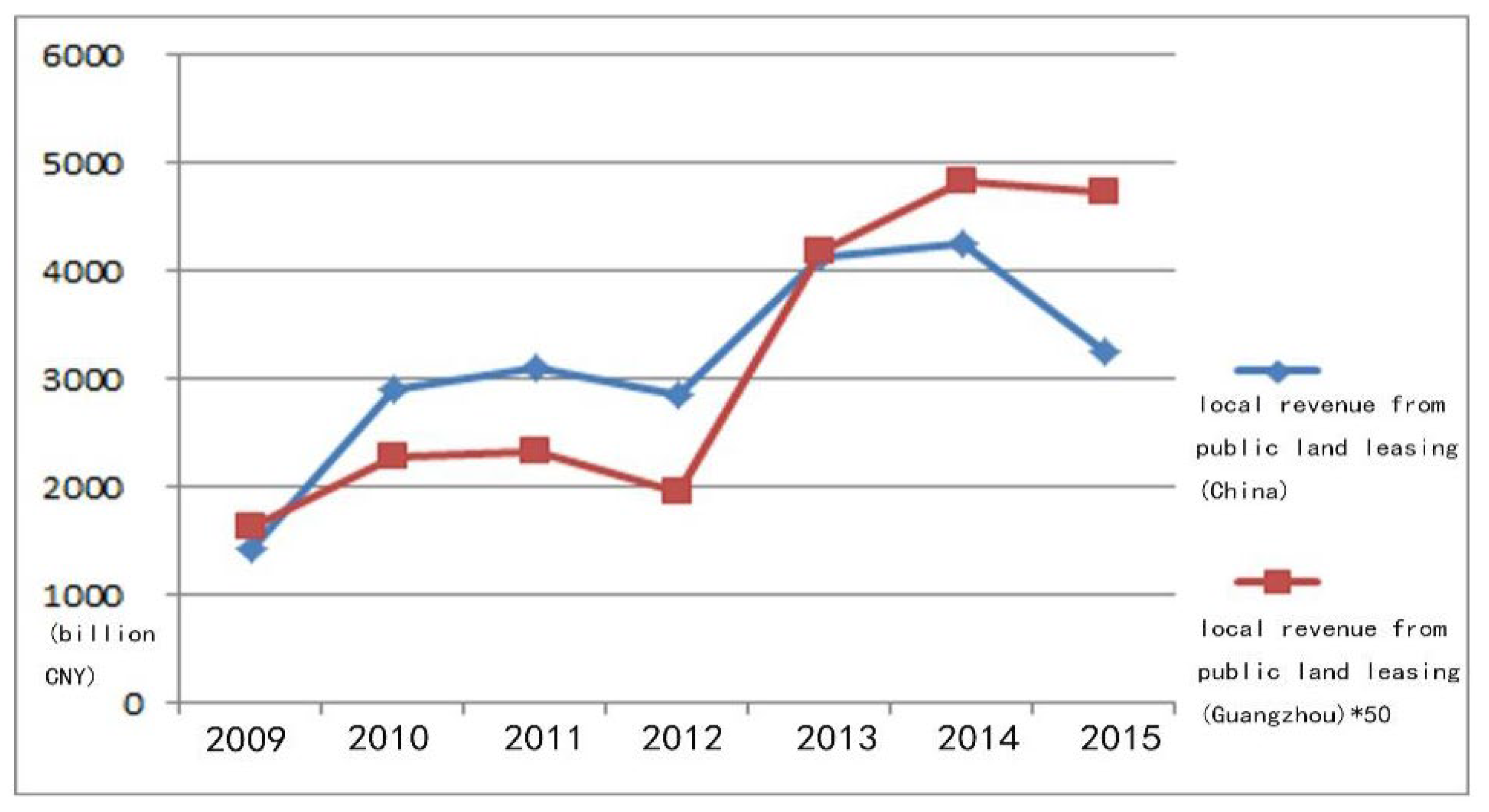
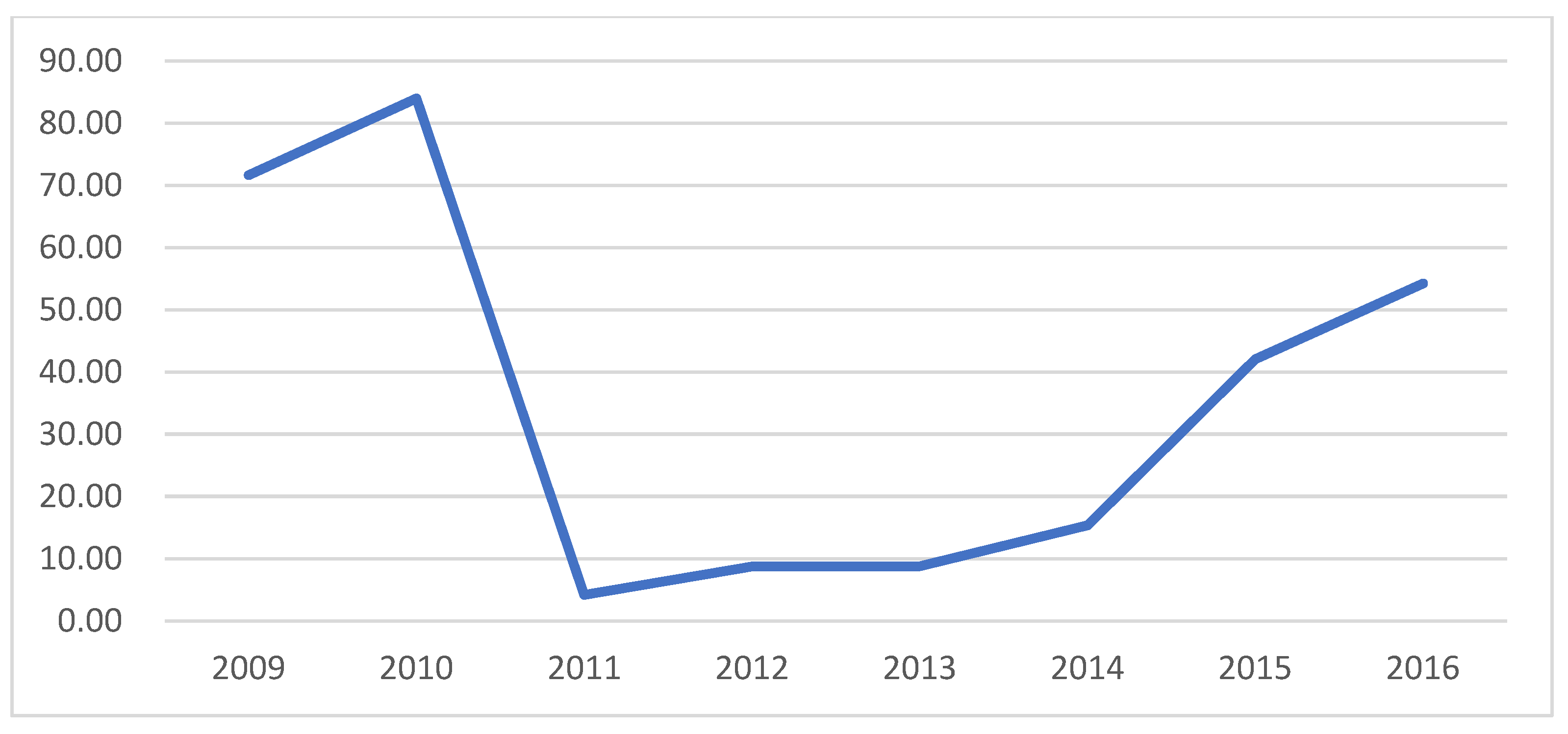
69]. On the other hand, land supply through TOR decreased due to the reduced number of projects; therefore, land transactions through open auctions, monopolized by the local state, increased. Such expansions increased the land revenue of municipal governments. From 2009 to 2012, land revenue was 32.3, 45.6, 46.5, and 38.9 billion CNY; then, in 2013, 2014, and 2015, the number jumped to 83.8, 96.7, and 94.8 billion CNY (see
Figure 3) [
77]. Regarding the total land revenue at the national level, 4.13, 4.26, and 3.25 trillion CNY in these 3 years, the revenue of Guangzhou was equal to 2.03%, 2.27%, and 2.92% of the whole national income from land leasing [
78]. These percentages are higher than those between 2009 and 2012, which were 2.27%, 1.57%, 1.49%, and 1.37%.
4.3. Micro-Regeneration Phase (2015–2019)
4.3.1. Policy Changes
One way to understand the micro-regeneration phase is to view it as a subphase of TOR phase 2.0 because TOR has been oppressed since the announcement of No. 20 municipal government document. An intriguing fact is that the document developed the notion of “regeneration of old town” in TOR policy into “micro-regeneration of the old neighborhood”. To provide context, in 2017, Guangzhou, as the only chosen first-tier metropolitan area, became one of the national experimental cities for regenerating old neighborhoods.
In this pathway, micro-regeneration, especially in old urban communities as the micro-regeneration of old neighborhoods, has become a municipal priority, suggesting that massive public funding is required to support it. For example, regarding the budget to regenerate urban areas in the Bureau of Urban Regeneration, the budget for 2016 only included 2.29 million CNY of public funds to support TOR projects. Meanwhile, 128.28 million CNY was allocated to micro-regeneration cases [
79].
In the “Methods of Urban Regeneration in Guangzhou” as a new municipal policy announced in 2015, micro-regeneration, whether in old neighborhoods or villages, is not defined as a total demolition and rebuild. Instead, it refers to a partial demolition, a functional replacement, a repair or activation, and an infrastructure improvement without changing the existing building structures. Here, the definition of “old neighborhoods” is communities with buildings mostly built before 2000.
4.3.2. Social Interaction
Micro-regeneration seems similar to community regeneration in the West with bottom-up characteristics. Indeed, public participation and bottom-up mechanisms were significant in a few cases, such as the micro-regeneration of Puntoon Wuyue, a historical urban village. However, in most cases, micro-regeneration mainly operated with top-down patterns. First, micro-regeneration projects were initiated and financed by the local state rather than communities and developers. Second, the roles of communist party members as involved residents were emphasized as crucial pillars to support micro-regeneration projects. Chinese Communist party is a top-down organization to control and mobilize its members. The government calls this phenomenon “building the communist party as a leading role” (dangjianyinling) (interview, planner 1 and 11, 2019).
Interestingly, in such a top-down pattern, local state sectors intentionally encourage public participation as a secondary mechanism. In other words, small-scale bottom-up approaches have been designed and supported by governmental actors within a sizeable top-down process. For example, after the government chooses communities for micro-regeneration and prepares public funding for regeneration, the operating department in micro-regeneration provides a 60-item list, which includes various aspects of regeneration, such as improving electric systems, repainting walls, and decorating corridors, to residents to make a choice. Then, a committee comprising various residents is built to participate in the whole process of micro-regeneration, except for the final approval of the project completion, which is provided by external experts (interview, planners 1 and 11, 2019). The whole mechanism is called “residents order the dish, the party and the government take the order, and all of them jointly complete the issue” (qunzhongxiadan, danghezhengfujiedan, and gongtongzuodan) (interview, officer 3, 2019).
4.3.3. Outcomes
The outcomes of micro-regeneration can be displayed on two levels. The first reveals the material dimension of regenerating projects, and the second presents political influences resulting from material performance. Until October 2019, 685 micro-regeneration projects were established in old neighborhoods. Among them, 208 projects have been completed. These projects involved 450,000 households and 1.58 million people. In these regenerated communities, 40,300 m
2 of illegal buildings were demolished, 1008 km
2 of outdoor lines running electricity, TV signal, and telecommunication systems were re-assembled underground, 124 km of sewer channels were separated between rain pipelines and dirty water ones, 24 km of accessible facilities for disabled people were constructed, 16,108 items of fire-proof equipment were added, and 3495 elevators were inserted into existing residential buildings [
80].
Politically, 81.5% of involved residents expressed their satisfaction with the projects, the Ministry of Housing and Construction praised methods applied in Guangzhou, and the mass media, including national media such as China Central Television, reported micro-regeneration in Guangzhou many times with positive opinions [
81]. In particular, a compelling case for micro-regeneration, the Yongqing Fang Project on Enning Road, was visited by President Xi in October 2018 and received very positive comments from him. Such visits and comments can significantly impact the Chinese political system. Afterward, the Yongqing Fang Project became the representative of micro-regeneration in Guangzhou, attracting thousands of governmental or voluntary visitors from other cities to “come and learn”.
However, as a top-down case, residents are passively involved with limited interest in participating. Furthermore, residents have continuously complained about disturbances due to construction activities for years without concrete results (interview, planner 1, 2019; interview, journalist 2, 2019).
5. Adaptation: External Challenges and Policy Responses
For these three distinct phases of urban regeneration in Guangzhou, within a relatively stable period in terms of speed of urbanization and economic growth, “why” did these changes happen dramatically and significantly? To answer this question, external challenges and policy responses are analyzed in three phases of policy initiation and formulation. The combination of and interaction between external challenges and policy responses can be understood as adaptation, which refers to the changes in response to competitive pressure [
69]. The tradeoff among urban regeneration, land leasing income, and micro-regeneration is crucial to determining such an adaptation.
5.1. “TOR” Policy, Phase 1.0 (2009–2012)
External challenges that occurred at the beginning of this phase can be divided into two interrelated levels. First, at the national level, the central state encouraged cities such as Guangzhou to pursue economic growth in an inter-city competitive environment (Li and Zhou, 2005). At the same time, the most critical resource for development, land for construction, was strictly regulated by quantitative controls from the central state through land planning. The situation became severe around 2009 as it was determined that available land for future new construction allowed in the 2020 Land Use General Plan (tudiliyongzongtiguihua) would be exhausted in the next 3–5 years if this metropolis followed former pathways of development (interview, officer 3, 2013). Moreover, 37% of total constructed land was considered low-efficiency land that required redevelopment; however, the high institutional cost was the main barrier to redevelopment [
75]. To respond to these challenges as difficulties in pursuing growth under competitive pressure at the national level, the provincial government of Guangdong and the Ministry of Land and Resources cooperated to announce the TOR policy, which involves the redevelopment of old towns in inner cities, old factories, and old villages or urban villages as low-efficiency land, to increase land-use efficiency (interview, officer 3, 2013). Furthermore, the TOR policy has been considered as political support for Mr. Wang Yang, the top leader of Guangdong Province, from the Ministry of Land and Resources, because the TOR policy can strongly enable him to achieve better political performance through stimulating economic growth (interview, planner 2, 2013). This is a particular kind of sustainability offered to a specific person in the planner 2’s statement in 2013:
“The TOR policy is a political investment from the Ministry of Land and Resources to Wang Yang, because he will run for the central position as one of the national leaders after his term in Guangdong has finished.”
In 2012, Mr. Wang Yang became the chairman of the National Committee of the Chinese People’s Political Consultative Conference. The TOR policy has not been applied in provinces other than Guangdong.
Second, at the municipal level, Guangzhou, as the capital of Guangdong Province, became one of the first three experimental cities to apply this new policy, best illustrated in the 2009 local government document No. 78. This provincial policy represents an external impact. Therefore, the Guangzhou city government had to respond, which meant that Guangzhou had to actively initiate and formulate new policies, such as the 2009 municipal government document No. 56 within its territory, to match policy motivations at higher levels.
5.2. “TOR” Policy, Phase 2.0 (2012–2015)
After 2012, external challenges for urban regeneration in Guangzhou were transformed. Debts of the Guangzhou government became more and more of a severe problem for local leaders and land income declined between 2009 and 2012; TOR may have been the reason behind such a decline (interview, planner 2, 2013). From February to April 2011, the National Audit Office sent its special team to Guangzhou to audit government debts as part of a national movement [
82]. In February 2012, the People’s Congress of Guangzhou established a supervisory role over municipal obligations for the first time in history [
83]. These activities brought enormous pressure on the Guangzhou government because people found that municipal debts rocketed from 115.3 billion CNY in 2008 to 247.5 billion CNY in 2010 [
84] (see
Table 1). Such a dramatic rise was attributed to the preparation and operation of the 2010 Asian Games [
84]. In December 2012, for the first time, the Guangzhou government publicly admitted the scope of debts, 241.4 billion CNY [
77]. This debt required payment from local revenue, which was highly related to income from the land leasing market [
85] (see
Table 2). From 2009 to 2012, through open-auction land leasing, the Guangzhou municipal government obtained 32.3, 45.6, 46.5, and 38.9 billion CNY in revenue under the title “governmental funding” (zhengfuxingjijin) [
85]. During the same period, compared to the national level, land revenue in Guangzhou declined relatively. In 2011, the Guangzhou government planned to gain 64.6 billion CNY in land revenue [
86]; however, the actual income was 46.5 billion, far less than that proposed [
85].
Such a decrease may be considered as due to the influence of TOR. In Chinese cities such as Guangzhou, fiscal income from land leasing is crucial for local revenue; land leasing income is influenced by demands of housing from the increased urban population, the expectation of economic growth and approaches of land leasing (auction or negotiation) [
87,
88,
89]. Between 2009 and 2012, changes in GDP, urban population and housing prices did not match the tendency of changes in land leasing revenue [
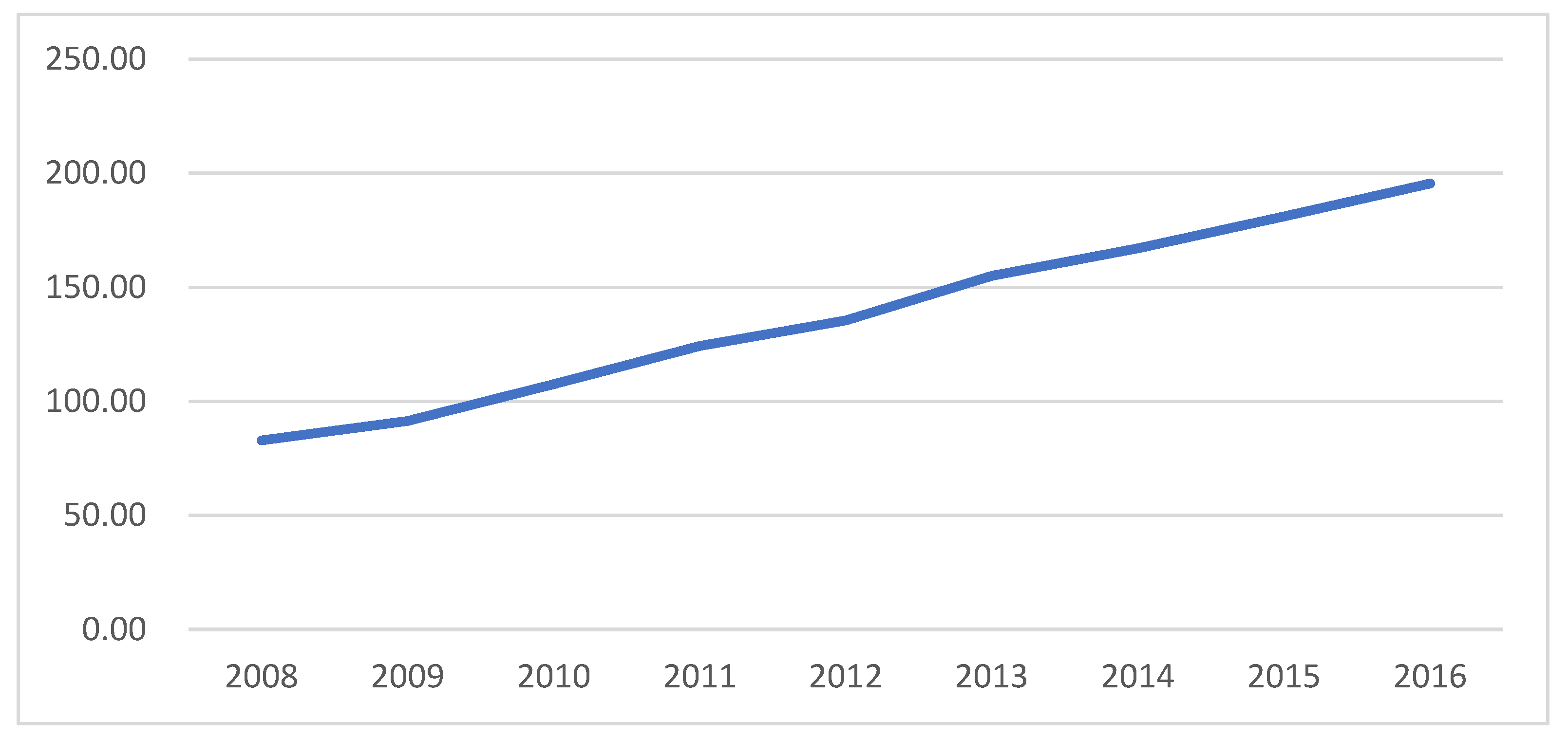
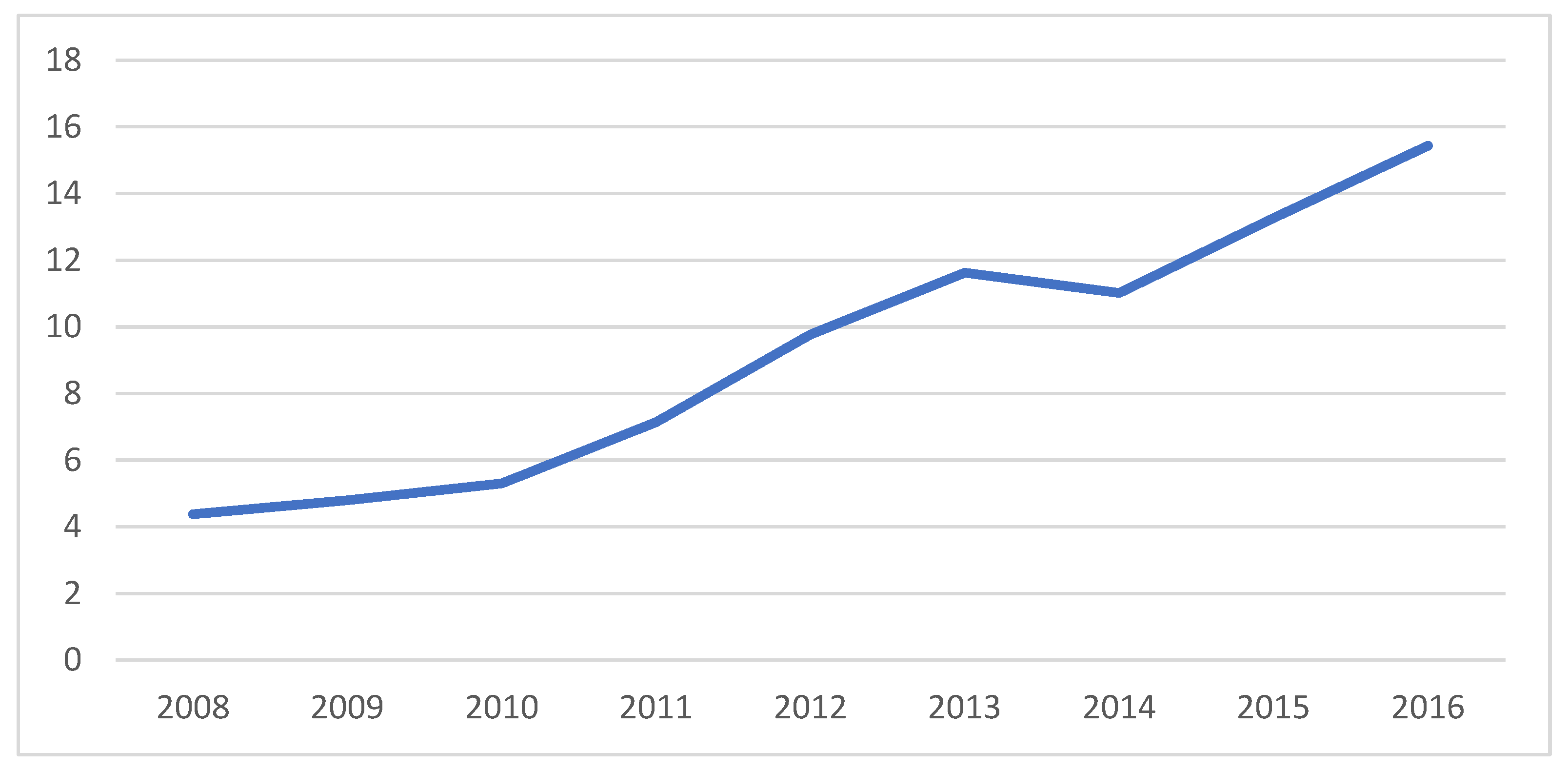
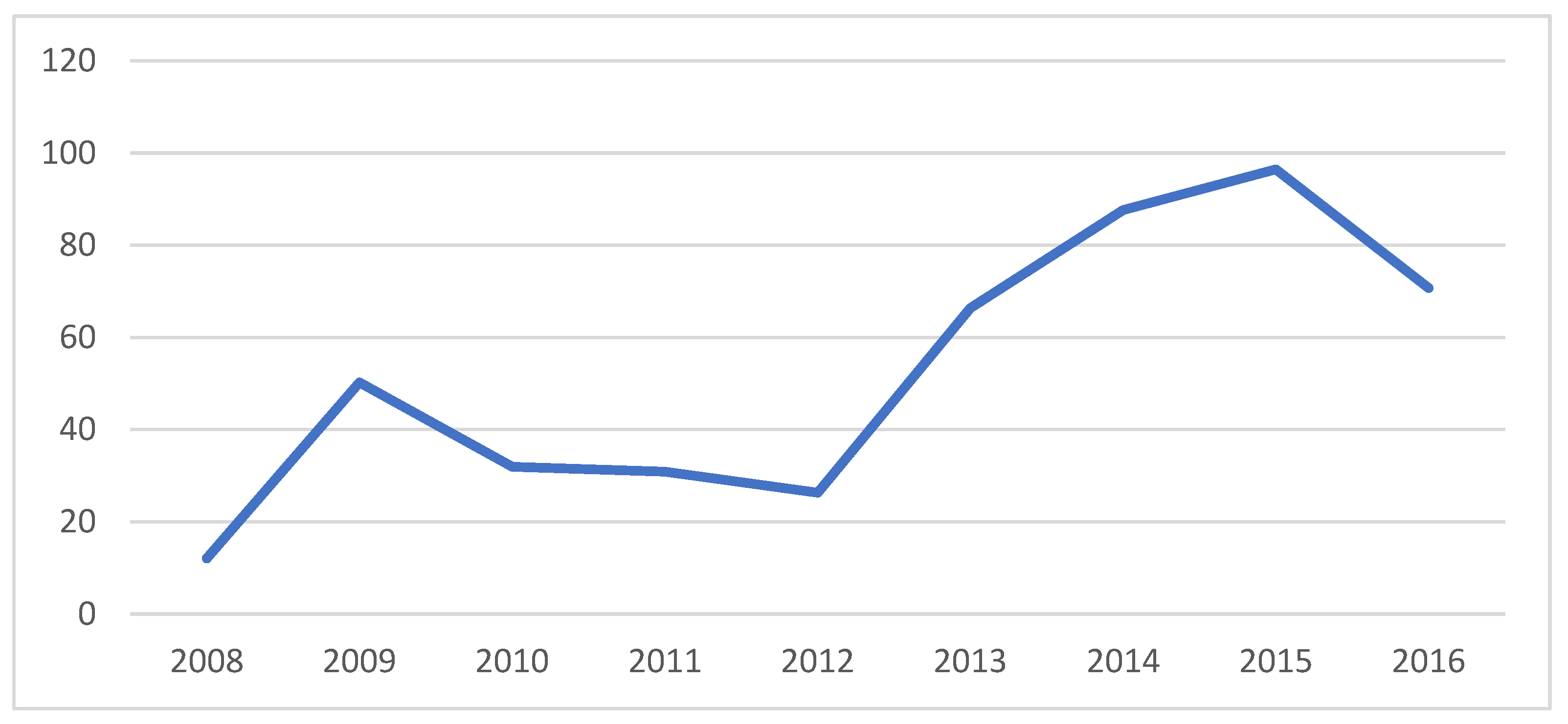
70] (see
Figure 4,
Figure 5,
Figure 6 and
Figure 7); it seems that land leasing methods might be more important to influence land revenue because the open auction is better than negotiation to obtain incomes [
90]. As land leasing through negotiation is the most important incentive for urban regeneration in the TOR 1.0 phase, to increase land leasing income to release political pressure from debts, it is reasonable for the local government to depress negotiation and encourage auction in the No. 20 municipal government document, which indicated the beginning of TOR 2.0 phase.
In the TOR 2.0 phase, land leasing income from urban regeneration became a particular “desirable” outcome for local leaders. In a meeting about regenerating Guangzhou Steel New Town (Guanggangxincheng), Mr. Chen JIanhua, the mayor of Guangzhou, required experts in the planning committee of Guangzhou to agree to a modified plan, which decreased green space and built more high-rise residential buildings. When experts were not keen to approve the plan, the mayor seriously demanded them to do so (interview, planner 12, 2020). This is a particular type of sustainability offered to the mayor rather than to the citizens, because the revised plan will reduce ecologic sustainability for the public but increase land leasing income to release fiscal pressure for the leaders of Guangzhou.
5.3. Micro-Regeneration Phase (2015–2019)
This land leasing income in the TOR 2.0 phase has significantly contributed to the ability to pay back debts. At the end of 2015, the municipal government was 266 billion CNY in debt, 8.2% lower than that in June 2013 [
77]. However, despite similar pressures, new challenges have emerged for municipal leaders and the Guangzhou Bureau of Urban Regeneration. On 28 February 2015, this bureau was established as the first Bureau of Urban Regeneration in China. This new sector was designed at the superior level as the leading operator of urban regeneration. Ironically, because the TOR policy in phase 2.0 discouraged regeneration projects, this newly appeared bureau had almost nothing to do to gain political achievement for its leaders. To respond to this challenge, in addition to routing jobs, in 2015 this bureau began to prepare a new policy for future urban regeneration, “Methods of Urban Regeneration in Guangzhou” (guangzhouchengshigengxinbanfa), which included a new category of urban regeneration, namely, micro-regeneration. Micro-regeneration, gradual and small-scale improvement without demolition and ownership shift, can be operated even in projects that regular TOR approaches do not cover, as mentioned by officer 3 in 2019:
“We assume that a regeneration project can be neither financially feasible as an individual case nor cooperative with other projects through joint regeneration; therefore, it cannot be regenerated under TOR policy. In these sorts of cases, micro-regeneration will be an appropriate choice. Furthermore, micro-regeneration aims to solve some urgent issues, such as safety.”
This reveals the adaptive nature of micro-regeneration policy innovation, which aims to push urban regeneration forward, not within the TOR channel, but through other methods to overcome external difficulties. This adaptive capacity met another challenge and opportunity later, at the end of 2015. After 37 years, the central government held a new national conference of urban affairs with the country’s top leaders. Within this meeting, the “regeneration of old neighborhoods” (laojiuxiaoqugaizao) was emphasized as a national urban strategy [
91]. To adapt to this new national policy, the Bureau of Urban Regeneration in Guangzhou added one more word, micro, to the national agenda.
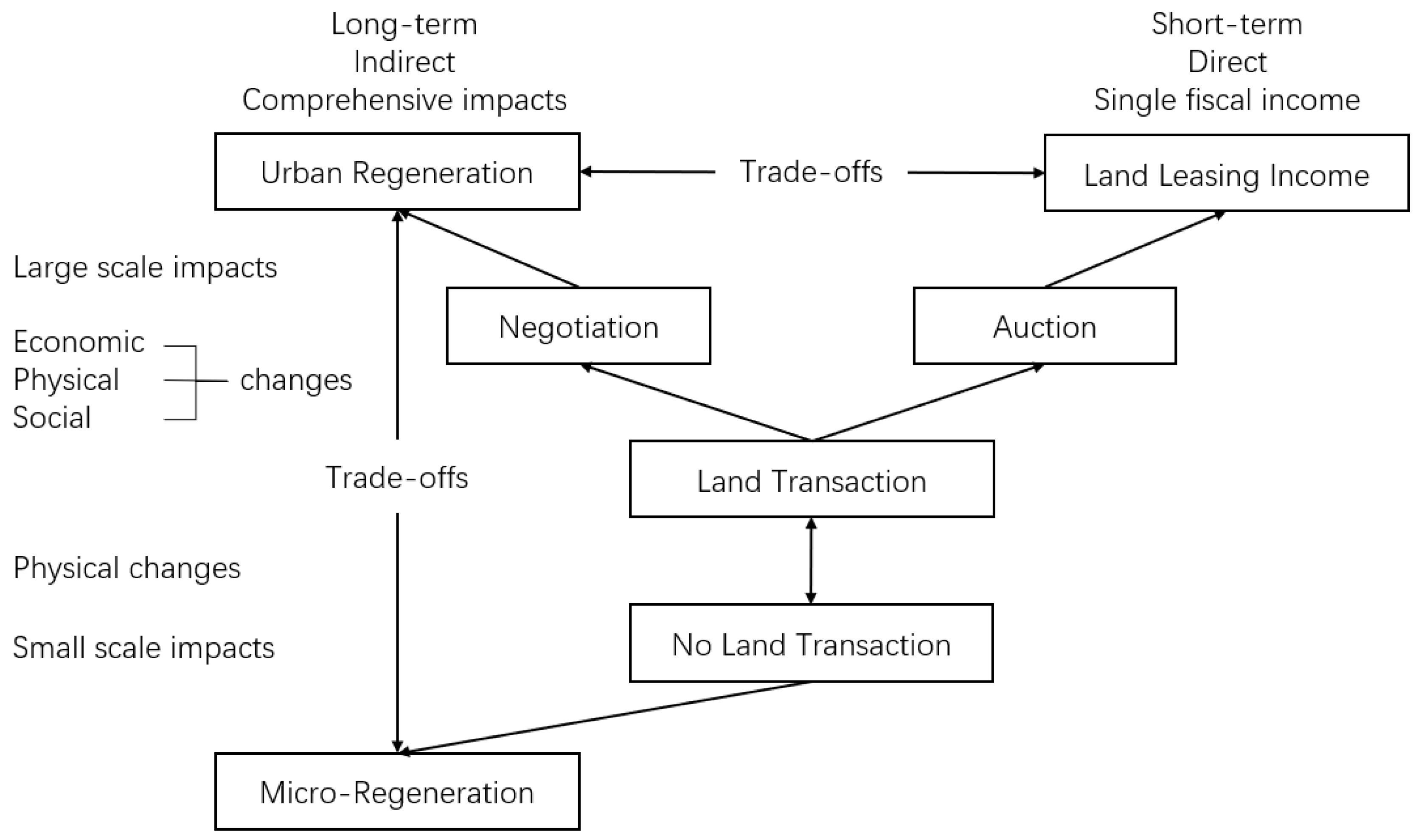
5.4. Tradeoffs among Urban Regeneration, Land Leasing Income, and Micro-Regeneration
Since 2009, these three stages of the adaptive governance of urban regeneration can be understood as tradeoffs among urban regeneration, fiscal income from land leasing, and micro-regeneration. Such exchanges aim to produce desirable states of urban regeneration in a broad political–economic context. The political leaders strategically define these delectable statuses to achieve their various targets within a changeable circumstance. Within such tradeoffs, urban regeneration leads to relatively large-scope, long-term. and indirect interests, such as an improved urban landscape, infrastructure, and updated industries with increased future taxes and fees. In contrast, land leasing revenue leads to short-term and direct cash income from land leasing to developers; micro-regeneration brings about a relatively small scope and indirect physical improvement. After 2009, the core difference between urban regeneration and land leasing income, as a target for local leaders, was the distinction between negotiation and auction in land leasing. Micro-regeneration differs from urban regeneration in terms of its small scope of impacts and lack of involvement of land transactions between owners.
Due to policy pressure from above to push TOR, land finance conceded urban regeneration in the first phase. Such a tradeoff was made at the level of municipal leaders. To realize its goal, the state granted power and interests to social actors to support regeneration projects. However, this concession led to a loss of land revenue for the local state. In the second phase, this tradeoff happened again under new pressure from debt and supervision from Guangzhou and above. This time, land finance was given higher priority in the minds of the top leaders of Guangzhou. To pursue land leasing income and then to depress the progress of TOR, governmental actors took their power back, and social players were more or less deprived of their rights in TOR and excluded from this domain. In the third phase, under pressure to pursue political performance and respond to national policy, a tradeoff happened mainly at the level of the urban regeneration bureau rather than the municipal leader level. As a result, urban regeneration was partially replaced by micro-regeneration, which did not affect the land leasing market through negotiation and impacted urban space in a similar but relatively small manner. Tradeoffs among urban regeneration, land leasing income, and micro-regeneration have been displayed in
Figure 8.
6. Adaptive Governance: Selective Feedback, Fragile Check-in-Balance and Social Learning Capacities
Adaptation between external challenges and policy changes as responses was efficient for urban regeneration in Guangzhou between 2009 and 2019; such an adaptation followed tradeoffs among urban renewal, fiscal income from land leasing, and micro-regeneration. The third research question (“how” social–political mechanisms enable such changes to happen) explores governance mechanisms in policy adoption. Governance of urban regeneration always involves actors from government, market, and communities, whereby the government actors can influence but not control other stakeholders. Conflicts of interest among different stakeholders are reflected in such adoption. To govern such disputes, adaptive governance includes three aspects: license to adopt in a power relationship, the process of adoption, and capacities to adopt as knowledge and values [
69].
6.1. License to Adopt: Fragile Check-and-Balance in the Power Relation
In a given power structure, the license to adapt is the key to deciding who has the right to make policy decisions. As a critical municipality in the Chinese authoritarian regime, Guangzhou has the party–state core as the executive sector at the center of policy adoption. Within a fragmented authoritarian system, different levels and sectors more or less share the power of policymaking [
92]; the adoption of the TOR policy can be understood as an interaction at provincial, municipal, and district levels, and between the local leaders, such as mayors, and different relevant departments, such as the Bureau of Urban Regeneration, in the party–state system. Power is shared between these actors, but the local leaders have the final decision power. Between governmental and nongovernmental actors, the local government has a highly advantaged position. Local congress, which makes laws, not policy, has minimal capacity in policy adoption; the local government is almost self-licensed to adopt. Such a power structure is reflected in one of the Chinese folk adages; black titles (laws) are less critical than red titles (policy), red ones are less important than white ones (leaders’ written comments), and white ones are less important than oral ones (orders from leaders). Therefore, there are fragile check-and-balance mechanisms to limit the tradeoff power of local political leaders to change policy; opposite forces from market and society are politically weak, and obstacles to applying adaptive actions can be effortlessly overcome. Other social groups’ interests, such as those of developers, cannot be institutionalized into policy adoption procedures. The lack of checks and balance may mean that the adaptive governance in regenerating Guangzhou represents interest in the local state, which is not wholly equal to the interest of the urban population, to pursue its sustainability.
6.2. Process of Adoption: Selective Feedback
Feedback is a crucial mechanism for building adaptation in urban regeneration because regeneration outcomes are significant on both the urban scale and the project scale; stakeholders can feel that such results directly change their behaviors accordingly (interview, officer 4, 2019). However, for policy adoption, feedback works in a highly selective manner. On the one hand, feedback is not equally expressed between different agencies and collected in a political system. Governmental actors, particularly members of the standing committee of the Communist Party Branch in Guangzhou, are key players in policy adoption. In 2014, several committee members led groups of officials to different districts of Guangzhou to collect feedback from the government and market; this feedback has a greater possibility of influencing future policy (interview, officer 3, 2013).
On the other hand, feedback is selectively responded to. For local leaders with tradeoffs in power, feedback has diverse categories, such as indicators of economic growth after TOR, housing prices influenced by TOR policy, the number of approved TOR projects after initiating the TOR policy, the amount of local revenue originating from land leasing by developers, and changes in the annual debt table for the Guangzhou government. This feedback is highly selectively considered by local state leaders. For instance, in 2012, municipal debt reached 241.4 billion CNY, which led to massive pressure on the local state, expressed in the mass media. This brought about a new policy to constrain TOR. In 2018, this number remained at 240.4 billion [
93]; however, it was hard to find any expression of pressure on the local state in the mass media this time. In contrast, this year, billions of government money was spent on micro-regeneration projects, which cannot contribute to local revenue directly. Therefore, it seems that municipal debt, even with a similar amount, is no longer a severe issue for the local state.
6.3. Capacities to Adopt: Social Learning of the Governmental Officials
The social learning capacities of the local state include getting knowledge, information, and values about urban regeneration in social interaction. The external pressures, main challenges, and desirable status have been quite diverse in every phase. Accordingly, the responsive policies are also different. It is challenging for the local state to recognize critical factors to respond to. Feedback is crucial in such a process to enable local leaders to understand the mechanisms and outcomes of urban regeneration in every phase. Furthermore, governmental actors are good at learning from social entities. For instance, the important micro-regeneration project, the Yongqing Fang Project on Enning Road, has experienced several rounds of social protest against government-initiated urban regeneration because of historic preservation and public participation issues. Through social interaction, officials have learned the terms related to preservation and participation from social actors and intentionally applied these learned terms in new policy documents and practices [
94]. However, these social learning mechanisms can help officials to grasp knowledge and information rather than values. In the Yongqing Fang case, historic preservation is even a key point in its marketing, whereby developers and the government have produced extensive damage to historical buildings in the regeneration process [
94].
6.4. Assessment, Lessons, and Challenges Acquired from the Guangzhou Style of Adaptive Governance
Adaptive governance in Guangzhou as a tradeoff configuration presents a challenge to conventional thoughts, which usually regard adaptive governance as opposite to top-down decision making and implementation of singular solutions from political consideration [
54]. Many ideas about adaptive governance emphasize the participative power structure, which comprises bottom-up policy initiations, community autonomy, polycentric power, participation in decision making, and self-organized policy actors to enable adaptive governance [
35,
61,
62,
95,
96]. However, this research found that the concentrated decision-making power structure in Guangzhou has also contributed to the development of adaptive governance in urban regeneration. Participation elements are not essential components in adaptation within the context of Guangzhou. Being adaptive does not mean being better; it simply gives the capacity to adapt to uncertain and changeable external circumstances. Guangzhou-style adaptive governance is the specific “authoritarian” type, which is opposite to the “democratic” type in conventional thoughts.
Guangzhou is the frontier of China’s reform, which has made this city prosperous. Guangdong has been the wealthiest province in China for many years; in 2019, its GDP was 10.76 trillion CNY (approximately 1.52 trillion USD) [
97], which is close to the GDP of Russia, 1.64 trillion USD [
98]. Guangzhou is the capital, political, and economic center of Guangdong Province. Therefore, social investment is active in Guangzhou, which has been a vital driving force to push urban regeneration when the local state thought it was necessary. When these local leaders decided to refuse social capital in urban regeneration, they still believed that this capital would come back if new policy changed to recall social investment. This is the background for Guangzhou to operate its adaptive governance in urban regeneration.
The Guangzhou case suggests a greater possibility of adaptive governance that goes beyond the conventional ways of local or national specificities. Instead, adaptive governance might be in the form of a spectrum, scaling from predominantly top-down decision making in more authoritarian societies to the mostly bottom-up policy initiations in democratic ones. For instance, in an earlier study conducted by the authors [
99], the second largest Russian city, St. Petersburg, was compared to Guangzhou, putting the Russian model somewhere in between the two extremes on the described spectrum. It was shown that adaptive governance of the major redevelopment projects in St. Petersburg combined a much larger scope of public participation as compared with Guangzhou’s case, although the measure of top-down decision-making was also identical.
While the lessons from Guangzhou proposed promising new venues to understand and utilize the concept of adaptive governance, the case study faced some difficulties and challenges. It is worth noting that Guangzhou was only one case out of the three that adopted similar urban regeneration policies in China. Whether other cities in China present similar findings toward adaptive governance still requires further investigation. Another limitation lies within the depth of qualitative data, presented by the nature of purposefully undocumented policies (see
Section 6.1). In addition, this study only traced the evolutions of adaptive governance and urban regeneration policies from Guangzhou for a decade, with the unprecedented intrusion of the COVID-19. It will be interesting to conduct a follow-up study to learn how the pandemic has shaped or reshaped the findings of the current study.
7. Discussions and Conclusions
7.1. Discussions
In contrast to conventional thought about adaptation and adaptive governance, which emphasizes decentralized power structure, bottom-up social interaction, and participation of different stakeholders, the Guangzhou case displays something different. In this centralized power system of Guangzhou, through selective responses to feedback and external signals, this adaptation was conducted by leaders in the local political system to achieve their defined goal of sustainability. Other urban forces had to follow these decisions about the adaptation of adaptation and attempted to pursue various interests as side-effects of such decisions. Interactions among diverse actors formulated various governance patterns in different phases; the local state conducted such interactive dances. This is a responsive, flexible, dynamic, and state-dominated adaptation with adaptive governance mechanisms, which is different from other decentralized, networked, and participative governance structures.
Negative aspects in Guangzhou-style adaptive governance may be displayed in the specific “authoritarian” type with monopolistic and exclusive sustainability pursued by a few leaders. Local leaders operate the adaptation of urban regeneration policy to achieve sustainability as a desirable status in various situations. Market players and communities may enjoy desirable statuses that allow them to ensure future sustainability in particular periods, such as developers in the first phase and residents in the third; however, their desirable statuses are granted by the local state rather than defined by themselves. Usually, sustainability is considered a holistic system to be inclusive across different social groups. However, the local government pursues sustainability in regenerating Guangzhou exclusively as its “own” sustainability. Therefore, the political nature of adaptation and adaptive governance can be revealed as monopolistic power in an authoritarian regime.
Guangzhou needs to investigate its governance pathway to pursue adaptation within its own institutional background that is path-dependent from its history. A localized mode of adaptive governance may be essential to understand how to build adaptation at the global level. There is no universal mode to build adaptive capacities in our diverse world with heterogeneous cities and regions. However, the contemporary world is full of uncertainty and unexpected external challenges, such as climate change, economic crises, and political instability. Such a world demands adaptation for survival and development. Diverse governance modes built within different institutions, power relations, and developmental channels may help to find their own methods of adaptation and can use local wisdom to find unique modes of adaptive governance. Each city or region needs to find its mode of adaptation, because none can escape from uncertain external impacts in contemporary circumstances. Each place has the potential to build adaptive capacities on the basis of its unique strength in tradeoffs, feedback, social learning, and other social mechanisms. Our study on the adaptive governing of urban regeneration in Guangzhou may act as an initial step in this process.
7.2. Conclusions
After using the concept of adaptive governance to study processes of changes in three phases, the progression of regenerating Guangzhou between 2009 and 2019 revealed policy changes, social interactions, and outcomes as policy implementation of urban regeneration in three distinct phases: TOR 1.0, TOR 2.0, and micro-regeneration with different policy changes, social interactions, and outcomes as the answers to the “what” question. The reasons behind these dramatic changes were adapted as policy initiations. Policy changes were responses to external challenges such as adaptation; tradeoffs among urban regeneration, land leasing income, and micro-regeneration represented the fundamental logic driving adaptation by local political leaders. This is the answer to the “why” question. Social–political mechanisms, including limited check-and-balance (license to adopt), selective feedback (process to adopt), and the social learning capacity (capacities to adopt) of the local state, are crucial governance factors to enable adaptation, as the answer to the “how” question. Policy adoption is operated within an adaptive governance system. Such research findings build the understanding of “what”, “why”, and “how” questions in adapting urban regeneration (the conclusion is summarized in
Figure 9). In particular, “how” social–political mechanisms enable these changes can contribute to the existing urban regeneration literature where “what” has happened and “why” are disproportionally studied.
Author Contributions
Conceptualization, B.L., K.Y., K.E.A. and H.L.; methodology, B.L. and H.L.; software, B.L.; writing—original draft preparation, B.L., K.Y., L.Z. and H.L.; writing—review and editing, B.L., K.Y., K.E.A., L.Z. and H.L.; Supervision, K.E.A.; funding acquisition, B.L. All authors have read and agreed to the published version of the manuscript.
Funding
This research was funded by National Natural Science Foundation of China (No. 41871154), National Natural Science Foundation of China and Science and Technology Development Fund of Macau (52061160366), (0039/2020/AFJ), and 2021 Tiehan Open Research Funding from Peking University Future City Lab (Shenzhen).
Data Availability Statement
Conflicts of Interest
The authors declare no conflict of interest.
References
- Scott, A.J.; Storper, M. The nature of cities: The scope and limits of urban theory. Int. J. Urban Reg. Res. 2015, 39, 1–15. [Google Scholar] [CrossRef] [Scilit]
- Couch, C. Introduction. In Urban Renewal: Theory and Practice; Macmillan International Higher Education: Basingstoke, UK, 1990; pp. 1–5. [Google Scholar]
- Roberts, P. The Evolution, Definition and Purpose of Urban Regeneration. In Urban Regeneration: A Handbook; SAGE Publications Ltd.: London, UK, 2000; pp. 9–36. [Google Scholar]
- Tian, L. The chengzhongcun land market in China: Boon or bane?—A perspective on property rights. Int. J. Urban Reg. Res. 2008, 32, 282–304. [Google Scholar] [CrossRef] [Scilit]
- Liu, Y.; He, S.; Wu, F.; Webster, C. Urban villages under China’s rapid urbanization: Unregulated assets and transitional neighbourhoods. Habitat Int. 2010, 34, 135–144. [Google Scholar] [CrossRef] [Scilit]
- Hao, P.; Sliuzas, R.; Geertman, S. The development and redevelopment of urban villages in Shenzhen. Habitat Int. 2011, 35, 214–224. [Google Scholar] [CrossRef] [Scilit]
- Lin, Y.; de Meulder, B.; Wang, S. Understanding the “village in the city” in guangzhou: Economic integration and development issue and their implications for the urban migrant. Urban Stud. 2011, 48, 3583–3598. [Google Scholar] [CrossRef] [Scilit]
- Song, Y.; Zenou, Y. Urban villages and housing values in China. Reg. Sci. Urban Econ. 2012, 42, 495–505. [Google Scholar] [CrossRef] [Scilit]
- Liu, Y.; Lin, Y.; Fu, N.; Geertman, S.; van Oort, F. Towards inclusive and sustainable transformation in Shenzhen: Urban redevelopment, displacement patterns of migrants and policy implications. J. Clean Prod. 2018, 173, 24–38. [Google Scholar] [CrossRef] [Scilit]
- Liu, Y.; Tang, S.; Geertman, S.; Lin, Y.; van Oort, F. The chain effects of property-led redevelopment in Shenzhen: Price-shadowing and indirect displacement. Cities 2017, 67, 31–42. [Google Scholar] [CrossRef] [Scilit]
- Liu, Y.; Geertman, S.; van Oort, F.; Lin, Y. Making the ‘Invisible’ Visible: Redevelopment-induced Displacement of Migrants in Shenzhen, China. Int. J. Urban Reg. Res. 2018, 42, 483–499. [Google Scholar] [CrossRef] [Scilit]
- Zhao, Y.; Webster, C. Land dispossession and enrichment in china’s suburban villages. Urban Stud. 2011, 48, 529–551. [Google Scholar] [CrossRef] [Scilit]
- Wu, F.; Zhang, F.; Webster, C. Informality and the development and demolition of urban villages in the Chinese peri-urban Area. Urban Stud. 2013, 50, 1919–1934. [Google Scholar] [CrossRef] [Scilit]
- Lai, Y.; Tang, B. Institutional barriers to redevelopment of urban villages in China: A transaction cost perspective. Land Use Policy 2016, 58, 482–490. [Google Scholar] [CrossRef] [Scilit]
- Lai, Y.; Wang, J.; Lok, W. Redefining property rights over collective land in the urban redevelopment of Shenzhen, China. Land Use Policy 2017, 69, 485–493. [Google Scholar] [CrossRef] [Scilit]
- Li, X.; Kleinhans, R.; van Ham, M. Shantytown redevelopment projects: State-led redevelopment of declining neighbourhoods under market transition in Shenyang, China. Cities 2017, 73, 106–116. [Google Scholar] [CrossRef] [Scilit]
- Xu, Z.; Lin, G.C.S. Participatory urban redevelopment in Chinese cities amid accelerated urbanization: Symbolic urban governance in globalizing Shanghai. J. Urban Aff. 2019, 41, 756–775. [Google Scholar] [CrossRef] [Scilit]
- Tan, X.; Altrock, U. Struggling for an adaptive strategy? Discourse analysis of urban regeneration processes—A case study of Enning Road in Guangzhou City. Habitat Int. 2016, 56, 245–257. [Google Scholar] [CrossRef] [Scilit]
- Zhang, C.; Li, X. Urban redevelopment as multi-scalar planning and contestation: The case of Enning Road project in Guangzhou, China. Habitat Int. 2016, 56, 157–165. [Google Scholar] [CrossRef] [Scilit]
- Lin, G.C.S. The Redevelopment of China’s Construction Land: Practising Land Property Rights in Cities through Renewals. China Q. 2015, 224, 865–887. [Google Scholar] [CrossRef] [Scilit]
- Weinstein, L.; Ren, X. The changing right to the city in Globalizing Mumbai and Shanghai. City Community 2009, 8, 407–433. [Google Scholar] [CrossRef] [Scilit]
- Zhang, T. Urban development and a socialist pro-growth coalition in Shanghai. Urban Aff. Rev. 2002, 37, 475–499. [Google Scholar] [CrossRef] [Scilit]
- Li, L.H.; Li, X. Redevelopment of urban villages in Shenzhen, China—An analysis of power relations and urban coalitions. Habitat Int. 2011, 35, 426–434. [Google Scholar]
- Yang, Y.R.; Chang, C.-h. An Urban Regeneration Regime in China: A Case Study of Urban Redevelopment in Shanghai’s Taipingqiao Area. Urban Stud. 2007, 44, 1809–1826. [Google Scholar] [CrossRef] [Scilit]
- Lin, Y.; Hao, P.; Geertman, S. A conceptual framework on modes of governance for the regeneration of Chinese ‘villages in the city’. Urban Stud. 2015, 52, 1774–1790. [Google Scholar] [CrossRef] [Scilit]
- Lin, Y.; De Meulder, B.; Cai, X.; Hu, H.; Lai, Y. Linking social housing provision for rural migrants with the redevelopment of “villages in the city”: A case study of Beijing. Cities 2014, 40, 111–119. [Google Scholar] [CrossRef] [Scilit]
- He, S.; Wu, F. Property-led redevelopment in post-reform China: A case study of Xintiandi redevelopment project in Shanghai. J. Urban Aff. 2005, 27, 1–23. [Google Scholar] [CrossRef] [Scilit]
- Wang, J. “Art in capital”: Shaping distinctiveness in a culture-led urban regeneration project in Red Town, Shanghai. Cities 2009, 26, 318–330. [Google Scholar] [CrossRef] [Scilit]
- Li, B.; Liu, C. Emerging selective regimes in a fragmented authoritarian environment: The ‘three old redevelopment’ policy in Guangzhou, China from 2009 to 2014. Urban Stud. 2018, 55, 1400–1419. [Google Scholar] [CrossRef] [Scilit]
- Schoon, S. Chinese strategies of experimental governance. The underlying forces influencing urban restructuring in the Pearl River Delta. Cities 2014, 41, 194–199. [Google Scholar] [CrossRef] [Scilit]
- Guo, Y.; Zhang, C.; Wang, Y.P.; Li, X. (De-)Activating the growth machine for redevelopment: The case of Liede urban village in Guangzhou. Urban Stud. 2018, 55, 1420–1438. [Google Scholar] [CrossRef] [Scilit]
- Ye, L. Urban regeneration in China: Policy, development, and issues. Local Econ. 2011, 26, 337–347. [Google Scholar] [CrossRef] [Scilit]
- Zhang, Y.; Fang, K. Is history repeating itself? From urban renewal in the United States to inner-city redevelopment in China. J. Plan Educ. Res. 2004, 23, 286–298. [Google Scholar] [CrossRef] [Scilit]
- Chaffin, B.C.; Gosnell, H.; Cosens, B.A. A decade of adaptive governance scholarship: Synthesis and future directions. Ecol. Soc. 2014, 19, 56. [Google Scholar] [CrossRef] [Scilit]
- Chaffin, B.C.; Gunderson, L.H. Emergence, institutionalization and renewal: Rhythms of adaptive governance in complex social-ecological systems. J. Environ. Manag. 2016, 165, 81–87. [Google Scholar] [CrossRef] [Scilit]
- Beswick, C.A.; Tsenkova, S. Overview of Urban Regeneration Policies. In Urban Regeneration: Learning from the British Experience; Faculty of Environmental Design, University of Calgary: Calgary, AB, Canada, 2003; pp. 9–16. [Google Scholar]
- Carmon, N. Three generations of urban renewal policies: Analysis and policy implications. Geoforum 1999, 30, 145–158. [Google Scholar] [CrossRef] [Scilit]
- Newman, K.; Ashton, P. Neoliberal urban policy and new paths of neighborhood change in the American inner city. Environ. Plan A. 2004, 36, 1151–1172. [Google Scholar] [CrossRef] [Scilit]
- Weber, R. Extracting Value from the City: Neoliberalism and Urban Redevelopment. Antipode 2002, 34, 519–540. [Google Scholar] [CrossRef] [Scilit]
- Couch, C.; Sykes, O.; Börstinghaus, W. Thirty years of urban regeneration in Britain, Germany and France: The importance of context and path dependency. Prog Plan. 2011, 75, 1–52. [Google Scholar] [CrossRef] [Scilit]
- Wu, F. Urban restructuring in China’s emerging market economy: Towards a framework for analysis. Int. J. Urban Reg. Res. 1997, 21, 640–663. [Google Scholar] [CrossRef] [Scilit]
- He, S.; Wu, F. China’s emerging neoliberal urbanism: Perspectives from urban redevelopment. Antipode 2009, 41, 282–304. [Google Scholar] [CrossRef] [Scilit]
- Shin, H.B. Contesting speculative urbanisation and strategising discontents. City 2014, 18, 509–516. [Google Scholar] [CrossRef] [Scilit]
- Shin, H.B. Residential redevelopment and the entrepreneurial local state: The implications of Beijing’s shifting emphasis on urban redevelopment policies. Urban Stud. 2009, 46, 2815–2839. [Google Scholar] [CrossRef] [Scilit]
- Gao, J.; Chen, W.; Yuan, F. Spatial restructuring and the logic of industrial land redevelopment in urban China: I. Theoretical considerations. Land Use Policy 2017, 68, 604–613. [Google Scholar] [CrossRef] [Scilit]
- Gao, J.; Chen, W.; Liu, Y. Spatial restructuring and the logic of industrial land redevelopment in urban China: II. A case study of the redevelopment of a local state-owned enterprise in Nanjing. Land Use Policy 2018, 72, 372–380. [Google Scholar] [CrossRef] [Scilit]
- He, S.; Zhang, M.; Wei, Z. The state project of crisis management: China’s Shantytown Redevelopment Schemes under state-led financialization. Environ. Plan. A. 2020, 52, 632–653. [Google Scholar] [CrossRef] [Scilit]
- He, S. Two waves of gentrification and emerging rights issues in Guangzhou, China. Environ. Plan. A. 2012, 44, 2817–2833. [Google Scholar] [CrossRef] [Scilit]
- Wu, F. State Dominance in Urban Redevelopment: Beyond Gentrification in Urban China. Urban Aff. Rev. 2016, 52, 631–658. [Google Scholar] [CrossRef] [Scilit]
- He, S. Three Waves of State-led Gentrification in China. Tijdschr. Econ. Soc. Geogr. 2019, 110, 26–34. [Google Scholar] [CrossRef] [Scilit]
- Healey, P. Transforming governance: Challenges of institutional adaptation and a new politics of space. Eur. Plan. Stud. 2006, 14, 299–320. [Google Scholar] [CrossRef] [Scilit]
- Karpouzoglou, T.; Dewulf, A.; Clark, J. Advancing adaptive governance of social-ecological systems through theoretical multiplicity. Environ. Sci. Policy 2016, 57, 1–9. [Google Scholar] [CrossRef] [Scilit]
- Walker, B.; Holling, C.S.; Carpenter, S.R.; Kinzig, A. Resilience, Adaptability and Transformability in Social–ecological Systems. Ecol. Soc. 2004, 9, 5. [Google Scholar] [CrossRef] [Scilit]
- Gunderson, L.; Light, S.S. Adaptive management and adaptive governance in the everglades ecosystem. Policy Sci. 2006, 39, 323–334. [Google Scholar] [CrossRef] [Scilit]
- Brunner, R.D. Adaptive governance as a reform strategy. Policy Sci. 2010, 43, 301–341. [Google Scholar] [CrossRef] [Scilit]
- Keessen, A.M.; Hamer, J.M.; van Rijswick, H.F.M.W.; Wiering, M. The concept of resilience from a normative perspective: Examples from Dutch adaptation strategies. Ecol. Soc. 2013, 18, 45. [Google Scholar] [CrossRef] [Scilit]
- Folke, C.; Carpenter, S.R.; Walker, B.; Scheffer, M.; Chapin, T.; Rockström, J. Resilience thinking: Integrating resilience, adaptability and transformability. Ecol. Soc. 2010, 15, 20. [Google Scholar] [CrossRef] [Scilit]
- Engle, N.L. Adaptive capacity and its assessment. Glob. Environ. Change 2011, 21, 647–656. [Google Scholar] [CrossRef] [Scilit]
- Holling, C.S. Engineering resileince versus ecological resilience. In Engineering Within Ecological Constraints; Schulze, P.C., Ed.; National Academy Press: Washington, DC, USA, 1996; pp. 31–45. [Google Scholar]
- Davoudi, S. Resilience, uncertainty, and adaptive planning. Annu. Rev. Territ. Gov. West. Balk. 2019, 1, 120–128. [Google Scholar]
- Davoudi, S.; Brooks, E.; Mehmood, A. Evolutionary resilience and strategies for climate adaptation. Plan. Pract. Res. 2013, 28, 307–322. [Google Scholar] [CrossRef] [Scilit]
- Cosens, B.A.; Craig, R.K.; Hirsch, S.L.; Tony Arnold, C.A.; Benson, M.H.; Decaro, D.A.; Garmestani, H.; Gosnell, J.; Ruhl, J.B.; Schlager, E. The role of law in adaptive governance. Ecol. Soc. 2017, 22, 30. [Google Scholar] [CrossRef] [Scilit]
- Rijke, J.; Brown, R.; Zevenbergen, C.; Ashley, R.; Farrelly, M.; Morison, P.; van Herk, S. Fit-for-purpose governance: A framework to make adaptive governance operational. Environ. Sci. Policy 2012, 22, 73–84. [Google Scholar] [CrossRef] [Scilit]
- Assche, K.V.; Beunen, R.; Duineveld, M. Evolutionary Governance Theory: An Introduction; Springer Science & Business Media: Berlin/Heidelberg, Germany, 2013; ISBN 978-3-319-00983-4. [Google Scholar]
- Duineveld, M.; Assche, K.V.; Beunen, R. Evolutionary Governance Theory: Theory and Applications; Springer: Berlin/Heidelberg, Germany, 2015; ISBN 978-3-319-12273-1. [Google Scholar]
- Djalante, R. Adaptive governance and resilience: The role of multi-stakeholder platforms in disaster risk reduction. Nat. Hazards Earth Syst. Sci. 2012, 12, 2923–2942. [Google Scholar] [CrossRef] [Scilit]
- Reyers, B.; Folke, C.; Moore, M.L.; Biggs, R.; Galaz, V. Social-ecological systems insights for navigating the dynamics of the Anthropocene. Annu. Rev. Environ. Resour. 2018, 43, 267–289. [Google Scholar] [CrossRef] [Scilit]
- Fischer, F.; Miller, G.J.; Sidney, M.S. (Eds.) Theories of the policy cycle. In Handbook of Public Policy Analysis: Theory, Politics, and Methods; CRC Press: Boca Raton, FL, USA, 2007; pp. 43–62. [Google Scholar]
- Hatfield-Dodds, S.; Nelson, R.; Cook, D.C. Adaptive governance: An introduction, and implications for public policy. In Proceedings of the 51th Australian Agricultural and Resource Economics Society Conferences (AARES 2007), Queenstown, New Zealand, 13–16 February 2007. [Google Scholar] [CrossRef]
- Guangzhou Statistics Bureau. Guangzhou Statistical Yearbook 2019; China Statistics Press: Beijing, China, 2019.
- Guangdong Provincial Government. Opinions to Support the ‘Three Old Redevelopment’ and Consume Land Resources More Efficiently, the No. 78 Provincial Government Document; Guangdong Provincial Government: Guangzhou, China, 2009.
- Guangzhou Municipal Government. The No. 56th Municipal Government Document, Methods to accelerate the ‘Three Old Redevelopment’; Guangzhou Municipal Government: Guangzhou, China, 2009.
- Lai, S.; Pang, X. Reflection of the Three Old Redevelopment plans in Guangzhou. In Proceedings of the Annual National Planning Conference 2013, Qingdao, China, November 2013; pp. 1–14. [Google Scholar]
- Yao, Z.; Tian, L. Transition of Pattern and Modes of Governance for Urban Renewal in Guangzhou since the 21st Century. Shanghai Plan. Rev. 2017, 05, 29–34. [Google Scholar]
- Lai, S.; Wu, J. Speed and efficiency: Discussion about the Three Old Redevelopment policy in Guangzhou under the New Urbanisation. Planners. 2013, 29, 36–41. [Google Scholar]
- Guangzhou Municipal Government. The No. 20th Municipal Government Document, Additional Ideas to Accelerate the ‘Three Old Redevelopment’; Guangzhou Municipal Government: Guangzhou, China, 2012.
- Guangzhou Municipal Government. Financial Budget Accounts. Guangzhou Municipal Government: Guangzhou, China, 2016. Available online: http://www.gz.gov.cn/zwgk/zdly/czzj/czyjs/js/content/post_3094023.html (accessed on 18 May 2020).
- Ministy of Finance. Financial Data. Ministry of Finance: Beijing, China, 2016. Available online: http://www.mof.gov.cn/gkml/caizhengshuju/ (accessed on 15 May 2020).
- Bureau of Urban Regeneration in Guangzhou. 2016 Plan of Urban Regeneration Projects and Investment in Guangzhou. Bureau of Urban Regeneration in Guangzhou: Guangzhou, China, 2016. Available online: http://www.gz.gov.cn/zwgk/ghjh/zxgh/content/post_3089400.html (accessed on 18 May 2020).
- Huang, C. Let the City to Be Elegant—Guangzhou is Positively Pushing Micro-Regeneration of Old Neighbourhood. 2019. Available online: https://www.gz.gov.cn/sofpro/gzyyqt/mh/zxft/zxft.jsp?id=184 (accessed on 23 May 2020).
- Deng, K. Seeing People’s Lives in Micro-Regeneration in Guanzghou. 2018. Available online: https://www.gz.gov.cn/sofpro/gzyyqt/mh/zxft/zxft.jsp?id=174 (accessed on 23 May 2020).
- Zhan, W. Guangzhou First Time Announces Its More than 240 Billion CNY Governmental Debts. New Express. 2012. Available online: http://news.ifeng.com/mainland/detail_2012_12/26/20524307_0.shtml (accessed on 30 April 2020).
- Li, D. Guangzhou: Local Debts have Been Supervised by People’s Congress for the First Time. Guangzhou Daily. 2012. Available online: http://finance.ce.cn/rolling/201202/07/t20120207_16822119.shtml (accessed on 30 April 2020).
- Li, L. Research on the Government Debt Risk of Guangzhou; Anhui University: Hefei, China, 2016. [Google Scholar]
- Guangzhou Municipal Government. Financial Budget Accounts. Guangzhou Municipal Government: Guangzhou, China, 2013. Available online: http://www.gz.gov.cn/zwgk/zdly/czzj/czyjs/ (accessed on 15 May 2020).
- Zhang, X.; Chen, X. Local Debt Guangzhou Case: Land Finance Supports High Property Price? 2013. Available online: http://house.china.com.cn/newscenter/view/679546.htm (accessed on 1 May 2020).
- Li, X.; Xu, X.X.; Li, Z.G. Land property rights and urbanization in China. China Rev. 2010, 10, 11–37. [Google Scholar]
- Wu, Y.; Zhu, H.; Zheng, S. The Local land finance transformation with the synergy of increment and inventory: A Case study in China. Land 2022, 11, 1529. [Google Scholar] [CrossRef] [Scilit]
- Hu, M.; Dong, J.; Yin, L.; Meng, C.; Li, X. A study on the relationship between land finance and housing price in urbanization process: An empirical analysis of 182 cities in china based on threshold panel models. J. Syst. Sci. Inf. 2021, 9, 74–94. [Google Scholar] [CrossRef] [Scilit]
- Chiang, T.F.; Hou, J.; Tsai, P.H. Fiscal incentives and land finance cycles of prefectures in China. World Econ. 2022, 45, 1262–1293. [Google Scholar] [CrossRef] [Scilit]
- Zhang, W. National Urban Conference has Been Hold in Beijing and Jinping Xi and Keqiang Li have Made Important Announcement in It. 2015. Available online: http://www.gov.cn/xinwen/2015-12/22/content_5026592.htm (accessed on 17 May 2020).
- Lieberthal, K.G. Introduction: The ‘Fragmented Authoritarianism Model’ and Its Limitations. In Bureaucracy, Politics, and Decision Making in Post-Mao China; Lieberthal, K.G., Lampton, D.M., Eds.; University of California Press: Berkeley, CA, USA, 1992. [Google Scholar]
- Guangzhou Municipal Government. Announcement of Guangzhou Governmental Debt in 2018. Guangzhou Municipal Government: Guangzhou, China, 2019. Available online: http://www.gz.gov.cn/zwgk/zdly/czzj/czyjs/ys/content/post_3094016.html (accessed on 2 June 2020).
- Yao, Z.; Li, B.; Li, G.; Zeng, C. Resilient governance under asymmetric power structure: The case of Enning Road Regeneration Project in Guangzhou, China. Cities 2021, 111, 102971. [Google Scholar] [CrossRef] [Scilit]
- Hong, S.; Lee, S. Adaptive governance and decentralization: Evidence from regulation of the sharing economy in multi-level governance. Gov. Inf. Q. 2018, 35, 299–305. [Google Scholar] [CrossRef] [Scilit]
- Janssen, M.; van der Voort, H. Adaptive governance: Towards a stable, accountable and responsive government. Gov. Inf. Q. 2016, 33, 1–5. [Google Scholar] [CrossRef] [Scilit]
- Xinhua. Guangdong Reports 6.3% GDP Growth in 2019. 2020. Available online: https://www.chinadailyhk.com/article/118440 (accessed on 9 August 2020).
- Silver, C. The Top 20 Economies in the World: Ranking the Richest Countries in the World. 2020. Available online: https://www.investopedia.com/insights/worlds-top-economies/ (accessed on 9 August 2020).
- Li, B.; Axenov, K.; Golubchikov, O. Adaptive management of urban redevelopment: A comparative study of Guangzhou, China and St. Petersburg, Russia. In Proceedings of the BRICS Municipal Forum, St. Petersburg, Russia, 5 November 2021. [Google Scholar]
| Disclaimer/Publisher’s Note: The statements, opinions and data contained in all publications are solely those of the individual author(s) and contributor(s) and not of MDPI and/or the editor(s). MDPI and/or the editor(s) disclaim responsibility for any injury to people or property resulting from any ideas, methods, instructions or products referred to in the content. |
© 2022 by the authors. Licensee MDPI, Basel, Switzerland. This article is an open access article distributed under the terms and conditions of the Creative Commons Attribution (CC BY) license (https://creativecommons.org/licenses/by/4.0/).