Review

The Winding Road towards Sustainable Forest Management in Romania, 1989–2022: A Case Study of Post-Communist Social–Ecological Transition
1
Department of Geography, Faculty of Geography and Geology, Alexandru Ioan Cuza University of Iași, Bd. Carol I no. 11, 700506 Iași, Romania
2
Faculty of Forest Science and Ecology, Vytautas Magnus University, Studentu g. 13, LT-53362 Akademija, Kauno r., Lithuania
3
Department of Forestry and Wildlife Management, Inland Norway University of Applied Sciences, Campus Evenstad, N-2480 Koppang, Norway
4
School for Forest Management, Faculty of Forest Sciences, Swedish University of Agricultural Sciences, SE-739 21 Skinnskatteberg, Sweden
*
Author to whom correspondence should be addressed.
Land 2022, 11(8), 1198; https://doi.org/10.3390/land11081198
Submission received: 5 July 2022 / Revised: 26 July 2022 / Accepted: 26 July 2022 / Published: 29 July 2022
(This article belongs to the Special Issue Diversifying Forest Landscape Management Approaches)

Abstract

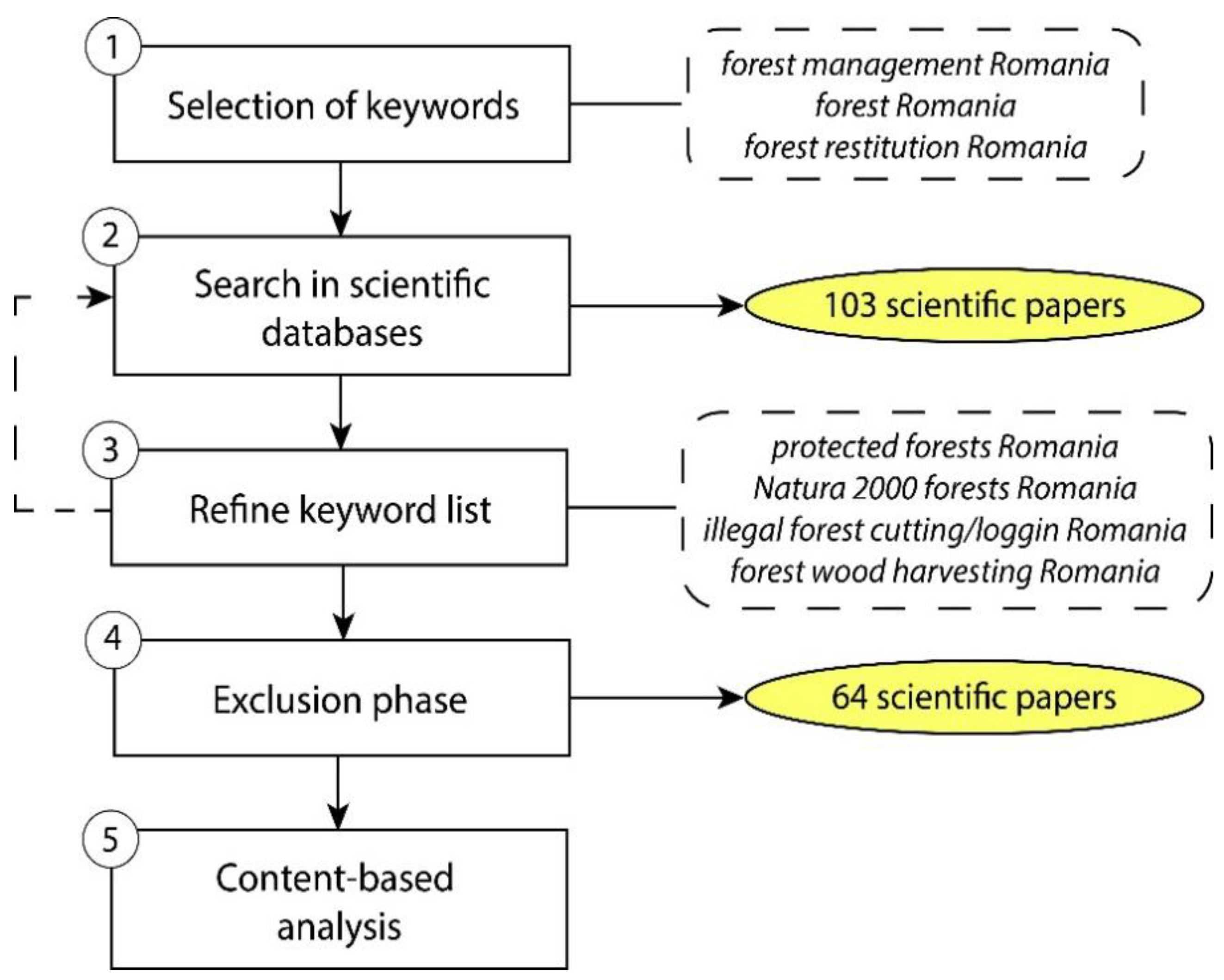
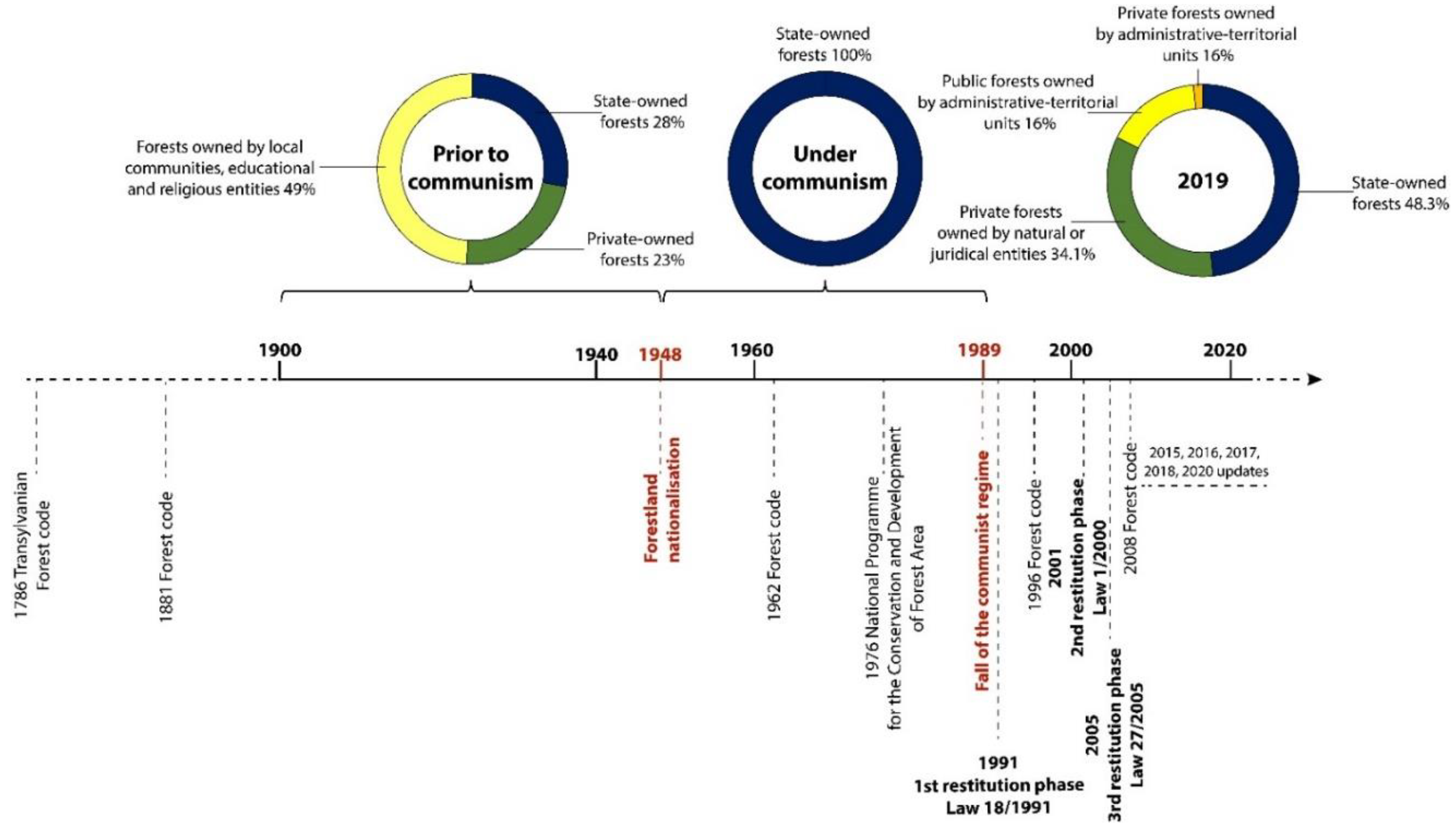
Forest ecosystems are a prime example of the heated debates that have arisen around how forests should be managed, and what services and benefits they should deliver. The European transitions in governance to and from communist regimes have had significant impacts on forests and their management. Unstable legislative and institutional changes prior to, during, and after a communist regime, combined with unique remnant areas of high-conservation-value forests, make Romania an ideal case study to explore the social–ecological transitions of forest landscapes. The aim of this paper is two-fold. First, we present the origins of, the evolution of, and the current state of forest management and ownership in Romania during transitions between the pre-communist (–1945), communist (1945–1989), and EU periods (2007–). Second, we focus on the enablers and barriers in Romania towards sustainable forest management as defined by pan-European forest policies. We used a semi-systematic, five-step scientific literature review on forest ownership, governance, and management in Romania. The analysis shows that both enablers (e.g., forest certification) and barriers (e.g., redundancy and the questionable effectiveness of the network of protected areas; illegal, unsustainable, and unreported logging; loopholes in the legislative framework) have contributed to the current approaches to interpreting forests, forestry, and forest management. The installation of the communist regime translated into sustained wood yield forest management under singular forest ownership, which opposed the previous system and forest ownership pluralism. In the post-communist period, forestland restitution led to significant legislative changes, but forest management must still confront remnant elements of the communist approach. Both communist and post-communist policies related to forests have shaped the evolution of forest landscape management in Romania, thus stressing the need to learn from the past towards securing sustainable forest management into the future. These lessons provide insights on both positive and negative drivers of forest management, which can contribute to smooth future transition towards more sustainable forest management practices.
Keywords: sustainable forest management; forest ownership; governance; post-communist forestry transformations; wood production; rural development; biodiversity sustainable forest management; forest ownership; governance; post-communist forestry transformations; wood production; rural development; biodiversity