Article

Interweaving Computational and Tacit Knowledge to Design Nature-Based Play Networks in Underserved Communities
Department of Landscape Architecture, The Pennsylvania State University, University Park, State College, PA 16802, USA
*
Author to whom correspondence should be addressed.
Land 2022, 11(3), 350; https://doi.org/10.3390/land11030350
Submission received: 29 January 2022 / Revised: 23 February 2022 / Accepted: 23 February 2022 / Published: 27 February 2022

Abstract

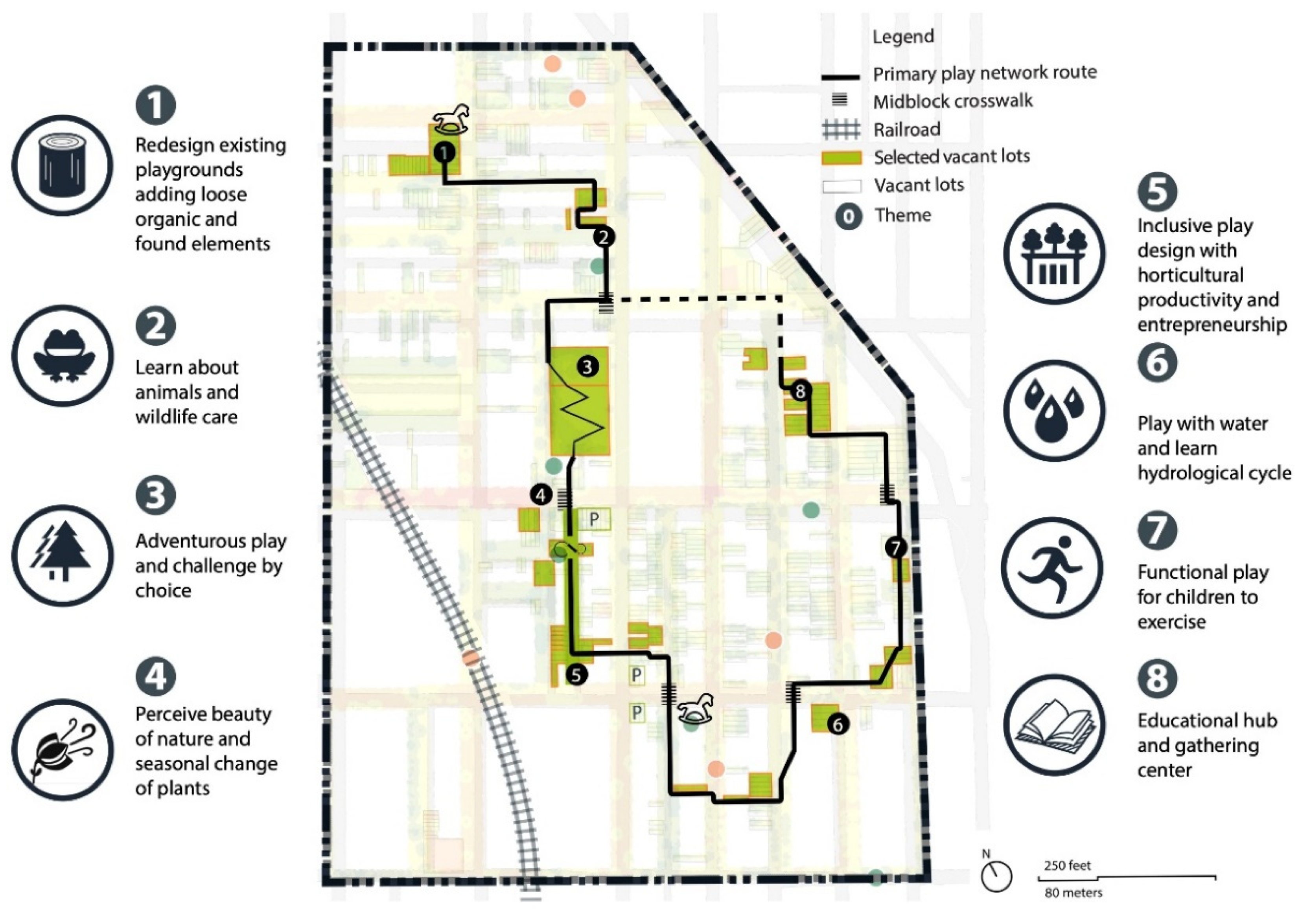
Children are often the most disadvantaged cohort during miserable situations of natural disaster, economic crisis, and environmental degradation. Meanwhile, children’s play is increasingly controlled, costly, and standardized with engineered structures and surfaces rather than infused with natural processes and organic materials. Access to nature-based playscapes in underserved neighborhoods is extremely limited, impacted by disparities of race, class, and gender. In these contexts, neglected vacant lots and streets and related interstitial spaces can be redesigned as playscapes that support active, engaged, meaningful, and socially interactive play. Our study addresses the ample opportunity to re-engage kids and city nature in underserved neighborhoods in Philadelphia and Pennsylvania. Methodologically, we balance systemic GIS spatial data approaches with informal and experiential—or tacit—site-based analyses. This mixed-methods approach helps identify local patterns of insecurity, children’s circulation, and natural resource possibilities. Finally, a play network with eight playscape themes is revealed as an emergent pattern that we termed green play infrastructure. These themes provide examples of activities and opportunities for future programs that fit their surrounding context. The mixed-methods approach fills a gap in children’s play literature and illustrates how green play infrastructure can serve as a key strategy in improving children’s lives in disadvantaged neighborhoods.
Keywords: nature-based play; GIS; suitability mapping; tacit knowledge; underserved neighborhood; green play infrastructure nature-based play; GIS; suitability mapping; tacit knowledge; underserved neighborhood; green play infrastructure