Article

Assessment of REDD+ MRV Capacity in Developing Countries and Implications under the Paris Regime

1
Division of Global Forestry, National Institute of Forest Science, Seoul 02455, Korea
2
Department of Forest Management, College of Forest and Environmental Science, Kangwon National University, Chuncheon 24341, Korea
3
Division of Climate Technology Cooperation, Green Technology Center, Seoul 04554, Korea
4
Division of Environmental Science and Ecological Engineering, College of Life Science and Biotechnology, Korea University, Seoul 20841, Korea
*
Author to whom correspondence should be addressed.
Land 2021, 10(9), 943; https://doi.org/10.3390/land10090943
Submission received: 4 August 2021 / Revised: 24 August 2021 / Accepted: 3 September 2021 / Published: 7 September 2021
(This article belongs to the Special Issue Social-Ecological and Ecosystem Responses to Climate Change)

Abstract

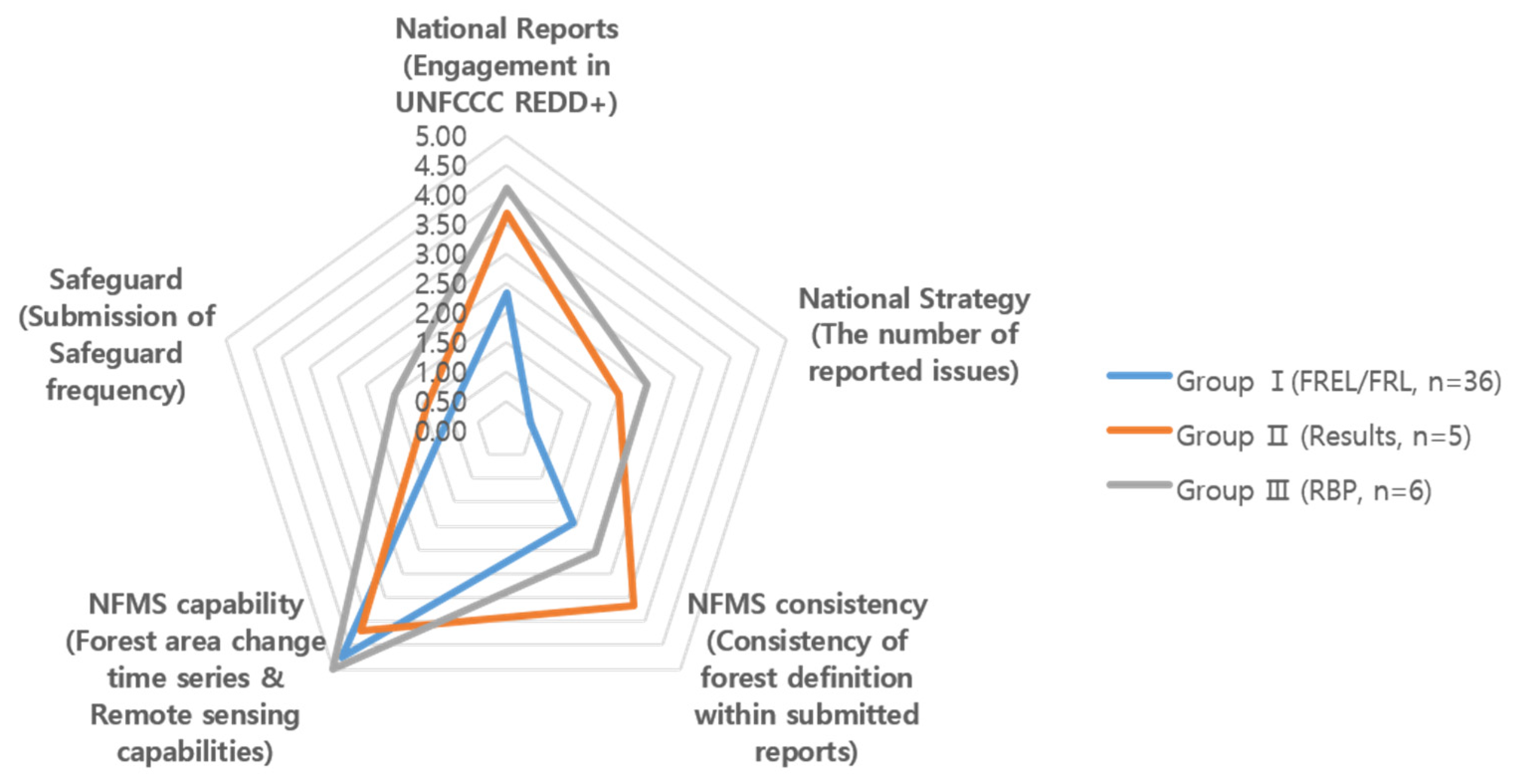
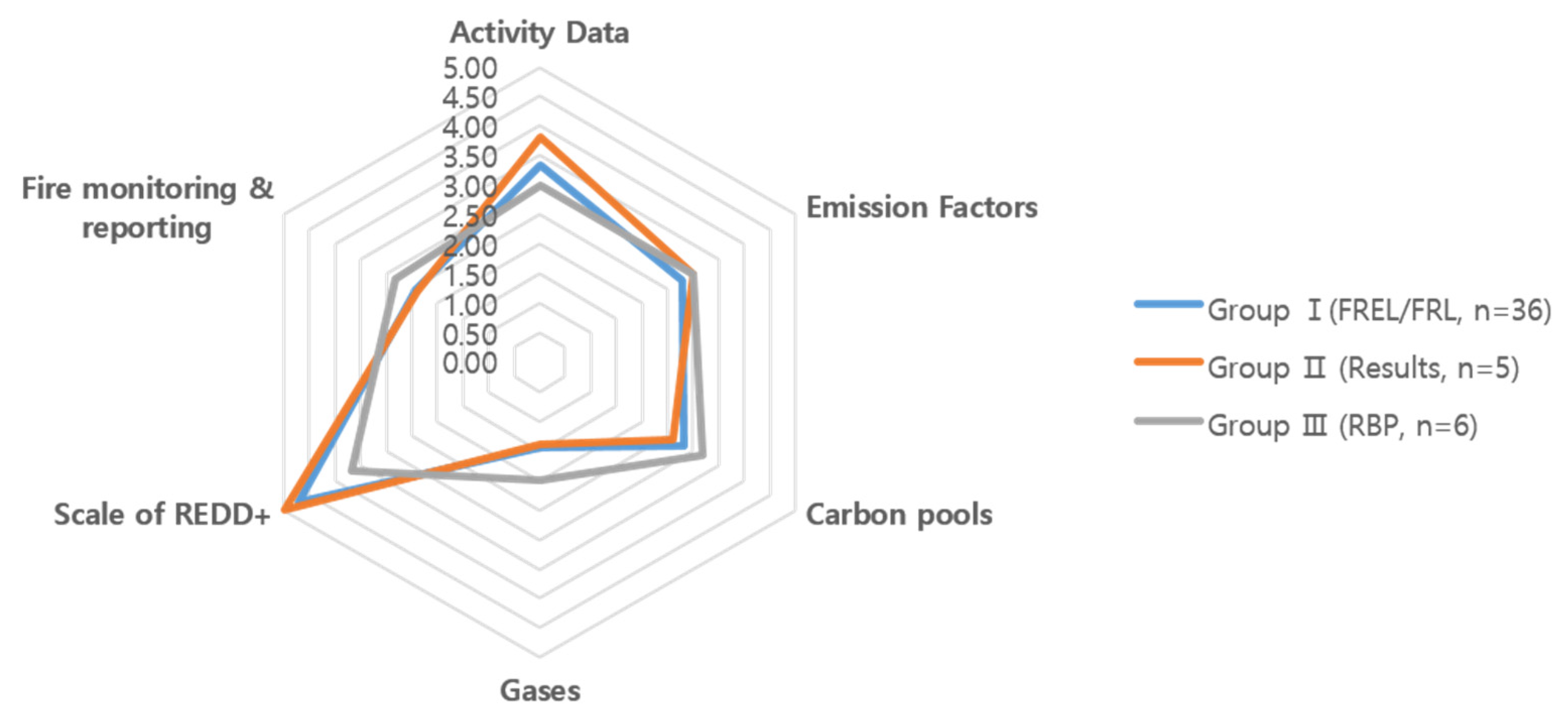
The United Nations Framework Convention on Climate Change (UNFCCC) recognized the importance of forests in combating climate change and agreed upon financial support for REDD+ activities in developing countries through the Warsaw REDD+ Framework (WRF). The REDD+ activities for conserving carbon stored in forests to reduce GHG emissions and to enhance the carbon sink function of forests are expected to serve as an important means for achieving the climatic goal. In this study, a set of criteria was devised to assess the REDD+ Measuring, Reporting, and Verifying (MRV) implementation capabilities of developing countries, which was applied to analyze the REDD+ MRV levels in REDD+ countries. Based on the Forest Reference Emission Level/Forest Reference Level (FREL/FRL), National Strategy (NS), National Forest Monitoring System (NFMS) and Safeguard Information Summary (SIS) the countries submitted, 36 REDD+ countries submitted only the FREL/FRL (Group I), while 5 countries fulfilled the WRF requirements and registered REDD+ reduction results (Group II), and 6 received Results-Based Payments (RBP) (Group III). From longest to shortest, the periods for which the International Fund provided support were arranged in the order of Group III, II, and I, verifying the relative importance of international support. From highest to lowest, the overall MRV capability was also arranged in the order of Group III, II, and I, although Group I or Group II was at a higher level than the other groups in some elements. REDD+ countries in the Readiness Phase (Group I) would aim to have the MRV capabilities of Groups II and III to receive RBP, and international support for REDD+ MRV capacity building could enable them to do. However, in addition to the receipt of RBP, REDD+ should be reflected in the Nationally Determined Contribution (NDC) as consistent reduction results at the national GHG inventory level, and the advancement of REDD+ MRV is expected to be a necessary and sufficient condition for REDD+ cooperation under the Paris Agreement cooperative approach framework. For the following groups, international cooperation is essential. Countries in the Readiness Phase need to be supported with the establishment of an MRV framework, which will enable them to achieve REDD+ to receive RBP and be reflected in NDCs. For REDD+ countries that have thus far met the WRF requirements, the REDD+ scope needs to be upscaled to national levels, and the MRV system should be further advanced to establish a cooperative approach system that can achieve more ambitious reduction targets through forests.
Keywords: Warsaw REDD+ Framework; MRV; deforestation; United Nations Framework Convention on Climate Change; nature-based solution Warsaw REDD+ Framework; MRV; deforestation; United Nations Framework Convention on Climate Change; nature-based solution