


Abstract
The main objective of the article was to demonstrate and prove the role of the sharing economy in integrating local communities as well as in improving the quality of life of urban residents. The sharing economy is an alternative model of consumption entered around an access to given goods without the need to possess it. The concept fits excellently into the ideas that are at the core of the social economy. Internet groups operating in the area of the sharing economy were analysed for the purpose of the article. Their members either live in or have other bonds with Krakow. They are usually focused around issues important for local communities. In the research, a triangulation method was used, involving a desk analysis as well as a passive observation and a covered participative observation. Such choice of methods allowed for the topic of the impact that the sharing economy has on the integration and the quality of life of urban residents to be analysed. The research confirmed that the sharing economy; as a form of social innovation; influences the improvement of the quality of life. Online groups integrate local communities and have a significant impact on the quality of life of city residents (T1; T2; T3; T4). The bilateral nature of dependency between the sharing economy and the quality of life was noticed. Firstly; the sharing economy affects the shape and quality of the product or service that is the subject of the transaction. It is also crucial to create a general “ambience of a site” in the internet group; which supports and stimulates satisfaction of the needs related to the sense of individuality; authenticity and community. On the other hand; the sharing economy affects the satisfaction of residents through economic; psychological; political and social impacts as well as individual ones; related to, e.g., the development of creativity and the acquisition of new skills
1. Introduction
A sharing economy is an alternative consumption model but also one of a form taken by social innovation. The concept fits excellently into the ideas that are at the core of the social economy and refers to the activity taken for public benefit, which assumes the dominance of social effects over the endeavours towards maximising profits. It contains core elements of social innovation, such as novelty, the effectiveness and fulfilment of social needs and the improvement of society’s ability to act [1,2,3]. Its important objective is to “actively seek and exploit opportunities to solve social problems” [4]. The great importance of the sharing economy in the sustainable development of the city, and thus, in the cost-effective management of limited resources, as well as in environmental protection, should also be emphasized. Certainly, the sharing economy plays an important role in the integration of local communities operating within the city and cooperating in the field of sharing goods and services. Furthermore, the sharing economy is an important trend, particularly in terms of developing the components of the quality of life.
Analysis of the subject’s literature showed that issues related to the impact of sharing economy on quality of life [5] are relatively rarely discussed. The authors usually focus on the impact of the sharing economy on sustainable development [6,7,8,9] or a development of smart cities [10,11] and a directly related rapid technological and technological development. Similarly, it is extremely difficult to find research on the sharing economy or quality of life using qualitative methods. After all, it is the qualitative research that gives the opportunity to deepen the subject and seems to be the most appropriate in the study of quality of life, especially in the context of perceived higher-level needs. The above observations and the identified gap provided the basis for further research.
The aim of the article is to demonstrate the impact of the sharing economy on improving the quality of life of users of urban spaces, as well as the integration of local communities. The internet groups active in specific identified areas of the sharing economy were researched. Groups were diagnosed on the basis of a passive observation and covert participative observation. In the analyses, proprietary research tools were used, developed on the basis of the methodological literature. The research confirmed that the sharing economy, as a form of social innovation, influences the improvement of the quality of life. Online groups integrate local communities and have a significant impact on the quality of life of city residents (T1, T2, T3, T4).
2. Literature Review and Theoretical Assumptions
2.1. The Concept of the Sharing Economy
The mechanism of sharing is not a new one, because exchange between people has always existed, reflecting social relations and consolidating cultural practices [12]. Sharing resources with strangers is a new aspect of the sharing economy [13]. Therefore, it goes beyond the circle of family members, friends or neighbours. At the same time, the risk of sharing is increasing, which attempts to minimise online platforms with a system of evaluation and reputation [14].
In the literature on the subject, many terms describing the sharing economy are used interchangeably, such as sharing economy, sharing, mesh, peer-to-peer economy [15], collaborative economy [16], access economy [17], collaborative consumption [18] or gig economy [19]. However, they cannot be treated as synonyms, as each of them corresponds to different methods of interaction [20]. It should be assumed that the sharing economy fits into the broader context of the platform economy and collaborative consumption. It is characterised by the following three key features: consumer relations (C2C), temporary access and physical resources.
The literature contains many inconsistencies in defining the term. It is generally assumed that sharing is mostly rental, leasing, letting, barter agreements and an exchange of goods. It is based on people’s propensity to work together, share their time and assets and, perhaps, reciprocating by offering tangible and intangible compensation.
The concept of access economy introduced by G. M. Eckhardt and F. Bardhi [21] contributed to the further clarification and more close specification of such terms as sharing economy, collaborative economy and peer economy (collaborative economy, peer economy) and the determination of their interdependencies. (Figure 1).
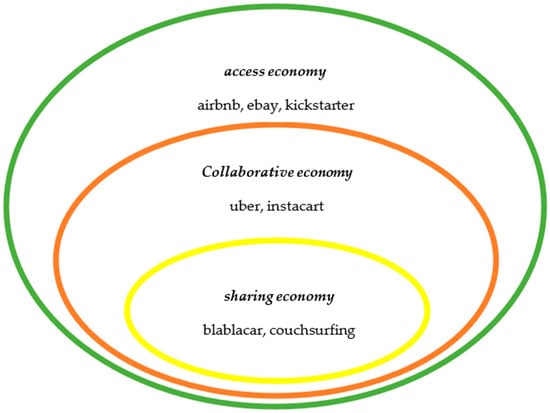
Figure 1.
Sharing economy in a broader context. Source: own study based on [23].
Access economy is the broadest term, and it is a community-based economy based on decentralised network markets, built in bottom-up processes and by-passing traditional go-betweens and agents. Collaborative economy is a slightly narrower notion within the access economy concept. It expands the concept of a sharing economy, with an important role played by business entities charging for access to their resources and not offering them only based on a joint/shared consumption principle. Here, an important role is played by the intermediaries who are often profit-oriented. The narrower of the notions discussed in the paper that is, at the same time, contained in both the above-mentioned concepts, is a sharing economy. It is based on sharing available or not fully used resources and services, for or without a charge, directly from private individuals. The community plays an important role in a sharing economy, while the role of intermediaries is reduced [22,23].
2.2. Sharing Economy—Its Genesis and Essence
The term “sharing economy” was first used in 1978 by American professors M. Felson and J.L. Spaeth in an article devoted to renting cars to other persons [24], to be later popularised by a management consultant, R. Algara, in 2007 [25]. The research conducted by R. Botsman and R. Rogers as well as their monograph published in 2010 [18], in which they attempted to prove that collaborative consumption was a long-term revolution in contemporary consumers’ behaviours, largely contributed to promoting the concept. Similarly, publications by L. Gansky [26] and research by F. Bardhi and G.M. Eckhardt [27] and J. Bainbridge [28] confirmed a change in the attitudes of some contemporary consumers consisting of giving up ownership of many goods in favour of renting them.
The dominant approach in scientific studies is that the sharing economy is an alternative consumption model that places access to a given good in the centre without the necessity to have it [27,29,30,31,32]. Temporary access is the basis for sharing that enables a more efficient use of resources. The profound social change in this area and the accompanying digital revolution meant that possessed goods ceased to be treated as a reflection of the identity of the individual, which may indicate entering an era of post-ownership [29,33,34,35]. The trust between users and the reputation built on the internet are also important [13], as well as a new social quality created between complete strangers [29,36]. The role of new technologies is also emphasized, as they significantly reduce transaction costs, make it possible to share previously unavailable resources [12,35,36,37] and create a network of connections between individual market participants [26]. Issues related to legal regulations that do not keep up with the new emerging technologies and their possibilities are also raised with an increasing frequency [13,36,38,39]. Researchers also point to the great potential of the sharing economy in terms of a more efficient use of resources and sustainable development [40].
The collaborative economy comprises three categories of participants, namely, service providers sharing their goods, resources, time or skills—these may be individuals offering peers or professional service providers (professional service providers); consumers of the abovementioned services/resources and intermediaries—linking and facilitating user-friendly providers through the online platform (cooperation platforms) [41].
The areas for sharing resources are very diverse. The key sectors and examples of platforms have been presented in the table (Table 1).

Table 1.
Some of the key sectors of the sharing economy.
2.3. The Impact of the Sharing Economy on Urban Functions
A growing concentration of people and, thus, of resources (capital: physical, human, organization, technology, knowledge, information) and the resulting problems related to mobility, create needs and favourable conditions for the development of the sharing economy [42,43].
The impact of the sharing economy on cities can be identified in the following three main spheres: social, economic and environmental (Table 2).
Table 2.
Sharing economy and the area of its impact on a city.
One of the most developed areas of the sharing economy is shared mobility, which includes both sharing vehicles (cars, scooters, bicycles, electric scooters) and rides. The importance of urbanisation for the development of the economy of sharing in the mobility sector is presented, inter alia, in studies by B. Cohen and J. Kietzmann [44]. Moreover, the available options of ad hoc journeys, especially in the city, significantly alter the way travellers/commuters use the means of transport and establish connections between them [45]. Transport decisions of urban users can consist of both shifts from private to shared transport, as well as from public transport to shared transport [46].
From the perspective of reducing CO2 emissions to the atmosphere and the associated environmental benefits, in terms of effectiveness, it its clearly more effective to integrate shared journeys with public transport (e.g., city bike, rail transport, electric city buses). Shared mobility has a positive effect on both travel conditions and the reduction in the number of private cars used in urban spaces. Research conducted in five cities located in Canada and the USA showed an improvement in the speed and comfort of travel for users, a reduction in travel costs, a reduction in the number of kilometres travelled, a reduction in greenhouse gas emissions (by 4–18% in the surveyed cities), as well as a reduction in the number of cars in the surveyed cities by 28 thousand vehicles [47].
There is no doubt that the sharing economy also significantly affects transformations in tourism and consumer behaviour in this area [48]. There is a noticeable increase in the supply of accommodation places and the development of the market for accommodation in private properties. On the other hand, some economic disadvantages of that can also be observed. An example of this is the segment of cheaper hotel services, where the dominance of the Airbnb platform resulted in a significant reduction in the revenues of other entities [49]. Additionally, the growing popularity of Airbnb has a negative impact on the functioning of local communities. The perceivable nuisance results from the high rotation of tenants, which increases the sense of danger and negative attitudes among permanent residents of city districts. The most common reason for the irritation of permanent residents is the use of competitive public resources by tourists (e.g., parking spaces), as well as the lack of care for common resources [50].
The impact of the sharing economy on the real estate market is due to the high popularity of accommodation sharing platforms. This results in both an increase in the demand for real property (its purchase and subsequent rental via an Airbnb platform), as well as an increase in the supply of accommodation offers. An increased demand leads to an increase in the sale and rental prices of apartments in popular locations.
The sharing economy also contributes to stimulating and developing entrepreneurial behaviour among city dwellers. They are most often manifested in the provision of real estate maintenance services, such as cleaning, gardening, swimming pool maintenance, etc. [51,52]. Another manifestation of entrepreneurship within the sharing economy is certainly the sharing of cars, apartments, houses, gardens and tools by their owners on specific online platforms and charging appropriate fees for it. Social benefits can be also achieved when relations are coined among strangers, potentially transforming into more permanent interactions [53,54,55]. Some manifestations of the sharing economy generate social benefits such as social assistance and integration. Members of network communities share their knowledge and skills (timebanks), as well as possessed goods (food, flowers, toys, clothes, etc.). Increasingly, the importance of ownership is diminishing in favour of the accumulation of experiences [56].
Seul is an example of a city that has fully applied the sharing economy. The city has an impressive IT infrastructure (the fastest internet in the world, available for free), many programs based on the sharing economy and large-scale car sharing projects among residents. Amsterdam is the best illustration of the sharing economy city in Europe. In 2015, this city was named the first sharing city in Europe and is based, among others, on systems such as Peerby or Snappcar. It has also a developed digital infrastructure. Another European city that deploys the sharing economy tools is Berlin. Its residents may use the world’s most developed public car network. Paris is another city that thrives on the sharing economy. The city has the most developed bike rentals and car sharing systems [57].
The sharing economy is also present in Poland. The most popular are services such as Blablacar—an online platform for sharing car trips, Vinted—a website for selling used clothing and accessories, Couchsurfing—a website based on the sharing economy for finding free accommodation around the world, or Airbnb—an online platform for short-term real property rentals. Three Polish cities (Kraków, Warsaw, Wrocław) have also implemented a city car-sharing car rental system, encompassing a network of self-service car rentals for several minutes, hours or even days. The main purpose of introducing this system is to convince residents to give up owning their own cars, which will significantly contribute to reducing air pollution and improving the quality of life of residents. The introduction of car-sharing also significantly reduces the need for parking spaces. This is of great importance due to the time spent looking for a parking space as well as the protection of public spaces and monuments [58].
The above considerations confirm the great importance of the sharing economy in the sustainable development of the city, and thus, in the cost-effective management of limited resources, as well as in environmental protection. Certainly, the sharing economy also plays an important role in the integration of local communities operating within the city and cooperating in the field of sharing goods and services. Internet platforms are a key tool used by the participants of the sharing economy. In particular, it is because of the use of social platforms and virtual groups that are formed or created by users. Their members (also those who are users of urban space) exchange knowledge and are active in a number of areas related to the sharing of goods and services. These efforts strengthen mutual ties and integrate local communities [59]. Further to the above, the two following theses may be put forward:
Thesis 1 (T1).
Internet groups operating within the sharing economy play an important role in creating social bonds and integrating local communities in the city.
Thesis 2 (T2).
Internet groups operating within the sharing economy play an important role in the recirculation of goods, and thus, significantly contribute to the protection of the natural environment in the city.
2.4. The Impact of the Sharing Economy on Improving the Quality of Life of Local Communities
The perception of quality by people varies and depends on many social and economic factors that determine the nature (character) of a location (city/town). Above all, however, it depends on the desired level of meeting the needs of a higher and lower order, resulting directly from individual expectations, objectives and opportunities available. Ultimately, it is they who play a decisive role in determining the factors affecting quality of life. An individual chooses a set of needs necessary for them in a given place and time; therefore, the level of satisfaction of needs will be individual for everyone [60,61,62]. The quality of life is “a set of spatial-environmental, production and cultural factors that make up the reality in which a person lives” [63] (p. 79). The very determination of one’s own situation and position is made in the face of commonly shared and communicated norms and values that result from a deeper cultural, social and economic context (Figure 2).
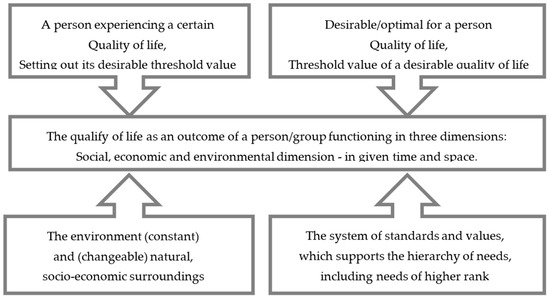
Figure 2.
Quality of life across the urban policy objectives and measures. Source: own study.
Subjective quality of life is a set (vector) of assessments of objective qualitative facts (assessments of the degree of satisfaction with various objective forms of satisfying human needs) characterizing various aspects of human life and derived from a psychological scale. Subjective quality of life is, therefore, a multidimensional assessment of an individual’s present life in the cultural context that concerns them and the values that they profess. It is primarily an expression of well-being in its physical, mental and spiritual aspects [64]. Thus, this quality of life is the value (assessment) of the preference function defined on objective qualitative states, that is as follows:
where
Js = f (Jo) = f ([X1,X2, …])
Js—subjective quality of life;
Jo—objective quality of life and;
X1,X2, …—objective qualitative conditions.
The sharing economy is an important trend, in particular in terms of developing the components of the quality of life; however, the role it plays in shaping sustainable consumption is still unknown and can only potentially be described as significant [65]. One can also reflect on the sense of individual changes [66], i.e., the so-called importance of individual responsibility, because in the light of sustainable consumption, the most desirable are social changes involving a wide participation of society. The sharing economy may make such changes possible as, in a special way, thanks to modern media, it engages the society in new forms of cooperation. Based on the above, the following theses were formulated:
Thesis 3 (T3).
The behaviour of members of internet groups in the area of sharing economy, as those resulting from the willingness to satisfy higher-order needs, significantly influences the improvement of the quality of life of local communities.
Thesis 4 (T4).
The sharing economy has a significant impact on improving the quality of life of urban residents.
3. Materials and Methods
Between February and April 2021, direct research was carried out, consisting in observing 76 internet groups created on Facebook and Instagram, operating in the area of sharing economy and associating people of all ages, living in Krakow or in some way related to this city. The research used the triangulation method that included the analysis of the literature on the subject of the functioning of virtual communities in the area of sharing economy, the impact of the sharing economy on the integration of local communities and the quality of life of the population in the city, as well as passive observation and participant hidden observation. Such choice of methods and, in particular, use of the qualitative methods, allowing for researching subjective phenomena that are difficult to measure in quantitative terms, allowed for the topic of the impact that the sharing economy has on the integration and the quality of life of urban residents to be analysed.
Note that online platforms such as Facebook or Instagram, also referred to as social networking sites, are used for the ordinary exchange of information. As part of the services provided by the administrators of this type of platforms, there are no specific features that would indicate a relationship with the sharing economy. However, they can be used by users to collaborate and to realize the values considered constitutive of the sharing economy. In addition, it is observed with increasing frequency that platform administrators from the sharing area create profiles on social networking sites. They are then complementary to the main activity, delivering the information and using the communication function with the users of a given platform. Virtual groups are also set up by people using the platform offer, providing a space for the exchange of knowledge and experience related to the use of the platform.
Relatively often, groups created in the virtual world (also those from the area of the sharing economy) connect people living in a specific real space and focus on the problems of these local communities. Groups can bring together residents of an entire city (Kraków się dzieli/Is Sharing), as well as residents of districts (Aktywne Łagiewniki), housing estates (Os. Na Stoku) and even specific blocks of flats (Osiedle Botanika) or people living somewhere else, in another location, but somehow related to a certain space or area. Typically, the information is included in the group’s name. Such groups tend to be private, with members accepted by an administrator. This diversity of intentions to create virtual groups leading to the introduction of sharing economy activities in real life as well as their relationship with real space and a measurable impact on its functioning, contributed to the decision to start the empirical research. The main goal of the research was to investigate whether virtual groups, operating in the area of the sharing economy, integrate local communities and significantly affect the quality of life of city residents, and thus, confirm the four theses put forward at the beginning (T1, T2, T3, T4).
The starting point for conducting qualitative observations was to analyse the various stages of preparation and conduct of the observations. The research procedure included the following stages: development of the observation concept, selection of the place of observation, design of a research tool, training of supporting researchers, obtaining consent to conduct observations in the studied space, carrying out preliminary observations, conducting the actual research and analysing the research results (Table 3).
Table 3.
Stages of the empirical research based on observation applied as a research method.
The key point at the stage of developing the concept of planned empirical research was to specify the main research areas in the sharing economy space, which were to be covered by further research. In the course of an in-depth analysis of the literature on the subject, such areas as transport, real estate, gastronomy, finance, exchange of goods and knowledge and time/skills banks were specified. The empirical research began with searching for virtual groups functioning within such social networks as Facebook and Instagram, which are thematically located in the specified research areas and associated with both the inhabitants of Krakow as well as people emotionally or in business related to this city. The aforementioned groups were searched primarily through the use of keywords adequate for individual research areas and locations in real space (Krakow, city districts, individual housing estates, etc.), as well as using the snowball method (subsequent groups recommended by members of the already observed groups virtual). At this stage, a total of 277 virtually active groups were found. A detailed analysis of the information on the selected groups (year of establishment, number of members, real space with which group members identify), an assessment of the activity level of the members, as well as the subject of posted posts allowed for the selection of 76 groups with the highest intensity of activity (a minimum of 3 posts a day, what made it possible to obtain valuable data) within the chosen topic, whose members identified with Krakow or a specific space within the city limits of Krakow. Selected groups were subjected to passive observation, and in the next stage, to active observation, which involved stimulating discussion and commenting on the statements of other group members.
4. Results
4.1. Sharing Economy and Integration of Local Communities and Environmental Protection
The analysis of social groups operating in cyberspace while connecting members of a given local community, from the perspective of five elements/criteria of observation (organization of time and space, objects, social actors, interactions, events) allowed for their in-depth characterisation (Table 4).
Table 4.
Characteristics of virtual groups operating within the sharing economy, and at the same time connecting members of a specific local community.
The use of both passive observation and active observation in the research consisting in stimulating the activity of group members made it possible to identify the topics discussed in discussions (also regarding a specific real space, its functioning, assessment of the current situation, including satisfaction or dissatisfaction, planned projects), the nature of the activities undertaken, the subject (things, information, services) of the exchange, the nature of the exchange (for profit, non-profit). The collected research material allowed for the classification of groups from the perspective of sectors/areas within which they operate (Table 5).
Table 5.
Virtual sharing economy groups acting in support for integration of the local communities.
The analysis of the empirical material confirmed that the sharing economy-based internet groups play an important role in creating social bonds and integrating local communities in the city. People living in a specific place, by subscribing to a selected group (whose name contains a reference to this space), at the outset, in some way, declare their interest in a given space. Further activity within the group usually contributes to making new acquaintances and deepening the existing ones. Solidarity is awakened, a sense of responsibility, community and willingness to act for the good of the community—”so that everyone can live better”.
The research also confirmed the truth of thesis two (T2), according to which internet groups operating within the sharing economy play an important role in the recirculation of goods, and thus, significantly contribute to environmental protection—reducing air pollution as well as protecting public space (Table 5).
4.2. Sharing Economy and the Quality of Life of Urban Local Communities
One may be tempted to say that the sharing economy can significantly improve the quality of human life. Certainly, an important economic aspect of the sharing economy affecting the quality of life is optimised consumption of one’s assets. Owners may generate additional profit by offering one’s room, flat, house, care, etc. for use without making costly investments. “Statistically, 96% of passenger cars are idle at all times, unused by their owners. Only 2.7% of cars travel from point A to point B at any time, while 75% of this group carries the driver only. In simplified terms, it can, therefore, be assumed that the consumption of assets such as passenger cars owned by Poles is as low as 1%, which is an obvious waste” [67]. The possibility of the better use of the available resources leads to an increase in material well-being, which has a direct impact on the quality of an individual’s life.
E. Pol and S. Ville [68] emphasise the role of social innovation in the improvement of the quality of life. The authors distinguish the micro-quality of life (quality of life in relation to individual people) and the macro-quality of life (quality of life in relation to a group of people). The economic function of the sharing economy concerns both the quality of life of individuals and entire communities. People using the sharing economy and active in virtual groups have the opportunity to generate financial benefits. For example, tourism, within the sharing economy, based on the local community may be a more sustainable form of development than conventional mass tourism, because it allows this community to become independent from external influences and the hegemony of tour operators. [69].
Contrary to the economic effects, the impact of the sharing economy on the development of local communities, the improvement of the quality of life of their members, which, despite their diversity, can be quantified, and the highly satisfied needs related to the sense of individuality, authenticity and community used in the context of co-consumption, is an important element significantly contributing to the improvement in the quality of human life. Additionally, increasing a person’s ability to share serves to counteract the problem of social exclusion and increase the creativity of the individual. In co-consumption, new roles are created (e.g., in certain situations, private persons become entrepreneurs).
Similarly, a sharing economy takes into account the rules of sustainable development. In addition to economic and social rationality, its positive impact on the environment is assumed, i.e., compliance with ecological goals. Co-consumption is considered environmentally friendly as it reduces the need for new products. Local communities feel more connected with the natural environment in which they exist. The local community has more knowledge and a sense of belonging to the environment.
Emancipation in the economic sphere brings financial benefits to residents and entire local communities. Emancipation in the psychological sphere is expressed in an increase in self-esteem and a sense of pride in the local culture, knowledge, tradition, resources and natural values. It also contributes to shaping the proper perception of themselves by the inhabitants (self-image). Emancipation in the social sphere allows for the maintenance of social balance and leads to cooperation and initiatives in the field of, inter alia, improving the condition of local infrastructure and services. Signs of emancipation in the political sphere are manifested in the system of representative democracy, through which residents can express their opinions and concerns about development initiatives (Table 6). The research results confirm that the behaviour of members of internet groups in the area of a sharing economy, as those resulting from the willingness to satisfy higher-order needs, significantly influences the improvement of the quality of life of local communities.
Table 6.
Spheres of emancipation of local communities resulting from involvement in activities within the sharing economy.
5. Conclusions and Discussion
Analysis of the subject’s literature showed that issues related to the impact of a sharing economy on quality of life are relatively rarely discussed. Furthermore, it is extremely difficult to find research on the sharing economy or quality of life using qualitative methods. Therefore, internet groups active in the area of the sharing economy were researched. Their members either live in Krakow or have emotional or business links with the city. The application of qualitative methods allowed for learning more on how internet groups operate. In the analyses, proprietary research tools were used. As part of passive observation, a historical analysis of the existing posts was made, the topics most often discussed on forums, relations between group members or activities were identified. On the other hand, a covert participative observation allowed us to enter into direct relations with respondents and learn about the motives behind their activities. When using this method, the researcher hides “their true identity and pretends to play a different role” [71] (p. 33). Covert participant observation can be virtuous in many ways, providing access to otherwise unavailable data [72,73] alongside opportunities to interpret and understand these data first-hand [74,75]. It also reduces the risk of disturbing or inhibiting participants’ natural behaviour [76]. Employing covert observers enables researchers to avoid contaminating the environment and the behaviours they are attempting to observe [77,78].
The research confirmed the significant impact of the sharing economy on the improvement of the city’s functioning, both in terms of creating social bonds and integrating local communities in the city, as well as environmental protection. Shared mobility has a positive effect on both travel conditions and the reduction in the number of private cars used in an urban space. This is reflected in the reduction in CO2 emissions to the atmosphere, but also in a significant reduction in the need for parking spaces and the protection of public spaces [79]. The sharing economy also significantly influences changes in tourism and consumer behaviour in this area [58]. In addition, members of network communities share knowledge, skills (timabanks), as well as possessed goods. There are also visible social benefits manifested in establishing relationships between strangers that can turn into more lasting interactions, as well as mutual help and social integration.
The sharing economy is also of great importance in improving the quality of life of local communities in the city. Taking advantage of the opportunities offered by modern media, it engages the public in new forms of cooperation. The highly satisfied needs related to the sense of individuality, authenticity and community, used in the context of co-consumption, significantly contributes to the improvement of the quality of human life. In addition, due to the fact that co-consumption is considered environmentally friendly, local communities feel more connected to the natural environment in which they exist when reducing the demand for new products [29,80,81,82].
Similarly, a bilateral nature of dependency between the sharing economy and the quality of life was noticed. On the one hand, the sharing economy affects the shape and quality of the product or service that is the subject of the transaction. This is accompanied by a special “atmosphere of the place” in the internet group, favouring, inter alia, meeting the needs related to the sense of individuality, authenticity and community. On the other hand, the sharing economy affects the satisfaction of residents through economic, psychological, political and social impacts (establishing deep interpersonal relationships and gaining friends, and those related to the place of residence) as well as individual ones, related to, e.g., the development of creativity and gaining new skills [83,84,85,86].
In 2011, “TIME” recognised the sharing economy as one of “10 ideas that will change the world” [87]. It can be perceived as a disruptive innovation (characterised by the ability to completely replace existing solutions with new ones with greater efficiency and a higher quality of operation) and social innovation, as it aims at the harmonious coexistence of the economy, the environment and society. It challenges environmental pollution and the extensive consumption of natural resources.
Funding
This research received no external funding.
Institutional Review Board Statement
Not applicable.
Informed Consent Statement
Not applicable.
Data Availability Statement
The results of my own research are presented for the first time in this article.
Conflicts of Interest
The author declares no conflict of interest.
References
- Kesselring, A.; Leitner, M. Soziale Innovationen in Unternehmen. Study, Compiled by Order of the Uissueuhe Stiftung. Vienna. 2008. Available online: http://www.zsi.at/attach/Soziale_Innovation_in_Unternehmen_ENDBERICHT.pdf (accessed on 10 May 2021).
- Caulier-Grice, J.; Davies, A.; Patrick, R.; Norman, W. Defining Social Innovation. A Deliverable of the Project: The Theoretical, Empirical and Policy Foundations for Building Social Innovation in Europe (TEPSIE); European Commission–7th Framework Programme; European Commission: Brussels, Belgium, 2012. [Google Scholar]
- Markiewicz, E. Konsumpcja kolaboratywna jako forma społecznych innowacji na rynku turystycznym. Mark. I Rynek 2017, 11, 333–344. [Google Scholar]
- Glinka, B.; Gudkova, S. Przedsiębiorczość; Oficyna Ekonomiczna Grupa Wolters Kluwer: Warszawa, Poland, 2011. [Google Scholar]
- Lan, J.; Ma, Y.; Zhu, D.; Mangalagiu, D.; Thornton, T.F. Enabling Value Co-Creation in the Sharing Economy: The Case of Mobike. Sustainability 2017, 9, 1504. [Google Scholar] [CrossRef]
- Petrini, M.; de Freitas, C.S.; da Silveira, L.M. A Proposal for a Typology of Sharing Economy. Rev. Adm. Mackenzie 2017, 18, 39–62. [Google Scholar] [CrossRef][Green Version]
- Curtis, S.K.; Lehner, M. Defining the Sharing Economy for Sustainability. Sustainability 2019, 11, 567. [Google Scholar] [CrossRef]
- Plewnia, F.; Guenther, E. Mapping the sharing economy for sustainability research. Manag. Decis. 2018, 56, 1–15. [Google Scholar] [CrossRef]
- Curtis, S.K.; Mont, O. Sharing economy business models for sustainability. J. Clean. Prod. 2020, 266. [Google Scholar] [CrossRef]
- Akande, A.; Cabral, P.; Casteleyn, S. Understanding the sharing economy and its implication on sustainability in smart cities. J. Clean. Prod. 2020, 277. [Google Scholar] [CrossRef]
- Vinod Kumar, T.M.; Dahiya, B. Smart Economy in Smart Cities. In Smart Economy in Smart Cities. Advances in 21st Century Human Settlements; Vinod Kumar, T., Ed.; Springer: Singapore, 2017. [Google Scholar] [CrossRef]
- Belk, R. Sharing. J. Consum. Res. 2010, 36, 715–734. [Google Scholar] [CrossRef]
- Schor, J. Debating the Sharing Economy. Available online: http://www.greattransition.org/publication/debating-the-sharing-economy (accessed on 13 March 2021).
- Frenken, K.; Schor, J. Putting the Sharing Economy into Perspective. Environ. Innov. Soc. Transit. 2017, 1, 3–10. [Google Scholar] [CrossRef]
- Brescia, R.H. Regulating the sharing economy: New and old insights into an oversight regime for the peer-to-peer economy. Neb. Law Rev. 2016, 95, 87–145. [Google Scholar]
- Aluchna, M.; Rok, B. Sustainable Business Models: The Case of Collaborative Economy. In Sustainable Business Models: Principles, Promise and Practice; Moratis, L., Melissen, F., Idowu, S.O., Eds.; Springer: Berlin/Heidelberg, Germany, 2018. [Google Scholar]
- Denning, S. An economy of access is opening for business: Five strategies for success. Strategy Leadersh. 2014, 42, 14–21. [Google Scholar] [CrossRef]
- Botsman, R.; Rogers, R. What’s Mine is Yours: The Rise of Collaborative Consumption; Harper Collins: New York, NY, USA, 2010. [Google Scholar]
- Friedman, G. Workers without employers: Shadow corporations and the rise of gig economy, Review of Keynesian Economics. Rev. Keynes. Econ. 2014, 2, 171–188. [Google Scholar] [CrossRef]
- World Economic Forum. Collaboration in Cities: From Sharing to ‘Sharing Economy’. 2017. Available online: https://www.google.com/url?sa=t&rct=j&q=&esrc=s&source=web&cd=2&cad=rja&uact=8&ved=2ahUKEwi_qZrexZPeAhXEkywKH-ViZDyQQFjABegQIBxAC&url=http%3A%2F%2Fwww3.weforum.org%2Fdocs%2FWhite_Paper_Collaboration_in_Cities_report_2017.pdf&usg=AOvVaw3_jLjEMfInHMg2ivmyJlb_ (accessed on 7 May 2021).
- Eckhardt, G.M.; Bardhi, F. The Sharing Economy Isn’t About Sharing at All, Harvard Business Review. 2015. Available online: https://hbr.org/2015/01/the-sharing-economy-isnt-about-sharing-at-all (accessed on 17 May 2021).
- Botsman, R. The Sharing Economy: Dictionary of Commonly Used Terms. 2015. Available online: http://www.collaborativeconsumption.com/2015/11/12/the-sharing-economy-dictionary-of-commonly-used-terms/ (accessed on 17 May 2021).
- Szymańska, A.I. Sharing economy jako nowy trend w zachowaniach konsumentów. Mark. I Rynek 2017, 9, 417–425. [Google Scholar]
- Felson, M.; Spaeth, J.L. Community structure and collaborative consumption: A routine activity approach. Am. Behav. Sci. 1978, 21, 614–624. [Google Scholar] [CrossRef]
- Algar, R. Collaborative Consumption. Available online: http://www.oxygen-consulting.co.uk/insights/collaborative-consumption/ (accessed on 17 May 2021).
- Gansky, L. The Mesh: Why the Future of Business Is Sharing; Penguin Books: New York, NY, USA, 2010. [Google Scholar]
- Bardhi, F.; Eckhardt, G.M. Access-based Consumption: The Case of Car Sharing. J. Consum. Res. 2012, 39, 881–987. [Google Scholar] [CrossRef]
- Bainbridge, J. Understanding Collaborative Consumption. 2013. Available online: http://www.campaignlive.co.uk/article/1208887/understanding-collaborative-consumption?src_site=marketingmagazine# (accessed on 16 May 2021).
- Belk, R. You Are What You Can Access: Sharing and Collaborative Consumption Online. J. Bus. Res. 2014, 67. [Google Scholar] [CrossRef]
- Ozanne, L.; Ballantine, W. Sharing as a form of Anti-consumption? An Examination of Toy Library Users. J. Consum. Behav. 2010, 9. [Google Scholar] [CrossRef]
- Hamari, J.; Sjoklint, M.; Ukkonen, A. The Sharing Economy: Why People Participate in Collaborative Consumption. J. Assoc. Inf. Sci. Technol. 2015, 67, 2047–2059. [Google Scholar] [CrossRef]
- Lamberton, C.; Rose, R. When is Our Better Than Mine? J. Mark. 2012, 76, 109–125. [Google Scholar] [CrossRef]
- Belk, R. Possessions and the Extended Self. J. Consum. Res. 1988, 15. [Google Scholar] [CrossRef]
- Belk, R. Why Not Share Rather Than Own? Ann. Am. Acad. Political Soc. Sci. 2007, 611, 126–140. [Google Scholar] [CrossRef]
- Belk, R. Extended Self in a Digital World. J. Consum. Res. 2013, 40, 477–500. [Google Scholar] [CrossRef]
- Benkler, Y. Sharing Nicely: On Shareable Goods and the Emergence of Sharing as a Modality of Economic Production. Yale Law J. 2005, 114, 273–358. [Google Scholar] [CrossRef]
- Sundararajan, A. Peer-to-Peer Businesses and the Sharing (Collaborative) Economy: Overview, Economic Effects and Regulatory Issue. 2014. Available online: http://smallbusiness.house.gov/uploadedfiles/1-15-2014_revised_sundararajan_testimony.pdf (accessed on 13 March 2021).
- Petropoulos, G. An Economic Review of the Collaborative Economy. Available online: http://bruegel.org/2017/02/an-economic-review-of-the-collaborative-economy (accessed on 3 March 2021).
- Codagnone, C.; Martens, B. Scoping the Sharing Economy: Origins, Definitions, Impact and Regulatory Issues, Digital Economy Working Paper 2016/01 JRC100369, Institute for Prospective Technological Studies, Joint Research Centre (Seville Site), 2016. Available online: https://papers.ssrn.com/sol3/papers.cfm?abstract_id=2783662 (accessed on 3 March 2021).
- Heinrisch, H. Sharing Economy: A Potential New Pathway to Sustainability. GAIA Ecol. Perspect. Sci. Soc. 2013, 22, 228–231. [Google Scholar] [CrossRef]
- Europejska, K. Komunikat Komisji do Parlamentu, Rady Europejskiego Komitetu Ekonomiczno-Społecznego i Komitetu Regionów: Europejski program na rzecz gospodarki dzielenia się, COM (2016), 356 final, Bruksela. Available online: https://eur-lex.europa.eu/legal-content/PL/TXT/PDF/?uri=CELEX:52016DC0356&from=SK (accessed on 3 March 2021).
- Franco, S. Entrepreneurship in the city: Sustainability and green entrepreneurs. TeMA-Journal of Land Use. Mobil. Environ. 2020, 13, 479–483. [Google Scholar]
- Anttiroiko, A.V. Digital Urban Planning Platforms: The Interplay of Digital and Local Embeddedness in Urban Planning. Int. J. E-Plan. Res. (IJEPR) 2021, 10, 35–49. [Google Scholar]
- Cohen, B.; Kietzmann, J. Ride On! Mobility Business Models for the Sharing Economy. Organ. Environ. 2014, 27, 279–296. [Google Scholar] [CrossRef]
- Shaheen, S.; Chan, N. Mobility and the Sharing Economy: Potential to Facilitate the First- and Last-Mile Public Transit Connections. Built Environ. 2016, 42, 573–588. [Google Scholar] [CrossRef]
- Le Vine, S.; Lee-Gosselin, M.; Sivakumar, A.; Polak, J. A New Approach to Predict the Market and Impacts of Round-Trip and Pointto-Point Carsharing Systems: Case Study of London. Transp. Res. Part D 2014, 32, 218–229. [Google Scholar] [CrossRef]
- Martin, E.; Shaheen, S. Impacts of Car2go on Vehicle Ownership, Modal Shift, Vehicle Miles Traveled, and Greenhouse Gas Emissions; Working Paper; University of California, Berkeley: Berkeley, CA, USA; Available online: http://innovativemobility.org/wp-content/uploads/2016/07/Impact-sofcar2go_FiveCities_2016.pdf (accessed on 15 May 2021).
- Edwards, J. Here’s Exactly What Airbnb Does to Rent in Popular Cities. Business Insider. 20 October 2016. Available online: http://www.businessinsider.com/statistics-data-airbnb-rent-prices-2016-10 (accessed on 15 May 2021).
- Zervas, G.; Proserpio, D.; Byers, J. The Rise of the Sharing Economy: Estimating the Impact of Airbnb on the Hotel Industry. J. Mark. Res. 2017, 54, 687–705. [Google Scholar] [CrossRef]
- Edelman, B.G.; Geradin, D. Efficiencies and Regulatory Shortcuts: How Should We Regulate Companies Like Airbnb and Uber. Stanf. Technol. Law Rev. 2015, 19, 293. [Google Scholar] [CrossRef]
- Burtch, G.; Carnahan, S.; Greenwood, B. Can You Gig It? An Empirical Examination of the Gig-Economy and Entrepreneurial Activity. Ross Sch. Bus. Work. Pap. 2016, 1308, 5497–5520. [Google Scholar] [CrossRef]
- Sigala, M.; Dolnicar, S. Entrepreneurship Opportunities [w:] S. Dolnicar (Red.), Peer-to-Peer Accommodation Networks; Pushing the boundaries, Goodfellow Publishers: Oxford, UK, 2017. [Google Scholar]
- Schor, J. Homo Varians: Diverse Economic Behaviors in New Sharing Markets; Unpublished Paper; Boston College: Chestnut Hill, MA, USA, 2015. [Google Scholar]
- Fitzmaurice, C.; Ladegaard, I.; Attwood-Charles, W. Domesticating the Market: Moral Ex-Change and the Sharing Economy. Available online: http://www.bc.edu/content/dam/files/schools/cassites/sociology/pdf/MoralMarkets.pdf (accessed on 15 May 2021).
- Ladegaard, I. Hosting the Comfortably Exotic: Cosmopolitan Aspirations in the Sharing Economy. Sociol. Rev. 2018, 66, 381–400. [Google Scholar] [CrossRef]
- Montgomery, C. Miasto Szczęśliwe. Jak Zmienić Nasze Życie, Zmieniając Nasze Miasta; Wydawnictwo Wysoki Zamek: Kraków, Pland, 2015; p. 149. [Google Scholar]
- Dorda, K. Sharing economy—Wspólnotowa strategia rozwoju miast. Mag. Miasta 2015, 1, 28–31. [Google Scholar]
- Obarska, M. Architektura—Dowód w sprawie. Mag. Miasta 2016, 2. Available online: http://magazynmiasta.pl/2016/11/26/obarska-wojna-i-architektura/ (accessed on 15 May 2021).
- Szymańska, A.I. Modele biznesu w sharing economy w kontekście grup społecznościowych działających w cybeprzestrzeni. Pr. Kom. Geogr. Przemysłu Pol. Tow. Geogr. 2021, in press. [Google Scholar]
- Kaleta, A. Jakość Życia Młodzieży Wiejskiej; Wydawnictwo UMK: Toruń, Poland, 1988. [Google Scholar]
- Borowicz, R. Równość i Sprawiedliwość Społeczna; PWN: Warszawa, Poland, 1988. [Google Scholar]
- Winiarczyk-Raźniak, A.; Raźniak, P. Regional Differences in the Standard of Living in Poland (Based on Selected Indices). Procedia Soc. Behav. Sci. 2011, 19, 31–36. [Google Scholar] [CrossRef]
- Otok, S. Geografia Społeczna; PZLG: Warszawa, Poland, 1987. [Google Scholar]
- Costanza, R.; Farley, J.; Templet, P. Quality of life and distribution of wealth and resources. In Understanding and Solving Environmental Problems in the 21st Century; Costanza, R., Jorgensen, S.E., Eds.; Crawford School of Public Policy—ANU; Elsevier: Amsterdam, The Netherlands, 2002. [Google Scholar]
- Demailly, D.; Novel, A.-S. The sharing economy: Make it sustainable. Studies 2014, 3, 1–30. [Google Scholar]
- Csutora, M. One More Awareness Gap? The Behaviour–Impact Gap Problem. J. Consum. Policy 2012, 145–163. [Google Scholar] [CrossRef]
- PWC The Sharing Economy. PricewaterhouseCoopers Consumer Intelligence Series. Available online: http://www.pwc.co.uk/issues/megatrends/collisions/sharingeconomy.html (accessed on 17 May 2021).
- Pol, E.; Ville, S. Social Innovation: Buzz Word or Enduring Term? Econ. Work. Pap. 2008. Available online: https://ro.uow.edu.au/commwkpapers/194/ (accessed on 17 May 2021).
- Timothy, D.J. Tourism and Community Development Issues. In Tourism and Development, Aspect of Tourism 5; Scharpley, R., Telfer, D., Eds.; Channel View Publications, Clevendon, Buffalo: Toronto, Sydney, 2002. [Google Scholar]
- Niezgoda, A. Obszar Recepcji Turystycznej w Warunkach Rozwoju Zrównoważonego; Wydawnictwo Akademii Ekonomicznej w Poznaniu: Poznań, Poland, 2006. [Google Scholar]
- Vinten, G. Participant observation: A model for organizational investigation? J. Manag. Psychol. 1994, 9, 30–38. [Google Scholar] [CrossRef]
- Lauder, M.A. Covert participant observation of a deviant community: Justifying the use of deception. J. Contemp. Relig. 1995, 18, 185–196. [Google Scholar] [CrossRef]
- Leo, R.A. Trial and tribulations: Courts, ethnography, and the need for an evidentiary privilege for academic researchers. Am. Sociol. 1995, 26, 113–134. [Google Scholar] [CrossRef]
- Sullivan, M.J.; Queen, S.A.; Patrick, R.C., Jr. Participation Observation as Employed in the Study of a Military Training Program. Am. Sociol. Rev. 1958, 23, 660–667. [Google Scholar] [CrossRef]
- Bulmer, M. When is disguise justified? Alternatives to covert participant observation. Qual. Sociol. 1982, 5, 251–264. [Google Scholar] [CrossRef]
- Homan, R. The Ethics of Covert Methods. Br. J. Sociol. 1980, 31, 46–59. [Google Scholar] [CrossRef] [PubMed]
- Bernstein, E.S. The transparency paradox a role for privacy in organizational learning and operational control. Adm. Sci. Q. 2012, 57, 181–216. [Google Scholar] [CrossRef]
- Roulet, T.; Gill, M.; Stenger, S.; Gill, D. Reconsidering the Value of Covert Research: The Role of Ambiguous Consent in Participant Observation. Organ. Res. Methods 2017, 57, 181–216. [Google Scholar] [CrossRef]
- Wallenstein, J.; Shelat, U. What’s Next for the Sharing Economy? Available online: https://www.bcg.com/pl-pl/publications/2017/strategy-technology-digital-whats-next-for-sharing-economy.aspx (accessed on 12 February 2021).
- Roszak, J.; Marechal, F. The Importance of Environmental Sustainability in the Decision to Participate in the Sharing Economy; Umeå University: Umeå, Sweden, 2017. [Google Scholar]
- Leismann, K.; Schmitt, M.; Rohn, H. Collaborative Consumption: Towards a Resource-Saving Consumption Culture. Resources 2013, 2, 184–203. [Google Scholar] [CrossRef]
- Xufeng, L.; Hongmin, C. Sharing Economy: Promote Its Potential to Sustainability by Regulation. Sustainability 2020, 12, 919. [Google Scholar] [CrossRef]
- Herman, P. The Airbnb Phenomenon: What Impact Is It Having on Cities? Available online: https://thesustainablecity.wordpress.com/2014/07/05/the-airbnb-phenomenon-what-impact-is-it-having-on-cities/ (accessed on 30 May 2021).
- Charlton, B. Visualizing Uber and Lyft Trips in San Francisco: More Than 200,000 Trips a Day. Available online: https://hackernoon.com/visualizing-uber-and-lyft-usage-in-san-francisco-928208b1978a (accessed on 30 May 2021).
- Bliss, L. To Measure the ‘Uber Effect’, Cities Get Creative. Available online: https://www.citylab.com/transportation/2018/01/to-measure-the-uber-effect-cities-get-creative/550295 (accessed on 19 May 2021).
- Wachsmuth, D.; Weisler, A. Airbnb and the rent gap: Gentrification through the sharing economy. Environ. Plan. 2018, 50, 1147–1170. [Google Scholar] [CrossRef]
- Walsh, B. Today’s Smart Choice: Don’t Own Share. Available online: http://content.time.com/time/specials/packages/article/0,28804,2059521_2059717_2059710,00.html (accessed on 15 June 2021).
Publisher’s Note: MDPI stays neutral with regard to jurisdictional claims in published maps and institutional affiliations. |
© 2021 by the author. Licensee MDPI, Basel, Switzerland. This article is an open access article distributed under the terms and conditions of the Creative Commons Attribution (CC BY) license (https://creativecommons.org/licenses/by/4.0/).