


Highlights
What are the main findings?
- Groundwater quality (GWQ) is declining, resulting from increased demand and land use alterations, with contamination highest near shorelines, and some areas are affected by saline pathways.
- While pH remains stable, other parameters often exceeded acceptable limits. The arithmetic GWQ index has been improved over the years, with post-monsoon quality being better than monsoon and worst in pre-monsoon.
- Principal component analysis shows that all GWQ parameters contribute to groundwater pollution PCI loading.
- The GWQ is safe for 2022, but unfit potable water may rise by 2030 as per simula-tion models.
- To protect the fresh aquifer from seawater intrusion (SWI) and urbanization, hy-draulic barriers and ridges are essential.
- Hybrid technology combining reverse osmosis, electrodialysis, and organic pre-treatment can purify brackish water in low- to middle-income economies. In-stalling a subsurface dam is another cost-effective method to reduce SWI.
Abstract
Seventy-one percent of the Earth’s surface is covered by water, with groundwater being one of the most important natural resources globally. In Purba Medinipur, the population growth rate has surged to ~0.75% per annum, outpacing that of West Bengal, due to agricultural and industrial development. Urbanization has led to an increase in the built-up area by 139.10% per annum, which has reduced the percolation of water into the groundwater table. Currently, 72% blocks are affected by salinity. Groundwater quality parameters such as pH, total dissolved solids (TDS), turbidity, iron, manganese, total hardness, and chloride were assessed over three seasons—pre-monsoon, monsoon, and post-monsoon—using 326 data points from 2015 to 2022. Turbidity and iron are the primary concerns for groundwater quality, contributing to pollution. Other parameters, including TDS and total hardness, were approaching acceptable limits across all seasons. Since 2021, turbidity has exceeded permissible limits during the pre-monsoon season, resulting from the dissolved minerals and seawater intrusion. The arithmetic weighted groundwater quality index has shown an increasing magnitude over time, indicating a decline in drinking water quality by 2030. The pre-monsoon season exhibits the most severely affected groundwater quality. Principal component analysis indicated that TDS and chloride are the major contaminants during the pre-monsoon, confirming seawater intrusion. In other seasons, metals like iron, TDSs, and manganese are significant contaminants. The hydraulic barriers, subsurface dams, and hybrid treatment can be adopted in the study area to abate the increasing groundwater quality concentration both on a yearly and seasonal basis.
1. Introduction
The most essential environmental asset is water, consisting of 71% of the global surface [1]. Groundwater (GW) is an essential resource. Approximately one-third of the world’s population consumes potable water. GW is a unique source of utilized water in West Bengal [2]. Generally, a coastal portion of West Bengal, like Coastal Purba Medinipur (CPM), is characterized by the scarcity of fresh water and a high rate of population growth amounting to ~0.75% per annum (p.a.) [3]. Human growth is dependent on water, but water characteristics are at risk resulting from its contamination. Water is therefore the main restriction of future development in CPM. A major portion of irrigation, industrial, and domestic needs in the study site is met primarily by GW, resulting in a groundwater level (GWL) decline [4,5]. Various GW-related problems, like GW drought, may be posed by CPM [6]. Similarly, the estimation of groundwater quality (GWQ) is also an important aspect of suitable potability, irrigation, and industrial needs [7]. In the research area, extensive irrigation and urbanization result in GWL decline and GWQ pollution in the aquifer [8]. Since GWL declined on a per annum basis in this region, as per the Ghyben Herzberg Principle, the Bay of Bengal (BoB) brackish waters are intruding into the mainland aquifer, resulting in GWQ deterioration. The arithmetic weighted GWQ index (AWGWQI) is therefore stretched seasonally. Since water consists of several quality parameters, some may lie within the permissible limits of the Bureau of Indian Standards (BIS 10500:2012) [9] for potable water in India, while others may exceed the acceptable or permissible limits. So, a few environmental parameters may be advantageous to human beings, whereas others may have adverse effects. The GWQ parameters like pH, turbidity, total dissolved solids (TDS), chloride (Cl), total iron (Fe), and manganese (Mn) are essential for the comprehension of living organisms and their timely allocation [10,11]. GWQ classification based on the permissible and acceptable limit of drinking water standard specification alone is unjustified. It is necessary to find the resultant GW impact on drinking water in terms of the arithmetic weighted groundwater quality index (AWGWQI). The AWGWQI is a simple and practical way to understand whether groundwater is safe for drinking and everyday use. It works by considering different water quality factors, such as pH, salinity, and metal content, giving more importance to those that affect human health the most, and then combining them into a single value. This makes it easier for people, planners, and authorities to quickly judge the overall quality of water and take necessary actions to protect public health. Since the classification of the GW sample based on the AWGWQI is procured from standard literature sources, aiding to identify the GW sample category. GWQ enables suggesting the appropriateness of GW for multipurpose use. Therefore, it is very much necessary to ascertain GWQ in GW prior to its intended use. It is very much needed, especially to determine GWQ, which ultimately constitutes AWGWQI, thus determining the GWQ status. The excellent to good GWQ means it needs no treatment attention before use. But pretreatment is necessary for the intended use of GW if it is of poor quality, or much worse. It is not only necessary to determine the GWQ status yearly but also seasonally. Moreover, the GWQ parameters responsible for pollution must be evaluated and checked before discharging into the river, ocean. So, based on the feasibility, several remedial measures are proposed, which are enabled to constitute the study site in conformity with Sustainable Development Goal 6 (SDG 6).
The surface waters (SW) are much more prone to chemical contamination due to 8–16% of industrial sewage discharge, 84–92% household refuse, pesticide discharge, etc., affecting food security in the community. The contamination of this SW, along with dried SW in the non-monsoon season, has profoundly shifted water use by Indians to GW. Apart from the conventional SW contamination from origin into surface and GW, a new source of pollution that is highly concerning in India and globally is seawater intrusion (SWI); it is the direct outcome of an expansive national population of ~464 per capita per km2, and often above 1000 per capita per km2 in the Indian coastal region, many times exceeding the mean global population density [3].
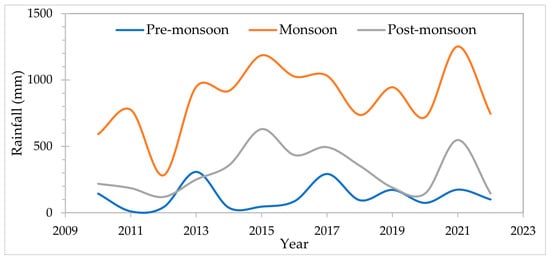
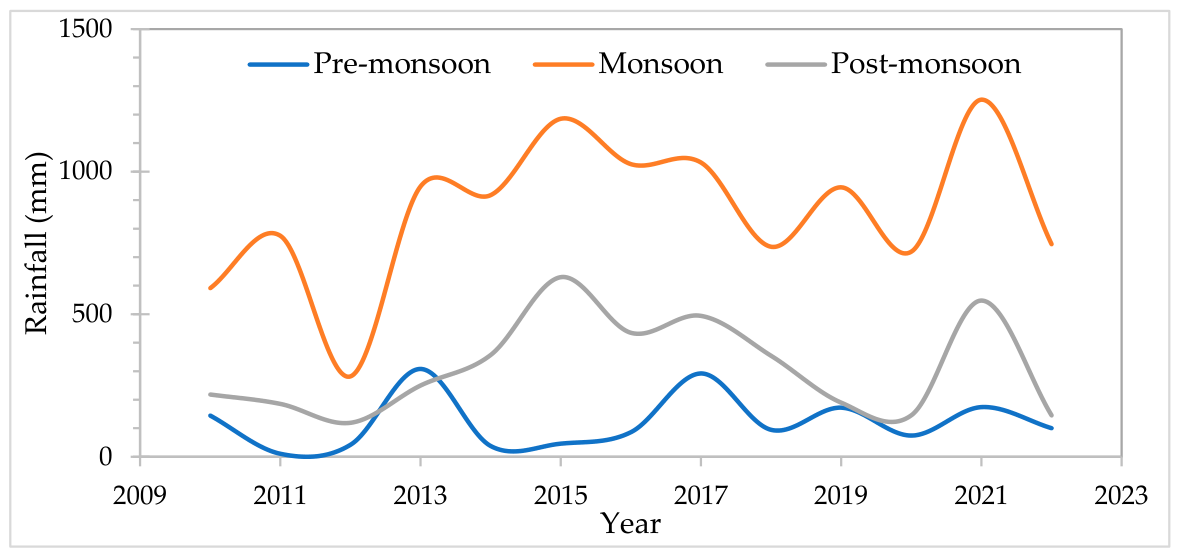
The lowest slope in CPM is observed in Khajuria II in the vicinity of the Bay of Bengal (BoB) and at Tamluk near the Rupnarayan River (<0.5). Similarly, the maximum slope is observed in Haldia and western CPM (>5). There is substantial rainfall in CPM owing to its tropical climate [12]. The details of rainfall from 2010 to 2022 are represented in Figure 1.
Figure 1.
Details of rainfall values during pre-monsoon, monsoon, and post-monsoon in CPM from 2010 to 2022.
High rainfall is responsible for high GW storage. The GWL is higher in the monsoon season, followed by the post-monsoon and then the pre-monsoon seasons. The rainfall in pre-monsoon is smaller than that in monsoon and almost equal to post-monsoon. Therefore, the intensity of GWQ parameters is diluted much more in the monsoon season compared to the post-monsoon and worst in the pre-monsoon season [13,14].
2. Research Area
The length of CPM is 65.5 km, representing approximately 1.20% of the Indian coastal reach. The Northing and Easting of Purba Medinipur are 21°38′–22°31′ N and 87°27′–88°12′ E, respectively. The extent of annual rainfall is 1167 mm in 2015 to 1665 mm in 2022, with a peak value of 2275 mm in 2021, resulting in dilution of GWQ parameters, creating lesser concentrations in monsoon seasons than the pre-monsoon season. Although after 2021, a falling trend in rainfall has occurred, generally, a substantial quantity of rainfall has taken place over the years in the research area. The average temperature in the CPM blocks varies from 19.3 °C in January to 32.2 °C in May [15]. It is also observed that rainfall is showing a linear trend, and the magnitude is sufficient to meet the needs of the inhabitants of CPM.
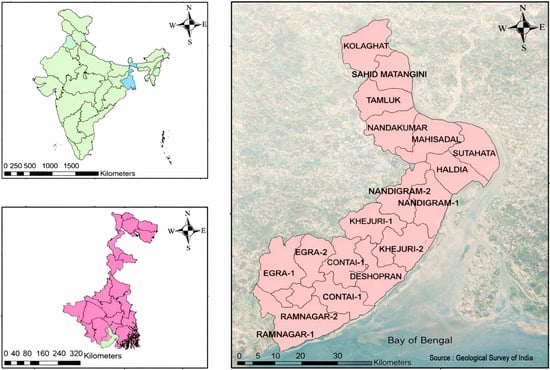
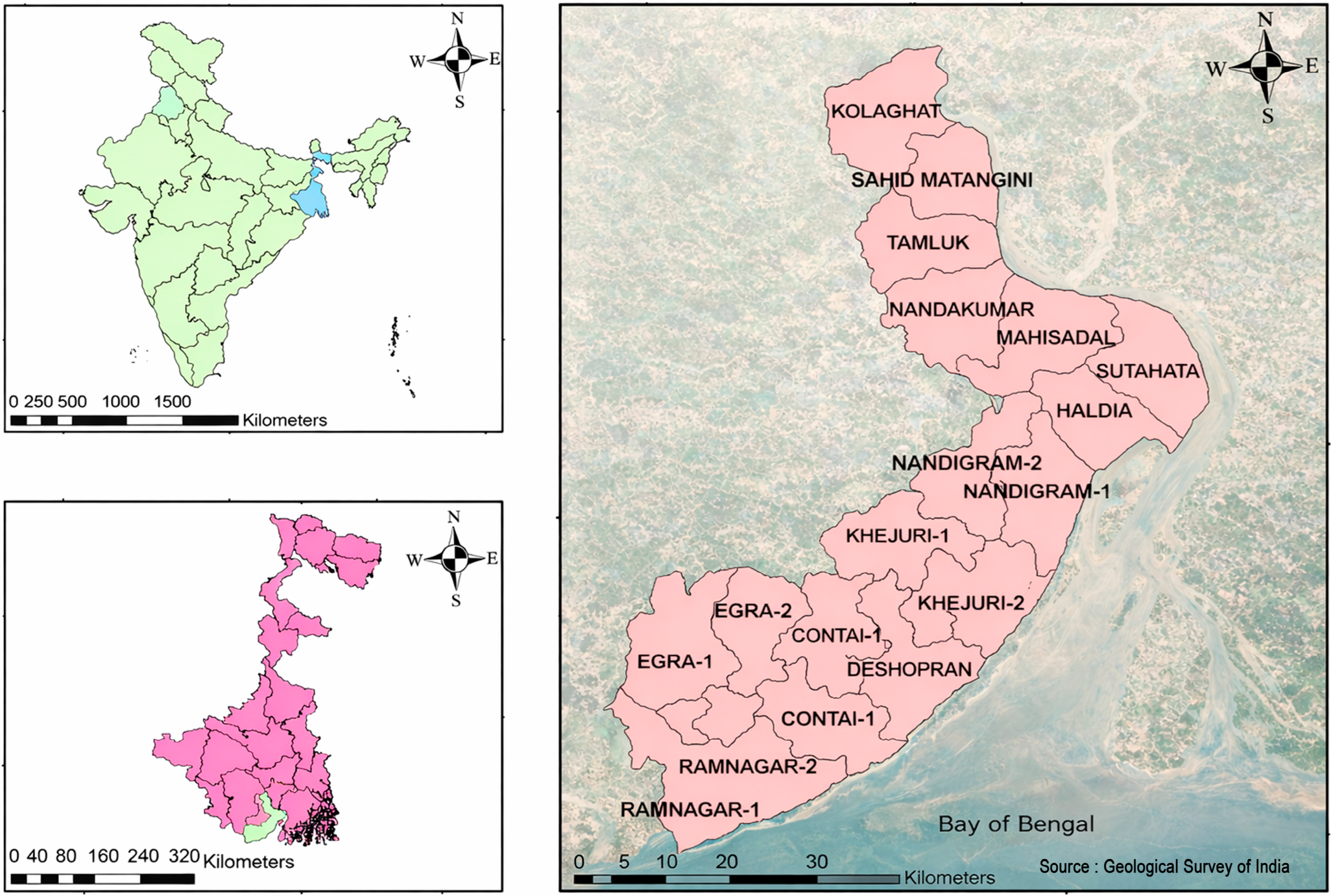
The excessive GW lifting in the coastal zone pushes the seawater towards the mainland aquifer, contaminating the GWQ. Since the GWL is declining in the aquifer compared to sea level rise (SLR) in the adjacent oceans and BoB, leading to an inverted hydraulic gradient, causing seawater to flow into the mainland, affecting the coastal aquifer. This phenomenon is the major origin of SW and GW contamination. Figure 2 represents approximately 3393 km2, which is approximately 72% of the total district area [3].
Figure 2.
Research area selected for this study.
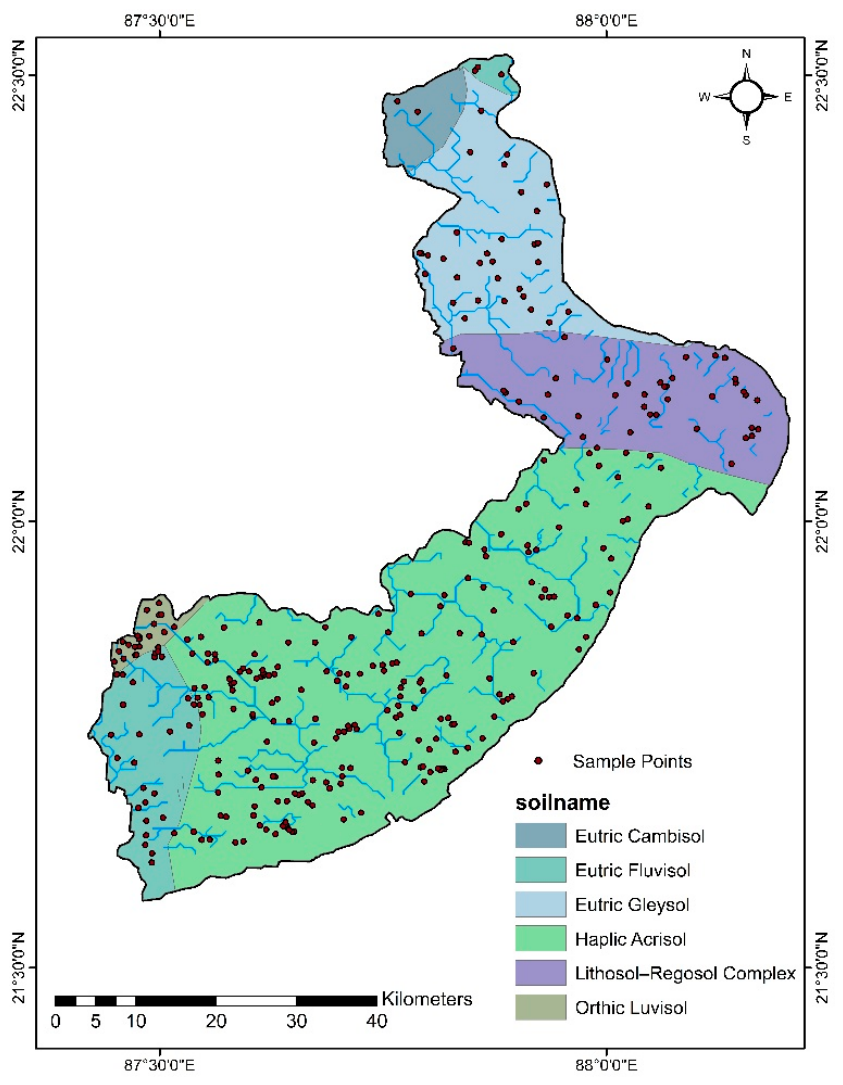
Odisha is located to the southwest of CPM, and the BoB is positioned to the south, with the zone at the extreme south of the Medinipur division. Paschim Medinipur is positioned to the northwest of CPM. Howrah is located in the northeast direction, with Hooghly River and South 24 Parganas located to the east. In Purba Medinipur, a total of 4 divisions are located, which are Tamluk, Haldia, Egra, and Contai. A total of 25 blocks and five municipalities are located here. But from the literature, it is evident that SWI-affected blocks are Contai (I, II, III), Egra (I, II), Mahisadal (I, II), Tamluk (I, II), Khejuri (I, II), Ramnagar (I, II), Nandigram (I, II, III), and Sutahata (I, II), and they occupy an area of almost 3393 km2, which is approximately 72% of the entire area [16]. Eutric Cambisols are present in Ramnagar-I, Egra-I, and Panskura, characterized by base-rich soil with moderate to high fertility which is supportive to irrigation and well-drained. Eutric Fluvisols can be observed in Kolaghat, which has a current development trait of floods caused by the Rupnarayan River. The soil colour here is greyish brown to yellowish brown, depending on the minerals present.
Eutric Gleysol is observed in Nanda Kumar, Tamluk, and Sahid Matangini, characterized by greyish blue and greenish grey colour resulting from anaerobic iron reduction. Well-drained clay persists in Eutric Gleysol, which is sticky with higher plasticity and is poorly drained, the texture of which comprises clayey loam.
Haplic Acrisol is seen widely across CPM, ranging from Southern Ramnagar-II to Northern Nandigram-II, from Eastern Haldia to Western Chandipur. It is characterized by reddish-brown to yellowish-brown texture; heavy cohesive clay is present in it. The drainage condition is good in this region. This soil type comprises clayey loam, and it is supportive of agriculture.
The Lithosol–Regosol complex is found in Sutahata, Mahishadal, Nandakumar, and Moyna blocks, which have a trait of sandy loam, poorly conglomerated, grey, yellow, and reddish in colour. It is well-drained and supportive of agriculture. Orthic Luvisols are found in Patashpur-II, which is characterized by brown- and grey-coloured soil with profuse organic matter present. Clayey loam persists in it. These locations are moderately to well-drained.
Semi-confined aquifers are classified as quaternary aquifers of Group I. Unconfined aquifers are classified as Aquifer II. Confined aquifers are classified as tertiary aquifers. The entire location area comprises a single aquifer group separated by numerous aquifer systems. In this region, beds of thick clay or sandy clay loam are observed. Localized aquifers are noticed in quaternary sediments. Aquifer I is located in the upper lithology, and Aquifer II is present in the lower lithology. Aquifer II is a major aquifer in the location, as per the Report on the Dynamic Groundwater Resources of West Bengal by the Central Groundwater Board [17]. GW is located in CPM at a moderate to high depth below the ground level. The saline water is percolated from the BoB over a considerable stretch to enter the aquifer of the alluvial plain in which the research area is located. These soil types are the main source of groundwater in aquifers. A large path length is traversed by the saline water from the BoB into the CPM aquifer. The CPM GW is of the excessive chloride type, indicating low quality and brackish in nature [18].
Infiltration due to surface runoff from these rivers, canals, and seepage from the BoB is quite heavy, rendering a high-water table over time. But shallow aquifers in the study area are saline in nature, and fresh water is available at a large depth of 16.85 m at Tabakhali tubewell (TW)-3 to 21.65 m at the Kanktia water-supply (w/s) scheme in pre-monsoon [19]. Similarly, the post-monsoon groundwater table (GWT) ranges from 16.2 m at the Habichack w/s scheme to 18.7 m in 2022 [20].
3. Research Objectives
- (i)
- It is essential to understand the reasons behind the annual GWT shifts in CPM.
- (ii)
- Investigating GWQ contamination in the research area over the years and seasonally using statistical methods is also important.
- (iii)
- We aim to assess the status of groundwater at a total of 326 locations within the research area between 2015 and 2016 and 2022 to determine whether the groundwater in these locations is safe for drinking, irrigation, or industrial use.
- (iv)
- It is necessary to classify the current groundwater quality and predict the status for the year 2030.
- (v)
- We seek to find innovative methods to mitigate saline water intrusion (SWI) in this coastal area.
4. Novelty of This Research
There is extensive research on the degradation of groundwater quality parameters over time, but the specific dependency of groundwater quality on seasonal variations, pre-monsoon, monsoon, and post-monsoon, from 2015 to 2022, has not yet been explored. This paper presents a novel approach to this research concept. Furthermore, the concentration of groundwater quality parameters is influenced not only by anthropogenic activities but also by hydrological factors such as rainfall, temperature, pressure, and relative humidity, which we have discussed in this research. In the Remedial Measures section, we have suggested various techniques, such as Inj GCW, hybrid technology, check dams, and subsurface dams, tailored to the economic conditions of the state, which have not been previously addressed for CPM. Additionally, simulating groundwater quality using a linear regression model has not been conducted before, making this a significant contribution to the literature.
5. Methodology
The GIS technique is used to determine the land use land cover (LULC) pattern in the research area, as it is one of the reasons for GWL decline. Since population growth is a major factor in GWL decline, data have been procured from the Census India website. Rainfall data and GWT data have been acquired from the India Meteorological Department (IMD), Pune, and Hydrometeorology and Remote Sensing (CHRS), respectively. GWQ indices are used to analyze and detect these natural resource trends. The cumulative effects of various factors may lead to the pollution of GWQ parameters. Seasonal GWQ attributes were gathered from the website https://maps.wbphed.gov.in/web_gis/ (accessed on 14 April 2026) for the years 2015 to 2022, focusing on pre-monsoon, monsoon, and post-monsoon seasons. A total of 326 samples were collected.
The local Public Health Engineering Department (PHED) collected groundwater samples from representative potable water sources, including tube wells (TWs) associated with hand pumps, deep TWs, and open borewells. Each pump was operated for 1–2 min to flush out static water, allowing fresh groundwater to enter the aquifer. Samples were collected in airtight 1 L containers made of polypropylene, which were rinsed in fresh groundwater to prevent any chemical contamination.
For this monitoring scenario, chemical analyses were conducted twice a year, typically during the pre-monsoon and post-monsoon seasons, to detect variations. Samples were also collected during the monsoon season to evaluate any significant small-scale variations. To protect the samples from sunlight, they were stored in black bags, and the temperature was maintained at 4 °C during transit. The specimens were delivered to the chemical laboratory within six hours of collection.
Various technologies were employed for testing, including a pH meter, gravimetric techniques, EDTA titration method, argentometric titration, and atomic absorption spectrophotometry, to measure parameters such as pH, TDS, total hardness (TH), Cl, and Fe. The testing was performed at the District PHED water testing laboratory.
Additional physicochemical tests could be conducted to further assess the GWQ status. With proper arrangements, more geogenic analyses at the study site could be performed. It is important to evaluate the contributions of sewage and small to medium enterprises to groundwater contamination. Periodic checks of groundwater samples must be conducted to comply with BIS 10500:2012 standards. Finally, the determination of electrical conductivity should be conducted to confirm seawater intrusion, which would help identify salinity trends in the aquifer.
Seasonal pH, TDS, turbidity, Fe, Mn, TH, and Cl data are obtained in the eight-year tenure, i.e., from 2015 to 2022, for all seasons except the winter season, which is a lean rainfall season. The all-attributes trend is detected by statistical measurements like AWGWQI and regression analysis. This method will aid in concluding the status of potable water during the study tenure. The GWQ parameters are responsible for GW pollution in distinct seasons as well as years, which are important to assess by principal component analysis (PCA) so that corresponding preventive measures can be adopted. In PCA, the first step is to standardize the data, like in Equation (1).
where μ is the mean of isolated parameters (=μ1, μ2,… μn).
The covariance matrix was also evaluated by Equation (2). Here, x1m and x2m are the mean magnitudes of parameters x1 and x2, respectively, and n = number of sample points. The covariance magnitude can be positive, negative, or zero.
The first principal component (PCI) has the maximum fluctuation; the second principal component values contribute comparatively less to GW pollution, and can be determined from the eigenvalue, which is calculated as shown in Equation (3).
If X is acted on by A, it is expanded or shrunk by the eigen scalar λ. Constant X makes eigen vectors stable, facilitating the rank of the GWQ parameters.
The entire dataset is presented in a 3D format that includes radius and variance. Principal component I (PCI) accounts for the highest variance, exceeding 75%, while PCII represents the second-largest variance, up to 70%. Finally, PCIII has the smallest variance, approximately 20%. These three components are mutually perpendicular to one another. The contribution of GW pollutants can be evaluated using this statistical method.
Moreover, the 8-year AWGWQI is simulated for the year 2030 using a regression model. Although other models exist, GWQ varies linearly [21]. So it is appropriate to determine AWGWQI linearly. Since the research has been conducted from 2015 to 2022, the graphical comparison of GWQ attributes in the two extreme years, i.e., 2015 and 2022, is also helpful to identify the blocks of the study site progressively contaminated by SWI. The dependency of every parameter on other parameters is required to be assessed by the correlation matrix, based on which the relationship between GWQ parameters and salinity can be evaluated.
6. Results and Discussion
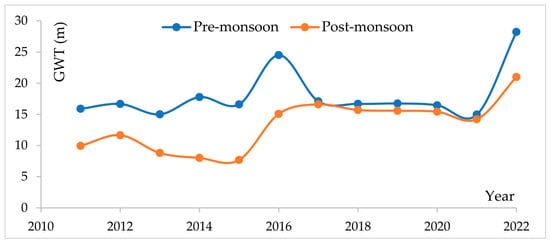
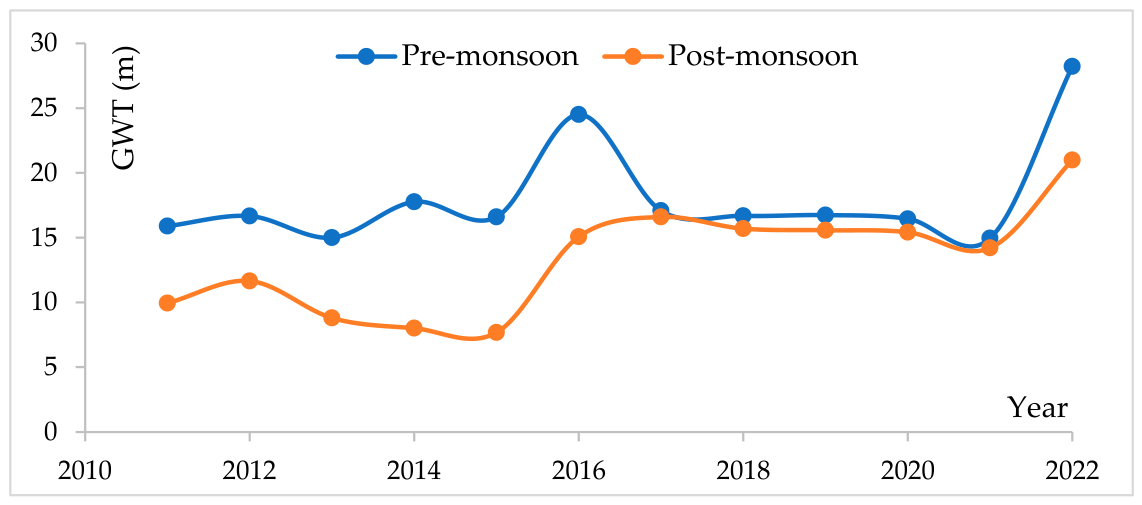
We primarily used traditional approaches. While much of the existing literature focuses on the mean concentration of GW pollution, this study also evaluates the median to determine the frequency of occurrence of GWQ parameters. Additionally, standard deviations are included to highlight the dispersion of GWQ pollution across the study area. Detailed statistical measures provide insights into the seasonal and yearly variations in the AWGWI and the spatial distribution of GWQ parameters at two key points in time: 2015 and 2022. Moreover, we incorporated five spatial distribution lithological traits to determine the type of aquifer, the presence of saline water, freshwater, and the existence of aquitards, which will assist in groundwater management for the conservation and judicious use of groundwater in line with SDG 6.0. Total 90 lithology charts were collected from the study site. The heavy rainfall in the research area and significant seepage from the BoB and nearby rivers contribute to a high GWT (Figure 3). Understanding the trend in GWT over time is essential.
Figure 3.
Scenarios of GWT during pre-monsoon and post-monsoon over time (Source: CHRS).
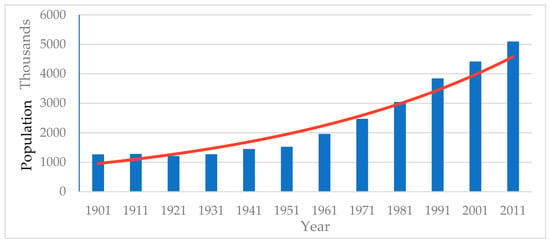
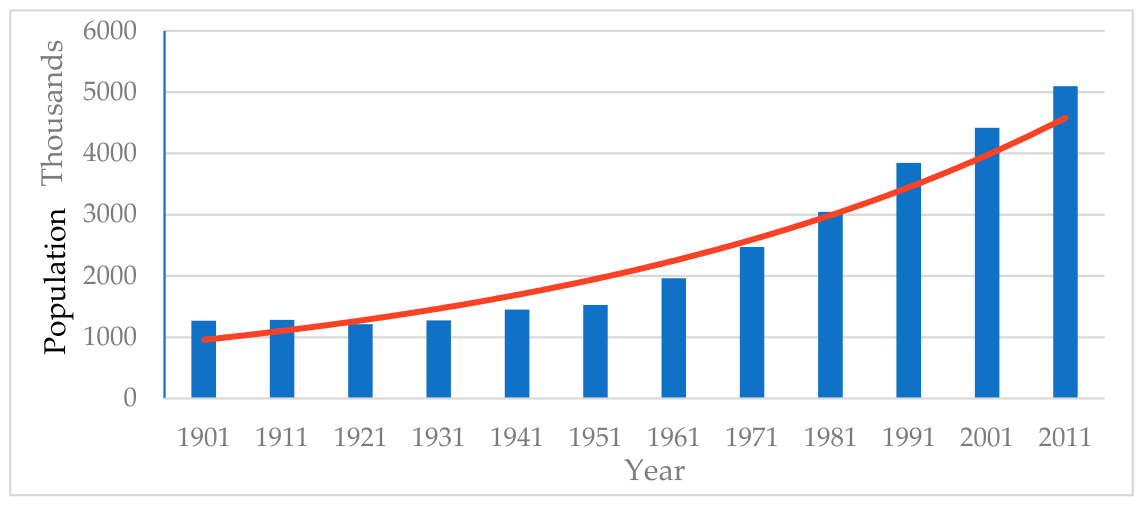
It is observed that GWT is in a decreasing trend after 2021, but it is also not in an alarming state due to heavy rainfall and profuse seepage resulting from irrigation, percolation from rivers, and the BoB. The main abstraction from groundwater is discharged by a TW for irrigation purposes. A positive trend indicating a higher GWT decline over time is also observed in the research area. The exponential increase in population in the research area from 1901 to 2011 is another factor in the abstraction of GWL (Figure 4). Although the research has been conducted on the GWQ pollution from 2015 to 2022, which is simulated in 2030, data regarding the population of Purba Medinipur can only be presented up to 2011, as the 2021 Purba Medinipur population has not been published to date. On the basis of the exponential trendline, it can be projected that the population of Purba Medinipur was approximately 5,760,000 in 2021.
Figure 4.
Population of Purba Medinipur over time.
The GW flow in CPM is towards the BoB with a hydraulic gradient ranging from 1- to 0.3 m/km [22]. TW yield tapping these freshwater aquifers is extended from 100 to 150 m3/h with a maximum drawdown of 17 m [17]. The trend in LULC is altered, resulting from the rapid growth of the population in all blocks within the coastal territory. Previously, the research area was covered with vegetation, irrigational land, and fallow land.
Excessive population growth leads to food insecurity, resulting in the marginal increase in agricultural land, constant vegetation cover, but enhanced water bodies resulting from increased fish farming, which are salt-resistant like tilapia, prawn, and other fish. The locations like Nandakumar CD block inside the coastal territory, irrigational land, and fallow or barren land were 41.30 km2 and 23.67 km2, respectively, in the year 2000. The vegetation cover area was 58.32% of the entire area of Nandakumar. The contribution of the built-up area was insignificant compared to other classes. The area of the water body was enhanced from 0.02% in 2000 to 4.06% in the year 2011. Irrigated land and vegetation area were enhanced by 24.54 km2 and 6.55 km2, respectively. In 2022, a substantial portion of the irrigational land area was lost, contributing to 12.36% of the area of the Nandakumar block. The water body area was approximately doubled due to the growth of fisheries, amounting to 11.60% of the Nandakumar block. Built-up area was increased by 139.10% of the entire area of the Nandakumar block in 2022 with respect to 2000. The vegetation area was almost the same throughout the analysis period [23,24].
Due to the overexploitation of GW, salinization of seawater from the BoB takes place in the aquifer of CPM [8]. Continuity in the decrease in GWL and SLR has been noticed in the research area because of the harmful intrusion of contaminated brackish water into the main aquifer, resulting in freshwater scarcity. More soil is excavated to find deep aquifer fresh water, as both shallow aquifer and canal, river water are contaminated by brackish water, especially during tides. The lithology already indicates an intermediate fresh and saline water intermingled aquifer. The GWL is declining to meet the growing needs and the fresh GW drought. Global warming creates SLR, which makes fresh water brackish and is directly related to declining GWT [25]. A decline in GWQ has resulted from this phenomenon. A high trend in sea level enhancement (4.44 mm/yr) has taken place with respect to global SLR [26].
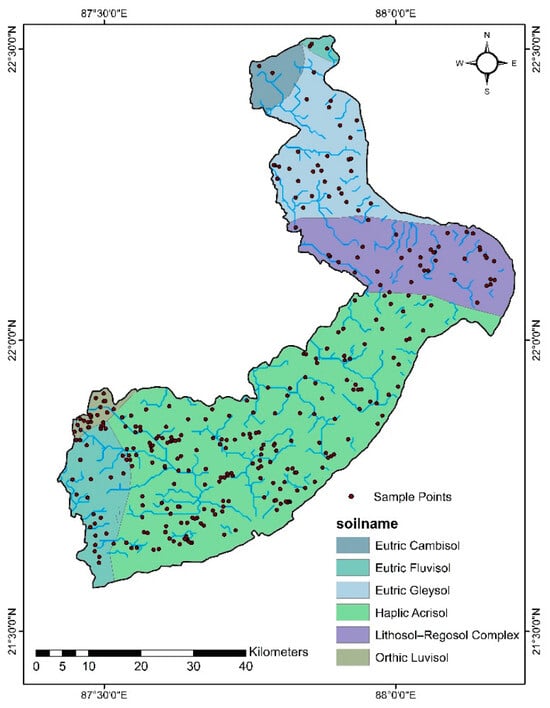
The sampling points of 326 locations from which secondary data of pH, TDS, turbidity, Fe, Mn, TH, and Cl in GW are procured in the tenure of 2015 to 2022 are presented in Figure 5.
Figure 5.
Soil map of study site along with sampling points.
Although the study site is composed of alluvial soil, which is carried by the River Ganga and BoB, generating low-permeable clayey-silty soil, sand layers are also found in the coastal region, having high permeability. But the horizontal hydraulic gradient is more pronounced than the vertical permeability. It is very much needed to understand the lithological characteristics of the coastal area, which may be susceptible to saline contamination. The physical survey is conducted at the site. Total 90 lithological charts were secured from PHED, Tamluk division, in CPM. It can be said that every lithological chart is very different to each other, where most of them are asymmetrical. As an unbiased one, lithological charts of Durmuth, Contai-III, are presented in the table representing CPM. The linear distance from Durmuth to Junput sea beach is 13.18 km. The lithological chart is displayed in Table 1.
Table 1.
Lithological chart of Durmuth, Contai-III.
The aquifer is multilayered, separated by aquitard clay layers in distinct depths. Shallow aquifers exist from 11 to 15.0 m with a minimum thickness of confined to semi-confined aquifer. Limited GW can be extracted. This aquifer is likely to be SWI-affected. An intermediate aquifer exists in the ranges 34–48.0 m, 84–105.0 m, and 112–135.0 m, containing a confined aquifer possessing fresh to saline water. Deep aquifers are present in the ranges 148–160.0 m, 182–190.0 m, 196–205.0 m, and 208–215.0 m. But the most productive aquifer is present from 230 m to 284.68 m, requiring a deep tube well to extract the water.
Moreover, the lithology suggests that the transmissivity of the soil layer is quite high, facilitating movement of fresh water to the saline layer through different aquifer layers, although it may be prevented from flowing by an aquitard. Similarly, the soil profile of the other four regions inside the study site is shown in Table 2, Table 3, Table 4 and Table 5 (below) to depict the prominent lithological profile of the research site.
Table 2.
Lithology chart of w/s scheme for Sankarpur and adjoining mouzas (village or a group of small settlements) within Ramnagar-I, block under Digha Subdivision.
Table 3.
Lithology chart of w/s scheme for Sankarpur and adjoining mouzas within Ramnagar-I, block under Tamluk division.
Table 4.
Lithology chart of Aladaput w/s scheme, TW-1 within Tamluk Division, Contai Subdivision.
Table 5.
Lithology chart of Kumirda, TW-2, within Tamluk Division.
From the extensive analysis of the lithology spatially distributed, the hydrogeological description of aquifers I and II, along with the depth of groundwater occurring in the CPM, can be inferred and are explained in the following passages. Aquifer I is called the upper aquifer of the type semi-confined (quaternary aquifer group). Its location is in the upper lithological layer, where lithology traits are clay, sandy clay loam, and fine sand layers. It occurs at shallow depths; it is discontinuous and localized, yielding low to moderate GW; and it is highly susceptible to SWI and contamination. GW in the region is mainly saline or brackish in nature. It is influenced by surface water and acts as a transition zone between surface water and deeper aquifers. The existing shallow GWT is ~16.85 m to 21.65 m in pre-monsoon and ~16.2 m to 18.7 m in post-monsoon.
Aquifer II is the lower aquifer of the unconfined to confined type, being contained within lower lithological strata. It is characterized by thick sand layers interbedded with clay aquitards. This is the main productive aquifer in CPM. It has higher transmissivity and storage capacity, and contains fresh to saline mixed water. It is less affected by immediate surface contamination compared to Aquifer I. Water movement occurs through multi-layered sand bodies here. These aquifers are separated by clay aquitards, creating a confined one. GW can be extensively tapped through deep tube wells. GWL is extended to >250 m in deep aquifers (Aquifer II).
Overall, Aquifer I exists in ~11 m to 15 m bgl, where GW is of saline and low productive traits. The intermediate aquifers exist at ~34–48 m, 84–105 m, 112–135 m bgl, containing mixed fresh and saline water, whereas aquifer II exists at ~148 m to >200 m bgl, establishing major water forming zones. The highly productive deep water bearing stratum is located in ~230 m to 284.68 m bgl. The GW is extracted by a deep tube well. Better quality GW is found in this zone.
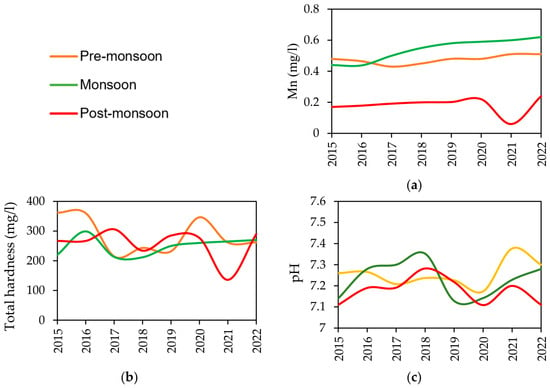
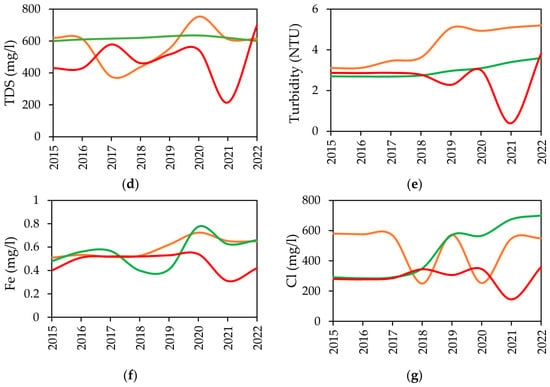
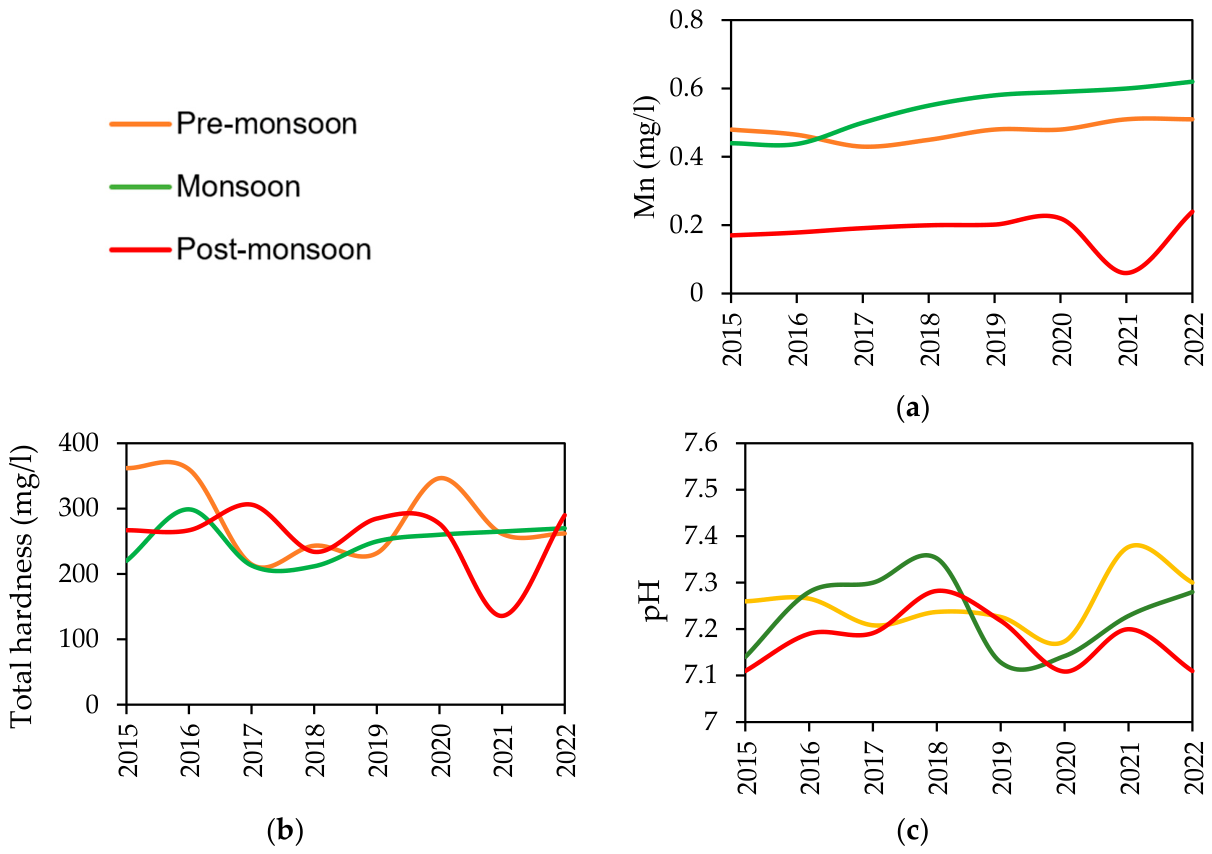
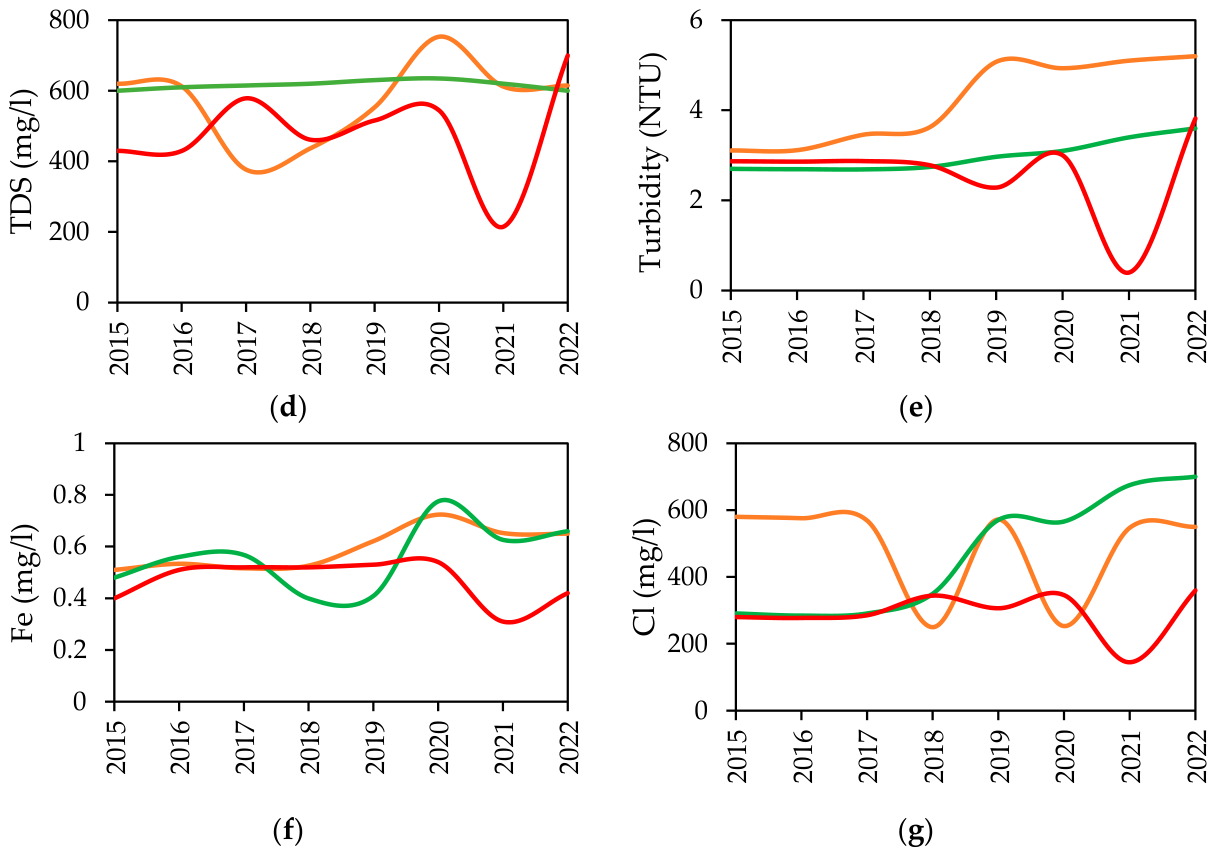
The test results of seven attributes, viz., of 326 samples spanning the 2015 to 2022 seasonally, are procured and presented in Figure 6. From Figure 6, the mean pH in pre-monsoon, monsoon, and post-monsoon were 7.17–7.37, 7.14–7.28, and 7.11–7.28 respectively. It indicates a slight tendency of GW to be alkaline, which is within the acceptable limit, ranging from 6.5 to 8.5 [27]. It is acting like an independent parameter compared to the other parameters. Average TDS in 2015 as well as in 2022 in pre-monsoon, monsoon, and post-monsoon were 376–615, 390–484, 428–500 mg/L, indicating a major enhancement of pre-monsoon TDS intensity in GW. The acceptable and permissible limits of TDS in potable water are 500 and 2000 mg/L. It has been observed that the mean TDS value is within the acceptable limit in Monsoon as well as in post-monsoon, but the increased concentration of TDS in those seasons is on the brink of breaching the acceptable limit in 2022, resulting from the decomposition of salts.
Figure 6.
Seasonal GWQ status of parameters: (a) Mn; (b) total hardness; (c) pH; (d) TDS; (e) turbidity; (f) Fe; (g) chloride from 2015 to 2022.
The turbidity in pre-monsoon, monsoon, and post-monsoon from 2015 to 2022 is extended in the ranges 3.11–5.2 NTU, 2.69–3.6 NTU, and 2.86–3.82 NTU, respectively. All these values have exceeded the acceptable limit of turbidity [9,28], which is 1 NTU, but within the permissible limit of 5 NTU. This GWQ parameter has indicated the worst concentration exceeding the permissible limit in pre-monsoon due to GW extraction, resulting in more SWI [29]. One of the worst-affected GWQ parameters is Fe, which ranged in pre-monsoon, monsoon, and post-monsoon from 2015 to 2022 were 0.53–0.65, 0.41–0.50, and 0.42–0.54 mg/L, respectively. The trend in Fe concentration in groundwater is upward trending, exceeding the permissible limit of Fe, i.e., 0.3 mg/L. Even GWQ in the monsoon season had shown unacceptable Fe concentration due to leachate and high runoff containing pesticides and fertilizers [17]. Metals exist in profuse concentrations (5% for Fe, 0.095% for Mn) in the Earth’s crust, resulting in mixing with GW by dissolving aerobically and by reductive dissolution [30].
Magnitudes of Mn concentrations in GW from 2015 to 2022 in pre-monsoon, monsoon, and post-monsoon were extended 0.43–0.51 mg/L, 0.43–0.62 mg/L, and 0.17–0.24 mg/L. Most of the Mn magnitudes exceeded the acceptable Mn limit [9], i.e., 0.1 mg/L, but within the permissible limit (0.3 mg/L) as the seasonal year progresses due to alluvium rock weathering. The values for TH in GW from 2015 to 2022 in pre-monsoon, monsoon, and post-monsoon were extended 214–360, 151.4–280, and 233–306 mg/L. Acceptable and permissible values of TH are 200 and 600 mg/L [9].
The acceptable limit and permissible limit of Cl are 250 and 1000 mg/L [9]. The Cl concentration in GW was always inside the safe drinking water limit from 2015 to 2022, irrespective of all seasons, but the maximum impact is exerted on the pre-monsoon season due to lower GWLs and major abstraction of GW resulting in SWI. Moreover, profound intensity of Cl is also observed in the monsoon season due to flooding in the study zone from the BoB and natural leaching. Moreover, anisotropic soil in CPM is such that horizontal hydraulic conductivity (Kx) is of greater magnitude than vertical hydraulic conductivity (Kz), resulting in more hydrological flux exchanges between brackish BoB water and fresh aquifer water, resulting in deterioration of GWQ [24]. So, maximum GW contamination is observed in pre-monsoon followed by monsoon and post-monsoon seasons, resulting from less rainfall and heavy extraction of GW invading SWI. The lower GW pollution is noticed in post-monsoon due to existing moderate rainfall, and the high GWL persists after the monsoon, which is sufficient to meet the daily needs of human beings. Seasonal variation in pH, TDS, turbidity, Fe, Mn, TH, and Cl from 2016 to 2022 is denoted in Figure 6a–g based on their acceptable limit and permissible limit [9]. In summary, the hydrochemical characteristics of groundwater in CPM are largely controlled by seawater intrusion, lithological composition, and geochemical interactions within the aquifer system. The most dominant hydrochemical type in the region is the chloride-rich facies, where groundwater is characterized by high concentrations of chloride and total dissolved solids, indicating a brackish to saline nature. This condition primarily results from the intrusion of seawater from the Bay of Bengal into inland aquifers, making the groundwater quality poor for drinking purposes. In addition to this, a mixed hydrochemical facies is also prevalent, especially in intermediate and deeper aquifers, where fresh groundwater mixes with saline water. This creates a transitional zone with variable chemical composition, reflecting both marine and meteoric influences.
In certain deeper confined aquifers, a bicarbonate-type hydrochemical facies is observed, representing comparatively fresh groundwater formed through rock–water interaction and weathering of alluvial sediments. This type generally exhibits better quality and is more suitable for potable use with minimal treatment. Furthermore, groundwater in CPM often shows elevated concentrations of iron and manganese, which are derived from geogenic processes such as reductive dissolution of minerals in the alluvial deposits. Although not a classical hydrochemical facies, this iron- and manganese-rich groundwater significantly affects water quality and usability. Overall, the hydrochemical regime of CPM reflects a complex interaction of saline intrusion, freshwater recharge, and subsurface geochemical processes.
The CPM comprises 18 blocks, of which 25 are affected by SWI. The central headquarters of CPM is Tamluk. The southernmost Medinipur division comprises 4 subdivisions, i.e., Tamluk, Contai, Egra, and Haldia, under which all the 25 blocks are connected. The GW samples are collected from the tube well and carried to the PHED of the corresponding subdivisions which are well equipped with GWQ determination apparatus like Atomic Absorption Spectrophotometer, EDTA Titration setup (Burette, pipette, conical flask), pH meter (electrode-based), TDS meter (conductivity-based), nephelometer/turbidity meter (NTU-based), chloride analyzer (digital titrator) are utilized to evaluate accurately the sample values of Mn, TH, pH, TDS, turbidity, Fe, and chloride, respectively. So the entire test results are put up on the PHED website based on internal laboratory results, which are quite satisfactory.
Electrical conductivity magnitudes are extended from 615 to 1548 μS/cm, where the standard magnitude is 1500 μS/cm, directing brackish water inwards in each season [31]. It is noticed that more polluted water is observed in 2022 than in 2015, and changes are minimal in consecutive years, so the alterations of 7 GWQ parameters are analyzed in 2015 and 2022. But a detailed discussion of GWQ parameters for every year is provided.
The amount of variance explained by every principal component (PC) is indicated by eigenvalues. More variance in the data set is explained by higher eigenvalues. The contribution of each variable to the PCs is shown by loadings. Either high positive or negative loadings are indicated by the chemical parameters that strongly impact the component. The statistical measurement is indicated in Table 6.
Table 6.
Initial eigenvalues determined for three different PCs.
Loading of hydrochemical elements is explained in Table 7, where PCI denotes high positive loadings indicated by GWQ parameters for pH, TDS, total iron, and chloride, contributing the most to PCI. The overall mineralization and ionic composition in water are indicated by PCI [32]. In the case of PCII, high loadings are indicated by turbidity and manganese, suggesting their major contribution to the second principal component. Suspended solids and particular metal contamination are represented by PCII.
Table 7.
Loading of GWQ parameters influencing principal component loading.
A major contribution to PCIII is made by no GWQ components, although total hardness has a moderate positive loading. It is a secondary factor affecting GWQ, like minor variations in hardness or other insignificant parameters [33]. The statistical measurement of GWQ parameters is presented for both 2015 and 2022 in Table 8.
Table 8.
Statistical measurement of GWQ parameters of both 2015 and 2022 in terms of minimum (min), maximum (max), and average (avg).
Almost constant pH, leading to GW being slightly alkaline in nature, is indicated. The higher TDS value indicates heavy mineralization and an indication of SWI. Higher standard deviation indicates spatially contaminated GW by seawater. Similarly, a higher turbidity value denotes higher mineralization in the study site GW. The prolific Fe quantity denotes iron contamination, which is a common characteristic of alluvial plains. The GW is also progressively contaminated by heavy metals. The trend in TH suggests few areas were heavily contaminated by TH, whereas a few localities were TH-free denoted by a high standard deviation. Increased chloride content suggests SWI in the study site due to anthropogenic activities (Table 8). The statistical measurement of the GWQ parameters represents the 316 GW samples for both 2015 and 2022. The discussion on each GWQ parameter based on [9,27,28] is portrayed below. Moreover, it is always best to keep water quality within the acceptable limit, as this ensures the water is safe and pleasant to use. If the values go beyond this level, the water is no longer considered suitable for regular use. However, in situations where no alternative source is available, such water may still be used, but only up to the permissible limit. If the quality exceeds even this permissible level, the water becomes unsafe and should be completely rejected as a source for use.
6.1. pH Concentration
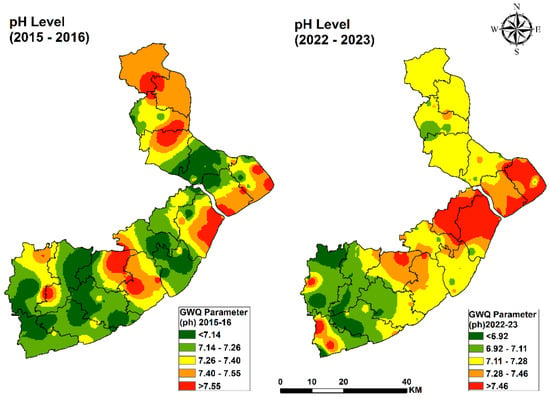
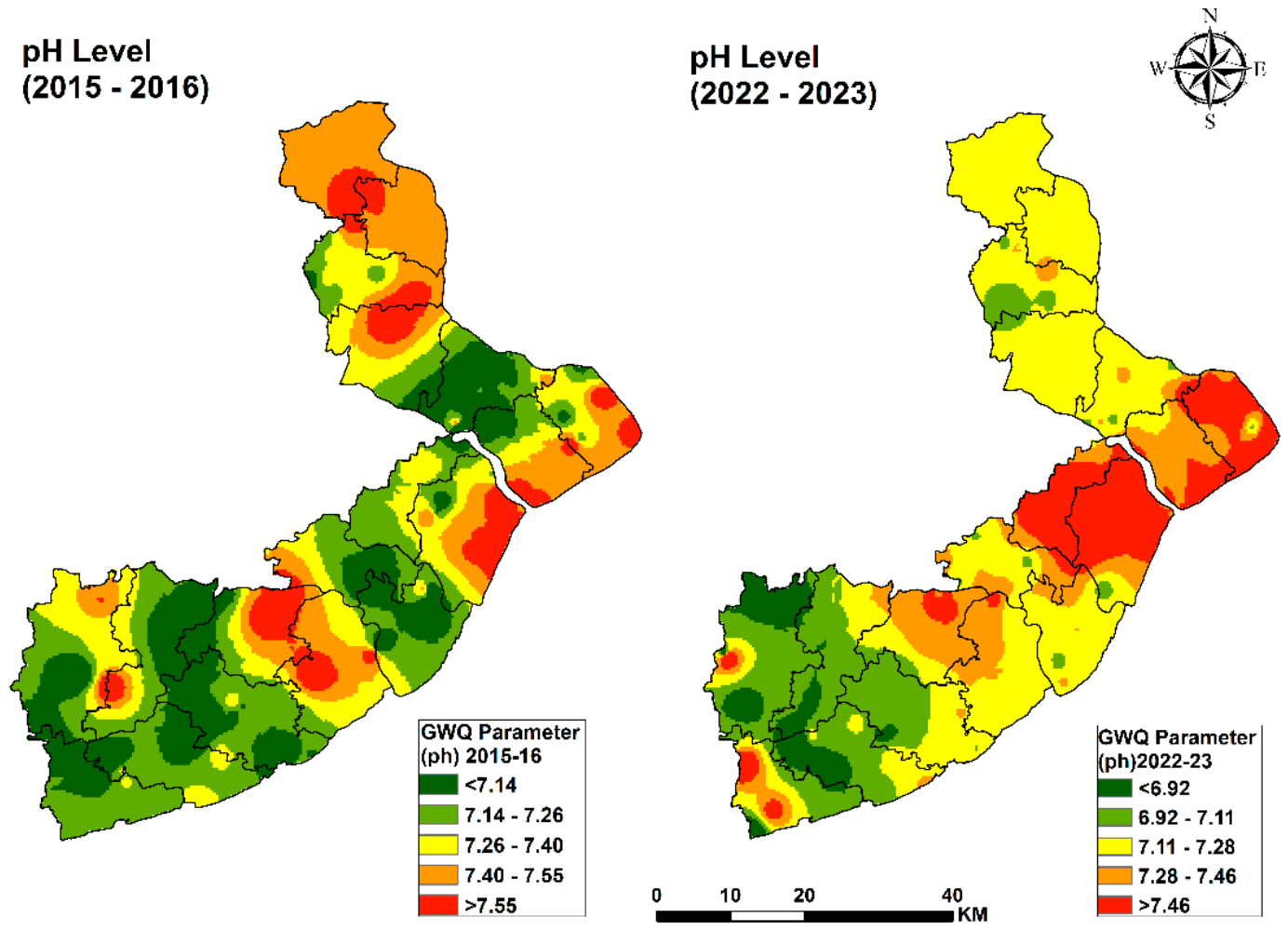
The pH of GW is an assessment of the H+ ion action in water. The range of pH values for daily purposes is limited between 6.5 and 8.5. However, GW contamination enhances the pH value by more than 9.0. Overall, 100% of water specimens of the research zone in both 2015 and 2022 are within acceptable limits of 6.5–8.5, as prescribed by [9,27,28]. The comparative assessment of pH concentration in 2022 and 2015 is shown in Figure 7. From Figure 7, it has been observed that although pH levels from 2015 to 2022 are within acceptable limits, the GWQ parameter has indicated an uptrend in Haldia, Nandigram (I, II), Khejuri (I, II), Chandipur, Bhagawanpur-I, and Sahid Matangini.
Figure 7.
Comparative diagrams of pH levels in 2015 and 2022.
6.2. TDS Concentration
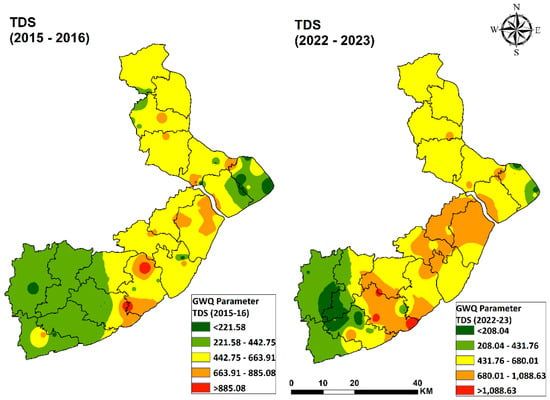
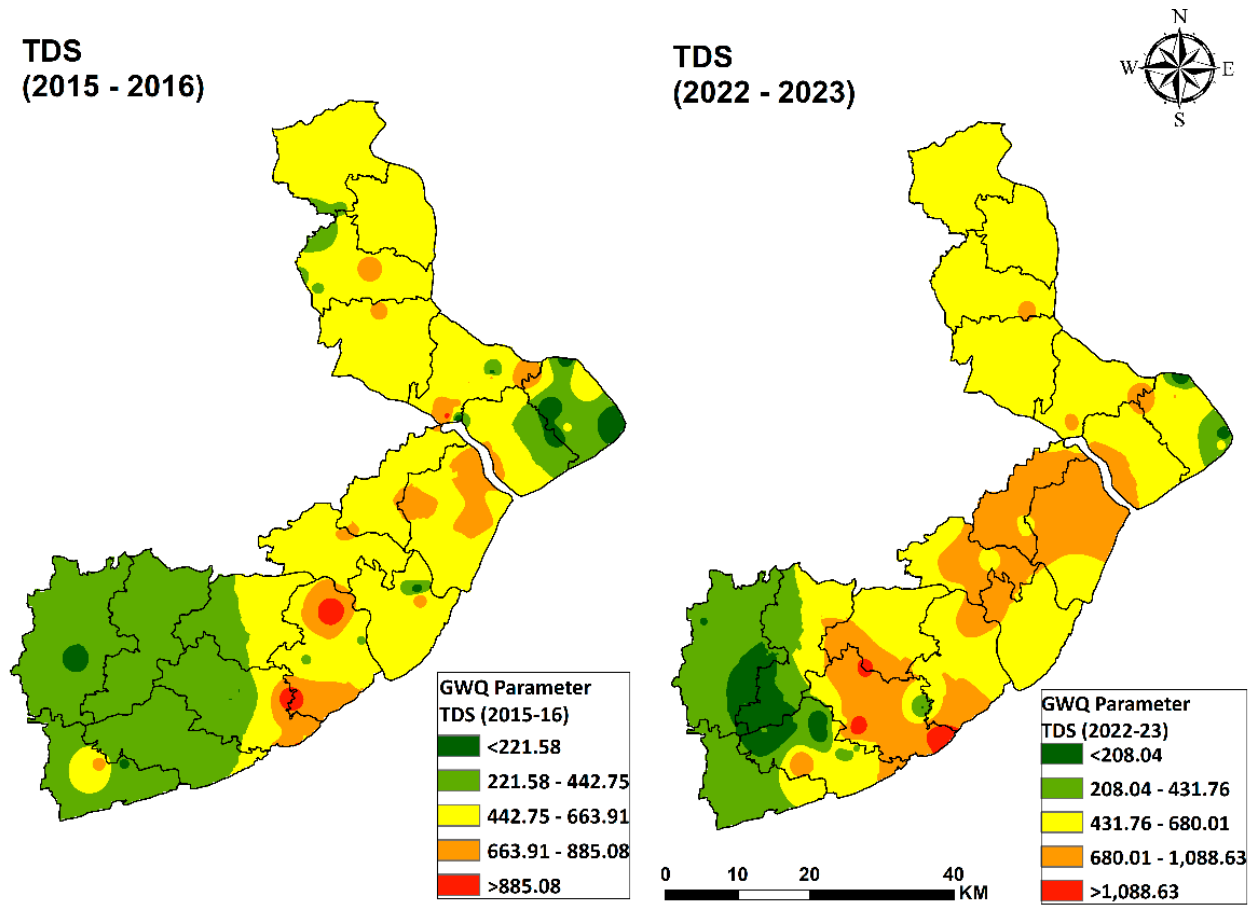
Total dissolved solids are contained in GW as a result of the dissolution of minerals out of rock and soil formation [34]. It is an important aspect of estimating GWQ. Groundwater comprising TDSs less than 500 mg/L is acceptable for household use and for many industrial purposes. The percentage of GW specimens with TDSs less than the [9,27,28] prescribed limit of 500 mg/L in 2015 and 2022 is 61.11% and 28.88%, respectively. The parity of TDSs in GW in two extreme years is shown in Figure 8. From Figure 8, it can be established that most of the coastal places have TDS values within acceptable limits in the standardized guideline for both 2015 and 2022. But with the passage of time, Haldia, Nandigram (I, II), Chandipur, Bhagawanpur (I, II), Khejuri-I, Haldia, and Sutahata, which are closer to the BoB, possess a higher TDS value than the standard value as a result of SWI.
Figure 8.
Comparative diagrams of TDS levels (mg/L) in 2015 and 2022.
6.3. Turbidity Concentration
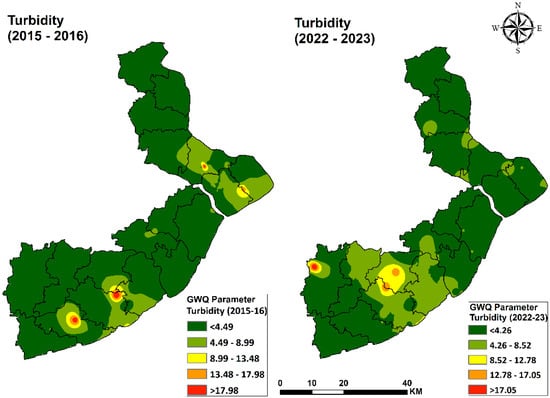
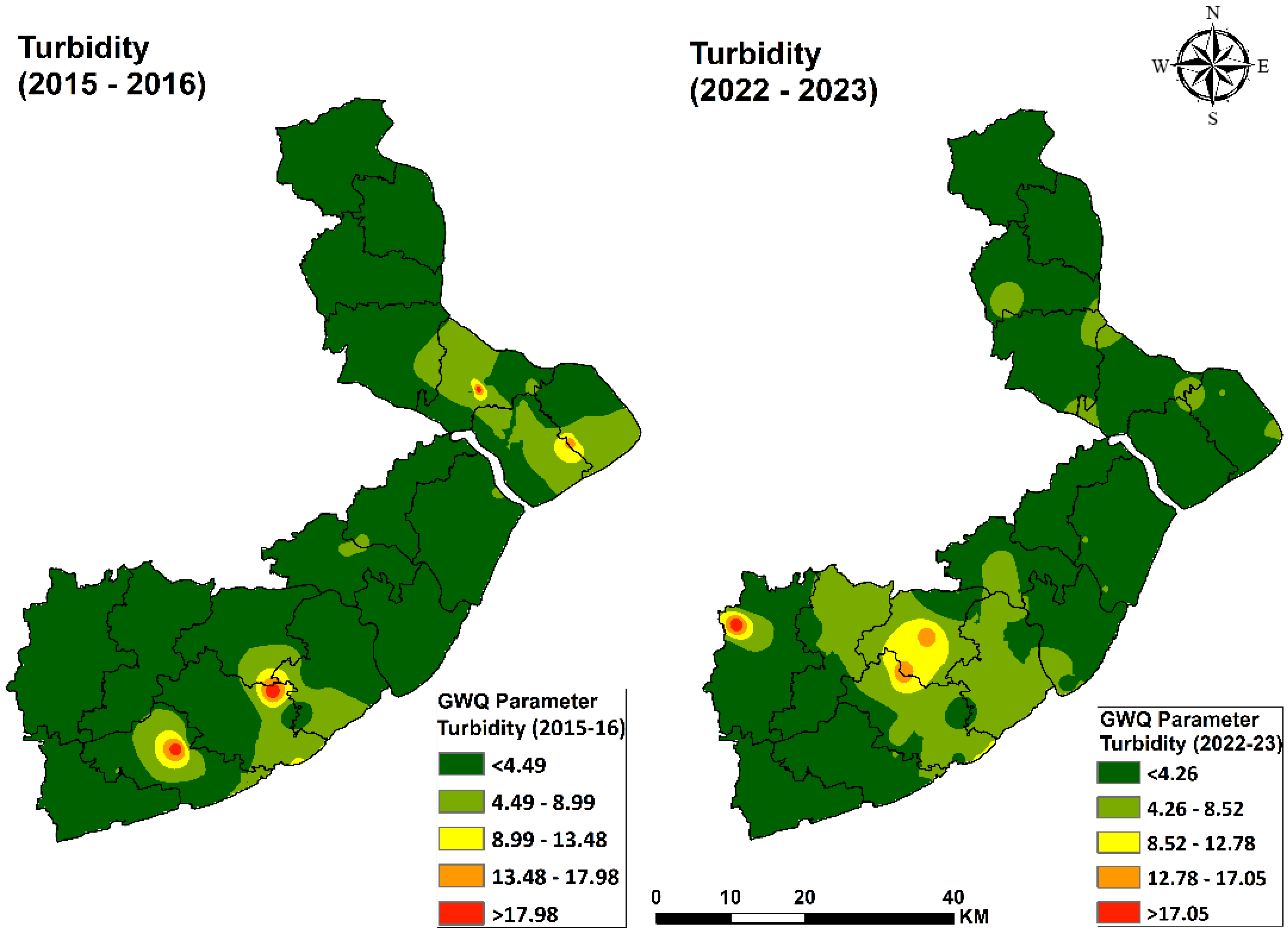
Turbidity in GW is caused by the presence of colloidal particles in it [35], which reduces water clarity. The acceptable limit of turbidity as per [9,27,28] is 1 NTU and 5 NTU, respectively. More specifically, GW must not contain turbidity 1 NTU [9]. As per our analysis, it has been observed that 83.33% of groundwater specimens in 2015–16 and 94.67% of water samples have exceeded the acceptable limit of turbidity as per BIS. The turbidity concentration in GW during the two extreme study tenures is portrayed in Figure 9. As per BIS, the maximum permissible value of turbidity in GW should be within 1 NTU. From Figure 8, it is observed that the magnitude of turbidity exceeds the prescribed limit by BIS in all coastal locations in both 2015 and 2022. Maximum turbidity concentration in water is observed in Contai-III, Ramnagar-II, and Mahisadal due to seawater ingress.
Figure 9.
Comparative diagrams of the turbidity levels (NTU) in 2015 and 2022.
6.4. Total Iron Concentration
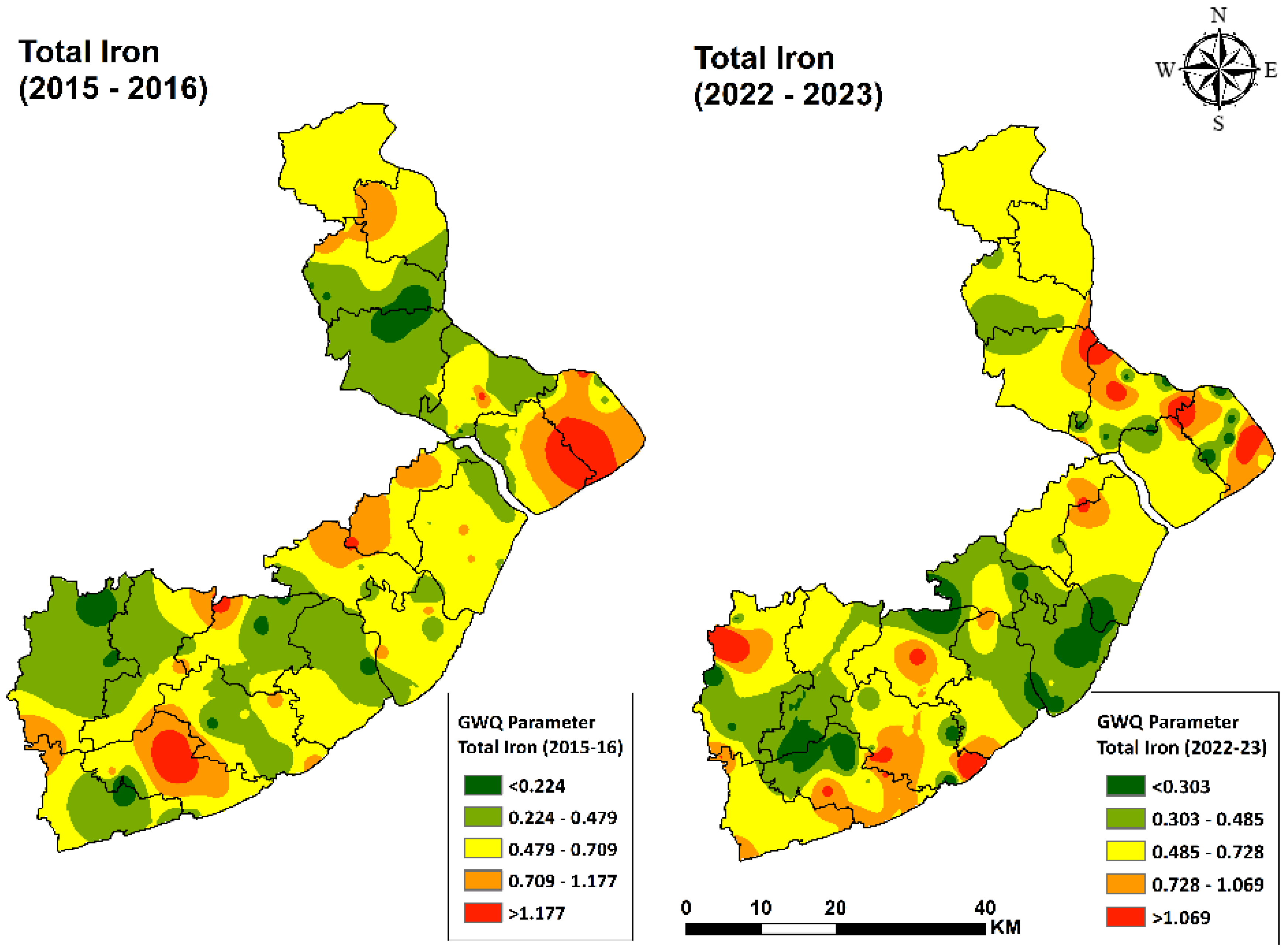
An elevated quantity of Fe contained in GW in any region pollutes the GW-bearing stratum and leads to subsequent health hazards [36]. Iron in GW is generated by the geological weathering of soils, reductive dissolution, and leaching from iron-containing mineral soils. The acceptable limit of Fe in groundwater is 0.3 mg/L [9,27,28]. In 2015, 95.56% of groundwater specimens, and in 2022, 100% of water samples have shown an uptrend in total iron contamination according to industry standards.
In accordance with standards, it is seen in Figure 10 that the total iron concentration in GW has deteriorated tremendously from 2015 to 2022. The maximum total iron concentration is observed in Sutahata in the vicinity of the BoB in the year 2022. Apart from Khejuri-I, Contai-I, and Egra-I, the groundwater of all 15 blocks was contaminated with total iron in 2022.
Figure 10.
Comparative diagrams of total iron levels (mg/L) in 2015 and 2022.
6.5. Manganese Concentration
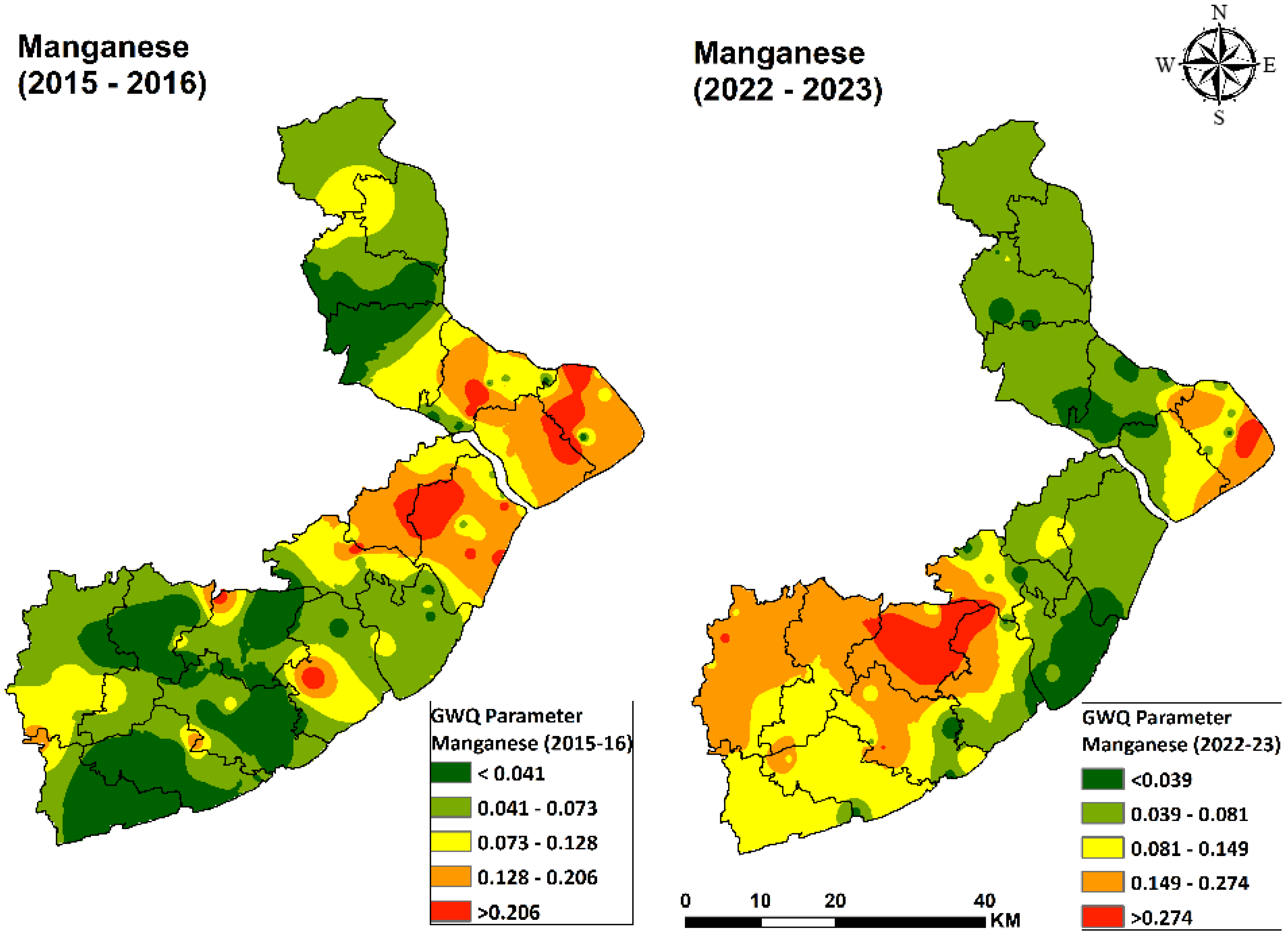
Manganese is an important nutrient for human health. Human life activity and energy metabolism are controlled by Mn [37,38]. The acceptable limits of Mn as per [9,27,28] are 0.1, 0.4, and 0.1 mg/L, respectively. Therefore, in our study, GWQ is judged on the basis of BIS standards. In 2015 and 2022, 31.11% and 27.78% of GW samples were contaminated with manganese. With the passage of time, it has been observed that GWQ has diminished from 2015 to 2022 from a Manganese point of view. In 2022, as per Figure 11, it is seen that Kolaghat, Sahid Matangini, Tamluk, Nanda Kumar, and Mahisadal blocks’ groundwater is safe with respect to manganese, as per BIS. But the rest of the coastal blocks are contaminated by manganese, according to BIS.
Figure 11.
Comparative diagrams of manganese levels (mg/L) in 2015 and 2022.
6.6. Total Hardness Concentration
The hardness of water is generated as a result of Ca2+ and Mg2+ ions in water [39]. It is the total ion concentration of both ions in mg/L of CaCO3.
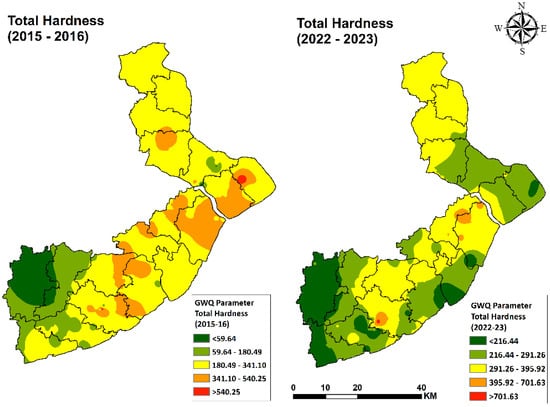
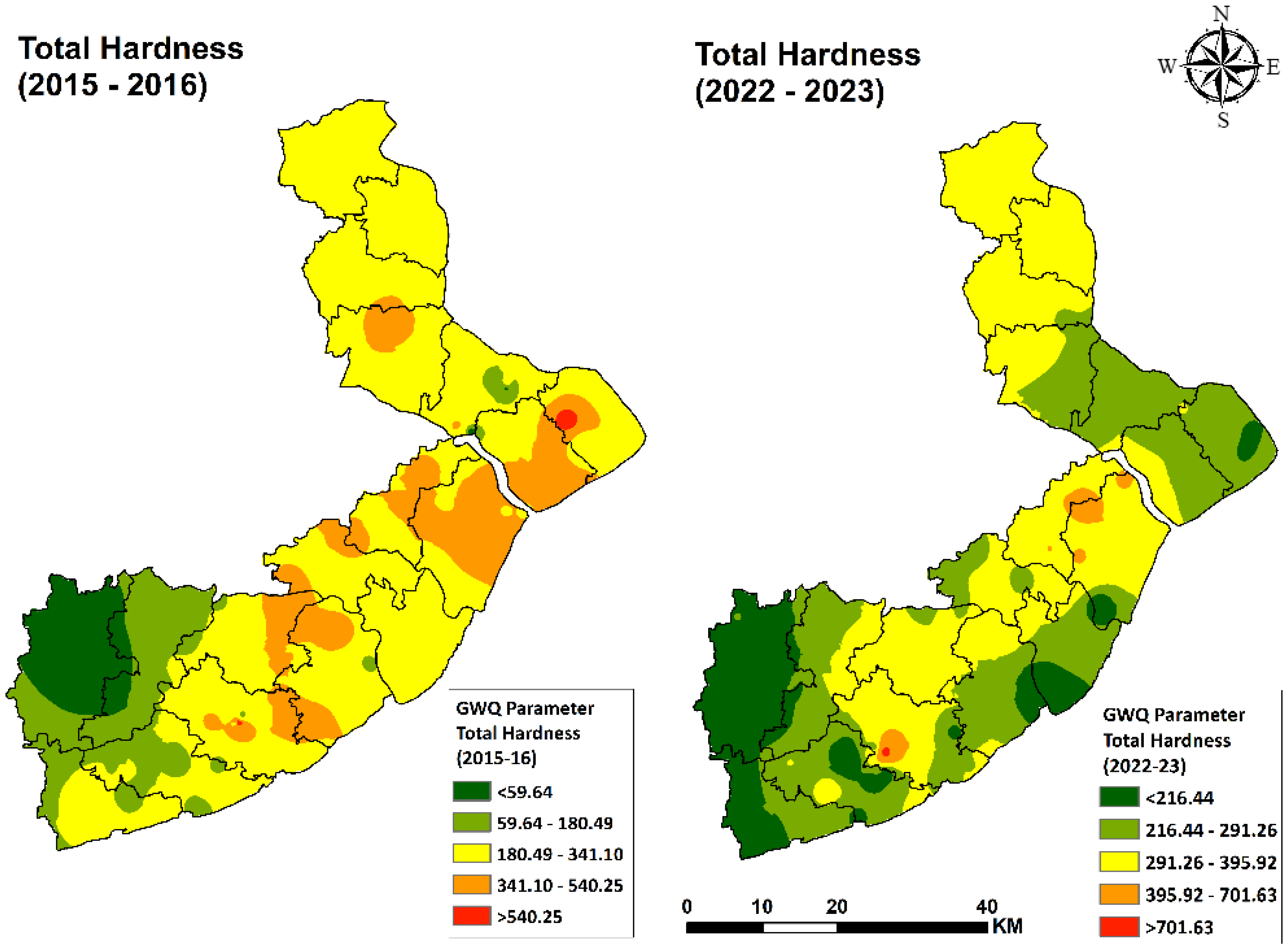
The percentage of GW specimens containing total hardness beyond 250 mg/L [9,28,29] is 62.22% and 53.33% of all samples in 2015 and 2022, respectively. From Figure 12, it has been seen that the total hardness of GW is more than the permissible limit according to BIS in both 2015 and 2022, except Egra (I, II), Patashpur (I, II), Deshpran, and Contai-I. But more than 90% of the coastal blocks are affected by total hardness in GW since the rocks containing Ca+, Mg+, HCO32− ions are dissolved in the saline water of the BoB. Comparative analysis of total hardness in GW is found to have declined tremendously in 2022 compared to 2015.
Figure 12.
Comparative diagrams of total hardness levels (mg/L) in 2015 and 2022.
6.7. Chloride Concentration
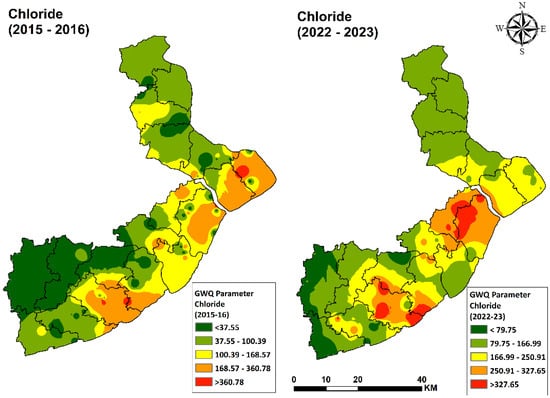
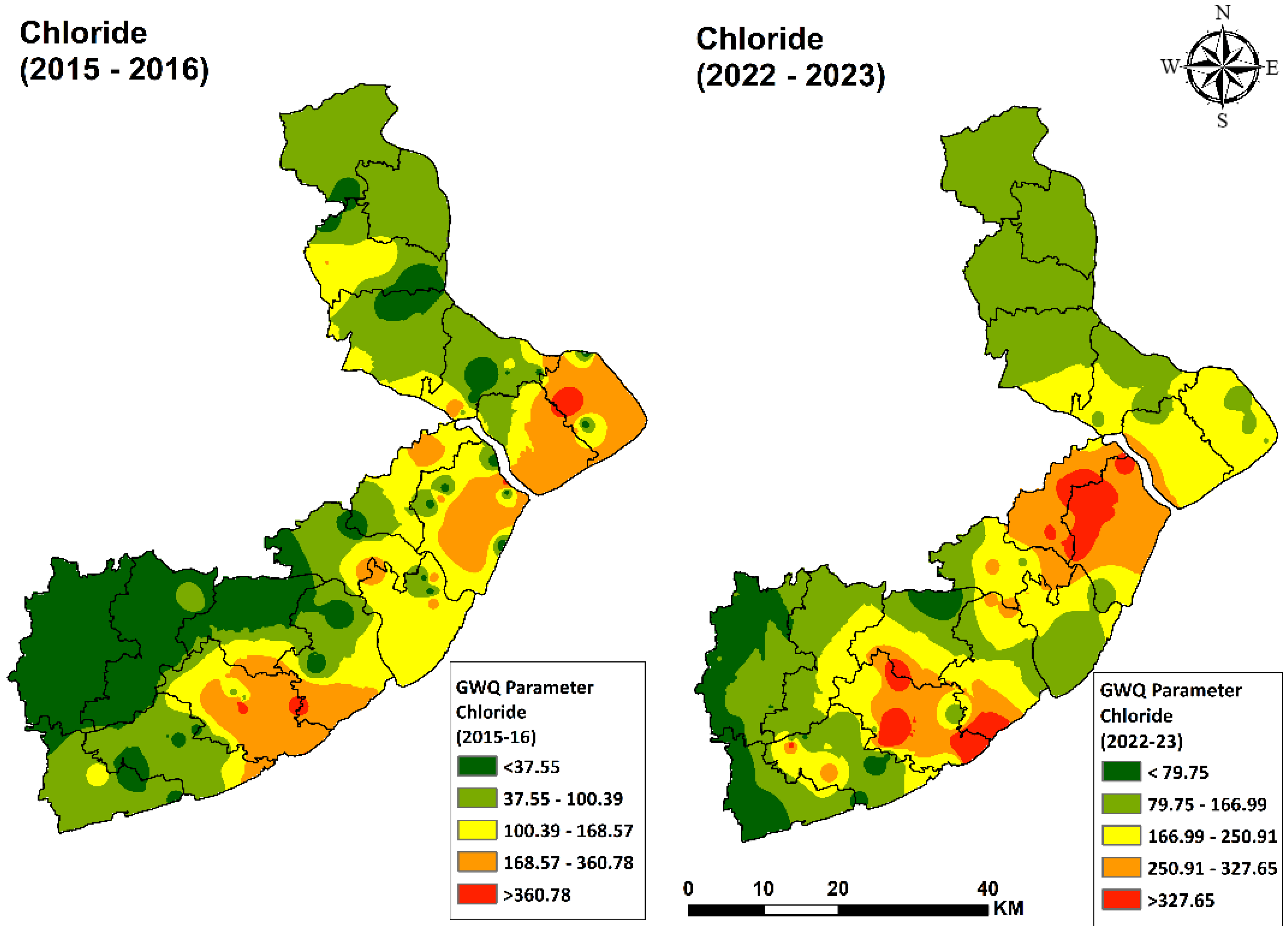
Chloride ions are necessary for the yield of gastric hydrochloric acid. Consumption of water containing higher chloride levels causes gastrointestinal disorders [40]. As per BIS recommendations, the acceptable limit of chloride in groundwater is 250 mg/L, and chloride concentration in groundwater samples in 2015 and 2022, beyond 250 mg/L, are 14.44% and 23.33%, respectively [29]. Chloride is one of the major GWQ parameters determining SWI in the research zone. It is seen from the contour map, as per Figure 13 of both 2015 and 2022, that blocks like Ramnagar-II, Contai-I, Deshpran, Nandigram-II, Khejuri-II, Nandigram-I, and Haldia, Sutahata, which are in direct contact with the BoB, are highly affected by GWQ by saline water encroachment in 2015. Chandipur, Moyna, Khejuri-I, and Contai-III, which are far distant from the BoB, have also shown high GWQ deterioration due to the path line of contaminated GW towards them through aquifers.
Figure 13.
Comparative diagrams of chloride level (mg/L) in 2015 and 2022.
The GWQ aspects individually cannot be conclusive about the status of GW. Therefore, the AWGWQI is adopted to determine the GWQ status. Different groundwater quality parameters are present in a sample and are evaluated against the acceptable and permissible limits prescribed in India under BIS 10500:2012. It is often observed that even when most parameters fall within permissible limits, the presence of a highly concentrated toxic substance can make the groundwater unsuitable for its intended use.
To properly assess such situations, the AWGWQI is used. In this method, greater weight is assigned to toxic substances and heavy metals due to their higher risk to public health. At the same time, smaller weightages are also given to less critical parameters, ensuring that all constituents contribute to the final index value.
As a result, even if some parameters lie within safe limits while others exceed acceptable levels, it is difficult to judge the overall water quality directly. The AWGWQI provides a more comprehensive evaluation by combining all parameters with appropriate weightages, thereby categorizing the overall groundwater quality clearly and reliably.
It is presented in Figure 10. Relative weight (Wi) is estimated by Equation (4).
where Si = standard acceptable value [9] and K = proportionality constant calculated by Equation (5).
Wi = K/Si,
Quality rating scale (Qi) is expressed by Equation (6).
where Vi = calculated magnitude of parameter, Videal = Ideal magnitude with 0 for maximum and 7 for pH, and 14.6 mg/L for dissolved oxygen.
Sub-index is represented by Equation (7).
SIi = Wi × Qi,
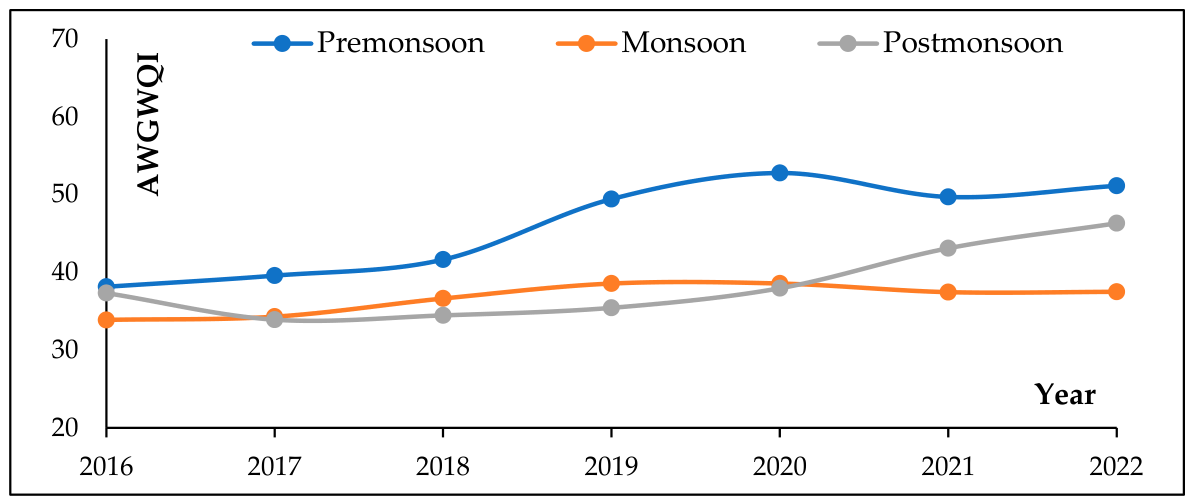
The AWGWQI is expressed by Equation (8). The classification of water as per AWGWQI is given in Table 9. The calculated AWGWQI is presented in Figure 14.
AWGWQI = ∑SIi,
Table 9.
Classification of water to drink on the basis of AWGWQI value [23].
Figure 14.
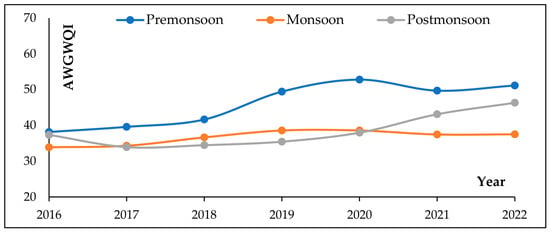
AWGWQI variation seasonally from 2015 to 2022.
The AWGWQI value seasonally and year-wise was increasing, denoting good potable GWQ too poor to drink (category B–C). It is also seen that the trend in poor-quality water is much more pronounced in the pre-monsoon season as a result of less rainfall and the least groundwater recharge. The most affected GWQ is observed in 2022 compared to other years. The AWGWQI for pre-monsoon, monsoon, and post-monsoon are evaluated based on contamination of GW contributed by individual parameters [41].
Apart from wastewater, chemical wastage seepage, percolation of excessive agricultural fertilizers penetrating the GW, and SWI are the major GW contamination sources since the SLR is increasing, resulting from global warming, in frequent brackish water floods in the freshwater aquifer of the study site [42]. It is seen that heavy metals like Fe and Mn are concentrated to a large extent in groundwater, especially in the Monsoon season. The existence of heavy metals is due to the decomposition that can occur naturally and anthropogenically. The leaching and smelting of these heavy metals are mainly dissolved by heavy rainfall in the study area, around 1700 mm annually, compared to that of West Bengal, which is around 1400–1500 mm annually. The GW pollution is not only dependent on SWI but also on a few hydrological factors discussed.
6.8. Dependance upon Hydrological Factors
The GW pollution is not only dependent on SWI but also on a few hydrological factors discussed below.
6.8.1. Rainfall
The rainfall in pre-monsoon is smaller than that in monsoon and almost equal to post-monsoon. The extent of annual rainfall is 1167 mm in 2015 to 1665 mm in 2022, with a peak value of 2275 mm in 2021–22, resulting in dilution of GWQ parameters, creating lesser concentrations in monsoon seasons than the pre-monsoon season. The seasonal variation in rainfall in a yearly manner is presented in Figure 12. Groundwater recharge by rainfall is a major factor in alleviating GWL. The GWL is higher in the monsoon season, followed by the post-monsoon and pre-monsoon seasons. Therefore, the intensity of GWQ parameters is diluted much more in the monsoon season compared to post-monsoon and worst in pre-monsoon [13]. The GWQ deterioration is also dependent on meteorological factors discussed below. The rainfall in the monsoon season ranged from 591.49 mm in 2015 to 794 mm in 2025. Similarly, in the pre-monsoon season, the rainfall was stretched from 144.51 mm in 2010 to 149.76 mm in 2022, generating almost constant and low rainfall. In the same manner, the rainfall in post-monsoon is a little higher compared to the pre-monsoon season, amounting to 218.81 mm in 2010 to 208.72 mm in 2022.
6.8.2. Temperature
The ambient temperature is counted from 1 January 2015 to 1 January 2023, ranging from 15.96 to 33.57 °C. The natural temperature range of 5–20 °C affects subsurface ecology and GW composition, as a 1 K temperature deficiency is interconnected to 4% reduction in O2 deficiency and 4% reduction in O2 saturation and a pH decline by 0.02, resulting from cumulative CO2. Since mean ambient temperatures are much higher, there is more mineral decomposition, resulting in higher Fe, Mn, and Cl in the sample water.
6.8.3. Pressure
The ambient pressure is extended from 99,289.05–101,140.8 millibars inside the study tenure. The ambient pressure is measured with the aid of GLDAS 2.1 software. The GW level change, flow directions are shifted due to increasing barometric pressure, which is one of the reasons for AWGWQI alteration.
6.8.4. Relative Humidity
Relative humidity (RH) in CPM is extended from 31.5 to 76.625% in the study duration, demarcating it as a humid region. The data are extracted by AIRS. High RH (>70%) is unable to reduce evapotranspiration, resulting in groundwater flux remaining unaltered. Moreover, RH creates a pathway to a smaller amount of water seepage in the vadose zone, unsaturated zone above GWT, resulting in a constant GWQ to exist.
pH, TDS, Fe, and TH are the strongest GWQ parameters (PCI), creating GW pollution. Similarly, turbidity is the strongest GWQ parameter of PCII, but Fe has an inverse relationship with CL, pH. Alkali-heavy metal inverse linkage is also observed. TH and Mn are the strongest GWQ parameters (PCIII), generating GW contamination in the pre-monsoon season because of SWI. TH is a less dominating factor under PCIII. The highest TDS, turbidity, and Mn are observed in the monsoon season due to heavy surface runoff. Fe intensity is also elevated (PCIII) in this season. The least Fe contribution is observed in the post-monsoon season to make the GW cleaner. The benchmark for polynomial regression is represented by Equation (9).
εxt~N(0, σ2) and are reciprocally independent, t = 1,…, rx, x = x1,…, xv and rx is the total number of observations.
Yxt = β0 + β1x + εxt,
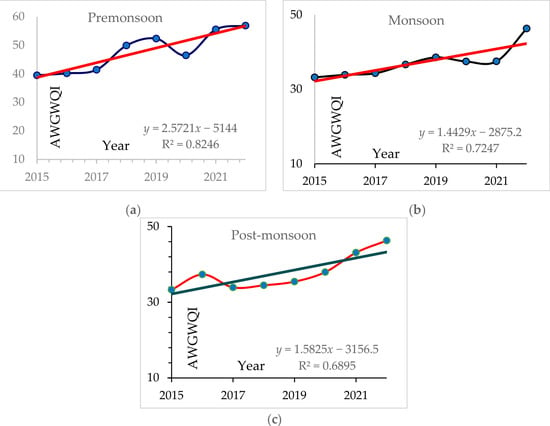
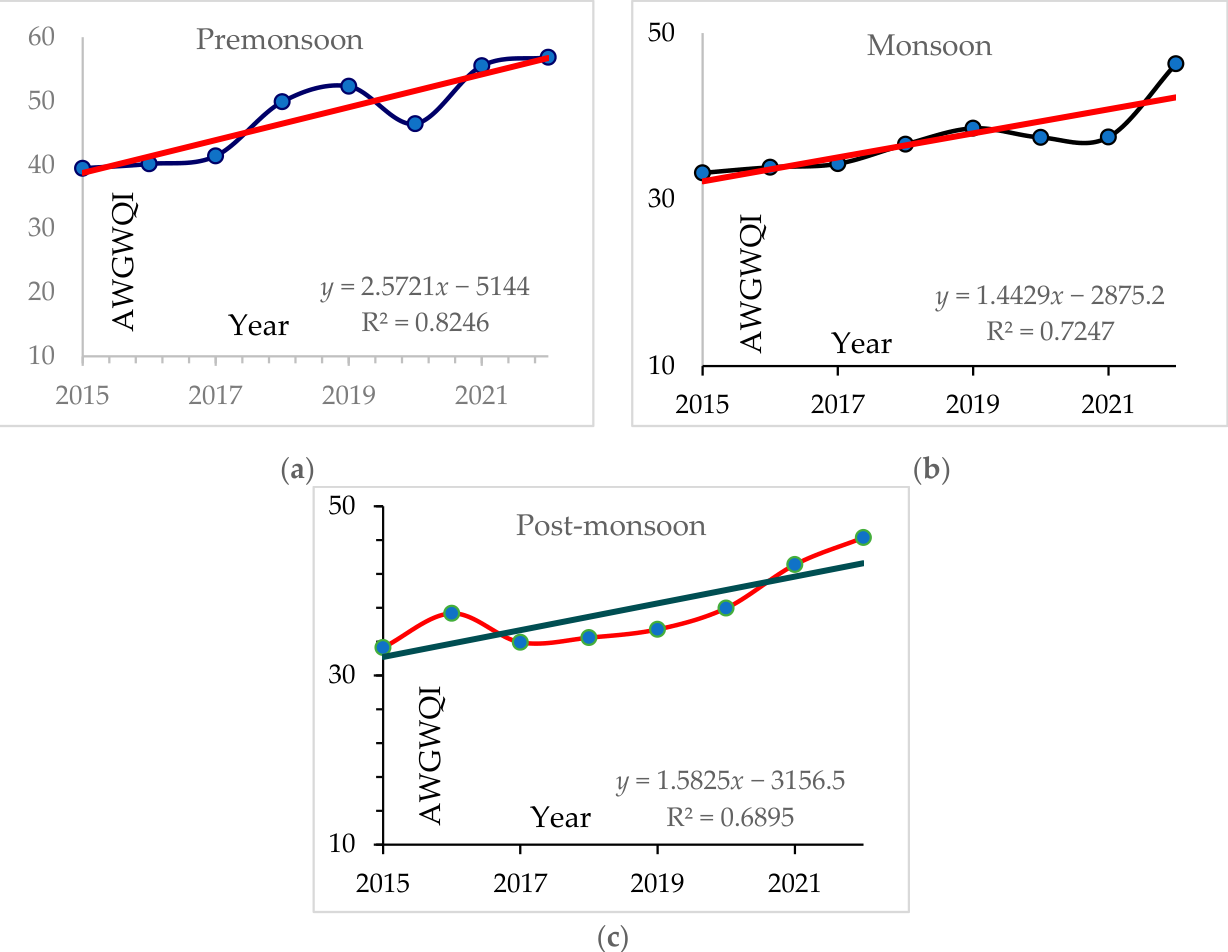
Based on the calculated WQI data from 2015 to 2022, the polynomial regression line is expressed in Figure 15a–c for pre-monsoon, monsoon, and post-monsoon. The coefficient of determination of pre-monsoon as per 15a is 0.51, which indicates a high fit of the model. The trendline of AWGWQI from 2015 to 2022. As per the trendline, the pre-monsoon AWGWQI in 2030 will be 63.66, signifying poor-quality water to drink. The coefficient of determination of the monsoon is 0.72, indicating an excellent fit. The trendline of GWQI from 2015 to 2022 in the monsoon season is expressed in Figure 15b. As per the trendline, the AWGWQI in 2030 will be 53.88, signifying poor-quality water to drink. The coefficient of determination in finding the trendline for post-monsoon is 0.68, indicating good fitting. The trendline of AWGWQI from 2015 to 2022 in the post-monsoon season is expressed in Figure 15c. As per the trendline, the AWGWQI in 2030 will be 55.97, signifying poor drinking. So, it is observed that GWQ is in a poor potability state in 2030, irrespective of seasons, which is a bigger concern. But GWQ will be poor to drink in 2030, creating the biggest worry. Figure 14 signifies a clear picture of the entire Figure 15a–c into a single Figure where the seasonal and year-wise analysis simulation of the GWQ status has been evaluated.
Figure 15.
Linear trendlines of AWGWQI during (a) pre-monsoon; (b) monsoon; (c) post-monsoon from 2015 to 2022.
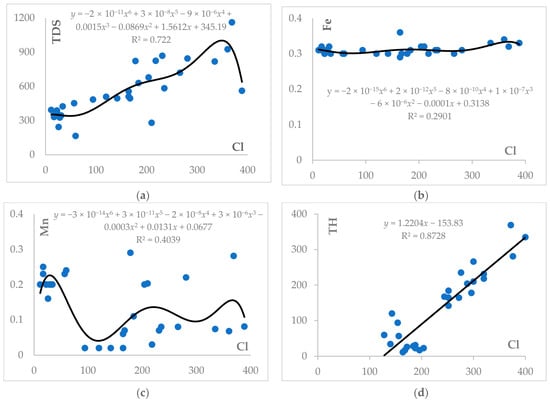
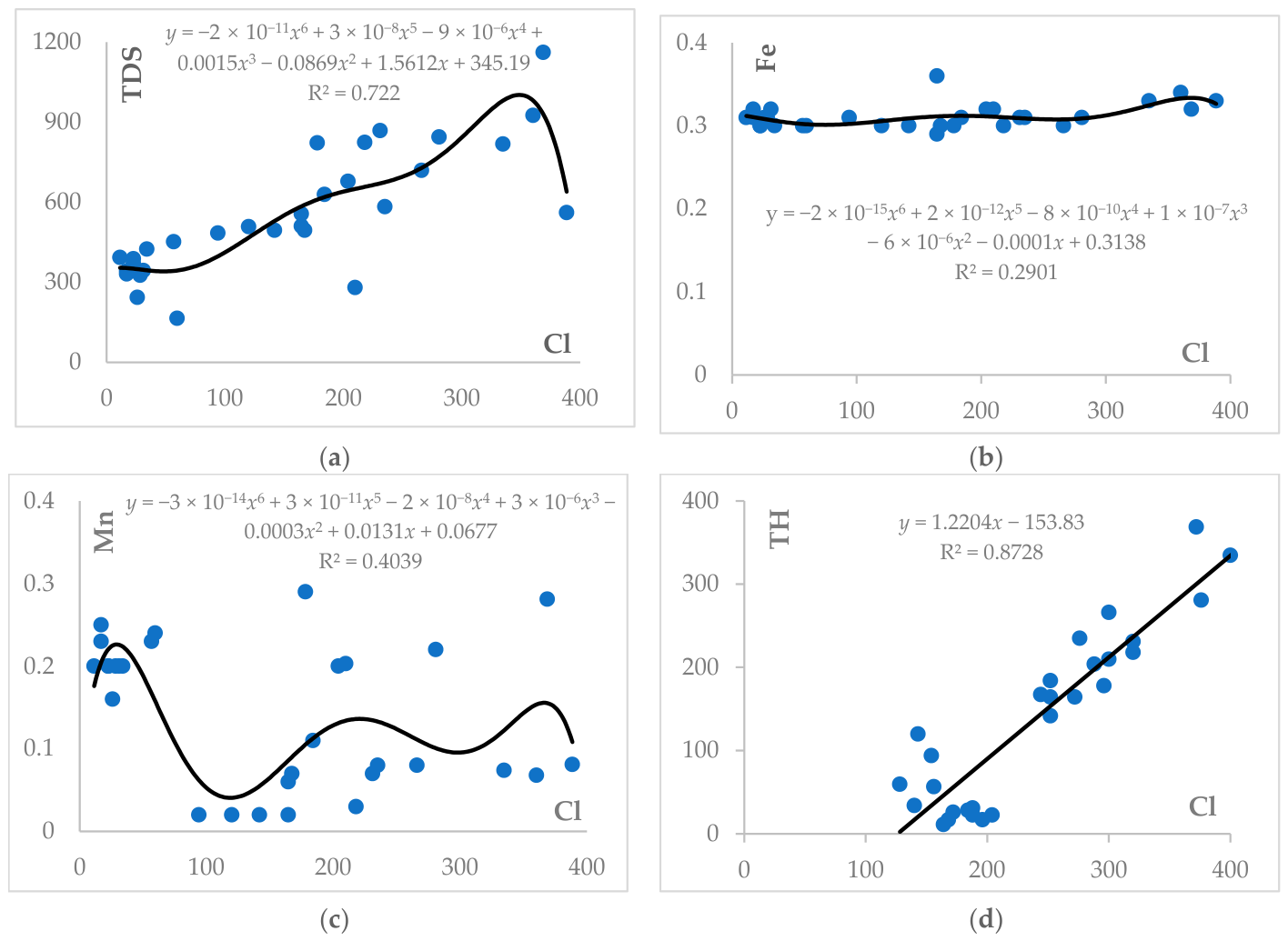
From the samples collected, a correlation matrix between all the GWQ physicochemical parameters of 2022 can be seen in Table 10. TDS and chloride have a strong correlation coefficient (=0.94), indicating that a higher TDS value implies a higher Cl value, so both of these parameters are closely linked. TH and Cl are also strongly correlated (0.89). Both of them represent strong factors of groundwater pollution.
Table 10.
Correlation matrix of physicochemical parameters of 2022.
A moderate correlation coefficient exists between TDS and Fe (0.47), indicating that a higher value of TDS may result in a high magnitude of Fe. An almost similar correlation coefficient exists between Mn and TH (=0.41). pH has a weak correlation coefficient with most of the parameters. pH acts as an independent indicator in the AWGWQI assessment. Based on Table 10, it is interpreted that maximum positive correlation exists between (i) TDS and Cl (0.94), (ii) Fe and Cl (0.49), (iii) Mn and Cl (0.45), and (iv) TH and Cl (0.89), directing high SWI in the study site. The relationship between these four highly dependent parameters is interpreted in Figure 16a–d for the year 2022 pre-monsoon, as it is the most polluted GW among all samples of the study tenure.
Figure 16.
Relationships between GWQ parameters (a) TDS; (b) Fe; (c) Mn; (d) TH in mg/L, with chloride possessing high positive correlation coefficients.
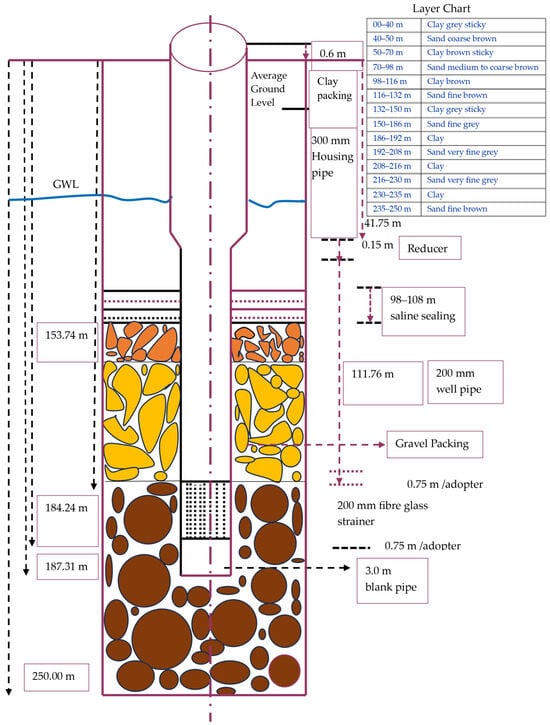
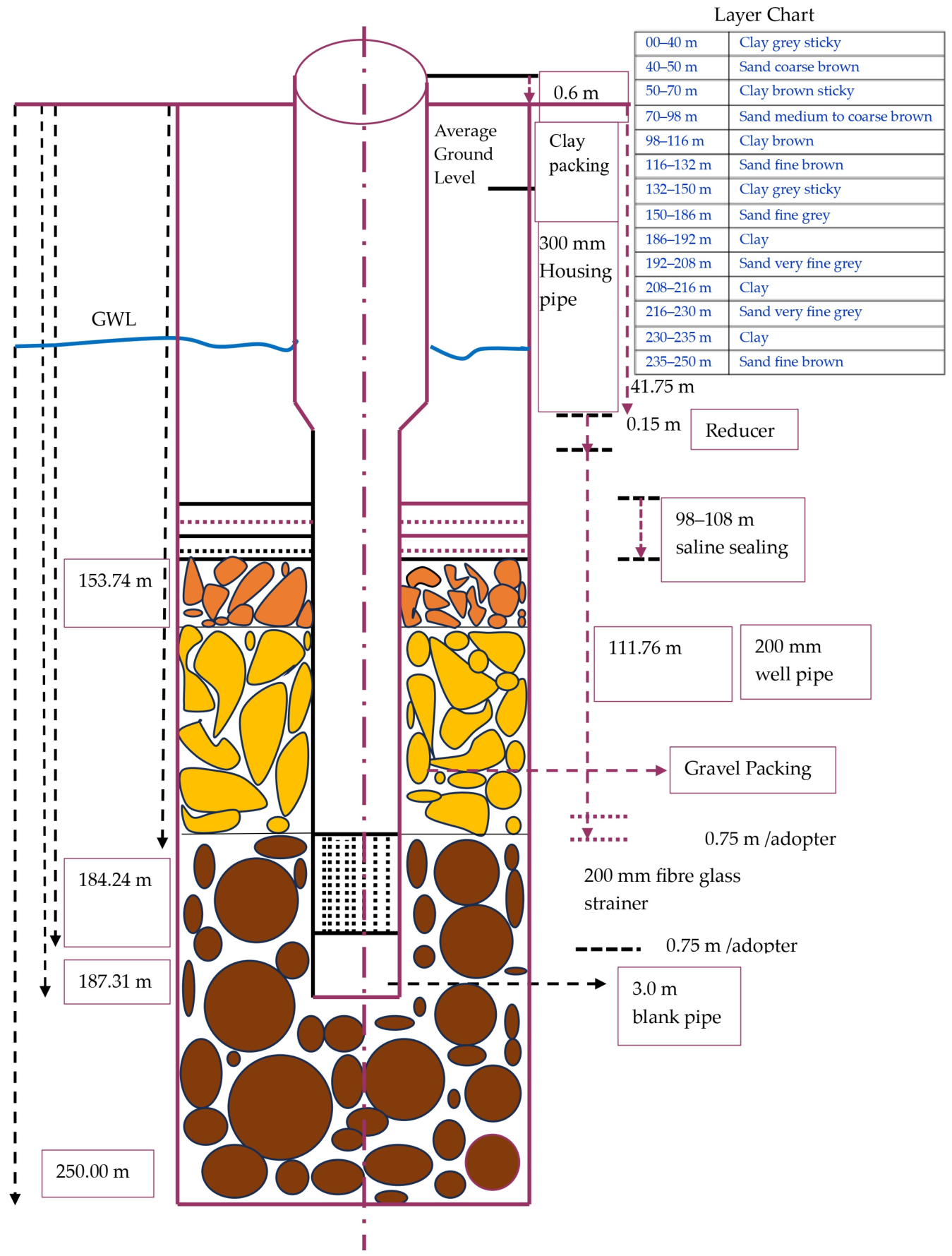
The coefficients of variation in TDS, Mn, TH, and Cl are very high in CPM because of their difference in spatial variability in pre-monsoon 2022. Therefore, although the R2 values in Mn and Cl and Fe and Cl are moderate, the trendline is a good fit. The other three relationships shown in Figure 15 are excellent, representing a true relationship between GWQ parameters. Since the GWQ will decline more with progressive time and will be of poor quality in 2030, it is pertinent to take remedial measures to prevent GW contamination by SWI and other refuse from distinct origins. The hydrogeologic map of the TW head work site in the w/s scheme for Shankarpur and adjoining mouzas within Ramnagar-I under Digha subdivision is indicated by Figure 17, indicating SWI into the aquifer from 40 to 98 m.
Figure 17.
Seawater and groundwater dynamics in Shankarpur under study site.
7. Remedial Measures
Mitigation of SWI demands appropriate measures to control or mitigate it [43]. Various mitigation practices are suggested, each having merits and demerits. Among the proposed measures, aquifer recharging by the positive hydraulic barrier is the most extensively adopted method [44]. The hydraulic head is increased by the method. The supplying portion of demand by overexploitation is relieved. The hydraulic gradient is maintained seaward, and even polluted water is flushed out. Distinct water sources are utilized, including desalinated seawater, lakes, rivers, stormwater, and wastewater after treatment [45].
Utilizing unconventional water resources to keep the water in an aquifer benefits the ecosystem, including passive purified wastewater and stormwater, reduction in evaporation loss, and reduced emissions of carbon during GWT rise and abated requirement of energy for pumping out groundwater [46,47]. However, there is a limitation of positive hydraulic barriers regarding the quantity of available water for recharge, which is a barrier to lessening SWI [48]. To overcome this problem, physical as well as hydraulic barriers can be combined [49]. Experimentally, it has been established that the injection of freshwater and cutoff walls improved the repulsion ratio of the suggested method from 22.39% to up to 45.4% [50]. This method helps to accelerate and improve the desalination of coastal aquifers. Sometimes, semi-permeable underground dams are provided to prevent SWI. But alone, this method is not sufficient to prevent SWI in mild seaward hydraulic gradient cases, even if the dam covers the aquifer thickness.
Combining hydraulic barriers with other distinct technologies is an important parameter for sustainable GW resources. CPM is a place where freshwater scarcity exists and constrains access to desalination and wastewater after treatment. In the research zone, a considerable amount of seawater encroaches on the mainland. It is also seen that freshwater is extracted more than brackish water by abstraction barriers, resulting in less GW flux. A new mitigation process, like the injection groundwater circulating well (Inj-GCW), can be suggested for the combination of injection wells and GCW to handle SWI. Injection of wastewater, which is treated and circulating groundwater, is promoted for sustainable management. The CPM aquifer is extremely deteriorated due to the consequence of salinization from SWI, mass fluxes from distinct origins such as riverine, network of waters, and return flows from irrigation. It has been estimated that 50% of isochlor reaching a considerable distance from wetlands will be the consequence. In the near future, worldwide SLR may increase by 0.45, resulting in an abstraction of GW three times greater. For this reason, a sustainable GW strategy is imperative.
The position of GCW with respect to the toe of the saltwater wedge interface has an important impact on SWI reduction, and on the salinity of the aquifer. Putting the injection well screen of GCW inside the saline wedge results in the creation of fresh as well as brackish bubbles of water, which have the capability to displace saline water. The efficiency capabilities of shallow injection wells have a repulsive property in the abatement of SWI. If the seaward hydraulic gradient becomes steeper, Inj-GCW performs better to abate SWI. All the remedial measures mentioned in the text will be much more effective in the future, such as in 2030. The aim of providing a hydraulic barrier is to repel the brackish water towards the BoB, which will also be effective in 2030. Check dams are tapping surface runoff in CPM, which can store the subsurface water in a cumulative manner, resulting in much less GWQ intensity in the future. It is expected that hybrid technology will be advanced in the future, generating a lower AWGWQI value, which can be lowered to good drinking water in 2030.
8. Limitations of the Study
This research relies on secondary data from PHED, Purba Medinipur, for the years 2016–2022, with some data from 2015 obtained from local subdivisions. Groundwater testing is restricted, leading to a reliance on 326 secondary data points. While the study lacks direct field-testing data, it presents a unique analysis on seasonal GWQ trends and remedial measures. It focuses mainly on physicochemical parameters of GWQ and does not consider bacterial contamination, which is important as well for assessing drinking water safety. Winter data is excluded for seasonal variation study purposes. Future predictions rely on a linear model that may not capture complex environmental changes. Other pollution sources, such as sewage and agricultural runoff, are not explored in detail.
9. Conclusions
SWI transpires because of the distinctions in salinity between freshwater and seawater. The aquifer of CPM has suffered a break in the chain in the natural equilibrium between freshwater and seawater, influencing the ecosystem. As a consequence, it has been observed that sea level rise (SLR) has taken place, and the exploitation of GW is more than the recharge. A positive pattern of SLR has been detected in the BoB since 1993. The combined trend of SLR and marine expansion shows a significantly increasing rate of 6.26 ± 1.29 mm/year, indicating a strong upward tendency. This trend is positively correlated with the overall SLR, which has been estimated at 4.36 ± 1.45 mm/year, signifying an average SLR increase rate, with a possible variation of ±1.29 mm/year with a wider uncertainty range. The positive correlation means that as marine expansion increases, SLR also increases invariably [51]. The study clearly demonstrates that groundwater quality in CPM is progressively deteriorating due to the combined impacts of seawater level rise, excessive groundwater abstraction, land use changes, and rapid population growth. Seasonal and temporal analyses (2015–2022) reveal that pre-monsoon conditions are the most vulnerable, with key parameters such as TDS, chloride, turbidity, iron, and manganese frequently approaching or exceeding permissible limits, thereby indicating intensified SWI. Although groundwater quality in 2022 remains largely within acceptable limits, model projections suggest a potential decline in potability by 2030 if current trends persist.
To address this challenge, the study proposes a set of integrated and sustainable remediation strategies. The newly introduced Inj-GCW method shows strong potential in controlling SWI by maintaining hydraulic balance and enhancing freshwater storage within the aquifer. In addition, structural interventions such as hydraulic barriers, subsurface dams, and artificial recharge through check dams can effectively counteract inverted hydraulic gradients and restrict saline water movement inland. The installation of approximately 150 additional check dams in CPM, beyond the existing ~500 in West Bengal, can significantly improve groundwater recharge and help push saline water back toward the sea.
Furthermore, the adoption of hybrid water treatment technologies, combining green pretreatment, electro dialysis, and reverse osmosis, offers a viable and economically adaptable solution for treating brackish groundwater. Compared to conventional methods like rainwater harvesting, these combined approaches are more effective in mitigating salinity intrusion and improving groundwater usability.
Overall, the study emphasizes that a combination of technological innovation, structural measures, and sustainable groundwater management practices is essential to protect coastal aquifers from SWI. With proper planning and implementation, it is possible to preserve groundwater quality, ensure long-term water security, and support ecological balance in CPM in alignment with Sustainable Development Goals.
Author Contributions
Conceptualization, methodology, investigation, S.C. and S.D.; data collection, formal analysis, validation and writing—original draft preparation: S.C.; supervision, resources, writing—review and editing, S.D. All authors have read and agreed to the published version of the manuscript.
Funding
This research received no external funding.
Data Availability Statement
The original contributions presented in this study are included in the article. Further inquiries can be directed to the corresponding author.
Conflicts of Interest
The authors declare no conflicts of interest.
References
- Moturi, W.N. Environmental Degradation’s Effect on the Gains Made in SDG6. In Clean Water and Sanitation; Leal Filho, W., Azul, A.M., Brandli, L., Lange Salvia, A., Wall, T., Eds.; Encyclopedia of the UN Sustainable Development Goals; Springer: Cham, Switzerland, 2022. [Google Scholar] [CrossRef] [Scilit]
- Roy, M.; Nilson, L.; Pal, P. Development of groundwater resources in a region with high population density: A study of environmental sustainability. Environ. Sci. 2008, 5, 251–267. [Google Scholar] [CrossRef] [Scilit]
- Chakraborty, S.; Rajak, S.; Das, S. The Contamination of Groundwater and Possible Remedial Measures in the Coastal Zone of Purba Medinipur, India. J. Coast. Conserv. 2023, 27, 29. [Google Scholar] [CrossRef] [Scilit]
- Dangar, S.; Asoka, A.; Mishra, V. Causes and implications of groundwater depletion in India: A review. J. Hydrol. 2021, 596, 126103. [Google Scholar] [CrossRef] [Scilit]
- Monir, M.M.; Sarker, S.C.; Islam, A.R.M.T. A critical review on groundwater level depletion monitoring based on GIS and data-driven models: Global perspectives and future challenges. HydroResearch 2024, 7, 285–300. [Google Scholar] [CrossRef] [Scilit]
- Giri, S. A Case Study: Ground Water Scarcity and Management in Egra-II Block of Purba Medinipur District, West Bengal, India. Int. J. Soc. Sci. Econ. Res. 2018, 3, 3435–3446. [Google Scholar]
- Tegegne, A.M.; Lohani, T.K.; Eshete, A.A. Evaluation of groundwater quality for drinking and irrigation purposes using proxy indices in the Gunabay watershed, Upper Blue Nile Basin, Ethiopia. Heliyon 2023, 9, e15263. [Google Scholar] [CrossRef] [Scilit] [PubMed]
- Chakraborty, S.; Maity, P.K.; John, B.; Das, S. Overexploitation Of Groundwater Causing Seawater Intrusion in the Coastal Aquifer of Egra in West Bengal. Indian J. Environ. Prot. 2020, 40, 413–423. [Google Scholar]
- BIS 10500:2012; Drinking Water Specification (Second Revision). Bureau of Indian Standards: New Delhi, India, 2012.
- Sajib, A.M.; Bamal, A.; Diganta, M.T.M.; Ashekuzzaman, S.S.S.M.; Rahman, A.; Olbert, A.I.; Uddin, M.G. Novel groundwater quality index (GWQI) model: A reliable approach for the assessment of groundwater. Results Eng. 2025, 25, 104265. [Google Scholar] [CrossRef] [Scilit]
- Arroyo-Figueroa, C.; Chalá, D.C.; Gutiérrez-Ribon, G.; Quiñones-Bolaños, E. A Framework to Evaluate Groundwater Quality and the Relationship between Rock Weathering and Groundwater Hydrogeochemistry in the Tropical Zone: A Case Study of Coastal Aquifer Arroyo Grande, in the Caribbean Region of Colombia. Water 2024, 16, 1650. [Google Scholar] [CrossRef] [Scilit]
- Panja, S.; Mukhopadhyay, S. Rainfall Variability and Its Impact on Crop Calendar of Rain-fed Rice Cultivation in East Coast of India: A Study of Purba Medinipur Coastal Area, West Bengal, India. Int. J. Biol. Pharm. Allied Sci. 2022, 11, 815–841. [Google Scholar] [CrossRef] [Scilit]
- Spane, F.A. Considering barometric pressure in groundwater flow investigations. Water Resour. Res. 2002, 38, 1078. [Google Scholar] [CrossRef] [Scilit]
- Du, J.; Yang, W.; Yang, Q.; Li, Y.; Wan, X.; Zhu, A.; He, Z.; Shrestha, R.P.; Razzaq, A. Assessment and Seasonal Monitoring of Groundwater Quality in Landfill-Affected Regions of China: Findings from Xiangyang. Water 2025, 17, 572. [Google Scholar] [CrossRef] [Scilit]
- District Survey Report (DSR) for Purba Medinipur District, West Bengal. 2016. Available online: http://www.dmm.gov.in/pdfs/DSR/DSR_of_Purba_Medinipur.pdf (accessed on 14 April 2026).
- Maity, P.K.; Das, S.; Das, R. A geochemical investigation and control management of saline water intrusion in the coastal aquifer of Purba Midnapur district in West Bengal, India. J. Indian Chem. Soc. 2018, 95, 205–210. [Google Scholar]
- CGWB. Report on the Dynamic Ground Water Resources of West Bengal as of 31st March. 2022. Available online: https://cgwb.gov.in/old_website/GW-Assessment/GWR-2022Reports%20State/Wst%20Bengal.pdf (accessed on 14 April 2026).
- Chakraborty, S.; John, B.; Das, S.; Maity, P. Examining the extent of seawater intrusion from groundwater quality analysis at Purba Medinipur coast of India. J. Indian Chem. Soc. 2020, 97, 587–594. [Google Scholar]
- Hölting, B.; Coldewey, G.C. Einführung in die Allgemeine und Angewandte Hydrogeologie, 8th ed.; Springer Spektrum: Berlin/Heidelberg, Germany, 2019. [Google Scholar] [CrossRef] [Scilit]
- Chakraborty, S.; Maity, P.K.; Das, S. Investigation, simulation, identification and prediction of groundwater levels in coastal areas of Purba Midnapur, India, using MODFLOW. Environ. Dev. Sustain. 2020, 22, 3805–3837. [Google Scholar] [CrossRef] [Scilit]
- Perdikaki, M.; Chrysanthopoulos, E.; Markantonis, K.; Kallioras, A. Groundwater Flow Model Calibration Using Variable Density Modeling for Coastal Aquifer Management. Hydrology 2024, 11, 59. [Google Scholar] [CrossRef] [Scilit]
- Xie, Q.; Liu, J.; Han, B.; Li, H.; Li, Y.; Li, X. Critical Hydraulic Gradient of Internal Erosion at the Soil–Structure Interface. Processes 2018, 6, 92. [Google Scholar] [CrossRef] [Scilit]
- Bera, P.; Modak, B.K.; Mandi, S.; Modak, P.; Mandal, M. Chronological variation of land use and land cover of coastal West Bengal. J. Sci. Enq. 2022, 2, 6–9. [Google Scholar] [CrossRef] [Scilit]
- Das, S.R.; Das, S.; Panda, S. Groundwater quality monitoring by correlation, regression and hierarchical clustering analyses using WQI and PAST tools. Groundw. Sustain. Dev. 2022, 16, 100708. [Google Scholar] [CrossRef] [Scilit]
- Meyssignac, B.; Cazenave, A. Sea level: A review of present-day and recent-past changes and variability. J. Geodyn. 2012, 58, 96–109. [Google Scholar] [CrossRef] [Scilit]
- Dim, J.R.; Chikita, K.A. Impact of Groundwater Level Decrease and Sea Level Fluctuations on Potential Saltwater Intrusion in the Subsurface Coastal Area of West Hokkaido, Japan. In Proceedings of the International Symposium on “Dawn of a New Natural History—Integration of Geoscience and Biodiversity Studies”, Sapporo, Japan, 5–6 March 2004; pp. 165–174. Available online: https://eprints.lib.hokudai.ac.jp/repo/huscap/all/38523/ (accessed on 14 April 2026).
- WHO. Guideline of Drinking Water Specification, World Health Organization. Updated in 2019. Available online: https://cpcb.nic.in/who-guidelines-for-drinking-water-quality/ (accessed on 14 April 2026).
- CPCB. Best Designated Use of Water. Central Pollution Control Board, India. 2019. Available online: https://cpcb.nic.in/wqm/Designated_Best_Use_Water_Quality_Criteria.pdf (accessed on 14 April 2026).
- Abanyie, S.K.; Apea, O.B.; Abagale, S.A.; Amuah, E.E.Y.; Sunkari, E.D. Sources and factors influencing groundwater quality and associated health implications: A review. Emerg. Contam. 2023, 9, 100207. [Google Scholar] [CrossRef] [Scilit]
- Uddin, M.G.; Nash, S.; Olbert, A.I. A review of water quality index models and their use for assessing surface water quality. Ecol. Indic. 2021, 122, 107218. [Google Scholar] [CrossRef] [Scilit]
- Dey, S.; Botta, S.; Kallam, R.; Angadala, R.; Andugala, J. Seasonal variation in water quality parameters of Gudlavalleru Engineering College Pond. Curr. Res. Green Sustain. Chem. 2021, 4, 100058. [Google Scholar] [CrossRef] [Scilit]
- Szabo, Z.; dePaul, V.T.; Fischer, J.M.; Kraemer, T.F.; Jacobsen, E. Occurrence and geochemistry of radium in water from principal drinking-water aquifer systems of the United States. Appl. Geochem. 2012, 27, 729–752. [Google Scholar] [CrossRef] [Scilit]
- Hassanpour, H.; Sadeghi, M.H.; Rasti, A.; Shajari, S. Investigation of Surface Roughness, Microhardness and White Layer Thickness in Hard Milling of AISI 4340 Using Minimum Quantity Lubrication. J. Clean. Prod. 2015, 120, 124–134. [Google Scholar] [CrossRef] [Scilit]
- Mohammad, A.H.; Abdullat, G.; Alzughoul, K. Changes in Total Dissolved Solids Concentration during Infiltration through Soils (Rain, Fresh Groundwater and Treated Wastewater). J. Environ. Prot. 2017, 8, 34–41. [Google Scholar] [CrossRef]
- Fahimah, N.; Salami, I.R.S.; Oginawati, K.; Thaher, Y.N. Variations of groundwater turbidity in the Bandung regency, Indonesia: From community-used water quality monitoring data. HydroResearch 2023, 6, 216–227. [Google Scholar] [CrossRef] [Scilit]
- Haque, M.E.; Zahan, R.N.; Reza, S. Iron in groundwater: Quality evaluation, health risk, and spatial distribution in Rangpur City Corporation. Arab. J. Geosci. 2021, 14, 550. [Google Scholar] [CrossRef] [Scilit]
- Zhu, L.; Han, Y.; Zhang, C.; Zhao, R.; Tang, S. Molecular dynamics simulation for the impact of an electrostatic field and impurity Mg2+ ions on hard water. RSC Adv. 2017, 7, 47583–47591. [Google Scholar] [CrossRef] [Scilit]
- Zhang, S.; Han, Y.; Peng, J.; Chen, Y.; Zhan, L.; Li, J. Human health risk assessment for contaminated sites: A retrospective review. Environ. Int. 2023, 171, 107700. [Google Scholar] [CrossRef] [Scilit]
- Kannan, D.; Mani, N. Hardness (Ca2+, Mg2+) uptake from ground water by activated Phyllanthus emblica wood powder. Int. J. Pharm. Sci. Res. 2019, 6, 374–381. [Google Scholar]
- Mohsen, I.H.; Mohsen, A.H.; Zaidan, H.K. Health Effects of Chlorinated Water: A Review Article. Pak. J. Biotechnol. 2019, 16, 263–267. [Google Scholar]
- Manikandan, E.; Rajmohan, N.; Anbazhagan, S. Monsoon impact on groundwater chemistry and geochemical processes in the shallow hard rock aquifer. Catena 2016, 195, 104766. [Google Scholar] [CrossRef] [Scilit]
- Re, V.; Sacchi, E.; Mas-Pla, J.; Menció, A.; Amrani, N.E. Identifying the effects of human pressure on groundwater quality to support water management strategies in coastal regions: A multi-tracer and statistical approach (Bou-Areg region, Morocco). Sci. Total Environ. 2014, 500–501, 211–223. [Google Scholar] [CrossRef] [Scilit]
- Kumar, R.; Singh, S.; Kumar, S.; Sharma, P. Groundwater Quality Characterization for Safe Drinking Water Supply in Sheikhpura District of Bihar, India: A Geospatial Approach. Front. Water 2022, 4, 848018. [Google Scholar] [CrossRef] [Scilit]
- Saad, S.; Javadi, A.A.; Chugh, T.; Farmani, R. Optimal management of mixed hydraulic barriers in coastal aquifers using multi-objective Bayesian optimization. J. Hydrol. 2022, 612, 128021. [Google Scholar] [CrossRef] [Scilit]
- Quon, H.; Jiang, S. Decision making for implementing non-traditional water sources: A review of challenges and potential solutions. npj Clean Water 2023, 6, 56. [Google Scholar] [CrossRef] [Scilit]
- Qadir, M.; Sharma, B.R.; Bruggeman, A.; Choukr-Allah, R.; Karajeh, F. Non-conventional water resources and opportunities for water augmentation to achieve food security in water scarce countries. Agric. Water Manag. 2007, 87, 2–22. [Google Scholar] [CrossRef] [Scilit]
- Dillon, P.; Arshad, M. Managed Aquifer Recharge in Integrated Water Resource Management. In Integrated Groundwater Management; Jakeman, A.J., Barreteau, O., Hunt, R.J., Rinaudo, J.D., Ross, A., Eds.; Springer: Cham, Switzerland, 2016. [Google Scholar] [CrossRef] [Scilit]
- Ebeling, P.; Händel, F.; Walther, M. Potential of mixed hydraulic barriers to remediate seawater intrusion. Sci. Total Environ. 2019, 693, 133478. [Google Scholar] [CrossRef] [Scilit]
- Pool, M.; Carrera, J. Dynamics of negative hydraulic barriers to prevent seawater intrusion. Hydrogeol. J. 2010, 18, 95–105. [Google Scholar] [CrossRef] [Scilit]
- Nakagawa, K.; Momii, K.; Roger, L.J. Effective Location of Injection Wells and Cutoff Walls for Controlling Seawater Intrusion. In Proceedings of the 17th Congress of the Asia-Pacific Division of the International Association of Hydraulic Engineering and Research, Auckland, New Zealand, 21–24 February 2010. [Google Scholar]
- Ghosh, S.; Hazra, S.; Nandy, S.; Mondal, P.P.; Watham, T.; Kushwaha, S.P.S. Trends of sea level in the Bay of Bengal using altimetry and other complementary techniques. J. Spat. Sci. 2017, 63, 49–62. [Google Scholar] [CrossRef] [Scilit]

Disclaimer/Publisher’s Note: The statements, opinions and data contained in all publications are solely those of the individual author(s) and contributor(s) and not of MDPI and/or the editor(s). MDPI and/or the editor(s) disclaim responsibility for any injury to people or property resulting from any ideas, methods, instructions or products referred to in the content. |
© 2026 by the authors. Licensee MDPI, Basel, Switzerland. This article is an open access article distributed under the terms and conditions of the Creative Commons Attribution (CC BY) license.