Article

Measurement-Based Framework for Real-Time Flood Prediction in Small Streams Using Rainfall–Discharge Nomographs and Depth–Discharge Rating Curves


1
National Disaster Management Institute, Ministry of Interior and Safety, Ulsan 44538, Republic of Korea
2
Korea Geological Survey (KOGS), Yongin 16905, Republic of Korea
*
Author to whom correspondence should be addressed.
Water 2026, 18(9), 1107; https://doi.org/10.3390/w18091107
Submission received: 24 March 2026 / Revised: 23 April 2026 / Accepted: 2 May 2026 / Published: 5 May 2026
(This article belongs to the Section Hydrology)

Abstract

Small streams exhibit rapid and nonlinear flood responses due to steep slopes, short flow paths, and limited storage capacity, making real-time flood prediction difficult under both computational and data constraints. This study presents a measurement-based flood prediction framework for real-time estimation of flood discharge and depth in small-stream basins. Conventional approaches, such as physically based hydrodynamic models, require detailed boundary conditions and high computational cost, while data-driven models often lack physical interpretability. The proposed framework integrates high-frequency monitoring data from the Small-Stream Smart Monitoring System, short-term rainfall nowcasting from the MAPLE system, and nonlinear regression-based hydraulic relationships within a unified operational structure. Rainfall–discharge nomographs and depth–discharge rating curves were developed using a four-parameter logistic regression model based on long-term observations from 12 small streams in Korea. Additional comparisons with alternative regression forms confirmed the suitability of the 4PL model for representing nonlinear hydrological responses. Forecast rainfall was used to estimate discharge, which was subsequently converted to flood depth through calibrated rating curves. For ungauged reaches, depth–discharge relationships were derived using HEC–RAS-based scenario simulations and the Manning equation to enable spatially continuous prediction along stream networks. Model performance was evaluated using independent validation events, showing mean prediction accuracies of approximately 89% for discharge and 90% for flood depth. The framework reduces computational demand by relying on pre-established relationships while maintaining physically interpretable structures. The results indicate that the proposed approach can support real-time flood prediction in small streams under conditions like those examined in this study, although its applicability to other regions requires site-specific calibration and further validation.

1. Introduction

Localized extreme rainfall has increased in both intensity and frequency in recent years, leading to growing flood damage in small-stream basins. These streams are typically located in upstream areas and are characterized by steep bed slopes, short flow paths, narrow channel sections, and rapidly varying hydraulic conditions. Such characteristics accelerate flood wave propagation and increase the risk of sudden flow hazards, contributing to a high proportion of flood-related casualties. Recent studies have highlighted the seriousness of flood hazards in small streams. Previous studies have reported that approximately 42.3% of flood-related fatalities within river basins in Korea occurred in small streams [1]. In addition, economic losses of about USD 193 million were recorded in 5013 small streams between 2020 and 2024, accounting for 22.7% of the national total. Despite these increasing risks, operational flood forecasting and warning systems have primarily focused on larger downstream rivers, while small-stream basins remain relatively underrepresented.
Flood forecasting has traditionally relied on physically based hydrodynamic models, such as HEC–RAS, which can represent flow dynamics under various boundary conditions. However, their direct application to small streams is often limited. Irregular channel geometry and steep longitudinal slopes increase sensitivity to model parameters and boundary conditions during flood events, which can reduce numerical stability and simulation reliability [2,3,4,5]. In addition, discharge and flow velocity in small streams can change rapidly over short time scales, requiring fine spatial discretization and short computational time steps for accurate simulation [6]. These requirements increase computational cost and limit the feasibility of real-time forecasting under rapidly changing hydrological conditions [7,8,9]. Data-driven and machine learning approaches have also been widely explored as alternatives for flood prediction. These methods can capture nonlinear relationships in hydrological data and can be efficiently applied once trained. However, they often require large training datasets and may lack physical interpretability, which can limit their reliability in operational settings, particularly when extrapolating beyond observed conditions. In small-stream environments, the availability of long-term, high-quality datasets remains limited, particularly for extreme events. For this reason, the present study focuses on a measurement-based framework using physically interpretable relationships, while future work will explore the application of machine learning approaches as more observational data become available.
These limitations have led to increasing interest in measurement-based approaches that directly utilize real-time observational data. Such approaches can reduce model complexity while maintaining consistency with observed hydrological behavior. A practical measurement-based forecasting system requires: (i) prediction models that are computationally efficient while maintaining acceptable accuracy, (ii) integration with real-time monitoring systems for continuous data acquisition, and (iii) a stable framework for data processing and management. Long-term monitoring data are particularly important in small-stream basins, where rainfall–runoff responses exhibit strong temporal and spatial variability. Observations covering a wide range of rainfall conditions improve the robustness of empirical relationships and support more reliable prediction [10,11]. In this study, a measurement-based flood prediction framework is developed by integrating high-frequency monitoring data from the Small-Stream Smart Monitoring System (SMMS), short-term rainfall nowcasting from the MAPLE system, and nonlinear regression-based hydraulic relationships. Rainfall–discharge nomographs and depth–discharge rating curves are constructed using a four-parameter logistic (4PL) regression model based on long-term observations from 12 small streams in Korea. The framework is designed to estimate discharge from forecast rainfall and subsequently derive flood depth through calibrated relationships.
Unlike approaches that apply individual components independently, the proposed framework combines observation data, rainfall forecasting, and regression-based hydraulic relationships within a single operational structure tailored to small-stream environments. In the early stage of this study, several alternative approaches were examined, including physically based hydraulic models and conventional regression formulations. However, physically based models often showed numerical instability when applied to small streams with steep slopes and short flow paths, while simpler hydrologic approaches tended to overestimate peak discharge and showed limitations in representing rapid response behavior. To address these limitations, various regression forms, including linear, polynomial, exponential, and power-law models, were tested using a nomograph-based framework. The results indicated that these formulations were insufficient to represent the nonlinear response characteristics observed in small streams. This structure enables rapid estimation of flood conditions while maintaining physically interpretable relationships. In addition, the framework extends prediction beyond monitoring locations by incorporating depth–discharge relationships for ungauged reaches derived from HEC–RAS scenario simulations and the Manning equation.
The objective of this study is to develop and evaluate a practical flood prediction framework for small streams that can support real-time estimation of discharge and flood depth using observational data and simplified hydraulic relationships. The applicability and limitations of the proposed approach are examined using data from 12 monitored small-stream basins in Korea.

2. Materials and Methods

2.1. Selection of Test-Bed Small Streams

To support the development and validation of the flood prediction model, the research used real-time observational data collected from the SMMS. Unlike conventional in situ measurement methods, the SMMS uses image- and radar-based non-contact techniques to continuously monitor surface velocity distributions and to automatically estimate discharge in real time [7,12,13,14]. The measured flood depth and discharge data were incorporated directly into the prediction framework for calibration and validation, thereby improving forecasting reliability [1,15,16,17]. Previous studies have shown that observation-based flood forecasting can provide rapid and accurate estimates of flood wave propagation and inundation potential in river systems [10,18,19].
At the time of this study, the Ministry of the Interior and Safety and local governments in Korea had deployed the SMMS at approximately 880 locations, with a long-term plan to install the system in about 2200 small streams, corresponding to roughly 10% of the 22,300 small streams nationwide [20]. For model development and evaluation, twelve test-bed small streams with observational records longer than three years were selected. Flood depth and discharge were available at 2 min intervals for all selected sites. The test-bed streams were Insu, Neungmac, Bekam, Songnam, Balmak, Jungdong, Jumsil, Gumanri, Daemi, Gwangdong, Jungsunpil, and Sunjang. The average longitudinal slope of the 12 streams was 0.029, indicating relatively steep hydraulic conditions. Their mean channel length was 2.34 km, which reflects the short spatial scale typical of small streams. Channel width ranged from 6.80 to 24.0 m, with an average of 15.62 m, confirming the narrow channel characteristics of the study sites [20]. Channel slope and geometric characteristics were derived from surveyed cross-sectional data provided in the Comprehensive Small-Stream Maintenance Plan reports. These parameters were used as input for both Manning-based calculations and HEC–RAS simulations.
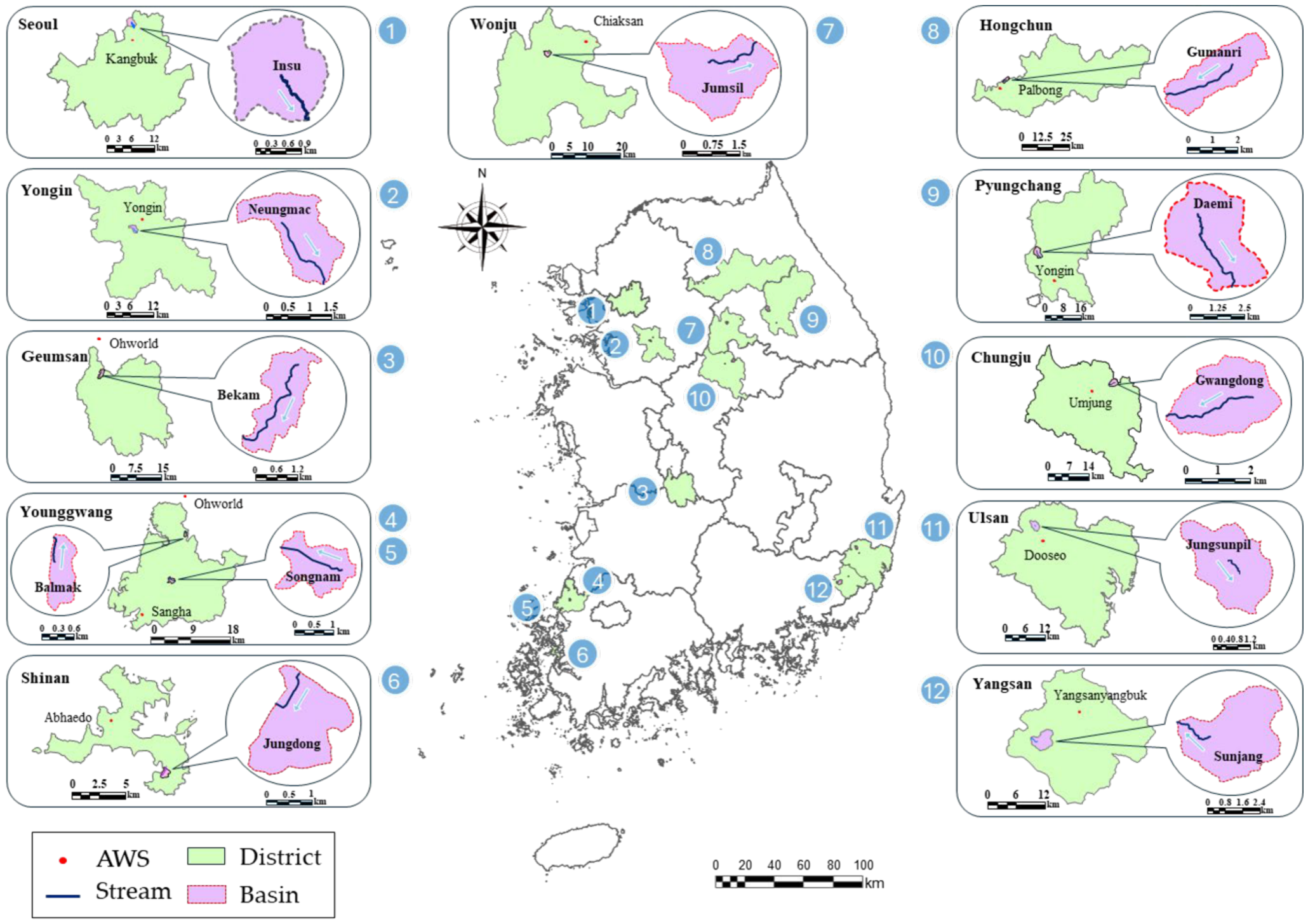
Rainfall input data were obtained from the Automated Weather Station (AWS) network operated by the Korea Meteorological Administration (KMA). More than 510 AWSs are operated nationwide to provide continuous meteorological observations for disaster prevention and early warning. These stations offer detailed temporal and spatial information on rainfall distribution, thereby supporting rainfall-based forecasting systems [21]. In this study, minute-scale rainfall data from the AWS station nearest to each SMMS-equipped stream were selected and incorporated into the modeling framework. The monitoring locations, SMMS installation information, basin area ( A b ), channel length ( L c ), channel width ( W ), channel slope ( S ), roughness coefficient ( n ), designed discharge ( Q d ), designed depth ( D d ), and the distance between each stream and the nearest AWS station ( D s ) are summarized in Table 1.
As shown in Figure 1, watershed areas and channel lengths were delineated from satellite imagery by defining the upstream and downstream boundaries of each stream. GIS tools were then used to derive watershed slope and topographic characteristics to ensure that basin geometry was represented consistently.
In addition to observation quality, the reliability of forecast rainfall was also critical for accurate flood prediction in small streams, as emphasized in recent studies on short-term rainfall forecasting for flood modeling and early warning [1,22,23]. The KMA estimates short-term rainfall movement and variability using AWS observations and weather radar data, which have been shown to improve nowcasting performance in hydrological applications [24]. Based on this system, the KMA provides gridded rainfall forecasts nationwide at 10 min intervals with lead times of up to 6 h. In this study, these forecast rainfall data were used to support proactive flood response in small-stream watersheds [25,26].
For model development and validation, flood depth, discharge, and rainfall data were collected from the SMMS and AWS networks from 2016, when the first monitoring system was installed, through 2025. Summary statistics of the collected data are presented in Table 2. Because the selected streams are largely ephemeral during dry periods, minimum values were excluded to focus on hydrologically meaningful conditions relevant to flood analysis and model evaluation [1,27]. Across the test-bed watersheds, mean annual rainfall ranged from 1180.1 to 1588.2 mm. Rainfall was concentrated mainly during the summer season from June to September, consistent with recent analyses of sub-daily heavy rainfall characteristics in Korea based on dense surface observations [28].
As shown in Table 2, the maximum 1 h rainfall intensity varied substantially among the study streams, ranging from 33.5 m m / h at Jumsil stream to 95.8 m m / h at Sunjang stream. This pattern is consistent with previous findings that short-duration extreme rainfall in Korea exhibits marked regional and seasonal heterogeneity [29]. Peak discharge, which is commonly used to characterize rainfall–runoff behavior in small basins, ranged from 4.98 m 3 / s at Jungdong stream to 210.3 m 3 / s at Sunjang stream. This wide range reflects the rapid and highly nonlinear hydrologic and hydraulic responses typical of small streams and further supports the need for data-driven, real-time forecasting frameworks based on high-frequency monitoring data [10].
A similarly wide range was observed for peak flow depth, from 0.46 m at Balmak stream to 2.45 m at Sunjang stream. These results underscore the importance of site-specific early warning strategies supported by observed hydraulic data. The mean and maximum values summarized in Table 2 provide useful baseline information for interpreting flood magnitude and flow regime characteristics in the test-bed streams and for supporting event-scale model calibration and validation [1].

2.2. Data Collection and Analysis

To utilize high-frequency monitoring data in real time, a Flood Early Warning Platform (FEWP) was developed to collect, store, and process rainfall, water level, and discharge data from the SMMS and AWS networks. The platform automatically acquires data at regular intervals and stores them in a structured database for subsequent analysis and model application [30,31]. Previous studies have shown that real-time integration of sensor networks with hydrometeorological monitoring systems reduces data latency and supports operational early warning [32,33].
A regression-based flood prediction module was developed and integrated into the FEWP to establish a unified operational workflow linking real-time observational data streams with predictive analytics. This integration enabled faster dissemination of forecast information on flood occurrence and potential impacts to decision-makers and stakeholders [30,34]. The FEWP integrates data acquisition, processing, and prediction within a single workflow. Observed rainfall, water level, and discharge data are collected and quality-controlled and then used as input for the rainfall–discharge and depth–discharge relationships developed in this study. The platform also incorporates forecast rainfall data from the MAPLE nowcasting system, allowing discharge and flood depth to be estimated in near real time. In this study, the prediction module refers to the implementation of regression-based relationships and data processing procedures within the platform, rather than an independent machine learning model. The framework relies on empirical relationships derived from the observed data, which are directly applied to incoming real-time data streams. By combining data acquisition, processing, and model execution within a unified system, the FEWP enables rapid estimation of flood conditions and supports timely information delivery for early warning. Such integration of real-time data and prediction procedures has been identified as an essential component of operational flood forecasting systems, particularly in environments with dense monitoring networks [30,33].

3. Flood Prediction Methods and Procedure

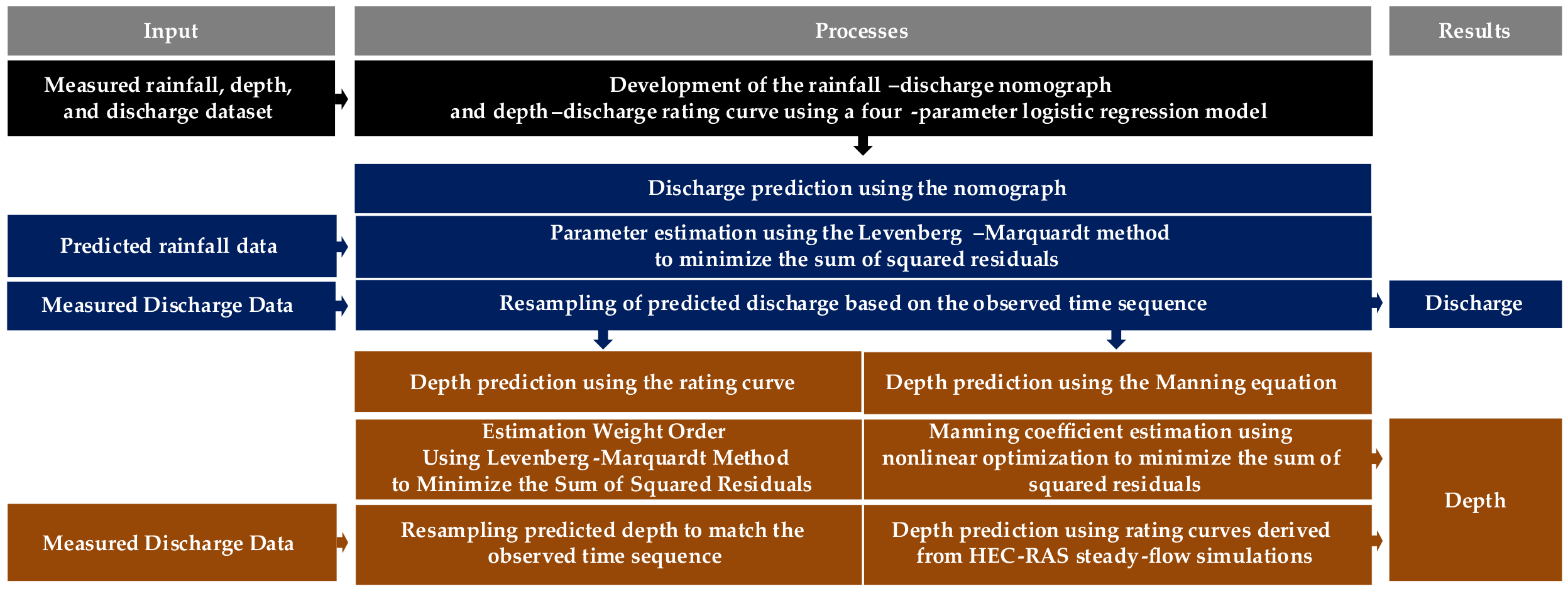
Flood forecasting in small streams requires rapid model execution to provide actionable lead time despite short watershed response times and high-flow velocities [10,35]. To estimate both discharge and flood depth, this study developed separate but linked procedures for gauged and ungauged reaches, as illustrated in Figure 2.
For gauged reaches, the relationship between peak rainfall intensity observed at nearby AWSs and peak discharge measured by the SMMS was analyzed. Based on this relationship, a four-parameter rainfall–discharge nomograph was established as expressed in Equation (1).
Q = m 1 + m 2 m 1 1 + R / m 3 m 4 ,
in which Q denotes observed flood discharge, R denotes observed rainfall intensity, and m 1 , m 2 , m 3 , and m 4 are parameters estimated using a nonlinear optimization technique. A 60 min rainfall intensity was adopted because the time of concentration for many small streams is approximately one hour [7].
The observed rainfall and discharge records were separated into individual flood events, and the temporal distribution of each event was examined. For each event, the peak rainfall intensity and corresponding peak discharge were extracted and treated as one rainfall–discharge pair. Repeating this procedure for all identified events produced the dataset required to calibrate the rainfall–discharge nomograph through nonlinear optimization. Similar relationships have long been used as practical tools for converting hydrological input into discharge estimates [2,7,36,37,38].

3.1. Method for Gauged Reaches

Flood depth at gauged reaches was estimated using a four-parameter depth–discharge rating curve, as expressed in Equation (2), developed from the relationship between observed peak discharge and peak flood depth.
D = n 1 + n 2 n 1 1 + Q / n 3 n 4 ,
in which D is the observed flood depth, and n 1 , n 2 , n 3 , and n 4 are parameters estimated using a nonlinear optimization technique. To construct this relationship, the observed discharge and flood depth records were also separated into individual flood events, and the peak discharge and corresponding peak depth were extracted for each event. These peak pairs were then used in nonlinear regression to derive the depth–discharge rating curve. Such rating curves provide a concise representation of hydraulic response and are widely used to estimate flood depth from discharge [1,2,39,40].
To estimate discharge and depth using the nomograph and rating curve, an objective function was defined to minimize the difference between observed and predicted values, as expressed in Equation (3).
F ( x ) = t y t y t ^ 2 ,
in which F(x) denotes the optimal predicted value, y t represents the observed value at time t , and y t ^ indicates the predicted value at time t . Real-time forecast rainfall from the KMA MAPLE nowcasting system was used as the input for the rainfall–discharge nomograph. Forecast rainfall intensities were extracted from the same grid cells corresponding to the AWS locations used during model calibration. The resulting predicted discharge was then converted into flood depth through the depth–discharge rating curve.
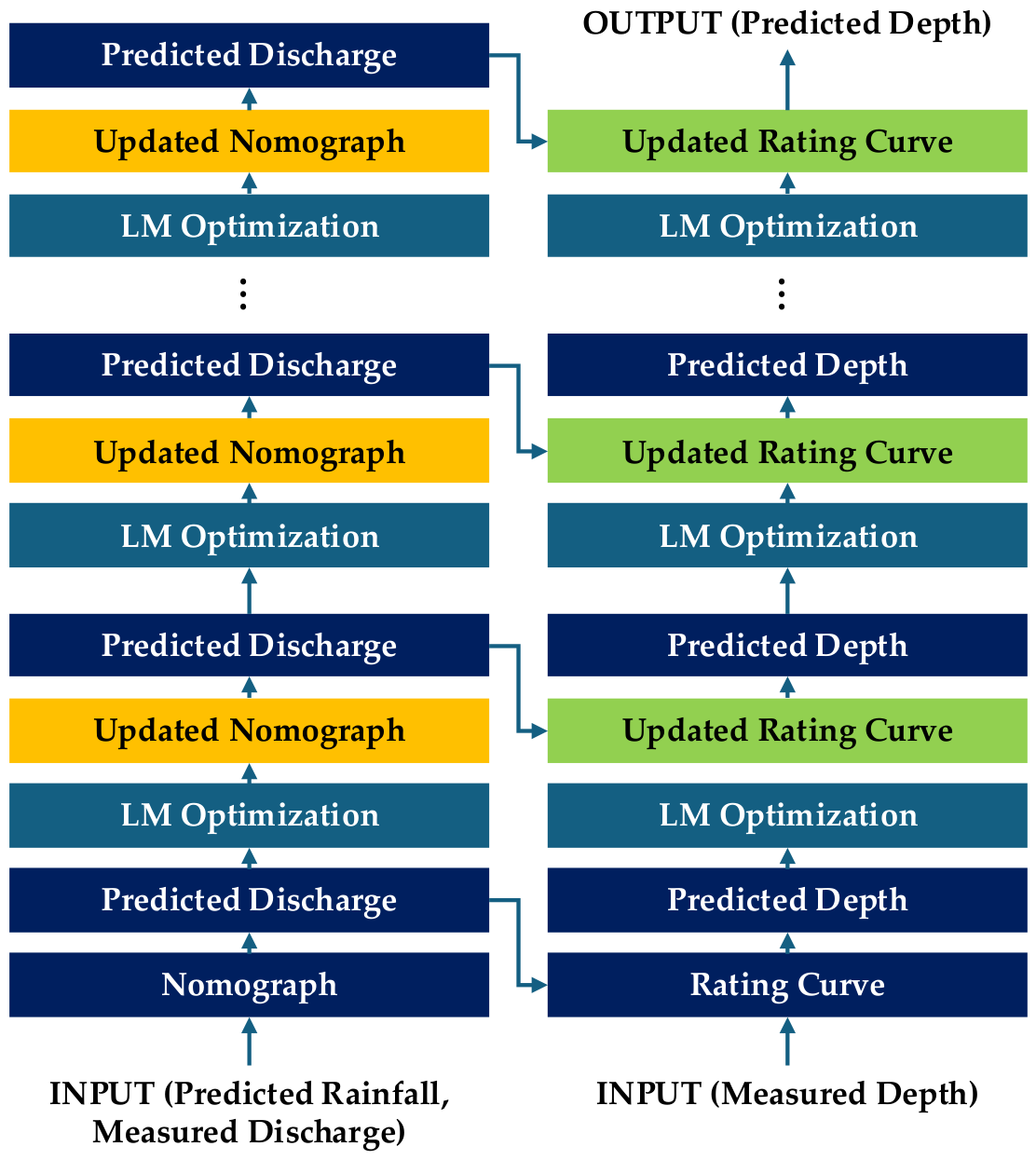
During prediction, simulated values were iteratively compared with observations until the prediction error reached a minimum. In each iteration, the predicted discharge and depth were used to update the rainfall–discharge nomograph and the depth–discharge rating curve, as shown in Figure 3. These updated relationships were then carried forward to the next iteration. This sequential updating process improved the final estimates of flood discharge and flood depth.
The nonlinear least-squares problem was solved using the Levenberg–Marquardt (LM) method, which is widely known for numerical stability and rapid convergence [41,42,43,44]. The LM method is commonly used for nonlinear optimization problems such as Equation (3) and can be interpreted as a damped variant of the Newton–Raphson method, as expressed in Equation (4).
x k + 1 = x k + H ( x k ) 1 F ( x k ) ,
in which x k denotes the parameter vector at the k-th iteration, and H is the Hessian matrix, representing the second-order partial derivatives of the objective function. Optimization methods that directly compute the Hessian may suffer from divergence and can be computationally expensive. The LM method avoids this difficulty by locally approximating the objective function with a linear form. Under this assumption, the parameter update is obtained from Equation (5).
F x + h = 1 2 f T f + h T J T f + 1 2 h T J T J h ,
in which J denotes the Jacobian matrix of the residual vector with respect to the parameter vector x . The term J T J serves as an approximation of the Hessian matrix H . Thus, the LM method estimates values close to the optimum by repeatedly computing the update vector h at each iteration. In the present framework, the update vector for discharge and depth estimation is expressed by Equation (6).
h = J T w J + μ k d i a g ( J T w J ) 1 × J T w Y Y ^ ,
in which d i a g ( J T w J ) is the diagonal matrix of J T w J , and μ k is the damping parameter at the k-th iteration, which is determined by the gain ratio ρ as defined below.
ρ = F x F ( x + h ) L 0 L h ,
in which L h is the objective function locally approximated around x . The initial damping parameter μ 0 was assumed set to m a x ( J T J ) , and the damping value was updated at each iteration following the adaptive strategy proposed by Marquardt [42].
μ k = 2 μ k 1 ,                     ρ < 0.25 0.33 μ k 1 ,           ρ > 0.25   ,
The flood depth predicted through this process was limited to the gauged reaches within the entire river network; therefore, additional methods were required to estimate flood depth in ungauged reaches.

3.2. Method for Ungauged Reaches

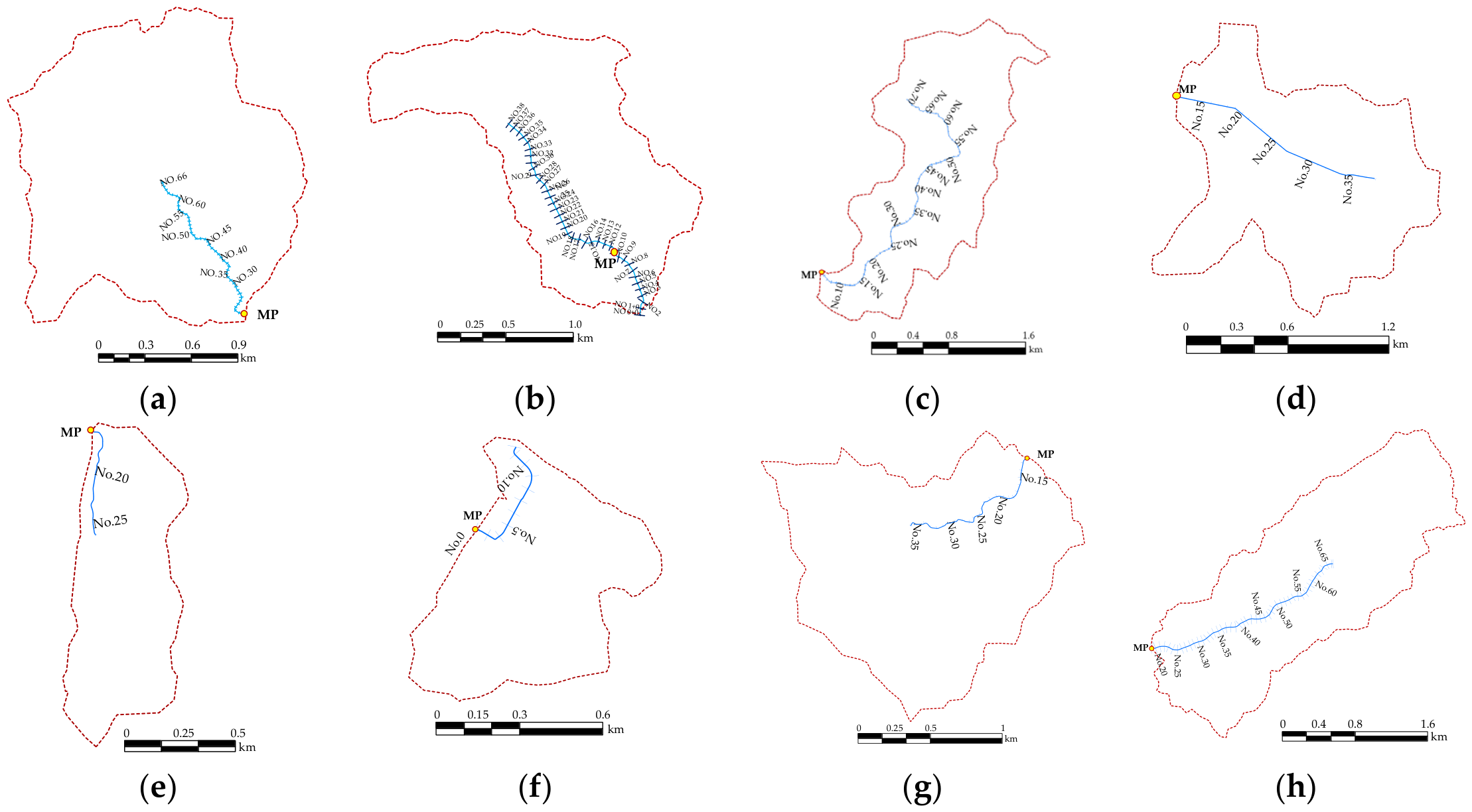
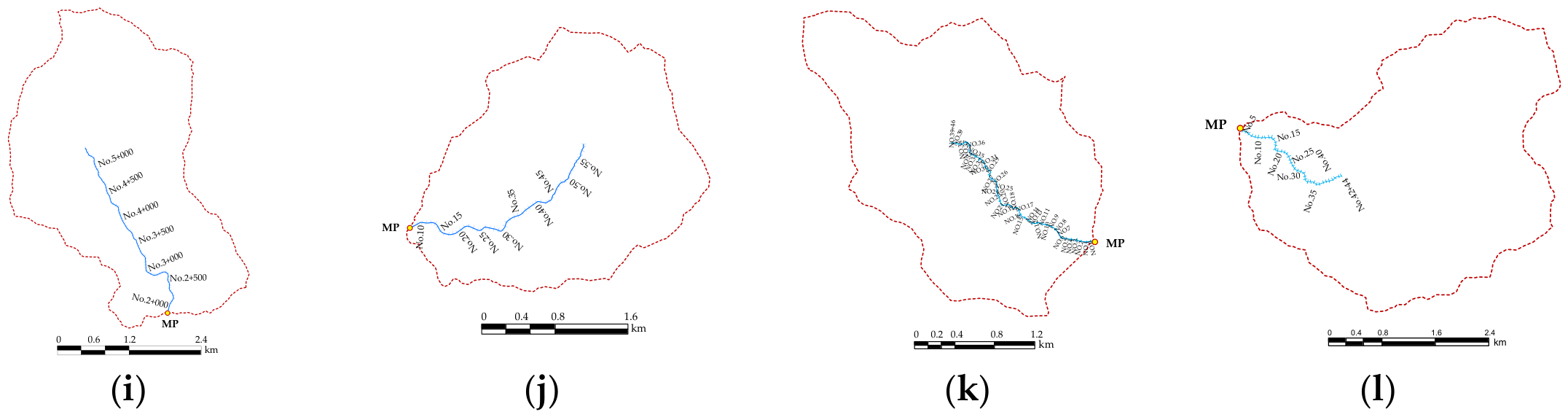
To estimate flood depth in ungauged reaches, this study used depth–discharge relationships derived from both the Manning equation and HEC–RAS simulations, as illustrated in Figure 4. Flood depth predicted at gauged locations reflects hydraulic conditions only at monitoring points and therefore does not fully represent flood risk along the entire stream reach. In reaches with low levee elevations or structural vulnerability, depth predictions at a single gauged location may be insufficient to assess overflow and inundation risk. Consequently, reliable depth estimation across the full stream length is needed for practical flood risk identification, as frequently requested by local practitioners responsible for small-stream management.
The applicability of HEC–RAS for ungauged small-stream reaches was first examined. The analysis indicated that steep slopes and short flow lengths can limit the ability of HEC–RAS to reproduce hydraulic variability adequately under real-time conditions [1,45,46,47]. Direct real-time application was therefore considered susceptible to numerical instability. To address this limitation, scenario-based simulations were conducted in advance, and peak discharge–depth pairs were generated under different upstream discharge and downstream water-level boundary conditions. According to HEC–RAS guidance from the U.S. Army Corps of Engineers, shallow water simulations can become unstable in reaches with slopes greater than 1%. Recommended measures include reducing the computational time step or increasing Manning’s roughness coefficient n . These measures were considered in the scenario design used in this study.
For this purpose, detailed cross-sectional survey data were collected for each pilot stream reach. These data were used to represent channel geometry, levee configuration, bed slope, hydraulic radius, and variations in flow depth. Fine-resolution measurements of horizontal spacing and elevation across each section enabled accurate representation of cross-sectional area and effective flow width. Based on the simulated peak discharge and depth values, depth–discharge relationships were developed for each reach using the same procedure adopted for gauged reaches. Predicted discharge was then used as input to estimate flood depth along ungauged reaches. In doing so, discharge was assumed to remain constant along the stream due to the absence of tributary inflow. This assumption was considered reasonable because most of the selected small streams in Korea do not receive substantial tributary inflow.
A second ungauged reach approach was based on the Manning equation. The Manning equation estimates flow depth and velocity from discharge, channel slope, roughness coefficient, and hydraulic geometry, allowing continuous reach-wise prediction of flood depth [48,49]. However, because this method treats each reach independently, it may underestimate depth in steep channels [34,50,51]. Previous studies have reported that direct estimation of Manning’s roughness coefficient using deep learning models trained on flume data can reduce errors in simulated flood depth and inundation extent in one-dimensional flood models [50]. It has also been shown that combining remote sensing information, such as synthetic aperture radar data, with terrain information and machine learning can further improve depth estimation by refining the estimation of Manning’s n [52,53].
In this study, optimal roughness coefficients for the Manning-based calculations were determined through field surveys, and the resulting values are listed in Table 1. Cross-sectional survey data were also collected for each test-bed stream reach, and the corresponding cross-sectional area and hydraulic radius were calculated. Reach-scale geometric characteristics are presented in Figure 4.

4. Development of Flood Prediction Methods

4.1. Prediction Method for Gauged Reaches

Rainfall–discharge nomographs and depth–discharge rating curves are widely used to estimate discharge and flow depth from rainfall intensity and discharge, respectively [10,54,55]. In this study, both relationships were represented using a nonlinear four-parameter logistic (4PL) regression model, as defined by Equations (1) and (2). The 4PL model is well suited to nonlinear phenomena and is particularly effective for representing curved relationships commonly observed in hydraulic and hydrological datasets [56,57]. The 4PL model was selected due to its ability to represent nonlinear asymptotic behavior. This selection is also supported by the physical characteristics of small streams. Many small streams exhibit intermittent flow behavior, where discharge does not increase proportionally at low rainfall levels due to initial losses and channel conditions. In addition, at higher flow stages, the rate of discharge increase tends to become gradual even with increasing rainfall. Such behavior cannot be adequately represented by simple exponential or power-law functions. In contrast, the 4PL model allows representation of both the initial slow response and the subsequent saturation-like behavior, making it more suitable for describing the nonlinear rainfall–discharge relationship observed in small streams.
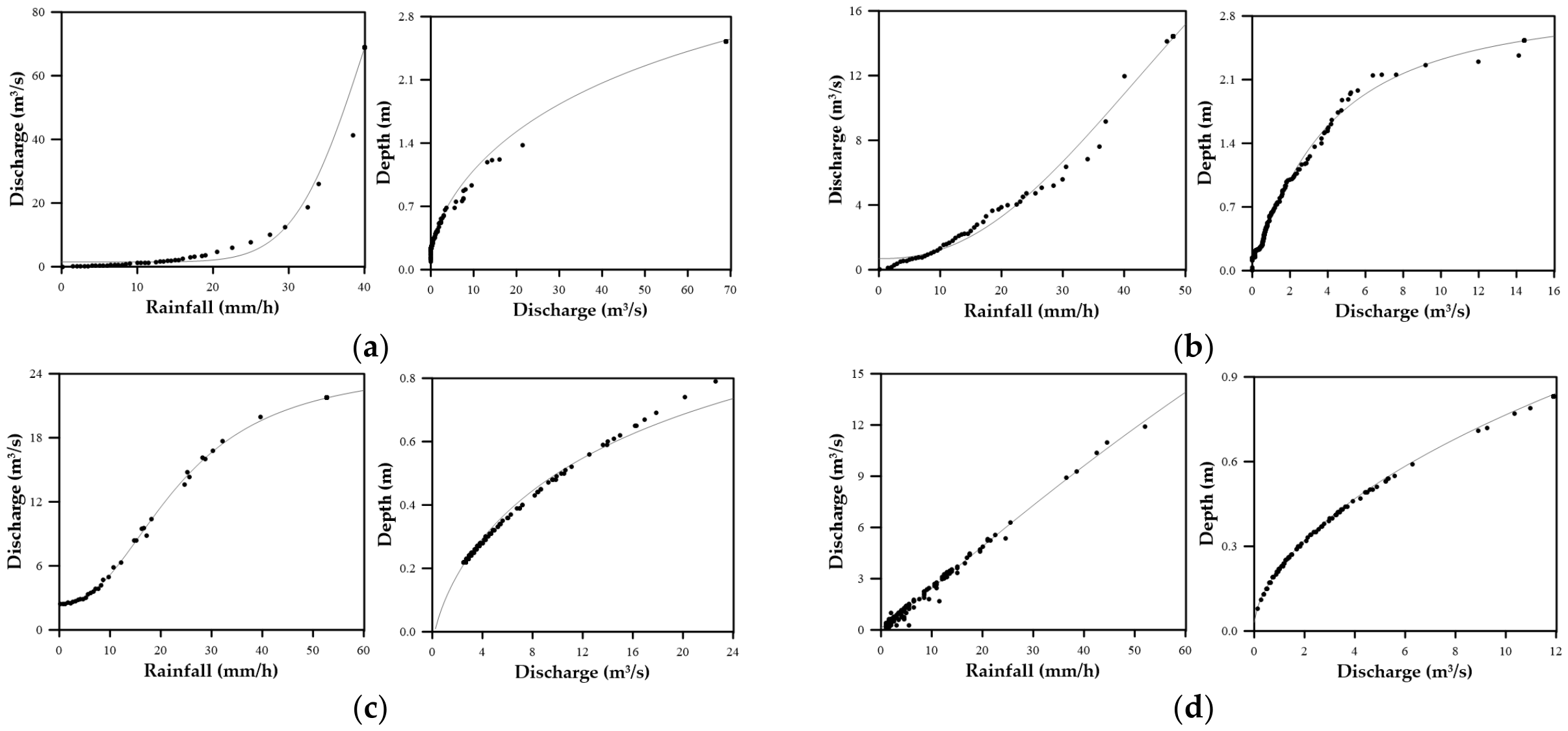
In contrast to simpler formulations such as power-law or exponential functions, the 4PL model allows flexible representation of lower and upper bounds as well as inflection characteristics. To examine its suitability, additional regression analyses using alternative models were conducted, and the 4PL model showed more stable parameter behavior and consistently higher goodness-of-fit across the study streams. To construct the rainfall–discharge nomographs, 1 min rainfall records measured from 2022 to 2025 at AWSs nearest to the 12 study streams were converted into 60 min accumulated rainfall intensity series. These rainfall data were analyzed together with 2 min discharge data measured by the SMMS. For each flood event, peak rainfall intensity and the corresponding peak discharge were extracted to form rainfall–discharge pairs. Similarly, peak flood depth and the corresponding peak discharge were extracted from the observed depth and discharge records to construct discharge–depth pairs. Repeating this procedure for all identified events produced datasets of rainfall intensity–discharge pairs and discharge–depth pairs. These datasets were then used in nonlinear 4PL regression to derive the rainfall–discharge nomographs and depth–discharge rating curves. The resulting parameter estimates and coefficients of determination are summarized in Table 3.
The fitted relationships showed high coefficients of determination, approaching 0.99. To assess model robustness, the dataset was divided into calibration and validation subsets, and the derived relationships were evaluated using independent events. Comparable performance between calibration and validation results indicates that the fitted relationships are not limited to the calibration dataset. The present framework is based on peak-value relationships rather than full hydrograph simulation. This approach reduces computational demand and enables rapid estimation suitable for real-time application in small streams with short response times. However, temporal variations such as rising and recession limbs are not explicitly represented, which may limit the applicability of the method for continuous flow simulation.
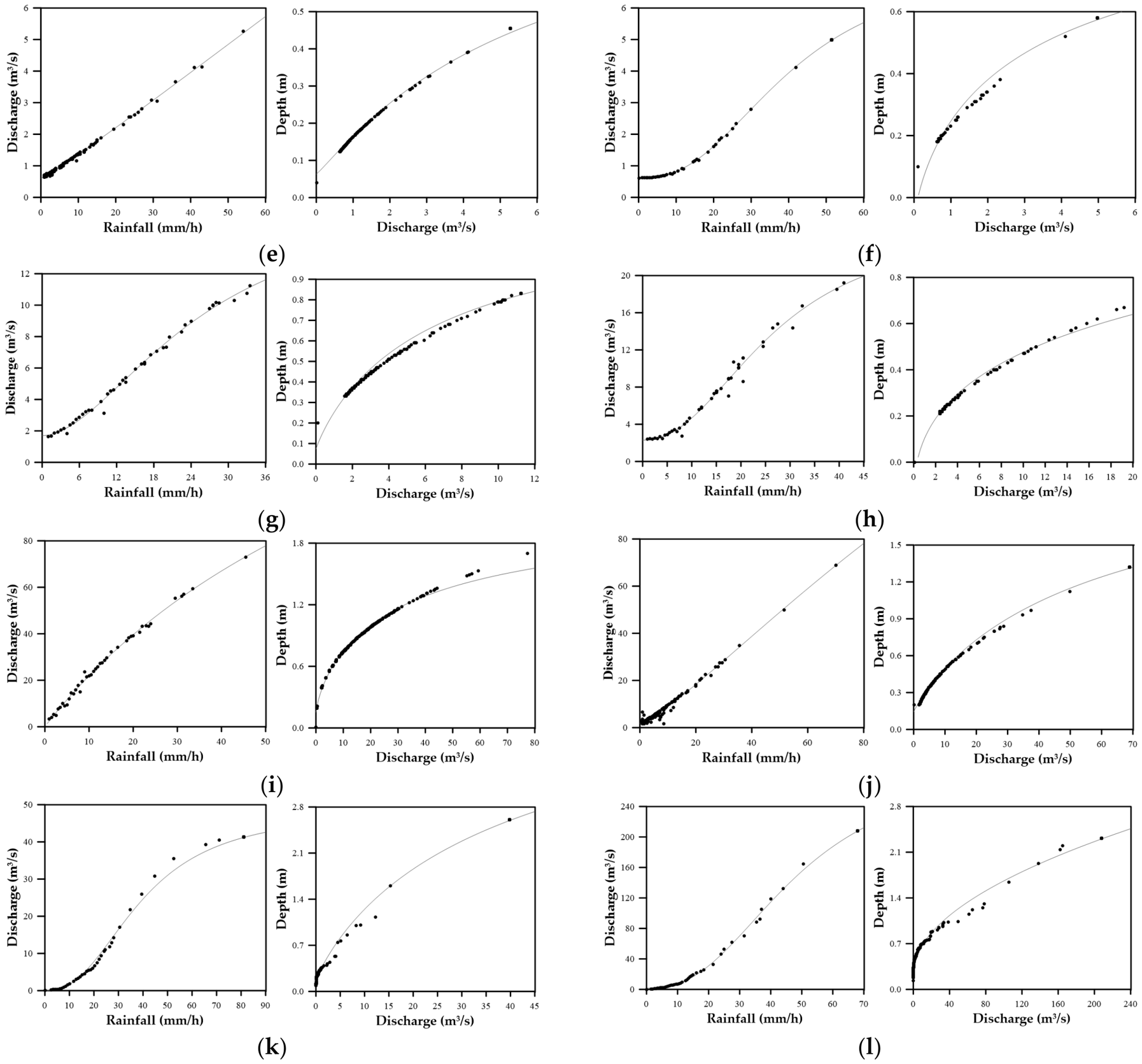
To evaluate the goodness of fit, scatter plots of peak rainfall intensity versus peak discharge and peak depth versus peak discharge were compared with the fitted 4PL curves, as illustrated in Figure 5. Although watershed characteristics such as drainage area, land use, and surface cover varied among the 12 streams, the fitted relationships showed consistent patterns across the monitored basins. These results indicate that the developed relationships capture the general nonlinear behavior observed in the study streams. However, their applicability is limited to basins with similar hydrological and geomorphological characteristics.
McCuen [55] noted that a single empirical equation may not fully represent the combined effects of rainfall–runoff processes, infiltration, and topographic controls. To address this limitation, the present study used calibration based on more than four years of observed rainfall, discharge, and depth data. This approach incorporates a wide range of hydrological conditions and reduces uncertainty associated with simple empirical formulations. As a result, the calibrated relationships reproduced observed discharge and depth with reduced statistical error compared to simpler regression-based approaches.

4.2. Prediction Method for Ungauged Reaches

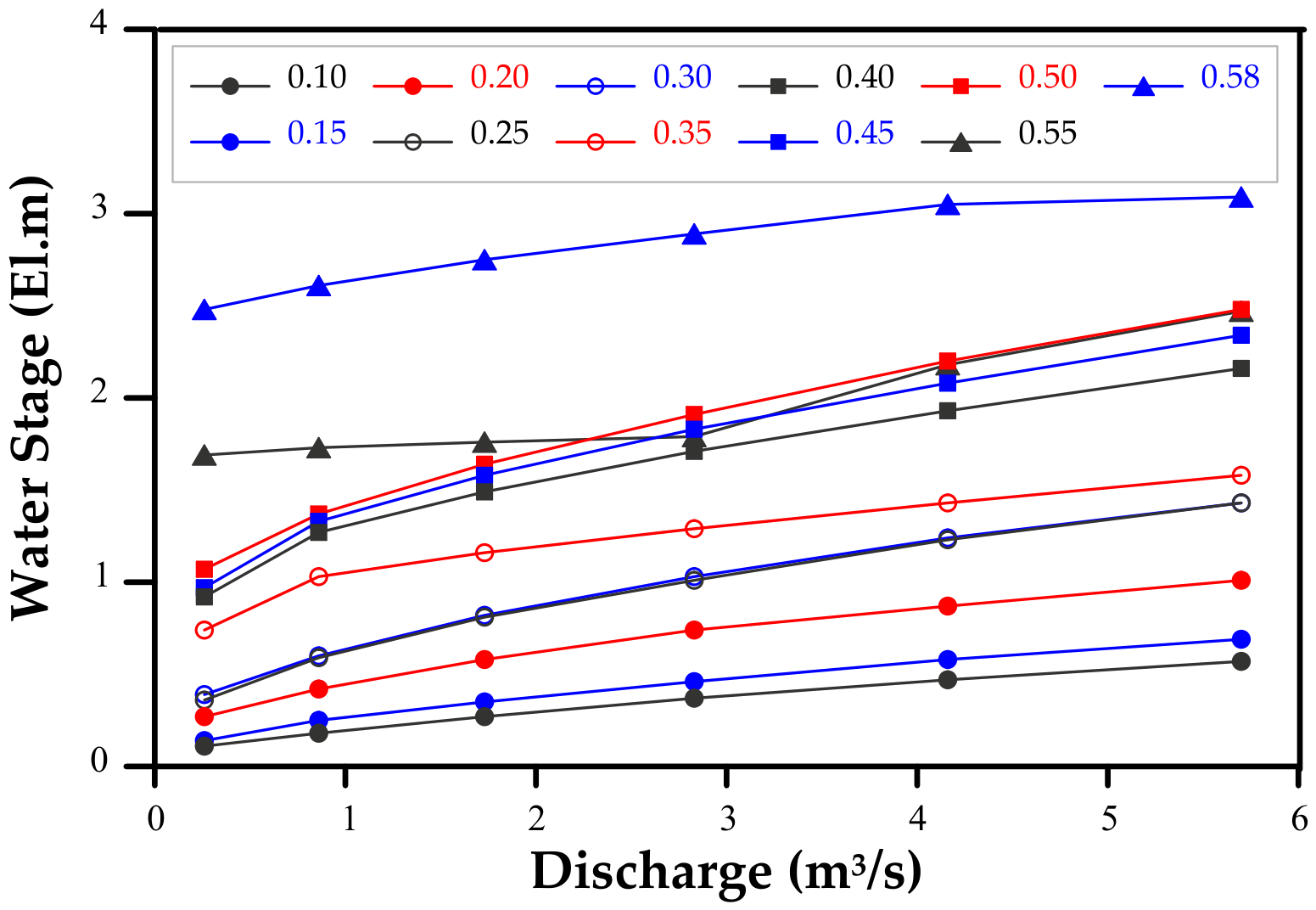
For ungauged reaches, peak discharge–depth pairs were generated using HEC–RAS steady flow scenario simulations, and depth–discharge rating curves were subsequently fitted using the same 4PL regression approach applied to gauged reaches. These relationships provide a basis for estimating flood depth in ungauged reaches from discharge predicted at gauged locations. Depth–discharge rating curves derived from the HEC–RAS scenarios were developed for all ungauged reaches in the 12 test-bed streams. However, due to space limitations, only the fitted parameters and coefficients of determination for Jungdong stream, which has the shortest channel length among the study streams, are presented in Table 4.
The HEC–RAS-based approach incorporates channel geometry and boundary conditions through pre-defined simulation scenarios, allowing more physically consistent representation of hydraulic behavior. In contrast, the Manning-based method provides a simpler and computationally efficient alternative by estimating flow depth directly from discharge and channel properties. In this study, the Manning-based approach is suitable for rapid preliminary estimation in reaches with relatively uniform geometry, whereas the HEC–RAS-based rating curves are more appropriate in reaches where hydraulic conditions are complex, such as abrupt slope changes or irregular channel sections. This distinction improves the practical applicability of the framework for ungauged reaches.
Application of the nonlinear 4PL regression model to the simulated data produced very high coefficients of determination for the ungauged reach rating curves, ranging from 0.987 to 0.999, as shown in Table 4. To illustrate the fit, the scatter plot of simulated peak depth versus peak discharge for Jungdong stream was compared with the corresponding fitted curve in Figure 6.
As shown in Figure 6, the ungauged reach depth–discharge relationships reproduced the simulated depth–discharge patterns with good agreement. This result indicates that regression-based calibration of scenario outputs can provide an efficient approximation of hydraulic behavior. However, the derived relationships are dependent on the pre-defined simulation conditions, and their accuracy may be affected by uncertainties in channel geometry, boundary conditions, and roughness parameters.

4.3. Application of Forecast Rainfall

Forecast rainfall used for small-stream prediction was obtained from the KMA MAPLE nowcasting system. MAPLE provides gridded rainfall forecasts at a spatial resolution of 1 km and generates 36 forecast fields at 10 min intervals, allowing lead times of up to 6 h. In this study, rainfall values were extracted from the grid cells corresponding to the AWS locations for each of the 12 streams and used as input for discharge prediction.
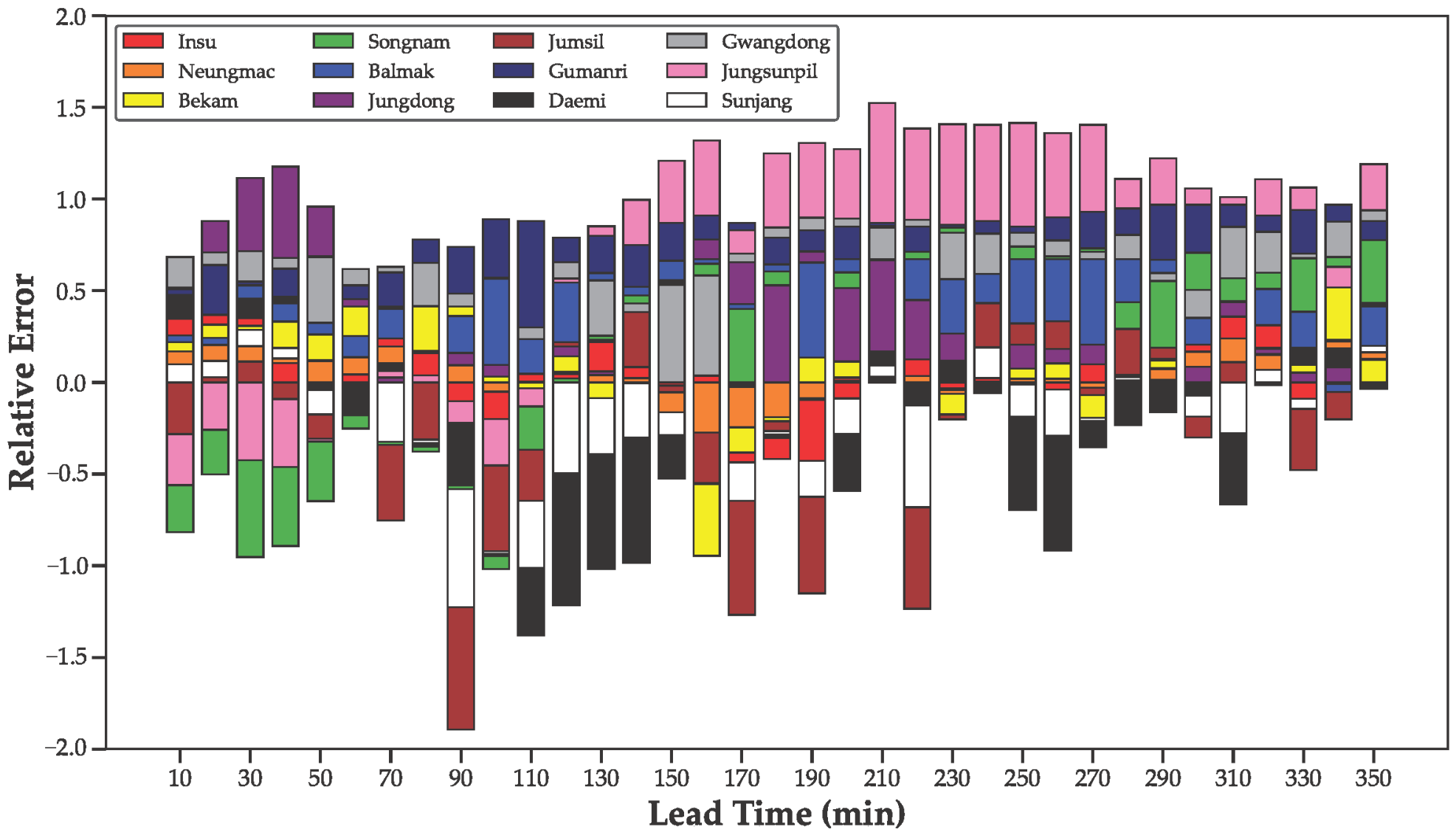
To examine the influence of lead time on forecast performance, the largest flood event for each of the 12 streams was selected. The maximum events occurred on 9 August 2022 for Insu stream; on 5 September 2023 for Neungmac, Jungsunpil, and Sunjang streams; on 13 July 2023 for Daemi and Jumsil streams; on 20 September 2023 for Bekam stream; on 26 June 2023 for Gwangdong stream; on 17 July 2023 for Balmak stream; on 14 July 2023 for Songnam stream; on 23 July 2023 for Jungdong stream; and on 21 June 2023 for Gumanri stream. The differences between the observed and forecast peak rainfall intensity were analyzed for lead times ranging from 10 min to 6 h, and the results are presented in Figure 7. Variations between the observed and forecast rainfall were observed across all lead times, indicating that forecast uncertainty is not negligible. These discrepancies directly influence discharge estimation through the rainfall–discharge relationship and subsequently affect flood depth prediction. Therefore, uncertainty in rainfall forecasts represents an important source of error in the overall prediction framework and should be considered in future analyses.
Forecast accuracy is commonly expected to decrease, or at best remain stable, as lead time increases [58,59]. In the present results, forecast rainfall was both underestimated and overestimated relative to observations, and the magnitude of error did not show a monotonic increase with lead time. Instead, fluctuations in error were observed across different lead times. Based on this analysis, the 1 h lead time was selected for discharge prediction, as it provided relatively stable performance while remaining consistent with the short response time of small streams. A 1 h forecast horizon was therefore adopted for real-time flood prediction in the study basins [60].

5. Application of Flood Prediction Methods

5.1. Application of Prediction Methods for Gauged Reaches

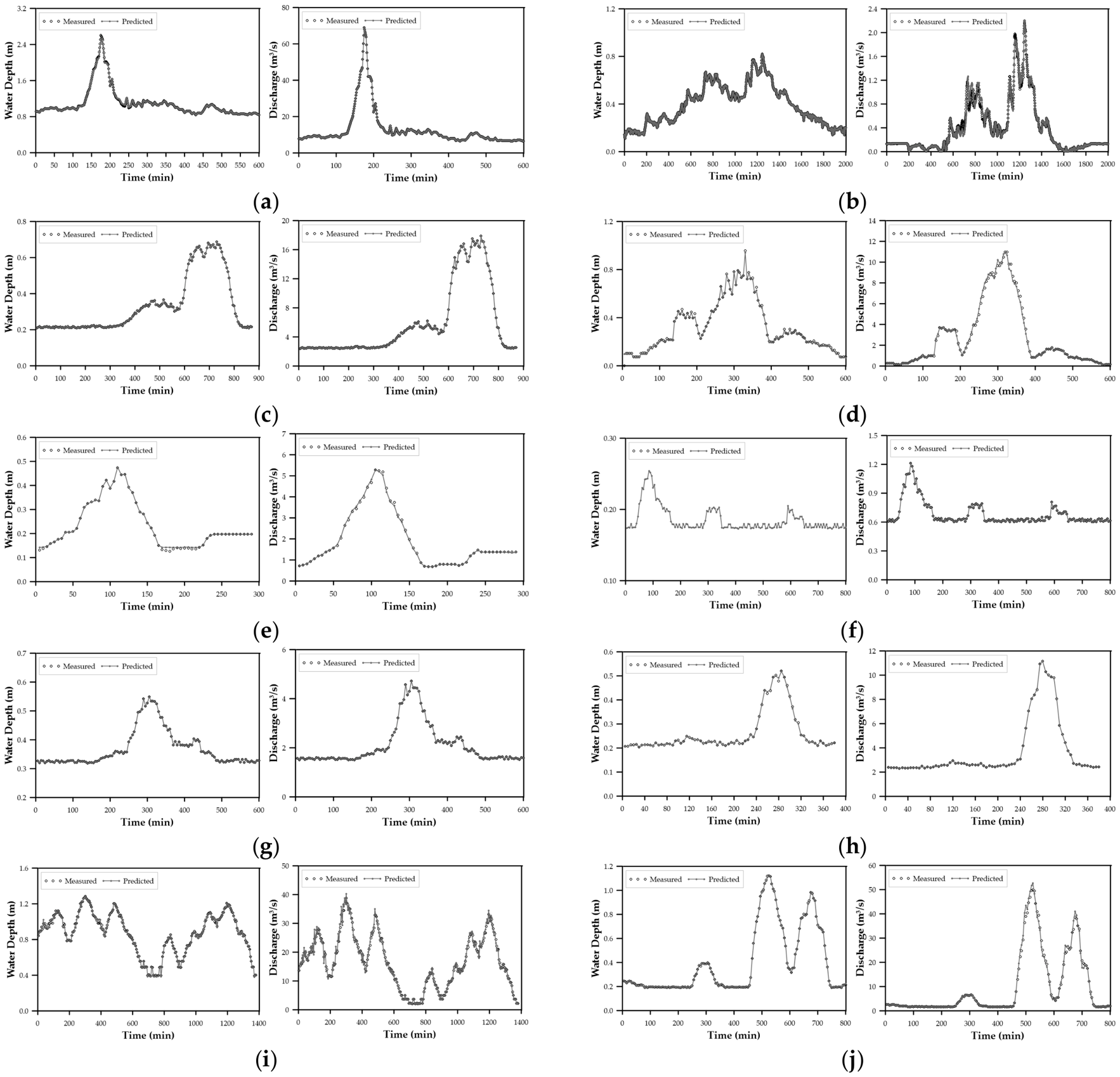
To evaluate the developed framework, predicted discharge and flood depth were compared with the observations measured by the SMMS at the 12 test-bed streams. Major flood events occurring in 2022 and 2023 were selected for evaluation. As shown in Figure 8, the model reproduced the temporal variation in both discharge and depth with reasonable agreement.
The results indicate that the calibrated rainfall–discharge nomographs and depth–discharge rating curves capture the main hydrological and hydraulic response characteristics of the study streams [61,62]. In this study, 60 min accumulated rainfall intensity was used to construct the rainfall–discharge nomograph, as hourly rainfall showed consistent correspondence with observed discharge variation and has been widely used as an indicator of flood occurrence [54,63].
The depth–discharge rating curve was calibrated using peak discharge and peak depth data, allowing the model to reproduce peak water levels with limited error. While the framework is based on peak-value relationships, the predicted results also reflect the general temporal variation during flood events. To quantify the difference between observed and predicted values, a discrepancy ratio was defined as follows:
D R = l n D P D M ,
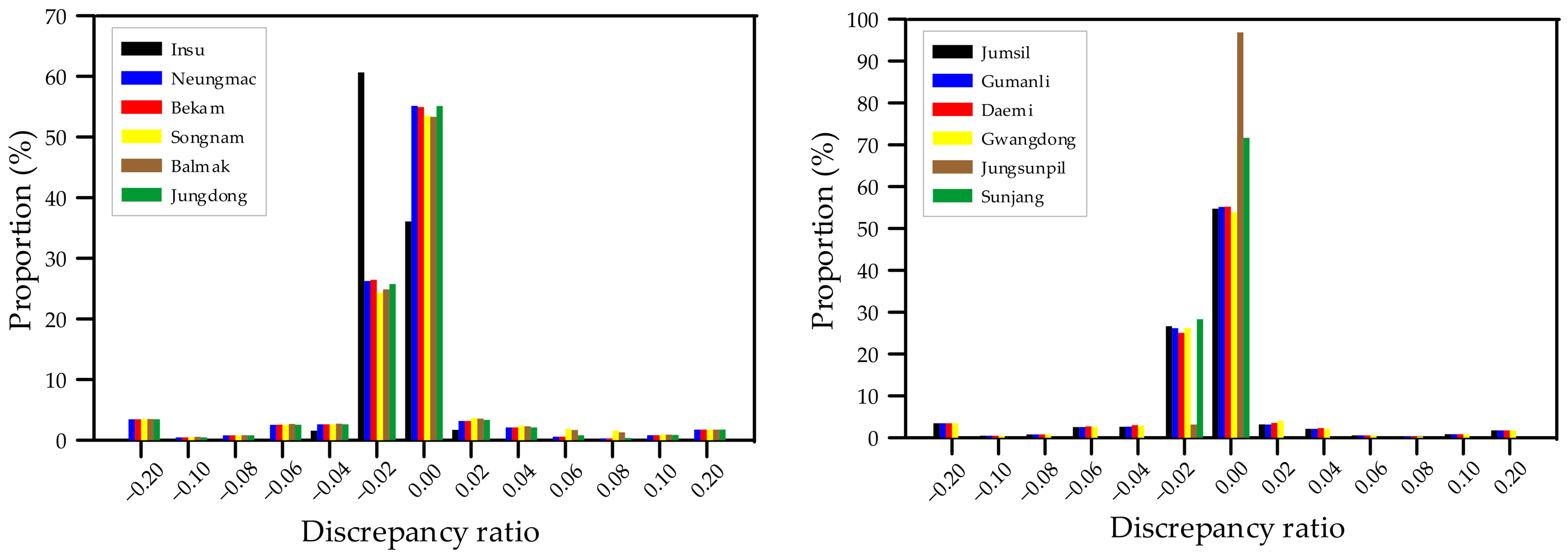
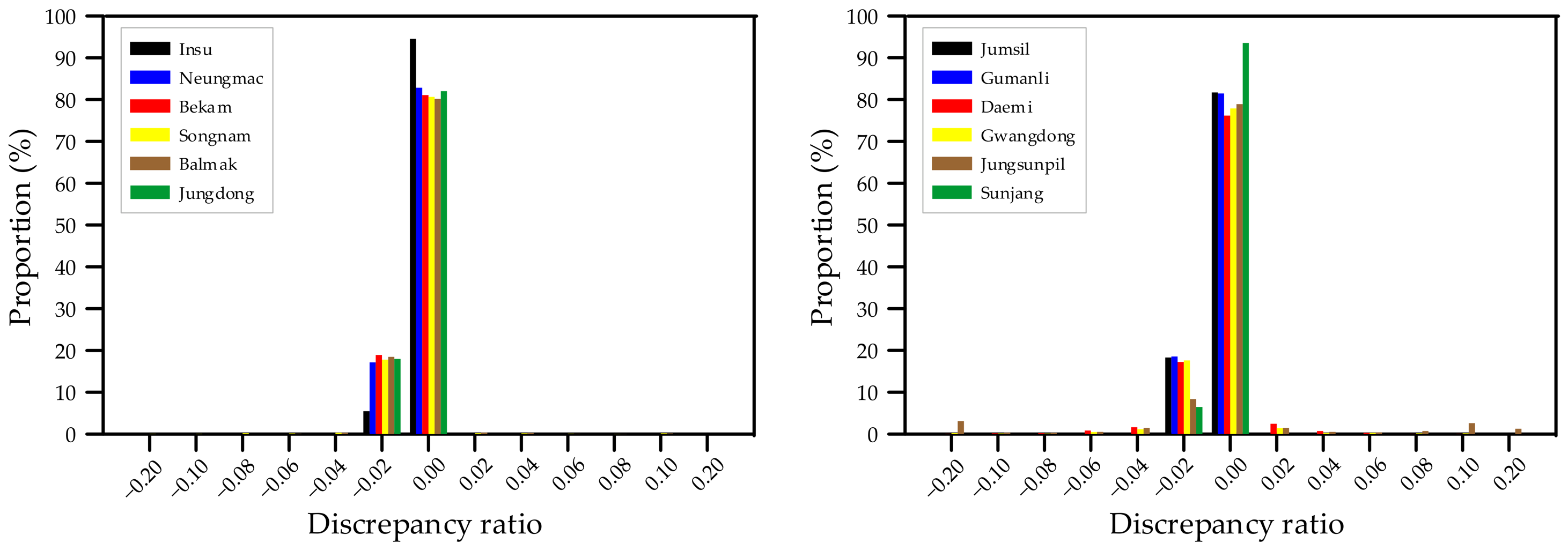
in which D R is discrepancy ratio, D P is predicted values, and D M is measured values. To compare the distribution of discrepancy ratios for predicted discharge and flood depth at each stream, the values were grouped into intervals of 0.01 within the range of −0.05 to 0.05, intervals of 0.05 up to 0.1, and intervals of 0.1 up to 0.2. The frequencies in each interval were then converted to percentages and presented as histograms in Figure 9 and Figure 10.
The discrepancy ratio between the predicted and observed values showed an approximately normal distribution for both discharge and depth. Across the 12 streams, the ratios ranged from −0.2 to 0.2, with the highest frequency occurring within the interval of −0.01 to 0.01. To compare performance among sites, prediction accuracy was defined as the proportion of discrepancy ratios within the range of −0.01 to 0.01. This metric was introduced to provide an operational interpretation of prediction reliability within a narrow error range. It represents the proportion of predictions that fall within a pre-defined acceptable error tolerance and is therefore useful for assessing practical applicability in real-time decision-making. However, this metric does not reflect the magnitude or structure of prediction errors and should be interpreted together with standard hydrological performance indices. However, it differs from standard hydrological performance indicators, such as NSE or RMSE, and should be interpreted accordingly, particularly when compared with conventional performance metrics. The resulting accuracy values for discharge and depth are summarized in Table 5.
For discharge prediction, the highest accuracy (100%) was obtained for Insu, Bekam, and Jungsunpil streams, whereas the lowest value (73.92%) was found for the Gumanri stream. For water-flood depth prediction, the highest accuracy (100%) was achieved for Insu, Gwangdong, Jungsunpil, and Sunjang streams, while the lowest value (74.86%) was also observed in the Gumanri stream. The mean accuracy of water-flood depth prediction was slightly higher than that of discharge prediction, indicating that flood depth was estimated more stably within the defined error range. Accuracy ratio (%) was used to quantify the proportion of predictions that fall within an acceptable error tolerance, providing a straightforward measure of practical reliability. However, since this metric does not reflect the magnitude or structure of errors, additional performance indicators were introduced. Nash–Sutcliffe efficiency (NSE) was used to evaluate how well the predicted values reproduce the observed time series relative to the mean of observations, while Kling–Gupta efficiency (KGE) was adopted to further assess the agreement in terms of correlation, variability, and bias. These two indices complement each other by capturing both the overall fit and structural consistency of the predictions. For discharge prediction, NSE values ranged from 0.9842 to 1.0000 and KGE values ranged from 0.9453 to 1.0000. These results indicate that the temporal dynamics of discharge were well reproduced across all streams. For water-flood depth prediction, NSE ranged from 0.9923 to 1.0000 and KGE ranged from 0.9681 to 0.9999, showing consistently high agreement between observed and predicted depth.
To further quantify the magnitude of prediction errors, RMSE was calculated. This metric is particularly sensitive to large deviations and is therefore useful for identifying discrepancies during peak conditions. For discharge prediction, the smallest RMSE values were observed at Insu and Neungmac streams (0.0003 m 3 / s ), whereas the largest value occurred at Daemi stream (1.1534 m 3 / s ), followed by Gwangdong (0.9340 m 3 / s ) and Jungsunpil (0.6306 m 3 / s ). These results suggest that, although the general discharge patterns were well reproduced, relatively large errors occurred in some streams, likely associated with high-flow conditions. For water-flood depth prediction, the RMSE values were considerably smaller, ranging from 0.0003 m to 0.0518 m . The smallest value was recorded at Jungsunpil stream (0.0003 m ), while the largest again occurred at Daemi stream (0.0518 m ). Compared to discharge, the smaller RMSE values for depth indicate that flood depth predictions were less affected by large deviations and exhibited more stable error characteristics. The difference between discharge and depth prediction can be explained by the nonlinear relationship between water level and discharge. Small deviations in water level can lead to amplified errors in discharge, particularly under high-flow conditions. This explains why NSE and KGE indicate strong agreement while RMSE reveals larger discrepancies in discharge for certain streams. Streams such as Daemi, Gwangdong, and Jungsunpil showed relatively large discharge errors, despite maintaining high NSE and KGE values. This suggests that the model captured the general trend well but had limitations in representing peak magnitudes. In contrast, most streams showed consistently small errors in depth prediction, supporting the reliability of the framework for estimating flood depth. Lower prediction accuracy in some streams may be attributed to steeper channel slopes, localized hydraulic complexity, and increased sensitivity to rainfall forecast uncertainty, which tend to amplify discharge errors more than depth errors.

5.2. Application to Ungauged Reaches

The observation-based prediction framework was applied to gauged reaches equipped with the SMMS, allowing flood conditions to be estimated based on real-time observations. However, monitoring devices are not available along all stream segments, and flood risk may arise in ungauged reaches. The 12 streams considered in this study range in length from 0.5 to 13.63 km, indicating that substantial portions of the channels remain ungauged. For this reason, an additional flood-depth estimation procedure was developed for ungauged reaches.
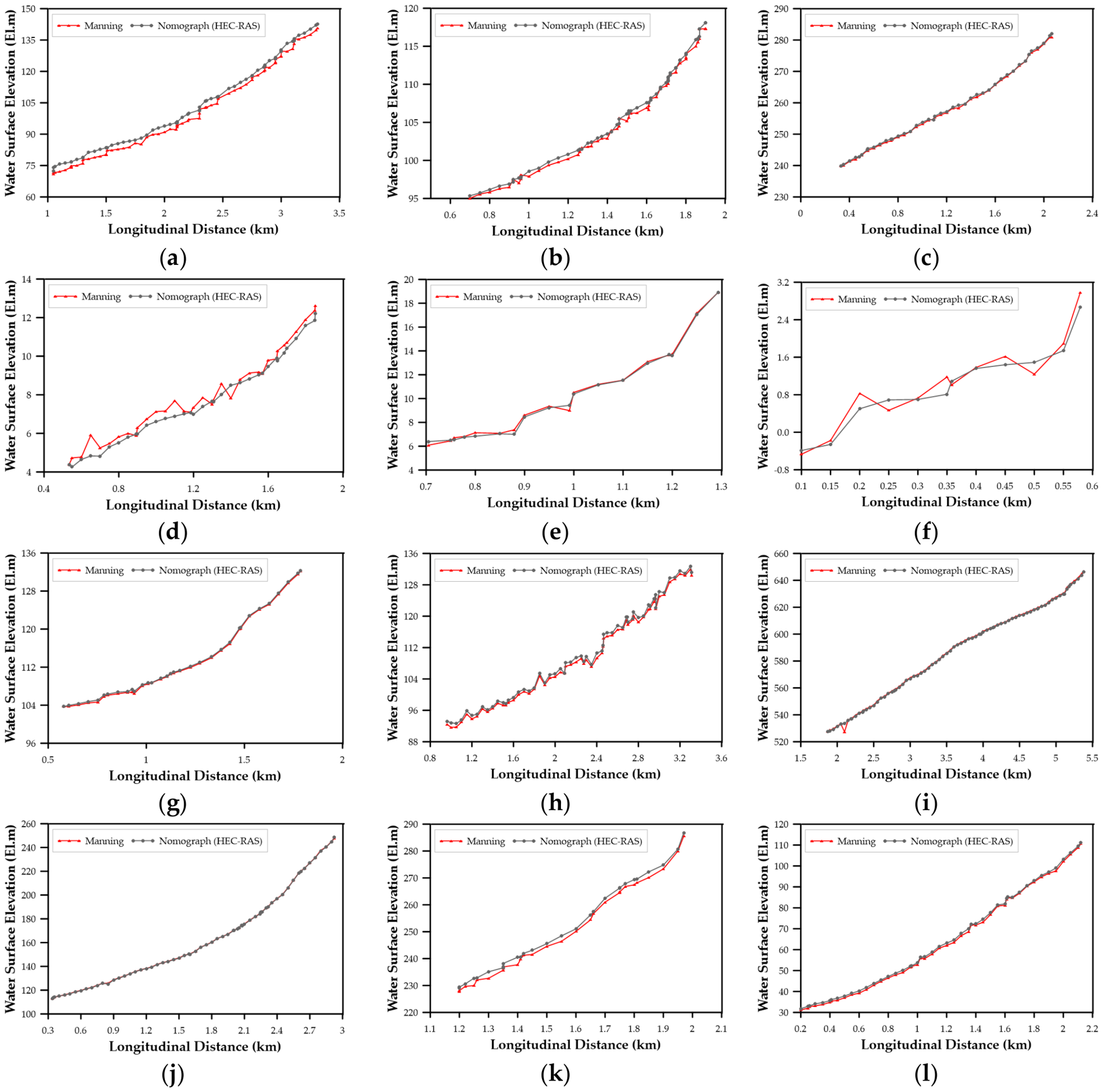
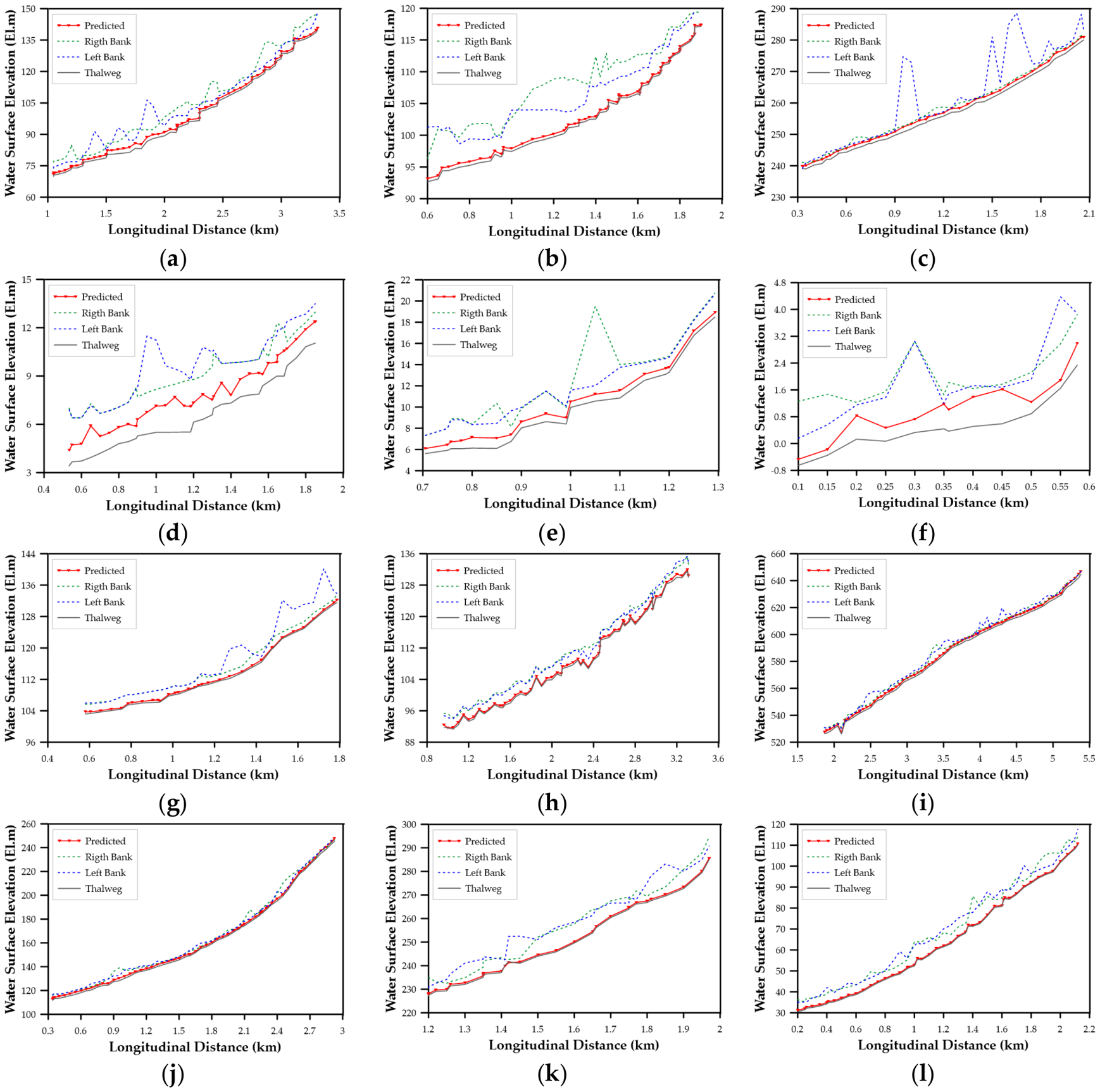
To support practical application, the ungauged reach model was designed to identify potentially hazardous sections and provide supplementary information for flood response to central and local government officials. Cross-sectional geometry for major channel sections was obtained from Comprehensive Small-Stream Maintenance Plan reports prepared by local governments. Using these data, flood depth along ungauged reaches was estimated using section-specific depth–discharge relationships derived from HEC–RAS scenario simulations and from the Manning equation. The discharge used in these calculations was obtained from gauged locations through the rainfall–discharge nomograph. Tributary inflow was assumed to be negligible, and discharge was therefore treated as constant along the stream reach. This assumption is considered reasonable for the selected small streams, where channel length is short and tributary inflow is limited. However, in more complex or larger basins, this simplification may introduce uncertainty in flood depth estimation. The two approaches used for ungauged reaches differ in complexity and applicability. The Manning-based method provides rapid estimation with low computational cost and is suitable for reaches with relatively uniform channel geometry. In contrast, the HEC–RAS-based rating curves incorporate hydraulic conditions through pre-defined simulation scenarios and are more appropriate in reaches where channel geometry is irregular or where hydraulic conditions vary significantly. Figure 11 compares flood depths predicted using the Manning equation with those estimated using HEC–RAS-based rating curves.
The results for the 12 streams indicate that flood depths predicted by the Manning equation showed patterns comparable to those obtained from the HEC–RAS scenario-based approach. However, in coastal streams such as Songnam and Jungdong, flood depths estimated from the HEC–RAS-based rating curves were slightly lower than those calculated using the Manning equation. One possible explanation is the influence of tidal boundary conditions. Tidal river reaches are more appropriately analyzed using unsteady flow models to estimate design flood depth [64]. In this study, steady gradually varied flow simulations were applied due to frequent convergence issues in small streams. This modeling simplification may have contributed to the observed differences between the two approaches.
To evaluate practical applicability, flood depths predicted using the Manning equation were compared with levee crest elevations to evaluate overtopping potential, as shown in Figure 12. No overtopping was identified in any of the 12 streams, which is consistent with field observations during the study period. This comparison provides a preliminary indication that the estimated flood depths are within a reasonable range under the analyzed conditions. Flood depths derived from the HEC–RAS-based rating curves were also evaluated but were not presented separately, as they showed minimal differences from the Manning-based results and could not be clearly distinguished in graphical form.
From an operational perspective, the Manning-based approach offers advantages for rapid estimation due to its simple structure and low computational demand. However, the results are sensitive to uncertainties in channel slope and roughness coefficients, and reliable field data are required for calibration. Previous studies have shown that spatial and temporal variability in Manning’s roughness coefficient is a major source of uncertainty in flood depth estimation [65,66].
As illustrated in Figure 11 and Figure 12, simplified Manning-based calculations can produce discontinuities in estimated flood depth between adjacent reaches or abrupt reductions in depth in steep channels, because they do not fully account for hydraulic interactions such as upstream–downstream connectivity, backwater effects, hydraulic structures, and rapidly varied flow. Reach-by-reach computations may therefore underestimate flood levels when these controls are significant [67]. In steep small streams, rapid flood wave propagation and complex channel geometry often require hydrodynamic models based on the Saint-Venant equations rather than simplified empirical approaches [17,18]. However, these models require substantial computation time and complex configuration, which limits their applicability for real-time forecasting [68,69,70,71].
Depth–discharge rating curves derived from HEC–RAS scenarios provide an alternative by incorporating hydraulic behavior into pre-defined relationships. Once established, these relationships enable rapid estimation of flood depth while retaining key hydraulic characteristics [72,73]. This approach reduces discontinuities associated with simplified methods and provides a balance between computational efficiency and hydraulic representation. However, the accuracy of the scenario-based relationships depends on the quality of input data, including channel geometry, boundary conditions, and roughness parameters. In addition, steady flow assumptions used in the simulations may limit applicability in reaches influenced by unsteady flow conditions [69,74].

6. Conclusions

This study developed a measurement-based flood prediction framework for small streams by integrating real-time monitoring data with rainfall–discharge nomographs and depth–discharge rating curves. The framework was designed to reduce the computational demand and data requirements associated with conventional hydrodynamic models, while maintaining consistency with observed hydrological behavior in small-stream environments.
Using long-term observations from 12 test-bed small streams, rainfall–discharge and depth–discharge relationships were derived using nonlinear four-parameter logistic regression. These relationships were constructed from observed data and used to estimate discharge from forecast rainfall and to convert discharge into flood depth within a unified framework.
Evaluation using major flood events showed that the framework reproduced the general temporal variation in discharge and depth. Mean prediction accuracy was approximately 89% for discharge and 90% for flood depth across the 12 streams. These results indicate that the proposed approach captures key response characteristics under the analyzed conditions.
To extend the framework beyond gauged locations, flood depth in ungauged reaches was estimated using both HEC–RAS-based scenario rating curves and the Manning equation. The two approaches produced comparable patterns, although the Manning-based method tended to underestimate depth in steep reaches due to its simplified formulation. The HEC–RAS-based relationships provided more consistent estimates by incorporating channel-specific hydraulic characteristics derived from scenario simulations.
Despite these results, several limitations should be noted. The framework is based on peak-value relationships and does not explicitly represent full hydrograph dynamics. The assumption of constant discharge along stream reaches may introduce uncertainty in basins with significant tributary inflow. In addition, prediction accuracy is influenced by uncertainties in rainfall forecasts and hydraulic parameters. Further sensitivity analysis under a wider range of hydrological conditions would be beneficial for improving the robustness of the framework.
The applicability of the proposed framework is limited to small streams with characteristics similar to those examined in this study, and site-specific calibration is required for application to other regions. Future work should include validation under diverse hydrological conditions, incorporation of additional performance metrics, and analysis of uncertainty propagation. Improvements may also be achieved by considering unsteady flow conditions and more complex boundary interactions, particularly in reaches influenced by tidal effects or hydraulic structures. These limitations should be considered when applying the framework in operational settings.

Author Contributions

Conceptualization, T.-S.C.; methodology, T.-S.C., S.K. and K.-M.K.; software, T.-S.C. and K.-M.K.; validation, T.-S.C. and K.-M.K.; formal analysis, T.-S.C.; investigation, S.K.; resources, T.-S.C. and S.K.; data curation, T.-S.C. and K.-M.K.; writing—original draft, T.-S.C. and K.-M.K.; writing—review and editing, T.-S.C., S.K. and K.-M.K.; visualization, T.-S.C.; supervision, T.-S.C. and S.K.; project administration, T.-S.C. and S.K.; funding acquisition, T.-S.C. All authors have read and agreed to the published version of the manuscript.

Funding

Deep thanks and gratitude to the Research Project (NDMI-PR-2025-07-02-01), the National Disaster Management Institute, Ulsan, Korea for funding the research article.

Data Availability Statement

The datasets presented in this article are not readily available because the data are part of an ongoing government-funded research. Requests to access the datasets should be directed to the corresponding author.

Acknowledgments

We are thankful to the National Disaster Management Institute of Korea for providing necessary data used in this study.

Conflicts of Interest

Authors Seojun Kim and Kang-Min Koo were employed by the company HydroSEM, Yongin 16976, Republic of Korea. The remaining authors declare that the research was conducted in the absence of any commercial or financial relationships that could be construed as potential conflicts of interest.

References

  1. Cheong, T.S.; Kim, S.; Koo, K. Development and evaluation of flood early warning system for small streams. J. Korean Soc. Hazard Mitig. 2024, 24, 93–103. [Google Scholar] [CrossRef]
  2. Chow, V.T.; Maidment, D.R.; Mays, L.W. Applied Hydrology; McGraw-Hill: New York, NY, USA, 1988. [Google Scholar]
  3. Hsu, M.H.; Chen, S.H.; Chang, T.J. Inundation simulation for urban drainage basin with storm sewer system. J. Hydrol. 2000, 234, 21–37. [Google Scholar] [CrossRef]
  4. Jeong, M.; Kim, J.; Kim, D.-H. Rainfall runoff prediction using instantaneous unit hydrograph derived by dynamic wave model based. In Proceedings of the Korea Water Resources Association Conference, Vienna, Austria, 3–8 May 2019; EGU: Munich, Germany, 2019; p. 110. [Google Scholar]
  5. Pappenberger, F.; Beven, K.J.; Horritt, M.S.; Blazkova, S. Uncertainty in the calibration of effective roughness parameters in HEC-RAS. J. Hydrol. 2006, 302, 46–69. [Google Scholar] [CrossRef]
  6. Yu, D.; Lane, S.N. Urban fluvial flood modelling using a two-dimensional diffusion-wave treatment, part 2: Development of a sub-grid-scale treatment. Hydrol. Process. 2006, 20, 1567–1583. [Google Scholar] [CrossRef]
  7. Cheong, T.S.; Choi, C.; Yei, S.; Shin, J.; Kim, S.; Koo, K. Development of flood early warning frameworks for the small streams in Korea. Water 2023, 15, 1808. [Google Scholar] [CrossRef]
  8. Ntelekos, A.A.; Smith, J.A.; Baeck, M.L. Extreme hydrometeorological events and the urban environment: Dissecting the 7 July 2004 flash flood in the Baltimore metropolitan region. Water Resour. Res. 2007, 44, W08406. [Google Scholar] [CrossRef]
  9. Seo, D.J.; Krajewski, W.F. Towards probabilistic forecasting of flash floods: The combined effects of uncertainty in radar-rainfall and flash flood guidance. J. Hydrol. 2010, 394, 275–284. [Google Scholar] [CrossRef]
  10. Cheong, T.S.; Kang, H.; Ye, S. Development and application of a data-driven prediction model for real-time flood response in small streams. J. Korea Water Resour. Assoc. 2025, 58, 869–881. [Google Scholar] [CrossRef]
  11. Wheater, H.S.; Evans, E. Land use, water management and future flood risk. Land Use Policy 2009, 26, S251–S264. [Google Scholar] [CrossRef]
  12. Chen, M.; Chen, H.; Wu, Z.; Huang, Y.; Zhou, N.; Xu, C.Y. A review on video-based river discharge measurement technique. Sensors 2024, 24, 4655. [Google Scholar] [CrossRef]
  13. Rantz, S.E. Measurement and Computation of Streamflow: Volume 1. Measurement of Stage and Discharge; USGS: Reston, VA, USA, 1982.
  14. Zhang, E.; Li, L.; Huang, W.; Jia, Y.; Zhang, M.; Kang, F.; Da, H. Measuring velocity and discharge of high-turbidity rivers using an improved near-field remote sensing measurement system. Water 2024, 16, 135. [Google Scholar] [CrossRef]
  15. Chen, Y.; Cao, F.; Cheng, W.; Wang, H.; Li, J. Real-time correction of channel-bed roughness and water level in river network hydrodynamic modeling for accurate forecasting. Sci. Rep. 2023, 13, 20660. [Google Scholar] [CrossRef]
  16. Yang, Y.; Pan, M.; Feng, D.; Xiao, M.; Dixon, T.; Hartman, R.; Shen, C.; Song, Y.; Sengupta, A.; Delle Monache, L.; et al. Improving streamflow simulation through machine learning-powered data integration and its potential for forecasting in the Western U.S. Hydrol. Earth Syst. Sci. 2025, 29, 5453–5476. [Google Scholar] [CrossRef]
  17. Zhang, T.; Zhang, R.; Li, J.; Feng, P. Deep learning of flood forecasting by considering interpretability and physical constraints. Hydrol. Earth Syst. Sci. 2025, 29, 5955–5974. [Google Scholar] [CrossRef]
  18. Kim, B.J.; Kim, M.; Yoo, J.; Kim, B. Rapid simulation for real-time flood depth prediction using support vector machine. Sci. Rep. 2025, 15, 31818. [Google Scholar] [CrossRef]
  19. Nguyen, G.V.; Pham-Van, C.; Tran, V.N.; Nguyen Van, L.; Lee, G. Toward real-time high-resolution fluvial flood forecasting: A robust surrogate approach based on overland flow models. Environ. Model. Softw. 2026, 195, 106716. [Google Scholar] [CrossRef]
  20. National Disaster Management Research Institute. Development of Platform for Establishing and Analyzing Measured and Characteristics Information of Small Streams (IV); National Disaster Management Research Institute: Ulsan, Republic of Korea, 2025; ISBN 979-11-94404-97-2. [Google Scholar]
  21. Park, C.; Yeo, C.G.; Lim, J.S.; Lee, J. Evaluating rainfall gauge network using AWS data in Seoul. Seoul Stud. 2015, 16, 165–182. [Google Scholar] [CrossRef]
  22. Oh, S.G.; Son, S.W.; Kim, Y.H.; Park, C.; Ko, J.; Shin, K.; Ha, J.; Lee, H. Deep learning model for heavy rainfall nowcasting in South Korea. Weather. Clim. Extrem. 2024, 44, 100652. [Google Scholar] [CrossRef]
  23. Yoon, S.S.; Shin, H.; Heo, J.Y.; Choi, K.B. Assessment of deep learning-based nowcasting using weather radar in South Korea. Remote Sens. 2023, 15, 5197. [Google Scholar] [CrossRef]
  24. An, S.; Oh, T.-J.; Sohn, E.; Kim, D. Deep learning for precipitation nowcasting: A survey from the perspective of time series forecasting. Expert Syst. Appl. 2025, 268, 126301. [Google Scholar] [CrossRef]
  25. Bauer, P.; Thorpe, A.; Brunet, G. The quiet revolution of numerical weather prediction. Nature 2015, 525, 47–55. [Google Scholar] [CrossRef]
  26. Mhedhbi, R.; Erechtchoukova, M.G. Assessing the impact of rainfall nowcasts on an encoder–decoder LSTM model for short-term flash flood prediction. Water Resour. Manag. 2025, 39, 1623–1638. [Google Scholar] [CrossRef]
  27. Kim, J.; Lee, H.; Park, S. Analysis of human casualties due to flash floods in small streams. Water Resour. Manag. 2020, 34, 123–135. [Google Scholar]
  28. Ho, C.; Kim, H.; Cha, Y.; Do, H.; Kim, J.; Kim, J.; Park, S.K.; Yoo, H. Recent changes in summer rainfall characteristics in Korea. J. Eur. Meteorol. Soc. 2025, 2, 100009. [Google Scholar] [CrossRef]
  29. Yu, H.-Y.; Suh, M.-S.; Park, J.-s.; Song, Y.-j.; Kim, C. Clustering and Characteristic Analysis of Sub-daily Scale (<12 h) Heavy Rainfall Types in South Korea Based on Observed Rainfall Data. Asia Pac. J. Atmos. Sci. 2025, 61, 25. [Google Scholar] [CrossRef]
  30. Andria, S.; Preema, M.; Mohan, S. Literature review on artificial intelligence and blockchain for flood monitoring and early warning system. AIP Conf. Proc. 2025, 3257, 020089. [Google Scholar]
  31. Pahuriray, A.V.; Cerna, P.D. IoT-enabled flood monitoring and early warning systems: A systematic review. Int. J. Comput. Sci. Mob. Comput. 2025, 14, 50–67. [Google Scholar] [CrossRef]
  32. Alfieri, L.; Salamon, P.; Pappenberger, F.; Wetterhall, F.; Thielen, J. Operational early warning systems for water-related hazards in Europe. Environ. Sci. Policy 2012, 21, 35–49. [Google Scholar] [CrossRef]
  33. Rathod, P.; Pandey, M.; Gupta, A.K. Artificial intelligence-based fully scalable real-time early flood warning system. In River, Sediment and Hydrological Extremes: Causes, Impacts and Management; Disaster Resilience and Green Growth; Pandey, M., Gupta, A.K., Oliveto, G., Eds.; Springer: Singapore, 2023. [Google Scholar]
  34. Liu, B.; Li, Y.; Ma, M.; Mao, B. A comprehensive review of machine learning approaches for flood depth estimation. Int. J. Disaster Risk Sci. 2025, 16, 433–445. [Google Scholar] [CrossRef]
  35. Javier, J.R.N.; Smith, J.A.; Meierdiercks, K.L.; Baeck, M.L.; Miller, A.J. Flash flood forecasting for small urban watersheds in the Baltimore metropolitan region. Weather. Forecast. 2007, 22, 1331–1344. [Google Scholar] [CrossRef]
  36. Bae, D.H.; Jung, I.W.; Chang, H. Long-term trend of precipitation and runoff in Korean river basins. Hydrol. Process. 2008, 22, 2644–2656. [Google Scholar] [CrossRef]
  37. Jang, C.H.; Kim, H.J. Development of flood runoff characteristics nomograph for small catchment using R-programming. In Proceedings of the Korea Water Resources Association Conference, Goseong, Republic of Korea, 28–29 May 2015; Korea Water Resources Association: Seul, Republic of Korea, 2015; p. 590. [Google Scholar]
  38. U.S. Geological Survey. National Water Summary 1984: Hydrologic Events, Selected Water-Quality Trends, and Ground-Water Resources; Water Supply Paper 2275; U.S. Geological Survey: Reston, VA, USA, 1984. [Google Scholar]
  39. World Meteorological Organization. Manual on Stream Gauging (Vol. II): Computation of Discharge; WMO-No. 1044; World Meteorological Organization: Geneva, Switzerland, 2010. [Google Scholar]
  40. Shao, Q.; Dutta, D.; Karim, F.; Petheram, C. A method for extending stage-discharge relationships using a hydrodynamic model and quantifying the associated uncertainty. J. Hydrol. 2018, 556, 154–172. [Google Scholar] [CrossRef]
  41. Levenberg, K. A method for the solution of certain non-linear problems in least squares. Q. Appl. Math. 1944, 2, 164–168. [Google Scholar] [CrossRef]
  42. Marquardt, D.W. An algorithm for least-squares estimation of nonlinear parameters. SIAM J. Appl. Math. 1963, 11, 431–441. [Google Scholar] [CrossRef]
  43. Moré, J.J. The Levenberg–Marquardt algorithm: Implementation and theory. In Numerical Analysis; Lecture Notes in Mathematics; Watson, G.A., Ed.; Springer: Berlin, Germany, 1978; Volume 630. [Google Scholar]
  44. Zheng, L.; Chen, L.; Ma, Y. A variant of the Levenberg–Marquardt method with adaptive parameters. AIMS Math. 2022, 7, 1241–1256. [Google Scholar] [CrossRef]
  45. Brunner, G.W. HEC-RAS, River Analysis System Hydraulic Reference Manual; CPD-69; U.S. Army Corps of Engineers: Washington, DC, USA, 2020. [Google Scholar]
  46. CivilGEO. Unsteady Flow HEC-RAS Model Troubleshooting. Available online: https://knowledge.civilgeo.com/unsteady-flow-hec-ras-model-troubleshooting/ (accessed on 1 March 2024).
  47. U.S. Army Corps of Engineers. Model Accuracy, Stability, and Sensitivity in HEC-RAS. Available online: https://www.hec.usace.army.mil (accessed on 1 March 2024).
  48. Arcement, G.J.; Schneider, V.R. Guide for Selecting Manning’s Roughness Coefficients for Natural Channels and Floodplains; U.S. Geological Survey Water-Supply Paper U.S. G.P.O; U.S. Geological Survey: Reston, VA, USA, 1989.
  49. Jain, S.K.; Singh, P.; Seth, S.M. Assessment of sedimentation in Bhakra Reservoir in the western Himalayan region using remotely sensed data. Hydrol. Sci. J. 2002, 47, 203–212. [Google Scholar] [CrossRef]
  50. Haces-Garcia, F.; Kotzamanis, V.; Glennie, C.L.; Rifai, H.S. Improving Manning’s n in flood models using 3D point clouds, flume experiments, and deep learning. Water Resour. Res. 2025, 61, e2024WR037665. [Google Scholar] [CrossRef]
  51. Soliman, M.; Morsy, M.M.; Radwan, H.G. Generalized methodology for two-dimensional flood depth prediction using ML-based models. Hydrology 2025, 12, 223. [Google Scholar] [CrossRef]
  52. Niazkar, M.; Talebbeydokhti, N.; Afzali, S.H. Novel grain and form roughness estimator scheme incorporating artificial intelligence models. Water Resour. Manag. 2019, 33, 757–773. [Google Scholar] [CrossRef]
  53. Ozdemir, H.; Sampson, C.; de Almeida, G.A.; Bates, P. Evaluating scale and roughness effects in urban flood modelling using terrestrial LIDAR data. Hydrol. Earth Syst. Sci. 2013, 17, 4015–4030. [Google Scholar] [CrossRef]
  54. Koutsoyiannis, D.; Kozonis, D.; Manetas, A. A mathematical framework for studying rainfall intensity-duration-frequency relationships. J. Hydrol. 1998, 206, 118–135. [Google Scholar] [CrossRef]
  55. McCuen, R.H. Hydrologic Analysis and Design, 3rd ed.; Pearson: London, UK, 2004. [Google Scholar]
  56. Seber, G.A.F.; Wild, C.J. Nonlinear regression models. In The Linear Model and Hypothesis; Springer: Cham, Switzerland, 2003. [Google Scholar]
  57. Yu, D.; Xie, P.; Dong, X.; Hu, X.; Liu, J.; Li, Y. Improvement of the SWAT model for event-based flood simulation on a sub-daily timescale. Hydrol. Earth Syst. Sci. 2018, 22, 5001–5019. [Google Scholar] [CrossRef]
  58. Hussain, B.M.; Uma Priyadarsini, P.S. Comparison of accuracy using novel artificial neural network model over logistic regression approach for flood prediction. In Applications of Mathematics in Science and Technology; CRC Press: London, UK, 2025; pp. 5–15. [Google Scholar]
  59. Lee, S.H.; Kim, J.H.; Park, J.S. Urban flood modeling using deep-learning approaches in Seoul, South Korea. J. Hydrol. 2021, 601, 126684. [Google Scholar] [CrossRef]
  60. Kim, B.; Choi, S.Y.; Han, K.Y. Integrated real-time flood forecasting and inundation analysis in small–medium streams. Water 2019, 11, 919. [Google Scholar] [CrossRef]
  61. Berndtsson, R.; Niemczynowicz, J. Spatial and temporal scales in rainfall analysis—Some aspects and future perspectives. J. Hydrol. 1988, 102, 293–313. [Google Scholar] [CrossRef]
  62. McCuen, R.H. Modeling Hydrologic Change: Statistical Methods; CRC Press: Boca Raton, FL, USA, 2003. [Google Scholar]
  63. Hershfield, D.M. Rainfall Frequency Atlas of the United States; Technical Paper No. 40; Weather Bureau, U.S. Department of Commerce: Washington, DC, USA, 1961.
  64. Baek, K.O.; Lee, D.Y. Design flood level at Han River Estuary should be calculated using unsteady flow model. J. Korea Water Resour. Assoc. 2024, 57, 969–975. [Google Scholar] [CrossRef]
  65. Li, L.; Bai, D.; Bai, X.; Zhou, W. Spatiotemporal analysis and automated identification of Manning’s roughness coefficient. Water 2025, 17, 3446. [Google Scholar] [CrossRef]
  66. Pavesi, L.; Volpi, E.; Fiori, A. Flood risk assessment through large-scale modeling under uncertainty. Nat. Hazards Earth Syst. Sci. 2024, 24, 4507–4522. [Google Scholar] [CrossRef]
  67. Lee, S.; Han, Y.; Kim, J.; Yun, S. High-resolution flood risk assessment in small streams using DSM–DEM integration and airborne LiDAR data. Sustainability 2025, 17, 9616. [Google Scholar] [CrossRef]
  68. Haces-Garcia, F.; Glennie, C.L.; Rifai, H.S. Lidar-based surface roughness estimation for hydrodynamic models using deep learning. In Proceedings of the AGU Fall Meeting Abstracts, San Francisco, CA, USA, 11–15 December 2023; American Geophysical Union: Washington, DC, USA, 2023; p. H43I–22. [Google Scholar]
  69. Piadeh, F.; Behzadian, K.; Alani, A.M. A critical review of real-time modelling of flood forecasting in urban drainage systems. J. Hydrol. 2022, 607, 127476. [Google Scholar] [CrossRef]
  70. Van den Bout, B.; Jetten, V.G.; van Westen, C.J.; Lombardo, L. A breakthrough in fast flood simulation. Environ. Model. Softw. 2023, 168, 105787. [Google Scholar] [CrossRef]
  71. Zainal, N.N.; Abu Talib, S.H. Review paper on applications of the HEC-RAS model for flooding, agriculture, and water quality simulation. Water Pract. Technol. 2024, 19, 2883–2900. [Google Scholar] [CrossRef]
  72. Gutenson, J.L.; Follum, M.L.; Staebell, K.A.; Ondich, E.S.; Wahl, M.D. Analyzing synthetic stage-discharge rating curves and riverine flood inundation maps derived from global-scale hydrologic and hydraulic modeling. J. Flood Risk Manag. 2025, 18, e70135. [Google Scholar] [CrossRef]
  73. Yilmaz, K.K.; Gupta, H.V.; Wagener, T. A process-based diagnostic approach to model evaluation: Application to the NWS distributed hydrologic model. Water Resour. Res. 2008, 44, W09417. [Google Scholar] [CrossRef]
  74. Siddique, M.; Ahmed, T.; Husain, M.S. Flood monitoring and early warning systems-An IoT based perspective. EAI Endorsed Trans. Internet Things 2023, 9, e4. [Google Scholar] [CrossRef]
Figure 1. Locations of the 12 test-bed small-stream basins and their corresponding AWSs.
Water 18 01107 g001
Figure 2. Schematic diagram of the flood prediction framework for small streams.
Water 18 01107 g002
Figure 3. Conceptual diagram of the iterative optimization process used to update the nomograph and rating curve and to estimate discharge and depth at gauged reaches.
Water 18 01107 g003
Figure 4. Comparison of the 12 test-bed small-stream basins, including the number of surveyed cross-sections. (a) Insu. (b) Neungmac. (c) Bekam. (d) Songnam. (e) Balmak. (f) Jungdong. (g) Jumsil. (h) Gumanri. (i) Daemi. (j) Gwangdong. (k) Jungsunpil. (l) Sunjang.
Water 18 01107 g004aWater 18 01107 g004b
Figure 5. Paired scatter plots for the 12 test-bed small streams: (al) each show (left) peak rainfall intensity versus peak discharge and (right) peak depth versus peak discharge, together with the fitted nonlinear 4PL regression curves. (a) Insu. (b) Neungmac. (c) Bekam. (d) Songnam. (e) Balmak. (f) Jungdong. (g) Jumsil. (h) Gumanri. (i) Daemi. (j) Gwangdong. (k) Jungsunpil. (l) Sunjang.
Water 18 01107 g005aWater 18 01107 g005b
Figure 6. Scatter plot of simulated peak water surface elevation versus peak discharge for Jungdong stream, together with the fitted nonlinear 4PL regression curve.
Water 18 01107 g006
Figure 7. Comparison of relative errors between predicted and measured rainfall by leading time.
Water 18 01107 g007
Figure 8. Comparison between predicted and observed values for the 12 test-bed small streams: (al) each consists of two panels showing (left) discharge and (right) flood depth. (a) Insu. (b) Neungmac. (c) Bekam. (d) Songnam. (e) Balmak. (f) Jungdong. (g) Jumsil. (h) Gumanri. (i) Daemi. (j) Gwangdong. (k) Jungsunpil. (l) Sunjang.
Water 18 01107 g008aWater 18 01107 g008b
Figure 9. Distribution of discrepancy ratios for discharge prediction at the 12 test-bed small streams.
Water 18 01107 g009
Figure 10. Distribution of discrepancy ratios for flood depth prediction at the 12 test-bed small streams.
Water 18 01107 g010
Figure 11. Comparison of predicted flood depths in ungauged reaches obtained using the Manning equation and depth–discharge rating curves derived from HEC–RAS simulations. (a) Insu. (b) Neungmac. (c) Bekam. (d) Songnam. (e) Balmak. (f) Jungdong. (g) Jumsil. (h) Gumanri. (i) Daemi. (j) Gwangdong. (k) Jungsunpil. (l) Sunjang.
Water 18 01107 g011
Figure 12. Comparison between predicted water levels in ungauged reaches based on the Manning equation and levee crest elevations. (a) Insu. (b) Neungmac. (c) Bekam. (d) Songnam. (e) Balmak. (f) Jungdong. (g) Jumsil. (h) Gumanri. (i) Daemi. (j) Gwangdong. (k) Jungsunpil. (l) Sunjang.
Water 18 01107 g012
Table 1. Basin and channel characteristics of the 12 test-bed small streams, together with SMMS and AWS information used for model development and evaluation.
Small StreamSMMS A b
( k m 2 )
L c
(km)
W
(m)
S n Q d
( m 3 / s )
D d
(El.m)
AWS
Lat.Lon.Start
Year
Name D s
(km)
Insu37.6671 127.0097 20203.66 3.12 17.1 0.0250.04071140.8Uijungbu10.4
Neungmac37.2418 127.1960 20182.41 3.09 9.45 0.0540.03530119.0Yongin5.83
Bekam36.1891 127.3887 20213.44 3.51 13.5 0.0140.03550119.9Ohworld11.4
Songnam35.2734 126.4482 20221.61 1.49 18.5 0.0080.030455.800Yeumsan10.1
Balmak35.3703 126.4892 20220.59 0.53 6.80 0.0280.035147.700Sangha8.00
Jungdong34.8337 126.3464 20230.50 0.60 15.0 0.0040.0301317.30Abhaedo6.81
Jumsil37.3914 127.9319 20212.59 1.29 12.6 0.0190.03057105.1Chiaksan10.8
Gumanri37.7204 127.7124 20225.00 2.69 24.0 0.0260.03510886.47Palbong3.94
Daemi37.4659 128.3205 202012.8 4.48 22.4 0.0330.033226529.9Pyungchang11.8
Gwangdong37.0919 127.9675 20226.36 2.95 11.6 0.0480.03096105.8Umjung6.04
Jungsunpil35.6558 129.1249 20165.09 3.18 14.0 0.0960.033181287.3Dooseo4.23
Sunjang35.4012 128.9303 201713.6 2.14 33.5 0.0930.035258113.5Yangsan9.86
Table 2. Mean and maximum observed rainfall, depth, and discharge for the 12 test-bed small streams.
Small StreamRainfall (mm/h)Depth (m)Discharge   ( m 3 /s)
MeanMax.MeanMax.MeanMax.
Insu0.3062.50.232.520.2468.88
Neungmac0.1756.70.181.740.1514.41
Bekam4.8053.50.260.793.6622.60
Songnam5.2852.00.220.831.3211.89
Balmak5.6054.00.160.461.035.270
Jungdong5.7951.50.200.580.804.980
Jumsil5.8733.50.420.832.9311.25
Gumanri5.5241.00.260.673.8719.20
Daemi4.7745.50.681.7010.777.41
Gwangdong5.3470.00.331.325.7668.94
Jungsunpil0.1680.00.241.980.8335.93
Sunjang0.1995.80.402.451.32210.3
Table 3. Optimal parameter estimates and coefficients of determination for the rainfall–discharge nomographs and depth–discharge rating curves obtained using nonlinear 4PL regression.
Small StreamRainfall–Discharge NomographDepth–Discharge Rating Curve
m 1 m 2 m 3 m 4 R 2 n 1 n 2 n 3 n 4 R 2
Insu157.681.510041.4927.65680.995.11040.203078.7430.7266 0.99
Neungmac39.4170.684562.4772.31130.993.00090.11623.85771.23600.99
Bekam27.7452.451923.5732.30760.991.1325 0.0678 14.117 1.0735 0.99
Songnam44.5830.2286118.981.20370.991.7342 0.0780 16.799 0.8224 0.99
Balmak128.030.59221269.91.04510.991.5943 0.0353 17.225 0.8506 0.99
Jungdong7.34030.612540.3572.47660.991.9308 0.0720 15.396 0.8627 0.99
Jumsil16.9221.699425.5771.82670.991.5999 0.1809 13.412 0.9977 0.99
Gumanri25.6092.308326.8942.20400.991.0657 0.0211 13.057 0.8941 0.99
Daemi185.001.433568.8741.08030.992.2656 0.1526 33.238 0.7767 0.99
Gwangdong299.251.9188140.871.24600.993.0874 0.1047 115.68 0.7843 0.99
Jungsunpil48.2760.001239.3272.43060.995.19490.161842.9430.8858 0.99
Sunjang296.391.560648.4312.48860.99178.800.24901152900.5167 0.99
Table 4. Optimal parameter estimates ( u n 1 , u n 2 , u n 3 , and u n 4 ) and coefficients of determination for the depth–discharge rating curves derived for ungauged reaches of Jungdong stream, where L D is the length from the downstream section.
L D (km) u n 1 u n 2 u n 3 u n 4 R 2
0.1001.65620.0767512.6790.988230.999
0.1501.74920.1064911.5900.916190.998
0.2002.05560.185707.57990.893160.998
0.2503.64770.2213612.2300.810360.996
0.3003.21370.280019.64640.867100.998
0.3503.45210.3561215.3320.465640.995
0.4004.01100.249216.17550.493750.993
0.4507.53710.6436943.3440.576110.997
0.5005.24240.9605112.3140.841410.998
0.5505.18641.695209.44362.418600.987
0.5793.54112.416503.51981.047100.994
Table 5. Prediction accuracy and root mean square error (RMSE) for discharge and flood depth at the 12 test-bed small streams.
Small StreamDischargeDepth
Accuracy Ratio NSEKGEMAERMSEAccuracy RatioNSEKGEMAERMSE
Insu100.01.0000 0.9999 0.0004 0.0003 100.00.9986 0.9727 0.0041 0.0080
Neungmac93.200.9922 0.9804 0.0124 0.0003 77.411.0000 0.9998 0.0001 0.0336
Bekam100.01.0000 0.9994 0.0086 0.1924 99.961.0000 0.9999 0.0006 0.0164
Songnam77.450.9963 0.9967 0.0775 0.1764 76.790.9979 0.9842 0.0052 0.0089
Balmak100.00.9980 0.9957 0.0368 0.1071 93.340.9982 0.9811 0.0023 0.0185
Jungdong77.451.0000 0.9998 0.0001 0.0482 76.390.9923 0.9681 0.0010 0.0137
Jumsil97.961.0000 0.9986 0.0008 0.1147 95.310.9995 0.9980 0.0008 0.0244
Gumanri73.920.9999 0.9989 0.0071 0.2715 74.860.9987 0.9960 0.0024 0.0236
Daemi97.960.9926 0.9878 0.5226 1.1534 85.150.9974 0.9937 0.0059 0.0518
Gwangdong74.250.9940 0.9710 0.4358 0.9340 100.00.9998 0.9993 0.0034 0.0193
Jungsunpil100.00.9842 0.9453 0.1667 0.6306 100.01.0000 0.9999 0.0000 0.0003
Sunjang76.791.0000 1.0000 0.0001 0.0004 100.01.0000 0.9993 0.0003 0.0006
Mean89.080.9964 0.9895 0.1057 0.3024 89.9342 0.9985 0.9910 0.0022 0.0183
Disclaimer/Publisher’s Note: The statements, opinions and data contained in all publications are solely those of the individual author(s) and contributor(s) and not of MDPI and/or the editor(s). MDPI and/or the editor(s) disclaim responsibility for any injury to people or property resulting from any ideas, methods, instructions or products referred to in the content.