Article

Response of Coastal Vegetation to Extreme Precipitation Modulated by Groundwater: A Case Study of Two Extreme Years in the Contemporary Yellow River Delta


1
Yantai Institute of Coastal Zone Research, Chinese Academy of Sciences, Yantai 264003, China
2
University of Chinese Academy of Sciences, Beijing 101408, China
*
Author to whom correspondence should be addressed.
Water 2026, 18(9), 1108; https://doi.org/10.3390/w18091108
Submission received: 15 March 2026 / Revised: 30 April 2026 / Accepted: 2 May 2026 / Published: 5 May 2026
(This article belongs to the Section Oceans and Coastal Zones)

Abstract

Driven by global warming, increasing extreme precipitation events (EPEs) threaten low-lying coastal ecosystems. This study focused on the contemporary Yellow River Delta and established a continuous framework linking extreme precipitation, groundwater, and vegetation, based on long-term extreme precipitation changes during 1960–2022 and vegetation dynamics during 2001–2022. Using regional precipitation records, groundwater observations from 16 monitoring wells, and five-day kernel normalized difference vegetation index (kNDVI) data, we compared two EPEs that exceeded the 99th-percentile wet-day precipitation threshold and had complete precipitation–groundwater–vegetation observations. Our findings reveal that: (1) extreme precipitation was intensified in the study area, with an R99p trend of 19.1 mm/10 a; (2) vegetation disturbance was stronger and more persistent after the 2019 Lekima event, with a mean post-event kNDVI anomaly of −12.8%, whereas the 2022 Chaba event produced a weaker, later, and more spatially limited negative response; (3) groundwater response was also stronger in 2019, as the proportion of wells with above-surface water levels reached 43.8%, compared with 12.5% in 2022, indicating more extensive and longer-lasting inundation; (4) the shallowest post-event groundwater depth was significantly negatively correlated with kNDVI anomalies (r = 0.579, p < 0.001), and during the 2019 event, the kNDVI fell below about −17% when surface inundation lasted for 6 days. These results indicate that groundwater is a key hydrological link connecting extreme precipitation and vegetation response. This study provides new evidence for the identification and adaptive management of ecological risks in low-lying coastal deltas.

1. Introduction

Driven by global warming, extreme precipitation events (EPEs) are projected to become more frequent and intense in many regions of the world [1]. The Sixth Assessment Report of the Intergovernmental Panel on Climate Change states that extreme daily precipitation intensity is expected to increase by about 7% for each 1 °C increase in global warming [2]. As one of the most destructive hydroclimatic disturbances, extreme precipitation can trigger floods, waterlogging, and soil erosion [3,4]. It can also alter radiation conditions and surface hydrological processes, thereby affecting ecosystem structure and function [4,5]. In coastal zones, heavy rainfall may further interact with storm surges and sea level rise, thereby amplifying hydrological and ecological stress [6,7]. Extreme precipitation is commonly characterized using percentile-based and extreme value indices, such as very wet day precipitation (R95p), extremely wet day precipitation (R99p), and annual maximum 1 day precipitation (Rx1day) [8,9].
The ecological effects of extreme precipitation are often more complex than those of persistent water deficit [4,5]. Excessive rainfall can cause ponding, waterlogging, root zone hypoxia, and suppressed photosynthesis, thereby reducing vegetation growth [10,11]. At the agronomic scale, extreme rainfall can also lead to substantial crop yield losses [12,13]. Previous studies have further shown that vegetation responses to extreme precipitation are not uniform but depend on vegetation type, topography, and local environmental conditions [14]. In coastal wetlands and low-lying croplands, these responses are further complicated by shallow groundwater and water–salt dynamics, and their impacts may persist beyond the rainfall event [15,16]. Accordingly, understanding the ecological consequences of extreme precipitation requires a broader perspective that links precipitation, groundwater, and vegetation, rather than an analysis based on rainfall alone [16,17].
In and around the contemporary Yellow River Delta (YRD), previous studies have provided useful but still fragmented insights. Regional studies have examined links between extreme climate variability and vegetation activity [18]. Event-based studies have documented the rapid rise and recovery of shallow groundwater following typhoon driven heavy rainfall in the contemporary YRD [19]. Other studies have described the spatiotemporal patterns of shallow groundwater depth and salinity [20]. Vegetation patterns and ecological processes in the contemporary YRD have also been shown to be closely associated with hydrological connectivity [21] and with water–salt conditions and precipitation timing [22,23]. Taken together, these studies indicate that previous work has mainly focused on precipitation, flooding, or groundwater processes separately. However, event-scale evidence remains limited on how post event groundwater dynamics modulate the intensity and persistence of vegetation responses in low-lying coastal deltas, especially when cropland and natural vegetation are exposed to the same EPEs. In addition, comparative studies based on high-frequency groundwater monitoring remain scarce, which limits our understanding of the full response chain from extreme precipitation to groundwater change and then to vegetation response.
The contemporary YRD is a typical low-lying coastal delta characterized by shallow groundwater [19,20], and the 2019 Typhoon Lekima and 2022 Typhoon Chaba events provide two representative EPEs with complete precipitation, groundwater, and vegetation observations. However, event-scale understanding remains limited regarding how post-event groundwater dynamics are associated with vegetation responses in low-lying coastal deltas. Therefore, this study focuses on how post-event groundwater dynamics are related to the magnitude, spatial extent, and persistence of vegetation responses after EPEs. To address this objective, we used regional precipitation records, high-frequency groundwater observations, and five-day kNDVI data to establish an integrated precipitation–groundwater–vegetation framework. Within this framework, we compared vegetation responses to the two typhoon-driven EPEs, examined groundwater rise and recovery processes, and evaluated the association between groundwater dynamics and vegetation disturbance. By doing so, this study provides an event-scale framework for examining the linkage between post-event groundwater dynamics and vegetation disturbance after EPEs in low-lying coastal deltas. This framework can provide a useful reference for ecological risk identification and adaptive management in the contemporary YRD and other low-lying coastal deltas.

2. Materials and Methods

2.1. Study Area

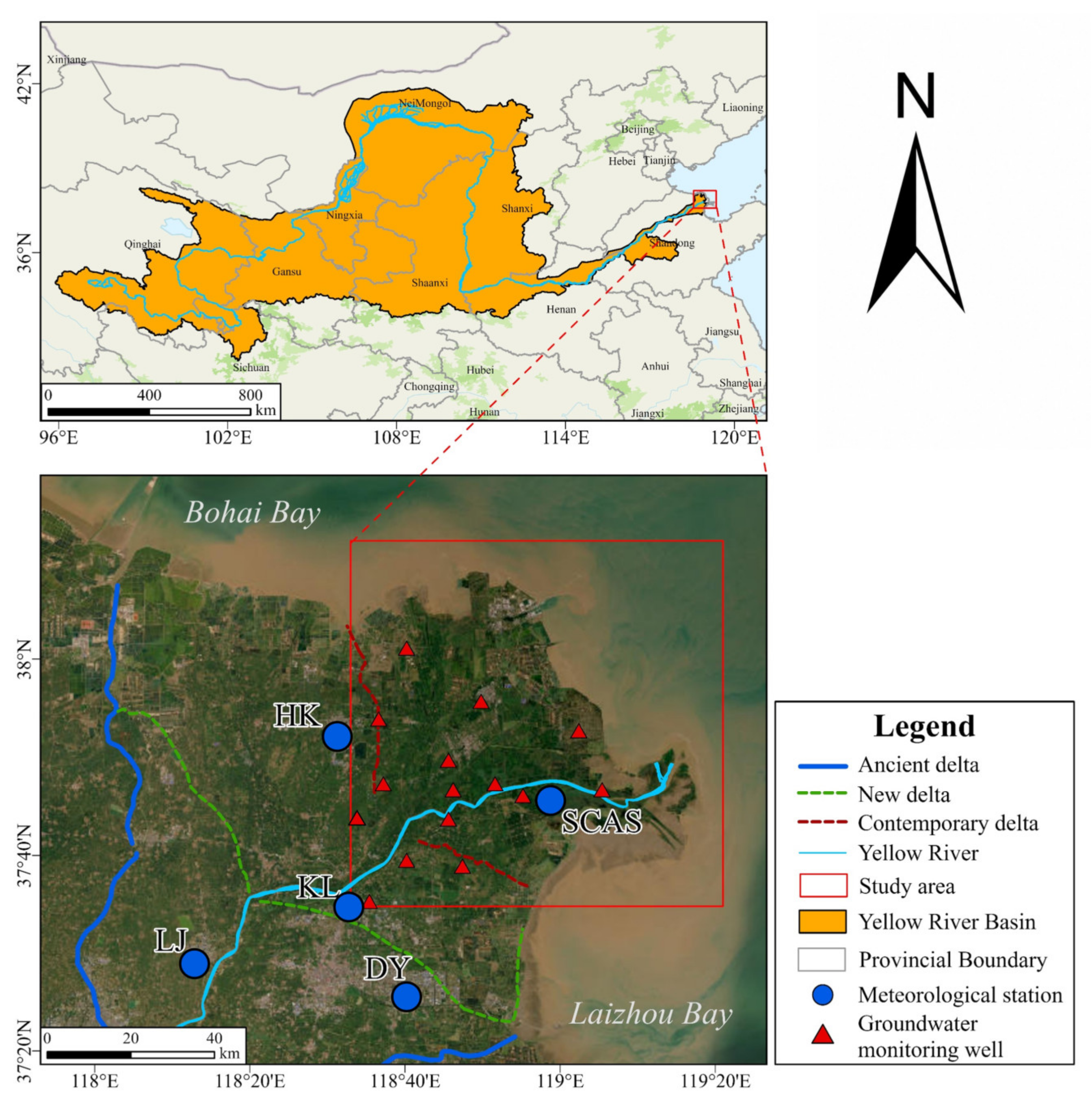
The Yellow River Delta (YRD) is an alluvial plain formed by sediment deposition from the Yellow River at its mouth in the Bohai Depression, at coordinates 118°33′ E~119°21′ E and 37°35′ N~38°12′ N. The delta faces the Bohai Sea to the east and north. It is adjacent to Laizhou Bay and Bohai Bay, and it is bordered by the North China Plain to the west and the piedmont plain of southern Shandong to the south (Figure 1). According to the commonly used geomorphological division of the YRD into the ancient, new, and contemporary delta, the study area selected in this study belongs to the contemporary YRD, which has developed since 1934 and covers about 2800 km2 [24]. This area has a warm temperate continental monsoon climate. The mean annual temperature is about 11.7–12.8 °C. Annual precipitation is about 530–630 mm, and about 70% of the rainfall occurs in summer. Precipitation is unevenly distributed through the year, and the rainy season overlaps with the hottest period.
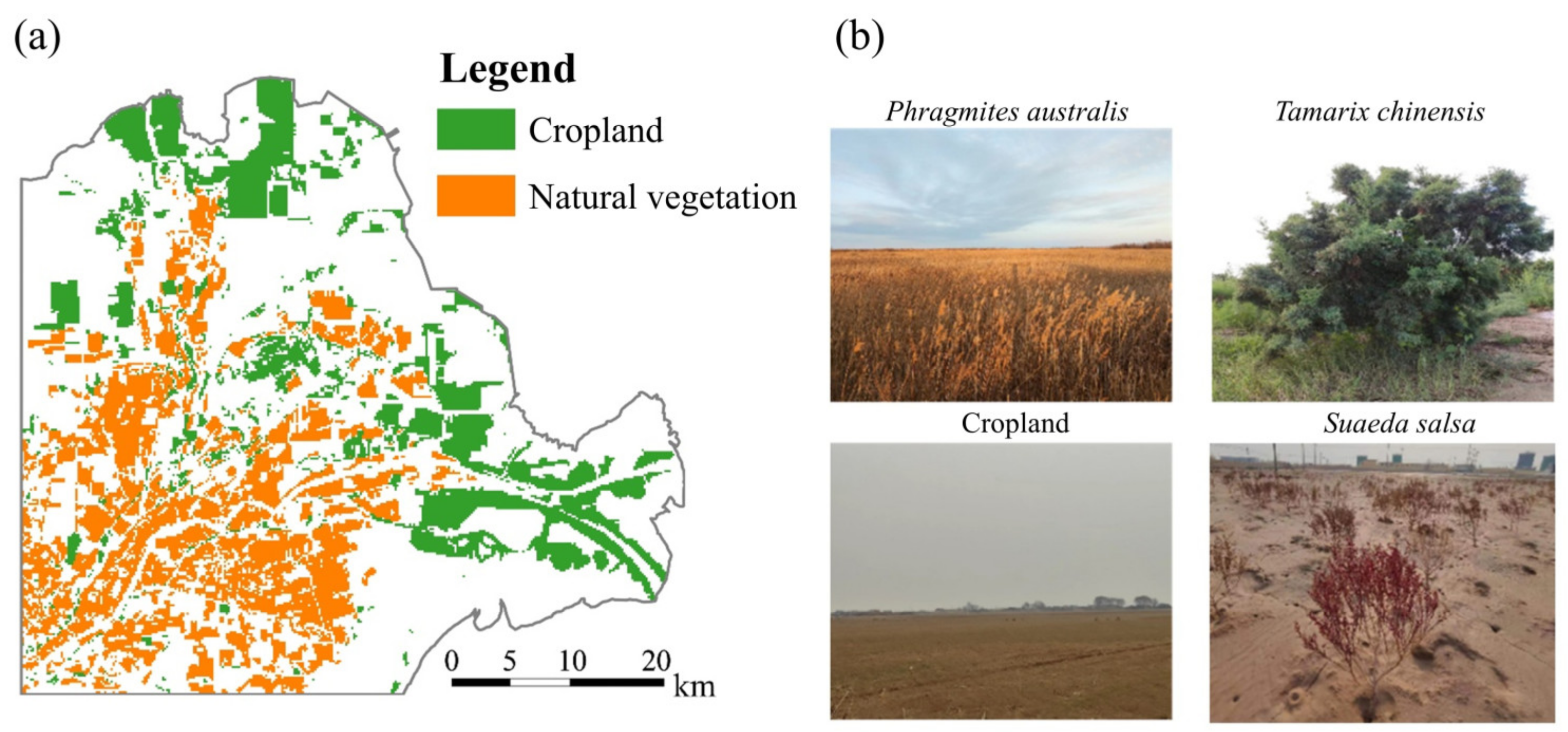
The study area is flat and has poor drainage conditions. High evaporation and seasonal precipitation favor soil salinization and shallow groundwater processes. Cropland is mainly dominated by a summer maize and winter wheat rotation system. Summer maize is usually sown in mid-June and harvested in early October. Natural vegetation is mainly composed of Phragmites australis, Tamarix chinensis, and Suaeda salsa.

2.2. Data Sources and Processing

2.2.1. Precipitation Data

Daily precipitation data from four meteorological stations in and around the contemporary YRD (Figure 1), namely Hekou (HK), Kenli (KL), Dongying (DY), and Lijin (LJ), were collected from the National Meteorological Information Center for the period 1960–2022. These four stations were selected because they are located in or near the contemporary YRD, have continuous long-term daily precipitation records, and provide the best available station coverage for representing regional precipitation conditions in the study area. To evaluate the reliability of the regional precipitation series, additional daily precipitation records from the Station of the Chinese Academy of Sciences (SCAS) were obtained from the contemporary YRD Field Observation and Research Station of Coastal Wetland Ecosystem, Chinese Academy of Sciences. Because the correlation coefficients among the four meteorological stations were all higher than 0.8 and significant at p < 0.001 (Table S1), the arithmetic mean of the four stations was used to represent regional precipitation in the study area. To assess spatial differences in precipitation input during the two focal events, we also used the 0.1° daily gridded precipitation dataset for the Chinese mainland [25]. Event cumulative precipitation was calculated for each event window and extracted for the study area and monitoring-well locations for comparison with groundwater response.

2.2.2. Groundwater Monitoring Data

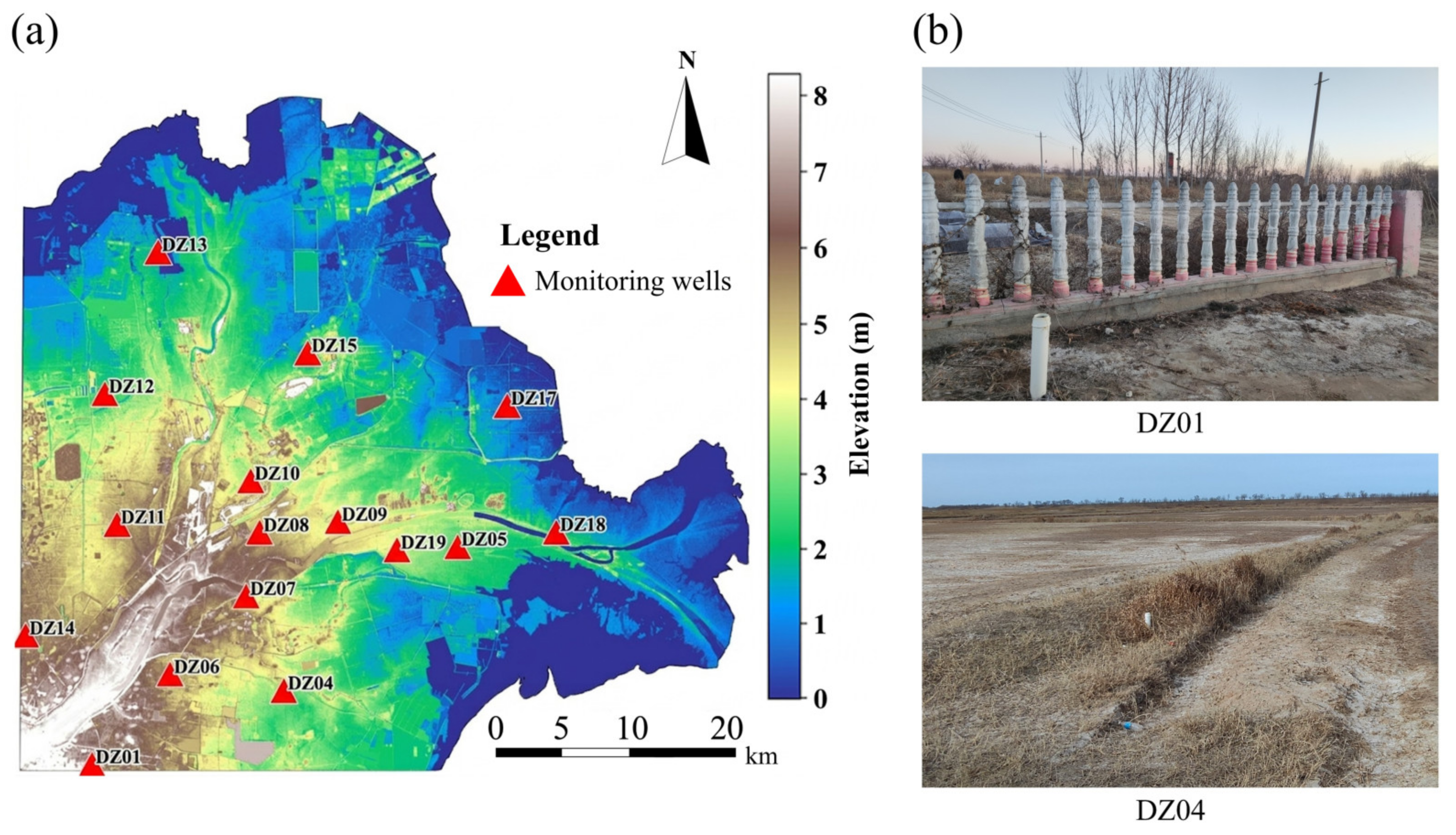
Groundwater level, electrical conductivity, and temperature were monitored hourly using Solinst Levellogger 5 sensors. The spatial distribution of the 16 monitoring wells and field views of two representative wells are shown in Figure 2. To better characterize the distribution and local environmental setting of the monitoring network, well-specific information on elevation, relative position, distance to the coastline, and land use is provided in Table S2, whereas the regional hydrogeological framework of the shallow aquifer system is summarized in Table S3.

2.2.3. Remote Sensing Data and Five-Day kNDVI Generation

Daily surface reflectance data were obtained from the MODIS Terra MOD09GQ product, which is distributed by the NASA EOSDIS Land Processes Distributed Active Archive Center [26,27]. This product provides daily gridded red and near-infrared (NIR) surface reflectance bands at a spatial resolution of 250 m. These two bands were used to calculate the normalized difference vegetation index (NDVI). Daily scenes were processed, and only pixels with clear or good quality flags were retained after quality control. The NDVI was calculated pixel by pixel as:
NDVI   =   NIR   Red NIR   +   Red ,
where NIR and Red represent the near-infrared and red surface reflectance bands from the MOD09GQ product, respectively.
The kernel normalized difference vegetation index (kNDVI) was then derived from the NDVI as:
kNDVI   =   tanh ( NDVI ) 2 ,
The kNDVI is a kernel-based transformation of the NDVI. It was proposed to improve the representation of vegetation greenness and to reduce the saturation effect that can affect the traditional NDVI in areas with relatively high biomass [28]. Recent studies have used the kNDVI to characterize regional vegetation dynamics and ecological degradation, showing its potential for monitoring vegetation changes under environmental stress [29,30]. We used the kNDVI in this study because the analysis focused on short-term vegetation anomalies after EPEs. Compared with the NDVI, the kNDVI provides a more sensitive and continuous indicator for detecting event-scale vegetation changes while remaining directly derived from the standard NDVI framework.
To reduce noise in the daily data while preserving peak vegetation signals, a five-day maximum value composite method was used to generate five-day kNDVI time series [31]. The five-day series was then smoothed using the Savitzky–Golay filter to improve temporal continuity and reduce residual noise [32]. This procedure produced a continuous five-day kNDVI dataset. The detailed processing workflow is shown in Figure S1, and the five-day raw and smoothed kNDVI time series are shown in Figure S2.

2.2.4. Digital Elevation Model and Land Use Data

The digital elevation model (DEM) was derived from approximately 2000 benchmark points and resampled to a resolution of 5 m. The DEM was used as the auxiliary variable in regression kriging. Land use data were obtained from multi-period land use maps developed by the Yantai Institute of Coastal Zone Research, Chinese Academy of Sciences, which have been used in related land use studies [33]. These maps were used to identify areas with unchanged land use during 2000–2022 (Figure 3). Stable cropland and stable natural vegetation masks were then generated for the subsequent analyses of kNDVI anomalies and vegetation type differences.

2.3. Extreme Precipitation Event

Extreme precipitation events (EPEs) were determined using a percentile-threshold method, which is widely used in extreme precipitation studies. In this method, thresholds are commonly calculated from wet-day precipitation records, defined as records from days with daily precipitation greater than 1 mm, such as the 95th or 99th percentile, and are then used to identify extremely wet days [8,9]. We selected the 99th percentile because this study focused on rare, high-intensity precipitation events rather than more common heavy rainfall events. Based on the daily precipitation records in the study area from 1960 to 2022, we first extracted the wet-day precipitation series. The 99th percentile of this series was then calculated and used as the single-day EPE threshold. The resulting threshold was 86.5 mm. Therefore, precipitation processes with daily precipitation greater than 86.5 mm were identified as EPEs in this study.
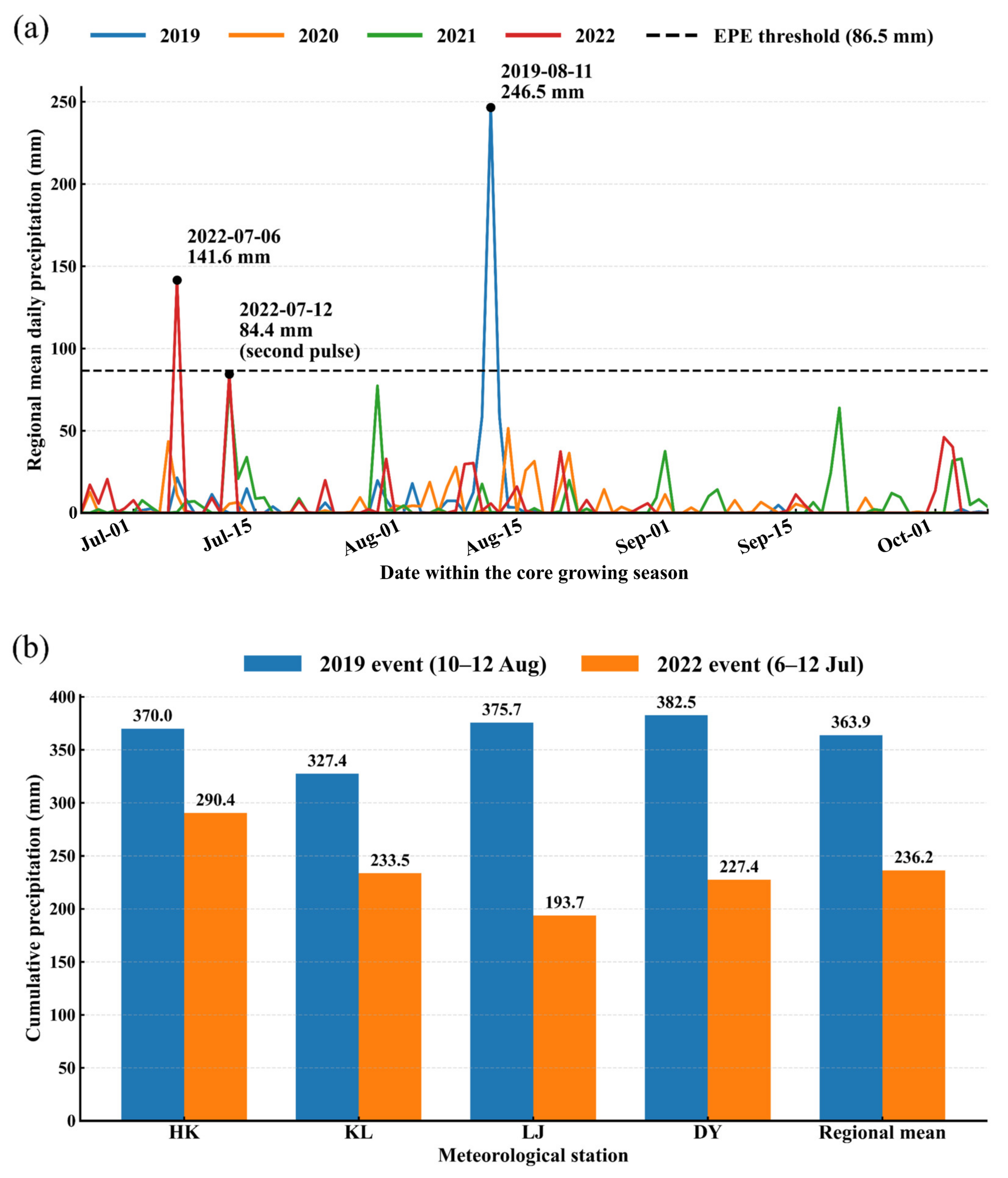
Based on this criterion, the 2019 Typhoon Lekima event and the 2022 Typhoon Chaba event were selected as the focal events in this study. Daily precipitation records from the four meteorological stations showed good regional consistency during both events. During the 2019 event, the regional mean daily precipitation reached 246.5 mm on 11 August, which was far above the extreme precipitation threshold. The regional mean cumulative precipitation from 10 to 12 August was 363.9 mm. During the same period, cumulative precipitation recorded at the four meteorological stations, namely HK, KL, LJ, and DY, reached 370.0, 327.4, 375.7, and 382.5 mm, respectively. In comparison, during the 2022 Typhoon Chaba event, the regional mean daily precipitation reached 141.6 mm on 6 July, which also exceeded the threshold. A second precipitation pulse occurred on 12 July, with a regional mean daily precipitation of 84.4 mm. Both the 2019 and 2022 events exceeded the 99th-percentile wet-day precipitation threshold and were supported by complete and matched precipitation, groundwater, and vegetation observations, which enabled an integrated analysis of the extreme precipitation, groundwater, and vegetation response framework.

2.4. Groundwater Depth Interpolation

To obtain a spatially continuous groundwater depth dataset, hourly groundwater level records from the 16 monitoring wells were first converted to groundwater depth and then aggregated to daily values. Because the study area shows clear spatial heterogeneity in terrain and surface conditions, three interpolation methods were compared, including inverse distance weighting (IDW), ordinary kriging (OK), and regression kriging (RK). Their interpolation accuracy was evaluated using leave one out cross validation. Regression kriging, using the DEM as an auxiliary variable for trend estimation, achieved the best performance, with the lowest root mean square error and the highest win rate (Table 1). This method combines trend estimation based on auxiliary variables with kriging of residuals, and has been widely used in spatial interpolation studies [34,35]. Therefore, it was selected to generate the daily groundwater depth dataset for the study area. The spatial interpolation effect is shown in Figure S3.

2.5. Quantification of the Response of Vegetation to Extreme Precipitation

The core growing season was identified from the multi-year mean annual kNDVI cycle in the contemporary YRD during 2001–2022 [36]. It was then used as the time window for analyzing vegetation responses to extreme precipitation. To quantify vegetation responses under different precipitation conditions, we calculated kNDVI anomalies for 2019–2022 using the multi-year mean as the baseline. Among these years, 2019 and 2022 were treated as the two focal EPE years because both exceeded the 99th-percentile wet-day precipitation threshold and were supported by complete and matched precipitation, groundwater, and vegetation observations, whereas 2020 and 2021 were retained as reference years for comparison. This baseline anomaly framework has been used in previous studies on vegetation response to EPEs [14].
The baseline kNDVI for each five-day period was calculated as:
kNDV I baseline , p   =   1 n y = 2001 2022 kNDVI y , p
In Equation (3), p denotes the index of the five-day period; kNDV I baseline , p denotes the multi-year mean baseline kNDVI for the p-th five-day period from 2001 to 2022; kNDVI y , p denotes the kNDVI value for the p-th five-day period in year y; n is the total number of years, with n = 22 in this study.
The pixel-scale kNDVI anomaly for each analysis year was calculated as:
Δ kNDV I t , p = kNDV I t , p   kNDV I baseline , p kNDV I baseline , p   ×   100 %
In Equation (4), Δ kNDV I t , p is the percentage kNDVI anomaly for the p-th five-day period in analysis year t; kNDV I t , p is the kNDVI value for the p-th five-day period in analysis year t; t denotes the analysis year.
The regional mean vegetation response was calculated as:
Δ kNDVI ¯ t , p = 1 N i = 1 N Δ kNDVI t , p , i
In Equation (5), Δ kNDVI ¯ t , p is the regional mean kNDVI anomaly for the p-th five-day period; i denotes the pixel; and N is the number of stable pixels included in the analysis, t denotes the analysis year.
To improve the robustness of interannual comparisons, the mean values were estimated from 1000 bootstrap resamples, and the 2.5th and 97.5th percentiles were used as the lower and upper bounds of the 95% confidence interval.

2.6. Analysis of Groundwater Modulation of Vegetation Responses to Extreme Precipitation

To examine the regulating role of groundwater in vegetation response to extreme precipitation, the analysis focused on two aspects: differences in groundwater response and grouped comparisons. Previous studies have shown that the 2019 Typhoon Lekima event caused rapid rise in shallow groundwater in the contemporary YRD and led to clear differences in the recovery process [19]. Based on this, the magnitude of groundwater rise, the shallowest groundwater depth after the event, and the recovery process were compared between the 2019 and 2022 EPEs to identify differences in groundwater response characteristics under different events.
Samples were then grouped according to the shallowest groundwater depth reached after the event and its continuous duration. The shallowest groundwater depth was classified into three groups: <0 m, [0, 0.5) m, and [0.5, 1.0) m. The corresponding duration was classified into 1, 2, 3, 4, 5, 6, and ≥7 d. Each pixel was assigned only once according to the shallowest groundwater depth class reached after the event and its corresponding continuous duration. kNDVI anomalies were then compared among groups. Statistical analyses included Pearson correlation, bootstrap confidence interval estimation, and significance tests. All comparisons were conducted within the same time window to ensure consistency across events.

2.7. Workflow of the Study

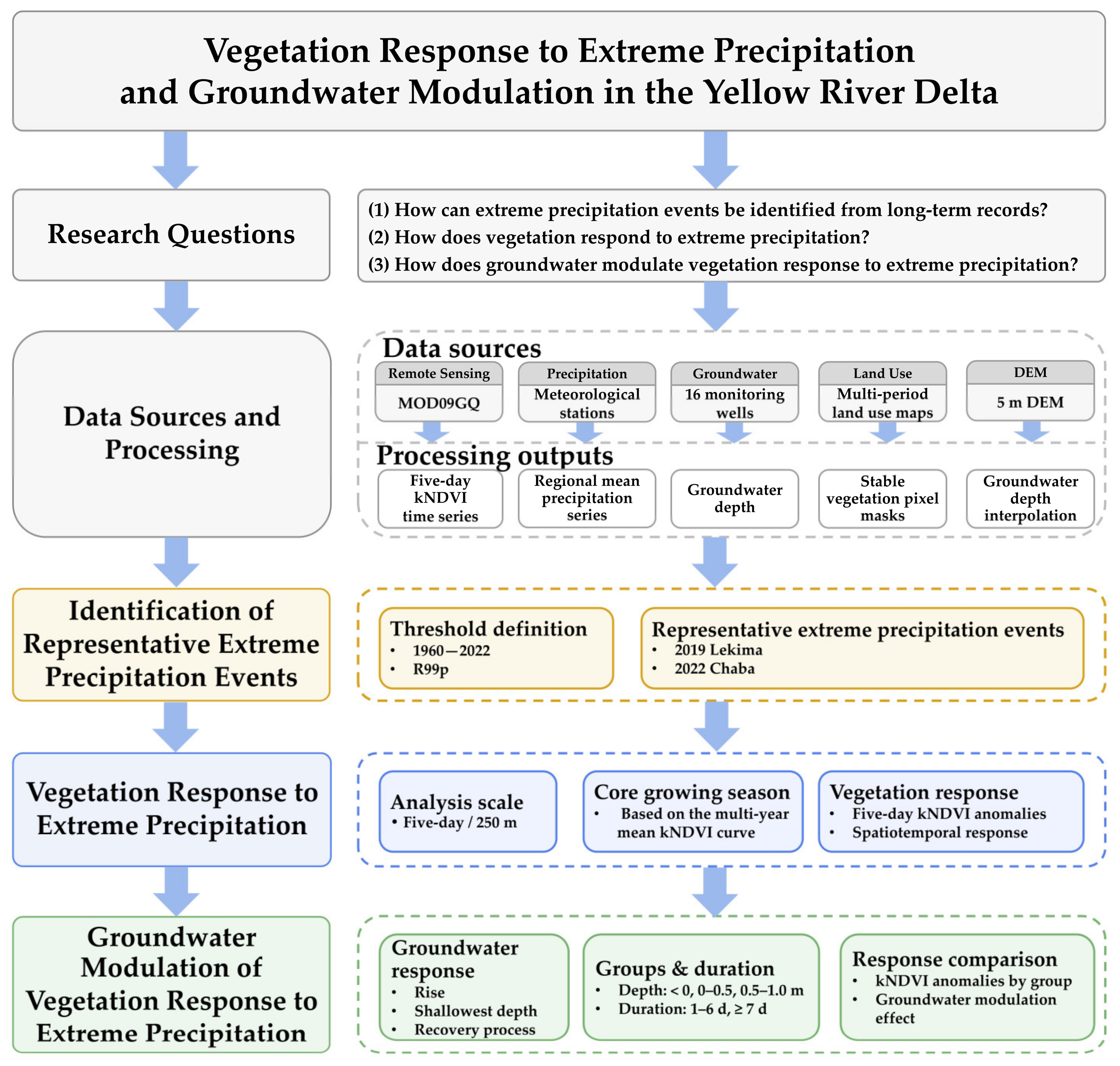
The overall workflow of the study is shown in Figure 4. The analysis followed a continuous framework linking extreme precipitation, groundwater dynamics, and vegetation response.

3. Results

3.1. Long-Term Increase in Extreme Precipitation from 1960 to 2022

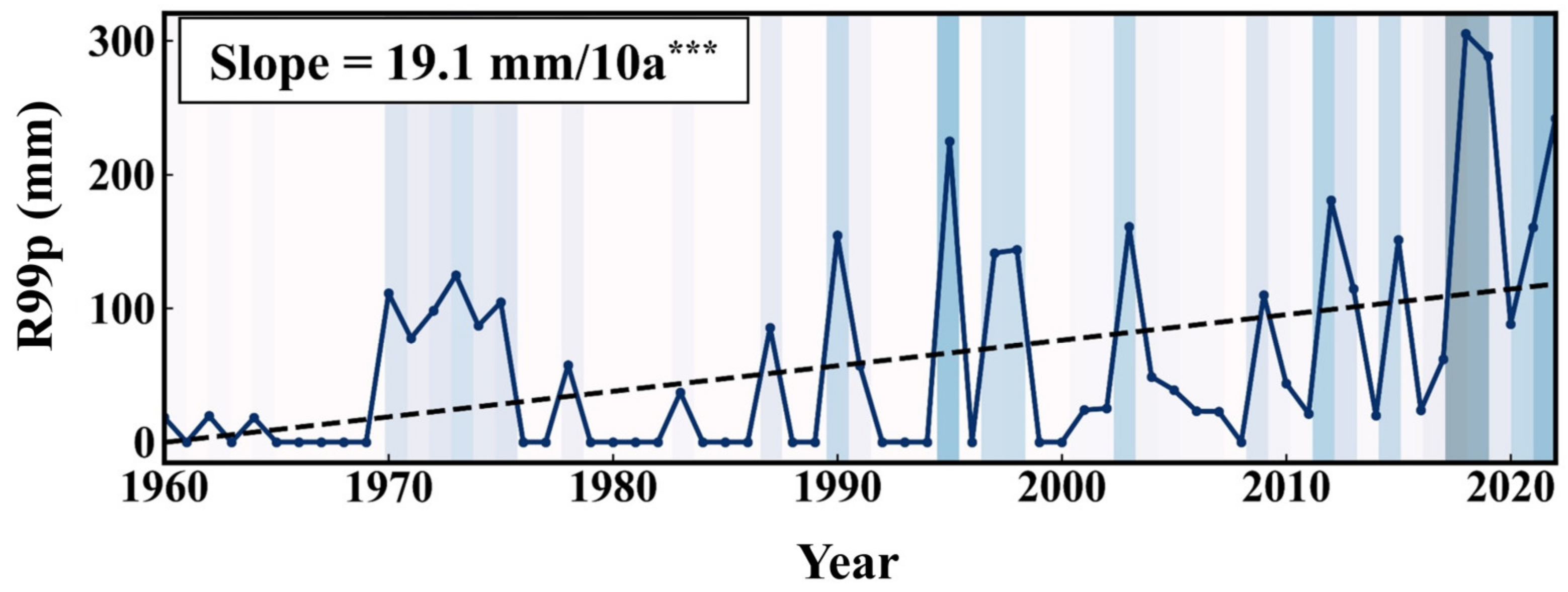
Figure 5 shows the long-term variation in R99p in the contemporary YRD from 1960 to 2022. Overall, R99p increased significantly, with a linear trend of 19.1 mm/10 a. In the earlier period, interannual fluctuations were relatively weak, and extreme high values occurred less frequently. After 2000, especially since 2010, high-value years became more frequent, and interannual variability also increased. These changes indicate that extreme precipitation in the study area has generally intensified. The results for the other two extreme precipitation indices, very wet day precipitation (R95p) and annual maximum 1-day precipitation (Rx1day), are presented in Figure S4, with linear trends of 30.5 mm/10 a and 8.3 mm/10 a, respectively. Taken together, the three indices indicate a consistent strengthening of the extreme precipitation background in the study area. Figure S5 shows the Mann–Kendall test results for these indices. They all show a stage of enhanced increase around 2010, and the upward tendency became more evident after 2016. Against this background, the 2019 and 2022 events can be regarded as representative cases for the subsequent event-scale analysis.
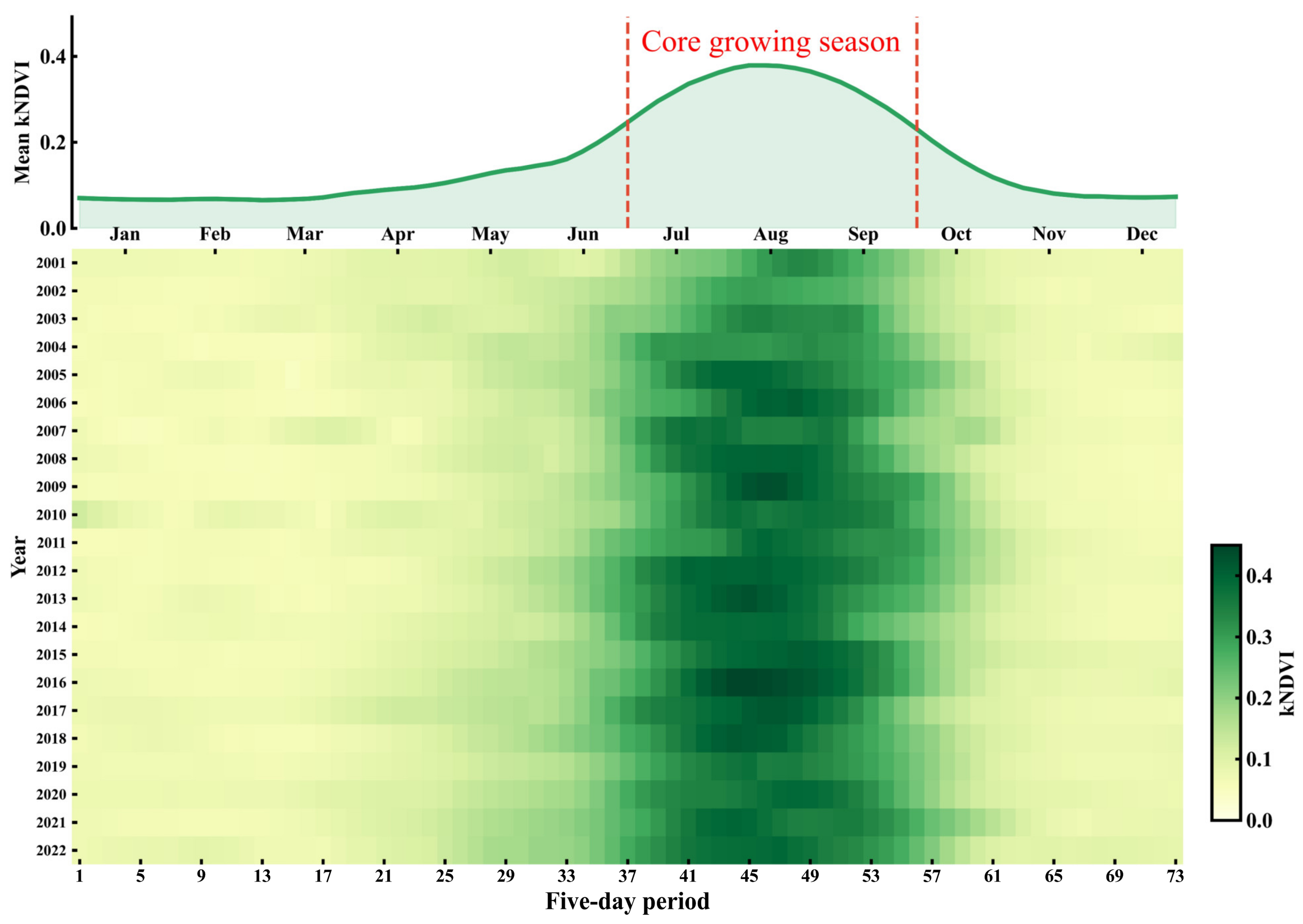
Figure 6 shows the five-day kNDVI pattern in the contemporary YRD from 2001 to 2022. Both the multi-year mean curve and the heatmap show that the kNDVI increased gradually from spring, reached high values in summer, and then declined rapidly after autumn. Based on this long-term growth pattern, vegetation activity was mainly concentrated in five-day periods 36–56, which were therefore defined as the core growing season. All subsequent analyses of vegetation and groundwater responses to the 2019 and 2022 EPEs were conducted within this period so that the two events could be compared under a broadly consistent background.

3.2. Response of Vegetation Growth to Extreme Precipitation

Figure 7 shows the precipitation characteristics of the two EPEs in 2019 and 2022. During the core growing season, both the 2019 and 2022 events exceeded the 99th-percentile wet-day precipitation threshold of 86.5 mm. The regional mean daily precipitation reached 246.5 mm on 11 August 2019, which was much higher than the 141.6 mm recorded on 6 July 2022. In 2022, a second precipitation pulse occurred on 12 July, with a regional mean daily precipitation of 84.4 mm, which was close to the threshold. The regional mean cumulative precipitation reached 363.9 mm during 10–12 August 2019, compared with 236.2 mm during 6–12 July 2022. Precipitation patterns among the four stations were broadly consistent during both events.
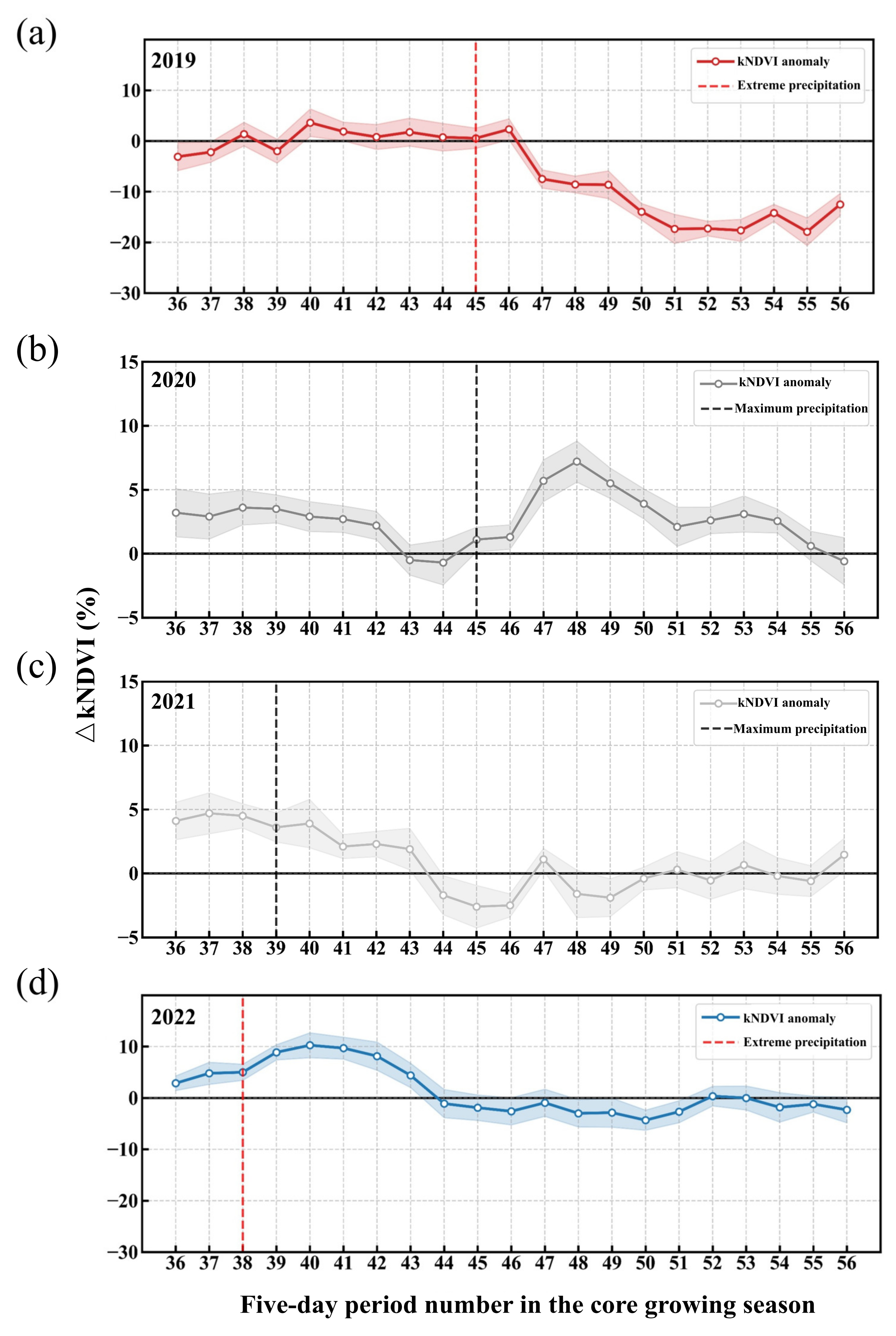
Figure 8 shows the five-day kNDVI anomaly series during the core growing season from 2019 to 2022. In 2020 and 2021, kNDVI anomalies generally showed small fluctuations and remained close to the multi-year mean level, with no clear anomalous shift observed around the dates of the annual maximum precipitation events (Figure 8b,c). Figure 8a shows that the EPE associated with Typhoon Lekima occurred in five-day period 45, when vegetation growth was near its seasonal peak. Before the event, kNDVI anomalies fluctuated around zero, indicating that vegetation growth was close to the baseline level. About 10 days after the event, a clear negative anomaly was first observed, reaching −8.3%. The anomaly then continued to decline and remained at a low level during the late growing season. The spatial result (Figure S6) shows that the area of negative anomalies expanded progressively after the event and developed into a broad and persistent negative response during the late growing season. Figure 8d shows that the EPE associated with Typhoon Chaba occurred in five-day period 38, at the early stage of the core growing season. About one month after the event, the anomaly first turned negative in five-day period 44 and then remained within a relatively small negative range of about −1% to −4%. Compared with 2019, the negative response in 2022 appeared later and had a smaller magnitude. The spatial result (Figure S9) further shows that negative anomalies in 2022 were mainly confined to local areas, and both their extent and intensity were lower than those in 2019. No broad and persistent negative response similar to that in 2019 was observed.
Taken together, Figure 8a–d show clear interannual differences in vegetation responses to precipitation events. The anomalies in 2020 and 2021 mainly reflected background fluctuations. In contrast, the 2019 extreme precipitation event was followed by the largest and longest-lasting negative response, whereas the 2022 event caused a weaker response with a more pronounced lag.

3.3. Groundwater Response to Extreme Precipitation

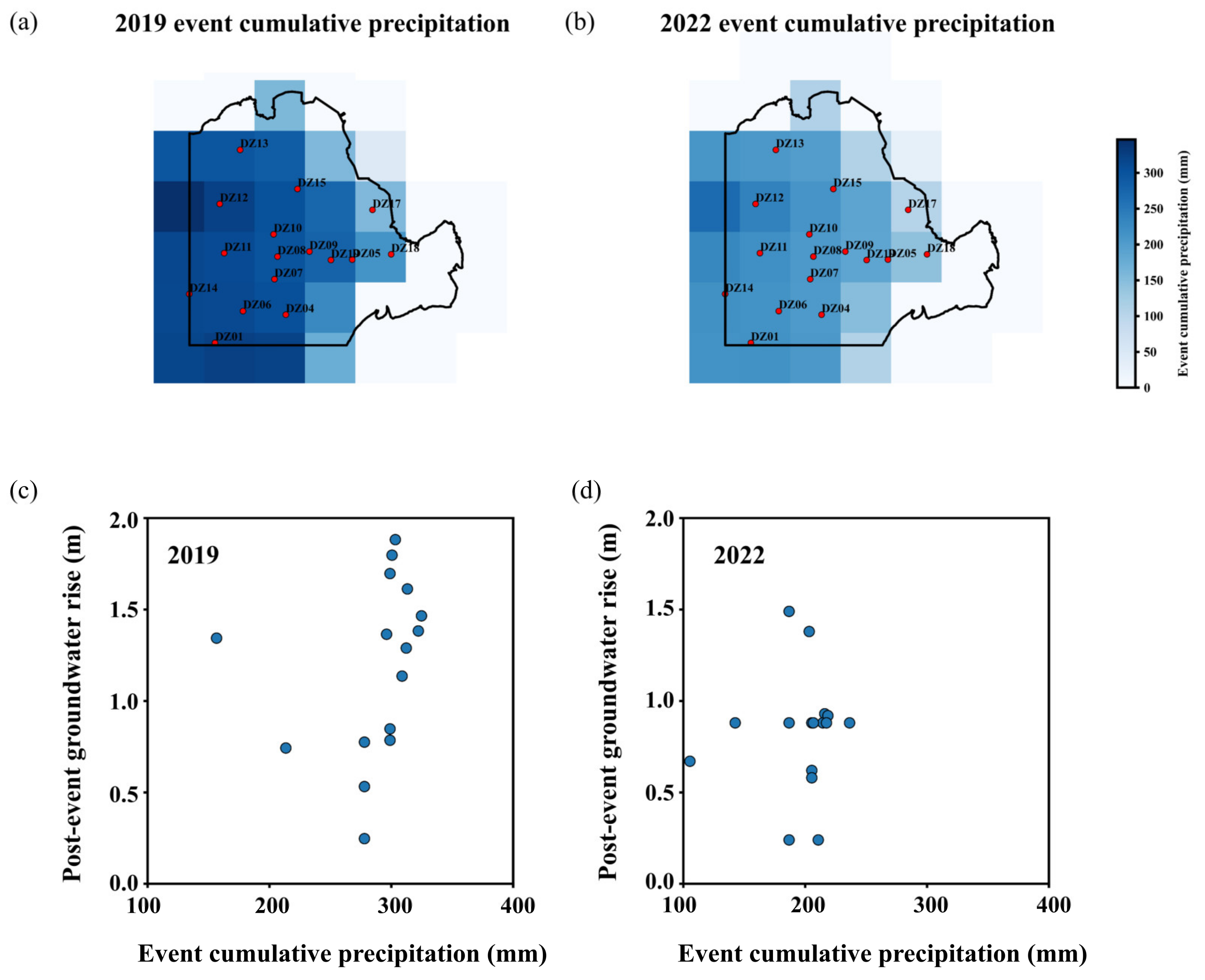
Figure 9 shows the spatial distribution of event cumulative precipitation and the well-based relationship between cumulative precipitation and post-event groundwater rise in 2019 and 2022. To further evaluate whether the differences among monitoring wells were related to spatial differences in rainfall input, we examined the event-scale distribution of cumulative precipitation using the 0.1° daily gridded precipitation dataset for the Chinese mainland [25]. The two events showed broadly similar spatial patterns within the study area (Figure 9a,b). However, at the monitoring-well scale, event cumulative precipitation did not show a clear correspondence with groundwater rise in either 2019 or 2022 (Figure 9c,d). This suggests that spatial differences in precipitation may have contributed to some inter-well differences but cannot fully explain the observed variability in groundwater response. Instead, the contrasting groundwater responses among wells were more likely influenced by differences in local site setting, drainage and waterway connectivity, and post-event recovery processes, with the relevant well-specific attributes and regional hydrogeological background summarized in Tables S2 and S3.
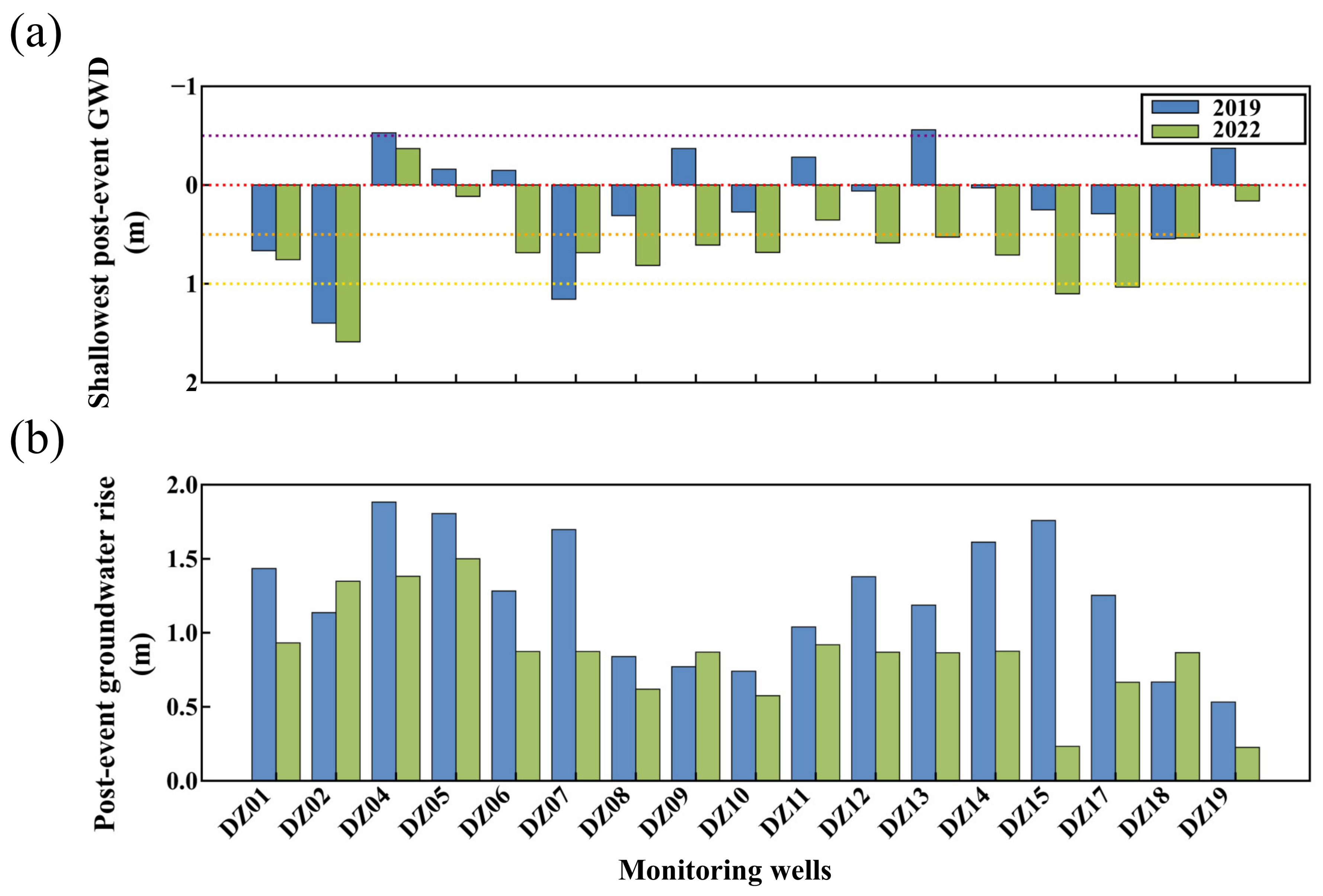
Figure 10 compares the intensity of groundwater responses at the monitoring-well scale after the 2019 and 2022 EPEs. Groundwater levels rose markedly at all monitoring wells after both events, but the response was stronger in 2019. After the 2019 event, surface inundation occurred at multiple wells. Groundwater levels rose above the land surface at DZ04, DZ05, DZ06, DZ09, DZ11, DZ13, and DZ19. The corresponding groundwater rise was mostly within 0.5–1.9 m, and exceeded 1.5 m at several wells. The groundwater response in 2022 was weaker overall. Only DZ04 showed slight above-surface water levels, and groundwater rise was generally smaller, mainly within 0.5–1.0 m.
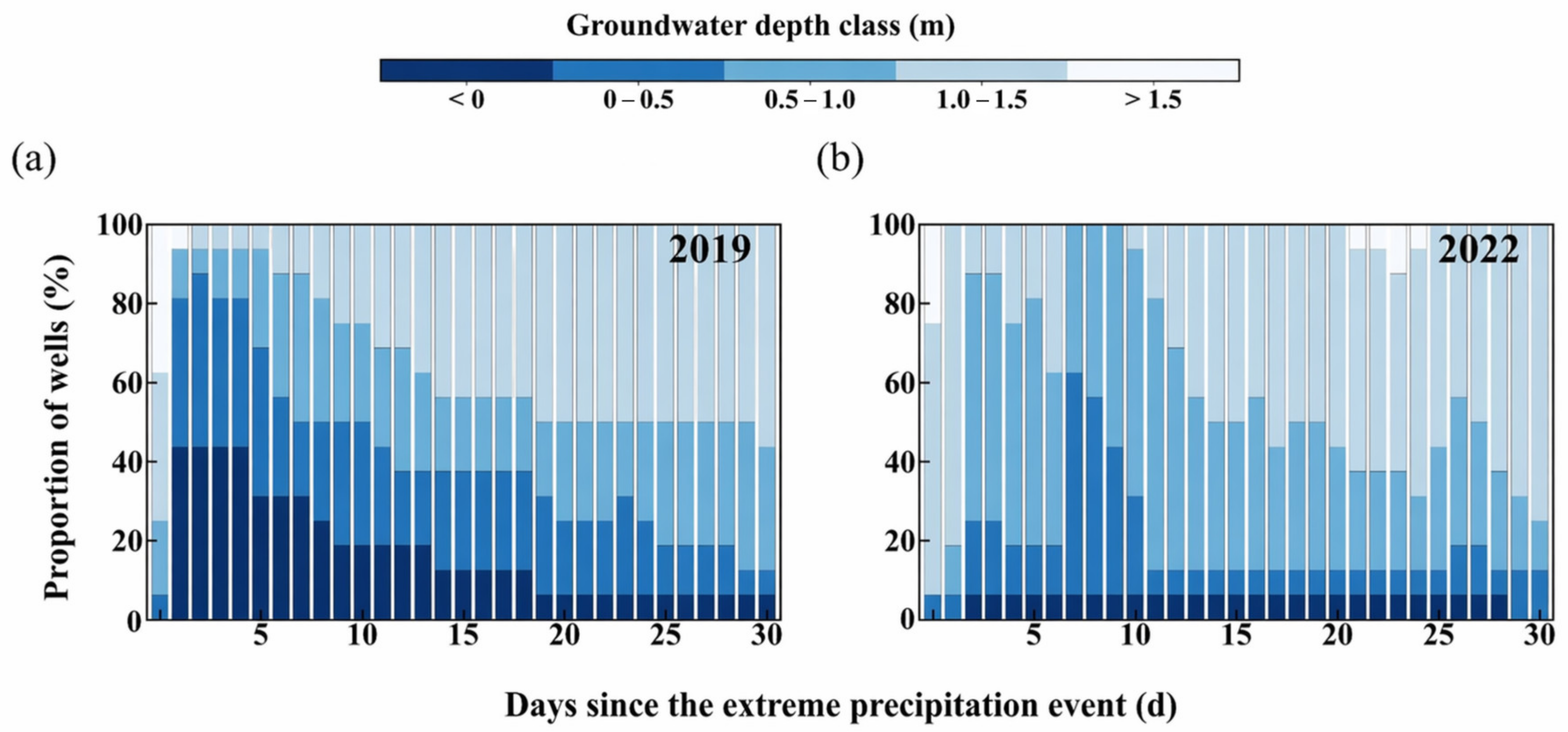
Figure 11 further shows the daily changes in groundwater depth classes after the two events. In 2019, a high proportion of wells reached above the land surface within a short time after the event. In 2022, groundwater also became markedly shallower, but most wells were concentrated in the 0.5–1.5 m classes, and the proportion of wells with above-surface water levels was much lower. The proportion of inundated wells reached 43.8% in 2019, which was much higher than the 12.5% recorded in 2022. In addition, shallow groundwater conditions persisted longer in 2019, and recovery was slower. In 2022, recovery was faster and the persistence of shallow groundwater was weaker. This pattern is consistent with previous work showing prolonged groundwater recovery after Typhoon Lekima [19].
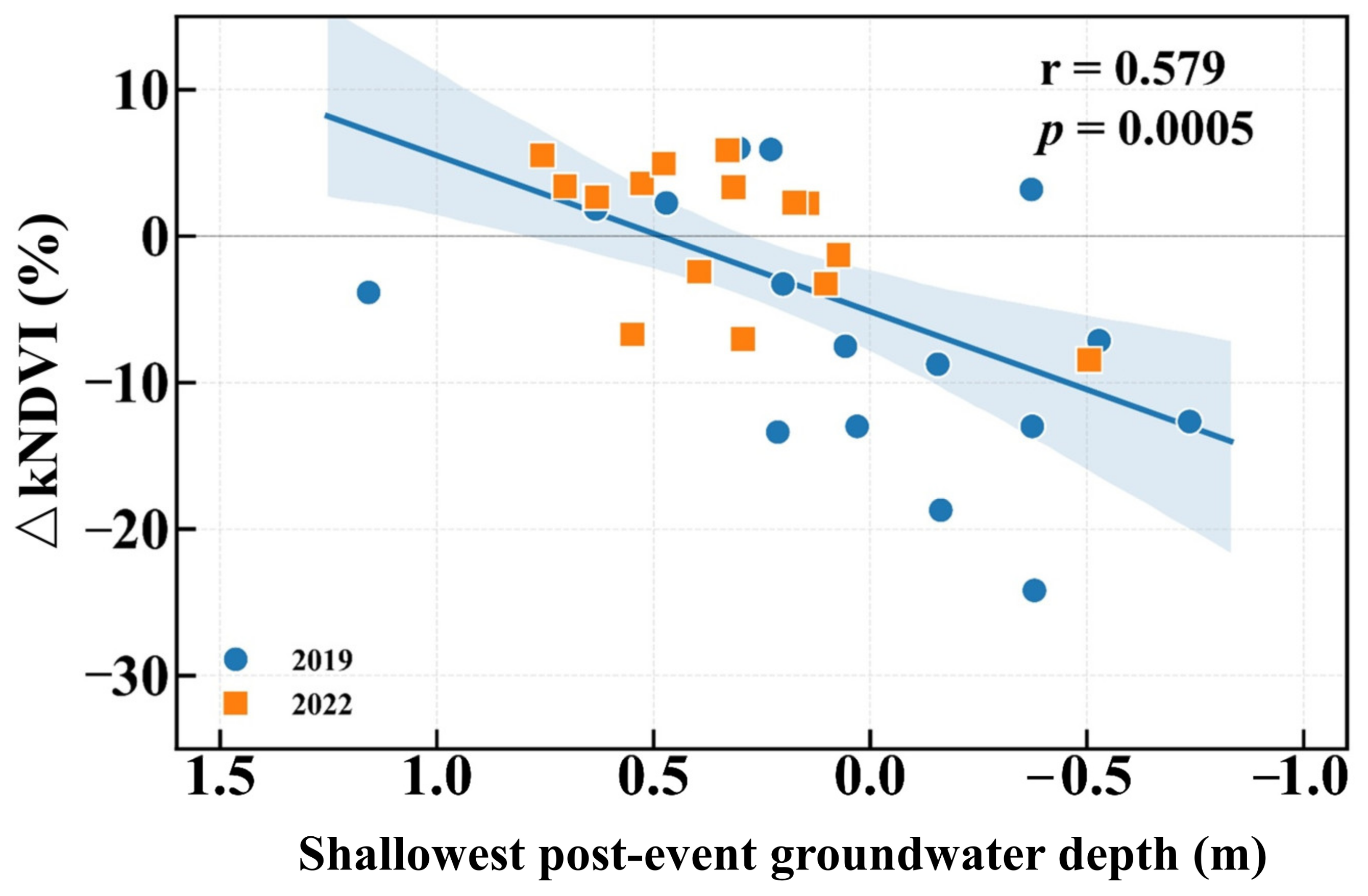
Figure 12 shows a significant negative relationship between the shallowest post-event groundwater depth and kNDVI anomalies. As post-event groundwater depth became shallower, kNDVI anomalies generally decreased, indicating stronger negative vegetation responses. This relationship was significant at the monitoring-well scale (r = 0.579, p < 0.001).

3.4. Vegetation Responses to Extreme Precipitation Were Modulated by Groundwater

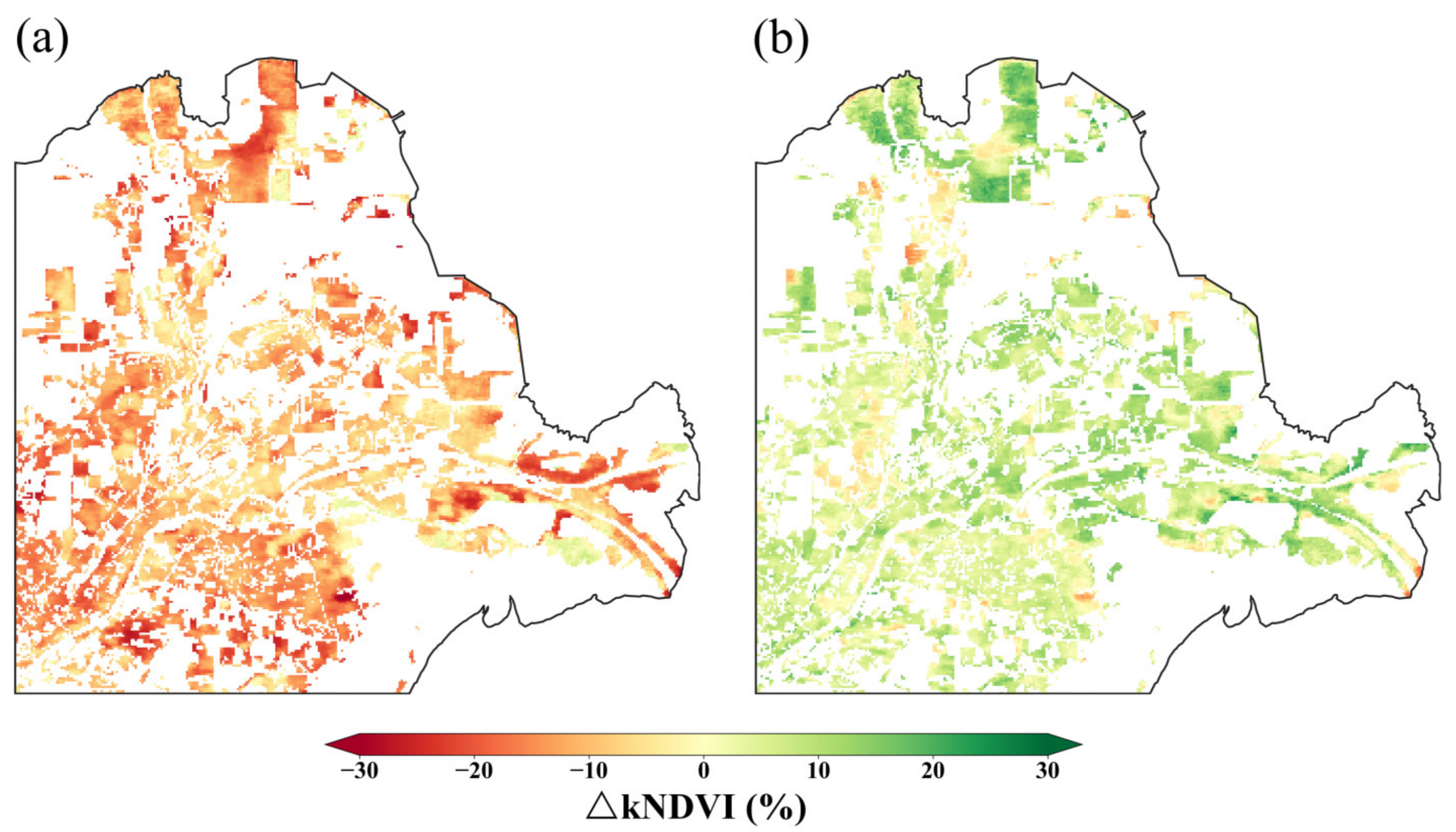
Figure 13 shows the spatial patterns of mean kNDVI anomalies after the 2019 and 2022 EPEs. After the 2019 event, negative anomalies dominated most of the study area. The mean kNDVI anomaly was −12.8%, and the area with negative responses accounted for 77.7%. In contrast, the mean kNDVI anomaly after the 2022 event was 3.1%, which was clearly higher than that in 2019. Negative anomalies were mainly confined to local areas, whereas large parts of the study area remained close to the baseline.
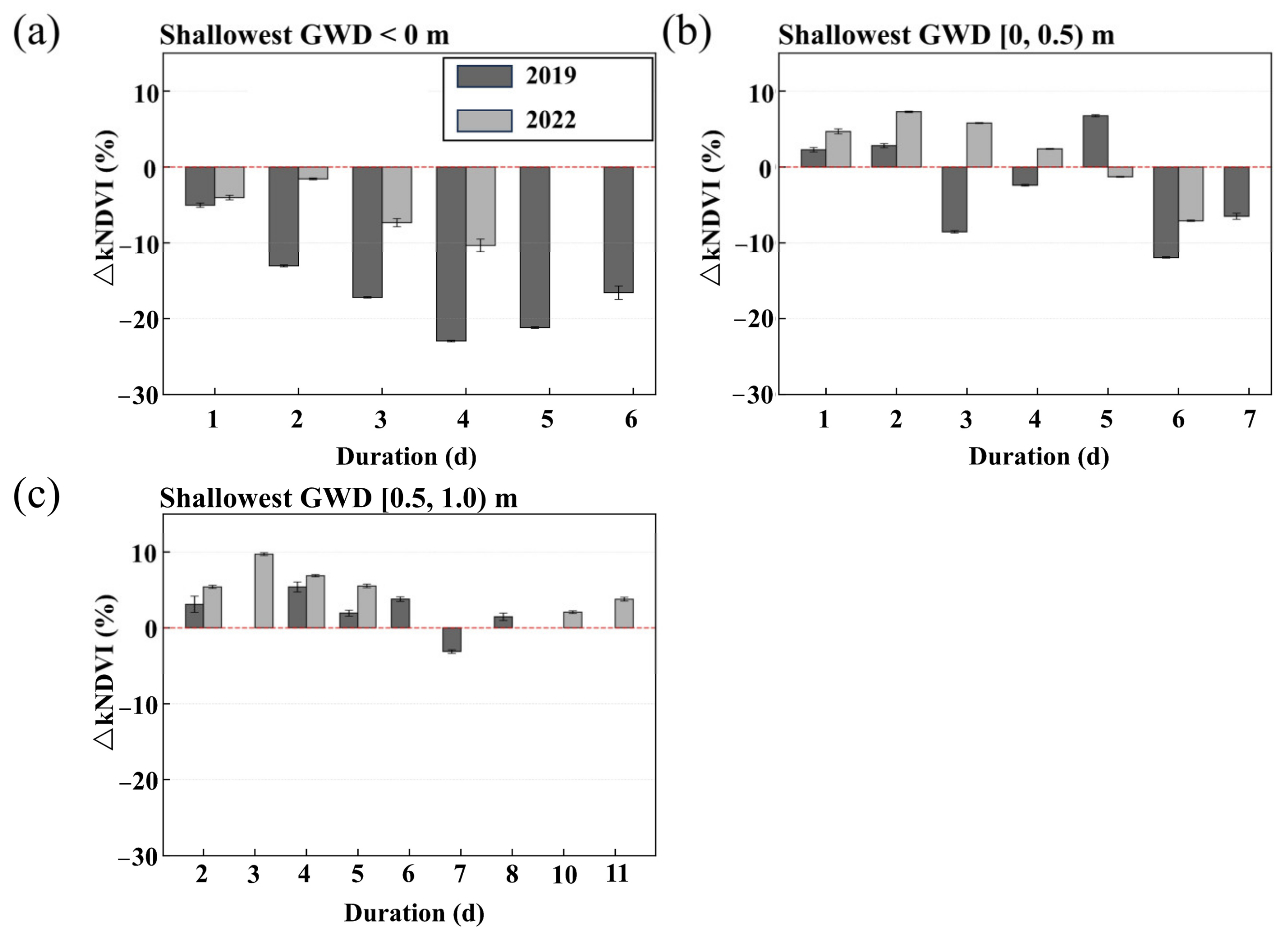
As shown in Figure 12, shallowest post-event groundwater depth was significantly negatively correlated with kNDVI anomalies at the monitoring-well scale. Based on this result, Figure 14 further compares vegetation responses under different groundwater conditions from the spatial perspective, using both shallowest groundwater depth classes and their durations. When surface inundation occurred after the event, the kNDVI showed clear negative anomalies in both years, and the magnitude of the negative anomaly increased with longer duration. Under this condition, the negative response was stronger in 2019. When inundation lasted for 6 days, the kNDVI anomaly had already declined to below about −17%. In 2022, negative anomalies were also observed, but their magnitude was smaller overall. When the shallowest groundwater depth was within the 0–0.5 m class, the kNDVI shifted gradually from near-zero fluctuations to negative anomalies. By contrast, when the shallowest groundwater depth remained within the 0.5–1.0 m class, kNDVI anomalies were generally close to baseline or remained slightly positive.
Table 2 further shows the difference in groundwater-state duration between 2019 and 2022. After the 2019 event, the proportion of duration in the above-surface inundation class reached 54.0%, which was much higher than the 7.2% in 2022. In contrast, in 2022, most of the duration was concentrated in the 0–0.5 m and 0.5–1.0 m classes, accounting for 63.5% and 29.4%, respectively. These results indicate that the post-event groundwater system remained in inundated or very shallow conditions for a longer period in 2019, whereas in 2022 it was more often characterized by shallow groundwater without persistent surface inundation.
Taken together, Figure 13 and Figure 14 and Table 2 show that vegetation responses after the two EPEs were closely related to both the shallowest post-event groundwater depth and its duration. A common pattern was observed in both years: when above-surface inundation lasted longer, the kNDVI showed stronger negative anomalies; when groundwater depth remained within the 0–0.5 m class for a longer time, the kNDVI also declined clearly; and when the shallowest groundwater depth remained within the 0.5–1.0 m class, the kNDVI changed only slightly. The main difference between the two events lay in response intensity and persistence. In 2019, surface inundation and very shallow groundwater conditions lasted longer, occupied a larger proportion, and recovered more slowly. Accordingly, the associated negative kNDVI anomalies were stronger. In 2022, the response followed the same direction, but its magnitude was weaker.

4. Discussion

4.1. Response of Vegetation to the Extreme Precipitation Events

Compared with the relatively small background fluctuations in vegetation growth observed in the two reference years (2020 and 2021), both 2019 and 2022 showed much stronger negative vegetation disturbances after the two EPEs, with the 2019 event producing a more severe and persistent response. These results indicate that, in the contemporary YRD, threshold-exceeding precipitation events can trigger marked vegetation disturbance and that response intensity further depends on event characteristics such as intensity, cumulative amount, and concentration.
These results are generally consistent with previous studies showing that extreme precipitation can suppress vegetation function in coastal ecosystems. Observational studies in coastal wetlands have shown that extreme precipitation can weaken the annual CO2 sink and produce effects that persist after the event [15]. In the contemporary YRD, previous research also found that Typhoon Lekima in 2019 caused a more than 100-fold reduction in the distribution area of Zostera japonica meadows, accompanied by substantial losses of soil organic carbon and total nitrogen and that natural recovery was unlikely [37]. In addition, studies in emerging coastal wetlands have shown that extreme precipitation can trigger rapid and abrupt vegetation succession rather than only gradual change [38]. Together, these studies indicate that high-intensity extreme precipitation events can cause deep and persistent ecological disturbances in coastal vegetation.
Vegetation responses to extreme precipitation depend not only on whether an event occurs but also on its intensity, persistence, and concentration. In the Yellow River Basin, extreme precipitation indices have been found to exert stronger effects on vegetation cover than extreme temperature indices, and precipitation intensity, frequency, and duration all play important roles in vegetation change [18]. The effects of extreme precipitation on vegetation usually involve clear lagged and cumulative responses [39]. At the coastal wetland, different extreme climate indices were also found to be associated with significantly different vegetation responses, and the effect of extreme precipitation varied among regions and vegetation types [40]. In the present study, the 2019 event had not only a higher daily intensity but also greater cumulative precipitation and a more concentrated process, and it was followed by a stronger negative vegetation response. By contrast, although the 2022 event also exceeded the extreme precipitation threshold, the subsequent decline in vegetation was weaker. Studies in coastal salt marshes have also shown that precipitation changes can alter dominant species and functional groups by changing soil salinity [23]. This suggests that, in strongly coupled water-salt environments such as the contemporary Yellow River Delta, vegetation changes after extreme precipitation may be related not only to water stress but also to post-event redistribution of water and salt.
From a longer-term perspective, R99p, R95p, and Rx1day all increased during 1960–2022 (Figure S4), indicating that extreme precipitation activity has intensified over time. Under global climate change, low-lying coastal ecosystems may become even more sensitive to extreme precipitation and flooding. Coastal wetlands are widely distributed in delta regions and are under increasing pressure from both climate change and human activities, which threatens their stability and sustainability [41]. The Yellow River Basin and coastal regions have also shown that intensified extreme precipitation may increase the risks of vegetation function decline, reduced ecosystem services, and vegetation composition change [18,37]. Therefore, the contrasting vegetation responses identified in this study under different EPEs are important not only for the contemporary YRD but also for understanding ecological risk, restoration, and climate adaptation in other low-lying coastal deltas. Based on a continuous precipitation–groundwater–vegetation framework for 2019–2022, this study compares two representative EPE years (2019 and 2022) with two reference years without EPEs (2020 and 2021), and thus provides direct event-scale evidence for distinguishing vegetation responses under extreme and non-extreme precipitation conditions. Future accumulation of longer matched observations will be valuable for testing the consistency of these response patterns over broader temporal scales. This also suggests that event-scale comparisons grounded in a common long-term background can provide a useful way to analyze vegetation variability in low-lying coastal deltas.

4.2. Groundwater as a Key Hydrological Link in Modulating Vegetation Responses to Extreme Precipitation Events

Vegetation responses to extreme precipitation were related not only to the shallowest post-event groundwater depth but also to the duration of surface inundation or very shallow groundwater conditions (Figure 14). When surface inundation lasted longer, or when groundwater remained within the very shallow depth class for an extended period, vegetation disturbance became stronger. In the contemporary YRD, the effect of extreme precipitation on vegetation may therefore be further amplified by post-event groundwater rise, the persistence of shallow groundwater conditions, and the recovery process.
Previous studies have shown that shallow groundwater level and salinity in the YRD exhibit clear spatiotemporal heterogeneity, and are jointly influenced by low-lying topography, strong evaporation, land–sea interactions, and fresh–saline water recharge [20,24]. Under these conditions, groundwater depth affects not only the accumulation and redistribution of soil salinity but also vegetation distribution and ecological processes [21,24]. Studies on hydrological connectivity in the YRD have further shown that hydrological connectivity is a major driver of plant community patterns [21], and its contribution at the local scale can even exceed that of some traditional environmental variables. In addition, hydrological connectivity in the YRD wetlands is not static but evolves under both natural processes and human disturbance, and can be classified into several connectivity modes, including artificial freshwater connectivity, artificial saltwater connectivity, natural–artificial freshwater connectivity, artificial–natural saltwater connectivity, and natural fresh–saline water connectivity [42]. Together, these studies indicate that groundwater and its connectivity status are themselves important background controls on vegetation change in the contemporary YRD. In the present study, these background controls are further supported by the well-specific site characteristics summarized in Table S2 and the regional shallow-aquifer framework summarized in Table S3.
After Typhoon Lekima, shallow groundwater in the contemporary YRD rose rapidly by about 1.3 m within 12 h on average, and the mean recovery time reached 56.2 d, while some coastal areas still failed to recover to pre-event conditions [19]. On this basis, recent studies in the YRD have moved from response to adaptability. Zheng et al. [43] showed that under a 100-year extreme precipitation scenario, the shallow groundwater system can exhibit four distinct adaptability modes. Among them, the low-adaptability mode is more likely to experience groundwater salinization and surface inundation, and usually has a longer recovery time. They also found that local landscape characteristics and combinations of artificial and natural waterways jointly control these adaptability differences. In addition, Pang et al. [44] quantified the adaptation and transition thresholds of vegetation in the YRD from the perspective of hydrological connectivity associated with salinity, and showed that vegetation productivity and pattern respond to this connectivity in a clear stage-dependent manner. These studies suggest that the YRD ecosystem does not respond to extreme hydrological disturbance in a simple linear and passive way but instead shows clear spatial heterogeneity, adaptability boundaries, and recovery differences. The further contribution of this study is that it links these differences in groundwater-system response, adaptability, and recovery directly to post-event changes in the vegetation kNDVI, and shows that groundwater not only responds to extreme precipitation but also influences the intensity, persistence, and recovery pace of vegetation disturbance.
For the contemporary YRD and other low-lying coastal deltas, the broader implication of this result is that ecological risk under extreme precipitation cannot be assessed from precipitation intensity alone but must also consider post-event groundwater rise, the persistence of shallow groundwater, and groundwater recovery capacity. Review studies have shown that coastal wetlands are widely distributed in delta regions and are increasingly exposed to the combined pressures of climate change and human activities, which threaten their stability and sustainability [41]. In this context, the precipitation–groundwater–vegetation framework proposed here helps move the interpretation of event-scale extreme-precipitation impacts from a precipitation-centered view toward a hydro-ecological coupled risk perspective. It also suggests that, under a future background of increasing extreme precipitation, low-lying coastal areas with weak groundwater recovery capacity and poor drainage conditions may become more vulnerable ecological risk units. At the same time, there is still room to further improve the characterization of fine-scale spatial heterogeneity. Rain-gauge observations are often sparse and unevenly distributed, which limits the adequate representation of spatial precipitation variability, and gauge networks themselves may fail to fully capture small-scale precipitation fields [45,46]. In addition, the groundwater monitoring network was limited to 16 wells, which constrained the characterization of finer-scale spatial heterogeneity in groundwater response. Although we attempted to maximize the value of the available observations through high-frequency monitoring, inter-well comparison, and spatial interpolation, denser monitoring networks would help to further improve the robustness of event-scale hydro-ecological analysis in future studies.

4.3. The Potential and Uncertainty of kNDVI in Monitoring Coastal Vegetation Response to Extreme Precipitation Events

The five-day kNDVI demonstrated strong utility for monitoring rapid vegetation dynamics following EPEs. The kNDVI was originally proposed as a kernel-based vegetation index to improve the link between spectral reflectance and vegetation properties and to reduce some saturation limitations of the traditional NDVI [28]. Previous studies have also shown that the kNDVI performs well in estimating vegetation traits [47]. Recent studies have further applied the kNDVI to regional vegetation dynamics and ecological degradation monitoring, supporting its use as a sensitive indicator of vegetation condition [29,30]. These properties support its use in this study, as our analysis focuses on short-term vegetation anomalies after EPEs. Nevertheless, the kNDVI remains an integrative proxy and cannot directly distinguish the specific physiological mechanisms behind the observed declines, such as reduced photosynthetic activity, prolonged waterlogging stress, or salinity-related effects.
Several directions could further improve this framework. First, future studies should strengthen uncertainty assessment and time-series reconstruction, because cloud contamination, atmospheric disturbance, and residual noise may still affect NDVI-based products even after quality control. More systematic reconstruction and uncertainty evaluation would help improve the robustness of event-scale vegetation monitoring [48]. Second, the kNDVI could be combined with physiologically more direct indicators, especially solar-induced chlorophyll fluorescence (SIF), which has shown strong potential for monitoring carbon and water cycling in coastal wetlands and could help distinguish changes in canopy greenness from changes in photosynthetic functioning [49]. Third, future work could further integrate remote sensing observations with field measurements of groundwater, salinity, vegetation traits, and species composition, so that the mechanisms underlying vegetation disturbance and recovery can be interpreted more explicitly.
Overall, the five-day kNDVI can be regarded as an efficient first-step indicator for identifying the timing, intensity, and persistence of vegetation responses after extreme precipitation. Its value would be further enhanced by combining it with higher-quality time-series reconstruction, multi-source physiological indicators, and field-based process observations.

5. Conclusions

This study was conducted in the contemporary Yellow River Delta against the background of long-term changes in extreme precipitation from 1960 to 2022 and vegetation dynamics from 2001 to 2022 and established a continuous framework linking extreme precipitation, groundwater, and vegetation. The main conclusions are as follows.
(1)
Extreme precipitation in the study area showed an overall increasing trend. R99p increased significantly during 1960–2022, with a linear trend of 19.1 mm/10 a, and both R95p and Rx1day also showed persistent upward trends. These results indicate that the contemporary Yellow River Delta is facing an intensifying extreme precipitation background. Under this background, vegetation growth was clearly disturbed after the 2019 Typhoon Lekima event, and the disturbance lasted into the late growing season, with a mean post-event kNDVI anomaly of −12.8%. In contrast, after the 2022 Typhoon Chaba event, kNDVI anomalies were mainly within the range of −1% to −4%, and the negative response was mostly confined to local areas.
(2)
Groundwater responded rapidly and synchronously to both events, but the response in 2019 was stronger and recovered more slowly. After the 2019 event, groundwater levels rose above the ground surface at multiple monitoring wells, and the groundwater rise at the well scale was mainly 0.5–1.9 m, with some wells exceeding 1.5 m. In 2022, groundwater rise was weaker overall and was mainly within 0.5–1.0 m. In addition, the proportion of wells with above-surface water levels reached 43.8% in 2019, which was much higher than the 12.5% recorded in 2022.
(3)
Groundwater played a key modulatory role in the effect of extreme precipitation on vegetation. The shallowest post-event groundwater depth was significantly negatively correlated with kNDVI anomalies at the monitoring-well scale (r = 0.579, p < 0.001). Further analysis showed that vegetation disturbance was jointly controlled by the shallowest post-event groundwater depth and its duration. When above-surface inundation lasted longer, vegetation disturbance became stronger. During the 2019 event, the kNDVI had already declined to below about −17% when surface inundation lasted for 6 days. In contrast, when the shallowest groundwater depth remained within 0.5–1.0 m, kNDVI anomalies were generally close to the baseline or showed only slight fluctuations.
Overall, this study shows that, in low-lying coastal deltas, post-event groundwater rise, the duration of shallow groundwater conditions, and the recovery process jointly affect the intensity of vegetation response. Under a background of intensifying extreme precipitation, the continuous framework linking extreme precipitation, groundwater, and vegetation developed in this study can provide a useful reference for ecological risk identification and adaptive management in the contemporary Yellow River Delta and other similar low-lying coastal wetlands.

Supplementary Materials

The following supporting information can be downloaded at: https://www.mdpi.com/article/10.3390/w18091108/s1, Figure S1: Workflow for five-day kNDVI generation; Figure S2: Regional mean five-day kNDVI time series in the contemporary YRD from 2001 to 2022; Figure S3: Groundwater depth interpolation maps in the contemporary YRD; Figure S4: Interannual variation in the extreme precipitation indices in (a) R95p, (b) R99p, and (c) Rx1day from 1960 to 2022 in the contemporary YRD; Figure S5: UF and UB curves of the Mann–Kendall test for extreme precipitation indices in (a) R95p, (b) R99p, and (c) Rx1day from 1960 to 2022 in the contemporary YRD; Figure S6: Spatial patterns of kNDVI anomalies across five-day periods 40–54 in 2019. Note that numbers above each panel denote five-day period numbers. The red box marks the five-day period of the extreme precipitation event; Figure S7: Spatial patterns of kNDVI anomalies across five-day periods 40–54 in 2020. Note that numbers above each panel denote five-day period numbers. The dashed box marks the five-day period of the annual maximum precipitation event; Figure S8: Spatial patterns of kNDVI anomalies across five-day periods 37–48 in 2021. Note that numbers above each panel denote five-day period numbers. The dashed box marks the five-day period of the annual maximum precipitation event; Figure S9: Spatial patterns of kNDVI anomalies across five-day periods 36–47 in 2022. Note that numbers above each panel denote five-day period numbers. The red box marks the five-day period of the extreme precipitation event; Table S1: Correlation coefficients among the four meteorological stations; Table S2: Location and local site characteristics of the groundwater monitoring wells; Table S3: Hydrogeological characteristics of the shallow aquifer system in the contemporary YRD.

Author Contributions

X.J.: Writing—original draft, Visualization, Validation, Software, Investigation, Formal analysis, Data curation. D.W.: Writing—review and editing, Supervision, Resources, Project administration, Methodology, Investigation, Funding acquisition, Conceptualization. X.T.: Writing—review and editing. X.B.: Writing—review and editing. X.W.: Resources. All authors have read and agreed to the published version of the manuscript.

Funding

This study was financially supported by National Natural Science Foundation of China (No. U2443213, 41001360, 42471132, and 42206240) and the Natural Science Foundation of Shandong Province (ZR2023MC002).

Data Availability Statement

The original contributions presented in this study are included in the article. Further inquiries can be directed to the corresponding author.

Acknowledgments

We thank the Yellow River Delta Field Observation and Research Station of Coastal Wetland Ecosystem, Chinese Academy of Sciences, for their help in the fieldwork.

Conflicts of Interest

The authors declare that they have no known competing financial interests or personal relationships that could have appeared to influence the work reported in this paper.

References

  1. Donat, M.G.; Lowry, A.L.; Alexander, L.V.; O’Gorman, P.A.; Maher, N. More extreme precipitation in the world’s dry and wet regions. Nat. Clim. Chang. 2016, 6, 508–513, Addendum in Nat. Clim. Chang. 20177, 154–158. [Google Scholar] [CrossRef]
  2. IPCC. Climate Change 2021: The Physical Science Basis; Cambridge University Press: Cambridge, UK, 2021. [Google Scholar]
  3. Reichstein, M.; Bahn, M.; Ciais, P.; Frank, D.; Mahecha, M.D.; Seneviratne, S.I.; Zscheischler, J.; Beer, C.; Buchmann, N.; Frank, D.C.; et al. Climate extremes and the carbon cycle. Nature 2013, 500, 287–295. [Google Scholar] [CrossRef]
  4. Frank, D.; Reichstein, M.; Bahn, M.; Thonicke, K.; Frank, D.; Mahecha, M.D.; Smith, P.; van der Velde, M.; Vicca, S.; Babst, F.; et al. Effects of climate extremes on the terrestrial carbon cycle: Concepts, processes and potential future impacts. Glob. Change Biol. 2015, 21, 2861–2880. [Google Scholar] [CrossRef]
  5. Piao, S.; Zhang, X.; Chen, A.; Liu, Q.; Lian, X.; Wang, X.; Peng, S.; Wu, X. The impacts of climate extremes on the terrestrial carbon cycle: A review. Sci. China Earth Sci. 2019, 62, 1551–1563. [Google Scholar] [CrossRef]
  6. Bevacqua, E.; Vousdoukas, M.I.; Zappa, G.; Hodges, K.; Shepherd, T.G.; Maraun, D. More meteorological events that drive compound coastal flooding are projected under climate change. Commun. Earth Environ. 2020, 1, 47. [Google Scholar] [CrossRef]
  7. Moftakhari, H.R.; Salvadori, G.; AghaKouchak, A.; Sanders, B.F.; Matthew, R.A. Compounding effects of sea level rise and fluvial flooding. Proc. Natl. Acad. Sci. USA 2017, 114, 9785–9790. [Google Scholar] [CrossRef]
  8. Zhang, X.; Alexander, L.; Hegerl, G.C.; Jones, P.; Klein Tank, A.M.G.; Peterson, T.C.; Trewin, B.; Zwiers, F.W. Indices for monitoring changes in extremes based on daily temperature and precipitation data. WIREs Clim. Change 2011, 2, 851–870. [Google Scholar] [CrossRef]
  9. Sillmann, J.; Kharin, V.V.; Zhang, X.; Zwiers, F.W.; Bronaugh, D. Climate extremes indices in the CMIP5 multimodel ensemble: Part 1. Model evaluation in the present climate. J. Geophys. Res. Atmos. 2013, 118, 1716–1733. [Google Scholar] [CrossRef]
  10. Islam, M.A.; Macdonald, S.E. Ecophysiological adaptations of black spruce (Picea mariana) and tamarack (Larix laricina) seedlings to flooding. Trees 2004, 18, 35–42. [Google Scholar] [CrossRef]
  11. Kozlowski, T.T. Plant responses to flooding of soil. BioScience 1984, 34, 162–167. [Google Scholar] [CrossRef]
  12. Li, Y.; Guan, K.; Schnitkey, G.D.; DeLucia, E.; Peng, B. Excessive rainfall leads to maize yield loss of a comparable magnitude to extreme drought in the United States. Glob. Change Biol. 2019, 25, 2325–2337. [Google Scholar] [CrossRef]
  13. Fu, J.; Jian, Y.; Wang, X.; Li, L.; Ciais, P.; Zscheischler, J.; Zhou, F. Extreme rainfall reduces one-twelfth of China’s rice yield over the last two decades. Nat. Food 2023, 4, 416–426. [Google Scholar] [CrossRef] [PubMed]
  14. Chen, J.; Qiu, B.; Guo, W.; Li, L.; Miao, X. Divergent response of crops and natural vegetation to the record-breaking extreme precipitation event in 2020 modulated by topography. Environ. Res. Lett. 2023, 18, 064047. [Google Scholar] [CrossRef]
  15. Wei, S.; Han, G.; Chu, X.; Sun, B.; Song, W.; He, W.; Wang, X.; Li, P.; Yu, D. Prolonged impacts of extreme precipitation events weakened annual ecosystem CO2 sink strength in a coastal wetland. Agric. For. Meteorol. 2021, 310, 108655. [Google Scholar] [CrossRef]
  16. Cui, H.; Bai, J.; Du, S.; Wang, J.; Keculah, G.; Wang, W.; Zhang, G.; Jia, J. Interactive effects of groundwater level and salinity on soil respiration in coastal wetlands of a Chinese delta. Environ. Pollut. 2021, 286, 117400. [Google Scholar] [CrossRef]
  17. Ward, N.D.; Megonigal, J.P.; Bond-Lamberty, B.; Bailey, V.L.; Butman, D.; Canuel, E.A.; Diefenderfer, H.; Ganju, N.K.; Goñi, M.A.; Graham, E.B.; et al. Representing the function and sensitivity of coastal interfaces in Earth system models. Nat. Commun. 2020, 11, 2458. [Google Scholar] [CrossRef]
  18. Li, Z.; Xue, H.; Dong, G.; Liu, X.; Lian, Y. Spatiotemporal variation in extreme climate in the Yellow River Basin and its impacts on vegetation coverage. Forests 2024, 15, 307. [Google Scholar] [CrossRef]
  19. Luo, F.; Wang, D.; Tian, X.; Bi, X.; Zheng, Q.; Zhou, Z.; Tang, Z. Estuarine groundwater level response to and recovery from extreme precipitation events: Typhoon Lekima in the Yellow River Delta. J. Hydrol. 2024, 632, 130918. [Google Scholar] [CrossRef]
  20. Fan, X.; Min, T.; Dai, X. The spatio-temporal dynamic patterns of shallow groundwater level and salinity: The Yellow River Delta, China. Water 2023, 15, 1426. [Google Scholar] [CrossRef]
  21. Liu, J.; Engel, B.A.; Zhang, G.; Wang, Y.; Wu, Y.; Zhang, M.; Zhang, Z. Hydrological connectivity: One of the driving factors of plant communities in the Yellow River Delta. Ecol. Indic. 2020, 112, 106150. [Google Scholar] [CrossRef]
  22. Huang, W.; Han, G.; Wei, S.; Zhao, M.; Chu, X.; Sun, R.; Zou, N.; Wang, X.; Li, P.; Zhang, X.; et al. Seasonal precipitation distribution determines ecosystem CO2 and H2O exchange by regulating spring soil water-salt dynamics in a brackish wetland. Funct. Ecol. 2024, 38, 1465–1480. [Google Scholar] [CrossRef]
  23. Song, J.; Liang, Z.; Li, X.; Wang, X.; Chu, X.; Zhao, M.; Zhang, X.; Li, P.; Song, W.; Huang, W.; et al. Precipitation changes alter plant dominant species and functional groups by changing soil salinity in a coastal salt marsh. J. Environ. Manag. 2024, 368, 122235. [Google Scholar] [CrossRef]
  24. Fan, X.; Pedroli, B.; Liu, G.; Liu, Q.; Liu, H.; Shu, L. Soil salinity development in the Yellow River Delta in relation to groundwater dynamics. Land Degrad. Dev. 2012, 23, 175–189. [Google Scholar] [CrossRef]
  25. Han, J.; Miao, C.; Gou, J.; Zheng, H.; Zhang, Q.; Guo, X. A new daily gridded precipitation dataset for the Chinese mainland based on gauge observations. Earth Syst. Sci. Data 2023, 15, 3147–3161. [Google Scholar] [CrossRef]
  26. Vermote, E.F.; Roger, J.C.; Ray, J.P. MODIS Surface Reflectance User’s Guide; Version 1.4; MODIS Land Processes Distributed Active Archive Center: Greenbelt, MD, USA, 2015. [Google Scholar]
  27. Vermote, E.F.; Wolfe, R.E. MODIS/Terra Surface Reflectance Daily L2G Global 250m SIN Grid V061; NASA EOSDIS Land Processes Distributed Active Archive Center: Sioux Falls, SD, USA, 2021. [Google Scholar] [CrossRef]
  28. Camps-Valls, G.; Campos-Taberner, M.; Moreno-Martínez, Á.; Walther, S.; Duveiller, G.; Cescatti, A.; Mahecha, M.D.; Muñoz-Marí, J.; García-Haro, F.J.; Guanter, L.; et al. A unified vegetation index for quantifying the terrestrial biosphere. Sci. Adv. 2021, 7, eabc7447. [Google Scholar] [CrossRef] [PubMed]
  29. Wu, Z.; Yao, F.; Ahmad, A.; Deng, F.; Fang, J. Spatiotemporal evolution and driving mechanisms of kNDVI in different sections of the Yangtze River Basin using multiple statistical methods and the PLSPM model. Remote Sens. 2025, 17, 299. [Google Scholar] [CrossRef]
  30. Guo, B.; Zhang, R.; Lu, M.; Xu, M.; Liu, P.; Wang, L. A new large-scale monitoring index of desertification based on kernel normalized difference vegetation index and feature space model. Remote Sens. 2024, 16, 1771. [Google Scholar] [CrossRef]
  31. Holben, B.N. Characteristics of maximum-value composite images from temporal AVHRR data. Int. J. Remote Sens. 1986, 7, 1417–1434. [Google Scholar] [CrossRef]
  32. Jönsson, P.; Eklundh, L. TIMESAT—A program for analyzing time-series of satellite sensor data. Comput. Geosci. 2004, 30, 833–845. [Google Scholar] [CrossRef]
  33. Zhu, Y.; Lu, L.; Li, Z.; Wang, S.; Yao, Y.; Wu, W.; Pandey, R.; Tariq, A.; Luo, K.; Li, Q. Monitoring Land Use Changes in the Yellow River Delta Using Multi-Temporal Remote Sensing Data and Machine Learning from 2000 to 2020. Remote Sens. 2024, 16, 1946. [Google Scholar] [CrossRef]
  34. Hengl, T.; Heuvelink, G.B.M.; Rossiter, D.G. About regression-kriging: From equations to case studies. Comput. Geosci. 2007, 33, 1301–1315. [Google Scholar] [CrossRef]
  35. Chrysanthi, M.; Pavlides, A.; Varouchakis, E.A. A Bayesian geostatistical approach to analyzing groundwater depth in mining areas. Geosciences 2025, 15, 410. [Google Scholar] [CrossRef]
  36. Zhang, X.; Friedl, M.A.; Schaaf, C.B.; Strahler, A.H.; Hodges, J.C.F.; Gao, F.; Reed, B.C.; Huete, A. Monitoring vegetation phenology using MODIS. Remote Sens. Environ. 2003, 84, 471–475. [Google Scholar] [CrossRef]
  37. Yue, S.; Zhang, X.; Xu, S.; Liu, M.; Qiao, Y.; Zhang, Y.; Liang, J.; Wang, A.; Zhou, Y. The super typhoon Lekima (2019) resulted in massive losses in large seagrass (Zostera japonica) meadows, soil organic carbon and nitrogen pools in the intertidal Yellow River Delta, China. Sci. Total Environ. 2021, 793, 148398. [Google Scholar] [CrossRef] [PubMed]
  38. Ma, S.; Ren, J.; Wu, C.; He, Q. Extreme precipitation events trigger abrupt vegetation succession in emerging coastal wetlands. Catena 2024, 241, 108066. [Google Scholar] [CrossRef]
  39. Liu, J.; Wei, L.; Zheng, Z.; Du, J. Vegetation cover change and its response to climate extremes in the Yellow River Basin. Sci. Total Environ. 2023, 905, 167366. [Google Scholar] [CrossRef]
  40. Xu, X.; Jiang, H.; Guan, M.; Wang, L.; Huang, Y.; Jiang, Y.; Wang, A. Vegetation responses to extreme climatic indices in coastal China from 1986 to 2015. Sci. Total Environ. 2020, 744, 140784. [Google Scholar] [CrossRef]
  41. Day, J.W.; Anthony, E.; Costanza, R.; Edmonds, D.; Gunn, J.; Hopkinson, C.; Mann, M.E.; Morris, J.; Osland, M.; Quirk, T.; et al. Coastal Wetlands in the Anthropocene. Annu. Rev. Environ. Resour. 2024, 49, 105–135. [Google Scholar] [CrossRef]
  42. Li, Y.; Huang, S.; Liu, Y.; Han, M.; Gong, H. Hydrological Connectivity Evolution of Yellow River Delta Wetland Based on Hydrological Connectivity Pattern Analysis. Water 2024, 16, 3323. [Google Scholar] [CrossRef]
  43. Zheng, Q.; Luo, F.; Wang, D.; Tian, X.; Bi, X.; Ji, X.; Tang, Z. Insight into landscape characteristics influence on the adaptability of estuarine shallow groundwater system to 100-year extreme precipitation. J. Hydrol. Reg. Stud. 2025, 57, 102187. [Google Scholar] [CrossRef]
  44. Pang, B.; Che, C.; Yang, C.; Xie, T.; Cui, B.; Liu, Y.; Wang, Q.; Lu, Y.; Li, Y.; Gao, F. Hydrological connectivity associated with salinity mediates wetland vegetation pattern and productivity in estuary. J. Environ. Manag. 2025, 395, 127842. [Google Scholar] [CrossRef]
  45. Paz, I.; Tchiguirinskaia, I.; Schertzer, D. Rain gauge networks’ limitations and the implications to hydrological modelling highlighted with a X-band radar. J. Hydrol. 2020, 583, 124615. [Google Scholar] [CrossRef]
  46. Fallah, A.; O, S.; Orth, R. Climate-dependent propagation of precipitation uncertainty into the water cycle: Catchment-scale analysis of multi-source precipitation data. Hydrol. Earth Syst. Sci. 2020, 24, 3725–3749. [Google Scholar] [CrossRef]
  47. Wang, Q.; Moreno-Martínez, Á.; Muñoz-Marí, J.; Campos-Taberner, M.; Camps-Valls, G. Estimation of vegetation traits with kernel NDVI. ISPRS J. Photogramm. Remote Sens. 2023, 195, 408–417. [Google Scholar] [CrossRef]
  48. Li, S.; Xu, L.; Jing, Y.; Yin, H.; Li, X.; Guan, X. High-quality vegetation index product generation: A review of NDVI time series reconstruction techniques. Int. J. Appl. Earth Obs. Geoinf. 2021, 105, 102640. [Google Scholar] [CrossRef]
  49. Lai, J.; Huang, Y. Potential of Solar-Induced Chlorophyll Fluorescence for Monitoring Gross Primary Productivity and Evapotranspiration in Tidally-Influenced Coastal Salt Marshes. Remote Sens. 2024, 16, 4636. [Google Scholar] [CrossRef]
Figure 1. Study area, meteorological stations, and groundwater monitoring wells in the contemporary YRD.
Water 18 01108 g001
Figure 2. Groundwater monitoring wells in the contemporary YRD. (a) Spatial distribution of the 16 groundwater monitoring wells, with elevation as the background layer; (b) field views of two representative monitoring wells, DZ01 and DZ04.
Water 18 01108 g002
Figure 3. Distribution of unchanged cropland and natural vegetation in the contemporary YRD during 2000–2022. (a) Spatial distribution of unchanged cropland and natural vegetation; (b) representative land-use types, including Phragmites australis, Tamarix chinensis, Suaeda salsa, and cropland.
Water 18 01108 g003
Figure 4. Workflow of the continuous analysis framework linking extreme precipitation, groundwater dynamics, and vegetation response.
Water 18 01108 g004
Figure 5. Interannual variation in the extreme precipitation index R99p in the contemporary YRD from 1960 to 2022. The blue line with markers represents annual R99p values, and the black dashed line represents the linear trend. The background shading indicates the magnitude of annual R99p, with darker blue indicating higher values. The symbol *** indicates statistical significance at p < 0.001.
Water 18 01108 g005
Figure 6. Five-day variation in kNDVI in the contemporary YRD from 2001 to 2022. The upper panel shows the multi-year mean kNDVI curve, and the lower panel shows the five-day kNDVI heatmap. Red dashed lines indicate the core growing season. Calendar months and five-day period numbers are both shown on the x-axis to improve readability.
Water 18 01108 g006
Figure 7. Precipitation characteristics of the EPEs. (a) Regional mean daily precipitation during the core growing season from 2019 to 2022; (b) cumulative precipitation at the four meteorological stations and the regional mean during the 2019 and 2022 events. The 2019 Typhoon Lekima event peaked on 11 August, whereas the 2022 Typhoon Chaba event peaked on 6 July and was followed by a second precipitation pulse on 12 July.
Water 18 01108 g007
Figure 8. Five-day kNDVI anomaly responses during the core growing season from 2019 to 2022. (ad) Spatially averaged five-day kNDVI anomalies in 2019, 2020, 2021, and 2022, respectively. The corresponding spatial response patterns are shown in Figures S6–S9. The dashed lines indicate the timing of the EPEs in 2019 and 2022 and the annual maximum precipitation events in 2020 and 2021. The shaded bands indicate the 95% confidence intervals. The black solid horizontal lines indicate the zero-anomaly baseline.
Water 18 01108 g008
Figure 9. Spatial distribution of event cumulative precipitation and its relationship with groundwater rise. (a,b) Spatial distribution of cumulative precipitation during the 2019 and 2022 events, respectively; (c,d) relationships between event cumulative precipitation and post-event groundwater rise at the monitoring-well scale in 2019 and 2022, respectively.
Water 18 01108 g009
Figure 10. Groundwater responses at monitoring wells after the 2019 and 2022 EPEs. (a) Shallowest post-event groundwater depth (GWD) at each monitoring well; (b) corresponding post-event groundwater rise. Negative GWD values indicate above-surface groundwater levels. The colored dotted horizontal lines in panel (a) mark reference GWD levels of −0.5, 0, 0.5, and 1.0 m, with the 0 m line representing the land surface.
Water 18 01108 g010
Figure 11. Temporal changes in groundwater depth classes after the 2019 and 2022 EPEs. (a,b) Daily proportions of monitoring wells in different groundwater depth classes after the 2019 and 2022 events, respectively. The first bar represents the mean pre-event groundwater depth distribution. The x-axis shows the number of days since the event.
Water 18 01108 g011
Figure 12. Relationship between the shallowest post-event groundwater depth and kNDVI anomalies at the monitoring-well scale. The blue solid line represents the fitted linear regression, and the light blue shaded band indicates the 95% confidence interval.
Water 18 01108 g012
Figure 13. Spatial distribution of mean kNDVI anomalies in the contemporary YRD following the EPEs. (a) 2019; (b) 2022.
Water 18 01108 g013
Figure 14. kNDVI anomalies under different shallowest groundwater depth classes and durations. (ac) kNDVI anomalies for shallowest groundwater depth classes of <0 m, 0–0.5 m, and 0.5–1.0 m, respectively. The x-axis shows the duration of each groundwater depth class. The red dashed horizontal lines indicate the zero-anomaly baseline.
Water 18 01108 g014
Table 1. Accuracy assessment of groundwater depth interpolation methods.
MethodRMSE
(m)
Win Rate
(%)
IDW0.6713%
OK0.5218%
RK0.2869%
Table 2. Comparison of the duration of different groundwater depth classes after the 2019 and 2022 EPEs.
Duration
(d)
2019
<0 m
(%)
2022
<0 m
(%)
2019
[0, 0.5) m
(%)
2022
[0, 0.5) m
(%)
2019
[0.5, 1.0) m
(%)
2022
[0.5, 1.0) m
(%)
11.81.01.21.10.00.1
26.66.11.512.70.23.1
36.20.17.115.20.14.5
421.50.03.016.20.27.7
513.70.07.011.60.22.3
64.20.010.85.70.60.0
≥70.00.09.01.05.311.7
Disclaimer/Publisher’s Note: The statements, opinions and data contained in all publications are solely those of the individual author(s) and contributor(s) and not of MDPI and/or the editor(s). MDPI and/or the editor(s) disclaim responsibility for any injury to people or property resulting from any ideas, methods, instructions or products referred to in the content.