Article

A Three-Dimensional Probabilistic Framework for Stability Assessment of Unsaturated Slopes Under Rainfall Infiltration

School of Intelligent Construction and Transportation Engineering, Henan University of Urban Construction, Longxiang Road, Pingdingshan 467036, China
*
Author to whom correspondence should be addressed.
Water 2026, 18(9), 1099; https://doi.org/10.3390/w18091099
Submission received: 2 April 2026 / Revised: 24 April 2026 / Accepted: 27 April 2026 / Published: 4 May 2026
(This article belongs to the Special Issue Disaster Analysis and Prevention of Dam and Slope Engineering)

Abstract

Given the escalating impacts of global climate change and extreme weather events, the accurate stability assessment of rainfall-induced landslides necessitates a comprehensive consideration of both seepage processes and the inherent spatial variability of soils. Traditional deterministic and two-dimensional (2D) analyses often fail to capture the multi-dimensional kinematic features of slope failures and the stochastic nature of soil heterogeneity, thereby leading to inaccurate risk assessments. This study proposes a three-dimensional (3D) slope reliability analysis framework. Within this framework, a 3D slope geometric model is constructed using GeoStudio 2025.1.0 software, and seepage analysis is conducted by the SEEP3D module. To account for soil spatial variability, the Karhunen–Loève (K-L) expansion method is employed to discretize key shear strength parameters (effective cohesion and effective angle of internal friction). The factor of safety (Fs) is evaluated using the 3D simplified Bishop method, which is then coupled with Monte Carlo simulations to determine the probability of failure (Pf). The results show that rainfall infiltration causes progressive dissipation of shallow matric suction and a significant rise in the groundwater table near the slope toe, resulting in reduced effective stress in the critical resistance zone. As rainfall intensity increases, the Fs decreases approximately linearly from 1.14 to 0.90, whereas the Pf increases nonlinearly from nearly 0 to 98.36%. Under the rainstorm condition, although the Fs remains above unity at 1.063, the corresponding Pf reaches 23%, indicating that deterministic evaluation based only on the Fs may underestimate the actual failure risk. The proposed framework provides a quantitative tool for evaluating rainfall-induced slope instability by integrating transient hydraulic response, three-dimensional spatial variability, and probabilistic reliability assessment.

1. Introduction

Landslides, recognized as one of the most widely distributed and devastating geological hazards globally, pose a persistent and severe threat to human life, critical infrastructure, and regional socio-economic stability [1,2]. Among the myriad external factors inducing slope instability, rainfall infiltration is universally acknowledged as the most frequent and predominant triggering mechanism [3]. Rainfall disrupts the preexisting hydrodynamic equilibrium within the soil mass. The infiltration process not only directly augments the soil unit weight, but more crucially, it alters the internal pore water pressure distribution and matric suction state, subsequently leading to a drastic reduction in the slope’s shear strength [4,5]. To effectively address the risks of slope failure induced by rainfall infiltration, the development of high-fidelity, physically based methods for transient slope stability analysis and reliability assessment has emerged as one of the most pressing scientific imperatives in modern geotechnical engineering and disaster risk management.
Recognizing the extreme destructiveness of rainfall-induced landslides, researchers have conducted extensive and in-depth investigations into elucidating the mechanisms of slope instability and developing predictive models. At present, mainstream research methodologies primarily encompass empirical statistical analyses [6], physically based deterministic models, and numerical simulation methods [7,8,9]. In the early stages of developing landslide early warning systems, empirical statistical methods played a dominant role. These approaches rely heavily on historical landslide inventory data and regional meteorological rainfall records to establish rainfall intensity–duration thresholds or antecedent rainfall thresholds via mathematical statistics [10]. While empirical threshold methods are straightforward to implement and impose minimal demands on underlying geotechnical parameters, their limitations are equally pronounced: they entirely disregard the complex physical, hydrological, and mechanical response processes occurring within the slope [11]. Consequently, when subjected to extreme rainfall events that fall outside the distribution of historical data, these methods often exhibit exceedingly high rates of false alarms and omissions [12]. To address the mechanistic deficiencies inherent in purely statistical models, numerous researchers have devoted efforts to developing deterministic hydro-geomechanical models based on rainfall infiltration theory [13,14]. These approaches typically couple one-dimensional rainfall infiltration models with infinite slope stability models to compute the transient pore water pressure distribution during rainfall events [15,16]. For instance, Muntohar and Liao [17] integrated the Green–Ampt infiltration model with an infinite slope framework to analyze the initiation time and sliding depth of rainstorm-induced shallow landslides. Li et al. [18] derived analytical solutions for transient pore water pressure by solving a modified Richards equation, applying them to regional slope stability assessments. Furthermore, Jiang et al. [19,20] introduced the concept of a transition layer into the Green–Ampt model, enhancing the accuracy of characterizing infiltration processes in heterogeneous slopes; by further accounting for the spatial variability of the saturated hydraulic conductivity, they proposed an improved Green–Ampt model tailored for probabilistic stability evaluations. However, these models are generally predicated on the infinite slope assumption and are thus primarily applicable to predicting shallow, slope-parallel sliding. Consequently, they are fundamentally ill-suited for natural slopes characterized by complex micro-topography or deep-seated sliding mechanisms [21].
For the rigorous analysis of site-specific engineering slopes, sophisticated numerical simulation techniques have emerged as the predominant research methodologies [22,23,24]. Employing methods such as the finite element method (FEM) and the finite difference method (FDM), researchers are capable of accommodating complex geometric boundaries, heterogeneous strata, and transient saturated–unsaturated seepage problems. Leveraging specialized software such as GeoStudio and PLAXIS, scholars can solve highly nonlinear partial differential seepage equations and investigate rainfall-induced slope stability by incorporating approaches like the shear strength reduction (SSR) method. For example, Chen et al. [25] utilized the FDM combined with the SSR method to simulate slope stability under the coupled effects of rainfall seepage and seismic ground motion, revealing that seismic excitation following rainfall seepage significantly diminishes the slope’s factor of safety and alters its failure mode. Amarasinghe et al. [26] compared a fully coupled finite element model with a sequentially coupled finite element-limit equilibrium model to explore the transient seepage characteristics of unsaturated soil slopes under rainfall infiltration, thereby elucidating the instability mechanisms triggered by the elevation of the groundwater table. Ering and Babu [27] developed a hydro-mechanically coupled analysis model based on the FDM and integrated it with a Bayesian probabilistic inverse approach to investigate the initiation mechanisms of rainfall-induced landslides. Their results demonstrated that the dissipation of matric suction and the accumulation of positive pore water pressures are the core driving forces triggering instability. Furthermore, Cheng et al. [28] incorporated a transient seepage field derived from 2D cross-sectional simulations into a rigorous 3D limit equilibrium method to systematically examine the impact of rainfall conditions on the stability of unsaturated–saturated soil slopes. Numerical simulation methods offer exceptionally high precision, faithfully reproducing the hydraulic softening pathways characterized by matric suction dissipation and pore water pressure accumulation. However, the majority of the aforementioned studies are predicated on 2D planar analyses, neglecting the impacts of 3D spatial effects. Consequently, they often fail to accurately capture the complex, 3D localized failure mechanisms driven by rainfall. Simultaneously, most existing research continues to employ deterministic analysis methods to evaluate slope stability, thereby failing to account for the inherent spatial variability of soil parameters. Related studies in other water-bearing geotechnical systems have also emphasized the importance of quantitatively characterizing the temporal–spatial evolution of stress and displacement under hydraulic influence [29]. Recent advances in geotechnical engineering have further highlighted the potential of data-driven and uncertainty-aware frameworks for capturing complex soil mechanical behavior. For example, Zhou et al. [30] developed a multi-fidelity time-series model for the stress–strain response of silt and demonstrated that uncertainty quantification can provide useful support for engineering prediction. Although 3D random field theory has undergone substantial development in recent years [31,32,33], a significant theoretical gap remains in the current literature regarding the coupled analysis of soil parameter spatial variability and rainfall infiltration processes within a fully 3D framework.
To address the above research gaps, this study develops a three-dimensional probabilistic framework for stability assessment of unsaturated slopes under rainfall infiltration. Unlike existing studies that mainly rely on two-dimensional simplifications, deterministic parameter settings, or separate treatment of seepage and soil heterogeneity, the present work integrates transient hydraulic response, spatial variability of shear strength parameters, and three-dimensional reliability evaluation within a common analytical framework. The study is intended to provide a more rigorous procedure for assessing rainfall-induced slope instability under complex three-dimensional conditions. Such a framework may offer useful support for risk-informed analysis of slopes subjected to transient rainfall infiltration.

2. Methodology

2.1. Seepage Analysis

The hydraulic response of slopes under rainfall is a typical three-dimensional saturated–unsaturated transient seepage process. Before analyzing the stability of a soil slope, the distribution of the seepage field must be determined. Currently, analytical solutions for the seepage field in such problems are difficult to obtain. Therefore, this study employs numerical methods to study the seepage field in saturated–unsaturated soil slopes.
The three-dimensional saturated–unsaturated seepage analysis in this study is based on Darcy’s law. Considering the movement of water in three-dimensional space within the soil mass, the governing equation for transient seepage, namely the three-dimensional Richards equation [34], can be expressed as:
x k x h w x + y k y h w y + z k z h w z + k z = m w γ w h w t
where hw is the pore water pressure head (m); kx, ky and kz are the unsaturated hydraulic conductivities in the x, y and z directions, respectively (m/s); mw is the specific water capacity of the soil; γw is the unit weight of water (kN/m3); and t is time (s).
In the unsaturated zone, both the hydraulic conductivity and water content of the soil strongly depend on the current matric suction. Therefore, solving the above equation requires the introduction of hydraulic property functions for unsaturated soils. These functions include the soil-water characteristic curve (SWCC) and the hydraulic conductivity function. In this study, the van Genuchten (VG) model [35], which is widely used in engineering practice, is adopted to fit the SWCC. The expression is as follows:
θ w = θ r + θ s θ r 1 + ( α ψ ) n m
where θs and θr are the saturated and residual volumetric water contents, respectively, ψ is the matric suction, and α, n and m are fitting parameters related to pore-size distribution. The physical meanings of α, n and m are as follows: α denotes the air-entry value of the SWCC, which is related to the inflection point separating the unsaturated and saturated states; n reflects the pore-size distribution and controls the rate of change in volumetric water content with respect to matric suction during the initial air-entry stage; and m is a soil parameter associated with the residual volumetric water content.
Given the highly nonlinear nature of the above partial differential equation for seepage and the complexity of the boundary conditions, this study employs the SEEP3D module within the GeoStudio 2025.1.0 software suite. The three-dimensional finite element method is used to numerically solve the seepage field of the three-dimensional slope. The transient pore-water-pressure fields obtained from the SEEP3D analysis are subsequently incorporated into the reliability evaluation framework described below.

2.2. Random Field Generation

Natural deposition and weathering processes lead to significant spatial variability in the physical and mechanical properties of slope soils in three dimensions. To accurately capture the influence of this heterogeneity on local strength behavior under unsaturated rainfall infiltration, this study introduces random field theory to discretize the key shear strength parameters of the soil, namely the effective cohesion c′ and the effective internal friction angle φ′.
Among various random field discretization methods, the Karhunen–Loève expansion method is adopted as the core algorithm for discretizing the continuous spatial domain, owing to its excellent truncation convergence efficiency in multidimensional spaces. The physical essence of the K-L expansion lies in decomposing complex spatial fluctuations into a linear combination of deterministic spatial functions and mutually independent random variables. The spatial correlation structure of soil parameters is typically governed by an autocorrelation function. In this study, a three-dimensional exponential autocorrelation model is employed [31], and the autocorrelation coefficient ρij can be expressed as:
ρ i j = exp x i x j L x y i y j L y z i z j L z
where ρij represents the correlation between positions (xi, yi, zi) and (xj, yj, zj) in the random field; Lx, Ly, and Lz represent the horizontal autocorrelation distance, vertical autocorrelation distance, and lateral autocorrelation distance, respectively.
The cross-correlated three-dimensional lognormal random field is generated following the method detailed in Wan et al. [36], which can be expressed as:
H c x , θ = exp μ ln c + i = 1 M σ ln c λ i φ i x χ c i θ
H φ x , θ = exp μ ln φ + i = 1 M σ ln φ λ i φ i x χ c i θ ρ c , φ + χ φ i θ 1 ρ 2 c , φ
where μln and σln denote the mean and standard deviation of the underlying normal distribution ln(H), which are determined by μ ln = ln μ σ ln 2 / 2 and σ ln = ln 1 + ( σ / μ ) 2 . λi and φi(x) represent the eigenvalues and eigenfunctions of the autocorrelation function, respectively. M is the truncation number. χi(θ) denotes a set of independent standard normal random variables, and ρc,φ is the cross-correlation coefficient between c′ and φ′.

2.3. Stability Analysis of Unsaturated Slopes

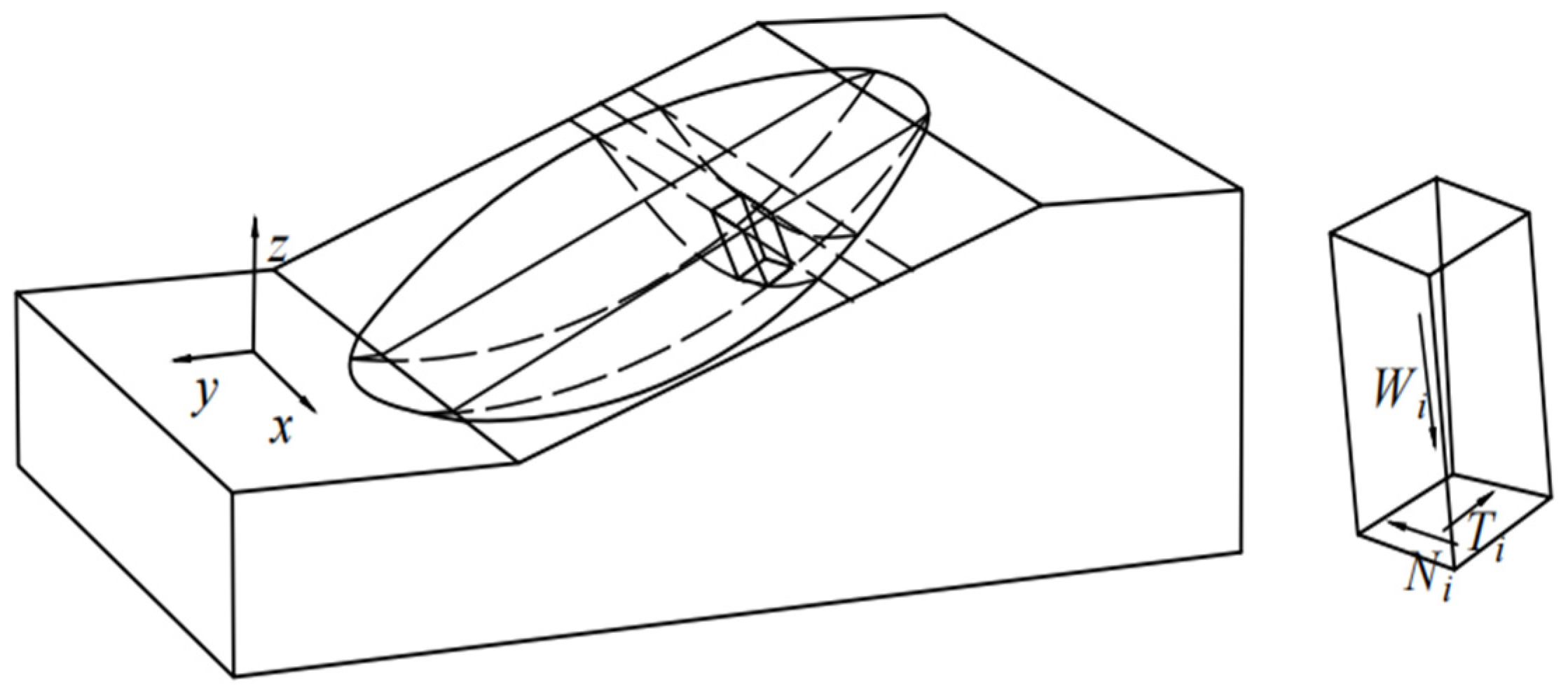
The three-dimensional Bishop method is widely used in slope stability analysis, and its results are in close agreement with those obtained from rigorous limit equilibrium methods. In the three-dimensional Bishop method, the sliding mass is divided into a number of vertical columns, and the inter-column forces are neglected, as illustrated in Figure 1.
Slope instability induced by rainfall infiltration involves a complex saturated–unsaturated hydro-mechanical coupling process. In the three-dimensional stability analysis of unsaturated soil slopes, accurate spatiotemporal evaluation of soil shear strength is of central importance. This study introduces the classic Fredlund unsaturated shear strength theory [37], extending the traditional Mohr–Coulomb failure criterion to unsaturated conditions. According to this theory, the shear strength τf of unsaturated soils can be expressed as:
τ f = c + ( σ n u a ) tan φ + ( u a u w ) tan φ b
where c′ is the effective cohesion, σn is the total normal stress, ua is the pore air pressure (generally ua = 0), uw is the pore water pressure, φ′ is the effective internal friction angle, and φb is the suction friction angle that characterizes the contribution of matric suction to shear strength.
Under a complex transient seepage field induced by rainfall infiltration, both positive pore water pressure zones and unsaturated suction zones coexist within the slope. To provide a physically unified calculation framework, this study equivalently converts the mechanical effect of pore water into an equivalent shear force increment along the three-dimensional sliding surface, denoted as ΔRwi. Based on the pore water pressure uwi, at the center of the base of the i-th column, obtained from transient seepage calculations, the piecewise calculation logic for ΔRwi is as follows:
Δ R w i = u w i A i tan φ b ,     u w i < 0 u w i A i tan φ i   ,     u w i 0
where uwi is the pore water pressure at the center of the base of the i-th column, Ai is the actual three-dimensional area of the column base, φ i is the effective internal friction angle, and φb is the suction friction angle. In the unsaturated zone, matric suction provides additional shear strength. In the saturated zone, positive pore water pressure reduces the effective stress and thus diminishes the shear strength.
The factor of safety Fs is calculated through overall moment equilibrium as follows:
F s = i = 1 n ( c i A i + N i tan φ i + Δ R w i ) ( m z i x i m x i z i ) i = 1 n [ W i x i N i ( n z i x i n x i z i ) ]
Based on the vertical force equilibrium condition of the i-th column, the expression for the total normal force Ni at the base can be derived as follows:
N i = W i ( c i A i + Δ R w i ) m z i F s n z i + tan φ i m z i F s
In the above formula, Wi is the weight of the soil column, and nxi, nyi, nzi and mxi, myi, mzi represent the direction cosines of the total normal force Ni and the shear resistance Ti in the three-dimensional coordinate system, respectively. xi, zi are the spatial moment arms.
Due to the introduction of the three-dimensional random field, the computational cost is extremely high. Considering that the variation in unit weight is a secondary factor in rainfall-induced slope instability, and to ensure computational feasibility without compromising the physical essence of the problem, the soil unit weight γ is assumed to be constant in the mechanical calculations of this model. The saturated unit weight is adopted to be conservative. Therefore, in the calculation of the factor of safety in this study, the weight Wi of each column is determined from the column volume and this constant unit weight.

2.4. Reliability Evaluation

In this study, the particle swarm optimization algorithm is employed to perform a global search for the three-dimensional critical slip surface, iteratively determining the minimum factor of safety of the slope. During each iteration, the particles dynamically adjust their search velocity and position based on their individual historical best positions and the global best position of the swarm. The update equations for the particle states are as follows:
v i j ( t + 1 ) = w v i j ( t ) + c 1 r 1 ( p B e s t i j ( t ) x i j ( t ) ) + c 2 r 2 ( g B e s t j ( t ) x i j ( t ) )
x i j ( t + 1 ) = x i j ( t ) + v i j ( t + 1 )
where w is the inertia weight, p B e s t i j ( t ) is the historical best position of particle i at iteration t, g B e s t j ( t ) is the global best position at iteration t, v i j ( t + 1 ) is the velocity of particle i in the j-th dimension at iteration t + 1, x i j ( t + 1 ) is the position of particle i in the j-th dimension at iteration t + 1, c1 and c2 are learning factors. r1 and r2 are random numbers uniformly distributed in [0, 1].
For each random field realization, the PSO algorithm initializes a large number of particles within the three-dimensional geometric domain of the slope. During each iteration, the algorithm extracts the pore water pressure and spatial strength parameters within the columns encompassed by a given slip surface, and calculates the factor of safety using Equations (8) and (9). The search terminates when the maximum number of iterations is reached or the error tolerance is satisfied. The global optimal solution at termination represents the critical three-dimensional slip surface and the corresponding minimum factor of safety for that specific rainfall duration and random field realization.
Latin Hypercube Sampling (LHS) is adopted to ensure uniform and efficient sampling in high-dimensional probability space, thus achieving a reliable representation of the spatial variability of soil parameters [38]. Finally, the slope failure probability is calculated using the Monte Carlo method. The formula for calculating the failure probability is:
P f = N f / N
where Nf is the number of times Fs is less than 1, and N is the number of generated random fields.
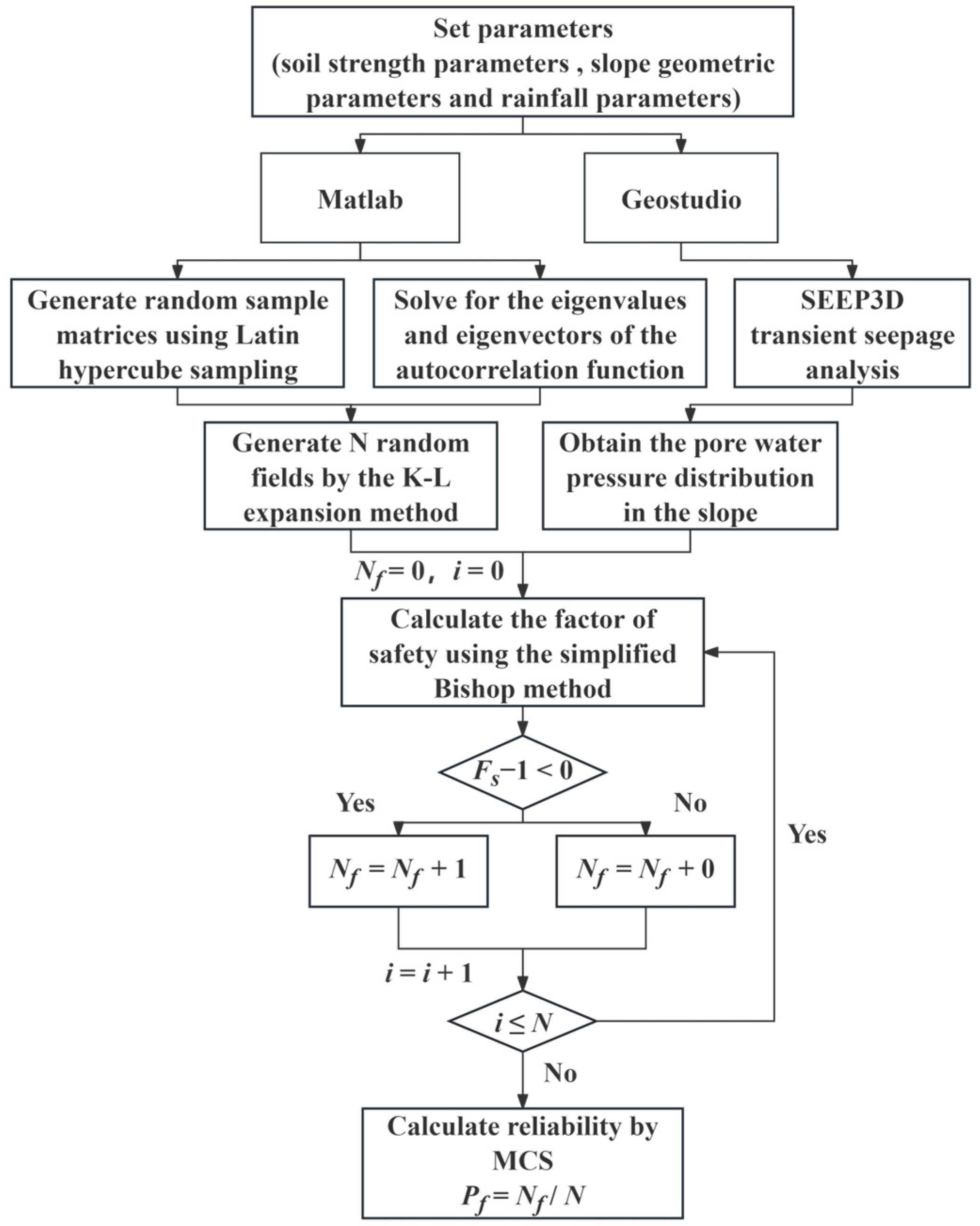
The overall computational procedure is illustrated in Figure 2. In this workflow, SEEP3D is employed to obtain the transient three-dimensional pore-water-pressure field under rainfall infiltration, and the resulting hydraulic response is further coupled with random-field generation, 3D stability calculation, critical slip-surface search, and probabilistic failure assessment using Matlab R2025b.

2.5. Parameter Basis and Validation

The parameter selection in this study followed the purpose of methodological demonstration rather than site-specific calibration. The coefficients of variation [31,32] and the cross-correlation coefficient adopted for the random fields were selected with reference to previous studies on spatial variability of slope soils [39,40]. The remaining hydraulic and mechanical parameters were assigned as representative values for a hypothetical slope example to illustrate the proposed framework [28]. Therefore, the present case study is intended to demonstrate the applicability of the method and the associated response patterns under rainfall infiltration, rather than to reproduce a particular field case.
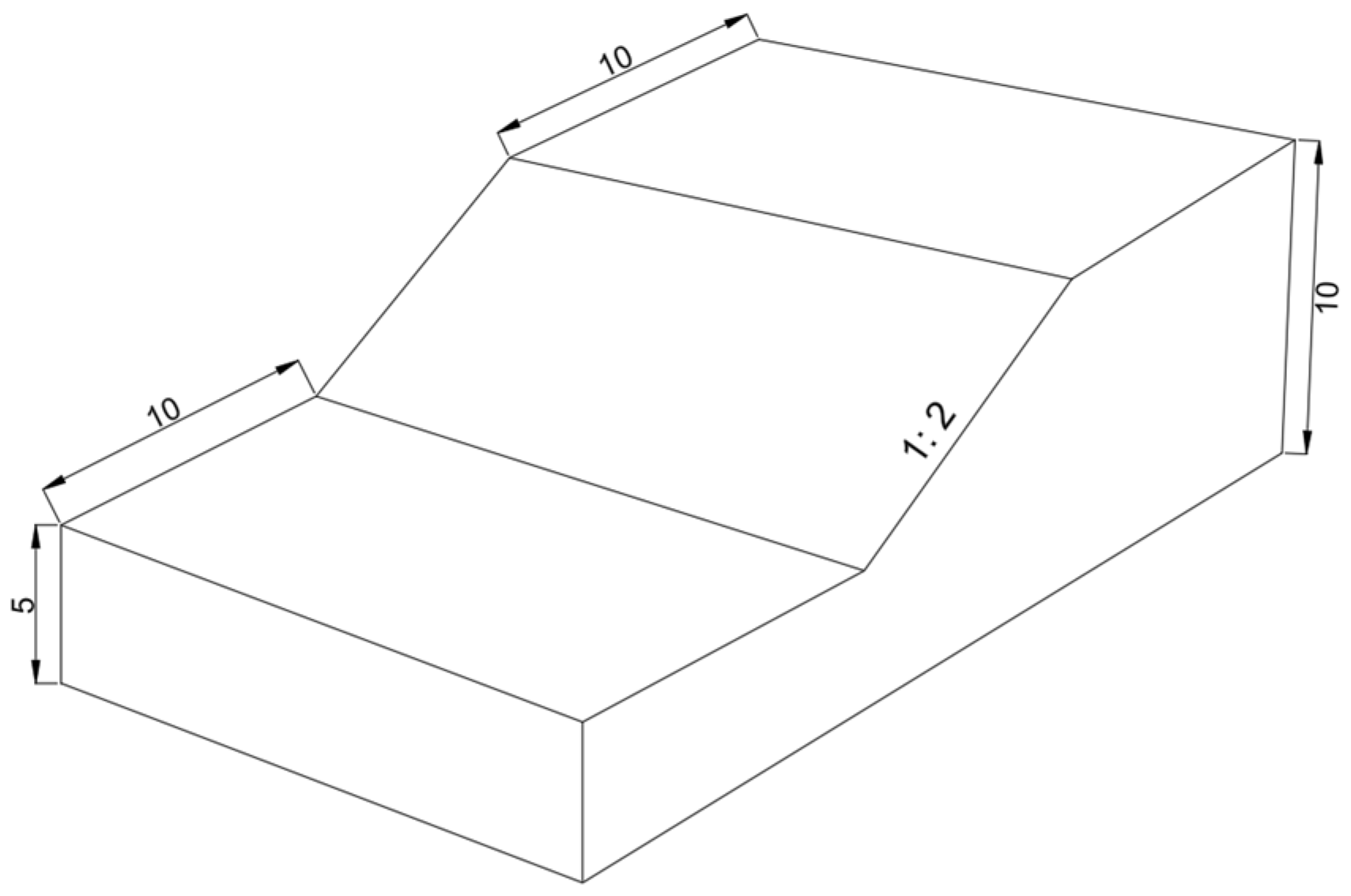
To verify the accuracy and effectiveness of the proposed method, the case where the coefficient of variation of soil properties is zero was first considered. In this scenario, the proposed method degenerates into the traditional deterministic safety factor calculation. When the slip surface is cylindrical and ly = +∞, the three-dimensional analysis further reduces to a two-dimensional one. The computational model proposed by Cho et al. [41] was adopted and extended to three dimensions, as shown in Figure 3. The corresponding soil parameters are listed in Table 1.
The safety factor calculated by the present three-dimensional program is F = 1.3521, which is very close to the result reported by Wan et al. [42], namely F = 1.3525. Furthermore, by combining the three-dimensional Bishop method with particle swarm optimization to search for the minimum safety factor, and performing 10,000 Monte Carlo simulations, the failure probability of the slope was obtained as Pf = 0.0907, which is also very close to the result of 9.25% reported by Wan et al. [42]. These comparisons demonstrate the correctness and reliability of the proposed three-dimensional calculation method and program.

3. Computational Model

3.1. Geometry and Boundary Conditions

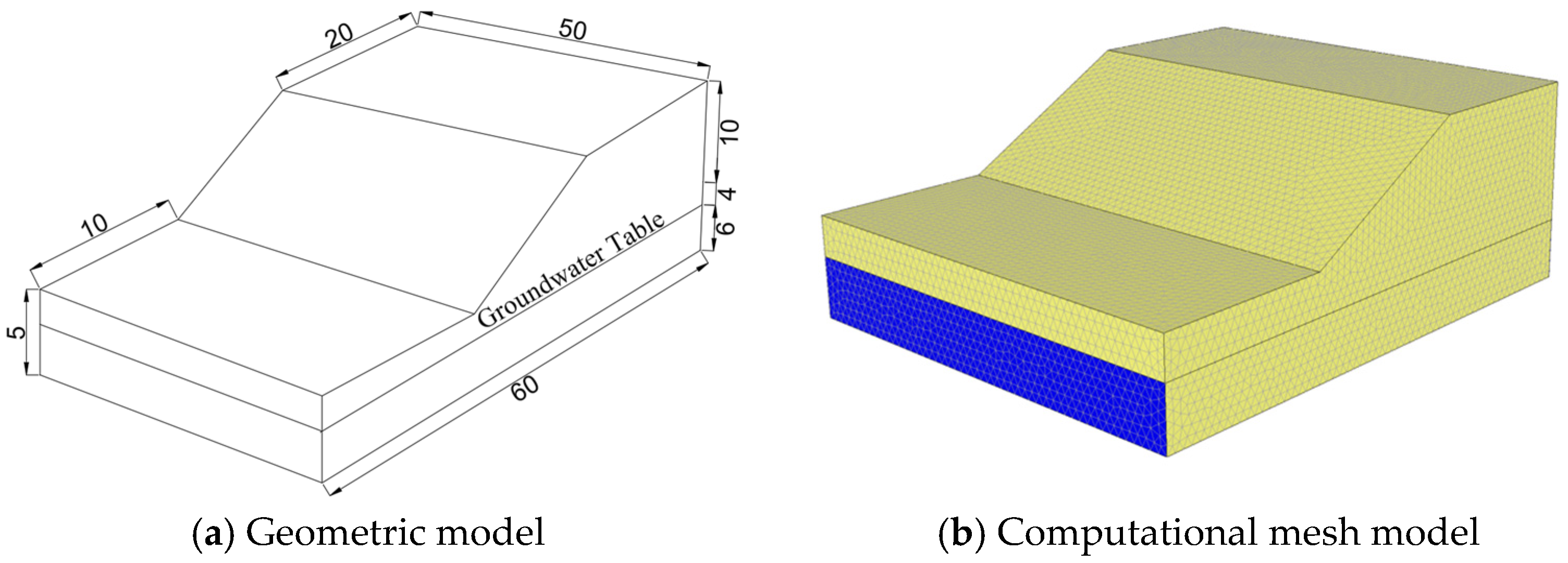
The 3D slope geometric model established in this study is illustrated in Figure 4, where (a) shows the geometric configuration and (b) presents the computational mesh. The blue region in panel (b) denotes the initial groundwater level boundary condition described below. The total dimensions of the model along the longitudinal X-axis, transverse Y-axis, and vertical Z-axis are 60 m, 50 m, and 20 m, respectively. The slope height is 10 m, the slope ratio is 0.5, and both the crest and toe widths are 20 m. To ensure the accuracy of the 3D seepage calculation and the precise mapping of the 3D random field, the model is discretized into tetrahedral mesh elements with a global edge length of 1 m. This generates a total of 67,259 nodes and 369,977 solid elements.
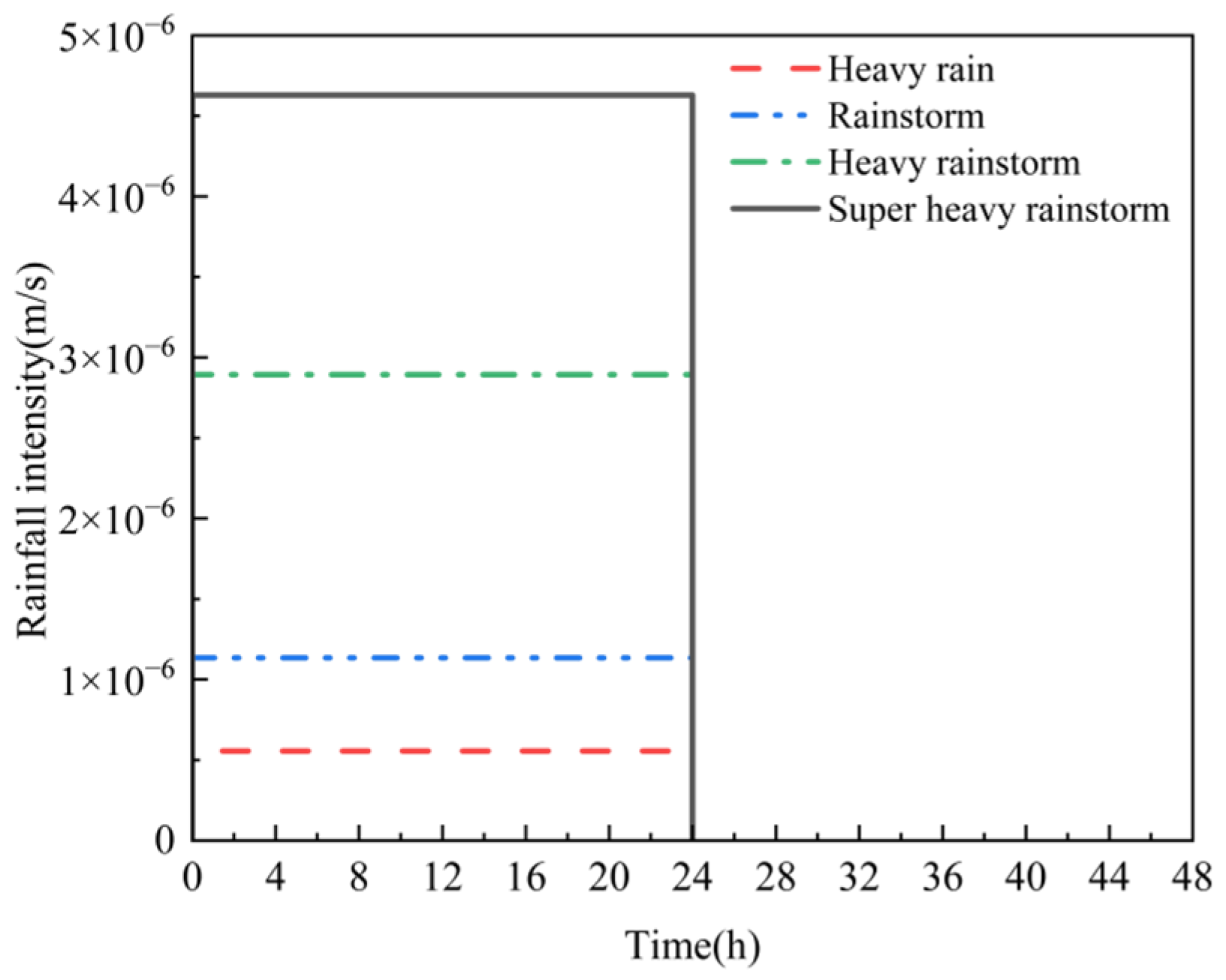
In the transient seepage analysis based on SEEP3D, the hydraulic boundary conditions are configured as follows. The bottom of the model is set as a no-flow boundary. The two sides of the model are set as constant head boundaries based on an initial groundwater level of 6 m to simulate the initial steady seepage field. The slope surface, including the crest and the slope face, is defined as the rainfall infiltration boundary. This study adopts a uniform rainfall pattern as shown in Figure 5. Four different constant rainfall intensity scenarios are established: 5.56 × 10⁻⁷ m/s, 1.13 × 10⁻⁶ m/s, 2.89 × 10⁻⁶ m/s, and 4.63 × 10⁻⁶ m/s. The total rainfall duration is uniformly set to 24 h.

3.2. Material Properties and Simulation Setup

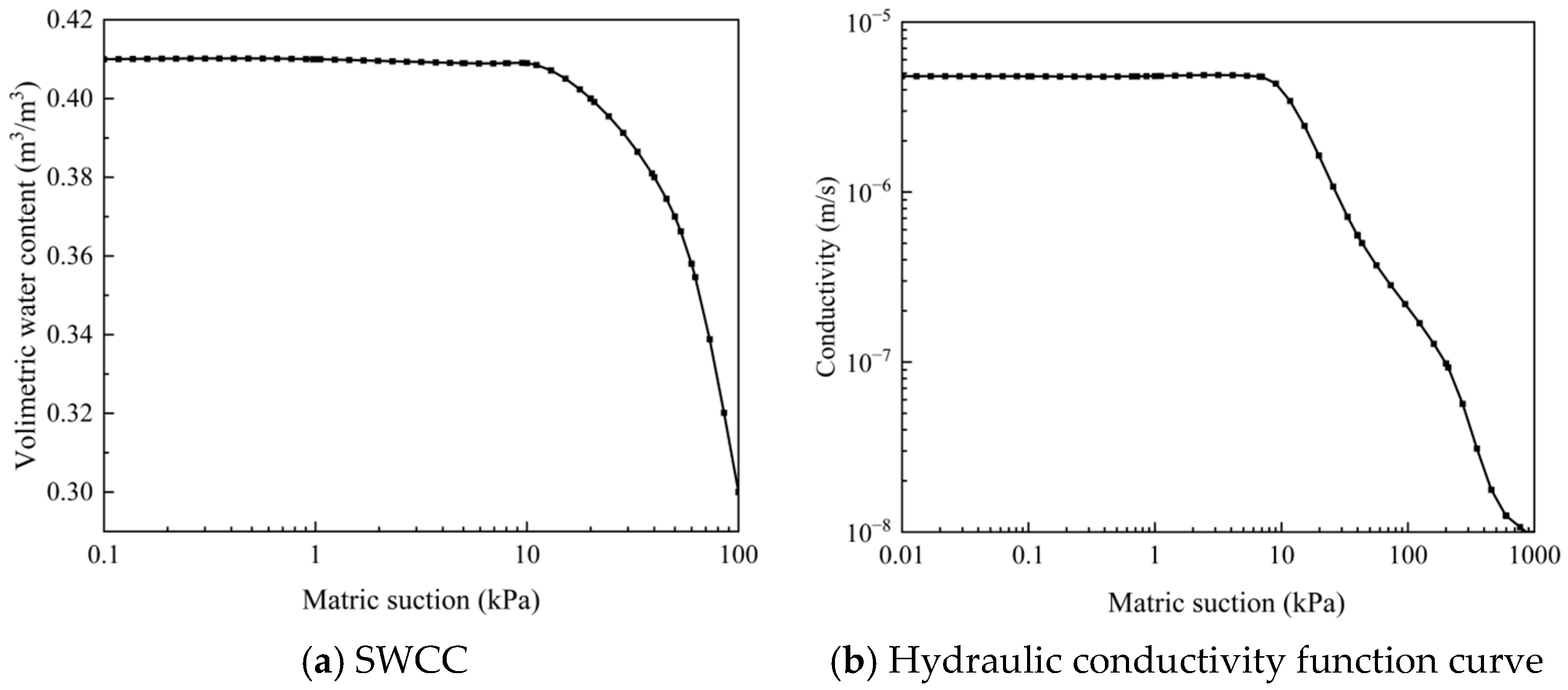
The basic physical and mechanical parameters, along with the unsaturated hydraulic properties of the soil used in this case study, are summarized in Table 2. Following the methodology outlined in Section 2.1, the soil–water characteristic curve and the unsaturated relative hydraulic conductivity function are described using the unimodal van Genuchten model. Laboratory tests indicate that the soil has a saturated volumetric water content θs of approximately 0.41 and a saturated hydraulic conductivity ks of 4.8 × 10⁻⁶ m/s. A nonlinear least-squares fitting procedure was applied to the experimental data to determine the residual volumetric water content θr and the key hydraulic parameters (α and n) of the VG model. Figure 6 presents the fitted SWCC and the variation in hydraulic conductivity with respect to matric suction.
To account for the spatial variability of soil shear strength, distinct from the aforementioned deterministic parameters, this study models the core strength parameters, effective cohesion c′ and effective friction angle φ′, as three-dimensional log-normal random fields. Their statistical properties are summarized in Table 3.
In the simulation setup of the reliability assessment, Latin Hypercube Sampling was employed to generate N = 8000 independent realizations of the three-dimensional random fields. For each slope model under a specific rainfall condition and spatial distribution of geotechnical parameters, the Particle Swarm Optimization algorithm was utilized to search for the critical three-dimensional slip surface. The swarm size of the PSO was set to 50 particles, and the maximum number of iterations was limited to 60. Furthermore, both the cognitive and social learning factors were uniformly set to c1 = c2 = 2.0. This parameterization ensures an optimal balance between the particles’ own historical best experiences and the global best guidance of the swarm.

4. Results and Discussion

Based on the proposed rainfall-3D random field framework, this section analyzes the transient seepage of the unsaturated slope.

4.1. Transient Seepage Response Under Rainfall

During rainfall, the dynamic evolution of slope stability is fundamentally driven by the significant redistribution of internal pore water pressure. To reveal how different rainfall characteristics affect the seepage field, this section analyzes both rainfall duration and intensity.
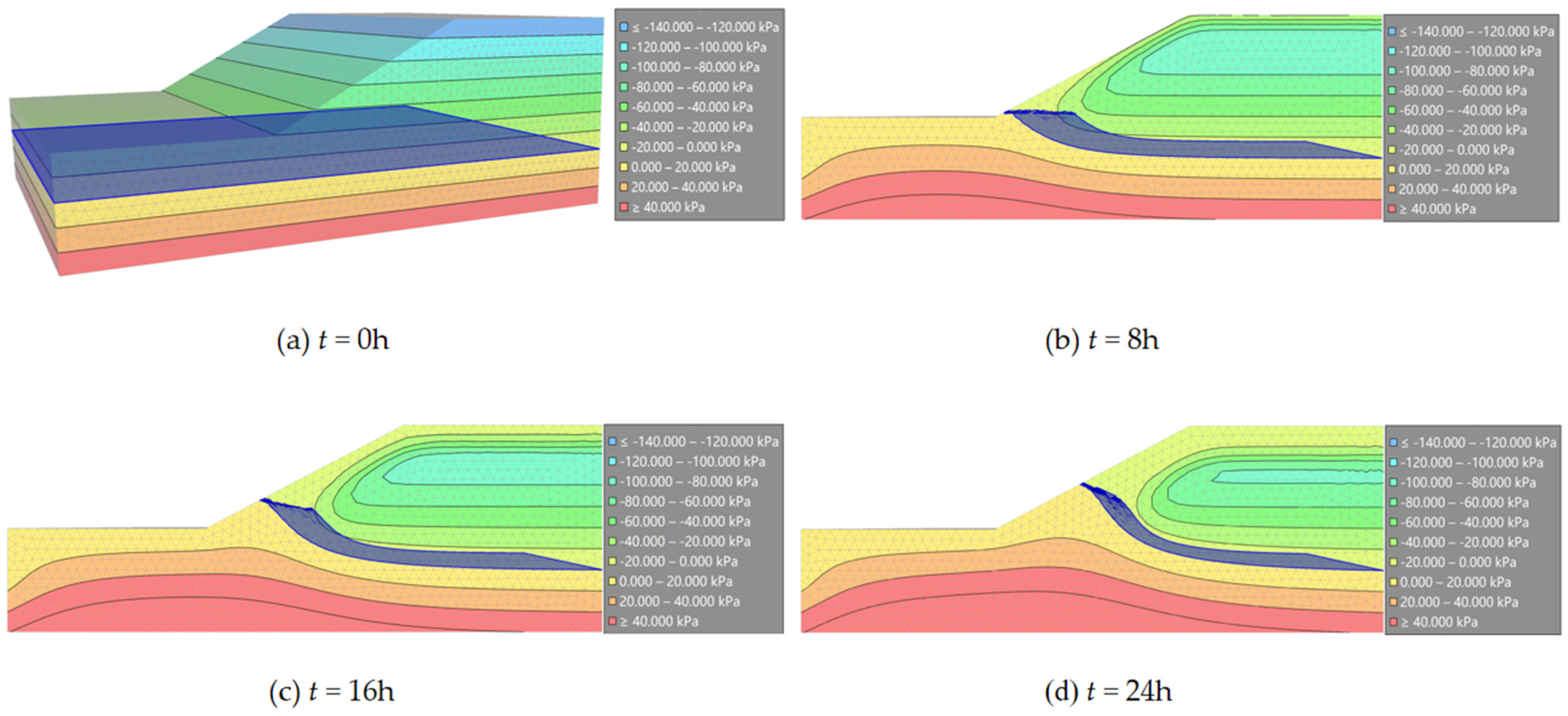
Taking the extreme Super heavy rainstorm condition as an example, Figure 7 shows the pore water pressure profiles at four typical times: 0 h (initial), 8 h, 16 h, and 24 h (final).
Before rainfall, as shown in Figure 7a, the slope is in an initial steady state. The groundwater table (the zero pore water pressure surface) is deep within the slope. A distinct negative pore water pressure gradient exists in the unsaturated zone above the water table. In the top and upper surface regions, the matric suction reaches 120–140 kPa. This corresponds to the dark blue zone in the figure. Macroscopically, this high-suction surface layer provides significant apparent cohesion to the shallow soil via capillary action. This serves as a key safety reserve for initial slope stability. Continuous rainfall infiltration breaks the original hydraulic balance. At t = 8 h, the surface soil quickly becomes saturated, and the wetting front begins to advance downward rapidly. The most significant change is the rapid dissipation of the high-suction zone at the slope surface. Meanwhile, surface runoff and interflow gather at the relatively flat slope toe. The groundwater table here rises slightly, forming a small transient saturated zone. At t = 16 h, the pore pressure field undergoes significant redistribution. The wetting front moves deeper, greatly compressing the intermediate suction zone (−100 kPa to −60 kPa). Infiltrated rainwater accumulates in the deep unsaturated zone. This causes a significant rise in the deep groundwater table. The transient saturated zone at the toe expands inward and upward. Effective stress in this critical resisting zone decreases substantially. At t = 24 h, the cumulative effect of the extreme rainfall peaks. Shallow matric suction is almost completely lost, and the unsaturated zone is severely compressed. Critically, the deep groundwater table rises sharply and seeps out at the slope toe. This forms a large, continuous transient saturated zone. This spatiotemporal evolution reveals two hydraulic failure mechanisms under extreme rainfall: the “top-down” collapse of shallow suction, and the “bottom-up” rapid rise in the groundwater table. The combination of these two processes provides sufficient hydraulic conditions for triggering large-scale landslides, which will be discussed in the subsequent 3D probabilistic analysis.
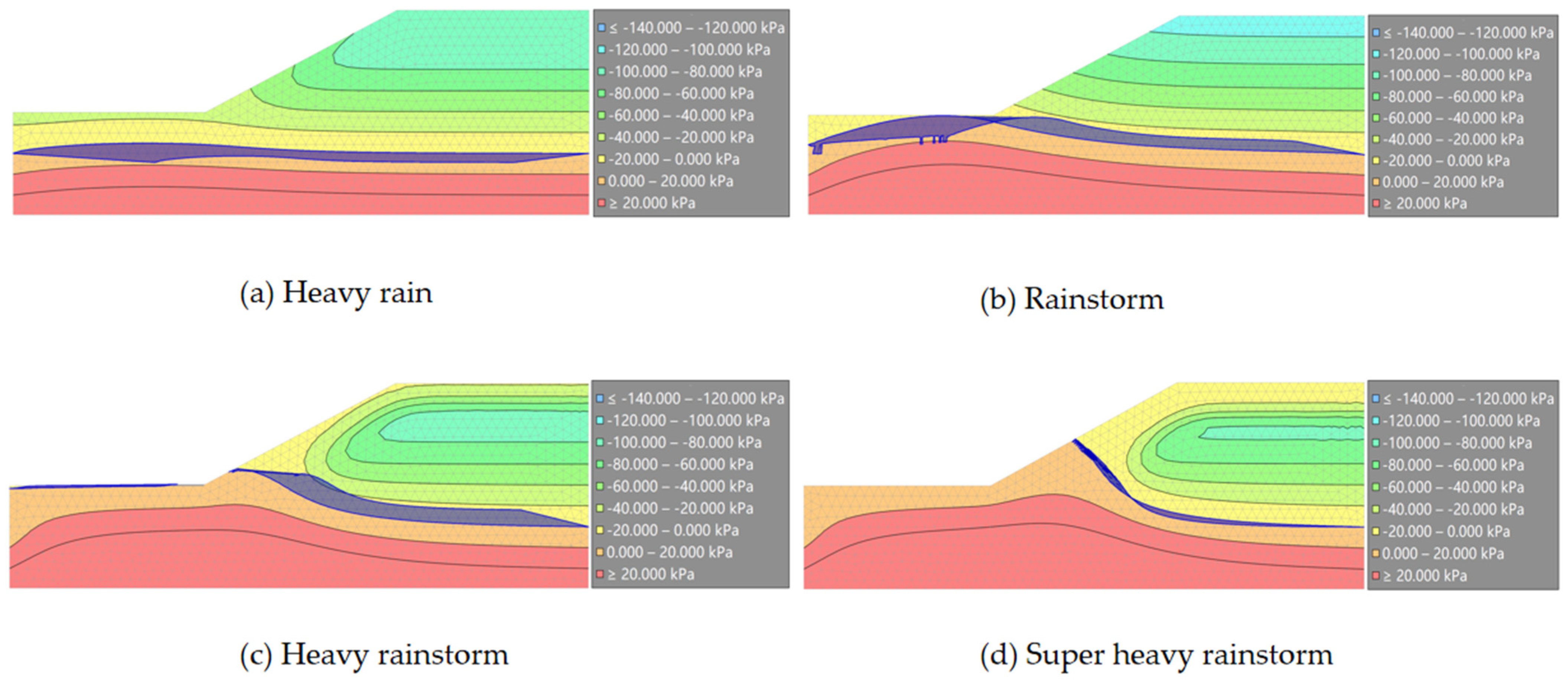
To further quantify the effect of rainfall intensity, Figure 8 compares the final seepage fields at t = 24 h under four different intensities: heavy rain, rainstorm, heavy rainstorm, and super heavy rainstorm.
Under lower rainfall intensities, the surface infiltration rate balances with the deep drainage capacity. Although the shallow high-suction zone shrinks slightly, the overall unsaturated zone remains intact. The deep groundwater table is largely undisturbed near its initial elevation, preserving a certain matric suction reserve. As rainfall intensity increases, the infiltration flux gradually exceeds the deep soil’s drainage capacity. The wetting front advances towards the middle and lower parts of the slope, widening the green transitional suction band. Lateral and vertical flows converge at the slope toe, causing localized mounding of the groundwater table. Under extreme rainfall conditions, the hydraulic response intensifies significantly. In Figure 8c, the high-suction core is severely compressed to the middle and rear of the slope. Figure 8d shows that the super heavy rainstorm causes a substantial rise in the internal groundwater table and induces seepage at the slope toe, forming a massive, continuous transient saturated zone. From a mechanical shear strength perspective, the pore pressure evolution exacerbated by increasing rainfall intensity negatively impacts slope stability in two ways: first, the widespread dissipation of matric suction reduces the apparent cohesion of the unsaturated soil, decreasing the overall shear resistance; second, the significant rise in the groundwater table at the toe increases pore water pressure, substantially reducing the effective stress in this critical area. This hydraulic evolution is the direct cause of the subsequent decrease in the factor of safety and the increase in failure probability.

4.2. Reliability Assessment Under Different Rainfall Intensities

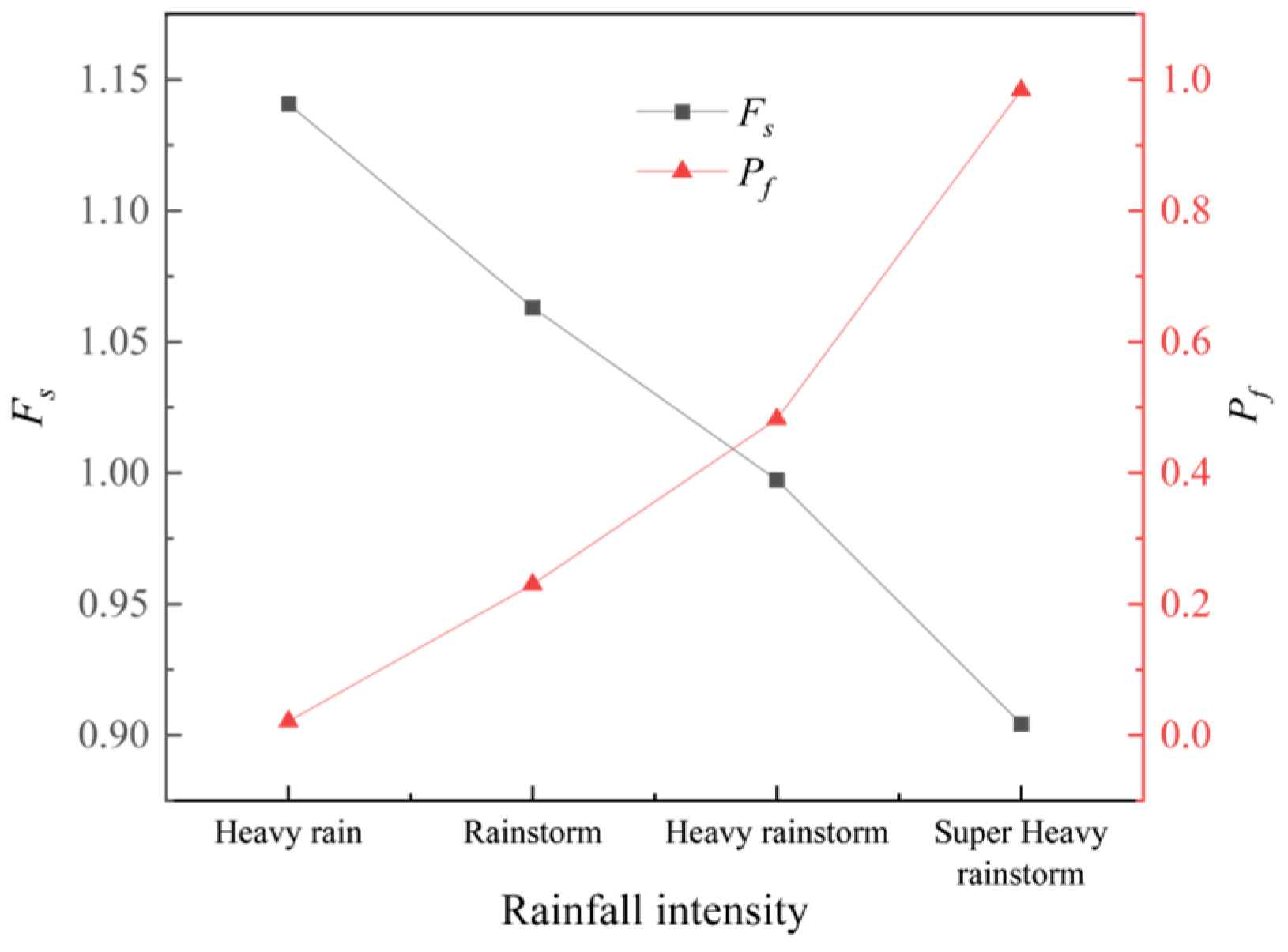
Under the coupled effects of complex rainfall boundaries and the inherent 3D spatial variability of geomaterials, slope stability exhibits significant probabilistic distribution characteristics. To accurately assess failure risks under actual geological conditions, this study couples the transient seepage fields of four rainfall scenarios with 8000 3D random fields generated by Latin hypercube sampling. The Particle Swarm Optimization algorithm is used to extract the statistical features of the Fs for massive samples under each scenario. Figure 9 presents a dual-Y-axis line chart showing the evolution of the mean Fs and Pf versus different rainfall intensities after 24 h of rainfall.
As shown in Figure 9, the mean Fs and Pf exhibit different trends as rainfall intensity increases. The mean Fs, representing the average sliding resistance, decreases almost linearly from 1.14 under heavy rain to 0.90 under super heavy rainstorm. This decrease reflects the hydraulic softening effect caused by heavier rainfall, which gradually reduces the overall soil strength. Unlike the linear drop in Fs, the response of Pf is nonlinear. Under heavy rain, Pf is nearly zero. As the intensity increases to heavy rainstorm and super heavy rainstorm, Pf surges to approximately 48.21% and 98.36%, respectively. This indicates that under intense rainfall, widespread loss of matric suction and expansion of the toe saturated zone cause more slope samples with local low-strength parameters to reach limit equilibrium. Consequently, the failure probability increases dramatically.
Comparing the two curves in Figure 9 highlights the difference between mean and probabilistic indicators in stability evaluation. For the rainstorm scenario, the mean Fs is 1.063, which is greater than 1.0. In conventional deterministic analysis, this implies a certain safety margin. However, the probabilistic results show an actual failure probability of 23%. From a mechanistic perspective, this discrepancy between mean Fs and Pf is closely related to the three-dimensional spatial variability of soil strength. Under rainfall infiltration, the rise in pore water pressure and the dissipation of matric suction do not reduce the sliding resistance in a spatially uniform manner. Instead, when the rainfall-induced high pore-pressure zone overlaps with locally weak regions characterized by relatively low values of c′ and φ′ in the three-dimensional random field, the local anti-sliding capacity may be exhausted much earlier than that suggested by the average strength level of the slope. In such cases, slope failure is controlled by a limited number of unfavorable realizations associated with the spatial coincidence of hydraulic weakening and local strength deficiency, rather than by the average mechanical state alone. This explains why the mean factor of safety may still remain above unity, while the failure probability has already reached a non-negligible level. This suggests that relying solely on the mean factor of safety may underestimate the actual failure risk in rainfall-induced landslides. Combining 3D transient seepage with spatial variability in a probabilistic framework provides a more objective risk assessment.

4.3. Temporal Dynamics of Reliability Indicators

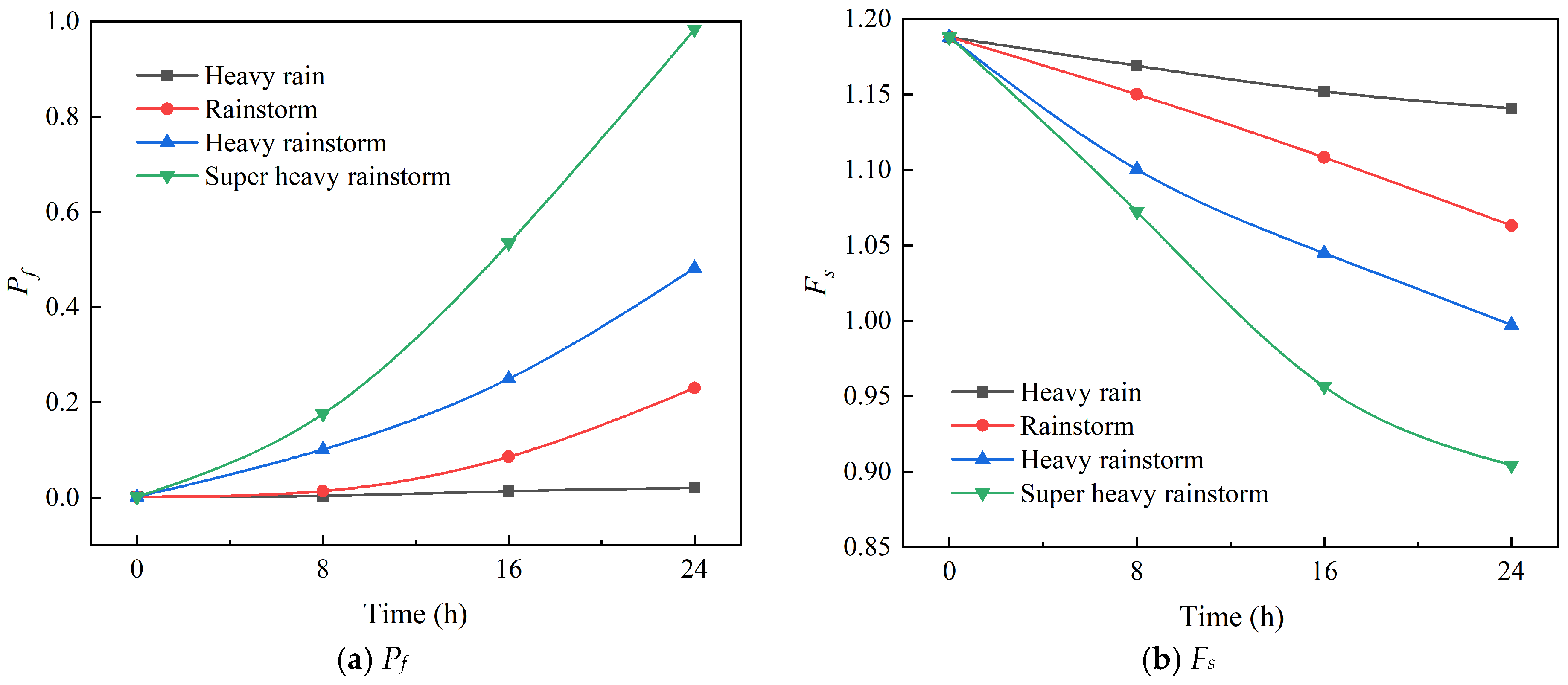
To further reveal the temporal evolution path of the aforementioned macroscopic instability, this section dynamically tracks the reliability indices during the rainfall duration. Figure 10a shows the temporal evolution of the failure probability Pf, whereas Figure 10b presents the corresponding variation in the mean factor of safety Fs under different rainfall intensities.
As shown by the Fs evolution curve in Figure 10, the degradation of the slope’s average sliding resistance is a typical time-cumulative process. Initially (t = 0 h), the slope population possesses an adequate safety margin with an Fs of 1.188. As rainfall continues, Fs decreases monotonically across all intensity scenarios. Greater rainfall intensity results in a steeper decline. For instance, under Heavy rain, Fs drops gently to 1.141 after 24 h. Conversely, under super heavy rainstorm, Fs falls below the critical threshold of 1.0 before 16 h, eventually reaching 0.904. This degradation pattern indicates that the weakening of the average soil shear strength due to water infiltration starts at the onset of rainfall and accumulates continuously. In stark contrast to the nearly linear decline of Fs, the Pf curve increases marginally during the initial stages of rainfall but surges dramatically after a specific duration. Except for the heavy rain scenario where Pf remains near zero, the failure probability under stronger rainfall exhibits a two-stage pattern: “early latency” and “later surge”. For example, under heavy rainstorm, despite a substantial drop in Fs during the first 8 h, Pf only increases slightly to 10.15%. After 8 h, the curve accelerates upward, soaring to approximately 48.21% at 24 h. This accelerated mutation is exceptionally severe under Super heavy rainstorm, where the curve climbs steeply after 8 h, reaching a failure probability of 98.36% at 24 h.
The temporal acceleration of Pf can also be interpreted in terms of the progressive interaction between hydraulic evolution and local weak zones in the three-dimensional slope. In the early stages of rainfall, infiltration is concentrated in the shallow layer, minimally affecting the deep unsaturated zone. At the early stage of rainfall, the hydraulic response is mainly concentrated in the shallow part of the slope, and the deep critical resistance zone is not yet significantly affected. Although the overall shear strength begins to decrease due to suction loss, many realizations still retain sufficient resistance because the local weak zones have not yet been fully connected with the unfavorable pore-pressure field. However, as rainfall continues, the wetting front advances downward, and the deep groundwater table rises significantly as shown in Figure 7c,d. This sustained hydraulic action reduces the effective stress over a large soil area. Once this expanded high-pore-pressure region begins to spatially coincide with locally weak regions in a considerable number of random-field realizations, the number of samples crossing the limit state increases rapidly, leading to the observed delayed but abrupt growth of Pf.
Comparing the temporal evolution of Fs and Pf provides valuable engineering insights for monitoring and early warning of rainfall-induced landslides. The results indicate that the increase in failure probability under extreme rainfall is highly nonlinear. Before a specific time threshold, such as the initial 16 h of the rainstorm scenario, Fs remains above 1.10 and the failure probability increases slowly. Therefore, the degradation of the average factor of safety alone cannot adequately reflect the true accumulation of internal system risks. As the rainfall duration further increases, the failure probability rises rapidly. This highlights the limitations of relying solely on static mean values or single-moment safety factors for early warning in engineering practice. A comprehensive full-cycle dynamic reliability assessment, incorporating 3D seepage evolution and parameter spatial variability, is essential to accurately reflect the true risk of slope instability.

5. Conclusions

In this study, a comprehensive three-dimensional probabilistic framework coupling transient seepage analysis and random field theory was proposed to evaluate the stability of unsaturated soil slopes under rainfall infiltration. By integrating the K-L expansion method, SEEP3D, and a PSO-based 3D simplified Bishop method, the spatiotemporal evolution of slope reliability under varying rainfall intensities was systematically investigated. The principal conclusions are summarized as follows:
(1)
The transient seepage analysis indicates that rainfall-induced slope instability is primarily driven by a dual hydraulic process: the top-down dissipation of shallow matric suction and the bottom-up elevation of the groundwater table at the slope toe. Under intense rainfall, the rapid loss of apparent cohesion in the superficial layer, combined with the decreased effective stress in the expanded saturated zone, provides the fundamental conditions for slope failure.
(2)
The mean factor of safety Fs and the failure probability Pf exhibit distinct response patterns to increasing rainfall intensity. While Fs decreases almost linearly due to continuous hydraulic softening, Pf increases non-linearly. The results demonstrate that deterministic evaluations may underestimate the actual sliding risk; for instance, under the rainstorm condition, the slope presents a significant failure probability of 23% even when the mean Fs remains above the critical equilibrium value (Fs = 1.063).
(3)
The temporal evolution of the reliability indicators reveals a clear “non-linear accelerated mutation” characteristic in Pf, which contrasts with the smooth, cumulative linear decay of Fs. During the initial stages of rainfall, Pf remains relatively low despite a continuous decline in Fs. A sharp surge in Pf only occurs after a specific duration when the wetting front significantly alters the deep stress field. This suggests that dynamic reliability assessments covering the entire rainfall duration are necessary for effective landslide early warning, rather than relying solely on the decay of instantaneous deterministic safety factors.

Author Contributions

Conceptualization, Q.W. and H.L.; methodology, Q.W.; software, M.R.; validation, Y.M., Q.W. and H.L.; formal analysis, M.R.; resources, M.R.; data curation, Q.W.; writing—original draft preparation, Q.W.; writing—review and editing, Y.M.; visualization, Y.M.; supervision, Y.M.; project funding acquisition, Y.M. All authors have read and agreed to the published version of the manuscript.

Funding

This research was funded by the Scientific Research Project of Education Department of Henan Province of China, grant number No. 22A56008.

Data Availability Statement

The original contributions presented in this study are included in the article. Further inquiries can be directed to the corresponding author.

Acknowledgments

We would like to thank the reviewers and editors for their thoughtful review of this paper.

Conflicts of Interest

The authors declare no conflicts of interest.

References

  1. Wang, L.; Zhang, K.; Chen, Y.; Wang, S.; Tian, D.; Li, X.; He, Y. Progressive deformation mechanism of colluvial landslides induced by rainfall: Insights from long-term field monitoring and numerical study. Landslides 2024, 21, 3069–3086. [Google Scholar] [CrossRef]
  2. Duan, X.; Hou, T.; Jiang, X. Study on stability of exit slope of Chenjiapo tunnel under extreme rainstorm conditions. Nat. Hazards 2021, 107, 1387–1411. [Google Scholar] [CrossRef]
  3. Yang, Y.; Yeh, H.; Ke, C.; Chen, N.; Chang, K. Assessment of probability of failure on rainfall-induced shallow landslides at slope scale using a physical-based model and fuzzy point estimate method. Front. Earth Sci. 2022, 10, 957506. [Google Scholar] [CrossRef]
  4. Bednarczyk, Z. Identification of flysch landslide triggers using conventional and ’nearly real-time’ monitoring methods—An example from the Carpathian Mountains, Poland. Eng. Geol. 2018, 244, 41–56. [Google Scholar] [CrossRef]
  5. Tang, H.; Zou, Z.; Xiong, C.; Wu, Y.; Hu, X.; Wang, L.; Lu, S.; Criss, R.E.; Li, C. An evolution model of large consequent bedding rockslides, with particular reference to the Jiweishan rockslide in Southwest China. Eng. Geol. 2015, 186, 17–27. [Google Scholar] [CrossRef]
  6. Peruccacci, S.; Brunetti, M.T.; Gariano, S.L.; Melillo, M.; Rossi, M.; Guzzetti, F. Rainfall thresholds for possible landslide occurrence in Italy. Geomorphology 2017, 290, 39–57. [Google Scholar] [CrossRef]
  7. Cho, S.E.; Lee, S.R. Evaluation of surficial stability for homogeneous slopes considering rainfall characteristics. J. Geotech. Geoenviron. Eng. 2002, 128, 756–763. [Google Scholar] [CrossRef]
  8. Sun, Y.; Yang, K.; Hu, R.; Wang, G.; Lv, J. Model test and numerical simulation of slope instability process induced by rainfall. Water 2022, 14, 3997. [Google Scholar] [CrossRef]
  9. Ma, W.; Shao, L. Slope stability analysis method based on known seepage lines. Int. J. Geomech. 2025, 25, 4025176. [Google Scholar] [CrossRef]
  10. Caine, N. The rainfall intensity: Duration control of shallow landslides and debris flows. Geogr. Ann. Ser. A-Phys. Geogr. 1980, 62, 23–27. [Google Scholar] [CrossRef]
  11. Bozzolan, E.; Holcombe, E.; Pianosi, F.; Wagener, T. Synthetic libraries of urban landslide simulations to identify slope failure hotspots and drivers across spatial scales and landscapes. Landslides 2025, 22, 637–654. [Google Scholar] [CrossRef]
  12. Ebrahim, K.; Gomaa, S.M.M.H.; Zayed, T.; Alfalah, G. Rainfall-induced landslide prediction models, Part I: Empirical–statistical and physically based causative thresholds. Water 2025, 17, 3273. [Google Scholar] [CrossRef]
  13. Kong, Y.; Liu, J.; Shi, H.; Zhang, L.; Zhao, H.; Yang, J. Infinite slope stability under transient rainfall infiltration conditions. Appl. Mech. Mater. 2014, 501–504, 395–398. [Google Scholar] [CrossRef]
  14. Godt, J.W.; Baum, R.L.; Savage, W.Z.; Salciarini, D.; Schulz, W.H.; Harp, E.I. Transient deterministic shallow landslide modeling: Requirements for susceptibility and hazard assessments in a GIS framework. Eng. Geol. 2008, 102, 214–226. [Google Scholar] [CrossRef]
  15. Chiu, Y.; Chen, H.; Yeh, K. Investigation of the influence of rainfall runoff on shallow landslides in unsaturated soil using a mathematical model. Water 2019, 11, 1178. [Google Scholar] [CrossRef]
  16. Li, S.; Cui, P.; Cheng, P.; Wu, L. Modified green-ampt model considering vegetation root effect and redistribution characteristics for slope stability analysis. Water Resour. Manag. 2022, 36, 2395–2410. [Google Scholar] [CrossRef]
  17. Muntohar, A.S.; Liao, H. Rainfall infiltration: Infinite slope model for landslides triggering by rainstorm. Nat. Hazards 2010, 54, 967–984. [Google Scholar] [CrossRef]
  18. Li, L.; Ju, N.; He, C.; Li, C.; Sheng, D. A computationally efficient system for assessing near-real-time instability of regional unsaturated soil slopes under rainfall. Landslides 2019, 17, 893–911. [Google Scholar] [CrossRef]
  19. Jiang, S.; Yuan, Z.; Wang, Z.Z.; Liu, X. Improved rainfall infiltration model for probabilistic slope stability assessment considering transition layers and spatial variability. Eng. Geol. 2025, 353, 108096. [Google Scholar] [CrossRef]
  20. Jiang, S.; Liu, X.; Ma, G.; Rezania, M. Stability analysis of heterogeneous infinite slopes under rainfall-infiltration by means of an improved Green–Ampt model. Can. Geotech. J. 2024, 61, 1560–1573. [Google Scholar] [CrossRef]
  21. Ajith, A.; Smitha, S.; Francis, K.A.; Pillai, R.J. A novel DEM enhancement methodology to improve physics-based susceptibility modeling of rainfall-induced landslide along anthropogenically modified slopes. Can. Geotech. J. 2025, 62, 8. [Google Scholar] [CrossRef]
  22. Dey, N.; Sengupta, A. Effect of rainfall on the triggering of the devastating slope failure at Malin, India. Nat. Hazards 2018, 94, 1391–1413. [Google Scholar] [CrossRef]
  23. Hou, T.; Jiang, X.; Chen, Y. Mechanism of rainfall-induced toppling in loess collapses. Earth Surf. Process. Landf. 2024, 49, 2825–2839. [Google Scholar] [CrossRef]
  24. Panda, S.D.; Kumar, S.; Pradhan, S.P.; Singh, J.; Kralia, A.; Thakur, M. Effect of groundwater table fluctuation on slope instability: A comprehensive 3D simulation approach for Kotropi landslide, India. Landslides 2023, 20, 663–682. [Google Scholar] [CrossRef]
  25. Chen, C.; Chen, H.; Wu, W. Numerical modeling of interactions of rainfall and earthquakes on slope stability analysis. Environ. Earth Sci. 2021, 80, 524. [Google Scholar] [CrossRef]
  26. Amarasinghe, M.P.; Robert, D.; Kulathilaka, S.A.S.; Zhou, A.; Jayathissa, H.A.G. Slope stability analysis of unsaturated colluvial slopes based on case studies of rainfall-induced landslides. Bull. Eng. Geol. Environ. 2024, 83, 476. [Google Scholar] [CrossRef]
  27. Ering, P.; Babu, G.L.S. Probabilistic back analysis of rainfall induced landslide—A case study of Malin landslide, India. Eng. Geol. 2016, 208, 154–164. [Google Scholar] [CrossRef]
  28. Cheng, H.; Wu, Z.; Chen, H.; Zhou, X. Stability analysis of unsaturated–saturated soil slopes under rainfall infiltration using the rigorous limit equilibrium method. Bull. Eng. Geol. Environ. 2024, 83, 174. [Google Scholar] [CrossRef]
  29. Liu, J.; Sui, W. Evolution and quantitative characterization of stress and displacement of surrounding rock structure due to the multiple layers backfill mining under loose aquifers. Water 2024, 16, 2574. [Google Scholar] [CrossRef]
  30. Zhou, S.; Wang, Y.; Feng, S.; Sun, Y. Deep learning-based modeling of silt stress-strain response via multi-fidelity time-series algorithms. Eng. Appl. Artif. Intell. 2026, 171, 114275. [Google Scholar] [CrossRef]
  31. Wang, Y.; Shao, L.; Wan, Y.; Chen, H. Reliability analysis of three-dimensional reinforced slope considering the spatial variability in soil parameters. Stoch. Environ. Res. Risk Assess. 2024, 38, 1583–1596. [Google Scholar] [CrossRef]
  32. Wang, Y.; Shang, H.; Wan, Y.; Chen, Y. The influence of slope geometric parameters on the reliability of slope reinforced by micro-piles in spatially variable soils. Probab. Eng. Mech. 2025, 79, 103719. [Google Scholar] [CrossRef]
  33. Wan, Y.; Fu, H.; Wang, Y. Study on the influence of spatial variability of soil strength parameters on reliability and slip surfaces of cofferdam slope reinforced by geosynthetic reinforcement. Mar. Geores. Geotechnol. 2024, 42, 233–242. [Google Scholar] [CrossRef]
  34. Richards, L.A. Capillary conduction of liquids through porous mediums. Physics 1931, 1, 318–333. [Google Scholar] [CrossRef]
  35. Vangenuchten, M.T. A closed-form equation for predicting the hydraulic conductivity of unsaturated soils. Soil Sci. Soc. Am. J. 1980, 44, 892–898. [Google Scholar] [CrossRef]
  36. Wan, Y.; Zhou, Y.; Shao, L.; Wang, Y. Three-dimensional reliability analysis of convex turning corner slopes considering spatial variability of soil parameters. Probab. Eng. Mech. 2025, 81, 103790. [Google Scholar] [CrossRef]
  37. Fredlund, D.G.; Rahardjo, H. Soil Mechanics for Unsaturated Soils; John Wiley & Sons: Hoboken, NJ, USA, 1993. [Google Scholar]
  38. Deutsch, J.L.; Deutsch, C.V. Latin hypercube sampling with multidimensional uniformity. J. Stat. Plan. Inference 2012, 142, 763–772. [Google Scholar] [CrossRef]
  39. Wang, Y.; Fu, H.; Wan, Y.; Yu, X. Reliability and parameter sensitivity analysis on geosynthetic-reinforced slope with considering spatially variability of soil properties. Constr. Build. Mater. 2022, 350, 128806. [Google Scholar] [CrossRef]
  40. Wang, Y.; Shang, H.; Wan, Y.; Yu, X. Reliability analysis of soil slope reinforced by micro-pile considering spatial variability of soil strength parameters. Geomech. Eng. 2024, 36, 631–640. [Google Scholar] [CrossRef]
  41. Cho, S.E. Probabilistic Assessment of Slope Stability That Considers the Spatial Variability of Soil Properties. J. Geotech. Geoenviron. Eng. 2010, 136, 975–984. [Google Scholar] [CrossRef]
  42. Wan, Y.; Xu, R.; Yang, R.; Zhu, L. Application of the improved particle swarm optimization method in slope probability analysis. Mar. Geores. Geotechnol. 2023, 42, 1531–1541. [Google Scholar] [CrossRef]
Figure 1. Calculation diagram of the three-dimensional simplified Bishop method.
Water 18 01099 g001
Figure 2. Flowchart of the proposed framework.
Water 18 01099 g002
Figure 3. Model used for verification.
Water 18 01099 g003
Figure 4. Three-dimensional geometric model of the slope.
Water 18 01099 g004
Figure 5. Rainfall intensity.
Water 18 01099 g005
Figure 6. The infiltration characteristic curves of the soil.
Water 18 01099 g006
Figure 7. Progressive evolution of pore water pressure distribution under Super heavy rainstorm. (The transparent blue region represents the groundwater table.)
Water 18 01099 g007
Figure 8. Comparison of final pore water pressure distributions at t = 24 h. (The transparent blue region represents the groundwater table.)
Water 18 01099 g008
Figure 9. Evolution of Fs and Pf under different rainfall intensities.
Water 18 01099 g009
Figure 10. Temporal evolution of Pf and Fs.
Water 18 01099 g010
Table 1. Soil parameters used for verification.
γ (kN/m3)Shear StrengthCoefficient of Variationlxlylzρc,φ
c (kPa)φ (°)COVcCOVφ
202300.3-20+∞2-
Table 2. Material properties and hydraulic parameters.
ParametersValue
Total unit weight γ/(kN·m−3)20
Saturated permeability ks/(m·s−1)4.8 × 10−6
Saturated volumetric water content θs0.41
Residual volumetric water content θr1 × 10−10
VG fitting parameter α/(kPa−1)0.0095
VG fitting parameter n1.9119
Suction friction angle φb15
Table 3. Statistical properties of shear strength parameters.
ParametersValue
c′/kPa20
φ′/°8
COVc0.3
COVφ0.2
ρc,φ−0.5
ly/m20
lz/m2
lx/m20
Disclaimer/Publisher’s Note: The statements, opinions and data contained in all publications are solely those of the individual author(s) and contributor(s) and not of MDPI and/or the editor(s). MDPI and/or the editor(s) disclaim responsibility for any injury to people or property resulting from any ideas, methods, instructions or products referred to in the content.