Article

Analysis of Spatio-Temporal Patterns in Virtual Water Trade Within the Service Sector Between China and Other RCEP Member States

China-ASEAN School of Economics, Guangxi University, Guangxi University Institurte for Frontier Economics of China, Nanning 530007, China
*
Author to whom correspondence should be addressed.
Water 2026, 18(9), 1062; https://doi.org/10.3390/w18091062
Submission received: 19 February 2026 / Revised: 20 April 2026 / Accepted: 22 April 2026 / Published: 29 April 2026
(This article belongs to the Section Water Resources Management, Policy and Governance)

Abstract

With the gradual implementation of the RCEP agreement, China’s service sector market has opened up further. According to statistics from the OECD database, in 2023, China’s service imports from other RCEP member states accounted for approximately 33% of its total service imports. The growing volume of service trade underscores the importance of trade with other RCEP member states in helping China achieve its goals of enhancing the quality of its service sector and establishing a sustainable and healthy development model. Based on the virtual water trade theory and using input–output tables for each year provided by China’s National Bureau of Statistics, this paper calculates the virtual water imports and exports associated with China’s service trade with other RCEP member states from 2007 to 2020. Based on these results, the paper analyzes the spatiotemporal patterns of service trade between China and other RCEP member states. By constructing a water resource carrying capacity evaluation system, this study analyzes whether China’s service trade with other RCEP member states aligns with virtual water theory. The results indicate that China has consistently been a net importer of virtual water in its service trade with other RCEP member states. Net imports rose from approximately 56 million cubic meters in 2007 to approximately 380 million cubic meters in 2020. From a spatiotemporal perspective, China’s virtual water trade in services with other RCEP member states has been evolving toward a diversified and balanced import pattern. In terms of the water carrying capacity index, although China ranks in the middle range, an index of water resource carrying capacity based on the entropy weighting method indicates that China is in a state of mild overload. It still imports virtual water from regions with lower water carrying capacity. This paper provides a reference for analyzing China’s virtual water trade in services under the RCEP framework.

1. Introduction

A report by the Food and Agriculture Organization of the United Nations indicates that population growth and economic development have placed unprecedented pressure on renewable yet finite water resources, particularly in arid regions. China’s situation is equally concerning, as the demands of rapid population growth and economic expansion have led to a corresponding surge in water usage and wastage. According to World Bank data, the global average per capita renewable inland freshwater resources stood at 5429 cubic metres in 2021, whereas China’s figure was merely 1992 cubic metres—not even half the world average. In recent years, although China’s water resource carrying capacity has remained stable, with total water consumption increasing and efficiency improving while lake storage levels have held steady, persistent challenges remain. These include precipitation falling below normal levels and the uneven distribution of water resources [1]. From 2000 to 2017, China’s water resource development remained within ecological carrying capacity limits, yet faced challenges of supply–demand imbalance. Research by Ouyang et al. Emphasized the need for China to enhance efforts in resource expansion, water conservation and pollution control to alleviate ecological pressures on water resources [2]. Allan first introduced the concept of virtual water in 1993 and applied it to international trade in 1998, whereby “virtual water” is transferred from water-abundant regions to water-scarce nations through trade flows [3]. This concept offers a trade-based approach for water-scarce nations to alleviate domestic water resource constraints. Consequently, this paper focuses on virtual water trade, analyzing the current state of China’s water resource trade and proposing corresponding recommendations.
The Regional Comprehensive Economic Partnership (RCEP) comprises 15 nations, representing nearly one-third of the world’s population and accounting for 29% of global GDP [4]. This underscores the profound influence of RCEP member states on international trade. Over the past several decades, international trade statistics have shown an upward trajectory; according to World Bank (WB) data, the contribution of international trade to gross domestic product (GDP) has risen from 27.3% in 1970 to 60.3% in 2019 [5]. Virtual water trade in the service sector represents an emerging field of research, highlighting the water resources embedded within services, particularly those delivered through tourism. This concept extends the traditional understanding of virtual water (primarily focused on the agricultural and industrial sectors) to encompass the role of the service sector in water resource management. Zhang et al.’s study [6] analyzed the water footprint of inbound tourists to China between 2001 and 2018, revealing that international tourism generates substantial virtual water flows. For instance, China’s inbound tourism exhibits increasing virtual water “exports”, with food consumption constituting the largest contributor to the water footprint. The virtual water flows generated by inbound tourism influence local water resource allocation, not only generating tourism revenue for the region but also potentially optimizing water resource allocation to yield water-saving effects. Research by Ma et al. also indicates that, compared to virtual water-intensive sectors such as agriculture and animal husbandry, high-value-added industries like financial services are concentrated in relatively developed regions. When exported, these high-value-added services consume less virtual water per unit than water-intensive products exported from less developed regions. This reflects an inequitable virtual water trade between developed and less developed regions, thereby leading to an unfair distribution of water resources [7]. In regions such as the Beijing–Tianjin–Hebei area, virtual water trade has generated considerable economic benefits, exerting a more significant influence on the economy. However, the proportion of the service sector within the total volume of virtual water flows remains relatively small [8]. This indicates that despite growing recognition of the service sector’s role in virtual water trade, it remains underdeveloped compared to agriculture and industry. Future research could further elucidate the complexities of water resource management within services, revealing potential new strategies for sustainable development. While studies on virtual water trade in services are currently scarce, the necessity for such research is increasingly evident.
Water consumption within China’s service sector presents a multifaceted issue influenced by various factors, including economic activities and the characteristics of specific industries. Although the service sector is not the largest direct consumer of water, it significantly contributes to indirect water use through interactions with other sectors. Several studies indicate that the service sector accounts for a substantial proportion of indirect water consumption. According to Liu’s research, industry and services collectively represent 53.2% of total indirect water use in regions such as the Haihe River Basin [9]. According to research by Li et al., the full water consumption coefficient for specific service activities such as information services is notably high, indicating that these sectors indirectly depend on water through their supply chains [10]. Some studies indicate that different service sectors exhibit distinct water usage patterns. For instance, technical service sectors associated with agriculture and forestry have been identified as key sectors in water resource utilisation [11]. Water efficiency in the service sector is influenced by the quality of public services, meaning that higher quality public services can lead to greater water efficiency [12]. However, most studies also indicate that while the service sector plays a crucial role in water consumption, it must be recognised that agriculture remains China’s primary direct consumer of water, accounting for the overwhelming majority of total water use. Water consumption within the service sector is more concentrated in indirect water use and specific sectors.
Given China’s water resource challenges and economic disparities, coupled with the burgeoning scale of its service sector, research into virtual water trade (VWT) within China’s services industry has become increasingly significant. Studies by Liao et al. have highlighted research gaps in virtual water accounting across various sectors, including services. This underscores the need for further investigation into China’s service sector virtual water trade to enhance water resource management and sustainability [13]. Amidst accelerating urbanization and industrialization, virtual water trade is evolving, exhibiting a marked shift towards the service sector. Research by Yang et al. indicates that the agricultural-driven pattern of virtual water transfers is gradually being disrupted, with the service sector assuming an increasingly prominent role in virtual water resource transfers—a trend particularly pronounced in developed regions. This manifests specifically through enhanced regional economic coordination, growth in the service sector, and improved water use efficiency, thereby addressing the issue of uneven water resource distribution [14]. Research by Zhou et al. further corroborates this perspective, revealing that economically advanced eastern regions exhibit a higher proportion of virtual water outflows from the tertiary sector, with substantial volumes flowing into central and western provinces. This indicates that as economies develop, sectoral composition undergoes continuous transformation, and the tertiary sector’s significance within virtual water trade correspondingly increases [15]. Some studies indicate that virtual water transfers often exacerbate regional inequalities, with certain provinces reaping dual benefits in both economic terms and virtual water trade, while others experience the exact opposite. These findings require policymakers to clarify the responsibilities of different regions in virtual water trade, thereby balancing economic gains with the transfer of virtual water [16].
Research on virtual water trade (VWT) within regional trade agreements, exemplified by the Regional Comprehensive Economic Partnership (RCEP), has increasingly come to the fore. The majority of such studies highlight the intricate relationship between trade and water resources. Research examining the indirect effects of economic policies, such as tariffs, on virtual water trade also holds practical significance for policymakers. Meng et al. examined China’s virtual water trade with Belt and Road partner nations, revealing that China is a net importer of virtual water. The food and tobacco sector, construction industry, and other services constitute the top three import sectors for virtual water. This demonstrates that services trade within regional agreements plays a pivotal role in China’s international virtual water transactions [17]. According to research by Zhang, from 2010 to 2022, the total virtual water flow between China and RCEP countries amounted to approximately 45,948 billion cubic metres. The trend broadly followed a pattern of fluctuating increases, followed by a sudden sharp decline, and subsequently stabilising growth in recent years. Moreover, virtual water trade flows exhibit a centralised pattern, predominantly concentrated among a few nations such as Japan and Singapore. The study further indicates that China has consistently maintained a virtual water trade surplus in its overall trade with other RCEP member states [18]. According to research by Chen et al., reducing tariffs can significantly increase virtual water flows, particularly in water-scarce nations, where a 1% tariff reduction substantially boosts trade in blue and green virtual water [19]. Research by Sinha et al. indicates that nations seek to alleviate domestic water scarcity through virtual water trade, particularly as climate change redistributes water resources across regions. The study further emphasises that virtual water policies should prioritise sustainability. However, certain regions have adopted unsustainable trade policies, resulting in the overexploitation of local water resources [20].
However, existing research on virtual water trade in services between China and RCEP member states still has significant shortcomings. First, in terms of temporal and spatial coverage, most studies examine only a single year or a few years, lacking a systematic depiction of long-term trends; second, regarding the segmentation of the service sector, existing studies have largely focused on virtual water trade in agriculture or industry, or treated the service sector as a homogeneous whole, failing to reveal the heterogeneity of water use coefficients across different service sub-sectors and their impact on trade patterns; third, in terms of analytical frameworks, few studies have conducted comparative analyses between the evolution of spatiotemporal patterns and water resource carrying capacity.
To address these research gaps, this study introduces the following methodological innovations: based on China’s provincial water quota standards, the service sector in the input–output tables was consolidated into 11 functionally similar sub-sectors, making the industry classification more relevant to water management practices; direct, total, and indirect water use coefficients were calculated separately, and their dynamic trends from 2007 to 2020 were analyzed. By comprehensively applying the CR4, HHI, fragmentation index, and global Moran’s I index, this study characterizes the spatiotemporal patterns of China’s virtual water imports in the service sector from multiple dimensions; a water resource carrying capacity index was constructed, incorporating per capita renewable water resources, per capita GDP, and forest coverage (weighted using the entropy weighting method), and the carrying capacities of various countries were compared with China’s to systematically assess consistency between virtual water flow directions and carrying capacity levels.
This study proposes the following research questions to systematically examine the spatiotemporal patterns and sustainability of virtual water trade in services between China and other RCEP member states:
(1)
What are the spatiotemporal evolution characteristics of the total volume, major trading partners, and sectoral composition of virtual water imports and exports in services between China and other RCEP member states from 2007 to 2020?
(2)
How has the spatial pattern of China’s imports of virtual water for services from other RCEP member states changed over time? What market structures and spatial agglomeration characteristics do these changes reflect?
(3)
Does the trade in virtual water for services between China and other RCEP member states facilitate the flow of virtual water resources from abundant regions to scarce regions, as predicted by virtual water theory?
Based on the three research questions outlined above, we propose the following testable research hypotheses:
H1. 
Between 2007 and 2020, the direct water use coefficient and total water use coefficient for virtual water in China’s service sector showed a significant overall downward trend. Furthermore, in order to improve the water use structure of the service sector and optimize virtual water trade, the net exports of virtual water from China’s service sector should show a downward trend.
H2. 
The spatial distribution of China’s imports of virtual water for services from other RCEP member states is evolving from a highly concentrated pattern toward a relatively balanced and diversified one.
H3. 
According to virtual water theory, China should net import virtual water for the service sector from RCEP member states with higher water carrying capacity than its own, while net exporting virtual water for the service sector to RCEP member states with lower water carrying capacity than its own. In other words, the direction of China’s net virtual water imports should be positively correlated with the water carrying capacity levels of its trading partners.
The above hypotheses will be tested one by one through comparative analysis in Section 3.

2. Materials and Methods

2.1. Input–Output Model

In the late 1930s, Professor Wassily Leontief established an analytical framework known as input–output analysis. The input–output model is also commonly referred to as the Leontief model. This model not only reveals patterns of direct and indirect consumption but can also be readily extended to encompass the consumption of natural resources [21]. Therefore, it can analyse trade flows in the absence of relevant data, thereby estimating a country’s virtual water flows.
In an input–output model, each unit of output from sector j requires intermediate products from sector i . The utilisation of these intermediate products can be reflected by calculating a ratio between the intermediate inputs from sector i and the output of sector j . This ratio is termed the technical coefficient for that sector, also known as the direct consumption coefficient. The specific formula is as follows:
a i j = z i j x j ( i , j = 1,2 , , n )
where z i j denotes the intermediate inputs from sector i to sector j , and x j represents the total inputs of sector j . By balancing total output with the sum of all intermediate inputs and final outputs, we derive the following formula:
x i = j = 1 n z i j + y i ( i , j = 1,2 , , n )
where xi represents the total output of sector i, y i represents the final use of sector i, and j = 1, n, z i j represents the intermediate products in the input–output table. Substituting Equation (1) into Equation (2), Treat X , Y as a matrix:
  a 11 X 1 + a 12 X 2 + + a 1 n X n + Y 1 = X 1 a 21 X 1 + a 12 X 2 + + a 2 n X n + Y 2 = X 2 a n 1 X 1 + a n 2 X 2 + + a n n X n + Y n = X n
list the direct consumption coefficients a i j as follows:
A = a 11 a 12 a 1 n a 21 a 22 a 2 n a n 1 a n 2 a n n
Expressed in matrix form as:
X = A X + Y
This system of equations can be expressed in the following matrix form, the final form is also referred to as the Leontief matrix L :
X = I A 1 Y
L = I A 1
However, in actual production activities, Department i not only utilises the direct inputs from Department j but also indirectly consumes products from other departments. Therefore, in addition to the direct consumption coefficient, an indirect consumption coefficient should also be established to fully represent the production input process. The sum of Department j ’s direct consumption coefficient and indirect consumption coefficient is termed the total consumption coefficient.
b i j = a i j + c i j
where b i j represents the direct consumption coefficient, and c i j represents the indirect consumption coefficient. In this way, we can establish a linear relationship linking the aggregate output of each sector of the national economy with its final use.

2.2. Water Resources Input Output Table

This paper draws upon the research of Cámara, Á et al., a water use coefficient indicator has been established [22]. When estimating water consumption throughout the entire production process, the total water consumption is divided into direct water consumption and indirect water consumption. A mathematical relationship is established to link these two components:
  T j = w j I A 1
where T j denotes the total water consumption coefficient for the sector, and w j represents the direct water use coefficient for sector j . This essentially indicates the direct water demand per unit of output produced by each sector j , mathematically expressed as:
w j = w c j / x j
where w c j denotes the direct water consumption of sector j , and x j represents the total output or total input of sector j expressed in monetary units. By analogy, the mathematical representation of the indirect water coefficient is given by:
I j = T j w j
where I j is the indirect water use coefficient for sector j ; T j is the total water use coefficient for sector j , obtained by multiplying the direct water use coefficient by the Leontief inverse matrix (Equation (8)); w j is the direct water use coefficient for sector j , the amount of water directly consumed per unit of output in that sector (Equation (9)). The indirect water use coefficient measures the amount of water use indirectly induced by a sector during the production process through the consumption of products or services from other sectors.

2.3. Calculation of Virtual Water Trade Volume

To utilise input–output tables for studying the flows of virtual water trade, constructing water resource input–output tables is essential. In 1965, Stoevener, H.H. first integrated water resource research with input–output modelling [23]. In 1970, Leontief also proposed the framework of “environmental input–output analysis” [24]. Most scholars today employ the unit water consumption of various industrial sectors directly when constructing value-based input–output tables, a method that is relatively straightforward and convenient. Therefore, the approach adopted in this paper involves adding water consumption as a new row vector to the existing input–output table. The reconstituted input–output table can thus clearly reflect the water consumption of each sector.
Multiplying the complete water coefficient matrix obtained above by China’s trade value with each RCEP member state yields the virtual water flow from China to these countries. The specific mathematical expression is as follows:
V E j = T j X E j = w j I A 1 X E j
where V E j denotes China’s virtual water trade flows to RCEP member states, and X E j represents the export trade value of sector j to RCEP member states. The virtual water flow from RCEP countries to China may be calculated using the following mathematical formula:
V I j = T j X I j = w j I A 1 X I j
where V I j denotes the virtual water trade flow from RCEP countries to China, and X I j represents the import trade value of sector j from RCEP countries. Given the large number of countries involved in RCEP, it is impractical to fully calculate and collect water use coefficients for all nations. Therefore, this paper adopts Renault’s definition of imported virtual water, which holds that, for the importing country, the value of virtual water in a product is no longer directly linked to the actual production conditions in the exporting country; rather, it should be quantified using a uniform benchmark in global comparative studies, in accordance with the Principle of Common Values [25]. Based on this definition, this paper employs the “substitution method” using Chinese data to substitute for the water use coefficients of various service sectors in ASEAN countries.
Subtracting the virtual water flow from China to RCEP countries from the virtual water flow from RCEP countries to China yields Δ V j , which constitutes China’s net virtual water exports. When Δ V j is positive, it indicates China’s net virtual water exports in the services sector to RCEP countries. When Δ V j is negative, it indicates China’s net virtual water imports in the services sector from RCEP countries.

2.4. Water Resource Carrying Capacity

To better measure disparities in water resource pressures among RCEP member states, thereby assessing whether China’s virtual water trade with different RCEP nations aligns with the theoretical principle of transferring water from water-rich to water-scarce regions. Therefore, this paper constructs a water resource carrying capacity index evaluation system for RCEP countries in 2020. Drawing upon the framework for water resource evaluation indicators established in Zhu’s research, we have selected the following three core evaluation metrics, which represent the following three key evaluation criteria [26]:
(1)
Water resources: “Per capita renewable water resources” (PCW) is used as an indicator to measure the abundance of natural water resources in each country. Given the significant differences in population size and land area among RCEP member states, calculating on a per capita basis eliminates scale effects and more fairly reflects the amount of freshwater available to each individual.
(2)
Level of Economic and Social Development: “Per capita gross domestic product” (PCG) is used as a proxy variable. The level of economic development is closely linked to investment in water infrastructure, the application of water-saving technologies, improvements in water use efficiency, and institutional capacity to address water scarcity. A higher per capita GDP typically indicates that a country has greater economic capacity to alleviate water resource constraints.
(3)
Ecological and Environmental Conditions: “Forest cover rate” (FCR) is used as an indicator reflecting the ecosystem’s ability to regulate the water cycle. Forest cover influences soil water retention, groundwater recharge, regulation of watershed runoff, and water purification, serving as a crucial dimension for measuring regional ecological health and its capacity to sustainably support water resources.
These three indicators, drawn from the complementary dimensions of “resource endowment,” “economic capacity,” and “ecological regulation,” provide a relatively comprehensive portrayal of a country or region’s water resource carrying capacity. Additionally, all indicators are normalized on a per capita or per unit area basis, ensuring comparability among RCEP member states that vary significantly in population and land area. Based on these three indicators, this study employs the entropy weighting method for objective weighting, calculates the Water Resource Carrying Capacity Index (WRCI) for each country in 2020, and classifies them according to internationally accepted grading standards [27] as shown in the Table 1. Admittedly, this simplified index omits several important dimensions, such as actual water withdrawal intensity, inter-sectoral competition for water, institutional quality, and cross-border water dependency. These limitations will be discussed further in the conclusion.
The formula for calculating the score is as follows:
V 1   l e v e l   i n d e x = 1 V 2   l e v e l   i n d e x = 1 + x a 1 a 2 a 1 V 3   l e v e l   i n d e x = 2 + x a 1 a 2 a 1 V 4   l e v e l   i n d e x = 3 + x a 1 a 2 a 1 V 5   l e v e l   i n d e x = 4
The l e v e l   i n d e x denotes the score for this indicator, where x represents the raw value of the indicator, and a 1 and a 2 denote the maximum and minimum values within this indicator group respectively. After obtaining the scores for each indicator, weighting is applied using the entropy method. The weights assigned to the three indicators—per capita renewable water resources, per capita GDP, and forest coverage rate—are 0.402, 0.423, and 0.175 respectively. Finally, the water resource carrying capacity index is calculated using the following formula [28]:
W R C I = i = 1 3 y i × w i
where y i denotes the score for indicator i , and w i represents the corresponding weighting for that indicator. The resulting classification is determined according to the Table 2 below [29]:

2.5. The Spatial Pattern Evolution of Virtual Water Import and Export

Merely calculating the imports and exports of virtual water in the service sector does not fully reveal China’s trade patterns in virtual water within the services sector with other RCEP member states. Previous literature has analysed changes in import and export trade from a time-series perspective, as well as the distribution of import and export trade from a spatial-series perspective. Therefore, this paper selects the following indicators to analyse the spatiotemporal distribution patterns of China’s virtual water trade in the services sector with other RCEP member states:

2.5.1. Concentration Ratio

Industrial concentration ratio reflects the degree of concentration within a particular industry in a nation or region. In this paper, industrial concentration denotes the proportion of China’s total virtual water imports from other RCEP member states accounted for by the top few countries. The formula for calculation is as follows:
C R i j t = 1 j S i j t × 100 %
C R i j t denotes the industrial concentration of virtual water imports from the service sector of region j to China during period t , while S i j t represents the volume of virtual water imports from region j ’s service sector to China during period t . Here, j is set to 4. Drawing upon Cheng’s methodology, market structure types are categorised as presented in Table 3 [30].
The Herfindahl-Hirschman Index (HHI) is another key indicator for measuring industrial concentration [31,32]. In this paper, the HHI is calculated by summing the squares of China’s import shares of virtual water in services from other RCEP member states. Its formula is as follows:
H H I = 1 N S i j t 2 × 100 %
Here S i j t represents the volume of virtual water imports from region j ’s service sector to China during period t , while N represents the number of countries in the selected sample. From the above formula, it can be observed that this index ranges from 1/14 to 1. The closer the value is to 1, the higher the concentration; conversely, the lower the value, the lower the concentration. This paper references the market structure classification by the U.S. Department of Justice based on the Herfindahl-Hirschman Index (HHI) values, as shown in Table 4. The conventional method of representation involves multiplying the HHI value by 10,000 before classification.

2.5.2. Fragmentation Index

The fragmentation index reflects the degree of decentralisation and fragmentation within a nation or region, having first been applied in studies of urban distribution. Drawing upon Luo Zhendong’s research methodology, this paper constructs a spatial fragmentation index representing China’s imports of virtual water in the service sector from other RCEP member states. Its calculation formula is as follows [33]:
Q j = S j / j = 1 14 S j
I = j = 1 14 Q j
where Q j denotes the proportion of virtual water in services imported by China fromregion j relative to the total virtual water in services imported from other RCEP member states during the current period. I represents the fragmentation index of virtual water in services imported by China from other RCEP member states. It can be observed that when Q j equals 1, the value of I is minimal, indicating a lower degree of fragmentation.

2.5.3. Moran’s I Index

The Moran’s I index, also known as the global spatial autocorrelation index, reflects the spatial distribution characteristics of a particular element. Its formula is as follows [34]:
Z i = X i X
  Moran s   I = N S 0 i = 1 N j = 1 N W i j Z i Z j i = 1 N Z i 2
where X i denotes China’s imports of virtual water from the service sector in region i , and X represents the average imports of virtual water from the service sector of other RCEP member states. N indicates the total number of regions, S 0 denotes the spatial weight for aggregation across all units, and W i j represents the spatial weight between country i and country j .

2.6. Data Source

The input–output table data utilised in this study originates from the National Bureau of Statistics of the People’s Republic of China, specifically the input–output tables published for the years 2007, 2010, 2012, 2015, 2017, 2018, and 2020. Given that the Chinese input–output tables categorise the service sector into multiple detailed sub-sectors, and that water consumption levels between some of these sub-sectors exhibit minimal variation, Therefore, this paper references the water consumption quota standards established by Chinese provinces under the Technical Guidelines for Water Use Compilation of the People’s Republic of China. It consolidates sectors within the input–output tables that exhibit similar water consumption quotas, categorising them into 10 distinct sectors. The categorised consolidated sectors, their constituent detailed departments, and their respective names and abbreviations are presented in Table 5. Water consumption data for each sector is derived from the China Statistical Yearbook for the corresponding year. However, as no official specific data source exists for detailed water consumption within each sector, an indirect method was employed to obtain water consumption figures for each consolidated sector. By drawing upon the methodology employed by Tian G et al., we allocated the water consumption data for the service sector to each sub-sector according to a predetermined proportion [35]. The calculation method for this ratio is as follows:
  d j = q s j s
Here, q s j represents the intermediate consumption of sector j in the water production/supply industry, s represents the total intermediate consumption of all sectors in the water production/supply industry, and d j represents the allocation ratio of intermediate consumption among sectors. The specific service sector is divided by the sum of all service sectors within the intermediate consumption of the water production/supply industry. Taking 2007 as an example, Table 6 shows the intermediate consumption of various sectors within the service industry in the water production/supply industry, along with their respective proportions.
Due to the absence of specific data sources for China’s and RCEP member states’ service trade imports and exports, calculations were substituted using the WOID World Input–Output Tables [36]. The per capita renewable water resources indicator within the water resource carrying capacity metrics is sourced from the Food and Agriculture Organization database, while the per capita GDP and forest cover indicators are derived from the World Bank database.

3. Analysis of the Spatio-Temporal Patterns of Virtual Water Trade

3.1. Analysis of Water Use Coefficient

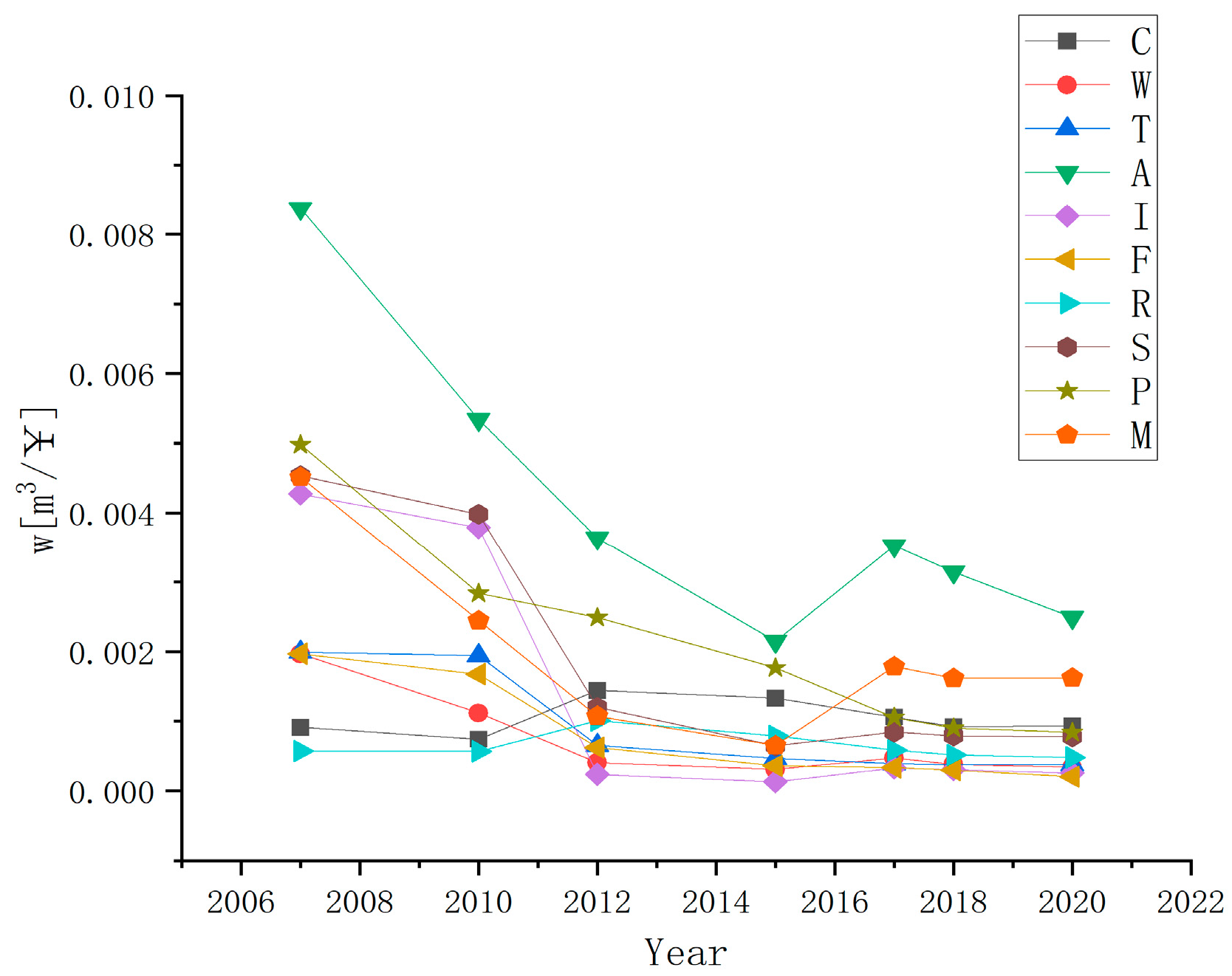
For the service sector, changes in water consumption over time are typically less pronounced than in the industrial and agricultural sectors. As shown in Figure 1, the direct water use coefficient for most service sectors exhibited significant variation between 2007 and 2020, revealing an overall downward trend over time. A sector-by-sector analysis reveals the most pronounced reductions in direct water use coefficients for scientific research, information services, wholesale and retail trade, financial services, and public services. Compared to 2007, these sectors recorded decreases of 82.83%, 93.94%, 82.64%, 89.55%, and 83.16% respectively by 2020. Notably, the core mechanisms driving this change lie in two aspects: first, technological progress—for instance, the information services sector has benefited from the widespread adoption of cloud computing, paperless offices, and remote services, significantly reducing the consumption of physical resources per unit of output; second, internal optimization of the industrial structure, with the share of high-value-added, knowledge-intensive services increasing, while traditional water-intensive services, such as accommodation and food services, although still maintaining a high water intensity, have seen their relative share decline.
Notably, the direct water intensity of the construction sector rose slightly by approximately 2%. This may be attributed to increased construction activity and the extensive nature of on-site water management during China’s rapid urbanization process. The significance of this heterogeneous finding lies in the fact that not all service sub-sectors can achieve water-saving optimization; policies must therefore establish precise water use standards and provide incentives for technological upgrades tailored to specific industries.
From the perspective of virtual water theory, the decline in the direct water use coefficient implies a reduction in the amount of virtual water “carried” per unit of service exports. Consequently, even as the scale of trade expands, the actual outflow of domestic virtual water resources can still be controlled. This provides a key efficiency parameter for subsequent analysis of changes in China’s net virtual water exports from the service sector.
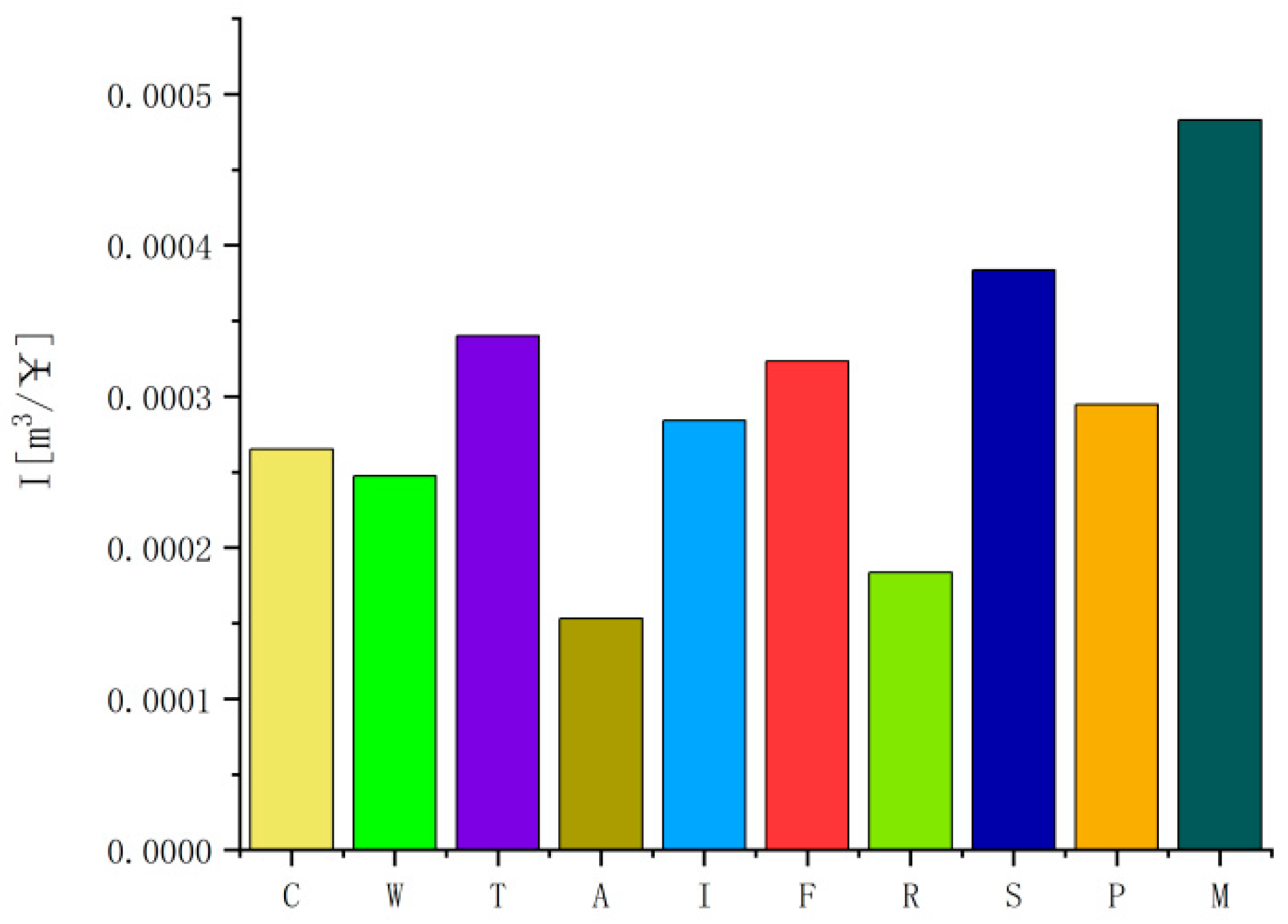
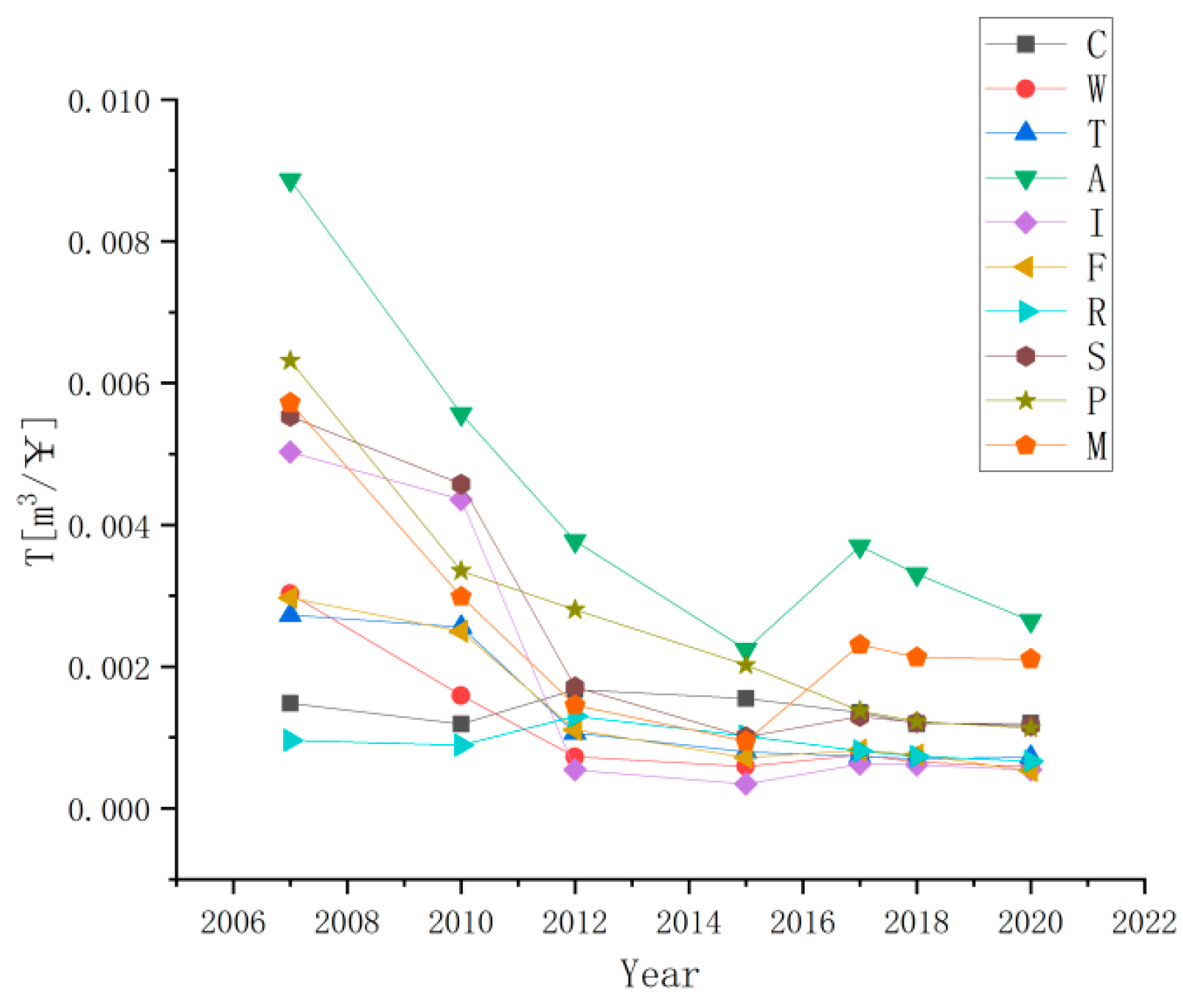
As observed in Figure 2 and Figure 3, the trends in the total water coefficient and direct water coefficient are remarkably similar. The sector identifiers (IDs) for each category are as shown in Figure 1. The sectors of scientific research, information services, wholesale and retail trade, financial services, and public services recorded decreases of 78.98%, 89.19%, 80.56%, 82.2%, 89.55%, and 83.16% respectively. Whether examining direct or total water coefficients, the information services sector exhibited the steepest decline, reflecting China’s technological advancements in this domain and their contribution to enhanced water efficiency.
The indirect water coefficient is calculated by subtracting the direct water coefficient from the total water coefficient. Its proportion relative to the total water coefficient indicates the water consumption associated with intermediate products within the sector. Taking the proportion of indirect water coefficients in 2020 as an example, Figure 3 reveals that financial services, information services, and media sectors exhibit relatively high proportions, whereas the accommodation and catering sector’s indirect water share is markedly lower than other industries. This stems from the predominantly electronic and virtual nature of financial and information services, which involve minimal direct water usage. Moreover, technological advancements have amplified their water-saving effects. The accommodation and food services sector relies almost entirely on direct water use, primarily comprising everyday domestic and industrial water consumption. Consequently, the reduction in water usage through technological advancement is relatively less pronounced.
The decline in the water intensity coefficient essentially reflects a “technology-driven reduction in virtual water intensity” within China’s service sector. Specifically, the continuous decrease in direct and total water consumption per unit of service output implies that the amount of virtual water “carried away” by each unit of service exports has decreased, thereby alleviating the actual burden of export activities on the water resource systems of destination countries. From the perspective of virtual water theory, this trend enables China to expand the scale of its trade in services while controlling the implicit outflow of domestic water resources and strengthening the decoupling of water consumption from economic growth. The decline in water intensity was particularly pronounced in sectors such as information services and financial services, indicating that digitalization and technological progress play a significant role in promoting water conservation in the service sector.

3.2. Country Analysis

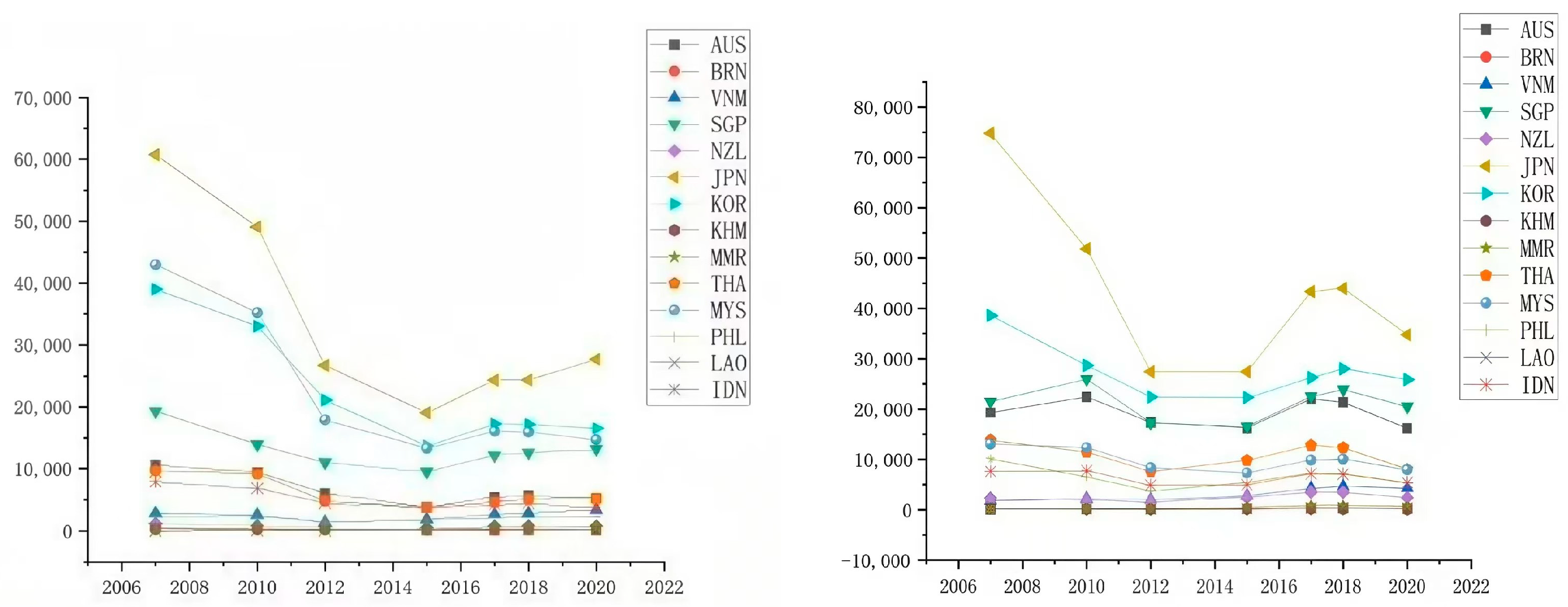
Based on the aforementioned methodology, we calculated China’s imports and exports of virtual water in services trade with other RCEP member states. As illustrated in Figure 4, Japan, South Korea, and Singapore represent the primary sources of China’s virtual water imports in services. Taking 2020 as an example, these three nations accounted for 26.34%, 19.61%, and 15.5% respectively of China’s total virtual water imports in services from other RCEP member states. Conversely, Japan, South Korea, and Singapore also hold significant positions in China’s virtual water exports in services. Japan, South Korea, and Singapore have long ranked as the top three sources of China’s virtual water imports in the service sector. The mechanisms underlying this pattern can be explained from both the supply and demand sides. On the supply side, Japan, South Korea, and Singapore have highly developed service sectors and possess comparative advantages in areas such as finance, information technology, and business services. On the demand side, the openness of China’s service market has gradually increased. Under the RCEP framework, the negative list and national treatment provisions have lowered barriers to market entry for service providers from these three countries, thereby stimulating imports.
In addition, geographical proximity and deepening regional economic integration may also have facilitated the flow of trade in services. It should be noted that this paper does not directly examine mechanisms such as cultural similarities, consumer preferences, or labor mobility; whether these factors play a role remains to be verified by future research.
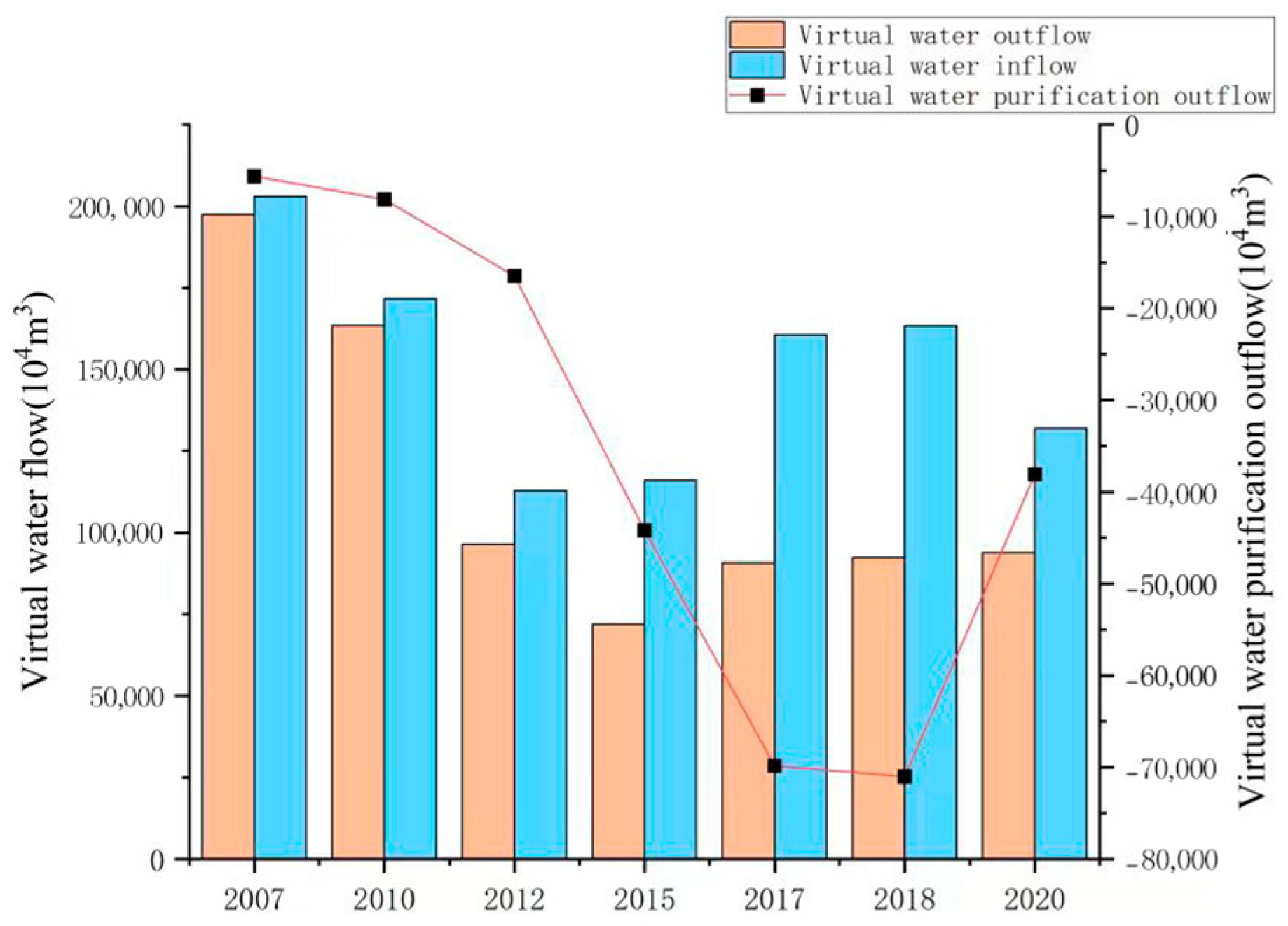
Figure 5 clearly shows that, in the area of trade in services, China has consistently been a net importer of virtual water, indicating a significant water-saving effect in its trade in services with other RCEP member states. It is worth noting that net exports showed an overall downward trend from 2007 to 2020 (increasing from approximately −0.56 billion cubic meters to −3.80 billion cubic meters). It should be noted that the mechanism behind this trend is not a contraction in trade volume, but rather a decline in the virtual water content per unit of input in China’s service sector (see Figure 1 and Figure 2), coupled with a continuous expansion in China’s demand for imports of services with higher virtual water content. The significance of this finding lies in the fact that technological progress and adjustments in trade structure can challenge the conventional wisdom that an increase in trade surpluses inevitably leads to an increase in net outflows of virtual water resources, thereby achieving a win–win outcome for both economic growth and water resource conservation.
Furthermore, the slight rebound in net exports in 2020 compared to 2018 can be explained by the fact that the COVID-19 pandemic restricted international travel, leading to a sharp decline in face-to-face service trade—such as accommodation, food services, and transportation—which are precisely the sectors with high virtual water intensity. This temporarily altered the structure of net imports. This anomaly suggests that policymakers should pay attention to the impact of sudden shifts in the structure of service trade on virtual water flows during times of crisis.
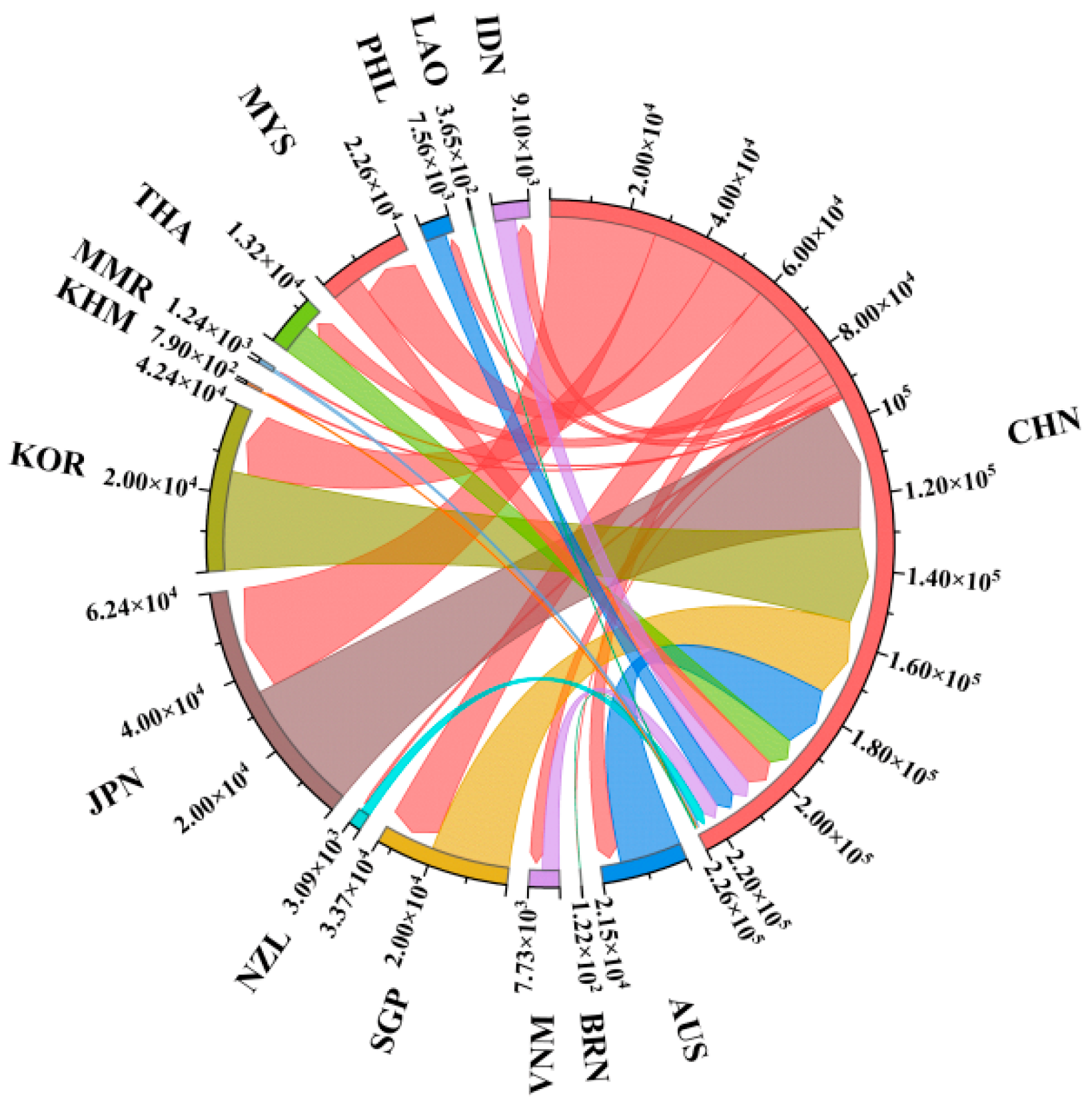
Figure 6 presents a chord diagram illustrating China’s virtual water flows in the service sector with other RCEP nations (excluding flows between other RCEP countries). It reveals that in 2020, the disparity between China’s virtual water exports and imports was relatively small, with imports from Japan, South Korea, Singapore, and Australia accounting for a significant proportion. China also exported substantial virtual water to these nations, reflecting how a country’s tertiary sector development directly influences the prosperity of its tertiary trade, thereby affecting the absolute value of its virtual water imports and exports. As China’s tertiary sector international trade has expanded during its recent development, the international balance of virtual water resources in services has become a crucial means for alleviating domestic water scarcity.
The above analysis also tests H1 proposed in this paper: namely, that between 2007 and 2020, the direct water use coefficient and total water use coefficient of China’s service sector showed a significant overall downward trend, and that net exports should have declined accordingly: The decline in water use coefficients is corroborated by the decline in net exports, indicating that against the backdrop of expanded service sector liberalization and growing import demand, technological progress has effectively reduced the virtual water content per unit of service output. This has enabled China to maintain net imports while further expanding their scale, which aligns with the expectations of virtual water theory that trade can alleviate local pressure in water-scarce regions.

3.3. Analysis of the Spatiotemporal Pattern of Virtual Water Import and Export

As shown in Table 7: Over the selected time span in this paper, the industrial concentration of China’s imports of virtual water in services from other RCEP member states generally exhibited a fluctuating downward trend. Observing the CR4 values reveals that while the overall figure decreased from 2007 to 2020, the reduction was limited. Throughout the period examined, the top four countries from which China imported virtual water in services from other RCEP members remained Japan, South Korea, Singapore, and Australia, with Japan and South Korea consistently occupying the top two positions. Comparing CR2 and CR4 calculations reveals that while CR4 declined only marginally, CR2 decreased significantly. This indicates a marked decline in the relative importance of Japan and South Korea within China’s imports of virtual water from other RCEP members’ services sectors, whereas Singapore and Australia have seen their positions strengthen. In terms of market structure, China’s imports of virtual water in services from other RCEP member states have shifted from a Tight Monopoly to an Oligopoly. Concentration has evolved from Very High to High, maintaining substantial concentration while progressing very slowly towards diversification. Regarding the Herfindahl-Hirschman Index (HHI), the concentration of China’s imports of virtual water in services from other RCEP member states has declined markedly. However, the market structure classification based on HHI values has shifted from Highly concentrated to Moderately concentrated, indicating an overall decrease in concentration.
In the context of virtual water theory, diversification of import sources can be viewed as a crucial risk-mitigation mechanism. If China’s imports of virtual water for services become overly concentrated in a few RCEP member states, the country would face the risk of virtual water supply disruptions should those nations experience water crises, droughts, or impose trade restrictions—which could in turn undermine the stable operation of related domestic service industries. From a policy perspective, the RCEP’s institutional framework provides China with a platform to import virtual water for services from multiple member states, helping to build a more resilient virtual water supply network. In the future, efforts should be made to further encourage trade cooperation in services with RCEP member states that have high water resource carrying capacity but currently account for a low share of trade, thereby enhancing the stability and sustainability of virtual water imports.
According to the aforementioned calculation formula, the fragmentation index should fall within the range of 1 to 3.742. Over the selected time span in this study, the average fragmentation index stood at 3.048, exceeding half of the upper limit of the range. This indicates a pronounced fragmentation effect in China’s imports of virtual water within the services sector from other RCEP member states. Spatially, the spatial distribution of China’s imports of virtual water in services from other RCEP member states exhibits relatively mild unevenness, with no severe concentration. Temporally, the period from 2007 to 2017 shows a stable growth trend, with a slight decline from 2018 to 2020 likely attributable to the Sino-US trade war and the COVID-19 pandemic weakening the degree of equilibrium.
Table 8 presents the results of global spatial autocorrelation. It is evident that from 2007 to 2002, all z-values were positive and statistically significant at the 95% confidence level. This indicates that China’s imports of virtual water in the service sector from other RCEP member states consistently exhibit positive global spatial autocorrelation, manifesting as spatial low-low clustering and high-high clustering. The trend in Moran’s I index reveals an overall decline with significant fluctuations, indicating a gradual dispersion in China’s imports of virtual water within the services sector from other RCEP member states. A notable rebound in Moran’s I index occurred in 2020, potentially attributable to the spatial clustering effects on services trade caused by the COVID-19 pandemic.
These changes indicate that China is moving beyond mere geographical proximity to establish more balanced virtual water ties with RCEP member states located further afield, such as Australia and New Zealand.
The aforementioned changes in the spatiotemporal pattern also support H2 of this paper: the spatial distribution of China’s imports of virtual water in the services sector from other RCEP member states is evolving from a highly concentrated state toward a relatively balanced and diversified one. Changes in the CR4 index, HHI, fragmentation index, and Moran’s I index validate the validity of H2. The spatial distribution of China’s imports of virtual water for services from RCEP member states is indeed evolving toward greater balance and diversification, with the market structure shifting from tight monopoly to oligopoly. From the perspective of risk management in virtual water trade, the diversification and balancing of import sources contribute to the construction of a more resilient virtual water supply network. When virtual water supply from a particular source country decreases due to drought, policy adjustments, or trade disputes, other source countries can partially substitute for it, thereby ensuring water security for China’s downstream service industries.

3.4. Analysis of Water Resources Carrying Capacity Index

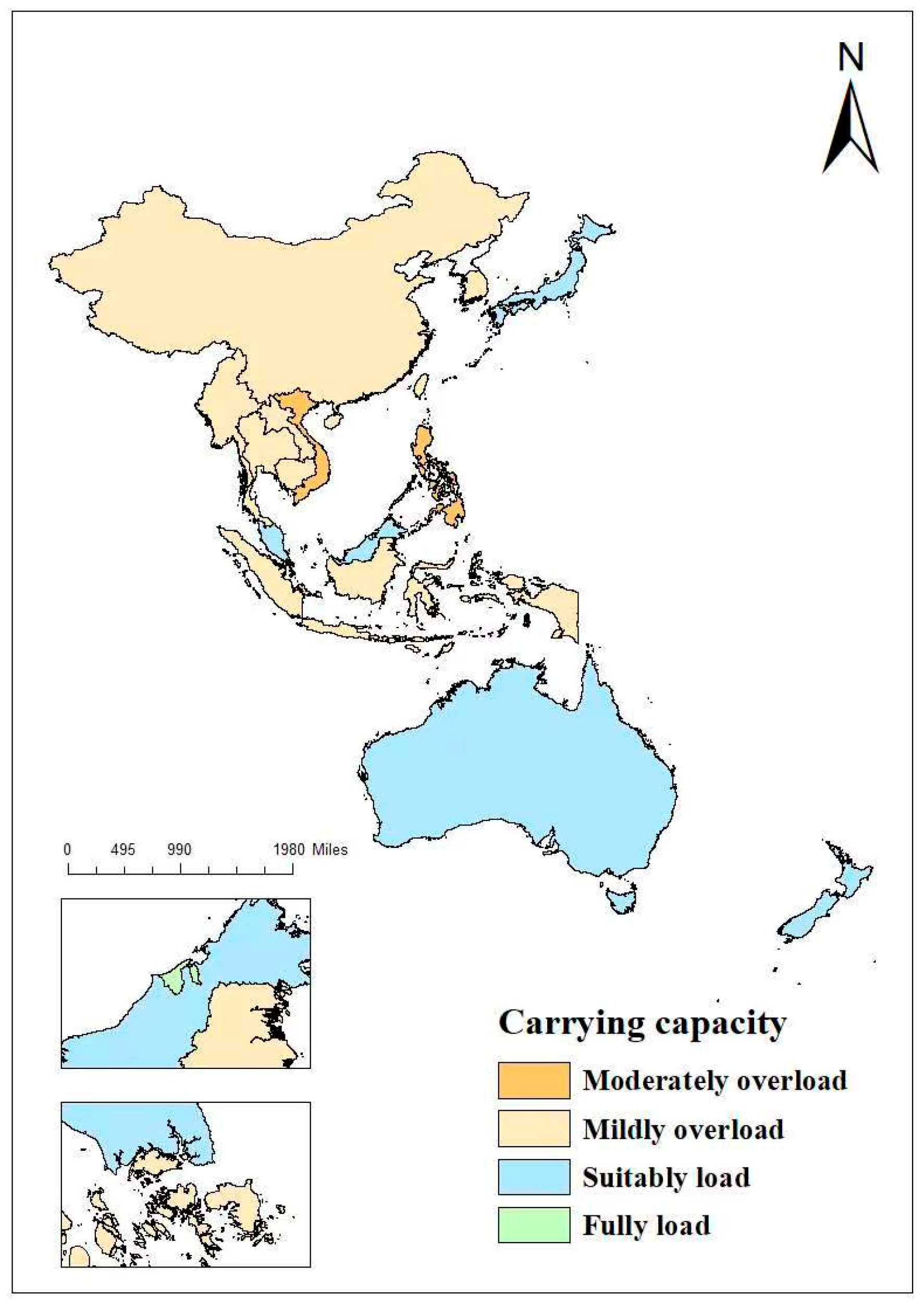
The water resource carrying capacity indices for RCEP member states in 2020 were calculated and categorised, yielding the following results. As Table 9 demonstrates, ASEAN nations (excluding Singapore) exhibit relatively abundant per capita water resources and high forest coverage, yet their per capita GDP remains low. Consequently, their water resource carrying capacity remains comparatively low compared to developed nations such as New Zealand. Singapore, owing to its unique geographical constraints, possesses extremely low per capita water resources and forest coverage. Thus, despite surpassing other nations in per capita GDP, its water resource carrying capacity remains low. Among RCEP nations, China occupies a mid-tier position in water resource carrying capacity. When cross-referenced with the 2020 virtual water trade data for China’s service sector, it emerges that although Brunei and Malaysia possess higher water resource carrying capacities than China, China remains a net exporter of virtual water in its service sector trade with both nations. This may stem from Brunei and Malaysia being RCEP members with per capita GDP most comparable to China’s among ASEAN nations. Per the theory of demand similarity, their demand tiers align more closely with China’s. Within services trade, China’s exports to Malaysia in retail, accommodation, information services, and financial services significantly exceed those to other ASEAN partners (Brunei’s smaller scale precludes meaningful comparison). Negative virtual water exports were recorded for all nations with lower water carrying capacity indices than China, excluding Cambodia. This likely stems from China’s service trade with ASEAN, where it predominantly imports from sectors with high virtual water intensity (such as accommodation and catering) while exporting more from sectors with low virtual water intensity (like information and financial services), ultimately resulting in net virtual water imports. In China’s services trade with developed economies, notably Japan, the relatively underdeveloped state of China’s service sector leads to substantially higher import values than exports, resulting in net virtual water imports. Overall, China is a net importer of virtual water in services trade with other RCEP members possessing higher water carrying capacities than China. Among other RCEP members with lower water resource carrying capacity than China, China exports virtual water in services to Cambodia while importing virtual water in services from Indonesia, Singapore, Thailand, Vietnam, and the Philippines. Overall, China remains a net importer of virtual water in its services trade with other RCEP members possessing lower water resource carrying capacity than China.
By categorising other RCEP member states into two groups based on whether their 2020 water resource carrying capacity index exceeded or fell below China’s, and applying GDP weighting, it is discernible that China imported a greater volume of virtual water from services originating in those RCEP member states with a lower water resource carrying capacity index than China’s during 2020. This finding contradicts the theoretical framework of virtual water, indicating an imbalance in China’s import structure within the RCEP framework’s virtual water trade.
The above analysis also indicates that the findings of this paper do not align with H3. H3 is supported only in certain bilateral trade relationships (such as those between Japan and South Korea), but overall, there is a significant deviation from the results of the comparison with China’s water carrying capacity. It should be noted that this deviation does not negate the virtual water theory, but rather reveals the multifactorial nature of virtual water trade in the service sector. While water resource endowment is indeed one of the factors influencing virtual water trade, the flow of virtual water in the service sector is more heavily influenced by factors such as the level of economic development, industrial competitiveness, digital infrastructure, linguistic and cultural ties, and trade institutional arrangements. Therefore, in subsequent discussions, the application of the virtual water theory to the service sector requires corresponding adjustments tailored to specific trade contexts.
Table 8 and Figure 7 present the water resource carrying capacity indices and classifications for RCEP countries in 2020, calculated using the original three-indicator system. However, a comparison of these results with those from mainstream international water resource assessment projects reveals several notable discrepancies.
Taking Singapore as an example, this study calculates its WRCI as 2.283, classifying it as “slightly overloaded.” However, according to FAO AQUASTAT data from 2020, Singapore’s per capita renewable freshwater resources are nearly zero, and the WRI Aqueduct water risk map similarly lists Singapore as one of the countries facing the highest water stress. The root cause of this discrepancy lies in the fact that Singapore has effectively alleviated the actual water supply pressure caused by freshwater shortages through the development of non-conventional water resources, such as desalination and reclaimed water. This has led to a divergence between the evaluation results of international organizations—which are based on natural freshwater endowment—and the findings of this study.


4. Conclusions

For policymakers, the following actionable insights can be drawn. China should further leverage the RCEP institutional framework to diversify the sources of virtual water imports in the service sector, reduce over-reliance on a few countries (such as Japan and South Korea), and enhance the resilience of its virtual water supply network. For countries with lower water carrying capacity than China but which are net exporters of virtual water to China (such as Singapore and Thailand), targeted water conservation cooperation and technology transfer can help alleviate water resource pressures in these regions. China’s successful experience in reducing water intensity in sectors such as information and financial services demonstrates that promoting high-value-added, low-virtual-water-intensity service exports can simultaneously generate economic benefits and conserve water resources. Phenomena inconsistent with virtual water theory suggest that policymakers need more refined policy guidance: while promoting virtual water trade in the service sector, they should also consider the water resource endowments of trading partners to avoid exacerbating water pressure in regions already facing water scarcity.
Although the Water Resource Carrying Capacity Index (WRCI) used in this study is based on three widely available indicators (PCW, PCG, and FCR) and an entropy-weighted method, it omits important dimensions such as water withdrawal intensity, sectoral demand structure, governance quality, and cross-border water dependency. Therefore, the WRCI provides only a rough ranking of the water resource carrying capacities of RCEP countries, rather than a precise measurement. Findings regarding China’s simultaneous import of virtual water from countries with both higher and lower water resource carrying capacities than its own should be interpreted with caution. Incorporating these missing dimensions into a more refined index in the future may alter the classification results for some countries and could affect the assessment of whether China’s virtual water trade in the service sector aligns with the expectations of virtual water theory. Furthermore, this study assumes that the technical coefficients of RCEP member states are consistent with those of China, which may also have some impact on the estimation of virtual water trade volumes. Future research could attempt to collect multi-country input–output tables or adopt multi-regional input–output models to further improve estimation accuracy.

Author Contributions

Formal analysis, investigation, resources and writing—original draft preparation, S.L.; data curation, writing—review and editing, visualization and supervision, S.W. All authors have read and agreed to the published version of the manuscript.

Funding

This research received no external funding.

Data Availability Statement

The data was counted according to the input–output table. https://www.stats.gov.cn/hd/lyzx/zxgk/trccb/ (accessed on 25 October 2025).

Conflicts of Interest

The authors declare no conflicts of interest.

References

  1. Qiu, Y.; Hao, C.; Jia, L.; Shen, Y.; Liu, H.; Wang, Z. Status variation development and utilization of water resources in China. River 2023, 2, 480–489. [Google Scholar] [CrossRef]
  2. Ouyang, X.T.; Liao, H.Y.; Jiang, Q.; Wang, Z. Simulation and Regulation of Sustainable Utilization of Water Resources in China Based on Improved Water Resources Ecological Footprint Model. Huan Jing Ke Xue 2023, 44, 1368–1377. [Google Scholar] [PubMed]
  3. Allan, A.J. Virtual water: A strategic resource, global solutions to regional deficits. Groundwater 1998, 36, 545–546. [Google Scholar] [CrossRef]
  4. Al-Qudah, A.A.; Al-Okaily, M.; Alqudah, H. The relationship between social entrepreneurship and sustainable development from economic growth perspective: 15 ‘RCEP’ countries. J. Sustain. Financ. Inv. 2022, 12, 44–61. [Google Scholar] [CrossRef]
  5. Hassan, T.; Song, H.; Kirikkaleli, D. International trade and consumption-based carbon emissions: Evaluating the role of composite risk for RCEP economies. Environ. Sci. Pollut. Res. 2021, 29, 3417–3437. [Google Scholar] [CrossRef] [PubMed]
  6. Zhang, Y.; Zhang, J.; Tian, Q. Virtual Water Trade in the Service Sector: China’s Inbound Tourism as a Case Study. Int. J. Environ. Res. Public Health 2021, 18, 1769. [Google Scholar] [CrossRef]
  7. Ma, W.; Li, C.; Kou, J.; Ma, Z.; Yang, H.; Xue, B. Value-added based inequity in global virtual water trade. Geogr. J. 2024, 191, e12603. [Google Scholar] [CrossRef]
  8. Liao, X.; Han, A.; Li, S.; Du, Y.; Chai, L. Unveiling Economic Co-Benefits of Virtual Water Trades: An Empirical Analysis on China’s JingJinJi Megalopolis. Water 2021, 13, 3140. [Google Scholar] [CrossRef]
  9. Liu, X. By Sector Water Consumption and Related Economy Analysis Integrated Model and Its Application in Hai River Basin, China. J. Water Resour. Prot. 2012, 4, 264–276. [Google Scholar] [CrossRef][Green Version]
  10. Li, W.; Wang, X.F.; Liu, J. Analysis of China department water consumption efficiency. IOP Conf. Ser. Mater. Sci. Eng. 2018, 322, 052018. [Google Scholar] [CrossRef]
  11. Deng, G.; Yue, X.; Miao, L.; Lu, F. Identification of key sectors of water resource utilization in China from the perspective of water footprint. PLoS ONE 2020, 15, e0234307. [Google Scholar] [CrossRef] [PubMed]
  12. Chang, J.; Li, W.F.; Zhou, Y.; Zhang, P.; Zhang, H. Impact of Public Service Quality on the Efficiency of the Water Industry: Evidence from 147 Cities in China. Sustainability 2022, 14, 15160. [Google Scholar] [CrossRef]
  13. Liao, X.; Liu, A.; Chai, L. Virtual water flows in a real world. PLoS Water 2024, 3, e0000275. [Google Scholar] [CrossRef]
  14. Yang, Y.; Tian, G.; Li, J.J.; Sun, Z. Evolution of spatiotemporal pattern of virtual water in the Yangtze River economic belt. Ecol. Indic. 2024, 161, 111967. [Google Scholar] [CrossRef]
  15. Zhou, B.; Liu, Y.; Ali, T. Sector-Level Inter-Provincial Virtual Water Trade in China: Implications for Regional Water Stress. Sustainability 2024, 16, 3666. [Google Scholar] [CrossRef]
  16. Wei, Z.; Wang, D.; Yu, Y.; Kapelan, Z. Unveiling the inequalities in virtual water transfer in China: The environmental and economic perspectives. Sustain. Prod. Consum. 2023, 42, 63–73. [Google Scholar] [CrossRef]
  17. Meng, F.; Xia, X.; Hu, Y.; Yang, Z. Virtual Water in Trade between China and Typical Countries along the Belt and Road. Strateg. Study CAE 2019, 21, 92–99. [Google Scholar] [CrossRef]
  18. Zhang, M.; Zhang, Y.; Tian, Q.; Man, X.; Wang, M. Virtual water flows and drivers in the international trade of agricultural products of the regional comprehensive economic partnership. Water Sci. Technol. 2024, 89, 730–744. [Google Scholar] [CrossRef]
  19. Chen, R.; Adu, D.T.; Li, W.; Wilson, N.L. Virtual water trade: Does bilateral tariff matter? Ecol. Econ. 2024, 222, 108216. [Google Scholar] [CrossRef]
  20. Sinha, J.; Sharma, A.; Marshall, L. Hydrological sustainability of international virtual water trade. Environ. Res. Lett. 2023, 18, 124037. [Google Scholar] [CrossRef]
  21. Leontief, W.W. Quantitative Input and Output Relations in the Economic Systems of the United States. Rev. Econ. Stat. 1936, 18, 105–125. [Google Scholar] [CrossRef]
  22. Cámara, Á.; Llop, M. Defining Sustainability in an Input–Output Model: An Application to Spanish Water Use. Water 2021, 13, 1. [Google Scholar] [CrossRef]
  23. Stoevener, H.H.; Emery, E.N. Input-Output Models and Benefit-Cost Analysis in Water Resources Research. J. Farm Econ. 1965, 47, 1572–1579. [Google Scholar] [CrossRef]
  24. Leontief, W. Environmental Repercussions and the Economic Structure: An Input-Output Approach. Rev. Econ. Stat. 1970, 52, 262–271. [Google Scholar] [CrossRef]
  25. Hoekstra, A.Y. Virtual Water Trade: Proceedings of the International Expert Meeting on Virtual Water Trade; Value of Water Research Report Series No. 12; IHE Delft: Delft, The Netherlands, 2003; Volume 4, pp. 77–91. [Google Scholar]
  26. Zheng, X.; Xu, Z. Analysis of Water Resources Carrying Capacity of the “Belt and Road” Initiative Countries based on Virtual Water Theory. J. Resour. Ecol. 2019, 10, 574–583. [Google Scholar] [CrossRef]
  27. Falkenmark, M.; Lundqvist, J.; Widstrand, C. Macro-scale water scarcity requires micro-scale approaches. Nat. Resour. Forum 1989, 13, 258–267. [Google Scholar] [CrossRef]
  28. Wang, Y.J.; Yang, G.; Xu, H.L. Evaluation of water resources carrying capacity based on fuzzy comprehensive evaluation on river basin in Arid Zone. Adv. Mater. Res. 2010, 113, 488–494. [Google Scholar] [CrossRef]
  29. Zhu, Y.X.; Huang, Y.X.; Wang, L.J. Synthetical evaluating method of water resources sustainable development and using status. J. Jilin Univ. (Earth Sci. Ed.) 2002, 32, 55–57. [Google Scholar]
  30. Cheng, X.; Shuai, C.; Yan, L.; Fan, L. Market Structure and Price Elasticity of China’s Iron Ore Imports. Resour. Sci. 2014, 36, 1915–1924. [Google Scholar]
  31. Hirschman, A.O. National Power and the Structure of Foreign Trade; University of California Press: Oakland, CA, USA, 1980. [Google Scholar]
  32. Herfindahl, O.C. Concentration in the Steel Industry; Columbia University: New York, NY, USA, 1997. [Google Scholar]
  33. Luo, Z.; Zhang, J. Measurement and Empirical Study of Urban Regional Spatial Agglomeration-Fragmentation Trends: A Case Study of the Urban Regions Along the Yangtze River in Jiangsu Province. Urban Plan. 2002, 4, 61–63. [Google Scholar]
  34. Lee, J.; Wong, D.W.S. Statistical Analysis with ArcView GIS; John Wiley & Sons: Hoboken, NJ, USA, 2001; pp. 156–164. [Google Scholar]
  35. Tian, G.; Han, X.; Zhang, C.; Li, J.; Liu, J. Virtual Water Flows Embodied in International and Interprovincial Trade of Yellow River Basin: A Multiregional Input-Output Analysis. Sustainability 2020, 12, 1251. [Google Scholar] [CrossRef]
  36. Koopman, R.; Wang, Z.; Wei, S.-J. Tracing Value-Added and Double Counting in Gross Exports. Am. Econ. Rev. 2014, 104, 459–494. [Google Scholar] [CrossRef]
Figure 1. Trends in Direct Water Consumption Coefficients in China’s Service Sector, 2007–2020.
Water 18 01062 g001
Figure 2. Trend of complete water use coefficient in China’s service industry, 2007–2020.
Water 18 01062 g002
Figure 3. Indirect water use coefficient of China’s service industry sector in 2020.
Water 18 01062 g003
Figure 4. China’s service industry virtual water import and export to RCEP countries, 2007−2020.
Water 18 01062 g004
Figure 5. Virtual Water Import and Export in China’s Service Industry, 2007–2020.
Water 18 01062 g005
Figure 6. Chord chart of China’s virtual water flow in the service industry to other RCEP countries in 2020.
Water 18 01062 g006
Figure 7. Water resources carrying index of RCEP countries in 2020.
Water 18 01062 g007
Table 1. Evaluation level of water resources carrying capacity index.
MetricsV1V2V3V4V5
PCW<500500–17001700–54755475–10,000>10,000
PCG≤39563956–67166716–94759475–12,235>12,235
FCR≤1515–3030–4545–60>60
Table 2. Classification of water resources carrying index.
IndexSevere OverloadModerately
Overload
Mildly
Overload
Suitably LoadFully Load
WRCI11–22–33–44
Table 3. Market structure classification based on CR4.
Value of CR4ConcentrationType of Market Structure
CR4 < 25%LowCompetitive
25% ≤ CR4 < 50%ModerateLoose oligopoly
50% ≤ CR4 < 75%HighOligopoly
75% ≤ CR4 < 100%Very highTight monopoly
Table 4. Market structure classification based on the Herfindahl-Hirschman Index (HHI).
Value of HHIType of Market Structure
HHI < 1000Low concentration
1000 ≤ HHI < 1800Moderately concentrated
1800 ≤ HHIHighly concentrated
Table 5. Table of Division of Service Industry Departments.
IDSectorDetailed Departments Included
CconstructionResidential building construction, sports stadiums and other building construction, railway, road, tunnel and bridge engineering construction, other civil engineering construction, building installation, building decoration, refurbishment and other construction services
WWholesale and retailWholesale and retail
TtransportationRail passenger transport, rail freight transport and transport auxiliary activities, urban public transport and road passenger transport, road freight transport and transport auxiliary activities, waterborne passenger transport, waterborne freight transport and transport auxiliary activities, air passenger transport, air freight transport and transport auxiliary activities, pipeline transport, multi-modal transport and freight forwarding, loading, unloading and warehousing, postal services
AAccommodation and mealsAccommodation and catering
Iinformation serviceTelecommunications, radio and television broadcasting services, satellite transmission services, internet and related services, software services, information technology services
Ffinancial serviceMonetary and financial services and other financial services, capital market services, insurance, business services
Rreal estateReal estate, letting
Sscientific researchResearch and experimental development, professional technical services, science and technology promotion and application services
Ppublic servicePublic facilities and land management, community services, other services, education, health, social work, social security, public administration and social organizations
Mmedia industryNews and Publishing, Broadcasting, Television, Film and Audiovisual Production, Culture and Arts, Sport, Entertainment
Table 6. Intermediate consumption in the water production/supply industry in 2007.
Sectors q s j d j
C232,6250.081
W230,0260.08
T262,6040.091
A503,6690.175
I173,9340.06
F234,6070.081
R34,8910.012
S106,2890.037
P1,039,7300.361
M64,8530.022
Table 7. Concentration ratio and Fragmentation Index.
YearCR4 (J = 4)HHIQj
20070.7590.2052.902
20100.7500.1722.982
20120.7470.1593.018
20150.7100.1493.113
20170.7110.1533.117
20180.7170.1553.110
20200.7370.1593.093
Table 8. Moran’s I index of China’s virtual water import for RCEP countries’ service industry.
YearMoran’s Izp
20070.1582.6170.009
20100.1382.3370.019
20120.1442.3600.018
20150.1342.2510.024
20170.1332.2710.023
20180.1352.2860.022
20200.1442.3720.018
Table 9. Water resources carrying index and Level of RCEP countries in 2020.
CountryWRCILevel
Brunei4Fully load
New Zealand3.715Suitably load
Malaysia3.592Suitably load
Australia3.476Suitably load
Japan3.217Suitably load
South Korea2.801Mildly overload
Laos2.730Mildly overload
Myanmar2.465Mildly overload
China2.342Mildly overload
Indonesia2.300Mildly overload
Cambodia2.289Mildly overload
Singapore2.283Mildly overload
Thailand2.126Mildly overload
Vietnam1.868Moderately overload
Philippines1.450Moderately overload
Disclaimer/Publisher’s Note: The statements, opinions and data contained in all publications are solely those of the individual author(s) and contributor(s) and not of MDPI and/or the editor(s). MDPI and/or the editor(s) disclaim responsibility for any injury to people or property resulting from any ideas, methods, instructions or products referred to in the content.