Risk Assessment of Dams and Reservoirs to Climate Change in the Mediterranean Region: The Case of Almopeos Dam in Northern Greece

 , ,
, ,  , , and
Highlights
- Temperature increase is the dominant climate risk for dams and reservoirs.
- Drought conditions cause moderate but critical stress on reservoir storage and supply.
- Extreme precipitation has low likelihood but high consequences for dam safety.
- Increased irrigation demand leads to very high operational risk under future climate scenarios.
- Operational measures are most effective, while structural and monitoring ensure safety.
- Risk matrices enable transparent and practical climate risk assessment of dams and reservoirs.
- System-based thresholds improve the interpretation of climate impacts on dams and reservoirs.
- Operational measures are the most effective for adapting dams and reservoirs to climate change.
- The proposed framework supports climate-proofing and resilient planning of dams and reservoirs.
Abstract
1. Introduction
2. Materials and Methods
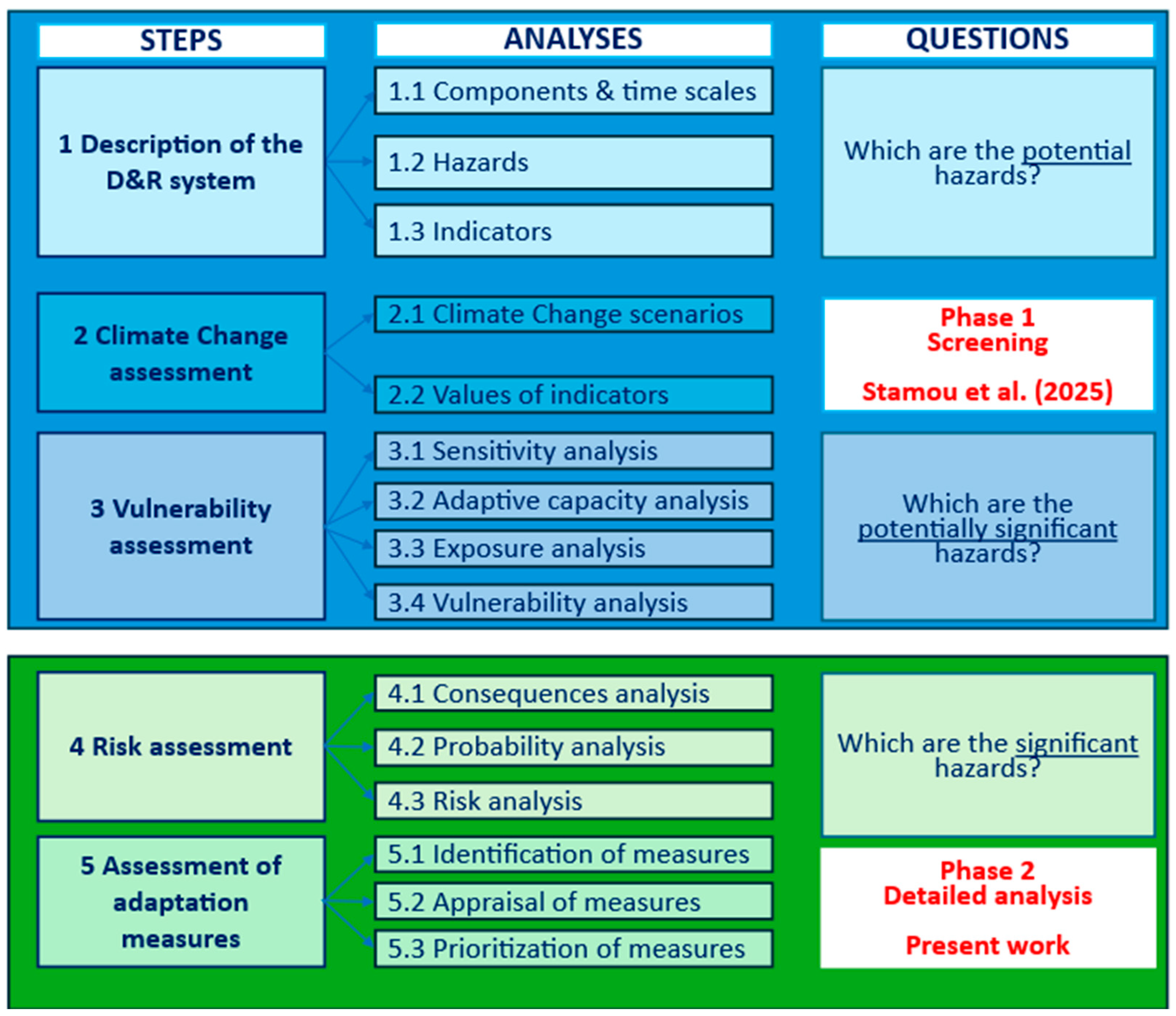
2.1. Methodology
2.2. Consequences Analysis
2.3. Likelihood Analysis
2.4. Risk Analysis
2.5. Assessment of Adaptation Measures
3. Application of the Methodology
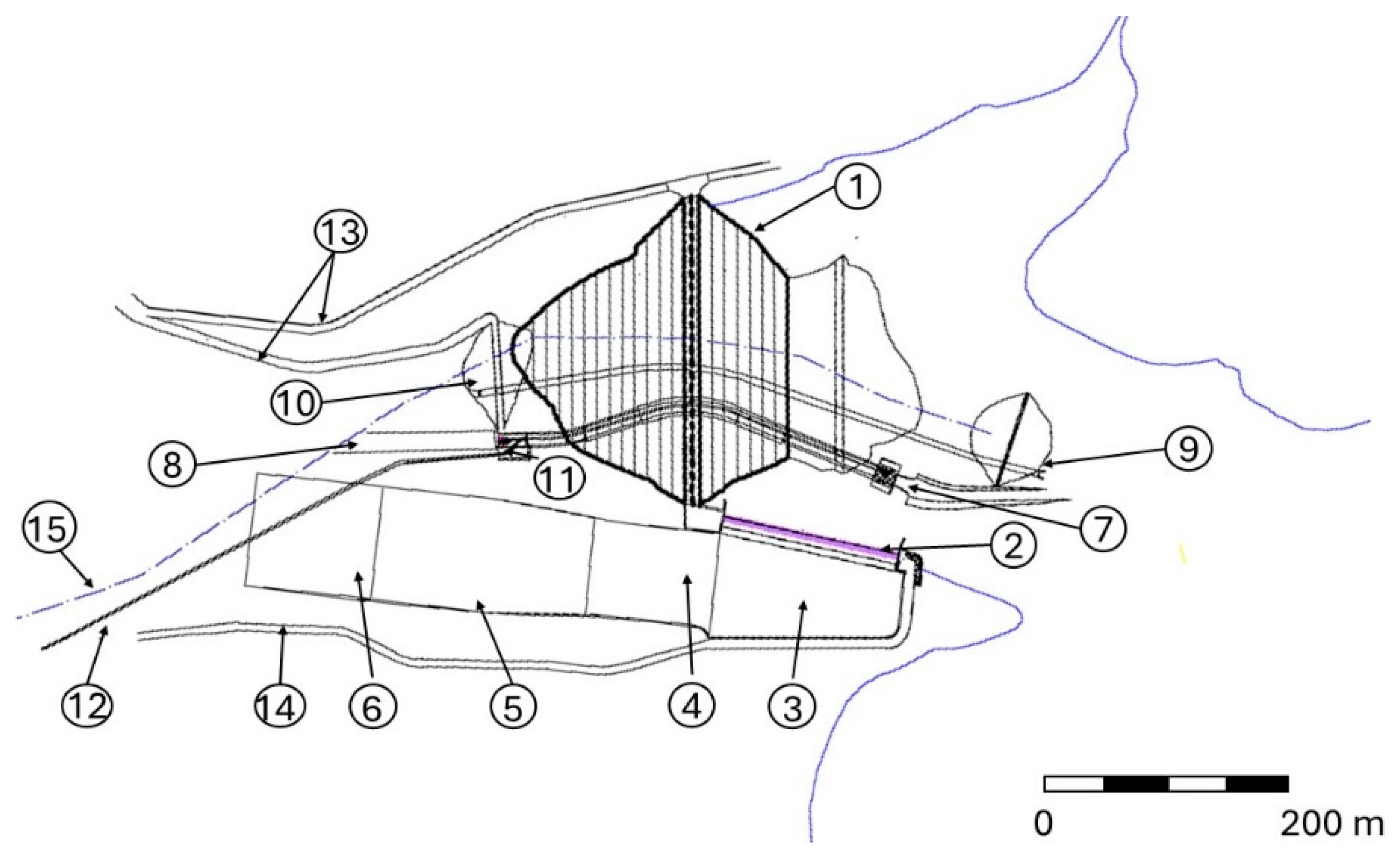
3.1. The Case Study of Almopeos D&R System
3.2. Selection of Relevant Impact Chains for the Almopeos D&R System
- Coverage of the main components of D&R systems, including inputs, functions, assets, outflows, and supporting infrastructure, following the system typologization of Stamou et al. [61];
- Representation of impacts across the five risk areas considered in the assessment.
3.3. Consequence Analysis of Almopeos D&R System
3.3.1. Asset Damage (CA)
3.3.2. Safety and Health (CH)
3.3.3. Environmental Impacts (CE)
3.3.4. Service Disruption (CS)
3.3.5. Financial and Reputational Impacts (CF & CR)
3.4. Likelihood Analysis of Almopeos D&R System
- TX35 (temperature increase and heat waves): number of days per year with maximum temperature exceeding 35 °C;
- CDD (drought conditions): maximum number of consecutive dry days per year;
- Rx1day (extreme precipitation): maximum daily precipitation per year.
3.4.1. Climate Change Scenarios
3.4.2. Empirical Distributions of Climate Indicators
3.4.3. Definition of System-Based Thresholds for Climate Indicators
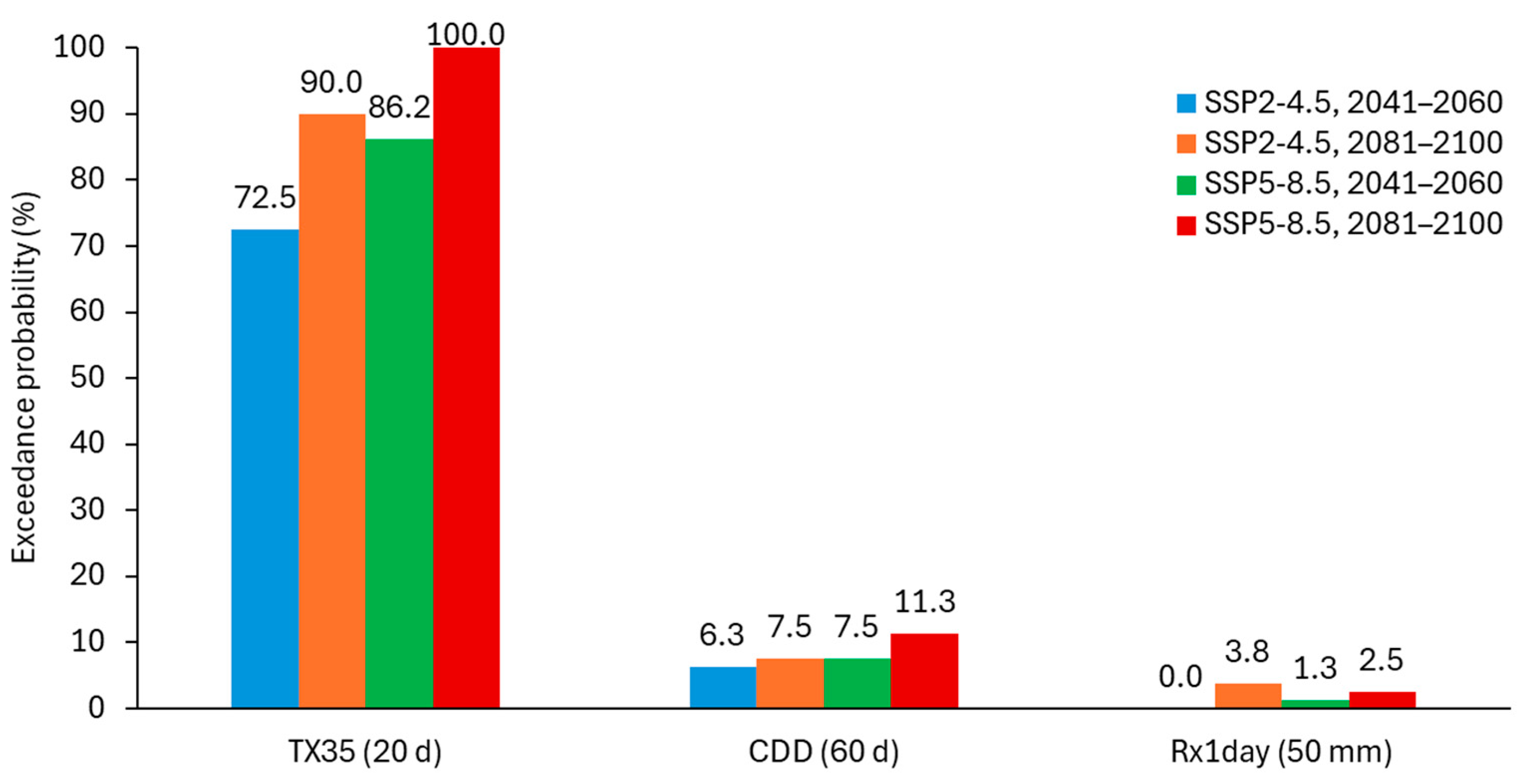
3.4.4. Likelihood Probability and Scores of Hazards
3.5. Risk Assessment of Almopeos D&R System
3.6. Assessment of Adaptation Measures for Almopeos D&R System
3.6.1. Identification of Adaptation Measures
- Management and operational measures (KTM-M), which include adaptive reservoir operation rules, improved irrigation scheduling, and measures to increase irrigation efficiency in the command area.
- Grey infrastructure measures (KTM-G), which entail the maintenance and upgrading of spillway components (including fusegates), and reinforcement of drainage and seepage control systems.
- Information and capacity-building measures (KTM-I) that deal with the enhanced monitoring of seepage, pore water pressures, and water quality, as well as with the development of flood forecasting and early warning systems.
- Nature-based solutions (KTM-N), such as catchment management interventions aimed at reducing erosion and sediment inflow into the reservoir.
- Policy and institutional measures (KTM-P). These measures, although not explicitly developed in this study, include regulatory and planning measures that support efficient water use and risk-informed dam operation and are implicitly relevant. Representative instruments include volumetric water pricing, drought-contingency allocation rules, and water-use quotas during shortage periods, which have been identified as useful mechanisms for reducing drought impacts in Mediterranean basins [70].
3.6.2. Appraisal of Adaptation Measures
3.6.3. Prioritization of Adaptation Measures
4. Discussion
5. Conclusions
Author Contributions
Funding
Data Availability Statement
Acknowledgments
Conflicts of Interest
References
- Zittis, G.; Almazroui, M.; Alpert, P.; Ciais, P.; Cramer, W.; Dahdal, Y.; Fnais, M.; Francis, D.; Hadjinicolaou, P.; Howari, F.; et al. Climate Change and Weather Extremes in the Eastern Mediterranean and Middle East. Rev. Geophys. 2022, 60, e2021RG000762. [Google Scholar] [CrossRef]
- Rico, M.; Benito, G.; Salgueiro, A.R.; Díez-Herrero, A.; Pereira, H.G. Reported Tailings Dam Failures. J. Hazard. Mater. 2008, 152, 846–852. [Google Scholar] [CrossRef]
- Gee, N.; Baker, M.; Mauney, L.; Hotchkiss, R.H. Analysis of Dam Failure and Incident Investigations in the United States from 1960 through 2022: Framework for Improving Future Investigations. J. Water Resour. Plann. Manag. 2024, 150, 04023081. [Google Scholar] [CrossRef]
- Ellingwood, B.; Corotis, R.B.; Boland, J.; Jones, N.P. Assessing Cost of Dam Failure. J. Water Resour. Plann. Manag. 1993, 119, 64–82. [Google Scholar] [CrossRef]
- DeNeale, S.T.; Baecher, G.B.; Stewart, K.M.; Smith, E.D.; Watson, D.B. Current State-of-Practice in Dam Safety Risk Assessment; Oak Ridge National Laboratory: Oak Ridge, TN, USA, 2019. [Google Scholar]
- Nastos, P.T.; Arsenis, S.; Samos, I. Thermodynamic Analysis of a Mediterranean Cyclone with Tropical Characteristics in the Central Mediterranean in September 2023; Copernicus Meetings: Göttingen, Germany, 2025. [Google Scholar]
- Nastos, P.; Feloni, E.; Chasiotis, A. Analysis of an Extreme Hydrometeorological Event in Athens on September 6, 2023, Using OTT Parsivel Disdrometer and Pluviometer Data. In Proceedings of the Tenth International Conference on Remote Sensing and Geoinformation of the Environment (RSCy2024), Paphos, Cyprus, 8–9 April 2024; Michaelides, S.C., Hadjimitsis, D.G., Danezis, C., Kyriakides, N., Christofe, A., Themistocleous, K., Schreier, G., Eds.; SPIE: Paphos, Cyprus, 2024; p. 66. [Google Scholar]
- Annunziato, A.; Santini, M.; Proietti, C.; De Girolamo, L.; Lorini, V.; Gerhardinger, A.; Tucci, M. Modelling and Validation of the Derna Dam Break Event. GeoHazards 2024, 5, 504–529. [Google Scholar] [CrossRef]
- Nemnem, A.M.; Tanim, A.H.; Nahian, A.; Khan, S.; Goharian, E.; Imran, J. How Extreme Rainfall and Failing Dams Unleashed the Derna Flood Disaster. Nat. Commun. 2025, 16, 4191. [Google Scholar] [CrossRef] [PubMed]
- Federal Emergency Management Agency. Federal Guidelines for Dam Safety Risk Management; FEMA: Washington, DC, USA, 2015.
- U.S. Bureau of Reclamation; U.S. Army Corps of Engineers. Best Practices in Dam and Levee Safety Risk Analysis; USBR: Denver, CO, USA; USACE: Washington, DC, USA, 2019.
- Environment Agency. Guide to Risk Assessment for Reservoir Safety Management; Environment Agency: Bristol, UK, 2013.
- International Commission on Large Dams. Risk Assessment in Dam Safety Management: A Reconnaissance of Benefits; Methods and Current Applications: Paris, French, 2005; Volume 130. [Google Scholar]
- U.S. Bureau of Reclamation. Public Protection Guidelines: A Risk Framework to Support Dam Safety Decision-Making; U.S. Bureau of Reclamation: Denver, CO, USA, 2011.
- Central Water Commission. Guidelines for Assessing and Managing Risks Associated with Dams; Dam Rehabilitation and Improvement Project (DRIP): New Delhi, India, 2019.
- Sohler, F.A.S.; Caldeira, L.M.M.S. Safety of Dams: A Pathological Approach of Qualitative and Quantitative Risks. J. Civ. Eng. Archit. 2016, 10, 1032–1051. [Google Scholar] [CrossRef]
- Xie, Y.; Pubucireng; Wan, Y.; Peng, X.; Jing, P. Study on Risk Assessment Method of Cascade Reservoirs Based on Hidden Danger Investigation. In Hydraulic Structure and Hydrodynamics; Wang, W., Wang, C., Lu, Y., Eds.; Lecture Notes in Civil Engineering; Springer Nature: Singapore, 2025; Volume 608, pp. 13–21. ISBN 978-981-97-7250-6. [Google Scholar]
- Nunes, R.; Arraut, E.; Pimentel, M. Risk Assessment Model for the Renewal of Water Distribution Networks: A Practical Approach. Water 2023, 15, 1509. [Google Scholar] [CrossRef]
- Lane, K.; Hrudey, S.E. A Critical Review of Risk Matrices Used in Water Safety Planning: Improving Risk Matrix Construction. J. Water Health 2023, 21, 1795–1811. [Google Scholar] [CrossRef] [PubMed]
- Liu, H.-C.; Liu, L.; Liu, N. Risk Evaluation Approaches in Failure Mode and Effects Analysis: A Literature Review. Expert Syst. Appl. 2013, 40, 828–838. [Google Scholar] [CrossRef]
- Santos, R.N.C.D.; Caldeira, L.M.M.S.; Serra, J.P.B. FMEA of a Tailings Dam. Georisk Assess. Manag. Risk Eng. Syst. Geohazards 2012, 6, 89–104. [Google Scholar] [CrossRef]
- Hartford, D.N.D.; Baecher, G.B. Risk and Uncertainty in Dam Safety; Thomas Telford Publishing: London, UK, 2004; ISBN 0-7277-3270-6. [Google Scholar]
- Briseno-Ramiro, R.A.; Alcocer-Yamanaka, V.H.; Pedrozo-Acuña, A.; Brena-Naranjo, J.A.; Dominguez-Mora, R. Dam Risk Assessment Using Event Tree Analysis and Bayesian Networks. In Proceedings of the IAHR World Congress, Panama City, Panama, 1–6 September 2019. [Google Scholar]
- Juliastuti; Thoyibahri, B.; Cahyono, C.; Setyandito, O. Qualitative Assessment of Deterioration Embankment Dam Using Index Condition and Annual Probability of Failure (APF) Using Event Tree Method. IOP Conf. Ser. Earth Environ. Sci. 2021, 794, 012060. [Google Scholar] [CrossRef]
- Zielinski, P.A. Event Trees in the Assessment of Dam Safety Risks. In Proceedings of the 2014 Australian National Committee on Large Dams, Sydney, Australia, 20–22 October 2014. [Google Scholar]
- Pérez, A.I.N.; Ugarelli, R. Fault Tree Analysis for Infrastructure Asset Management. VANN 2014, 49, 492–499. [Google Scholar]
- Patev, R.C.; Putcha, C.S. Development of Fault Trees for Risk Assessment of Dam Gates and Associated Operating Equipment. Int. J. Model. Simul. 2005, 25, 190–201. [Google Scholar] [CrossRef]
- Gachlou, M.; Roozbahani, A.; Banihabib, M.E. Comprehensive Risk Assessment of River Basins Using Fault Tree Analysis. J. Hydrol. 2019, 577, 123974. [Google Scholar] [CrossRef]
- Goodarzi, E.; Mirzaei, M.; Ziaei, M. Evaluation of Dam Overtopping Risk Based on Univariate and Bivariate Flood Frequency Analyses. Can. J. Civ. Eng. 2012, 39, 374–387. [Google Scholar] [CrossRef]
- Goodarzi, E.; Shui, L.T.; Ziaei, M. Risk and Uncertainty Analysis for Dam Overtopping—Case Study: The Doroudzan Dam, Iran. J. Hydro-Environ. Res. 2014, 8, 50–61. [Google Scholar] [CrossRef]
- Morales-Nápoles, O.; Delgado-Hernández, D.J.; De-León-Escobedo, D.; Arteaga-Arcos, J.C. A Continuous Bayesian Network for Earth Dams’ Risk Assessment: Methodology and Quantification. Struct. Infrastruct. Eng. 2014, 10, 589–603. [Google Scholar] [CrossRef]
- Li, Z.; Wang, T.; Ge, W.; Wei, D.; Li, H. Risk Analysis of Earth-Rock Dam Breach Based on Dynamic Bayesian Network. Water 2019, 11, 2305. [Google Scholar] [CrossRef]
- He, L.; Wang, S.; Gu, Y.; Pang, Q.; Wu, Y.; Ding, J.; Yan, J. Seepage Behavior Assessment of Earth-Rock Dams Based on Bayesian Network. Int. J. Distrib. Sens. Netw. 2021, 17, 155014772110586. [Google Scholar] [CrossRef]
- Zamarrón-Mieza, I.; Yepes, V.; Moreno-Jiménez, J.M. A Systematic Review of Application of Multi-Criteria Decision Analysis for Aging-Dam Management. J. Clean. Prod. 2017, 147, 217–230. [Google Scholar] [CrossRef]
- Samaras, G.D.; Gkanas, N.I.; Vitsa, K.C. Assessing Risk in Dam Projects Using AHP and ELECTRE I. Int. J. Constr. Manag. 2014, 14, 255–266. [Google Scholar] [CrossRef]
- Wu, J.; Chen, X.; Lu, J. Assessment of Long and Short-Term Flood Risk Using the Multi-Criteria Analysis Model with the AHP-Entropy Method in Poyang Lake Basin. Int. J. Disaster Risk Reduct. 2022, 75, 102968. [Google Scholar] [CrossRef]
- Yang, Y.; Ren, Q.; Tian, Y.; Xiong, Y. Risk Analysis for a Cascade Reservoir System Using the Brittle Risk Entropy Method. Sci. China Technol. Sci. 2016, 59, 882–887. [Google Scholar] [CrossRef]
- Diffenbaugh, N.S.; Giorgi, F. Climate Change Hotspots in the CMIP5 Global Climate Model Ensemble. Clim. Change 2012, 114, 813–822. [Google Scholar] [CrossRef]
- IPCC. Climate Change 2021: The Physical Science Basis; Cambridge University Press: Cambridge, UK, 2021. [Google Scholar]
- European Environment Agency. Climate Risk Assessment and Adaptation in Europe; EEA: Copenhagen, Denmark, 2023. [Google Scholar]
- International Commission on Large Dams. Dam Safety Management: Operational Phase of the Dam Life Cycle; International Commission on Large Dams: Paris, French, 2017; Volume 154. [Google Scholar]
- Granata, F.; Zhu, S.; Di Nunno, F. Hydrological Extremes in the Mediterranean Basin: Interactions, Impacts, and Adaptation in the Face of Climate Change. Reg. Environ. Change 2025, 25, 100. [Google Scholar] [CrossRef]
- Eekhout, J.P.C.; Delsman, I.; Baartman, J.E.M.; Van Eupen, M.; Van Haren, C.; Contreras, S.; Martínez-López, J.; De Vente, J. How Future Changes in Irrigation Water Supply and Demand Affect Water Security in a Mediterranean Catchment. Agric. Water Manag. 2024, 297, 108818. [Google Scholar] [CrossRef]
- ICOLD. ICOLD Incident Database Bulletin 99 Update/Base de Données Des Incidents de La CIGB Mise à Jour Du Bulletin 99: Statistical Analysis of Dam Failures/Analyse Statistique Des Ruptures de Barrages, 1st ed.; CRC Press: London, UK, 2025; ISBN 978-1-003-68411-4. [Google Scholar]
- Zhang, L.M.; Xu, Y.; Jia, J.S. Analysis of Earth Dam Failures: A Database Approach. Georisk Assess. Manag. Risk Eng. Syst. Geohazards 2009, 3, 184–189. [Google Scholar] [CrossRef]
- Foster, M.; Fell, R.; Spannagle, M. The Statistics of Embankment Dam Failures and Accidents. Can. Geotech. J. 2000, 37, 1000–1024. [Google Scholar] [CrossRef]
- Fell, R.; MacGregor, P.; Stapledon, D.; Bell, G.; Foster, M. Geotechnical Engineering of Dams, 2nd ed.; CRC Press: Boca Raton, FL, USA, 2014. [Google Scholar]
- Gaume, E.; Bain, V.; Bernardara, P.; Newinger, O.; Barbuc, M.; Bateman, A.; Blaškovičová, L.; Blöschl, G.; Borga, M.; Dumitrescu, A.; et al. A Compilation of Data on European Flash Floods. J. Hydrol. 2009, 367, 70–78. [Google Scholar] [CrossRef]
- Michailidi, E.M.; Bacchi, B. Dealing with Uncertainty in the Probability of Overtopping of a Flood Mitigation Dam. Hydrol. Earth Syst. Sci. 2017, 21, 2497–2507. [Google Scholar] [CrossRef]
- Costa, L.M.; Alonso, E.E. Predicting the Behavior of an Earth and Rockfill Dam under Construction. J. Geotech. Geoenviron. Eng. 2009, 135, 851–862. [Google Scholar] [CrossRef]
- Iglesias, A.; Garrote, L.; Quiroga, S.; Moneo, M. A Regional Comparison of the Effects of Climate Change on Agricultural Crops in Europe. Clim. Change 2012, 112, 29–46. [Google Scholar] [CrossRef]
- World Meteorological Organization. Manual on Drought Indices and Indicators; WMO: Geneva, Switzerland, 2009. [Google Scholar]
- Fowler, H.J.; Lenderink, G.; Prein, A.F.; Westra, S.; Allan, R.P.; Ban, N.; Barbero, R.; Berg, P.; Blenkinsop, S.; Do, H.X.; et al. Anthropogenic Intensification of Short-Duration Rainfall Extremes. Nat. Rev. Earth Environ. 2021, 2, 107–122. [Google Scholar] [CrossRef]
- Varotsos, K.V.; Katavoutas, G.; Kitsara, G.; Karali, A.; Lemesios, I.; Patlakas, P.; Hatzaki, M.; Tenentes, V.; Sarantopoulos, A.; Psiloglou, B.; et al. CLIMADAT-GRid: A High-Resolution Daily Gridded Precipitation and Temperature Dataset for Greece. Earth Syst. Sci. Data 2025, 17, 4455–4477. [Google Scholar] [CrossRef]
- Daher, H.; Kirtman, B.P. Future Climate Assessment in the Mediterranean Region Using Downscaled CMIP6 Data. Front. Clim. 2025, 7, 1691944. [Google Scholar] [CrossRef]
- Enyew, F.B.; Sahlu, D.; Tarekegn, G.B.; Hama, S.; Debele, S.E. Performance Evaluation of CMIP6 Climate Model Projections for Precipitation and Temperature in the Upper Blue Nile Basin, Ethiopia. Climate 2024, 12, 169. [Google Scholar] [CrossRef]
- Stamou, A.I.; Mitsopoulos, G.; Koutroulis, A. Proposed Methodology for Climate Change Adaptation of Water Infrastructures in the Mediterranean Region. Environ. Process. 2024, 11, 12. [Google Scholar] [CrossRef]
- European Commission. Technical Guidance on the Climate Proofing of Infrastructure in the Period 2021–2027; European Commission: Brussels, Belgium, 2021. [Google Scholar]
- European Commission. Guidelines for Project Managers: Making Vulnerable Investments Climate Resilient; European Commission, Directorate-General for Climate Action: Brussels, Belgium, 2013. [Google Scholar]
- Stamou, A.I.; Mitsopoulos, G.; Sfetsos, A.; Stamou, A.T.; Sideris, S.; Varotsos, K.V.; Giannakopoulos, C.; Koutroulis, A. Vulnerability Assessment of Dams and Reservoirs to Climate Change in the Mediterranean Region: The Case of the Almopeos Dam in Northern Greece. Water 2025, 17, 1289. [Google Scholar] [CrossRef]
- Stamou, A.I.; Mitsopoulos, G.; Sfetsos, A.; Stamou, A.T.; Varotsos, K.V.; Giannakopoulos, C.; Koutroulis, A. Typologizing the Hydro-Environmental Research on Climate Change Adaptation of Water Infrastructure in the Mediterranean Region. Atmosphere 2024, 15, 1526. [Google Scholar] [CrossRef]
- Zhang, S.; Hou, W.; Yin, J.; Lin, Z. A Review of Research and Practice on the Theory and Technology of Reservoir Dam Risk Assessment. Sustainability 2022, 14, 14984. [Google Scholar] [CrossRef]
- CLIMADAT-Hub Home—Climadat Hub. Available online: https://www.climadathub.gr/ (accessed on 21 April 2026).
- Varotsos, K.V.; Dandou, A.; Papangelis, G.; Roukounakis, N.; Kitsara, G.; Tombrou, M.; Giannakopoulos, C. Using a New Local High Resolution Daily Gridded Dataset for Attica to Statistically Downscale Climate Projections. Clim. Dyn. 2023, 60, 2931–2956. [Google Scholar] [CrossRef]
- Allen, R.G.; Pereira, L.S.; Raes, D.; Smith, M. Crop Evapotranspiration: Guidelines for Computing Crop Water Requirements; FAO Irrigation and Drainage Paper; Food and Agriculture Organization: Rome, Italy, 1998; Volume 56. [Google Scholar]
- Perkins, S.E.; Alexander, L.V. On the Measurement of Heat Waves. J. Clim. 2013, 26, 4500–4517. [Google Scholar] [CrossRef]
- Russo, S.; Sillmann, J.; Fischer, E.M. Top Ten European Heatwaves since 1950 and Their Occurrence in the Coming Decades. Environ. Res. Lett. 2015, 10, 124003. [Google Scholar] [CrossRef]
- Spinoni, J.; Vogt, J.V.; Naumann, G.; Barbosa, P.; Dosio, A. Will Drought Events Become More Frequent and Severe in Europe? Int. J. Climatol. 2018, 38, 1718–1736. [Google Scholar] [CrossRef]
- Kendon, E.J.; Roberts, N.M.; Fowler, H.J.; Roberts, M.J.; Chan, S.C.; Senior, C.A. Heavier Summer Downpours with Climate Change Revealed by Weather Forecast Resolution Model. Nat. Clim Change 2014, 4, 570–576. [Google Scholar] [CrossRef]
- Mirra, L.; Gutiérrez-Martín, C.; Giannoccaro, G. Security-Differentiated Water Pricing as a Mechanism for Mitigating Drought Impacts. Insights from a Case Study in the Mediterranean Basin. Environ. Manag. 2024, 73, 683–696. [Google Scholar] [CrossRef] [PubMed]
- Radzicki, K.; Stoliński, M. Seepage Monitoring and Leaks Detection along an Earth Dam with a Multi-Sensor Thermal-Active System. Bull. Eng. Geol. Environ. 2024, 83, 362. [Google Scholar] [CrossRef]
- Oduor, B.O.; Martínez-Pérez, S.; Rodríguez-Castellanos, J.M.; Sánchez-Gómez, A.; Molina-Navarro, E. Future of Water Security in Mediterranean Reservoirs: Advancing SWAT + Modeling of Hydrological Response to Climate Change in Central Spain. Earth Syst. Environ. 2026. [Google Scholar] [CrossRef]



| Risk Area | Description | Indicative Consequences |
|---|---|---|
| Asset Damage (CA) | Damage to physical components of the dam and associated infrastructure. | Spillway overtopping, erosion of embankments, malfunction of outlet works. |
| Safety and Health (CH) | Impacts on human life and public safety caused by dam malfunction or failure. | Downstream flooding, emergency evacuations, injuries or fatalities. |
| Environmental Impacts (CE) | Adverse effects on aquatic and terrestrial ecosystems. | Habitat degradation, sediment transport changes, water quality deterioration. |
| Service Disruption & Social Impacts (CS) | Interruption of water services affecting communities or users. | Irrigation supply interruption, restrictions on water use. |
| Financial and reputational impacts (CF & CR). | Economic consequences related to infrastructure damage or service disruption. | Repair costs, loss of hydropower production, irrigation supply interruption. |
| Symbol | Climate Indicator | Impact | Impact Chain (Simplified) | CA | CH | CE | CS | CF & CR |
|---|---|---|---|---|---|---|---|---|
| TIM1 | TXm, HD | Obscuring of monitoring sites due to algae growth | Increased water temperature → T-P1 increased algae growth → obstruction of monitoring sites → increased maintenance | X | X | |||
| TIM1 | TXm, TR | Degradation of water quality due to increased water temperature | Increase in air temperature → T-I increase in river and reservoir water temperature → T-P1 increased biological activity and degraded water quality → reduced suitability of water for irrigation (T-O1) → environmental impacts (CE) and increased monitoring or treatment costs (CA, CF & CR) | X | X | X | ||
| TIM2 | TXm, HD | Reduction in reservoir storage due to increased evaporation | Higher temperature and heat waves → T-P2 increased evaporation from the reservoir surface → reduction in effective reservoir storage → reduced water availability for irrigation (T-O1) → service disruption (CS) and economic losses (CF & CR) | X | X | X | ||
| TIM3 | TXm, TX35 | Increased irrigation water demand during heat waves | Increased temperature and evapotranspiration → T-O1 increased irrigation water demand → higher withdrawals from the reservoir → reduced reliability of irrigation supply (CS) → financial losses in agriculture (CF & CR) | X | X | |||
| TIM4 | TXm, TX35, TR | Desiccation and cracking of embankment materials | Prolonged heat and drought conditions → T-A1 desiccation and shrinkage of clayey materials in the embankment → formation of cracks and increased seepage susceptibility → increased inspection and maintenance requirements (CA) and higher repair costs (CF & CR) | X | X | |||
| TIM5 | TXm, HD | Thermal deterioration of spillway and auxiliary structures | High temperature and solar radiation → T-A2 thermal expansion and cracking of spillway concrete structures and T-A3 deformation of metallic auxiliary components → reduced structural reliability → increased maintenance and repair needs (CA, CF & CR) | X | X | |||
| TIM6 | HD, TX35, TR | More difficult working conditions for personnel | Heat waves and tropical nights → T-S4 increased thermal stress for personnel → difficult outdoor working conditions and reduced operational efficiency → occupational health risks (CH) and operational disruptions (CS) | X | X | X |
| Symbol | Climate Indicator | Impact | Impact Chain | CA | CH | CE | CS | CF & CR |
|---|---|---|---|---|---|---|---|---|
| DIM1 | PRCPTOT | Reduced reservoir storage due to reduced inflows | Reduced precipitation → D-I reduced inflows to the reservoir → D-P1 reduced reservoir volumes and water levels → reduced water supply potential for irrigation (D-O1) → service disruption (CS) and economic losses (CF & CR) | X | X | X | ||
| DIM2 | PRCPTOT, CDD | Degradation of water quality due to low reservoir levels | Reduced inflows and prolonged dry periods → D-P1 reduced reservoir volumes → increased concentration of pollutants and degraded water quality → additional monitoring or treatment required (D-O1) → environmental impacts (CE) and increased operational costs (CA, CF & CR) | X | X | X | ||
| DIM3 | PRCPTOT | Damage to exposed parts of the dam due to low water levels | Prolonged low reservoir levels → D-P1 exposure of upstream dam surfaces → D-A1 erosion or deterioration of exposed materials due to waves, temperature and UV radiation → increased inspection and maintenance requirements (CA) and higher repair costs (CF & CR) | X | X | |||
| DIM4 | CDD | Desiccation and shrinkage of clay core causing seepage and piping | Prolonged drought conditions → D-A1 desiccation and shrinkage of clay core and embankment materials → cracking and increased seepage paths → risk of piping and internal erosion → potential structural instability (CA) and downstream impacts (CH, CE, CS, CF & CR) | X | X | X | X | X |
| DIM5 | PRCPTOT, CDD | Instability or slumping of the upstream dam face | Repeated wetting and drying cycles associated with reservoir level fluctuations → D-A1 instability or slumping of upstream dam face → reduced structural reliability → increased maintenance and repair needs (CA) and higher operational costs (CF & CR) | X | X | |||
| DIM6 | CDD | Increased irrigation demand during drought conditions | Drought and prolonged dry periods → D-O1 increased irrigation water demand → increased withdrawals and reduced reliability of water supply (CS) → economic losses in agriculture (CF & CR) | X | X |
| Symbol | Climate Indicator | Impact | Impact Chain | CA | CH | CE | CS | CF & CR |
|---|---|---|---|---|---|---|---|---|
| FIM1 | Rx1day | Overflow and flooding risk | Extreme precipitation events → F-I increased inflows to the reservoir → F-P1 rapid increase in reservoir water levels → F-P2 overflow and increased flooding risk → downstream impacts on population and environment (CH, CE, CS) and economic losses (CF & CR) | X | X | X | X | X |
| FIM2 | Rx1day | Overtopping of the dam | Extreme inflow and rapid reservoir filling → F-P1 rapid rise in reservoir water level → F-A1 overtopping of the embankment dam → erosion and possible dam breach → severe downstream impacts (CH, CE, CS, CF & CR) | X | X | X | X | X |
| FIM3 | Rx1day | Seepage and piping due to rapid water level rise | Rapid reservoir level rise during floods → F-P1 rapid water level fluctuations → F-A1 increased pore pressure and seepage within embankment → piping and internal erosion risk → potential dam failure (CA) with downstream impacts (CH, CE, CS, CF & CR) | X | X | X | X | X |
| FIM4 | R20mm, Rx1day | Damage or malfunction of spillway structures | High inflow and discharge velocities → F-P1 increased flow through spillway system → F-A2 structural stress or deterioration of spillway components → reduced discharge capacity → increased maintenance needs (CA, CF & CR) | X | X | |||
| FIM5 | R20mm, Rx1day | Sediment and debris transport | Heavy rainfall and runoff → F-I increased sediment loads and debris transport → F-P1 sediment accumulation and obstruction of hydraulic structures → damage or malfunction of components (CA) and environmental impacts (CE) | X | X | X | ||
| FIM6 | R20mm | Degraded water quality due to sediments and turbidity | Intense rainfall and runoff → F-I increased turbidity and sediment inflow → F-P1 deterioration of water quality → need for additional monitoring or treatment (F-O1) → environmental impacts (CE) and operational costs (CF & CR) | X | X | |||
| FIM7 | R20mm, Rx1day | Damage to auxiliary structures and equipment | Flood flows and debris → F-A3 damage to pipelines, valves, intake structures or monitoring equipment → reduced operational reliability (CA) → repair and maintenance costs (CF & CR) | X | X | |||
| FIM8 | R20mm | Damage to access roads and site accessibility | Heavy rainfall and local flooding → F-S3 erosion or damage to access roads → reduced accessibility for inspection and maintenance (CS) → increased restoration costs (CF & CR) | X | X |
| Score | Magnitude | Asset Damage (CA) | Safety and Health (CH) | Environmental Impacts (CE) | Service Disruption (CS) | Financial Impacts (CF & CR) |
|---|---|---|---|---|---|---|
| 1 | Insignificant | <1% damage (negligible) | No population at risk | Negligible impact, localized, immediate recovery | <5% irrigation deficit (no impact) | <2% economic loss |
| 2 | Minor | 1–5% damage (minor repair) | <10 people, minor injuries | <1 km affected, recovery < 1 month | 5–15% deficit (minor restrictions) | 2–10% economic loss |
| 3 | Moderate | 5–15% damage (moderate repair) | 10–100 people at risk, serious injuries possible | 1–5 km affected, recovery < 1 year | 15–30% deficit (moderate impact) | 10–25% economic loss |
| 4 | Major | 15–40% damage (major repair) | 100–1000 people at risk (high risk) | 5–20 km affected, recovery > 1 year | 30–60% deficit (severe shortage) | 25–50% economic loss |
| 5 | Catastrophic | >40% damage or structural failure | >1000 people at risk or fatalities | >20 km affected, long-term or irreversible impact | >60% deficit (system failure) | >50% economic loss |
| Score | Term | Qualitative Estimation | Quantitative Estimation |
|---|---|---|---|
| 1 | Rare | Hazard is highly unlikely to occur | 5% |
| 2 | Unlikely | Hazard is unlikely to occur | 20% |
| 3 | Moderate | Hazard is as likely to occur as not | 50% |
| 4 | Likely | Hazard is likely to occur | 80% |
| 5 | Almost certain | Hazard is very likely to occur | 95% |
| Risk Score | Risk Level |
|---|---|
| 1–4 | Low |
| 5–9 | Moderate |
| 10–15 | High |
| 16–25 | Very High |
| Group of Hazards | Selected Impact Chains | Main Justification |
|---|---|---|
| Temperature increases and heat waves | TIM1, TIM2 & TIM3 | Irrigation use, water quality sensitivity, evaporation losses, increased demand |
| Decreased precipitation and drought | DIM1, DIM2 & DIM4 | Reduced inflows, water quality deterioration at low levels, clay-core desiccation |
| Extreme precipitation and floods | FIM1, FIM2, FIM3, FIM4 & FIM5 | Earthfill dam safety, spillway performance, sediment/debris transport, flood loading |
| Group of Hazards | Impact Chains | CA | CH | CE | CS | CF & CR | Overall |
|---|---|---|---|---|---|---|---|
| Temperature increases and heat waves | TIM1—Water quality degradation | 2 | 1 | 3 | 2 | 2 | 3 |
| TIM2—Evaporation losses | 2 | 1 | 2 | 3 | 2 | 3 | |
| TIM3—Increased irrigation demand | 1 | 1 | 2 | 4 | 4 | 4 | |
| Drought conditions | DIM1—Reduced reservoir storage | 2 | 1 | 3 | 4 | 4 | 4 |
| DIM2—Water quality deterioration | 2 | 1 | 3 | 2 | 2 | 3 | |
| DIM4—Clay core desiccation/seepage | 4 | 2 | 1 | 2 | 2 | 4 | |
| Extreme precipitation and floods | FIM1—Overflow and flooding | 4 | 4 | 4 | 4 | 3 | 4 |
| FIM2—Overtopping | 5 | 5 | 4 | 5 | 5 | 5 | |
| FIM3—Piping/internal erosion | 4 | 4 | 4 | 4 | 4 | 4 | |
| FIM4—Spillway malfunction | 4 | 3 | 2 | 2 | 2 | 4 | |
| FIM5—Sediment and debris transport | 2 | 1 | 3 | 2 | 2 | 3 |
| Threshold | SSP2-4.5 | SSP5-8.5 | ||
|---|---|---|---|---|
| TX35 | 2041–2060 | 2081–2100 | 2041–2060 | 2081–2100 |
| 10 | 5 (91.3%) | 5 (96.3%) | 5 (96.3%) | 5 (100.0%) |
| 15 | 4 (83.8%) | 5 (92.5%) | 5 (92.5%) | 5 (100.0%) |
| 20 | 4 (72.5%) | 5 (90.0%) | 5 (86.3%) | 5 (100.0%) |
| 25 | 4 (68.8%) | 4 (82.5%) | 4 (80.0%) | 5 (100.0%) |
| 30 | 3 (48.8%) | 4 (80.0%) | 4 (76.3%) | 5 (100.0%) |
| 35 | 3 (36.3%) | 4 (66.3%) | 4 (62.5%) | 5 (100.0%) |
| 40 | 3 (23.8%) | 3 (56.3%) | 3 (47.5%) | 5 (98.8%) |
| CDD | 2041–2060 | 2081–2100 | 2041–2060 | 2081–2100 |
| 30 | 3 (56.3%) | 3 (56.3%) | 4 (63.8%) | 4 (78.8%) |
| 50 | 2 (11.3%) | 2 (15.0%) | 2 (15.0%) | 3 (26.3%) |
| 60 | 2 (6.3%) | 2 (7.5%) | 2 (7.5%) | 2 (11.3%) |
| 70 | 1 (3.8%) | 1 (3.8%) | 1 (2.5%) | 2 (8.8%) |
| 90 | 1 (0.0%) | 1 (1.3%) | 1 (0.0%) | 1 (2.5%) |
| 110 | 1 (0.0%) | 1 (0.0%) | 1 (0.0%) | 1 (1.3%) |
| 130 | 1 (0.0%) | 1 (0.0%) | 1 (0.0%) | 1 (1.3%) |
| RX1d | 2041–2060 | 2081–2100 | 2041–2060 | 2081–2100 |
| 30 | 3 (28.8%) | 3 (23.8%) | 3 (33.8%) | 3 (32.5%) |
| 50 | 1 (0.0%) | 1 (3.8%) | 1 (1.3%) | 1 (2.5%) |
| 70 | 1 (0.0%) | 1 (0.0%) | 1 (0.0%) | 1 (0.0%) |
| 100 | 1 (0.0%) | 1 (0.0%) | 1 (0.0%) | 1 (0.0%) |
| 130 | 1 (0.0%) | 1 (0.0%) | 1 (0.0%) | 1 (0.0%) |
| Group of Hazards | Indicator | Impact Chain | SSP2-4.5 | SSP5-8.5 | ||
|---|---|---|---|---|---|---|
| 2041–2060 | 2081–2100 | 2041–2060 | 2081–2100 | |||
| Temperature increases and heat waves | TX35 | TIM1—Water quality degradation | 4 (72.5%) | 5 (90.0%) | 5 (86.3%) | 5 (100.0%) |
| TIM2—Evaporation losses | ||||||
| TIM3—Increased irrigation demand | ||||||
| Decreased precipitation and drought | CDD | DIM1—Reduced reservoir storage | 2 (6.3%) | 2 (7.5%) | 2 (7.5%) | 2 (11.3%) |
| DIM2—Water quality deterioration | ||||||
| DIM4—Clay core desiccation/seepage | ||||||
| Extreme precipitation and floods | Rx1day | FIM1—Overflow and flooding | 1 (0.0%) | 1 (3.8%) | 1 (1.3%) | 1 (2.5%) |
| FIM2—Overtopping | ||||||
| FIM3—Piping/internal erosion | ||||||
| FIM4—Spillway malfunction | ||||||
| FIM5—Sediment and debris transport | ||||||
| Indicator | Threshold | SSP2-4.5 | SSP5-8.5 | ||
|---|---|---|---|---|---|
| 2041–2060 | 2081–2100 | 2041–2060 | 2081–2100 | ||
| TX35 | 18 d | 4 (76.2%) | 5 (91.2%) | 5 (91.2%) | 5 (100.0%) |
| 20 d | 4 (72.5%) | 5 (90.0%) | 5 (86.2%) | 5 (100.0%) | |
| 22 d | 4 (71.2%) | 5 (86.2%) | 5 (83.8%) | 5 (100.0%) | |
| CDD | 54 d | 2 (8.8%) | 2 (10.0%) | 2 (12.5%) | 2 (15.0%) |
| 60 d | 2 (6.3%) | 2 (7.5%) | 2 (7.5%) | 2 (11.3%) | |
| 66 d | 1 (3.8%) | 1 (3.8%) | 1 (5.0%) | 2 (10.0%) | |
| Rx1day | 45 mm | 1 (3.8%) | 1 (3.8%) | 1 (3.8%) | 2 (6.3%) |
| 50 mm | 1 (0.0%) | 1 (3.8%) | 1 (1.3%) | 1 (2.5%) | |
| 55 mm | 1 (0.0%) | 1 (2.5%) | 1 (0.0%) | 1 (2.5%) | |
| Group of Hazards | Impact Chains | Consequences Score | Likelihood Score | Risk Score | Risk Level |
|---|---|---|---|---|---|
| Temperature increases and heat waves | TIM1—Water quality degradation | 3 | 5 | 15 | High |
| TIM2—Evaporation losses | 3 | 5 | 15 | High | |
| TIM3—Increased irrigation demand | 4 | 5 | 20 | Very High | |
| Decreased precipitation and drought | DIM1—Reduced reservoir storage | 4 | 2 | 8 | Moderate |
| DIM2—Water quality deterioration | 3 | 2 | 6 | Moderate | |
| DIM4—Clay core desiccation/seepage | 4 | 2 | 8 | Moderate | |
| Extreme precipitation and floods | FIM1—Overflow and flooding | 4 | 1 | 4 | Low |
| FIM2—Overtopping | 5 | 1 | 5 | Moderate | |
| FIM3—Piping/internal erosion | 4 | 1 | 4 | Low | |
| FIM4—Spillway malfunction | 4 | 1 | 4 | Low | |
| FIM5—Sediment and debris transport | 3 | 1 | 3 | Low |
| Adaptation Measure | KTM (Category) | Impact Chains | Risk Level | Effectiveness | Feasibility | Cost | Priority |
|---|---|---|---|---|---|---|---|
| Adaptive reservoir operation rules | KTM-M (Management) | TIM2, TIM3 & DIM1 | High-Very High | High | High | Low | High |
| Improved irrigation efficiency | KTM-M (Management) | TIM2, TIM3 & DIM1 | High-Very High | High | Moderate | Moderate | High |
| Enhanced seepage monitoring and Instrumentation | KTM-I (Monitoring) | DIM4 | Moderate | High | High | Low | High |
| Maintenance and upgrading of spillway (e.g., fusegates) | KTM-G (Structural) | FIM1–FIM4 | Low-Moderate | High | High | Moderate | High |
| Flood forecasting and early warning system | KTM-I (Monitoring) | FIM1–FIM3 | Low–Moderate | Moderate–High | Moderate | Moderate | Medium |
| Sediment management and catchment interventions | KTM-N (NbS) | DIM2 & FIM5 | Low–Moderate | Moderate | Moderate | Moderate | Medium |
| Water quality monitoring | KTM-I (Monitoring) | TIM1, DIM2 & FIM5 | Low–High | Moderate | High | Low | Medium |
Disclaimer/Publisher’s Note: The statements, opinions and data contained in all publications are solely those of the individual author(s) and contributor(s) and not of MDPI and/or the editor(s). MDPI and/or the editor(s) disclaim responsibility for any injury to people or property resulting from any ideas, methods, instructions or products referred to in the content. |
© 2026 by the authors. Licensee MDPI, Basel, Switzerland. This article is an open access article distributed under the terms and conditions of the Creative Commons Attribution (CC BY) license.
Share and Cite
Stamou, A.I.; Mitsopoulos, G.; Sfetsos, A.; Stamou, A.T.; Bloutsos, A.; Varotsos, K.V.; Giannakopoulos, C.; Koutroulis, A. Risk Assessment of Dams and Reservoirs to Climate Change in the Mediterranean Region: The Case of Almopeos Dam in Northern Greece. Water 2026, 18, 1031. https://doi.org/10.3390/w18091031
Stamou AI, Mitsopoulos G, Sfetsos A, Stamou AT, Bloutsos A, Varotsos KV, Giannakopoulos C, Koutroulis A. Risk Assessment of Dams and Reservoirs to Climate Change in the Mediterranean Region: The Case of Almopeos Dam in Northern Greece. Water. 2026; 18(9):1031. https://doi.org/10.3390/w18091031
Chicago/Turabian StyleStamou, Anastasios I., Georgios Mitsopoulos, Athanasios Sfetsos, Athanasia Tatiana Stamou, Aristeidis Bloutsos, Konstantinos V. Varotsos, Christos Giannakopoulos, and Aristeidis Koutroulis. 2026. "Risk Assessment of Dams and Reservoirs to Climate Change in the Mediterranean Region: The Case of Almopeos Dam in Northern Greece" Water 18, no. 9: 1031. https://doi.org/10.3390/w18091031
APA StyleStamou, A. I., Mitsopoulos, G., Sfetsos, A., Stamou, A. T., Bloutsos, A., Varotsos, K. V., Giannakopoulos, C., & Koutroulis, A. (2026). Risk Assessment of Dams and Reservoirs to Climate Change in the Mediterranean Region: The Case of Almopeos Dam in Northern Greece. Water, 18(9), 1031. https://doi.org/10.3390/w18091031