Article

Assessing the Ability of the Variable Length Block Bootstrapping Model for the Generation of Multiple Stochastic Hydrometric Data Types


1
Department of Earth Sciences, University of Venda, Thohoyandou 0950, South Africa
2
School of Civil and Environmental Engineering, University of Witwatersrand, Johannesburg 2050, South Africa
*
Author to whom correspondence should be addressed.
Water 2026, 18(9), 1023; https://doi.org/10.3390/w18091023
Submission received: 12 January 2026 / Revised: 17 March 2026 / Accepted: 19 March 2026 / Published: 25 April 2026
(This article belongs to the Special Issue Application of Machine Learning in Hydrological Monitoring)

Abstract

Stochastic inputs are essential for incorporating hydrological variability in water resources assessment, planning, and management. However, most studies focus on the generation of precipitation and temperature, precipitation and streamflow, and precipitation and evaporation, with limited incorporation of groundwater levels. This study assessed the ability of the Variable Length Block (VLB) bootstrapping model for simultaneously generating stochastic sequences of rainfall, evaporation, and groundwater levels. The performance of the model was assessed by comparing single statistics of historical time series located within the box plots of 100 annual and monthly stochastically generated time series. The model preserved eight of the nine statistics adequately, except for skewness, across all variables, with historical values for evaporation and groundwater levels falling below and above the interquartile range for 12 months. All the historic statistics for rainfall, evaporation, and groundwater levels were within the interquartile ranges of the box plots for 83, 71, and 71% of the time, respectively. The historic statistics for rainfall, evaporation, and groundwater levels were within the box plot ranges for 100, 98, and 99% of the time, respectively. These findings indicated reasonably successful generation, and the VLB generator was therefore considered applicable for the stochastic generation of multiple hydrometric data types.

1. Introduction

Stochastic hydrological inputs are essential for comprehensive incorporation of hydrological variability into water resources assessment, planning, and management. Use of stochastic sequences improves the assessment of risk in evaluating water resources system performance [1]. Probabilistic assessment through stochastic simulation is highly valuable, as synthetic time series provide large samples or ensembles of time series to evaluate a wide range of possible outcomes [2]. Stochastic methods account for uncertainty arising from model inputs, model structure, climate, spatial variability, and lack of and/or limited data. Stochastic bootstrapping models capture the complicated dependence in hydrological data and also avoid unnecessary distributional assumptions [3].
Studies have mostly focused on the stochastic generation of precipitation [4,5], precipitation and temperature [6,7,8], and rainfall and streamflow [9,10]. Alhassoun et al. [11] used autoregressive and first-order Markov models for stochastic generation of monthly and annual evaporation, respectively, in Saudi Arabia. Al-Shaikh [12] generated monthly and annual evaporation for 22 stations in Saudi Arabia using an autoregressive model. The methods applied by Alhassoun et al. [11] and Al-Shaikh [12] are univariate, and the sequences were generated for single sites. A daily, monthly mixed algorithm and a simple regression model were used to generate stochastic sequences of daily rainfall and monthly pan evaporation in Jabulika, Australia, by Chiew and Wang [13]. A simple regression model was, however, developed to reproduce the cross-correlation between monthly evaporation and rainfall. Verhoest et al. [14] used precipitation from the Bartlett–Lewis and daily temperature from a stochastic temperature model to generate coupled precipitation and evaporation time series based on vine copulas for a site in Uccle, Belgium. Mandaran et al. [15] assessed the accuracy of the Stochastic Climate Library for the generation of annual, monthly, and daily stochastic rainfall and evaporation for a mine pit lake in central Queensland, Australia.
Tapoglou et al. [16] forecasted groundwater levels using an artificial neural network model based on temperature and precipitation from the Long Ashton Research Station Weather Generator (LARS-WG) stochastic weather generator in Chania in the region of Agia in Greece. Ghazavi and Ebrahimi [17] also used temperature and precipitation from LARS-WG to predict groundwater levels based on the Modular Finite-Difference Groundwater Flow model in Ilam Province, west of Iran. Climate variables (precipitation, maximum and minimum temperature, sunshine hours, vapour pressure, and wind speed) from the Climatic Research Unit daily weather generator were used as inputs into the HydroGeoSphere model to simulate time series of groundwater levels for different climate change scenarios by Goderniaux et al. [18]. In these reviewed studies, stochastically generated inputs of hydrometeorological variables were used in models for predicting/forecasting groundwater levels, and groundwater levels were not themselves included as inputs for stochastic generation. A neural network-based stochastic model was used to generate five synthetic series of daily groundwater levels by Farias et al. [19]. The synthetic series of daily groundwater levels was generated from univariate data and pertained to a single site. The review of the literature did not reveal any studies involving the simultaneous generation of rainfall, evaporation, and groundwater level time series, which is essential for risk-based modelling of the conjunctive use of surface and groundwater.
This study, therefore, aimed to assess the VLB’s ability to simultaneously generate stochastic rainfall, evaporation, and groundwater levels. The VLB has previously been used to generate multisite stochastic rainfall [20] and streamflow [21], and has been found to be effective. It has not yet been used to simultaneously generate rainfall, evaporation, and groundwater levels. This study, therefore, contributes to the testing of alternative methods for the simultaneous stochastic generation of hydrological data, including groundwater levels, which have received limited attention. It also contributed to the application of models for stochastic generation of rainfall, evaporation, and groundwater levels, as most studies focused on precipitation and temperature, precipitation and streamflow, and precipitation and evaporation, as indicated in this review. Testing the VLB for simultaneous stochastic generation of rainfall, evaporation, and groundwater levels enhances the application of stochastic methods in groundwater studies, including those that incorporate climate change scenarios. This will help to close the research gap in incorporating stochastic inputs into scenario analysis and assessments of groundwater resources, given the limited number of developed and tested approaches. In addition, groundwater level time series statistical characteristics that are generated by stochastic models are also essential in calculations to guarantee probability, as well as average- and extreme-value repeatability [22].

2. Materials and Methods

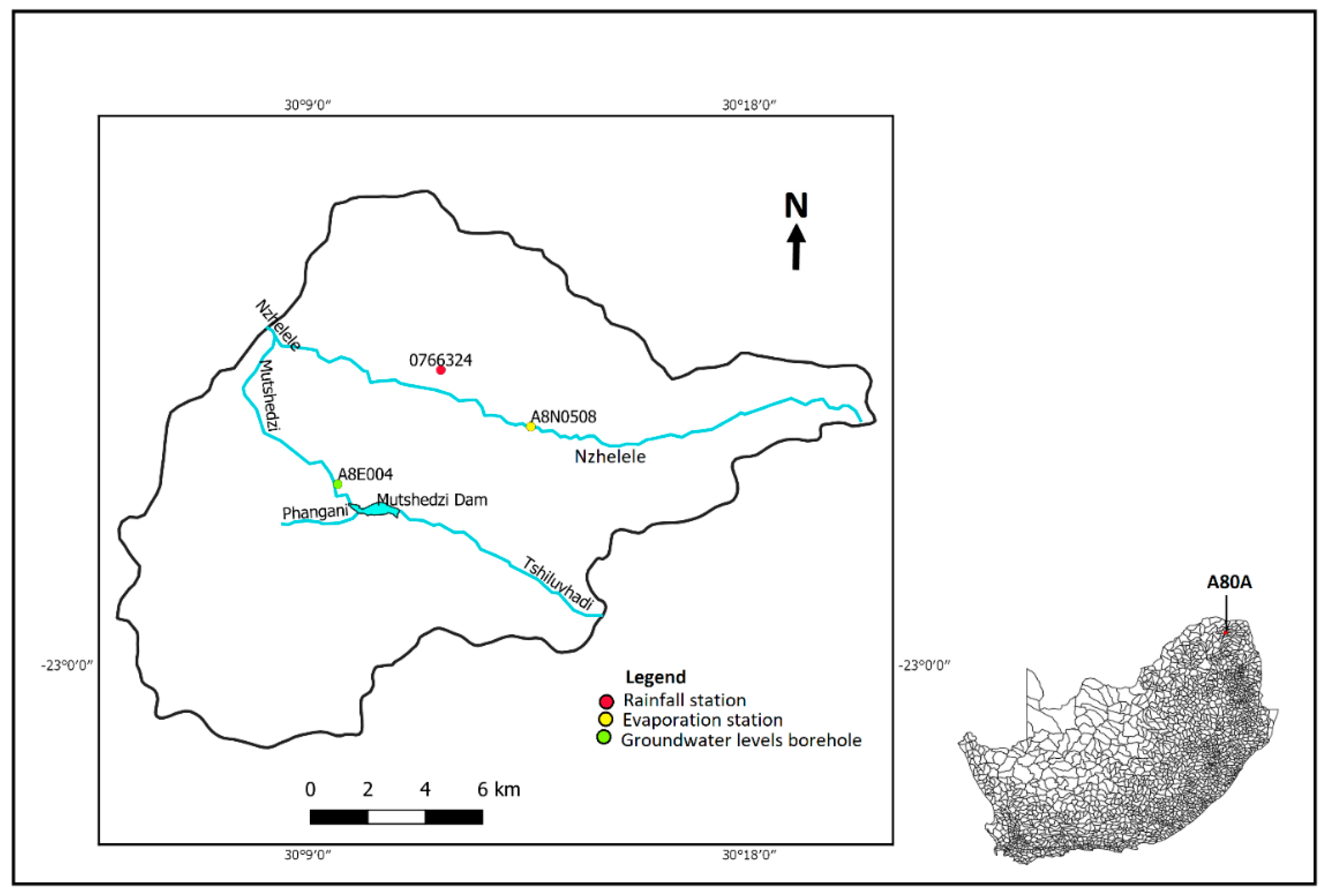
Historic data used in the study constituted extended and infilled rainfall, evaporation, and groundwater levels for the period 1980–2013 (34 years) for stations 0766324, A8E004, and A8N0508, respectively, located in quaternary catchment A80A of Nzhelele River Catchment in South Africa (Figure 1). Nzhelele River Catchment is in a semi-arid area with mean annual evaporation ranging 1300–1400 mm and mean annual rainfall of 350–400 mm. The mean annual rainfall of quaternary catchment A80A is, however, 938 mm due to its proximity to Soutpansberg Mountain. The Soutpansberg Mountain experiences orographic rainfall due to moisture-laden air from the Indian Ocean, driven by the prevailing south-easterly winds [23,24].
Observed rainfall and evaporation data from South African Weather Services and Department of Water and Sanitation stations 0766324 and A8E004 covering the period 1 July 1991 to 31 July 2012 were extended by Makungo [25] to cover the period from 1 January 1980 to 30 June 1991. The rainfall data were estimated using a robust locally weighted scatter smoother (LOWESS) nonparametric regression with a tricube kernel and two polynomial degrees. Evaporation was calculated from the Hargreaves–Samani method based on the evapotranspiration data. Observed groundwater levels for the Department of Water and Sanitation borehole A8N0508 for the period 20 July 2005 to 25 November 2012 were extended by Makungo [25] to cover the period from 1 January 1980 to 19 July 2005. A coupled Output Error-Nonlinear Hammerstein Weiner (OE-NLHW) system identification model was used to extend the groundwater level data. The OE component of the model has linear structures that provide different ways to parameterise the transfer functions, while the NLHW component represents the system dynamics and captures the nonlinearities in the inputs and outputs.
In the study, 100 stochastic sequences of rainfall, evaporation, and groundwater levels, with a record length of 34 years, similar to the historical record, were generated using the VLB generator. The hydrologic year was assumed to start in July to ensure it began and ended in the driest month. The VLB stochastic generator is a non-parametric generator that adequately replicates historical statistics and reproduces annual serial and cross-correlations. The input settings of the VLB generator in Table 1 were applied based on previous parameterization experience (Ndiritu and Nyaga [20]). The implementation steps of the version of the VLB model used here for stochastic generation are fully described in Ndiritu and Nyaga [20] and are summarised as follows:
  • Generate blocks of variable length (variable length blocks) of annual time series from historic data. The selection of block lengths was aimed at obtaining a drier, a wetter, or a more variable climate to account for climate variability and produce stochastic sequences of highly varied characteristics.
  • Create an annual stochastic time series of specified length through random sampling of the blocks with replacement.
  • Match each of the stochastic time series years with a pair of different years of the historic time series based on the magnitude of the annual values of the current and the previous year.
  • Disaggregate the stochastic annual values into monthly values using the monthly distributions of the pair of matching historic years and incorporate perturbations.
  • Update the stochastic annual values after the disaggregation.

Table 1. Input settings for the VLB generator.
Input TypeValue
Number of stations3
Length of historic variables in years34
Length of the sequences to be generated in years34
Number of stochastic sequences to be generated100
Minimum block length (years)3
Minimum number of blocks a stochastic sequence requires3
Upper limit of the low rainfall threshold (as a percentage of the rank)60
Lower limit of low rainfall threshold (as a percentage of the rank)90
Number of years of warmup period to avoid bias20
Performance of VLB in the generation of stochastic sequences was assessed by determining how centrally the single statistics of historic time series are located within box plots of the same statistic obtained from the 100 stochastic time series. Box plots are suitable for presenting and summarising very large data sets and for comparing two or more data sets. The box plots also help to assess the variability and identify the range of the generated statistics [26]. The statistics used include mean, median, 25th and 75th percentiles, lowest and highest values, standard deviation, skewness, and serial and cross-correlation coefficients, following Ndiritu and Nyaga [20]. Replication of the performance of a given statistic was judged as good when the historical value fell within the interquartile range of the box plots [6,27].

3. Results

3.1. Stochastic Generation of Rainfall, Evaporation, and Groundwater Levels

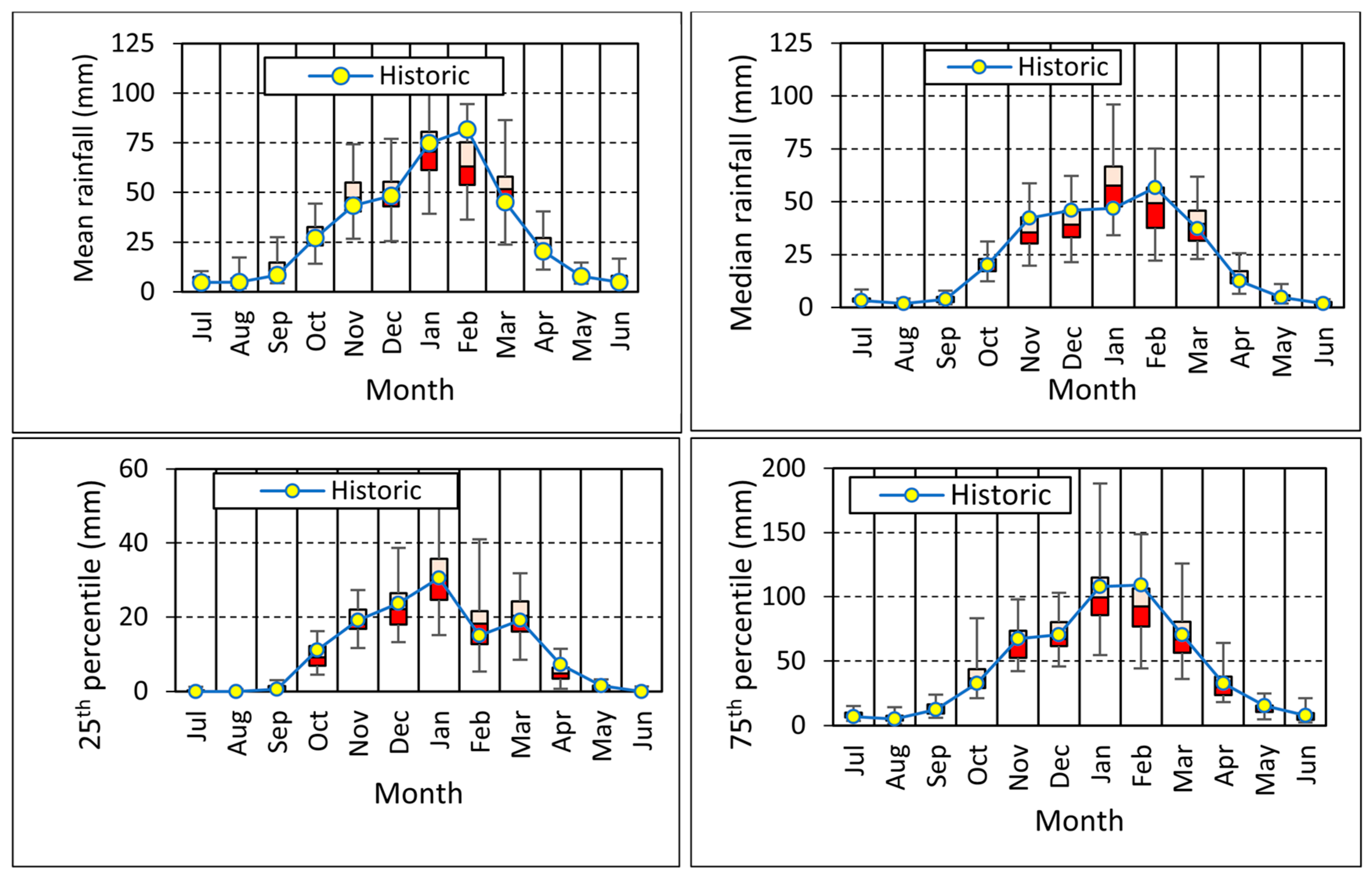
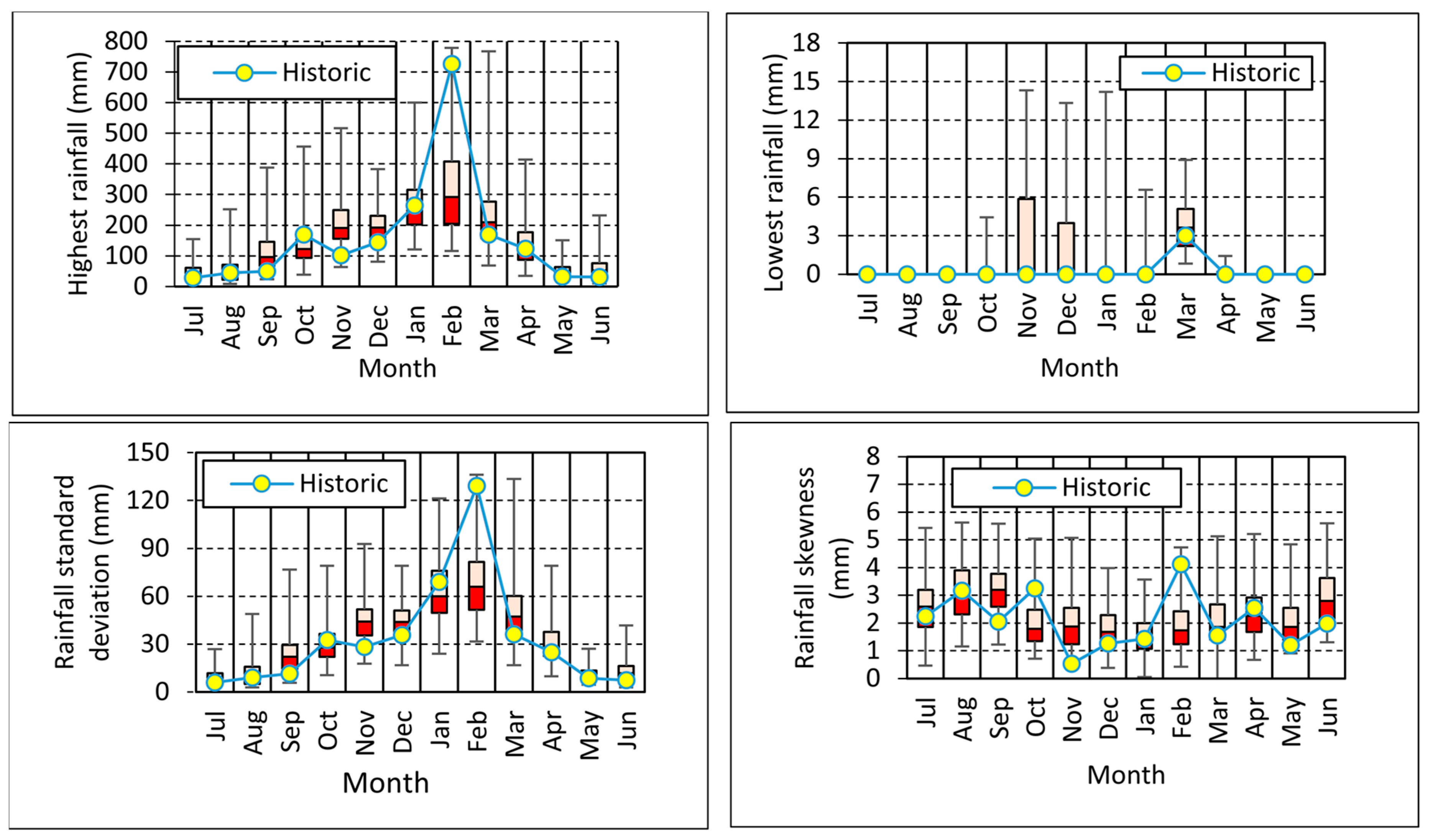
In the box plots (Figure 2), the box indicates the interquartile range (25 to 75% percentiles) while the lower and upper ends of the whiskers indicate the minimum and maximum values in the stochastically generated sequences, respectively. The lower, middle, and upper horizontal lines in the box plots’ interquartile range indicate the lower (25%), median (50%), and upper (75%) percentiles, respectively. The historic mean, median, 25th, and 75th percentiles of rainfall were within or at the boundaries of the interquartile range, except for the historic mean for February. The historic mean rainfall for February, the peak rainfall month in the study area, was slightly higher than the upper quartile of the box plot (Figure 2), while the highest historic rainfall, standard deviation, and skewness for February were higher than the upper quartile and closer to the maximum stochastically generated values (Figure 3). The historic standard deviation values for rainfall for September, November, and March were below the lower quartile, unlike the other months, when they were within the interquartile range (Figure 3) and were well preserved. The historic skewness values for rainfall for September, November, May, and June were below the lower quartile. However, the skewness value for November was equal to the minimum value of the stochastically generated values. The remaining values were within the interquartile range, indicating they were well preserved.
The lowest historic and stochastically generated rainfall values were mostly similar, except for March, which was above zero but within the interquartile range (Figure 3). The lowest historic rainfall for November, December, and April was also within the interquartile range, though it was above the median but below the upper quartile. The lowest historic rainfall for January and February was outside the interquartile range but within the maximum stochastically generated values. This indicated that the lowest rainfall was mostly well preserved by the VLB generator.
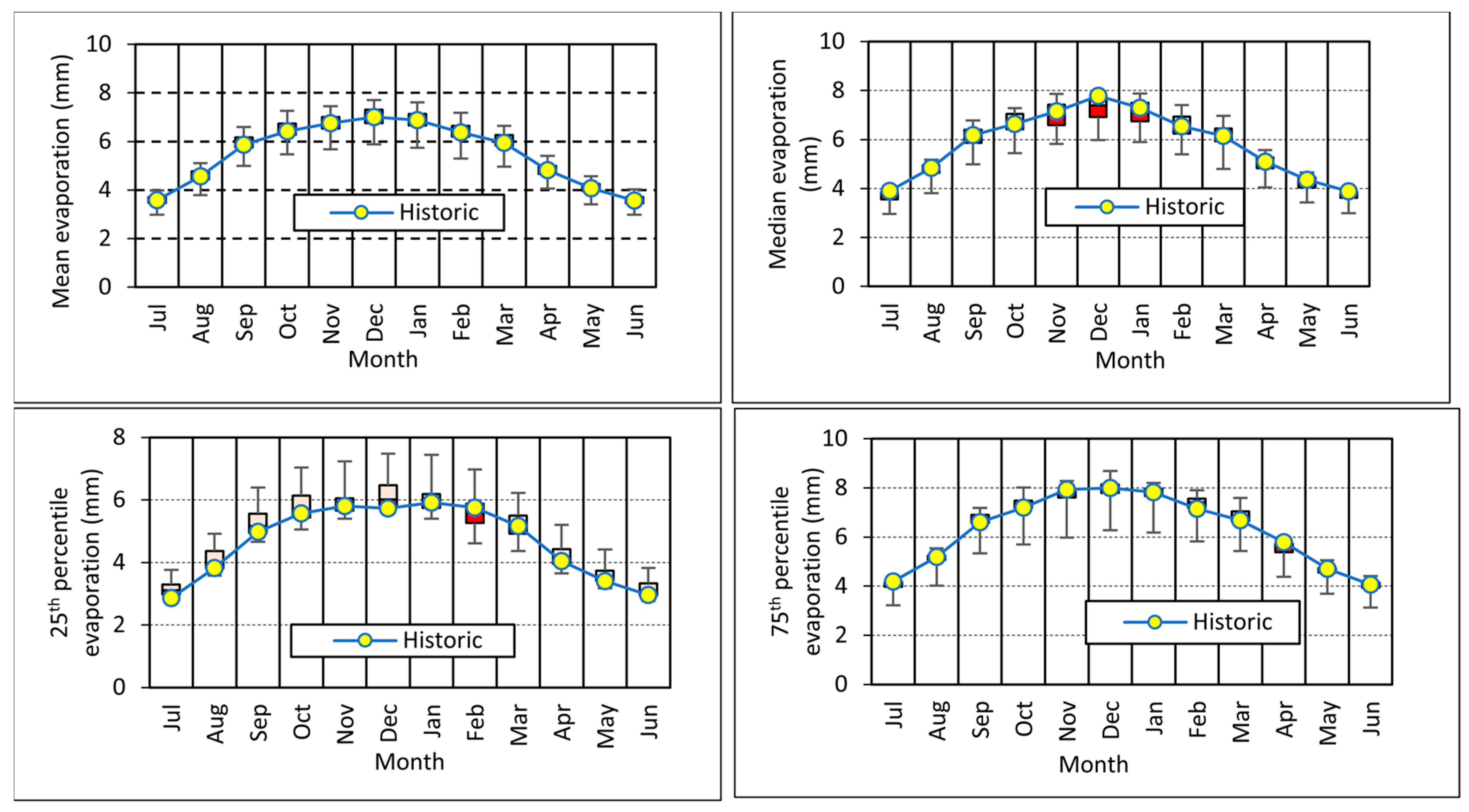
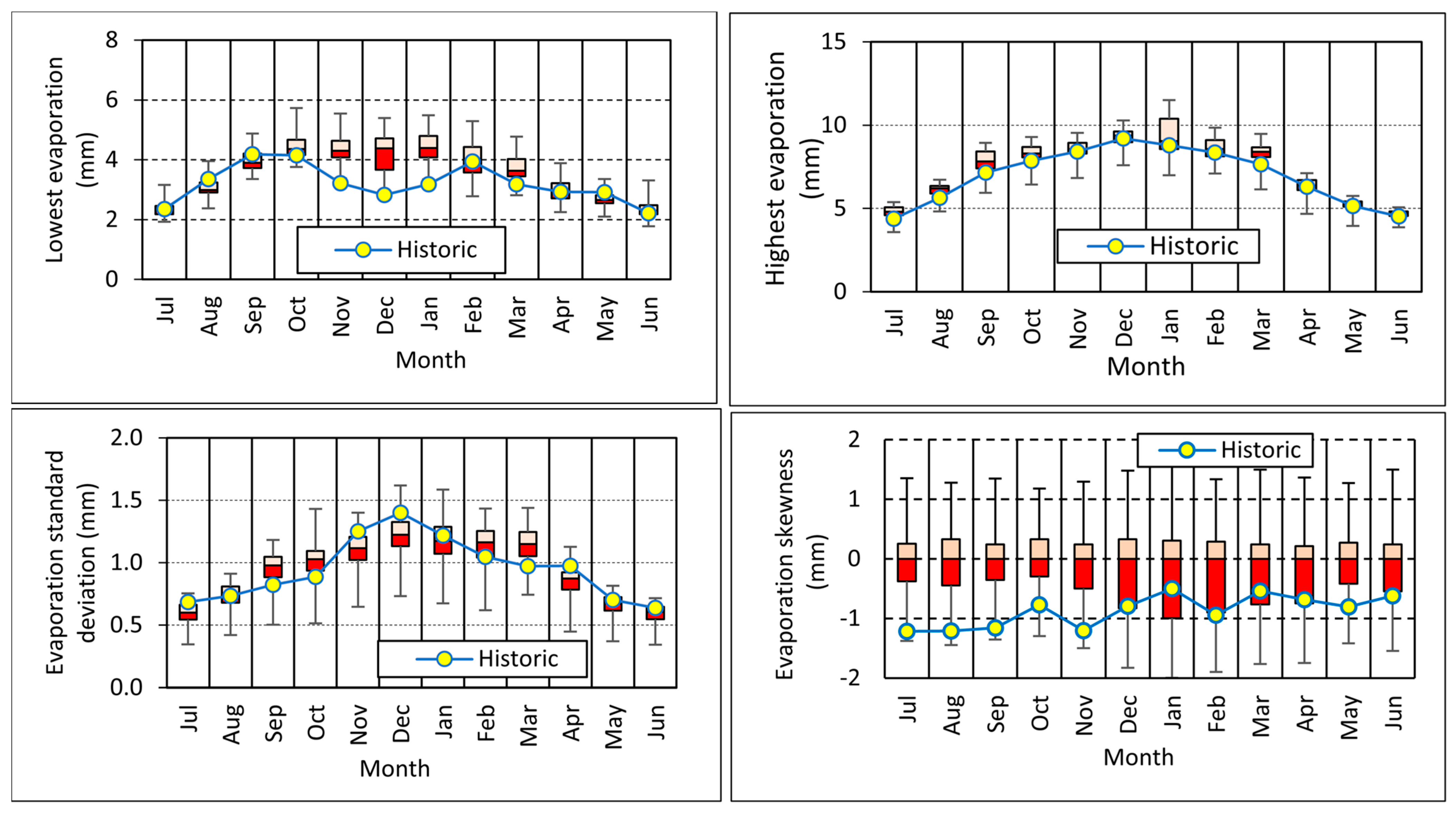
The historic mean, median, 25th, and 75th percentiles of evaporation were mostly within the interquartile ranges of stochastically generated values (Figure 4), indicating that they were mostly well preserved. The lowest historic evaporation for November, December, January, and March were below the interquartile range, but those for the first three of these months were very close to or coincided with the minimum values of the stochastically generated sequences (Figure 4). The historic highest evaporation values for July to October and March were slightly below the interquartile range. The historic standard deviation values for evaporation for September, October and March, and November, December and April were slightly below and above the interquartile range, respectively. Historic skewness values for all the months were lower than the interquartile range but did not go below the minimum values of stochastically generated sequences (Figure 5).
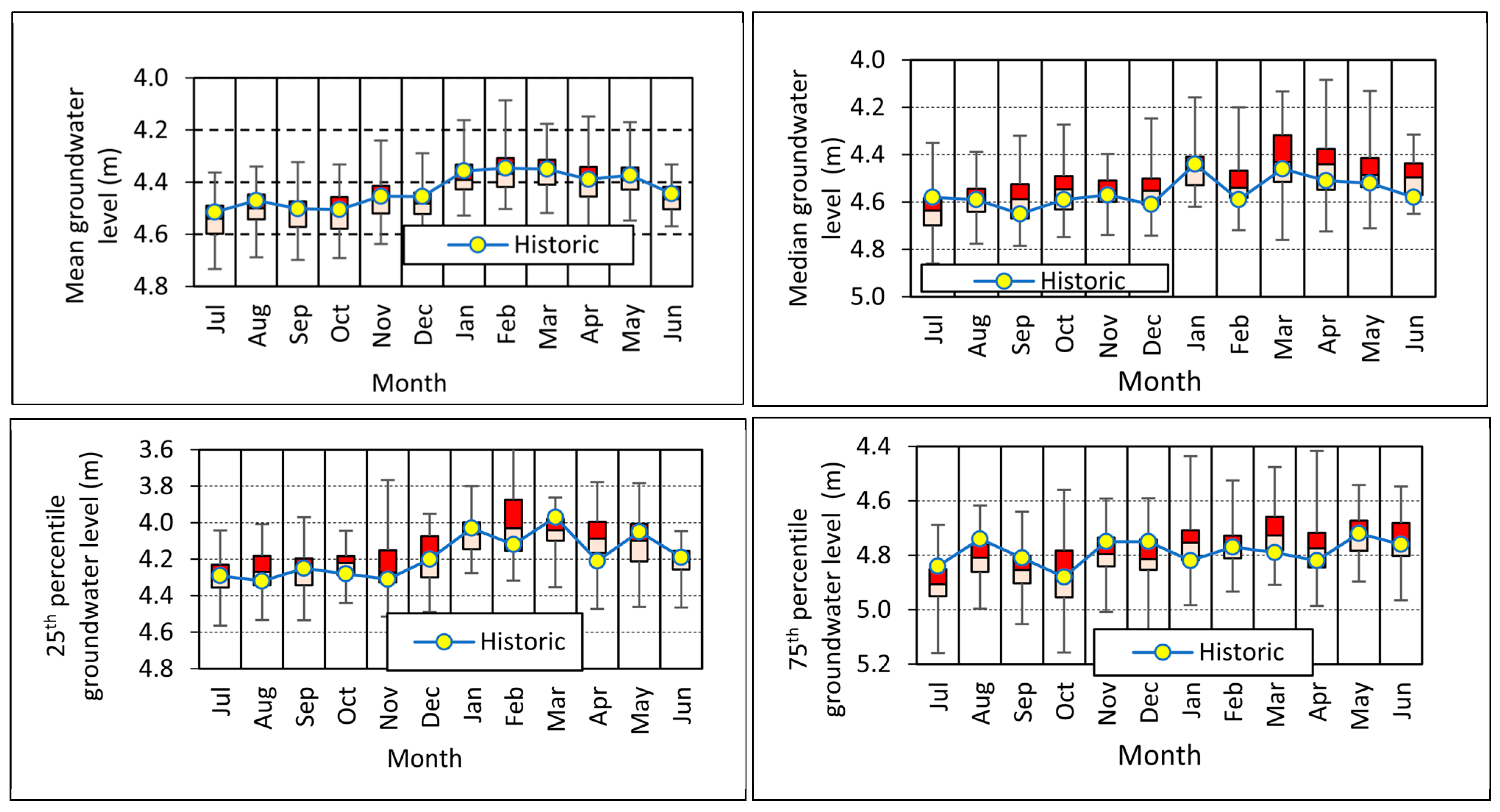
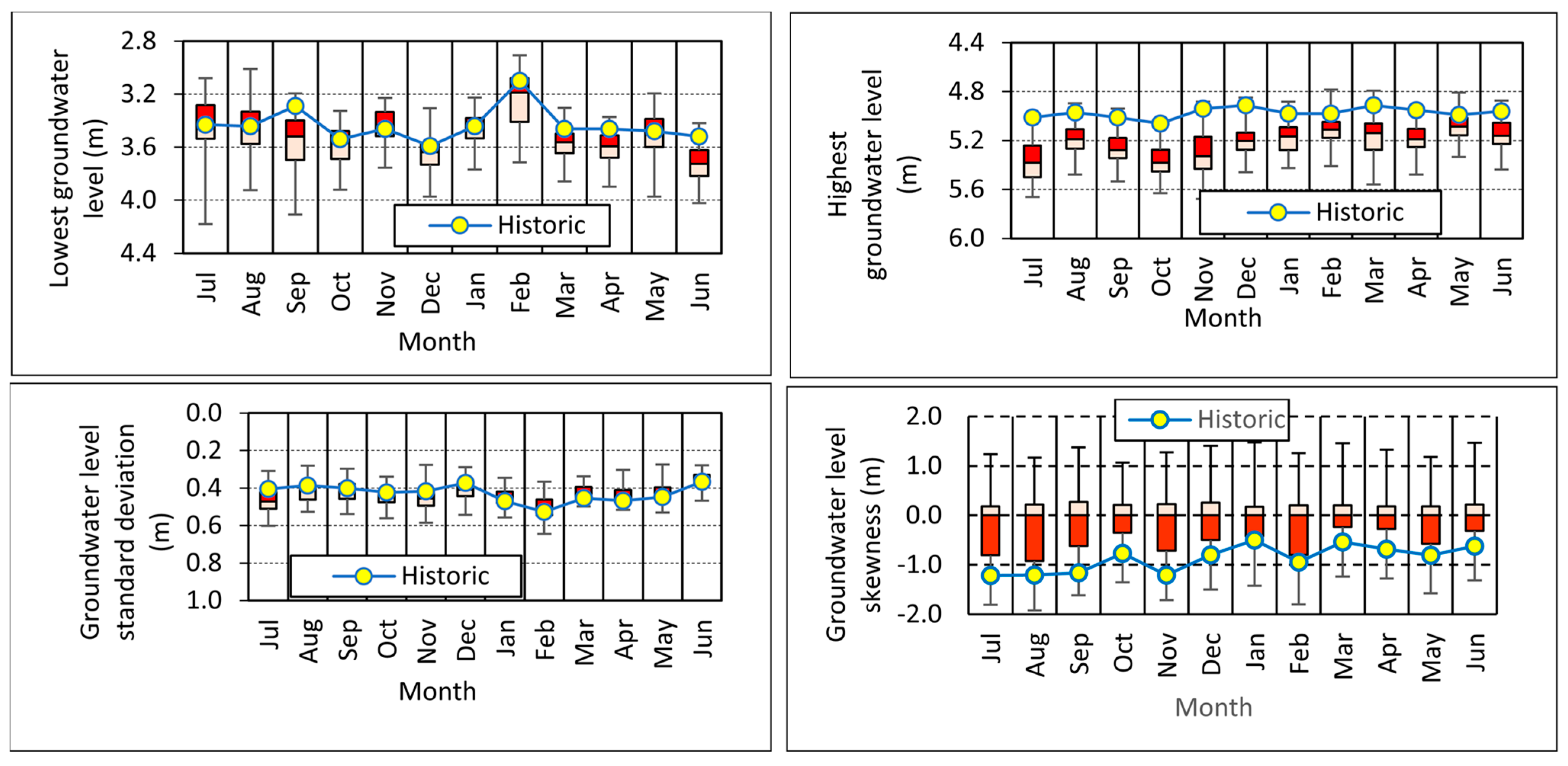
Mean historic groundwater levels for all months were within the interquartile range (Figure 6). Median historic groundwater levels for December, February, and June, 25th percentile for March, and 75th percentile for July were at the upper quartile. The historic 25th percentile value for April was lower than the lower quartile, while the historic 75th percentile for August was above the upper quartile. Historic standard deviation values were mostly within the interquartile range (Figure 6), indicating that they were mostly well preserved, except for July, when it was above the interquartile range. The lowest historic groundwater levels for September, March, April, and June were above the interquartile range, while the rest were within (Figure 7). All the highest historical groundwater levels were above the interquartile range, though the value for May was closer to the upper quartile.
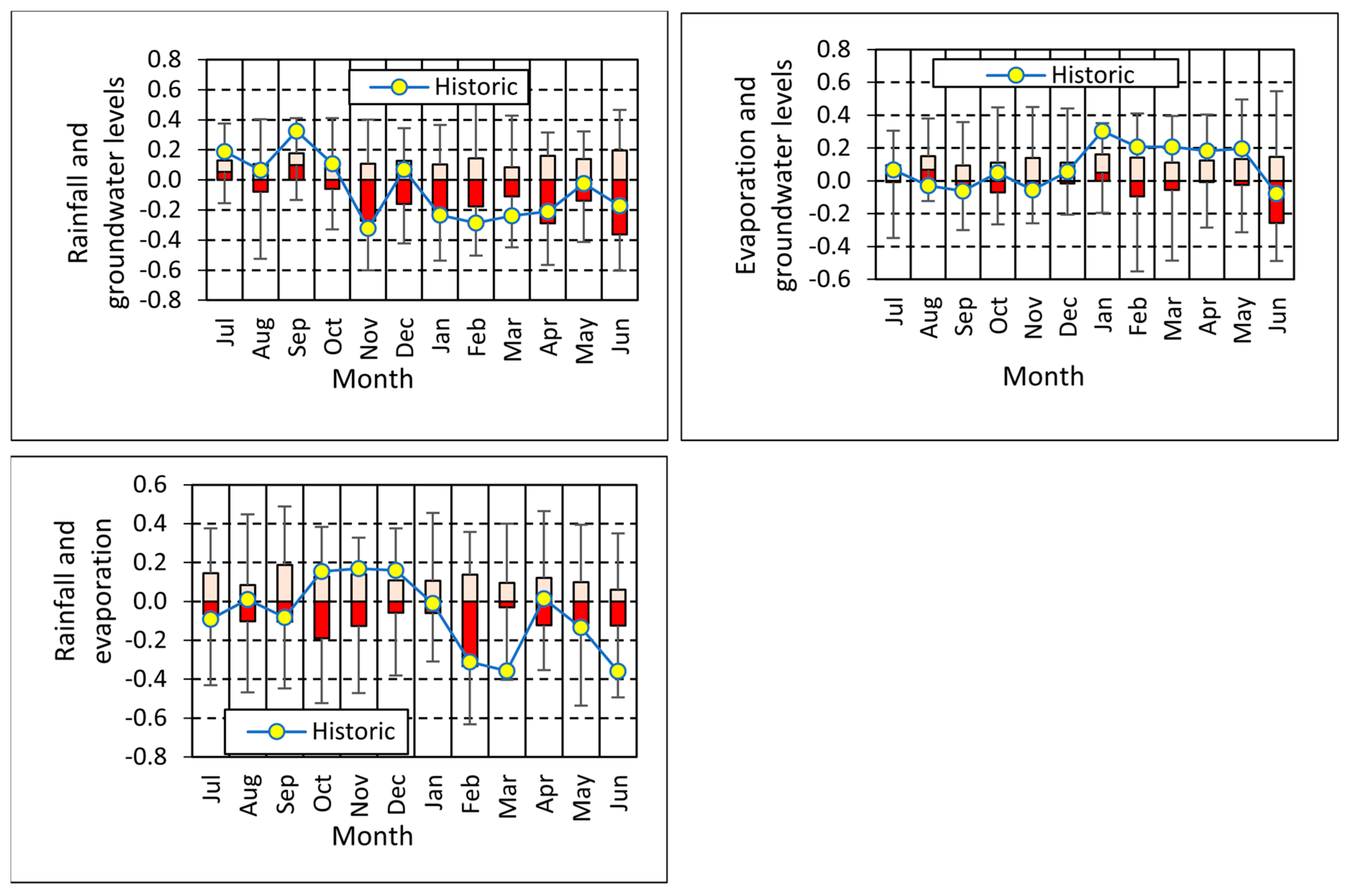
The historic cross-correlations between rainfall and groundwater levels for November, January to April, and June were below the lower quartile (Figure 8). For September, the historical cross-correlation between rainfall and groundwater levels was slightly above the upper quartile, while for July it was at the upper quartile. The historic cross-correlation values for August, October, and December were within the interquartile ranges, indicating that they were well preserved. The historic cross-correlation value for May was almost at the lower quartile. The historic cross-correlations of evaporation and groundwater levels were below the lower quartiles for August, September, November, and June, while that for January was almost at the upper quartile (Figure 8). Historic cross-correlations of evaporation and groundwater levels for July, October, December, and February to May were within the interquartile range, indicating that they were well preserved. Historic cross-correlations of rainfall and evaporation were below the lower quartiles in July, September, February, March, May, and June, while those for August, January, and April were at the lower quartile (Figure 8). Historic cross-correlation values for October, November, and December were within the interquartile range, indicating that they were well preserved.
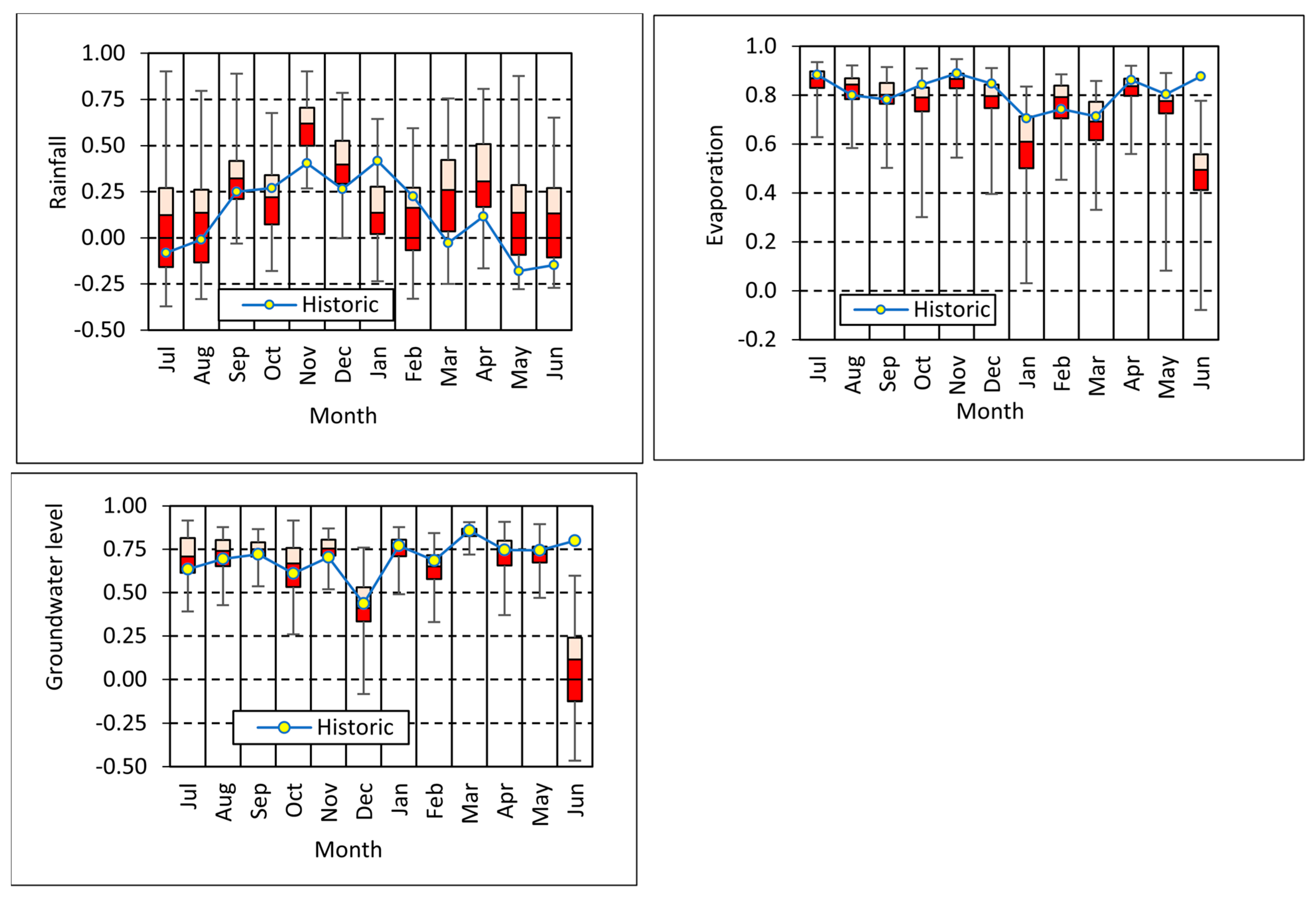
Figure 9 shows the monthly serial correlations for rainfall, evaporation, and groundwater levels, respectively. Historic serial correlations of rainfall for July to October and February were well preserved, since they were within the interquartile range. Values for the rest of the months were outside the interquartile range and were therefore not well preserved. Historic serial correlation values for evaporation from July to September and February to May were within the interquartile range (Figure 9) and were thus well preserved. Values for October to January were at the upper quartile, while that of June was outside the box plot limits. Historic serial correlations for groundwater levels from July to May were within the interquartile range, indicating that they were mostly preserved. The value for June was outside the maximum stochastically generated value and thus not preserved.
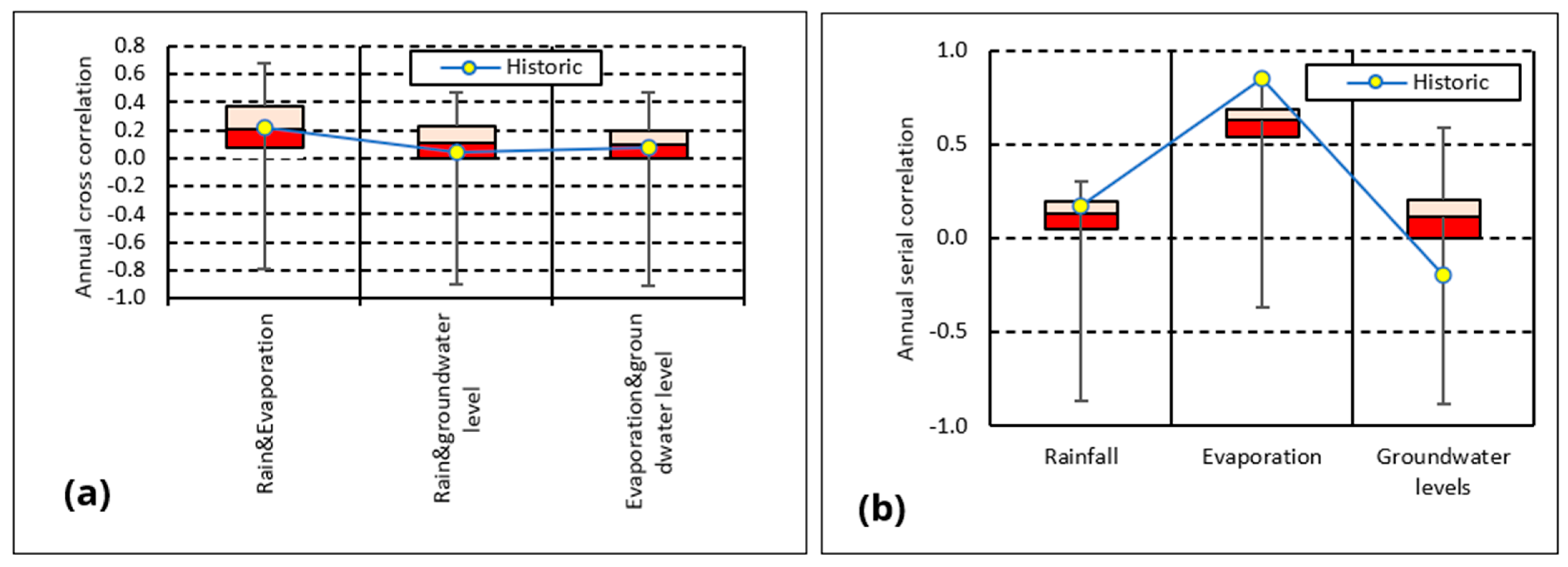
The annual cross-correlations between all variables (Figure 10a) were within the interquartile range, indicating that they were well preserved. The annual serial correlation for evaporation was at the maximum box limit, while that for groundwater levels was within the box plot limits (Figure 10b). The annual serial correlations for each variable were also well preserved.

3.2. Overall Performance of Stochastic Data Generation

To further assess the accuracy of VLB in preserving historic statistics, its overall performance on stochastic data generation is presented in Table 2 and Table 3. For both rainfall and evaporation, four statistics (median, lowest, and 25th and 75th percentiles) were within the interquartile range (WIR) for all 12 months, while for groundwater levels, two statistics (mean and median) were within the interquartile range for all 12 months of the year (Table 2). The highest standard deviation and serial correlation for rainfall were within the interquartile range for 84, 84, and 25% of the months, respectively. The 25th and 75th percentiles, standard deviation, and serial correlation for groundwater levels within the interquartile range for 92% of the months, while the lowest and highest groundwater levels were located within WIR for 67 and 8% of the months, respectively. Lowest, highest, standard deviation, and serial correlation for evaporation were well preserved for 50, 58, and 42% of the months, respectively. All historic rainfall statistics were within the overall range (WOR) of the respective 100 stochastically generated values (Table 2). Most of the historic statistics for evaporation and groundwater levels were also within the overall range of stochastic values for all (100%) months. The exceptions to this were the standard deviation and serial correlation for evaporation, and the serial correlation of groundwater levels, which were within the overall range of the stochastic values for 92% of the months. On average, all historic statistics for rainfall, evaporation, and groundwater levels were within the overall range of the stochastic values for 100, 98, and 99% of the time, respectively.
The skewness values for rainfall were within the interquartile range for 58% of 12 months, while those of evaporation and groundwater levels were not within the interquartile range for the 12-month period, indicating that they were not well preserved. The cross-correlations for rainfall and evaporation, rainfall and groundwater levels, and evaporation and groundwater levels were within the interquartile range for 50, 33, and 58% of the 12 months, respectively, indicating they were well preserved for an average of 47% of the months (Table 3). This performance was lower than that of the other statistics included in this study. The cross-correlations, however, fell within the minimum and maximum values for all 12 months (Table 3).

4. Discussion

The VLB modelled the monthly rainfall better than evaporation and groundwater levels, as a larger proportion (84%) of the historic rainfall statistics were located within both the interquartile and overall ranges. The VLB generator applied in this study had initially been developed to generate monthly streamflows [21] and later modified to generate multisite monthly rainfalls [20], partly on the basis of the observed statistical characteristics of monthly rainfall. The VLB parameter settings (Table 1) used for rainfall generation [20] were also adopted for the current study. It is therefore considered likely that the generation of evaporation and groundwater levels could be improved by updating the VLB model and recalibrating the parameter settings by considering the characteristics of the two variables more closely. However, the VLB located 71% of the historic evaporation and groundwater levels within the interquartile range, and this is considered satisfactory.
The performance in the generation of mean and standard deviation of rainfall by the VLB is comparable to those of other studies [2,20], while that of groundwater levels is comparable to the results obtained by Farias et al. [19].
As observed in the previous studies on VLB [20,21], the monthly and annual cross-correlations for all variables were adequately preserved, indicating that the contemporaneous approach for preserving cross-correlations is applicable to the modelling of multiple data types. Preservation of cross-correlation is essential, either due to cause-and-effect relationships in hydrometeorological systems or to common hydroclimatic regimes [2].
Historic serial correlations for most of the months were well preserved for the three data types, although the preservation of this statistic for rainfall was lower than that reported by Ndiritu and Nyaga [20], where only 10% of the monthly historic serial correlations were located outside the interquartile range. The VLB version used in the current study excluded the routine for preserving the serial correlation between the last month of a year and the last month of the following year because monthly serial correlation of rainfall had been found to be negligible at the end and the start of the hydrologic year (typically in the dry season with low rainfall) [20]. The VLB model therefore failed to preserve the monthly serial correlations between the last month of the year (June) and the first month of the following year (July) for evaporation and groundwater levels, as seen in Figure 9. This routine had been applied effectively for preserving the monthly serial correlation for the stochastic generation of streamflow [21] and could therefore be adopted for future generation of data with significant end-of-year to beginning-of-year monthly serial correlations.
Among the overall performance metrics for stochastic data generation, skewness performed the least satisfactorily. The highest groundwater levels were also located in WIR for 8% of the months. The historical maximum rainfall, standard deviation, and skewness were outside the interquartile range for only 1 or 2 months and were thus comparable to those reported in studies by Ndiritu and Nyaga [20] and Nyaga [26]. However, this was not the case with evaporation and groundwater levels, where some of the lowest, highest, and skewness values were poorly preserved in the current study. Acharya et al. [28] noted that some stochastic generators were also unable to reproduce skewness because they could not preserve the shape of the data distribution at the tails. Chiew and Wang [13] and Steinschneider and Brown [29] also informed that skewness was poorly preserved and attributed this to the limited historical data used to generate stochastic weather variables. Limited data used to generate stochastic time series may also have affected the preservation of skewness and the highest groundwater levels in this study. Limited observational data may not adequately represent extreme values (both wet and dry) [30] and the interconnections among different types of extremes [31], leading to poor preservation of skewness. In their multisite stochastic generation study, Efstratiadis et al. [2] found a few cases where skewness was not well preserved, and it was suggested that improvements to the modelling of skewness could remedy this.
In addition, uncertainties associated with the use of imputed data may alter statistical characteristics, thereby increasing uncertainty in data generation and in associated hydrological and water resource decision-making [30,31]. However, given the unsatisfactory levels of data availability both in Africa [32] and globally [33], these uncertainties are unavoidable. An analysis of the effect of using imputed data on the quality of stochastic data generation could be significant and is recommended for future studies.

5. Conclusions

The VLB model’s ability to simultaneously generate monthly stochastic sequences of rainfall, evaporation, and groundwater levels was assessed. The model preserved most of the statistics, including the mean, median, the 25th and 75th percentiles, lowest and highest rainfall, and standard deviation for rainfall, evaporation, and groundwater levels. This indicated reasonably successful generation of these variables. The skewness was not well preserved across all variables, with historical values for evaporation and groundwater levels falling beyond the interquartile range for all 12 months. The inability to preserve some historical statistics is a common problem with stochastic generators and has sometimes been attributed to insufficient data length. Future studies on the VLB would therefore need to include an analysis of the effect of data length on generation performance for statistics that were not well preserved. This approach could be incorporated and assessed in future updates of the VLB model. The inability of this version of the VLB model to preserve the serial correlation between the last month of a year and the first month of the following year was significant for generating stochastic sequences of evaporation and groundwater levels. A routine for preserving this serial correlation, which had been applied in a previous version of the VLB model, would therefore need to be incorporated when historic time series with significant monthly cross-correlations are involved. The results of this study indicate that the VLB model can be used for the simultaneous generation of stochastic rainfall, evaporation, and groundwater levels, as most of the statistics were well preserved. However, caution should be exercised when generating stochastic estimates of the highest groundwater levels, which were located within the interquartile range for 8% of the months.

Author Contributions

Conceptualisation, R.M. and J.N.; methodology, R.M.; formal analysis, R.M. and J.N.; visualisation, R.M.; writing—original draft preparation, R.M.; writing—review and editing, J.N. All authors have read and agreed to the published version of the manuscript.

Funding

This research received no external funding.

Data Availability Statement

Data used for this study will be made available upon request from the authors.

Acknowledgments

The South African Weather Services and the Department of Water and Sanitation are acknowledged for providing historical data used in this study.

Conflicts of Interest

The authors declare no conflicts of interest.

Abbreviations

The following abbreviations are used in this manuscript:
VLBVariable Length Block
LARS-WGLong Ashton Research Station Weather Generator
WORWithin the overall range
WIRWithin the interquartile range

References

  1. Loucks, D.P.; Van Beek, E. Water Resource Systems Planning and Management: An Introduction to Methods, Models, and Applications; Springer: Berlin/Heidelberg, Germany, 2017. [Google Scholar]
  2. Efstratiadis, A.; Dialynas, Y.G.; Kozanis, S.; Koutsoyiannis, D. A multivariate stochastic model for the generation of synthetic time series at multiple time scales reproducing long-term persistence. Environ. Model. Softw. 2014, 62, 139–152. [Google Scholar] [CrossRef]
  3. Noguchi, K.; Gel, Y.R.; Duguay, C.R. Bootstrap-based tests for trends in hydrological time series, with application to ice phenology data. J. Hydrol. 2011, 410, 150–161. [Google Scholar] [CrossRef]
  4. De Luca, D.L.; Petroselli, A. STORAGE (STOchastic RAinfall GEnerator): A user-friendly software for generating long and high-resolution rainfall time series. Hydrology 2021, 8, 76. [Google Scholar] [CrossRef]
  5. Soriano, E.; Mediero, L.; Petroselli, A.; De Luca, D.L.; Apollonio, C.; Grimaldi, S. Assessment of the impact of climate change on dam hydrological safety by using a stochastic rainfall generator. Hydrology 2025, 12, 153. [Google Scholar] [CrossRef]
  6. Apipattanavis, S.; Podestá, G.; Rajagopalan, B.; Katz, R.W. A semiparametric multivariate and multisite weather generator. Water Resour. Res. 2007, 43, W11401. [Google Scholar] [CrossRef]
  7. Greene, A.M.; Hellmuth, M.; Lumsden, T. Stochastic decadal climate simulations for the Berg and Breede water management areas, western Cape province, South Africa. Water Resour. Res. 2012, 48, W06504. [Google Scholar] [CrossRef]
  8. Juárez-Torres, M.; Richardson, J.W.; Vedenov, D. Semiparametric Copula-Based Stochastic Weather Generator; Working Papers; Banco de Mexico: Ciudad de Mexico, Mexico, 2013. [Google Scholar]
  9. Westra, S.; Sharma, A.; Brown, C.; Lall, U. Stochastic generation of rainfall and streamflow time series at multiple sites using independent component analysis. In 30th Hydrology & Water Resources Symposium: Past, Present & Future; Informit: Sandy Bay, TAS, Australia, 2006. [Google Scholar]
  10. Yang, L.; Chen, J.; Zhang, X.J.; Xiong, L. A stochastic weather generator based framework for generating ensemble sub-monthly precipitation for streamflow prediction. J. Hydrol. Reg. Stud. 2025, 58, 102186. [Google Scholar] [CrossRef]
  11. Alhassoun, S.; Sendil, U.; Al-Othman, A.A.; Negm, A.M. Stochastic generation of annual and monthly evaporation in Saudi Arabia. Can. Water Resour. J. 1997, 22, 141–154. [Google Scholar] [CrossRef]
  12. Al-Shaikh, A.A. Evaporation Data Stochastic Generation for King Fahad Dam Lake in Bishah, Saudi Arabia. Water Eng. Res. 2001, 2, 209–218. [Google Scholar]
  13. Chiew, F.H.S.; Wang, Q.J. Hydrological Analysis Relevant to Surface Water Storage at Jabiluka; Supervising Scientist report 142; IAEA: Vienna, Austria, 1999. [Google Scholar]
  14. Verhoest, N.; Vernieuwe, H.; Pham, M.T.; Willems, P.; De Baets, B. A copula-based stochastic generator for coupled precipitation and evaporation time series. In EGU General Assembly; European Geosciences Union: Munich, Germany, 2015. [Google Scholar]
  15. Mandaran, K.; McIntyre, N.; McJannet, D. Deterministic and stochastic generation of evaporation data for long-term mine pit lake water balance modelling. Water 2022, 14, 4123. [Google Scholar] [CrossRef]
  16. Tapoglou, E.; Trichakis, I.C.; Dokou, Z.; Nikolos, I.K.; Karatzas, G.P. Groundwater-level forecasting under climate change scenarios using an artificial neural network trained with particle swarm optimization. Hydrol. Sci. J. 2014, 59, 1225–1239. [Google Scholar] [CrossRef]
  17. Ghazavi, R.; Ebrahimi, H. Predicting the impacts of climate change on groundwater recharge in an arid environment using modeling approach. Int. J. Clim. Chang. Strat. Manag. 2018, 11, 88–99. [Google Scholar]
  18. Goderniaux, P.; Brouyere, S.; Blenkinsop, S.; Burton, A.; Fowler, H.J.; Orban, P.; Dassargues, A. Modeling climate change impacts on groundwater resources using transient stochastic climatic scenarios. Water Resour. Res. 2011, 47, W12516. [Google Scholar] [CrossRef]
  19. Farias, C.A.S.; Kadota, A.; Suzuki, K.; Shigematsu, K. Stochastic generation of daily groundwater levels by artificial neural networks. J. JSCE 2011, 67, I_55–I_60. [Google Scholar] [CrossRef] [PubMed][Green Version]
  20. Ndiritu, J.; Nyaga, J. A Non-Parametric Multi-Site Stochastic Rainfall Model with Applications to Climate Change; WRC Report No. 2148/1; Water Research Commission: Pretoria, South Africa, 2014. [Google Scholar]
  21. Ndiritu, J. A variable-length block bootstrap method for multi-site synthetic streamflow generation. Hydrol. Sci. J.–J. Des Sci. Hydrol. 2011, 56, 362–379. [Google Scholar] [CrossRef]
  22. Graf, R. Reference statistics for the structure of measurement series of groundwater levels (Wielkopolska Lowland, western Poland). Hydrol. Sci. J. 2015, 60, 1587–1606. [Google Scholar] [CrossRef]
  23. Mostert, T.H.C.; Bredenkamp, G.J.; Klopper, H.L.; Verwey, C. Major vegetation types of the Soutpansberg conservancy and the Blouberg nature reserve, South Africa. Koedoe 2008, 50, 32–48. [Google Scholar] [CrossRef]
  24. Nenwiini, S.C. Climatic Anomalies and Their Influence on Rainfall Trends in Vhembe District South Africa. Doctoral Dissertation, North-West University, Potchefstroom, South Africa, 2017. [Google Scholar]
  25. Makungo, R. Development of Risk-Based Groundwater Operating Rules: A Case Study of Siloam Village, South Africa. Doctoral Dissertation, University of Venda, Thohoyandou, South Africa, 2019. [Google Scholar]
  26. Nyaga, M.J. The Use of Empirical Mode Decomposition (EMD) and Variable Length Boostrap (VLB) for Stochastic Rainfall Generation. Doctoral Dissertation, University of the Witwatersrand, Johannesburg, South Africa, 2014. [Google Scholar]
  27. Prairie, J.; Rajagopalan, B.; Lall, U.; Fulp, T. A stochastic nonparametric technique for space-time disaggregation of streamflows. Water Resour. Res. 2007, 43, W03432. [Google Scholar] [CrossRef]
  28. Acharya, N.; Frei, A.; Chen, J.; DeCristofaro, L.; Owens, E.M. Evaluating stochastic precipitation generators for climate change impact studies of New York City’s primary water supply. J. Hydrometeorol. 2017, 18, 879–896. [Google Scholar] [CrossRef]
  29. Steinschneider, S.; Brown, C. A semiparametric multivariate, multisite weather generator with low-frequency variability for use in climate risk assessments. Water Resour. Res. 2013, 49, 7205–7220. [Google Scholar] [CrossRef]
  30. Beven, K. Issues in generating stochastic observables for hydrological models. Hydrol. Process. 2021, 35, e14203. [Google Scholar] [CrossRef]
  31. Tabari, H. Statistical analysis and stochastic modelling of hydrological extremes. Water 2019, 11, 1861. [Google Scholar] [CrossRef]
  32. Tramblay, Y.; Rouché, N.; Paturel, J.-E.; Mahé, G.; Boyer, J.-F.; Amoussou, E.; Bodian, A.; Dacosta, H.; Dakhlaoui, H.; Dezetter, A. The African database of hydrometric indices (ADHI). Earth Syst. Sci. Data Discuss. 2020, 2020, 1–21. [Google Scholar]
  33. Wilby, R.L. A global hydrology research agenda fit for the 2030s. Hydrol. Res. 2019, 50, 1464–1480. [Google Scholar] [CrossRef]
Figure 1. Location of study area.
Water 18 01023 g001
Figure 2. Mean, median, 25th and 75th percentile rainfall compared with historic values.
Water 18 01023 g002
Figure 3. Lowest and highest rainfall, standard deviation, and skewness compared with historic values.
Water 18 01023 g003
Figure 4. Mean, median, 25th, and 75th percentiles of evaporation compared with historical values.
Water 18 01023 g004
Figure 5. Lowest and highest evaporation, standard deviation, and skewness compared with historic values.
Water 18 01023 g005
Figure 6. Mean, median, 25th, and 75th percentiles of groundwater levels compared with historic values.
Water 18 01023 g006
Figure 7. Lowest and highest groundwater level, standard deviation, and skewness compared with historic values.
Water 18 01023 g007
Figure 8. Monthly cross-correlation of rainfall, evaporation, and groundwater levels.
Water 18 01023 g008
Figure 9. Monthly serial correlation of rainfall, evaporation, and groundwater levels.
Water 18 01023 g009
Figure 10. (a) Annual cross-correlation and (b) annual serial correlations of rainfall, evaporation, and groundwater levels.
Water 18 01023 g010
Table 2. Overall performance based on the percentage of time that historic statistics fall within the interquartile range (WIR) and overall range (WOR) of monthly stochastically generated values.
RainfallEvaporationGroundwater Levels
StatisticWIR (%)WOR (%)WIR (%)WOR (%)WIR (%)WOR (%)
Mean92100100100100100
Median100100100100100100
25th percentile10010010010092100
75th percentile10010010010092100
Lowest1001005010067100
Highest84100581008100
Standard deviation84100429292100
Skewness5810001000100
Serial correlation4210092929292
Average 8410071987199
Table 3. Percentage of time that historic annual cross-correlations fall within the interquartile (WIR) and the overall (WOR) of stochastic values.
VariableWIR (%)WOR (%)
Rainfall and evaporation50100
Rainfall and groundwater levels33100
Evaporation and groundwater levels58100
Average47100
Disclaimer/Publisher’s Note: The statements, opinions and data contained in all publications are solely those of the individual author(s) and contributor(s) and not of MDPI and/or the editor(s). MDPI and/or the editor(s) disclaim responsibility for any injury to people or property resulting from any ideas, methods, instructions or products referred to in the content.