


Abstract
Sunset Yellow is a water-soluble synthetic dye resistant to degradation and stable under various conditions, posing an environmental challenge. In the present study pure chitosan hydrogel (PCH) films were synthesized, followed by the assessment of sorption capacity and recyclability compared to chitosan-based films doped with niobium oxide (CHN) or activated carbon (CHC). The aim was to promote the application of sorption methods for Sunset Yellow dye using these films as a treatment option for the pollutant, with the analysis of the effectiveness of the method and its behavior using adsorption kinetic models and thermodynamic analysis. Equilibrium was reached at 240 min for all films tested, with the adsorbed amounts ranging from 18.58 to 18.79 mg g−1 at 30 °C, when the highest kinetic rate constants were observed. The pseudo-first-order kinetic model best described the experimental data, with the lowest Bayesian information criterion, Akaike information criterion, and mean absolute error values. Thermodynamic analysis indicated a spontaneous, exothermic process, with interactions ranging from electrostatic interactions in CHC and PCH to physisorption in CHN. Recycling tests showed 80% efficiency after the third cycle for all three films. These findings highlight the potential of chitosan-based films as an efficient option for removing Sunset Yellow dye from water, thus improving water quality and enhancing wastewater treatment.
1. Introduction
Environmental pollution, particularly water pollution, has been on the rise due to the growing use of various hard-to-treat substances by industries and humans, such as heavy metals, herbicides, pharmaceuticals, and dyes. Dyes are widely used by the textile and food industries, generating large amounts of wastewater, a significant portion of which does not receive proper treatment before being discharged into water bodies [1].
The use of synthetic dyes has been increasing in recent years. Global dye production exceeds 7 × 10⁵ tons annually, with a variety of over 100,000 commercially available types of dye [2]. The presence of these dyes in industrial effluents is concerning and poses risks to the environment, such as the death and delayed regeneration of aquatic organisms, accumulation in plants, difficulties in water reoxygenation, and the imbalance of ecosystems [2]. In terms of human health, the excessive consumption of dyes can cause allergies, asthmatic reactions, DNA damage, hepatocellular damage, renal failure, attention deficit hyperactivity disorder, potential immunotoxicity, and reproductive toxicity [3]. Due to these effects, stricter regulations concerning the discharge of effluents containing dyes into the environment and water bodies are prompting industries to seek more efficient technologies for removing these compounds from their effluents [4].
Dyes containing the azo group (R-N=N-R), such as Sunset Yellow, Bordeaux Red, and Tartrazine Yellow, are commonly used by the food and pharmaceutical industries. These dyes are found in cereals, candies, dairy products, jams, ice creams, fillings, liqueurs, powdered juices, soft drinks, and yogurts [5]. Known also as Yellow 6 or E110, Sunset Yellow is an orange dye obtained synthetically through the diazotization reaction of an aromatic primary amine, followed by coupling of the diazonium salt with a phenol or aromatic amine, thus forming an azo group [6]. This dye exhibits thermal stability, an aromatic structure, physicochemical stability, resistance to biodegradation, and solubility in water. Its molar mass is 452.4 g mol−1 and its chemical formula is C16H10N2Na2O7S2. Sunset Yellow absorbs electromagnetic radiation most strongly at a wavelength of 482 nm.
According to estimates, nearly one million tons of azo dyes with an average concentration of 2000 mg L−1 are dumped into water bodies by various industries annually [7]. Different methods have been employed to remove or treat dye-contaminated persistent pollutants, such as ozonation, coagulation-flocculation, photodegradation, flotation, films, electrochemical destruction, sorption, and ion exchange [1]. However, these methods have disadvantages, such as relatively high prices, catalyst poisoning, and the production of secondary pollutants [8]. Sorption has gained prominence as a highly effective, promising treatment method for removing dye from industrial effluents. Sorption is a physicochemical phenomenon by which molecules from a fluid adhere to the surface of a solid without undergoing chemical transformation. This method involves the equilibrium between two phases (fluid and solid), with the adsorbent as the solid material to which the molecules of the absorbate adhere [9].
Sorption offers the advantages a lower cost as well as greater simplicity of operation and application compared to other processes, along with high removal efficiency when the adsorbent exhibits adequate affinity for the target pollutant [10,11]. Chitosan-based biopolymer hydrogels have excellent physicochemical properties for pollutant removal and rank among the best adsorbents due to this characteristic [12]. An advantage of hydrogels is the ability to adsorb water or other solutes through their three-dimensional networks without dissolving [13]. Chitosan is an outstanding adsorbent due to having different functional groups that form strong interactions (chelation) with adsorbates, resulting in high sorption capacity [12]. Other advantages of chitosan-based hydrogels include the low cost due to being the second-most abundant polysaccharide globally after cellulose, biodegradability [14], and ease of separation. Different three-dimensional structures can be obtained from the deacetylation of chitosan which is capable of immobilizing and assisting adsorbents and enzymes in their processes [15]. Chitosan/CuNb2O6 composites have demonstrated excellent interactions with tartrazine yellow dye, enhancing photocatalytic performance during photodegradation processes. The relationship between adsorption and oxidative degradation enables the use of this type of system in green water treatment methods [16].
Numerous adsorbent materials have been employed for removing dyes from aqueous solutions, such as activated carbons, industrial spent (brewer’s yeast), clays, chitosan, cellulose, and chitin [17,18,19]. Chitosan-based biopolymer hydrogels exhibit excellent physicochemical properties for pollutant removal. Additionally, the numerous functional groups can form strong interactions (chelation) with adsorbates, resulting in a high sorption capacity [12]. Additional materials can be incorporated into the three-dimensional chitosan network to improve adsorption performance. Activated carbon, known for its high surface area and porosity, enhances dye removal through electrostatic interactions [20]; niobium oxide, which is widely available in Brazil [16], has shown promising results in dye degradation and photocatalysis [21].
The fitting of sorption kinetic models to these systems enables the determination of the sorption rate of the adsorbate in aqueous solutions [22] as well as the understanding of the sorption mechanism on the adsorbent surface [23] and the factors that influence sorption [24]. Different models are used to describe adsorption kinetics [25]. These include the pseudo-first-order kinetic model, the pseudo-second-order kinetic model, and the Elovich model, which are the most commonly reported in adsorption studies. Therefore, the aim of the present study was to investigate the application of chitosan hydrogel membranes and composite chitosan hydrogel membranes containing either niobium oxide or activated carbon for the adsorption of Sunset Yellow dye. This study also determined the adsorption kinetics and thermodynamic parameters of the dye in the hydrogel networks as well as the recycling efficiency of all three types of membrane.
2. Materials and Methods
2.1. Reagents
The reagents used to develop the work were niobium oxide (kindly provided by CBMM, Araxá, MG, Brazil), activated carbon (PA, REATEC, Brazil), chitosan (PA, BIOTEC, Brazil), acetic acid (PA, REATEC, Brazil), glutaraldehyde solution (PA 50%, Dinâmica, Brazil), and yellow dye (food grade, NUTYLAC, Brazil).
2.2. Synthesis of Chitosan Hydrogel
The method for the synthesis of chitosan hydrogel films chosen as adsorbents for the present study was adapted from Paz et al. (2022) [26], Prando et al. (2025) [27], and Reinehr et al. (2025) [28]. Besides assessing the effect in its original form, two modifications were also tested. Niobium oxide and activated carbon were introduced independently into the films to assess the effects on dye adsorption when these solids are present in the film. The solids were incorporated at a concentration of 10% relative to the mass of chitosan in the respective films. A mass of 0.40 g of powdered chitosan was measured and transferred to a beaker. Twenty mL of 0.1 mol L−1 acetic acid solution were added to the chitosan and the mixture was stirred. Next, 2.4 mL of a 1% v/v glutaraldehyde solution were added. The mixture was homogenized, transferred to a plastic Petri dish (60 × 15 mm), and placed in a forced air oven (520 FANEM, Guarulhos, SP, Brazil) at 60 °C for 24 h for film crosslinking. The process for preparing all films was similar, differing only in the addition of activated carbon or niobium oxide to the film. For each film preparation, 0.04 g of the respective additive (10% relative to the mass of chitosan) was weighed and mixed with chitosan before adding the acid and glutaraldehyde, and the process followed as described. Each preparation procedure yielded one hydrogel film. After 24 h, the films were carefully removed from the Petri dishes to avoid tearing.
2.3. Characterization
The Fourier transform infrared (FTIR) spectroscopy was performed using the Bruker INVENIO-S equipment, Germany, with a wavelength reading range between 4000 and 400 cm−1 and resolution of 4 cm−1. Thermogravimetric analysis (TGA) was performed using the 0550-1318 TGA55 equipment, USA. The samples were heated from 10 to 450 °C at a rate of 10 °C min−1 under a nitrogen flow rate of 60 mL min−1.
2.4. Adsorption Kinetics
An incubator with orbital stirring (Solab SL-221, Brazil) was used for the determination of adsorption kinetics. The experimental temperatures were 30 °C, 40 °C, and 50 °C, with stirring at 100 rpm. The experiments were performed in duplicate. This range of experimental conditions was determined in preliminary experiments. A 20 mg L−1 solution of Sunset Yellow dye was prepared and rectangular films weighing approximately 0.10 g each were cut. Six Erlenmeyer flasks were used (experiments performed in duplicate), each containing 100 mL of Sunset Yellow solution for each type of film. The Erlenmeyer flasks were labeled 1 to 6 with corresponding letters: (A) pure chitosan hydrogel (PCH) film, (B) chitosan hydrogel with niobium oxide (CHN), and (C) chitosan hydrogel with activated carbon (CHC). Erlenmeyer flasks containing the solutions were properly labeled and placed in the shaker at batch temperature to equilibrate for 15 min before the films were placed in the solution. After equilibration, the films were placed into the solutions, with a 10 min interval between types A, B, and C. The solutions were removed from stirring at 15, 30, 45, 60, 120, 240, and 360 min. The films were taken out of the solution and samples were analyzed using a spectrophotometer (Kasvi, K37-uvvis, Brazil), scanning between 350 and 600 nm. A wavelength of 482 nm was used to determine the dye concentration in the medium based on a previously obtained calibration curve.
2.5. Kinetic Modeling
Three nonlinear kinetic models (modeled in Scilab software, version 6.1.1) were used to determine kinetics based on the experimental data: pseudo-first order, pseudo-second order, and Elovich (Equations (1), (2), and (3), respectively).
in which k is the sorption rate (min−1), t is sorption (min), qt (mg g−1) is sorption capacity at time , (mg g−1 min−1) is the initial sorption rate at time , (g mg−1) is the desorption constant related to surface coverage and activation energy involved in the chemisorption process, and is the amount sorbed after equilibrium is reached [13,29].
qt = qe × (1 − e−kt)
Three statistical criteria were used to determine whether the models fit the experimental data: Akaike’s information criterion (AIC), Bayesian information criterion (BIC), and mean absolute error (MAE), as per Equations (4)–(6).
in which is the amount of Sunset Yellow dye adsorbed during the experiment, is the amount adsorbed according to each model, m is the number of experiments, and is the number of parameters estimated in each model. is given in (mg g−1) and obtained experimentally by Equation (7).
in which is the initial concentration (mg L−1), Ct is the concentration (mg L−1) at time , is the volume of Sunset Yellow solution used (L), and m the mass of the hydrogel film used (g).
2.6. Adsorption Thermodynamics
The adsorption thermodynamics were determined (apparently) by examining changes in standard Gibbs energy (ΔG0), enthalpy (ΔH0), and entropy (ΔS0), using Equations (8)–(10) (Van’t Hoff equation). Instead of using the distribution constant () to calculate thermodynamic parameters, the Henry’s law constant (KH) was employed to avoid dimensionality problems. It should be noted that the data obtained were evaluated only in a comparative manner. KH was applied at low equilibrium concentrations (i.e., when Ce < 1), where it represents the linear stage of the Freundlich isotherm (i.e., when n = 1). It is worth noting that has also dimensionality (L g−1), representing the initial behavior of the Langmuir isotherm [30].
can also be defined as the limiting case of / at low concentrations ( → 0). Then, this constant could be conceptually related to , representing the linear adsorption regime under dilute conditions.
2.7. Recycle Test
An incubator with orbital stirring was used for the recycle tests, with the experimental temperature set at 50 °C and stirring at 100 rpm, as in the kinetic adsorption tests. The same adsorption procedure was performed for the first step of the experiment, using rectangular films weighing approximately 0.10 g placed in the solution and left to adsorb for 360 min. After the sorption step, the films were removed from the aqueous medium, washed three times with deionized water, and placed in an oven at 60 °C for 24 h to dry. The dried films were weighed again (the total mass loss was less than 15% in all experiments) and the experiment was repeated with a new dye solution. The recycling tests were conducted in triplicate and until the desired minimum efficiency was reached. Equation (11) was used to calculate efficiency:
in which qt,1st is the amount of Sunset Yellow dye removed during the first sorption cycle and qt,rec is the amount removed in each round of recycling.
3. Results and Discussion
3.1. Characterization
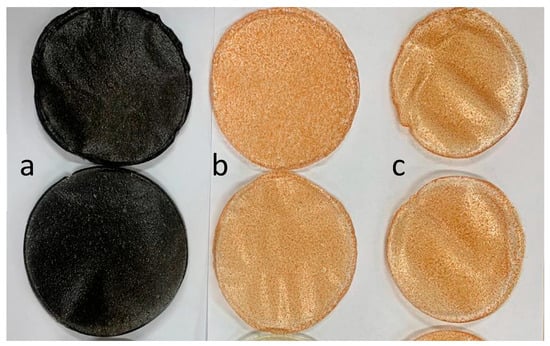
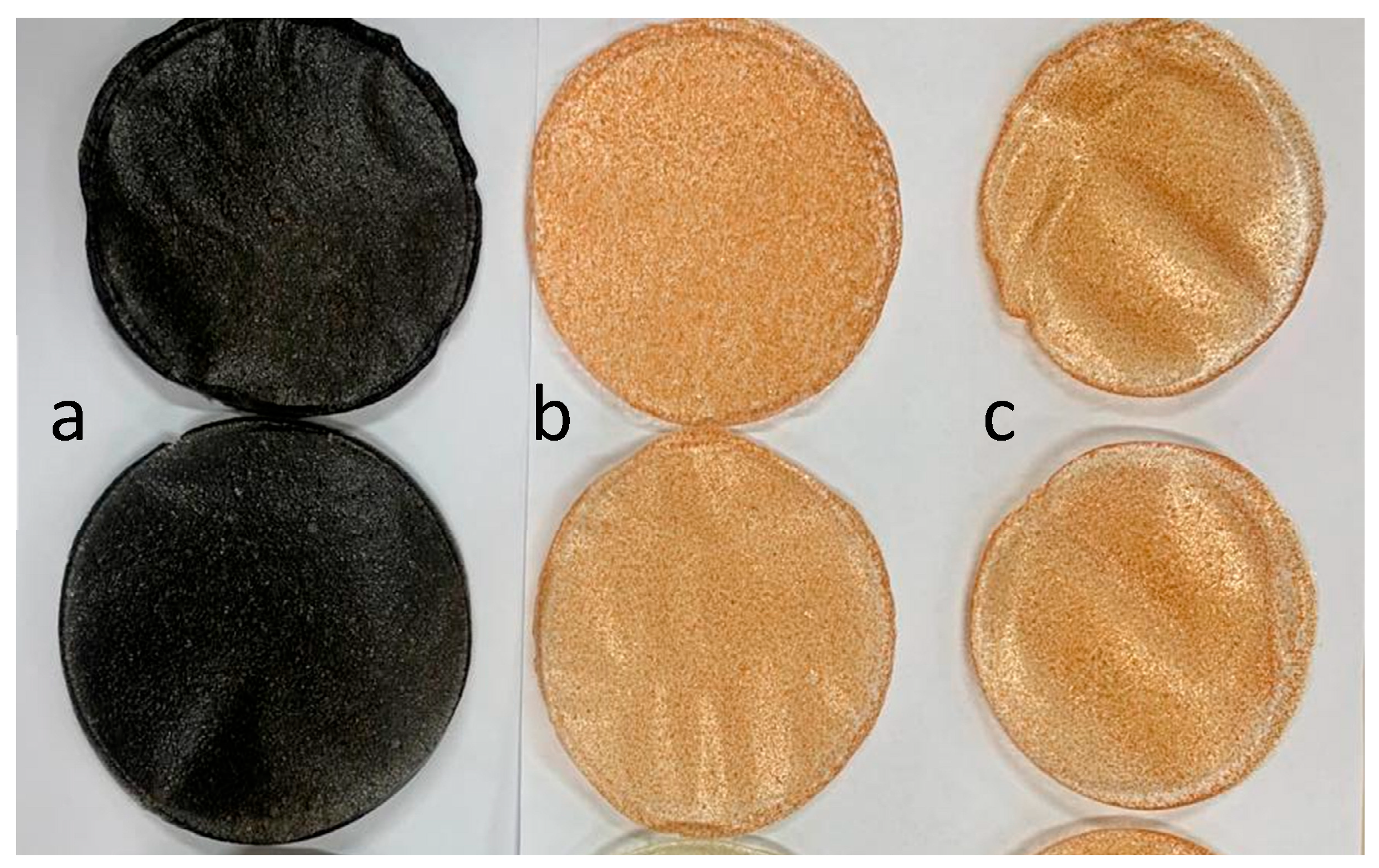
Samples of the films after cross-linking are shown in Figure 1.
Figure 1.
Photos of chitosan hydrogel films synthesized, characterized, and applied for adsorption of dyes in aqueous media. Film (a) is the chitosan hydrogel film with activated carbon (CHC), (b) is the chitosan hydrogel film with niobium oxide (CHN), and (c) is the pure chitosan hydrogel film without additives (PCH).
The synthesized films exhibited characteristics such as flexibility, good physical strength, porosity, homogeneity, ease of water sorption, and the maintenance of shape when in contact with water or the dye solution, as expected. The presence of niobium oxide or activated carbon in the films did not cause any visually observable changes in physical strength or difficulty in removing the films from the dishes. The main visual difference was the opaquer and rougher appearance of CHC and CHN, whereas PCH appeared smoother and shinier. The characteristic of physical strength after the cross-linking time in the oven is linked to the formation of acetal bridges in the production of hydrogel films with glutaraldehyde. These linkages are established through acetylation with hydroxyl groups in the polymeric chain of the chitosan film [31].
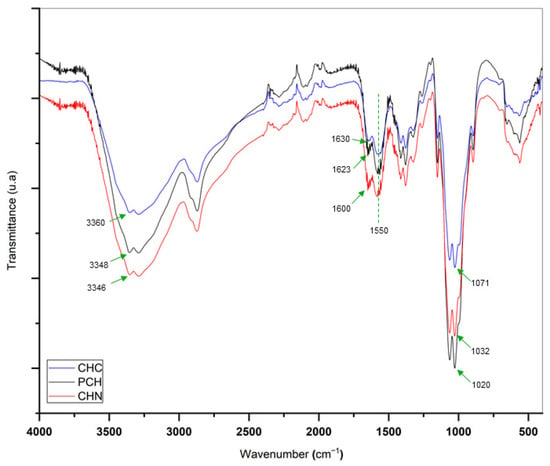
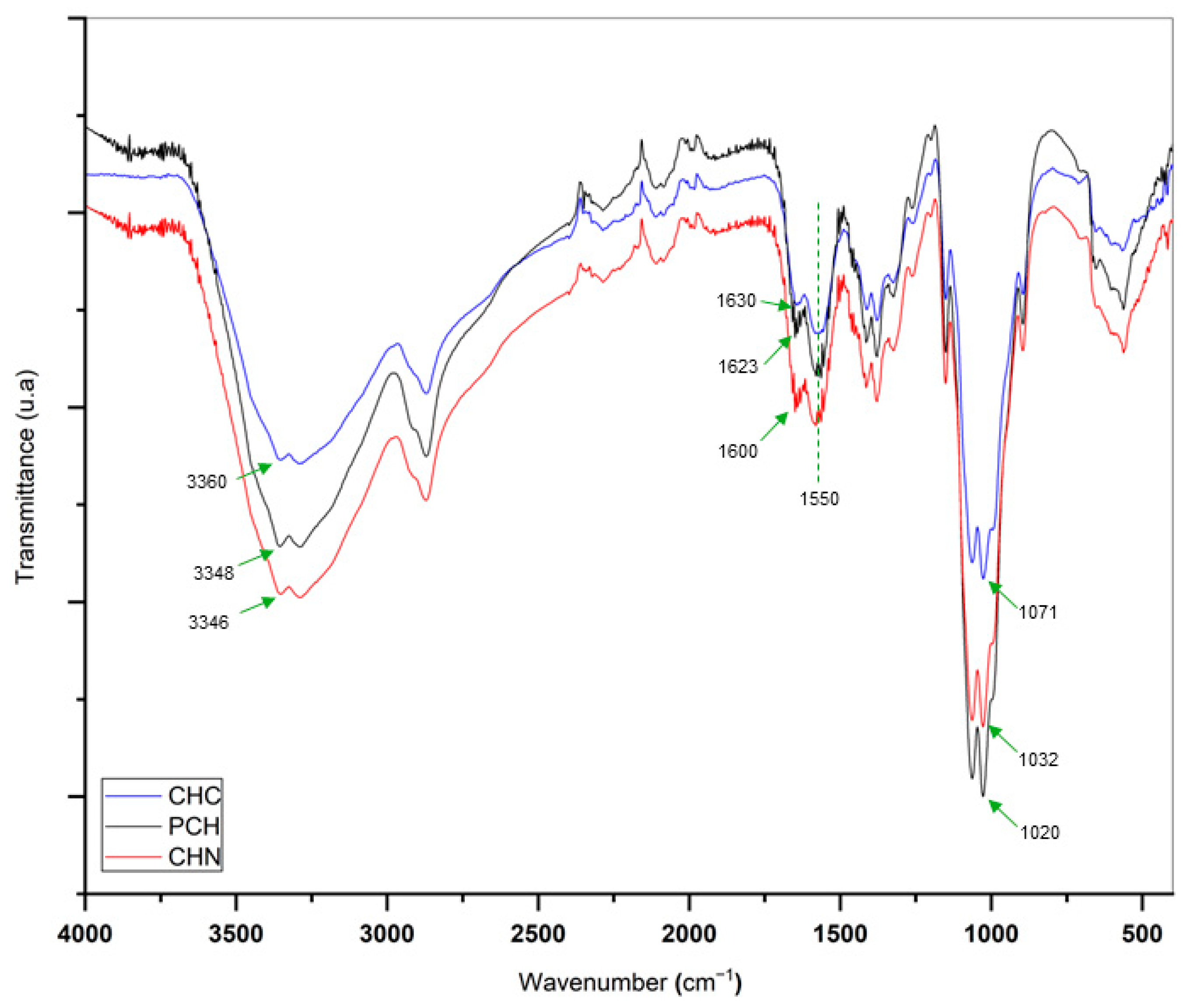
The results of the FTIR analysis for CHC, CHN, and PCH are shown in Figure 2.
Figure 2.
FTIR spectroscopy of CHC, PCH and CHN.
FTIR analysis enables the detection of compounds containing organic and inorganic covalent bonds. Understanding these functional groups on the surface of the film is crucial to a better understanding of the sorption mechanisms. Characteristic bands of functional groups were found in chitosan, and no significant changes in the transmittance bands were found with the presence of the solids. The bands at 1020, 1032, and 1071 cm−1 correspond to C-O-C bonds (saccharide rings) [32]. Stretching related to C=O bonds (typical band of amide I) is found at wavelengths around 1600, 1623, and 1630 cm−1; stretching related to amide II is found at approximately 1550 cm−1; aliphatic compounds are present at 2800 to 2900 cm−1 [33]. Additionally, hydroxyl (-OH) and NH groups linked to the chitosan structure can be identified at 3346, 3348, and 3360 cm−1. Under acidic conditions, the amine and hydroxyl groups of chitosan are responsible for dye adsorption. All bands identified are characteristic of chitosan-based hydrogel films [34].
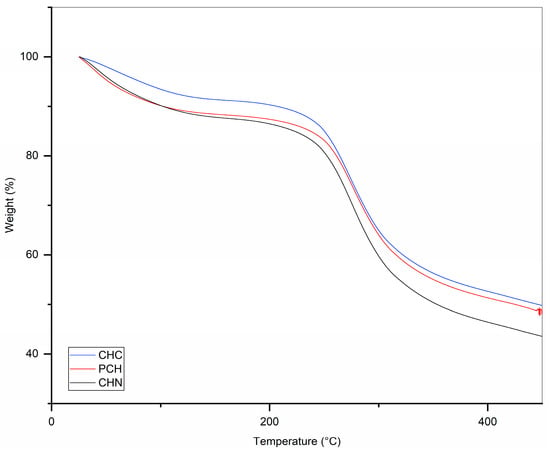
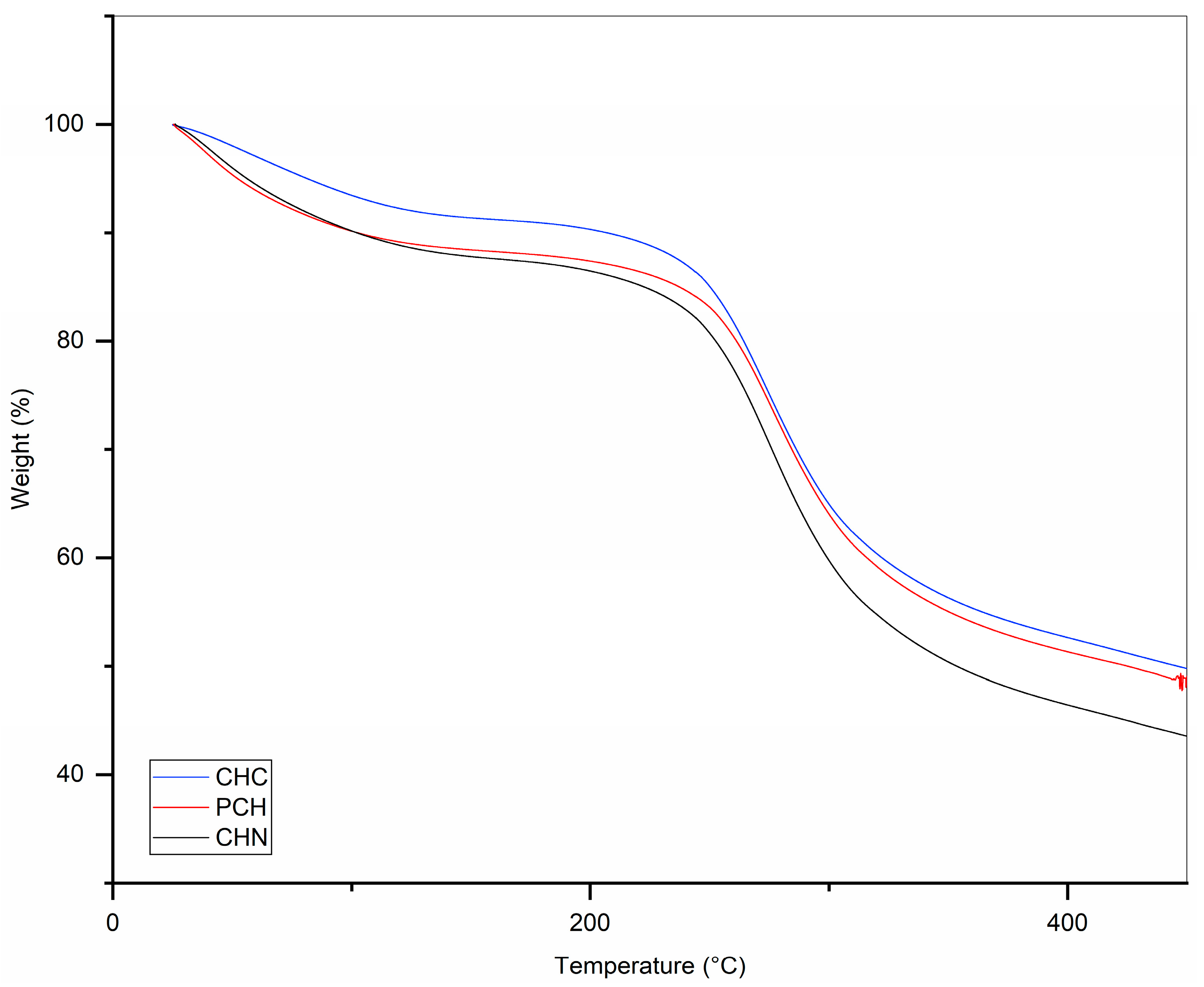
Thermogravimetric analysis enables obtaining important information on the thermal stability of the film structure. Figure 3 displays the results of mass decay with the increase in temperature for the three films used.
Figure 3.
Thermogravimetric analysis of synthesized chitosan hydrogel films.
The three films exhibited very similar behavior regarding thermal degradation, which occurred in two stages. The first stage of thermal decomposition occurred from 30 to 230 °C for PCH and CHN, with a mass loss of 15% for both and a mass loss of 10% for CHC. The elimination of water adhered to the material surface (physisorption) occurs in this stage. The second mass loss occurred from 230 to 400 °C, corresponding to 48% for CHC, 50% for CHN, and 54% for PCH. This loss is related to the degradation of the amine and hydroxyl functional groups. Above 400 °C, mass loss reached 62% for PCH and 57% for CHC and CHN, indicating the pyrolysis reaction of the film structure [35,36]. Observing the mass loss of the three films, the addition of the solid sorbents to the chitosan film led to a slight improvement in resistance to thermal exposure. The temperatures used for the kinetic experiments of 30, 40, and 50 °C do not cause mass loss of the films, confirming their thermal resistance in the experimental medium and ease of separation from the medium.
3.2. Kinetics
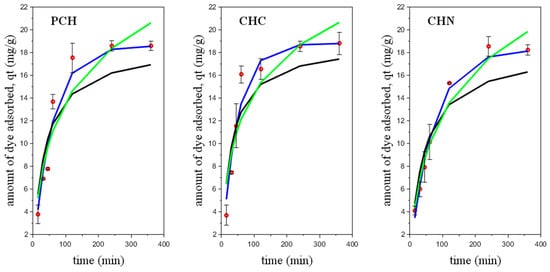
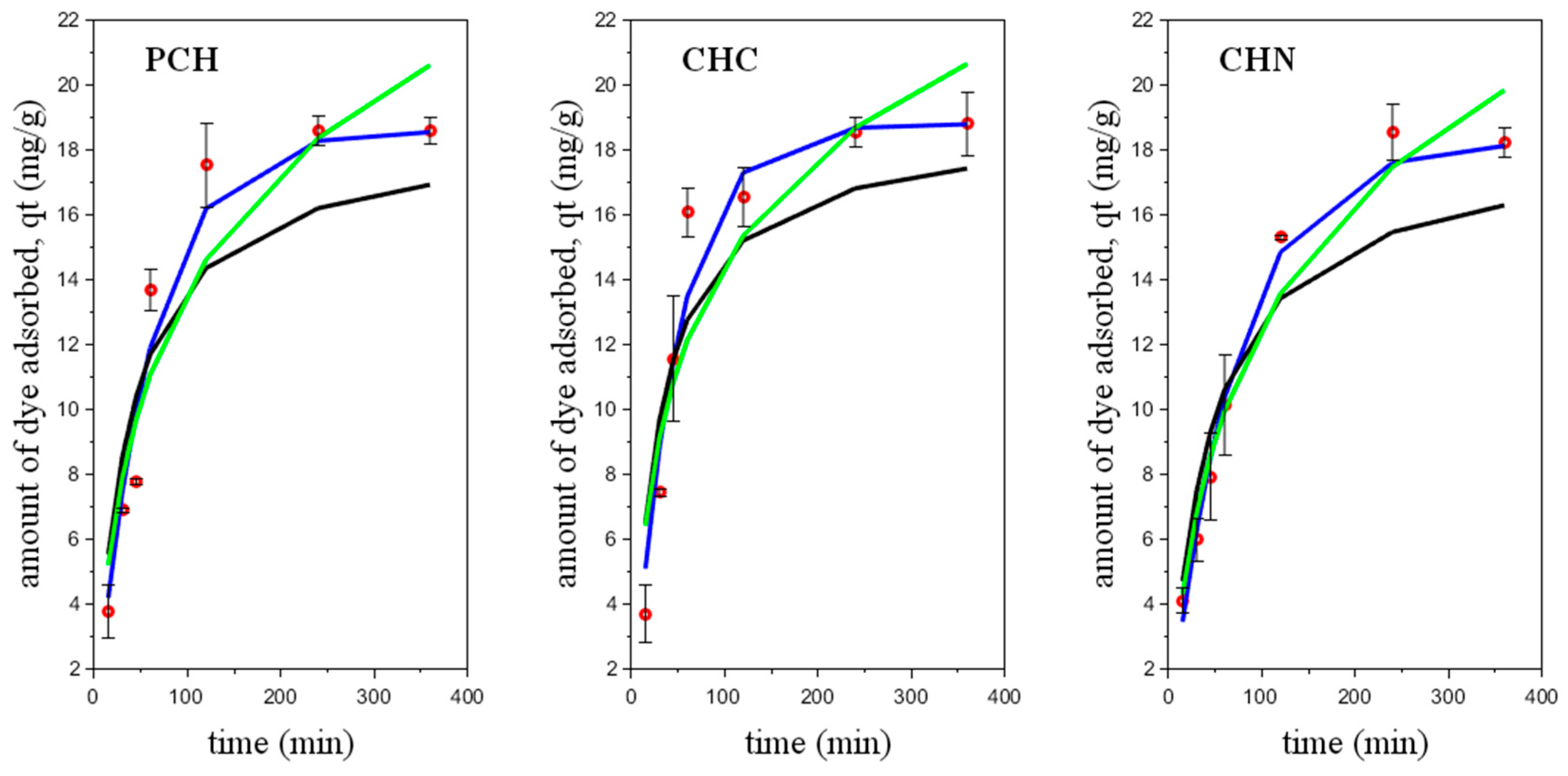
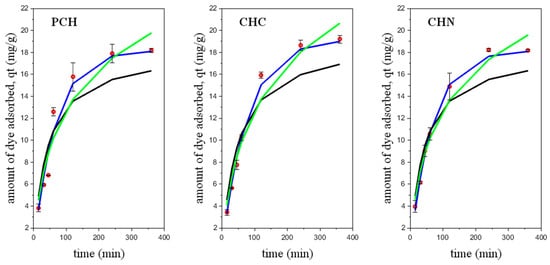
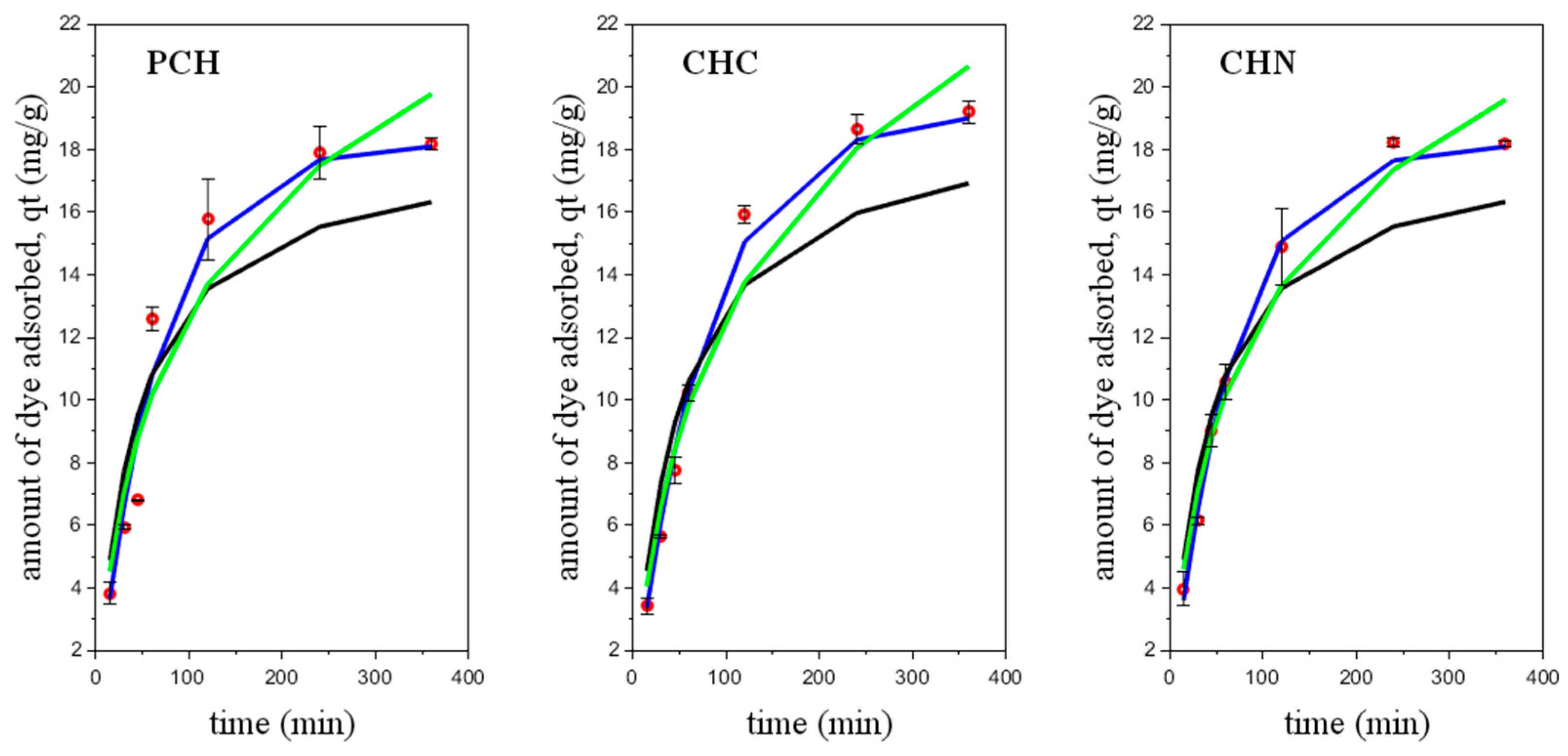
After the conclusion of the experiments and the determination of the amount of dye sorbed per gram of hydrogel for each film over time at each temperature, adjustments of the kinetic models were made for the amounts of Sunset Yellow dye sorbed per gram of hydrogel (mg g−1). Graphs of the experimental data and values predicted by the kinetic models were plotted and the fits were assessed using statistical quality criteria. Figure 4 displays the graph of the amount of Yellow Sunset dye adsorbed per gram of hydrogel over time at a temperature of 30 °C, including experimental data and profiles obtained from the fitted models.
Figure 4.
Fit of non-linear pseudo-first-order (blue), pseudo-second-order (black), and Elovich (green) kinetic models to experimental data (red circles) at 30 °C.
Analyzing the figure, equilibrium begins to be reached after approximately 200 min for all film systems and solutions. The maximum experimental adsorption capacity was 18.58 mg g−1 for PCH, 18.53 mg g−1 for CHN, and 18.79 mg g−1 for CHC. Considering the initial concentration of the Sunset Yellow solution, which was 20 mg L−1, the average removal rate with 0.1000 g of hydrogel was 98%. Table 1 displays the results of the adsorption kinetics modeling at 30°C.
Table 1.
Values of variables for nonlinear pseudo-first-order, pseudo-second-order, Elovich kinetic models and results of statistical criteria at 30 °C.
The graph in Figure 5 shows the amount of Sunset Yellow dye adsorbed per gram of hydrogel over time at 40 °C, including profiles obtained from the models and experimental data.
Figure 5.
Fit of non-linear pseudo-first-order (blue), pseudo-second-order (black), and Elovich (green) kinetic models to experimental data (red circles) at 40 °C.
According to Figure 5, equilibrium is reached around 240 min for all films and solution systems. Equilibrium was considered achieved when variations of less than 5% relative to qe were observed. Although the curves indicate an approach to equilibrium at around 200 min, the analysis of the quantitative data shows that the system only effectively stabilizes at 240 min. Table 2 displays a comparison of the adsorption performance of the films developed here to other biosorbents reported in the literature, considering adsorption capacity and equilibrium time under different experimental conditions.
Table 2.
Comparative analysis of adsorption capacity (qe) and equilibrium time for different adsorbents applied for removal of Sunset Yellow dye under different experimental conditions.
Analyzing other biosorbents reported in the literature for the adsorption of Sunset Yellow dye, the time to reach equilibrium is influenced by the initial concentration, temperature, and type of adsorbent. For instance, studies involving adsorbents produced from treated cellulose and cassava residues report equilibrium values close to those found in the present work [39,41]. The maximum amount adsorbed experimentally was 17.91 mg g−1 for PCH, 18.17 mg g−1 for CHN, and 19.18 mg g−1 for CHC with an initial concentration of Sunset Yellow solution of 20 mg L−1, resulting in an average removal rate of 98%. The results obtained from the modeling of adsorption kinetics at 40 °C are displayed in Table 3.
Table 3.
Values of variables for nonlinear pseudo-first-order, pseudo-second-order, Elovich kinetic models, and results of statistical criteria at 40°C.
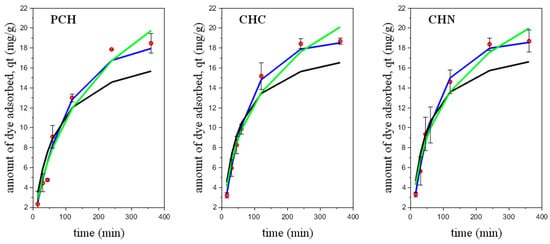
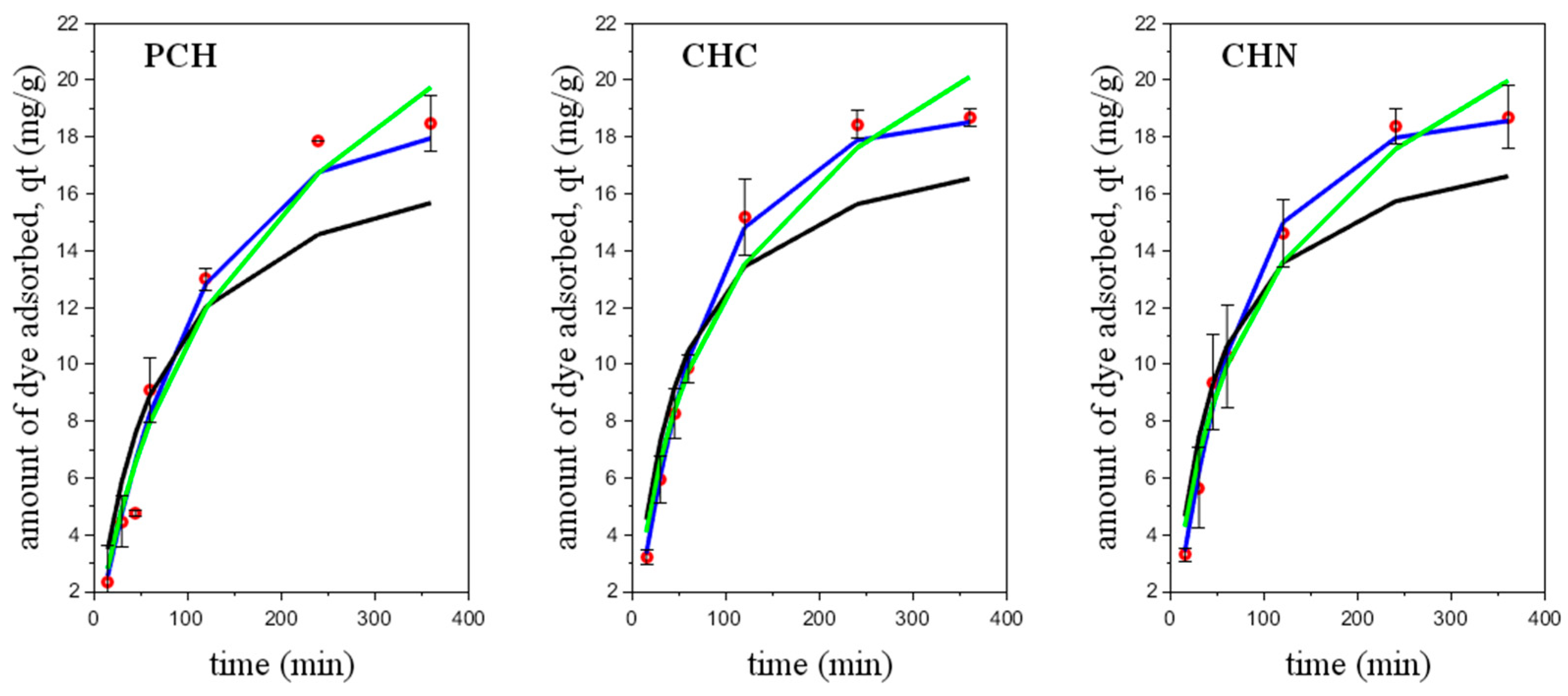
The profiles obtained from the models and the experimental data for Sunset Yellow dye adsorbed per gram of hydrogel over time at 50 °C are displayed in Figure 6.
Figure 6.
Fit of non-linear pseudo-first-order (blue), pseudo-second-order (black), and Elovich (green) kinetic models to experimental data (red circles) at 50 °C.
The figure shows that equilibrium begins to be reached at approximately 200 min in all cases. The average removal rate was 98%, considering the initial concentration of Sunset Yellow solution, which was 20 mg L−1. The maximum amount adsorbed experimentally for each type of film was 18.47 mg g−1 for PCH, 18.70 mg g−1 for CHN, and 18.68 mg g−1 for CHC.
Table 4 displays the results obtained from the kinetic modeling of adsorption at 50 °C.
Table 4.
Values of variables for nonlinear pseudo-first-order, pseudo-second-order, Elovich kinetic models, and results of statistical criteria at 50 °C.
Studies involving adsorption kinetic models enable observing the effectiveness of the process between the adsorbate and adsorbent and understanding the type of mechanism through which this process occurs. An analysis of the graphs in Figure 4, Figure 5 and Figure 6 reveals that the pseudo-first-order model best fit the data at all temperatures with all three types of films among the models studied in this work. This model, which was developed by Lagergren in 1898, is widely used in adsorption processes where the adsorbate is in the liquid phase and the adsorbent is in the solid phase [25]. According to this model, the rate of adsorption is proportional to the driving forces [13], as observed in the experiments conducted herein.
The pseudo-first-order model was the best fit, as shown in Figure 4, Figure 5 and Figure 6, where the model predictions are more closely aligned with the experimental values. These figures also demonstrate good dispersion of the experimental values, indicating no trend-fitting error in the models throughout the time interval. Any variability can be attributed to the experimental conditions and characteristics of the model.
The efficacy of this model in describing the data is further verified through the quality criteria (AIC, MAE, and BIC) in Table 1, Table 2 and Table 3, in which the lowest values, indicating better fit, consistently point towards the pseudo-first-order model. For instance, in the adsorption kinetics of the chitosan hydrogel at 30 °C, the AIC, MAE, and BIC values were, respectively, 4.71, 0.94, and 4.65 for the pseudo-first-order model, 13.30, 2.18, and 13.25 for the pseudo-second-order model, and 13.21, 1.73, and 13.11 for the Elovich model.
Compared to the other models, the pseudo-second-order model, which describes adsorption involving inter/intramolecular interactions, failed to provide an accurate prediction of the amounts adsorbed closer to the equilibrium of the system, always predicting lower values than those observed experimentally. On the other hand, the Elovich model assumes that adsorption occurs via chemisorption and that the solid surface is energetically heterogeneous, predicting higher adsorbed amounts at equilibrium in all cases but not corresponding to the temporal evolution of adsorption as effectively. These deviations are characteristic across all cases and confirm that the pseudo-first-order model indeed provides a better representation of the real system.
The kinetic rate constant k (min−1) in the pseudo-first-order and pseudo-second-order equations plays a role in the time scale, that is, the time required for the system to reach equilibrium decreases as k increases [42]. In Table 5, we can visualize the data obtained for k for the pseudo-first-order model at the three temperatures for each of the hydrogels.
Table 5.
Values of kinetic constant (min−1) for pseudo-first-order model.
With the pseudo-first-order model, no increase in k occurred with the increase in temperature, indicating that a higher temperature will not yield better results in terms of adsorption kinetics. Comparing the performance of the films, a shorter time to reach equilibrium was found at 30 °C for CHC, at 40 °C for PCH and CHN, and at 50 °C for CHC and CHN, demonstrating a positive outcome in combining the chitosan hydrogel with activated carbon or niobium oxide. CHN achieved superior results at reaching equilibrium at all temperatures, being higher at 40 °C and 50 °C.
Better fit results using the pseudo-first-order model were also reported in the effective removal of 4-aminophenol from aqueous media using sulfuric acid-activated pea (Pisum sativum) pods [43] for adsorption and the recovery of butyl acetate at low concentrations [44], and with the modification of the interfacial surface of fiberglass through graphene oxide–chitosan interactions for dye removal [45].
3.2.1. Chitosan Film Alone and Combined with Adsorbents
Observing the results of the characterization analyses, the combination of carbon or niobium oxide did not exert a negative effect on the physical strength or thermal resistance of the film structure; on the contrary, a slight improvement was found. This enhancement in physical and thermal resistance has been observed in the removal of Orange G dye using sand-reinforced chitosan films [35].
Chitosan/CuNb2O6 immobilization demonstrated efficiency, with excellent interaction between the film and tartrazine yellow dye, which is crucial for photocatalytic applications, promoting an association between adsorption and oxidative processes [16]. A previous study showed that modifying the interfacial surface of fiberglass through graphene oxide–chitosan interactions was highly efficient for the removal of four different dyes [45].
All films tested in the present study achieved excellent dye removal rates (approximately 98%). At 30°C, the maximum experimental adsorption for each film type was 18.58 mg g−1 for PCH, 18.53 mg g−1 for CHN, and 18.79 mg g−1 for CHC using 0.1000 g of hydrogel with an initial dye solution concentration of 20 mg L−1, indicating that the systems are efficient.
A hydrogel made from cinnamaldehyde and chitosan for the adsorption of tartrazine yellow and carmoisine was a potentially excellent approach for controlling pollutants and preserving water, achieving a maximum removal rate of 98% for both dyes at room temperature [46]. A chitosan hydrogel modified with carbon nanotubes exhibited promising removal capabilities for the food dyes FbB1 and FdR17, and the films could be reused multiple times for pollutant removal [47].
Although CHN did not have a superior adsorptive performance in comparison to PCH, its scientific assessment is strategically relevant, as Brazil is home to more than 92% of the known niobium reserves in the world and is the largest global producer of this mineral [48]. Thus, research into new fields of application for niobium oxide, including wastewater treatment, should be encouraged. Previous studies have investigated adsorption with niobium oxide, but not for Sunset Yellow, as we can see in the SCOPUS and Web of Science platforms (www.scopus.com; www.clarivate.com/academia-government/scientific-and-academic-research/research-discovery-and-referencing/web-of-science/ (accessed on 29 March 2026).
3.2.2. Influence of Temperature
Analyzing the amount of dye adsorbed at the maximum time across all temperatures, the change in temperature between 30 °C and 50 °C was not a significant influencing factor in the interaction between the adsorbent and adsorbate in the experiment. Another factor that highlights this result is the observation of the k values (Table 5) in the pseudo-first-order model, which were highest at 30 °C. A positive aspect emphasized by the experiments is that the dye removal process by adsorption with these films is very stable in variations in temperature, with no significant loss of effectiveness in environments above 30 °C. Most adsorption kinetics experiments show a positive outcome with the increase in temperature, which is known to enhance molecular stirring and increase the size of active sites on most adsorbents, thus promoting quicker attainment of equilibrium in the system. A phenomenon that may explain the lack of improvement in adsorption with the increase in temperature is molecular diffusion and the effects of surface adsorption energy [49]. Temperature may not exert a sufficient influence due to the need for a larger increase, as reported by [50], who found that an increase from 20° to 95 °C reduced the number of hydrogen bonds. This reduction favors the adsorption of compounds from aqueous solutions onto solid surfaces.
3.3. Adsorption Thermodynamics
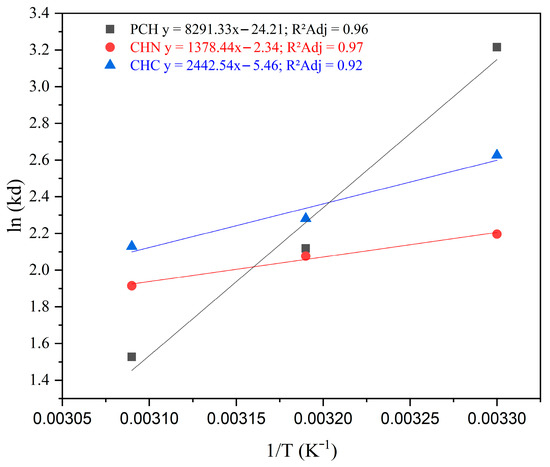
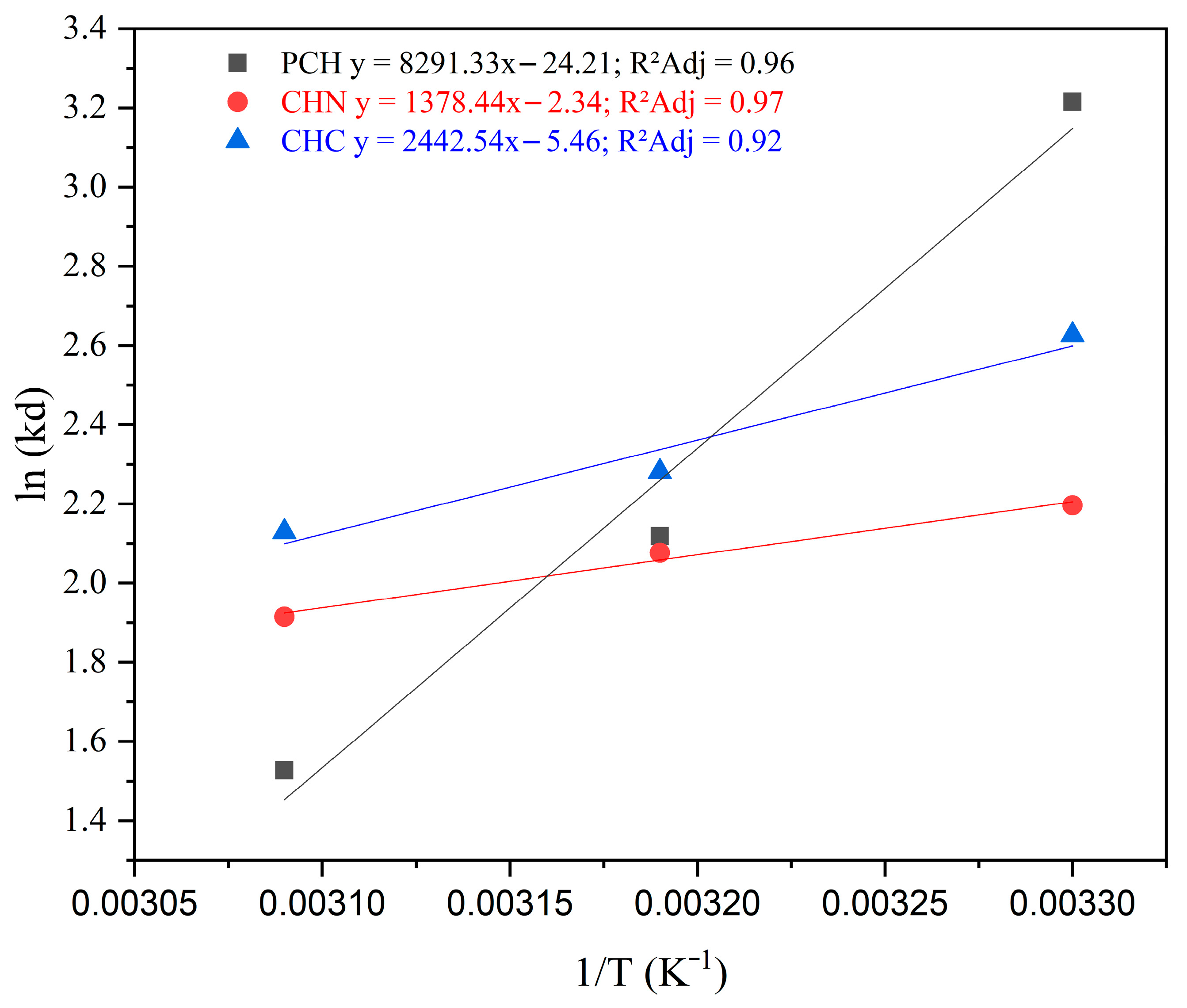
The apparent thermodynamic analysis of the adsorption process (Table 6) revealed that, when interacting with the Sunset Yellow dye, the chitosan films had negative standard Gibbs energy values (ΔG0), as demonstrated by the Van’t Hoff plot (Figure 7), indicating that adsorption occurred spontaneously in all three compositions at the different temperatures analyzed. Furthermore, negative values were found for standard enthalpy (ΔH0) in all three cases, indicating that the process was exothermic, with variations depending on the adsorbent. Negative values were also found for entropy (ΔS0), suggesting a reduction in the disorder of the system at the solid–liquid interface during adsorption [25].
Table 6.
Thermodynamic variables for adsorption of Sunset Yellow dye to chitosan hydrogel film with activated carbon (CHC), with niobium oxide (CHN), and without additives (PCH) at 303.15, 313.15, and 323.15 K.
Figure 7.
Van’t Hoff plot of CHC, CHN, and PCH at different temperatures (30, 40, and 50 °C).
The pure chitosan hydrogel film (without incorporated additives) had the most negative values of standard enthalpy (ΔH0 = –68.93 kJ mol−1) and standard entropy (ΔS0 = −201.27 J mol−1 K−1). The standard enthalpy value is compatible with electrostatic interactions between the adsorbent and dye. In the films modified with 10% activated carbon, ΔH0 was –20.31 kJ mol−1 and ΔS0 was –45.39 J mol−1 K−1, with the formation of an adsorbate layer in a less ordered manner than in pure chitosan but also exhibiting electrostatic interactions because of the magnitude of the standard enthalpy (20–80 kJ mol−1). On the other hand, the film modified with 10% of niobium oxide exhibited the lowest ΔH0 (–11.46 kJ mol−1) and ΔS0 (–19.47 J mol−1 K−1), indicating a physisorption process characterized by weak interactions (<20 kJ mol−1), such as van der Waals forces, and less order in the system [51]. These thermodynamic characteristics are consistent with other adsorptive systems reported in the literature, such as the removal of 4-aminophenol from aqueous media using sulfuric acid-activated Pisum sativum (pea) pods [43].
As reported in Section 3.2, the pseudo-first-order model was the best fit for all films. Compared to the ΔH° values, the analysis of CHN is consistent with physisorption, suggesting that weak interactions favor first-order kinetics. For PCH and CHC, the parameters indicate the presence of electrostatic interactions. This approach would not fully cover the interpretation by comparing kinetics and thermodynamic values, but it would also not negate it. According to Vareda et al. (2023) [25], the pseudo-first-order model describes macroscopic kinetic behavior—that is, the site-occupancy rate—and not the nature of the adsorbate–adsorbent bond. Therefore, conditions such as an excess of active sites relative to the adsorbate concentration or when the mass transport of the adsorbate in the fluid phase is the limiting step can lead to an inadequate pseudo-first-order analysis.
The difference in ΔS° values among the films may reflect important variations in the degree of molecular organization at the adsorbent–adsorbate interface. The more negative ΔS° value for PCH (−201.27 J mol−1 K−1) indicates that the dye molecules adopt a more ordered configuration after adsorption. This behavior is consistent with the predominance of strong electrostatic interactions between the protonated amino groups (-NH3+) of chitosan, which interact in a site-specific manner with the sulfonate groups (-SO3−) of the Sunset Yellow dye [52]. When the doped adsorbent was assessed, the increase in ΔS° values indicates an increase in disorder at the solid–solution interface during dye adsorption. This change may be explained by factors such as the reduction in the density of –NH3+ groups on the surface (due to the partial occupation of -NH2 sites by Nb2O5 domains or activated carbon in the composite matrix), which reduces the specificity of chitosan interactions with the dye, resulting in other interactions related to the composites with the adsorbent. Another factor could be the displacement of water molecules from the surface of the composite during adsorption, which is a phenomenon that introduces a favorable entropic component that attenuates the reduction in the total entropy of the system, or even an enthalpy-entropic compensation related to water, which occurs to a lesser extent on the surface of pure chitosan (more homogeneous sites) [53,54,55].
In terms of the effect of temperature, the ΔG0 demonstrates a reduction in spontaneity as temperature increases. Reinforcing what was mentioned in the previous topic, temperature, in this case, does not have a positive effect on the adsorption process. Thus, the thermodynamic results confirm that, although all systems exhibit spontaneous adsorption, the nature and intensity of the interactions vary with the modification of the film, being primarily electrostatic in PCH and CHC and physical in CHN. Overall, a simpler thermodynamic approach was presented, without considering criteria involving different isotherm models and mass variations, as discussed elsewhere [56]. As our focus was to evaluate the kinetic behavior, the thermodynamic results were discussed based on Henry’s theory for dilute solutions.
3.4. Recycle Test
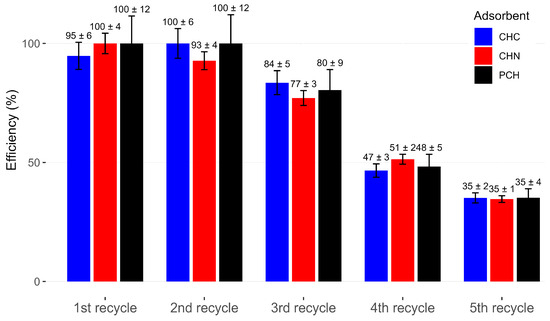
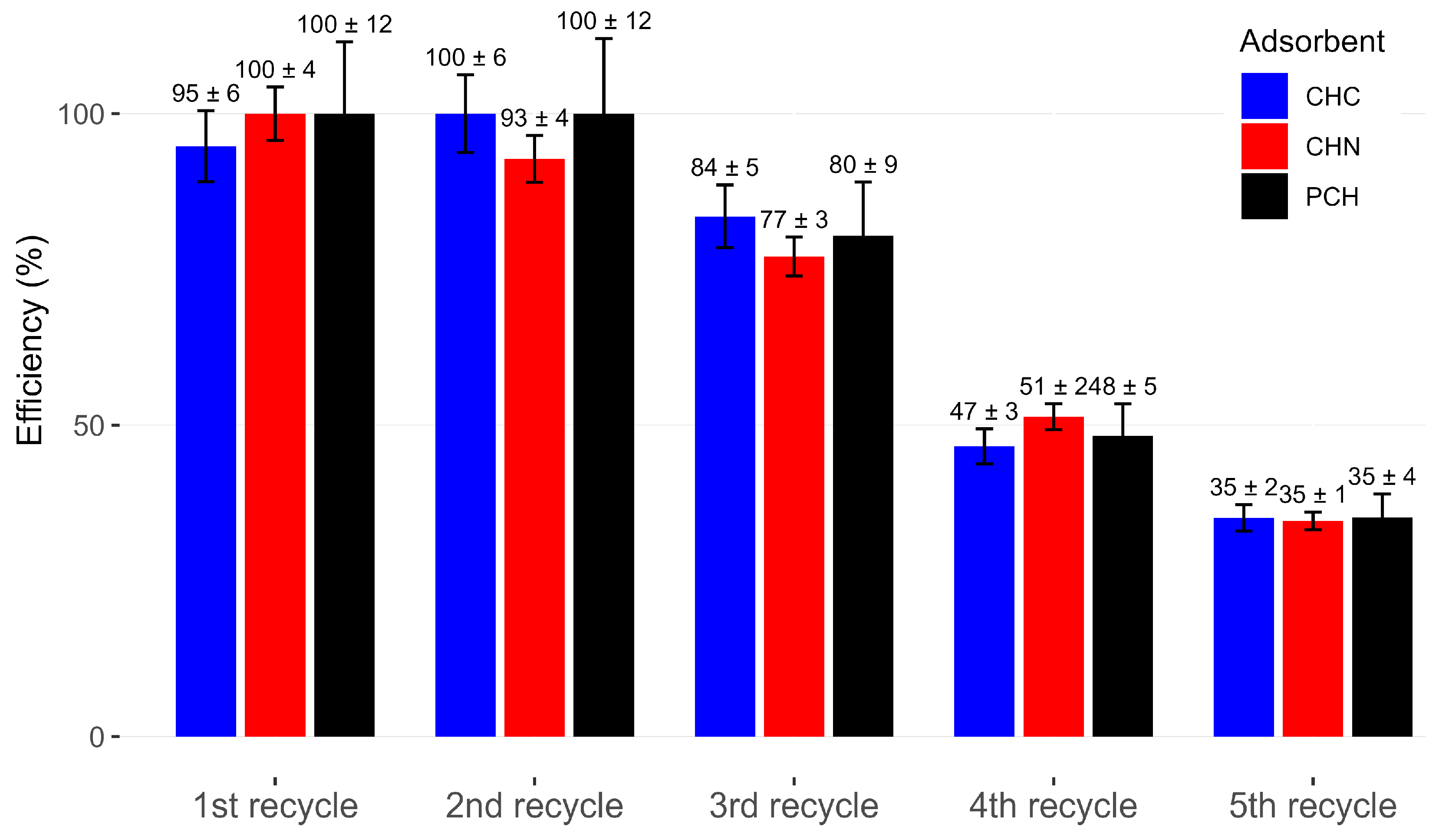
The reusability of adsorbents is a key factor in determining their practical applicability, particularly in environmental and industrial wastewater treatment [57,58]. In the present study, five successive adsorption cycles were conducted to determine the recycling performance of the films (CHC, CHN, and PCH). As shown in Figure 8, all materials exhibited high initial removal rates, with values close to 100% in the first two cycles. From the 4th recycling test onward, efficiency barely reached 50%. The reduction in adsorption efficiency may be related to saturation of the adsorbent surface (incomplete desorption during regeneration), structural collapse of the material, or disintegration during sorption and desorption [59]. A possible way to restore the sorption capacity of the hydrogel would be to apply a more aggressive or longer method for desorbing the dye sorbed onto the surface of the material. However, this can degrade the final material.
Figure 8.
Efficiency results in recycling tests.
Although some film breakage occurred during testing, mass loss compared to the initial value was less than 15%, enabling the completion of the experiment. The chitosan-based films remained effective at removing the dye for at least three reuse cycles, which is similar to findings described for tartrazine yellow [16], Rhodamine 6G, and indigo carmine [60].
It is widely known that adsorption alone transfers the pollutant from the aqueous phase to the solid phase without degrading it, which is certainly a limitation of this method. Nonetheless, adsorption remains a widely used strategy in water purification processes. An adsorbent containing a concentrated adsorbate is a source of pollution that is easier to handle and subsequently treat (considering scalability, this process would serve as a concentrator of the problem for future treatment). Chitosan-based hydrogels can be regenerated by washing with acidic or alkaline solutions, depending on the type of adsorbate, enabling reuse in multiple adsorption cycles. When a hydrogel contains photocatalysts in its structure, as in the present study, it is possible to combine adsorption and photodegradation methods to mineralize the residue produced rather than just concentrate or transfer pollutants from different matrices.
4. Conclusions
The synthesis of films using pure chitosan or combined with either activated carbon or niobium oxide was successful. The films exhibited flexibility, good physical strength, porosity, and homogeneity, and maintained their shape when in contact with water or a dye solution, as expected. The presence of carbon or niobium oxide made the structure firmer, resulting in a slight improvement in terms of noticeable mass loss in the thermogravimetric analysis. The amount of dye adsorbed over time reached approximately 18 mg g−1 for all films tested, with an average maximum removal rate of 98%. Considering the excellent removal capacities of the films, the addition of the solid adsorbents to the chitosan hydrogel film is beneficial, demonstrating that chitosan hydrogel is an excellent adsorbent and that the use of niobium oxide or activated carbon did not reduce the total adsorption capacity. The kinetic adsorption model that best fit the data was the pseudo-first-order model. This model is widely used in adsorption processes where the adsorbate is in liquid phase and the adsorbent is in solid phase. The analysis of the amount of dye adsorbed at the maximum time at the tested temperatures revealed that the increase in temperature did not exert an influence on the interaction between adsorbent and adsorbate. Another factor supporting this result is the observation of the k values in the pseudo-first-order and second-order models, which were higher at 30 °C. Adsorption was spontaneous (negative ΔG0) and exothermic (negative ΔH0) in all films, accompanied by a reduction in entropy (negative ΔS0), indicating a decrease in disorder at the interface. The PCH and CHC results indicated the presence of electrostatic interactions. On the other hand, CHN exhibited physisorption-type adsorption characteristics. In agreement with the k value findings, spontaneity decreased with the increase in temperature, indicating that this variable does not favor the process. Chitosan film adsorption proved to be a highly effective method for removing Sunset Yellow dye, as it is easily synthesized, exhibits excellent pollutant removal capabilities, and requires a short contact time. Recycling tests also demonstrated that chitosan hydrogels can be reused up to three times with a slight loss in efficiency. The present results were achieved on a bench scale, but the positive functionality is indicative of possible larger-scale applications with broader conditions to ensure the quality of wastewater from industries that employ food dyes, which requires further studies to validate feasibility and the experimental conditions.
Author Contributions
A.P.O.: Investigation, data curation, formal analysis, methodology, writing. A.C.M.: Investigation, methodology. A.T.P.: data curation, methodology, writing—review and editing. G.E.M.: data curation, formal analysis, methodology, writing. H.E.: Data curation, Formal analysis, methodology, supervision, writing—review and editing. L.J.V.: Investigation, Data curation, project administration, supervision, writing—review and editing. All authors have read and agreed to the published version of the manuscript.
Funding
Conselho Nacional de Desenvolvimento Científico e Tecnológico (CNPq, Brazil)—Grant Number: 313064/2022-9. Fundação de Amparo à Pesquisa e Inovação do Estado de Santa Catarina (FAPESC, Brazil)—Grant Numbers: 2024/TR002572, 2025TR1612 and 2025TR001579. This work was partially supported by the Brazilian agencies MCTIC/CNPq—Grant number: 406973/2022-9 and Coordenação de Aperfeiçoamento de Pessoal de Nível Superior (CAPES–Finance Code 001).
Data Availability Statement
The original contributions presented in this study are included in the article. Further inquiries can be directed to the corresponding author.
Acknowledgments
ATP thanks Conselho Nacional de Desenvolvimento Científico e Tecnológico (CNPq, Brazil) for the research fellowship (Grant Number: 313064/2022-9). ATP, HE, and LJV thank Fundação de Amparo à Pesquisa e Inovação do Estado de Santa Catarina (FAPESC, Brazil) for the financial support (Grant Numbers: 2024/TR002572 and 2025TR001579). This work was partially supported by the Brazilian agencies MCTIC/CNPq (Grant number: 406973/2022-9) and Coordenação de Aperfeiçoamento de Pessoal de Nível Superior (CAPES–Finance Code 001). HE, ATP, GEM, and LJV thank Fundação de Amparo à Pesquisa e Inovação do Estado de Santa Catarina (FAPESC, Brazil) for the financial support (Grant Number: 2025TR1612). The authors are thankful for the Multi-User Facility infrastructure from Santa Catarina State University’s Technological Sciences Center.
Conflicts of Interest
The authors declare that they have no known competing financial interests or personal relationships that could have influenced the work reported in this paper.
References
- Calciolari, A.R.; Pires, N.J.; Trugilho, P.F.; Guimarães Junior, M. Remoção Do Corante Azul de Metileno de Solução Aquosa Usando Biomassa de Pele Prata de Café (Coffee Silverskin) Como Bioadsorvente de Baixo Custo. Matéria 2022, 27, e20220141. [Google Scholar] [CrossRef] [Scilit]
- Sardar, M.; Manna, M.; Maharana, M.; Sen, S. Remediation of Dyes from Industrial Wastewater Using Low-Cost Adsorbents. In Green Adsorbents to Remove Metals, Dyes and Boron from Polluted Water; Springer International Publishing: Cham, Switzerland, 2021; pp. 377–403. [Google Scholar]
- Rovina, K.; Prabakaran, P.P.; Siddiquee, S.; Shaarani, S.M. Methods for the Analysis of Sunset Yellow FCF (E110) in Food and Beverage Products—A Review. TrAC Trends Anal. Chem. 2016, 85, 47–56. [Google Scholar] [CrossRef] [Scilit]
- Hadi, P.; Sharma, S.K.; McKay, G. Removal of Dyes from Effluents Using Biowaste-Derived Adsorbents. In Green Chemistry for Dyes Removal from Wastewater; John Wiley and Sons: Hoboken, NJ, USA, 2015; pp. 139–201. [Google Scholar]
- Gomes, K.M.S.; de Oliveira, M.V.G.A.; Carvalho, F.R.d.S.; Menezes, C.C.; Peron, A.P. Citotoxicity of Food Dyes Sunset Yellow (E-110), Bordeaux Red (E-123), and Tatrazine Yellow (E-102) on Allium Cepa L. Root Meristematic Cells. Food Sci. Technol. 2013, 33, 218–223. [Google Scholar] [CrossRef] [Scilit]
- Brito, A.K.d.B.; Cardoso, K.G.M.; Soares, S.D.; Chisté, R.C. Corantes artificiais permitidos no Brasil: Principais características e efeitos toxicológicos. In Ciência e Tecnologia de Alimentos: Pesquisa e Práticas Contemporâneas—Volume 2; Editora Científica Digital: São Paulo, Brazil, 2021; pp. 428–444. [Google Scholar]
- Mittal, Y.; Dash, S.; Srivastava, P.; Mishra, P.M.; Aminabhavi, T.M.; Yadav, A.K. Azo Dye Containing Wastewater Treatment in Earthen Membrane Based Unplanted Two Chambered Constructed Wetlands-Microbial Fuel Cells: A New Design for Enhanced Performance. Chem. Eng. J. 2022, 427, 131856. [Google Scholar] [CrossRef] [Scilit]
- Abhisek, K.; Vhatkar, S.S.; Mathew, H.T.; Singh, P.; Oraon, R. A Critical Review on the Challenges and Techno-Economic Assessment of Dyes Removal Technologies from Waste Water. Discov. Chem. 2025, 2, 41. [Google Scholar] [CrossRef] [Scilit]
- Nunes, C.S.; Castillo, A.d.S.; Ramos, J.P.; Gomes, L.G.; Cardoso, F.J.B.; Vilhena, K.d.S.d.S. Potencial de Resíduo Não Processado Proveniente Da Obtenção Do Silício Metálico Como Adsorvente Do Corante Vermelho de Metila. Matéria 2023, 28, e20230018. [Google Scholar] [CrossRef] [Scilit]
- Bankole, D.T.; Inyinbor, A.A.; Oluyori, A.P.; Arowolo, M.O. Adsorptive Removal of Synthetic Food Dyes Using Low-Cost Biochar: Efficiency Prediction, Kinetics and Desorption Index Evaluation. Bioresour. Technol. Rep. 2024, 25, 101709. [Google Scholar] [CrossRef] [Scilit]
- Ben Yahia, M.; Sellaoui, L. Adsorptive Removal of Sunset Yellow Dye by Biopolymers Functionalized with (3–Aminopropyltriethoxysilane): Analytical Investigation via Advanced Model. J. Mol. Liq. 2020, 312, 113395. [Google Scholar] [CrossRef] [Scilit]
- Zhang, L.; Sellaoui, L.; Franco, D.; Dotto, G.L.; Bajahzar, A.; Belmabrouk, H.; Bonilla-Petriciolet, A.; Oliveira, M.L.S.; Li, Z. Adsorption of Dyes Brilliant Blue, Sunset Yellow and Tartrazine from Aqueous Solution on Chitosan: Analytical Interpretation via Multilayer Statistical Physics Model. Chem. Eng. J. 2020, 382, 122952. [Google Scholar] [CrossRef] [Scilit]
- Vieira, T.; Becegato, V.A.; Paulino, A.T. Equilibrium Isotherms, Kinetics, and Thermodynamics of the Adsorption of 2,4-Dichlorophenoxyacetic Acid to Chitosan-Based Hydrogels. Water Air Soil Pollut. 2021, 232, 60. [Google Scholar] [CrossRef] [Scilit]
- Sabbah, M.; Di Pierro, P.; Dell’Olmo, E.; Arciello, A.; Porta, R. Improved Shelf-Life of Nabulsi Cheese Wrapped with Hydrocolloid Films. Food Hydrocoll. 2019, 96, 29–35. [Google Scholar] [CrossRef] [Scilit]
- Berger, J.; Reist, M.; Mayer, J.M.; Felt, O.; Peppas, N.A.; Gurny, R. Structure and Interactions in Covalently and Ionically Crosslinked Chitosan Hydrogels for Biomedical Applications. Eur. J. Pharm. Biopharm. 2004, 57, 19–34. [Google Scholar] [CrossRef] [Scilit]
- Guz, R.; Tiburtius, E.R.L.; Pessôa, C.A. Association of Adsorption and Heterogeneous Photocatalysis in the Degradation of Tartrazine Yellow Dye with CuNb2O6 Synthesized and Immobilized on Chitosan Membranes. Inorg. Chem. Commun. 2023, 152, 110645. [Google Scholar] [CrossRef] [Scilit]
- Lourenço, L.N.N.; Itabaiana, I.; Lemes, A.C. Brewer’s Spent Yeast as a Biosorbent for the Synthetic Dye Tartrazine Yellow. ACS Omega 2026, 11, 9022–9037. [Google Scholar] [CrossRef] [Scilit]
- Toprakçürümez, H.; Recepoğlu, Y.K.; Arar, Ö. Quaternary Ammonium-Modified Cellulose: A Sustainable Strategy for Purifying Aqueous Solutions Contaminated with Sunset Yellow Dye. Int. J. Biol. Macromol. 2025, 294, 139555. [Google Scholar] [CrossRef] [Scilit]
- Şenol, Z.M.; Arslanoğlu, H.; Keskin, Z.S.; Mehmeti, V.; El Messaoudi, N. Biosorption of Rhodamine B and Sunset Yellow Dyes on Cross-Linked Chitosan-Alginate Biocomposite Beads: Experimental and Theoretical Studies. Int. J. Biol. Macromol. 2025, 298, 139264. [Google Scholar] [CrossRef] [Scilit]
- Xiao, W.; Garba, Z.N.; Sun, S.; Lawan, I.; Wang, L.; Lin, M.; Yuan, Z. Preparation and Evaluation of an Effective Activated Carbon from White Sugar for the Adsorption of Rhodamine B Dye. J. Clean. Prod. 2020, 253, 119989. [Google Scholar] [CrossRef] [Scilit]
- Chebanenko, M.I.; Popkov, V.I.; Schröettner, H.; Sushnikova, A.A.; Rempel, A.A.; Valeeva, A.A. Sorption-Photocatalytic Performance of NbOx Nanocrystals Synthesized via Heat-Stimulated Oxidation of Niobium Carbide. Appl. Surf. Sci. 2022, 582, 152422. [Google Scholar] [CrossRef] [Scilit]
- Abumelha, H.M. Efficient Removal of Sunset Yellow Food Dye from Aqueous Environment Using Bimetal-Organic Frameworks Encapsulated with Chitosan: Synthesis, Characterization, Adsorption Analysis, and Optimization. J. Mol. Liq. 2024, 407, 125208. [Google Scholar] [CrossRef] [Scilit]
- Alraddadi, S. Utilization of Nano Volcanic Ash as a Natural Economical Adsorbent for Removing Cadmium from Wastewater. Heliyon 2022, 8, e12460. [Google Scholar] [CrossRef] [Scilit]
- Sen Gupta, S.; Bhattacharyya, K.G. Kinetics of Adsorption of Metal Ions on Inorganic Materials: A Review. Adv. Colloid Interface Sci. 2011, 162, 39–58. [Google Scholar] [CrossRef] [Scilit]
- Vareda, J.P. On Validity, Physical Meaning, Mechanism Insights and Regression of Adsorption Kinetic Models. J. Mol. Liq. 2023, 376, 121416. [Google Scholar] [CrossRef] [Scilit]
- Paz, M.J.; Vieira, T.; Enzweiler, H.; Paulino, A.T. Chitosan/Wood Sawdust/Magnetite Composite Membranes for the Photodegradation of Agrochemicals in Water. J. Environ. Chem. Eng. 2022, 10, 106967. [Google Scholar] [CrossRef] [Scilit]
- Prando, J.; Reinehr, I.L.; Visioli, L.J.; Paulino, A.T.; Enzweiler, H. Photolysis, Photocatalysis, and Sorption of Caffeine in Aqueous Media in the Presence of Chitosan Membrane and Chitosan/TiO2 Composite Membrane. Processes 2025, 13, 2439. [Google Scholar] [CrossRef] [Scilit]
- Reinehr, I.L.; Capra, D.F.; Kempka, A.P.; Visioli, L.J.; Paulino, A.T.; Enzweiler, H. Innovative Chitosan/TiO2 Composite Membrane for the Sustainable Photocatalytic Purification of Water Contaminated with Emerging Micropollutants. Polym. Bull. 2025, 82, 9513–9533. [Google Scholar] [CrossRef] [Scilit]
- Zhou, X.; Yu, X.; Maimaitiniyazi, R.; Zhang, X.; Qu, Q. Discussion on the Thermodynamic Calculation and Adsorption Spontaneity Re Ofudje et al. (2023). Heliyon 2024, 10, e28188. [Google Scholar] [CrossRef] [Scilit]
- Tran, H.N. Improper Estimation of Thermodynamic Parameters in Adsorption Studies with Distribution Coefficient KD (qe/Ce) or Freundlich Constant (KF): Considerations from the Derivation of Dimensionless Thermodynamic Equilibrium Constant and Suggestions. Adsorpt. Sci. Technol. 2022, 2022, 5553212. [Google Scholar] [CrossRef] [Scilit]
- Supriya Bhatt, S.; Thakur, G.; Nune, M. Preparation and Characterization of PVA/Chitosan Cross-Linked 3D Scaffolds for Liver Tissue Engineering. Mater. Today Proc. 2023, 117, 115–123. [Google Scholar] [CrossRef] [Scilit]
- İlk, S.; Ramanauskaitė, A.; Koç Bilican, B.; Mulerčikas, P.; Çam, D.; Onses, M.S.; Torun, I.; Kazlauskaitė, S.; Baublys, V.; Aydın, Ö.; et al. Usage of Natural Chitosan Membrane Obtained from Insect Corneal Lenses as a Drug Carrier and Its Potential for Point of Care Tests. Mater. Sci. Eng. C 2020, 112, 110897. [Google Scholar] [CrossRef] [Scilit] [PubMed]
- Chelu, M.; Calderon Moreno, J.; Atkinson, I.; Pandele Cusu, J.; Rusu, A.; Bratan, V.; Aricov, L.; Anastasescu, M.; Seciu-Grama, A.-M.; Musuc, A.M. Green Synthesis of Bioinspired Chitosan-ZnO-Based Polysaccharide Gums Hydrogels with Propolis Extract as Novel Functional Natural Biomaterials. Int. J. Biol. Macromol. 2022, 211, 410–424. [Google Scholar] [CrossRef] [Scilit] [PubMed]
- Karthikeyan, C.; Tharmalingam, N.; Varaprasad, K.; Mylonakis, E.; Yallapu, M.M. Biocidal and Biocompatible Hybrid Nanomaterials from Biomolecule Chitosan, Alginate and ZnO. Carbohydr. Polym. 2021, 274, 118646. [Google Scholar] [CrossRef] [Scilit]
- Amjlef, A.; Farsad, S.; Chaoui, A.; Ben Hamou, A.; Ezzahery, M.; Et-Taleb, S.; El Alem, N. Effective Adsorption of Orange G Dye Using Chitosan Cross-Linked by Glutaraldehyde and Reinforced with Quartz Sand. Int. J. Biol. Macromol. 2023, 239, 124373. [Google Scholar] [CrossRef] [Scilit] [PubMed]
- Doustdar, F.; Olad, A.; Ghorbani, M. Effect of Glutaraldehyde and Calcium Chloride as Different Crosslinking Agents on the Characteristics of Chitosan/Cellulose Nanocrystals Scaffold. Int. J. Biol. Macromol. 2022, 208, 912–924. [Google Scholar] [CrossRef] [Scilit] [PubMed]
- Esvandi, Z.; Foroutan, R.; Peighambardoust, S.J.; Akbari, A.; Ramavandi, B. Uptake of Anionic and Cationic Dyes from Water Using Natural Clay and Clay/Starch/MnFe2O4 Magnetic Nanocomposite. Surf. Interfaces 2020, 21, 100754. [Google Scholar] [CrossRef] [Scilit]
- Agarwal, S.; Jain, H.; Dhupper, R.; Mathur, A. Optimizing Methyl Orange Dye Removal from Aqueous Solutions Using White Chrysanthemum Floral Waste-Derived Bioadsorbent: A Study of Kinetics, Thermodynamics, Isotherms, and RSM Optimization. Int. J. Environ. Res. 2025, 19, 104. [Google Scholar] [CrossRef] [Scilit]
- Mhlongo, J.T.; Dlamini, M.L.; Nuapia, Y.; Etale, A. Synthesis and Application of Cationized Cellulose for Adsorption of Anionic Dyes. Mater. Today Proc. 2022, 62, S133–S140. [Google Scholar] [CrossRef] [Scilit]
- Lopes, G.K.P.; Zanella, H.G.; Spessato, L.; Ronix, A.; Viero, P.; Fonseca, J.M.; Yokoyama, J.T.C.; Cazetta, A.L.; Almeida, V.C. Steam-Activated Carbon from Malt Bagasse: Optimization of Preparation Conditions and Adsorption Studies of Sunset Yellow Food Dye. Arab. J. Chem. 2021, 14, 103001. [Google Scholar] [CrossRef] [Scilit]
- Chukwuemeka-Okorie, H.O.; Ekuma, F.K.; Akpomie, K.G.; Nnaji, J.C.; Okereafor, A.G. Adsorption of Tartrazine and Sunset Yellow Anionic Dyes onto Activated Carbon Derived from Cassava Sievate Biomass. Appl. Water Sci. 2021, 11, 27. [Google Scholar] [CrossRef] [Scilit]
- Plazinski, W.; Rudzinski, W.; Plazinska, A. Theoretical Models of Sorption Kinetics Including a Surface Reaction Mechanism: A Review. Adv. Colloid Interface Sci. 2009, 152, 2–13. [Google Scholar] [CrossRef] [Scilit]
- Mishra, P.; Singh, K.; Dixit, U.; Agarwal, A.; Ahmad Bhat, R. Effective Removal of 4-Aminophenol from Aqueous Environment by Pea (Pisum Sativum) Shells Activated with Sulfuric Acid: Characterization, Isotherm, Kinetics and Thermodynamics. J. Indian Chem. Soc. 2022, 99, 100528. [Google Scholar] [CrossRef] [Scilit]
- Ma, C.; Zhao, L.; Mao, Z.; Su, H.; Liu, Q. Alternative Technology for the Recovery of Butyl Acetate with Low Concentration: High Capacity Adsorbent and High Efficiency Adsorption. Green Chem. Eng. 2024, 5, 236–244. [Google Scholar] [CrossRef] [Scilit]
- Vo, T.S.; Hossain, M.M.; Lim, T.; Suk, J.W.; Choi, S.; Kim, K. Modification of the Interfacial Glass Fiber Surface through Graphene Oxide-Chitosan Interactions for Excellent Dye Removal as an Adsorptive Membrane. J. Environ. Chem. Eng. 2022, 10, 108965. [Google Scholar] [CrossRef] [Scilit]
- Pan, D.; Parshi, N.; Jana, B.; Prasad, K.; Ganguly, J. Optimization of the Spontaneous Adsorption of Food Colors from Aqueous Medium Using Functionalized Chitosan/Cinnamaldehyde Hydrogel. Int. J. Biol. Macromol. 2021, 193, 758–767. [Google Scholar] [CrossRef] [Scilit] [PubMed]
- Gonçalves, J.O.; da Silva, K.A.; Rios, E.C.; Crispim, M.M.; Dotto, G.L.; de Almeida Pinto, L.A. Chitosan Hydrogel Scaffold Modified with Carbon Nanotubes and Its Application for Food Dyes Removal in Single and Binary Aqueous Systems. Int. J. Biol. Macromol. 2020, 142, 85–93. [Google Scholar] [CrossRef] [Scilit]
- Sinisgalli, R.S.D.C.; Silva, G.P.; Cruz, P.O.F.; Morganti, L.; Genova, L.A. Obtaining and Characterization of Porous Microspheres of Nb2O5, TiO2 and Their Mixtures by Internal Gelation. Mater. Res. 2025, 28, e20250278. [Google Scholar] [CrossRef] [Scilit]
- Ligero, A.; Calero, M.; Pérez, A.; Solís, R.R.; Muñoz-Batista, M.J.; Martín-Lara, M.Á. Low-Cost Activated Carbon from the Pyrolysis of Post-Consumer Plastic Waste and the Application in CO2 Capture. Process Saf. Environ. Prot. 2023, 173, 558–566. [Google Scholar] [CrossRef] [Scilit]
- Aumeier, B.M.; Augustin, A.; Thönes, M.; Sablotny, J.; Wintgens, T.; Wessling, M. Linking the Effect of Temperature on Adsorption from Aqueous Solution with Solute Dissociation. J. Hazard. Mater. 2022, 429, 128291. [Google Scholar] [CrossRef] [Scilit]
- Piccin, J.S.; Cadaval, T.R.S.; de Pinto, L.A.A.; Dotto, G.L. Adsorption Isotherms in Liquid Phase: Experimental, Modeling, and Interpretations. In Adsorption Processes for Water Treatment and Purification; Springer International Publishing: Cham, Switzerland, 2017; pp. 19–51. [Google Scholar]
- Lu, X.; Liu, R. Treatment of Azo Dye-Containing Wastewater Using Integrated Processes. In Biodegradation of Azo Dyes; Atacag Erkurt, H., Ed.; Springer: Berlin/Heidelberg, Germany, 2010; pp. 133–155. [Google Scholar]
- Kyzas, G.Z.; Kostoglou, M.; Lazaridis, N.K. Relating Interactions of Dye Molecules with Chitosan to Adsorption Kinetic Data. Langmuir 2010, 26, 9617–9626. [Google Scholar] [CrossRef] [Scilit]
- Piccin, J.S.; Dotto, G.L.; Pinto, L.A.A. Adsorption Isotherms and Thermochemical Data of FD&C Red N° 40 Binding by Chitosan. Braz. J. Chem. Eng. 2011, 28, 295–304. [Google Scholar] [CrossRef] [Scilit]
- Dragan, A.I.; Read, C.M.; Crane-Robinson, C. Enthalpy–Entropy Compensation: The Role of Solvation. Eur. Biophys. J. 2017, 46, 301–308. [Google Scholar] [CrossRef] [Scilit] [PubMed]
- Lima, E.C.; Hosseini-Bandegharaei, A.; Moreno-Piraján, J.C.; Anastopoulos, I. A Critical Review of the Estimation of the Thermodynamic Parameters on Adsorption Equilibria. Wrong Use of Equilibrium Constant in the Van’t Hoof Equation for Calculation of Thermodynamic Parameters of Adsorption. J. Mol. Liq. 2019, 273, 425–434. [Google Scholar] [CrossRef] [Scilit]
- Mirzajani, R.; Karimi, S. Ultrasonic Assisted Synthesis of Magnetic Ni-Ag Bimetallic Nanoparticles Supported on Reduced Graphene Oxide for Sonochemical Simultaneous Removal of Sunset Yellow and Tartrazine Dyes by Response Surface Optimization: Application of Derivative Spectrophotometry. Ultrason. Sonochem. 2019, 50, 239–250. [Google Scholar] [CrossRef] [Scilit] [PubMed]
- Habiba, U.; Joo, T.C.; Siddique, T.A.; Salleh, A.; Ang, B.C.; Afifi, A.M. Effect of Degree of Deacetylation of Chitosan on Adsorption Capacity and Reusability of Chitosan/Polyvinyl Alcohol/TiO2 Nano Composite. Int. J. Biol. Macromol. 2017, 104, 1133–1142. [Google Scholar] [CrossRef] [Scilit] [PubMed]
- Ramadhan, N.; Mardiyanto, M.; Fithri, N.A.; Hanifah, Y.; Lesbani, A. Selective Adsorption and Reusability of LDH@Microalgae (Spirulina) Hydrochar via Microwave-Assisted Synthesis for Ciprofloxacin Removal: Competitive Fluoroquinolone Adsorption and Mechanistic Insight. Colloids Surf. A Physicochem. Eng. Asp. 2026, 739, 140131. [Google Scholar] [CrossRef] [Scilit]
- Salzano de Luna, M.; Castaldo, R.; Altobelli, R.; Gioiella, L.; Filippone, G.; Gentile, G.; Ambrogi, V. Chitosan Hydrogels Embedding Hyper-Crosslinked Polymer Particles as Reusable Broad-Spectrum Adsorbents for Dye Removal. Carbohydr. Polym. 2017, 177, 347–354. [Google Scholar] [CrossRef] [Scilit]

Disclaimer/Publisher’s Note: The statements, opinions and data contained in all publications are solely those of the individual author(s) and contributor(s) and not of MDPI and/or the editor(s). MDPI and/or the editor(s) disclaim responsibility for any injury to people or property resulting from any ideas, methods, instructions or products referred to in the content. |
© 2026 by the authors. Licensee MDPI, Basel, Switzerland. This article is an open access article distributed under the terms and conditions of the Creative Commons Attribution (CC BY) license.