Enhanced Runoff Prediction in Zijiang River Basin Using Machine Learning and SHAP-Based Interpretability
 ,
,  and
and
Abstract
1. Introduction
2. Study Area and Data Processing
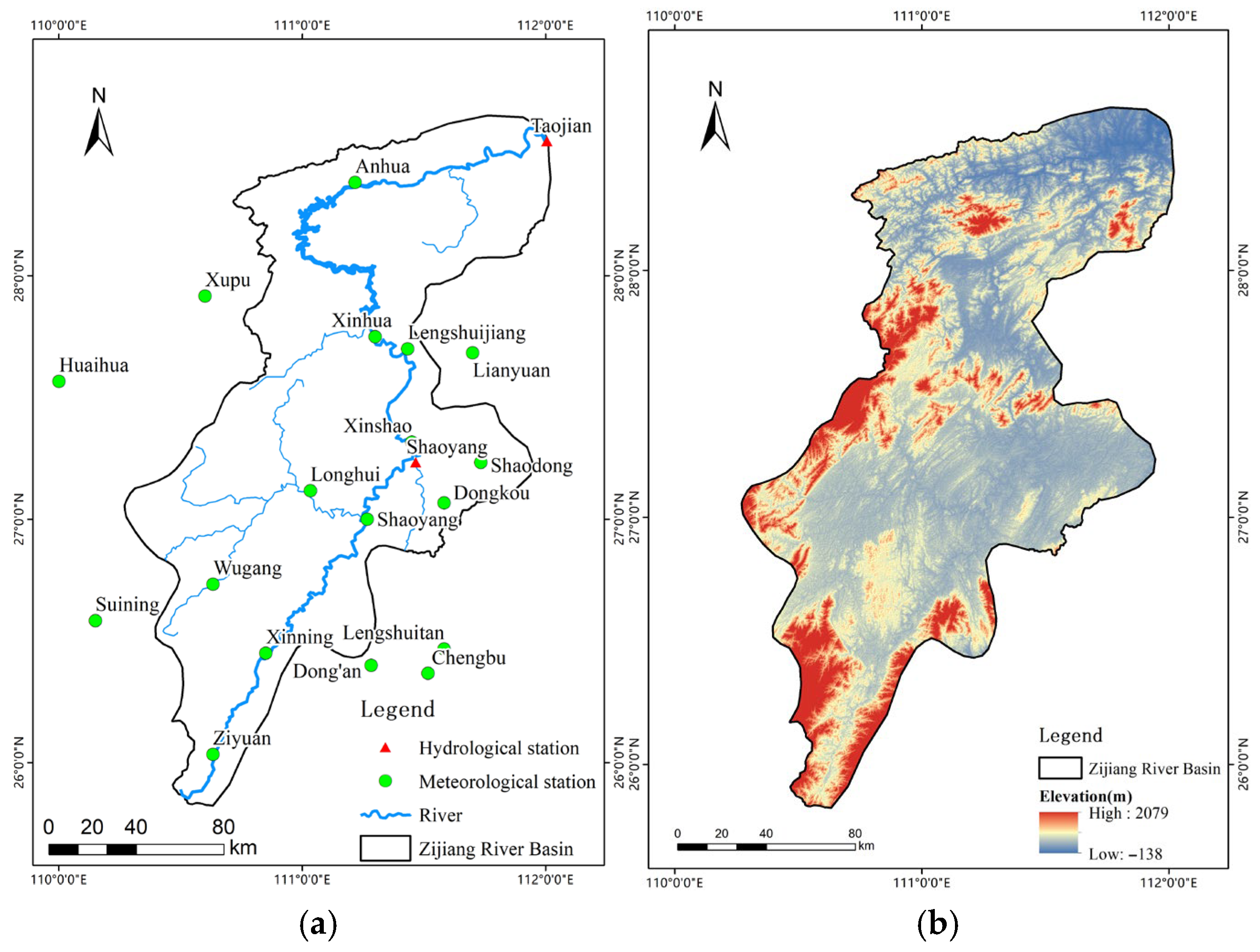
2.1. Study Area
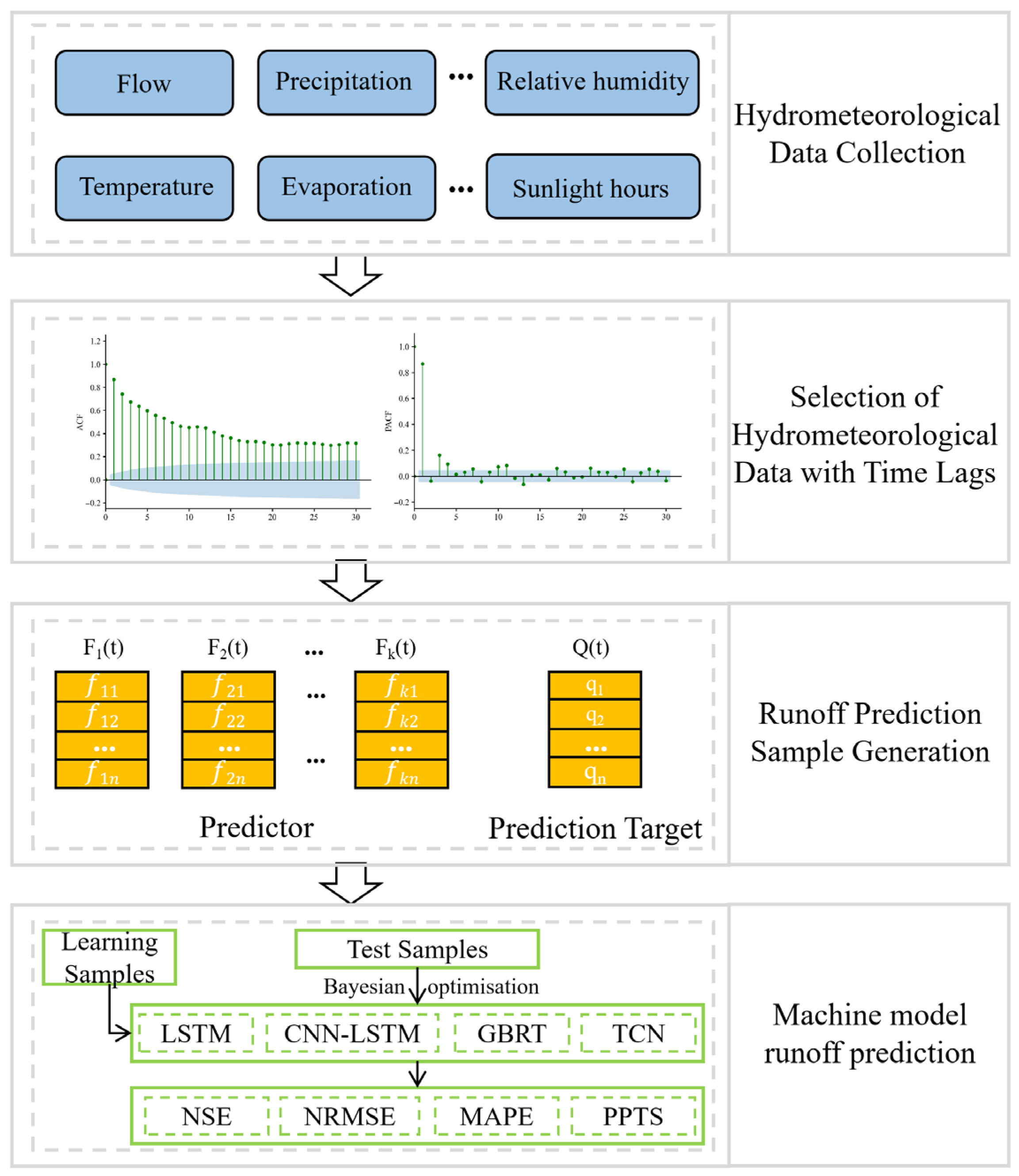
2.2. Data Processing
3. Research Methodology
3.1. Machine Learning Model Structure
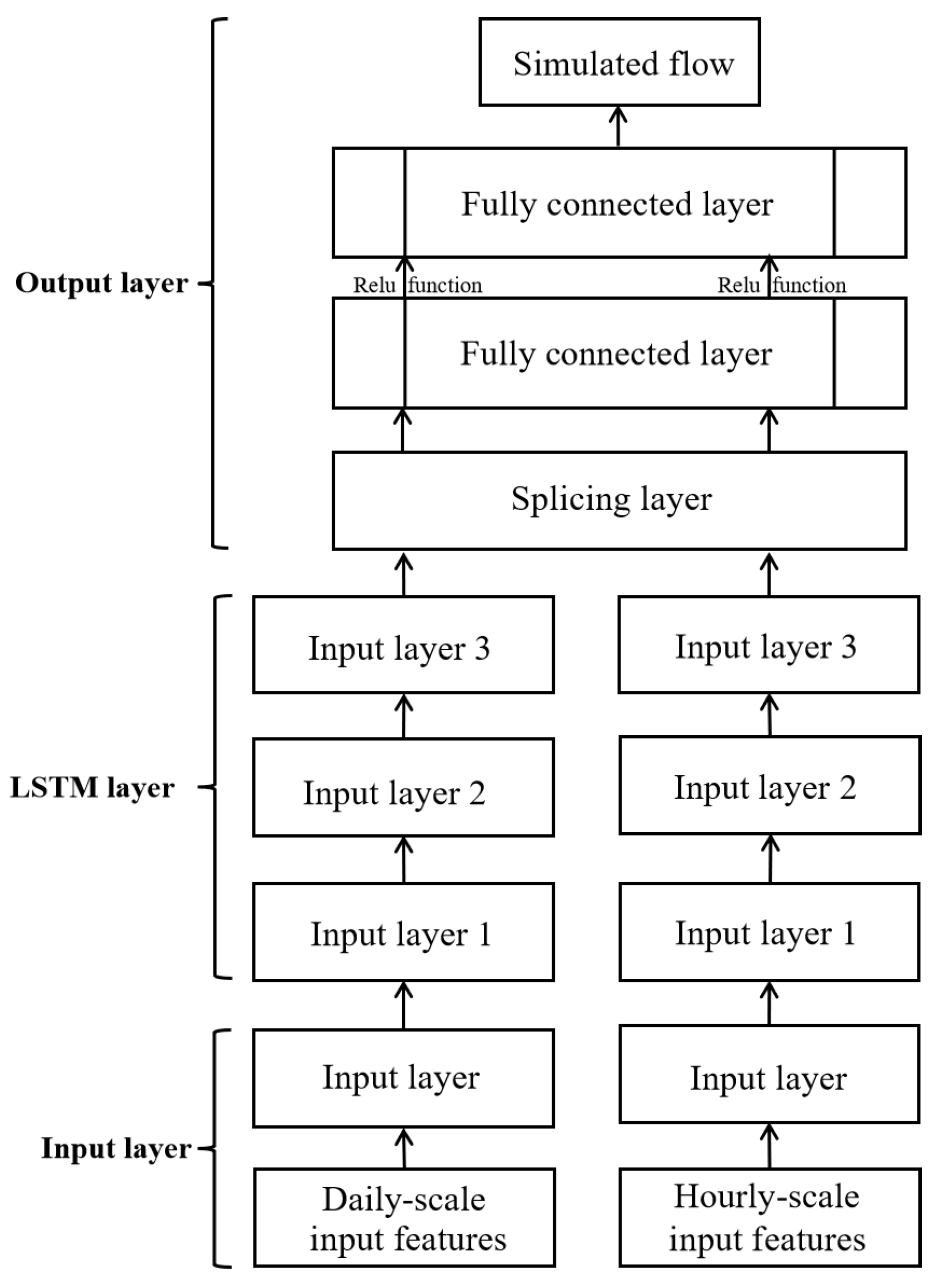
3.1.1. LSTM
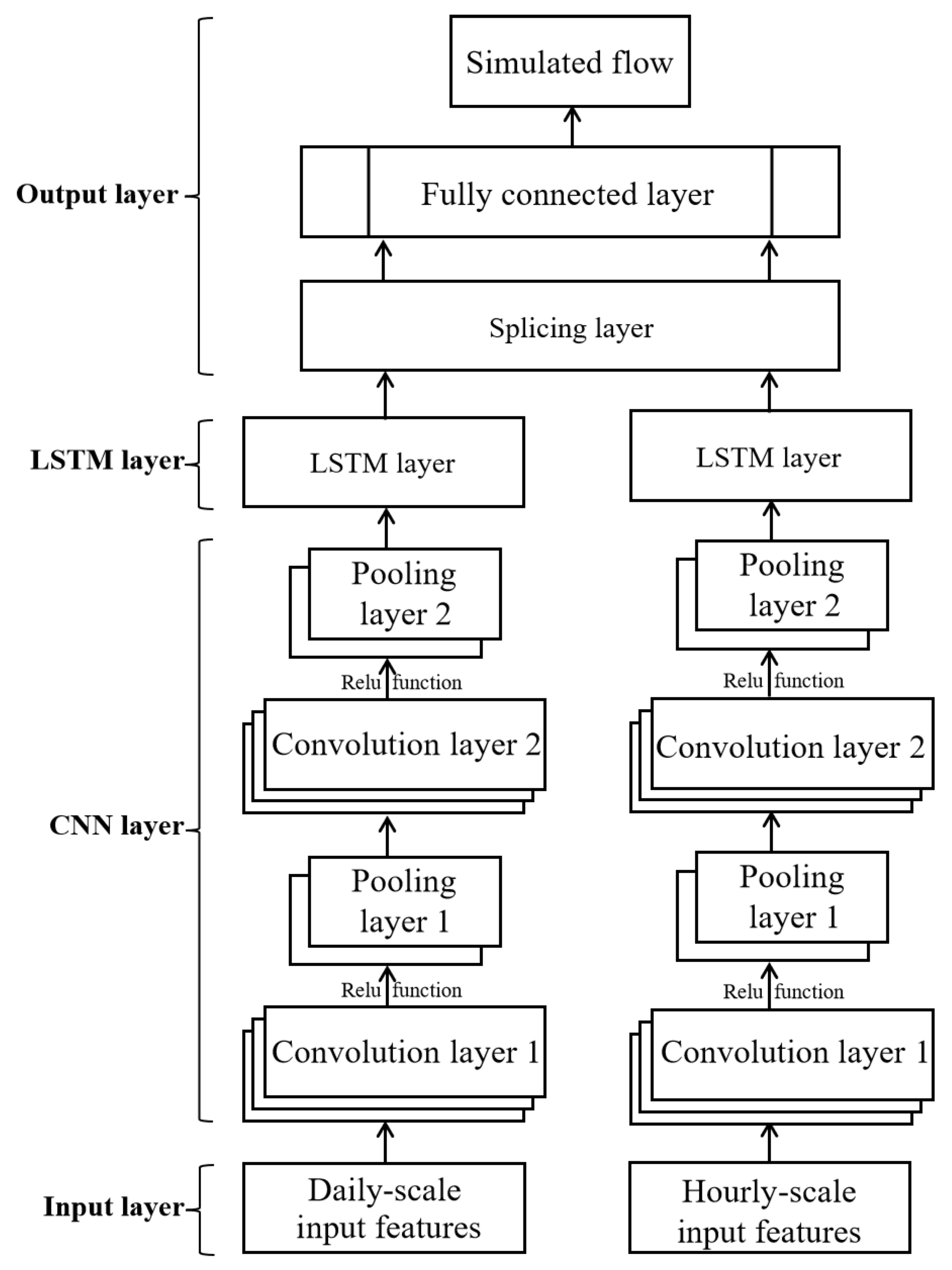
3.1.2. CNN-LSTM
3.1.3. GBRT
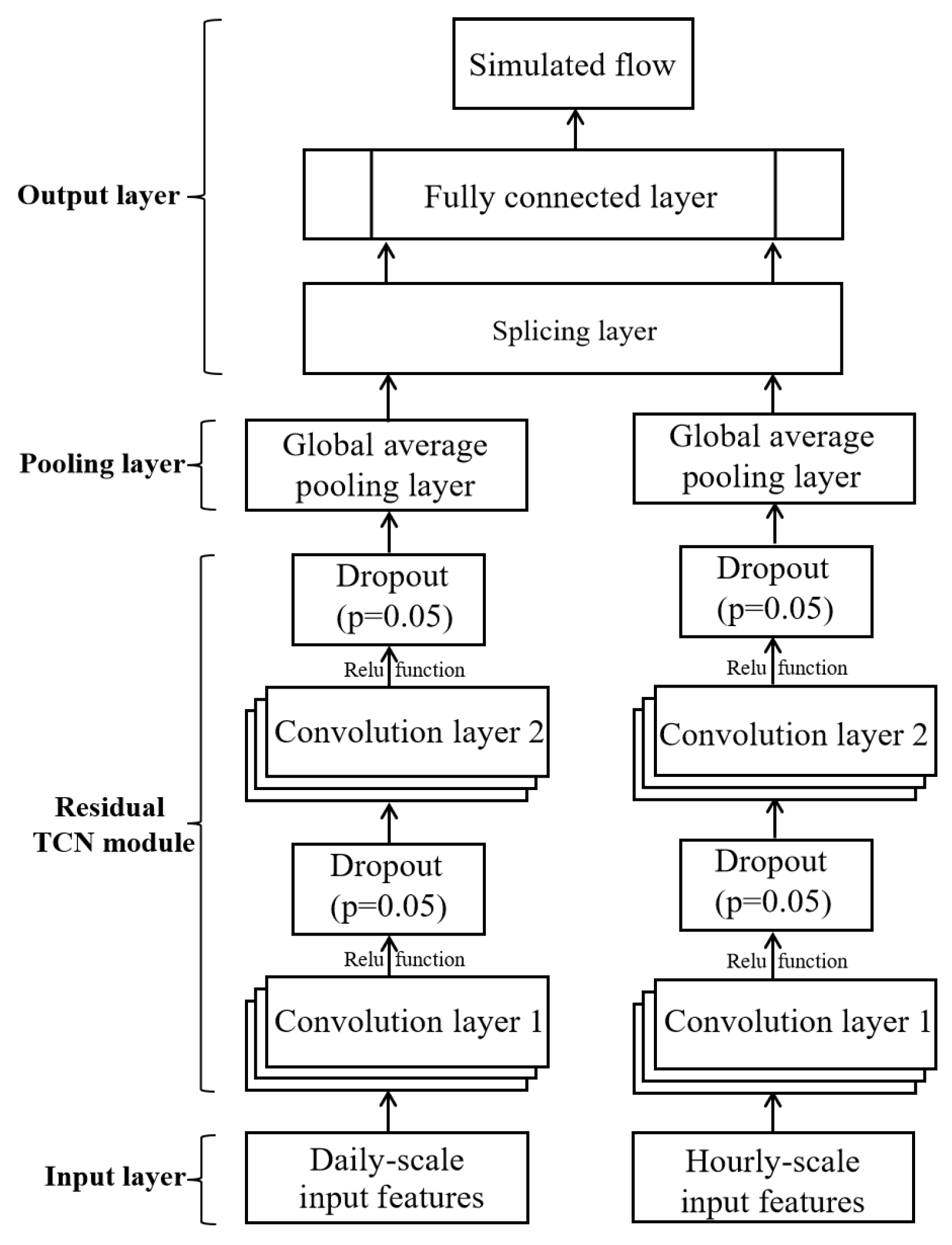
3.1.4. TCN
3.2. SHAP Model Interpretation
3.3. Model Accuracy Evaluation Metrics
4. Results and Analysis
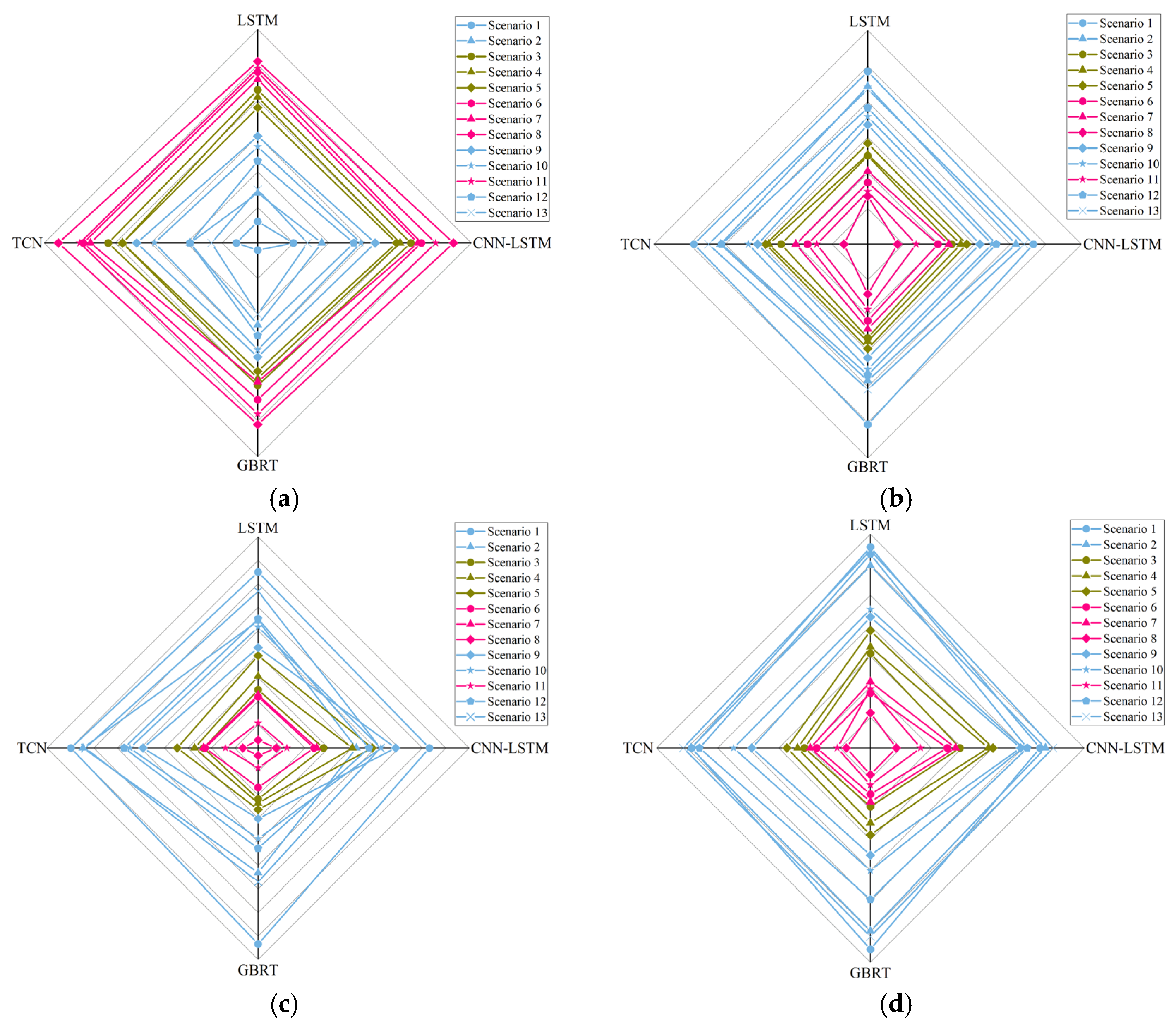
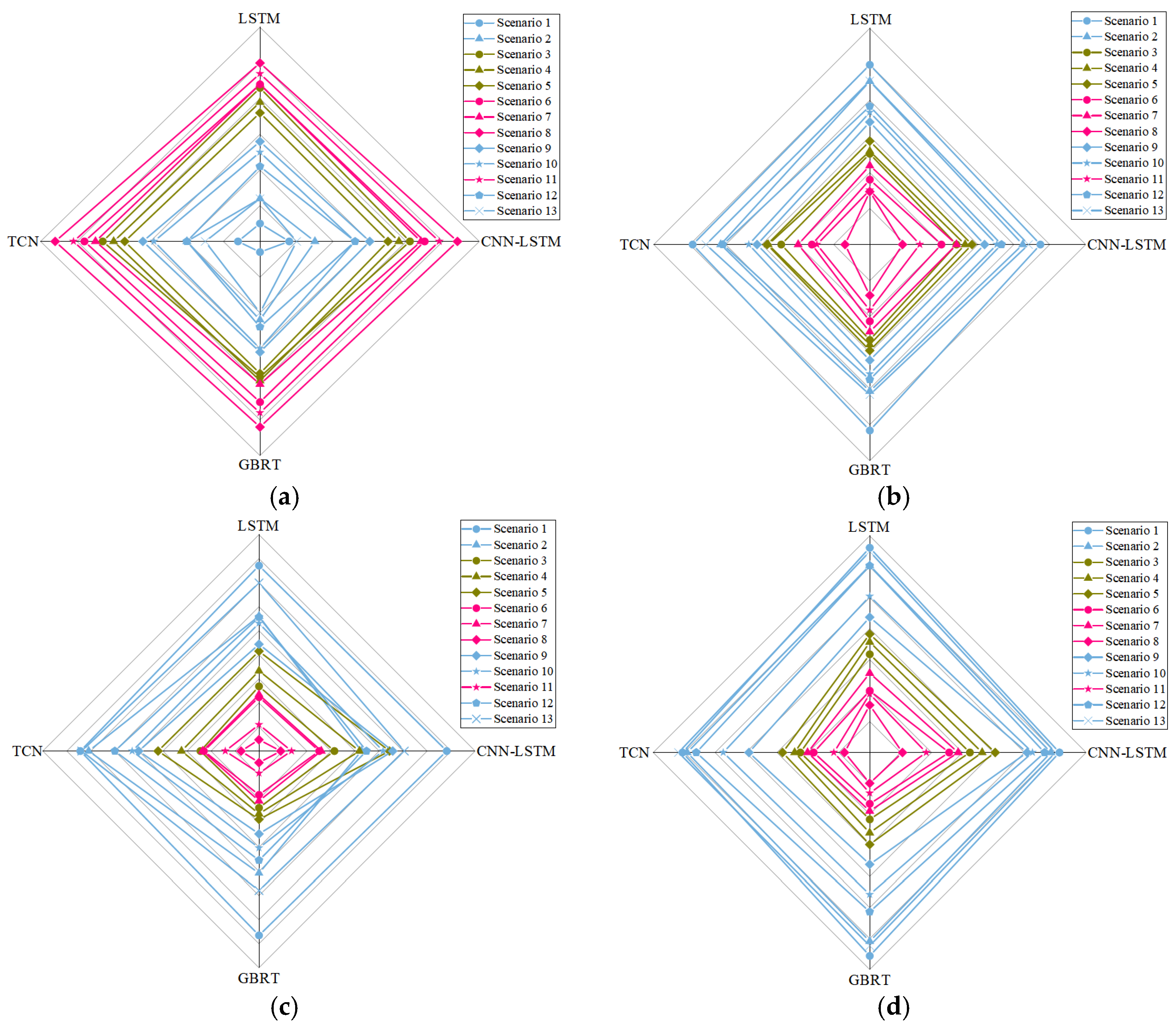
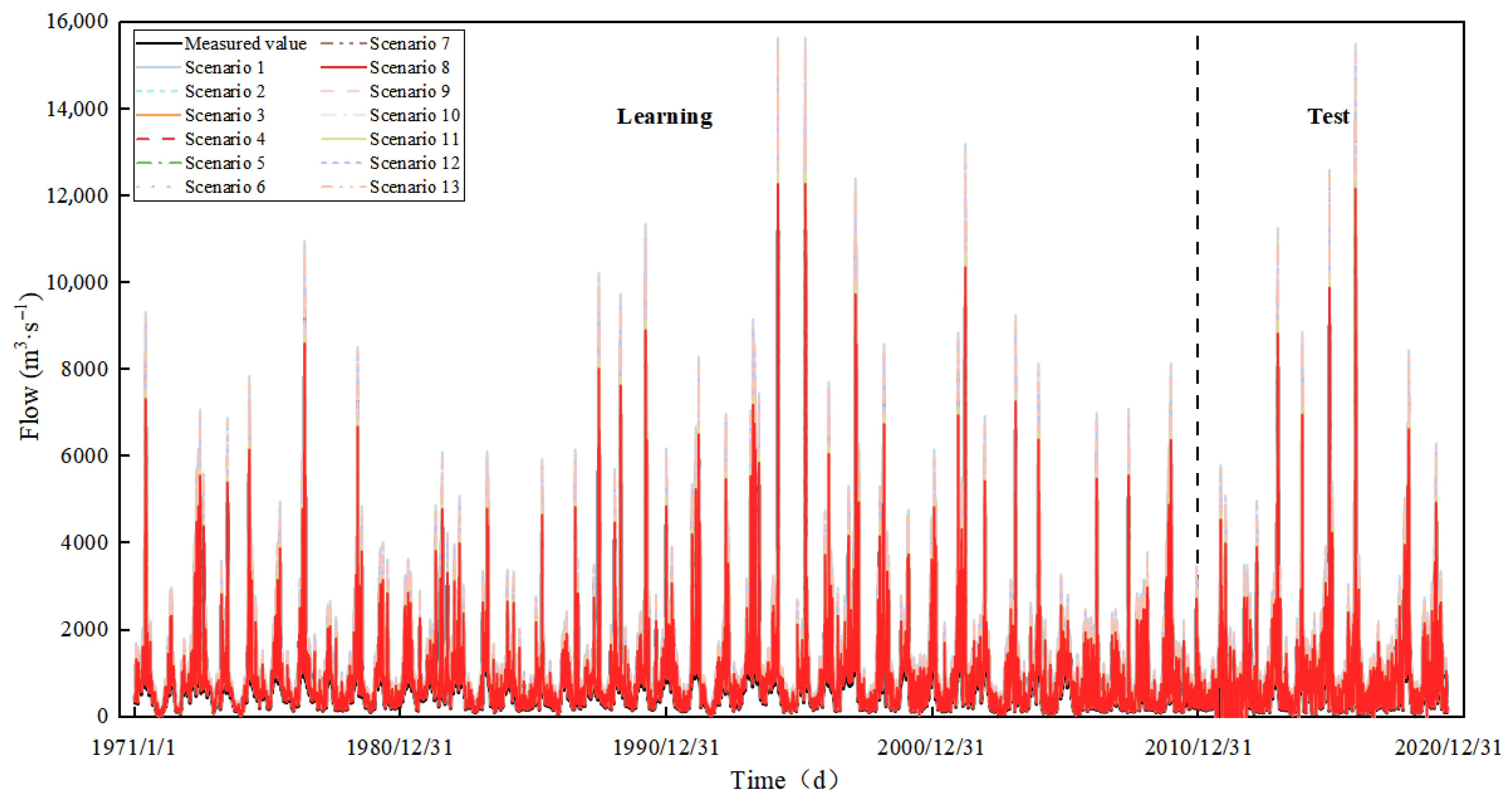
4.1. Comparative Analysis of Model Accuracy
4.2. Runoff Prediction Performance and Driving Mechanism Analysis Under Different Meteorological Factor Combinations
4.3. SHAP Model Interpretability Analysis
5. Discussion
6. Conclusions
- (1)
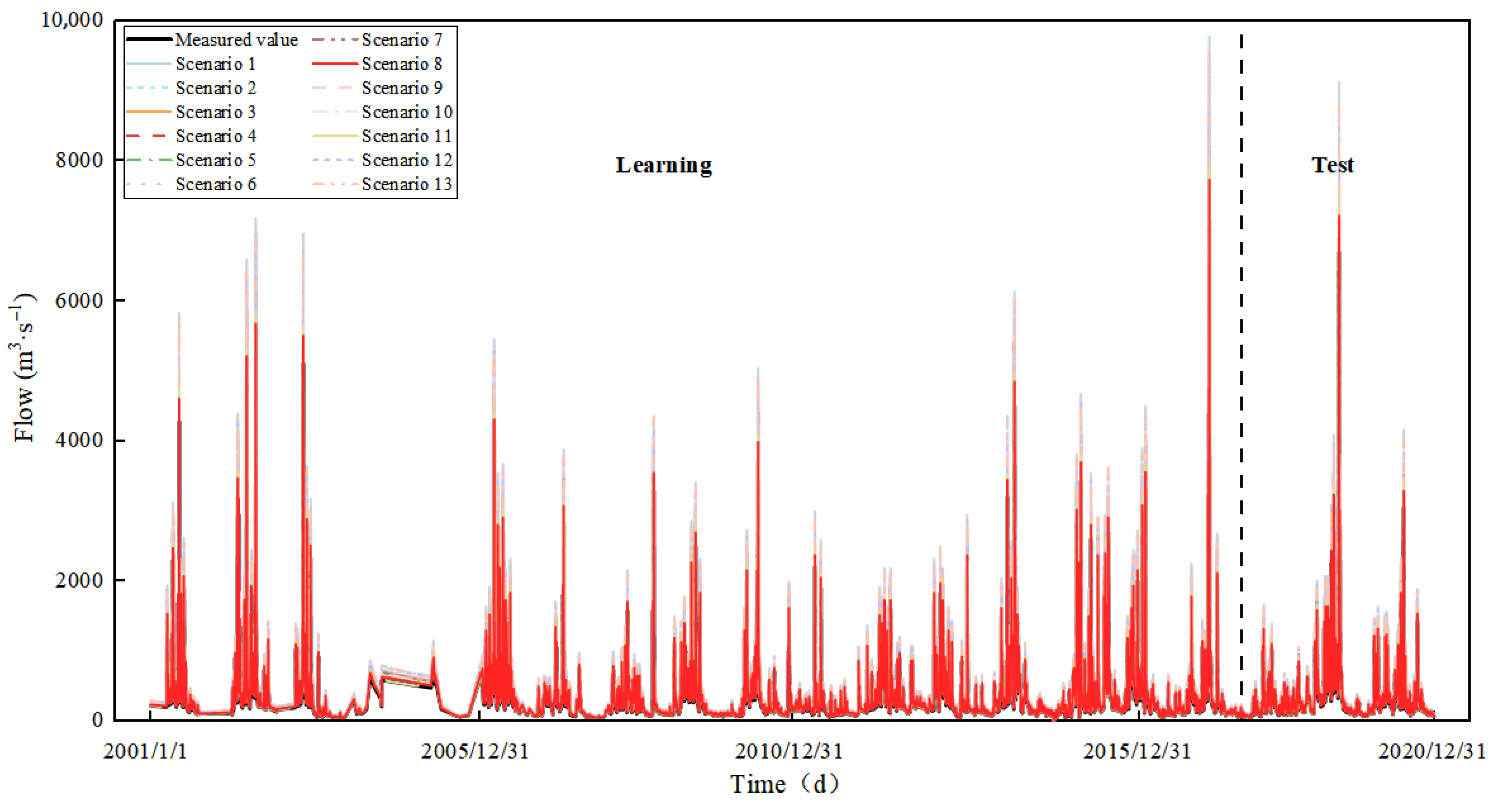
- Among all tested configurations, the TCN model demonstrates the best overall performance under the core input combination of “runoff + precipitation + evaporation + temperature” (Scenario 8), achieving an NSE of 0.96. It also shows strong resilience to redundant factor interference (Scenarios 9–12). The GBRT model performs well in terms of percentage error and peak flow timing prediction. In contrast, the LSTM and CNN-LSTM models are more sensitive to redundant inputs, with substantial increases in prediction errors under full-factor scenarios.
- (2)
- Simulation accuracy improves progressively across core factor combinations (Scenarios 3–8), indicating that adding key variables enhances model performance without triggering efficiency loss. Scenario 8 provides the optimal input dimensionality across all models. Conversely, using full-factor inputs (Scenario 2) or combinations with weakly correlated variables (Scenario 13) introduces significant noise, confirming the hypothesis that “excessive input dimensionality reduces learning efficiency”.
- (3)
- The predictive value of individual meteorological factors is governed by their degree of direct correlation with runoff processes. Variables that directly influence runoff generation or consumption yield far greater improvements in accuracy than those with indirect regulatory effects. Multi-factor combinations do not exhibit additive accuracy gains; rather, the presence of a complete coupling mechanism—encompassing supply, consumption, and regulation—is essential for optimal performance. Scenario 8 improves NSE by 7.9~10.3% compared to binary combinations (Scenarios 6 and 7) and mitigates large deviations in peak flow timing caused by single-factor limitations. The interference effects of redundant factors are closely tied to their secondary synergy with core variables. For instance, when relative humidity is paired with temperature, the resulting decrease in NSE is reduced from 16.9~20.7% to just 6.3%.
- (4)
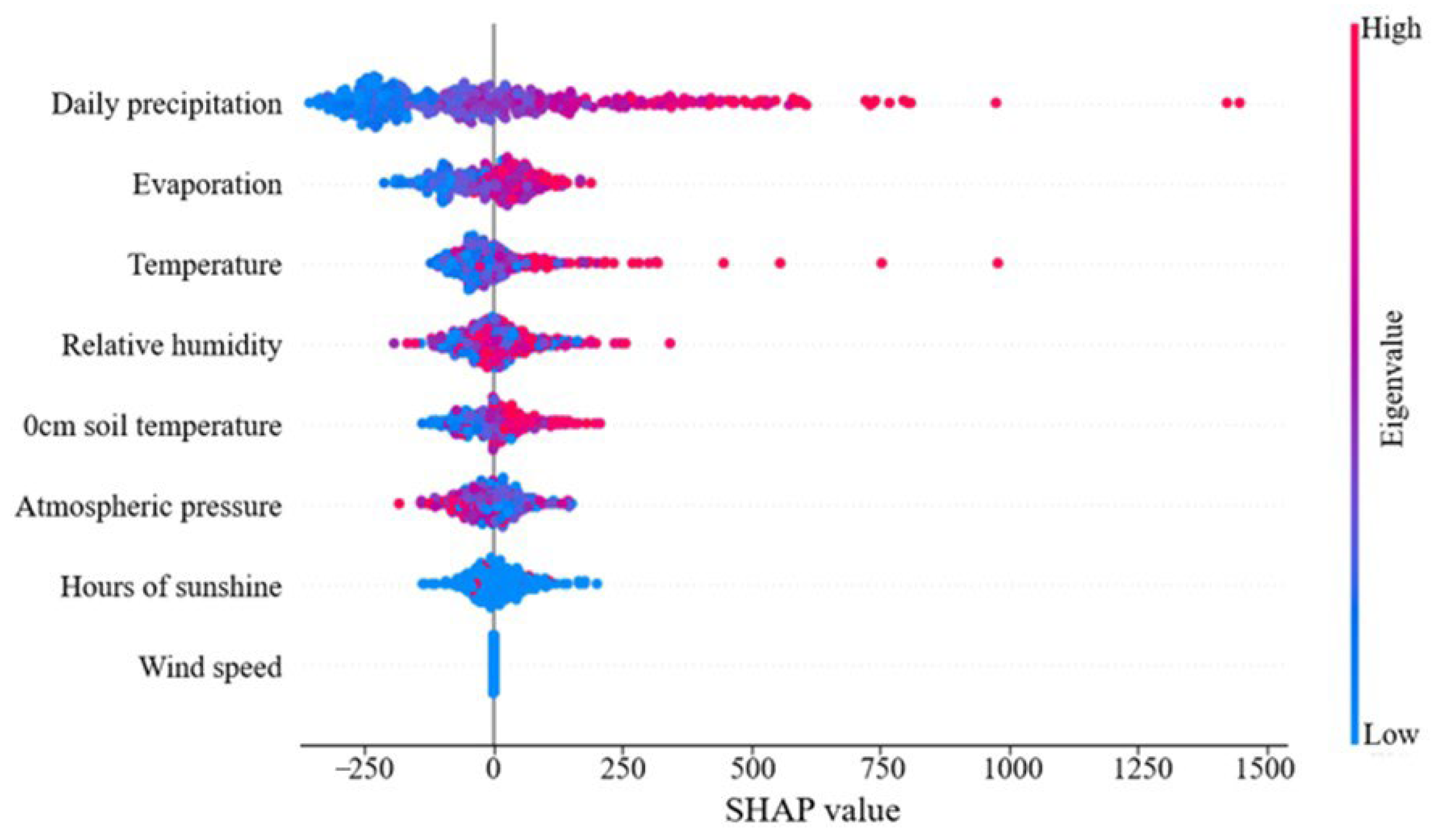
- SHAP analysis reveals that daily precipitation holds the highest average SHAP value (7.8189), identifying it as the most influential driver of runoff. Temperature (6.4520) and evaporation (−7.4823) operate as complementary, indirect regulators, while relative humidity (−5.3683) acts as a suppressive factor. The inclusion of relative humidity and other low-impact variables can exacerbate biases, particularly in peak flow timing predictions. For example, in Scenario 1, which uses only runoff input, the MAPE deviation reaches 59.91%. From an application perspective, a 3D input scheme of “precipitation + evaporation + temperature” is recommended.
Author Contributions
Funding
Data Availability Statement
Conflicts of Interest
Abbreviations
| LSTM | Long Short-term Memory Neural Network |
| CNN | Convolutional Neural Network |
| TCN | Temporal Convolutional Network |
| GBRT | Gradient Boosting Regression Tree |
| SHAP | Shapley Additive Explanations |
| SWAT | Soil and Water Assessment Tool |
| HEC-RAS | Hydrologic Engineering Center-River Analysis System |
| SVR | Support Vector Regression |
| DEM | Digital Elevation Model |
| RNN | Recurrent Neural Network |
| MSELoss | Mean Squared Error Loss |
| NSE | Nash-Sutcliffe Efficiency Coefficient |
| NRMSE | Normalized Root Mean Square Error |
| MAPE | Mean Absolute Percentage Error |
| PPTS | Peak Percentage of Threshold Statistic |
References
- Abdi, E.; Sattari, M.T.; Samadianfard, S.; Ahmad, S. Advancing Hydrological Prediction with Hybrid Quantum Neural Networks: A Comparative Study for Mile Mughan Dam. Water 2025, 17, 3592. [Google Scholar] [CrossRef] [Scilit]
- Lavers, D.A.; Harrigan, S.; Andersson, E.; Richardson, D.S.; Prudhomme, C.; Pappenberger, F. A Vision for Improving Global Flood Forecasting. Environ. Res. Lett. 2019, 14, 121002. [Google Scholar] [CrossRef] [Scilit]
- Sheffield, J.; Wood, E.F.; Pan, M.; Beck, H.; Coccia, G.; Serrat-Capdevila, A.; Verbist, K. Satellite remote sensing for water resources management: Potential for supporting sustainable development in data-poor regions. Water Resour. Res. 2018, 54, 9724–9758. [Google Scholar] [CrossRef] [Scilit]
- De, S.; Farzad, R.; Brewick, P.T.; Johnson, E.A.; Wojtkiewicz, S.F. Likelihood level adapted estimation of marginal likelihood for Bayesian model selection. Comput. Methods Appl. Mech. Eng. 2025, 445, 118141. [Google Scholar] [CrossRef] [Scilit]
- Brewick, P.T.; Farzad, R. Hierarchical Bayesian calibration of Bouc–Wen hysteretic models with applications to seismic isolators. Mech. Syst. Signal Process. 2025, 237, 113021. [Google Scholar] [CrossRef] [Scilit]
- Jeyrani, F.; Morid, S.; Srinivasan, R. Assessing basin blue–green available water components under different management and climate scenarios using SWAT. Agric. Water Manag. 2021, 256, 107074. [Google Scholar] [CrossRef] [Scilit]
- Luo, M.; Liu, T.; Meng, F.; Duan, Y.; Huang, Y.; Frankl, A.; De Maeyer, P. Proportional coefficient method applied to TRMM rainfall data: Case study of hydrological simulations of the Hotan River Basin (China). Water Clim. Change 2017, 8, 627–640. [Google Scholar] [CrossRef] [Scilit]
- Akiyanova, F.; Ongdas, N.; Zinabdin, N.; Karakulov, Y.; Nazhbiyev, A.; Mussagaliyeva, Z.; Atalikhova, A. Operation of Gate-Controlled Irrigation System Using HEC-RAS 2D for Spring Flood Hazard Reduction. Computation 2023, 11, 27. [Google Scholar] [CrossRef] [Scilit]
- Park, N.; Kim, S.; Seo, I.; Yoon, S. Application of LPCF model based on ARIMA model to prediction of water quality change in water supply system. Desalin. Water Treat. 2021, 212, 8–16. [Google Scholar] [CrossRef] [Scilit]
- Cui, L.; Wang, Y.; Zhang, H.; Lv, X.; Lei, K. Use of non-linear multiple regression models for setting water quality criteria for copper: Consider the effects of salinity and dissolved organic carbon. J. Hazard. Mater. 2023, 450, 131107. [Google Scholar] [CrossRef] [Scilit]
- Avila, R.; Horn, B.; Moriarty, E.; Hodson, R.; Moltchanova, E. Evaluating statistical model performance in water quality prediction. J. Environ. Manag. 2018, 206, 910–919. [Google Scholar] [CrossRef] [Scilit]
- Fernandes, A.P.; Fonseca, A.R.; Pacheco, F.A.L.; Fernandes, L.S. Water quality predictions through linear regression-A brute force algorithm approach. Methodsx 2023, 10, 102153. [Google Scholar] [CrossRef] [Scilit]
- Osmane, A.; Zidan, K.; Benaddi, R.; Sbahi, S.; Ouazzani, N.; Belmouden, M.; Mandi, L. Assessment of the effectiveness of a full-scale trickling filter for the treatment of municipal sewage in an arid environment: Multiple linear regression model prediction of fecal coliform removal. J. Water Process Eng. 2024, 64, 105684. [Google Scholar] [CrossRef] [Scilit]
- Ewnetu, S.S.; Dessie, M.; Belete, M.A.; van Griensven, A.; Walraevens, K.; Frankl, A.; Adgo, E.; Verhoest, N.E.C. Spatial and Temporal Evaluation of Gridded Precipitation Products over the Mountainous Lake Tana Basin, Ethiopia. Water 2025, 17, 3536. [Google Scholar] [CrossRef] [Scilit]
- Ma, Q.; Ma, T.; Lu, C.; Cheng, B.; Xie, S.; Gong, L.; Fu, Z.; Liu, C. A Cloud-based Quadruped Service Robot with Multi-Scene Adaptability and various forms of Human-Robot Interaction. IFAC Papers OnLine 2020, 53, 134–139. [Google Scholar] [CrossRef] [Scilit]
- Su, L.; Miao, C.; Duan, Q.; Lei, X.; Li, H. Multiple-wavelet coherence of world’s large rivers with meteorological factors and ocean signals. J. Geophys. Res. Atmos. 2019, 124, 4932–4954. [Google Scholar] [CrossRef] [Scilit]
- Yuan, Y.; Zhou, C.; Wu, J.; Deng, F.; Liu, W.; Sun, M.; Li, L. An Interpretable Deep Learning Framework for River Water Quality Prediction—A Case Study of the Poyang Lake Basin. Water 2025, 17, 2496. [Google Scholar] [CrossRef] [Scilit]
- Chen, Y.; Song, L.; Liu, Y.; Yang, L.; Li, D. A Review of the Artificial Neural Network Models for Water Quality Prediction. Appl. Sci. 2020, 10, 5776. [Google Scholar] [CrossRef] [Scilit]
- Zhi, W.; Appling, A.P.; Golden, H.E.; Podgorski, J.; Li, L. Deep learning for water quality. Nat. Water 2024, 2, 228–241. [Google Scholar] [CrossRef] [Scilit]
- Wellen, C.; Kamran-Disfani, A.-R.; Arhonditsis, G.B. Evaluation of the Current State of Distributed Watershed Nutrient Water Quality Modeling. Environ. Sci. Technol. 2015, 49, 3278–3290. [Google Scholar] [CrossRef] [Scilit]
- Hawtree, D.; Mellander, P.-E.; Adams, R.; Ezzati, G.; Jackson-Blake, L.; Zurovec, O.; Norling, M.; Galloway, J. Application of a Parsimonious Phosphorus Model (SimplyP) to Two Hydrologically Contrasting Agricultural Catchments. Water 2026, 18, 6. [Google Scholar] [CrossRef] [Scilit]
- Chen, Y.C.; Yu, S.R.; Yang, H.C.; Kuo, J.J.; Zeng, M.Y. Fast and Minimally Intrusive Method for Measuring Tidal-Stream Discharge. J. Hydrol. Eng. 2014, 20, 06014011. [Google Scholar] [CrossRef] [Scilit]
- Huang, J.H.; Wang, Z.C.; Wu, J.H.; Yao, Z.Y. Research on Runoff Interval Prediction Based on Deep Learning Ensemble Optimization Model. J. Hydraul. Eng. 2025, 56, 240–252, 265. [Google Scholar]
- Zhu, C.M.; Wu, H.J.; Song, X.Y.; Song, S.B. Application of SVR Model Based on Multi-Factor Combination in Runoff Forecasting of the Songhua River Basin. Water Resour. Power 2021, 39, 12–15 + 41. [Google Scholar]
- Liang, H.; Lin, Y.; Yang, G.; Su, Z.; Wang, W.; Guo, F. Application of Random Forest Algorithm Based on Meteorological Factors in Forest Fire Prediction in the Tahe Area. Sci. Silvae Sin. 2016, 52, 89–98. [Google Scholar]
- Zhang, J.C.; Zhao, Q.; Xu, X.J. Combined Factor Method in Statistical Forecasting. Chin. J. Atmos. Sci. 1978, 2, 48–54. [Google Scholar]
- Wang, X.Y.; Chen, Q.; Du, H.L.; Zhang, R.; Ma, H.L. Study on Evapotranspiration Interpolation in Alpine Wetlands of the Qinghai-Tibet Plateau Based on Machine Learning. Chin. J. Plant Ecol. 2023, 47, 912–921. [Google Scholar] [CrossRef] [Scilit]
- Xie, J.; Hsu, P.C.; Hu, Y.; Zhang, H.; Ye, M. Advancing subseasonal surface air temperature and heat wave prediction skill in China by incorporating scale interaction in a deep learning model. Geophys. Res. Lett. 2024, 51, e2024GL111076. [Google Scholar] [CrossRef] [Scilit]
- Li, R.; Feng, K.; An, T.; Cheng, P.; Wei, L.; Zhao, Z.; Xu, X.; Zhu, L. Enhanced Insights into Effluent Prediction in Wastewater Treatment Plants: Comprehensive Deep Learning Model Explanation Based on SHAP. ACS ES&T Water 2024, 4, 1904–1915. [Google Scholar] [CrossRef] [Scilit]
- Fan, Z.X.; Wang, Y.; Wang, R.T. Precipitation Forecasting Based on Interpretability of Neural Network Models. J. Trop. Meteorol. 2024, 40, 1030–1044. [Google Scholar]
- Ma, C.Z.; Yao, J.Q.; Mo, Y.X.; Zhou, G.X.; Xu, Y.; He, X.M. Prediction of summer precipitation via machine learning with key climate variables: A case study in Xinjiang, China. J. Hydrol. Reg. Stud. 2024, 56, 101964. [Google Scholar] [CrossRef] [Scilit]
- Li, B.; Zhang, X.P.; Yang, L.; Xia, Y. Spatiotemporal Variation Characteristics and Recurrence Period Calculation of Extreme Precipitation in the Zishui River Basin, Hunan Province. J. Irrig. Drain. 2019, 38, 117–128. [Google Scholar]
- Long, Y.N.; Zhang, Y.L.; Jiang, C.B.; Mo, J.C.; Huang, C.F.; Song, X.Y. Runoff Response of the Zishui River Basin Under Climate Change Based on CMIP6. Res. Soil Water Conserv. 2024, 31, 114–125. [Google Scholar]
- Muñoz-Sabater, J.; Dutra, E.; AgustígPanareda, A.; Albergel, C.; Arduini, G.; Balsamo, G.; Boussetta, S.; Choulga, M.; Harrigan, S.; Hersbach, H.; et al. ERA5-Land: A State-of-the-Art Global Reanalysis Dataset for Land Applications. Earth Syst. Sci. Data 2021, 13, 4349–4383. [Google Scholar] [CrossRef] [Scilit]
- Yang, G.; Shi, H.J.; Jiang, Y.M.; Wu, Y.F.; Wang, Y.; Li, J. Spatiotemporal Variation Characteristics and Influencing Factors of Drought on the Loess Plateau Based on Daily-Scale SPEI. Res. Soil Water Conserv. 2025, 32, 244–254. [Google Scholar]
- Li, Z.; Peng, S.; Zheng, G.; Chu, X.; Tian, Y. Prediction of Daily Water Consumption in Residential Areas Based on Meteorologic Conditions—Applying Gradient Boosting Regression Tree Algorithm. Water 2023, 15, 3455. [Google Scholar] [CrossRef] [Scilit]
- Sadiki, N.; Jang, D.-W. Estimation of Hydraulic and Water Quality Parameters Using Long Short-Term Memory in Water Distribution Systems. Water 2024, 16, 3028. [Google Scholar] [CrossRef] [Scilit]
- Agarwal, H.; Mahajan, G.; Shrotriya, A.; Shekhawat, D. Predictive data analysis: Leveraging RNN and LSTM techniques for time series dataset. Procedia Comput. Sci. 2024, 235, 979–989. [Google Scholar] [CrossRef] [Scilit]
- Swiderski, B.; Osowski, S.; Gwardys, G.; Kurek, J.; Slowinska, M.; Lugowska, I. Random CNN structure: Tool to increase generalization ability in deep learning. Eurasip. J. Image Video Process. 2022, 2022, 3. [Google Scholar] [CrossRef] [Scilit]
- Wang, G.Q.; Ruan, Y.L.; Wang, H.X.; Zhao, G.; Cao, X.X.; Li, X.M.; Ding, Q.J. Tribological performance study and prediction of copper coated by MoS2 based on GBRT method. Tribol. Int. 2023, 179, 108149. [Google Scholar] [CrossRef] [Scilit]
- Zhang, Z.; Yang, W.; Wushour, S. Traffic Accident Prediction Based on LSTM-GBRT Model. J. Control Sci. Eng. 2020, 2020, 4206919. [Google Scholar] [CrossRef] [Scilit]
- Xiang, X.; Guo, S.L.; Li, C.L.; Wang, Y. An explainable deep learning model based on hydrological principles for flood simulation and forecasting. Hydrol. Earth Syst. Sci. 2025, 29, 7217–7239. [Google Scholar] [CrossRef] [Scilit]
- Chen, C.; Li, B.; Zhang, H.; Zhao, M.; Liang, Z.; Li, K.; An, X. Performance enhancement of deep learning model with attention mechanism and FCN model in flood forecasting. J. Hydrol. 2025, 658, 133221. [Google Scholar] [CrossRef] [Scilit]
- Bai, S.; Kolter, J.Z.; Koltun, V. An Empirical Evaluation of Generic Convolutional and Recurrent Networks for Sequence Modeling. arXiv 2018, arXiv:1803.01271. [Google Scholar] [CrossRef] [Scilit]
- Xu, Y.; Hu, C.; Wu, Q.; Li, Z.; Jian, S.; Chen, Y. Application of temporal convolutional network for flood forecasting. Hydrol. Res. 2021, 52, 1455–1468. [Google Scholar] [CrossRef] [Scilit]
- Soleymani Hasani, S.; Arias, M.E.; Nguyen, H.Q.; Tarabih, O.M.; Welch, Z.; Zhang, Q. Leveraging explainable machine learning for enhanced management of lake water quality. J. Environ. Manag. 2024, 370, 122890. [Google Scholar] [CrossRef] [Scilit]
- Liu, Y.C.; Liu, Z.H.; Luo, X.; Zhao, H.H.T. Diagnosis of Parkinson’s disease based on SHAP value feature selection. Biocybern. Biomed. Eng. 2022, 42, 856–869. [Google Scholar] [CrossRef] [Scilit]
- Si, W.A.; Huang, Y.; Liu, T.; Li, Z.X.; Zan, C.J.; Wang, X.F. Runoff Simulation in the Source Area of the Yarkant River Based on Deep Learning and Air Temperature Spatial Field. Prog. Geogr. 2025, 44, 631–641. [Google Scholar]
- Mianabadi, A.; Coenders-Gerrits, M.; Shirazi, P.; Bijan Ghahraman, B.; Alizadeh, A. A global Budyko model to partition evaporation into interception and transpiration. Hydrol. Earth Syst. Sci. 2019, 23, 4983–5000. [Google Scholar] [CrossRef] [Scilit]
- Berghuijs, W.R.; Larsen, J.R.; van Emmerik, T.H.M.; Woods, R.A. A Global Assessment of Runoff Sensitivity to Changes in Precipitation, Potential Evaporation, and Other Factors. Water Resour. Res. 2017, 53, 8475–8486. [Google Scholar] [CrossRef] [Scilit]
- Khozani, Z.S.; Precht, E.; Ionita, M. Weekly streamflow forecasting of Rhine river based on machine learning approaches. Nat. Hazards 2025, 121, 4135–4153. [Google Scholar] [CrossRef] [Scilit]
- Li, J.; Sheng, F.; Liu, S.Y.; Zhang, T.; Yu, M.Q. Characteristics of baseflow variation and its response to precipitation in the Jiuqushui watershed of southern Jiangxi, subtropical China. Chin. J. Appl. Ecol. 2022, 33, 2251–2259. [Google Scholar]
- Kim, Y.; Garcia, M.; Morillas, L.; Weber, U.; Black, T.A.; Johnson, M.S. Relative humidity gradients as a key constraint on terrestrial water and energy fluxes. Hydrol. Earth Syst. Sci. 2021, 25, 5175–5196. [Google Scholar] [CrossRef] [Scilit]
- Fathi, M.M.; Al Mehedi, M.A.; Smith, V.; Fernandes, A.M.; Hren, M.T.; Terry, D.O., Jr. Evaluation of LSTM vs. conceptual models for hourly rainfall runoff simulations with varied training period lengths. Sci. Rep. 2025, 15, 15820. [Google Scholar] [CrossRef] [Scilit] [PubMed]
- Zhang, M.F.; Ding, B.B.; Jia, G.D.; Yu, X.X. Comparative Runoff Prediction for the Beiluo River Based on TCN-BiLSTM and LSTM Models. J. Beijing For. Univ. 2024, 46, 141–148. [Google Scholar]



| Scenario No. | Input Feature Combination | Basis for Construction |
|---|---|---|
| Scenario 1 | Single runoff | Baseline control group |
| Scenario 2 | Runoff + All meteorological factors | |
| Scenario 3 | Runoff + Precipitation | Core factor dominance validation |
| Scenario 4 | Runoff + Evaporation | |
| Scenario 5 | Runoff + Temperature | |
| Scenario 6 | Runoff + Precipitation + Evaporation | |
| Scenario 7 | Runoff + Precipitation + Temperature | |
| Scenario 8 | Runoff + Precipitation + Evaporation + Temperature | Multi-factor synergy validation |
| Scenario 9 | Runoff + Precipitation + Evaporation + Relative humidity | |
| Scenario 10 | Runoff + Precipitation + Temperature + Relative humidity | |
| Scenario 11 | Runoff + Precipitation + Evaporation + Temperature + Relative humidity | |
| Scenario 12 | Runoff + Precipitation + Evaporation + Temperature + Relative humidity + Air pressure | Weak factor and core factor interaction validation |
| Scenario 13 | Runoff + Precipitation + Air pressure + Surface ground temperature + Sunlight hours + Wind speed and direction |
| Model | Evaluation Indicators | Scenario 1 | Scenario 2 | Scenario 3 | Scenario 4 | Scenario 5 | Scenario 6 | Scenario 7 | Scenario 8 | Scenario 9 | Scenario 10 | Scenario 11 | Scenario 12 | Scenario 13 |
|---|---|---|---|---|---|---|---|---|---|---|---|---|---|---|
| LSTM | NSE | 0.46 | 0.54 | 0.83 | 0.81 | 0.78 | 0.88 | 0.86 | 0.91 | 0.70 | 0.67 | 0.89 | 0.63 | 0.55 |
| NRMSE | 0.0585 | 0.0543 | 0.0348 | 0.0352 | 0.0383 | 0.0273 | 0.0305 | 0.0235 | 0.0435 | 0.0458 | 0.0248 | 0.0483 | 0.0535 | |
| MAPE | 57.49 | 47.10 | 32.40 | 35.28 | 39.67 | 30.92 | 31.25 | 21.69 | 41.39 | 45.79 | 25.32 | 47.52 | 53.39 | |
| PPTS | 85.74 | 79.66 | 50.90 | 53.08 | 58.42 | 37.98 | 41.68 | 31.49 | 62.88 | 65.36 | 39.32 | 83.41 | 84.65 | |
| CNN-LSTM | NSE | 0.50 | 0.58 | 0.83 | 0.80 | 0.79 | 0.86 | 0.85 | 0.95 | 0.73 | 0.69 | 0.90 | 0.67 | 0.54 |
| NRMSE | 0.0565 | 0.0516 | 0.0336 | 0.0361 | 0.0378 | 0.0297 | 0.0328 | 0.0184 | 0.0415 | 0.0449 | 0.0236 | 0.0461 | 0.0539 | |
| MAPE | 56.49 | 40.94 | 33.95 | 40.09 | 44.32 | 31.91 | 32.51 | 23.86 | 49.33 | 46.15 | 26.11 | 43.61 | 46.07 | |
| PPTS | 75.46 | 77.29 | 49.30 | 58.62 | 60.11 | 45.15 | 47.91 | 28.48 | 69.14 | 69.93 | 36.45 | 71.33 | 79.77 | |
| GBRT | NSE | 0.42 | 0.63 | 0.80 | 0.78 | 0.76 | 0.84 | 0.79 | 0.91 | 0.72 | 0.70 | 0.88 | 0.66 | 0.60 |
| NRMSE | 0.0606 | 0.0483 | 0.0363 | 0.0373 | 0.0393 | 0.0315 | 0.0338 | 0.0240 | 0.0419 | 0.0451 | 0.0283 | 0.0467 | 0.0508 | |
| MAPE | 61.71 | 46.56 | 30.88 | 31.78 | 33.11 | 28.42 | 29.70 | 21.60 | 35.06 | 39.32 | 24.23 | 41.38 | 48.53 | |
| PPTS | 85.79 | 79.78 | 39.21 | 44.50 | 48.45 | 35.13 | 37.58 | 28.74 | 55.09 | 60.11 | 32.11 | 69.49 | 81.57 | |
| TCN | NSE | 0.46 | 0.59 | 0.82 | 0.78 | 0.78 | 0.89 | 0.87 | 0.96 | 0.74 | 0.69 | 0.90 | 0.59 | 0.53 |
| NRMSE | 0.0588 | 0.0513 | 0.0343 | 0.0378 | 0.0386 | 0.0269 | 0.0302 | 0.0167 | 0.0409 | 0.0435 | 0.0243 | 0.0510 | 0.0547 | |
| MAPE | 59.91 | 57.31 | 31.60 | 33.54 | 37.23 | 31.32 | 31.65 | 23.27 | 44.53 | 47.32 | 26.96 | 48.55 | 56.80 | |
| PPTS | 78.46 | 78.66 | 41.58 | 43.80 | 47.32 | 37.52 | 39.63 | 27.90 | 58.80 | 64.75 | 30.85 | 75.88 | 81.23 |
| Model | Evaluation Indicators | Scenario 1 | Scenario 2 | Scenario 3 | Scenario 4 | Scenario 5 | Scenario 6 | Scenario 7 | Scenario 8 | Scenario 9 | Scenario 10 | Scenario 11 | Scenario 12 | Scenario 13 |
|---|---|---|---|---|---|---|---|---|---|---|---|---|---|---|
| LSTM | NSE | 0.45 | 0.52 | 0.83 | 0.79 | 0.76 | 0.84 | 0.84 | 0.90 | 0.68 | 0.65 | 0.87 | 0.61 | 0.52 |
| NRMSE | 0.0599 | 0.0553 | 0.0352 | 0.0359 | 0.0387 | 0.0280 | 0.0319 | 0.0247 | 0.044 | 0.0467 | 0.0251 | 0.0484 | 0.0554 | |
| MAPE | 58.57 | 48.05 | 33.45 | 36.67 | 40.77 | 31.22 | 31.73 | 22.37 | 42.20 | 46.58 | 25.49 | 47.83 | 54.97 | |
| PPTS | 86.16 | 80.45 | 51.75 | 55.69 | 58.27 | 39.94 | 45.65 | 35.31 | 63.74 | 70.46 | 38.88 | 80.34 | 84.96 | |
| CNN-LSTM | NSE | 0.48 | 0.55 | 0.81 | 0.78 | 0.75 | 0.85 | 0.84 | 0.94 | 0.70 | 0.66 | 0.89 | 0.66 | 0.50 |
| NRMSE | 0.0574 | 0.0525 | 0.0341 | 0.0365 | 0.0384 | 0.0299 | 0.0341 | 0.0191 | 0.0419 | 0.0453 | 0.0239 | 0.0466 | 0.0541 | |
| MAPE | 59.07 | 41.33 | 35.71 | 40.92 | 47.15 | 32.54 | 32.98 | 24.53 | 47.84 | 45.83 | 26.78 | 42.39 | 50.26 | |
| PPTS | 81.34 | 78.57 | 52.39 | 56.38 | 60.56 | 45.68 | 48.60 | 30.57 | 70.89 | 72.63 | 38.27 | 76.52 | 80.08 | |
| GBRT | NSE | 0.43 | 0.62 | 0.78 | 0.79 | 0.77 | 0.85 | 0.80 | 0.92 | 0.71 | 0.70 | 0.88 | 0.64 | 0.60 |
| NRMSE | 0.0616 | 0.0507 | 0.0365 | 0.0378 | 0.0394 | 0.0313 | 0.0342 | 0.0241 | 0.0421 | 0.0459 | 0.0282 | 0.0475 | 0.0517 | |
| MAPE | 58.26 | 45.39 | 31.80 | 33.04 | 34.21 | 29.11 | 30.36 | 22.41 | 37.23 | 40.17 | 24.61 | 42.71 | 48.95 | |
| PPTS | 85.61 | 80.91 | 41.62 | 45.95 | 49.73 | 36.57 | 38.92 | 29.93 | 56.15 | 65.81 | 33.13 | 71.38 | 82.33 | |
| TCN | NSE | 0.46 | 0.60 | 0.83 | 0.8 | 0.77 | 0.88 | 0.85 | 0.96 | 0.72 | 0.69 | 0.91 | 0.60 | 0.55 |
| NRMSE | 0.0592 | 0.0514 | 0.0346 | 0.0382 | 0.0385 | 0.0261 | 0.0299 | 0.0169 | 0.0413 | 0.0436 | 0.0247 | 0.0508 | 0.0555 | |
| MAPE | 57.19 | 55.47 | 32.19 | 36.13 | 41.01 | 31.49 | 31.72 | 23.72 | 45.07 | 46.39 | 27.03 | 50.02 | 56.91 | |
| PPTS | 80.55 | 79.04 | 42.44 | 44.26 | 48.18 | 38.11 | 40.10 | 28.14 | 59.07 | 67.35 | 31.61 | 76.09 | 81.86 |
| Meteorological Features | SHAP Value | Meteorological Features | SHAP Value |
|---|---|---|---|
| Precipitation | 7.8189 | Surface ground temperature | 2.6512 |
| Evaporation | −7.4823 | Air pressure | 2.3833 |
| Air temperature | 6.4520 | Sunlight hours | 0.8711 |
| Relative humidity | −5.3683 | Air Velocity | 0.1236 |
Disclaimer/Publisher’s Note: The statements, opinions and data contained in all publications are solely those of the individual author(s) and contributor(s) and not of MDPI and/or the editor(s). MDPI and/or the editor(s) disclaim responsibility for any injury to people or property resulting from any ideas, methods, instructions or products referred to in the content. |
© 2026 by the authors. Licensee MDPI, Basel, Switzerland. This article is an open access article distributed under the terms and conditions of the Creative Commons Attribution (CC BY) license.
Share and Cite
Ma, K.; Jiang, C.; Long, Y.; Wu, Z.; Yan, S. Enhanced Runoff Prediction in Zijiang River Basin Using Machine Learning and SHAP-Based Interpretability. Water 2026, 18, 601. https://doi.org/10.3390/w18050601
Ma K, Jiang C, Long Y, Wu Z, Yan S. Enhanced Runoff Prediction in Zijiang River Basin Using Machine Learning and SHAP-Based Interpretability. Water. 2026; 18(5):601. https://doi.org/10.3390/w18050601
Chicago/Turabian StyleMa, Kaiwen, Changbo Jiang, Yuannan Long, Zhiyuan Wu, and Shixiong Yan. 2026. "Enhanced Runoff Prediction in Zijiang River Basin Using Machine Learning and SHAP-Based Interpretability" Water 18, no. 5: 601. https://doi.org/10.3390/w18050601
APA StyleMa, K., Jiang, C., Long, Y., Wu, Z., & Yan, S. (2026). Enhanced Runoff Prediction in Zijiang River Basin Using Machine Learning and SHAP-Based Interpretability. Water, 18(5), 601. https://doi.org/10.3390/w18050601