Chasing a Complete Understanding of the Yanshangou Landslide in the Baihetan Reservoir Area

 ,
,  and
and
Abstract
1. Introduction
2. Geological Background
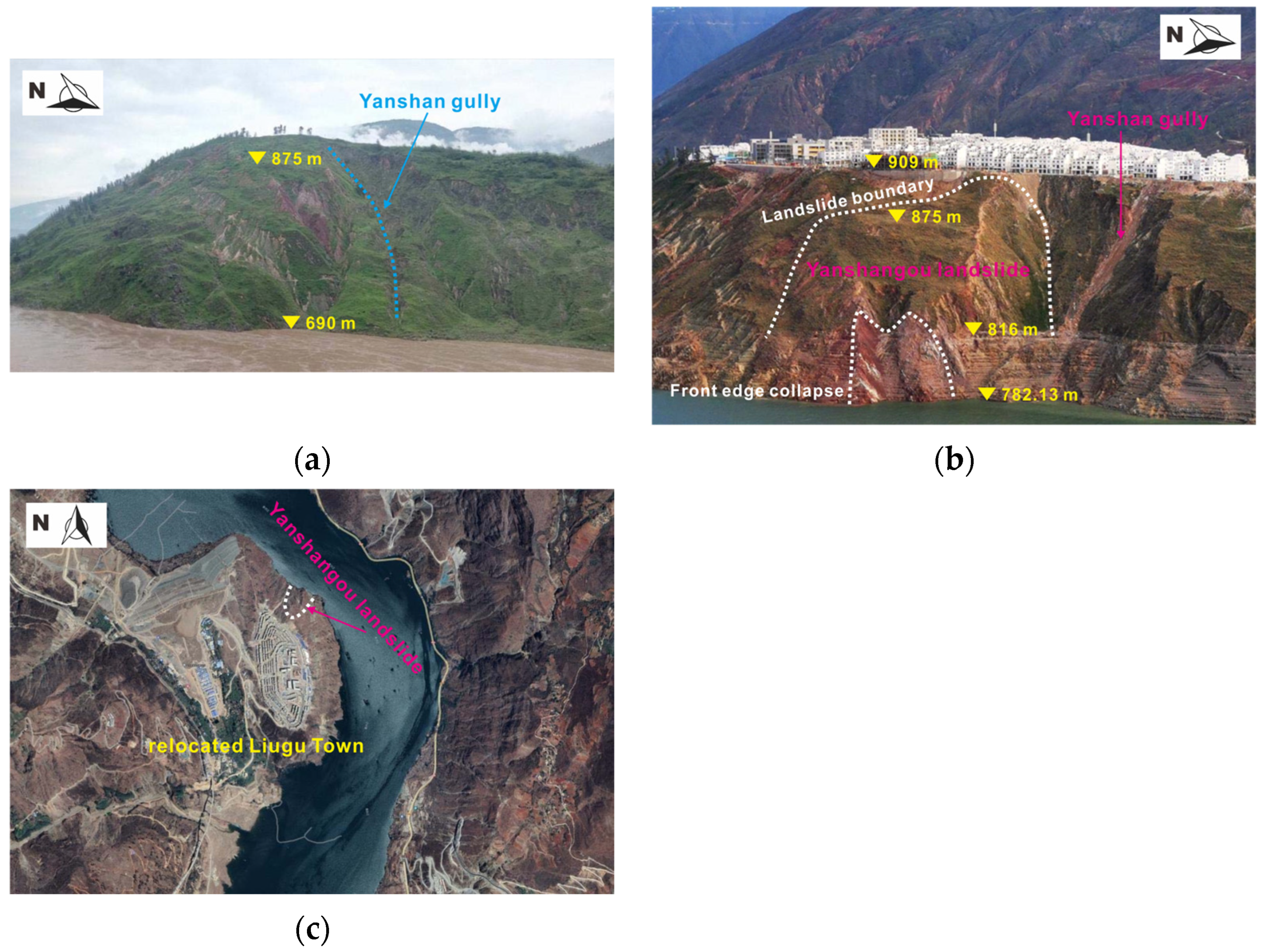
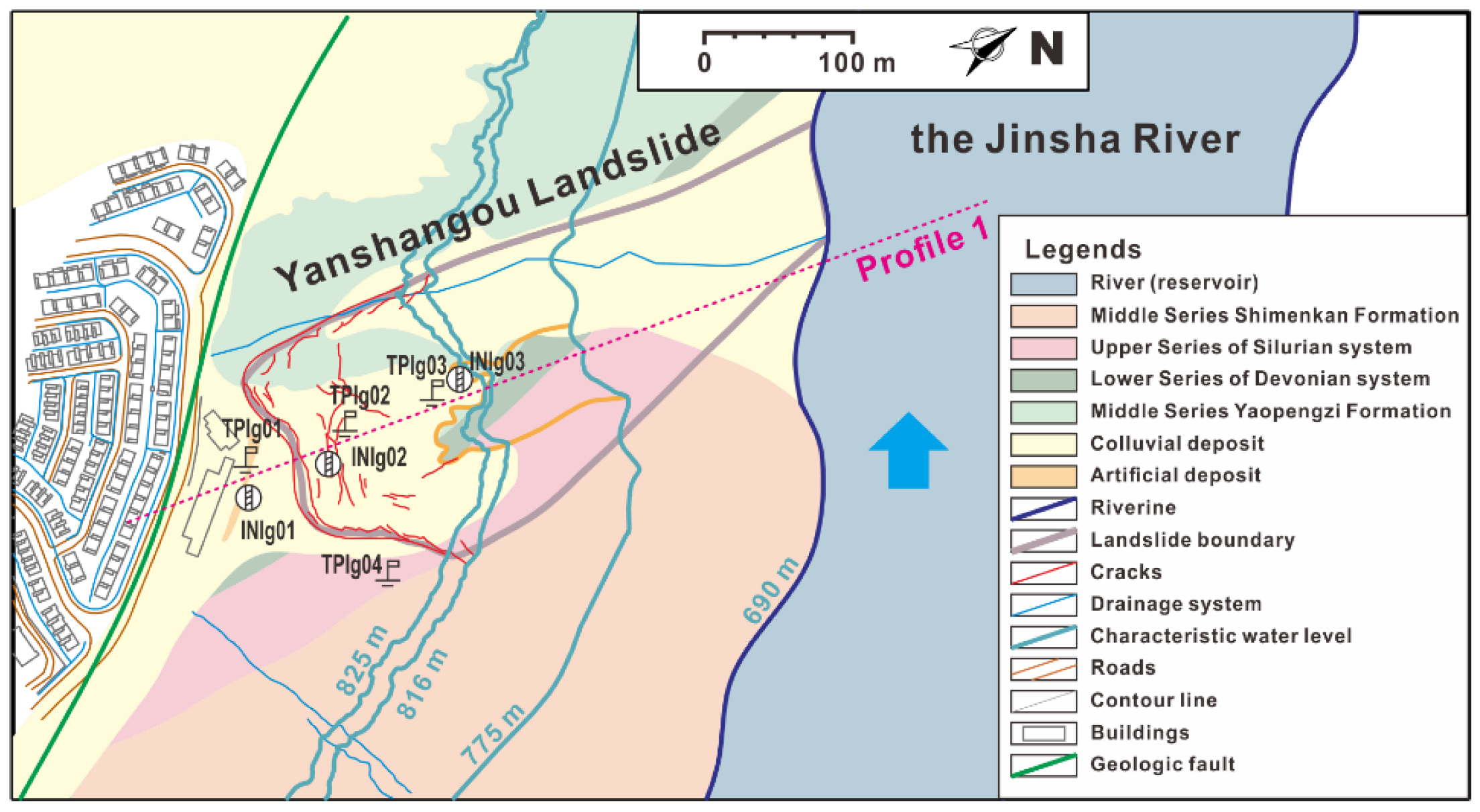
2.1. Topography and Landforms
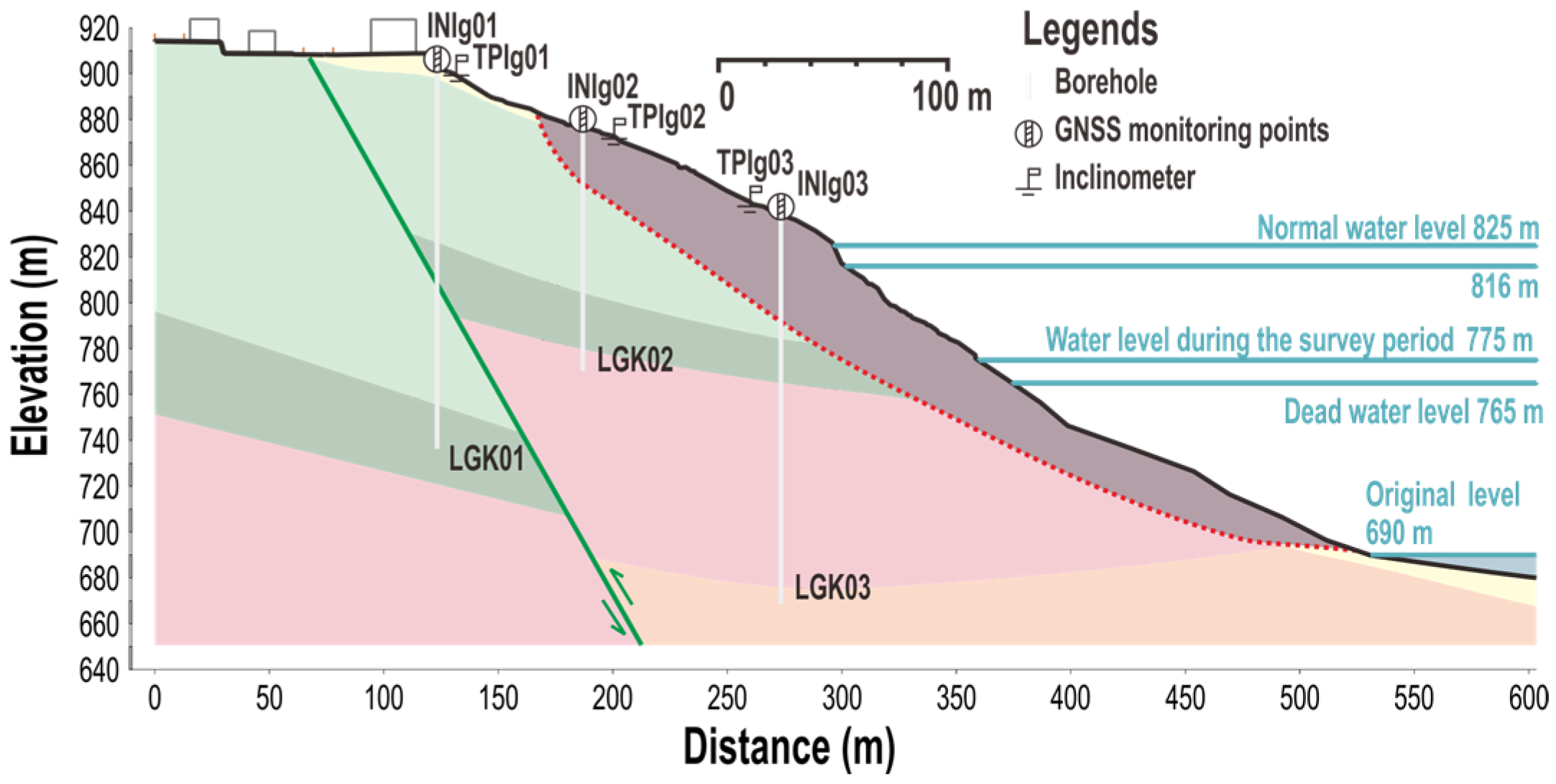
2.2. Stratigraphy and Lithology
2.3. Geological Structure
3. Materials and Methods
3.1. Deformation Observation
3.2. Slope Stability Evaluation
3.2.1. Richard’s Equation for Seepage Field Calculation
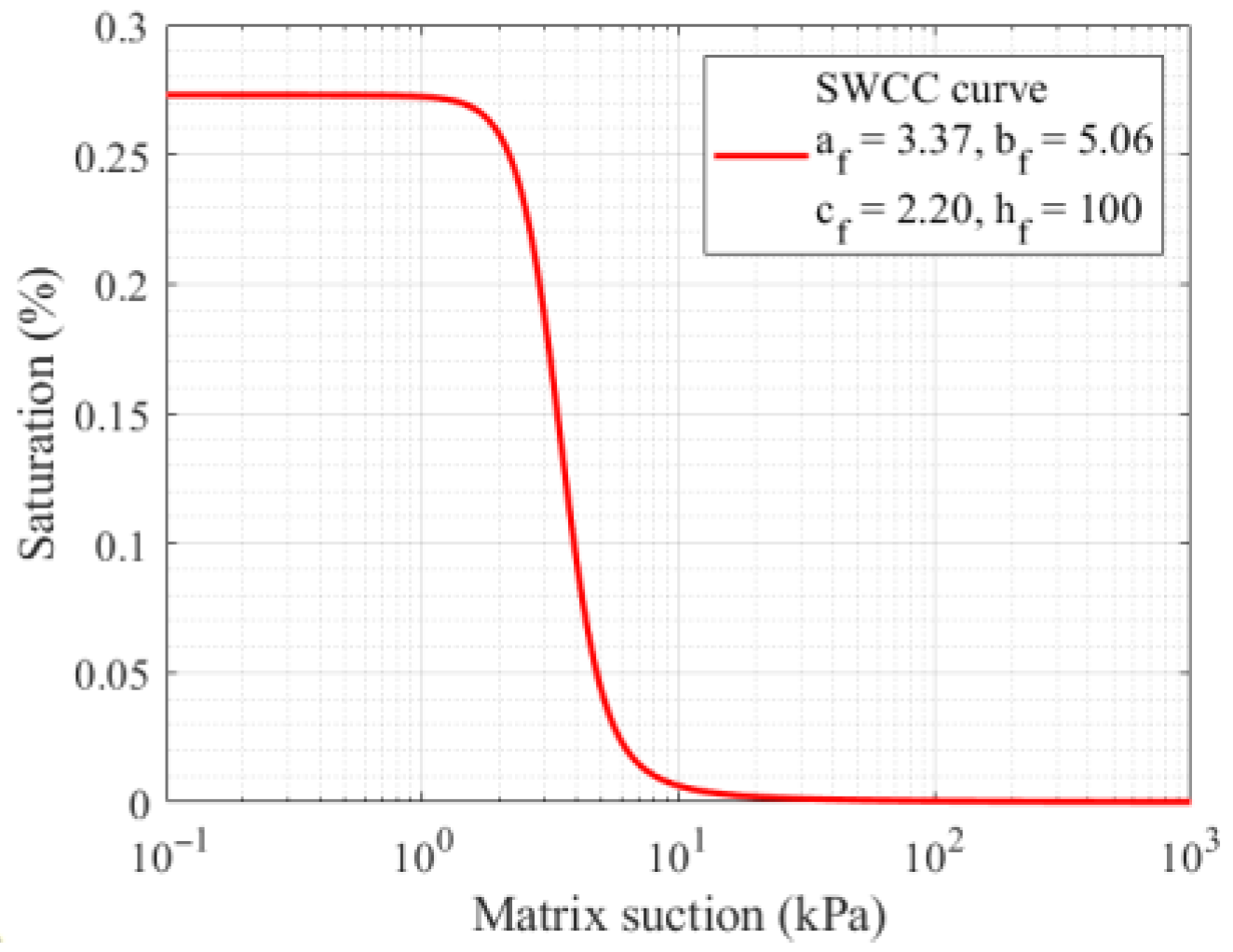
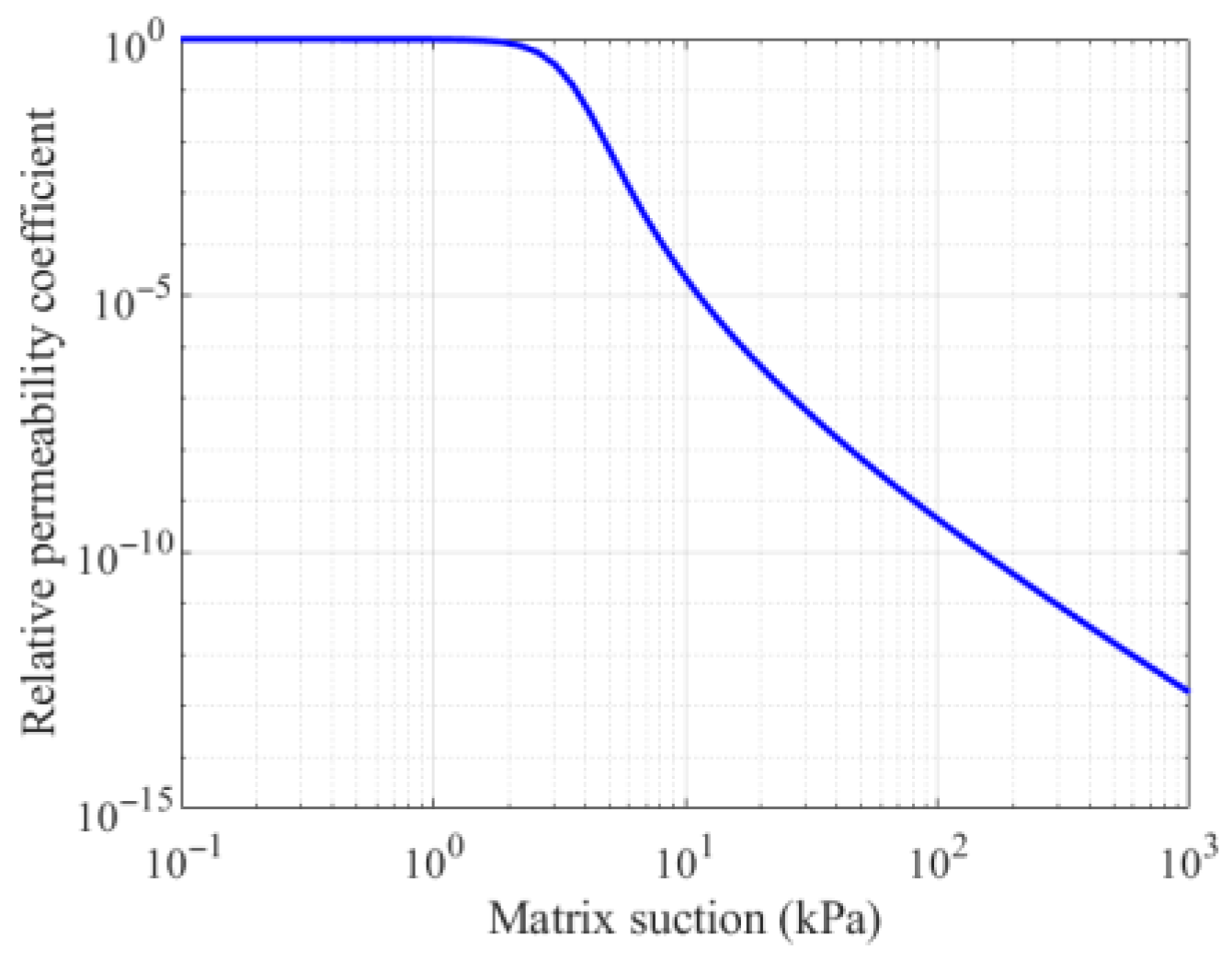
3.2.2. Determination of SWCC and HCF
3.2.3. Shear Strength Criterion of Unsaturated Soil
3.2.4. Morgenstern–Price Limit Equilibrium Method
3.3. Pre-Analysis of Landslide-Induced Surge Hazards
3.3.1. SPH Basic Control Equations
3.3.2. Non-Newtonian Rheological Model for Landslides
4. Results
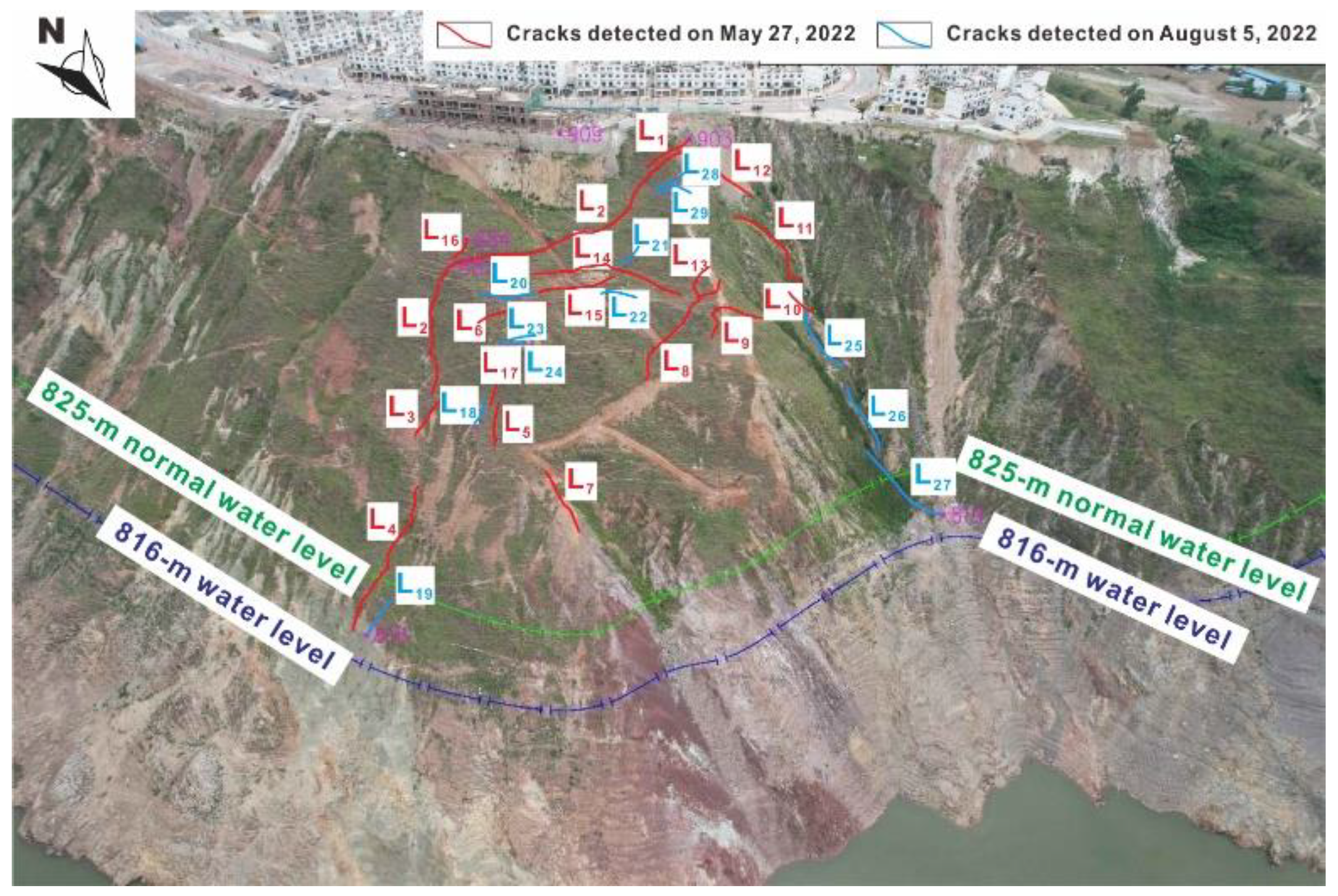
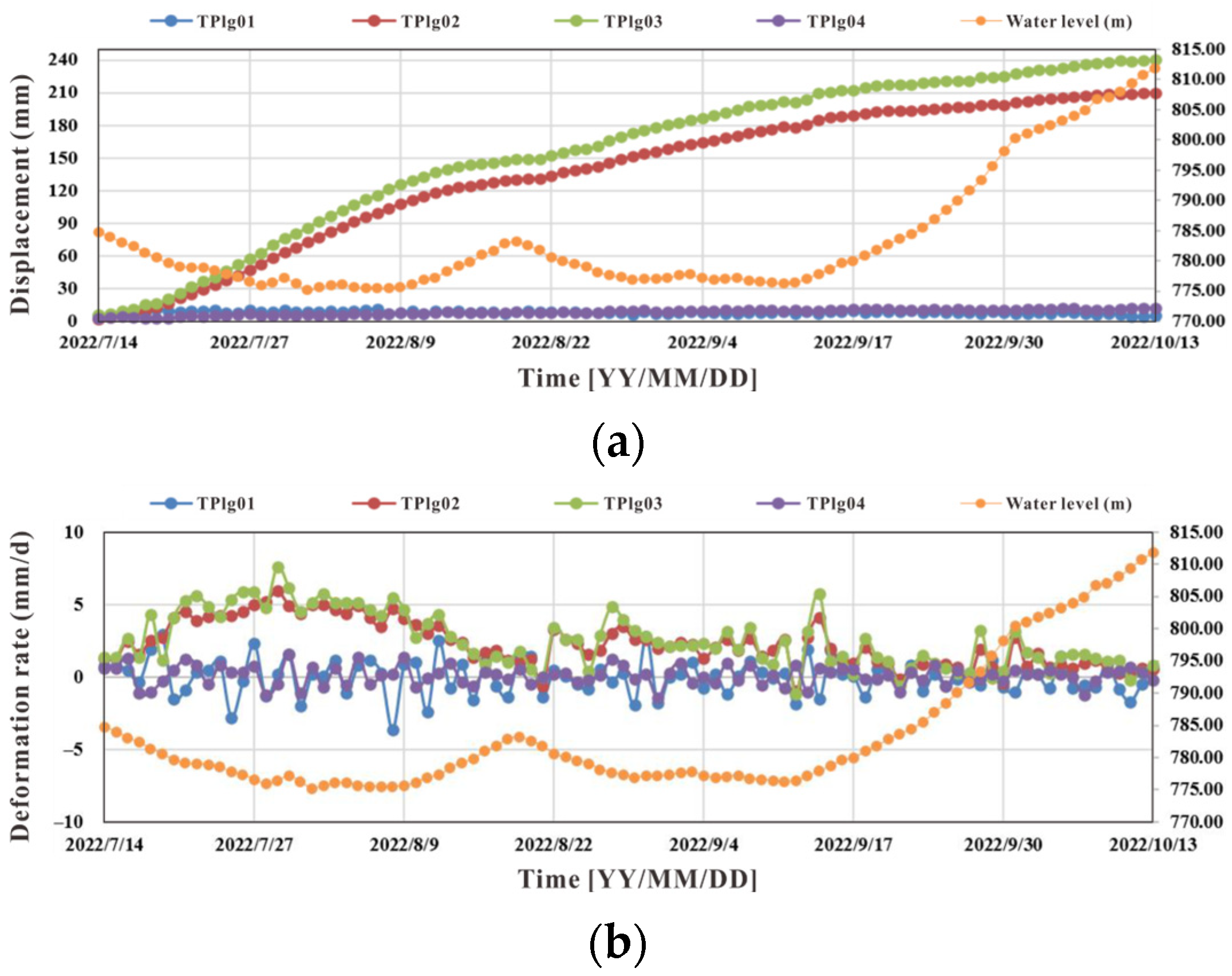
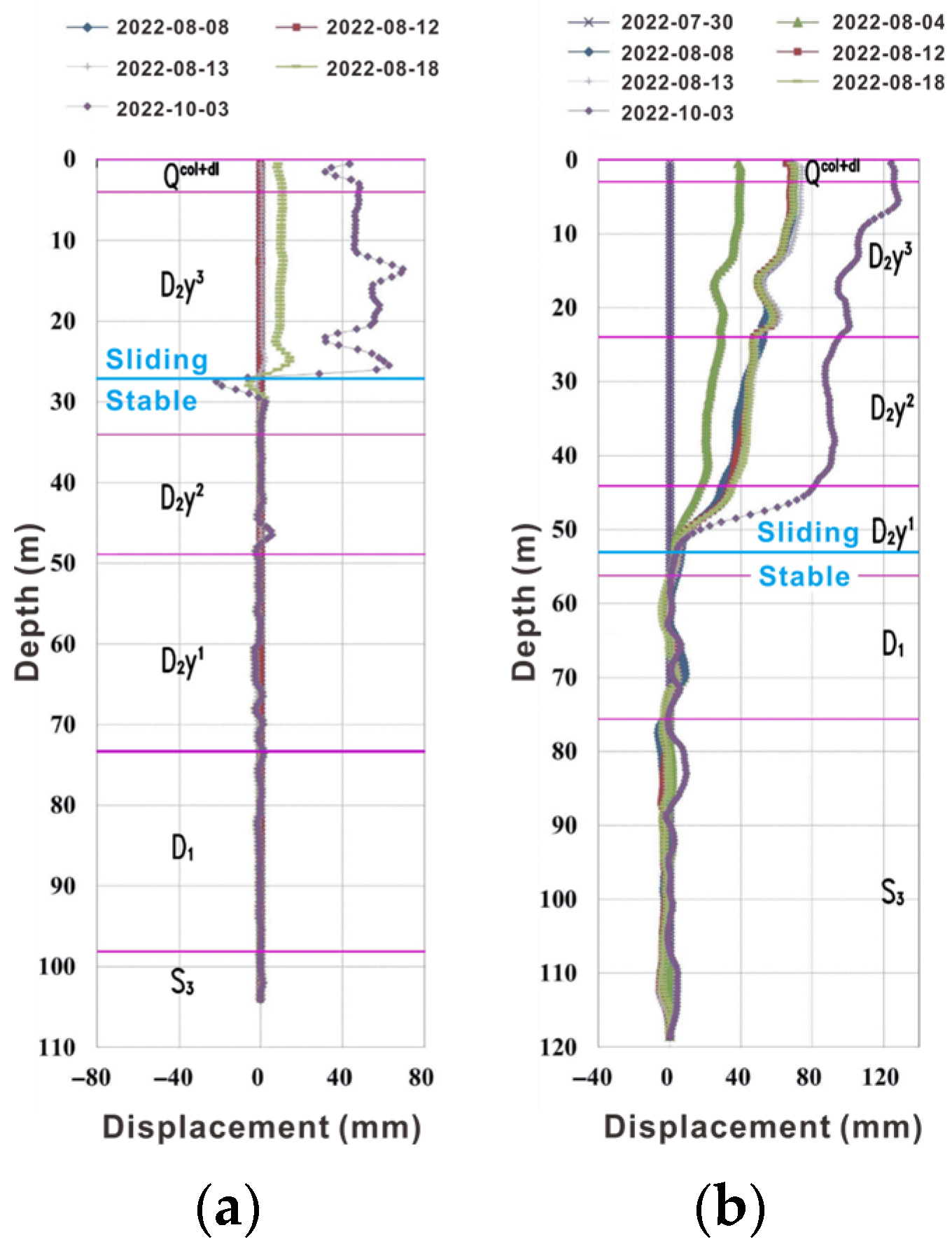
4.1. Deformation Characteristics
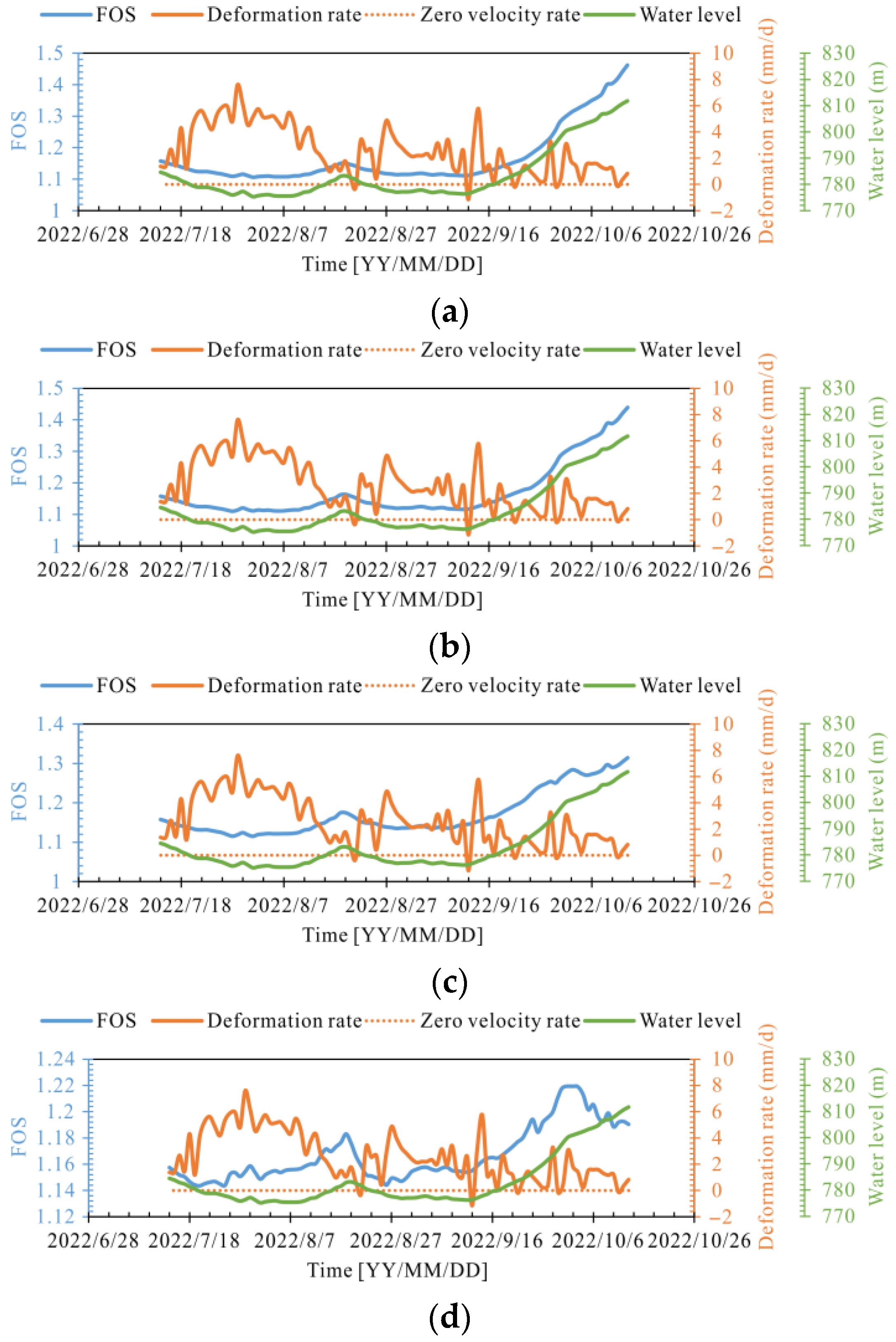
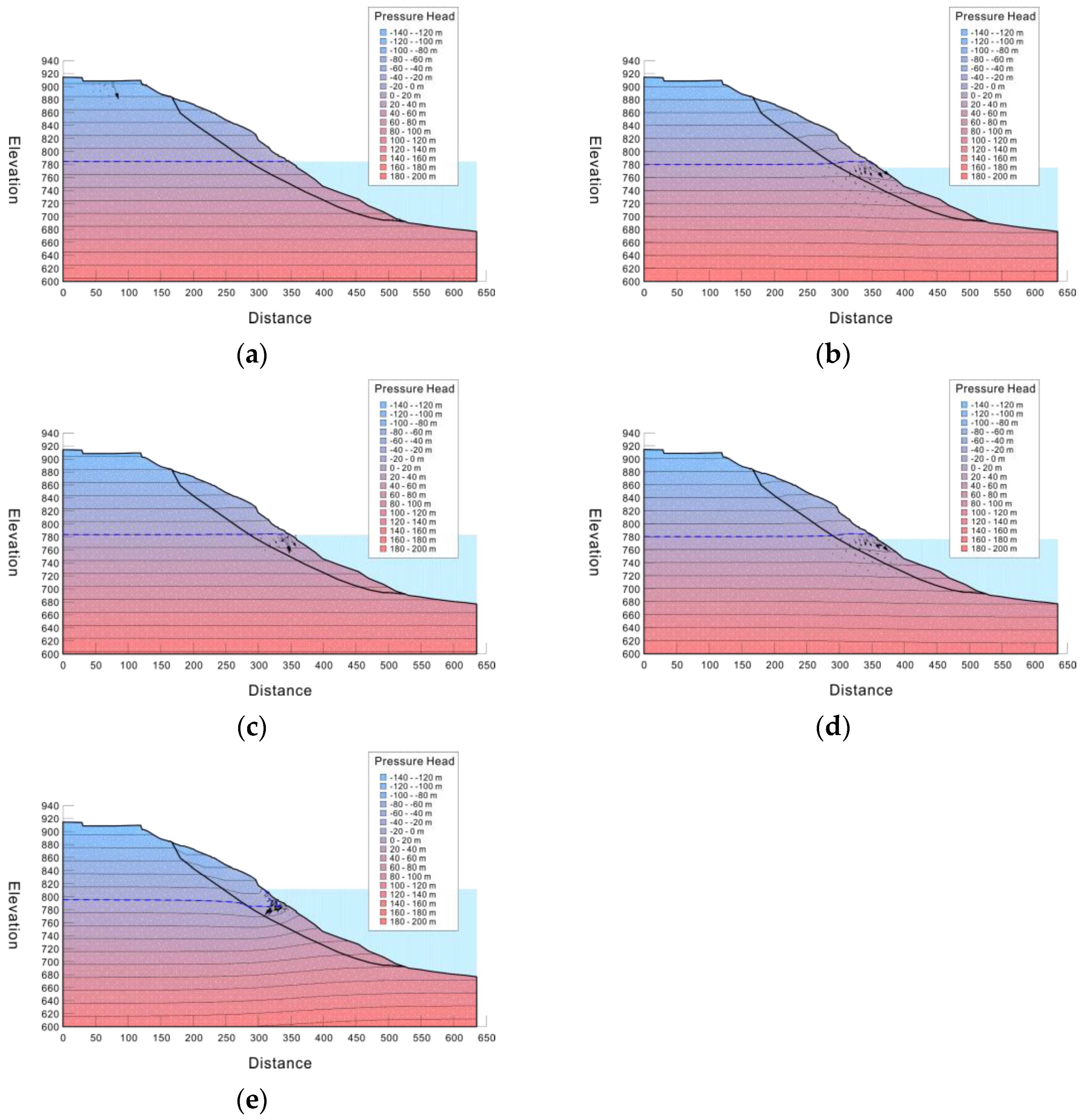
4.2. FOS Calculation Result
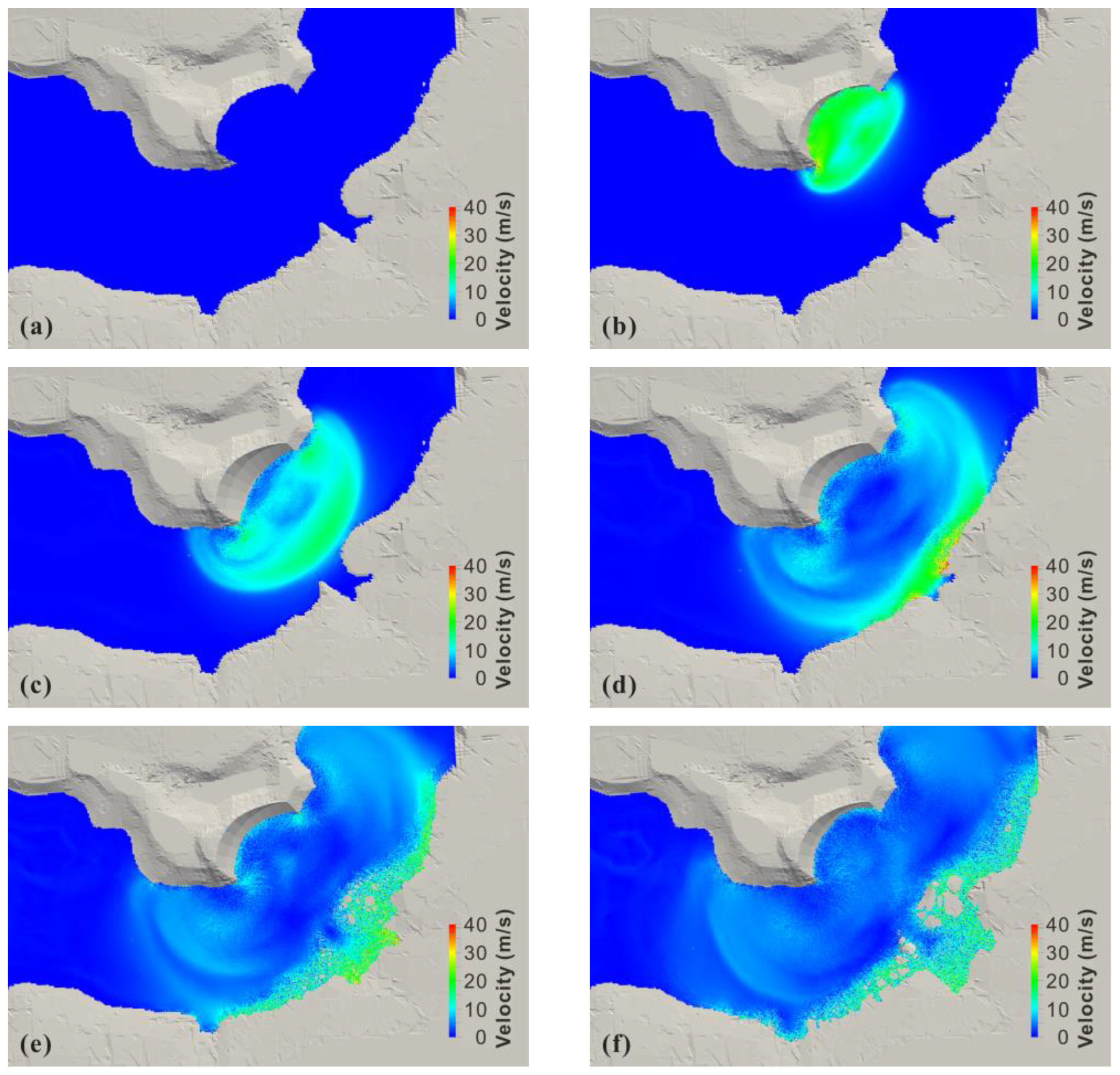
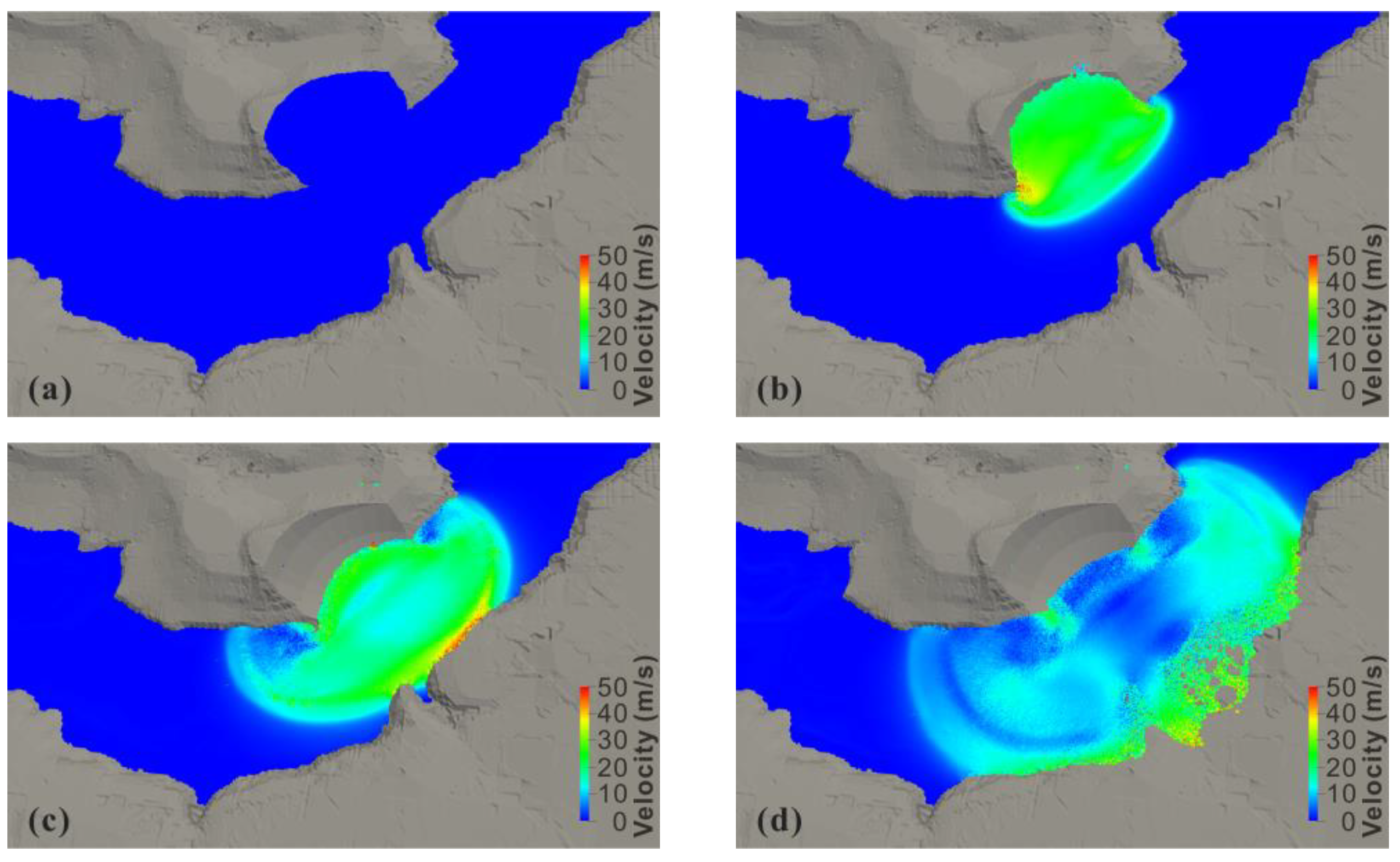
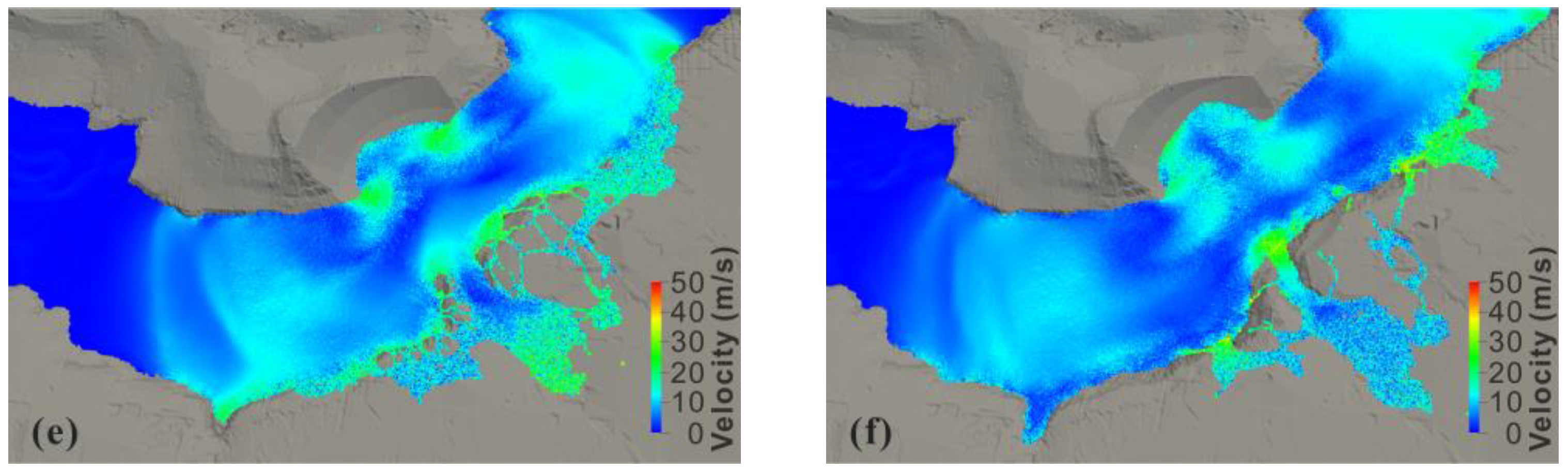
4.3. Analysis Results of Landslide-Induced Surge Hazard
5. Conclusions
- (a)
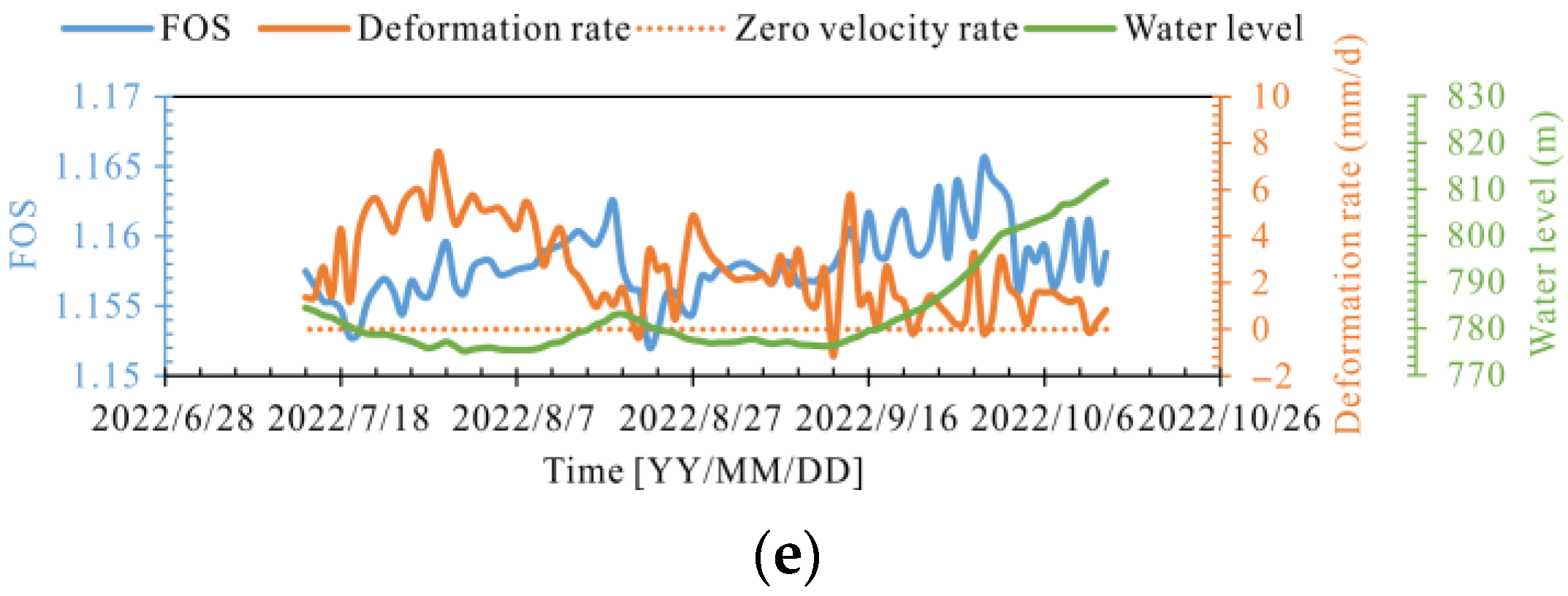
- The Yanshangou landslide exhibits obvious staged deformation characteristics that are closely coupled with reservoir water level fluctuations. The deformation rate of the landslide showed a dynamic fluctuation trend that was highly consistent with the changes in the reservoir water level. The peak deformation rate occurred during the period of rapid reservoir water level decline, and the deformation rate decreased with the rise or stabilization of the reservoir water level, which verifies that reservoir water level fluctuation is the core triggering factor for the deformation of the Yanshangou landslide.
- (b)
- The Yanshangou landslide has low saturated permeability, and its factor of safety presents a clear four-stage variation trend in response to reservoir water level fluctuations. Through the calibration of numerical simulation results and field monitoring data, the actual saturated permeability coefficient of the landslide is determined to be lower than 1 × 10⁻⁶ m/s. Under this low permeability condition, the factor of safety of the landslide shows a distinct four-stage variation trend with the fluctuation of the reservoir water level, which is rapid decline, slow recovery, slight drop, and steady rise. At present, the slope is in a slow deformation state and tends to stabilize with the sustained rise in the reservoir water level, but it remains highly sensitive to reservoir water level changes. Especially rapid reservoir water level drawdown can still cause a significant drop in the stability of the landslide.
- (c)
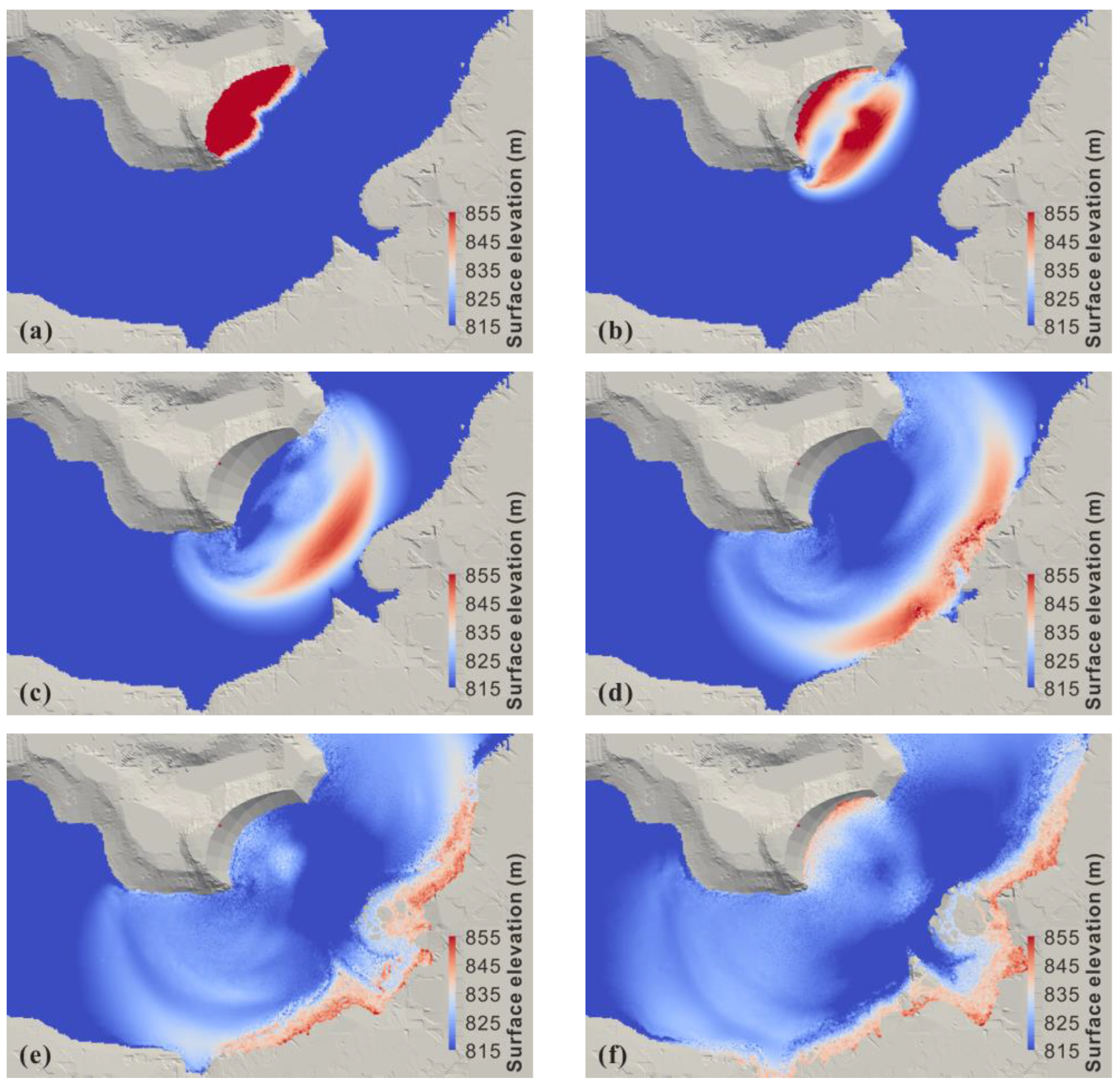
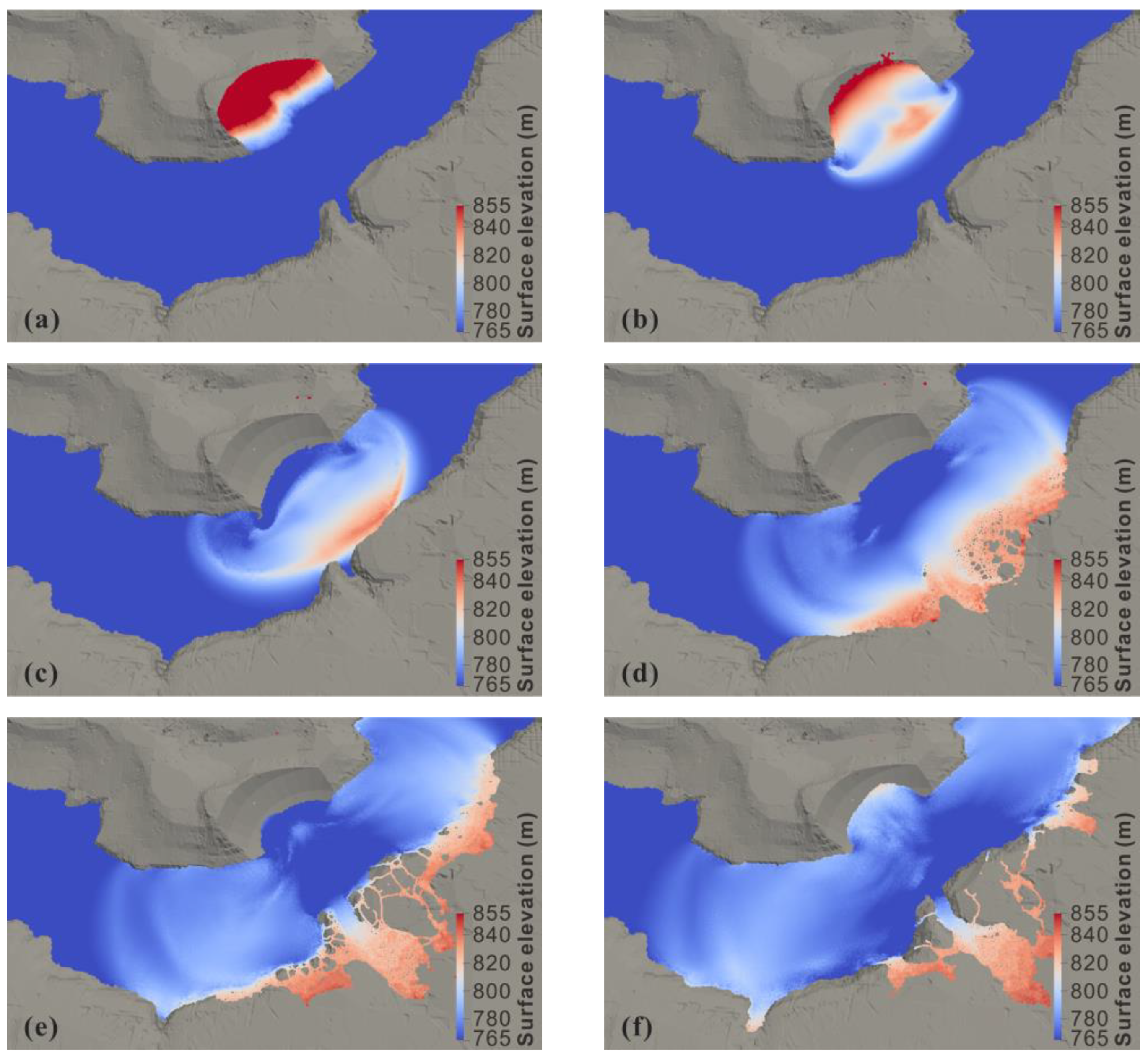
- Landslide-induced surges under different reservoir water level scenarios have distinct hazard characteristics, and the Smoothed Particle Hydrodynamics model can accurately simulate the entire surge evolution process. The numerical simulation results show that under the high reservoir water level scenario of 815 m, the landslide-induced surge is characterized by high height, fast velocity, and strong local destructive power, which is confined within the reservoir area and does not threaten the reconstructed Liugu Town. Under the low reservoir water level scenario of 765 m, although the intensity of the surge is reduced, its horizontal propagation range is wider, which may affect more reservoir bank areas along the Jinsha River and lead to a larger hazard coverage. The Smoothed Particle Hydrodynamics-based numerical model adopted in this study can accurately capture the key processes of landslide–water interaction, surge propagation, and energy dissipation, providing an effective technical tool for the hazard assessment of landslide-induced surges in similar reservoir areas.
- (d)
- Targeted disaster prevention and mitigation suggestions are put forward based on the research results for the Yanshangou landslide. On the one hand, it is necessary to strengthen the real-time and continuous monitoring of reservoir water level changes and landslide surface and deep deformation, and avoid rapid reservoir water level drawdown in the reservoir operation process to prevent a sharp drop in the stability of the landslide caused by hydrodynamic pressure changes. On the other hand, differentiated surge hazard protection measures should be adopted for different reservoir water level scenarios. For the high reservoir water level scenario, high-strength anti-surge protective structures should be set up in key areas near the landslide to resist the impact of high-velocity and high-height surges. For the low reservoir water level scenario, the hazard prevention scope should be expanded to cover the entire reservoir bank area along the river to avoid the impact of surges with a wider propagation range.
Author Contributions
Funding
Data Availability Statement
Acknowledgments
Conflicts of Interest
References
- Shi, A.; Li, C.; Hong, W.; Lu, G.; Zhou, J.; Li, H. Comparative analysis of deformation and failure mechanisms of underground powerhouses on the left and right banks of Baihetan hydropower station. J. Rock Mech. Geotech. Eng. 2022, 14, 731–745. [Google Scholar] [CrossRef]
- Xu, L.; Rong, G.; Qiu, Q.; Zhang, H.; Chen, W.; Chen, Z. Analysis of reservoir slope deformation during initial impoundment at the Baihetan Hydropower Station, China. Eng. Geol. 2023, 323, 107201. [Google Scholar] [CrossRef]
- Dai, K.; Chen, C.; Shi, X.; Wu, M.; Feng, W.; Xu, Q.; Li, Z. Dynamic landslides susceptibility evaluation in Baihetan Dam area during extensive impoundment by integrating geological model and InSAR observations. Int. J. Appl. Earth Obs. Geoinf. 2023, 116, 103157. [Google Scholar] [CrossRef]
- Li, X.; Li, W.; Wu, Z.; Xu, Q.; Zheng, D.; Dong, X.; Wang, X. Identification and deformation characteristics of active landslides at large hydropower stations at the early impoundment stage: A case study of the lianghekou reservoir area in sichuan province, southwest China. Remote Sens. 2024, 16, 3175. [Google Scholar] [CrossRef]
- Tang, F.; Qi, S.; Guo, S.; Li, Y.; Guo, X.; Lu, X.; Wang, Z. The influence of reservoirs on landslide erosion. Remote Sens. 2025, 17, 569. [Google Scholar] [CrossRef]
- Hu, X.; Ju, N.; Zhao, J.; Feng, Q.; Zhao, W.; Huang, J.; Xie, M. Reservoir impoundment induced the revival of toppling paleo-landslide in the upper reaches of the Yellow River: A case of Darou landslide. Landslides 2025, 22, 3743–3757. [Google Scholar] [CrossRef]
- Deng, X.; Ma, J.; Zhang, G.; He, X.; Jiang, S.; Li, Y.; Lei, D. Temporal and spatial evolution of a large-scale landslide reactivated by the impoundment of the Wudongde Reservoir based on multisource data. Landslides 2025, 22, 3095–3115. [Google Scholar] [CrossRef]
- Barla, G.; Paronuzzi, P. The 1963 Vajont Landslide: 50th Anniversary. Rock Mech. Rock Eng. 2013, 46, 1267–1270. [Google Scholar] [CrossRef]
- Paronuzzi, P.; Bolla, A.; Pinto, D.; Lenaz, D.; Soccal, M. The Clays Involved in the 1963 Vajont Landslide: Genesis and Geomechanical Implications. Eng. Geol. 2021, 294, 106376. [Google Scholar] [CrossRef]
- Xue, G. A Study of the 1985 Xintan Landslide in Xiling Gorge, Three Gorges Area, China. In Landslide Disaster Mitigation in Three Gorges Reservoir, China; Springer: Berlin/Heidelberg, Germany, 2009; pp. 387–409. [Google Scholar]
- Wang, F.W.; Zhang, Y.M.; Huo, Z.T.; Matsumoto, T.; Huang, B.L. The July 14, 2003 Qianjiangping Landslide, Three Gorges Reservoir, China. Landslides 2004, 1, 157–162. [Google Scholar] [CrossRef]
- Zhou, J.J.; Xie, K.K.; Chen, L.; Gong, Z.P. Parameters of Muzhuping Landslide in the Shuibuya Reservoir. Appl. Mech. Mater. 2011, 90, 442–445. [Google Scholar] [CrossRef]
- Jia, H.; Wang, Y.; Ge, D.; Deng, Y.; Wang, R. Improved Offset Tracking for Predisaster Deformation Monitoring of the 2018 Jinsha River Landslide (Tibet, China). Remote Sens. Environ. 2020, 247, 111899. [Google Scholar] [CrossRef]
- Wang, L.; Zhang, Q.; Jia, C.; Chen, H.; Hu, J.; Huang, Q. Centrifuge Modeling of Deformation and Failure Mechanisms in Reservoir Bank Slopes Under the Coupled Effect of Rainfall and Water-Level Fluctuations. Rock Mech. Rock Eng. 2025, 59, 2369–2393. [Google Scholar] [CrossRef]
- Wen, H.; Li, Y.; Wang, X.; Zeng, Y.; Yan, F. Triggering mechanism of rainfall and reservoir water level dynamic change-induced step-like displacement for reservoir bank landslide. Earth Surf. Process. Landf. 2025, 50, e70172. [Google Scholar] [CrossRef]
- Yang, Z.; Xi, W.; Yang, Z.; Shi, Z.; Huang, G.; Guo, J.; Yang, D. Time-Lag response of landslide to reservoir water level fluctuations during the storage period: A case study of Baihetan reservoir. Water 2023, 15, 2732. [Google Scholar] [CrossRef]
- Zhu, Y.; Qiu, H.; Liu, Z.; Ye, B.; Tang, B.; Li, Y.; Kamp, U. Rainfall and water level fluctuations dominated the landslide deformation at Baihetan Reservoir, China. J. Hydrol. 2024, 642, 131871. [Google Scholar] [CrossRef]
- Wei, S.; Ji, F.; Lv, F.; Wang, L. Physical model test on the influence of reservoir water level fluctuation on the deformation of landslides with weak interlayers. Bull. Eng. Geol. Environ. 2025, 84, 187. [Google Scholar] [CrossRef]
- Chen, M.L.; Zhou, J.W.; Yang, X.G. A novel approach for slope stability evaluation considering landslide dynamics and its application to reservoir landslide. Nat. Hazards 2024, 120, 3589–3621. [Google Scholar] [CrossRef]
- Chen, M.L.; Yang, X.G.; Zhou, J.W. Effect of water level fluctuation and its rate on the response of deposits on a reservoir slope: Flume experiment, case monitoring comparison and failure mechanism. Acta Geotech. 2023, 18, 6213–6234. [Google Scholar] [CrossRef]
- Chen, M.; Yang, X.; Zhou, J. Spatial distribution and failure mechanism of water-induced landslides in the reservoir areas of Southwest China. J. Rock Mech. Geotech. Eng. 2023, 15, 442–456. [Google Scholar] [CrossRef]
- Morgenstern, N.R.; Price, V.E. The analysis of the stability of general slip surfaces. Geotechnique 1965, 15, 79–93. [Google Scholar] [CrossRef]
- Greenkorn, R.A. Steady flow through porous media. AIChE J. 1981, 27, 529–545. [Google Scholar] [CrossRef]
- Fredlund, D.G.; Rahardjo, H. Soil Mechanics for Unsaturated Soils; John Wiley & Sons: New York, NY, USA, 1993. [Google Scholar]
- Chen, Y.; Wang, S.; Wang, L.; Chen, Y.; Zhang, K.; Fan, Z.; Li, Q. A discrete element method for calculating saturated and unsaturated seepage in landslide soils and a case study. Landslides 2025, 22, 2379–2395. [Google Scholar] [CrossRef]
- Darcy, H. Les Fontaines Publiques de la Ville de Dijon: Exposition et Application des Principes à Suivre et des Formules à Employer dans les Questions de Distribution d’Eau; Victor Dalmont: Paris, France, 1856; Volume 2. [Google Scholar]
- Fredlund, D.G.; Xing, A. Equations for the soil-water characteristic curve. Can. Geotech. J. 1994, 31, 521–532. [Google Scholar] [CrossRef]
- Houston, W.N.; Dye, H.B.; Zapata, C.E.; Perera, Y.Y.; Harraz, A. Determination of SWCC using one point suction measurement and standard curves. In Unsaturated Soils 2006; American Society of Civil Engineers: Reston, VA, USA, 2006; pp. 1482–1493. [Google Scholar]
- Lu, N.; Likos, W.J. Suction stress characteristic curve for unsaturated soil. J. Geotech. Geoenviron. Eng. 2006, 132, 131–142. [Google Scholar] [CrossRef]
- Guan, X.; Shi, H. Translational momentum of deformable submarine landslides off a slope. J. Fluid Mech. 2023, 960, A23. [Google Scholar] [CrossRef]
- Heidarzadeh, M.; Ishibe, T.; Sandanbata, O.; Muhari, A.; Wijanarto, A.B. Numerical modeling of the subaerial landslide source of the 22 December 2018 Anak Krakatoa volcanic tsunami, Indonesia. Ocean Eng. 2020, 195, 106733. [Google Scholar] [CrossRef]
- Molteni, D.; Colagrossi, A. A simple procedure to improve the pressure evaluation in hydrodynamic context using the SPH. Comput. Phys. Commun. 2009, 180, 861–872. [Google Scholar] [CrossRef]
- Monaghan, J.J. Smoothed particle hydrodynamics. Rep. Prog. Phys. 2005, 68, 1703–1759. [Google Scholar] [CrossRef]
- Shao, S.; Lo, E.Y.M. Incompressible SPH method for simulating Newtonian and non-Newtonian flows with a free surface. Adv. Water Resour. 2003, 26, 787–800. [Google Scholar] [CrossRef]
- Dymond, J.H.; Malhotra, R. The Tait equation: 100 years on. Int. J. Thermophys. 1988, 9, 941–951. [Google Scholar] [CrossRef]
- Huang, Y.; Zhang, W.; Xu, Q.; Xie, P.; Hao, L. Run-out analysis of flow-like landslides triggered by the Ms 8.0 2008 Wenchuan earthquake using smoothed particle hydrodynamics. Landslides 2012, 9, 275–283. [Google Scholar] [CrossRef]
- Dai, Z.; Wang, F.; Huang, Y.; Song, K.; Iio, A. SPH-based numerical modeling for the post-failure behavior of the landslides triggered by the 2016 Kumamoto earthquake. Geoenviron. Disasters 2016, 3, 24. [Google Scholar] [CrossRef]
- Bao, Y.; Huang, Y.; Liu, G.R.; Zeng, W. SPH simulation of high-volume rapid landslides triggered by earthquakes based on a unified constitutive model. Part II: Solid–liquid-like phase transition and flow-like landslides. Int. J. Comput. Methods 2018, 16, 1850149. [Google Scholar] [CrossRef]
- Fourtakas, G.; Rogers, B.D. Modelling multi-phase liquid-sediment scour and resuspension induced by rapid flows using smoothed particle hydrodynamics (SPH) accelerated with a graphics processing unit (GPU). Adv. Water Resour. 2016, 92, 186–199. [Google Scholar] [CrossRef]


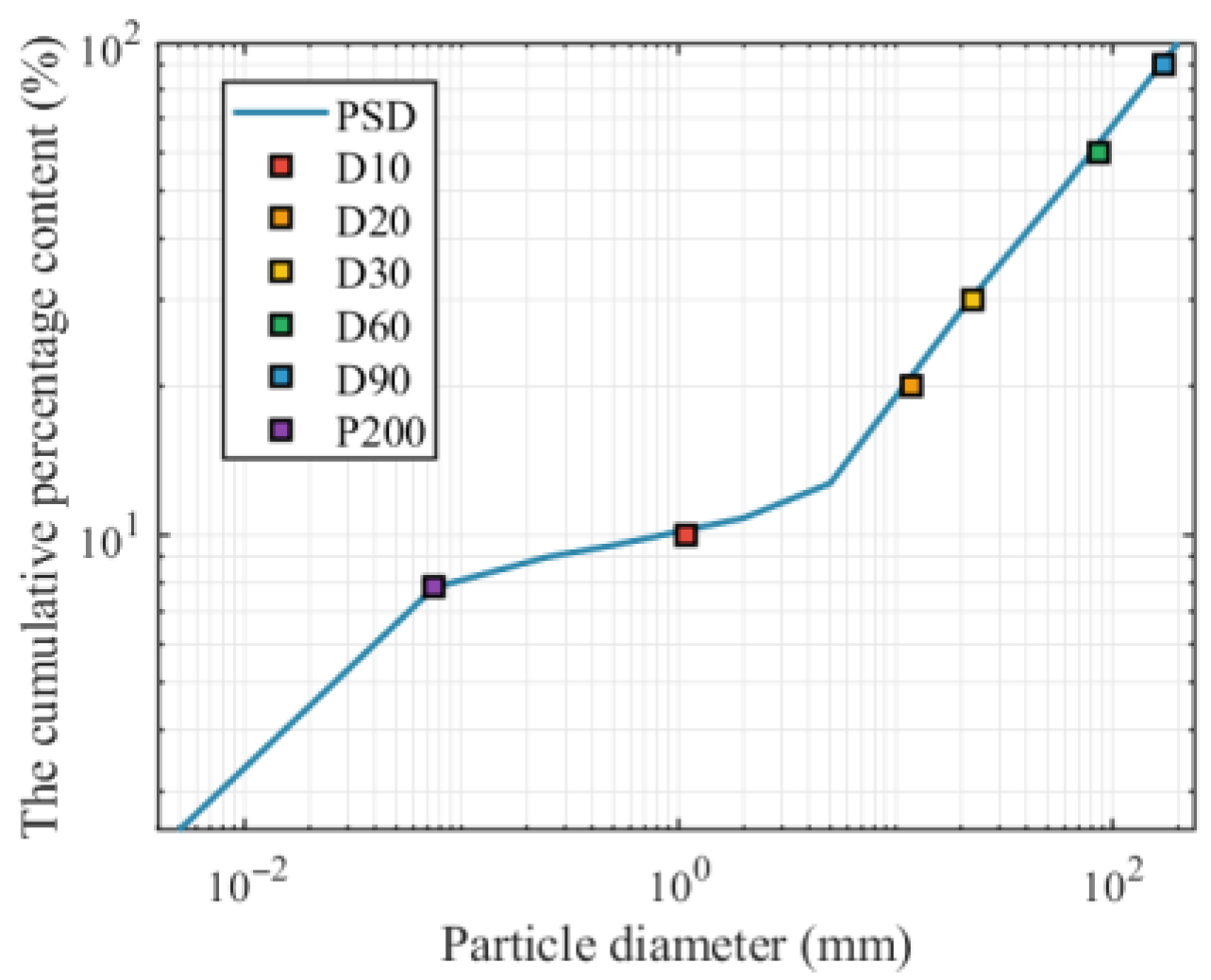








| Particle Size (mm) | 0.005 | 0.075 | 0.25 | 0.5 | 2 | 5 | 20 | 60 | 200 |
| Cumulative percentage of particles smaller than corresponding size (%) | 2.5 | 7.8 | 9.0 | 9.5 | 10.8 | 12.7 | 28.5 | 51.0 | 100 |
| Particle Size Parameter | D0 | D10 | D20 | D30 | D60 | D90 | D100 | P200 |
| Unit | mm | mm | mm | mm | mm | mm | mm | % |
| Value | 0.2 | 1.1 | 11.9 | 22.7 | 85.7 | 171.4 | 216.0 | 7.8 |
| Particle Size Parameter | Unit | Selected Value |
|---|---|---|
| CFL number | / | 0.2 |
| Coefficient of speed of sound | / | 10 |
| Polytropic index | / | 7 |
| Number of steps to apply Euler time stepping | / | 40 |
| Particle distance | m | 4 |
| viscosity | m2/s | 0.1 |
| Density of water | kg/m3 | 1000 |
| Density of landslide | kg/m3 | 1650 |
| Interaction kernel function | / | Wendland |
| Time-stepping algorithm | / | Velocity-Verlet |
| Viscosity treatment | / | Artificial |
| Boundary treatment | / | Dynamic boundary condition |
Disclaimer/Publisher’s Note: The statements, opinions and data contained in all publications are solely those of the individual author(s) and contributor(s) and not of MDPI and/or the editor(s). MDPI and/or the editor(s) disclaim responsibility for any injury to people or property resulting from any ideas, methods, instructions or products referred to in the content. |
© 2026 by the authors. Licensee MDPI, Basel, Switzerland. This article is an open access article distributed under the terms and conditions of the Creative Commons Attribution (CC BY) license.
Share and Cite
Chen, J.-P.; Shi, A.-C.; Niu, Z.-H.; Xu, Y.; Zhang, Z.-H.; Chen, M.-L.; Wang, L. Chasing a Complete Understanding of the Yanshangou Landslide in the Baihetan Reservoir Area. Water 2026, 18, 1018. https://doi.org/10.3390/w18091018
Chen J-P, Shi A-C, Niu Z-H, Xu Y, Zhang Z-H, Chen M-L, Wang L. Chasing a Complete Understanding of the Yanshangou Landslide in the Baihetan Reservoir Area. Water. 2026; 18(9):1018. https://doi.org/10.3390/w18091018
Chicago/Turabian StyleChen, Jian-Ping, An-Chi Shi, Zi-Hao Niu, Yu Xu, Zhen-Hua Zhang, Ming-Liang Chen, and Lei Wang. 2026. "Chasing a Complete Understanding of the Yanshangou Landslide in the Baihetan Reservoir Area" Water 18, no. 9: 1018. https://doi.org/10.3390/w18091018
APA StyleChen, J.-P., Shi, A.-C., Niu, Z.-H., Xu, Y., Zhang, Z.-H., Chen, M.-L., & Wang, L. (2026). Chasing a Complete Understanding of the Yanshangou Landslide in the Baihetan Reservoir Area. Water, 18(9), 1018. https://doi.org/10.3390/w18091018