Article

Label-Free and Ultrasensitive Detection of Hg2+ Based on Structure Switching of Aptamer and Rolling Circle Amplification (RCA)

1
School of Ecology and Environment, Zhengzhou University, Zhengzhou 450001, China
2
College of Chemistry, Zhengzhou University, Zhengzhou 450001, China
*
Authors to whom correspondence should be addressed.
Water 2026, 18(9), 1017; https://doi.org/10.3390/w18091017
Submission received: 21 March 2026 / Revised: 21 April 2026 / Accepted: 22 April 2026 / Published: 24 April 2026

Highlights

What are the main findings?
  • Developed a label-free Hg2+ biosensor integrating aptamer switching and RCA.
  • Achieved an ultralow detection limit of 3.2 nM, well below WHO guidelines.
  • Demonstrated excellent linearity (10–1000 nM) and high target selectivity.
  • Validated in real environmental water with high recovery (93.8–106.0%).
What are the implications of the main findings?
  • Eliminates costly fluorescent labels, significantly simplifying workflows.
  • Provides a cost-effective and robust platform for aquatic Hg2+ monitoring.
  • Overcomes traditional pretreatment limits, aiding rapid on-site screening.
  • Lays the groundwork for future integration into portable POCT devices.

Abstract
Mercury ions (Hg2+), a heavy metal contaminant of strong biotoxicity, pose a serious threat to ecosystems and human health in aquatic environments. Developing highly sensitive and specific detection methods is therefore of great importance. This study presents a novel label-free fluorescent biosensor for Hg2+ by ingeniously coupling target-induced aptamer switching with rolling circle amplification (RCA). Upon Hg2+ binding, the conformational change releases a sequestered primer to initiate RCA, generating G-quadruplex-rich DNA products that produce a strong “turn-on” signal with N-methylmesoporphyrin IX (NMM). Under optimized conditions, the assay exhibits excellent linearity from 10 to 1000 nM with a detection limit of 3.2 nM, along with high selectivity over competing metal ions. Validation using spiked environmental water samples yielded accurate and reproducible recoveries in the range of 93.8% to 106.0%. With its operational simplicity, high sensitivity, and robust performance in complex matrices, this label-free strategy offers a reliable and promising platform for detecting Hg2+ in environmental waters.

Graphical Abstract

1. Introduction

Mercury ions (Hg2+) are highly toxic, non-degradable pollutants that persist in the environment and pose severe risks to human health—particularly damaging the nervous system and kidneys—through food chain biomagnification [1,2]. Research has confirmed that prolonged exposure to mercury-containing environments poses persistent health risks to humans, potentially causing various health issues including neurological dysfunction and kidney damage. Therefore, the development of rapid, sensitive, and dependable Hg2+ detection approaches proves indispensable for environmental monitoring, food safety, and public health.
Conventional Hg2+ detection methods are mainly based on large-scale instrumental analytical techniques [3], such as atomic absorption/emission spectroscopy (AAS) [4] and inductively coupled plasma mass spectrometry (ICP-MS) [5]. Electrochemical methods, particularly stripping voltammetry, serve as highly sensitive alternatives capable of achieving extraordinary, sub-nanomolar detection limits (e.g., 0.025 nM) [6]. However, despite their exceptional sensitivity, electrochemical approaches are often susceptible to electrode surface fouling and require meticulous electrode preparation or regeneration protocols. While these methods offer high accuracy and precision, achieving detection limits at the ng/L level, their application faces significant limitations. The required equipment is costly, with high operational and maintenance expenses, necessitating specialized personnel, making widespread adoption in resource-constrained laboratories challenging. Furthermore, the detection process typically demands complex sample pretreatment, including digestion, enrichment, and separation steps, which are cumbersome and time-consuming [7]. In summary, these methods impose stringent laboratory environment requirements, making rapid on-site detection difficult and failing to meet the emergency monitoring needs for sudden environmental pollution incidents [8,9]. Currently, most biosensors still encounter challenges regarding their long-term stability and consistent performance in fluctuating environmental conditions, which hampers their transition from laboratory proof-of-concept to robust, field-deployable point-of-care testing (POCT) [10]. To overcome these bottlenecks, recent advancements in portable sensor technologies have demonstrated the feasibility of rapid, on-site contaminant analysis in complex water matrices without the need for extensive sample pretreatment [11]. Therefore, researchers have progressively shifted their focus toward developing new Hg2+ detection systems that are more convenient, efficient, and highly sensitive to address the urgent demands of practical applications. In recent years, nucleic acid aptamers, often termed “chemical antibodies,” have emerged as powerful recognition elements. For Hg2+ detection, T-rich aptamers are especially effective as they utilize unique T-Hg2+-T coordination to achieve superior selectivity in complex environmental matrices, effectively addressing the cross-reactivity issues of traditional methods. Furthermore, their high binding affinity ensures the efficient capture of trace Hg2+, which is critical for triggering the subsequent signal amplification required for ultralow detection [12,13]. However, many such approaches still rely on fluorescently labeled probes (e.g., FAM, Cy5), which not only increase detection costs and time but also potentially compromise probe–target binding efficiency during labeling [14]. Consequently, developing label-free, highly sensitive detection methods represents a critical research direction.
Rolling Circle Amplification (RCA) is a highly efficient isothermal nucleic acid amplification technique [15]. It utilizes circular DNA templates and Phi29 DNA polymerase with strand displacement activity to synthesize long single-stranded DNA containing hundreds of complementary repetitive units under constant-temperature conditions [16,17]. This technology offers simple operation, high stability, and potent signal amplification capabilities. Consequently, numerous RCA-based strategies have been widely applied for efficient detection of DNA [18], RNA [19], and proteins [20]. While RCA is powerful, existing RCA-based sensors for Hg2+ face several practical limitations. For instance, Zhou et al. developed an electrochemiluminescent Hg2+ sensor using magnetic beads and RCA; however, this approach requires the RCA reaction to occur directly on the solid surface (causing steric hindrance) and necessitates the synthesis of specific fluorophore-tagged probes [21]. Similarly, Kim et al. reported a colorimetric radial flow assay where Hg2+ inhibits the RCA reaction; yet, such “signal-off” mechanisms can be highly susceptible to false positives caused by environmental inhibitors, and the method relies on complex gold nanoparticle conjugates [22]. Furthermore, while recent portable fluorescent aptamer sensors exhibit high sensitivity, many still depend on costly dual-labeled DNA strands or the complex synthesis of novel nanomaterials [23]. Therefore, developing a truly label-free, ‘signal-on’ RCA platform that avoids surface steric hindrance remains highly desirable. Through rational template design, specific functional sequences, such as G-quadruplex sequences [24], can be incorporated into RCA products. G-quadruplexes are unique nucleic acid secondary structures formed by guanine-rich (G) DNA sequences via Hoogsteen hydrogen bonds [25]. They can specifically bind to certain small-molecule dyes (e.g., thioxanthen-5-thione, ThT; or N-methylporphyrin IX, NMM) to produce a strong fluorescence enhancement effect, enabling label-free, low-background fluorescence detection [26,27]. Combining RCA’s powerful amplification capability with the high signal-to-noise ratio output of G-quadruplex/NMM has become an effective strategy for constructing ultra-sensitive biosensors [28,29,30], widely applied in the detection of proteins, nucleic acids, and small-molecule contaminants [31,32]. Liu et al. developed a label-free, highly sensitive APE1 detection method based on RCA combined with G-quadruplexes for detecting APE1 in human serum samples, achieving a detection limit as low as 1.52 × 10⁻⁶ U/mL [33]. Gan et al. developed a label-free strategy for direct detection of Staphylococcus aureus in complex matrices using RCA combined with G-quadruplexes and aptamers, maintaining high selectivity and specificity under complex conditions [34]. Gao et al. constructed a dual-model aptamer sensor based on RCA-generated G-quadruplexes for visual/sensitive detection of kanamycin, achieving a detection limit of 1.949 nM [35]. Collectively, these studies highlight the synergy between RCA’s exponential amplification and G-quadruplex-based label-free readout. By effectively overcoming traditional labeling limitations, this strategy offers a cost-effective and highly sensitive paradigm for biosensor construction, providing a robust foundation for developing novel Hg2+ detection platforms.
This study innovatively combines Hg2+ aptamers with RCA technology to construct a novel label-free fluorescent sensor. Its core design involves immobilizing biotinylated Hg2+ aptamers on streptavidin-modified magnetic beads, where they hybridize with a complementary DNA strand (serving as the RCA primer). In the absence of Hg2+, the primer is “locked” onto the magnetic bead, resulting in extremely low background signal. Upon Hg2+ presence, it specifically binds to the T base in the aptamer, forming a stable T-Hg2+-T structure. This induces a conformational rearrangement in the aptamer, competitively displacing the primer from the magnetic bead. The released free primer then initiates RCA, generating abundant G-quadruplex structures. Upon binding to NMM, these structures produce significantly enhanced fluorescence signals. This design not only achieves highly sensitive Hg2+ detection but also simplifies operational steps and reduces detection costs through a label-free strategy. Through systematic optimization of experimental conditions, this study established a highly sensitive, selective, and user-friendly Hg2+ detection method, providing a novel technical approach for monitoring heavy metal pollutants in environmental water samples.

2. Materials and Methods

2.1. Materials and Reagents

Phi29 DNA polymerase, deoxyribonucleotide triphosphates (dNTPs), and T4 DNA ligase were supplied by New England Biolabs, Inc. (Ipswich, MA, USA). Streptavidin-coated magnetic beads (1 μm diameter) were purchased from BioMag Scientific Inc. (Wuxi, China). The fluorescent probe N-methylporphyrin IX (NMM) was obtained from Sigma-Aldrich (St. Louis, MO, USA). Mercury chloride (HgCl2) and other metal salts (e.g., NaCl, NaNO3, Mg(NO3)2) were of analytical grade and procured from Beijing Chemical Factory (Beijing, China).
Ethylenediaminetetraacetic acid (EDTA) was supplied by Aladdin Industrial Co., Ltd. (Shanghai, China). Buffer reagents including Tris-HCl, HEPES, and MOPS were purchased from Sinopharm Chemical Reagent Co., Ltd. (Shanghai, China). All buffer solutions used during experiments were prepared with ultrapure water with a resistivity ≥ 18.2 MΩ·cm.
All oligonucleotide sequences involved in the following experiments were synthesized by Sangon Biotech Co., Ltd. (Shanghai, China) and purified by high-performance liquid chromatography (HPLC).
DNA for immobilization on magnetic beads (Hg2+ aptamer, 5′ to 3′ from left to right)
5′- TCA TGT TTG TTT GTT GGC CCC CCT TCT TTC TTA -3′
Complementary strands of varying lengths (hybridization regions with 10 bp, 12 bp, and 14 bp base pairs)
P-10: 5′- CTC ATA CGC CAC AAA CAT G -3′(10-base complementarity)
P-12: 5′- CTC ATA CGC CAA ACA AAC ATG A -3′(12-base complementarity)
P-14: 5′- CTC ATA CGC CAC AAA CAA ACA TGA -3′(14-base complementarity)
Circular DNA template
GCGTATGAGAAAACCCAACCCGCCCTACCCAAAATTCATGTTTGTG
All buffers used in this study are provided in the Supplementary Information (page 2), with their pH precisely adjusted at room temperature using HCl or NaOH.

2.2. Preparation of Mercury Ion-Targeting Conjugated Magnetic Beads

The conjugation process of biotin-labeled aptamers to streptavidin magnetic beads follows a meticulously optimized protocol to ensure high surface coverage and activity. First, lyophilized aptamers are resuspended in nuclease-free water to prepare a 100 μM stock solution, then diluted to a 5 μM concentration using annealing buffer. To ensure proper secondary structure formation, the working solution undergoes thermal annealing: heating at 95 °C for 5 min in a digital water bath (Thermo Scientific (Waltham, MA, USA)), followed by gradual cooling to room temperature (approximately 2 h) to complete correct folding.
Concurrently, transfer 100 μL of magnetic bead stock suspension (10 mg/mL) to a 1.5 mL low-binding microcentrifuge tube. Use a magnetic stand (Life Technologies (Carlsbad, CA, USA)) to fix the beads to the tube wall. Carefully aspirate and discard the supernatant containing storage buffer and preservative. Subsequently, resuspend and wash the bead pellet three times with 300 μL of Binding Buffer A. During each wash step, gently vortex the tube to ensure complete resuspension. Place on the magnetic stand for 1 min to separate, then discard the supernatant. After the final wash, resuspend the beads in 100 μL of Binding Buffer B.
Subsequently, add 100 μL of the prepared aptamer solution to the magnetic bead suspension. The mixture was placed in a constant-temperature shaker (Eppendorf (Hamburg, Germany)) and incubated at 37 °C for 2 h under constant shaking at 300 rpm to maximize biotin–streptavidin binding kinetics. After incubation, the tubes were placed on a magnetic stand. The supernatant containing free aptamers was collected; its concentration could be measured if necessary to assess coupling efficiency. Subsequently, wash the bead pellet three times with 300 μL of wash buffer to remove loosely bound DNA. Finally, resuspend the aptamer–magnetic bead conjugate in 100 μL of storage buffer. To construct the “closed” state recognition interface, the complementary primer strand (e.g., P-10) must be hybridized with the immobilized aptamer. Briefly, the aptamer-functionalized magnetic beads were resuspended in 100 μL of Hybridization Buffer containing an optimal concentration of the complementary primer. The mixture was incubated at 37 °C for 1.5 h under continuous gentle shaking (300 rpm) to ensure thorough duplex formation. Subsequently, the tubes were placed on a magnetic stand, and the supernatant was discarded. The bead pellet was strictly washed three times with 300 μL of Wash Buffer. This rigorous washing step is critical to completely remove any unhybridized free primers, thereby eliminating potential false-positive background signals in the subsequent RCA process. Finally, the prepared aptamer–primer duplex-conjugated magnetic beads were resuspended in 100 μL of Storage Buffer. The stability of the aptamer–primer duplex-conjugated magnetic beads was evaluated by monitoring the fluorescence response to 500 nM Hg2+ over 14 days at 4 °C. As shown in Figure S2, the sensor retained over 96.2% of its initial signal, with a relative standard deviation (RSD) of 3.8%. These results demonstrate that the functionalized beads exhibit excellent storage stability and reproducibility over a two-week period, supporting their suitability for batch analysis.

2.3. Synthesis of Circular DNA Template

High-efficiency circular DNA templates are crucial for the success of RCA reactions. In this study, templates were prepared by enzymatically ligating linear padlock probes. In a 0.2 mL PCR tube, the linear padlock probe (final concentration 2 μM) was mixed with the ligation template (final concentration 4 μM) in 1× annealing buffer containing 10 mM MgCl2. The mixture underwent an annealing program in a thermal cycler: holding at 70 °C for 10 min, followed by a slow cooling to 25 °C at a rate of 0.1 °C/s. This step ensured specific hybridization between the terminal ends of the padlock probe and the ligation template, positioning their 5′-phosphate and 3′-hydroxyl groups in close proximity to complete the ligation reaction.
Subsequently, T4 DNA ligase buffer (final concentration 1×), bovine serum albumin (final concentration 0.05 mg/mL), and T4 DNA ligase (350 U per reaction) were added to the annealed mixture. The ligation reaction proceeded at 16 °C for 16 h (overnight) in a constant-temperature incubator. To remove excess linear padlock probes, ligated templates, and unligated by-products, an exonuclease digestion step was employed. Exonuclease I (20 U, specifically acting on 3′→5′ single-stranded DNA) and exonuclease III (100 U, acting on double-stranded DNA with blunt or overhanging 3′ ends) were added directly to the ligation mixture. The digestion reaction was conducted at 37 °C for 2 h. Following digestion, the enzymes were inactivated by heating at 80 °C for 20 min. The resulting solution (containing circular DNA template, linear digestion products, and nucleotides) was diluted 50-fold with nuclease-free water. The concentration and purity of the circular template were determined using a NanoDrop 2000c spectrophotometer (Thermo Fisher Scientific (Waltham, MA, USA)). To avoid freeze–thaw cycles, aliquot the circular template stock solution for long-term storage at −20 °C.

2.4. RCA-Based Fluorescence Detection

The detection procedure comprised four main steps: target recognition, magnetic separation, RCA amplification, and fluorescence measurement. Briefly, 10 μL of the aptamer–magnetic bead conjugate (equivalent to approximately 100 μg of magnetic beads) was pipetted into a PCR tube. Then, 9 μL of detection buffer and 1 μL of sample (Hg2+ standards or pretreated environmental samples) were added to achieve a final volume of 20 μL. The mixture was incubated at 37 °C with shaking at 500 rpm for 30 min in a thermomixer to allow for Hg2+ binding and primer displacement.
Immediately after incubation, the tube was placed on a magnetic stand for 2 min to achieve complete bead separation. Subsequently, 10 μL of clear supernatant, which contains the released primers in the presence of Hg2+, was carefully transferred into a new sterile PCR tube to serve as the template for the subsequent RCA reaction.
The RCA master mix was prepared on ice, with each 10 μL reaction composed of: 2 μL of 10 × Phi29 DNA polymerase buffer, 1.4 μL of 10 mM dNTP mixture (final 700 μM), 1.5 μL of circular DNA template (final 150 nM), 1 μL of Phi29 DNA polymerase (1.5 U), and nuclease-free water to volume. This master mix was combined with the 10 μL template supernatant, mixed by gentle pipetting, and incubated at 37 °C for 60 min. Finally, the polymerase was inactivated by heating at 80 °C for 10 min.
For fluorescence development, a staining mixture must be prepared separately, containing 30 mM KCl and 5 μM NMM dye (determined as the optimal concentration). Typically, 72.5 μL of the staining mixture is combined with 7.5 μL of the RCA reaction product in a black-walled, transparent-bottomed 96-well microplate (Corning, NY, USA). After capping, the plate is incubated at 37 °C in the dark for 20 min to allow equilibrium in G-quadruplex formation and NMM binding. Fluorescence measurements were performed using a BioTek Synergy H1 multi-mode microplate reader (BioTek Instruments, Winooski, VT, USA) and a Hitachi F-7000 fluorescence spectrophotometer (Hitachi High-Tech Science Corporation, Tokyo, Japan). The excitation wavelength was set to 399 nm (the isosbestic point for NMM binding to different G-quadruplex conformations) or 425 nm, with emission intensity recorded at 610 nm within a 5–10 nm bandwidth. A standard curve was generated by plotting the fluorescence intensity at 610 nm (after blank subtraction) against the logarithm of Hg2+ concentration using Origin 2024 software (OriginLab Corporation, Northampton, MA, USA).

3. Results and Discussion

3.1. Detection Principle and Strategy

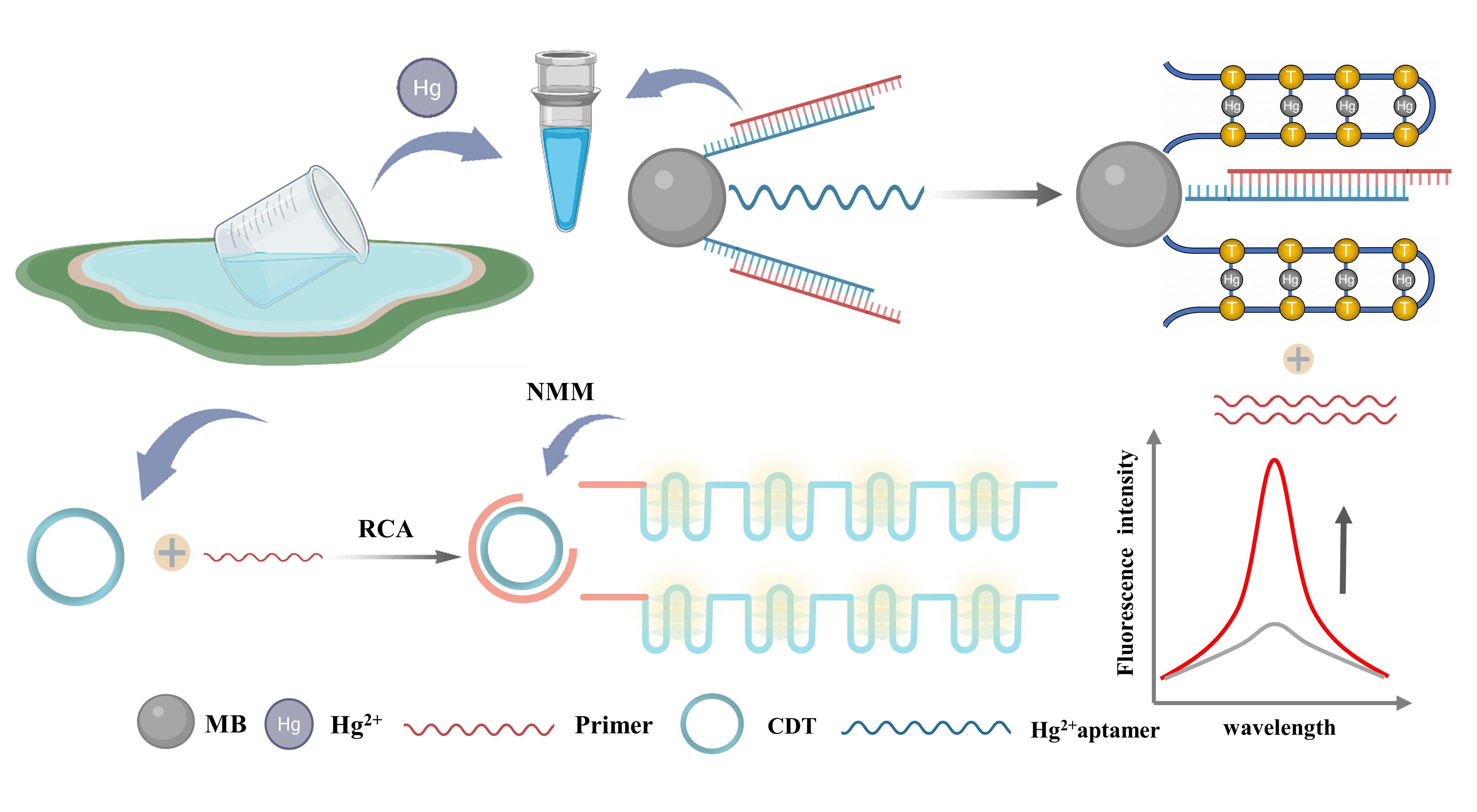
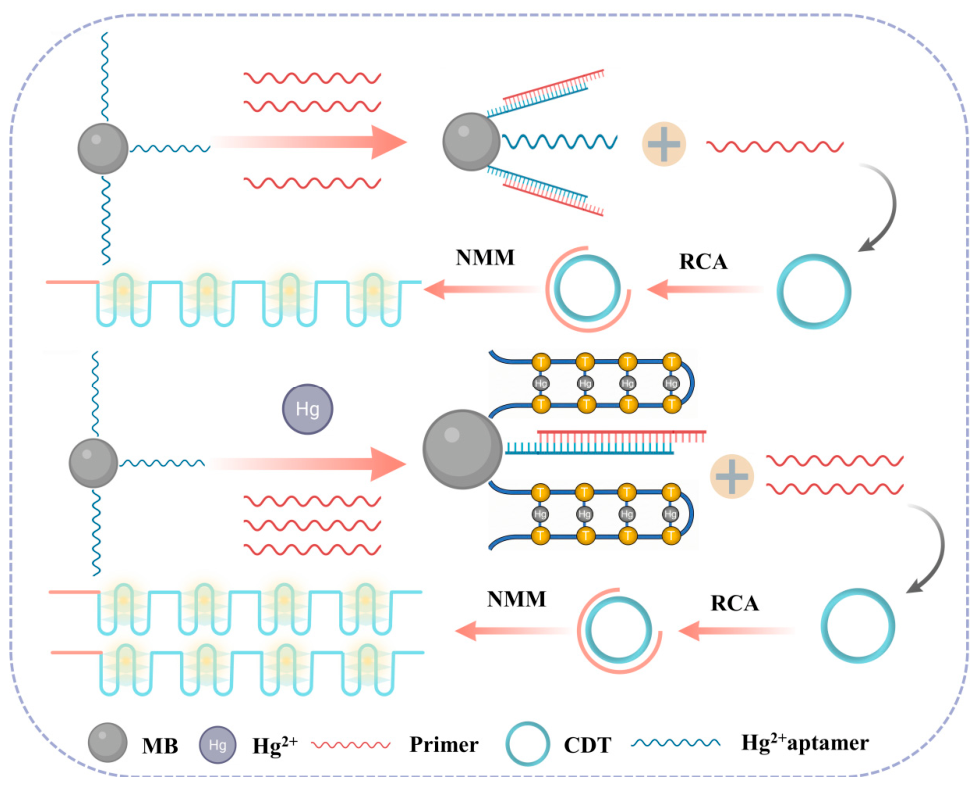
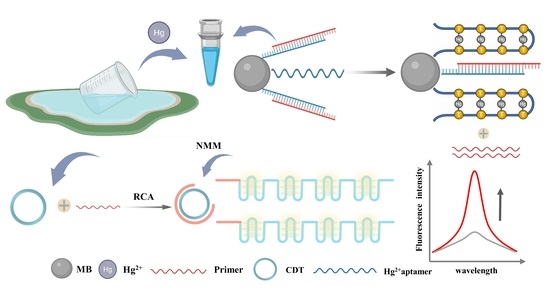
Figure 1 illustrates the working principle of the proposed label-free Hg2+ biosensor, which operates via a two-stage cascade mechanism. In the first stage, a Hg2+-specific DNA aptamer immobilized on superparamagnetic microspheres serves as the recognition module. A short DNA primer is pre-hybridized with the aptamer to form a stable duplex that remains intact under normal conditions but dissociates upon target binding. In the presence of Hg2+, the aptamer forms a T–Hg2+–T structure, releasing the primer. In the second stage, the liberated primer hybridizes with a circular DNA template and initiates rolling circle amplification (RCA) driven by phi29 DNA polymerase, generating long single-stranded DNA with abundant guanine-rich sequences. These sequences fold into G-quadruplex (G4) structures in the presence of K+.
Fluorescent detection is achieved using N-methylmesoporphyrin IX (NMM), a label-free probe that exhibits enhanced fluorescence upon binding to G4 structures. The fluorescence intensity is proportional to the amount of RCA product and thus correlates with the Hg2+ concentration. This cascade amplification strategy enables sensitive detection while maintaining a simple and cost-effective label-free design.
Fluorescent readout is achieved through a label-free switching mechanism. The dye N-methylmesoporphyrin IX (NMM), which exhibits very weak fluorescence in its free state, is introduced into the system. NMM binds with high specific to G-quadruplex structures. Upon intercalation or end-stacking with the G4 sites on the RCA product, restricted internal rotation and an altered local electronic environment lead to a dramatic increase in its fluorescence quantum yield—often by two orders of magnitude or more. The fluorescence intensity at the characteristic emission maximum (~610 nm) is therefore directly proportional to the amount of G-quadruplex structures formed, which in turn reflects the amount of RCA product synthesized and, ultimately, the number of primers released by the initial Hg2+ binding event. This multi-stage amplification cascade provides high sensitivity while retaining the simplicity and cost-effectiveness of a label-free design.

3.2. Influence of Key Reaction Parameters on RCA Amplification

3.2.1. Effect of Primer Concentration on RCA Amplification

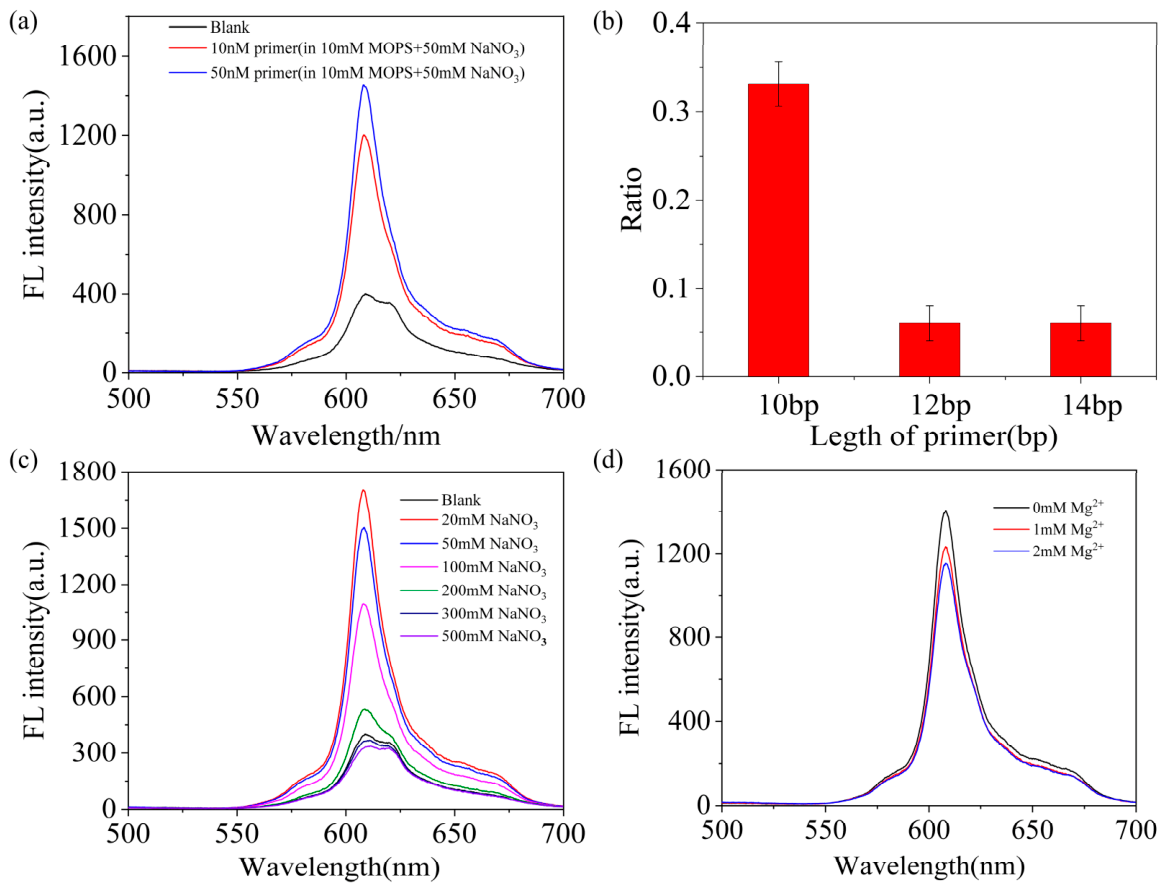
The performance of this sensing method was significantly influenced by the primer concentration. To investigate this relationship, we evaluated the RCA reaction efficiency under low-salt conditions (50 mM NaNO3) using a fixed concentration of circular template and varying primer concentrations (0, 10, and 50 nM). As illustrated in Figure 2a, the signal intensity exhibited a clear dependence on primer concentration, increasing progressively as the concentration was raised. Based on these results and in consideration of reagent economy, a primer concentration of 50 nM was selected for all subsequent experiments.

3.2.2. Thermodynamic Regulation: Primer Stability and Release Efficiency

The enhancement ratio (F/F0) in Figure 2b reveals a critical dependence on the complementarity length between the aptamer and the primer. Although the 12 bp and 14 bp primers show higher hybridization efficiency (as shown in Figure S1), they exhibit significantly lower enhancement ratios compared to the 10 bp primer. This observation is explicitly linked to the binding energy: the 14 bp duplex is thermodynamically too stable to be effectively disrupted by Hg2+, whereas the 10 bp duplex exists in a “marginal stability” state [36]. At 37 °C, the energy gain from T-Hg2+-T coordination is sufficient to overcome the 10 bp binding force, leading to a higher proportion of released primers and a superior signal-to-noise ratio [37].

3.2.3. Effect of Ionic Strength on Detection Performance

Figure 2c shows a parabolic relationship between NaNO3 concentration and fluorescence intensity, with a peak at 20 mM. The initial increase suggests that moderate ionic strength is necessary to stabilize the primer-template hybridization and maintain Phi29 polymerase activity. However, the decline beyond 50 mM likely results from the overcharging effect or the stabilization of non-productive DNA secondary structures, which inhibits correct G4 folding [38].
Additionally, Figure 2d confirms that while Mg2+ is a necessary cofactor for the polymerase, excessive concentrations slightly reduce the final signal due to decreased hybridization stringency [39], 2 mM Mg2+ was selected as the optimal concentration for subsequent assays.

3.3. Optimization of Experimental Conditions

To ensure the optimal analytical performance of the constructed biosensor, particularly in terms of sensitivity and signal-to-noise ratio (SNR), it is critical to investigate the influence of key experimental variables on the fluorescence response. Factors such as reagent stoichiometry and reaction kinetics directly determine the efficiency of signal amplification and the background noise level. Therefore, we systematically optimized three crucial conditions: the concentration of the fluorescent reporter (NMM), the concentration of the circular DNA template, and the RCA reaction duration. The objective was to identify the specific parameters that yield the maximum fluorescence enhancement while maintaining a low background signal.
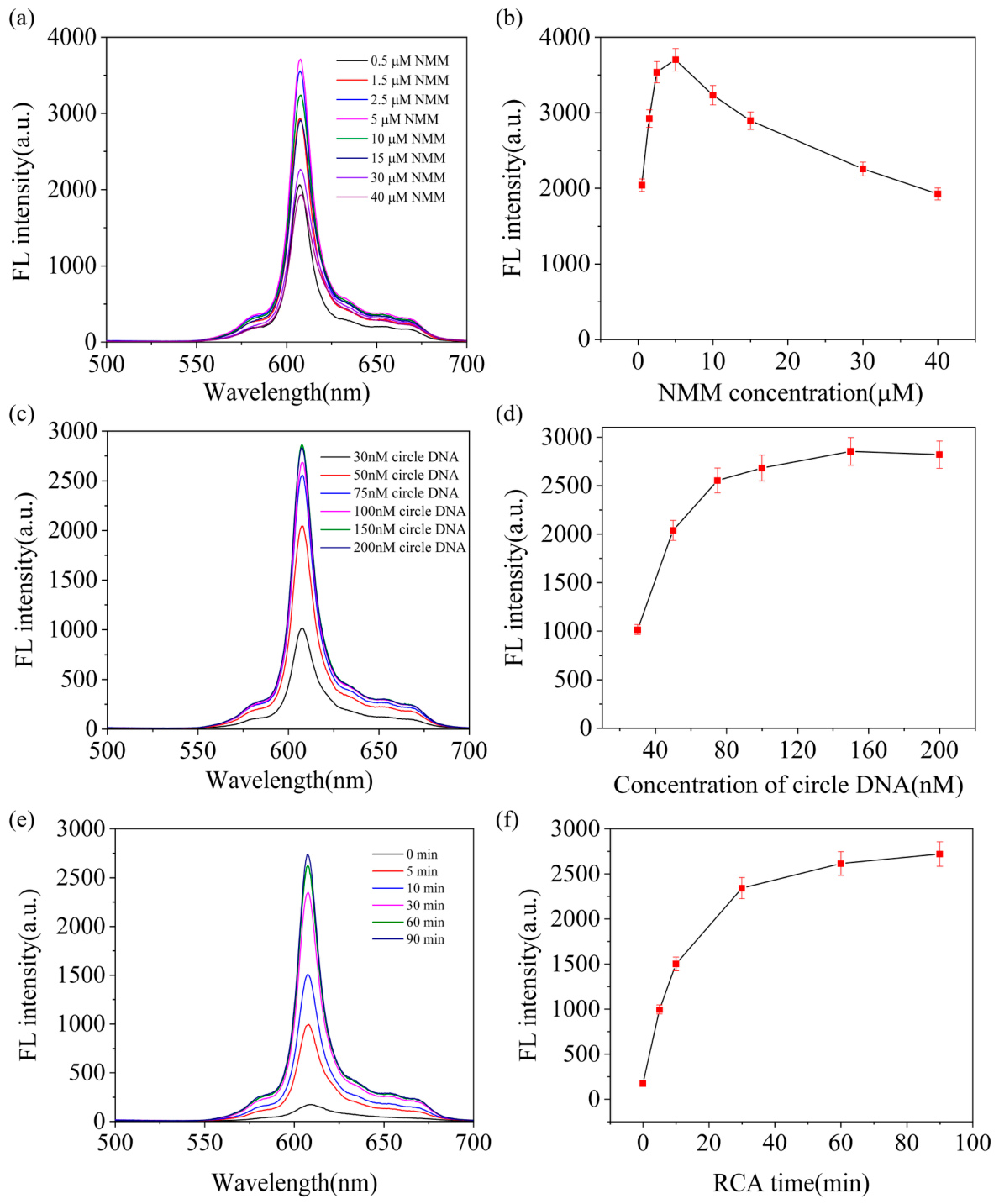
The concentration of the fluorescent reporter, NMM, is a critical parameter determining both signal amplitude and the signal-to-noise ratio (SNR). As illustrated in Figure 3a,b, the fluorescence intensity peaks at 5 μM NMM. The subsequent decline at higher concentrations is a characteristic signature of NMM self-stacking aggregation and the inner filter effect (IFE), where excessive dye molecules quench their own fluorescence or absorb the excitation light [40,41].
Regarding the circular template, Figure 3c,d show a saturation plateau at 150 nM. This indicates that at this concentration, the template-to-primer ratio is optimized for maximum extension efficiency. The slight decrease at 200 nM suggests that an excess of single-stranded template might non-specifically bind to NMM or cause steric hindrance during the RCA process [42,43].
The duration of the RCA reaction determines both the product length and the total number of G-quadruplex repeats synthesized. The kinetic curves in Figure 3e,f demonstrate a rapid signal increase during the first 45 min, reaching a steady-state plateau at 60 min. This plateau reflects the transition from exponential growth to substrate limitation (e.g., dNTP depletion), justifying 60 min as the standard amplification time for efficiency.

3.4. Detection Performance

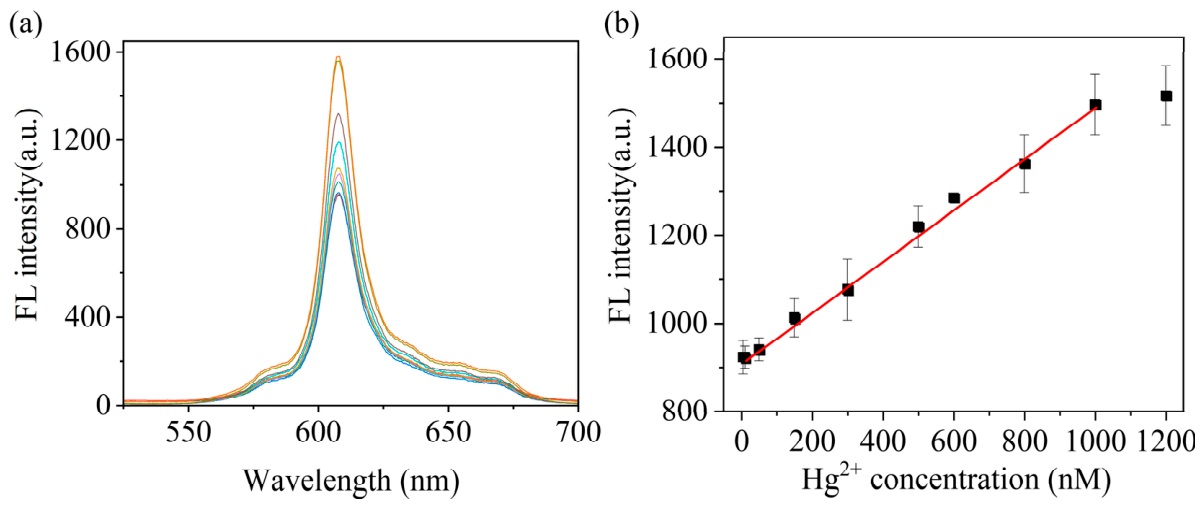
To systematically evaluate the analytical performance of the proposed biosensor, an experimental plan was executed under the optimized conditions. The fluorescence responses were recorded for a series of Hg2+ standard solutions with concentrations ranging from 5 nM to 1200 nM. To ensure statistical reliability and reproducibility, each concentration was independently analyzed in triplicate (n = 3). As shown in Figure 4a, the fluorescence emission intensity increased correspondingly with higher Hg2+ concentrations. A calibration curve was plotted by correlating the average fluorescence intensity measured at 610 nm with the Hg2+ concentration (Figure 4b). This method exhibits a good linear response within the concentration range of 10 nM to 1000 nM, described by the linear regression equation Y = 0.58X + 912.3 (R2 = 0.9877), where Y represents the fluorescence intensity and X denotes the Hg2+ concentration (nM). The limit of detection (LOD) was rigorously calculated to be 3.2 nM based on the standard 3σ/S criterion. In this equation, S represents the slope of the linear calibration curve, and σ is the standard deviation derived from 11 independent parallel measurements of the blank samples (containing no Hg2+). This sensitivity is significantly lower than the toxicity level defined by the World Health Organisation (WHO) for Hg2+ (30 nM) in drinking water [44], thereby meeting the requirements for rapid screening of Hg2+ in water bodies.
To further evaluate the analytical reliability and practical advantages of the proposed biosensor, its key performance indicators were compared with other recently published sensing methods for Hg2+ determination. As summarized in Table 1, while certain electrochemical or photoelectrochemical platforms achieve ultra-low limits of detection (in the picomolar or femtomolar range), they often suffer from complex electrode fabrication or stringent operating conditions. Compared to other existing fluorescent sensors, our proposed MBs-RCA strategy offers an exceptionally broad linear dynamic range (10–1000 nM) along with a reliable LOD of 3.2 nM. Furthermore, the integration of magnetic solid-phase separation endows our method with superior matrix tolerance and operational simplicity, avoiding the complex synthesis of multi-component nanomaterials and rendering it a highly robust tool for actual environmental monitoring.

3.5. Selective Analysis

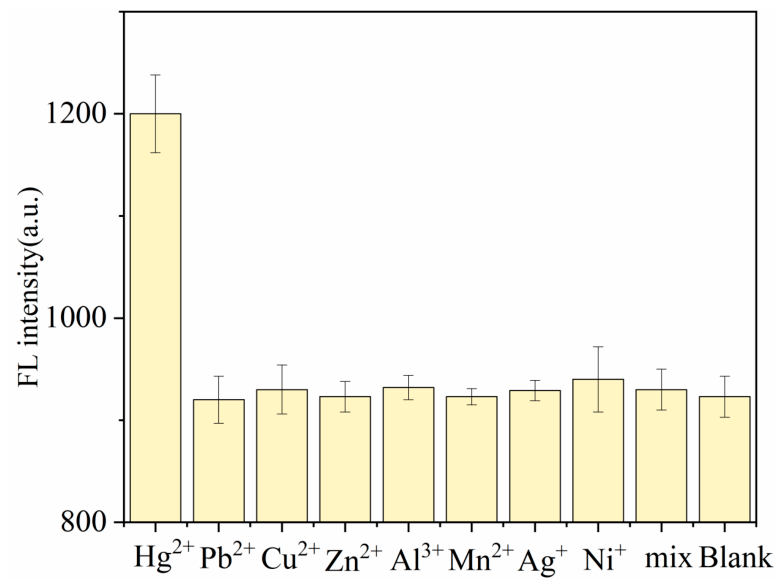
To validate the specific selectivity toward Hg2+, a panel of interfering metal ions was selected based on environmental relevance, natural abundance, and chemical affinity for DNA. Specifically, Pb2+, Cu2+, Zn2+, and Ni+ were chosen as typical heavy metal co-contaminants frequently found alongside Hg2+ in polluted waters. Al3+ and Mn2+ were included due to their high natural background abundance in aquatic ecosystems. Furthermore, Ag+ and Cu2+ were particularly investigated because their strong coordination affinities with nucleobases (e.g., forming C-Ag+-C pairs) could theoretically compete with the target T-Hg2+-T interaction. Evaluating this specific group ensures a robust assessment of the biosensor’s reliability in complex real-world matrices. As illustrated in Figure 5, experimental results indicate that under identical testing conditions, samples containing only Hg2+ exhibit significantly enhanced fluorescence signals, whereas signals generated by competitive metal ions remain essentially consistent with those of the blank solution. Furthermore, even within complex systems where multiple metal ions coexist, this method maintains high specificity for Hg2+ detection, with no significant interference observed. These results explicitly confirm that the proposed sensing strategy possesses adequate selectivity for Hg2+ determination, with its prominent selectivity rendering it highly promising for practical application scenarios. This outstanding selectivity is a testament to the dual-specificity built into the design. First, the DNA aptamer itself has been selected for high affinity and specificity towards Hg2+ over other metals. Second, and perhaps more importantly, the triggering mechanism relies on the unique T-Hg2+-T coordination chemistry [49]. Other divalent metal ions do not form comparably stable complexes with thymine bases under these conditions. Therefore, even if another ion were to weakly bind the aptamer, it would be highly unlikely to induce the precise conformational switch required to displace the primer and initiate the cascade. This two-tiered specificity provides a robust safeguard against cross-reactivity.

3.6. Recovery Study

To validate the applicability and reliability of the constructed sensor in identifying and detecting Hg2+ within real-world environmental samples, this study employed two water samples—Jian Gang Reservoir water and Meihu Lake water from Zhengzhou University—for spiked recovery experiments. All environmental water samples were collected in pre-cleaned containers, immediately filtered through 0.22 μm membrane filters to remove suspended particles and microorganisms, and stored at 4 °C in the dark. The analyses were performed within 24 h without further acidification to preserve the native matrix conditions for a realistic interference assessment. To simulate varying degrees of acute pollution incidents and to evaluate the sensor’s reliability across its linear working range, standard Hg2+ solutions at concentrations of 200 nM and 500 nM were spiked into the real water samples. Given the sensor’s established LOD of 3.2 nM, it is also intrinsically capable of screening Hg2+ at the WHO drinking water toxicity threshold (30 nM).
Experimental results are summarized in Table 2. Recovery rates across both water samples remained within the range of 93.8–106.0% at different concentrations. Furthermore, recovery results for high and low concentrations within the same water sample were comparable, showing no significant differences. This indicates that the method exhibits good detection stability and concentration applicability across different matrices. These results demonstrate that the developed biosensor maintains high detection accuracy and sensitivity within the complex matrices of real-world water samples, exhibits minimal interference from common environmental components, and displays excellent repeatability and reliability. This method is not only suitable for laboratory standard systems but also shows significant application potential for Hg2+ detection in real-environment water samples, providing reliable technical support for rapid on-site monitoring and practical sample analysis. It should be noted that the T-Hg2+-T coordination mechanism specifically recognizes free/labile inorganic Hg2+. The T-Hg2+-T structure remains robust against common background ions (e.g., Cl, PO43−) even at concentrations several orders of magnitude higher than that of Hg2+. Because organomercury species (e.g., CH3Hg+) lack the dual coordination sites required for cross-linking [50], and stable species like HgS cannot be dissociated by the aptamer, the sensor inherently measures the bioaccessible inorganic mercury fraction. For the quantification of “Total Mercury” in highly complex matrices containing abundant sulfides or strong organic ligands, a standard pretreatment step such as UV oxidation or acid digestion is required prior to analysis to release the bound mercury [51]. The excellent recoveries (93.8–106.0%) in raw samples confirm that highly concentrated natural ligands and anions do not compromise target recognition.

4. Conclusions

In summary, this study successfully developed a label-free, ultra-sensitive Hg2+ fluorescent sensing platform based on aptamer structural switching and rolling circle amplification (RCA). The method innovatively utilizes Hg2+-triggered primer release to initiate the RCA reaction, achieving cascading signal amplification while enabling label-free fluorescent detection through G-quadruplex/NMM complexes. Through systematic optimization of parameters including primer length, reagent concentrations, and reaction time, this method demonstrates excellent sensitivity (linear range 10–1000 nM, LOD 3.2 nM), high selectivity, and reliable practicality for Hg2+ detection. Crucially, compared to existing biosensors that often struggle with matrix interference or require complex nanomaterial synthesis, the core novelty of this work lies in the seamless integration of solid-phase magnetic separation with a true label-free RCA cascade. This unique architecture physically isolates the target recognition event from the amplification process, thereby effectively eliminating background noise and matrix-induced false positives. Consequently, this study not only overcomes the limitations of conventional analytical methods but also establishes a highly robust, cost-effective, and promising new paradigm for the rapid detection of trace Hg2+ in complex environmental waters. Future work may explore integrating this sensor with microfluidic chips or portable fluorescence detection devices to facilitate on-site, point-of-care testing (POCT) applications.

Supplementary Materials

The following supporting information can be downloaded at: https://www.mdpi.com/article/10.3390/w18091017/s1, Figure S1: Effect of complementary chain hybridization base count on hybridization rate; Figure S2: Storage stability of the conjugated magnetic beads.

Author Contributions

Conceptualization, L.L.; Funding acquisition, L.L.; methodology, L.L. and B.S.; writing—original draft preparation, S.L.; data curation, S.L. and J.W.; formal analysis, J.W. and Y.M.; visualization, J.S.; project administration, B.W.; writing—review & editing, Q.W. and B.S. All authors have read and agreed to the published version of the manuscript.

Funding

This research was supported by National Key Research and Development Project (2023YFC3208302), special fund of State Key Laboratory of Regional Environment and Sustainability (Grant No. 24K25ESPCT) and Key R&D and Promotion Project of Henan Province (Grant No. 252102321058).

Data Availability Statement

The original contributions presented in this study are included in the article. Further inquiries can be directed to the corresponding authors.

Conflicts of Interest

The authors declare no conflicts of interest.

References

  1. Lee, H.; Su, Y.-C.; Tang, H.-H.; Lee, Y.-S.; Lee, J.-Y.; Hu, C.-C.; Chiu, T.-C. One-pot hydrothermal synthesis of carbon dots as fluorescent probes for the determination of mercuric and hypochlorite ions. Nanomaterials 2021, 11, 1831. [Google Scholar] [CrossRef] [PubMed]
  2. Li, Y.; Liu, C.; Chen, M.; An, Y.; Zheng, Y.; Tian, H.; Shi, R.; He, X.; Lin, X. Solvent-free preparation of tannic acid carbon dots for selective detection of Ni2+ in the Environment. Int. J. Mol. Sci. 2022, 23, 6681. [Google Scholar] [CrossRef]
  3. Chan, D.S.-H.; Fu, W.-C.; Wang, M.; Liu, L.-J.; Leung, C.-H.; Ma, D.-L. A highly selective and non-reaction based chemosensor for the detection of Hg2+ ions using a luminescent iridium (III) complex. PLoS ONE 2013, 8, e60114. [Google Scholar] [CrossRef][Green Version]
  4. Cizdziel, J.; Gerstenberger, S. Determination of total mercury in human hair and animal fur by combustion atomic absorption spectrometry. Talanta 2004, 64, 918–921. [Google Scholar] [CrossRef]
  5. Bohari, N.A.; Siddiquee, S.; Saallah, S.; Misson, M.; Arshad, S.E. Optimization and analytical behavior of electrochemical sensors based on the modification of indium tin oxide (ITO) using PANI/MWCNTs/AuNPs for mercury detection. Sensors 2020, 20, 6502. [Google Scholar] [CrossRef]
  6. Faller, C.; Stojko, N.Y.; Henze, G.; Brainina, K.Z. Stripping voltammetric determination of mercury at modified solid electrodes: Determination of mercury traces using PDC/Au (III) modified electrodes. Anal. Chim. Acta 1999, 396, 195–202. [Google Scholar] [CrossRef]
  7. Yu, H.; Zhao, Q. A sensitive aptamer fluorescence anisotropy sensor for Cd2+ using affinity-enhanced aptamers with phosphorothioate modification. Biosensors 2022, 12, 887. [Google Scholar] [CrossRef]
  8. Han, K.N.; Choi, J.-S.; Kwon, J. Gold nanozyme-based paper chip for colorimetric detection of mercury ions. Sci. Rep. 2017, 7, 2806. [Google Scholar] [CrossRef] [PubMed]
  9. Yuan, M.; Yang, Y.; Chau, N.T.Q.; Zhang, Q.; Wu, X.; Chen, J.; Wu, Z.; Zhong, H.; Li, Y.; Xu, F. A Novel Fluorescent Aptasensor for Arsenic (III) Detection Based on a Triple-Helix Molecular Switch. Molecules 2023, 28, 2341. [Google Scholar] [CrossRef] [PubMed]
  10. Farzin, L.; Shamsipur, M.; Sheibani, S. A review: Aptamer-based analytical strategies using the nanomaterials for environmental and human monitoring of toxic heavy metals. Talanta 2017, 174, 619–627. [Google Scholar] [CrossRef]
  11. Li, B.; Li, B.; Han, Y.; Li, Q.; Liang, C.; Zhang, S.; Li, W. Rational design of porphyrin-based ionophores for enhanced perchlorate selectivity in ion selective electrodes: Application to fireworks wastewater analysis. Energy Environ. Nexus 2025, 1, e009. [Google Scholar] [CrossRef]
  12. Zeng, G.; Zhang, C.; Huang, D.; Lai, C.; Tang, L.; Zhou, Y.; Xu, P.; Wang, H.; Qin, L.; Cheng, M. Practical and regenerable electrochemical aptasensor based on nanoporous gold and thymine-Hg2+-thymine base pairs for Hg2+ detection. Biosens. Bioelectron. 2017, 90, 542–548. [Google Scholar] [CrossRef]
  13. Abdelhamid, H.N.; Wu, H.-F. Ultrasensitive, rapid, and selective detection of mercury using graphene assisted laser desorption/ionization mass spectrometry. J. Am. Soc. Mass Spectrom. 2014, 25, 861–868. [Google Scholar] [CrossRef]
  14. Shi, H.; Li, L.; Zhang, L.; Yu, J. In situ controllable heterojunction conversion strategy driven by oriented paper-based fluid transfer for human immunoglobulin G detection. Microchim. Acta 2021, 188, 373. [Google Scholar] [CrossRef] [PubMed]
  15. Loha, K.; Boonkoom, T.; Pitakjakpipop, H.; Alam, I.; Treetong, A.; Boonbanjong, P.; Chatnuntawech, I.; Teerapittayanon, S.; Keyser, U.F.; Schulte, A. Structural and Kinetic Profiling of Rolling Circle Amplification via Solid-State Nanopore Sensing Using miR-21 as a Model. ACS Sens. 2025, 10, 7014–7024. [Google Scholar] [CrossRef]
  16. Grasemann, L.; Thiel Pizarro, P.; Maerkl, S.J. C2CAplus: A one-pot isothermal circle-to-circle DNA amplification system. ACS Synth. Biol. 2023, 12, 3137–3142. [Google Scholar] [CrossRef]
  17. Idilli, A.I.; Segura-Bayona, S.; Lippert, T.P.; Boulton, S.J. A C-circle assay for detection of alternative lengthening of telomere activity in FFPE tissue. STAR Protoc. 2021, 2, 100569. [Google Scholar] [CrossRef]
  18. Anping, C.; Chun-yang, Z. Sensitive and Label-Free DNA Methylation Detection by Ligation-Mediated Hyperbranched Rolling Circle Amplification. Anal. Chem. 2012, 84, 6199–6205. [Google Scholar]
  19. Zhou, Y.; Huang, Q.; Gao, J.; Lu, J.; Shen, X.; Fan, C. A dumbbell probe-mediated rolling circle amplification strategy for highly sensitive microRNA detection. Nucleic Acids Res. 2010, 38, e156. [Google Scholar] [CrossRef] [PubMed]
  20. Xue, Q.; Wang, L.; Jiang, W. A versatile platform for highly sensitive detection of protein: DNA enriching magnetic nanoparticles based rolling circle amplification immunoassay. Chem. Commun. 2012, 48, 3930–3932. [Google Scholar] [CrossRef]
  21. Zhou, X.; Su, Q.; Xing, D. An electrochemiluminescent assay for high sensitive detection of mercury (II) based on isothermal rolling circular amplification. Anal. Chim. Acta 2012, 713, 45–49. [Google Scholar] [CrossRef]
  22. Kim, T.-Y.; Lim, M.-C.; Woo, M.-A.; Jun, B.-H. Radial flow assay using gold nanoparticles and rolling circle amplification to detect mercuric ions. Nanomaterials 2018, 8, 81. [Google Scholar] [CrossRef]
  23. Li, J.; Zhang, X.; Suo, Z.; Feng, X.; Li, W.; He, B.; Wei, M.; Zhao, R. A portable fluorescent aptamer sensor for rapid quantitative detection of Hg2+. Anal. Methods 2025, 17, 4461–4469. [Google Scholar] [CrossRef]
  24. Khoshbin, Z.; Danesh, N.M.; Nameghi, M.A.; Ramezani, M.; Alibolandi, M.; Shayan, M.; Samie, A.; Abnous, K.; Taghdisi, S.M. Robust tag-free aptasensor for monitoring of tobramycin: Architecting of rolling circle amplification and fluorescence synergism. Anal. Biochem. 2023, 674, 115197. [Google Scholar] [CrossRef] [PubMed]
  25. Zhang, S.; Wu, Y.; Zhang, W. G-quadruplex structures and their interaction diversity with ligands. ChemMedChem 2014, 9, 899–911. [Google Scholar] [CrossRef]
  26. Zhu, J.; Yan, Z.; Bošković, F.; Haynes, C.J.; Kieffer, M.; Greenfield, J.L.; Wang, J.; Nitschke, J.R.; Keyser, U.F. Fe II4 L 4 tetrahedron binds and aggregates DNA G-quadruplexes. Chem. Sci. 2021, 12, 14564–14569. [Google Scholar] [PubMed]
  27. Zhou, X.; Zhang, D.; Yan, Y.; He, H.; Zhou, Y.; Ma, C. A Label-Free Fluorometric Glutathione Assay Based on a Conformational Switch of G-quadruplex. Molecules 2021, 26, 2743. [Google Scholar] [CrossRef]
  28. Mandal, S.; Hoque, M.E.; Mao, H. Single-molecule investigations of G-quadruplex. In G-Quadruplex Nucleic Acids: Methods and Protocols; Springer: Berlin/Heidelberg, Germany, 2019; pp. 275–298. [Google Scholar]
  29. Li, W.-x.; Jiang, S.; Liu, W.-j.; Zhang, C.-y. RNA demethylation-driven functional supramolecular structure for label-free detection of m6A modification eraser FTO in human breast tissues. Anal. Chim. Acta 2023, 1260, 341208. [Google Scholar] [PubMed]
  30. Wu, Q.; Zhang, Y.; Yang, Q.; Yuan, N.; Zhang, W. Review of electrochemical DNA biosensors for detecting food borne pathogens. Sensors 2019, 19, 4916. [Google Scholar] [CrossRef]
  31. Wu, J.; Lv, J.; Zheng, X.; Wu, Z.-S. Hybridization chain reaction and its applications in biosensing. Talanta 2021, 234, 122637. [Google Scholar] [CrossRef]
  32. Song, L.; Zhuge, Y.; Zuo, X.; Li, M.; Wang, F. DNA walkers for biosensing development. Adv. Sci. 2022, 9, 2200327. [Google Scholar] [CrossRef]
  33. Liu, B.; Yang, Z.; Huang, T.; Li, M.-M.; Duan, W.; Xie, B.; Chen, J.-X.; Dai, Z.; Chen, J. Label-free and highly sensitive APE1 detection based on rolling circle amplification combined with G-quadruplex. Talanta 2022, 244, 123404. [Google Scholar] [CrossRef]
  34. Gan, Y.; Long, X.; Gong, Z.; Yuan, P.; Tang, Y.; Zhong, S.; Yang, Y. A label-free strategy for direct detection of Staphylococcus aureus in complex matrixes based on RCA and aptamer. Sens. Actuators B Chem. 2025, 422, 136674. [Google Scholar] [CrossRef]
  35. Gao, X.; Sun, Z.; Wang, X.; Zhang, W.; Xu, D.; Sun, X.; Guo, Y.; Xu, S.; Li, F. Construction of a dual-model aptasensor based on G-quadruplexes generated via rolling circle amplification for visual/sensitive detection of kanamycin. Sci. Total Environ. 2022, 839, 156276. [Google Scholar] [CrossRef]
  36. Chen, K.; Fu, T.; Sun, W.; Huang, Q.; Zhang, P.; Zhao, Z.; Zhang, X.; Tan, W. DNA-supramolecule conjugates in theranostics. Theranostics 2019, 9, 3262. [Google Scholar] [CrossRef] [PubMed]
  37. Wang, Y.-P.; Eriksson, L.A.; Zhang, R.-B. Mechanism of dual-site recognition in a classic DNA aptamer. J. Chem. Inf. Model. 2024, 64, 7698–7708. [Google Scholar] [CrossRef]
  38. Zhang, C.; Tian, F.-J.; Zuo, H.-W.; Qiu, Q.-Y.; Zhang, J.-H.; Wei, W.; Tan, Z.-J.; Zhang, Y.; Wu, W.-Q.; Dai, L. Counterintuitive DNA destabilization by monovalent salt at high concentrations due to overcharging. Nat. Commun. 2025, 16, 113. [Google Scholar] [CrossRef]
  39. Traeger, J.C.; Schwartz, D.K. Interplay of electrostatic repulsion and surface grafting density on surface-mediated DNA hybridization. J. Colloid Interface Sci. 2020, 566, 369–374. [Google Scholar] [CrossRef] [PubMed]
  40. Monteiro, A.R.; Ramos, C.I.; Fateixa, S.; Moura, N.M.; Neves, M.G.; Trindade, T. Hybrids based on graphene oxide and porphyrin as tools for detection and stabilization of DNA G-quadruplexes. ACS Omega 2018, 3, 11184–11191. [Google Scholar] [CrossRef] [PubMed]
  41. Wang, T.; Zeng, L.-H.; Li, D.-L. A review on the methods for correcting the fluorescence inner-filter effect of fluorescence spectrum. Appl. Spectrosc. Rev. 2017, 52, 883–908. [Google Scholar] [CrossRef]
  42. Hutchison, C.A., III; Smith, H.O.; Pfannkoch, C.; Venter, J.C. Cell-free cloning using φ29 DNA polymerase. Proc. Natl. Acad. Sci. USA 2005, 102, 17332–17336. [Google Scholar] [CrossRef]
  43. Rye, H.S.; Glazer, A.N. Interaction of dimeric intercalating dyes with single-stranded DNA. Nucleic Acids Res. 1995, 23, 1215–1222. [Google Scholar] [CrossRef]
  44. World Health Organization. Guidelines for Drinking-Water Quality; World Health Organization: Geneva, Switzerland, 2011. [Google Scholar]
  45. Ma, N.; Ren, X.; Wang, H.; Kuang, X.; Fan, D.; Wu, D.; Wei, Q. Ultrasensitive Controlled Release Aptasensor Using Thymine-Hg2+-Thymine Mismatch as a Molecular Switch for Hg2+ Detection. Anal. Chem. 2020, 92, 14069–14075. [Google Scholar] [CrossRef] [PubMed]
  46. Zhao, M.; Fan, G.-C.; Chen, J.-J.; Shi, J.-J.; Zhu, J.-J. Highly sensitive and selective photoelectrochemical biosensor for Hg2+ detection based on dual signal amplification by exciton energy transfer coupled with sensitization effect. Anal. Chem. 2015, 87, 12340–12347. [Google Scholar] [CrossRef] [PubMed]
  47. Yao, J.; He, Y.; Li, L.; Li, P.; Yang, M. Magnified fluorescent aptasensors based on a gold nanoparticle−DNA hybrid and DNase I for the cycling detection of mercury (II) Ions in aqueous solution. Ind. Eng. Chem. Res. 2019, 58, 21201–21207. [Google Scholar] [CrossRef]
  48. Li, H.; Bei, Q.; Zhang, W.; Marimuthu, M.; Hassan, M.M.; Haruna, S.A.; Chen, Q. Ultrasensitive fluorescence sensor for Hg2+ in food based on three-dimensional upconversion nanoclusters and aptamer-modulated thymine-Hg2+-thymine strategy. Food Chem. 2023, 422, 136202. [Google Scholar] [CrossRef]
  49. Zhu, Z.; Su, Y.; Li, J.; Li, D.; Zhang, J.; Song, S.; Zhao, Y.; Li, G.; Fan, C. Highly sensitive electrochemical sensor for mercury (II) ions by using a mercury-specific oligonucleotide probe and gold nanoparticle-based amplification. Anal. Chem. 2009, 81, 7660–7666. [Google Scholar] [CrossRef]
  50. Deng, L.; Li, Y.; Yan, X.; Xiao, J.; Ma, C.; Zheng, J.; Liu, S.; Yang, R. Ultrasensitive and highly selective detection of bioaccumulation of methyl-mercury in fish samples via Ag0/Hg0 amalgamation. Anal. Chem. 2015, 87, 2452–2458. [Google Scholar] [CrossRef]
  51. Kadam, U.S.; Hong, J.C. Advances in aptameric biosensors designed to detect toxic contaminants from food, water, human fluids, and the environment. Trends Environ. Anal. Chem. 2022, 36, e00184. [Google Scholar] [CrossRef]
Figure 1. Scheme of label-free and ultrasensitive detection of Hg2+ based on structure switching of aptamer and RCA.
Water 18 01017 g001
Figure 2. (a) Effect of primer concentration on RCA products. (b) Fluorescence enhancement ratio of complementary chains of different lengths after adding 500 nM Hg2+. (c) Effect of NaNO3 concentration on fluorescence intensity. (d) Effect of Mg2+ concentration on fluorescence intensity.
Water 18 01017 g002
Figure 3. Optimization of experimental conditions. (a,b) Effect of NMM concentration on fluorescence intensity (c,d) Effect of cyclic template concentration on fluorescence intensity (e,f) Effect of RCA time on fluorescence intensity.
Water 18 01017 g003
Figure 4. (a) Detection results for a series of Hg2+ standard solutions at different concentrations in this study. The colorful lines represent the fluorescence emission spectra at varying concentrations of Hg2+ (ranging from 5 to 1200 nM, with intensity increasing as concentration increases). (b) Calibration curve.
Water 18 01017 g004
Figure 5. Specificity evaluation of the proposed biosensor. Fluorescence intensity responses of the sensing system to Hg2+ and various interfering metal ions (Pb2+, Cu2+, Zn2+, Al3+, Mn2+, Ag+, and Ni+) as well as their mixture. The concentration of Hg2+ and other metal ions was 500 nM. Error bars indicate the standard deviation of three independent measurements (n = 3).
Water 18 01017 g005
Table 1. Comparison of the analytical performance of the proposed method with previously reported Hg2+ sensors.
Detection MethodRecognition Element/StrategyLinear RangeLODRef.
ElectrochemicalAu NPs-ssDNA/CRSEA10 pM–100 μM2.9 pM[45]
ColorimetricAuNPs/Rolling Circle AmplificationNot specified22.4 nM[22]
PhotoelectrochemicalCdS QDs & Au NPs/T-Hg2+-T10 fM–200 nM3.3 fM[46]
FluorescentAuNP-DNA/DNase I Amplification10–300 nM2.11 nM[47]
FluorescentUpconversion Nanoclusters/Aptamer~2.5–100 nM~1.4 nM[48]
FluorescentAptamer-MBs/RCA cascade10–1000 nM3.2 nMThis work
Table 2. Recovery study of Hg2+ in spiked different water samples.
SampleAdded (nM)Measured (nM) *Recoveries (%)
Jiangang Reservoir3028 ± 493
5052 ± 8104
200212 ± 9106
500478 ± 1696
Meihu Lake water from Zhengzhou University3029 ± 797
5054 ± 6108
200189 ± 1295
500468 ± 3494
Note: * Measured values are expressed as C ± Δ where C is the mean concentration and Δ represents the 95% confidence interval. n = 3, p = 0.95.
Disclaimer/Publisher’s Note: The statements, opinions and data contained in all publications are solely those of the individual author(s) and contributor(s) and not of MDPI and/or the editor(s). MDPI and/or the editor(s) disclaim responsibility for any injury to people or property resulting from any ideas, methods, instructions or products referred to in the content.