Article

A Physics-Informed Deep Learning Approach Using Different Free Surface Approximation Strategies for Steady Seepage in Dams


1
School of Civil and Environmental Engineering, Changsha University of Science & Technology, Changsha 410114, China
2
School of Smart City, Nanning Vocational and Technical University, Nanning 530004, China
3
Key Laboratory of Special Environment Road Engineering of Hunan Province, Changsha University of Science & Technology, Changsha 410114, China
*
Author to whom correspondence should be addressed.
Water 2026, 18(9), 1016; https://doi.org/10.3390/w18091016
Submission received: 2 April 2026 / Revised: 18 April 2026 / Accepted: 22 April 2026 / Published: 24 April 2026

Abstract

Investigating soil seepage considering free surface conditions under complex geological conditions is of great significance to ensure the safety of dams. In recent years, physics-informed deep learning (PINN) has become a cross-disciplinary hotspot for solving forward and inverse problems based on partial differential equations. However, the challenges in free surface simulation have confined the majority of current PINN research to seepage problems under fixed boundary conditions. To address the above issues, we propose a physics-informed deep learning-based approach for steady seepage in dams. In the proposed method, two different free surface approximation strategies are introduced to accommodate varying boundary conditions in the dam seepage problem. The first strategy approximates the free boundary by sampling points, while the second strategy approximates the free boundaries by an additional deep neural network. To validate the proposed methods, three benchmark cases with different boundary conditions have been conducted. The results indicate that the proposed approach effectively simulates steady seepage in dams. Both point-sampling and deep neural network-based free surface approximation strategies demonstrate high accuracy in predicting the location of the phreatic surface and the discharge of the seepage. Specifically, the prediction results are comparable in accuracy to analytical solutions and advanced numerical simulation methods.

1. Introduction

The rapid development of hydropower engineering construction has highlighted dam seepage as a critical scientific issue of ongoing concern in the field of hydropower engineering. During the operation of reservoir dams, fluctuations in reservoir water levels induce changes in the internal seepage field of the dam. This can readily lead to phenomena such as piping and liquefaction, subsequently causing engineering safety issues [1,2,3]. Extensive research has been conducted on seepage problems [4,5,6]. Still, it is challenging to accurately simulate seepage problems in dams due to the substantial uncertainty concerning the free surface.
With the advancement of computer technology, numerical simulation has become a primary means of studying seepage problems. Numerical methods such as the Finite Element Method (FEM) [7,8], Finite Difference Method (FDM) [9,10], and meshless methods [11] simulate the seepage process within the dam body and determine the position of the free surface by transforming analytical problems with continuous variables into numerical problems with discrete variables. Mesh-based methods, represented by FEM and FDM, discretize the computational domain using meshes, enabling them to accurately describe the corresponding physical laws and structural responses in continuum problems and small deformation problems. In contrast, meshless methods use discrete domain points to construct approximations, thereby overcoming the limitations of mesh-based methods when addressing issues such as discontinuous media and large deformations. However, this discrete approach also introduces the significant drawback of high computational cost. Solving complex engineering problems with current numerical methods faces challenges due to their high computational cost and the difficulty in achieving technological breakthroughs.
In recent years, the powerful capability of deep learning methods in approximating nonlinear functions has opened up new avenues for tackling complex engineering problems, including dam seepage. The integration of physical principles and data to build more general and explanatory deep learning models has received widespread attention. Among these, the most representative deep learning method is the Physics-Informed Neural Network (PINN). The PINN, first proposed by Raissi [12], requires significantly less training data compared to purely data-driven methods. It solves partial differential equations (PDEs) by training a deep neural network to minimize a loss function that incorporates governing equations, initial conditions, boundary conditions, and other prior knowledge. The PINN exhibits high accuracy and strong robustness, making it frequently employed as a surrogate model for solving uncertainty quantification problems and PDEs. Li et al. [13] introduced a theory-guided neural network, demonstrating its accuracy and effectiveness in uncertainty quantification tasks with noisy data by incorporating scientific theories and empirical rules into its loss function. Amininiaki et al. [14] proposed a sequential training strategy to mitigate the instability often encountered during neural network training for multiphysics problems in composite materials.
Compared with traditional numerical methods, the breakthrough of the PINN lies in its ability to accurately establish complex nonlinear mappings by learning from a small amount of data, thus transforming the numerical solution in the traditional numerical methods into an efficient learning process, which significantly improves the efficiency of solving PDEs [15]. Theoretically, the deep learning approach has better adaptability and generalization ability and can more efficiently solve the PDE problems encountered in complex engineering [16,17,18]. However, as a developing emerging technology, current PINNs still struggle to simulate free surface variations. Existing studies on PINNs are mostly limited to problems with fixed boundaries, and rarely focus on dynamic boundary scenarios such as the free surface [19,20,21]. Additionally, a small number of relevant studies rely on specific governing equations (e.g., the Shallow Water Equations) [22,23,24] to define the free surface, resulting in limited applicability. Such limitations have hindered the application of PINNs in complex seepage problems or large deformation problems.
In this paper, to address the above issues, we propose a physics-informed deep learning-based approach for steady seepage in rectangle dam. In the proposed method, two different free surface simulation strategies are introduced to accommodate varying boundary conditions in the dam seepage problem. The first strategy approximates the free boundary by sampling points, while the second strategy approximates the free boundaries with an additional deep neural network. Finally, the results of the three benchmark cases demonstrate that the proposed methods are comparable in accuracy to analytical solutions and advanced numerical methods.
The contributions of this paper are as follows:
  • We propose a physics-informed deep learning-based approach using different free surface approximation strategies for steady seepage in homogeneous dams.
  • This paper presents two different strategies to approximate the free surface (phreatic surface) and provides corresponding usage recommendations.
  • Three benchmark cases with different boundary conditions have been conducted to show the capability of PINN towards the seepage problem with free surfaces.

2. Background

2.1. Physics-Informed Neural Networks

Physics-based neural networks (PINNs) are a class of semi-supervised deep learning models that directly incorporate known physical laws into the training objectives of the network. Rather than learning the solution solely from data, a PINN represents the unknown field u ( x ) by a parameterized neural network F ( x , θ ) and enforces the governing equations by penalizing the PDE residual computed from F ( x , θ ) . In this study, several simplifying assumptions are made to establish the physics-informed neural network framework. First, the seepage flow is assumed to be steady-state, meaning the hydraulic head and free surface position do not change over time. Second, the porous media are considered isotropic, where the hydraulic conductivity is uniform in all directions.
Starting from a single layer f ( x ) :
f ( x ) = σ ( a x T + b ) )
where x is the input of the network, a represents learnable weights, b is the bias, and σ represents a non-linear activation function. Assuming a number n of these layers gives a simple fully-connected neural network F ( x , θ ) :
f ( x , θ ) = ( f n f 2 f 1 ) ( x )
where θ denotes all trainable network parameters.
We optimize the parameters of this neural network by minimizing the loss function:
L ( x , θ ) = 1 N i = 1 N ( y i F ( x i , θ ) )
To minimize the mean square error of network output relative to some true data points ( x i , y i ) .
This framework is designed to address problems where the underlying dynamics can be described by a generic partial differential equation of the form:
N x [ u ] = 0 , x Ω R d
u ( x ) = z ( x ) , x Ω , z : Ω R n
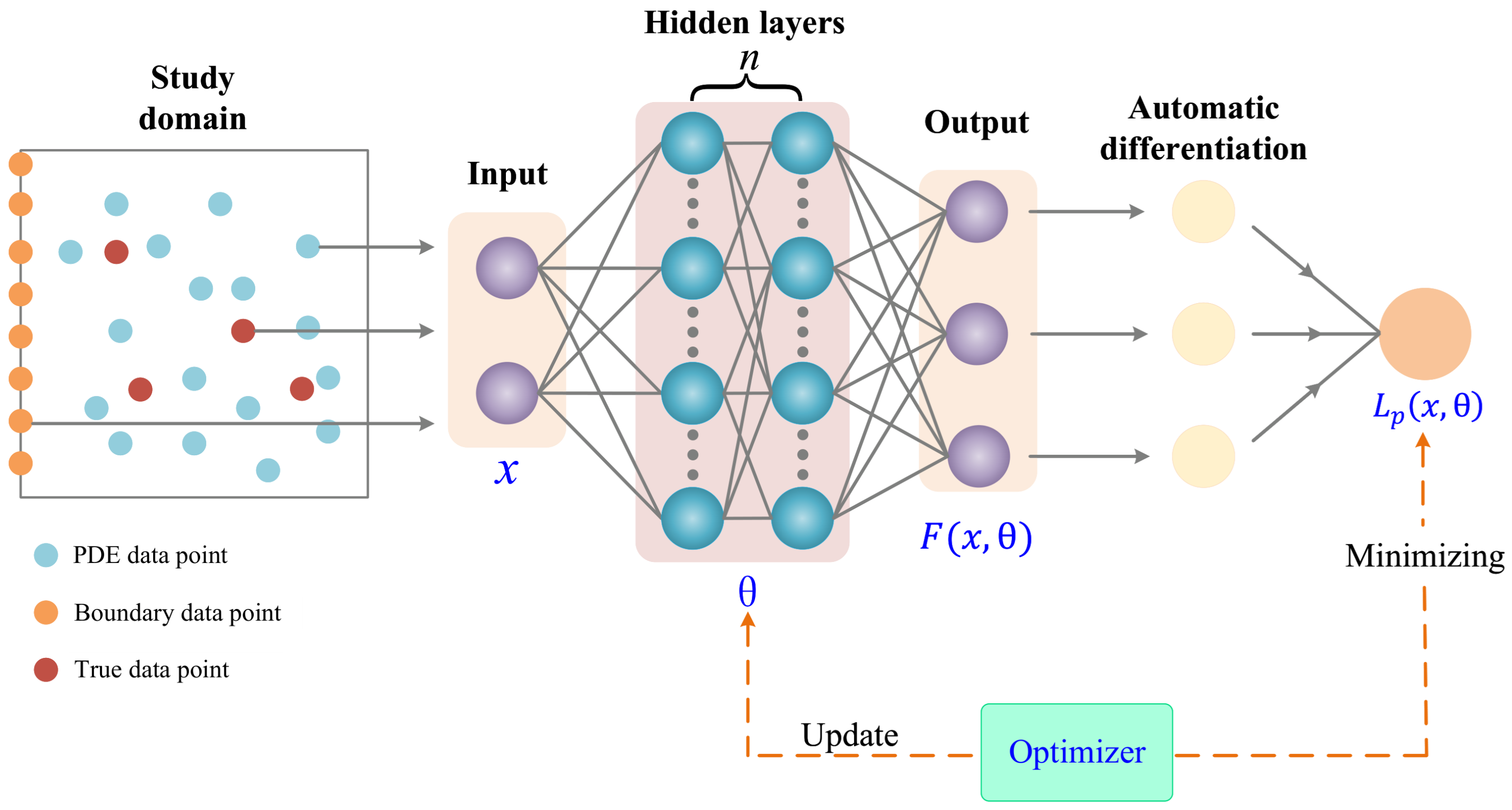
where u is the solution operator, z represents some function describing boundary conditions, and N x denotes a generally nonlinear differential operator. We utilize this partial differential equation to create a PINN (see Figure 1) by adding a new physical loss term l p ( x , θ ) (typically represented as PDEs, related boundaries (BC), and initial conditions (IC)) to the loss function L ( x , θ ) .
l p ( x , θ ) = N x [ F ( x , θ ) ] 2
This penalizes the PDE residual with the current network prediction substituted for the true solution. Thus, the resulting total physics-informed loss L p ( x , θ ) is defined as:
L p ( x , θ ) = L ( x , θ ) + l p ( x , θ )

2.2. Governing Equation of Steady Seepage

To analyze the steady seepage problem in dams, it is necessary to combine Darcy’s Law, which describes the constitutive relationship of seepage, and the continuity equation, which represents mass conservation. The expression of Darcy’s Law is given by Equation (8):
v = k φ
where v denotes the seepage velocity, k is the hydraulic conductivity, ∇ is the Hamiltonian operator, φ represents the piezometric head, and φ stands for the hydraulic head gradient vector.
The continuity equation is expressed as Equation (9)
v = 0
By substituting Equation (8) into Equation (9) to eliminate the seepage velocity v, the governing equation with the piezometric head φ as the variable can be derived. For the homogeneous and isotropic medium involved in this study, the hydraulic conductivity k is a constant, and thus the governing equation can be simplified to the well-known Laplace equation [25], as shown in Equation (10):
2 φ = 0
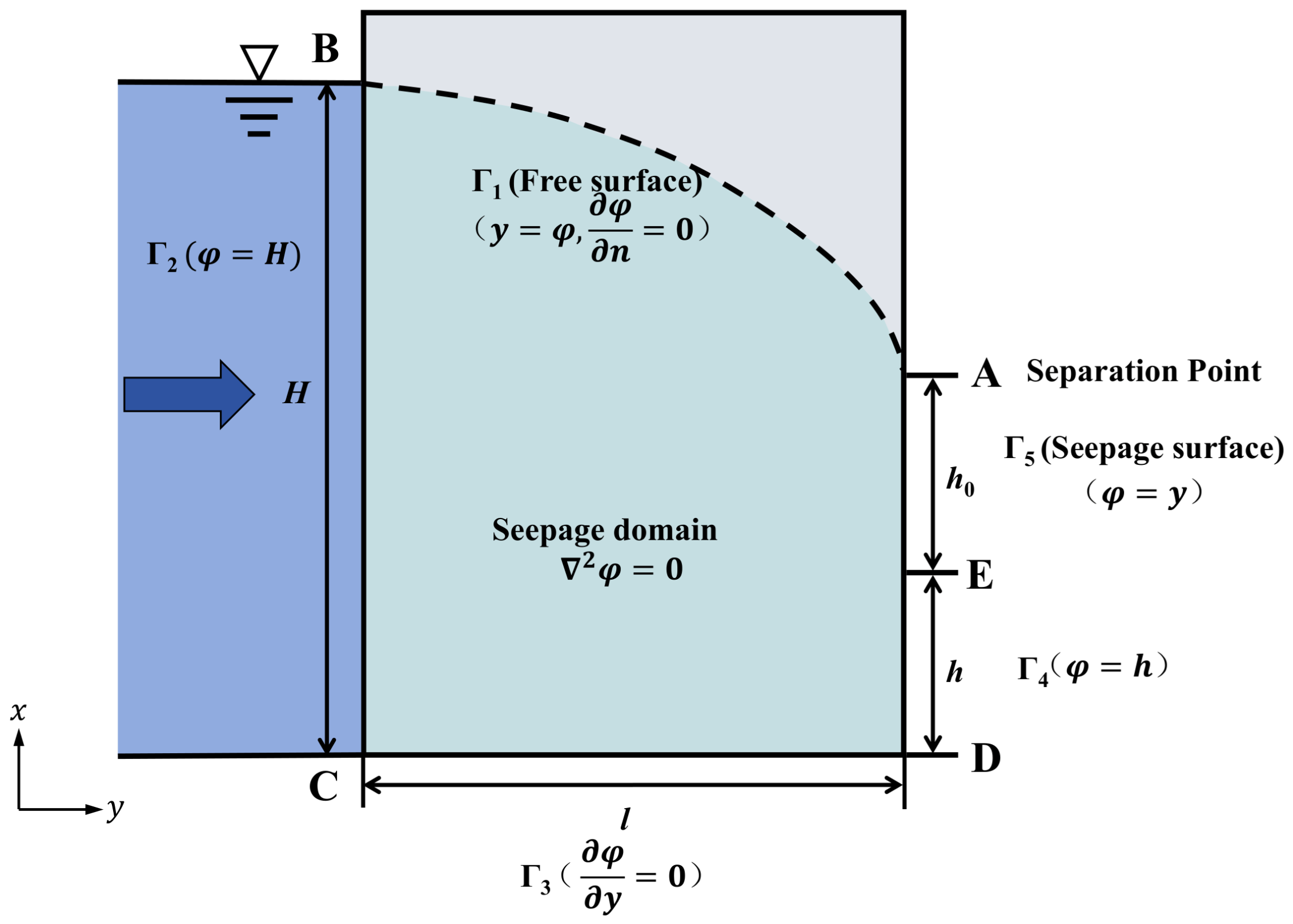
Based on the above equations, the seepage problem of a rectangular dam in this study can be illustrated in Figure 2. In the figure, the left boundary BC serves as a constant-head input boundary for seepage; the bottom boundary CD is an impermeable boundary, where the normal seepage velocity is 0; the right boundary is divided into two parts, AE and DE. AE is the seepage face, where the piezometric head is always equal to the elevation head, and DE corresponds to the tailwater level. The free surface is represented by AB, and the piezometric head at each point on this line is equal to its elevation head (the pressure head is 0, i.e., atmospheric pressure), which marks the boundary between the saturated and dry zones. Therefore, the normal flow velocity of AB is always 0.
According to various values of the seepage face height h 0 and the tailwater height h, the position of the free surface can be determined using the Dupuit–Forchheimer assumption and Polubarinova–Kochina’s solution. In the case study section, different scenarios will be discussed, and the accuracy of the proposed method in simulating the free surface will be verified.

3. Methods

3.1. Overview

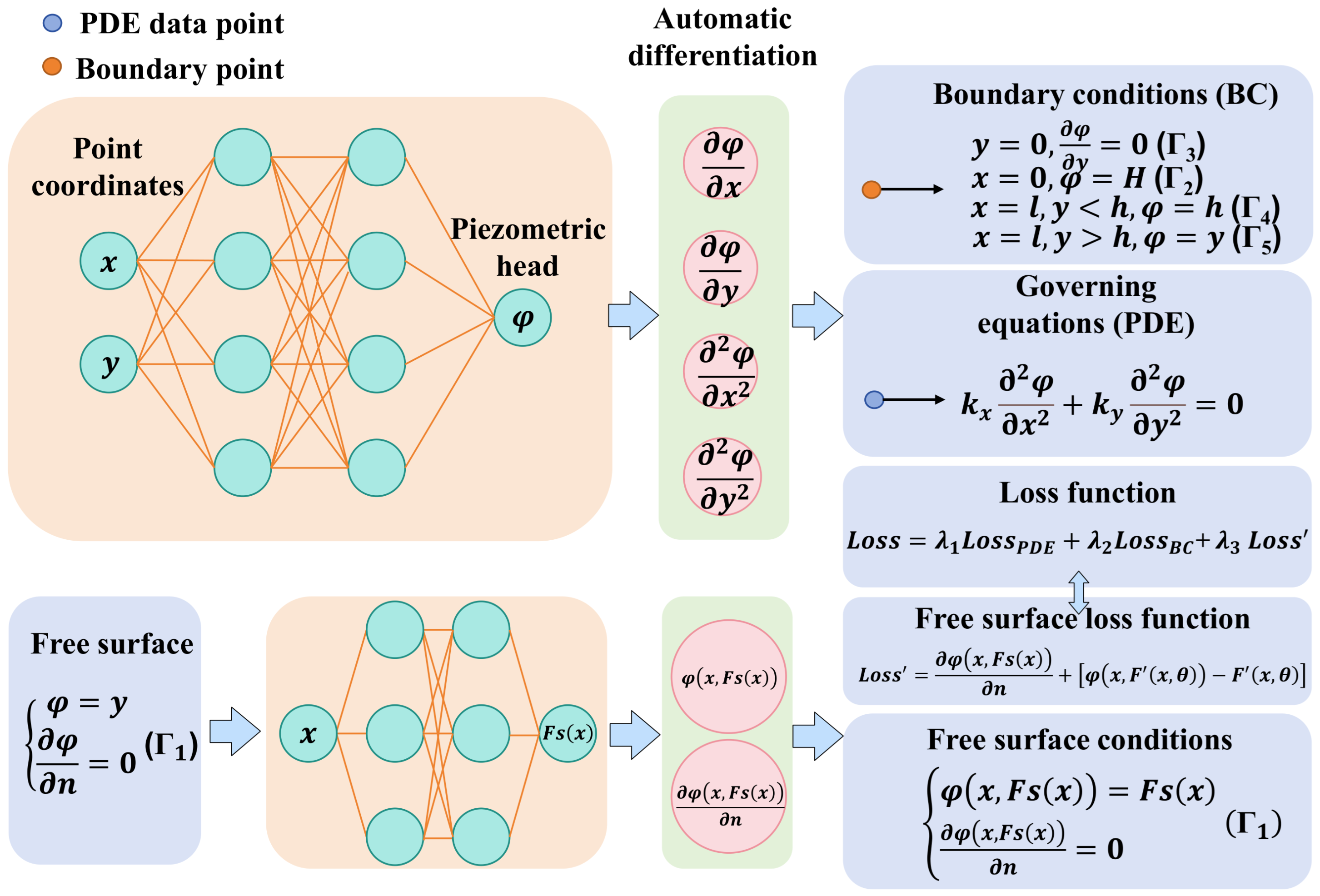
Accurate analysis of the seepage field in rectangular dams is in rectangular dams is of crucial importance in ensuring the stability of dam structures. In this paper, we propose the PINN to analyze the seepage field within a dam. As illustrated in Figure 2 and Figure 3, we begin by randomly sampling PDE data points within the seepage domain. For points on fixed boundaries, we carry out random sampling using the Glorot method [26], according to the mathematical expressions of each boundary (e.g., Boundary Γ 2 : x = 0, Γ 3 : y = 0, Γ 4 : x = l and y < h). Finally, a number of valid sampling points that meet the conditions are generated, which are used as the boundary points for model training.
However, as shown in boundaries Γ 1 and Γ 5 In Figure 2, the position of the free surface is unknown before modeling, and it must simultaneously satisfy the boundary conditions of water head and flow rate, which makes it difficult to calculate residuals by pre-sampling points. Thus, to simulate the free surface, we propose two methods for different situations: (1) Explicit sampling-based method; (2) Implicit function-based method.

3.2. Explicit Sampling-Based PINN for Free Surface Modeling

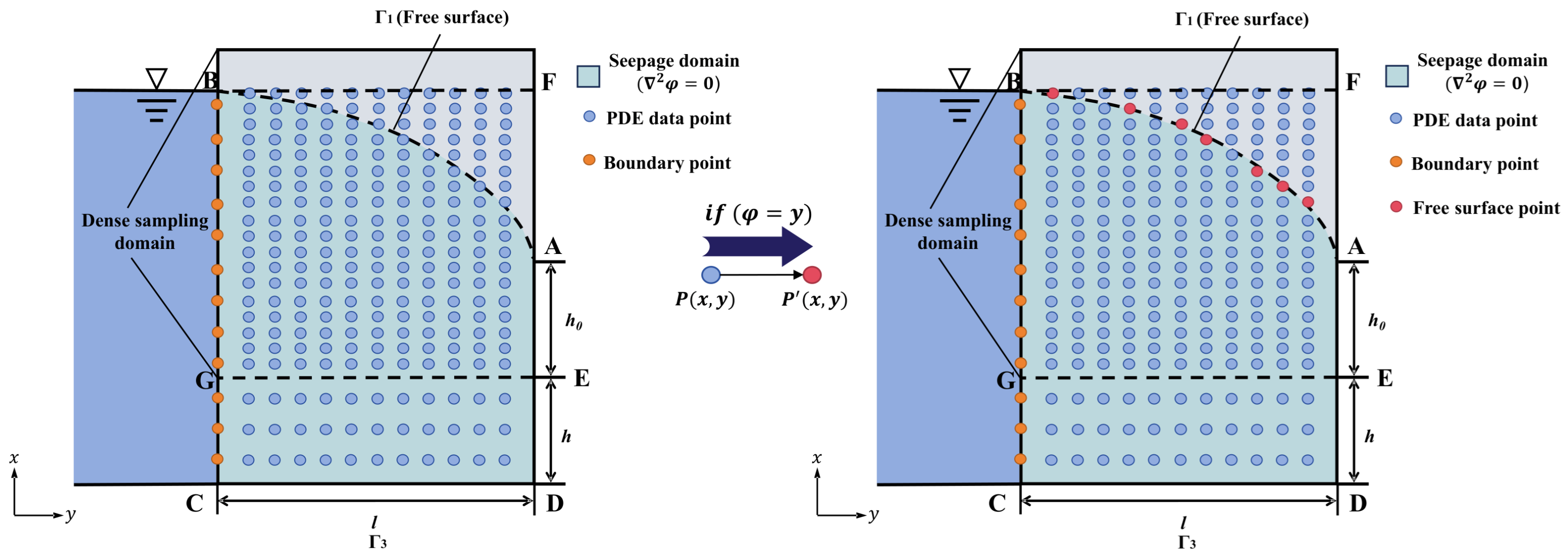
Within the PINN framework, the seepage problem in dams is solved by minimizing the loss associated with satisfying the governing equations and boundary conditions, which are evaluated from the output of a neural network at discrete sampling points. Analogously, for free surface problems, the proposed explicit sampling-based method ascertains the position of the free surface by enforcing its specific boundary conditions through a dense set of sampling points. Specifically, as illustrated in Figure 4, we perform dense sampling within the region Ω B G E F , which is the potential area for the free surface. The number of sampling points in this region is dozens of times higher than usual.
Let the true free surface of the steady seepage problem in a rectangular dam be denoted as Γ 1 , which is an unknown continuous boundary embedded in the bounded closed domain Ω B G E F . For steady seepage in homogeneous isotropic dams, the free surface satisfies the constraint:
φ ( x , y ) = y
where φ ( x , y ) denotes the piezometric head, and y denotes the elevation head.
Then, we implement dense stochastic sampling within the envelope domain Ω f to generate a set of candidate sampling points:
P = { p i ( x i , y i ) | p i Ω BGEF , i = 1 , 2 , , N }
where N represents the total number of sampling points.
According to the density property of stochastic sampling in bounded Euclidean domains, as the sampling size N becomes sufficiently large, the point set P forms a dense approximation of Ω B G E F . This guarantees that a sufficient number of sampling points will asymptotically coincide with or approach infinitesimally close to the true free surface Γ 1 .
Based on the intrinsic definition of the free surface, we introduce a small positive threshold ϵ 1 to formulate the point identification criterion:
F s condition = 1 , | φ ( x , y ) y | ϵ , 0 , | φ ( x , y ) y | > ϵ .
where F s condition indicates that the candidate point ( x , y ) is recognized as a valid free-surface point. A sensitivity analysis was conducted in order to ascertain the sampling density and threshold ϵ . Please refer to the Section 4 for further details.
In addition to the geometric constraint φ ( x , y ) = y , the free surface also satisfies the zero normal flux condition for seepage flow:
φ ( x , y ) n = 0
where n denotes the unit outward normal vector of Γ f .
Substituting the valid free-surface points into the normal flux constraint, the free-surface residual loss is constructed as:
L o s s = 1 N F s i = 1 N F s F s condition φ ( x i , y i ) n 2
where N F s is the number of free surface boundary points, n is the normal direction of the free surface, and φ ( x , y ) n represents the normal partial derivative of water head φ ( x i , y i ) obtained by the neural network.
By performing dense sampling in the pre-defined free-surface domain, we ensure the existence of sufficient candidate points in the vicinity of the true free surface. The valid free-surface points are then screened strictly by the physical definition φ ( x , y ) = y . This two-step procedure enables the acquisition of a statistically representative set of points for computing the free-surface residual loss, thereby converting the unknown free-boundary seepage problem into a solvable discrete constrained optimization problem within the PINN framework.
The total loss function of the explicit sampling-based method is analogous to that of the implicit function-based method, and will be detailed in Section 3.3.

3.3. Implicit Function-Based PINN for Free Surface Modeling

According to the aforementioned Section 3.2, the explicit sampling-based PINN requires dense sampling, which significantly increases computational costs. Therefore, to avoid the additional computational burden caused by excessive sampling points, we propose the implicit function-based PINN for free surface modeling. In this method, the free surface is directly represented by a function. Thus, the problem is reduced to the formulation and simulation of a function that describes this free boundary.
Neural networks have been proven to simulate any continuous nonlinear function [27]. To directly integrate the constraint conditions for the free surface boundary and the boundary conditions into the PINN training process as a loss function, an additional neural network is constructed to represent the free surface.
We assume that the expression for the free surface Γ 1 is:
y = F s ( x )
The piezometric head φ is a function φ ( x , y ) related to the position of a point. Substituting Equation (16) into the free surface boundary conditions φ = y φ n = 0 yields the following expression:
φ ( x , F s ( x ) ) = F s ( x ) φ ( x , F s ( x ) ) n = 0
where n is the normal direction of the free surface, and φ n = 0 represents a normal flow velocity of 0.
Assuming a number n of fully-connected layers f provide a simple fully-connected neural network F ( x , θ ) to represent the free surface F s :
F s ( x ) = F ( x , θ ) = ( f n f 2 f 1 ) ( x )
where θ denotes all trainable network parameters, and x denotes the horizontal axis. The loss of the additional neural network F ( x , θ ) for the free surface point x i , F ( x i , θ ) can be defined as:
L o s s = 1 N F s i = 1 N F s φ x i , F S ( x i ) n + φ x i , F ( x i , θ ) F ( x i , θ ) 2
Thus, various control conditions are measured at PDE points, boundary points, and free surface points, the total loss function of the PINN is defined as:
L o s s = λ 1 L o s s PDE + λ 2 L o s s BC + λ 3 L o s s
L o s s PDE = 1 N PDE i = 1 N PDE k x 2 φ x i 2 + k y 2 φ y i 2 2
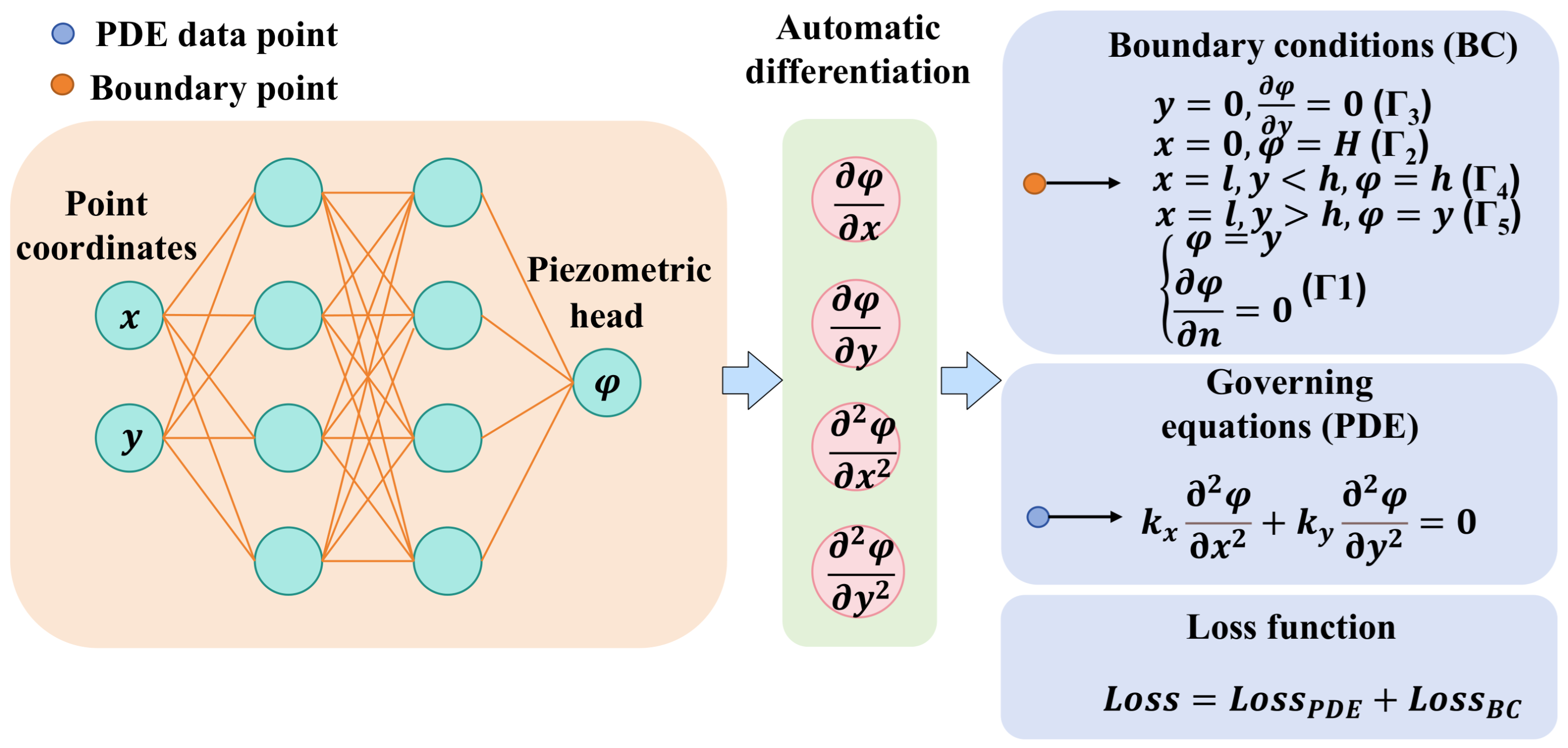
where L o s s PDE is the PDE residual loss for PDE data points, L o s s BC is the boundary condition residual loss for boundary points, and L o s s is the free surface residual loss for free surface points. The loss function L o s s for the explicit method is Equation (15), while that for the Implicit method is Equation (19). λ 1 , λ 2 , and λ 3 are the weights of various loss functions. N PDE is the number of PDE data points (see Figure 5).
In Equation (20) mentioned above, the boundary loss L o s s B C is composed of loss functions on four boundaries: Γ 2 , Γ 3 , Γ 4 , Γ 5 .
L o s s BC = 1 N 2 i = 1 N 2 φ ( x i , y i ) H 2 ( x i , y i ) Γ 2 1 N 3 i = 1 N 3 φ ( x i , y i ) h 2 ( x i , y i ) Γ 3 1 N 4 i = 1 N 4 φ ( x i , y i ) y 2 ( x i , y i ) Γ 4 1 N 5 i = 1 N 5 φ ( x i , y i ) n 2 ( x i , y i ) Γ 5
where φ ( x i , y i ) represents the piezometric head output by the neural network at the position of the boundary sample point ( x i , y i ) . n is the normal direction of the free surface, H denotes the height of the seepage boundary Γ 2 on the left side of the dam, and h denotes the height of the stable seepage boundary Γ 3 on the right side of the dam (see Figure 2).

4. Results

To verify the applicability and prediction accuracy of the proposed PINN, three numerical experiments are designed based on whether the seepage face h 0 shown in Figure 2 and the tailwater height h can be neglected.
For implementation, all experiments in this section were conducted on a laptop computer equipped with an AMD Ryzen 9 7945HX CPU with 16 GB of DDR5 RAM and a NVIDIA GeForce RTX 4060 Laptop GPU with 8 GB of VRAM. The code was implemented in Python 3.11 using the TensorFlow 2 framework and built on the DeepXDE library [28]. For model training, network parameters were initialized using the Glorot method [26], and the Adam optimizer was employed to train the PINN. The number of training iterations was set to 40,000 for Example 1 and 50,000 for both Examples 2 and 3. The optimization process is divided into two stages: the learning rate is set to 0.001 for the first 20,000 iterations, and then reduced to 0.0001 for the subsequent iterations. The loss function of PINN typically consists of heterogeneous components such as data loss and physics constraint loss (e.g., PDE residuals, boundary/initial condition errors). These components inherently differ in terms of dimensionality, convergence rate, and importance. Direct summation of these components may lead to training failure or poor accuracy. To ensure that all loss values maintain consistent magnitudes during neural network training, it is necessary to introduce weight parameters for different loss components. In this study, the weight values are manually adjusted using the method described in [29]. Alternatively, adaptive methods such as the Neural Tangent Kernel (NTK) method introduced in [27] can be employed.

4.1. Case 1: Not Considering the Seepage Face Above the Tailwater

In the first case, the primary focus is on the seepage field distribution within the rectangular dam and the corresponding shape of the seepage surface when the seepage face above the tailwater is negligible. For the study domain illustrated in Figure 2, the boundary parameters are set as follows: H = 2 , l = 2 , h = 1 , h 0 = 0 . When the seepage face above the tailwater is neglected, the position of the free surface in this problem can be calculated using the Dupuit equation, as shown in Equation (23) [30].
H 2 y 2 = x L { H 2 ( h + h 0 ) 2 }
Substituting the specific parameters into the governing equations, the analytical solution for this problem could be obtained.
y = 4 1.5 x
Then, a PINN network consisting of 4 layers with 100 neurons per layer is constructed for the problem, where the tanh function is adopted as the activation function. For the explicit sampling-based method, the loss weight for the free surface boundary (i.e., λ 3 in Equation (20)) is set to 10,000, while the other weights are 1.
As described in Section 3.1, the explicit sampling-based method requires a appropriate sampling density and a threshold for judging whether a sampling point lies on the free surface. Accordingly, we performed a parameter sensitivity analysis. In the sensitivity analysis, four levels of sampling point density were set as 10×, 30×, 50×, and 70× higher, and three values of threshold ϵ were adopted, that 1 × 10 4 , 1 × 10 5 , and 1 × 10 6 . The detailed results are presented in the table below.
It can be observed that the prediction accuracy gradually improves with the sampling points. When the threshold ϵ is relatively large, the accuracy improvement is slight when the sampling density is raised from 50× to 70×, indicating that the number of sampling points on the free surface has approached saturation. For ϵ = 1 × 10 6 , further increasing the sampling points brings some improvement, but will significantly increase the computational time with low cost-effectiveness.
Regarding the effect of threshold: when ϵ = 1 × 10 4 , the judgment criterion is too loose, and a large number of non-free-surface points are included, resulting in degraded accuracy. When ϵ = 1 × 10 6 , the criterion is excessively strict; even under the high-density sampling of 70×, only a few points are identified as the free surface, leading to insufficient samples and unsatisfactory accuracy.
In summary, we confirm that the combination of 50× sampling density and ϵ = 1 × 10 5 is optimal and reasonable, as it achieves a favorable balance between accuracy and efficiency (see Table 1).
For the implicit function-based method, the loss weight of free surface boundary conditions φ ( x , F s ( x ) ) n = 0 is 1000, φ ( x , F s ( x ) ) F s ( x ) = 0 is 100. The remaining loss weights are all set to 1, see Equation (25).
L o s s = L o s s PDE + L o s s BC + 1 N Fs i = 1 N Fs 1000 × φ x i , F s ( x i ) n + 100 × φ x i , F ( x i , θ ) F ( x i , θ ) 2
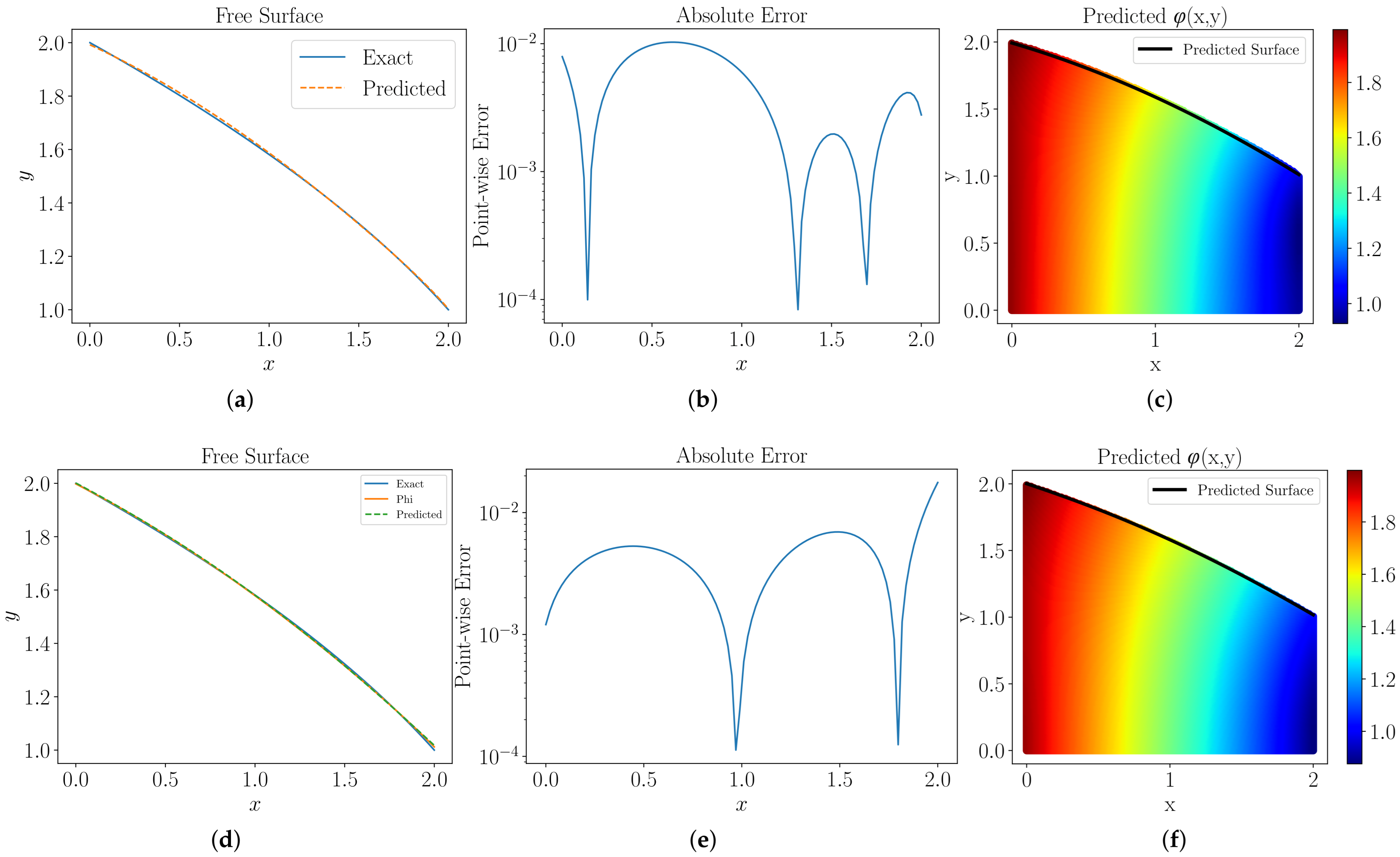
Figure 6 shows comparisons between the free surface predicted by PINNs using different strategies outlined in Section 3 and the analytical solution, along with the corresponding seepage field.
As can be seen from Figure 6, both methods can well predict the free surface in the rectangular dam, while the seepage face above the tailwater is not considered. The RMSE and relative L2 errors of the prediction results from the two methods are presented in Table 2.
Specifically, the explicit sampling-based method achieves high prediction accuracy for the free surface within x [ 1.0 , 2.0 ] , while small errors are observed in the region before x = 1.0 . We hypothesize that this discrepancy arises from an insufficient number of sampling points in the latter region—there is a lack of qualified sampling points near the free surface. This issue can be alleviated by increasing the total number of sampling points. In contrast, the implicit function-based method maintains high accuracy across the entire domain, except for a minor deviation near x = 2.0 .

4.2. Case 2: Not Considering the Tailwater

In the following case, we consider the problem setting where the tailwater height is neglected, i.e., h = 0 in Figure 2. The other parameters are set as follows: H = 1 , l = 1 , and h 0 0 . The solutions for the seepage face at specific locations in this problem are obtained from [31], and these results will be used for comparison with the PINN simulation results proposed in this study.
In this case, we adopt a PINN architecture consisting of 4 layers with 100 neurons per layer. In the loss function, different loss terms are assigned distinct weights. The loss weights are similar to those in Section 4.1, except that an additional weight of 100 is assigned to the left boundary condition.
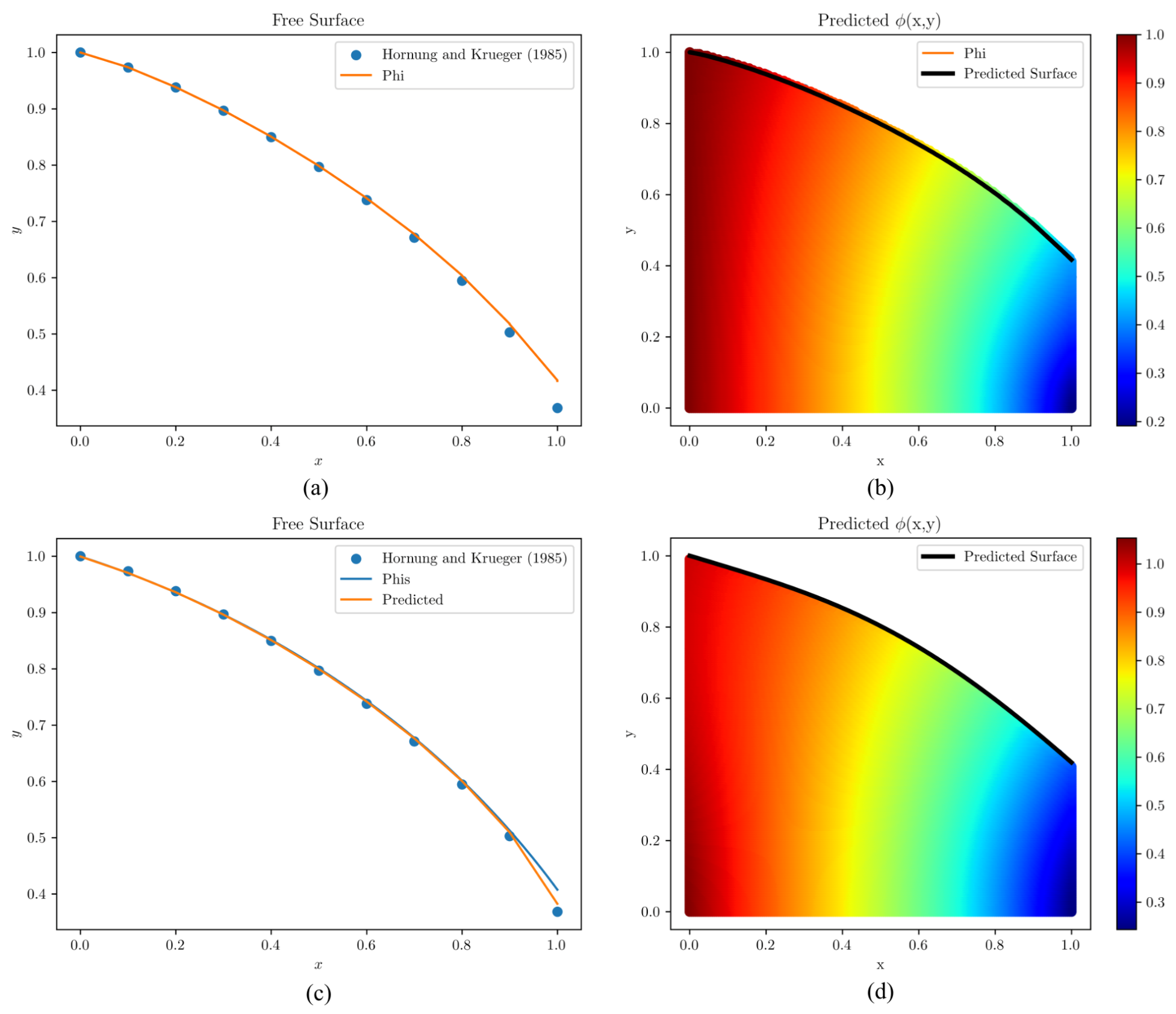
The comparisons between the seepage face predictions from PINNs using two different strategies and the coordinates of analytical solution on the free surfaces reproduced from the Polubarinova-Kochina formula, along with the predictions of the overall seepage field, are presented in Figure 7.
As depicted in the figure, the results of the seepage field simulation for the rectangular dam using the proposed two methods are highly consistent. Furthermore, both methods exhibit high accuracy in simulating the free surface φ (piezometric head). At the right boundary of the free surface, the piezometric head predicted by the explicit sampling-based method is slightly larger than that of the analytical solution, whereas the result using the implicit function-based method is more accurate, demonstrating superior extrapolation capability over the explicit sampling-based method. The discontinuity of derivatives at the boundary may cause these errors, and further explanations will be provided in Section 5.2.

4.3. Case 3: Considering Both Seepage Face and the Tailwater

We now study a more challenging and realistic simulation scenario, incorporating both the tailwater height and the seepage face above it. Specifically, a homogeneous rectangular dam is considered in this case, with a width and height of l = 0.5 and H = 1 , respectively. The water head at the left boundary is set to the same value as the corresponding height, H. Meanwhile, the water head at the right boundary is set to 0.5 . The bottom boundary remains impermeable, consistent with the previous settings.
Case 3 is more complex than the previous two cases; therefore, we adopt an 8 layer network in this example, while the number of neurons per layer and the weight of each loss term remain unchanged. Regarding the activation function, to better simulate the unknown free surface, we introduce the Locally Adaptive Activation Functions with a per-layer basis proposed in [32].
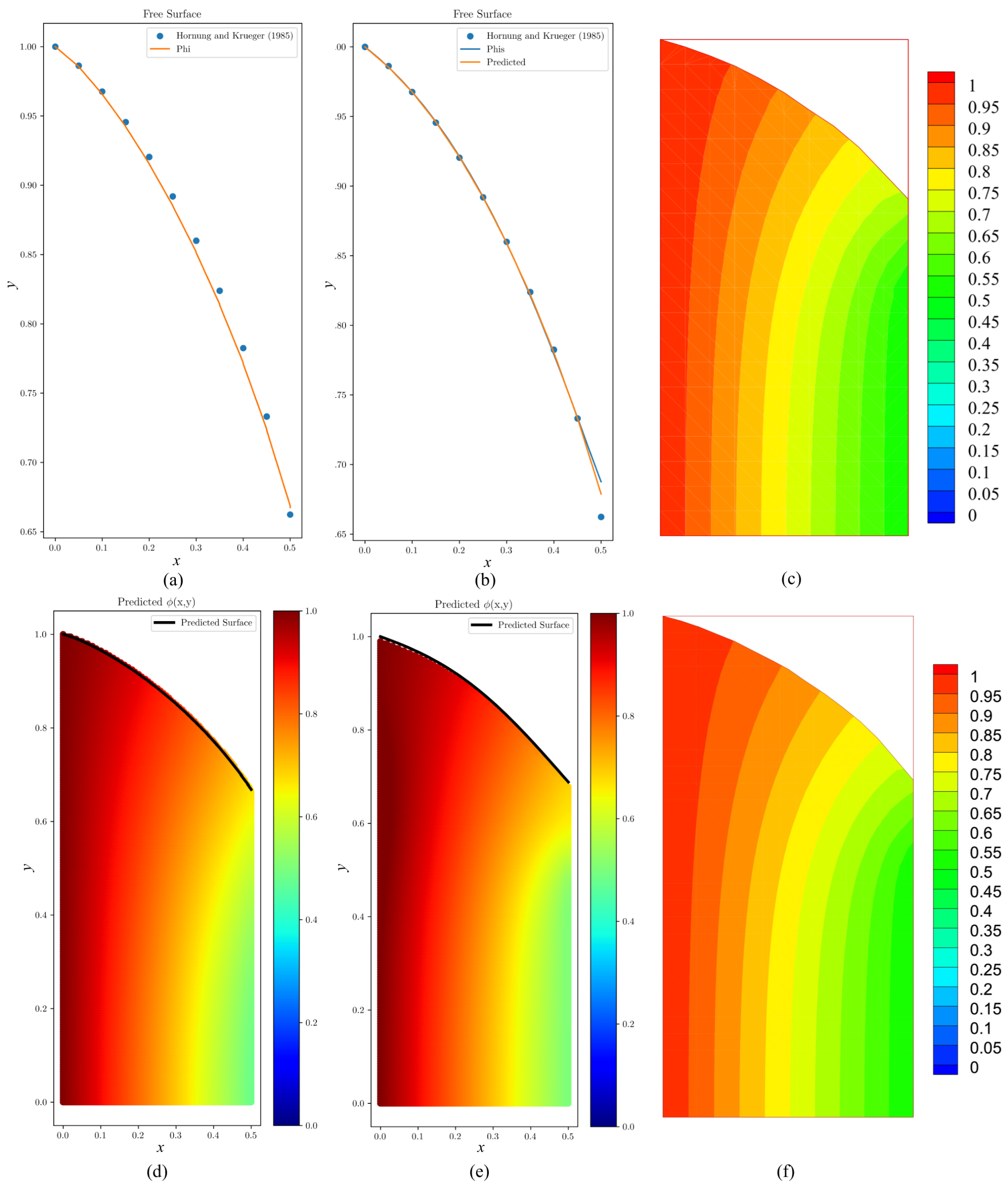
As illustrated in Figure 8, a comparison is presented between the two proposed PINN methods and other extant studies in terms of the free surface location and seepage field contours. Specifically, the analytical solution for the free surface location is adopted from [31], while the results of the seepage field contours are derived from the numerical manifold method proposed by [33]. Both the free surface locations and water head contours predicted by the two methods in this study are in excellent agreement with those from existing literature.
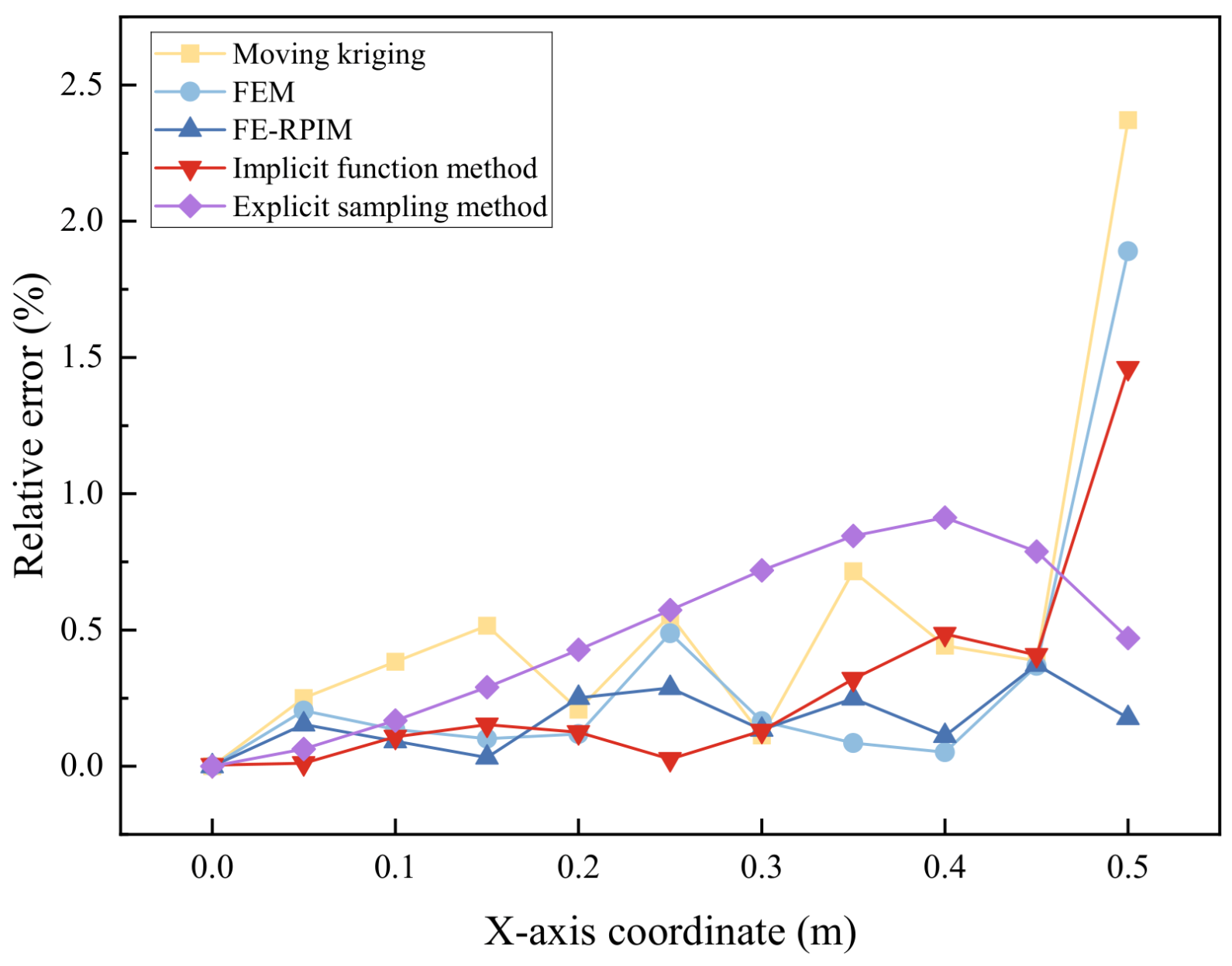
Furthermore, a comparative analysis was also conducted between the PINN and other established numerical analysis methods, including the Moving Kriging Method [34], the Finite Element Method (FEM), and the Finite Element-Radial Point Interpolation Method (FE-RPIM) [35]. This analysis focused on the prediction of the free surface location, as illustrated in Figure 9.
As demonstrated in Figure 9, the PINN method exhibits competitive performance. In particular, the implicit function-based PINN is second only to FE-RPIM in terms of accuracy, and its precision is comparable to that of FE-RPIM across most regions, except for the water head at the right boundary. The lower prediction accuracy is attributed to the discontinuity of the derivative at the right boundary, which is the same as Case 2. In contrast, the explicit sampling-based PINN demonstrates an opposing trend: it attains higher prediction accuracy than the implicit function-based PINN at the right boundary, yet its performance is poor at all other sampling points.
In summary, Case 3 demonstrates that the developed PINN methods can achieve accuracy comparable to that of various well-developed numerical analysis methods, thereby verifying the effectiveness of PINN in solving seepage problems of rectangular dams.

5. Discussion

5.1. Comparison of Free Surface Modeling Methods: Accuracy, Efficiency, and Convergence

The application of the PINN to steady seepage problems in rectangular dams, specifically the accurate determination of the free surface, necessitates careful consideration of the chosen method for enforcing the free surface boundary conditions. In this study, we proposed and investigated two distinct approaches: an explicit sampling-based method and an implicit function-based method. Each method presents a unique set of advantages and disadvantages with respect to accuracy, computational cost, and robustness.
While explicit sampling-based methods are conceptually straightforward for representing free surfaces, they require a significant number of sampling points to achieve satisfactory accuracy. Compared to implicit function-based methods, explicit sampling-based methods exhibit lower accuracy across various cases (see Table 3). This stems from the fact that their dense sampling approximates the free surface geometry, and an excessive number of sampling points can lead to substantial accumulated errors. Consequently, the optimization of sampling strategies is of paramount importance for balancing accuracy and computational efficiency when using explicit sampling-based methods.
In contrast, the implicit function-based function method generally offers the potential for higher accuracy with a reduced number of sampling points directly on the free surface (see Table 3). However, this advantage comes at the cost of introducing an additional neural network specifically dedicated to representing the free surface. This necessitates the simultaneous training of multiple neural networks (the primary percolation network and the free surface network) while satisfying a complex set of constraints. This coupled training process results in an average increase of 38.1% in computational time (see Table 4) and introduces the possibility of non-convergence, requiring careful tuning of hyperparameters, network architecture, and training strategies to ensure reliable results. Furthermore, the accuracy of the explicit sampling-based method hinges on the ability of the additional neural network to accurately represent the free surface, which might be challenging for complex free surface geometries.
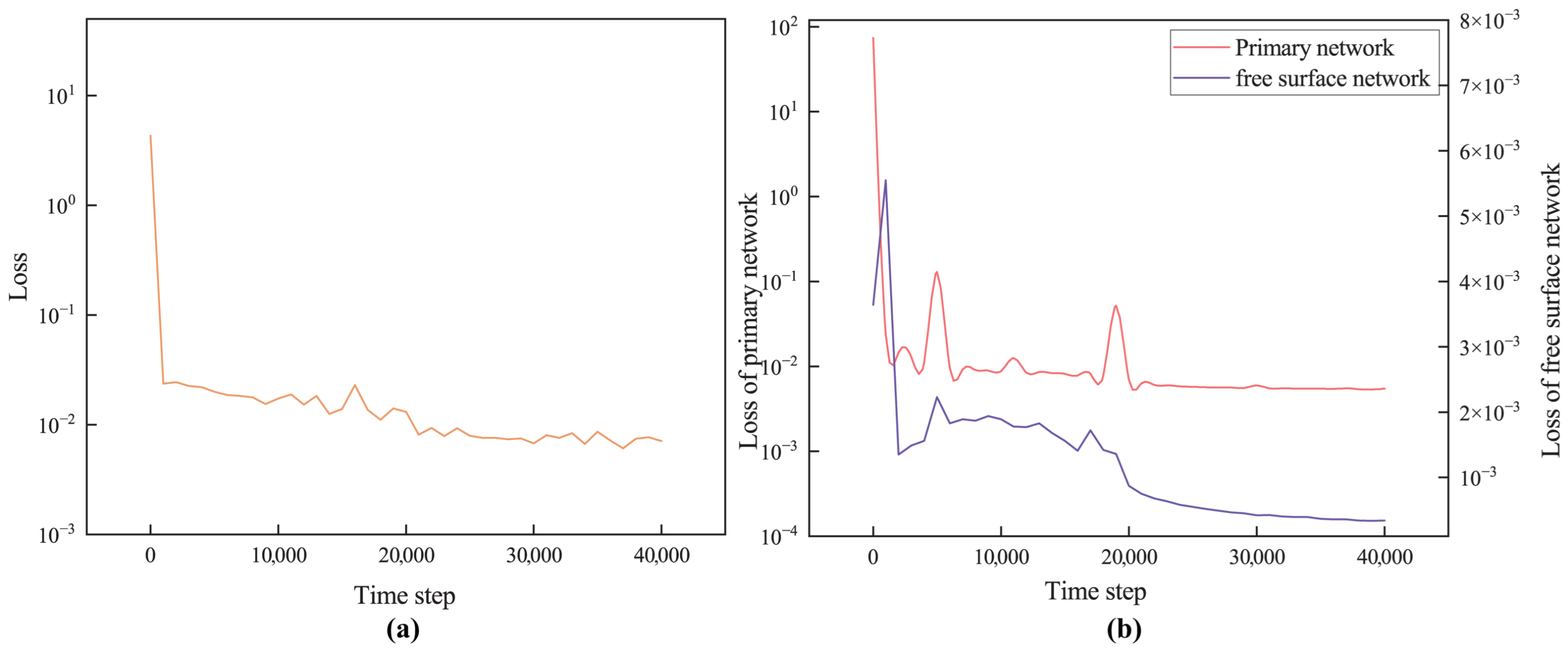
To ensure stable interaction between the two networks, we employed a joint optimization strategy with a multi-stage learning rate schedule (starting at 0.001 and decaying to 0.0001). In the training process, the Glorot method is used for network parameter initialization, followed by the application of the Adam optimizer. The physical boundary conditions on the free surface act as a strong structural regularizer, which prevents the networks from diverging during the early stages of training. As shown in Figure 10, the explicit method converges at approximately 25,000 iterations. Owing to the introduction of the free surface network, the implicit method converges at around 35,000 iterations, requiring an additional 30–40% of iterations compared with the explicit method.
To clearly illustrate the merits of each approach, a systematic comparison between the Implicit function-based method and the explicit strategy was conducted (see Table 5). Regarding predictive precision, the implicit method leverages an auxiliary neural network to capture the nonlinear pressure distribution along the free surface with greater flexibility, thereby markedly decreasing approximation errors in the presence of complex boundaries. Nonetheless, such enhanced fidelity is achieved at the cost of increased computational overhead and diminished convergence rates. Empirical results suggest that the dual-network synergistic optimization inherent in the implicit approach leads to a higher number of iterations required to reach the target residual, resulting in a 38.1% increase in execution time.
Consequently, a distinct trade-off is observed where explicit strategies are preferable for scenarios prioritizing efficiency and geometric simplicity. Conversely, the implicit function method exhibits greater robustness and potential for advanced research involving highly nonlinear and complex seepage flow regimes where precise boundary delineation is paramount.

5.2. Comparison with Traditional Methods and Current Limitations

The proposed PINN methods present a promising avenue for addressing steady-state seepage problems. In comparison to conventional techniques such as the FEM, PINNs obviate the need for structured mesh generation, a feature particularly advantageous when dealing with complex geometries or scenarios necessitating adaptive mesh refinement. This mesh-free characteristic streamlines the pre-processing phase and mitigates the computational burden associated with mesh generation and maintenance. Furthermore, PINN solutions are inherently differentiable, yielding continuous representations of the solution field and its derivatives, thereby facilitating downstream post-processing and sensitivity analyses [36,37,38]. However, PINN-based approaches, including the one presented in this study, may require substantial training durations to converge to an acceptable solution. The training time is markedly influenced by factors such as network architecture, hyperparameter selection, and the intricacy of the loss function landscape. This temporal overhead should be duly considered when benchmarking the overall computational cost against that of traditional solvers, which typically exhibit comparatively shorter solution times. In addition, PINN can exert more powerful performance than traditional methods in scenarios such as transfer learning or occasions requiring massive repeated calculations (e.g., uncertainty analysis, parametric inversion, and multi-condition iterative analysis).
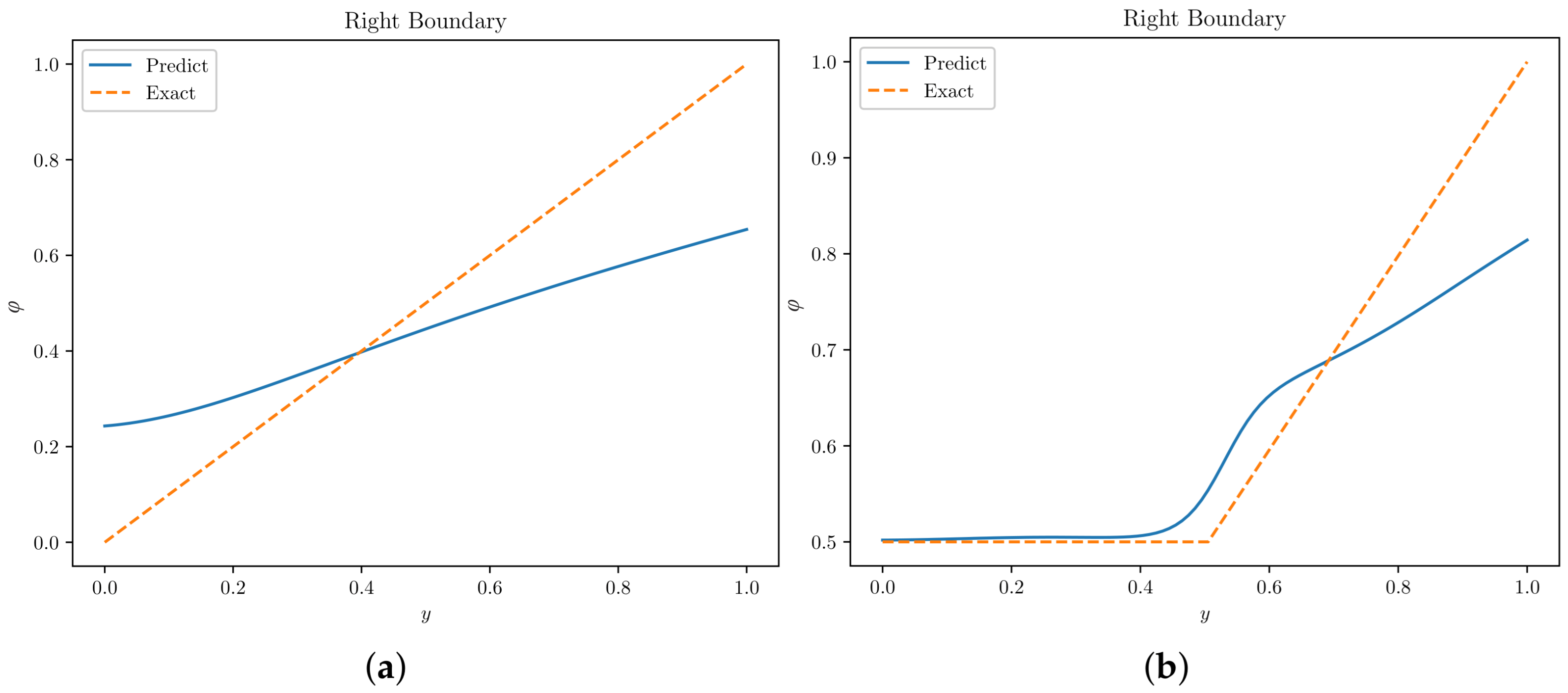
A key limitation is the potential discontinuity in the derivative of the solution caused by the free surface condition itself, resulting in slow convergence speed and reduced accuracy of the free surface. For instance, discontinuities in derivatives occur at the intersection of the lower and right boundaries in Case 2, and at the interface between the tailwater and seepage face in Case 3. As shown in Figure 11, these derivative discontinuities hinder neural network training and limit the accuracy of determining free surfaces. Error emerges starting from y = 0 in Figure 11a, whereas in Figure 11b, the prediction agrees well with the analytical solution when far from the interface, after which the error increases rapidly. Both figures demonstrate the impact of derivative discontinuity on the prediction accuracy of the seepage field at the boundary. In addition, by comparing Figure 6, Figure 7 and Figure 8, it can be observed that Case 1 shows the best performance for the right boundary of the seepage surface. This is because the derivatives at the right boundary in Case 1 remain constant throughout. Further research is needed on strategies to alleviate these discontinuities, such as specialized activation functions or domain decomposition.

5.3. Outlook and Future Work

This paper demonstrates the promise of PINNs for solving steady-state seepage problems through rigorous verification against analytical benchmarks. While the current study prioritizes the establishment of a robust framework and quantitative error assessment using idealized cases, several avenues for bridging the gap between theoretical verification and engineering practice remain open. Addressing free boundary problems constitutes a critical prerequisite for tackling more complex, large-scale engineering scenarios. Consequently, future work will focus on extending the proposed methods to real-world case studies, incorporating field monitoring data to validate the predictive capability of the model in heterogeneous and anisotropic geological environments. Furthermore, exploring effective strategies for handling discontinuities in the derivative induced by the free surface, particularly within unsaturated soil regimes, will be prioritized to enhance the robustness and engineering applicability of the proposed PINN framework.
Crucially, the extrapolation capabilities of the PINNs are also of significant importance. For PINNs, predicting system behavior beyond the training domain, such as extrapolating seepage rates under significantly altered hydraulic conditions, presents a formidable challenge. The research on transfer learning or domain adaptation techniques may improve the extrapolation performance of PINN models.

6. Conclusions

Accurate prediction of soil seepage, including the evolving free surface in complex geological settings, is paramount for ensuring the long-term safety and stability of dams. Addressing this critical need, we propose a physics-informed deep learning-based approach, an emerging technique for solving PDE, to provide reliable and efficient seepage analysis for steady seepage. The results of the benchmark case studies demonstrate the efficacy of the proposed explicit sampling-based PINN and implicit function-based methods in accurately simulating steady seepage within dams under diverse boundary conditions. While both methods effectively capture the essential physics of the seepage process, their performance characteristics differ. Specifically, the explicit sampling-based method offers a computationally efficient solution suitable for scenarios where high accuracy is not paramount, while the implicit function-based method achieves greater precision, albeit at a higher computational cost, making it ideal for applications demanding detailed free surface characterization. Importantly, both methods exhibit a high level of accuracy that is consistent with traditional numerical approaches. Based on these findings, we recommend the explicit sampling-based method for applications prioritizing computational speed and the implicit function-based method for those requiring high-fidelity free surface simulation. This adaptive approach, offering a trade-off between accuracy and efficiency, provides a valuable tool for engineers and researchers engaged in dam safety assessment and design, enabling informed decision-making based on specific project requirements.

Author Contributions

Conceptualization, J.T. and L.X.; methodology, J.T. and L.X.; software, J.T., J.Y. and L.X.; formal analysis, J.Y.; investigation, J.Y., Q.G. and T.Z.; resources, Q.G.; writing—original draft preparation, J.T., J.Y. and T.Z.; writing—review and editing, J.T. and L.X.; supervision, L.X.; project administration, J.T. and L.X. All authors have read and agreed to the published version of the manuscript.

Funding

We acknowledge the funding support from the National Natural Science Foundation of China (Grant Nos. 52378439, 42507223); Middle-aged and Young Teachers’ Basic Ability Promotion Project of Guangxi (Grant Nos. 2025KY1331).

Data Availability Statement

Dataset available on request from the authors.

Acknowledgments

The authors would like to thank the editor and the reviewers for their comments.

Conflicts of Interest

The authors declare that they have no known competing financial interests or personal relationships that could have appeared to influence the work reported in this paper.

References

  1. Li, X.; Chen, H.; Chen, X.; Wang, T.; Jiang, Y.; Ruan, H. Experimental study on the stability of noncohesive landslide dams based on seepage effect. Eng. Geol. 2024, 341, 107708. [Google Scholar] [CrossRef]
  2. Günay, A.; Akbas, S.O. AI-Supported probabilistic steady-state and transient seepage analysis of an embankment dam with clay core: A case study on Büyükcekmece Dam. Eng. Geol. 2025, 351, 108029. [Google Scholar] [CrossRef]
  3. Kacimov, A. Ephemeral reservoirs of low-head wadi dams drained by seepage, evaporation and pumping: The Pavlovsky/Polubarinova-Kochina/Abel analytical legacy redux. Adv. Water Resour. 2026, 207, 105201. [Google Scholar] [CrossRef]
  4. Huang, Z.; Xue, B.; Li, M.; Lei, J.; Fang, H. A novel meshless method for solving steady seepage problems with free surface based on physics-informed neural networks. Comput. Geotech. 2025, 186, 107348. [Google Scholar] [CrossRef]
  5. Li, J.; Zhu, X.; Feng, C.; Wen, M.; Zhang, Y. A simple and efficient three-dimensional spring element model for pore seepage problems. Eng. Anal. Bound. Elem. 2025, 176, 106225. [Google Scholar] [CrossRef]
  6. Wu, C.; Wang, L.; Yu, T.; Natarajan, S. An adaptive isogeometric analysis framework for two-dimensional steady-state unconfined seepage problems. Adv. Eng. Softw. 2026, 213, 104093. [Google Scholar] [CrossRef]
  7. Yi, G.; Zou, D.; Chen, K.; Nie, X.; Zhang, M.; Deng, Y. An efficient nonlinear polyhedral scaled boundary finite element method for saturated and unsaturated soil seepage problems. Eng. Anal. Bound. Elem. 2025, 180, 106445. [Google Scholar] [CrossRef]
  8. Yan, M.; Yang, Y.; Zhang, Z.; Hao, D.; Su, C.; Duan, Q. Three-dimensional seepage analysis using a polyhedral scaled boundary finite element method. Comput. Geotech. 2026, 190, 107708. [Google Scholar] [CrossRef]
  9. Sun, J.; Haoyu, S.; Lu, M.; Han, B. Finite-difference solution for dissipation of excess pore water pressure within liquefied soil stabilized by stone columns with consideration of coupled radial-vertical seepage. Soil Dyn. Earthq. Eng. 2024, 176, 108328. [Google Scholar] [CrossRef]
  10. Zhang, L.; Zhang, Y.; Tian, Y.; El Naggar, M.H.; Wen, M.; Wu, W. Alternating direction finite difference analysis of nonlinear thermal consolidation of expansive soil around a buried thermal pipeline induced by local heat seepage. Int. J. Heat Mass Transf. 2026, 255, 127714. [Google Scholar] [CrossRef]
  11. Lin, S.; Cao, X.; Zheng, H.; Li, Y.; Li, W. An improved meshless numerical manifold method for simulating complex boundary seepage problems. Comput. Geotech. 2023, 155, 105211. [Google Scholar] [CrossRef]
  12. Raissi, M.; Perdikaris, P.; Karniadakis, G. Physics-informed neural networks: A deep learning framework for solving forward and inverse problems involving nonlinear partial differential equations. J. Comput. Phys. 2019, 378, 686–707. [Google Scholar] [CrossRef]
  13. Li, J.; Zhang, D.; He, T.; Zheng, Q. Uncertainty quantification of two-phase flow in porous media via the Coupled-TgNN surrogate model. Geoenergy Sci. Eng. 2023, 221, 211368. [Google Scholar] [CrossRef]
  14. Amini Niaki, S.; Haghighat, E.; Campbell, T.; Poursartip, A.; Vaziri, R. Physics-informed neural network for modelling the thermochemical curing process of composite-tool systems during manufacture. Comput. Methods Appl. Mech. Eng. 2021, 384, 113959. [Google Scholar] [CrossRef]
  15. Han, J.; Jentzen, A.; E, W. Solving high-dimensional partial differential equations using deep learning. Proc. Natl. Acad. Sci. USA 2018, 115, 8505–8510. [Google Scholar] [CrossRef]
  16. Blechschmidt, J.; Ernst, O.G. Three ways to solve partial differential equations with neural networks—A review. GAMM-Mitteilungen 2021, 44, e202100006. [Google Scholar] [CrossRef]
  17. Rezaei, S.; Harandi, A.; Moeineddin, A.; Xu, B.X.; Reese, S. A mixed formulation for physics-informed neural networks as a potential solver for engineering problems in heterogeneous domains: Comparison with finite element method. Comput. Methods Appl. Mech. Eng. 2022, 401, 115616. [Google Scholar] [CrossRef]
  18. Bu, Y.; Xue, B.; Huang, Z.; Yang, M.; Zhang, Z.; Zheng, C. Parameter inversion of the concrete hydration heat source based on physics-informed neural network. Int. J. Heat Mass Transf. 2026, 260, 128409. [Google Scholar] [CrossRef]
  19. Wang, S.; Perdikaris, P. Deep learning of free boundary and Stefan problems. J. Comput. Phys. 2021, 428, 109914. [Google Scholar] [CrossRef]
  20. Lu, H.; Wang, Q.; Tang, W.; Liu, H. Physics-informed neural networks for fully non-linear free surface wave propagation. Phys. Fluids 2024, 36, 062106. [Google Scholar] [CrossRef]
  21. Lin, A.; Zhang, Z.; Zhao, W.; Zhao, W. Discontinuous extreme learning machine for interface and free boundary problems. J. Comput. Phys. 2025, 541, 114329. [Google Scholar] [CrossRef]
  22. Leiteritz, R.; Hurler, M.; Pflüger, D. Learning Free-Surface Flow with Physics-Informed Neural Networks. In Proceedings of the 2021 20th IEEE International Conference on Machine Learning and Applications (ICMLA); IEEE: Piscataway, NJ, USA, 2011; Volume 181, pp. 1060–1071. [Google Scholar]
  23. Huang, Y.H.; Xu, Z.; Qian, C.; Liu, L. Solving free-surface problems for non-shallow water using boundary and initial conditions-free physics-informed neural network (bif-PINN). J. Comput. Phys. 2023, 479, 112003. [Google Scholar] [CrossRef]
  24. Song, Y.; Shen, C.; Liu, X. A Surrogate Model for Shallow Water Equations Solvers with Deep Learning. J. Hydraul. Eng. 2023, 149, 04023045. [Google Scholar] [CrossRef]
  25. Liu, F.X.; Lei, G.H.; Wang, W.Y.; Li, Z. Charts for free surfaces in steady-state seepage flow through homogeneous isotropic rectangular dams. J. Hydrol. 2022, 612, 128082. [Google Scholar] [CrossRef]
  26. Glorot, X.; Bengio, Y. Understanding the difficulty of training deep feedforward neural networks. J. Mach. Learn. Res. 2010, 9, 249–256. [Google Scholar]
  27. Wang, S.; Teng, Y.; Perdikaris, P. Understanding and Mitigating Gradient Flow Pathologies in Physics-Informed Neural Networks. SIAM J. Sci. Comput. 2021, 43, A3055–A3081. [Google Scholar] [CrossRef]
  28. Lu, L.; Meng, X.; Mao, Z.; Karniadakis, G.E. DeepXDE: A Deep Learning Library for Solving Differential Equations. SIAM Rev. 2021, 63, 208–228. [Google Scholar] [CrossRef]
  29. Yazdani, A.; Lu, L.; Raissi, M.; Karniadakis, G.E. Systems biology informed deep learning for inferring parameters and hidden dynamics. PLoS Comput. Biol. 2020, 16, e1007575. [Google Scholar] [CrossRef]
  30. Chapman, T.G. Two-Dimensional Ground-Water Flow Through a Bank with Vertical Faces. Géotechnique 1957, 7, 35–40. [Google Scholar] [CrossRef]
  31. Hornung, U.; Krueger, T. Evaluation of the Polubarinova-Kochina Formula for the Dam Problem. Water Resour. Res. 1985, 21, 395–398. [Google Scholar] [CrossRef]
  32. Jagtap, A.D.; Kawaguchi, K.; Em Karniadakis, G. Locally adaptive activation functions with slope recovery for deep and physics-informed neural networks. Proc. R. Soc. A Math. Phys. Eng. Sci. 2020, 476, 20200334. [Google Scholar] [CrossRef] [PubMed]
  33. Yang, Y.; Sun, G.; Zheng, H. Modeling unconfined seepage flow in soil-rock mixtures using the numerical manifold method. Eng. Anal. Bound. Elem. 2019, 108, 60–70. [Google Scholar] [CrossRef]
  34. Zhang, W.; Dai, B.; Liu, Z.; Zhou, C. Unconfined Seepage Analysis Using Moving Kriging Mesh-Free Method with Monte Carlo Integration. Transp. Porous Media 2017, 116, 163–180. [Google Scholar] [CrossRef]
  35. Wang, B.; Li, J.; Jiang, Q.; Yang, Y.; Feng, X.T. An improved FE-Meshfree method for solving steady seepage problems. Comput. Geotech. 2020, 119, 103223. [Google Scholar] [CrossRef]
  36. Fu, T.; Yuan, B.; Zhang, W.; Wang, J.; Liu, S. Particle swarm optimization-based PINN for direct-simulation of fluids flow in subsurface reservoir. Geoenergy Sci. Eng. 2025, 254, 214010. [Google Scholar] [CrossRef]
  37. Walter, L.; Parisio, F.; Kong, Q.; Hanson-Hedgecock, S.; Vilarrasa, V. Bridging the Gap for Sparse Observations: Data-Driven Versus Physics-Informed Neural Networks for a Transient Flow Problem in a Heterogeneous Porous Medium. J. Geophys. Res. Mach. Learn. Comput. 2025, 2, e2025JH000733. [Google Scholar] [CrossRef]
  38. Zhang, Z.; Li, Z.; Dias, D. Seismic stability of cracked rock slopes based on physics-informed neural networks. Int. J. Rock Mech. Min. Sci. 2025, 192, 106147. [Google Scholar] [CrossRef]
Figure 1. The architecture of the conventional PINN.
Water 18 01016 g001
Figure 2. Illustration of the steady seepage problem in rectangular dams.
Water 18 01016 g002
Figure 3. Schematic diagram of PINN for steady seepage in rectangular dams.
Water 18 01016 g003
Figure 4. The strategy of the explicit sampling-based PINN.
Water 18 01016 g004
Figure 5. The strategy of the implicit function-based PINN.
Water 18 01016 g005
Figure 6. Comparison of predicted and analytical solution for Case 1 using different PINN methods. (ac) Explicit sampling-based method. (df) Implicit function-based method.
Water 18 01016 g006
Figure 7. Comparison of predicted and analytical solution [31] for Case 2 using different PINN methods. (a,b) Explicit sampling-based method. (c,d) Implicit function-based method.
Water 18 01016 g007
Figure 8. Comparison of predicted and analytical solution for Case 3 using different PINN methods. (a,d) Explicit sampling-based method. (b,e) Implicit function-based method. (c,f) the results in [31,33].
Water 18 01016 g008
Figure 9. Comparison of the proposed PINNs with numerical analysis methods for free surface location.
Water 18 01016 g009
Figure 10. Loss trajectory curves of different strategy-based PINN methods. (a) Explicit sampling-based method. (b) Implicit function-based method.
Water 18 01016 g010
Figure 11. The impact of derivative discontinuities in the right boundary for the implicit function-based method. (a) Case 2. (b) Case 3.
Water 18 01016 g011
Table 1. Parametersensitivity analysis for the sampling density and threshold ϵ using Relative L2 Error.
Sampling DensityAverage Computation Time (s) ϵ = 1 × 10 4 ϵ = 1 × 10 5 ϵ = 1 × 10 6
10×826.50 2.02 × 10 2 7.92 × 10 3 2.07 × 10 2
30×1731.57 1.96 × 10 2 7.64 × 10 3 1.79 × 10 2
50×2570.49 1.12 × 10 2 4.45 × 10 3 1.44 × 10 2
70×3619.41 1.07 × 10 2 4.28 × 10 3 1.02 × 10 2
Table 2. Performances of different strategy-based PINN methods in Case 1.
MethodExplicit Sampling-
Based Method
Implicit Function-
Based Method
Metric
RMSE0.09310.0815
Relative L2 Error4.45 × 10−33.27 × 10⁻³
Table 3. Comparison of different strategy-based PINN methods: RMSE and relative L2 errors of predicted solution.
Case 1Case 2Case 3
RMSEL2RMSEL2RMSEL2
Explicit sampling-
based method
0.2240.0110.0310.0390.0170.019
Implicit function-
based method
0.1070.0050.0240.0300.0120.013
Table 4. The computation time of different PINN methods for all cases.
Case 1Case 2Case 3Mean
Explicit sampling-based method2570.49 s1654.13 s1360.30 s1861.64 s
Implicit function-based method3161.85 s2594.14 s3271.08 s3009.01 s
Table 5. Systematic comparison of different PINN methods.
Explicit Sampling-
Based Method
Implicit Function-
Based Method
AccuracyLowerHigher
Convergence rateFasterSlower
Computational efficiencyLowerHigher
Usage recommendationsSimple dam body and regular boundaryComplex geological conditions and heterogeneous dam bodies
Disclaimer/Publisher’s Note: The statements, opinions and data contained in all publications are solely those of the individual author(s) and contributor(s) and not of MDPI and/or the editor(s). MDPI and/or the editor(s) disclaim responsibility for any injury to people or property resulting from any ideas, methods, instructions or products referred to in the content.