Article

Optimal Hydraulic Design of Flexible-Lined Channels Using the VegyRap QGIS Tool with Cost and Reliability Analysis

by
Ahmed M. Tawfik
1 and
Mohamed H. Elgamal
2,*
1
Irrigation and Hydraulics Department, Faculty of Engineering, Cairo University, Giza 12613, Egypt
2
Civil Engineering Department, Imam Mohammad Ibn Saud Islamic University (IMSIU), Riyadh 13318, Saudi Arabia
*
Author to whom correspondence should be addressed.
Water 2026, 18(8), 957; https://doi.org/10.3390/w18080957
Submission received: 17 February 2026 / Revised: 8 April 2026 / Accepted: 13 April 2026 / Published: 17 April 2026
(This article belongs to the Section Hydraulics and Hydrodynamics)

Abstract

Previous approaches to flexible-lined channel design typically isolate least-cost cross-section optimization from parameter uncertainty, or restrict reliability analysis to specific cases, limited failure modes, and proprietary codes. This paper presents VegyRap, an open-source QGIS-based plugin with an intuitive graphical user interface that unites these traditionally disjointed, sequential tasks into a single computational framework. The tool guides designers sequentially through: (i) terrain-driven longitudinal profile optimization using dynamic programming; (ii) least-cost cross-sectional optimization for riprap and vegetated linings; and (iii) multi-mode probabilistic reliability analysis coupled with dual risk–cost Pareto optimization. To seamlessly handle the stochastic behavior of uncertain variables, the framework features built-in statistical distributions and allows users to flexibly evaluate up to four distinct failure modes: overtopping, erosion, sedimentation, and near-critical flow oscillation. The framework’s capabilities are demonstrated through nine diverse design examples, incorporating benchmark validations against published studies and a comprehensive real-world case study in Wadi Al-Arja, Saudi Arabia. Results highlight that for vegetated channels, a hierarchical two-phase design logic is essential to satisfy both establishment-phase stability (Class E) and long-term conveyance (Class B). While benchmark comparisons show VegyRap achieves consistent cost reductions of 10–15% over traditional methods, the case study demonstrates that deterministic least-cost solutions can carry non-negligible failure probabilities. By utilizing marginal efficiency analysis to identify cost-effective enhancements, the integrated Pareto-based dual optimization produces transparent trade-off surfaces, empowering practitioners to transition from a single least-cost solution to a defensible, risk-calibrated preferred alternative.

1. Introduction

Open-channel conveyance systems, including irrigation canals, drainage channels, and flood conveyance structures, represent fundamental infrastructure supporting agricultural productivity, urban stormwater management, and flood risk mitigation. The hydraulic performance and long-term functionality of these systems are intrinsically governed by boundary stability, rendering lining selection a critical design decision with significant economic, hydraulic, and environmental implications [1].
Historically, channel linings have been dominated by rigid materials such as concrete and masonry, owing to their low hydraulic roughness and predictable performance [1]. However, extensive field experience has revealed notable limitations. Rigid linings are prone to cracking due to settlement and thermal stress, act as barriers to groundwater recharge, provide negligible ecological value, and exhibit brittle, catastrophic failure modes when distressed [2,3]. These shortcomings have motivated a paradigm shift toward flexible lining systems that offer enhanced adaptability and environmental compatibility.
Flexible linings, most notably loose rock riprap and vegetative covers, have emerged as sustainable alternatives capable of accommodating minor deformations while maintaining structural integrity. Unlike rigid systems, they permit infiltration and exfiltration processes, fail progressively rather than abruptly, and can support ecological functions such as riparian habitat development [2,4,5]. Properly graded riprap provides robust erosion protection under a wide range of hydraulic conditions [6], whereas vegetated linings contribute to both hydraulic stability and environmental enhancement.
Despite these advantages, the design of flexible-lined channels introduces substantial engineering complexity. Their significantly higher hydraulic roughness relative to rigid linings necessitates larger cross-sectional dimensions to convey equivalent discharges, thereby increasing excavation volumes, land requirements, and overall construction costs [7]. This challenges the common assumption that flexible linings are inherently more economical [1]. Furthermore, vegetated linings exhibit strongly stage-dependent hydraulic behavior. During establishment, temporary protection measures may be required [8], while in mature stages, flow resistance varies dynamically with vegetation properties such as stiffness, density, and submergence, rendering the use of constant Manning’s coefficients inadequate [9,10].
Riprap-lined channels are subject to equally complex stability considerations. Their performance depends not only on median stone size but also on angularity, gradation, layer thickness, and slope geometry [11]. Steep longitudinal and side slopes introduce additional destabilizing forces that are not fully captured by conventional one-dimensional assumptions, often leading to inaccurate predictions of incipient motion thresholds [12]. These complexities highlight the limitations of simplified design methodologies when applied to flexible systems.
Conventional design practice relies predominantly on empirical approaches based on permissible velocity or tractive force concepts [6,13], as codified in widely adopted agency manuals [8,14]. While these methods are straightforward and practical, they treat alignment selection, cross-sectional design, and stability verification as sequential and largely independent processes. This fragmented approach typically results in conservative designs that satisfy constraints but do not achieve true optimality.
To overcome these limitations, significant research efforts have been directed toward integrated and optimization-based design methodologies. Early developments introduced direct analytical and graphical solutions for grass-lined channels [15] and optimal stable trapezoidal sections [16], along with hydraulic efficiency relationships for riprap-lined channels [17]. These approaches were later extended into cost-minimization frameworks incorporating practical constraints such as freeboard, velocity limits, and flow regime conditions, often solved using evolutionary and stochastic optimization techniques [18,19]. Particle swarm optimization models further expanded these formulations by incorporating factors such as stone angularity, sediment-laden flow, and land acquisition costs [20,21].
In parallel, advances in geospatial analysis enabled the integration of terrain data into channel design. Geographic Information Systems (GIS) have been employed to optimize canal alignments and earthwork volumes [22], with subsequent developments introducing three-dimensional heuristic optimization models that incorporate terrain constraints directly into the design process [23]. These studies emphasize the importance of transitioning from isolated hydraulic optimization toward holistic, project-level optimization frameworks.
Simultaneously, substantial progress has been made in understanding the physical mechanisms governing flow resistance and stability. Biomechanical models have linked vegetation properties to hydraulic resistance [24,25], with real-scale experimental studies confirming the strong dependence of roughness on vegetation configuration and flow conditions [9,10]. For riprap, incipient motion theories have been extended to account for non-horizontal slopes [26,27], protection length effects [28], and critical movability conditions under steep configurations [12,29]. Additional constraints arise from sediment transport considerations, where maintaining self-cleansing velocities is essential to prevent deposition [30], and from hydraulic instabilities associated with near-critical flow regimes, including oscillations and wave formations [31,32].
Recognizing the inherent variability in flexible-lined systems, probabilistic approaches have been introduced to quantify design reliability. Multi-mode reliability frameworks accounting for overtopping, erosion, and sedimentation have demonstrated that uncertainty-aware designs can yield significantly different performance predictions compared to deterministic approaches [33,34]. Field observations further confirm the non-equilibrium behavior of vegetated and gravel-bed channels, where morphological adjustments may occur even under relatively stable flow conditions [35]. More recently, predictive capabilities have been enhanced through data-driven and hybrid approaches, including neuro-fuzzy models for incipient motion prediction [36] and advanced turbulence characterization for vegetated flows [37].
Despite these substantial advancements across hydraulic theory, optimization methods, and probabilistic design, a critical gap remains in current practice. Existing studies largely address individual aspects of the design problems such as cross-sectional optimization, stability analysis, or alignment planning, without integrating them into a unified computational framework. In particular, the coupling of terrain-driven longitudinal profile optimization, least-cost cross-sectional design, and multi-mode reliability analysis remain unresolved. Moreover, the trade-off between economic efficiency and failure risk is seldom quantified explicitly, limiting the ability of practitioners to make informed, risk-calibrated decisions.
To address this gap, the present study introduces VegyRap, an open-source, QGIS-based computational framework that integrates these traditionally disjointed components within a single geospatial environment. The framework combines terrain-driven longitudinal optimization using dynamic programming, least-cost cross-sectional design for both riprap and vegetated linings, and probabilistic reliability analysis incorporating multiple failure modes. By embedding these capabilities within a unified platform and enabling Pareto-based cost–risk trade-off evaluation, the proposed approach facilitates a transition from conservative, sequential design practices toward integrated, performance-based optimization. This advancement enables practitioners to identify not only hydraulically feasible solutions but also economically efficient and reliability-informed design alternatives, thereby directly addressing the key research gaps identified in the literature.
The primary objective of this study is to develop VegyRap, an integrated GIS-based computational framework designed for the optimal hydraulic design of flexible-lined trapezoidal channels. This framework simultaneously determines the optimal cross-sectional geometry for vegetated channels, as well as the optimal geometry and required median stone size for riprap-lined channels, to minimize total construction costs while adhering to strict hydraulic and geometric constraints. Furthermore, the research aims to couple longitudinal terrain-driven optimization with cross-sectional hydraulic design, which facilitates alignment and bed-profile refinement based on minimum earthwork principles within a unified workflow. To account for hydrologic, geometric, and roughness uncertainties, the study incorporates a multi-mode probabilistic reliability analysis using Monte Carlo simulation (MCS) that evaluates risks such as overtopping, erosion, sedimentation, and near-critical flow oscillation. Finally, the research seeks to quantify the marginal risk–cost efficiency of key design parameters to identify the most cost-effective levers for reducing failure probabilities, culminating in the implementation of a Pareto-based dual-objective optimization that explicitly evaluates cost–risk trade-offs and supports the selection of a preferred solution beyond the deterministic least-cost design
The remainder of this paper is structured as follows: Section 2 outlines the theoretical background and methodology, describing the hydraulics of open channels, Manning’s equation, roughness coefficients and allowable shear stress for riprap and vegetated linings. Section 3 discusses nine design examples of using the created tools to get the optimum design for riprap lining with high and low flow rates and vegetation lining. Section 4 presents the key findings extracted from the results, highlighting the advantages and potential limitations of the proposed tool. Finally, Section 5 presents the study’s limitations, and suggested future research topics aimed at further enhancing the optimal design of channel lining.

2. Materials and Methods

In this study, the least-cost design for open-channel cross-sections is achieved using the VegyRap tool, which determines the optimal bed width, water depth, freeboard, and mean riprap diameter to minimize total construction costs. In addition, the tool can also be used to determine the bed width, water depth, and freeboard of the best design to minimize the total cost for a channel lined with Bermuda grass. Furthermore, a graphical user interface (GUI) is created to facilitate the use of the tool. Moreover, Monte Carlo simulation and Pareto dual optimal analysis are also conducted to check the reliability of the least-cost design and to produce a more realistic compromised design alternative that compromises between the cost and the risk. More details will be presented in Section 2.2.

2.1. Governing Equations of Riprap and Vegetation Linings

The flow rate through channel cross-section is correlated with water depth by Manning’s equation as follows [38,39,40,41,42,43,44].
Q = A × 1 n × R 2 / 3 × S o 0.5
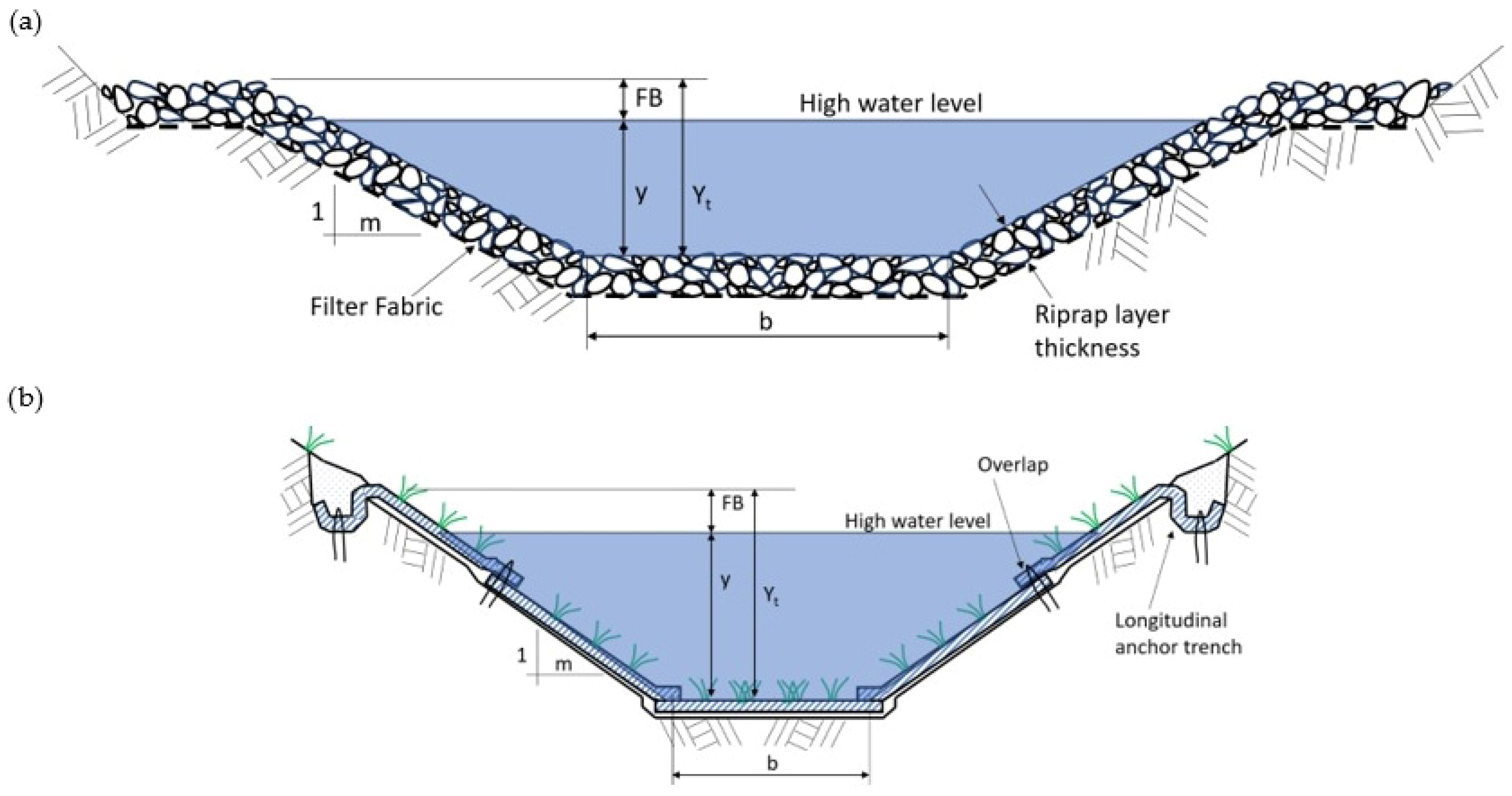
where n is Manning’s roughness coefficient, R is the hydraulic radius of the channel cross-section, A is the cross-section area and So is the longitudinal slope of the channel. Typical cross-sections for riprap- and vegetation-lined channels are presented in Figure 1.
Tractive stress is correlated with water depth by the following equation [43].
τ b = K b γ y S o
where τb is the tractive stress on the channel bed, Kb is a dimensionless coefficient less than one by a small amount, γ is the specific weight of water, and y is the water depth in the channel.
The maximum tractive stress tending to move riprap units from channel sides is correlated with water depth by the following equation [43].
τ s = K s γ y S o K
where τs is the tractive stress on the channel sides, Ks is a dimensionless coefficient depending on the value of side slope as described in the following equation, and K is a dimensionless factor showing the tendancy of riprap units to roll down the side slope due to the effect of gravity and is calculated using Equation (5) [43].
K s = 0.0045   m 2 + 0.07261   m + 0.67215
K = 1 1 ( 1 + m 2 )   s i n 2 ( α )
where m is the side slope of the channel and α is the angle of repose. To obtain this angle, one can use the following equations [43,44].
α = 2.46137 × ln ( 1000 d 50 ) + 25.46756
α = 1.48327 ln ( 1000 d 50 ) + 33.54868
α = 0.60764 ln ( 1000 d 50 ) + 38.85406
where α is the angle of repose in degrees, and d50 is the mean stone size in m. Equations (6)–(8) are used to determine the angle of repose for very rounded, very angular, and crushed rocks, respectively. It is recommended to use a side slope of 4:1 if the angle of repose is less than 32°. If the angle of repose is greater than 38.5°, use a side slope of 2.5:1. If the angle of repose is between 32° and 38.5°, use a side slope of 3:1 [43].
Manning’s coefficient for riprap channels can be calculated using the following equation [43].
n = C m   ( K v   d 50 ) 1 / 6
where Cm is a coefficient of about 0.039 [43], Kv is a conversion factor of about 3.28 m−1, and d50 is the mean stone diameter.
In shallow channels with a small discharge, Manning’s coefficient is correlated with the ratio of R/d50 for discharge less than 1.4 m3/s using the following equation.
n = ( K v   R ) 1 / 6 8.60 + 19.98   l o g ( R / d 50 )
The permissible tractive stress for riprap material is calculated from the following equation [38].
τ p = C r   d 50
where Cr = 628.5 N/m3.
The maximum tractive stress on the channel bed and sides should be less than Cp τp where Cp depends on the degree of channel sinuousness and a value of 1 is assigned for straight channels, 0.9 for slightly sinuous channels, 0.75 for moderately sinuous channels, and 0.6 for very sinuous channels [43].
The thickness of the riprap layer, t, is taken as about twice the mean stone size as in the following equation.
t = 2 × d 50
Freeboard is calculated using the following equation [44].
F B = C   y
where C equals 0.5 m for a discharge of 0.6 m3/s and 0.76 m for 85 m3/s or more. One can perform linear interpolation to get the intermediate values of C.
Channel total perimeter and total area are calculated using channel total depth as in the following equations.
Y t = y + F B
P t = b + 2   Y t   1 + m 2
A t = b Y t + m   Y t 2  
where b is the channel bed width, and m is the side slope.
Manning’s coefficient for vegetative covers is calculated by the following formula [43].
n = ( R K v ) 1 / 6 C n + 19.97 l o g [ ( R K v ) 1.4 S 0 0.4 ]
where Cn is a dimensionless factor and depends on retardance class. For Bermuda grass, the value of Cn is assigned as 23.0 and 37.7 for Classes B and E, respectively, whereas the permissible shear stresses are 100.5 and 16.7 N/m2 for Classes B and E, respectively. Moreover, Bermuda grass has an average height of 30 cm in Class B and 4 cm in Class E [43]. The design of channels lined with Bermuda grass includes two phases. The first phase verifies the cross-section’s resistance to erosion (Retardance Class E), while the second phase evaluates the required water depth and freeboard (Retardance Class B).
The total cost includes both the excavation cost and lining cost. For riprap-lined channels, the excavation cost can be determined from the following equation.
r i p r a p   e x c a v a t i o n   c o s t / m = c exc × ( A t + P t × t )
For vegetation-lined channels, the excavation cost can be determined from the following equation.
v e g e t a t i o n   e x c a v a t i o n   c o s t / m = c exc × A t
For riprap-lined channels, the lining cost can be calculated by the following equation.
r i p r a p   l i n i n g   c o s t / m = c lin × P t × t
For vegetation-lined channels, the cost of lining can be calculated by the following equation.
v e g e t a t i o n   l i n i n g   c o s t / m = c veg × P t
where c exc is the unit cost of excavation (and/or embankment reshaping) required to form the trapezoidal channel section (units currency/m3). c lin is the unit cost of riprap lining material (including placement), expressed per unit volume of riprap (units currency/m3). c veg is the unit cost of vegetation lining, including planting, soil preparation, and establishment, applied per unit area (currency/m2).

2.2. VegyRap Tool

2.2.1. System Architecture and Operational Workflow

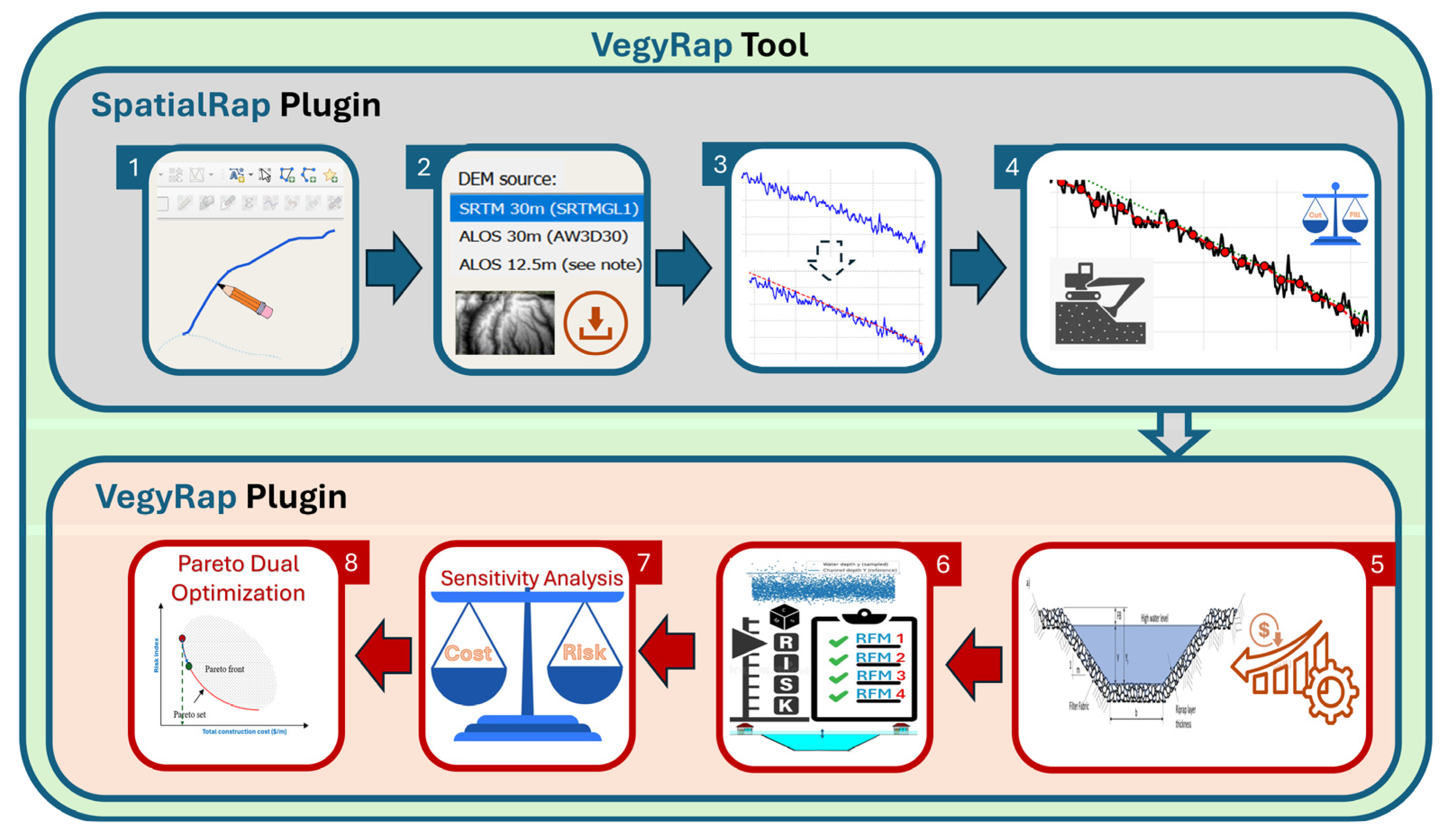
VegyRap is an integrated computational framework developed within the QGIS environment (version 3.40.8), utilizing the PyQGIS application programming interface (API) to bridge geospatial terrain processing with advanced hydraulic and probabilistic calculation engines. At its core, the software architecture is modular yet highly cohesive, comprising two primary interacting components: the spatial module (SpatialRap) and the core analytical module (VegyRap). By encapsulating complex, sequentially dependent tasks within a unified graphical user interface (GUI), the architecture ensures that data flows continuously from initial terrain extraction to final Pareto-based risk–cost trade-off analysis. This structural integration eliminates the need for manual data transfer between disparate software environments, thereby minimizing data-handling errors and streamlining the designer’s operational workflow, as in Figure 2.
The underlying logic and operational sequence of the tool are executed through a strict step-by-step workflow, translating the mathematical formulations into a seamless user experience. This workflow is divided into four primary stages:
Stage 1—Spatial Data Acquisition and Profile Optimization Module (SpatialRap): The workflow begins in the QGIS canvas, where the user digitizes the proposed channel alignment. Through the SpatialRap interface, the user selects a preferred digital elevation model (DEM) source (e.g., SRTM 30 m or ALOS) and downloads the raw terrain data using an OpenTopography API key [45]. To streamline geospatial processing, the software automatically projects the downloaded DEM to the user-specified coordinate reference system and clips it into a targeted elevation strip along the channel path, dictated by a user-defined buffer width. The plugin then samples this localized DEM strip to extract the accurate ground surface profile. Utilizing dynamic programming, the algorithm identifies the optimal locations and elevations of channel bed breakpoints. This step programmatically minimizes the total volume of earthwork while keeping the net difference between cut and fill quantities strictly constrained.
The critical geometric output of this spatial module, the optimized longitudinal bed slope, will be used as a deterministic input parameter in the next core VegyRap module.
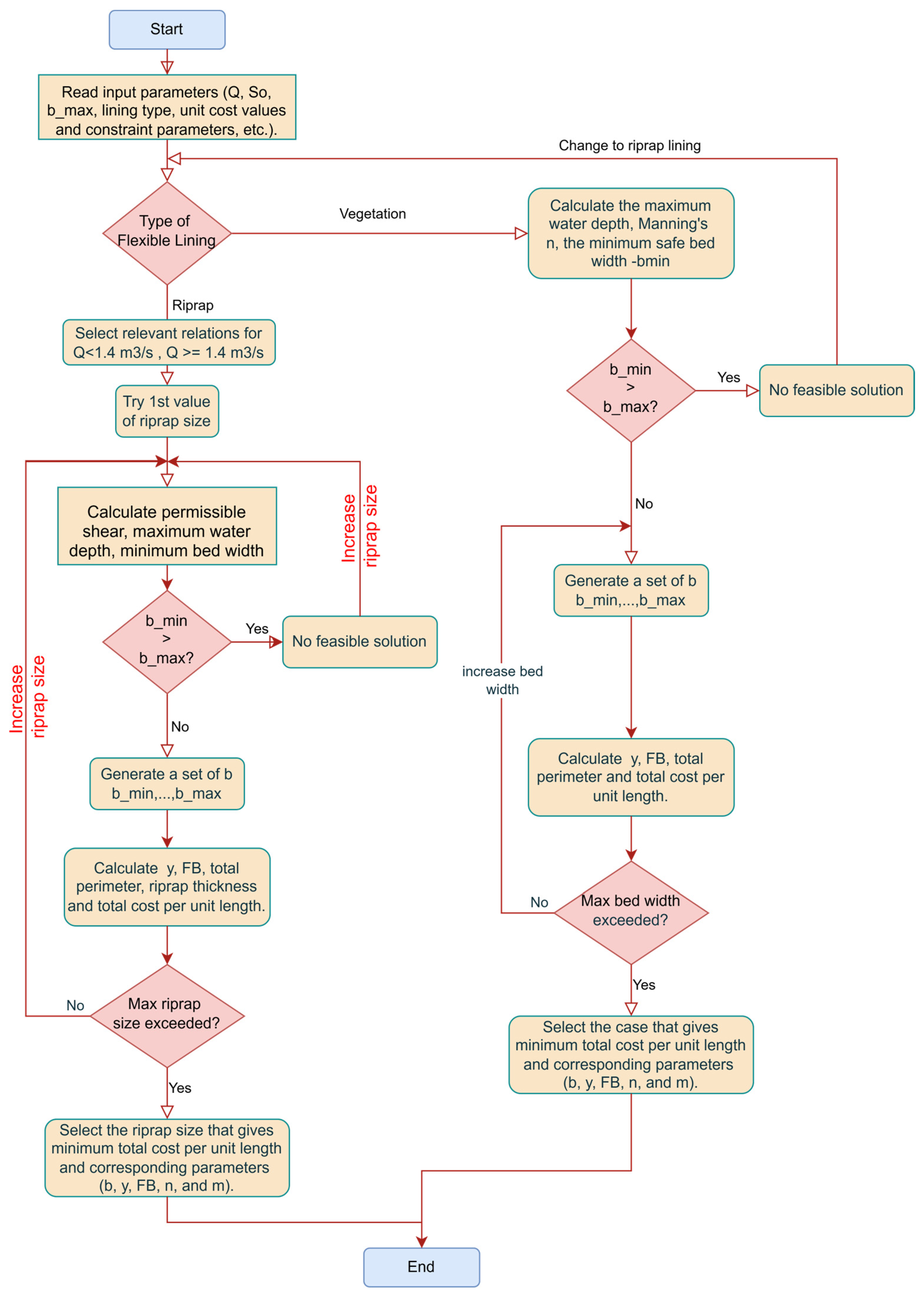
Stage 2—Deterministic Least-Cost Cross-Sectional Optimization: Upon obtaining the optimized slope, the user transitions to the “Input Data” tab within the VegyRap GUI to define the design discharge, lining type (riprap or vegetation), unit costs, and boundary constraints. As mapped comprehensively in the optimization flowchart (Figure 3), the underlying algorithmic logic executes a nested iterative search to identify the least-cost trapezoidal section. During this routine, the software dynamically adapts its hydraulic checks based on the selected lining. For riprap linings, the algorithm loops through combinations of bed widths and available median stone sizes to concurrently optimize both channel geometry and armor requirements. For vegetated linings, the tool implements a hierarchical two-phase design logic: it strictly filters dimensions to ensure they satisfy both early establishment-phase stability criteria (Class E retardance) and long-term flow conveyance capacity (Class B retardance). Across both lining types, any dimensional combination violating Froude limits, maximum allowable bed widths, or permissible shear stress thresholds is immediately discarded as infeasible. Through these systematic iterations, the software isolates the mathematically optimal, hydraulically valid cross-section that yields the absolute minimum total cost per unit length, rendering the final dimensions in the “Optimal Section” tab.
Stage 3—Multi-Mode Probabilistic Reliability Analysis: Because deterministic compliance does not account for hydrologic or material uncertainties, the software automatically carries the least-cost dimensions forward into the “Reliability Input Data” tab. Here, the user assigns statistical distributions (e.g., Normal, Log-Pearson Type III) to random variables such as discharge, Manning’s roughness, and bed slope. The software’s Monte Carlo simulation engine then executes thousands of iterations to evaluate the design against four distinct failure modes: overtopping (capacity exceedance), scour/erosion, sedimentation, and near-critical oscillation. The outputs are aggregated into visual risk indices and bar charts, instantly quantifying the probabilistic robustness of the deterministic design.
Stage 4—Sensitivity and Dual-Objective Pareto Optimization: To empower decision-making beyond a single deterministic answer, the final operational stage allows users to explore cost–risk trade-offs. Using the “Sensitivity Analysis” module, the software systematically perturbs key design variables (e.g., bed width, riprap size) to reveal the directional trends of risk reduction versus cost increase. Guided by these marginal efficiencies, the “Pareto Dual Optimization” module performs an automated search. The user sets a maximum affordable cost increase constraint (e.g., 5%), and the software generates a Pareto front, isolating the specific alternative dimensions that yield the maximum possible reduction in aggregate risk for that specified cost increment.
The following subsections detail the specific mathematical formulations, objective functions, and constraints governing these sequential optimization stages.

2.2.2. Spatial Analysis and Longitudinal Profile Optimization

In the initial stage of the workflow, the SpatialRap module is deployed to establish a hydraulically feasible and constructible longitudinal bed profile along the designated channel route. The user-defined channel alignment is first digitized on the QGIS canvas and discretized at a constant spacing x to obtain a continuous set of stations x i ( i = 0 , , N ) . Utilizing a digital elevation model (DEM) retrieved from spatial databases, the ground surface elevation z i at each specific station is sampled to formulate the existing longitudinal profile as
z i = z g ( x i )
To optimize constructability, the continuous channel bed profile z c ( x ) is mathematically approximated by a piecewise linear function defined over a subset of breakpoints. This formulation is expressed as
z c ( x ) = z c , i + s i j ( x x i ) ,   x i x x j
where s i j is the bed slope of reach ( i j ) :
s i j = z c , j z c , i x j x i
The optimization process is bounded by strict topographical and geometric constraints; each individual reach must satisfy user-defined minimum and maximum allowable bed slopes:
S m a x s i j S m i n
with S m i n > 0 . A minimum reach length L m i n is enforced as
x j x i L m i n
Working within these constraints, SpatialRap executes a search algorithm to identify a piecewise linear bed profile that explicitly minimizes the total earthwork burden. This is achieved by targeting an earthwork proxy function, defined as the absolute deviation between the existing ground and the proposed bed elevations integrated along the entire profile:
E i j = x k = i j z k ( z c , i + s i j ( x k x i ) )  
where E i j represents the earthwork proxy function (or the objective cost function for earthwork) for a specific proposed channel segment between station i and station j .
By minimizing this metric, the algorithm actively penalizes excessive cutting and filling, promoting a balanced earthwork distribution. Following this optimization, the exact volumetric requirements are computed, yielding the total cut, fill and cumulative earthwork volumes as
V cut = x i = 0 N m a x ( z i z c , i , 0 )
V fill = x i = 0 N m a x ( z c , i z i , 0 )
V tot = V cut + V fill
where x is longitudinal distance increment, V cut is the total volume of cut sections, V fill is the total volume of fill sections and V tot is the total cumulative earthwork volume of cut and fill sections.

2.2.3. Integrated Cross-Sectional and Reliability Optimization

Following the determination of the optimal longitudinal slope, the core VegyRap module computes the least-cost trapezoidal cross-section per unit channel length utilizing deterministic uniform-flow hydraulics. The user inputs primary design parameters, including design discharge, sinuosity, lining type, constraints such as minimum self-cleansing velocity, and unit material costs, which the algorithm uses to execute a cost-minimization function.
For riprap-lined channels, the objective function calculates the total cost ( C ) by integrating the excavation cost to shape the section and the material cost required to armor the wetted perimeter, expressed as (with lining thickness t = m a x ( 2 d 50 , t m i n ) )
C = c exc ( b Y t + m Y t 2 + P t t ) + c lin ( P t t )
Conversely, for vegetation-lined configurations, the optimization function adapts to reflect surface area protection rather than volumetric armoring, taking the form
C = c exc ( b Y t + m Y t 2 ) + c veg P t
To evaluate the structural and hydraulic robustness of the resulting least-cost geometry under parameter uncertainty, the framework transitions into a multi-mode reliability analysis driven by Monte Carlo simulation (MCS). Uncertain variables, such as hydrologic inflows or roughness coefficients, are assigned specific probability distributions, allowing the module to evaluate four distinct modes of failure expressed as risk-of-failure mode ratios (RFM). The first mode, overtopping risk, occurs when the computed probabilistic water depth exceeds the available channel capacity. The second mode evaluates erosion and scour, identifying failures where flow-induced boundary shear stress exceeds the permissible material limits on the bed or side slopes. The third mode assesses sedimentation risk, triggered when the average probabilistic velocity falls below the minimum self-cleansing threshold. Finally, the fourth mode evaluates surface water oscillation instabilities, registering a failure when the flow Froude number ( F r ) enters an undesirable near-critical band (e.g., between F r = 0.8 and F r = 1.2 ).
Upon completing the MCS iterations, the individual RFM values are reported and aggregated to provide a holistic view of system vulnerability. The software calculates an equally weighted risk index ( R F M a l l ) and a user-customizable weighted index ( R F M w e i g h t e d ) as follows:
R F M all = 1 N k = 1 N w k R F M k
R F M weighted = k = 1 4 w k R F M k
where w k is the weight of the k mode of failure, 0 w k 1 and k = 1 4 w k = 1 .
Building upon these aggregated risk indices (probabilistic metrics), the framework finally provides structured, automated pathways to explore cost–risk trade-offs beyond the mathematical least-cost configuration.
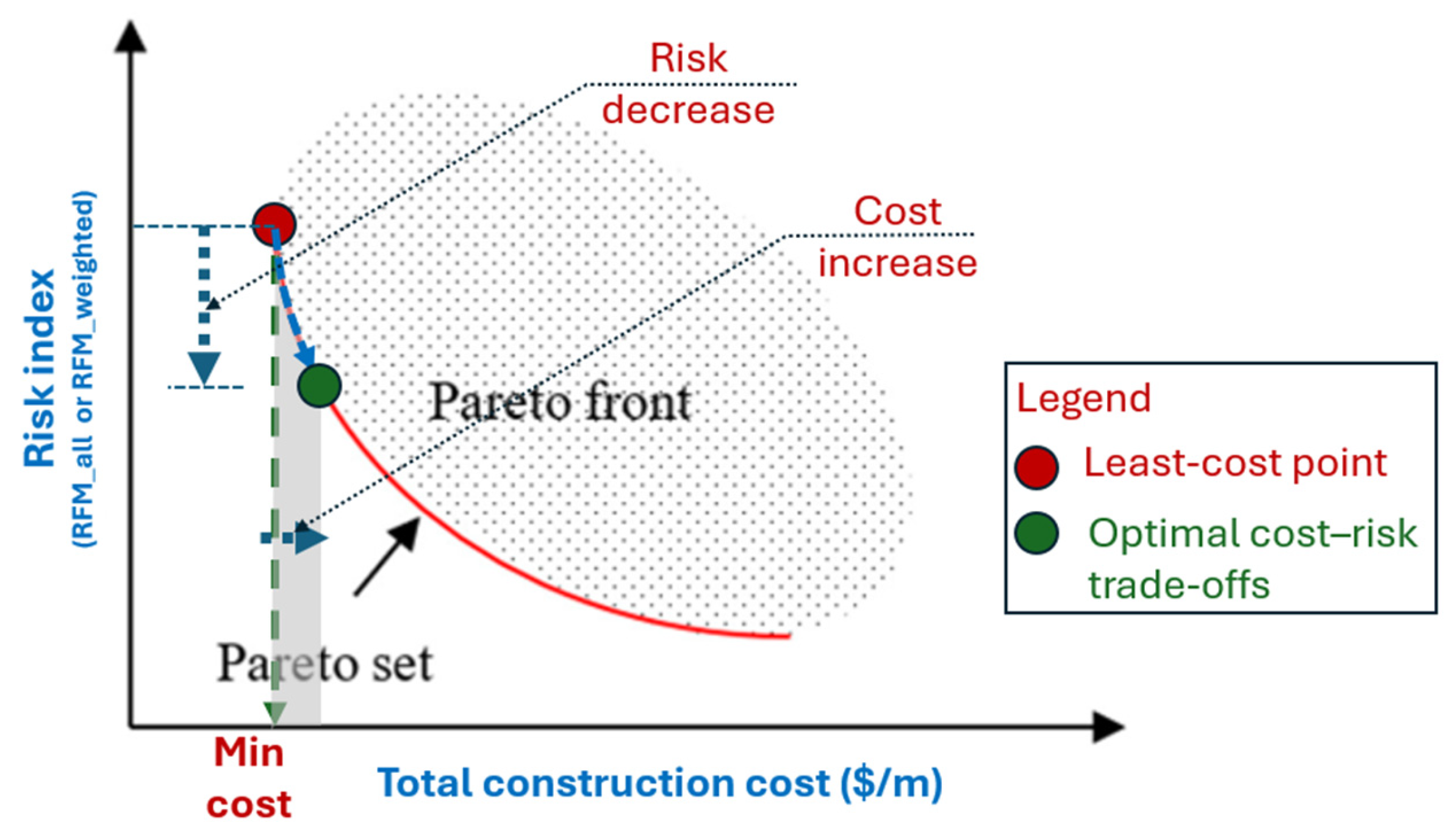
Through an integrated sensitivity analysis, the tool systematically perturbs user-selected geometric decision variables (specifically the bed width, side slope, total depth, and, for riprap linings, the median stone size) within user-defined percentage boundaries to reveal the directional trends of risk reduction versus marginal cost increases. Utilizing these trends, the module executes a dual-objective Pareto optimization that generates a spectrum of alternative design dimensions. As conceptually illustrated in Figure 4, this approach establishes a Pareto front that explicitly maps the trade-offs between incremental cost investments and their corresponding risk reductions. By imposing a maximum allowable percentage increase in total cost, the user can seamlessly navigate this trade-off surface to identify a final, preferred channel geometry that optimally balances economic efficiency with rigorous, quantified safety allowances.

3. Results and Discussion of Least-Cost Optimization Cases

3.1. Overview of Design Examples

To systematically examine and verify the VegyRap plugin, nine design examples were considered, shown in Table 1. Some examples have only a single run case, while others include up to seven different run cases, resulting in a total of 27 modeling case-runs (Table 2). These cases were selected to span a wide range of hydraulic, geometric, and material conditions.
The examples are systematically selected to encompass a broad spectrum of hydraulic and lining conditions, including varying flow regimes, slope gradients, riprap and vegetation linings, and design constraints, while benchmarking the tool’s performance against established methods and published studies to ensure reliability and accuracy. The progression moves from theoretical least-cost optimization to an integrated real-world application, culminating in a detailed case study that incorporates terrain analysis, reliability, and sensitivity assessments. The examples are organized into two main groups: Examples 1–8 focus on least-cost optimal design validation, using the VegyRap plugin under diverse hydraulic and geometric scenarios to isolate the influence of specific parameters (e.g., flow rate, slope, lining type, and constraints) on design outcomes; Example 9 then presents an integrated case study for Wadi Al-Arja, demonstrating a holistic application of the toolset by combining SpatialRap for terrain and slope optimization with VegyRap for hydraulic design, and further incorporating reliability and sensitivity analyses to support risk-informed decision-making.
The first eight design examples focus on least-cost deterministic optimization under varied flow regimes, lining types, and benchmark comparisons in addition to investigating parametric sensitivities; the ninth example is an integrated real-world case study (Wadi Al-Arja, Saudi Arabia) that incorporates terrain-driven longitudinal profile optimization, probabilistic reliability analysis, and Pareto-based cost–risk trade-off evaluation.
Table 1 presents an overview of these nine examples, listing for each the hydraulic and characteristic input parameters including: the design discharge, longitudinal slope, lining type, primary objective, any benchmark reference, and the distinguishing feature that the example is intended to test.
The compiled numerical results of the least-cost optimization for the nine design examples, including optimized median stone size (d50), bed width (b), flow depth (y), side slope (m), freeboard (FB), total depth (Yt), lining thickness, unit cost, Froude number, velocity, and Manning’s coefficient, are presented in Table 2.

3.2. Design Trajectories Governing Riprap-Lined Channel Optimization

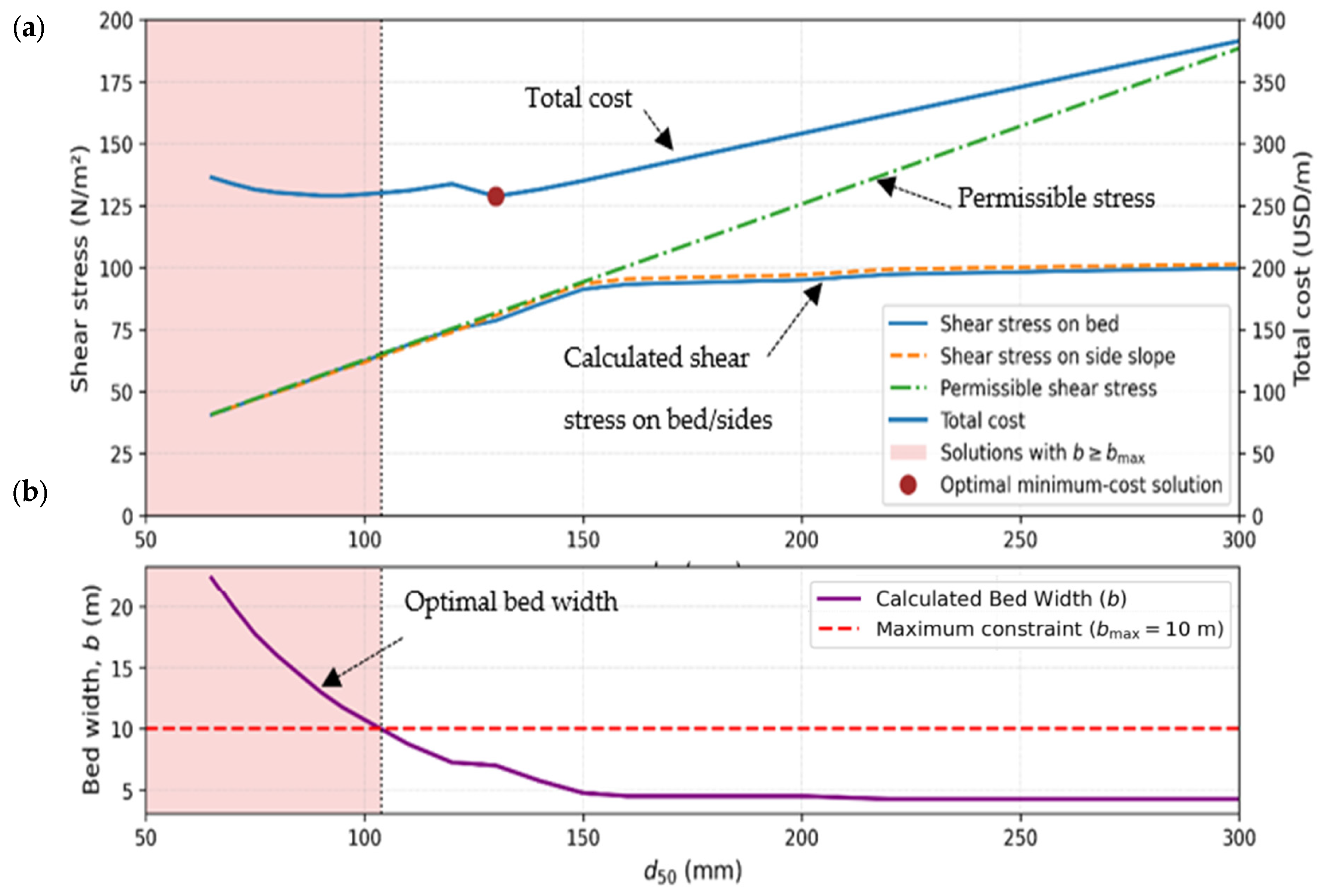
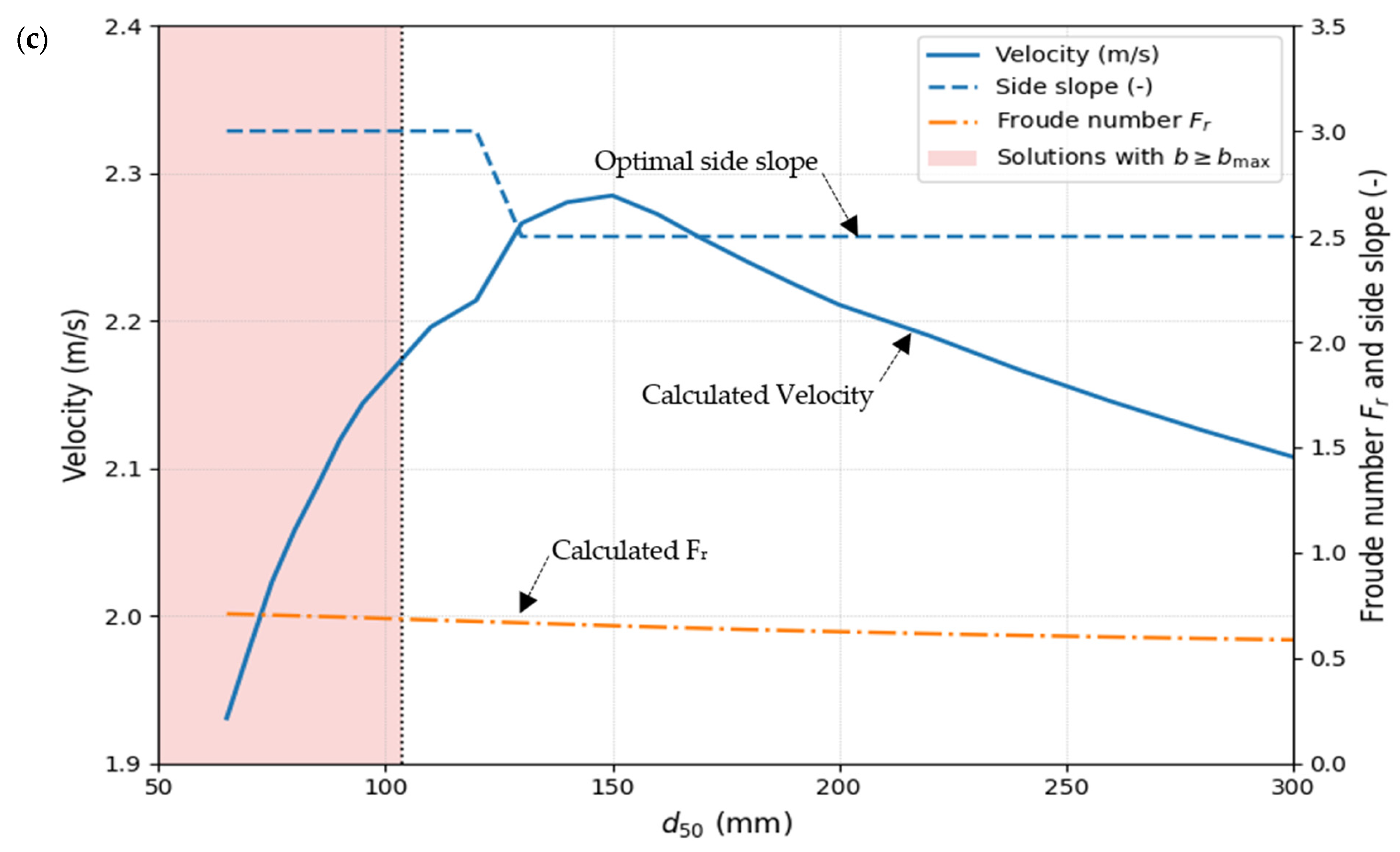
Figure 5 illustrates the typical design output trajectories for a riprap-lined channel (Design Example 1, Case 1), mapping hydraulic, geometric, and economic responses as a function of d 50 . The total cost curve (Figure 5a) exhibits convexity, reflecting competing excavation and lining costs. For small d 50 , limited permissible shear stress forces a wide, shallow geometry, making excavation cost dominant. As d 50 increases, higher allowable shear stress reduces bed width and excavation, lowering cost. Beyond a threshold (~130 mm), further enlargement yields diminishing geometric returns; the marginal decrease in excavation no longer offsets the rise in lining cost, defining a global minimum, an equilibrium between excavation and lining expenditures.
Figure 5a,b reveal that the lower feasibility bound is set by a spatial constraint, not shear stress alone. Below a critical d 50 (100–110 mm), the required bed width exceeds the 10 m maximum, rendering designs infeasible even when shear stress is adequate. Once d 50 enters the feasible domain, enhanced boundary roughness and higher permissible shear stress allow a more compact geometry: bed width decreases rapidly, flow remains subcritical, and larger stone sizes permit steeper side slopes, progressing from 3:1 to 2.5:1 (Figure 5c), governed by angle-of-repose characteristics.
These geometric step-changes drive the cost trend. Initial cost reduction (Figure 5a) stems from narrower beds and steeper slopes, but this advantage is progressively offset by thicker lining material. The global minimum emerges where marginal savings from geometric compactness exactly balance the marginal cost of additional riprap.
The global minimum cost solution emerges precisely at d50 = 130 mm. At this specific inflection point, the marginal savings generated from reduced excavation and a narrower channel footprint are perfectly offset by the marginal cost increases of the thicker stone lining. Crucially, the exact location of this global minimum is intrinsically dependent on the unit cost ratio of excavation to lining material ( C e x c / C l i n ) . The optimum is established exactly where the marginal reduction in excavation cost equals the marginal increase in lining cost. Beyond this optimum, the cost penalty of the thicker riprap layer disproportionately dominates the objective function, rendering larger rock sizes economically inefficient despite their superior hydraulic stability and allowance for a steeper bank angle.
The parametric variations examined in Cases 2 through 7 of Design Example 1 (Table 1) reveal that the optimal channel geometry is highly dynamic, governed by the shifting gradients of hydraulic loading, material properties, and boundary constraints. As summarized in Table 2, increasing hydraulic loading, either through higher flow rate or steeper slope, amplifies boundary shear stress, forcing the system to adopt larger stone sizes and shifting the optimum toward a costlier, wider geometry. Conversely, the use of highly angular riprap increases the material’s internal friction angle, permitting steeper side slopes and more compact designs without requiring oversized stones. Notably, excessive flattening of the longitudinal slope diminishes flow kinetic energy; to convey the required discharge at such low velocities, the channel undergoes substantial cross-sectional expansion. This cross-sectional “bloat” causes earthwork costs to surge, demonstrating that maintaining sufficient specific energy is as critical to cost efficiency as managing shear stress.
In contrast, low-discharge, width-restricted channels (exemplified by Design Example 2, with a maximum bed width of 5 m) operate within a fundamentally different, constraint-dominated regime. Here, the hydraulic radius and total excavation volumes are inherently small, rendering the economic leverage of rock angularity and steeper side slopes virtually negligible. Instead, the design is governed by non-negotiable kinetic thresholds, specifically, the minimum velocity required to prevent sediment deposition. Although unconstrained optimization algorithms mathematically favor channel widening to enable the use of smaller, cheaper rocks, such lateral expansion dissipates flow energy and reduces velocities below the permissible limit for sediment transport, risking siltation. Consequently, in very low-flow environments (Q ≤ 0.5 m3/s) , the physical requirement of maintaining adequate specific energy strictly overrides direct cost minimization, rendering least-cost geometries physically infeasible.

3.3. Design Trajectories Governing Vegetation-Lined Channel Optimization

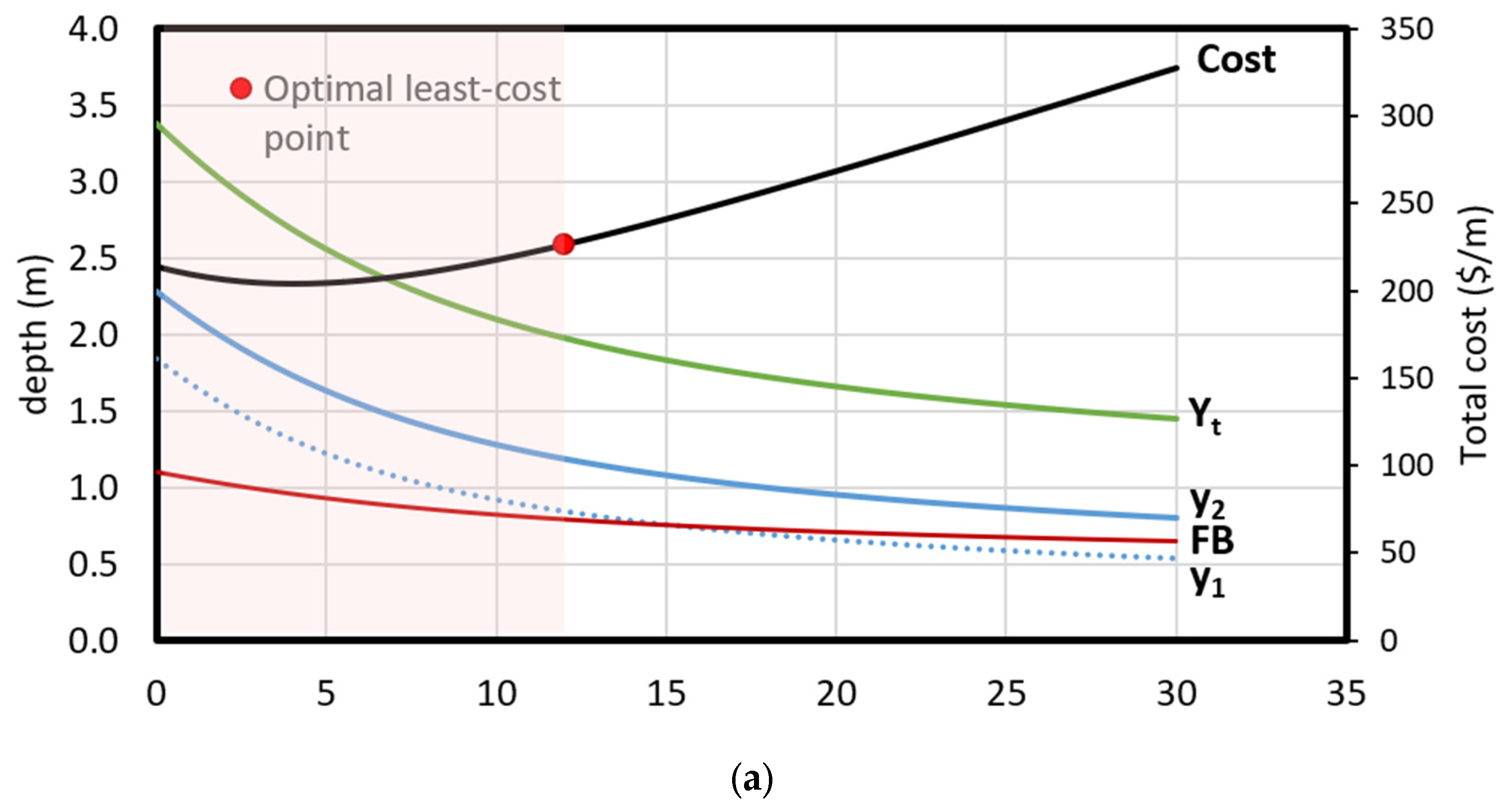
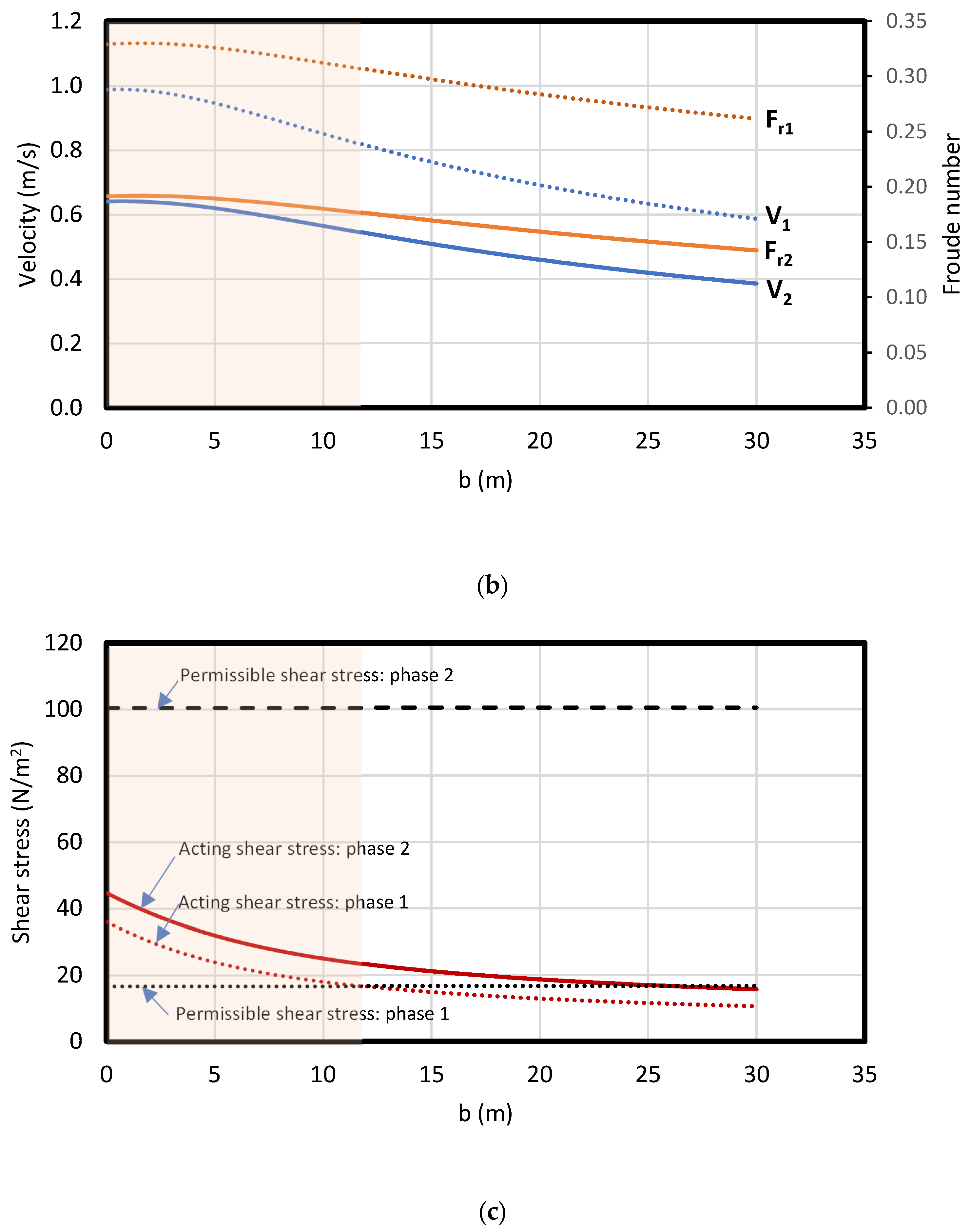
Design Examples 1 and 2 dealt with rigid riprap linings, where the median stone size d 50 can be increased continuously to resist higher tractive forces. In contrast, Design Example 4 introduces the fundamentally different behavior of a vegetated (flexible) lining, where optimization is constrained by a fixed permissible shear stress (biologically controlled) and the dual-state hydraulic response of vegetation. Vegetated channels require a two-condition analysis. Condition 1 (stability phase) represents newly established or freshly mowed vegetation, which offers low flow retardance (low Manning’s n ). This state produces the highest flow velocities and the maximum boundary shear stress τ b 1 . Condition 2 (capacity phase) represents mature, uncut vegetation with maximum retardance, which generates the greatest flow depth y 2 and determines the total required channel depth Y t .
The optimization trajectories in Figure 6 are nonlinear and effectively convex with respect to b . Figure 6a shows that the mathematical algorithm strongly favors a compact channel, identifying a theoretical global minimum cost at a bed width of exactly b = 4   m . At this narrow width, the lateral footprint is minimized, offering theoretical savings in excavation and seeding. However, forcing the discharge through such a narrow section makes the flow deep. During the critical Condition 1 stability phase, this depth produces a severe bed shear stress of τ b 1 25.7 N/m2. Unlike riprap channels, where stone size can simply be increased to handle such stress, the chosen vegetation has a fixed permissible shear stress of only 16.7 N/m2 (Figure 6c). Therefore, the mathematically “cheapest” solution at b = 4   m is physically infeasible: the concentrated hydraulic forces would scour the vegetation from the soil matrix. To achieve hydraulic stability, the channel must be systematically widened to dissipate the tractive forces. As the bed width increases, the flow becomes shallower, and the bed shear stress progressively declines. The data indicates that the feasible design domain is only reached when b = 12   m . At this spatial threshold, the flow is shallow enough that τ b 1 drops below the permissible limit.
Just as minimum velocity constraints overrode cost optimization in the low-flow environment of Example 2, the fixed permissible shear stress (biologically controlled) overrides cost optimization in Example 4. The physical need to shallow the flow forces a large lateral expansion, from 4 m to 12 m, raising the final feasible cost well above the unconstrained mathematical minimum.

3.4. Benchmarking VegyRap: Economic Efficiency and Geometric Flexibility

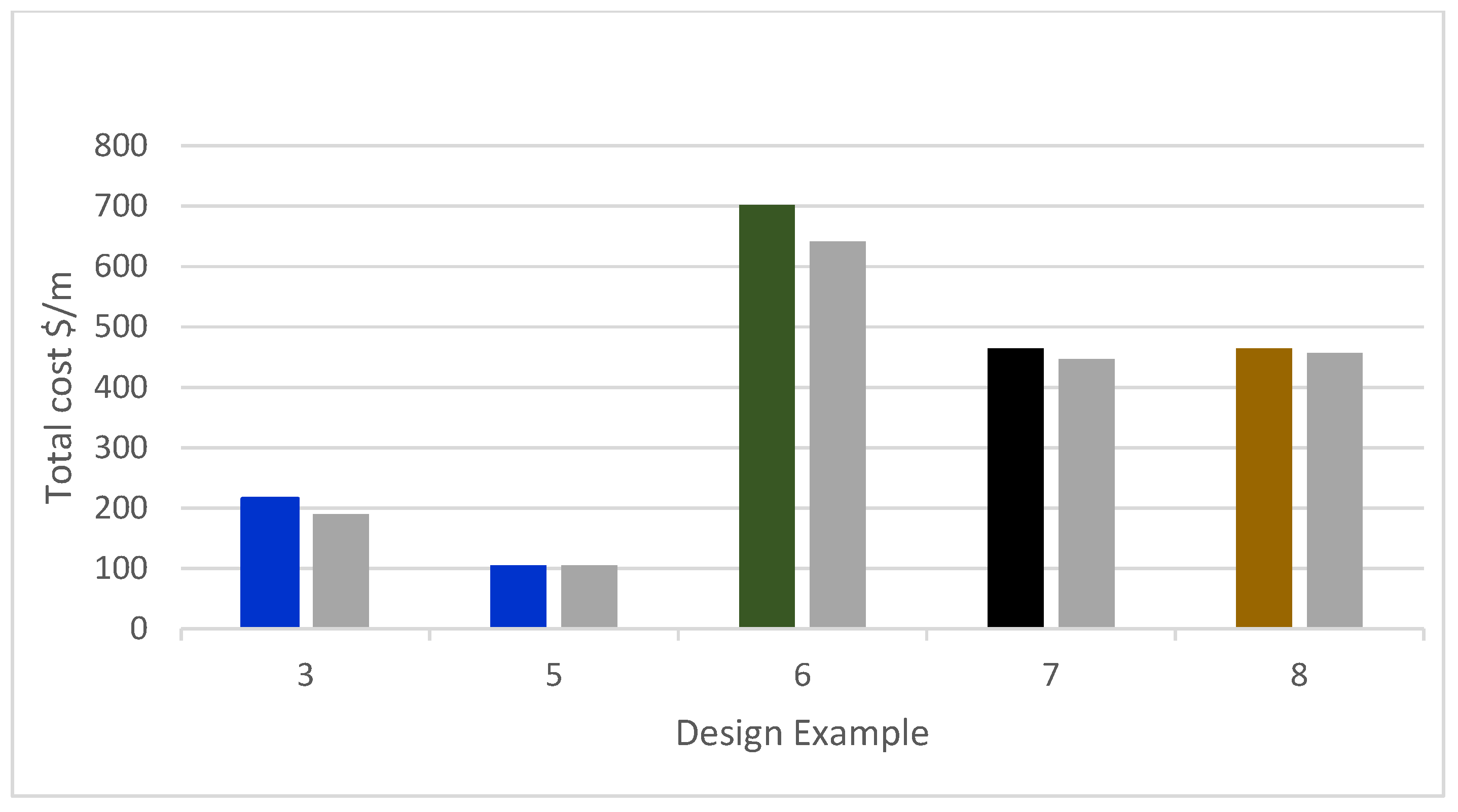
To validate both the economic efficiency and numerical accuracy of the VegyRap plugin, the optimization outcomes were directly benchmarked against established design methodologies and published literature (Examples 3, 5, 6, 7, and 8). The comparative analysis, illustrated in Figure 7, demonstrates that VegyRap consistently generates solutions that are either economically superior to, or directly comparable with, the benchmark designs. The magnitude of these cost reductions, however, is fundamentally contingent upon the governing design conditions and the allowable degree of geometric flexibility.
For rigid-boundary, riprap-lined channels (Examples 3, 6, and 7), the algorithm yielded notable cost reductions of up to 12%. This efficiency is achieved primarily through a mechanism of geometric redistribution. For instance, in the high-discharge scenario (Example 6: FHWA HEC-11, Q = 141.6 m3/s), VegyRap widened the channel from 6.1 m to 13.5 m, concurrently reducing the flow depth from 3.6 m to 2.48 m. Because boundary shear stress scales nonlinearly with flow depth ( τ y ), this shallower profile precipitated a substantial 34% reduction in the required median stone size ( d 50 , from 290 mm to 190 mm) and an 8.7% reduction in total cost.
Furthermore, Example 7 ( Q = 60 m3/s) demonstrated that fully lining the perimeter yielded a lower total cost ($447/m) than a partially lined configuration ($464/m). The partially lined channel, constrained by the weaker permissible shear stress of the native soil bed, is forced into a deeper, narrower section requiring substantial toe embedment. Conversely, full lining allows shear redistribution across the entire wetted perimeter, facilitating a wider, shallower section with thinner armor and the elimination of toe reinforcement.
These behaviors underscore the fundamental limitation of conventional sequential design, where geometry is predefined and lining is subsequently sized. Such traditional approaches inherently favor deeper sections that amplify applied shear and necessitate overly conservative, costly lining. By simultaneously optimizing geometry and boundary resistance, VegyRap actively exploits geometry–resistance coupling to bypass this inefficiency.
In contrast, the vegetated channel comparisons (Examples 5 and 8) exhibited near-identical economic performance between VegyRap and the benchmark solutions. For the Bermuda grass channel (Example 5, Q = 2.27 m3/s), VegyRap produced a distinctly wider and shallower geometry ( b = 2.65 m, y = 1.108 m) compared to the reference ( b = 2.01 m, y = 1.18 m), yet resulted in a virtually identical cost ($105.1/m vs. $105.5/m). A similar marginal variance (a 1.6% reduction) was observed for the higher-discharge grass–legume mix (Example 8).
This tight economic parity, despite geometric variance, confirms that multiple cross-sectional configurations can achieve equivalent economic performance, indicating that the optimization surface for vegetated channels is relatively flat near the global minimum. This flatness is a direct consequence of the stringent permissible shear constraints imposed during the critical vegetation establishment phase, which heavily restrict the feasible design space and limits the algorithmic flexibility seen in riprap channels.
It is imperative to interpret these benchmark comparisons with appropriate engineering context. Reference designs in published literature are rarely intended to represent absolute mathematical least-cost solutions. They frequently incorporate unquantified, site-specific practicalities—such as maintenance access, strict right-of-way limitations, constructability constraints, ecological targets, or agency-specific safety margins. Consequently, identifying a lower-cost optimized configuration does not imply a flaw in the benchmark design. Rather, it underscores that, within a strictly defined envelope of modeled constraints, integrated optimization leverages the critical interaction between channel geometry and boundary resistance to isolate the absolute economic floor of the design space.

3.5. Integrated Real-World Application: Wadi Al-Arja Case Study (Design Example 9)

3.5.1. Site Context and Ecological Engineering Objectives

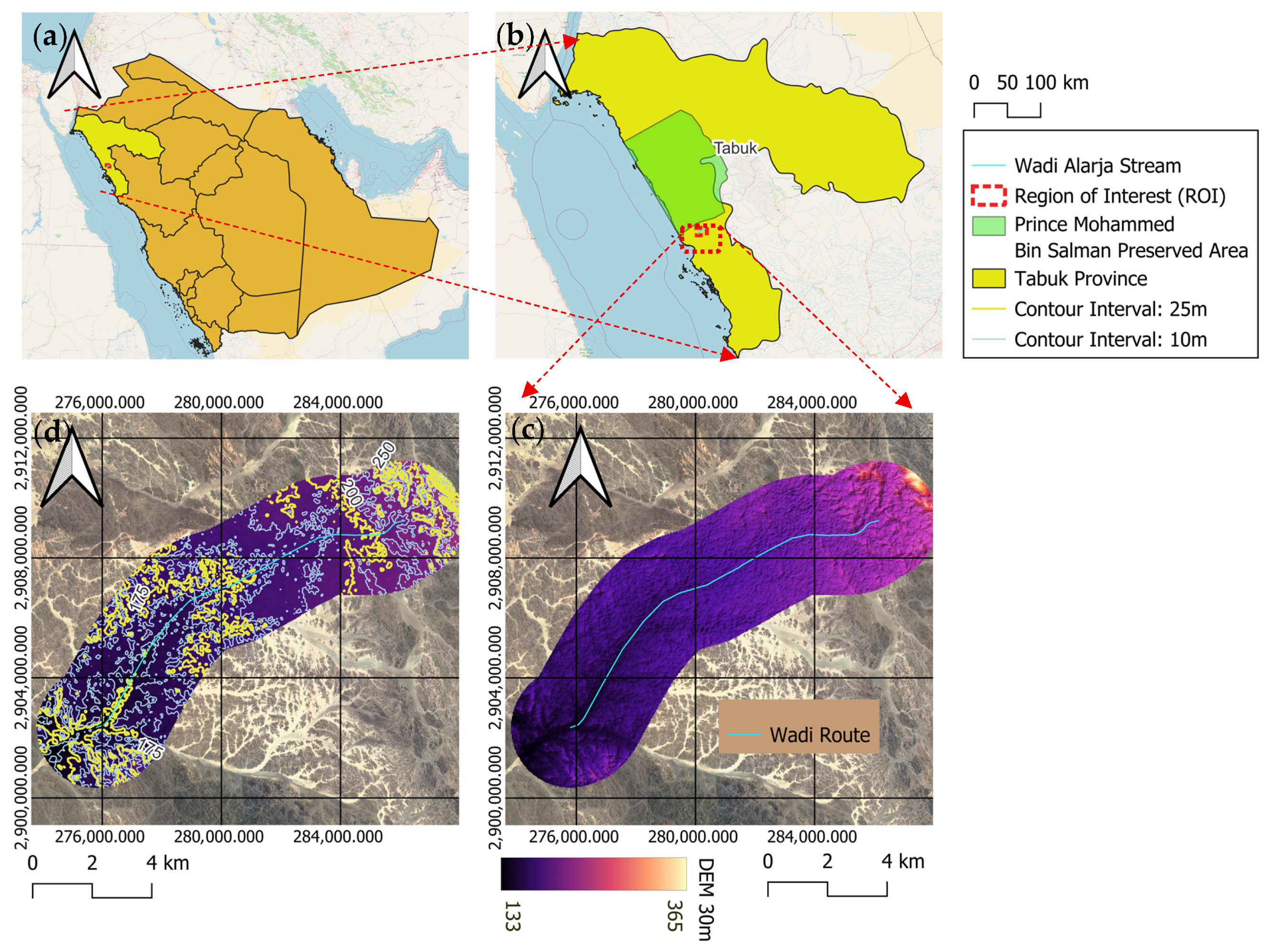
Wadi Al-Arja is a medium-sized ephemeral wadi located in the Tabuk Region of northwestern Saudi Arabia. The system extends from the southwestern margins of the Prince Mohammad bin Salman Nature Reserve (PMBNR) toward the Red Sea coastal plain near Al-Wajh Governorate (Figure 8). Functionally, the wadi acts as both a hydrological and ecological corridor, linking interior desert ecosystems with coastal environments. Flash floods generated by short-duration, high-intensity rainfall events dominate the flow regime, providing episodic groundwater recharge within alluvial deposits and facilitating sediment and nutrient redistribution across an arid landscape.
Morphologically, the wadi transitions from confined bedrock reaches upstream to broader alluvial and depositional zones downstream, where finer sediments and shallow groundwater support relatively dense riparian vegetation. Recent development pressures in the PMBNR–Al-Wajh transition zone, including transport infrastructure and eco-tourism facilities, have increased the need for flood risk mitigation and channel stabilization.
The proposed intervention consists of reshaping hydraulically sensitive reaches into a stabilized trapezoidal configuration. This measure is not intended to fully channelize the system but rather to regulate flood conveyance while preserving longitudinal connectivity and allowing controlled interaction between flow, sediment, and subsurface processes.
Riprap lining was selected as the primary stabilization measure due to its hydraulic robustness and hydro-ecological compatibility. Unlike impermeable linings, riprap provides high resistance to boundary shear during flash floods while maintaining permeability. The interstitial voids promote localized energy dissipation, extended residence time, and enhanced infiltration into underlying alluvial aquifers, an important consideration in ephemeral systems where flood events represent the primary recharge mechanism.
A design discharge of 40 m3/s was adopted, together with a Log-Pearson Type III distribution (coefficient of variation = 0.5, skewness coefficient = 0.2), to reflect the strongly skewed flood behavior typical of arid catchments. Within this framework, VegyRap was employed to optimize cross-sectional geometry and riprap sizing under combined hydraulic, economic, and environmental criteria. Refer to the Supplementary Materials for more information about VegyRap and its GUI.

3.5.2. Spatial Analysis and Longitudinal Profile Optimization

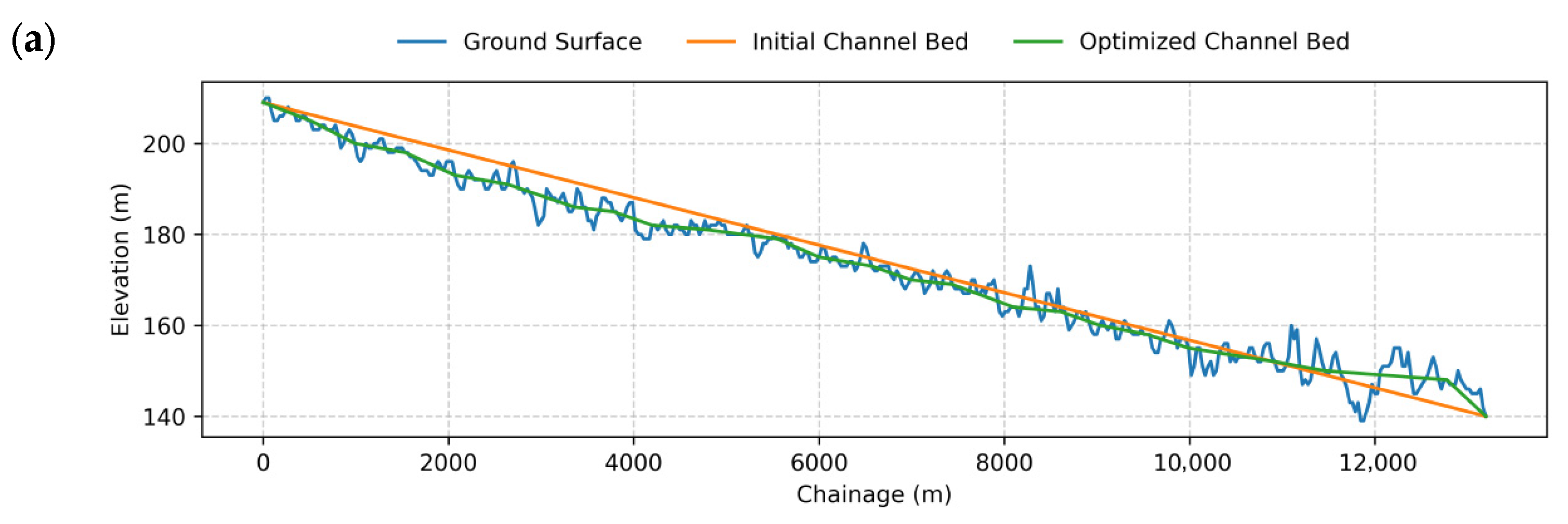
A 30 m resolution DEM was obtained using the SpatialRap plugin (Figure S5) to extract the longitudinal ground profile along the selected reach (Figure 8c and Figure S6–S9 in Supplementary Materials). The average bed slope derived from the profile is approximately 0.5% (Figure 9a).
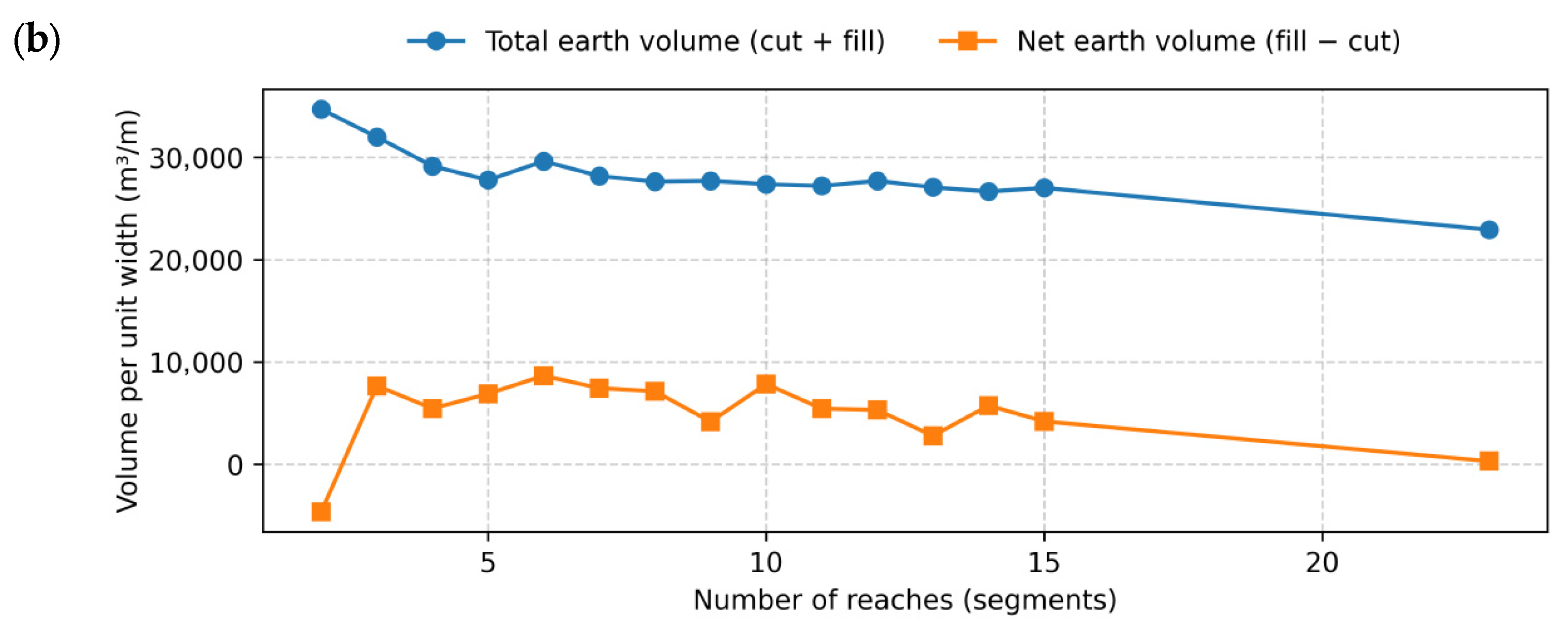
To minimize construction impacts, the longitudinal bed alignment was optimized to reduce total earthwork volume and achieve near-balanced cut–fill conditions. Discretizing the reach into 23 linear slope segments resulted in a minimum total earthwork volume of approximately 22.9 × 10³ m3 per meter width, with close equilibrium between cut and fill quantities (Figure 9b). This step ensures geometric feasibility prior to cross-sectional hydraulic optimization.

3.5.3. Cross-Sectional Optimization

Following longitudinal alignment, the VegyRap plugin (Figure 10a) was used to determine the least-cost stable trapezoidal cross-section and required riprap size. A uniform slope equal to the reach-average value was adopted. Hydraulic constraints included a minimum cleansing velocity of 0.7 m/s and exclusion of the transitional flow range (0.8 < Fr < 1.2).
The resulting design satisfies all hydraulic and stability criteria while minimizing total construction cost (Figure 10b). The solution reflects the typical optimization trend observed in earlier examples: redistribution toward a geometrically efficient section that balances excavation and lining demand.

3.5.4. Reliability and Risk Assessment

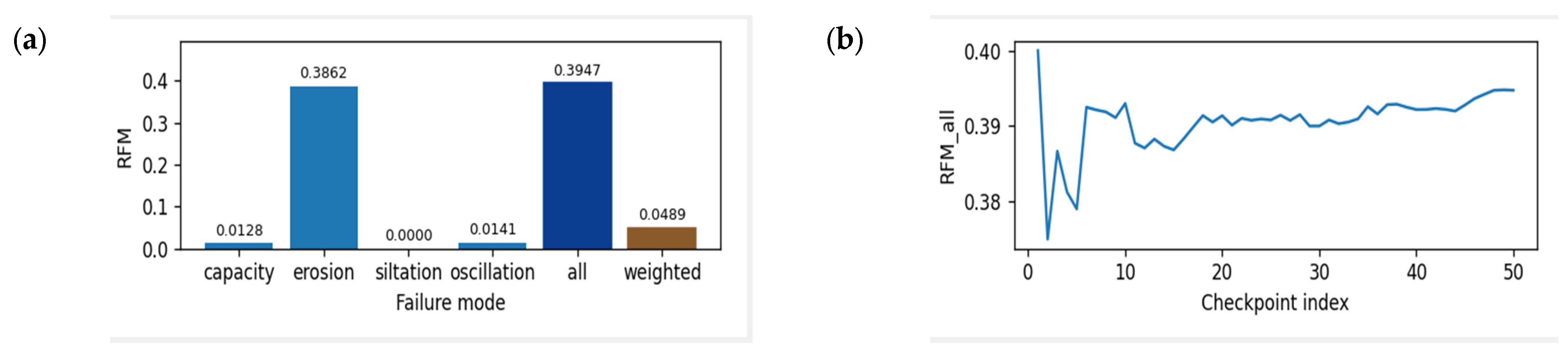
The reliability analysis evaluated four distinct failure mechanisms, overtopping (capacity exceedance), erosion, siltation, and near-critical oscillation, which were assigned relative weighting factors of 0.75, 0.10, 0.10, and 0.05, respectively. The results indicate that the deterministic least-cost design yields a weighted failure probability of approximately 4.89% (Figure 11a), with comprehensive statistical details for the adopted distributions provided in Figure S14. Furthermore, a convergence analysis tracking the aggregated risk metric (RFM_all) demonstrates that the failure probability estimates successfully stabilize over the course of the 20,000 Monte Carlo iterations executed (Figure 11b).
To explore mitigation options, geometric parameters were adjusted manually (e.g., increasing bed width), followed by re-evaluation. Increasing bed width to 7.5 m reduced the weighted probability of failure to 0.0453, demonstrating the trade-off between economic optimality and reliability (Figure S15).
Sensitivity analysis was conducted to quantify the effectiveness of alternative design adjustments in reducing risk per unit cost increase (Figure S16). Starting from the least-cost configuration, individual parameters were perturbed locally while holding others constant. A marginal efficiency metric was defined as
E = C R F M a l l   a n d   E n = C / C m i n R F M a l l / R F M a l l _ m a x
where R F M a l l represents the aggregated failure index.
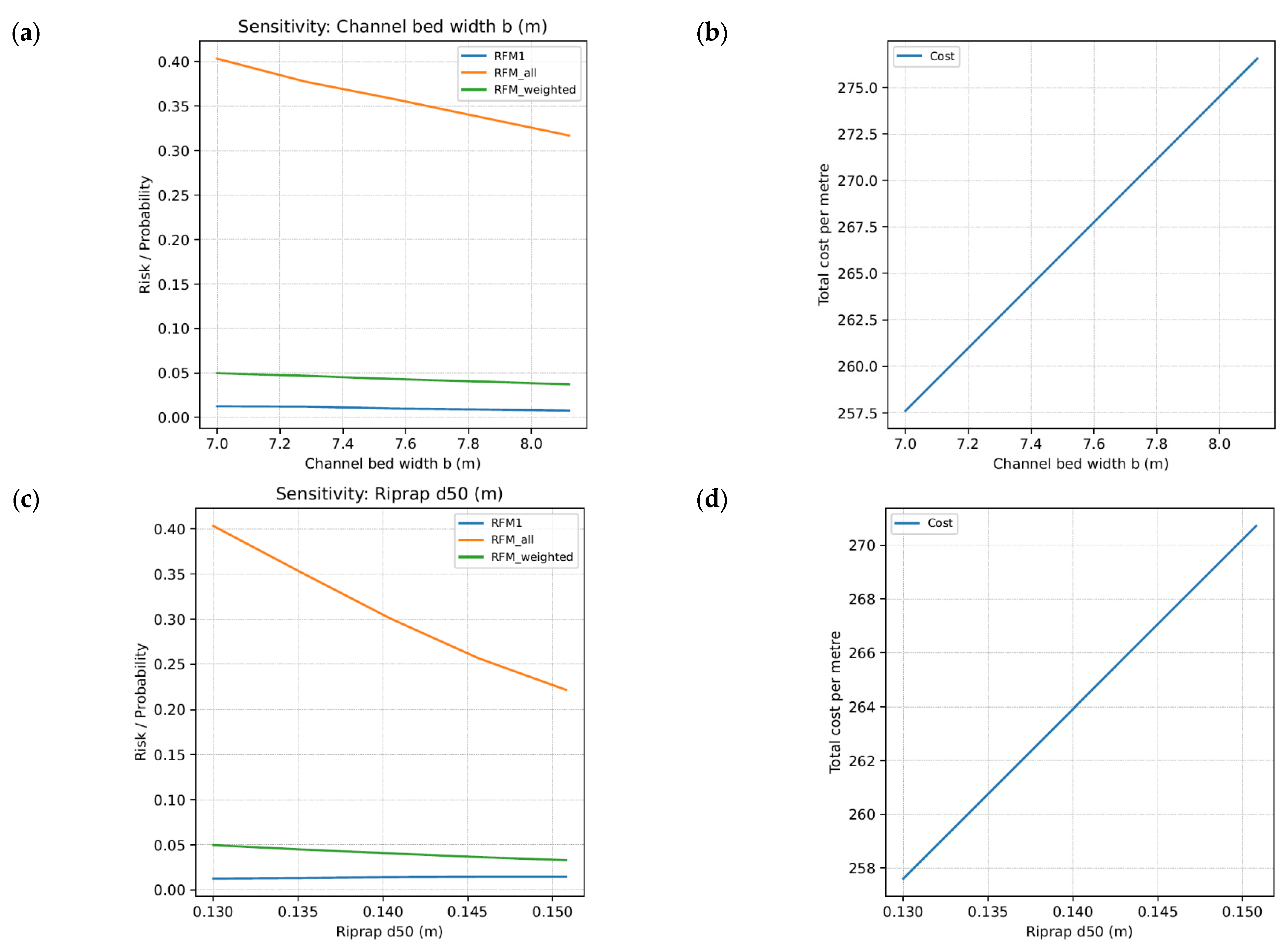
The reliability assessment activated three stochastic variables simultaneously, while the sensitivity analysis systematically perturbed four geometric and material parameters: channel bed width, depth, side slope, and riprap size (see Figure 12 and Figure S16).
The results (Figure 12 and Figure S17) show that both bed width and riprap median size significantly influence reliability; however, their cost efficiencies differ substantially. Increasing bed width from 7 to 8 m reduced risk by approximately 0.085 at a cost increase of 18 USD/m. In contrast, increasing d 50 from 130 to 150 mm reduced risk by approximately 0.175 at a cost increase of 13 USD/m. Thus, riprap size increases yield nearly three times greater risk reduction per unit cost compared with geometric widening (Table 3).
This indicates that once minimum hydraulic capacity is satisfied, incremental improvements in lining resistance provide the most cost-effective risk mitigation strategy.
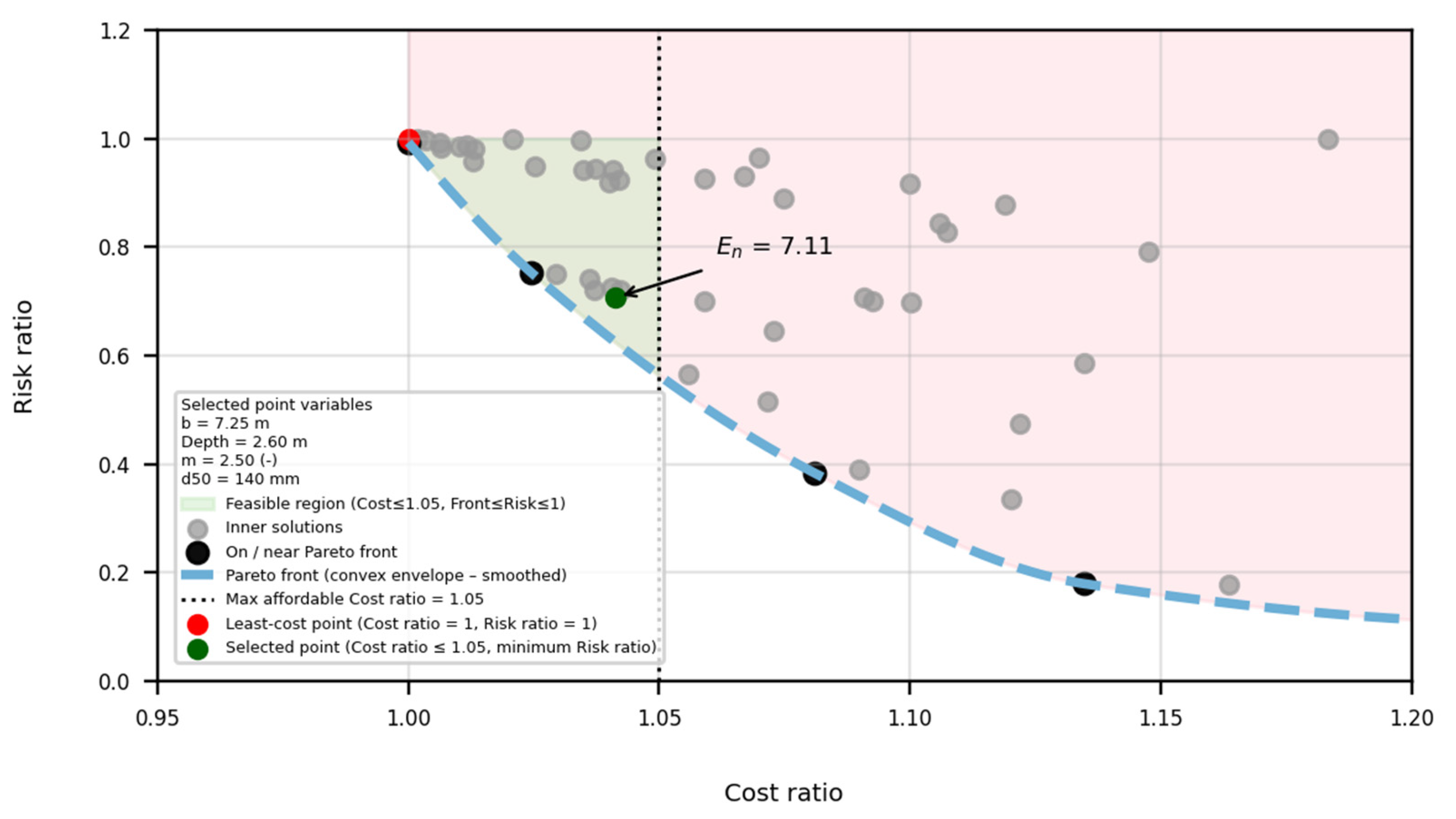
To formalize the cost–risk trade-off, a multi-objective Pareto optimization was conducted (GUI tab, Figure S18). Total construction cost and aggregated failure risk were treated as competing objectives. The horizontal axis in Figure 13 represents the normalized cost ratio relative to the least-cost design, while the vertical axis represents the corresponding normalized risk ratio. The Pareto front exhibits a strongly nonlinear relationship: small increases in cost beyond the minimum-cost design yield disproportionately large reductions in system risk. This behavior reflects the proximity of least-cost solutions to hydraulic constraint boundaries. Under a predefined affordability constraint of a maximum 5% cost increase, a compromise solution was selected.
The adopted configuration (green marker in Figure 13) corresponds to a bed width of 7.25 m, a flow depth of 2.60 m, a side slope of 2.5H:1V, and a riprap median size d50 = 140 mm. This solution achieves a substantial reduction in aggregated failure probability while maintaining acceptable economic performance, yielding a marginal efficiency metric of 7.11 as computed from Equation (35).

4. Conclusions

This study presents the development and validation of VegyRap, an integrated open-source QGIS-based computational framework that automates and unifies three traditionally disjointed sequential tasks in flexible-lined channel design: terrain-driven longitudinal profile optimization, least-cost cross-sectional design for riprap and vegetated linings, and multi-mode probabilistic reliability analysis coupled with Pareto-based cost–risk trade-offs.
The systematic evaluation of the tool across diverse hydraulic regimes, benchmark comparisons, and the Wadi Al-Arja case study demonstrates that the explicit integration of spatial constraints, boundary resistance, and parameter uncertainty is essential for generating robust, site-adaptive engineering solutions.
Several substantive findings arise from the validation analyses and the deterministic least-cost optimization performed on the design cases. First, for riprap-lined channels, the optimization yields a convex total cost curve, which mirrors the competing demands of excavation and lining expenditures. The global least-cost solution occurs at a specific median stone size where the marginal saving from reduced excavation exactly balances the marginal cost of additional riprap. Stone angularity plays a decisive role: transitioning from very rounded to angular or crushed riprap increases the angle of repose by approximately 5–8°, permitting steeper stable side slopes (e.g., 2.5:1 instead of 3:1). This geometric adjustment reduces both excavation volume and wetted perimeter, yielding measurable construction cost reductions of 4–6% while sometimes even lowering the required d50. Second, for vegetated channels, the analysis demonstrates that a hierarchical two-phase design logic is essential: dimensions must first satisfy establishment-phase stability (Class E retardance) before long-term conveyance (Class B retardance) can be verified. Designs that ignore this sequence are hydraulically infeasible or prone to failure during vegetation maturation. Third, benchmarking against established methodologies shows that VegyRap consistently achieves cost reductions of 10–15% over traditional design practices, primarily by allowing geometric redistribution and wider, shallower sections that reduce boundary shear and thus required stone size, rather than by simply minimizing wetted perimeter.
Beyond deterministic optimization, the incorporation of Monte Carlo-based reliability analysis exposed the inherent fragility of absolute least-cost designs. Because optimization algorithms naturally drive geometries to the very margins of allowable shear and spatial constraints, the Wadi Al-Arja application demonstrated that relying solely on a deterministic optimum yields non-negligible failure probabilities, predominantly driven by scour. Through marginal risk–cost efficiency evaluations, this research established a critical principle for risk mitigation: once minimum hydraulic conveyance is achieved, augmenting boundary shear resistance (e.g., increasing median stone size) provides a risk reduction per unit cost nearly three times greater than geometric channel widening.
Ultimately, the implementation of Pareto-based dual optimization formalizes the critical trade-off between construction cost and system reliability. The strongly nonlinear Pareto fronts generated by the framework confirm that minor incremental investments slightly beyond the absolute minimum cost yield disproportionately massive reductions in failure probability. By providing continuous trade-off surfaces rather than a singular discrete output, VegyRap empowers decision-makers to navigate affordability constraints and stakeholder risk tolerance, culminating in defensible, resilient engineering configurations. Future research will focus on extending this framework to accommodate gradually varied flow conditions, incorporating climate non-stationarity into hydrologic inputs, and deploying machine learning surrogates to further accelerate probabilistic evaluations within the geospatial environment.

5. Limitations and Future Research Directions

Despite its demonstrated capabilities, the current version of the VegyRap framework possesses several limitations that warrant acknowledgment. Hydraulically, the tool assumes uniform steady-state flow within a standard, symmetrical trapezoidal cross-section, restricting its applicability in trans-critical reaches, transitions near hydraulic structures, or rapidly varied flow conditions. Additionally, while the tool assesses the probabilistic risk of sedimentation and active scour via boundary thresholds, it does not perform continuous morphodynamic routing or explicitly solve for bed-level changes driven by upstream sediment supply imbalances. Furthermore, the current workflow optimizes a single representative section per reach, meaning spatial variability in hydraulic or geotechnical conditions along the longitudinal profile is not explicitly modeled. Materially, the framework is currently parameterized exclusively for riprap and vegetative (Bermuda grass) linings. Finally, while depth-dependent, the freeboard formulation relies on empirical equations that do not account for complex dynamic factors such as wave run-up, debris blockage, or climate change adjustments.
Addressing these constraints forms the basis of the future research and development trajectory. To broaden its engineering utility, subsequent versions will extend the hydraulic engine beyond uniform flow assumptions to accommodate gradually varied and mixed flow conditions. This expansion will also encompass a wider array of cross-sectional profiles, specifically integrating capabilities for unsymmetric and compound trapezoidal geometries, alongside the development of optimal channel layout pathing directly within the SpatialRap module. The material scope will be expanded to include synthetic mats, gabions, and bio-engineered composites. Furthermore, the framework’s probabilistic capacity will be significantly elevated. While the current sensitivity and stochastic modules effectively handle up to five key variables, future iterations will accommodate a wider array of random variables to capture deeper systemic uncertainties. To manage the increased computational demand introduced by advanced gradually varied flow solvers, future work will upgrade the plugin architecture to support parallel computing and integrate efficient analytical reliability algorithms, such as the First-Order Reliability Method (FORM) and Second-Order Reliability Method (SORM). By drastically reducing computational overhead compared to traditional Monte Carlo simulations, these methodologies will ensure the framework remains highly responsive during intensive optimizations. Finally, deploying machine learning surrogates, embedding climate non-stationarity via non-parametric discharge distributions, coupling baseline geometries with dedicated 1D/2D morphodynamic solvers for long-term bed evolution modeling, and expanding the Pareto optimization to include socio-environmental externalities will transition the tool into a fully comprehensive decision-support environment.


Supplementary Materials

The following supporting information can be downloaded at https://www.mdpi.com/article/10.3390/w18080957/s1.

Author Contributions

Conceptualization, A.M.T. and M.H.E.; methodology, A.M.T. and M.H.E.; GUI preparation, M.H.E.; case study and reliability analysis, M.H.E.; formal analysis, A.M.T. and M.H.E.; solved examples 1–8, A.M.T.; resources, M.H.E.; data curation, M.H.E.; writing—original draft preparation, A.M.T. and M.H.E.; writing—review and editing, A.M.T. and M.H.E.; visualization, A.M.T. and M.H.E. All authors have read and agreed to the published version of the manuscript.

Funding

This research received no external funding.

Data Availability Statement

The original data/code of VegyRap (version 1) presented in the study will be openly available in [GitHub] upon the acceptance of the paper.

Conflicts of Interest

The authors declare no conflicts of interest.

References

  1. Metropolitan Nashville—Davidson County. Stormwater Management Manual. Volume 2, Chapter 3 Open Channel Hydraulics; Metropolitan Nashville—Davidson County: Nashville, TN, USA, 2000. [Google Scholar]
  2. Kilgore, R.T.; Cotton, G.K. Hydraulic Engineering Circular No. 15. Design of Roadside Channels with Flexible Linings, 3rd ed.; Federal Highway Administration: Washington, DC, USA, 2005. [Google Scholar]
  3. Brown, S.A.; Clyde, E.S. Hydraulic Engineering Circular No. 11. Design of Riprap Revetment; Federal Highway Administration: Washington, DC, USA, 1989. [Google Scholar]
  4. Rimoldi, P. Design for erosion control according to ISO TR 18228-8. In Proceedings of the GeoAmericas—4th Pan American Conference on Geosynthetics, Rio de Janeiro, Brazil, 25–29 October 2020. [Google Scholar]
  5. Insta-Turf. Design Considerations and Limitations of TRM-Reinforced Vegetation. Available online: https://insta-turf.com/design-considerations-and-limitations-of-trm-reinforced-vegetation/ (accessed on 15 February 2026).
  6. Thompson, P.L.; Kilgore, R.T. Hydraulic Engineering Circular No. 14. Hydraulic Design of Energy Dissipators for Culverts and Channels; Federal Highway Administration: Washington, DC, USA, 2006; Chapter 10. [Google Scholar]
  7. Mississippi Department of Environmental Quality. Erosion and Stormwater Management Manual. Volume 1, Chapter 4, Section 4.4. Available online: https://opcgis.deq.state.ms.us/Erosion_Stormwater_Manual_2ndEd/Volume1/Chap_4_Sections/4_4/V1_Chap4_4_Runoff_Conveyance_RS.pdf (accessed on 2 January 2026).
  8. Chen, Y.H.; Cotton, G.K. Hydraulic Engineering Circular No. 15. Design of Roadside Channels with Flexible Lining; Federal Highway Administration: Washington, DC, USA, 1988. [Google Scholar]
  9. Nicosia, A.; Carollo, F.G.; Palmeri, V.; Ferro, V. Flow resistance of flexible vegetation in real-scale drainage channels. Hydrol. Process. 2023, 37, e14883. [Google Scholar] [CrossRef]
  10. Bailly, J.S.; Vinatier, F.; Belaud, G.; Combemale, D. Vegetation Patch Effects on Flow Resistance at Channel Scale. In Proceedings of the E-Proceedings of the 36th IAHR World Congress, The Hague, The Netherlands, 28 June–3 July 2015. [Google Scholar]
  11. U.S. Army Corps of Engineers. Hydraulic Design of Flood Control Channels. EM 1110-2-1601; U.S. Army Corps of Engineers: Washington, DC, USA, 1994.
  12. Appolus, M.; Bosman, A.; Basson, G.R. Critical incipient failure conditions for angular riprap on steep trapezoidal channels using the movability number. Water SA 2025, 51, 243–255. [Google Scholar] [CrossRef]
  13. Lagasse, P.F.; Zevenbergen, L.W.; Schall, D.J.; Clopper, P.E. Hydraulic Engineering Circular No. 23. Bridge Scour and Stream Instability Countermeasures: Experience, Selection, and Design Guidance, 3rd ed.; Federal Highway Administration: Washington, DC, USA, 2009; Chapter 8. [Google Scholar]
  14. Easa, S.M.; Wu, G.; Abd El Halim, A.O.; Yu, M. Non-iterative design method for flexible channels with bends. Proc. Inst. Civ. Eng. Water Manag. 2015, 168, 245–255. [Google Scholar] [CrossRef]
  15. Easa, S.M.; Vatankhah, A.R. Direct solutions for design of grass-lined channels. Proc. Inst. Civ. Eng.Water Manag. 2012, 165, 153–162. [Google Scholar] [CrossRef]
  16. Easa, S.M.; Vatankhah, A.R.; Abd El Halim, A.O. A simplified direct method for finding optimal stable trapezoidal channels. Int. J. River Basin Manag. 2011, 9, 85–92. [Google Scholar] [CrossRef]
  17. Froehlich, D.C. Most Hydraulically Efficient Riprap-Lined Drainage Channels. J. Irrig. Drain. Eng. 2011, 137, 581–588. [Google Scholar] [CrossRef]
  18. Aksoy, B.; Altan-Sakarya, A.B. Optimal lined channel design. Can. J. Civ. Eng. 2006, 33, 535–545. [Google Scholar] [CrossRef]
  19. Janga Reddy, M.; Adarsh, S. Chance constrained optimal design of composite channels using meta-heuristic techniques. Water Resour. Manag. 2010, 24, 2221–2235. [Google Scholar] [CrossRef]
  20. Gupta, S.K.; Umank, M.; Singh, V.P. Design of Minimum Cost Earthen Channels Having Side Slopes Riveted with Different Types of Riprap Stones and Unlined Bed by Using Particle Swarm Optimization. Irrig. Drain. 2016, 65, 319–333. [Google Scholar] [CrossRef]
  21. Gupta, S.K.; Umank, M.; Datta, D.; Singh, V.P. Fish shoal optimization for identification of the most suitable revetment stone for design of minimum cost earthen canals carrying sediment laden flow. ISH J. Hydraul. Eng. 2018, 24, 172–189. [Google Scholar] [CrossRef]
  22. Depeweg, H.; Urquieta, E.R. GIS tools and the design of irrigation canals. Irrig. Drain. 2004, 53, 301–314. [Google Scholar] [CrossRef]
  23. Graser, A.; Sutton, T.; Bernasocchi, M. The QGIS project: Spatial without compromise. Patterns 2025, 6, 101265. [Google Scholar] [CrossRef] [PubMed]
  24. Kouwen, N.; Unny, T.E.; Hill, H.M. Flow Retardance in Vegetated Channels. J. Irrig. Drain. Div. 1969, 95, 329–344. [Google Scholar] [CrossRef]
  25. Kouwen, N.; Li, R.M. Biomechanics of Vegetative Channel Linings. J. Hydraul. Div. 1980, 106, 1085–1103. [Google Scholar] [CrossRef]
  26. Wang, S.; Shen, H.W. Incipient Sediment Motion and Riprap Design. J. Hydraul. Eng. 1985, 111, 520–538. [Google Scholar] [CrossRef]
  27. Chiew, Y.M.; Parker, G. Incipient motion on non-horizontal slopes. J. Hydraul. Res. 1994, 32, 649–660. [Google Scholar] [CrossRef]
  28. de Almeida, G.A.M.; Martín-Vide, J.P. Riprap Stability: Transverse and Longitudinal versus Continuous Protections. J. Hydraul. Eng. 2009, 135, 507–512. [Google Scholar] [CrossRef]
  29. Langmaak, K.R.; Basson, G.R. Incipient Motion of Riprap on Steep Slopes. J. Hydraul. Eng. 2015, 141, 04015020. [Google Scholar] [CrossRef]
  30. Kanellopoulos, P.M. Incipient Motion Under Shallow Flow Conditions. Mater’s Thesis, Master of Science in Civil Engineering, Virginia Polytechnic Institute and State University, Blacksburg, VA, USA, 1998. [Google Scholar]
  31. Comiti, F.; Lenzi, M.A. Dimensions of standing waves at steps in mountain rivers. Water Resour. Res. 2006, 42, W03411. [Google Scholar] [CrossRef]
  32. Chanson, H. The Hydraulics of Open Channel Flow: An Introduction; Elsevier: Amsterdam, The Netherlands, 2004. [Google Scholar]
  33. Easa, S.M. Reliability Analysis of Open Drainage Channels under Multiple Failure Modes. J. Irrig. Drain. Eng. 1994, 120, 1007–1024. [Google Scholar] [CrossRef]
  34. Cardoso, A.H.; Schleiss, A.J.; Le Doucen, O.; Simarro, G. Sizing of riprap for spill-through abutments. Proc. Inst. Civ. Eng.—Water Manag. 2010, 163, 499–507. [Google Scholar] [CrossRef]
  35. Picco, L.; Pellegrini, G.; Iroume, A.; Lenzi, M.A.; Rainato, R. The role of in-channel vegetation in driving and controlling the geomorphic changes along a gravel-bed river. Geomorphology 2023, 437, 108803. [Google Scholar] [CrossRef]
  36. Bizimana, H.; Altunkaynak, A. A novel approach for the prediction of the incipient motion of sediments under smooth, transitional and rough flow conditions using Geno-Fuzzy Inference System model. J. Hydrol. 2019, 577, 123952. [Google Scholar] [CrossRef]
  37. Nandi, K.K.; Kakati, R.; Dutta, S.; Khatua, K.K. Exploring the influence of vegetated mid-channel bar on flow and turbulence in bifurcated channels: An experimental approach. Adv. Water Resour. 2024, 189, 104727. [Google Scholar] [CrossRef]
  38. Sturm, T. Open Channel Hydraulics; McGraw-Hill: New York, NY, USA, 2001. [Google Scholar]
  39. Henderson, F.M. Open Channel Flow; Macmillan Publishing Co.: New York, NY, USA, 1966. [Google Scholar]
  40. Chaudhry, H. Open Channel Flow; Springer: Berlin/Heidelberg, Germany, 2008. [Google Scholar]
  41. Chow, V.T. Open Channel Hydraulics; McGraw-Hill: New York, NY, USA, 1973. [Google Scholar]
  42. Subramanya, K. Flow in Open Channels; McGraw-Hill: New York, NY, USA, 2009. [Google Scholar]
  43. Osman Akan, A. Open Channel Hydraulics; Elsevier: Amsterdam, The Netherlands, 2006. [Google Scholar]
  44. Chin, D. Water Resources Engineering, 3rd ed.; Pearson: London, UK, 2013. [Google Scholar]
  45. OpenTopography. Academic and Research Partnerships. Available online: https://opentopography.org/about/academicpartnership (accessed on 17 February 2026).
Figure 1. Typical cross-section for (a) riprap-lined channel, (b) vegetation-lined channel.
Water 18 00957 g001
Figure 2. Workflow diagram for the QGIS VegyRap toolbox. 1. Draw the layout of the channel on QGIS canvas. 2. Select DEM source, enter API key and download DEM. 3. Sample DEM along the channel route, plot the longitudinal profile of the ground surface along the route and get initial average slope. 4. Use dynamic programing to identify locations and elevations of breakpoints of the channel bed to minimize total volume of earth while keeping diff between fill and cut minimal. 5. Enter flow, select type of lining and optimize the channel dimensions to get min total cost of lining (refer to Figure S3 in Supplementary Materials). 6. Select random variables, their distributions and modes of failure, and then carry out multi-mode risk/reliability analysis. 7. Select variables to be examined in sensitivity analysis and their range of variabilities. 8. Carry out dual Pareto optimization to get the relevant practical design compromising both cost and risk.
Water 18 00957 g002
Figure 3. Flow diagram of the VegyRap least-cost optimization process.
Water 18 00957 g003
Figure 4. Conceptual illustration of cost–risk Pareto trade-offs in VegyRap. (Note: axis scales are omitted for generality; a detailed numerical example is provided later for the Wadi Al-Arja case study).
Water 18 00957 g004
Figure 5. Design output trials for a riprap lined channel as a function of riprap size (Design Example 1, Case 1). (a) d50 vs. shear stress and total cost, (b) d50 vs. bed width, (c) d50 vs. velocity, Froude number and side slope.
Water 18 00957 g005aWater 18 00957 g005b
Figure 6. Optimal design output for vegetation-lined channel as a function of channel bed width (Design Example 4, Case 1): (a) water depth at two stages, free board and total cost; (b) velocity and Froude number; (c) permissible and tractive shear stresses at two stages.
Water 18 00957 g006aWater 18 00957 g006b
Figure 7. VegyRap cost comparison for benchmark examples. Note: Gray color for VegyRap results, Dark blue for results from benchmark [43], Green for benchmark [3], Black for benchmark [17] and brown for benchmark [4].
Water 18 00957 g007
Figure 8. Wadi Al-Arja case study (Design Example 9). (a) KSA administration zones. (b) Location of Wadi Al-Arja. (c) SRTM digital elevation model, 30 m resolution (given by SpatialRap). (d) Elevation contour lines throughout wadi stream.
Water 18 00957 g008
Figure 9. Optimization of longitudinal channel bed surface using SpatialRap (Wadi Al-Arja). (a) Longitudinal profiles: ground surface, initial bed, and optimized bed. (b) Number of reaches versus total and net earth volumes (per unit width).
Water 18 00957 g009aWater 18 00957 g009b
Figure 10. GUI tabs for least-cost optimal design in VegyRap (Wadi Al-Arja). (a) Input data tab, (b) least-cost optimal result tab. (Note: remaining GUI tabs can be found in the Supplementary Materials).
Water 18 00957 g010aWater 18 00957 g010b
Figure 11. Reliability analysis of the least-cost optimal section of Wady Al-Arjah. (a) Weighted, average and individual values of RFM for different failure modes and (b) temporal conversion index.
Water 18 00957 g011
Figure 12. Results of sensitivity analysis for Wady Al-Arjah. (a,b) Effect of increasing channel bed width on probability of risk and total cost respectively. (c,d) Effect of increasing d50 on probability of risk and total cost respectively.
Water 18 00957 g012
Figure 13. Results of Pareto dual optimization for Wady Al-Arjah (adopted alpha step = 0.1). Note: The green marker denotes the dual risk–cost optimal solution under an accepted 5% cost increase.
Water 18 00957 g013
Table 1. Overview of design examples, objectives, and distinguishing parameters.
Design Example #Design Flow (m3/s)Longitudinal SlopeType of Flexible LiningPrimary ObjectiveVerificationDistinguishing Feature
Rock RiprapVegetationDescriptionLeast-Cost Optimal DesignSensitivity AnalysisReliability AnalysisRisk–Cost Trade-Off
Optimal
Comparison with Benchmark ExampleBenchmark Reference
120–800.0005–0.005 Riprap (various) Sensitivity to riprap angularity and flow–slope changes
20.5–1.30.0005–0.005 Riprap (various) Focus on low-flow feasibility and velocity constraints
328.30.004 Riprap (angular) [43]Validation against established riprap design methods
41–100.0005–0.005 Bermuda grass Effect of flow and slope on vegetated channel dimensions
52.270.002 Bermuda grass [43]Comparison with published vegetated channel results
6141.60.0049 Riprap (angular) [3]Validation for large discharge conditions
7600.0005 Riprap (angular) [17]Compares a published optimal partially lined section with the optimal fully lined configuration
8500.001 Grass–legume mix [4]Comparison using depth-dependent freeboard
9400.005 Riprap (rounded) Real-world implementation integrates GIS route delineation, DEM profiling, hydraulic geometry optimization, and multi-criteria evaluation (reliability, sensitivity, Pareto risk–cost analysis).
Table 2. Outputs of least-cost optimization for all design examples.
Design ExampleRun CaseDesign Flow (m3/s)Slope (So)Type of LiningDesign ToolOptimal Least-Cost ParametersFeasible Solution Exists?
RiprapVegetation
VRVACRBermuda GrassLegume MixVegyRapBenchmarkd50 (mm)b (m)y (m)Side Slope mFB (m)Thickness (m)Cost ($/m)Fr or (Fr1/Fr2)V (m/s) or (V1/V2)n or (n1/n2)
11400.005 13071.6032.50.9980.26257.60.672.270.0338
2400.005 1109.251.4012.50.9330.22248.020.682.240.0329
3400.005 1109.251.4012.50.9330.22248.020.682.240.0329
4200.005 709.50.88830.7050.14154.830.691.850.0305
5800.005 1709.252.1132.51.2540.34437.120.672.610.0354
6400.001 309.751.83531.0680.06293.160.391.430.0265
7400.0005 307.252.42631.2280.063600.291.130.0265
211.30.005 3030.36730.4290.0628.6560.510.870.0352
21.30.005 302.950.3752.50.4340.0626.6880.520.890.035
31.30.005 253.90.3182.50.40.0526.2490.530.870.0336
410.005 302.20.36630.4280.0624.720.50.830.0355
50.50.005
61.30.001
71.30.0005
3128.30.004 [43]1223.351.8022.51.0270.2442160.620.0335
759.251.1882.50.8340.151900.641.950.0309
41100.002 N/A121.18630.792N/A226(0.31/0.18)(0.81/0.54)(0.0436/0.0795)
250.002 N/A5.751.18230.7791N/A150(0.29/0.16)(0.72/0.46)(0.0453/0.0868)
310.002
4100.0015 N/A7.751.53730.9017N/A230(0.28/0.16)(0.80/0.53)(0.0431/0.0778)
5100.001 N/A4.52.03231.0366N/A258(0.23/0.13)(0.72/0.46)(0.0435/0.0786)
6100.0005 N/A5.12.38231.1225N/A328(0.16/0.09)(0.54/0.34)(0.0456/0.0834)
7100.0002
512.270.002 [43]N/A2.011.1830.772N/A105.5(0.26/0.13)(0.60/0.35)(0.0484/0.101)
2.651.10830.748105.1(0.26/0.13)(0.59/0.34)(0.0486/0.1015)
61141.60.0049 [3]2906.13.621.650.6701.960.622.960.0387
19013.52.482.51.370.38641.320.672.90.0360
71600.0005 [17]7910.282.951.871.420.158464.370.281.290.0311
2010.52.5431.320.04446.880.311.30.0248
81500.001 [4]N/A83.2321.45N/A464.28(N/A/0.23)(N/A/1.07)(N/A/0.033)
8.53.1221.43456.9(0.27/0.24)(1.20/1.09)(0.0411/0.0468)
91400.005 13071.6032.50.9980.26257.60.672.270.0338
Note: N/A means “not applicable”.
Table 3. Marginal risk–cost efficiency of key design parameters.
Parameter ChangeRange of VariationΔRFMallΔC($/m)E (RFM/$)En (% Risk/% Cost)
Bed width7 → 8 m−0.085180.00473.04
Riprap size130 → 150 mm−0.175130.01358.65
Disclaimer/Publisher’s Note: The statements, opinions and data contained in all publications are solely those of the individual author(s) and contributor(s) and not of MDPI and/or the editor(s). MDPI and/or the editor(s) disclaim responsibility for any injury to people or property resulting from any ideas, methods, instructions or products referred to in the content.