1. Introduction
Understanding the factors that control surface water quality is essential for the sustainable management of freshwater resources, particularly in regions subjected to increasing climatic and anthropogenic pressures. In semi-arid and Mediterranean environments, rivers constitute key water resources for drinking, irrigation, and socio-economic activities. However, their chemical composition is highly dynamic and reflects the combined influence of natural geochemical processes, such as water-rock interaction and groundwater contributions, and human-induced pressures, including agricultural practices, urban effluents, and land-use change [
1,
2,
3,
4,
5,
6,
7,
8,
9,
10,
11]. Therefore, identifying and quantifying the relative contribution of these factors remains a major challenge in hydrochemical studies and water resource management.
Previous studies have shown that surface water degradation in semi-arid river systems is often associated with salinization, mineral enrichment, and seasonal variations in solute concentrations. These processes are commonly intensified by low rainfall, high evapotranspiration, and reduced river discharge, which limit the natural dilution capacity of watercourses [
5,
8,
10]. In such hydroclimatic settings, both anthropogenic inputs and naturally occurring solute sources can substantially alter river chemistry and reduce water suitability for domestic and agricultural uses.
Among the natural sources affecting river hydrochemistry, thermal spring discharges represent a particularly important but still insufficiently investigated factor. Thermal waters generally acquire high temperatures and elevated dissolved mineral contents through prolonged circulation at depth and intensive interaction with geological formations. When discharged into rivers, they may continuously supply large amounts of dissolved ions, thereby modifying hydrochemical facies, increasing salinity and mineralization, and degrading water quality over downstream reaches [
12,
13,
14,
15]. In contrast to intermittent pollution sources, thermal discharges often act as persistent inputs, which makes their impact cumulative and potentially more difficult to control.
This issue is particularly critical in Mediterranean semi-arid regions, where river systems are inherently vulnerable to water quality deterioration. Under conditions of marked seasonal flow variability, irregular precipitation, and strong evaporative demand, even natural hydrochemical inputs may have disproportionately large effects on river water composition and usability. Therefore, understanding the role of thermal spring discharges is essential not only for hydrochemical interpretation but also for the development of effective management strategies in vulnerable watersheds.
Algeria is particularly concerned by this issue because it hosts a large number of thermal springs distributed across different geological and tectonic settings. More than 282 thermal springs have been documented in the country, with a strong concentration in the northeastern region [
14,
16]. Although previous research has mainly focused on the hydrogeochemical characteristics, geothermal potential, and therapeutic uses of these waters [
17,
18,
19,
20,
21,
22,
23,
24], far less attention has been paid to their influence on surface water quality. Only a limited number of studies have addressed the environmental impact of thermal discharges on Algerian river systems, and these investigations remain geographically restricted, notably to the Mila and Guelma regions [
14]. Consequently, a significant knowledge gap persists regarding the hydrochemical effects of thermal spring inputs at the watershed scale.
The Soummam watershed, located in northeastern Algeria, provides an appropriate case study to address this gap. It is a major hydrological system of high socio-economic importance, supporting agricultural activities, settlements, and diverse water uses. The basin also receives inputs from several thermal springs, among which the Sidi Yahia and Sillal springs are of particular interest because they discharge directly into the surface water network through the Boussellem River and the Remila Wadi, respectively, before joining the Soummam River. Their direct hydrological connection to the basin makes them suitable case studies for evaluating the extent to which thermomineral waters influence river hydrochemistry and water suitability.
To investigate these processes, the present study adopts an integrated approach based on physicochemical characterization, water quality indices, and multivariate statistical analysis. The Water Quality Index (WQI) and Irrigation Water Quality Index (IWQI) were used to assess the suitability of water for drinking and irrigation purposes, respectively [
25,
26,
27,
28], while hierarchical cluster analysis (HCA) was applied to identify spatial and seasonal similarities and to distinguish between thermally influenced, mixed, and relatively unaffected waters [
29,
30,
31].
The novelty of this work lies in providing the first integrated basin-scale assessment of the impact of the Sidi Yahia and Sillal thermal springs on the hydrochemical composition and quality of surface waters in the Soummam watershed. By combining hydrochemical data, suitability indices, and statistical classification, this study offers new insight into the extent to which thermal spring discharges modify river water composition under contrasting hydrological conditions.
Accordingly, the objectives of this study are to: (i) characterize the spatial and seasonal variability of surface water hydrochemistry in the Soummam watershed; (ii) evaluate water suitability for drinking and irrigation purposes; and (iii) quantify the influence of thermal spring discharges on the Soummam river network.
2. Materials and Methods
2.1. Study Area
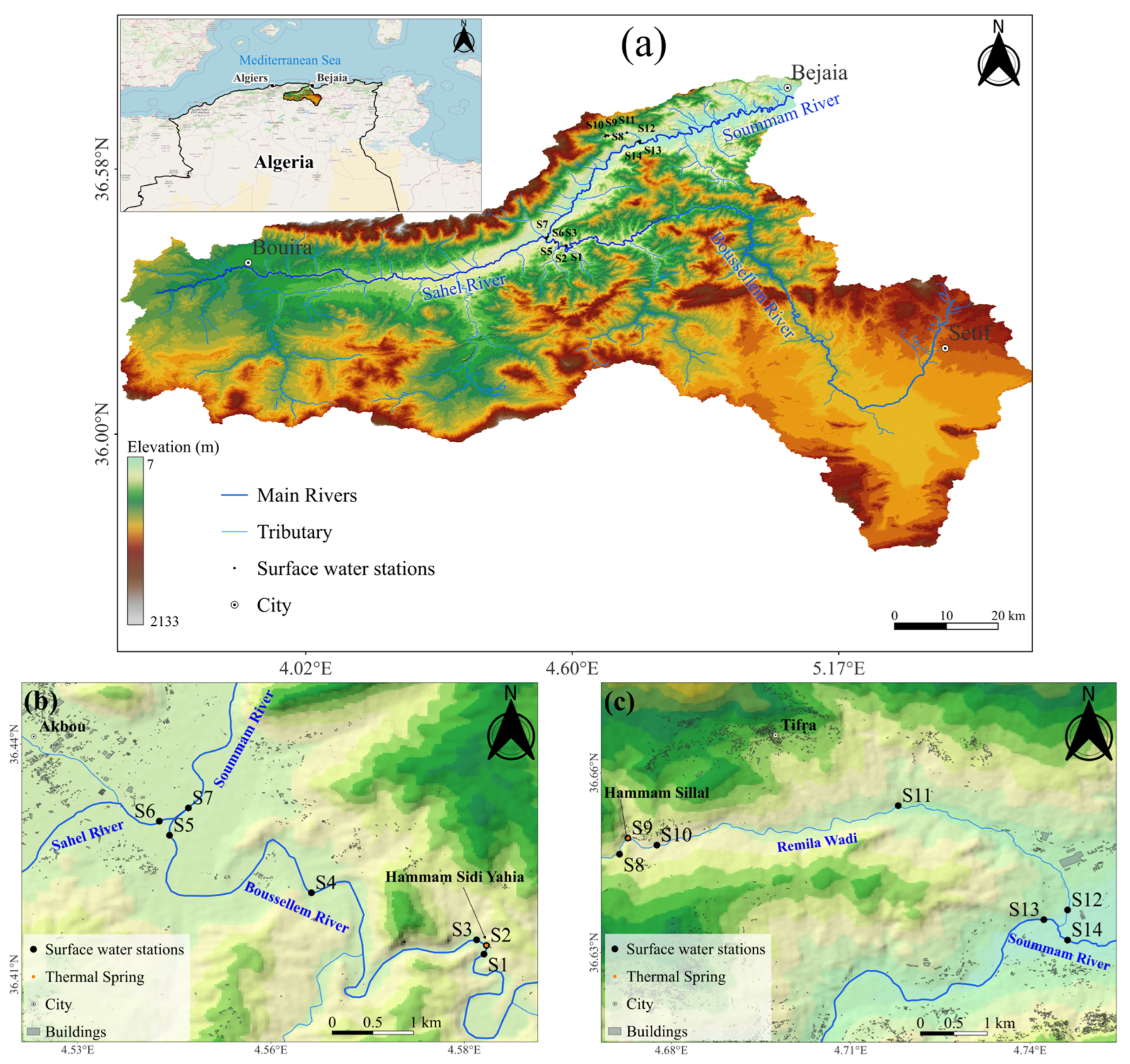
The present study was conducted in the Soummam watershed, which is located in north-eastern Algeria between latitudes 35.74° and 36.79° N and longitudes 3.62° and 5.62° E (
Figure 1a). Covering an area of approximately 9125 km
2, the basin constitutes one of the most important hydrological systems in the region due to its size, hydrological complexity, and socio-economic significance. Extending from the Hodna Mountains in the south to the Djurdjura Range in the north, the watershed is bounded by the Babors and the Sétif Plateau to the east and the Bouira Plateau to the west.
The basin was selected as a representative study area due to the coexistence of natural hydrogeochemical processes and multiple anthropogenic pressures, including agricultural activities, urban discharge, and geothermal inputs. In particular, the presence of several thermal springs discharging directly into the surface water network makes the Soummam watershed a suitable natural laboratory for investigating the impact of thermomineral waters on river hydrochemistry. In addition, the Soummam River acts as a hydrological integrator, receiving contributions from multiple tributaries and allowing the cumulative effects of different inputs to be assessed at the basin scale.
Climatically, the Soummam watershed exhibits a pronounced north–south gradient, reflecting the influence of topography and proximity to the Mediterranean Sea. The northern mountainous areas experience a humid Mediterranean climate, whereas the southern and interior high plains are characterized by semi-arid conditions [
32]. Mean annual precipitation varies significantly across the basin, ranging from approximately 400 mm in the Sétif highlands to nearly 1000 mm in the coastal and mountainous zones near Bejaia [
33]. Mean annual air temperatures also show spatial variability, increasing from about 13.4 °C in the northern Sétif region to approximately 18.2 °C in the coastal zone of Bejaia [
34]. This climatic heterogeneity strongly influences river discharge, seasonal dilution processes, and the vulnerability of surface waters to salinization and mineral enrichment.
The hydrographic network of the Soummam watershed is well developed and structurally complex. The main drainage system comprises by two major tributaries: the Sahel River, which originates in the Bouira region, and the Boussellem River, which rises on the Sétif Plateau. These rivers converge near the town of Akbou to form the Soummam River, which flows northward over a distance of approximately 70 km before discharging into the Mediterranean Sea at Bejaia. The average annual discharge of the Soummam River is estimated at around 25 m
3/s [
35], although significant seasonal variations occur in response to rainfall patterns and upstream inflows.
Within this watershed, two zones influenced by thermal spring activity were selected for detailed investigation based on their hydrological positioning.
The first zone (
Figure 1b) is located in the central sector of the basin, approximately 20 km south of Akbou. It corresponds to the Sidi Yahia thermal spring, whose discharge flows directly into the Boussellem River, a major upstream tributary of the Soummam River. This zone represents an upstream thermal input system, where geothermal waters interact with surface flows prior to their confluence with the main river.
The second zone (
Figure 1c) is situated in the central to downstream sector of the basin, approximately 15 km northeast of Sidi Aïch. It includes the Sillal thermal spring, whose outflow drains into the Remila Wadi before joining the Soummam River downstream. This configuration represents a downstream thermal input system, directly influencing the hydrochemical characteristics of the main river channel.
The selection of these two zones enables a comparative assessment of thermal water impacts under contrasting hydrological conditions, namely upstream versus downstream inputs within the basin. This approach allows for a comprehensive evaluation of how thermal discharges influence hydrochemical facies evolution, water quality parameters, and downstream water suitability within the Soummam watershed.
2.2. Surface Water Sampling and Hydrochemical Analysis
To evaluate the impact of thermal spring discharges on the mineralization and quality of surface waters in the Soummam watershed, a total of fourteen sampling stations were selected to represent thermal sources, upstream reference conditions, confluence zones, and downstream reaches influenced by thermomineral inputs (
Figure 1). Surface water samples were collected during three sampling campaigns conducted under contrasting hydrological conditions: October 2024 (low-flow period), December 2024 (early wet season), and March 2025 (high-flow period). The samples were obtained using standard methods [
36,
37].
Samples were collected from the Boussellem, Sahel, Soummam, and Remila rivers, as well as directly from the Sidi Yahia and Sillal thermal springs. The water samples were collected in pre-cleaned polyethylene bottles, stored immediately in insulated coolers. They were then transported to the laboratory under refrigerated conditions (approximately 4 °C) to minimize chemical alterations prior to analysis.
In situ measurements of physicochemical parameters, including water temperature (T), pH, and electrical conductivity (EC), were performed at each station using a calibrated portable multiparameter probe (HANNA HI98194, HANNA Instruments, Woonsocket, RI, USA). Laboratory analyses focused on major cations and anions using standard analytical procedures. Calcium (Ca) concentration and total hardness were determined by ethylenediaminetetraacetic acid (EDTA) titration, while magnesium (Mg) was calculated by subtracting Ca from total hardness. Bicarbonate (HCO3) concentrations were measured by titration with hydrochloric acid (HCl), and chloride (Cl) was determined by argentometric titration using silver nitrate (AgNO3). Sulfate (SO4) and nitrate (NO3) concentrations were analyzed using a UV-Visible spectrophotometer (Hach DR6000, Hach Company, Loveland, CO, USA), while sodium (Na) and potassium (K) were quantified by flame photometry (AFP-100, Biotech Engineering Management Co. Ltd., London, UK). All concentrations were expressed in mg/L and converted 2 to milliequivalents per liter (meq/L) where required for subsequent calculations.
The quality and reliability of the chemical analyses were evaluated using the charge balance error (
CBE). The
CBE was calculated according to the following equation:
where ∑
cations and ∑
anions denote the total concentrations of major cations and anions, respectively, expressed in milliequivalents per liter (meq/L).
All analyzed water samples exhibited charge balance errors within ±5%, which is generally considered acceptable for natural water analyses, thereby confirming the analytical accuracy and internal consistency of the dataset [
38,
39].
2.3. Schoeller’s Indices (Chlor-Alkaline Indices)
The ion exchange processes occurring between surface waters and their geological environment were evaluated using Schoeller’s chlor-alkaline indices (CAI-I and CAI-II), which are widely applied to assess cation exchange mechanisms in natural waters [
40]. These indices quantify the exchange between alkali metals (Na + K) and alkaline earth metals (Ca + Mg) based on ionic concentrations expressed in meq/L [
41].
A positive CAI value indicates an exchange of Na and K from water with Ca and Mg from the surrounding rock or soil matrix. Conversely, a negative value reflects the reverse process, whereby Ca and Mg in water are replaced by Na and K from the host material [
42,
43]. The indices were calculated using the following equations:
2.4. Water Quality Index (WQI)
The Water Quality Index (WQI) was employed to evaluate the suitability of surface waters for drinking purposes by integrating multiple physicochemical parameters into a single, dimensionless index [
44]. The robustness and applicability of this method have been extensively demonstrated in studies of surface waters [
6,
40,
45], groundwater [
46,
47,
48], and thermal waters [
49,
50,
51].
In this study, the following eleven parameters were considered for WQI computation: pH, EC, T, Ca, Mg, Na, K, Cl, HCO3, SO4, and NO3. Each parameter was assigned a weight (wi) ranging from 1 to 5 according to its relative importance for human health.
The relative weight (
Wi) for each parameter was calculated using the following formula:
The quality rating scale (
qi) for each parameter was computed as:
where
Ci is the measured concentration and
Si is the corresponding drinking water standard recommended by the World Health Organization [
52]. The overall WQI was then calculated as:
WQI values were interpreted using the classification proposed by Sahu and Sikdar [
53]: <50 (excellent), 50–100 (good), 100–200 (poor), 200–300 (very poor), and >300 (unsuitable for drinking).
2.5. Irrigation Water Quality Index (IWQI)
The Irrigation Water Quality Index (IWQI) was used to assess the suitability of surface waters for agricultural purposes, taking in to account the combined effects of salinity, sodicity, specific ion toxicity, and soil permeability degradation [
53,
54,
55,
56]. Due to its wide applicability and proven reliability, the IWQI model proposed by Meireles et al. [
57] was adopted due to its wide applicability and proven reliability, including recent applications in Algerian hydrological studies [
58,
59,
60,
61].
The IWQI calculation was based on five key parameters: electrical conductivity (EC); the sodium adsorption ratio (SAR), and the concentrations of Na, Cl, and HCO
3. Each parameter was assigned a relative weight (
Wi) reflecting its importance, as summarized in
Table 1. The index was calculated as follows:
The sub-index value (
qi) for each parameter was calculated using:
where
qimax is the maximum sub-index value for a given class,
Xij is the measured con-centration,
Xinf is the lower limit of the class interval,
Xamp is the amplitude of the parameter class, and
qiamp represents the corresponding quality interval (
Table 2).
According to Meireles et al. [
57] IWQI values are classified into five categories: unrestricted use (IWQI > 85), low restriction (70–85), moderate restriction (55–70), high restriction (40–55), and severe restriction (IWQI < 40), indicating water unsuitable for most crops.
2.6. Hierarchical Cluster Analysis (HCA)
Hierarchical Cluster Analysis (HCA) was used to identify spatial and seasonal pat-terns in surface water quality by grouping sampling stations and campaigns according to their similarity in WQI and IWQI values [
62]. This multivariate technique initially treats each observation as an independent cluster and progressively merges the most similar clusters, producing a dendrogram that visually represents the hierarchical relationships among the samples [
63].
Prior to analysis, the data were standardized using Z-score normalization to eliminate scale effects and ensure comparability between variables. Euclidean distance was used as the dissimilarity measure, and Ward’s linkage method was applied to generate compact and statistically robust clusters by minimizing intra-cluster variance at each merging step [
64,
65].
HCA was performed in the R statistical environment (version 4.5.2) using the factoextra package (version 1.0.7), which facilitates cluster extraction, visualization, and interpretation [
66]. The resulting clusters provide an integrated view of water quality dynamics and highlight zones dominated by thermal influence, mixed hydrochemical conditions, and relatively unaffected areas within the Soummam watershed.
3. Results
3.1. Summary Statistics of the Hydrochemical Parameters
Table 3 presents the statistical values of the hydrochemical parameters measured at 14 stations (S1 to S14) covering the Boussellem, Sahel, Soummam, and Remila rivers, as well as the thermal springs (Sidi Yahia and Sillal), during three sampling campaigns conducted in October and December 2024 and March 2025.
The average temperature is 31.24 °C in October, 17.59 °C in December, and 23.37 °C in March. The highest temperatures were recorded at the Sidi Yahia 1 (S2) and Sillal (S9) thermal springs. The lowest temperatures were recorded at the S1, S8, and S6 upstream stations. The discharge of thermal springs into watercourses warms the downstream waters. This results in high temperatures at the downstream stations (S3 to S5 and S10 to S12) and confluences (S7 and S14), which can reach or exceed 30 °C in October. Elevated temperatures can affect aquatic organisms by increasing their metabolic rates and reducing oxygen solubility [
6]. The average pH values range from 7.2 to 7.6. So, the water is slightly alkaline. Lower pH values at the S2 and S9 thermal springs are explained by the high concentration of CO
2 [
67,
68]. The average EC values ranged from 9178 to 11,116 µS/cm, with a wide range of 377 to 27,359 µS/cm. The highest EC values were observed at the S2 and S9 thermal springs and at the S3, S4, S5, S7, and S10 stations located downstream of the thermal springs. This indicates high mineralization linked to the direct discharge of thermal water into watercourses. In contrast, stations S1, S6, and S8, which are located upstream of the thermal springs, have lower EC values, reflecting low mineralization. The electrical conductivity at station S9 (Hammam Sillal) is 3890 µS/cm, which is lower than the conductivity of the Sidi Yahia thermal spring (S2), which is 27,126 µS/cm. This difference can be explained by the distinct chemical composition of the two springs, linked to the geological formations present at the depth from which the thermal water originates [
18]. The increase in the electrical conductivity of surface water during winter could be linked to the untreated discharge of oil mill wastewater (OMW) observed during the sampling campaign (December 2024). These liquid residues contain significant amounts of dissolved salts and organic matter that can increase the mineralization of receiving waterways [
69].
The Ca content varies between 48 and 714 mg/L. The highest concentrations are observed at thermal springs S2 and S9, as well as at stations S2 to S5, S9, and S10. This reflects the dissolution of calcium linked to carbonate formations and thermal input. The Mg content fluctuates between 2 and 197 mg/L. The maximum values were recorded in December, which corresponds to the period when wastewater from oil mills is discharged. It decreases in March due to spring dilution. Na concentrations reach maximum values of up to 6900 mg/L at stations S2 and S9 (thermal springs), and downstream stations (S3 to S5 and S10). At the same time. K levels remain low (<150 mg/L) but follow the same trend as Na+ levels, demonstrating the influence of thermal sources on ion load.
The highest concentrations of chlorides (Cl) were observed at thermal spring S2 (10,508 mg/L) and thermal spring S9 (1150 mg/L), as well as around 9000 mg/L at stations S3 to S5, located immediately downstream. This indicates direct saline influence. An increase in chloride concentrations above 2000 mg/L was observed at stations S7, S13, and S14 (Soummam River) in October and December, followed by a decrease in March, con-firming significant dilution. Meanwhile, concentrations remained low at the upstream stations S1 and S8, indicating the absence of direct saline influence. Sulfates (SO
4) range from 20 to 1050 mg/L. The highest concentrations are found in thermal spring areas (S2 and S9) and their downstream areas (S3 to S5 and S10), while low concentrations (25–72 mg/L) are observed at stations S1 and S8. Measured bicarbonate (HCO
3) concentrations range from 430 to 560 mg/L, averaging 134 to 985 mg/L. The highest concentrations were found in the thermal spring and near it (S2 to S5). Station S13 (Soummam River) recorded the highest levels of HCO
3 in October and December. This station receives inflows from the Boussellem and Sahel subbasins upstream. These high concentrations can be attributed to the dissolution of carbonate formations, wastewater discharges, and agricultural activities [
70]. In contrast, in March, the increase in surface water flow leads to a decrease in HCO
3 levels, attributed to a dilution effect. Despite significant anthropogenic pressure on the surface waters of the Soummam, nitrate (NO
3) concentrations remain low overall (6–12 mg/L). This is due to a natural balance between inputs, dilution, and bio-geochemical processes [
71]. Thermal springs S2 and S9 have zero nitrate (NO
3) values. This is due to the absence of mixing with polluted surface water; nitrates in these waters primarily originate from external anthropogenic sources [
72].
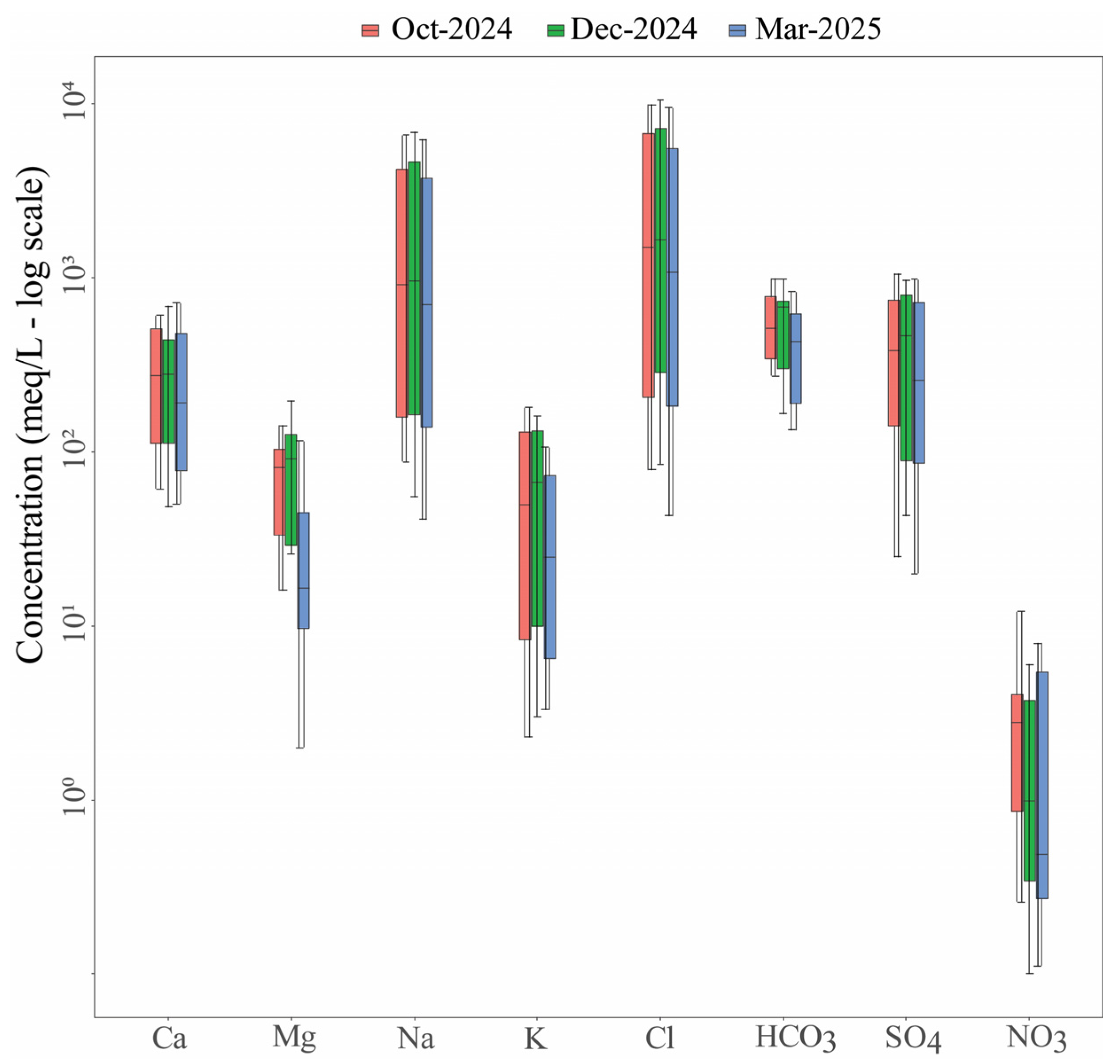
Figure 2 presents the distribution and seasonal variability of major hydrochemical parameters using boxplots plotted on a logarithmic (log
10) scale. This representation highlights the wide range of concentrations and allows meaningful comparison between water samples with markedly different chemical compositions. The boxplots indicate substantial variability and dispersion for most ions, particularly Na, Cl, and SO
4, as evidenced by the broad interquartile ranges and extended whiskers. The occurrence of extreme values further reflects the presence of distinct hydrochemical groups within the dataset. Three main water types can be distinguished: (i) low-mineralized upstream waters (S1, S6, and S8), characterized by relatively narrow distributions and low concentrations; (ii) highly mineralized thermal waters (S2 and S9), exhibiting elevated concentrations and contributing to the upper extremes of the distributions; and (iii) downstream and mixed waters (S3–S5, S7, and S10–S14), showing intermediate values that reflect varying degrees of thermal influence. Seasonal variations are also evident, with generally greater dispersion observed during October and December, likely associated with reduced dilution capacity and possible anthropogenic inputs. In contrast, March samples tend to exhibit lower variability for several parameters, suggesting the effect of increased river discharge and dilution processes.
3.2. Hydrochemical Facies for Each Water
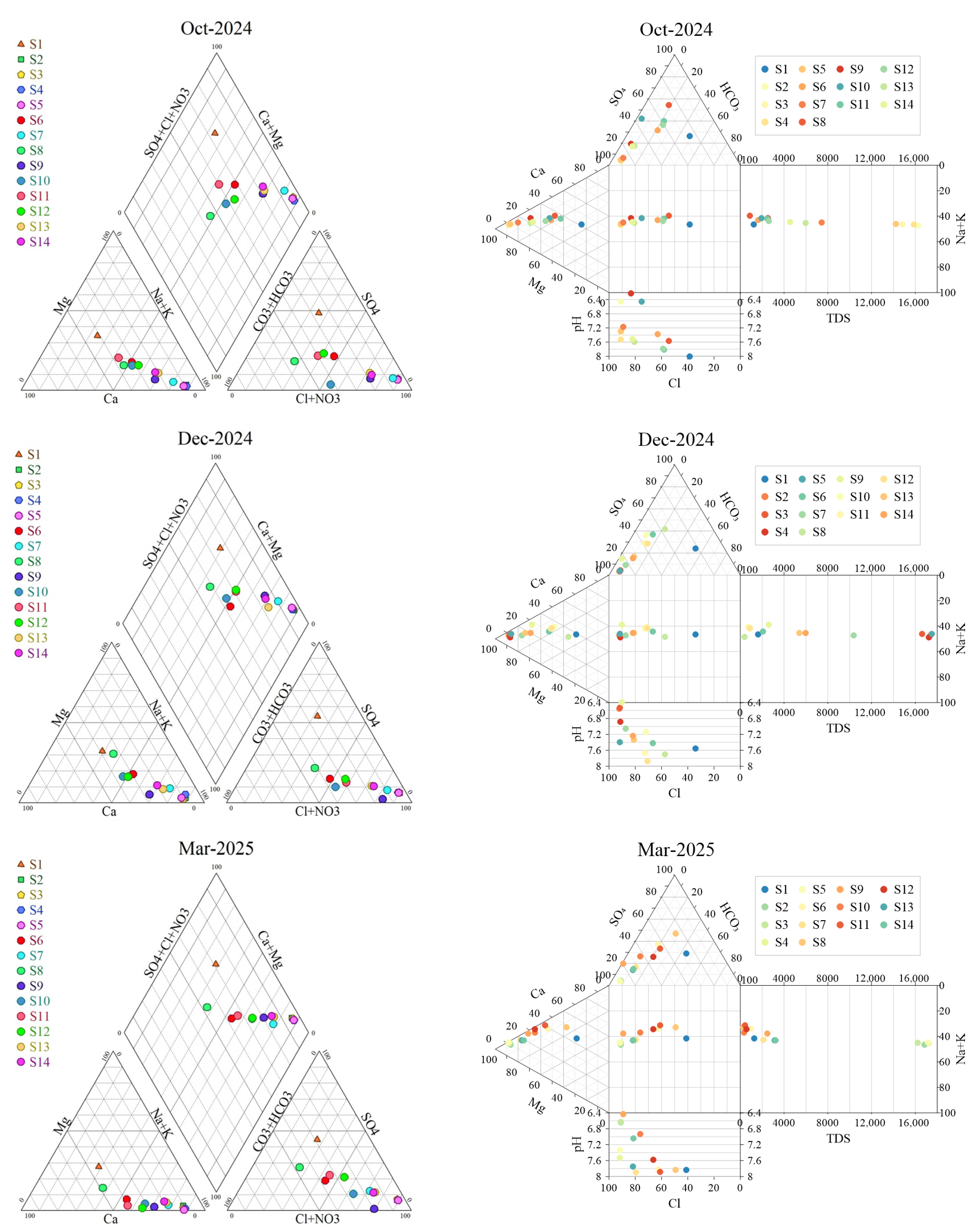
The hydrochemical facies of the sampled waters were identified using Piper diagrams, while Durov diagrams were employed to elucidate the dominant geochemical processes controlling water composition during the three sampling campaigns (
Figure 3).
The Piper diagrams reveal four principal hydrochemical facies within the study area: Ca-HCO
3, Ca-SO
4, Na-Cl, and mixed Na-Ca-Cl-HCO
3 types, reflecting the combined influence of lithology, thermal inputs, and mixing processes along the hydrological network. The upstream stations (S1, S6, and S8) are characterized by low mineralization and predominantly exhibit Ca-HCO
3 and Ca-SO
4 facies. The Ca-HCO
3 type, observed at S6 and S8, indicates the dissolution of carbonate formations (limestone and dolomite), whereas the Ca-SO
4 facies at S1 reflects the contribution of gypsum-bearing formations. In contrast, the thermal springs (S2 and S9) and their immediate downstream stations (S3–S5 and S10) are strongly dominated by the Na-Cl facies, indicating high salinity and mineralization associated with evaporite dissolution and deep water-rock interaction processes typical of geothermal systems [
73]. The persistence of this Na-Cl signature at downstream stations highlights the propagation of thermomineral inputs along the river network. Stations located at confluences and downstream reaches (S7, S11–S14) exhibit predominantly mixed Na-Ca-Cl-HCO
3 facies, resulting from the mixing of mineralized thermal waters with less mineralized river waters.
Although the general distribution of facies remains consistent across the three campaigns, seasonal variations are evident. In October 2024, a clear contrast is observed between low-mineralized upstream waters and Na-Cl-dominated thermal and downstream waters, with mixed facies at S11 and S12 and a Na-Cl tendency at S7, S13, and S14. In December 2024, a shift toward more mineralized compositions is observed, with upstream stations tending slightly toward mixed facies and thermal and downstream stations maintaining their Na-Cl signature, while S11 and S12 continue to display mixed facies and S7, S13, and S14 maintain their tendency toward Na-Cl. In March 2025, the hydrochemical structure remains broadly similar; however, stations S11 and S12 return to compositions similar to those observed upstream, while the Soummam stations (S7, S13, S14) evolve toward mixed Na-Ca-Cl-HCO3 facies, illustrating the effect of spring dilution.
The Durov diagrams complement these observations by highlighting the underlying geochemical processes. Upstream waters are generally weakly evolved and controlled primarily by simple water-rock interaction with carbonate and gypsum formations. In contrast, thermal and downstream waters are positioned within fields associated with mixing, ion exchange, and evaporite dissolution processes, indicating a higher degree of chemical evolution. A progressive shift toward more evolved chemicals from upstream to downstream is observed across all campaigns, confirming the increasing influence of thermomineral inputs along the hydrological continuum. Seasonally, the Durov diagrams suggest a gradual intensification of these processes from October to March, characterized by increased ionic strength and enhanced ion exchange, particularly in downstream sections.
Overall, the combined interpretation of Piper and Durov diagrams demonstrates that the hydrochemical evolution of surface waters in the Soummam watershed is primarily controlled by lithological factors in upstream areas, thermal spring inputs introducing Na-Cl-rich waters, and subsequent mixing and ion exchange processes governing downstream composition. Despite moderate seasonal variability, the persistence and downstream propagation of the Na-Cl signature indicate that thermal discharges represent a dominant and continuous control on surface water hydrochemistry within the basin.
3.3. Relationship Between the Hydrochemical Parameters
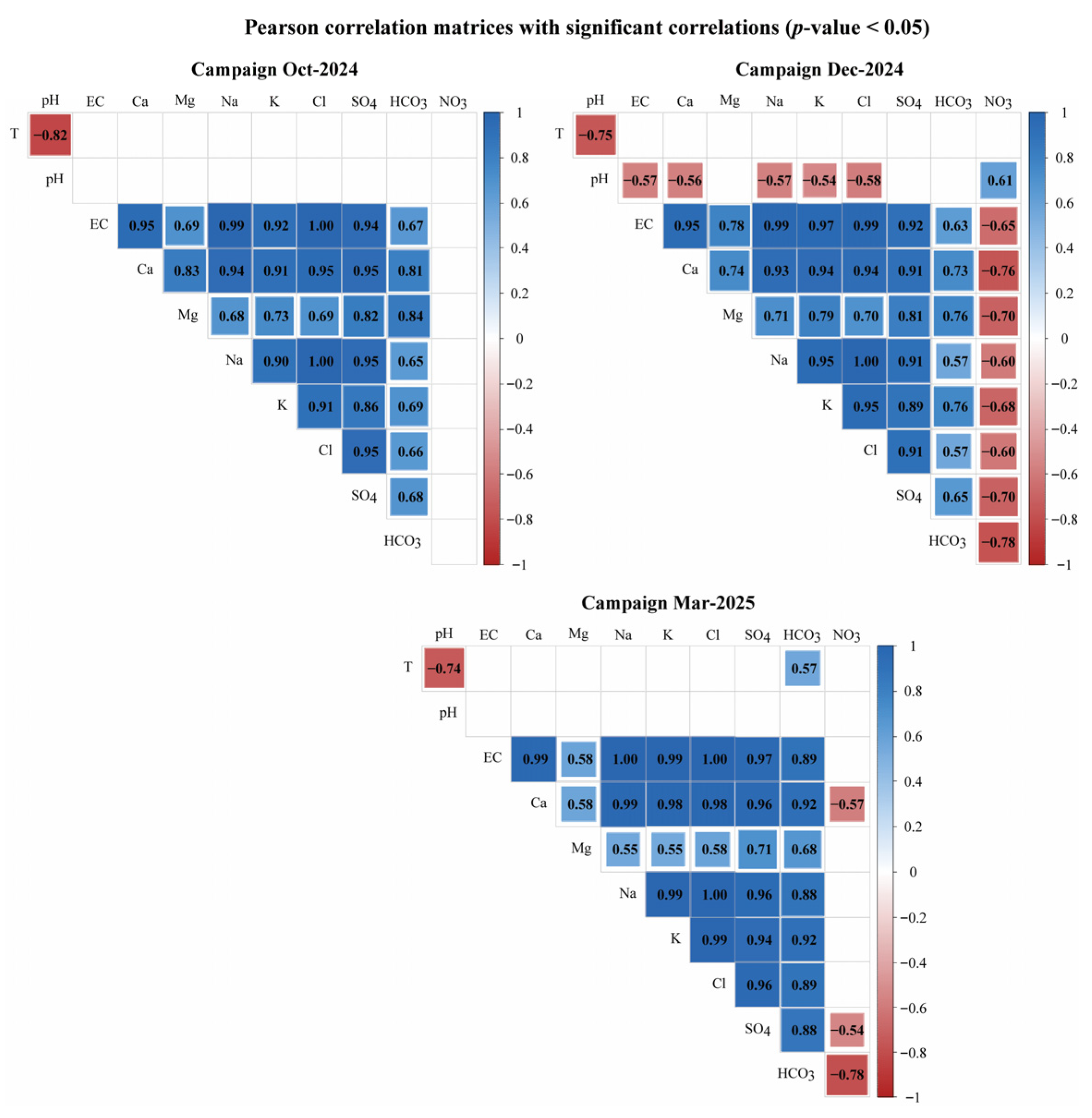
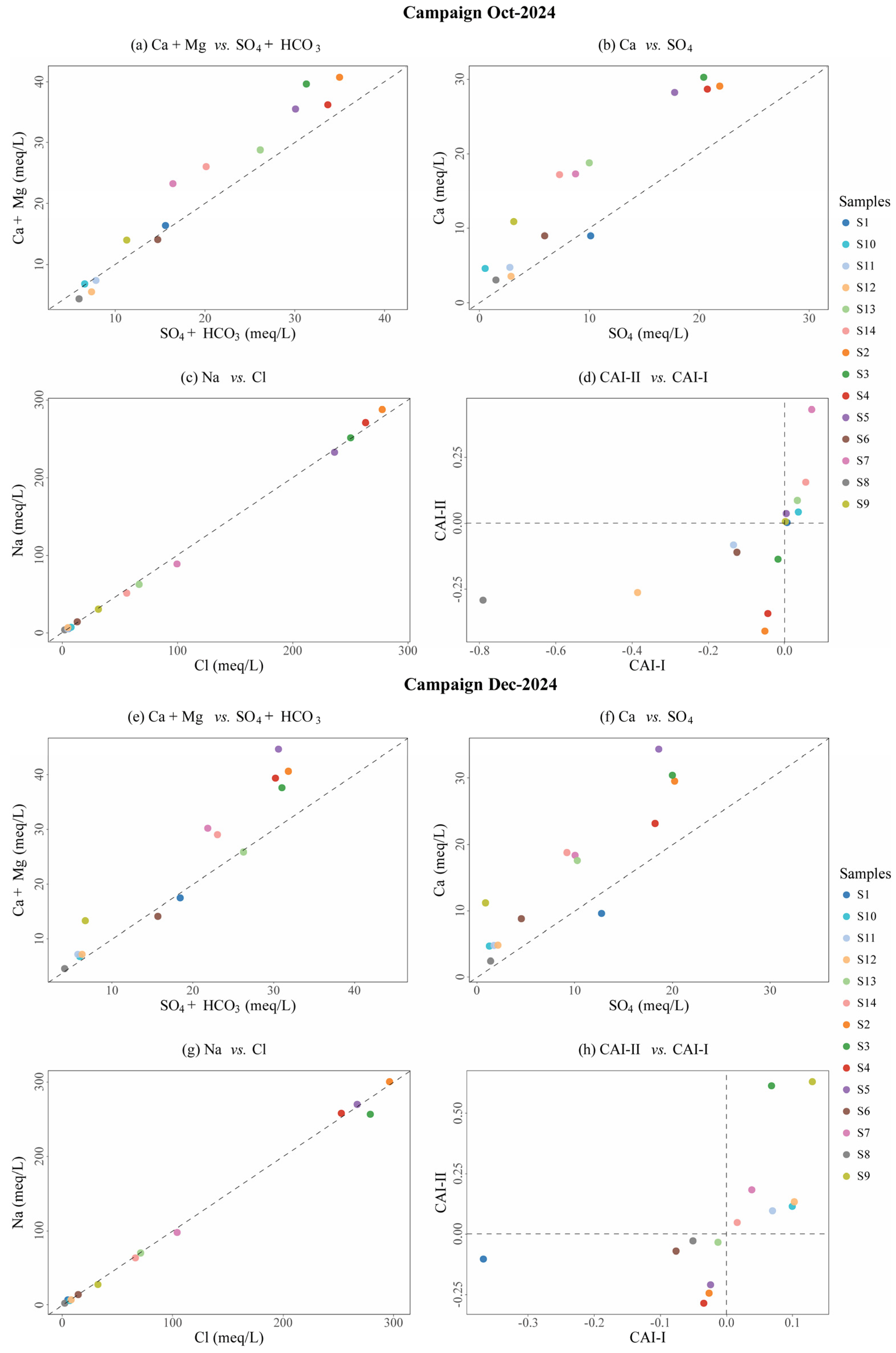
The relationships among hydrochemical parameters and the dominant geochemical processes controlling water composition were investigated using Pearson correlation matrices (
Figure 4), bivariate ionic relationships and chloro-alkaline indices (
Figure 5), as well as Gaillardet (
Figure 6) and Gibbs (
Figure 7) diagrams.
The Pearson correlation matrices (
Figure 4) reveal strong and statistically significant positive correlations (
p < 0.05) among major ions, particularly between Na, Cl, SO
4, and EC, across all campaigns. These high correlations indicate a common origin of dissolved ions, primarily associated with evaporite dissolution and thermal inputs, which contribute substantially to the overall mineralization of the waters. Calcium and magnesium also show strong correlations with sulfate and bicarbonate, reflecting the influence of carbonate and gypsum dissolution. In contrast, pH exhibits weak to moderate correlations with most ions, suggesting that it is controlled by buffering processes (carbonate equilibrium) rather than direct mineral inputs. Seasonal comparison indicates a slight increase in correlation strength during December and March, consistent with enhanced geochemical interactions and concentration effects.
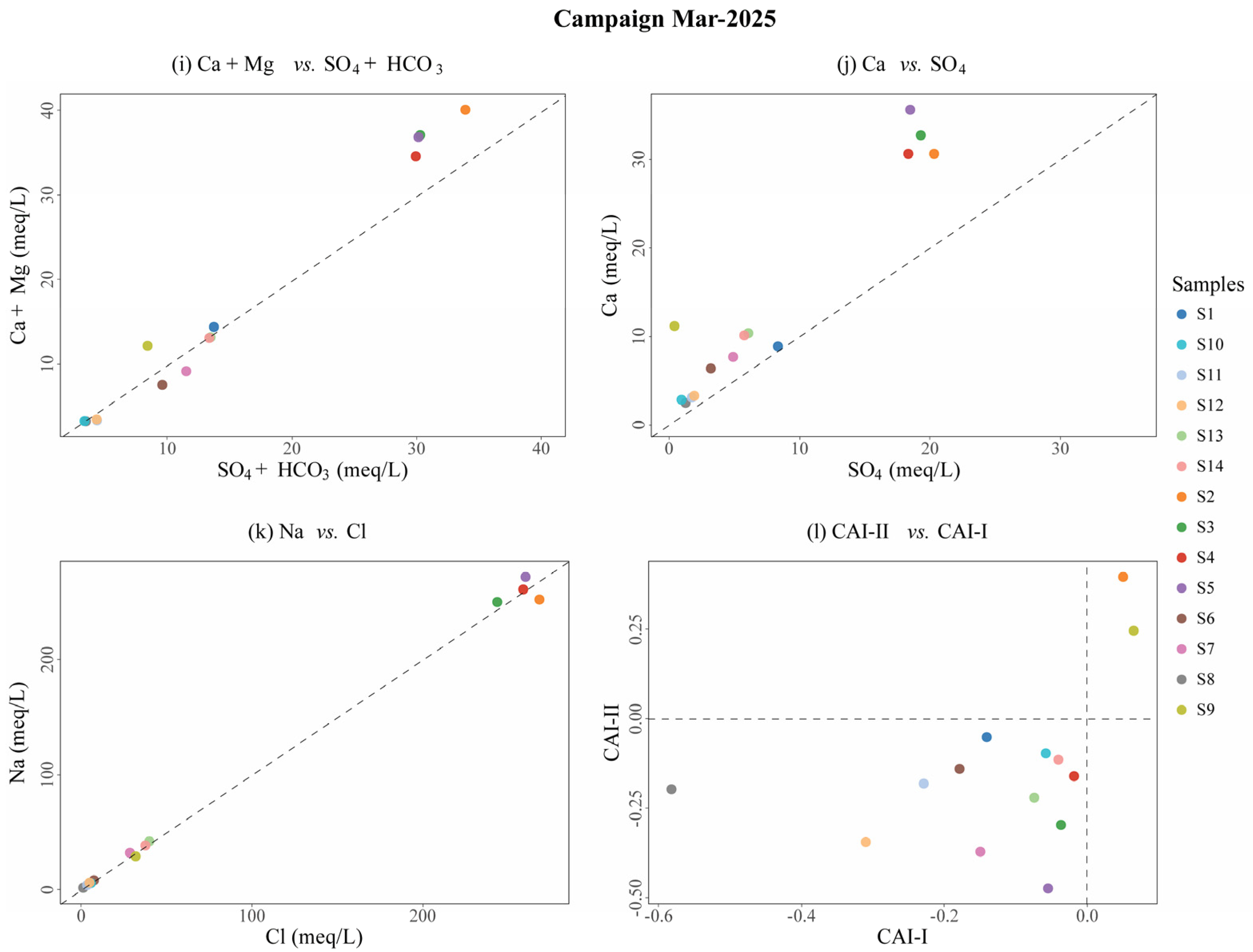
Scatter plots (
Figure 5) were used to identify the geochemical processes controlling surface water composition and the origin of major ions in the Soummam basin. The relationships between (Ca + Mg) and (SO
4 + HCO
3) show that most upstream stations (S1, S6, S8, S11, and S12) cluster near the 1:1 equilibrium line, indicating that carbonate weathering is the dominant process in low-mineral waters. In contrast, thermal spring stations (S2 and S9) and their downstream counterparts (S3–S5 and S10) are shifted toward higher concentrations, reflecting strong mineralization associated with thermal inputs. Stations located at confluences and along the Soummam River (S7, S13, and S14) deviate from the equilibrium line, indicating mixing between thermomineral waters and the surface.
The Ca vs. SO4 relationship further highlights the influence of evaporitic mineral dissolution (gypsum and anhydrite), particularly at thermal and downstream stations, whereas upstream stations remain closer to equilibrium, confirming the predominance of carbonate-controlled chemistry. The strong linear relationship between Na and Cl, with thermal and downstream stations aligning along the 1:1 line, confirms that halite dissolution and geothermal contributions are the primary sources of salinity. Upstream stations plot near the origin, reflecting low ionic concentrations, while intermediate stations occupy transitional positions, illustrating progressive mixing processes along the flow path.
The chloro-alkaline indices (CAI-I and CAI-II) provide further evidence of cation exchange processes. Most samples exhibit negative CAI values during October and December, indicating reverse ion exchange, where Na
+ in solution is exchanged with Ca
2+ and Mg from the aquifer matrix. In contrast, positive CAI values observed at thermal stations, particularly in March, suggest localized direct ion exchange associated with deep geothermal waters. The seasonal variability observed at station S2 reflects changing mixing and dilution conditions, leading to temporary shifts in ion exchange mechanisms. Overall, these results confirm that the hydrochemical evolution of the Soummam basin is governed by the combined effects of carbonate and evaporite dissolution, thermal inputs, ion exchange, and mixing processes [
74,
75].
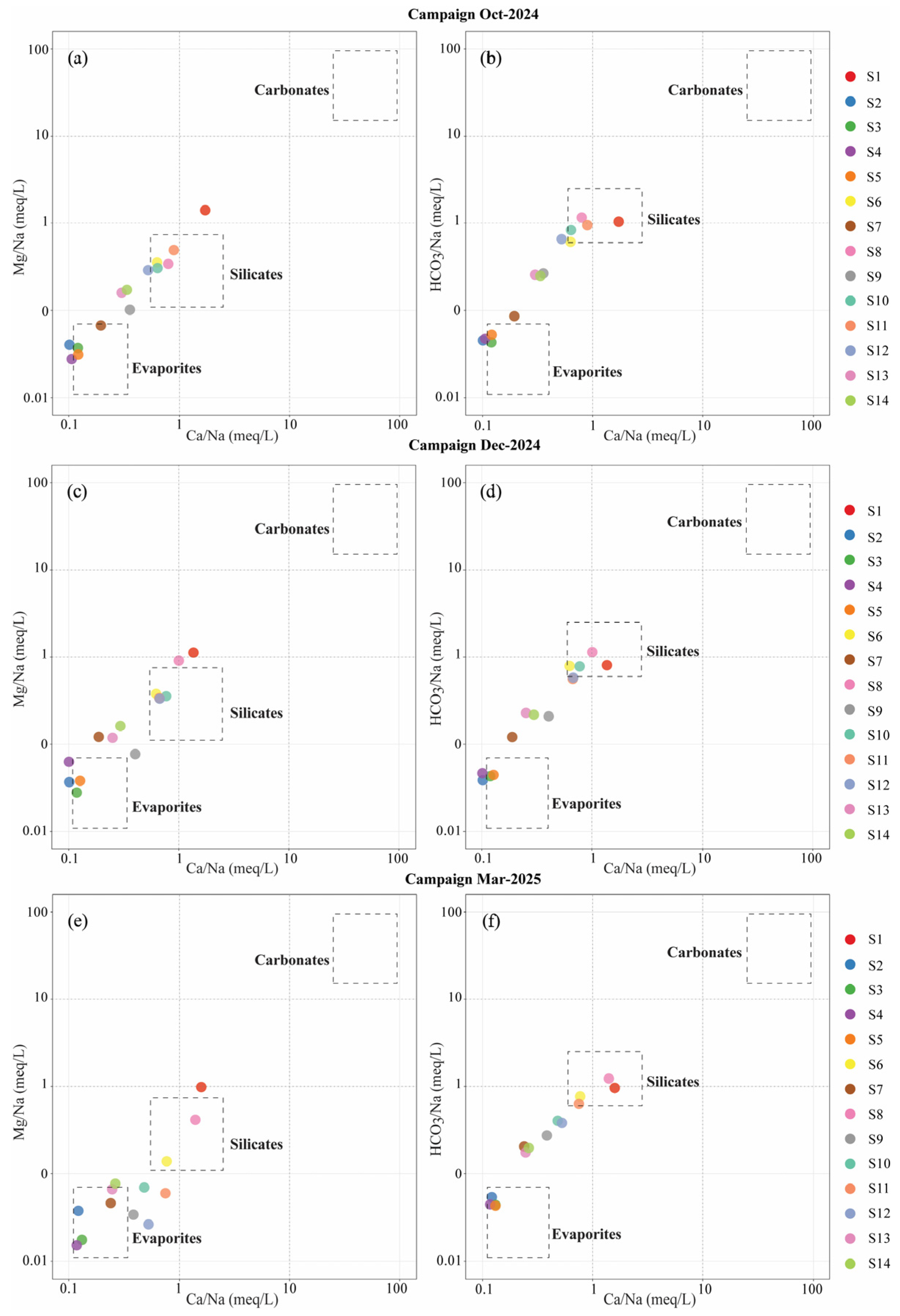
The Gaillardet diagrams (
Figure 6), based on the molar ratios Ca/Na, Mg/Na, and HCO
3/Na, indicate that most samples fall within the silicate and evaporite weathering domains, with limited contribution from carbonate dissolution. Upstream stations (S1, S6, and S8) consistently plot in the silicate domain, reflecting control by silicate mineral weathering. In contrast, the Sidi Yahia thermal spring (S2) and its downstream stations (S3–S5) are clearly associated with the evaporite domain, indicating strong mineralization due to deep evaporite dissolution. The Sillal spring (S9) shows an intermediate signature, reflecting mixed geochemical control.
Downstream and confluence stations (S7, S10–S14) show a tendency toward the evaporite field in October and December, indicating increasing thermal influence and cumulative salt enrichment along the flow path. In contrast, in March, stations S10, S11, and S12 return to the silicate field, while the Soummam stations (S7, S13, S14) evolve toward a mixed field (evaporite and silicate). Overall, the results highlight a transition from upstream waters controlled by silicates to downstream waters dominated by evaporites, driven by thermal inputs.
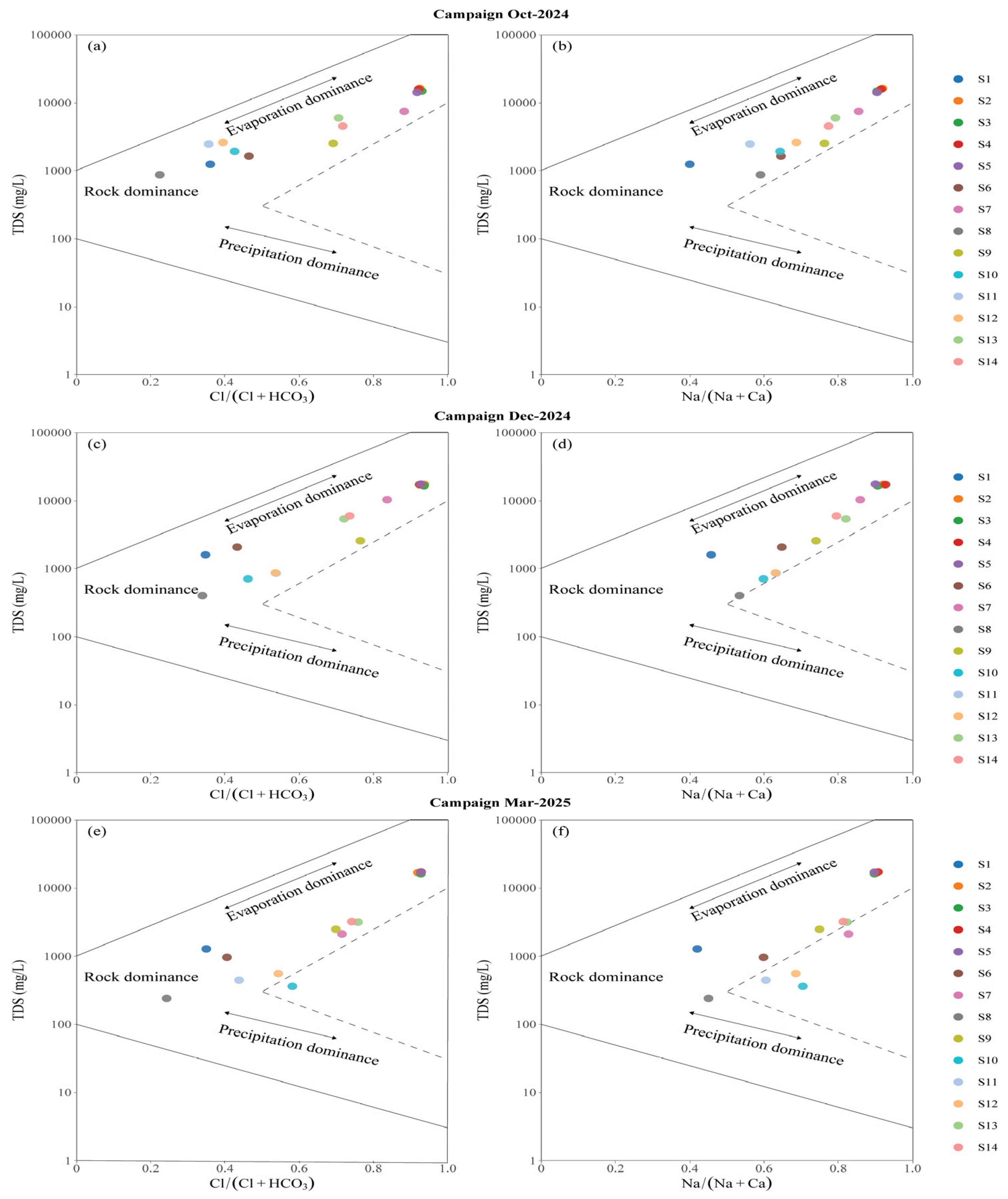
The Gibbs diagrams (
Figure 7) identify the dominant mechanisms controlling surface water chemistry, highlighting the combined influence of rock weathering and evaporation processes. Most samples plot within the rock dominance and evaporation–crystallization fields, indicating that water composition is governed by water–rock interaction and evaporative concentration.
The upstream stations (S1, S6, S8) plot in the rock dominance field, with low ionic ratios (<0.6) and moderate TDS (241 to 1606 mg/L), reflecting silicate and carbonate weathering. In contrast, the thermal spring S2 and its downstream stations (S3–S5) show very high TDS (>14000 mg/L) and ratios > 0.90, placing them in the evaporation–crystallization field, indicating high mineralization linked to thermal inputs and evaporite dissolution. Spring S9 exhibits a similar but less pronounced signature (TDS: 2490–2584 mg/L; ratios > 0.74). Stations S10, S11, and S12 display transitional positions (TDS: 858–2605 mg/L; ratios up to 0.69), reflecting moderate thermal influence. The Soummam stations (S7, S13, S14) are mainly positioned in the evaporation–crystallization field (TDS: 4550–10361 mg/L; ratios > 0.77), acting as a receptacle for cumulative thermal inputs. From October to March, a seasonal evolution is observed. The upstream stations remain stable in the rock weathering field. Stations S10, S11, and S12 record a significant decrease in TDS in March and approach the rock weathering field. The Soummam stations (S7, S13, S14) also show a decrease in TDS in March while maintaining high ratios, remaining in a transition zone between evaporation and weathering. Overall, the Gibbs diagrams demonstrate a clear spatial gradient from rock-dominated upstream waters to evaporation-dominated downstream waters, controlled by the combined effects of lithology, thermal inputs, and seasonal hydrological conditions.
3.4. Assessment of the Surface Water Quality
3.4.1. Evaluation of the Water Quality Index (WQI)
The Water Quality Index (WQI) is a commonly used tool for assessing, monitoring, and managing groundwater and surface water resources, particularly those found in watercourses [
76]. The relative weightings calculated for water quality parameters in accordance with WHO guidelines [
52] are presented in
Table 4.
The WQI was then calculated for all stations sampled during the three campaigns. The results are presented in
Table 5 and the corresponding classification according to quality classes is shown in
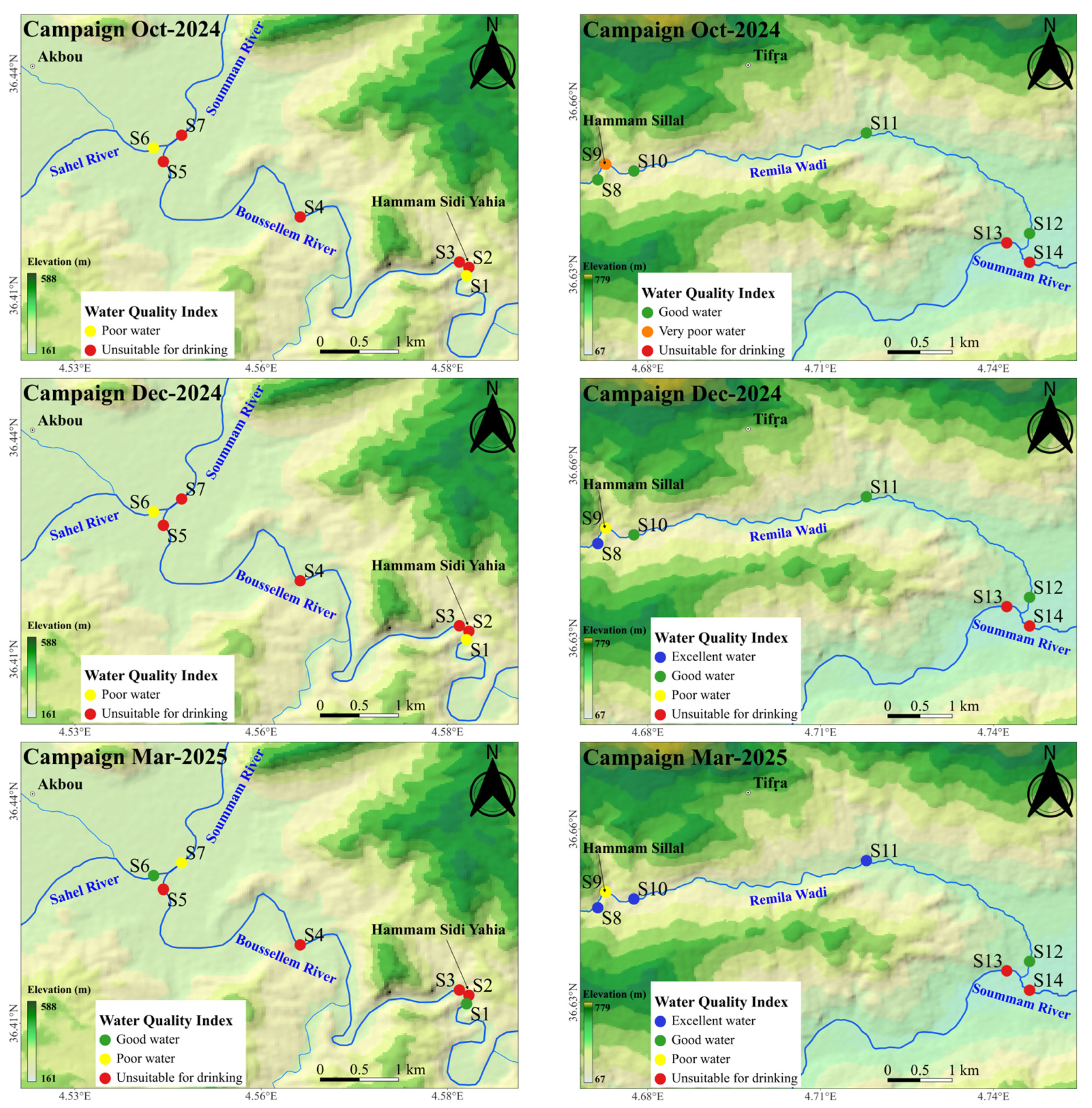
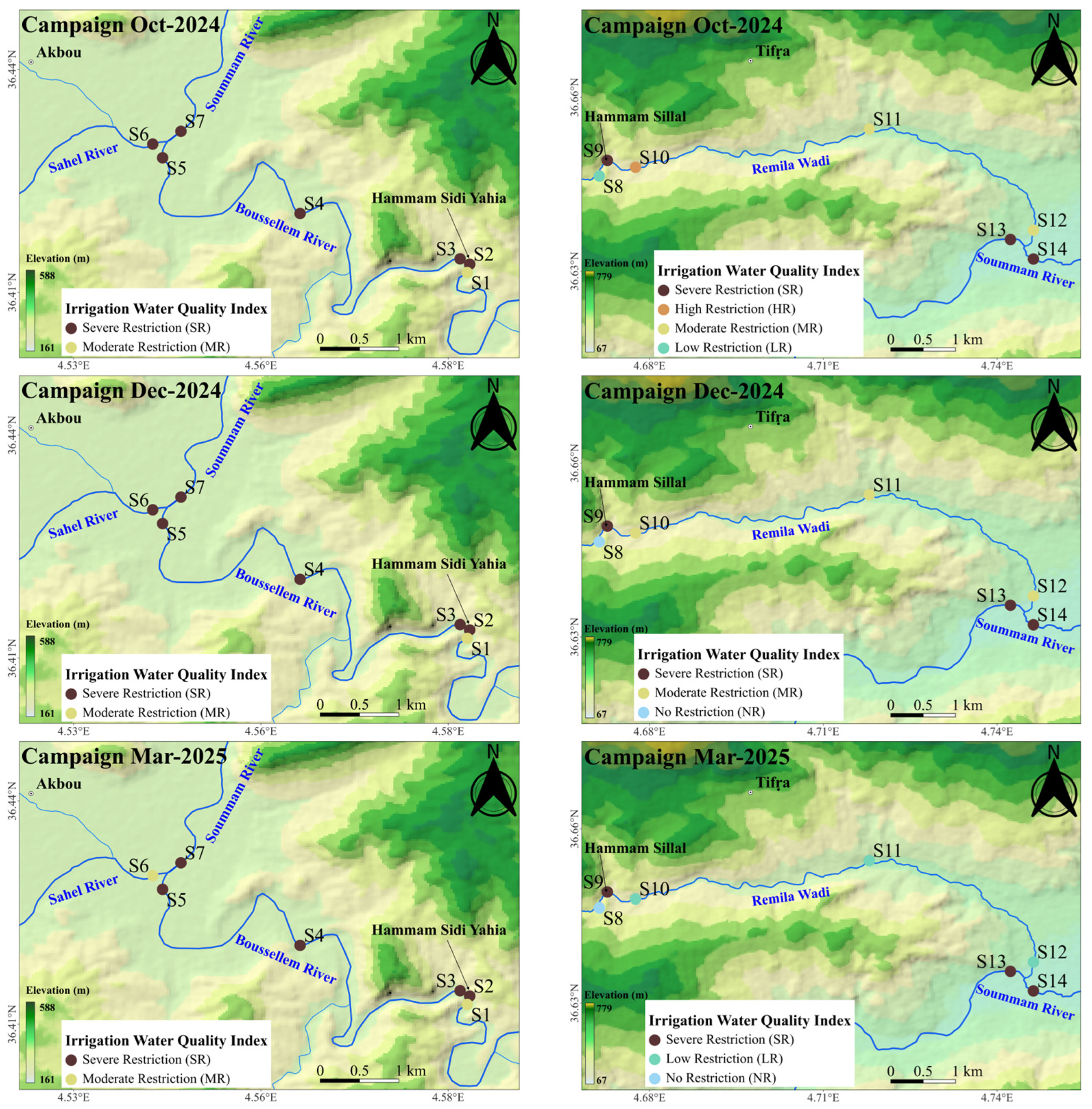
Table 6. To visualize the spatial and temporal distribution of WQI values, final water quality index maps (
Figure 8) were developed using a geographic information system (QGIS 3.42). The WQI values demonstrate significant spatial and temporal variability, ranging from 32.7 (S8 in March 2025) to 1383.3 (S2 in December 2024). This reflects the high hydrochemical heterogeneity of the system, which is largely controlled by thermal springs. In October 2024, 50% of stations had water that was unfit for consumption (WQI > 300). Meanwhile. 28.6% were classified as good, and 14.3% were classified as poor. By December, the proportion of unsafe water remained stable at 50%, while there was a slight improvement in the poor and good categories, which were 21.4% each. A notable improvement occurred during the March 2025 campaign. The proportion of unsuitable water fell to 28.6%, while the excellent and good categories increased to 21.4% each.
Spatial analysis highlights the heterogeneity of water quality and the localized impact of thermal springs. The Boussellem river system (
Figure 8) shows the most severe degradation, particularly at the Sidi Yahia thermal spring (station S2), where WQI values exceed 1200 during all campaigns. This extreme mineralization persists significantly in the immediate downstream area (stations S3 to S5), indicating a high salt load along the watercourse. In contrast, the Sahel River (S6) has WQI values of approximately 87–157, indicating poor water quality. At the Boussellem-Sahel confluence (S7), these values increase significantly (545–594 in October and December) due to the inflow of highly mineralized water from the Boussellem River. However, a significant drop in March 2025 (WQI = 182) suggests gradual dilution during the high-water period linked to seasonal dilution. The Sillal-Remila Wadi system (
Figure 8) is different. Upstream, the waters (S8) are of excellent quality (WQI = 32–52). Water quality deteriorates significantly at Thermal Spring 2 (S9) (WQI ≈ 200) but improves rapidly at S10, S11, and S12 (WQI = 45–90) due to mixing with low-mineralization surface water downstream. Finally, stations on the Soummam River and at the Soummam-Remila confluence (S13–S14) show high WQI values (226–428), though these values decreased significantly in March. This indicates a partial but insufficient improvement linked to the dispersion of thermal and anthropogenic inputs, which keeps the Soummam River in a generally very poor quality state.
3.4.2. Evaluation of the Irrigation Water Quality Index (IWQI)
Table 7 summarizes the results of the IWQI calculation for all sampled stations during the three campaigns, while
Table 8 presents their classification according to the categories established by Meireles et al. [
57].
Figure 9 illustrates the spatial distribution of IWQI values for each sampling period, allowing visualization of the spatio-temporal variability of irrigation water quality within the Soummam watershed. According to the IWQI classification, heavily polluted waters (IWQI < 40) predominate, representing 64.3% of samples in October and December and 57.1% in March. The stations on the Boussellem River (
Figure 9) show the most critical values (4.3–9.7), especially at the Sidi Yahia thermal spring (S2) and its immediate sections (S3–S5), reflecting extreme mineralization, which significantly degrades the quality for agricultural use. Stations S6 and S7 also show low indices (22–55), indicating high to severe restriction. Quality deteriorates sharply at the confluence, reflecting the spread of the saline load from the Boussellem, while a temporary improvement is observed at S6 in March (IWQI = 55.5) due to dilution during the rise in river flow. Only station S1, located upstream, shows slightly higher values (63–69), indicating moderate to low restriction, and therefore water that is marginally suitable for irrigating salt-tolerant plants. The stations in the Sillal-Ouadi Remila system (
Figure 9) generally have water quality that is suitable for irrigation. Station S8, located upstream, has high IWQI values (77.1–94.6), classifying it as an optimal irrigation resource. However, the index drops sharply at the Sillal thermal spring (S9) due to its high mineralization, classifying it as unsuitable for irrigation (34–38). Further downstream, stations S10, S11 and S12 show gradual improvement in IWQI values (52–82), indicating dilution and mixing with river water. Depending on the period, these waters are usable for irrigation with moderate to low restrictions. Finally, the stations on the Soummam River (S13 and S14) have low to moderate values (22–34), which keeps them in the severe restriction category for irrigation. The poor quality in this section of the river confirms its role as a final receiving area, where pollutants from thermal, urban, and agricultural sources, transported by the entire upstream hydrographic network, accumulate.
3.5. Clusters Analysis
To obtain a reliable and representative classification of the spatial and temporal variability of the WQI and IWQI indices, it is necessary to determine the optimal number of clusters before carrying out the hierarchical cluster analysis (HCA). To achieve this, the NbClust package (version 3.0.1) in R was employed, adopting the Ward aggregation method and using Euclidean distance as a measure of similarity. This package offers 30 internal validation indices that can be used simultaneously to evaluate both the compactness of groups and their separation. The optimal number of clusters for each tested partition is determined based on the maximum (or minimum, depending on the index) or a clear break in the evolution of these values [
77]. Analysis of the various validation indices presented in
Table 9 and
Table 10 identifies three clusters as the optimal structure for the WQI and IWQI indices, respectively. This partition is confirmed by the majority rule as being the most representative of surface water quality in the study area.
3.5.1. Cluster Analysis of WQI
Hierarchical cluster analysis (HCA) was performed on the WQI values to group the sampling stations into homogeneous clusters. Having determined the optimal number of groups in advance, the stations were organized according to the similarity of their water quality profiles during the three sampling campaigns (October 2024, December 2024 and March 2025) using analysis based on Ward’s method and Euclidean distance.
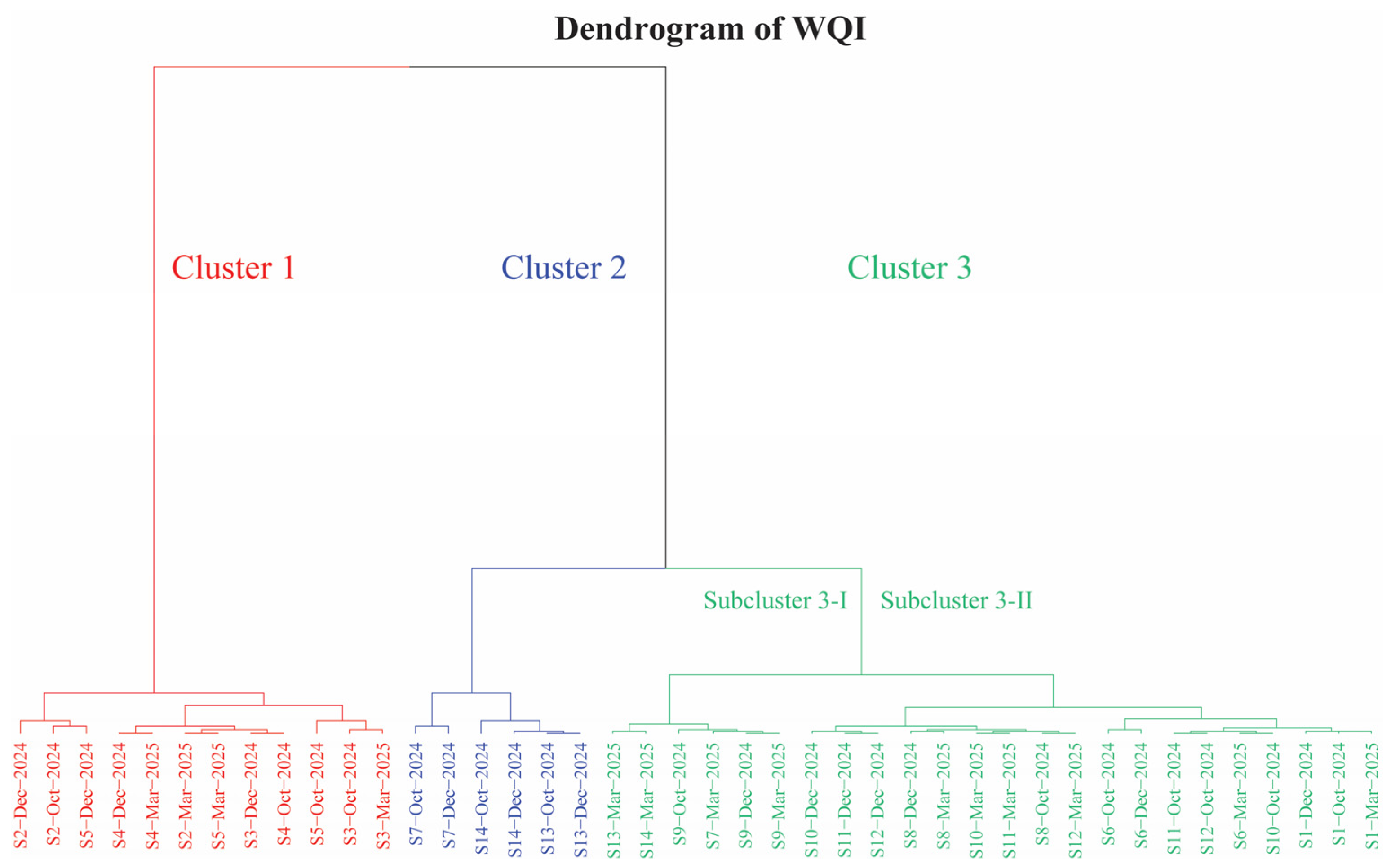
Figure 10 shows the resulting dendrogram, which reveals the hierarchical structure of the stations and the spatial and temporal variability of water quality within the study area.
Cluster 1 includes stations with the highest WQI values across all three campaigns, indicating severely degraded water quality. It includes the Sidi Yahia thermal spring (S2), as well as stations located immediately downstream (S3) and along the river (S4 and S5). The temporal stability of this group suggests constant pollution linked to discharges from the Sidi Yahia thermal spring.
Cluster 2 comprises stations S7, S13 and S14, which are all situated along the main channel of the Soummam River. This river acts as an integrator of the multiple polluting influences within the watershed, such as thermal inputs and anthropogenic discharges. This cluster shows intermediate WQI values for both the October 2024 and March 2025 campaigns, indicating poor water quality.
Cluster 3 is divided into two subclusters. Subcluster 3-I is characterized by the presence of the Sillal thermal spring (S9). The fact that it is in this group rather than Cluster 1 indicates a moderate impact on water quality. Unlike Sidi Yahia (S2), S9 has lower mineralization and lower WQI values, classifying it as a source of water of average quality. This demonstrates that not all thermal springs have the same environmental impact [
51]. This subcluster also includes stations S7, S13 and S14 (Soummam River) during the March 2025 campaign only, suggesting a seasonal dilution effect that temporarily improves their quality. Subcluster 3-II includes stations S1, S6, S8, S10, S11, and S12 for all sampling campaigns. These sites have the lowest WQI values. Stations S1 and S8, located upstream of thermal discharges and in watercourses little affected by human activity, serve as natural reference points. Station S6, located on the Sahel River, although subject to some diffuse anthropogenic pressures, maintains an overall satisfactory water quality. Stations S10, S11, and S12, located downstream from source S9, reflect a moderate impact from the latter. Overall, this subcluster sets the benchmark for water quality in the basin, due to the low impact of thermal discharges and anthropogenic activities observed at the stations that comprise it.
3.5.2. Cluster Analysis of IWQI
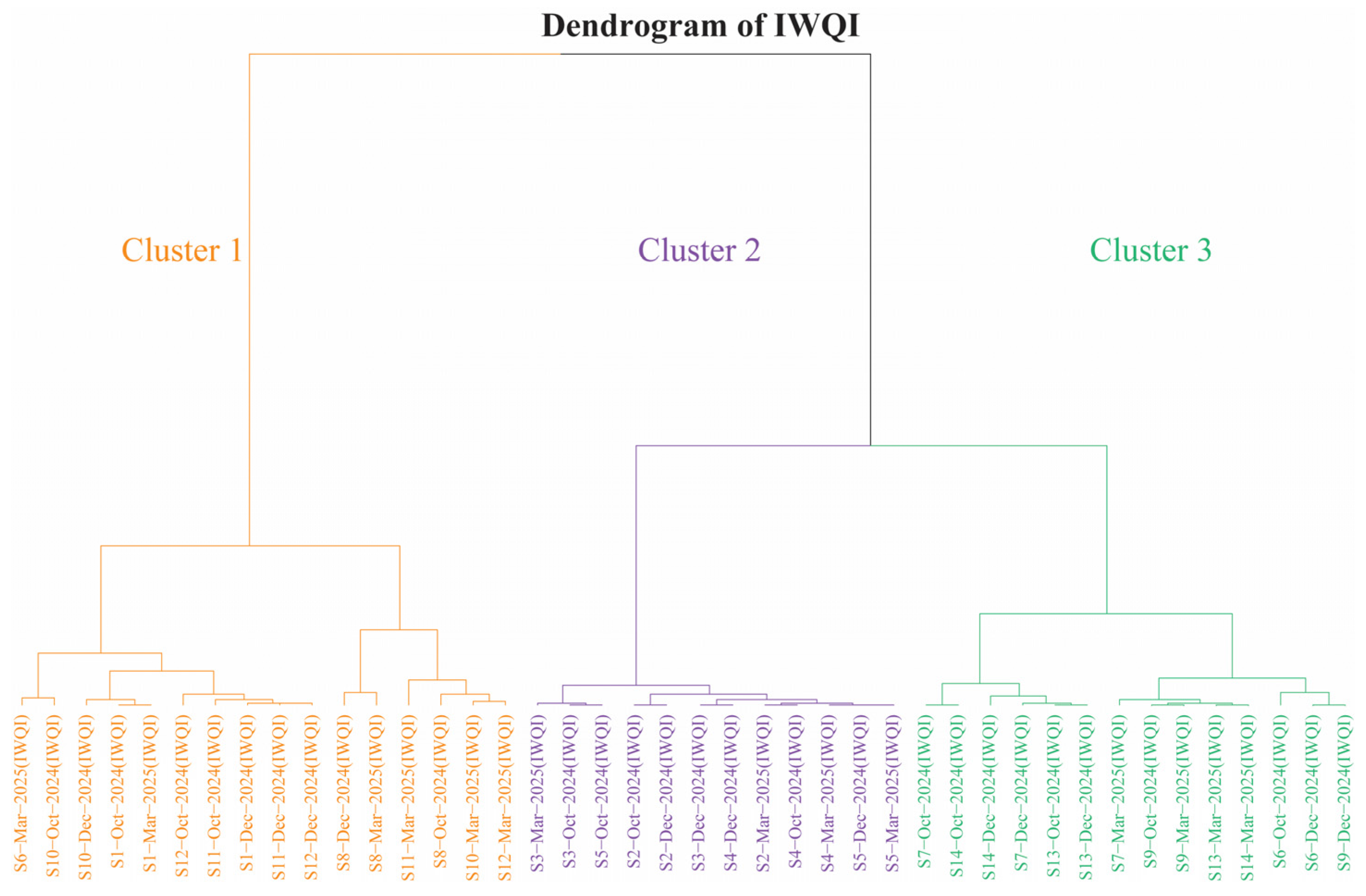
Hierarchical cluster analysis (HCA) was also applied to the IWQI values to examine the structure of the stations according to their suitability for irrigation. Using the same methodological framework as for the WQI, the resulting dendrogram (
Figure 11) reveals three distinct groups that reflect the spatial variations and seasonal contrasts that characterize the irrigation water quality of the Soummam basin.
Cluster 1 includes sites S1, S8, S10, S11, and S12 for all campaigns, as well as site S6 in March 2025. These stations have the most favorable conditions, with higher IWQI values. The sites correspond to areas located either upstream of thermal and anthropogenic influences (S1 and S8) or downstream of the thermal source S9, where its impact remains limited and has only a minor effect on irrigation suitability (S10, S11, and S12). Finally, station S6 is located on the Sahel River. Its inclusion in the cluster in March is explained by the dilution effect linked to the increase in flow during this period.
Cluster 2 comprises the thermal spring S2 (Hammam Sidi Yahia) and the stations situated immediately downstream (S3, S4 and S5) across all campaigns. This grouping reflects the significant impact of S2 on irrigation suitability along the Boussellem river, as evidenced by consistently low IWQI values.
Cluster 3 represents waters of intermediate quality according to the IWQI, combining stations on the main Soummam River (S7, S13 and S14) with the S9 thermal spring (Hammam Sillal) in all campaigns, as well as S6 (Sahel River) during October and December 2024. The presence of the S9 spring within this group confirms its moderate impact on the quality of water intended for irrigation, unlike the more marked influence of the Sidi Yahia spring. The grouping of stations S7, S13, and S14 reflects the integrative role of the Soummam River, which receives and mixes the various influences from the entire watershed. Finally, the presence of S6 in this cluster during the first campaigns indicates a seasonal deterioration in its quality for irrigation, probably linked to low flows and anthropogenic inputs into the Sahel River.
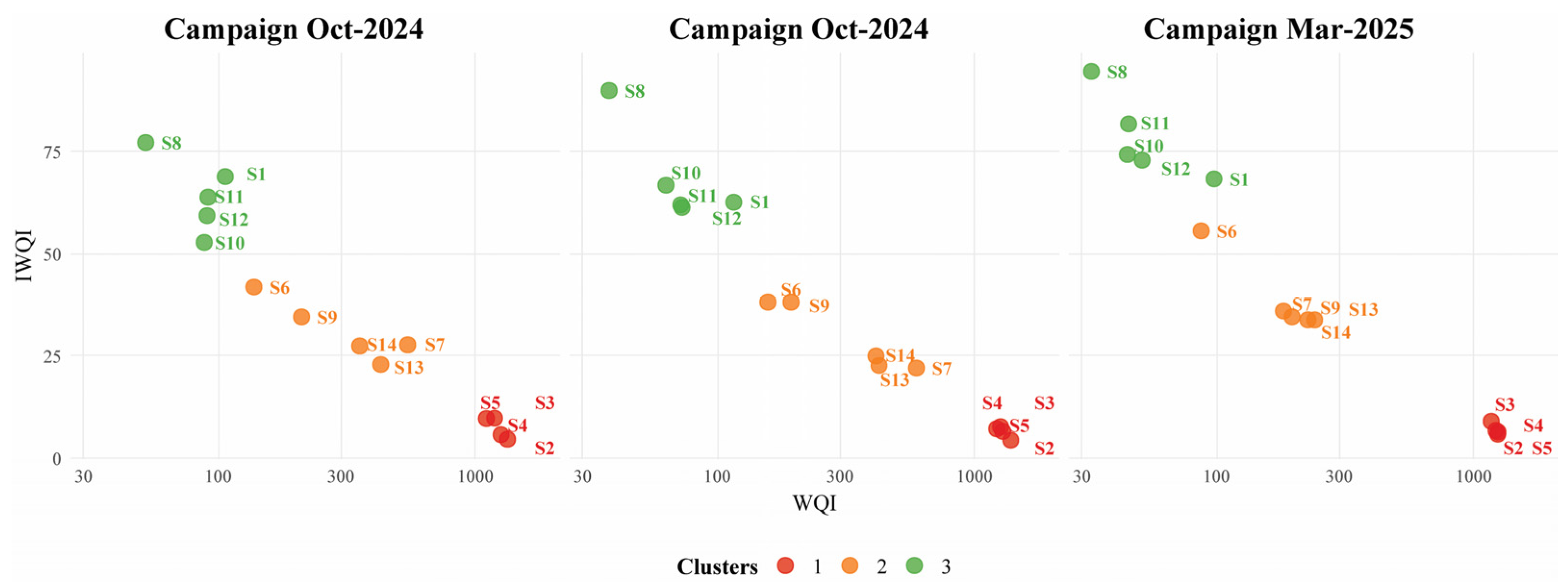
Beyond cluster analysis,
Figure 12 reveals a spatio-temporal correlation between the WQI and IWQI indices, showing a consistent distribution of stations across the three campaigns. This stability, which contrasts with the variations in the dendrograms, indicates that the two indices capture complementary qualitative dimensions while preserving the overall structure of the three identified clusters. This reinforces the validity of the classification obtained by HCA.
4. Discussion
The results of this study confirm that thermal spring discharges represent the dominant control on surface water hydrochemistry and quality in the Soummam watershed, with persistent downstream propagation of high mineralization and Na-Cl facies overriding seasonal hydrological variations. This aligns with prior investigations of thermal waters in northeastern Algeria, where deep circulation through faulted Triassic evaporitic and carbonate formations leads to elevated Na+, Cl−, SO42−, and TDS, often resulting in Na-Cl or mixed facies upon emergence and mixing with surface waters. Studies in Guelma, Mila, and Setif regions have similarly documented high salinity and ion enrichment from evaporite dissolution and geothermal processes, with downstream degradation in receiving streams due to continuous thermomineral inputs. In the Soummam basin, the contrasting signatures of Hammam Sidi Yahia (S2: extreme TDS up to ~27,000 µS/cm, dominant Na-Cl) and Hammam Sillal (S9: moderate TDS ~3890 µS/cm, intermediate facies) reflect variable deep reservoir lithologies and circulation depths, consistent with regional geothermal heterogeneity.
Seasonal patterns reveal a progressive intensification of mineralization from October (higher dilution, fresher upstream signatures) to March (reduced dilution, more evolved downstream waters), despite increased flow in spring. This counterintuitive trend—where wetter periods amplify rather than mitigate thermal influence—stems from the continuous nature of thermal discharges, which maintain high solute loads year-round, combined with cumulative mixing and ion exchange along flow paths. Durov diagrams highlight enhanced ion exchange (e.g., Na+ enrichment via Ca2+/Mg2+ displacement) and evaporite dissolution in thermal-influenced zones, while upstream waters remain weakly evolved and controlled by carbonate/gypsum dissolution. These observations extend findings from localized Algerian thermal systems, where mixing with surface waters and secondary reactions (e.g., carbonate equilibrium, cation exchange) modulate downstream evolution, often leading to persistent salinization.
Gaillardet diagrams further elucidate source contributions, showing a clear transition from silicate weathering in upstream references (S1, S6, S8) to evaporite dominance downstream of thermal springs (S2–S5, S10), with Sillal exhibiting mixed control. This spatial gradient underscores the overriding role of geothermal evaporite dissolution over silicate or carbonate weathering in driving overall mineralization, differing from many non-thermal Mediterranean rivers where carbonate dissolution predominates. Gibbs diagrams reinforce this, positioning thermal-influenced waters in the evaporation–crystallization domain (high TDS, elevated ionic ratios), while upstream sites remain rock-dominated. The observed winter EC/Cl increases (December 2024) linked to olive mill wastewater (OMW) discharges introduce secondary anthropogenic enhancement of salinity, consistent with reports of OMW contributing salts and organics in Algerian catchments, though thermal inputs remain the primary driver.
Water quality assessments using WQI and IWQI reveal severe degradation, particularly along the Boussellem River (S2–S5: WQI > 1000, IWQI < 10, unfit for drinking/irrigation), with partial downstream attenuation via mixing but persistent poor conditions in the Soummam River (S13–S14). Upstream references (S1, S8) serve as baselines (excellent/good WQI, optimal IWQI), while Sillal’s moderate impact allows rapid recovery downstream (S10–S12). These patterns highlight disproportionate thermal effects on usability, with Na-Cl enrichment posing risks of salinization, soil sodicity, and reduced agricultural productivity in a semi-arid region already vulnerable to climatic constraints. The improvement in March (reduced unfit proportions) reflects dilution benefits, yet is insufficient to restore suitability in thermal-impacted reaches, emphasizing the need for targeted mitigation.
Hierarchical cluster analysis (HCA) of WQI and IWQI values delineates three robust clusters, confirming spatial-thermal gradients: Cluster 1 (severe degradation: S2–S5, persistent across seasons), Cluster 2 (intermediate Soummam integration: S7, S13–S14), and Cluster 3 (reference/moderate impact: upstream and Sillal-downstream sites, with seasonal shifts). This clustering validates the complementary nature of WQI (drinking-focused) and IWQI (irrigation-focused), capturing thermal dominance while highlighting differential spring impacts—Sidi Yahia as a major polluter versus Sillal’s lesser footprint. Such multivariate grouping aligns with applications in geothermal-influenced systems, where HCA distinguishes thermal vs. non-thermal zones and seasonal patterns.
Overall, these findings support the hypothesis that thermal springs exert continuous, watershed-scale hydrochemical control in the Soummam, exacerbating salinization and quality degradation beyond episodic anthropogenic inputs (e.g., OMW, agriculture). In the broader Mediterranean semi-arid context, where irregular flows heighten vulnerability, such natural inputs can disproportionately impair water resources for drinking and irrigation, as observed in analogous geothermal basins. The Soummam case illustrates how thermal discharges, though geogenic, function as chronic stressors requiring integrated management.
Future research should quantify thermal flux contributions via isotopic tracers to partition geothermal vs. surficial sources, model downstream solute transport under varying climate scenarios, and evaluate remediation options (e.g., diversion or dilution strategies). Long-term monitoring, including trace elements and emerging contaminants, would further elucidate health risks and support sustainable basin management in thermally active regions of Algeria.
5. Conclusions
This study provides the first comprehensive watershed-scale assessment of the hydrochemical and water quality impacts of thermal spring discharges in the Soummam basin, northeastern Algeria. The integrated analysis of physicochemical parameters, hydrochemical facies (Piper and Durov diagrams), ionic relationships (Gaillardet and Gibbs diagrams), synthetic indices (WQI and IWQI), and hierarchical clustering (HCA) demonstrates that thermal inputs from Hammam Sidi Yahia and Hammam Sillal exert a dominant, persistent control on surface water composition and usability.
The results reveal a well-defined spatial gradient in hydrochemistry. Upstream stations (S1, S6, and S8) are characterized by low mineralization and Ca–HCO3/Ca–SO4 facies controlled by carbonate and gypsum weathering, representing natural baseline conditions. In contrast, the thermal springs (S2 and S9) introduce highly mineralized Na-Cl waters derived from evaporite dissolution and deep water–rock interaction. This thermomineral signature propagates downstream, affecting river chemistry through mixing, ion exchange, and cumulative enrichment, as confirmed by hydrochemical diagrams and correlation analyses.
Geochemical diagrams indicate a transition from silicate and carbonate weathering dominance upstream to evaporite and evaporation–crystallization processes downstream, highlighting the increasing influence of thermal inputs along the hydrological network. Despite seasonal variations, the persistence of these processes across all campaigns demonstrates that thermal discharges act as a continuous and dominant control on water chemistry.
Water quality assessment further emphasizes the environmental significance of these findings. The WQI results show that waters affected by the Sidi Yahia spring are unsuitable for drinking, with extreme mineralization extending downstream, while the Sillal system exhibits a comparatively moderate impact with partial recovery due to dilution. Similarly, IWQI values indicate severe restrictions for irrigation in thermally influenced areas, particularly within the Boussellem system, whereas downstream dilution improves suitability in the Remila sub-basin. Cluster analysis confirms these patterns by distinguishing between severely impacted zones, moderately affected areas, and relatively preserved upstream waters.
Overall, the results demonstrate that in semi-arid Mediterranean environments, geogenic thermal inputs can act as major and persistent drivers of water quality degradation, with impacts comparable to or exceeding those of anthropogenic sources. This highlights the need to explicitly integrate geothermal influences into water resource assessment and management frameworks.
From a management perspective, priority should be given to monitoring thermal discharges, controlling secondary anthropogenic inputs, and implementing integrated watershed management strategies to mitigate salinization risks. Future research should focus on quantifying source contributions using isotopic and tracer techniques, assessing ecological impacts of elevated salinity and temperature, and developing predictive models of hydrochemical evolution under changing climatic conditions.
This study contributes to a better understanding of hydrochemical processes in thermally influenced basins and provides a scientific basis for improving water resource management in northeastern Algeria and similar semi-arid regions.





 ,
,