Article

Phytoplankton Distribution and Influencing Factors in Typical Lakes of Inner Mongolia, China

1
Department of Science and Technology of Inner Mongolia Autonomous Region Hohhot City, Hohhot 010010, China
2
College of Water Conservancy and Civil Engineering, Inner Mongolia Agricultural University, Hohhot 010018, China
3
Inner Mongolia Wild Scientific Observatory on the Ecological Environment of the Dali-nor Lake, Chifeng 024005, China
*
Author to whom correspondence should be addressed.
Water 2026, 18(8), 941; https://doi.org/10.3390/w18080941
Submission received: 6 February 2026 / Revised: 2 April 2026 / Accepted: 3 April 2026 / Published: 14 April 2026
(This article belongs to the Section Biodiversity and Functionality of Aquatic Ecosystems)

Abstract

This study aimed to examine the distribution characteristics of phytoplankton communities in typical lakes in Inner Mongolia and their relationships with environmental factors, focusing on the effects of key factors such as nutrient levels, salinity, and water temperature on phytoplankton community structure. Using multivariate statistical analysis, the community composition, dominant taxa, and their interactions with environmental factors were analyzed across 79 sampling sites distributed among 20 lakes in these six regions. The results indicated significant differences in community structure along a nutrient gradient: Cyanobacteria predominated in eutrophic lakes, whereas Chlorophyta and Bacillariophyta were more common in saline lakes. Nutrient concentrations, particularly total nitrogen and phosphorus, were the main drivers of phytoplankton community changes, leading to frequent cyanobacterial blooms in eutrophic lakes. Salinity significantly regulated phytoplankton diversity, especially in arid and semi-arid regions. Lake eutrophication and phytoplankton proliferation not only altered the community structure but also affected ecosystem stability and function. Certain integrated management strategies, including pollution control, water allocation, and ecological restoration, can effectively mitigate eutrophication-related ecological issues. This study provides essential scientific insights into lake ecological management.

1. Introduction

Lakes are vital freshwater reservoirs and essential habitats for diverse organisms [1,2,3,4]. Phytoplankton serves as the primary producer, plays a critical role in energy flow and material cycling within lake ecosystems [5,6,7], and is recognized as an indicator of water quality and ecological health [8]. Changes in phytoplankton community structure can affect aquatic biodiversity and are closely linked to environmental challenges, including eutrophication and cyanobacterial blooms [7,9]. Thus, understanding the distribution of phytoplankton and its relationship with environmental factors is essential for effective lake ecosystem protection and management.
Phytoplankton distribution is influenced by multiple environmental factors, including physical, chemical, and biological indicators [10,11]. Nutrients such as total nitrogen (TN) and total phosphorus (TP) are the primary limiting factors for phytoplankton growth [12,13]. Physical variables, including temperature, salinity, light, and water transparency, also significantly affect phytoplankton community structure and distribution [14,15,16]. Additionally, increasing human activities, particularly in agriculture, industry, and livestock farming, have intensified nutrient inputs and water pollution, worsening lake water quality towards eutrophication [17,18,19,20,21]. Understanding these environmental influences on phytoplankton is essential for revealing ecological processes and supporting effective lake management.
Inner Mongolia in northern China, with its rich lake resources including Hulun Lake and Ulansuhai Lake, plays a critical role in maintaining the regional water balance and biodiversity [19,20,21]. However, climate change and intensified human activities have led to reduced water volumes, increased salinity, and eutrophication in many lakes [19,20,22]. Research on phytoplankton communities in Inner Mongolian lakes is essential for understanding ecological transition patterns and developing effective management strategies. Although previous studies have primarily focused on isolated environmental factors [23,24], a holistic approach that considers both natural lake evolution owing to climate change and human impacts is necessary [25,26]. Integrating these factors can offer deeper insights into the complex interactions between environmental variables and phytoplankton communities, thereby supporting effective conservation and management of lake ecosystems.
This study analyzed typical lakes in Inner Mongolia and investigated the phytoplankton community composition and their relationships with environmental factors; this includes comparative analyses of ecological environments such as the strong saline-freshwater gradient in Inner Mongolia. Using multivariate statistical analysis, we assessed the effects of key factors, including TN, TP, salinity, and temperature, on phytoplankton community structures to reveal their regulatory roles under varying conditions. These findings offer new insights into the ecological mechanisms driving phytoplankton community succession and provide scientific support for developing strategies for lake water management and protection.

2. Study Area and Data Sources

2.1. Geographical and Environmental Characteristics of the Study Area

The Inner Mongolia Autonomous Region is located in northern China and spans from 97°12′ to 126°04′ longitude and 37°24′ to 53°23′ latitude. The region extends across northeastern, northern, and northwestern China, spanning over 2400 km east to west and approximately 1700 km north to south, covering approximately 1.183 million square kilometers. Inner Mongolia has a diverse climate, transitioning from a temperate monsoon climate in the east to a temperate continental and arid climate in the west. The eastern region experiences higher annual precipitation, whereas the western region is considerably drier. The annual temperatures also vary significantly, with the eastern region remaining warmer and the western region experiencing greater temperature extremes, including cold winters and hot summers. Annual precipitation exhibits a clear gradient, decreasing from over 800 mm in the east to below 200 mm in the west, indicating a shift from humid to arid climates [27,28]. Inner Mongolia hosts a variety of ecosystems including forests, grasslands, wetlands, and deserts, which provide habitats for diverse wildlife species. This region is also home to numerous lakes, such as Hulun Lake and Ulansuhai Lake, which play crucial roles in maintaining regional ecological balance and supplying water resources. Overall, the lakes exhibit a high degree of eutrophication [29,30,31].

2.2. Data Collection

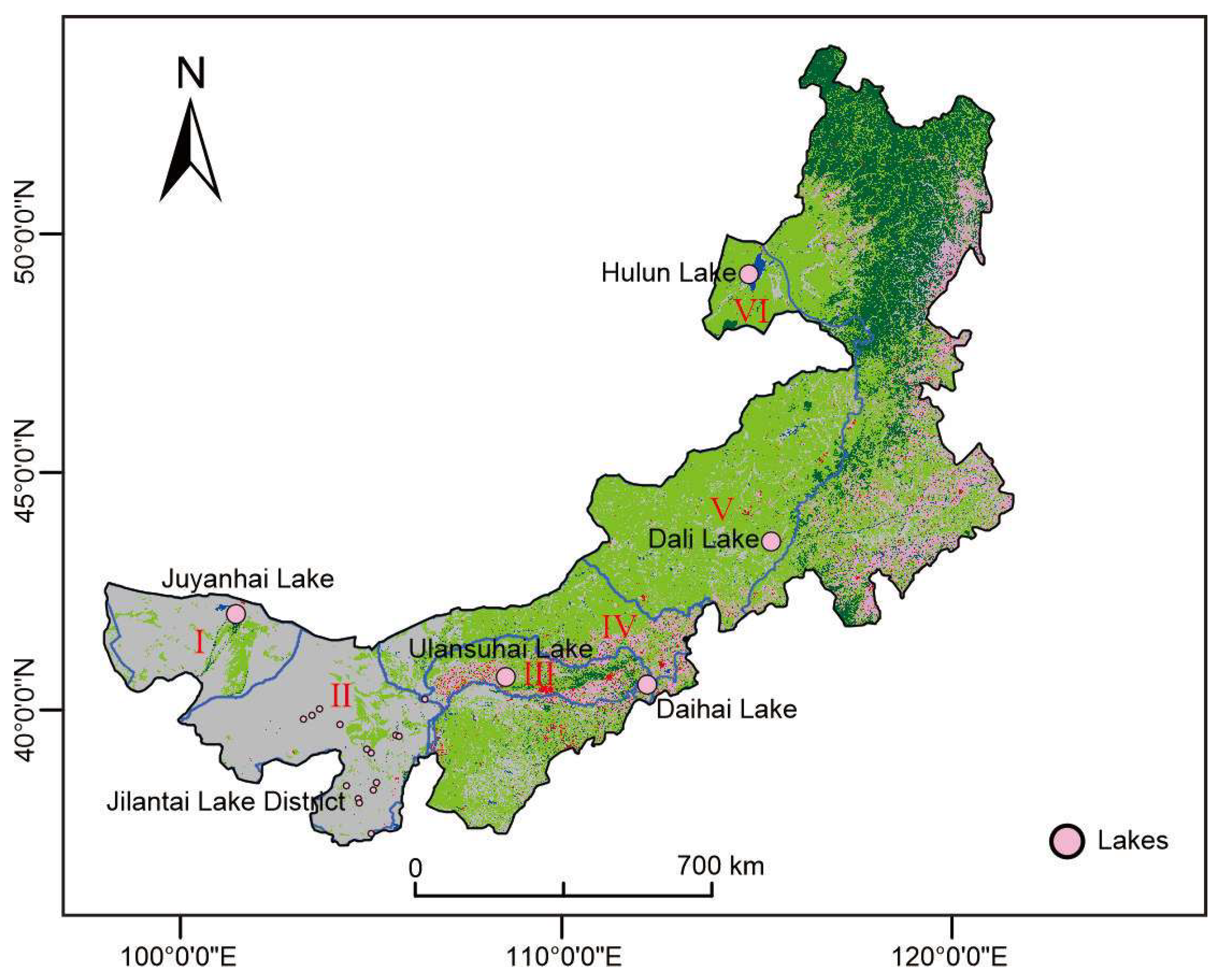
The Mengxin Plateau Lake Region is also known as the Northwestern Arid Lake Region, which is located in northeastern Asia and extends from the Greater Khingan Mountains in the east to the Tianshan and Himalayan Mountains in the west [32]. It borders Mongolia and Russia to the north and includes parts of the Ningxia Hui Autonomous Region, Inner Mongolia Autonomous Region, Xinjiang Uygur Autonomous Region, Shanxi Province, Shanxi Province, and Gansu Province [33]. Utilizing China’s 1:250,000-scale first- and second-level watershed classification data, along with the corresponding DEM information, we delineated third-level watersheds [34]. The phytoplankton characteristics of lakes in the northern inland river basin, lakes in the Inner Mongolia Yellow River basin, and Hulun Lake were studied (Figure 1) and divided these areas into subregions, primarily encompassing Juyanhai Lake in Region I, the Jilantai Lake district in Region II, Ulansuhai Lake in Region III, Daihai Lake in Region IV, Dali Lake in Region V, and Hulun Lake in Region VI (Table S1). During the summer of 2024, a total of 20 lakes were investigated, and 79 surface water and phytoplankton samples were collected using a water sampler during the peak vegetation period. Juyanhai Lake, the Jilantai Lake district, Ulansuhai Lake, Daihai Lake, Dali Lake and Hulun Lake yielded 7, 17, 14, 11, 17 and 13 samples, respectively. In the Jilantai Lake district, 15 lakes were surveyed, with 17 sampling sites established, as two relatively large lakes were each sampled at two locations. A portable multi-parameter water quality analyzer (YSI Professional Plus) was used to measure dissolved oxygen (DO), water temperature (T), electrical conductivity (EC), salinity (Salt), total dissolved solids (TDS), and pH at each sampling point. Water samples were collected in 1 L polyethylene bottles and transported to the laboratory for further analysis. Total nitrogen (TN) and total phosphorus (TP) concentrations were measured directly from raw water samples. Ammonia nitrogen (NH3-N) concentrations were measured after filtering the water samples through a 0.45 µm membrane filter, following the methods outlined in the Water and Wastewater Testing Methods (Chinese Environmental Protection Agency, 2002) [20]. Additionally, one sample from each point was collected to investigate phytoplankton community characteristics and preserved in 15 mL of 5% Lugol’s iodine solution. After being returned to the laboratory, samples were placed on a horizontal test bench for 48 h of sedimentation. The supernatant was then siphoned off, leaving approximately 30 mL of phytoplankton concentrate. The phytoplankton samples were transferred to 50 mL sample bottles, and the original polyethylene bottles were rinsed three times with ultrapure water to adjust the sample volume to 50 mL. Finally, quantitative phytoplankton samples were analyzed using an optical microscope (Zeiss Axioskop, Germany) to identify phytoplankton species and cell numbers [11,16,31].

2.3. Data Processing

All statistical analyses and data visualizations were performed using R software (v4.3.1). Prior to analysis, environmental factors and phytoplankton biomass were transformed to meet assumptions of normality and homogeneity of variance. One-way analysis of variance (ANOVA) was employed to assess spatial variation in physicochemical parameters across representative lakes in Inner Mongolia. For the RDA, only variables with both statistical significance and strong explanatory power were selected for the final RDA interpretation to avoid overfitting and multicollinearity. Generalized additive models (GAMs) were constructed using the mgcv package, with smoothing parameters estimated via restricted maximum likelihood (REML) to quantitatively analyze the nonlinear responses of biomass to physicochemical parameters and nutrients. Additionally, partial least squares path models (PLS-PM) were built using the plspm package to elucidate causal pathways influencing community dynamics. Path coefficient significance was validated using nonparametric bootstrapping with 1000 resamples, while model predictive capability was assessed via goodness-of-fit (GoF) indices and coefficients of determination. All academic figures—including GAM curves and PLS-PM path maps—were generated using the ggplot2 and ggraph packages. This study employs the TSI index to conduct a quantitative analysis of the trophic status of lakes [35].
Quantitative phytoplankton analysis was conducted using a German Zeiss Axioskop research microscope at 400× magnification. Species identification and cell counting followed established protocols [11,16,31], with each sample requiring a minimum count of 300–500 units to determine quantitative abundance (cells/L). To accurately reflect ecological significance, phytoplankton biomass (mg/L) was estimated by measuring morphological dimensions of at least 30 individuals per dominant taxon and converting these measurements into biomass volume using standardized geometric formulas, assuming a specific abundance of 1 g/cm3.
Phytoplankton biodiversity indices are statistical measures used to assess the taxonomic diversity within phytoplankton communities [36]. The following formulas were used to calculate biodiversity indices:
Margalef Richness Index (D) [37]:
D = S 1 l o g ( N )
where (S) is the number of species, and (N) is the total number of individuals in all samples.
Shannon Index (H’) [20]:
H = i = 1 N p i × l o g 2 ( p i )
where (pi) is the proportion of individuals of species (i) relative to the total number of individuals.
Pielou’s Evenness Index (J’) [38]:
J = H l o g ( N )
where (H’) is the Shannon index, and (S) is the number of species.
Simpson’s Diversity Index [39]:
D s i m p s o n = 1 i = 1 N p i 2
where (pi2) is the squared proportion of individuals of species (i).
Population dominance (Y) [39]:
Y = f i     ×   p i
where Y is the population dominance of the i species of phytoplankton; fi is the frequency of the i species; and pi is the proportion of the i species in the total biomass. When Y > 0.02, the population is the dominant taxon.

3. Results

3.1. Water Quality Characteristics

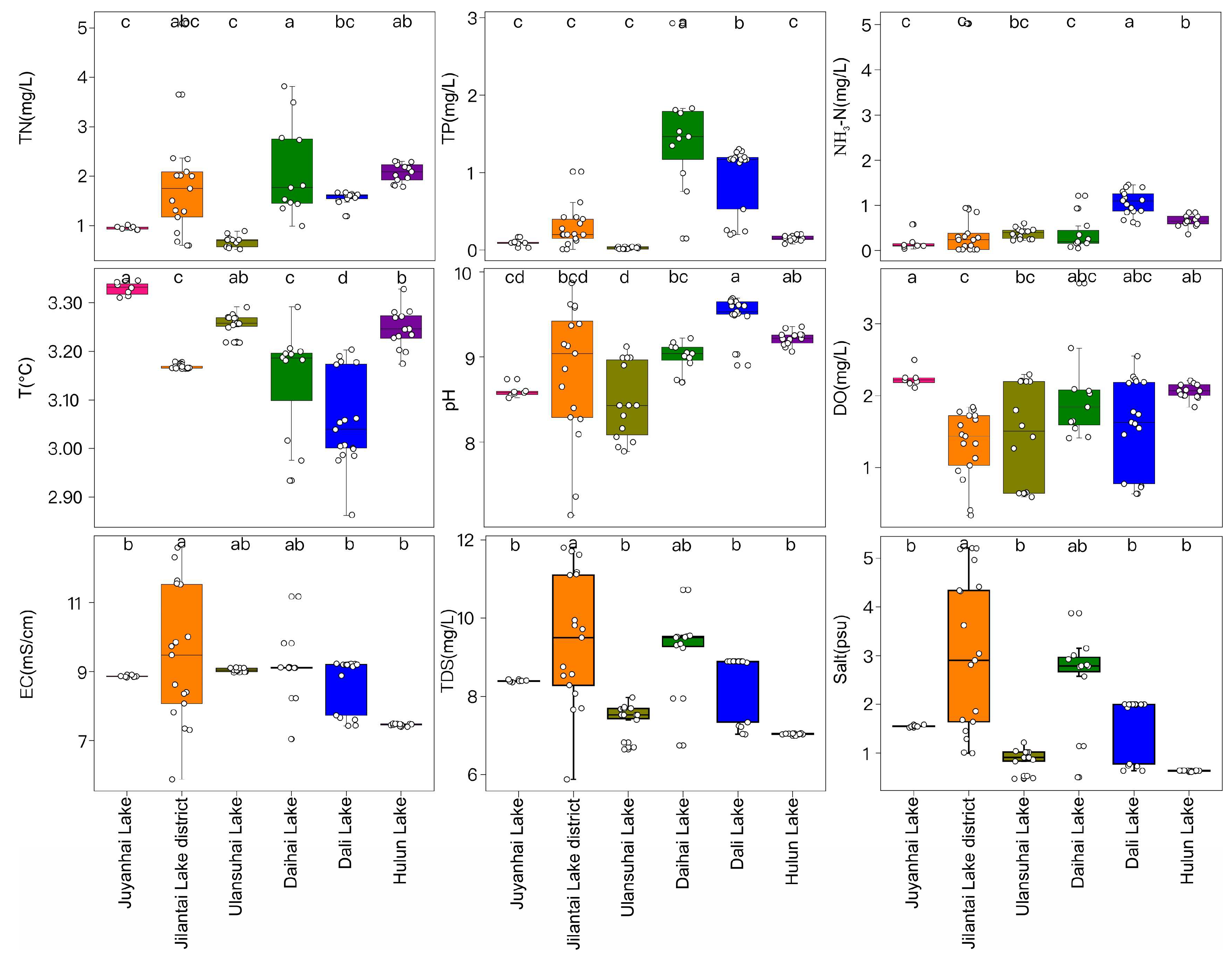
A comprehensive summary of the environmental parameters of six tertiary river basins in Inner Mongolia was provided. The Juyanhai Lake was characterized by high dissolved oxygen levels, whereas the Jilantai Lake district exhibited notably high salinity. Indicators for Ulansuhai Lake were relatively low, suggesting better water quality. Elevated levels of phosphorus and salinity were prevalent in the western Inner Mongolia Plateau, whereas the eastern plateau had comparatively higher levels of pH, TP, and NH3-N. In the Hulun Lake Basin, the lake exhibited relatively high levels of pH, TN, and NH3-N. Significant differences (p < 0.05) were observed in the physicochemical indicators and nutrient concentrations across the lakes (Figure 2).

3.2. Phytoplankton Composition

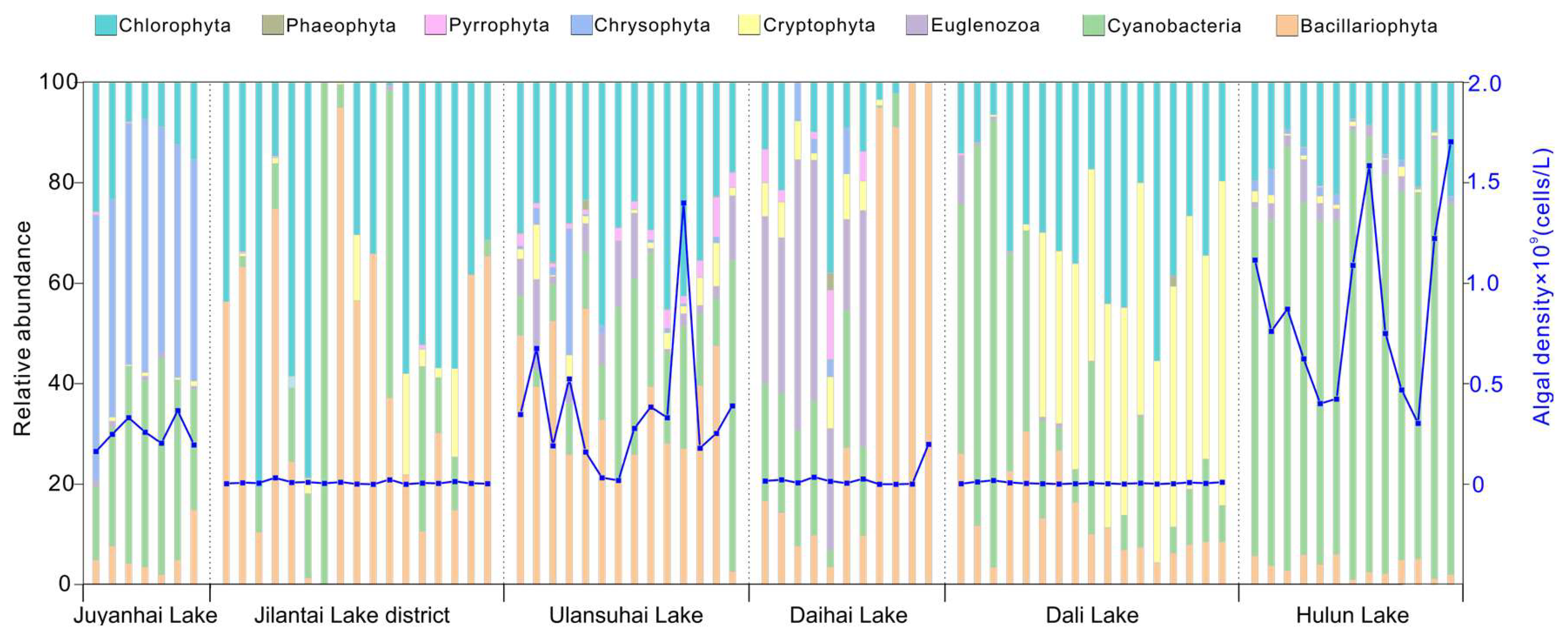
A total of 10 phyla and 230 phytoplankton taxa were identified across 79 sampling points in the lakes of Inner Mongolia, with 30 phytoplankton taxa classified as dominant. Chlorophyta were the most abundant group, accounting for 41.3% of the total phytoplankton taxa, followed by Bacillariophyta at 27.8% and Cyanobacteria at 16.5%. Other identified groups included Euglenozoa, Cryptophyta, Chrysophyta, Dinoflagellata, Xanthophyta, Charophyta, and Phaeophyta (Table S2). Phytoplankton cell abundance varies significantly across different lakes (Figure 3). Specifically, Hulun Lake exhibits the highest Chlorophyta abundance, while the eastern region of the Inner Mongolia Plateau shows the lowest abundance, at only 4993 × 103 cells/L. Chlorophyta exhibited the highest relative abundance in the Jilantai Lake district (Region II) at 39.34%, whereas the lowest relative abundance was 15.43% in the Hulun Lake system (Region VI). Bacillariophyta were relatively abundant in both the Jilantai Lake district (40.59%) and Ulansuhai Lake in Inner Mongolia (Region III) at 34.75%, with a lower abundance in Regions I and V. Cyanobacteria had the highest relative abundance in Regions VI (76.25%) and IV (23.22%). Euglenozoa were the most abundant in Region IV (23.22%) but were less common in other regions. Cryptophytes had the highest relative abundance in Region V (31.30%) and were evenly distributed in other regions. Chrysophyta were the most abundant in Region I (47.17%) and absent in Regions II–V. Dinoflagellates displayed higher relative abundance in Regions III and IV, with values of 2.26% and 2.74%, respectively. Xanthophyta were identified only in Regions IV and V, with relative abundances of 0.31% and 0.12%, respectively. Phaeophyta was present in small quantities in the specific regions (Figure 3).
Phytoplankton in Inner Mongolia’s lakes are primarily composed of Bacillariophyta, Chlorophyta, and Cyanobacteria, accounting for over 85% of the total (Figure 3). This finding is consistent with results from other studies [40,41,42,43]. In terms of abundance, Chrysophyta and Chlorophyta dominated the Juyanhai Lake, whereas Chlorophyta and Bacillariophyta were predominant in the Jilantai Lake district. Cyanobacteria, Chlorophyta, and Bacillariophyta were the dominant groups in Ulansuhai Lake. Phytoplankton in both Hulun Lake and Juyanhai Lake were primarily composed of Cyanobacteria and Chlorophyta. The western region of the Inner Mongolia Plateau was characterized by the dominance of Bacillariophyta and Chlorophyta, whereas the eastern region predominantly featured Cyanobacteria and Chlorophyta. Notably, the phytoplankton community in Hulun Lake was mainly composed of Cyanobacteria, corroborating previous studies of phytoplankton composition in Inner Mongolian lakes [43]. This consistency indicated that the structure of phytoplankton communities and aquatic environments in these lakes remained relatively stable.

3.3. Phytoplankton Community Diversity

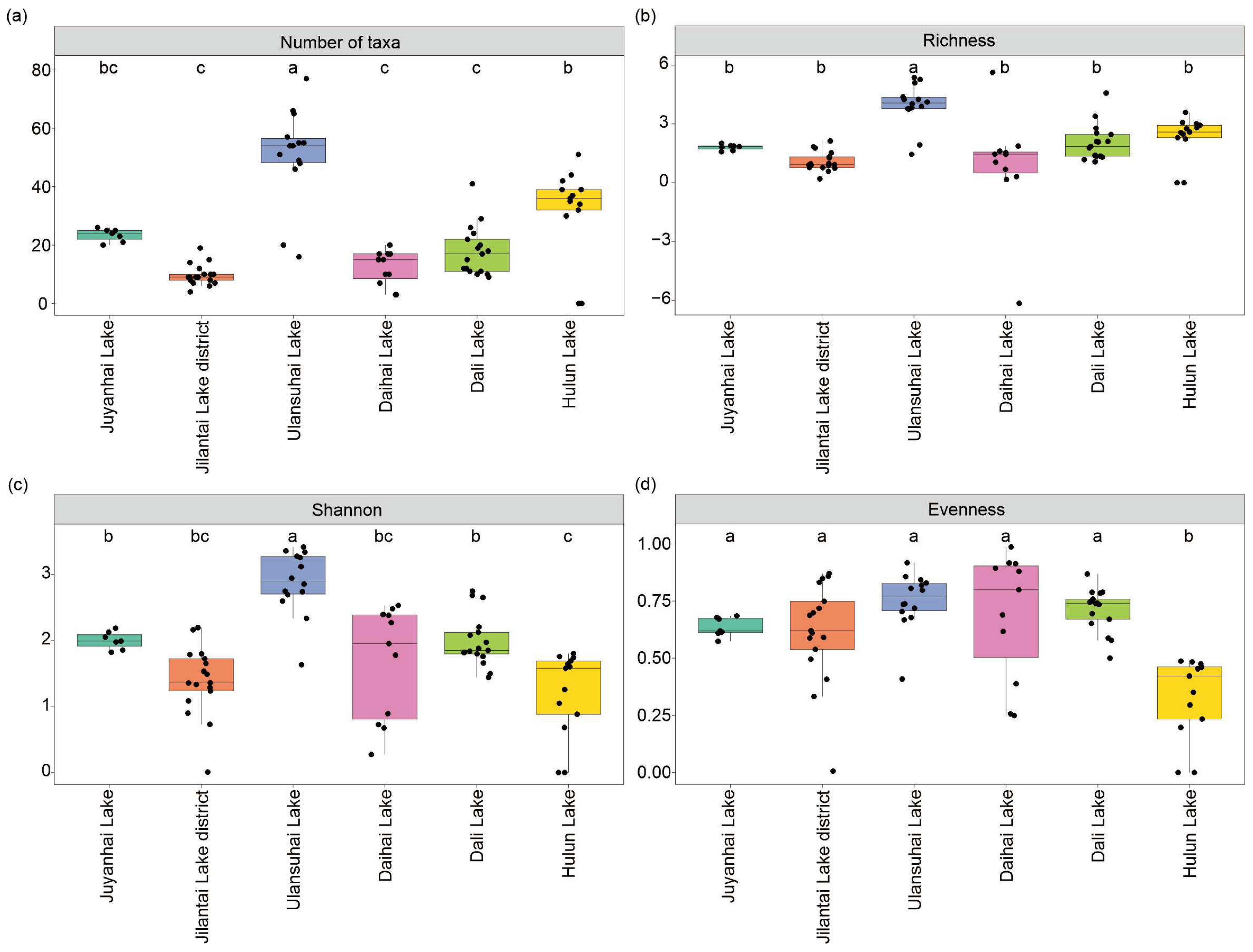
Prior to comparing alpha diversity across different lake regions, this study first assessed spatial heterogeneity within lakes (Table S5). Results indicate that phytoplankton distribution is not uniform within each lake region. The coefficient of variation (CV) for abundance exhibited extremely high variability (ranging from 29.3% to 397.6%). Concurrently, the mean Sørensen similarity index between sites within each lake region was generally low (e.g., only 0.43 in Region V). These findings indicate that large lakes on the Inner Mongolia Plateau harbor multiple spatially heterogeneous sub-communities due to local environmental variations. It is precisely this pronounced intra-lake spatial structure that explains the substantial within-group variance observed in subsequent alpha diversity analyses (Figure 4).
Biodiversity indices from Ulansuhai Lake in Inner Mongolia demonstrated relatively high species numbers, richness index, Shannon index, and Pielou evenness index, indicating a high level of biodiversity with a diverse range of species and an even distribution. In contrast, the Jilantai Lake district and the western part of the Inner Mongolian Plateau exhibited lower species numbers, richness index, and Shannon index, reflecting poorer biodiversity and a reduced number of species. Additionally, the Hulun Lake Basin displayed lower values for the Shannon index and Pielou evenness index, indicating the most uneven distribution of species among the studied regions (Figure 4).

3.4. Dominant Taxa

The McNaughton dominance index indicated the relative position of different species within a community and their influence on community structure. Generally, species with an advantage index ≥ 0.02 are considered dominant taxa, as they could play a crucial role in shaping the overall structure of the phytoplankton community [40].
The composition and abundance of dominant taxa exhibit significant regional variation, reflecting differences in hydrological conditions, nutrient status, and habitat heterogeneity. In the major lakes of Inner Mongolia, seven phyla and thirty dominant taxa were identified, including ten species of Cyanobacteria, eight species of Chlorophyta, six species of Bacillariophyta, two species of Chrysophyta, two species of Cryptophytes, one species of Euglenozoa and one taxon of Charophyta. Nine dominant taxa were recorded in Region I, comprising four species of Cyanobacteria, one species of Bacillariophyta, three species of Chlorophyta and one of Chrysophyta. This area possesses relatively eutrophic and potentially stable hydrological conditions, which are conducive to the proliferation of Cyanobacteria. Region II had only one taxon, Microcystis sp.; this indicates a relatively simplified community structure, which may be associated with harsh environmental conditions or intense environmental filtering. Region III had eleven dominant taxa from six phyla: Cyanobacteria (two taxa), Chlorophyta (three taxa), Bacillariophyta (four taxa), Euglenozoa (one taxon), Charophyta (one taxon) and Chrysophyta (one taxon). The relatively high taxonomic diversity in this region may be attributed to greater environmental heterogeneity and more dynamic hydrological processes, which promote niche differentiation. In Region IV, five dominant taxa from three phyla were found: Cyanobacteria (two taxa), Bacillariophyta (two taxa), and Euglenozoa (one taxon); this reflects the persistence of moderate biodiversity under relatively arid conditions. Seven dominant taxa from four phyla were identified in Region V, including Cyanobacteria (two taxa), Chlorophyta (two taxa), Bacillariophyta (one taxon), and Cryptophytes (two taxa). This indicates differences in water transparency or mixing mechanisms. Region VI had three dominant taxa from two phyla: Cyanobacteria (two taxa) and Chlorophyta (one taxon); this indicates variations in water transparency or mixing mechanisms, with relatively balanced dominant community structures but lower complexity (Table 1).

3.5. Relationship Between Phytoplankton and Environmental Factors

3.5.1. RDA

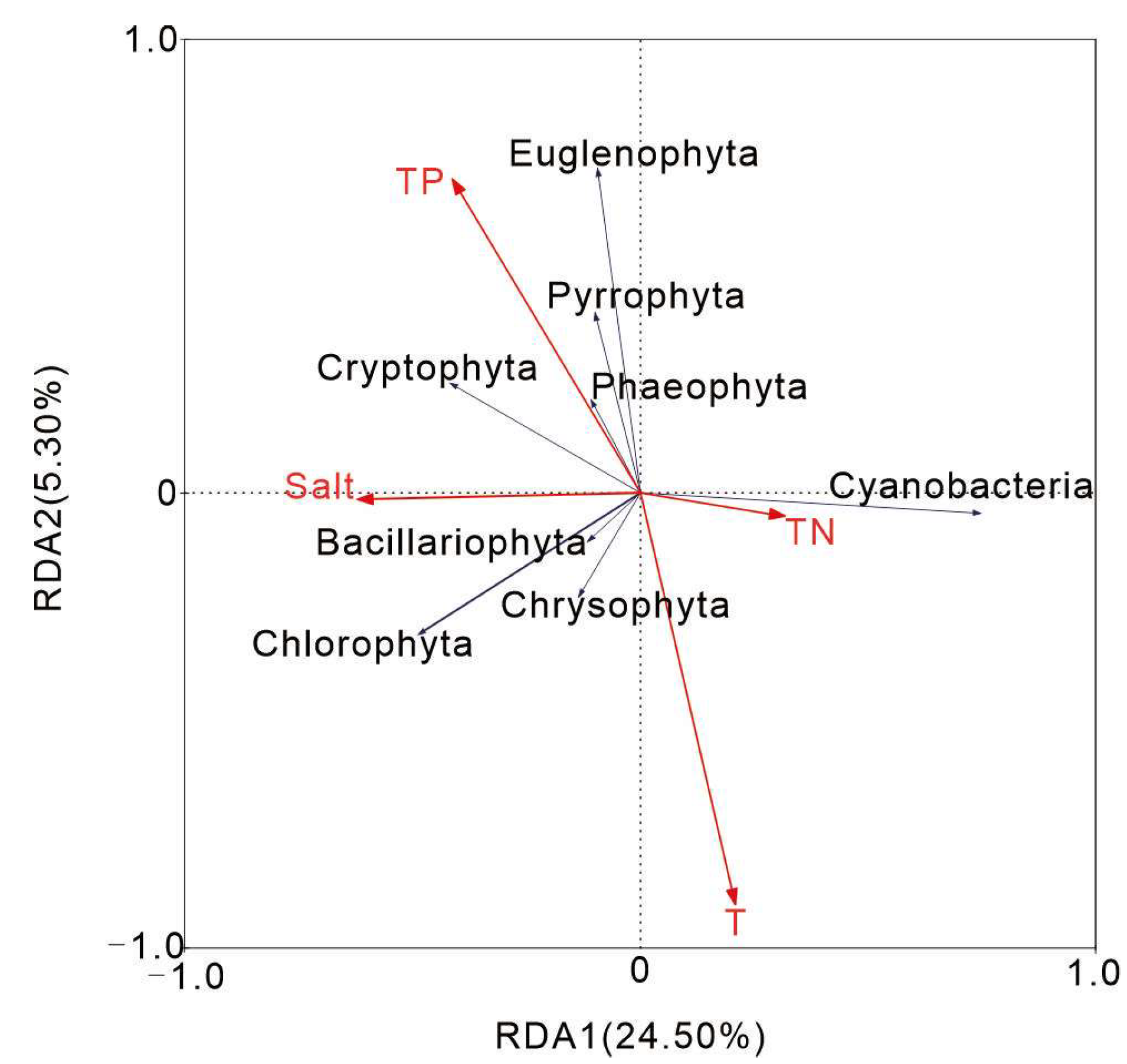
To investigate the influence of environmental factors on the distribution of phytoplankton phyla, detrended correspondence analysis (DCA) was performed on their relative abundance. The length of the ordination axis was less than three, indicating that the distribution could be modeled using a linear model. Nine environmental factors (pH, EC, T, TDS, Salt, DO, TN, TP, and NH3-N) were included in the redundancy analysis (RDA). A Monte Carlo permutation test was used to assess the significance of these factors [41]. Through selection, Salt, TN, TP and T emerged as significant explanatory variables, serving as the primary environmental factors affecting the dominant phytoplankton species, with the results shown in Figure 5. The first ordination axis explained 24.50% of the variance in the relative abundance of phytoplankton phyla, demonstrating a correlation of 0.662 between the relative abundance of phytoplankton phyla and environmental factors, indicating the strong representation of the relationship between the dominant phytoplankton species and these factors. TN concentration and T were positively correlated with the first ordination axis, whereas Salt and TP concentration were negatively correlated. Cyanobacteria exhibited a significant positive correlation with TN concentration. Cyanobacteria generally showed a negative correlation with salinity, whereas Chlorophyta exhibited a positive correlation. Euglenozoa were significantly negatively correlated with temperature. Additionally, Euglenozoa and Cryptophyta were significantly positively correlated with TP concentration, whereas Cyanobacteria was negatively correlated with TP concentration (Figure 5, Table 2).

3.5.2. Phytoplankton Distribution Along Environmental Gradients

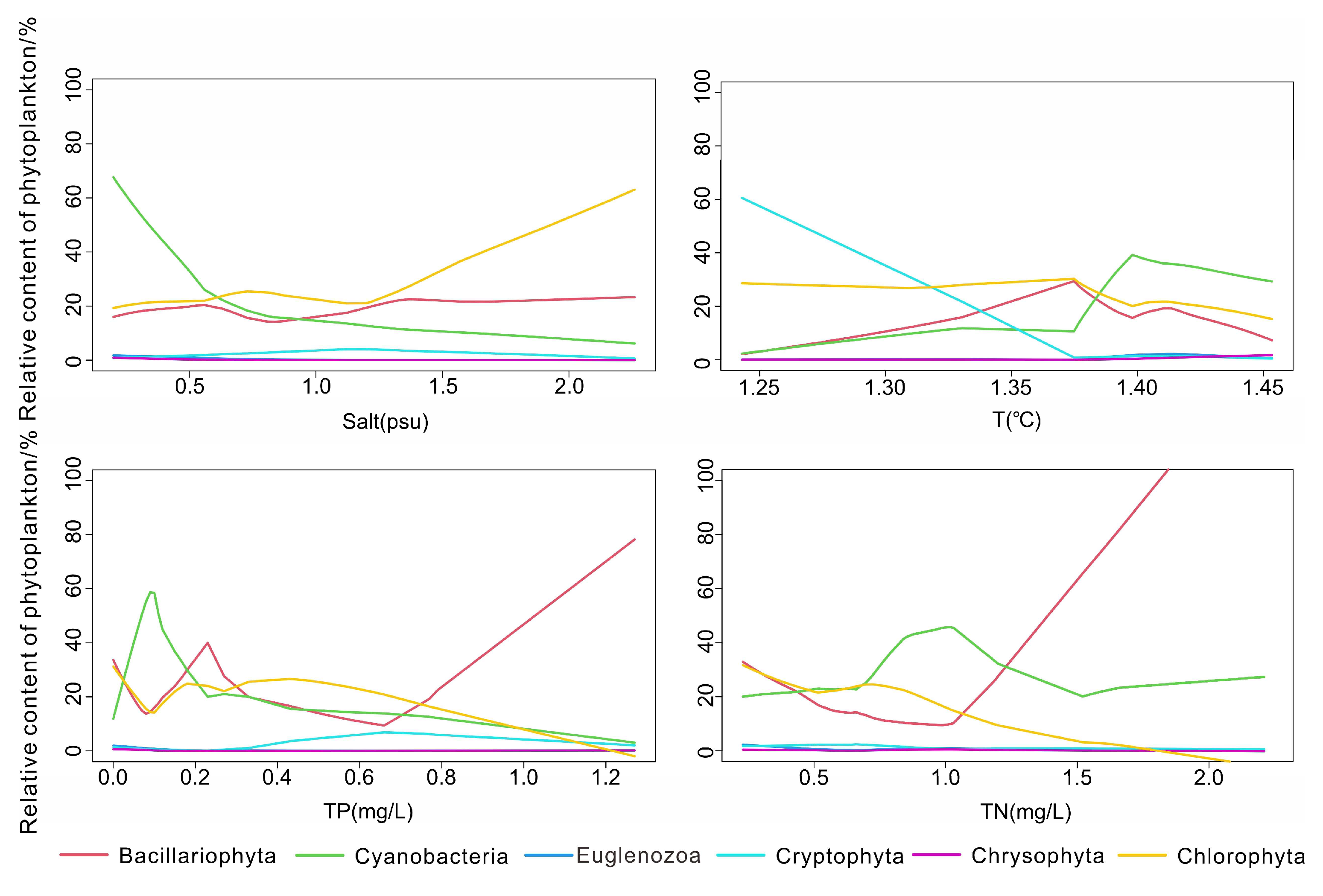
The relative abundance of phytoplankton phyla showed clear trends along the primary environmental gradients of salinity, temperature (T), TP, and TN (Figure 6), based on log(x + 1)-transformed data. Increased salinity was generally associated with a decrease in the relative abundance of Cyanobacteria, whereas Chlorophyta exhibited an increasing trend; however, this pattern was not consistent across all regions. In Region II, Cyanobacteria (e.g., Microcystis sp.) remained dominant despite relatively high salinity. This may be attributed to the high ecological adaptability of Microcystis sp., which can tolerate a wide range of salinity conditions and maintain competitive advantages under nutrient-rich environments. Bacillariophyta maintained a relative abundance of around 20%, while Cryptophyta, Chrysophyta, and Euglenozoa exhibited low relative abundances with no significant response to the Salt. The relative abundances of Bacillariophyta, Cyanobacteria, and Euglenozoa exhibited a decreasing trend as temperatures rise at relatively low levels (about 15 °C), but show an increasing trend as temperatures continue to climb. In contrast, Cryptophyta exhibited an increasing trend at temperatures below 15 °C but decreased above this temperature. The relative abundance of Chlorophyta had an increased trend with the rising temperatures below 24 °C but declined above 24 °C. Cryptophyta and Chlorophyta exhibited the decreasing relative abundance with the increasing TP concentrations. The relative abundance of Bacillariophyta had a decreased trend with TP levels below about 3.4 mg/L but subsequently began to increase. The relative abundance of Chlorophyta also had a decreased trend with increasing TN concentrations. The relative abundance of Chrysophyta declined with increasing TN levels below 9 mg/L but increased above this level. Conversely, Bacillariophyta initially decreased in relative abundance with increasing TN but showed a marked increase when TN concentrations exceeded approximately 9 mg/L.

3.6. Generalized Additive Models of Phytoplankton Relative Abundance

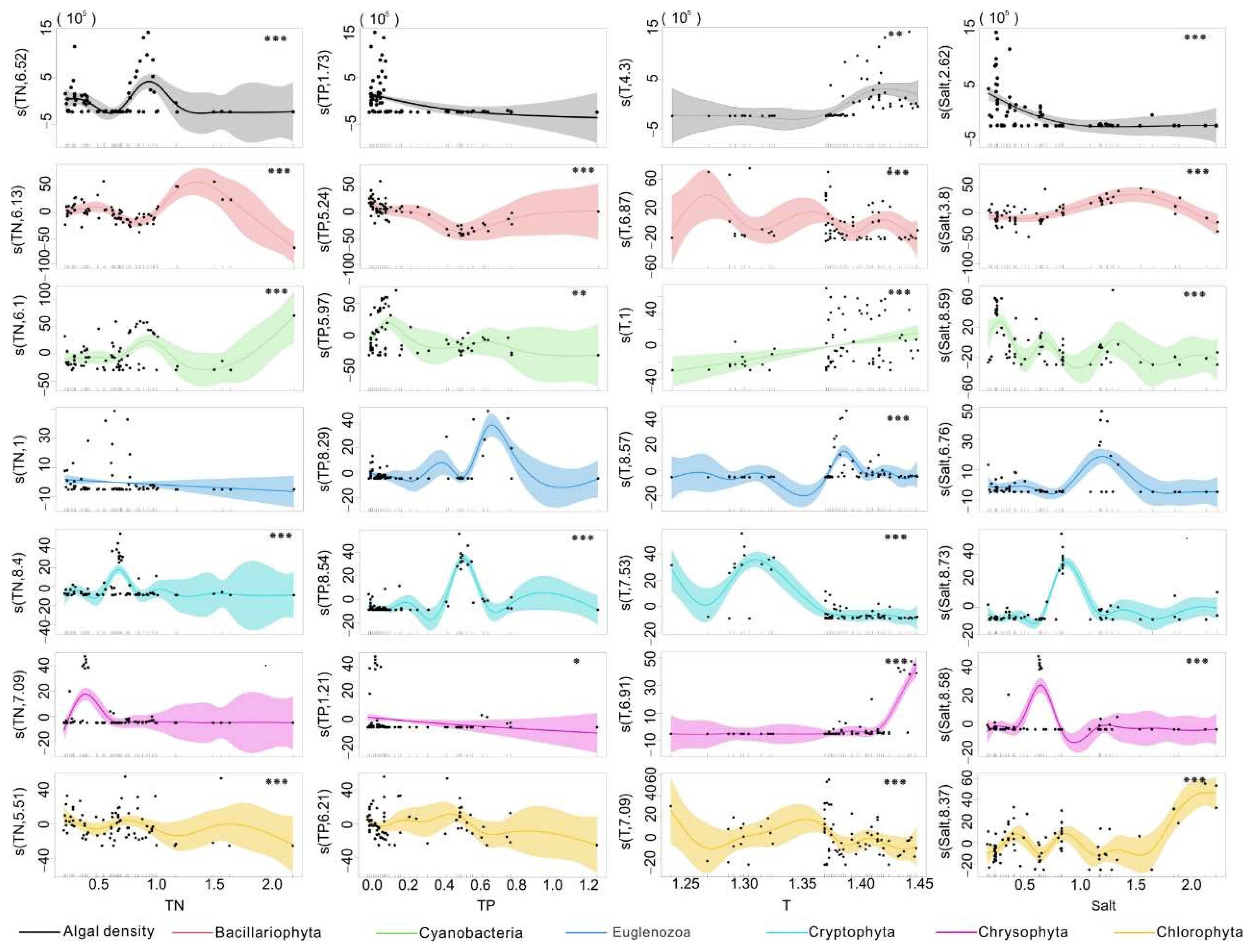
GAMs were employed to evaluate the significance of the relative abundance patterns for each phytoplankton group [42] (Figure 5). The explained deviances were as follows: Bacillariophyta (75.5%), Cyanobacteria (81.5%), Euglenozoa (87.9%), Cryptophyta (92.3%), Chrysophyta (82.7%), and Chlorophyta abundance (62.7%). TN was particularly significant for Bacillariophyta, Cyanobacteria, Euglenozoa, Chrysophyta, and Chlorophyta abundance. T yielded significant results for Cyanobacteria, Euglenozoa, Cryptophyta, and Chrysophyta, whereas Salt was especially significant for Bacillariophyta, Cyanobacteria, Euglenozoa, and Chlorophyta diversity (Figure 7 and Table S3).

3.7. Structural Equation Model Analysis of Phytoplankton Species Composition

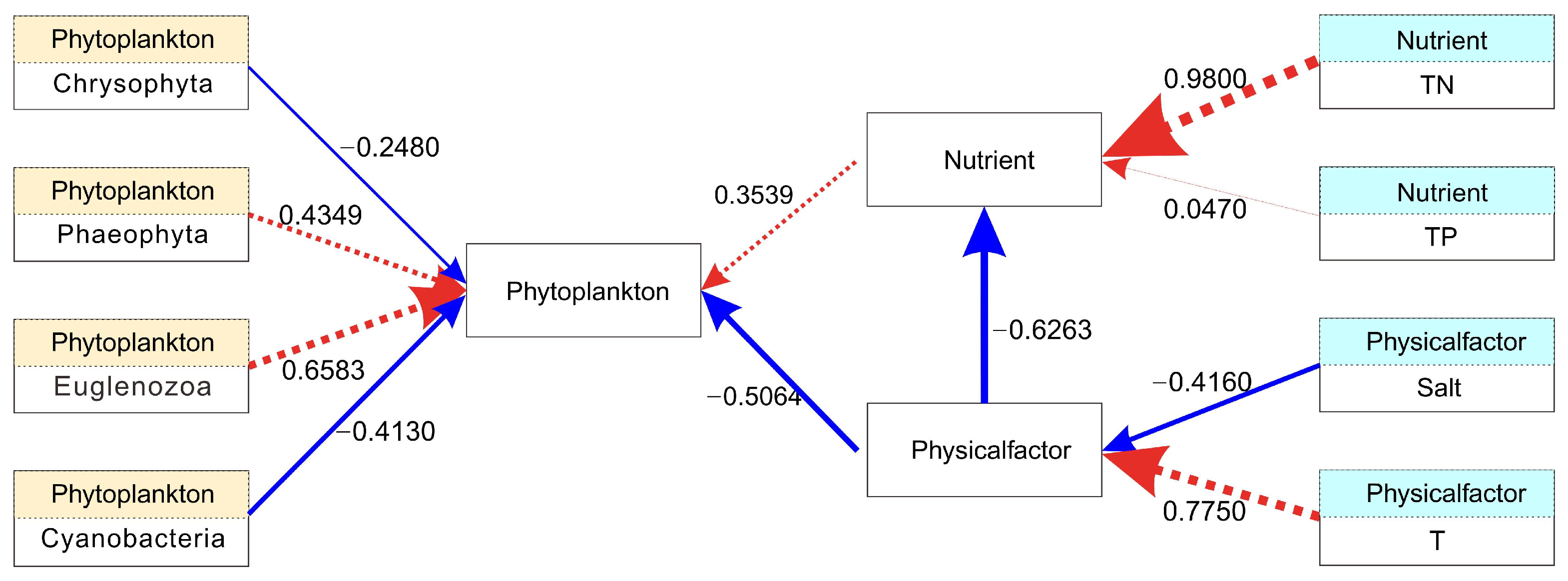
Variations in phytoplankton species composition are influenced by water physicochemical factors and nutrients [8]. Therefore, this study considered nutrients (TN, TP, and NH3-N) and physicochemical factors (pH, DO, T, TDS, EC, and Salt) as potential variables, which is supported by RDA. The structural model included two potential pathways: (1) the direct impact of nutrients and physicochemical factors on phytoplankton species composition and (2) the indirect influence of physicochemical factors on phytoplankton species composition through nutrient status. The model incorporated TN and TP as the observed indicators of nutrients and T and Salt as the observed variables of physicochemical factors. The path analysis of the model is shown in Figure 8. The goodness of fit of the structural equation model was 0.48. The model indicated that among the factors affecting the composition of phytoplankton classes, the path coefficient for physicochemical factors was −0.506, while the path coefficient for nutrients was 0.354, suggesting that physicochemical factors played a more significant role in shaping phytoplankton composition, with nutrients having a relatively minor impact. Additionally, physicochemical factors indirectly affected phytoplankton composition through nutrients, as evidenced by a path coefficient of −0.626. Among the physicochemical factors, the path coefficients for T and Salt were 0.775 and −0.416, respectively, indicating that T was the primary indicator. Among the nutrient indicators, the path coefficient for TN was 0.98, whereas that for TP was 0.047, indicating that nitrogen was the limiting nutrient factor. Overall, both physicochemical factors and trophic variables were associated with phytoplankton composition. Among trophic indicators, TN exhibited stronger standardized correlations with multiple phytoplankton taxa compared to TP. It should be noted that lake ecosystems exhibit complex feedback mechanisms, including changes in pH, nutrient availability and light conditions mediated by phytoplankton. Given the moderate model fit, these relationships should be interpreted cautiously as indicative evidence rather than conclusive proof of causality. Notably, although Phaeophyta was represented by only one species and occurred only in Region II, its relatively high importance in the model may be attributed to its strong responsiveness to environmental gradients. This suggests that even low-diversity groups can contribute disproportionately to community–environment relationships when they exhibit pronounced ecological sensitivity; however, this result should be interpreted with caution.

4. Discussion

4.1. Analysis of Factors Affecting Phytoplankton Communities in Inner Mongolia Lakes

Our research primarily focuses on the relationship between phytoplankton and their environment across different ecological settings, including varying salinity levels. Multiple analytical methods (RDA, GAM, and SEM) were applied. We found that the structure and biodiversity of phytoplankton communities in various lakes across Inner Mongolia exhibited significant variations, primarily influenced by environmental factors such as nutrient concentration, Salt, and pH (Figure 5) [42]. Among these lakes, Ulansuhai Lake exhibited the highest biodiversity, featuring a rich variety of phytoplankton (Figure 4). This can be largely attributed to its low nutrient concentrations (TN and TP) and moderate Salt, which create favorable conditions for the growth of diverse phytoplankton species, promoting taxonomic diversity and even distribution [7]. In contrast, Hulun Lake displayed the most uneven species distribution, with Cyanobacteria dominating the phytoplankton community (Figure 3 and Figure 4). The high nutrient concentrations, particularly TN (averaging 7 mg/L) (Figure 2), provided optimal conditions for cyanobacteria growth, resulting in frequent outbreaks of cyanobacterial blooms [43,44]. This indicated that elevated nutrient levels were the key factors driving these bloom events.
Biodiversity in the Jilantai Lake district and western Inner Mongolia Plateau was relatively poor, characterized by low species numbers, species taxonomic richness, and Shannon indices, likely due to the high Salt levels in these regions (Figure 2 and Figure 4) [45,46]. In the Jilantai Lake district, the Salt at the sampling points can reach 50 psu, whereas the western Inner Mongolia Plateau records Salt levels of 15 psu. Such high Salt levels are unsuitable for the growth of most phytoplankton species [47]. In the Jilantai Lake district and western Inner Mongolia Plateau, only 35 and 55 species of phytoplankton were recorded, respectively, which are lower than the numbers found in freshwater lakes (Table S2). However, these values are relatively high compared with the species counts in other saline lakes [44]. Similar to other salt lakes, Bacillariophyta comprises up to 40.59% of the phytoplankton in the Jilantai Lake district [44]. The extremely high salinity likely inhibits the growth of phytoplankton species adapted to freshwater habitats, and many narrow-range, temperature-sensitive, and warmth-loving species struggle to reproduce under these conditions [48].
The phytoplankton abundance in the eastern Inner Mongolia Plateau is significantly lower than in other regions, with the dominant groups being Cryptophyta, Cyanobacteria, and Chlorophyta, while Bacillariophyta is relatively scarce. This phenomenon may be attributed to high pH levels, as illustrated in Figure 2 and Figure 3. Studies have demonstrated that Cyanobacteria, Chlorophyta, and Cryptophyta thrive in high-pH environments, and the process of phytoplankton photosynthesis further elevates pH, enhancing their growth advantage. Dali Lake, located in this region, is a typical soda lake, similar to those found in Austria, China, Hungary, Kazakhstan, Mongolia, Russia, Serbia, and Turkey [49]. Research has indicated that under eutrophic conditions, a pH of 9.5 can significantly impede the growth of phytoplankton communities. Lakes on the eastern Inner Mongolia Plateau are characterized by high nutrient concentrations and elevated pH levels. When phytoplankton reproduce naturally and deplete carbon dioxide, they may become carbon-limited [50,51]. pH is a critical variable in aquatic ecosystems that influences nutrient absorption kinetics and the chemical forms of nutrient ions required by algae [52,53]. Current research has indicated that under nutrient-rich conditions, phytoplankton species are primarily limited by pH when values exceed 9.5. Nutrients are regarded as the key factors controlling phytoplankton community structure and biomass, with studies indicating that phosphorus, nitrogen, and silicon are limiting resources. Additionally, nutrient concentrations can determine trophic status and nutrient ratios that limit specific nutrients [54]. The concentrations of TN and TP indicated that Dali Lake was in a eutrophic state, providing sufficient nutrients to support phytoplankton (Figure 2). However, despite the abundance of this nutrient, the high pH levels and dissolved solid content appeared to limit the nutrient availability (Figure 8). In saline and soda lakes, pH, dissolved solids (such as Salt), and temperature are considered to be the primary factors controlling phytoplankton distribution and abundance. Consequently, high pH and dissolved solids can be the main factors regulating phytoplankton growth and biodiversity in lakes on the eastern Inner Mongolia Plateau.
In summary, the structure and biodiversity of phytoplankton communities in various lakes across Inner Mongolia are primarily influenced by Salt, nutrient concentration, and pH. Ulansuhai Lake exhibits high biodiversity owing to its moderate Salt and low nutrient levels, whereas Hulun Lake is dominated by Cyanobacteria as a result of high nutrient concentrations, leading to frequent cyanobacterial blooms. The Jilantai Lake district and western Inner Mongolia Plateau demonstrate low biodiversity owing to high Salt, whereas Bacillariophyta are relatively abundant. In contrast, the eastern Inner Mongolia Plateau faces limitations in phytoplankton diversity and growth because of its high pH and dissolved solids.

4.2. Impact of Geographic Environment and Human Activities on Phytoplankton Communities

Ulansuhai Lake is the largest lake in the upper reaches of the Yellow River and serves as a vital ecological barrier and bird habitat in northern China [55]. Situated in the Yellow River Basin, its primary water sources are the Yellow River and Hetao Irrigation District. The lake is directly influenced by water replenishment from the Yellow River and irrigation runoff, with high-quality water from the Yellow River and low-quality runoff from farmland entering the lake through the main water channels (Figure S1). Studies have indicated that agricultural runoff from the Hetao Irrigation District may be the primary source of pollution in Ulansuhai Lake [21]. From 2010 to 2020, increased fertilizer utilization in agricultural production increased the nutrient load of the lake through farmland runoff, particularly during the growing season. As the farmland runoff supply remained stable, the total water replenishment to Ulansuhai Lake rose annually from 721 million cubic meters to 1.192 billion cubic meters, with the Yellow River’s contribution to the total water supply increasing each year [56]. Studies have indicated that the growing proportion of high-quality water from the Yellow River is a significant factor in the gradual decrease in the nutrient load of Ulansuhai Lake.
Before the ecological water replenishment from the Yellow River, untreated urban, industrial, and domestic wastewater, along with agricultural runoff, was discharged into Ulansuhai Lake, exacerbating the environmental degradation due to insufficient ecological water volume. This has led to a deterioration in the lake’s water quality, with only 55 species of phytoplankton recorded [57]. However, in this study, with lower nutrient concentrations (TN and TP) and moderate Salt, 125 species of phytoplankton were identified (Table S2). Ecological replenishment from the Yellow River significantly alleviated the eutrophication and salinization of Ulansuhai Lake, promoting phytoplankton growth and maintaining biodiversity [58]. Globally, over 75% of lakes and reservoirs experience water quality deterioration and eutrophication, which contribute to water shortages and ecological degradation. The ongoing occurrence of eutrophication and harmful Chlorophyta blooms is widely recognized as a serious environmental issue. Water scarcity is particularly prevalent in cold and arid regions where evaporation exceeds precipitation [59,60]. Ecological water replenishment through hydraulic engineering is a key strategy for maintaining and improving lake water quality and is crucial for protecting fragile aquatic ecosystems in these areas. Research suggests that introducing higher-quality water can help mitigate both water quality degradation and shortages. The quantity and quality of ecological replenishment are critical factors that influence chemical reactions, hydrology, and water quality in lakes, thereby effectively enhancing the water quality of eutrophic lakes [61].
As the largest freshwater lake in Inner Mongolia, Hulun Lake spans an area of 2239 square kilometers and is a typical grassland lake. It is primarily fed by the Kherlen and Urshen Rivers, and its basin supports well-developed livestock (Figure 1 and Figure S2). The prosperity of animal husbandry has resulted in the discharge of substantial amounts of livestock waste into Hulun Lake, introducing significant nutrients. Unlike Dali and Daihai lakes, Hulun Lake functions as a flow-through lake. In 2019, the “One Lake, Two Seas” project was implemented, resulting in an annual water transfer of 1.1 billion cubic meters to Hulun Lake, thereby ensuring the continuous water volume growth [62]. The increased water volume and accelerated water exchange have improved the circulation of the lake, contributing to enhanced water quality. In contrast, terminal lakes, such as Dali and Daihai, have experienced significant salinization and eutrophication due to high evaporation rates and improper human activities, leading to water quality deterioration and a notable decline in biodiversity and species count.
The flow-through nature of Hulun Lake, along with artificial water transfer, has increased water volume and diluted pollutants, thereby facilitating the maintenance of water quality at a reasonable level and supporting biodiversity [62,63,64,65]. However, despite its rich nutrient content, the overall dilution of pollutants has declined owing to the reduced inflow [66,67]. The nutrients in water are critical factors influencing the growth and community composition of Cyanobacteria, as the nitrogen and phosphorus contents directly affect their distribution, growth, and reproduction [16,17,18,19,20,21,22,23,24,25,26,27,28,29,30,31,32,33,34,35,36,37,38,39,40,41,42,43,44,45,46,47,48,49,50,51,52,53,54,55,56,57,58,59,60,61,62,63,64,65,66,67,68]. The concentrations of TN and TP in Hulun Lake exceed the eutrophication threshold. Research indicates that TN exerts a significant direct effect on phytoplankton community dynamics. While most lakes exhibit phosphorus limitation, Hulun Lake demonstrates pronounced nitrogen limitation characteristics. This phenomenon stems from the release process of phosphorus elements within Hulun Lake’s sediments. Even with controlled external inputs, sediment release under high temperatures and wind-wave disturbance maintains elevated phosphorus levels in the water body. SEM variance analysis results further confirm that TN is the primary limiting nutrient. When nitrogen and phosphorus levels are elevated, Microcystis sp., a cyanobacterial species tolerant to high levels of these nutrients, becomes dominant [69]. The nitrogen and phosphorus concentrations are critical factors in the formation of cyanobacterial blooms [70]. Additionally, the pH levels of Hulun Lake range between 9.00 and 9.28 and promote Cyanobacteria growth. In water bodies with high cyanobacterial abundance, photosynthesis consumes significant amounts of CO2, resulting in reduced CO2 concentrations and elevated pH levels. Studies have indicated that pH values above 8.5 are conducive to Cyanobacteria growth [16]. When the pH exceeds 9, Microcystis sp. can bloom at the water surface through buoyancy mechanisms, enhancing CO2 absorption at the air-water interface [71]. In contrast, algae lacking buoyancy mechanisms face a competitive disadvantage owing to insufficient CO2 to sustain high photosynthetic rates [72]. This may explain the relatively low Shannon Index and Pielou’s Evenness Index in Hulun Lake, indicating an uneven species distribution.
Nutrient input into Hulun Lake is a vital factor in determining water quality. The surrounding region is dominated by grassland ecosystems (Figure 1 and Figure S2). However, unsustainable grazing practices have led to partial grassland degradation, increasing the risk of grass influx into lakes, atmospheric deposition, and soil erosion [73]. Tumbleweeds and atmospheric dust have been identified as primary contributors to the lake’s high COD. Along with river hydrodynamics, wind speed and direction also influence the water quality. Hulunbuir experiences 40–53 windy days per year with prevailing northwesterly winds. Strong winds can carry suspended matter, such as plant debris and weeds, onto the lake surface, where the decomposition of organic matter may further pollute water. Therefore, controlling unsustainable land use in the basin and reducing pollutant entry are essential for improving water quality and conserving biodiversity.
The Daihai Lake Basin supports extensive agriculture and animal husbandry along with some industrial activities (Figure 1 and Figure S1). Without a direct outflow, nutrient removal relies solely on the lake’s self-purification capacity. However, agricultural expansion, water extraction from Daihai Lake for cooling purposes by the power plant (with substantial losses through evaporation), and drought conditions have led to a gradual reduction in the lake surface area. Water inflow has decreased, and external groundwater resources are insufficient to meet local demand, weakening the lake’s ability to self-purify [74]. Reduced water volume has further concentrated nutrients, whereas population growth has escalated urban wastewater discharge and compounding pollution. Fertilizers from nearby farmlands that are not fully absorbed can reach the lake via runoff, leaching, and infiltration, increasing nutrient pollution. Overuse of land and water resources, along with improper wastewater disposal, has severely degraded the lake environment, resulting in higher Salt and a notable decline in phytoplankton biodiversity [75,76].
Dali Lake is a typical tectonic lake in eastern Inner Mongolia and shares similar climatic conditions with Daihai Lake, which has undergone significant surface area reduction and salinization [77]. However, Dali Lake maintains relatively lower Salt and better biodiversity than Daihai Lake. This distinction could be related to the predominantly pastoral nature of eastern Inner Mongolia, where the intensity of human activity is lower (Figure 1 and Figure S4). In arid and semi-arid regions, excessive exploitation of water and soil resources, along with improper wastewater disposal, has led to water quality degradation and biodiversity loss in lakes. Salinization and shrinkage are inevitable in enclosed inland lakes in these climates, and human activities have accelerated these processes. Owing to climate change and extensive water resource exploitation, Daihai’s average annual inflow decreased from 78 million cubic meters to 3.12 million cubic meters by 2019, reducing its surface area by over half (from 115.36 square kilometers in 1989) and increasing Salt by nearly fourfold [75]. The Salt of Daihai is now ten times that of Ulansuhai Lake and Hulun Lakes in similar climatic zones and double that of Dali Lake, contributing to the ongoing water quality decline and reduced biodiversity.
The Jilantai desert region (located in the Alxa), characterized by vast desert landscapes, exhibits sparse industrial, agricultural, and pastoral activities. Frequent sandstorms play a substantial role in lake formation and persistence (Figure S6). This region experiences low precipitation, abundant sunshine, high evaporation, and limited water resources, with lakes primarily comprising brackish water or saltwater [78]. Studies have indicated that Salt significantly influences phytoplankton communities and diversity in areas with extensive Salt gradients. Juyanhai Lake in western Inner Mongolia faces similar water scarcity but supports lakes with higher taxonomic richness and biodiversity, including improved Shannon and abundance indices, likely due to lower Salt and nutrient levels. Juyanhai Lake’s comparatively high biodiversity is attributed to its primary water source, the Heihe River, which continuously supplies water, gradually increasing the lake’s water volume (Figure S1). This increasing volume accelerates water renewal, dilutes ions, reduces Salt and nutrient concentrations, enhances water quality, and fosters greater biodiversity [79].

4.3. Implications for Lake Management

Research has revealed that certain lakes in Inner Mongolia, notably Hulun Lake and Ulansuhai Lake, are experiencing eutrophication issues, with frequent Chlorophyta blooms primarily driven by high concentrations of TN and TP [80]. Therefore, future management strategies should prioritize the reduction in external nutrient inputs into these lake basins. Key actions include controlling nitrogen and phosphorus pollution from agricultural runoff by optimizing fertilizer use and implementing improved irrigation methods, such as drip irrigation, to reduce agricultural nitrogen and phosphorus losses [81]. Additionally, enhanced management of livestock waste is essential for reducing the direct discharge of animal manure into lakes and promoting sustainable land management in the livestock industry to protect grassland ecology [82]. Further measures involve improving the treatment of industrial and domestic wastewater in lake basins and promoting efficient wastewater treatment facilities to ensure compliance with emission standards [83,84].
For lakes susceptible to cyanobacterial blooms, such as Hulun Lake, a comprehensive management strategy is recommended to prevent cyanobacterial outbreaks. This includes establishing a real-time monitoring network to track nutrient concentrations, cyanobacterial biomass, and water quality parameters for early cyanobacterial bloom warnings. Enhancing the lake’s self-purification capacity through biological measures, such as vegetation and wetland restoration, and implementing artificial floating islands, can reduce cyanobacterial blooms. For lakes prone to cyanobacteria blooms, such as Lake Hulun, priority should be given to implementing targeted zoned management policies. Ecological restoration measures should be deployed first in lake areas with high nutrient loads, such as total nitrogen. In lake areas with relatively lower nutrient concentrations, the focus should be on ecological monitoring and preventive conservation, particularly controlling pollution in rivers flowing into the lake.
This study highlighted that the changes in lake water levels directly affected ecosystem health, particularly in lakes such as Daihai, where a significant water level reduction led to a sharp increase in Salt. Future lake management should prioritize the introduction of clean water sources via water conservation projects to restore lake water levels and dilute lake nutrients, thereby improving water quality. For lakes threatened by high evaporation rates, such as Daihai, ecological water replenishment is essential to enhance water quality and maintain ecological balance. Additionally, a balanced approach to lake water replenishment, agricultural needs, and industrial demands is crucial for optimizing water use and preventing ecological degradation due to unsustainable water usage.
Human activities in lake basins, including agriculture, animal husbandry, and industrial practices, directly affect lake ecosystems. Effective future management should involve a comprehensive basin management approach to mitigate the ecological damage from land-use changes and agricultural expansion. In particularly sensitive regions such as the Jilantai Lake district, restricting excessive development and unsustainable water usage is essential to prevent further lake salinization. Enhancing public environmental awareness and encouraging local community participation in lake protection through educational activities can further reduce pollution.
The nutrient concentrations and biodiversity of lakes in Inner Mongolia are notably influenced by fluctuations in lake water volume, with climate change and human activities driving lake area reduction and shrinkage [85,86]. Future management should focus on constructing ecological models to simulate the effects of climate change on lakes and developing adaptive measures, such as mitigating extreme climate impacts on lake ecosystems through vegetation restoration. Additionally, expanding research on future changes in lake water quality and biodiversity under climate change will help refine management strategies.
These management measures can effectively prevent problems such as eutrophication and salinization in lake waters, maintain the ecological health and functionality of lakes, and ensure sustainable development of lake ecosystems.

5. Conclusions

This study systematically analyzed the distribution characteristics of planktonic communities in typical lakes in Inner Mongolia and their relationships with environmental factors, highlighting the influence of key factors, such as nutrient concentration, salinity, and water temperature, on plankton community structure. Based on the sampling surveys and data analysis of the 20 lakes, the following conclusions were drawn. In total, 10 phyla and 230 phytoplankton taxa were identified across 79 sampling sites in Inner Mongolian lakes, including 30 dominant taxa. The Chlorophyta exhibited the highest taxonomic diversity, representing 41.3% of all species, followed by the Bacillariophyta (27.8%) and Cyanobacteria (16.5%) phyla. The structure of planktonic communities varies significantly between lakes in different regions of Inner Mongolia, with Chlorophyta, Bacillariophyta, and Cyanobacteria being the primary phytoplankton groups. Salt and TN were the primary environmental factors influencing the dominant phytoplankton species. Structural equation modeling indicated that physicochemical factors played the main role in shaping phytoplankton taxonomic composition, with nutrients having a relatively minor influence. Physicochemical factors also indirectly affected phytoplankton composition through nutrient mediation, with TN identified as the limiting nutrient factor. Cyanobacteria dominated eutrophic lakes, such as Hulun Lake, whereas Chlorophyta and Bacillariophyta were more abundant in lakes with higher Salt. This suggests that the geographical setting and physicochemical characteristics of a lake can significantly influence the phytoplankton community structure. However, as this study only examined phytoplankton patterns during the summer season, its scope is limited in capturing long-term and interannual dynamics. Future research should therefore investigate phytoplankton communities across multiple seasons.

Supplementary Materials

The following supporting information can be downloaded at: https://www.mdpi.com/article/10.3390/w18080941/s1, Figure S1. Layout of sampling sites in the Ulansuhai Lake and regional surface characteristics. Figure S2. Locations of sampling points in Hulun Lake and surface characteristics of the basin. Figure S3. Locations of sampling points in Daihai Lake and surface characteristics of the basin. Figure S4. Locations of sampling points in Dali Lake and surface characteristics of the basin. Figure S5. Layout of sampling sites in the Juyanhai Lake and regional surface characteristics. Figure S6. Layout of sampling sites in the Jilantai Lake district and regional surface characteristics. Table S1. Basic Information on Different Lake Regions. Table S2. Distribution characteristics of phytoplankton species in the lakes of Inner Mongolia. Table S3: Generalized additive models for the phytoplankton group biomass and relative phylum content. Table S4: Eutrophication index of lakes in different zones. Table S5: Spatial heterogeneity within lakes across different regions.

Author Contributions

Z.H. conducted bioinformatics analysis and drafted the manuscript. Y.S. formulated and designed the research protocol. X.G. and W.L. acquired lake water samples and carried out image-based visualization processing. All authors contributed critical feedback and assisted in refining the research, analysis, and manuscript. All authors have read and agreed to the published version of the manuscript.

Funding

This work was supported by the National Natural Fund (52569015 and 52160021), Inner Mongolia Autonomous Region Graduate Student Research Innovation Project (KC2025038B), Inner Mongolia Autonomous Region Science and Technology Tackling Project (2025YFDZ0040 and 2020GG0009), and Inner Mongolia Autonomous Region Natural Science Foundation Project (2025LHMS02004).

Data Availability Statement

The original contributions presented in this study are included in the article/Supplementary Materials. Further inquiries can be directed to the corresponding author.

Conflicts of Interest

The authors declare that they have no competing financial interests or personal relationships that could have appeared to influence the work reported in this paper.

References

  1. Rao, E.; Xiao, Y.; Ouyang, Z.; Jiang, B.; Yan, D. Status and dynamics of China’s lake water regulation. Acta Ecol. Sin. 2014, 34, 6225–6231. [Google Scholar]
  2. Kajan, K.; Osterholz, H.; Stegen, J.; Udovic, M.G.; Orlic, S. Mechanisms shaping dissolved organic matter and microbial community in lake ecosystems. Water Res. 2023, 245, 120653. [Google Scholar] [CrossRef]
  3. O’Brien, D.A.; Gal, G.; Thackeray, S.J.; Matsuzaki, S.-I.S.; Clements, C. Planktonic functional diversity changes in synchrony with lake ecosystem state. Glob. Change Biol. 2023, 29, 686–701. [Google Scholar] [CrossRef] [PubMed]
  4. Xie, H.; Ma, Y.; Jin, X.; Jia, S.; Zhao, X.; Zhao, X.; Cai, Y.; Xu, J.; Wu, F.; Giesy, J.P. Land use and river-lake connectivity: Biodiversity determinants of lake ecosystems. Environ. Sci. Ecotechnol. 2024, 21, 100434. [Google Scholar] [CrossRef] [PubMed]
  5. Cloern, J.E.; Foster, S.Q.; Kleckner, A.E. Phytoplankton primary production in the world’s estuarine-coastal ecosystems. Biogeosciences 2014, 11, 2477–2501. [Google Scholar] [CrossRef]
  6. Xu, Y.; Li, A.J.; Qin, J.; Li, Q.; Ho, J.G.; Li, H. Seasonal patterns of water quality and phytoplankton dynamics in surface waters in Guangzhou and Foshan, China. Sci. Total Environ. 2017, 590, 361–369. [Google Scholar] [CrossRef]
  7. Wu, Y.; Peng, C.; Li, G.; He, F.; Huang, L.; Sun, X.; Wu, S. Integrated evaluation of the impact of water diversion on water quality index and phytoplankton assemblages of eutrophic lake: A case study of Yilong Lake. J. Environ. Manag. 2024, 357, 120707. [Google Scholar] [CrossRef]
  8. Taipale, S.J.; Vuorio, K.; Aalto, S.L.; Peltomaa, E.; Tiirola, M. Eutrophication reduces the nutritional value of phytoplankton in boreal lakes. Environ. Res. 2019, 179, 108836. [Google Scholar] [CrossRef]
  9. Thomas, M.K.; Kremer, C.T.; Litchman, E. Environment and evolutionary history determine the global biogeography of phytoplankton temperature traits. Glob. Ecol. Biogeogr. 2016, 25, 75–86. [Google Scholar] [CrossRef]
  10. Groendahl, S.; Fink, P. Consumer species richness and nutrients interact in determining producer diversity. Sci. Rep. 2017, 7, 44869. [Google Scholar] [CrossRef]
  11. Chang, C.; Gao, L.; Wei, J.; Ma, N.; He, Q.; Pan, B.; Li, M. Spatial and environmental factors contributing to phytoplankton biogeography and biodiversity in mountain ponds across a large geographic area. Aquat. Ecol. 2021, 55, 721–735. [Google Scholar] [CrossRef]
  12. Burson, A.; Stomp, M.; Greenwell, E.; Grosse, J.; Huisman, J. Competition for nutrients and light: Testing advances in resource competition with a natural phytoplankton community. Ecology 2018, 99, 1108–1118. [Google Scholar] [CrossRef]
  13. Hayes, N.M.; Patoine, A.; Haig, H.A.; Simpson, G.L.; Swarbrick, V.J.; Wiik, E.; Leavitt, P.R. Spatial and temporal variation in nitrogen fixation and its importance to phytoplankton in phosphorus-rich lakes. Freshw. Biol. 2019, 64, 269–283. [Google Scholar] [CrossRef]
  14. Zhou, Q.; Zhang, Y.; Lin, D.; Shan, K.; Luo, Y.; Zhao, L.; Tan, Z.; Song, L. The relationships of meteorological factors and nutrient levels with phytoplankton biomass in a shallow eutrophic lake dominated by cyanobacteria, Lake Dianchi from 1991 to 2013. Environ. Sci. Pollut. Res. 2016, 23, 15616–15626. [Google Scholar] [CrossRef]
  15. Moffett, E.R.; Baker, H.K.; Bonadonna, C.C.; Shurin, J.B.; Symons, C.C. Cascading effects of freshwater salinization on plankton communities in the Sierra Nevada. Limnol. Oceanogr. Lett. 2023, 8, 30–37. [Google Scholar] [CrossRef]
  16. Cao, J.; Wu, Y.; Li, Z.-K.; Hou, Z.-Y.; Wu, T.-H.; Chu, Z.-S.; Zheng, B.-H.; Yang, P.-P.; Yang, Y.-Y.; Li, C.-S.; et al. Dependence of evolution of Cyanobacteria superiority on temperature and nutrient use efficiency in a meso-eutrophic plateau lake. Sci. Total Environ. 2024, 927, 172338. [Google Scholar] [CrossRef] [PubMed]
  17. Zhao, L.; Li, Y.; Zou, R.; He, B.; Zhu, X.; Liu, Y.; Wang, J.; Zhu, Y. A three-dimensional water quality modeling approach for exploring the eutrophication responses to load reduction scenarios in Lake Yilong (China). Environ. Pollut. 2013, 177, 13–21. [Google Scholar] [CrossRef] [PubMed]
  18. Shi, Y.; Li, W.; Guo, X. Composition, interaction networks, and nitrogen metabolism patterns of bacterioplankton communities in a grassland type Lake: A case of Hulun Lake, China. Front. Microbiol. 2023, 14, 1305345. [Google Scholar] [CrossRef]
  19. Wu, R.; Liu, Y.; Zhang, S.; Shi, X.; Zhao, S.; Lu, J.; Kang, X.; Wang, S.; Wu, Y.; Arvola, L. Characterization of nitrogen and phosphorus at the ice-water-sediment interface and the effect of their migration on overlying water quality in Daihai Lake (China) during the freezing period. Sci. Total Environ. 2023, 893, 164863. [Google Scholar] [CrossRef] [PubMed]
  20. Shi, Y.; Li, W.; Guo, X. Exploring environment-specific regulation Characterizing bacterioplankton community dynamics in a typical lake of Inner Mongolia, China. Environ. Res. 2024, 253, 119154. [Google Scholar] [CrossRef] [PubMed]
  21. Yu, H.; Shi, X.; Sun, B.; Zhao, S.; Wang, S.; Yang, Z.; Han, Y.; Kang, R.; Chen, L. Effects of water replenishment on lake water quality and trophic status: An 11-year study in cold and arid regions. Ecotoxicol. Environ. Saf. 2024, 281, 116621. [Google Scholar] [CrossRef] [PubMed]
  22. Lin, S.-S.; Shen, S.-L.; Zhou, A.; Lyu, H.-M. Assessment andmanagement of lake eutrophication: A case study in Lake Erhai, China. Sci. Total Environ. 2021, 751, 141618. [Google Scholar] [CrossRef] [PubMed]
  23. Ma, C.; Mwagona, P.C.; Yu, H.; Sun, X.; Liang, L.; Al-Ghanim, K.A.; Mahboob, S. Spatial and temporal variation of phytoplankton functional groups in extremely alkaline Dali Nur Lake, North China. J. Freshw. Ecol. 2019, 34, 91–105. [Google Scholar] [CrossRef]
  24. Li, X.; Liu, Y.; Zhang, S.; Li, G.; Tao, Y.; Wang, S.; Yu, H.; Shi, X.; Zhao, S. Evolution Characteristics and Driving Factors of Cyanobacterial Blooms in Hulun Lake from 2018 to 2022. Water 2023, 15, 3765. [Google Scholar] [CrossRef]
  25. Chang, C.-W.; Miki, T.; Ye, H.; Souissi, S.; Adrian, R.; Anneville, O.; Agasild, H.; Ban, S.; Be’eri-Shlevin, Y.; Chiang, Y.-R.; et al. Causal networks of phytoplankton diversity and biomass are modulated by environmental context. Nat. Commun. 2022, 13, 1140, Correction in Nat. Commun. 2022, 13, 5872. https://doi.org/10.1038/s41467-022-33702-1. [Google Scholar] [CrossRef]
  26. Ding, Y.; Li, M.; Pan, B.; Zhao, G.; Gao, L. Disentangling the drivers of phytoplankton community composition in a heavily sediment-laden transcontinental river. J. Environ. Manag. 2022, 302, 113939. [Google Scholar] [CrossRef]
  27. Quan, Q.; Liang, W.; Yan, D.; Lei, J. Influences of joint action of natural and social factors on atmospheric process of hydrological cycle in Inner Mongolia, China. Urban Clim. 2022, 41, 101043. [Google Scholar] [CrossRef]
  28. Zhang, H.; Zhao, S.; Shi, X.; Sun, B.; Cui, Z.; Zhao, Y.; Zhang, J. Distribution characteristics, risk assessment, and source analysis of heavy metals in typical lake sediments in Inner Mongolia, China. Ecol. Indic. 2024, 166, 112341. [Google Scholar] [CrossRef]
  29. Yin, H.; Pflugmacher, D.; Li, A.; Li, Z.; Hostert, P. Land use and land cover change in Inner Mongolia—Understanding the effects of China’s re-vegetation programs. Remote Sens. Environ. 2018, 204, 918–930. [Google Scholar] [CrossRef]
  30. He, X.; Li, P.; Ji, Y.; Wang, Y.; Su, Z.; Vetrimurugan, E. Groundwater Arsenic and Fluoride and Associated Arsenicosis and Fluorosis in China: Occurrence, Distribution and Management. Expo. Health 2020, 12, 355–368. [Google Scholar] [CrossRef]
  31. Li, X.; Zhang, N.; Zhang, A.; Tang, J.; Li, Z.; Nie, Z. Changes in grassland vegetation based on spatiotemporal variation in vegetation growth and spatial configuration dynamics of bare lands. Ecol. Inform. 2024, 80, 102473. [Google Scholar] [CrossRef]
  32. Ma, R.; Yang, G.; Duan, H.; Jiang, J.; Wang, S.; Feng, X.; Li, A.; Kong, F.; Xue, B.; Wu, J.; et al. China’s lakes at present: Number, area and spatial distribution. Sci. China Earth Sci. 2011, 54, 283–289. [Google Scholar] [CrossRef]
  33. Ye, B.; Sun, B.; Shi, X.; Zhao, S.; Liu, J.; Zou, J.; Yao, W.; Zhao, Y.; Guo, Y.; Pang, J. Temporal and spatial characteristics and driving forces of lakes in the Mongolia-Xinjiang Plateau during 1989–2021. J. Lake Sci. 2024, 36, 1252–1267. [Google Scholar] [CrossRef]
  34. Xu, X. Data Set of River Basin and River Network in China Extracted Based on DEM; Resource and Environmental Science Data Registration and Publication System: Beijing, China, 2018. [Google Scholar]
  35. Carlson, R.E. A trophic state index for lakes. Limnol. Oceanogr. 1977, 22, 361–369. [Google Scholar] [CrossRef]
  36. Kim, H.G.; Hong, S.; Kim, D.-K.; Joo, G.-J. Drivers shaping episodic and gradual changes in phytoplankton community succession: Taxonomic versus functional groups. Sci. Total Environ. 2020, 734, 138940. [Google Scholar] [CrossRef]
  37. Van Loon, W.; Walvoort, D.; Hoey, G.V.; Vina-Herbon, C.; Blandon, A.; Pesch, R.; Schmitt, P.; Scholle, J.; Heyer, K.; Lavaleye, M.; et al. A regional benthic fauna assessment method for the Southern North Sea using Margalef diversity and reference value modelling. Ecol. Indic. 2018, 89, 667–679. [Google Scholar] [CrossRef]
  38. Jost, L. The Relation between Evenness and Diversity. Diversity 2010, 2, 207–232. [Google Scholar] [CrossRef]
  39. Simpson, E. Measurement of Diversity. Nature 1949, 163, 688. [Google Scholar] [CrossRef]
  40. Zhu, H.; Cao, K.; Chen, X.; Liu, X.; Zhang, X. Effects of suspended ecological beds on phytoplankton community structure in Baiyangdian Lake, China. J. Freshw. Ecol. 2022, 37, 189–202. [Google Scholar] [CrossRef]
  41. Zhou, Y.J.; Zhang, Y.Y.; Liang, T.; Wang, L.Q. Shifting of phytoplankton assemblages in a regulated Chinese river basin after streamflow and water quality changes. Sci. Total Environ. 2019, 654, 948–959. [Google Scholar] [CrossRef]
  42. Buchaca, T.; Catalan, J. Nonlinearities in phytoplankton groups across temperate high mountain lakes. J. Ecol. 2024, 112, 755–769. [Google Scholar] [CrossRef]
  43. Ma, C.; Zhao, C.; Mwagona, P.C.; Li, Z.; Liu, Z.; Dou, H.; Zhou, X.; Bhadha, J.H. Bottom-up and top-down effects on phytoplankton functional groups in Hulun Lake, China. Ann. Limnol.—Int. J. Limnol. 2021, 57, 3. [Google Scholar] [CrossRef]
  44. Li, Z.; Gao, Y.; Wang, S.; Lu, Y.; Sun, K.; Jia, J.; Wang, Y. Phytoplankton community response to nutrients along lake salinity and altitude gradients on the Qinghai-Tibet Plateau. Ecol. Indic. 2021, 128, 107848. [Google Scholar] [CrossRef]
  45. Larson, C.A.; Belovsky, G.E. Salinity and nutrients influence species richness and evenness of phytoplankton communities in microcosm experiments from Great Salt Lake, Utah, USA. J. Plankton Res. 2013, 35, 1154–1166. [Google Scholar] [CrossRef]
  46. Zadereev, E.; Drobotov, A.; Anishchenko, O.; Kolmakova, A.; Lopatina, T.; Oskina, N.; Tolomeev, A. The Structuring Effects of Salinity and Nutrient Status on Zooplankton Communities and Trophic Structure in Siberian Lakes. Water 2022, 14, 1468. [Google Scholar] [CrossRef]
  47. Afonina, E.Y.; Tashlykova, N.A. Plankton community and the relationship with the environment in saline lakes of Onon-Torey plain, Northeastern Mongolia. Saudi J. Biol. Sci. 2018, 25, 399–408. [Google Scholar] [CrossRef] [PubMed]
  48. Redden, A.M.; Rukminasari, N. Effects of increases in salinity on phytoplankton in the Broadwater of the Myall Lakes, NSW, Australia. Hydrobiologia 2008, 608, 87–97. [Google Scholar] [CrossRef]
  49. Boros, E.; Kolpakova, M. A review of the defining chemical properties of soda lakes and pans: An assessment on a large geographic scale of Eurasian inland saline surface waters. PLoS ONE 2018, 13, e0202205. [Google Scholar] [CrossRef]
  50. Kocer, M.A.T.; Sen, B. Some factors affecting the abundance of phytoplankton in an unproductive alkaline lake (Lake Hazar, Turkey). Turk. J. Bot. 2014, 38, 790–799. [Google Scholar] [CrossRef]
  51. Riisgaard, K.; Nielsen, T.G.; Hansen, P.J. Impact of elevated pH on succession in the Arctic spring bloom. Mar. Ecol. Prog. Ser. 2015, 530, 63–75. [Google Scholar] [CrossRef]
  52. Jia, J.; Chen, Q.; Ren, H.; Lu, R.; He, H.; Gu, P. Phytoplankton Composition and Their Related Factors in Five Different Lakes in China: Implications for Lake Management. Int. J. Environ. Res. Public Health 2022, 19, 3135. [Google Scholar] [CrossRef] [PubMed]
  53. Paltsev, A.; Bergstrom, A.-K.; Vuorio, K.; Creed, I.F.; Hessen, D.O.; Kortelainen, P.; Vuorenmaa, J.; Wit, H.A.D.; Lau, D.C.P.; Vrede, T.; et al. Phytoplankton biomass in northern lakes reveals a complex response to global change. Sci. Total Environ. 2024, 940, 173570. [Google Scholar] [CrossRef] [PubMed]
  54. Qin, B.; Zhou, J.; Elser, J.J.; Gardner, W.S.; Deng, J.; Brookes, J.D. Water Depth Underpins the Relative Roles and Fates of Nitrogen and Phosphorus in Lakes. Environ. Sci. Technol. 2020, 54, 3191–3198. [Google Scholar] [CrossRef] [PubMed]
  55. Li, G.; Zhang, S.; Shi, X.; Zhao, S.; Zhan, L.; Pan, X.; Zhang, F.; Yu, H.; Sun, Y.; Arvola, L.; et al. Significant spatiotemporal pattern of nitrous oxide emission and its influencing factors from a shallow eutropic lake in Inner Mongolia, China. J. Environ. Sci. 2025, 149, 488–499. [Google Scholar] [CrossRef]
  56. Shi, R.; Zhao, J.; Shi, W.; Song, S.; Wang, C. Comprehensive Assessment of Water Quality and Pollution Source Apportionment in Wuliangsuhai Lake, Inner Mongolia, China. Int. J. Environ. Res. Public Health 2020, 17, 5054. [Google Scholar] [CrossRef]
  57. Li, J.; Li, C.; Li, X.; Shi, X.; Li, W.; Sun, B.; Zhen, Z. Phytoplankton community structure in Wuliangsuhai Lake and its relationships with environmental factors using Canonical Correspondence Analysis. Ecol. Environ. Sci. 2013, 22, 1032–1040. [Google Scholar] [CrossRef]
  58. Xing, Z.; Huang, H.; Li, Y.; Liu, S.; Wang, D.; Yuan, Y.; Zhao, Z.; Bu, L. Management of sustainable ecological water levels of endorheic salt lakes in the Inner Mongolian Plateau of China based on eco-hydrological processes. Hydrol. Process. 2021, 35, e14192. [Google Scholar] [CrossRef]
  59. Wang, X.L.; Lu, Y.L.; He, G.Z.; Han, J.Y.; Wang, T.Y. Exploration of relationships between phytoplankton biomass and related environmental variables using multivariate statistic analysis in a eutrophic shallow lake: A 5-year study. J. Environ. Sci. 2007, 19, 920–927. [Google Scholar] [CrossRef]
  60. Liu, X.; Duan, L.; Mo, J.; Du, E.; Shen, J.; Lu, X.; Zhang, Y.; Zhou, X.; He, C.; Zhang, F. Nitrogen deposition and its ecological impact in China: An overview. Environ. Pollut. 2011, 159, 2251–2264. [Google Scholar] [CrossRef]
  61. Su, Q.; Qin, H.; Fu, G. Environmental and ecological impacts of water supplement schemes in a heavily polluted estuary. Sci. Total Environ. 2014, 472, 704–711. [Google Scholar] [CrossRef]
  62. Wu, R.; Zhang, S.; Liu, Y.; Shi, X.; Zhao, S.; Kang, X.; Quan, D.; Sun, B.; Arvola, L.; Li, G. Spatiotemporal variation in water quality and identification and quantification of areas sensitive to water quality in Hulun lake, China. Ecol. Indic. 2023, 149, 110176. [Google Scholar] [CrossRef]
  63. Yang, W.; Deng, D.G.; Meng, X.L.; Zhang, S. Temporal and Spatial Variations of Phytoplankton Community Structure in Lake Erhai, a Chinese Plateau Lake, with Reference to Environmental Factors. Russ. J. Ecol. 2019, 50, 352–360. [Google Scholar] [CrossRef]
  64. Liu, X.; Chen, L.; Zhang, G.; Zhang, J.; Wu, Y.; Ju, H. Spatiotemporal dynamics of succession and growth limitation of phytoplankton for nutrients and light in a large shallow lake. Water Res. 2021, 194, 116910. [Google Scholar] [CrossRef] [PubMed]
  65. Xiao, L.-J.; Zhu, Y.; Yang, Y.; Lin, Q.; Han, B.-P.; Padisak, J. Species-based classification reveals spatial processes of phytoplankton meta-communities better than functional group approaches: A case study from three freshwater lake regions in China. Hydrobiologia 2018, 811, 313–324. [Google Scholar] [CrossRef]
  66. Liu, X.; Zhang, J.; Wu, Y.; Yu, Y.; Sun, J.; Mao, D.; Zhang, G. Intensified effect of nitrogen forms on dominant phytoplankton species succession by climate change. Water Res. 2024, 264, 122214. [Google Scholar] [CrossRef]
  67. Meng, S.; Yao, Y.; Hu, B.; Chen, Y.; Wang, L.; Liu, Y. Spatial distribution characteristics of chlorophyll-a concentration in summer and its influencing factors in Lake Daihai of Mengxin Plateau. J. Lake Sci. 2023, 35, 1255–1267. [Google Scholar] [CrossRef]
  68. Morey, J.S.; Monroe, E.A.; Kinney, A.L.; Beal, M.; van Dolah, F.M. Transcriptomic response of the red tide dinoflagellate, Karenia brevis, to nitrogen and phosphorus depletion and addition. Bmc Genom. 2011, 12, 346. [Google Scholar] [CrossRef]
  69. Tan, X.; Shen, H.; Song, L. Comparative studies on physiological responses at phosphorus stress of three waterbloom-forming cyanobacteria. Acta Hydrobiol. Sin. 2007, 31, 693–699. [Google Scholar] [CrossRef]
  70. Maberly, S.C.; Pitt, J.-A.; Davies, P.S.; Carvalho, L. Nitrogen and phosphorus limitation and the management of small productive lakes. Inland Waters 2020, 10, 159–172. [Google Scholar] [CrossRef]
  71. Yamamoto, Y.; Nakahara, H. Seasonal variations in the diel vertical distribution of phytoplankton and zooplankton in a shallow pond. Phycol. Res. 2006, 54, 280–293. [Google Scholar] [CrossRef]
  72. Lewandowska, A.M.; Breithaupt, P.; Hillebrand, H.; Hoppe, H.-G.; Jürgens, K.; Sommer, U. Responses of primary productivity to increased temperature and phytoplankton diversity. J. Sea Res. 2012, 72, 87–93. [Google Scholar] [CrossRef]
  73. Zhao, W.; Yang, P.; Li, H.; Hu, G.; Liu, X. Characteristics of soil erosion, nitrogen and phosphorous losses under three grassland use patterns in Hulun Lake watershed. Trans. Chin. Soc. Agric. Eng. 2011, 27, 9. [Google Scholar]
  74. Chen, X.; Chuai, X.; Yang, L.; Zhao, H. Climatic warming and overgrazing induced the high concentration of organic matter in Lake Hulun, a large shallow eutrophic steppe lake in northern China. Sci. Total Environ. 2012, 431, 332–338. [Google Scholar] [CrossRef]
  75. Chen, J.; Lv, J.; Li, N.; Wang, Q.; Wang, J. External Groundwater Alleviates the Degradation of Closed Lakes in Semi-Arid Regions of China. Remote Sens. 2020, 12, 45. [Google Scholar] [CrossRef]
  76. Ren, X.; Yu, R.; Kang, J.; Lu, C.; Wang, R.; Li, Y.; Zhang, Z. Water pollution characteristics and influencing factors of closed lake in a semiarid area: A case study of Daihai Lake, China. Environ. Earth Sci. 2022, 81, 393. [Google Scholar] [CrossRef]
  77. Guo, X.; Li, W.; Shi, X.; Liu, T.; Shi, Y. Hydrogen isotope records of long-chain alkanes from the monsoon boundary zone over the last 2400 years in North China. J. Hydrol. 2024, 633, 131008. [Google Scholar] [CrossRef]
  78. Guo, X.; Shi, X.; Shi, Y.; Li, W.; Wang, Y.; Cui, Z.; Arvolab, L. Characterization of bacterial community dynamics dominated by salinity in lakes of the Inner Mongolian Plateau, China. Front. Microbiol. 2024, 15, 1448919. [Google Scholar] [CrossRef] [PubMed]
  79. Xiao, S.; Peng, X.; Tian, Q. Climatic and human drivers of recent lake-level change in East Juyan Lake, China. Reg. Environ. Change 2016, 16, 1063–1073. [Google Scholar] [CrossRef]
  80. Smith, V.H. Eutrophication of freshwater and coastal marine ecosystems a global problem. Environ. Sci. Pollut. Res. 2003, 10, 126–139. [Google Scholar] [CrossRef]
  81. Cherry, K.A.; Shepherd, M.; Withers, P.J.A.; Mooney, S.J. Assessing the effectiveness of actions to mitigate nutrient loss from agriculture: A review of methods. Sci. Total Environ. 2008, 406, 1–23. [Google Scholar] [CrossRef]
  82. McDowell, R.W.; Nash, D. A Review of the Cost-Effectiveness and Suitability of Mitigation Strategies to Prevent Phosphorus Loss from Dairy Farms in New Zealand and Australia. J. Environ. Qual. 2012, 41, 680–693. [Google Scholar] [CrossRef]
  83. Schipper, L.A.; Cameron, S.C.; Warneke, S. Nitrate removal from three different effluents using large-scale denitrification beds. Ecol. Eng. 2010, 36, 1552–1557. [Google Scholar] [CrossRef]
  84. Abell, J.M.; Ozkundakci, D.; Hamilton, D.P.; Reeves, P. Restoring shallow lakes impaired by eutrophication: Approaches, outcomes, and challenges. Crit. Rev. Environ. Sci. Technol. 2022, 52, 1199–1246. [Google Scholar] [CrossRef]
  85. Tao, S.; Fang, J.; Ma, S.; Cai, Q.; Xiong, X.; Tian, D.; Zhao, X.; Fang, L.; Zhang, H.; Zhu, J.; et al. Changes in China’s lakes: Climate and human impacts. Natl. Sci. Rev. 2020, 7, 132–140. [Google Scholar] [CrossRef]
  86. Yang, R.; Fan, X.; Zhao, L.; Yang, K. Identification of major environmental factors driving phytoplankton community succession before and after the regime shift of Erhai Lake, China. Ecol. Indic. 2023, 146, 109875. [Google Scholar] [CrossRef]
Figure 1. Map of typical lakes of Inner Mongolia showing the locations of the lake systems selected for this study.
Water 18 00941 g001
Figure 2. Characteristics of changes in typical physicochemical indicators of lakes in Inner Mongolia. All variables except pH are presented as log(x + 1)-transformed values.
Water 18 00941 g002
Figure 3. Characteristics of relative abundance changes in phytoplankton phyla in the lakes of Inner Mongolia.
Water 18 00941 g003
Figure 4. Characterization of phytoplankton biodiversity in the lakes of Inner Mongolia.
Water 18 00941 g004
Figure 5. RDA ordination diagram illustrating major gradients in phytoplankton community composition as influenced by linear combinations of environmental variables.
Water 18 00941 g005
Figure 6. Relative abundance of phytoplankton phyla along major environmental gradients (Salt, TN, TP, and T) fitted with LOWESS smoothing (span = 0.5). Note the logarithmic scale on the axis.
Water 18 00941 g006
Figure 7. Generalized additive models of phytoplankton biomass and relative phylum content. The color contours indicate 95% confidence intervals. There is a significant trend (*** p < 0.001; ** p < 0.01; * p < 0.05). The solid lines represent the fitted smoothing curves, and the shaded areas indicate the 95% confidence intervals. The y-axis represents the partial effect of the environmental factor on the response variable, where “estimated degrees of freedom” indicates the complexity of the curve (the higher, the more non-linear the relationship). TN and TP are measured in mg/L, T is measured in °C, and Salt is measured in psu.
Water 18 00941 g007
Figure 8. Structural equation modeling. Segmented structural equation model illustrating both direct and indirect relationships between phytoplankton, nutrients, and physical factors. Red arrows indicate positive effects; blue arrows indicate negative effects. Numbers on the arrows represent standardized path coefficients (ranging from −1 to 1), indicating the strength and direction (positive or negative) of the effect. The thickness of the arrows is proportional to the magnitude of the path coefficients.
Water 18 00941 g008
Table 1. The dominant phytoplankton taxa of lakes in different regions of Inner Mongolia.
PhylumDominant TaxaY
IBacillariophytaUlnaria acus0.029
ChlorophytaChlamydomonas ovalis0.023
ChlorophytaMucidosphaerium pulchellum0.032
ChlorophytaKirchneriella lunaris0.025
ChrysophytaChromulina elegans0.451
CyanobacteriaMerismopedia marssonii0.114
CyanobacteriaMerismopedia minima0.073
CyanobacteriaPhormidium allorgei0.054
CyanobacteriaSynechocystis minuscula0.030
IICyanobacteriaMicrocystis sp.0.170
IIIBacillariophytaNitzschia acicularis0.026
BacillariophytaStephanocyclus meneghinianus0.086
BacillariophytaCyclotella sp.0.045
BacillariophytaNitzschia spp.0.059
ChlorophytaAnkistrodesmus sp.0.035
ChlorophytaScenedesmus quadricauda0.086
CharophytaMougeotia sp.0.042
ChrysophytaChromulina sp.0.024
CyanobacteriaMerismopedia sp.0.035
CyanobacteriaPseudanabaena sp.0.029
CyanobacteriaAnabaena sp.0.086
IVBacillariophytaNavicula sp.0.023
BacillariophytaNitzschia spp.0.369
CyanobacteriaPseudanabaena sp.0.022
CyanobacteriaAnabaena sp.0.076
EuglenozoaEuglena sp.0.022
VBacillariophytaNitzschia spp.0.044
ChlorophytaOocystis sp.0.028
ChlorophytaSchroederia setigera0.022
CryptophytaCryptomonas sp.0.043
CryptophytaKomma caudata0.110
CyanobacteriaGlaucospira laxissima0.020
CyanobacteriaMicrocystis sp.0.036
VIChlorophytaCrucigenia tetrapedia0.046
CyanobacteriaDolichospermum circinale0.745
CyanobacteriaAnabaena sp.0.028
Table 2. Analysis results of RDA under different environmental variables.
VariableR2Fp
NH3.N0.0763.6300.016 *
TN0.1085.1460.004 **
TP0.26312.4980.001 ***
T0.1386.5610.002 **
PH0.1004.7550.008 **
Salt0.1507.1520.001 ***
DO0.0442.0950.095
TDS0.0452.1320.080
EC0.0763.6100.020 *
Note: * represents p < 0.05, ** represents p < 0.01, *** represents p < 0.001.
Disclaimer/Publisher’s Note: The statements, opinions and data contained in all publications are solely those of the individual author(s) and contributor(s) and not of MDPI and/or the editor(s). MDPI and/or the editor(s) disclaim responsibility for any injury to people or property resulting from any ideas, methods, instructions or products referred to in the content.