Review

Applications, Challenges, and Future Trends of Artificial Intelligence of Things (AIoT)-Enabled Water Quality and Resource Management


Faculty of Artificial Intelligence and Engineering, Multimedia University, Cyberjaya 63100, Malaysia
*
Authors to whom correspondence should be addressed.
Water 2026, 18(8), 919; https://doi.org/10.3390/w18080919
Submission received: 10 February 2026 / Revised: 23 March 2026 / Accepted: 9 April 2026 / Published: 12 April 2026

Abstract

Safe and sustainable water sources are a serious global concern because of growing population, urbanization, industrialization, and climate change. The conventional water surveillance systems that rely on periodic sampling and laboratory analysis fail to provide time-sensitive and high-resolution data utilized for proactive water management. Artificial Intelligence of Things (AIoT) offers a viable solution, as they can provide tools of constant active monitoring and predictive analytics. The integration of IoT sensor networks with machine learning (ML) methods enables real-time data-driven water resource monitoring and intelligent decision-making, enhances water quality assessment, supports early detection of anomalies, improves predictive capabilities for floods and droughts, and facilitates efficient irrigation and reservoir management, ultimately leading to sustainable and resilient water management systems. The paper presents an extensive overview of AIoT solutions for water quality monitoring and water resource management, including IoT sensor networks for real-time data acquisition, machine learning methods for prediction, classification, anomaly detection, and edge computing platforms for data processing and decision support. This study also highlights existing possibilities, obstacles, and research gaps identified through a review of the recent literature. Key challenges reported across multiple studies include limited data availability, sensor calibration bias, integration of heterogeneous data, and insufficient model interpretability. Advanced paradigms such as digital twin systems, TinyML, federated learning, and explainable AI (XAI) are examined as enabling technologies to enhance system efficiency, flexibility, and transparency. Future research directions are outlined to develop scalable, interpretable, and real-time water management solutions.

1. Introduction

Water has become one of the most important natural resources, which contributes to the survival of human beings, agricultural output, industry processes, and the integrity of ecology. With an increasing global population, urbanization and climate change, stress on water quality and water resource management has intensified, leading to pollution, water scarcity and unproductive distribution [1,2,3]. The conventional water monitoring techniques, which include manual sampling and laboratory-based testing, are also restricted on spatial coverage, time-resolution, and responsiveness. Because of these limitations, it is difficult to catch outbreaks of contamination at an earlier stage, predict hydrological extremes and the implementation of real-time management plans [4,5]. Water monitoring has changed much with the introduction of Internet of Things (IoT) technologies. IoT technologies enable real-time, high-frequency, and continuous monitoring of water systems through networks of distributed sensors. These systems can measure and identify a wide range of physicochemical and hydrological variables, including water quality indicators and flow-related characteristics, that provide rich datasets for dynamic situational awareness. However, the data generated by IoT platforms are often noisy, heterogeneous, incomplete, and high dimensional, which poses significant challenges for conventional analysis methods [6,7]. Machine learning (ML) techniques have become essential for extracting meaningful insights from large-scale water data collected through IoT systems. ML models, such as Random Forests (RFs), support vector machines (SVMs), artificial neural networks (ANNs), long short-term memory (LSTM) networks, gated recurrent units (GRUs), convolutional neural networks (CNNs), and hybrid models, have been used to classify the water potability, predict the events of flooding or drought, detect leaks and predict the levels [8,9]. To instance, the combination of IoT devices and ML has been thoroughly examined, and it has been shown that real-time data sent over low-power wide area network (LPWAN), Wi-Fi, and cellular can be utilized to forecast the water quality parameters [9,10,11,12]. More recent studies have also discussed the emergence of explainable ML systems and digital twin models, as well as the necessity of an increased level of data privacy and model interpretability in smart water quality monitoring [13,14,15]. Despite these technological changes, there have still major challenges in water domain. For example, IoT sensor networks tend to have issues with data quality such as missing values, drift, calibration error, low connectivity, power considerations and cybersecurity implications. In addition, deep learning and ML models are often treated as black boxes and make water managers and regulators less transparent and trusting [16,17,18]. Moreover, it is not a simple task to incorporate heterogeneous data sources, including distributed IoT nodes and remote sensing, and it demands scalable and robust frameworks. These gaps are specifically identified and proposed to be addressed in future research on ML methods and IoT water quality systems, including few-shot learning, edge computing, and explainable AI (XAI) [19,20]. Considering these opportunities and challenges, this study examines the integration of IoT and ML to improve water quality and water resource management.
The investigation will discuss applications such as real-time water quality classification and anomaly detection, the prediction of microbial and chemical contamination, flood and drought prediction, the optimization of reservoir operation, smart irrigation scheduler, and the detection of leaks in water distribution systems. Moreover, the paper also identifies the major research gaps such as data scarcity, model explainability and system resilience, and discusses emerging trends such as digital twins, TinyML, federated learning, and explainable models.
The major contributions of this review are:
  • A unified summary of AIoT applications for water quality and resource management;
  • The identification of key challenges limiting practical deployment;
  • Highlighting research gaps and opportunities;
  • The mapping of future trends and research directions.
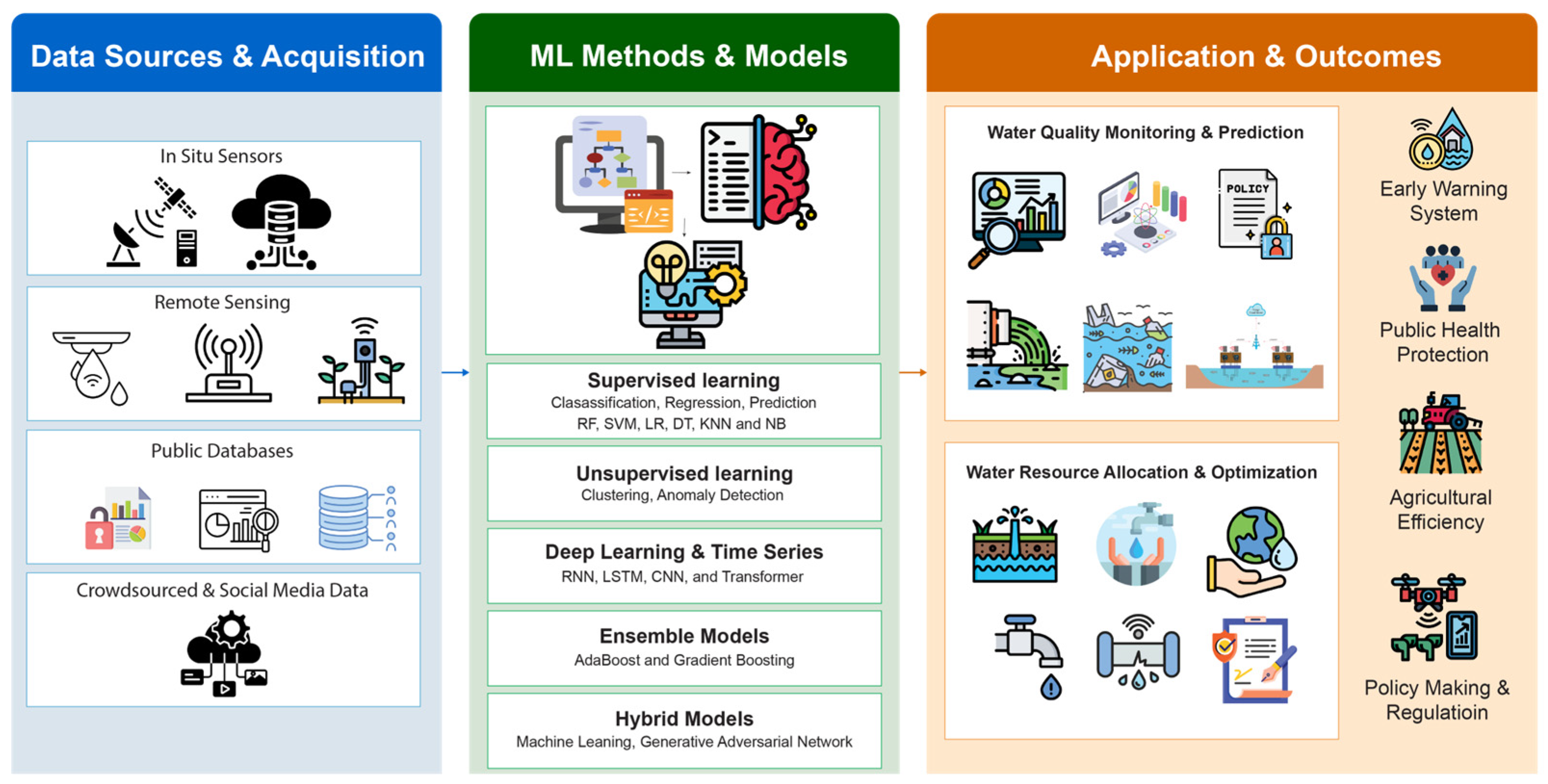
Figure 1 represents multiple data collecting methods, ML frameworks, applications and the key issues they address. By combining IoT-enabled data acquisition with advanced ML models in a unified framework, this research aims to contribute to more intelligent, adaptive, and sustainable water management, thereby improving public health, resource efficiency, and ecosystem resilience. All figures in this article were created using Adobe Illustrator 2020.

2. Applications of Artificial Intelligence and Technology

Artificial intelligence and advanced technologies have been widely applied across various sectors to enhance efficiency, accuracy, and decision-making. In water and environmental management scenarios, AI-driven systems support real-time monitoring, anomaly detection, and predictive analysis through the integration of sensor networks and machine learning models, represent at Table 1. These technologies enable intelligent assessment of water quality, early warning of extreme events, and the optimization of resource utilization. Beyond environmental applications, artificial intelligence is increasingly used in healthcare, agriculture, transportation, and smart cities to improve operational performance and sustainability. The combination of data-driven intelligence and automation facilitates adaptive, scalable, and cost-effective solutions for complex real-world challenges.

2.1. Water Quality Management Applications

Applications for water quality management are essential in guaranteeing security, sustainability, and effective usage of the available water resources. In drinking water quality monitoring, AIoT-based monitoring systems have been utilized to a great degree, with real-time sensor information supplemented by machine learning algorithms to ensure that the standards of public health are met and the threat of contamination is detected at the initial stage [21]. Within the aquaculture and fish farming industries, intelligent monitoring systems are used to monitor such water parameters as dissolved oxygen, temperature and ammonia to ensure optimal aquatic conditions and to increase production efficiency [22]. Likewise, AI-based water quality monitoring has been used in agricultural irrigation control to optimize the utilization of water, to avoid soil salinization, and to improve the productivity of crops [23]. Wastewater treatment and effluent monitoring are also implemented in AIoT in the industry, where autonomous and automatic controls, such as the concentration of pollutants and the need to comply with determined criteria, can be observed through this tool [24]. The above applications show how AIoT technologies can be used to achieve effective and information-driven water quality management in various industrial and environmental contexts.

2.1.1. Real-Time Water Quality Monitoring

Water quality monitoring in real-time has emerged as one of the most effective applications of AIoT in water quality management. The conventional water monitoring structures are overburdened by manual sampling and lab work, which are labor intensive, time consuming, very expensive, and often incapable of capturing sudden pollution events. Although recent advancements in technologies significantly improve the timeliness and automation of water monitoring systems, some complex chemical parameters still require laboratory analysis and estimation methods [24]. In contrast, IoT sensor networks integrated with intelligent ML algorithms allow uninterrupted, automatic, and high-resolution monitoring of water bodies, significantly improving response time and the strength of decision-making processes [25]. The introduction of the AIoT suggests potential opportunities that can be used in real-time water quality monitoring. However, existing studies on the ML-based water quality monitoring systems dwell on general ML algorithms without paying much attention to real-time and low-power realization applications in developing nations [26,27]. Water quality detectors on IoT are based on distributed sensor networks which are installed in rivers, lakes, reservoirs, pipelines, and treatment facilities. These sensors continuously measure some of the important physicochemical parameters which include pH, turbidity, temperature, dissolved oxygen (DO), electrical conductivity (EC), total dissolved solids (TDSs), oxidation-reduction potential (ORP), and biochemical oxygen demand (BOD) [28,29]. The collected data are transmitted in real time through wireless communication technologies, including Narrowband Internet of Things (NB-IoT), Long-Range Wide Area Network (LoRaWAN), Global System for Mobile Communications (GSM), and Wireless Fidelity (Wi-Fi), to centralized cloud-based platforms for storage, processing, and analysis. This continuous data stream is processed using machine learning models to identify the change and identify water quality status and forecast future trends. The RF, SVM, ANN and deep learning (DL) designs are created to understand the pattern of normal functioning and recognize abnormal events signifying the presence of contamination or system malfunction. These models make it possible to automatically generate alerts and decision-making in the form of a high level of accuracy distinguishing safe and unsafe water conditions [30,31]. More sophisticated real-time monitoring systems, such as Isolation Forest, Autoencoders, and statistical process control methods, are also used to detect anomalies like sudden spikes or deviations on sensor readings in sensor readings. Predictive analytics can also predict trends in water quality, which can be used to identify proactive perspectives on the change, potentially including chemical dosing response, filtration control, or flow redistribution. The combination of IoT and ML forms a smart ecosystem, which can learn and adapt to calibration and possess decentralized intelligence. These systems, together with cloud computing and edge computing platforms, minimize latency and guarantee speed in the generation of responses. The Water Quality Indices, risk level and trend analytics are visualized in real-time dashboards, which allows authorities and other concerned parties to make informed operational and policy decisions [28,29,32]. Altogether, IoT-based real-time water quality monitoring is more efficient, is less reliant on people, has a fast response system, and allows sustainable water resource management. This is a smart method which is needed to deal with the rising challenges related to urbanization, industrial pollution, climate variability, and the rising water demand in the world.

2.1.2. Water Potability and Water Quality Index Prediction

Water potability testing is an essential aspect of water quality management because it determines whether the water is safe for human consumption and suitable for other intended applications. Conventionally, potability assessment has depended on extensive lab testing and predetermined threshold-based measurements which are usually lengthy, expensive, and insufficient for timely decision-making. The combination of the concept of AIoT technologies has established a more efficient and intelligent solution to anticipating the potability of water and the calculation of the Water Quality Index (WQI) [33]. IoT sensor networks on current systems provide continuous monitoring of physicochemical parameters of pH, turbidity, dissolved oxygen (DO), total dissolved solids (TDSs), electrical conductivity (EC), biochemical oxygen demand (BOD), temperature, and oxidation-reduction potential (ORP). These parameters are input characteristics of ML models categorizing water into a set of categories of established quality [26,34]. WQI is calculated by the summing up the weighted values of parameters in one index that gives the overall health of the water body. Examples of the common supervised learning algorithms used in WQI prediction are RF, SVM, KNN, ANN, Gradient Boosting and deep neural networks (DNNs). These models can learn nonlinear relationships between input parameters and water quality labels that are more complex and are therefore more accurate in predicting the water quality than the conventional statistical techniques. Continuous WQI estimation is also commonly performed using regression-based methods, whereas the determination of categorical potability is done through classification models [34,35]. Moreover, the adoption of real-time IoT information enables real-time water quality, early warning of contamination and automated water treatment system decision systems. The frameworks of hybrid models of ML and domain knowledge such as WQI standards of WHO or local regulative organizations have demonstrated better reliability and interpretability [31,36]. Overall, an AIoT-enabled smart water potability evaluation system can be used to manage the water resources in a sustainable way as it allows implementing a quick response to any pollution outbreak and optimizing the work of water treatment.

2.1.3. Microbial and Chemical Contamination Detection

The potential hazards of microbiological and chemical pollution represent a significant threat to aquatic and human health. Standard methods of detection, including culture-based microbial testing and laboratory spectroscopy, typically take a great deal of time, specialized apparatus and trained human staff [37]. In an attempt to counter these constraints, biosensors that are enabled with IoT and linked with pertinent ML-derived analytical systems have become a potent solution to real-time contamination detection. Biosensing platforms and smart sensors have the capacity to detect biological and chemical signals correlating to specific contaminants [38]. Parameters monitored in these systems include a change in conductivity, fluorescence, electrochemical reactions and spectral absorbance increases. These signals are then interpreted to determine the presence and levels of inappropriate pollutants such as [39,40]:
  • Pathogenic bacteria like Escherichia coli (E. coli) and Salmonella.
  • Lead (Pb), mercury (Hg), cadmium (Cd), and arsenic (As) amongst heavy metals.
  • Pollutants in industries and pesticides.
  • The overeating of nutrients like nitrate and phosphates.
SVM and CNN as well as decision trees are popular classification models that differentiate between polluted water and samples that are safe based on sensor reactions. The regression models are used to estimate the level of contaminants, which allows the level of toxicity to be performed quantitatively. Deep learning methods also improve the process of detection by identifying some delicate patterns of signal which can hardly be identified by classical algorithms. Biosensors and ML can be used to monitor the contamination at fast speeds, automatically, and with high resolutions [41,42]. This method is one that greatly lowers the detection latency, promotes early warning mechanisms and enables quick corrective actions to be taken. Consequently, the water authorities can take preventive steps before the contamination escalates to high levels—hence, keeping the people safe and adhering to the set rules that govern the environment.

2.1.4. Harmful Algal Bloom Prediction

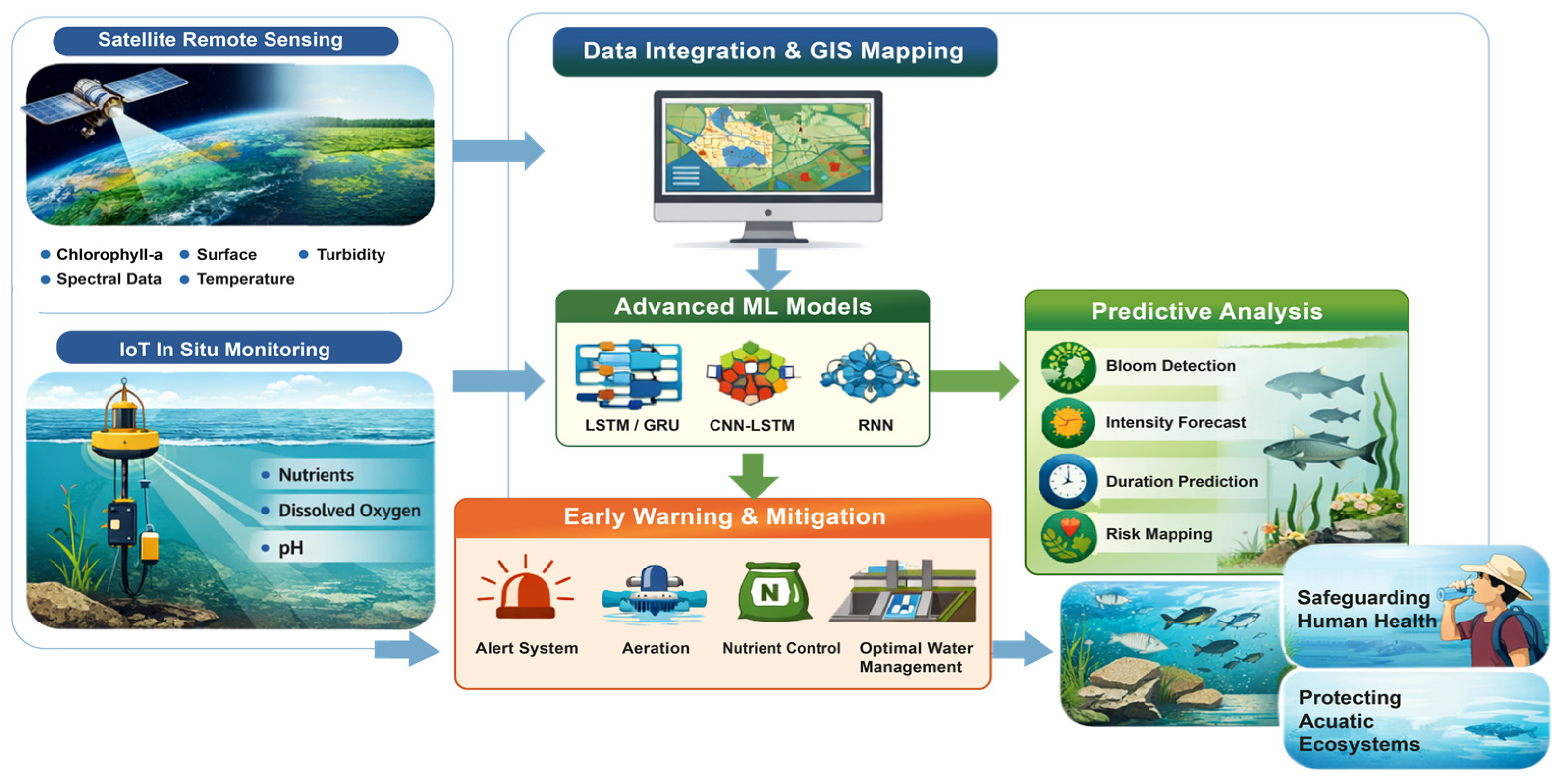
Harmful Algal Blooms (HABs) are excessive growths of algae that release toxins, degrade water quality, and disrupt aquatic ecosystems. These blooms are often triggered by a combination of nutrient enrichment (eutrophication), rising temperatures, stagnant water conditions, and climate variability. Existing HAB prediction systems combine remote sensing via satellites, in situ based on IoT monitoring, and highly advanced ML models to deliver precise and time-to-time forecasting. Figure 2 illustrates an integrated system combining satellite remote sensing and IoT-based in situ monitoring for comprehensive water quality assessment. Remote sensing systems can give extensive spatial data like chlorophyll-a concentration, the temperature of surface water, turbidity, and spectral reflectance, while IoT sensor networks provide supplementary in situ measurements including concentrations of nutrients, dissolved oxygen, and pH [43,44]. The LSTM, GRU, CNN-LSTM hybrid networks and recurrent neural networks (RNNs) are widely utilized to capture temporal dynamics and seasonal changes in the pattern of algal growth. They are models which utilize past information as well as the real-time information to forecast the bloom onset, intensity, duration, and spatial extension [45].
The use of spatial–temporal modeling methods also reinforces the accuracy of the prediction by combining both approaches with geographical information systems (GISs). This enables the creation of a map of bloom risk and identifying the hotspots, which may be taken up by target management [46]. Predictive intelligence is used to give early warnings, run reservoir activities in the most optimal way, and implement preventive actions like sealed aeration and reduction in nutrient loads. Integrating satellite data with IoT and ML, the HAB prediction systems enhance the environmental monitoring capacity and safeguard aquatic biodiversity as well as protecting human lives by proactively managing the water bodies [43,45]. Table 2 summarizes the implementation of AIoT technology in water quality management.

2.2. Water Resource Management Applications

Water resource management applications are interests in sustainable planning, allocation and the protection of water resources, a problem that is increasing under the environmental and socio-economic pressures. The recent research has shown that the use of AI and IoT technologies can be considered a significant enhancement of monitoring precision and decision-making in water resource systems. In a case in point, machine learning implementations like Random Forest, support vectors and LSTM networks have demonstrated the capability to predict hydrolog variables like river discharge, reservoir inflow and groundwater levels with high precision, thereby assisting in the optimization of reservoir functioning and flood predicting [8,47,48]. Moreover, AI-based predictive algorithms have also been used to forecast the water demand and irrigation control, which allow the allocation of the water resources effectively in both agricultural and urban systems [48]. In addition, dams and water bodies are equipped with integrated hydrological and water quality monitoring systems, which utilize IoT sensor networks and provide real-time information on the areas of rainfall, water level, water flow rate, and water ground depth, which enhance the early warning of the presence of drought and floods. Such systems nurtured with geographic information systems (GISs) and predictive analytics allow the mapping of spatial risks and promote climate-resilient planning design decision-making [49,50]. Altogether, the evidence in the literature suggests that AIoT-based water resource management systems can lead to the improvement of operational performance, predictability, and long-term water security, especially in the area where water shortages become more frequent and the climate more erratic.

2.2.1. Streamflow, Runoff, and Flood Forecasting

The precise forecasting of streamflow, surface runoff and floods forms the basis of water resource management, particularly towards curbing hydrological calamities as well as optimizing water resource distribution [51]. Hackneyed hydrological models empirically based rainfall runoff models and physically based simulations frequently rely on the extensive calibration of intricate parameters and assume a great deal of historical data. This makes them less effective in highly dynamic or data-scarce environments. It has been shown that the integration of IoT technology of sensing and ML models has crucially optimized predictive power by allowing real-time, adaptive, and data-driven hydrological prediction systems. The hydrological monitoring systems are based on IoT and deployed sensors in river basins, watersheds, and catchment areas to constantly record hydrometeorological data, such as volume of rainfall, water level, moisture in soil, velocity of flows, temperature, and humidity [52,53]. These streams of data are sent to central or cloud-based resources where ML models act on them to predict important hydrological variables, which include the discharge of rivers, the volumes of surface runoff, peak flows, and the association between rainfall and runoff. The most efficient ML models (LSTM network and GRU) are especially useful in hydrological prediction because they can be used to memorize temporal connections and nonlinearities in time-series data [50,54,55]. The recurrent neural networks are used to examine historical trends and real-time sensor measurements to forecast future streamflow dynamics and the intensity of floods with high accuracy. In the meantime, ensemble-based models such as Extreme Gradient Boosting (XGBoost) can perform with strong performance even in the context of complex interaction between inputs and heterogeneous datasets, thus fitting the requirements of rainfall runoff modeling and flood peak prediction [47,48,55]. Through the understanding of the dynamic, precipitation, watershed and runoff generation, ML-based systems can effectively capture this dynamic and therefore understand the precipitation and runoff in response to changing climatic conditions, and the opposite. The predictions enable the extreme flow conditions to be detected early before they escalate to a serious situation; thus, flood warnings can be issued with minimum loss of life and destruction of infrastructure. Moreover, the combination of ML algorithms with GISs promotes flood mapping and risk zoning in space, and the authorities can visualize the inundated zones and understand the risky zones. Together with real-time dashboards and alerts are the emergency response planning and decision-making of dam operations, flood control structures and urban drainage systems [49,50,56]. Overall, the combination of IoT sensing and ML-based forecasting is an effective framework that enables us to manage floods proactively, plan the watershed sustainably and develop the infrastructure resistant to climate changes. These intelligent systems improve prediction accuracy, reduce uncertainty, and contribute significantly to disaster risk reduction and resilient water resource planning.

2.2.2. Drought Monitoring and Groundwater Estimation

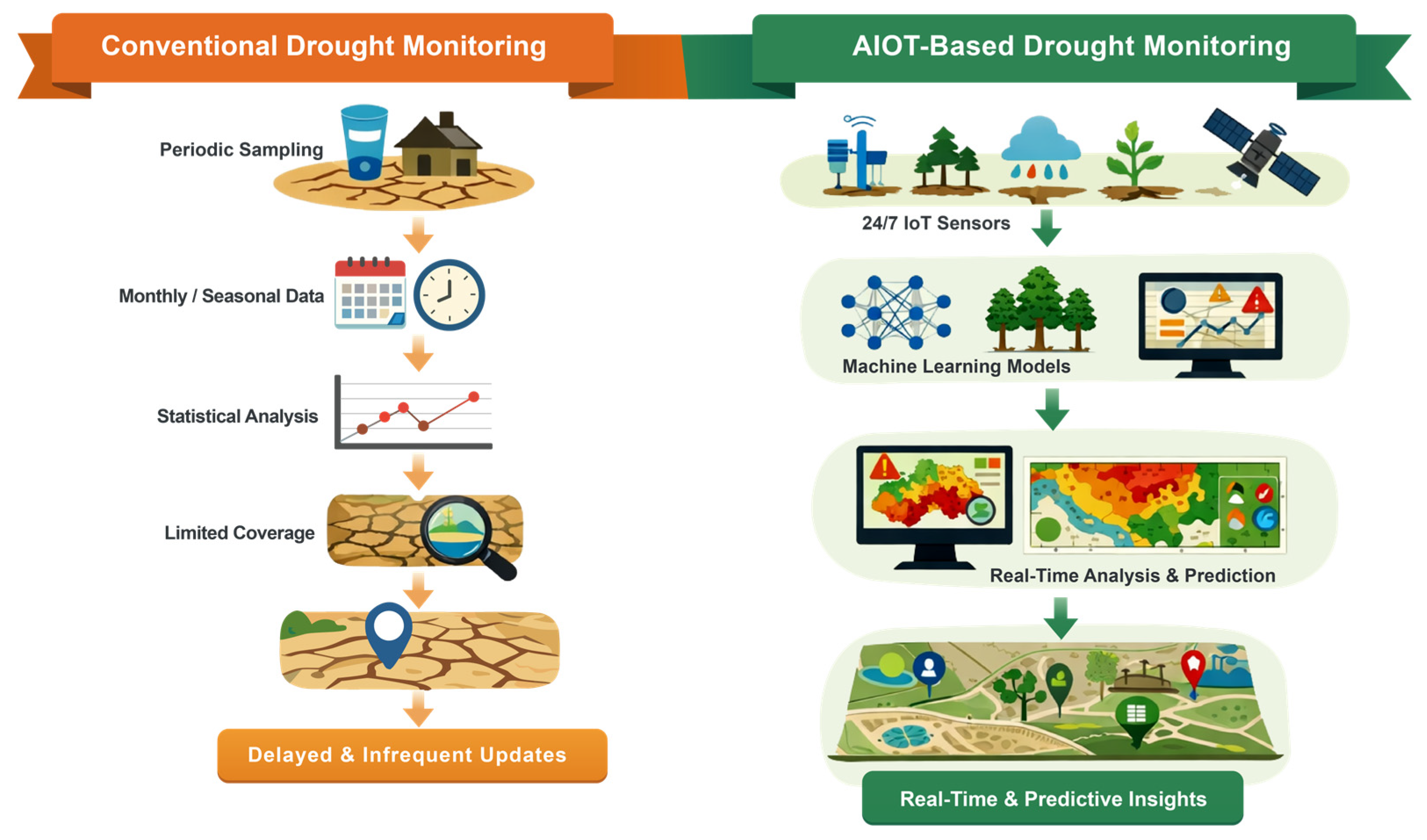
The process of monitoring drought and estimating the water levels on the ground are important factors in managing water resources sustainably, especially in those areas that are facing augmented water scarcity owing to environmental alterations, population increase and the overexploitation of aquatic formations [57]. Figure 3 illustrates the comparison of conventional and AIoT-based drought monitoring.
Conventional ways of drought assessment can be based on hydrological measurements and climatic indices at a period that might not be spatial enough nor be able to detect the swift alterations in subsurface water. Demonstrations of AIoT models can enhance the precision, timeliness, and accuracy of groundwater monitoring and drought predictive systems have been achieved with great success [58]. The IoT sensing infrastructure can be used to collect hydrological data and meteorological data 24/7 by relying on soil moisture sensors, groundwater level sensors (piezometers), automated weather stations, and remote sensing platforms. These systems observe intelligent parameters of soil moisture content, rainfall, temperature, evapotranspiration, relative humidity, and depth of groundwater table. The data obtained, in conjunction with historic hydrological data, results in a rich source of data for predictive modeling via MLs. The ANN, support vector regression (SVR), RF, LSTM and GB models are generally used as the ML algorithms to predict the level of groundwater and drought severity indices. Time-series models, like LSTM and GRU, are especially suitable at capturing long-term temporal dependencies and seasonal changes in the cycle of recharge and the depletion of ground water [59,60]. These models assist in predicting the future of the ground water exactly in accordance with the past patterns and the current environmental changes. The combination of ML and established drought indices, including Standardized Precipitation Index (SPI), Standardized Precipitation Evapotranspiration Index (SPEI), Palmer Drought Severity Index (PDSI), and Vegetation Health Index (VHI), is used to obtain a better drought severity assessment. ML models can process data in patterns of multidimensional parameters and produce spatial risk maps of drought and classify the drought into mild, moderate, severe, and extreme [61]. Moreover, the integration of ML-based models with GIS will enable a visual depiction of the areas of groundwater depletion and drought-sensitive areas. Such spatial intelligence can be used to make informed decisions in terms of the irrigation planning, eternity regulation and sustainability management of the aquifer. Predictive insights also facilitate the early warning systems and various water allocation strategies and evidence-based climate-resistant agricultural practices [62]. All in all, combining IoT-based surveillance with ML-driven predictive analytics, a smart environment of active drought control can be established. Such systems will minimize uncertainty in predictions in water availability and reinstate water conservation measures as well as the sustainability of ground water resources in the changing climatic conditions.

2.2.3. Smart Irrigation and Agricultural Water Use Optimization

The optimization of agricultural water through smart irrigation and agricultural companies is important in reducing water consumption, increasing crop yields, and fostering sustainable food production, especially in those areas where water is limited and climate changes are evident [63]. Traditional methods of irrigation are commonly based on set times or human judgment, and therefore, they commonly cause over-irrigation, under-irrigation, and ineffective utilization of the water resources [64]. AIoT technologies in irrigation management have been reduced to an intelligent, adaptive, and data-driven process. Smart irrigation systems that run on IoT operate on a network of distributed sensors and constantly measure vital environmental and soil metrics and conditions, such as soil moisture content, soil temperature, air temperature, relative humidity, solar radiation, rainfall, and wind velocity. These sensors do offer real-time information that shows the true status of the water of the soil and the crop set up. Collected data are sent to the cloud-based systems or edge computing systems where they are processed with ML models to identify the optimum irrigation needs [65,66]. The ML algorithms represent the main hydrological and agronomic variables of the soil moisture dynamics, rates of evapotranspiration, and demand for water by crops. Evapotranspiration (ET), which is an important parameter in irrigation planning, is estimated by training ML models on meteorological data and soil data, which is better than traditional empirical predictors like the FAO Penman Monteith equation. ML systems predict the amount of water, as well as when and where to apply it, because the systems learn the complex nonlinear relationships between the environmental variables and crop water requirements. More intricate algorithms like RF, SVR, ANN, LSTM and GB are regularly employed to produce intelligent irrigation plans. Such schedules respond in time to the current conditions of the field, the stage of crop growth, and the weather forecasts to reduce the amount of water that is lost to runoff, deep-rooted percolation, or the earth in the form of evaporation [67,68,69]. Moreover, intelligent irrigation systems combine ML forecasts with controller systems and allow real-time operation of brake pumps, valves, and sprinklers. It is a closed-loop system, which guarantees the accurate delivery of water, decreases the use of energy, and promotes environmentally friendly agricultural activities [70]. GISs are also used to develop irrigation planning through the capability of conducting the spatial analysis of soil heterogeneity and crop variability in the large farmlands [71]. Studies have shown that the use of support irrigation systems based on the IoT–ML-based systems has brought about notable advantages, which comprise water saving, harvest increase, better soil health, and drought resistance [72,73]. These systems play a role in contributing directly to precision agriculture and the sustainable management of water resources, which is why they are considered the indispensable instruments of the new agri-technological change.

2.2.4. Water Distribution Network Management

The effective operation of water distribution systems (WDNs) is required to reduce water losses, provide universal services, and equitable water supply both in cities and rural areas. Traditional methods of managing water networks rely commonly on reactive maintenance and manual control, which are unsuitable for handling growing system complexities, aging systems and growing demand pressures [74]. It has been demonstrated that AIoT has facilitated the creation of intelligent, real-time water distribution management systems, enhancing the efficiency of the operations and minimizing non-revenue water (NRW). Smart water distribution systems that are powered on by IoT utilize pressure sensors, flow meters, acoustic sensors and vibration detectors that are inserted at the points of pipeline networks, pumping stations, and storage tanks. They use sensors that capture real-time data regarding the flow rate, pressure changes, pipe vibrations and hydraulic uncertainties. For example, RF-based leak detection models integrated with acoustic and pressure sensors have achieved up to 92–96% detection accuracy and early detection lead times above conventional methods. In pilot deployments, IoT-enabled pressure monitoring combined with machine learning reduced NRW by 15–25% over one year [75,76]. The gathered information is sent to centralized systems where PCs can run ML algorithms to track the performance aspects of systems and detect abnormality. ML-based leakage detection systems use classification and anomaly detection methods to detect abnormal flow patterns, pressure drops and acoustic signals of pipeline leakages. RF, SVM, Isolation Forest, and Autoencoders are typical examples of algorithm types that are used to differentiate normal changes in the operational process and actual leaks. These systems will have great benefits in terms of leak detection at a very early stage, which will save the wastewater and repair expenses. This is a prediction method that is used to forecast the bursting of pipes by the use of predictive modeling which considers past failure information, pipe age, type of material used, pressure fluctuation, composition of soil as well as environmental factors and have demonstrated 80–90% reliability in forecasting pipe bursts and planning preventive maintenance, reducing catastrophic failures by up to 30%. The ML model’s preventive maintenance and replacement are planned as they predict the likelihood of premature pipe malfunction. This predictive maintenance plan will minimize disastrous failures and service failures [77,78]. Another major application is pressure optimization, during which the ML algorithms are used to dynamically control pressure to reduce the amount of stress exerted on pipelines, while providing sufficient water supply levels. Reinforcement learning and optimization algorithms close control valves and pressure-reducing stations to keep pressure areas optimal and save energy consumption of 10–18% and prolong the life of assets. Pump scheduling systems are based on the application of ML models to optimize the operational schedule based on demand prediction, electricity pricing, and hydraulic performance limits. Smart scheduling is energy efficient, saves on operation expenses at 8–15% and ensures that the pumps are not overused or damaged by the work [79]. The problem of water theft is discussed in the framework of ML tools that help to evaluate the trend of consumption and detect anomalies in consumption. These systems will help in protecting revenues by 12–20% and in making the systems transparent by comparing real-time consumption information with normal profiles that are projected and unauthorized water usage, meter tampering, and illegal connections [80]. The combination of ML and IoT will produce a smart water delivery system with the potential of real-time control, self-developing, and maneuverable control. Combined with Supervisory Control and Data Acquisition (SCADA) systems and GISs, it provides the means of full visualization, decision support, and automated response mechanisms [81,82]. This smart system improves the resilience of the system, resource utilization, and management of the urban water infrastructure.

2.2.5. Reservoir Operation and Storage Forecasting

Reservation operation and storage parameters are the essential parts of the integrated water resource management because the functions of reservoirs can be divided into the following: water supply, flood control, irrigation, hydropower generation, and other activities aimed at regulating the ecological flows. Conventional approaches to running reservoirs are frequently governed by rules or require relatively more deterministic hydrological forecasting approaches, which cannot be flexible in the highly variable climatic environment and unpredictable inflow patterns. AIoT technologies have also contributed greatly to predicting the inflows of the reservoir, storage processes, and evaporation losses, thus contributing to more efficient and adaptive reservoir operation policies [83,84]. Monitoring systems through IoT installed in the reservoir catchments constantly gather real-time information that includes rainfall, inflow discharge, water level, temperature, humidity, wind speed, and solar radiation. These parameters are necessary to model hydrodynamics in a reservoir, and estimate some of the most important processes in such situations, including the variability of inflows, surface evaporation, and water balance variation. Data gathered by the sensor are coupled with historical hydrological data to create a strong dataset on the prediction models based on ML [85]. The ANN, RF, SVR, XGBoost and LSTM networks are some of the widely used ML algorithms to predict inflow and the storage levels of a reservoir. Deep learning models, especially LSTM and GRU, are appropriately positioned to model nonlinear temporal relationships and seasonality on the inflow patterns. These models can forecast the behavior of the short- and long-term reservoir behavior accurately such as daily, weekly, seasonal or storage variations [86,87]. Another important aspect in the management of the reservoirs is their predictability through evaporation, since the loss of water due to evaporation can greatly influence the supply of water, particularly in the arid and semi-arid areas. ML models estimate the rates of evaporation based on meteorological statements, including temperature, relative humidity, wind speed, and sun rays, which is superior to the traditional empirical equations because it can adapt to the complex processes in the atmosphere [88]. Combining reservoir operation policies with ML predictions allows the decision-makers to make gate release decisions, keep flood control buffers, and have upon-demand storage, as well, during dry seasons. Reservoir control is further optimized using optimization methods and techniques of reinforcement learning, which adaptively vary the operational rules according to the predicted inflow and demand trends. This has the effect of enhancing efficiency in water allocation, lowering the chances of flood, and increasing the drought resilience [89]. Additionally, linking the ML-based prediction to GIS and SCADA platforms will allow visualizing the conditions of the reservoir in real time and making automated decisions. The scenario-based simulation enables the operator to assess the effect of alternative release measures across different hydrological environments that will support sound management of risks at the reservoir [90,91]. Altogether, the ML and IoT usage as a tool of the reservoir operation and storage forecasting introduces a databased tool of sustainable and adaptable management of reservoirs. These smart systems will make forecasting more precise and operational capacity more reliable, and this will also lead to climate-resilient water infrastructure planning. The examples listed in Table 3 highlight the diverse approaches and technological frameworks currently applied in the water resource management field.

2.3. AIoT Solutions for Water Management Worldwide

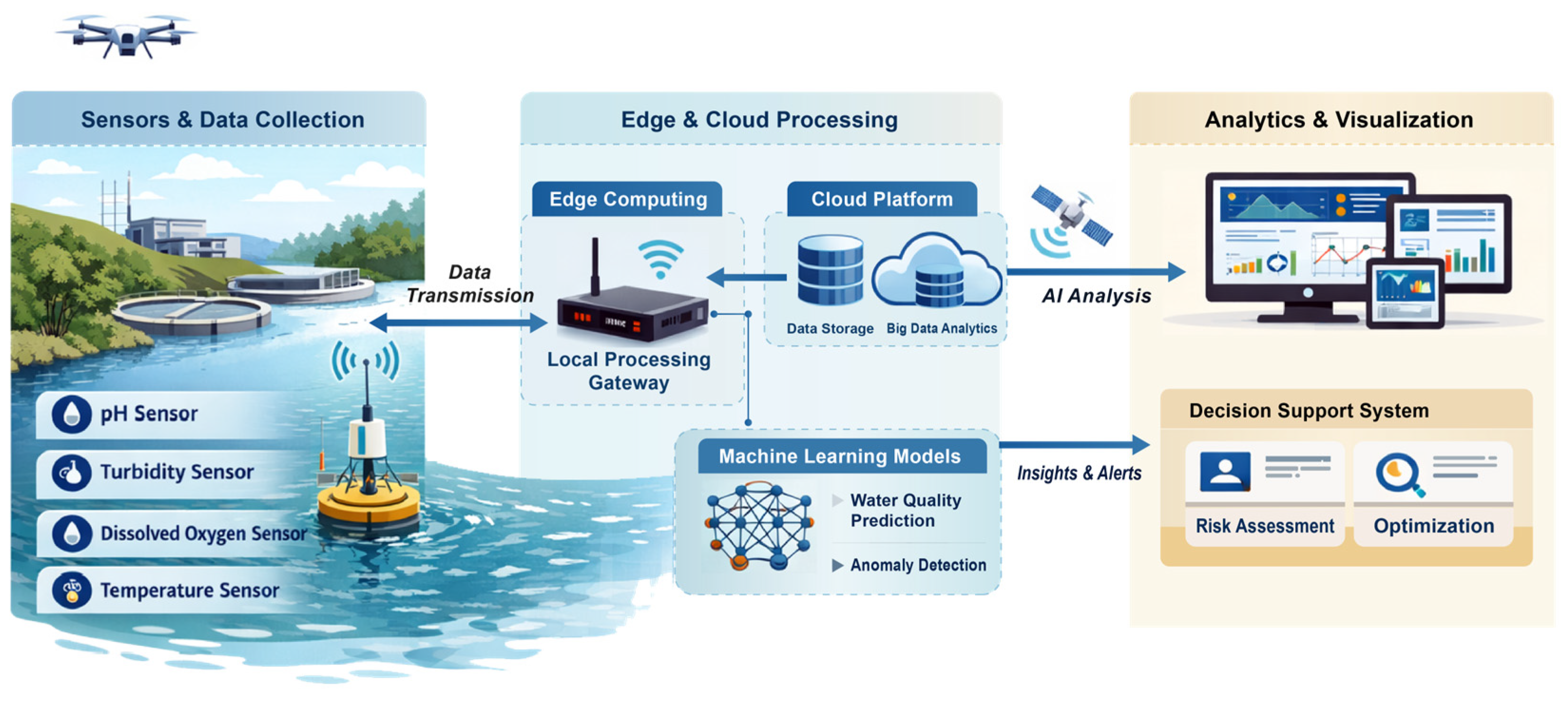
Artificial Intelligence of Things (AIoT) technologies have been deployed by several countries to enhance the monitoring of water quality, resource management, and the efficiency of infrastructure. Various countries have implemented smart water management systems that integrate IoT sensor networks, advanced communication technologies, cloud computing platforms, and machine learning algorithms to improve monitoring accuracy, operational efficiency, and decision-making capabilities. Figure 4 depicts the general AIoT architecture.
For example, the Intelligent Water Management system installed in the city of Dublin, Ireland by IBM incorporates IoT sensors and predictive analytics to track the water distribution systems and locate leakages in real time. Similarly, in Singapore, the PUB is the smart water grid, the National Water Agency of Singapore, which operates huge sensor networks and data analytics platforms to observe the water quality, the amount of pressure, and the pipeline integrity of the water supply system of the city-state [91]. IoT sensors, big data analytics, and AI-based forecasting models have been integrated in large-scale smart water management systems in China to track water pollution in rivers and optimize urban water distribution networks in big cities like Shanghai. DC Water utility in Washington, D.C, in the United States, has implemented sensor networks and predictive analytics to identify failures of pipes and enhance monitoring in water quality in the urban infrastructure. In the meantime, the example of European cities, including Barcelona, Spain, where smart water platforms with the combination of IoT sensors, edge computing, and AI-based data analysis have been implemented, can serve to improve effectiveness in water distribution and lessen water losses [92]. These global implementations demonstrate that AIoT technologies can support real-time monitoring, predictive maintenance, early contamination detection, and resource management, pointing to the increasing importance of their application in the next-generation smart water systems across the world.
Table 4 demonstrates a comprehensive quantitative analysis of AIoT-based water management models by which the advanced machine learning and deep learning methods meet the level of a high predictive performance in different applications. The majority of models give an accuracy between 85% and 99.6%, and ensemble models like Gradient Boosting, Random Forest and XGBoost tend to be more successful than the older approaches to machine learning. Measures of error, such as RMSE and MSE, are characterized by a relatively small value (0.018–0.48), which means that the predictive precision of the model and the model itself are strong. On the same note, coefficients of determination (R2) lie between 0.85 and 0.99, indicating the strength and validity of these models in explaining these complex water quality patterns. Moreover, AIoT integration allows real-time monitoring, which is created by uniting IoT sensors, cloud computing, and machine learning algorithms, which are much more responsive and automated than traditional methods of monitoring. The systems have found effective application in various fields such as water quality evaluation, flood forecasting, ground water and smart irrigation. Multiparameter datasets such as pH, turbidity, dissolved oxygen, total dissolved solids, and temperature are very important in promoting the accuracy of predictions. However, there are a few challenges that are encountered despite these developments, such as sensor dependency, the costliness of implementation, and data quality and standardization concerns. On balance, the results indicate that AIoT-based solutions offer a reliable, scalable, and precise model of the contemporary water resource management that still requires additional research to explain the limitations to its practical implementation and enhance the interoperability of the systems.

3. Challenges in AIoT-Based Water Management

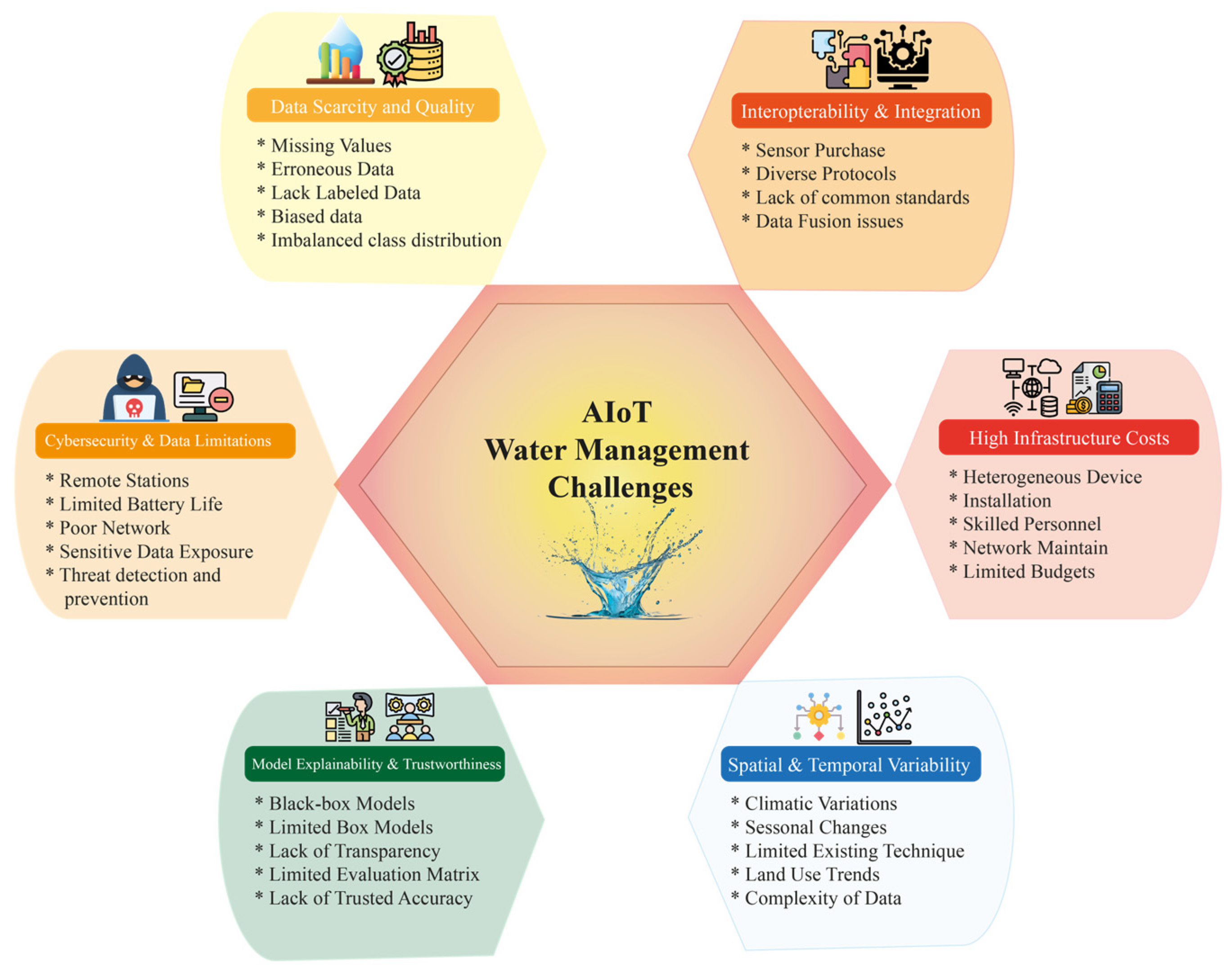
This section critically analyzes the key technical, operational, and institutional issues associated with the integration of AIoT technologies in water quality monitoring and water resource management systems. Although these technologies have great potential to transform water management practices, they have several obstacles that influence performance, scalability, and reliability as well as real-world deployment. Figure 5 and Table 5 represent the major obstacles encountered in applying AIoT techniques in water management.

3.1. Data Scarcity and Quality Issues

The lack of high-quality labeled datasets remains one of the major drawbacks of ML-based water management systems integrated with IoT technology. In many regions, continuous and long-term water quality records are unavailable, especially in rural and developing areas where water monitoring infrastructure and observation stations are limited. This scarcity of reliable data restricts the capability of data-driven models to learn strong patterns and generalize effectively across diverse hydrological situations [107]. Moreover, IoT sensor data are affected by quality-related issues, including missing values, signal noise, sensor drift, and unreliable measurements caused by environmental interference, hardware degradation, and improper calibration. The data imperfections may lead to biased predictions, reduced model accuracy and unreliable decision-making, which are especially critical in applications such as water potability assessment, and flood forecasting [108]. These challenges are not unique to machine learning approaches but are inherent to water monitoring systems in general. Therefore, greater efforts are required to optimize distributed sensor network design, improve sensor calibration procedures, and implement robust data quality control and validation strategies. These measures can enhance data reliability and support more accurate analytical models for effective water quality monitoring and resource management.

3.2. Interoperability and Integration Challenges

The interoperability of heterogeneous IoT devices and sources of information is still a major technical challenge. Frequently, water monitoring systems are based on an assortment of sensors of dissimilar manufacturers utilizing a combination of communication protocols, data formats, and transmission conventions. The absence of common standards will prevent the smooth interoperability of devices, databases, cloud environment and ML analytics engines. This fragmentation complicates real-time data fusion and impedes the creation of unified monitoring frameworks. Consequently, large-scale water resource management strategies are constrained because it becomes hard to facilitate system scalability and sharing data on a cross-regional basis. The solution to this problem is to develop the so-called standardized architecture and open data protocols [109,110].

3.3. High Costs of IoT Infrastructure

The implementation and operation of IoT-based water monitoring infrastructure requires financial investment. Associated costs involve sensor purchase, installation, data transmission network, cloud storage, power distribution systems, and maintenance. As an illustration, commercial off-the-shelf multiparameter water quality devices like Hanna 9829 sensors can be priced at USD 1000 per sensor, and less expensive IoT-compatible sensors of single parameters may range between USD 50 and 500 (depending on type and quality) [111]. Moreover, the system upgrading, troubleshooting, and sensor calibration demand skilled technical personnel. These huge operation costs are a significant limitation to developing regions where the limited budgets are a problem to the implementation of advanced monitoring technologies [112]. As a result, most areas still use manual sampling and conventional methods of monitoring, thus making the possible importance of the optimization implemented by ML less significant.

3.4. Pollutant Source Tracing and Inversion

Pollutant source tracing and inversion represent a critical challenge in water quality monitoring and management systems. In many real-world scenarios, water pollution originates from multiple point and non-point sources, including industrial discharge, agricultural runoff, domestic wastewater, and accidental chemical spills. Identifying the location, intensity, and timing of these pollution sources is essential for effective environmental management and timely mitigation of contamination events. However, pollutant source tracing is inherently complex due to the dynamic nature of hydrological processes, including water flow, dispersion, dilution, and chemical transformation. In many cases, monitoring data collected by distributed sensors only capture downstream pollutant concentrations, making it difficult to accurately infer the original source location and emission characteristics. Advanced data-driven approaches, including machine learning models, spatio-temporal analysis, and inverse modeling techniques, have been explored to address this problem. These methods can analyze sensor data patterns and hydrological conditions to estimate potential pollution sources and their propagation pathways. Nevertheless, challenges remain due to limited sensor coverage, data uncertainty, and the high computational complexity of inversion algorithms. Therefore, improving sensor network design, integrating hydrodynamic models with AI techniques, and developing robust source identification algorithms remain important research directions for practical AIoT-based water monitoring systems [113,114].

3.5. Model Explainability and Trustworthiness

Many state-of-the-art machine learning systems, particularly deep learning models, often function as black-box models whose internal decision-making processes are difficult to interpret. This lack of transparency can reduce the level of trust among water authorities, environmental regulators, and policymakers who require clear explanations when making critical decisions, such as issuing pollution warnings or allocating water resources [115]. To address this limitation, explainable artificial intelligence (XAI) techniques, including SHAP (SHapley Additive exPlanations), LIME (Local Interpretable Model-agnostic Explanations), and attention mechanisms, have been explored to improve model interpretability. In recent years, hybrid modeling approaches that couple mechanism-based hydrological models with data-driven machine learning techniques have gained increasing attention. These integrated frameworks leverage the physical interpretability of process-based models while benefiting from the predictive capability of machine learning algorithms. By combining domain knowledge with data-driven learning, such hybrid models can improve transparency, enhance prediction reliability, and provide more trustworthy decision support tools for water resource management and environmental monitoring systems. However, achieving an optimal balance between model accuracy and interpretability remains a challenge, particularly in safety-critical water management applications [116,117].

3.6. Cybersecurity and Data Privacy

Smart water management systems that use IoT technologies are becoming more susceptible to cybercrimes such as hacking, data manipulation, ransomware exploitation, and exception. Data that are compromised results in inaccurate reports on the water quality, wrongful choice of operations and even health risk to the people. Also, water surveillance data can provide sensitive data on infrastructure or human trends of use. Secure ways of transmission, encryption systems, and solid access control methods are crucial to the integrity of the system and assurance in the minds of people [114,118,119].

3.7. Power and Connectivity Limitations

Remote water monitoring stations are mostly subjected to poor environmental factors and minimal access to constant power sources and communication channels. The problems are that IoT devices installed in such places have limited battery life, inconvenient issues of network connection, and original breakdown caused by the harsh environment. These constraints lead to some intermittencies in data transmission, failure on real-time monitoring, and lowering the reliability of the system [120]. Possible solutions are sensor design with low power and high efficiency, low-power communication protocols like LoRaWAN, and solar-powered systems, though they need further investment and technical skills [121]. AIoT is limited to interrelated issues such as data scarcity, infrastructure expenses and interoperability, model interpretability, the risk of cybersecurity, and operational domains in a remote setting that limit its utility in water quality and water resource management. To solve these problems, there is need to have interdisciplinary effort, policy, intervention on a policy level, better technical standards and spending on resilient infrastructure which will provide sustainability and trust in the smart water management system.

4. Research Gaps in AIoT-Based Water Management

Although the current technologies of Artificial Intelligence of Things (AIoT) in the domain of water quality monitoring and water resource management have shown remarkable progress, a number of critical research gaps need to be bridged to enable their effective application at scale and over their open ends. The development of AI-driven smart water management systems is full of potential gaps that researchers must address to provide reliable services with limited data conditions. Most of the current research uses large labeled datasets to train deep learning models, but again, these datasets are inaccessible in practice water monitoring for a real-world environment, especially in rural or developing environments. Although these new methods, like few-shot learning, transfer learning, and self-supervised learning, have promise, their use in the context of water quality prediction is only beginning to be examined, and more research is needed to enhance the model generalization to different hydrological conditions.
The other significant research gap is related to integrating filing heterogeneous data sources. The existing AIoT systems are usually based on isolated sets of data that are retrieved by each sensor or monitoring station. Nonetheless, water management necessitates the consolidation of various streams of data, such as IoT sensor data, satellite sounds, meteorological and hydrological models, and historical environmental databases. One of the open research problems is how to develop coherent data fusion frameworks that are capable of integrating these disparate data sources. Moreover, the interpretability of the model and decision support capabilities are also unexploited. Though the explainable artificial intelligence (XAI) methods have been proposed to explain machine learning forecast, there is still a lack of an integrated application into the practice of water management. It is required to have powerful interpretable AI to deliver clear, consistent, and actionable information to policy makers, water management, and environmental regulators.
The other significant gap is related to the implementation of AIoT systems in environments with limited resources. Most of the proposed architectures have only been tested in regulated laboratory settings or through a simulation environment, but when it comes to a real deployment environment, issues like unreliable network connectivity, sensor bias, power constraints, and environmental factors come into play. Further studies are needed to develop resilient architectures that integrate the edge computing technology, adaptive learning models, and energy-efficient sensor networks to guarantee robust, enduring functioning. Moreover, AIoT schemes that are conscious of security and privacy are still in their infancy. With the growing integration of water infrastructure, there is a high probability of cyberattacks, data manipulation, and unauthorized access. Even though some progress has been initiated in the development of secure communication protocols and blockchain-based monitoring systems, the lack of comprehensive security frameworks combining the use of machine learning, encryption systems, and decentralized systems like federated learning remains.
Finally, there is a dearth of scalable and integrated smart water management solutions that can support widespread deployments throughout an area or nation. Only particular case studies or pilot projects are the main focus of the current research. Future studies should involve scalable architecture to integrate AI analytics, digital twin, edge–cloud computing, and standardized IoT frameworks to realize real-time, data-driven water governance, at regional and national scales. The interdisciplinary cooperation between artificial intelligence specialists, hydrology experts, environmental scientists, specialists in communication networks, and public policy experts will be necessary to address these research gaps. The development of scalable, explainable, secure, and data-efficient AIoT systems will be important to close the gap between research available experimentally and the application of smart water management in real-life use.

5. Future Trends in AIoT-Based Water Management

  • The latest developments in the fields of AIoT continually transform water quality and water resource management. Among the most promising advancements is the development of digital twin systems that model and replicate entire water networks in virtual environments by integrating real-time data from IoT platforms. The digital twins provide the opportunity to dynamically simulate the water flows, the spread of contamination, and infrastructure functionality, giving the operators a chance to experiment with the management options, anticipate risks, and optimize operations without interfering with the physical systems.
  • The scarcity of data is also a challenge in most rural and developing areas, where they are in most cases deficient in the long-term infrastructure necessary to monitor ongoing processes. In this regard, few-shot and zero-shot learning paradigms are becoming a focus. Such methods enable ML models to use limited labeled data or even unseen labels, making them highly relevant in the context of early contamination detection, water quality classification, and hazard in areas where monitoring networks are sparsely distributed.
  • Moreover, federated learning presents a privacy-preserving, decentralized training paradigm that allows various stakeholders to improve ML models without disclosing raw data. This approach preserves sensitive environmental, industrial and infrastructural information while improving data security and leveraging shared model intelligence for enhanced water management applications. When combined with federated learning, Internet of Things, satellite remote sensing, and unmanned aerial vehicle (UAV)-based hyperspectral observation significantly improve environmental monitoring capabilities. The integration of these heterogeneous data sources enables ML models to produce very accurate, spatiotemporally resolved estimates of water quality, algal blooms, nutrient dynamics, and hydrological stress measures.
  • In addition, XAI plays a significant role in ensuring transparency, accountability, and regulatory compliance as intelligent systems grow in complexity. SHAP, LIME, and attention mechanisms enable operators and policymakers to interpret the predictions of the models, justify operational decisions, and trust autonomous systems. Consequently, autonomous smart water systems are being developed, capable of self-learning, self-correcting models in response to sensor driftage or anomaly, and automatically refining predicted values. These capabilities raise reliability and lower operational control as well as facilitating proactive management of water in dynamic environmental conditions.
  • Lastly, edge computing is emerging as one of the enabling technologies for real-time analytics in the field of IoT-based water systems. Edge computing lowers latency by placing ML functionality directly on an IoT node or local gateway, providing ultra-fast contamination response times and reducing reliance on centralized cloud systems. This distributed intelligence model enables prompt decision-making in emergent circumstances and effectively controls the bandwidth and computer resources. On the whole, the intersection of digital twins, data-efficient ML paradigms, federated learning, multi-source data fusion, XAI, and autonomous systems with edge computing is poised to transform water management. These approaches address key issues such as data scarcity, privacy, real-time responsiveness, transparency, and operational efficiency, leading to reliable, adaptable, and sustainable water infrastructure worldwide. Table 6 summarizes the future trends of AIoT technology in water management.

6. Conclusions

AIoT has revolutionized water quality monitoring and water resource management, providing unprecedented opportunities for real-time monitoring, predictive analytics, and intelligent decision-making. The integration of ML models with IoT sensor networks, remote sensing and edge computing enables accurate water potability assessment, contamination detection, hydrological prediction and optimized water distribution. Cutting-edge technologies, including digital twins, autonomous systems, federated learning, and explainable AI, have the potential to improve the resiliency, flexibility, and transparency of the systems. Despite these advancements, a range of significant challenges still persist, including limited data availability, data quality issues, inadequate interoperability, high infrastructure costs, lack of model explainability, cybersecurity vulnerabilities, and connectivity limitations in remote deployment environments. Addressing these challenges is critical to achieving sustainable, reliable, and scalable smart water systems. Key research gaps include the development of robust models to overcome data scarcity and regulations, the provision of operations that are not only regulatory compliant but also privacy-preserving, predictive and self-flexing autonomous systems capable of responding in real-time to dynamic environmental conditions. Future studies need to concentrate on integrating multi-source data, improving model intelligibility, implementing edge and autonomous systems, and establishing standardized frameworks for interoperability in IoT. With the systematic response to these issues and the adaptation to evolving trends, AIoT-enabled water management systems could contribute to significantly better water security, population health, and sustainability in diverse environmental and socio-economic settings.

Author Contributions

A.R.: Conceptualization, methodology, software, validation, formal analysis, investigation, resources, data curation, and writing—original draft preparation. G.C.C. and Y.H.N.: supervision, writing—review and editing, visualization, conceptualization, investigation, project administration, funding acquisition. All authors have read and agreed to the published version of the manuscript.

Funding

This research received no external funding.

Data Availability Statement

No new data were created or analyzed in this study. Data sharing is not applicable to this article.

Acknowledgments

During the preparation of this manuscript, the authors used generative AI tools such as Grammarly (v.1.2.248.1873) and Quillbot (v.4.73.0) to assist with language refinement, grammar checking, and improving clarity of expression. All content was carefully reviewed and verified by the authors to ensure accuracy and originality. The authors take full responsibility for the final content of the manuscript. The authors would like to express their sincere gratitude to their respective institutions for providing research support and facilities. The authors also thank the editor and reviewers for their valuable comments and suggestions, which have significantly improved the quality of this manuscript.

Conflicts of Interest

The authors declare that they have no known competing financial interests or personal relationships that could have appeared to influence the work reported in this paper.

References

  1. Mohan, S.; Kumar, B.; Nejadhashemi, A.P. Integration of Machine Learning and Remote Sensing for Water Quality Monitoring and Prediction: A Review. Sustainability 2025, 17, 998. [Google Scholar] [CrossRef]
  2. Irwan, D.; Ibrahim, S.L.; Latif, S.D.; Winston, C.A.; Ahmed, A.N.; Sherif, M.; El-Shafie, A.H.; El-Shafie, A. River Water Quality Monitoring using Machine Learning with Multiple Possible In-Situ Scenarios. Environ. Sustain. Indic. 2025, 28, 100620. [Google Scholar] [CrossRef]
  3. Frincu, R.M. Artificial intelligence in water quality monitoring: A review of water quality assessment applications. Water Qual. Res. J. 2025, 60, 164–176. [Google Scholar] [CrossRef]
  4. Baena-Navarro, R.; Carriazo-Regino, Y.; Torres-Hoyos, F.; Pinedo-López, J. Intelligent prediction and continuous monitoring of water quality in aquaculture: Integration of machine learning and Internet of Things for sustainable management. Water 2025, 17, 82. [Google Scholar] [CrossRef]
  5. Chen, L.; Liu, L.; Liu, S.; Shi, Z.; Shi, C. The Application of Remote Sensing Technology in Inland Water Quality Monitoring and Water Environment Science: Recent Progress and Perspectives. Remote Sens. 2025, 17, 667. [Google Scholar] [CrossRef]
  6. Jan, F.; Min-Allah, N.; Düştegör, D. Iot based smart water quality monitoring: Recent techniques, trends and challenges for domestic applications. Water 2021, 13, 1729. [Google Scholar] [CrossRef]
  7. Zulkifli, C.Z.; Garfan, S.; Talal, M.; Alamoodi, A.H.; Alamleh, A.; Ahmaro, I.Y.; Sulaiman, S.; Ibrahim, A.B.; Zaidan, B.B.; Ismail, A.R.; et al. IoT-based water monitoring systems: A systematic review. Water 2022, 14, 3621. [Google Scholar] [CrossRef]
  8. Essamlali, I.; Nhaila, H.; El Khaili, M. Advances in machine learning and IoT for water quality monitoring: A comprehensive review. Heliyon 2024, 10, e27920. [Google Scholar] [CrossRef] [PubMed]
  9. Drogkoula, M.; Kokkinos, K.; Samaras, N. A comprehensive survey of machine learning methodologies with emphasis in water resources management. Appl. Sci. 2023, 13, 12147. [Google Scholar] [CrossRef]
  10. Karim, M.R.; Syeed, M.M.; Rahman, A.; Ayaz Rabbani, K.; Fatema, K.; Khan, R.H.; Hossain, M.S.; Uddin, M.F. A Comprehensive Dataset of Surface Water Quality Spanning 1940–2023 for Empirical and ML Adopted Research. Sci. Data 2025, 12, 39. [Google Scholar] [CrossRef]
  11. Deng, Y.; Zhang, Y.; Pan, D.; Yang, S.X.; Gharabaghi, B. Review of recent advances in remote sensing and machine learning methods for lake water quality management. Remote Sens. 2024, 16, 4196. [Google Scholar] [CrossRef]
  12. Pandya, H.; Jaiswal, K.; Shah, M. A comprehensive review of machine learning algorithms and its application in groundwater quality prediction. Arch. Comput. Methods Eng. 2024, 31, 4633–4654. [Google Scholar] [CrossRef]
  13. Dharmarathne, G.; Abekoon, A.M.; Bogahawaththa, M.; Alawatugoda, J.; Meddage, D.P. A review of machine learning and internet-of-things on the water quality assessment: Methods, applications and future trends. Results Eng. 2025, 26, 105182. [Google Scholar] [CrossRef]
  14. Cojbasic, S.; Dmitrasinovic, S.; Kostic, M.; Turk Sekulic, M.; Radonic, J.; Dodig, A.; Stojkovic, M. Application of machine learning in river water quality management: A review. Water Sci. Technol. 2023, 88, 2297–2308. [Google Scholar] [CrossRef] [PubMed]
  15. Talukdar, S.; Bera, S.; Naikoo, M.W.; Ramana, G.V.; Mallik, S.; Kumar, P.A.; Rahman, A. Optimisation and interpretation of machine and deep learning models for improved water quality management in Lake Loktak. J. Environ. Manag. 2024, 351, 119866. [Google Scholar] [CrossRef]
  16. Jayaraman, P.; Nagarajan, K.K.; Partheeban, P.; Krishnamurthy, V. Critical review on water quality analysis using IoT and machine learning models. Int. J. Inf. Manag. Data Insights 2024, 4, 100210. [Google Scholar] [CrossRef]
  17. Krishnan, S.R.; Nallakaruppan, M.K.; Chengoden, R.; Koppu, S.; Iyapparaja, M.; Sadhasivam, J.; Sethuraman, S. Smart water resource management using Artificial Intelligence—A review. Sustainability 2022, 14, 13384. [Google Scholar] [CrossRef]
  18. Helaly, M.A.; Rady, S.; Mabrouk, M.; MAref, M.; Villarroya, S.; Cotos, J.M.; Mera, D. Advancements in water quality prediction: A practical review of machine learning and deep learning approaches. Clust. Comput. 2025, 28, 598. [Google Scholar] [CrossRef]
  19. Bhardwaj, A.; Dagar, V.; Khan, M.O.; Aggarwal, A.; Alvarado, R.; Kumar, M.; Irfan, M.; Proshad, R. Smart IoT and machine learning-based framework for water quality assessment and device component monitoring. Environ. Sci. Pollut. Res. 2022, 29, 46018–46036. [Google Scholar] [CrossRef] [PubMed]
  20. Ooko, S.O.; Cheptegei, L.; Karume, S.M. Application of machine learning for real-time water quality monitoring in developing countries: A review. Sustain. Futures 2025, 10, 100984. [Google Scholar] [CrossRef]
  21. Haroon, M.; Sebastian, C.J.; Nayak, J. AIoT-Based Scalable Water Quality Monitoring and Prediction System. In Proceedings of the International Conference on Information and Communication Technology for Intelligent Systems; Springer Nature: Singapore, 2025; pp. 1–9. [Google Scholar]
  22. Nayoun, M.N.; Hossain, S.A.; Rezaul, K.M.; Siddiquee, K.N.; Islam, M.S.; Jannat, T. Internet of Things-driven precision in fish farming: A deep dive into automated temperature, oxygen, and pH regulation. Computers 2024, 13, 267. [Google Scholar] [CrossRef]
  23. Behzadipour, F.; Ghasemi Nezhad Raeini, M.; Abdanan Mehdizadeh, S.; Taki, M.; Khalil Moghadam, B.; Zare Bavani, M.R.; Lloret, J. A smart IoT-based irrigation system design using AI and prediction model. Neural Comput. Appl. 2023, 35, 24843–24857. [Google Scholar] [CrossRef]
  24. Chavhan, N.; Bhattad, R.; Khot, S.; Patil, S.; Pawar, A.; Pawar, T.; Gawli, P. APAH: An autonomous IoT driven real-time monitoring system for Industrial wastewater. Digit. Chem. Eng. 2025, 14, 100217. [Google Scholar] [CrossRef]
  25. Durgun, Y. Real-time water quality monitoring using AI-enabled sensors: Detection of contaminants and UV disinfection analysis in smart urban water systems. J. King Saud Univ.-Sci. 2024, 36, 103409. [Google Scholar] [CrossRef]
  26. Sharma, N.; Sharma, R. Real-time monitoring of physicochemical parameters in water using big data and smart IoT sensors. Environ. Dev. Sustain. 2024, 26, 22013–22060. [Google Scholar] [CrossRef]
  27. Singh, R.; Baz, M.; Gehlot, A.; Rashid, M.; Khurana, M.; Akram, S.V.; Alshamrani, S.S.; AlGhamdi, A.S. Water quality monitoring and management of building water tank using industrial internet of things. Sustainability 2021, 13, 8452. [Google Scholar] [CrossRef]
  28. Rai, S.; Poduval, D.S.; Anand, U.; Verma, V.; Banerjee, S. An effective smart water quality monitoring and management system using IoT and machine learning. SN Comput. Sci. 2024, 5, 846. [Google Scholar] [CrossRef]
  29. El-Shafeiy, E.; Alsabaan, M.; Ibrahem, M.I.; Elwahsh, H. Real-time anomaly detection for water quality sensor monitoring based on multivariate deep learning technique. Sensors 2023, 23, 8613. [Google Scholar] [CrossRef]
  30. Lokman, A.; Ismail, W.Z.; Aziz, N.A. A review of water quality forecasting and classification using machine learning models and statistical analysis. Water 2025, 17, 2243. [Google Scholar] [CrossRef]
  31. Vicente, E.C.; Silva, L.A.; da Rocha Fernandes, A.M.; Parreira, W.D. A Structured Review of IoT-Based Embedded Systems and Machine Learning for Water Quality Monitoring. Appl. Sci. 2025, 15, 11719. [Google Scholar] [CrossRef]
  32. Shahra, E.Q.; Wu, W.; Basurra, S.; Aneiba, A. Intelligent edge-cloud framework for water quality monitoring in water distribution system. Water 2024, 16, 196. [Google Scholar] [CrossRef]
  33. Hassan, M.M.; Hassan, M.M.; Akter, L.; Rahman, M.M.; Zaman, S.; Hasib, K.M.; Jahan, N.; Smrity, R.N.; Farhana, J.; Raihan, M.; et al. Efficient prediction of water quality index (WQI) using machine learning algorithms. Hum.-Centric Intell. Syst. 2021, 1, 86–97. [Google Scholar] [CrossRef]
  34. Uddin, M.G.; Nash, S.; Olbert, A.I. A review of water quality index models and their use for assessing surface water quality. Ecol. Indic. 2021, 122, 107218. [Google Scholar] [CrossRef]
  35. Uddin, M.G.; Nash, S.; Rahman, A.; Olbert, A.I. Performance analysis of the water quality index model for predicting water state using machine learning techniques. Process Saf. Environ. Prot. 2023, 169, 808–828. [Google Scholar] [CrossRef]
  36. Sidek, L.M.; Mohiyaden, H.A.; Marufuzzaman, M.; Noh, N.S.; Heddam, S.; Ehteram, M.; Kisi, O.; Sammen, S.S. Developing an ensembled machine learning model for predicting water quality index in Johor River Basin. Environ. Sci. Eur. 2024, 36, 67. [Google Scholar] [CrossRef]
  37. Xiao, Y.; Du, Z.; Li, Y.; Cao, L.; Zhu, B.; Kitaguchi, T.; Huang, C. A review on the application of biosensors for monitoring emerging contaminants in the water environment. Sensors 2025, 25, 4945. [Google Scholar] [CrossRef]
  38. Fdez-Sanromán, A.; Bernárdez-Rodas, N.; Rosales, E.; Pazos, M.; González-Romero, E.; Sanromán, M.Á. Biosensor technologies for water quality: Detection of emerging contaminants and pathogens. Biosensors 2025, 15, 189. [Google Scholar] [CrossRef]
  39. Ejeian, F.; Etedali, P.; Mansouri-Tehrani, H.A.; Soozanipour, A.; Low, Z.X.; Asadnia, M.; Taheri-Kafrani, A.; Razmjou, A. Biosensors for wastewater monitoring: A review. Biosens. Bioelectron. 2018, 118, 66–79. [Google Scholar] [CrossRef]
  40. Anchidin-Norocel, L.; Bosancu, A.; Iatcu, O.C.; Lobiuc, A.; Covasa, M. Real-Time Detection of Heavy Metals and Some Other Pollutants in Wastewater Using Chemical Sensors: A Strategy to Limit the Spread of Antibiotic-Resistant Bacteria. Chemosensors 2025, 13, 352. [Google Scholar] [CrossRef]
  41. Maurya, B.M.; Yadav, N.; Iyer, M.; Yadav, M.K.; Vellingiri, B. Artificial intelligence and machine learning algorithms in the detection of heavy metals in water and wastewater: Methodological and ethical challenges. Chemosphere 2024, 353, 141474. [Google Scholar] [CrossRef]
  42. Bagheri, M.; Bagheri, K.; Farshforoush, N.; Velazquez, A.; Liu, Y. A novel hybrid deep learning model for real-time monitoring of water pollution using sensor data. J. Water Process Eng. 2024, 68, 106595. [Google Scholar] [CrossRef]
  43. Gupta, S.; Gupta, S. Time series forecasting of chlorophyll-a concentrations in the Chesapeake Bay. Sci. Rep. 2025, 15, 30877. [Google Scholar] [CrossRef] [PubMed]
  44. Shahmiri, A.; Seyed-Djawadi, M.H.; Siadatmousavi, S.M. AI-driven forecasting of harmful algal blooms in Persian Gulf and Gulf of Oman using remote sensing. Environ. Model. Softw. 2025, 185, 106311. [Google Scholar] [CrossRef]
  45. Izadi, M.; Sultan, M.; Kadiri, R.E.; Ghannadi, A.; Abdelmohsen, K. A remote sensing and machine learning-based approach to forecast the onset of harmful algal bloom. Remote Sens. 2021, 13, 3863. [Google Scholar] [CrossRef]
  46. Wang, W.; Wang, G.; Li, J.; Chen, J.; Gao, Z.; Fang, L.; Ren, S.; Wang, Q. Remote sensing identification and model-based prediction of harmful algal blooms in inland waters: Current Insights and Future Perspectives. Water Res. X 2025, 28, 100369. [Google Scholar] [CrossRef]
  47. Ghobadi, F.; Kang, D. Application of machine learning in water resources management: A systematic literature review. Water 2023, 15, 620. [Google Scholar] [CrossRef]
  48. Asif, M.; Kuglitsch, M.M.; Pelivan, I.; Albano, R. Review and intercomparison of machine learning applications for Short-term flood forecasting. Water Resources Management 2025, 39, 1971–1991. [Google Scholar] [CrossRef]
  49. Zhao, T.; Song, C.; Yu, J.; Xing, L.; Xu, F.; Li, W.; Wang, Z. Leveraging immersive digital twins and AI-driven decision support systems for sustainable water reserves management: A conceptual framework. Sustainability 2025, 17, 3754. [Google Scholar] [CrossRef]
  50. Demissie, Z.; Rimal, P.; Seyoum, W.M.; Dutta, A.; Rimmington, G. Flood susceptibility mapping: Integrating machine learning and GIS for enhanced risk assessment. Appl. Comput. Geosci. 2024, 23, 100183. [Google Scholar] [CrossRef]
  51. Ougahi, J.H.; Rowan, J.S. Enhanced streamflow forecasting using hybrid modelling integrating glacio-hydrological outputs, deep learning and wavelet transformation. Sci. Rep. 2025, 15, 2762. [Google Scholar] [CrossRef]
  52. Li, L.; Jun, K.S. Review of machine learning methods for river flood routing. Water 2024, 16, 364. [Google Scholar] [CrossRef]
  53. Santos, L.B.; Escobar-Silva, E.V.; Satolo, L.F.; Oyarzabal, R.S.; Diniz, M.M.; Negri, R.G.; Lima, G.R.; Stephany, S.; Soares, J.A.; Duque, J.S.; et al. Machine learning-based hydrological models for flash floods: A systematic literature review. Smart Constr. Sustain. Cities 2025, 3, 21. [Google Scholar] [CrossRef]
  54. Soltani, S.S.; Mohammadi, Z.; Izadi, A.; Kollet, S. Enhancing Flood Forecasting with Machine Learning Informed by Integrated ParFlow-CLM Hydrological Modeling. In Earth Systems and Environment; Springer: Berlin/Heidelberg, Germany, 2025; pp. 1–22. [Google Scholar]
  55. Gacu, J.G.; Monjardin, C.E.; Mangulabnan, R.G.; Mendez, J.C. Application of artificial intelligence in hydrological modeling for streamflow prediction in ungauged watersheds: A review. Water 2025, 17, 2722. [Google Scholar] [CrossRef]
  56. Singha, C.; Rana, V.K.; Pham, Q.B.; Nguyen, D.C.; Łupikasza, E. Integrating machine learning and geospatial data analysis for comprehensive flood hazard assessment. Environ. Sci. Pollut. Res. 2024, 31, 48497–48522. [Google Scholar] [CrossRef]
  57. Oyounalsoud, M.S.; Yilmaz, A.G.; Abdallah, M.; Abdeljaber, A. Drought prediction using artificial intelligence models based on climate data and soil moisture. Sci. Rep. 2024, 14, 19700. [Google Scholar] [CrossRef]
  58. Boo, K.B.; El-Shafie, A.; Othman, F.; Khan, M.M.; Birima, A.H.; Ahmed, A.N. Groundwater level forecasting with machine learning models: A review. Water Res. 2024, 252, 121249. [Google Scholar] [CrossRef] [PubMed]
  59. Hikouei, I.S.; Eshleman, K.N.; Saharjo, B.H.; Graham, L.L.; Applegate, G.; Cochrane, M.A. Using machine learning algorithms to predict groundwater levels in Indonesian tropical peatlands. Sci. Total Environ. 2023, 857, 159701. [Google Scholar] [CrossRef] [PubMed]
  60. Parajuli, A.; Parajuli, R.; Banjara, M.; Bhusal, A.; Dahal, D.; Kalra, A. Application of machine learning and hydrological models for drought evaluation in ungauged basins using satellite-derived precipitation data. Climate 2024, 12, 190. [Google Scholar] [CrossRef]
  61. Nugroho, J.T.; Lestari, A.I.; Gustiandi, B.; Sofan, P.; Prasasti, I.; Rahmi, K.I.; Noviar, H.; Sari, N.M.; Manalu, R.J.; Arifin, S.; et al. Groundwater potential mapping using machine learning approach in West Java, Indonesia. Groundw. Sustain. Dev. 2024, 27, 101382. [Google Scholar] [CrossRef]
  62. Ahansal, Y.; Bouziani, M.; Yaagoubi, R.; Sebari, I.; Sebari, K.; Kenny, L. Towards smart irrigation: A literature review on the use of geospatial technologies and machine learning in the management of water resources in arboriculture. Agronomy 2022, 12, 297. [Google Scholar] [CrossRef]
  63. Dhal, S.; Alvarado, J.; Braga-Neto, U.; Wherley, B. Machine learning-based smart irrigation controller for runoff minimization in turfgrass irrigation. Smart Agric. Technol. 2024, 9, 100569. [Google Scholar] [CrossRef]
  64. Ali, A.; Hussain, T.; Zahid, A. Smart irrigation technologies and prospects for enhancing water use efficiency for sustainable agriculture. AgriEngineering 2025, 7, 106. [Google Scholar] [CrossRef]
  65. Bwambale, E.; Abagale, F.K.; Anornu, G.K. Smart irrigation monitoring and control strategies for improving water use efficiency in precision agriculture: A review. Agric. Water Manag. 2022, 260, 107324. [Google Scholar] [CrossRef]
  66. Bwambale, E.; Abagale, F.K.; Anornu, G.K. Towards a modelling, optimization and predictive control framework for smart irrigation. Heliyon 2024, 10, e38095. [Google Scholar] [CrossRef] [PubMed]
  67. Preite, L.; Vignali, G. Artificial intelligence to optimize water consumption in agriculture: A predictive algorithm-based irrigation management system. Comput. Electron. Agric. 2024, 223, 109126. [Google Scholar] [CrossRef]
  68. Al Khatib, A.M.; Alshaib, B.M. Smart Irrigation Systems: Optimizing Water Use with AI. In Transforming Agriculture through Artificial Intelligence for Sustainable Food Systems; Springer Nature: Singapore; pp. 73–93.
  69. Obaideen, K.; Yousef, B.A.; AlMallahi, M.N.; Tan, Y.C.; Mahmoud, M.; Jaber, H.; Ramadan, M. An overview of smart irrigation systems using IoT. Energy Nexus 2022, 7, 100124. [Google Scholar] [CrossRef]
  70. Eze, V.H.; Eze, E.C.; Alaneme, G.U.; Bubu, P.E.; Nnadi, E.O.; Okon, M.B. Integrating IoT sensors and machine learning for sustainable precision agroecology: Enhancing crop resilience and resource efficiency through data-driven strategies, challenges, and future prospects. Discov. Agric. 2025, 3, 83. [Google Scholar] [CrossRef]
  71. Adamo, T.; Caivano, D.; Colizzi, L.; Dimauro, G.; Guerriero, E. Optimization of irrigation and fertigation in smart agriculture: An IoT-based micro-services framework. Smart Agric. Technol. 2025, 11, 100885. [Google Scholar] [CrossRef]
  72. Morchid, A.; Said, Z.; Abdelaziz, A.Y.; Siano, P.; Qjidaa, H. Fuzzy Logic-Based IoT System for Optimizing Irrigation with Cloud Computing: Enhancing Water Sustainability in Smart Agriculture. Smart Agric. Technol. 2025, 11, 100979. [Google Scholar] [CrossRef]
  73. Jara-Arriagada, C.; Stoianov, I. Spatial interpolation of pressure transient metrics for improved water distribution network asset management. Water Resour. Res. 2025, 61, e2024WR039742. [Google Scholar] [CrossRef]
  74. Yilmaz, S.; Ateş, A.; Firat, M.; Cinal, H. Defining the most appropriate water network management plan with different optimization algorithms for sustainable water management. Water Resour. Manag. 2025, 39, 5673–5694. [Google Scholar] [CrossRef]
  75. Taiwo, R.; Yussif, A.M.; Zayed, T. Making waves: Generative artificial intelligence in water distribution networks: Opportunities and challenges. Water Res. X 2025, 28, 100316. [Google Scholar] [CrossRef]
  76. Liu, R.; Zayed, T.; Xiao, R.; Hu, Q. Time-Transformer for acoustic leak detection in water distribution network. J. Civ. Struct. Health Monit. 2025, 15, 759–775. [Google Scholar] [CrossRef]
  77. Yuan, H.; Liu, Y.; Huang, L.; Liu, G.; Chen, T.; Su, G.; Dai, J. Real-time detection of urban gas pipeline leakage based on machine learning of IoT time-series data. Measurement 2025, 242, 115937. [Google Scholar] [CrossRef]
  78. Fakhari, Z.; Ahmadi, A. Integrating the agent-based approach with hydraulic analysis of the water distribution network to a realistic micro-scale simulation of end-users in GAZ City, Iran. J. Hydrol. Reg. Stud. 2025, 62, 102805. [Google Scholar] [CrossRef]
  79. Raphael, R.; Prasath Ramprasad, S.H.; Narasimhan, S. Cloud-based control and monitoring of water distribution network using free spectrum communication protocols. Eng. Proc. 2024, 69, 71. [Google Scholar]
  80. Wang, J.; Fu, G.; Savic, D. Leveraging large language models for automating water distribution network optimization. Water Res. 2025, 288, 124536. [Google Scholar] [CrossRef]
  81. Velayudhan, N.K.; Devidas, A.R.; Savić, D. Generative AI for spatio-temporal multivariate imputation and demand prediction in water distribution systems. Results Eng. 2025, 27, 106178. [Google Scholar] [CrossRef]
  82. Fan, M.; Liu, S.; Lu, D. Advancing subseasonal reservoir inflow forecasts using an explainable machine learning method. J. Hydrol. Reg. Stud. 2023, 50, 101584. [Google Scholar] [CrossRef]
  83. Herbert, Z.C.; Asghar, Z.; Oroza, C.A. Long-term reservoir inflow forecasts: Enhanced water supply and inflow volume accuracy using deep learning. J. Hydrol. 2021, 601, 126676. [Google Scholar] [CrossRef]
  84. Kazemnadi, Y.; Nazari, M.; Kerachian, R. Evaluating how inflow forecast lead time affects the operating policies of cascade reservoirs with a focus on water quality issues. J. Hydrol. 2025, 654, 132832. [Google Scholar] [CrossRef]
  85. Brodeur, Z.P.; Taylor, W.; Herman, J.D.; Steinschneider, S. Synthetic ensemble forecasts: Operations-based evaluation and inter-model comparison for reservoir systems across California. Water Resour. Res. 2025, 61, e2024WR039324. [Google Scholar] [CrossRef]
  86. Tanhapour, M.; Soltani, J.; Shakibian, H.; Malekmohammadi, B.; Hlavcova, K.; Kohnova, S. Development of a multi-objective optimal operation model of a dam using Meteorological Ensemble forecasts for Flood Control. Water Resour. Manag. 2025, 39, 2743–2761. [Google Scholar] [CrossRef]
  87. Chen, C.; Li, B.; Zhang, H.; Zhao, M.; Liang, Z.; Li, K.; An, X. Uncertainty-informed multi-reservoir flood control optimization: A probabilistic forecasting and stochastic decision-making framework. J. Hydrol. 2025, 663, 134285. [Google Scholar] [CrossRef]
  88. Ebrahimi, E.; Shourian, M. Modeling farmer responses to reservoir operation policies using agent based analysis of risk behavior and irrigation adoption. Sci. Rep. 2025, 15, 25591. [Google Scholar] [CrossRef]
  89. Rabie, A.B.; Elhag, M.; Subyani, A. Remote Sensing, GIS, and Machine Learning in Water Resources Management for Arid Agricultural Regions: A Review. Water 2025, 17, 3125. [Google Scholar] [CrossRef]
  90. Yi, S.; Yi, J. Reservoir-based flood forecasting and warning: Deep learning versus machine learning. Appl. Water Sci. 2024, 14, 237. [Google Scholar] [CrossRef]
  91. Public Utilities Board Singapore. Managing the Water Distribution Network with a Smart Water Grid. Smart Water 2016, 1, 4. [Google Scholar] [CrossRef]
  92. Iancu, G.; Ciolofan, S.N.; Drăgoicea, M. Real-time IoT architecture for water management in smart cities. Discov. Appl. Sci. 2024, 6, 191. [Google Scholar] [CrossRef]
  93. Malek, N.H.; Wan Yaacob, W.F.; Md Nasir, S.A.; Shaadan, N. Prediction of water quality classification of the Kelantan River Basin, Malaysia, using machine learning techniques. Water 2022, 14, 1067. [Google Scholar] [CrossRef]
  94. Sami, B.H.; Sami, B.F.; Fai, C.M.; Essam, Y.; Ahmed, A.N.; El-Shafie, A. Investigating the reliability of machine learning algorithms as a sustainable tool for total suspended solid prediction. Ain Shams Eng. J. 2021, 12, 1607–1622. [Google Scholar] [CrossRef]
  95. Chinnappan, C.V.; John William, A.D.; Nidamanuri, S.K.; Jayalakshmi, S.; Bogani, R.; Thanapal, P.; Syed, S.; Venkateswarlu, B.; Syed Masood, J.A. IoT-enabled chlorine level assessment and prediction in water monitoring system using machine learning. Electronics 2023, 12, 1458. [Google Scholar] [CrossRef]
  96. Singh, Y.; Walingo, T. Smart water quality monitoring with IoT wireless sensor networks. Sensors 2024, 24, 2871. [Google Scholar] [CrossRef]
  97. Wiryasaputra, R.; Huang, C.Y.; Lin, Y.J.; Yang, C.T. An IoT real-time potable water quality monitoring and prediction model based on cloud computing architecture. Sensors 2024, 24, 1180. [Google Scholar] [CrossRef] [PubMed]
  98. Nemade, B.; Maharana, K.K.; Kulkarni, V.; Mondal, S.; Ghantasala, G.P.; Al-Rasheed, A.; Getahun, M.; Soufiene, B.O. IoT-based automated system for water-related disease prediction. Sci. Rep. 2024, 14, 29483. [Google Scholar] [CrossRef] [PubMed]
  99. Ahmed, U.; Mumtaz, R.; Anwar, H.; Shah, A.A.; Irfan, R.; García-Nieto, J. Efficient water quality prediction using supervised machine learning. Water 2019, 11, 2210. [Google Scholar] [CrossRef]
  100. Nemade, B.; Shah, D. An efficient IoT based prediction system for classification of water using novel adaptive incremental learning framework. J. King Saud Univ.-Comput. Inf. Sci. 2022, 34, 5121–5131. [Google Scholar] [CrossRef]
  101. Yang, S.N.; Chang, L.C. Regional inundation forecasting using machine learning techniques with the internet of things. Water 2020, 12, 1578. [Google Scholar] [CrossRef]
  102. Solanki, H.; Vegad, U.; Kushwaha, A.; Mishra, V. Improving streamflow prediction using multiple hydrological models and machine learning methods. Water Resour. Res. 2025, 61, e2024WR038192. [Google Scholar] [CrossRef]
  103. Fankhauser, K.; Macharia, D.; Coyle, J.; Kathuni, S.; McNally, A.; Slinski, K.; Thomas, E. Estimating groundwater use and demand in arid Kenya through assimilation of satellite data and in-situ sensors with machine learning toward drought early action. Sci. Total Environ. 2022, 831, 154453. [Google Scholar] [CrossRef]
  104. Kashani, A.; Safavi, H.R. Assessing groundwater drought in Iran using GRACE data and machine learning. Sci. Rep. 2025, 15, 14671. [Google Scholar] [CrossRef] [PubMed]
  105. Tace, Y.; Tabaa, M.; Elfilali, S.; Leghris, C.; Bensag, H.; Renault, E. Smart irrigation system based on IoT and machine learning. Energy Rep. 2022, 8, 1025–1036. [Google Scholar] [CrossRef]
  106. Sapitang, M.; MRidwan, W.; Faizal Kushiar, K.; Najah Ahmed, A.; El-Shafie, A. Machine learning application in reservoir water level forecasting for sustainable hydropower generation strategy. Sustainability 2020, 12, 6121. [Google Scholar] [CrossRef]
  107. Rajeev, A.; Shah, R.; Shah, P.; Shah, M.; Nanavaty, R. The potential of big data and machine learning for ground water quality assessment and prediction. Arch. Comput. Methods Eng. 2025, 32, 927–941. [Google Scholar] [CrossRef]
  108. Gacu, J.G.; Monjardin, C.E.; Mangulabnan, R.G.; Pugat, G.C.; Solmerin, J.G. Artificial Intelligence (AI) in Surface Water Management: A Comprehensive Review of Methods, Applications, and Challenges. Water 2025, 17, 1707. [Google Scholar] [CrossRef]
  109. Perez, A.G. Bridging the Gap: Overcoming Integration and Interoperability Challenges in Digital Healthcare Systems. Digit. Transform. Accel. Organ. Intell. 2026, 131. [Google Scholar]
  110. Ranatunga, S.; Ødegård, R.S.; Jetlund, K.; Onstein, E. Use of semantic web technologies to enhance the integration and interoperability of environmental geospatial data: A framework based on ontology-based data access. ISPRS Int. J. Geo-Inf. 2025, 14, 52. [Google Scholar] [CrossRef]
  111. Huang, J.; Broekman, A.; Markou, G.; Chen, H.P. Framework for a practical and cost-effective IoT-enhanced structural health monitoring and damage diagnostics system with digital twinning. J. Civ. Struct. Health Monit. 2025, 15, 2059–2084. [Google Scholar] [CrossRef]
  112. Kok, C.L.; Heng, J.B.; Koh, Y.Y.; Teo, T.H. Energy-, Cost-, and Resource-Efficient IoT Hazard Detection System with Adaptive Monitoring. Sensors 2025, 25, 1761. [Google Scholar] [CrossRef] [PubMed]
  113. Sarker, M.R.; Abdolrasol, M.G.; Mohamad Hanif Md, S.; Kadir, R.A.; Ahmad, M.N.; Olazagoitia, J.L. Advancing Agriculture Automation Systems: Technological Innovations, Possible Applications, Challenges, and Recommendations. Adv. Agric. 2025, 2025, 5518653. [Google Scholar] [CrossRef]
  114. Shete, R.P.; Bongale, A.M.; Hiremath, S.; Dharrao, D. Comprehensive Analysis of Aquaculture Research Trends Focusing on Internet of Things, Machine Learning, Water Quality Monitoring, and Cybersecurity over Two Decades Using Bibliometric Data. Results Eng. 2025, 28, 108266. [Google Scholar] [CrossRef]
  115. Vani, M.S.; Sudhakar, R.V.; Mahendar, A.; Ledalla, S.; Radha, M.; Sunitha, M. Personalized health monitoring using explainable AI: Bridging trust in predictive healthcare. Sci. Rep. 2025, 15, 31892. [Google Scholar] [CrossRef]
  116. Schiller, J.; Stiller, S.; Ryo, M. Artificial intelligence in environmental and Earth system sciences: Explainability and trustworthiness. Artif. Intell. Rev. 2025, 58, 316. [Google Scholar] [CrossRef]
  117. Zaman, J.; Shoomal, A.; Jahanbakht, M.; Ozay, D. Driving supply chain transformation with IoT and AI integration: A dual approach using bibliometric analysis and topic modeling. IoT 2025, 6, 21. [Google Scholar] [CrossRef]
  118. Pimenow, S.; Pimenowa, O.; Prus, P.; Niklas, A. The Impact of Artificial Intelligence on the Sustainability of Regional Ecosystems: Current Challenges and Future Prospects. Sustainability 2025, 17, 4795. [Google Scholar] [CrossRef]
  119. Pradhan, N.C.; Gavhane, K.P.; Bhalekar, D.G.; Kiran, P.R. Sustainable agriculture fundamentals. In Health, Nutrition and Sustainability; Academic Press: Cambridge, MA, USA, 2026; pp. 609–626. [Google Scholar]
  120. Frash, L.P.; Meng, M.; Li, W.; Kc, B.; Madenova, Y. Exploring the physical limits of hydraulic fracture caging to forecast its feasibility for geothermal power generation. Renew. Energy 2025, 241, 122364. [Google Scholar] [CrossRef]
  121. Wang, W.; Zhu, Y.; Wang, Y.; Ding, R.; Chatzinotas, S. Toward mobile satellite internet: The fundamental limitation of wireless transmission and enabling technologies. Engineering 2025, 54, 42–51. [Google Scholar] [CrossRef]
Figure 1. Framework of IoT-enabled machine learning for water quality monitoring and resource management. The blue section represents data sources and acquisition, the green section illustrates machine learning methods and models, and the orange section shows application domains and outcomes. Icons are used to visually depict system components and processes.
Water 18 00919 g001
Figure 2. AIoT-based framework for Harmful Algal Bloom (HAB) prediction and management. Blue panels represent data acquisition sources satellite remote sensing and IoT in situ monitoring), the central section illustrates data integration and advanced machine learning models (LSTM: Long Short-Term Memory; GRU: Gated Recurrent Unit; CNN-LSTM: Convolutional Neural Network–Long Short-Term Memory; RNN: Recurrent Neural Network), and green/orange panels denote predictive analysis and early warning mechanisms. Arrows indicate the data processing flow from acquisition to decision-making.
Water 18 00919 g002
Figure 3. Comparison between conventional and AIoT-based drought monitoring approaches. The orange section represents traditional methods characterized by periodic sampling, delayed updates, and limited spatial coverage, while the green section illustrates AIoT-based monitoring integrating sensors, satellite data, and machine learning models for real-time analysis and prediction. Arrows indicate the progression of monitoring processes.
Water 18 00919 g003
Figure 4. Architecture of AIoT-based smart water management system. Arrows indicate the direction of data flow and AI-driven analysis. Color-coded regions distinguish between field data collection (light blue), backend processing (medium blue), and end-user decision support (yellow).
Water 18 00919 g004
Figure 5. Challenges of ML and IoT in water management.
Water 18 00919 g005
Table 1. Scenario-based applications of AIoT in water quality monitoring and resource management.
Water EnvironmentKey Monitoring ObjectivesCommon IoT Sensors/ParametersAI Techniques UsedTypical Applications
River SystemsDetect industrial discharge, agricultural runoff, and real-time pollution propagation in flowing waterpH, turbidity, dissolved oxygen (DO), conductivity, temperature, nitrate, heavy metalsMachine learning classifiers, anomaly detection, time-series predictionReal-time pollution detection, early warning systems, watershed management, contamination source identification
Lakes and ReservoirsMonitor long-term water quality stability, eutrophication, and algal bloom developmentChlorophyll-a, temperature, dissolved oxygen, nutrient levels (nitrogen, phosphorus), turbidityDeep learning, predictive modeling, spatio-temporal analysisAlgal bloom prediction, drinking water safety monitoring, ecological health assessment
Groundwater SystemsAssess potability, detect contamination from agriculture or industrial activitiespH, total dissolved solids (TDS), nitrate, fluoride, hardness, conductivitySupervised ML models (RF, SVM, XGBoost), regression analysisDrinking water quality prediction, groundwater contamination detection, aquifer management
Coastal and Marine EnvironmentsMonitor large-scale environmental changes, salinity variation, oil spills, and marine pollutionSalinity, temperature, dissolved oxygen, turbidity, oil detection sensors, satellite dataDeep learning, data fusion models, remote sensing analyticsMarine ecosystem monitoring, fishery management, coastal pollution detection
Urban Water Distribution SystemsEnsure safe drinking water delivery and detect pipeline contamination or leakagepH, residual chlorine, turbidity, pressure sensors, flow sensorsAnomaly detection, predictive maintenance models, reinforcement learningSmart water supply management, leakage detection, contamination alerts
Table 2. Water quality management using AIoT.
ApplicationML MethodIoT Sensor TypeParametersDataset/SystemStrengthsChallengesKey ResultsSource
Real-time water quality monitoring in WTPRule-based/Statistical MonitoringpH, DO, TDS, Temp sensorspH, Dissolved Oxygen, Total Dissolved Solids, TemperatureWater treatment plant sensor networkContinuous monitoring, low-costLimited ML; small number of parametersReal-time alerts, remote access[27,28]
Leak detection (acoustic)Random Forest (Ensemble)HydrophoneAcoustic vibration, Flow-induced soundsHydroacoustic sensor dataHigh precision, non-invasiveNeeds hydrophones; noise sensitiveFew false alarms; accurate leak detection[34]
Leak detection and localization (lab-scale)ANN (Deep Learning-based classification)Accelerometer, PressureVibration, Pressure fluctuationLab sensor rigGood localizationLab-scale only; feature engineering neededAccuracy = 86.5%, F1 = 86.2%[35]
IoT + TinyML for leak detectionTinyML (Edge ML)Pressure/Flow sensorPressure, Flow rateEmbedded edge sensorsUltra-low power, local inferenceModel size limitedReal-time detection in pipelines[29,30]
Water quality forecasting (rural/remote)Random Forest, SVMESP32-based pH, TDS, TurbiditypH, TDS, Turbidity, TemperatureESP32 multi-sensor deploymentLow-cost, scalableCalibration and generalization challengesPredictive water safety monitoring[32]
Water quality review/ML + IoT surveySystematic reviewMultipleMultiple parameters reviewedLiterature synthesisComprehensive trends and gapsNo experimental dataTaxonomy of methods[35]
Table 3. Water resource management using AIoT.
ApplicationML Method/TypeIoT Sensor TypeDataset/SystemParameters/VariablesStrengthsLimitations/ChallengesKey ResultsSource
Flood/discharge predictionRF, SVR, LSTM, GRU (Hybrid)Rainfall, Flow, Reservoir inflowMulti-reservoir inflow and weatherRainfall, River discharge, Reservoir inflowComparative analysis; informs reservoir operationData-intensive; overfitting possibleGRU outperformed LSTM; RF slightly better than SVR[55,86]
Flood forecasting with interpretabilityLSTM + AttentionRiver Gauge, Rainfall IoTHydrological time-seriesRiver stage, Rainfall, Flow rateHigh accuracy + interpretableComplex trainingNSE = 0.988 (t + 1 h), 0.908 (t + 6 h)[56]
Flash flood modeling (review)ML models (LSTM dominant)Rainfall/River sensors50 selected hydrological studiesRainfall, Runoff, River stageBroad coverage, trend analysisInsufficient InterpretabilityLSTM used in ~60% of studies[54]
Water level predictionLSTM + GRURainfall IoT, Water level sensorsRain gauge IoT, water level time seriesRainfall, Water levelCaptures temporal dependenciesRequires extensive historical data; lack of generalization Accurate water level prediction[59,89]
Water distribution digital twinDigital Twin + MLPressure, Flow, Valve SensorsWDN digital twin, IoT nodesPressure, Flow rate, Valve statePredictive monitoring; anomaly detectionHigh-fidelity model neededEffective anomaly detection[78]
Water resource review (ML + IoT)ReviewMultipleLiterature synthesisRainfall, Discharge, Water level, Flow, etc.Highlights trends and gapsData scarcityKey gaps and future research directions[75]
Table 4. Comparative analysis of AIoT-based water management methods with quantitative performance metrics.
Ref.Method/ModelIoT Components/ParametersApplicationDataset/SourceAccuracy (%)RMSER2Key Improvement
[93]Gradient Boosting (Ensemble ML) + IoT13 physical and chemical parameters of water qualityWater quality classificationRiver dataset94.90-0.92Improve prediction accuracy compared to traditional ML models
[4]ML (Random Forest) + IoT + Quantum approximate optimization algorithm (QAOA) Temperature, dissolved oxygen (DO), pH, and turbidityContinuous monitoring of water quality in aquacultureAquaculture environments dataset-0.090.99Mitigate environment risks, optimize fish health, and support sustainable aquaculture practices
[94]ANN + IoTTurbidity, total suspended solids, nitrate, ironMonitoring water qualityWater reservoir99.30.480.96Nonlinear modeling capability
[95]Decision Tree + IoTChlorine measurements sensor, fuzzy set Chlorine level assessment and prediction in water monitoring systemDrinking water91.08--Better performance than the existing techniques
[96]IoT + Wirel sensor network (WSN) + ML (AdaBoost regressor)pH, conductivity, chloride, turbidity, nitrates, and chlorophyllSmart water quality monitoring and contamination detectionSurface water multivariate regression dataset-0.1820.91Real-time monitoring capability and achieves higher predictive reliability compared to conventional approaches
[97]ML + IoTpH, turbidity, electrical conductivity, temperature, DO, total dissolved solids sensors Real-time potable water quality monitoringPotable water dataset98.00.180.92Enhance the efficiency, responsiveness, and reliability of drinking water monitoring
[98]ML + IoT17 water quality featuresWater disease predictionRiver basins99.6-0.99Superior accuracy, reduced prediction error, and enhanced real-time decision-making capability
LSTM17 water quality featuresTime-series forecastingRiver basins-0.160.97
[99]Gradient Boosting Temperature, turbidity, pH, and total dissolved solids (TDSs)
sensor fusion
Water quality prediction Surface water 0.250.95Provides faster, scalable, and cost-efficient solutions
MLPWater Quality classificationSurface water85.0--
[100]Deep Learning neural network + IoT10 water quality parametersWater quality classificationDrinking and surface water99.3--Adaptive incremental learning on unseen data
[101]ML + IoT25 IoT sensor used for data collectionRegional flood inundation forecastsRainfall stations-0.0360.98Improve the models’ reliability and accuracy in multi-step-ahead
[102]ML ModelsSitu and satellite-based observationsStreamflow predictionRiver basin-0.430.85Enhance the predictions for flood magnitude and flood inundation
[103]ML AlgorithmsTemperature, rainfall, and relative humidityGroundwater level predictionGroundwater dataset-0.260.96Help to formulate policies for sustainable GWR management
[104]Extreme Gradient Boosting (XGBoost)Satellite dataGroundwater drought monitoringRiver basins-0.220.99Enhancing groundwater resource management, strategic planning, and identifying critical basins
[105]ML(KNN) + IoTSoil humidity, temperature, and rain sensorsSmart irrigation systemMap acquisition (Node-RED and MongoDB)98.30.120.96Improve better visualization and supervision of our environment
[106]MLRainfall, water level, and sent outReservoir water level forecastingReservoir dataset-0.0180.99Effective method for water decision makers
Table 5. Key challenges, gaps, and emerging trends AIoT water management.
CategorySpecific IssueCurrent LimitationsPotential ML/IoT SolutionsResearch Directions
Data Scarcity and QualityLimited labeled datasets, missing values, noise, poor sensor calibrationSparse data coverage, low-quality readings, inconsistent measurement intervalsData augmentation, sensor fusion, few-shot/zero-shot learningDevelop robust models that generalize with minimal data; integrate real-time data cleaning and fault-tolerant ML
Interoperability and IntegrationDiverse IoT sensors, proprietary protocols, inconsistent formatsDifficulty in multi-source data fusion, limited scalabilityMiddleware frameworks, open standards, IoT–ML integrationUniversal protocols for IoT and remote sensing; scalable, multi-source data integration pipelines
High Infrastructure CostsSensor networks, communication towers, maintenanceFinancial constraints in developing regionsLow-cost IoT devices, energy-efficient sensors, shared infrastructureEconomical, modular IoT networks; solar-powered or hybrid energy solutions
Spatial and Temporal VariabilityRegional differences in hydrology, seasonal fluctuationsPoor model generalization across regions and climatesSpatio-temporal ML models, hybrid physics-informed MLTransfer learning and adaptive models for dynamic environmental conditions
Model ExplainabilityBlack-box DL/ML modelsReduced stakeholder trust and regulatory acceptanceExplainable AI (XAI), SHAP, LIME, attention-based modelsStandardize explainability metrics; integrate interpretability with high-performance models
Cybersecurity and Data PrivacyVulnerable IoT systems, unauthorized accessRisk of data tampering, hacking, or leaksFederated learning, encryption, secure authenticationPrivacy-preserving ML frameworks; regulation-compliant distributed training
Power and Connectivity LimitationsRemote deployments with low battery life, unstable networksIntermittent data transmission, unreliable monitoringEdge computing, low-power communication protocolsReal-time, autonomous edge analytics; self-sustaining energy solutions
Real-Time Decision-MakingLatency in cloud-based processingSlow alerts for contamination or flood eventsEdge AI, on-node ML inferenceUltra-low-latency, distributed intelligence systems for autonomous water management
Autonomous System AdaptationSensor drift, environmental changes, model degradationManual recalibration required, reduced reliabilitySelf-learning systems, adaptive ML, digital twin feedbackFully autonomous smart water systems capable of self-calibration and predictive adjustment
Multi-Source Data FusionIoT sensors, satellite imagery, UAV/hyperspectral dataIntegration complexity, heterogeneous data formatsML-based fusion, hybrid modelingUnified IoT–remote sensing–ML platforms for high-resolution water monitoring
Regulatory and Stakeholder TrustNeed for transparent and accountable modelsBlack-box ML limits regulatory complianceExplainable AI, interpretable ML frameworksMandatory XAI for environmental decision-making and policy support
Table 6. Future trends of AIoT water management.
Trend/TechnologyDescriptionKey Benefits/Applications
Digital Twin SystemsVirtual replicas of physical water networks using real-time IoT data.Real-time simulation, contamination prediction, optimized operational strategies, proactive risk management.
Few-Shot and Zero-Shot LearningML approaches enabling predictions with minimal or no labeled data.Enables monitoring in data-scarce regions, rapid contamination detection, early warning in rural or undeveloped areas.
Federated LearningDecentralized ML training across multiple data sources without sharing raw data.Protects sensitive industrial/environmental data, collaborative model improvement, regulatory compliance.
IoT–Remote Sensing–ML Data FusionIntegration of IoT sensors, satellite imagery, and UAV-based hyperspectral data.High-accuracy environmental assessments, spatio-temporal monitoring, algal bloom detection, nutrient mapping.
Explainable AI (XAI)Techniques such as SHAP and LIME to interpret ML predictions.Regulatory compliance, transparency, decision justification, stakeholder trust.
Autonomous Smart Water SystemsSelf-learning systems that adapt to sensor drift, recalibrate models, and update predictions automatically.Reduced human oversight, improved resilience, proactive water management, operational reliability.
Edge ComputingML capabilities deployed directly on IoT nodes or local gateways.Ultra-fast contamination alerts, low-latency decision-making, reduce dependence on cloud connectivity.
Disclaimer/Publisher’s Note: The statements, opinions and data contained in all publications are solely those of the individual author(s) and contributor(s) and not of MDPI and/or the editor(s). MDPI and/or the editor(s) disclaim responsibility for any injury to people or property resulting from any ideas, methods, instructions or products referred to in the content.