Article

Elucidating the Degradation of Naphthalene in Fenton-like Processes Coupled with Various Sulfur-Iron Materials: Performance and Mechanisms

1
Zhejiang Key Laboratory of Ecological Environmental Damage Control and Value Transformation, Ecological and Environmental Science and Research Institute of Zhejiang Province, Hangzhou 310007, China
2
State Environmental Protection Key Laboratory of Environmental Risk Assessment and Control on Chemical Process, East China University of Science and Technology, Shanghai 200237, China
*
Author to whom correspondence should be addressed.
Water 2026, 18(8), 918; https://doi.org/10.3390/w18080918
Submission received: 12 March 2026 / Revised: 3 April 2026 / Accepted: 8 April 2026 / Published: 11 April 2026
(This article belongs to the Special Issue Fate and Transport of Contaminants in Soil and Water)

Abstract

In this work, three sulfur-iron materials (sulfide-modified nanoscale zerovalent iron (S-nZVI), ferrous sulfide (FeS), and pyrite (FeS2)) were employed to enhance the Fenton process for naphthalene (NAP) degradation. The enhancement performance and mechanisms of S-nZVI, FeS, and FeS2 were investigated and compared. The results showed that NAP removal was enhanced from 56.4% in the H2O2/Fe(II) system to 88.6%, 83.0%, and 89.1% with the addition of S-nZVI, FeS, and FeS2, respectively. Three sulfur-iron materials could all reduce Fe(III) produced in aqueous solution, regenerate Fe(II), and slow down the precipitation of dissolved iron. In addition, the addition of sulfur-iron materials could promote the generation of hydroxyl radical (HO•), thus intensifying the degradation of NAP. The results of scavenging tests indicated that HO• was the dominant reactive oxygen species (ROS) for NAP removal, while superoxide radical (O2•) also participated. The effect of complex water matrices on NAP degradation was evaluated, showing that sulfur-iron material-enhanced techniques had a wide pH application range and had great tolerance to inorganic ions and humic acid. Moreover, NAP degradation intermediates and their toxicity were elucidated. Finally, the obvious removal of various pollutants in sulfur-iron material-enhanced systems demonstrated that these technologies could be used to remediate organic-polluted groundwater.

1. Introduction

Recently, the problem of remaining contaminated sites has been increasingly exposed with the relocation of enterprises, and efficient and rapid remediation methods are urgently needed to solve the problem. The research and implementation of advanced oxidation processes (AOPs) have received special attention due to their efficient performance on pollutant degradation and mineralization [1,2]. Some reactive oxygen species (ROS), such as hydroxyl radical (HO•, E0 = 2.8 V) and sulfate radical (SO4•, E0 = 2.5~3.1 V), can be generated in AOPs, and they can rapidly react with organic compounds through addition, ring-opening, etc. [3,4]. The conventional Fenton process is one kind of AOPs, and HO• is the major ROS in the Fenton process, which can degrade various organic compounds non-selectively and produce intermediate products [2,5].
As is well known, the obvious drawbacks of the conventional Fenton process are as follows. On the one hand, dissolved Fe(II) is easily precipitated and quickly consumed in a short period of time; thus, the sustaining provision of Fe(II) is indispensable for promoting the degradation of pollutants in the Fenton process. On the other hand, the Fenton reaction is extremely demanding on pH value, and an acidic condition (pH = 3) is always needed for the reaction [6]. To overcome these problems, sulfur-iron materials (such as sulfide-modified nanoscale zerovalent iron (S-nZVI), ferrous sulfide (FeS), and pyrite (FeS2)) have been used as a stimulant for oxidant activation and as a enhancer for pollutant removal in AOPs due to the existence of the electron shuttle, sustainable release of Fe(II), Fe(II) regeneration by sulfur species, and resistance to a high value of pH [7,8,9].
Sulfidation refers to the reduction of iron salt by borohydrides and dithionites through the one-pot method, forming a mixture of S2−, S22−, poly S2−, SO32−, and SO42− on the surface of nanoscale zerovalent iron (nZVI), and sulfur-iron species (such as FeS and FeS2) can be formed simultaneously [10,11]. The main mechanisms of S-nZVI involved in the reaction process are as follows. On the one hand, these sulfur species can slow down the reaction between Fe(0) and O2 by forming a core–shell structure, retarding the passivation of the material. On the other hand, these sulfur species as reductants can reduce the surface Fe(III) to Fe(II) by accelerating the electron shuttle [12]. Therefore, the introduction of S-nZVI in AOPs can improve the removal performance of various pollutants [9,13]. In addition, some literature has reported that heavy metals (such as Sb(III) and As(III)) could be effectively removed by S-nZVI directly due to its great reductivity [14,15].
In addition, as the main component of mackinawite, FeS has received extensive attention in pollutant removal, and it is involved in contaminant degradation in three ways. Firstly, the homogeneous reaction can be triggered by Fe(II) released from solid FeS in aqueous solution in acidic conditions according to Equation (1), and ROS can be produced by activating the oxidant with Fe(II) [16]. Secondly, the surface-active sites of FeS can contribute to the oxidation of pollutants, and the number of available sites increases with the increase in FeS dosage [17]. Thirdly, the reductive sulfur species in FeS can promote the reduction in Fe(III) and the regeneration of Fe(II), accelerating the activation of oxidants and the removal of pollutants [7]. Chen et al. (2015) found that 2,4-dichlorophenoxyacetic acid could be effectively removed in the H2O2/FeS system, and HO• was the dominant ROS for the pollutant removal [17].
FeS + 2H+ → Fe(II) + H2S
Pyrite is the most abundant iron sulfide mineral in the crust of Earth, and FeS2 is the main ingredient of natural pyrite [18]. The reaction mechanisms of FeS2 involved in AOPs are as follows. On the one hand, HO• and H2O2 can be generated simultaneously in the presence of FeS2 in aqueous solution according to Equations (2) and (3), and this process can be accelerated with the existence of oxygen (Equations (4)–(6)) [19,20]. On the other hand, H+ can be generated in the oxidation process (Equation (4)), resulting in the rapid Fe(II) leaching from FeS2 and the efficient activation of the oxidant. However, pollutant removal is limited in the presence of FeS2 due to the deficient H2O2 production induced by FeS2 [20]. Pollutants can be effectively degraded with the addition of exogenous H2O2. Bae et al. (2013) found that diclofenac could be completely degraded within 120 s in the H2O2/FeS2 system. This was ascribed to the lower pH value caused by the presence of FeS2 and the sustained dissolution of Fe(II) from FeS2 [21].
H2O(ads) + Fe(III)(pyrite) → HO• + Fe(II)(pyrite) + H+
HO• + HO• → H2O2
2FeS2 + 7O2 + 2H2O → 2Fe(II) + 4SO42− + 4H+
Fe(II) + O2 → Fe(III) + O2
Fe(II) + 2H2O + O2• → H2O2 + Fe(III) + 2OH
Polycyclic aromatic hydrocarbons (PAHs) have been frequently found in contaminated sites, and it is urgent to remove them by efficient techniques [22]. However, the above three sulfur-iron materials (S-nZVI, FeS, and FeS2) as the enhancers to remove PAHs in Fenton-like processes have not been reported yet. In this work, naphthalene (NAP) was selected as the representative PAHs, and the removal of NAP in the H2O2/Fe(II) process enhanced by S-nZVI, FeS, and FeS2 was investigated. The aims of this work are to: (1) compare the removal performance of NAP in various systems enhanced by different sulfur-iron materials and elucidate the enhancement mechanism of different sulfur-iron materials in Fenton-like process; (2) illuminate the degradation mechanism of NAP and determine the major ROS for NAP removal in various systems; (3) explore the effect of different water matrixes on NAP removal and evaluate the effectiveness of Fenton-like systems enhanced by different sulfur-iron materials on NAP removal in actual groundwater; (4) reveal the NAP degradation intermediates and pathways in sulfur-iron material-enhanced systems; and (5) assess the applicability of these techniques in the removal of other pollutants.

2. Materials and Methods

2.1. Materials

H2O2 (30% wt) was acquired from Yonghua Chemical Co., Ltd. (Shanghai, China). S-nZVI (99.0%, ω(S) = 2%) was purchased from Shanghai Chaowei Nanotechnology Co., Ltd. (Shanghai, China). FeS (99.0%) was provided by Shanghai Macklin Biochemical Co., Ltd. (Shanghai, China). FeS2 (95.0%) was supplied by Shanghai Pumai Biotechnology Co., Ltd. (Shanghai, China). The details of other chemicals used in this work are available in Text S1. The major parameters of the actual groundwater are provided in Table S1.

2.2. Experimental Procedures

NAP degradation experiments were performed in 250 mL reactors with the initial NAP concentration of 0.1 mM. The reaction was started when Fe(II), sulfur-iron materials (S-nZVI, FeS, and FeS2), and H2O2 were added in sequence. At the given time, the sample was mixed with the same amount of methanol for quenching the reaction and then filtered for further determination of concentration by high-performance liquid chromatography (HPLC). All experiments were carried out in duplicate, and the data were shown in mean values.

2.3. Analytical Methods

The detailed analytical method for NAP by HPLC was provided in Text S2. The concentrations of H2O2 and Fe were detected by titanium sulfate spectrophotometry and 1,10-phenanthroline spectrophotometry, respectively [23,24]. The solution pH and dissolved oxygen (DO) were determined by a pH meter (FE28, Mettler-Toledo, Columbus, OH, USA) and a DO meter (JPB-607A, Shanghai Instrument & Electrical Scientific Instrument Co., Ltd., Shanghai, China), respectively. The specific analytical methods for NAP degradation intermediates and the parameters of actual groundwater were supplied in Text S2.

3. Results and Discussion

3.1. NAP Degradation Performance in Various Systems

The degradation performance of NAP in Fenton-like processes coupled with different sulfur-iron materials (S-nZVI, FeS, and FeS2) was investigated, and the initial concentrations of H2O2, Fe(II), S-nZVI, FeS, FeS2, and NAP were set as 0.5 mM, 0.3 mM, 0.03 g L−1, 0.1 g L−1, 1 g L−1, and 0.1 mM, respectively. The initial reaction pH was not pre-adjusted (initial pH = 5.71). As shown in Figure S1, NAP could not be effectively degraded, and the removal was less than 7% within 120 min in the individual existence of H2O2, Fe(II), S-nZVI, FeS, and FeS2, respectively. Without the addition of Fe(II), 5.1%, 5.7%, and 64.5% of NAP were removed in H2O2 oxidation processes activated by S-nZVI, FeS, and FeS2, respectively. The above phenomenon can be explained as follows. Firstly, H2O2 could not be efficiently activated by these sulfur-iron materials (S-nZVI, FeS, and FeS2), and the solubility of sulfur-iron materials was poor, resulting in the insignificant leaching of Fe(II); thus, ROS could not be generated along with the activation of H2O2, and NAP degradation was limited without Fe(II) addition [25]. However, FeS2 could react with O2 to form Fe(II) and H+ in aqueous solution (Equation (4)), accelerating the FeS2 dissolution; hence, NAP was removed continually in the H2O2/FeS2 system. Moreover, H2S could be generated according to Equation (1), but an unpleasant odor was not found in this work; this might be due to the small usage of FeS and the little production of H2S. Moreover, the generated H2S is soluble in water to form hydrosulfuric acid.
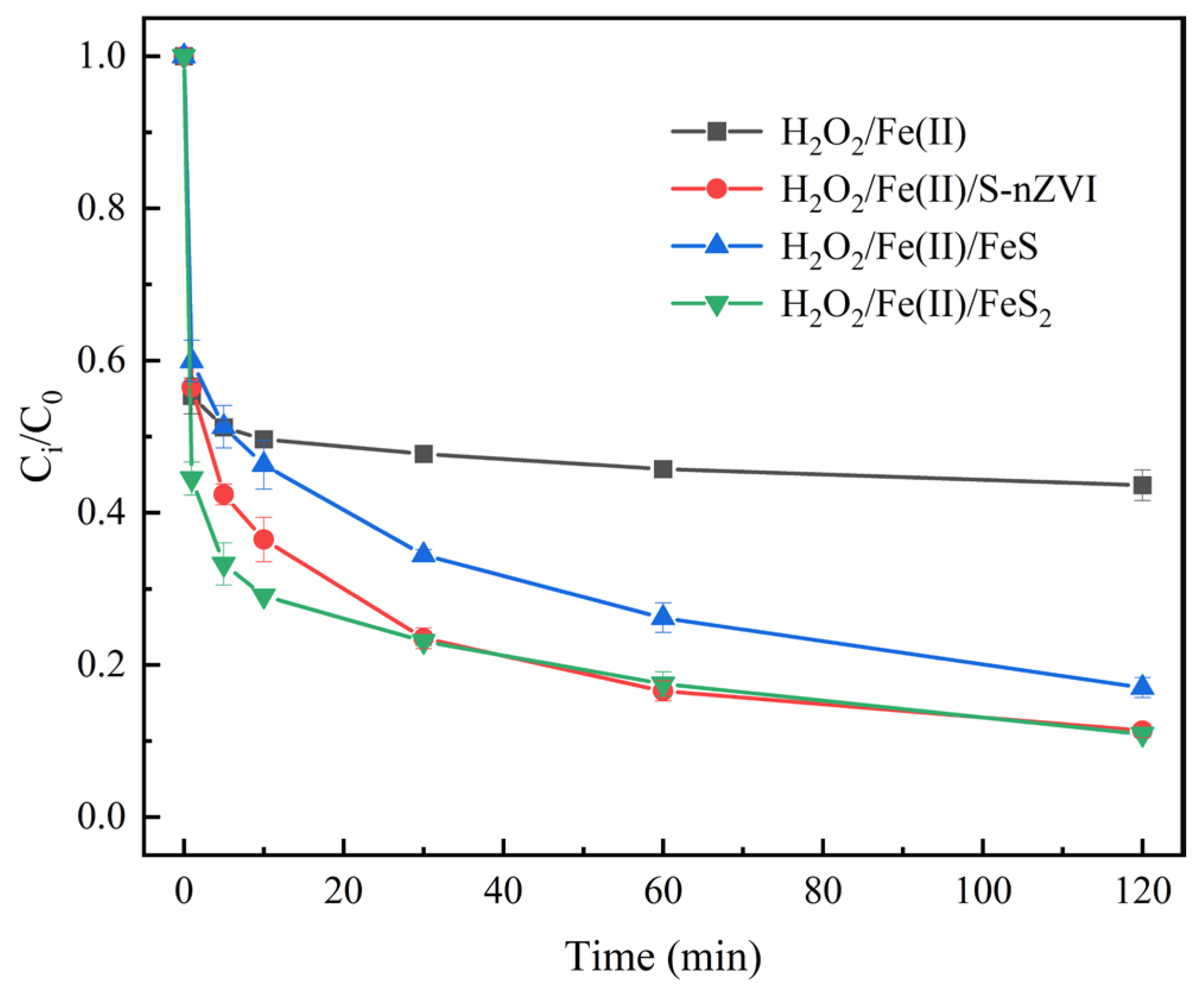
As illustrated in Figure 1, 56.4% removal of NAP was obtained in the H2O2/Fe(II) system within 120 min. Notably, NAP was removed rapidly within 1 min, but NAP could not be obviously degraded in the subsequent reaction time, showing that NAP could not be continuously and efficiently degraded in the traditional Fenton process. However, with the addition of S-nZVI, FeS, and FeS2, the degradation efficiency of NAP was enhanced to 88.6%, 83.0%, and 89.1%, respectively, indicating that sulfur-iron materials could promote the production of ROS and the removal of NAP. Moreover, NAP degradation in these processes followed the pseudo-second-order kinetic model, and the kinetic results are shown in Table 1. The kinetic constant (k) of NAP degradation increased from 0.0340 mM−1 min−1 in the H2O2/Fe(II) process to 0.5792 mM−1 min−1, 0.3445 mM−1 min−1, and 0.5454 mM−1 min−1 in H2O2/Fe(II)/S-nZVI, H2O2/Fe(II)/FeS, and H2O2/Fe(II)/FeS2 processes, respectively. In other words, k increased by 16, 9, and 15 times when three sulfur-iron materials were introduced, confirming the important role of sulfur-iron materials in NAP removal. These results can be clarified in the following two ways. Firstly, Fe(II) was continuously released from sulfur-iron materials during the reaction, which could promote the homogeneous reaction and the degradation of NAP [26]. Secondly, Fe(III) produced in the oxidation processes could be reduced to Fe(II) through reductive sulfur species, which could participate in the activation of oxidants and accelerate the production of ROS, further promoting the removal of NAP.
Moreover, the influence of various chemicals (H2O2, Fe(II), and sulfur-iron materials) on NAP degradation was explored. The degradation of NAP could be promoted by appropriately increasing the reagent dosages, but excessive chemicals were not conducive to the degradation of NAP by scavenging the generated ROS (Figure S2). In a word, the optimal concertation of H2O2, Fe(II), S-nZVI, FeS, and FeS2 were 0.5 mM, 0.3 mM, 0.03 g L−1, 0.1 g L−1, and 1 g L−1, respectively. Notably, a smaller dosage of S-nZVI was needed to achieve the ideal removal of NAP (>80%) among the three sulfur-iron materials, which was attributed to the reactivity of S-nZVI and the synergistic effect between S and Fe(0) [27].

3.2. Insights into the Enhancement Mechanism of Sulfur-Iron Materials

3.2.1. The Variation in Fe and H2O2 Concentrations

To explore the enhancement mechanism of S-nZVI, FeS, and FeS2 on NAP degradation in Fenton-like systems, the concentrations of Fe(II) and total Fe in various systems were determined. The initial concentrations of H2O2, Fe(II), S-nZVI, FeS, FeS2, and NAP were controlled at 0.5 mM, 0.3 mM, 0.03 g L−1, 0.1 g L−1, 1 g L−1, and 0.1 mM, respectively.
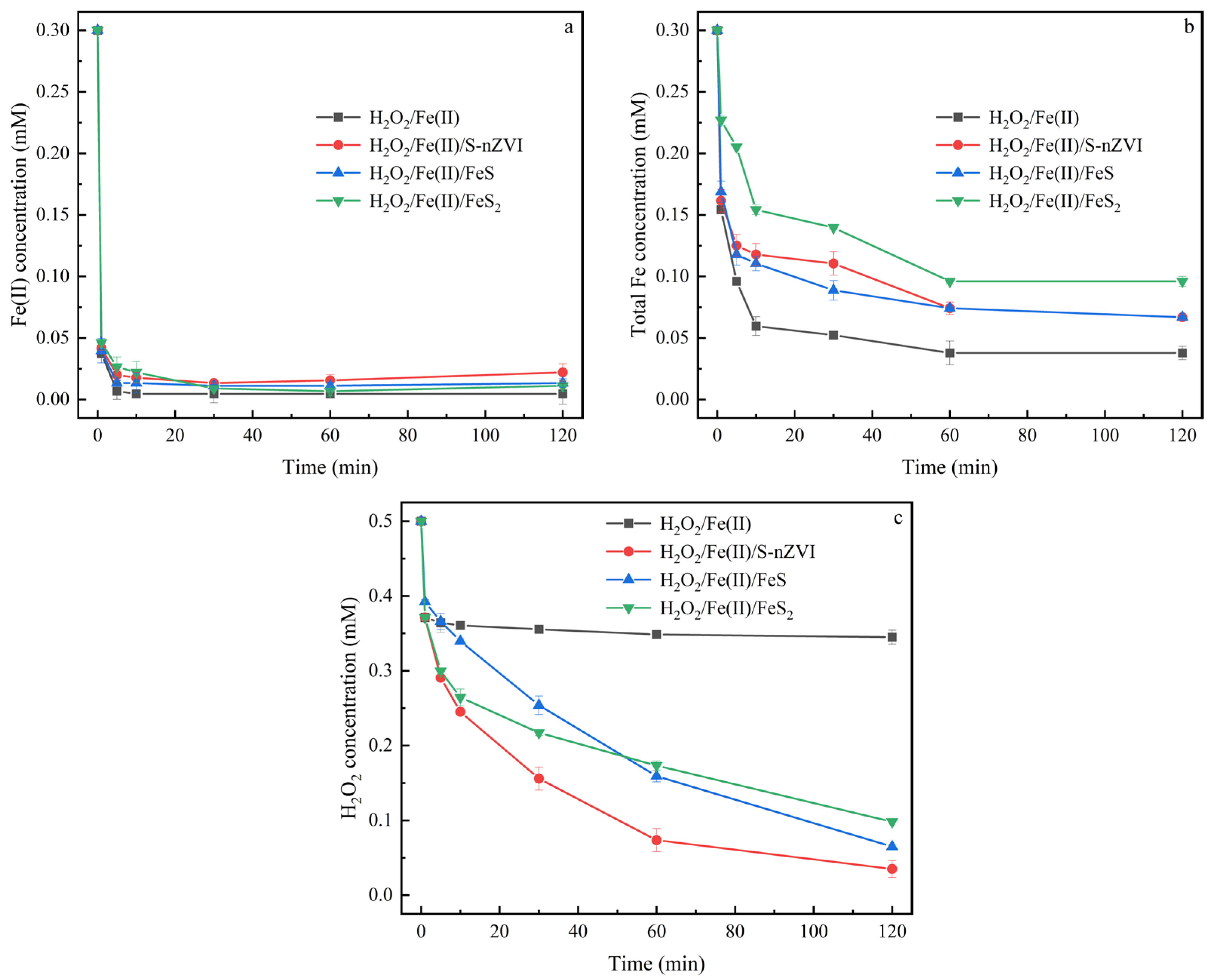
As shown in Figure 2, the concentration of Fe(II) rapidly decreased from 0.3 mM to about 0.04 mM within 1 min in both H2O2/Fe(II) and H2O2/Fe(II)/sulfur-iron materials systems, demonstrating the rapid involvement of Fe(II) in the reaction of H2O2 activation. In the subsequent reaction from 1 min to 120 min, Fe(II) was almost exhausted and maintained at 0.004 mM in the H2O2/Fe(II) process, which explained the rapid degradation of NAP within 1 min and the unobvious removal in the subsequent time. In the other three sulfur-iron material-enhanced systems, the Fe(II) concentration was more than 0.010 mM within 120 min due to the sustained release of Fe(II) from sulfur-iron materials, which was conducive to the continuous activation of oxidants and the production of ROS. As for the variation in total Fe concentration, the amount of total Fe in the H2O2/Fe(II) system decreased from 0.3 mM to 0.038 mM within 120 min, because dissolved iron ions were transferred to iron precipitation during the reaction. However, in S-nZVI, FeS, and FeS2-enhanced processes, the concentrations of total Fe after the reaction were 0.067 mM, 0.067 mM, and 0.096 mM, respectively, which were much greater than that (0.038 mM) in the system without enhancement. The above phenomenon could be expounded as follows. On the one hand, dissolved iron ions could be released continuously from the sulfur-iron materials during the reaction. On the other hand, S0, S2−, and S22− in S-nZVI, FeS, and FeS2 could reduce Fe(III) generated in these systems (Equations (7)–(9)), regenerate Fe(II), and slow down the precipitation of Fe(III). In addition, Fe(III) could also be reduced by Fe(0) in S-nZVI. In conclusion, three sulfur-iron materials (S-nZVI, FeS, and FeS2) could promote NAP removal by releasing Fe(II) and reducing Fe(III).
6Fe(III) + S0 + 4H2O → 6Fe(II) + SO42− + 8H+
8Fe(III) + S2− + 4H2O → 8Fe(II) + SO42− + 8H+
14Fe(III) + S22− + 8H2O → 14Fe(II) + 2SO42− + 16H+
Moreover, the consumption of H2O2 in different systems was explored, and the results are illustrated in Figure 2c. In the H2O2/Fe(II) process, the H2O2 amount decreased dramatically from 0.5 mM to 0.371 mM within 1 min, then decreased slowly during the subsequent reaction from 1 min to 120 min, and finally maintained at 0.345 mM, which was a similar trend to the variation of iron concentration. In three sulfur-iron material-enhanced systems, H2O2 was gradually consumed during the whole reaction, and the concentrations decreased from 0.5 mM to 0.035 mM, 0.065 mM, and 0.098 mM within 120 min in H2O2/Fe(II)/S-nZVI, H2O2/Fe(II)/FeS, and H2O2/Fe(II)/FeS2 systems, respectively. Notably, the utilization efficiency of H2O2 increased from 31.0% in the H2O2/Fe(II) process to 93.0%, 87.0%, and 80.3% with the addition of S-nZVI, FeS, and FeS2, respectively, demonstrating that sulfur-iron materials could facilitate the Fe(II)/Fe(III) circulation and accelerate the activation of H2O2.

3.2.2. The Variation in HO• Concentration

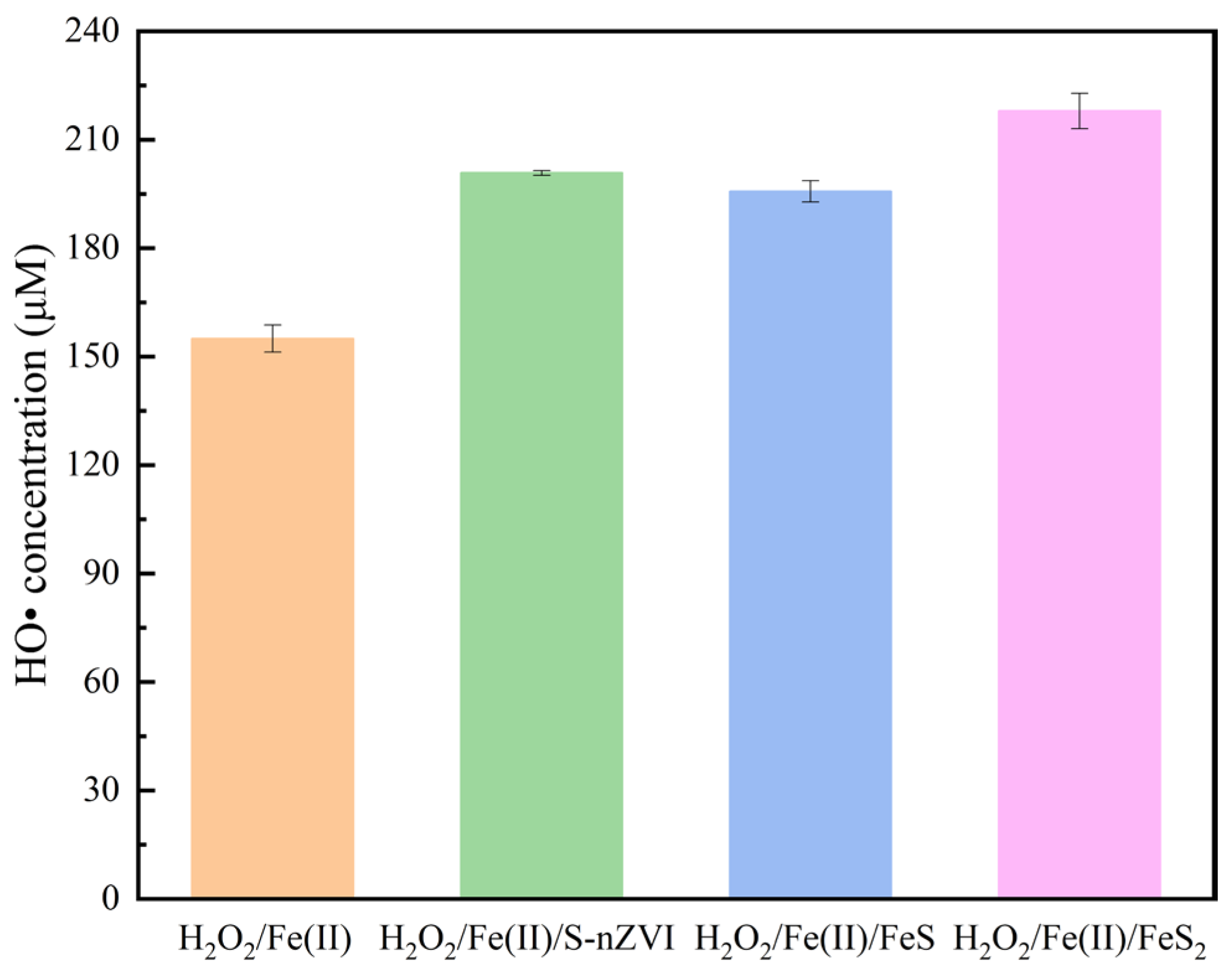
Benzoic acid (BA) was used as the capture of HO• to quantitatively analyze the concentration of generated HO•. p-Hydroxybenzoic acid (p-HBA) was the characteristic product of the reaction between BA and HO•, and there is a clear conversion coefficient (5.87) between p-HBA and HO• [28]. Therefore, the amount of HO• produced in aqueous solution can be quantitatively determined indirectly by measuring the concentration of p-HBA. As shown in Figure 3, the amount of HO• accumulated within 120 min in the H2O2/Fe(II) system was 155.0 μM. Notably, the concentrations of HO• increased to 200.8 μM, 195.7 μM, and 218.0 μM with the addition of S-nZVI, FeS, and FeS2, respectively, confirming that the presence of sulfur-iron materials could promote the ROS production and NAP removal. The presence of sulfur-iron materials could accelerate the circulation of Fe(II)/Fe(III), achieving the aim of efficient activation of oxidant and production of ROS.

3.3. The Degradation Mechanism of NAP in Sulfur-Iron Material-Enhanced Systems

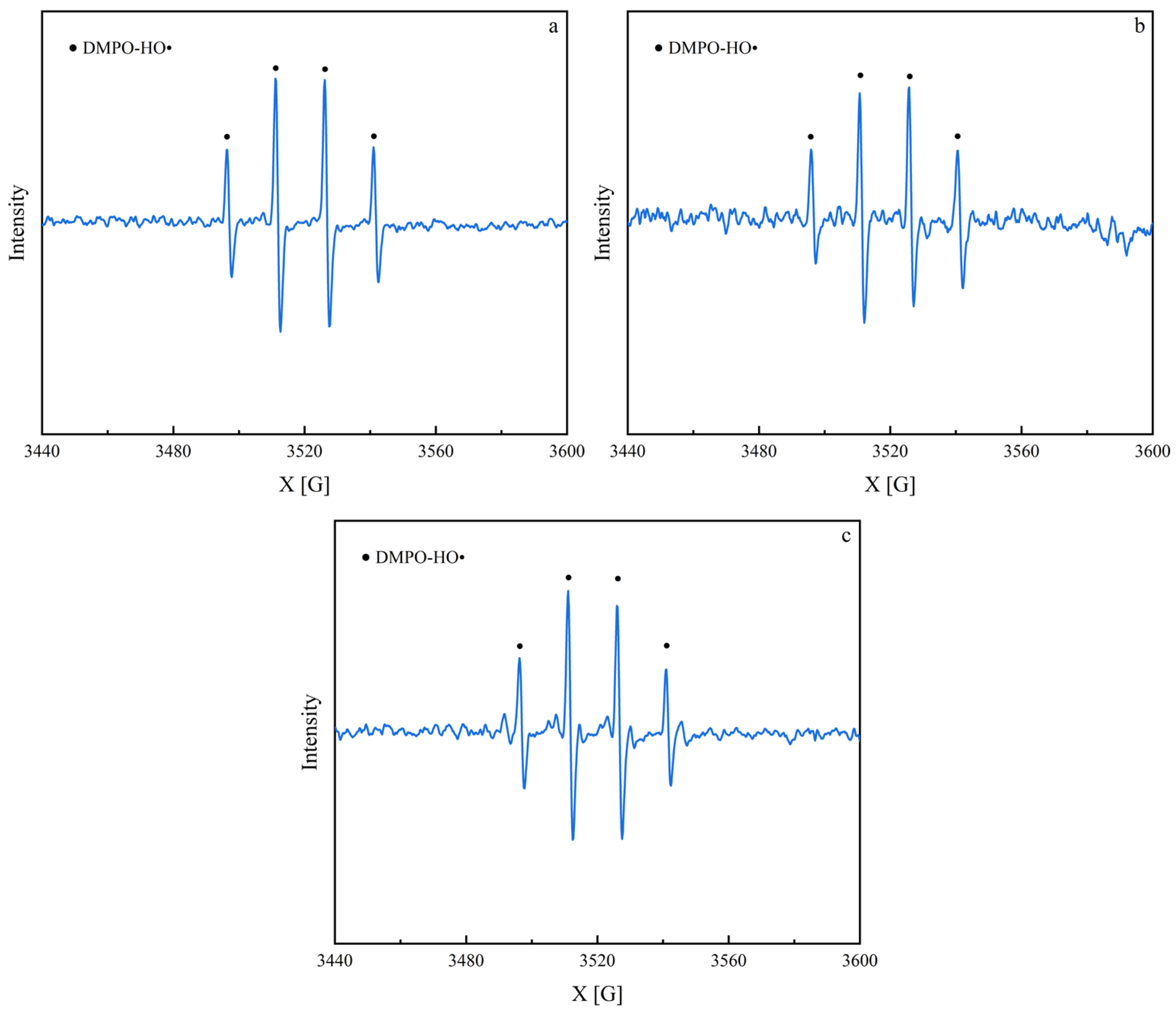
Reportedly, HO• and superoxide radical (O2•) are the main ROS generated in the Fenton-like process [29]. In this work, to investigate the ROS produced in sulfur-iron material-enhanced systems, electron paramagnetic resonance (EPR) was employed, and 5,5-dimethyl-1-oxypyrrolidine (DMPO) was used as the ROS capture. The initial concentrations of H2O2, Fe(II), S-nZVI, FeS, and FeS2 were controlled at 0.5 mM, 0.3 mM, 0.03 g L−1, 0.1 g L−1, and 1 g L−1, respectively. As shown in Figure 4, the signals of DMPO-HO• were all found in H2O2/Fe(II)/S-nZVI, H2O2/Fe(II)/FeS, and H2O2/Fe(II)/FeS2 processes, confirming the generation of HO• in these three systems. However, the characteristic peaks of the products generated by the reaction between DMPO and O2• were not observed by EPR in the above three systems, which might be due to the instability of O2• in aqueous solution [30].
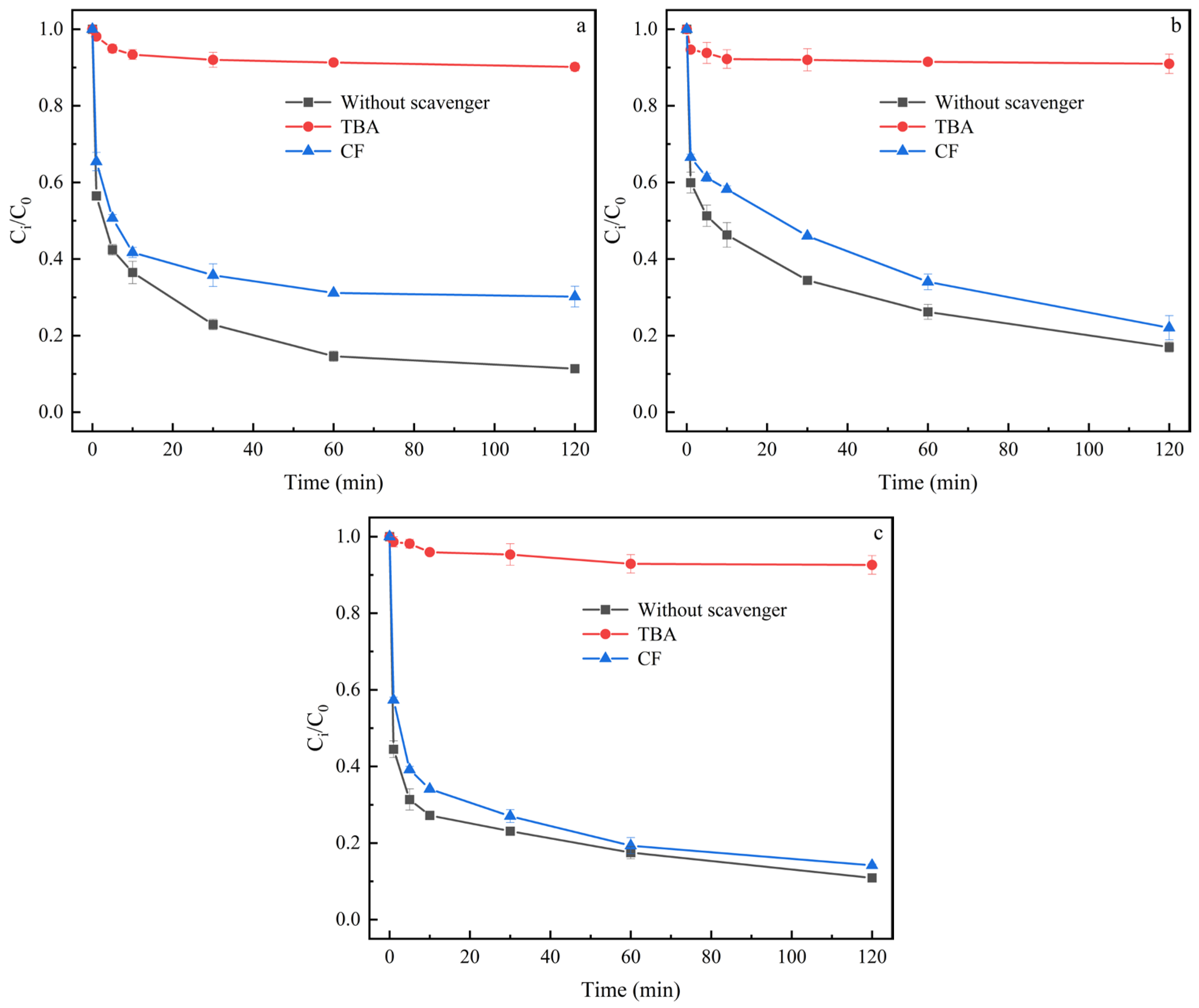
Moreover, the scavenging tests were conducted to confirm the contribution of diverse ROS to NAP removal and determine the dominant ROS. Tertiary butanol (TBA) and chloroform (CF) were used as the scavengers of HO• and O2• due to their great reactivity with the specific ROS, respectively [31,32]. As illustrated in Figure 5, 88.6%, 83.0%, and 89.1% of NAP could be removed in H2O2/Fe(II)/S-nZVI, H2O2/Fe(II)/FeS, and H2O2/Fe(II)/FeS2 processes without the presence of scavengers, while NAP removal decreased to 9.9%, 9.0%, and 7.4% with the addition of 100 mM TBA, respectively, demonstrating that HO• was the dominated ROS in these three systems and contributed tremendously to NAP degradation. Notably, with the existence of 50 mM CF, NAP degradation was slightly restrained in these three processes, and the removal decreased to 69.8%, 77.9%, and 85.8%, respectively, and the result indicated that O2• also participated in NAP degradation in sulfur-iron material-enhanced systems, especially in the H2O2/Fe(II)/S-nZVI system.

3.4. The Influence of Water Matrices on NAP Degradation in Sulfur-Iron Material-Enhanced Systems

To assess the effectiveness of sulfur-iron materials-nhanced systems on NAP degradation in complex water matrices, the effect of solution pH was first explored. The initial dosages of H2O2, Fe(II), S-nZVI, FeS, FeS2, and NAP were set as 0.5 mM, 0.3 mM, 0.03 g L−1, 0.1 g L−1, 1 g L−1, and 0.1 mM, respectively. As shown in Figure S3, NAP removal changed slightly and was more than 80% with the initial solution pH increasing from 3 to 9 in the H2O2/Fe(II)/S-nZVI system, showing that the S-nZVI-enhanced process could degrade NAP effectively with the value of initial pH from 3 to 9. Similar experimental results were observed in H2O2/Fe(II)/FeS and H2O2/Fe(II)/FeS2 processes, namely, NAP could be effectively removed in both systems when the solution pH was 3 to 9, demonstrating that the pH application range of sulfur-iron material-enhanced systems was wide.
Secondly, four common inorganic ions (Cl, HCO3, SO42−, and NO3) were selected as the representatives presented in actual groundwater, and the effect of inorganic ions was explored. The presence of different concentrations of Cl exerted an insignificant influence on NAP removal and solution pH variation (Figure S4 and Table S2). This can be expounded in the following ways. On the one hand, Cl can scavenge HO• generated in aqueous solution. On the other hand, some reactive chlorine species (such as chloride radical and dichloride radical) can be generated by the chain reaction between Cl and HO•, which may contribute to NAP removal [33]. However, with the presence of HCO3, NAP removal was obviously inhibited in sulfur-iron material-enhanced systems, and the inhibitory effect was more obvious with the augmentation of HCO3 concentration (Figure S4). This is because that the existence of HCO3 could increase the pH value, with the existence of 10 mM HCO3, the value of solution pH increased from 5.71 to 8.63, 8.55, and 8.56 in H2O2/Fe(II)/S-nZVI, H2O2/Fe(II)/FeS, and H2O2/Fe(II)/FeS2 system, respectively (Table S2). In addition, the presence of HCO3 could enhance the buffering of the solution and scavenge HO•, thus inhibiting the degradation of NAP [27]. In the presence of various concentrations (1~100 mM) of SO42− and NO3, NAP removal changed little; hence, the effect of them on NAP degradation could be omitted in this work (Figure S4).
Thirdly, humic acid (HA) was chosen as the representative of natural organic matter in groundwater, and the effect on NAP removal is shown in Figure S5. With the concentration of HA increasing from 0 to 50 mM, NAP removal changed insignificantly in H2O2/Fe(II)/S-nZVI, H2O2/Fe(II)/FeS, and H2O2/Fe(II)/FeS2 processes, demonstrating that sulfur-iron material-enhanced systems had a great tolerance to HA. Though the presence of HA could compete with the target pollutant for the generated ROS, the precipitation of dissolved iron ions could be slowed down through HA chelation [34]. Thus, the negative effects of ROS consumption caused by HA could be offset through its chelation of dissolved iron ions and promoting the generation of ROS.
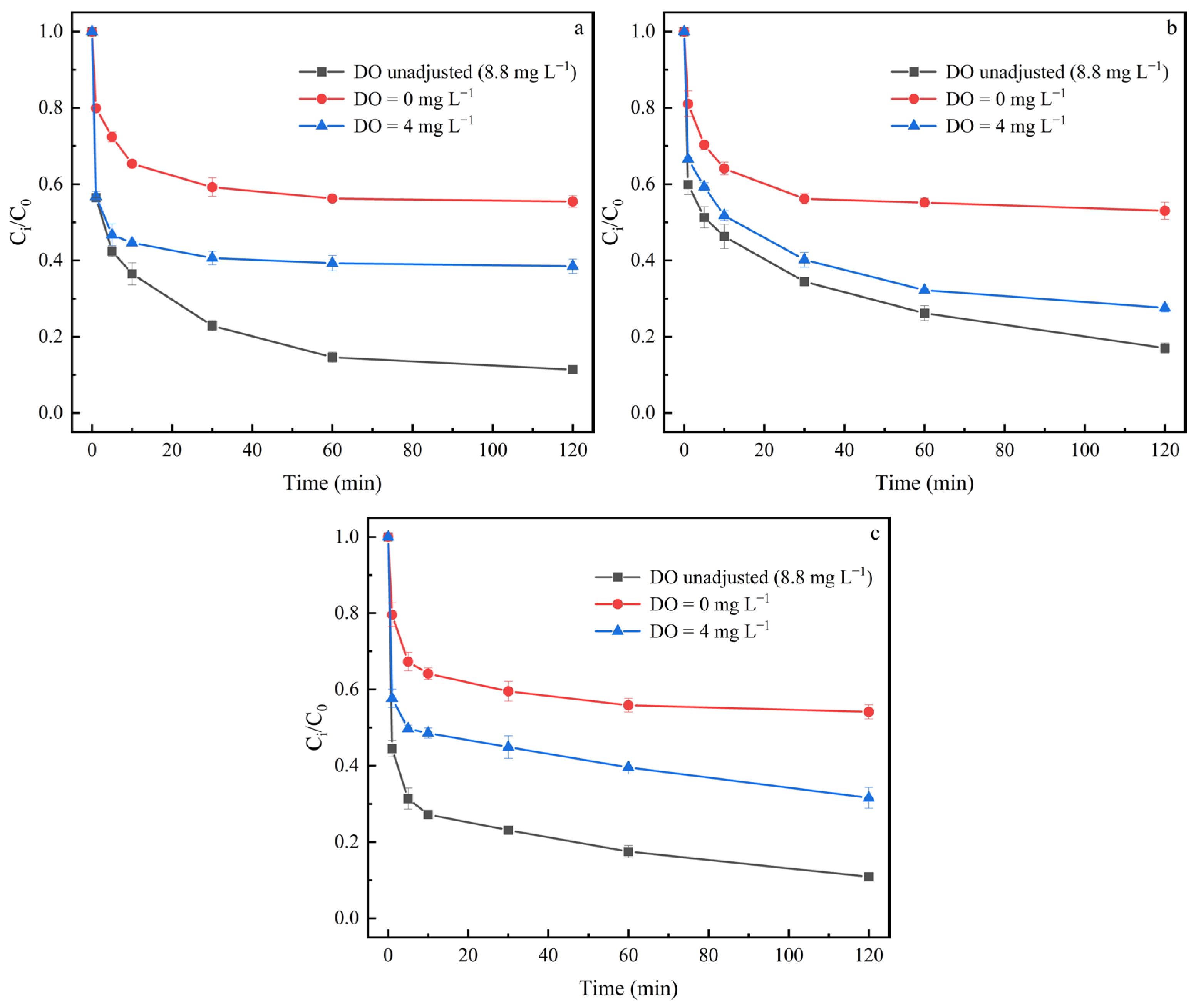
Moreover, dissolved oxygen (DO) is also an important parameter in actual groundwater. Thus, three concentrations (0 mg L−1, 4 mg L−1, and 8.8 mg L−1 (unadjusted)) of DO were controlled by nitrogen blowing to investigate the influence of DO on NAP degradation. As seen in Figure 6, when the DO concentration was unadjusted (8.8 mg L−1), NAP removal was 88.6%, 83.0%, and 89.1% in H2O2/Fe(II)/S-nZVI, H2O2/Fe(II)/FeS, and H2O2/Fe(II)/FeS2 processes, respectively. With the amount of DO adjusted to 4 mg L−1, NAP removal decreased to 61.5%, 72.5%, and 68.4% in these three sulfur-iron material-enhanced systems, respectively. However, only 44.6%, 47.0%, and 45.9% of NAP could be removed when the concentration of DO was controlled at 0 mg L−1. The above results showed that DO took part in the degradation of NAP. Our previous study also found that DO could be involved in the chain reaction of ROS and affect the production of ROS, thus inhibiting the removal of pollutants [35].
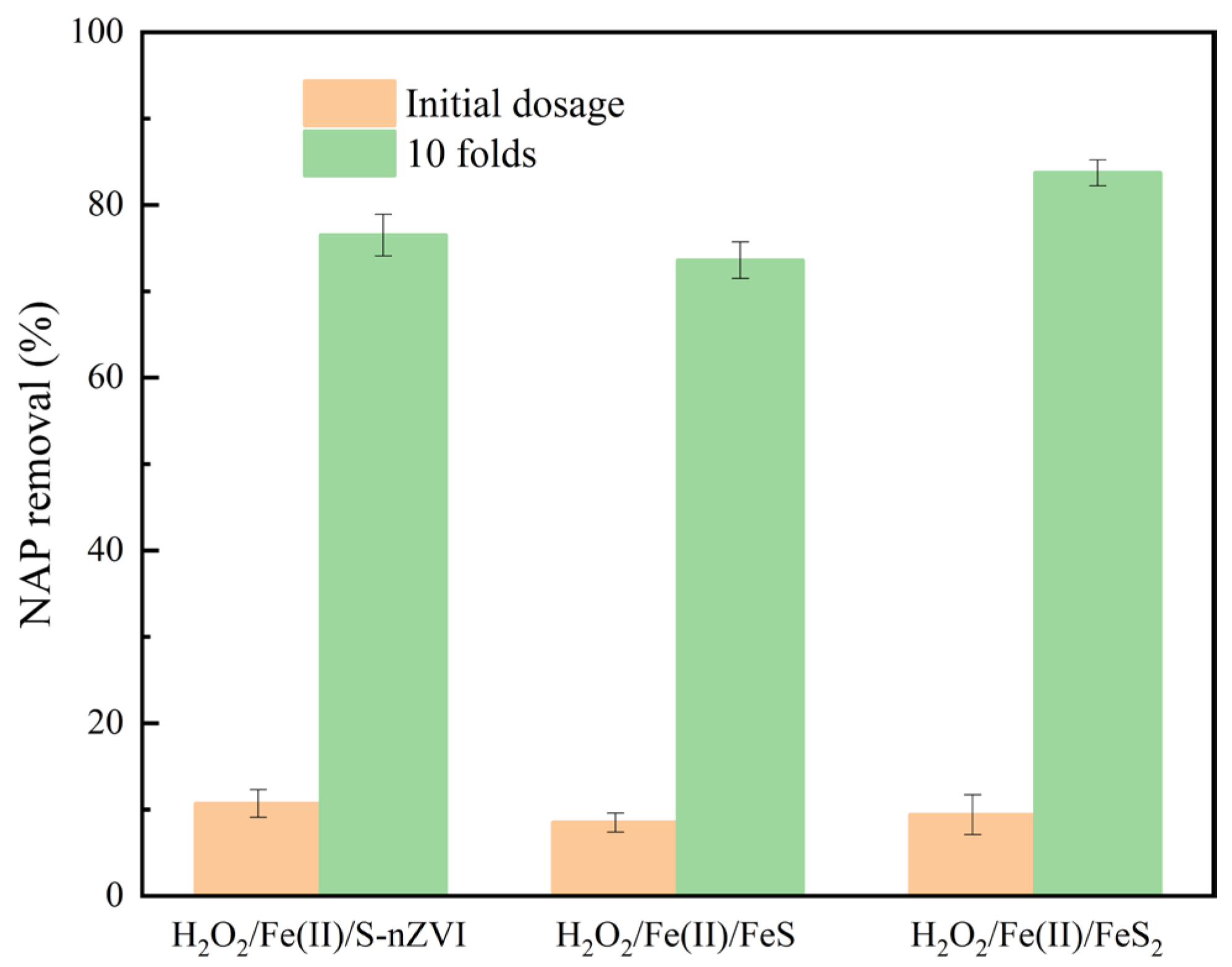
Finally, the degradation performance of NAP in actual groundwater in sulfur-iron material-enhanced systems was explored, and the results are shown in Figure 7. Only 10.7%, 8.5%, and 9.4% of NAP could be degraded in actual groundwater in H2O2/Fe(II)/S-nZVI, H2O2/Fe(II)/FeS, and H2O2/Fe(II)/FeS2 processes, respectively, which were much lower than the results in ultrapure water (88.6%, 83.0%, and 89.1%). This phenomenon can be clarified as follows. The actual groundwater was alkaline, had the property of buffering, and contained a lot of organic matter (TOC = 38.25 mg L−1) and HCO3 (96.8 mg L−1) (Table S1), which were not conducive to the degradation of NAP. Fortunately, when the chemical dosages were increased to 10 times, NAP removal increased to 76.5%, 73.6%, and 83.7% in these three sulfur-iron material-enhanced systems, respectively, demonstrating that sulfur-iron material-enhanced techniques can be applied to effectively remove NAP in polluted groundwater.

3.5. Applicability of Sulfur-Iron Material-Enhanced Systems for Other Pollutants

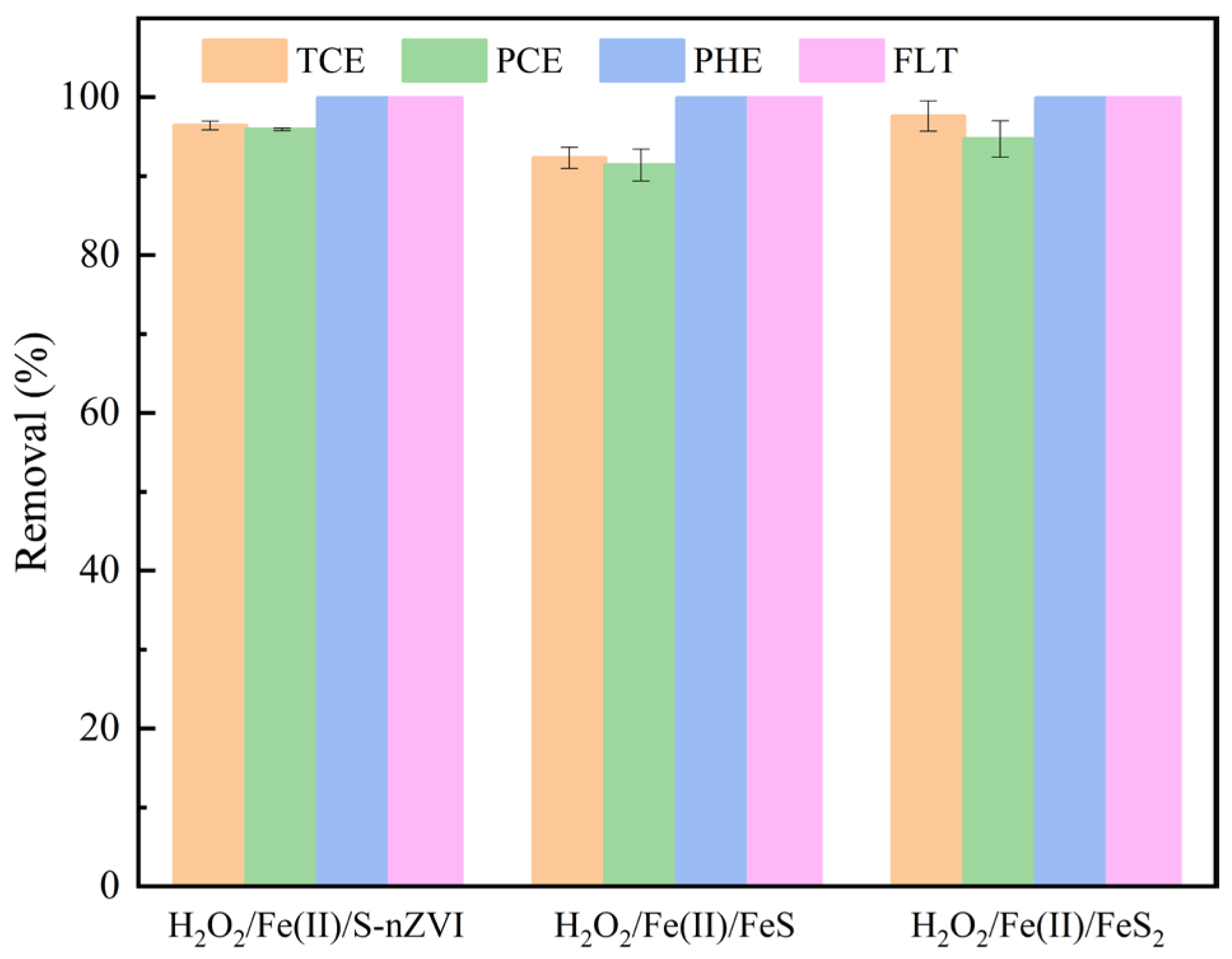
To assess the wide applicability of sulfur-iron material-enhanced systems for the remediation of actual contaminated groundwater, different pollutants (trichloroethylene (TCE), perchloroethylene (PCE), phenanthrene (PHE), and fluoranthene (FLT)) were selected as the representatives of common contaminants in polluted groundwater to explore their degradation performance in sulfur-iron material-enhanced processes. As exhibited in Figure 8, 96.4%, 92.3%, and 97.6% of TCE could be removed in H2O2/Fe(II)/S-nZVI, H2O2/Fe(II)/FeS, and H2O2/Fe(II)/FeS2 processes, respectively, and PCE removal could reach 95.9%, 91.4%, and 94.7% in these three systems. Notably, PHE and FLT could be fully removed within 120 min in sulfur-iron material-enhanced systems. The above results demonstrated that sulfur-iron material-enhanced systems in this work had a great performance on the removal of other pollutants and had broad prospects of application.

3.6. NAP Degradation Pathways and Intermediates Toxicity Estimation

NAP degradation intermediates in H2O2/Fe(II) processes coupled with sulfur-iron materials (S-nZVI, FeS, and FeS2) were detected by LC-MS/MS. As illustrated in Table S3 and Figure S6, three NAP degradation intermediates (benzoic acid, phthalic anhydride, and 1,4-naphthalenediol) were all found in the above three oxidation processes.
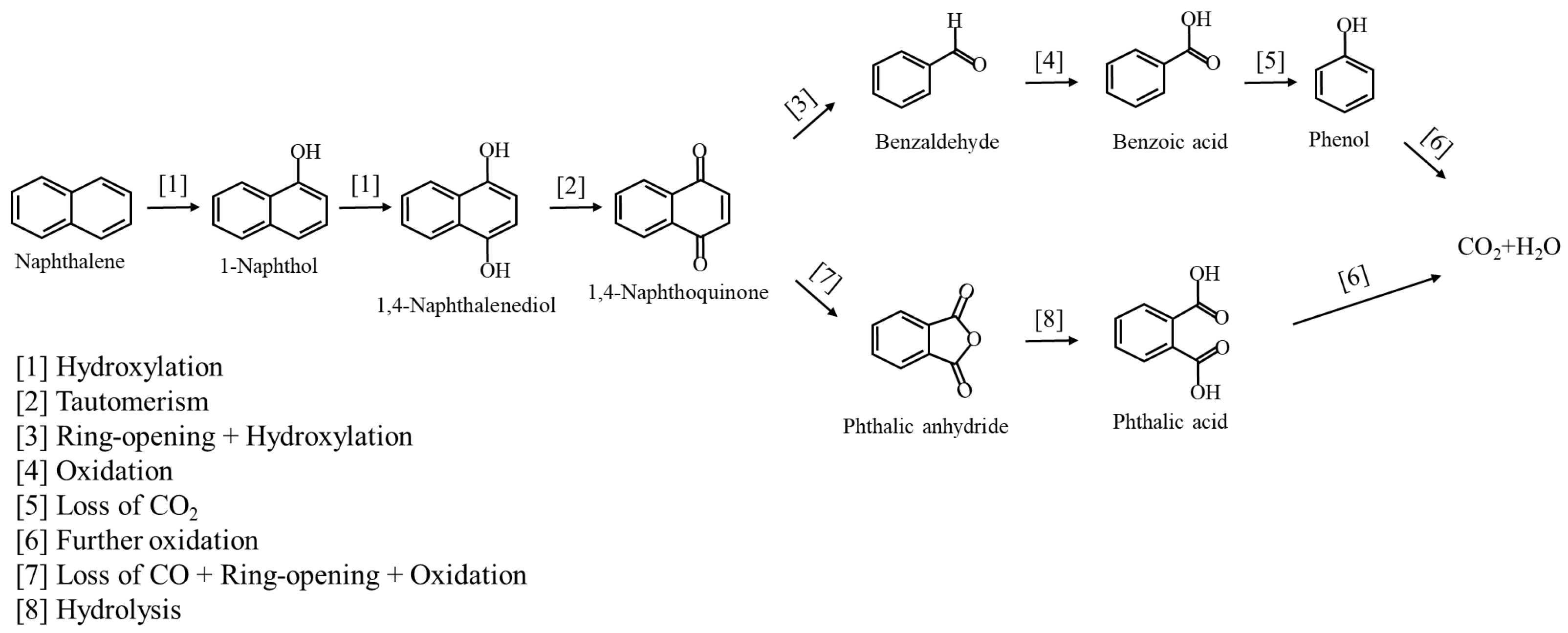
According to the observations of LC-MS/MS, two possible degradation pathways of NAP were proposed (Figure 9). 1-Naphthol was discovered because of the addition of HO• on the NAP molecule, then 1,4-naphthalenediol was generated through hydroxylation, which was further converted to 1,4-naphthoquinone by tautomerism. In the meantime, two possible removal pathways could exist in the removal of 1,4-naphthoquinone. One was that benzaldehyde was produced from 1,4-naphthoquinone by hydroxylation and ring-opening, and it was transformed to benzoic acid through oxidation, resulting in the generation of phenol through the loss of CO2 from benzoic acid. The other was that phthalic anhydride was generated by 1,4-naphthoquinone through oxidation, ring-opening, and loss of CO, and then it was transformed to phthalic acid through hydrolysis [36]. Finally, CO2 and H2O could be formed by these degradation intermediates through further oxidation.
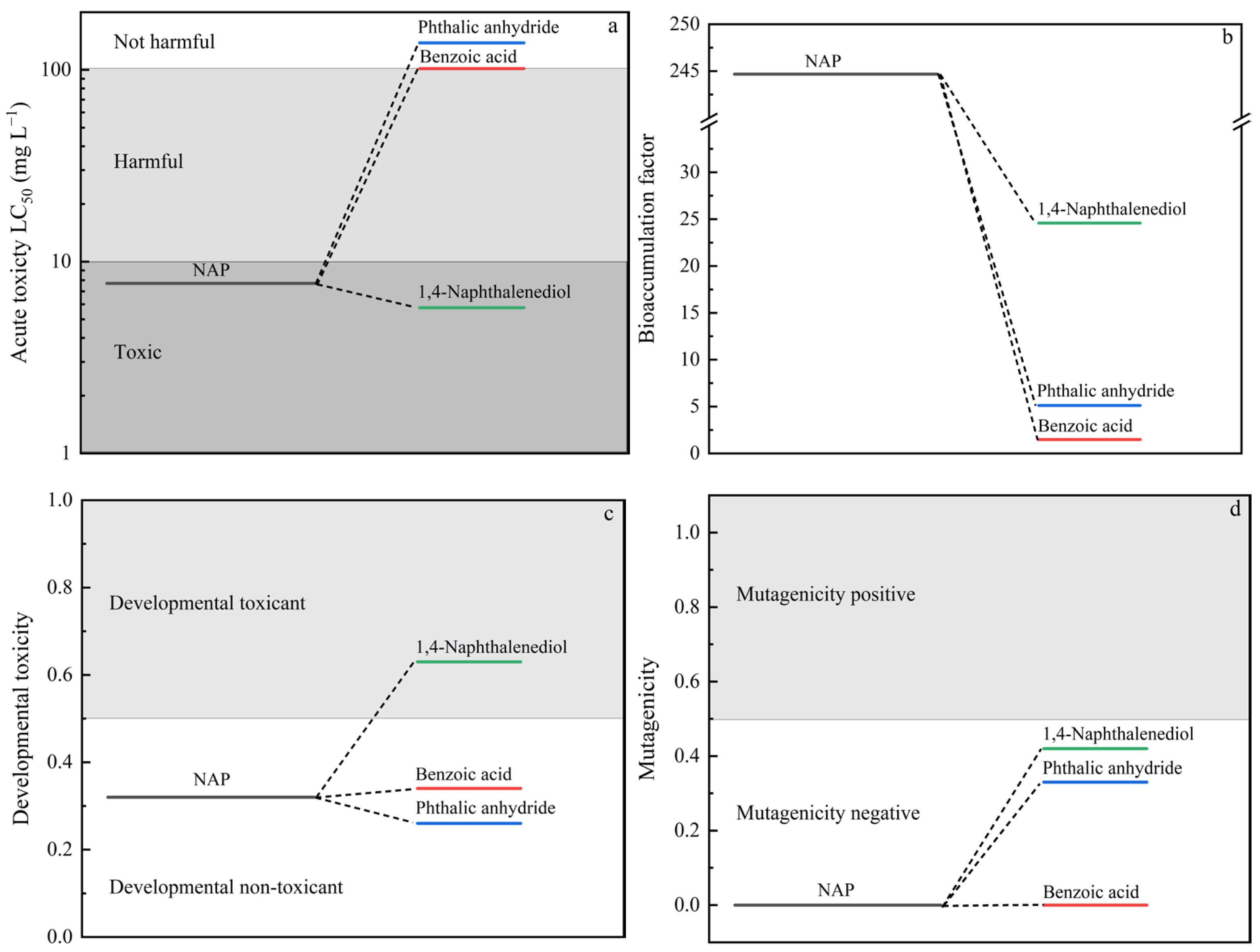
The preliminary results of intermediate toxicity estimation by the Toxicity Estimation Software Tool (version 5.1.2) are shown in Figure 10 and Table S4. Except for 1,4-naphthalenediol, the LC50 (chemical concentration that kills half of the fathead minnow after 96 h) values of the other two intermediates (benzoic acid and phthalic anhydride) were greater than that of NAP (7.71 mg L−1), demonstrating their lower acute toxicity. Notably, all the intermediates showed lower values of the bioaccumulation factors than NAP. Except for 1,4-naphthalenediol, benzoic acid, and phthalic anhydride were classified as “developmental non-toxicant”, and their developmental toxicity factor was lower than 0.5. Moreover, only phthalic anhydride and 1,4-naphthalenediol showed greater mutagenicity, but they were still categorized into “mutagenicity negative”. In conclusion, although 1,4-naphthalenediol, with greater toxicity, was produced, it could be transformed to the less toxic intermediates (benzoic acid and phthalic anhydride) through oxidation during the degradation of NAP.

4. Conclusions

In this work, NAP degradation in Fenton-like processes enhanced by S-nZVI, FeS, and FeS2 was investigated, and the enhancement performance and mechanism of these three sulfur-iron materials were revealed and compared. The results showed that only 56.4% of NAP was degraded in the H2O2/Fe(II) system, while NAP removal increased to 88.6%, 83.0%, and 89.1% with the addition of S-nZVI, FeS, and FeS2, respectively, demonstrating that the existence of sulfur-iron materials could promote the removal of NAP. Based on the results of the variation in Fe concentration in the above systems, it can be concluded that the three sulfur-iron materials could all reduce Fe(III) produced in aqueous solution, regenerate Fe(II), and slow down the precipitation of dissolved iron. In addition, the addition of sulfur-iron materials could promote the generation of HO• in aqueous solution, thus enhancing the degradation of NAP. The results of scavenging tests indicated that HO• was the dominant ROS for NAP removal, while O2• also contributed to the degradation of NAP. The effect of complex water matrices on NAP removal was evaluated, and the results showed that sulfur-iron material-enhanced techniques had a wide pH application range and great tolerance to inorganic ions and humic acid. Moreover, three degradation intermediates of NAP were found by LC-MS/MS in sulfur-iron material-enhanced processes, among which the acute toxicity of 1,4-naphthalenediol was stronger, while those of benzoic acid and phthalic anhydride were weaker. Two degradation pathways of NAP were proposed. Finally, according to the removal performance of other PAHs and chlorinated alkene (>90%), sulfur-iron material-enhanced processes could be suitable for the efficient restoration of complex polluted groundwater.

Supplementary Materials

The following supporting information can be downloaded at: https://www.mdpi.com/article/10.3390/w18080918/s1, Text S1. Materials. Text S2. Analytical methods. Figure S1. NAP degradation performance in different systems. Figure S2. The effect of (a) H2O2 ([Fe(II)]0 = 0.3 mM, [S-nZVI]0 = 0.03 g L−1, [FeS]0 = 0.1 g L−1, [FeS2]0 = 1.0 g L−1), (b) Fe(II) ([H2O2]0 = 0.5 mM, [S-nZVI]0 = 0.03 g L−1, [FeS]0 = 0.1 g L−1, [FeS2]0 = 1.0 g L−1), and (c) surfur-iron materials ([H2O2]0 = 0.5 mM, [Fe(II)]0 = 0.3 mM) dosages on NAP degradation in different systems. ([NAP]0 = 0.1 mM). Figure S3. The effect of solution pH on NAP degradation in (a) H2O2/Fe(II)/S-nZVI, (b) H2O2/Fe(II)/FeS, and (c) H2O2/Fe(II)/FeS2 systems. ([H2O2]0 = 0.5 mM, [Fe(II)]0 = 0.3 mM, [S-nZVI]0 = 0.03 g L−1, [FeS]0 = 0.1 g L−1, [FeS2]0 = 1.0 g L−1, [NAP]0 = 0.1 mM). Figure S4. The effect of different inorganic ions on NAP removal in (a) H2O2/Fe(II)/S-nZVI, (b) H2O2/Fe(II)/FeS, and (c) H2O2/Fe(II)/FeS2 systems. ([H2O2]0 = 0.5 mM, [Fe(II)]0 = 0.3 mM, [S-nZVI]0 = 0.03 g L−1, [FeS]0 = 0.1 g L−1, [FeS2]0 = 1.0 g L−1, [NAP]0 = 0.1 mM). Figure S5. The effect of HA on NAP removal in (a) H2O2/Fe(II)/S-nZVI, (b) H2O2/Fe(II)/FeS, and (c) H2O2/Fe(II)/FeS2 systems. ([H2O2]0 = 0.5 mM, [Fe(II)]0 = 0.3 mM, [S-nZVI]0 = 0.03 g L−1, [FeS]0 = 0.1 g L−1, [FeS2]0 = 1.0 g L−1, [NAP]0 = 0.1 mM). Figure S6. LC-MS/MS mass spectrums of NAP degradation intermediates. Table S1. The main characteristics of actual groundwater. Table S2. Parameter values in various systems. Table S3. The details of NAP degradation intermediates detected by LC-MS/MS in negative electrospray ionization mode. Table S4. The toxicological properties of NAP and intermediates.

Author Contributions

G.Z.: Conceptualization, Methodology, Software, Investigation, Data Curation, Writing—Original Draft. C.Z.: Formal analysis, Validation, Writing—Review and Editing. S.L.: Validation, Writing—Review and Editing. X.M.: Validation, Writing—Review and Editing, Supervision, Project administration, Funding acquisition. All authors have read and agreed to the published version of the manuscript.

Funding

This work was financially supported by the National Key R&D Program of China (2024YFC3713302), Zhejiang Provincial Postdoctoral Research Excellence Funding Program (ZJ2025168), and Special Project of Zhejiang Provincial Department of Science and Technology for Research Institutes (Research on Precision Diagnosis and Green Remediation Technology for Chlorinated Hydrocarbon Pollution in Groundwater).

Data Availability Statement

All data generated or analyzed during this study are included in this manuscript and Supplementary Materials.

Conflicts of Interest

The authors declare no conflicts of interest.

References

  1. Preethi; Shanmugavel, S.; Kumar, G.; Yogalakshmi, K.; Gunasekaran, M.; Rajesh Banu, J. Recent progress in mineralization of emerging contaminants by advanced oxidation process: A review. Environ. Pollut. 2024, 341, 122842. [Google Scholar] [CrossRef] [PubMed]
  2. Ziembowicz, S.; Kida, M. Limitations and future directions of application of the Fenton-like process in micropollutants degradation in water and wastewater treatment: A critical review. Chemosphere 2022, 296, 134041. [Google Scholar] [CrossRef] [PubMed]
  3. Qu, R.; Li, C.; Liu, J.; Xiao, R.; Pan, X.; Zeng, X.; Wang, Z.; Wu, J. Hydroxyl radical based photocatalytic degradation of halogenated organic contaminants and paraffin on silica gel. Environ. Sci. Technol. 2018, 52, 7220–7229. [Google Scholar] [CrossRef] [PubMed]
  4. Ye, C.; Ma, X.Y.; Deng, J.; Li, X.Y.; Li, Q.S.; Dietrich, A.M. Degradation of saccharin by UV/H2O2 and UV/PS processes: A comparative study. Chemosphere 2022, 288, 132337. [Google Scholar] [CrossRef]
  5. Dai, H.; Luo, W.; Jin, L.; Deng, L.; Wang, Q.; Hu, J.; Singh, R. Degradation of chloroquine phosphate during UV/H2O2 process: Performance, kinetics, and degradation pathways. J. Environ. Chem. Eng. 2024, 12, 112493. [Google Scholar] [CrossRef]
  6. Soufi, A.; Hajjaoui, H.; Boumya, W.; Elmouwahidi, A.; Baillón-García, E.; Abdennouri, M.; Barka, N. Recent trends in magnetic spinel ferrites and their composites as heterogeneous Fenton-like catalysts: A review. J. Environ. Manag. 2024, 367, 121971. [Google Scholar] [CrossRef]
  7. Hong, Q.; Liu, C.; Wang, Z.; Li, R.; Liang, X.; Wang, Y.; Zhang, Y.; Song, Z.; Xiao, Z.; Cui, T.; et al. Electron transfer enhancing Fe(II)/Fe(III) cycle by sulfur and biochar in magnetic FeS@biochar to active peroxymonosulfate for 2,4-dichlorophenoxyacetic acid degradation. Chem. Eng. J. 2021, 417, 129238. [Google Scholar] [CrossRef]
  8. Karim, A.; Jiao, Y.; Zhou, M.; Nidheesh, P. Iron-based persulfate activation process for environmental decontamination in water and soil. Chemosphere 2021, 265, 129057. [Google Scholar] [CrossRef]
  9. Wu, J.; Zhao, J.; Hou, J.; Zeng, R.; Xing, B. Degradation of tetrabromobisphenol a by sulfidated nanoscale zerovalent iron in a dynamic two-step anoxic/oxic process. Environ. Sci. Technol. 2019, 53, 8105–8114. [Google Scholar] [CrossRef]
  10. Su, Y.; Adeleye, A.; Keller, A.; Huang, Y.; Dai, C.; Zhou, X.; Zhang, Y. Magnetic sulfide-modified nanoscale zerovalent iron (S-nZVI) for dissolved metal ion removal. Water Res. 2015, 74, 47–57. [Google Scholar] [CrossRef]
  11. Liu, Y.; Gao, J.; Wang, Q.; Chen, H.; Zhang, Y.; Fu, X. Efficient peroxymonosulfate activation by nanoscale zerovalent iron for removal of sulfadiazine and sulfadiazine resistance bacteria: Sulfidated modification or not. J. Hazard. Mater. 2024, 469, 133869. [Google Scholar] [CrossRef] [PubMed]
  12. Yu, X.; Jin, X.; Li, M.; Yu, Y.; Zhu, M.; Tang, S.; Zhou, H.; Wang, K.; Dou, R.; Sun, J. Degradation mechanism of tetracycline using sulfidated nanoscale zerovalent iron driven peroxymonosulfate and metabolomic insights into environmental risk of intermediates products. Chem. Eng. J. 2022, 430, 133141. [Google Scholar] [CrossRef]
  13. Su, Y.; Jassby, D.; Song, S.; Zhou, X.; Zhao, H.; Filip, J.; Petala, E.; Zhang, Y. Enhanced oxidative and adsorptive removal of diclofenac in heterogeneous Fenton-like reaction with sulfide modified nanoscale zerovalent iron. Environ. Sci. Technol. 2018, 52, 6466–6475. [Google Scholar] [CrossRef] [PubMed]
  14. Liu, S.; Feng, H.; Tang, L.; Dong, H.; Wang, J.; Yu, J.; Feng, C.; Liu, Y.; Luo, T.; Ni, T. Removal of Sb(III) by sulfidated nanoscale zerovalent iron: The mechanism and impact of environmental conditions. Sci. Total Environ. 2020, 736, 139629. [Google Scholar] [CrossRef]
  15. Zhao, J.; Su, A.; Tian, P.; Tang, X.; Collins, R.; He, F. Arsenic (III) removal by mechanochemically sulfidated microscale zero valent iron under anoxic and oxic conditions. Water Res. 2021, 198, 117132. [Google Scholar] [CrossRef]
  16. Sun, Y.; Danish, M.; Ali, M.; Shan, A.; Li, M.; Lyu, Y.; Qiu, Z.; Sui, Q.; Zang, X.; Lyu, S. Trichloroethene degradation by nanoscale CaO2 activated with Fe(II)/FeS: The role of FeS and the synergistic activation mechanism of Fe(II)/FeS. Chem. Eng. J. 2020, 194, 124830. [Google Scholar] [CrossRef]
  17. Chen, H.; Zhang, Z.; Yang, Z.; Yang, Q.; Li, B.; Bai, Z. Heterogeneous Fenton-like catalytic degradation of 2,4-dichlorophenoxyacetic acid in water with Fes. Chem. Eng. J. 2015, 273, 481–489. [Google Scholar] [CrossRef]
  18. Wang, C.; Sun, R.; Huang, R.; Cao, Y. A novel strategy for enhancing heterogeneous Fenton degradation of dye wastewater using natural pyrite: Kinetics and mechanism. Chemosphere 2021, 272, 129883. [Google Scholar] [CrossRef]
  19. Chen, S.; Xiong, P.; Zhan, W.; Xiong, L. Degradation of ethylthionocarbamate by pyrite-activated persulfate. Miner. Eng. 2018, 122, 38–43. [Google Scholar] [CrossRef]
  20. Wang, W.; Qu, Y.; Yang, B.; Liu, X.; Su, W. Lactate oxidation in pyrite suspension: A Fenton-like process in situ generating H2O2. Chemosphere 2012, 86, 376–382. [Google Scholar] [CrossRef]
  21. Bae, S.; Kim, D.; Lee, W. Degradation of diclofenac by pyrite catalyzed Fenton oxidation. Appl. Catal. B Environ. 2013, 134–135, 93–102. [Google Scholar] [CrossRef]
  22. Huang, J.; Zhu, B.; Song, D.; Wang, B.; Chen, L.; Lu, L.; Chen, Q.; Gai, L.; Zhai, C.; Chen, L.; et al. Synergistic photocatalysis for naphthalene (NAP) removal in seawater by S-scheme heterojunction Bi2S3/CeVO4: Mechanistic investigation and degradation pathways. Chem. Eng. J. 2023, 464, 142784. [Google Scholar] [CrossRef]
  23. Deadman, B.J.; Hellgardt, K.; Hii, K.K. A colorimetric method for rapid and selective quantification of peroxodisulfate, peroxomonosulfate and hydrogen peroxide. React. Chem. Eng. 2017, 2, 462–466. [Google Scholar] [CrossRef]
  24. Harvey, A.E.; Smart, J.A.; Amis, E.S. Simultaneous spectrophotometric determination of iron(II) and total iron with 1,10-phenanthroline. Anal. Chem. 1955, 27, 26–29. [Google Scholar] [CrossRef]
  25. Oh, S.Y.; Kang, S.G.; Kim, D.W.; Chiu, P.C. Degradation of 2,4-dinitrotoluene by persulfate activated with iron sulfides. Chem. Eng. J. 2011, 172, 641–646. [Google Scholar] [CrossRef]
  26. Zhao, L.; Chen, Y.; Liu, Y.; Luo, C.; Wu, D. Enhanced degradation of chloramphenicol at alkaline conditions by S(-II) assisted heterogeneous Fenton-like reactions using pyrite. Chemosphere 2017, 188, 557–566. [Google Scholar] [CrossRef] [PubMed]
  27. Wu, G.; Kong, W.; Gao, Y.; Kong, Y.; Dai, Z.; Dan, H.; Shang, Y.; Wang, S.; Yin, F.; Yue, Q.; et al. Removal of chloramphenicol by sulfide-modified nanoscale zero-valent iron activated persulfate: Performance, salt resistance, and reaction mechanisms. Chemosphere 2022, 286, 131876. [Google Scholar] [CrossRef] [PubMed]
  28. Zhou, X.; Mopper, K. Determination of photochemically produced hydroxyl radicals in seawater and freshwater. Mar. Chem. 1990, 30, 71–88. [Google Scholar] [CrossRef]
  29. Zhang, C.; Ding, N.; Pan, Y.; Fu, L.; Zhang, Y. The degradation pathways of contaminants by reactive oxygen species generated in the Fenton/Fenton-like systems. Chin. Chem. Lett. 2024, 35, 109579. [Google Scholar] [CrossRef]
  30. Fang, G.D.; Dionysiou, D.D.; Al-Abed, S.R.; Zhou, D.M. Superoxide radical driving the activation of persulfate by magnetite nanoparticles: Implications for the degradation of PCBs. Appl. Catal. B Environ. 2013, 129, 325–332. [Google Scholar] [CrossRef]
  31. Buxton, G.V.; Greenstock, C.L.; Helman, W.P.; Ross, A.B. Critical review of rate constants for reactions of hydrated electrons, hydrogen atoms and hydroxyl radicals (OH/O) in aqueous solution. J. Phys. Chem. Ref. Data 1988, 17, 513–886. [Google Scholar] [CrossRef]
  32. Oyekunle, D.; Li, D.; Zheng, L.; Luo, F.; Wang, S.; Chen, Z. Enhanced degradation of organic compounds through the interfacial transfer of electrons in the presence of phosphate and Nitrogen-cobalt doped graphitic carbon. J. Colloid Interface Sci. 2022, 607, 1641–1650. [Google Scholar] [CrossRef]
  33. Yang, Y.; Cao, Y.; Jiang, J.; Lu, X.L.; Ma, J.; Pang, S.Y.; Li, J.; Liu, Y.Z.; Zhou, Y.; Guan, C.T. Comparative study on degradation of propranolol and formation of oxidation products by UV/H2O2 and UV/persulfate (PDS). Water Res. 2019, 149, 543–552. [Google Scholar] [CrossRef]
  34. Georgi, A.; Schierz, A.; Trommler, U.; Horwitz, C.P.; Collins, T.J.; Kopinke, F.D. Humic acid modified Fenton reagent for enhancement of the working pH range. Appl. Catal. B Environ. 2007, 72, 26–36. [Google Scholar] [CrossRef]
  35. Zeng, G.; Yang, R.; Habib, M.; Zhou, Z.; Xu, Z.; Sui, Q.; Lyu, S. Enhanced degradation of naphthalene in persulfate-based systems coupled with calcium sulfite: Elucidation of degradation mechanisms and pathways. Sep. Purif. Technol. 2024, 330, 125358. [Google Scholar] [CrossRef]
  36. Gu, M.; Sui, Q.; Farooq, U.; Zhang, X.; Qiu, Z.; Lu, S. Degradation of phenanthrene in sulfate radical based oxidative environment by nZVI-PDA functionalized rGO catalyst. Chem. Eng. J. 2018, 354, 541–552. [Google Scholar] [CrossRef]
Figure 1. NAP degradation performance in different systems. ([H2O2]0 = 0.5 mM, [Fe(II)]0 = 0.3 mM, [S-nZVI]0 = 0.03 g L−1, [FeS]0 = 0.1 g L−1, [FeS2]0 = 1.0 g L−1, [NAP]0 = 0.1 mM).
Water 18 00918 g001
Figure 2. The variation of (a) Fe(II), (b) total Fe, and (c) H2O2 concentrations in different systems. ([H2O2]0 = 0.5 mM, [Fe(II)]0 = 0.3 mM, [S-nZVI]0 = 0.03 g L−1, [FeS]0 = 0.1 g L−1, [FeS2]0 = 1.0 g L−1, [NAP]0 = 0.1 mM).
Water 18 00918 g002
Figure 3. The accumulated concentration of HO• in different systems. ([H2O2]0 = 0.5 mM, [Fe(II)]0 = 0.3 mM, [S-nZVI]0 = 0.03 g L−1, [FeS]0 = 0.1 g L−1, [FeS2]0 = 1.0 g L−1).
Water 18 00918 g003
Figure 4. EPR detection in (a) H2O2/Fe(II)/S-nZVI, (b) H2O2/Fe(II)/FeS, and (c) H2O2/Fe(II)/FeS2 systems. ([H2O2]0 = 0.5 mM, [Fe(II)]0 = 0.3 mM, [S-nZVI]0 = 0.03 g L−1, [FeS]0 = 0.1 g L−1, [FeS2]0 = 1.0 g L−1).
Water 18 00918 g004
Figure 5. The effect of different scavengers on NAP removal in (a) H2O2/Fe(II)/S-nZVI, (b) H2O2/Fe(II)/FeS, and (c) H2O2/Fe(II)/FeS2 systems. ([H2O2]0 = 0.5 mM, [Fe(II)]0 = 0.3 mM, [S-nZVI]0 = 0.03 g L−1, [FeS]0 = 0.1 g L−1, [FeS2]0 = 1.0 g L−1, [NAP]0 = 0.1 mM, [TBA]0 = 100 mM, [CF]0 = 50 mM).
Water 18 00918 g005
Figure 6. The effect of different DO concentrations on NAP removal in (a) H2O2/Fe(II)/S-nZVI, (b) H2O2/Fe(II)/FeS, and (c) H2O2/Fe(II)/FeS2 systems. ([H2O2]0 = 0.5 mM, [Fe(II)]0 = 0.3 mM, [S-nZVI]0 = 0.03 g L−1, [FeS]0 = 0.1 g L−1, [FeS2]0 = 1.0 g L−1, [NAP]0 = 0.1 mM).
Water 18 00918 g006
Figure 7. NAP degradation performance in actual groundwater in sulfur-iron material-enhanced systems. ([NAP]0 = 0.1 mM).
Water 18 00918 g007
Figure 8. The degradation performance of various contaminants in sulfur-iron material-enhanced systems. ([H2O2]0 = 0.5 mM, [Fe(II)]0 = 0.3 mM, [S-nZVI]0 = 0.03 g L−1, [FeS]0 = 0.1 g L−1, [FeS2]0 = 1.0 g L−1, [TCE]0 = [PCE]0 = 0.1 mM, [PHE]0 = 5.6 μM, [FLT]0 = 1.0 μM).
Water 18 00918 g008
Figure 9. Proposed degradation pathway of NAP.
Water 18 00918 g009
Figure 10. Toxicity evaluation, (a) acute toxicity, (b) bioaccumulation factor, (c) developmental toxicity, and (d) mutagenicity.
Water 18 00918 g010
Table 1. Pseudo-second-order kinetics of NAP degradation in various systems.
Processesk (mM−1 min−1)R2
H2O2/Fe(II)0.03400.8176
H2O2/Fe(II)/S-nZVI0.57920.9837
H2O2/Fe(II)/FeS0.34450.9975
H2O2/Fe(II)/FeS20.54540.9905
Disclaimer/Publisher’s Note: The statements, opinions and data contained in all publications are solely those of the individual author(s) and contributor(s) and not of MDPI and/or the editor(s). MDPI and/or the editor(s) disclaim responsibility for any injury to people or property resulting from any ideas, methods, instructions or products referred to in the content.