Review

AI-Supported Reality: Revisiting Models and Techniques of Systems Analysis in Water Resources and Agriculture Management


Department of Water Management, Faculty of Agriculture, University of Novi Sad, Trg D. Obradovića 8, 21000 Novi Sad, Serbia
*
Author to whom correspondence should be addressed.
Water 2026, 18(8), 914; https://doi.org/10.3390/w18080914
Submission received: 12 March 2026 / Revised: 4 April 2026 / Accepted: 9 April 2026 / Published: 11 April 2026
(This article belongs to the Section Water Resources Management, Policy and Governance)

Abstract

This paper reviews contemporary developments in systems analysis applied to water resources and agricultural management, highlighting the growing influence of artificial intelligence (AI) and machine learning (ML). The literature in this field encompasses a wide range of approaches, methods, and applications, including hydrological simulation models, decision-support systems, and participatory governance frameworks. In recent years, increasing attention has been devoted to systematically reviewing and categorizing these approaches, particularly in light of rapid advances in AI- and ML-based technologies. The present study focuses on the contributions and impacts of AI and ML on systems analysis methodologies compared with the state of the field approximately a decade ago. By revisiting and classifying key groups of approaches, methods, and software tools, the paper provides an updated overview of the current status of systems analysis in water resources and irrigation management. This overview also serves as a reference framework for assessing future methodological and technological developments. Adopting a systems-thinking perspective, the review spans multiple spatial and management scales, from plot-level irrigation practices to river-basin water allocation. The paper aims to support a more holistic understanding and improved design and evaluation of water–agriculture systems, while also strengthening policy support for sustainable resource management. Finally, it highlights the need for continued interdisciplinary integration, enhanced stakeholder participation, and the development of operational tools capable of translating complex systems insights into actionable water management strategies in the emerging context shaped by AI and ML.

1. Introduction

Water resources and agriculture management involve complex interactions among hydrological, environmental, economic, and social components, often characterized by uncertainty, nonlinearity, and competing objectives. Traditional sectoral approaches and single-purpose models are frequently insufficient to capture these dynamics, creating a need for integrated systems analysis that combines modeling, data, and decision-support frameworks across scales, from watershed processes to farm-level irrigation decisions.
Since the previous review [1] was published, nearly a decade ago, the field has undergone a substantial transformation driven by rapid advances in artificial intelligence (AI), machine learning (ML), and deep learning, alongside the expansion of information and communication technologies. Classical systems analysis methods—deterministic, stochastic, and optimization-based—have been significantly extended through their interaction with intelligent models, leading to hybrid, adaptive, and data-driven approaches. At the same time, enabling technologies such as Big Data platforms, the Internet of Things (IoT), remote sensing, digital twins, and cloud computing have made continuous data acquisition, processing, and near real-time analysis feasible.
These developments have led to notable improvements in the planning, design, and management of water and agricultural systems. In particular, decision-making under uncertainty has been enhanced in areas such as risk management (floods, droughts, climate variability), efficient allocation and use of water resources, and support for sustainable and precision agriculture [2,3,4,5,6,7,8].
Systems analysis plays a central role by integrating ecological, economic, social, and technological dimensions, while bridging hard (quantitative, model-based) and soft (participatory, institutional) approaches, including stakeholder engagement and adaptive governance. It also supports cross-sector perspectives such as the water–energy–food nexus, where interdependencies require coordinated modeling and policy analysis.
In recent years, Large Language Model-based Multi-Agent (LLM-MA) systems have shown significant potential to manage complex tasks through coordinated, specialized agents [9]. In water engineering, they can enhance data integration, monitoring, and decision-making, supporting applications such as groundwater monitoring, irrigation scheduling, reservoir management, and post-disaster response. Combining strong linguistic capabilities with a modular, scalable, and collaborative architecture, LLM-MA systems provide a robust framework for exploring intelligent agents that enable timely, adaptive, and traceable solutions. A key concept is the use of negotiating agents to achieve balanced outcomes across competing objectives.
Against this background, this paper reviews contemporary methods, techniques, and software tools for comprehensive water resources systems analysis with a certain emphasis on agricultural applications. We aim to (i) organize and cluster existing approaches, (ii) examine their methodological foundations and evolution, and (iii) analyze their integration with emerging AI/ML techniques and related digital technologies.
The main contribution of this paper is a structured synthesis that connects established systems analysis frameworks with recent technological advances, highlighting pathways for hybridization, interoperability, and practical implementation. By consolidating dispersed knowledge and emphasizing integration across models, data, and decision processes, the review aims to support more effective, adaptive, and scalable solutions for water resources and agricultural management.
In the remainder of the paper, a review of relevant contemporary literature is given, illustrating where and how artificial intelligence and machine learning methods are applied in the fields of water resources management and agriculture. In most of the below-cited references, fundamental and reference terminological definitions are given, as well as extensive discussion on AI and ML advantages, limitations, and directions for future development.

2. Brief Review of Contemporary Literature

The development of artificial intelligence and machine learning has gained significant momentum, largely due to advances in hardware in the field of computing. Today, AI and ML are widely accessible from a software perspective thanks to high-end graphics cards in personal computers, as well as the development of specialized processors such as GPU accelerators, TPU units, and modern multi-core CPU processors.
In addition, high-performance servers in data centers play a significant role, along with parallel processing systems, large amounts of fast RAM, and advanced SSD and NVMe storage systems that enable the processing of massive datasets. The development of cloud infrastructure, distributed computing, and specialized AI chips has further accelerated the application of artificial intelligence in various fields. Furthermore, edge devices, embedded systems, and mobile processors with AI accelerators are playing an increasingly important role, enabling machine learning models to run directly on devices such as smartphones, IoT devices, and autonomous systems.
Recent advancements in AI technologies have resulted in a growing number of applications of AI-supported systems analysis techniques and tools in various sectors of water resources management and agriculture. AI’s role in operations related to water supply, hydropower generation, and applications relevant to the sediment transport and management, agriculture and irrigation, as well as its contribution to the water–energy–food nexus, is discussed at different levels of detail in [10,11,12,13,14,15]. Worth mentioning is that the water–energy–food nexus model is constructed using various optimization methods, providing quantitative decision support for water resource management in irrigation areas under complex interconnected systems.
A comprehensive review of AI applications in water resources management is also given in a recently published document by UNESCO, ‘Applications of AI for Water Management’ [16]. The authors suggest that AI is revolutionizing water management by enabling more efficient and sustainable use of this critical resource by analyzing vast amounts of data for weather forecasts, gauging stations, satellite imagery, and sensors, optimizing water distribution and usage, and controlling the quality of water. Recently published studies describe AI-driven models for predicting the water needs of users, allowing dam operators at surface reservoirs to allocate water resources more optimally. Additionally, AI can help detect leaks in urban water systems by analyzing pressure and flow data in real time, enabling faster repairs and reducing water loss.
As reported in a study by Bi et al. [17], recent developments have shown that neural network systems, which are the fundamental pillar of AI, can efficiently exploit global data and outperform short- and medium-term classical meteorological forecasting systems.
As a branch of AI, machine learning (ML), and particularly its subfield deep learning (DL), demonstrated revolutionary performance in areas such as computer vision [18], natural language processing [19], and gaming [20,21]. These developments have increased the momentum of ML applications in non-native fields, such as earth and environmental sciences, where knowledge-based modeling has dominated to date. As stated in a study by Razavi et al. [22], the number of ML-related presentations at the American Geophysical Union’s Fall Meetings has increased from 0.2% in 2015 to >4% in 2020 and was as high as 28%, 9%, and 7.5% in the non-linear geophysics, natural hazards, and hydrology sections, respectively. In addition, it is claimed that ML is believed to provide processes and systems in EES with new and fertile research horizons, leveraging the boom in computational power, ‘big data’ sets, and novel sensing technologies (see also Reichstein et al. [23]).
According to Sit et al. [10], there is substantial growth of the volume, variety, and velocity of water-related data in research and practice [24,25,26,27]. Modern data-collection techniques, including satellite hydrology, Internet of Things for on-site measurements [28], and crowd-sourcing tools [29], have revolutionized the water science and industry as approached by the government, academia, and private sector [30].
In the hydrological domain, multivariate analysis relying on extensive and semantically connected data resources is required to generate actionable knowledge and produce realistic and beneficial solutions to water challenges faced by communities [31,32]. However, the inaccessible, unstructured, nonstandardized, and incompatible nature of the data makes optimized data models [33] and smarter analytics approaches a necessity [34]. Sermet and Demir (2018) [29,34] introduced an intelligent system called Flood AI, developed to enhance societal preparedness for flooding. The system functions as a knowledge engine that integrates voice recognition, artificial intelligence, and natural language processing, built upon a generalized disaster ontology with a primary emphasis on floods. By employing a flood-specific ontology, the knowledge engine connects user inputs to relevant knowledge sources and discovery channels. It incorporates a comprehensive data acquisition and processing framework that utilizes environmental observations, forecast models, and established knowledge bases. The framework communicates through multiple platforms, including web-based systems, agent-based chatbots, smartphone applications, automated web workflows, and smart home devices. These diverse communication channels expand access to flood-related knowledge and enable a wide range of practical uses.
Razavi et al. [22] note that machine learning (ML) applications in earth and environmental sciences have expanded rapidly in recent years. Despite this growth, ML developments have largely progressed in isolation from traditional mechanistic, process-based modeling (PBM), which has long served as the foundation for scientific understanding and policy support. The authors advocate for a ‘co-evolutionary’ approach to model development, moving from a culture of borrowing to one of co-creation. This approach aims to produce a new generation of models that harness the strengths of ML, such as scalability to large datasets and high-dimensional mapping, while remaining grounded in process-based knowledge and adhering to principles of explainability, interpretability, and falsifiability.
Similarly, Ghobadi and Kang [12] provide a comprehensive overview of the fundamental concepts, key applications, and ongoing challenges of ML, particularly in the context of water resources management (WRM). They review core ML applications, including prediction, clustering, and reinforcement learning, and highlight emerging research directions and trends. In the second part of their study, they focus on the relatively underexplored domain of WRM, identifying gaps and outlining opportunities for future research. The authors suggest that the expanding use of ML tools is likely to play a significant role in advancing sustainable water management strategies in the coming decade.
Zhang et al. [35] predict the next hour’s wastewater inflow for the wastewater treatment plant, which is to identify which parts of the sewer system have more free space and take action based on the outcome. LSTM, NARX, and Elman neural networks are compared, and it was found that the LSTM model provides better results than other methods based on the results.
Karimi et al. [36] proposed an LSTM model to forecast flow in sanitary sewer systems. It is claimed that accepting the groundwater as an additional input for the LSTM model increases the overall accuracy of the task.

3. Systems Analysis in Water Resources and Irrigation Management

The concept and role of systems analysis in water resources management were formally established in the 1970s. Initially viewed as a methodological novelty in water planning, systems analysis has since evolved into a mature, multidisciplinary framework encompassing mathematical, computational, and decision-support techniques for planning, design, and management. Although early system-oriented literature emphasized the importance of formal optimization (e.g., [3,4]), practical applications historically relied on these methods far less than theoretically expected.
Limited early adoption of optimization stemmed from institutional resistance, modeling challenges, and the weak sensitivity of many real-world water systems to changes in configuration, uncertainty, or economic parameters. These barriers were compounded by restricted access to computing resources, as advanced computational tools became widely available only with the rise in personal computing in the 1980s. As a result, simulation-based approaches emerged as the dominant paradigm and remain so today largely because they avoid explicit formulations of objective functions and allow for intuitive scenario-based explorations of system behavior.
Contemporary systems analysis increasingly combines simulation with optimization, heuristics, and meta-heuristics within integrated decision support systems (DSS). These hybrid platforms offer a pragmatic balance between mathematical rigor and usability, embedding optimization components within transparent simulation frameworks. Typical examples include network-based reservoir and water-supply models using linear or mixed-integer programming supported by user-oriented interfaces, statistical tools, and visualization capabilities.
In irrigation systems, systems analysis enables the coordination of water allocation, conveyance, and on-farm application to improve efficiency and reliability under variable climatic and demand conditions. Traditional deterministic and optimization models are increasingly complemented by stochastic approaches to account for uncertainty in water availability, crop water requirements, and farmer behavior. This integration is particularly important in regions facing water scarcity, where trade-offs between agricultural productivity, environmental protection, and energy consumption must be carefully balanced.
In recent years, artificial intelligence and machine learning have further transformed systems analysis by enabling data-driven modeling, adaptive control, and improved handling of uncertainty. When integrated with physics-based models, AI supports hybrid and digital-twin approaches capable of real-time monitoring, forecasting, and operational optimization. Advances in sensors, remote sensing, IoT platforms, and cloud computing have accelerated this shift, extending systems analysis from strategic planning toward dynamic and near-real-time decision support.
While many large water systems, particularly in developed countries, have evolved without centralized planning or formal optimization, often due to historically abundant water resources and established institutional practices, systems analysis has proven valuable across diverse contexts. In Serbia, for example, despite institutional and economic constraints, mathematical models and automated control concepts have been applied since the early 1970s in the planning and management of irrigation and regional water-supply systems in major river basins, including the Morava, Drina, and Danube. These experiences confirm the broad relevance of systems analysis across regions and scales. Building on such foundations, the following section reviews key computerized systems analysis methods, with particular emphasis on AI-enhanced approaches and their evolving role in water management and agriculture.

4. Techniques of Systems Analysis

Modern modeling within the framework of systems analysis requires a solid foundation in mathematics, knowledge of numerical techniques, and, to some extent, expertise in computer programming in procedural or object-oriented languages. Thanks to powerful computing platforms in the early 1980s, which led to significant advances in data processing through the development of database concepts, software for designing and managing databases (Database Management Systems-DBMSs) came into use. More recently, thanks to the Internet, numerous software environments and distributed client–server applications have emerged, and work on internet platforms (e.g., cloud computing) is being developed.
New standards for modeling dynamic processes and phenomena in different sectors and types of activities were accompanied by new techniques and technologies in computer environments on various hardware and software platforms. Among the computer-implemented models, some of the important categories include: real-time simulation systems, virtual multi-agent applications, heuristic procedures for solving NP-hard problems, stochastic evolutionary searchers, and data-mining algorithms that intelligently sort, organize, or group large amounts of data and extract relevant information for specific needs. Numerical procedures have been improved in terms of implementation and accuracy due to the precision of computers. It is well known that the computer’s machine word is extended every 5–6 years, that the speed of the fastest machines is measured in peta-flops (1015 operations per second), and parallel processing is carried out with tens of thousands of connected processors.
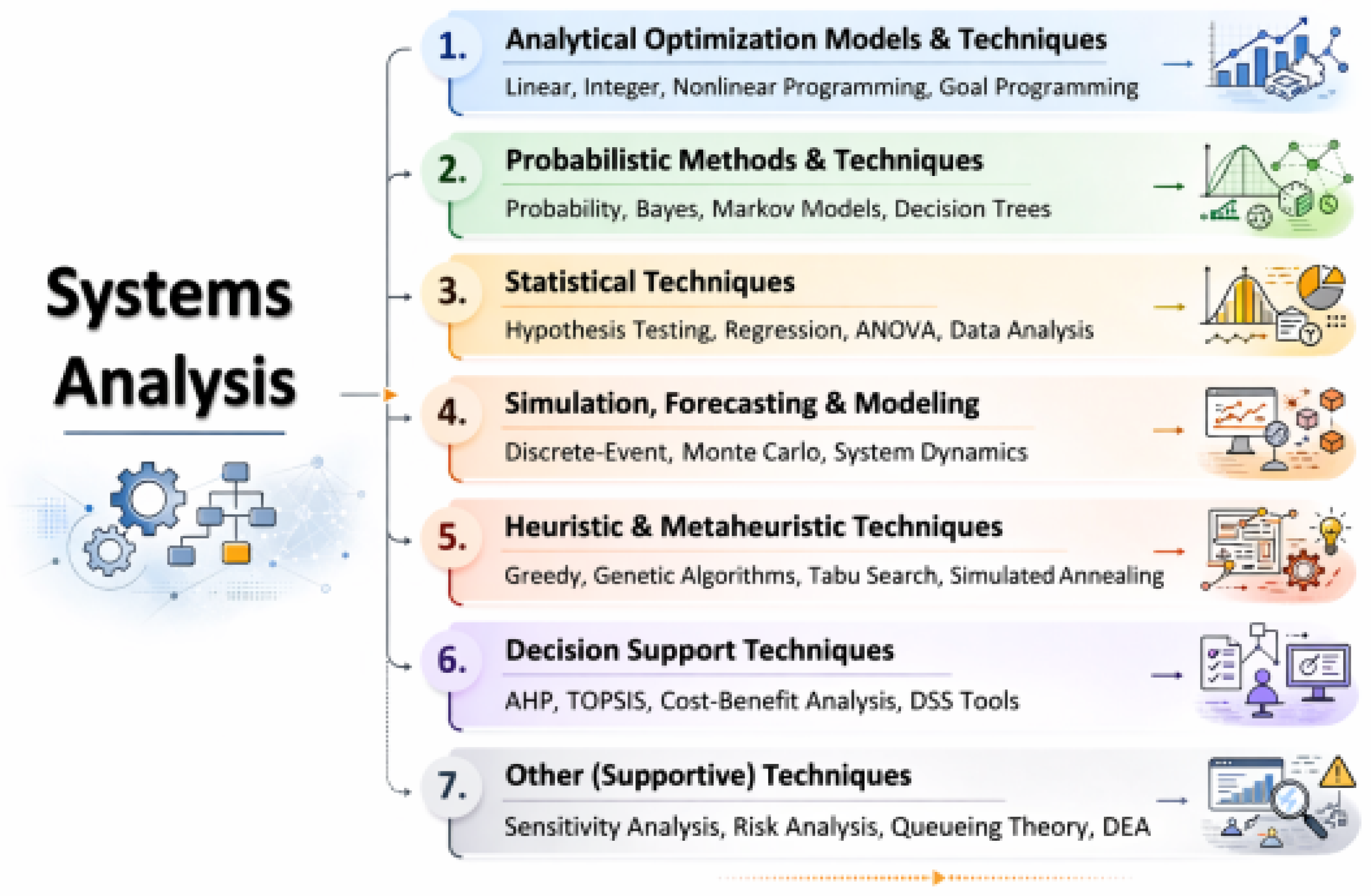
According to [8], ‘Thanks to these facts, systems analysis is a powerful discipline as it combines methods, methodologies, and technologies from different domains, involves interdisciplinary, and is not limited to analysis alone, but also offers solutions through decision-making processes in multi-criteria environments, in individual and group situations, and with reliable and unreliable information. Numerics, iterative procedures, approximate calculations, suboptimization, compromise solutions, and numerous algorithms are integral elements of systems analysis.’ A possible classification of techniques that together constitute the so-called system-analytical approach to problems of water and agricultural resources is shown in Figure 1.
Remark: The classification criteria used to structure Groups 1–7 are based on a combination of the primary methodological paradigm (e.g., analytical, simulation-based, heuristic, decision-support), the type of problem addressed (deterministic vs. stochastic, static vs. dynamic, single vs. multi-criteria), and the functional role within the decision-making process (model formulation, solution generation, evaluation, or support). By introducing these dimensions, the classification is grounded in well-established methodological distinctions. We acknowledge that strictly disjointed boundaries are neither realistic nor desirable in contemporary systems analysis. Many modern approaches, particularly hybrid and AI-supported methods, span multiple categories. Therefore, the proposed groups should be interpreted as dominant methodological domains, rather than mutually exclusive classes. Typical overlaps (e.g., metaheuristics supporting classical optimization, simulation coupled with decision-support tools) thereby increase transparency instead of forcing artificial separation.
We emphasize that the intention of the presented classification is not to impose a rigid taxonomy, but to provide a structured yet flexible framework that reflects the evolving, hybrid nature of systems analysis, particularly in the context of integration with AI/ML and decision-support environments.
As is to be expected, the explanations and corrections given in further elaborations improve the clarity, justification, and persuasive strength of the proposed classification.
  • Group 1: Optimization Methods and Techniques
This group covers a broad set of applied mathematical methods, including differential and integral calculus, matrix methods, and a wide range of deterministic and stochastic algorithms. It also spans major classes of mathematical optimization, such as linear, quadratic, and integer programming, along with dynamic, goal, and geometric programming. Closely related areas such as control theory, game theory, and decision analysis are also included.
Network-based methods, including CPM and PERT, and optimization techniques that model technical problems as networks, are an important part of this group. Typical applications include transportation and flow problems in open and closed networks, with or without losses, under deterministic or stochastic assumptions, and in both static and adaptive settings.
In practice, Linear Programming (LP) and dynamic programming (DP) are the most widely used techniques. LP is especially popular because of its conceptual simplicity: problems are defined through constraints, conditions, and an objective function, regardless of whether the underlying space is two-, three-, or higher-dimensional. Its adoption is further driven by the availability of mature, standardized software across platforms. These include web-based tools (such as LINDO), commercial modeling environments like GAMS, which integrates licensed solvers such as CPLEX, GUROBI, MOSEK, and XPRESS, as well as open-source options like CBC, and a wide range of standalone solver packages.
Another widely used LP environment is Frontline Solvers, which offers a basic solver integrated with Excel and a Premium Solver Platform capable of handling much larger problems (up to roughly 8000 variables, about 40 times the scale of the standard Excel solver). Additional extensions integrate high-performance solvers such as GUROBI, MOSEK, XPRESS, and LSLP, enabling the solution of problems with very large numbers of variables and constraints. These tools, along with standard LP packages, can also handle mixed-integer programming (MIP) efficiently on modern 32- and 64-bit personal computers, with performance varying by problem size and solver choice.
Dynamic programming is most commonly used for sequential decision-making problems, as it produces a complete optimal control policy over a range of input variables rather than a single optimal solution for one data sequence. Because of this, DP is particularly well-suited to dynamic systems. Numerous variants exist, including discrete, continuous (differential), stochastic, and approximate dynamic programming methods.
More recently, these classical optimization and network methods have become tightly integrated with artificial intelligence and machine learning applications. Mathematical programming and network models are now routinely embedded within AI-driven systems for planning, scheduling, resource allocation, and real-time decision support. Examples include reinforcement learning, where dynamic programming concepts underpin value functions and policy optimization; hybrid approaches that combine machine learning with LP or MIP to learn model parameters or constraints from data; and large-scale optimization engines used in logistics, energy systems, telecommunications, and autonomous systems.
AI applications also increasingly rely on network optimization and graph-based models for tasks such as supply-chain coordination, traffic management, social and information network analysis, and explainable decision-making. Advances in computing power, cloud-based solvers, and open-source optimization libraries have further accelerated the convergence of optimization and AI, enabling adaptive, data-driven systems that continuously update decisions in response to uncertainty and changing environments.
In modern AI systems, these optimization and network techniques are implemented through a growing ecosystem of specialized platforms and hybrid tool chains. Representative examples include:
  • Google OR-Tools: An open-source optimization suite widely used for routing, scheduling, and assignment problems, integrating LP, MIP, constraint programming, and graph algorithms; commonly embedded in AI-driven logistics and planning systems.
  • IBM ILOG CPLEX Optimization Studio: A commercial-grade platform combining CPLEX and CP Optimizer, frequently used in large-scale industrial AI applications such as airline scheduling, manufacturing, and supply-chain optimization.
  • Gurobi Optimizer: A high-performance solver with Python, MATLAB, and cloud integrations, often paired with machine learning frameworks for hybrid predictive–prescriptive analytics.
  • Pyomo: A Python-based open-source optimization modeling language that integrates naturally with data science and AI workflows, enabling optimization models to be driven by machine learning outputs.
  • AMPL: A widely used algebraic modeling language with interfaces to both commercial and open-source solvers, commonly applied in research and large-scale decision-support systems.
  • Ray RLlib and OpenAI Gym-style environments: Platforms for reinforcement learning where dynamic programming and optimal control concepts are combined with simulation-based learning.
  • TensorFlow and PyTorch (hybrid optimization use): Deep learning frameworks increasingly coupled with mathematical programming and differentiable optimization layers for end-to-end decision models.
  • Cloud-based optimization services: Platforms offered by major cloud providers that enable scalable, on-demand optimization and AI-driven decision support for large, data-intensive systems.
These platforms support the convergence of optimization, machine learning, and network modeling, enabling AI systems that combine data-driven learning with explicit constraints, interpretability, and performance guarantees.
Overall, network theory, mathematical programming, and dynamic optimization techniques are expected to play an increasingly central role in applied systems analysis, both as standalone decision-support tools and as core components of modern AI-enabled systems for evaluating alternatives, analyzing management strategies, and solving complex allocation problems.
  • Group 2: Probabilistic Models and Techniques
In water resources systems analysis, probabilistic approaches play a crucial role because many hydrological and hydraulic variables exhibit significant variability and uncertainty in both space and time. Typical variables are precipitation, streamflow, groundwater recharge, evaporation, and irrigation water demand. The uncertainties stem from natural climate variability, limited data availability, evolving cropping patterns, and an incomplete understanding of underlying processes. Probabilistic models provide a formal framework for representing such uncertainties, for example, through probability distributions of floods and droughts, stochastic rainfall generators, and random variables describing irrigation demands and potential supply deficits.
Probabilistic techniques are widely applied in flood frequency analysis, reservoir yield assessment, drought risk evaluation, and the planning and operation of irrigation systems. In irrigation management, they are particularly useful for estimating the reliability of water deliveries, assessing the risk of crop water stress, and quantifying the likelihood of supply shortages under variable climatic and hydrological conditions. Key performance measures such as reliability, resilience, and vulnerability are commonly derived from probabilistic simulations and serve as important inputs to decision-making related to irrigation infrastructure design, water allocation rules, and reservoir operation policies.
Models from this group are primarily descriptive in nature and do not directly generate decisions; instead, they yield statistical measures such as expected values, variances, or waiting-time distributions that support managerial actions within a system. Queuing theory is a representative example and can be effectively combined with optimization models from Groups 1 and 4, as discussed later. For the analysis of capacity-related problems, such as channel sizing, retention basin volumes, and the zoning of artificial reservoir storage, this group also includes techniques based on classification, sorting, and related methods. Owing to their relative simplicity and widespread availability on personal computing platforms, probabilistic methods are extensively used both as standalone tools and in combination with other modeling approaches.
When integrated with simulation or optimization frameworks, probabilistic models significantly enhance the robustness of water resources and irrigation systems by explicitly accounting for uncertainty and extreme events, rather than relying solely on deterministic assumptions.
  • Group 3: Statistical Techniques
Statistical techniques enable all kinds of statistical calculations and support complex multivariable analyses of historical data sequences, forecasting, prediction, and, in many applications, statistical inference. Within the overall process of water resources planning and management, these techniques are primarily descriptive in nature. They do not directly contribute to the selection of system components for analysis, the choice of datasets, or the determination of independent and dependent variables (for example, in multivariable regression models), nor do they estimate the system state based on technical design alternatives treated as predefined independent variables. Instead, their main role lies in the analysis, interpretation, and synthesis of available data.
Applications of statistical techniques have been documented predominantly in system planning, particularly for the description and analysis of hydrological and hydroclimatic processes in river basins, such as runoff generation, inflows to reservoirs, river and canal discharges, groundwater-level fluctuations, and irrigation water requirements. In irrigation and agricultural water management, statistical analyses are also used to evaluate crop water use patterns, assess yield–water relationships, and identify trends and anomalies in water demand under changing climatic and management conditions.
In recent years, the role of statistical techniques has expanded significantly due to the availability of large observational and remotely sensed datasets and the development of contemporary software products and platforms. Widely used statistical and data analysis environments such as R, Python-based libraries (e.g., NumPy, Pandas, SciPy), MATLAB, and SPSS complement traditional packages such as STATISTICA. These tools are increasingly integrated with geographic information systems (GIS) and remote sensing products, including satellite-based rainfall estimates, evapotranspiration products, and soil moisture data, enabling spatially distributed statistical analyses in water resources and irrigation studies.
Furthermore, statistical techniques underpin many modern decision-support and monitoring systems in water management, including drought indices, irrigation performance benchmarking tools, and early warning systems for floods and water shortages. Although these methods remain largely descriptive, their combination with simulation, optimization, and machine learning approaches enhances the analytical capabilities of contemporary water resources and irrigation planning, supporting more informed and data-driven decision-making.
  • Group 4: Simulation, Search, and Sampling Techniques
Simulation models are primarily descriptive: they represent how a system behaves rather than prescribing how it should be optimized. A simulation model captures quantitative relationships among system variables and generates system responses to specified inputs, stimuli, or operating conditions. Unlike optimization models, most simulation models do not include an internal algorithm for searching for an optimal solution (except for hybrid simulation–optimization approaches).
A key strength of simulation is its ability to represent real-world systems with relatively high fidelity. Because simulation focuses on reproducing system behavior rather than enforcing optimality, it typically requires fewer simplifying assumptions than optimization-based models. At its core, simulation involves two main steps: (1) model formulation, where system behavior is expressed using algebraic, differential, or integral equations; and (2) experimentation, where the model is executed repeatedly to observe system responses under different scenarios and input conditions.
Within a systems-analysis framework, simulation is especially effective when the input space can be constrained in advance, keeping the number of required simulation runs manageable. When inputs are poorly bounded or highly uncertain, however, extensive exploration of response curves or surfaces can significantly increase model complexity, computational demands, and overall analysis costs.
A general limitation of simulation models is their context dependence, that is, strong dependence on application-specific conditions. Many models must be tailored to specific physical, environmental, or operational settings. Good examples of this are models used to represent aquifer geometry and hydraulic properties or to simulate groundwater dynamics. Over the past two decades, a growing number of standardized and semi-standardized simulation tools have emerged. These include models for estimating crop water requirements (e.g., CROPWAT, AquaCrop), simulating soil moisture dynamics, evaluating the economic impacts of irrigation, assessing flood damage, designing regional water-supply systems with reservoirs, and allocating reservoir storage among competing uses. A good overview of these models can be found in the book [8]. Whether independently or in combination with optimization models, especially in the context of so-called simulation-optimization techniques [37,38,39], simulation is the leading and indispensable technique of systems analysis in all tasks related to planning and managing water resources in water management and related sectors, particularly agriculture. Related to agriculture, Tanji and Kielen [5] provide planners, decision-makers, and engineers with guidelines to sustain irrigated agriculture in arid and semi-arid areas, and at the same time to protect water resources from the negative impacts of agricultural drainage water disposal. On the basis of case studies from Central Asia, Egypt, India, Pakistan, and the United States of America, the authors distinguish four broad groups of drainage water management options: water conservation, drainage water re-use, drainage water disposal, and drainage water treatment.
More recently, simulation has become tightly coupled with artificial intelligence and data-driven methods. Machine learning models are increasingly used to approximate complex system dynamics, calibrate simulation parameters from large observational datasets, and serve as fast surrogate models that replace or augment computationally expensive simulations. AI-driven approaches also support intelligent sampling of the input space (e.g., active learning), uncertainty quantification, and real-time scenario analysis. In combination with optimization techniques, these hybrid simulation–optimization and simulation–AI frameworks enable adaptive planning, predictive decision support, and digital-twin implementations for water resources, agriculture, and infrastructure systems.
Recent advances in artificial intelligence have introduced new engineering paradigms for simulation. Of particular importance are:
  • Digital twins: Platforms such as Azure Digital Twins, Dassault Systèmes’ 3DEXPERIENCE, and sector-specific water and infrastructure digital twins integrate physics-based simulation with real-time sensor data and AI analytics. These systems enable continuous monitoring, forecasting, and scenario testing for infrastructure, water resources, and agricultural systems.
  • Surrogate (emulator) models, in which machine learning methods (e.g., Gaussian process regression, deep neural networks, and polynomial chaos expansions) approximate the input–output behavior of high-fidelity simulations, enabling rapid evaluation for sensitivity analysis, uncertainty propagation, and optimization. Surrogate modeling and emulation frameworks: Machine learning models (e.g., Gaussian processes, neural networks, and ensemble learners) are used as fast approximations of complex simulation models. Tools built on PyTorch, TensorFlow, and scikit-learn, often coupled with uncertainty-quantification libraries, allow for rapid scenario evaluation and sensitivity analysis.
  • Hybrid simulation–AI environments: Platforms such as Python-based co-simulation frameworks, OpenAI Gym-style environments, and reinforcement-learning toolkits (e.g., Ray RLlib) combine simulation models with learning agents for adaptive control, reservoir operation, irrigation scheduling, and energy–water system management.
  • Simulation environments for learning-based control, where reinforcement learning agents interact with simulation models to derive control policies for reservoir operation, irrigation scheduling, or infrastructure management.
  • Operational decision-support systems: Commercial and open-source platforms increasingly embed simulation engines alongside optimization solvers and AI modules to support real-time planning, early warning systems, and policy evaluation under uncertainty. These AI-enhanced simulation frameworks support intelligent sampling of input spaces, automated calibration using observational data, uncertainty analysis, and real-time adaptation. They also enable the development of policy-relevant scenario analysis, allowing decision-makers to evaluate trade-offs among economic efficiency, environmental sustainability, and risk under multiple future conditions.
From an engineering standpoint, calibration, verification, and validation are critical. Calibration involves estimating model parameters by minimizing discrepancies between simulated and observed data, often via least-squares or likelihood-based formulations. Verification ensures numerical correctness and implementation fidelity, while validation assesses model adequacy against independent datasets and performance metrics.
Whether employed as standalone analysis tools or integrated into ‘simulation–optimization–AI’ workflows, simulation models remain central to engineering systems analysis. In water resources, agriculture, and infrastructure engineering, they provide the computational foundation for design, operational planning, risk assessment, and policy evaluation in systems characterized by nonlinear dynamics, spatial heterogeneity, and uncertainty.
Whether used independently or as part of integrated simulation–optimization–AI pipelines, simulation remains a central and indispensable technique in systems analysis. In water resources management, agriculture, and related sectors, it provides the analytical foundation for long-term planning, operational management, and evidence-based policy design, particularly in contexts characterized by complex dynamics, uncertainty, and competing stakeholder objectives.
Whether used independently or embedded within simulation, optimization, and AI-enabled decision-support pipelines, simulation remains a core and indispensable tool of systems analysis. It plays a central role in planning and managing water resources and related sectors, particularly agriculture, where complex dynamics, uncertainty, and competing objectives make purely analytical or optimization-based approaches insufficient.
  • Group 5: Heuristic and Metaheuristic Techniques
Group 5 comprises heuristic and metaheuristic techniques, which are widely used for solving complex, large-scale, and computationally intractable problems. A heuristic is commonly understood as a rule of thumb: a problem-specific, non-general algorithm designed to iteratively improve solution quality. Heuristic solutions are typically suboptimal, but they can be obtained efficiently for problems where exact optimization is impractical.
At the core of heuristic methods is problem encoding, which involves transforming a continuous or highly complex problem into a discrete, often combinatorial, representation. Candidate solutions are iteratively generated and evaluated, for example, by encoding decision variables as binary strings and applying operations such as swapping, mutation, or recombination. This approach is commonly used to search multimodal objective functions and large decision spaces, where classical gradient-based methods fail.
Metaheuristics extend this idea by coordinating or combining multiple heuristics according to a higher-level strategy. Well-designed metaheuristics accelerate convergence and typically produce solutions that are closer to the global optimum than those obtained by individual heuristics alone. While optimality is not guaranteed, solution quality and robustness are often significantly improved.
Heuristics are particularly valuable for NP-hard problems with extremely large or practically infinite solution spaces, such as the control and operation of multi-reservoir water systems with uncertain inflows, competing users, dynamic storage constraints, and nonlinear economic objectives. Even with coarse discretization, such problems are computationally infeasible for exact methods. Heuristic and metaheuristic approaches reduce these problems to manageable discrete searches and apply intelligent stochastic exploration (e.g., random walks, branching, region jumping) to identify high-quality solutions.
Modern AI has significantly strengthened heuristic and metaheuristic methods. Many of these techniques are now viewed as core components of artificial intelligence, particularly in search, planning, and learning. Evolutionary and swarm-based algorithms, such as genetic algorithms, ant colony optimization, particle swarm optimization, bee and cuckoo search methods, are inspired by natural processes including selection, mutation, cooperation, and adaptation. These methods are implemented as software systems that rely on randomized sampling, population diversity, and adaptive search control to avoid premature convergence and local optima.
In recent times, thanks primarily to powerful computing technology, numerous algorithms inspired by evolutionary processes in nature have gained great popularity, especially processes characterized by the survival and propagation of the best individuals in a population, population diversification, sexual crossover of individual genes (chromosomes), mutation, and others. The class of intelligent methods of systems analysis includes genetic algorithms (GA), ant colonies and systems (Ant Colonies), bee colonies and systems (Bee Colonies), particle swarms (Particle Swarm), cuckoo colonies (Cuckoo Colonies), and many others (see, for example, [40,41,42,43,44]). Intelligent methods are extensively reported in the scientific literature, and continuous efforts are made to improve them and apply them in all fields, including water resources management and agriculture.
Increasingly, heuristics and metaheuristics are integrated with machine learning. Examples include learning heuristic parameters from data, using surrogate models to approximate objective functions, and embedding metaheuristic searches within reinforcement learning or simulation-based decision frameworks. These hybrid AI approaches are widely applied in water resources management, agriculture, energy systems, and logistics.
In systems analysis for water management and agriculture, Group 5 methods are especially appropriate when data are uncertain or scarce, system behavior is highly nonlinear, exact algorithms are unavailable or too slow, or rapid decisions are required. Their main advantages are flexibility, scalability, and intuitive modeling inspired by natural processes. Their limitations include the lack of guaranteed optimality, sensitivity to parameter tuning, and challenges in integrating locally optimal solutions into a globally consistent system solution.
  • Group 6: Techniques for supporting decision making
Group 6 encompasses methods and techniques that support structured decision-making processes. Two main classes are distinguished: (1) multicriteria analysis and optimization (MCA and MCO), and (2) social choice theory (SCT).
MCA and MCO deal with problems involving multiple criteria and alternatives, with decisions made individually, in subgroups, or by a collective. Depending on the formulation of the decision problem, particularly the definition of the global objective, methods are categorized as non-compensatory (e.g., dominance, max–min, max–max, conjunctive and disjunctive) or compensatory (e.g., utility-based, consensus, compromise) approaches. When decisions involve groups, individual preferences can be aggregated using a variety of mathematical methods, as discussed extensively in the literature [45,46,47,48,49].
Social choice theory (SCT) focuses on voting and collective choice, often applied in electoral or governance contexts such as irrigation user associations, river-basin committees, and farmers’ associations. SCT models include preferential and non-preferential voting, where multiple criteria are synthesized implicitly in the voting process, unlike MCA/MCO, where the weights of criteria are explicitly considered. SCT and MCA/MCO can be used independently or in a hybrid form, depending on the application context [45,46].
AI integration in decision-support techniques has enhanced both MCA/MCO and SCT applications. For example:
  • Preference learning: Machine learning models (e.g., neural networks, support vector machines) can infer stakeholder priorities from historical decisions in irrigation management, crop planning, or water allocation.
  • Adaptive weighting and optimization: AI algorithms such as reinforcement learning or genetic algorithms adjust criteria weights dynamically under uncertain hydrological or economic conditions. For instance, in reservoir operation planning, AI-driven MCA can optimize trade-offs between water supply, flood risk, and environmental flows.
  • Voting and aggregation analysis: Multi-agent AI systems can simulate group voting, detect inconsistent preferences, and explore coalition formation in river-basin committees. Tools like NetLogo or Python-based multi-agent frameworks are often used.
  • Scenario simulation: Monte Carlo and AI-powered simulation frameworks enable testing of alternative policy or management scenarios under uncertainty, such as evaluating irrigation strategies across multiple farms using hybrid MCA/SCT models.
  • Decision-support platforms: Platforms like DSS-WRM, WEAP, or AquaCrop, coupled with AI modules, integrate MCA/MCO with scenario analysis, optimization, and stakeholder input for evidence-based water and agricultural management.
These AI-augmented MCA/MCO and SCT frameworks are increasingly applied in water resources management, agriculture, and multi-stakeholder resource allocation, supporting robust, participatory, and data-driven decision-making.
  • Preference learning and elicitation: Machine learning models infer implicit stakeholder preferences from historical decisions or behavioral data.
  • Adaptive weighting and optimization: AI algorithms dynamically adjust criteria weights or evaluate trade-offs under uncertainty.
  • Aggregation and consistency analysis: AI techniques identify inconsistencies, conflicts, or strategic patterns in group voting or scoring.
  • Scenario simulation and participatory DSS: Reinforcement learning, Monte Carlo simulations, and multi-agent AI systems enable exploration of multiple “what-if” scenarios and support transparent, data-driven stakeholder engagement. Monte Carlo simulation method, queuing theory, and other techniques can be used to construct a flexible decision support system, providing methods and practical support for the refined and scientific management of agricultural water resources management and irrigation scheduling [50,51,52].
Hybrid AI-driven systems combining MCA/MCO and SCT are increasingly applied in water management, agriculture, and other resource allocation domains, supporting robust, participatory, and evidence-based decision-making.
  • Group 7: Auxiliary (Supporting) Techniques
Auxiliary techniques complement the methods in Groups 1–6, addressing complex, cross-sector problems that often involve multiple stakeholders, conflicting interests, or imbalances in water and agricultural systems. While Groups 1–6 provide the core analytical and optimization tools, Group 7 methods are essential for linking quantitative results to social, economic, and political contexts, where societal preferences, priorities, and trade-offs play a critical role in decision-making.
These techniques provide formal mechanisms to balance competing interests, reconcile conflicting objectives, and interpret systems analysis outcomes for practical planning and management. Key methods can be grouped as follows:
  • Game theory, which enables the modeling of strategic interactions among stakeholders or competing agents in resource allocation, markets, or infrastructure systems.
  • Cost–benefit analysis, which evaluates trade-offs between economic, social, and environmental outcomes.
  • Stakeholder analysis and multi-criteria aggregation by using statistical inference, direct cross-referencing, or advanced data fusion to integrate heterogeneous input from multiple actors.
AI has expanded the capabilities of auxiliary techniques in the following way:
  • Predictive and prescriptive analytics use machine learning to forecast stakeholder responses, system performance, or economic outcomes under different management scenarios.
  • Multi-agent simulations implement game-theoretic interactions in dynamic, data-driven environments to explore negotiation, coalition-building, or competitive behavior.
  • Automated trade-off analysis employs reinforcement learning or optimization-guided AI to explore Pareto-efficient solutions across multiple conflicting objectives.
  • Decision-support platforms integrate auxiliary techniques with MCA/MCO and SCT frameworks, enabling interactive visualization, scenario analysis, and participatory policy evaluation (e.g., AI-enhanced DSS-WRM, WEAP, or digital-twin frameworks).
Auxiliary techniques are particularly valuable when objectives are multiple and conflicting, systems are high-dimensional, and decisions must consider both technical constraints and societal priorities. Their origins in economics, military strategy, energy systems, and other applied fields reflect their focus on real-world planning and managerial challenges, and AI now allows these methods to operate at larger scales and with greater adaptive intelligence.
Table 1 provides a mapping of the previously described techniques and methods of systems analysis, their integration with AI and achieved enhancements, and key applications that make the framework practical for engineers, policymakers, and academics.

5. Water Resources: Systems Modeling Tools and Approaches

5.1. River-Basin Models and Tools

Systems analysis in the water sector employs a range of modeling tools and computational methods. Regarding river-basin hydrological and hydraulic models, the following basin-scale models are worth mentioning as suggested in [53,54].
SWAT (Soil and Water Assessment Tool) with AI integration is a robust river-basin-scale model that simulates daily hydrological processes, water quality, water allocation, irrigation, nutrient cycles, and crop growth at watershed scales. As a model that integrates land use, climate, and agricultural management scenarios to inform sustainable water management, SWAT receives continuous interest from researchers and practitioners and has thousands of applications reported in studies, papers, and other scientific documents worldwide. An important AI feature recently embedded in SWAT is that it now uses artificial neural networks for calibrating hydrological models based on real-time data, while its machine learning module enables improvement of water runoff predictions, evaluation of soil erosion impacts, and identification of irrigation needs under different agricultural practices. Embedded optimization models include flood, water quality, and agricultural runoff predictions.
  • SWMM (Storm Water Management Model) is a dynamic rainfall–runoff–subsurface runoff simulation model used for single-event to long-term continuous simulation of the surface and/or/subsurface hydrology quantity and quality from primarily urban/suburban areas. It is an urban-focused model that handles runoff, drainage systems, and water quality. The model is often coupled with hydrological models. Since its inception by the EPA in the USA, the model has been used in thousands of sewer and stormwater studies throughout the world. SWMM is public domain software that may be freely copied and distributed.
  • River Ware is an advanced river and reservoir modeling tool used for water resource management, operational scheduling, and long-term planning. Developed by the Center for Advanced Decision Support for Water and Environmental Systems (CADSWES) at the University of Colorado Boulder, it is a standard tool for major agencies like the U.S. Bureau of Reclamation and the Tennessee Valley Authority.
  • MODSIM-DSS (Decision Support System) is a GUI-driven, powerful, generalized river-basin management and water allocation model developed at Colorado State University. It is a network-based river-basin allocation and operations model, used globally to simulate complex water resource systems and support decision-making for long-term planning and daily operations. Its core functionality includes network flow optimization monthly and a simulation procedure conceptualized as a chain of monthly optimizations. MODSIM represents river basins as networks of nodes (reservoirs, demands, diversion points) and links (canals, river reaches). It uses a minimum-cost network flow algorithm to allocate water based on physical constraints and user-defined priorities. Model excels at modeling the interaction between surface water and groundwater, often linking with models like MODFLOW to handle stream-aquifer exchanges. MODSIM includes a powerful, interactive graphical user interface for creating, locating, and connecting river-basin infrastructural objects.
  • AQUATOOL is a decision-support system software developed by the Polytechnic University of Valencia for the planning and management of water resource systems. It is used for research, academic, and practical management applications by river-basin agencies. The software allows users to design and graphically configure water resource systems, manage associated databases, and perform optimization and simulation for various management alternatives and time horizons. Key modules include SIMGES (simulation), OPTIGES (optimization), GESCAL (water quality simulation), SIMRISK (risk assessment), and EVALHID (rainfall–runoff modeling). AQUATOOL helps in analyzing problems related to water management, evaluating the impacts of changes in the system, performing risk analysis, and supporting the distribution of resources between conflicting demands. It is commonly used in Europe and Latin America for basin planning and water allocation.
  • MIKE Powered by DHI. It is a modeling suite for water quality monitoring and management in water systems that uses AI to analyze water quality, pollution levels, and hydrological data at a river-basin scale. Its AI-driven data analysis is used for water quality modeling, focusing on nutrient loading, chemical pollution, and sediment transport. Machine learning is used for predicting water quality trends under different agricultural runoff and wastewater management scenarios, while optimization algorithms suggest best practices for water pollution control and agricultural runoff management. MIKE is commonly applied for water quality monitoring, managing pollution in agricultural and urban water systems, and decision-making in water management.
  • Ribasim (River-basin planning and management model) is an open-source tool for modeling managed water systems at the river-basin scale. Built to support collaborative planning and decision support, it enables simulations of how choices affect people, nature, and water-supply reliability. Through evidence-based modeling, it enables decision makers to build consensus amongst water users and make smart decisions about how to manage water resources optimally, considering uncertainties now and in the future.
Other more important models in this class are:
  • HEC-HMS (Hydrologic Modeling System), which is a software system widely used by engineers and agencies for flood forecasting and event-based simulations.
  • TOPMODEL, which is focused on topography-driven runoff generation and is good for understanding saturation excess flows.
  • HBV (Hydrologiska Byråns Vattenbalansavdelning) is a conceptual, lumped/semi-distributed model that is widely used for runoff simulation.
  • PRMS (Precipitation–Runoff Modeling System) is developed by the US Geological Survey and is good for climate and land-use impact studies.
  • VICM (Variable Infiltration Capacity Model) is most used in climate studies. The model simulates land-surface hydrology at large scales.
  • DHSVM (Distributed Hydrology Soil Vegetation Model) is physics-based and grid-based and commonly used in studies for mountainous and forested watersheds.
  • WASP (Water Quality Analysis Simulation Program) is frequently used for river, lake, and estuary water quality modeling. It is often coupled with hydrological models.
  • SWMM (Storm Water Management Model) is an urban-focused model that handles runoff, drainage systems, and water quality. This model is also often coupled with hydrological models.
  • MODFLOW (with packages like MODFLOW-NWT, MODFLOW-OWHM) is a standard groundwater flow model, often coupled with watershed models.
  • HEC-RAS (with hydrologic inputs) is a primarily hydraulic model that is commonly used alongside watershed models for floodplain analysis.
There are certain challenges and research gaps in all broad applications of AI-oriented water management tools. Regarding data availability and quality, many AI models require high-quality large datasets that are often unavailable or difficult to integrate across different regions, catchment areas, and agricultural systems; this is an important challenge in developing effective systems analysis tools. Regarding model transparency and interpretability, AI and machine learning models are often seen as ‘black boxes’, which can reduce trust among stakeholders (e.g., farmers and policymakers); ensuring transparency in AI-based decision-making processes appears to be a key research gap and will obviously require more time for research efforts. Integration of diverse data sources is a requirement for AI to enable the generation of accurate predictions by collecting and integrating diverse data from remote sensing, IoT devices, weather stations, and field surveys. Combining these data types effectively remains a major challenge. No less important is the challenge of achieving adoption of new technological tools by farmers and policymakers. Namely, many AI-based tools require a level of technical expertise that may limit adoption, particularly in small-scale or resource-poor settings. Research into user-friendly interfaces and training is needed.

5.2. Multi-Criteria Decision Analysis and Optimization Models

Watershed management and flood risk planning require balancing competing objectives, such as ecological preservation, infrastructure costs, and public safety, across diverse stakeholder groups. This complexity has led to the adoption of Multi-Criteria Decision Analysis (MCDA) and rigorous mathematical optimization techniques.

5.2.1. Multi-Criteria Decision Analysis (MCDA) Models

MCDA frameworks are essential for ranking alternatives based on qualitative and quantitative factors where no single ‘perfect’ solution exists [55,56].
  • AHP (Analytic Hierarchy Process) [57,58,59,60] is the most widely used MCDA method in watershed management [56]. It structures complex problems into a top-down hierarchy of decision elements (goal, criteria, sub-criteria, alternatives) and uses pairwise comparisons to derive their weights, thus enabling transparent prioritization of watershed sub-basins, flood mitigation measures, or conservation zones. AHP is widely applied in flood vulnerability mapping, erosion risk assessment, and site suitability analysis.
  • ANP (Analytic Network Process) [61,62] is an extension of AHP. While AHP assumes a linear top-down structure, ANP allows for dependence and feedback between elements, effectively modeling decision problems as networks rather than trees. ANP is therefore suitable for complex ecological systems where one factor (e.g., land use) directly impacts another (e.g., runoff). ANP is particularly relevant in watershed systems where hydrology, land use, policy, and ecological processes interact dynamically. ANP is often used when socio-ecological feedback significantly influences outcomes.
  • TOPSIS (Technique for Order of Preference by Similarity to Ideal Solution) [63] identifies the solution that is geometrically closest to the ‘positive ideal’ and farthest from the ‘negative ideal’ [63,64]. This is one of the most popular MCDM tools because it can account for both positive and negative aspects of alternatives simultaneously and maintains a constant number of computational steps regardless of the number of attributes [65,66]. A good review on the method, its extensions for different applications, and recent developments can be found in [67]. It is frequently used for water allocation and rating management strategies and also for prioritizing flood control strategies, reservoir operation alternatives, or green infrastructure options under competing objectives.
  • ELECTRE (Élimination Et Choix Traduisant la REalité) [68,69,70,71] is an outranking method that identifies preferred alternatives through pairwise dominance relationships by comparing them in pairs to see which ‘outranks’ others based on specific thresholds. It is particularly useful when decision-makers wish to eliminate clearly inferior watershed management options rather than compute strict rankings.
  • PROMETHEE (Preference Ranking Organization METHod for Enrichment Evaluations) [72,73,74,75] is also an outranking technique that provides partial or complete rankings of alternatives based on preference functions. It is frequently applied in environmental planning where qualitative and quantitative criteria must be integrated.

5.2.2. Rigorous Optimization Techniques

These optimization approaches are frequently coupled with hydrological simulation models to enhance decision support. When watershed planning requires finding the best solution under explicit physical, financial, or regulatory constraints, rigorous optimization models offer valuable outcomes. Unlike MCDA, which ranks pre-defined alternatives, these techniques search for the mathematically ‘best’ possible solution within a set of constraints [76].
  • Linear and Nonlinear Programming (LP, NLP) [77,78] are commonly used to allocate limited resources, such as irrigation water, to maximize economic yield while staying within supply limits [79]. Linear Programming (LP) is used when both objective functions and constraints are linear. LP is predominantly applied in water allocation problems, reservoir operation planning, and cost minimization of flood mitigation strategies. Nonlinear Programming (NLP) is applied when system relationships are nonlinear, which is common in hydrology (e.g., runoff–storage relationships). NLP models can optimize groundwater extraction, flood-routing parameters, and ecological flow requirements.
  • Dynamic Programming (DP) (Bellman 1957) [80] is effective for multistage decision-making, such as managing reservoir releases over several months to account for seasonal variations, especially during flood events. DP breaks complex time-dependent problems into simpler recursive stages [79].
  • Stochastic Programming (SP) is specifically designed to handle uncertainty, such as unpredictable rainfall or inflow, by incorporating probability distributions into the optimization model. It is widely used in flood risk planning under uncertain future hydrologic conditions (e.g., [81]).

5.2.3. Integrated Simulation–Optimization Software

Modern watershed planning often couples physical simulation models (which predict what will happen) with optimization algorithms (which decide what should be done). Table 2 shows key details of several software systems with their primary functions and optimization coupling examples in water resources management.

5.3. Decision Support Systems with AI Integration

There are many decision support systems at different scales and functions in water resources and agricultural management, and with ongoing implementations of AI tools. Some of them are already mentioned in previous sections, and here are briefly elaborated on two advanced integrations with AI tools of decision support systems known as WEAP and DSSAT.
  • WEAP (Water Evaluation and Planning system) is a policy-analysis and scenario planning model that simulates water demand, supply, irrigation needs, ecological flows, and socio-economic drivers. It supports strategy comparison under uncertainty. WEAP itself is a rule-based decision support model. AI is coupled externally to enhance prediction, optimization, or scenario evaluation. This way, AI improves the inputs, while WEAP handles the allocation decisions. AI methods used in combination with WEAP are artificial neural networks (ANN), Long–Short-Term Memory/Recurrent Neural Network (LSTM/RNN) (for time-series forecasting), and Random Forest (RF). For instance, LSTM predicts monthly inflow, and WEAP allocates water among sectors. For evaluation of management scenario options and decision support, clustering in WEAP is supported by AI to identify similar climate scenarios, reinforcement learning for analyzing adaptive water management scenarios, and fuzzy logic for handling uncertainty and stakeholder preferences. AI is also used for optimization of policies, including optimization of reservoir operating rules, priorities of water allocation among users, and following environmental flow constraints such as minimum low-flow augmentation. In addition, AI optimizes costs vs. reliability of supply and, to some extent, the sustainability of reservoirs’ optimal operating outcomes.
  • DSSAT (Decision Support System for Agrotechnology Transfer) is a comprehensive system that helps in crop modeling and agricultural management using AI and machine learning for better prediction of crop yields under different water availability scenarios, and optimal fertilizer use and irrigation practices implementation. Focused on crop growth and agronomic outcomes, if integrated with water models, it links agricultural productivity to water resource dynamics. From an operational point of view, DSSAT is physically based, but rule-driven. AI adds learning, prediction, and optimization, where the originally developed DSSAT is weak. Regarding DSSAT input, AI improves weather, soil, and management inputs by using ANN/LSTM for climate variable forecasting, Random Forest for soil parameter estimation, and ML-based gap filling for missing data. An example is that LSTM predicts future rainfall, while DSSAT simulates crop yield. DSSAT enables predictive analytics for forecasting crop yields based on varying water availability and agricultural practices, and also includes data assimilation techniques to integrate field data with climate models for more accurate predictions.

5.4. Emerging Computational Methods in Irrigation with AI Integration

AI-oriented systems analysis approaches and tools are becoming increasingly valuable in water management and agriculture because they can handle complex, dynamic systems with large amounts of data, provide predictions, and optimize decision-making processes. They integrate machine learning, optimization algorithms, and modeling techniques to enhance the efficiency and sustainability of water use, crop production, and overall environmental management. The following two classes are: (1) machine learning and reinforcement learning models, which are gaining traction for predictive water resources planning, optimization under uncertainty, and real-time decision support, especially for dynamic allocation and quality assessment; and (2) AI-based decision models, which are increasingly used in studies and real-time decision making. More commonly used models belonging to this class are fuzzy logic models applied in studies of water quality and for flood risk decisions, genetic algorithm (GA) models, which are used for reservoir operation and watershed management, and reinforcement learning models, which are emerging but still mostly used for research.
Regarding AI-related systems analysis applications in agricultural water management, the following applications deserve more attention.
  • Smart Irrigation Systems: Combining AI, IoT, and machine learning enables automation of irrigation and optimization of water usage for agriculture. Sensor networks powered by AI are aimed at detecting soil moisture levels, temperature, and rainfall, triggering irrigation only when necessary. Machine learning models analyze environmental data to predict irrigation needs over time, optimizing water use while maintaining crop health, and finally, integration with weather forecast models enables predicting water demand based on seasonal weather patterns. SIS is commonly used in applications for precision irrigation, smart farming, reducing water waste, and improving crop health.
  • Irrigation Scheduling and Efficiency. Systems analysis improves irrigation efficiency by integrating soil–climate data with water delivery systems, preventing water waste and enhancing crop outcomes. Models evaluate timing, volumes, and water quality impacts on agriculture. Water-need models enable surveys of irrigation decision systems, highlight mathematical models assessing crop water needs, adapting to environmental dynamics, and guiding irrigation strategies.
  • Water Quality in Irrigation. Systems-level assessments of irrigation water quality show how upstream contamination, hydrology, and watershed management influence agricultural risk, including food safety. Recent reviews expand this to sustainable development frameworks (e.g., SDG 6), emphasizing comprehensive quality assessment systems for irrigation water and policy integration.
  • Green Innovations & Sustainable Management. Sustainable water management literature often intersects systems thinking with green innovations such as efficient irrigation technologies, governance reforms, and adaptive policies. However, precise definitions and standardized frameworks for sustainable water management and agricultural applications remain underdeveloped in many studies.

6. Several Recently Reported Examples of Real-Life AI Applications in Water Management

There are many examples of real-life AI-driven support for water resources management and irrigation management at various scales, primarily at the local. Here are some recently published real-life applications of AI in water management, cross municipal systems, environmental monitoring, agriculture, flood risk, and industrial operations.
  • Regarding urban and municipal water management, two examples from India are worth mentioning. As reported in The Times of India (7 January 2026), in Tamil Nadu (India), Trichy Corporation uses AI for water quality monitoring and distribution. An AI-based image analysis tool is used to verify chlorine levels from water sample photos, improving water quality checks in real time. The drinking-water chlorination monitoring system is upgraded by deploying 75 portable testing kits and introducing an AI-backed verification mechanism. The other case is related to smart water network optimization. The Delhi Jal Board partnered with IIT Kanpur to deploy in Delhi (India) an AI-driven system with digital-twin tech to monitor pipelines, detect leaks, optimize distribution, speed up complaint resolution, and plan groundwater recharge. Advanced AI technologies are aimed at modernizing and streamlining the city’s water and wastewater management systems. One important aspect is to integrate artificial intelligence (AI) in groundwater recharge and maintenance of its water and sewage treatment plants. Digital-twin technology will be leveraged to create virtual replicas of DJB’s water systems, which will aid in enabling early detection of leakages, pressure drops, and system inefficiencies.
  • There are many AI applications in leak detection. For instance, the city of Las Vegas in the USA uses AI-based systems that analyze sensor and flow data aimed at detecting leaks early and reducing water loss in the urban water distribution system. Another interesting example is hydraulic network optimization in Georgia. In the Khelvachauri case study, AI algorithms combined with hydraulic modeling increased network pressures, improved pump efficiency, and reduced leak rates, showing how machine learning can help smaller utilities manage resource constraints. As far as predictive forecasting and resource planning are concerned, one example is Cape Town, where AI is used to forecast water demand and help manage scarce supplies during drought crises. The other example is the use of AI for river-basin governance and decision support. A platform called WaterCopilot has been developed for the Limpopo River Basin. It integrates real-time hydrological data with AI to support policymakers with alerts, trend insights, and interactive queries for informed water resource decisions.
  • Regarding flood risk and environmental monitoring, in Aragon (Spain), the early flood warning company Amazon (AWS) invested in an AI-powered early warning system to integrate weather and water flow data to improve regional flood anticipation and response planning. There are evidence-based research projects that are focused on using hybrid AI vision systems to interpret river gauge data automatically, enhancing water-level monitoring for better flood forecasting and water allocation planning.
  • Smart Water System for Urban Flood Prevention is deployed in Rotterdam (Netherlands), focusing on the integration of IoT sensors with AI to manage urban water risks. Rotterdam invested in a sensor network monitoring sewers, canals, and pumps, feeding AI analytics that can predict blockages or pump failures and adjust pumping systems in real time based on forecast rainfall and current flow data. This way, the system helps reduce urban flooding risk in a city highly vulnerable to storms and sea-level rise.
  • A water quality and leak-monitoring system in Barcelona (Spain) uses an AI-based sensor network for real-time distribution monitoring. By deploying sensors throughout the distribution system and by using AI to analyze chlorine, temperature, and flow parameters, various benefits are recognizable, such as faster leak and contamination detection and improved operational responsiveness. Also, AI enables more proactive and granular monitoring than periodic manual testing.
  • Fido Tech from the UK uses small sensors placed on pipes for acoustic monitoring (‘listening’) of the flow of water. Their AI algorithm analyzes the sound waves to distinguish between background noise and the specific frequency of a leak. It can pinpoint a leak’s location to within a few meters, saving crews from digging up entire streets. The company Asterra, also from the UK, uses satellite imagery data from satellites to scan the earth for underground moisture. Their AI analyzes the soil moisture signatures to detect drinking water mixed with soil, identifying major underground leaks from space without any ground sensors.
  • Water quality monitoring is one more area of increasing AI implementation with water resources standard techniques. In the US, agencies use AI models fed with satellite imagery and weather data to predict when and where toxic algal blooms will occur in lakes and coastal waters. This allows treatment plants to adjust their filtration processes proactively before the contaminated water enters the intake pipes. The company Kando (Wastewater Intelligence) from Israel uses IoT sensors and AI to monitor sewage networks. Their AI wastewater treatment optimization algorithm detects illegal industrial discharges or chemical spikes in real time. It can then alert the treatment plant to divert that specific slug of contaminated water to a holding tank, preventing the biological treatment bacteria from being killed off.
  • Climate change is making weather patterns more erratic, requiring faster prediction models. Two good examples of flood prediction and management in this regard are the following: (a) Google’s Flood Hub—Google uses AI to analyze river gauge data and satellite imagery to predict riverine floods up to 7 days in advance. It is currently active in over 80 countries, sending alerts directly to users’ smartphones in at-risk villages, giving them crucial time to evacuate; (b) Sewer Overflow Prevention (EmNet/Xylem)—In cities like South Bend, Indiana, AI controls ‘smart valves’ and gates within the sewer system. When a storm hits, the AI dynamically routes water to empty parts of the sewer network to store it temporarily, preventing the system from becoming overwhelmed and dumping raw sewage into local rivers.
  • Urban-related utilities need to know how much water to pump and treat on any given day. A good example of demand forecasting and utility management is the water company Veolia (Siemens), which created ‘Digital Twins’, virtual replicas of entire water distribution networks. AI runs thousands of simulations on this virtual model to predict how the system will react to a heat wave, a pipe burst, or a power outage. This helps operators make better decisions in the real world.
  • Regarding agricultural water use efficiency, Netafim and CropX companies integrated CropX’s soil sensing technology into Netafim’s precision irrigation systems to enhance precision irrigation. These systems use sensors buried in the soil to measure moisture, temperature, and salinity. AI algorithms combine this data with weather forecasts and crop models to determine exactly how much water a specific part of a field needs. This automates irrigation systems to water only when necessary, reducing water usage by up to 30%.
  • Recent reports highlight growing efforts to advance AI-driven agriculture in India. For example, the Centre of Excellence in Artificial Intelligence for Agriculture at IIT Ropar, established by the Union Ministry of Education, has launched initiatives to promote data-driven farming. A key measure is the deployment of 100 AI-based weather stations, starting in Punjab, to create a scalable Weather Intelligence Network. Provided free of charge, these stations deliver hyperlocal, real-time data to support decisions on sowing, irrigation, and crop protection. The initiative is being implemented in phases, with plans to expand to several other states.
  • Many recent applications of autonomous farming machinery and agricultural robotics demonstrate the growing role of AI in field operations. Laser-based weeding robots use computer vision to remove weeds with high precision, significantly reducing the need for chemicals, while autonomous tractors and sprayers optimize tasks with minimal human intervention. A notable example is SwagBot (Australia), an autonomous robot developed to herd cattle and monitor pasture conditions. Since its initial launch in 2016 as a terrain-capable herding platform, it has been upgraded with sensors, artificial intelligence, and machine learning. The battery-powered system can assess pasture type, density, and health, as well as monitor livestock condition. Based on this data, it autonomously guides cattle to optimal grazing areas, helping prevent overgrazing and soil degradation, while also transmitting valuable information back to farmers.
Despite rapid advances in autonomous units (AU) and task-specific AI applications in water resources and agriculture, challenges remain in their practical deployment and integration. One key issue is the fragmentation of existing solutions because most current systems are specialized and designed for narrow tasks such as precision weeding, irrigation control, or monitoring, with limited interoperability. As highlighted in recent discussions worldwide, it is still unclear how these domain-specific tools will align with emerging generative AI technologies. While integration is seen as a promising pathway, generative AI could act as a high-level planning and human–machine interface but such functionality is not yet implemented in most commercial platforms.
Additionally, users frequently report dissatisfaction with costly and rigid software ecosystems that lack flexibility and scalability, which limits broader adoption, especially in water resource management, where cross-sectoral coordination is essential. At the same time, generative AI is seen as a potential driver of democratization, enabling end-users to develop customized analytics and automation workflows. However, this shift introduces new challenges related to reliability, standardization, data quality, and user capacity. Overall, the transition from isolated AI tools to integrated, user-centric, and adaptive systems remains a key unresolved issue in real-world applications.

7. Conclusions

Techniques from the seven groups of systems analysis approaches, models, and tools discussed in this paper are increasingly recognized as important components of modern systems and control approaches in resource management. To varying degrees, these techniques are relevant for water management and agricultural systems in many countries, as they support the functioning of organizational, technical, and technological units involved in planning, analysis, and decision-making. Their application has become more feasible due to the growing availability of trained scientific and professional personnel, widespread access to computing infrastructure, and the presence of advanced software tools that meet international standards.
This paper provides a general overview of the main groups of techniques used in modern systems analysis applied to water management and agriculture. Particular attention was given to their fundamental characteristics and their usefulness in planning and resource management tasks. Their practical implementation is increasingly supported by modern computing environments and by the rapid development of artificial intelligence (AI) and machine learning (ML). In practice, the application of systems approaches is closely connected with digital infrastructures such as the Internet, decision support systems, geographic information systems (GIS), and distributed database systems, which together enable the integration, analysis, and interpretation of complex datasets.
The literature on systems analysis in water management and agriculture demonstrates a wide diversity of methods, ranging from hydrological simulation models and optimization techniques to decision support systems and participatory governance frameworks. Applied across different spatial and organizational scales, from field-level irrigation management to river-basin planning, systems thinking provides holistic insights that support more effective evaluation, planning, and policy development for sustainable water–agriculture systems.
Classification of systems analysis techniques in seven major categories is grounded in the reviewed literature, with a clear explanation of how and why these categories emerge from existing research streams. In a way, this establishes a logical progression from prior studies in the cited literature toward our presentation of synthesis within seven categories. We are aware that some groups of systems analysis techniques partially overlap, but in the presented classification approach, we did our best to establish ‘distinctions’ among models and tools. These ‘distinctions’ are elaborated in Section 3, Section 4 and Section 5 with insights into elaborations in relevant literature.
The technical classification we suggested (Groups 1–7) reflects methodological coherence and practical applicability. For each category (e.g., Applied Mathematics & Optimization, Simulation Models, Heuristic Methods, Decision-Support Techniques), we discussed typical model tools and algorithms throughout the manuscript, as well as specific representative application domains. This way, we created a transparent bridge between abstract methodological classes and their real-world use, improving internal consistency across the manuscript.
Regarding identification of research gaps and controversial points, there is insufficient integration between classical optimization approaches and AI/ML-based methods, and the fragmentation between simulation-based and decision-support frameworks and the lack of unified environments that support hybrid, multi-method decision processes remain unresolved.
Future research should focus on several key directions. Greater integration of social, economic, and policy dimensions into quantitative models is needed in order to better represent the real-world complexity of water management systems. The development of clearer and more widely accepted conceptual and operational frameworks for sustainable water management remains an important task. In addition, further work is required to enhance real-time decision-support capabilities through the integration of AI and ML methods, while ensuring transparency, interpretability, and stakeholder trust. Finally, the incorporation of climate change projections and uncertainty analysis into dynamic systems models will be essential for supporting adaptive and resilient water management strategies in agriculture. These directions together form an important agenda for future interdisciplinary research in the field.

Author Contributions

Conceptualization, B.S. and Z.S.; Methodology, B.S. and Z.S.; Software, B.S.; Validation, Z.S.; Formal analysis, Z.S.; Writing-Review and Editing, B.S. and Z.S. All authors have read and agreed to the published version of the manuscript.

Funding

The research funds were provided by the Ministry of Science, Technological Development and Innovation under Contract No. 451-03-34/2026-03/200117 dated 5 February 2026.

Data Availability Statement

The data presented in this study are available on request from the corresponding author.

Acknowledgments

The authors declare that no generative AI tools were used in the preparation of this manuscript. The only exception is the right-hand side of Figure 1, which was generated for visual comparison with the corresponding figure in the referenced paper. The AI tools ChatGPT 5.3 and Gemini 3 were used solely for grammar polishing during the final stage of manuscript preparation.

Conflicts of Interest

The authors declare no conflicts of interest.

References

  1. Srđević, B. Systems analysis models and techniques for water resources and agricultural management (Modeli i tehnike sistemske analize u vodoprivredi i poljoprivredi). Ann. Agron. 2017, 41, 104–112. [Google Scholar]
  2. Yeh, W.W.-G. Reservoir Management and Operations Models: A-State-of-the-Art Review. Water Resour. Res. 1985, 21, 1797–1818. [Google Scholar] [CrossRef]
  3. Simonović, S. Mogućnosti primene sistemske analize u navodnjavanju i odvodnjavanju; Vode Vojvodine: Novi Sad, Serbia, 1985. (In Serbian) [Google Scholar]
  4. Rogers, P.P.; Fiering, M. Use of Systems Analysis in Water Management. Water Resour. Res. 1986, 22, 1465–1585. [Google Scholar] [CrossRef]
  5. Tanji, K.K.; Kielen, N.C. Agricultural Drainage Water Management in Arid and Semi-Arid Areas; FAO Irrigation and Drainage Paper 61; FAO: Rome, Italy, 2002. [Google Scholar]
  6. Simonović, S. Managing water resources: Methods and tools for a systems approach. Vodoprivreda 2008, 40, 157–165. (In Serbian) [Google Scholar]
  7. Blagojević, B.; Srđević, Z.; Bezdan, A.; Srđević, B. Group decision making in land evaluation for irrigation: A Case study from Serbia. J. Hydroinformatics 2016, 18, 579–598. [Google Scholar] [CrossRef]
  8. Srđević, B.; Srđević, Z. Vodoprivredna sistemska analiza sa primenama u menadžmentu vodnih resursa; Poljoprivredni Fakultet, Univerzitet u Novom Sad: Novi Sad, Serbia, 2016; p. 321. (In Serbian) [Google Scholar]
  9. Hosseini, S.H.; Zolghadr-Asli, B.; Tenkanen, H.; Madani, K.; Matin, M.A.; Demir, I.; Ostfeld, A.; Singh, V.P.; Savic, D. Making waves: A conceptual framework exploring how large language model-based multi-agent systems could reshape water engineering. Water Res. 2025, 291, 125157. [Google Scholar] [CrossRef]
  10. Sit, M.; Demiray, B.Z.; Xiang, Z.; Ewing, G.J.; Sermet, Y.; Demir, I. A comprehensive review of deep learning applications in hydrology and water resources. Water Sci. Technol. 2020, 82, 2635–2670. [Google Scholar] [CrossRef] [PubMed]
  11. Jibril, M.M.; Bello, A.; Aminu, I.I.; Ibrahim, A.S.; Bashir, A.; Malami, S.I.; Habibu, M.A.; Magaji, M.M. An overview of streamflow prediction using the random forest algorithm. GSC Adv. Res. Rev. 2022, 13, 050–057. [Google Scholar] [CrossRef]
  12. Ghobadi, F.; Kang, D. Application of Machine Learning in Water Resources Management: A Systematic Literature Review. Water 2023, 15, 620. [Google Scholar] [CrossRef]
  13. Yang, G.; Xia, S.; Huo, L.; Li, M.; Zhang, C.; Su, Y.; Guo, D. Two-Stage Multiobjective Decision-Making Method Based on Agricultural Water-Energy-Food Nexus: Case Study in Hetao Irrigation District, China. Water Resour. Plan. Manag. 2023, 149, 05023006. [Google Scholar] [CrossRef]
  14. Su, Y.; Liu, Y.; Huo, L.; Yang, G. Research on optimal allocation of soil and water resources based on water–energy–food–carbon nexus. Clean. Prod. 2024, 450, 141869. [Google Scholar] [CrossRef]
  15. Li, M.; Guo, P.; Yang, G.Q.; Fang, S.Q. IB-ICCMSP. An Integrated Irrigation Water Optimal Allocation and Planning Model Based on Inventory Theory under Uncertainty. Water Resour. Manag. 2014, 28, 241–260. [Google Scholar] [CrossRef]
  16. UNESCO. Applications of AI for Water Management’ 2025; UNESCO: Paris, France, 2025; (UNESCO, 7, place de Fontenoy, 75352 Paris 07 SP, France and Deltares, 1 Boussinesqweg, 2629 HV Delft, The Netherlands). [Google Scholar]
  17. Bi, K.; Xie, L.; Zhang, H.; Chen, X.; Gu, X.; Tian, Q. Accurate medium-range global weather forecasting with 3D neural networks. Nature 2023, 619, 533–538. [Google Scholar] [CrossRef] [PubMed]
  18. Krizhevsky, A.; Sutskever, I.; Hinton, G.E. Imagenet classification with deep convolutional neural networks. In Proceedings of the 25th International Conference on Neural Information Processing Systems; Association for Computing Machinery: New York, NY, USA, 2012; pp. 1097–1105. [Google Scholar]
  19. Young, T.; Hazarika, D.; Poria, S.; Cambria, E. Recent trends in deep learning based natural language processing. IEEE Comput. Intell. Mag. 2018, 13, 55–75. [Google Scholar] [CrossRef]
  20. Silver, D.; Hubert, T.; Schrittwieser, J.; Antonoglou, I.; Lai, M.; Guez, A.; Lanctot, M.; Sifre, L.; Kumaran, D.; Graepel, T.; et al. A general reinforcement learning algorithm that masters chess, shogi, and Go through self-play. Science 2018, 362, 1140–1144. [Google Scholar] [CrossRef] [PubMed]
  21. Silver, D.; Hubert, T.; Schrittwieser, J.; Antonoglou, I.; Lai, M.; Guez, A.; Lanctot, M.; Sifre, L.; Kumaran, D.; Graepel, T.; et al. Mastering Chess and Shogi by Self-Play with a General Reinforcement Learning Algorithm. arXiv 2017, arXiv:1712.01815. [Google Scholar] [CrossRef]
  22. Razavi, S.; Hannah, D.M.; Elshorbagy, A.; Kumar, S.; Marshall, L.; Solomatine, D.P.; Dezfuli, A.; Sadegh, M.; Famiglietti, J. Coevolution of Machine Learning and Process-Based Modelling to Revolutionize Earth and Environmental Sciences: A Perspective. Hydrol. Process. 2022, 36, e14596. [Google Scholar] [CrossRef]
  23. Reichstein, M.; Camps-Valls, G.; Stevens, B.; Jung, M.; Denzler, J.; Carvalhais, N.; Prabhat, F. Deep learning and process understanding for data-driven Earth system science. Nature 2019, 566, 195–204. [Google Scholar] [CrossRef]
  24. Weber, L.J.; Muste, M.; Bradley, A.A.; Amado, A.A.; Demir, I.; Drake, C.W.; Krajewski, W.F.; Loeser, T.J.; Politano, M.S.; Shea, B.R.; et al. The watershed project: Iowa’s prototype for engaging communities and professionals in watershed hazard mitigation. Int. J. River Basin Manag. 2018, 16, 315–328. [Google Scholar] [CrossRef]
  25. Weber, T.; Corotan, A.; Hutchinson, B.; Kravitz, B.; Link, R. Deep Learning for Creating Surrogate Models of Precipitation in Earth System Models. Atmos. Chem. Phys. 2020, 20, 2303–2317. [Google Scholar] [CrossRef]
  26. Sit, M.; Sermet, Y.; Demir, I. Optimizedwatershed delineation library for server-side and client-side web applications. Open Geospat. Data Softw. Stand. 2019, 4, 8. [Google Scholar] [CrossRef]
  27. Sit, M.A.; Koylu, C.; Demir, I. Identifying disaster-related tweets and their semantic, spatial, and temporal context using deep learning, natural language processing, and spatial analysis: A case study of Hurricane Irma. Digit. Earth 2019, 12, 1205–1229. [Google Scholar] [CrossRef]
  28. Kruger, A.; Krajewski, W.F.; Niemeier, J.J.; Ceynar, D.L.; Goska, R. Bridge-mounted river stage sensors (BMRSS). IEEE Access 2016, 4, 8948–8966. [Google Scholar] [CrossRef]
  29. Sermet, Y.; Demir, I. An intelligent system for knowledge generation and communication about flooding. Environ. Model. Softw. 2018, 108, 51–60. [Google Scholar] [CrossRef]
  30. Krajewski, W.F.; Ceynar, D.; Demir, I.; Goska, R.; Kruger, A.; Langel, C.; Mantilla, R.; Niemeier, J.; Quintero, F.; Seo, B.C.; et al. Real-time flood forecasting and information system for the state of Iowa. Bull. Am. Meteorol. Soc. 2017, 98, 539–554. [Google Scholar] [CrossRef]
  31. Carson, A.; Windsor, M.; Hill, H.; Haigh, T.; Wall, N.; Smith, J.; Olsen, R.; Bathke, D.; Demir, I.; Muste, M. Seriousgaming for participatory planning of multi-hazard mitigation. Int. J. River Basin Manag. 2018, 16, 379–391. [Google Scholar] [CrossRef]
  32. Jadidoleslam, N.; Mantilla, R.; Krajewski, W.F.; Cosh, M.H. Data-driven stochastic model for basin and sub-gridvariability of SMAP satellite soil moisture. J. Hydrol. 2019, 576, 85–97. [Google Scholar] [CrossRef]
  33. Demir, I.; Szczepanek, R. Optimization of river network representation data models for web-based systems. Earth Space Sci. 2017, 4, 336–347. [Google Scholar] [CrossRef]
  34. Sermet, Y.; Demir, I. Flood action VR: A virtual realityframework for disaster awareness and emergency response training. In Proceedings of the International Conference on Modeling, Simulation and Visualization Methods (MSV), Los Angeles, CA, USA, 28 July 2019; Association for Computing Machinery: New York, NY, USA, 2019; pp. 65–68. [Google Scholar]
  35. Zhang, D.; Martinez, N.; Lindholm, G.; Ratnaweera, H. Manage sewer in-line storage control using a hydraulic model and a recurrent neural network. Water Resour. Manag. 2018, 32, 2079–2098. [Google Scholar] [CrossRef]
  36. Karimi, H.S.; Natarajan, B.; Ramsey, C.L.; Henson, J.; Tedder, J.L.; Kemper, E. Comparison of learning-based wastewater flow prediction methodologies for smart sewer management. J. Hydrol. 2019, 577, 123977. [Google Scholar] [CrossRef]
  37. +++, Unapređenje regionalnog hidrosistema Nadela prema evropskim standardima sa participativnim modelom odlučivanja o višenamenskoj eksploataciji sistema (II faza); Poljoprivredni fakultet: Novi Sad, Serbia, 2010. (In Serbian)
  38. +++, Izrada participativnog modela odlučivanja o višekorisničkoj eksploataciji vodnih resursa slivnog područja reke Krivaja (III faza); Poljoprivredni fakultet: Novi Sad, Serbia, 2012. (In Serbian)
  39. Srđević, B.; Srđević, Z. Coupling Hydrological and Economic Model for the Analysis of Staged Growth in Water Management Systems. Water 2024, 16, 3437. [Google Scholar] [CrossRef]
  40. Dorigo, M.; Maniezzo, V.; Colorni, A. The Ant System: Optimization by a Colony of Cooperating Agents. IEEE Trans. Syst. Man Cybern. B 1996, 6, 29–41. [Google Scholar] [CrossRef] [PubMed]
  41. Goldberg, D.E. Genetic Algorithms in Search, Optimization and Machine Learning; Addison-Wesley: Reading, MA, USA, 1989. [Google Scholar]
  42. Drias, H.S.S.; Yahi, S. Cooperative bees swarm for solving the maximum weighted satisfiability problem. In Computational Intelligence and Bioinspired Systems (3512/2005); Springer: Berlin/Heidelberg, Germany, 2005; pp. 318–325. [Google Scholar]
  43. Yang, X.-S.; Deb, S. Engineering Optimisation by Cuckoo Search. Math. Numer. Optim. 2010, 1, 330–343. [Google Scholar] [CrossRef]
  44. Yang, G.; Xu, Y.; Huo, L.; Guo, D.; Wang, J.; Xia, S.; Liu, Y.; Liu, Q. Genetic algorithm optimized back propagation artificial neural network for a study on a wastewater treatment facility cost model. Desalination Water Treat. 2023, 282, 96–106. [Google Scholar] [CrossRef]
  45. Dong, Y.; Zhang, G.; Hong, W.C.; Xu, Y. Consensus models for AHP group decision making under row geometric mean prioritization method. Decis. Support Syst. 2010, 49, 281–289. [Google Scholar] [CrossRef]
  46. Srdjevic, B.; Srdjevic, Z.; Blagojevic, B.; Suvocarev, K. A two-phase algorithm for consensus building in AHP-group decision making. Appl. Math. Model. 2013, 37, 6670–6682. [Google Scholar] [CrossRef]
  47. Srdjevic, B.; Srdjevic, Z. Synthesis of individual best local priority vectors in AHP-group decision making. Appl. Soft Comput. 2013, 13, 2045–2056. [Google Scholar] [CrossRef]
  48. Blagojevic, B.; Srđević, B. Grupno odlučivanje u vodoprivredi po različitim preferentnim metodima. Vodoprivreda 2013, 45, 139–146. (In Serbian) [Google Scholar]
  49. Cai, X.; Lasdon, L.; Michelsen, A.M. Group decision making in water resources planning using multiple objective analysis. Water Resour. Plan. Manag. 2004, 130, 4–14. [Google Scholar] [CrossRef]
  50. Yang, G.Q.; Li, M.; Guo, P. Monte Carlo-Based Agricultural Water Management under Uncertainty: A Case Study of Shijin Irrigation District, China. Environ. Inform. 2022, 39, 15. [Google Scholar] [CrossRef]
  51. Yang, G.; Li, M.; Huo, L. Decision Support System Based on Queuing Theory to Optimize Canal Management. Water Resour. Manag. 2019, 33, 4367–4384. [Google Scholar] [CrossRef]
  52. Yang, G.; Liu, L.; Guo, G.; Li, M. A flexible decision support system for irrigation scheduling in an irrigation district in China. Agric. Water Manag. 2017, 179, 378–389. [Google Scholar] [CrossRef]
  53. Metcalf and Eddy. Water Resources Engineers and University of Florida Storm Water Management Model; Vol. I—Final Report, 11024DOC 7/71. Vol. II—Verification and Testing, 11024DOC 8/71. Vol. III—User’s Manual, 11024DOC 9/71. Vol. IV—Program Listing, 11024DOC 10/71; US EPA: Washington, DC, USA, 1971. [Google Scholar]
  54. Neitsch, S.L.; Arnold, J.G.; Kiniry, J.R.; Williams, J.R.; King, K.W. Soil Water Assessment Tool Theoretical Documentation (PDF). 2002, Archived (PDF) from the original on 2 July 2022. Available online: https://swat.tamu.edu/media/1290/swat2000theory.pdf (accessed on 17 August 2024).
  55. Abdullah, M.F.; Siraj, S.; Hodgett, R.E. An overview of Multi-Criteria Decision Analysis (MCDA) application in managing water-related disaster events: Analyzing 20 years of literature for flood and drought events. Water 2021, 13, 1358. [Google Scholar] [CrossRef]
  56. Digkoglou, P.; Tsoukiàs, A.; Papathanasiou, J.; Gotzamani, K. A meta-analysis of the review literature on Multiple-Criteria Decision Aids for environmental issues. Appl. Sci. 2024, 14, 10862. [Google Scholar] [CrossRef]
  57. Saaty, T.L. The Analytic Hierarchy Process: Planning, Priority Setting, Resource Allocation; McGraw-Hill: New York, NY, USA, 1980. [Google Scholar]
  58. Saaty, T.L. The Analytic Hierarchy Process: What it is and how it is used. Math. Model. 1987, 9, 161–176. [Google Scholar] [CrossRef]
  59. Saaty, T.L. How to make a decision: The Analytic Hierarchy Process. Eur. J. Oper. Res. 1990, 48, 9–26. [Google Scholar] [CrossRef]
  60. Saaty, T.L. Decision making with the analytic hierarchy process. Int. J. Serv. Sci. 2008, 1, 83–98. [Google Scholar] [CrossRef]
  61. Saaty, T.L. Decision Making with Dependence and Feedback: The Analytic Network Process; RWS Publication: Pittsburgh, PA, USA, 1996. [Google Scholar]
  62. Saaty, T.L. Fundamentals of the Analytic Network Process—Dependence and Feedback in Decision-Making with a Single Network. J. Syst. Sci. Syst. Eng. 2004, 13, 129–157. [Google Scholar] [CrossRef]
  63. Hwang, C.L.; Yoon, K. Multiple Attribute Decision Making: Methods and Applications: A State-of-the-Art Survey; Springer: Berlin/Heidelberg, Germany, 1981. [Google Scholar]
  64. Singh, S.R.; Harirchian, E.; Monjardin, C.E.F.; Lahmer, T. GIS-based risk assessment of building vulnerability in flood zones of Naic, Cavite, Philippines using AHP and TOPSIS. GeoHazards 2024, 5, 1040–1073. [Google Scholar] [CrossRef]
  65. Madanchian, M.; Taherdoost, H. A comprehensive guide to the TOPSIS method for multi-criteria decision making. Sustain. Soc. Dev. 2023, 1, 2220. [Google Scholar] [CrossRef]
  66. Shyur, H.-J.; Shih, H.-S. Resolving rank reversal in TOPSIS: A comprehensive analysis of distance metrics and normalization methods. Informatica 2024, 35, 837–858. [Google Scholar] [CrossRef]
  67. Pandey, V.; Komal; Dincer, H. A review of the TOPSIS method and its extensions for different applications with recent developments. Soft Comput. 2023, 27, 18011–18039. [Google Scholar] [CrossRef]
  68. Roy, B. Classement et choix enprésence de points de vue multiples (la méthode ELECTRE). Rev. D’informatique Rech. Opérationnelle (RIRO) 1968, 8, 57–75. [Google Scholar]
  69. Roy, B.; Bertier, P. La méthode ELECTRE II: Uneméthode de classementenprésence de critères multiples; Note de Travail No. 142, Direction Scientifique de la SEMA; SEMA: Diamond Bar, CA, USA, 1971. [Google Scholar]
  70. Roy, B. ELECTRE III: Un algorithme de classement fondé sur une représentation floue des préférences en présence de critères multiples. Cah. CERO 1978, 20, 3–24. [Google Scholar]
  71. Figueira, J.; Mousseau, V.; Roy, B. ELECTRE Methods. In Multiple Criteria Decision Analysis: State of the Art Surveys; Springer: New York, NY, USA, 2005; pp. 133–153. [Google Scholar]
  72. Brans, J.P. L’ingénierie de la décision: Elaboration d’instrumentsd’aide à la décision. La méthode PROMETHEE. In L’aide à la décision: Nature, Instruments et Perspectives d’Avenir; Presses de l’Université: Laval, Québec, Canada, 1982; pp. 183–213. [Google Scholar]
  73. Brans, J.P.; Vincke, P.; Mareschal, B. How to select and how to rank projects: The PROMETHEE method. Eur. J. Oper. Res. 1984, 24, 228–238. [Google Scholar] [CrossRef]
  74. Brans, J.P.; Vincke, P. A preference ranking organisation method: (The PROMETHEE method for multiple criteria decision-making). Manag. Sci. 1985, 31, 647–656. [Google Scholar] [CrossRef]
  75. Brans, J.P.; Mareschal, B. PROMETHEE Methods. In Multiple Criteria Decision Analysis: State of the Art Surveys; Springer: New York, NY, USA, 2005; pp. 163–195. [Google Scholar]
  76. Das, A.; Datta, B. Application of optimisation techniques in groundwater quantity and quality management. Sadhana 2001, 26, 293–316. [Google Scholar] [CrossRef]
  77. Dantzig, G.B. Linear Programming and Extensions; Princeton University Press: Princeton, NJ, USA, 1963. [Google Scholar]
  78. Bazaraa, M.S.; Sherali, H.D.; Shetty, C.M. Nonlinear Programming: Theory and Algorithms; John Wiley & Sons: Hoboken, NJ, USA, 2013. [Google Scholar]
  79. Li, X.; Huo, Z.; Xu, B. Optimal allocation method of irrigation water from river and lake by considering the field water cycle process. Water 2017, 9, 911. [Google Scholar] [CrossRef]
  80. Bellman, R. Dynamic Programming; Princeton University Press: Princeton, NJ, USA, 1957. [Google Scholar]
  81. Vafakhah, M.; Noor, H. Optimal Prioritization of Best Management Practices Through a Simulation-Optimization Model. ECOPERSIA 2021, 9, 299–311. [Google Scholar]
  82. Farrokhzadeh, S.; Hashemi Monfared, S.; Azizyan, G.; Sardar Shahraki, A.; Ertsen, M.; Abraham, E. Sustainable water resources management in an arid area using a coupled optimization-simulation modeling. Water 2020, 12, 885. [Google Scholar] [CrossRef]
  83. Xiang, Z.; Bailey, R.T.; Nozari, S.; Husain, Z.; Kisekka, I.; Sharda, V.; Gowda, P. DSSAT-MODFLOW: A new modeling framework for exploring groundwater conservation strategies in irrigated areas. Agric. Water Manag. 2020, 232, 106033. [Google Scholar] [CrossRef]
Figure 1. Systems analysis techniques. (Figure generated by the AI tool Gemini 3).
Water 18 00914 g001
Table 1. Techniques and methods of systems analysis, their integration with AI, and applications.
GroupTechniques/MethodsAI Integration/EnhancementsApplications
1. Applied Mathematics & OptimizationDifferential/integral calculus, matrix calculus, LP, QP, DP, control theory, game theory, network optimizationHybrid optimization with AI solvers (Gurobi, CPLEX, MOSEK, XPRESS); reinforcement learning; surrogate modelingReservoir operation, irrigation scheduling, water–energy–agriculture planning, digital-twin platforms
2. Simulation ModelsAlgebraic, differential, integral equations; discrete-event, agent-based, stochastic simulationDigital twins; surrogate models (ML approximations); AI-enhanced scenario analysisGroundwater flow, crop water requirements (CROPWAT, AquaCrop), flood risk modeling
3. Network & Graph OptimizationNetwork theory, flow optimization, CPM/PERTGraph neural networks (GNNs) for flow prediction; AI-guided network optimizationCanal networks, urban drainage, water/irrigation logistics, transport routing
4. Classical Optimization & ProgrammingLP, integer programming, quadratic programming, DP, stochastic/deterministic methodsAI solvers; simulation-optimization hybrids; reinforcement learningLarge-scale water distribution, energy–water–agriculture system optimization
5. Heuristic & Metaheuristic MethodsRule-of-thumb heuristics, genetic algorithms, ant/bee/cuckoo colonies, particle swarmAI-assisted search guidance; reinforcement learning for adaptive heuristics; surrogate models for fitness evaluationNP-hard problems: multi-reservoir control, irrigation planning, adaptive resource allocation
6. Decision-Support TechniquesMCA/MCO (utility, consensus, compromise, dominance); SCT (preferential/non-preferential voting)ML for preference learning; adaptive weighting; multi-agent voting simulations; scenario simulationParticipatory water governance, agricultural policy planning, hybrid MCA/SCT DSS (DSS-WRM, WEAP)
7. Auxiliary TechniquesGame theory, cost–benefit analysis, stakeholder analysis, multi-criteria aggregationMulti-agent simulations for strategy & coalition modeling; predictive analytics for socio-economic outcomes; AI-enabled trade-off analysisConflict resolution in multi-stakeholder water management, strategic planning in agriculture/energy–water systems, policy evaluation under socio-economic and environmental constraints
Table 2. Example software systems and their coupling with optimization.
SoftwarePrimary FunctionOptimization Coupling Example
SWATSimulates physical processes like sediment yield and streamflow.Often coupled with genetic algorithms to find the most cost-effective locations for conservation practices (e.g., filter strips, terraces). In [81], a SWAT and a GA are used to find cost-effective management scenarios to reduce sediment yield in the Taleghan Dam Watershed, Iran.
WEAPFocuses on water demand and resource allocation.Uses Linear Programming heuristics to solve daily or monthly water allocation problems between competing users [82].
MODFLOWModels groundwater flow and aquifer levels.Coupled with optimization modules (like SOMOS) to determine the best pumping rates that maximize yield without depleting the aquifer [76,83].
Disclaimer/Publisher’s Note: The statements, opinions and data contained in all publications are solely those of the individual author(s) and contributor(s) and not of MDPI and/or the editor(s). MDPI and/or the editor(s) disclaim responsibility for any injury to people or property resulting from any ideas, methods, instructions or products referred to in the content.