1. Introduction
Global water scarcity, affecting 2.4 billion people and projected to impact 5 billion by 2050, drives a shift from wastewater management to reuse [
1]. Reclaimed water reuse with market value surging from ~USD 18B in 2025 to USD 30–45B by 2030–2034 (compound annual growth rate = 9.73%) triples capacity over 20 years amid water scarcity [
2]. This intense focus on volume has fostered a policy–science gap where water quality oversight lags. This occurs despite 70% of global wastewater remaining untreated [
3].
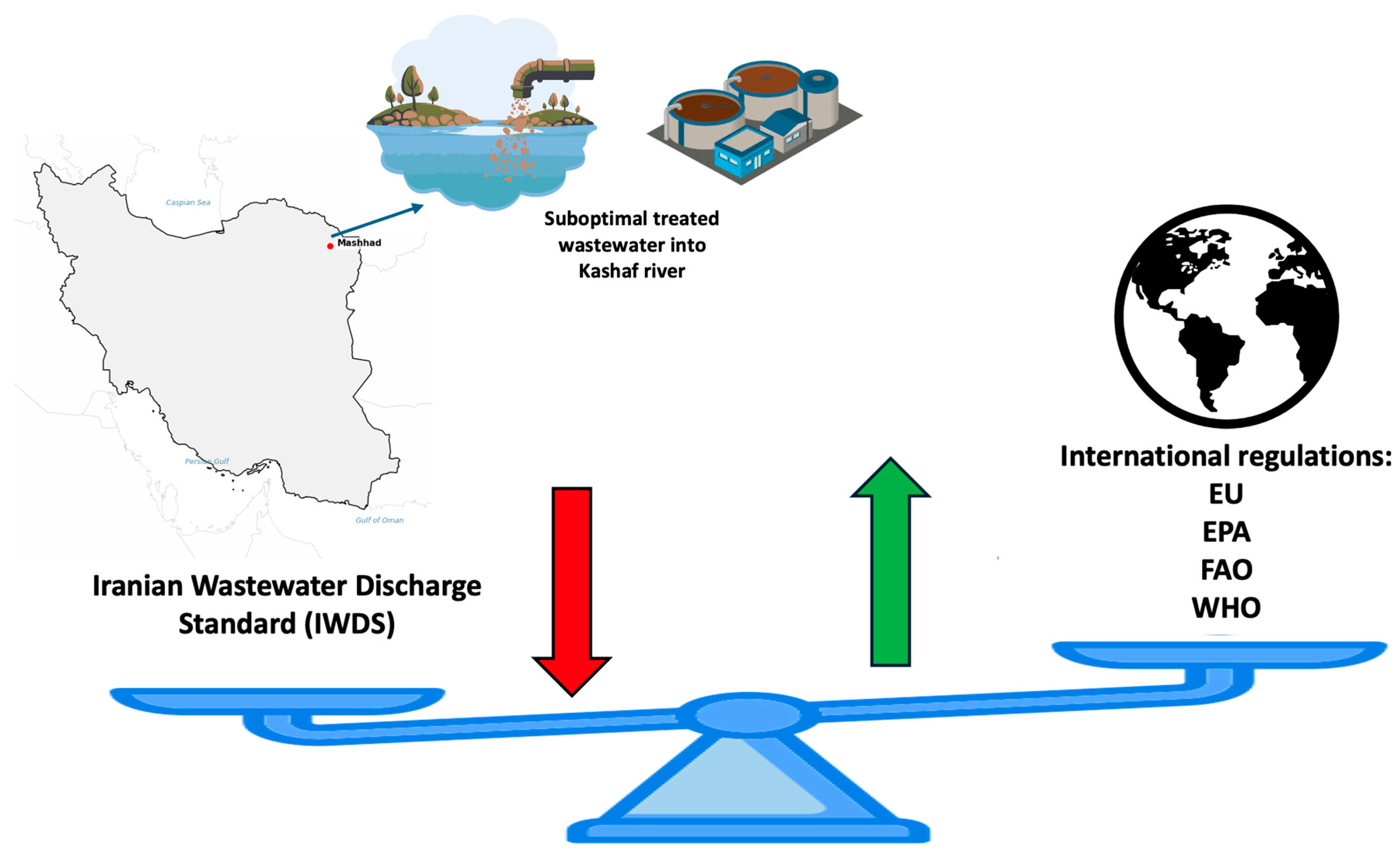
Is the treatment of polluted waters a simple guarantee of safety? The current regulatory frameworks could be a regulatory mirage, where (1) legal compliance is not environmental safety, and (2) there is a focus on quantity over quality. Wastewater treatment plants (WWTPs) meet all local discharge regulations, although this results in the discharge of suboptimal treated wastewater into vulnerable ecosystems [
4]. Treatment systems are technically effective in removing a wide range of pollutants (e.g., 90% of BOD
5: biological oxygen demand), but the core regulatory failure lies in neglecting the cumulative load, when aggregated from multiple sources [
5]. These outdated standards are structurally blind to emerging risks, such as contaminants of emerging concern (CECs), which are often persistent and unregulated [
6].
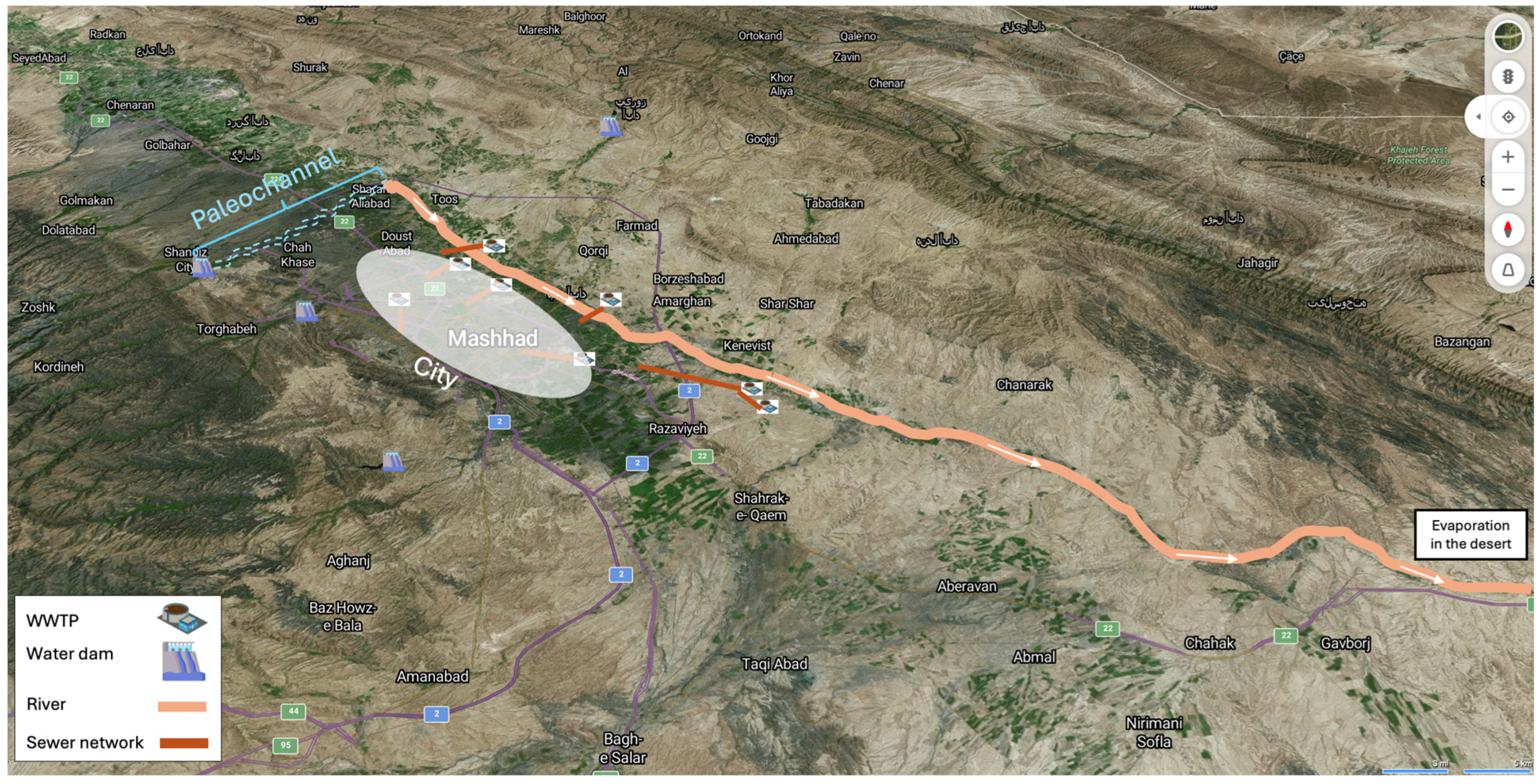
In the Kashaf River in Mashhad, Iran, the effluent from WWTPs becomes the only consistent flow, transforming the river from a natural ecosystem into a conveyance channel for agricultural supply [
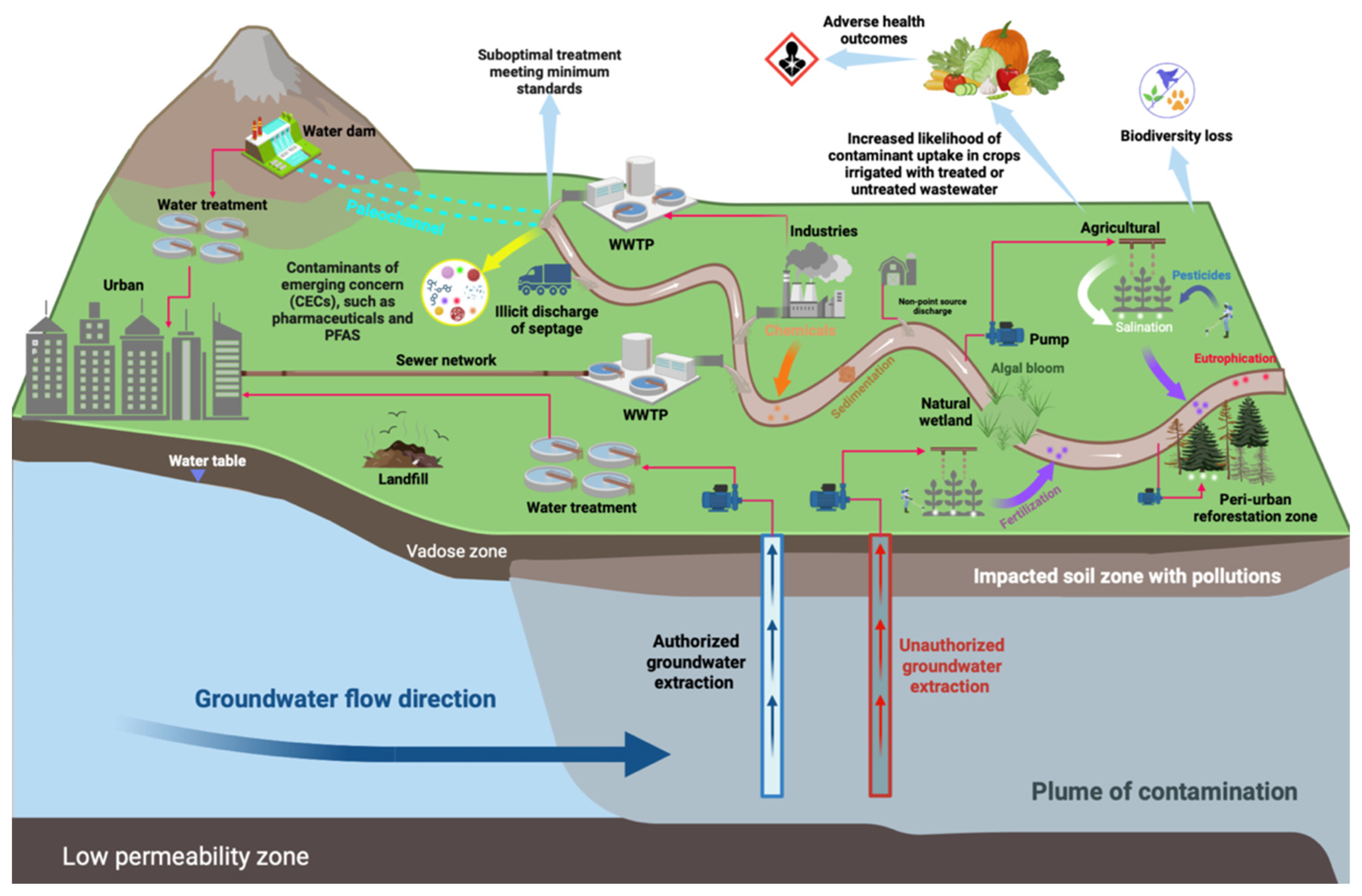
7]. In effluent-dependent basins like the Kashaf River, any imbalance between water extraction, consumptive use, wastewater discharge, and groundwater recharge progressively destabilizes the entire hydrological system. When abstractions for urban supply and irrigation exceed natural recharge, baseflow declines and rivers become structurally reliant on treated effluent as their primary flow, amplifying the concentration of salts, nutrients, heavy metals, and contaminants of emerging concern in low-dilution conditions. At the same time, return flows of suboptimal treated wastewater, combined with reduced infiltration and altered soil structure, degrade groundwater quality and can reverse hydraulic gradients, promoting the downward migration of pollutants from polluted surface waters into underlying aquifers. This coupled surface–groundwater imbalance accelerates eutrophication, salinization, and sediment contamination in riverine wetlands, while simultaneously compromising groundwater as a strategic resource for drinking water and drought buffering. Once, the paleochannel of the river was fed by seasonal precipitation. This regulatory disconnect is particularly pronounced in regions like Iran, a country characterized by an arid climate and intense water stress [
8]. The Kashaf River serves as the archetype for this systemic failure. It flows directly past residential and high-value agricultural zones, where it is abstracted legally and illegally for irrigation. In the Kashaf River basin, this regulatory mirage extends beyond the river channel itself to the natural wetlands that fringe and intercept its flow [
9]. These valley-bottom marshes and floodplain wetland patches act as unplanned nature-based treatment systems, buffering nutrient pulses, attenuating contaminants, and sustaining biodiversity in an otherwise arid landscape. However, permissive concentration-based limits for BOD
5, nutrients, salinity, heavy metals, and unregulated CECs effectively license a chronic pollutant load that exceeds the assimilative capacity of these wetlands, accelerating eutrophication, sediment contamination, vegetation shifts, and loss of ecological function [
9]. In effluent-dependent reaches of the Kashaf River, natural wetlands thus become sacrificial sinks for regulatory failure; rather than being protected as priority receptors, they are progressively transformed into extensions of the wastewater infrastructure. Across many regions, traditional knowledge-based systems provide practical models for sustainable wastewater reuse and water protection. Qanats, seepage pits, tank–cascade systems, and paddy irrigation landscapes combine gravity-driven conveyance, subsurface storage, natural filtration, and managed wetlands to buffer floods, recharge groundwater, and reuse nutrient-rich return flows. Indigenous ecological knowledge similarly guides the design and management of treatment wetlands and other nature-based solutions. Today, these practices are being revisited and hybridized with modern engineering through constructed wetlands, decentralized reuse, and integrated watershed management to support wastewater reuse, safeguard water resources, and advance sustainable development under growing water-scarcity pressures.
Despite their proliferation across regional, national, and global levels, most current environmental policies and discharge standards remain poorly aligned with the realities of effluent-dependent basins and nature-based solutions. They are largely concentration-based, sectoral, and end-of-pipe, so they ignore cumulative mass loads, mixture toxicity, and the basin-scale interactions between surface water, groundwater, soils, and wetlands that determine the actual performance of nature-based solutions. They also tend to treat wastewater reuse, food production, and ecosystem protection as separate policy arenas, which means that standards for safe irrigation, ecological flow, and wetland conservation are rarely harmonized in space and time. As a result, even formally “compliant” effluents can overload rivers and wetlands with nutrients, salts, heavy metals, and contaminants of emerging concern, undermining the very nature-based systems that policies claim to promote for mitigating water scarcity, protecting groundwater, and supporting sustainable development. This study, therefore, presents the Kashaf River as an early warning case, showing how structural deficiencies in the Iranian Wastewater Discharge Standards (IWDS) create a crisis in both the river ecosystem and its associated wetlands [
10]. Similar challenges of river and wetland degradation are evident globally, such as in India, China, Pakistan, Bangladesh, Brazil, South Africa, Mexico, Oman, and Indonesia [
11]. Together, these countries are characterized by rapidly growing urban populations, expanding wastewater generation, and predominantly concentration-based discharge standards, which makes effluent-dependent rivers and wetlands especially vulnerable to cumulative pollutant loads. Do current end-of-pipe discharge regulations ensure that water is safe for reuse and ecosystem health, or do these regulations come into force too late to prevent ecological damage? The findings serve as an urgent call for regulatory reform, not only to secure river health and safe reuse but also to safeguard the remaining natural wetlands in arid basins, where they represent critical nodes of resilience under climate change and escalating water scarcity.
3. Results and Discussion
3.1. Benchmarking the Failure
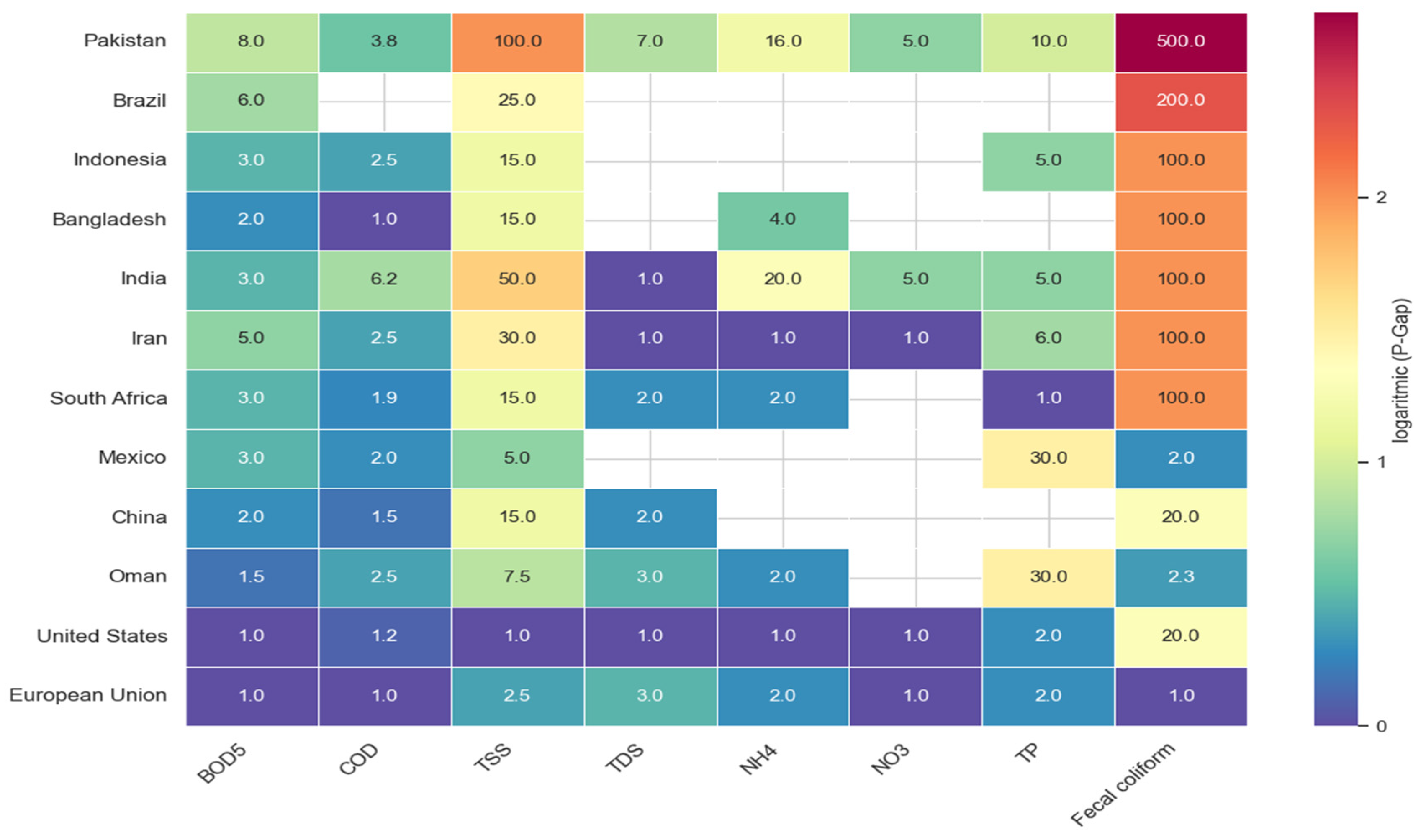
The global P-Gap clearly highlights the stringent nature of some regulatory policies like the EU and the US, compared to the high-risk gaps present in Iran and several other developing nations (
Figure 3). The lenient regulatory system is structurally wide for Pakistan, Brazil, and Indonesia, requiring special attention to avoid late warnings. Comparable regulatory reform debates have emerged in other developing countries [
20]. In India, for example, the National Green Tribunal’s 2019 tightening of urban STP discharge standards upheld by the Supreme Court in 2021 aims to reduce pollution loads to rivers such as the Ganga and explicitly links stricter effluent limits to safe reuse and circular-economy objectives [
20]. In Brazil, long-term programmes for the Tietê River in São Paulo have combined large investments in sewerage and WWTP upgrades with progressively stricter enforcement by the state environmental agency, yet persistent basin-scale pollution has highlighted the need to couple regulatory reform with integrated river-basin management and nature-based solutions [
21]. Together with the Kashaf River, these cases suggest that successful reform requires not only stricter numeric limits but also basin-scale planning, reliable enforcement, and explicit protection of effluent-dependent rivers and wetlands.
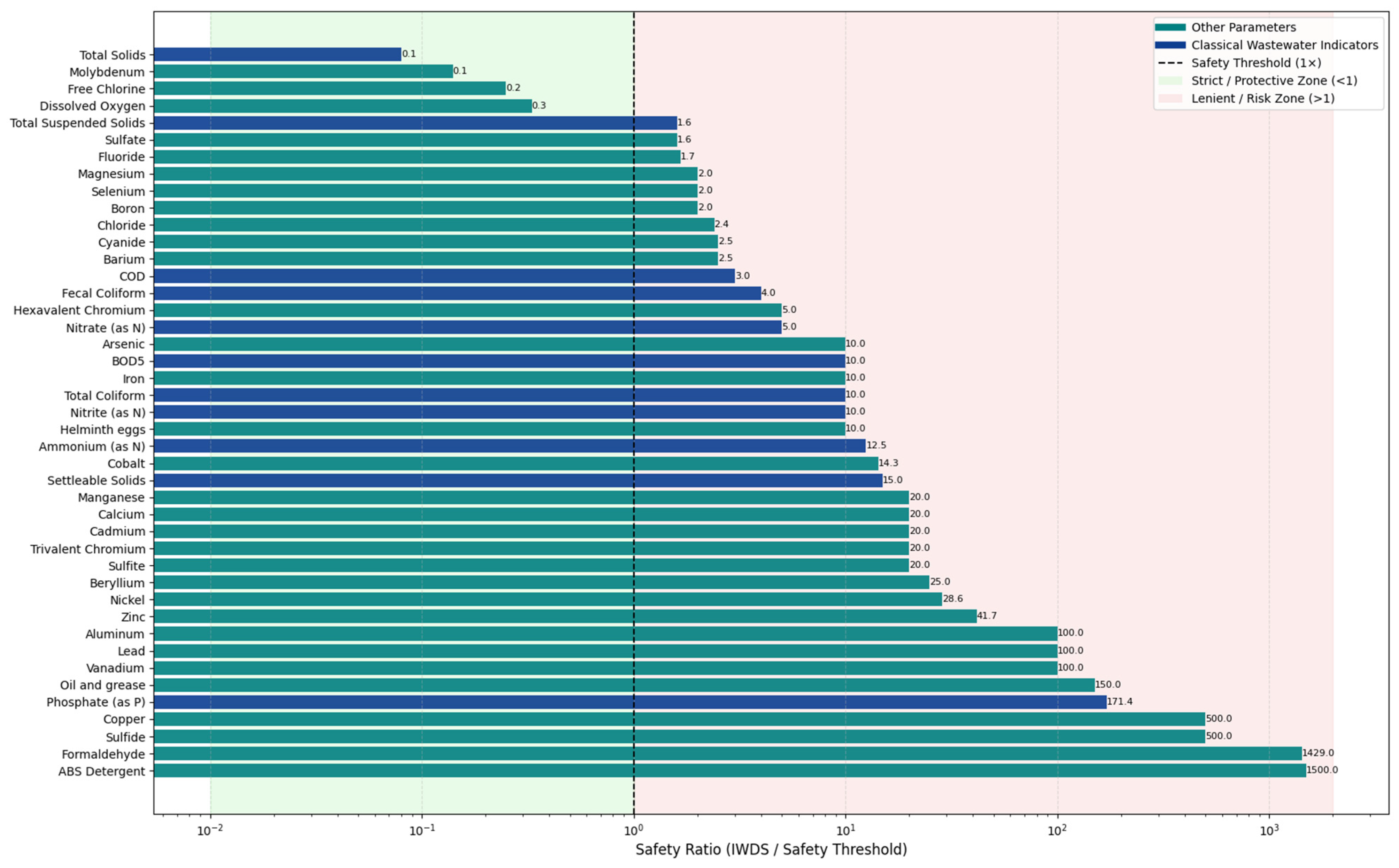
IWDS consistently permits pollutant concentrations far exceeding established safe international environmental limits. It is the primary driver of the ecological damage observed in wastewater reuse scenarios. A P-Gap index of IWDS highlights the parameters exhibiting the most deviations from safe benchmarks (
Figure 4).
River basins are particularly vulnerable to wastewater discharge and reuse because all upstream abstractions, discharges, and land-use changes are hydrologically integrated and accumulate along the flow path. Rapid demographic growth and urban expansion in Mashhad have driven a steady increase in wastewater volumes, leading to successive expansions of WWTP capacity without a proportional tightening of effluent quality targets, so larger loads of nutrients, salts, heavy metals, and contaminants of emerging concern are now released into an already water-stressed system. Under arid-climate conditions and more frequent extreme events (droughts and flash floods), low natural dilution and episodic high-load pulses further amplify concentration peaks and mass fluxes, ensuring that pollutants are stored and recycled within the river–wetland–groundwater continuum rather than being flushed out. Consequently, even when WWTPs formally comply with permissive concentration-based standards, the cumulative mass load at the basin scale systematically exceeds the assimilative capacity of the river basin, making degradation of the river and its dependent wetlands almost unavoidable.
Based on
Figure 4, several heavy metals and persistent organic compounds (e.g., phenol, ABS detergents) exhibit P-Gap ratios spanning multiple orders of magnitude. This underscores a profound failure to harmonize national policy with established ecotoxicological thresholds. Even foundational wastewater parameters, including essential nutrients, oxygen demand indicators, and microbial proxies, prove substantially elevated P-Gap ratios, signaling a systemic vulnerability. From a policy perspective, such limits incentivize the regulatory system, effectively suppressing the mandate for technological upgrades in wastewater treatment, and could diminish the efficacy of national environmental protection legislation.
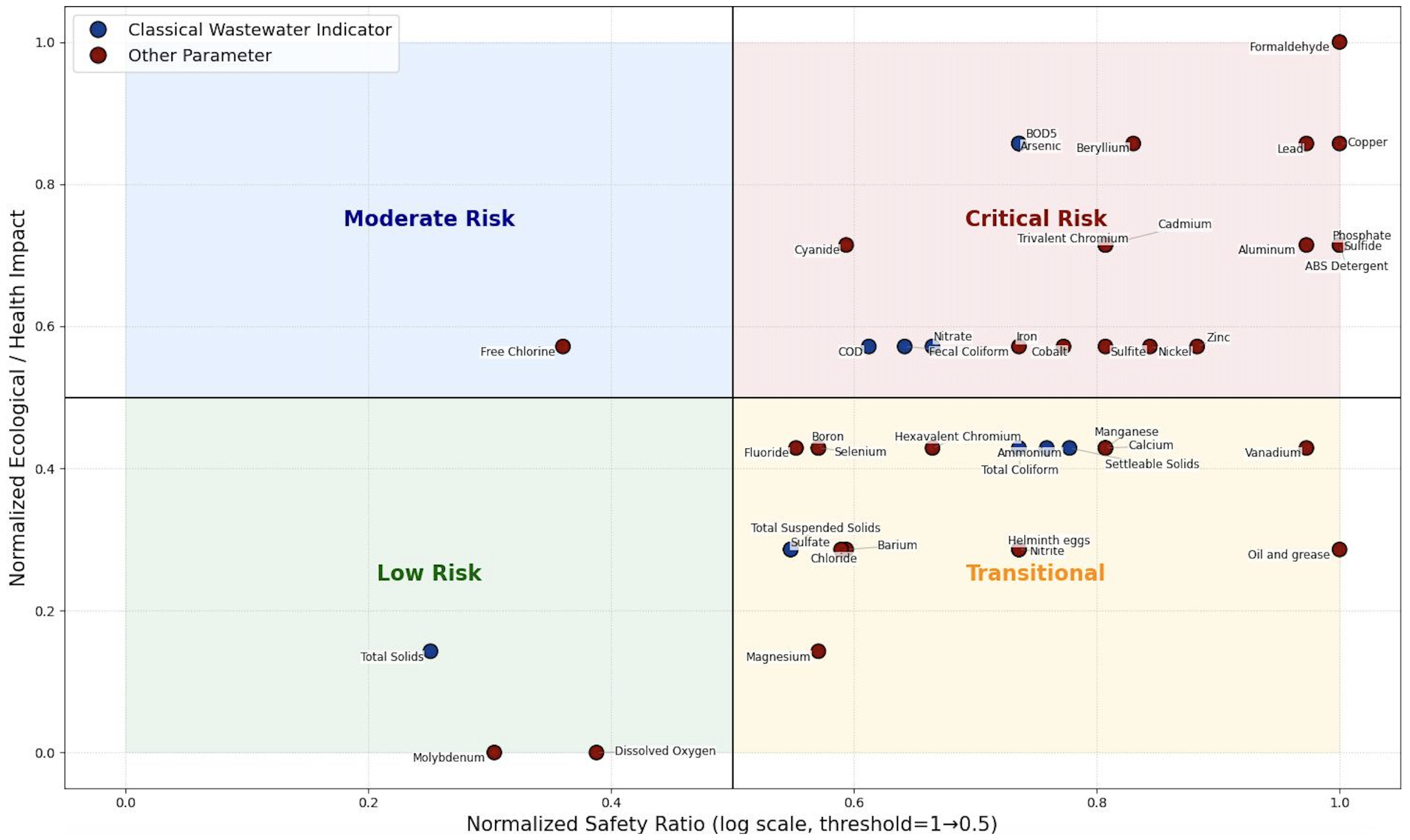
Figure 5 categorizes parameters based on the magnitude of the P-Gap versus the frequency of environmental concern.
Heavy metals and priority organic pollutants cluster, necessitating immediate prioritization for regulatory revision and treatment intervention due to their documented ecotoxicity and human health risks. High consequence/lower P-Gap pollutants (e.g., fecal coliforms, nutrients) require continuous, close attention despite having relatively closer regulatory limits.
3.2. The Unregulated Frontier: The Cocktail Effect
The reliance of IWDS on single-parameter, concentration-based limits creates an unregulated frontier where systemic risks, namely mixture toxicity and cumulative load (Cocktail Effect), are entirely disregarded (the total quantity of a pollutant discharged over time: kg/day). This regulation is fundamentally incapable of addressing the complexities of modern urban effluent. This is particularly critical for the compounds identified in the P-Gap index, which, when combined, can still trigger severe ecotoxicological stress.
The concentration-based IWDS limits fail to protect multi-source rivers with low dilution capacity, such as the Kashaf River, where pollutant masses from multiple dischargers accumulate in a single low-flow channel. This cumulative load drives eutrophication (from phosphate) and oxygen depletion (from BOD5), revealing a design that ignores both mixture toxicity (“cocktail effect”) and total mass release, twin failures at the core of the regulatory mirage sustaining environmental degradation.
3.3. The Blind Spot: Emerging Contaminant
The IWDS and many other international regulations ignore the chemical landscape. The standard remains blind to the vast and dynamic landscape of CECs; for instance, pharmaceuticals, endocrine-disrupting chemicals (EDCs), and PFAS have been found in many environmental matrices. The discussion of CECs is herein based on evidence from comparable semi-arid, wastewater-impacted river systems rather than on direct measurements from the Kashaf River, for which CEC data are not yet available. CECs are currently unregulated under IWDS. Targeted monitoring of pharmaceuticals, PFAS, and other CECs in the Kashaf River and its associated wetlands is a key priority for future work. These unregulated pollutants that pass through WWTPs are persistent, mobile, and bio-accumulative CECs. For organic micropollutants (OMPs), WWTPs are not removal barriers but rather conveyance points into the environment. Studies in the Netherlands, for example, estimate that a substantial fraction of PFAS influent, potentially between 65 and 180 kg annually across the country, is discharged directly into surface waters via WWTP effluent [
22]. Many CEC compounds are categorized as very persistent and very mobile (vPvM), meaning they are not only environmentally recalcitrant but also pose a significant threat to groundwater. The potential for these vPvM CECs to leach deep into the subsurface is alarming, with detection reported at depths of 15 m below ground [
23], thereby contaminating underlying aquifers.
CECs carried in the effluent effect soil, with PFAS shown to disturb soil enzyme activity, alter microbial availability, and damage cellular structures [
24]. Most critically, the process facilitates the soil-to-crop transfer of these CECs. Bioaccumulation of long-chain PFAS (PFOA and PFOS) has been noted in potato peels and cereal seeds, while highly mobile short-chain compounds readily accumulate in the stems, leaves, and fruits of crops, including leafy vegetables [
25]. This transfer from biosolids-improved soil to the terrestrial food chain represents a high-risk exposure pathway [
26]. The IWDS’s silence on CECs amplifies the health danger of the regulatory mirage. Based on the previous studies, the absence of limits for pharmaceuticals could directly contribute to the spread of antibiotic resistance genes (ARGs) in the aquatic environment, a global public health crisis [
6]. Likewise, unregulated EDCs might pose chronic threats through endocrine disruption and reproductive harm [
26].
3.4. Natural Wetland Degradation in the Kashaf River Basin
The conceptual framework of systemic failure in the Kashaf River explicitly includes downstream natural wetlands as receptors of treated effluent, agricultural return flows, and diffuse pollution. In the effluent-dependent reaches of the basin, these wetlands are no longer buffered by natural hydrological variability; instead, their hydrology and water quality are largely controlled by wastewater-dominated baseflow and episodic storm events. These valley-bottom marshes and floodplain wetland patches historically provided nutrient retention, sediment trapping, and habitat functions, effectively acting as unplanned nature-based treatment systems within an otherwise arid landscape. Previous studies already documented substantial pollutant loads and ecological stress along the Kashaf River corridor and comparable Iranian rivers (
Table 1).
The high permissibility gaps quantified for key IWDS parameters make long-term degradation of these wetlands structurally unavoidable. Elevated BOD5 and nutrient limits sanction chronic organic and nutrient loading, promoting eutrophication, algal blooms, and hypoxic conditions in wetland pools, which favor a few opportunistic macrophytes over diverse native plant communities. Likewise, the reliance on a relative 10% rule for total dissolved solids, rather than a fixed salinity cap, drives progressive salinization of wetland soils and pore water, reducing plant species richness and shifting vegetation towards halotolerant assemblages. Lenient or absent limits for heavy metals, phenolic compounds, surfactants, and other priority organics further enable the accumulation of contaminants in wetland sediments and biota, with cascading impacts on invertebrates, fish, and waterbirds that depend on these habitats.
Because of this regulatory context, natural wetlands along the Kashaf River effectively function as sacrificial sinks for excess pollutant loads that remain legally permissible at the WWTP outlet. They buffer short-term peaks in concentration but at the cost of declining ecological function, diminished capacity to absorb future disturbances, and the risk that legacy contaminants will be remobilized during floods or management interventions. Rather than being designated as priority receptors that constrain upstream discharge limits, these wetlands are implicitly treated as extensions of the wastewater infrastructure.
This trajectory is consistent with broader trends of wetland loss and degradation reported across Iran’s arid and semi-arid regions, where climate-driven aridification, upstream abstraction, and pollutant inputs act synergistically. In effluent-dependent basins such as the Kashaf, permissive discharge standards accelerate this decline by locking natural wetlands into a role for which they were neither designed nor institutionally protected. From a management perspective, the results indicate that implementing constructed wetlands or other nature-based solutions upstream, without simultaneously tightening IWDS limits and adopting mass-based, mixture-aware regulation, would mainly redistribute rather than reduce risk. Only by explicitly recognizing natural wetlands as critical receptors—and setting discharge limits and treatment wetland designs accordingly—can planned green–grey infrastructures help to restore, rather than replace, the ecological functions of the remaining wetland ecosystems in the Kashaf River basin.
3.5. Forging a New Path and Global Implications
Transitioning from legal compliance to environmental and health safety requires an integrated, three-pronged regulatory overhaul.
Pillar I—De-concentrate the risk: Mass-based discharge permits (kg/day) should be replaced by obsolete concentration limits (mg/L). Effluent should target safe thresholds for high-P-Gap contaminants, ensuring suitability for designated reuses such as irrigation.
Pillar II—Close the regulatory loophole: Discharge standards could align with international guidelines like FAO and WHO. The relative rule is replaced with a fixed limit to protect soil health and prevent salinization.
Pillar III—Police the unregulated frontier: Replacement of indicator screening for CECs like PFAS and pharmaceuticals, and stakeholder engagement ensuring implementable, sustainable monitoring and policy resilience.
The analysis of the Kashaf River demonstrates that the regional environmental crisis is not the result of incompetent wastewater treatment but a systemic regulatory failure. The findings from the Kashaf River are not unique to Iran. The archetype of the effluent-dependent river exists across the developing world. In these regions, legacy environmental regulations, often inherited from the mid-20th century, are being outpaced by climate change, population growth, and the proliferation of CECs.
4. Conclusions
IWDS creates a regulatory mirage, where legal compliance leads to multiple environmental degradation pathways rather than genuine protection of water resources. Its structural failure to account for cumulative mass load, mixture toxicity, and unregulated contaminants of emerging concern means that even compliant effluent can drive eutrophication, salinization, heavy-metal accumulation, and PFAS and pharmaceutical pollution in effluent-dependent rivers and their associated wetlands. In the Kashaf River basin, this failure is manifested not only in the main channel but also in the natural wetlands that fringe and intercept the flow, which are progressively transformed from biodiversity refugia and nature-based treatment buffers into sacrificial sinks for excess pollutant loads. The Kashaf River thus serves as an archetype for arid and semi-arid basins globally, demonstrating that the environmental crisis in wastewater-fed rivers and wetlands is, to a large extent, a policy failure rather than a technical limitation of treatment technologies. Addressing this regulatory mirage will require shifting from permissive concentration-based limits to mass-based and mixture-aware standards aligned with international benchmarks, explicitly recognizing natural and constructed wetlands as priority receptors, and integrating nature-based solutions into broader circular water-management strategies. Future work combining hydrological water-quality simulations and additional effluent-dependent case studies would be valuable to test the broader applicability of this regulatory mirage framework.