Article

Streamflow Simulation Based on a Hybrid Morphometric–Satellite Methodological Framework

by
Devis A. Pérez-Campo
1,
Fernando Espejo
2 and
Santiago Zazo
2,*
1
Hydraulic Engineering Area, High Polytechnic School of Avila, University of Salamanca, Av. de los Hornos Caleros, 50, 05003 Ávila, Spain
2
IGA Research Group, High Polytechnic School of Avila, University of Salamanca, Av. de los Hornos Caleros, 50, 05003 Ávila, Spain
*
Author to whom correspondence should be addressed.
Water 2026, 18(7), 786; https://doi.org/10.3390/w18070786
Submission received: 2 February 2026 / Revised: 16 March 2026 / Accepted: 24 March 2026 / Published: 26 March 2026

Abstract

This research investigates the relationships between the parameters of the GR4J hydrological model and a set of morphometric descriptors, climatic indices, land-cover characteristics, and soil properties across the Caquetá River Basin (Colombia). Twelve limnimetric–limnographic gauges with consistent records for the period 2001–2022 were selected for model calibration and validation. The corresponding sub-watersheds were delineated and characterized in terms of geomorphometry, vegetation cover, and soil permeability. According to that, the morphometric assessment focused on estimating key geomorphometric parameters, while land-cover descriptions utilized NDVI data. Soil type identification was based on the average approximate permeability across each analyzed sub-watershed. Model calibration was performed using the Differential Evolution Markov Chain (DE-MC) algorithm with 8000 simulations, forced by CHIRPS satellite precipitation and ERA5 potential evaporation data. Relationships between GR4J parameters and watershed attributes were assessed using Spearman’s rank correlation and curve-fitting analyses. The results reveal strong and consistent relationships between GR4J parameters (X1–X4) and key morphometric variables, including basin perimeter, circularity ratio, main channel length, and channel slope. Coefficients of determination ranged from 0.80 to 0.98, highlighting the potential for parameter regionalization based on physiographic and environmental descriptors.

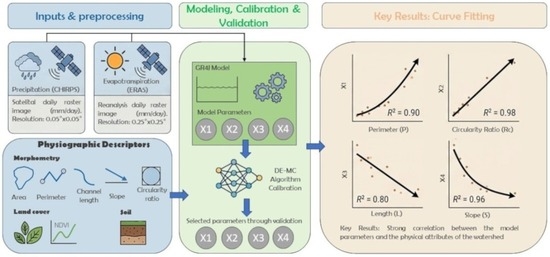
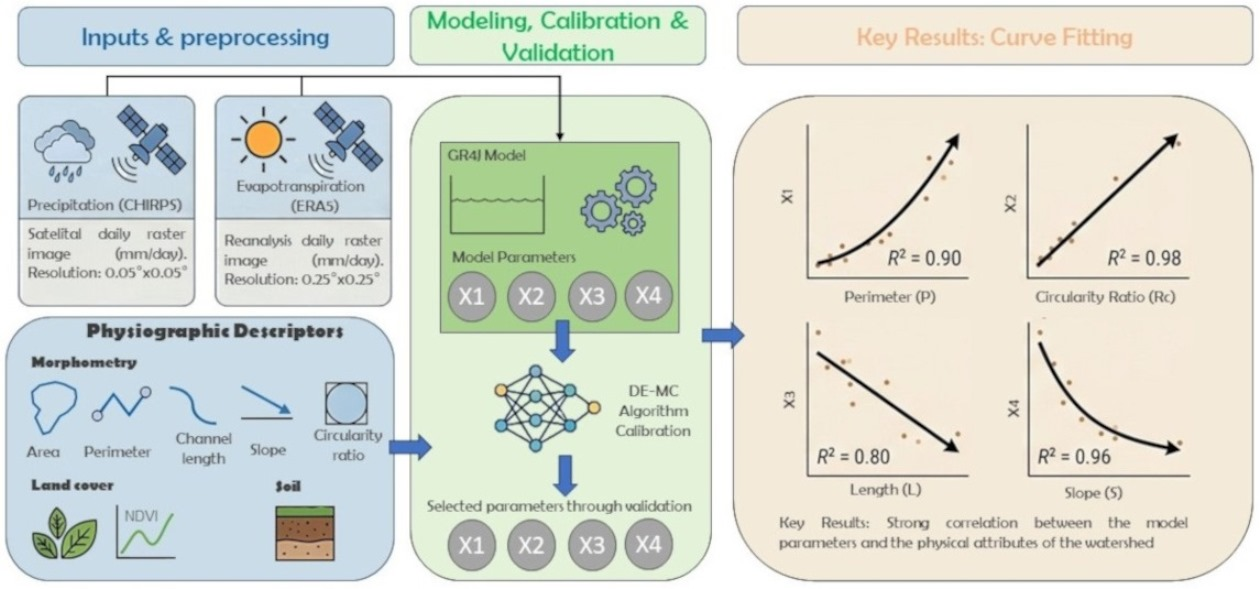
Graphical Abstract

1. Introduction

Estimating streamflow is fundamental for effective water management and decision-making at the watershed scale [1,2]. Reliable streamflow information is particularly important for applications such as drought and flood hydrology, crop modeling, flood forecasting, the estimation of crop water requirements, reservoir operation management, and freshwater allocation [3,4]. Consequently, river flows assessment represents a key challenge for risk management, infrastructure design, and sustainable management of water resources [5,6,7].
As such, there is an increasing need for a robust network of hydrometeorological stations [8]. However, the availability of streamflow, precipitation, and evaporation data remains limited in many remote areas due to social, economic, and geographical constraints present in many regions worldwide [9]. This highlights the importance of developing new methodologies to estimate hydrological variables in ungauged or data-scarce regions, where the lack of information hampers effective water resources management [10,11,12]. To address this challenge, hydrological modeling has become an efficient and reliable approach for assessing river basins’ behavior and estimating streamflow [13,14].
Traditionally, hydrological models are classified into two main categories: (i) distributed models and (ii) aggregated models, commonly referred to as lumped models [15]. Lumped models are widely applied in large-scale analyses [16,17,18] because of their conceptual simplicity and computational efficiency [19]. In contrast, distributed models explicitly account for spatial heterogeneity and provide a more detailed representation of hydrological processes within a watershed [20]. However, despite their higher level of detail, distributed models often require extensive datasets, involve complex calibration procedures [21,22] and entail significant computational costs [23]. Conversely, lumped models are limited in their ability to represent the spatial variability of hydrological processes and model parameters [24,25]. In addition to spatial discretization, hydrologic models can also be classified according to the physical processes they represent, distinguishing between conceptual and physically based models. Conceptual models use simplified mathematical relationships to represent the dominant hydrologic processes occurring within a catchment, whereas physically based models rely on deterministic formulations derived from the conservation laws of mass, momentum, and energy conservation to describe these processes in greater physical detail [26,27,28].
In contrast, conceptual models represent the main hydrological processes occurring within a catchment through simplified representations of its physical components, such as rainfall, infiltration, percolation, evaporation, runoff, and drainage. These models employ semi-empirical equations, and their parameters are derived not only from field observations but also through calibration procedures [28]. Numerous conceptual models with different levels of complexity have been developed. Among them, the GR4J model has been widely applied worldwide. Originally developed for hydrological applications in agriculture [29], GR4J is a conceptual rainfall–runoff model based on four parameters operating at a daily time scale.
Rainfall–runoff models require hydrological inputs such as precipitation and evaporation to estimate streamflow; however, these data are often unavailable in many regions. In this context, remote sensing has emerged as an alternative data source for assessing the spatio-temporal variability of key inputs required in ungauged watersheds [20,30,31]. Satellite and reanalysis-based datasets have significantly advanced over recent decades and are increasingly used as complementary sources of information to in situ measurements for estimating river discharge through hydrological modeling [32,33,34]. However, the performance of these alternative data sources varies depending on the regions [35,36,37,38]. This variability can be attributed to several factors, including climatic characteristics [39], surface conditions [40], and differences in precipitation measurement techniques [41].
Consequently, the evaluation of satellite-based datasets for precipitation and potential evaporation has become a relevant research topic for ungauged watersheds. Many of these datasets are used either to evaluate hydrological model performance or to complement secondary information sources [42,43,44]. In addition, several satellite-derived products have been validated and compared with ground observations, particularly those related to precipitation and evaporation estimates [45,46,47].
This study aims to propose an alternative methodology for hydrological modeling in ungauged basins by applying a conceptual GR4J rainfall–runoff model [29], using input data derived from satellite observations. Specifically, the research seeks to identify correlations between the calibrated model parameters and the morphometric, climatic, land cover, and soil characteristics of the gauged watershed used for calibration and validation. These correlations are then employed in a curve-fitting procedure to derive predictive relationships for each model parameter, enabling parameter estimation in basins where calibration is not feasible.
The GR4J conceptual model, a lumped, continuous, daily-scale rainfall–runoff model [29], was selected due to its simplicity, daily temporal resolution, and widespread application in hydrological studies worldwide [10,48,49]. Furthermore, the proposed methodology has been designed to require modest computational resources, making it accessible to a broad range of users.
Additionally, the present research provides new lines of investigation to study erosion challenges in fluvial bank protection structures and embankments, including scour at bridge piers and abutments [50,51,52,53,54], in zones like the ones under study. A detailed review of the implications in this field can be found in Iqbal and Tanaka [55].
After this introductory section, this research work is organized as follows. A case study and dataset description are shown in Section 2. Section 3 provides a background on GR4J hydrological model. The methodological approach is detailed in Section 4. Section 5 presents the main results, and Section 6 concludes with a discussion of the findings and final conclusions.

2. Study Case

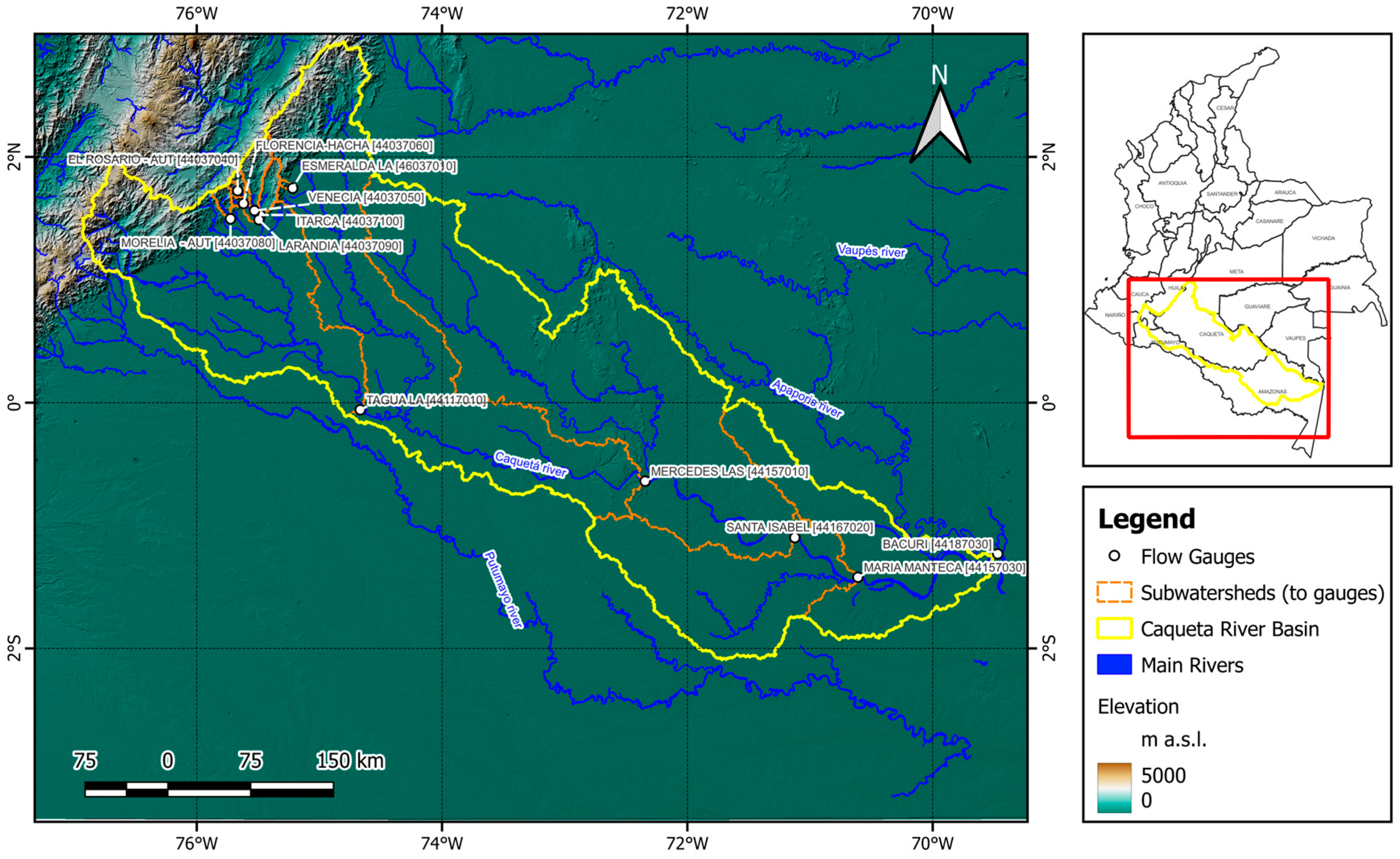
This study was conducted across 12 sub-watersheds of the Caquetá River, located in the southeastern Colombian Amazon region, encompassing the departments of Cauca, Caquetá, Putumayo and Amazonas. Caquetá River rises in the eastern part of the Cauca department, within the Cordillera Oriental, and discharges into the Amazon River after receiving the contributions from the Apaporis River. This river ranks among the most important rivers in the country (Figure 1). Its catchment area represents nearly 15% of Colombia’s continental territory and plays a crucial role in sustaining the regional biodiversity, fluvial transport, agriculture, fishing and water supply. However, there is an evident limited availability of gauges in this region, and as consequence, water management has become a hydrological challenge for engineering in this region of the country.
The catchment areas of the studied watersheds range from 57 km2 to 148,985.3 km2, and are geographically limited between the coordinates 2°5′37.12″ S–76°55′53.88″ W and 2°56′15.33″ N–69°28′8.30″ W. The basin headwaters comprise hills in the northwestern sector of the watershed, although the topography in the study area is predominantly flat [56].
With respect to river geomorphology, most basins exhibit meandering streams, a characteristic feature of flat areas. The precipitation regime is marked by two contrasting periods: a drier season from October to March, and a wetter season from April to September. This unimodal annual cycle is influenced by the movement of the Intertropical Convergence Zone (ITCZ) across Colombia [57]. Furthermore, over the long term, average rainfall and evaporation values offset each other [57]. Consequently, the period of highest evaporation coincides with the period of lowest precipitation, underscoring the climatic interaction between these variables. Finally, estimated average discharges in the study area range from 7.26 up to 11,162 m3/s, with seasonal variations in the flow regime reflecting the rainfall regime.

2.1. Available Data

The data used in this study include daily: flow rates, rainfall, potential evaporation, as well as land cover, and soil characterization (Table 1). This way, there are no problems of temporal inconsistency between the inputs considered.

2.1.1. Streamflow Data

Streamflow data were obtained for each limnimetric or limnographic gauge from the database of the Instituto de Hidrología, Meteorología y Estudios Ambientales (IDEAM)) across the Caquetá River Basin. Only gauges with at least eight years of available data within the period from 2001 to 2022 were considered.

2.1.2. Rainfall and Potential Evaporation Data

The rainfall data were obtained from the Climate Hazards Group InfraRed Precipitation with Station data (CHIRPS), a publicly available precipitation database established in 2014. Managed jointly by the U.S. Geological Survey (USGS) and the University of California, Santa Barbara (UCSB), this database spans from 1981 to the present and covers land areas exclusively, spanning latitudes 50° S to 50° N and all longitudes, with a spatial resolution of 0.05°. CHIRPS provides data at daily, monthly, decadal, and annual temporal resolutions [58].
The potential evaporation data were obtained from ERA5, provided by the European Centre for Medium-Range Weather Forecasts (ECMWF), this is a reanalysis dataset that covers land surface variables from January 1950 to the present date. The information is organized on a regular global grid in terms of longitude and latitude, with a resolution of 0.1°. In GR4J model, streamflow is simulated from daily precipitation and potential evapotranspiration (PE) rather than actual evaporation, and model performance depends primarily on the temporal coherence of the PE signal rather than on an exact physical estimate of evaporation. For this reason, daily ERA5 PE was used directly as the PE input, as it provides a spatially and temporally consistent reanalysis dataset with global coverage. Moreover, previous studies have reported uncertainties and regional biases in ERA5-derived evaporation over tropical basins, mainly associated with the representation of convection and land–atmosphere interactions [59]. These biases can propagate into hydrological simulations; however, both conceptual hydrological model theory and empirical studies indicate that part of the systematic bias in climatic inputs, including PE, is compensated during calibration through parameter adjustment, which limits the impact of moderate PE biases on streamflow performance [60]. On the other side, in this research no in situ evaporation or evapotranspiration observations are available to perform a robust local validation or bias correction of ERA5 PE. Therefore, ERA5 PE was used without additional correction, following common practice in data-scarce tropical basins and ensuring a reproducible workflow based on globally available datasets.
The dataset is available at hourly temporal resolution, expressed in meters, and provided in GRIB format [61].

2.1.3. Land Cover and Soil Characterization

Land cover was analyzed through satellite imagery from the Landsat 8 mission, provided by the USGS. Vegetation conditions were assessed by means of NDVI [62].
Soil characterization was performed based on the soil classification system of United States Department of Agriculture, which categorizes soils according to their sand, silt and clay content [63]. The soil information was obtained from the General Soil Studies and Land Identification of the Caquetá, Amazonas, Cauca and Putumayo departments [64].

3. Hydrological Model

Given the availability of hydrometeorological data, the GR4J hydrological model was applied. This model was selected because of its simplicity, suitability for daily time scales, and widespread application in hydrological studies worldwide [10,48,49].
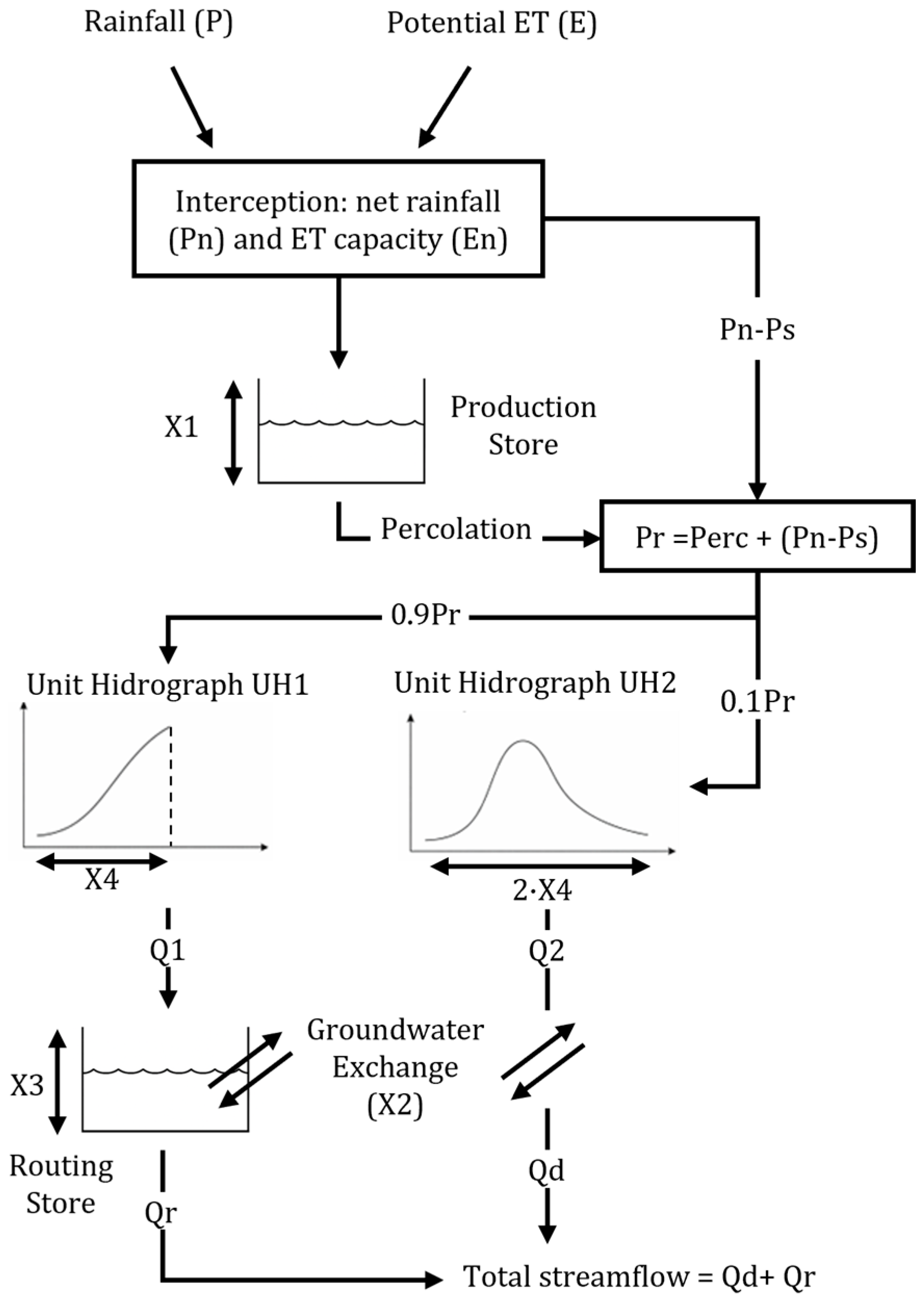
GR4J is a conceptual, lumped, and continuous rainfall–runoff model operating at a daily time step, whose primary objective is to represent the rainfall–runoff transformation process. This is achieved through four parameters representing key hydrological processes, including water storage in soil reservoir, runoff generation timing and catchment response characteristics [29]. The conceptual framework of the model is shown in Figure 2.
The model requires daily rainfall (PP) and daily potential evapotranspiration (PE) as input variables. Rainfall can be estimated from rain gauges observations or, as in this case, from remote sensors databases. Potential evapotranspiration is often represented using simplified or climatological estimates; however, in this study, daily PE values were derived from a reanalysis database. All water units are expressed in millimeters (mm), and the model operates using discrete daily time steps.
A general formulation of the rainfall–runoff model follows Equation (1):
Q = G R 4 J P P , P E , X 1 , X 2 , X 3 , X 4
In this way, the discharge Q (mm·d−1) in GR4J model is the result of the climatological forcing denoted by PP and PE (precipitation and potential evapotranspiration in mm d−1), and the four parameters (X1, X2, X3, X4) of the model:
  • X1: maximum capacity of the production store (mm).
  • X2: groundwater exchange coefficient (mm).
  • X3: one day ahead maximum capacity of the routing store (mm).
  • X4: time base of unit hydrograph UH1 (days).
All these parameters are real numbers: X1 and X3 are positive, X4 is greater than 0.5 and X2 can be either positive, zero or negative [29].

4. Methodology

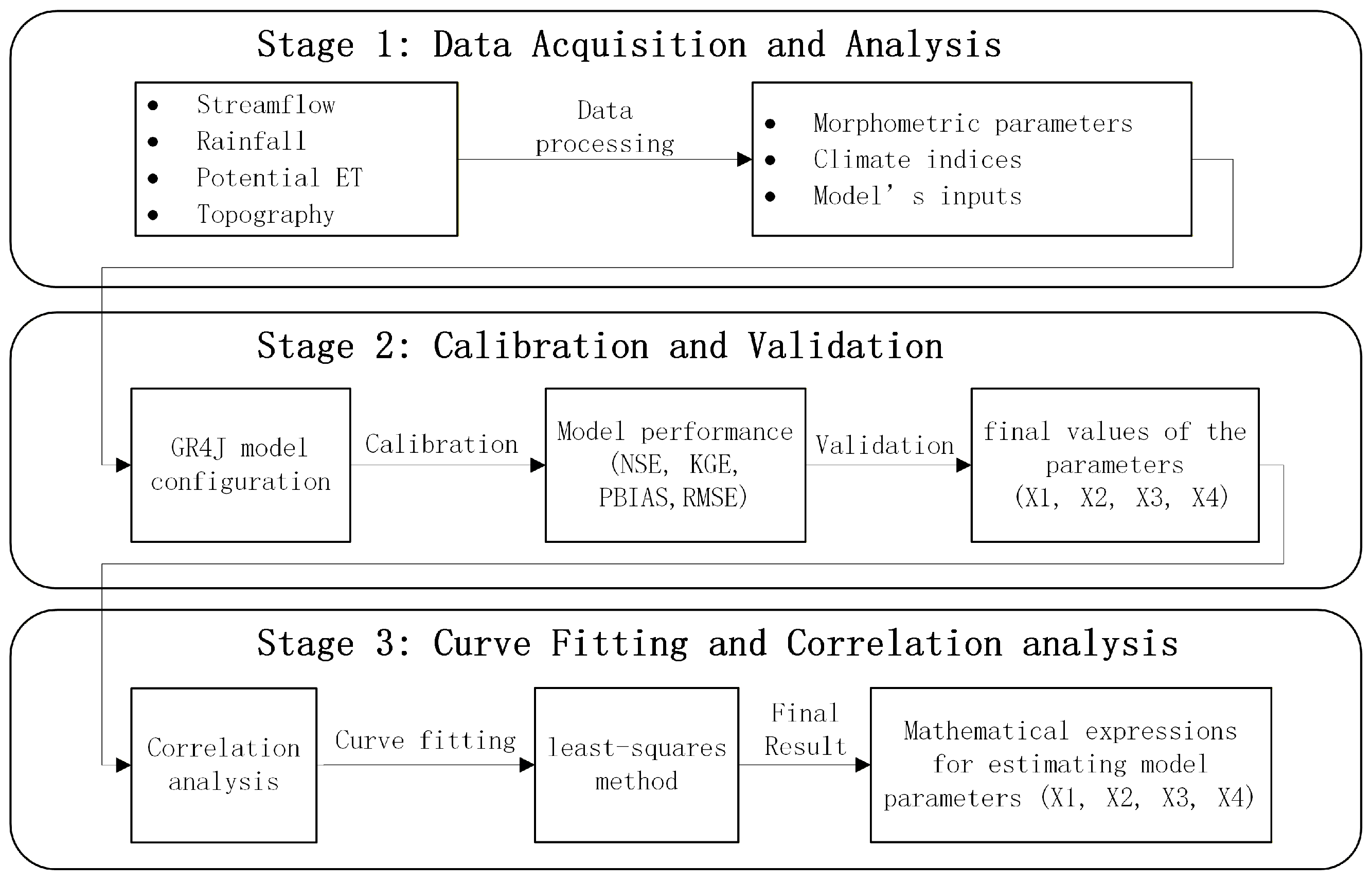
The study was conducted in three main stages. First, a hydrological analysis was performed to estimate the main morphometric, climatic, and land-cover parameters for each basin were estimated. Second, the GR4J model was calibrated and validated for each evaluated sub-basin. Third, a correlation analysis was conducted between the calibrated model parameters and the basin characteristics estimated in the first stage. Based on these results, equations were fitted for each GR4J parameter (Figure 3).

4.1. Stage 1: Morphometric and Climatic Analysis

Morphometry refers to the measurement of linear, areal and relief characteristics of drainage basins [65,66]. Consequently, it plays an important role in basin development and flood control planning [67], constituting one of the main reasons why morphometry is a fundamental component of hydrological studies.
At this stage, key morphometric parameters were estimated for each sub-watershed. Therefore, several characteristics were assessed such as area, perimeter, maximum length (from the outlet to the furthest point), mean elevation, mean slope, length of the main channel, mean slope of the main channel, Strahler order, compactness coefficient, circularity ratio, elongation ratio, and Horton’s shape factor.
On the other hand, the watershed delineation allows us to estimate the main climatic indices over each catchment area analyzed. These parameters are referred to as the following: mean annual precipitation, mean annual potential evaporation, aridity index (the ratio between mean annual potential evaporation and precipitation) and the streamflow coefficient (ratio between mean discharge and mean annual precipitation). These play a crucial role in evaluating the hydrological behavior of watersheds, particularly for understanding the average streamflow regime [68].

4.2. Stage 2: Calibration and Validation

The Differential Evolution Markov Chain (DE-MCz) algorithm was applied to calibrate the GR4J model in each sub-watershed. DE-MCz is a Markov Chain Monte Carlo (MCMC) which requires a minimal number of three chains that learn from each other during the sampling. It has the same Metropolis decision as the MCMC algorithm, and it has been found to be quite efficient compared with other MCMC techniques. Furthermore, the DE-MCz algorithm does not require any prior distribution information, which reduces the uncertainty due to subjective assumptions during the analysis [69].
Daily calibration was performed for a minimum of 5 years, ensuring that the calibration period does not exceed 80% of the total length of the daily time series of the respective limnimetric or limnographic gauge. Consequently, the validation period corresponded to at least 20% of the total record. In this regard, the classical approach for selecting calibration and validation periods is the split-sample test proposed by [70], which divides the available record into two independent subsets. Although no universally accepted standard exists regarding the proportion of data assigned to each subset, studies such as Shen et al. [71] recommend a minimum of five years of data for validation and suggests a division for calibration and validation periods with an 80–20%, respectively.
The objective function to be maximized is the Nash–Sutcliffe efficiency (NSE; [72]), which quantifies the agreement between observed and simulated streamflow. Additionally, the Kling–Gupta efficiency (KGE; [73]) was considered to compare the results obtained from the NSE.
The Nash–Sutcliffe efficiency is defined as
N S E = 1 i = 1 N S i ϕ i 2 i = 1 N S i S ^ 2
where S i is the streamflow observation, ϕ i is the simulated streamflow value, S ^ is the mean of the observed streamflow data and n is the total number of observations.
On the other side, Kling–Gupta efficiency (KGE; [73]) is defined as
K G E = 1 r 1 2 + α 1 2 + β 1 2
where r is the Pearson product-moment correlation coefficient, α is the ratio between the standard deviations of the simulated and observed values and β is the ratio between the means of the simulated and observed values.
Moreover, PBIAS (Equation (4)) was used to assess the average tendency of simulated values ( S i ) to be larger or smaller than the corresponding observed values ( ϕ i ). Positive values indicate model underestimation, whereas negative values indicate model overestimation [73].
P B I A S = i = 1 N S i ϕ i · 100 i = 1 N S i
The numerical thresholds of NSE and PBIAS indexes are shown in Table 2.
Finally, the Root Mean Square Error (RMSE; Equation (5)) was used as a metric to quantify the average magnitude of the error in the units of the variable of interest [73]. In this context, an RMSE value of 0 indicates a perfect fit between simulated and observed data.
R M S E = i = 1 N S i ϕ i 2
The four parameters of the GR4J model were calibrated. Initially, the upper and lower bounds of the prior parameter distributions were defined following Perrin et al. [29]. These bounds were subsequently adjusted to improve the calibration process and to analyze the trend of optimal parameters values obtained during calibration. A total of 8000 simulations were performed using the generalized DE-MCz algorithm across Markov chains. Calibration performance was evaluated using the NSE index and compared with the reference values proposed by Molnar [74].
Additionally, a global sensitivity analysis was performed by means of the Fourier Amplitude Sensitivity Test (FAST; [76]). FAST estimates variance-based sensitivity indices by mapping the multidimensional parameter space onto a single search curve, where each parameter is assigned a distinct frequency. The model output is evaluated along this trajectory and decomposed using Fourier analysis. Sensitivity indices are then computed from the contribution of each parameter’s frequency to the total output variance. Therefore, a total-order sensitivity index (STi) was adopted as it quantifies both the main effect of a parameter and its interactions with other parameters.
Furthermore, the evaluation is complemented by several additional analyses. First, the monthly mean flow curve is examined to assess the seasonal behavior of observed and simulated flows, which is directly related to the mean flow regime. Second, the empirical probability distribution is analyzed to evaluate the model’s ability to reproduce high flows (probability of occurrence between 0 and 20%) and low flows (between 80 and 100%) compared with observed values. Finally, a two-dimensional frequency histogram is used to assess the model balance, indicating whether simulated flows tend to be systematically overestimated or underestimated.

4.3. Stage 3: Curve Fitting and Correlation Analysis

A correlation analysis was conducted to identify relationships between the model parameters and the morphometric, climatic, soil, and land-cover characteristics of each sub-watershed. This analysis was performed through Spearman’s rank correlation [77,78].
When significant correlations were identified between the model parameters and morphometric, climatic or land-cover parameters, least-squares was used to derive mathematical functions (the most used in hydrology) allowing the estimation of X1, X2, X3, or X4 from the correlated variables. This approach provided further insight into the relationship between the GR4J parameters and the physical characteristics of the studied watersheds. Model performance was evaluated using the coefficient of determination (R2), which represents the proportion of observed data variation that can be explained by the simple linear regression model [79].

5. Results

This section is organized into subsections and provides a description of the experimental results and their interpretation.

5.1. Morphometric and Climatic Analysis

The drainage watersheds corresponding to the selected limnimetric and limnographic gauges were delineated, and their morphometric parameters were quantified. Table 3 summaries the main results.
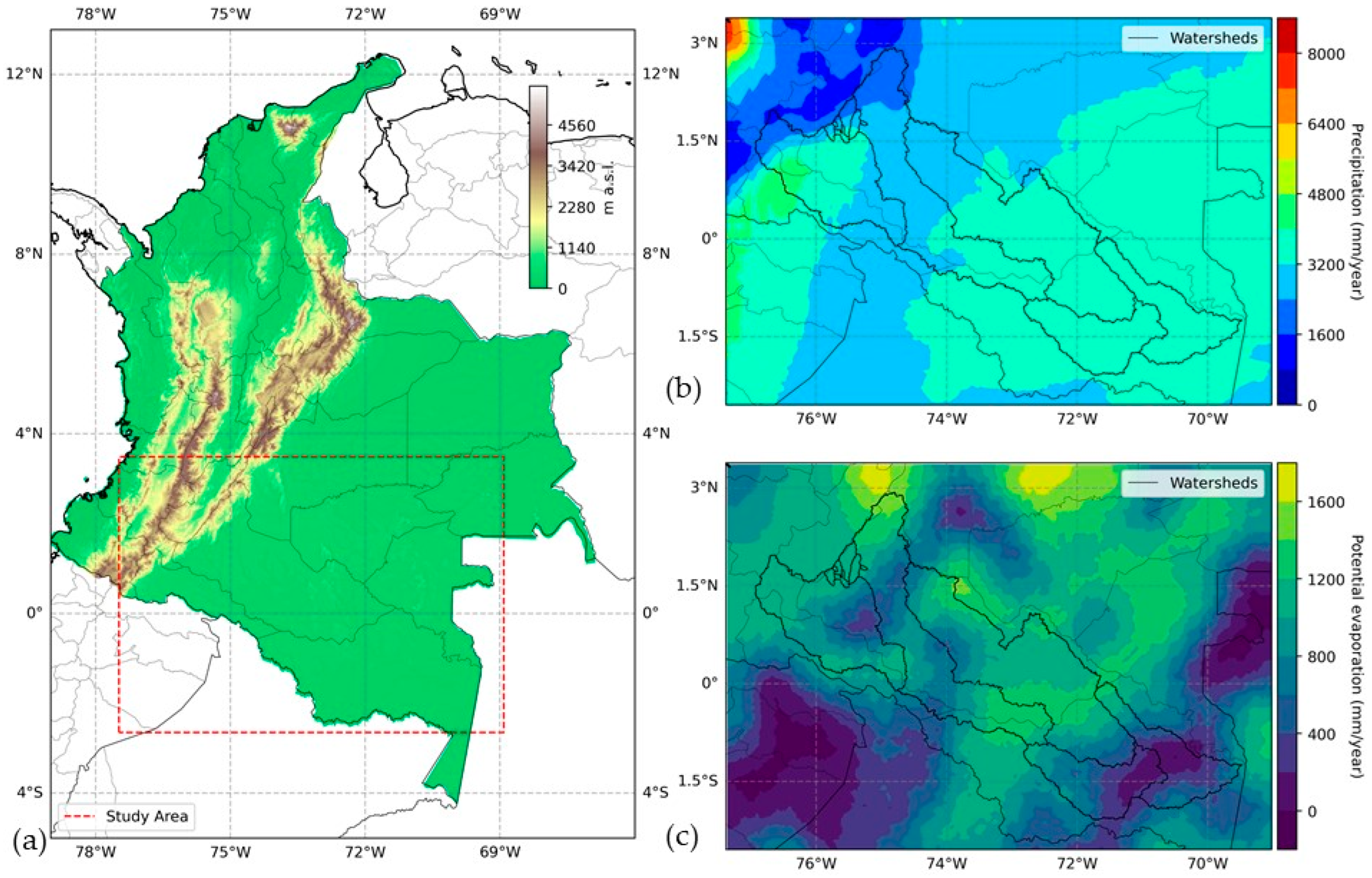
Figure 4 shows the spatial distribution of the mean annual precipitation derived from the CHIRPS precipitation dataset and the mean annual potential evaporation derived from the ERA5 reanalysis dataset. The figure the delineated watersheds and the elevation map related to Colombia, allowing comparison between the climatic conditions and the orography of the Caquetá River Basin.
Table 4 summarizes the results of the climatic index analysis for each of the 12 assessed sub-watersheds.
Annual average precipitation varies considerably among the studied sub-watersheds, ranging from 2383.08 mm/year in VENECIA to 3259.61 mm/year in BACURI. This variability underscores the importance of precipitation in controlling watershed discharge. BACURI, MARIA MANTECA and TAGUA LA show the highest annual average precipitations values, reflecting their location in the flat eastern sector of the Caquetá River Basin. In contrast, VENECIA, located in the headwaters at higher elevations, records the lowest annual average precipitation. Annual average potential evaporation also exhibits substantial variability, ranging from 758.73 mm in ESMERALDA LA to 1315.07 mm in ITARCA. This variable represents the amount of water that would evaporate under potential conditions from a reference surface. ITARCA, LARANDIA and MORELIA–AUT present the highest annual average potential evaporation values, whereas ESMERALDA LA shows the lowest.
The aridity index, ranging between 0.25 and 0.53, expresses the relationship between precipitation and potential evaporation and is widely used to characterize climatic conditions within a watershed The watersheds associated with the BACURI, ESMERALDA LA and TAGUA LA gauges correspond to semi-arid conditions, whereas the VENECIA watershed shows arid conditions, and the remaining watersheds present a humid climate.
Finally, the streamflow coefficient, ranging between 0.66 and 0.88, represents the proportion of precipitation that becomes runoff. The TAGUA LA, ESMERALDA LA and MERCEDES LAS watersheds show the highest runoff coefficients, whereas BACURI presents the lowest.
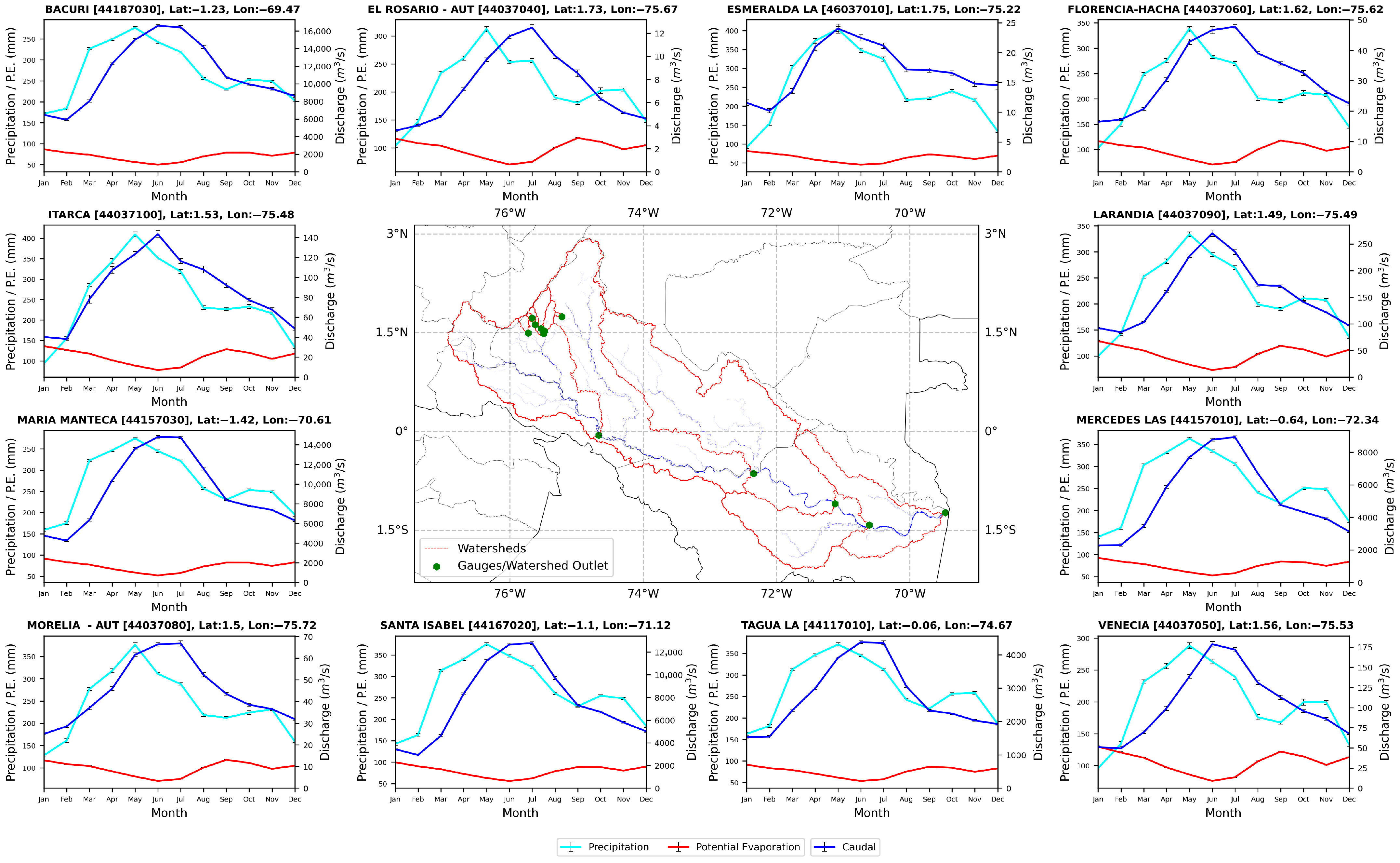
Figure 5 summarizes the monthly average discharge, monthly average precipitation, and monthly average potential evaporation for each studied watershed, illustrating the seasonal variability of these variables.

5.2. Model Calibration and Validation

Model performance varies across gauges, as reflected by the efficiency criteria evaluated (NSE and KGE). In this context, gauges SANTA ISABEL (NSE: 0.72 and KGE: 0.81), MARIA MANTECA (NSE: 0.71 and KGE: 0.77), MERCEDES LAS (NSE: 0.65 and KGE: 0.69), and BACURI (NSE: 0.6 and KGE: 0.67) show very good performance.
Good performance is observed at TAGUA LA (NSE: 0.58 and KGE: 0.72) and LARANDIA (NSE: 0.4 and KGE: 0.48). In contrast, EL ROSARIO–AUT (NSE: 0.21 and KGE: 0.22), ITARCA (NSE: 0.26 and KGE: 0.38) and VENECIA (NSE: 0.29 and KGE: 0.38) show satisfactory performance, whereas ESMERALDA LA, FLORENCIA-HACHA, and MORELIA–AUT exhibit insufficient performance.
The ranges of NSE and KGE values are generally similar, indicating consistent calibration results. However, the FLORENCIA–HACHA gauge shows a noticeable discrepancy between NSE and KGE values. This difference suggests that, in this case, the model has limited ability to reproduce extreme events and their temporal synchronization, while still representing the overall water balance and flow variability reasonably well, as reflected by the moderate KGE values.
On the other hand, most stations fall within the very good category for PBIAS (values < ±10), including MARIA MANTECA, MERCEDES LAS, BACURI, FLORENCIA-HACHA, and LARANDIA, all of which also exhibit relatively low RMSE values, confirming reliable simulations. ITARCA and MORELIA–AUT are classified as good (±10 ≤ PBIAS < ±15), though their higher RMSE indicates reduced accuracy. EL ROSARIO–AUT and ESMERALDA LA remain within the very good bias range, but their elevated RMSE highlights limitations in reproducing flow variability. Overall, the joint evaluation of PBIAS and RMSE shows that while bias levels are generally acceptable, discrepancies in RMSE reveal differences in predictive precision across sub-watersheds.
Table 5 summarizes the optimal calibrated parameters obtained for each assessed sub-watershed, together with the corresponding efficiency criteria. These values indicate the performance of the calibration process across the different hydrological units.
The efficiency of the calibrated models was assessed through the validation stage. As in the calibration process, the NSE and KGE were used as evaluation criteria. The validation results are presented in Table 6.
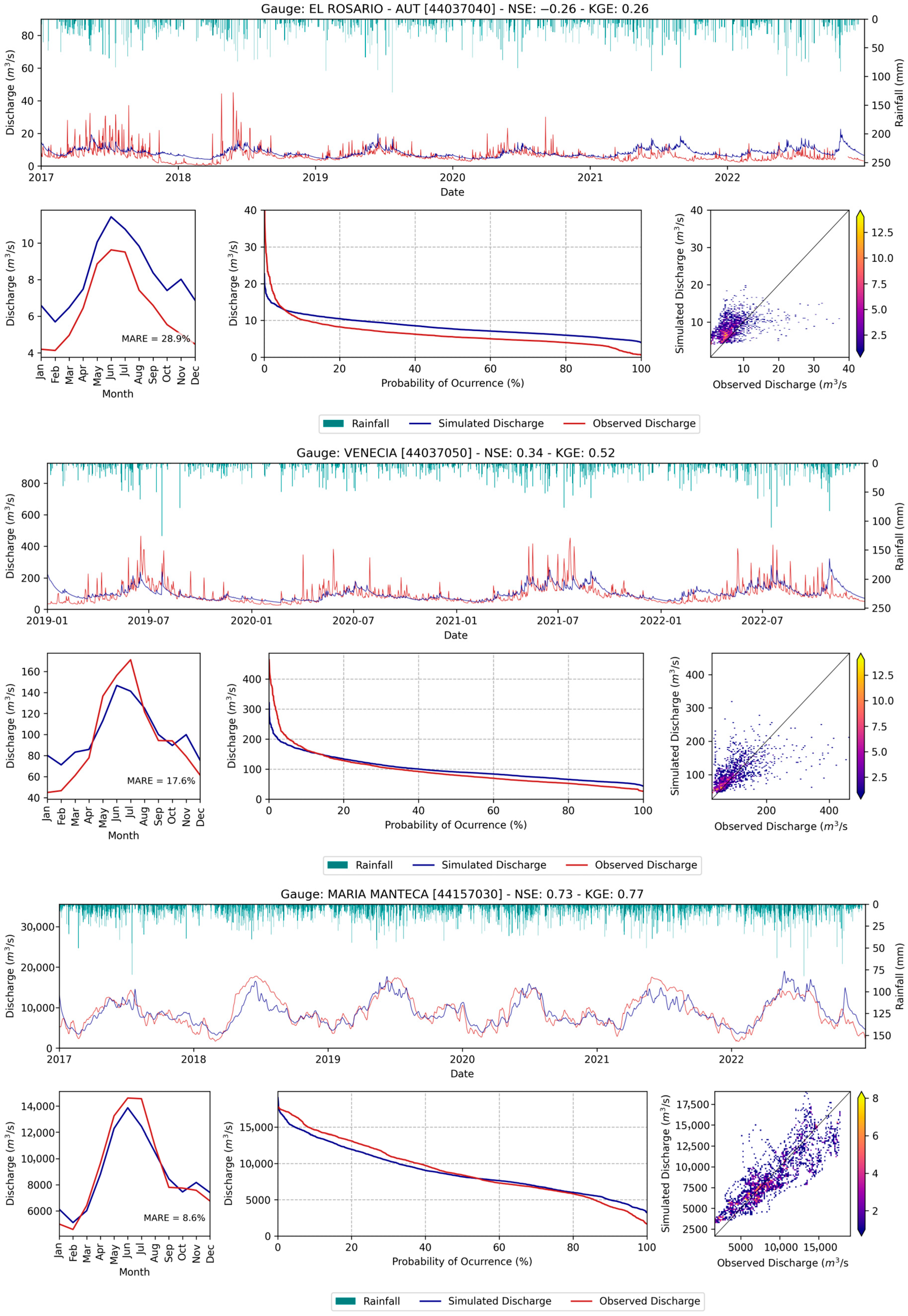
Similar to calibration, the gauges BACURI (NSE: 0.66 and KGE: 0.71), MARIA MANTECA (NSE: 0.73 and KGE: 0.77), SANTA ISABEL (NSE: 0.69 and KGE: 0.69), and MERCEDES LAS (NSE: 0.61 and KGE: 0.69) maintain excellent performance during validation.
LARANDIA (NSE: 0.41 and KGE: 0.43) shows good performance, consistent with the efficiency obtained during calibration. However, several gauges exhibit a noticeable decrease in performance compared with calibration stage, particularly FLORENCIA-HACHA (NSE: 0.11 and KGE: 0.21) or ESMERALDA LA (NSE: 0.08 and KGE: 0.35). This may indicate a limited ability of the model to reproduce extreme events and their temporal dynamics. Nevertheless, the moderate KGE values suggest that the model can still represent the overall volumetric balance and flow variability reasonably well. The gauges EL ROSARIO-AUT (NSE: −0.26 and KGE: 0.26) and TAGUA LA (NSE: −0.40 and KGE: 0.45) show negative NSE values, indicating poorer model performance than a simple simulation based on the mean observed discharges. As observed during calibration, most stations show consistent behavior between NSE and KGE. However, TAGUA LA gauge again presents a larger discrepancy between these metrics, suggesting that the model captures part of the total flow volume (positive KGE) but fails to adequately reproduce the temporal dynamics of the discharge’s series (negative NSE).
Overall, the figures based on monthly averages values show that both observed and simulated streamflow follow a unimodal seasonal pattern, with a wet season between April and July, and a dry season between August and March. In general, the simulated monthly averages flows align well with the observed values in both timing and magnitude, indicating that the model adequately reproduces the average flow regime.
During the validation period, several stations demonstrated very good performance in terms of bias, including MARIA MANTECA, MERCEDES LAS, BACURI, MORELIA–AUT, and VENECIA, all of which also showed relatively low RMSE values, confirming reliable simulations. LARANDIA and SANTA ISABEL were classified as good, with acceptable bias but variable accuracy. FLORENCIA-HACHA and ITARCA fell into the satisfactory category, reflecting moderate deviations and higher RMSE. In contrast, EL ROSARIO–AUT and TAGUA LA exhibited unsatisfactory performance, with large biases and elevated RMSE, underscoring significant limitations in reproducing observed flows. Overall, the combined evaluation of PBIAS and RMSE highlights that while most stations retained acceptable bias levels, differences in RMSE reveal varying degrees of predictive accuracy across sub-watersheds during the validation period.
Figure 6 presents the validation results for some of the streamflow gauges considered in the study. The figure shows the observed and simulated streamflow time series together with the corresponding daily precipitation series. It also includes the monthly averages, the empirical probability distribution curves, and scatter plots comparing observed and simulated values.
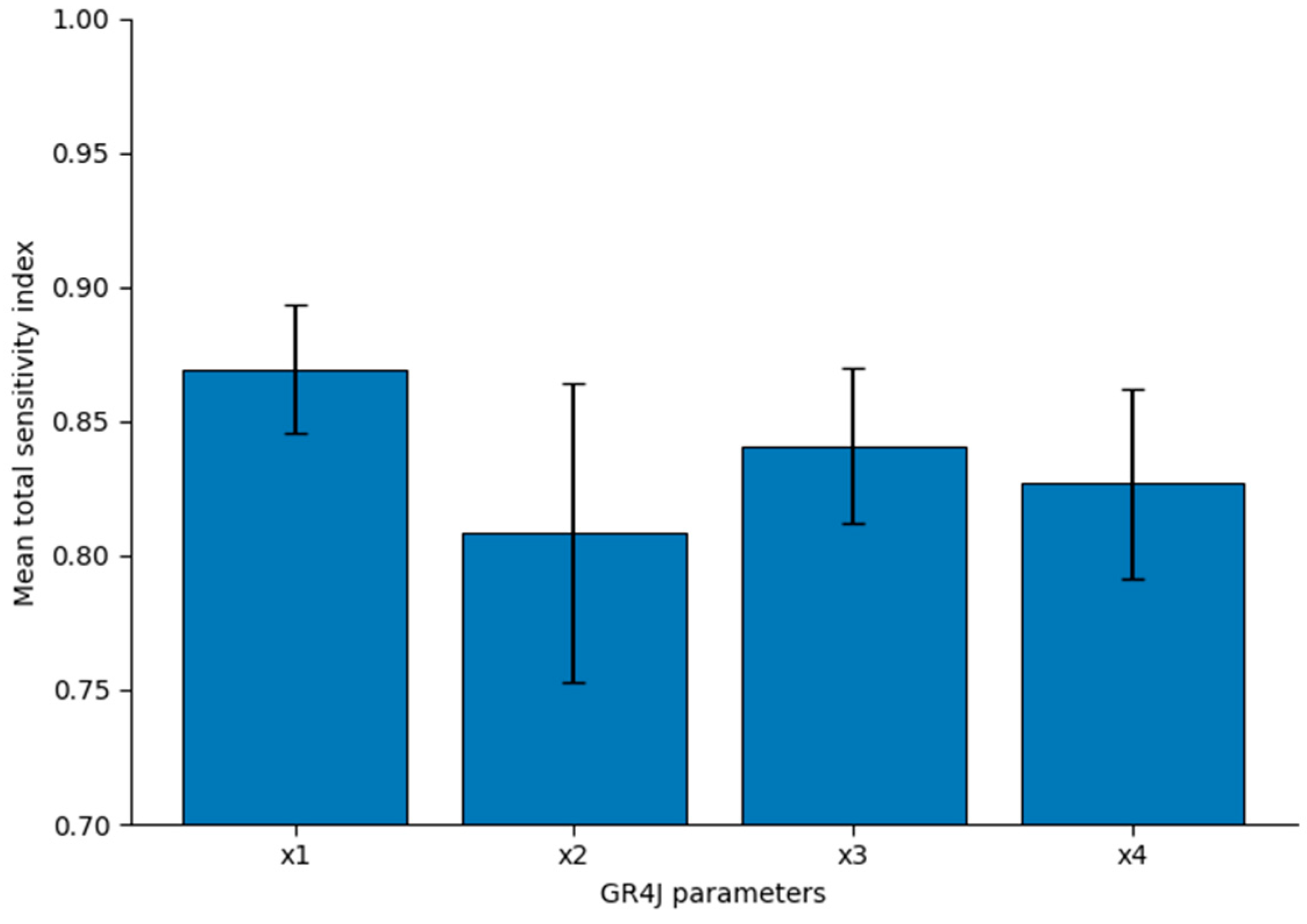
For its part, Figure 7 summarizes the Fourier Amplitude Sensitivity Test. The FAST analysis revealed high total-order sensitivity indices for all GR4J parameters, indicating that model performance is strongly controlled by the full parameter set.

5.3. Correlation and Curve-Fitting Analysis

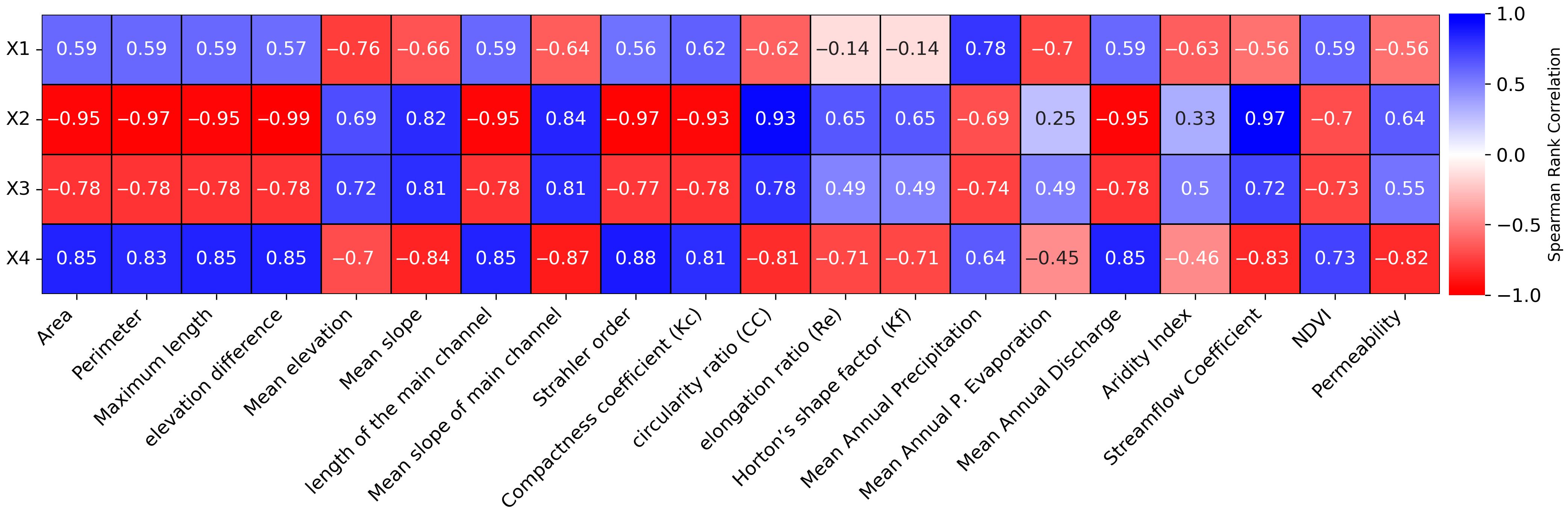
Spearman’s rank correlation was applied to evaluate the relationships between the parameters estimated from the calibrated GR4J models and the morphometric attributes, climatic indices, land-cover metrics, and soil characterization across the 12 assessed sub-watersheds. Figure 8 displays the cross-correlation matrix.
The correlation matrix shows that parameter X1 exhibits a moderate positive correlation with mean annual precipitation (0.78), indicating that both variables tend to increase or decrease together. In addition, X1 shows a moderate negative correlation with the average elevation of the watershed (−0.76) and a weak negative correlation with Horton’s shape factor (−0.14). These results suggest a weak inverse relationship between X1 and Horton’s shape factor. Consequently, a simple linear relationship may not adequately describe this association, and alternative functional relationships should be explored.
Parameter X2 exhibits a strong negative correlation with geometric and morphometric watersheds attributes, including area (−0.95), perimeter (−0.97), maximum length (−0.95), and elevation difference within the watershed (−0.99), indicating that X2 decreases as these parameters increase. In contrast, X2 shows a strong positive correlation with the flow coefficient (0.97) and a weak positive correlation with certain climatic indices, such as mean annual potential evaporation and aridity index.
Parameter X3 exhibits a strong positive correlation with morphometric attributes of the watersheds, particularly the average slope of the watershed and the average slope of the main channel, both with a correlation coefficient of 0.81. In addition, X3 shows a moderate negative correlation with geometric and morphometric watershed attributes, including area, perimeter, maximum length, elevation difference, and compactness coefficient (in this case −0.78), indicating that X3 decreases as the magnitude of these parameters increases.
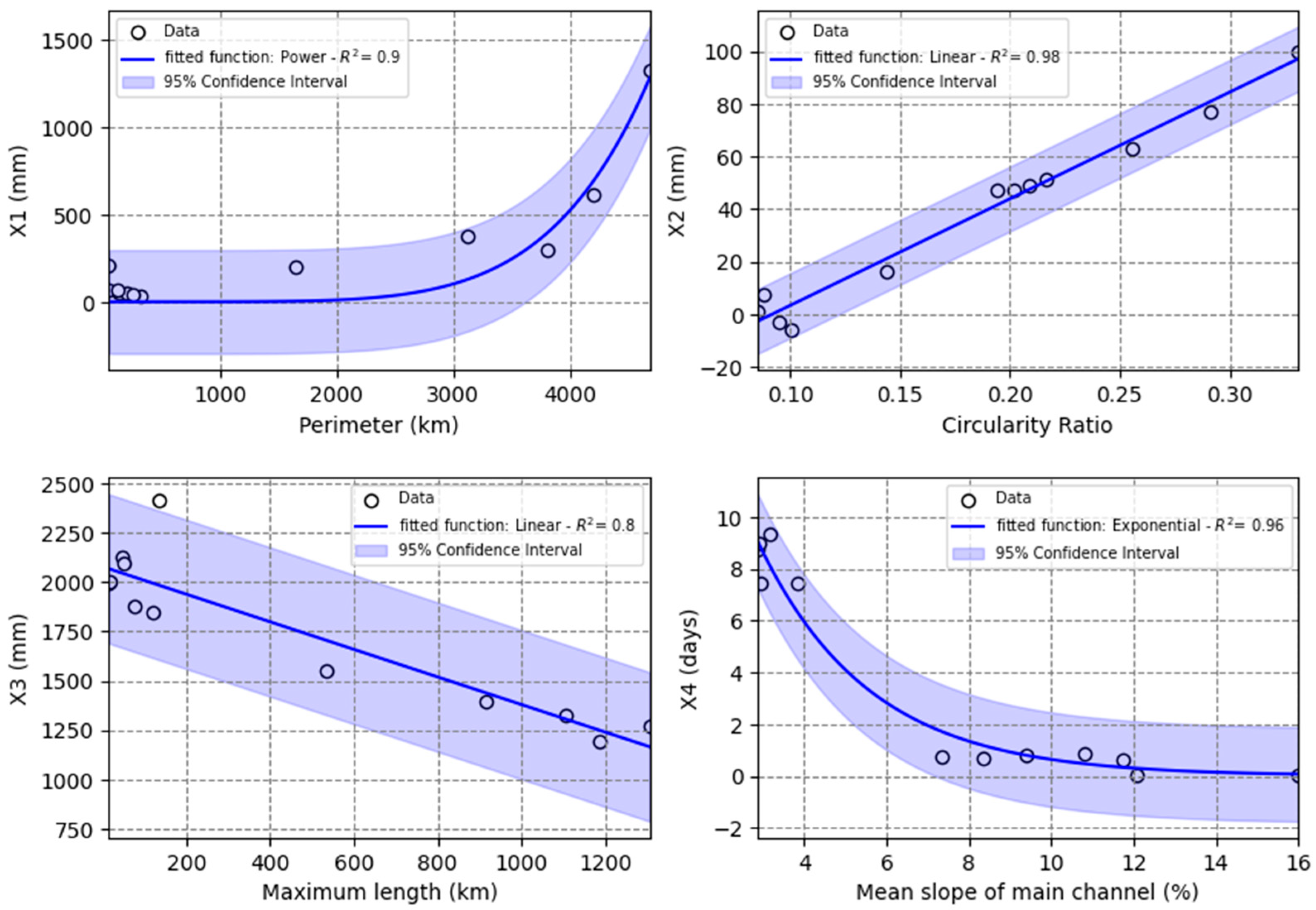
Finally, parameter X4 shows a strong positive correlation with several morphometric attributes, particularly with the maximum Strahler order (0.88). It also exhibits a strong negative correlation with the average slope of the main channel and the average slope of the watershed (−0.87 and −0.84, respectively). In addition, weak negative correlations are observed with two climatic indices: the annual potential evaporation and the aridity index, with correlation coefficients of −0.45 and −0.46, respectively. Table 7 presents the best-fit results for each model parameter based on coefficient of determination (R2).
For parameters X2 and X4, both are high-degree fit models, with high coefficients of determination (R2) of 0.98 and 0.96, respectively. These results indicate that the models effectively capture the variability in these parameters and produce accurate predictions. X2 was fitted based on the watershed circularity ratio, while X4 was fitted based on the slope of the watershed’s main channel.
X1 exhibits an adequate fit, with a high R2 of 0.90, indicating that the model explains 90% of the variability in this parameter. X1 was fitted based on the watershed perimeter.
For X3, the model shows a reasonable fit, with R2 close to 0.80, but with a relatively high standard error(s). To improve the fit for X3, additional relevant variables could be considered or the model structure modified. Parameter X3 was fitted based on the maximum length of the main channel.
As shown by the correlation analysis and confirmed through the curve-fitting process, parameters X1 and X2 exhibit positive relationships with the watershed perimeter and circularity ratio, respectively. This indicates that as the watershed perimeter (circularity ratio) increases or decreases, X1 (X2) tends to vary in the same direction. The difference lies in the functional form used to describe each parameter: X1 is represented by a power function, whereas X2 is represented by a linear function.
In contrast, parameters X3 and X4 display inverse relationships with the maximum length and the slope of the main channel respectively. That is, as the maximum length (slope) of the main channel increases, X3 (X4) tends to vary in the opposite direction. Here too, the functional forms differ: X3 is described by a linear function, whereas X4 is described by an exponential function.
Overall, X1 and X2 were fitted based on an intrinsic watershed characteristic (perimeter and circularity ratio), while X3 and X4 were fitted based on drainage network features (maximum main channel length and slope). Both sets of parameters, those related to the watershed and those related to the drainage network, are essential components of hydrological analysis. These relationships allow for the estimation of GR4J model parameters through a straightforward analysis of the studied basins.
Figure 9 shows the fitted modes along with the corresponding input data for each parameter.

6. Discussion and Conclusions

The morphometric analysis indicates that most sub-watersheds are characterized by elongated geometries while only a limited number exhibit more circular tendencies. Likewise, climatic indices reveal marked spatial variability in annual precipitation, primarily driven by orographic controls, with higher precipitation observed in the Andean piedmont and a progressive decrease toward lower-elevation areas, likely resulting from interactions between atmospheric wind jets and Andean topography. In contrast, potential evaporation exhibits an inverse spatial distribution, more strongly associated with temperature, land cover, and other physiographic factors. Land-cover assessment shows predominantly moderate to dense vegetation, consistent with generally humid climatic conditions, although semi-arid environments are identified in headwater areas.
Considering the morphometric analysis undertaken, it is important to discuss the hydrological significance of the most influential parameters. The catchment perimeter, together with basin area, contributes to describing watershed shape, which can influence hydrological response by affecting runoff concentration and the spatial distribution of flow paths within the basin. In this regard, the circularity ratio is a widely used indicator of basin shape and expresses the degree to which a watershed approaches a circular form. Basins with higher circularity ratios tend to produce a faster and more synchronized runoff response, as water from different parts of the catchment reaches the outlet more simultaneously, whereas elongated basins typically generate a more attenuated hydrograph [66]. Moreover, maximum stream length is a key variable for estimating the time of concentration, which directly influences the timing of peak discharge and the shape of the resulting hydrograph. Likewise, channel slope is a fundamental factor in hydrological and fluvial geomorphological analyses, as it controls the gravitational forces governing water flow and sediment transport within river channels. Consequently, slope directly affects flow velocity, erosion potential, and the efficiency with which runoff is conveyed through the drainage network [80].
The calibration results indicate that the GR4J model performs satisfactorily across most of the analyzed watersheds, with improved performance in larger basins characterized by gentler slopes. The GR4J model demonstrates an adequate capacity to represent medium and low flow regimes, although it shows some limitations in reproducing maximum flow events. Additionally, the seasonal hydrological dynamics of wet (April–July) and dry (August–March) periods are reasonably well-reflected.
A spatial tendency is observed in which NSE and KGE values decrease toward the western sector of the study area, where watershed size becomes smaller. This may be due to factors such as the limited accuracy of the remote sensing precipitation product used in the headwaters of the Caquetá River Basin, particularly at higher elevations, or to the hydrological response of the GR4J model in small and steep watersheds. On the other hand, the initial segment of the probability distribution curves, associated with low exceedance probabilities (below 20%), generally shows lower simulated values compared to observations. This suggests that the model tends to underestimate peak flow events. Nevertheless, this effect was not observed at several gauging stations (SANTA ISABEL, MARIA MANTECA, LAS MERCEDES, LA TAGUA, and BACURI), where the model exhibits a suitable representation of maximum discharge regimes. For discharges associated with high exceedance probabilities (>80%), a good agreement between simulated and observed values was found in most watersheds.
The ESMERALDA LA, MORELIA–AUT, and FLORENCIA–HACHA stations exhibit the lowest model performance, with NSE values around 0.17 and 0.18 and KGE between 0.21 and 0.29, indicating limited ability of the GR4J model to reproduce observed streamflow dynamics. ESMERALDA LA shows the largest errors (RMSE: 17.05) and a positive PBIAS (9.85%), while MORELIA–AUT also presents similar simulation errors RMSE: 8.46. In contrast, FLORENCIA–HACHA has a PBIAS close to zero (−1.39%), suggesting a reasonable representation of total volume but difficulties in capturing temporal variability. These results may be related to the location of these sub-basins in high-elevation headwater areas influenced by the Andes, where previous studies have shown that the accuracy of satellite-derived precipitation products tends to decrease, potentially propagating uncertainties into the hydrological simulations and affecting model performance.
It is important to consider that remote sensing datasets present some limitations. In Colombia, precipitation products exhibit regional biases, typically showing underestimation in the wettest areas and overestimation in drier regions. These discrepancies are particularly pronounced at high elevations in the Andes Mountains, where differences with gauge observations are greatest. In contrast, performance generally improves in lowland regions such as the Orinoco Basin and the Amazon Basin, where satellite estimates tend to show greater agreement with ground measurements. Similar spatial and temporal patterns have been reported globally in regions with comparable climatic and topographic conditions [45,81]. Regarding the ERA5 reanalysis dataset, error propagation analyses indicate that uncertainty in reference evaporation estimates derived from reanalysis data tend to be higher in tropical regions [59].
On the other side, correlation analyses show significant relationships between selected morphometric and climatic variables and GR4J parameters. In particular, X2 and X4 parameters show strong relationships with topographic and geometric characteristics.
This research has highlighted a strong capacity to represent GR4J parameters through a hybrid morphometric–satellite methodological framework applied to data-scarce basins. In this sense, the X2 and X4 parameters exhibit high performance (R2 > 0.95), indicating that their variability is well captured by simple geometric and topographic descriptors. In the case of the X1 parameter, it is also demonstrated to have high explanatory power (R2 ≈ 0.90). In contrast, the X3 parameter shows a comparatively weaker fit, suggesting sensitivity to additional controlling factors not fully represented in the current formulations.
These results open new opportunities for future research. In this sense, it could extend the proposed methodology to encompass the entire Colombian Orinoquía region, including the Guaviare, Inírida, Apaporis, Vichada, Meta, and Casanare river basins. Such an expansion would enable an integrated regional assessment and contribute to the development of more robust and transferable parameter prediction relationships across hydrologically connected watersheds.
Additionally, the applicability of the method could be evaluated in regions characterized by contrasting hydroclimatic and physiographic conditions, such as areas with higher precipitation rates, distinct orographic settings, or unique climatic regimes. In this context, the Colombian Pacific region represents a particularly relevant case study due to its extreme rainfall patterns and complex topography.
Finally, future researchers might incorporate independent validation of parameter formulas in neighboring basins as well as testing alternative conceptual models and bias correction that could improve reliability and transferability. Additionally, progress could be made in the integration of hydrological models focused on extreme flow regimes, which would allow for improved representation and prediction of peak discharges associated with different return periods, thereby enhancing the applicability of the methodology for flood risk management and the design of hydraulic infrastructure.

Author Contributions

D.A.P.-C., F.E. and S.Z. conceived, designed, and led the research. All authors did research into conceptualization and analytical development. D.A.P.-C. supervised all actions. The Discussion and Conclusions sections were addressed by all authors, and all authors wrote the paper. All authors have read and agreed to the published version of the manuscript.

Funding

This research was developed within the framework of the GestEAUr project (S1/2.5/E0053 Interreg Sudeo co-funded by the European Union) and SOGECAL project (PID2022–142299OB-I00, supported by the Ministry of Science and Innovation of Spain).

Data Availability Statement

The original contributions presented in this study are included in the article. Further inquiries can be directed to the corresponding author.

Acknowledgments

The authors thank the University of Salamanca for the facilities made available to undertake this research.

Conflicts of Interest

The authors declare no conflicts of interest.

References

  1. Ndiaye, P.M.; Bodian, A.; Dezetter, A.; Ogilvie, A.; Goudiaby, O. Sensitivity of Global Hydrological Models to Potential Evapotranspiration Estimation Methods in the Senegal River Basin (West Africa). J. Hydrol. Reg. Stud. 2024, 53, 101823. [Google Scholar] [CrossRef]
  2. Barbhuiya, S.; Manekar, A.; Ramadas, M. Performance Evaluation of ML Techniques in Hydrologic Studies: Comparing Streamflow Simulated by SWAT, GR4J, and State-of-the-Art ML-Based Models. J. Earth Syst. Sci. 2024, 133, 136. [Google Scholar] [CrossRef]
  3. Kumari, N.; Srivastava, A.; Sahoo, B.; Raghuwanshi, N.S.; Bretreger, D. Identification of Suitable Hydrological Models for Streamflow Assessment in the Kangsabati River Basin, India, by Using Different Model Selection Scores. Nat. Resour. Res. 2021, 30, 4187–4205. [Google Scholar] [CrossRef]
  4. Brunner, M.I.; Slater, L.; Tallaksen, L.M.; Clark, M. Challenges in Modeling and Predicting Floods and Droughts: A Review. WIREs Water 2021, 8, e1520. [Google Scholar] [CrossRef]
  5. Van Dijk, A.I.J.M.; Brakenridge, G.R.; Kettner, A.J.; Beck, H.E.; De Groeve, T.; Schellekens, J. River Gauging at Global Scale Using Optical and Passive Microwave Remote Sensing. Water Resour. Res. 2016, 52, 6404–6418. [Google Scholar] [CrossRef]
  6. Snelder, T.H.; Datry, T.; Lamouroux, N.; Larned, S.T.; Sauquet, E.; Pella, H.; Catalogne, C. Regionalization of Patterns of Flow Intermittence from Gauging Station Records. Hydrol. Earth Syst. Sci. 2013, 17, 2685–2699. [Google Scholar] [CrossRef]
  7. Robert Brakenridge, G.; Cohen, S.; Kettner, A.J.; De Groeve, T.; Nghiem, S.V.; Syvitski, J.P.M.; Fekete, B.M. Calibration of Satellite Measurements of River Discharge Using a Global Hydrology Model. J. Hydrol. 2012, 475, 123–136. [Google Scholar] [CrossRef]
  8. Raiol, L.L.; Rocha, Y.A.d.S.; Lima, A.M.M.d.; Velastegui-Montoya, A. Assessment of Environmental Degradation and Conservation in the Maracanã River Basin, Eastern Amazon. Front. Environ. Sci. 2025, 12, 1506701. [Google Scholar] [CrossRef]
  9. Razavi, T.; Coulibaly, P. Streamflow Prediction in Ungauged Basins: Review of Regionalization Methods. J. Hydrol. Eng. 2013, 18, 958–975. [Google Scholar] [CrossRef]
  10. Karki, N.; Shakya, N.M.; Pandey, V.P.; Devkota, L.P.; Pradhan, A.M.S.; Lamichhane, S. Comparative Performance of Regionalization Methods for Model Parameterization in Ungauged Himalayan Watersheds. J. Hydrol. Reg. Stud. 2023, 47, 101359. [Google Scholar] [CrossRef]
  11. Kittel, C.M.M.; Arildsen, A.L.; Dybkjær, S.; Hansen, E.R.; Linde, I.; Slott, E.; Tøttrup, C.; Bauer-Gottwein, P. Informing Hydrological Models of Poorly Gauged River Catchments—A Parameter Regionalization and Calibration Approach. J. Hydrol. 2020, 587, 124999. [Google Scholar] [CrossRef]
  12. Kunnath-Poovakka, A.; Ryu, D.; Renzullo, L.J.; George, B. Remotely Sensed ET for Streamflow Modelling in Catchments with Contrasting Flow Characteristics: An Attempt to Improve Efficiency. Stoch. Environ. Res. Risk Assess. 2018, 32, 1973–1992. [Google Scholar] [CrossRef]
  13. Ansori, M.B.; Nadjadji, A. The TRMM rainfall-runoff transformation model using GR4J as a prediction of the Tugu dam reservoir inflow. Int. J. Geomate 2022, 23, 45–52. [Google Scholar] [CrossRef]
  14. Ait Naceur, K.; El Khalki, E.M.; Hadri, A.; Jaffar, O.; Brocca, L.; Saidi, M.E.; Tramblay, Y.; Chehbouni, A. Comparison of Calibration Strategies for Daily Streamflow Simulations in Semi-Arid Basins. Water Resour. Manag. 2025, 39, 1089–1105. [Google Scholar] [CrossRef]
  15. Zhou, Y.; Wang, Y.; Gold, A.J.; August, P.V. Modeling Watershed Rainfall–Runoff Relations Using Impervious Surface-Area Data with High Spatial Resolution. Hydrogeol. J. 2010, 18, 1413–1423. [Google Scholar] [CrossRef]
  16. Beven, K. Prophecy, Reality and Uncertainty in Distributed Hydrological Modelling. Adv. Water Resour. 1993, 16, 41–51. [Google Scholar] [CrossRef]
  17. Beven, K. How Far Can We Go in Distributed Hydrological Modelling? Hydrol. Earth Syst. Sci. 2001, 5, 1–12. [Google Scholar] [CrossRef]
  18. Kirchner, J.W. Getting the Right Answers for the Right Reasons: Linking Measurements, Analyses, and Models to Advance the Science of Hydrology. Water Resour. Res. 2006, 42. [Google Scholar] [CrossRef]
  19. Refsgaard, J.C.; Storm, B. Construction, Calibration and Validation of Hydrological Models. In Distributed Hydrological Modelling; Springer: Berlin/Heidelberg, Germany, 1990; pp. 41–54. [Google Scholar]
  20. Chen, J.M.; Chen, X.; Ju, W.; Geng, X. Distributed Hydrological Model for Mapping Evapotranspiration Using Remote Sensing Inputs. J. Hydrol. 2005, 305, 15–39. [Google Scholar] [CrossRef]
  21. Tang, Y.; Reed, P.; van Werkhoven, K.; Wagener, T. Advancing the Identification and Evaluation of Distributed Rainfall-runoff Models Using Global Sensitivity Analysis. Water Resour. Res. 2007, 43. [Google Scholar] [CrossRef]
  22. Shakti, P.; Shrestha, N.; Gurung, P. Step Wise Multi-Criteria Performance Evaluation of Rainfall-Runoff Models Using WETSPRO. J. Hydrol. Meteorol. 1970, 7, 18–29. [Google Scholar] [CrossRef]
  23. Xu, W.; Chen, J.; Corzo, G.; Xu, C.; Zhang, X.J.; Xiong, L.; Liu, D.; Xia, J. Coupling Deep Learning and Physically Based Hydrological Models for Monthly Streamflow Predictions. Water Resour. Res. 2024, 60. [Google Scholar] [CrossRef]
  24. Kuchment, L.S.; Demidov, V.N.; Naden, P.S.; Cooper, D.M.; Broadhurst, P. Rainfall-Runoff Modelling of the Ouse Basin, North Yorkshire: An Application of a Physically Based Distributed Model. J. Hydrol. 1996, 181, 323–342. [Google Scholar] [CrossRef]
  25. Brirhet, H.; Benaabidate, L. Comparison of Two Hydrological Models (Lumped and Distributed) Over A Pilot Area of the Issen Watershed in the Souss Basin, Morocco. Eur. Sci. J. 2016, 12, 347. [Google Scholar] [CrossRef][Green Version]
  26. Refsgaard, J.C. Terminology, Modelling Protocol and Classification of Hydrological Model Codes. Water Sci. Technol. Libr. 1996, 22, 17–40. [Google Scholar]
  27. Abbott, M.B.; Bathurst, J.C.; Cunge, J.A.; O’Connell, P.E.; Rasmussen, J. An Introduction to the European Hydrological System—Systeme Hydrologique Europeen, “SHE”, 1: History and Philosophy of a Physically-Based, Distributed Modelling System. J. Hydrol. 1986, 87, 45–59. [Google Scholar] [CrossRef]
  28. Gayathri, K.; Ganasri, B.; Dwarakish, G. A Review on Hydrological Models. In Proceedings of the International Conference on Water Resources, Coastal and Ocean Engineering (ICWRCOE 2015), Mangalore, India, 12–14 March 2015; Elsevier: Amsterdam, The Netherlands, 2015; pp. 1001–1007. [Google Scholar]
  29. Perrin, C.; Michel, C.; Andréassian, V. Improvement of a Parsimonious Model for Streamflow Simulation. J. Hydrol. 2003, 279, 275–289. [Google Scholar] [CrossRef]
  30. Collischonn, B.; Collischonn, W.; Tucci, C.E.M. Daily Hydrological Modeling in the Amazon Basin Using TRMM Rainfall Estimates. J. Hydrol. 2008, 360, 207–216. [Google Scholar] [CrossRef]
  31. Andrade, J.M.; Ribeiro Neto, A.; Nóbrega, R.L.B.; Rico-Ramirez, M.A.; Montenegro, S.M.G.L. Efficiency of Global Precipitation Datasets in Tropical and Subtropical Catchments Revealed by Large Sampling Hydrological Modelling. J. Hydrol. 2024, 633, 131016. [Google Scholar] [CrossRef]
  32. Yu, C.; Hu, D.; Duan, X.; Zhang, Y.; Liu, M.; Wang, S. Rainfall-Runoff Simulation and Flood Dynamic Monitoring Based on CHIRPS and MODIS-ET. Int. J. Remote Sens. 2020, 41, 4206–4225. [Google Scholar] [CrossRef]
  33. Zhu, S.; Wei, J.; Zhang, H.; Xu, Y.; Qin, H. Spatiotemporal Deep Learning Rainfall-Runoff Forecasting Combined with Remote Sensing Precipitation Products in Large Scale Basins. J. Hydrol. 2023, 616, 128727. [Google Scholar] [CrossRef]
  34. Kunnath-Poovakka, A.; Ryu, D.; Eldho, T.I.; George, B. Parameter Uncertainty of a Hydrologic Model Calibrated with Remotely Sensed Evapotranspiration and Soil Moisture. J. Hydrol. Eng. 2021, 26, 04020070. [Google Scholar] [CrossRef]
  35. Maggioni, V.; Massari, C. On the Performance of Satellite Precipitation Products in Riverine Flood Modeling: A Review. J. Hydrol. 2018, 558, 214–224. [Google Scholar] [CrossRef]
  36. Wang, N.; Liu, W.; Sun, F.; Yao, Z.; Wang, H.; Liu, W. Evaluating Satellite-Based and Reanalysis Precipitation Datasets with Gauge-Observed Data and Hydrological Modeling in the Xihe River Basin, China. Atmos. Res. 2020, 234, 104746. [Google Scholar] [CrossRef]
  37. Dubey, S.; Gupta, H.; Goyal, M.K.; Joshi, N. Evaluation of Precipitation Datasets Available on Google Earth Engine over India. Int. J. Climatol. 2021, 41, 4844–4863. [Google Scholar] [CrossRef]
  38. Xu, J.; Ma, Z.; Yan, S.; Peng, J. Do ERA5 and ERA5-Land Precipitation Estimates Outperform Satellite-Based Precipitation Products? A Comprehensive Comparison between State-of-the-Art Model-Based and Satellite-Based Precipitation Products over Mainland China. J. Hydrol. 2022, 605, 127353. [Google Scholar] [CrossRef]
  39. Maggioni, V.; Meyers, P.C.; Robinson, M.D. A Review of Merged High-Resolution Satellite Precipitation Product Accuracy during the Tropical Rainfall Measuring Mission (TRMM) Era. J. Hydrometeorol. 2016, 17, 1101–1117. [Google Scholar] [CrossRef]
  40. Bytheway, J.L.; Kummerow, C.D. A Physically Based Screen for Precipitation Over Complex Surfaces Using Passive Microwave Observations. IEEE Trans. Geosci. Remote Sens. 2010, 48, 299–313. [Google Scholar] [CrossRef]
  41. Villarini, G.; Krajewski, W.F.; Smith, J.A. New Paradigm for Statistical Validation of Satellite Precipitation Estimates: Application to a Large Sample of the TMPA 0.25° 3-hourly Estimates over Oklahoma. J. Geophys. Res. Atmos. 2009, 114. [Google Scholar] [CrossRef]
  42. Arciniega-Esparza, S.; Birkel, C.; Chavarría-Palma, A.; Arheimer, B.; Breña-Naranjo, J.A. Remote Sensing-Aided Rainfall–Runoff Modeling in the Tropics of Costa Rica. Hydrol. Earth Syst. Sci. 2022, 26, 975–999. [Google Scholar] [CrossRef]
  43. Tramblay, Y.; El Khalki, E.M.; Ciabatta, L.; Camici, S.; Hanich, L.; Saidi, M.E.M.; Ezzahouani, A.; Benaabidate, L.; Mahé, G.; Brocca, L. River Runoff Estimation with Satellite Rainfall in Morocco. Hydrol. Sci. J. 2023, 68, 474–487. [Google Scholar] [CrossRef]
  44. Zubieta, R.; Getirana, A.; Espinoza, J.C.; Lavado, W. Impacts of Satellite-Based Precipitation Datasets on Rainfall–Runoff Modeling of the Western Amazon Basin of Peru and Ecuador. J. Hydrol. 2015, 528, 599–612. [Google Scholar] [CrossRef]
  45. Vallejo-Bernal, S.M.; Urrea, V.; Bedoya-Soto, J.M.; Posada, D.; Olarte, A.; Cárdenas-Posso, Y.; Ruiz-Murcia, F.; Martínez, M.T.; Petersen, W.A.; Huffman, G.J.; et al. Ground Validation of TRMM 3B43 V7 Precipitation Estimates over Colombia. Part I: Monthly and Seasonal Timescales. Int. J. Climatol. 2021, 41, 601–624. [Google Scholar] [CrossRef]
  46. Urrea, V.; Ochoa, A.; Mesa, O. Validación de La Base de Datos de Precipitación CHIRPS Para Colombia a Escala Diaria, Mensual y Anual En El Periodo 1981–2014. In Proceedings of the XXVII Congreso Latinoamericano de Hidráulica, Lima, Perú, 28–30 September 2016; IAHR: Madrid, Spain, 2016. [Google Scholar]
  47. Baker, J.C.A.; Garcia-Carreras, L.; Gloor, M.; Marsham, J.H.; Buermann, W.; da Rocha, H.R.; Nobre, A.D.; de Araujo, A.C.; Spracklen, D.V. Evapotranspiration in the Amazon: Spatial Patterns, Seasonality, and Recent Trends in Observations, Reanalysis, and Climate Models. Hydrol. Earth Syst. Sci. 2021, 25, 2279–2300. [Google Scholar] [CrossRef]
  48. Bari, M.A.; Khan, U.; Amirthanathan, G.E.; Tuteja, M.; Laugesen, R.M. Simulation of Gauged and Ungauged Streamflow of Coastal Catchments across Australia. Water 2024, 16, 527. [Google Scholar] [CrossRef]
  49. Mathevet, T.; Gupta, H.; Perrin, C.; Andréassian, V.; Le Moine, N. Assessing the Performance and Robustness of Two Conceptual Rainfall-Runoff Models on a Worldwide Sample of Watersheds. J. Hydrol. 2020, 585, 124698. [Google Scholar] [CrossRef]
  50. Haider, R.; Qiao, D.; Yan, J.; Ning, D.; Pasha, G.A.; Iqbal, S. Flow Characteristics Around Permeable Spur Dike with Different Staggered Pores at Varying Angles. Arab. J. Sci. Eng. 2022, 47, 5219–5236. [Google Scholar] [CrossRef]
  51. Iqbal, S.; Pasha, G.A.; Ghani, U.; Ullah, M.K.; Ahmed, A. Flow Dynamics Around Permeable Spur Dike in a Rectangular Channel. Arab. J. Sci. Eng. 2021, 46, 4999–5011. [Google Scholar] [CrossRef]
  52. Alauddin, M.; Tashiro, T.; Tsujimoto, T. Design of Groynes Modified with Both Alignment and Permeability for Lowland River Problems. J. Jpn. Soc. Civ. Eng. Ser. A2 (Appl. Mech.) 2011, 67, I_645–I_652. [Google Scholar] [CrossRef][Green Version]
  53. Sadat, S.H.; Tominaga, A. INFLUENCE OF PILE GROUP DENSITY ON MINIMIZING LOCAL SCOUR OF A DOUBLE SPUR DIKE GROUP. J. Jpn. Soc. Civ. Eng. Ser. B1 (Hydraul. Eng.) 2014, 70, I_85–I_90. [Google Scholar] [CrossRef][Green Version]
  54. Iqbal, S.; Tanaka, N. Experimental Study on Flow Characteristics and Energy Reduction Around a Hybrid Dike. Int. J. Civ. Eng. 2023, 21, 1045–1059. [Google Scholar] [CrossRef]
  55. Iqbal, S.; Tanaka, N. An Experimental Investigation on Dike Stabilization against Floods. Geosciences 2023, 13, 307. [Google Scholar] [CrossRef]
  56. SINCHI—Instituto Amazónico de Investigaciones Científicas. Contaminación Por Mercurio En El Rio Caquetá, Afectación a Comunidades Indígenas Amazónicas: Bora y Miraña; SINCHI: Bogotá, Colombia, 2023. [Google Scholar]
  57. Poveda Jaramillo, G.; Mesa Sánchez, O.J.; Vélez Upegui, J.I. Hidrología de Colombia: El Ciclo Del Agua En Una Geografía Compleja; Universidad Nacional de Colombia, Ed.; Universidad Nacional de Colombia: Bogotá, Colombia, 2024. [Google Scholar]
  58. Funk, C.; Peterson, P.; Landsfeld, M.; Pedreros, D.; Verdin, J.; Shukla, S.; Husak, G.; Rowland, J.; Harrison, L.; Hoell, A.; et al. The Climate Hazards Infrared Precipitation with Stations—A New Environmental Record for Monitoring Extremes. Sci. Data 2015, 2, 150066. [Google Scholar] [CrossRef]
  59. Tran, B.N.; Dehati, S.; Seyoum, S.; van der Kwast, J.; Jewitt, G.; Uijlenhoet, R.; Mul, M. Evaluating Reanalysis Datasets as Meteorological Input for Estimating Reference Evapotranspiration in Africa and Southwest Asia. Hydrol. Sci. J. 2026, 71, 654–672. [Google Scholar] [CrossRef]
  60. Oudin, L.; Perrin, C.; Mathevet, T.; Andréassian, V.; Michel, C. Impact of Biased and Randomly Corrupted Inputs on the Efficiency and the Parameters of Watershed Models. J. Hydrol. 2006, 320, 62–83. [Google Scholar] [CrossRef]
  61. Hersbach, H.; Bell, B.; Berrisford, P.; Hirahara, S.; Horányi, A.; Muñoz-Sabater, J.; Nicolas, J.; Peubey, C.; Radu, R.; Schepers, D.; et al. The ERA5 Global Reanalysis. Q. J. R. Meteorol. Soc. 2020, 146, 1999–2049. [Google Scholar] [CrossRef]
  62. Rouse, J.W.; Haas, R.H.; Schell, J.A.; Deering, D.W. Monitoring the Vernal Advancement and Retrogradation (Green Wave Effect) of Natural Vegetation; NTRS: Greenbelt, MD, USA, 1974. [Google Scholar]
  63. USDA—United States Department of Agriculture. Soil Taxonomy: A Basic System of Soil Classification for Making and Interpreting Soil Surveys, 2nd ed.; Natural Resources Conservation Service: Washington, DC, USA, 1999.
  64. Instituto Geográfico Agustín Codazzi Instituto Geográfico Agustín Codazzi. Available online: https://www.igac.gov.co/ (accessed on 13 June 2024).
  65. Clarke, J.I. Morphometry from Maps. Essays in Geomorphology. In Essays in Geomorphology; Dury, G.H., Ed.; Heinemann: London, UK, 1966; pp. 235–274. [Google Scholar]
  66. Raja Shekar, P.; Mathew, A. Morphometric Analysis of Watersheds: A Comprehensive Review of Data Sources, Quality, and Geospatial Techniques. Watershed Ecol. Environ. 2024, 6, 13–25. [Google Scholar] [CrossRef]
  67. Mahala, A. The Significance of Morphometric Analysis to Understand the Hydrological and Morphological Characteristics in Two Different Morpho-Climatic Settings. Appl. Water Sci. 2020, 10, 33. [Google Scholar] [CrossRef]
  68. Poveda, G.; Vélez, J.I.; Mesa, O.J.; Cuartas, A.; Barco, J.; Mantilla, R.I.; Mejía, J.F.; Hoyos, C.D.; Ramírez, J.M.; Ceballos, L.I.; et al. Linking Long-Term Water Balances and Statistical Scaling to Estimate River Flows along the Drainage Network of Colombia. J. Hydrol. Eng. 2007, 12, 4–13. [Google Scholar] [CrossRef]
  69. Ter Braak, C.J.F.; Vrugt, J.A. Differential Evolution Markov Chain with Snooker Updater and Fewer Chains. Stat. Comput. 2008, 18, 435–446. [Google Scholar] [CrossRef]
  70. Klemeš, V. Operational Testing of Hydrological Simulation Models. Hydrol. Sci. J. 1986, 31, 13–24. [Google Scholar] [CrossRef]
  71. Shen, H.; Tolson, B.A.; Mai, J. Time to Update the Split-Sample Approach in Hydrological Model Calibration. Water Resour. Res. 2022, 58, e2021WR031523. [Google Scholar] [CrossRef]
  72. Nash, J.E.; Sutcliffe, J.V. River Flow Forecasting through Conceptual Models Part I—A Discussion of Principles. J. Hydrol. 1970, 10, 282–290. [Google Scholar] [CrossRef]
  73. Gupta, H.V.; Sorooshian, S.; Yapo, P.O. Toward Improved Calibration of Hydrologic Models: Multiple and Noncommensurable Measures of Information. Water Resour. Res. 1998, 34, 751–763. [Google Scholar] [CrossRef]
  74. Molnar, P. Calibration. Watershed Modelling; Institute of Environmental Engineering, Chair of Hydrology and Water Resources Management, ETH Zürich: Zürich, Switzerland, 2011. [Google Scholar]
  75. Moriasi, D.N.; Arnold, J.G.; Van Liew, M.W.; Bingner, R.L.; Harmel, R.D.; Veith, T.L. Model Evaluation Guidelines for Systematic Quantification of Accuracy in Watershed Simulations. Trans. ASABE 2007, 50, 885–900. [Google Scholar] [CrossRef]
  76. Saltelli, A.; Tarantola, S.; Chan, K.P.-S. A Quantitative Model-Independent Method for Global Sensitivity Analysis of Model Output. Technometrics 1999, 41, 39–56. [Google Scholar] [CrossRef]
  77. Bishara, A.J.; Hittner, J.B. Testing the Significance of a Correlation with Nonnormal Data: Comparison of Pearson, Spearman, Transformation, and Resampling Approaches. Psychol. Methods 2012, 17, 399–417. [Google Scholar] [CrossRef]
  78. Zar, J.H. Significance Testing of the Spearman Rank Correlation Coefficient. J. Am. Stat. Assoc. 1972, 67, 578–580. [Google Scholar] [CrossRef]
  79. Gao, J. R-Squared (R2)—How Much Variation Is Explained? Res. Methods Med. Health Sci. 2024, 5, 104–109. [Google Scholar] [CrossRef]
  80. Cohen, S.; Wan, T.; Islam, M.T.; Syvitski, J.P.M. Global River Slope: A New Geospatial Dataset and Global-Scale Analysis. J. Hydrol. 2018, 563, 1057–1067. [Google Scholar] [CrossRef]
  81. Romero-Hernández, C.M.; Avila-Diaz, A.; Quesada, B.; Medeiros, F.; Cerón, W.L.; Guzman-Escalante, J.; Ocampo-Marulanda, C.; Rodrigues Torres, R.; Zuluaga, C.F. Bias-Corrected High-Resolution Precipitation Datasets Assessment over a Tropical Mountainous Region in Colombia: A Case of Study in Upper Cauca River Basin. J. S. Am. Earth Sci. 2024, 140, 104898. [Google Scholar] [CrossRef]
Figure 1. Study area location.
Water 18 00786 g001
Figure 2. GR4J hydrological model conceptual framework based on Perrin et al. [29].
Water 18 00786 g002
Figure 3. Methodological flowchart.
Water 18 00786 g003
Figure 4. (a) Topographic map of Colombia, (b) mean annual precipitation map and (c) mean annual potential evaporation map.
Water 18 00786 g004
Figure 5. Location of selected limnimetric and limnigraphic gauges. The monthly average discharge, monthly average precipitation, and monthly average potential evaporation are related to the watershed contributing to each gauge.
Water 18 00786 g005
Figure 6. Results of the validation process for the gauges EL ROSARIO–AUT, VENECIA, MARIA MANTECA. Note: MARE: Mean Absolute Relative Error.
Water 18 00786 g006
Figure 7. Total-order sensitivity indices of GR4J parameters through Fourier amplitude sensitivity test.
Water 18 00786 g007
Figure 8. Correlation matrix associated with the parameters of the GR4J model.
Water 18 00786 g008
Figure 9. Scatter plot and best estimated fit for each of the parameters of the GR4J model.
Water 18 00786 g009
Table 1. Input data summary.
DataSourceContentSpatial
Resolution
Temporal
Availability
FlowIDEAMDaily time series (m3/s)--
RainfallCHIRPSDaily raster image (mm/day)Res: 0.05° × 0.05°1981-act.
Potential evaporationERA5Daily raster image (mm/day)Res: 0.25° × 0.25°1945-act.
Land coverLANDSAT 8Satellite imagery (NDVI)Res: 30 m × 30 m2013-act.
Soil CharacterizationIGACSoil texture mapScale 1:100,0002003–2014
Table 2. NSE and PBIAS, general performance ratings.
Performance RatingNSE [74]PBIAS (%) [75]
Excellent0.80 < NSE ≤ 1.00------
Very Good0.60 < NSE ≤ 0.80PBIAS < ±10
Good0.40 < NSE ≤ 0.60±10 ≤ PBIAS < ±15
Satisfactory 0.20 < NSE ≤ 0.40±15 ≤ PBIAS < ±25
InsufficientNSE ≤ 0.20PBIAS ≥ ±25
Table 3. Morphometric analysis for each sub-watershed.
WatershedArea (km2)Perimeter (km)Mean Elevation (m a.s.l.)Mean Slope (%)Main Channel Length (km)Compactness Coefficient (Kc)Circularity Ratio (CC)Elongation Ratio (Re)Horton’s Shape Factor (Kf)
BACURI148,985.34683.63492.91303.53.40.10.30.1
EL ROSARIO–AUT5749.6175817.115.81.90.30.50.2
ESMERALDA LA62.648.7631.38.316.31.70.30.50.2
FLORENCIA-HACHA297.1131.21400.211.946.72.10.20.40.1
ITARCA640.4203.41126.19.675.42.30.20.40.1
LARANDIA1669.6322.51320.210.5134.12.20.20.30.1
MARIA MANTECA133,092.34201.4374.73.21184.23.20.10.30.1
MERCEDES LAS68,2933126.9546.33.6913.53.40.10.30.1
MORELIA–AUT334.7128.31103.612.949.920.30.40.1
SANTA ISABEL116,203.93806.8408.63.21105.53.20.10.30.1
TAGUA LA31,1381650.8684.24.5533.22.60.10.40.1
VENECIA1071.7253.71539.511.61202.20.20.30.1
Table 4. Analysis of climatic indices for each of the 12 watersheds.
WatershedMean AnnualAridity IndexStreamflow Coefficient
Rainfall (mm)Evaporation (mm)Discharge (m3/s)
BACURI3259.61840.4911,162.230.260.72
EL ROSARIO–AUT2491.091178.387.290.471.62
ESMERALDA LA3024.61758.7317.570.252.93
FLORENCIA-HACHA2629.761178.3830.480.451.23
ITARCA2996.331315.0786.910.441.43
LARANDIA2619.101233.82160.990.471.16
MARIA MANTECA3230.56880.078980.190.270.66
MERCEDES LAS3069.98892.864994.430.290.75
MORELIA–AUT2903.811178.3844.320.411.44
SANTA ISABEL3183.45952.597763.650.300.66
TAGUA LA3196.13898.572776.170.280.88
VENECIA2383.081258.67103.190.531.27
Table 5. Optimal parameters calibrated and efficiency criteria for each sub-watersheds assessed. Note: The best results are indicated in bold, and the worst ones are shaded.
WatershedX1X2X3X4NSEKGEPBIASRMSE
BACURI1325.360.801270.467.420.600.67−1.451.74
EL ROSARIO–AUT209.4077.251993.140.000.210.220.518.40
ESMERALDA LA67.1299.802000.000.720.180.219.8517.05
FLORENCIA-HACHA51.0051.002126.260.630.180.29−1.396.04
ITARCA51.7047.311881.380.670.260.383.717.15
LARANDIA29.6847.172416.380.830.400.48−1.253.91
MARIA MANTECA614.42−3.181192.918.770.710.77−1.751.49
MERCEDES LAS373.707.661394.979.380.650.69−1.792.05
MORELIA–AUT71.6862.732100.000.040.170.233.538.46
SANTA ISABEL300.07−5.851322.588.990.720.810.151.48
TAGUA LA200.0016.281553.677.430.580.72−5.152.23
VENECIA38.9849.201847.310.830.290.386.314.92
Table 6. Efficiency criteria obtained for the validation period. Note: The best results are indicated in bold, and the worst ones are shaded.
GaugeNSEKGEPBIASRMSE
BACURI0.660.71−8.391.46
EL ROSARIO–AUT−0.260.26−31.145.90
ESMERALDA LA0.080.35−13.909.56
FLORENCIA-HACHA0.110.2120.276.20
ITARCA0.150.2720.007.86
LARANDIA0.410.4312.076.24
MARIA MANTECA0.730.772.611.38
MERCEDES LAS0.610.69−10.491.99
MORELIA–AUT0.310.40−1.645.80
SANTA ISABEL0.690.6915.901.81
TAGUA LA−0.400.45−44.913.54
VENECIA0.340.52−6.233.81
Table 7. Result of fitting the equations representing the parameters of the GR4J model in the study area.
ParameterEquation a b x (Variable) Unit   of   x R2
X1 (mm) a x b 1.84 × 10−185.68Perimeterkm0.90
X2 (mm) a x + b 405.8−37.32Circularity ratio-0.98
X3 (mm) a x + b −0.71079.6Maximum lengthkm0.80
X4 (days) a e b x 26.47−0.37Mean slope of the main channel%0.96
Disclaimer/Publisher’s Note: The statements, opinions and data contained in all publications are solely those of the individual author(s) and contributor(s) and not of MDPI and/or the editor(s). MDPI and/or the editor(s) disclaim responsibility for any injury to people or property resulting from any ideas, methods, instructions or products referred to in the content.