1. Introduction
Irrigation canals are vital components of urban water supply systems that play critical roles in green space irrigation and constitute key urban landscape features. Siltation in an irrigation canal significantly diminishes its carrying capacity, thereby impairing the overall functionality of the irrigation system [
1]. The implementation of a comprehensive desilting program is a costly and time-consuming process when applied to large irrigation canal systems [
2]. Regular, preventative dredging is an effective method for reducing dredging costs and maintaining canal capacity and water quality [
3]. Consequently, accurately assessing the risk of canal siltation and prioritizing canals for desilting are crucial for enhancing irrigation efficiency and minimizing water waste.
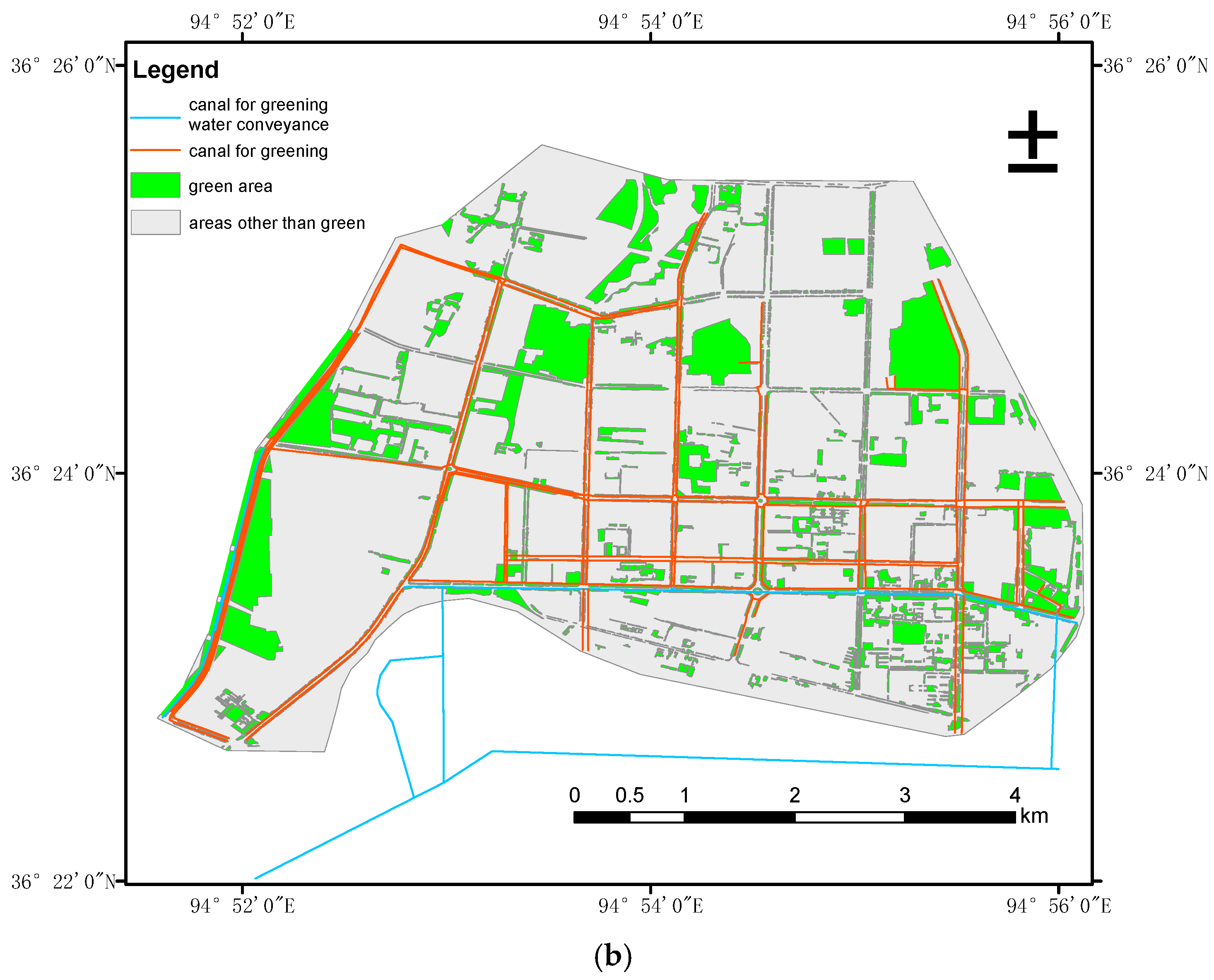
To identify canal siltation points, previous studies have mainly relied on three approaches: (i) field measurements, (ii) theoretical calculations, and (iii) physical simulation. (i) Field measurements allow for the precise quantification of the vertical distribution of sediment concentration and the analysis of silt composition [
4,
5]. (ii) Theoretical calculations can be used to estimate siltation. For example, by adopting the Zamarin canal sand-holding force formula, Zhang [
6] calculated the saturated sand-holding force in the return zone of the pre-gate section of the open canal and derived a formula for the canal siltation rate. (iii) Physical simulation is another effective approach. For instance, Xu et al. [
7] constructed a series of physical models of diversion canals based on the gravity similarity criterion and conducted simulations under different flow rates to determine the effect of water flow on sediment deposition within the canal.
In recent years, machine learning and numerical simulation methods have also been introduced into sediment-related studies of drainage systems. For example, Safari and Mehr [
8] proposed an evolutionary decision tree model for the design of smart urban drainage systems, demonstrating the potential of data-driven methods for determination of the flow characteristics at sediment deposition conditions in drainage systems. Furthermore, Di et al. [
9] combined GASM-TranGRU with CFD-DEM to conduct a high-resolution analysis of the hydraulic response characteristics of silted stormwater pipelines and manholes, showing that the coupling of machine learning with computational fluid dynamics can effectively capture the complex hydraulic behavior induced by sediment deposition. Similarly, Ebtehaj et al. [
10] applied sensitivity and uncertainty analyses to sediment transport modeling in sewer pipes, highlighting how numerical methods can quantify uncertainties in deposition processes within urban drainage networks. In another study, Montes et al. [
11] developed a Random Forest model to predict non-deposition sediment transport and self-cleansing velocity in sewer pipes, outperforming traditional regression approaches in avoiding permanent deposition. Additionally, Azamathulla et al. [
12] proposed an ANFIS-based approach for predicting sediment transport in clean sewers, providing a robust alternative to empirical formulas. These studies suggest that ML-based and numerical approaches can provide new perspectives for identifying and evaluating siltation risks in drainage and canal systems.
However, most scholars have focused on individual canals or a few canals, performing limited research on siltation across entire irrigation canal networks. In existing studies, researchers have predominantly analyzed the effects of sediment deposition and slope vegetation [
13,
14], leaving the impacts of anthropogenic activities underexplored. Additionally, domestic waste [
15] and leaf litter, particularly in windy northwestern Chinese cities, significantly contribute to canal siltation. To identify network siltation points, Guo et al. [
16] proposed using overflow points as potential hazards, and Jia et al. [
17] assessed the impact on pipe networks using the Storm Water Management Model to calculate discharge flow rates. These methods can be adapted for canal analysis, offering a rational approach for assessing irrigation networks. To assess anthropogenic impacts, Huang et al. [
18] used GIS technology to integrate multiple factors, including human influences, and demonstrated its feasibility for such evaluations.
Siltation in irrigation canals is influenced by numerous factors, and therefore its assessment requires a comprehensive multi-factor framework rather than reliance on a single indicator or a purely hydraulic perspective. Existing multifactor assessment methods can generally be divided into two categories. The first category determines indicator weights on the basis of expert judgment and applies methods such as the analytic hierarchy process, fuzzy comprehensive evaluation, and principal component analysis [
19,
20]. The second category determines weights according to the statistical characteristics of the data, such as indicator correlation and coefficient of variation, using methods including the entropy weight method and gray relational analysis [
21,
22]. Among these approaches, the entropy weight-TOPSIS method has demonstrated strong applicability in comprehensive evaluation because of its simple principle, computational efficiency, and reduced dependence on expert scoring [
23]. Previous entropy weight-TOPSIS studies have mainly focused on regional suitability evaluation and site selection, emphasizing objective weighting, grid-based comparison, and the ranking of relative suitability across space. However, such studies are primarily intended to identify favorable locations and compare relative regional potential, rather than to diagnose siltation risk mechanisms and support operation and maintenance management in complex irrigation canal networks.
This study focuses on the siltation risk assessment of the irrigation canal system in Golmud City, Qinghai Province. The canals in this region connect inland water systems with oasis zones and are subject to multiple disturbance factors along their routes, including wind-blown sand, anthropogenic activities, and vegetation, resulting in pronounced spatial heterogeneity in both siltation types and associated risks. Unlike conventional studies that assess siltation mainly through hydrodynamic simulation or detailed analysis of individual canal sections, this study develops a multidimensional risk assessment framework coupling hydrodynamic conditions, land-use characteristics, and anthropogenic disturbance factors. In this sense, the contribution of this work is threefold. First, it moves beyond the traditional limitation of evaluating siltation solely from a fluid-dynamics perspective and reveals the role of socio-environmental drivers in canal infrastructure maintenance. Second, rather than conducting fine-scale simulation for only a few selected sections, it develops a rapid, low-cost, and relatively objective risk-screening tool for large-scale urban irrigation canal systems based on the entropy weight-TOPSIS method, thereby enabling precise identification of key siltation-prone nodes across the entire network. Third, the study promotes a shift in canal management from post-siltation dredging toward preventive zonal management. By identifying dominant siltation types and their controlling factors, the proposed framework provides a scientific basis for differentiated dredging, source-oriented control, and optimized allocation of maintenance resources. Therefore, compared with previous EW-TOPSIS studies that mainly rank regional suitability or select optimal sites, the present study is more concerned with network-scale risk diagnosis, mechanism-informed management, and preventive operation strategies for irrigation canals. The aims of this study are to: (1) reveal the spatial variation patterns of siltation risk across the canal network, and (2) identify the dominant siltation types and their controlling factors, thereby providing a basis for differentiated dredging in Golmud and other arid regions with similar environmental conditions.
2. Materials and Methods
2.1. Study Area and Data
The study area is located in Golmud city, which is in the western part of Qinghai Province. Golmud is situated in a high-altitude inland area characterized by a plateau continental climate, strong winds, low precipitation, and marked evaporation. The Golmud River is the most utilized river in Golmud city and is the main source of water for its irrigation canals, with an annual diversion level of 5.25 million m
3 for green irrigation. The study area is approximately 38.24 km
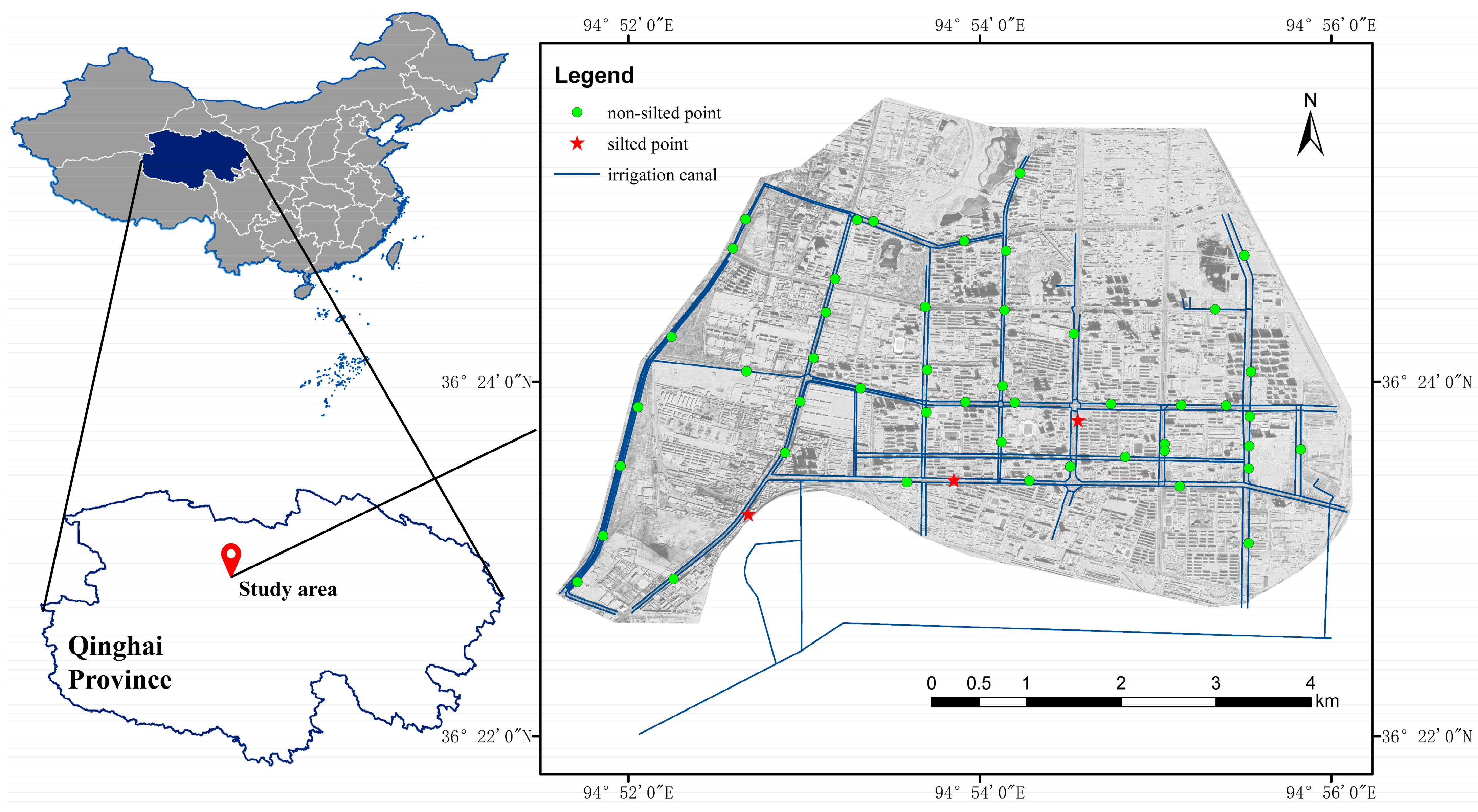
2. The area measures 8.4 km in length from east to west and 6.9 km in length from north to south. The eastern boundary of the area commences at Xueshuihe Road, the western boundary extends to Binhe Road, the northern boundary begins at Jinfeng Road, and the southern boundary terminates at Yingbin Road. In Golmud, the irrigation canal system is a vital water management infrastructure that delivers water to maintain an oasis ecosystem through greening and facilitates the reuse of urban stormwater. Therefore, ensuring that these irrigation canals remain clear through timely siltation identification and dredging is not merely a technical maintenance issue but is crucial for safeguarding Golmud’s water security and sustainable development. The city of Golmud has 267 irrigation canals, with a total length of 132,000 m. Collectively, these canals constitute the green irrigation canal water supply network in Golmud city. The southern trunk canals are located outside the city of Golmud, and the surrounding area is essentially wasteland, which primarily serves the function of water transmission. Additionally, we selected several points along irrigation canals throughout the city for verification, including 3 silted points and 47 nonsilted points. The spatial distribution of the extent of the built-up area, field validation points and irrigation canals in Golmud is illustrated in
Figure 1. In this study, data on the spatial distribution, length, and elevation of the irrigation canals were derived from fieldwork and existing datasets, while land-use data and data on irrigation canal types were sourced from government information (
Table 1).
2.2. Overall Framework
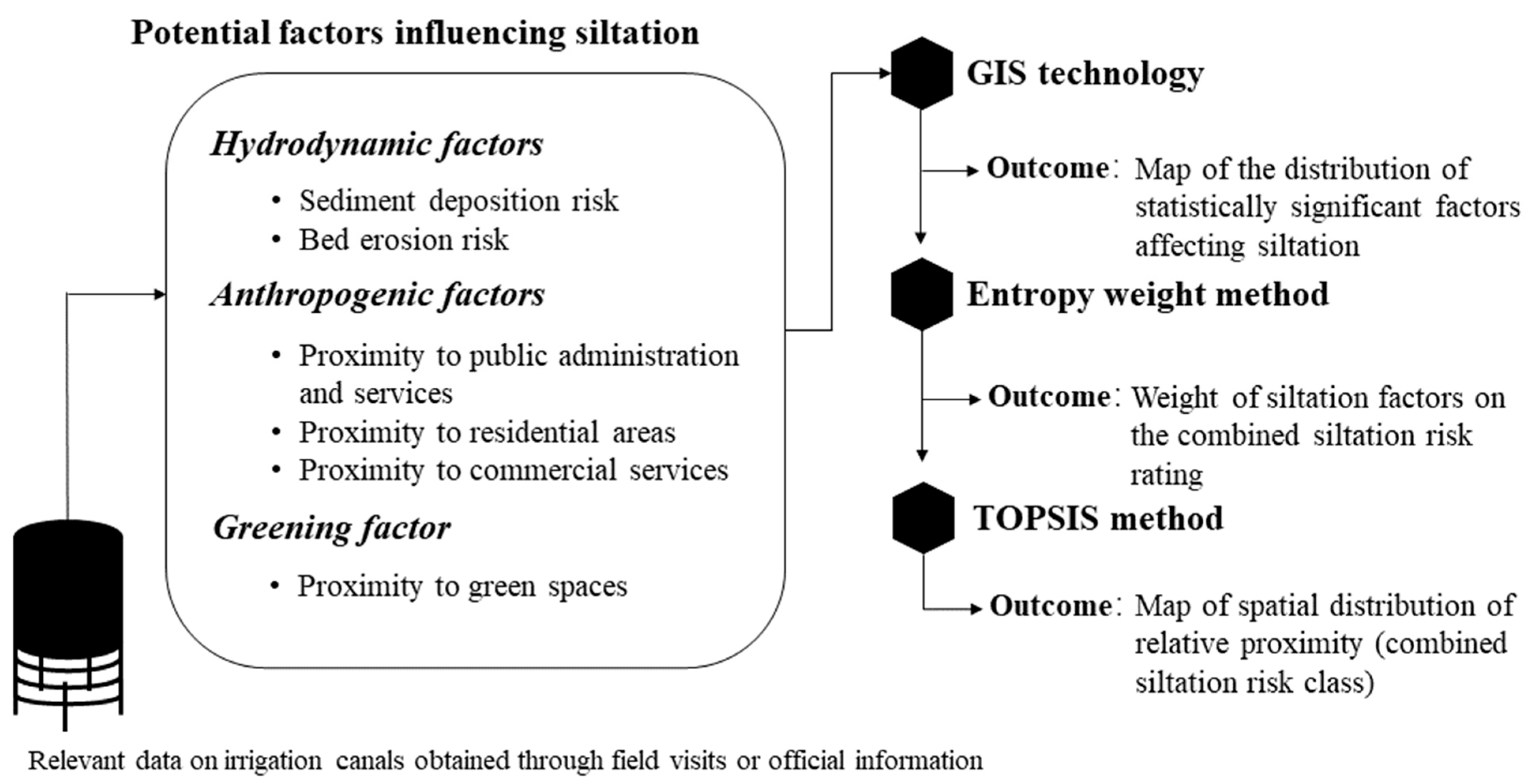
We constructed a comprehensive siltation grade evaluation index system based on hydrodynamic principles and land-use analysis for the three types of factors affecting siltation in irrigation canals, namely, hydrodynamic impact, anthropogenic impact and greening impact. On the basis of the entropy weight method, the weight of each indicator was determined, and the relative proximity of each irrigation canal, i.e., the integrated siltation risk level, was calculated using the TOPSIS method. Afterward, the distribution of the siltation risk of irrigation canals throughout the city of Golmud was mapped. The detailed flow of the methodology is shown in
Figure 2.
The workflow of this study was organized into six steps. First, the irrigation canal network was divided into canal segments as the basic evaluation units. Second, for each canal segment, hydrodynamic indicators, including sediment deposition risk and bed erosion risk, were calculated from the canal geometry, slope, hydraulic radius, discharge, and canal type by using Equations (1)–(5). Third, land-use layers representing public administration and services, residential areas, commercial services, and green spaces were converted into distance-based risk layers in GIS through multi-ring buffer analysis. Fourth, the values of all hydrodynamic, anthropogenic, and greening indicators were spatially assigned to each canal segment through overlay analysis. Fifth, the indicator matrix was normalized and weighted by the entropy weight method. Finally, the relative proximity of each canal segment was calculated by the TOPSIS method to represent the comprehensive siltation risk level of the canal network.
2.3. Hydrodynamic Impact Analysis
In the case of canals, the design of the gradient and cross-sectional shape can result in water velocities that are either too slow or too fast. Insufficient velocity can result in the accumulation of sediment within the canal, whereas excessive velocity can lead to erosion. The velocity for sedimentation control is the minimum vertical average flow velocity that does not decrease when the water passes through. This velocity is dependent on the water content of the canal and the hydraulic elements of the cross-section, and it should be determined by experimental research or practical experience. The velocity for erosion control is the maximum flow velocity that does not result in the scouring of the canal bed. This velocity is dependent on the nature of the soil in the canal bed, the sand content of the flowing water, and the gradient of the canal. Once the irrigation canal has been lined, the velocity for erosion control is assumed to be considerable. In the urban area of Golmud, the flow velocity of the paved irrigation canal does not exceed this value, thus ensuring that erosion does not occur. For the unlined irrigation canal, the specific value is determined through either experimental research or the experience gained from the use of previously completed canals. The flow velocity of the canal should be less than its velocity for erosion control and greater than the velocity for sedimentation control.
When practical research results are lacking, empirical formulas can be used to calculate the velocity for sedimentation control (v
cd); when the irrigation canal is an earthen canal with an unlined bottom (ecological canal), the C.A. Gilshkan formula [
24] is used to calculate the velocity for erosion control (v
cs).
where v
cd is the canal velocity for sedimentation control, m/s; C
0 is the coefficient of velocity for sedimentation control, which varies with the canal flow velocity and width-to-depth ratio; Q is the design flow velocity of the canal, m
3/s; v
cs is the velocity for sedimentation control of the canal, m/s; and K is the coefficient of impact resistance according to the soil coefficient of the canal bed.
In this study, the theoretical flow velocity was estimated using the Manning formula under the assumption of quasi-uniform flow. This assumption is considered reasonable because the selected canal reaches are open-channel sections with relatively regular geometry, small longitudinal slope variation, and no abrupt hydraulic structures within the evaluated segment. Moreover, the purpose of this calculation is to obtain a representative hydraulic indicator for comparative risk assessment rather than to reproduce local transient flow details. The Manning formula is therefore used to approximate the mean flow velocity of each canal reach as follows:
where v is the average velocity of the cross-section, m/s; k is the conversion factor; n is the roughness; R
h is the hydraulic radius, i.e., the ratio of the cross-sectional area of the fluid to the wet perimeter (the wet perimeter is the perimeter of the fluid in contact with the open canal cross-section, and the depth of water is set to be the maximum depth of water minus the free board, which is 0.2 m); and S is the gradient of the open canal.
In this study, on the basis of available data and relevant experience, C
0 = 0.4, K = 0.75 (canal bed soil is clay), k = 1 and n = 0.025 (earth canals with even and straight alignment and general maintenance) [
25].
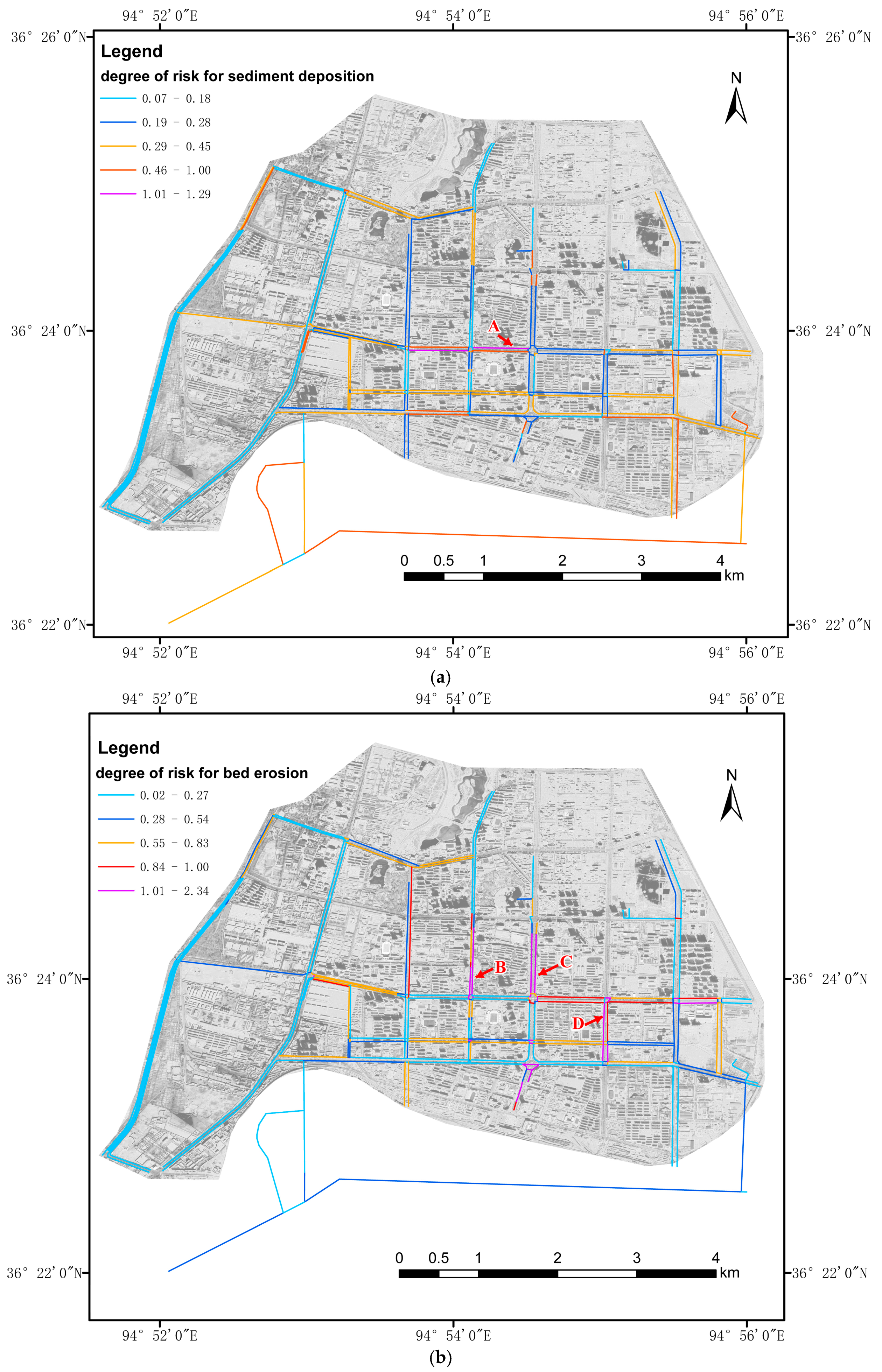
The risks of canal sedimentation and erosion, which are attributed to hydrodynamic factors, are gauged by comparing these velocities against the theoretical flow velocity of the canal.
In practical implementation, the hydrodynamic calculations were carried out along the canal network according to the available canal geometry and management data. The longitudinal slope S was calculated from the elevation difference and canal length, and the hydraulic radius Rh was determined from the corresponding cross-sectional geometry. The discharge and canal type information were obtained from the irrigation canal management data and field investigation. For ecological canals, the erosion-control velocity was calculated to reflect the susceptibility of the bed and side slopes to scouring, whereas for lined canals the erosion risk was considered relatively limited under the same hydraulic conditions. The sediment deposition risk Rcd and bed erosion risk Rcs were then calculated according to Equations (4) and (5), providing the hydraulic basis for the subsequent comprehensive evaluation.
2.4. Anthropogenic Impact Analysis
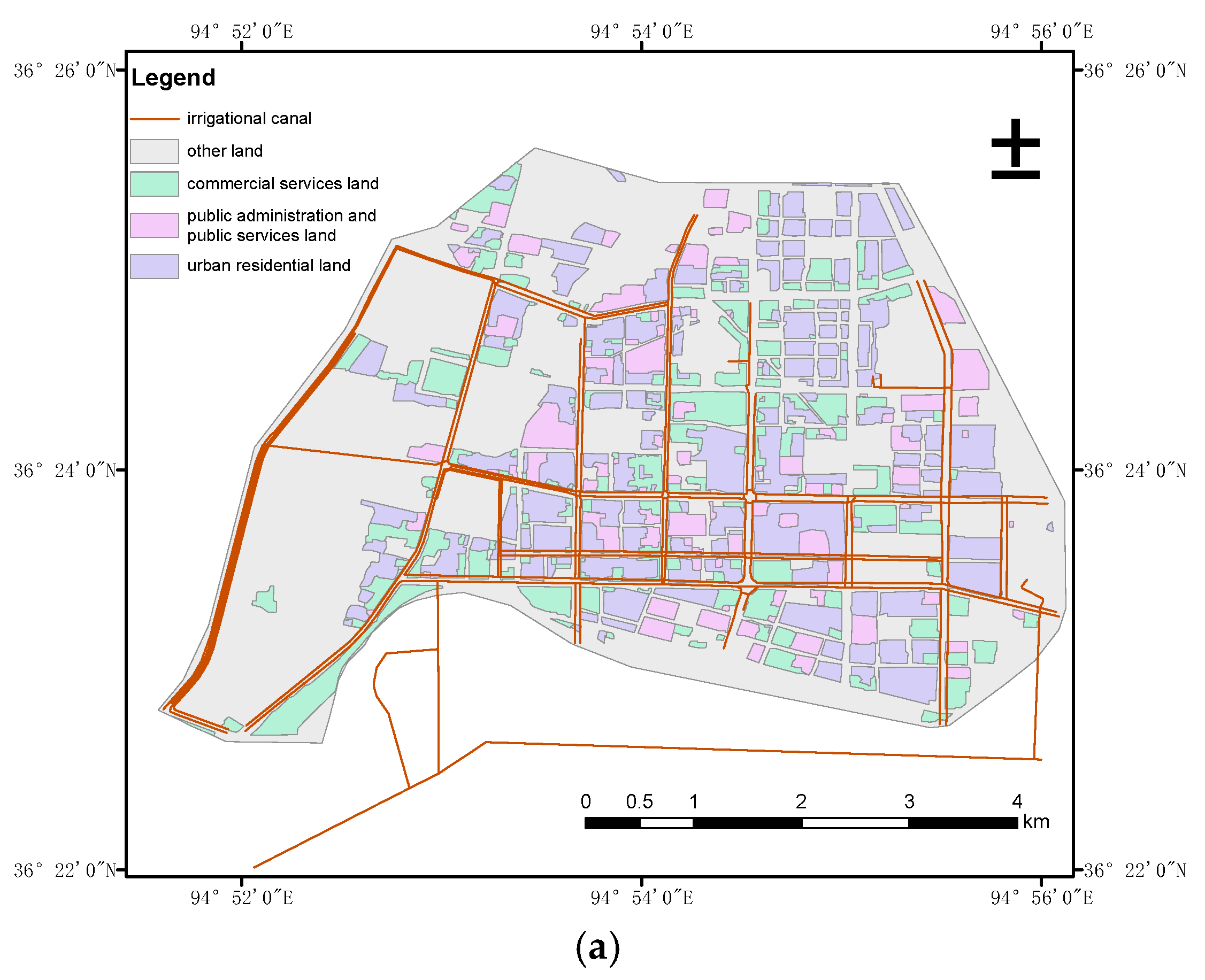
Human activities are likely to cause the accumulation of surface pollutants, which can enter irrigation canals through rainfall runoff, street washing, or direct dumping, thereby reducing the water conveyance capacity. In terms of anthropogenic factors, according to the territorial spatial plan of Golmud, the land-use types most closely associated with human disturbance include urban residential land, public administration and service land, and commercial service land. For each of these three land-use categories, GIS-based proximity analysis was conducted in ArcGIS 10.8 by using the Multi-Ring Buffer tool. Specifically, 10 concentric buffer zones were generated at 10 m intervals, corresponding to distances of 0–10 m, 10–20 m, …, and 90–100 m; distances greater than 100 m were classified as Level 10. These distance bands were then converted into ordinal risk classes from 1 to 10, where a lower class value indicates a shorter distance to the land-use source and thus a higher risk of anthropogenic siltation. The canal network was then spatially intersected with the buffer layers so that the spatial relationship between canals and surrounding land-use sources could be expressed in terms of distance-based risk classes. In this way, the anthropogenic siltation risk along the canal network was quantified, and a lower class value represents a greater likelihood of siltation caused by nearby human activities.
2.5. Greening Impact Analysis
Functionally, the irrigation canals in Golmud can be divided into canals for greening water conveyance, which are used for water transfer only, and greening canals, which are used for both water transfer and greening. Leaves and broken branches can cause siltation in greening canals, which is among the major causes of siltation in the windy city of Golmud; moreover, greening canals in Golmud are irrigated by flood irrigation, and when irrigation is needed, a section of the canal is separated by a baffle such that the water overflows into the green belt, which can bring suspended greening soil into the canal and cause siltation. The closer the distance to the green belt is, the more likely siltation is to occur, but this distance is much smaller than the distance at which anthropogenic activities can affect siltation. According to the spatial image map of Golmud, green spaces were first identified, and then 10 multi-ring buffers were generated at 1 m intervals, corresponding to distances of 0–1 m, 1–2 m, …, and 9–10 m; distances greater than 10 m were classified as Level 10. These distance bands were converted into greening-risk classes from 1 to 10, with lower values indicating higher siltation risk. After spatial overlay between the canal network and the green-space buffers, each relevant canal segment was assigned the nearest greening-risk class. In this study, only canals serving a greening function were assigned greening-related risk values, and a lower class value indicates a greater likelihood of siltation caused by nearby green spaces.
2.6. Entropy Weight Method
The entropy weight method is among the preferred multiobjective decision-making methods because of its straightforward calculation process and clear concepts, especially when there is no need for subjective judgment inputs or when reflecting the decision-maker’s preferences is not needed [
26]. The basic principle of the entropy weight method is that the higher the weight is, the more information the indicator contains [
27]. The method takes the decision matrix as a starting point, calculates the information entropy of each indicator, and calculates the entropy weights of the indicators as a result, which can capture the interactions implicit in the factors; its detailed steps are as follows [
23,
28]:
Step 1: Establishment of the initial decision matrix (X).
where x
ij is the value of the indicator (i = 1, 2, …, m, and j = 1, 2, …, n).
Step 2: Normalization of the initial decision matrix (P).
Owing to the different dimensions or measures of the data, it is necessary to normalize the matrix, and the normalized decision matrix can be expressed as follows:
where y
ij is the normalized value of option i for indicator j.
where Y is the normalized decision matrix.
Step 3: Calculation of the entropy (ej).
The entropy of each factor can be calculated as follows:
where e
j is the entropy value of each factor and (y
ij + 0.0001) is used to avoid errors from logarithmic operations.
Step 4: Calculation of the weights
The weights of the factors can be calculated as follows:
where w
j is the weight of each factor.
2.7. TOPSIS
The TOPSIS method, introduced by Hwang and Yoon [
29], is a simple and effective method for multicriteria decision-making that has been used in the analysis of water resource carrying capacity, the allocation of flood rights in catchments, and the selection of water quality monitoring points, among other applications [
30,
31,
32]. The basic principle of TOPSIS is to make the chosen alternative the closest Euclidean distance to the positive ideal solution and the farthest Euclidean distance to the negative ideal reference points. The detailed steps are as follows:
Step 1: Construction of the normalized decision matrix.
The normalized decision matrix is constructed according to Equations (6)–(8).
Step 2: Construction of the weighted decision matrix.
The weights calculated from Equation (11) are assigned to the normalized decision matrix as follows:
where Z is the weighted decision matrix.
Step 3: Evaluation of the positive and negative ideal reference points.
The calculation of positive and negative ideal reference points can be summarized as follows:
Step 4: Calculation of Euclidean distances for the positive and negative ideal reference points.
Step 5: Calculation of the relative proximity.
The relative proximity can be calculated using the following equation:
where C
i is the relative proximity.
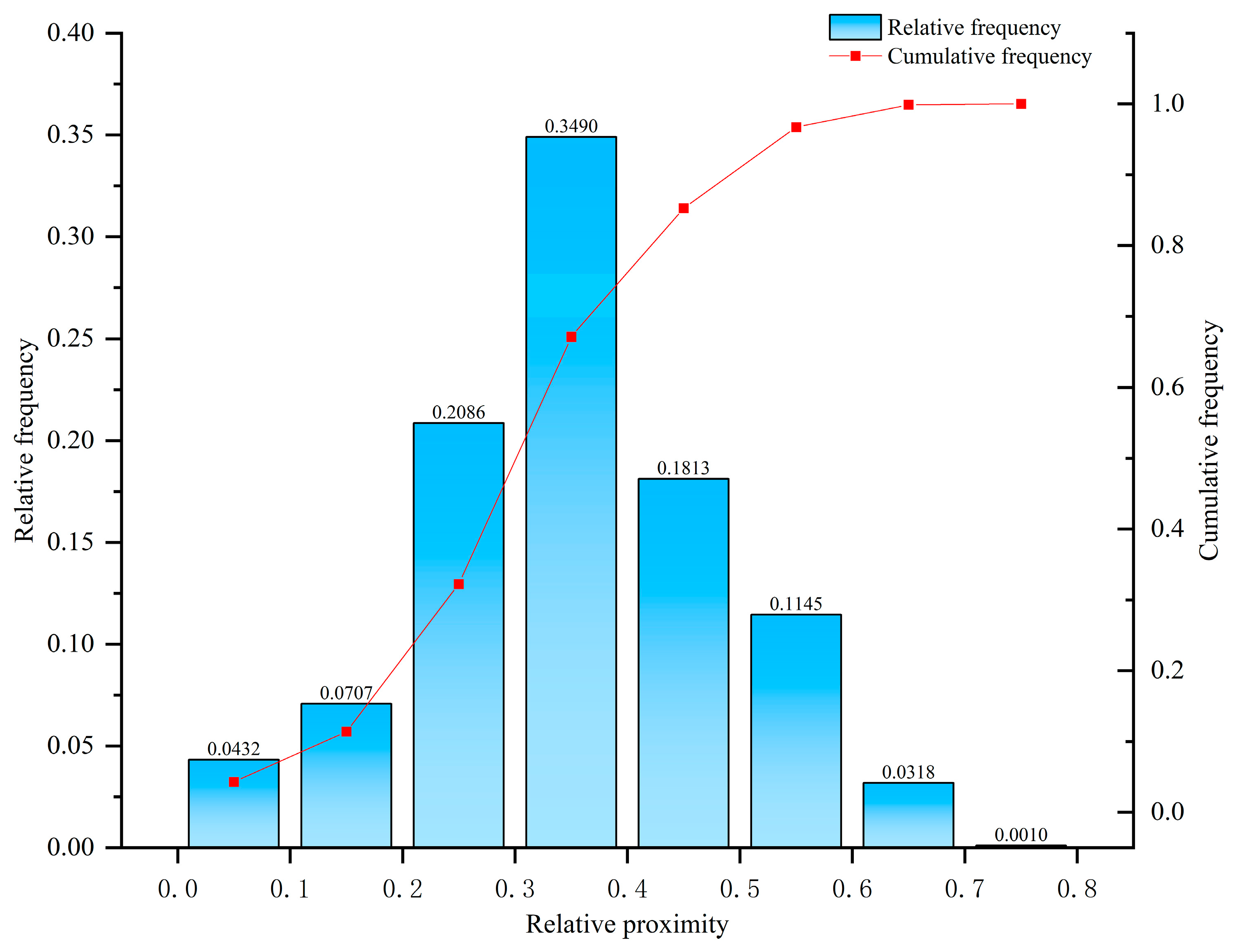
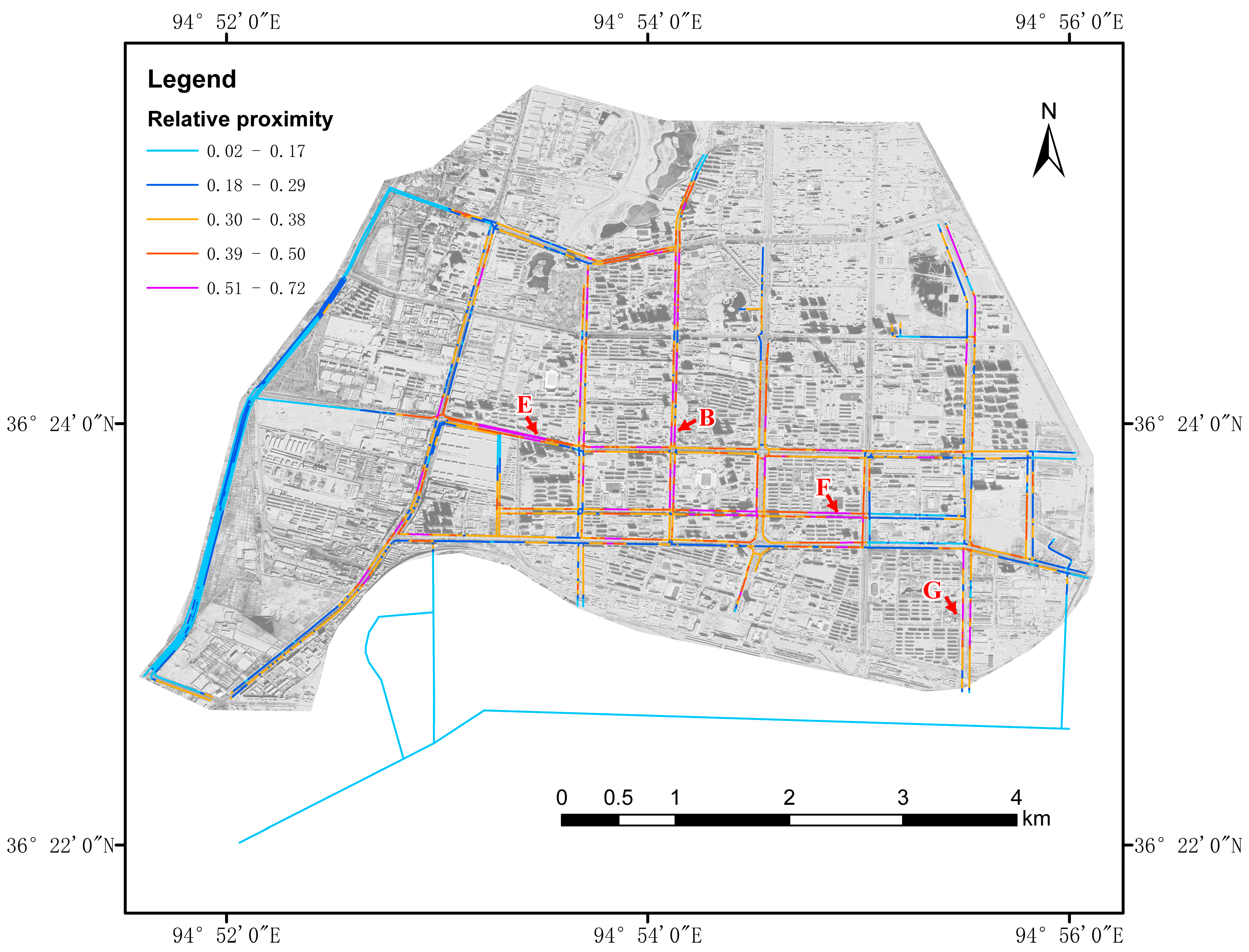
Different siltation factors have different effects on siltation. In this project, the comprehensive siltation level of irrigation canals is determined through the TOPSIS method combined with the entropy weight method; the index weights are determined by the entropy weight method, and the comprehensive siltation level is evaluated using the TOPSIS method. Then, the relative proximity degree of the TOPSIS results is taken as the siltation risk level of the irrigation canals. The larger the proximity coefficient is, the more prone the irrigation canal is to siltation.
4. Discussion
4.1. Model Validation
The distribution of the validation points is shown in
Figure 1. In this validation against 50 field sites, we employed a confusion matrix framework, where true positive (TP) was a segment with a high model relative proximity (>0.5) that was confirmed to be silted; true negative (TN) was a segment with a low model relative proximity (≤0.5) that was confirmed to be nonsilted; false positive (FP) was a segment with a high model relative proximity that was confirmed to be nonsilted; and false negative (FN) was a segment with a low model relative proximity that was confirmed to be silted. The model achieved an overall accuracy of 94% ((TP+TN)/Total = 47/50), demonstrating its high general correctness.
The model achieved an overall accuracy of 94% (47/50). However, the precision was 50%, indicating that some segments identified as high risk by the model were not confirmed as silted during field validation. A plausible explanation is that some of these segments may have been dredged in recent but undocumented maintenance operations. Therefore, the model output should be interpreted as a relative risk screening result rather than a direct substitute for complete maintenance records or detailed field surveys. Nevertheless, the recall reached 100% (3/3), suggesting that all observed silted segments were successfully captured in the high-risk group. The corresponding F1-score was 66.7% (2 × Precision × Recall/(Precision + Recall) = 0.667), indicating moderate balanced performance when both precision and recall were considered. Overall, the model is better suited for precautionary identification and prioritization of potentially vulnerable canal segments than for definitive condition diagnosis.
4.2. Factor Analysis
As illustrated in
Table 1, the mean weight of the anthropogenic factors is 0.21, which is the highest of the three factor types. The impacts of the three anthropogenic factors are primarily concentrated in the city center, with more variable coverage elsewhere. Public impacts and public services are the most significant; hence, their weights are the highest. The weight of the greening factor is 0.13, which is lower than that of the anthropogenic factors and higher than that of the hydrodynamic factors. This result arises because the influence of greening on irrigation canals is dependent not only on the distance from the greening land but also on the function of the irrigation canal itself. Consequently, the weight of the greening factor is greater than that of the hydrodynamic factor. However, most irrigation canals in the city of Golmud are, in fact, canals for greening water conveyance, and only a few of the irrigation canals in the west and south are greening canals. This difference makes the weight of the greening factors lower than that of the anthropogenic factors. Furthermore, the average weight of the hydrodynamic factor is the lowest at 0.11 because of the minor differences in the indicators for each irrigation canal.
We employ a methodology that combines the entropy weight method with the TOPSIS method. The entropy weight method addresses the issue of disparate units and measurement scales by normalizing the data [
34]. By considering both positive and negative ideal reference points, the TOPSIS method, in turn, enhances the comprehensiveness and objectivity of the results [
35]. It is not possible to apply expert opinions to every irrigation canal, particularly at the urban scale. Furthermore, the irrigation canals in Golmud, which constitute the main greening water supply network within Golmud, are not identical to other agricultural irrigation canals in terms of the degrees of anthropogenic and greening impacts. Consequently, expert views of the irrigation canals may have certain biases. The calculations presented in this work are based on objective irrigation canal dimensions and urban planning, which allows for a more objective assessment than subjective empowerment methods [
36].
4.3. Implications for Siltation Prevention
The risk assessment method provides a solid foundation for transitioning from a reactive dredging regime to a proactive, risk-based management strategy. This study advocates for a zoned management framework in which interventions are tailored to the specific risk profile and dominant factors of each canal segment, with a strong emphasis on prevention and source control.
For high-risk siltation in the urban core (Canals B, E, F, and G), intensive and preventive measures are paramount. Beyond quarterly dredging using a combination of hydraulic flushing and mechanical removal, engineering interventions should target the root causes of siltation. Specifically, we recommend the installation of protective covers or screens along canals adjacent to green spaces, such as Canal G, to physically prevent the influx of autumn leaves and organic debris. For segments with steep slopes such as Canal B, slope stabilization and reinforcement are critical for mitigating soil erosion at its source. Furthermore, for canals experiencing high levels of public interference, public awareness campaigns and physical barriers should be explored to reduce waste disposal into the canals.
For low- to moderate-risk siltation in peri-urban and western areas, the strategy should be focused on cost-effective preventive maintenance. This process includes establishing a rigorous quarterly inspection regime to identify early signs of siltation. Routine dredging activities should be strategically scheduled before and after the primary irrigation season to maintain optimal channel capacity. Additionally, a network of key monitoring cross-sections should be established and surveyed regularly to track siltation dynamics. These data can be used to calibrate the model over time and create an early warning system that triggers interventions before siltation becomes critical.
This integrated strategy, which moves beyond undirected, uninformed dredging to a factor-specific and prevention-oriented approach, enables a sustainable management mechanism. The quantitative model thus directly guides targeted operations, transforming the management paradigm from post-event response to forward-looking prevention. This shift is crucial for optimizing resource allocation and minimizing operational disruptions.
In addition, the applicability of the proposed framework may extend beyond the present urban irrigation setting. In particular, it may also be used in agricultural irrigation canal networks where siltation risk is jointly influenced by hydraulic conditions and external environmental disturbances, and where rapid network-scale screening is needed to support maintenance prioritization. However, for agricultural irrigation areas, the indicator system should be adjusted according to local characteristics, such as crop distribution, field management practices, irrigation return flows, and dominant sediment sources. Therefore, the present framework should be regarded as a transferable assessment approach rather than a fixed indicator scheme.
5. Conclusions
In this study, a method for objectively evaluating the risk of siltation of irrigation canals through the entropy weight-TOPSIS method was used. This method combines the morphological characteristics of the irrigation canals themselves with the surrounding land-use; analyses the effects of hydrodynamic, anthropogenic, and greening factors on the canals; and evaluates the risk of siltation of the irrigation canal system in the old urban area of Golmud. The main conclusions of the present study are as follows:
- (1)
Model validation confirms the high accuracy of the risk assessment method, with an overall accuracy of 94%, demonstrating its robust ability to reliably identify siltation risk points across the canal network.
- (2)
The assessment reveals the socio-environmental driving mechanisms of siltation; anthropogenic impacts are concentrated in the central and southern parts of the city, while greening factors affect most areas, highlighting how urbanization patterns dictate infrastructure risks.
- (3)
Canals in the west and north of Golmud face lower siltation risks, whereas those in the city center, especially north—south-oriented canals, face higher risks because of decreased flow velocities and increased sediment deposition.
- (4)
The siltation risk tends to increase from the outskirts toward the urban core of Golmud, emphasizing the increased vulnerability of central canals to siltation revealed by relative proximity calculations.
- (5)
A zoned management strategy is established, implementing preventive engineering controls (e.g., covers and slope reinforcement) in high-risk irrigation canals and systematic monitoring in low-risk areas, effectively transitioning management from response to prevention.
This study has several limitations. First, the field validation was based on 50 sites, which is sufficient for preliminary verification but still limited in representing the entire canal network. Second, incomplete dredging records in the study area may have introduced uncertainty into the validation results, particularly for locations identified as high risk by the model but observed as nonsilted in the field. In addition, the anthropogenic indicators were represented mainly through land-use proximity, which can reflect the spatial intensity of human disturbance but cannot distinguish the relative contributions of specific mechanisms such as littering, runoff, vegetation maintenance, or construction activities. Third, the entropy weight–TOPSIS method is essentially a network-scale comprehensive screening approach and cannot explicitly simulate the dynamic processes of sediment transport and deposition in the way that detailed hydrodynamic models can. Future studies should therefore incorporate more extensive validation data, improved maintenance records, more detailed anthropogenic observations, and dynamic simulation methods to further enhance the reliability of the proposed framework.



 ,
,