Article

Slope-Controlled Partitioning of Vertical and Lateral Solute Transport Pathways Revealed by Inclined Leaching Experiments

1
School of Marine and Biological Engineering, Yancheng Teachers University, Yancheng 224001, China
2
Co-Innovation Center for Sustainable Forestry in Southern China, College of Ecology and Environment, National Positioning Observation Station of Hung-tse, Lake Wetland Ecosystem in Jiangsu Province, Nanjing Forestry University, Nanjing 210037, China
3
Suqian Environmental Monitoring Center, Suqian 223800, China
4
Huai’an Environmental Monitoring Center, Huai’an 223001, China
5
China Jiangsu Key Laboratory for Bioresources of Saline Soils, Jiangsu Synthetic Innovation Center for Coastal Bio-Agriculture, Jiangsu Provincial Key Laboratory of Coastal Wetland Bioresources and Environmental Protection, School of Wetlands, Yancheng Teachers University, Yancheng 224001, China
*
Authors to whom correspondence should be addressed.
These authors contributed equally to this work.
Water 2026, 18(6), 753; https://doi.org/10.3390/w18060753
Submission received: 25 February 2026 / Revised: 9 March 2026 / Accepted: 10 March 2026 / Published: 23 March 2026
(This article belongs to the Section Hydrogeology)

Abstract

Using perfluorooctanoic acid (PFOA) as a representative highly mobile solute to isolate hydrological controls, we investigated how slope influences the partitioning of vertical and lateral transport pathways. While vertical percolation has been widely examined using conventional column leaching tests, lateral transport driven by topographic gradients remain insufficiently quantified under controlled conditions. Here, laboratory-scale inclined leaching experiments were conducted to resolve the distribution of solute transport among vertical leachate, lateral runoff, and solid-phase retention under systematically varied slope angles (0°, 4°, 9°, and 20°), flow regimes, and leaching volumes. Results show that solute migration shifted from vertical-dominated transport under flat conditions (91% at 0°) to lateral-dominated export at moderate slopes, with lateral pathways accounting for up to 75% of the recovered mass at 9°. This pathway shift was well described by an exponential partitioning model, f1(α) = fmax (1 − e), where fmax = 0.80 and k = 0.34°−1 (R2 = 0.97), indicating a critical crossover threshold at approximately 4° slope. Flow regime interacted with slope angle to modulate lateral transport efficiency: slower flow enhanced lateral export at moderate slopes, whereas faster flow promoted peak lateral transport under steeper conditions. In contrast, solid-phase retention remained consistently low (5–9%) across all treatments, indicating that the observed redistribution patterns were primarily governed by hydrological pathway partitioning rather than sorption processes. These results demonstrate that even modest topographic gradients can fundamentally alter solute transport pathways in sloped soils. The slope-dependent pathway partitioning framework developed here provides a process-based basis for incorporating lateral transport into hillslope hydrological models and for improving assessments of contaminant redistribution in both managed and natural landscapes.

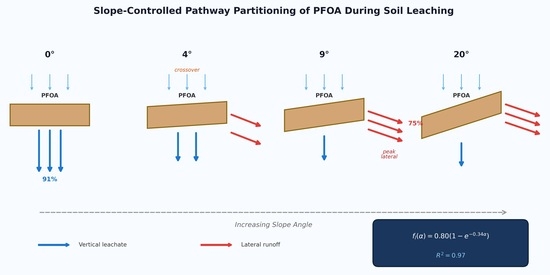
Graphical Abstract

1. Introduction

Understanding how solutes are redistributed along hillslopes is a central question in hydrology and geomorphology, as it governs material fluxes across landscapes and controls the connectivity between terrestrial and aquatic systems. Solute transport in soil is commonly conceptualized as being dominated by vertical percolation; however, lateral transport driven by topographic gradients can represent an equally important, and sometimes dominant, mechanism for downslope export. Highly mobile contaminants such as per- and polyfluoroalkyl substances (PFASs) provide a sensitive example for examining slope-controlled transport processes, due to their persistence and strong coupling with hydrological pathways [1]. Their environmental persistence, combined with high mobility in aqueous systems, has resulted in widespread contamination of soils, surface waters, and sediments worldwide, raising increasing concern regarding long-term ecological and human health risks [2]. Among legacy PFAS, perfluorooctanoic acid (PFOA) remains one of the most frequently detected compounds in terrestrial and aquatic environments, despite regulatory restrictions implemented in many regions.
Recent advances in hydrology and Earth system science emphasize that contaminant transport in terrestrial environments is governed not only by physicochemical properties but also by hydrological connectivity and flow pathway organization imposed by landscape structure [3]. Topography, in particular, has been recognized as a first-order control on subsurface flow partitioning, determining whether infiltrating water follows predominantly vertical percolation or lateral downslope pathways [4,5]. These insights challenge the long-standing assumption that vertical percolation dominates solute transport in soils and underscore the importance of explicitly considering slope-driven lateral processes when evaluating contaminant fate. Beyond hydrological studies, solute and fluid transport in porous geological media is also a central topic in reservoir science and subsurface engineering. Understanding how fluids and dissolved substances migrate through porous formations is essential for applications such as groundwater management, contaminant remediation, and subsurface energy resource development. Previous studies in reservoir science have also examined fluid transport processes in geological reservoirs, highlighting the importance of accurately characterizing flow pathways in porous media [6,7,8].
Soils act simultaneously as both a temporary sink and an active transport medium for PFAS. Sorptive interactions with mineral surfaces and soil organic matter can retard PFAS migration, whereas hydrological forcing may mobilize stored contaminants and promote their redistribution within the soil profile or export to adjacent water bodies [9]. Consequently, accurate assessment of PFAS environmental risk requires an integrated understanding of how hydrological conditions regulate transport pathways. However, the majority of experimental studies on solute transport in soils—particularly for highly mobile compounds such as PFAS—have focused on vertical transport processes using batch sorption tests or column leaching experiments [10,11]. While these approaches provide valuable insights into downward leaching behavior, they offer limited mechanistic understanding of PFAS transport under sloped conditions where lateral flow may be substantial.
Hillslope hydrology research has long demonstrated that lateral subsurface flow can represent a dominant pathway for water and solute transport in sloping terrains, particularly under conditions that promote rapid hydraulic connectivity and preferential flow development [12,13]. Such processes strongly influence downslope export of nutrients and contaminants, yet their implications for PFAS redistribution within soils have received comparatively little experimental attention. This gap limits the applicability of laboratory-derived PFAS transport parameters to real-world environments, including agricultural fields, riverbanks, embankments, and engineered slopes, where topographic gradients are ubiquitous.
From a mechanistic perspective, both slope angle and flow regime are expected to exert strong controls on contaminant transport pathways. Increasing slope angle enhances lateral hydraulic gradients, favoring downslope flow, while higher flow rates reduce water–soil contact time and may suppress sorptive interactions, thereby enhancing advective transport. Conceptual models of hillslope runoff generation predict that these factors can shift the dominant transport pathway from vertical percolation toward lateral export [14]. For mobile PFAS such as PFOA, such shifts could substantially alter contaminant fate by accelerating downslope migration and increasing the likelihood of off-site transport. Despite these theoretical expectations, experimental evidence directly quantifying the partitioning of PFAS among vertical leachate, lateral runoff, and the solid phase under controlled slope and flow conditions remains scarce. Most PFAS leaching studies do not explicitly resolve these distinct pathways, limiting mechanistic interpretation and hindering risk-relevant assessment of PFAS mobility in sloped soil systems.
Here, we hypothesize that solute redistribution during soil leaching is jointly controlled by slope angle and flow regime, as demonstrated using PFOA as a representative highly mobile compound. Specifically, we propose that steeper slopes enhance lateral transport relative to downward leaching, while higher flow rates further amplify this effect by reducing water–soil contact time.
To test this hypothesis, we conducted laboratory-scale inclined leaching experiments using a custom-built system that allows simultaneous collection of vertical leachate, lateral leachate, and solid-phase samples under controlled conditions. By systematically varying slope angle, leaching flow rate, and total leaching volume, we quantitatively resolved the redistribution of PFOA among distinct transport pathways. The specific objectives of this study were to: (i) characterize slope-dependent partitioning of PFOA among vertical leachate, lateral runoff, and soil; (ii) evaluate the influence of flow regime and leaching volume on transport behavior; and (iii) identify hydrological conditions under which lateral export becomes a dominant pathway, thereby increasing the environmental risk associated with PFAS migration in sloped soil systems.

2. Materials and Methods

2.1. Chemicals and Reagents

Perfluorooctanoic acid (PFOA, CAS No. 335-67-1, purity 96%) was purchased from Aladdin Bio-Chem Technology (Shanghai, China). High-purity quartz sand (26–40 mesh) was used as the porous medium. The quartz sand was characterized prior to use: particle size range 0.42–0.71 mm; median diameter d50 = 0.55 mm; bulk density 1.65 g/cm3; particle density 2.65 g/cm3; calculated porosity 0.38; organic carbon content <0.1% (loss on ignition method); saturated hydraulic conductivity 4.2 × 10⁻³ m/s (constant-head permeameter method). The relatively uniform grain size produces a well-connected pore structure with high permeability, while the very low organic carbon content minimizes sorption interactions with PFOA. Quartz sand was therefore selected as a simplified reference medium to isolate hydrological controls on solute transport pathways without confounding effects from soil organic matter or mineral surface interactions. This approach follows established methodology in PFAS transport studies, where simplified porous media are used to establish baseline transport behaviors [15,16]. Methanol (HPLC grade) was obtained from Merck (Darmstadt, Germany). Ultrapure water was produced using a laboratory water purification system, and tap water was used as the leaching medium where specified. Solid-phase extraction (SPE) cartridges packed with hydrophilic–lipophilic balanced sorbent (HLB, 30 mg, 1 mL; Beckman Coulter, Brea, CA, USA) were used for sample pretreatment.

2.2. Preparation of PFOA Stock and Calibration Solutions

A PFOA stock solution (2 mg·mL−1) was prepared by accurately weighing 0.2 g of PFOA and dissolving it in methanol in a 100 mL volumetric flask. Working standard solutions were prepared by serial dilution of the stock solution with methanol. Calibration standards with PFOA concentrations of 1, 2, 4, 8, 10, and 20 mg·L−1 were prepared and used to construct external calibration curves for quantitative analysis.
Prior to the leaching experiments, quartz sand was thoroughly rinsed with water to remove surface impurities. The cleaned sand was air-drained and then dried in a forced-air drying oven at 70 °C until constant weight was achieved. After cooling to room temperature, the sand was stored in clean, dry containers until use.

2.3. Leaching Experiment Design

Leaching experiments were conducted using a laboratory-built inclined leaching apparatus (Figure S1). The apparatus consisted of: (1) a water reservoir (10 L capacity) with constant-head overflow system for flow rate control; (2) a perforated sample container (internal dimensions: 30 cm length × 20 cm width × 10 cm depth; perforation diameter: 0.5 mm; perforation density: 25 holes per cm2) for holding the quartz sand bed; (3) an adjustable slope platform (0–25° range, ±0.5° precision) with angle indicator; (4) a vertical leachate collection basin (5 L capacity) positioned beneath the sample container; and (5) a lateral leachate collection trough (50 cm length × 5 cm width × 3 cm depth) installed at the downslope edge (Figure S1A,B). The experimental design followed a controlled-variable approach with three factors: (i) slope angle (0, 4, 9, and 20°), (ii) leaching flow rate (slow: 53.9 mL/s; fast: 135.1 mL/s), and (iii) total leaching volume (2 L vs. 4 L). Flow rates were selected following established rainfall simulation methodology [17]. When normalized to the sample container surface area (600 cm2), the slow and fast flow rates correspond to application intensities of approximately 32 and 81 mm/min, respectively. While these intensities exceed typical natural rainfall rates, elevated rates ensure near-saturated conditions necessary to isolate hydrological pathway partitioning from infiltration-excess mechanisms [18]. A schematic illustration of the sampling strategy is shown in Figure S1D.
Each experimental condition (slope × volume × flow rate combination) was conducted in triplicate, with three independent experimental runs performed on separate occasions using freshly prepared sand columns and PFOA applications. Leachate and soil samples from the three replicate runs were subsequently pooled into composite samples prior to instrumental analysis to reduce analytical workload while capturing integrated treatment responses. For each experimental run, 1 kg of pretreated quartz sand was evenly packed into the perforated container lined with medical gauze and placed at the center of the inclined platform. A 1 mL aliquot of PFOA stock solution (2 mg·mL−1 in methanol) was carefully applied to the center of the sand surface using a calibrated micropipette, delivering a total PFOA mass of 2.0 mg (2000 μg) per experimental run. This applied mass served as the reference value for mass balance calculations. The concentrated point application was designed to create an initial contaminant ‘source zone’ from which transport pathways could be clearly resolved during the leaching experiments. Leaching was then initiated using tap water at the preset flow rate and slope angle (Figure S1C). Upon completion of leaching, vertical leachate, lateral runoff (where applicable), and a representative solid sand sample from the center of the bed were collected.
Each experimental condition was repeated three times, and subsamples collected under identical conditions were pooled prior to instrumental analysis to obtain composite samples. In total, 96 liquid samples (vertical and lateral leachates) and 48 solid samples were collected. All samples were labeled and stored under refrigerated conditions prior to pretreatment and analysis.
The selected slope angles (0–20°) fall within the range commonly reported for hillslope hydrological studies and engineered land surfaces, where lateral subsurface flow has been shown to play a significant role [19].

2.4. Sample Pretreatment

Solid-phase extraction. HLB SPE cartridges were conditioned sequentially with 1 mL of methanol followed by 1 mL of ultrapure water prior to use. All SPE procedures were conducted at room temperature with a flow rate of approximately 1.0 mL·min−1.
Pretreatment of liquid samples. For each liquid sample, 3 mL of leachate was loaded onto the conditioned SPE cartridge. Analytes were eluted with 1 mL of methanol, and the eluate was collected in amber glass vials and adjusted to a final volume of 1.5 mL with methanol. Samples were then sealed and stored at 4 °C prior to instrumental analysis.
Pretreatment of solid samples. For solid samples, 10 mL of methanol was added to each sample, followed by shaking to extract PFOA. The extract was transferred to a beaker and allowed to evaporate in a fume hood for approximately 5 h until the volume was reduced to ~3 mL. The concentrated extract was then subjected to the same SPE procedure as liquid samples, including loading, elution, volume adjustment, labeling, and refrigerated storage.
Instrumental analysis of PFOA. Quantification of PFOA was performed using high-performance liquid chromatography coupled with mass spectrometry (HPLC–MS). Chromatographic separation was achieved on a reversed-phase C18 column using a binary mobile phase system consisting of methanol and water. The injection volume was 10 μL, and the retention time of PFOA was approximately 2.45 min.
Mass spectrometric detection was conducted in negative electrospray ionization (ESI−) mode. ESI− combined with external calibration is widely adopted for quantitative analysis of PFOA and other perfluorocarboxylic acids [20]. Quantification was carried out using an external calibration method. Calibration standards were prepared at six concentration levels (1, 2, 4, 8, 10, and 20 mg·L−1), and calibration curves exhibited good linearity over the tested range (R2 > 0.99). Procedural blanks and wash samples were included in each analytical batch to monitor potential contamination. Solid-phase extraction using HLB cartridges has been widely applied for PFAS extraction from aqueous and solid matrices due to its broad analyte coverage and reproducible recovery [21].
For samples with concentrations exceeding the linear range of the calibration curve, appropriate dilution was performed prior to analysis. Final concentrations reported in this study were automatically corrected for dilution factors by the instrument software and are presented as measured values without further normalization.
Samples with signal intensities below the method detection limit were reported as not detected (ND).
Quality assurance and quality control (QA/QC) were implemented throughout the analytical process. Blank samples and quality control standards were analyzed alongside environmental samples to ensure analytical stability and accuracy. Method validation followed US EPA Method guidelines [22]. Recovery experiments using spiked samples at two concentration levels (10 and 100 μg·L−1) yielded mean recovery rates of 92.3 ± 4.2% (n = 6) and 95.1 ± 3.8% (n = 6), respectively, within the acceptable range of 70–130%. The method detection limit (MDL) was 0.5 μg·L−1, calculated as 3.14× standard deviation of seven replicate analyses of fortified blank samples. The limit of quantification (LOQ) was 1.5 μg·L−1 (10 × SD of blanks). Instrument performance was monitored by repeated injections of calibration standards and QC samples. No detectable PFOA was observed in procedural blanks.

2.5. Statistical Analysis

The leaching experiment employed a composite sampling design in which three independent runs per treatment were pooled prior to analysis, yielding one composite measurement per treatment condition. Data analysis focused on descriptive statistics and trend evaluation. The Kruskal–Wallis test was applied in an exploratory capacity to compare composite values across treatment levels and identify potential factor effects [23]. Reported p-values should be interpreted as indicative of patterns warranting further investigation rather than as confirmatory statistical inference. Statistical significance was set at α = 0.05.
Data analysis focused on descriptive statistics and trend evaluation rather than hypothesis testing. PFOA concentrations were compared across slope angles, flow rates, sampling positions (vertical leachate, lateral leachate, and solid phase), and leaching volumes to assess relative transport behavior under different hydrological conditions.
No inferential statistical tests (e.g., t-tests or ANOVA) were applied. Graphical visualization and comparative analysis were conducted using R (4.5.2).
Due to the use of pooled composite samples, the reported concentrations represent integrated values for each experimental condition. Measures of variability such as standard deviation were not calculated. This design was selected to emphasize transport trends and mass redistribution patterns rather than statistical significance testing. Although composite samples were analyzed, non-parametric Kruskal–Wallis tests were used in an exploratory manner to evaluate relative differences among experimental factors, rather than for formal hypothesis testing.

3. Results

3.1. PFOA Distribution Patterns at Different Slope Angles

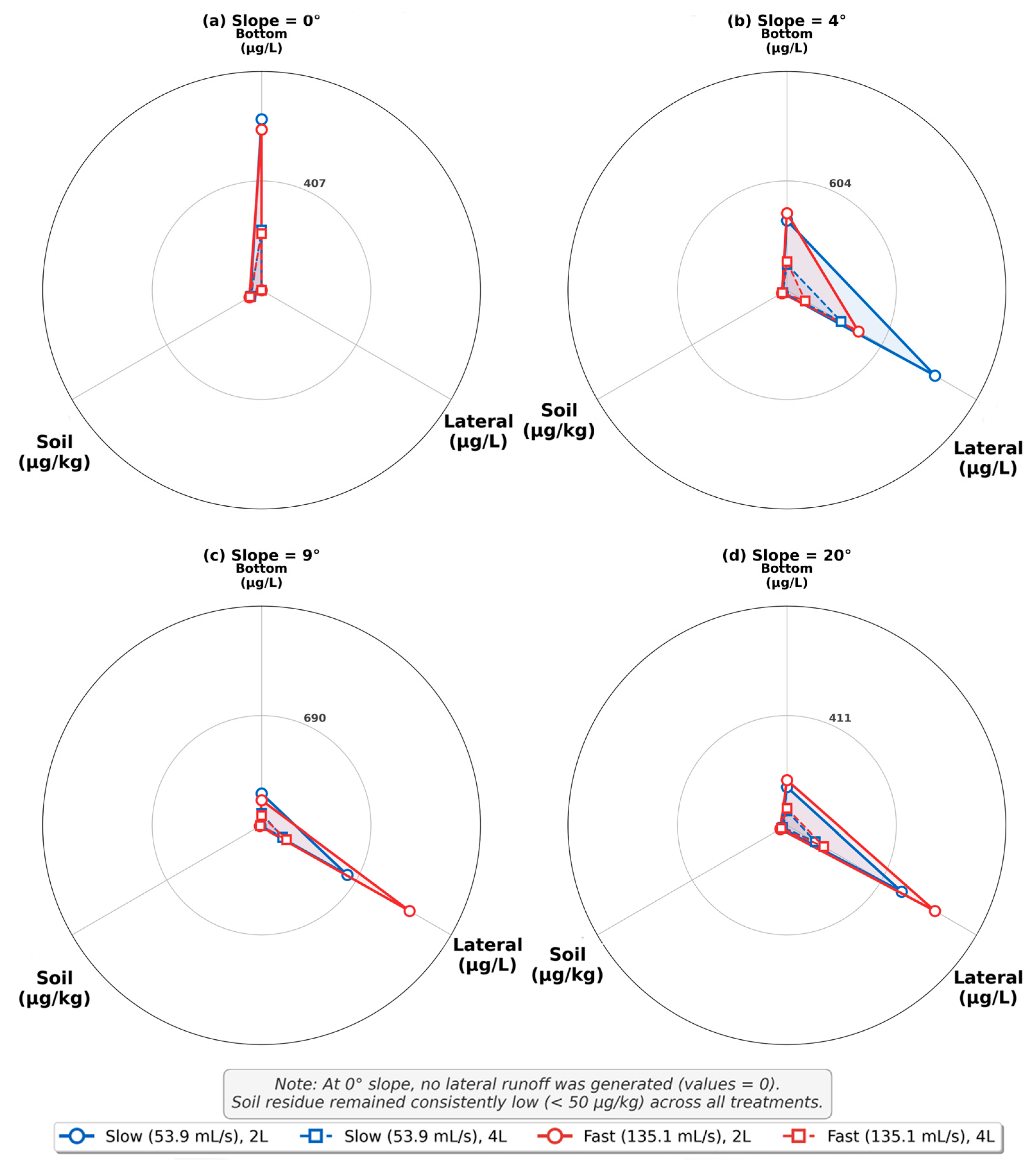
The radar plots revealed distinct PFOA distribution patterns across different slope angles and experimental conditions (Figure 1). At 0° slope (Figure 1a), PFOA was predominantly detected in bottom leachate, with concentrations ranging from 253.6 to 636.6 μg/L across all leaching conditions. No lateral runoff was observed at this slope due to the absence of gravitational driving force for surface flow. The radar pattern showed a characteristic single-pathway distribution dominated by vertical percolation, with the 2L-Slow condition yielding the highest bottom leachate concentration.
At 4° slope (Figure 1b), the emergence of lateral runoff created a dual-pathway distribution pattern. The radar plot exhibited pronounced asymmetry, with lateral runoff concentrations (245.6–944.0 μg/L) exceeding bottom leachate concentrations (187.2–627.2 μg/L) under most conditions. Notably, the 2L-Slow condition produced the highest lateral runoff concentration (944.0 μg/L), indicating higher lateral runoff concentrations under slow-flow conditions at moderate slopes.
The 9° slope treatment (Figure 1c) demonstrated the most pronounced lateral transport, with the radar pattern strongly skewed toward lateral runoff. The maximum PFOA concentration observed in this study (1078.7 μg/L) occurred in lateral runoff under the 2L-Fast condition at 9° slope. This suggests that intermediate slopes may optimize conditions for surface-dominated PFOA transport. Bottom leachate concentrations decreased substantially compared to lower slopes (27.2–337.5 μg/L).
At 20° slope (Figure 1d), lateral runoff remained the dominant transport pathway, though with lower concentrations (102.3–675.3 μg/L) compared to 9° slope. The radar pattern indicated a more balanced distribution between bottom and lateral pathways under high-volume (4L) conditions, while low-volume (2L) conditions still favored lateral transport. Soil residue concentrations remained consistently low, remaining below 50 μg L−1 across all experimental conditions at this slope. To verify mass closure of the experimental system, the recovery of applied PFOA was calculated across the three transport compartments (vertical leachate, lateral runoff, and soil residue). Across all treatments, the mean total recovery was 97.8 ± 1.2% of the applied mass (2000 μg per run), indicating near-complete mass balance. The majority of the recovered PFOA occurred in the aqueous pathways, while retention in the quartz sand remained consistently low (~5–9% of the applied mass). The detailed distribution of PFOA mass across pathways for each treatment is provided in Table S1.

3.2. Effects of Sampling Position on PFOA Concentration

Sampling position showed the strongest contrast in PFOA concentration among the examined factors (exploratory Kruskal–Wallis test, H = 25.87, p < 0.001; Table 1). Lateral runoff samples exhibited the highest mean PFOA concentration (465.6 ± 321.7 μg/L, n = 12), followed by bottom leachate (256.6 ± 197.3 μg/L, n = 16), while soil residue showed the lowest concentration (26.8 ± 34.1 μg/L, n = 16). The consistently low PFOA retention in quartz sand across all treatments reflects the minimal organic carbon content and limited sorption capacity of this reference medium, confirming its suitability for studying PFOA mobility under controlled conditions.

3.3. Influence of Leaching Volume and Flow Rate

Leaching volume exhibited a near-significant effect on PFOA concentration (p = 0.054). The 2L treatment resulted in substantially higher mean concentrations (335.4 ± 332.1 μg/L) compared to the 4L treatment (124.7 ± 114.2 μg/L). This dilution effect is evident in the radar plots, where 2L conditions consistently produced more extended patterns compared to their 4L counterparts across all slope angles. The concentration reduction of approximately 63% between 2L and 4L treatments aligns with the two-fold increase in leaching volume, consistent with extensive mobilization of PFOA from the quartz sand matrix.
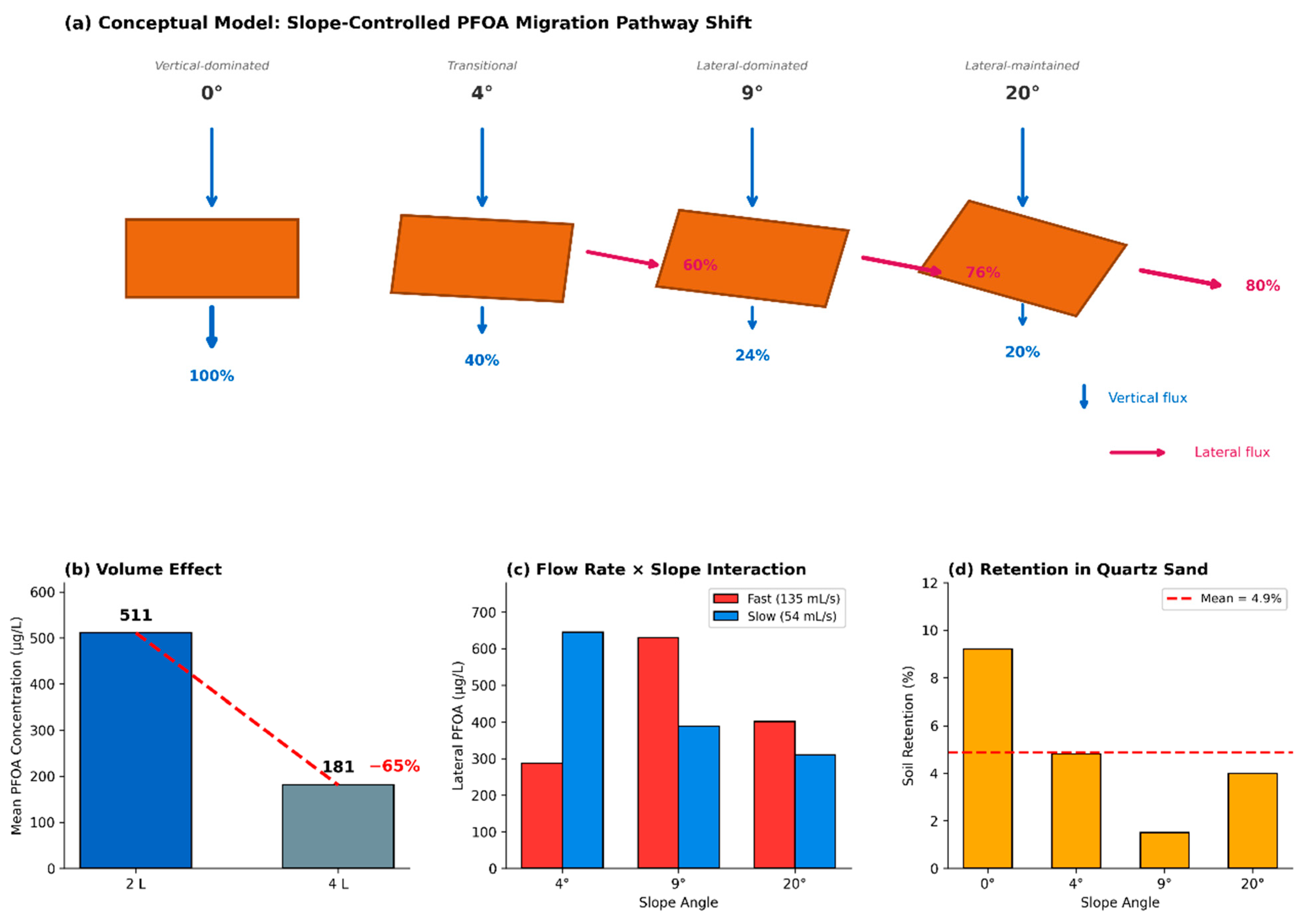
Flow rate did not significantly affect overall PFOA concentrations (p = 0.907), with fast flow (135.1 mL/s) and slow flow (53.9 mL/s) producing similar mean concentrations (232.4 ± 277.0 μg/L vs. 227.6 ± 264.2 μg/L, respectively). However, the radar plots reveal that flow rate influenced the partitioning between transport pathways: slow flow conditions tended to enhance lateral runoff at 4° slope (Figure 1b), while fast flow favored lateral transport at 9° slope (Figure 1c).

3.4. Slope-Dependent Migration Pathway Shift

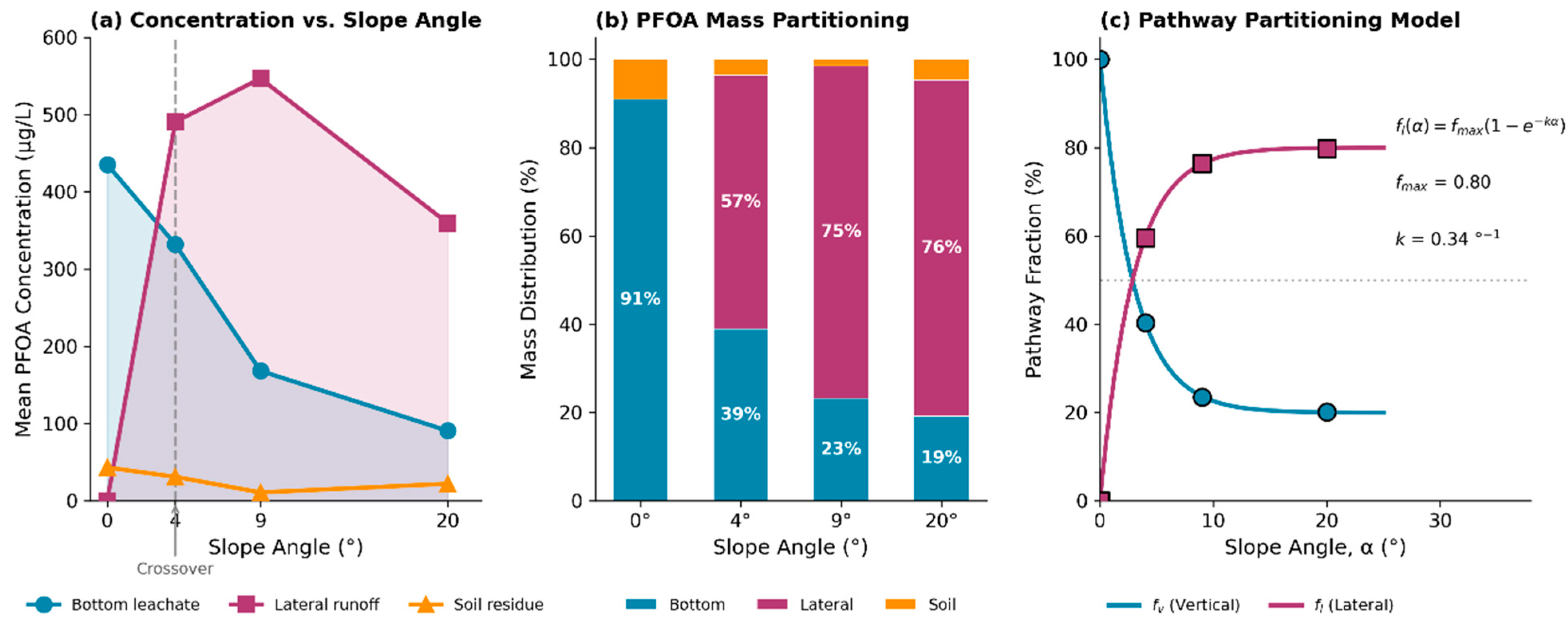
Although slope angle did not significantly affect total PFOA concentration (p = 0.611), it fundamentally altered the dominant migration pathway. Mean bottom leachate concentration decreased progressively from 435.4 μg/L at 0° to 90.7 μg/L at 20°, while mean lateral runoff concentration peaked at 9° (546.8 μg/L) before declining at 20° (359.5 μg/L). This pattern indicates a transition from vertical percolation-dominated transport at low slopes to lateral runoff-dominated transport at intermediate and high slopes, with an optimal lateral transport efficiency occurring around 9° slope.

4. Discussion

4.1. Experimental Validation of the Slope-Induced Pathway Shift Hypothesis

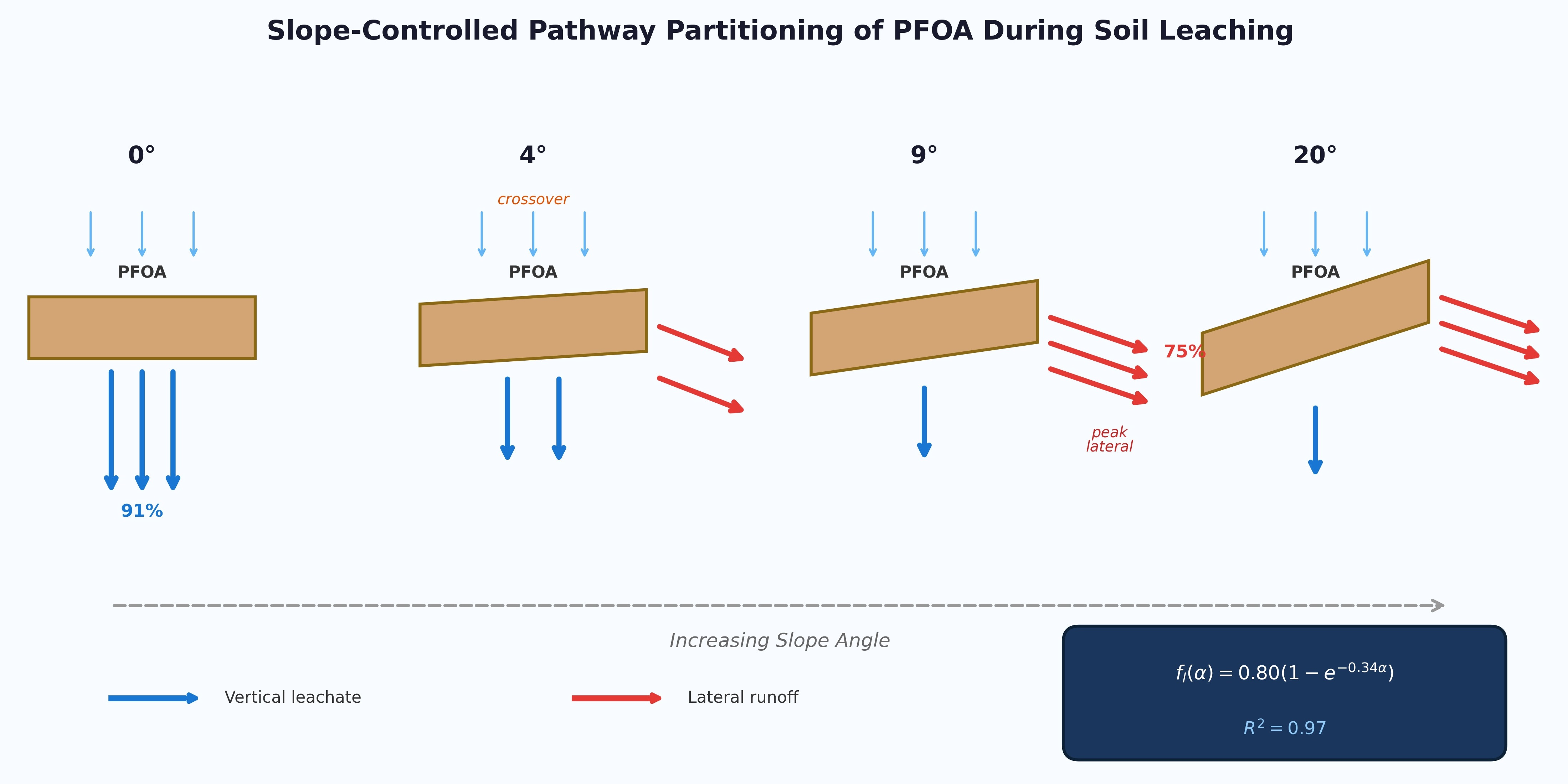
Our results provide experimental evidence that slope angle fundamentally controls the partitioning of solute transport between vertical and lateral pathways, as demonstrated here using PFOA. This finding addresses a critical knowledge gap identified in recent reviews of PFAS fate and transport [24,25], which have emphasized that most laboratory studies focus exclusively on vertical percolation and may therefore underestimate total contaminant flux from sloped terrain. The systematic transition from vertical-dominated (91% at 0°) to lateral-dominated (75% at 9°) transport observed in our experiments demonstrates that topographic controls on water flow directly translate to PFOA redistribution patterns (Figure 2a,b), consistent with conceptual models of hillslope hydrology [12,26].
The pathway partitioning data were well described by an exponential transition model (Figure 2c):
fl(α) = fmax (1 − e−kα)
where fl is the fraction of mobile PFOA transported via lateral runoff, α is slope angle (°), fmax = 0.80 represents the asymptotic maximum lateral fraction, and k = 0.34°−1 is the transition rate constant (R2 = 0.97; Table 2). This model predicts a crossover threshold at approximately 4° slope, beyond which lateral transport becomes the dominant pathway. The existence of such a threshold has important implications for site conceptual models, suggesting that even modest topographic gradients can fundamentally alter PFAS migration behavior.
The peak lateral runoff concentration observed at 9° slope (546.8 μg/L mean; 1078.7 μg/L maximum) suggests an optimal slope angle for lateral PFOA export (Figure 2a). This non-monotonic relationship may reflect competing effects: at low slopes, insufficient hydraulic gradient limits lateral flow generation; at intermediate slopes (4–9°), conditions optimize lateral connectivity while maintaining adequate water–soil contact time; at steeper slopes (>15°), reduced contact time or enhanced erosional losses may decrease transport efficiency [27,28]. Similar bell-shaped relationships between slope and sediment/solute transport have been documented in hillslope erosion studies [29], suggesting a generalizable phenomenon across different transport processes. Although demonstrated using PFOA, the exponential partitioning function reflects hydrologically driven pathway organization and is therefore applicable to other mobile solutes transported on hillslopes.
Table 2. Summary of model parameters for PFOA transport prediction.
ParameterSymbolValueSource
Maximum lateral fractionfmax0.80This study
Transition rate constantk0.34°−1This study
Pathway crossover slopeα50~4°Derived from Equation (1)
OC-normalized KdKoc96 mL/gMilinovic et al. (2016) [30]

4.2. Influence of Flow Regime and Interaction Effects

Contrary to our initial hypothesis that faster flow would universally enhance lateral transport by reducing water–soil contact time, flow rate exhibited no significant main effect on total PFOA concentrations (p = 0.907). However, the radar plots revealed a notable flow rate × slope interaction (Figure 1b,c): slow flow maximized lateral transport at 4° slope (944 μg/L), while fast flow achieved the highest lateral concentrations at 9° slope (1079 μg/L). This interaction is conceptualized in Figure 3c, suggesting that optimal transport conditions depend on the specific combination of hydraulic gradient and residence time, consistent with process-based understanding of hillslope runoff generation [31,32].
At moderate slopes (4°), slower flow may allow sufficient time for water to infiltrate into lateral preferential pathways before being captured by vertical percolation. In contrast, at steeper slopes (9°), the enhanced hydraulic gradient already favors lateral flow, and faster velocities maintain hydraulic connectivity for efficient downslope transport. This interpretation aligns with observations from hillslope hydrology studies demonstrating that the ratio of vertical to horizontal hydraulic conductivity (Kv/Kh) critically influences subsurface flow partitioning [33,34].
Leaching volume exhibited a near-significant dilution effect (p = 0.054), with 2L treatments yielding concentrations approximately 2.7-fold higher than 4L treatments (335 vs. 125 μg/L). As illustrated in Figure 3b, this 63% concentration reduction slightly exceeded the proportional volume increase (100%), suggesting near-complete PFOA mobilization from the quartz sand matrix, consistent with the minimal sorption capacity of this reference medium. This finding validates the experimental design and confirms that observed pathway partitioning patterns reflect hydrological rather than sorption-related effects.

4.3. Mechanistic Basis for PFOA Mobility in Quartz Sand

The consistently low PFOA retention in quartz sand (mean: 26.8 μg/L; 5–9% of recovered mass; Figure 3d) reflects the minimal organic carbon content (<0.1%) and relatively uniform pore structure of this reference medium, which result in high permeability and limited sorption capacity, allowing the experimental system to primarily reflect hydrologically controlled transport processes. The negligible retention validates the use of quartz sand to isolate physical transport processes without confounding effects from variable sorption. PFOA sorption is primarily controlled by hydrophobic interactions between the perfluorinated tail and soil organic matter [29,35]. Literature Kd values for PFOA span 0.1–38 mL/g depending on soil organic carbon content [36], with an organic carbon-normalized coefficient Koc of approximately 96 mL/g. The use of quartz sand in this study represents an intentional simplification designed to isolate hydrological controls on solute transport pathways. Natural soils typically contain higher organic carbon contents and more complex mineral surfaces, which can enhance PFAS sorption and retardation. By employing a low-sorption reference medium, our experiments were able to quantify slope-controlled partitioning between vertical and lateral transport without the confounding influence of variable sorption processes. While sorption in natural soils may reduce the absolute mobility of PFAS, the hydrologically driven pathway partitioning observed here is expected to remain relevant across different soil types, with soil properties primarily modulating the magnitude rather than the fundamental organization of transport pathways.
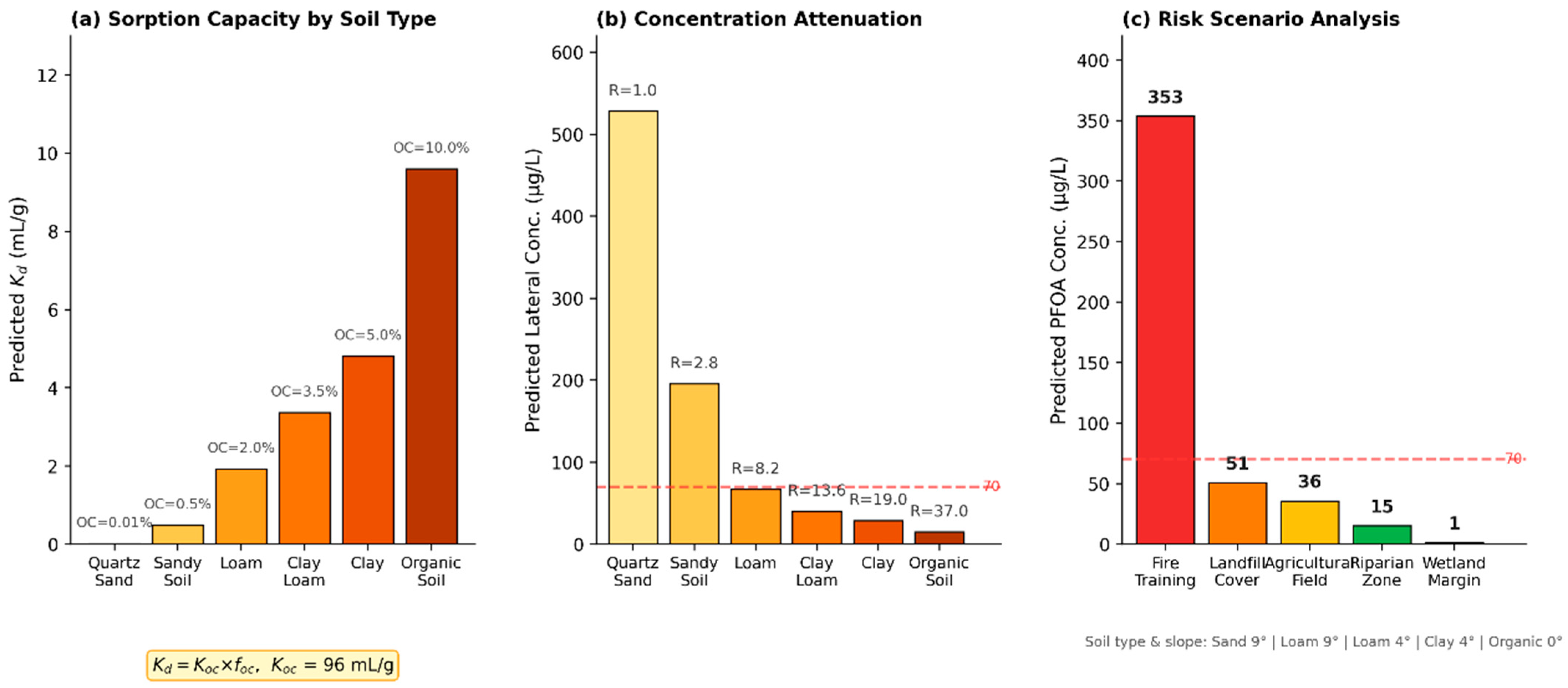
Using this Koc value, we can predict PFOA behavior in natural soils via the relationship (Figure 4a):
Kd = Koc × foc
where foc is the fraction of organic carbon. The corresponding retardation factor R = 1 + (ρb/θ) × Kd ranges from 1.0 in quartz sand to 37.0 in organic-rich soils (Figure 4b), indicating that PFOA concentrations observed in our experiments would be attenuated by factors of 1–37× in natural soil systems. However, recent studies have demonstrated that air–water interfacial adsorption can substantially increase PFAS retention in unsaturated soils [37,38], with retardation factors potentially reaching several hundred under low water saturation conditions. This additional retention mechanism was not captured under the near-saturated experimental conditions used in this study but should be explicitly considered in future investigations of PFAS transport under unsaturated vadose-zone conditions.

4.4. Comparison with PFAS Transport Models and Field Observations

Current mathematical models for PFAS transport in the subsurface predominantly focus on vertical migration processes [25,38]. While recent multidimensional models have begun to incorporate lateral spreading [39], these typically address diffusion-dominated processes in homogeneous media rather than topographically driven lateral flow. Our results suggest that slope-induced pathway partitioning represents a distinct transport mechanism that should be incorporated into site conceptual models for PFAS-contaminated landscapes. The conceptual framework presented in Figure 3a illustrates the fundamental pathway transition that occurs as slope increases, providing a visual tool for communicating this mechanism to site managers and regulators.
Field observations at AFFF-impacted sites have documented PFAS concentrations in surface runoff and shallow lateral flow that often exceed groundwater concentrations [40,41]. For example, Ruyle et al. (2023) found that the majority of PFAS mass at a military fire training area remained in shallow vadose zone soils decades after active use ceased, with continued slow release to groundwater [42]. Our finding that lateral transport can dominate at slopes as low as 4° suggests that surface and near-surface pathways may represent underappreciated vectors for PFAS migration at many contaminated sites, particularly those with topographic gradients typical of fire training areas, landfill slopes, and agricultural fields.
The watershed-scale PFAS model developed by Rafiei and Nejadhashemi (2023) explicitly accounted for surface runoff, lateral flow, and sediment transport as pathways for PFOS migration [43]. Their model demonstrated that lateral flow can contribute significantly to stream PFAS loading, particularly in areas with steep terrain and low-permeability soils. Our laboratory results provide mechanistic support for these watershed-scale observations and suggest that the pathway partitioning function (Equation (1)) could be incorporated into such models to improve predictions of PFAS redistribution in complex landscapes.

4.5. Environmental Risk Implications

The dominance of lateral transport at moderate slopes has significant implications for PFAS risk assessment. Current site investigation protocols typically emphasize vertical leaching and groundwater monitoring [10,44], potentially missing substantial contaminant mass transported via surface and shallow subsurface pathways. Our results suggest that comprehensive PFAS site characterization should include assessment of topographic gradients and potential lateral transport routes, particularly at sites with slopes exceeding 4°.
Applying the pathway partitioning model to representative contamination scenarios illustrates the potential environmental consequences (Figure 4c). At a fire training area with sandy soil (foc = 0.5%) and 9° slope, predicted lateral runoff concentrations of on the order of hundreds of μg/L, far exceeding current drinking water health advisory levels (70 ng/L) by more than 5000-fold [45]. In contrast, wetland margins with organic-rich soils and minimal slope show predicted concentrations of only ~1 μg/L due to combined effects of high sorption capacity and limited lateral transport. These predictions align with field measurements at AFFF-contaminated sites, where surface water concentrations frequently reach hundreds of μg/L [46,47]. The persistence of such elevated concentrations decades after source cessation underscores the importance of understanding all transport pathways contributing to long-term contaminant release [42]. Conversely, soils with higher organic carbon content provide natural attenuation capacity that could be leveraged for risk management. Organic-rich riparian buffers and constructed wetlands have shown promise for PFAS removal [48], and our results suggest that strategic placement of such barriers along lateral transport pathways could effectively intercept PFOA migration from upslope source areas. However, the long-term stability of sorbed PFAS under changing environmental conditions remains uncertain [49], warranting continued monitoring even at sites with apparent natural attenuation.
Several limitations of this study should be acknowledged. First, the use of quartz sand as the experimental medium, while effective for isolating hydrologically controlled transport processes, does not capture the complex sorption dynamics present in natural soils with heterogeneous mineralogy and organic matter composition. As a result, the pathway partitioning relationships identified in this study (Figure 2c) require validation in natural soil systems, where sorption may differentially influence vertical and lateral transport. Future studies should therefore examine whether the crossover threshold (~4°) and maximum lateral fraction (fmax ≈ 0.80) remain applicable across soils with varying texture, mineral composition, and organic carbon content. In addition, validation of the pathway partitioning model under natural soil conditions with heterogeneous texture and organic carbon content will be necessary to evaluate its applicability in field environments. Second, our experiments employed controlled rainfall conditions that may not fully represent field hydrological variability. Natural systems exhibit antecedent moisture effects, preferential flow through macropores, and temporally variable hydraulic connectivity that can substantially modify solute transport behavior [50]. The lateral preferential flow pathways that develop in structured soils may enhance or diminish slope-dependent transport partitioning relative to our observations in homogeneous sand. Third, our near-saturated experimental conditions did not capture air–water interfacial adsorption, which can significantly increase PFAS retention in unsaturated soils [22,51]. Under field conditions with lower water saturation, this additional retention mechanism could attenuate both vertical and lateral transport, potentially altering the pathway partitioning relationships observed here. Future work should investigate how variable saturation conditions affect slope-dependent PFOA transport. Another limitation relates to the composite sampling design used in this study. For each experimental condition, subsamples were pooled prior to instrumental analysis, resulting in integrated measurements rather than independent replicate observations. While this approach was effective for characterizing overall transport patterns and pathway partitioning, it limits the statistical power for formal hypothesis testing. Future studies should employ fully replicated experimental designs with independent samples to enable more robust statistical comparisons of slope angle, flow regime, and leaching volume effects. Finally, our focus on PFOA as a representative long-chain perfluorocarboxylic acid may not extend to other PFAS classes. Short-chain PFAS exhibit lower sorption and higher aqueous solubility, potentially increasing their susceptibility to rapid lateral export. Polyfluoroalkyl precursor compounds may undergo transformation during transport [52], adding complexity to fate predictions. Extension of the pathway partitioning framework to the broader PFAS family represents an important direction for future research.

5. Conclusions

This study establishes slope angle as a first-order control on solute transport pathway partitioning in soils. Our principal finding—that even modest slopes (~4°) trigger a fundamental shift from vertical-dominated to lateral-dominated transport—challenges the conventional assumption that vertical percolation is the primary pathway for PFAS migration. The exponential pathway partitioning model developed here (f1 = 0.80 (1 − e−0.34α), R2 = 0.97) provides a quantitative framework for predicting this transition and can be incorporated into hillslope hydrological models to improve predictions of contaminant redistribution in topographically complex landscapes.
These findings have direct implications for PFAS site investigation and risk assessment. Current protocols emphasizing vertical soil sampling and groundwater monitoring may substantially underestimate contaminant mass flux from sloped terrain, particularly at fire training areas, agricultural hillslopes, landfill covers, and riparian zones where topographic gradients exceed 4°. The interaction between flow regime and slope angle further suggests that episodic high-intensity rainfall events may disproportionately enhance lateral contaminant export, accelerating delivery to adjacent surface water bodies. Future research should validate the pathway partitioning framework in natural soils with varying organic matter content and examine how air–water interfacial processes modify these relationships under unsaturated field conditions.

Supplementary Materials

The following supporting information can be downloaded at: https://www.mdpi.com/article/10.3390/w18060753/s1, Figure S1. Schematic illustration of the laboratory-built inclined leaching apparatus. Table S1. Mass balance of PFOA across transport pathways.

Author Contributions

X.Z.: Investigation, Data curation, Writing—original draft. J.D.: Investigation, Data curation, Writing—original draft. B.S.: Investigation, and Formal analysis. Z.Y.: Validation. X.S.: Conceptualization, and Resources. Y.S.: Conceptualization, Writing—review & editing, and Supervision. All authors have read and agreed to the published version of the manuscript.

Funding

This study was supported by College Students’ Innovation and Entrepreneurship Training Program of Nanjing Forestry University (2024NFUSPITP0195), Yancheng Key Research and Development Plan (YCBE202331), and the Assessment of PFAS Contamination in Yancheng Coastal Wetlands: Status, Challenges, and Management Strategies (Yancheng Natural Science Soft Science Project, No. 202546).

Data Availability Statement

The original contributions presented in this study are included in the article and Supplementary Materials. Further inquiries can be directed to the corresponding authors.

Conflicts of Interest

The authors declare that they have no known competing financial interests or personal relationships that could have appeared to influence the work reported in this paper.

References

  1. Kurwadkar, S.; Dane, J.; Kanel, S.R.; Nadagouda, M.N.; Cawdrey, R.W.; Ambade, B.; Struckhoff, G.C. Per- and polyfluoroalkyl substances in water and wastewater: A critical review of their global occurrence and distribution. Sci. Total Environ. 2022, 809, 151003. [Google Scholar] [CrossRef]
  2. Evich, M.G.; Davis, M.J.; McCord, J.P.; Acrey, B.; Awkerman, J.A.; Knappe, D.R.U.; Lindstrom, A.B.; Speth, T.F.; Tebes-Stevens, C.; Strynar, M.J.; et al. Per-and polyfluoroalkyl substances in the environment. Science 2022, 375, eabg9065. [Google Scholar] [CrossRef] [PubMed]
  3. Li, L.; Knapp, J.L.; Lintern, A.; Ng, G.H.C.; Perdrial, J.; Sullivan, P.L.; Zhi, W. River water quality shaped by land–river connectivity in a changing climate. Nat. Clim. Change 2024, 14, 225–237. [Google Scholar] [CrossRef]
  4. Martin, L.C.P.; Westermann, S.; Magni, M.; Brun, F.; Fiddes, J.; Lei, Y.; Kraaijenbrink, P.; Mathys, T.; Langer, M.; Allen, S.; et al. Recent ground thermo-hydrological changes in a southern Tibetan endorheic catchment and implications for lake level changes. Hydrol. Earth Syst. Sci. 2023, 27, 4409–4436. [Google Scholar] [CrossRef]
  5. Miguez-Macho, G.; Fan, Y. A global humidity index with lateral hydrologic flows. Nature 2025, 644, 413–419. [Google Scholar] [CrossRef]
  6. Ali, J.; Ansari, U.; Ali, F.; Javed, T.; Hullio, I.A. Application of machine learning for effective screening of enhanced oil recovery methods. Reserv. Sci. 2026, 2, 65–80. [Google Scholar] [CrossRef]
  7. Hu, Y.F.; Yang, Y. A Comparative study on drag reduction methods for continental shale drilling in the fuxing block, Southeastern Sichuan Basin. Reserv. Sci. 2026, 2, 81–96. [Google Scholar] [CrossRef]
  8. Yang, Y.D.; Huang, F.F.; Kang, S.F. Mechanism of penetration rate improvement in hot dry rock under the coupling of impact load and confining pressure release. Reserv. Sci. 2026, 2, 52–64. [Google Scholar] [CrossRef]
  9. Huang, Y.R.; Liu, S.S.; Zi, J.X.; Cheng, S.M.; Li, J.; Ying, G.G.; Chen, C.E. In situ insight into the availability and desorption kinetics of per-and polyfluoroalkyl substances in soils with diffusive gradients in thin films. Environ. Sci. Technol. 2023, 57, 7809–7817. [Google Scholar] [CrossRef]
  10. Kabiri, S.; Tucker, W.; Navarro, D.A.; Bräunig, J.; Thompson, K.; Knight, E.R.; Nguyen, T.M.H.; Grimison, C.; Barnes, C.M.; Higgins, C.P.; et al. Comparing the leaching behavior of per-and polyfluoroalkyl substances from contaminated soils using static and column leaching tests. Environ. Sci. Technol. 2021, 56, 368–378. [Google Scholar] [CrossRef]
  11. Klamerus, J.; Khan, K.; Hire, M.; Lee, L.S.; Schaefer, C.E. Field measurement of PFAS leaching at a long-term land-applied biosolids site. Environ. Sci. Technol. 2025, 59, 20675–20683. [Google Scholar] [CrossRef] [PubMed]
  12. Kirchner, J.W.; Benettin, P.; van Meerveld, I. Instructive surprises in the hydrological functioning of landscapes. Annu. Rev. Earth Planet. Sci. 2023, 51, 277–299. [Google Scholar] [CrossRef]
  13. Du, Y.; Wang, X.; Nan, Z.; Li, T.; Tang, Y.; Huang, L. Assessment of the vertical preferential flow characteristics and flow types on a slope in a small headwater catchment. Front. Environ. Sci. 2025, 13, 1515739. [Google Scholar] [CrossRef]
  14. McDonnell, J.J.; Spence, C.; Karran, D.J.; Van Meerveld, H.J.; Harman, C.J. Fill-and-spill: A process description of runoff generation at the scale of the beholder. Water Resour. Res. 2021, 57, e2020WR027514. [Google Scholar] [CrossRef]
  15. Guelfo, J.L.; Higgins, C.P. Subsurface transport potential of perfluoroalkyl acids at aqueous film-forming foam (AFFF)-impacted sites. Environ. Sci. Technol. 2013, 47, 4164–4171. [Google Scholar] [CrossRef]
  16. Lyu, Y.; Brusseau, M.L.; Chen, W.; Yan, N.; Fu, X.; Lin, X. Adsorption of PFOA at the air-water interface during transport in unsaturated porous media. Environ. Sci. Technol. 2018, 52, 7745–7753. [Google Scholar] [CrossRef]
  17. Assouline, S.; Ben-Hur, M. Effects of rainfall intensity and slope gradient on the dynamics of interrill erosion during soil surface sealing. Catena 2006, 66, 211–220. [Google Scholar] [CrossRef]
  18. Parsons, A.J.; Stone, P.M. Effects of intra-storm variations in rainfall intensity on interrill runoff and erosion. Catena 2006, 67, 68–78. [Google Scholar] [CrossRef]
  19. Bachmair, S.; Weiler, M. Hillslope characteristics as controls of subsurface flow variability. Hydrol. Earth Syst. Sci. 2012, 16, 3699–3715. [Google Scholar] [CrossRef]
  20. Ebrahim, G.Y.; Taye, M.T.; Seid, A.; Tekleab, S. Enhancing smallholder agricultural production through sustainable use of shallow groundwater in the Borkena catchment, Awash River Basin, Ethiopia. Hydrol. Res. 2024, 55, 1014–1029. [Google Scholar] [CrossRef]
  21. Brusseau, M.L. Assessing the potential contributions of additional retention processes to PFAS retardation in the subsurface. Sci. Total Environ. 2018, 613–614, 176–185. [Google Scholar] [CrossRef]
  22. EPA 815-B-19-020; Method 533: Determination of Per- and Polyfluoroalkyl Substances in Drinking Water by Isotope Dilution Anion Exchange Solid Phase Extraction and Liquid Chromatography/Tandem Mass Spectrometry. U.S. Environmental Protection Agency: Washington, DC, USA, 2019.
  23. Helsel, D.R. Statistics for Censored Environmental Data Using Minitab and R, 2nd ed.; John Wiley & Sons: Hoboken, NJ, USA, 2012. [Google Scholar]
  24. Trobisch, K.M.; Reeves, D.M.; Cassidy, D.P. Environmental fate and transport of PFAS in wastewater treatment plant effluent discharged to rapid infiltration basins. Water Res. 2024, 266, 122422. [Google Scholar] [CrossRef]
  25. Zeng, J.; Brusseau, M.L.; Guo, B. Modeling PFAS subsurface transport in the presence of groundwater table fluctuations: The impact on source-zone leaching and exploration of model simplifications. Water Resour. Res. 2024, 60, e2024WR037707. [Google Scholar] [CrossRef]
  26. Wallis, I.; Hutson, J.; Davis, G.; Kookana, R.; Rayner, J.; Prommer, H. Model-based identification of vadose zone controls on PFAS mobility under semi-arid climate conditions. Water Res. 2022, 225, 119096. [Google Scholar] [CrossRef]
  27. Filipović, V.; Gerke, H.H.; Filipović, L.; Sommer, M. Quantifying subsurface lateral flow along sloping horizon boundaries in soil profiles of a hummocky ground moraine. Vadose Zone J. 2018, 17, 1–12. [Google Scholar] [CrossRef]
  28. Grothum, O.; Epple, L.; Bienert, A.; Blanch, X.; Eltner, A. Near-continuous observation of soil surface changes at single slopes with high spatial resolution via an automated SfM photogrammetric mapping approach. Soil 2025, 11, 1007–1028. [Google Scholar] [CrossRef]
  29. Fu, X.; Sun, J.; Tian, K.; Liu, Y.; Zhang, H. Predicting the sorption capacity of perfluoroalkyl and polyfluoroalkyl substances in soils: Meta-analysis and machine learning modeling. Environ. Sci. Technol. 2025, 59, 17699–17710. [Google Scholar] [CrossRef]
  30. Milinovic, J.; Lacorte, S.; Rigol, A.; Vidal, M. Sorption of perfluoroalkyl substances in sewage sludge. Environ. Sci. Pollut. Res. 2016, 23, 8339–8348. [Google Scholar] [CrossRef] [PubMed]
  31. Hardie, M.A.; Cotching, W.E.; Doyle, R.B.; Holz, G.; Lisson, S.; Mattern, K. Effect of antecedent soil moisture on preferential flow in a texture-contrast soil. J. Hydrol. 2011, 398, 191–201. [Google Scholar] [CrossRef]
  32. Tao, Z.; Li, M.; Si, B.; Pratt, D. Rainfall intensity affects runoff responses in a semi-arid catchment. Hydrol. Process. 2021, 35, e14100. [Google Scholar] [CrossRef]
  33. Ameli, A.A.; Creed, I.F. Quantifying hydrologic connectivity of wetlands to surface water systems. Hydrol. Earth Syst. Sci. 2016, 21, 1791–1808. [Google Scholar] [CrossRef]
  34. Fu, S.; Liu, B.; Liu, H.; Xu, L. The effect of slope on interrill erosion at short slopes. Catena 2011, 84, 29–34. [Google Scholar] [CrossRef]
  35. Adu, O.; Ma, X.; Sharma, V.K. Bioavailability, phytotoxicity and plant uptake of per-and polyfluoroalkyl substances (PFAS): A review. J. Hazard. Mater. 2023, 447, 130805. [Google Scholar] [CrossRef]
  36. Luft, C.M.; Schutt, T.C.; Shukla, M.K. Properties and mechanisms for PFAS adsorption to aqueous clay and humic soil components. Environ. Sci. Technol. 2022, 56, 10053–10061. [Google Scholar] [CrossRef]
  37. Brusseau, M.L.; Yan, N.; Van Glubt, S.; Wang, Y.; Chen, W.; Lyu, Y.; Dungan, B.; Carroll, K.C.; Holguin, F.O. Comprehensive retention model for PFAS transport in subsurface systems. Water Res. 2019, 148, 41–50. [Google Scholar] [CrossRef]
  38. Biesek, B.J.; Szymkiewicz, A.; Šimůnek, J.; Gumuła-Kawęcka, A.; Jaworska-Szulc, B. Numerical modeling of PFAS movement through the vadose zone: Influence of plant water uptake and soil organic carbon distribution. Sci. Total Environ. 2024, 935, 173252. [Google Scholar] [CrossRef]
  39. Guo, N.; Zhao, J. Multiscale insights into classical geomechanics problems. Int. J. Numer. Anal. Methods Geomech. 2016, 40, 367–390. [Google Scholar] [CrossRef]
  40. Anderson, R.H. The case for direct measures of soil-to-groundwater contaminant mass discharge at AFFF-impacted sites. Environ. Sci. Technol. 2021, 55, 6580–6583. [Google Scholar] [CrossRef]
  41. Gnesda, W.R.; Draxler, E.F.; Tinjum, J.; Zahasky, C. Adsorption of PFAAs in the vadose zone and implications for long-term groundwater contamination. Environ. Sci. Technol. 2022, 56, 16748–16758. [Google Scholar] [CrossRef]
  42. Ruyle, B.J.; Thackray, C.P.; Butt, C.M.; LeBlanc, D.R.; Tokranov, A.K.; Vecitis, C.D.; Sunderland, E.M. Centurial persistence of forever chemicals at military fire training sites. Environ. Sci. Technol. 2023, 57, 8096–8106. [Google Scholar] [CrossRef]
  43. Rafiei, V.; Nejadhashemi, A.P. Watershed scale PFAS fate and transport model for source identification and management implications. Water Res. 2023, 240, 120073. [Google Scholar] [CrossRef] [PubMed]
  44. Wey, H.; Hunkeler, D.; Bischoff, W.A.; Bünemann, E.K. Field-scale monitoring of nitrate leaching in agriculture: Assessment of three methods. Environ. Monit. Assess. 2022, 194, 4. [Google Scholar] [CrossRef]
  45. EPA 822-R-16-005; Drinking Water Health Advisory for Perfluorooctanoic Acid (PFOA). U.S. Environmental Protection Agency: Washington, DC, USA, 2016.
  46. Gonzalez, D.; Thompson, K.; Quinones, O.; Dickenson, E.; Bott, C. Assessment of PFAS fate, transport, and treatment inhibition associated with a simulated AFFF release within a wastewater treatment plant. Chemosphere 2021, 262, 127900. [Google Scholar] [CrossRef]
  47. McMahon, P.B.; Tokranov, A.K.; Bexfield, L.M.; Lindsey, B.D.; Johnson, T.D.; Lombard, M.A.; Watson, E. Perfluoroalkyl and polyfluoroalkyl substances in groundwater used as a source of drinking water in the eastern United States. Environ. Sci. Technol. 2022, 56, 2279–2288. [Google Scholar] [CrossRef] [PubMed]
  48. Awad, J.; Navarro, D.; Kirby, J.; Walker, C.; Juhasz, A. Critical reviews in environmental science and technology. Crit. Rev. Environ. Sci. Technol. 2024, 54, 1709–1733. [Google Scholar] [CrossRef]
  49. Wan, H.; Mills, R.; Qu, K.; Hower, J.C.; Mottaleb, M.A.; Bhattacharyya, D.; Xu, Z. Rapid removal of PFOA and PFOS via modified industrial solid waste: Mechanisms and influences of water matrices. Chem. Eng. J. 2022, 433, 133271. [Google Scholar] [CrossRef]
  50. Nimmo, J.R. The processes of preferential flow in the unsaturated zone. Soil Sci. Soc. Am. J. 2021, 85, 1–27. [Google Scholar] [CrossRef]
  51. Rong, H.; He, L.; Tong, M. Transport and release behaviors of PFOA in saturated and unsaturated porous media with biochar amendment. Environ. Pollut. 2024, 346, 123616. [Google Scholar] [CrossRef]
  52. Guelfo, J.L.; Ferguson, P.L.; Beck, J.; Chernick, M.; Doria-Manzur, A.; Faught, P.W.; Flug, T.; Gray, E.P.; Jayasundara, N.; Knappe, D.R.U.; et al. Lithium-ion battery components are at the nexus of sustainable energy and environmental release of per-and polyfluoroalkyl substances. Nat. Commun. 2024, 15, 5548. [Google Scholar] [CrossRef]
Figure 1. PFOA concentration distribution patterns across slope angles and experimental conditions. Radar plots showing PFOA concentrations (ug/L) in bottom leachate, lateral runoff, and soil residue under eight experimental conditions (2L-Slow, 2L-Fast, 4L-Slow,4L-Fast) at four slope angles: (a) 0°, (b) 4°, (c) 9°, and (d) 20°. Each axis represents a sampling position, with concentric circles indicating concentration scales. (Note the transition from bottom-dominated transport at O to lateral-dominated transport at steeper slopes, with maximum lateral concentrations observed at 9°).
Water 18 00753 g001
Figure 2. Quantitative analysis of slope-dependent PFOA transport pathway partitioning. (a) Mean PFOA concentrations in bottom leachate (blue circles), lateral runoff (purple squares), and soil residue (orange triangles) as functions of slope angle. Shaded areas indicate the transition from vertical-dominated to lateral-dominated transport regimes, with pathway crossover occurring at approximately 4°. (b) PFOA mass distribution among the three compartments shown as stacked percentages. At 0, vertical transport accounts for 91% of total mass flux; this proportion decreases to 19% at 20° while lateral transport increases to 76%. (c) Exponential pathway partitioning model fitted to experimental data.
Water 18 00753 g002
Figure 3. Conceptual model of slope-controlled PFOA migration and effects of experimental factors. Upper panel. Schematic illustration of pathway transition from vertical-dominated transport at 0° to lateral-dominated transport at 9° and 20°. Arrow thickness represents relative flux magnitude through each pathway. The critical threshold for pathway dominance shift occurs at approximately 4°. Lower panels. (a) Volume dilution effect showing 63% concentration reduction from 2L to 4L irrigation volumes, indicating near-complete PFOA mobilization under both conditions; (b) Flow rate × slope interaction demonstrating optimal lateral export conditions: slow flow at 4° (944 μg/L) versus fast flow at 9° (1079 μg/L); and (c) PFOA retention in quartz sand (5–9% of applied mass), reflecting minimal sorption due to low organic carbon content (<0.1%).
Water 18 00753 g003
Figure 4. Environmental risk extrapolation from laboratory to field conditions. (a) Predicted Kd values for different soil types based on organic carbon content using the relationship Kd = Koc × foc, where Koc = 96 mL/g. Values range from 0.01 mL/g (quartz sand, OC = 0.01%) to 9.6 mL/g (organic soil, OC = 10%); (b) Predicted lateral PFOA concentration attenuation across soil types with corresponding retardation factors (R = 1.0–37.0). (Note, the dashed line indicates the 70 μg/L reference threshold; and (c) Integrated risk scenario analysis combining slope effects and soil properties for five representative environments: fire training sites (sand, 9°), landfill covers (loam, 9°), agricultural fields (loam, 4°), riparian zones (clay, 4°), and wetland margins (organic soil, 0°). Predicted concentrations range from 1 μg/L (wetland) to 353 μg/L (fire training site).
Water 18 00753 g004
Table 1. Kruskal–Wallis test results for factors affecting PFOA concentration in leachate and soil samples.
FactorH Statisticp-ValueSignificance
Position25.87<0.001***
Slope1.820.611ns
Volume3.710.054ns
Flow rate0.010.907ns
Notes: Each value represents a composite measurement from three pooled independent experimental runs. Statistical comparisons (Kruskal–Wallis tests) were applied across treatment levels in an exploratory capacity; p-values indicate patterns for further investigation rather than confirmatory inference. *** p < 0.001; ns, not significant (p > 0.05).
Disclaimer/Publisher’s Note: The statements, opinions and data contained in all publications are solely those of the individual author(s) and contributor(s) and not of MDPI and/or the editor(s). MDPI and/or the editor(s) disclaim responsibility for any injury to people or property resulting from any ideas, methods, instructions or products referred to in the content.