Article

Comparison of Microclimate and Soil Hydrology in the Spruce Stand and Buffer Zone of a Fir–Beech Primeval Forest Across Years with Various Drought Risks


by
Zuzana Greštiak Oravcová
1,
Paulína Nalevanková
1,
Miriam Hanzelová
1,
Michal Bošeľa
2 and
Jaroslav Vido
1,3,*
1
Department of Natural Environment, Faculty of Forestry, Technical University in Zvolen, T.G. Masaryka 24, 96001 Zvolen, Slovakia
2
Department of Forest Resource Planning and Informatics, Faculty of Forestry, Technical University in Zvolen, T.G. Masaryka 24, 96001 Zvolen, Slovakia
3
Department of Forest Botany, Dendrology and Geobiocoenology, Faculty of Forestry and Wood Technology, Mendel University in Brno, Zemědelská 1665/1, 613 00 Brno, Czech Republic
*
Author to whom correspondence should be addressed.
Water 2026, 18(6), 756; https://doi.org/10.3390/w18060756
Submission received: 29 January 2026 / Revised: 13 March 2026 / Accepted: 18 March 2026 / Published: 23 March 2026
(This article belongs to the Section Ecohydrology)

Abstract

Climate change leads to less water in forest ecosystems and higher evapotranspiration during the growing season, increasing the risk of drought. This study evaluates microclimate and soil hydrology at two different sites in the Dobroč Primeval Forest (National Nature Reserve, NATURA 2000): a near-natural fir–beech buffer zone and a managed Norway spruce monoculture. Measurements cover two hydrological years with very different climatic conditions. The Climatic Water Balance (CWB) was used to assess precipitation deficit, and soil moisture dynamics were simulated with the GLOBAL mathematical model. In 2021, precipitation was 223.7 mm below the long-term average, and the cumulative CWB deficit from March to September was 224 mm. Drought risk peaked in summer 2021. The spruce stand’s A/B horizon was 197 days below the point of decreased availability (PDA), compared to 179 days in the beech buffer zone. Drought moved through the soil profile with a 3–4-day lag between horizons at both sites. Results confirm that Norway spruce monocultures are more drought-vulnerable than near-natural beech stands under identical conditions, supporting active forest conversion in Central European mountain regions.

1. Introduction

Maintaining the hydric functions of the forest is important for mitigating the effects of climate change [1]. The water regime of forest soil depends on the supply and depletion of water from the root zone [2]. In Slovakia, we observed a decrease in precipitation and an uneven distribution, along with increases in temperatures and evapotranspiration demands [3]. Climate change scenarios predict an increased risk of extremely dry years [3,4] and related changes in soils, leading to decreased productivity [5] and significant risks to forest ecosystems [4]. Drought tolerance depends on a tree’s position in the stand and on specific environmental conditions, including soil properties that determine water retention and availability [6,7,8].
From a meteorological perspective, the Climatic Water Balance (CWB) can be used to assess water balance and drought risk. Since the calculation is based on differences between the water an ecosystem receives from precipitation and the water that can be pumped out of the ecosystem (assuming sufficient potential evapotranspiration), we do not have reliable information on how water availability changes across the soil profile. Therefore, it is important to consider the soil water regime throughout the year, especially during periods of reduced water availability, when it is a limiting factor for vegetation productivity [2]. Hydrolimits are convenient for evaluating soil water balance [9]. Although all water between the field capacity (FC) and the wilting point (WP) is available, water stops moving even before the wilting point is reached. When the water content drops below a threshold, and the water supply is insufficient to meet transpiration requirements, vegetation is subject to drought stress [10,11]. Direct measurements of changes in soil moisture are not always possible. Therefore, modelling soil moisture dynamics in an unsaturated soil zone could provide a more detailed view of soil hydrology and eventual drought.
Comparative studies in Central European forests show that stand composition shapes soil moisture, precipitation partitioning, and root water uptake. Norway spruce monocultures maintain lower soil moisture than European beech stands during the dormant season due to year-round canopy interception. During the growing season, they are more vulnerable to drought due to their shallower roots [12]. These differences in soil water depletion and recharge have been confirmed across precipitation regimes and soil types, underscoring the hydrological relevance of tree species selection in forest conversion [12,13].
The Dobroč Primeval Forest has been a National Nature Reserve since 1913 and is listed under the NATURA 2000 network (SKUEV0047). It is one of the best-preserved temperate mixed fir–beech primeval forests in Central Europe. This makes it a unique reference site for studying the function of natural forest ecosystems. Comparing this near-natural forest with nearby managed Norway spruce monocultures provides a rare opportunity to assess the hydrological effects of different stand types under identical site conditions. This insight is highly relevant to ongoing forest conversion efforts across Central Europe.
The aim of the study was, first, to detect changes in microclimate and hydrology in stands with different vegetation under the same habitat conditions, and second, to understand the development of drought across the soil profile. CWB was used to detect periods with high evapotranspiration requirements that were not covered due to a lack of precipitation or its uneven distribution. Subsequently, we used the mathematical model GLOBAL to provide a more detailed view of the dynamics of water in the root zones of the beech stand (buffer zone) and the spruce stand, with different hydrophysical properties in individual soil horizons.
We hypothesized that (1) spruce stands would exhibit greater drought risk than beech stands due to differences in rooting depth and canopy characteristics, and (2) drought propagation would show a measurable time lag with increasing soil depth.

2. Materials and Methods

2.1. Study Area Dobroč

Two research plots were selected in the Dobroč Forest: one in the buffer zone of the primeval forest (BU) and the other in a nearby managed spruce stand (SP). The BU plot is located at an altitude of 932 m above sea level, with a slope orientation to the southeast at an average of 10°. The stand is predominantly composed of European beech (Fagus sylvatica), exhibiting a heterogeneous age structure and reaching heights of up to 40 m, with scattered silver fir (Abies alba) and ash (Fraxinus spp.). The SP stand is a managed monoculture of Norway spruce (Picea abies), located approximately 100 m from the BU plot. It consists exclusively of spruce trees reaching heights of up to 30 m. The slope has a southwest-to-southeast orientation and an inclination of 15°. The study area is depicted in Figure 1. According to the Landscape Atlas of the Slovak Republic [14], the Dobroč Forest is situated within a mountainous region classified as a semi-cold to cold climatic district, characterized by high relative air humidity. The mean annual air temperature is approximately 5 °C, while the average temperature during the growing season is around 11 °C. Annual precipitation totals 905 mm, of which about 550 mm occurs during the growing season. The potential natural vegetation of the area corresponds to montane beech forests (Luzulo-Fagetum) and mixed fir–beech forests (Abieti-Fagetum), characteristic of the Carpathian phytogeographical region [15]. For the purposes of the model, soil probes were dug in both plots (Section 2.3), and the depth of the root zone was defined. In the protective zone under the beech forest, roots were concentrated in the upper 30–40 cm, then advanced, and at a depth of 60 cm, the root zone terminated. In the spruce stand, the strongest rooting was in the upper 25 cm, and the root zone was terminated at a depth of 40 cm [16].

2.2. Soil Water Modelling

The GLOBAL mathematical model we used in this work is a single-domain model describing water movement in the unsaturated zone of soil (the area where pores are not fully filled with water) under isothermal conditions (constant temperature). It is based on the solution of the Richards equation, which describes how water flows through variably saturated porous media, using the finite element method [17]. The Richards equation, which governs water flow in variably saturated porous media, is expressed as follows:
h w t = 1 c ( h w ) z k h w h w z + 1 S z , t c ( h w )
where hw is the soil water potential (cm); k (hw) is the unsaturated hydraulic conductivity (cm·s−1); S (z, t) is the intensity of root water uptake (cm·s−1); z is the vertical coordinate (cm); t is the time coordinate (s); and
c h w = θ h w
where θ is the volumetric water content (cm3·cm−3); t is time (day); and z is the vertical coordinate (cm). The equation is solved numerically using the finite element method with daily time steps [17]. Input parameters of the model are described in the Table 1.
The model has been tested, and due to its accuracy (±15%), it is considered a suitable tool for monitoring the interaction of soil water and vegetation [18]. Direct validation of the GLOBAL model outputs against in situ soil moisture measurements was not possible due to the absence of continuous soil moisture monitoring at the study sites during the observation period. However, the GLOBAL model has been previously validated in comparable Central European forest and agricultural conditions, demonstrating an accuracy within ±15% [18,19]. The reliability of model outputs is further supported by the use of measured hydrophysical parameters (Table 2) derived from 46 laboratory soil samples collected directly from both study sites, which reduces parametric uncertainty.
The upper boundary condition at the surface of the unsaturated soil is defined based on meteorological data and the characteristics of the vegetation stand. Water is transported into the soil profile through precipitation or irrigation. Given that the water table was situated well below the domain of interest, it did not influence the flow within the transport domain. Consequently, the lower boundary condition was specified as free drainage. The model allows daily simulations, which are valuable for assessing soil water content over time, particularly with respect to its interactions with the root zone and vegetation [17,19]. The input parameters utilized in the model are presented in Table 1.

2.3. Meteorological Inputs

The meteorological characteristics required for the modelling are precipitation [mm], air temperature [°C], wind speed [m·s−1], water vapour pressure [hPa], and duration of sunshine [h]. The quantities were measured using the automatic meteorological station TUZVO from EMS (Brno, Czech Republic). Temperature and relative humidity were measured at a height of 2 m. Global radiation was measured at 5 min intervals, and precipitation was recorded continuously at 1 m above ground level. Potential evapotranspiration (PET) was calculated using the PENMAN equation [20]. PET (mm.h−1) represents the theoretical requirements of the atmosphere, considering the full saturation of the ecosystem, and is defined by the equation:
P E T = + γ R n + γ + γ 6.43 1 + 0.536 u 2 D γ
where is the slope of the saturation vapour pressure curve (Pa·K−1), and Rn is the net radiation (W·m2) estimated as 80% of the global incoming solar radiation. The psychrometric constant (γ) was set at 66 Pa·K−1. The latent heat of vaporization (λ) was set at 2.45 MJ·kg−1 [10]. D is the vapour pressure deficit defined as es-ea (kPa), where es is the saturated vapour pressure at a given air temperature, and ea is the vapour pressure of the free-flowing air. Parameter u2 is wind speed at the height 2 m, whereby considering the site condition, a constant wind speed of 1.5 m·s−1 was used [21].

2.4. Hydrophysical Characteristics

To determine the hydrophysical properties, a representative soil profile was selected from both research plots. The soil profile was stratified into distinct horizons, and samples were collected to assess the saturated hydraulic conductivity (Ks) and the soil water retention curve. A total of 21 samples were taken from the buffer zone (BU) and 25 from the spruce plot (SP). For the measurement of points of the drying branch of the soil water retention curve, the NTE 5 pressure plate apparatus (TLAKON SK, s.r.o., Žilina, Production No. 14521/2012) was utilized. The subsequent approximation of the retention curve was carried out using the van Genuchten equation [22], with reference to the Mualem model [23]:
θ = θ r + θ s θ r [ 1 + ( α h ) n ] m
m = 1 1 / n
where θ is the volumetric water content (cm3·cm−3); θr is the residual water content; θs is the saturated water content; and h is the pressure (KPa). Parameters of van Genuchten α, m, and n determine the shape and position of the retention curve. The RET-C programme from PC PROGRESS (version 6.02/2009) was used to fit the values of the retention curve. Values of saturated hydraulic conductivity (Ks) were measured on 46 samples in laboratory conditions using a permeameter device. and for modelling, were calculated in cm per day. A summary of hydrophysical characteristics for the GLOBAL model is displayed in Table 2.

2.5. Vegetation Parameters

2.5.1. Leaf Area Index

The Leaf Area Index (LAI, m2·m−2) is a critical input parameter for modelling canopy interception and estimating the volume of water infiltrating the soil. For the spruce stand, a constant LAI value of 5.83 was adopted, based on the findings [24]. This value is consistent with reported LAI ranges for mature Norway spruce stands under non-defoliation conditions [24]. While it is acknowledged that drought stress can induce needle casting in conifers over extended periods, this process typically manifests over multi-year timescales and was not expected to produce significant LAI changes within the two hydrological years analyzed here. Nevertheless, this assumption may lead to a slight overestimation of transpiration during the dry year 2021, and future studies should incorporate dynamic LAI measurements for spruce to reduce this source of uncertainty. In the buffer zone, LAI values were derived from satellite imagery provided by the Copernicus Global Land Service (Sentinel-3). The accuracy of these satellite-derived LAI values was validated [25].
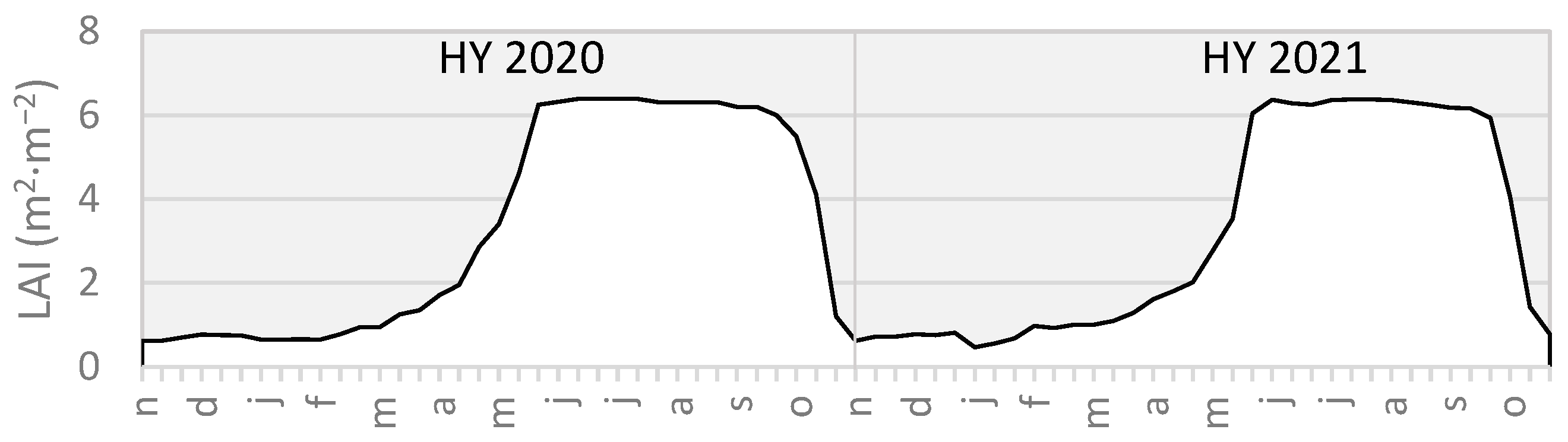
Given the spatial heterogeneity of the Dobroč Primeval Forest, LAI values were determined for each observation date as the average of eight measurements. These measurements were taken within a 300 × 300 m grid, encompassing a total area of 72 hectares. For modelling purposes, daily LAI values were obtained using linear interpolation between observation dates (see Figure 2).

2.5.2. Surface Roughness and Albedo

Surface roughness and albedo were estimated from LAI values using the methodology proposed by [26], with reference to the approaches outlined by [10,27]. The model adopts the concept of four distinct crop development stages. In the initial stage, the relative LAI (ωr) is calculated using the equation
ɷr = ɷ/ɷ0,m
where ɷ is LAI and ɷ0,m is the maximal value of LAI during the vegetation season. The relation between LAI and Albedo (a) is defined as follows:
a = (am − as)·ωr + as
where am is the maximal value of albedo during the vegetation season and as is the albedo of bare soil without vegetation. The relation between ɷr and surface roughness (z0) is described as follows:
z0 = (z0,m − z0,s)·ɷr + z0,s
where z0,m is the maximal value of surface roughness during the vegetation season, and z0,s is the surface roughness of bare soil without vegetation. Values of surface roughness and albedo for different vegetation cover and bare soil, as well as threshold values for crop development stages in Slovakia, were estimated based on [26].

2.5.3. Root Zone Data

The GLOBAL model places particular emphasis on root zone characteristics. Accordingly, it incorporates root distribution functions (RDFs) and simulates plant water uptake under stress conditions using the Feddes water stress model [28]. The depth of the root zone and the corresponding RDFs were derived from field surveys conducted during soil sampling campaigns, with consideration of the root systems of Fagus sylvatica (European beech) and Picea abies (Norway spruce) as representative species for the respective plots [29,30,31,32,33]. The rooting depths applied in the model (60 cm for beech, 40 cm for spruce) were determined directly from soil probe excavations at both study sites and reflect site-specific soil constraints, including local stoniness and textural properties. Literature sources [29,30,31,32,33] served as supporting references to confirm the plausibility of the observed rooting patterns.
For Fagus sylvatica, the potential root water uptake factor was set to 1.0 in the upper 40 cm of soil; it decreased to 0.7 at 50 cm, and then linearly decreased to 0 at 60 cm. For Picea abies, the uptake factor was set to 1.0 from the surface to 25 cm, followed by a linear decline to 0 at 40 cm. The parameters of the water stress model for Fagus sylvatica and Picea abies were defined according to [25] (Table 3). Parameters include the pressure head below which roots start to extract water from the soil (h1), the pressure head below which roots extract water at the maximum possible rate (h2), and the pressure head below which roots can no longer extract water at the maximum possible rate (h3). The last parameter was defined as the pressure head below which root water uptake stops, usually at the wilting point (h4).
As suggested in [24], correctly adjusting the wilting point is impossible due to the tensiometer’s measurement limit and because the root water uptake model based on water potential indicated that the h4 value from the Feddes model was incorrectly low [34]. Considering site conditions, aeration stress was neglected.

2.6. Data Analysis

In assessing water balance in forest ecosystems, the winter period is critical, as it is essential for accumulating water reserves that support the subsequent growing season. Therefore, water balance evaluations were conducted over a hydrological year, defined as the period from 1 November to 31 October of the following year [35].
To evaluate drought from a climatological perspective, the Climatic Water Balance (CWB) was calculated. The CWB is defined as the difference between potential evapotranspiration (PET) and precipitation, with positive values indicating a water deficit in the ecosystem and negative values reflecting a surplus [36,37]. Based on daily CWB values, the number of water deficit days (WDD) was calculated for each month. A WDD was defined as any day on which PET exceeded precipitation, corresponding to a positive CWB value. In addition, we calculated the cumulative course of the climatic water balance (CWBcum) daily by summing day-to-day values over the study period. For each identified drought episode, the cumulative Climatic Water Balance (CWB) was calculated as the sum of daily CWB values over the episode’s duration, providing an integrated measure of atmospheric water demand relative to precipitation input during that period.
Soil drought assessment was based on simulations using the GLOBAL model, incorporating hydrolimits corresponding to field capacity (FC) and the point of decreased availability (PDA). Following the definitions of [9], FC was set at a soil water potential of pF = 2.5, while PDA was defined at pF = 3.3. The value of pF = 2.5 for FC is consistent with the standard soil hydrological definition widely used in Central European pedology [9]. Hydrolimit values were calculated as the mean for each soil horizon, based on the drying branch of the soil water retention curve and derived from laboratory analysis of 46 soil samples (Table 4). In interpreting GLOBAL model outputs, the FC hydrolimit was considered indicative of full soil water availability, whereas the PDA represented the threshold below which water availability is substantially reduced, marking the onset of soil drought.
The GLOBAL model outputs raw daily soil water content (SWC) data at 1 cm vertical resolution throughout the soil profile. To enable comparison across soil horizons of varying thicknesses, an average SWC per 1 cm depth was calculated for each horizon. Descriptive statistical analyses of daily and monthly SWC values were conducted using R version 4.3.3 (R Core Team, 2024). The monthly coefficient of variation (CV) was employed to quantify the temporal variability in soil water content. To assess the relationship between model-derived SWC and the Climatic Water Balance (CWB) across different soil horizons, the Pearson correlation coefficient (PCC) was calculated. PCC values are reported as descriptive measures of association only. Formal significance testing was not applied because daily model outputs exhibit strong temporal autocorrelation, violating the independence assumption underlying standard inferential tests of the Pearson coefficient.
The time lag between drought onset in adjacent soil horizons was determined by comparing the dates of PDA threshold exceedance across successive horizons.

3. Results

3.1. Meteorological and Climatological Drought

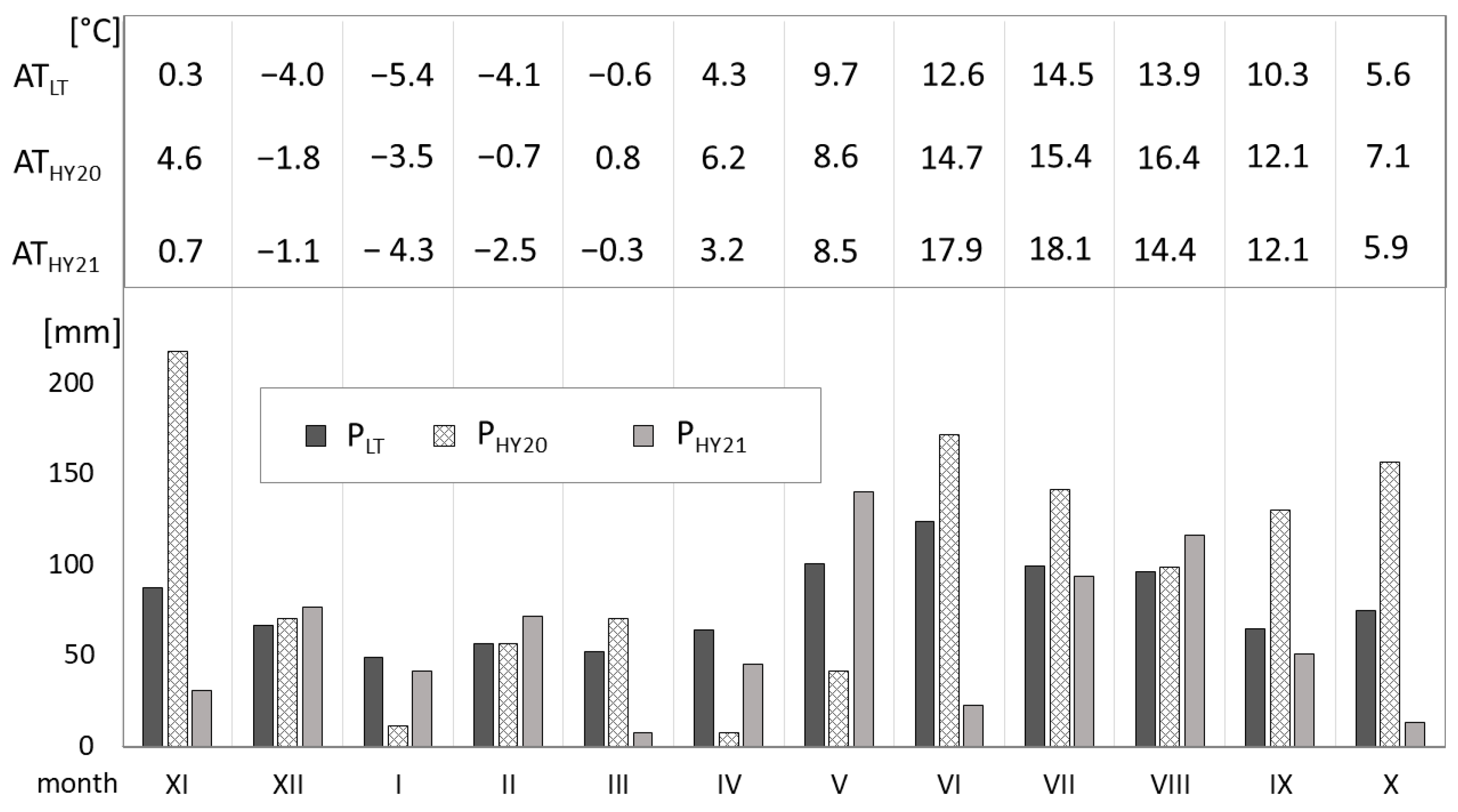
Seasonal patterns of precipitation and air temperature, along with their comparison to the long-term climatic normal for the Dobroč area, are presented in Figure 3. During the 2020 hydrological year, total precipitation reached 1173 mm, representing 125% of the long-term average. The mean annual air temperature was 6.7 °C, exceeding the long-term mean by 1.9 °C. The winter months showed above-average precipitation and temperatures. April and May were characterized by below-average precipitation, while summer and autumn experienced significantly higher-than-average rainfall. Air temperatures throughout the remainder of the hydrological year also remained consistently above the long-term average.
In the hydrological year (HY) 2021, total precipitation amounted to 711.3 mm, which is 223.7 mm below the long-term average and 461.7 mm less than in the previous year. The mean annual air temperature was 6.0 °C. Precipitation during the winter and spring seasons was significantly below average, resulting in minimal replenishment of soil moisture. Although May experienced increased rainfall, it was followed by an extended dry period lasting approximately 45 days during the summer. In contrast, August recorded above-average precipitation. Air temperatures were consistently above normal from June through the end of the hydrological year, except in October, when they closely matched the long-term mean.
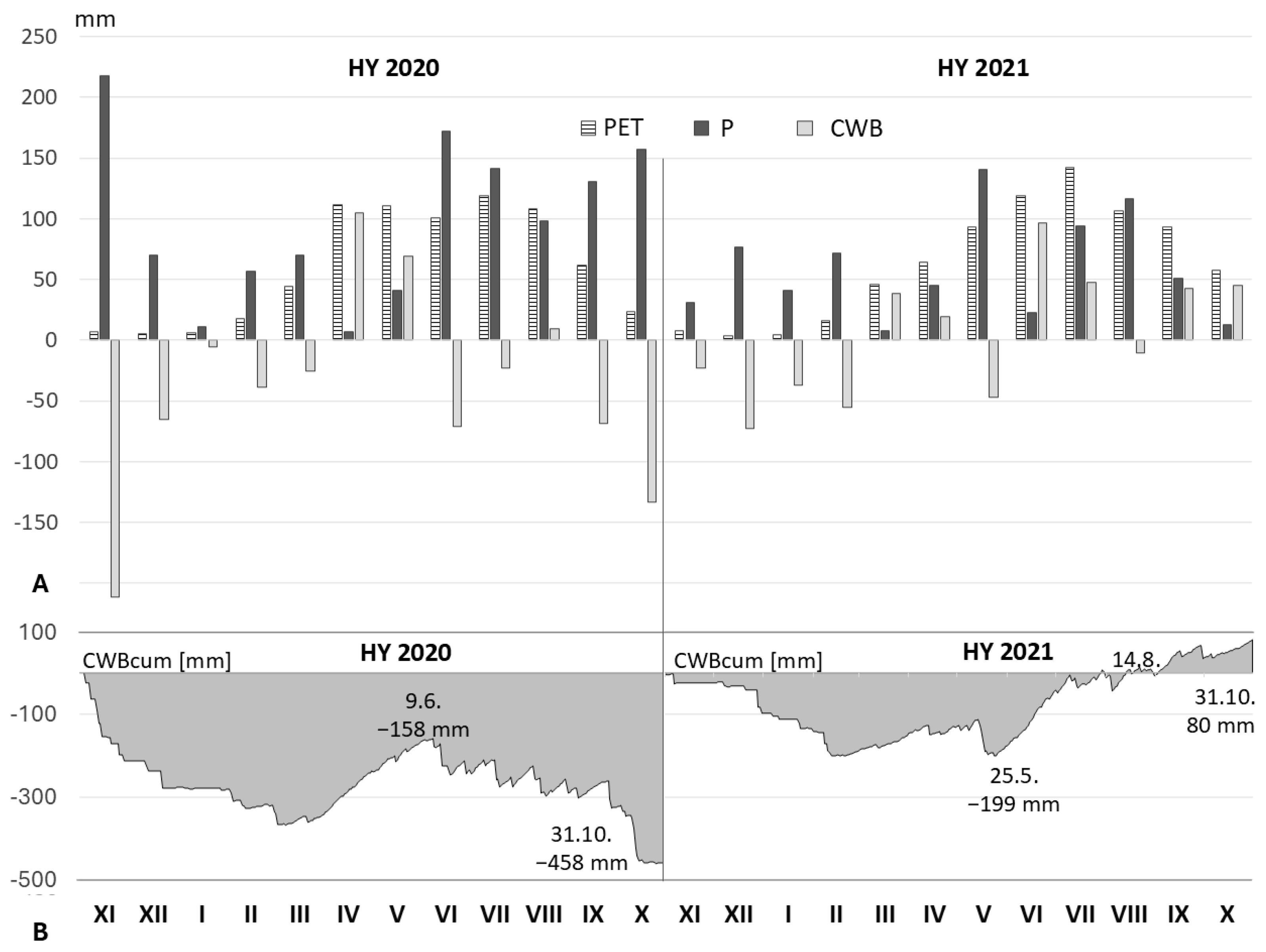
Hydrological years 2020 and 2021 differed markedly in their winter precipitation regimes, total annual water input, and monthly mean air temperatures—all of which influenced water balance and drought risk. In HY 2020, characterized by above-average precipitation, the annual potential evapotranspiration was estimated at 715 mm. The most pronounced moisture deficit occurred in April, when the monthly CWB reached 105.1 mm (Figure 4A). Subsequent months experienced sufficient to above-average precipitation. The CWBcum reached its maximum on 6 June, indicating a surplus of 158 mm. From that point onward, it remained negative until the end of the hydrological year, suggesting that, from a climatological perspective, the water demands of the ecosystem were met (Figure 4B).
In contrast, during the hydrological year 2021, the total potential evapotranspiration amounted to 792 mm, exceeding the total annual precipitation by 81 mm. Limited water input during the winter and a continuing deficit through spring led to a pronounced water shortage, with a cumulative deficit of 224 mm recorded between March and the end of September. According to the CWB, drought conditions were most severe in June and July, with monthly water deficits exceeding 100 mm in both months. The CWBcum revealed a steadily increasing drought risk beginning in mid-May, which persisted until the end of the hydrological year. By the end of October, the CWBcum reached 80 mm, indicating sustained water stress (Figure 4B).

3.2. Drought Risk Across the Root Zone

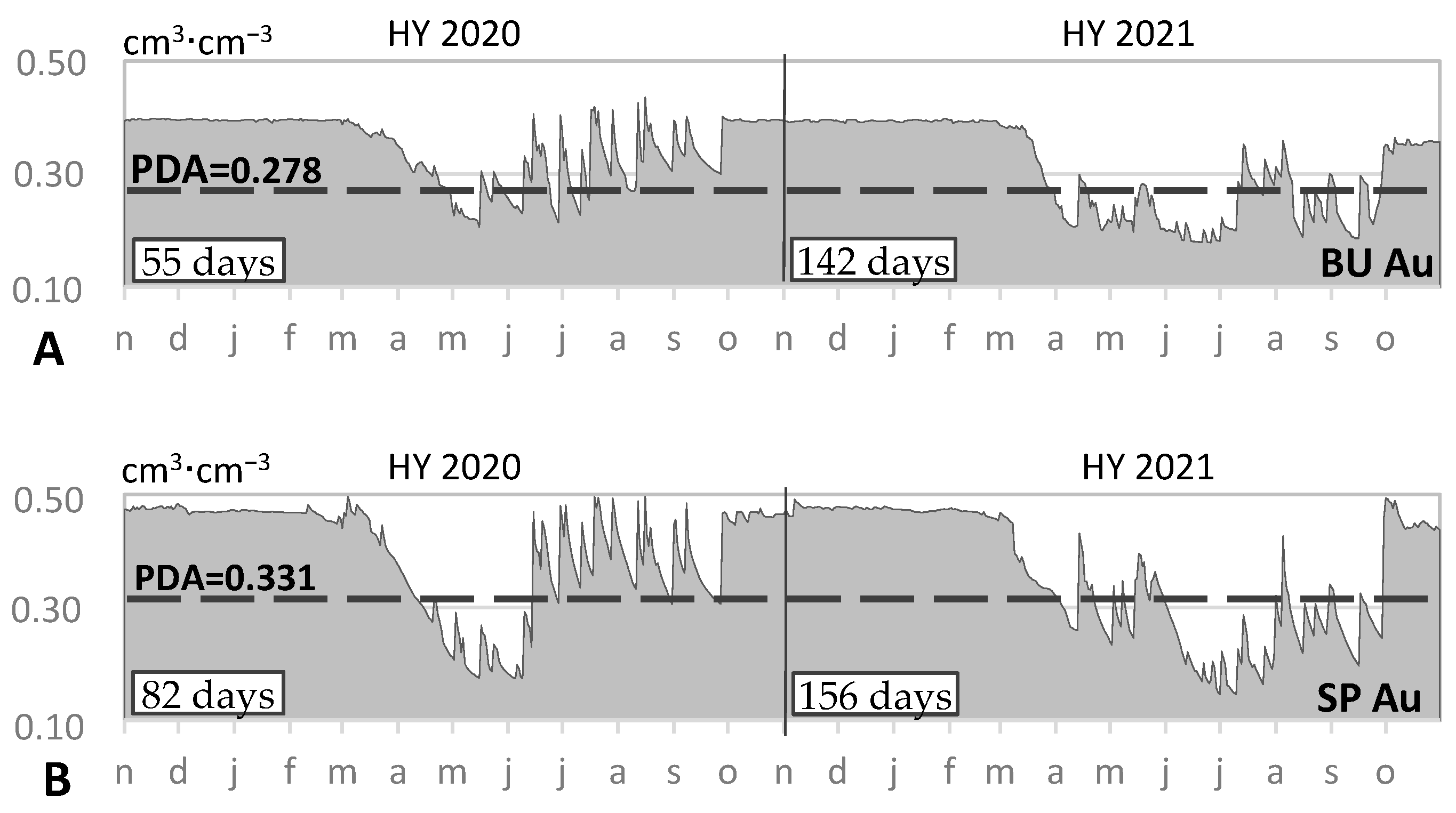
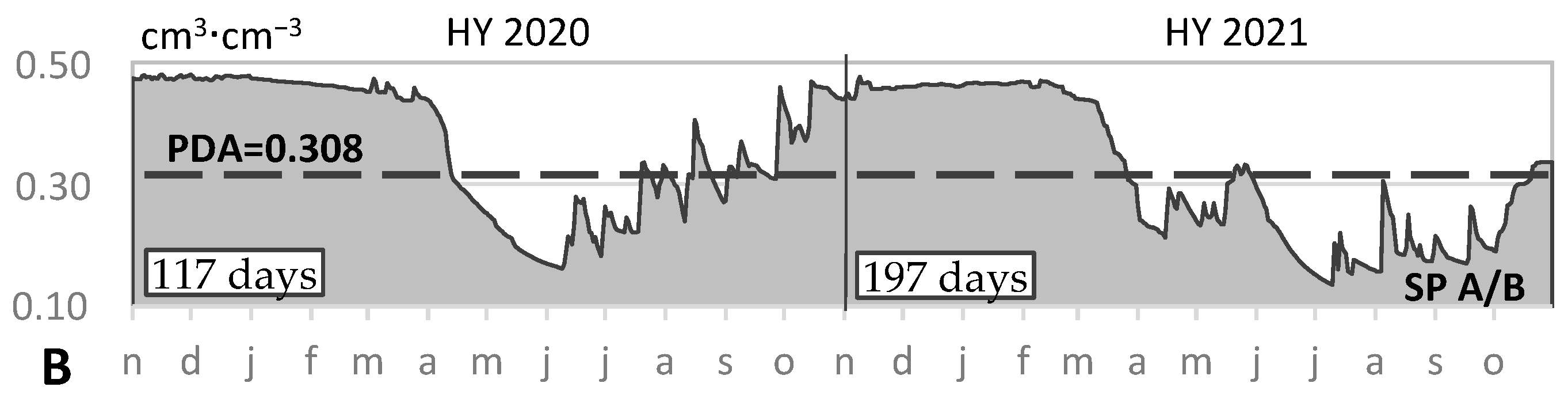
The monitored hydrological years exhibited variations in both total precipitation and its temporal distribution, which significantly affected soil moisture dynamics at both study sites. Drought episodes lasting more than 10 days on both sites are shown in Table 5 and Table 6. The hydrological year 2020 was characterized by significant water supplies from winter. From November to mid-February, the humidity at both locations was above the FC hydrolimit. Given that the physiological activity of the spruce stand was not constrained by foliar limitations during this period, a decline in soil moisture beneath the spruce canopy was first observed in late February. In contrast, the beech stand exhibited a similar decline later, during the first half of March (Figure 5, Figure 6 and Figure 7).
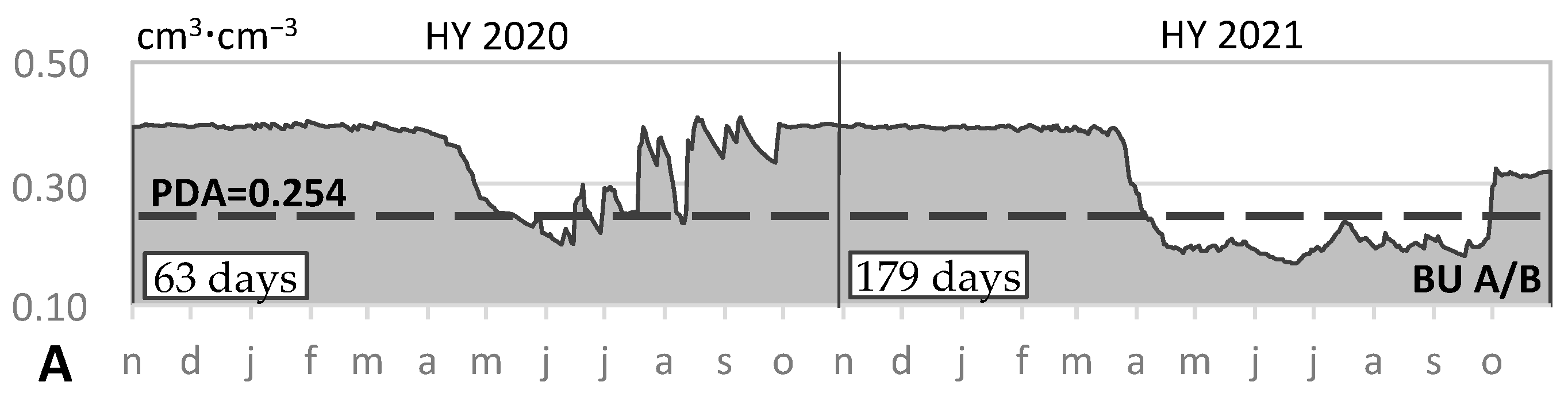
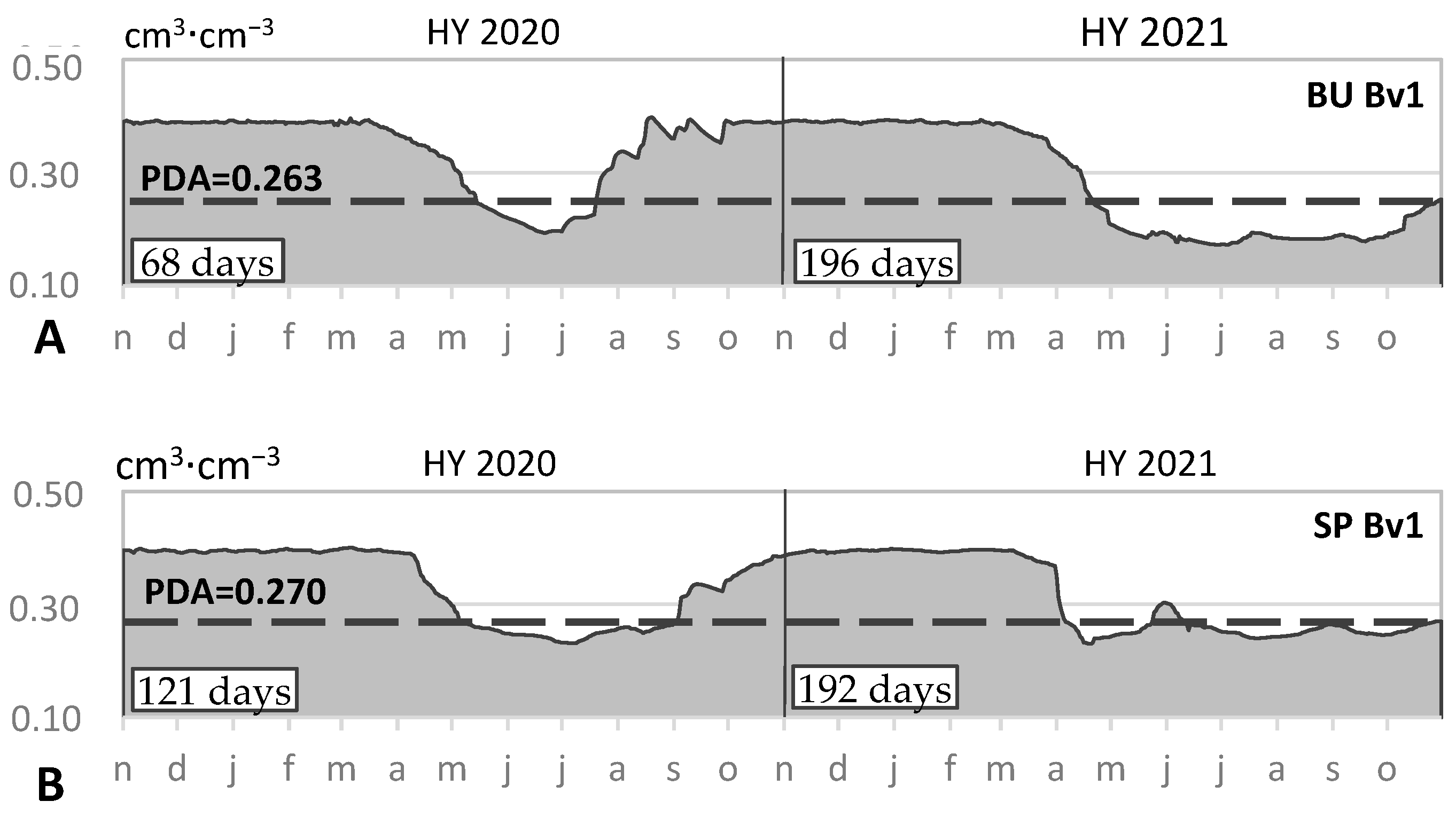
In the main root zone (Au and transitional A/B horizons) of the spruce stand, soil water content (SWC) declined below the PDA hydrolimit as early as mid-April and remained below this limit until mid-July—persisting for nearly three months (Figure 5B and Figure 6B). In the buffer zone, SWC dropped below the PDA hydrolimit later, around late April to early May, primarily due to foliage development and the associated increase in physiological activity. However, subsequent spring precipitation events led to rapid soil resaturation. From June onward, precipitation was relatively sufficient, and soil moisture fluctuated near the PDA hydrolimit for the remainder of the growing season. On average, drought conditions in the spruce stand lasted 2–3 days longer than at the comparison site. At both locations, drought propagation showed a consistent 3–4-day lag between adjacent horizons. Consequently, the most pronounced and prolonged period of suboptimal water availability occurred exclusively in the spruce stand during the first half of the growing season. The hydrological year 2021 was marked by significantly below-average precipitation, with total rainfall falling well below the long-term mean. Between mid-February and mid-April, cumulative precipitation totalled only 15 mm, and 57 consecutive days without rainfall were recorded. Soil water depletion coincided with the onset of increased physiological activity in the vegetation. In the buffer zone, a rapid decline in soil moisture was first observed in the Au horizon beginning on 13 March. After 16 days, soil water content in this horizon dropped below the PDA hydrolimit (Figure 5A). Eight days later, the A/B horizon also exhibited moisture levels below the PDA hydrolimit, and after an additional 14 days—by the second half of April—the threshold was exceeded in the deeper part of the root zone (Bv1 horizon).
This early and rapid onset of drought persisted in the root zone for almost the entire growing season, except for the Au horizon, which was intermittently saturated with precipitation. After significant rainfall at the end of September, the soil in the root zone was saturated, but this water did not reach deeper layers. The total number of days below the PDA threshold increased towards depth, and in all horizons of the root zone, the unfavourable period lasted more than 140 days.
In the spruce stand, drought conditions during the 2021 hydrological year were notably severe. A decline in soil moisture was first observed in the Au and A/B horizons beginning in mid-February. In the Au horizon, SWC exhibited dynamic fluctuations, with five distinct drought episodes recorded by the end of May (Figure 5B). In the A/B horizon, SWC remained below the PDA hydrolimit for a total of 55 days, ending on May 20 (Figure 6B). In the Bv1 horizon—where fine roots were still present—SWC dropped below the PDA hydrolimit 10 days after the A/B horizon, with drought conditions persisting uninterrupted for 49 days (Figure 7B). A second drought episode commenced at the end of May 2021, affecting the entire soil profile and continuing through the remainder of the growing season.
From early June to mid-July, the spruce stand experienced a significant precipitation deficit, receiving only 33 mm of rainfall, while potential evapotranspiration (PET) during this period reached 207 mm. In the Au horizon, three extended drought episodes were observed between 30 May and the end of the hydrological year, interrupted only briefly by short periods of moderate rewetting. A single heavy rainfall event on 30 September (30.4 mm) temporarily recharged the Au horizon, raising SWC above the PDA hydrolimit. In contrast, drought conditions were more severe in the deeper soil layers. In the A/B horizon, continuous drought persisted for 142 days, ending in the second half of October. The seasonal SWC minimum in this layer was recorded on 10 July, reaching 0.135 cm3·cm−3. In the Bv1 horizon, drought onset occurred 12 days after that in the Au horizon. Across all soil horizons in the spruce stand, suboptimal moisture conditions persisted until the final day of monitoring (Table 6).

3.3. Drought Patterns in the Soil Profile

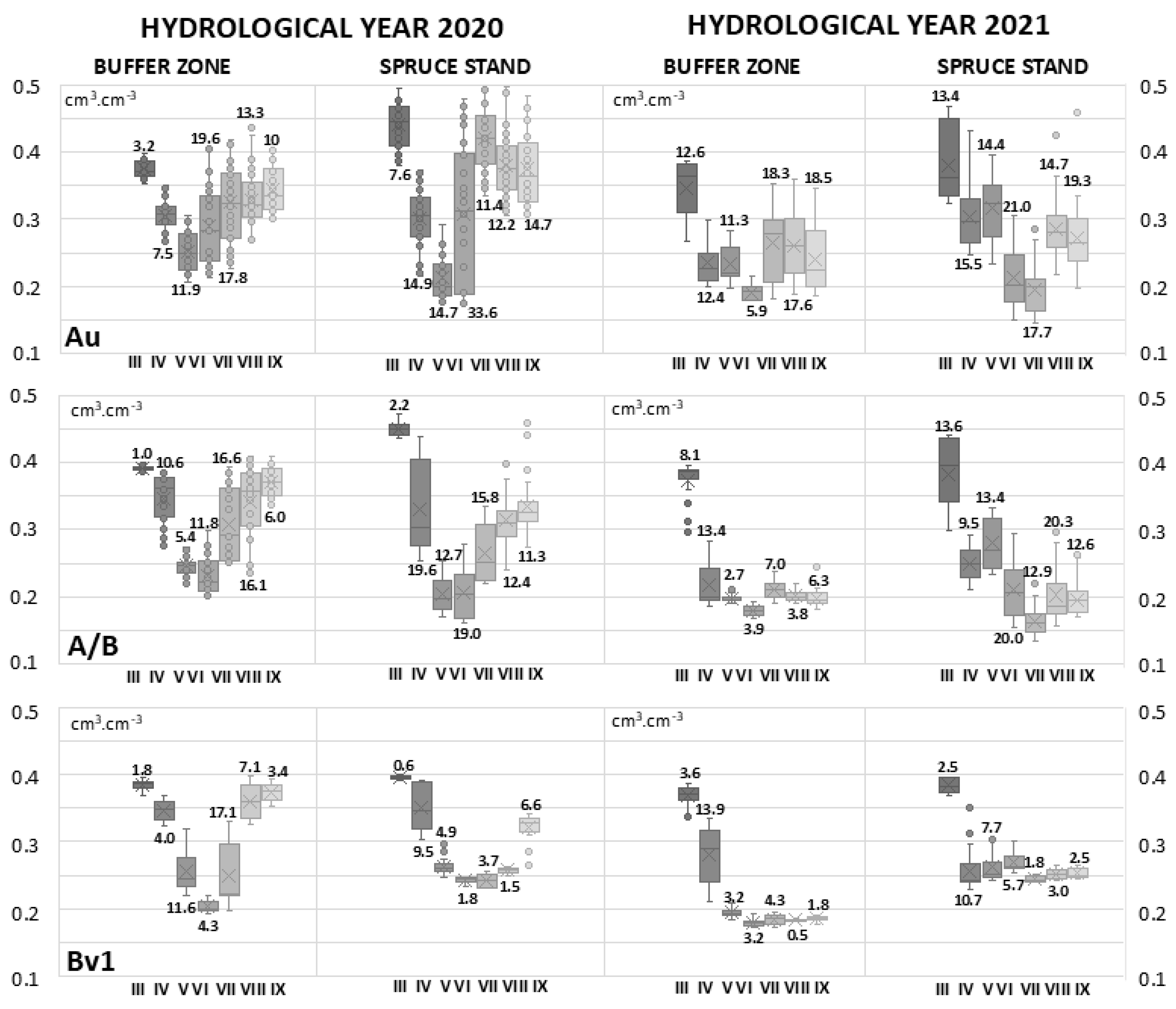
Modelling of seasonal soil moisture dynamics at two sites within the Dobroč Primeval Forest area—the buffer zone (BU) and the spruce stand (SP)—across hydrological years with differing precipitation regimes revealed distinct patterns linked to both soil profile characteristics and stand structure. Notable changes and differences in soil water content (SWC) dynamics across individual horizons were observed during both growing seasons. Average monthly SWC values, along with the range and coefficient of variation for each soil horizon at both sites during the 2021 growing season (March–September), are presented in Figure 8.
A summary of the number of days within key hydrolimits—field capacity (FC) and the point of decreased availability (PDA)—as determined by the model, along with the number and average duration of drought episodes in each soil horizon for both the buffer zone and spruce stand during HY 2020 and HY 2021, is provided in Table 7.
In 2020, the most severe drought occurred during the early part of the growing season, while the latter half was characterized by above-average precipitation. In contrast, during 2021, drought conditions were most pronounced in the summer months, with seasonal minimum soil moisture levels recorded in early July. Precipitation in the latter half of July led to partial rewetting of only the upper soil horizon (Au), whereas unfavourable moisture conditions persisted in the deeper horizons throughout the remainder of the growing season and likely beyond. Due to the delayed onset of drought in the deeper layers—combined with its prolonged duration—the recorded number of days below the point of decreased availability (PDA) during HY 2021 (Table 7) may underestimate the actual extent of drought, as conditions likely remained critical beyond the official end of the hydrological year (31 October).
Rapid soil water depletion and the onset of drought first occurred in the upper soil horizons. However, these layers also exhibited quicker resaturation following precipitation events. As a result, the Au horizon experienced more drought episodes, though their average duration was relatively short (Table 7). In contrast, deeper horizons at both study sites showed an increasing number of dry days within the root zone with depth. This pattern was accompanied by reduced SWC dynamics, as indicated by lower coefficients of variation across most months in both growing seasons (Figure 8). Elevated coefficients of variation and broader SWC ranges typically reflect increased temporal variability, which may include rapid shifts in soil moisture status. Such fluctuations were observed, for example, in April 2020 within the A/B horizon of the spruce stand (Figure 8).
The observed decline in Pearson correlation coefficients (PCCs) between climatological drought (as represented by the CWB) and soil drought (quantified by deviation from the Point of Decreased Availability) with increasing soil depth supports the conclusion that upper soil horizons respond more rapidly to meteorological variations (Table 8). Notably, PCC values were significantly elevated in the spruce stand, which may be attributed to the species’ maintenance of a stable leaf area index, thereby rendering physiological activity directly dependent on prevailing meteorological conditions. In contrast, beech trees exhibit phenological constraints, with water uptake limited during spring leaf emergence and ceasing post-leaf abscission in autumn, despite potentially favourable meteorological conditions.

4. Discussion

The increasing risk of drought poses a significant threat to forest ecosystems across much of Europe [4,38,39]. In Slovakia, anticipated shifts in vegetation zones are closely linked to alterations in the climatic water balance [40,41,42]. Recent observations [43] and future climate projections [3,44] highlight an increasingly uneven intra-annual distribution of precipitation and a higher frequency of extreme drought years in Central Europe. These trends are expected to have profound impacts, particularly on soil water regimes [5].
European beech (Fagus sylvatica) forests exhibit high sensitivity to the timing of drought onset, with the greatest vulnerability occurring during the early stages of the growing season [45]. Although precipitation levels in the Dobroč Primeval Forest area were markedly below average in January and April 2020, residual winter soil moisture, coupled with slightly above-average precipitation during the remaining spring months, mitigated the adverse effects of early-season drought. This occurred despite April being classified as an extremely dry month across Central Europe [46,47]. By the end of April, approximately 84% of Slovakia’s territory was experiencing extreme drought conditions in the upper 40 cm of the soil profile. These conditions were further intensified by increased solar radiation and elevated evapotranspiration demand, resulting in pronounced impacts on forest ecosystems [48]. Model simulations indicated that the drought event in the research plots represented a single, continuous episode that affected the entire soil profile. In spruce-dominated stands, the duration of drought—defined as soil water content (SWC) below the PDA hydrolimit—was extended by 27 days in the Au horizon and by 54 days in the A/B horizon, relative to the adjacent buffer zone. These findings support previous evidence that beech can access deeper soil moisture reserves [24,49]. At both study sites, drought conditions intensified during the vegetation season of 2020 until mid-June, when model outputs indicated that soil water content reached its seasonal minimum. Precipitation during the second half of the growing season was favourable, resulting in gradual soil moisture replenishment. By the end of the hydrological year, the soil water content had recovered to levels corresponding to the field capacity.
The hydrological year 2021 was characterized by a notable reduction in total precipitation compared to both the previous year and the long-term climatic average (Figure 3). In mid-April, the Slovak Hydrometeorological Institute reported the onset of a significant drought event across Slovakia [50]. In the Dobroč Primeval Forest region, anomalously dry conditions had already emerged in March, which recorded only a single day of measurable precipitation. The drought conditions intensified further in April. The most severe drought occurred in June, marked by exceptionally high air temperatures, persistent clear skies, and prolonged solar radiation—conditions atypical for that time of year. According to the Slovak Hydrometeorological Institute’s drought monitoring system, the relative soil moisture content in the 0–40 cm surface layer in the Dobroč area declined to approximately 20%, a critically low value [51]. The Climatic Water Balance (CWB) indicated a monthly precipitation deficit of 137 mm in June, along with 28 days of continuous deficit, representing one of the most extreme hydrological anomalies of the season. Although drought conditions began to abate during the second half of July, the response in the soil profile was minimal. Due to the prolonged dry period, only a modest increase in soil moisture was observed in the upper horizons. In August, the model suggested a minor re-saturation event; however, this temporary improvement was rapidly offset by elevated evapotranspiration demand, preventing sustained recovery of soil water content. In September, dry meteorological conditions prevailed, contributing to a further decline in soil moisture toward the end of the growing season. A brief increase in soil water content was observed following a single high-intensity rainfall event (~30 mm) at the end of the month, yet this input was insufficient to counterbalance the accumulated deficit. The cumulative Climatic Water Balance (Figure 4B) confirmed that the summer drought was both prolonged and intense, with no significant recovery observed during the latter part of the growing season.
Drought risk assessment, based on both meteorological parameters and model simulations, revealed a range of site-specific characteristics influenced by local environmental conditions, dominant tree species, and the regional precipitation and temperature regimes. Among these factors, soil properties and total retention capacity play a critical role in determining the amount of water available for vegetation [2,9,24]. The drought sensitivity of European beech (Fagus sylvatica) is significantly influenced by the tree’s position within the stand (e.g., dominant vs. suppressed individuals) and site-specific variables, particularly the physical and hydraulic characteristics of the soil profile [7,52,53]. According to Del Castillo et al. [54], beech productivity is expected to decline progressively toward the southern margins of its natural distribution, where increased drought frequency, greater precipitation variability, and extreme temperature events are becoming more prevalent [3,7,44]. Körner [55] emphasized that drought risk is closely linked to site-specific habitat conditions, including soil depth, texture, and water-holding capacity. Moreover, species-specific transpiration dynamics further influence drought responses. For instance, in Norway spruce (Picea abies), maximum transpiration per unit of leaf area index (LAI) tends to decline with increasing tree age. In contrast, beech regenerates its leaf area annually, resulting in age-independent maximum transpiration per unit of LAI [49].
Soil moisture dynamics analysis revealed a higher number of days with soil water content below the point of decreased availability (PDA) within the root zone of the spruce-dominated stand. Coniferous species, such as Norway spruce (Picea abies), generally exhibit lower physiological resilience to transient drought conditions and a limited capacity for rehydration compared to broadleaved deciduous species [6,52,56,57]. Spruce is particularly sensitive to reductions in soil water availability, a response that can be monitored through transpiration measurements [58]. Under conditions of significantly reduced soil water potential, transpiration in spruce is regulated solely by the actual soil water content, rather than by the theoretical demand determined by potential evapotranspiration (PET) [56]. Prolonged periods of hydrological stress—such as those observed during the 2021 growing season in the Dobroč Primeval Forest—can increase the vulnerability of spruce, as the severity of drought impacts tends to escalate with increasing duration [40,59].
The observed temporal lag in drought propagation through the soil profile is consistent with the broader concept of forest-mediated hydrological buffering, whereby stand structure and canopy characteristics modulate the timing and magnitude of water fluxes. This effect has been demonstrated at the catchment scale through long-term analysis of river flow dynamics in relation to forest cover changes [60], and our results provide complementary evidence at the plot and soil profile scale.
The methodology presented in this study relies on a comprehensive set of site-specific input data, including measured hydrophysical soil parameters, meteorological records, and vegetation characteristics. While this data intensity ensures high model accuracy at the study sites, it may limit direct applicability in ungauged basins or regions with limited data availability. However, the GLOBAL mathematical model framework is transferable to other forested sites, provided that basic soil profile characterization and standard meteorological measurements are available. Minimum data requirements include soil texture and retention curve parameters, which can be estimated using pedotransfer functions in data-sparse environments [61]. Future applications should explore the use of remote sensing products and publicly available soil databases to reduce field data requirements.
When applying the GLOBAL mathematical model for drought risk assessment, it is important to acknowledge certain methodological limitations. Specifically, the model simplifies the complexity of forest ecosystems by omitting heterogeneity in both stand structure and spatiotemporal variation in soil hydrophysical properties [61,62,63,64]. For example, the model assumes a uniform distribution of soil moisture within each soil horizon. This assumption introduces a significant simplification, as coarse fragments (e.g., gravel and rock) can cause spatially variable moisture dynamics—either by temporarily retaining water above impermeable layers or by accelerating drainage into deeper soil strata [65]. Moreover, the current modelling approach does not account for soil water repellency, a phenomenon that can substantially reduce infiltration at the soil surface and restrict vertical water movement between horizons, leading to highly uneven soil moisture distribution [66,67].

5. Conclusions

This study evaluated the Climatic Water Balance (CWB) and its cumulative course (CWBcum) in the buffer zone of the Dobroč primeval forest and applied water-balance modelling to capture soil–water–plant interactions under varying climatic conditions. The combined use of climatic indices and modelling approaches proved effective for characterizing both short-term variability and long-term cumulative effects of water availability in forest ecosystems.
Both research hypotheses were confirmed by the study results. The first hypothesis—that spruce stands would exhibit greater drought risk than beech due to differences in rooting depth and canopy characteristics—was supported by a consistently higher number of days with soil water content below the PDA hydrolimit in the spruce stand across both hydrological years and all soil horizons. In the dry year 2021, the number of days below PDA exceeded 190 days in the deeper horizons of the spruce stand, compared to approximately 180 days in the beech buffer zone. The second hypothesis—that drought propagation would show a measurable time lag with increasing soil depth—was confirmed by the observed 3–4-day delay between the onset and cessation of drought conditions in adjacent soil horizons at both study sites.
The contrasting hydrological behaviour of the two stands, observed under both near-average (HY 2020) and severely dry (HY 2021) conditions, highlights the critical role of stand composition and rooting strategy in determining ecosystem drought resilience. The Dobroč Primeval Forest, as one of the best-preserved temperate fir–beech forests in Central Europe, provides a unique natural reference for assessing the hydrological consequences of replacing potential natural vegetation with managed monocultures. Our results provide empirical support for ongoing forest conversion efforts from Norway spruce monocultures toward more drought-resilient mixed or broadleaved stands in Central European mountain forests.
Our results confirm that spruce is more sensitive to drought risk than beech, and that CWB-based analyses supported by modelling provide valuable tools for assessing ecosystem resilience. The integration of observed data with simulation outputs not only improves the interpretation of climatic drivers but also demonstrates the applicability of modelling approaches in complex forested landscapes. Beyond the local scale, the methodology presented here is transferable to other European forests facing similar challenges. Future research should extend this methodology to additional forest types and incorporate long-term monitoring to better anticipate the impacts of climate change on forest ecosystems.

Author Contributions

Conceptualization, Z.G.O. and J.V.; methodology, Z.G.O.; software, P.N. and Z.G.O.; validation, Z.G.O., M.H. and P.N.; formal analysis, Z.G.O.; investigation, Z.G.O., M.H. and P.N.; resources, Z.G.O. and M.B.; data curation, Z.G.O.; writing—original draft preparation, Z.G.O.; writing—review and editing, J.V. and P.N.; visualization, Z.G.O. and M.H.; supervision, J.V.; project administration, J.V. and P.N.; funding acquisition, J.V. and P.N. All authors have read and agreed to the published version of the manuscript.

Funding

This research was funded by the Science Grant Agency of the Ministry of Education, Science, Research and Sport of the Slovak Republic, VEGA No. 1/0617/26, and by the Slovak Research and Development Agency under Contract Nos. APVV-21-0224, APVV-19-0183 and APVV-24-0382.

Data Availability Statement

The data presented in this study are available on request from the corresponding author. The data are not publicly available due to privacy.

Acknowledgments

The authors would like to thank the State Nature Conservancy of the Slovak Republic, Administration of the Poľana Protected Landscape Area, for granting permission to carry out research in the buffer zone of the primeval forest.

Conflicts of Interest

The authors declare no conflicts of interest.

References

  1. Food and Agriculture Organization UN. Forests: Nature-Based Solutions for Water; Unasylva; Food and Agriculture Organization UN: Rome, Italy, 2019; Volume 70, pp. 1–88. [Google Scholar]
  2. Štekauerová, V.; Nagy, V.; Kotrová, D. Soil water regime of agricultural field and forest ecosystems. Biologia 2006, 61, 300–304. [Google Scholar] [CrossRef]
  3. Gera, M.; Damborská, I.; Lapin, M.; Melo, M. Climate changes in Slovakia: Analysis of past and present observations and scenarios of future developments. In Water Resources in Slovakia—Part II: Climate Change, Drought and Floods; Negm, A.M., Zeleňáková, M., Eds.; The Handbook of Environmental Chemistry; Springer: Berlin/Heidelberg, Germany, 2019; Volume 70, pp. 21–47. [Google Scholar] [CrossRef]
  4. Hlásny, T.; Mátyás, C.; Seidl, R.; Kulla, L.; Merganičová, K.; Trombik, J.; Dobor, L.; Barcza, Z.; Konôpka, B. Climate change increases the drought risk in Central European forests: What are the options for adaptation? For. J. 2014, 60, 5–18. [Google Scholar] [CrossRef]
  5. Trnka, M.; Kersebaum, K.C.; Eitzinger, J.; Hayes, M.; Hlavinka, P.; Svoboda, M.; Dubrovský, M.; Semerádová, D.; Wardlow, B.; Pokorný, E.; et al. Consequences of climate change for the soil climate in Central Europe and the central plains of the United States. Nat. Clim. Change 2013, 3, 718–724. [Google Scholar] [CrossRef]
  6. Rennenberg, H.; Loreto, F.; Polle, A.; Brilli, F.; Fares, S.; Beniwal, R.S.; Gessler, A. Physiological responses of forest trees to heat and drought. Plant Biol. 2006, 8, 556–571. [Google Scholar] [CrossRef]
  7. Diaconu, D.; Kahle, H.P.; Spiecker, H. Thinning increases drought tolerance of European beech: A case study on two forested slopes on opposite sides of a valley. Eur. J. For. Res. 2017, 136, 319–328. [Google Scholar] [CrossRef]
  8. Puhlmann, H.; von Wilpert, K. Pedotransfer functions for water retention and unsaturated hydraulic conductivity of forest soils. J. Plant Nutr. Soil Sc. 2012, 175, 221–235. [Google Scholar] [CrossRef]
  9. Kutílek, M.; Nielsen, D.R. Soil Hydrology; Catena Verlag: Cremlingen-Destedt, Germany, 1994; 370p. [Google Scholar]
  10. Allen, R.; Pereira, L.; Raes, D.; Smith, M. Crop Evapotranspiration—Guidelines for Computing Crop Water Requirements; FAO Irrigation and Drainage Paper 56; Food and Agriculture Organization UN: Rome, Italy, 1998; 300p. [Google Scholar]
  11. Granier, A.; Reichstein, M.; Breda, N.; Janssens, I.A.; Falge, E.; Ciais, P.; Grunwald, T.; Aubinet, M.; Berbigier, P.; Bernhofer, C.; et al. Evidence for the soil water control on carbon and water dynamics in European forests during the extremely dry year 2003. Agric. For. Meteorol. 2003, 143, 123–145. [Google Scholar] [CrossRef]
  12. Schume, H.; Jost, G.; Hager, H. Soil water depletion and recharge patterns in mixed and pure forest stands of European beech and Norway spruce. J. Hydrol. 2004, 289, 258–274. [Google Scholar] [CrossRef]
  13. Kuželková, M.; Jačka, L.; Kovář, M.; Hradilek, V.; Máca, P. Tree trait-mediated differences in soil moisture regimes: A comparative study of beech, spruce, and larch in a drought-prone area of Central Europe. Eur. J. For. Res. 2024, 143, 319–332. [Google Scholar] [CrossRef]
  14. Miklós, L.; Hrnčiarová, T.; Slovak Environmental Agency (Eds.) Landscape Atlas of the Slovak Republic; Ministry of the Environment of the Slovak Republic: Bratislava, Slovakia; Slovak Environmental Agency: Banská Štiavnica, Slovakia, 2002. [Google Scholar]
  15. Križová, E. Vegetation of the Dobroč Primeval Forest. In Dobroč Primeval Forest (National Nature Reserve); Slávik, D., Burkovský, J., Galvánková, M., Gejdura, S., Križová, E., Kropil, R., Pekarovič, B., Rybár, I., Saniga, M., Šály, R., Eds.; ÚVVP LVH SR: Zvolen, Slovakia, 2002; 107p. [Google Scholar]
  16. Oravcová, Z. Bioclimatic Risk of Drought in the Forest Landscape. Ph.D. Thesis, Technical University in Zvolen, Faculty of Forestry, Zvolen, Slovakia, 2022; 132p. [Google Scholar]
  17. Majerčák, J.; Novák, V. GLOBAL—One-Dimensional Variable Saturated Flow Model, Including Root Water Uptake, Evapotranspiration Structure, Corn Yield, Interception of Precipitation and Winter Regime Calculation; Research Report; Institute of Hydrology, Slovak Academy of Sciences: Bratislava, Slovakia, 1994; p. 75. [Google Scholar]
  18. Igaz, D.; Tóthová, I.; Samuhel, P. Evaluation of soil water content using the simulation models GLOBAL and DSSAT4. In Bioclimatology and Natural Hazards—International Scientific Conference, Poľana nad Detvou, Slovakia, 17–20 September 2007; Střelcová, K., Škvarenina, J., Blaženec, M., Eds.; Czech Bioclimatological Society: Brno, Czech Republic, 2007. [Google Scholar]
  19. Štekauerová, V.; Nagy, V. Impact of climatic conditions on water supply for plants in localities Báč and Bodíky. Acta Hydrol. Slovaca 2001, 2, 58–63. [Google Scholar]
  20. Penman, H.L. Natural evaporation from open water, bare soil and grass. Proc. R. Soc. Lond. A 1948, 193, 120–145. [Google Scholar] [CrossRef]
  21. Otruba, J. Weather Conditions in Slovakia; Publishing House of the Slovak Academy of Sciences: Bratislava, Slovakia, 1964; 281p. [Google Scholar]
  22. Van Genuchten, M.T. A closed-form equation for predicting the hydraulic conductivity of unsaturated soils. Soil Sci. Soc. Am. J. 1980, 44, 892–898. [Google Scholar] [CrossRef]
  23. Mualem, Y. A new model for predicting the hydraulic conductivity of unsaturated porous media. Water Resour. Res. 1976, 12, 513–522. [Google Scholar] [CrossRef]
  24. Šípek, V.; Hnilica, J.; Vlček, L.; Hnilicová, S.; Tesar, M. Influence of vegetation type and soil properties on soil water dynamics in the Šumava Mountains (Southern Bohemia). J. Hydrol. 2020, 582, 124285. [Google Scholar] [CrossRef]
  25. Fuster, B.; Sánchez-Zapero, J.; Camacho, F.; García-Santos, V.; Verger, A.; Lacanze, R.; Weiss, M.; Baret, F.; Smets, B. Quality assessment of PROBA-V LAI, fAPAR and fCOVER Collection 300 m products of Copernicus Global Land Service. Remote Sens. 2020, 12, 1017. [Google Scholar] [CrossRef]
  26. Novák, V. Calculation of evapotranspiration for water balance assessment in a catchment. Bull. Minist. Environ. 2011, 19, 10–23. [Google Scholar]
  27. Doorenbos, J.; Pruitt, W.O. Guidelines for Predicting Crop Water Requirements; FAO Irrigation and Drainage Paper 24 (Rev.); FAO: Rome, Italy, 1977. [Google Scholar]
  28. Feddes, R.A.; Bresler, E.; Neuman, S.P. Field test of a modified numerical model for water uptake by root systems. Water Resour. Res. 1974, 10, 1199–1206. [Google Scholar] [CrossRef]
  29. Mauer, O.; Palátová, E.; Beran, F. Root system development in two provenances of Picea abies at two different sites. Dendrobiology 2009, 61, 21–28. [Google Scholar]
  30. Štofko, P.; Kodrík, M. Architecture of root branches of Norway spruce trees (Picea abies (L.) Karst.) growing in gley soil. J. For. Sci. 2008, 54, 15–21. [Google Scholar] [CrossRef]
  31. Puhe, J. Growth and development of the root system of Norway spruce (Picea abies) in forest stands—A review. For. Ecol. Manag. 2003, 175, 253–273. [Google Scholar] [CrossRef]
  32. Kodrík, J.; Kodrík, M. Root biomass of beech as a factor influencing wind tree stability. J. For. Sci. 2002, 48, 549–564. [Google Scholar] [CrossRef]
  33. Lozanova, L.; Zhiyanski, M.; Vanguelova, E.; Doncheva, S.; Marinov, M.P.; Lazarova, S. Dynamics and vertical distribution of roots in European beech forests and Douglas fir plantations in Bulgaria. Forests 2019, 10, 1123. [Google Scholar] [CrossRef]
  34. Vogel, T.; Dohnal, M.; Dušek, J.; Tesar, M. Macroscopic modeling of plant water uptake in a forest stand involving root-mediated soil water redistribution. Vadose Zone J. 2013, 12, 1–12. [Google Scholar] [CrossRef]
  35. Likens, G.E.; Bormann, F.H.; Pierce, R.S.; Eaton, J.S.; Johnson, N.M. Biogeochemistry of a Forested Ecosystem, 3rd ed.; Springer: New York, NY, USA, 2012; 146p. [Google Scholar]
  36. Špánik, F.; Tomlain, J. Climate Change and Its Impact on Agriculture; Slovak University of Agriculture: Nitra, Slovakia, 1997; 154p. [Google Scholar]
  37. Šiška, B.; Takáč, J. Drought analyses of agricultural regions as influenced by climatic conditions in the Slovak Republic. Időjárás 2009, 113, 135–143. [Google Scholar]
  38. Lindner, M.; Maroschek, M.; Netherer, S.; Kremer, A.; Barbati, A.; Garcia Gonzalo, J.; Seidl, R.; Delzon, S.; Corona, P.; Kolström, M.; et al. Climate change impacts, adaptive capacity, and vulnerability of European forest ecosystems. For. Ecol. Manag. 2010, 259, 698–709. [Google Scholar] [CrossRef]
  39. Spathelf, P.; van der Maaten, E.; van der Maaten-Theunissen, M.; Campioli, M.; Dobrowolska, D. Climate change impacts in European forests: The expert views of local observers. Ann. For. Sci. 2013, 70, 131–137. [Google Scholar] [CrossRef]
  40. Střelcová, K.; Sitková, Z.; Kurjak, D.; Kmeť, J. Drought Stress and Forest Stands; Publishing House of the Technical University in Zvolen: Zvolen, Slovakia, 2011; 266p. [Google Scholar]
  41. Škvarenina, J.; Križová, E.; Tomlain, J. Impact of climate change on the water balance of altitudinal vegetation stages in Slovakia. Ekol. Bratisl. 2004, 23, 13–29. [Google Scholar]
  42. Škvarenina, J.; Tomlain, J.; Hrvol, J.; Škvarenínová, J.; Nejedlík, P. Progress in dryness and wetness parameters in altitudinal vegetation stages of the West Carpathians: Time series analysis 1951–2007. Időjárás 2009, 113, 47–54. [Google Scholar]
  43. Büntgen, U.; Urban, O.; Krusic, P.J.; Rybníček, M.; Kolář, T.; Kyncl, T.; Ač, A.; Koňasová, E.; Čáslavský, J.; Esper, J.; et al. Recent European drought extremes beyond Common Era background variability. Nat. Geosci. 2021, 14, 190–196. [Google Scholar] [CrossRef]
  44. Pendergrass, A.G.; Knutti, R. The uneven nature of daily precipitation and its change. Geophys. Res. Lett. 2018, 45, 11980–11988. [Google Scholar] [CrossRef]
  45. Gennaretti, F.; Ogée, J.; Sainte-Marie, J.; Cuntz, M. Mining ecophysiological responses of European beech ecosystems to drought. Agric. For. Meteorol. 2020, 280, 107780. [Google Scholar] [CrossRef]
  46. Brauns, B.; Cuba, D.; Bloomfield, J.P.; Hannah, D.M.; Jackson, C.; Marchant, B.P.; Heudorfer, B.; Van Loon, A.F.; Bessière, H.; Thunholm, B.; et al. The Groundwater Drought Initiative (GDI): Analysing and understanding groundwater drought across Europe. Proc. IAHS 2020, 383, 297–305. [Google Scholar] [CrossRef]
  47. Carlowicz, M.; Rodell, M. Signs of Drought in European Groundwater. NASA Earth Observatory, 22 June 2020. Available online: https://earthobservatory.nasa.gov/images/146888/signs-of-drought-in-european-groundwater (accessed on 10 January 2026).
  48. Turňa, M.; Ivaňáková, G.; Krčová, I.; Merkaj, I.; Ridzoň, J. Assessment of drought in Slovakia in 2020. Meteorol. Čas. 2021, 24, 11–20. [Google Scholar]
  49. Köstner, B. Evaporation and transpiration from forests in Central Europe—Relevance of patch level studies for spatial scaling. Meteorol. Atmos. Phys. 2001, 76, 69–82. [Google Scholar] [CrossRef]
  50. SHMÚ. Assessment of Drought in Slovakia in 2021. Available online: https://www.shmu.sk/sk/?page=2049&id=1189 (accessed on 10 May 2022).
  51. Intersucho.sk. Soil Profile Saturation Maps. Available online: https://www.intersucho.sk/sk/slovensko/aktualni-stav-zasoba-vody-v-pude/ (accessed on 10 April 2022).
  52. Rennenberg, H.; Seiler, W.; Matyssek, R.; Gessler, A.; Kreuzwieser, J. Die Buche (Fagus sylvatica L.)—Ein Waldbaum ohne Zukunft im südlichen Mitteleuropa? Allg. Forst Jagdztg. 2004, 175, 210–224. [Google Scholar]
  53. Geßler, A.; Keitel, C.; Kreuzwieser, J.; Matyssek, R.; Seiler, W.; Rennenberg, H. Potential risks for European beech (Fagus sylvatica L.) in a changing climate. Trees 2007, 21, 1–11. [Google Scholar] [CrossRef]
  54. Del Castillo, E.M.; Zang, C.S.; Buras, A.; Hacke-Pain, A.; Esper, J.; Serrano-Notivoli, R.; Hartl, C.; Weigel, R.; Klesse, S.; Resco de Dios, V.; et al. Climate-change-driven growth decline of European beech forests. Commun. Biol. 2022, 5, 163. [Google Scholar] [CrossRef] [PubMed]
  55. Körner, C. Humidity responses in forest trees: Precautions in thermal scanning surveys. Arch. Meteorol. Geophys. Bioclimatol. Ser. B 1985, 36, 83–98. [Google Scholar] [CrossRef]
  56. Gartner, K.; Nahezdina, N.; Englisch, M.; Čermák, J.; Leitgeb, E. Sap flow of birch and Norway spruce during the European heat and drought in summer 2003. For. Ecol. Manag. 2009, 258, 590–599. [Google Scholar] [CrossRef]
  57. Salomón, R.L.; Peters, R.L.; Zweifel, R.; Sass-Klaassen, U.G.W.; Stegehuis, A.I.; Smiljanic, M.; Poyatos, R.; Babst, F.; Cieciala, E.; Fonti, P.; et al. The 2018 European heatwave led to stem dehydration but not to consistent growth reductions in forests. Nat. Commun. 2022, 13, 28. [Google Scholar] [CrossRef]
  58. Střelcová, K.; Kurjak, D.; Leštianska, A.; Kovalčíková, D.; Ditmarová, Ľ.; Škvarenina, J.; Ahmed, Y.A.R. Differences in transpiration of Norway spruce drought-stressed trees and trees well supplied with water. Biologia 2013, 68, 1118–1122. [Google Scholar] [CrossRef]
  59. Wilhite, D.A.; Glantz, M.H. Understanding the drought phenomenon—The role of definitions. Water Int. 1985, 10, 111–120. [Google Scholar] [CrossRef]
  60. Jin, C.; Zha, T.; Guo, X.; Li, X.; Liu, X.; Jiang, Y.; Bourque, C.P.A. Forest-cover-loss control on year-round river flow dynamics in the upper Saint John River (Wolastoq) basin, Northeastern North America from 2001 to 2019. J. Hydrol. 2023, 623, 129776. [Google Scholar] [CrossRef]
  61. Himmelbauer, M.L.; Majerčák, J.; Rodny, M.; Novák, V.; Loiskandl, W. The impact of root data details on modelling of soil water transport in soil–plant–atmosphere system. Acta Hydrol. Slovaca 2013, 14, 21–31. [Google Scholar]
  62. Novák, V.; Kňava, K. Forest soil water content annual courses as influenced by canopy properties. In Bioclimatic Aspects of Landscape Processes Assessment; Rožnovský, J., Litschmann, T., Eds.; Česká Bioklimatologická Společnost (ČBKS): Mikulov, Czech Republic, 2008. [Google Scholar]
  63. Novák, V.; Hlaváčiková, H. Soil Hydrology; VEDA Publishing House of the Slovak Academy of Sciences: Bratislava, Slovakia, 2016; 350p. [Google Scholar]
  64. Jarabicová, M. Prognosis of Soil Water Regime. Ph.D. Thesis, Slovak University of Technology, Bratislava, Slovakia, 2016; 161p. [Google Scholar]
  65. Hlaváčiková, H.; Novák, V.; Holko, L. On the role of rock fragments and initial soil water content in the potential subsurface runoff formation. J. Hydrol. Hydromech. 2015, 63, 71–81. [Google Scholar] [CrossRef][Green Version]
  66. Doerr, S.H.; Shakesby, R.A.; Walsh, R.P.D. Soil water repellency: Its causes, characteristics and hydro-geomorphological significance. Earth-Sci. Rev. 2000, 51, 33–65. [Google Scholar] [CrossRef]
  67. Gerke, K.M.; Sidle, R.C.; Mallants, D. Preferential flow mechanisms identified from staining experiments in forested hillslopes. Hydrol. Process. 2015, 29, 4562–4578. [Google Scholar] [CrossRef]
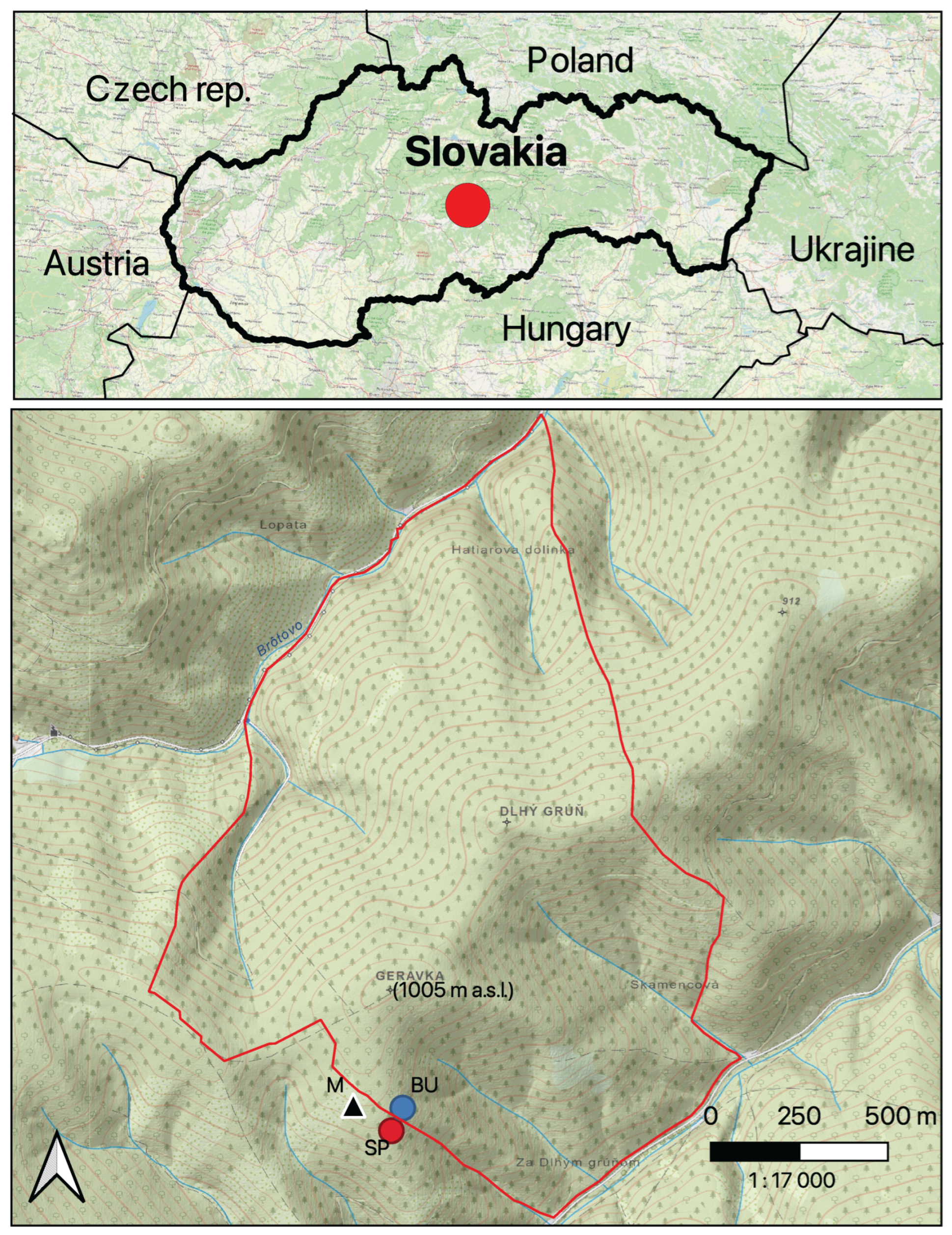
Figure 1. Location of the study area within Slovakia (inset) and detailed map of the Dobroč Primeval Forest showing the buffer zone plot: (BU)—blue dot, the spruce stand plot; (SP)—red dot, the meteorological station; (M)—black triangle, and the main topographic features. The highest point of the forest is Geravka with 1005 m a.s.l.
Water 18 00756 g001
Figure 2. Seasonal changes in Leaf Area Index for buffer zone (BU) of Dobroč Primeval Forest in hydrological years 2020 and 2021.
Water 18 00756 g002
Figure 3. Comparison of monthly values of air temperature AT (°C) and precipitation P (mm) during HY 2020 and HY 2021 with long-term reference period LT (1960–1991) in Dobroč.
Water 18 00756 g003
Figure 4. Monthly values of Climatic Water Balance (CWB) and its components (P—precipitation; PET—potential evapotranspiration) (A) and cumulative values CWBcum (B) in hydrological years 2020 and 2021 in Dobroč.
Water 18 00756 g004
Figure 5. Seasonal changes in soil water content (cm3·cm−3) in horizon Au in HY 2020 and HY 2021 in buffer zone BU (A) and spruce stand SP (B), with the dashed line representing the hydrolimit point of decreased availability (PDA) and total amount of days under hydrolimit PDA (in white box).
Water 18 00756 g005
Figure 6. Seasonal changes in soil water content (cm3·cm−3) in horizon A/B in HY 2020 and HY 2021 in buffer zone BU (A) and spruce stand SP (B), with the dashed line representing the hydrolimit point of decreased availability (PDA) and total amount of days under hydrolimit PDA (in white box).
Water 18 00756 g006aWater 18 00756 g006b
Figure 7. Seasonal changes in soil water content (cm3·cm−3) in horizon Bv1 in HY 2020 and HY 2021 in buffer zone BU (A) and spruce stand SP (B), with the dashed line representing the hydrolimit point of decreased availability (PDA) and total amount of days under hydrolimit PDA (in white box).
Water 18 00756 g007
Figure 8. Seasonal dynamics of water content from March to September 2020 and 2021 in the main root zone of the buffer zone and spruce stand in Dobroč, with values of the coefficient of variation.
Water 18 00756 g008
Table 1. Input parameters for the GLOBAL model.
METEOROLOGICAL PARAMETRS 1Precipitation (mm·day −1)
Mean air temperature (°C)
Sunshine (h)
Vapour pressure (hPa)
Wind speed (m·s−1)
VEGETATION
PARAMETERS
Leaf area index (LAI) (m2·m−2) 1
Albedo (-) 1
Surface roughness (m2) 1
Root depth (cm) 1
Potential root water uptake factor (0, 1)
Feddes parameters (h1, h2, h3, h4)
HYDROPHYSICAL
PARAMETERS 2
θ r residual water content (cm3·cm−3)
α , n parameters of van Genuchten’s soil hydraulic functions
θ s saturated water content (cm3·cm−3)
K s saturated hydraulic conductivity (cm·day−1)
INITIAL CONDITION 2Initial water content within the soil profile (cm3·cm−3)
BOTTOM BOUNDARY CONDITIONFree drainage
1 daily data; 2 sets for each soil horizon.
Table 2. Hydrophysical characteristics of each horizon of the soil profile in buffer zone (BU) and spruce stand (SP) in Dobroč.
Soil Horizon
Depth [cm]
Saturated Water Content
θs (cm3·cm−3)
Residual Water Content
θr (cm3·cm−3)
α
(cm−1)
n
(-)
Saturated Hydraulic Conductivity
Ks (cm·Day−1)
BU Au (0–10)0.40510.07060.01841.373270.78
BU A/B (11–31)0.41290.02980.01271.492163.56
BU Bv1, Bv2 (32–77)0.39100.04900.01161.48147.28
BU B/C (78–100)0.39470.04580.00881.52845.74
SP Au (0–10)0.38940.04470.01351.46331.59
SP A/B (11–29)0.39930.03510.01261.48443.35
SP Bv1, Bv2 (30–79)0.40660.03050.01711.45441.05
SP B/C (80–100)0.41240.02420.03501.42921.81
Table 3. Feddes water stress model parameters (in pressure head) for representative tree species of Fagus sylvatica and Picea abies that entered the mathematical model GLOBAL.
[cm]h1h2h3h4
Fagus sylvatica−10−10−800−900
Picea abies−10−20−450−850
Table 4. Mean values of soil water content (cm3·cm−3) corresponding with hydrolimits of field capacity (FC) and point of decreased availability (PDA) for each horizon of the soil profile in spruce stand (SP) and buffer zone (BU) of fir–beech primeval forest in Dobroč.
Soil
Horizon
AuA/BBv1Bv2B/C
BUFFER ZONE (BU)
FC0.3010.2860.2950.2860.254
PDA0.2780.2540.2630.2530.219
SPRUCE STAND (SP)
FC0.3640.3460.3140.2860.272
PDA0.3310.3080.2700.2460.243
Table 5. Summary of drought episodes (SWC under PDA) that lasted more than 10 days in individual soil horizons of the root zone in the buffer zone (BU) in the Dobroč area in the hydrological years 2020 and 2021. P is precipitation, PET is potential evapotranspiration, and CWB is Climatic Water Balance during drought episodes.
Horizon (BU)DateNumber of DaysPPETCWBMean SWC
(cm3·cm−3)
Au26 April–16 May 2020219.268.158.90.237
29 May–9 June 2020121937.618.60.248
28 March–13 April 2021173.73834.30.233
18 April–14 May 2021274881330.225
22 May–10 July 202150452341890.201
11–29 August 2021193664280.231
3–16 September 202114056560.207
A/B7 May–15 June 20204075139640.230
5 April–30 September 20211794696451760.199
Bv114 May–20 July 202068292243−490.216
19 April–31 October 2021 11964546782240.194
Note: 1 End of simulation 31 October 2021.
Table 6. Summary of drought episodes (SWC under PDA) that lasted more than 10 days in individual soil horizons of the root zone in the spruce stand (SP) in the Dobroč area in the hydrological years 2020 and 2021. P is precipitation; PET is potential evapotranspiration; and CWB is Climatic Water Balance during drought episodes.
Horizon (SP)DateNumber of DaysPPETCWBMean SWC
(cm3·cm−3)
Au9 April–14 June 202067902371470.335
30 March–13 April 2021153.73329.30.291
22 April–2 May 2021116.729.622.90.269
30 May–4 August 2021671403181780.213
8–31 August 2021234683370.272
2–29 September 2021282090.270.20.262
A/B14 April–19 July 202097256346900.225
27 March–20 May 202155173138−350.258
31 May–19 October 20211422975352380.204
Bv16 May–3 September 2020121483429−540.250
6 April–24 May 202149184120.9−63.10.248
11 June–31 October 2021 11432925152230.253
Note: 1 End of simulation 31 October 2021.
Table 7. Summary of days within hydrolimit field capacity (FC) and point of decreased availability (PDA) according to the model, number of drought episodes and average length of drought episodes (in days) in individual soil horizons of the soil profiles in the buffer zone (BU) and spruce stand (SP) in Dobroč during HY 2020 and HY 2021.
HY 2020SiteBUSP
horizontAuA/BBv1Bv2B/CAuA/BBv1Bv2B/C
θ > FC28928428800257207231200204
Ʃ dayFC > θ > PDA211892422752641136187
PDA > θ556368123908211712110474
Average drought length (days)816684190212912110474
Number of drought
episodes
7413144111
HY 2021SiteBUSP
horizonAuA/BBv1Bv2B/CAuA/BBv1Bv2B/C
θ > FC18918116500175142152155160
Ʃ dayFC > θ > PDA38651681933527224336
PDA > θ139179196 1198173156197192 1168 1170
Average drought length (days)17179196 1198173209996 184 185
Number of drought
episodes
8111182222
Note: 1 End of simulation 31 October 2021.
Table 8. Pearson correlation coefficient (PCC) between CWB and deviation from the Point of Decreased Availability hydrolimit in the horizons of the spruce stand and buffer zone in the Dobroč area.
AuA/BBv1Bv2B/C
BUFFER ZONE0.3310.1670.1400.1190.117
SPRUCE STAND0.7620.7260.7140.6690.611
Disclaimer/Publisher’s Note: The statements, opinions and data contained in all publications are solely those of the individual author(s) and contributor(s) and not of MDPI and/or the editor(s). MDPI and/or the editor(s) disclaim responsibility for any injury to people or property resulting from any ideas, methods, instructions or products referred to in the content.