Article

An Integrated Modeling Approach for Managing the Water–Energy–Food Nexus in Resource-Based Cities: A Case Study of Daqing, China


1
Haihe River, Huaihe River and Xiaoqinghe River Basin Water Conservancy Management and Service Center of Shandong Province, Jinan 250100, China
2
Key Laboratory of Groundwater Resources and Environment, Ministry of Education, Jilin University, Changchun 130021, China
3
College of New Energy and Environment, Jilin University, Changchun 130021, China
4
College of Civil Engineering, Shandong University, Jinan 250061, China
*
Authors to whom correspondence should be addressed.
Water 2026, 18(6), 723; https://doi.org/10.3390/w18060723
Submission received: 28 January 2026 / Revised: 5 March 2026 / Accepted: 17 March 2026 / Published: 19 March 2026
(This article belongs to the Special Issue Advanced Perspectives on the Water–Energy–Food Nexus)

Abstract

Resource-based regions (RBRs) are vital to socio-economic development, yet intensive resource exploitation strains water, energy, and food (WEF) security and causes environmental stress. Optimizing collaborative management of the WEF nexus is crucial for their sustainable development. This study developed an integrated model (WEFN) for optimizing the WEF nexus in RBRs by combining multi-objective optimization and the efficacy coefficient method. The WEFN model incorporates internal couplings and external linkages of the WEF nexus into objectives and constraints. Using Daqing, China, as a case study, six policy scenarios were designed. S1 follows the 2030 planning scheme, while S2–S5 prioritize energy-food supply, environmental protection, water conservation, and economic gains, respectively. S6, formulated via the WEFN model, integrates the objectives of S2–S5 into a collaborative management policy. A comprehensive benefit evaluation system was established, yielding an Evaluation Index (EVI) to quantify WEF system benefits and identify the optimal scenario. Results show that collaborative policy S6 best supports coordinated socio-economic and environmental development in Daqing. The findings offer a valuable reference for WEF nexus management in other RBRs.

1. Introduction

Water, energy, and food are essential resources for human survival and development. Global population growth and economic development are putting increasing pressure on the supplies of water, energy, and food [1,2,3]. It is projected that by 2050, the global demand for these critical resources will surge by 60%, 55%, and 80% respectively, presenting a major challenge to countries worldwide [4]. Water, energy, and food resources are closely interrelated. The extraction, treatment, and transportation of water require energy input. The exploitation, processing, and power generation of energy depend on water resources. The production, processing, and transportation of food rely on both water and energy. Additionally, certain food crops can be converted into bioenergy. The concept of the Water–Energy–Food (WEF) Nexus was first introduced at the 2011 Bonn Conference. Since then, research on the WEF Nexus has grown significantly worldwide [5,6]. The WEF Nexus offers a holistic framework for sustainable resource management through its emphasis on interdependence and coordinated management [7,8]. However, there remains a lack of systematic and effective solutions for collaborative WEF management, both in terms of theoretical completeness and practical applicability. Formulating resource management policies based solely on a single-resource-centric approach fails to meet the requirements of collaborative management and could lead to severe unforeseen consequences [9,10]. For instance, the enhancement of water resource exploitation through technologies like seawater desalination and reclaimed water treatment relies heavily on energy input, thereby creating considerable pressure on the energy sector [11,12]. The Iranian government’s pursuit of agricultural self-sufficiency, achieved through subsidies for production inputs like water and energy, has resulted in irreparable damage to groundwater resources and the environment, rendering food production unsustainable [13]. It is evident that decision-makers must enhance collaboration with stakeholders and fully consider local conditions. By formulating specific policies and measures tailored to the local context, the collaborative management of WEF can be achieved, thereby promoting sustainable socio-economic development [14,15].
The multi-objective optimization model is widely applied in the fields of resource planning and management [16,17]. This model aims to identify optimal decisions that can simultaneously satisfy multiple conflicting objectives under resource constraints, thereby addressing issues such as rational resource allocation and inter-departmental collaborative optimization [18,19,20]. At present, this method is mainly applied to allocating resources and achieving equilibrium of the WEF nexus in irrigation districts and river basins. For instance, Karamian et al. present a multi-objective genetic algorithm model to balance sustainable agricultural development in the Miandarband plain, west Iran, showing that its optimal cultivation pattern reduces water and energy use by 2.56% and 12.71%, respectively, alongside a 6.82% reduction in environmental impacts [21]. To identify comprehensive water–food–energy alternatives, Zeng et al. applied their developed simulation–optimization approach to the Jing River, China, obtaining results on shortages, optimal allocation, and system benefits under various policy scenarios [22]. Resource-based regions (RBRs) have played a vital role in national socio-economic development [23]. However, the intensive exploitation of resources generates substantial pressures on water, energy, and food security, alongside causing significant environmental stress [24]. Despite the recognized importance of optimizing WEF nexus management for RBR sustainable development, existing research remains inadequate in addressing several critical aspects. First, regarding decision-oriented optimization, conventional GA-based multi-objective approaches typically produce Pareto frontiers that necessitate subjective interpretation of trade-offs among conflicting objectives. This limitation hinders their direct applicability to practical policy decisions, as stakeholders must navigate complex trade-offs without a clear, unified basis for comparison. Furthermore, these approaches often require subjective weighting or value judgments to select among Pareto-optimal solutions, introducing additional uncertainty where no consensus exists on the relative importance of different WEF dimensions. Second, regarding the scope of optimization frameworks, most existing models focus primarily on internal resource flows, with limited integration of external socio-economic–environmental linkages. There is a notable deficiency in research that incorporates social, economic, and environmental dimensions into WEF nexus optimization [25]. Relying solely on internal WEF flows is insufficient given external pressures such as environmental degradation, urbanization, and economic policies [26,27]. Moreover, existing models often define constraints based on the separate endowments of water, energy, and land. This approach neglects critical cross-sectoral interlinkages, providing only a limited view of the complex interdependencies and trade-offs within the WEF nexus [28,29]. For instance, grain production is influenced by both direct (e.g., diesel, electricity) and indirect (e.g., fertilizer, pesticides) energy inputs. Improving energy use efficiency in this process can simultaneously achieve energy conservation and yield increases, thereby supporting sustainable agricultural development [30]. However, despite this recognized importance, energy use efficiency is rarely incorporated as a constraint in current optimization frameworks. These limitations collectively hinder the effectiveness of existing WEF nexus optimization approaches in addressing the unique challenges faced by resource-based regions.
Building on this foundation, this study proposes a WEFN model for RBRs by integrating multi-objective optimization and the efficacy coefficient method. The proposed model introduces two key innovations. First, an efficacy coefficient method integration aggregates multiple objectives into a single comprehensive function through the geometric mean of efficacy functions. This approach inherently penalizes imbalance among objectives and eliminates the need for subjective weighting, thereby offering a practicable pathway toward integrated WEF governance. Second, a holistic RBR-tailored framework integrates both internal WEF couplings and external socio-economic-environmental linkages into its objectives and constraints. Using Daqing, China, as a case study, the model incorporates primary regional contradictions, including water scarcity, water pollution, and production demands, into its objective functions, while treating secondary considerations, such as energy use efficiency in grain production, as constraints. By embedding policy-relevant limits, including permitted maximum and minimum values for planting areas and energy production, the framework captures Daqing’s unique resource endowments and its strategic role in national energy security.
Using Daqing as a case study, six policy scenarios were designed to assess their impacts on the WEF system. A comprehensive benefit evaluation system was established to yield an Evaluation Index (EVI) for quantifying benefits and identifying the optimal scenario. This study can provide valuable references for exploring pathways to collaborative management of the WEF nexus and promoting sustainable socio-economic development in RBRs.

2. Study Area

Daqing City is located in the southwest of Heilongjiang Province, China, with a total area of 22,161 km2 (Figure 1). Administratively, a “city” in China refers to a vast geographical region that encompasses not only urban districts but also extensive rural areas, farmland, and natural landscapes, rather than merely a contiguous built-up area. Daqing City is situated in the temperate continental monsoon climate zone. The average annual temperature is 4.2 °C, and the average annual precipitation is approximately 427.5 mm. The summer is characterized by high temperatures and concentrated rainfall, with precipitation from June to September accounting for about 70% of the annual rainfall.
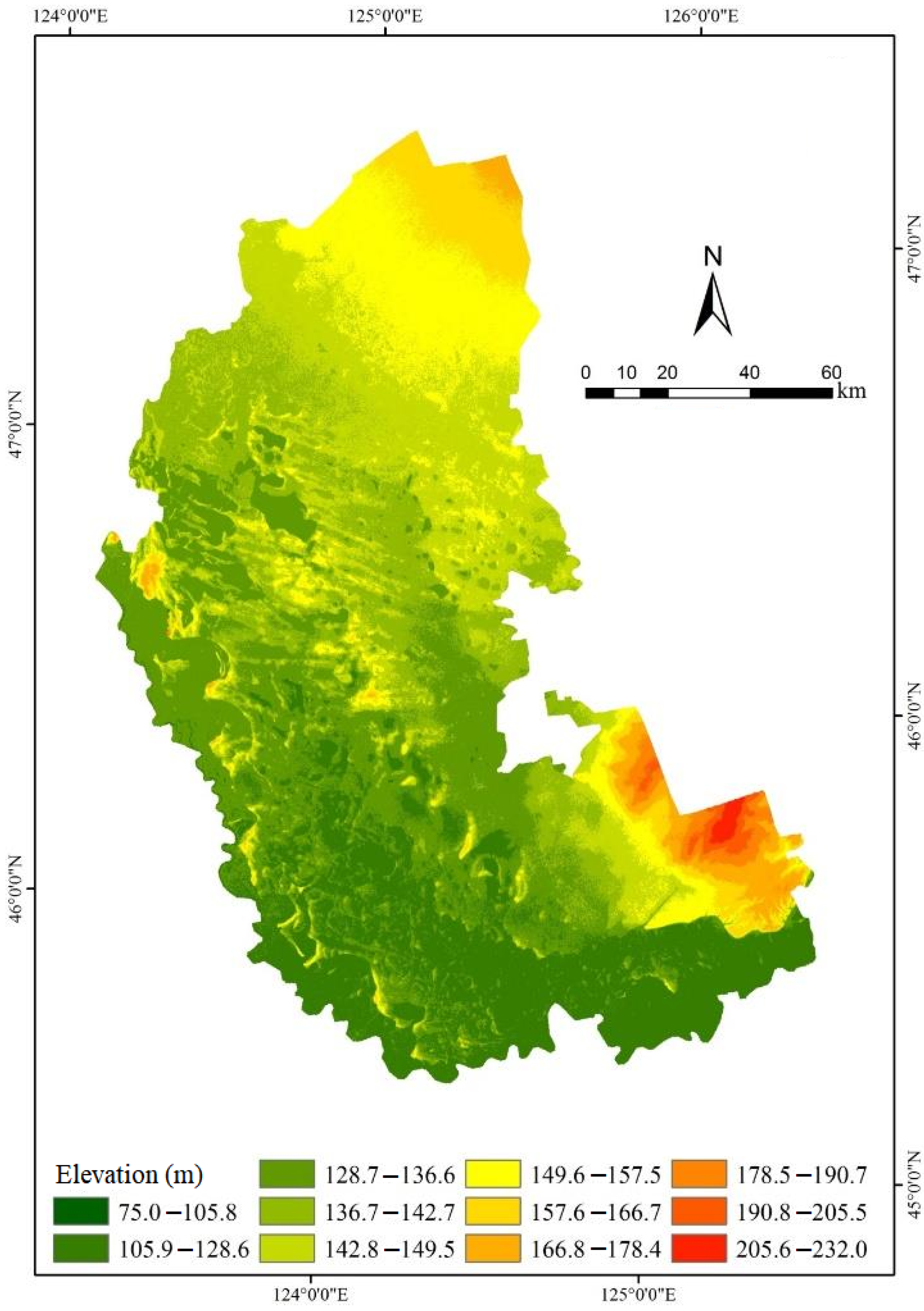
Daqing City is situated in the closed-drainage area of the Songnen Plain. The topography is generally higher in the northeast and lower in the southwest (Figure 2). The Nenjiang and Songhua Rivers flow along the western and southern margins of the city, respectively. Although the region contains numerous lakes and wetlands, it lacks perennial natural rivers within its administrative boundaries. Seasonal rivers, such as the Shuangyang River in the northern part of the city, flow through the broader administrative area but do not provide a permanent natural drainage network. Daqing City is deficient in local water resources. The average annual water resources amount to 19.5 × 10⁸ m3, and the per capita water availability is only 714 m3. Before the operation of the Nen River water diversion projects, water for production and domestic use was mainly sourced from groundwater. With the accelerated development of industry, agriculture, and urban construction, urban water consumption increased sharply, and the area of groundwater overexploitation zones reached a maximum of 1151 km2.
With the operation of the water diversion projects from the Nen River, a substantial volume of its water has been transferred to Daqing. In addition, the implementation of non-engineering measures such as the restriction of groundwater extraction has led to a decreasing trend in groundwater exploitation. In 2023, the total water supply in Daqing was 27.78 × 10⁸ m3, with surface water accounting for 80% and groundwater accounting for 20%. Agricultural irrigation and industrial use account for 80% and 10% of total water use, respectively.
Daqing contains one of the super-giant sandstone oil fields in the world. Daqing is rich in petroleum and natural gas resources and is an important energy-producing base in China. The Daqing Oilfield is located in the central-western part of Heilongjiang Province, with an oil-bearing area of more than 6000 km2. It has proven petroleum geological reserves of 64 × 108 t and proven natural gas reserves of 548.2 × 10⁸ m3. The cumulative production of oil has reached 25 × 108 t. In 2023, the oil production of the Daqing Oilfield was 29.71 × 10⁶ t, and the natural gas production was 53.45 × 10⁸ m3.
Daqing is a modern agricultural demonstration zone in China. With the advantage of black soil in cold regions, the grain yield per unit area is 15% higher than the national average. In 2023, the grain output of Daqing was 460.99 × 10⁴ t. Grain crops occupy nearly 99% of the total planting area. The main crops are rice, corn, beans and wheat. The four main crops are grown in a single annual rotation, with their growth cycles coinciding with the main rainy season. The primary water source for irrigation is surface water, accounting for approximately 74% of total irrigation water, while groundwater contributes the remaining 26%.
After years of high-intensity exploitation, the recoverable reserves of fossil energy have declined seriously. The extensive production mode has led to a continuous decline in soil fertility. Moreover, the shortage of water resources and pollution of the ecological environment have become increasingly prominent. These issues have become the main bottlenecks restricting energy and food production. Strengthening the coordinated management of the WEF nexus has become a primary issue for Daqing’s sustainable development. This is essential to ensure the production advantages of energy and food, guarantee water supply security, balance economic development with environmental protection, and enhance the comprehensive benefits of the WEF system.

3. Methodology

3.1. Scenario Design

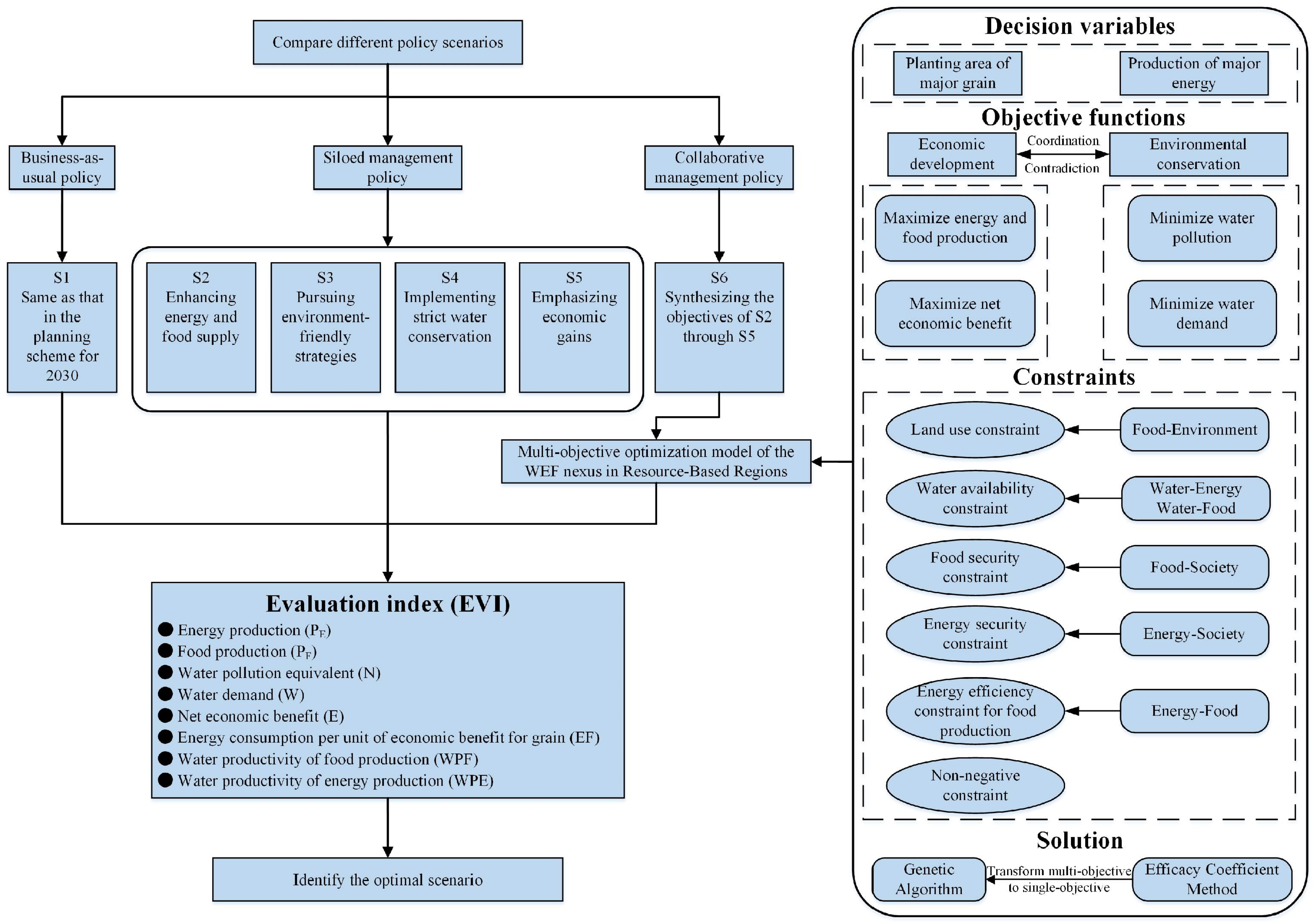
To identify synergistic pathways for optimizing the WEF nexus, six policy scenarios were designed and their impacts on the WEF system were assessed, as illustrated in Figure 3. Scenario 1 (S1) serves as the baseline scenario, derived from Daqing’s 2030 development plan. It reflects the business-as-usual policy, without incorporating any single-policy or collaborative management strategies for the WEF system. Scenarios 2–5 correspond to distinct policy priorities: enhancing energy and food supply (S2), pursuing environment-friendly strategies (S3), implementing strict water conservation (S4), and emphasizing economic gains (S5). To address water resource and environmental challenges in Daqing, a WEFN model was developed by combining multi-objective optimization with the efficacy coefficient method for optimizing the WEF nexus in RBRs. The WEFN model incorporates the internal couplings and external linkages of the WEF nexus in setting up its objective functions and constraints. Specifically, the objective function is formulated to capture the impacts of energy and food production on economic benefits, water use, and the water environment. The constraint set encompasses considerations such as the influence of energy inputs on agriculture, social demands, and the limitations imposed by water and land availability on production. S6, which is implemented by applying the WEFN model, represents a collaborative management policy formulated by synthesizing the objectives of S2 through S5. This involves maximizing production and net economic benefits while minimizing water demand and water pollution.

3.2. Optimization Models

3.2.1. Decision Variables

In this study, the planting area of major grain crops and the production of major energy in Daqing are taken as the decision variables of the WEFN model, as shown in Table 1.

3.2.2. Objective

Grounded in the specific challenges and policy priorities of Daqing, the objective functions of the WEFN model were selected to capture the region’s fundamental priorities and critical challenges. Maximizing food and energy production reflects Daqing’s strategic role in ensuring national food and energy security. Minimizing water pollution targets the most pressing environmental challenge constraining local WEF coordination. Minimizing water demand addresses severe regional water scarcity and the need for efficiency gains. Maximizing net economic benefits ensures that policies remain economically viable and support sustainable regional development.
(1) Maximize energy and food production
max f 1 x = i = 1 4 a i x i P F + i = 5 6 b i x i P E
where ai is the yield per unit area for food i (t/km2), bi is the conversion coefficient of energy i to standard coal (tce/t or tce/m3), PF is the food production in the base year (t), and PE is the energy production in the base year (tce).
(2) Minimize water pollution
min f 2 x = i = 1 4 f i m x i + i = 5 6 g i n x i
where fi is the pollutant emissions per unit area for food i (kg/km2), gi is the pollutant emissions per unit production for energy i (kg/t or kg/m3), m is the pollution equivalent value of pollutants from food production (kg), and n is the pollution equivalent value of pollutants from energy production (kg).
(3) Minimize water demand for food and energy production
min f 3 x = 1 η i = 1 4 c i x i + i = 5 6 d i x i
where ci is the irrigation water demand per unit area for food i (m3/km2), η is the effective utilization coefficient of irrigation water in farmland, and di is the water demand per unit production for energy i (m3/t or m3/m3).
(4) Maximize net economic benefit
max f 4 x = i = 1 4 h i x i + i = 5 6 j i x i
where hi is the net economic benefit per unit area for food i (CNY/km2), and ji is the net economic benefit per unit production for energy i (CNY/t or CNY/m3).
The WEFN model is a multi-objective optimization framework developed to identify trade-offs and synergies among water, energy, and food sectors, thereby providing a scientific basis for collaborative management. The Efficacy Coefficient Method is employed to conduct a comprehensive evaluation of the WEF system performance. The WEFN model uses the geometric mean of the efficacy functions of four sub-objectives as the objective function [31]. Its objective function is to maximize D(x), as shown in Equation (5). This approach ensures that underperformance in any single objective substantially reduces the overall score, reflecting the coordinated development principle of the WEF nexus, where all dimensions must be advanced together without sacrificing any single component.
D x = i = 1 k d i ( x ) k
where di(x) is the efficacy function of the sub-objective function fi(x), and k is the number of sub-objectives. The larger the value of D(x) (0 ≤ D(x) ≤ 1), the better the performance of the design scenario.
Consider a multi-objective optimization problem with k sub-objective functions under given constraints. Among these, s sub-objective functions are to be minimized, and the remaining k-s are to be maximized. The efficacy function for each sub-objective is defined as follows:
The minimum and maximum values of each sub-objective function are obtained in the feasible region D.
f i 1 = min f i ( x ) f i 2 = max f i ( x ) ( i = 1,2 , ,   k )
For the s sub-objective functions fi(x) to be minimized, the efficacy function is calculated using Equations (7) and (8):
    d i x = 1           f i x = f i 1 0           f i x = f i 2 ( i = 1,2 , ,   s )
d i x = f i ( 2 ) f i ( x ) f i ( 2 ) f i ( 1 )           ( i = 1,2 , ,   s )
For the k-s sub-objective functions fi(x) to be maximized, the efficacy function is calculated using Equations (9) and (10):
d i x = 1           f i x = f i 2 0           f i x = f i 1 ( i = s + 1 , ,   k )
d i x = f i x f i ( 1 ) f i ( 2 ) f i ( 1 )           ( i = s + 1 , ,   k )
The calculation formula of the efficacy function corresponding to the k sub-objective functions is shown in Equation (11).
d i x = f i ( 2 ) f i ( x ) f i ( 2 ) f i ( 1 )           ( i = 1,2 ,   ,   s )         f i x f i ( 1 ) f i ( 2 ) f i ( 1 )           ( i = s + 1 , ,   k )

3.2.3. Constraints

The WEF model incorporates both the internal couplings and external linkages of the nexus system through specific constraint formulations. The internal resource couplings are represented as follows: the water-food nexus by water consumption in food production, the energy-water nexus by water consumption in energy production, and the energy-food nexus by energy consumption in food production. Concurrently, the model addresses key external linkages: the food-environment interrelation through land resource constraints on cultivation, and the energy-society and food-society interrelations through their respective capacities to meet societal demand.
(1) Land use constraint
Considering food requirements and prevailing grain production practices, the grain planting area is constrained by both an upper limit (the target value of the 2030 agricultural development plan) and a lower limit (the actual planting area recorded in the base year of 2023).
l A min i = 1 4 x i l A max
L F A i x i U F A i           i = 1 , 2 , 3 , 4
where l is the multiple crop index, Amax is the maximum planting area for grain (km2), Amin is the minimum planting area for grain (km2), LFAi is the lower limit of land availability for food i (km2), and UFAi is the upper limit of land availability for food i (km2).
(2) Water availability constraint
The water demand for grain irrigation should be less than the water availability for irrigated agriculture. Based on the relevant water quota standards of Heilongjiang Province (2025), the agricultural water supply guarantee rate should be no less than 75%.
    Q F 1 η i = 1 4 c i x i 0.75
where QF is the water availability for irrigated agriculture (m3).
The water demand for energy production should be less than the water availability for the energy industry. Based on the 14th Five-Year Plan for Water Conservancy Development in Daqing, a minimum industrial water supply guarantee rate of 95% is required.
Q E i = 5 6 d i x i 0.95
where QE is the water availability for the energy industry (m3).
(3) Food security constraint
The grain production should be no less than the target production of the regional grain development plan. The per capita production of grain should satisfy the minimum requirements set by the State Council. The grain self-sufficiency rate should meet the socioeconomic targets established for ensuring food security.
i = 1 4 a i x i P F F
i = 1 4 a i x i T P R S F
i = 1 4 a i x i F F C F S R
where PFF is the target production in the regional food development plan (t), TP is the total population of the region, RSF is the minimum requirement for per capita grain production (t per capita), FFC is the total grain consumption in the planning year (t), and FSR is the lower limit of the grain self-sufficiency rate.
(4) Energy security constraint
Energy production must meet or exceed the minimum production target set in the regional energy development plan, while remaining within the maximum production capacity. The energy self-sufficiency rate should meet the socioeconomic targets established for ensuring energy security.
P O min x 5 P O max
P G min x 6 P G max
i = 5 6 b i x i E F C E S R
where POmin is the lower limit of oil production (t), POmax is the upper limit of oil production (t), PGmin is the lower limit of natural gas production (m3), PGmax is the upper limit of natural gas production (m3), EFC is the energy consumption in the planning year (tce), and ESR is the lower limit of the energy self-sufficiency rate.
(5) Energy efficiency constraint for food production
Chemical fertilizers, pesticides, diesel, and electricity account for the majority of the total energy consumption in grain production [32,33]. Therefore, this study considers chemical fertilizers, pesticides, diesel, and electricity as energy inputs in the process of grain production. Within the WEFN model, compared to the base year (2023), the energy consumption per unit economic benefit of grain is required to decrease, thereby improving energy utilization efficiency.
i = 1 4 E f i x i + i = 1 4 E p i x i + i = 1 4 E d i x i + i = 1 4 E e i x i i = 1 4 h i x i E I F
where Efi is the chemical fertilizer consumption per unit area for food i (tce/km2), Epi is the pesticide consumption per unit area for food i (tce/km2), Edi is the diesel consumption per unit area for food i (tce/km2), Eei is the electricity consumption per unit area for food i (tce/km2), and EIF is the energy consumption per unit economic benefit of grain in the base year (tce/CNY).
(6) Non-negative constraint
The decision variables should not be negative.
x i 0           i = 1 , 2 , , 6

3.3. Method of Solution

In this study, the optimal solutions of the WEFN model were obtained using the GA in MATLAB R2018a [34]. The genetic algorithm was implemented using the built-in GA solver with the following parameters: population size = 200, crossover rate = 0.8, mutation rate = adaptive feasible, and selection method = stochastic uniform. The maximum number of generations was set to 600 (corresponding to 100 times the number of decision variables). Convergence was achieved when the average relative change in the best fitness value over 50 generations fell below 1 × 10⁻⁶.
To verify solution stability, the algorithm was run 20 independent times with different random seeds, yielding very low variability in objective function values (coefficient of variation < 1%) and minimal variation in decision variables (relative differences < 0.5%).

3.4. Evaluation Index

A comprehensive benefit evaluation system for the WEF Nexus in RBRs was constructed, as detailed in Table 2. Based on the impacts of energy and food production processes on the resource, social, economic, and environmental subsystems, this evaluation system selects indicators from the internal couplings and external linkages of the WEF nexus to compare and assess different policy scenarios.
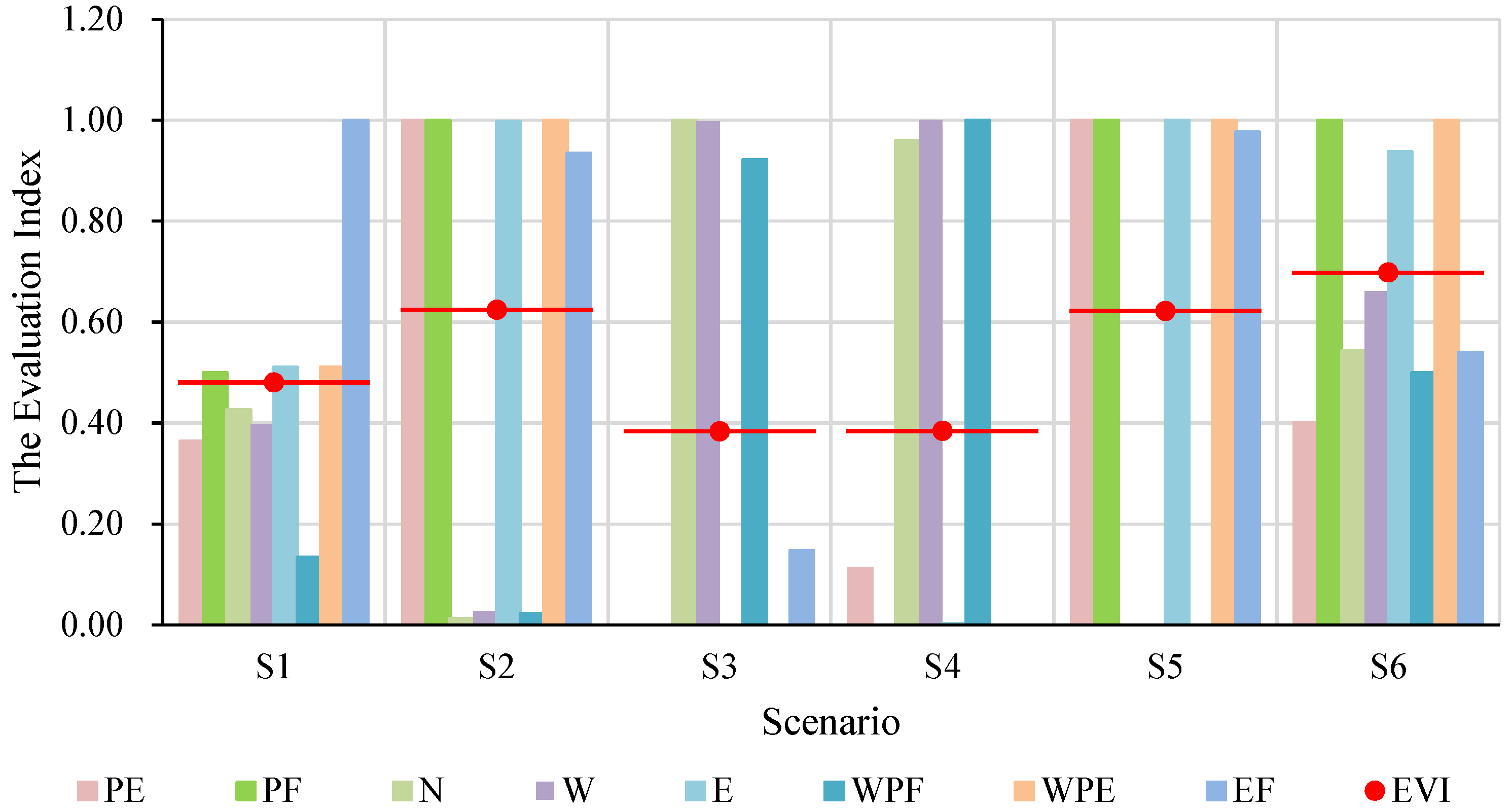
Based on this system, an Evaluation Index (EVI) is derived to quantify the comprehensive benefits of the WEF system and identify the optimal policy scenario. As shown in Equation (24), the EVI is calculated using an equal-weight coefficient method as the arithmetic mean of eight normalized indicators: energy production (PE), food production (PF), water pollution equivalent (N), net economic benefit (E), water demand (W), energy consumption per unit of economic benefit for grain (EF), water productivity of food production (WPF), and water productivity of energy production (WPE). The scenario with the largest value of EVI is the best scenario. The use of equal weighting was motivated by the need to avoid subjective bias and the lack of a universally accepted hierarchy among WEF nexus dimensions. Following common practices in composite index construction [35], this approach ensures transparency and neutrality in the absence of a priori weighting information.
E V I = ( P E + P F + N + E + W + E F + W P F + W P E ) 8
The indicators of EVI are normalized in order to exclude the influence of different dimensions by applying the Min-Max normalization technique. Equation (25) is applied when a higher value of an indicator (benefit type) is preferable for the WEF system. Conversely, Equation (26) is used when a lower value is preferable (cost type).
F i = f i a ( x ) m i n f i ( x ) m a x f i ( x ) m i n f i ( x )
F i = 1 f i a ( x ) m i n f i ( x ) m a x f i ( x ) m i n f i ( x )
where fia(x) is the actual value of EVI’s indicator i, minfi(x) is the minimum value of EVI’s indicator i, and maxfi(x) is the maximum value of EVI’s indicator i.

4. Application

4.1. Data Collection

The WEFN model is a comprehensive model using many parameters associated with the WEF system. The WEFN model parameters are divided into four categories: water-related parameters, energy-related parameters, food-related parameters, and socio-economic and environmental parameters. The WEFN model takes 2023 as the base year and 2030 as the planning year. The parameters of the WEFN model were obtained through literature review and on-site investigation.

4.2. Water-Related Parameters

The water-related parameters (Table A1) were collected from the Water Resources Bulletin of Daqing City, the Water Quota Standards in Heilongjiang Province, the 14th Five-Year Development Plan of Water Conservancy, and the Water Resources Management report of Daqing City. Based on Daqing City’s strictest “Three Red Lines” water resource indicators and the proportion of water used for grain and energy production in the base year, the available water for grain irrigation is projected to reach 24.81 × 10⁸ m3 in 2030, and the available water for energy production is estimated to be 3.67 × 10⁸ m3. According to the water efficiency control targets of Daqing City, the effective utilization coefficient of irrigation water will reach 0.64 in 2030.

4.3. Energy-Related Parameters

The energy-related parameters (Table A2) were obtained from the Statistical Yearbook of Daqing City, the Sustainable Development Plan of Daqing Oilfield, General rules for calculation of the comprehensive energy consumption (GB/T 2589-2020) [36], and the Strategic Action Plan for Energy Development of China. According to the Sustainable Development Plan of Daqing Oilfield, the oil and gas equivalent of Daqing Oilfield will remain at (20–25) × 106 t in 2050. The lower and upper limits of oil and natural gas output in 2030 were obtained through interpolation. Based on the total energy consumption of Daqing City over the years, the total energy consumption in 2030 was calculated using the trend extrapolation method. The conversion coefficients of oil to standard coal and of natural gas to standard coal were obtained from GB/T 2589-2020 [36]. According to the Strategic Action Plan for Energy Development of China, the lower limit of the energy self-sufficiency rate in 2030 is set at 85%.

4.4. Food-Related Parameters

The food-related parameters (Table A3) were collected from the Statistical Yearbook of Daqing City, the Development Plan of Modern Agriculture in Daqing, the Long-Term Plan Outline for Food Security in China, and field research. According to the 14th Five-Year Plan for the Development of Planting Industry in Daqing City, the upper and lower limits of land availability for corn, rice, wheat, and beans are determined, and the target for the grain output in 2030 is set to 465 × 104 t. Based on the total grain consumption of Daqing City over the years, the total food consumption in 2030 is calculated using the trend extrapolation method. According to the Long-Term Plan Outline for Food Security in China, the lower limit of the grain self-sufficiency rate in 2030 is set at 95%. With reference to the grain security indicators of the Development Research Center of the State Council of China, the minimum requirement for per capita grain production is set to 400 kg. The direct energy input for grain production mainly includes diesel fuel required for agricultural machinery operations and electricity required for water pumping. The indirect energy inputs mainly involve the application of chemical fertilizers and pesticides. The calculation of fertilizer consumption primarily focuses on nitrogen, phosphate, potash, and compound fertilizers. The energy consumption of grain production in Daqing is calculated using Equation (27). The energy consumption per unit of economic benefit for grain is calculated by dividing the energy consumption in grain production by economic benefits.
E = E f + E p + E d + E e = i = 1 4 s i σ f i + m p σ p + R P σ d + I σ e
where E is the energy consumption per unit area of grain production (tce/km2), Ef is chemical fertilizer consumption per unit area (tce/km2), Ep is pesticide consumption per unit area (tce/km2), Ed is the diesel consumption per unit area (tce/km2), Ee is the electricity consumption per unit area (tce/km2), si is the application rate of fertilizer i per unit area (kg/km2), σfi is the conversion coefficient of fertilizer i to standard coal (tce/kg), mp is the application rate of pesticides per unit area (kg/km2), σp is the conversion coefficient of pesticides to standard coal (tce/kg), R is the diesel cost per unit area (CNY/km2), P is the price of diesel (CNY/kg), σd is the conversion coefficient of diesel to standard coal (tce/kg), I is the electricity consumption per unit area (kWh/km2), and σe is the conversion coefficient of electricity to standard coal (kWh/kg).

4.5. Parameters for Society, Economy and Environment

The parameters for society, economy and environment (Table A4) were obtained from the Statistical Yearbook of Daqing City, the Economic and Social Development Plan of Daqing City, the Agricultural Product Price Information Network of Heilongjiang Province, the Environmental Statistics Yearbook of Daqing City, and the Manual on Emission Coefficients of Non-Point Source Pollution from Farmland in China. The population of Daqing City in 2030 is predicted by the natural increase method. The pollution equivalent is obtained by multiplying the pollutant emission quantity by the pollution equivalent value. Total phosphorus and total nitrogen are selected as typical pollutants in grain production, while COD and ammonia nitrogen are selected as typical pollutants in energy production.

5. Results and Discussion

5.1. Analysis of the Indicators Under Different Policy Scenarios

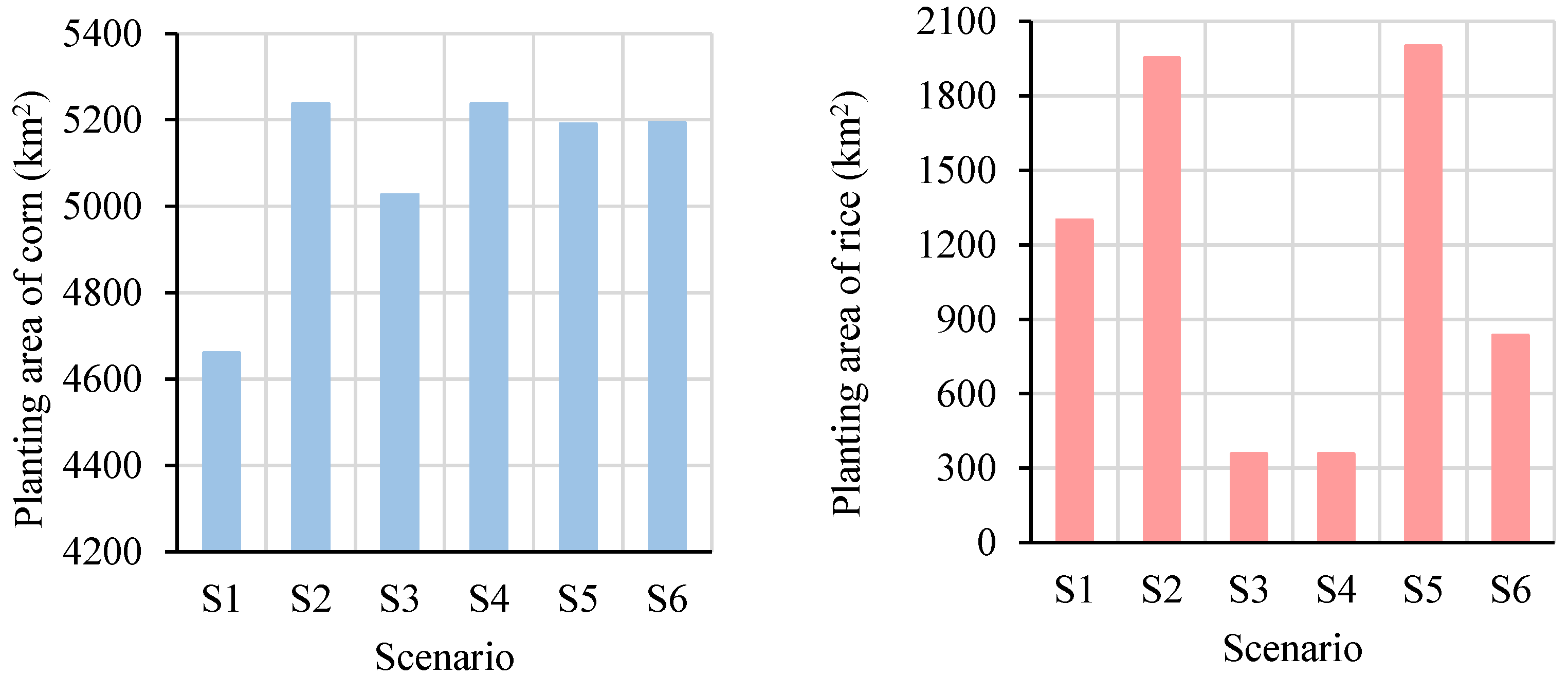
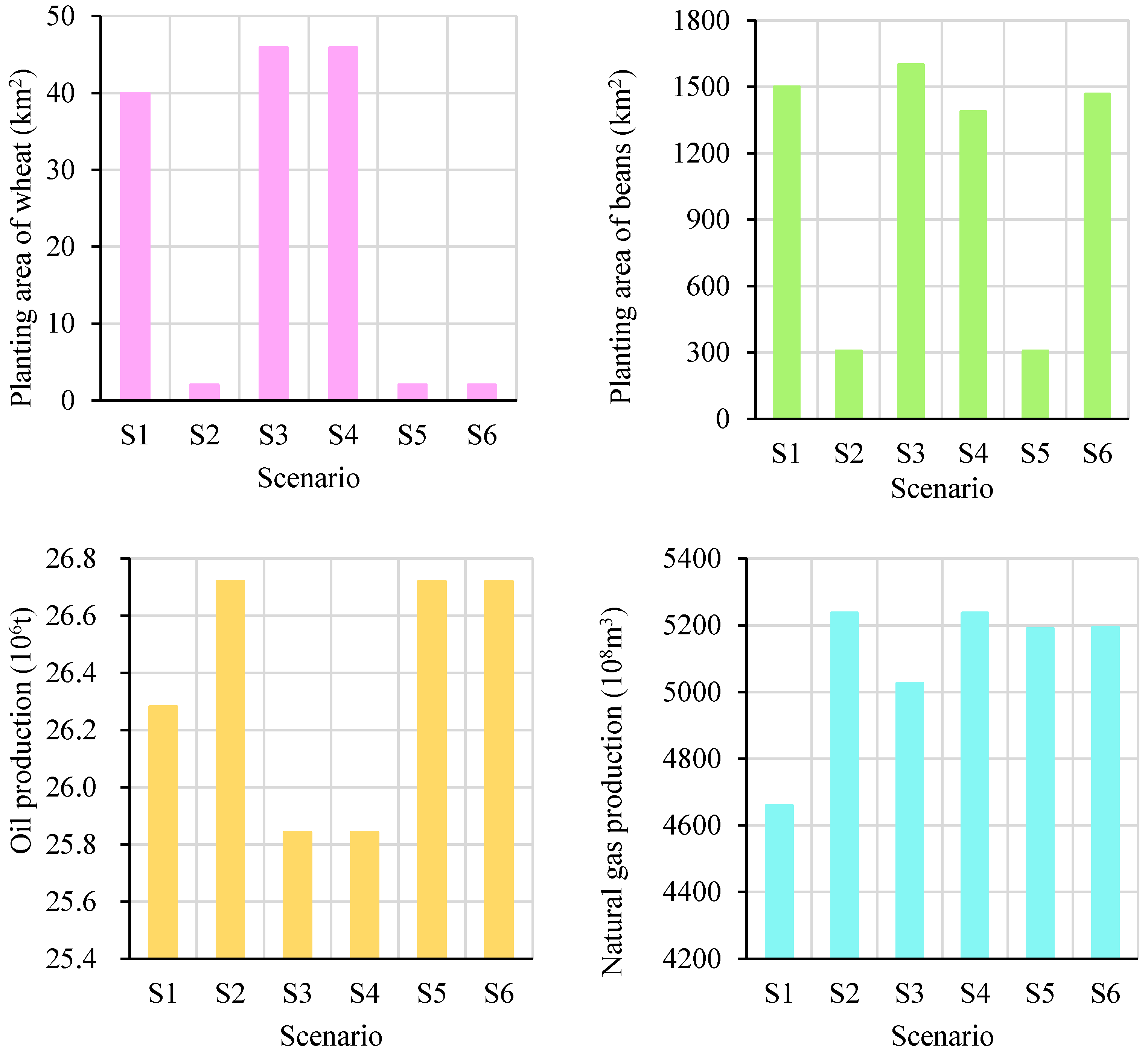
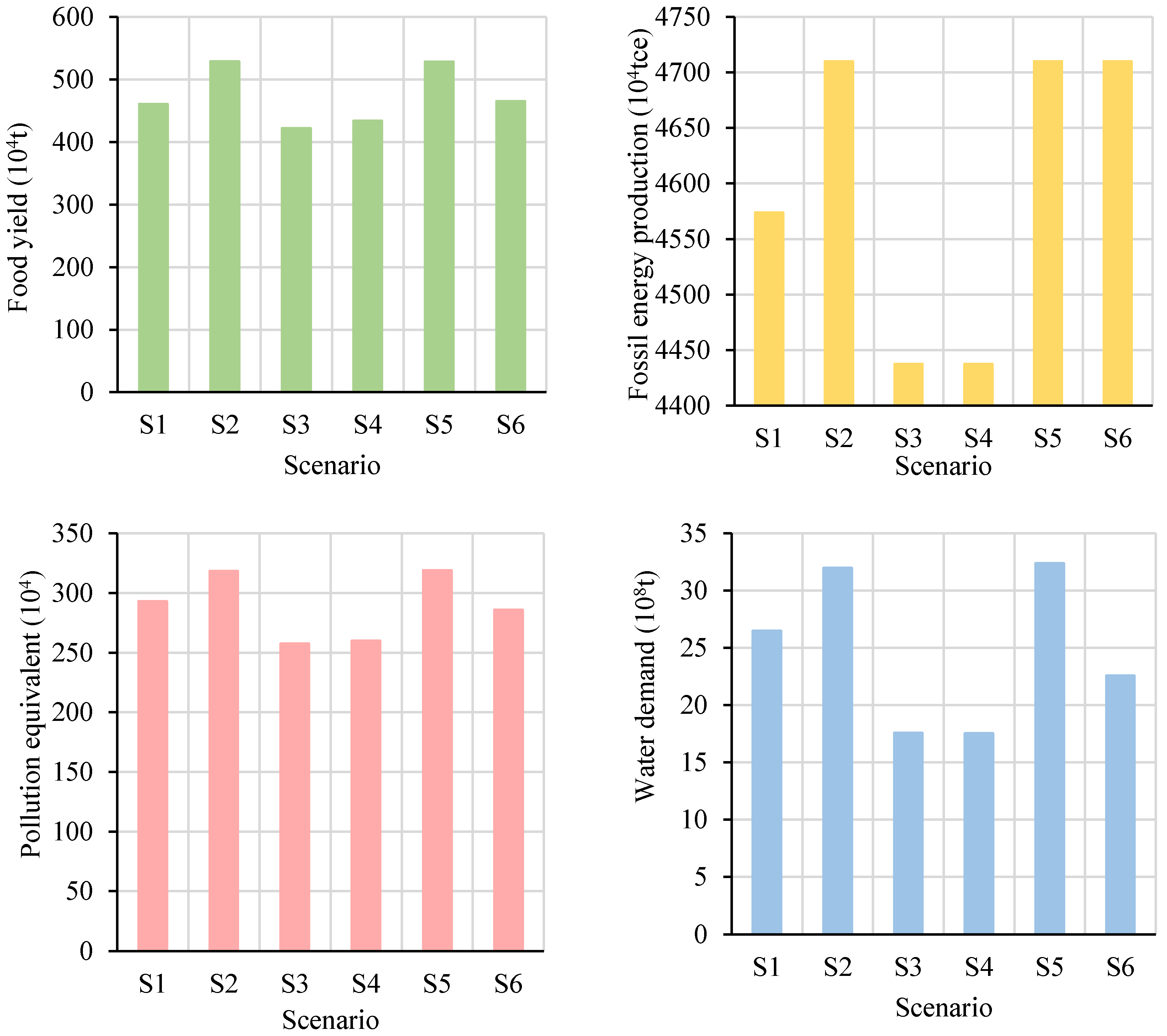
The indicators of the WEF system under different scenarios are detailed in Figure 4. The total grain planting area is reduced by approximately 10% under scenarios that prioritize environmental protection (S3) and water conservation (S4). The planting areas of different grain crops fluctuate significantly due to policy influences. Under the policy aimed at boosting grain production, compared with S1, the planting areas of corn and rice, which have relatively high per-unit yields, increased by 577.85 km2 and 652.98 km2 in S2, respectively. To reduce water pollution from grain farming, the planting areas of wheat and beans—which are less polluting during cultivation compared to other grains—have been increased in S3 to their permitted maximums, increasing by 5.9 km2 and 100 km2, respectively. In S4, the planting area of rice, a crop with high irrigation water requirements, decreased by 72.4%, while the areas allocated to corn and wheat, which have lower irrigation water demands, were increased to their permitted maximums, thereby achieving the water-saving objective. Driven by a policy oriented toward maximizing economic returns, the planting area of rice, a crop with comparatively high economic value, increased by 700 km2 in S5, while the areas for wheat and beans were reduced to their permitted minimums. In S6, the planting area of wheat approached its permitted lower limit, whereas the areas allocated to corn, rice, and legumes fell within their respective permissible ranges between the upper and lower limits. Regarding energy production for S2 to S5, oil and natural gas output reached the permitted maximums in all cases except S3 and S4. Considering that the local consumption of oil and natural gas in 2030 is approximately 15.06 × 10⁶ t and 34.85 × 10⁸ m3, respectively, the external energy transfers under the baseline scenario (S1) are 11.22 × 10⁶ t for oil and 26.75 × 10⁸ m3 for natural gas. Compared with S1, the policy-driven increases in fossil energy production under S2, S5, and S6 lead to a 3.91% rise in oil exports and a 20.6% rise in natural gas exports, implying an increase of 0.039 × 10⁸ m3 in local energy-related water consumption. Under the two policy scenarios of environmentally friendly (S3) and strict water conservation (S4), coupled with differences in resource endowments, oil and natural gas production decreased by 3.29% and 16.44%, respectively. Consequently, external energy transfers of oil and natural gas fall to 10.78 × 10⁶ t and 21.23 × 10⁸ m3, respectively, resulting in a 4.26% reduction in local energy-related water consumption.

5.2. Comparison of Internal Couplings of the WEF Nexus Under Different Scenarios

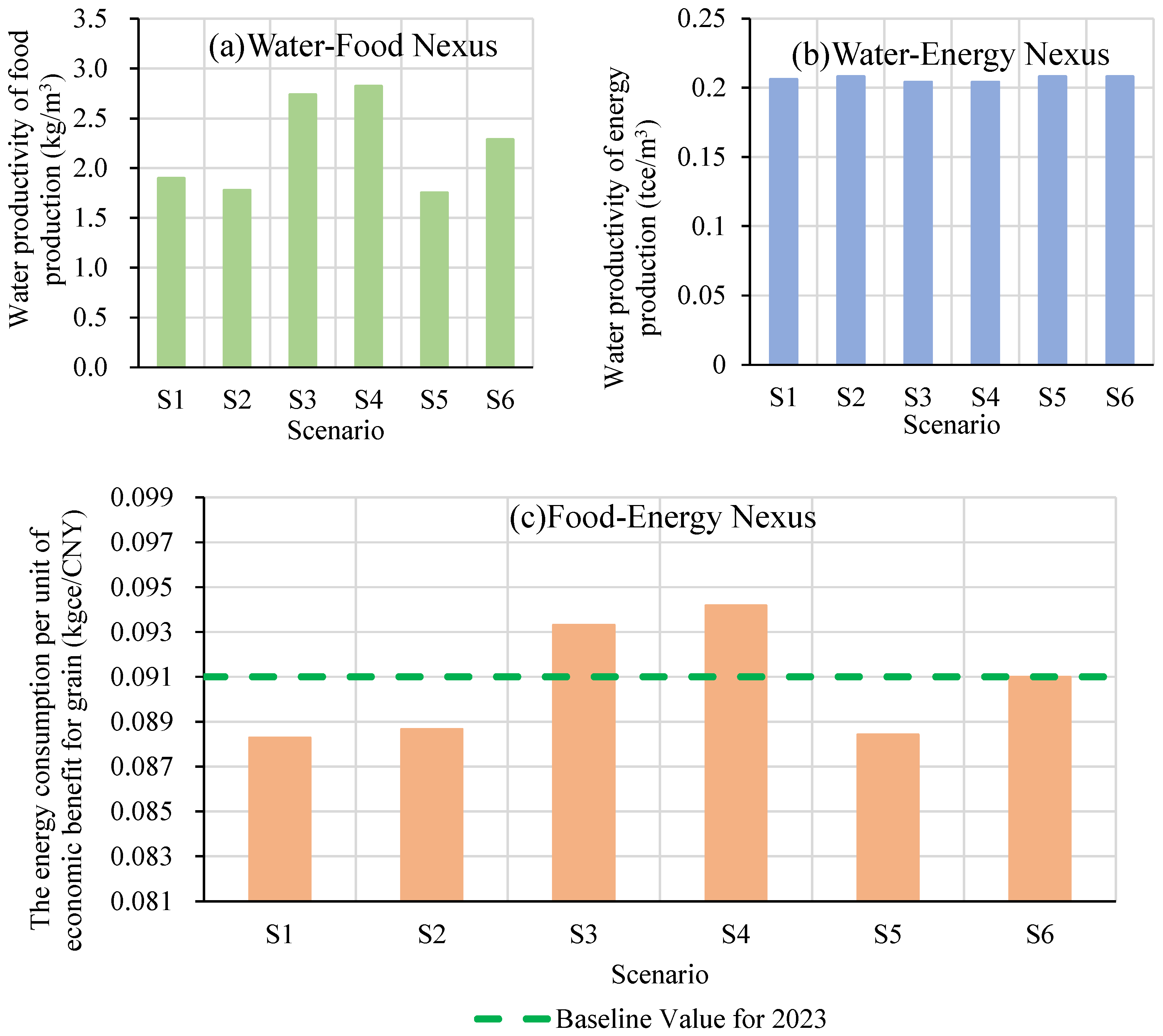
Comparison of internal couplings of the WEF nexus under different scenarios is shown in Figure 5. In Figure 5a, the water productivity of food production follows the order: S4 > S3 > S6 > S1 > S2 > S5. The water productivity of food production in S3, S4, and S6 was higher than that in S1, reaching 2.74, 2.83, and 2.29 kg/m3, respectively. This is primarily due to the shift in cropping structure, specifically the expansion of corn cultivation (which has a higher water productivity of 6.65 kg/m3) and the reduction in rice planting area (which has a lower water productivity of 1.09 kg/m3). In Figure 5b, the water use efficiency in the energy production process showed little variation across the six policy scenarios. The water productivity of energy production in S2, S5, and S6 was higher than that in S1. The water productivity of natural gas production (0.71 tce/m3) is higher than that of oil (0.18 tce/m3). Consequently, scenarios characterized by a higher proportion of natural gas output in the energy mix (such as S2, S5, and S6 in Figure 4) yield greater overall water use efficiency as a logical outcome of these coefficients. In Figure 5c, the energy consumption per unit of economic benefit for grain follows the order: S4 > S3 > S6 > S2 > S5 > S1. In S3 and S4, the energy consumption per unit of economic benefit for grain production exceeded the 2023 baseline (0.091 kgce/CNY). In contrast, all other scenarios remained below this benchmark. As a major energy-producing region, Daqing City has a relatively abundant energy supply for grain production. Therefore, S1, S2, S5, and S6 all satisfy the requirements for enhancing energy use efficiency in the grain production process.

5.3. Comparison of Objectives Under Different Scenarios

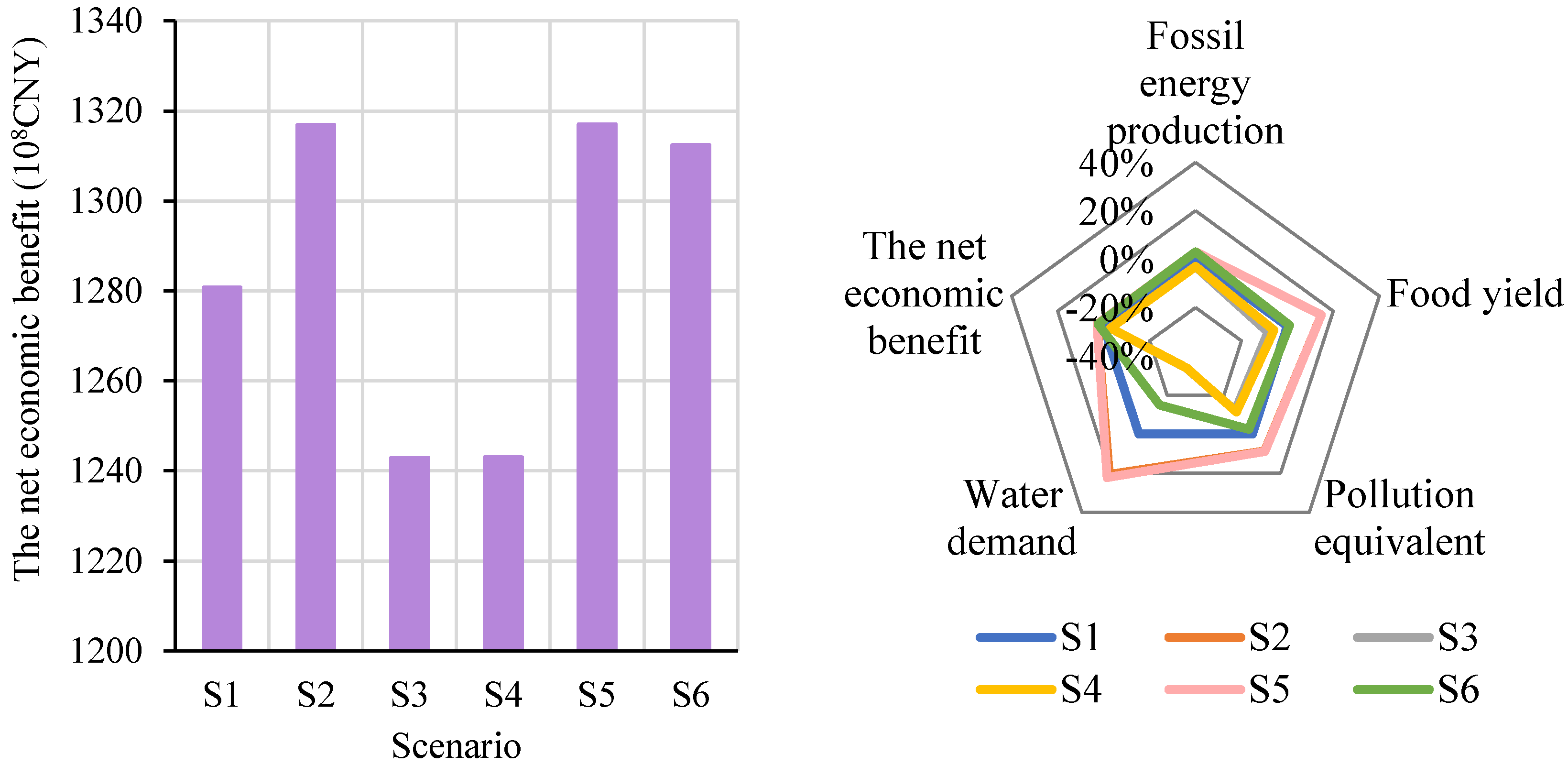
The objectives of the WEF system under different scenarios are illustrated in Figure 6. This result clearly demonstrates the trade-offs within the WEF system among increasing production, water conservation, environmental protection, and enhancing net economic benefits. In 2030, the food production of the planning scheme (S1) is 461.02 × 10⁴ t, the fossil energy production is 4573.96 × 104 tce, the water demand is 26.50 × 10⁴ t, the pollution equivalent of water environment is 292.98 × 10⁴, and the net economic benefit is 1280.79 × 108 CNY. Compared with S1, in S2, driven by policies aimed at increasing grain and energy production, the expansion of corn and rice planting areas led to a food yield increase of 67.85 × 10⁴ t, and the rise in fossil energy production reached 136.04 × 10⁴ tce. Accordingly, net economic benefits, water demand, and the water pollution equivalent increased by 36.16 × 10⁸ CNY, 5.49 × 10⁸ t, and 25.36 × 10⁴, respectively. Guided by the environmentally friendly policy, the planting area of wheat and beans, which cause less pollution during cultivation, was expanded in S3. This led to an 8.43% decrease in total grain production. Fossil energy production also recorded a decrease of 2.98%. Accordingly, both the water pollution equivalent and net economic benefits fell by 32.8 × 10⁴ and 37.67 × 10⁸ CNY, respectively. In S4, influenced by the strict water-saving policy, the reduction in the planting area of water-intensive crops (such as rice and beans) and in fossil energy production led to a decrease of 8.96 × 10⁸ t in the total water demand for energy and food production. Correspondingly, both the water pollution equivalent and net economic benefits declined by 11.19% and 2.94%, respectively. In pursuit of maximum economic benefits, S5 involved a reduction in the planting area of wheat and beans, which offer relatively low net economic returns, alongside an increase in oil and natural gas production. This led to the water pollution equivalent, water demand, and net economic benefits increasing by 26.16 × 10⁴, 5.89 × 10⁸ t, and 36.31 × 10⁸ CNY, respectively. In S6, the values for all objectives lie between the minimum and maximum levels observed in the other scenarios. This scenario increases grain output, energy production, and net economic benefits by 0.86%, 2.97%, and 2.48%, respectively, while reducing water demand and the water pollution equivalent by 14.82% and 2.46%. This balance reflects a relatively harmonious interplay within the WEF nexus.

5.4. The Comprehensive Benefit Evaluation of the WEF System Under Different Scenarios

The EVI of water–food–energy nexus under different scenarios is illustrated in Figure 7. The food and energy production, water demand, pollution equivalent, and net economic benefit vary according to the policy orientation of each scenario. S3 performs the worst in terms of enhancing net economic benefit and water productivity of energy production, and the output of food and energy. S6 is the best scenario as it has the highest EVI with a value of 0.7. S6 is followed by S2, S5, S1, S4, and S3. Through collaborative optimization and comprehensive allocation of the WEF resources, in 2030, the planting areas of corn, rice, wheat and beans in S6 are adjusted to 5194.3793 km2, 836.4039 km2, 2.0420 km2, and 1467.1748 km2. The production of oil is increased to 26.7215 × 10⁶ t. The production of natural gas is increased to 67.11 × 10⁸ m3. Specifically, compared to the baseline planning scheme (S1), S6 achieves substantial improvements across all WEF nexus dimensions: food and energy production increase by 3.98 × 10⁴ t and 136.04 × 10⁴ tce, respectively, while net economic benefit rises by 31.71 × 10⁸ CNY. Concurrently, it reduces resource pressure and environmental impact: water demand decreases by 3.93 × 10⁸ m3, and the pollution equivalent of water environment is cut by 7.19 × 10⁴. Furthermore, WEF system efficiencies are enhanced: water productivity for food and energy production increases by 0.39 kg/m3 and 0.002 tce/m3, respectively, and the energy consumption per unit economic benefit for grain falls below the 2023 baseline (0.091 kgce/CNY), indicating higher energy efficiency. Collectively, these outcomes confirm that the collaborative management policy underpinning S6 effectively enhances the comprehensive benefits of the WEF system, thereby promoting coordinated socio-economic and environmental development in Daqing.

6. Conclusions and Suggestions

This study developed an integrated optimization model for the WEF nexus in resource-based regions (RBRs), incorporating internal couplings and external linkages. Using Daqing, China, as a case study, six policy scenarios were designed and evaluated through a comprehensive benefit index (EVI). The results demonstrate that the collaborative management scenario (S6) achieves the highest comprehensive benefits, significantly outperforming the baseline scenario (S1), increasing food and energy production while reducing water demand and environmental pollution, and improving WEF system efficiencies across multiple dimensions.
The findings of this study indicate that when formulating regional development strategies and policies, it is essential to consider the internal couplings among water, energy, and food resources as well as their linkages with the society, economy, and environment. Only through this approach can the comprehensive benefits of the WEF system be enhanced, collaborative risks be mitigated, rational resource allocation be promoted, and sustainable socio-economic development be supported.
Resource allocation can be further optimized through a suite of strategies, including the promotion of water-saving technologies, upgrades in energy extraction, the cultivation of drought-resistant crops, the use of environmentally friendly pesticides and fertilizers, and the implementation of well-designed economic policies. However, the real-world implementation of these strategies may face institutional, economic, and technological barriers, such as cross-sectoral coordination challenges, upfront investment costs, and technology scalability issues. Future research should therefore analyze the implementation difficulties, transition costs, and cost-effectiveness of these strategies to enhance policy feasibility and provide more actionable guidance for decision-makers. In addition, stakeholder-derived weights could be explored through participatory methods (e.g., surveys or the Analytic Hierarchy Process), coupled with sensitivity tests to assess the robustness of scenario rankings under different weighting assumptions. Systematic sensitivity analysis should also be employed to account for parameter uncertainty, thereby strengthening the representativeness of optimization results and enhancing the reliability of decision-making guidance. Furthermore, future research could extend the framework to incorporate consumption-side environmental impacts, including CO2 emissions, for a more comprehensive sustainability assessment. Integrating detailed hydrological process modeling, including watershed characterization, water balance components, seasonal variability, climate change impacts, and sectoral water allocation, into the WEF optimization framework would enhance the physical realism of water availability constraints.

Author Contributions

Investigation and writing, C.W.; data curation, H.L.; methodology, M.H.; software, H.Z.; formal analysis, L.C.; conceptualization, Q.G.; review and editing, Y.L.; supervision Y.X.; validation, Y.C. and Y.H. All authors have read and agreed to the published version of the manuscript.

Funding

This research was supported by Shandong Provincial Natural Science Foundation (Grant No. ZR2024QE357).

Data Availability Statement

The data presented in this study are available on request from the corresponding author due to confidentiality agreements with the collaborating organizations that participated in the research.

Acknowledgments

The authors gratefully acknowledge the editor and anonymous reviewers for their comments, which greatly contributed to improving the quality of the manuscript.

Conflicts of Interest

The authors declare no conflicts of interest.

Appendix A

Table A1. Water-related parameters.
ParameterNumerical Value
The available water for irrigated agriculture24.81 × 108 m3
The available water for energy industry3.67 × 108 m3
The irrigation water demand per unit area for corn11 × 104 m3/km2
The irrigation water demand per unit area for rice66 × 104 m3/km2
The irrigation water demand per unit area for wheat8 × 104 m3/km2
The irrigation water demand per unit area for beans12 × 104 m3/km2
The water demand per unit production for oil8 m3/t
The water demand per unit production for natural gas2.6 m3/t
The effective utilization coefficient of irrigation water0.64
Table A2. Energy-related parameters.
ParameterNumerical Value
Oil production in the base year (2023)29.71 × 10⁶ t
Natural gas production in the base year (2023)53.45 × 10⁸ m3
Fossil energy production in the base year (2023)4955.26 × 104 tce
The lower limit of oil production25.8429 × 106 t
The upper limit of oil production26.7215 × 106 t
The lower limit of natural gas production56.08 × 108 m3
The upper limit of natural gas production67.11 × 108 m3
Oil production in the planning scheme (2030)26.2822 × 10⁶ t
Natural gas production in the planning scheme (2030)61.60 × 10⁸ m3
The energy consumption in the planning year (2030)4270.81 × 104 tce
The lower limit of the energy self-sufficiency rate85%
The conversion coefficient of oil to standard coal1.4286 tce/t
The conversion coefficient of natural gas to standard coal0.00133 tce/m3
Table A3. Food-related parameters.
ParameterNumerical Value
Corn production in the base year (2023)361.54 × 10⁴ t
Rice production in the base year (2023)80.84 × 10⁴ t
Wheat production in the base year (2023)0.97 × 10⁴ t
Beans production in the base year (2023)15.82 × 10⁴ t
Food yield (2023)459.17 × 10⁴ t
Yield per unit area for corn732 t/km2
Yield per unit area for rice718 t/km2
Yield per unit area for wheat341 t/km2
Yield per unit area for beans168 t/km2
The target for the grain output in the planning year (2030)465 × 104 t
The food consumption in the planning year (2030)198.92 × 10⁴ t
The planting area of corn in the planning scheme (2030)4660 km2
The planting area of rice in the planning scheme (2030)1300 km2
The planting area of wheat in the planning scheme (2030)40 km2
The planting area of beans in the planning scheme (2030)1500 km2
The lower limit of land availability for corn3333.33 km2
The upper limit of land availability for corn5237.85 km2
The lower limit of land availability for rice358.82 km2
The upper limit of land availability for rice2000 km2
The lower limit of land availability for wheat2.04 km2
The upper limit of land availability for wheat45.9 km2
The lower limit of land availability for beans307.13 km2
The upper limit of land availability for beans1600 km2
The lower limit of the grain self-sufficiency rate95%
The lower limit of land availability for grain7031.08 km2
The upper limit of land availability for grain7500 km2
The minimum requirement for per capita grain production0.4 t per capita
The energy consumption per unit of economic benefit for grain0.091 kgce/CNY
Table A4. Parameters for society, economy and environment.
ParameterNumerical Value
The total population in the planning year (2030)247.35 × 10⁴
The net economic benefit per unit area for corn39.503 × 104 CNY/km2
The net economic benefit per unit area for rice70.284 × 104 CNY/km2
The net economic benefit per unit area for wheat1.875 × 104 CNY/km2
The net economic benefit per unit area for beans30.762 × 104 CNY/km2
The net economic benefit per unit production for oil4118 CNY/t
The net economic benefit per unit production for natural gas2.70 CNY/m3
The pollution equivalent for per capita production of corn385/km2
The pollution equivalent for per capita production of rice555/km2
The pollution equivalent for per capita production of wheat305/km2
The pollution equivalent for per capita production of beans268/km2
The pollution equivalent for per unit production of oil0.3874/106 t
The pollution equivalent for per unit production of natural gas1085.55/108 m3

References

  1. Yang, W.; Chen, J.; Ding, T.; Yan, X.; Gong, W. Supply-Demand Security Assessment of Water-Energy-Food Systems: A Perspective on Intra-City Coupling and Inter-City Linkages of Ecosystem Services. Sustain. Cities Soc. 2024, 117, 105964. [Google Scholar] [CrossRef]
  2. Radmehr, R.; Ghorbani, M.; Ziaei, A.N. Quantifying and Managing the Water-Energy-Food Nexus in Dry Regions Food Insecurity: New Methods and Evidence. Agric. Water Manag. 2021, 245, 106588. [Google Scholar] [CrossRef]
  3. Wu, H.; Yue, Q.; Guo, P.; Xu, X.Y. Exploiting the Potential of Carbon Emission Reduction in Cropping-Livestock Systems: Managing Water-Energy-Food Nexus for Sustainable Development. Appl. Energ. 2025, 377, 124443. [Google Scholar] [CrossRef]
  4. Davis, K.F.; Rulli, M.C.; Seveso, A.; D’Odorico, P. Increased Food Production and Reduced Water Use through Optimized Crop Distribution. Nat. Geosci. 2017, 10, 919–924. [Google Scholar] [CrossRef]
  5. Purwanto, A.; Susnik, J.; Suryadi, F.X.; de Fraiture, C. Water-Energy-Food Nexus: Critical Review, Practical Applications, and Prospects for Future Research. Sustainability 2021, 13, 1919. [Google Scholar] [CrossRef]
  6. Yang, G.Q.; Su, Y.X.; Huo, L.J.; Guo, D.P.; Wu, Y.S. A Multi-Objective Synergistic Optimization Model Considering the Water-Energy-Food-Carbon Nexus and Bioenergy. Agric. Water Manag. 2025, 312, 109431. [Google Scholar] [CrossRef]
  7. Mansour, F.; Al-Hindi, M.; Najm, M.A.; Yassine, A. The Water Energy Food Nexus: A Multi-Objective Optimization Tool. Comput. Chem. Eng. 2024, 187, 108718. [Google Scholar] [CrossRef]
  8. Mansour, F.; Al-Hindi, M.; Najm, M.A.; Yassine, A. Multi-Objective Optimization for Comprehensive Water, Energy, Food Nexus Modeling. Sustain. Prod. Consum. 2023, 38, 295. [Google Scholar] [CrossRef]
  9. Armagan, K.; Benis, N.E.; Denis, L.; Bruna, G.; Giovanni, B.; Liliana, P.; Fay, B.; Alberto, A.; Arnaud, R.; Joachim, M.; et al. Mapping Water Provisioning Services to Support the Ecosystem–Water–Food–Energy Nexus in the Danube River Basin. Ecosyst. Serv. 2016, 17, 278–292. [Google Scholar] [CrossRef]
  10. Zhang, C.; Chen, X.; Li, Y.; Ding, W.; Fu, G. Water-Energy-Food Nexus: Concepts, Questions and Methodologies. J. Clean. Prod. 2018, 195, 625–639. [Google Scholar] [CrossRef]
  11. Gu, Y.; Dong, Y.; Wang, H.; Keller, A.; Xu, J.; Chiramba, T.; Li, F. Quantification of the Water, Energy and Carbon Footprints of Wastewater Treatment Plants in China Considering a Water-Energy Nexus Perspective. Ecol. Indic. 2016, 60, 402–409. [Google Scholar] [CrossRef]
  12. Mo, W.; Zhang, Q.; Mihelcic, J.R.; Hokanson, D.R. Embodied Energy Comparison of Surface Water and Groundwater Supply Options. Water Res. 2011, 45, 5577–5586. [Google Scholar] [CrossRef] [PubMed]
  13. Radmehr, R.; Brorsen, B.W.; Shayanmehr, S. Adapting to Climate Change in Arid Agricultural Systems: An Optimization Model for Water-Energy-Food Nexus Sustainability. Agric. Water Manag. 2024, 303, 108727. [Google Scholar] [CrossRef]
  14. van Vuuren, D.P.; Bijl, D.L.; Bogaart, P.; Dekker, S.C.; Gernaat, D.E.H.J.; Harmsen, M.; Stehfest, E.; Doelman, J.C.; Biemans, H. Integrated Scenarios to Support Analysis of the Food-Energy-Water Nexus. Nat. Sustain. 2019, 2, 1132–1141. [Google Scholar] [CrossRef]
  15. Romero-Lankao, P.; McPhearson, T.; Davidson, D.J. The Food-Energy-Water Nexus and Urban Complexity. Nat. Clim. Change 2017, 7, 233–235. [Google Scholar] [CrossRef]
  16. Zhang, T.; Tan, Q.; Zhang, T.; He, L.; Yu, X.; Zhang, S. A Multi-Objective Optimization Decision-Making Methodology for Fostering Synergies in the Water-Energy-Food Nexus. J. Clean. Prod. 2024, 479, 144051. [Google Scholar] [CrossRef]
  17. Alamanos, A.; Latinopoulos, D.; Loukas, A.; Mylopoulos, N. Comparing Two Hydro-Economic Approaches for Multi-Objective Agricultural Water Resources Planning. Water Resour. Manag. 2020, 34, 4511. [Google Scholar] [CrossRef]
  18. Wu, H.; Yue, Q.; Guo, P.; Pan, Q.; Guo, S. Sustainable Regional Water Allocation under Water-Energy Nexus: A Chance-Constrained Possibilistic Mean-Variance Multi-Objective Programming. J. Clean. Prod. 2021, 313, 127934. [Google Scholar] [CrossRef]
  19. Yang, G.; Xia, S.; Huo, L.; Li, M.; Zhang, C.; Su, Y.; Guo, D. Two-Stage Multiobjective Decision-Making Method Based on Agricultural Water-Energy-Food Nexus: Case Study in Hetao Irrigation District, China. J. Water Resour. Plan. Manag. 2023, 149, 05023006. [Google Scholar] [CrossRef]
  20. Proctor, K.; Tabatabaie, S.M.H.; Murthy, G.S. Gateway to the Perspectives of the Food-Energy-Water Nexus. Sci. Total Environ. 2021, 764, 142852. [Google Scholar] [CrossRef]
  21. Karamian, F.; Mirakzadeh, A.A.; Azari, A. Application of Multi-Objective Genetic Algorithm for Optimal Combination of Resources to Achieve Sustainable Agriculture Based on the Water-Energy-Food Nexus Framework. Sci. Total Environ. 2023, 860, 160419. [Google Scholar] [CrossRef]
  22. Zeng, X.T.; Zhang, J.L.; Yu, L.; Zhu, J.X.; Li, Z.; Tang, L. A Sustainable Water-Food-Energy Plan to Confront Climatic and Socioeconomic Changes Using Simulation-Optimization Approach. Appl. Energ. 2019, 236, 743–759. [Google Scholar] [CrossRef]
  23. Jing, Z.; Wang, J. Sustainable Development Evaluation of the Society–Economy–Environment in a Resource-Based City of China: A Complex Network Approach. J. Clean. Prod. 2020, 263, 121510. [Google Scholar] [CrossRef]
  24. Li, W.; Yi, P.; Zhang, D.; Zhou, Y. Assessment of Coordinated Development Between Social Economy and Ecological Environment: Case Study of Resource-Based Cities in Northeastern China. Sustain. Cities Soc. 2020, 59, 102208. [Google Scholar] [CrossRef]
  25. Simpson, G.B.; Jewitt, G.P.W. The Development of the Water-Energy-Food Nexus as a Framework for Achieving Resource Security: A Review. Front. Environ. Sci. 2019, 7, 8. [Google Scholar] [CrossRef]
  26. Ma, Q.T.; Yang, Y.H.; Sheng, Z.P.; Han, S.M.; Yang, Y.M.; Moiwo, J.P. Hydro-Economic Model Framework for Achieving Groundwater, Food, and Economy Trade-Offs by Optimizing Crop Patterns. Water Res. 2022, 226, 119342. [Google Scholar] [CrossRef]
  27. Feng, M.Q.; Chen, Y.N.; Li, Z.; Duan, W.L.; Zhu, Z.Y.; Liu, Y.C.; Zhou, Y.Q. Optimisation Model for Sustainable Agricultural Development Based on Water-Energy-Food Nexus and CO2 Emissions: A Case Study in Tarim River Basin. Energy Convers. Manag. 2024, 303, 118174. [Google Scholar] [CrossRef]
  28. Tan, Z.W.; Li, H.; Zhu, Z.Y.; Hou, J.W.; Wang, Z.C. A Water-Energy-Food-Land Nexus Framework for Multi-Objective Optimization and Risk Assessment Integrating Deep Reinforcement Learning and Copula-Based Modeling. Water Res. 2025, 287, 124474. [Google Scholar] [CrossRef]
  29. Scanlon, B.R.; Rudell, B.L.; Reed, P.M.; Hook, R.I.; Zheng, C.; Tidwell, V.C.; Siebert, S. The Food-Energy-Water Nexus: Transforming Science for Society. Water Resour. Res. 2017, 53, 3550–3556. [Google Scholar] [CrossRef]
  30. Yue, Q.; Guo, P. Managing Agricultural Water-Energy-Food-Environment Nexus Considering Water Footprint and Carbon Footprint under Uncertainty. Agric. Water Manag. 2021, 252, 106893. [Google Scholar] [CrossRef]
  31. Chen, Q.; Wang, C.; Wen, P.; Wang, M.; Zhao, J. Comprehensive Performance Evaluation of Low-Carbon Modified Asphalt Based on Efficacy Coefficient Method. J. Clean. Prod. 2018, 203, 633–644. [Google Scholar] [CrossRef]
  32. Kargwal, R.; Yadvika; Kumar, A.; Garg, M.K.; Chanakaewsomboon, I. A Review on Global Energy Use Patterns in Major Crop Production Systems. Environ. Sci. Adv. 2022, 1, 662–679. [Google Scholar] [CrossRef]
  33. Hasanzadeh Saray, M.; Baubekova, A.; Gohari, A.; Eslamian, S.S.; Kløve, B.; Torabi Haghighi, A. Optimization of Water-Energy-Food Nexus Considering CO2 Emissions from Cropland: A Case Study in Northwest Iran. Appl. Energ. 2022, 307, 118. [Google Scholar] [CrossRef]
  34. MATLAB. Global Optimization Toolbox: User’s Guide (R2018a), The MathWorks Inc.: Natick, MA, USA, 2018.
  35. El-Gafy, I.; Grigg, N.; Waskom, R. Water-Food-Energy: Nexus and Non-Nexus Approaches for Optimal Cropping Pattern. Water Resour. Manag. 2017, 31, 4971–4986. [Google Scholar] [CrossRef]
  36. GB/T 2589-2020; General Rules for Calculation of the Comprehensive Energy Consumption. Standardization Administration of China: Beijing, China, 2020.
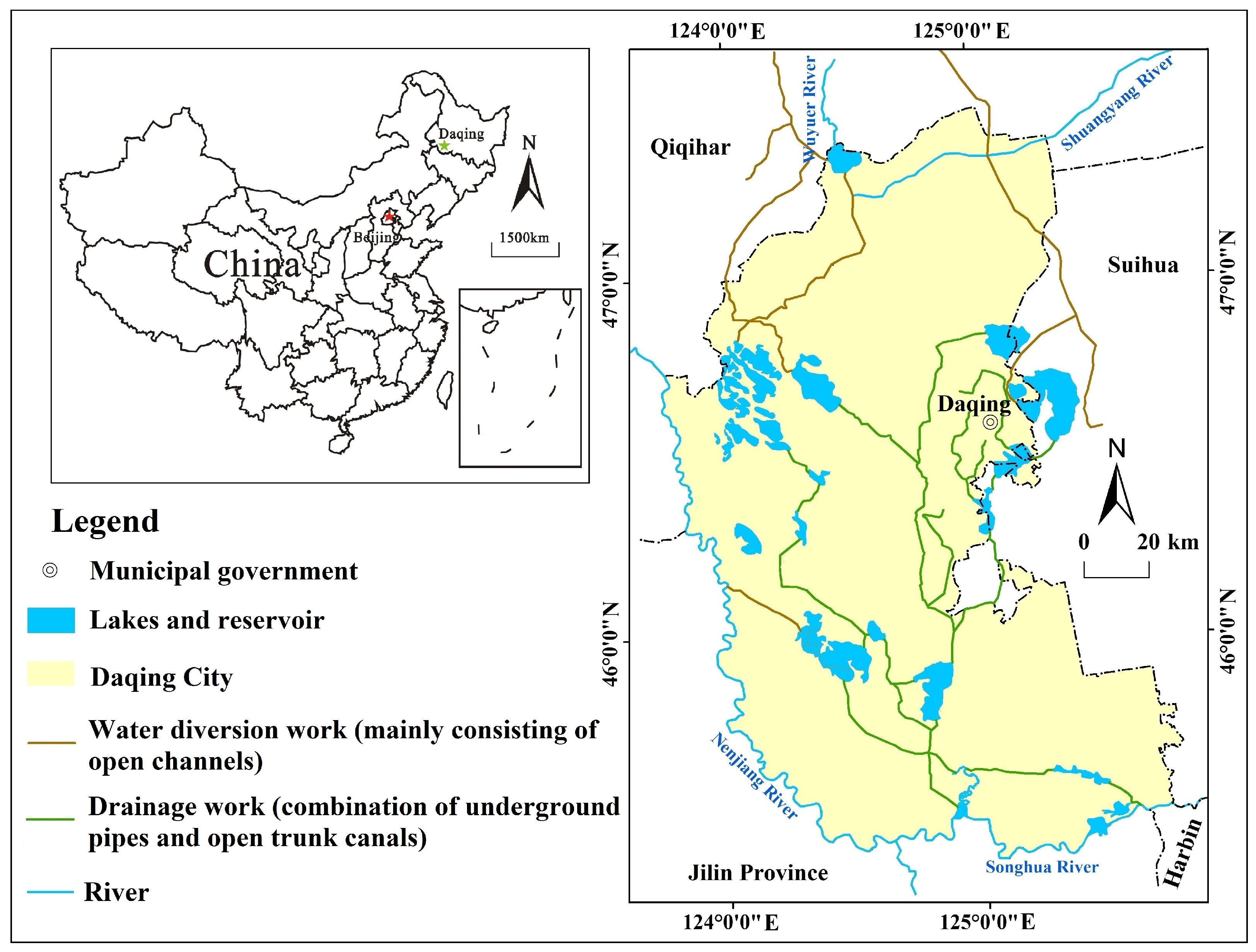
Figure 1. Map of Daqing City.
Water 18 00723 g001
Figure 2. Digital Elevation Model (DEM) of Daqing City.
Water 18 00723 g002
Figure 3. Methodological Framework.
Water 18 00723 g003
Figure 4. The indicators of water–food–energy system under different scenarios. Scenario notations: S1 (Base), S2 (Output), S3 (Environ.), S4 (Water Cons.), S5 (Econ.), S6 (Synthesis).
Water 18 00723 g004aWater 18 00723 g004b
Figure 5. Comparison of internal couplings of the WEF nexus under different scenarios. Scenario notations: S1 (Base), S2 (Output), S3 (Environ.), S4 (Water Cons.), S5 (Econ.), S6 (Synthesis).
Water 18 00723 g005
Figure 6. Objectives of the WEF system under different scenarios. Scenario notations: S1 (Base), S2 (Output), S3 (Environ.), S4 (Water Cons.), S5 (Econ.), S6 (Synthesis).
Water 18 00723 g006aWater 18 00723 g006b
Figure 7. The EVI of water–food–energy nexus under different scenarios. Scenario notations: S1 (Base), S2 (Output), S3 (Environ.), S4 (Water Cons.), S5 (Econ.), S6 (Synthesis).
Water 18 00723 g007
Table 1. Decision variables of the optimization models.
Variable TypeVariable NameVariable SymbolUnit
FoodPlanting area of cornx1km2
Planting area of ricex2km2
Planting area of wheatx3km2
Planting area of beansx4km2
EnergyOil productionx5t
Natural gas productionx6m3
Table 2. Comprehensive benefit evaluation system for the WEF Nexus.
Evaluation IndexMeaningLinkageIndicator Type
Energy productionCapacity of energy production to meet social demandWEF-SocietyBenefit type
Food productionCapacity of food production to meet social demandWEF-SocietyBenefit type
Water pollution equivalentDegree of water pollution caused by energy and food productionWEF-EnvironmentCost type
Net economic benefitThe impact of energy and food production on the economyWEF-EconomyBenefit type
Water demandWater demand for food and energy productionEnergy-Water
Food-Water
Cost type
Energy consumption per unit of economic benefit for grainEnergy efficiency of food productionFood-EnergyCost type
Water productivity of food productionWater use efficiency in food productionWater-FoodBenefit type
Water productivity of energy productionWater use efficiency in energy productionWater-EnergyBenefit type
Disclaimer/Publisher’s Note: The statements, opinions and data contained in all publications are solely those of the individual author(s) and contributor(s) and not of MDPI and/or the editor(s). MDPI and/or the editor(s) disclaim responsibility for any injury to people or property resulting from any ideas, methods, instructions or products referred to in the content.