Review

Partial Sulfur-Driven Denitrification: A Promising Pathway to Break Through the Nitrite Bottleneck in the Anammox Process


1
Research Center for Eco-Environmental Sciences, Chinese Academy of Sciences, Beijing 100085, China
2
College of Resources and Environment, University of Chinese Academy of Sciences, Beijing 100049, China
3
School of Life Sciences, Division of Life Sciences and Medicine, University of Science and Technology of China, Hefei 230027, China
4
State Key Laboratory of Tibetan Plateau Earth System, Environment and Resources (TPESER), Institute of Tibetan Plateau Research, Chinese Academy of Sciences, Beijing 100101, China
*
Authors to whom correspondence should be addressed.
Water 2026, 18(6), 677; https://doi.org/10.3390/w18060677
Submission received: 20 January 2026 / Revised: 25 February 2026 / Accepted: 11 March 2026 / Published: 13 March 2026
(This article belongs to the Special Issue ANAMMOX Based Technology for Nitrogen Removal from Wastewater)

Abstract

The anammox technology, as an efficient and energy-saving denitrification method, has been widely used in the field of wastewater treatment. Nevertheless, this process faces two key challenges in actual operation, namely the fluctuation of nitrite substrate supply and the residual nitrate, which greatly limits its promotion and application in a wider range. Although the traditional combined process of partial denitrification/anammox (PD/A) can generate nitrite substances, the coexistence of heterotrophic microorganisms and organic carbon sources in the system may have a significant inhibitory effect on the proliferation of Anammox bacteria. The sulfur-oxidizing bacteria (SOB) involved in the sulfur autotrophic denitrification process (SAD) have overlapping ecological niches with Anammox microorganisms and have stable nitrite enrichment characteristics. In view of this, sulfur-oxidizing bacteria are regarded as a potential candidate for combining with the Anammox process. However, the denitrification efficiency of this process is often restricted by the low solubility and poor bioavailability of substrates. At the same time, there are significant research gaps and data deficiencies regarding the key operating parameters for autotrophic short-range denitrification using elemental sulfur to achieve nitrite accumulation and the coupling application of this process with other wastewater treatment technologies. In view of this, this study is committed to comprehensively sorting out and evaluating the existing optimization methods of the elemental sulfur autotrophic denitrification process, while providing an in-depth analysis of its mechanism of action and environmental control factors. At the same time, this study also carried out innovative exploration on the modification process of the sulfur element from the frontier perspective of materials science and pointed out the key directions for subsequent optimization of the construction path of the elemental sulfur autotrophic denitrification system and for improving the denitrification process efficiency. In summary, this study systematically discusses the mechanism of action, practical application, and improvement scheme of PS0AD.

1. Introduction

In the field of urban sewage treatment, removing nitrogen from water bodies in an economical and efficient manner has always been a key issue to be overcome in the field of environmental engineering [1]. As an innovative biological denitrification process, anammox technology shows great application potential due to its significant technical characteristics, such as greatly reducing the demand for oxygen and organic carbon sources, significantly improving denitrification efficiency, effectively reducing the production of excess sludge, and significantly reducing greenhouse gas emissions [2,3,4]. This technology is recognized as the most economical and efficient treatment method in the field of biological denitrification. Anammox bacteria can use ammonia nitrogen (NH4+-N) and nitrite nitrogen (NO2-N) as substrates to carry out the denitrification process [5]. However, nitrite is only a transient intermediate product in the nitrogen cycle. It is easy to decompose or transform in the sewage treatment environment and has poor stability. This characteristic greatly restricts the large-scale promotion and application of anammox technology in practical engineering [6]. In view of this, ensuring the stable and continuous supply of nitrite is of key significance for the practical application of anammox technology in the field of urban sewage treatment.
In the substrate supply link of the anaerobic ammonium oxidation process, it mainly relies on two metabolic pathways: one is the partial nitrification conversion of ammonia nitrogen, that is, ammonium ion (NH4+-N), which is biologically oxidized to generate nitrite ion (NO2-N); the second is the partial denitrification process of nitrate, that is, nitrate ion (NO3-N), which is reduced to nitrite ion (NO2-N).
However, the traditional partial nitrification–anaerobic ammonium oxidation combined system has obvious limitations. It cannot effectively degrade nitrate in wastewater [7]. At the same time, in order to accurately inhibit the activity of nitrite-oxidizing bacteria (NOB), this process needs to maintain extremely complex and strict operating parameters [8], which directly leads to the high overall treatment cost. Compared with the traditional partial nitrification/anammox (PN/A) process, the treatment system using partial denitrification (PD) combined with anammox shows more prominent technical superiority. Under this synergistic mechanism, the aeration volume of the system can be reduced by more than 50%, the carbon source consumption is reduced by 63%, the output of excess sludge is reduced by 84%, and the starting period of the process is significantly shortened and the generation and release of N2O is effectively inhibited [9,10,11,12]. Moreover, even under complex working conditions with low influent nitrogen load and fluctuating environmental temperature, the partial denitrification/anammox (PD/A) process can still maintain a stable and efficient nitrogen removal rate and total nitrogen removal performance [13]. In the PD/A treatment system, facultative denitrifying bacteria may compete with anammox bacteria for nitrite resources due to their relatively fast proliferation rate [14]. Furthermore, when an external carbon source is introduced into the system, it may inhibit the activity of anammox bacteria, thereby negatively affecting the stable start-up and continuous operation of this process [2].
The synergistic action of sulfur-oxidizing bacteria and anammox bacteria shows a broad application prospect. These autotrophic microorganisms do not rely on external organic carbon sources for their reproduction. Their proliferation rate is between 0.04 and 0.27 per hour, and the biomass production is in the range of 0.59 to 0.65 g VSS/g N [15,16], which is at the same order of magnitude as that of anammox bacteria. Moreover, these substances consume oxygen in the system, thus creating a suitable reproduction condition for anammox bacteria [17]. Chen et al.’s research shows that in an environment with adjustable pH value, the order of the action between elemental sulfur and nitrate is prior to that between elemental sulfur and nitrite, resulting in the accumulation rate of nitrite exceeding 95% [18]. At the same time, the autotrophic denitrification process driven by elemental sulfur (S0AD) shows practical value in various reactor types, such as upflow anaerobic sludge blanket (UASB), sequencing batch activated sludge process (SBR), and moving bed biofilm reactor (MovBR). Compared with processes that use sulfide and thiosulfate as electron donors, the actual operation cost of this technology is significantly reduced [19]. In general, the above research results fully confirm the great application potential of elemental sulfur in strengthening the synergy between partial denitrification and anaerobic ammonium oxidation. However, the solubility of elemental sulfur in water is extremely low (5 μg/L at 20 °C), and in addition, its biological utilization rate is poor. These two factors seriously restrict the denitrification effect of the sulfur autotrophic denitrification process [20]. Moreover, there are still large research gaps regarding the key influencing factors and their regulation mechanisms of nitrite accumulation in the sulfur autotrophic short-range denitrification process, as well as the synergetic application and efficiency improvement strategies of this process with other wastewater treatment technologies. This study is committed to the structural optimization and functional strengthening of sulfur-based biological packing, aiming to construct an efficient and stable sulfur autotrophic short-range denitrification reaction system. This paper systematically sorts out the current optimization approaches of the elemental sulfur autotrophic denitrification process and deeply explores the mechanism of short-range denitrification mediated by sulfur and its realization conditions. On this basis, the research innovatively analyzes the modification technology of sulfur-based materials from the perspective of materials science, and puts forward forward-looking insights for promoting the construction of the partial sulfur autotrophic denitrification process (PS0AD) and the improvement of denitrification efficiency.

2. Materials and Methods

During the preparation of this manuscript, the author used Google Gemini 3 Flash (Preview) for the purposes of organizing visualization concepts and generating basic image assets.

3. The Mechanism, Applications, Advantages, and Disadvantages of PS0AD

3.1. Mechanism and Conditions for Partial Denitrification of SAD

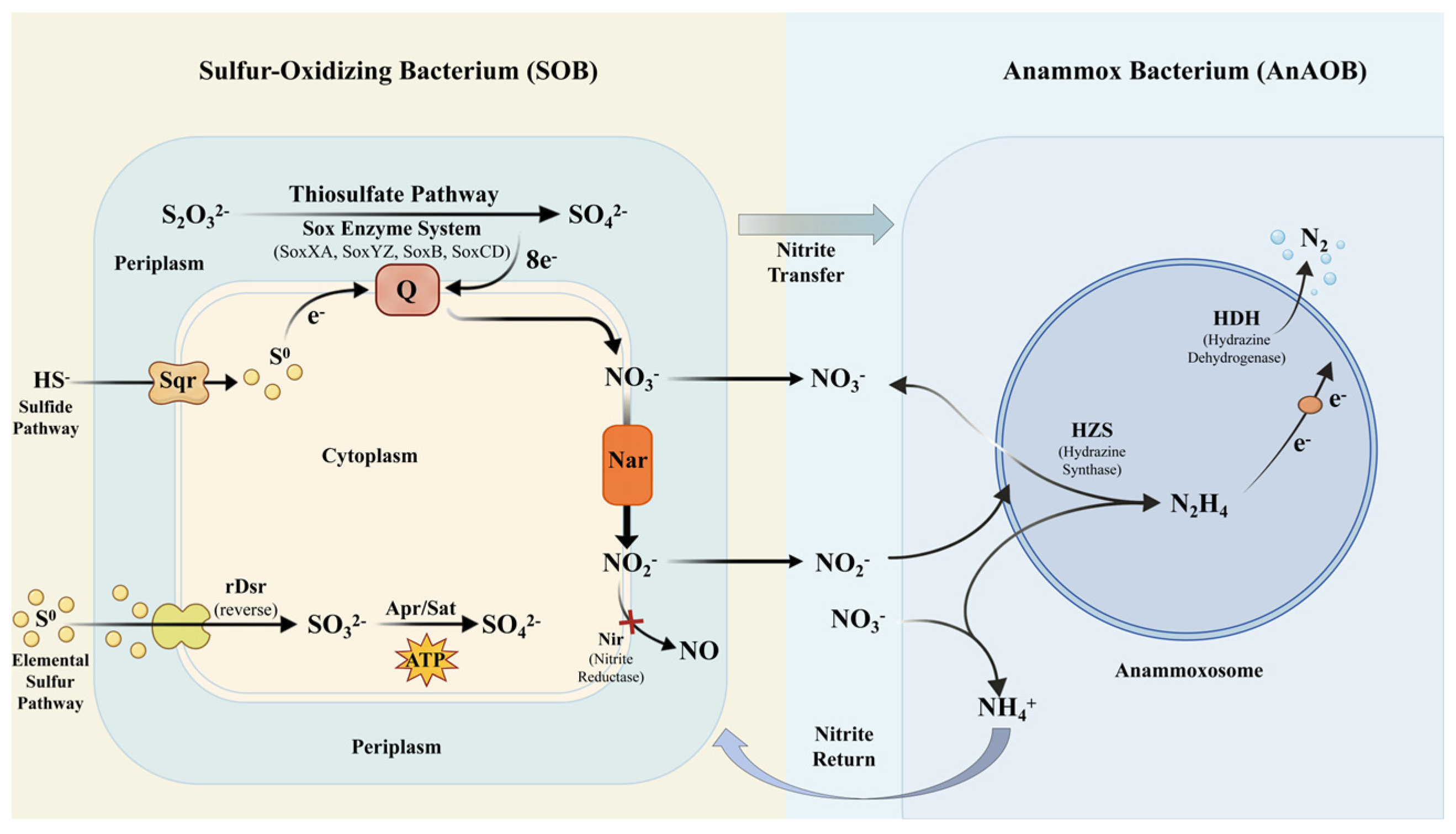
Sulfur-driven autotrophic denitrification (SAD) is a biological process in wastewater with co-existing sulfides and nitrogen, in which elemental sulfur, sulfides, thiosulfate, and other reduced sulfur species are used as electron donors to drive the reduction in nitrate/nitrite [21,22]. In the sulfur-driven denitrification system, the unbalanced metabolic rates of denitrifying bacteria and anammox bacteria often cause the biological accumulation of nitrite intermediates [23,24,25,26]. However, the diverse and complex metabolic pathways of sulfur-oxidizing bacteria (SOB) make the accumulation status of nitrite and its formation pathways show significant differences (specifically shown in Figure 1). This discussion will focus on three specific substances, namely sulfides, thiosulfate, and elemental sulfur.
In anoxic environments, sulfide is the main metabolite produced by sulfate-reducing bacteria during sulfate respiration. In the sulfur autotrophic denitrification (SAD) process, microorganisms first oxidize sulfide to elemental sulfur (BPS0), and then further convert it to sulfate [27]. It is worth noting that several scientific studies have confirmed that when sulfide is in a co-existing state, the generation and accumulation of nitrite have not been observed [28,29]. According to the research results of the Gadkar team, when sulfide is exhausted, BPS0 can be used as an electron donor, and then a significant enrichment of nitrite in the reactor occurs [24]. Deng et al. carried out in-depth discussions on the accumulation behavior of nitrite under the two working conditions of nitrate limitation and sulfide limitation. The research conclusion shows that to effectively accumulate nitrite as the metabolic substrate of anammox bacteria, an excessive supply of sulfide in the system must be ensured [30]. The key functional microbial groups involved in the sulfur oxidation process mainly include Thiobacillus and Thiothrix. Thiothrix strains have a complete sulfur oxidase (SOX) enzyme system, which is crucial for their sulfur metabolism function; in contrast, some members of the Thiobacillus genus lack the soxCD gene in their genomes. This difference in genetic characteristics may be an important factor causing the bio-accumulation of elemental sulfur (S0) in biofilm reactors (such as the SAD system) [31,32]. In an environmental system with sulfide as the carbon source, the abundance change in specific functional microbial communities may have a significant impact on the generation and retention of nitrite.
Thiosulfates are widely present in multiple industrial fields such as chemical engineering, medicine, and mineral processing. Due to its low toxicity and good bioavailability characteristics, it has become a common source of electron acceptors in sulfur-oxidizing bacterial communities [33,34]. When thiosulfate is used as an electron donor, the metabolic pathway of denitrification can be divided into two consecutive stages [35] during which nitrite is generated as a key intermediate product. The specific reaction formulas are as follows (Equations (1) and (2)):
S 2 O 3 2   +   4 NO 3   +   H 2 O     2 SO 4 2   +   4 NO 2   +   2 H +
3 S 2 O 3 2 + 8 NO 2 + 2 H +     6 SO 4 2 + 4 N 2 + H 2 O
In this system, the difference in the activity of biological enzymes leads to the divergence of the reduction efficiency of nitrite and nitrate, and then causes the enrichment phenomenon of nitrite [3]. The research of the Guwu team shows that when the environmental pH is lower than 7.4, the accumulation of nitrite is due to the selective inhibition of the catalytic activity of nitrite reductase and nitrate reductase. Similarly, the original concentration level of nitrite and the abundance of denitrifying bacteria also significantly affect the generation and accumulation of nitrite in the denitrification process driven by thiosulfate [35]. At the same time, the research of the Deng team shows that in the denitrification process with thiosulfate as the electron acceptor, nitrite (NO2) and BPS0 biofilm will be generated in the system. These two metabolites can synergistically promote the proliferation and activity improvement of anaerobic ammonia oxidation bacteria. It is worth noting that the BPS0 biofilm forms a protective layer on the outer layer of the granular sludge, which can effectively isolate and buffer the toxic factors in the external environment, such as free ammonia, free nitrite, and dissolved oxygen, thus creating a relatively stable and suitable micro-ecological environment for the anaerobic ammonia-oxidizing bacteria in the inner layer and significantly reducing the negative impact of these inhibitory substances on the core functional bacteria [36].
Elemental sulfur has non-toxic characteristics, is hardly soluble in water, and has relatively stable chemical properties, and can be conveniently extracted from natural ores and various industrial production processes. The denitrification reaction based on elemental sulfur follows a stepwise transformation mechanism, and the specific process can be referred to the reaction formulas described in Equations (3) and (4).
S 0 + 3 NO 3 +   H 2 O     SO 4 2 + 3 NO 2 + 2 H +
S 0 + 2 NO 2 SO 4 2 + N 2
It is worth noting that the rate-limiting step in this reaction process is actually the second-step transformation process in the system. A large number of literature data show that while nitrate nitrogen (NO3-N) is continuously consumed, nitrite nitrogen (NO2-N) will show a phenomenon of gradual enrichment [25,37]. When the concentration of nitrate nitrogen approaches exhaustion, the accumulation amount of nitrite nitrogen will climb to the highest point and then gradually decrease. In the sulfur autotrophic denitrification system, compared with nitrite ions, nitrate ions are a more preferred electron acceptor choice [38,39,40]. In the sulfide-autotrophic denitrification process, microorganisms will first react with nitrite ions and then with nitrate ions. This reaction sequence makes it inevitable to form a competitive relationship for electron acceptors between autotrophic denitrifying bacteria and anammox bacteria in a single reactor environment [41,42]. In the granular sludge system using thiosulfate as an electron donor, the reduction efficiencies of nitrate and nitrite show a high degree of consistency, and no obvious enrichment phenomenon of nitrite is detected [43]. Based on this, using elemental sulfur (S0) as an electron donor is expected to alleviate the competitive relationship between autotrophic denitrification process and anammox reaction for nitrite, and then improve the efficiency of their synergistic effect. It is worth noting that in the denitrification process using sulfur as an electron donor, the phenomenon of large-scale accumulation of nitrite usually occurs in the reactor environment of non-continuous-flow operation. In the sulfur autotrophic denitrification process, it is often difficult to achieve a stable nitrite accumulation state. This is mainly due to the necessity of maintaining excess elemental sulfur as an electron donor; once the sulfur source supply is insufficient, the generated nitrite will be easily further reduced to nitrogen [44,45]. In addition, the sediment components in the influent water quality and the system operation parameters such as hydraulic retention time (HRT), etc., will also have a significant impact on the accumulation effect of nitrite ions in the reaction process [46,47].

3.2. Main Influencing Factors of PSAD

The traditional view holds that denitrifying bacteria complete their metabolic process through a series of continuous nitrogen transformation reactions. The specific pathway is: nitrate ions (NO3) are gradually reduced to nitrite ions (NO2), then they generate nitric oxide (NO), then they transform into nitrous oxide (N2O), and finally they release nitrogen gas (N2). This transformation process is catalyzed by four specific enzymes in sequence, namely nitrate reductase (NAR), nitrite reductase (NIR), nitric oxide reductase (NOR), and nitrous oxide reductase (N2OR). Due to the significant differences in the distribution pattern and metabolic flow pathway of various denitrifying reductases in organisms, the sensitivity and response mode of their catalytic activity to the fluctuations of surrounding environmental factors also show obvious diversity.
In some short-range denitrification processes, the stable retention of nitrite is its core feature. The mechanism of this phenomenon lies in the fact that the reduction efficiency of nitrate ions is significantly higher than the transformation efficiency of nitrite ions. To achieve this specific biological transformation state, differential regulation on the activities of nitrate reductase and nitrite reductase can be implemented. The key parameters for regulating this process mainly include environmental temperature [48], solution pH value [38], water salinity [49], free ammonia concentration [50], free nitrite content [51], and intermediate metabolites in the reaction system [52]. The research of Qaisar et al. shows that for the flora participating in short-range denitrification (SAD), the shortest time required to complete the full denitrification reaction is about 5 h, while the shortest reaction time to achieve partial denitrification is shortened to 1 h. By accurately regulating the hydraulic retention time (HRT) in the partial denitrification stage, the stable generation and accumulation state of nitrite can be effectively maintained [53,54]. According to the differentiation characteristics of the metabolic pathway, the sulfur–nitrogen ratio, nitrogen-containing nutrients, and sulfur-containing nutrients are optimized and regulated, aiming to strengthen a specific type of denitrification process. Similarly, the research of the Daehee team shows that quorum-sensing molecules such as C8-homoserine lactone (C8-HSL) and C12-homoserine lactone (C12-HSL) show differential activation effects on nitrate reductase (Nar) and nitrite reductase (Nir), and this mechanism may provide a new regulation approach for partial denitrification process [55].

3.3. Practical Applications of PS0AD Coupling with Anammox

The PD/A process primarily functions through either a two-stage configuration, which separates PD and Anammox into distinct reactors, or a single-stage combined setup. Two-stage systems are typically designed to minimize microbial competition and mitigate the inhibition of microorganisms by organic matter; however, they may result in nitrite residue in the effluent [56]. In contrast, single-stage systems can streamline operational processes, reduce land use, and enhance microbial coupling, although they impose more complex parameter control requirements for stable operation [57].
Based on the latest operation monitoring data (see Table 1), the synergistic effect of anammox and sulfur autotrophic denitrification has been verified in various bioreactor systems, covering different configurations such as sequencing batch reactor (SBR), upflow anaerobic sludge blanket (UASB), moving bed biofilm reactor (MovBR), fluidized bed, and packed bed. Among them, the process combination using elemental sulfur (S0) as the electron donor shows a continuous, stable, and significant advantage in the removal efficiency of total nitrogen (TN). According to relevant research, the UASB reactor using the S0 process and the SBR shows excellent performance in total nitrogen removal efficiency, and their removal rates break through the thresholds of 92.4% and 96.8% respectively. It is worth noting that for some specially designed UASB devices, the total nitrogen removal efficiency can reach a high level of more than 99%. At the same time, in the optimized reactor similar to MovBR, the denitrification process using S0 as the electron donor shows a nitrate removal efficiency as high as 91.07%. In contrast, in the UASB reactor, the total nitrogen removal efficiency of the system using sulfide (S2−) as the electron donor fluctuates greatly, usually in the range of 60% to 90.0%, and this difference is mainly attributed to the difference in the selection of reactor configuration.
During the operation of the SAD-A process, if thiosulfate and sulfide ions are used as electron donors, the abnormal accumulation of sulfate ions in the system [58] and the continuous rise in sulfide concentration [59] will both have a significant inhibitory effect on the proliferation process of anammox bacteria. Studies have shown that constructing a segmented reaction system is an effective technical way to alleviate this problem [60]. Under the condition of using S0 as the substrate, the uptake efficiency of anammox bacteria for nitrite is 34.5 times higher than that of the SAD bacteria [52], which reveals that the metabolic characteristics of the SAD bacteria are more inclined to the partial denitrification pathway, and their niche competition strategy makes their dependence on nitrite significantly reduced. Zhang et al. successfully operated the S0AD-A coupled system in a single-stage reactor, achieving a total nitrogen removal efficiency exceeding 95% and maintaining the effluent nitrate concentration below 10 mgN/L [18]. Furthermore, numerous studies have successfully initiated and operated the S0AD-A process in single-stage reactors [61,62,63], which highlights the extensive application potential of single-stage PS0AD-A. In the practical application process of the Anammox process, in addition to the classical sequencing batch activated sludge (SBR) technology, the scientific research and engineering fields have also actively explored many other types of reactors, such as moving bed biofilm reactor (MBBR) [64], fluidized bed reactor [65], packed bed reactor [66], and upflow anaerobic sludge bed (UASB) [19]. These innovative reactors can significantly improve the immobilization efficiency and biomass accumulation ability of anammox bacteria by filling specific sulfur-containing carrier materials inside them and then lay a solid foundation for the stable construction of an efficient biofilm structure [65]. Yin and colleagues delved into the dynamic processes of biofilm formation and the underlying mechanisms of S0AD-A. Their research data show that the sulfur-oxidizing bacteria in the biofilm samples are mostly enriched in the deep structure, while the anammox bacteria are evenly distributed both inside and outside the biofilm matrix. It is worth noting that there are significant interspecific interactions between the above two functional bacteria groups in the sludge samples, and they jointly construct a stable microbial community structure [67]. However, the effects produced by spatial niche differentiation and its internal mechanism still need to be explored more deeply.
Table 1. Summary of recent operation of anammox and sulfur autotrophic denitrification coupling process.
Reactor TypeElectron DonorInfluent/Conditions
(NH4+, NOx)
Sludge InoculationRemoval EfficiencyReference
SBRS0NH4+: 50~200 mg N/L;
NO3: 50~200 mg N/L
SADN sludgeTN: 96.8%Chen et al. (2019) [18]
UASBS0NH4+: ~30 mg N/L;
NO3: ~50 mg N/L
Anaerobic granular sludgeTN: 92.4%; NAR: 92.1%Wang et al. (2024) [19]
UASBS0NH4+: 113~133 mg N/L;
NO3: 150~170 mg N/L
Anammox granular sludgeTN: >99%Wang et al. (2019) [60]
MovBRS0NO3: 20 mg N/LActivated sludgeNO3: 91.07%Xu et al. (2024) [64]
Fluidized-bedS0NO3: 40 mg N/LAnaerobic activated sludgeN.A.Gu et al. (2024) [65]
Packed
-bed
S0NO3: <2.2 mg N/L; 10~80 mg N/LActivated sludgeN.A.Sun et al. (2023) [66]
UASBS0NH4+: 230 mg N/L;
NO2: 50~303.6 mg N/L; NO3: 0~230 mg N/L
Anammox sludge and SAD sludgeARE: >54.2%Yin et al. (2025) [67]
UASBS2−NH4+: 42~252 mg N/L;
NO2: 55~333 mg N/L
Anammox sludge and methanogenic granules sludgeTN: 88.3%Guo et al. (2016) [61]
UASBS2−TN: 280, 560 mg N/LAnammox sludgeNRE: >60%Xia et al. (2019) [62]
UASBS2−TN: 0~174.6 mg N/LAnammox sludgeTN: >90%;
NAR: >90%
Shi et al. (2019) [63]
Note(s): N.A. indicates that there is no relevant data in the references.

3.4. Engineering Challenges and Limitations of Sulfur-Driven Coupled Processes

While sulfur-driven partial denitrification coupled with anammox technology (SAD/A) has demonstrated significant advantages in carbon source conservation and nitrogen removal efficiency at the theoretical and laboratory scales, its transition toward engineering scale-up and mainstream wastewater treatment remains hindered by multiple technical bottlenecks. These include complex multiphase mass transfer, substrate toxicity stress, and risks of secondary environmental pollution. Based on the operational data summarized in Table 1, the primary challenges of the current process can be categorized into the following dimensions.

3.4.1. Substrate Toxicity and Microbial Ecological Competition Imbalance

The functional microbial communities in the SAD/A system are significantly susceptible to the metabolic intermediate products of sulfur and nitrogen. As revealed in Table 1, in the study of treating sulfur-containing wastewater using an upflow anaerobic sludge blanket (UASB) device, the experimental results of Guo et al. (2016) show that this process is extremely sensitive to the shock load of sulfide anions (S2−), so the proportion of the influent composition must be precisely regulated [61]. Free sulfide molecules can easily cross the cell membrane barrier of microorganisms and directly damage the heme c active site in the crucial denitrification enzyme molecules of anammox bacteria, thereby causing its fatal cytotoxic effect. Similarly, in processes such as the single-stage sequencing batch reactor (SBR) constructed by Chen et al. (2019), even if the removal efficiency of total nitrogen is increased to 96.8% through parameter optimization, the resource competition between sulfur-oxidizing bacteria and anaerobic anammox bacteria for the electron acceptor nitrite (NO2) is still difficult to eliminate [18]. When the sulfur–nitrogen ratio (S/N) in the system or the influent load changes significantly, it may lead to the abnormal enrichment of denitrifying bacteria (for example, some Thiomonas microorganisms). Such competitive microorganisms may additionally reduce nitrite (NO2) and convert it into nitrogen (N2), and this part of nitrite is originally a key substrate for the metabolism of anammox bacteria. This shunting effect of substrates will directly disrupt the core material transfer chain in the short-range denitrification process, and then cause a significant decrease in the coupling conversion efficiency of energy and substances in the entire system.

3.4.2. Mass Transfer Barriers of Elemental Sulfur (S0) and Physical Clogging by Biogenic Sulfur (BPS0)

In a biological system where elemental sulfur (S0) is used as an electron donor, the solubility of solid sulfur in water is poor [68] (the solubility is about 5 mg/L at 20 °C), and at the same time, its surface has a strong hydrophobic property. This dual property obviously hinders the mass transfer process at the solid–liquid interface. Thus, the bioavailability of sulfur to autotrophic denitrifying bacteria is severely restricted and has a negative impact on the kinetic rate of the overall denitrification reaction. More importantly, in the biological transformation process, using thiosulfate or sulfide as an electron donor, due to the imbalance of microkinetic parameters, biogenic elemental sulfur (BPS0) in the form of hydrophilic colloid often accumulates in large quantities as a key intermediate [69]. Such tiny colloidal sulfur particles can build a “protective barrier” that is impermeable, covering the surface of granular sludge or biofilm, significantly increasing the mass transfer difficulty for the substrate to penetrate into the interior and finally causing the decline of the physiological activity of anammox bacteria due to “mass transfer obstruction” [70]. At the same time, in the long-term engineering application process, the continuous accumulation of BPS0 will cause serious blockage phenomena in equipment such as upflow anaerobic sludge bed (UASB) reactors and packed beds. Such phenomena will cause a significant decrease in water head pressure, and then force the system to frequently have unexpected shutdowns to remove the blockages, which will undoubtedly greatly increase the physical operation and maintenance costs of the equipment.

3.4.3. Sulfate (SO42−) Accumulation and Secondary Pollution Risks

Under the theoretical framework of thermodynamics and chemical stoichiometry, no matter what sulfur-containing electron donor is used (S2−, S2O32−, or S0), the final stable oxidation product of the sulfur-driven autotrophic denitrification reaction pathway is invariably sulfate (SO42−). Through precise calculation of the chemical stoichiometric relationship, it can be known that for every 1 g of nitrate nitrogen (calculated as (NO3-N)) reduced and removed, about 12.15 g of sulfate ion will be generated in the system. Directly discharging high-concentration sulfate wastewater into the natural freshwater system may not only violate strict environmental standards (for example, the emission limit of sulfate in China’s drinking water sources and water distribution pipelines is usually set below 250 mg/L) but also has the risk of inducing harmful algae blooms [71]. Moreover, when the drainage containing high-concentration sulfate enters the anaerobic environment sewage treatment system in the downstream, the sulfate in it may be further converted into hydrogen sulfide (H2S) by sulfate-reducing bacteria (SRB). This gas is not only extremely toxic but also has significant corrosiveness. Once released, it will not only cause irreversible damage to various municipal infrastructure but may also further trigger secondary environmental safety incidents [72].

3.4.4. Ecological Vulnerability to Substrate Fluctuations

The key functional microbial communities in the SAD/A process, namely anammox bacteria and autotrophic sulfur-oxidizing bacteria, both belong to chemolithoautotrophic microorganisms. Their remarkable characteristics are long reproductive cycles and extremely slow metabolic rates. This inherent defect in physiological characteristics makes the synergistic system extremely vulnerable to the adverse effects of severe load fluctuations frequently occurring in the main flow of municipal or industrial wastewater (such as sudden high ammonia nitrogen concentration shocks or long-term insufficient nutrient supply) at the ecological level. In order to alleviate such instability and ensure the stable operation of the system, technicians often construct a more precise structure. As shown in Figure 1, the WangT team (2019) constructed an independent two-stage tandem treatment system, and this system responds to the severe fluctuations in the influent ammonia nitrogen concentration by introducing a specific “nitrification side stream” unit [60]. Although this scheme can ensure that the total nitrogen removal efficiency is stably maintained above 99%, it also brings significant negative impacts: not only greatly increases the difficulty and cost of process regulation but also leads to a significant increase in the floor space of the system, thereby causing a sharp rise in the initial investment (CAPEX) and long-term operation costs [73].

4. Optimization Strategies for S0AD Processes

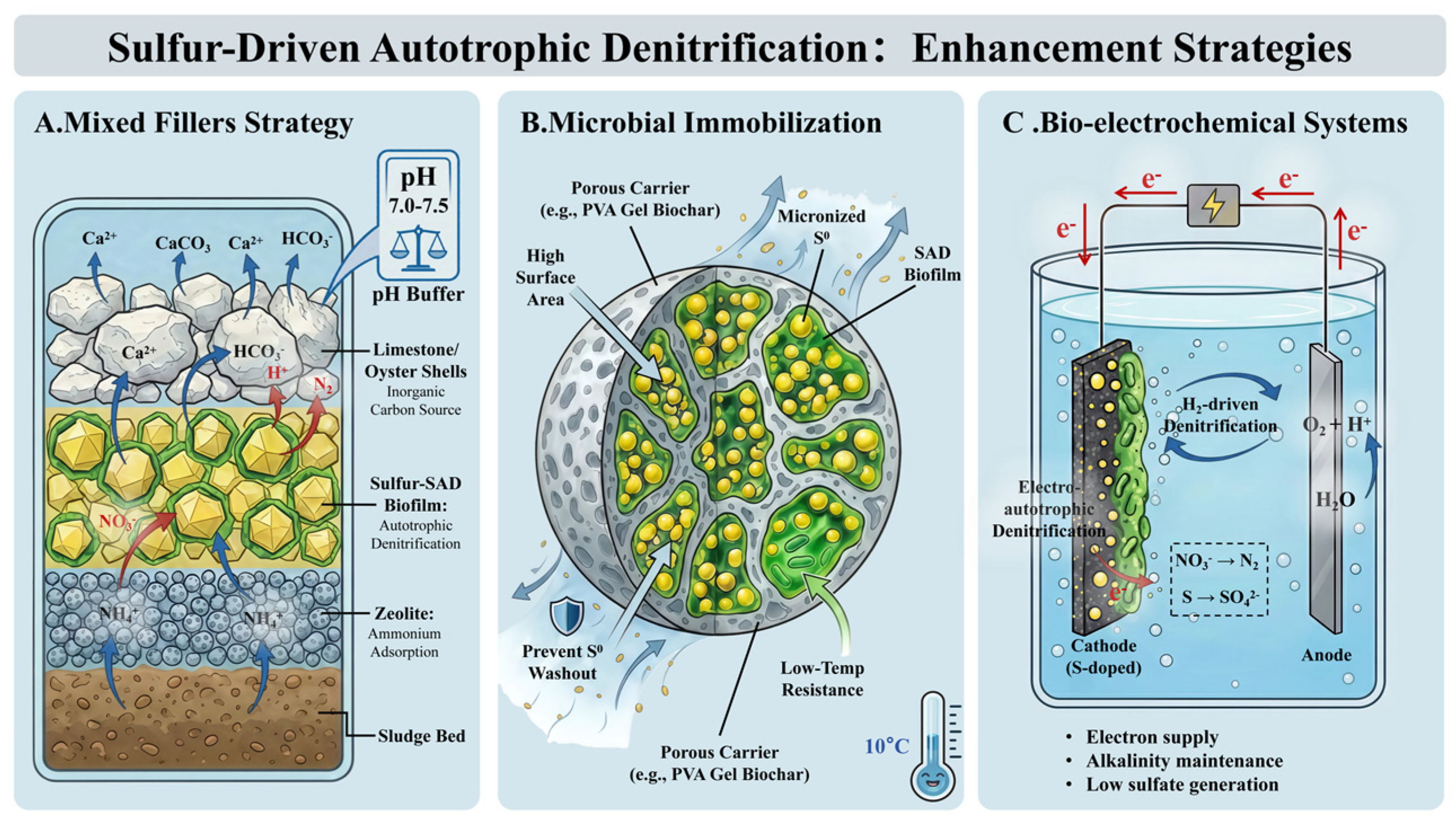
Although S0AD is an effective method for treating nitrate wastewater, the low water solubility of sulfur leads to poor bioavailability, which limits the removal efficiency of S0AD [74]. Furthermore, the high production of sulfate and significant consumption of alkalinity are also critical factors that restrict the S0AD process [75]. Consequently, enhancing the denitrification efficiency and process stability has become a primary focus of research on S0AD (As shown in Figure 2).
In order to optimize the alkalinity level of the system, natural minerals such as limestone, oyster shells [76], and other shellfish shells [77] are often selected in the academic community, and they are uniformly compounded with elemental sulfur, and then this mixed system is arranged inside the reactor. It is particularly crucial that limestone can not only act as the energy source of sulfur autotrophic denitrification bacteria group but can also be used as the inorganic carbon source required for their growth. In addition, many scientific researchers also use adsorption technology, using substances such as activated carbon and ceramsite as the attachment matrix of microorganisms. This strategy can promote the colonization and proliferation of sulfur autotrophic denitrification bacteria group on the surface of the carrier and then improve the degradation efficiency of ammonia nitrogen. Experiments conducted by other scholars (such as the Ma’s team) have confirmed that zeolite, with its excellent ammonia adsorption characteristics, can construct a local ammonia enrichment microenvironment [78]. This condition can not only activate the metabolic activity of anaerobic ammonia oxidation microorganisms, but can also effectively inhibit the nitrite reduction process, promote the proportion of some denitrification pathways to increase, and finally realize the optimization of the overall denitrification effect.
Immobilized microbial carriers play a crucial role in the utilization of sulfur by sulfur-oxidizing bacteria (SOB) [79]. The low solubility and hydrophobic nature of sulfur limit its availability to microorganisms, consequently restricting the denitrification rate of sulfur-driven autotrophic denitrification. Previous research has demonstrated that enhancing the specific surface area, such as through the use of smaller sulfur particles or sulfur powder, can significantly improve the bioavailability of elemental sulfur (S0) [80]. However, this approach may also lead to sulfur substrate loss at elevated flow rates. Employing microbial immobilization technology to embed sulfur powder and microorganisms within the pores of biocompatible carriers can effectively enhance sulfur utilization by microorganisms [81] and improve process stability [82]. Lin et al. assessed the performance of the SAD/A process (coupling process of anammox and SAD) with immobilized versus free microorganisms at low temperatures. Their findings indicated that the immobilized carriers significantly preserved microbial activity [83], with activity at 10 °C being approximately 1.45 times greater than that of free microorganisms. Additionally, the nitrogen removal efficiency (NRE) was 11% higher in the immobilized state compared to the free state at the same temperature. Chang et al. applied sulfur powder to flexible fiber fillers, which effectively increased the total biomass [84] in the reactor by enlarging the specific surface area and enhancing microbial adhesion.
Microbial electrochemistry employs a bioelectrochemical method for autotrophic denitrification, achieved by continuously supplying electrons through an external circuit or electrolyzing water to generate hydrogen, as illustrated in Equations (5) and (6).
NO 3 + 6 H + + 5 e     0.5 N 2 + 3 H 2 O  
55 S + 50 NO 3 + 38 H 2 O + 20 CO 2 + 4 N H 4 +     4 C 5 H 7 O 2 N + 25 N 2 + 55 S O 4 2 + 64 H +
Within the framework of the S0AD-MED system architecture, the microbial electrochemical denitrification (MED) mechanism achieves the denitrification goal with the participation of hydrogen ions (H+). This process not only completes the denitrification reaction but also can reduce the sulfate generated in the S0AD process [85,86]. By adding elemental sulfur (S0) to the system, the redox potential of the reaction system can be effectively reduced, and then the energy consumption required for the operation of the bioelectrochemical system (BES) can be significantly reduced. According to literature reports, the research of Wen et al. reveals that the application of the S0-C electrode significantly improves the contact efficiency between sulfate-reducing bacteria and sulfide in the system [87]. In the comparative experiment with the traditional biofilm reactor filled with sulfur particles (the sulfur-based denitrification rate is 0.8 mgN/m2-d), the reactor using the S0-C electrode shows a higher sulfur denitrification conversion efficiency per unit area [88]. In the construction process of the permeable reaction wall of the microbial electrolytic cell, the Chen team introduced elemental sulfur as a key component. Through this strategy, he successfully regulated the interspecific interaction pattern within the biological community and significantly improved the degradation efficiency of nitrate by the system [89].

5. Reference for the Modification Methods of Sulfur

While the aforementioned process optimization strategies enhance the denitrification efficiency of the S0AD process, conventional fillers often encounter issues such as diminished microbial utilization and the propensity for internal pore clogging during prolonged operation. Given the fundamental properties of sulfur and the specific requirements of the SAD process, the development of novel and efficient modified fillers represents a crucial avenue for advancing the broader application of the SAD process.

5.1. Basic Properties and Applications of Sulfur

Sulfur is a non-metallic element characterized primarily by its cyclic molecular structure, S8, which consists of eight sulfur atoms bonded covalently. It exhibits a relatively low melting point, transitioning completely to liquid sulfur at 159 °C [90]. In construction, sulfur serves as a binder when mixed with mineral aggregates or various fillers [91], such as fly ash and rubber powder, and is commonly utilized for asphalt modification [92] and concrete preparation [93]. Furthermore, when elemental sulfur is incorporated into nanomaterials, it exhibits numerous interfacial defect structures [94], known as sulfur holes, which enhance its application in fields such as photocatalysis and electrochemistry [95]. Traditional inorganic non-metallic materials primarily possess ionic and mixed bond structures, resulting in significant property differences, including higher melting points, greater hardness, and enhanced oxidation resistance compared to sulfur. Consequently, the reaction scenarios and methodologies involving sulfur differ from those of conventional inorganic non-metallic materials. Nevertheless, owing to the thermoplastic properties of sulfur, some researchers have explored concrete production methods for modifying sulfur fillers [96].

5.2. Fabrication of Composite Fillers

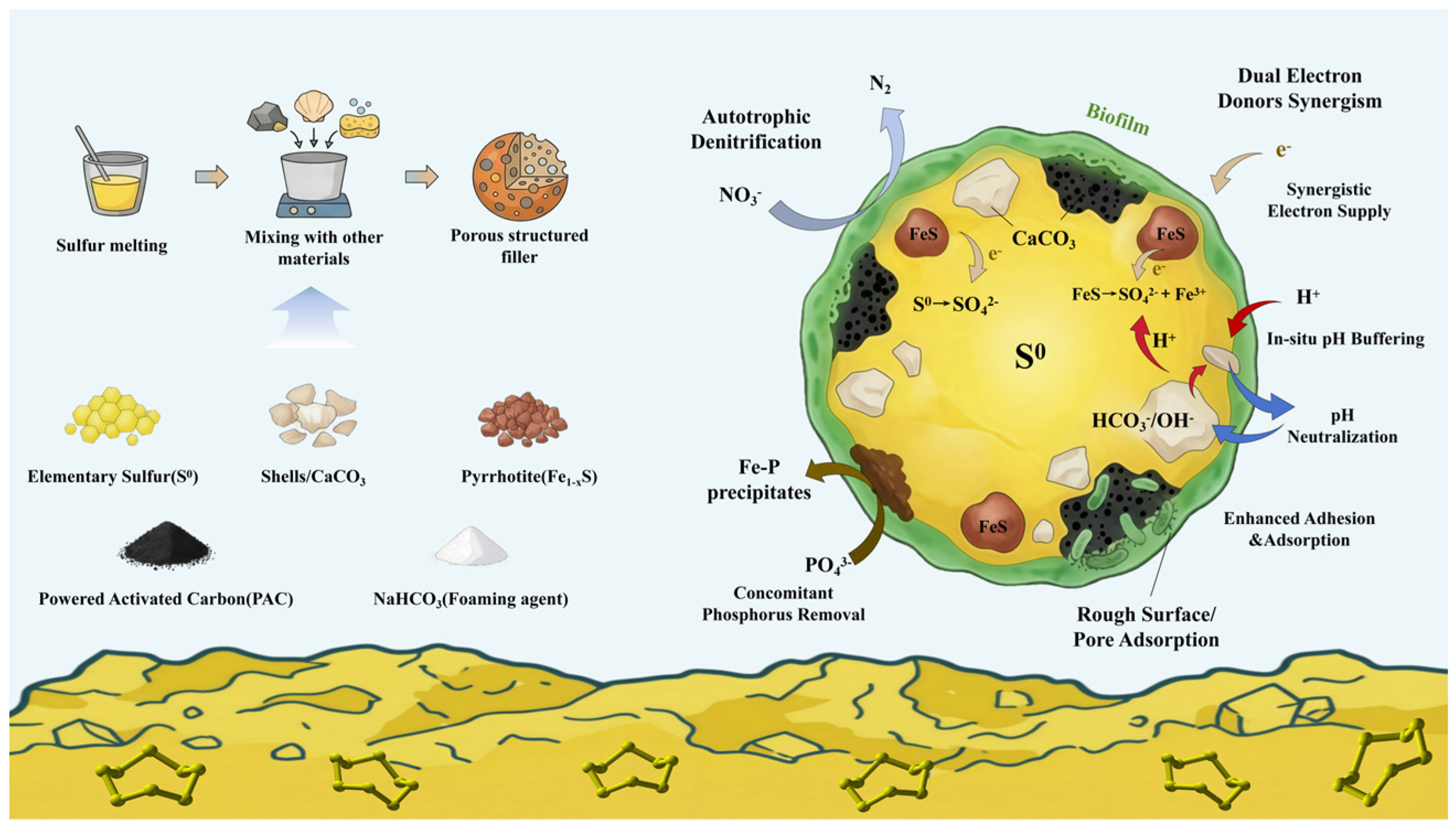
Composite sulfur source packing involves the incorporation of chemicals that enhance the existing deficiencies of the packing without altering the properties of the sulfur source, followed by secondary processing techniques such as embedding, curing, and calcination (As shown in Figure 3).
Iron-based compounds, such as pyrite (FeSz), pyrrhotite (Fe1-nS), and siderite (FecOg), can act as efficient electron acceptors in the metabolic process of autotrophic microorganisms and can significantly improve the deamination efficiency when acting synergistically with elemental sulfur [97]. The research team used sulfur particles, iron compounds, binders, and alkaline substances as raw materials, carried out composite molding by adjusting the proportion of each component, and successfully prepared a uniform granular material with enhanced hardness and uniformity of alkalinity. A composite filler with a thickness between 3 and 5 mm was prepared through a mixing and pressing process, with sulfur powder, activated carbon fine powder, and calcium carbonate as the main components. The experimental results show that the removal efficiency of total nitrogen (TN) by the composite filler is nearly 40% higher than that of the single sulfur filling medium, and the relevant data and literature [98] have confirmed it. At the same time, when the molten pure sulfur is mixed with the powdery residues of eggshells, scallop shells, or limestone, a composite sulfur-based filler with a granular structure and uniform distribution can be obtained. This material can not only provide sufficient alkalinity reserve and inorganic carbon for the sulfur ammonium denitrification reaction but also the denitrification conversion efficiency can break through the threshold of 99.7% [99]. Another research team, such as Professor Shen’s, used sodium bicarbonate as a physical foaming agent to aim at increasing the specific surface area of the filler. This strategy not only enhances the adhesion ability of microorganisms on the carrier surface but also helps to alleviate the problem of mass transfer efficiency decline caused by the blockage of internal pores [100].

6. Research Needs and Future Directions

S0AD encounters several technical challenges. Sulfur’s hydrophobic nature and low solubility restrict its bioavailability for sulfur-oxidizing bacteria (SOB). One potential solution is to enhance the specific surface area of sulfur. Nanoparticles, defined as particles with a size of 100 nm or less, possess a high specific surface area [101]. Samrat et al. demonstrated that nano-sized sulfur particles exhibit superior surface properties [102] compared to micron-sized sulfur particles. However, a gap currently exists in the application of nano-sulfur within the sulfur-oxidizing anaerobic digestion (SAD) process. Alternatively, immobilized microbial technology can utilize nano-sulfur as a substrate to further improve the denitrification efficiency of the process. Additionally, due to their high adsorption capacity and surface activity, nano-iron particles have emerged as a focal point of research in the environmental field. Numerous studies have reported that nano-iron (nZVI) significantly influences both Anammox and denitrification activities [103,104,105]. nZVI may facilitate the initiation and stable operation of partial sulfur-oxidizing anaerobic digestion (PSAD) through direct addition or the fabrication of composite packing. Furthermore, another approach involves converting elemental sulfur into a more hydrophilic and soluble form. Biological sulfur is an intermediate product [106,107] generated by sulfur-oxidizing bacteria during the utilization of reduced sulfur-containing compounds, such as sulfides and thiosulfates. This bio-sulfur exhibits greater adhesion (1.54 times) and hydrophilicity [108] compared to chemical sulfur, owing to its surface being coated with a composite charged layer of polysulfides and organic substances. Hao and Kostrytsia conducted multiple studies on bio-sulfur as an emerging substrate for sulfate-activated denitrification (SAD), achieving denitrification loadings ranging from 0.194 to 0.225 kg/m3-d [109,110]. Despite these findings, biological sulfur has not yet been widely adopted in the SAD process. Cultivating microbial agents capable of consistently producing biological sulfur may represent a promising strategy to enhance the practical application of SAD in urban sewage treatment facilities.
The final product of sulfate-oxidizing anaerobic digestion (S0AD) is sulfate. In autotrophic and mixed autotrophic systems [16,111,112], the sulfate concentration in the effluent often exceeds the permissible limit for drinking water in China, which is 250 mg/L. Elevated sulfate emissions can result in toxic algal blooms, facilitate mercury methylation [113], and contribute to gastrointestinal diseases in humans. Dominika et al. noted that under inorganic conditions, sulfate-reduced ammonium oxidation (Sulfammox) can react with SO42− and NH4+ to produce S0 and NO2, achieving a SO42− removal rate of 53–60% [114]. The resulting nitrite can also serve as a substrate for Anammox. Consequently, the integration of S0AD/A and Sulfammox may represent a significant avenue for future research.

7. Conclusions

S0AD is an autotrophic denitrification process that offers significant advantages, including low operating costs, the ease of nitrite accumulation, and effective integration with various reactor types. These features position S0AD as a promising method for coupling partial denitrification of sulfur with anaerobic ammonium oxidation. However, the low water solubility and bioavailability of elemental sulfur hinder the nitrogen removal efficiency of S0AD. Additionally, the consumption of alkalinity and the substantial emission of sulfate during the process pose challenges to its stable operation. Historically, efforts to enhance the process have focused on methods such as process coupling, increasing the specific surface area, and material compounding. Nevertheless, these approaches have yielded limited improvements since they do not alter the inherent properties of sulfur. Future advancements may involve optimizing the characteristics of elemental sulfur through principles related to bio-sulfur and nanomaterials, thereby improving the denitrification efficacy of the S0AD process. Furthermore, the integration of S0AD/A with Sulfammox for wastewater denitrification could represent a novel strategy to facilitate the broader application of S0AD/A in urban sewage treatment.

Author Contributions

Conceptualization, T.Y. and C.J.; resources, X.W., Y.X., Y.G., Y.Y., Y.Z., X.Z. (Xinyuan Zhang) and T.Y.; writing—original draft preparation, T.Y.; writing—review and editing, C.J. and X.W.; supervision, X.Z. (Xuliang Zhuang); funding acquisition, X.W. and C.J. All authors have read and agreed to the published version of the manuscript.

Funding

This research was funded by Jing-Jin-Ji Regional Integrated Environmental Improvement-National Science and Technology Major Project (Grant No. 2025ZD1204700) and the National Natural Science Foundation of China (Grant numbers: 52500064, 42230411 and 42407161).

Data Availability Statement

The data presented in this study are available upon request from the corresponding author due to the stringent data governance and privacy policies established by the corresponding author’s institution.

Acknowledgments

We are grateful for the meticulous guidance provided by the teachers, and we extend our thanks to all the students who contributed to this article. During the preparation of this manuscript, the authors used Google Gemini for the purposes of organizing visualization concepts and generating basic image assets. The authors have reviewed and edited the output and take full responsibility for the content of this publication.

Conflicts of Interest

The authors declare no conflicts of interest. The funders had no role in the design of the study; in the collection, analyses, or interpretation of data; in the writing of the manuscript; or in the decision to publish the results.

References

  1. Zhang, L.; Zhang, Q.; Li, X.; Jia, T.; Wang, S.; Peng, Y. Enhanced nitrogen removal from municipal wastewater via a novel combined process driven by partial nitrification/anammox (PN/A) and partial denitrification/anammox (PD/A) with an ultra-low hydraulic retention time (HRT). Bioresour. Technol. 2022, 363, 127950. [Google Scholar] [CrossRef]
  2. Cao, S.; Du, R.; Zhou, Y. Coupling anammox with heterotrophic denitrification for enhanced nitrogen removal: A review. Crit. Rev. Environ. Sci. Technol. 2021, 51, 2260–2293. [Google Scholar] [CrossRef]
  3. Deng, Y.F.; Zan, F.X.; Huang, H.; Wu, D.; Tang, W.T.; Chen, G.H. Coupling sulfur-based denitrification with anammox for effective and stable nitrogen removal: A review. Water Res. 2022, 224, 119051. [Google Scholar] [CrossRef] [PubMed]
  4. Soliman, M.; Eldyasti, A. Development of partial nitrification as a first step of nitrite shunt process in a Sequential Batch Reactor (SBR) using Ammonium Oxidizing Bacteria (AOB) controlled by mixing regime. Bioresour. Technol. 2016, 221, 85–95. [Google Scholar] [CrossRef] [PubMed]
  5. Han, Y.; Qian, J.; Guo, J.; Song, Y.; Lu, C.; Li, H.; Hou, Y.; Chen, Z. Feasibility of partial denitrification and anammox for removing nitrate and ammonia simultaneously in situ through synergetic interactions. Bioresour. Technol. 2021, 320, 124390. [Google Scholar] [CrossRef]
  6. Zhang, M.; Wang, S.; Ji, B.; Liu, Y. Towards mainstream deammonification of municipalwastewater: Partial nitrification-anammox versus partial denitrification-anammox. Sci. Total Environ. 2019, 692, 393–401. [Google Scholar] [CrossRef]
  7. Cao, S.; Du, R.; Li, B.; Wang, S.; Ren, N.; Peng, Y. Nitrite production from partial-denitrification process fed with low carbon/nitrogen (C/N) domestic wastewater: Performance, kinetics and microbial community. Chem. Eng. J. 2017, 326, 1186–1196. [Google Scholar] [CrossRef]
  8. Al-Hazmi, H.E.; Hassan, G.K.; Maktabifard, M.; Grubba, D.; Majtacz, J.; Makinia, J. Integrating conventional nitrogen removal with anammox in wastewater treatment systems: Microbial metabolism, sustainability and challenges. Environ. Res. 2022, 215, 114432. [Google Scholar] [CrossRef]
  9. Li, J.; Peng, Y.; Zhang, L.; Liu, J.; Wang, X.; Gao, R.; Pang, L.; Zhou, Y. Quantify the contribution of anammox for enhanced nitrogen removal through metagenomic analysis and mass balance in an anoxic moving bed biofilm reactor. Water Res. 2019, 160, 178–187. [Google Scholar] [CrossRef]
  10. Guo, Y.; Luo, Z.; Shen, J.; Li, Y.Y. The main anammox-based processes, the involved microbes and the novel process concept from the application perspective. Front. Environ. Sci. Eng. 2022, 16, 84. [Google Scholar] [CrossRef]
  11. Zhuang, J.L.; Sun, X.; Zhao, W.Q.; Zhang, X.; Zhou, J.J.; Ni, B.J.; Liu, Y.D.; Shapleigh, J.; Li, W. The anammox coupled partial-denitrification process in an integrated granular sludge and fixed-biofilm reactor developed for mainstream wastewater treatment: Performance and community structure. Water Res. 2022, 210, 117964. [Google Scholar] [CrossRef] [PubMed]
  12. Shinoda, K.; Eamrat, R.; Tsutsumi, Y.; Rujakom, S.; Singhopon, T.; Kamei, T.; Kazama, F. Newly established process combining partial hydrogenotrophic denitrification and anammox for nitrogen removal. Water Sci. Technol. 2020, 82, 1272–1284. [Google Scholar] [CrossRef] [PubMed]
  13. Cao, S.; Du, R.; Peng, Y.; Li, B.; Wang, S. Novel two stage partial denitrification (PD)-Anammox process for tertiary nitrogen removal from low carbon/nitrogen (C/N) municipal sewage. Chem. Eng. J. 2019, 362, 107–115. [Google Scholar] [CrossRef]
  14. Yao, S.; Zhang, K.; Yang, S.; Li, Z.; Wang, Y.; Ma, F.; Chen, P.; Zhu, T. A novel coupling process to replace the traditional multi-stage anammox process—Sulfur autotrophic denitrification coupled anammox system. Biodegradation 2024, 35, 565–582. [Google Scholar] [CrossRef] [PubMed]
  15. Wang, J.; Zhang, F.; Wang, Z.; Liang, H.; Du, Z.; Zhang, Y.; Lu, H.; Peng, Y. Metagenomic insights into nitrite accumulation in sulfur-based denitrification systems utilizing different electron donors: Functional microbial communities and metabolic mechanisms. Water Res. 2025, 270, 122805. [Google Scholar] [CrossRef]
  16. Gong, Q.; Zeng, W.; Ma, B.; Hao, X.; Zhan, M.; Peng, Y. Ultra-stable mixotrophic denitrification coupled with anammox under organic stress for mainstream municipal wastewater treatment. Water Res. 2024, 249, 120932. [Google Scholar] [CrossRef]
  17. Li, M.; Li, D.; Han, F.; Mao, Z.; Hu, L.; Wang, W.; Zhang, J. Enhancement of anaerobic ammonia oxidation process composed of mixed sludge without additional deoxidation by sulfur autotrophic denitrification under mainstream conditions. J. Environ. Chem. Eng. 2023, 11, 110902. [Google Scholar] [CrossRef]
  18. Chen, F.; Li, X.; Yuan, Y.; Huang, Y. An efficient way to enhance the total nitrogen removal efficiency of the Anammox process by S0-based short-cut autotrophic denitrification. J. Environ. Sci. 2019, 81, 214–224. [Google Scholar] [CrossRef]
  19. Wang, L.; Zhao, Q.; Zhang, L.; Wu, D.; Zhou, J.; Peng, Y. S0-driven partial denitrification coupled with anammox (S0PDA) enables highly efficient autotrophic nitrogen removal from wastewater. Water Res. 2024, 255, 121418. [Google Scholar] [CrossRef]
  20. Koenig, A.; Liu, L.H. Kinetic model of autotrophic denitrification in sulphur packed-bed reactors. Water Res. 2001, 35, 1969–1978. [Google Scholar] [CrossRef]
  21. Jing, C.; Ping, Z.; Mahmood, Q. Influence of various nitrogenous electron acceptors on the anaerobic sulfide oxidation. Bioresour. Technol. 2010, 101, 2931–2937. [Google Scholar] [CrossRef]
  22. Wang, J.J.; Huang, B.C.; Li, J.; Jin, R.C. Advances and challenges of sulfur-driven autotrophic denitrification (SDAD) for nitrogen removal. Chin. Chem. Lett. 2020, 31, 2567–2574. [Google Scholar] [CrossRef]
  23. Furumai, H.; Tagui, H.; Fujita, K. Effects of pH and alkalinity on sulfur-denitrification in a biological granular filter. Water Sci. Technol. 1996, 34, 355–362. [Google Scholar] [CrossRef]
  24. Gadekar, S.; Nemati, M.; Hill, G.A. Batch and continuous biooxidation of sulphide by Thiomicrospira sp. CVO: Reaction kinetics and stoichiometry. Water Res. 2006, 40, 2436–2446. [Google Scholar] [CrossRef] [PubMed]
  25. Kimura, K.; Nakamura, M.; Watanabe, Y. Nitrate removal by a combination of elemental sulfur-based denitrification and membrane filtration. Water Res. 2002, 36, 1758–1766. [Google Scholar] [CrossRef] [PubMed]
  26. Pan, J.; Wei, C.; Fu, B.; Ma, J.; Preis, S.; Wu, H.; Zhu, S. Simultaneous nitrite and ammonium production in an autotrophic partial denitrification and ammonification of wastewaters containing thiocyanate. Bioresour. Technol. 2018, 252, 20–27. [Google Scholar] [CrossRef]
  27. Delgado Vela, J.; Stadler, L.B.; Martin, K.J.; Raskin, L.; Bott, C.B.; Love, N.G. Prospects for biological nitrogen removal from anaerobic effluents during mainstream wastewater treatment. Environ. Sci. Technol. Lett. 2015, 2, 234–244. [Google Scholar] [CrossRef]
  28. Cui, Y.X.; Guo, G.; Ekama, G.A.; Deng, Y.F.; Chui, H.K.; Chen, G.H.; Wu, D. Elucidating the biofilm properties and biokinetics of a sulfur-oxidizing moving-bed biofilm for mainstream nitrogen removal. Water Res. 2019, 162, 246–257. [Google Scholar] [CrossRef]
  29. Xu, G.; Yin, F.; Chen, S.; Xu, Y.; Yu, H.Q. Mathematical modeling of autotrophic denitrification (AD) process with sulphide as electron donor. Water Res. 2016, 91, 225–234. [Google Scholar] [CrossRef]
  30. Deng, Y.F.; Wu, D.; Huang, H.; Cui, Y.X.; van Loosdrecht, M.C.; Chen, G.H. Exploration and verification of the feasibility of sulfide-driven partial denitrification coupled with anammox for wastewater treatment. Water Res. 2021, 193, 116905. [Google Scholar] [CrossRef]
  31. Deng, Y.F.; Ekama, G.A.; Cui, Y.X.; Tang, C.J.; van Loosdrecht, M.C.; Chen, G.H.; Wu, D. Coupling of sulfur (thiosulfate)-denitratation and anammox process to treat nitrate and ammonium contained wastewater. Water Res. 2019, 163, 114854. [Google Scholar] [CrossRef]
  32. Lin, W.; Feng, J.; Hu, K.; Qu, B.; Song, S.; He, K.; Liu, C.; Chen, Y.; Hu, Y. Sulfidation forwarding high-strength Anammox process using nitrate as electron acceptor via thiosulfate-driven nitrate denitratation. Bioresour. Technol. 2022, 344, 126335. [Google Scholar] [CrossRef]
  33. Cui, Y.X.; Biswal, B.K.; Guo, G.; Deng, Y.F.; Huang, H.; Chen, G.H.; Wu, D. Biological nitrogen removal from wastewater using sulphur-driven autotrophic denitrification. Appl. Microbiol. Biotechnol. 2019, 103, 6023–6039. [Google Scholar] [CrossRef] [PubMed]
  34. Di Capua, F.; Pirozzi, F.; Lens, P.N.; Esposito, G. Electron donors for autotrophic denitrification. Chem. Eng. J. 2019, 362, 922–937. [Google Scholar] [CrossRef]
  35. Mora, M.; Guisasola, A.; Gamisans, X.; Gabriel, D. Examining thiosulfate-driven autotrophic denitrification through respirometry. Chemosphere 2014, 113, 1–8. [Google Scholar] [CrossRef]
  36. Deng, Y.F.; Tang, W.T.; Huang, H.; Qian, J.; Wu, D.; Chen, G.H. Development of a kinetic model to evaluate thiosulfate-driven denitrification and anammox (TDDA) process. Water Res. 2021, 198, 117155. [Google Scholar] [CrossRef] [PubMed]
  37. Kostrytsia, A.; Papirio, S.; Frunzo, L.; Mattei, M.R.; Porca, E.; Collins, G.; Lens, P.N.L.; Esposito, G. Elemental sulfur-based autotrophic denitrification and denitritation: Microbially catalyzed sulfur hydrolysis and nitrogen conversions. J. Environ. Manag. 2018, 211, 313–322. [Google Scholar] [CrossRef] [PubMed]
  38. Chen, F.; Li, X.; Gu, C.; Huang, Y.; Yuan, Y. Selectivity control of nitrite and nitrate with the reaction of S0 and achieved nitrite accumulation in the sulfur autotrophic denitrification process. Bioresour. Technol. 2018, 266, 211–219. [Google Scholar] [CrossRef] [PubMed]
  39. Sun, Y.; Nemati, M. Evaluation of sulfur-based autotrophic denitrification and denitritation for biological removal of nitrate and nitrite from contaminated waters. Bioresour. Technol. 2012, 114, 207–216. [Google Scholar] [CrossRef]
  40. Zhou, W.; Sun, Y.; Wu, B.; Zhang, Y.; Huang, M.; Miyanaga, T.; Zhang, Z. Autotrophic denitrification for nitrate and nitrite removal using sulfur-limestone. J. Environ. Sci. 2011, 23, 1761–1769. [Google Scholar] [CrossRef]
  41. Mahmood, Q.; Zheng, P.; Cai, J.; Wu, D.; Hu, B.; Islam, E.; Rashid Azim, M. Comparison of anoxic sulfide biooxidation using nitrate/nitrite as electron acceptor. Environ. Prog. 2007, 26, 169–177. [Google Scholar] [CrossRef]
  42. Moraes, B.D.S.; Souza, T.S.O.; Foresti, E. Effect of sulfide concentration on autotrophic denitrification from nitrate and nitrite in vertical fixed-bed reactors. Process Biochem. 2012, 47, 1395–1401. [Google Scholar] [CrossRef]
  43. Qian, J.; Bai, L.; Zhang, M.; Chen, L.; Yan, X.; Sun, R.; Zhang, M.; Chen, G.H.; Wu, D. Achieving rapid thiosulfate-driven denitrification (TDD) in a granular sludge system. Water Res. 2021, 190, 116716. [Google Scholar] [CrossRef] [PubMed]
  44. Qiu, Y.Y.; Zhang, L.; Mu, X.; Li, G.; Guan, X.; Hong, J.; Jiang, F. Overlooked pathways of denitrification in a sulfur-based denitrification system with organic supplementation. Water Res. 2020, 169, 115084. [Google Scholar] [CrossRef]
  45. Sahinkaya, E.; Yurtsever, A.; Aktas, O.; Ucar, D.; Wnag, Z. Sulfur-based autotrophic denitrification of drinking water using a membrane bioreactor. Chem. Eng. J. 2015, 268, 180–186. [Google Scholar] [CrossRef]
  46. Dasgupta, S.; Wu, S.; Goel, R. Coupling autotrophic denitrification with partial nitritation-anammox (PNA) for efficient total inorganic nitrogen removal. Bioresour. Technol. 2017, 243, 700–707. [Google Scholar] [CrossRef]
  47. Zeng, C.; Su, Q.; Peng, L.; Sun, L.; Zhao, Q.; Diao, X.; Lu, H. Elemental sulfur-driven autotrophic denitrification for advanced nitrogen removal from mature landfill leachate after PN/A pretreatment. Chem. Eng. J. 2021, 410, 128256. [Google Scholar] [CrossRef]
  48. Richardson, D.; Felgate, H.; Watmough, N.; Thomson, A.; Baggs, E. Mitigating release of the potent greenhouse gas N2O from the nitrogen cycle—could enzymic regulation hold the key? Trends Biotechnol. 2009, 27, 388–397. [Google Scholar] [CrossRef]
  49. Dang, P.; Wang, Y.; Lyu, C.; Wang, H.; Yuan, Y.; Li, X.; Shi, X.; Wang, J.; Hua, Y.; Guo, J. Dynamic response of pH to NO2 and S0 directional accumulation during sulfur autotrophic denitrification. J. Environ. Manag. 2025, 390, 126332. [Google Scholar] [CrossRef]
  50. Shen, Z.; Xie, L.; Lyu, C.; Xu, P.; Yuan, Y.; Li, X.; Huang, Y.; Li, W.; Zhang, M.; Shi, M. Effects of salinity on nitrite and elemental sulfur accumulation in a double short-cut sulfur autotrophic denitrification process. Bioresour. Technol. 2023, 369, 128432. [Google Scholar] [CrossRef]
  51. Li, Y.; Chen, B.; Zhang, X.; Luo, Z.; Lei, M.; Song, T.; Long, Z.; Li, J.; Ma, J. Elemental sulfur autotrophic partial denitrification (S0-PDN) with high pH and free ammonia control strategy for low-carbon wastewater: From performance to microbial mechanism. Chem. Eng. J. 2023, 474, 145419. [Google Scholar] [CrossRef]
  52. Deng, Y. Coupling of Sulfur-Based Denitrification and Anammox for Nitrogen Removal; Hong Kong University of Science and Technology: Hong Kong, China, 2021. [Google Scholar]
  53. Huo, P.; Deng, R.; Yang, L.; Liu, Y.; Wei, W.; Ni, B.J.; Chen, X. Exposure of sulfur-driven autotrophic denitrification to hydroxylamine/hydrazine: Underlying mechanisms and implications for promoting partial denitrification and N2O recovery. Chem. Eng. J. 2023, 477, 146943. [Google Scholar] [CrossRef]
  54. Mahmood, Q.; Zheng, P.; Cai, J.; Wu, D.; Hu, B.; Li, J. Anoxic sulfide biooxidation using nitrite as electron acceptor. J. Hazard. Mater. 2007, 147, 249–256. [Google Scholar] [CrossRef]
  55. Choi, D.; Yun, W.; Choi, Y.; Jung, J.; Park, S.; Ju, D.; Bae, H. Insights into thiosulfate-driven partial denitrification synergistically mediated by anaerobic ammonium oxidation: Biosynthesized signaling molecules and enzymatic collaboration. Chem. Eng. J. 2025, 506, 160069. [Google Scholar] [CrossRef]
  56. Du, R.; Cao, S.; Li, B.; Niu, M.; Wang, S.; Peng, Y. Performance and microbial community analysis of a novel DEAMOX basedon partial-denitrification and anammox treating ammonia and nitrate wastewaters. Water Res. 2017, 108, 46–56. [Google Scholar] [CrossRef]
  57. Im, H.; Jeong, S.; Kim, H.; Yoon, S.; Yu, J.; Ni, S.Q.; Chung, J.; Lee, T. Mainstream application of the partial denitrification-anammox process for carbon-neutral wastewater treatment: A review. J. Water Process Eng. 2025, 72, 107558. [Google Scholar] [CrossRef]
  58. Chung, J.; Amin, K.; Kim, S.; Yoon, S.; Kwon, K.; Bae, W. Autotrophic denitrification of nitrate and nitrite using thiosulfate as an electron donor. Water Res. 2014, 58, 169–178. [Google Scholar] [CrossRef]
  59. Rios-Del Toro, E.E.; Cervantes, F.J. Coupling between anammox and autotrophic denitrification for simultaneous removal of ammonium and sulfide by enriched marine sediments. Biodegradation 2016, 27, 107–118. [Google Scholar] [CrossRef]
  60. Wang, T.; Guo, J.; Song, Y.; Lian, J.; Li, H.; Lu, C.; Han, Y.; Hou, Y. Efficient nitrogen removal in separate coupled-system of anammox and sulfur autotrophic denitrification with a nitrification side-branch under substrate fluctuation. Sci. Total Environ. 2019, 696, 133929. [Google Scholar] [CrossRef]
  61. Guo, Q.; Hu, H.Y.; Shi, Z.J.; Yang, C.C.; Li, P.; Huang, M.; Ni, W.M.; Shi, M.L.; Jin, R.C. Towards simultaneously removing nitrogen and sulfur by a novel process: Anammox and autotrophic desulfurization-denitrification (AADD). Chem. Eng. J. 2016, 297, 207–216. [Google Scholar] [CrossRef]
  62. Xia, W.J.; Yu, M.J.; Wu, W.X.; Chen, C.; Huang, B.C.; Fan, N.S.; Jin, R.C. Merely inoculating anammox sludge to achieve the start-up of anammox and autotrophic desulfurization-denitrification process. Sci. Total Environ. 2019, 682, 374–381. [Google Scholar]
  63. Shi, Z.J.; Wu, D.; Cheng, Y.F.; Zhang, F.Y.; Liao, S.M.; Zhang, Z.Z.; He, M.M.; Jin, R.C. Anammox granule as new inoculum for start-up of anaerobic sulfide oxidation (ASO) process and its reverse start-up. Chemosphere 2019, 217, 279–288. [Google Scholar] [CrossRef] [PubMed]
  64. Xu, J.M.; Zi, H.Y.; Xu, H.R.; Zhang, Y.F.; Ren, D.H.; Zeng, R.; Zhang, G.J.; Wang, A.; Cheng, H.Y. Improved efficiency and stability using a novel elemental sulfur-based moving-bed denitrification process. Water Res. 2024, 254, 121391. [Google Scholar] [CrossRef] [PubMed]
  65. Gu, Z.; Liu, Z.; Cheng, Y.; Zhu, Z.; Tian, J.; Hu, C.; Qu, J. Intensified denitrification in a fluidized-bed reactor with suspended sulfur autotrophic microbial fillers. Bioresour. Technol. 2024, 391, 129965. [Google Scholar] [CrossRef]
  66. Sun, Y.L.; Zhai, S.Y.; Qian, Z.M.; Yi, S.; Zhuang, W.Q.; Cheng, H.Y.; Zhang, X.N.; Wang, A.J. Managing microbial sulfur disproportionation for optimal sulfur autotrophic denitrification in a pilot-scale elemental sulfur packed-bed bioreactor. Water Res. 2023, 243, 120356. [Google Scholar] [CrossRef]
  67. Yin, S.; Wang, Y.X.; Hou, C.; Wang, J.; Xu, J.; Jiang, X.; Chen, D.; Mu, Y.; Shen, J. Deciphering the key role of biofilm and mechanisms in high-strength nitrogen removal within the anammox coupled partial S0-driven autotrophic denitrification system. Bioresour. Technol. 2025, 419, 132020. [Google Scholar] [CrossRef]
  68. Xu, J.; Lu, Z.; Xu, Y.; Liang, C.; Peng, L. Improved performance of sulfur-driven autotrophic denitrification process by regulating sulfur-based electron donors. Water 2024, 16, 730. [Google Scholar] [CrossRef]
  69. Liu, Y.; Deng, Y.; van Loosdrecht, M.C.; Chen, G. Development of nitrification and elemental sulfur-based denitrification/anammox (NS0DA) process for mainstream nitrogen removal. Water Res. 2025, 283, 123836. [Google Scholar] [CrossRef]
  70. Zhang, Q.; Xu, X.; Zhou, X.; Chen, C. Recent advances in autotrophic biological nitrogen removal for low carbon wastewater: A review. Water 2022, 14, 1101. [Google Scholar] [CrossRef]
  71. Pan, B.; Xu, L. Enhancement of Sulfur Autotrophic Denitrification by Solid-State Carbon Source PHBV for Nitrate Removal of Aquaculture Wastewater. Processes 2025, 13, 265. [Google Scholar] [CrossRef]
  72. Zhang, L.; Qiu, Y.Y.; Sharma, K.R.; Shi, T.; Song, Y.; Sun, J.; Liang, Z.; Yuan, Z.; Jiang, F. Hydrogen sulfide control in sewer systems: A critical review of recent progress. Water Res. 2023, 240, 120046. [Google Scholar] [CrossRef]
  73. Li, H.; Zhang, J.; Zhang, C.; Song, Y.; Han, Y.; Hou, Y.; Zhang, D.; Li, C.; Wang, Y.; Guo, J. Responses of anammox and sulfur/pyrite autotrophic denitrification in one-stage system to high nitrogen load: Performance, metabolic and bacterial community. J. Environ. Manag. 2023, 332, 117427. [Google Scholar] [CrossRef] [PubMed]
  74. Sierra-Alvarez, R.; Beristain-Cardoso, R.; Salazar, M.; Gómez, J.; Razo-Flores, E.; Field, J.A. Chemolithotrophic denitrification with elemental sulfur for groundwater treatment. Water Res. 2007, 41, 1253–1262. [Google Scholar] [CrossRef] [PubMed]
  75. Koenig, A.; Liu, L.H. Use of limestone for pH control in autotrophic denitrification: Continuous flow experiments in pilot-scale packed bed reactors. J. Biotechnol. 2002, 99, 161–171. [Google Scholar] [CrossRef] [PubMed]
  76. Kong, Z.; Feng, C.; Chen, N.; Tong, S.; Zhang, B.; Hao, C.; Chen, K. A soil infiltration system incorporated with sulfur-utilizing autotrophic denitrification (SISSAD) for domestic wastewater treatment. Bioresour. Technol. 2014, 159, 272–279. [Google Scholar] [CrossRef]
  77. Sahinkaya, E.; Dursun, N.; Kilic, A.; Demirel, S.; Uyanik, S.; Cinar, O. Simultaneous heterotrophic and sulfur-oxidizing autotrophic denitrification process for drinking water treatment: Control of sulfate production. Water Res. 2011, 45, 6661–6667. [Google Scholar] [CrossRef]
  78. Ma, C.; Zeng, W.; Miao, H.; Li, S.; Peng, Y. Combination of sulfide-driven partial denitrification with anammox enhanced by zeolite powder for autotrophic nitrogen and sulfide removal from wastewater. Environ. Res. 2023, 237, 116906. [Google Scholar] [CrossRef]
  79. Zhang, L.; Qiu, Y.Y.; Zhou, Y.; Chen, G.H.; van Loosdrecht, M.C.; Jiang, F. Elemental sulfur as electron donor and/or acceptor: Mechanisms, applications and perspectives for biological water and wastewater treatment. Water Res. 2021, 202, 117373. [Google Scholar] [CrossRef]
  80. Moon, H.S.; Chang, S.W.; Nam, K.; Choe, J.; Kim, J.Y. Effect of reactive media composition and co-contaminants on sulfur-based autotrophic denitrification. Environ. Pollut. 2006, 144, 802–807. [Google Scholar] [CrossRef]
  81. Lan, Z.; Hu, Y.; Qin, W. Effect of surfactant OPD on the bioleaching of marmatite. Miner. Eng. 2009, 22, 10–13. [Google Scholar] [CrossRef]
  82. Zhang, Z.; Lei, Z.; He, X.; Zhang, Z.; Yang, Y.; Sugiura, N. Nitrate removal by Thiobacillus denitrificans immobilized on poly(vinyl alcohol) carriers. J. Hazard. Mater. 2009, 163, 1090–1095. [Google Scholar] [CrossRef] [PubMed]
  83. Lin, X.; Li, B.; Tian, M.; Li, X.; Wang, J. Denitrification effect and strengthening mechanism of SAD/A system at low temperature by gel-immobilization technology. Sci. Total Environ. 2023, 900, 165599. [Google Scholar] [CrossRef] [PubMed]
  84. Chang, M.; Fan, F.; Zhang, K.; Wu, Z.; Zhu, T.; Wang, Y. Denitrification performance and mechanism of a novel sulfur-based fiber carrier fixed-bed reactor: Co-existence of sulfur-based autotrophic denitrification and endogenous denitrification. J. Water Process Eng. 2023, 53, 103618. [Google Scholar] [CrossRef]
  85. Wang, H.; Lyu, W.; Hu, X.; Chen, L.; He, Q.; Zhang, W.; Song, J.Y.; Wu, J. Effects of current intensities on the performances and microbial communities in a combined bio-electrochemical and sulfur autotrophic denitrification (CBSAD) system. Sci. Total Environ. 2019, 694, 133775. [Google Scholar] [CrossRef]
  86. Wang, H.; Qu, J. Combined bioelectrochemical and sulfur autotrophic denitrification for drinking water treatment. Water Res. 2003, 37, 3767–3775. [Google Scholar] [CrossRef]
  87. Hao, W.; Miao, B.; Liu, P.; Huang, X.; Liang, P. Potential regulation accelerates element sulfur metabolism in sulfur autotrophic denitrification. J. Clean. Prod. 2019, 228, 94–100. [Google Scholar] [CrossRef]
  88. Wang, Y.; Bott, C.; Nerenberg, R. Sulfur-based denitrification: Effect of biofilm development on denitrification fluxes. Water Res. 2016, 100, 184–193. [Google Scholar] [CrossRef]
  89. Chen, F.; Ye, Y.; Fan, B.; Lv, M.; Liang, B.; Liu, W.; Wang, Y.; Wang, A.; Li, Z. Simultaneous removal of tetrachloroethylene and nitrate with a novel sulfur-packed biocathode system: The synergy between bioelectrocatalytic dechlorination and sulfur autotrophic denitrification. Chem. Eng. J. 2022, 439, 135793. [Google Scholar] [CrossRef]
  90. Oh, S.; Choi, S. Evaluating Use of Hydraulic Modified Sulfur Powder in Concrete Pavements: Laboratory Testing and Field Application. Buildings 2024, 14, 2231. [Google Scholar] [CrossRef]
  91. Gwon, S.; Ahn, E.; Shin, M. Self-healing of modified sulfur composites with calcium sulfoaluminate cement and superabsorbent polymer. Compos. Part B Eng. 2019, 162, 469–483. [Google Scholar] [CrossRef]
  92. Zhang, F.; Hu, C. Influence of aging on thermal behavior and characterization of SBR compound-modified asphalt. J. Therm. Anal. Calorim. 2014, 115, 1211–1218. [Google Scholar] [CrossRef]
  93. Vidojkovic, V.M.; Boljanac, T.D.J.; Brankovic, A.R.; Vlahovic, M.M.; Martinovic, S.P.; Djordjevic, N.G. The influence of filler type on the corrosion stability of the sulfure concrete. Hem. Ind. 2010, 64, 129–137. [Google Scholar] [CrossRef][Green Version]
  94. Li, Y.; Yin, J.; An, L.; Lu, M.; Sun, K.; Zhao, Y.Q.; Gao, D.; Cheng, F.; Xi, P. FeS2/CoS2 interface nanosheets as efficient bifunctional electrocatalyst for overall water splitting. Small 2018, 14, 1801070. [Google Scholar] [CrossRef] [PubMed]
  95. Chen, X.; Wen, R.; Qi, G.; Xu, H.; Yuan, Z. A general strategy to enhance surface hydrophobicity through modifying a rough-textured surface with weakly hydrophilic elemental sulfur. J. Colloid Interface Sci. 2025, 693, 137659. [Google Scholar] [CrossRef] [PubMed]
  96. Toutanji, H.A.; Evans, S.; Grugel, R.N. Performance of lunar sulfur concrete in lunar environments. Constr. Build. Mater. 2012, 29, 444–448. [Google Scholar] [CrossRef]
  97. Zhu, T.T.; Cheng, H.Y.; Yang, L.H.; Su, S.G.; Wang, H.C.; Wang, S.S.; Wang, A.J. Coupled sulfur and iron (II) carbonate-driven autotrophic denitrification for significantly enhanced nitrate removal. Environ. Sci. Technol. 2018, 53, 1545–1554. [Google Scholar] [CrossRef] [PubMed]
  98. Woo, Y.C.; Lee, J.J.; Jeong, A.; Song, J.; Choi, Y.; Kim, H.S. Removal of nitrogen by a sulfur-based carrier with powdered activated carbon (PAC) for denitrification in membrane bioreactor (MBR). J. Water Process Eng. 2020, 34, 101149. [Google Scholar] [CrossRef]
  99. Liang, J.; Chen, N.; Tong, S.; Liu, Y.; Feng, C. Sulfur autotrophic denitrification (SAD) driven by homogeneous composite particles containing CaCO3-type kitchen waste for groundwater remediation. Chemosphere 2018, 212, 954–963. [Google Scholar] [CrossRef]
  100. Shen, S.; Qiu, J.; Yang, Y. Nitrogen and phosphorus removal performance of the pyrrhotite and limestone modified sulfur foaming material. Acta Sci. Circumstantiae 2022, 42, 141–150. [Google Scholar]
  101. Abhilash; Revati, K.; Pandey, B.D. Microbial synthesis of iron-based nanomaterials—A review. Bull. Mater. Sci. 2011, 34, 191–198. [Google Scholar] [CrossRef]
  102. Roy Choudhury, S.; Ghosh, M.; Mandal, A.; Chakravorty, D.; Pal, M.; Pradhan, S.; Goswami, A. Surface-modified sulfur nanoparticles: An effective antifungal agent against Aspergillus niger and Fusarium oxysporum. Appl. Microbiol. Biotechnol. 2011, 90, 733–743. [Google Scholar] [CrossRef]
  103. Guo, B.; Chen, Y.; Lv, L.; Ahmad, H.A.; Ni, S.Q.; Ren, L.; Cui, Z.; Fang, X.; Qiao, Z.; Ding, S. Transformation of the zero valent iron dosage effect on anammox after long-term culture: From inhibition to promotion. Process Biochem. 2019, 78, 132–139. [Google Scholar] [CrossRef]
  104. Liu, X.; Wei, J.; Wu, Y.; Zhang, J.; Xing, L.; Zhang, Y.; Pan, G.; Li, J.; Xu, M.; Li, J. Performances and mechanisms of microbial nitrate removal coupling sediment-based biochar and nanoscale zero-valent iron. Bioresour. Technol. 2022, 345, 126523. [Google Scholar] [CrossRef]
  105. Crampon, M.; Joulian, C.; Ollivier, P.; Charron, M.; Hellal, J. Shift in natural groundwater bacterial community structure due to zero-valent iron nanoparticles (nZVI). Front. Microbiol. 2019, 10, 533. [Google Scholar] [CrossRef]
  106. De Rink, R.; Klok, J.B.; Van Heeringen, G.J.; Sorokin, D.Y.; Ter Heijne, A.; Zeijlmaker, R.; Mos, Y.M.; De Wilde, V.; Keesman, K.J.; Buisman, C.J. Increasing the selectivity for sulfur formation in biological gas desulfurization. Environ. Sci. Technol. 2019, 53, 4519–4527. [Google Scholar] [CrossRef]
  107. Gupta, S.; Plugge, C.M.; Klok, J.B.; Muyzer, G. Comparative analysis of microbial communities from different full-scale haloalkaline biodesulfurization systems. Appl. Microbiol. Biotechnol. 2022, 106, 1759–1776. [Google Scholar] [CrossRef]
  108. Li, W.; Zhu, L.; Pan, C.; Chen, W.; Xu, D.; Kang, D.; Guo, L.; Mei, Q.; Zheng, P.; Zhang, M. Insights into the superior bioavailability of biogenic sulfur from the view of its unique properties: The key role of trace organic substances. Environ. Sci. Technol. 2023, 57, 1487–1498. [Google Scholar] [CrossRef]
  109. Hao, W.; Liu, P.; Miao, B.; Jiang, Y.; Wang, D.; Yang, X.; Huang, X.; Liang, P. DL-cysteine and L-cystine formation and their enhancement effects during sulfur autotrophic denitrification. Sci. Total Environ. 2019, 695, 133823. [Google Scholar] [CrossRef]
  110. Kostrytsia, A.; Papirio, S.; Khodzhaev, M.; Morrison, L.; Collins, G.; Lens, P.N.; Ljaz, U.Z.; Esposito, G. Biofilm carrier type affects biogenic sulfur-driven denitrification performance and microbial community dynamics in moving-bed biofilm reactors. Chemosphere 2022, 287, 131975. [Google Scholar] [CrossRef]
  111. Zhang, K.; Kang, T.; Yao, S.; Liang, B.; Chang, M.; Wang, Y.; Ma, Y.; Hao, L.; Zhu, T. A novel coupling process with partial nitritation-anammox and short-cut sulfur autotrophic denitrification in a single reactor for the treatment of high ammonium-containing wastewater. Water Res. 2020, 180, 115813. [Google Scholar] [CrossRef]
  112. Zhao, Y.; Dong, Y.; Chen, X.; Wang, Z.; Cui, Z.; Ni, S.Q. Using sulfide as nitrite oxidizing bacteria inhibitor for the successful coupling of partial nitrification-anammox and sulfur autotrophic denitrification in one reactor. Chem. Eng. J. 2023, 475, 146286. [Google Scholar] [CrossRef]
  113. Wu, T.; Ding, J.; Zhong, L.; Sun, H.J.; Pang, J.W.; Zhao, L.; Bai, S.W.; Ren, N.Q.; Yang, S.S. Sulfate-reducing ammonium oxidation: A promising novel process for nitrogen and sulfur removal. Sci. Total Environ. 2023, 893, 164997. [Google Scholar] [CrossRef] [PubMed]
  114. Dominika, G.; Joanna, M.; Jacek, M. Sulfate reducing ammonium oxidation (SULFAMMOX) process under anaerobic conditions. Environ. Technol. Innov. 2021, 22, 101416. [Google Scholar] [CrossRef]
Figure 1. Sulfur-oxidizing bacteria are metabolized by three substrates (thiosulfate, sulfide, and sulfur) and coupled with anammox bacteria. (The red cross indicates that in partial denitrification, this metabolic process is relatively weak).
Water 18 00677 g001
Figure 2. Common optimization strategies for sulfur autotrophic denitrification process. (A) Mix various fillers (for the convenience of demonstration, evenly mixed fillers are drawn in layers in the figure), (B) immobilized microorganism, (C) microbial electrochemistry.
Water 18 00677 g002
Figure 3. Su composite form and function of fillers.
Water 18 00677 g003
Disclaimer/Publisher’s Note: The statements, opinions and data contained in all publications are solely those of the individual author(s) and contributor(s) and not of MDPI and/or the editor(s). MDPI and/or the editor(s) disclaim responsibility for any injury to people or property resulting from any ideas, methods, instructions or products referred to in the content.