Research on Responsibility-Sharing and Compensation Scheme for Agricultural Water Pollution Transfer Embodied in China’s Inter-Provincial Trade

Abstract
1. Introduction
2. Methodology and Data Sources
2.1. Methodologies
2.1.1. Calculating the Water Pollutant Equivalent
2.1.2. Quantifying the Agricultural Water Pollution Transfer in Inter-Provincial Trade
2.1.3. Model for Calculating Agricultural Water Pollution Responsibility Sharing
Determining the Value-Added Transfer in Inter-Provincial Trade
Determining the Responsibility-Sharing Scheme of Each Province
2.1.4. Determination of the Ecological Compensation Scheme for Agricultural Water Pollution
Determining the Ecological Compensation Volume for Agricultural Water Pollution
Determining the Ecological Compensation Value for Agricultural Water Pollution
2.2. Data Sources
3. Results
3.1. Agricultural Water Pollution Loads and Value Added Embodied in Trade
3.1.1. Agricultural Water Pollution Loads Embodied in Trade
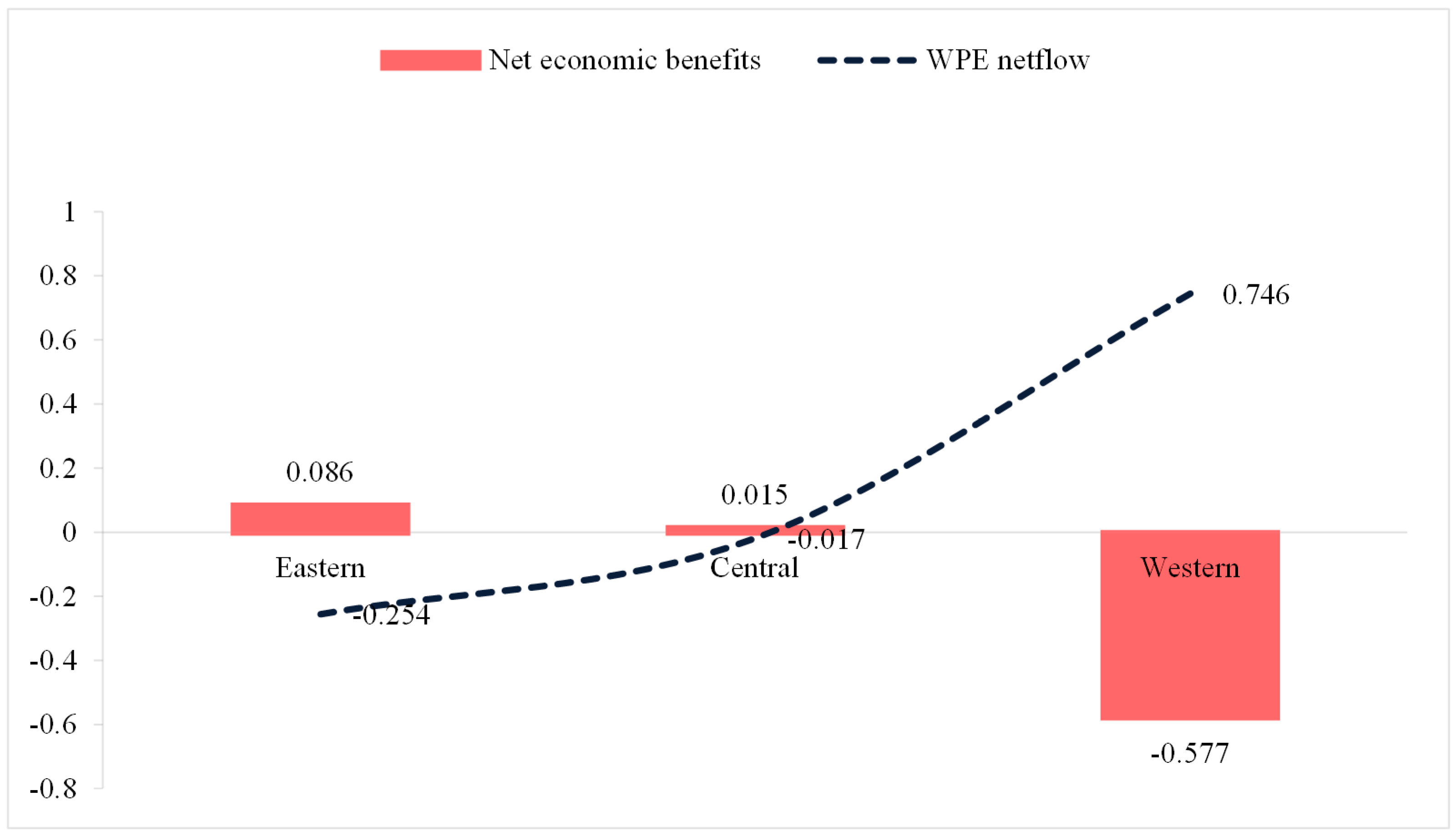
3.1.2. Contrast of the Net Flows of WPE and Value Added
3.2. Agricultural Water Pollution Responsibility Sharing
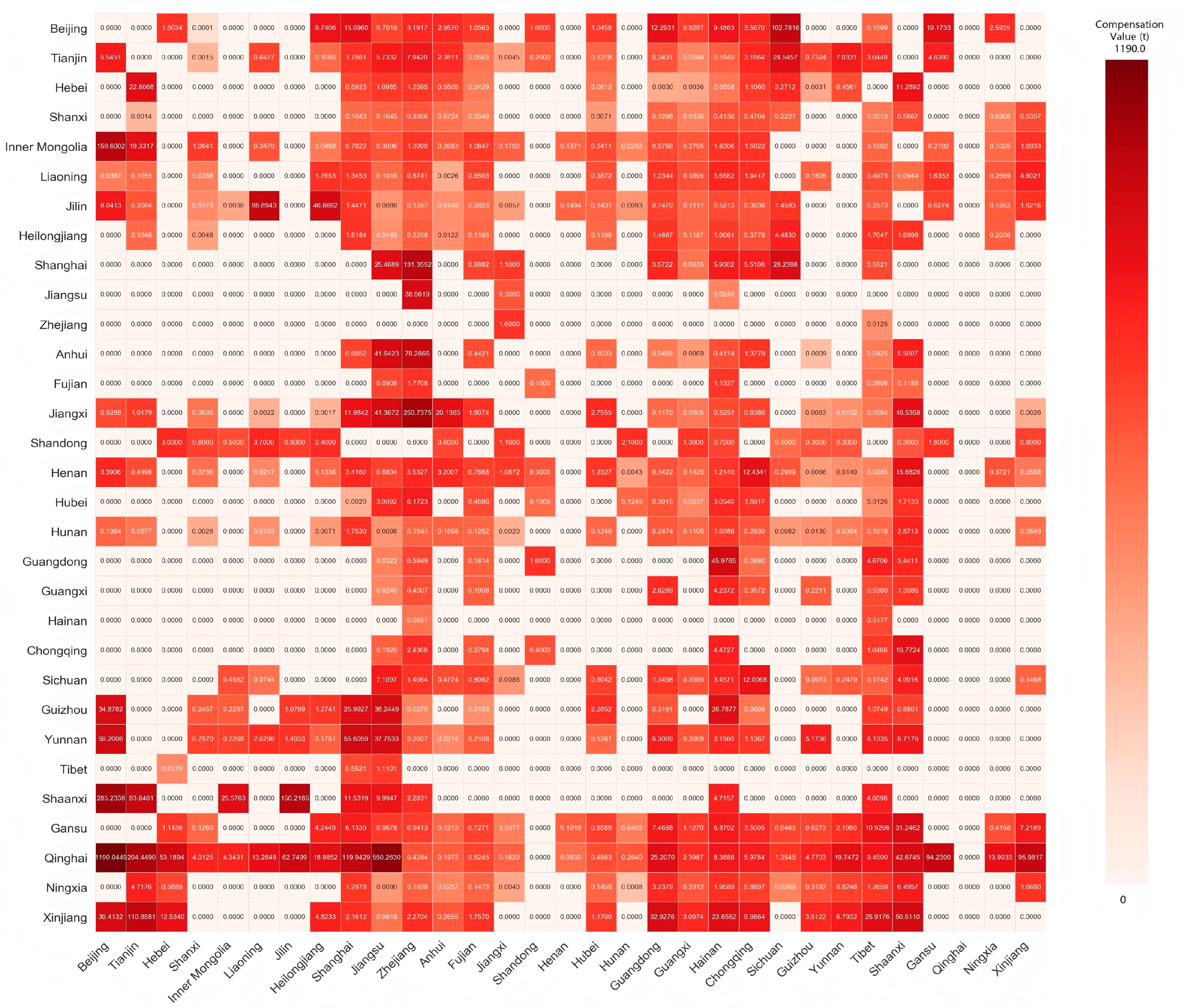
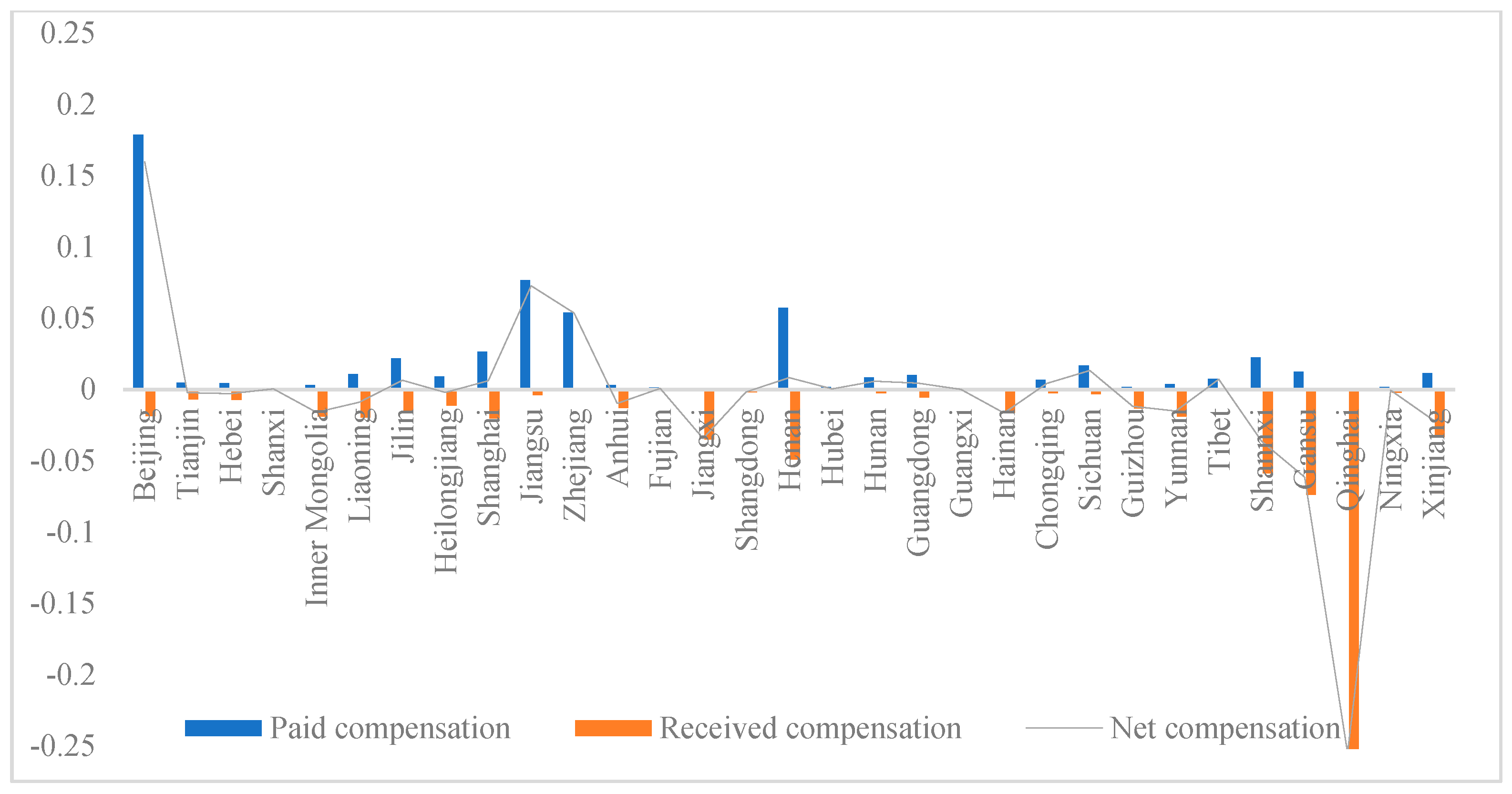
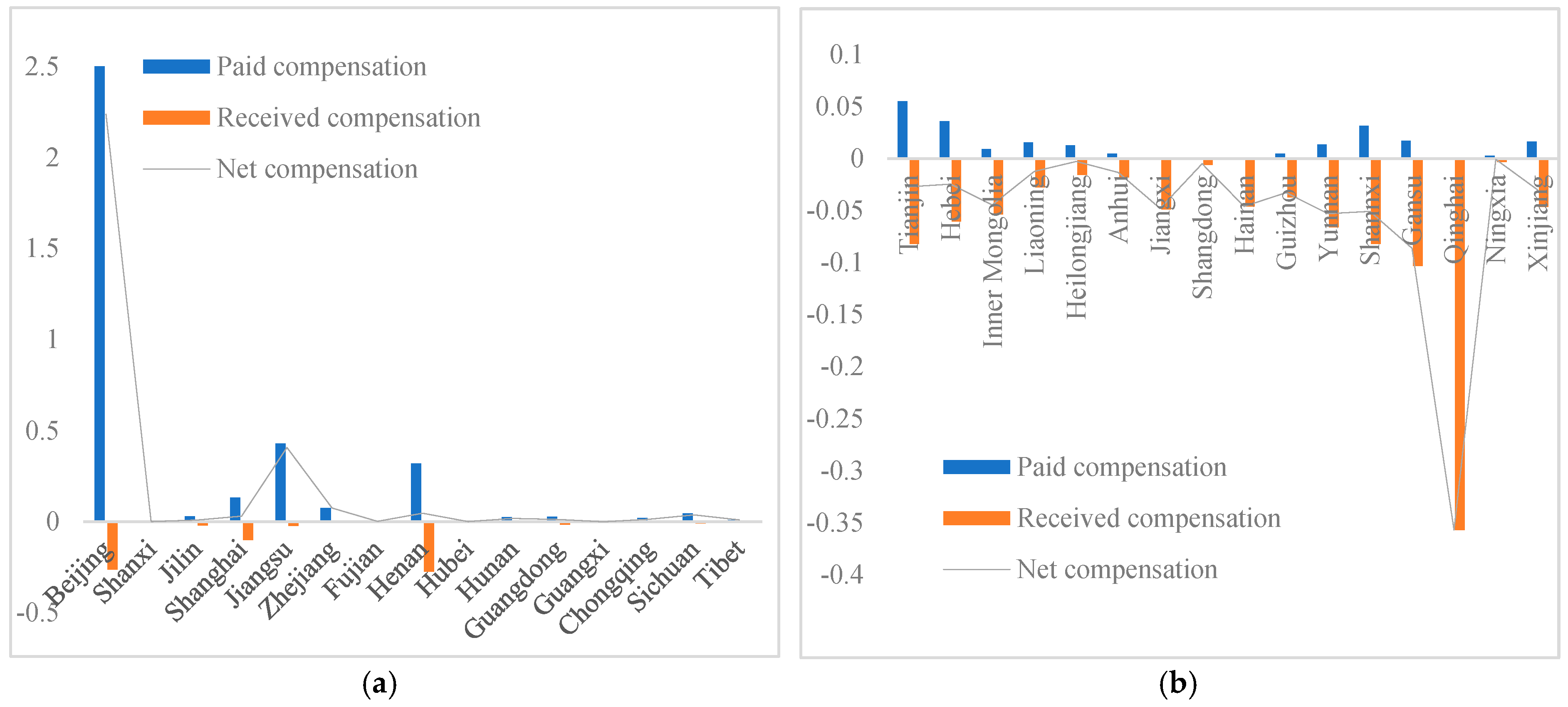
3.3. Agricultural Water Pollution Compensation Scheme
4. Discussion and Policy Implications
- (1)
- Strengthen the internalization of environmental costs in agricultural trade. Agricultural policies and trade planning should incorporate external costs such as water pollution, promoting a “green trade” accounting system.
- (2)
- Develop agriculture according to local conditions in each province. Coordinate and optimize the regional agricultural layout and control the transfer effect of water pollution through measures such as industrial planning and environmental regulation.
- (3)
- Improve data support and monitoring systems. We suggest further integrating multi-regional input–output data, pollution emission data, and trade flow data to build a dynamically updated accounting platform for agricultural pollution transfer.
5. Conclusions
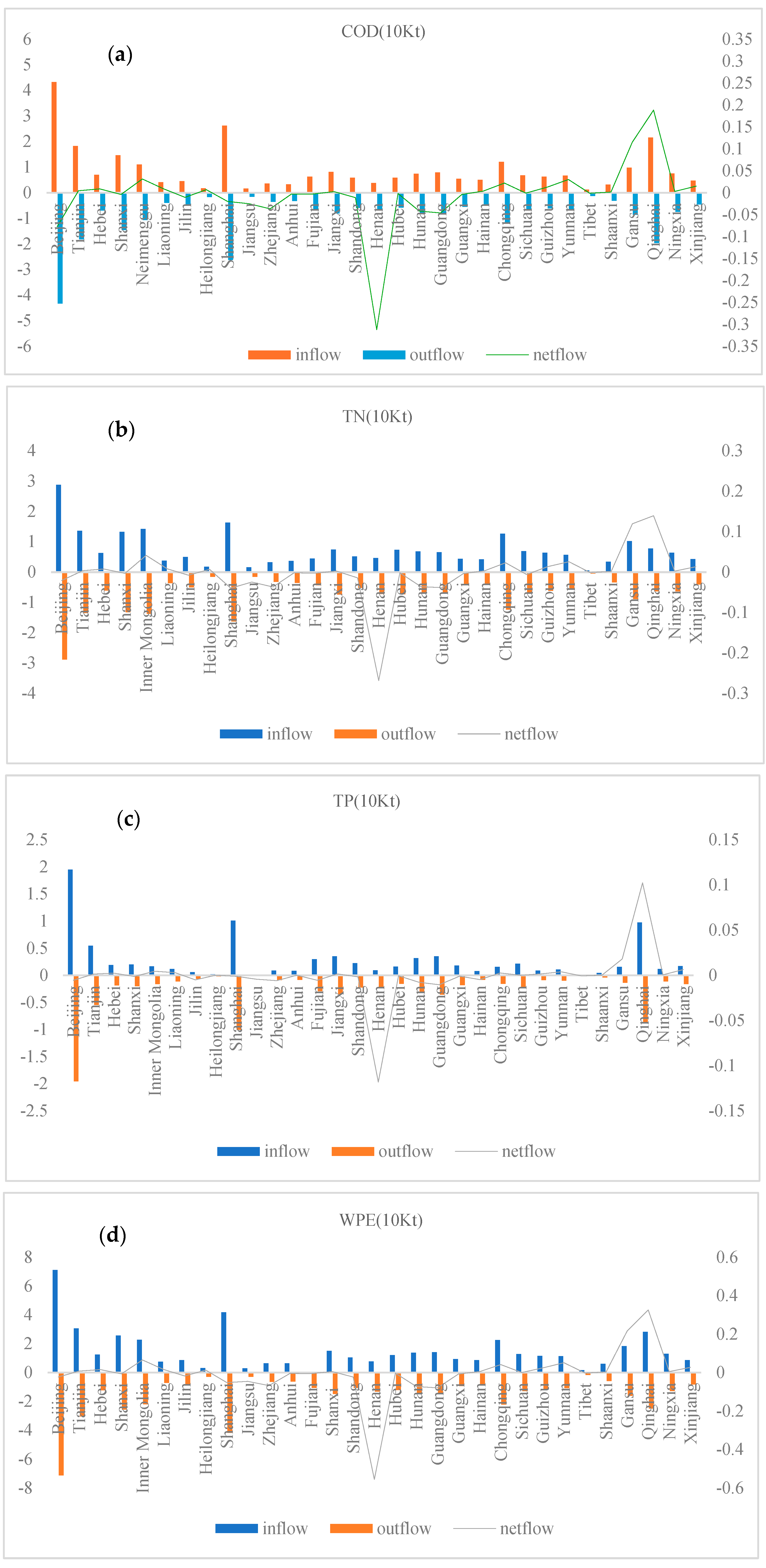
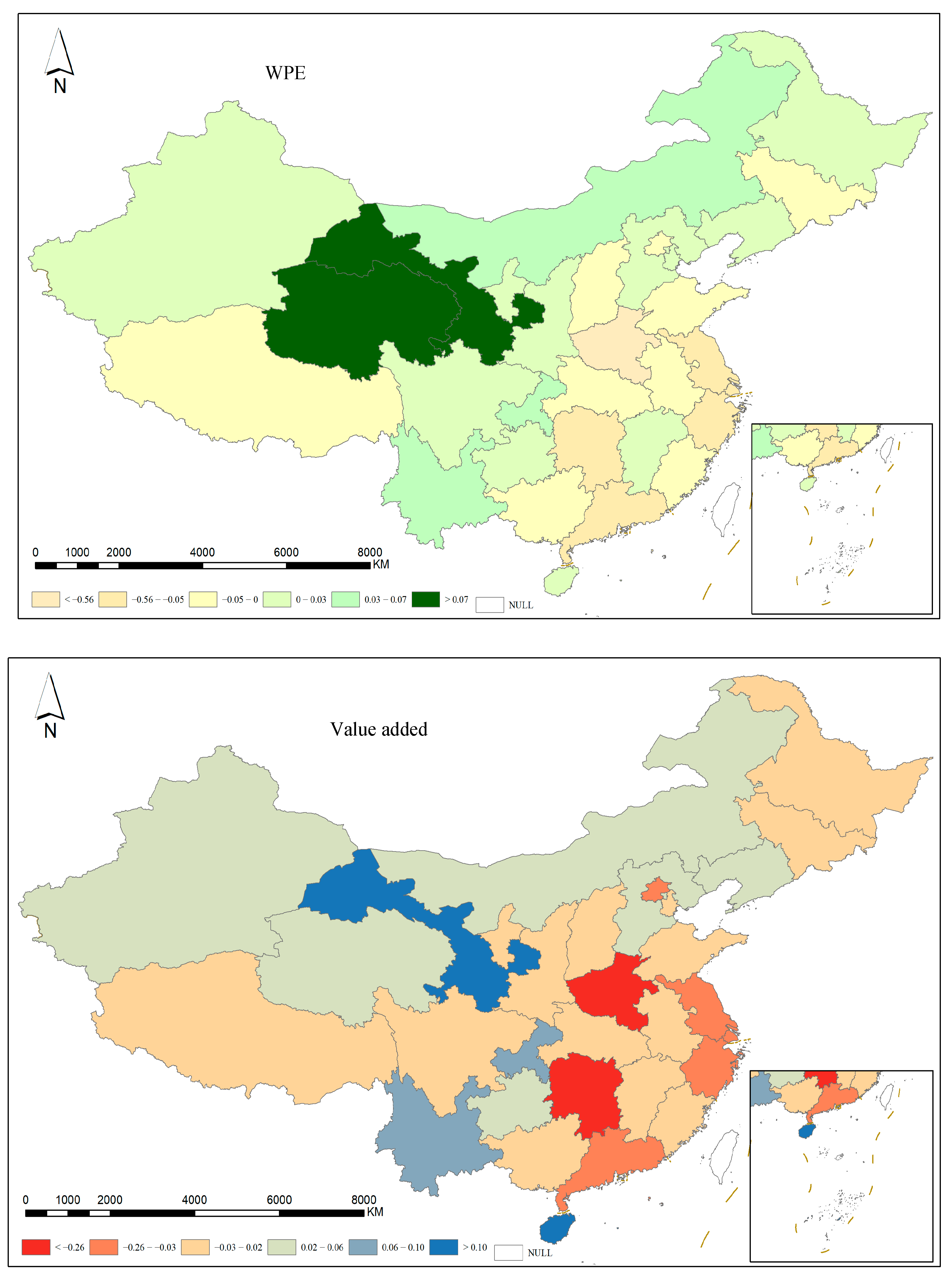
- Qinghai and Gansu represent the key net-receiving regions of agricultural water pollution, where net inflows of COD, TN, and TP are significantly greater than in other provinces.
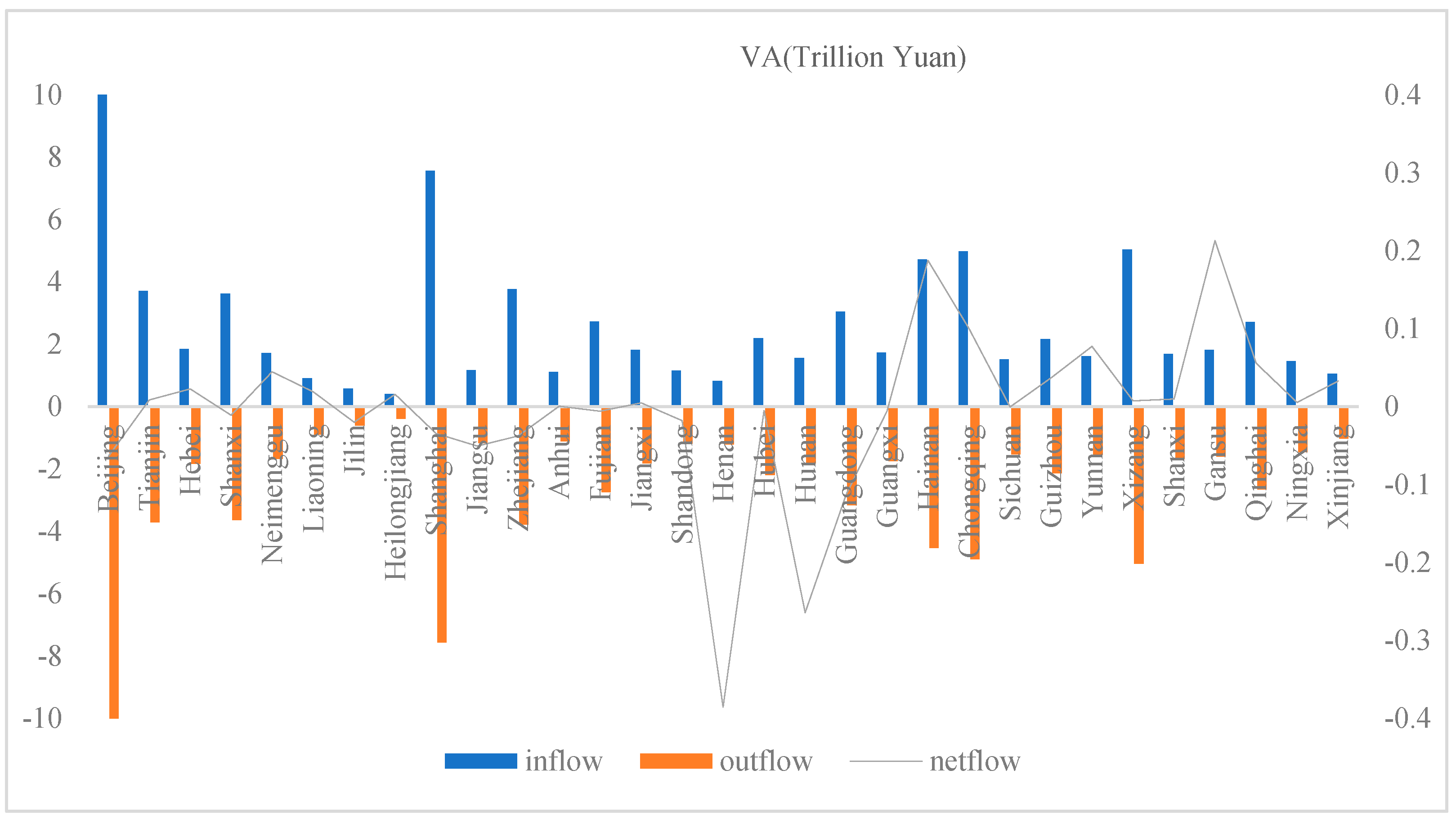
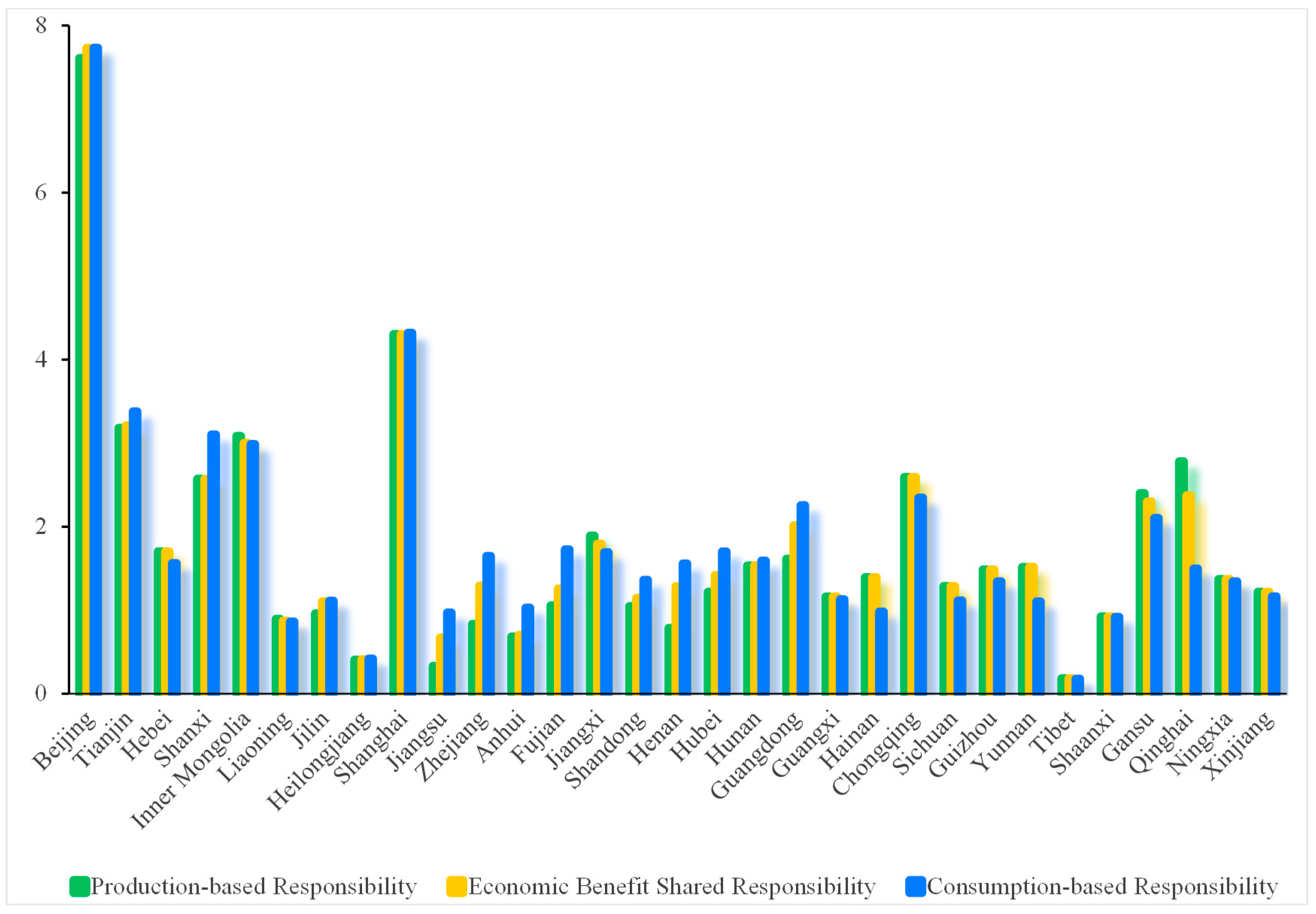
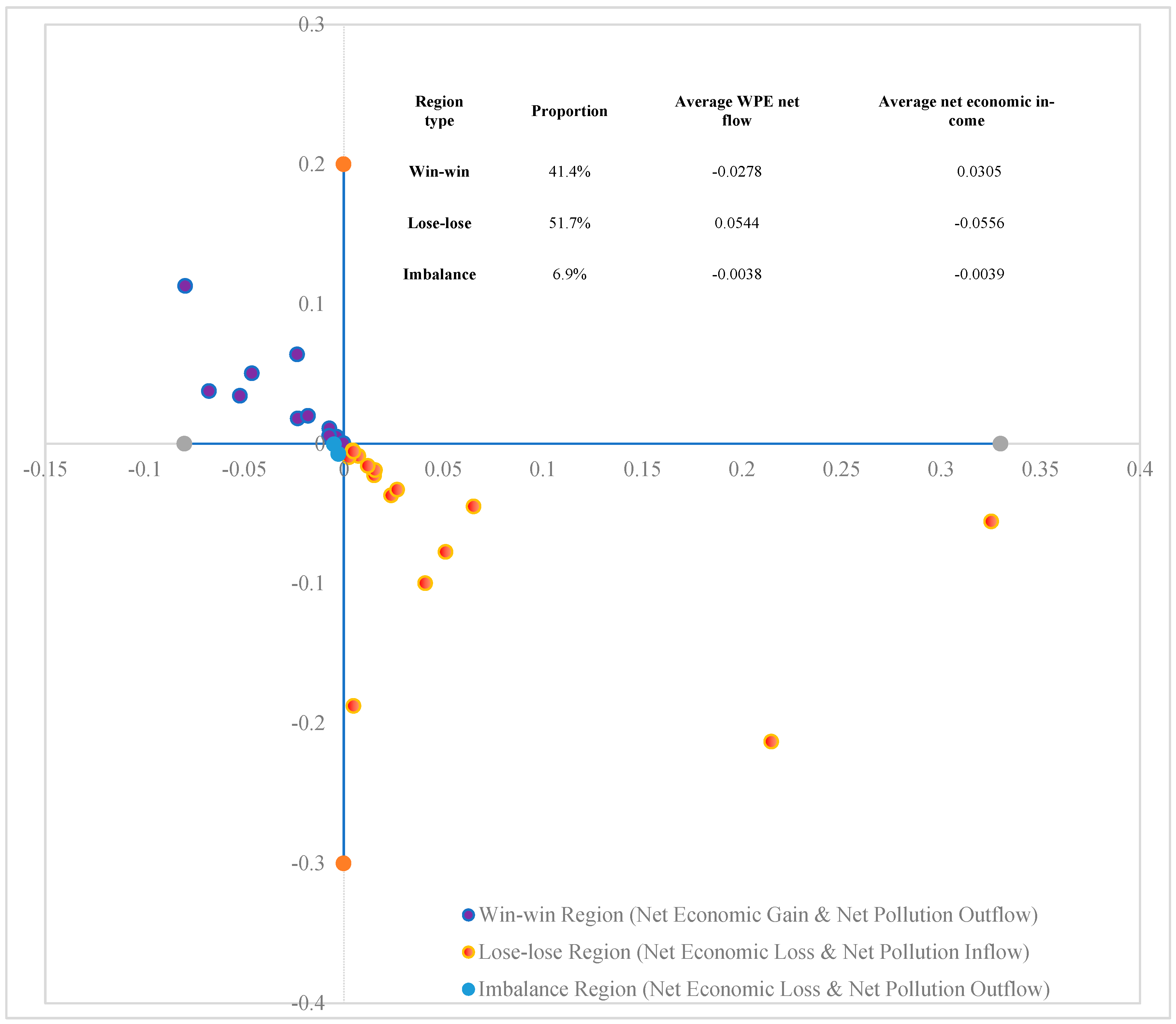
- Gansu and Qinghai bear the largest WPE (2.15 Kt and 3.25 Kt, respectively) but receive relatively little economic return (0.21 trillion and 0.06 trillion yuan, respectively). In contrast, Beijing, Guangdong, Jiangsu, Zhejiang, and Shanghai collectively transfer out 2.69 Kt of agricultural pollution WPE, while still gaining 0.30 trillion yuan in economic benefits.
- Beijing, Jiangsu, and Zhejiang bear the largest compensation liabilities to others, with 1.60 Kt, 0.73 Kt, and 0.54 Kt, respectively. Conversely, provinces including Qinghai, Gansu, and Jiangxi require the greatest compensation inflows, at 2.55 Kt, 0.62 Kt, and 0.34 Kt, respectively.
- Beijing has the highest environmental protection tax rate nationally at 14 yuan/kg, resulting in the highest payment standard of 250 million yuan. As the province with the highest net agriculture water pollution inflow, Qinghai has a minimum acceptable compensation standard of 36 million yuan.
Author Contributions
Funding
Data Availability Statement
Conflicts of Interest
Appendix A

| Regions | Environmental Protection Tax Rate (Yuan/kg) | Regions | Environmental Protection Tax Rate (Yuan/kg) |
|---|---|---|---|
| Beijing | 14 | Hubei | 2.8 |
| Tianjin | 12 | Hunan | 3.0 |
| Hebei | 8.4 | Guangdong | 2.8 |
| Shanxi | 2.1 | Guangxi | 2.8 |
| Inner Mongolia | 2.8 | Hainan | 2.8 |
| Liaoning | 1.4 | Chongqing | 3.0 |
| Jilin | 1.4 | Sichuan | 2.8 |
| Heilongjiang | 1.4 | Guizhou | 2.8 |
| Shanghai | 5.0 | Yunnan | 3.5 |
| Jiangsu | 5.6 | Tibet | 1.4 |
| Zhejiang | 1.4 | Shannxi | 1.4 |
| Anhui | 1.4 | Gansu | 1.4 |
| Fujian | 1.5 | Qinghai | 1.4 |
| Jiangxi | 1.4 | Ningxia | 1.4 |
| Shandong | 3.0 | Xinjiang | 1.4 |
| Henan | 5.6 |
References
- The Food and Agriculture Organization. The State of Food and Agriculture 2020: Overcoming Water Challenges in Agriculture. Available online: https://openknowledge.fao.org/items/a2dc7490-735d-4b5d-92a2-a36bfb380e02 (accessed on 1 January 2023).
- The United Nations Educational, Scientific and Cultural Organization. The United Nations World Water Development Report 2018: Nature-Based Solutions for Water. Available online: https://unesdoc.unesco.org/ark:/48223/pf0000261424 (accessed on 1 January 2023).
- Ministry of Ecology and Environment of the People’s Republic of China. Announcement on the Release of the Second National Pollution Source Census Bulletin. Available online: https://www.mee.gov.cn/xxgk2018/xxgk/xxgk01/202006/t20200610_783547.html (accessed on 1 January 2023).
- Bai, Y.; Wang, Y.; Xuan, X.; Weng, C.; Huang, X.; Deng, X. Tele-connections, driving forces and scenario simulation of agricultural land, water use and carbon emissions in China’s trade. Resour. Conserv. Recycl. 2024, 203, 107433. [Google Scholar] [CrossRef]
- Wang, Z.; Yin, Y.; Liu, G.; Lun, F.; Zhang, F.; Cui, Z.; Wu, J. International trade reduces global phosphorus demand but intensifies the imbalance in local consumption. Sci. Total Environ. 2022, 830, 154484. [Google Scholar] [CrossRef]
- Zhang, C.; Anadon, L.D. A multi-regional input–output analysis of domestic virtual water trade and provincial water footprint in China. Ecol. Econ. 2014, 100, 159–172. [Google Scholar] [CrossRef]
- Wu, H.; Jin, R.; Liu, A.; Jiang, S.; Chai, L. Savings and Losses of Scarce Virtual Water in the International Trade of Wheat, Maize, and Rice. Int. J. Environ. Res. Public Health 2022, 19, 4119. [Google Scholar] [CrossRef] [PubMed]
- Duarte, R.; Pinilla, V.; Serrano, A. The water footprint of the Spanish agricultural sector: 1860–2010. Ecol. Econ. 2014, 108, 200–207. [Google Scholar] [CrossRef]
- Tian, G.L.; Wang, X.W. Study on the virtual water flow relationship between China and Mekong riparian countries driven by agricultural trade. J. North China Inst. Water Resour. Hydropower 2018, 39, 16–23. [Google Scholar]
- National Food and Strategic Reserves Administration. China Grain Development Report 2018; Economic Management Press: Beijing, China, 2018. (In Chinese) [Google Scholar]
- O’Bannon, C.; Carr, J.; Seekell, D.A.; D’Odorico, P. Globalization of agricultural pollution due to international trade. Hydrol. Earth Syst. Sci. Discuss. 2013, 18, 503–510. [Google Scholar] [CrossRef]
- Dabrowski, J.M.; Murray, K.; Ashton, P.J.; Leaner, J. Agricultural impacts on water quality and implications for virtual water trading decisions. Ecol. Econ. 2009, 68, 1074–1082. [Google Scholar] [CrossRef]
- Zapata, J.G.; Vangipuram, B.; Dalin, C.; Erfani, T. Water quality and pollution trading: A sustainable solution for future food production. ACS Est Eng. 2023, 3, 1112–1124. [Google Scholar] [CrossRef] [PubMed]
- Zahoor, I.; Mushtaq, A. Water pollution from agricultural activities: A critical global review. Int. J. Chem. Biochem. Sci. 2023, 23, 164–176. [Google Scholar]
- Zhang, D.; Liu, P.; Liu, B.; Ju, Z. Research on foreign trade, inter-regional trade and virtual water pollution transfer: A study based on the environmental input-output model. Process Saf. Environ. Prot. 2025, 205, 108190. [Google Scholar] [CrossRef]
- Zhang, Y.; Zhang, J.; Tang, G.; Chen, M.; Wang, L. Virtual water flows in the international trade of agricultural products of China. Sci. Total Environ. 2016, 557, 1–11. [Google Scholar] [CrossRef] [PubMed]
- Zhu, M.; Wang, J.; Zhang, J.; Xing, Z. Responsibility-sharing and compensation scheme of transboundary water pollution embodied in China’s inter-provincial trade: A perspective from economic value capturing. Environ. Sci. Pollut. Res. 2024, 31, 8677–8688. [Google Scholar] [CrossRef]
- Lenzen, M.; Murray, J.; Sack, F.; Wiedmann, T. Shared producer and consumer responsibility-theory and practice. Ecol. Econ. 2007, 61, 27–42. [Google Scholar] [CrossRef]
- Wu, L.; Zhou, Y.; Qian, H. Global actions under the Paris agreement: Tracing the carbon leakage flow and pursuing countermeasures. Energy Econ. 2022, 106, 105804. [Google Scholar] [CrossRef]
- Davis, S.J.; Caldeira, K. Consumption-based accounting of CO2 emissions. Proc. Natl. Acad. Sci. USA 2010, 107, 5687–5692. [Google Scholar] [CrossRef]
- Spaiser, V.; Scott, K.; Owen, A.; Holland, R. Consumption-based accounting of CO2 emissions in the sustainable development Goals Agenda. Int. J. Sustain. Dev. World Ecol. 2019, 26, 282–289. [Google Scholar] [CrossRef]
- Csutora, M.; Vetőné Mózner, Z. Proposing a beneficiary-based shared responsibility approach for calculating national carbon accounts during the post-Kyoto era. Clim. Policy 2014, 14, 599–616. [Google Scholar] [CrossRef]
- Piñero, P.; Bruckner, M.; Wieland, H.; Pongrácz, E.; Giljum, S. The raw material basis of global value chains: Allocating environmental responsibility based on value generation. Econ. Syst. Res. 2019, 31, 206–227. [Google Scholar] [CrossRef]
- Jakob, M.; Ward, H.; Steckel, J.C. Sharing responsibility for trade-related emissions based on economic benefits. Glob. Environ. Change 2021, 66, 102207. [Google Scholar] [CrossRef]
- Zhao, L.; He, Z. Allocation of responsibility for transportation carbon emissions based on economic benefits. Transp. Res. D Transp. Environ. 2025, 146, 104850. [Google Scholar] [CrossRef]
- Wang, J.; Ji, C.J.; Liu, Y.; Shan, Y.; Hubacek, K.; Wei, Y.M.; Wang, K. Re-investigating the shared responsibility for trade-embodied carbon emissions. Ecol. Econ. 2024, 220, 108162. [Google Scholar] [CrossRef]
- Xu, X.; Yuan, J.; Yu, Q. A study on water rights allocation in transboundary rivers based on the transfer and inequality index of virtual water. Water 2023, 15, 2379. [Google Scholar] [CrossRef]
- Robles-Diaz-de-Leon, L.F.; Kangas, P. Evaluation of potential gross income from non-timber products in a model riparian forest for the Chesapeake Bay watershed. Agrofor. Syst. 1998, 44, 215–225. [Google Scholar] [CrossRef]
- Haaren, C.V.; Bathke, M. Integrated Landscape Planning and Remuneration of Agri-environmental Services: Results of a Case Study in the Fuhrberg Region of Germany. J. Environ. Manag. 2008, 89, 209–221. [Google Scholar] [CrossRef]
- Gao, X.; Shen, J.; He, W.; Sun, F.; Zhang, Z.; Zhang, X.; Xu, X. Changes in ecosystem services value and establishment of watershed ecological compensation standards. Int. J. Environ. Res. Public Health 2019, 16, 2951. [Google Scholar] [CrossRef]
- Liu, L.H.; Yang, B.R. Research on Ecological Compensation of Cultivated Land in China. China Popul. Resour. Environ. 2019, 29, 52–62. [Google Scholar]
- Bai, Y.; Liu, M.; Yang, L. Calculation of ecological compensation standards for arable land based on the value flow of support services. Land 2021, 10, 719. [Google Scholar] [CrossRef]
- Wang, H.; Qu, J.; Zhang, W.; Zhu, P.; Zhu, R.; Han, Y.; Cao, Y.; Dong, B. Research on Ecological Compensation in the Yangtze River Economic Belt Based on Water-Energy-Food Service Flows and XGBoost-SHAP Analysis. Sustainability 2026, 18, 839. [Google Scholar] [CrossRef]
- Dunford, R.W.; Ginn, T.C.; Desvousges, W.H. The Use of Habitat Equivalency Analysis in Natural Resource Damage Assessments. Ecol. Econ. 2004, 48, 49–70. [Google Scholar] [CrossRef]
- Engel, S.; Pagiola, S.; Wunder, S. Designing Payments for Environmental Services in Theory and Practice: An Overview of the Issues. Ecol. Econ. 2008, 65, 663–674. [Google Scholar] [CrossRef]
- Zhao, S.Q.; Sun, X.; Hou, D.L.; Zhu, Y. Research on Ecological Compensation Volume of Watershed Water Resources for Addressing Cross-Border Pollution from Livestock and Poultry Farming-A Case Study of the Jiuzhou River Basin in the National Ecological Compensation Demonstration Zone. Acta Ecol. Sin. 2020, 40, 3247–3257. [Google Scholar]
- Geng, X.Y.; Ge, Y.X.; Zhang, H.N. Research on the Ecological Compensation Standard of Watershed Based on Replacement Cost-Taking the Xiaoqing River Basin as an Example. China Popul. Resour. Environ. 2018, 28, 140–147. [Google Scholar]
- Tienhaara, A.; Haltia, E.; Pouta, E.; Arovuori, K.; Grammatikopoulou, I.; Miettinen, A.; Koikkalainen, K.; Ahtiainen, H.; Artell, J. Demand and Supply of Agricultural ES: Towards Benefit-based Policy. Eur. Rev. Agric. Econ. 2020, 47, 1223–1249. [Google Scholar] [CrossRef]
- Tadesse, T.; Berhane, T.; Mulatu, D.W.; Rannestad, M.M. Willingness to Accept Compensation for Afromontane Forest Ecosystems Conservation. Land Use Policy 2021, 105, 105382. [Google Scholar] [CrossRef]
- Wang, T.; Mao, D.; Jiang, Z. Quantitative assessment of agricultural horizontal ecological compensation in China, from the perspective of virtual land and virtual water. Environ. Sci. Pollut. Res. 2023, 30, 22885–22899. [Google Scholar] [CrossRef]
- Li, J.; Li, L.; Li, K. Research on inter-provincial agricultural ecological compensation standards in China from the perspective of implicit water pollution. Issues Agric. Econ. 2022, 43, 106–121. [Google Scholar]
- Leontief, W. Environmental repercussions and the economic structure: An input-output approach. Rev. Econ. Stat. 1970, 52, 262–271. [Google Scholar] [CrossRef]
- Zhao, X.; Liu, J.; Liu, Q.; Tillotson, M.R.; Guan, D.; Hubacek, K. Physical and virtual water transfers for regional water stress alleviation in China. Proc. Natl. Acad. Sci. USA 2015, 112, 1031–1035. [Google Scholar] [CrossRef] [PubMed]
- Li, S.; Pan, C.; He, J.; Chen, J. China Interprovincial Input Output Table 2017: Compilation and Application; Economic Science Press: Beijing, China, 2021. (In Chinese) [Google Scholar]
- A Group of Experts from the UK, USA and China. China Emissions Accounts and Datasets. Available online: https://www.ceads.net/user/login.php?lang=cn (accessed on 1 January 2023).
- National Bureau of Statistics of China. China’s Environmental Statistics Yearbook; China Statistics Press: Beijing, China, 2018. (In Chinese) [Google Scholar]
- Wang, J.; Li, L.; Li, F.; Kharrazi, A.; Bai, Y. Regional footprints and interregional interactions of chemical oxygen demand discharges in China. Resour. Conserv. Recycl. 2018, 132, 386–397. [Google Scholar] [CrossRef]
- Li, Y.; Zhang, Q.L. Research on inter-provincial virtual water ecological compensation in China. China Soft Sci. 2022, 8, 79–91. [Google Scholar]
- Wu, Z.; Ye, Q. Water pollution loads and shifting within China’s inter-province trade. J. Clean. Prod. 2020, 259, 120879. [Google Scholar] [CrossRef]
- Xing, Z. Measurement of embodied carbon emissions in China’s inter-provincial trade and cross regional compensation mechanism. Environ. Econ. Resour. 2023, 8, 84–99. [Google Scholar]
- Ma, Z.; Kang, Y.; Ma, W.; Niu, X.; Kou, J.; Yang, H. The fairness of shared responsibility for embodied carbon emission: A case study of the Yellow River Basin, China. Environ. Sci. Pollut. Res. 2024, 31, 57065–57080. [Google Scholar] [CrossRef] [PubMed]
- Xing, Z. Collaborative governance of trade-driven transboundary air pollution in China: A responsibility-based fair compensation mechanism. J. Environ. Manag. 2023, 348, 119327. [Google Scholar] [CrossRef]
- Li, H.; Zhou, B.; Li, Y.; Zhou, T.; Hu, M.; Huang, H.; Pang, W. Provincial responsibilities and compensations in water pollutant transfers in China. Process Saf. Environ. Prot. 2025, 195, 106739. [Google Scholar] [CrossRef]
- Peng, Q.; He, W.; Kong, Y.; Shen, J.; Yuan, L.; Ramsey, T.S. Spatio-temporal analysis of water sustainability of cities in the Yangtze River Economic Belt based on the perspectives of quantity-quality-benefit. Ecol. Indic. Indic. 2024, 160, 111909. [Google Scholar] [CrossRef]
- Lu, L.; Zhao, Z.; Jiang, J.; Meng, F.; Wang, Z.; Wang, C.; Fu, D. The embodied agricultural NH3 emissions in China’s inter-provincial trade and the implied environmental inequities. J. Clean. Prod. 2025, 537, 147177. [Google Scholar] [CrossRef]




Disclaimer/Publisher’s Note: The statements, opinions and data contained in all publications are solely those of the individual author(s) and contributor(s) and not of MDPI and/or the editor(s). MDPI and/or the editor(s) disclaim responsibility for any injury to people or property resulting from any ideas, methods, instructions or products referred to in the content. |
© 2026 by the authors. Licensee MDPI, Basel, Switzerland. This article is an open access article distributed under the terms and conditions of the Creative Commons Attribution (CC BY) license.
Share and Cite
Xu, X.; Yu, Q. Research on Responsibility-Sharing and Compensation Scheme for Agricultural Water Pollution Transfer Embodied in China’s Inter-Provincial Trade. Water 2026, 18, 647. https://doi.org/10.3390/w18050647
Xu X, Yu Q. Research on Responsibility-Sharing and Compensation Scheme for Agricultural Water Pollution Transfer Embodied in China’s Inter-Provincial Trade. Water. 2026; 18(5):647. https://doi.org/10.3390/w18050647
Chicago/Turabian StyleXu, Xia, and Qianwen Yu. 2026. "Research on Responsibility-Sharing and Compensation Scheme for Agricultural Water Pollution Transfer Embodied in China’s Inter-Provincial Trade" Water 18, no. 5: 647. https://doi.org/10.3390/w18050647
APA StyleXu, X., & Yu, Q. (2026). Research on Responsibility-Sharing and Compensation Scheme for Agricultural Water Pollution Transfer Embodied in China’s Inter-Provincial Trade. Water, 18(5), 647. https://doi.org/10.3390/w18050647