Article

Ecological Characteristics of Eukaryotic Communities in Water Diversion Rivers of the Eastern Route of China’s South-to-North Water Diversion Project During Flood and Non-Flood Seasons


1
College of Environmental Science and Engineering, Yangzhou University, Huayang West Road #196, Yangzhou 225009, China
2
State Key Laboratory of Water Disaster Prevention, Nanjing Hyraulic Research Institute, Guangzhou Road #223, Nanjing 210029, China
3
Dongzhu Ecological Environmental Protection Co., Ltd., Xihu Middle Road #90, Wuxi 214000, China
*
Authors to whom correspondence should be addressed.
Water 2026, 18(6), 648; https://doi.org/10.3390/w18060648
Submission received: 1 February 2026 / Revised: 24 February 2026 / Accepted: 4 March 2026 / Published: 10 March 2026
(This article belongs to the Special Issue Water Pollution Control and Ecological Restoration: 2nd Edition)

Abstract

The composition, ecological network characteristics, and community assembly mechanisms of eukaryotic communities in the sediments of typical water diversion rivers (WDRs) of the Eastern Route of the South-to-North Water Diversion Project were analyzed using 18S rRNA gene sequencing during the flood and non-flood seasons. Against the backdrop of global climate change and intensified anthropogenic disturbances, shifts in hydrological regimes induced by inter-basin water transfer projects have become key factors altering the structure and function of aquatic microbial ecosystems. Clarifying the spatiotemporal dynamics and assembly mechanisms of sedimentary eukaryotic communities in water diversion rivers under different hydrological conditions is crucial for understanding the ecological response of river ecosystems to water diversion and safeguarding the ecological security of diverted water resources. The eukaryotic communities were primarily composed of Bacillariophyta, Ciliophora, Arthropoda, and Chlorophyta. The composition and distribution patterns of eukaryotic communities exhibited distinct temporal and spatial shifts under varying hydrological regimes. Stochastic dispersal was identified as the primary driver of community assembly. During the flood season, eukaryotic communities showed increased complexity, more competitive interactions, and enhanced modularity, with species turnover being the dominant structuring process. During the non-flood season, eukaryotic communities exhibited higher spatial heterogeneity.

1. Introduction

Inter-basin water transfer is an effective engineering measure to address the uneven spatiotemporal distribution of water resources, and its ecological impacts on aquatic ecosystems have attracted widespread attention in recent years [1,2]. As vital components of river ecosystems, sedimentary eukaryotic microorganisms play key roles in biogeochemical cycles, energy flow, and pollutant degradation, and their community dynamics can effectively reflect ecological changes in water diversion rivers (WDRs) [3]. However, the ecological processes and response mechanisms of sedimentary eukaryotic microorganisms in WDRs under varying hydrological conditions remain unclear, which is the core scientific question addressed in this study.
Inter-basin water transfer achieves the optimal allocation of water resources through redistributing surplus water across different basins, and represents an effective strategy to tackle the uneven spatial and temporal distribution of water resources [4,5]. Against the backdrop of global population growth, accelerated urbanization, and climate change exacerbating the imbalance between water supply and demand, inter-basin water transfer has evolved into a crucial engineering measure worldwide to alleviate regional water scarcity and resolve mismatches in water resource allocation [6,7]. The primary goal of inter-basin water transfer projects is to mitigate the spatial mismatch between socio-economic development and water resource distribution, thereby safeguarding regional water security by optimizing the spatial layout of water resources and balancing water demand patterns. In China, water resources are characterized by a pronounced spatiotemporal pattern of “southern abundance and northern scarcity”, which has imposed severe constraints on the sustainable development of northern regions [8]. Following years of planning and construction, China has implemented a series of inter-basin water transfer projects, which have effectively optimized the allocation of water resources across its intricate river systems [9]. Among these projects, the Eastern Route of the South-to-North Water Diversion Project is particularly prominent owing to its significant benefits. Taking water from the Jiangdu Water Control Project in Jiangsu Province—the lower Yangtze River basin—the project conveys water northward via staged pumping along the Beijing-Hangzhou Grand Canal and its adjacent water channels. The project links major lakes and reservoirs such as Hongze Lake, Luoma Lake, Nansi Lake and Dongping Lake, thereby effectively relieving water shortages in northern China. Against this backdrop, the ecological condition of the aquatic environment at the source of the Eastern Route of the South-to-North Water Diversion Project is of critical importance. It not only directly determines the usability of the diverted water resources, but also exerts a profound influence on the economic and social stability of the water-receiving areas along the route, which is essential for guaranteeing the overall performance of the project. Thus, in-depth monitoring and research on ecological changes in the aquatic environment at the water source are of great practical and scientific significance for sustaining the long-term stable operation of the South-to-North Water Diversion Project.
While optimizing the spatial allocation of water resources, water diversion projects adopt distinct scheduling modes (e.g., flood control, drought relief, and water transfer) during flood and non-flood seasons. The resultant variations in surface runoff can exert an influence on the water environment and microbial ecosystems within the water diversion rivers (WDRs) along the route. The natural flow regime of WDRs varies across hydrological periods, which in turn drives dynamic exchanges of energy and materials within the river channels. This, in turn, shapes environmental factors such as water temperature, nutrient status, and sediment properties spatiotemporally [10,11]. In aquatic ecosystems, hydrological conditions act as key drivers shaping microbial dispersal and distribution, with microbial communities exhibiting distinct responses to different flow regimes [12]. Accordingly, under the fluctuating hydrological conditions of WDRs, the community composition and species diversity of benthic microbes may display adaptive changes across various spatial and temporal scales. Dai et al. [13] examined the effects of the Yangtze River-to-Taihu Lake Water Diversion Project on the microbial community structure and overall ecosystem of the receiving lake and revealed that water diversion altered the lake’s trophic state and the functional traits of the microbial community. Moreover, recent studies on microbial communities in the lakes and canals along the Eastern Route of China’s South-to-North Water Diversion Project have demonstrated that increased habitat connectivity driven by water diversion tends to promote microbial homogenization and reduce ecological heterogeneity [14]. However, current research on the impacts of water diversion on aquatic microbial communities has predominantly focused on source reservoirs or receiving water bodies [15,16], with an emphasis on bacterial communities. Nonetheless, knowledge regarding the ecological processes and response mechanisms of sedimentary eukaryotic microorganisms under variable hydrological regimes in WDRs is still insufficient.
Eukaryotic communities play an indispensable role in river ecosystems and form a key component of aquatic food webs [17]. As sensitive bioindicators, their shifts in community structure and diversity in response to environmental perturbations can effectively characterize alterations in riverine ecosystems, laying a robust scientific foundation for the mitigation and management of associated ecological and environmental challenges [18]. Eukaryotic microorganisms are not only widely utilized as indicators of environmental quality in freshwater ecosystems but also play key roles in biogeochemical cycles, energy flow, and pollutant degradation [19]. They are essential forces in maintaining the stable functioning of river ecosystems [20,21]. In recent years, driven by global warming, the magnitude and frequency of extreme precipitation events have been on the rise [22]. Under the combined influence of climate change and anthropogenic water transfer, variations in regional factors (e.g., temperature, precipitation, and runoff) are likely to further intensify the spatiotemporal heterogeneity of the ecosystems in water diversion rivers [23,24]. This, in turn, modulates material transport processes and drives changes in the structural and functional dynamics of eukaryotic microbial communities within these systems [25]. Consequently, elucidating the ecological characteristics of sedimentary eukaryotic microbial communities in WDRs under changing environmental conditions holds significant practical importance for the integrated regulation and management of variable aquatic environments.
This study concentrated on sedimentary eukaryotic communities in the WDRs of the South-to-North Water Diversion Eastern Route during flood and non-flood periods. Utilizing 18S rRNA gene sequencing, combined with methods such as co-occurrence network analysis and neutral community modeling, it aimed to elucidate the spatiotemporal distribution patterns of eukaryotic communities in WDRs during flood and non-flood seasons, and to reveal the community assembly characteristics and mechanisms of riverine eukaryotic microorganisms under a changeable environment. This study is expected to provide a scientific basis for the ecological regulation of aquatic environments, the assessment of ecological impacts induced by water diversion projects, and the protection of water quality in water diversion rivers.

2. Materials and Methods

2.1. Study Area and Sample Collection

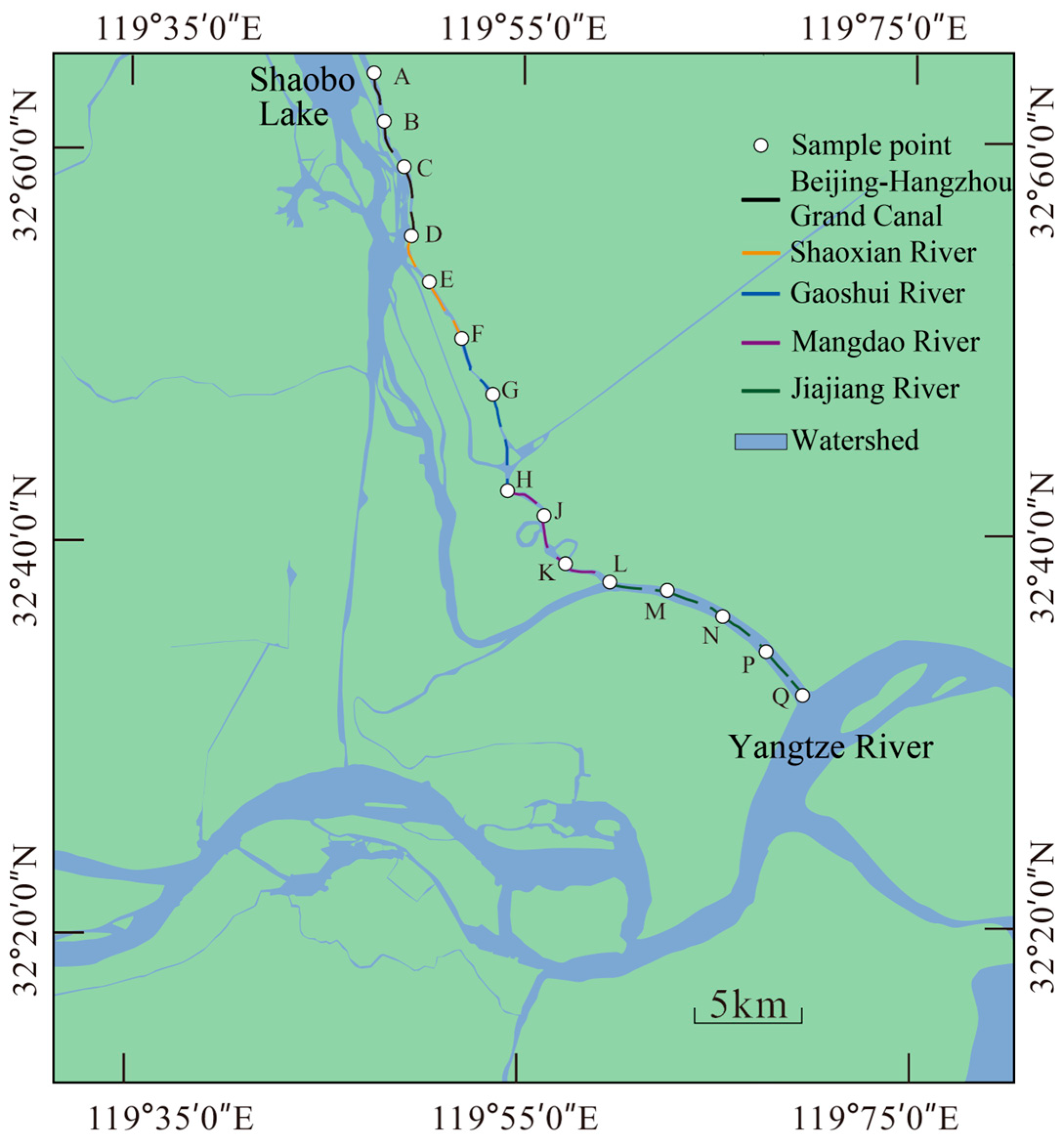
The study area encompassed five water diversion rivers (WDRs) along the Eastern Route of the South-to-North Water Diversion Project, namely the Beijing-Hangzhou Grand Canal, Shaoxian River, Gaoshui River, Mangdao River, and Jiajiang River (Figure 1). These five rivers are key sections in the southern part of the Eastern Route of the South-to-North Water Diversion Project, with typical hydrological characteristics and stable water diversion functions, and can effectively reflect the ecological status of the southern section of the Eastern Route. Sampling campaigns were conducted in April (non-flood season) and August (flood season) of 2022. Prior to the collection of sediment samples, all sampling devices and containers were strictly sterilized. Surface sediments (0–5 cm depth) were collected using a sterilized Van Veen grab sampler( Qingdao Watertools Technology Co., Ltd., Qingdao, China). Three replicate samples were taken at each sampling site. The specific sampling procedure was as follows: within each site, three sub-sampling points were evenly distributed around a central point in the middle of the river, and surface sediment (0–5 cm) was independently collected from each sub-point to constitute one replicate. Approximately 1–2 g of sediment was subsequently collected from each of the three replicate samples. These subsamples were thoroughly homogenized, allocated into 2 mL sterile centrifuge tubes( Corning Inc., Corning, NY, USA), and immediately placed in dry ice for preservation. All samples were then transported to the laboratory and stored at −80 °C in an ultra-low temperature freezer( Haier Biomedical Co., Ltd., Qingdao, China) until total DNA extraction for subsequent analysis.

2.2. DNA Extraction, PCR Amplification, and Illumina HiSeq 2500 Sequencing

This study employed high-throughput sequencing technology targeting the 18S rRNA gene (Illumina HiSeq 2500 platform, PE250; Illumina, Inc., San Diego, CA, USA) to characterize the composition of eukaryotic communities. Total DNA was extracted from sediment samples using the E.Z.N.A.® Soil DNA Kit (Omega Bio-Tek, Norcross, GA, USA) and quantified with a NanoDrop2000 spectrophotometer (Thermo Fisher Scientific, Waltham, MA, USA). The integrity of the extracted DNA was verified by 1% agarose gel electrophoresis at 5 V/cm for 20 min, while its purity and concentration were assessed using a NanoDrop2000 spectrophotometer (Thermo Fisher Scientific, Inc., Waltham, MA, USA) by measuring the A260/280 and A260/230 absorbance ratios. Amplicon sequencing of the V4 hypervariable region of the 18S rRNA gene was performed using the universal primers TAReuk454FWD1 (5′-CCAGASCYGCGGTAATTCC-3′) and TAReukREV3 (5′-ACTTTCGTTCTTGATYRA-3′) [26]. Polymerase Chain Reaction (PCR) amplification was carried out with TransStart FastPfu DNA Polymerase (TransGen Biotech Co., Ltd., Beijing, China) in a 20 μL reaction volume, with three technical replicates for each sediment sample to ensure reproducibility. The reaction mixture included 4 μL of 5× FastPfu buffer, 2 μL of 2.5 mM dNTPs, 0.8 μL of Forward primer (5 μM), 0.8 μL of Reverse primer (5 μM), 10 ng of DNA template, and 0.4 μL of FastPfu polymerase. The PCR protocol consisted of an initial denaturation step at 95 °C for 5 min, followed by 35 cycles of denaturation at 95 °C for 30 s, annealing at 55 °C for 30 s, and extension at 72 °C for 45 s, with a final extension step at 72 °C for 10 min. PCR reactions were performed at Biozeren Co., Ltd. (Shanghai, China), and the amplification products were detected by 2% agarose gel electrophoresis. The PCR products were purified using the AxyPrep DNA Gel Extraction Kit (Axygen Biosciences, Inc., Union City, CA, USA), quantified with a Quantus™ Fluorometer (Promega Corporation, Madison, WI, USA), and subsequently used for paired-end (PE) library construction and sequencing. The raw sequencing data generated in this study have been deposited in the National Center for Biotechnology Information (NCBI) database under the BioProject accession number PRJNA1261395.

2.3. Statistical Analysis

2.3.1. Sequencing Data Preprocessing

The raw sequencing reads were first subjected to quality control to obtain high-quality sequences for subsequent analysis. The cleaning process was performed using fastp (version 0.20.0) for quality control, in conjunction with FLASH (version 1.2.7) for sequence assembly. The specific steps were as follows: bases with a quality score below 20 at the ends of the reads were trimmed. A 50 bp sliding window was applied; if the average quality score within the window was below 20, the bases from that window position to the end of the read were truncated. Reads with a length of less than 50 bp after quality control were filtered out, and reads containing ambiguous bases (N) were also removed to eliminate low-quality sequences. Based on the overlap relationship between the paired-end (PE) reads, the read pairs were assembled into a single sequence. The minimum overlap length was set to 10 bp, and the maximum mismatch ratio allowed in the overlap region of the assembled sequence was 0.2; sequences that did not meet these criteria were discarded. Samples were distinguished, and sequence directions were adjusted according to the barcode and primer information at the ends of the sequences. A mismatch of 0 was allowed for the barcodes, and a maximum of 2 mismatches was allowed for the primers to ensure the accuracy and uniqueness of the sample sequences. Chimeric sequences were removed using USEARCH software(drive5) in conjunction with the Gold database, employing a combination of de novo and reference-based methods.
The operational taxonomic unit (OTU) clustering analysis process was as follows: First, non-repetitive sequences were extracted from the optimized sequences to reduce computational redundancy during the analysis (http://drive5.com/usearch/manual/dereplication.html) (accessed on 5 May 2022). Subsequently, singletons were removed (http://drive5.com/usearch/manual/singletons.html) (accessed on 5 May 2022). The remaining non-repetitive sequences (excluding singletons) were clustered into OTUs based on a 97% similarity threshold. Chimeras were simultaneously removed during the clustering process, ultimately obtaining representative sequences for each OTU. All optimized sequences were then mapped against the OTU representative sequences, and sequences with similarity ≥ 97% were selected to generate an OTU abundance table. Taxonomic analysis was performed using the UCLUST algorithm, comparing the OTU representative sequences against the Silva 18S rRNA database (v138) at an 80% alignment threshold. The microbial community composition of each sample was summarized at two taxonomic levels: phylum and genus. The phylum level reflects the overall community structure, while the genus level reveals key functional taxa.
Origin (version 2024) was used to visualize differences in community structure across the two hydrological periods (flood season and non-flood season). Microsoft Excel (version 2019) and SPSS (version 25.0) were employed for raw data organization and general statistical analysis, respectively. Additionally, the spatial distribution of sampling sites was mapped using CorelDRAW (version 2020).

2.3.2. Assembly Mechanisms of Sedimentary Eukaryotic Microorganisms

Spearman correlation analysis was performed using the igraph package in R (version 4.0.4). Only correlation pairs that were statistically significant (p < 0.05) and exhibited a high absolute correlation strength (|r| > 0.8) were retained for constructing the co-occurrence network. The generated network file was imported into Gephi software (version 0.9.2) for visualization. Key microbial taxa within the network were identified based on node topological properties, such as degree centrality and betweenness centrality [27,28]. The neutral community model was fitted to assess the influence of stochastic processes on community assembly. Neutral model plots were generated using the Hmisc package in R (version 4.0.4). Based on the β-diversity of eukaryotic microbial communities, the Sørensen dissimilarity index (βSOR) was partitioned into spatial turnover (βSIM) and nestedness (βNES) components using the Baselga framework [29]. Specifically, βSIM quantifies species turnover across multi-site assemblages, explicitly controlling for the confounding effects of richness gradients to isolate compositional shifts driven purely by species replacement. βNES captures the nestedness structure of these biotas, defined here as the extent to which species-poor communities represent non-random subsets of species-rich assemblages. βSOR integrates these two components to represent the total compositional dissimilarity between sites; as a holistic metric of β-diversity, it is inherently linked to the proportional overlap of species taxa across the studied communities. By comparing the relative contributions of βSIM and βNES, the dominant community assembly processes could be inferred: whether they are primarily driven by species turnover (e.g., environmental selection, dispersal limitation) or by nestedness (e.g., non-random species gain and loss).

3. Results and Discussion

3.1. Composition and Distribution Patterns of the Sedimentary Eukaryotic Microbial Community

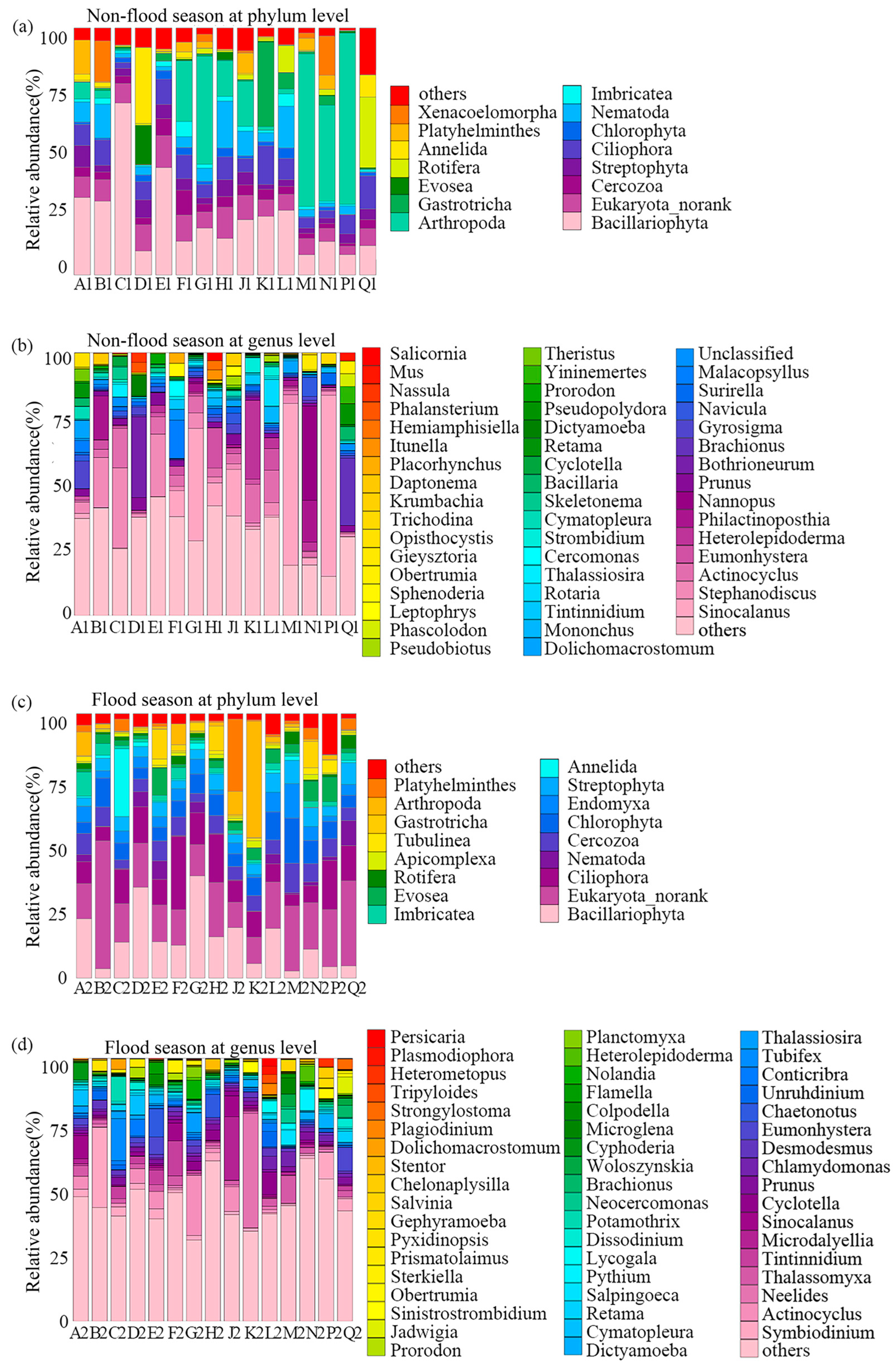
The number of cleaned reads after quality control was 1,605,559, with an average of 53,518.63 cleaned reads per sample and an average read length of 380.98 bp, which ensured sufficient sequencing depth for subsequent analysis. Analysis of eukaryotic communities in the water diversion rivers across different hydrological periods (selecting taxa with a relative abundance >1%) revealed that the communities were predominantly composed of Bacillariophyta, Ciliophora, Arthropoda, and Chlorophyta. Their composition and distribution patterns varied between flood and non-flood seasons (Figure 2). During the non-flood season, Bacillariophyta was the phylum with the highest average relative abundance (22.97% of the total community), followed by Arthropoda (18.99%) and Ciliophora (8.05%). Within Bacillariophyta, Actinocyclus (5.02%) and Stephanodiscus (6.87%) were the dominant genera. In the flood season, Bacillariophyta remained the dominant phylum (14.67%), followed by Ciliophora (11.75%) and Chlorophyta (7.51%). Actinocyclus (3.75%) was the most dominant genus of Bacillariophyta. Hydrodynamic changes and water quality variations induced by riverine water mass mixing may affect the structural composition and diversity of microbial communities [30]. The distribution of Bacillariophyta in freshwater environments is affected by various factors, including nutrient levels and flow velocity [31]. The relative abundance of Bacillariophyta was significantly higher in the non-flood season than in the flood season, which may be associated with variations in water quality and hydraulic conditions in the diversion rivers between the two hydrological periods.

3.2. Analysis of the Assembly Mechanisms of the Sedimentary Eukaryotic Microbial Community

3.2.1. Co-Occurrence Network Analysis of the Sedimentary Eukaryotic Microbial Community

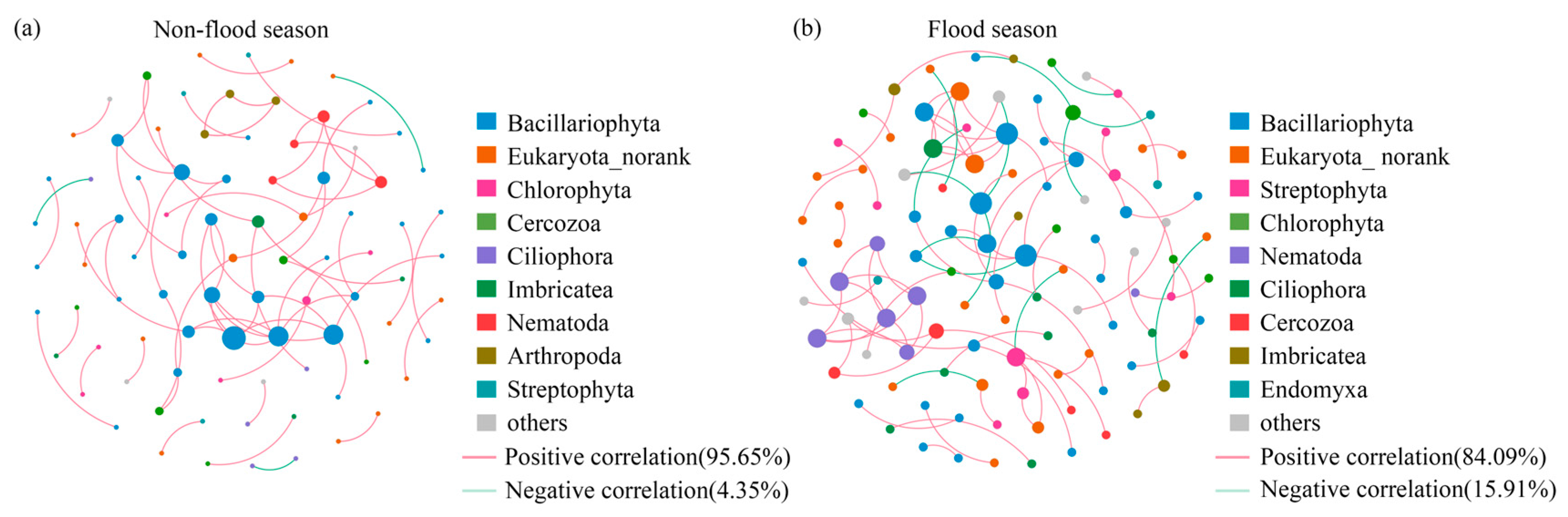
Co-occurrence network analysis was performed using OTUs with an average relative abundance greater than 0.001% (Figure 3). In the network visualization, only the top 9 phyla with strong and statistically significant correlations (|r| > 0.6, p < 0.05) were displayed as individual nodes; phyla with weak correlations or low relative abundances were grouped into the “others” category to maintain visual clarity. In this study, network complexity was evaluated as a comprehensive property based on multiple topological metrics, including node number, edge number, graph density, modularity, average clustering coefficient, and average path length [32,33]. The topological properties of the eukaryotic microbial networks (Table 1) indicated that during the flood season, the community exhibited higher complexity, compactness, and competitiveness, whereas the non-flood season network was relatively sparse with weaker competitive or symbiotic interactions among species. This highlights the influence of hydrological modifications resulting from water diversion on the ecological strategies employed by eukaryotic microorganisms. During the flood season, the higher number of nodes and edges indicated elevated eukaryotic diversity and more frequent interspecific interactions. This was likely driven by environmental disturbances such as hydrodynamic mixing and nutrient inputs, which facilitated the introduction of new taxa and materials. This suggests enhanced cooperative or competitive capacities among eukaryotic microbes in response to environmental stress. The smaller network diameter and shorter average path length observed during the flood season implied higher efficiency in information or material transfer, as well as tighter interspecific connections. The higher average clustering coefficient and modularity index in the flood season suggested that species tended to form more localized functional subgroups, promoting niche differentiation. The more distinct modular structure may enhance adaptability to environmental changes [34]. In both non-flood and flood seasons, the OTUs with the highest degree centrality in the co-occurrence networks belonged to Bacillariophyta, indicating its role as a core hub in energy flow, supporting the survival of other eukaryotic groups. Studies have indicated that species prone to symbiotic interactions often become dominant, thereby driving shifts in microbial community structure. Meanwhile, these interactions also contribute to maintaining ecosystem stability and functional diversity [35]. The proportions of positive correlations in both non-flood and flood season networks far exceeded those of negative correlations, indicating that interactions among sedimentary eukaryotic microorganisms in the diversion rivers were predominantly facilitative and relatively tight. The absolute predominance of positive correlations (95.65%) during the non-flood season indicated a cooperative and symbiotic strategy within the eukaryotic community in a stable environment. In contrast, the proportion of positive correlations decreased to 84.09% during the flood season, while negative correlations increased to 15.91%, revealing a shift toward intensified species competition, potentially due to nutrient competition or spatial exclusion [36].

3.2.2. Neutral Community Model Analysis of the Sedimentary Eukaryotic Microbial Community

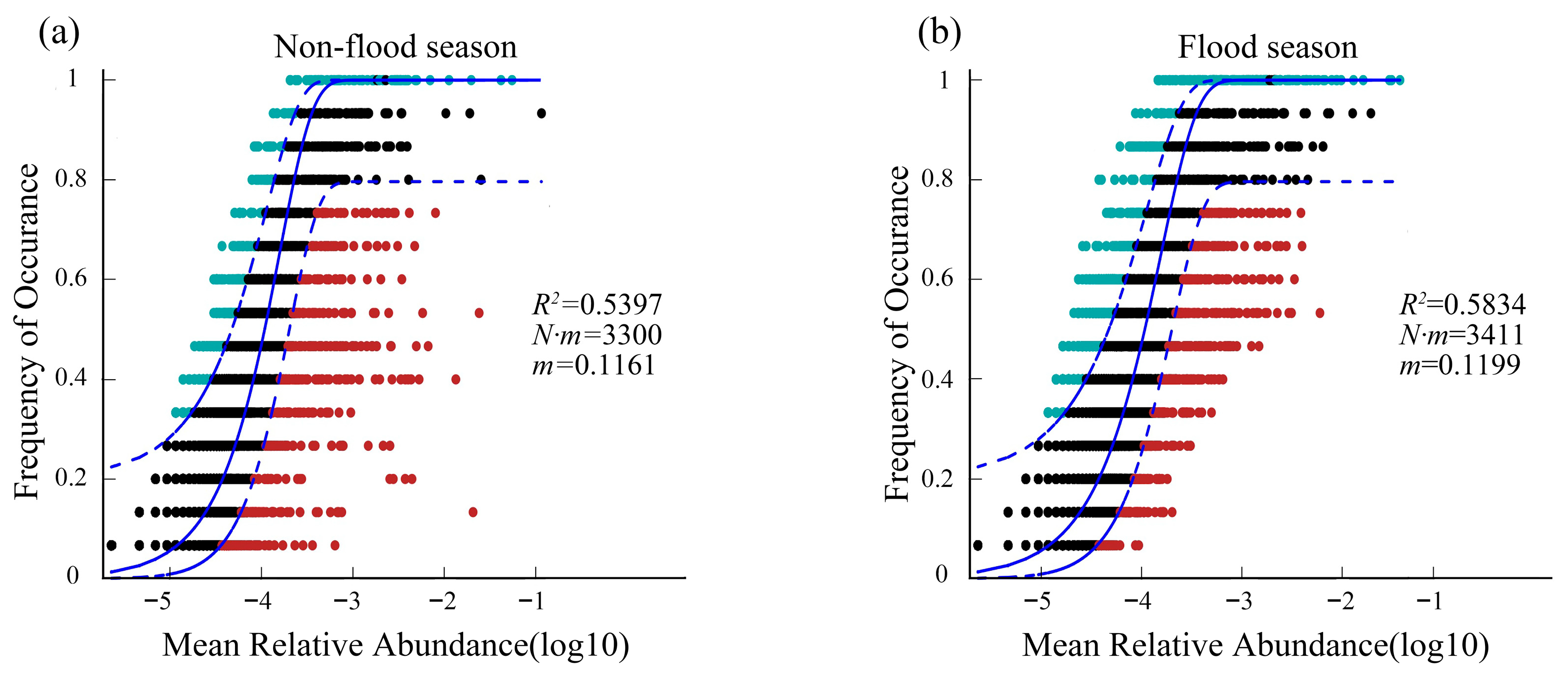
The neutral community model applied to sedimentary eukaryotic microorganisms in the water diversion rivers (Figure 4) indicates that both stochastic and deterministic processes jointly influenced community assembly during non-flood and flood seasons. The model showed a relatively high explanatory power (R2 = 0.5138 for non-flood season and R2 = 0.5834 for flood season) and a low migration rate (m) for eukaryotic assemblages in both periods, suggesting that neutral processes (stochastic process) serve as important drivers in structuring eukaryotic microbial communities. The estimated metacommunity size times migration rate (N·m = 3411) was higher during the flood season than during the non-flood season (N·m = 3300), reflecting a greater degree of species dispersal under flood conditions. Although species distribution patterns were similar between seasons, the neutral model explained a larger proportion of the variation in microbial species distribution during the flood season (R2 = 0.5834), indicating stronger stochastic process influences on community assembly. This may be attributed to enhanced random dispersal resulting from hydrological changes induced by water diversion [37]. Concurrently, environmental disturbances during the flood season may also strengthen deterministic processes by favoring taxa with adaptive traits. These findings are consistent with the co-occurrence network results, which exhibited elevated modularity and intensified competitive interactions during the flood season, collectively demonstrating the multi-scale regulatory effects of hydrological variation on microbial community assembly [38,39].

3.2.3. Analysis of Spatial Drivers: Species Turnover and Community Nestedness

Analysis of spatial ecological drivers—specifically species turnover and community nestedness—within the sedimentary eukaryotic microbial communities in the diverted river reach during the flood and non-flood seasons revealed that community dissimilarity was primarily driven by species turnover, with nestedness contributing secondarily. As shown in Table 2, the overall Sørensen dissimilarity index was higher during the non-flood season (βSOR = 0.8497) than during the flood season (βSOR = 0.8210), indicating greater spatial heterogeneity among communities in the non-flood period. This likely resulted from more stable environmental conditions (e.g., hydrological stability and nutrient supply) during the non-flood season, which promoted local niche differentiation and increased community dissimilarity. In contrast, the stronger hydrodynamic disturbances in the flood season could promote community homogenization through increased dispersal [40,41]. The species turnover component (βSIM) closely approximated βSOR in both periods, accounting for a very high proportion of total dissimilarity (94.6% in the non-flood season and 97.4% in the flood season). This demonstrates that species turnover acted as the dominant driver of beta diversity in sedimentary eukaryotic microbial communities. The nestedness-resultant component (βNES) was low in both seasons, indicating a weak role for nestedness. The further decrease in nestedness during the flood season may be attributed to intensified stochastic dispersal [42].

4. Conclusions

The eukaryotic communities in the sediments of the WDRs of the Eastern Route of the South-to-North Water Diversion Project were primarily composed of Bacillariophyta, Ciliophora, Arthropoda, and Chlorophyta. The relative abundance of Bacillariophyta during the non-flood season (22.97%) was higher than that during the flood season (14.67%), whereas Ciliophora and Chlorophyta exhibited higher relative abundances during the flood season. These patterns could be attributed to changes in water quality and hydraulic conditions in the WDRs induced by shifts in the hydrological regime. Co-occurrence network analysis revealed that eukaryotic communities during the flood season exhibited higher complexity, competitiveness, and modularity, with Bacillariophyta serving as the core hub taxa supporting energy flow. Furthermore, neutral community modeling indicated that stochastic dispersal was a key driver of eukaryotic community assembly, with stronger stochastic processes (R2 = 0.5834) and greater dispersal capacity (N·m = 3411) observed during the flood season. Species turnover was found to be the dominant process contributing to eukaryotic community dissimilarity in the sediments of the WDRs (βSIM > 94%). Spatial heterogeneity was higher during the non-flood season (βSOR = 0.8497). During the flood season, hydrodynamic disturbance presumably drove community homogenization by strengthening dispersal processes, while the contribution of nestedness was only minor.
The findings of this study have important practical significance and scientific value. They clarify the spatiotemporal dynamics and assembly mechanisms of sedimentary eukaryotic communities in the southern section of the Eastern Route of the South-to-North Water Diversion Project under different hydrological conditions, enrich the research on the ecological impacts of water diversion projects on eukaryotic microorganisms, and provide a scientific basis for the ecological regulation of water diversion rivers, the assessment of engineering ecological impacts, and the safeguarding of water quality. Specifically, the results suggest that shifts in the hydrological regime are the key factor driving changes in eukaryotic communities. Therefore, in the ecological management of water diversion rivers, it is necessary to adjust the water diversion schedule according to the hydrological characteristics of different seasons, mitigate the disturbance of flood season water diversion on eukaryotic community structure, and maintain the stability of river ecosystems. In addition, as the keystone hub taxa of the community, Bacillariophyta can be used as an indicator taxon to monitor the ecological status of water diversion rivers.
This study concentrated on the southern part of the Eastern Route of the South-to-North Water Diversion Project. Future research would expand the sampling range to include the middle and northern sections of the Eastern Route to comprehensively understand the spatial patterns of eukaryotic communities. In addition, the functional traits of eukaryotic communities (e.g., metabolic functions) would also be further explored to clarify their ecological roles in the biogeochemical cycles of water diversion rivers. Furthermore, the long-term dynamic monitoring of eukaryotic communities can be carried out to reveal the long-term response of eukaryotic communities to water diversion projects and climate change.

Author Contributions

Conceptualization, W.C. and J.W.; methodology, W.C.; software, W.C., Y.Z., H.L., Y.J. and X.W.; validation, W.C.; formal analysis, W.C.; investigation, W.C., Y.Z., H.L. and Q.Z.; resources, W.C.; data curation, W.C. and X.W.; writing—original draft preparation, W.C. and Y.Z.; writing—review and editing, W.C.; visualization, W.C.; supervision, W.C. and J.W.; project administration, W.C.; funding acquisition, W.C. All authors have read and agreed to the published version of the manuscript.

Funding

This research was funded by the National Natural Science Foundation of China (Grant No. 51909229), the Natural Science Foundation of the Jiangsu Higher Education Institutions of China (Grant No. 24KJB610020), and the Belt and Road Special Foundation of the State Key Laboratory of Water Disaster Prevention (Grant No. 2023nkms04).

Data Availability Statement

The data presented in this study are available on request from the corresponding author. The data are not publicly available due to privacy restrictions.

Conflicts of Interest

Author Qin Zhong was employed by Dongzhu Ecological Environmental Protection Co., Ltd. The remaining authors declare that the research was conducted in the absence of any commercial or financial relationships that could be construed as a potential conflict of interest.

References

  1. Shi, Z.; Zhang, H.; Zhang, P.; Xiao, Z.; Zhang, J.; Huo, S. Ecological networks and mechanisms underlying their variation in impounded lakes along the eastern route of China’s south-to-north water diversion project. J. Contam. Hydrol. 2025, 275, 104697. [Google Scholar] [CrossRef]
  2. Zhang, Z.; Wu, Z.; Zhang, Y.; Yuan, W.; Zhang, X. Effects of the South-to-North water diversion project (China) on phytoplankton community and water ecology of Dongping Lake. Ecohydrol. Hydrobiol. 2025, 25, 100703. [Google Scholar] [CrossRef]
  3. Wei, J.; Zhang, Q.; Yin, Y.; Peng, K.; Wang, L.; Cai, Y.; Gong, Z. Limited Impacts of Water Diversion on Micro-eukaryotic Community along the Eastern Route of China’s South-to-North Water Diversion Project. Water Res. 2024, 262, 122109. [Google Scholar] [CrossRef] [PubMed]
  4. Wu, L.; Su, X.; Zhang, T. Challenges of typical inter-basin water transfer projects in China: Anticipated impacts of climate change on streamflow and hydrological drought under CMIP6. J. Hydrol. 2023, 627, 130437. [Google Scholar] [CrossRef]
  5. Wang, L.; He, F.; Zhao, Y.; Wang, J.; Lu, P.; Ou, Z.; Jia, Y. Complex network-based analysis of inter-basin water transfer networks. Ecol. Indic. 2023, 156, 111197. [Google Scholar] [CrossRef]
  6. Jia, Y.; Zhang, L.; Niu, J.; Berndtsson, R. China’s South-to-North Water Diversion Project: A Review and Reach Beyond China’s Borders. Water 2025, 17, 3275. [Google Scholar] [CrossRef]
  7. Li, Q.; Zhu, F.; Hou, W.; Zhu, X.; Dong, T. Influence of the Yangtze-to-Huaihe Water Diversion Project on the Spatiotemporal Distribution and Ecological Risk of Polycyclic Aromatic Hydrocarbons in Sediments from Lake Caizi, China. Sustainability 2026, 18, 446. [Google Scholar] [CrossRef]
  8. Yang, M.; Qin, C.; Zhu, Y.; Zhao, Y.; He, G.; Wang, L. Assessment of Multi-Regional Comprehensive Benefits of the South-to-North Water Diversion Project in China. Water 2024, 16, 473. [Google Scholar] [CrossRef]
  9. Zhou, B.; Fang, G.; Li, X.; Zhou, J.; Zhong, H. Joint optimal operation of the South-to-North Water Diversion Project considering the evenness of water deficit. Hydrol. Earth Syst. Sci. 2024, 28, 817–832. [Google Scholar] [CrossRef]
  10. Zhang, D.; Han, X.; Zhong, Q.; Wang, S.; Ding, L.; Liu, Y.; Chen, Q.; Wang, F. Online monitoring and sampling analysis of siltation in the middle route of the south-to-north water diversion project. Front. Environ. Sci. 2022, 10, 927588. [Google Scholar] [CrossRef]
  11. Ma, C.; Zhang, H.; Huo, S.; Zhi, W.; Wu, F.; Fu, Q. Water quality improvements and amplified climate impacts from the South-to-North Water Diversion Project, China. J. Hydrol. 2025, 656, 133032. [Google Scholar] [CrossRef]
  12. Li, Y.; Wang, C.; Zhang, W.; Wang, P.; Niu, L.; Hou, J.; Wang, J.; Wang, L. Modeling the Effects of Hydrodynamic Regimes on Microbial Communities within Fluvial Biofilms: Combining Deterministic and Stochastic Processes. Environ. Sci. Technol. 2015, 49, 12869–12878. [Google Scholar] [CrossRef]
  13. Dai, J.; Wu, S.; Wu, X.; Lv, X.; Sivakumar, B.; Wang, F.; Zhang, Y.; Yang, Q.; Gao, A.; Zhao, Y.; et al. Impacts of a large river-to-lake water diversion project on lacustrine phytoplankton communities. J. Hydrol. 2020, 587, 124938. [Google Scholar] [CrossRef]
  14. Yang, N.; Hou, X.; Li, Y.; Zhang, H.; Wang, J.; Hu, X.; Zhang, W. Inter-basin water diversion homogenizes microbial communities mainly through stochastic assembly processes. Environ. Res. 2023, 223, 115473. [Google Scholar] [CrossRef]
  15. Yang, Y.; Ci, F.; Xu, A.; Zhang, X.; Ding, N.; Wan, N.; Lv, Y.; Song, Z. Seasonal Dynamics of Eukaryotic Microbial Communities in the Water-Receiving Reservoir of the Long-Distance Water Diversion Project, China. Microorganisms 2024, 12, 1873. [Google Scholar] [CrossRef] [PubMed]
  16. Zhu, L.; Feng, L.; Zhang, D.; Shi, F.; Zou, X.; Yang, Q.; He, S.; Zhu, W. Eukaryotic plankton community and assembly processes in a large-scale water diversion project in China. Sci. Rep. 2025, 15, 4365. [Google Scholar] [CrossRef] [PubMed]
  17. Busi, S.; Peter, H.; Brandani, J.; Kohler, T.; Fodelianakis, S.; Pramateftaki, P.; Bourquin, M.; Michoud, G.; Ezzat, L.; Lane, S.; et al. Cross-domain interactions confer stability to benthic biofilms in proglacial streams. Front. Microbiomes 2024, 2, 1280809. [Google Scholar] [CrossRef]
  18. Yang, Q.; Zhang, P.; Li, X.; Yang, S.; Chao, X.; Liu, H.; Ba, S. Distribution patterns and community assembly processes of eukaryotic microorganisms along an altitudinal gradient in the middle reaches of the Yarlung Zangbo River. Water Res. 2023, 239, 120047. [Google Scholar] [CrossRef]
  19. Garner, R.; Kraemer, S.; Onana, V.; Huot, Y.; Gregory-Eaves, I.; Walsh, D. Protist Diversity and Metabolic Strategy in Freshwater Lakes Are Shaped by Trophic State and Watershed Land Use on a Continental Scale. mSystems 2022, 7, e00316-22. [Google Scholar] [CrossRef]
  20. Zhang, W.; Bhagwat, G.; Palanisami, T.; Liang, S.; Wan, W.; Yang, Y. Lacustrine plastisphere: Distinct succession and assembly processes of prokaryotic and eukaryotic communities and role of site, time, and polymer types. Water Res. 2024, 248, 120875. [Google Scholar] [CrossRef]
  21. Li, C.; Miao, L.; Adyel, T.; Huang, W.; Wang, J.; Wu, J.; Hou, J.; Wang, Z. Eukaryotes contribute more than bacteria to the recovery of freshwater ecosystem functions under different drought durations. Environ. Microbiol. 2023, 25, 1363–1373. [Google Scholar] [CrossRef]
  22. Xie, Z.; Fu, Y.; He, H.; Wang, S.; Wang, L.; Liu, C. Increases in extreme precipitation expected in Northeast China under continued global warming. Clim. Dyn. 2024, 62, 4943–4965. [Google Scholar] [CrossRef]
  23. Gudmundsson, L.; Brunner, M.; Döll, P.; Fluet-Chouinard, E.; Frolova, N.; Gosling, S.; Hirabayashi, Y.; Liu, X.; Müller Schmied, H.; Magritskiy, D.; et al. Past and future change in global river flows. Nat. Rev. Earth Environ. 2026, 7, 7–23. [Google Scholar]
  24. Salmaso, F.; Crosa, G.; Espa, P.; Quadroni, S. Climate Change and Water Exploitation as Co-Impact Sources on River Benthic Macroinvertebrates. Water 2021, 13, 2778. [Google Scholar] [CrossRef]
  25. Zhang, P.; Xu, Q.; Huo, S.; Zhang, H. Complementary roles of bacteria and microeukaryotes in shaping DOM composition along the Eastern Route of South-to-North Water Diversion Project. J. Hydrol. 2026, 664, 134551. [Google Scholar] [CrossRef]
  26. Logares, R.; Audic, S.; Santini, S.; Pernice, M.; De Vargas, C.; Massana, R. Diversity patterns and activity of uncultured marine heterotrophic flagellates unveiled with pyrosequencing. ISME J. 2012, 6, 1823–1833. [Google Scholar] [CrossRef] [PubMed]
  27. Lee, K.; Kim, H.; Lee, Y. Cross-kingdom co-occurrence networks in the plant microbiome: Importance and ecological interpretations. Front. Microbiol. 2022, 13, 953300. [Google Scholar]
  28. Gao, J.; Zhang, F. Influence of Companion Planting on Microbial Compositions and Their Symbiotic Network in Pepper Continuous Cropping Soil. J. Microbiol. Biotechnol. 2023, 33, 760–770. [Google Scholar] [CrossRef]
  29. Baselga, A. Partitioning the turnover and nestedness components of beta diversity. Glob. Ecol. Biogeogr. 2010, 19, 134–143. [Google Scholar] [CrossRef]
  30. Hu, X.; Hu, M.; Zhu, Y.; Wang, G.; Xue, B.; Shrestha, S. Phytoplankton community variation and ecological health assessment for impounded lakes along the eastern route of China’s South-to-North Water Diversion Project. J. Environ. Manag. 2022, 318, 115561. [Google Scholar]
  31. Fai, P.; Kenko, D.; Tchamadeu, N.; Mbida, M.; Korejs, K.; Riegert, J. Use of multivariate analysis to identify phytoplankton bioindicators of stream water quality in the monomodal equatorial agroecological zone of Cameroon. Environ. Monit. Assess. 2023, 195, 788. [Google Scholar] [CrossRef] [PubMed]
  32. Layeghifard, M.; Hwang, D.; Guttman, D. Disentangling Interactions in the Microbiome: A Network Perspective. Trends Microbiol. 2017, 25, 217–228. [Google Scholar] [CrossRef] [PubMed]
  33. Peura, S.; Bertilsson, S.; Jones, R.; Eiler, A. Resistant Microbial Cooccurrence Patterns Inferred by Network Topology. Appl. Environ. Microbiol. 2015, 81, 2090–2097. [Google Scholar] [CrossRef]
  34. Chen, K.; Xing, S.; Shi, H.; Tang, Y.; Yang, M.; Gu, Q.; Li, Y.; Zhang, J.; Ji, B. Long-term fencing can’t benefit plant and microbial network stability of alpine meadow and alpine steppe in Three-River-Source National Park. Sci. Total Environ. 2023, 902, 166076. [Google Scholar] [CrossRef]
  35. Horton, D.; Theis, K.; Uzarski, D.; Learman, D. Microbial community structure and microbial networks correspond to nutrient gradients within coastal wetlands of the Laurentian Great Lakes. FEMS Microbiol. Ecol. 2019, 95, fiz033. [Google Scholar] [CrossRef]
  36. Faust, K.; Lima-Mendez, G.; Lerat, J.; Sathirapongsasuti, J.; Knight, R.; Huttenhower, C.; Lenaerts, T.; Raes, J. Cross-biome comparison of microbial association networks. Front. Microbiol. 2015, 6, 01200. [Google Scholar] [CrossRef] [PubMed]
  37. Zhu, W.; Zhu, M.; Liu, X.; Xia, J.; Yin, H.; Li, X. Different Responses of Bacteria and Microeukaryote to Assembly Processes and Co-occurrence Pattern in the Coastal Upwelling. Microb. Ecol. 2023, 86, 174–186. [Google Scholar] [CrossRef]
  38. Fan, Y.; Dai, Z.; Xiang, T.; Tian, Y.; Xu, W.; Huang, Y.; Mao, X.; Liu, L.; Wang, F.; Yang, S.; et al. Multi-trophic microbial communities drive nitrogen cycling in river ecosystems: Synergistic control of hydrological regime and nutrient input. Water Res. 2025, 289, 124820. [Google Scholar] [CrossRef]
  39. Lu, H.; Ma, Z.; Su, L.; Du, Y.; Zhou, K.; Wang, P. Hydrodynamic activities and lifestyle preferences synergistically drive prokaryotic community assembly processes in the dual fronts system of the Yangtze River Estuary. Front. Microbiol. 2025, 16, 1610617. [Google Scholar] [CrossRef]
  40. Doloiras-Laraño, A.; Serrana, J.; Takahashi, S.; Takemon, Y.; Watanabe, K. Short-term influences of flow alteration on microbial community structure and putative metabolic functions in gravel bar hyporheic zones. Front. Environ. Sci. 2023, 11, 1205561. [Google Scholar] [CrossRef]
  41. Bai, S.; Zhang, J.; Qi, X.; Zeng, J.; Wu, S.; Peng, X. Changes of in Situ Prokaryotic and Eukaryotic Communities in the Upper Sanya River to the Sea over a Nine-Hour Period. Microorganisms 2023, 11, 536. [Google Scholar] [CrossRef]
  42. Soininen, J.; Hillebrand, H. Disentangling Distance Decay of Similarity from Richness Gradients: Response to Baselga. Ecography 2007, 30, 838–841. [Google Scholar] [CrossRef]
Figure 1. Distribution of sampling sites.
Water 18 00648 g001
Figure 2. Relative abundance of eukaryotic community composition in water diversion rivers during flood and non-flood seasons. (a) Community composition at the phylum level; (b) Community composition at the genus level; (c) Flood season at phylum level; (d) Flood season at genus level.
Water 18 00648 g002
Figure 3. Co-occurrence network of eukaryotic community at the OTU level during flood and non-flood seasons. (a) Non-flood season; (b) Flood season.
Water 18 00648 g003
Figure 4. Neutral community modeling analysis of eukaryotic communities at the OTU level. (a) Non-flood season; (b) Flood season. N·m indicates the estimate of metacommunity size multiplied by immigration rate, N represents metacommunity size, m is the immigration rate, and the coefficient of determination (R2) denotes the goodness of fit of the neutral community model (NCM). The blue solid line and dashed line represent the best-fit curve and 95% confidence interval of the NCM, respectively. OTUs with occurrence frequencies higher or lower than the predicted values of the NCM are displayed in teal and red, respectively. Black dots represent OTUs that fall within the 95% confidence interval of the NCM predictions.
Water 18 00648 g004
Table 1. Topological properties of eukaryotic microbial community symbiotic network.
Network Topological MetricsNon-Flood SeasonFlood Season
Average connectivity1.6051.645
Average weighted degree1.4291.482
Network diameter94
Graph density0.0190.016
Connected components2837
Average clustering coefficient0.360.529
Average path length2.6851.556
Modularity0.8770.935
Node86107
Edge6988
Table 2. Biological differences in spatial turnover and nesting pattern indices.
Sampling PeriodβSORβSIMβNES
Non-flood season0.84970.80400.0457
Flood season0.82100.79960.0214
Disclaimer/Publisher’s Note: The statements, opinions and data contained in all publications are solely those of the individual author(s) and contributor(s) and not of MDPI and/or the editor(s). MDPI and/or the editor(s) disclaim responsibility for any injury to people or property resulting from any ideas, methods, instructions or products referred to in the content.