Article

Research on Responsibility-Sharing and Compensation Scheme for Agricultural Water Pollution Transfer Embodied in China’s Inter-Provincial Trade

1
Architectural Engineering School, Tongling University, Tongling 244000, China
2
Business School, Suzhou University of Science and Technology, Suzhou 215009, China
*
Author to whom correspondence should be addressed.
Water 2026, 18(5), 647; https://doi.org/10.3390/w18050647
Submission received: 20 January 2026 / Revised: 27 February 2026 / Accepted: 3 March 2026 / Published: 9 March 2026

Abstract

Agricultural transboundary water pollution induced by inter-regional trade poses a complex and pressing challenge for environmental governance. This study integrates an agricultural water pollutant emission inventory, multi-regional input–output model, responsibility-sharing framework, and ecological compensation scheme to establish the collaborative control of agriculture water pollution embodied in China’s inter-provincial trade. The findings reveal, firstly, that inter-provincial agricultural trade led to significant transfers of agricultural water pollution, predominantly flowing from economically developed provinces to less developed provinces, reflecting a mismatch between economic gains and environmental costs. Specifically, Gansu and Qinghai bear the largest agricultural water pollution impact (2.15 Kt and 3.25 Kt, respectively), while it is still a loss in terms of economic net benefits (0.21 trillion and 0.06 trillion yuan, respectively). Secondly, the economic benefit responsibility-sharing shows that for most provinces, responsibility lies between production- and consumption-based accounting and provides a feasible pathway for responsibility sharing. Third, economically developed provinces like Beijing, Jiangsu, and Zhejiang bear the largest compensation liabilities to others, with 1.60 Kt, 0.73 Kt, and 0.54 Kt, respectively. Conversely, provinces including Qinghai, Gansu, and Jiangxi require the greatest compensation inflows, at 2.55 Kt, 0.62 Kt, and 0.34 Kt, respectively. Finally, the maximum acceptable payment value for compensating provinces and the minimum acceptable compensation value for recipient provinces are identified. Our study elucidates the inter-provincial disparities in agricultural water pollution burdens and economic benefits, establishing a quantitative foundation for optimizing responsibility-sharing and compensation strategies in China, which is crucial for fostering regional cooperation in water pollution control.

1. Introduction

In the process of agricultural irrigation, agro-chemicals, including fertilizers and pesticides, contaminate groundwater and rivers through surface runoff and infiltration. This results in water eutrophication, heavy metal accumulation, microbial contamination, and so on. According to the Food and Agriculture Organization and United Nations Educational, Scientific and Cultural Organization, approximately 1.2 billion people globally have lived in areas experiencing severe water scarcity coupled with agricultural pollution over the past two decades [1,2]. Agricultural production regions face the dual challenge of ensuring food safety while addressing the difficulties of water pollution control. As a major global agricultural producer, China’s Second National Census of Pollution Sources Bulletin indicates that agricultural key water pollutants—chemical oxygen demand (COD), total nitrogen (TN), and total phosphorus (TP)—contribute to 50%, 47%, and 67% of the total emissions, respectively [3]. Agriculture has become one of the primary sources of water pollution, rendering agricultural areas key targets for pollution remediation efforts. Therefore, we can know that agricultural pollution is an important issue that needs to be addressed by regions around the world.
In addition to meeting local consumption, agricultural production provinces also need to supply other provinces through trade [4,5,6,7,8,9]. The volume of inter-provincial grain circulation in China increased from 115 billion kilograms in 2004 to 170 billion kilograms in 2017, resulting in a significant spatial mismatch between agricultural production and consumption [10]. Consequently, the water pollution embedded in agricultural trade has also been transferred across regions [11]. By importing goods and services, agricultural consumption provinces partially transfer the pressure of water pollution control to exporting provinces. In contrast, this process also increases the water-pollution-management burden in outflow areas, resulting in an imbalance in ecological costs and economic benefits between provinces. Consequently, Inter-regional trade leads to the significant transfer of agricultural pollutants [12,13,14,15,16,17]. These studies confirm that regional trade drives agricultural water pollutant transfer. However, they do not quantify the unequal distribution of economic benefits and agricultural water pollutant costs between regions. Therefore, the purpose of this study is to identify the agricultural water pollution transfer across provinces, determine the corresponding responsibility for agricultural water pollution in each province, and then establish a corresponding agricultural ecological compensation scheme to address this imbalance.
At present, the problem of the responsibility sharing of agricultural water pollutants embedded in trade has attracted considerable scholarly attention. It is widely acknowledged that the fragmentation of supply chains, coupled with the geographical disconnect between production and consumption regions, presents substantial challenges to environmental governance and complicates the determination of accountability for pollution emissions. Some researchers believe that the production-based (PBR) accounting method may inadvertently promote the statistical loss of pollutants and the transfer of pollution costs [17,18,19]. Therefore, a consumption-based (CBR) accounting method of virtual pollution emission responsibility sharing is established to capture the emissions related to the final demand of a region. Although this approach solves some shortcomings of the production-based model, it fails to consider the economic benefits that producers derive from such emission-generating activities [20,21]. Based on this, some literature proposes that the responsibility for trade-related pollution emissions should be shared among trading partners according to the proportion of their economic benefits from the transaction [22,23,24,25,26,27]. However, the application of this method under the responsibility sharing of agricultural water pollution in inter-provincial trade has not been fully explored. Therefore, based on the principle that environmental costs and economic benefits should be fairly distributed among stakeholders, this study established a framework for agricultural water pollution responsibility sharing embedded in inter-provincial trade.
Furthermore, regarding the ecological scheme for agricultural water pollution, some scholars have proposed compensation schemes based on the valuation of agricultural ecosystem services [28,29,30,31,32,33]. Others have advocated for compensation determined by the costs associated with agricultural pollution control and conservation [34,35,36,37]. And some researchers have focused on compensation frameworks grounded in the willingness-to-pay of beneficiaries and the willingness-to-accept of farmers [38,39]. In addition, some studies have tried to explore the compensation mechanism of virtual land and water embedded in inter-provincial trade [40]. However, these studies of agricultural ecological compensation are mainly focus on physical water and have not yet considered ecological compensation from the perspective of agricultural water pollution embedded in inter-provincial trade. To address this gap, this study utilizes the multi-regional input–output approach to quantify the volume of agricultural water pollution transfer across provinces and then calculate the ecological compensation scheme for agricultural water pollution in inter-provincial trade.
In general, many studies have confirmed the existence and impacts of agricultural water pollution transfer through trade. However, existing frameworks for ecological compensation related to agricultural water pollution predominantly focus on physical water. Furthermore, there is a lack of a compensation scheme that incorporates the principle of equitable responsibility sharing for agricultural water pollution. To address these gaps, firstly, this study delineates the agricultural water pollution transfer embedded in inter-provincial trade. Subsequently, the agricultural water pollution responsibility sharing embodied in trade are quantified for each province based on the equivalence of environmental costs and economic benefits. Finally, we determined the ecological compensation scheme based on the calculated agricultural water pollution responsibility.
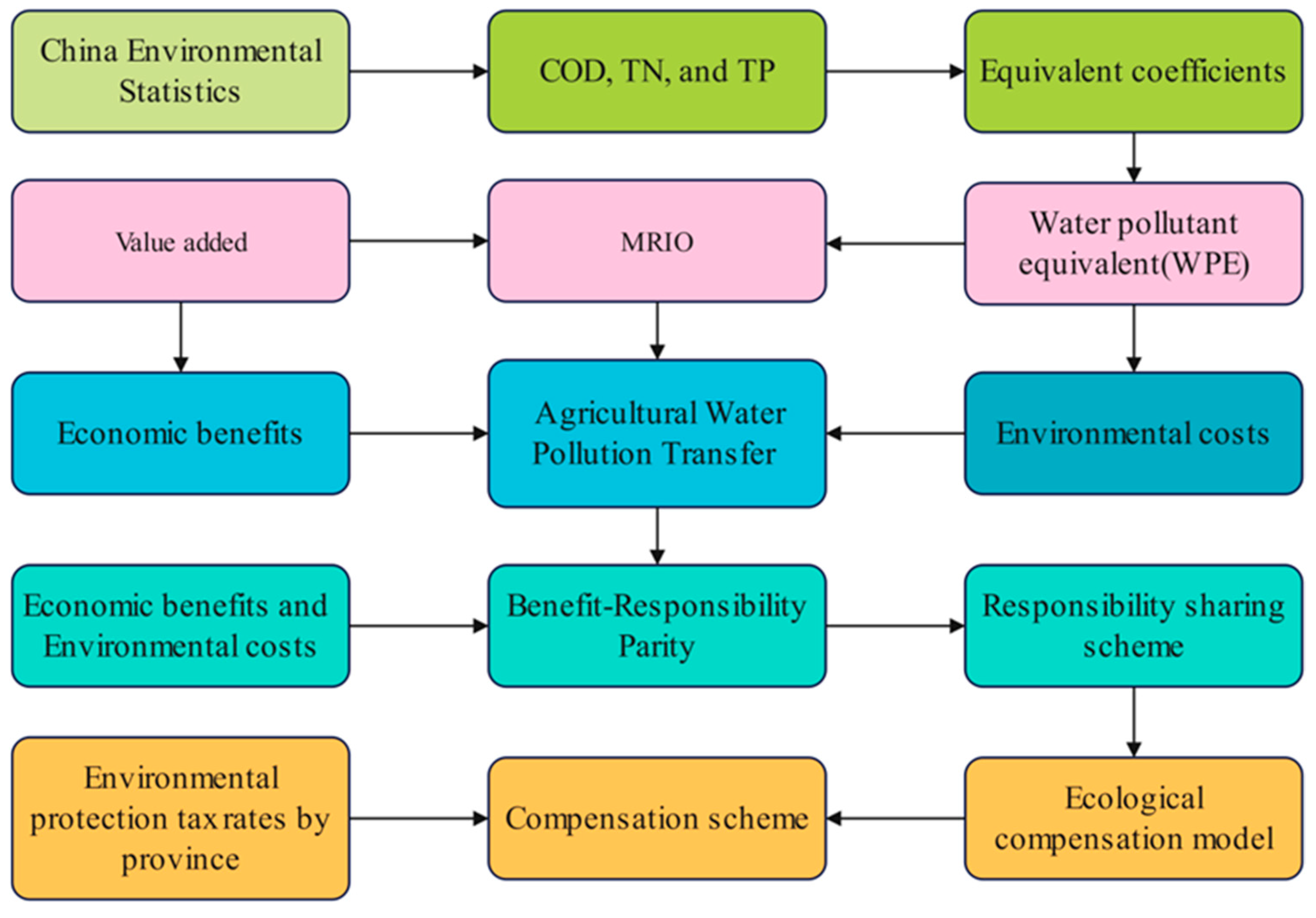
Based on the above analysis, this paper constructs a research framework as shown in Figure 1. First, it clarifies the agricultural water pollution transfer embedded in inter-provincial trade by the water pollutant equivalent and the multi-regional input–output model. Second, it calculates the responsibility sharing for agricultural water pollution by integrating the environmental costs and economic benefits associated in inter-provincial trade. Finally, it determines the ecological compensation scheme based on provincial environmental protection tax standards and the quantified responsibilities for agricultural water pollution carried by each province through trade.
Agricultural water pollution embedded in inter-provincial trade has increasingly become a critical issue in China’s environmental governance. However, existing ecological compensation mechanisms rarely account for the spatial mismatch between pollution generation and consumption responsibility. To effectively process the issue of transboundary agricultural water pollution induced by inter-provincial trade, this study incorporates the concept of agricultural water pollution embedded in inter-provincial trade into the compensation mechanism and proposes an innovative integrated “responsibility and compensation” approach for agricultural water pollution governance. The following hypotheses are proposed:
Hypothesis 1 (H1):
Inter-provincial agricultural trade leads to the significant transfer of agricultural water pollution;
Hypothesis 2 (H2):
There are significant regional disparities in the burden of agricultural water pollution and the distribution of economic benefits.

2. Methodology and Data Sources

2.1. Methodologies

2.1.1. Calculating the Water Pollutant Equivalent

Considering that typical pollutants causing agricultural water pollution are the chemical oxygen demand (COD), total nitrogen (TN), and total phosphorus (TP), this study selects these three pollutants to represent agricultural water pollution. The total pollution load from these pollutants is expressed in terms of the Water Pollution Equivalent (WPE), and the formula is provided as follows:
WPE = i = 1 3 c i × L i i = C O D , T P , T N
where L i is the total pollutant load of contaminant i discharged into surface water, and c i is the WPE coefficient for that pollutant i . According to the Regulations on the Implementation of the Environmental Protection Tax Law of the People’s Republic of China, the pollutant equivalent factors for COD and TP are 1 and 0.25, respectively. The value for TN is based on the standard for ammonia nitrogen, taking the value of 0.8. Consequently, the coefficients c i for COD, TN, and TP are taken as 1 kg, 0.8 kg, and 0.25 kg, respectively [41].

2.1.2. Quantifying the Agricultural Water Pollution Transfer in Inter-Provincial Trade

To systematically evaluate the implicit transfer of agricultural water pollutants in inter-provincial trade, this study adopts the Multi Regional Input Output (MRIO) method, which can effectively reflect the technological heterogeneity and structural differences between regions [42,43]. The core relationship between total output and final demand can be expressed as follows:
X = A X + r Y r
Equation (2) is solved as follows [38]:
X = ( I A ) 1 × r Y r = L × r Y r
where ( I A ) 1 = L is the Leontief inverse matrix, denoting the total output required to meet the final demand of one unit. A is the matrix of direct consumption; X is the vector of total economic output; Y r is the vector of final demand in province r .
Based on this, the agricultural water pollutant emissions of province s, driven by the final demand of province r , can be calculated as follows:
A W P s r = p = 1 n P s L s p F p r
To be specific, A W P s r denotes the virtual WPE discharges transferred from province r to province s . P s represents the vector of WPE discharge in province s . r and s refer to provinces, and p stands for the provinces trading with province r and s . When p = r , AWP is included in the direct trade from province r to province s . When p r , province s exports semi-finished products to province p , which are then further processed into final products and exported to province r , and then, agricultural water pollution is transferred from province r to province s . It is, in other words, indirect AWP from province r to province s .
In the same way, the virtual WPE discharges transferred from province s to province r can be attained:
A W P r s = p = 1 n P r L r p F p s

2.1.3. Model for Calculating Agricultural Water Pollution Responsibility Sharing

Determining the Value-Added Transfer in Inter-Provincial Trade
In the way mentioned in Section 2.1.2, the e v transfer matrix (from province r to province s ) is obtained:
e v r s = p = 1 n e v r L r p F p s
where e v r stands for the trade value-added matrix of province r , which is obtained from MRIO directly. e v r s means the trade value added transferred from r to province s .
Similarly, the e v transfer matrix from province s to province r is as follows:
e v s r = p = 1 n e v s L s p F p r
Determining the Responsibility-Sharing Scheme of Each Province
The issue of agricultural water pollution emissions arising from trade should be implemented with shared responsibility between the place of origin and the place of consumption [21,22,23,24,25]. Under the EBSR principle, a province’s responsibility sharing should be determined by the economic benefits it derives from trade [23]. The formula can be expressed as follows:
W R r = W T r , s × e v r s e v r s + e v s r
W R s = W T r , s × e v s r e v r s + e v s r
W T r , s = A W P r s + A W P s r
where W T r , s represents the total agricultural WPE discharges between provinces r and s ; W R r and W R s are the WPE discharge responsibilities of provinces r and s , respectively; e v s r and e v r s are the economic benefits produced in province s (r) induced by the final demand of province r (s).

2.1.4. Determination of the Ecological Compensation Scheme for Agricultural Water Pollution

Determining the Ecological Compensation Volume for Agricultural Water Pollution
The compensable discharge volume is quantified by comparing provincial EBSR results with their respective export-based discharges. Following this determination and under the assumption that compensation is directed from province s to province r, the WPE compensation volume between the two provinces can be computed using the equation below:
W Q s r = W D r W R r = W R s W D s     = A W P r s A W P r s + A W P s r × e v r s e v r s + e v s r
where W Q s r notes the compensation volume of discharges between province s to province r ; W D r = A W P r s and W D s = A W P s r represent the production-based contributions of province s and province r to the bilateral trade-related WPE discharges, respectively; and e v r s ( e v s r ) indicates the economic benefits generated in province r (or province s ) induced by the final demand of province s (or province r ).
Determining the Ecological Compensation Value for Agricultural Water Pollution
The environmental protection tax ( P r ) of each province is selected as the compensation standard. And then, multiplying the inter-provincial compensation volume for WPE discharges with the corresponding compensation standard, the compensation value from province s to province r can be calculated as follows:
W M s r = P r × W Q s r = P r × A W P r s A W P r s + A W P s r × e v r s e v r s + e v s r
where W M s r represents the compensation value from province s to province r .

2.2. Data Sources

This study utilizes the latest 2017 China inter-provincial input–output table and focuses on agricultural water pollution associated with domestic trade within China [44,45,46]. The table includes 31 provinces (excluding Macau, Hong Kong, Taiwan) and the agricultural sector (including farming, forestry, animal husbandry, fishery, and auxiliary activities). In addition, the data of three main agricultural water pollution components, COD, TP, and TN, were collected from the China Statistical Yearbook on Environment in 2018 [41,45,46]. The province classifications and the environmental protection tax rates of each province are listed in Table A1 of the Appendix A.

3. Results

3.1. Agricultural Water Pollution Loads and Value Added Embodied in Trade

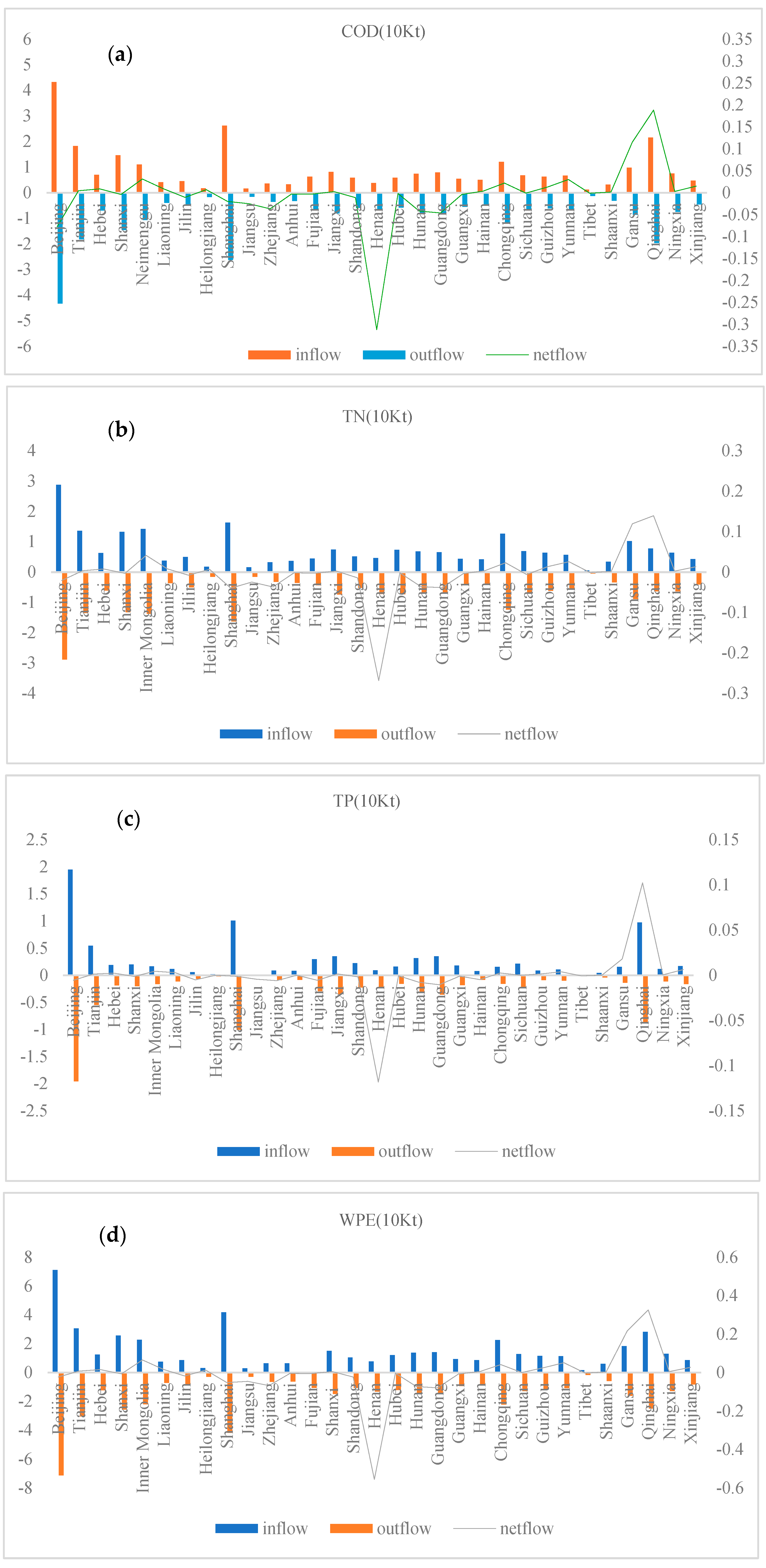
Figure 2a–d show the inflow, outflow, and netflow of COD, TN, TP, and WPE transfers embodied in China’s inter-provincial trade among 31 Chinese provinces. A positive value indicates that a province is a net recipient, meaning it bears additional pollution due to production for other provinces. A negative value indicates that a province is a net exporter, meaning it has shifted its pollution burden to other provinces through trade.
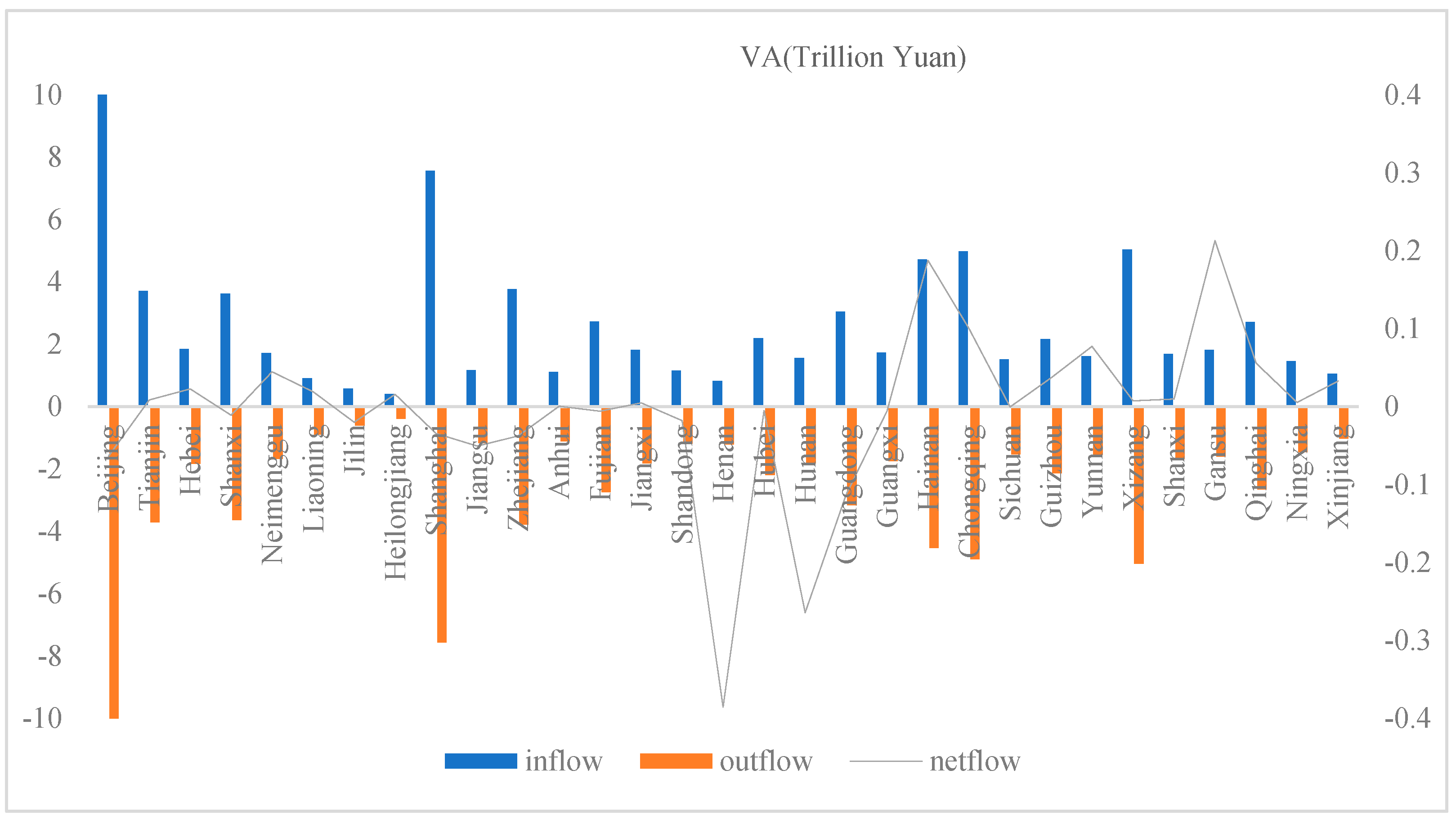
Conversely, Figure 3 shows the net transfer of value added among 31 Chinese provinces. Value added represents the economic value (benefits) created by economic activities. A positive trade value added indicates that the province is a net importer and does not achieve a net economic gain, while a negative value suggests that the province is a net exporter and obtains a net economic benefit.

3.1.1. Agricultural Water Pollution Loads Embodied in Trade

In Figure 2a–d, net inflows of agricultural water pollutants (COD, TP, TN, WPE) were observed in several less developed regions, including Inner Mongolia, Hebei, Guizhou, Yunnan, Tibet, Shaanxi, Gansu, Qinghai, Ningxia, and Xinjiang, indicating that these areas bear a disproportionate share of agricultural pollution. Among them, Qinghai and Gansu showed significant net inflows across all pollutants, with COD, TN, and TP reaching 1.88 Kt, 1.39 Kt, and 1.02 Kt and 1.14 Kt, 1.19 Kt, and 0.18 Kt respectively. In contrast, economically developed regions such as Beijing, Shanghai, Guangdong, Jiangsu, and Zhejiang demonstrated net outflows of COD, TP, and TN, suggesting a transfer of agricultural pollution to other provinces. Among them, Guangdong had a net outflow of 0.46 Kt of COD, 0.38 Kt of TN, and 0.10 Kt of TP. In addition, Henan consistently showed the highest net outflows across all pollutants, with COD, TN, TP, and WPE reaching 3.12 Kt, 2.68 Kt, and 1.18 Kt, and 5.59 Kt, respectively. Henan consistently showed net outflows consistent with the previous studies [47,48,49]. As a water-scarce province, Henan imports substantial water-intensive, low-value-added agricultural products through trade, which consequently leads to its significant role in transferring pollution to other provinces. This pollution-transfer pattern is essentially a manifestation of regional differences in water resource endowments and the division of industrial structure as reflected in trade. Some water-scarce regions or those with a low share of agriculture “outsource” their agricultural pollution burden to water-abundant or agriculture-dominated regions by importing water-intensive agricultural products.

3.1.2. Contrast of the Net Flows of WPE and Value Added

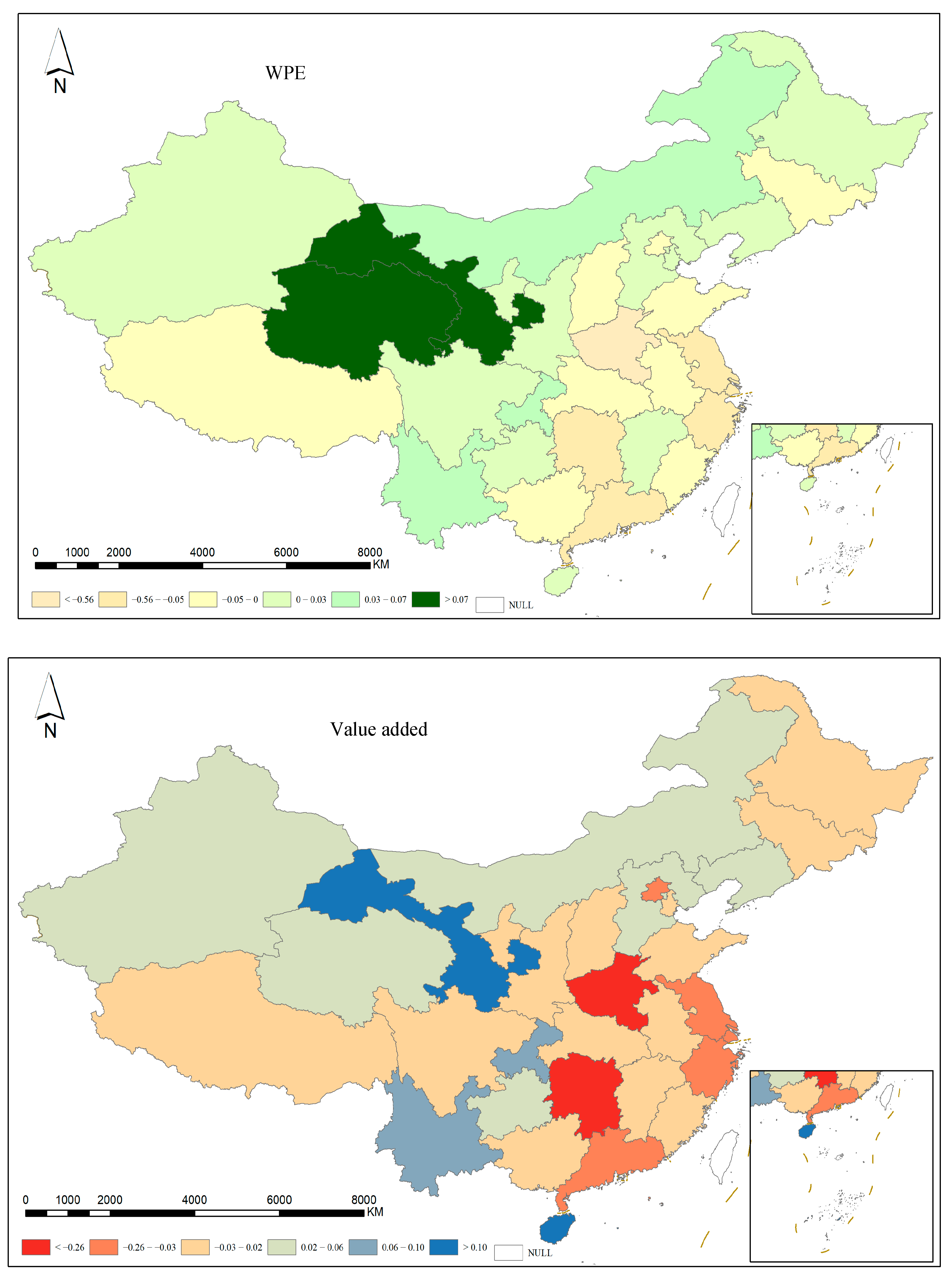
As shown in Figure 3 and Figure 4, economically developed regions, including Beijing, Guangdong, Shanghai, Jiangsu, and Zhejiang, record negative values for both net WPE outflows and net VA outflows. This indicates that these provinces have gained positive economic returns by participating in trade networks, externalizing the pressure of agricultural water pollution to other regions. In contrast, less developed regions, including Hebei, Guizhou, Inner Mongolia, Gansu, and Xinjiang, show positive values for both net WPE and net VA inflow. This indicates that these provinces bear a dual burden of economic loss and agricultural water pollutant inflow. In addition, by comparing the net flow patterns of WPE and value added across provinces, the imbalanced characteristics of these flows are revealed as shown in Figure 3 and Figure 4. Specifically, in Figure 2d, we can see that Gansu and Qinghai bear the largest WPE impact (2.15 Kt and 3.25 Kt, respectively), while it is still a loss in terms of economic net benefits and a loss of 0.21 and 0.06 trillion yuan, respectively (Figure 3). In contrast, Beijing, Guangdong, Jiangsu, Zhejiang, and Shanghai achieved a net economic benefit of 0.30 trillion yuan while transferring out a net total of 2.69 Kt of agricultural water pollutant equivalents. Among them, Guangdong benefited the most, with a net transfer of 0.80 Kt of agricultural water pollution and an associated economic gain of 0.11 trillion yuan. This disparity between economic gains and environmental burdens, where certain provinces achieve environmental and economic benefits while imposing the costs on others, highlights the imperative of formulating ecological compensation policies to mitigate environmental inequality and promote regional coordinated development.

3.2. Agricultural Water Pollution Responsibility Sharing

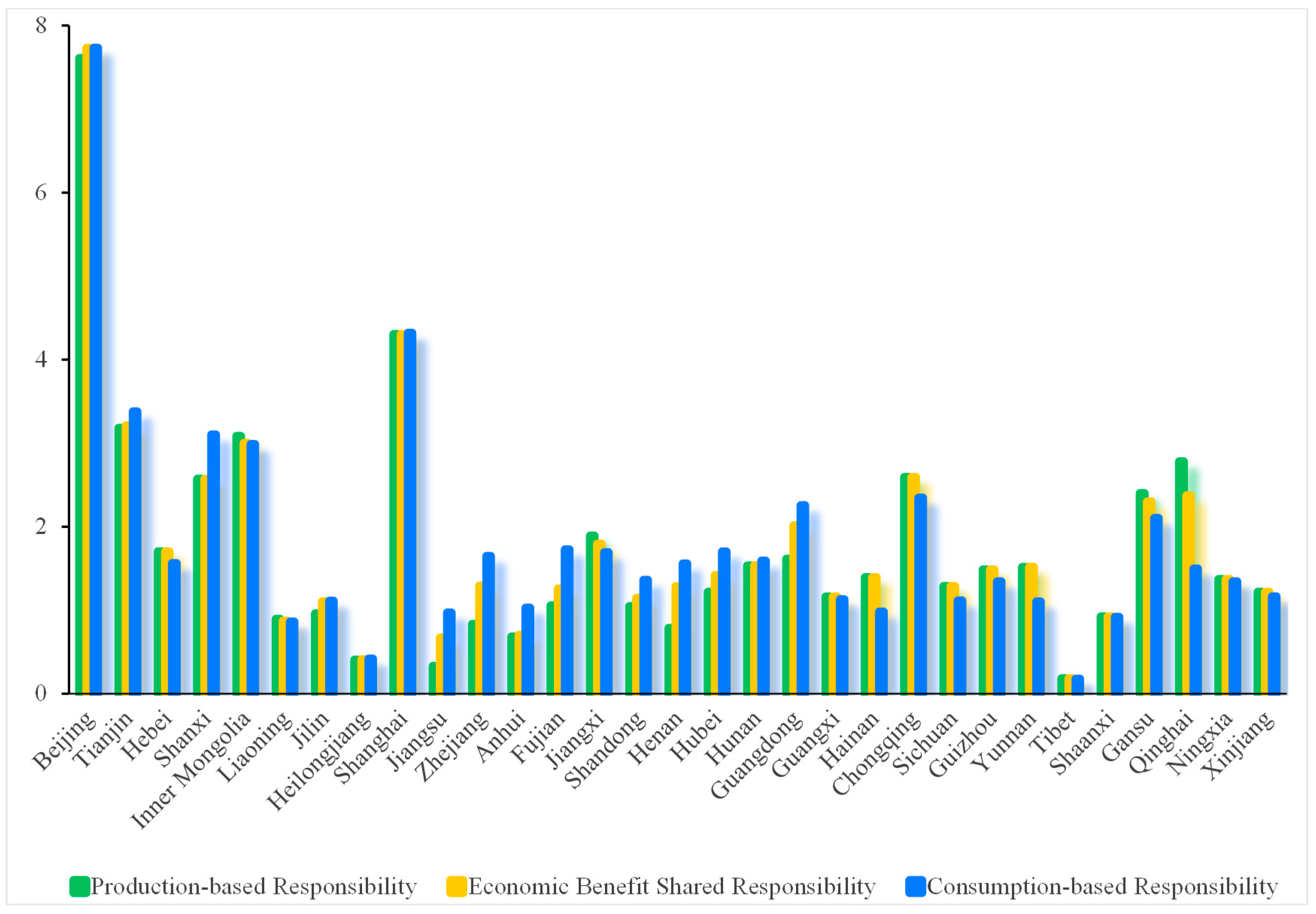
The fair distribution of agricultural water pollutant discharge responsibilities can effectively alleviate environmental inequality caused by inter-provincial trade in China [16,50,51,52]. Based on this, this study adopts the economic benefit shared responsibility (EBSR) scheme to divide the implied WPE emission responsibility based on the economic benefits obtained by each trading entity from trade. Figure 5 compares implicit agricultural water pollution discharge responsibilities in trade among provinces at the provincial level based on three different accounting principles: PBR, CBR, and EBSR. Under the PBR, a region is held accountable for the WPE emissions generated in the production of goods it exports, whereas the CBR assigns responsibility for emissions associated with the goods it imports. In economically developed or water-scarce areas such as Beijing, Tianjin, Shanxi, Henan, Shanghai, Fujian, Anhui, Guangdong, Chongqing, Jiangsu, and Zhejiang, the CBR value is higher than its corresponding PBR value. Among them, the CBR in Jiangsu is about three times that of the PBR, while the CBR in Zhejiang is almost twice that of the PBR. In contrast, provinces such as Qinghai, Liaoning, Gansu, Xinjiang, Ningxia, Guizhou, Yunnan, and Inner Mongolia have a PBR higher than the CBR, while Qinghai’s PBR is about twice that of the CBR. In several economically advanced or water-scarce regions, such as Beijing, Tianjin, Shanxi, Henan, Shanghai, Fujian, Anhui, Guangdong, Chongqing, Jiangsu, and Zhejiang, the CBR values exceed their PBR counterparts. Notably, Jiangsu’s CBR is roughly triple its PBR, and Zhejiang’s CBR is nearly double its own. Conversely, provinces such as Qinghai, Liaoning, Gansu, Xinjiang, Ningxia, Guizhou, Yunnan, and Inner Mongolia exhibit higher PBR than CBR; in the case of Qinghai, the PBR is approximately twice its CBR. Overall, this responsibility pattern reveals a mismatch between “producing regions” and “consuming regions” in agricultural pollution governance. Furthermore, we observe that for most provinces, the EBSR results lie between the PBR and CBR values. Nevertheless, the degree of this adjustment exhibits substantial variation among provinces. In provinces such as Beijing, Jiangsu, Zhejiang, and Guangdong, the EBSR was relatively close to the CBR, whereas in provinces like Shanxi, Anhui, Fujian, Xinjiang, and Yunnan, it was rather close to the PBR.

3.3. Agricultural Water Pollution Compensation Scheme

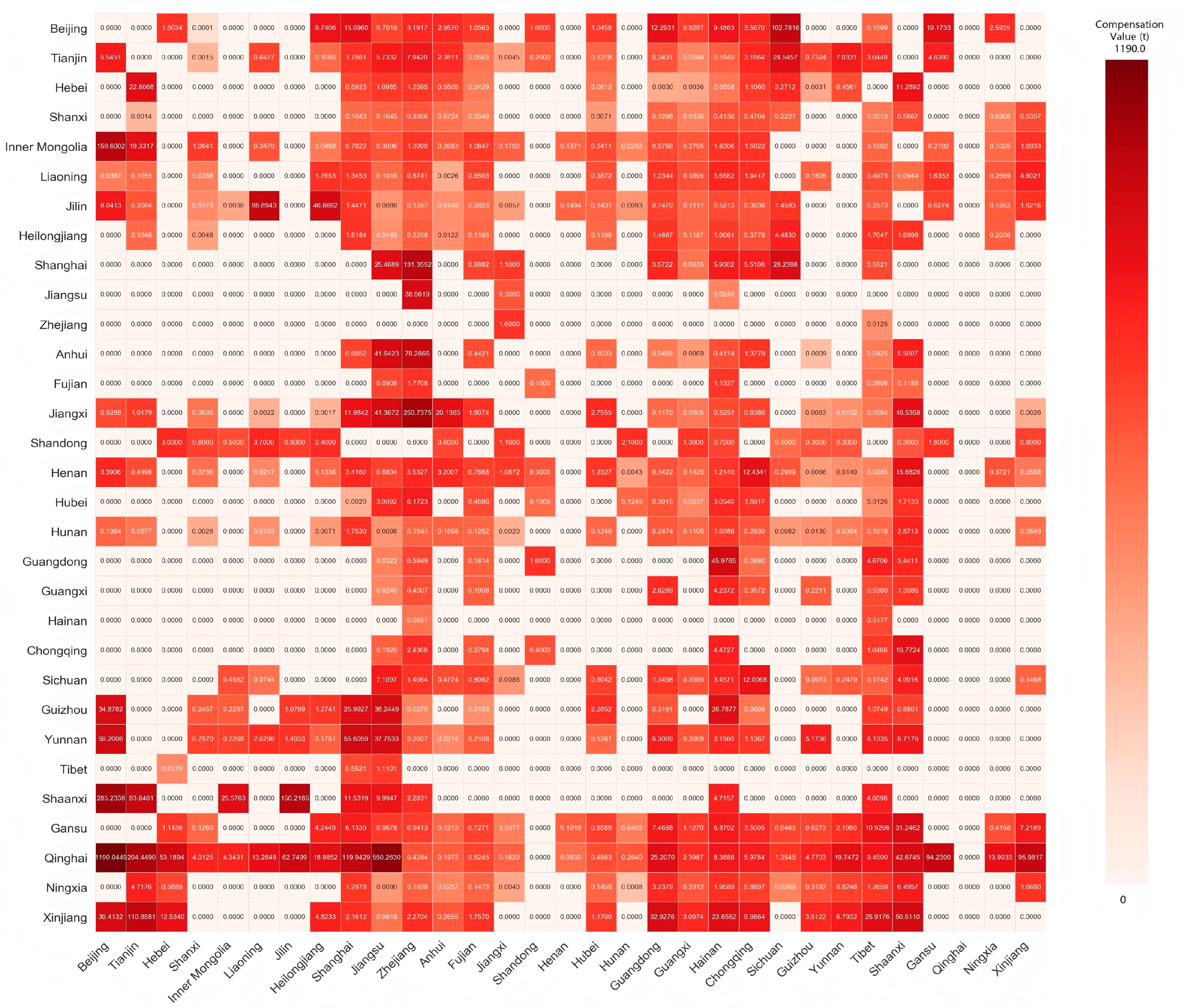
Horizontal ecological compensation is an important practical mechanism to realize the responsibility sharing of agricultural water pollution among provinces. This study quantifies the WPE compensation amount among 31 provinces by comparing the emissions based on the EBSR framework. Figure 6 shows the matrix of WPE compensation flow among provinces in China. In this matrix, 460 red squares indicate that there is a compensation liability relationship, and the remaining 501 white squares indicate that there is no compensation flow. Each red square represents the amount of compensation paid from the provinces corresponding to the vertical axis to the provinces corresponding to the horizontal axis, and the degree of red reflects the amount of compensation. From the perspective of provincial WPE compensation, the more significant compensation flows include the following: Beijing→Qinghai (1.19 kt), Beijing→Shaanxi (0.29 kt), Beijing→Inner Mongolia (0.16 kt), Tianjin→Qinghai (0.20 kt), Tianjin→Xinjiang (0.11 kt), Jilin→Shaanxi (0.15 kt), Jiangsu→Qinghai (0.55 kt), Zhejiang→Jiangxi (0.25 kt). The amount of compensation is mainly affected by the differences in the industrial structure between the two provinces.
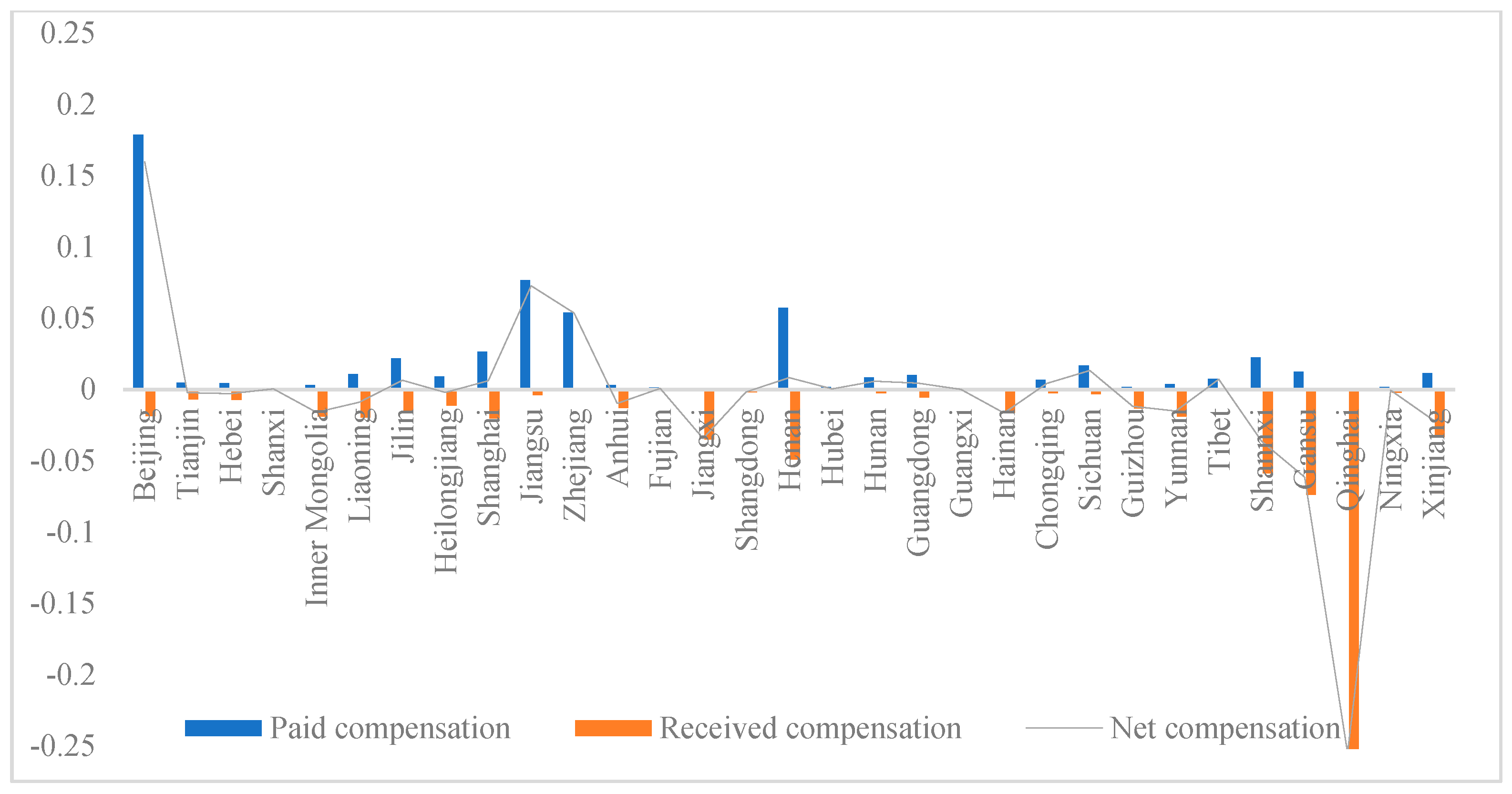
This study further calculates the payment compensation, receipt compensation, and net compensation balance of WPE emissions in various provinces of China, as shown in Figure 7. The results show that 15 provinces, including Beijing, Shanghai, Jiangsu, Zhejiang, Guangdong, and Sichuan, need to pay net compensation to other regions, while the remaining 16 provinces can get net compensation. Most of the provinces with net compensation outflow are economically developed regions, of which the industrial structure is dominated by low pollution and high value-added products. In contrast, the 16 provinces eligible for compensation have relatively limited economic benefits from trade and bear higher environmental costs due to local pollution intensive agricultural production. Specifically, Beijing, Jiangsu, and Zhejiang have the largest amount of net compensation expenditure, reaching 1.60 kt, 0.73 kt, and 0.54 kt respectively; however, Qinghai, Gansu, and Jiangxi need to obtain the highest net compensation inflow, which are 2.55 kt, 0.62 kt, and 0.34 kt respectively. Furthermore, certain provinces such as Jilin and Tibet exhibit a relatively lower pollution intensity in agricultural production while enjoying higher economic returns from agricultural trade, thereby positioning them as net compensators to other provinces.
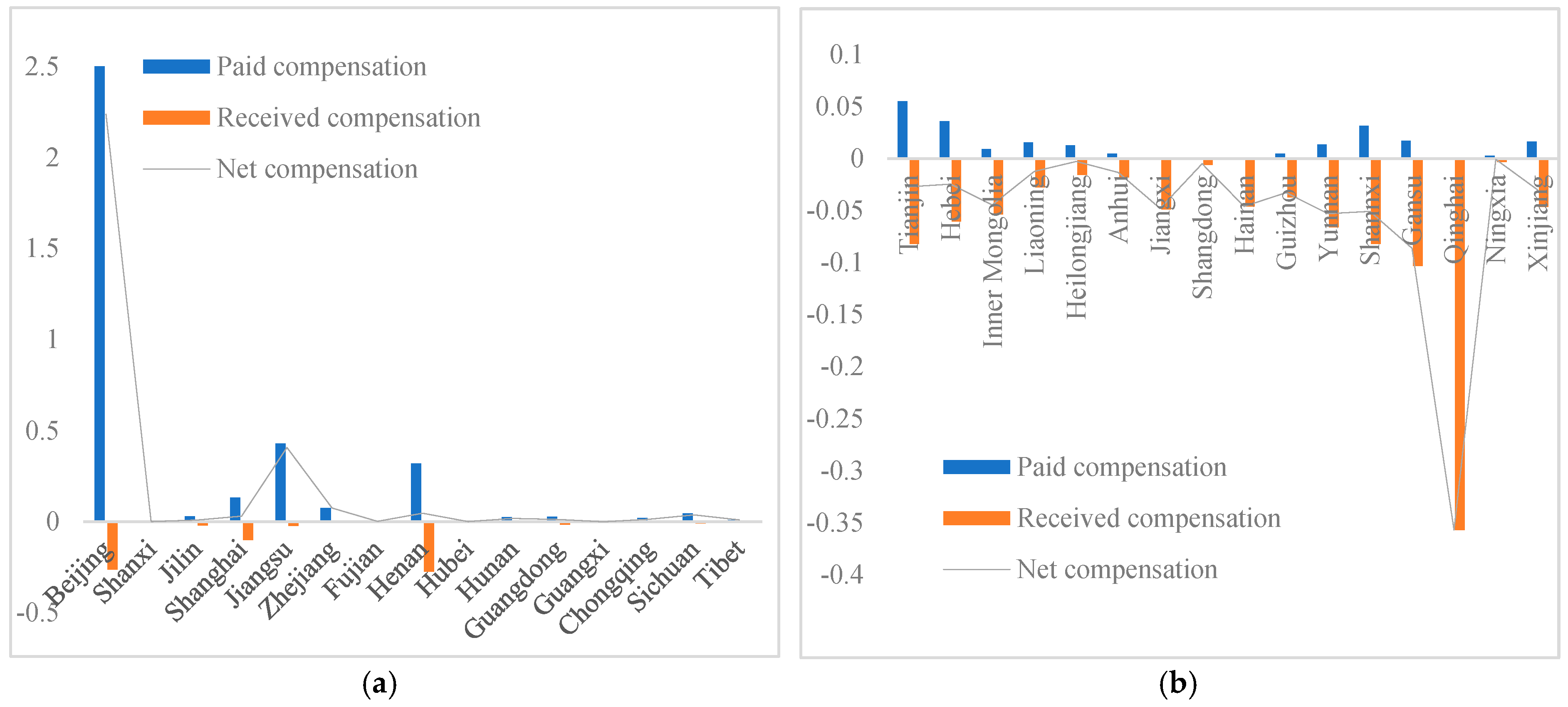
Based on Equation (10), the maximum acceptable compensation value for a compensating province and the minimum acceptable compensation value for recipient provinces can be calculated. The results are presented in Figure 8a,b. Figure 8a presents the maximum payment benchmark for each compensating province. If the actual payment exceeds this level, the province would prefer to retain and treat the agriculture water pollution locally. Among compensating provinces, Beijing has the highest environmental protection tax rate nationally at 14 yuan/kg, resulting in the highest payment standard of 250 million yuan. Figure 8b shows the minimum compensation benchmark for each recipient province. If the compensation received falls below this threshold, the recipient province would incur an unnecessary net loss. As the province with the highest net agriculture water pollution inflow, Qinghai has a minimum acceptable compensation standard of 36 million yuan.

4. Discussion and Policy Implications

Firstly, several less economically developed regions, such as Jilin, Tibet, Henan, and Guangxi, are required to compensate other provinces. Jilin requires compensation due to its low-pollution agriculture and high-value processing sector. Tibet becomes a net payer through its high-value specialty products under ecological constraints [48]. Guangxi assumes compensation responsibility given its dual production and processing–export role. Henan’s net outflows of pollutants have remained persistently high across all categories. This is likely attributable to the fact that, as a major grain-producing region in China, Henan has long ranked among the top provinces in agricultural value added, yet it suffers from severe water scarcity. Moreover, with a population exceeding 100 million and a high multiple cropping index, the province faces acute man–land conflict and substantial developmental demands, while its grain output for out-of-province transfer is relatively limited. To alleviate the dual constraints of water shortages and an insufficient environmental carrying capacity, Henan imports large quantities of water-intensive, high-pollution-intensity, low-value-added agricultural products (e.g., some feed grains and processing raw materials) from other provinces. This transfers the responsibility for embodied water pollution emissions to the producing regions, substantially reducing the water pollution generated by Henan’s own production activities. As a result, the inflow of embodied water pollution into Henan is far smaller than its outflow [48,49].
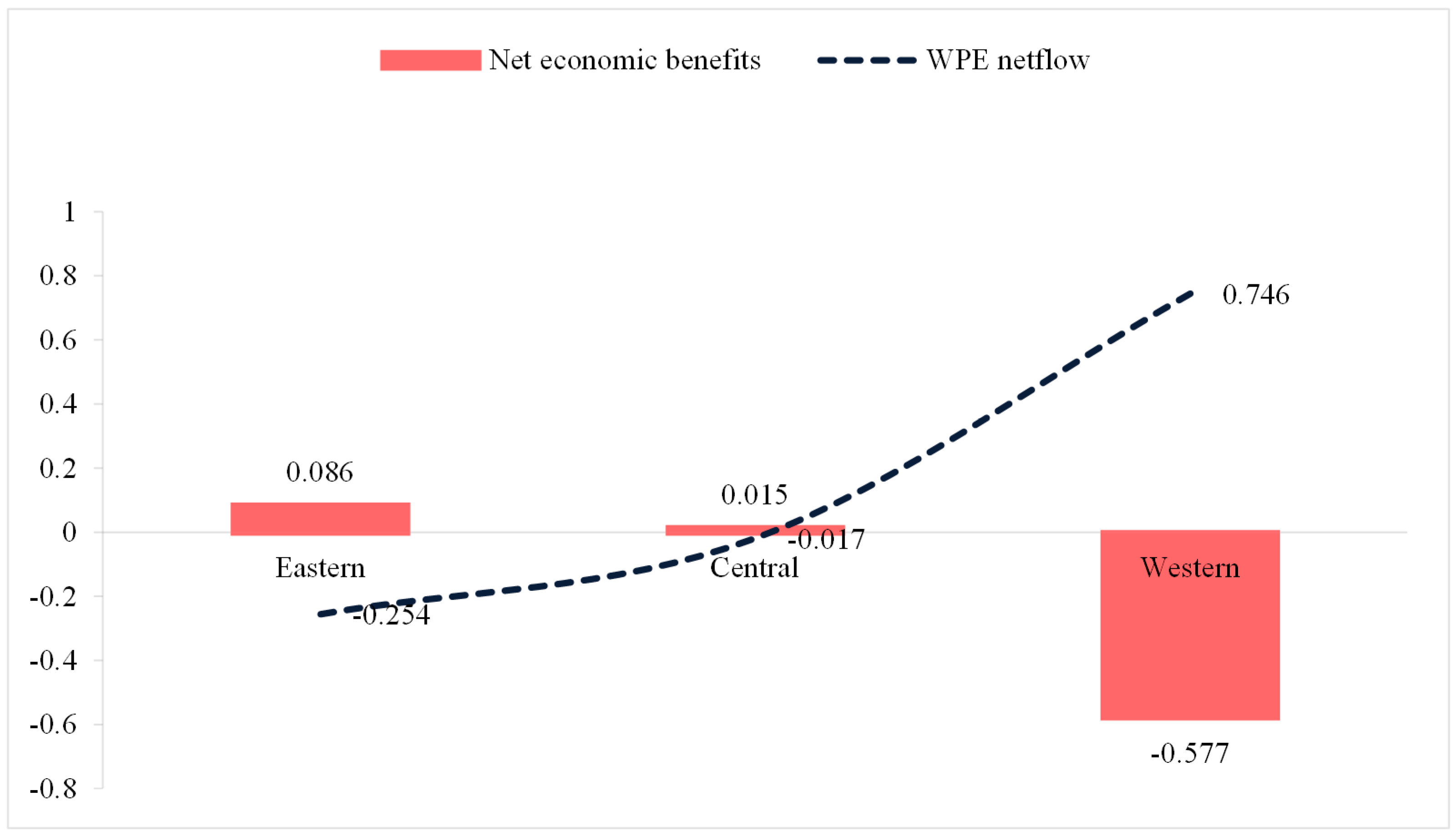
Secondly, after removing notably distinct provinces like Henan, the rest are classified into three regions: Eastern, Central, and Western China. Figure 9 illustrates the net transfer direction of agricultural WPE and the net economic benefits among these regions. Data indicate that the distribution of pollution responsibility and economic benefits among China’s three major regions exhibits significant non-equilibrium characteristics. The eastern region shows a net outflow of WPE and positive net economic benefits. This is mainly because developed eastern coastal provinces (such as Beijing, Shanghai, Guangdong, Jiangsu, and Zhejiang) have high rates of off-farm transfer of rural labor and non-grain conversion of farmland, with grain production growth below the national average. Grain is largely transferred in from other provinces, successfully shifting the agricultural water pollution responsibility that should have been borne locally to the production areas, while retaining the economic value derived from agricultural product consumption. Their agricultural functions have transformed toward a high-value-added, low-pollution model [47,53,54]. Meanwhile, traditional grain-producing areas like Shandong, constrained by their own large development demands, have relatively small grain outflows. In 2017, several eastern region areas—including Tianjin, Jiangsu, Zhejiang, Guangdong, Shandong, and Fujian—ranked among the top ten nationally in grain inflows. Therefore, as a whole, the eastern region exhibits a pattern of being both a pollution responsibility transferor and an economic beneficiary. The central region also exhibits net WPE outflows and positive net economic benefits, albeit at relatively modest levels. This suggests that central provinces engage in limited import trade and remain positioned in low-value-added, low-bargaining-power segments of the agricultural trade division. Unlike the eastern region, they have not been able to achieve significant economic value added on the consumption side. The western region presents a pattern diametrically opposite to that of the eastern and central regions, characterized by net WPE inflows and negative net economic benefits. Specifically, western provinces such as Xinjiang, Gansu, and Inner Mongolia have long ranked among the country’s top grain-exporting regions, shipping large quantities of grain, livestock products, and specialty agricultural products to eastern and central provinces. From the perspective of overall regional accounting, the western region not only fails to transfer its pollution responsibility outward through trade but instead passively bears the environmental liability that should rightfully belong to consuming regions. Moreover, the negative net economic benefit of the western region as a whole indicates a net loss position in inter-provincial agricultural trade. This can be attributed, on one hand, to structural disadvantages such as high agricultural production costs, long transportation distances, and low value-added products; on the other hand, it reflects the region’s unfavorable position in the agricultural trade division of labor, characterized by low bargaining power and limited capacity for value capture [47,55].
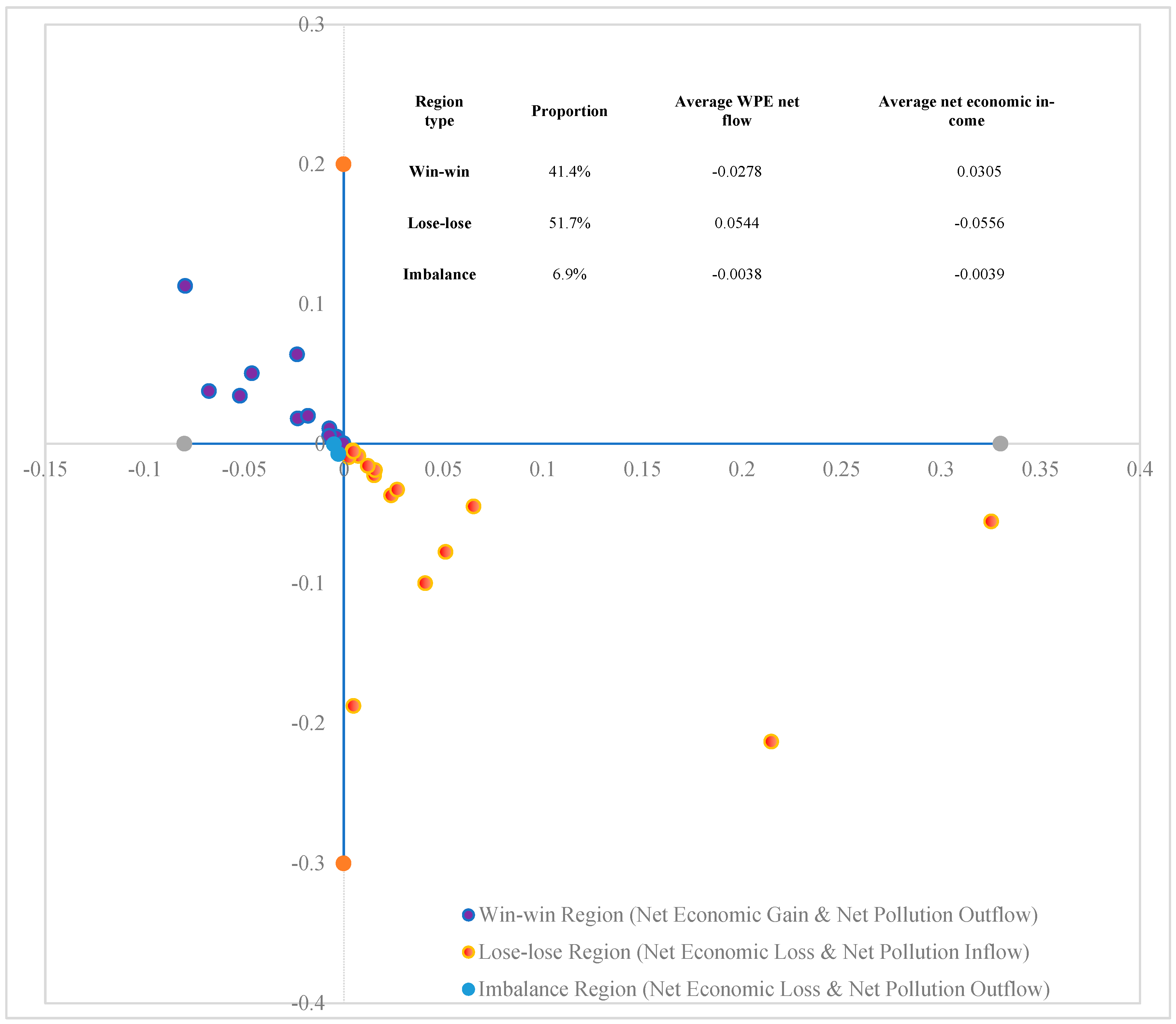
Thirdly, Figure 10 reveals a predominant correlation: most provinces with environmental gains also enjoy net economic benefits, while most provinces experiencing environmental losses concurrently suffer net economic losses. This figure illustrates the distribution of “environmental inequality.” The EBSR principle links pollution responsibility to economic value added from trade. It establishes a fair negotiation benchmark for both sides. This differentiated allocation is more equitable and acceptable. It provides a logical foundation for cross-provincial compensation schemes.
In addition, the compensation scheme results from the interaction of the regional division of labor, allocated responsibilities, and policy instruments (e.g., the environmental protection tax). Compensating provinces, such as Beijing, Jiangsu, and Zhejiang, are mainly located in eastern high-consumption, high-tax regions. Recipient provinces, including Qinghai, Gansu, and Jiangxi, are concentrated in central and western production-intensive, low-income areas. This pattern reflects the need to balance environmental externalities through fiscal transfers.
Finally, China’s current practice of ecological compensation mainly focuses on the problem of physical water pollution in a river basin, river system, or developed areas, providing targeted financial support and poverty alleviation for less developed areas. However, the problem of agricultural virtual water pollution involved in inter-provincial trade has not been paid attention to. Therefore, it is suggested to further clarify the scope of ecological compensation and include virtual water pollution in cross regional agricultural trade.
Based on the above analysis, we propose the following policy recommendations:
(1)
Strengthen the internalization of environmental costs in agricultural trade. Agricultural policies and trade planning should incorporate external costs such as water pollution, promoting a “green trade” accounting system.
(2)
Develop agriculture according to local conditions in each province. Coordinate and optimize the regional agricultural layout and control the transfer effect of water pollution through measures such as industrial planning and environmental regulation.
(3)
Improve data support and monitoring systems. We suggest further integrating multi-regional input–output data, pollution emission data, and trade flow data to build a dynamically updated accounting platform for agricultural pollution transfer.

5. Conclusions

This study develops an integrated analytical framework to trace, allocate, and compensate for agricultural water pollution embedded in China’s inter-provincial agricultural trade. The empirical results validate the two research hypotheses proposed earlier: first, inter-provincial agricultural trade does lead to significant transfers of agricultural water pollution; second, there is a significant uneven distribution of agricultural water pollution burdens and economic benefits among Eastern, Central, and Western China, resulting in a marked decoupling between environmental costs and economic gains. Accordingly, an inter-provincial ecological compensation scheme has been designed. This scheme offers an actionable pathway toward the equitable allocation of environmental pollution responsibilities across regions. Main conclusions are as follows:
  • Qinghai and Gansu represent the key net-receiving regions of agricultural water pollution, where net inflows of COD, TN, and TP are significantly greater than in other provinces.
  • Gansu and Qinghai bear the largest WPE (2.15 Kt and 3.25 Kt, respectively) but receive relatively little economic return (0.21 trillion and 0.06 trillion yuan, respectively). In contrast, Beijing, Guangdong, Jiangsu, Zhejiang, and Shanghai collectively transfer out 2.69 Kt of agricultural pollution WPE, while still gaining 0.30 trillion yuan in economic benefits.
  • Beijing, Jiangsu, and Zhejiang bear the largest compensation liabilities to others, with 1.60 Kt, 0.73 Kt, and 0.54 Kt, respectively. Conversely, provinces including Qinghai, Gansu, and Jiangxi require the greatest compensation inflows, at 2.55 Kt, 0.62 Kt, and 0.34 Kt, respectively.
  • Beijing has the highest environmental protection tax rate nationally at 14 yuan/kg, resulting in the highest payment standard of 250 million yuan. As the province with the highest net agriculture water pollution inflow, Qinghai has a minimum acceptable compensation standard of 36 million yuan.
Future work will further consider the impact of factors such as differences in agricultural technology levels and environmental carrying capacities across provinces on the equitable attribution of pollution transfer responsibilities. Efforts will be made to integrate inter-provincial technological heterogeneity and environmental capacity constraints into the research framework, with the aim of exploring more adaptive compensation mechanisms for transboundary pollution.

Author Contributions

X.X.: writing; Q.Y.: providing revised advice. Q.Y. is recognized as a corresponding author. All authors have read and agreed to the published version of the manuscript.

Funding

This paper was supported by Anhui Provincial Philosophy and Social Sciences Youth Project (Grant No. AHSKQ2024D013), The National Natural Science Foundation of China (Grant No. 72304204), Anhui Provincial Education Department Humanities Key Fund (Grant No. 2024AH053419), The Natural Science Foundation of Jiangsu Province (Grant No. BK20230648), and The Project of Social Science Foundation of Jiangsu Province (Grant No. 22GLC013). Anhui Province Outstanding Young Teachers Training General Project (Grant No. YQYB2025039).

Data Availability Statement

The original contributions presented in this study are included in the article. Further inquiries can be directed to the corresponding author.

Conflicts of Interest

The authors declare no conflicts of interest.

Appendix A

Table A1. Environmental protection tax rate (Yuan/kg).
RegionsEnvironmental Protection Tax Rate (Yuan/kg)RegionsEnvironmental Protection Tax Rate (Yuan/kg)
Beijing14Hubei2.8
Tianjin12Hunan3.0
Hebei8.4Guangdong2.8
Shanxi2.1Guangxi2.8
Inner Mongolia2.8Hainan2.8
Liaoning1.4Chongqing3.0
Jilin1.4Sichuan2.8
Heilongjiang1.4Guizhou2.8
Shanghai5.0Yunnan3.5
Jiangsu5.6Tibet1.4
Zhejiang1.4Shannxi1.4
Anhui1.4Gansu1.4
Fujian1.5Qinghai1.4
Jiangxi1.4Ningxia1.4
Shandong3.0Xinjiang1.4
Henan5.6

References

  1. The Food and Agriculture Organization. The State of Food and Agriculture 2020: Overcoming Water Challenges in Agriculture. Available online: https://openknowledge.fao.org/items/a2dc7490-735d-4b5d-92a2-a36bfb380e02 (accessed on 1 January 2023).
  2. The United Nations Educational, Scientific and Cultural Organization. The United Nations World Water Development Report 2018: Nature-Based Solutions for Water. Available online: https://unesdoc.unesco.org/ark:/48223/pf0000261424 (accessed on 1 January 2023).
  3. Ministry of Ecology and Environment of the People’s Republic of China. Announcement on the Release of the Second National Pollution Source Census Bulletin. Available online: https://www.mee.gov.cn/xxgk2018/xxgk/xxgk01/202006/t20200610_783547.html (accessed on 1 January 2023).
  4. Bai, Y.; Wang, Y.; Xuan, X.; Weng, C.; Huang, X.; Deng, X. Tele-connections, driving forces and scenario simulation of agricultural land, water use and carbon emissions in China’s trade. Resour. Conserv. Recycl. 2024, 203, 107433. [Google Scholar] [CrossRef]
  5. Wang, Z.; Yin, Y.; Liu, G.; Lun, F.; Zhang, F.; Cui, Z.; Wu, J. International trade reduces global phosphorus demand but intensifies the imbalance in local consumption. Sci. Total Environ. 2022, 830, 154484. [Google Scholar] [CrossRef]
  6. Zhang, C.; Anadon, L.D. A multi-regional input–output analysis of domestic virtual water trade and provincial water footprint in China. Ecol. Econ. 2014, 100, 159–172. [Google Scholar] [CrossRef]
  7. Wu, H.; Jin, R.; Liu, A.; Jiang, S.; Chai, L. Savings and Losses of Scarce Virtual Water in the International Trade of Wheat, Maize, and Rice. Int. J. Environ. Res. Public Health 2022, 19, 4119. [Google Scholar] [CrossRef] [PubMed]
  8. Duarte, R.; Pinilla, V.; Serrano, A. The water footprint of the Spanish agricultural sector: 1860–2010. Ecol. Econ. 2014, 108, 200–207. [Google Scholar] [CrossRef]
  9. Tian, G.L.; Wang, X.W. Study on the virtual water flow relationship between China and Mekong riparian countries driven by agricultural trade. J. North China Inst. Water Resour. Hydropower 2018, 39, 16–23. [Google Scholar]
  10. National Food and Strategic Reserves Administration. China Grain Development Report 2018; Economic Management Press: Beijing, China, 2018. (In Chinese) [Google Scholar]
  11. O’Bannon, C.; Carr, J.; Seekell, D.A.; D’Odorico, P. Globalization of agricultural pollution due to international trade. Hydrol. Earth Syst. Sci. Discuss. 2013, 18, 503–510. [Google Scholar] [CrossRef]
  12. Dabrowski, J.M.; Murray, K.; Ashton, P.J.; Leaner, J. Agricultural impacts on water quality and implications for virtual water trading decisions. Ecol. Econ. 2009, 68, 1074–1082. [Google Scholar] [CrossRef]
  13. Zapata, J.G.; Vangipuram, B.; Dalin, C.; Erfani, T. Water quality and pollution trading: A sustainable solution for future food production. ACS Est Eng. 2023, 3, 1112–1124. [Google Scholar] [CrossRef] [PubMed]
  14. Zahoor, I.; Mushtaq, A. Water pollution from agricultural activities: A critical global review. Int. J. Chem. Biochem. Sci. 2023, 23, 164–176. [Google Scholar]
  15. Zhang, D.; Liu, P.; Liu, B.; Ju, Z. Research on foreign trade, inter-regional trade and virtual water pollution transfer: A study based on the environmental input-output model. Process Saf. Environ. Prot. 2025, 205, 108190. [Google Scholar] [CrossRef]
  16. Zhang, Y.; Zhang, J.; Tang, G.; Chen, M.; Wang, L. Virtual water flows in the international trade of agricultural products of China. Sci. Total Environ. 2016, 557, 1–11. [Google Scholar] [CrossRef] [PubMed]
  17. Zhu, M.; Wang, J.; Zhang, J.; Xing, Z. Responsibility-sharing and compensation scheme of transboundary water pollution embodied in China’s inter-provincial trade: A perspective from economic value capturing. Environ. Sci. Pollut. Res. 2024, 31, 8677–8688. [Google Scholar] [CrossRef]
  18. Lenzen, M.; Murray, J.; Sack, F.; Wiedmann, T. Shared producer and consumer responsibility-theory and practice. Ecol. Econ. 2007, 61, 27–42. [Google Scholar] [CrossRef]
  19. Wu, L.; Zhou, Y.; Qian, H. Global actions under the Paris agreement: Tracing the carbon leakage flow and pursuing countermeasures. Energy Econ. 2022, 106, 105804. [Google Scholar] [CrossRef]
  20. Davis, S.J.; Caldeira, K. Consumption-based accounting of CO2 emissions. Proc. Natl. Acad. Sci. USA 2010, 107, 5687–5692. [Google Scholar] [CrossRef]
  21. Spaiser, V.; Scott, K.; Owen, A.; Holland, R. Consumption-based accounting of CO2 emissions in the sustainable development Goals Agenda. Int. J. Sustain. Dev. World Ecol. 2019, 26, 282–289. [Google Scholar] [CrossRef]
  22. Csutora, M.; Vetőné Mózner, Z. Proposing a beneficiary-based shared responsibility approach for calculating national carbon accounts during the post-Kyoto era. Clim. Policy 2014, 14, 599–616. [Google Scholar] [CrossRef]
  23. Piñero, P.; Bruckner, M.; Wieland, H.; Pongrácz, E.; Giljum, S. The raw material basis of global value chains: Allocating environmental responsibility based on value generation. Econ. Syst. Res. 2019, 31, 206–227. [Google Scholar] [CrossRef]
  24. Jakob, M.; Ward, H.; Steckel, J.C. Sharing responsibility for trade-related emissions based on economic benefits. Glob. Environ. Change 2021, 66, 102207. [Google Scholar] [CrossRef]
  25. Zhao, L.; He, Z. Allocation of responsibility for transportation carbon emissions based on economic benefits. Transp. Res. D Transp. Environ. 2025, 146, 104850. [Google Scholar] [CrossRef]
  26. Wang, J.; Ji, C.J.; Liu, Y.; Shan, Y.; Hubacek, K.; Wei, Y.M.; Wang, K. Re-investigating the shared responsibility for trade-embodied carbon emissions. Ecol. Econ. 2024, 220, 108162. [Google Scholar] [CrossRef]
  27. Xu, X.; Yuan, J.; Yu, Q. A study on water rights allocation in transboundary rivers based on the transfer and inequality index of virtual water. Water 2023, 15, 2379. [Google Scholar] [CrossRef]
  28. Robles-Diaz-de-Leon, L.F.; Kangas, P. Evaluation of potential gross income from non-timber products in a model riparian forest for the Chesapeake Bay watershed. Agrofor. Syst. 1998, 44, 215–225. [Google Scholar] [CrossRef]
  29. Haaren, C.V.; Bathke, M. Integrated Landscape Planning and Remuneration of Agri-environmental Services: Results of a Case Study in the Fuhrberg Region of Germany. J. Environ. Manag. 2008, 89, 209–221. [Google Scholar] [CrossRef]
  30. Gao, X.; Shen, J.; He, W.; Sun, F.; Zhang, Z.; Zhang, X.; Xu, X. Changes in ecosystem services value and establishment of watershed ecological compensation standards. Int. J. Environ. Res. Public Health 2019, 16, 2951. [Google Scholar] [CrossRef]
  31. Liu, L.H.; Yang, B.R. Research on Ecological Compensation of Cultivated Land in China. China Popul. Resour. Environ. 2019, 29, 52–62. [Google Scholar]
  32. Bai, Y.; Liu, M.; Yang, L. Calculation of ecological compensation standards for arable land based on the value flow of support services. Land 2021, 10, 719. [Google Scholar] [CrossRef]
  33. Wang, H.; Qu, J.; Zhang, W.; Zhu, P.; Zhu, R.; Han, Y.; Cao, Y.; Dong, B. Research on Ecological Compensation in the Yangtze River Economic Belt Based on Water-Energy-Food Service Flows and XGBoost-SHAP Analysis. Sustainability 2026, 18, 839. [Google Scholar] [CrossRef]
  34. Dunford, R.W.; Ginn, T.C.; Desvousges, W.H. The Use of Habitat Equivalency Analysis in Natural Resource Damage Assessments. Ecol. Econ. 2004, 48, 49–70. [Google Scholar] [CrossRef]
  35. Engel, S.; Pagiola, S.; Wunder, S. Designing Payments for Environmental Services in Theory and Practice: An Overview of the Issues. Ecol. Econ. 2008, 65, 663–674. [Google Scholar] [CrossRef]
  36. Zhao, S.Q.; Sun, X.; Hou, D.L.; Zhu, Y. Research on Ecological Compensation Volume of Watershed Water Resources for Addressing Cross-Border Pollution from Livestock and Poultry Farming-A Case Study of the Jiuzhou River Basin in the National Ecological Compensation Demonstration Zone. Acta Ecol. Sin. 2020, 40, 3247–3257. [Google Scholar]
  37. Geng, X.Y.; Ge, Y.X.; Zhang, H.N. Research on the Ecological Compensation Standard of Watershed Based on Replacement Cost-Taking the Xiaoqing River Basin as an Example. China Popul. Resour. Environ. 2018, 28, 140–147. [Google Scholar]
  38. Tienhaara, A.; Haltia, E.; Pouta, E.; Arovuori, K.; Grammatikopoulou, I.; Miettinen, A.; Koikkalainen, K.; Ahtiainen, H.; Artell, J. Demand and Supply of Agricultural ES: Towards Benefit-based Policy. Eur. Rev. Agric. Econ. 2020, 47, 1223–1249. [Google Scholar] [CrossRef]
  39. Tadesse, T.; Berhane, T.; Mulatu, D.W.; Rannestad, M.M. Willingness to Accept Compensation for Afromontane Forest Ecosystems Conservation. Land Use Policy 2021, 105, 105382. [Google Scholar] [CrossRef]
  40. Wang, T.; Mao, D.; Jiang, Z. Quantitative assessment of agricultural horizontal ecological compensation in China, from the perspective of virtual land and virtual water. Environ. Sci. Pollut. Res. 2023, 30, 22885–22899. [Google Scholar] [CrossRef]
  41. Li, J.; Li, L.; Li, K. Research on inter-provincial agricultural ecological compensation standards in China from the perspective of implicit water pollution. Issues Agric. Econ. 2022, 43, 106–121. [Google Scholar]
  42. Leontief, W. Environmental repercussions and the economic structure: An input-output approach. Rev. Econ. Stat. 1970, 52, 262–271. [Google Scholar] [CrossRef]
  43. Zhao, X.; Liu, J.; Liu, Q.; Tillotson, M.R.; Guan, D.; Hubacek, K. Physical and virtual water transfers for regional water stress alleviation in China. Proc. Natl. Acad. Sci. USA 2015, 112, 1031–1035. [Google Scholar] [CrossRef] [PubMed]
  44. Li, S.; Pan, C.; He, J.; Chen, J. China Interprovincial Input Output Table 2017: Compilation and Application; Economic Science Press: Beijing, China, 2021. (In Chinese) [Google Scholar]
  45. A Group of Experts from the UK, USA and China. China Emissions Accounts and Datasets. Available online: https://www.ceads.net/user/login.php?lang=cn (accessed on 1 January 2023).
  46. National Bureau of Statistics of China. China’s Environmental Statistics Yearbook; China Statistics Press: Beijing, China, 2018. (In Chinese) [Google Scholar]
  47. Wang, J.; Li, L.; Li, F.; Kharrazi, A.; Bai, Y. Regional footprints and interregional interactions of chemical oxygen demand discharges in China. Resour. Conserv. Recycl. 2018, 132, 386–397. [Google Scholar] [CrossRef]
  48. Li, Y.; Zhang, Q.L. Research on inter-provincial virtual water ecological compensation in China. China Soft Sci. 2022, 8, 79–91. [Google Scholar]
  49. Wu, Z.; Ye, Q. Water pollution loads and shifting within China’s inter-province trade. J. Clean. Prod. 2020, 259, 120879. [Google Scholar] [CrossRef]
  50. Xing, Z. Measurement of embodied carbon emissions in China’s inter-provincial trade and cross regional compensation mechanism. Environ. Econ. Resour. 2023, 8, 84–99. [Google Scholar]
  51. Ma, Z.; Kang, Y.; Ma, W.; Niu, X.; Kou, J.; Yang, H. The fairness of shared responsibility for embodied carbon emission: A case study of the Yellow River Basin, China. Environ. Sci. Pollut. Res. 2024, 31, 57065–57080. [Google Scholar] [CrossRef] [PubMed]
  52. Xing, Z. Collaborative governance of trade-driven transboundary air pollution in China: A responsibility-based fair compensation mechanism. J. Environ. Manag. 2023, 348, 119327. [Google Scholar] [CrossRef]
  53. Li, H.; Zhou, B.; Li, Y.; Zhou, T.; Hu, M.; Huang, H.; Pang, W. Provincial responsibilities and compensations in water pollutant transfers in China. Process Saf. Environ. Prot. 2025, 195, 106739. [Google Scholar] [CrossRef]
  54. Peng, Q.; He, W.; Kong, Y.; Shen, J.; Yuan, L.; Ramsey, T.S. Spatio-temporal analysis of water sustainability of cities in the Yangtze River Economic Belt based on the perspectives of quantity-quality-benefit. Ecol. Indic. Indic. 2024, 160, 111909. [Google Scholar] [CrossRef]
  55. Lu, L.; Zhao, Z.; Jiang, J.; Meng, F.; Wang, Z.; Wang, C.; Fu, D. The embodied agricultural NH3 emissions in China’s inter-provincial trade and the implied environmental inequities. J. Clean. Prod. 2025, 537, 147177. [Google Scholar] [CrossRef]
Figure 1. Research framework.
Water 18 00647 g001
Figure 2. (ad) The outflow, inflow, and netflow of 31 provinces in COD, TN, TP, and WPE.
Water 18 00647 g002
Figure 3. The outflow, inflow, and netflow of 31 provinces in value added.
Water 18 00647 g003
Figure 4. Contrast of the net flows of WPE and value added across China’s 31 provinces.
Water 18 00647 g004
Figure 5. Comparison of WPE responsibility-sharing schemes under different principles.
Water 18 00647 g005
Figure 6. Inter-provincial compensation volume of agricultural WPE.
Water 18 00647 g006
Figure 7. Paid, received, and net compensation volumes of Chinese provinces.
Water 18 00647 g007
Figure 8. (a) The highest compensation value for paying provinces, and (b) the minimum compensation value for recipient provinces.
Water 18 00647 g008
Figure 9. Eastern, Western, and Central China’s net economic benefits and WPE netflow.
Water 18 00647 g009
Figure 10. Scatter plot of provinces categorized by net economic benefits versus net environmental burdens.
Water 18 00647 g010
Disclaimer/Publisher’s Note: The statements, opinions and data contained in all publications are solely those of the individual author(s) and contributor(s) and not of MDPI and/or the editor(s). MDPI and/or the editor(s) disclaim responsibility for any injury to people or property resulting from any ideas, methods, instructions or products referred to in the content.